introduction
• Inflammation is the response of vascularised
connective tissue to injury, characterized by
extracellular fluid and leukocyte accumulation.
• It is a complex dynamic process intended by
Nature as a protective response, which
eliminates noxious agents and paves way for
repair of damaged tissues.
• It results from a delicate interplay between
several protagonists and antagonists, and
therefore trivial to life-threatening effects may
result from excessive or inadequate
inflammatory reactions.
For example
• Inflammation is the basis of tissue damage
that occurs in hypersensitivity and
autoimmune reactions, adult respiratory
distress syndrome, crystal diseases, and
chronic diseases such as atherosclerosis
and pulmonary fibrosis.
Further
• Individuals with specific deficiencies in
leukocyte function and inflammatory
responses are susceptible to opportunistic
microbial infections.
Main Types
• Inflammation may be either acute
(stereotyped reaction to injury of all types,
rapid instantaneous onset, brief duration,
characterized by exudation and
predominantly neutrophil emigration) or
chronic (modulated response to injurious
agents that cannot immediately be
eliminated, insidious onset, long duration,
characterized by concomitant
inflammation, attempts at healing and
tissue damage).
Acute Inflammation
Inflammation
• This is the response of living vascularised tissue
to injury.
• Inflammation is fundamentally a protective
response, the ultimate goal of which is to rid the
body of both the initial cause of cell injury and
the consequences of such injury
• The inflammatory process is closely intertwined
with the process of repair
• Acute inflammation is of relatively short
duration, lasting from minutes to a few days &
its main characteristics are the exudation of fluid
and plasma proteins and the migration of
leukocytes
Historical Highlights
• Clinical features of inflammation were 1st
described in an Egyptian papyrus in
300BC
• Cardinal signs of inflammation
1. Rubor – Redness
2. Tumor – Swelling
3. Calor – Heat
4. Dolor – Pain
5. Functio laesa – Loss of function added by
Virchow
25/10/2022 8
Acute Inflammation
• This is the immediate or early response of
living vascularised tissues to an injurious
agent.
• It has three major components
(1) Alteration in vascular caliber that leads to an
increase in blood flow.
(2) Structural changes in the microvasculature that
permits the plasma proteins and leukocytes to
leave the circulation.
(3) Emigration of the leukocytes from the
microcirculation & their accumulation at the
focus of injury & their activation to eliminate
the offending agent
Definition of basic terms in
inflammation
• Exudation- this is the escape of fluids, proteins,
and blood cells from the vascular system into the
interstitial tissue or body cavities
• Exudate- is an inflammatory extravascular fluid
that has high protein content, cellular debris and
a specific gravity < 1.020
• Transudate- a fluid low in protein content
(mainly albumin) and a specific gravity of
>1.012. It is essentially an ultra filtrate of blood
plasma that results from osmotic or hydrostatic
imbalance across the vessel wall without
increase in vascular permiability
• Edema- this denotes an excess of fluid in
the interstitial or serous cavities, it can be
either exudative or transudative.
• Pus- a purulent exudate, which is an
inflammatory exudate rich in leukocytes
(mostly neutrophils), the debris of dead
cells and in many cases, microorganisms.
Stimuli for Acute inflammation
• Infections (bacterial, viral, parasitic) and
microbial toxins
• Trauma (blunt and penetrating)
• Physical and chemical agents (thermal
injury eg frost bite burns, irradiation,
some environmental chemicals)
• Tissue necrosis from any cause
• Foreign bodies
• Immune reactions (hypersensitivity
reactions)
Events in Acute Inflammation
• Vascular events
• Cellular events
• Chemical mediators of inflammation
Vascular events
• Changes in vascular flow and caliber.
• Transient vasoconstriction (inconstant)
• Vasodilation
• Stasis
• Increased vascular permeability
Stasis
• Peripheral orientation of leukocytes
• Leukocyte margination
• Rolling
• pavementing
Circulating cells and proteins,
cells of blood vessels
Vascular dilatation in
inflammation
Cellular events
• Leukocyte extravasation
(1) In the lumen – margination, rolling and
adhesion
(2) Transmigration across the endothelium
(diapedisis)
(3) Migration in the interstitial tissues
towards the chemotactic stimulus
Adhesion and transmigration
• P-selectins – rolling
• E-selectins- rolling adhesion to activated
endothelium
• ICAM-1 - Adhesion, arrest, tranmigration
• VCAM-1 – adhesion
• GlyCam -1 - Homing
Chemotaxis
• This is the movement of leukocytes
towards the site of injury propelled by a
chemical gradient
• Chemoattractants – C5a, B4 Cytokins eg
IL-8, Bacterial products
Leukocyte Activation
• Production of arachidonic acid
metabolites from phospholipids
• Degranulation and secretion of lysosomal
enzymes and activation of the oxidative
burst
• Modulation of leukocyte adhesion
molecules
Phagocytosis
• Recognition and attachment – opsonins –
C3b, IgG Fc fragment
• Engulfment
• Killing or degradation
Chemical mediators of
inflammation
• Mediators from plasma
• Mediators from cells
• Most mediators perform by initially
binding to specific receptors on target cells
• A chemical mediator can stimulate the
release of mediators by target cells
themselves
• Mediators can act on one or few target cell
types and have wide spread effect.
Preformed mediators
• Histamine
• Serotonin
• Lysosomal enzymes
• They are produced by mast cells, platelets
and neutrophils and macrophages
Newly synthesized
• Prostaglandins
• Leukotrienes
• Platelet activation factor
• Activated O2 species
• Nitric Oxide
• Cytokins
• Produced by all leukocyte
Complement factors
• C3a-- Anaphylatoxins
• C5a-- ‘’
• C3b
• C5b-9
Clotting factor
• Factor XII Hageman factor
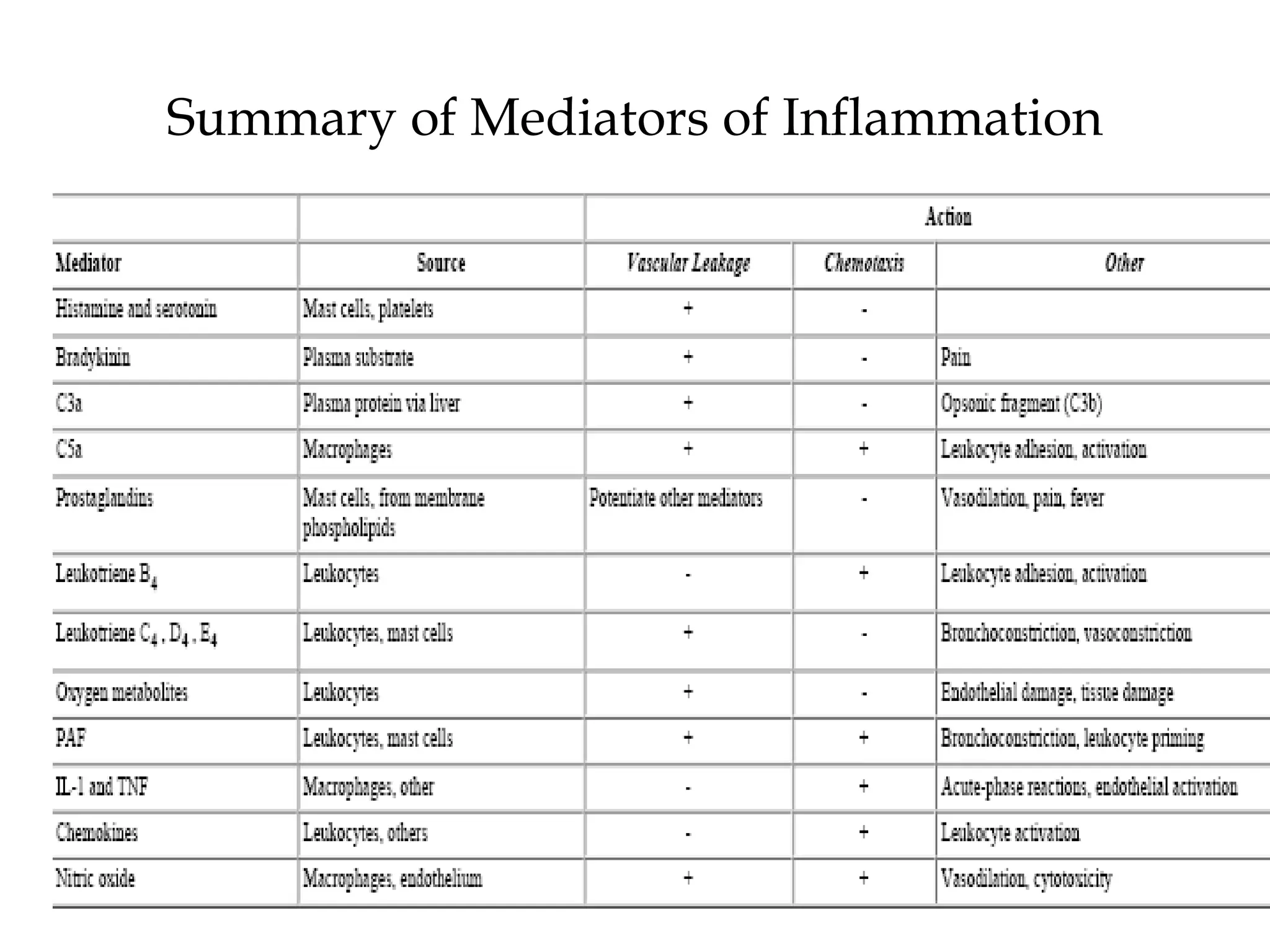
Summary of Mediators of Inflammation
Outcome of Acute Inflammation
• Resolution
• Healing by fibrosis
• Abscess formation
• Progression to chronic inflammation
Chronic Inflammation
Chronic inflammation is considered to be inflammation
of prolonged duration (weeks or months) in which
active inflammation, tissue destruction, and attempts
at repair are proceeding simultaneously. Although it
may follow acute inflammation, chronic inflammation
frequently begins insidiously, as a low-grade,
smoldering, often asymptomatic response.
CAUSES OF CHRONIC INFLAMMATION
Persistent infections by
• tubercle bacilli,
• Treponema pallidum
• certain viruses
• fungi,
• parasites.
. toxic agents, either
exogenous or
endogenous. e.g. silica
(silicosis).
. Atherosclerosis is thought
to be a chronic
inflammatory process of
the arterial wall induced,
at least in part, by
endogenous toxic plasma
lipid components.
. Autoimmunity
MORPHOLOGIC FEATURES
of chronic inflammation
• Infiltration with mononuclear cells, which include
macrophages, lymphocytes, and plasma cells.
• Tissue destruction, induced by the persistent offending
agent or by the inflammatory cells.
• Attempts at healing by connective tissue replacement
of damaged tissue, accomplished by proliferation of
small blood vessels (angiogenesis) and, fibrosis.
GRANULOMATOUS INFLAMMATION
Granulomatous inflammation is a
distinctive pattern of chronic inflammatory
reaction characterized by focal
accumulations of epithelioid cells
surrounded by a collar of mononuclear
leukocytes, principally lymphocytes and
occasionally plasma cells .
. Examples of Diseases with Granulomatous
Inflammations
• Tuberculosis is the prototype of the granulomatous diseases,
• Others are: sarcoidosis,
• cat-scratch disease,
• lymphogranuloma inguinale,
• leprosy,
• brucellosis,
• Syphilis
• mycotic infections
• Berylliosis
• reactions of irritant lipids
Systemic Effects of
Inflammation
 These include:
 -Fever
 -Increased acute-
phase proteins
 -Leukocytosis
-increased pulse and
blood pressure
-decreased sweating
-rigors (shivering)
-chills (search for
warmth)
-anorexia
-somnolence
-malaise
Acute-phase proteins
are plasma proteins, mostly synthesized in the liver, whose
plasma concentrations may increase several hundred-fold as
part of the response to inflammatory stimuli. Three of the best-
known examples of these proteins are C-reactive protein (CRP),
fibrinogen, and serum amyloid A protein (SAA). Synthesis of
these molecules by hepatocytes is upregulated by cytokines,
especially IL-6 (for CRP and fibrinogen) and IL-1 or TNF (for
SAA). Many acute-phase proteins, such as CRP and SAA, bind
to microbial cell walls, and they may act as opsonins and fix
complement.
Consequences of Defective or Excessive
Inflammation
Defective inflammation typically results in increased susceptibility
to infections and delayed healing of wounds and tissue damage.
The susceptibility to infections reflects the fundamental role of
the inflammatory response in host defense, and is the reason
why this response is a central component of the defense
mechanisms that immunologists call innate immunity . Delayed
repair is because the inflammatory response is essential for
clearing damaged tissues and debris, and provides the
necessary stimulus to get the repair process started.
summary
Inflammation is a defensive mechanism, but excessive
inflammation is the basis of many categories of human
diseases. E.g. allergies, autoimmune diseases, Cancer,
atherosclerosis and ischemic heart disease, and some
neurodegenerative diseases such as Alzheimer disease are
associated with inflammation. In addition, prolonged
inflammation and the fibrosis that accompanies it are
responsible for much of the pathology in many chronic
infectious, metabolic and other diseases.

Acute Inflammation.ppt

  • 1.
    introduction • Inflammation isthe response of vascularised connective tissue to injury, characterized by extracellular fluid and leukocyte accumulation. • It is a complex dynamic process intended by Nature as a protective response, which eliminates noxious agents and paves way for repair of damaged tissues. • It results from a delicate interplay between several protagonists and antagonists, and therefore trivial to life-threatening effects may result from excessive or inadequate inflammatory reactions.
  • 2.
    For example • Inflammationis the basis of tissue damage that occurs in hypersensitivity and autoimmune reactions, adult respiratory distress syndrome, crystal diseases, and chronic diseases such as atherosclerosis and pulmonary fibrosis.
  • 3.
    Further • Individuals withspecific deficiencies in leukocyte function and inflammatory responses are susceptible to opportunistic microbial infections.
  • 4.
    Main Types • Inflammationmay be either acute (stereotyped reaction to injury of all types, rapid instantaneous onset, brief duration, characterized by exudation and predominantly neutrophil emigration) or chronic (modulated response to injurious agents that cannot immediately be eliminated, insidious onset, long duration, characterized by concomitant inflammation, attempts at healing and tissue damage).
  • 5.
  • 6.
    Inflammation • This isthe response of living vascularised tissue to injury. • Inflammation is fundamentally a protective response, the ultimate goal of which is to rid the body of both the initial cause of cell injury and the consequences of such injury • The inflammatory process is closely intertwined with the process of repair • Acute inflammation is of relatively short duration, lasting from minutes to a few days & its main characteristics are the exudation of fluid and plasma proteins and the migration of leukocytes
  • 7.
    Historical Highlights • Clinicalfeatures of inflammation were 1st described in an Egyptian papyrus in 300BC • Cardinal signs of inflammation 1. Rubor – Redness 2. Tumor – Swelling 3. Calor – Heat 4. Dolor – Pain 5. Functio laesa – Loss of function added by Virchow
  • 8.
    25/10/2022 8 Acute Inflammation •This is the immediate or early response of living vascularised tissues to an injurious agent. • It has three major components (1) Alteration in vascular caliber that leads to an increase in blood flow. (2) Structural changes in the microvasculature that permits the plasma proteins and leukocytes to leave the circulation. (3) Emigration of the leukocytes from the microcirculation & their accumulation at the focus of injury & their activation to eliminate the offending agent
  • 9.
    Definition of basicterms in inflammation • Exudation- this is the escape of fluids, proteins, and blood cells from the vascular system into the interstitial tissue or body cavities • Exudate- is an inflammatory extravascular fluid that has high protein content, cellular debris and a specific gravity < 1.020 • Transudate- a fluid low in protein content (mainly albumin) and a specific gravity of >1.012. It is essentially an ultra filtrate of blood plasma that results from osmotic or hydrostatic imbalance across the vessel wall without increase in vascular permiability
  • 10.
    • Edema- thisdenotes an excess of fluid in the interstitial or serous cavities, it can be either exudative or transudative. • Pus- a purulent exudate, which is an inflammatory exudate rich in leukocytes (mostly neutrophils), the debris of dead cells and in many cases, microorganisms.
  • 11.
    Stimuli for Acuteinflammation • Infections (bacterial, viral, parasitic) and microbial toxins • Trauma (blunt and penetrating) • Physical and chemical agents (thermal injury eg frost bite burns, irradiation, some environmental chemicals) • Tissue necrosis from any cause • Foreign bodies • Immune reactions (hypersensitivity reactions)
  • 12.
    Events in AcuteInflammation • Vascular events • Cellular events • Chemical mediators of inflammation
  • 13.
    Vascular events • Changesin vascular flow and caliber. • Transient vasoconstriction (inconstant) • Vasodilation • Stasis • Increased vascular permeability
  • 14.
    Stasis • Peripheral orientationof leukocytes • Leukocyte margination • Rolling • pavementing
  • 15.
    Circulating cells andproteins, cells of blood vessels
  • 16.
  • 18.
    Cellular events • Leukocyteextravasation (1) In the lumen – margination, rolling and adhesion (2) Transmigration across the endothelium (diapedisis) (3) Migration in the interstitial tissues towards the chemotactic stimulus
  • 20.
    Adhesion and transmigration •P-selectins – rolling • E-selectins- rolling adhesion to activated endothelium • ICAM-1 - Adhesion, arrest, tranmigration • VCAM-1 – adhesion • GlyCam -1 - Homing
  • 21.
    Chemotaxis • This isthe movement of leukocytes towards the site of injury propelled by a chemical gradient • Chemoattractants – C5a, B4 Cytokins eg IL-8, Bacterial products
  • 22.
    Leukocyte Activation • Productionof arachidonic acid metabolites from phospholipids • Degranulation and secretion of lysosomal enzymes and activation of the oxidative burst • Modulation of leukocyte adhesion molecules
  • 23.
    Phagocytosis • Recognition andattachment – opsonins – C3b, IgG Fc fragment • Engulfment • Killing or degradation
  • 24.
    Chemical mediators of inflammation •Mediators from plasma • Mediators from cells • Most mediators perform by initially binding to specific receptors on target cells • A chemical mediator can stimulate the release of mediators by target cells themselves • Mediators can act on one or few target cell types and have wide spread effect.
  • 25.
    Preformed mediators • Histamine •Serotonin • Lysosomal enzymes • They are produced by mast cells, platelets and neutrophils and macrophages
  • 26.
    Newly synthesized • Prostaglandins •Leukotrienes • Platelet activation factor • Activated O2 species • Nitric Oxide • Cytokins • Produced by all leukocyte
  • 27.
    Complement factors • C3a--Anaphylatoxins • C5a-- ‘’ • C3b • C5b-9 Clotting factor • Factor XII Hageman factor
  • 29.
    Summary of Mediatorsof Inflammation
  • 30.
    Outcome of AcuteInflammation • Resolution • Healing by fibrosis • Abscess formation • Progression to chronic inflammation
  • 31.
    Chronic Inflammation Chronic inflammationis considered to be inflammation of prolonged duration (weeks or months) in which active inflammation, tissue destruction, and attempts at repair are proceeding simultaneously. Although it may follow acute inflammation, chronic inflammation frequently begins insidiously, as a low-grade, smoldering, often asymptomatic response.
  • 32.
    CAUSES OF CHRONICINFLAMMATION Persistent infections by • tubercle bacilli, • Treponema pallidum • certain viruses • fungi, • parasites. . toxic agents, either exogenous or endogenous. e.g. silica (silicosis). . Atherosclerosis is thought to be a chronic inflammatory process of the arterial wall induced, at least in part, by endogenous toxic plasma lipid components. . Autoimmunity
  • 33.
    MORPHOLOGIC FEATURES of chronicinflammation • Infiltration with mononuclear cells, which include macrophages, lymphocytes, and plasma cells. • Tissue destruction, induced by the persistent offending agent or by the inflammatory cells. • Attempts at healing by connective tissue replacement of damaged tissue, accomplished by proliferation of small blood vessels (angiogenesis) and, fibrosis.
  • 34.
    GRANULOMATOUS INFLAMMATION Granulomatous inflammationis a distinctive pattern of chronic inflammatory reaction characterized by focal accumulations of epithelioid cells surrounded by a collar of mononuclear leukocytes, principally lymphocytes and occasionally plasma cells .
  • 35.
    . Examples ofDiseases with Granulomatous Inflammations • Tuberculosis is the prototype of the granulomatous diseases, • Others are: sarcoidosis, • cat-scratch disease, • lymphogranuloma inguinale, • leprosy, • brucellosis, • Syphilis • mycotic infections • Berylliosis • reactions of irritant lipids
  • 36.
    Systemic Effects of Inflammation These include:  -Fever  -Increased acute- phase proteins  -Leukocytosis -increased pulse and blood pressure -decreased sweating -rigors (shivering) -chills (search for warmth) -anorexia -somnolence -malaise
  • 37.
    Acute-phase proteins are plasmaproteins, mostly synthesized in the liver, whose plasma concentrations may increase several hundred-fold as part of the response to inflammatory stimuli. Three of the best- known examples of these proteins are C-reactive protein (CRP), fibrinogen, and serum amyloid A protein (SAA). Synthesis of these molecules by hepatocytes is upregulated by cytokines, especially IL-6 (for CRP and fibrinogen) and IL-1 or TNF (for SAA). Many acute-phase proteins, such as CRP and SAA, bind to microbial cell walls, and they may act as opsonins and fix complement.
  • 38.
    Consequences of Defectiveor Excessive Inflammation Defective inflammation typically results in increased susceptibility to infections and delayed healing of wounds and tissue damage. The susceptibility to infections reflects the fundamental role of the inflammatory response in host defense, and is the reason why this response is a central component of the defense mechanisms that immunologists call innate immunity . Delayed repair is because the inflammatory response is essential for clearing damaged tissues and debris, and provides the necessary stimulus to get the repair process started.
  • 39.
    summary Inflammation is adefensive mechanism, but excessive inflammation is the basis of many categories of human diseases. E.g. allergies, autoimmune diseases, Cancer, atherosclerosis and ischemic heart disease, and some neurodegenerative diseases such as Alzheimer disease are associated with inflammation. In addition, prolonged inflammation and the fibrosis that accompanies it are responsible for much of the pathology in many chronic infectious, metabolic and other diseases.