INTRODUCCTION


       As a compilation of some of the most important topics that we have studied during
the quarter, the intention I want to obtain with this presentation is not only a self-assess
about the gained knowledge but also to share it with my classmates, and at the same time
could serve to the professor as a measurement of the individualized achieving of the initial
courses objectives, y also allow me to storage important material that can be very useful
during all my career.

         From the all topics that we saw; I chose one; which are not exactly the most easily
understood and assimilated to me, if not the opposite; in which I found greater degree of
difficulty and I think is the most extensive and may include or relate to the other ones. It
with the intention of being rechecked important details, in order to can understand them
better and especially to spend a little more time in the practice of them.

        I hope my proposal will help you as much as to me to continue expanding our
English knowledge and that this language every day becomes to be a better tool for our
intellectual and professional development .
VERBAL TENSES


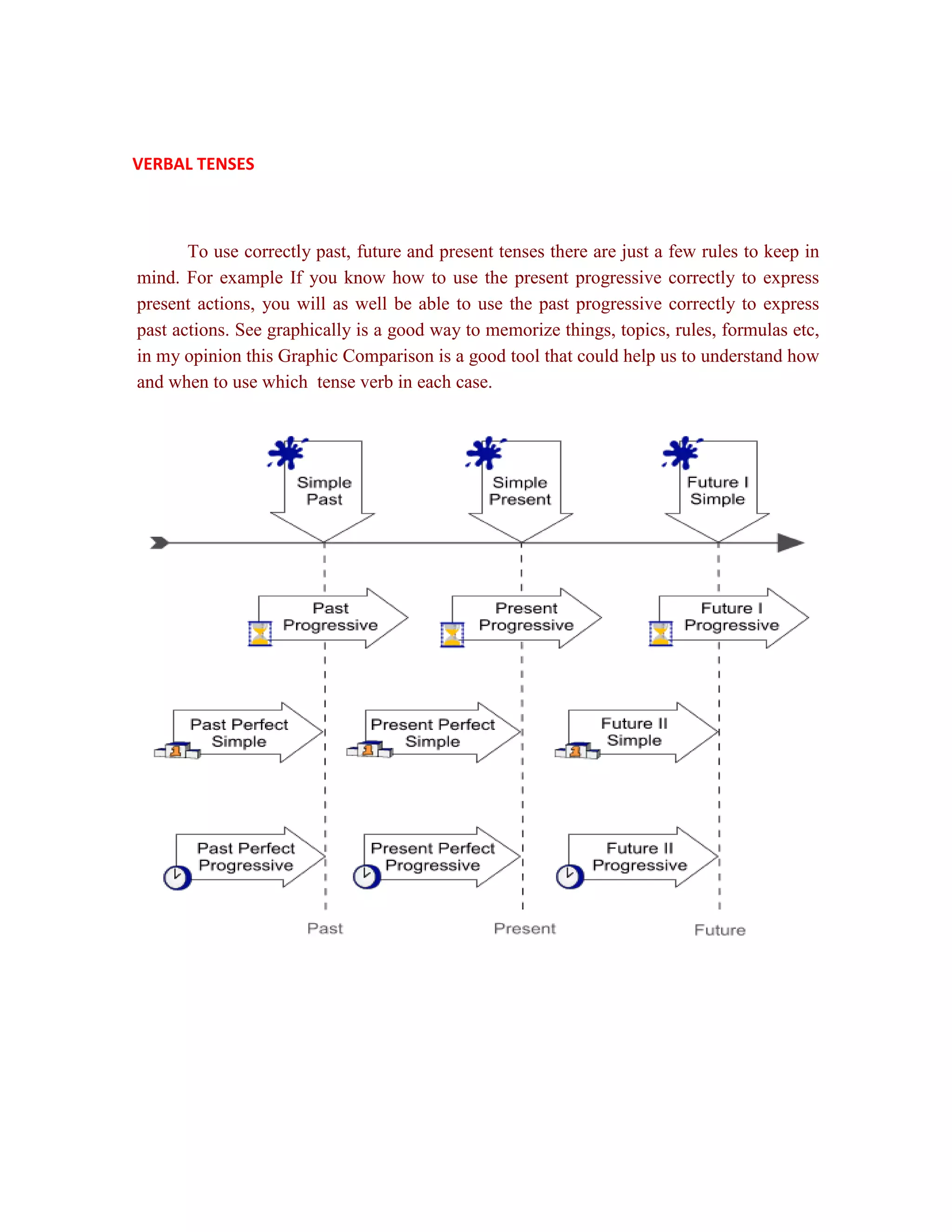
       To use correctly past, future and present tenses there are just a few rules to keep in
mind. For example If you know how to use the present progressive correctly to express
present actions, you will as well be able to use the past progressive correctly to express
past actions. See graphically is a good way to memorize things, topics, rules, formulas etc,
in my opinion this Graphic Comparison is a good tool that could help us to understand how
and when to use which tense verb in each case.
Legend
                         action that takes place once, never or several times
                         actions that happen one after another
    moment in time       actions that suddenly take place

                         action that started before a certain moment and lasts beyond that moment
                         actions taking place at the same time
    period of time

                         action taking place before a certain moment in time
        Result           puts emphasis on the result

                         action taking place before a certain moment in time

 Course / Duration       puts emphasis on the course or duration of the action

Graphic was downloaded from; URL http://grupos.emagister.com/ficheros/dspflashview?idFichero=117501


Explanation and examples

                                             Past                                        Present                                 Future


                          Simple Past , regular verb to                   Simple Present, I, you, we,                   Future I Simple,
Explanation
                          add e, irregular verbs in past                    and They, verb in base                         will /going to
                                     tense, d                             form, for she, he and it. to
                                                                                                                           + in base form
                                                                                     add s
                            Neg. form; didn`t + verb in                   Neg. form;, I, you, we, and
                                                                          They don`t, she, he and it.              Neg. form Will not/wont
                                   based form
                                                                          doesn`t + verb in based                     + verb in based form
                                                                          form
E    Regular Verb         He played football last night.                  They like (she likes) to play He (we) will / is (are)
X                                                                         guitar.                       going to buy a new car.
A    Irregular Verb       She saw a tiger when she                                                                The same rule to regular (i) verb, it
                                                                                                                  doesn`t require conjugation
M                         went to Africa.                                 The same rule to regular (i) verb, it
                                                                          doesn`t require conjugation
P
L    Negative             He didn`t move his hand                         We don’t play guitar                    He will not/wont to buy a
E    Regular Verb                                                         It doesn`t mean nothing                 new car
S
     Negative Irregular   The same rule to regular (i) verb, it doesn`t   The same rule to regular (i) verb, it   The same rule to regular (i) verb, it
                          require conjugation                             doesn`t require conjugation             doesn`t require conjugation.
     Verb

                          Past Progressive, verb to be                     Present Progressive verb               Future I Progressive will
Explanation                (was, were) + verb in ing                       to be(m, is, are,) + verb in            /going to + verb to be +
                                                                                        ing                              verb in ing


E    Regular Verb         He was, (They were)                             They are (I`m) (she is)                 He (they ) will / is (are)
X                    watching TV last night.                         speaking about your                     going to be studying
A                                                                    amazing presentation                    tomorrow during the
M                                                                                                            morning.
P Irregular Verb     The same rule to regular (i) verb, it doesn`t   The same rule to regular (i) verb, it
                     require conjugation                             doesn`t require conjugation
L                                                                                                            The same rule to regular (i) verb, it
E                                                                                                            doesn`t require conjugation
S Negative           He wasn`t (they weren`t)                        We aren’t (she is not )                 He (they) will not/wont to
  Regular Verb       watching TV last night                          playing guitar                          to be studying tomorrow
                                                                                                             during the morning.


    Negative         The same rule to regular (i) verb, it doesn`t   The same rule to regular (i) verb, it   The same rule to regular (i) verb, it
                     require conjugation                             doesn`t require conjugation             doesn`t require conjugation.
    Iregular Verb


                       Past Perfect Simple had +                        Present Perfect Simple                     Future II Simple
Explanation             past participle not more                        She, he it (has) We They                   Will have + past
                                                                        (have) + past participle                      participle
                                                                               continues
    Regular Verb     She had loved her friend                        He has (we have) started to             She will have worked in
                     until today .                                   work in the first project               the first project


    Irregular Verb   He had won five matches                         He has (we have) won five               He will have won five
                     until that day.                                 matches so far.                         matches by then.
E
X
A
  Negative           She hadn`t loved her friend                     We haven`t speak with our               She won’t have worked in
M
  Regular Verb       until today                                     fiend.                                  the first project.
P
L
E
  Negative           He hadn`t won any matches                       We haven`t see any giraffe              He wont have won
S
  Irregular Verb     until that day.                                 In our couentry                         matches by then.


                     Past Perfect Progressive had      Present Perfect           Future II Progressive
Explanation                been + verb in ing     Progressive She, he, it ( has She, he, it ( will has been
                                                    been ), We , they (have      ), We , they ( will have
                                                      been) + verb in ing           been) + verb in ing

E Regular Verb       He had been playing singing                     He has (they have) been                 He will have been playing
X                    the same song until she                         singing the same song                   football for ten years.
A                    learned new one.                                during all our vacations
M
                     The same rule to regular (i) verb, it doesn`t   The same rule to regular (i) verb, it   The same rule to regular (i) verb, it
P Irregular Verb     require conjugation                             doesn`t                                 doesn`
L
E
S
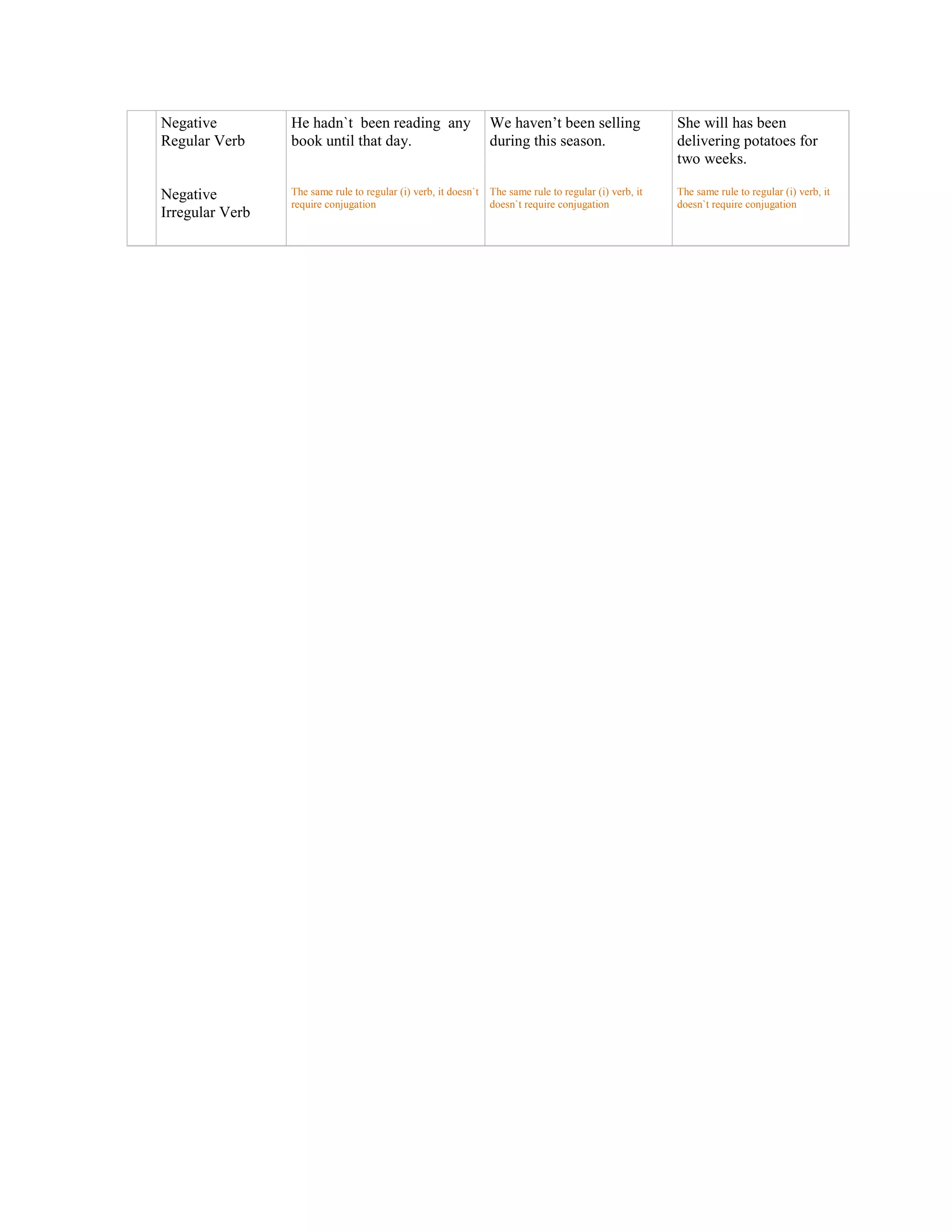
Negative         He hadn`t been reading any                      We haven’t been selling                 She will has been
Regular Verb     book until that day.                            during this season.                     delivering potatoes for
                                                                                                         two weeks.

Negative         The same rule to regular (i) verb, it doesn`t   The same rule to regular (i) verb, it   The same rule to regular (i) verb, it
                 require conjugation                             doesn`t require conjugation             doesn`t require conjugation
Irregular Verb

Proyecto final grammar 2

  • 1.
    INTRODUCCTION As a compilation of some of the most important topics that we have studied during the quarter, the intention I want to obtain with this presentation is not only a self-assess about the gained knowledge but also to share it with my classmates, and at the same time could serve to the professor as a measurement of the individualized achieving of the initial courses objectives, y also allow me to storage important material that can be very useful during all my career. From the all topics that we saw; I chose one; which are not exactly the most easily understood and assimilated to me, if not the opposite; in which I found greater degree of difficulty and I think is the most extensive and may include or relate to the other ones. It with the intention of being rechecked important details, in order to can understand them better and especially to spend a little more time in the practice of them. I hope my proposal will help you as much as to me to continue expanding our English knowledge and that this language every day becomes to be a better tool for our intellectual and professional development .
  • 2.
    VERBAL TENSES To use correctly past, future and present tenses there are just a few rules to keep in mind. For example If you know how to use the present progressive correctly to express present actions, you will as well be able to use the past progressive correctly to express past actions. See graphically is a good way to memorize things, topics, rules, formulas etc, in my opinion this Graphic Comparison is a good tool that could help us to understand how and when to use which tense verb in each case.
  • 3.
    Legend  action that takes place once, never or several times  actions that happen one after another moment in time  actions that suddenly take place  action that started before a certain moment and lasts beyond that moment  actions taking place at the same time period of time  action taking place before a certain moment in time Result  puts emphasis on the result  action taking place before a certain moment in time Course / Duration  puts emphasis on the course or duration of the action Graphic was downloaded from; URL http://grupos.emagister.com/ficheros/dspflashview?idFichero=117501 Explanation and examples Past Present Future Simple Past , regular verb to Simple Present, I, you, we, Future I Simple, Explanation add e, irregular verbs in past and They, verb in base will /going to tense, d form, for she, he and it. to + in base form add s Neg. form; didn`t + verb in Neg. form;, I, you, we, and They don`t, she, he and it. Neg. form Will not/wont based form doesn`t + verb in based + verb in based form form E Regular Verb He played football last night. They like (she likes) to play He (we) will / is (are) X guitar. going to buy a new car. A Irregular Verb She saw a tiger when she The same rule to regular (i) verb, it doesn`t require conjugation M went to Africa. The same rule to regular (i) verb, it doesn`t require conjugation P L Negative He didn`t move his hand We don’t play guitar He will not/wont to buy a E Regular Verb It doesn`t mean nothing new car S Negative Irregular The same rule to regular (i) verb, it doesn`t The same rule to regular (i) verb, it The same rule to regular (i) verb, it require conjugation doesn`t require conjugation doesn`t require conjugation. Verb Past Progressive, verb to be Present Progressive verb Future I Progressive will Explanation (was, were) + verb in ing to be(m, is, are,) + verb in /going to + verb to be + ing verb in ing E Regular Verb He was, (They were) They are (I`m) (she is) He (they ) will / is (are)
  • 4.
    X watching TV last night. speaking about your going to be studying A amazing presentation tomorrow during the M morning. P Irregular Verb The same rule to regular (i) verb, it doesn`t The same rule to regular (i) verb, it require conjugation doesn`t require conjugation L The same rule to regular (i) verb, it E doesn`t require conjugation S Negative He wasn`t (they weren`t) We aren’t (she is not ) He (they) will not/wont to Regular Verb watching TV last night playing guitar to be studying tomorrow during the morning. Negative The same rule to regular (i) verb, it doesn`t The same rule to regular (i) verb, it The same rule to regular (i) verb, it require conjugation doesn`t require conjugation doesn`t require conjugation. Iregular Verb Past Perfect Simple had + Present Perfect Simple Future II Simple Explanation past participle not more She, he it (has) We They Will have + past (have) + past participle participle continues Regular Verb She had loved her friend He has (we have) started to She will have worked in until today . work in the first project the first project Irregular Verb He had won five matches He has (we have) won five He will have won five until that day. matches so far. matches by then. E X A Negative She hadn`t loved her friend We haven`t speak with our She won’t have worked in M Regular Verb until today fiend. the first project. P L E Negative He hadn`t won any matches We haven`t see any giraffe He wont have won S Irregular Verb until that day. In our couentry matches by then. Past Perfect Progressive had Present Perfect Future II Progressive Explanation been + verb in ing Progressive She, he, it ( has She, he, it ( will has been been ), We , they (have ), We , they ( will have been) + verb in ing been) + verb in ing E Regular Verb He had been playing singing He has (they have) been He will have been playing X the same song until she singing the same song football for ten years. A learned new one. during all our vacations M The same rule to regular (i) verb, it doesn`t The same rule to regular (i) verb, it The same rule to regular (i) verb, it P Irregular Verb require conjugation doesn`t doesn` L E S
  • 5.
    Negative He hadn`t been reading any We haven’t been selling She will has been Regular Verb book until that day. during this season. delivering potatoes for two weeks. Negative The same rule to regular (i) verb, it doesn`t The same rule to regular (i) verb, it The same rule to regular (i) verb, it require conjugation doesn`t require conjugation doesn`t require conjugation Irregular Verb