
Infinitives after
Certain Verbs
The Life of an
English Student
10
Focus on Grammar 3
Part VII, Unit 29
By Ruth Luman, Gabriele Steiner, and BJ Wells
Copyright © 2006. Pearson Education, Inc. All rights reserved.
What Students Are Thinking
I want to learn.
I hope to succeed.
I promise to study
hard.
I try to get only “A”
grades!
I refuse to give up.
I plan to get to class
on time.
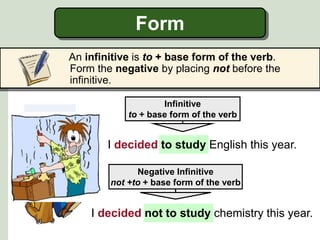
I decided to study English this year.
Form
An infinitive is to + base form of the verb.
Form the negative by placing not before the
infinitive.
Infinitive
to + base form of the verb
Negative Infinitive
not +to + base form of the verb
I decided not to study chemistry this year.
Infinitives after Verbs 1
Certain verbs can be followed by an infinitive.
I want to get a good grade in my English
class.
I told her to go to bed.
Infinitive
Examples: ask, advise, tell, want
Infinitive
Infinitives after Verbs 2
Some verbs can be followed directly by an
infinitive.
He is learning to spell correctly.
He refuses to be uncomfortable
when studying.
Infinitive
Examples: begin, decide, fail, learn, plan, promise, refuse, seem, try
Infinitive
Infinitives after Objects 1
Some verbs need an object (noun or
pronoun) before the infinitive.
Our teacher advises them to take notes.
She doesn’t allow students to do
their homework in class.
Infinitive
Examples: advise, allow, encourage, force, invite, remind, tell, warn
Object
InfinitiveObject
Infinitives after Objects 2
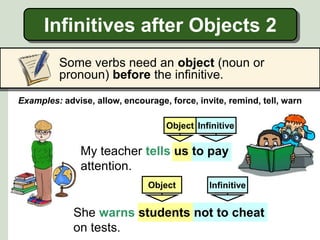
Some verbs need an object (noun or
pronoun) before the infinitive.
My teacher tells us to pay
attention.
She warns students not to cheat
on tests.
Infinitive
Examples: advise, allow, encourage, force, invite, remind, tell, warn
Object
InfinitiveObject
Complete the sentences with
infinitives and your own
information. Use objects where
needed.
Maria invited …
Practice 1
Maria invited me to go to a party with her.
1. I promised …
2. My mother plans …
3. Our teacher encourages …
4. My friends decided …
5. My father always tells …
Example:
Infinitives with or without Objects
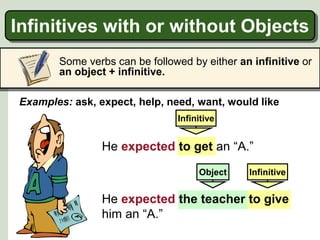
Some verbs can be followed by either an infinitive or
an object + infinitive.
He expected to get an “A.”
He expected the teacher to give
him an “A.”
Infinitive
Examples: ask, expect, help, need, want, would like
InfinitiveObject
Form sentences with the verbs. Use
infinitives and use each verb twice:
First without an object, and then
with an object.
I expected to do well on the test.
Practice 2
expect
need
help
would like
ask
1.
2.
3.
4.
Example:
My teacher expected me to do well on the test.
without object
with object
References
Copyright © 2006 Pearson Education
and its licensors. All rights reserved.

Infinitives after-certain-verbs

  • 1.
    Infinitives after Certain Verbs TheLife of an English Student 10 Focus on Grammar 3 Part VII, Unit 29 By Ruth Luman, Gabriele Steiner, and BJ Wells Copyright © 2006. Pearson Education, Inc. All rights reserved.
  • 2.
    What Students AreThinking I want to learn. I hope to succeed. I promise to study hard. I try to get only “A” grades! I refuse to give up. I plan to get to class on time.
  • 3.
    I decided tostudy English this year. Form An infinitive is to + base form of the verb. Form the negative by placing not before the infinitive. Infinitive to + base form of the verb Negative Infinitive not +to + base form of the verb I decided not to study chemistry this year.
  • 4.
    Infinitives after Verbs1 Certain verbs can be followed by an infinitive. I want to get a good grade in my English class. I told her to go to bed. Infinitive Examples: ask, advise, tell, want Infinitive
  • 5.
    Infinitives after Verbs2 Some verbs can be followed directly by an infinitive. He is learning to spell correctly. He refuses to be uncomfortable when studying. Infinitive Examples: begin, decide, fail, learn, plan, promise, refuse, seem, try Infinitive
  • 6.
    Infinitives after Objects1 Some verbs need an object (noun or pronoun) before the infinitive. Our teacher advises them to take notes. She doesn’t allow students to do their homework in class. Infinitive Examples: advise, allow, encourage, force, invite, remind, tell, warn Object InfinitiveObject
  • 7.
    Infinitives after Objects2 Some verbs need an object (noun or pronoun) before the infinitive. My teacher tells us to pay attention. She warns students not to cheat on tests. Infinitive Examples: advise, allow, encourage, force, invite, remind, tell, warn Object InfinitiveObject
  • 8.
    Complete the sentenceswith infinitives and your own information. Use objects where needed. Maria invited … Practice 1 Maria invited me to go to a party with her. 1. I promised … 2. My mother plans … 3. Our teacher encourages … 4. My friends decided … 5. My father always tells … Example:
  • 9.
    Infinitives with orwithout Objects Some verbs can be followed by either an infinitive or an object + infinitive. He expected to get an “A.” He expected the teacher to give him an “A.” Infinitive Examples: ask, expect, help, need, want, would like InfinitiveObject
  • 10.
    Form sentences withthe verbs. Use infinitives and use each verb twice: First without an object, and then with an object. I expected to do well on the test. Practice 2 expect need help would like ask 1. 2. 3. 4. Example: My teacher expected me to do well on the test. without object with object
  • 11.
    References Copyright © 2006Pearson Education and its licensors. All rights reserved.