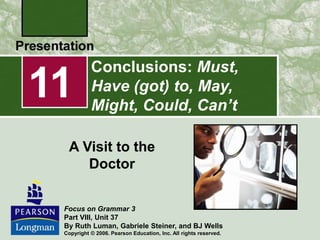
Conclusions: Must,
Have (got) to, May,
Might, Could, Can’t
A Visit to the
Doctor
11
Focus on Grammar 3
Part VIII, Unit 37
By Ruth Luman, Gabriele Steiner, and BJ Wells
Copyright © 2006. Pearson Education, Inc. All rights reserved.
Am I OK?
So, what
seems to be
the problem?
Well, I have
terrible pain
in my
stomach.
What could
the problem
be?
We’ll need to
take some
X-rays and
do some
tests to find
out.
There are
several
possibilities.
Meaning
We often make guesses and draw conclusions about
present situations using the information we have.
We use modals to show how
certain or uncertain we are
about our conclusions.
must
have (got) to
may
might, could
can’t, couldn’t
must not
may not
might not
100% Certain
0% Certain
Positive Negative
Affirmative Conclusions
When we are almost 100% certain, we use must, have
to, or have got to to state affirmative conclusions.
I looked at all the test
results, and I talked to the
patient. I believe that…
Mr. Jones must have
an ulcer.
He has to be in pain.
He’s got to be very
uncomfortable.
Possibilities
When we are less certain about our conclusion, we use may,
might, or could to express that something is possible.
I see something
unusual.
Mr. Jones could have
an ulcer.
He may have an
infection.
He might be very
sick.
Practice 1
Look at each part of the photograph one
at a time. Try to guess what it is.
Increase the certainty of your guesses by
using the appropriate modals.
must
have (got) to
may
might, could
100% Certain
0% Certain
An X-ray of the heart
and lungs.
This might be …
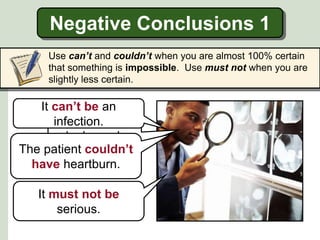
Negative Conclusions 1
Use can’t and couldn’t when you are almost 100% certain
that something is impossible. Use must not when you are
slightly less certain.
The X-rays
look good.
It can’t be an
infection.
The patient couldn’t
have heartburn.
It must not be
serious.
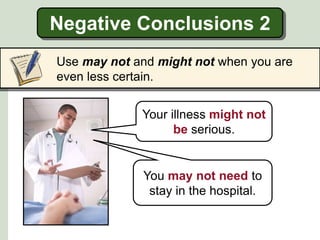
Use may not and might not when you are
even less certain.
Negative Conclusions 2
Your illness might not
be serious.
You may not need to
stay in the hospital.
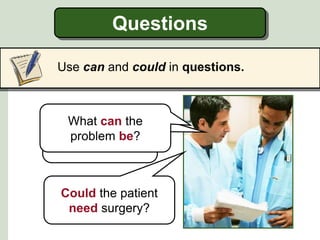
Questions
Use can and could in questions.
The test results
are not clear.
What can the
problem be?
Could the patient
need surgery?
It may be a
feather.
What could
it be?
5.
It can’t be
skin.
Practice 2
Look at the objects under a
microscope. Ask and answer
questions about possibility. Use
positive and negative modals.
stomach of a spider eye of an insect a feather
cotton fibers tongue of a snail skin
Example:
It must be
cotton fibers.
1. 2.
3. 4.
(Example) (#1)
(#2) (#3)
(#4)
(#5)
Short Answers
He may not.
The surgeon
might
operate first.
In short answers, use a modal alone.
Does the
patient
have a
broken
bone?
Does he
need a
cast?He has to.
He was in a
serious
accident.
Be Careful!
Use be in short answers to questions that
include be.
Oh wait. It
has to be.
I see the
brain stem.
Could that
be an image
of my brain?
I’m not sure.
It might be.
Practice 3
Ask and answer questions
about the X-rays. Use
short answers.
Possible Questions
Could X-ray # ___ be a ___?
Can X-ray #___ be a ___?
Possible Answers
It has to be./It’s got to be.
It may/might/could be.
knee brain
1. 2.
Example:
shoulder
It might be.
Could that X-ray
be a knee?
Copyright © 2006 Pearson Education and
its licensors. All rights reserved.
References

Modals deduction conclusions present

  • 1.
    Conclusions: Must, Have (got)to, May, Might, Could, Can’t A Visit to the Doctor 11 Focus on Grammar 3 Part VIII, Unit 37 By Ruth Luman, Gabriele Steiner, and BJ Wells Copyright © 2006. Pearson Education, Inc. All rights reserved.
  • 2.
    Am I OK? So,what seems to be the problem? Well, I have terrible pain in my stomach. What could the problem be? We’ll need to take some X-rays and do some tests to find out. There are several possibilities.
  • 3.
    Meaning We often makeguesses and draw conclusions about present situations using the information we have. We use modals to show how certain or uncertain we are about our conclusions. must have (got) to may might, could can’t, couldn’t must not may not might not 100% Certain 0% Certain Positive Negative
  • 4.
    Affirmative Conclusions When weare almost 100% certain, we use must, have to, or have got to to state affirmative conclusions. I looked at all the test results, and I talked to the patient. I believe that… Mr. Jones must have an ulcer. He has to be in pain. He’s got to be very uncomfortable.
  • 5.
    Possibilities When we areless certain about our conclusion, we use may, might, or could to express that something is possible. I see something unusual. Mr. Jones could have an ulcer. He may have an infection. He might be very sick.
  • 6.
    Practice 1 Look ateach part of the photograph one at a time. Try to guess what it is. Increase the certainty of your guesses by using the appropriate modals. must have (got) to may might, could 100% Certain 0% Certain An X-ray of the heart and lungs. This might be …
  • 7.
    Negative Conclusions 1 Usecan’t and couldn’t when you are almost 100% certain that something is impossible. Use must not when you are slightly less certain. The X-rays look good. It can’t be an infection. The patient couldn’t have heartburn. It must not be serious.
  • 8.
    Use may notand might not when you are even less certain. Negative Conclusions 2 Your illness might not be serious. You may not need to stay in the hospital.
  • 9.
    Questions Use can andcould in questions. The test results are not clear. What can the problem be? Could the patient need surgery?
  • 10.
    It may bea feather. What could it be? 5. It can’t be skin. Practice 2 Look at the objects under a microscope. Ask and answer questions about possibility. Use positive and negative modals. stomach of a spider eye of an insect a feather cotton fibers tongue of a snail skin Example: It must be cotton fibers. 1. 2. 3. 4. (Example) (#1) (#2) (#3) (#4) (#5)
  • 11.
    Short Answers He maynot. The surgeon might operate first. In short answers, use a modal alone. Does the patient have a broken bone? Does he need a cast?He has to. He was in a serious accident.
  • 12.
    Be Careful! Use bein short answers to questions that include be. Oh wait. It has to be. I see the brain stem. Could that be an image of my brain? I’m not sure. It might be.
  • 13.
    Practice 3 Ask andanswer questions about the X-rays. Use short answers. Possible Questions Could X-ray # ___ be a ___? Can X-ray #___ be a ___? Possible Answers It has to be./It’s got to be. It may/might/could be. knee brain 1. 2. Example: shoulder It might be. Could that X-ray be a knee?
  • 14.
    Copyright © 2006Pearson Education and its licensors. All rights reserved. References