Verbals: Infinitives
p. 76
Infinitives
verbals that act like adjectives, adverbs, and nouns.
Infinitives
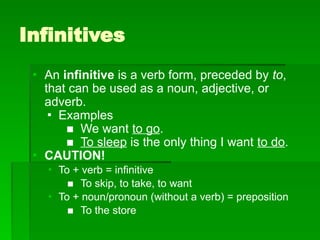
▪ An infinitive is a verb form, preceded by to,
that can be used as a noun, adjective, or
adverb.
▪ Examples
■ We want to go.
■ To sleep is the only thing I want to do.
▪ CAUTION!
▪ To + verb = infinitive
■ To skip, to take, to want
▪ To + noun/pronoun (without a verb) = preposition
■ To the store
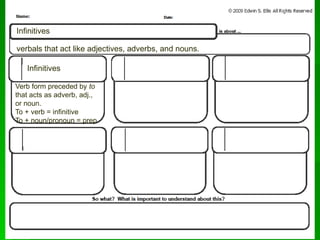
Infinitives
verbals that act like adjectives, adverbs, and nouns.
Infinitives
Verb form preceded by to
that acts as adverb, adj.,
or noun.
To + verb = infinitive
To + noun/pronoun = prep
Infinitive Phrases
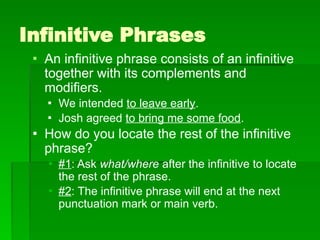
▪ An infinitive phrase consists of an infinitive
together with its complements and
modifiers.
▪ We intended to leave early.
▪ Josh agreed to bring me some food.
▪ How do you locate the rest of the infinitive
phrase?
▪ #1: Ask what/where after the infinitive to locate
the rest of the phrase.
▪ #2: The infinitive phrase will end at the next
punctuation mark or main verb.
Caution: Infinitive Phrases
▪ An infinitive can include other phrases
▪ prepositional phrases
▪ participial phrases
▪ gerund phrases
▪ Examples
▪ To be objective in my decision is hard.
▪ The foundation sponsors clinics to help
children with golf.
▪ To make a living as a golfer is no easy
task.
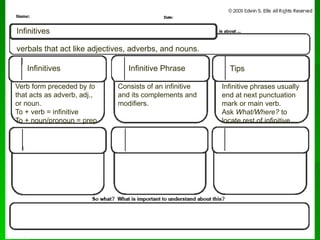
Infinitives
verbals that act like adjectives, adverbs, and nouns.
Infinitives
Verb form preceded by to
that acts as adverb, adj.,
or noun.
To + verb = infinitive
To + noun/pronoun = prep
Infinitive Phrase
Consists of an infinitive
and its complements and
modifiers.
Infinitive phrases usually
end at next punctuation
mark or main verb.
Ask What/Where? to
locate rest of infinitive
Tips
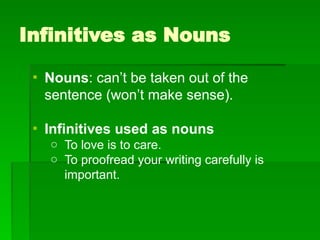
Infinitives as Nouns
▪ Nouns: can’t be taken out of the
sentence (won’t make sense).
▪ Infinitives used as nouns
○ To love is to care.
○ To proofread your writing carefully is
important.
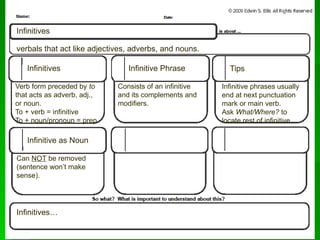
Infinitives
verbals that act like adjectives, adverbs, and nouns.
Infinitives
Verb form preceded by to
that acts as adverb, adj.,
or noun.
To + verb = infinitive
To + noun/pronoun = prep
Infinitive Phrase
Consists of an infinitive
and its complements and
modifiers.
Tips
Infinitive as Noun
Can NOT be removed
(sentence won’t make
sense).
Infinitives…
Infinitive phrases usually
end at next punctuation
mark or main verb.
Ask What/Where? to
locate rest of infinitive
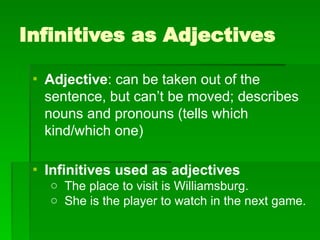
Infinitives as Adjectives
▪ Adjective: can be taken out of the
sentence, but can’t be moved; describes
nouns and pronouns (tells which
kind/which one)
▪ Infinitives used as adjectives
○ The place to visit is Williamsburg.
○ She is the player to watch in the next game.
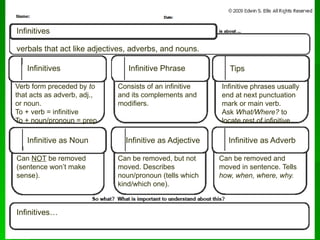
Infinitives
verbals that act like adjectives, adverbs, and nouns.
Infinitives
Verb form preceded by to
that acts as adverb, adj.,
or noun.
To + verb = infinitive
To + noun/pronoun = prep
Infinitive Phrase
Consists of an infinitive
and its complements and
modifiers.
Tips
Infinitive as Noun Infinitive as Adjective
Can NOT be removed
(sentence won’t make
sense).
Can be removed, but not
moved. Describes
noun/pronoun (tells which
kind/which one).
Infinitives…
Infinitive phrases usually
end at next punctuation
mark or main verb.
Ask What/Where? to
locate rest of infinitive
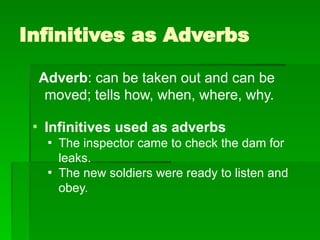
Infinitives as Adverbs
Adverb: can be taken out and can be
moved; tells how, when, where, why.
▪ Infinitives used as adverbs
▪ The inspector came to check the dam for
leaks.
▪ The new soldiers were ready to listen and
obey.
Infinitives
verbals that act like adjectives, adverbs, and nouns.
Infinitives
Verb form preceded by to
that acts as adverb, adj.,
or noun.
To + verb = infinitive
To + noun/pronoun = prep
Infinitive Phrase
Consists of an infinitive
and its complements and
modifiers.
Tips
Infinitive as Noun Infinitive as Adjective
Can NOT be removed
(sentence won’t make
sense).
Can be removed, but not
moved. Describes
noun/pronoun (tells which
kind/which one).
Infinitives…
Can be removed and
moved in sentence. Tells
how, when, where, why.
Infinitive as Adverb
Infinitive phrases usually
end at next punctuation
mark or main verb.
Ask What/Where? to
locate rest of infinitive
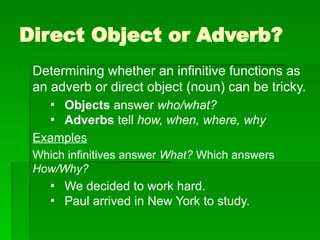
Direct Object or Adverb?
Determining whether an infinitive functions as
an adverb or direct object (noun) can be tricky.
▪ Objects answer who/what?
▪ Adverbs tell how, when, where, why
Examples
Which infinitives answer What? Which answers
How/Why?
▪ We decided to work hard.
▪ Paul arrived in New York to study.
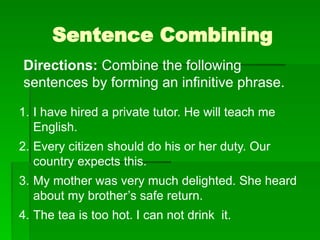
Sentence Combining
Directions: Combine the following
sentences by forming an infinitive phrase.
1. I have hired a private tutor. He will teach me
English.
2. Every citizen should do his or her duty. Our
country expects this.
3. My mother was very much delighted. She heard
about my brother’s safe return.
4. The tea is too hot. I can not drink it.
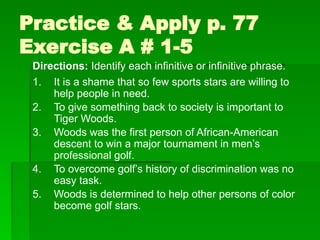
Practice & Apply p. 77
Exercise A # 1-5
Directions: Identify each infinitive or infinitive phrase.
1. It is a shame that so few sports stars are willing to
help people in need.
2. To give something back to society is important to
Tiger Woods.
3. Woods was the first person of African-American
descent to win a major tournament in men’s
professional golf.
4. To overcome golf’s history of discrimination was no
easy task.
5. Woods is determined to help other persons of color
become golf stars.

Infinitives in English: Its uses, types, and examples

  • 1.
  • 2.
    Infinitives verbals that actlike adjectives, adverbs, and nouns.
  • 3.
    Infinitives ▪ An infinitiveis a verb form, preceded by to, that can be used as a noun, adjective, or adverb. ▪ Examples ■ We want to go. ■ To sleep is the only thing I want to do. ▪ CAUTION! ▪ To + verb = infinitive ■ To skip, to take, to want ▪ To + noun/pronoun (without a verb) = preposition ■ To the store
  • 4.
    Infinitives verbals that actlike adjectives, adverbs, and nouns. Infinitives Verb form preceded by to that acts as adverb, adj., or noun. To + verb = infinitive To + noun/pronoun = prep
  • 5.
    Infinitive Phrases ▪ Aninfinitive phrase consists of an infinitive together with its complements and modifiers. ▪ We intended to leave early. ▪ Josh agreed to bring me some food. ▪ How do you locate the rest of the infinitive phrase? ▪ #1: Ask what/where after the infinitive to locate the rest of the phrase. ▪ #2: The infinitive phrase will end at the next punctuation mark or main verb.
  • 6.
    Caution: Infinitive Phrases ▪An infinitive can include other phrases ▪ prepositional phrases ▪ participial phrases ▪ gerund phrases ▪ Examples ▪ To be objective in my decision is hard. ▪ The foundation sponsors clinics to help children with golf. ▪ To make a living as a golfer is no easy task.
  • 7.
    Infinitives verbals that actlike adjectives, adverbs, and nouns. Infinitives Verb form preceded by to that acts as adverb, adj., or noun. To + verb = infinitive To + noun/pronoun = prep Infinitive Phrase Consists of an infinitive and its complements and modifiers. Infinitive phrases usually end at next punctuation mark or main verb. Ask What/Where? to locate rest of infinitive Tips
  • 8.
    Infinitives as Nouns ▪Nouns: can’t be taken out of the sentence (won’t make sense). ▪ Infinitives used as nouns ○ To love is to care. ○ To proofread your writing carefully is important.
  • 9.
    Infinitives verbals that actlike adjectives, adverbs, and nouns. Infinitives Verb form preceded by to that acts as adverb, adj., or noun. To + verb = infinitive To + noun/pronoun = prep Infinitive Phrase Consists of an infinitive and its complements and modifiers. Tips Infinitive as Noun Can NOT be removed (sentence won’t make sense). Infinitives… Infinitive phrases usually end at next punctuation mark or main verb. Ask What/Where? to locate rest of infinitive
  • 10.
    Infinitives as Adjectives ▪Adjective: can be taken out of the sentence, but can’t be moved; describes nouns and pronouns (tells which kind/which one) ▪ Infinitives used as adjectives ○ The place to visit is Williamsburg. ○ She is the player to watch in the next game.
  • 11.
    Infinitives verbals that actlike adjectives, adverbs, and nouns. Infinitives Verb form preceded by to that acts as adverb, adj., or noun. To + verb = infinitive To + noun/pronoun = prep Infinitive Phrase Consists of an infinitive and its complements and modifiers. Tips Infinitive as Noun Infinitive as Adjective Can NOT be removed (sentence won’t make sense). Can be removed, but not moved. Describes noun/pronoun (tells which kind/which one). Infinitives… Infinitive phrases usually end at next punctuation mark or main verb. Ask What/Where? to locate rest of infinitive
  • 12.
    Infinitives as Adverbs Adverb:can be taken out and can be moved; tells how, when, where, why. ▪ Infinitives used as adverbs ▪ The inspector came to check the dam for leaks. ▪ The new soldiers were ready to listen and obey.
  • 13.
    Infinitives verbals that actlike adjectives, adverbs, and nouns. Infinitives Verb form preceded by to that acts as adverb, adj., or noun. To + verb = infinitive To + noun/pronoun = prep Infinitive Phrase Consists of an infinitive and its complements and modifiers. Tips Infinitive as Noun Infinitive as Adjective Can NOT be removed (sentence won’t make sense). Can be removed, but not moved. Describes noun/pronoun (tells which kind/which one). Infinitives… Can be removed and moved in sentence. Tells how, when, where, why. Infinitive as Adverb Infinitive phrases usually end at next punctuation mark or main verb. Ask What/Where? to locate rest of infinitive
  • 14.
    Direct Object orAdverb? Determining whether an infinitive functions as an adverb or direct object (noun) can be tricky. ▪ Objects answer who/what? ▪ Adverbs tell how, when, where, why Examples Which infinitives answer What? Which answers How/Why? ▪ We decided to work hard. ▪ Paul arrived in New York to study.
  • 15.
    Sentence Combining Directions: Combinethe following sentences by forming an infinitive phrase. 1. I have hired a private tutor. He will teach me English. 2. Every citizen should do his or her duty. Our country expects this. 3. My mother was very much delighted. She heard about my brother’s safe return. 4. The tea is too hot. I can not drink it.
  • 16.
    Practice & Applyp. 77 Exercise A # 1-5 Directions: Identify each infinitive or infinitive phrase. 1. It is a shame that so few sports stars are willing to help people in need. 2. To give something back to society is important to Tiger Woods. 3. Woods was the first person of African-American descent to win a major tournament in men’s professional golf. 4. To overcome golf’s history of discrimination was no easy task. 5. Woods is determined to help other persons of color become golf stars.