Infinispan
from POC to Production
Who am I?
   Mark Addy, Senior Consultant


Fast, Reliable, Secure, Manageable
Agenda
Part 1
• An existing production system unable to scale


Part 2
• A green-field project unable to meet SLA’s
About the Customer
• Global on-line travel & accommodation
  provider
  – 50 million searches per day
• Our relationship
  – Troubleshooting
  – Workshops
Part 1


         Part 1 – Existing Application
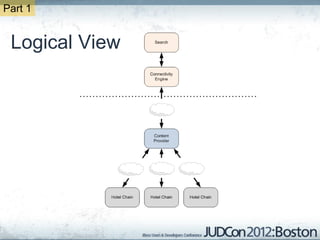
     Connectivity Engine
     • Supplements site content with data from
       third parties (Content Providers)
         – Tomcat
         – Spring
         – EhCache
         – MySQL
         – Apache load-balancer / mod_jk
Part 1


 Logical View
Part 1


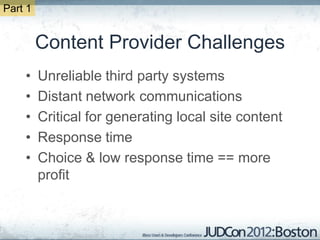
         Content Provider Challenges
    •    Unreliable third party systems
    •    Distant network communications
    •    Critical for generating local site content
    •    Response time
    •    Choice & low response time == more
         profit
Part 1


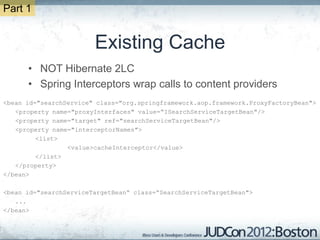
                        Existing Cache
      • NOT Hibernate 2LC
      • Spring Interceptors wrap calls to content providers
<bean id="searchService" class="org.springframework.aop.framework.ProxyFactoryBean">
   <property name="proxyInterfaces" value=“ISearchServiceTargetBean"/>
   <property name="target" ref="searchServiceTargetBean"/>
   <property name="interceptorNames">
         <list>
                 <value>cacheInterceptor</value>
         </list>
   </property>
</bean>

<bean id="searchServiceTargetBean“ class=“SearchServiceTargetBean">
   ...
</bean>
Part 1


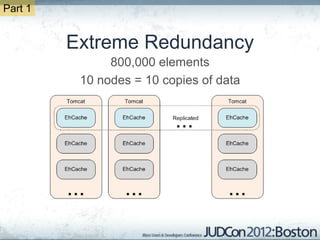
         Extreme Redundancy
               800,000 elements
          10 nodes = 10 copies of data
Part 1


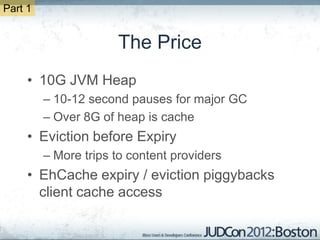
                      The Price
     • 10G JVM Heap
         – 10-12 second pauses for major GC
         – Over 8G of heap is cache
     • Eviction before Expiry
         – More trips to content providers
     • EhCache expiry / eviction piggybacks
       client cache access
Part 1


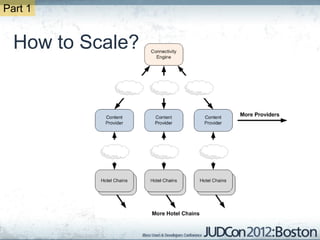
  How to Scale?
Part 1


                     Objectives
     • Reduce JVM Heap Size
         – 10 second pauses are too long
     • Increase cache capacity
     • Remove Eviction
         – Cache entries should expire naturally
     • Improve Response Times
         – Latency decreases if eviction, GC pauses
           and frequency are reduced
Part 1


                   Discussions
     • Pre-sales workshop
         – Express Terracotta EhCache
         – Oracle Coherence
         – Infinispan
Part 1


             Why Infinispan?
    • Open source advocates
    • Cutting edge technology
Part 1


                  Benchmarking
     • Must be reproducible
     • Must reflect accurately the production
       load and data
         – 50 million searches / day == 600 / sec
     • Must be able to imitate the content
       providers
Part 1


                       Solution
     • Replica load-test environment
     • Port mirror production traffic
         – Capture incoming requests
         – Capture content provider responses
     • Custom JMeter script
     • Mock application Spring Beans
Part 1


         Benchmarking Architecture
Part 1


          Benchmarking Validation
     • Understand your cached data
         – jmap
         jmap –dump:file=mydump.hprof <pid>
         – Eclipse Memory Analyzer
         – OQL
                  SELECT
                  toString(x.key)
                  , x.key.@retainedHeapSize
                  , x.value.@retainedHeapSize
                  FROM net.sf.ehcache.Element x
Part 1


               Benchmarking Validation


  Extract cached object properties - you can learn a lot quickly
         –   creationTime             –   timeToLive
         –   lastAccessTime           –   timeToIdle
         –   lastUpdateTime           –   etc
         –   hitCount                 –   etc
Part 1


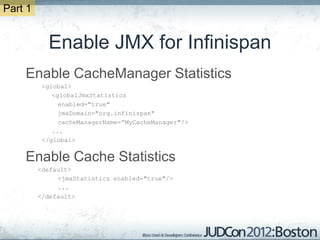
           Enable JMX for Infinispan
    Enable CacheManager Statistics
          <global>
             <globalJmxStatistics
               enabled="true"
               jmxDomain="org.infinispan"
               cacheManagerName=“MyCacheManager"/>
             ...
          </global>


    Enable Cache Statistics
         <default>
              <jmxStatistics enabled="true"/>
              ...
         </default>
Part 1


            Enable Remote JMX
    -Dcom.sun.management.jmxremote.port=nnnn
    -Dcom.sun.management.jmxremote.authenticate=false
    -Dcom.sun.management.jmxremote.ssl=false
Part 1


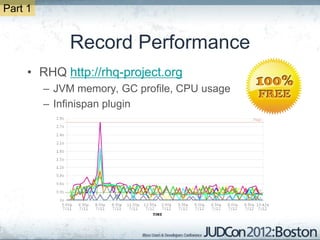
             Record Performance
     • RHQ http://rhq-project.org
         – JVM memory, GC profile, CPU usage
         – Infinispan plugin
Part 1


         Infinispan
Part 1


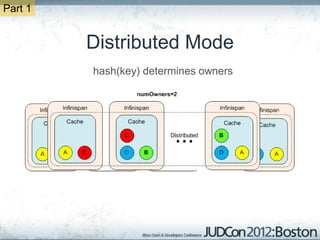
         Distributed Mode
         hash(key) determines owners
Part 1


             Distribution Features
     • Configurable redundancy
         – numOwners
     • Dynamic scaling
         – Automatic rebalancing for distribution and
           recovery of redundancy
     • Replication (distribution) overhead does
       not increase as more nodes are added
Part 1


                        Hotrod
     • Client – Server architecture
         – Java client
         – Connection pooling
         – Dynamic scaling
         – Smart routing
     • Separate application and cache
       memory requirements
Part 1


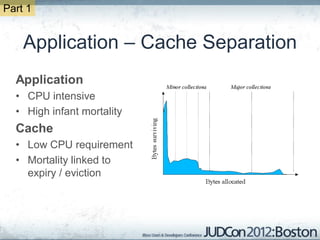
    Application – Cache Separation
  Application
  • CPU intensive
  • High infant mortality
  Cache
  • Low CPU requirement
  • Mortality linked to
    expiry / eviction
Part 1


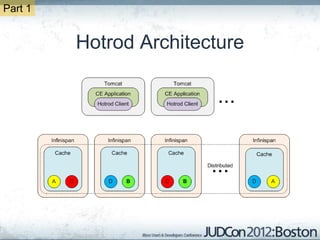
         Hotrod Architecture
Part 1


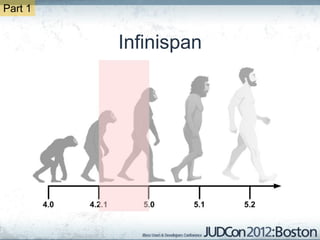
     Remember this is cutting edge
     • Latest final release was 4.2.1
     • Lets get cracking...
         – Distributed mode
         – Hotrod client
         – What issues did we encounter...
Part 1


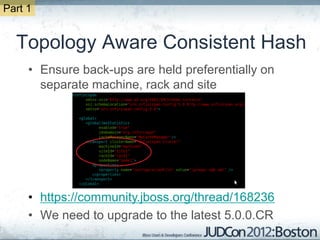
  Topology Aware Consistent Hash
     • Ensure back-ups are held preferentially on
       separate machine, rack and site


     • https://community.jboss.org/thread/168236
     • We need to upgrade to the latest 5.0.0.CR
Part 1


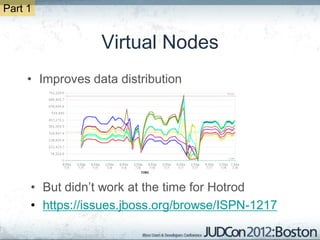
               Virtual Nodes
    Sub-divides hash wheel positions


    <hash numVirtualNodes=2/>
Part 1


                  Virtual Nodes
     • Improves data distribution


     • But didn’t work at the time for Hotrod
     • https://issues.jboss.org/browse/ISPN-1217
Part 1


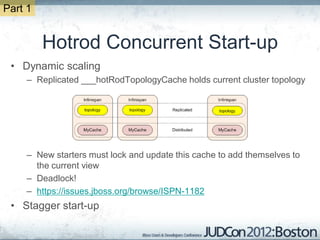
         Hotrod Concurrent Start-up
 • Dynamic scaling
    – Replicated ___hotRodTopologyCache holds current cluster topology


    – New starters must lock and update this cache to add themselves to
      the current view
    – Deadlock!
    – https://issues.jboss.org/browse/ISPN-1182
 • Stagger start-up
Part 1


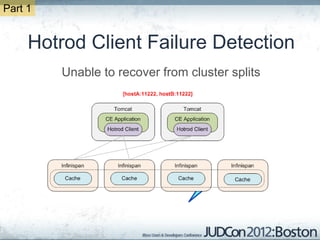
     Hotrod Client Failure Detection
         Unable to recover from cluster splits
Part 1


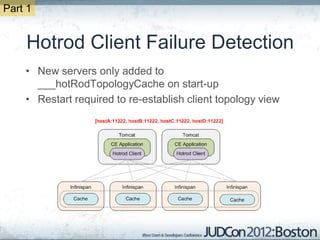
    Hotrod Client Failure Detection
    • New servers only added to
      ___hotRodTopologyCache on start-up
    • Restart required to re-establish client topology view
Part 1


   Hotrod Server Cluster Meltdown
Part 1


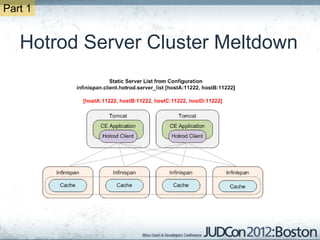
   Hotrod Server Cluster Meltdown
     • Clients can’t start without an available
       server
     • Static Configuration is only read once
     • To restart client-server communications
       either
         – Restart last “known” server
         – Restart the client
Part 1


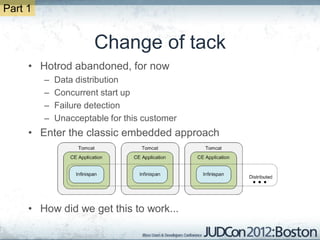
                      Change of tack
     • Hotrod abandoned, for now
         –   Data distribution
         –   Concurrent start up
         –   Failure detection
         –   Unacceptable for this customer
     • Enter the classic embedded approach


     • How did we get this to work...
Part 1


                    Dynamic Scaling
    • Unpredictable under heavy load, writers blocked
         – Unacceptable waits for this system
           <hash numOwners=“2” rehashEnabled=“false” />
         – Accept some data loss during a leave / join
    • Chunked rehashing / state transfer (5.1)
         – https://issues.jboss.org/browse/ISPN-284
    • Non-blocking state transfer
         – https://issues.jboss.org/browse/ISPN-1424
    • Manual rehashing
         – https://issues.jboss.org/browse/ISPN-1394
Part 1


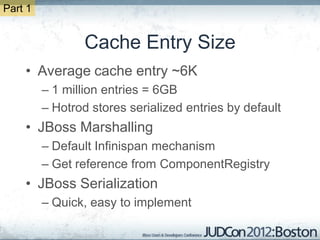
                 Cache Entry Size
    • Average cache entry ~6K
         – 1 million entries = 6GB
         – Hotrod stores serialized entries by default
    • JBoss Marshalling
         – Default Infinispan mechanism
         – Get reference from ComponentRegistry
    • JBoss Serialization
         – Quick, easy to implement
Part 1


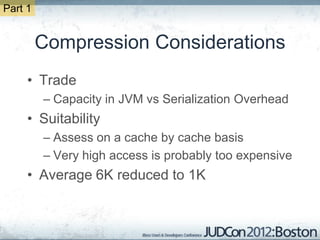
         Compression Considerations
     • Trade
         – Capacity in JVM vs Serialization Overhead
     • Suitability
         – Assess on a cache by cache basis
         – Very high access is probably too expensive
     • Average 6K reduced to 1K
Part 1


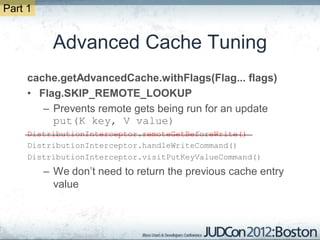
           Advanced Cache Tuning
     cache.getAdvancedCache.withFlags(Flag... flags)
     • Flag.SKIP_REMOTE_LOOKUP
        – Prevents remote gets being run for an update
          put(K key, V value)
     DistributionInterceptor.remoteGetBeforeWrite()
     DistributionInterceptor.handleWriteCommand()
     DistributionInterceptor.visitPutKeyValueCommand()
         – We don’t need to return the previous cache entry
           value
Part 1


                         JGroups
    • UDP out-performed TCP (for us)
    • Discovery
         – For a cold, full cluster start-up avoid split
           brain / merge scenarios
           <PING timeout="3000" num_initial_members="10"/>

    • Heartbeat
         – Ensure failure detection is configured
           appropriately
           <FD_ALL interval="3000" timeout="10000"/>
Part 1


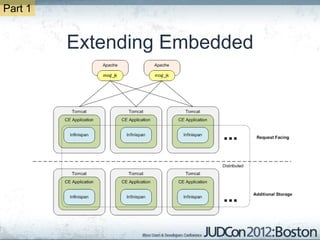
         Extending Embedded
Part 1


         Current Production System
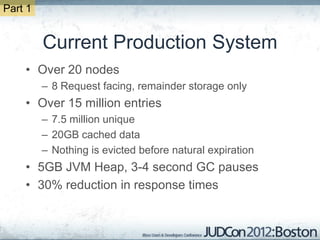
    • Over 20 nodes
         – 8 Request facing, remainder storage only
    • Over 15 million entries
         – 7.5 million unique
         – 20GB cached data
         – Nothing is evicted before natural expiration
    • 5GB JVM Heap, 3-4 second GC pauses
    • 30% reduction in response times
Part 1


                           Summary
     • Don’t compromise on the benchmarking
         – Understand your cached data profile
         – Functional testing is NOT sufficient
         – Monitoring and Analysis is essential
     • Tune Virtual Nodes for best distribution
     • Mitigate memory usage of embedded cache
         – Consider compressing embedded cache entries
         – Non request facing storage nodes
     • Distributed Infinispan out performs EhCache
     • Don’t rule Hotrod out
         – Not acceptable for this customer
         – Many improvements and bug fixes
Part 2


         Part 2 – Green Field SLA’s
    New Pricing Engine
         –   Tomcat
         –   Spring & Grails
         –   Infinispan
         –   Oracle RAC
         –   Apache load-balancer / mod_jk
    Historical Pricing Engine
         – EhCache
         – MySQL
         – 2 second full Paris Query
Part 2


                        Logical View
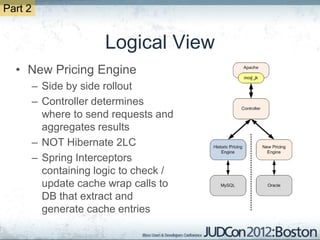
  • New Pricing Engine
         – Side by side rollout
         – Controller determines
           where to send requests and
           aggregates results
         – NOT Hibernate 2LC
         – Spring Interceptors
           containing logic to check /
           update cache wrap calls to
           DB that extract and
           generate cache entries
Part 2


                Proposed Caching
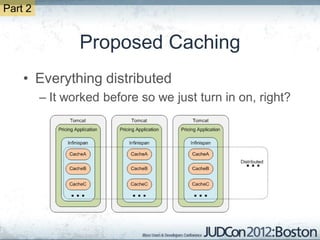
    • Everything distributed
         – It worked before so we just turn in on, right?
Part 2


                         The Pain
     • Distributed Mode
         – Network saturation on 1Gb switch
           (125MB/second) under load
         – Contention in org.jgroups
     • Performance SLA’s
         – Caching data in Local mode required 14G heap &
           20 second GC pauses
     • Aggressive rollout strategy
         – Struggling at low user load
Part 2


                    Cache Analysis

 • Eclipse Memory Analyzer
    – Identify cache profile
    – Small subset of elements account for
      almost all the space
    – Paris “Rates” sizes 20K – 1.6MB
    – Paris search (500 rates records) ==
      50MB total
    – 1Gb switch max throughput =
      125MB/second
Part 2


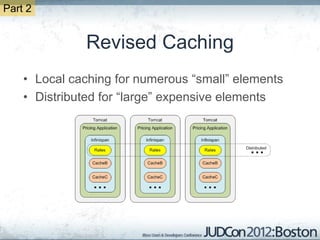
              Revised Caching
    • Local caching for numerous “small” elements
    • Distributed for “large” expensive elements
Part 2


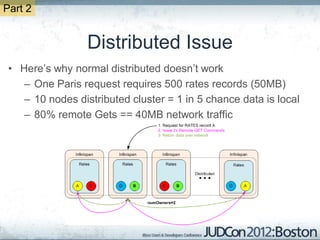
                  Distributed Issue
 • Here’s why normal distributed doesn’t work
    – One Paris request requires 500 rates records (50MB)
    – 10 nodes distributed cluster = 1 in 5 chance data is local
    – 80% remote Gets == 40MB network traffic
Part 2


                             Options
  • Rewrite the application caching logic
         – Significantly reduce the element size
  • Run Local caching with oversized heap
         – Daily restart, eliminate full GC pauses
         – Large memory investment and careful management
  • Sacrifice caching and hit the DB
         – Hits response times and hammer the database
  • Distributed Execution?
         – Send a task to the data and extract just what you need
Part 2


          Change in Psychology...
           If the mountain will not come to
         Muhammad, then Muhammad must go
                    to the mountain
Part 2


                  Distributed Execution
  • DefaultExecutorService
         – http://docs.jboss.org/infinispan/5.1/apidocs/org/infinispan/distexec
           /DefaultExecutorService.html
  • Create the Distributed Execution Service to run on the cache
    node specified
     public DefaultExecutorService(Cache masterCacheNode)
  • Run task on primary owner of Key input
     public Future<T> submit(Callable<T> task, K... input)
         – Resolve primary owner of Key then either
             • Run locally
             • Issue a remote command and run on the owning node
Part 2


                Pricing Controller
     • Callable task
         – Contains code to
           • Grab reference to local Spring Context
           • Load required beans
           • Spring interceptor checks cache at the owning
Existing     node (local get)
 Code      • If not found then goto database, retrieve and
             update cache
           • Extract pricing based on request criteria
           • Return results
Part 2


                    Pricing Controller
 • Create a new DefaultExecutorService
    – Create callable tasks required to satisfy request
    – Issue callable tasks concurrently
    while (moreKeys) {
       Callable<T> callable = new MyCallable<T>(...);
       Future<T> future = distributedExecutorService.submit(callable, key);
       ...
    }

    – Collate results and assemble response
    while (moreFutures) {
       T result = future.get();
    }
Part 2


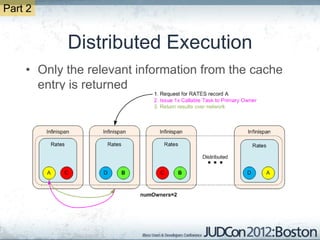
           Distributed Execution
    • Only the relevant information from the cache
      entry is returned
Part 2


                       Results
     • Latency – Paris search
         – Historic Engine 2 seconds
         – Dist-Exec 200ms
     • JVM
         – 5GB Heap
         – 3-4 second pauses
Part 2


                        Limitations
     • Failover
         – Task sent to primary owner only
         – https://community.jboss.org/wiki/Infinispan60-
           DistributedExecutionEnhancements
         – Handle failures yourself
     • Hotrod not supported
         – This would be fantastic!
         – https://issues.jboss.org/browse/ISPN-1094
     • Both in 6.0?
Part 2


                         Summary
     • Analysis and re-design of cached data
     • Accessing large data sets requires an
       alternative access pattern
     • Dramatically reduced latency
         – Parallel execution
         – Fraction of data transferred across the wire
     • Execution failures must be handled by
       application code, at the moment...
Thanks for Listening!

    Any Questions?

Infinispan from POC to Production

  • 2.
  • 3.
    Who am I? Mark Addy, Senior Consultant Fast, Reliable, Secure, Manageable
  • 4.
    Agenda Part 1 • Anexisting production system unable to scale Part 2 • A green-field project unable to meet SLA’s
  • 5.
    About the Customer •Global on-line travel & accommodation provider – 50 million searches per day • Our relationship – Troubleshooting – Workshops
  • 6.
    Part 1 Part 1 – Existing Application Connectivity Engine • Supplements site content with data from third parties (Content Providers) – Tomcat – Spring – EhCache – MySQL – Apache load-balancer / mod_jk
  • 7.
  • 8.
    Part 1 Content Provider Challenges • Unreliable third party systems • Distant network communications • Critical for generating local site content • Response time • Choice & low response time == more profit
  • 9.
    Part 1 Existing Cache • NOT Hibernate 2LC • Spring Interceptors wrap calls to content providers <bean id="searchService" class="org.springframework.aop.framework.ProxyFactoryBean"> <property name="proxyInterfaces" value=“ISearchServiceTargetBean"/> <property name="target" ref="searchServiceTargetBean"/> <property name="interceptorNames"> <list> <value>cacheInterceptor</value> </list> </property> </bean> <bean id="searchServiceTargetBean“ class=“SearchServiceTargetBean"> ... </bean>
  • 10.
    Part 1 Extreme Redundancy 800,000 elements 10 nodes = 10 copies of data
  • 11.
    Part 1 The Price • 10G JVM Heap – 10-12 second pauses for major GC – Over 8G of heap is cache • Eviction before Expiry – More trips to content providers • EhCache expiry / eviction piggybacks client cache access
  • 12.
    Part 1 How to Scale?
  • 13.
    Part 1 Objectives • Reduce JVM Heap Size – 10 second pauses are too long • Increase cache capacity • Remove Eviction – Cache entries should expire naturally • Improve Response Times – Latency decreases if eviction, GC pauses and frequency are reduced
  • 14.
    Part 1 Discussions • Pre-sales workshop – Express Terracotta EhCache – Oracle Coherence – Infinispan
  • 15.
    Part 1 Why Infinispan? • Open source advocates • Cutting edge technology
  • 16.
    Part 1 Benchmarking • Must be reproducible • Must reflect accurately the production load and data – 50 million searches / day == 600 / sec • Must be able to imitate the content providers
  • 17.
    Part 1 Solution • Replica load-test environment • Port mirror production traffic – Capture incoming requests – Capture content provider responses • Custom JMeter script • Mock application Spring Beans
  • 18.
    Part 1 Benchmarking Architecture
  • 19.
    Part 1 Benchmarking Validation • Understand your cached data – jmap jmap –dump:file=mydump.hprof <pid> – Eclipse Memory Analyzer – OQL SELECT toString(x.key) , x.key.@retainedHeapSize , x.value.@retainedHeapSize FROM net.sf.ehcache.Element x
  • 20.
    Part 1 Benchmarking Validation Extract cached object properties - you can learn a lot quickly – creationTime – timeToLive – lastAccessTime – timeToIdle – lastUpdateTime – etc – hitCount – etc
  • 21.
    Part 1 Enable JMX for Infinispan Enable CacheManager Statistics <global> <globalJmxStatistics enabled="true" jmxDomain="org.infinispan" cacheManagerName=“MyCacheManager"/> ... </global> Enable Cache Statistics <default> <jmxStatistics enabled="true"/> ... </default>
  • 22.
    Part 1 Enable Remote JMX -Dcom.sun.management.jmxremote.port=nnnn -Dcom.sun.management.jmxremote.authenticate=false -Dcom.sun.management.jmxremote.ssl=false
  • 23.
    Part 1 Record Performance • RHQ http://rhq-project.org – JVM memory, GC profile, CPU usage – Infinispan plugin
  • 24.
    Part 1 Infinispan
  • 25.
    Part 1 Distributed Mode hash(key) determines owners
  • 26.
    Part 1 Distribution Features • Configurable redundancy – numOwners • Dynamic scaling – Automatic rebalancing for distribution and recovery of redundancy • Replication (distribution) overhead does not increase as more nodes are added
  • 27.
    Part 1 Hotrod • Client – Server architecture – Java client – Connection pooling – Dynamic scaling – Smart routing • Separate application and cache memory requirements
  • 28.
    Part 1 Application – Cache Separation Application • CPU intensive • High infant mortality Cache • Low CPU requirement • Mortality linked to expiry / eviction
  • 29.
    Part 1 Hotrod Architecture
  • 30.
    Part 1 Remember this is cutting edge • Latest final release was 4.2.1 • Lets get cracking... – Distributed mode – Hotrod client – What issues did we encounter...
  • 31.
    Part 1 Topology Aware Consistent Hash • Ensure back-ups are held preferentially on separate machine, rack and site • https://community.jboss.org/thread/168236 • We need to upgrade to the latest 5.0.0.CR
  • 32.
    Part 1 Virtual Nodes Sub-divides hash wheel positions <hash numVirtualNodes=2/>
  • 33.
    Part 1 Virtual Nodes • Improves data distribution • But didn’t work at the time for Hotrod • https://issues.jboss.org/browse/ISPN-1217
  • 34.
    Part 1 Hotrod Concurrent Start-up • Dynamic scaling – Replicated ___hotRodTopologyCache holds current cluster topology – New starters must lock and update this cache to add themselves to the current view – Deadlock! – https://issues.jboss.org/browse/ISPN-1182 • Stagger start-up
  • 35.
    Part 1 Hotrod Client Failure Detection Unable to recover from cluster splits
  • 36.
    Part 1 Hotrod Client Failure Detection • New servers only added to ___hotRodTopologyCache on start-up • Restart required to re-establish client topology view
  • 37.
    Part 1 Hotrod Server Cluster Meltdown
  • 38.
    Part 1 Hotrod Server Cluster Meltdown • Clients can’t start without an available server • Static Configuration is only read once • To restart client-server communications either – Restart last “known” server – Restart the client
  • 39.
    Part 1 Change of tack • Hotrod abandoned, for now – Data distribution – Concurrent start up – Failure detection – Unacceptable for this customer • Enter the classic embedded approach • How did we get this to work...
  • 40.
    Part 1 Dynamic Scaling • Unpredictable under heavy load, writers blocked – Unacceptable waits for this system <hash numOwners=“2” rehashEnabled=“false” /> – Accept some data loss during a leave / join • Chunked rehashing / state transfer (5.1) – https://issues.jboss.org/browse/ISPN-284 • Non-blocking state transfer – https://issues.jboss.org/browse/ISPN-1424 • Manual rehashing – https://issues.jboss.org/browse/ISPN-1394
  • 41.
    Part 1 Cache Entry Size • Average cache entry ~6K – 1 million entries = 6GB – Hotrod stores serialized entries by default • JBoss Marshalling – Default Infinispan mechanism – Get reference from ComponentRegistry • JBoss Serialization – Quick, easy to implement
  • 42.
    Part 1 Compression Considerations • Trade – Capacity in JVM vs Serialization Overhead • Suitability – Assess on a cache by cache basis – Very high access is probably too expensive • Average 6K reduced to 1K
  • 43.
    Part 1 Advanced Cache Tuning cache.getAdvancedCache.withFlags(Flag... flags) • Flag.SKIP_REMOTE_LOOKUP – Prevents remote gets being run for an update put(K key, V value) DistributionInterceptor.remoteGetBeforeWrite() DistributionInterceptor.handleWriteCommand() DistributionInterceptor.visitPutKeyValueCommand() – We don’t need to return the previous cache entry value
  • 44.
    Part 1 JGroups • UDP out-performed TCP (for us) • Discovery – For a cold, full cluster start-up avoid split brain / merge scenarios <PING timeout="3000" num_initial_members="10"/> • Heartbeat – Ensure failure detection is configured appropriately <FD_ALL interval="3000" timeout="10000"/>
  • 45.
    Part 1 Extending Embedded
  • 46.
    Part 1 Current Production System • Over 20 nodes – 8 Request facing, remainder storage only • Over 15 million entries – 7.5 million unique – 20GB cached data – Nothing is evicted before natural expiration • 5GB JVM Heap, 3-4 second GC pauses • 30% reduction in response times
  • 47.
    Part 1 Summary • Don’t compromise on the benchmarking – Understand your cached data profile – Functional testing is NOT sufficient – Monitoring and Analysis is essential • Tune Virtual Nodes for best distribution • Mitigate memory usage of embedded cache – Consider compressing embedded cache entries – Non request facing storage nodes • Distributed Infinispan out performs EhCache • Don’t rule Hotrod out – Not acceptable for this customer – Many improvements and bug fixes
  • 48.
    Part 2 Part 2 – Green Field SLA’s New Pricing Engine – Tomcat – Spring & Grails – Infinispan – Oracle RAC – Apache load-balancer / mod_jk Historical Pricing Engine – EhCache – MySQL – 2 second full Paris Query
  • 49.
    Part 2 Logical View • New Pricing Engine – Side by side rollout – Controller determines where to send requests and aggregates results – NOT Hibernate 2LC – Spring Interceptors containing logic to check / update cache wrap calls to DB that extract and generate cache entries
  • 50.
    Part 2 Proposed Caching • Everything distributed – It worked before so we just turn in on, right?
  • 51.
    Part 2 The Pain • Distributed Mode – Network saturation on 1Gb switch (125MB/second) under load – Contention in org.jgroups • Performance SLA’s – Caching data in Local mode required 14G heap & 20 second GC pauses • Aggressive rollout strategy – Struggling at low user load
  • 52.
    Part 2 Cache Analysis • Eclipse Memory Analyzer – Identify cache profile – Small subset of elements account for almost all the space – Paris “Rates” sizes 20K – 1.6MB – Paris search (500 rates records) == 50MB total – 1Gb switch max throughput = 125MB/second
  • 53.
    Part 2 Revised Caching • Local caching for numerous “small” elements • Distributed for “large” expensive elements
  • 54.
    Part 2 Distributed Issue • Here’s why normal distributed doesn’t work – One Paris request requires 500 rates records (50MB) – 10 nodes distributed cluster = 1 in 5 chance data is local – 80% remote Gets == 40MB network traffic
  • 55.
    Part 2 Options • Rewrite the application caching logic – Significantly reduce the element size • Run Local caching with oversized heap – Daily restart, eliminate full GC pauses – Large memory investment and careful management • Sacrifice caching and hit the DB – Hits response times and hammer the database • Distributed Execution? – Send a task to the data and extract just what you need
  • 56.
    Part 2 Change in Psychology... If the mountain will not come to Muhammad, then Muhammad must go to the mountain
  • 57.
    Part 2 Distributed Execution • DefaultExecutorService – http://docs.jboss.org/infinispan/5.1/apidocs/org/infinispan/distexec /DefaultExecutorService.html • Create the Distributed Execution Service to run on the cache node specified public DefaultExecutorService(Cache masterCacheNode) • Run task on primary owner of Key input public Future<T> submit(Callable<T> task, K... input) – Resolve primary owner of Key then either • Run locally • Issue a remote command and run on the owning node
  • 58.
    Part 2 Pricing Controller • Callable task – Contains code to • Grab reference to local Spring Context • Load required beans • Spring interceptor checks cache at the owning Existing node (local get) Code • If not found then goto database, retrieve and update cache • Extract pricing based on request criteria • Return results
  • 59.
    Part 2 Pricing Controller • Create a new DefaultExecutorService – Create callable tasks required to satisfy request – Issue callable tasks concurrently while (moreKeys) { Callable<T> callable = new MyCallable<T>(...); Future<T> future = distributedExecutorService.submit(callable, key); ... } – Collate results and assemble response while (moreFutures) { T result = future.get(); }
  • 60.
    Part 2 Distributed Execution • Only the relevant information from the cache entry is returned
  • 61.
    Part 2 Results • Latency – Paris search – Historic Engine 2 seconds – Dist-Exec 200ms • JVM – 5GB Heap – 3-4 second pauses
  • 62.
    Part 2 Limitations • Failover – Task sent to primary owner only – https://community.jboss.org/wiki/Infinispan60- DistributedExecutionEnhancements – Handle failures yourself • Hotrod not supported – This would be fantastic! – https://issues.jboss.org/browse/ISPN-1094 • Both in 6.0?
  • 63.
    Part 2 Summary • Analysis and re-design of cached data • Accessing large data sets requires an alternative access pattern • Dramatically reduced latency – Parallel execution – Fraction of data transferred across the wire • Execution failures must be handled by application code, at the moment...
  • 64.
    Thanks for Listening! Any Questions?