



In-Memory Computing 
“Real 
World 
Use 
Cases” 
Kai Wähner 
Technical Lead 
kwaehner@tibco.com 
@KaiWaehner 
www.kai-waehner.de 
LinkedIn / Xing à Please connect!
Kai Wähner 
Consulting 
Developing 
Coaching 
Speaking 
Writing 
Selling 
Main Tasks 
Requirements Engineering 
Enterprise Architecture Management 
Business Process Management 
Architecture and Development of Applications 
Service-oriented Architecture 
Integration of Legacy Applications 
Cloud Computing 
Big Data 
Contact 
Email: kontakt@kai-waehner.de 
Blog: www.kai-waehner.de/blog 
Twitter: @KaiWaehner 
Social Networks: LinkedIn, Xing
Disclaimer 
! 
These 
opinions 
are 
my 
own 
and 
do 
not 
necessarily 
represent 
my 
employer
Key Messages 
In-Memory Computing is used for Acting in Real-Time! 
In-Memory is NOT just for Caching and Storing – A Data Grid offers much more! 
Eventing and Fault-Tolerance move In-Memory Computing to another Level!
© Copyright 2000-2014 TIBCO Software Inc. 5 
Agenda 
• Introduction to In-Memory Computing 
• Use Cases / Customer Success Stories
© Copyright 2000-2014 TIBCO Software Inc. 6 
Agenda 
• Introduction to In-Memory Computing 
• Use Cases / Customer Success Stories
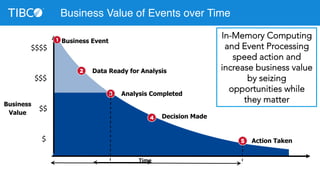
Time 
Business 
Value 
Business Event 
Data Ready for Analysis 
Analysis Completed 
Decision Made 
$$$$ 
$$$ 
$$ 
$ 
In-Memory Computing 
and Event Processing 
speed action and 
increase business value 
by seizing 
opportunities while 
they matter 
Action Taken 
Business Value of Events over Time
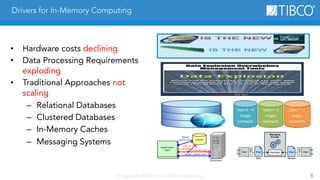
Drivers for In-Memory Computing 
• Hardware costs declining 
• Data Processing Requirements 
exploding 
• Traditional Approaches not 
scaling 
© Copyright 2000-2014 TIBCO Software Inc. 8 
– Relational Databases 
– Clustered Databases 
– In-Memory Caches 
– Messaging Systems
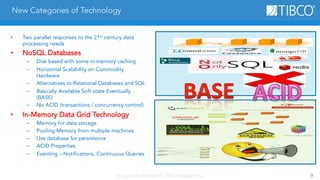
New Categories of Technology 
• Two parallel responses to the 21st century data 
© Copyright 2000-2014 TIBCO Software Inc. 9 
processing needs 
• NoSQL Databases 
– Disk based with some in-memory caching 
– Horizontal Scalability on Commodity 
Hardware 
– Alternatives to Relational Databases and SQL 
– Basically Available Soft-state Eventually 
(BASE) 
– No ACID (transactions / concurrency control) 
• In-Memory Data Grid Technology 
– Memory for data storage 
– Pooling Memory from multiple machines 
– Use database for persistence 
– ACID Properties 
– Eventing – Notifications, Continuous Queries
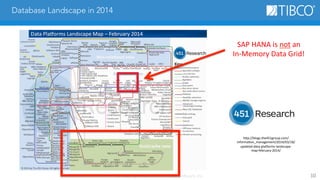
SAP 
HANA 
is 
not 
an 
In-­‐Memory 
Data 
Grid! 
© Copyright 2000-2014 TIBCO Software Inc. 10 
Database Landscape in 2014 
h;p://blogs.the451group.com/ 
informaDon_management/2014/03/18/ 
updated-­‐data-­‐plaIorms-­‐landscape-­‐ 
map-­‐february-­‐2014/
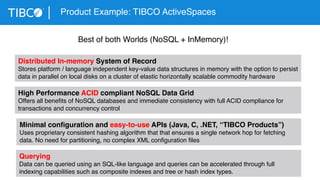
Product Example: TIBCO ActiveSpaces 
Best of both Worlds (NoSQL + InMemory)! 
Distributed In-memory System of Record 
Stores platform / language independent key-value data structures in memory with the option to persist 
data in parallel on local disks on a cluster of elastic horizontally scalable commodity hardware 
High Performance ACID compliant NoSQL Data Grid 
Offers all benefits of NoSQL databases and immediate consistency with full ACID compliance for 
transactions and concurrency control 
Minimal configuration and easy-to-use APIs (Java, C, .NET, “TIBCO Products”) 
Uses proprietary consistent hashing algorithm that that ensures a single network hop for fetching 
data. No need for partitioning, no complex XML configuration files 
Querying 
Data can be queried using an SQL-like language and queries can be accelerated through full 
indexing capabilities such as composite indexes and tree or hash index types.
© Copyright 2000-2014 TIBCO Software Inc. 12 
Agenda 
• Introduction to In-Memory Computing 
• Use Cases / Customer Success Stories
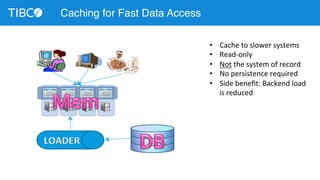
Caching for Fast Data Access 
LOADER 
• Cache 
to 
slower 
systems 
• Read-­‐only 
• Not 
the 
system 
of 
record 
• No 
persistence 
required 
• Side 
benefit: 
Backend 
load 
is 
reduced
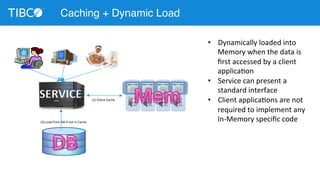
Caching + Dynamic Load 
SERVICE 
• Dynamically 
loaded 
into 
Memory 
when 
the 
data 
is 
first 
accessed 
by 
a 
client 
applicaDon 
• Service 
can 
present 
a 
standard 
interface 
• Client 
applicaDons 
are 
not 
required 
to 
implement 
any 
In-­‐Memory 
specific 
code 
(1) 
Check 
Cache 
(2) 
Load 
from 
DB 
if 
not 
in 
Cache
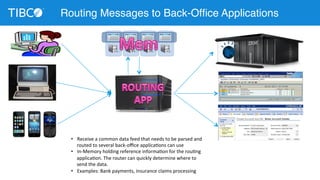
Routing Messages to Back-Office Applications 
• Receive 
a 
common 
data 
feed 
that 
needs 
to 
be 
parsed 
and 
routed 
to 
several 
back-­‐office 
applicaDons 
can 
use 
• In-­‐Memory 
holding 
reference 
informaDon 
for 
the 
rouDng 
applicaDon. 
The 
router 
can 
quickly 
determine 
where 
to 
send 
the 
data. 
• Examples: 
Bank 
payments, 
insurance 
claims 
processing
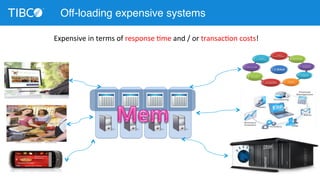
Off-loading expensive systems 
Expensive 
in 
terms 
of 
response 
Dme 
and 
/ 
or 
transacDon 
costs!
Personalized Customer Experience 
“With 
38 
million 
fans, 
MGM 
knows 
how 
to 
put 
its 
customers 
first, 
it 
takes 
more 
than 
a 
smile 
too. 
Customers 
want 
a 
personalized, 
tailored 
experience, 
one 
that 
knows 
their 
name 
and 
can 
anDcipate 
their 
needs. 
With 
the 
help 
of 
TIBCO 
technologies 
that 
leverage 
big 
data 
and 
give 
customers 
a 
digital 
idenDty, 
MGM 
can 
send 
personalized 
offers 
directly 
to 
customers, 
save 
them 
a 
seat, 
and 
have 
their 
favorite 
drink 
on 
the 
way. 
With 
mulDple 
customer 
touch 
points 
and 
channels, 
MGM 
can 
reach 
customers 
in 
more 
ways, 
and 
in 
more 
places, 
than 
ever 
before.” 
h;ps://www.youtube.com/watch?v=X-­‐7S3kCOx9k 
Latency 
Problems: 
• Several 
Legacy 
Systems 
• Processing 
via 
ERP, 
CRM, 
Host, 
etc. 
In-­‐Memory: 
• Events 
and 
CorrelaDons 
• Enable 
Real 
Time 
• Only 
customers 
that 
have 
checked 
in
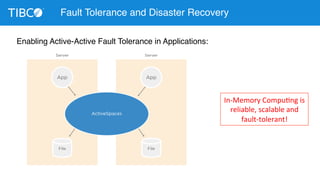
Fault Tolerance and Disaster Recovery 
Enabling Active-Active Fault Tolerance in Applications: 
In-­‐Memory 
CompuDng 
is 
reliable, 
scalable 
and 
fault-­‐tolerant!
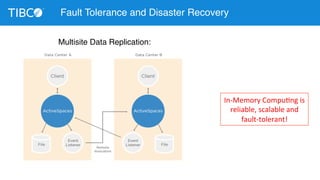
Fault Tolerance and Disaster Recovery 
Multisite Data Replication: 
In-­‐Memory 
CompuDng 
is 
reliable, 
scalable 
and 
fault-­‐tolerant!
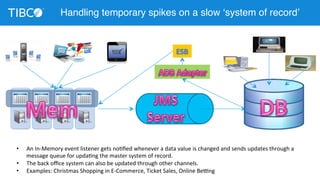
Handling temporary spikes on a slow ‘system of record’ 
• An 
In-­‐Memory 
event 
listener 
gets 
noDfied 
whenever 
a 
data 
value 
is 
changed 
and 
sends 
updates 
through 
a 
message 
queue 
for 
updaDng 
the 
master 
system 
of 
record. 
• The 
back 
office 
system 
can 
also 
be 
updated 
through 
other 
channels. 
• Examples: 
Christmas 
Shopping 
in 
E-­‐Commerce, 
Ticket 
Sales, 
Online 
Bekng
à 
Operational Data Store (Local File System) 
In-­‐Memory 
as 
“system 
of 
record”
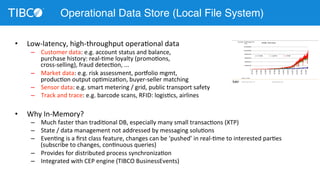
Operational Data Store (Local File System) 
• Low-­‐latency, 
high-­‐throughput 
operaDonal 
data 
– Customer 
data: 
e.g. 
account 
status 
and 
balance, 
purchase 
history: 
real-­‐Dme 
loyalty 
(promoDons, 
cross-­‐selling), 
fraud 
detecDon, 
... 
– Market 
data: 
e.g. 
risk 
assessment, 
porIolio 
mgmt, 
producDon 
output 
opDmizaDon, 
buyer-­‐seller 
matching 
– Sensor 
data: 
e.g. 
smart 
metering 
/ 
grid, 
public 
transport 
safety 
– Track 
and 
trace: 
e.g. 
barcode 
scans, 
RFID: 
logisDcs, 
airlines 
• Why 
In-­‐Memory? 
– Much 
faster 
than 
tradiDonal 
DB, 
especially 
many 
small 
transacDons 
(XTP) 
– State 
/ 
data 
management 
not 
addressed 
by 
messaging 
soluDons 
– EvenDng 
is 
a 
first 
class 
feature, 
changes 
can 
be 
‘pushed’ 
in 
real-­‐Dme 
to 
interested 
parDes 
(subscribe 
to 
changes, 
conDnuous 
queries) 
– Provides 
for 
distributed 
process 
synchronizaDon 
– Integrated 
with 
CEP 
engine 
(TIBCO 
BusinessEvents)
Situation 
Retailer: Inventory Management 
• Master data management system stores over 800 million customer records across more than 30 enterprise apps. 
• Stores real-time inventory data to enable ‘Buy online and pick-up at store’ and ‘Smart fulfillment’ features 
Problem 
• Due to lack of correlation between Point of Sale data and inventory, the website contained outdated inventory data. 
Products were listed as out of stock when there was actually inventory. 
• Need to leverage store inventory as well as inventory located fulfillment centers 
Solution 
• In-Memory stores real-time inventory data for the website, the fulfillment application, and other applications that need 
access to inventory data 
Business Impact 
• Reduction in customer churn 
• Intelligent fulfillments leading to greater customer satisfaction 
• Improved overall efficiency of fulfillment centers and store inventory
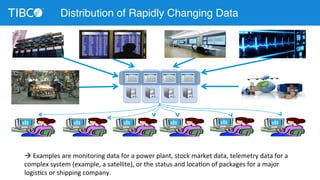
Distribution of Rapidly Changing Data 
à 
Examples 
are 
monitoring 
data 
for 
a 
power 
plant, 
stock 
market 
data, 
telemetry 
data 
for 
a 
complex 
system 
(example, 
a 
satellite), 
or 
the 
status 
and 
locaDon 
of 
packages 
for 
a 
major 
logisDcs 
or 
shipping 
company.
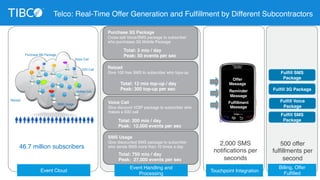
Telco: Real-Time Offer Generation and Fulfillment by Different Subcontractors 
Purchase 3G Package 
Cross-sell Voice/SMS package to subscriber 
who purchases 3G Mobile Package 
Total: 3 mio / day 
Peak: 50 events per sec 
Reload 
Give 100 free SMS to subscriber who tops-up 
Total: 12 mio top-up / day 
Peak: 300 top-up per sec 
Voice Call 
Give discount VOIP package to subscriber who 
makes a IDD call 
Total: 200 mio / day 
Peak: 12,000 events per sec 
SMS Usage 
Give discounted SMS package to subscriber 
who sends SMS more than 10 times a day 
Total: 750 mio / day 
Peak: 27,000 events per sec 
Purchase BB Package 
Event Cloud 
Reload 
Voice Call 
IDD Call 
OnNet Call 
SMS Usage 
Event Handling and 
Processing 
Touchpoint Integration 
Fulfill SMS 
Package 
Fulfill 3G Package 
Fulfill Voice 
Package 
Fulfill SMS 
Package 
Billing, Offer 
Fulfilled 
46.7 million subscribers 
2,000 SMS 
notifications per 
seconds 
500 offer 
fulfillments per 
second 
Offer 
Message 
Reminder 
Message 
Fulfillment 
Message
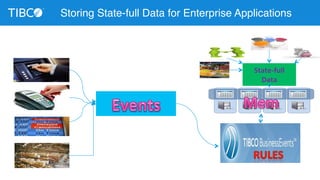
Storing State-full Data for Enterprise Applications 
State-­‐full 
Data
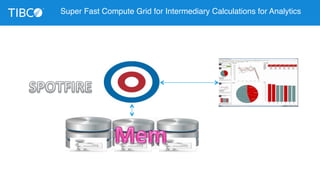
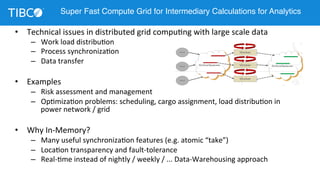
Super Fast Compute Grid for Intermediary Calculations for Analytics
Super Fast Compute Grid for Intermediary Calculations for Analytics 
• Technical 
issues 
in 
distributed 
grid 
compuDng 
with 
large 
scale 
data 
– Work 
load 
distribuDon 
– Process 
synchronizaDon 
– Data 
transfer 
• Examples 
– Risk 
assessment 
and 
management 
– OpDmizaDon 
problems: 
scheduling, 
cargo 
assignment, 
load 
distribuDon 
in 
power 
network 
/ 
grid 
• Why 
In-­‐Memory? 
– Many 
useful 
synchronizaDon 
features 
(e.g. 
atomic 
“take”) 
– LocaDon 
transparency 
and 
fault-­‐tolerance 
– Real-­‐Dme 
instead 
of 
nightly 
/ 
weekly 
/ 
... 
Data-­‐Warehousing 
approach
Key Messages 
In-Memory Computing is used for Acting in Real-Time! 
In-Memory is NOT just for Caching and Storing – A Data Grid offers much more! 
Eventing and Fault-Tolerance move In-Memory Computing to another Level!
Questions? 
Kai Wähner 
kwaehner@tibco.com 
@KaiWaehner 
www.kai-waehner.de 
LinkedIn / Xing à Please connect!

Real World Use Cases and Success Stories for In-Memory Data Grids (TIBCO ActiveSpaces, Oracle Coherence, Infinispan, IBM WebSphere eXtreme Scale, Hazelcast, Gigaspaces, GridGain, Pivotal Gemfire, not: SAP HANA)

  • 1.
    In-Memory Computing “Real World Use Cases” Kai Wähner Technical Lead kwaehner@tibco.com @KaiWaehner www.kai-waehner.de LinkedIn / Xing à Please connect!
  • 2.
    Kai Wähner Consulting Developing Coaching Speaking Writing Selling Main Tasks Requirements Engineering Enterprise Architecture Management Business Process Management Architecture and Development of Applications Service-oriented Architecture Integration of Legacy Applications Cloud Computing Big Data Contact Email: kontakt@kai-waehner.de Blog: www.kai-waehner.de/blog Twitter: @KaiWaehner Social Networks: LinkedIn, Xing
  • 3.
    Disclaimer ! These opinions are my own and do not necessarily represent my employer
  • 4.
    Key Messages In-MemoryComputing is used for Acting in Real-Time! In-Memory is NOT just for Caching and Storing – A Data Grid offers much more! Eventing and Fault-Tolerance move In-Memory Computing to another Level!
  • 5.
    © Copyright 2000-2014TIBCO Software Inc. 5 Agenda • Introduction to In-Memory Computing • Use Cases / Customer Success Stories
  • 6.
    © Copyright 2000-2014TIBCO Software Inc. 6 Agenda • Introduction to In-Memory Computing • Use Cases / Customer Success Stories
  • 7.
    Time Business Value Business Event Data Ready for Analysis Analysis Completed Decision Made $$$$ $$$ $$ $ In-Memory Computing and Event Processing speed action and increase business value by seizing opportunities while they matter Action Taken Business Value of Events over Time
  • 8.
    Drivers for In-MemoryComputing • Hardware costs declining • Data Processing Requirements exploding • Traditional Approaches not scaling © Copyright 2000-2014 TIBCO Software Inc. 8 – Relational Databases – Clustered Databases – In-Memory Caches – Messaging Systems
  • 9.
    New Categories ofTechnology • Two parallel responses to the 21st century data © Copyright 2000-2014 TIBCO Software Inc. 9 processing needs • NoSQL Databases – Disk based with some in-memory caching – Horizontal Scalability on Commodity Hardware – Alternatives to Relational Databases and SQL – Basically Available Soft-state Eventually (BASE) – No ACID (transactions / concurrency control) • In-Memory Data Grid Technology – Memory for data storage – Pooling Memory from multiple machines – Use database for persistence – ACID Properties – Eventing – Notifications, Continuous Queries
  • 10.
    SAP HANA is not an In-­‐Memory Data Grid! © Copyright 2000-2014 TIBCO Software Inc. 10 Database Landscape in 2014 h;p://blogs.the451group.com/ informaDon_management/2014/03/18/ updated-­‐data-­‐plaIorms-­‐landscape-­‐ map-­‐february-­‐2014/
  • 11.
    Product Example: TIBCOActiveSpaces Best of both Worlds (NoSQL + InMemory)! Distributed In-memory System of Record Stores platform / language independent key-value data structures in memory with the option to persist data in parallel on local disks on a cluster of elastic horizontally scalable commodity hardware High Performance ACID compliant NoSQL Data Grid Offers all benefits of NoSQL databases and immediate consistency with full ACID compliance for transactions and concurrency control Minimal configuration and easy-to-use APIs (Java, C, .NET, “TIBCO Products”) Uses proprietary consistent hashing algorithm that that ensures a single network hop for fetching data. No need for partitioning, no complex XML configuration files Querying Data can be queried using an SQL-like language and queries can be accelerated through full indexing capabilities such as composite indexes and tree or hash index types.
  • 12.
    © Copyright 2000-2014TIBCO Software Inc. 12 Agenda • Introduction to In-Memory Computing • Use Cases / Customer Success Stories
  • 13.
    Caching for FastData Access LOADER • Cache to slower systems • Read-­‐only • Not the system of record • No persistence required • Side benefit: Backend load is reduced
  • 14.
    Caching + DynamicLoad SERVICE • Dynamically loaded into Memory when the data is first accessed by a client applicaDon • Service can present a standard interface • Client applicaDons are not required to implement any In-­‐Memory specific code (1) Check Cache (2) Load from DB if not in Cache
  • 15.
    Routing Messages toBack-Office Applications • Receive a common data feed that needs to be parsed and routed to several back-­‐office applicaDons can use • In-­‐Memory holding reference informaDon for the rouDng applicaDon. The router can quickly determine where to send the data. • Examples: Bank payments, insurance claims processing
  • 16.
    Off-loading expensive systems Expensive in terms of response Dme and / or transacDon costs!
  • 17.
    Personalized Customer Experience “With 38 million fans, MGM knows how to put its customers first, it takes more than a smile too. Customers want a personalized, tailored experience, one that knows their name and can anDcipate their needs. With the help of TIBCO technologies that leverage big data and give customers a digital idenDty, MGM can send personalized offers directly to customers, save them a seat, and have their favorite drink on the way. With mulDple customer touch points and channels, MGM can reach customers in more ways, and in more places, than ever before.” h;ps://www.youtube.com/watch?v=X-­‐7S3kCOx9k Latency Problems: • Several Legacy Systems • Processing via ERP, CRM, Host, etc. In-­‐Memory: • Events and CorrelaDons • Enable Real Time • Only customers that have checked in
  • 18.
    Fault Tolerance andDisaster Recovery Enabling Active-Active Fault Tolerance in Applications: In-­‐Memory CompuDng is reliable, scalable and fault-­‐tolerant!
  • 19.
    Fault Tolerance andDisaster Recovery Multisite Data Replication: In-­‐Memory CompuDng is reliable, scalable and fault-­‐tolerant!
  • 20.
    Handling temporary spikeson a slow ‘system of record’ • An In-­‐Memory event listener gets noDfied whenever a data value is changed and sends updates through a message queue for updaDng the master system of record. • The back office system can also be updated through other channels. • Examples: Christmas Shopping in E-­‐Commerce, Ticket Sales, Online Bekng
  • 21.
    à Operational DataStore (Local File System) In-­‐Memory as “system of record”
  • 22.
    Operational Data Store(Local File System) • Low-­‐latency, high-­‐throughput operaDonal data – Customer data: e.g. account status and balance, purchase history: real-­‐Dme loyalty (promoDons, cross-­‐selling), fraud detecDon, ... – Market data: e.g. risk assessment, porIolio mgmt, producDon output opDmizaDon, buyer-­‐seller matching – Sensor data: e.g. smart metering / grid, public transport safety – Track and trace: e.g. barcode scans, RFID: logisDcs, airlines • Why In-­‐Memory? – Much faster than tradiDonal DB, especially many small transacDons (XTP) – State / data management not addressed by messaging soluDons – EvenDng is a first class feature, changes can be ‘pushed’ in real-­‐Dme to interested parDes (subscribe to changes, conDnuous queries) – Provides for distributed process synchronizaDon – Integrated with CEP engine (TIBCO BusinessEvents)
  • 23.
    Situation Retailer: InventoryManagement • Master data management system stores over 800 million customer records across more than 30 enterprise apps. • Stores real-time inventory data to enable ‘Buy online and pick-up at store’ and ‘Smart fulfillment’ features Problem • Due to lack of correlation between Point of Sale data and inventory, the website contained outdated inventory data. Products were listed as out of stock when there was actually inventory. • Need to leverage store inventory as well as inventory located fulfillment centers Solution • In-Memory stores real-time inventory data for the website, the fulfillment application, and other applications that need access to inventory data Business Impact • Reduction in customer churn • Intelligent fulfillments leading to greater customer satisfaction • Improved overall efficiency of fulfillment centers and store inventory
  • 24.
    Distribution of RapidlyChanging Data à Examples are monitoring data for a power plant, stock market data, telemetry data for a complex system (example, a satellite), or the status and locaDon of packages for a major logisDcs or shipping company.
  • 25.
    Telco: Real-Time OfferGeneration and Fulfillment by Different Subcontractors Purchase 3G Package Cross-sell Voice/SMS package to subscriber who purchases 3G Mobile Package Total: 3 mio / day Peak: 50 events per sec Reload Give 100 free SMS to subscriber who tops-up Total: 12 mio top-up / day Peak: 300 top-up per sec Voice Call Give discount VOIP package to subscriber who makes a IDD call Total: 200 mio / day Peak: 12,000 events per sec SMS Usage Give discounted SMS package to subscriber who sends SMS more than 10 times a day Total: 750 mio / day Peak: 27,000 events per sec Purchase BB Package Event Cloud Reload Voice Call IDD Call OnNet Call SMS Usage Event Handling and Processing Touchpoint Integration Fulfill SMS Package Fulfill 3G Package Fulfill Voice Package Fulfill SMS Package Billing, Offer Fulfilled 46.7 million subscribers 2,000 SMS notifications per seconds 500 offer fulfillments per second Offer Message Reminder Message Fulfillment Message
  • 26.
    Storing State-full Datafor Enterprise Applications State-­‐full Data
  • 27.
    Super Fast ComputeGrid for Intermediary Calculations for Analytics
  • 28.
    Super Fast ComputeGrid for Intermediary Calculations for Analytics • Technical issues in distributed grid compuDng with large scale data – Work load distribuDon – Process synchronizaDon – Data transfer • Examples – Risk assessment and management – OpDmizaDon problems: scheduling, cargo assignment, load distribuDon in power network / grid • Why In-­‐Memory? – Many useful synchronizaDon features (e.g. atomic “take”) – LocaDon transparency and fault-­‐tolerance – Real-­‐Dme instead of nightly / weekly / ... Data-­‐Warehousing approach
  • 29.
    Key Messages In-MemoryComputing is used for Acting in Real-Time! In-Memory is NOT just for Caching and Storing – A Data Grid offers much more! Eventing and Fault-Tolerance move In-Memory Computing to another Level!
  • 30.
    Questions? Kai Wähner kwaehner@tibco.com @KaiWaehner www.kai-waehner.de LinkedIn / Xing à Please connect!