INFILTRATION AND
EXTRAVASATION
Objectives
After the discussion the group will be able to:
 Define IV infiltration and extravasation
 Able to identify signs and symptoms of IV
infiltration and extravasation
 Describe categories of IV infiltration and
extravasation
 Explain prevention and management of IV
infiltration and extravasations
Definition
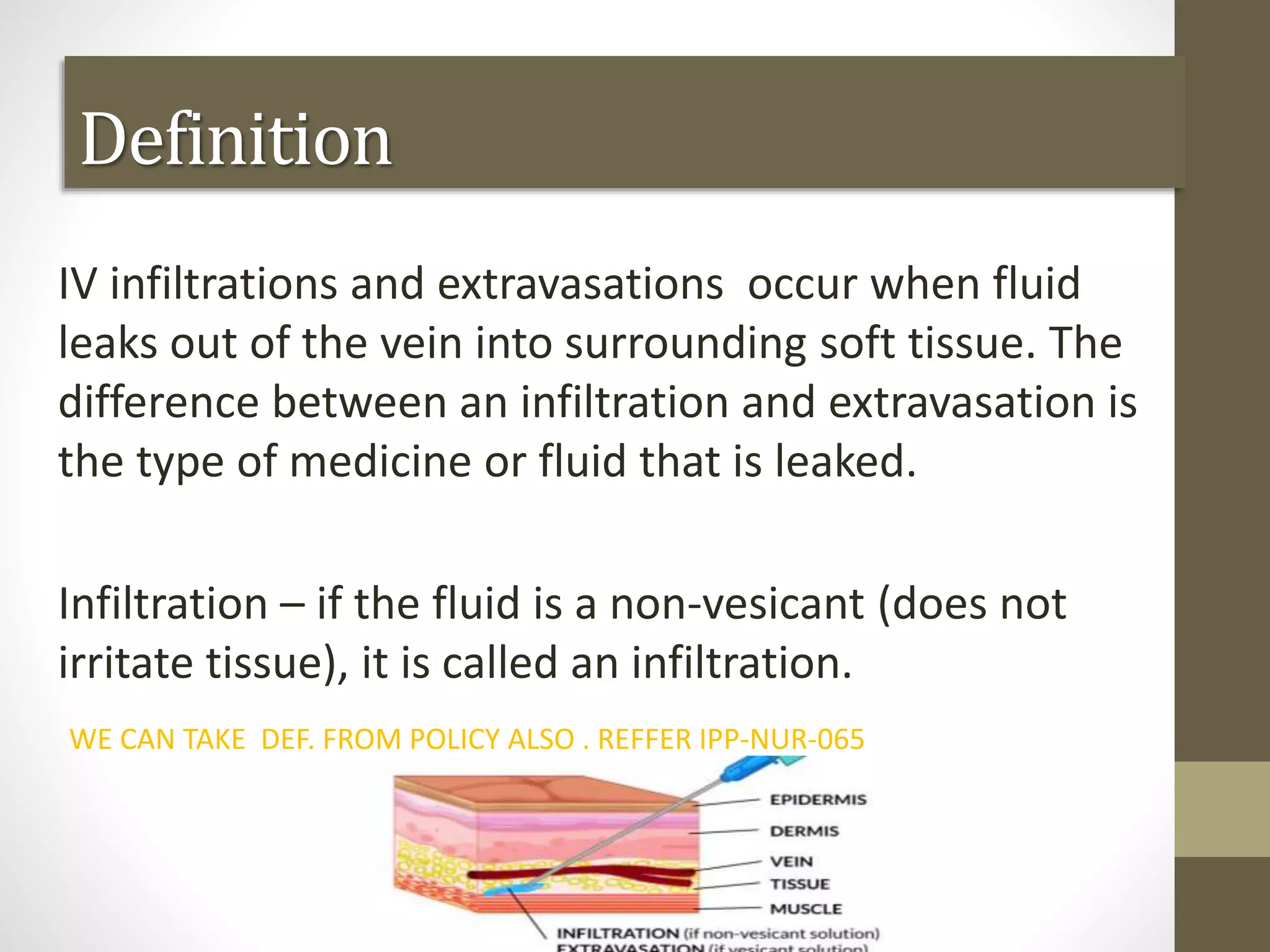
IV infiltrations and extravasations occur when fluid
leaks out of the vein into surrounding soft tissue. The
difference between an infiltration and extravasation is
the type of medicine or fluid that is leaked.
Infiltration – if the fluid is a non-vesicant (does not
irritate tissue), it is called an infiltration.
WE CAN TAKE DEF. FROM POLICY ALSO . REFFER IPP-NUR-065
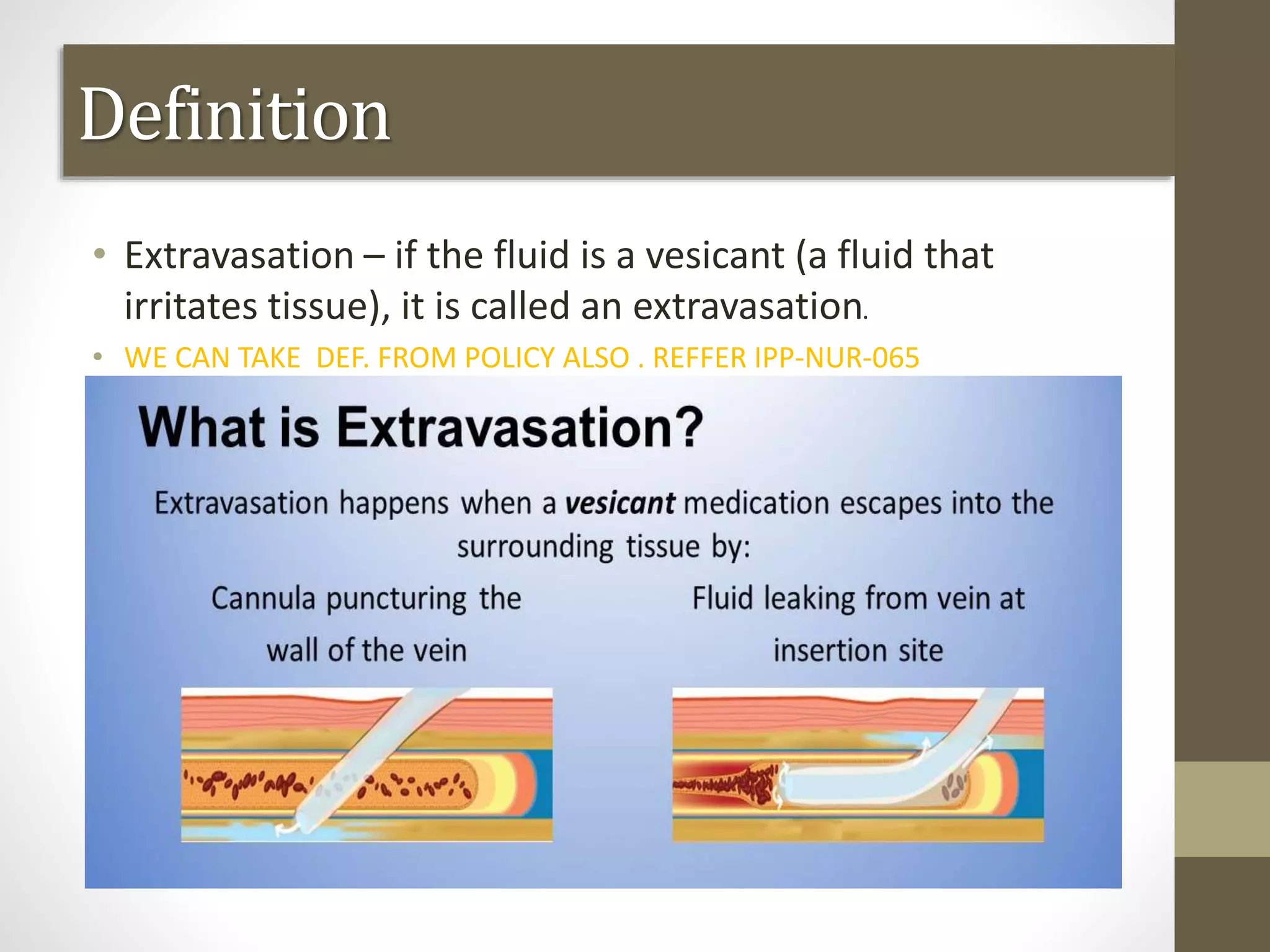
• Extravasation – if the fluid is a vesicant (a fluid that
irritates tissue), it is called an extravasation.
• WE CAN TAKE DEF. FROM POLICY ALSO . REFFER IPP-NUR-065
Definition
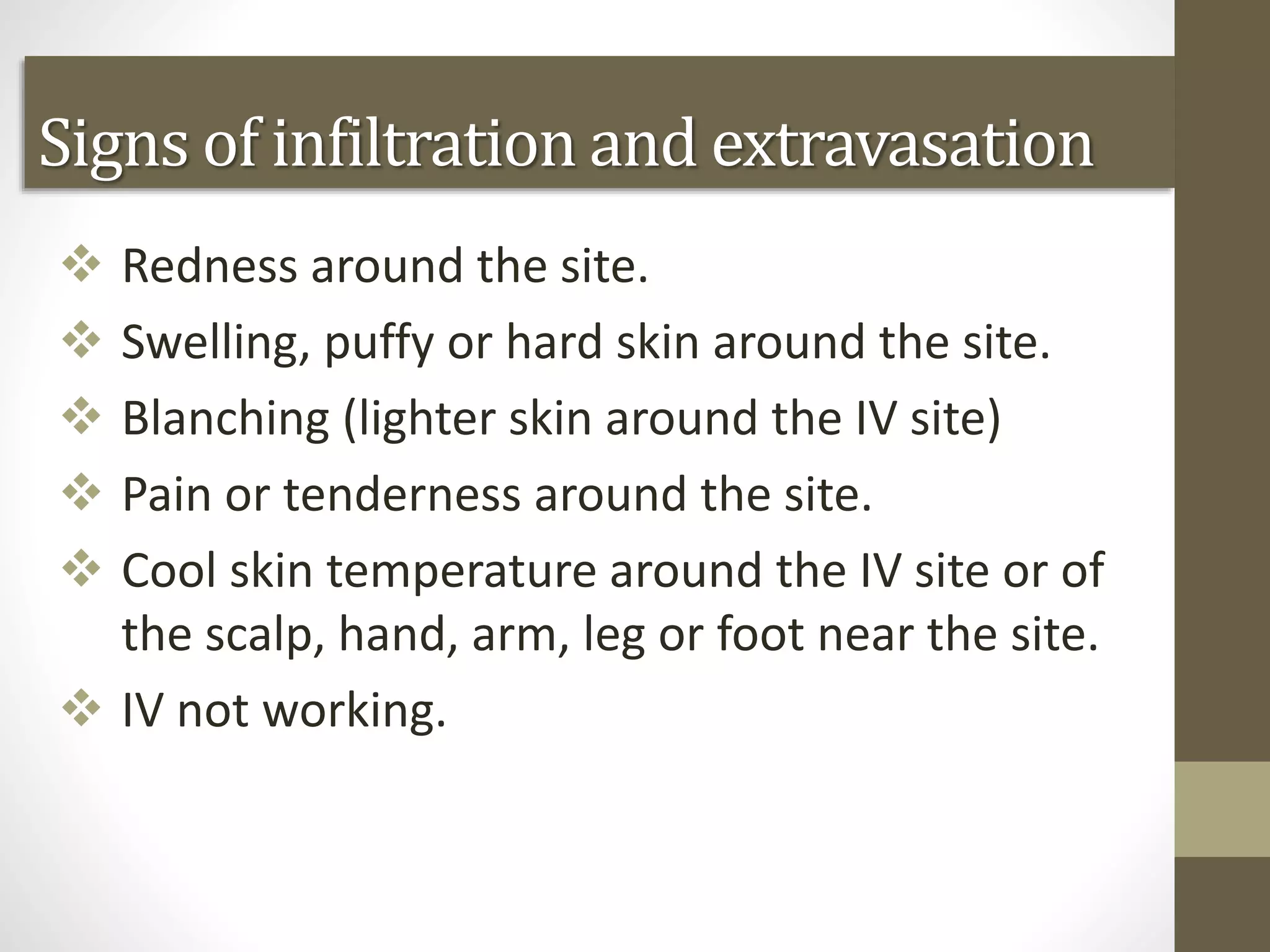
Signs of infiltration and extravasation
 Redness around the site.
 Swelling, puffy or hard skin around the site.
 Blanching (lighter skin around the IV site)
 Pain or tenderness around the site.
 Cool skin temperature around the IV site or of
the scalp, hand, arm, leg or foot near the site.
 IV not working.
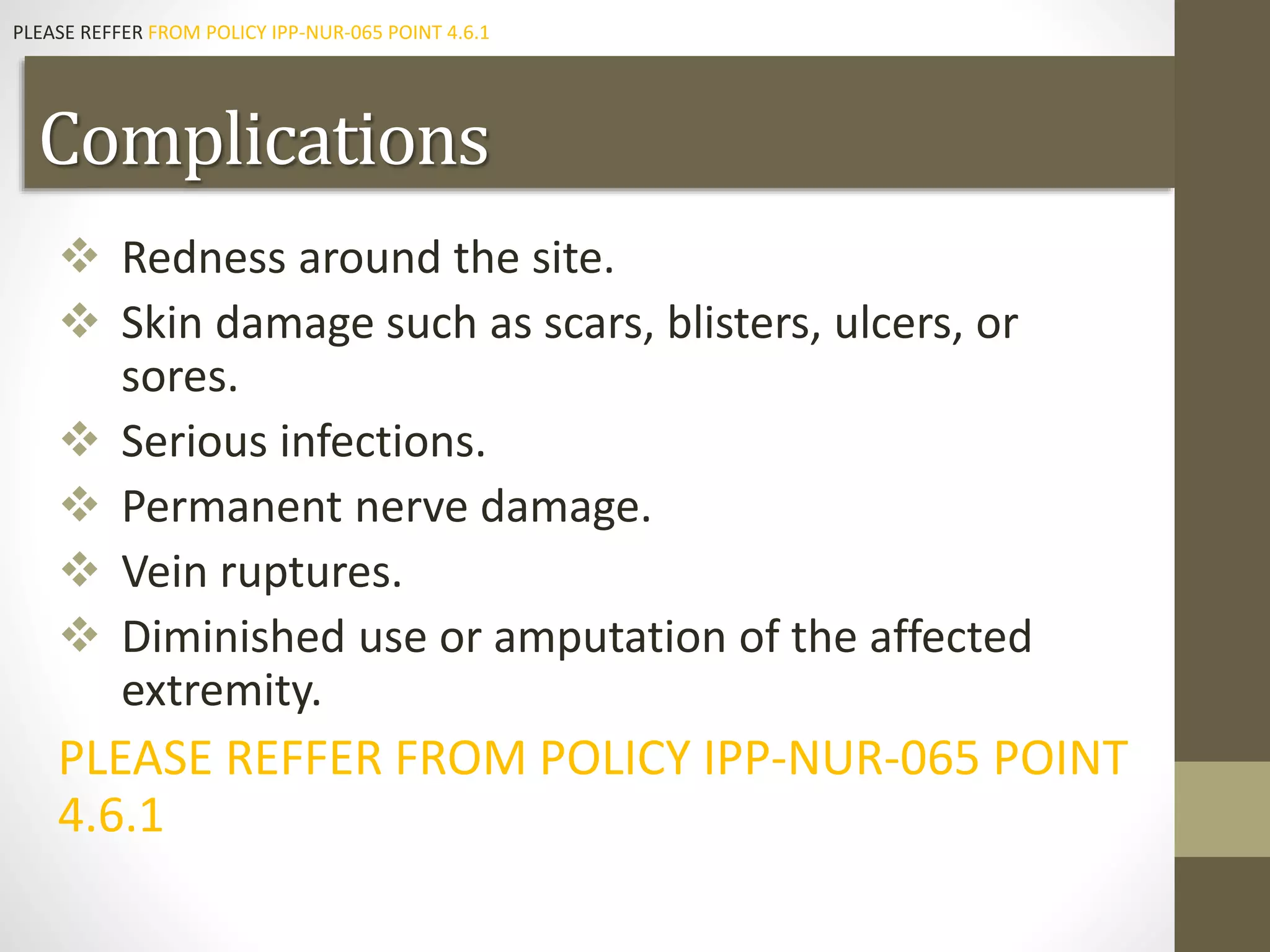
Complications
 Redness around the site.
 Skin damage such as scars, blisters, ulcers, or
sores.
 Serious infections.
 Permanent nerve damage.
 Vein ruptures.
 Diminished use or amputation of the affected
extremity.
PLEASE REFFER FROM POLICY IPP-NUR-065 POINT
4.6.1
PLEASE REFFER FROM POLICY IPP-NUR-065 POINT 4.6.1
Precautions
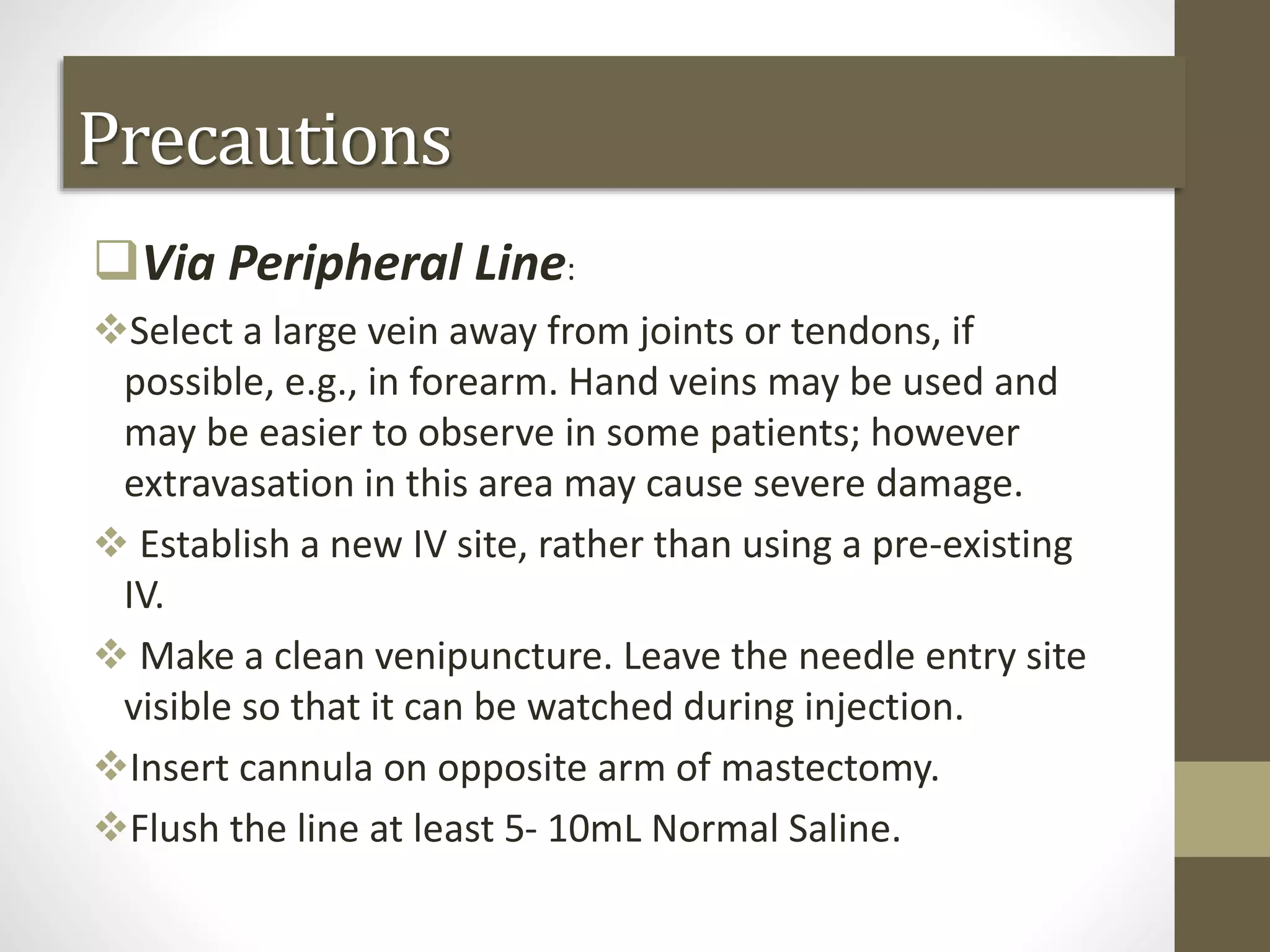
Via Peripheral Line:
Select a large vein away from joints or tendons, if
possible, e.g., in forearm. Hand veins may be used and
may be easier to observe in some patients; however
extravasation in this area may cause severe damage.
 Establish a new IV site, rather than using a pre-existing
IV.
 Make a clean venipuncture. Leave the needle entry site
visible so that it can be watched during injection.
Insert cannula on opposite arm of mastectomy.
Flush the line at least 5- 10mL Normal Saline.
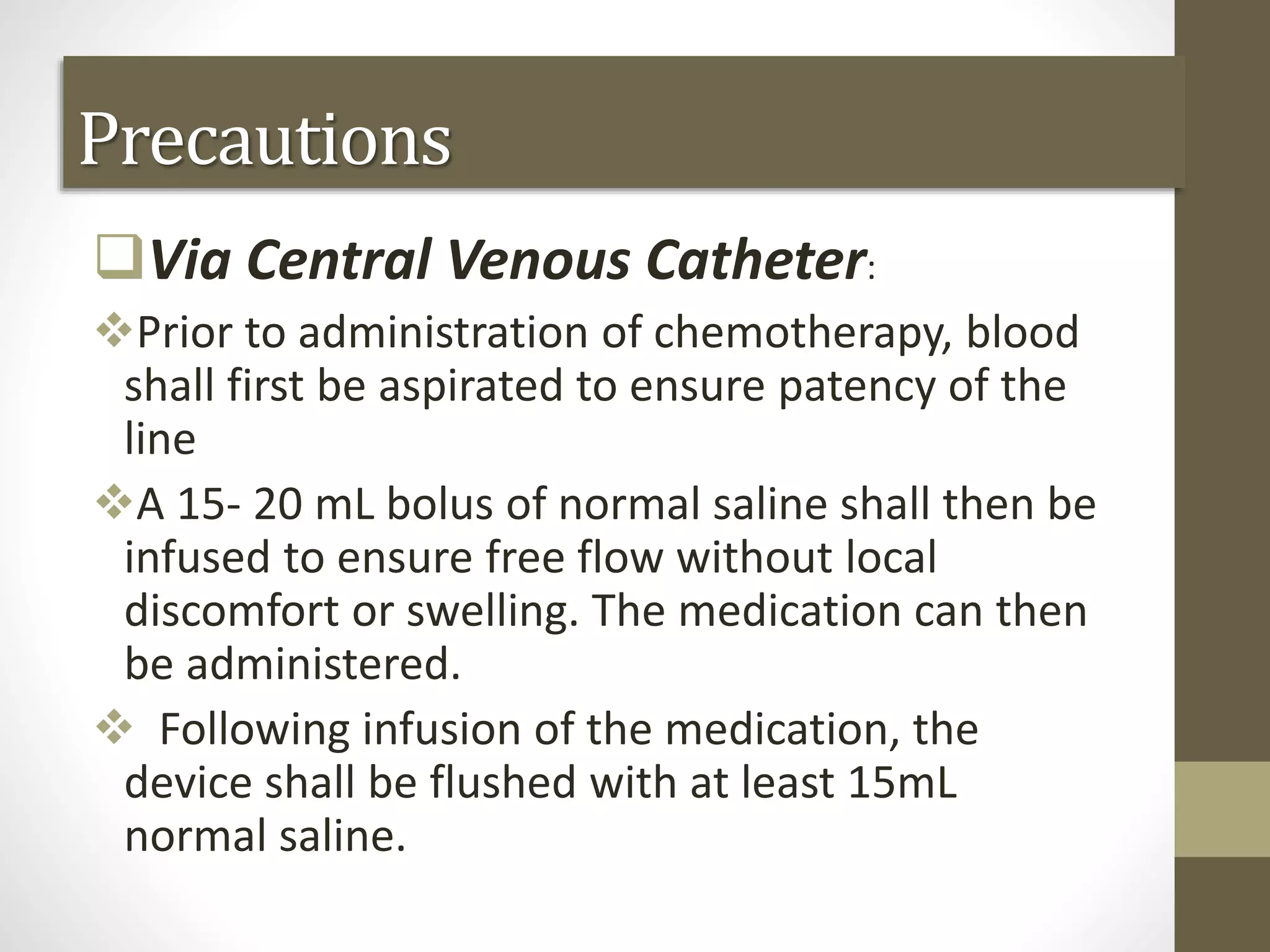
Via Central Venous Catheter:
Prior to administration of chemotherapy, blood
shall first be aspirated to ensure patency of the
line
A 15- 20 mL bolus of normal saline shall then be
infused to ensure free flow without local
discomfort or swelling. The medication can then
be administered.
 Following infusion of the medication, the
device shall be flushed with at least 15mL
normal saline.
Precautions
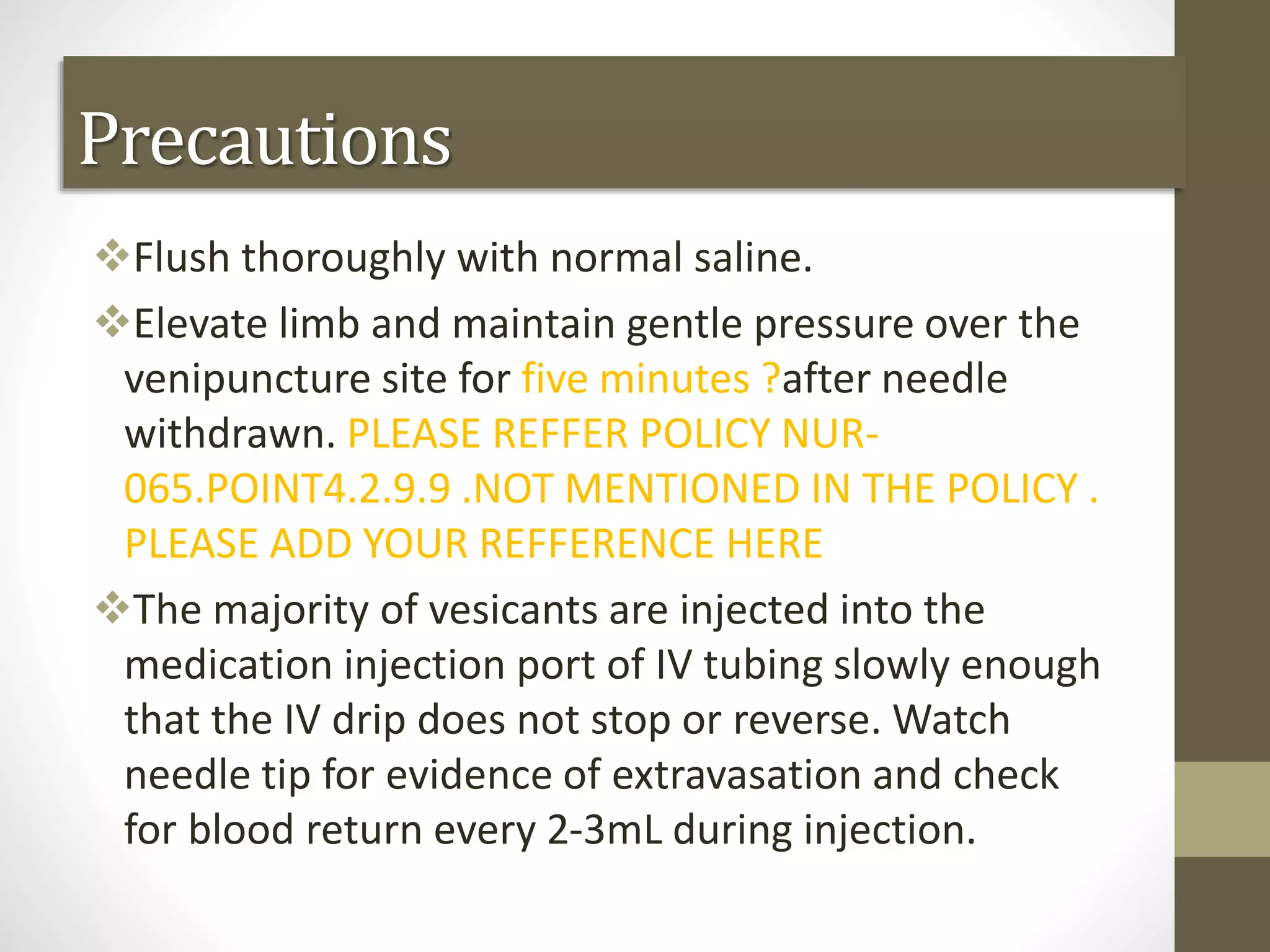
Flush thoroughly with normal saline.
Elevate limb and maintain gentle pressure over the
venipuncture site for five minutes ?after needle
withdrawn. PLEASE REFFER POLICY NUR-
065.POINT4.2.9.9 .NOT MENTIONED IN THE POLICY .
PLEASE ADD YOUR REFFERENCE HERE
The majority of vesicants are injected into the
medication injection port of IV tubing slowly enough
that the IV drip does not stop or reverse. Watch
needle tip for evidence of extravasation and check
for blood return every 2-3mL during injection.
Precautions
Prevention of Extravasation
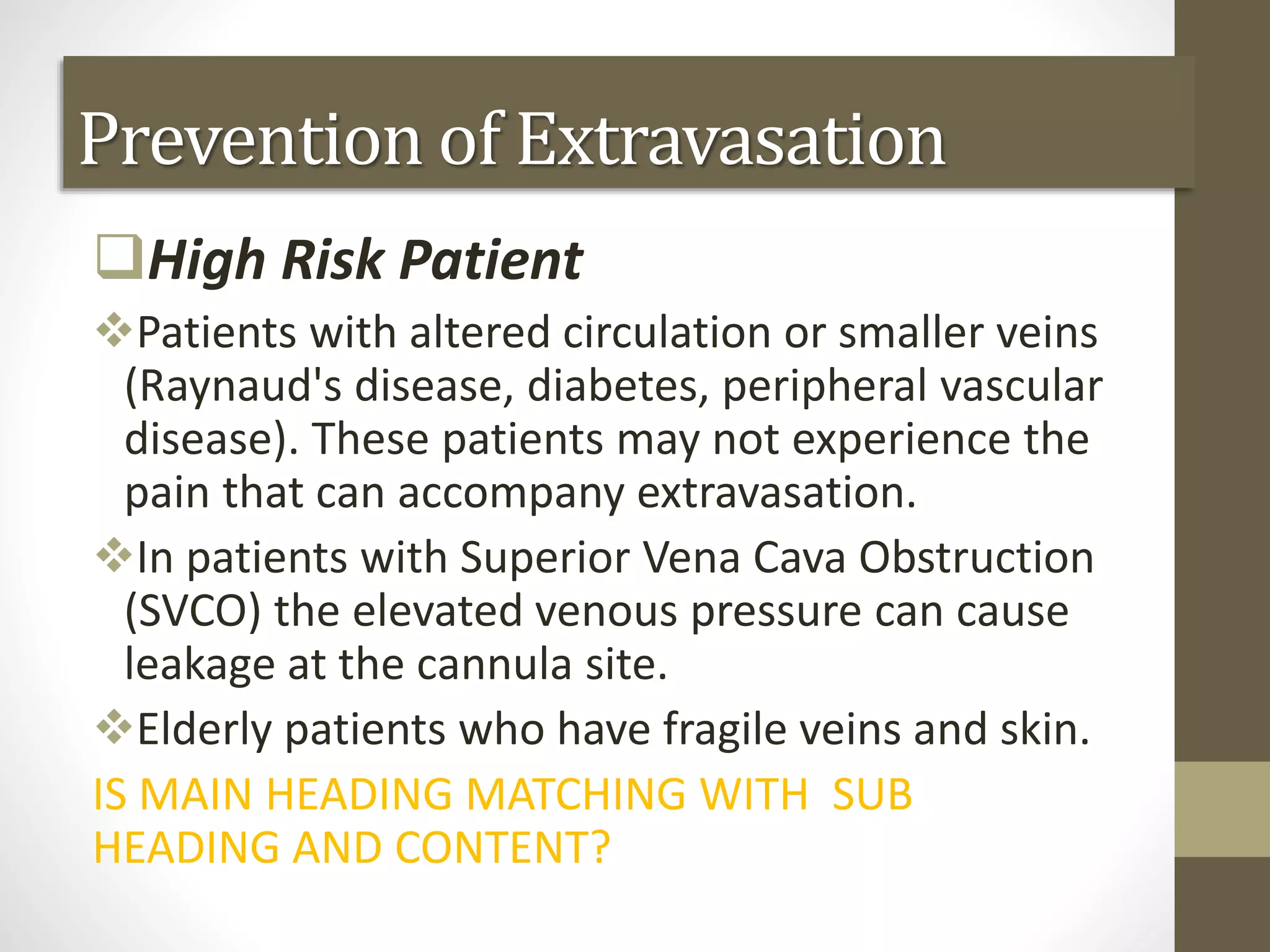
High Risk Patient
Patients with altered circulation or smaller veins
(Raynaud's disease, diabetes, peripheral vascular
disease). These patients may not experience the
pain that can accompany extravasation.
In patients with Superior Vena Cava Obstruction
(SVCO) the elevated venous pressure can cause
leakage at the cannula site.
Elderly patients who have fragile veins and skin.
IS MAIN HEADING MATCHING WITH SUB
HEADING AND CONTENT?
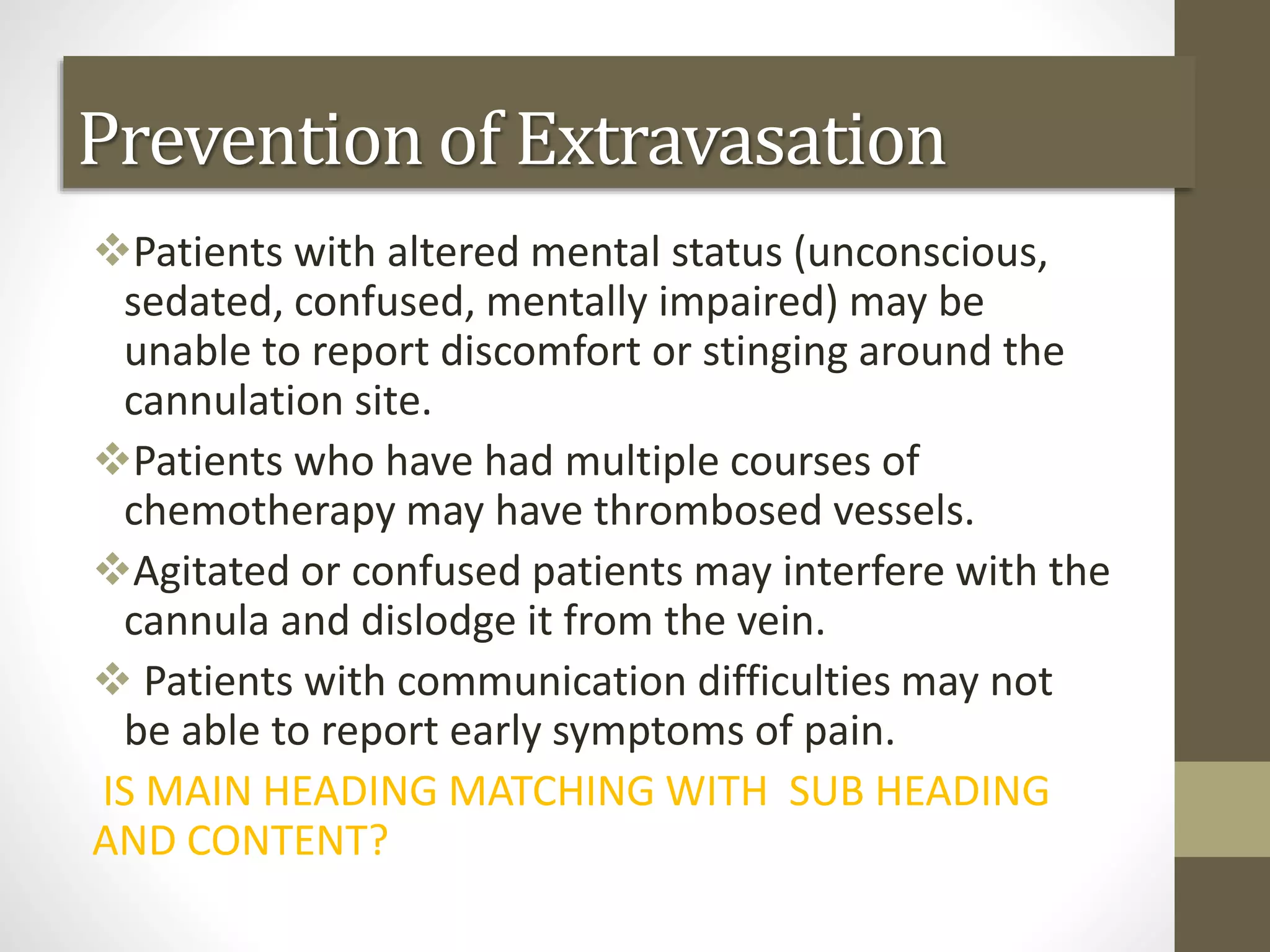
Patients with altered mental status (unconscious,
sedated, confused, mentally impaired) may be
unable to report discomfort or stinging around the
cannulation site.
Patients who have had multiple courses of
chemotherapy may have thrombosed vessels.
Agitated or confused patients may interfere with the
cannula and dislodge it from the vein.
 Patients with communication difficulties may not
be able to report early symptoms of pain.
IS MAIN HEADING MATCHING WITH SUB HEADING
AND CONTENT?
Prevention of Extravasation
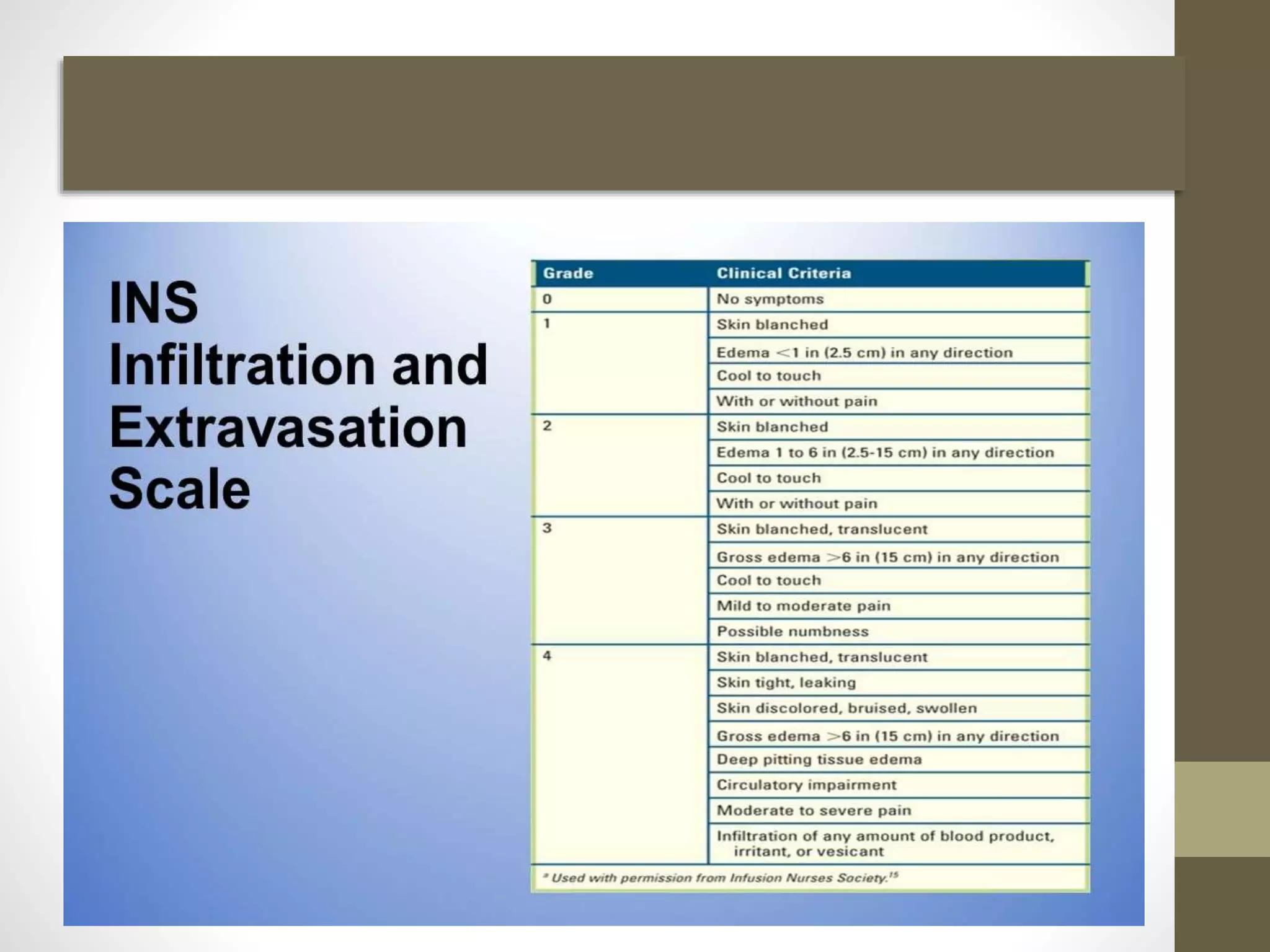
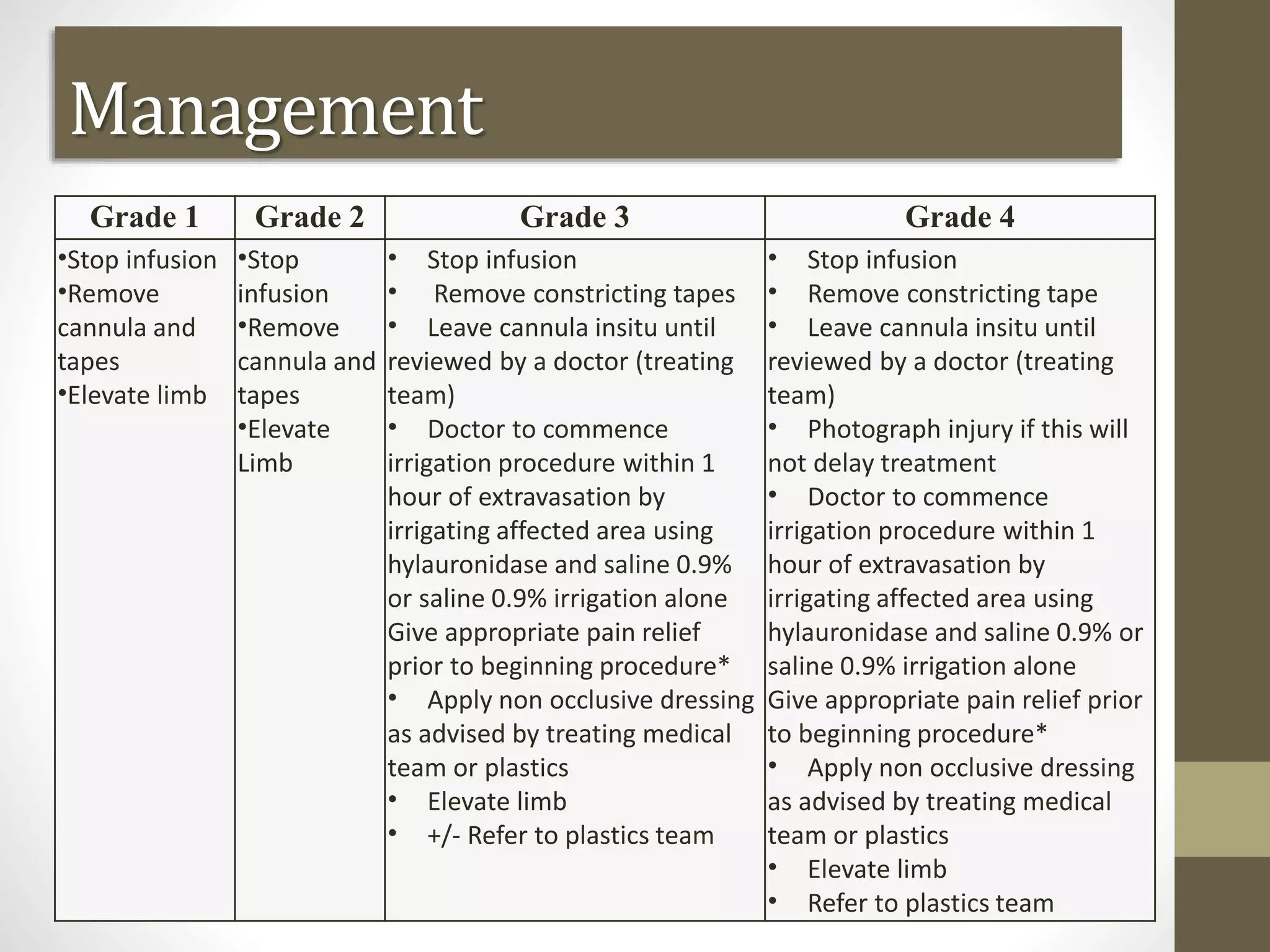
Management
Grade 1 Grade 2 Grade 3 Grade 4
•Stop infusion
•Remove
cannula and
tapes
•Elevate limb
•Stop
infusion
•Remove
cannula and
tapes
•Elevate
Limb
• Stop infusion
• Remove constricting tapes
• Leave cannula insitu until
reviewed by a doctor (treating
team)
• Doctor to commence
irrigation procedure within 1
hour of extravasation by
irrigating affected area using
hylauronidase and saline 0.9%
or saline 0.9% irrigation alone
Give appropriate pain relief
prior to beginning procedure*
• Apply non occlusive dressing
as advised by treating medical
team or plastics
• Elevate limb
• +/- Refer to plastics team
• Stop infusion
• Remove constricting tape
• Leave cannula insitu until
reviewed by a doctor (treating
team)
• Photograph injury if this will
not delay treatment
• Doctor to commence
irrigation procedure within 1
hour of extravasation by
irrigating affected area using
hylauronidase and saline 0.9% or
saline 0.9% irrigation alone
Give appropriate pain relief prior
to beginning procedure*
• Apply non occlusive dressing
as advised by treating medical
team or plastics
• Elevate limb
• Refer to plastics team
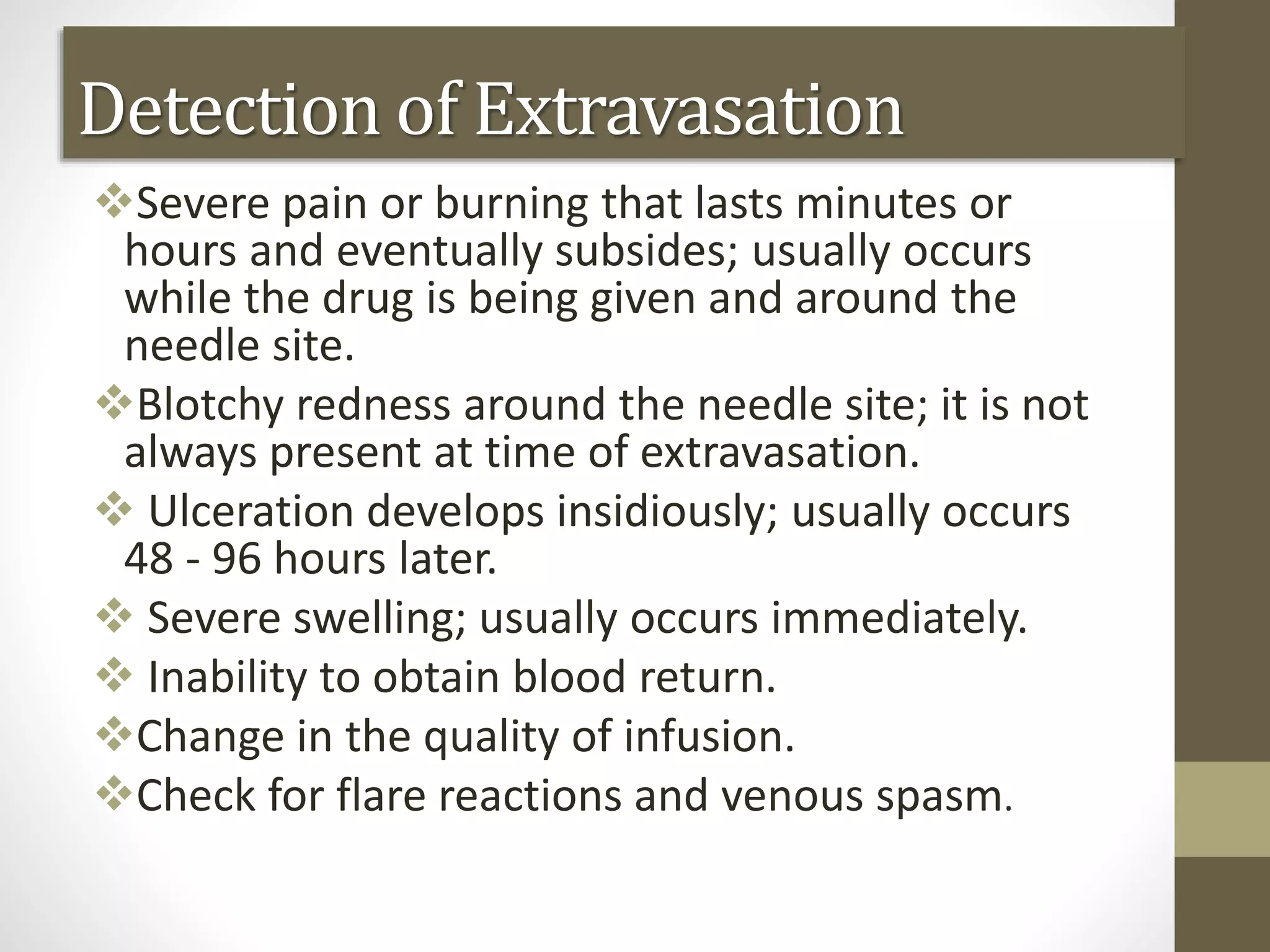
Detection of Extravasation
Severe pain or burning that lasts minutes or
hours and eventually subsides; usually occurs
while the drug is being given and around the
needle site.
Blotchy redness around the needle site; it is not
always present at time of extravasation.
 Ulceration develops insidiously; usually occurs
48 - 96 hours later.
 Severe swelling; usually occurs immediately.
 Inability to obtain blood return.
Change in the quality of infusion.
Check for flare reactions and venous spasm.
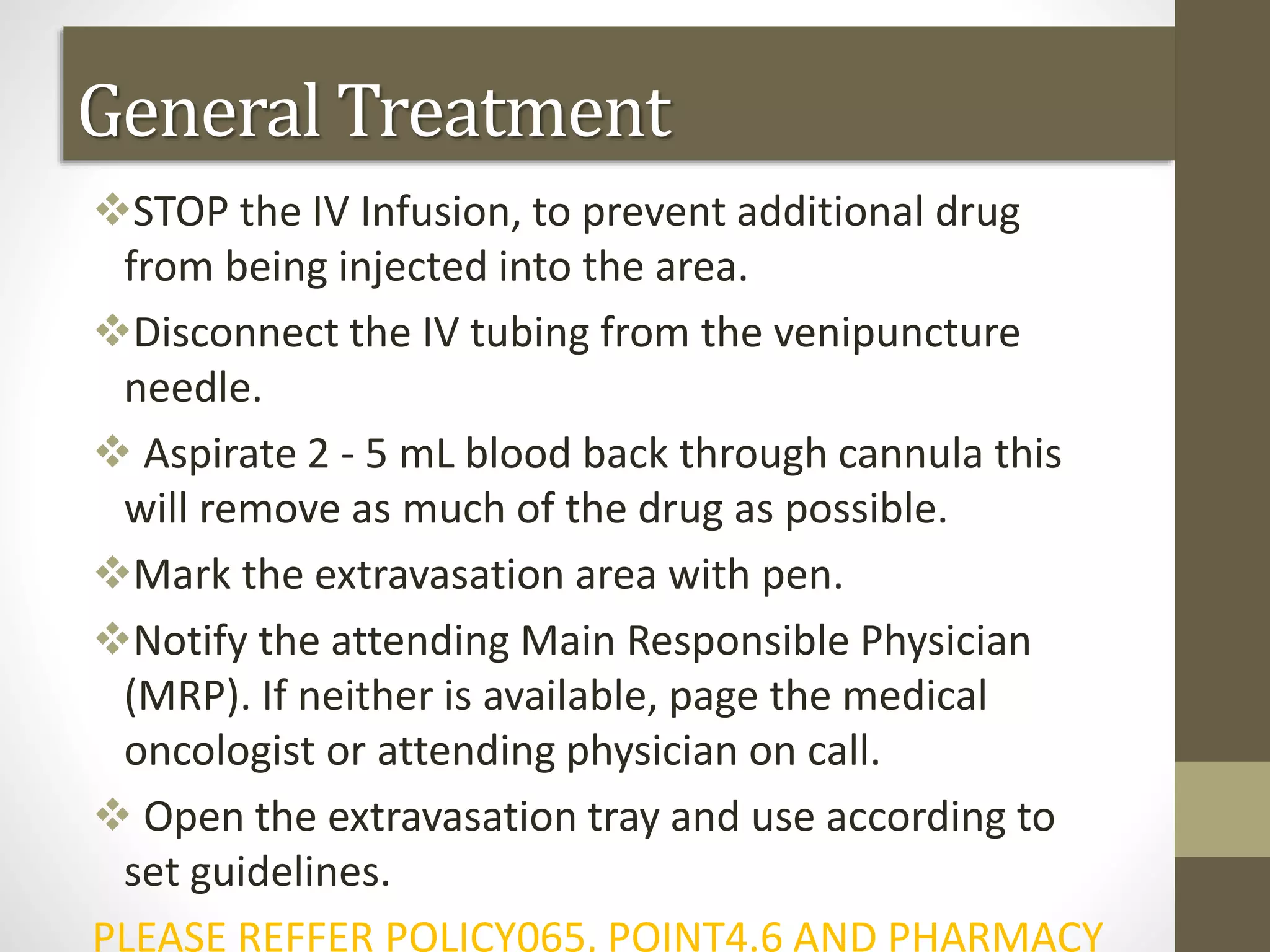
General Treatment
STOP the IV Infusion, to prevent additional drug
from being injected into the area.
Disconnect the IV tubing from the venipuncture
needle.
 Aspirate 2 - 5 mL blood back through cannula this
will remove as much of the drug as possible.
Mark the extravasation area with pen.
Notify the attending Main Responsible Physician
(MRP). If neither is available, page the medical
oncologist or attending physician on call.
 Open the extravasation tray and use according to
set guidelines.
PLEASE REFFER POLICY065, POINT4.6 AND PHARMACY
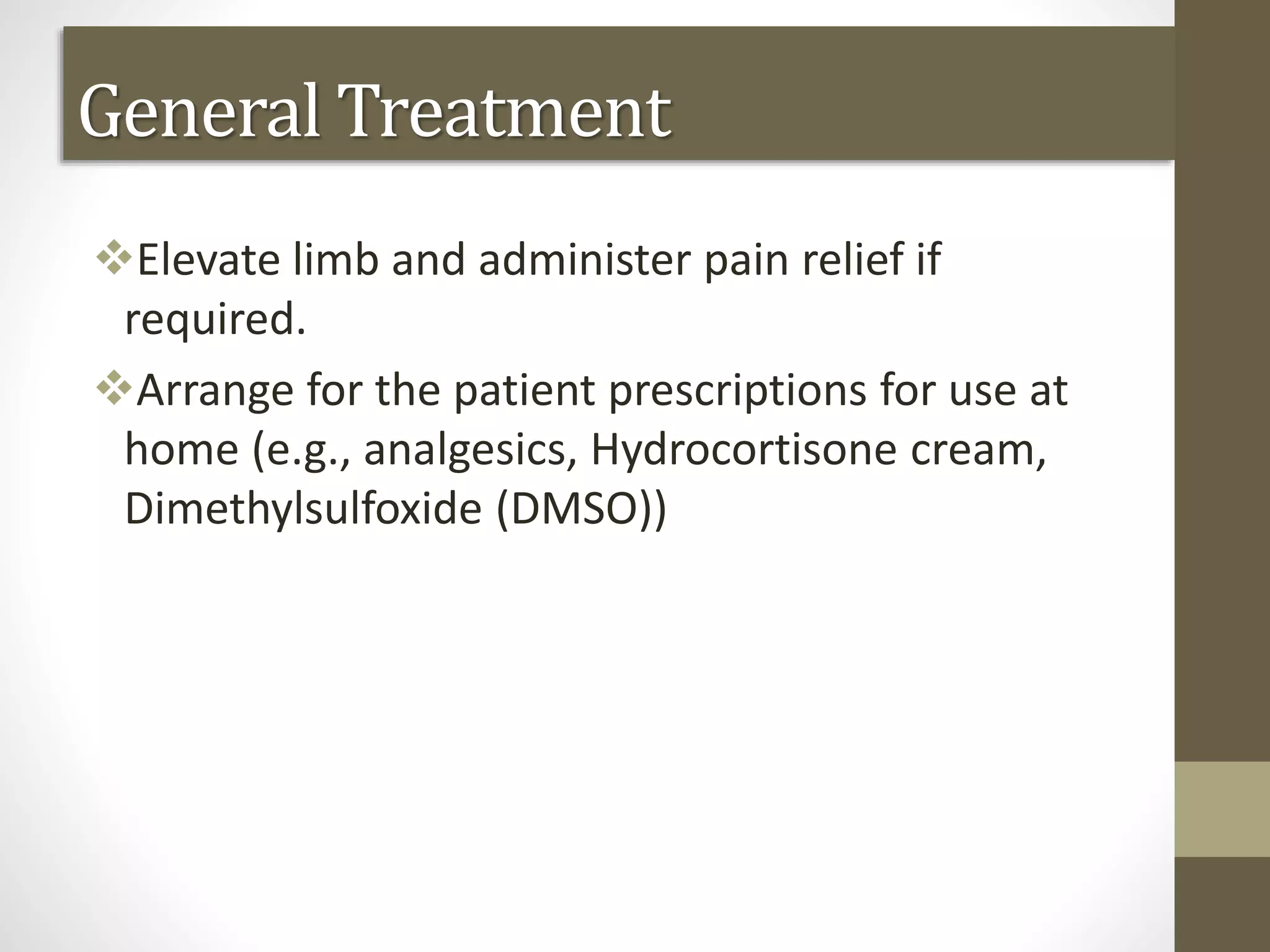
Cont……
Elevate limb and administer pain relief if
required.
Arrange for the patient prescriptions for use at
home (e.g., analgesics, Hydrocortisone cream,
Dimethylsulfoxide (DMSO))
General Treatment
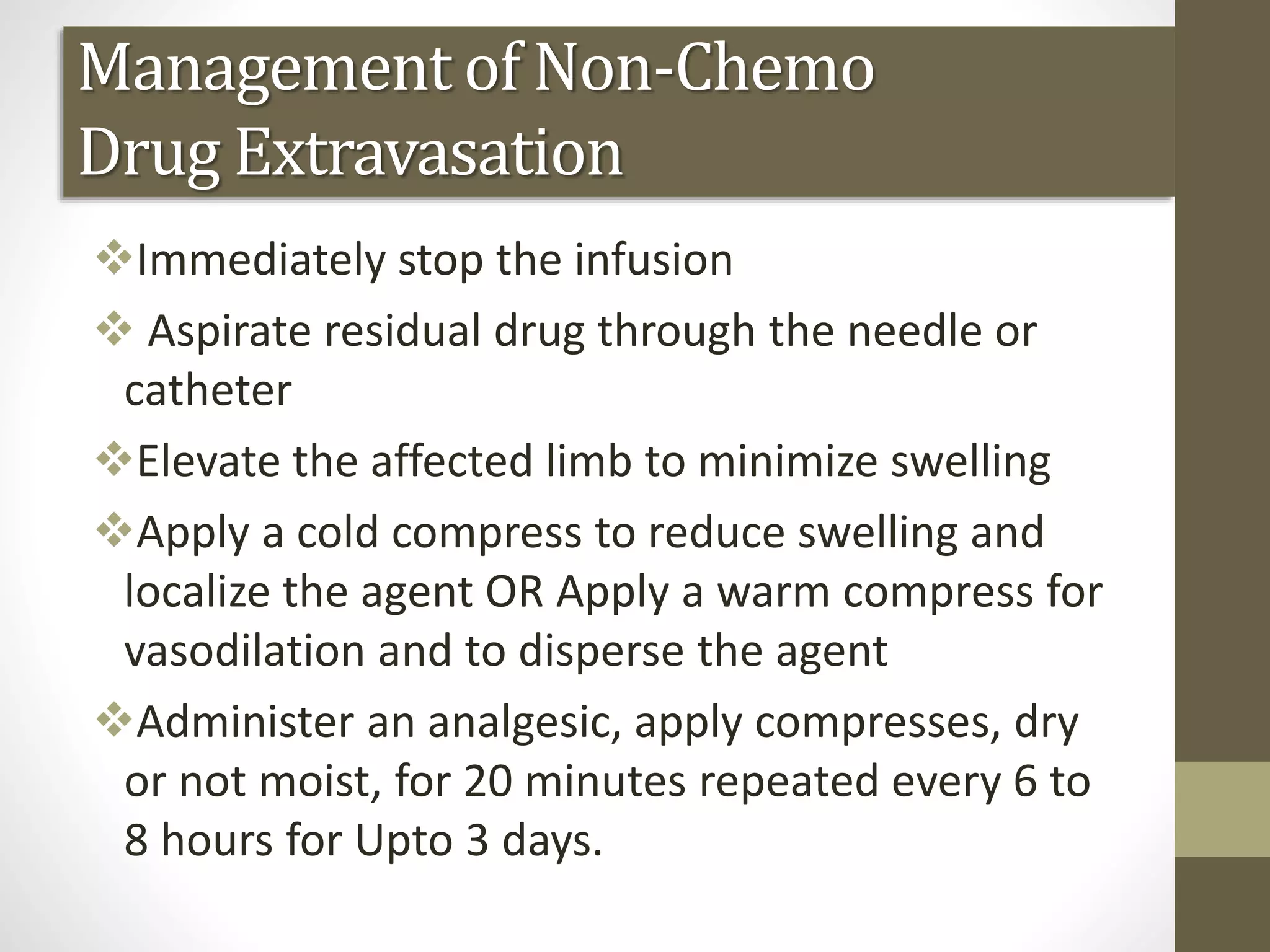
Management of Non-Chemo
Drug Extravasation
Immediately stop the infusion
 Aspirate residual drug through the needle or
catheter
Elevate the affected limb to minimize swelling
Apply a cold compress to reduce swelling and
localize the agent OR Apply a warm compress for
vasodilation and to disperse the agent
Administer an analgesic, apply compresses, dry
or not moist, for 20 minutes repeated every 6 to
8 hours for Upto 3 days.
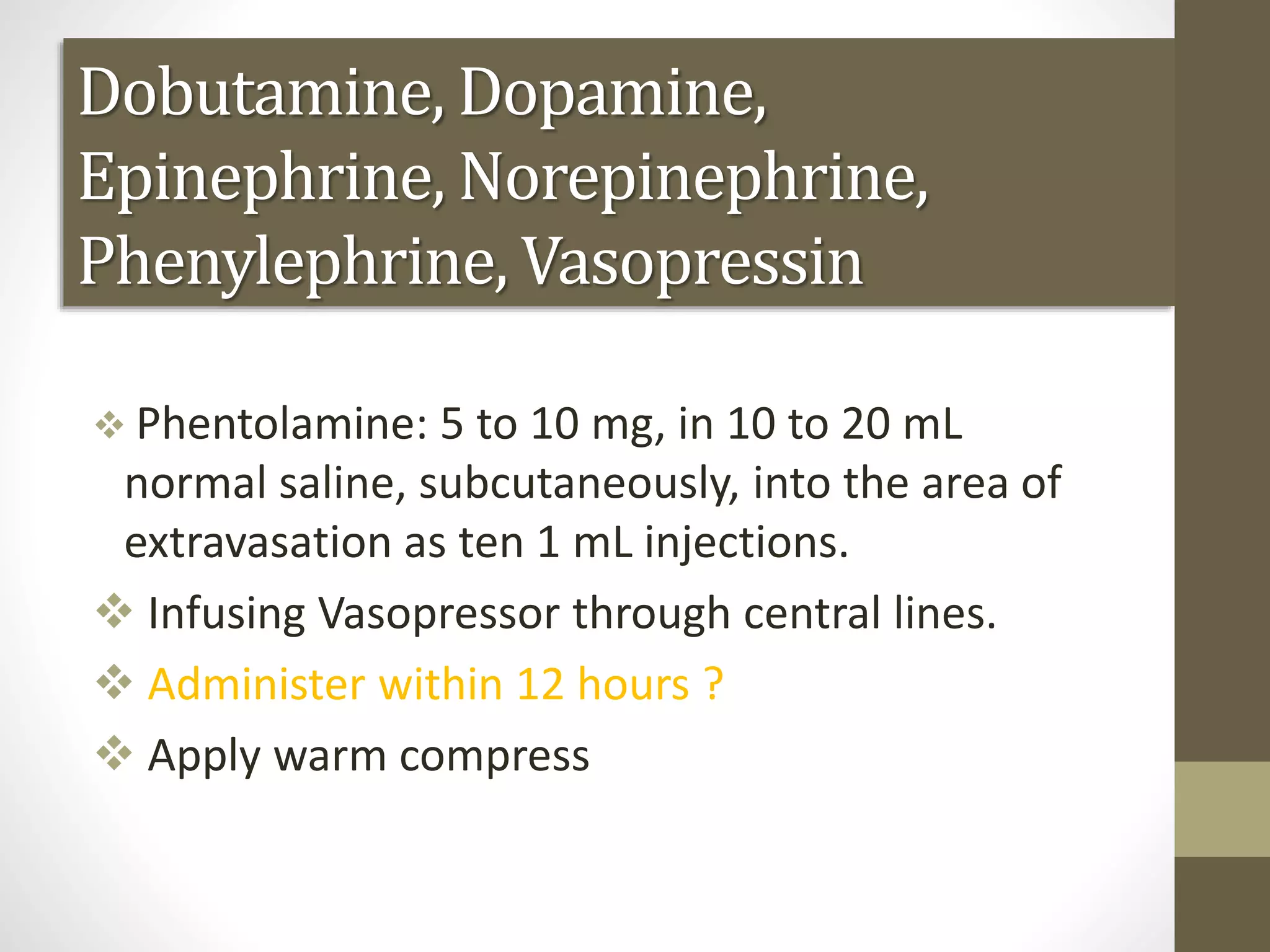
Dobutamine, Dopamine,
Epinephrine, Norepinephrine,
Phenylephrine, Vasopressin
 Phentolamine: 5 to 10 mg, in 10 to 20 mL
normal saline, subcutaneously, into the area of
extravasation as ten 1 mL injections.
 Infusing Vasopressor through central lines.
 Administer within 12 hours ?
 Apply warm compress
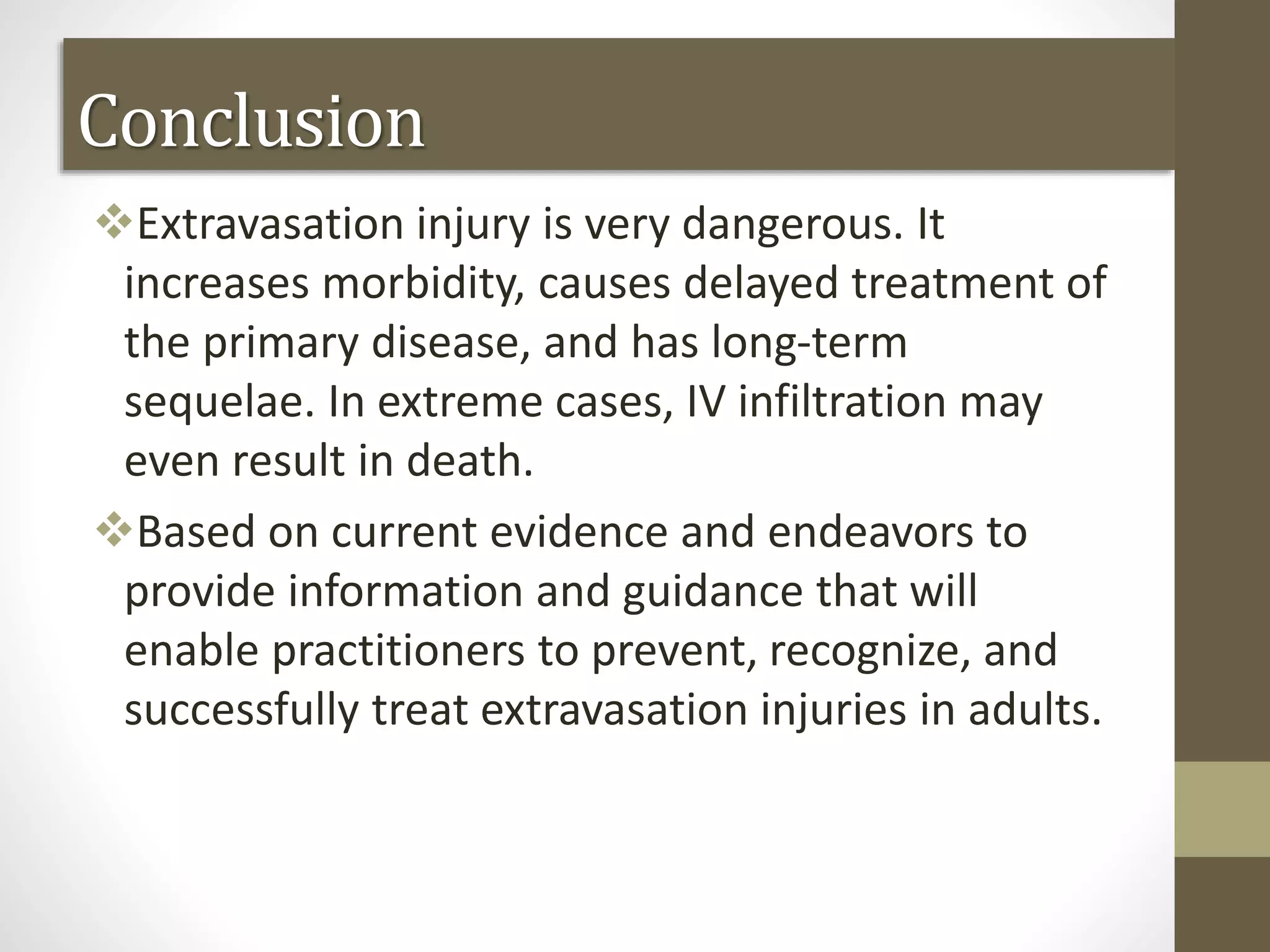
Conclusion
Extravasation injury is very dangerous. It
increases morbidity, causes delayed treatment of
the primary disease, and has long-term
sequelae. In extreme cases, IV infiltration may
even result in death.
Based on current evidence and endeavors to
provide information and guidance that will
enable practitioners to prevent, recognize, and
successfully treat extravasation injuries in adults.
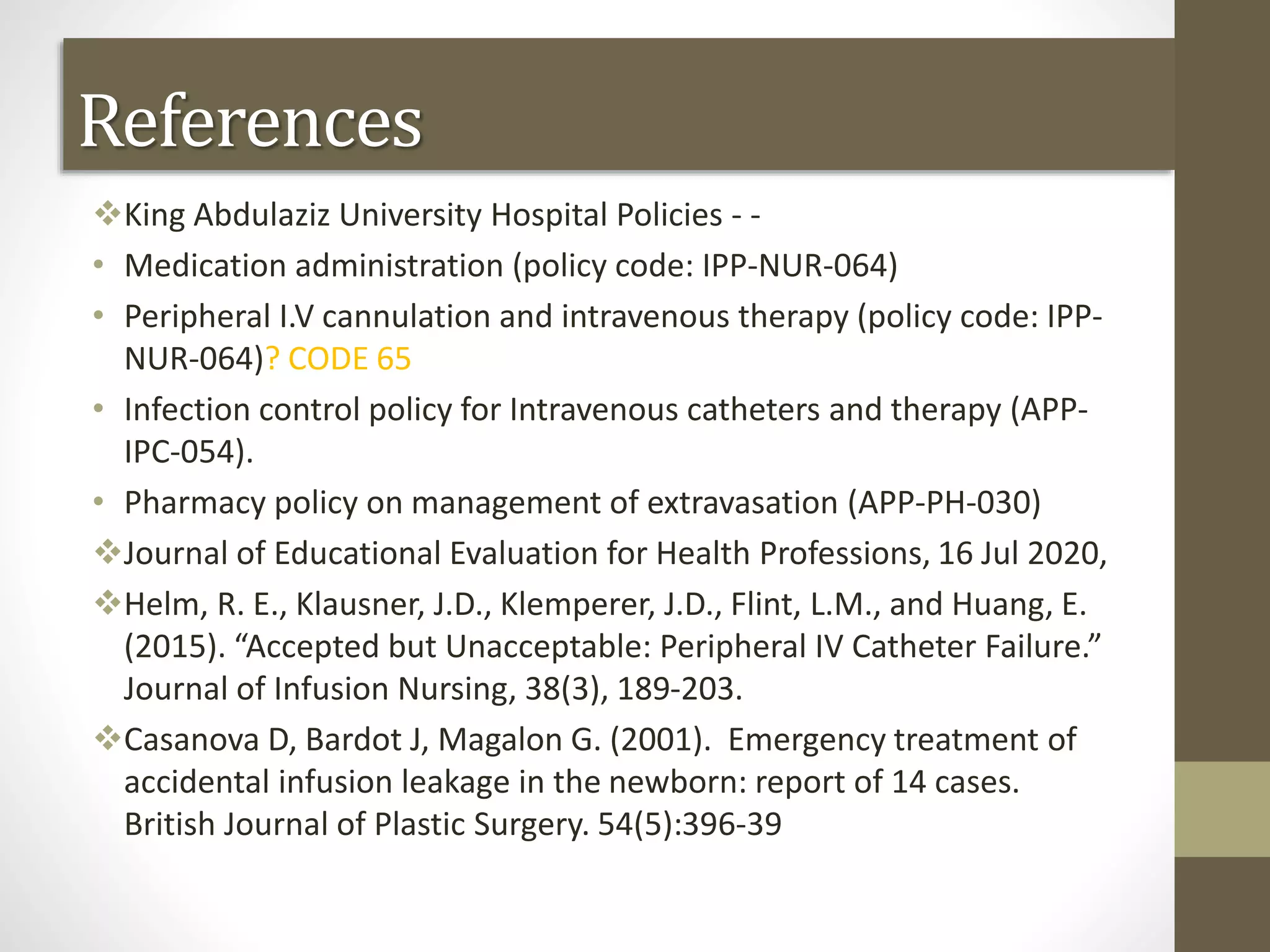
References
King Abdulaziz University Hospital Policies - -
• Medication administration (policy code: IPP-NUR-064)
• Peripheral I.V cannulation and intravenous therapy (policy code: IPP-
NUR-064)? CODE 65
• Infection control policy for Intravenous catheters and therapy (APP-
IPC-054).
• Pharmacy policy on management of extravasation (APP-PH-030)
Journal of Educational Evaluation for Health Professions, 16 Jul 2020,
Helm, R. E., Klausner, J.D., Klemperer, J.D., Flint, L.M., and Huang, E.
(2015). “Accepted but Unacceptable: Peripheral IV Catheter Failure.”
Journal of Infusion Nursing, 38(3), 189-203.
Casanova D, Bardot J, Magalon G. (2001). Emergency treatment of
accidental infusion leakage in the newborn: report of 14 cases.
British Journal of Plastic Surgery. 54(5):396-39
Thank you

infiltration and extravasation.pptx

  • 1.
  • 2.
    Objectives After the discussionthe group will be able to:  Define IV infiltration and extravasation  Able to identify signs and symptoms of IV infiltration and extravasation  Describe categories of IV infiltration and extravasation  Explain prevention and management of IV infiltration and extravasations
  • 3.
    Definition IV infiltrations andextravasations occur when fluid leaks out of the vein into surrounding soft tissue. The difference between an infiltration and extravasation is the type of medicine or fluid that is leaked. Infiltration – if the fluid is a non-vesicant (does not irritate tissue), it is called an infiltration. WE CAN TAKE DEF. FROM POLICY ALSO . REFFER IPP-NUR-065
  • 4.
    • Extravasation –if the fluid is a vesicant (a fluid that irritates tissue), it is called an extravasation. • WE CAN TAKE DEF. FROM POLICY ALSO . REFFER IPP-NUR-065 Definition
  • 5.
    Signs of infiltrationand extravasation  Redness around the site.  Swelling, puffy or hard skin around the site.  Blanching (lighter skin around the IV site)  Pain or tenderness around the site.  Cool skin temperature around the IV site or of the scalp, hand, arm, leg or foot near the site.  IV not working.
  • 6.
    Complications  Redness aroundthe site.  Skin damage such as scars, blisters, ulcers, or sores.  Serious infections.  Permanent nerve damage.  Vein ruptures.  Diminished use or amputation of the affected extremity. PLEASE REFFER FROM POLICY IPP-NUR-065 POINT 4.6.1 PLEASE REFFER FROM POLICY IPP-NUR-065 POINT 4.6.1
  • 7.
    Precautions Via Peripheral Line: Selecta large vein away from joints or tendons, if possible, e.g., in forearm. Hand veins may be used and may be easier to observe in some patients; however extravasation in this area may cause severe damage.  Establish a new IV site, rather than using a pre-existing IV.  Make a clean venipuncture. Leave the needle entry site visible so that it can be watched during injection. Insert cannula on opposite arm of mastectomy. Flush the line at least 5- 10mL Normal Saline.
  • 8.
    Via Central VenousCatheter: Prior to administration of chemotherapy, blood shall first be aspirated to ensure patency of the line A 15- 20 mL bolus of normal saline shall then be infused to ensure free flow without local discomfort or swelling. The medication can then be administered.  Following infusion of the medication, the device shall be flushed with at least 15mL normal saline. Precautions
  • 9.
    Flush thoroughly withnormal saline. Elevate limb and maintain gentle pressure over the venipuncture site for five minutes ?after needle withdrawn. PLEASE REFFER POLICY NUR- 065.POINT4.2.9.9 .NOT MENTIONED IN THE POLICY . PLEASE ADD YOUR REFFERENCE HERE The majority of vesicants are injected into the medication injection port of IV tubing slowly enough that the IV drip does not stop or reverse. Watch needle tip for evidence of extravasation and check for blood return every 2-3mL during injection. Precautions
  • 10.
    Prevention of Extravasation HighRisk Patient Patients with altered circulation or smaller veins (Raynaud's disease, diabetes, peripheral vascular disease). These patients may not experience the pain that can accompany extravasation. In patients with Superior Vena Cava Obstruction (SVCO) the elevated venous pressure can cause leakage at the cannula site. Elderly patients who have fragile veins and skin. IS MAIN HEADING MATCHING WITH SUB HEADING AND CONTENT?
  • 11.
    Patients with alteredmental status (unconscious, sedated, confused, mentally impaired) may be unable to report discomfort or stinging around the cannulation site. Patients who have had multiple courses of chemotherapy may have thrombosed vessels. Agitated or confused patients may interfere with the cannula and dislodge it from the vein.  Patients with communication difficulties may not be able to report early symptoms of pain. IS MAIN HEADING MATCHING WITH SUB HEADING AND CONTENT? Prevention of Extravasation
  • 13.
    Management Grade 1 Grade2 Grade 3 Grade 4 •Stop infusion •Remove cannula and tapes •Elevate limb •Stop infusion •Remove cannula and tapes •Elevate Limb • Stop infusion • Remove constricting tapes • Leave cannula insitu until reviewed by a doctor (treating team) • Doctor to commence irrigation procedure within 1 hour of extravasation by irrigating affected area using hylauronidase and saline 0.9% or saline 0.9% irrigation alone Give appropriate pain relief prior to beginning procedure* • Apply non occlusive dressing as advised by treating medical team or plastics • Elevate limb • +/- Refer to plastics team • Stop infusion • Remove constricting tape • Leave cannula insitu until reviewed by a doctor (treating team) • Photograph injury if this will not delay treatment • Doctor to commence irrigation procedure within 1 hour of extravasation by irrigating affected area using hylauronidase and saline 0.9% or saline 0.9% irrigation alone Give appropriate pain relief prior to beginning procedure* • Apply non occlusive dressing as advised by treating medical team or plastics • Elevate limb • Refer to plastics team
  • 14.
    Detection of Extravasation Severepain or burning that lasts minutes or hours and eventually subsides; usually occurs while the drug is being given and around the needle site. Blotchy redness around the needle site; it is not always present at time of extravasation.  Ulceration develops insidiously; usually occurs 48 - 96 hours later.  Severe swelling; usually occurs immediately.  Inability to obtain blood return. Change in the quality of infusion. Check for flare reactions and venous spasm.
  • 15.
    General Treatment STOP theIV Infusion, to prevent additional drug from being injected into the area. Disconnect the IV tubing from the venipuncture needle.  Aspirate 2 - 5 mL blood back through cannula this will remove as much of the drug as possible. Mark the extravasation area with pen. Notify the attending Main Responsible Physician (MRP). If neither is available, page the medical oncologist or attending physician on call.  Open the extravasation tray and use according to set guidelines. PLEASE REFFER POLICY065, POINT4.6 AND PHARMACY
  • 16.
    Cont…… Elevate limb andadminister pain relief if required. Arrange for the patient prescriptions for use at home (e.g., analgesics, Hydrocortisone cream, Dimethylsulfoxide (DMSO)) General Treatment
  • 17.
    Management of Non-Chemo DrugExtravasation Immediately stop the infusion  Aspirate residual drug through the needle or catheter Elevate the affected limb to minimize swelling Apply a cold compress to reduce swelling and localize the agent OR Apply a warm compress for vasodilation and to disperse the agent Administer an analgesic, apply compresses, dry or not moist, for 20 minutes repeated every 6 to 8 hours for Upto 3 days.
  • 18.
    Dobutamine, Dopamine, Epinephrine, Norepinephrine, Phenylephrine,Vasopressin  Phentolamine: 5 to 10 mg, in 10 to 20 mL normal saline, subcutaneously, into the area of extravasation as ten 1 mL injections.  Infusing Vasopressor through central lines.  Administer within 12 hours ?  Apply warm compress
  • 19.
    Conclusion Extravasation injury isvery dangerous. It increases morbidity, causes delayed treatment of the primary disease, and has long-term sequelae. In extreme cases, IV infiltration may even result in death. Based on current evidence and endeavors to provide information and guidance that will enable practitioners to prevent, recognize, and successfully treat extravasation injuries in adults.
  • 20.
    References King Abdulaziz UniversityHospital Policies - - • Medication administration (policy code: IPP-NUR-064) • Peripheral I.V cannulation and intravenous therapy (policy code: IPP- NUR-064)? CODE 65 • Infection control policy for Intravenous catheters and therapy (APP- IPC-054). • Pharmacy policy on management of extravasation (APP-PH-030) Journal of Educational Evaluation for Health Professions, 16 Jul 2020, Helm, R. E., Klausner, J.D., Klemperer, J.D., Flint, L.M., and Huang, E. (2015). “Accepted but Unacceptable: Peripheral IV Catheter Failure.” Journal of Infusion Nursing, 38(3), 189-203. Casanova D, Bardot J, Magalon G. (2001). Emergency treatment of accidental infusion leakage in the newborn: report of 14 cases. British Journal of Plastic Surgery. 54(5):396-39
  • 21.