Prepared by: Dr. Zahra HasanAlali
Medical intern
Supervised by: Dr. Mohammed Ali Almatar
OBJECTIVES:
Definition of
Mononucleosis
Epidemiology of
Mononucleosis
Causes of
Mononucleosis
Pathophysiology
Clinical picture
Diagnosis of
mononucleosis
Treatment of
mononucleosis
Prevention of
mononucleosis
DEFINITION & EPIDEMIOLOGY
DEFINITION OF MONONUCLEOSIS:
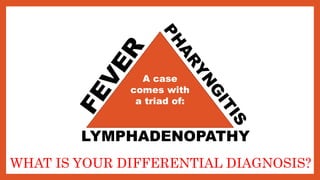
• Infectious mononucleosis is an infectious disease characterized by a triad
of fever, tonsillar pharyngitis and lymphadenopathy.
• It was formerly known as glandular fever, but this term was changed to
infectious mononucleosis.
• Epstein-Barr virus (EBV) is the most common cause of infectious
mononucleosis, but other viruses can also cause this disease.
UP TO DATE
EPIDEMIOLOGYOF MONONUCLEOSIS
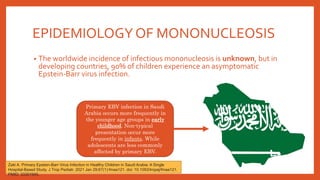
• The worldwide incidence of infectious mononucleosis is unknown, but in
developing countries, 90% of children experience an asymptomatic
Epstein-Barr virus infection.
Primary EBV infection in Saudi
Arabia occurs more frequently in
the younger age groups in early
childhood. Non-typical
presentation occur more
frequently in infants. While
adolescents are less commonly
affected by primary EBV.
Zaki A. Primary Epstein-Barr Virus Infection in Healthy Children in Saudi Arabia: A Single
Hospital-Based Study. J Trop Pediatr. 2021 Jan 29;67(1):fmaa121. doi: 10.1093/tropej/fmaa121.
PMID: 33351945.
CAUSES
CAUSES OF MONONUCLEOSIS:
• Mononucleosis is caused by 2 members of the herpes simplex family:
Epstein-Barr virus Cytomegalovirus
This variant is milder
Elana Pearl Ben-Joseph. "How Long Is Mono Contagious?". Kidshealth.org. Archived from the original on 2016-11-19.
Epstein-Barr virus (EBV)
• 90% of cases of infectious mononucleosis are caused by EBV.
• It is one of the most common viruses throughout the world.
• EBV is not highly contagious.
• It can only be contracted through direct contact with an infected person's saliva,
such as through kissing or sharing toothbrushes.
• About 95% of the population has been exposed to EBV by the age of 40, but only
about 40% of exposed adults develop infectious mononucleosis.
• Incubation period is between 4-8 weeks.
Elana Pearl Ben-Joseph. "How Long Is Mono Contagious?". Kidshealth.org. Archived from the original on 2016-11-19.
CYTOMEGALOVIRUS (CMV)
• About 5–7% of cases of infectious mononucleosis is caused by CMV.
• CMV is found in body fluids including saliva, urine, blood, and tears.
• A person becomes infected with this virus by direct contact with infected body
fluids.
• Cytomegalovirus is mostly transmitted through kissing and sexual intercourse.
• It can also be transferred from an infected mother to her unborn child.
Elana Pearl Ben-Joseph. "How Long Is Mono Contagious?". Kidshealth.org. Archived from the original on 2016-11-19.
CYTOMEGALOVIRUS (CMV) Cont…
• This virus is often "silent" because the signs and symptoms cannot be felt by the
person infected.
• However, it can cause life-threatening illness in:
• Infants.
• Patients with HIV.
• Transplant recipients.
• Patients with weak immune systems.
• Once a person becomes infected with cytomegalovirus, the virus stays in their
body fluids throughout the person's lifetime.
Elana Pearl Ben-Joseph. "How Long Is Mono Contagious?". Kidshealth.org. Archived from the original on 2016-11-19.
PATHOPHYSIOLOGY
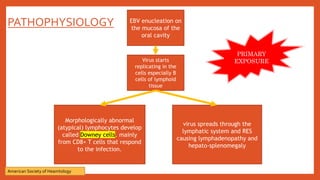
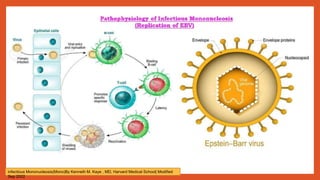
PATHOPHYSIOLOGY EBV enucleation on
the mucosa of the
oral cavity
Virus starts
replicating in the
cells especially B
cells of lymphoid
tissue
virus spreads through the
lymphatic system and RES
causing lymphadenopathy and
hepato-splenomegaly
Morphologically abnormal
(atypical) lymphocytes develop
called Downey cells. mainly
from CD8+ T cells that respond
to the infection.
PRIMARY
EXPOSURE
American Society of Heamtology
infectious Mononucleosis(Mono)By Kenneth M. Kaye , MD, Harvard Medical School| Modified
Sep 2022
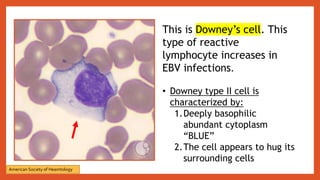
This is Downey’s cell. This
type of reactive
lymphocyte increases in
EBV infections.
• Downey type II cell is
characterized by:
1.Deeply basophilic
abundant cytoplasm
“BLUE”
2.The cell appears to hug its
surrounding cells
American Society of Heamtology
PATHOPHYSIOLOGY Cont…
• When the infection is acute (recent onset, instead of chronic) 
heterophile antibodies are produced.
• CMV, Adenovirus and Toxoplasma gondii infections can cause symptoms
similar to infectious mononucleosis, but heterophile antibody test will be
negative.
infectious Mononucleosis(Mono)By Kenneth M. Kaye , MD, Harvard Medical School| Modified
Sep 2022
CLINICAL PICTURE
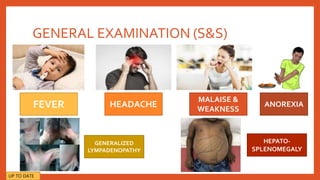
GENERAL EXAMINATION (S&S)
FEVER ANOREXIA
MALAISE &
WEAKNESS
HEADACHE
GENERALIZED
LYMPADENOPATHY
HEPATO-
SPLENOMEGALY
UP TO DATE
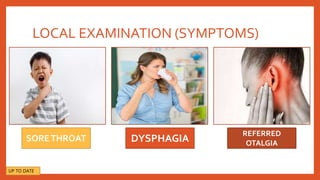
LOCAL EXAMINATION (SYMPTOMS)
SORETHROAT
REFERRED
OTALGIA
DYSPHAGIA
UP TO DATE
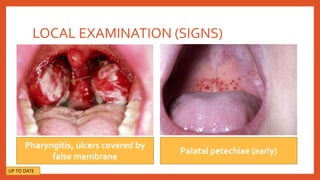
LOCAL EXAMINATION (SIGNS)
Pharyngitis, ulcers covered by
false membrane
Palatal petechiae (early)
UP TO DATE
C/P DIFFERS ACCORDINGTO AGE:
• In children before puberty  the disease typically only produces flu-like
symptoms
• In adolescence and young adulthood  the disease presents with a
characteristic triad of
1. Fever – mild lasting 2 weeks
2. Sore throat – severe lasting for 3–5 days.
3. Swollen glands – mobile; usually located around the back of the neck (posterior
cervical lymph nodes) and sometimes throughout the body.
Cohen JI (2008). "Epstein-Barr Infections, Including Infectious Mononucleosis". In Kasper DL, Braunwald E, Fauci AS, Hauser SL, Longo
DL, Jameson JL, Loscalzo J (eds.). Harrison's principles of internal medicine (17th ed.). New York: McGraw-Hill Medical Publishing
Division. pp. 380–91.
PROGRESSIONOFTHE C/P
• Symptoms most often disappear after about 2–4 weeks. However, fatigue
and a general feeling of being unwell (malaise) may sometimes last for
months.
• Caution!!!
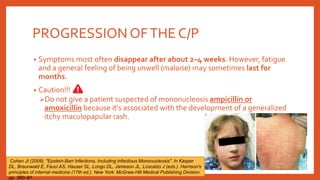
Do not give a patient suspected of mononucleosis ampicillin or
amoxicillin because it's associated with the development of a generalized
itchy maculopapular rash.
Cohen JI (2008). "Epstein-Barr Infections, Including Infectious Mononucleosis". In Kasper
DL, Braunwald E, Fauci AS, Hauser SL, Longo DL, Jameson JL, Loscalzo J (eds.). Harrison's
principles of internal medicine (17th ed.). New York: McGraw-Hill Medical Publishing Division.
pp. 380–91.
DIAGNOSIS
DIAGNOSIS OF MONONUCLEOSIS
HISTORYTAKING
PHYSICAL
EXAMINATION
INVESTIGATIONS
INVESTIGATIONS:
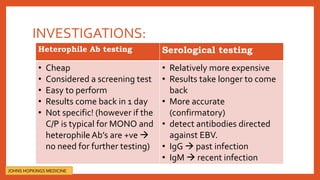
Heterophile Ab testing Serological testing
• Cheap
• Considered a screening test
• Easy to perform
• Results come back in 1 day
• Not specific! (however if the
C/P is typical for MONO and
heterophile Ab’s are +ve 
no need for further testing)
• Relatively more expensive
• Results take longer to come
back
• More accurate
(confirmatory)
• detect antibodies directed
against EBV.
• IgG  past infection
• IgM  recent infection
JOHNS HOPKINGS MEDICINE
INVESTIGATIONS:
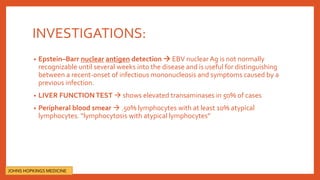
• Epstein–Barr nuclear antigen detection  EBV nuclear Ag is not normally
recognizable until several weeks into the disease and is useful for distinguishing
between a recent-onset of infectious mononucleosis and symptoms caused by a
previous infection.
• LIVER FUNCTIONTEST  shows elevated transaminases in 50% of cases
• Peripheral blood smear  .50% lymphocytes with at least 10% atypical
lymphocytes. “lymphocytosis with atypical lymphocytes”
JOHNS HOPKINGS MEDICINE
LYMPHADENOPATHY
A case
comes with
a triad of:
WHAT IS YOUR DIFFERENTIAL DIAGNOSIS?
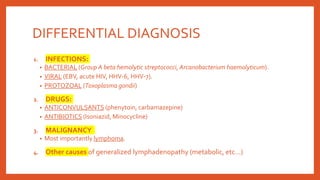
DIFFERENTIAL DIAGNOSIS
1. INFECTIONS:
• BACTERIAL (Group A beta hemolytic streptococci, Arcanobacterium haemolyticum).
• VIRAL (EBV, acute HIV, HHV-6, HHV-7).
• PROTOZOAL (Toxoplasma gondii)
2. DRUGS:
• ANTICONVULSANTS (phenytoin, carbamazepine)
• ANTIBIOTICS (Isoniazid, Minocycline)
3. MALIGNANCY
• Most importantly lymphoma.
4. Other causes of generalized lymphadenopathy (metabolic, etc…)
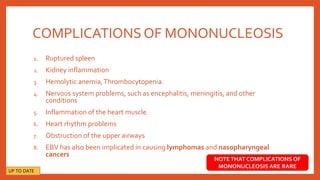
COMPLICATIONSOF MONONUCLEOSIS
1. Ruptured spleen
2. Kidney inflammation
3. Hemolytic anemia,Thrombocytopenia.
4. Nervous system problems, such as encephalitis, meningitis, and other
conditions
5. Inflammation of the heart muscle
6. Heart rhythm problems
7. Obstruction of the upper airways
8. EBV has also been implicated in causing lymphomas and nasopharyngeal
cancers
NOTETHAT COMPLICATIONS OF
MONONUCLEOSIS ARE RARE
UP TO DATE
TREATMENT
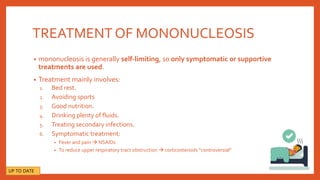
TREATMENT OF MONONUCLEOSIS
• mononucleosis is generally self-limiting, so only symptomatic or supportive
treatments are used.
• Treatment mainly involves:
1. Bed rest.
2. Avoiding sports
3. Good nutrition.
4. Drinking plenty of fluids.
5. Treating secondary infections.
6. Symptomatic treatment:
• Fever and pain  NSAIDs
• To reduce upper respiratory tract obstruction  corticosteroids “controversial”
UP TO DATE
TREATMENT OF MONONUCLEOSIS
• Intravenous corticosteroids are not recommended for routine use but may be
useful if there is:
• Risk of airway obstruction.
• Very low platelet count.
• Hemolytic anemia.
• There is no evidence that supports the use of antivirals like Acyclovir.
• Avoid using ampicillin and amoxicillin.
UP TO DATE
PREVENTION
PREVENTION
• There’s no vaccine for mono.
• The best way to prevent getting the viruses that
cause mono is by:
1. practicing good hygiene.
2. Don’t share foods, drinks or bodily fluids with
someone who has mono or any signs of viral
illness, like fever, cough, sore throat or fatigue
Zaki A. Primary Epstein-Barr Virus Infection in Healthy Children in Saudi Arabia: A Single Hospital-Based
Study. J Trop Pediatr. 2021 Jan 29;67(1):fmaa121. doi: 10.1093/tropej/fmaa121. PMID: 33351945.
Infectious Mononeucleosis .pptx

Infectious Mononeucleosis .pptx

  • 1.
    Prepared by: Dr.Zahra HasanAlali Medical intern Supervised by: Dr. Mohammed Ali Almatar
  • 2.
    OBJECTIVES: Definition of Mononucleosis Epidemiology of Mononucleosis Causesof Mononucleosis Pathophysiology Clinical picture Diagnosis of mononucleosis Treatment of mononucleosis Prevention of mononucleosis
  • 3.
  • 4.
    DEFINITION OF MONONUCLEOSIS: •Infectious mononucleosis is an infectious disease characterized by a triad of fever, tonsillar pharyngitis and lymphadenopathy. • It was formerly known as glandular fever, but this term was changed to infectious mononucleosis. • Epstein-Barr virus (EBV) is the most common cause of infectious mononucleosis, but other viruses can also cause this disease. UP TO DATE
  • 5.
    EPIDEMIOLOGYOF MONONUCLEOSIS • Theworldwide incidence of infectious mononucleosis is unknown, but in developing countries, 90% of children experience an asymptomatic Epstein-Barr virus infection. Primary EBV infection in Saudi Arabia occurs more frequently in the younger age groups in early childhood. Non-typical presentation occur more frequently in infants. While adolescents are less commonly affected by primary EBV. Zaki A. Primary Epstein-Barr Virus Infection in Healthy Children in Saudi Arabia: A Single Hospital-Based Study. J Trop Pediatr. 2021 Jan 29;67(1):fmaa121. doi: 10.1093/tropej/fmaa121. PMID: 33351945.
  • 6.
  • 7.
    CAUSES OF MONONUCLEOSIS: •Mononucleosis is caused by 2 members of the herpes simplex family: Epstein-Barr virus Cytomegalovirus This variant is milder Elana Pearl Ben-Joseph. "How Long Is Mono Contagious?". Kidshealth.org. Archived from the original on 2016-11-19.
  • 8.
    Epstein-Barr virus (EBV) •90% of cases of infectious mononucleosis are caused by EBV. • It is one of the most common viruses throughout the world. • EBV is not highly contagious. • It can only be contracted through direct contact with an infected person's saliva, such as through kissing or sharing toothbrushes. • About 95% of the population has been exposed to EBV by the age of 40, but only about 40% of exposed adults develop infectious mononucleosis. • Incubation period is between 4-8 weeks. Elana Pearl Ben-Joseph. "How Long Is Mono Contagious?". Kidshealth.org. Archived from the original on 2016-11-19.
  • 9.
    CYTOMEGALOVIRUS (CMV) • About5–7% of cases of infectious mononucleosis is caused by CMV. • CMV is found in body fluids including saliva, urine, blood, and tears. • A person becomes infected with this virus by direct contact with infected body fluids. • Cytomegalovirus is mostly transmitted through kissing and sexual intercourse. • It can also be transferred from an infected mother to her unborn child. Elana Pearl Ben-Joseph. "How Long Is Mono Contagious?". Kidshealth.org. Archived from the original on 2016-11-19.
  • 10.
    CYTOMEGALOVIRUS (CMV) Cont… •This virus is often "silent" because the signs and symptoms cannot be felt by the person infected. • However, it can cause life-threatening illness in: • Infants. • Patients with HIV. • Transplant recipients. • Patients with weak immune systems. • Once a person becomes infected with cytomegalovirus, the virus stays in their body fluids throughout the person's lifetime. Elana Pearl Ben-Joseph. "How Long Is Mono Contagious?". Kidshealth.org. Archived from the original on 2016-11-19.
  • 11.
  • 12.
    PATHOPHYSIOLOGY EBV enucleationon the mucosa of the oral cavity Virus starts replicating in the cells especially B cells of lymphoid tissue virus spreads through the lymphatic system and RES causing lymphadenopathy and hepato-splenomegaly Morphologically abnormal (atypical) lymphocytes develop called Downey cells. mainly from CD8+ T cells that respond to the infection. PRIMARY EXPOSURE American Society of Heamtology
  • 13.
    infectious Mononucleosis(Mono)By KennethM. Kaye , MD, Harvard Medical School| Modified Sep 2022
  • 14.
    This is Downey’scell. This type of reactive lymphocyte increases in EBV infections. • Downey type II cell is characterized by: 1.Deeply basophilic abundant cytoplasm “BLUE” 2.The cell appears to hug its surrounding cells American Society of Heamtology
  • 15.
    PATHOPHYSIOLOGY Cont… • Whenthe infection is acute (recent onset, instead of chronic)  heterophile antibodies are produced. • CMV, Adenovirus and Toxoplasma gondii infections can cause symptoms similar to infectious mononucleosis, but heterophile antibody test will be negative. infectious Mononucleosis(Mono)By Kenneth M. Kaye , MD, Harvard Medical School| Modified Sep 2022
  • 16.
  • 17.
    GENERAL EXAMINATION (S&S) FEVERANOREXIA MALAISE & WEAKNESS HEADACHE GENERALIZED LYMPADENOPATHY HEPATO- SPLENOMEGALY UP TO DATE
  • 18.
  • 19.
    LOCAL EXAMINATION (SIGNS) Pharyngitis,ulcers covered by false membrane Palatal petechiae (early) UP TO DATE
  • 20.
    C/P DIFFERS ACCORDINGTOAGE: • In children before puberty  the disease typically only produces flu-like symptoms • In adolescence and young adulthood  the disease presents with a characteristic triad of 1. Fever – mild lasting 2 weeks 2. Sore throat – severe lasting for 3–5 days. 3. Swollen glands – mobile; usually located around the back of the neck (posterior cervical lymph nodes) and sometimes throughout the body. Cohen JI (2008). "Epstein-Barr Infections, Including Infectious Mononucleosis". In Kasper DL, Braunwald E, Fauci AS, Hauser SL, Longo DL, Jameson JL, Loscalzo J (eds.). Harrison's principles of internal medicine (17th ed.). New York: McGraw-Hill Medical Publishing Division. pp. 380–91.
  • 21.
    PROGRESSIONOFTHE C/P • Symptomsmost often disappear after about 2–4 weeks. However, fatigue and a general feeling of being unwell (malaise) may sometimes last for months. • Caution!!! Do not give a patient suspected of mononucleosis ampicillin or amoxicillin because it's associated with the development of a generalized itchy maculopapular rash. Cohen JI (2008). "Epstein-Barr Infections, Including Infectious Mononucleosis". In Kasper DL, Braunwald E, Fauci AS, Hauser SL, Longo DL, Jameson JL, Loscalzo J (eds.). Harrison's principles of internal medicine (17th ed.). New York: McGraw-Hill Medical Publishing Division. pp. 380–91.
  • 22.
  • 23.
  • 24.
    INVESTIGATIONS: Heterophile Ab testingSerological testing • Cheap • Considered a screening test • Easy to perform • Results come back in 1 day • Not specific! (however if the C/P is typical for MONO and heterophile Ab’s are +ve  no need for further testing) • Relatively more expensive • Results take longer to come back • More accurate (confirmatory) • detect antibodies directed against EBV. • IgG  past infection • IgM  recent infection JOHNS HOPKINGS MEDICINE
  • 25.
    INVESTIGATIONS: • Epstein–Barr nuclearantigen detection  EBV nuclear Ag is not normally recognizable until several weeks into the disease and is useful for distinguishing between a recent-onset of infectious mononucleosis and symptoms caused by a previous infection. • LIVER FUNCTIONTEST  shows elevated transaminases in 50% of cases • Peripheral blood smear  .50% lymphocytes with at least 10% atypical lymphocytes. “lymphocytosis with atypical lymphocytes” JOHNS HOPKINGS MEDICINE
  • 26.
    LYMPHADENOPATHY A case comes with atriad of: WHAT IS YOUR DIFFERENTIAL DIAGNOSIS?
  • 27.
    DIFFERENTIAL DIAGNOSIS 1. INFECTIONS: •BACTERIAL (Group A beta hemolytic streptococci, Arcanobacterium haemolyticum). • VIRAL (EBV, acute HIV, HHV-6, HHV-7). • PROTOZOAL (Toxoplasma gondii) 2. DRUGS: • ANTICONVULSANTS (phenytoin, carbamazepine) • ANTIBIOTICS (Isoniazid, Minocycline) 3. MALIGNANCY • Most importantly lymphoma. 4. Other causes of generalized lymphadenopathy (metabolic, etc…)
  • 28.
    COMPLICATIONSOF MONONUCLEOSIS 1. Rupturedspleen 2. Kidney inflammation 3. Hemolytic anemia,Thrombocytopenia. 4. Nervous system problems, such as encephalitis, meningitis, and other conditions 5. Inflammation of the heart muscle 6. Heart rhythm problems 7. Obstruction of the upper airways 8. EBV has also been implicated in causing lymphomas and nasopharyngeal cancers NOTETHAT COMPLICATIONS OF MONONUCLEOSIS ARE RARE UP TO DATE
  • 29.
  • 30.
    TREATMENT OF MONONUCLEOSIS •mononucleosis is generally self-limiting, so only symptomatic or supportive treatments are used. • Treatment mainly involves: 1. Bed rest. 2. Avoiding sports 3. Good nutrition. 4. Drinking plenty of fluids. 5. Treating secondary infections. 6. Symptomatic treatment: • Fever and pain  NSAIDs • To reduce upper respiratory tract obstruction  corticosteroids “controversial” UP TO DATE
  • 31.
    TREATMENT OF MONONUCLEOSIS •Intravenous corticosteroids are not recommended for routine use but may be useful if there is: • Risk of airway obstruction. • Very low platelet count. • Hemolytic anemia. • There is no evidence that supports the use of antivirals like Acyclovir. • Avoid using ampicillin and amoxicillin. UP TO DATE
  • 32.
  • 33.
    PREVENTION • There’s novaccine for mono. • The best way to prevent getting the viruses that cause mono is by: 1. practicing good hygiene. 2. Don’t share foods, drinks or bodily fluids with someone who has mono or any signs of viral illness, like fever, cough, sore throat or fatigue Zaki A. Primary Epstein-Barr Virus Infection in Healthy Children in Saudi Arabia: A Single Hospital-Based Study. J Trop Pediatr. 2021 Jan 29;67(1):fmaa121. doi: 10.1093/tropej/fmaa121. PMID: 33351945.

Editor's Notes

  • #13 After exposure in the oral cavity, the virus begins the replication process. There is a predilection for infection of the B-cells of lymphoid tissue. Subsequently, the infection spreads through the lymphatic system. EBV infects B lymphocytes. Morphologically abnormal (atypical) lymphocytes develop called Downey cells. , mainly from CD8+ T cells that respond to the infection.
  • #18 General SYMPTOMS : rapid onset of fever, malaise, headache, anorexia, constant fatigue. GENRAL SIGNS: generalized lymphadenopathy, splenomegaly and hepatomegaly
  • #19 Local SYMPTOMS: rapid onset of sore throat, dysphagia and referred otalgia.
  • #20 Local SIGNS: •Diffuse congestion of pharyngeal and tonsillar mucosa , shallow ulcer covered by false membrane , similar to that in diphtheria but bilateral. •Palatal petechiae appear in early stages .
  • #24 suspect Infectious mononucleosis based on the signs & symptoms (such as fever and sore throat etc.) medical history (as close contact with other people with infectious mononucleosis) and a physical examination (including palpation of any enlarged lymph nodes, tonsils in the neck or enlarged liver or spleen and petechiae in the palate etc.).
  • #25 NOTE 1: False positive heterophile tests have been reported in conditions including other acute infections, autoimmune disease, and cancer. NOTE 2: heterophile antibodies by definition are not specific. however, if the clinical picture is typical of infectious mononucleosis and the heterophile antibody test is positive, no additional diagnostic procedures are necessary. NITE 3: Serologic tests detect antibodies directed against the Epstein–Barr virus. In case of positive patient, Immunoglobulin G (IgG) level detection performed; mainly reflects a past infection, whereas immunoglobulin M (IgM) mainly reflects a current infection.
  • #26 Examination of Peripheral Blood Film (PBF) is one of the diagnostic criterion for infectious mononucleosis; presence of 50% lymphocytes with at least 10% atypical lymphocytes (large, irregular nuclei).A fibrin ring granuloma may be present.
  • #28 NOTE 1: GABHS doesn’t usually cause splenomegaly and fatigue. NOTE 2: acute HIV causes a syndrome similar to MONO but with more incidence of ulcerations and skin rashes. NOTE 6: HHV (HUMAN HERPES VIRUS 6 AND 7) are very rare and cause a syndrome similar to MONO but with more prolonged lymphadenopathy. NOTE 7: Toxoplasmosis causes fever, lymphadenopathy, BUT USUALL WITH NO pharyngitis and NO elevation of liver enzymes and NO ATYPICAL LYMPHOCYTOSIS. NOTE 8: The drugs in the slide cause a blood picture of lymphocytosis with atypical lymphocytes similar to EBV.
  • #31 NOTE 1:; occasionally, a streptococcal (strep) infection accompanies the sore throat of mononucleosis NOTE 2: There is no currently accepted specific treatment for infectious mononucleosis. NOTE 3: Avoiding sports: Physical activity can put too much pressure on an enlarged spleen, increasing the risk of rupture. You should avoid contact sports and strenuous exercise while you’re sick and for up to four weeks afterward. NOTE 4: Prednisone, a corticosteroid, while used to try to reduce throat pain or enlarged tonsils, remains controversial due to the lack of evidence that it is effective and the potential for side effects.