
E-PEDAGOGY: AN INEVITABLE REALITY FOR
PREPARING 21ST CENTURY LEARNERS
Dr. Jagannath K. Dange
Associate Professor
Robit Mathew
Research Scholar
Department of P.G. Studies and Research in Education,
Kuvempu University, Shankaraghatta-577451, Karnataka
State, India,
Introduction
World is in the path of development and perfection. So
the survival of any institute or system depends upon the timely
updation of it. Since education is the most decisive factor in the
development of every nation, it is high time to upgrade the
education system for preparing the digitally skilled generation
of the 21st century. ICT has caused an educational renaissance
bringing revolutionary changes especially the possibilities of
Pedagogy.
Pedagogy has got a vital role in defining the education
strategies according to the dynamic demands of the changing
world. Pedagogy is defined as any conscious and purposeful act
of teaching adopted by teachers to enhance the learning
outcome.
Here Pedagogy has got two role:
1. enhance the quality of education
2. equip the learners according to the needs of the time.
This conceptual article tries to explore: Why the adoption of
e-pedagogy is inevitable in the education system?
Why e-pedagogy is inevitable in the education
system?
1) E-Pedagogy: Inevitable for the fulfilment educational
expectations
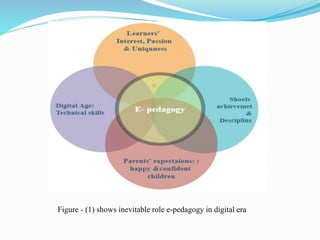
Education is challenged to fulfil expectations of parents,
parents, schools, society according to the demands of tile
and learners which is explained the figure given below:
Figure - (1) shows inevitable role e-pedagogy in digital era
2. E-pedagogy: Inevitable for content
exploration
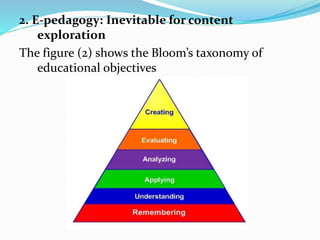
The figure (2) shows the Bloom’s taxonomy of
educational objectives
• The revised Bloom’s taxonomy (Figure: 2) can be used to
understand the need of implementing e–pedagogy for
quality teaching and learning processes in this digital era.
• According to this theory perfect learning takes place only
when the learner reaches the sixth stage.
• But these six stages are to be redefined according to the
need of the hour;
• otherwise the learners may be unfit to any field incapable
of fulfilling the demands of changing time.
• Traditional systems of education and classroom activities
are confined to reach up to the sixth level according to the
demands of the digital era.
• Accordingly adoption of e-pedagogy becomes inevitable for
forming a digitally smart generation.
 E- pedagogy: Inevitable for learning exploration
of 21st century learners
21st century learners are challenged ever before to find
space in the digital era. The only way to overcome
these challenges is to prepare the learners by adopting
e-pedagogy, because e-pedagogy is rich enough to
equip the learners with all the skills needed for the
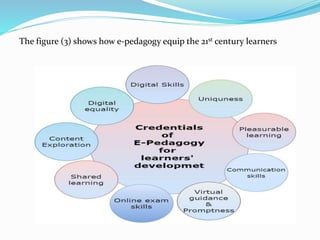
digital age which are portrayed in the figure (3) given
above.
The figure (3) shows how e-pedagogy equip the 21st century learners
3. Pedagogy: Inevitable for teaching
exploration
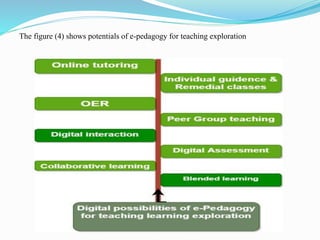
E- Pedagogy offers a number of possibilities for teachers
to explore teaching process which are depicted in the
figure (4) the enhancement the quality of education
system for the 21st century learners which are
portrayed below:
The figure (4) shows potentials of e-pedagogy for teaching exploration
 Blended learning: Digital pedagogy enabled an enhanced teaching-
learning with blended learning possibilities to incorporate best in face-to-
face interaction of traditional classroom and best in online teaching
platform.
 Collaborative learning: The possibilities of collaborative learning
prevailed in traditional classroom are being enhanced with the possibilities
of online digital platforms for discussion, sharing, and clarification from
teachers and even from class teachers without any time and space
limitations.
 Digitalised assessment: It has facilitated a wide variety of assessment
patterns like quizzes, multiple choice questions, etc to streamline evaluation
process according to the convenience of the teachers and to overcome the
complexities involved in the assessment process.
 Digital interaction: technology has enlarged the possibilities of
interaction for further teaching according to the need of the learner through
social media platforms like whatsapp, facebook, etc.
 Peer group teaching: A virtual classroom facility has opened the
possibilities of peer group teaching for teaching perfection and
perfect content transactions.
 Availability open educational resources (OER): An amazing
possibility of e-pedagogy is that it provides OER sources for
teaching learning exploration.
 Possibilities of catering individuality and remedial class: e-
pedagogy enables the mentors to cater the individual needs of the
learners by accommodating digital possibilities like AI, ML and
OER.
 Online tutoring: digital platform open for teachers the unlimited
teaching platform without space limitation. A passionate teacher can
find his/her space to enlighten the online aspirants from different
parts of the world through digital tutoring.
Suggestions
Since adaptation of e-pedagogy is inevitable for preparing a
digitally skilled generation, education system has to be
restructured from policy level to ground stakeholders.
Content is to be modified in tune with e-pedagogy.
 School infrastructure is to be updated in every school for the
successful execution of e-pedagogy.
Adequate budget is to be released in this regard during the
budget allocation. E)
Training programmes for present teachers should be
designed and conducted.
 Teacher training programme is to be restructured for
preparing tech savvy teachers for the digital era.
There should be made possible arrangements from concerned
authorities to avoid the problem of the digital era.
Conclusion
21st century learners are bourn and are supposed
to be brought up in the digital age. Traditions
educational system is not perfect enough to cater the
demands of digital generation. Since technological
backwardness will never contribute to the expected
perfection and outcome in the education system, there
is a need for updation and perfection which point to
the need of inevitable adaptation of E-pedagogy to
equip the mentors and learners of the 21st century. The
successful execution of e-pedagogy for expected
outcome demands the updation of the entire
traditional education system.
Reference
Dange, Jagannath K. & M, Somashekhara, (2017) Ict In Teacher Education:
The Possibilities,
https://www.academia.edu/33375265/ICT_IN_TEACHER_EDUCATION_
THE_POSSIBILITIES
Dange, Jagannath K. (2019). Innovative approaches for Teaching and
Learning, SlideShare, Retrieved 11 May, 2020 from
https://www.slideshare.net/jkdange/innovative-approaches-for-teaching-
and-learning
Dange, Jagannath K., (2019). Innovative approaches for Teaching and
Learning, InSlideshare, retrieved 2nd may, 2020 from
https://www.slideshare.net/jkdange/innovative-approaches-for-teaching-
and-learning
Dange, Jagannath, K. (2016). Information technology in teacher education.
Aayushi international interdisciplinary research journal, 11-19.
Fernando, Mgnas (2017). Pedagogical and E-Learning Techniques for
Quality Improvement of ICT Education, retrieved 1st May, 2020 from
https://www.intechopen.com/books/advanced.
Jain, Rahul (2016), Use of Social Media in Teaching retrieved 25th
April, 2020 from https://www.asmaindia.in/blog/use-of-social-
media-in-teaching-and-learning-emerging-role-of-social-
Maringe, Felix & Ojo, Emmanuel, (2017). Sustainable
Transformation in African Higher Education, Academia,
retrieved 9 May, 2020 from
https://www.academia.edu/37609687/Sustainability_
Naamani Mehanna, Wassila (2014). E-pedagogy: The pedagogies
of e-learning, ResearchGate, retrieved 2nd May, 2020 from
https://www.researchgate.net/publication/29812
Pizzi, Michael A.. (2014). Blended Learning Pedagogy: The Time
is Now, ResearchGate, Retrieved 10 May, 2020 from
https://www.researchgate.net/publication/263513353_Blended_L
earning_Pedagogy
UNESCO, (2018). Unpacking Sustainable Development Goal 4
Education 2030, retrieved on 1st May,
2020fromhttps://www.campaignforeducation.org/wp/wp-
content/uploads/2018/07/SDG4.pdf.
THANK YOU

Inevitable e-pedagogy

  • 1.
    E-PEDAGOGY: AN INEVITABLEREALITY FOR PREPARING 21ST CENTURY LEARNERS Dr. Jagannath K. Dange Associate Professor Robit Mathew Research Scholar Department of P.G. Studies and Research in Education, Kuvempu University, Shankaraghatta-577451, Karnataka State, India,
  • 2.
    Introduction World is inthe path of development and perfection. So the survival of any institute or system depends upon the timely updation of it. Since education is the most decisive factor in the development of every nation, it is high time to upgrade the education system for preparing the digitally skilled generation of the 21st century. ICT has caused an educational renaissance bringing revolutionary changes especially the possibilities of Pedagogy. Pedagogy has got a vital role in defining the education strategies according to the dynamic demands of the changing world. Pedagogy is defined as any conscious and purposeful act of teaching adopted by teachers to enhance the learning outcome.
  • 3.
    Here Pedagogy hasgot two role: 1. enhance the quality of education 2. equip the learners according to the needs of the time. This conceptual article tries to explore: Why the adoption of e-pedagogy is inevitable in the education system? Why e-pedagogy is inevitable in the education system? 1) E-Pedagogy: Inevitable for the fulfilment educational expectations Education is challenged to fulfil expectations of parents, parents, schools, society according to the demands of tile and learners which is explained the figure given below:
  • 4.
    Figure - (1)shows inevitable role e-pedagogy in digital era
  • 5.
    2. E-pedagogy: Inevitablefor content exploration The figure (2) shows the Bloom’s taxonomy of educational objectives
  • 6.
    • The revisedBloom’s taxonomy (Figure: 2) can be used to understand the need of implementing e–pedagogy for quality teaching and learning processes in this digital era. • According to this theory perfect learning takes place only when the learner reaches the sixth stage. • But these six stages are to be redefined according to the need of the hour; • otherwise the learners may be unfit to any field incapable of fulfilling the demands of changing time. • Traditional systems of education and classroom activities are confined to reach up to the sixth level according to the demands of the digital era. • Accordingly adoption of e-pedagogy becomes inevitable for forming a digitally smart generation.
  • 7.
     E- pedagogy:Inevitable for learning exploration of 21st century learners 21st century learners are challenged ever before to find space in the digital era. The only way to overcome these challenges is to prepare the learners by adopting e-pedagogy, because e-pedagogy is rich enough to equip the learners with all the skills needed for the digital age which are portrayed in the figure (3) given above.
  • 8.
    The figure (3)shows how e-pedagogy equip the 21st century learners
  • 9.
    3. Pedagogy: Inevitablefor teaching exploration E- Pedagogy offers a number of possibilities for teachers to explore teaching process which are depicted in the figure (4) the enhancement the quality of education system for the 21st century learners which are portrayed below:
  • 10.
    The figure (4)shows potentials of e-pedagogy for teaching exploration
  • 11.
     Blended learning:Digital pedagogy enabled an enhanced teaching- learning with blended learning possibilities to incorporate best in face-to- face interaction of traditional classroom and best in online teaching platform.  Collaborative learning: The possibilities of collaborative learning prevailed in traditional classroom are being enhanced with the possibilities of online digital platforms for discussion, sharing, and clarification from teachers and even from class teachers without any time and space limitations.  Digitalised assessment: It has facilitated a wide variety of assessment patterns like quizzes, multiple choice questions, etc to streamline evaluation process according to the convenience of the teachers and to overcome the complexities involved in the assessment process.  Digital interaction: technology has enlarged the possibilities of interaction for further teaching according to the need of the learner through social media platforms like whatsapp, facebook, etc.
  • 12.
     Peer groupteaching: A virtual classroom facility has opened the possibilities of peer group teaching for teaching perfection and perfect content transactions.  Availability open educational resources (OER): An amazing possibility of e-pedagogy is that it provides OER sources for teaching learning exploration.  Possibilities of catering individuality and remedial class: e- pedagogy enables the mentors to cater the individual needs of the learners by accommodating digital possibilities like AI, ML and OER.  Online tutoring: digital platform open for teachers the unlimited teaching platform without space limitation. A passionate teacher can find his/her space to enlighten the online aspirants from different parts of the world through digital tutoring.
  • 13.
    Suggestions Since adaptation ofe-pedagogy is inevitable for preparing a digitally skilled generation, education system has to be restructured from policy level to ground stakeholders. Content is to be modified in tune with e-pedagogy.  School infrastructure is to be updated in every school for the successful execution of e-pedagogy. Adequate budget is to be released in this regard during the budget allocation. E) Training programmes for present teachers should be designed and conducted.  Teacher training programme is to be restructured for preparing tech savvy teachers for the digital era. There should be made possible arrangements from concerned authorities to avoid the problem of the digital era.
  • 14.
    Conclusion 21st century learnersare bourn and are supposed to be brought up in the digital age. Traditions educational system is not perfect enough to cater the demands of digital generation. Since technological backwardness will never contribute to the expected perfection and outcome in the education system, there is a need for updation and perfection which point to the need of inevitable adaptation of E-pedagogy to equip the mentors and learners of the 21st century. The successful execution of e-pedagogy for expected outcome demands the updation of the entire traditional education system.
  • 15.
    Reference Dange, Jagannath K.& M, Somashekhara, (2017) Ict In Teacher Education: The Possibilities, https://www.academia.edu/33375265/ICT_IN_TEACHER_EDUCATION_ THE_POSSIBILITIES Dange, Jagannath K. (2019). Innovative approaches for Teaching and Learning, SlideShare, Retrieved 11 May, 2020 from https://www.slideshare.net/jkdange/innovative-approaches-for-teaching- and-learning Dange, Jagannath K., (2019). Innovative approaches for Teaching and Learning, InSlideshare, retrieved 2nd may, 2020 from https://www.slideshare.net/jkdange/innovative-approaches-for-teaching- and-learning Dange, Jagannath, K. (2016). Information technology in teacher education. Aayushi international interdisciplinary research journal, 11-19. Fernando, Mgnas (2017). Pedagogical and E-Learning Techniques for Quality Improvement of ICT Education, retrieved 1st May, 2020 from https://www.intechopen.com/books/advanced.
  • 16.
    Jain, Rahul (2016),Use of Social Media in Teaching retrieved 25th April, 2020 from https://www.asmaindia.in/blog/use-of-social- media-in-teaching-and-learning-emerging-role-of-social- Maringe, Felix & Ojo, Emmanuel, (2017). Sustainable Transformation in African Higher Education, Academia, retrieved 9 May, 2020 from https://www.academia.edu/37609687/Sustainability_ Naamani Mehanna, Wassila (2014). E-pedagogy: The pedagogies of e-learning, ResearchGate, retrieved 2nd May, 2020 from https://www.researchgate.net/publication/29812 Pizzi, Michael A.. (2014). Blended Learning Pedagogy: The Time is Now, ResearchGate, Retrieved 10 May, 2020 from https://www.researchgate.net/publication/263513353_Blended_L earning_Pedagogy UNESCO, (2018). Unpacking Sustainable Development Goal 4 Education 2030, retrieved on 1st May, 2020fromhttps://www.campaignforeducation.org/wp/wp- content/uploads/2018/07/SDG4.pdf.
  • 17.