INTRODUCTION TO
FISCAL MEASUREMENT
Mozaffar Etezadifar
Fall 2016
Mozaffar.etezadifar@gmail.com
Energykade.com
Energykade.com Mozaffar.etezadifar@gmail.com
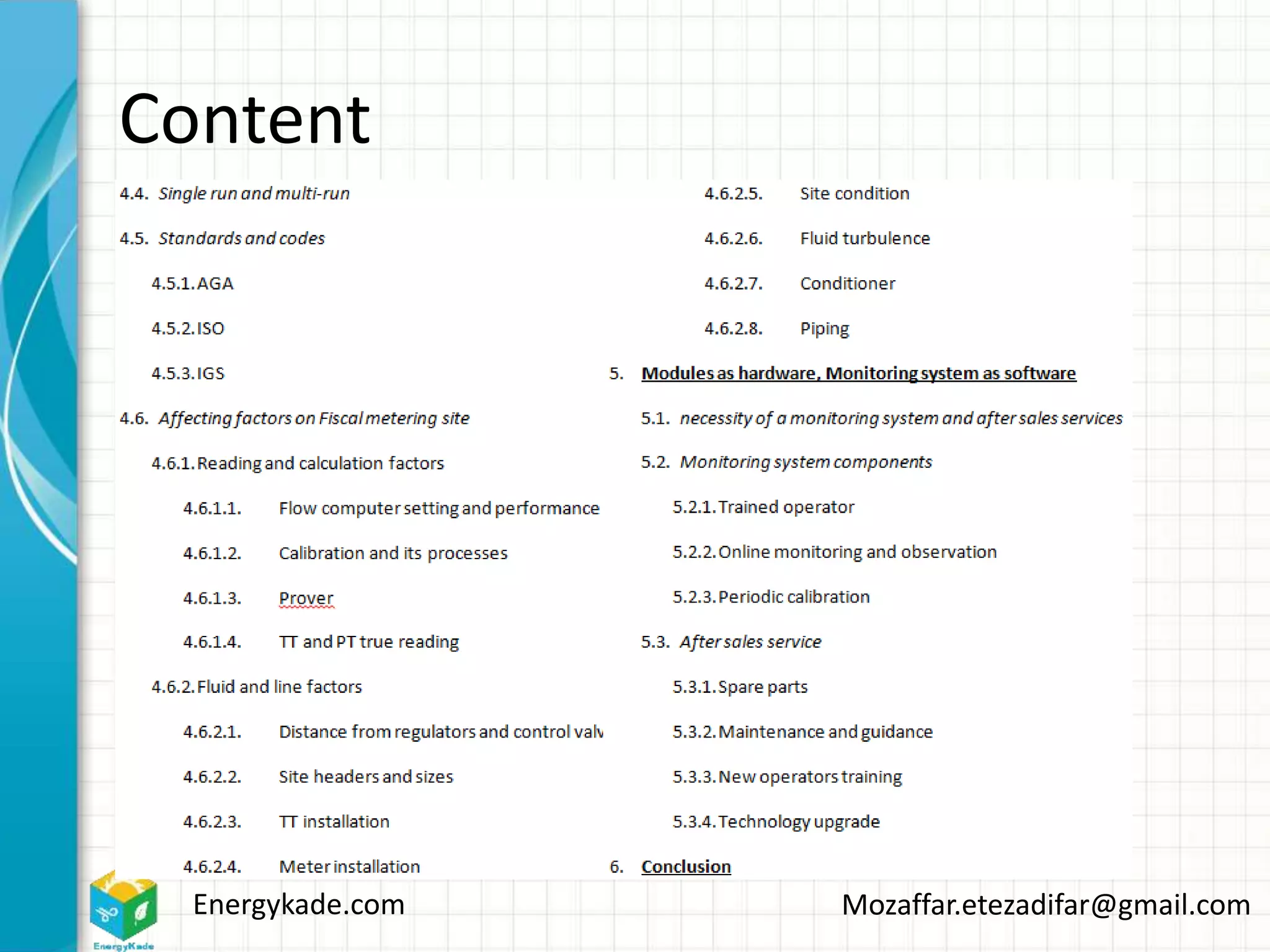
Content
Energykade.com Mozaffar.etezadifar@gmail.com
Content
Energykade.com Mozaffar.etezadifar@gmail.com
Chapter 1
Fiscal Metering Fundamentals
Energykade.com Mozaffar.etezadifar@gmail.com
1.1. What is fiscal metering?
• Fiscal metering is combination of regulations,
laws, protocols, systems and devices which
enables two parties to transfer and measure
a valuable product from one side to another
in a way that both sides agree on.
Energykade.com Mozaffar.etezadifar@gmail.com
1.2. When do we need fiscal metering?
• When seller and buyer are dealing on huge
amount of material OR expensive one, it is
important to have precise measurement of
amount transferred between two parties.
• Both seller and buyer should agree on the
amount and the way it’s calculated, to have a
deal.
• In Oil&Gas field, it’s both huge and expensive
Energykade.com Mozaffar.etezadifar@gmail.com
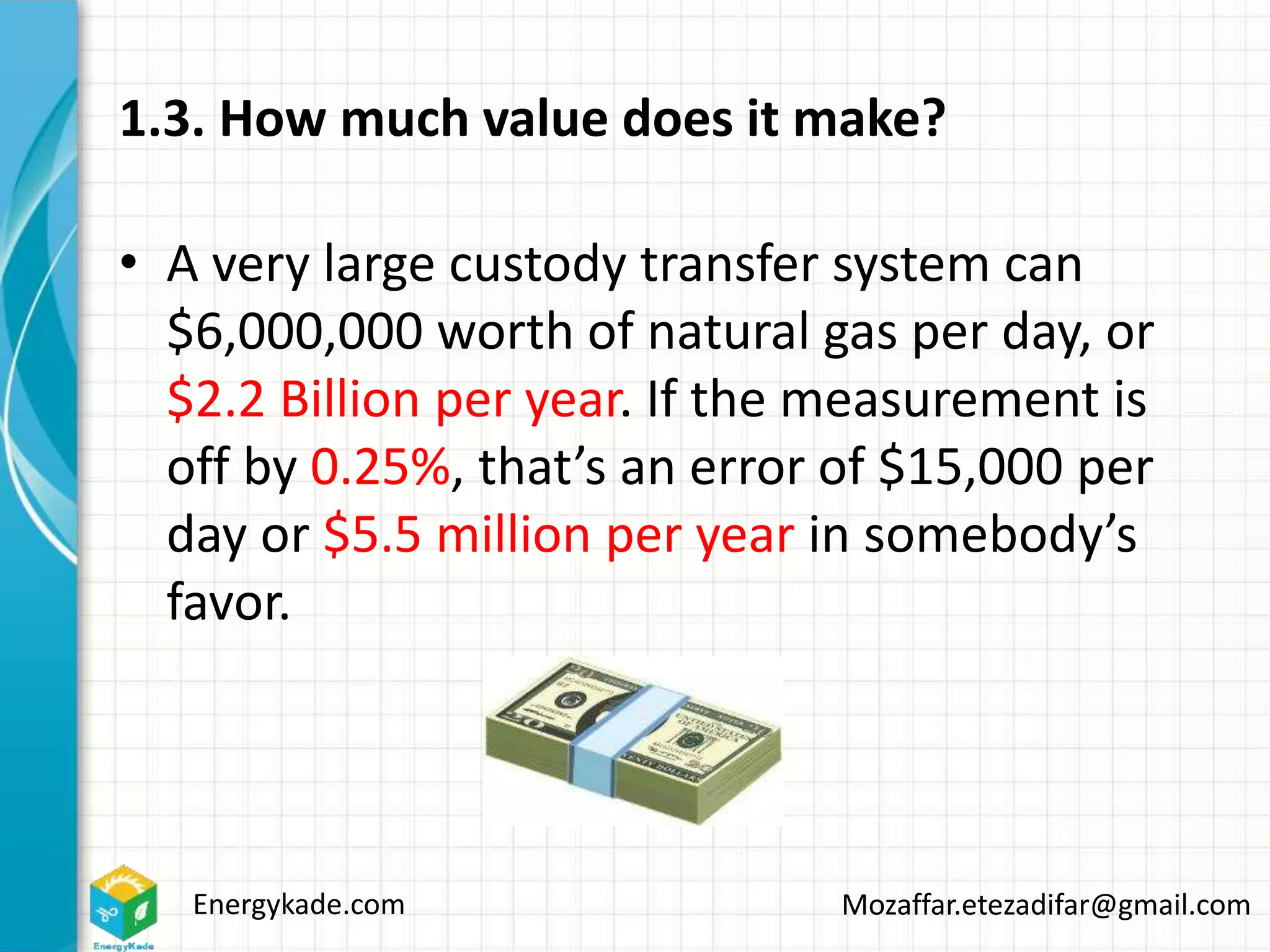
1.3. How much value does it make?
• A very large custody transfer system can
$6,000,000 worth of natural gas per day, or
$2.2 Billion per year. If the measurement is
off by 0.25%, that’s an error of $15,000 per
day or $5.5 million per year in somebody’s
favor.
Energykade.com Mozaffar.etezadifar@gmail.com
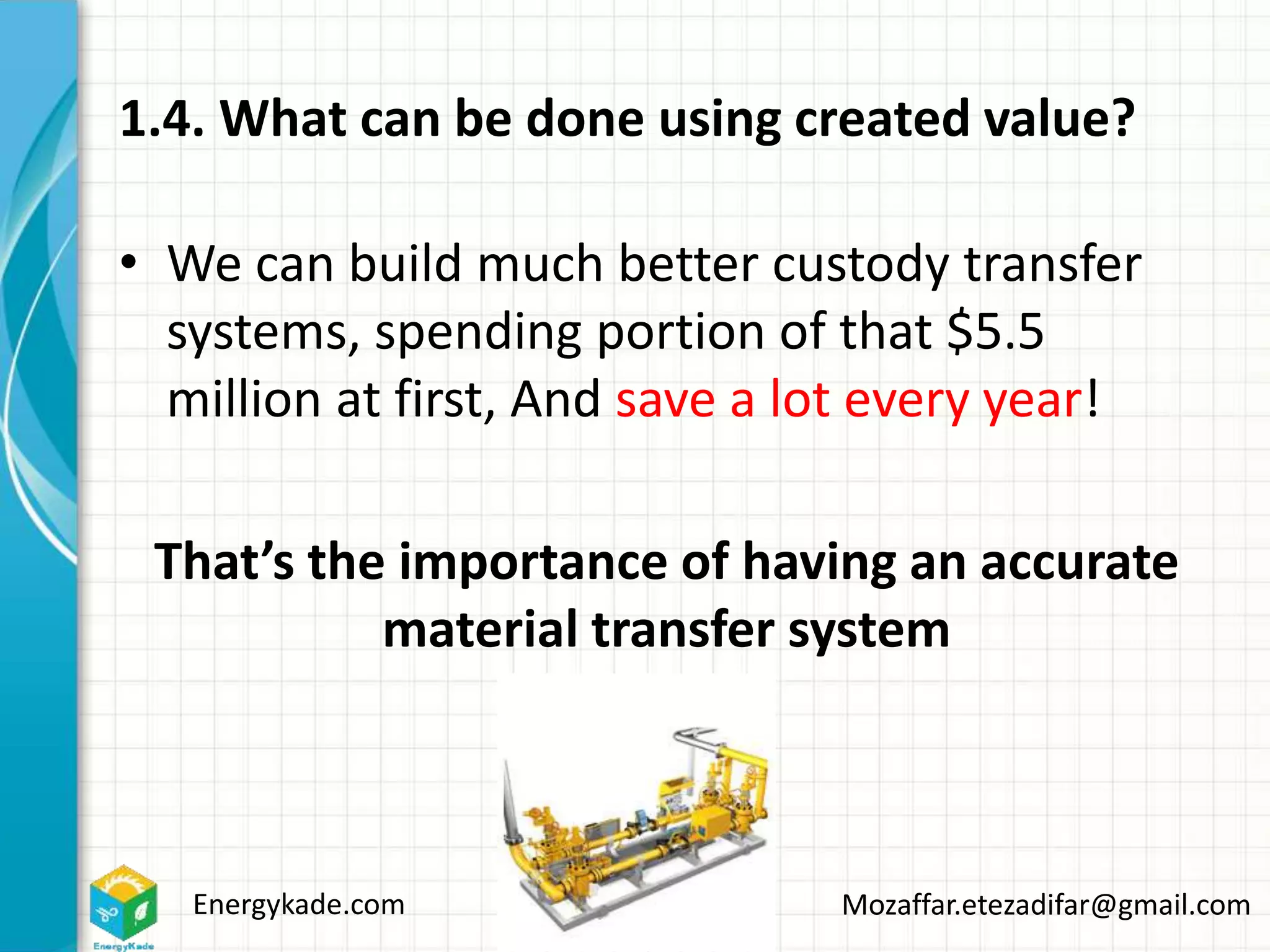
1.4. What can be done using created value?
• We can build much better custody transfer
systems, spending portion of that $5.5
million at first, And save a lot every year!
That’s the importance of having an accurate
material transfer system
Energykade.com Mozaffar.etezadifar@gmail.com
Chapter 2
Fiscal Metering Categories
Energykade.com Mozaffar.etezadifar@gmail.com
• Fiscal measurement is a general word:
measurement for money
• Fiscal measurement includes:
1- Allocation
2- Custody Transfer
Energykade.com Mozaffar.etezadifar@gmail.com
2.1 Allocation
• Allocation is the numerical distribution of
products between parties according to their
equity share.
you share whatever you have, good or bad,
according to everyone’s share.
Energykade.com Mozaffar.etezadifar@gmail.com
2.2. Custody Transfer
• Custody transfer is contract driven: that means that there is
a contractual obligation between buyer and seller which may
require adherence to accuracy, repeatability, linearity or
uncertainty standards as defined by measurement standards
such as API, GOST (Russian equivalent to API), etc.
• The terms custody transfer and fiscal metering are often
interchanged. Custody transfer takes place any time fluids
are passed from possession of one party to another.
Energykade.com Mozaffar.etezadifar@gmail.com
2.3. Accuracy vs. Uncertainty and Validation
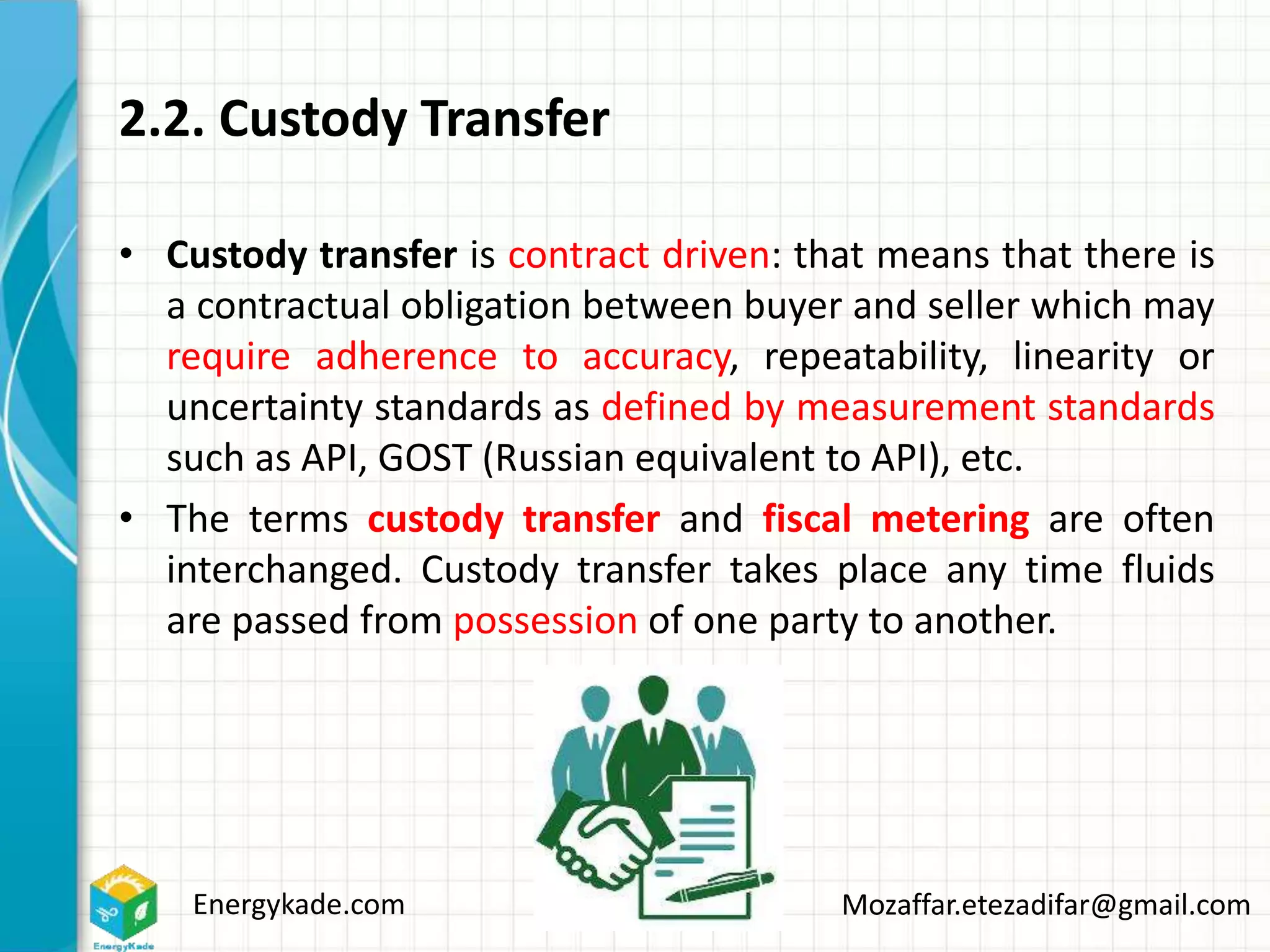
• All meters and metering systems are subject to uncertainty and it is a common
mistake to mix accuracy and uncertainty as they are subtly different.
• Accuracy is matching the meter output to a known standard or reference and
will include terms like bias, readability and precision, this can be considered the
best estimate according to the scale of the measurement.
• Uncertainty is more related to repeatability and is an estimate of the limits
where the true value is expected to lie for a given confidence level.
• Validation, before we can report any data, we should be able to make sure our
obtained data is valid! It takes some equipment, observation, time and money
but it totally worth it, because all these data is useless if they are not valid.
Energykade.com Mozaffar.etezadifar@gmail.com
2.4. Maximum allowed uncertainty
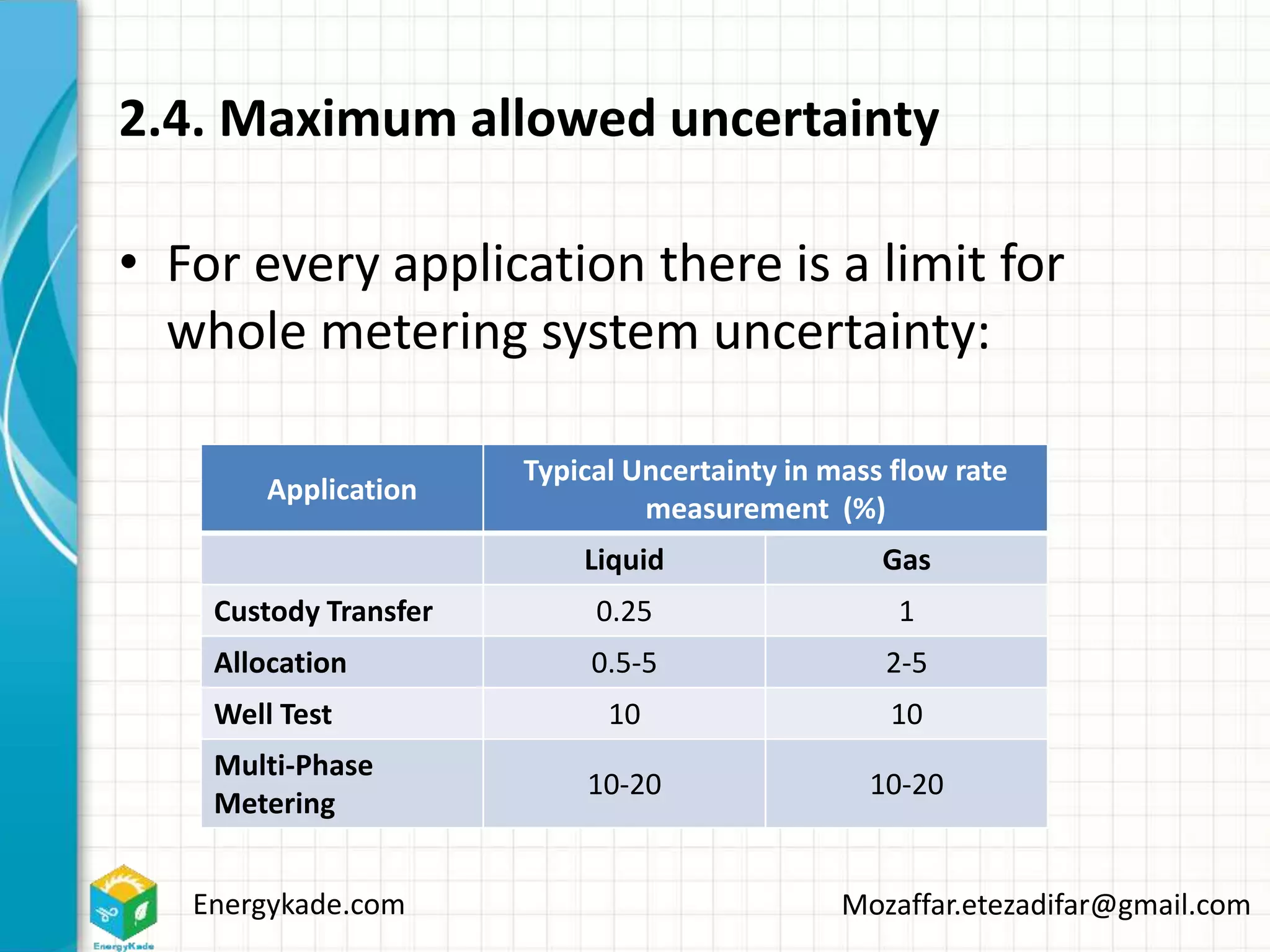
• For every application there is a limit for
whole metering system uncertainty:
Application
Typical Uncertainty in mass flow rate
measurement (%)
Liquid Gas
Custody Transfer 0.25 1
Allocation 0.5-5 2-5
Well Test 10 10
Multi-Phase
Metering
10-20 10-20
Energykade.com Mozaffar.etezadifar@gmail.com
Chapter 3
Fiscal Metering Frame Work
Energykade.com Mozaffar.etezadifar@gmail.com
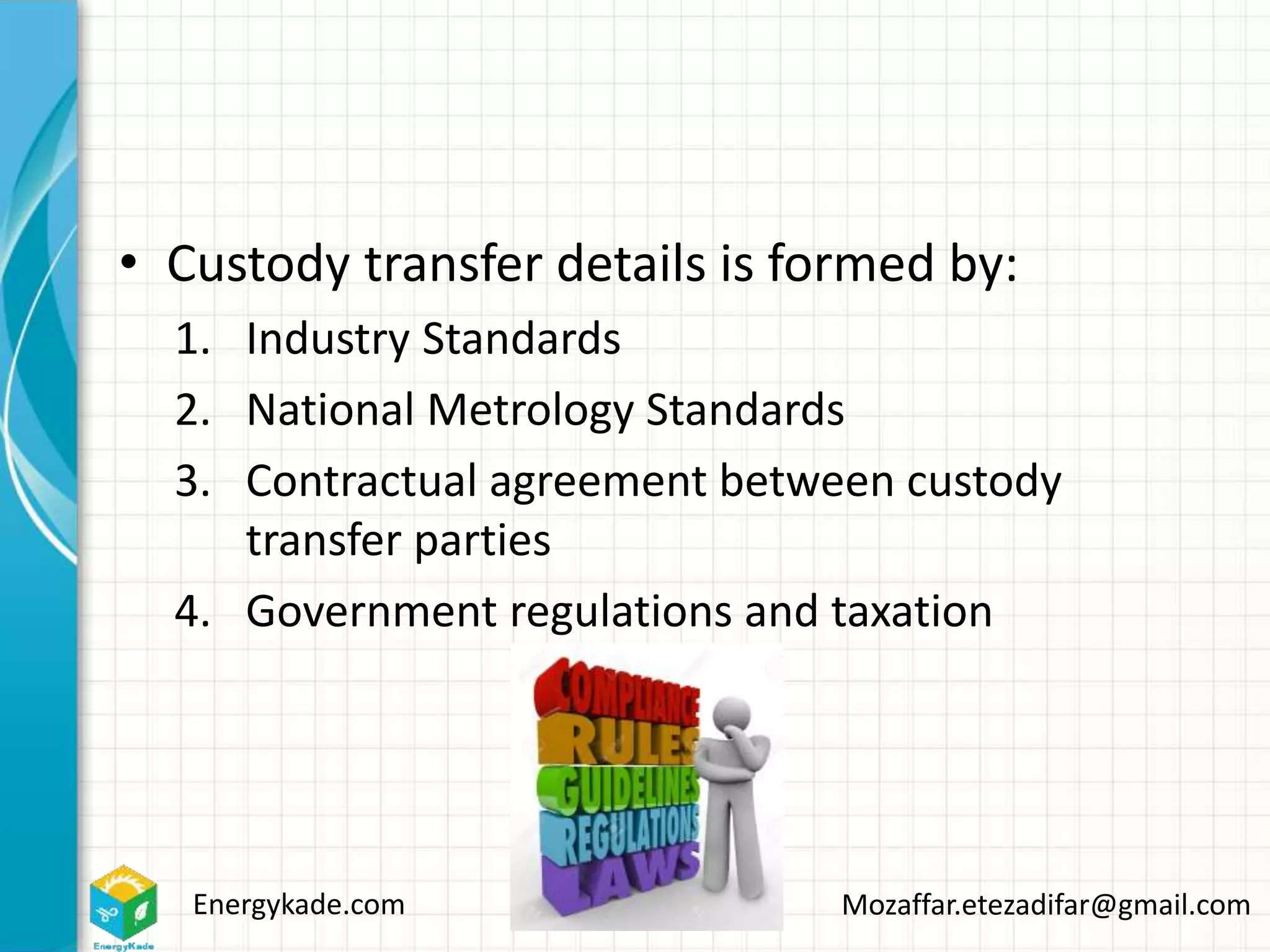
• Custody transfer details is formed by:
1. Industry Standards
2. National Metrology Standards
3. Contractual agreement between custody
transfer parties
4. Government regulations and taxation
Energykade.com Mozaffar.etezadifar@gmail.com
3.1. Industry Standards
Every industry has its own standards. Some of them
may be initiated by dominant country in that
industry at first and then they’d become wide
spread all around the world. Like AGA which stands
for American Gas Association but it’s widely used in
other countries too. Also IGS stands for Iranian Gas
Standards.
Energykade.com Mozaffar.etezadifar@gmail.com
3.2. National Metrology Standards
Every country may have National Metrology
organization or Standard organization which issues
general and specific regulations for each industry. A
project, should obey general regulations beside
industry-specified ones.
Energykade.com Mozaffar.etezadifar@gmail.com
3.3. Contractual agreement between custody
transfer parties
When two parties go for a deal, they can both ask
for special criteria in their mutual contract. Good
contract should cover all the possible and required
situations and data so it prevent disagreement in
the middle of the deal. It can start with a tender
announcement and end up in an official contract.
Energykade.com Mozaffar.etezadifar@gmail.com
3.4. Government regulations and taxation
Some times governments ask their ministries or
organizations to conform specific rules and policies.
Also they can issue tax and financial rules as their
favor which will affect a fiscal metering project.
Good example is forcing tenders to be provided be
national-made products.
Energykade.com Mozaffar.etezadifar@gmail.com
Chapter 4
Custody Transfer
Energykade.com Mozaffar.etezadifar@gmail.com
4.1. Why is Custody Transfer growing fast?
• Not only because of its widespread use for accounting
purposes due to escalation in material values, but also
because of its application in several other aspects of
upstream and pipeline operation such as:
– leak detection systems
– batch operation (for liquids only)
– loss/gain balance
All of these applications constitute key elements for the
operator who wants to maximize pipeline efficiency, and
requires a very strict correlation with accurate and reliable
flow measurement.
Energykade.com Mozaffar.etezadifar@gmail.com
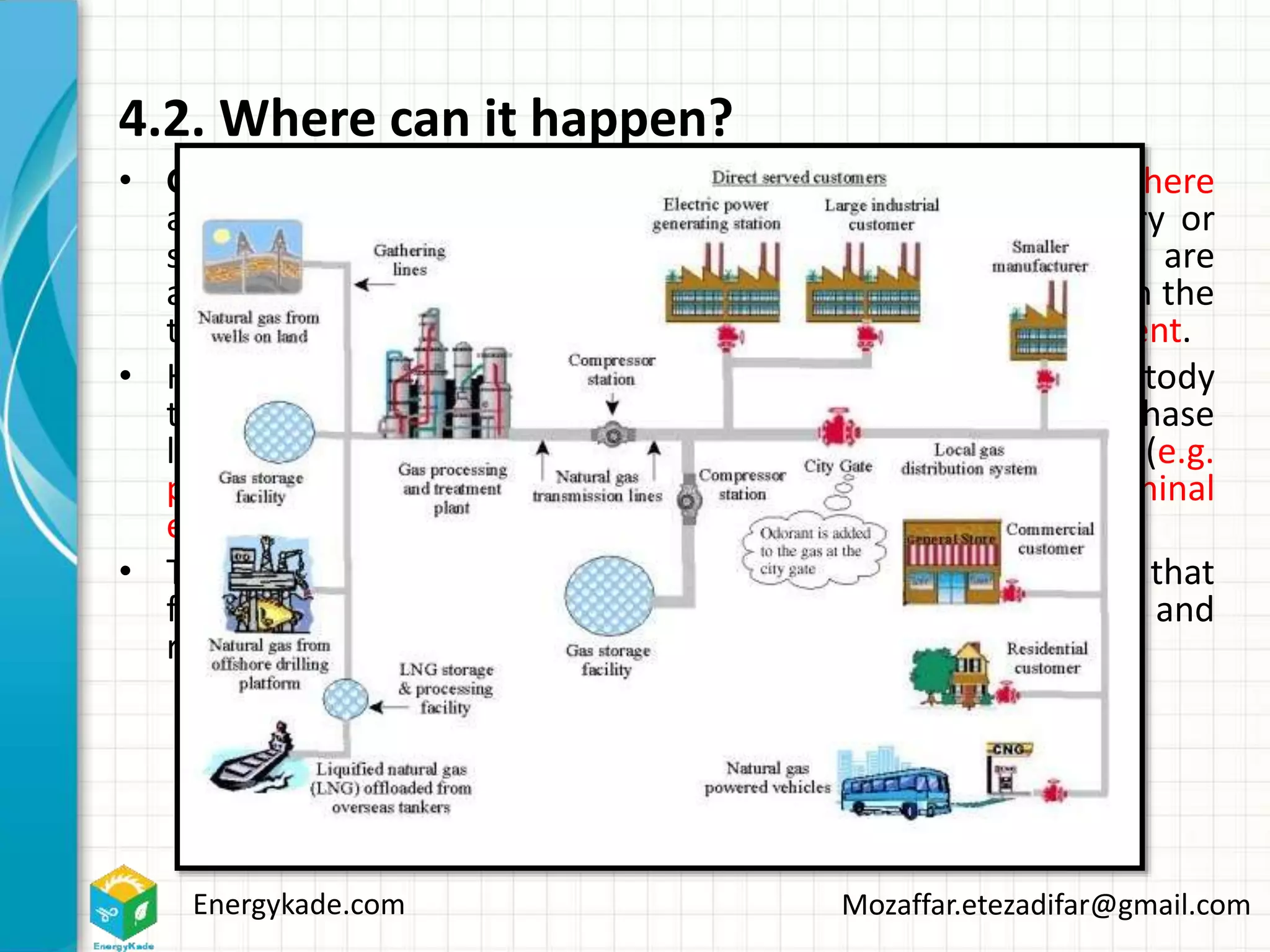
4.2. Where can it happen?
• Gas custody transfer flow measurement can take place anywhere
along the process value chain from the wellhead to delivery or
sale location. The dynamics of where these transactions are
actually located can be influenced by a number of factors with the
two primary ones being regulation and commercial arrangement.
• However for the lowest uncertainty in measurement, custody
transfer generally takes place at stable, predictable single phase
locations or physical discrete hand-over points (e.g.
platform/production exit location, pipeline entry/exit, terminal
entry etc.).
• These locations generally provide the favorable conditions that
flow measurement devices can operate predictably and
repeatability.
Energykade.com Mozaffar.etezadifar@gmail.com
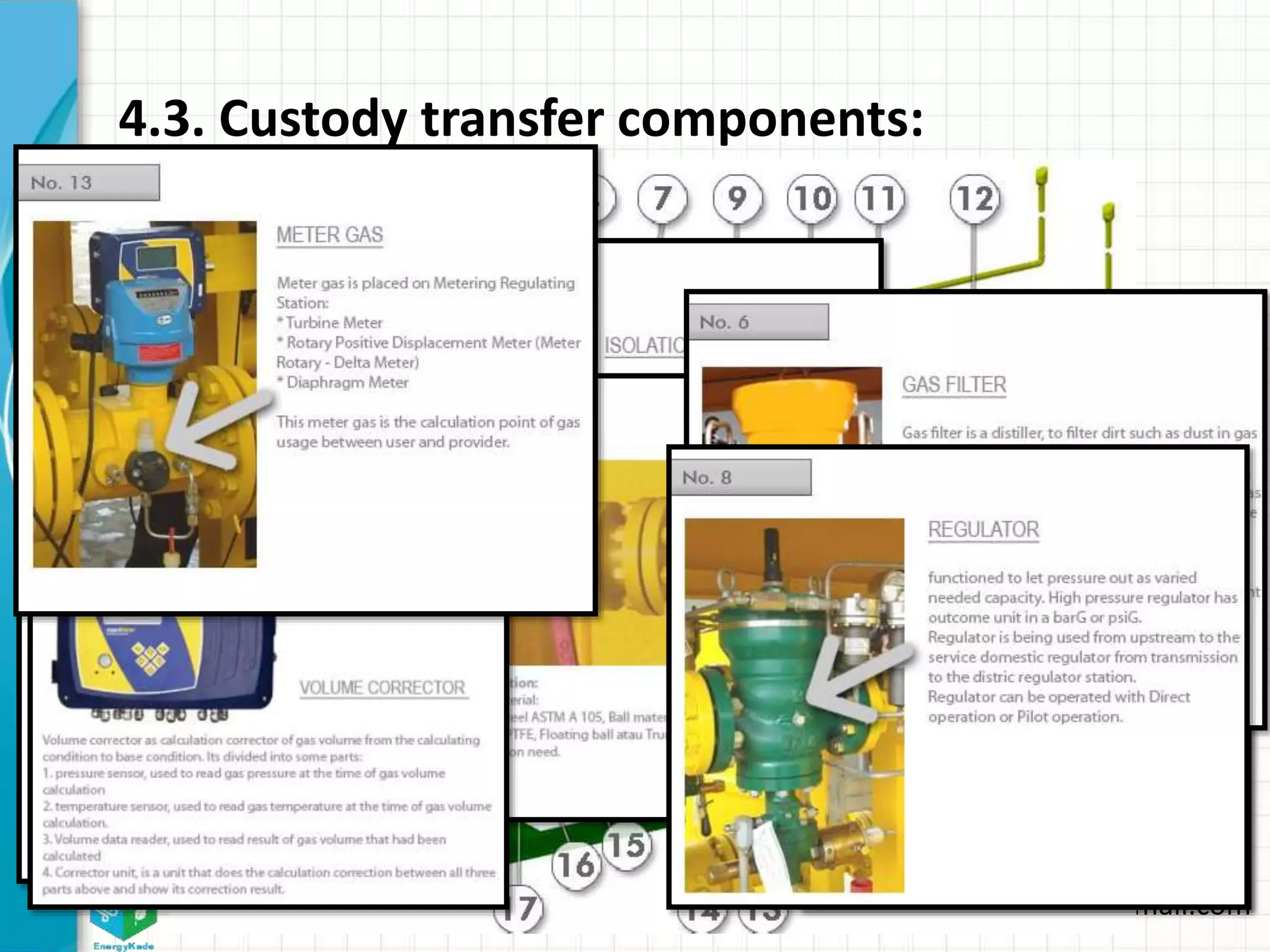
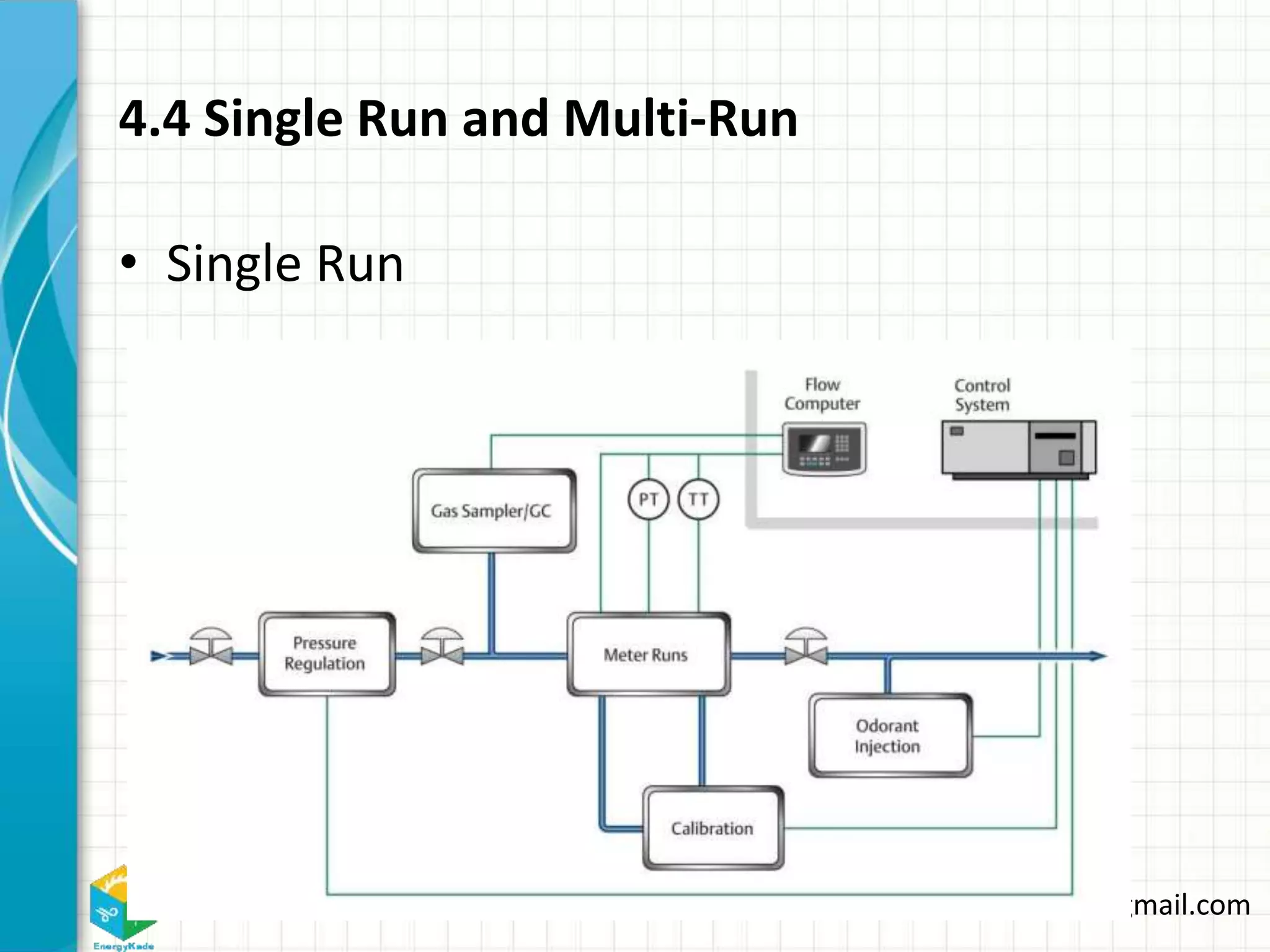
4.3. Custody transfer components:
• It’s not only about the flow meter, the whole system should
be designed for fiscal metering:
a) Multiple Meters/Meter runs
b) Flow computers and data management system
c) Gas sampler and gas chromatograph
d) Calibration system (Master Meter or prover)
e) Valves, Piping and Flanges
f) Pressure regulator or boosters
g) Transmitters (TT, Pt, …)
h) Gas filtration
i) Skid
j) Validating (Operator control, After sales services, Training,
Monitoring system, …)
Energykade.com Mozaffar.etezadifar@gmail.com
4.3. Custody transfer components:
Energykade.com Mozaffar.etezadifar@gmail.com
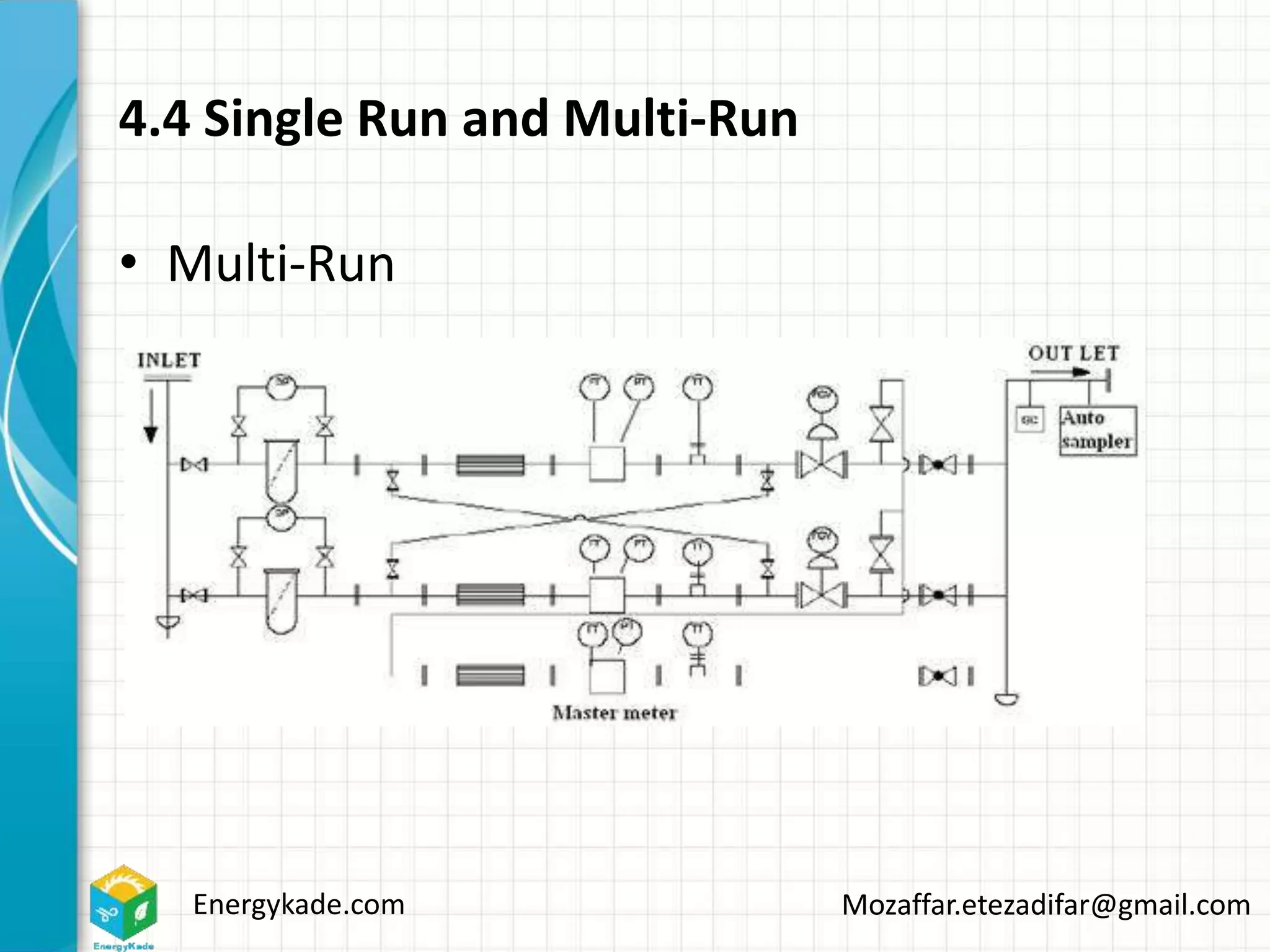
4.4 Single Run and Multi-Run
• Single Run
Energykade.com Mozaffar.etezadifar@gmail.com
4.4 Single Run and Multi-Run
• Multi-Run
Energykade.com Mozaffar.etezadifar@gmail.com
4.5. Standards and codes:
As mentioned before, there are many codes and standards which should be
considered during establishing and operating a fiscal metering station.
Standards and codes like:
• AGA
• ISO
• IGS, OIML, API and …
Energykade.com Mozaffar.etezadifar@gmail.com
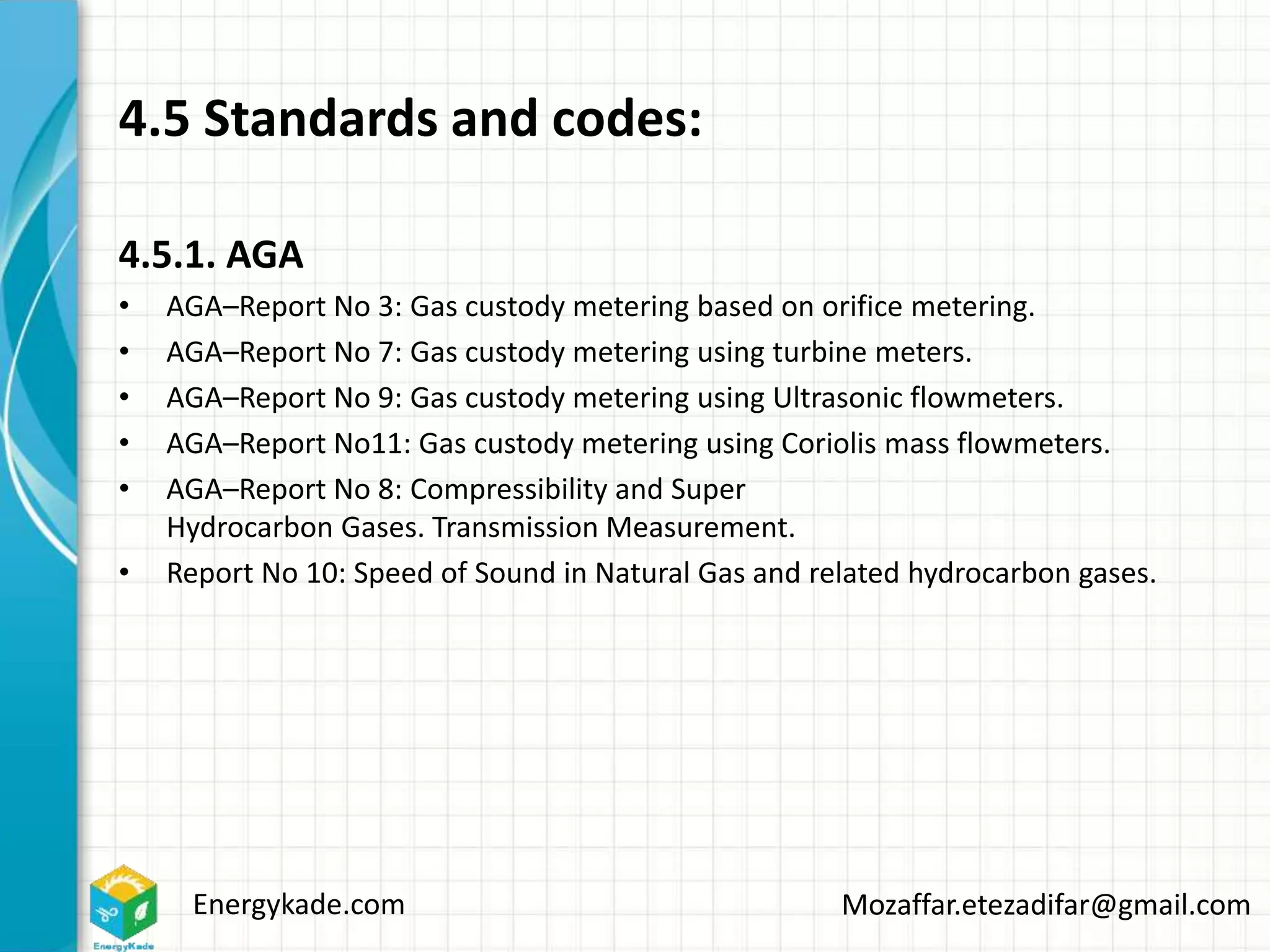
4.5 Standards and codes:
4.5.1. AGA
• AGA–Report No 3: Gas custody metering based on orifice metering.
• AGA–Report No 7: Gas custody metering using turbine meters.
• AGA–Report No 9: Gas custody metering using Ultrasonic flowmeters.
• AGA–Report No11: Gas custody metering using Coriolis mass flowmeters.
• AGA–Report No 8: Compressibility and Super
Hydrocarbon Gases. Transmission Measurement.
• Report No 10: Speed of Sound in Natural Gas and related hydrocarbon gases.
Energykade.com Mozaffar.etezadifar@gmail.com
4.5. Standards and codes:
4.5.2. ISO
• ISO 12765: Measurement of Fluid Flow in Closed Conduits Methods using Transit
Time Ultrasonic Flowmeters.
• ISO 10723: Natural gas – Performance evaluation for Online Analytical Systems.
• ISO 5168: Measurement of Fluid Flow: Estimation of Uncertainty of Ultrasonic Flo
wmeters.
• ISO 6569: Natural Gas – Rapid Analysis by Gas Chromatography.
• ISO 6976: Natural Gas Calculation of Calorific Value, Density and Relative Density.
• And …
Energykade.com Mozaffar.etezadifar@gmail.com
4.5 Standards and codes:
4.5.3. IGS and OIML …
• OIML DR 3: Draft Recommendations Gas meters (Combined revision of R6, R31 a
nd R32 Draft).
• OIML_D11 General requirements for measuring instruments - Environmental
conditions
• OIML_R137-1&2 Gas meters Part 1: Metrological and technical requirements
Part 2: Metrological controls and performance tests
• IGS-M-IN-104(1) Multi-Path Transit Time ultrasonic gas flowmeters
• IGS-C-IN-105(0) Calibration Duration of Measuring Instruments (Flow ,Pressure
and Temperature)
• IGS-M-CH-033(1) Specification for Iranian Natural Gas Quality
Energykade.com Mozaffar.etezadifar@gmail.com
4.6. Affecting factors on accuracy
Reading and calculation factors Fluid and line factors
Flow computer setting and performance Distance from regulators ad control valves
TT and PT and Flow meter true reading Site headers and sizes
Calibration and its processes TT installation
Prover Meter Installation
Site condition
Fluid turbulence
conditioner
Piping
Energykade.com Mozaffar.etezadifar@gmail.com
4.6.1. Reading and calculation factors
• 4.6.1.1. Flow computer setting and performance
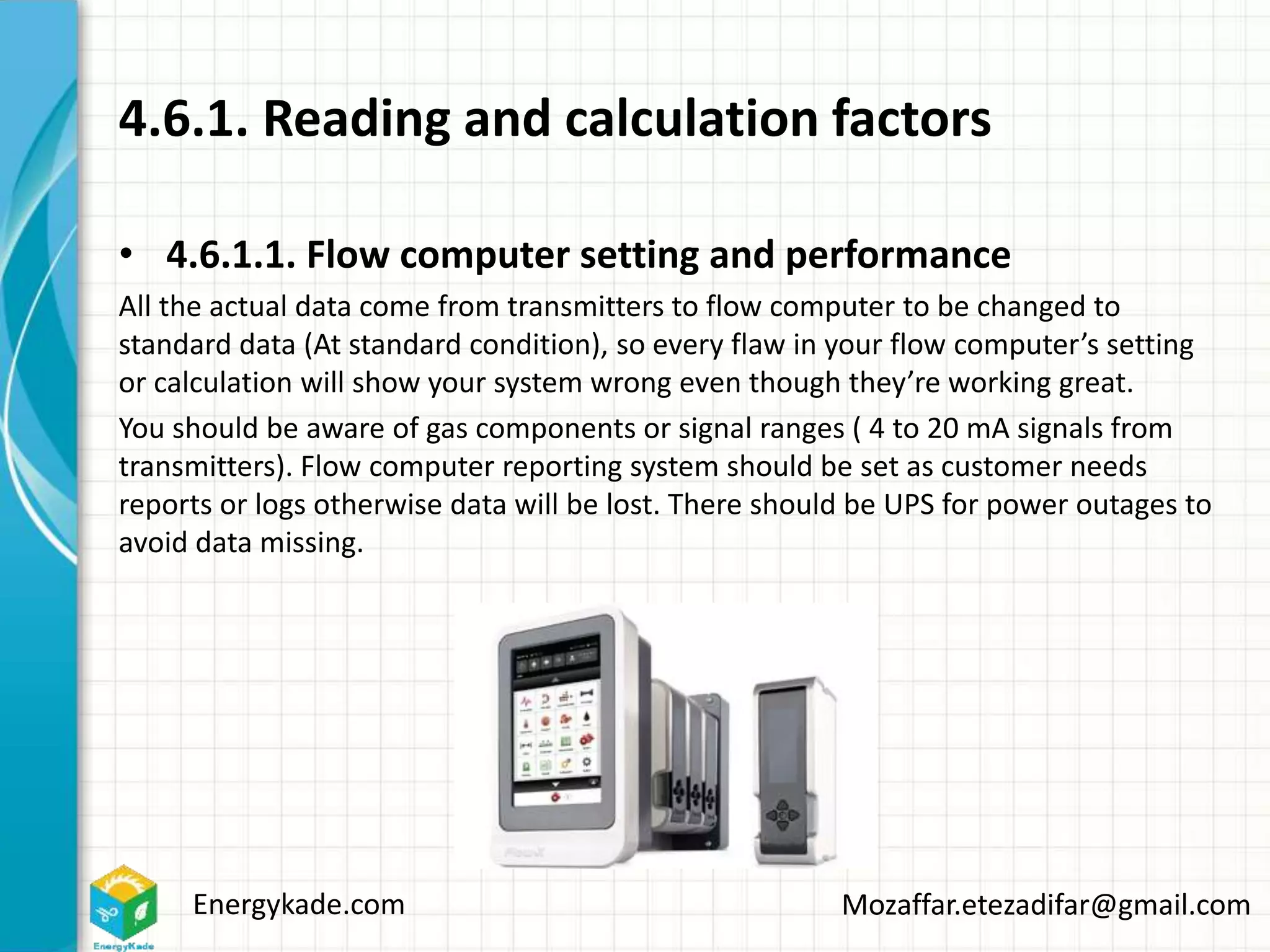
All the actual data come from transmitters to flow computer to be changed to
standard data (At standard condition), so every flaw in your flow computer’s setting
or calculation will show your system wrong even though they’re working great.
You should be aware of gas components or signal ranges ( 4 to 20 mA signals from
transmitters). Flow computer reporting system should be set as customer needs
reports or logs otherwise data will be lost. There should be UPS for power outages to
avoid data missing.
Energykade.com Mozaffar.etezadifar@gmail.com
4.6.1. Reading and calculation factors
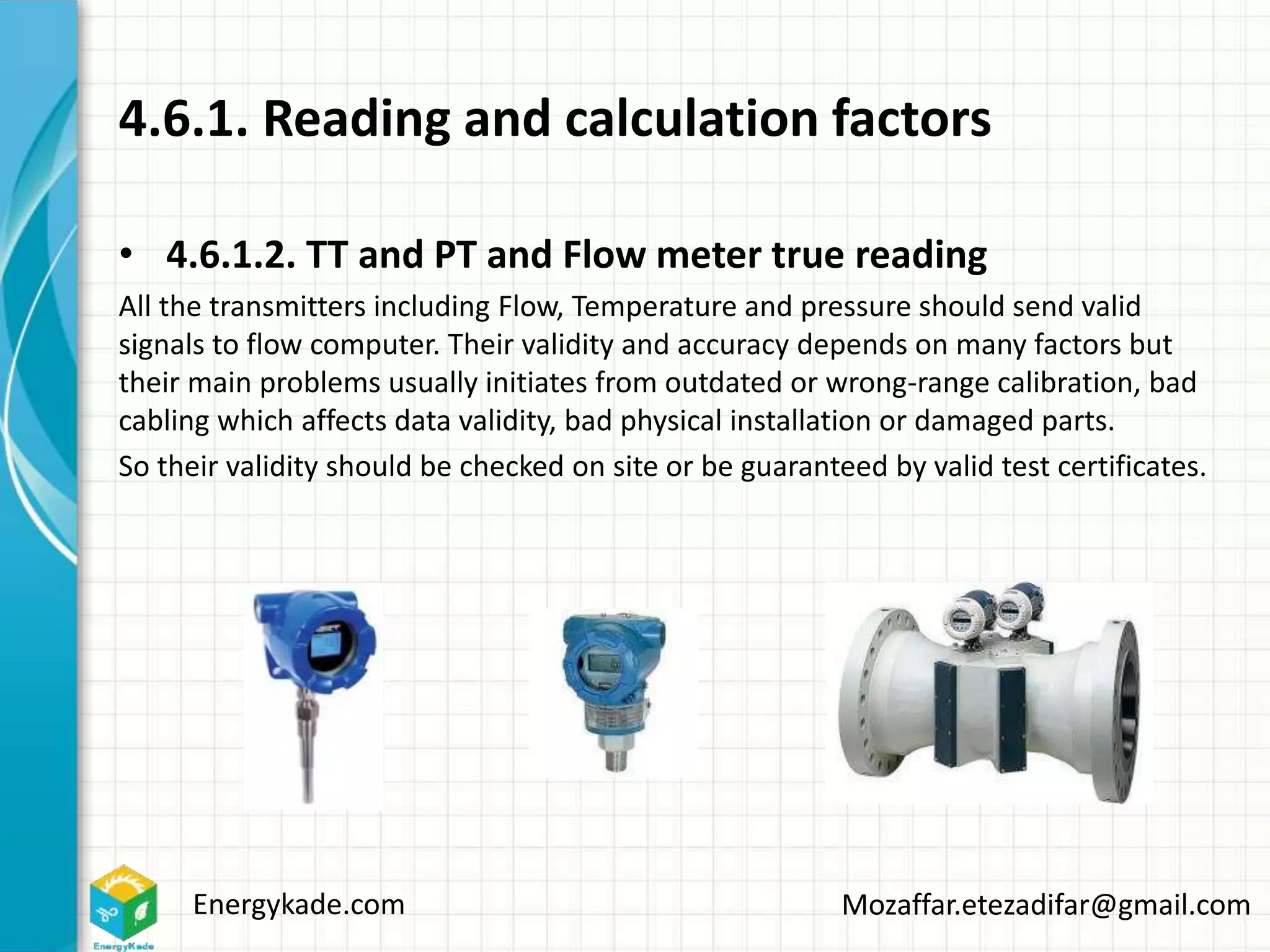
• 4.6.1.2. TT and PT and Flow meter true reading
All the transmitters including Flow, Temperature and pressure should send valid
signals to flow computer. Their validity and accuracy depends on many factors but
their main problems usually initiates from outdated or wrong-range calibration, bad
cabling which affects data validity, bad physical installation or damaged parts.
So their validity should be checked on site or be guaranteed by valid test certificates.
Energykade.com Mozaffar.etezadifar@gmail.com
4.6.1. Reading and calculation factors
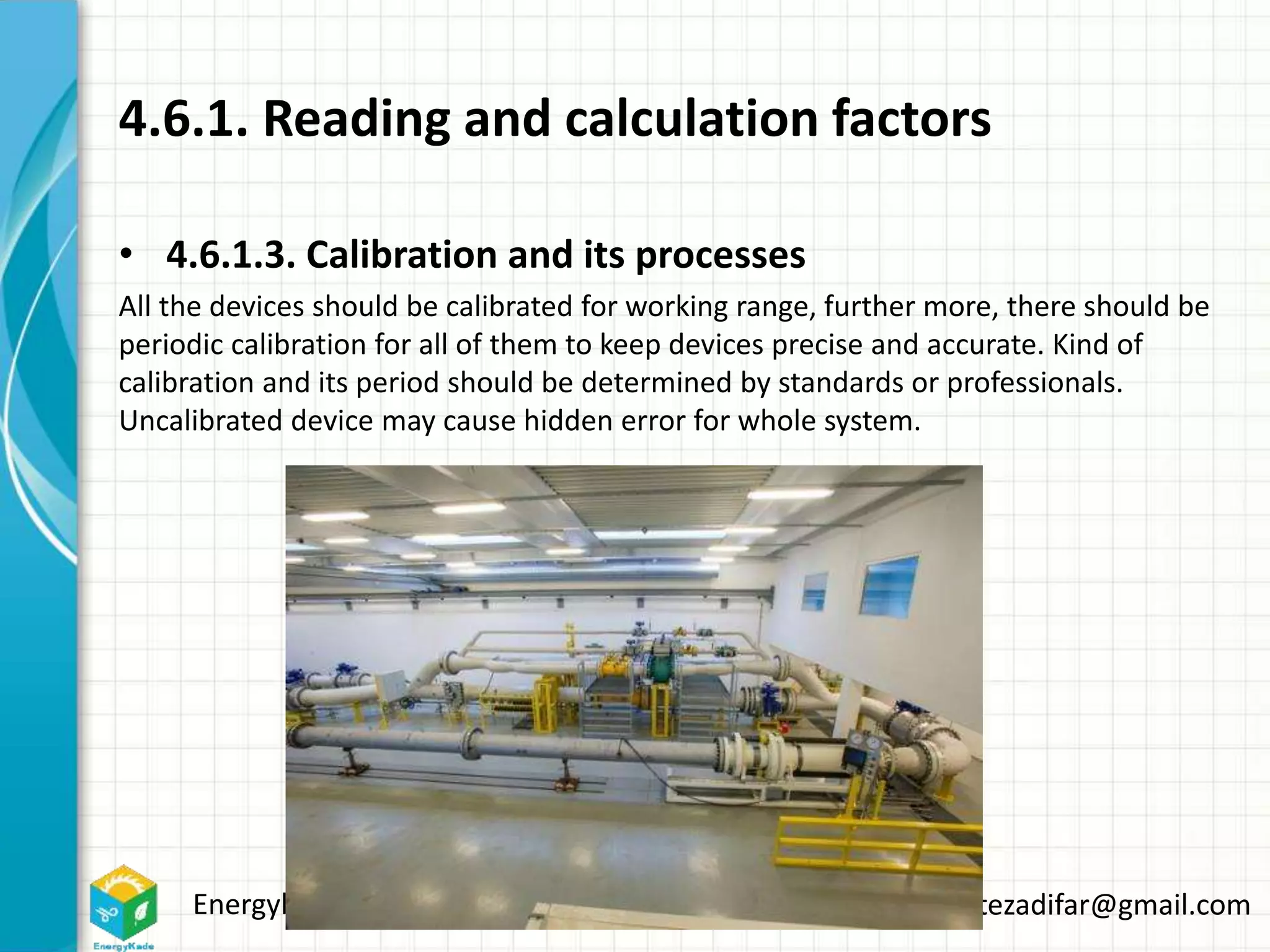
• 4.6.1.3. Calibration and its processes
All the devices should be calibrated for working range, further more, there should be
periodic calibration for all of them to keep devices precise and accurate. Kind of
calibration and its period should be determined by standards or professionals.
Uncalibrated device may cause hidden error for whole system.
Energykade.com Mozaffar.etezadifar@gmail.com
4.6.1. Reading and calculation factors
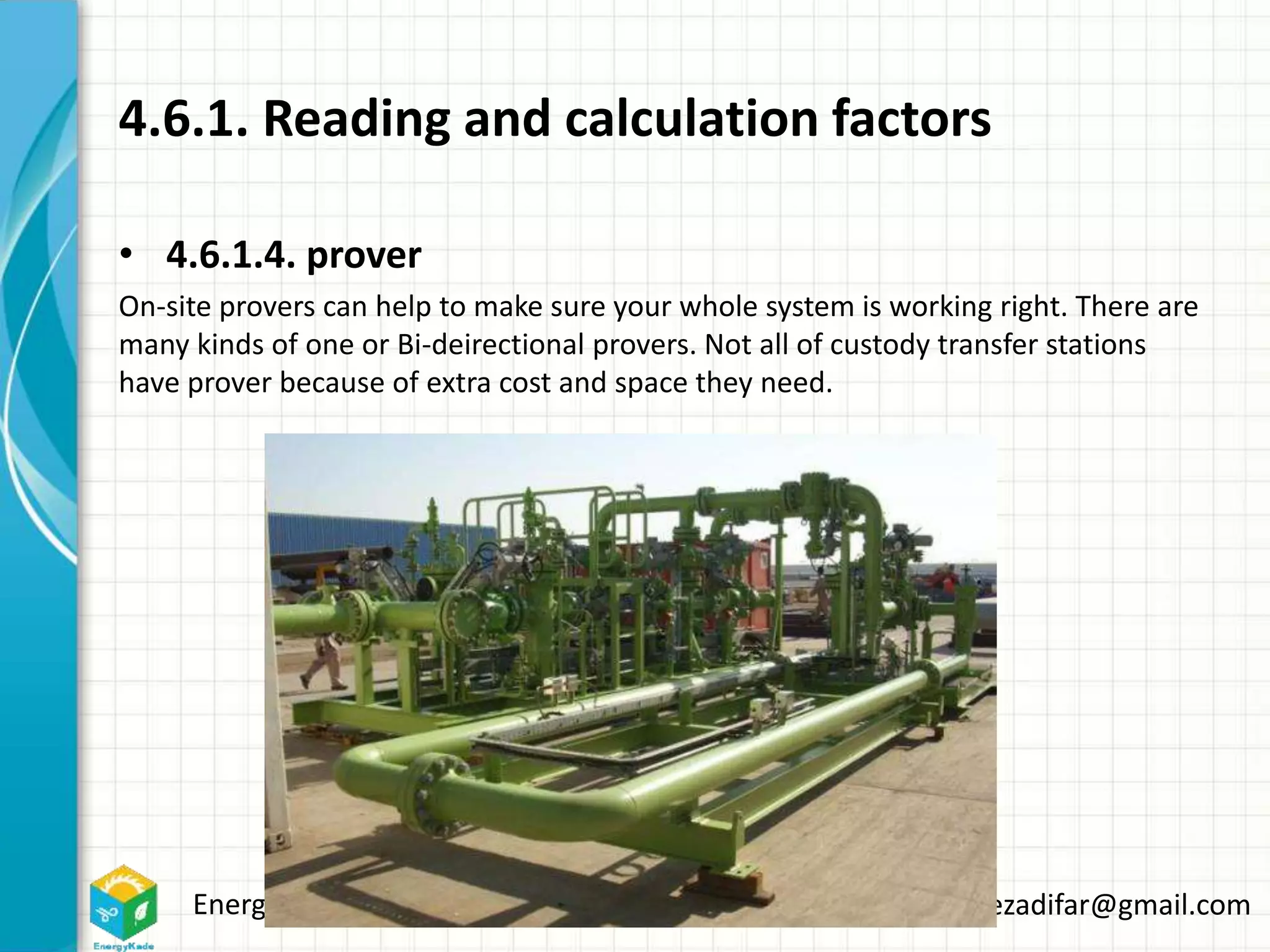
• 4.6.1.4. prover
On-site provers can help to make sure your whole system is working right. There are
many kinds of one or Bi-deirectional provers. Not all of custody transfer stations
have prover because of extra cost and space they need.
Energykade.com Mozaffar.etezadifar@gmail.com
4.6.2. Fluid and line factors
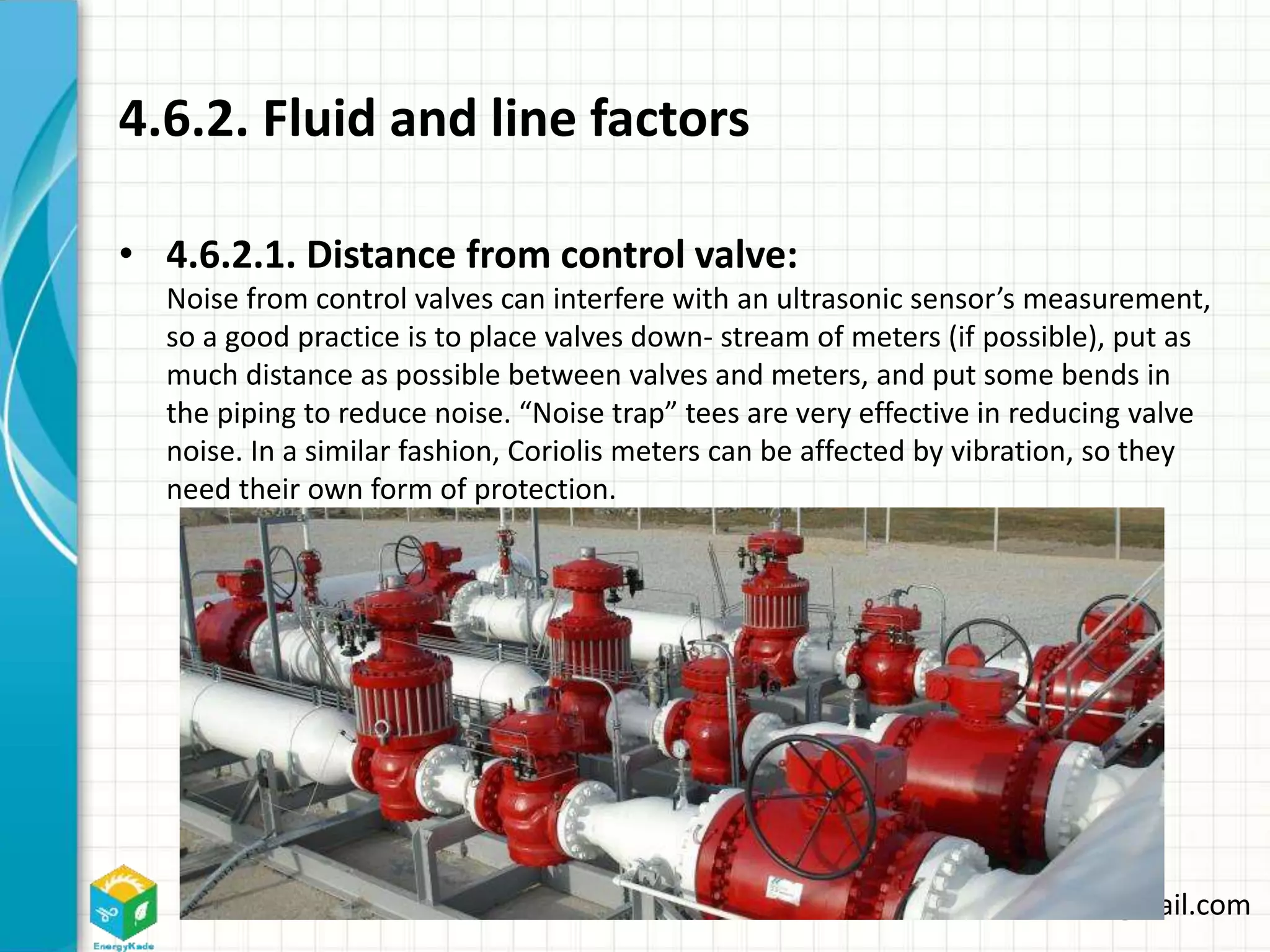
• 4.6.2.1. Distance from control valve:
Noise from control valves can interfere with an ultrasonic sensor’s measurement,
so a good practice is to place valves down- stream of meters (if possible), put as
much distance as possible between valves and meters, and put some bends in
the piping to reduce noise. “Noise trap” tees are very effective in reducing valve
noise. In a similar fashion, Coriolis meters can be affected by vibration, so they
need their own form of protection.
Energykade.com Mozaffar.etezadifar@gmail.com
4.6.2. Fluid and line factors
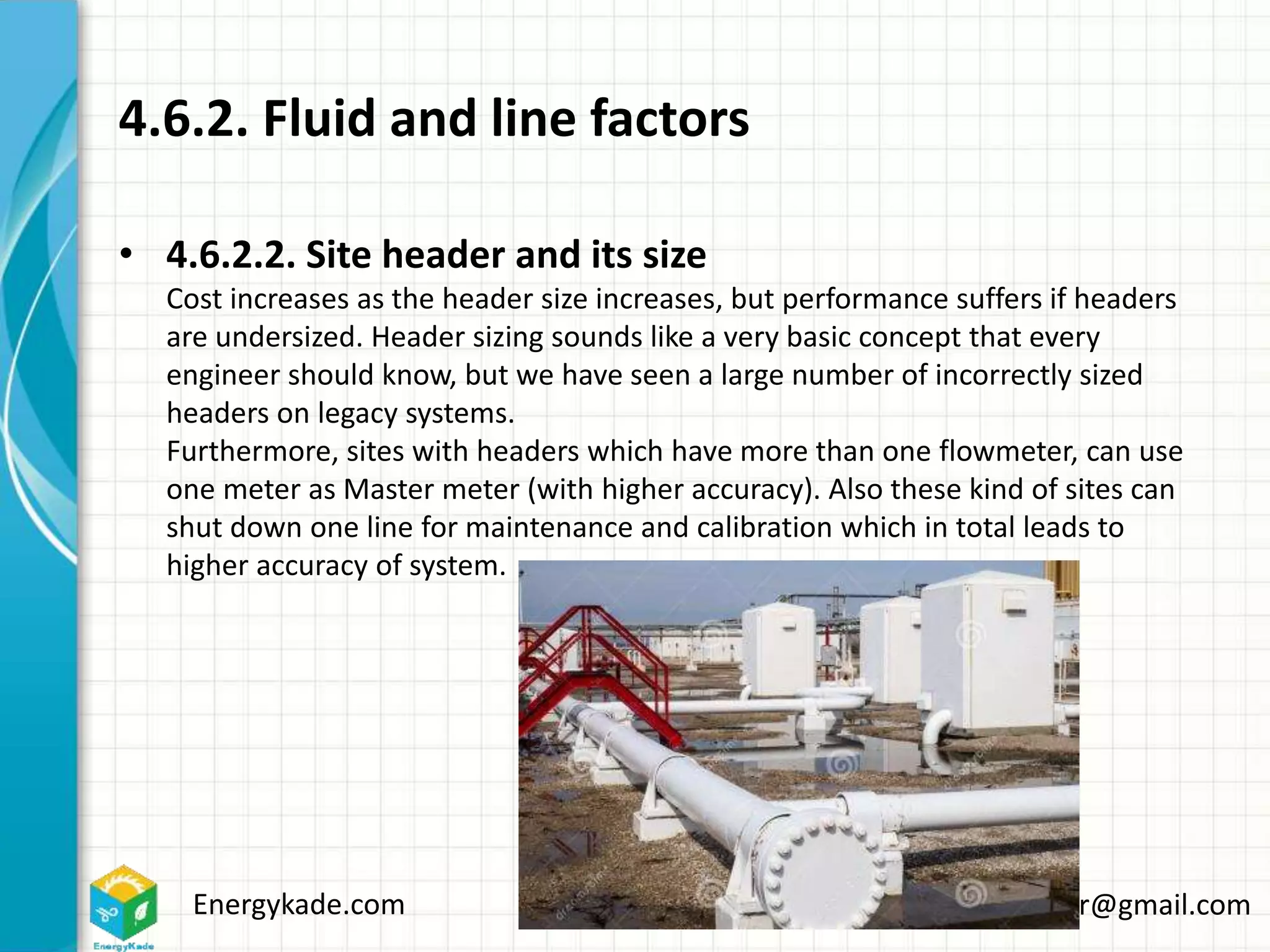
• 4.6.2.2. Site header and its size
Cost increases as the header size increases, but performance suffers if headers
are undersized. Header sizing sounds like a very basic concept that every
engineer should know, but we have seen a large number of incorrectly sized
headers on legacy systems.
Furthermore, sites with headers which have more than one flowmeter, can use
one meter as Master meter (with higher accuracy). Also these kind of sites can
shut down one line for maintenance and calibration which in total leads to
higher accuracy of system.
Energykade.com Mozaffar.etezadifar@gmail.com
4.6.2. Fluid and line factors
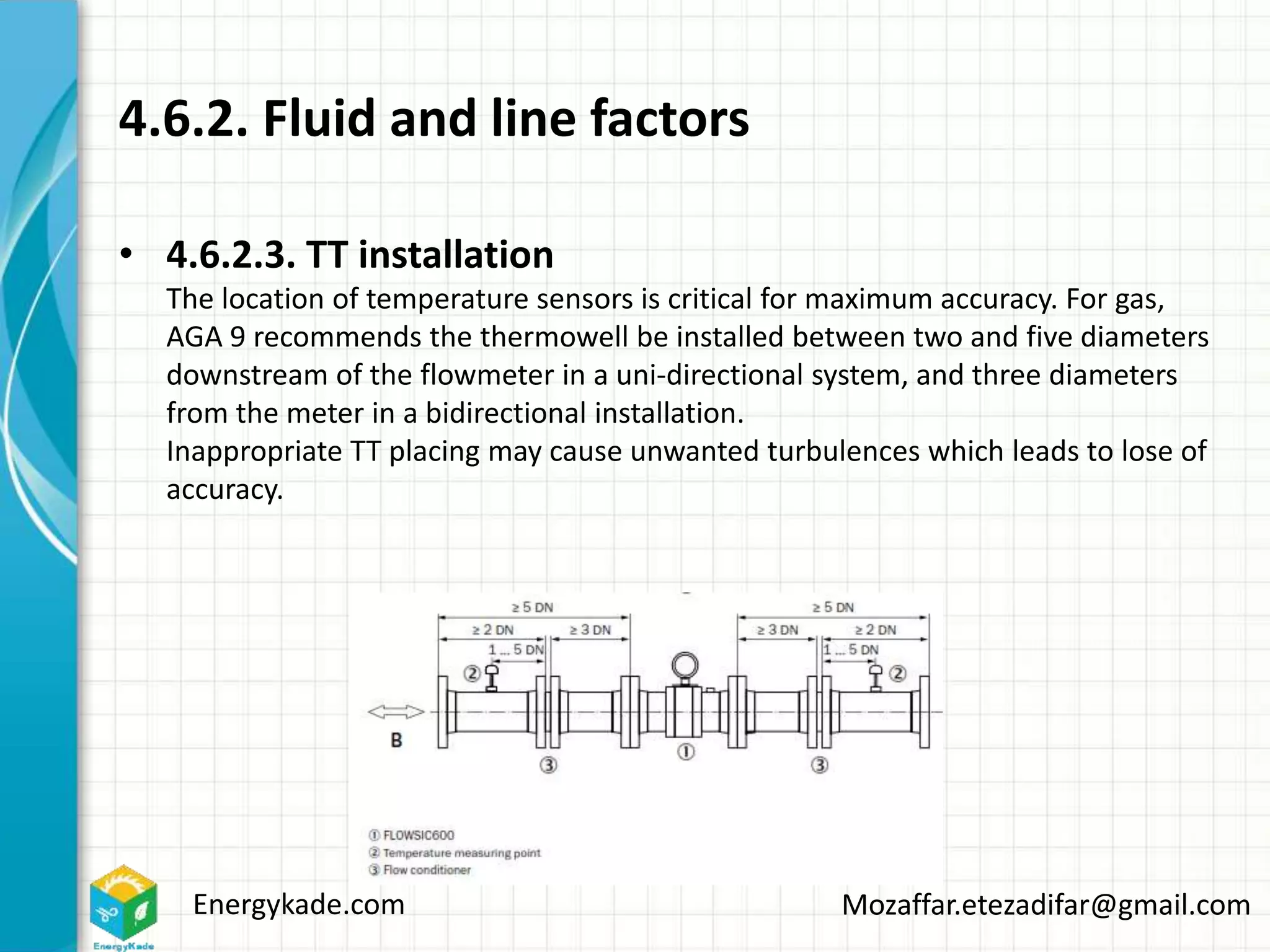
• 4.6.2.3. TT installation
The location of temperature sensors is critical for maximum accuracy. For gas,
AGA 9 recommends the thermowell be installed between two and five diameters
downstream of the flowmeter in a uni-directional system, and three diameters
from the meter in a bidirectional installation.
Inappropriate TT placing may cause unwanted turbulences which leads to lose of
accuracy.
Energykade.com Mozaffar.etezadifar@gmail.com
4.6.2. Fluid and line factors
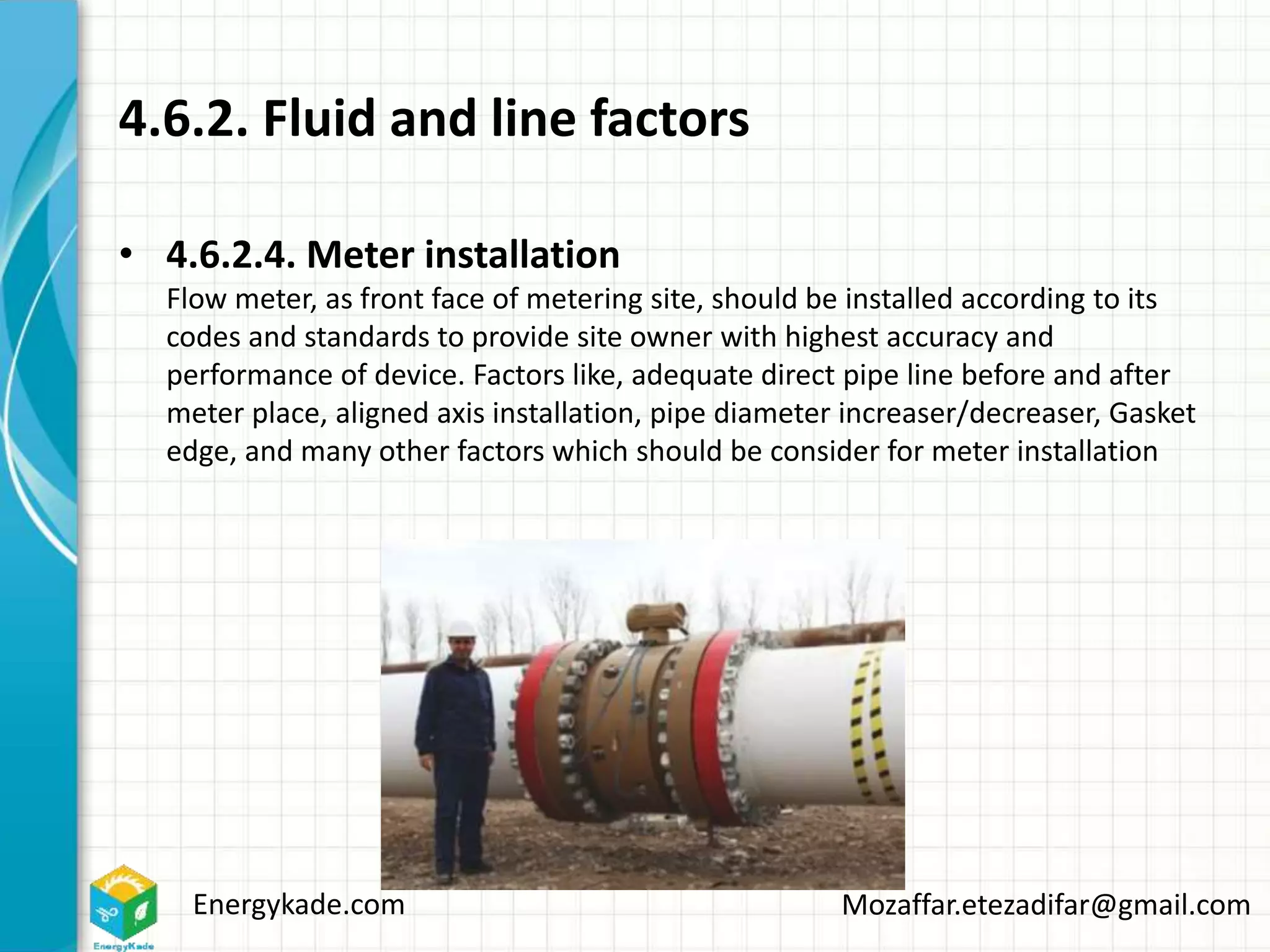
• 4.6.2.4. Meter installation
Flow meter, as front face of metering site, should be installed according to its
codes and standards to provide site owner with highest accuracy and
performance of device. Factors like, adequate direct pipe line before and after
meter place, aligned axis installation, pipe diameter increaser/decreaser, Gasket
edge, and many other factors which should be consider for meter installation
Energykade.com Mozaffar.etezadifar@gmail.com
4.6.2. Fluid and line factors
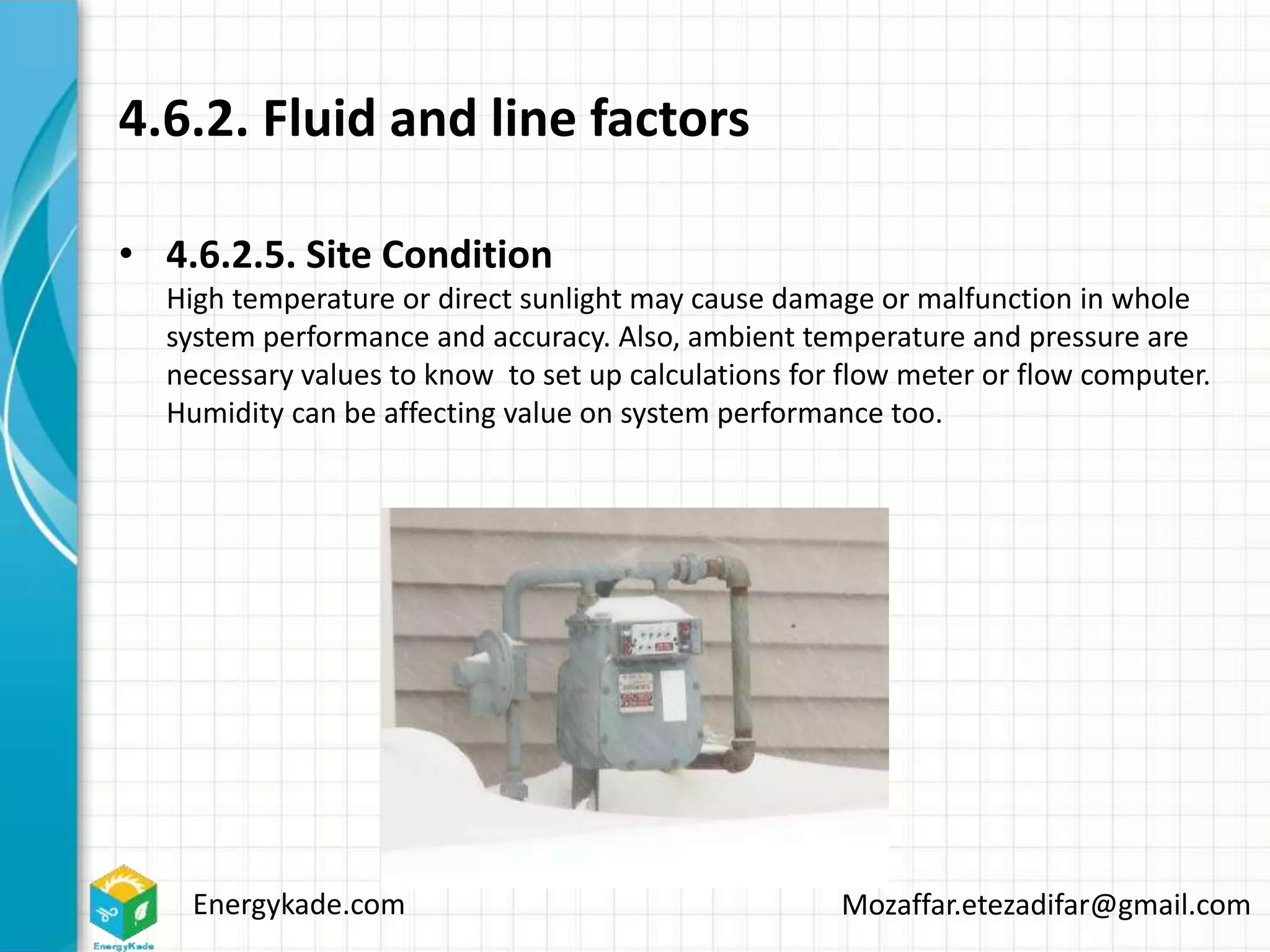
• 4.6.2.5. Site Condition
High temperature or direct sunlight may cause damage or malfunction in whole
system performance and accuracy. Also, ambient temperature and pressure are
necessary values to know to set up calculations for flow meter or flow computer.
Humidity can be affecting value on system performance too.
Energykade.com Mozaffar.etezadifar@gmail.com
4.6.2. Fluid and line factors
• 4.6.2.6. Fluid Turbulence
To have measurement theories true and working and accuracy as desired, we
need certain fluid velocity profile. Many factors may affect this velocity profile
such as path that fluid goes through like 90° or U Turns before and after meter,
vertical or horizontal path, size changers and many other factors which all in all
will affect Reynolds number. Reynolds number describes fluid turbulence.
Energykade.com Mozaffar.etezadifar@gmail.com
4.6.2. Fluid and line factors
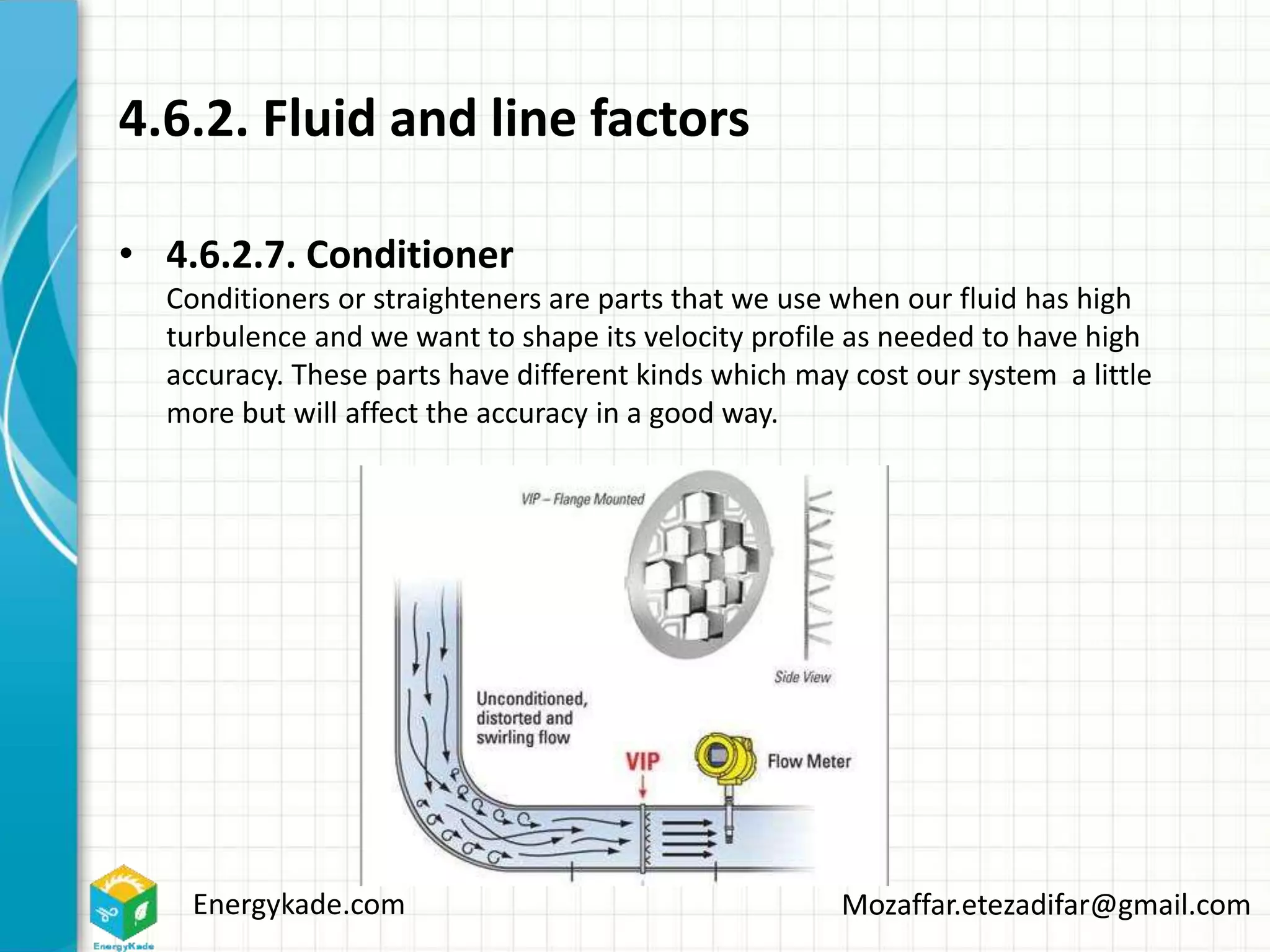
• 4.6.2.7. Conditioner
Conditioners or straighteners are parts that we use when our fluid has high
turbulence and we want to shape its velocity profile as needed to have high
accuracy. These parts have different kinds which may cost our system a little
more but will affect the accuracy in a good way.
Energykade.com Mozaffar.etezadifar@gmail.com
4.6.2. Fluid and line factors
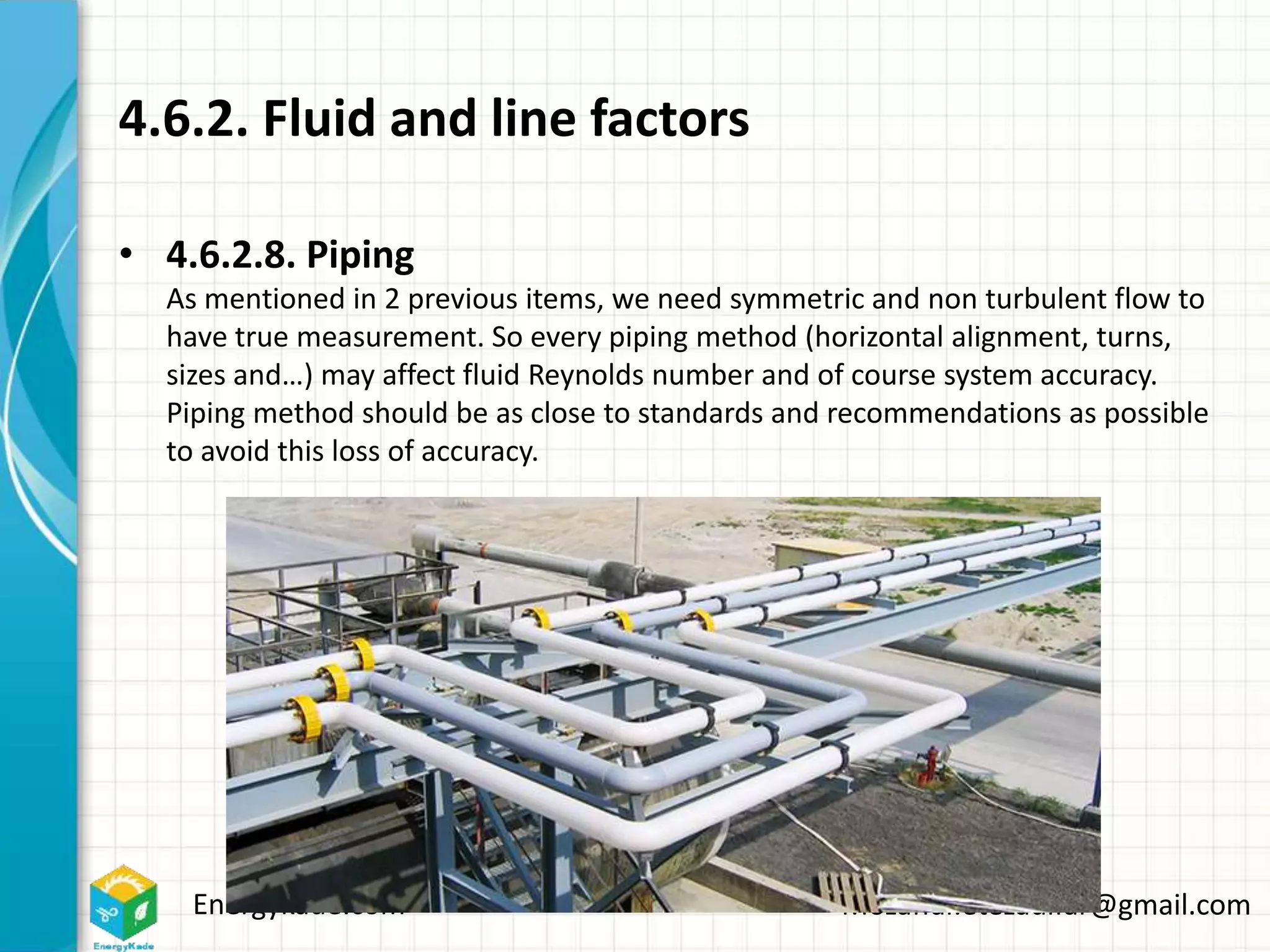
• 4.6.2.8. Piping
As mentioned in 2 previous items, we need symmetric and non turbulent flow to
have true measurement. So every piping method (horizontal alignment, turns,
sizes and…) may affect fluid Reynolds number and of course system accuracy.
Piping method should be as close to standards and recommendations as possible
to avoid this loss of accuracy.
Energykade.com Mozaffar.etezadifar@gmail.com
Chapter 5
Modules as hardware, Monitoring
system as software
Energykade.com Mozaffar.etezadifar@gmail.com
5.1. necessity of a monitoring system and after
sales services
• What if you buy an expensive car and give it someone who doesn’t know how to
work with gears, and he only uses first gear?
You need to know how to use your product to get maximum out of your
expensive product!
• What if you invest a lot on buying an expensive car and you want to use that for
a lifetime and suddenly some part of it breaks down and you can’t find any spare
part for it?
If you want to make sure your investment will work a long time for you, you
should be provided with spares and service.
• What if it’s said that your expensive car burns very little amount fuel, but
because its engine isn’t adjusted, it’s burning much more than ordinary cars?
You should keep your product calibrated and adjusted at its best.
• And…
Energykade.com Mozaffar.etezadifar@gmail.com
5.2. Monitoring system components
5.2.1. Trained Operator
5.2.2. Online monitoring and observation
system
5.2.3. Periodic calibration
Energykade.com Mozaffar.etezadifar@gmail.com
5.2. Monitoring system components
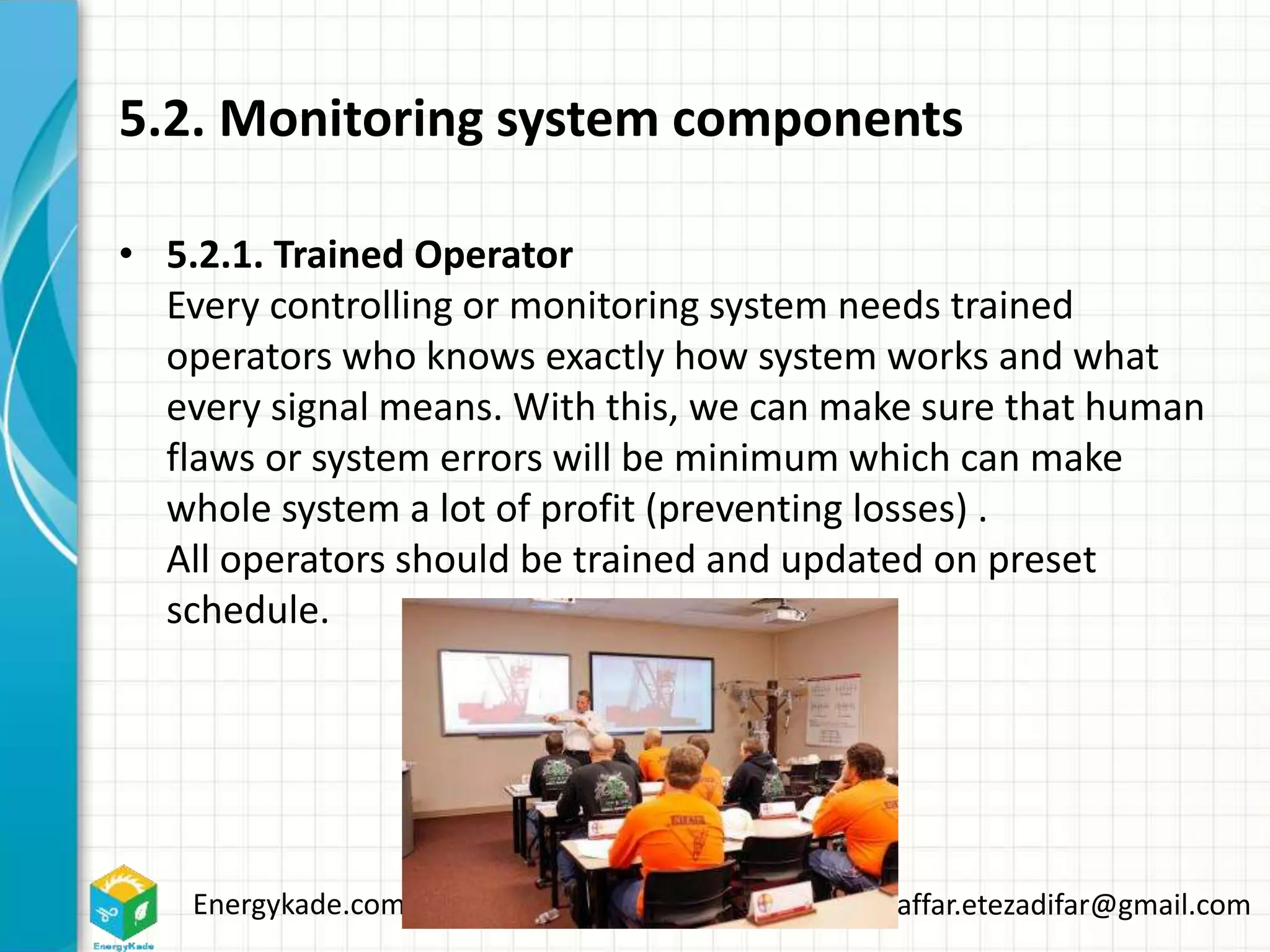
• 5.2.1. Trained Operator
Every controlling or monitoring system needs trained
operators who knows exactly how system works and what
every signal means. With this, we can make sure that human
flaws or system errors will be minimum which can make
whole system a lot of profit (preventing losses) .
All operators should be trained and updated on preset
schedule.
Energykade.com Mozaffar.etezadifar@gmail.com
5.2. Monitoring system components
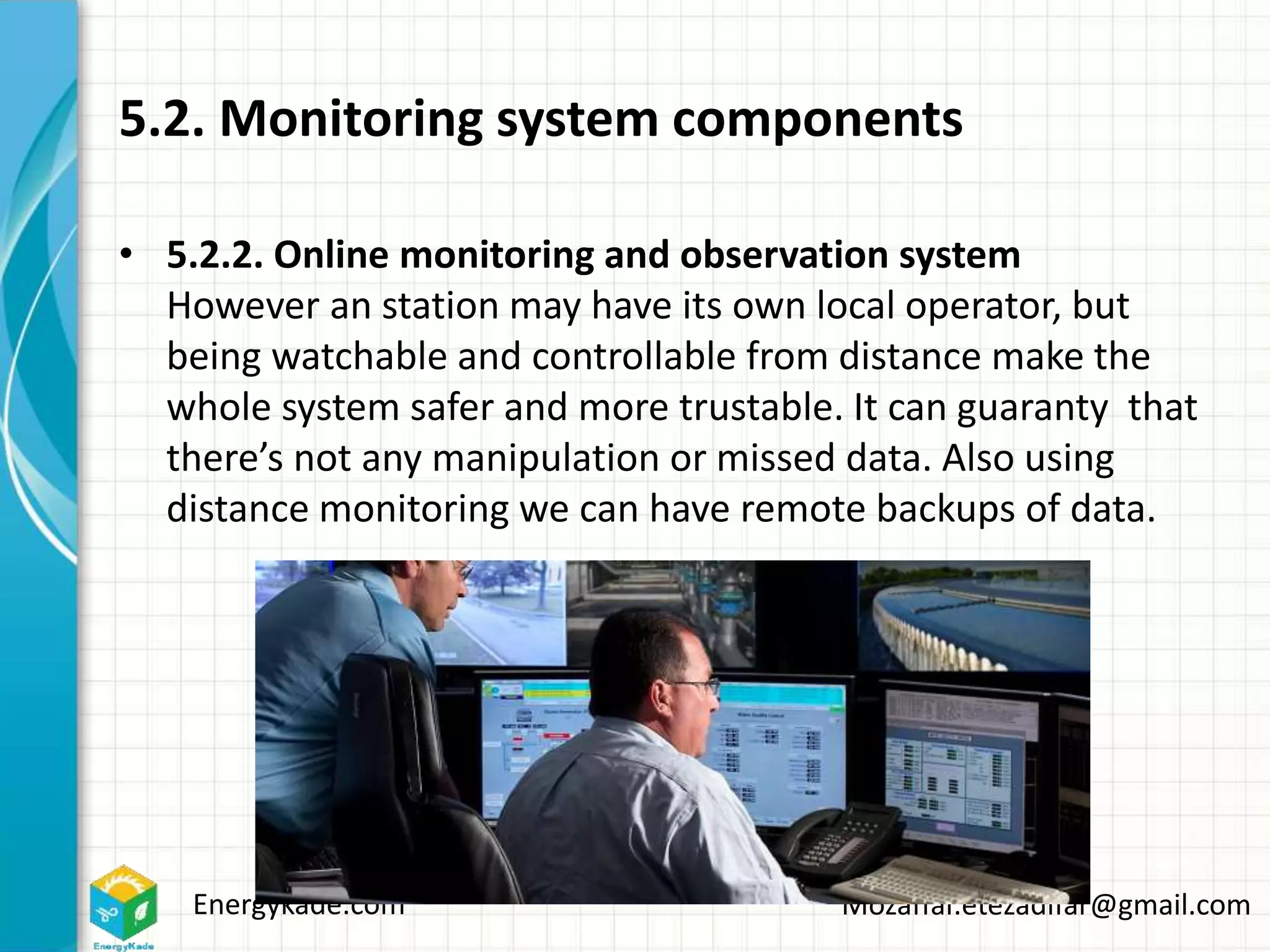
• 5.2.2. Online monitoring and observation system
However an station may have its own local operator, but
being watchable and controllable from distance make the
whole system safer and more trustable. It can guaranty that
there’s not any manipulation or missed data. Also using
distance monitoring we can have remote backups of data.
Energykade.com Mozaffar.etezadifar@gmail.com
5.2. Monitoring system components
• 5.2.3. Periodic calibration
Every system need re-calibration, eventhough the system is
fully calibrated at first. Not to care about calibration
sessions, will lead to loosing accuracy in whole system
because all devices will go out of calibration setting after a
while. Some devices has standard periods of calibration but
many others don’t. it should be checked with used
standards.
Energykade.com Mozaffar.etezadifar@gmail.com
5.3. After Sales Services
5.3.1. Spare parts
5.3.2. Maintenance and guidance
5.3.3. Training new operators
5.3.4. Technology upgrade
Energykade.com Mozaffar.etezadifar@gmail.com
5.3. After Sales Services
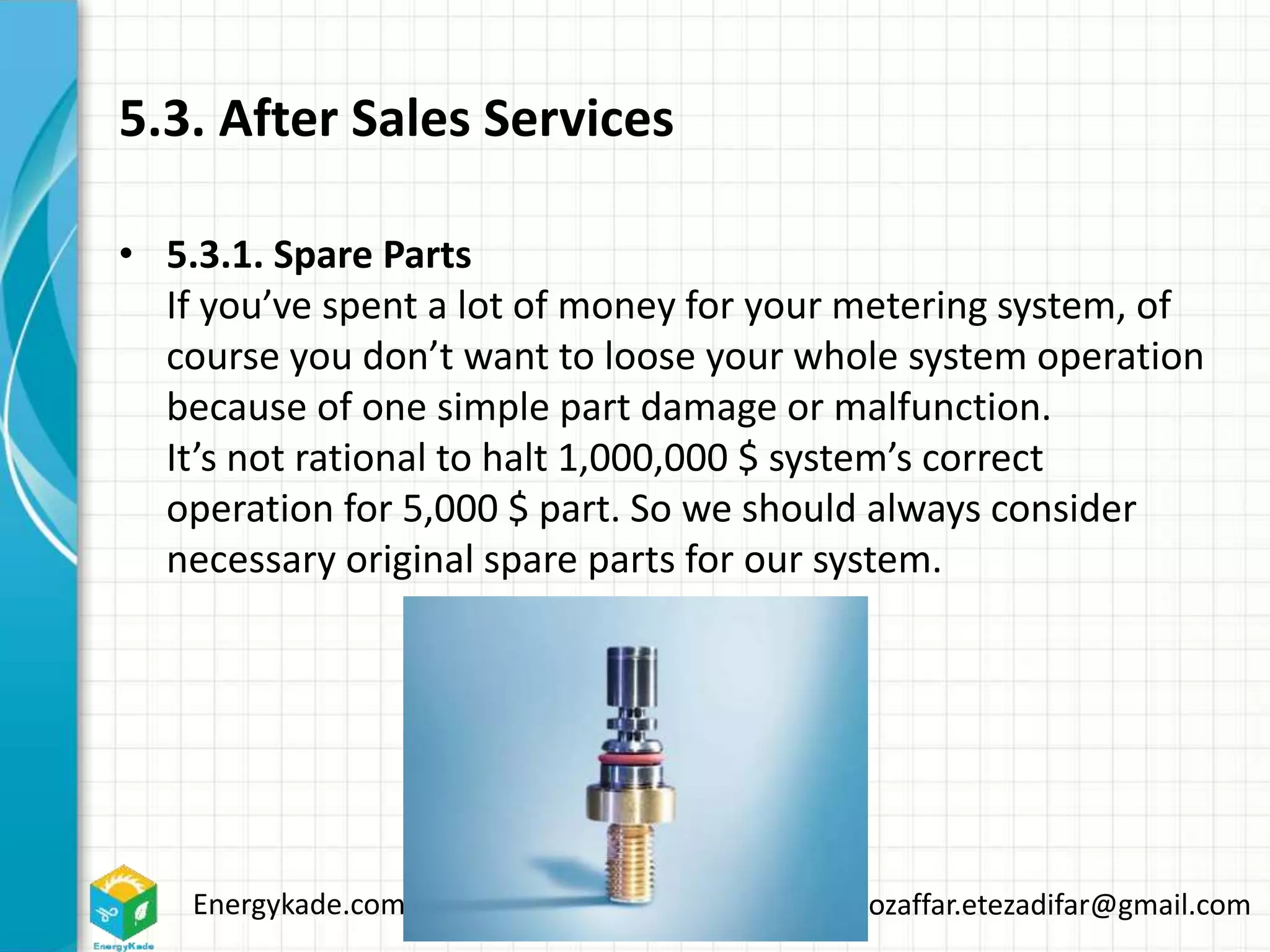
• 5.3.1. Spare Parts
If you’ve spent a lot of money for your metering system, of
course you don’t want to loose your whole system operation
because of one simple part damage or malfunction.
It’s not rational to halt 1,000,000 $ system’s correct
operation for 5,000 $ part. So we should always consider
necessary original spare parts for our system.
Energykade.com Mozaffar.etezadifar@gmail.com
5.3. After Sales Services
• 5.3.2. Maintenance and Guidance
In case anything happens for metering system, it’s always
heart warming to be sure a team can guide our engineers or
operators to get over the problem or if it wasn’t solved their
team can come and check the situation ASAP.
Energykade.com Mozaffar.etezadifar@gmail.com
5.3. After Sales Services
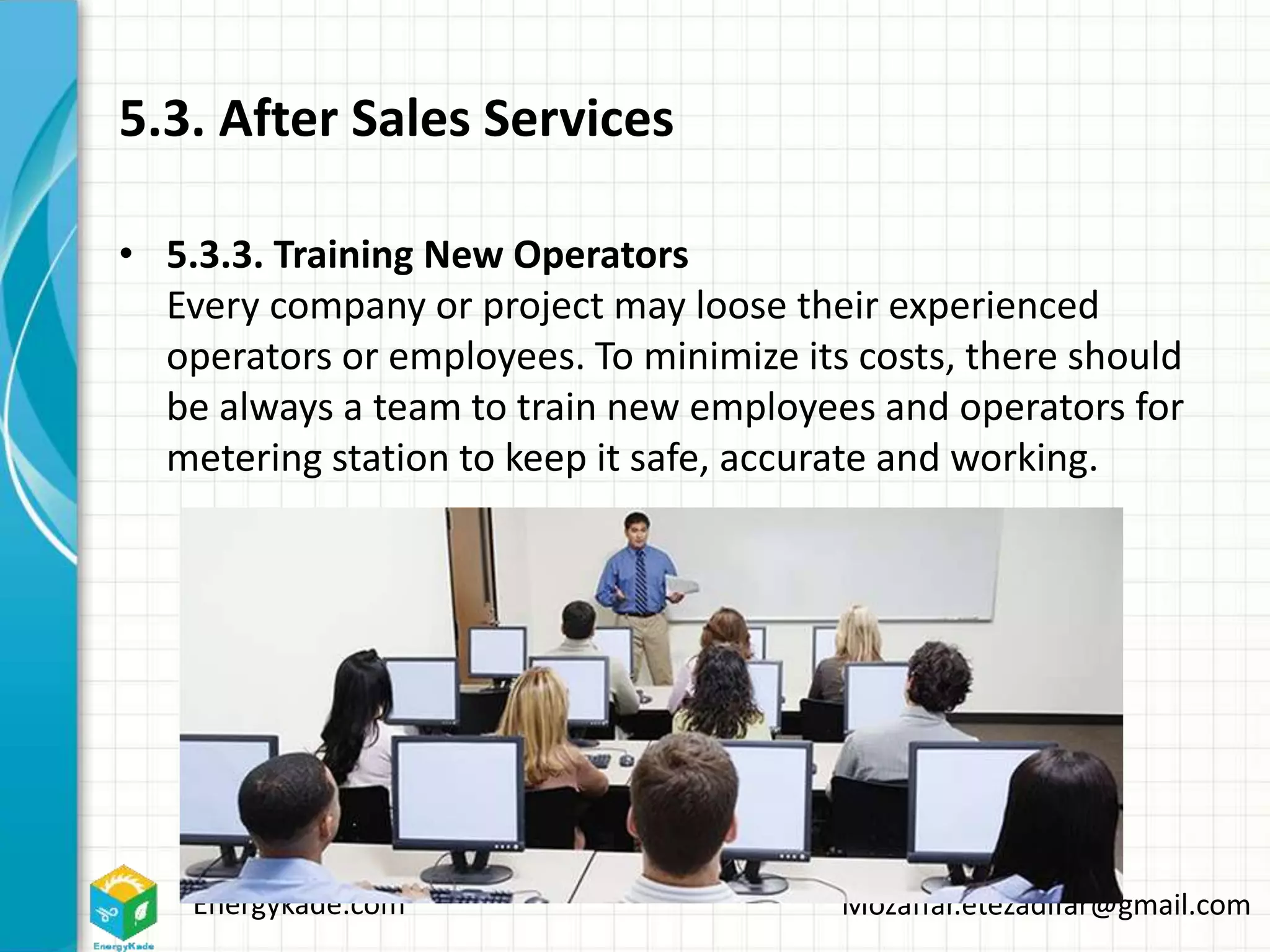
• 5.3.3. Training New Operators
Every company or project may loose their experienced
operators or employees. To minimize its costs, there should
be always a team to train new employees and operators for
metering station to keep it safe, accurate and working.
Energykade.com Mozaffar.etezadifar@gmail.com
5.3. After Sales Services
• 5.3.4. Technology Upgrade
Good metering station will work for many years and during
these years new technologies and product may appear.
Usually, vendor companies are most up to date companies
about these changes, So they can offer their former
customers about new solutions to be more efficient.
Energykade.com Mozaffar.etezadifar@gmail.com
Chapter 6
Conclusion
Energykade.com Mozaffar.etezadifar@gmail.com
Conclusion
• Fiscal metering system is your cash register, invest on its
accuracy and validity. Investment on its accuracy and
performance will pay off a lot more in long term.
• Fiscal metering system isn’t only your flow meter. look at it
as a living system which needs maintenance, training,
backup. All its parts should work together properly to
provide us with good results.
• Paying for expensive and accurate metering system without
sticking to training and solution upgrades is waste of money
in midterm.
THANKS

Introduction to Fiscal Metering (Custody Transfer)

  • 1.
    INTRODUCTION TO FISCAL MEASUREMENT MozaffarEtezadifar Fall 2016 Mozaffar.etezadifar@gmail.com Energykade.com
  • 2.
  • 3.
  • 4.
  • 5.
    Energykade.com Mozaffar.etezadifar@gmail.com 1.1. Whatis fiscal metering? • Fiscal metering is combination of regulations, laws, protocols, systems and devices which enables two parties to transfer and measure a valuable product from one side to another in a way that both sides agree on.
  • 6.
    Energykade.com Mozaffar.etezadifar@gmail.com 1.2. Whendo we need fiscal metering? • When seller and buyer are dealing on huge amount of material OR expensive one, it is important to have precise measurement of amount transferred between two parties. • Both seller and buyer should agree on the amount and the way it’s calculated, to have a deal. • In Oil&Gas field, it’s both huge and expensive
  • 7.
    Energykade.com Mozaffar.etezadifar@gmail.com 1.3. Howmuch value does it make? • A very large custody transfer system can $6,000,000 worth of natural gas per day, or $2.2 Billion per year. If the measurement is off by 0.25%, that’s an error of $15,000 per day or $5.5 million per year in somebody’s favor.
  • 8.
    Energykade.com Mozaffar.etezadifar@gmail.com 1.4. Whatcan be done using created value? • We can build much better custody transfer systems, spending portion of that $5.5 million at first, And save a lot every year! That’s the importance of having an accurate material transfer system
  • 9.
  • 10.
    Energykade.com Mozaffar.etezadifar@gmail.com • Fiscalmeasurement is a general word: measurement for money • Fiscal measurement includes: 1- Allocation 2- Custody Transfer
  • 11.
    Energykade.com Mozaffar.etezadifar@gmail.com 2.1 Allocation •Allocation is the numerical distribution of products between parties according to their equity share. you share whatever you have, good or bad, according to everyone’s share.
  • 12.
    Energykade.com Mozaffar.etezadifar@gmail.com 2.2. CustodyTransfer • Custody transfer is contract driven: that means that there is a contractual obligation between buyer and seller which may require adherence to accuracy, repeatability, linearity or uncertainty standards as defined by measurement standards such as API, GOST (Russian equivalent to API), etc. • The terms custody transfer and fiscal metering are often interchanged. Custody transfer takes place any time fluids are passed from possession of one party to another.
  • 13.
    Energykade.com Mozaffar.etezadifar@gmail.com 2.3. Accuracyvs. Uncertainty and Validation • All meters and metering systems are subject to uncertainty and it is a common mistake to mix accuracy and uncertainty as they are subtly different. • Accuracy is matching the meter output to a known standard or reference and will include terms like bias, readability and precision, this can be considered the best estimate according to the scale of the measurement. • Uncertainty is more related to repeatability and is an estimate of the limits where the true value is expected to lie for a given confidence level. • Validation, before we can report any data, we should be able to make sure our obtained data is valid! It takes some equipment, observation, time and money but it totally worth it, because all these data is useless if they are not valid.
  • 14.
    Energykade.com Mozaffar.etezadifar@gmail.com 2.4. Maximumallowed uncertainty • For every application there is a limit for whole metering system uncertainty: Application Typical Uncertainty in mass flow rate measurement (%) Liquid Gas Custody Transfer 0.25 1 Allocation 0.5-5 2-5 Well Test 10 10 Multi-Phase Metering 10-20 10-20
  • 15.
  • 16.
    Energykade.com Mozaffar.etezadifar@gmail.com • Custodytransfer details is formed by: 1. Industry Standards 2. National Metrology Standards 3. Contractual agreement between custody transfer parties 4. Government regulations and taxation
  • 17.
    Energykade.com Mozaffar.etezadifar@gmail.com 3.1. IndustryStandards Every industry has its own standards. Some of them may be initiated by dominant country in that industry at first and then they’d become wide spread all around the world. Like AGA which stands for American Gas Association but it’s widely used in other countries too. Also IGS stands for Iranian Gas Standards.
  • 18.
    Energykade.com Mozaffar.etezadifar@gmail.com 3.2. NationalMetrology Standards Every country may have National Metrology organization or Standard organization which issues general and specific regulations for each industry. A project, should obey general regulations beside industry-specified ones.
  • 19.
    Energykade.com Mozaffar.etezadifar@gmail.com 3.3. Contractualagreement between custody transfer parties When two parties go for a deal, they can both ask for special criteria in their mutual contract. Good contract should cover all the possible and required situations and data so it prevent disagreement in the middle of the deal. It can start with a tender announcement and end up in an official contract.
  • 20.
    Energykade.com Mozaffar.etezadifar@gmail.com 3.4. Governmentregulations and taxation Some times governments ask their ministries or organizations to conform specific rules and policies. Also they can issue tax and financial rules as their favor which will affect a fiscal metering project. Good example is forcing tenders to be provided be national-made products.
  • 21.
  • 22.
    Energykade.com Mozaffar.etezadifar@gmail.com 4.1. Whyis Custody Transfer growing fast? • Not only because of its widespread use for accounting purposes due to escalation in material values, but also because of its application in several other aspects of upstream and pipeline operation such as: – leak detection systems – batch operation (for liquids only) – loss/gain balance All of these applications constitute key elements for the operator who wants to maximize pipeline efficiency, and requires a very strict correlation with accurate and reliable flow measurement.
  • 23.
    Energykade.com Mozaffar.etezadifar@gmail.com 4.2. Wherecan it happen? • Gas custody transfer flow measurement can take place anywhere along the process value chain from the wellhead to delivery or sale location. The dynamics of where these transactions are actually located can be influenced by a number of factors with the two primary ones being regulation and commercial arrangement. • However for the lowest uncertainty in measurement, custody transfer generally takes place at stable, predictable single phase locations or physical discrete hand-over points (e.g. platform/production exit location, pipeline entry/exit, terminal entry etc.). • These locations generally provide the favorable conditions that flow measurement devices can operate predictably and repeatability.
  • 24.
    Energykade.com Mozaffar.etezadifar@gmail.com 4.3. Custodytransfer components: • It’s not only about the flow meter, the whole system should be designed for fiscal metering: a) Multiple Meters/Meter runs b) Flow computers and data management system c) Gas sampler and gas chromatograph d) Calibration system (Master Meter or prover) e) Valves, Piping and Flanges f) Pressure regulator or boosters g) Transmitters (TT, Pt, …) h) Gas filtration i) Skid j) Validating (Operator control, After sales services, Training, Monitoring system, …)
  • 25.
  • 26.
  • 27.
  • 28.
    Energykade.com Mozaffar.etezadifar@gmail.com 4.5. Standardsand codes: As mentioned before, there are many codes and standards which should be considered during establishing and operating a fiscal metering station. Standards and codes like: • AGA • ISO • IGS, OIML, API and …
  • 29.
    Energykade.com Mozaffar.etezadifar@gmail.com 4.5 Standardsand codes: 4.5.1. AGA • AGA–Report No 3: Gas custody metering based on orifice metering. • AGA–Report No 7: Gas custody metering using turbine meters. • AGA–Report No 9: Gas custody metering using Ultrasonic flowmeters. • AGA–Report No11: Gas custody metering using Coriolis mass flowmeters. • AGA–Report No 8: Compressibility and Super Hydrocarbon Gases. Transmission Measurement. • Report No 10: Speed of Sound in Natural Gas and related hydrocarbon gases.
  • 30.
    Energykade.com Mozaffar.etezadifar@gmail.com 4.5. Standardsand codes: 4.5.2. ISO • ISO 12765: Measurement of Fluid Flow in Closed Conduits Methods using Transit Time Ultrasonic Flowmeters. • ISO 10723: Natural gas – Performance evaluation for Online Analytical Systems. • ISO 5168: Measurement of Fluid Flow: Estimation of Uncertainty of Ultrasonic Flo wmeters. • ISO 6569: Natural Gas – Rapid Analysis by Gas Chromatography. • ISO 6976: Natural Gas Calculation of Calorific Value, Density and Relative Density. • And …
  • 31.
    Energykade.com Mozaffar.etezadifar@gmail.com 4.5 Standardsand codes: 4.5.3. IGS and OIML … • OIML DR 3: Draft Recommendations Gas meters (Combined revision of R6, R31 a nd R32 Draft). • OIML_D11 General requirements for measuring instruments - Environmental conditions • OIML_R137-1&2 Gas meters Part 1: Metrological and technical requirements Part 2: Metrological controls and performance tests • IGS-M-IN-104(1) Multi-Path Transit Time ultrasonic gas flowmeters • IGS-C-IN-105(0) Calibration Duration of Measuring Instruments (Flow ,Pressure and Temperature) • IGS-M-CH-033(1) Specification for Iranian Natural Gas Quality
  • 32.
    Energykade.com Mozaffar.etezadifar@gmail.com 4.6. Affectingfactors on accuracy Reading and calculation factors Fluid and line factors Flow computer setting and performance Distance from regulators ad control valves TT and PT and Flow meter true reading Site headers and sizes Calibration and its processes TT installation Prover Meter Installation Site condition Fluid turbulence conditioner Piping
  • 33.
    Energykade.com Mozaffar.etezadifar@gmail.com 4.6.1. Readingand calculation factors • 4.6.1.1. Flow computer setting and performance All the actual data come from transmitters to flow computer to be changed to standard data (At standard condition), so every flaw in your flow computer’s setting or calculation will show your system wrong even though they’re working great. You should be aware of gas components or signal ranges ( 4 to 20 mA signals from transmitters). Flow computer reporting system should be set as customer needs reports or logs otherwise data will be lost. There should be UPS for power outages to avoid data missing.
  • 34.
    Energykade.com Mozaffar.etezadifar@gmail.com 4.6.1. Readingand calculation factors • 4.6.1.2. TT and PT and Flow meter true reading All the transmitters including Flow, Temperature and pressure should send valid signals to flow computer. Their validity and accuracy depends on many factors but their main problems usually initiates from outdated or wrong-range calibration, bad cabling which affects data validity, bad physical installation or damaged parts. So their validity should be checked on site or be guaranteed by valid test certificates.
  • 35.
    Energykade.com Mozaffar.etezadifar@gmail.com 4.6.1. Readingand calculation factors • 4.6.1.3. Calibration and its processes All the devices should be calibrated for working range, further more, there should be periodic calibration for all of them to keep devices precise and accurate. Kind of calibration and its period should be determined by standards or professionals. Uncalibrated device may cause hidden error for whole system.
  • 36.
    Energykade.com Mozaffar.etezadifar@gmail.com 4.6.1. Readingand calculation factors • 4.6.1.4. prover On-site provers can help to make sure your whole system is working right. There are many kinds of one or Bi-deirectional provers. Not all of custody transfer stations have prover because of extra cost and space they need.
  • 37.
    Energykade.com Mozaffar.etezadifar@gmail.com 4.6.2. Fluidand line factors • 4.6.2.1. Distance from control valve: Noise from control valves can interfere with an ultrasonic sensor’s measurement, so a good practice is to place valves down- stream of meters (if possible), put as much distance as possible between valves and meters, and put some bends in the piping to reduce noise. “Noise trap” tees are very effective in reducing valve noise. In a similar fashion, Coriolis meters can be affected by vibration, so they need their own form of protection.
  • 38.
    Energykade.com Mozaffar.etezadifar@gmail.com 4.6.2. Fluidand line factors • 4.6.2.2. Site header and its size Cost increases as the header size increases, but performance suffers if headers are undersized. Header sizing sounds like a very basic concept that every engineer should know, but we have seen a large number of incorrectly sized headers on legacy systems. Furthermore, sites with headers which have more than one flowmeter, can use one meter as Master meter (with higher accuracy). Also these kind of sites can shut down one line for maintenance and calibration which in total leads to higher accuracy of system.
  • 39.
    Energykade.com Mozaffar.etezadifar@gmail.com 4.6.2. Fluidand line factors • 4.6.2.3. TT installation The location of temperature sensors is critical for maximum accuracy. For gas, AGA 9 recommends the thermowell be installed between two and five diameters downstream of the flowmeter in a uni-directional system, and three diameters from the meter in a bidirectional installation. Inappropriate TT placing may cause unwanted turbulences which leads to lose of accuracy.
  • 40.
    Energykade.com Mozaffar.etezadifar@gmail.com 4.6.2. Fluidand line factors • 4.6.2.4. Meter installation Flow meter, as front face of metering site, should be installed according to its codes and standards to provide site owner with highest accuracy and performance of device. Factors like, adequate direct pipe line before and after meter place, aligned axis installation, pipe diameter increaser/decreaser, Gasket edge, and many other factors which should be consider for meter installation
  • 41.
    Energykade.com Mozaffar.etezadifar@gmail.com 4.6.2. Fluidand line factors • 4.6.2.5. Site Condition High temperature or direct sunlight may cause damage or malfunction in whole system performance and accuracy. Also, ambient temperature and pressure are necessary values to know to set up calculations for flow meter or flow computer. Humidity can be affecting value on system performance too.
  • 42.
    Energykade.com Mozaffar.etezadifar@gmail.com 4.6.2. Fluidand line factors • 4.6.2.6. Fluid Turbulence To have measurement theories true and working and accuracy as desired, we need certain fluid velocity profile. Many factors may affect this velocity profile such as path that fluid goes through like 90° or U Turns before and after meter, vertical or horizontal path, size changers and many other factors which all in all will affect Reynolds number. Reynolds number describes fluid turbulence.
  • 43.
    Energykade.com Mozaffar.etezadifar@gmail.com 4.6.2. Fluidand line factors • 4.6.2.7. Conditioner Conditioners or straighteners are parts that we use when our fluid has high turbulence and we want to shape its velocity profile as needed to have high accuracy. These parts have different kinds which may cost our system a little more but will affect the accuracy in a good way.
  • 44.
    Energykade.com Mozaffar.etezadifar@gmail.com 4.6.2. Fluidand line factors • 4.6.2.8. Piping As mentioned in 2 previous items, we need symmetric and non turbulent flow to have true measurement. So every piping method (horizontal alignment, turns, sizes and…) may affect fluid Reynolds number and of course system accuracy. Piping method should be as close to standards and recommendations as possible to avoid this loss of accuracy.
  • 45.
    Energykade.com Mozaffar.etezadifar@gmail.com Chapter 5 Modulesas hardware, Monitoring system as software
  • 46.
    Energykade.com Mozaffar.etezadifar@gmail.com 5.1. necessityof a monitoring system and after sales services • What if you buy an expensive car and give it someone who doesn’t know how to work with gears, and he only uses first gear? You need to know how to use your product to get maximum out of your expensive product! • What if you invest a lot on buying an expensive car and you want to use that for a lifetime and suddenly some part of it breaks down and you can’t find any spare part for it? If you want to make sure your investment will work a long time for you, you should be provided with spares and service. • What if it’s said that your expensive car burns very little amount fuel, but because its engine isn’t adjusted, it’s burning much more than ordinary cars? You should keep your product calibrated and adjusted at its best. • And…
  • 47.
    Energykade.com Mozaffar.etezadifar@gmail.com 5.2. Monitoringsystem components 5.2.1. Trained Operator 5.2.2. Online monitoring and observation system 5.2.3. Periodic calibration
  • 48.
    Energykade.com Mozaffar.etezadifar@gmail.com 5.2. Monitoringsystem components • 5.2.1. Trained Operator Every controlling or monitoring system needs trained operators who knows exactly how system works and what every signal means. With this, we can make sure that human flaws or system errors will be minimum which can make whole system a lot of profit (preventing losses) . All operators should be trained and updated on preset schedule.
  • 49.
    Energykade.com Mozaffar.etezadifar@gmail.com 5.2. Monitoringsystem components • 5.2.2. Online monitoring and observation system However an station may have its own local operator, but being watchable and controllable from distance make the whole system safer and more trustable. It can guaranty that there’s not any manipulation or missed data. Also using distance monitoring we can have remote backups of data.
  • 50.
    Energykade.com Mozaffar.etezadifar@gmail.com 5.2. Monitoringsystem components • 5.2.3. Periodic calibration Every system need re-calibration, eventhough the system is fully calibrated at first. Not to care about calibration sessions, will lead to loosing accuracy in whole system because all devices will go out of calibration setting after a while. Some devices has standard periods of calibration but many others don’t. it should be checked with used standards.
  • 51.
    Energykade.com Mozaffar.etezadifar@gmail.com 5.3. AfterSales Services 5.3.1. Spare parts 5.3.2. Maintenance and guidance 5.3.3. Training new operators 5.3.4. Technology upgrade
  • 52.
    Energykade.com Mozaffar.etezadifar@gmail.com 5.3. AfterSales Services • 5.3.1. Spare Parts If you’ve spent a lot of money for your metering system, of course you don’t want to loose your whole system operation because of one simple part damage or malfunction. It’s not rational to halt 1,000,000 $ system’s correct operation for 5,000 $ part. So we should always consider necessary original spare parts for our system.
  • 53.
    Energykade.com Mozaffar.etezadifar@gmail.com 5.3. AfterSales Services • 5.3.2. Maintenance and Guidance In case anything happens for metering system, it’s always heart warming to be sure a team can guide our engineers or operators to get over the problem or if it wasn’t solved their team can come and check the situation ASAP.
  • 54.
    Energykade.com Mozaffar.etezadifar@gmail.com 5.3. AfterSales Services • 5.3.3. Training New Operators Every company or project may loose their experienced operators or employees. To minimize its costs, there should be always a team to train new employees and operators for metering station to keep it safe, accurate and working.
  • 55.
    Energykade.com Mozaffar.etezadifar@gmail.com 5.3. AfterSales Services • 5.3.4. Technology Upgrade Good metering station will work for many years and during these years new technologies and product may appear. Usually, vendor companies are most up to date companies about these changes, So they can offer their former customers about new solutions to be more efficient.
  • 56.
  • 57.
    Energykade.com Mozaffar.etezadifar@gmail.com Conclusion • Fiscalmetering system is your cash register, invest on its accuracy and validity. Investment on its accuracy and performance will pay off a lot more in long term. • Fiscal metering system isn’t only your flow meter. look at it as a living system which needs maintenance, training, backup. All its parts should work together properly to provide us with good results. • Paying for expensive and accurate metering system without sticking to training and solution upgrades is waste of money in midterm.
  • 58.

Editor's Notes

  • #2 This template can be used as a starter file for presenting training materials in a group setting. Sections Right-click on a slide to add sections. Sections can help to organize your slides or facilitate collaboration between multiple authors. Notes Use the Notes section for delivery notes or to provide additional details for the audience. View these notes in Presentation View during your presentation. Keep in mind the font size (important for accessibility, visibility, videotaping, and online production) Coordinated colors Pay particular attention to the graphs, charts, and text boxes. Consider that attendees will print in black and white or grayscale. Run a test print to make sure your colors work when printed in pure black and white and grayscale. Graphics, tables, and graphs Keep it simple: If possible, use consistent, non-distracting styles and colors. Label all graphs and tables.
  • #7 Give a brief overview of the presentation. Describe the major focus of the presentation and why it is important. Introduce each of the major topics. To provide a road map for the audience, you can repeat this Overview slide throughout the presentation, highlighting the particular topic you will discuss next.
  • #59 Microsoft Confidential