http://www.bized.co.uk
Copyright 2007 – Biz/ed
Protectionism
and Trade Liberalisation
http://www.bized.co.uk
Copyright 2007 – Biz/ed
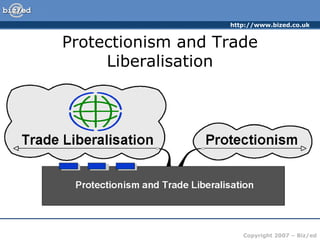
Protectionism and Trade
Liberalisation
http://www.bized.co.uk
Copyright 2007 – Biz/ed
Protectionism
http://www.bized.co.uk
Copyright 2007 – Biz/ed
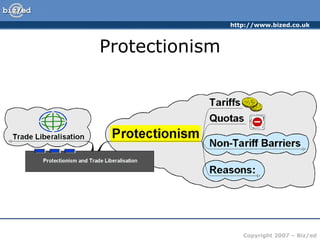
Protectionism
• Means by which trade between
countries is restricted in some way –
normally through measures to reduce
the number of imports coming into
a country
• Main means are:
– Tariffs
– Quotas
– Non-Tariff Barriers
http://www.bized.co.uk
Copyright 2007 – Biz/ed
Protectionism
• Tariff: A tax on a good
coming into a country
• Increases the price of the good
and makes it less competitive
• Quota: Physical restriction
on the number of goods
coming into a country
http://www.bized.co.uk
Copyright 2007 – Biz/ed
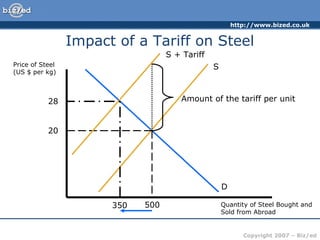
Impact of a Tariff on Steel
Price of Steel
(US $ per kg)
Quantity of Steel Bought and
Sold from Abroad
S
D
20
S + Tariff
Amount of the tariff per unit
500
28
350
http://www.bized.co.uk
Copyright 2007 – Biz/ed
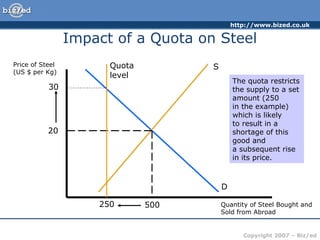
Impact of a Quota on Steel
Price of Steel
(US $ per Kg)
Quantity of Steel Bought and
Sold from Abroad
S
D
20
500
Pre-trade
position before
a quota.
Quota
level
250
30
The quota restricts
the supply to a set
amount (250
in the example)
which is likely
to result in a
shortage of this
good and
a subsequent rise
in its price.
http://www.bized.co.uk
Copyright 2007 – Biz/ed
Non-Tariff Barriers
• Any methods not covered by a tariff,
most usually:
– Rules
– Regulations
– Voluntary Export Restraints (VERs)
– Legislation
– Exacting Standards or Specifications
http://www.bized.co.uk
Copyright 2007 – Biz/ed
Non-Tariff Barriers
• Examples include setting exacting standards
on fuel emissions from cars, the
documentation required to be able to sell
drugs in different countries, the ingredients
in products – some of which may be banned
in the destination country
• NTBs are difficult to prove – when do you
accuse a country of protectionism –
could be a legal or cultural issue?
• The main method involved in NTBs is not
to prevent trade but to make the cost of doing
so prohibitive to the potential exporter
http://www.bized.co.uk
Copyright 2007 – Biz/ed
Reasons
• Protect domestic industries
• Protect domestic employment
• Strategic reasons
• Political pressures
• Protect culture?
• Prevent ‘Dumping’ – selling goods
in the destination country below cost
to break into that market
http://www.bized.co.uk
Copyright 2007 – Biz/ed
Trade Liberalisation
http://www.bized.co.uk
Copyright 2007 – Biz/ed
Trade Liberalisation
• Aims to free up world trade
and break down the barriers
to international trade
• Basic philosophy rests on the
principle of comparative advantage
• Talks to achieve trade
liberalisation have been ongoing
for many years
http://www.bized.co.uk
Copyright 2007 – Biz/ed
Trade Liberalisation
• GATT – General Agreement on Tariffs
and Trade
• First signed in 1947 –
talks on-going since then!
• Uruguay Round 1994 – set up the World Trade
Organisation (WTO) as well as agreements
covering a range of trade liberalisation
measures
• WTO provides the forum through which trade
issues can be negotiated and works to help
implement and police trade agreements
http://www.bized.co.uk
Copyright 2007 – Biz/ed
Trade Liberalisation
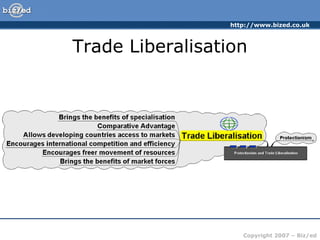
• Potential benefits:
– Promotes international specialisation
and increases world output
– Promotes efficient use and allocation
of world resources
– Allows developing countries access to the
heavily protected markets of the developed
world thus helping promote development
– Facilitates the working of the international
market system and the working of price
signals to ensure efficient allocation
of resources, international competition
and the associated benefits to all
http://www.bized.co.uk
Copyright 2007 – Biz/ed
Trade Liberalisation
• World agreements are very difficult
to achieve
• Witness the issues
over the removal or reduction
of agricultural subsidies, tariffs
on steel in the United States,
the banana wars, etc!

Trade and Protectionism

  • 1.
    http://www.bized.co.uk Copyright 2007 –Biz/ed Protectionism and Trade Liberalisation
  • 2.
    http://www.bized.co.uk Copyright 2007 –Biz/ed Protectionism and Trade Liberalisation
  • 3.
  • 4.
    http://www.bized.co.uk Copyright 2007 –Biz/ed Protectionism • Means by which trade between countries is restricted in some way – normally through measures to reduce the number of imports coming into a country • Main means are: – Tariffs – Quotas – Non-Tariff Barriers
  • 5.
    http://www.bized.co.uk Copyright 2007 –Biz/ed Protectionism • Tariff: A tax on a good coming into a country • Increases the price of the good and makes it less competitive • Quota: Physical restriction on the number of goods coming into a country
  • 6.
    http://www.bized.co.uk Copyright 2007 –Biz/ed Impact of a Tariff on Steel Price of Steel (US $ per kg) Quantity of Steel Bought and Sold from Abroad S D 20 S + Tariff Amount of the tariff per unit 500 28 350
  • 7.
    http://www.bized.co.uk Copyright 2007 –Biz/ed Impact of a Quota on Steel Price of Steel (US $ per Kg) Quantity of Steel Bought and Sold from Abroad S D 20 500 Pre-trade position before a quota. Quota level 250 30 The quota restricts the supply to a set amount (250 in the example) which is likely to result in a shortage of this good and a subsequent rise in its price.
  • 8.
    http://www.bized.co.uk Copyright 2007 –Biz/ed Non-Tariff Barriers • Any methods not covered by a tariff, most usually: – Rules – Regulations – Voluntary Export Restraints (VERs) – Legislation – Exacting Standards or Specifications
  • 9.
    http://www.bized.co.uk Copyright 2007 –Biz/ed Non-Tariff Barriers • Examples include setting exacting standards on fuel emissions from cars, the documentation required to be able to sell drugs in different countries, the ingredients in products – some of which may be banned in the destination country • NTBs are difficult to prove – when do you accuse a country of protectionism – could be a legal or cultural issue? • The main method involved in NTBs is not to prevent trade but to make the cost of doing so prohibitive to the potential exporter
  • 10.
    http://www.bized.co.uk Copyright 2007 –Biz/ed Reasons • Protect domestic industries • Protect domestic employment • Strategic reasons • Political pressures • Protect culture? • Prevent ‘Dumping’ – selling goods in the destination country below cost to break into that market
  • 11.
    http://www.bized.co.uk Copyright 2007 –Biz/ed Trade Liberalisation
  • 12.
    http://www.bized.co.uk Copyright 2007 –Biz/ed Trade Liberalisation • Aims to free up world trade and break down the barriers to international trade • Basic philosophy rests on the principle of comparative advantage • Talks to achieve trade liberalisation have been ongoing for many years
  • 13.
    http://www.bized.co.uk Copyright 2007 –Biz/ed Trade Liberalisation • GATT – General Agreement on Tariffs and Trade • First signed in 1947 – talks on-going since then! • Uruguay Round 1994 – set up the World Trade Organisation (WTO) as well as agreements covering a range of trade liberalisation measures • WTO provides the forum through which trade issues can be negotiated and works to help implement and police trade agreements
  • 14.
    http://www.bized.co.uk Copyright 2007 –Biz/ed Trade Liberalisation • Potential benefits: – Promotes international specialisation and increases world output – Promotes efficient use and allocation of world resources – Allows developing countries access to the heavily protected markets of the developed world thus helping promote development – Facilitates the working of the international market system and the working of price signals to ensure efficient allocation of resources, international competition and the associated benefits to all
  • 15.
    http://www.bized.co.uk Copyright 2007 –Biz/ed Trade Liberalisation • World agreements are very difficult to achieve • Witness the issues over the removal or reduction of agricultural subsidies, tariffs on steel in the United States, the banana wars, etc!