Market Structures
Chapter 7
Section 3
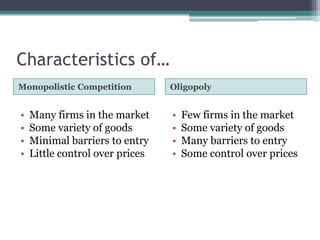
Characteristics of…
Monopolistic Competition Oligopoly
• Many firms in the market
• Some variety of goods
• Minimal barriers to entry
• Little control over prices
• Few firms in the market
• Some variety of goods
• Many barriers to entry
• Some control over prices
Monopolistic Competition
• In monopolistic
competition, many
companies compete in an
open market to sell
similar, but not identical,
products.
• Common examples or
monopolistically
competitive firms are:
▫ Bagel shops
▫ Gas stations
▫ Retail stores
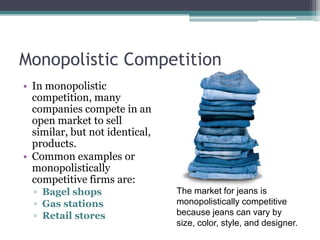
The market for jeans is
monopolistically competitive
because jeans can vary by
size, color, style, and designer.
Monopolistic Competition Conditions
• Many Firms
▫ Low start-up costs allow many firms to enter the
market.
• Few barriers to entry
▫ It is easy for new firms to enter the market.
• Little control over price
▫ If a firm raises their prices too high, consumers will go
elsewhere to buy the product.
• Differentiated products
▫ Allows a firm to profit from the differences between
their product and a competitor’s product.
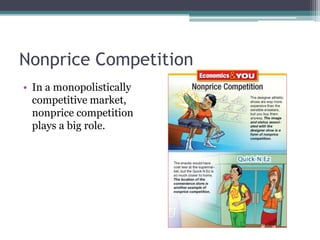
Nonprice Competition
• In a monopolistically
competitive market,
nonprice competition
plays a big role.
Prices
• Prices, output, and profits under
monopolistically competitive market structures
look very similar to those under perfectly
competitive market structures.
• Prices
▫ Under monopolistic competition prices are higher
but their demand curves are more elastic because
customers can choose among many substitutes.
Output and Profits
• Output
▫ As a result of the relative elasticity in monopolistically
competitive firms, the total output falls somewhere
between that of a monopoly and that of perfect
competition.
• Profits
▫ Monopolistically competitive firms earn just enough to
cover all of their costs.
▫ They can earn profits in the short run, but too many
competitors make this hard to maintain in the long
run.
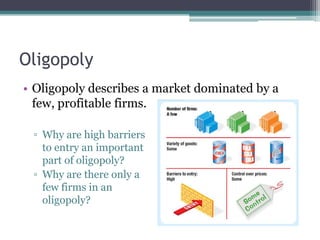
Oligopoly
• Oligopoly describes a market dominated by a
few, profitable firms.
▫ Why are high barriers
to entry an important
part of oligopoly?
▫ Why are there only a
few firms in an
oligopoly?
Barriers to Entry
• Barriers to entry in an oligopoly can be
technological or they can be created by a system
of government licenses or patents.
▫ Economies of scale can also lead to an oligopoly.
Cooperation, Collusion, & Cartels
• There are three practices that concern
government regarding oligopolies.
▫ Price leadership: This can lead to price wars
when companies in an oligopoly disagree
▫ Collusion: This leads to price fixing and is illegal
in the United States
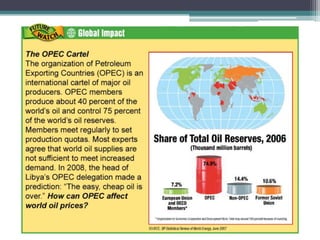
▫ Cartels: By coordinating prices and production,
cartels offer its members strong incentives to
produce more than its quota, which leads to falling
prices.
Section 4
Government Regulation
• Sometimes the government takes steps to
promote competition because markets with
more competition have lower prices.
• The government does this through:
▫ Antitrust laws
▫ Approving or not approving mergers
▫ Deregulation
Market Power
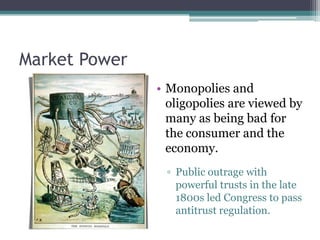
• Monopolies and
oligopolies are viewed by
many as being bad for
the consumer and the
economy.
▫ Public outrage with
powerful trusts in the late
1800s led Congress to pass
antitrust regulation.
Government & Competition
• The federal government has policies, known as
antitrust laws, to keep firms from gaining too
much market power.
▫ The Federal Trade Commission and the
Department of Justice’s Antitrust Division watch
firms to make sure they don’t unfairly force out
competitors.
History of Antitrust Policy
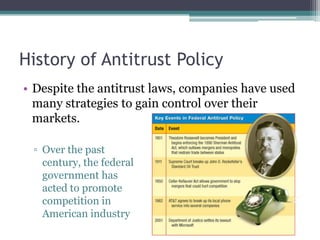
• Despite the antitrust laws, companies have used
many strategies to gain control over their
markets.
▫ Over the past
century, the federal
government has
acted to promote
competition in
American industry
Blocking Mergers
• The government has the power to prevent the
rise of monopolies by blocking mergers.
• The government also checks in on past mergers
to make sure that they do not lead to unfair
market control.
▫ The government tries to predict the effects of a
merger before approving it.
Corporate Mergers
• Some mergers can benefit consumers.
▫ Corporate mergers will lower average prices,
which leads to:
 Lower prices
 More reliable products and services
 More efficient industry
Deregulation
• Some government regulation was seen to reduce
competition, which led to the deregulation of
some industries.
• Over several years, the government deregulated:
▫ Airlines
▫ Trucking
▫ Banking
▫ Natural gas
▫ Railroad
▫ Television broadcasting
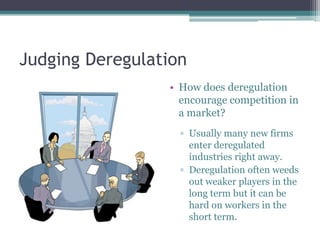
Judging Deregulation
• How does deregulation
encourage competition in
a market?
▫ Usually many new firms
enter deregulated
industries right away.
▫ Deregulation often weeds
out weaker players in the
long term but it can be
hard on workers in the
short term.

Chapter 7 presentation part b

  • 1.
  • 2.
  • 3.
    Characteristics of… Monopolistic CompetitionOligopoly • Many firms in the market • Some variety of goods • Minimal barriers to entry • Little control over prices • Few firms in the market • Some variety of goods • Many barriers to entry • Some control over prices
  • 4.
    Monopolistic Competition • Inmonopolistic competition, many companies compete in an open market to sell similar, but not identical, products. • Common examples or monopolistically competitive firms are: ▫ Bagel shops ▫ Gas stations ▫ Retail stores The market for jeans is monopolistically competitive because jeans can vary by size, color, style, and designer.
  • 5.
    Monopolistic Competition Conditions •Many Firms ▫ Low start-up costs allow many firms to enter the market. • Few barriers to entry ▫ It is easy for new firms to enter the market. • Little control over price ▫ If a firm raises their prices too high, consumers will go elsewhere to buy the product. • Differentiated products ▫ Allows a firm to profit from the differences between their product and a competitor’s product.
  • 6.
    Nonprice Competition • Ina monopolistically competitive market, nonprice competition plays a big role.
  • 7.
    Prices • Prices, output,and profits under monopolistically competitive market structures look very similar to those under perfectly competitive market structures. • Prices ▫ Under monopolistic competition prices are higher but their demand curves are more elastic because customers can choose among many substitutes.
  • 8.
    Output and Profits •Output ▫ As a result of the relative elasticity in monopolistically competitive firms, the total output falls somewhere between that of a monopoly and that of perfect competition. • Profits ▫ Monopolistically competitive firms earn just enough to cover all of their costs. ▫ They can earn profits in the short run, but too many competitors make this hard to maintain in the long run.
  • 9.
    Oligopoly • Oligopoly describesa market dominated by a few, profitable firms. ▫ Why are high barriers to entry an important part of oligopoly? ▫ Why are there only a few firms in an oligopoly?
  • 10.
    Barriers to Entry •Barriers to entry in an oligopoly can be technological or they can be created by a system of government licenses or patents. ▫ Economies of scale can also lead to an oligopoly.
  • 11.
    Cooperation, Collusion, &Cartels • There are three practices that concern government regarding oligopolies. ▫ Price leadership: This can lead to price wars when companies in an oligopoly disagree ▫ Collusion: This leads to price fixing and is illegal in the United States ▫ Cartels: By coordinating prices and production, cartels offer its members strong incentives to produce more than its quota, which leads to falling prices.
  • 13.
  • 14.
    Government Regulation • Sometimesthe government takes steps to promote competition because markets with more competition have lower prices. • The government does this through: ▫ Antitrust laws ▫ Approving or not approving mergers ▫ Deregulation
  • 15.
    Market Power • Monopoliesand oligopolies are viewed by many as being bad for the consumer and the economy. ▫ Public outrage with powerful trusts in the late 1800s led Congress to pass antitrust regulation.
  • 16.
    Government & Competition •The federal government has policies, known as antitrust laws, to keep firms from gaining too much market power. ▫ The Federal Trade Commission and the Department of Justice’s Antitrust Division watch firms to make sure they don’t unfairly force out competitors.
  • 17.
    History of AntitrustPolicy • Despite the antitrust laws, companies have used many strategies to gain control over their markets. ▫ Over the past century, the federal government has acted to promote competition in American industry
  • 18.
    Blocking Mergers • Thegovernment has the power to prevent the rise of monopolies by blocking mergers. • The government also checks in on past mergers to make sure that they do not lead to unfair market control. ▫ The government tries to predict the effects of a merger before approving it.
  • 19.
    Corporate Mergers • Somemergers can benefit consumers. ▫ Corporate mergers will lower average prices, which leads to:  Lower prices  More reliable products and services  More efficient industry
  • 20.
    Deregulation • Some governmentregulation was seen to reduce competition, which led to the deregulation of some industries. • Over several years, the government deregulated: ▫ Airlines ▫ Trucking ▫ Banking ▫ Natural gas ▫ Railroad ▫ Television broadcasting
  • 21.
    Judging Deregulation • Howdoes deregulation encourage competition in a market? ▫ Usually many new firms enter deregulated industries right away. ▫ Deregulation often weeds out weaker players in the long term but it can be hard on workers in the short term.