Industry 4.0
K. Rajaraman
Director, Entrepreneurship Development Institute, Tamil Nadu
Www.editn.in
Manufacturing : 5Ms
Materials Properties & Functions
Machines Precision & Capabilities
Methods Efficiency & Productivity
Measurements Sensing & Improvements
Modelling Prediction, Optimisation,
Prevention
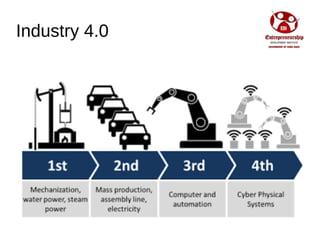
Industry 4.0
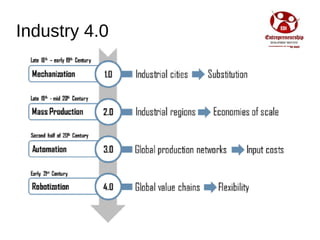
Industry 4.0
Definition

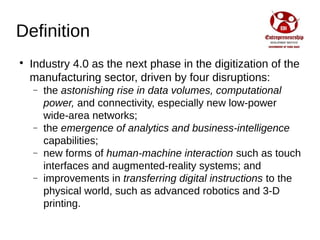
Industry 4.0 as the next phase in the digitization of the
manufacturing sector, driven by four disruptions:
 the astonishing rise in data volumes, computational
power, and connectivity, especially new low-power
wide-area networks;
 the emergence of analytics and business-intelligence
capabilities;
 new forms of human-machine interaction such as touch
interfaces and augmented-reality systems; and
 improvements in transferring digital instructions to the
physical world, such as advanced robotics and 3-D
printing.
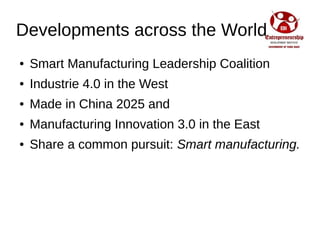
Developments across the World
● Smart Manufacturing Leadership Coalition
● Industrie 4.0 in the West
● Made in China 2025 and
● Manufacturing Innovation 3.0 in the East
● Share a common pursuit: Smart manufacturing.
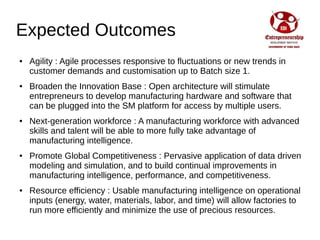
Expected Outcomes
● Agility : Agile processes responsive to fluctuations or new trends in
customer demands and customisation up to Batch size 1.
● Broaden the Innovation Base : Open architecture will stimulate
entrepreneurs to develop manufacturing hardware and software that
can be plugged into the SM platform for access by multiple users.
● Next-generation workforce : A manufacturing workforce with advanced
skills and talent will be able to more fully take advantage of
manufacturing intelligence.
● Promote Global Competitiveness : Pervasive application of data driven
modeling and simulation, and to build continual improvements in
manufacturing intelligence, performance, and competitiveness.
● Resource efficiency : Usable manufacturing intelligence on operational
inputs (energy, water, materials, labor, and time) will allow factories to
run more efficiently and minimize the use of precious resources.
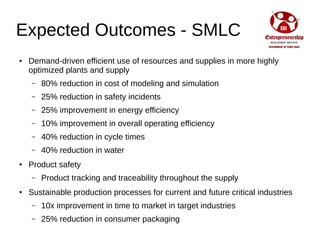
Expected Outcomes - SMLC
● Demand-driven efficient use of resources and supplies in more highly
optimized plants and supply
– 80% reduction in cost of modeling and simulation
– 25% reduction in safety incidents
– 25% improvement in energy efficiency
– 10% improvement in overall operating efficiency
– 40% reduction in cycle times
– 40% reduction in water
● Product safety
– Product tracking and traceability throughout the supply
● Sustainable production processes for current and future critical industries
– 10x improvement in time to market in target industries
– 25% reduction in consumer packaging
Definition
Digital-to-physical transfer.

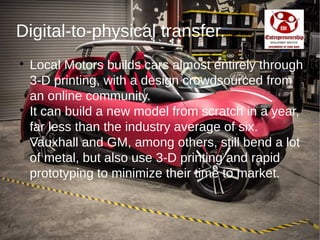
Local Motors builds cars almost entirely through
3-D printing, with a design crowdsourced from
an online community.

It can build a new model from scratch in a year,
far less than the industry average of six.

Vauxhall and GM, among others, still bend a lot
of metal, but also use 3-D printing and rapid
prototyping to minimize their time to market.
Platforms

“Platforms,” in which products, services, and
information can be exchanged via predefined
streams. Think open-source software applied to
the manufacturing context.

For example, a company might provide
technology to connect multiple parties and
coordinate their interactions. SLM Solutions, a
3-D-printer manufacturer, and Atos, an IT
services company, are currently running a pilot
project to develop such a marketplace.
Platforms: Manufacturing as a Service

‘Uber’isation of manufacturing: SMEs can perhaps
setup their own cooperative cloud manufacturing
platforms. It is known that SMEs could suffer from low
capacity utilisation cycles. Manufacturing as a service
could enable cooperative targeting of better capacity
utilisation!

For eg, the manufacturers of printing machines have
traditionally made the bulk of their revenues from
selling and servicing presses. When the presses
generate usage data, the manufacturers can become
brokers of press time, knowing when customers’
presses are available, and negotiating printing prices
accordingly.
Highly customised products

Customer can create her own perfume from
millions of possibilities via a web portal.

Smart Factory can produce 36 000 Unique
Perfume Packages per day

24 hours after the order via the Internet has
been completed the individualized product is
ready for shipment.

Since the customer of an individualized
product, designed by herself, she does not
accept long delivery times, the product should
be produced close to the customer.
Adidas : Speedfactory
Producing your own shoes

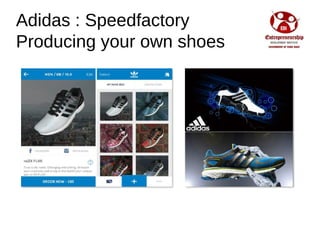
The costumers can design their own short
shoes using an App. Since the customer wants
to receive his personalized product on the next
day or faster, long logistic chains from low-
wage countriesare no longer acceptable in the
era of mass customization.

Thus, Adidas decided to open various "Speed
Factories" for personalized shoes in Germany
close to the customer, using Cyber-physical
production systems (CPPS).
Adidas : Speedfactory
Producing your own shoes
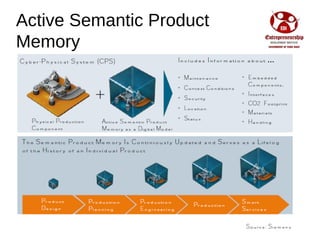
Active Semantic Product
Memory
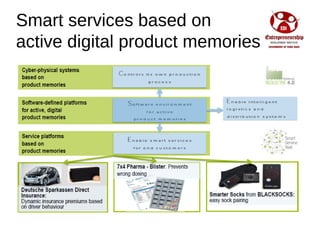
Smart services based on
active digital product memories
Pay-by-use

Pay-by-use and subscription-based services, turning
machinery from capex to opex for manufacturers.

Rolls-Royce pioneered this approach in its jet-engine
business; other manufacturers have followed suit.

Atlas Copco, a manufacturer of air compressors based
in Nacka, Sweden, is moving away from selling its
equipment directly, and, instead, is billing only for the
compressed air that is used. The machines installed at
customer sites can monitor the flow of compressed air
and adjust the output according to customer need,
who pay as they use.
Pay-by-use

Businesses that license intellectual property.
Today, many manufacturing companies have
deep expertise in their products and processes,
but lack the expertise to generate value from
their data. SAP offers consulting services that
build on its software. Qualcomm makes more
than half of its profits from intellectual-property
royalties.

Manufacturers might offer consulting services
or other businesses that monetize the value of
their expertise.
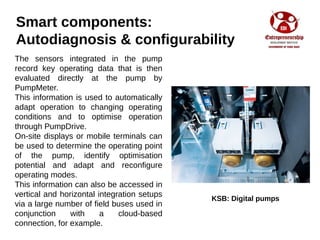
Smart components:
Autodiagnosis & configurability
The sensors integrated in the pump
record key operating data that is then
evaluated directly at the pump by
PumpMeter.
This information is used to automatically
adapt operation to changing operating
conditions and to optimise operation
through PumpDrive.
On-site displays or mobile terminals can
be used to determine the operating point
of the pump, identify optimisation
potential and adapt and reconfigure
operating modes.
This information can also be accessed in
vertical and horizontal integration setups
via a large number of field buses used in
conjunction with a cloud-based
connection, for example.
KSB: Digital pumps
Internet of Things
Advanced analytics.

Stronger analysis can dramatically improve product
development. One automaker uses data from its
online configurator together with purchasing data to
identify options that customers are willing to pay a
premium for.

With this knowledge, the automaker reduced the
options on one model to just 13,000—three orders of
magnitude fewer than its competitor, which offered
27,000,000. Development time and production costs
fell dramatically; most companies can improve gross
margin by 30 percent within 24 months.
Advanced analytics.

Analysis of your customers’ daily and seasonal use of
machinery can help improve production schedules.

Data about employee performance can determine
training needs and scheduling

Production data can illuminate opportunities to
eliminate downtime or speed up throughput.

Analytics can also help meet aspirations that seemed
nearly impossible before. For example, many
companies struggle to improve their eco-footprint.

Analytics can identify wasted materials and suggest
ways to reclaim them, or to use them as inputs for
other industrial processes.
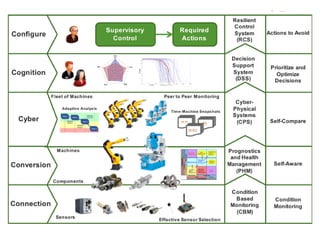
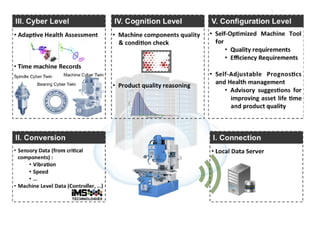
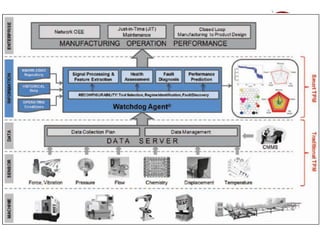
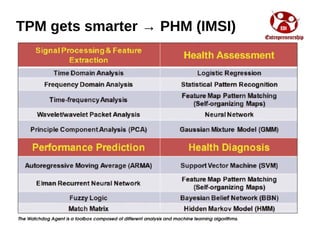
TPM gets smarter → PHM (IMSI)
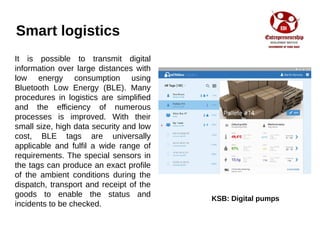
Smart logistics
It is possible to transmit digital
information over large distances with
low energy consumption using
Bluetooth Low Energy (BLE). Many
procedures in logistics are simplified
and the efficiency of numerous
processes is improved. With their
small size, high data security and low
cost, BLE tags are universally
applicable and fulfil a wide range of
requirements. The special sensors in
the tags can produce an exact profile
of the ambient conditions during the
dispatch, transport and receipt of the
goods to enable the status and
incidents to be checked.
KSB: Digital pumps
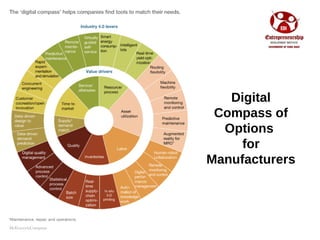
Digital Compass of Options

With production data now available for the
asking, executives rightly wonder about how to
begin. Which data would be most beneficial?
Which data leakages are causing the most
pain? Which technologies would deliver the
biggest return on investment for a company,
given its unique circumstances?

To sort through the choices, manufacturing
leaders can use a “digital compass”
Digital
Compass of
Options
for
Manufacturers
Preparing for the future

To get the most out of Industry 4.0 technologies, and
to get past square one with a digital business model,
companies will have to take a third step: prepare for a
digital transformation.

Manufacturers should begin today to join the hunt for
the best digital talent, and think about how to structure
their digital organization.

Data management and cybersecurity will be critical
problems to solve. Many companies will find that a
“two speed” data architecture can help them deploy
new technologies at the speed required, while also
preserving mission-critical applications.
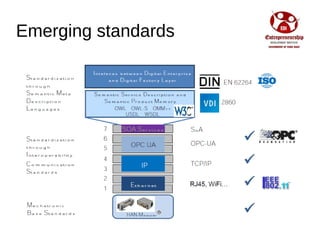
Emerging standards
Cyber security : cyber-diode

The risks of networking highly critical control systems
can be minimised through the use of the “cyber-diode”.
This solution monitors network connections and only
allows one-way data transfer – information flow in the
opposite direction is completely blocked. Systems
protected in this manner are free to send control
information via the Internet without becoming
vulnerable to attack and risk their integrity being
compromised.

The “cyber-diode” allows data transfer rates of up to 1
Gbit/s for TCP and UDP protocols and supports FTP
file transfer and SMTP for e-mail traffic.
Implications of I4.0

These changes and many others like them are
sure to be far reaching, affecting every corner
of the factory and the supply chain.

The pace of change, however, will likely be
slower than what we’ve seen in the consumer
sector, where equipment is changed frequently.

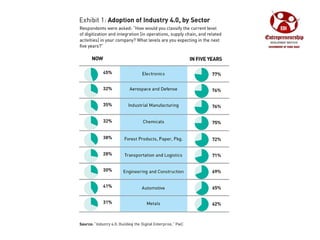
Nearly 25% of industry leaders surveyed
expected those improvements, in both cost
savings and revenues, to exceed 20 percent
over the next five years.
Thank you...

Industry 4.0

  • 1.
    Industry 4.0 K. Rajaraman Director,Entrepreneurship Development Institute, Tamil Nadu Www.editn.in
  • 2.
    Manufacturing : 5Ms MaterialsProperties & Functions Machines Precision & Capabilities Methods Efficiency & Productivity Measurements Sensing & Improvements Modelling Prediction, Optimisation, Prevention
  • 3.
  • 4.
  • 5.
    Definition  Industry 4.0 asthe next phase in the digitization of the manufacturing sector, driven by four disruptions:  the astonishing rise in data volumes, computational power, and connectivity, especially new low-power wide-area networks;  the emergence of analytics and business-intelligence capabilities;  new forms of human-machine interaction such as touch interfaces and augmented-reality systems; and  improvements in transferring digital instructions to the physical world, such as advanced robotics and 3-D printing.
  • 7.
    Developments across theWorld ● Smart Manufacturing Leadership Coalition ● Industrie 4.0 in the West ● Made in China 2025 and ● Manufacturing Innovation 3.0 in the East ● Share a common pursuit: Smart manufacturing.
  • 8.
    Expected Outcomes ● Agility: Agile processes responsive to fluctuations or new trends in customer demands and customisation up to Batch size 1. ● Broaden the Innovation Base : Open architecture will stimulate entrepreneurs to develop manufacturing hardware and software that can be plugged into the SM platform for access by multiple users. ● Next-generation workforce : A manufacturing workforce with advanced skills and talent will be able to more fully take advantage of manufacturing intelligence. ● Promote Global Competitiveness : Pervasive application of data driven modeling and simulation, and to build continual improvements in manufacturing intelligence, performance, and competitiveness. ● Resource efficiency : Usable manufacturing intelligence on operational inputs (energy, water, materials, labor, and time) will allow factories to run more efficiently and minimize the use of precious resources.
  • 9.
    Expected Outcomes -SMLC ● Demand-driven efficient use of resources and supplies in more highly optimized plants and supply – 80% reduction in cost of modeling and simulation – 25% reduction in safety incidents – 25% improvement in energy efficiency – 10% improvement in overall operating efficiency – 40% reduction in cycle times – 40% reduction in water ● Product safety – Product tracking and traceability throughout the supply ● Sustainable production processes for current and future critical industries – 10x improvement in time to market in target industries – 25% reduction in consumer packaging
  • 14.
  • 15.
    Digital-to-physical transfer.  Local Motorsbuilds cars almost entirely through 3-D printing, with a design crowdsourced from an online community.  It can build a new model from scratch in a year, far less than the industry average of six.  Vauxhall and GM, among others, still bend a lot of metal, but also use 3-D printing and rapid prototyping to minimize their time to market.
  • 16.
    Platforms  “Platforms,” in whichproducts, services, and information can be exchanged via predefined streams. Think open-source software applied to the manufacturing context.  For example, a company might provide technology to connect multiple parties and coordinate their interactions. SLM Solutions, a 3-D-printer manufacturer, and Atos, an IT services company, are currently running a pilot project to develop such a marketplace.
  • 17.
    Platforms: Manufacturing asa Service  ‘Uber’isation of manufacturing: SMEs can perhaps setup their own cooperative cloud manufacturing platforms. It is known that SMEs could suffer from low capacity utilisation cycles. Manufacturing as a service could enable cooperative targeting of better capacity utilisation!  For eg, the manufacturers of printing machines have traditionally made the bulk of their revenues from selling and servicing presses. When the presses generate usage data, the manufacturers can become brokers of press time, knowing when customers’ presses are available, and negotiating printing prices accordingly.
  • 18.
    Highly customised products  Customercan create her own perfume from millions of possibilities via a web portal.  Smart Factory can produce 36 000 Unique Perfume Packages per day  24 hours after the order via the Internet has been completed the individualized product is ready for shipment.  Since the customer of an individualized product, designed by herself, she does not accept long delivery times, the product should be produced close to the customer.
  • 19.
    Adidas : Speedfactory Producingyour own shoes  The costumers can design their own short shoes using an App. Since the customer wants to receive his personalized product on the next day or faster, long logistic chains from low- wage countriesare no longer acceptable in the era of mass customization.  Thus, Adidas decided to open various "Speed Factories" for personalized shoes in Germany close to the customer, using Cyber-physical production systems (CPPS).
  • 20.
  • 21.
  • 22.
    Smart services basedon active digital product memories
  • 23.
    Pay-by-use  Pay-by-use and subscription-basedservices, turning machinery from capex to opex for manufacturers.  Rolls-Royce pioneered this approach in its jet-engine business; other manufacturers have followed suit.  Atlas Copco, a manufacturer of air compressors based in Nacka, Sweden, is moving away from selling its equipment directly, and, instead, is billing only for the compressed air that is used. The machines installed at customer sites can monitor the flow of compressed air and adjust the output according to customer need, who pay as they use.
  • 24.
    Pay-by-use  Businesses that licenseintellectual property. Today, many manufacturing companies have deep expertise in their products and processes, but lack the expertise to generate value from their data. SAP offers consulting services that build on its software. Qualcomm makes more than half of its profits from intellectual-property royalties.  Manufacturers might offer consulting services or other businesses that monetize the value of their expertise.
  • 25.
    Smart components: Autodiagnosis &configurability The sensors integrated in the pump record key operating data that is then evaluated directly at the pump by PumpMeter. This information is used to automatically adapt operation to changing operating conditions and to optimise operation through PumpDrive. On-site displays or mobile terminals can be used to determine the operating point of the pump, identify optimisation potential and adapt and reconfigure operating modes. This information can also be accessed in vertical and horizontal integration setups via a large number of field buses used in conjunction with a cloud-based connection, for example. KSB: Digital pumps
  • 26.
  • 27.
    Advanced analytics.  Stronger analysiscan dramatically improve product development. One automaker uses data from its online configurator together with purchasing data to identify options that customers are willing to pay a premium for.  With this knowledge, the automaker reduced the options on one model to just 13,000—three orders of magnitude fewer than its competitor, which offered 27,000,000. Development time and production costs fell dramatically; most companies can improve gross margin by 30 percent within 24 months.
  • 28.
    Advanced analytics.  Analysis ofyour customers’ daily and seasonal use of machinery can help improve production schedules.  Data about employee performance can determine training needs and scheduling  Production data can illuminate opportunities to eliminate downtime or speed up throughput.  Analytics can also help meet aspirations that seemed nearly impossible before. For example, many companies struggle to improve their eco-footprint.  Analytics can identify wasted materials and suggest ways to reclaim them, or to use them as inputs for other industrial processes.
  • 30.
    TPM gets smarter→ PHM (IMSI)
  • 31.
    Smart logistics It ispossible to transmit digital information over large distances with low energy consumption using Bluetooth Low Energy (BLE). Many procedures in logistics are simplified and the efficiency of numerous processes is improved. With their small size, high data security and low cost, BLE tags are universally applicable and fulfil a wide range of requirements. The special sensors in the tags can produce an exact profile of the ambient conditions during the dispatch, transport and receipt of the goods to enable the status and incidents to be checked. KSB: Digital pumps
  • 32.
    Digital Compass ofOptions  With production data now available for the asking, executives rightly wonder about how to begin. Which data would be most beneficial? Which data leakages are causing the most pain? Which technologies would deliver the biggest return on investment for a company, given its unique circumstances?  To sort through the choices, manufacturing leaders can use a “digital compass”
  • 33.
  • 34.
    Preparing for thefuture  To get the most out of Industry 4.0 technologies, and to get past square one with a digital business model, companies will have to take a third step: prepare for a digital transformation.  Manufacturers should begin today to join the hunt for the best digital talent, and think about how to structure their digital organization.  Data management and cybersecurity will be critical problems to solve. Many companies will find that a “two speed” data architecture can help them deploy new technologies at the speed required, while also preserving mission-critical applications.
  • 35.
  • 36.
    Cyber security :cyber-diode  The risks of networking highly critical control systems can be minimised through the use of the “cyber-diode”. This solution monitors network connections and only allows one-way data transfer – information flow in the opposite direction is completely blocked. Systems protected in this manner are free to send control information via the Internet without becoming vulnerable to attack and risk their integrity being compromised.  The “cyber-diode” allows data transfer rates of up to 1 Gbit/s for TCP and UDP protocols and supports FTP file transfer and SMTP for e-mail traffic.
  • 37.
    Implications of I4.0  Thesechanges and many others like them are sure to be far reaching, affecting every corner of the factory and the supply chain.  The pace of change, however, will likely be slower than what we’ve seen in the consumer sector, where equipment is changed frequently.  Nearly 25% of industry leaders surveyed expected those improvements, in both cost savings and revenues, to exceed 20 percent over the next five years.
  • 39.