Digitalization and Industry 4.0 Transformation
Amri Kosim
Mechatronic and Digitalization Consultant
Phone: +628111042496
Email: kosim.amri@gmail.com
Introduction
Content :
• Introduction to Industry 4.0, Driver & Enabler
• LEAN Champion & Digitalization in Industry
• Internet of Things for Business
• Design Principle & Goals of Industry 4.0
• IoT and Smart Manufacturing Scope
• Smart Maintenance for Smart Connected
Factory
• Industrial IoT and Automation Pyramid
• Industry 4.0 Lever & Value Driver with IoT
• IoT and Industry 4.0 Ecosystem
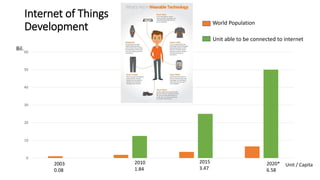
Internet of Things
Development
0
10
20
30
40
50
60
2003
0.08
Bil.
2010
1.84
2015
3.47
2020*
6.58
Unit / Capita
World Population
Unit able to be connected to internet
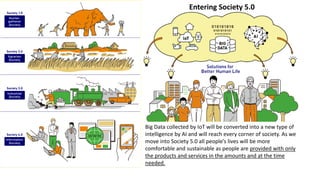
Entering Society 5.0
Big Data collected by IoT will be converted into a new type of
intelligence by AI and will reach every corner of society. As we
move into Society 5.0 all people’s lives will be more
comfortable and sustainable as people are provided with only
the products and services in the amounts and at the time
needed.
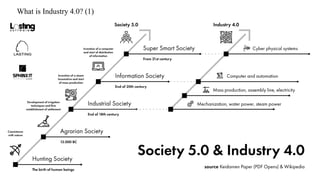
What is Industry 4.0? (1)
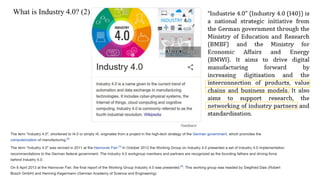
What is Industry 4.0? (2)
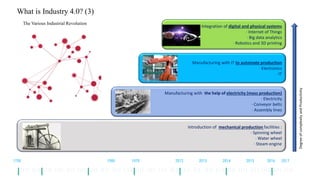
Manufacturing with the help of electricity (mass production)
∙ Electricity
∙ Conveyor belts
∙ Assembly lines
The Various Industrial Revolution
Introduction of mechanical production facilities :
∙ Spinning wheel
∙ Water wheel
∙ Steam engine
Manufacturing with IT to automate production
∙ Electronics
∙ IT
Integration of digital and physical systems
∙ Internet of Things
∙ Big data analytics
∙ Robotics and 3D printing
1750 1900 1970 2012 2013 2014 2015 2016 2017
Degree
of
complexity
and
Productivity
What is Industry 4.0? (3)
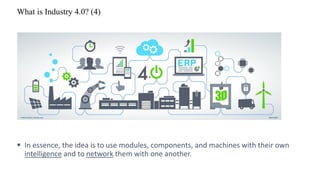
What is Industry 4.0? (4)
▪ In essence, the idea is to use modules, components, and machines with their own
intelligence and to network them with one another.
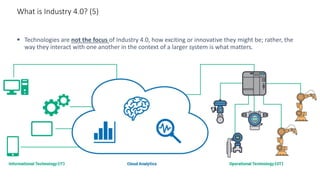
What is Industry 4.0? (5)
▪ Technologies are not the focus of Industry 4.0, how exciting or innovative they might be; rather, the
way they interact with one another in the context of a larger system is what matters.
Source: FESTO, Mobile World Live
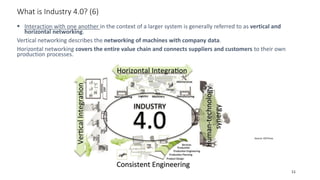
What is Industry 4.0? (6)
11
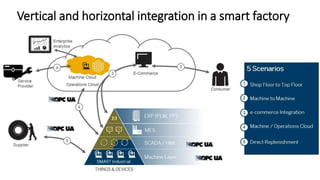
▪ Interaction with one another in the context of a larger system is generally referred to as vertical and
horizontal networking.
Vertical networking describes the networking of machines with company data.
Horizontal networking covers the entire value chain and connects suppliers and customers to their own
production processes.
Source: IOS Press
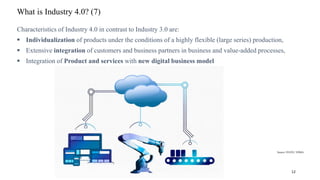
What is Industry 4.0? (7)
12
Characteristics of Industry 4.0 in contrast to Industry 3.0 are:
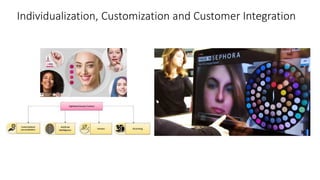
▪ Individualization of products under the conditions of a highly flexible (large series) production,
▪ Extensive integration of customers and business partners in business and value-added processes,
▪ Integration of Product and services with new digital business model
Source: FESTO, VDMA
Individualization, Customization and Customer Integration
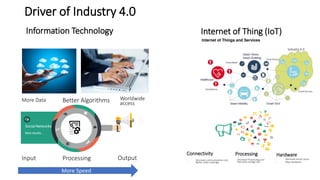
Driver of Industry 4.0
Social Networks
Best results…
Input Processing Output
More Speed
More Data Better Algorithms Worldwide
access
Information Technology Internet of Thing (IoT)
Connectivity
- Decrease communication cost
- Better radio coverage
Processing
- Decrease Processing cost
- Decrease energy cost
Hardware
- Decrease sensor price
- New Hardware
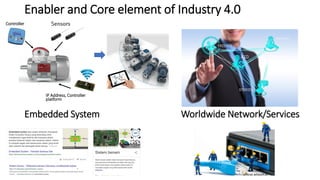
Enabler and Core element of Industry 4.0
Embedded System Worldwide Network/Services
Controller
IP Address, Controller
platform
official.wtouch.in
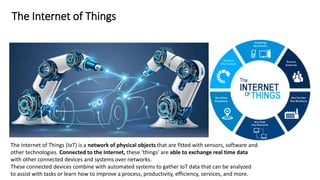
The Internet of Things
The Internet of Things (IoT) is a network of physical objects that are fitted with sensors, software and
other technologies. Connected to the Internet, these ‘things’ are able to exchange real time data
with other connected devices and systems over networks.
These connected devices combine with automated systems to gather IoT data that can be analyzed
to assist with tasks or learn how to improve a process, productivity, efficiency, services, and more.
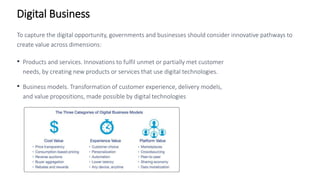
Digital Business
To capture the digital opportunity, governments and businesses should consider innovative pathways to
create value across dimensions:
• Products and services. Innovations to fulfil unmet or partially met customer
needs, by creating new products or services that use digital technologies.
• Business models. Transformation of customer experience, delivery models,
and value propositions, made possible by digital technologies
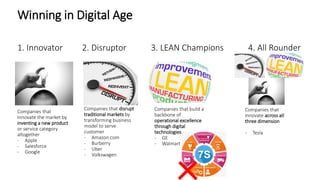
1. Innovator 2. Disruptor 3. LEAN Champions 4. All Rounder
Companies that
Innovate the market by
inventing a new product
or service category
altogether
- Apple
- Salesforce
- Google
Companies that disrupt
traditional markets by
transforming business
model to serve
customer
- Amazon.com
- Burberry
- Uber
- Volkswagen
Companies that build a
backbone of
operational excellence
through digital
technologies
- GE
- Walmart
Companies that
innovate across all
three dimension
- Tesla
Winning in Digital Age
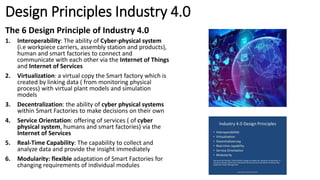
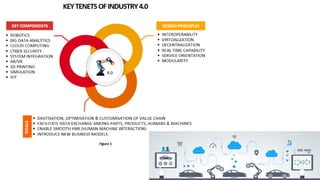
Design Principles Industry 4.0
The 6 Design Principle of Industry 4.0
1. Interoperability: The ability of Cyber-physical system
(i.e workpiece carriers, assembly station and products),
human and smart factories to connect and
communicate with each other via the Internet of Things
and Internet of Services
2. Virtualization: a virtual copy the Smart factory which is
created by linking data ( from monitoring physical
process) with virtual plant models and simulation
models
3. Decentralization: the ability of cyber physical systems
within Smart Factories to make decisions on their own
4. Service Orientation: offering of services ( of cyber
physical system, humans and smart factories) via the
Internet of Services
5. Real-Time Capability: The capability to collect and
analyze data and provide the insight immediately
6. Modularity: flexible adaptation of Smart Factories for
changing requirements of individual modules
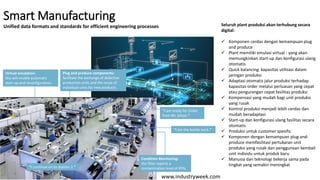
Unified data formats and standards for efficient engineering processes
Smart Manufacturing
“I am ready for Order
from Mr. Johan.”
“I continue on to station 2.”
Virtual emulation:
this will enable automatic
start-up and reconfiguration.
Plug and produce components:
facilitate the exchange of defective
production units and the reuse of
individual units for new products.
Condition Monitoring:
the filter reports a
contamination level of 95%.
www.industryweek.com
“I am the bottle neck.”
Seluruh plant produksi akan terhubung secara
digital:
✓ Komponen cerdas dengan kemampuan plug
and produce
✓ Plant memiliki emulasi virtual - yang akan
memungkinkan start-up dan konfigurasi ulang
otomatis
✓ Quick balancing kapasitas utilisasi dalam
jaringan produksi
✓ Adaptasi otomatis jalur produksi terhadap
kapasitas order melalui perluasan yang cepat
atau pengurangan cepat fasilitas produksi
✓ Kompensasi yang mudah bagi unit produksi
yang rusak
✓ Kontrol produksi menjadi lebih cerdas dan
mudah beradaptasi
✓ Start-up dan konfigurasi ulang fasilitas secara
otomatis
✓ Produksi untuk customer spesific
✓ Komponen dengan kemampuan plug-and-
produce memfasilitasi pertukaran unit
produksi yang rusak dan penggunaan kembali
unit individu untuk produk baru
✓ Manusia dan teknologi bekerja sama pada
tingkat yang semakin meningkat
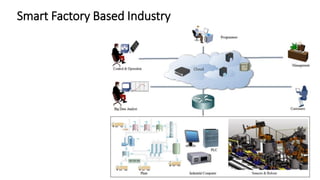
Smart Factory Based Industry
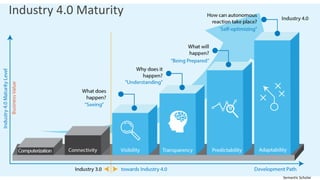
Industry 4.0 Maturity
Semantic Scholar
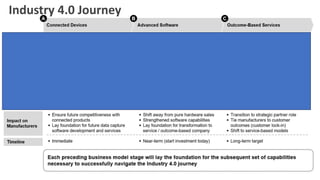
Industry 4.0 Journey
Digitalization in Beauty Industry
• Collaboration with
external parties
• Different type of
services
• Data as new resources
• Optimization of
Marketing
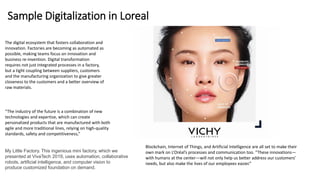
Sample Digitalization in Loreal
The digital ecosystem that fosters collaboration and
innovation. Factories are becoming as automated as
possible, making teams focus on innovation and
business re-invention. Digital transformation
requires not just integrated processes in a factory,
but a tight coupling between suppliers, customers
and the manufacturing organization to give greater
closeness to the customers and a better overview of
raw materials.
“The industry of the future is a combination of new
technologies and expertise, which can create
personalized products that are manufactured with both
agile and more traditional lines, relying on high-quality
standards, safety and competitiveness,”
Blockchain, Internet of Things, and Artificial Intelligence are all set to make their
own mark on L’Oréal’s processes and communication too. “These innovations—
with humans at the center—will not only help us better address our customers’
needs, but also make the lives of our employees easier.”
My Little Factory. This ingenious mini factory, which we
presented at VivaTech 2019, uses automation, collaborative
robots, artificial intelligence, and computer vision to
produce customized foundation on demand.
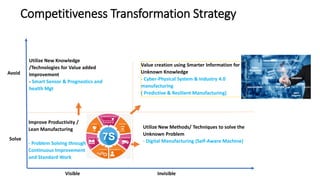
Competitiveness Transformation Strategy
Improve Productivity /
Lean Manufacturing
- Problem Solving through
Continuous Improvement
and Standard Work
Utilize New Methods/ Techniques to solve the
Unknown Problem
- Digital Manufacturing (Self-Aware Machine)
Utilize New Knowledge
/Technologies for Value added
Improvement
- Smart Sensor & Prognostics and
health Mgt
Value creation using Smarter Information for
Unknown Knowledge
- Cyber-Physical System & Industry 4.0
manufacturing
( Predictive & Resilient Manufacturing)
Solve
Visible Invisible
Avoid
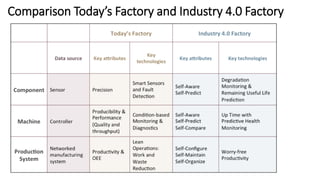
Comparison Today’s Factory and Industry 4.0 Factory
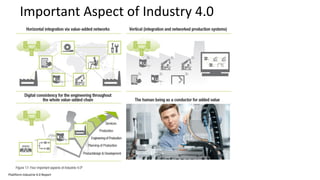
Important Aspect of Industry 4.0
Plattform Industrie 4.0 Report
33
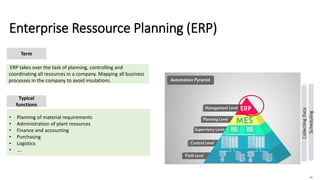
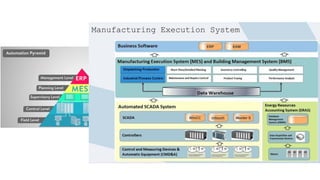
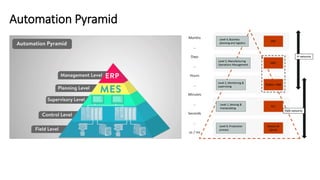
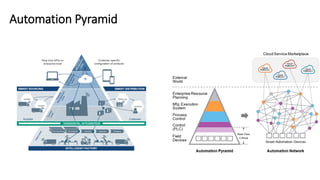
Enterprise Ressource Planning (ERP)
ERP takes over the task of planning, controlling and
coordinating all resources in a company. Mapping all business
processes in the company to avoid insulations.
Term
• Planning of material requirements
• Administration of plant resources
• Finance and accounting
• Purchasing
• Logistics
• ….
Typical
functions
34
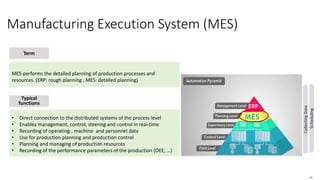
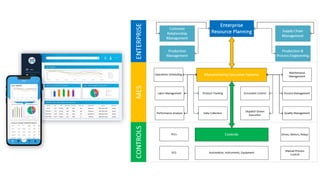
Manufacturing Execution System (MES)
MES performs the detailed planning of production processes and
resources. (ERP: rough planning ; MES: detailed planning)
Term
• Direct connection to the distributed systems of the process level
• Enables management, control, steering and control in real-time
• Recording of operating-, machine- and personnel data
• Use for production planning and production control
• Planning and managing of production resources
• Recording of the performance parameters of the production (OEE, …)
Typical
functions
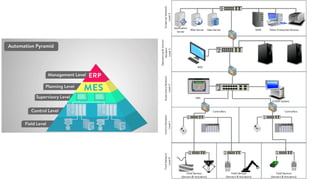
Automation Pyramid
Automation Pyramid
Vertical and horizontal integration in a smart factory
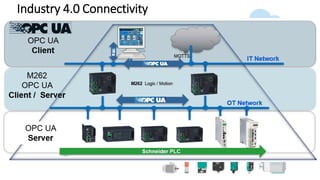
Industry 4.0 Connectivity
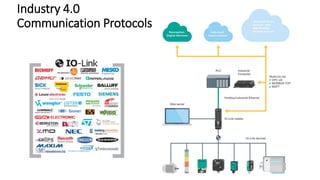
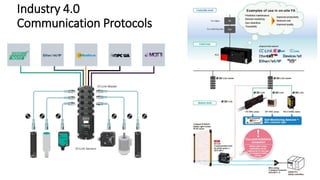
Communication Protocols
sciencedirect.com
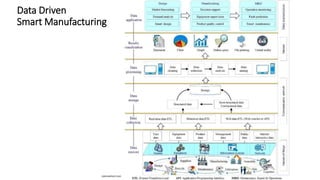
Data Driven
Smart Manufacturing
Industry 4.0
Communication Protocols
Industry 4.0
Communication Protocols
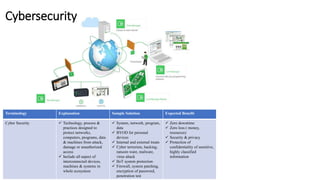
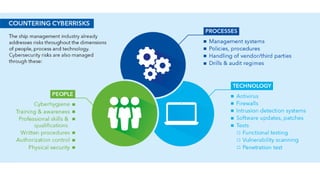
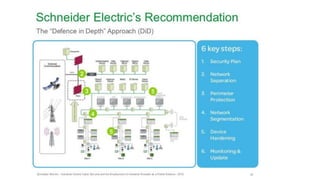
Cybersecurity
Terminology Explanation Sample Solution Expected Benefit
Cyber Security ✓ Technology, process &
practices designed to
protect networks,
computers, programs, data
& machines from attack,
damage or unauthorized
access
✓ Include all aspect of
interconnected devices,
machines & systems in
whole ecosystem
✓ System, network, program,
data
✓ BYOD for personal
devices
✓ Internal and external treats
✓ Cyber terrorism, hacking,
ransom ware, malware,
virus attack
✓ IIoT system protection
✓ Firewall, system patching,
encryption of password,
penetration test
✓ Zero downtime
✓ Zero loss ( money,
resources)
✓ Security & privacy
✓ Protection of
confidentiality of sensitive,
highly classified
information
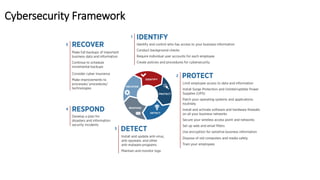
Cybersecurity Framework
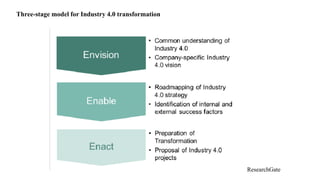
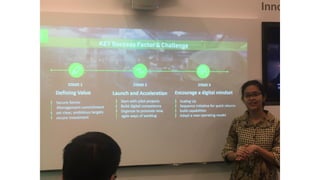
Three-stage model for Industry 4.0 transformation
ResearchGate
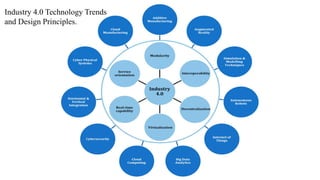
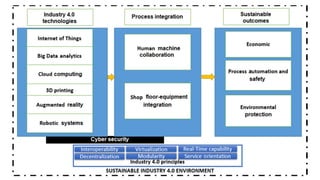
Industry 4.0 Technology Trends
and Design Principles.
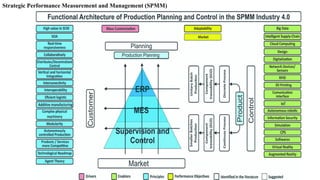
Strategic Performance Measurement and Management (SPMM)
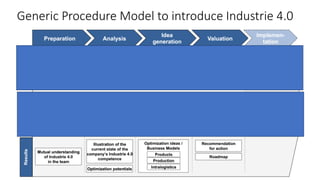
Generic Procedure Model to introduce Industrie 4.0
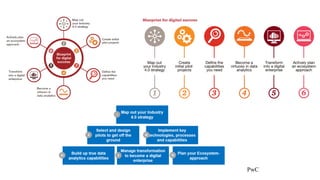
PwC
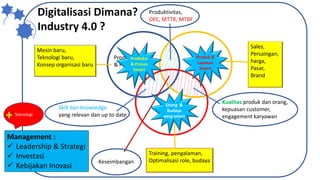
Produksi
& Proses-proses
Orang
Product
& Layanan
Mesin baru,
Teknologi baru,
Konsep organisasi baru
Training, pengalaman,
Optimalisasi role, budaya
Sales,
Persaingan,
harga,
Pasar,
Brand
Kualitas produk dan orang,
kepuasan customer,
engagement karyawan
Produktivitas,
OEE, MTTR, MTBF
Skill dan knowledge
yang relevan dan up to date
Keseimbangan
Management :
✓ Leadership & Strategi
✓ Investasi
✓ Kebijakan Inovasi
Digitalisasi Dimana?
Industry 4.0 ?
Produk &
Layanan
Smart
Teknologi
Produksi
& Proses
Smart
Orang &
Budaya
yang smart
www.indi4.id
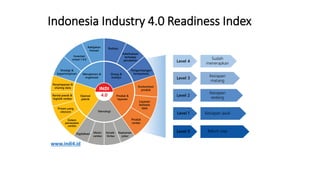
Indonesia Industry 4.0 Readiness Index

1. Digitalization and Industry 4.0 Transformation.pdf

  • 1.
    Digitalization and Industry4.0 Transformation Amri Kosim Mechatronic and Digitalization Consultant Phone: +628111042496 Email: kosim.amri@gmail.com
  • 2.
    Introduction Content : • Introductionto Industry 4.0, Driver & Enabler • LEAN Champion & Digitalization in Industry • Internet of Things for Business • Design Principle & Goals of Industry 4.0 • IoT and Smart Manufacturing Scope • Smart Maintenance for Smart Connected Factory • Industrial IoT and Automation Pyramid • Industry 4.0 Lever & Value Driver with IoT • IoT and Industry 4.0 Ecosystem
  • 4.
  • 5.
    Entering Society 5.0 BigData collected by IoT will be converted into a new type of intelligence by AI and will reach every corner of society. As we move into Society 5.0 all people’s lives will be more comfortable and sustainable as people are provided with only the products and services in the amounts and at the time needed.
  • 6.
  • 7.
  • 8.
    Manufacturing with thehelp of electricity (mass production) ∙ Electricity ∙ Conveyor belts ∙ Assembly lines The Various Industrial Revolution Introduction of mechanical production facilities : ∙ Spinning wheel ∙ Water wheel ∙ Steam engine Manufacturing with IT to automate production ∙ Electronics ∙ IT Integration of digital and physical systems ∙ Internet of Things ∙ Big data analytics ∙ Robotics and 3D printing 1750 1900 1970 2012 2013 2014 2015 2016 2017 Degree of complexity and Productivity What is Industry 4.0? (3)
  • 9.
    What is Industry4.0? (4) ▪ In essence, the idea is to use modules, components, and machines with their own intelligence and to network them with one another.
  • 10.
    What is Industry4.0? (5) ▪ Technologies are not the focus of Industry 4.0, how exciting or innovative they might be; rather, the way they interact with one another in the context of a larger system is what matters. Source: FESTO, Mobile World Live
  • 11.
    What is Industry4.0? (6) 11 ▪ Interaction with one another in the context of a larger system is generally referred to as vertical and horizontal networking. Vertical networking describes the networking of machines with company data. Horizontal networking covers the entire value chain and connects suppliers and customers to their own production processes. Source: IOS Press
  • 12.
    What is Industry4.0? (7) 12 Characteristics of Industry 4.0 in contrast to Industry 3.0 are: ▪ Individualization of products under the conditions of a highly flexible (large series) production, ▪ Extensive integration of customers and business partners in business and value-added processes, ▪ Integration of Product and services with new digital business model Source: FESTO, VDMA
  • 13.
  • 14.
    Driver of Industry4.0 Social Networks Best results… Input Processing Output More Speed More Data Better Algorithms Worldwide access Information Technology Internet of Thing (IoT) Connectivity - Decrease communication cost - Better radio coverage Processing - Decrease Processing cost - Decrease energy cost Hardware - Decrease sensor price - New Hardware
  • 15.
    Enabler and Coreelement of Industry 4.0 Embedded System Worldwide Network/Services Controller IP Address, Controller platform official.wtouch.in
  • 16.
    The Internet ofThings The Internet of Things (IoT) is a network of physical objects that are fitted with sensors, software and other technologies. Connected to the Internet, these ‘things’ are able to exchange real time data with other connected devices and systems over networks. These connected devices combine with automated systems to gather IoT data that can be analyzed to assist with tasks or learn how to improve a process, productivity, efficiency, services, and more.
  • 17.
    Digital Business To capturethe digital opportunity, governments and businesses should consider innovative pathways to create value across dimensions: • Products and services. Innovations to fulfil unmet or partially met customer needs, by creating new products or services that use digital technologies. • Business models. Transformation of customer experience, delivery models, and value propositions, made possible by digital technologies
  • 18.
    1. Innovator 2.Disruptor 3. LEAN Champions 4. All Rounder Companies that Innovate the market by inventing a new product or service category altogether - Apple - Salesforce - Google Companies that disrupt traditional markets by transforming business model to serve customer - Amazon.com - Burberry - Uber - Volkswagen Companies that build a backbone of operational excellence through digital technologies - GE - Walmart Companies that innovate across all three dimension - Tesla Winning in Digital Age
  • 19.
    Design Principles Industry4.0 The 6 Design Principle of Industry 4.0 1. Interoperability: The ability of Cyber-physical system (i.e workpiece carriers, assembly station and products), human and smart factories to connect and communicate with each other via the Internet of Things and Internet of Services 2. Virtualization: a virtual copy the Smart factory which is created by linking data ( from monitoring physical process) with virtual plant models and simulation models 3. Decentralization: the ability of cyber physical systems within Smart Factories to make decisions on their own 4. Service Orientation: offering of services ( of cyber physical system, humans and smart factories) via the Internet of Services 5. Real-Time Capability: The capability to collect and analyze data and provide the insight immediately 6. Modularity: flexible adaptation of Smart Factories for changing requirements of individual modules
  • 23.
    Unified data formatsand standards for efficient engineering processes Smart Manufacturing “I am ready for Order from Mr. Johan.” “I continue on to station 2.” Virtual emulation: this will enable automatic start-up and reconfiguration. Plug and produce components: facilitate the exchange of defective production units and the reuse of individual units for new products. Condition Monitoring: the filter reports a contamination level of 95%. www.industryweek.com “I am the bottle neck.” Seluruh plant produksi akan terhubung secara digital: ✓ Komponen cerdas dengan kemampuan plug and produce ✓ Plant memiliki emulasi virtual - yang akan memungkinkan start-up dan konfigurasi ulang otomatis ✓ Quick balancing kapasitas utilisasi dalam jaringan produksi ✓ Adaptasi otomatis jalur produksi terhadap kapasitas order melalui perluasan yang cepat atau pengurangan cepat fasilitas produksi ✓ Kompensasi yang mudah bagi unit produksi yang rusak ✓ Kontrol produksi menjadi lebih cerdas dan mudah beradaptasi ✓ Start-up dan konfigurasi ulang fasilitas secara otomatis ✓ Produksi untuk customer spesific ✓ Komponen dengan kemampuan plug-and- produce memfasilitasi pertukaran unit produksi yang rusak dan penggunaan kembali unit individu untuk produk baru ✓ Manusia dan teknologi bekerja sama pada tingkat yang semakin meningkat
  • 24.
  • 25.
  • 26.
  • 27.
    Digitalization in BeautyIndustry • Collaboration with external parties • Different type of services • Data as new resources • Optimization of Marketing
  • 28.
    Sample Digitalization inLoreal The digital ecosystem that fosters collaboration and innovation. Factories are becoming as automated as possible, making teams focus on innovation and business re-invention. Digital transformation requires not just integrated processes in a factory, but a tight coupling between suppliers, customers and the manufacturing organization to give greater closeness to the customers and a better overview of raw materials. “The industry of the future is a combination of new technologies and expertise, which can create personalized products that are manufactured with both agile and more traditional lines, relying on high-quality standards, safety and competitiveness,” Blockchain, Internet of Things, and Artificial Intelligence are all set to make their own mark on L’Oréal’s processes and communication too. “These innovations— with humans at the center—will not only help us better address our customers’ needs, but also make the lives of our employees easier.” My Little Factory. This ingenious mini factory, which we presented at VivaTech 2019, uses automation, collaborative robots, artificial intelligence, and computer vision to produce customized foundation on demand.
  • 29.
    Competitiveness Transformation Strategy ImproveProductivity / Lean Manufacturing - Problem Solving through Continuous Improvement and Standard Work Utilize New Methods/ Techniques to solve the Unknown Problem - Digital Manufacturing (Self-Aware Machine) Utilize New Knowledge /Technologies for Value added Improvement - Smart Sensor & Prognostics and health Mgt Value creation using Smarter Information for Unknown Knowledge - Cyber-Physical System & Industry 4.0 manufacturing ( Predictive & Resilient Manufacturing) Solve Visible Invisible Avoid
  • 30.
    Comparison Today’s Factoryand Industry 4.0 Factory
  • 31.
    Important Aspect ofIndustry 4.0 Plattform Industrie 4.0 Report
  • 33.
    33 Enterprise Ressource Planning(ERP) ERP takes over the task of planning, controlling and coordinating all resources in a company. Mapping all business processes in the company to avoid insulations. Term • Planning of material requirements • Administration of plant resources • Finance and accounting • Purchasing • Logistics • …. Typical functions
  • 34.
    34 Manufacturing Execution System(MES) MES performs the detailed planning of production processes and resources. (ERP: rough planning ; MES: detailed planning) Term • Direct connection to the distributed systems of the process level • Enables management, control, steering and control in real-time • Recording of operating-, machine- and personnel data • Use for production planning and production control • Planning and managing of production resources • Recording of the performance parameters of the production (OEE, …) Typical functions
  • 37.
  • 38.
  • 39.
    Vertical and horizontalintegration in a smart factory
  • 40.
  • 41.
  • 42.
  • 43.
  • 44.
    Cybersecurity Terminology Explanation SampleSolution Expected Benefit Cyber Security ✓ Technology, process & practices designed to protect networks, computers, programs, data & machines from attack, damage or unauthorized access ✓ Include all aspect of interconnected devices, machines & systems in whole ecosystem ✓ System, network, program, data ✓ BYOD for personal devices ✓ Internal and external treats ✓ Cyber terrorism, hacking, ransom ware, malware, virus attack ✓ IIoT system protection ✓ Firewall, system patching, encryption of password, penetration test ✓ Zero downtime ✓ Zero loss ( money, resources) ✓ Security & privacy ✓ Protection of confidentiality of sensitive, highly classified information
  • 45.
  • 49.
    Three-stage model forIndustry 4.0 transformation ResearchGate
  • 50.
    Industry 4.0 TechnologyTrends and Design Principles.
  • 51.
    Strategic Performance Measurementand Management (SPMM)
  • 54.
    Generic Procedure Modelto introduce Industrie 4.0
  • 55.
  • 58.
    Produksi & Proses-proses Orang Product & Layanan Mesinbaru, Teknologi baru, Konsep organisasi baru Training, pengalaman, Optimalisasi role, budaya Sales, Persaingan, harga, Pasar, Brand Kualitas produk dan orang, kepuasan customer, engagement karyawan Produktivitas, OEE, MTTR, MTBF Skill dan knowledge yang relevan dan up to date Keseimbangan Management : ✓ Leadership & Strategi ✓ Investasi ✓ Kebijakan Inovasi Digitalisasi Dimana? Industry 4.0 ? Produk & Layanan Smart Teknologi Produksi & Proses Smart Orang & Budaya yang smart
  • 59.