
Opportunities in
R. Rajkumar
Assistant Professor
Department of CSE
SRM IST | Chennai
Webinar on Opportunities in Industry 4.0
Date: 30.04.2020
SNS College of Technology
Department of Mechanical Engineering
R. Rajkumar
Assistant Professor
Department of CSE
SRM IST | Chennai
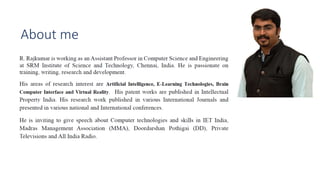
About me
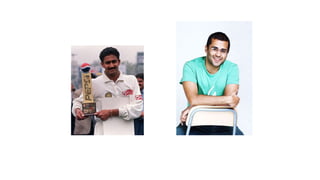
Famous Mechanical Engineers in India
1. A. P. J. Abdul Kalam (Aero)
2. Kumar Bhattacharyya
3. Ravi Grover
4. Suhas V Patankar
5. Sanjay Sharma
Famous Mechanical Engineers in world
1. Nikola Tesla
Tesla was a Serbian-American immigrant who contributed to the design of the modern alternating current
electricity supply system and is known as the father of radio for his role in the invention of wireless radio
communications.
2. Kitaw Ejugu
This Ethiopian-American engineer invented GPS (global positioning system) technology while working at NASA
over a number of years.
3. James Watt
Watt nevertheless became an engineer who invented the modern steam engine, rotary engine He also developed
the concept of Horsepower and had the S.I. unit of power named after him due to his prominence.
4. George Stephenson
A British inventor in the 1800s who created the first public inter-city railway system and is known as the “father of
railways” for his contributions to the railway system.
5. Aurel Stdola
He invented the first heat pump and contributed to the invention of both steam and gas turbines as part of his
research into many different areas of science, and he earned many honorary degrees and awards during his
lifetime for his work.
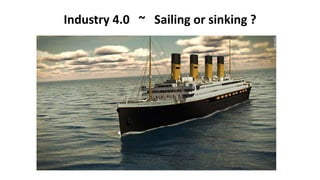
Industry 4.0 ~ Sailing or sinking ?
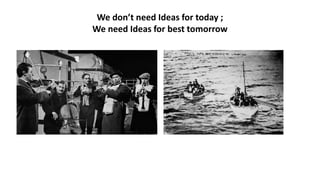
We don’t need Ideas for today ;
We need Ideas for best tomorrow
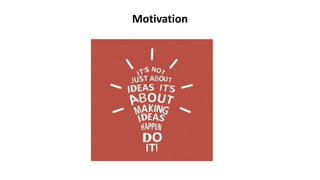
Motivation
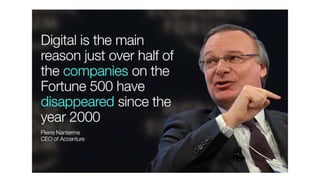
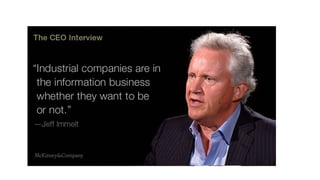
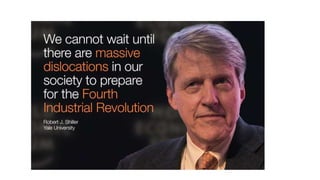
Quotes
Big TechCompanies
Big TechCompanies?
Emerging (Emergency )Companies?
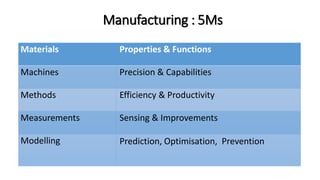
Manufacturing : 5Ms
Materials Properties & Functions
Machines Precision & Capabilities
Methods Efficiency & Productivity
Measurements Sensing & Improvements
Modelling Prediction, Optimisation, Prevention
https://www.youtube.com/watch?v=JTl8w6yA
jds
Definitions
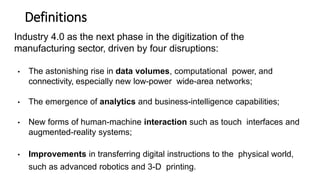
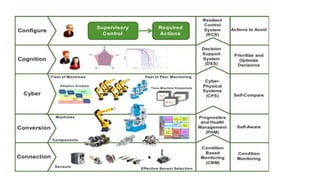
Industry 4.0 as the next phase in the digitization of the
manufacturing sector, driven by four disruptions:
• The astonishing rise in data volumes, computational power, and
connectivity, especially new low-power wide-area networks;
• The emergence of analytics and business-intelligence capabilities;
• New forms of human-machine interaction such as touch interfaces and
augmented-reality systems;
• Improvements in transferring digital instructions to the physical world,
such as advanced robotics and 3-D printing.
Digital
Compass of
Options
for
Manufacturers
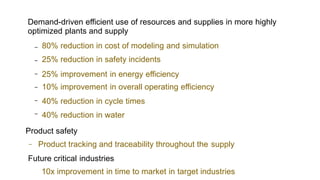
Demand-driven efficient use of resources and supplies in more highly
optimized plants and supply
–
–
–
–
–
–
80% reduction in cost of modeling and simulation
25% reduction in safety incidents
25% improvement in energy efficiency
10% improvement in overall operating efficiency
40% reduction in cycle times
40% reduction in water
Product safety
– Product tracking and traceability throughout the supply
Future critical industries
10x improvement in time to market in target industries
Platforms
• “Platforms,” in which products, services, and information
can be exchanged via predefined streams. Think open-
source software applied to the manufacturing context.
• For example, a company might provide technology to
connect multiple parties and coordinate their interactions,
a 3-D-printer manufacturer and IT services company, are
currently running a pilot project to develop such a
marketplace.
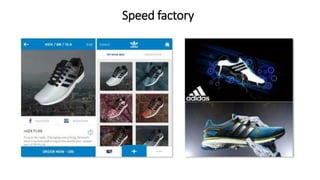
Speed factory
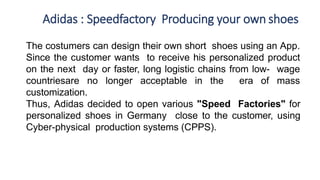
Adidas : Speedfactory Producing your own shoes
The costumers can design their own short shoes using an App.
Since the customer wants to receive his personalized product
on the next day or faster, long logistic chains from low- wage
countriesare no longer acceptable in the era of mass
customization.
Thus, Adidas decided to open various "Speed Factories" for
personalized shoes in Germany close to the customer, using
Cyber-physical production systems (CPPS).
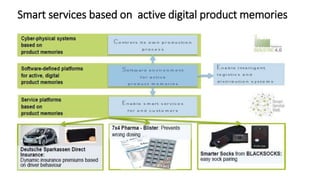
Smart services based on active digital product memories
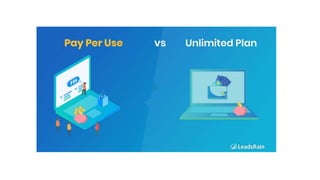
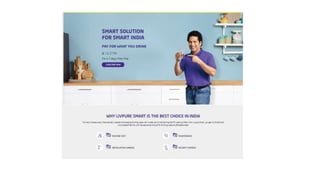
Pay-by-use
• Pay-by-use and subscription-based services, turning
machinery from capex to opex for manufacturers.
• Rolls-Royce pioneered this approach in its jet-engine
business; other manufacturers have followed suit.
• Atlas Copco, a manufacturer of air compressors based in
Nacka, Sweden, is moving away from selling its equipment
directly, and, instead, is billing only for the compressed air
that is used.
• The machines installed at customer sites can monitor the
flow of compressed air and adjust the output according to
customer need, who pay as they use.
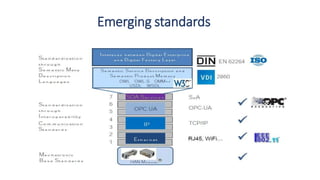
Emerging standards
Preparing for the future
• Toget the most out of Industry 4.0 technologies, and to get past
square one with a digital business model, companies will have to take
a third step: prepare for a digital transformation.
• Manufacturers should begin today to join the hunt for the best digital
talent, and think about how to structure their digital organization.
• Data management and cybersecurity will be critical problems to
solve. Many companies will find that a “two speed” data
architecture can help them deploy new technologies at the speed
required, while also preserving mission-critical applications.
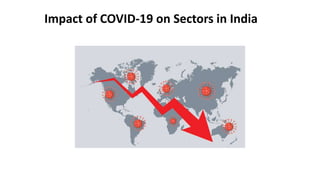
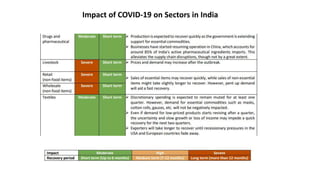
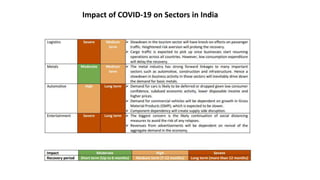
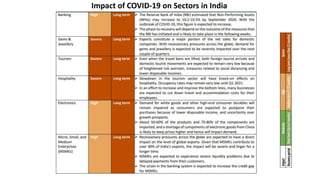
Impact of COVID-19 on Sectors in India
Opportunities by Industry 4.0
Smart Home
The estimated amount of funding for Smart Home startups exceeds $2.5bn and is
ever growing.
The list of startups includes prominent startup company names such as AlertMe or
Nest as well as a number of multinational corporations like Philips, Haier, or Belkin
etc.
Wearable devices
It make our life easier and healthier
Smart City
IoT solutions offered in the Smart City area solve various city-related problems
comprising of traffic, reduce air and noise pollution and help make cities safer.
Industrial Internet of Things
One way to think of the Industrial Internet is, as connecting machines and devices
in industries such as power generation, oil, gas, and healthcare.
Connected Car
Connected car technology is a vast and an extensive network of multiple sensors,
antennas, embedded software, and technologies that assist in communication to
navigate in our complex world.
Connected Health
(Digital Health/Tele-health/Telemedicine)
IoT has various applications in healthcare, which are from remote monitoring
equipment to advance & smart sensors to equipment integration.
It has the potential to improve how physicians deliver care and also keep patients
safe and healthy
Smart Retail
Retailers have started adopting IoT solutions and using IoT embedded systems
across a number of applications that improve store operations such as increasing
purchases, reducing theft, enabling inventory management, and enhancing the
consumer’s shopping experience.
Smart Supply Chain
With an IoT enabled system, factory equipment that contains embedded sensors
communicate data about different parameters such as pressure, temperature, and
utilization of the machine.
Almost done..!
Fresh Quotes
“ Without Business, there is no Technology
Without Technologies, there is no Industry ”
- R. Rajkumar
Author INDIA
2030
Thank you..!
Feedback & Questions?
R. Rajkumar
rajkumar03r@gmail.com
+91 9894808403.
https://www.linkedin.com/in/raj-kumar-1251a553/

Webinar on oppurtunities on industry 4.0

  • 1.
    Opportunities in R. Rajkumar AssistantProfessor Department of CSE SRM IST | Chennai
  • 2.
    Webinar on Opportunitiesin Industry 4.0 Date: 30.04.2020 SNS College of Technology Department of Mechanical Engineering R. Rajkumar Assistant Professor Department of CSE SRM IST | Chennai
  • 3.
  • 6.
    Famous Mechanical Engineersin India 1. A. P. J. Abdul Kalam (Aero) 2. Kumar Bhattacharyya 3. Ravi Grover 4. Suhas V Patankar 5. Sanjay Sharma
  • 7.
    Famous Mechanical Engineersin world 1. Nikola Tesla Tesla was a Serbian-American immigrant who contributed to the design of the modern alternating current electricity supply system and is known as the father of radio for his role in the invention of wireless radio communications. 2. Kitaw Ejugu This Ethiopian-American engineer invented GPS (global positioning system) technology while working at NASA over a number of years. 3. James Watt Watt nevertheless became an engineer who invented the modern steam engine, rotary engine He also developed the concept of Horsepower and had the S.I. unit of power named after him due to his prominence. 4. George Stephenson A British inventor in the 1800s who created the first public inter-city railway system and is known as the “father of railways” for his contributions to the railway system. 5. Aurel Stdola He invented the first heat pump and contributed to the invention of both steam and gas turbines as part of his research into many different areas of science, and he earned many honorary degrees and awards during his lifetime for his work.
  • 8.
    Industry 4.0 ~Sailing or sinking ?
  • 9.
    We don’t needIdeas for today ; We need Ideas for best tomorrow
  • 10.
  • 11.
  • 15.
  • 16.
  • 17.
  • 19.
    Manufacturing : 5Ms MaterialsProperties & Functions Machines Precision & Capabilities Methods Efficiency & Productivity Measurements Sensing & Improvements Modelling Prediction, Optimisation, Prevention
  • 21.
  • 22.
    Definitions Industry 4.0 asthe next phase in the digitization of the manufacturing sector, driven by four disruptions: • The astonishing rise in data volumes, computational power, and connectivity, especially new low-power wide-area networks; • The emergence of analytics and business-intelligence capabilities; • New forms of human-machine interaction such as touch interfaces and augmented-reality systems; • Improvements in transferring digital instructions to the physical world, such as advanced robotics and 3-D printing.
  • 26.
  • 27.
    Demand-driven efficient useof resources and supplies in more highly optimized plants and supply – – – – – – 80% reduction in cost of modeling and simulation 25% reduction in safety incidents 25% improvement in energy efficiency 10% improvement in overall operating efficiency 40% reduction in cycle times 40% reduction in water Product safety – Product tracking and traceability throughout the supply Future critical industries 10x improvement in time to market in target industries
  • 28.
    Platforms • “Platforms,” inwhich products, services, and information can be exchanged via predefined streams. Think open- source software applied to the manufacturing context. • For example, a company might provide technology to connect multiple parties and coordinate their interactions, a 3-D-printer manufacturer and IT services company, are currently running a pilot project to develop such a marketplace.
  • 29.
  • 30.
    Adidas : SpeedfactoryProducing your own shoes The costumers can design their own short shoes using an App. Since the customer wants to receive his personalized product on the next day or faster, long logistic chains from low- wage countriesare no longer acceptable in the era of mass customization. Thus, Adidas decided to open various "Speed Factories" for personalized shoes in Germany close to the customer, using Cyber-physical production systems (CPPS).
  • 31.
    Smart services basedon active digital product memories
  • 34.
    Pay-by-use • Pay-by-use andsubscription-based services, turning machinery from capex to opex for manufacturers. • Rolls-Royce pioneered this approach in its jet-engine business; other manufacturers have followed suit. • Atlas Copco, a manufacturer of air compressors based in Nacka, Sweden, is moving away from selling its equipment directly, and, instead, is billing only for the compressed air that is used. • The machines installed at customer sites can monitor the flow of compressed air and adjust the output according to customer need, who pay as they use.
  • 35.
  • 36.
    Preparing for thefuture • Toget the most out of Industry 4.0 technologies, and to get past square one with a digital business model, companies will have to take a third step: prepare for a digital transformation. • Manufacturers should begin today to join the hunt for the best digital talent, and think about how to structure their digital organization. • Data management and cybersecurity will be critical problems to solve. Many companies will find that a “two speed” data architecture can help them deploy new technologies at the speed required, while also preserving mission-critical applications.
  • 37.
    Impact of COVID-19on Sectors in India
  • 38.
    Impact of COVID-19on Sectors in India
  • 39.
    Impact of COVID-19on Sectors in India
  • 40.
    Impact of COVID-19on Sectors in India
  • 41.
  • 42.
    Smart Home The estimatedamount of funding for Smart Home startups exceeds $2.5bn and is ever growing. The list of startups includes prominent startup company names such as AlertMe or Nest as well as a number of multinational corporations like Philips, Haier, or Belkin etc.
  • 43.
    Wearable devices It makeour life easier and healthier
  • 44.
    Smart City IoT solutionsoffered in the Smart City area solve various city-related problems comprising of traffic, reduce air and noise pollution and help make cities safer.
  • 45.
    Industrial Internet ofThings One way to think of the Industrial Internet is, as connecting machines and devices in industries such as power generation, oil, gas, and healthcare.
  • 46.
    Connected Car Connected cartechnology is a vast and an extensive network of multiple sensors, antennas, embedded software, and technologies that assist in communication to navigate in our complex world.
  • 47.
    Connected Health (Digital Health/Tele-health/Telemedicine) IoThas various applications in healthcare, which are from remote monitoring equipment to advance & smart sensors to equipment integration. It has the potential to improve how physicians deliver care and also keep patients safe and healthy
  • 48.
    Smart Retail Retailers havestarted adopting IoT solutions and using IoT embedded systems across a number of applications that improve store operations such as increasing purchases, reducing theft, enabling inventory management, and enhancing the consumer’s shopping experience.
  • 49.
    Smart Supply Chain Withan IoT enabled system, factory equipment that contains embedded sensors communicate data about different parameters such as pressure, temperature, and utilization of the machine.
  • 50.
  • 51.
    Fresh Quotes “ WithoutBusiness, there is no Technology Without Technologies, there is no Industry ” - R. Rajkumar Author INDIA 2030
  • 52.
    Thank you..! Feedback &Questions? R. Rajkumar rajkumar03r@gmail.com +91 9894808403. https://www.linkedin.com/in/raj-kumar-1251a553/