INDUSTRIAL
DISPUTES
INDUSTRIAL DISPUTE
 Any dispute or difference between
a) Employers and Employers
b)Employers and Workmen
c)Workmen and Workman
 Disputes may be connected with
Employment/Non employment
a)Terms of employment
b)Conditions of labour
[demand has to be made by workmen]
Definitions
 Industrial Dispute(Sec. 21K)
Any dispute or difference between employers and
employers, employers and workmen, or between
workmen and workmen which is connected with
the employment or non employment or terms of
employment or with conditions of labour of any
person.
--- INDUSTRIAL DISPUTES ACT 1947
FORMS OF INDUSTRIAL DISPUTES
Strikes BundhsGheraosLock-out
Pen-
Down
Strike
Hunger
Strike
Sympath
y Strike
Go
Slow
Strike
Strike &
Work
Accordin
g to Rule
Token
Strike
Strike (Sec 2(q))
A Cessation of work by a body of persons employed in
any industry acting in combination or a concerted refusal
under a common understanding of any number of persons
who are or have been so employed to continue to work or to
accept employment.
(i) Token or Protest Strikes : It is of very short
duration and is in nature of signal for the danger
ahead. In this strike workers do not work for an
hour or a day.
(ii) Work to rule : In this strike, the strikers undertake
the work according to rules or job description.
(iii) Go –Slow : In this strike, the workers intentionally
reduce the speed of work.
iv. Sympathetic Strike: It is usually a day’s
strike , not for the fulfillment of any of their
own demands, of a trade union, but to
demonstrate their support for a strike in
another organization.
v. Hunger Strike : This type of strike is
resorted to either by the leaders of the union
or by some workers all at a time for a
limited period or up to the period of
settlement of disputes.
vi. Tools Down, Pen Down Strike : Here the
strikers lay down their tools in case of
factory workers , office workers lay down
their pens.
Lock – Out (Sec 2.(1))
The closing of a place of employment or the
suspension of work or the refusal by an
employer to continue to employ any number of
persons employed by him.
Gheraos
It is a physical blockade of a target either
by encirclement, intended to block from and
to a particular office, workshop etc.
Bundhs
Trade Unions resort to Bundh when an
industrial dispute reaches its extreme edge.
Under it trade unions try to get the work of
all industrial establishments stopped at the
district or state level to get their demands
fulfilled.
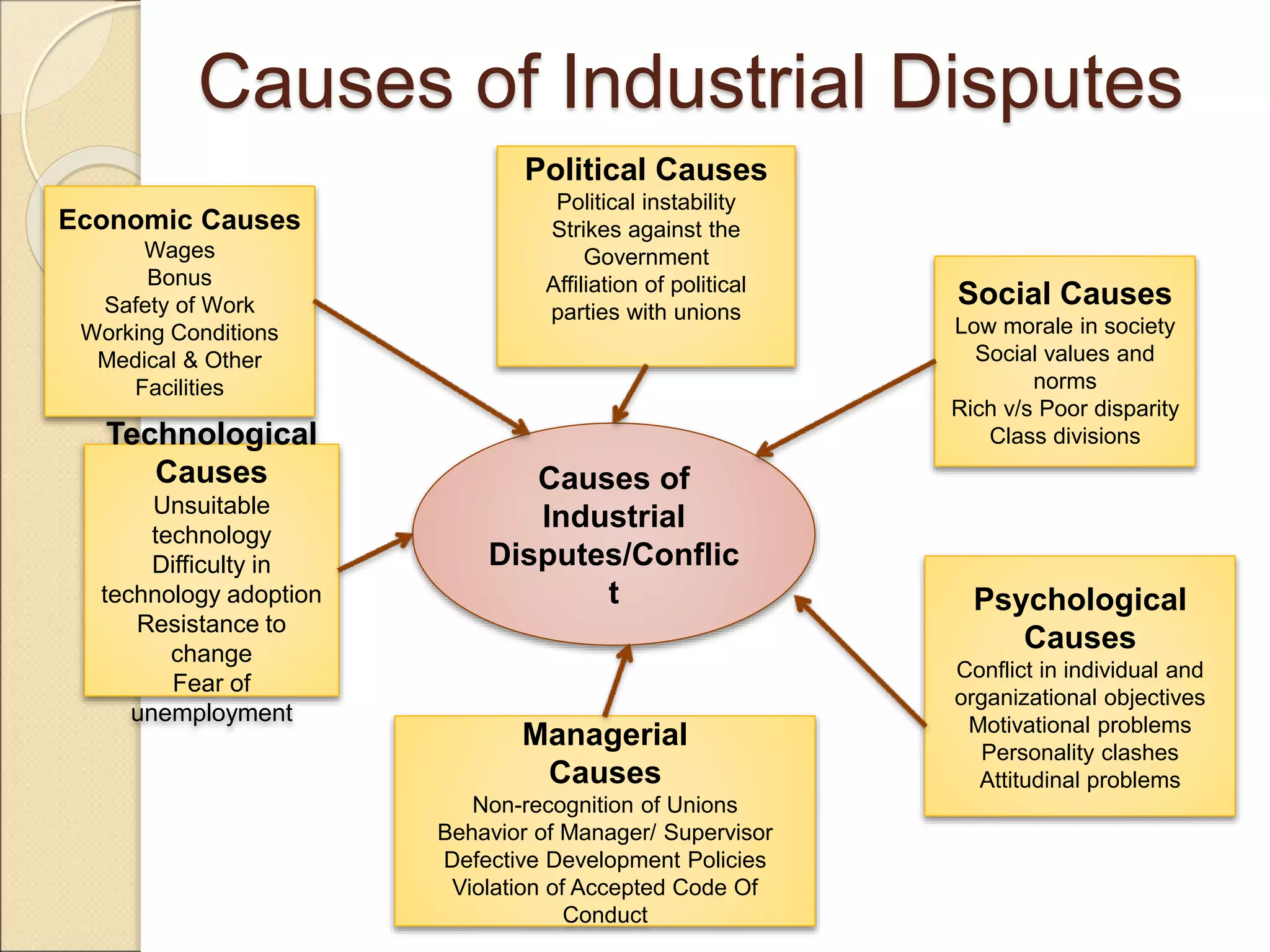
Causes of Industrial Disputes
Economic Causes
Wages
Bonus
Safety of Work
Working Conditions
Medical & Other
Facilities
Political Causes
Political instability
Strikes against the
Government
Affiliation of political
parties with unions
Social Causes
Low morale in society
Social values and
norms
Rich v/s Poor disparity
Class divisionsTechnological
Causes
Unsuitable
technology
Difficulty in
technology adoption
Resistance to
change
Fear of
unemployment
Psychological
Causes
Conflict in individual and
organizational objectives
Motivational problems
Personality clashes
Attitudinal problems
Managerial
Causes
Non-recognition of Unions
Behavior of Manager/ Supervisor
Defective Development Policies
Violation of Accepted Code Of
Conduct
Causes of
Industrial
Disputes/Conflic
t
Settlement of Disputes
Whatever may be the cause of industrial disputes,
the consequences are harmful to all stakeholders-
management, employees, economy and the society
.
For management, disputes result in loss of
production, revenue, profit, and even sickness of
the plant.
Employees would be hard hit as the disputes may
lead to lockouts and consequent loss of wages and
even jobs.
Various methods are available for resolving
Collective
Bargaining
Code of
Discipline
Grievance
Procedure
Dispute
Settlement
Consultative
Machinery
Arbitration
Conciliation
Adjudication
Collective Bargaining:
Collective bargaining helps for settlement of
issues and prevention of industrial disputes. It
occurs when representatives of a labour union
meet management representatives to determine
employees wages and benefits, to create or revise
work rules and to resolve disputes or violations of
the labour contract.
The bargaining is collective in the sense that the
chosen representative of the employees (i.e. union )
acts as a bargaining agent for all the employees in
carrying out negotiations and dealings with the
management. On the employer side, it is collective
in those common situations in which the companies
have joined together in an employer association for
the purposes of bargaining with a union.
The term Collective bargaining was first
coined by SIDNEY and BEATRIE in
their book Industrial Society in 1897.
The process of collective bargaining
involves six major steps :
Environment
Preparation for
Negotiation
Bargaining
Issues
Negotiating
Negotiation
Breakdowns
Reaching the
Agreement
Ratifying the agreement
Administration of the
Agreement
Overcoming
Breakdowns
Yes
No
Code of Discipline :
The code of discipline defines duties and
responsibilities of employers and workers. The
objectives of the code are:
1. To ensure that employers and employees
recognize each others rights and obligations.
2. To promote consecutive co-operation between
parties concerned at all levels.
3. To eliminate all forms of coercion,
intimidation and violence in IR.
4. To avoid work stoppages.
5. To facilitate the growth of trade unions.
6. To maintain discipline in the industry.
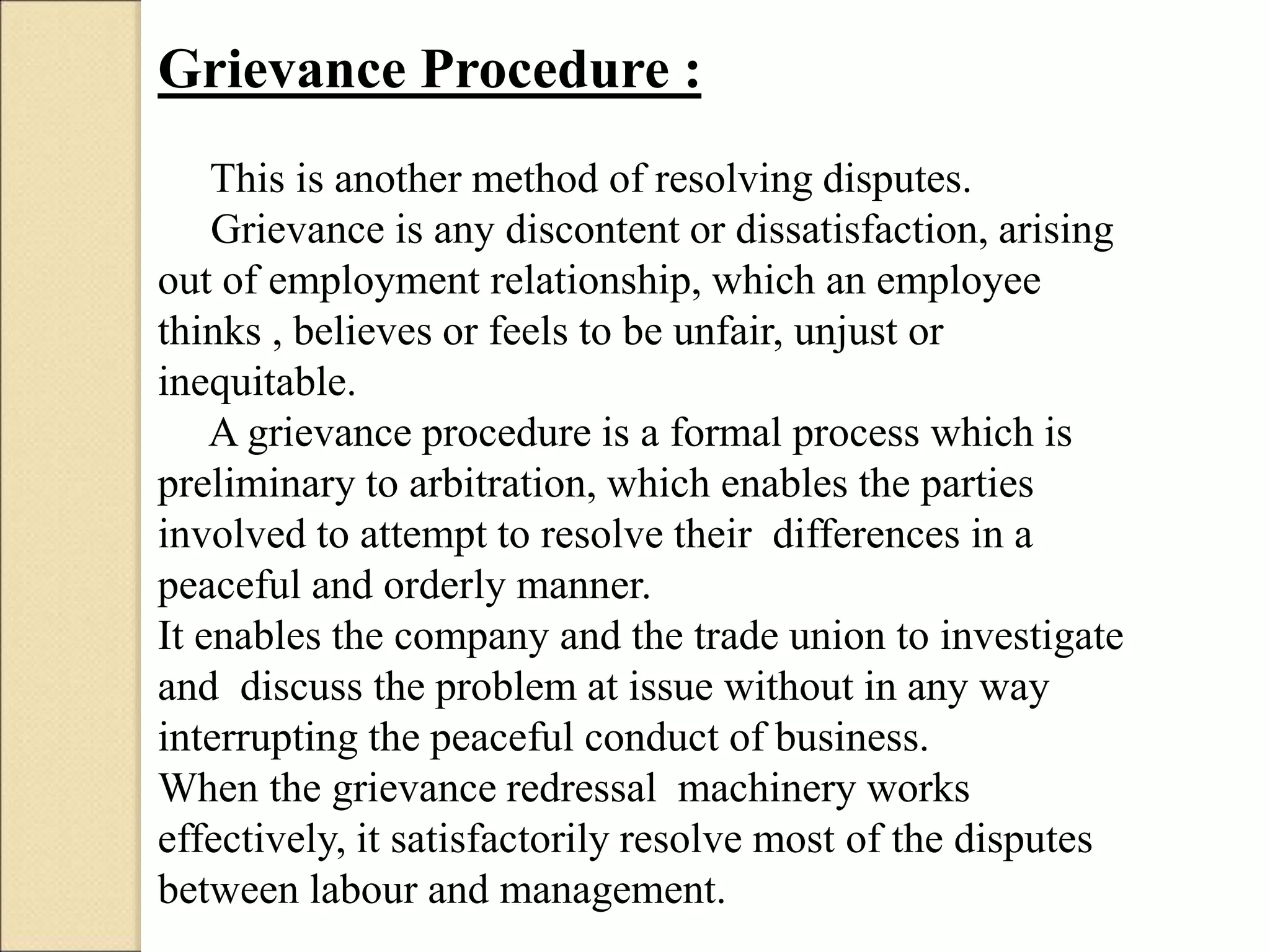
Grievance Procedure :
This is another method of resolving disputes.
Grievance is any discontent or dissatisfaction, arising
out of employment relationship, which an employee
thinks , believes or feels to be unfair, unjust or
inequitable.
A grievance procedure is a formal process which is
preliminary to arbitration, which enables the parties
involved to attempt to resolve their differences in a
peaceful and orderly manner.
It enables the company and the trade union to investigate
and discuss the problem at issue without in any way
interrupting the peaceful conduct of business.
When the grievance redressal machinery works
effectively, it satisfactorily resolve most of the disputes
between labour and management.
Voluntary
Arbitration
Committee of
union &
Management
Representatives
Manager
Grievance Committee
Departmental
Representatives
Department
Representatives
Head of the
department
Supervisor
Foreman
Grievant Employee
VI stage within7 days
V stage Appeal to
Management for
revision
IV stage communicates
the decision within 7 days
II stage
decision within
3days
I stage answer to
be given within 48
hrs
III stage conveys
verbally
NS
NS
NS
NS
NS
NS
NS- Not satisfied
Arbitration :
Arbitration is a procedure in which a neutral
third party studies the bargaining situation,
listens to both the parties, gathers information
and then makes recommendations that are
binding on both the parties.
Arbitration is effective means of resolving
disputes because it is :
1. Established by the parties themselves and
the decision is acceptable to them.
2. Relatively expeditious when compared to
courts and tribunals.
Process of Arbitration
1) The labour union generally takes initiative to go for
arbitration. when the union decides, it notifies the
management.
2) The union & the management select the potential
arbitrator by carefully studying the previous
decisions given by the particular arbitrator, to detect
any biases.
3) After the arbitrator is selected, the time & place
for hearing will be determined, the issue to be
resolved will be presented to the arbitrator in a
document that summarizes the questions to be
decided, any contracts restrictions that prohibit the
arbitrator from making an award that would change
the terms of existing contract.
4) Each side represents its case at the hearing.
1) Witness , cross-examination, transcripts & legal
counsel may be used.
2) After hearing, the arbitrator studies the materials
submitted and reaches the decision within 30 – 60
days.
3) The decision given usually is a written opinion
mentioning the reasons.
4) The report is submitted by the arbitrator to the
appropriate government
Conciliation
Conciliation is a process by which the representatives of
workers and employers are brought together before a third
party with a view to persuading them to arrive at an
agreement by mutual discussion between them. The third
party may be an individual or a group of people. The third
party may also be called as mediators.
The ID Act, 1947and other state enactments authorize the
governments to appoint conciliators charged with duty of
mediating in and promoting the settlement of industrial
disputes.
In Conciliation , the ultimate decision rests with the
parties themselves but the conciliator may offer a solution
to the dispute acceptable to both the parties and serve as a
channel communication . The parties may accept his
recommendation or reject it.
 If the conciliation fails, the next stage may be
compulsory adjudication or the parties may be left
with their own choice. In cases where a settlement
is arrived , they can record the settlement and in
case of failure of the conciliatory negotiations, they
can send a failure report to the appropriate
government.
 The conciliation officer shall submit his or her
report within 14 days from the date of
commencement of the conciliation proceedings .
The act prohibits a strike or the Lockout when the
proceedings are in progress.
Adjudication :
Adjudication means a mandatory settlement of an
industrial dispute by a labour court or a tribunal. Generally,
the government refers a dispute for adjudication depending
on the failure of conciliation proceedings. Section 10 of the
Industrial Act, 1947, provides for reference of a dispute to
labour court or tribunal.
Disputes are generally referred to adjudication on the
recommendation of the conciliation officer who had dealt
with them earlier. The government has a discretionary
powers to accept or reject recommendations of the
conciliation officer. It is obvious that once is referred for
adjudication , the verdict of a labour court or tribunal is
binding on both the parties.
This is the most significant instrument of resolving
disputes. But, it has been criticsed because of the delay
involved in resolving conflicts.
Consultative Machinery
Consultative machinery is set by the government to resolve
conflicts. The main function is to bring the parties together for
mutual settlement of differences in the spirit of co-operation
and goodwill.
A consultative machinery operates at plant , industry , state
and national levels. At plant level, there are works committee
and joint management councils. Being bipartite in character,
works committee are constituted as per the provisions of
industrial Disputes Act, 1947 and joint management councils
are set up following the trust laid down in the Industrial Policy
Resolution 1956. At the industry level, there are wage boards
and industrial committee.
labour advisory boards operate at the state and at the all
India level there are Indian labour commission(ILC) and the
Standing labour committee(SLC). The bodies operating at
state and national level, are tripartite in character , representing
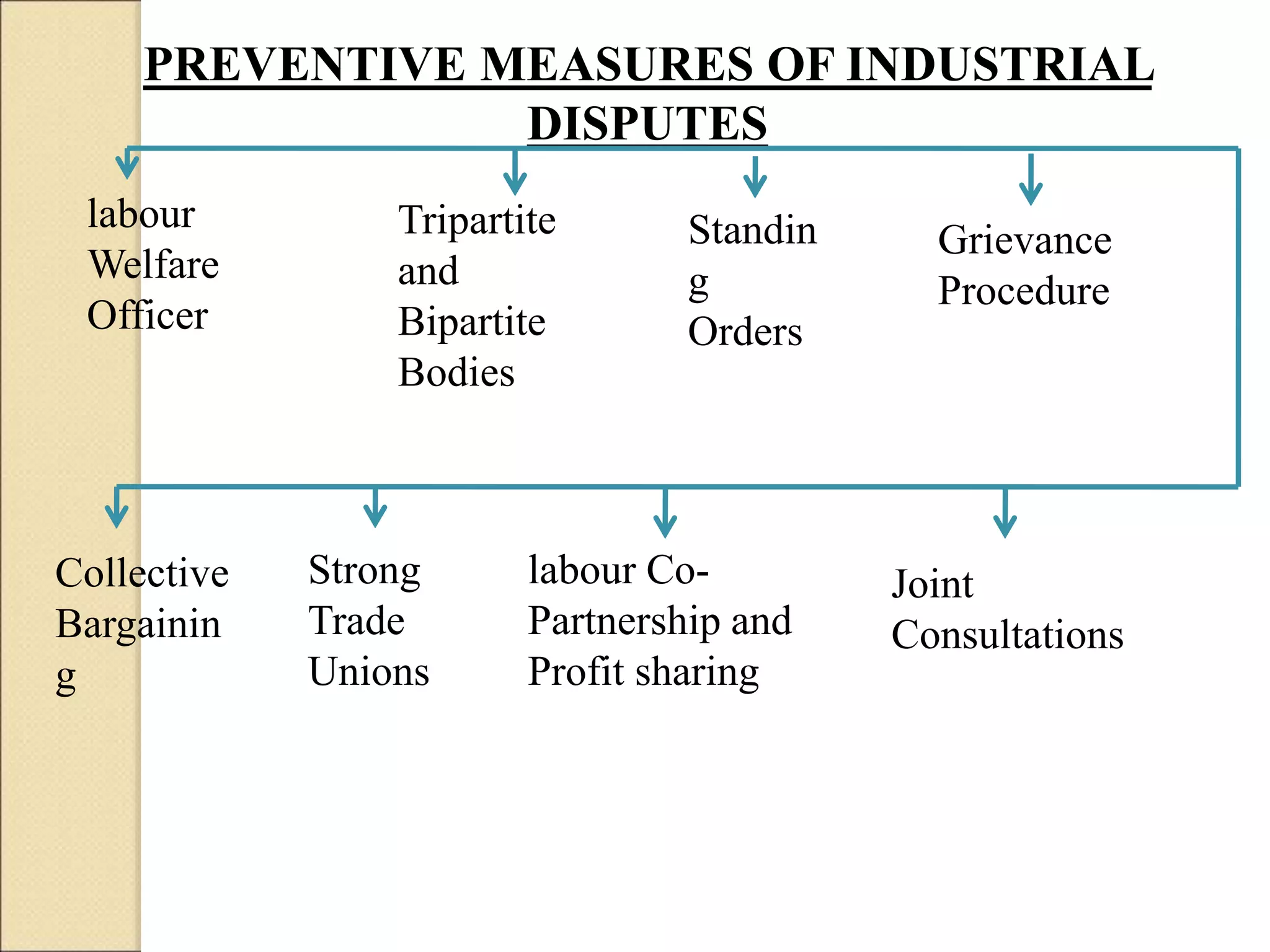
PREVENTIVE MEASURES OF INDUSTRIAL
DISPUTES
labour
Welfare
Officer
Tripartite
and
Bipartite
Bodies
Standin
g
Orders
Grievance
Procedure
Collective
Bargainin
g
Strong
Trade
Unions
labour Co-
Partnership and
Profit sharing
Joint
Consultations
1]Labor Welfare Officer : Section 49 (1) and
(2) of the Factories Act, 1948 specifies that every
factory wherein 500 or more workers are ordinarily
employed at least one welfare Officer must be
appointed, where the number of workers are in
excess of 2500,the assistant and / or additional
welfare officers are required to be appointed to
assist the Welfare Officer.
The functions of labour Welfare Officer includes :
(I) labour Welfare Functions :Advice and
assistance in implementing legislative and non-
legislative provisions relating to :
(a)Health &Safety
(b)Working conditions
(c)Sanitation & Cleanliness
(d)Recreation
(e)Welfare Amenities
(f)Workers Education
(g)Services like Co-operative grain shops, housing
cooperatives.
(h)Formation of welfare committees.
(i) Housing
(j) Implementation of welfare Acts.
(II) labour Administration Functions :
These may cover:
(a)Organizational Discipline
(b)Safety & Medical administration
(c)Wage & salary administration
(III) labour Relations Functions:
These may consist of :
(a)Administration of standing orders.
(b)Settlement of Grievances.
(c)Settlement of Disputes through statutory
procedures.
(d)Trade unions& union management relations
(e)Steps to increase productivity efficiency.
2]Tripartite and Bipartite Bodies :
Industrial relations in India have been shaped
largely by the policies and practices of
Tripartite and Bipartite bodies.
The purpose of consultative machinery is to
bring the partners together for mutual
settlement of differences in spirit of
cooperation and goodwill.
Bipartite consultative machinery comprises
two parties i.e. employees and employer, the
important bipartite body is works
committees.
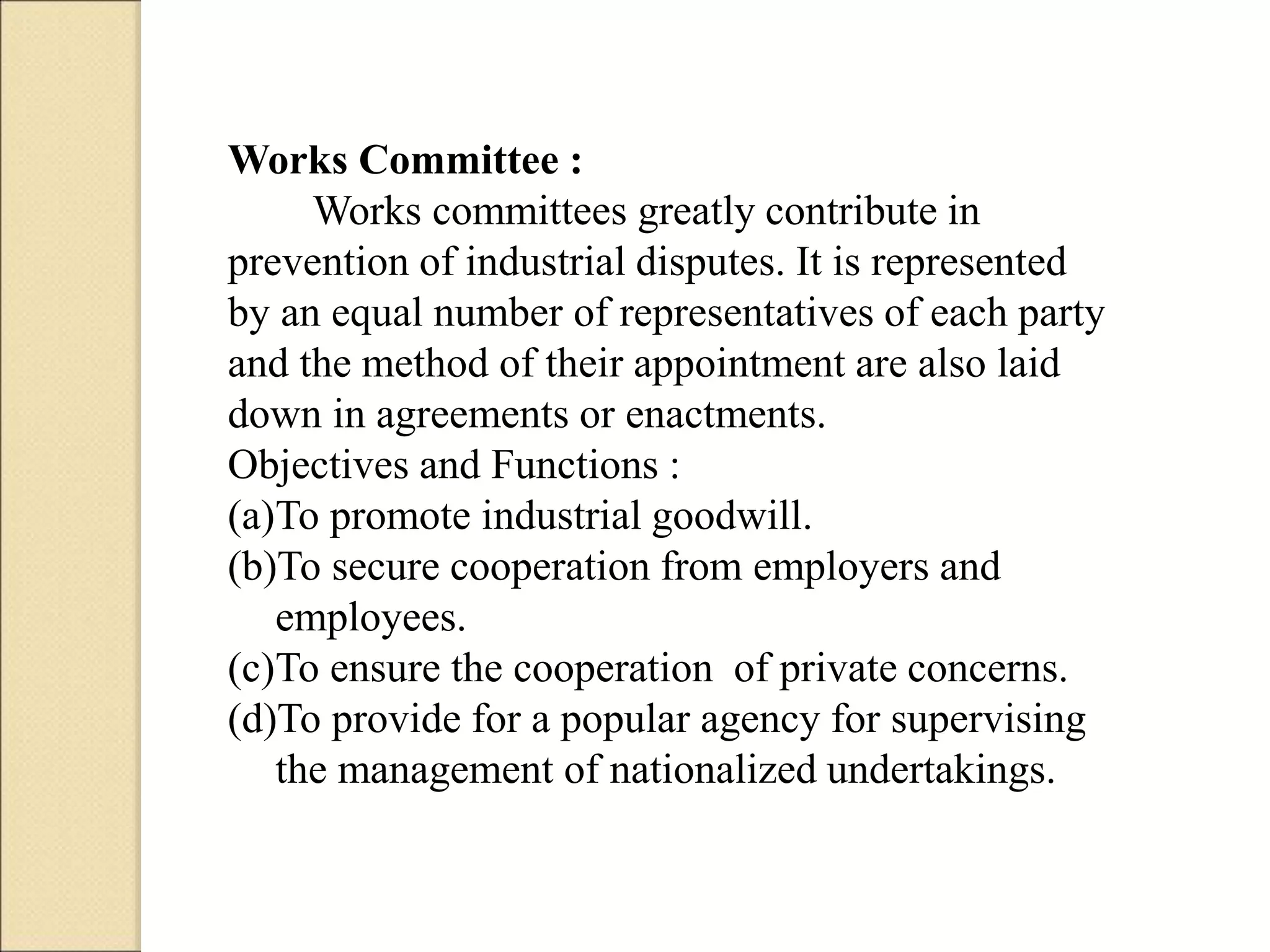
Works Committee :
Works committees greatly contribute in
prevention of industrial disputes. It is represented
by an equal number of representatives of each party
and the method of their appointment are also laid
down in agreements or enactments.
Objectives and Functions :
(a)To promote industrial goodwill.
(b)To secure cooperation from employers and
employees.
(c)To ensure the cooperation of private concerns.
(d)To provide for a popular agency for supervising
the management of nationalized undertakings.
3] Standing Orders :
Majority of the industrial disputes are
related to conditions of employment. To
prevent this, Standing orders are formulated.
It was made obligatory that standing orders
should govern the conditions of employment
under the Industrial Employment (Standing
Orders ) Act of 1946. The Standing Orders
regulate the conditions of employment from
the stage of entry to the stage of exit.
4] Grievance Procedure :
Grievance generally arise from day – to- day
working relations. Grievances of the employees are
readdressed by the management. Management can
prevent the occurrence of industrial disputes by
solving the individual problems.
5] Collective Bargaining :
Collective bargaining helps for settlement of issues
and prevention of industrial disputes. It occurs
when representatives of a labour union meet
management representatives to determine
employees wages and benefits, to create or revise
work rules and to resolve disputes or violations of
the labour contract.
6] Strong Trade unions :
Trade union is the most suitable and effective
agency to conduct collective bargaining on behalf
of the workers. A powerful bargaining may be
achieved by strong trade unions, which enable the
workforce to maintain harmonious relations with
the management.
7] labour Co-partnership and profit
sharing :
Good industrial relations can be maintained
through proper partnership and profit sharing;
employer gives a portion of total profits to workers
in addition to their normal wages. This sort of
attitude of management would create psychological
8] Joint Consultation :
Joint Consultation involves a continuous
relationship between labour and management
and expects willingness of management and the
participation of workers in discussing common
problems of interest. This is the result of
collective bargaining relations on a stable basis
when parties know each other well and have a
mutual trust.
• http://www.whatishumanresource.com
• http://www.mbaofficial.com
• Human Resource and Personnel Management- K.
Aswathappa, Tata McGraw Hill

Industrial disputes act

  • 1.
  • 2.
    INDUSTRIAL DISPUTE  Anydispute or difference between a) Employers and Employers b)Employers and Workmen c)Workmen and Workman  Disputes may be connected with Employment/Non employment a)Terms of employment b)Conditions of labour [demand has to be made by workmen]
  • 3.
    Definitions  Industrial Dispute(Sec.21K) Any dispute or difference between employers and employers, employers and workmen, or between workmen and workmen which is connected with the employment or non employment or terms of employment or with conditions of labour of any person. --- INDUSTRIAL DISPUTES ACT 1947
  • 4.
    FORMS OF INDUSTRIALDISPUTES Strikes BundhsGheraosLock-out Pen- Down Strike Hunger Strike Sympath y Strike Go Slow Strike Strike & Work Accordin g to Rule Token Strike
  • 5.
    Strike (Sec 2(q)) ACessation of work by a body of persons employed in any industry acting in combination or a concerted refusal under a common understanding of any number of persons who are or have been so employed to continue to work or to accept employment. (i) Token or Protest Strikes : It is of very short duration and is in nature of signal for the danger ahead. In this strike workers do not work for an hour or a day. (ii) Work to rule : In this strike, the strikers undertake the work according to rules or job description. (iii) Go –Slow : In this strike, the workers intentionally reduce the speed of work.
  • 6.
    iv. Sympathetic Strike:It is usually a day’s strike , not for the fulfillment of any of their own demands, of a trade union, but to demonstrate their support for a strike in another organization. v. Hunger Strike : This type of strike is resorted to either by the leaders of the union or by some workers all at a time for a limited period or up to the period of settlement of disputes. vi. Tools Down, Pen Down Strike : Here the strikers lay down their tools in case of factory workers , office workers lay down their pens.
  • 7.
    Lock – Out(Sec 2.(1)) The closing of a place of employment or the suspension of work or the refusal by an employer to continue to employ any number of persons employed by him. Gheraos It is a physical blockade of a target either by encirclement, intended to block from and to a particular office, workshop etc.
  • 8.
    Bundhs Trade Unions resortto Bundh when an industrial dispute reaches its extreme edge. Under it trade unions try to get the work of all industrial establishments stopped at the district or state level to get their demands fulfilled.
  • 9.
    Causes of IndustrialDisputes Economic Causes Wages Bonus Safety of Work Working Conditions Medical & Other Facilities Political Causes Political instability Strikes against the Government Affiliation of political parties with unions Social Causes Low morale in society Social values and norms Rich v/s Poor disparity Class divisionsTechnological Causes Unsuitable technology Difficulty in technology adoption Resistance to change Fear of unemployment Psychological Causes Conflict in individual and organizational objectives Motivational problems Personality clashes Attitudinal problems Managerial Causes Non-recognition of Unions Behavior of Manager/ Supervisor Defective Development Policies Violation of Accepted Code Of Conduct Causes of Industrial Disputes/Conflic t
  • 11.
    Settlement of Disputes Whatevermay be the cause of industrial disputes, the consequences are harmful to all stakeholders- management, employees, economy and the society . For management, disputes result in loss of production, revenue, profit, and even sickness of the plant. Employees would be hard hit as the disputes may lead to lockouts and consequent loss of wages and even jobs. Various methods are available for resolving
  • 12.
  • 13.
    Collective Bargaining: Collective bargaininghelps for settlement of issues and prevention of industrial disputes. It occurs when representatives of a labour union meet management representatives to determine employees wages and benefits, to create or revise work rules and to resolve disputes or violations of the labour contract. The bargaining is collective in the sense that the chosen representative of the employees (i.e. union ) acts as a bargaining agent for all the employees in carrying out negotiations and dealings with the management. On the employer side, it is collective in those common situations in which the companies have joined together in an employer association for the purposes of bargaining with a union.
  • 14.
    The term Collectivebargaining was first coined by SIDNEY and BEATRIE in their book Industrial Society in 1897. The process of collective bargaining involves six major steps :
  • 15.
  • 16.
    Code of Discipline: The code of discipline defines duties and responsibilities of employers and workers. The objectives of the code are: 1. To ensure that employers and employees recognize each others rights and obligations. 2. To promote consecutive co-operation between parties concerned at all levels. 3. To eliminate all forms of coercion, intimidation and violence in IR. 4. To avoid work stoppages. 5. To facilitate the growth of trade unions. 6. To maintain discipline in the industry.
  • 17.
    Grievance Procedure : Thisis another method of resolving disputes. Grievance is any discontent or dissatisfaction, arising out of employment relationship, which an employee thinks , believes or feels to be unfair, unjust or inequitable. A grievance procedure is a formal process which is preliminary to arbitration, which enables the parties involved to attempt to resolve their differences in a peaceful and orderly manner. It enables the company and the trade union to investigate and discuss the problem at issue without in any way interrupting the peaceful conduct of business. When the grievance redressal machinery works effectively, it satisfactorily resolve most of the disputes between labour and management.
  • 18.
    Voluntary Arbitration Committee of union & Management Representatives Manager GrievanceCommittee Departmental Representatives Department Representatives Head of the department Supervisor Foreman Grievant Employee VI stage within7 days V stage Appeal to Management for revision IV stage communicates the decision within 7 days II stage decision within 3days I stage answer to be given within 48 hrs III stage conveys verbally NS NS NS NS NS NS NS- Not satisfied
  • 19.
    Arbitration : Arbitration isa procedure in which a neutral third party studies the bargaining situation, listens to both the parties, gathers information and then makes recommendations that are binding on both the parties. Arbitration is effective means of resolving disputes because it is : 1. Established by the parties themselves and the decision is acceptable to them. 2. Relatively expeditious when compared to courts and tribunals.
  • 20.
    Process of Arbitration 1)The labour union generally takes initiative to go for arbitration. when the union decides, it notifies the management. 2) The union & the management select the potential arbitrator by carefully studying the previous decisions given by the particular arbitrator, to detect any biases. 3) After the arbitrator is selected, the time & place for hearing will be determined, the issue to be resolved will be presented to the arbitrator in a document that summarizes the questions to be decided, any contracts restrictions that prohibit the arbitrator from making an award that would change the terms of existing contract. 4) Each side represents its case at the hearing.
  • 21.
    1) Witness ,cross-examination, transcripts & legal counsel may be used. 2) After hearing, the arbitrator studies the materials submitted and reaches the decision within 30 – 60 days. 3) The decision given usually is a written opinion mentioning the reasons. 4) The report is submitted by the arbitrator to the appropriate government
  • 22.
    Conciliation Conciliation is aprocess by which the representatives of workers and employers are brought together before a third party with a view to persuading them to arrive at an agreement by mutual discussion between them. The third party may be an individual or a group of people. The third party may also be called as mediators. The ID Act, 1947and other state enactments authorize the governments to appoint conciliators charged with duty of mediating in and promoting the settlement of industrial disputes. In Conciliation , the ultimate decision rests with the parties themselves but the conciliator may offer a solution to the dispute acceptable to both the parties and serve as a channel communication . The parties may accept his recommendation or reject it.
  • 23.
     If theconciliation fails, the next stage may be compulsory adjudication or the parties may be left with their own choice. In cases where a settlement is arrived , they can record the settlement and in case of failure of the conciliatory negotiations, they can send a failure report to the appropriate government.  The conciliation officer shall submit his or her report within 14 days from the date of commencement of the conciliation proceedings . The act prohibits a strike or the Lockout when the proceedings are in progress.
  • 24.
    Adjudication : Adjudication meansa mandatory settlement of an industrial dispute by a labour court or a tribunal. Generally, the government refers a dispute for adjudication depending on the failure of conciliation proceedings. Section 10 of the Industrial Act, 1947, provides for reference of a dispute to labour court or tribunal. Disputes are generally referred to adjudication on the recommendation of the conciliation officer who had dealt with them earlier. The government has a discretionary powers to accept or reject recommendations of the conciliation officer. It is obvious that once is referred for adjudication , the verdict of a labour court or tribunal is binding on both the parties. This is the most significant instrument of resolving disputes. But, it has been criticsed because of the delay involved in resolving conflicts.
  • 25.
    Consultative Machinery Consultative machineryis set by the government to resolve conflicts. The main function is to bring the parties together for mutual settlement of differences in the spirit of co-operation and goodwill. A consultative machinery operates at plant , industry , state and national levels. At plant level, there are works committee and joint management councils. Being bipartite in character, works committee are constituted as per the provisions of industrial Disputes Act, 1947 and joint management councils are set up following the trust laid down in the Industrial Policy Resolution 1956. At the industry level, there are wage boards and industrial committee. labour advisory boards operate at the state and at the all India level there are Indian labour commission(ILC) and the Standing labour committee(SLC). The bodies operating at state and national level, are tripartite in character , representing
  • 26.
    PREVENTIVE MEASURES OFINDUSTRIAL DISPUTES labour Welfare Officer Tripartite and Bipartite Bodies Standin g Orders Grievance Procedure Collective Bargainin g Strong Trade Unions labour Co- Partnership and Profit sharing Joint Consultations
  • 27.
    1]Labor Welfare Officer: Section 49 (1) and (2) of the Factories Act, 1948 specifies that every factory wherein 500 or more workers are ordinarily employed at least one welfare Officer must be appointed, where the number of workers are in excess of 2500,the assistant and / or additional welfare officers are required to be appointed to assist the Welfare Officer. The functions of labour Welfare Officer includes : (I) labour Welfare Functions :Advice and assistance in implementing legislative and non- legislative provisions relating to :
  • 28.
    (a)Health &Safety (b)Working conditions (c)Sanitation& Cleanliness (d)Recreation (e)Welfare Amenities (f)Workers Education (g)Services like Co-operative grain shops, housing cooperatives. (h)Formation of welfare committees. (i) Housing (j) Implementation of welfare Acts. (II) labour Administration Functions : These may cover: (a)Organizational Discipline (b)Safety & Medical administration (c)Wage & salary administration
  • 29.
    (III) labour RelationsFunctions: These may consist of : (a)Administration of standing orders. (b)Settlement of Grievances. (c)Settlement of Disputes through statutory procedures. (d)Trade unions& union management relations (e)Steps to increase productivity efficiency.
  • 30.
    2]Tripartite and BipartiteBodies : Industrial relations in India have been shaped largely by the policies and practices of Tripartite and Bipartite bodies. The purpose of consultative machinery is to bring the partners together for mutual settlement of differences in spirit of cooperation and goodwill. Bipartite consultative machinery comprises two parties i.e. employees and employer, the important bipartite body is works committees.
  • 31.
    Works Committee : Workscommittees greatly contribute in prevention of industrial disputes. It is represented by an equal number of representatives of each party and the method of their appointment are also laid down in agreements or enactments. Objectives and Functions : (a)To promote industrial goodwill. (b)To secure cooperation from employers and employees. (c)To ensure the cooperation of private concerns. (d)To provide for a popular agency for supervising the management of nationalized undertakings.
  • 32.
    3] Standing Orders: Majority of the industrial disputes are related to conditions of employment. To prevent this, Standing orders are formulated. It was made obligatory that standing orders should govern the conditions of employment under the Industrial Employment (Standing Orders ) Act of 1946. The Standing Orders regulate the conditions of employment from the stage of entry to the stage of exit.
  • 33.
    4] Grievance Procedure: Grievance generally arise from day – to- day working relations. Grievances of the employees are readdressed by the management. Management can prevent the occurrence of industrial disputes by solving the individual problems. 5] Collective Bargaining : Collective bargaining helps for settlement of issues and prevention of industrial disputes. It occurs when representatives of a labour union meet management representatives to determine employees wages and benefits, to create or revise work rules and to resolve disputes or violations of the labour contract.
  • 34.
    6] Strong Tradeunions : Trade union is the most suitable and effective agency to conduct collective bargaining on behalf of the workers. A powerful bargaining may be achieved by strong trade unions, which enable the workforce to maintain harmonious relations with the management. 7] labour Co-partnership and profit sharing : Good industrial relations can be maintained through proper partnership and profit sharing; employer gives a portion of total profits to workers in addition to their normal wages. This sort of attitude of management would create psychological
  • 35.
    8] Joint Consultation: Joint Consultation involves a continuous relationship between labour and management and expects willingness of management and the participation of workers in discussing common problems of interest. This is the result of collective bargaining relations on a stable basis when parties know each other well and have a mutual trust.
  • 36.
    • http://www.whatishumanresource.com • http://www.mbaofficial.com •Human Resource and Personnel Management- K. Aswathappa, Tata McGraw Hill