INDUSTRIAL
RELATIONS
2
INDUSTRIAL RELATION MEANING
The term industrial relations comprises two words, i.E. ‘Industry’ and ‘relations’.
The term ‘industry’ refers to any productive activity in the organisation in which the employees are
engaged.
On the other hand, the term ‘relations’ refers to the relationship, which exists within the industry between
the management and the employees.
The relationship between management and employees within the organisation within the organisational
settings is defined by industrial relations.
Industrial relations emerge directly or indirectly from management-trade union relationships.
“Industrial relation is an art of
living together for the purpose of
production” - J. Henry
According to the international labour
organisation (ILO), industrial relations
deals with relationships between either
state and employers and workers
organisations or the relationship between
the occupation organisation themselves.
Characteristics of Industrial Relation
Following are the significant features of industrial relations:
•Industrial relations are the result of employment relationships in industrial enterprises.
•Industrial relations introduced the concept and method of balancing and cooperating.
•Industrial relations formulate rules and regulations to maintain harmonious relations.
•The intervention of the Government to shape the industrial relation is made through laws, agreements,
rules, charters, etc.
•Industrial relations incorporate both individual relations and collective relations.
•Several parties play a role in industrial relations. The main parties are employees and their organisation,
employers and their association, and government.
OBJECTIVESOF INDUSTRIALRELATION
• To establish industrial peace.
• To safeguard the interests of both workers and management.
• To avoid industrial disputes.
• To raise the production capacity.
• To establish industrial democracy.
• To minimise the labour turnover rate and absenteeism.
• To safeguard the workers economic and social interests.
• To contribute to the economic development of the country through
productivity.
• To establish a full employment situation.
• To minimise strikes, lockout, Heroes, etc., by providing good
working conditions and fair wages to the workers.
5
IMPORTANCE OF INDUSTRIAL RELATIONS
6
•Promotes Democracy:
•Industrial relations means employing collective bargaining to resolve issues
faced by workers. This collective bargaining is generally employed through
cooperation and mutual agreement amongst all the affected parties, i.e.,
democracy, management, and employees unions. This enables an
organisation to establish industrial democracy, which eventually motivates
the workers to perform their best to the growth and prosperity of the
organisation.
•High Morale:
•Good industrial relations enhance the morale of the employees and motivate
the workers to work more efficiently.
•Avoid Conflicts Between Management And Union:
• Industrial relations minimise issues between unions and management. This
is because industrial relations incorporate setting up machinery to resolve
issues faced by management and employees through mutual agreement to
which both these parties are bound. This results in ignoring any unfair
practices that could lead to major conflicts between employers and trade
unions.
7
•Minimises Wastage:
• Satisfactory Industrial relations are maintained on the
basis of co-operation and recognition of each other in the
department. It helps to minimise wastage of material,
manpower, and costs.
•Economic Growth And Development:
•Good and harmonious industrial relations result in
increased efficiency and hence prosperity, which in turn
minimise turnover and other tangible benefits to the
organisation. This promotes economic growth and
development.
8
• Uninterrupted Production - There is uninterrupted flow of
income for all. This means, continuous employment for all from
manager to workers.
• Reduction in Industrial Disputes - Good industrial relation
reduce the industrial disputes. Ex- Strikes, lockouts, go-slow
tactics, gherao and grievances
• High Morale - Employees work with great zeal with the feeling
in mind that the interest of employer and employees is one and
the same, i.e. to increase production.
IMPORTANCE
9
• Mental Revolution – The main object of
industrial relation is a complete mental
revolution of workers and employees.
• New Programmes – New programmes
for workers development are introduced
in an atmosphere of peace such as
training facilities, labor welfare facilities
etc.
• Reduced Wastage - Wastages of man,
material and machines are reduced to the
minimum and thus national interest is
protected.
CONTD…
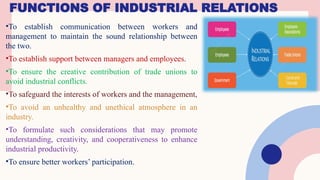
FUNCTIONS OF INDUSTRIAL RELATIONS
•To establish communication between workers and
management to maintain the sound relationship between
the two.
•To establish support between managers and employees.
•To ensure the creative contribution of trade unions to
avoid industrial conflicts.
•To safeguard the interests of workers and the management,
•To avoid an unhealthy and unethical atmosphere in an
industry.
•To formulate such considerations that may promote
understanding, creativity, and cooperativeness to enhance
industrial productivity.
•To ensure better workers’ participation.
SCOPE / CONCEPT OF INDUSTRIAL RELATIONS
1. Employment Relationship: Industrial relations focus on understanding and managing the relationship
between employers and employees. This includes examining the terms and conditions of employment,
contractual obligations, rights and responsibilities, and the dynamics of power and authority within the
workplace.
2. Collective Bargaining: Collective bargaining is a central element of industrial relations. It involves
negotiations between representatives of employees (such as labor unions) and employers to determine
employment conditions, including wages, working hours, benefits, and workplace policies. The scope of
industrial relations covers the processes and outcomes of collective bargaining.
3. Labor Unions and Employee Representation: Industrial relations involve the study of labor unions and
other forms of employee representation. This includes understanding the formation, organization, and
activities of unions, as well as their role in representing and advocating for the interests of employees. The
scope also encompasses the relationship between labor unions and employers, including the dynamics of
negotiation and dispute resolution.
4. Workplace Conflict Resolution: Industrial relations address the management of workplace conflicts and
disputes. This includes understanding the causes of conflicts, developing mechanisms for resolution, and
implementing processes such as grievance handling, mediation, arbitration, or legal intervention. Conflict
resolution is essential for maintaining positive labor relations and fostering a productive work environment.
5. Employee Rights and Protections: The scope of industrial relations includes the recognition and
protection of employee rights. This involves understanding and promoting fair employment practices,
ensuring compliance with labor laws and regulations, and addressing issues related to workplace
discrimination, health and safety, freedom of association, and other rights.
6. Employment Legislation and Regulation: Industrial relations consider the legal framework
governing the employment relationship. This includes studying employment laws and
regulations, understanding their impact on labor relations, and ensuring compliance with legal
requirements. Industrial relations professionals often play a role in interpreting and applying
employment legislation.
7. Employee Engagement and Well-being: Industrial relations encompass the study of employee
engagement, job satisfaction, and well-being. It involves examining factors that contribute to positive
employee experiences, such as effective management practices, communication channels, recognition and
rewards, career development opportunities, work-life balance, and health and safety measures.
8. Social and Economic Context: Industrial relations cannot be understood in isolation from the broader
social and economic context. It involves considering factors such as economic trends, technological
advancements, globalization, demographic changes, and societal values that influence the employment
relationship and labor market dynamics.
Factors that affect Industrial Relations
1.Institutional Factors – like state policy, labour laws, collective bargaining agreements, labour unions, employers’
federations etc
2. Economic Factors – like economic organizations( socialist, communist, capitalist), type of ownership (individual,
company – domestic, MNC, government, cooperative ownership), source of labour supply, disparity of wages between
groups, level of unemployment etc
3. Social Factors – These factors like caste, creed, status are loosing importance with the acceleration of industrialization
but cannot be ignored.
4. Technological Factors – like work methods, type of technology used, etc as these factors influence employment status,
wage level, etc
5. Psychological Factors – like owners’ attitude, perception of workforce, workers’ attitude, their motivation, morale,
interest, dissatisfaction etc has an important impact in the industrial relations
6. Political Factors – like system of government, political philosophy, attitude of government towards labour problems etc.
IR are largely shaped by the amount of involvement of political parties in trade union activities.
7. Enterprise related Factors – like style of management, its values, organizational climate, competition, adaptability to
changes, HR policies etc
8. Global Factors – like international relations, global conflicts, economic and trading policies of power blocks,
international trade agreements, International labour agreements.
ACTORS OF IR
There are three principal actors
• The workers and there trade union.
• The employee and there association.
• Government and there agencies.
16
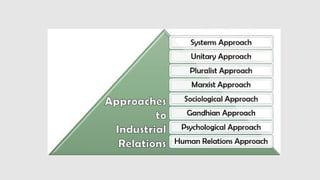
Systems Approach
John Dunlop gave the systems theory of industrial relations in the year 1958. He believed that
every human being belongs to a continuous but independent social system culture which is
responsible for framing his or her actions, behaviour and role.
The industrial relations system was based on three sets of different variables:
1.Actors: By actors here we mean that the individuals or parties involved in the process of
developing sound industrial relations. This variable is denoted by ‘A’.
2.Contexts: The contexts refer to the setup in which the actors perform the given tasks. It
includes the industry markets (M), technologies (T) and the power distribution in the
organization and labour unions(P).
3.Ideology: The similar ideas, mentality or beliefs shared by the actors helps to blend the
system. It can be expressed by the initial (I)
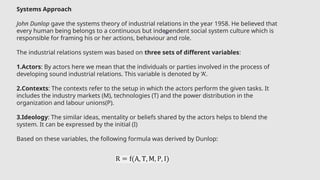
Based on these variables, the following formula was derived by Dunlop:
17
Unitary Approach
As the name suggests, the unitary approach can be seen as a method of bringing together the teamwork,
common objective, individual strategy and mutual efforts of the individuals.
This theory believes that the conflicts are non-permanent malformations, which are a result of improper
management in the organization.
Moreover, if everyone works towards the achievement of the common goals by maintaining peace and
cooperation in the workplace, it will tend to benefit everyone associated with the organization. It also
considered the organizational conflicts resulting in strikes to be useless and destructive.
Aims of the unitary approach are as follows:
•To create a productive, effective and harmonious work environment;
•to develops a trustworthy, open, fair and transparent work culture;
•to create a cordial work environment;
•to restrict the role of the tribunals and other government associations like the trade unions and initiates
direct negotiation between the management and the employees.
Pluralist Approach
The pluralist theory also called the ‘Oxford Approach’, was proposed by Flanders in the year 1970.
This approach explained that the management and the trade unions are the different and robust sub-
groups which unanimously form an organization.
Collective bargaining was considered to be a useful technique for resolving organizational conflicts. Due to
this, the management’s role has transformed from imposition and control; to influencing and coordinating
with the workers.
Following are some of the highlights of this approach:
•The organization should appoint personnel experts and industrial relations specialists to act as mediators
between the management and trade unions. They need to look into the matters of staffing, provide
consultation to the managers and the unions, and negotiate with both the parties in case of conflicts.
•The organization should ensure that the trade unions get recognized and the union leaders or
representatives can perform their duties freely.
•In the case of industrial disputes, the organization can avail the services of the external agent for
settlement of such issues.
•The managers should resolve to a collective bargaining agreement when there is a need for negotiation
and settlement with the trade unions.
The following formula denotes the Flanders pluralist theory:
Where,
‘R‘ is the rules of industrial relations;
‘b‘ is collective bargaining;
‘c‘ is resolving conflicts through collective bargaining.
Marxist Approach
Lenin came up with the concept of a Marxist approach in the year 1978, where he emphasized the social
perspective of the organization.
This theory perceived that the industrial relations depend upon the relationship between the workers (i.e.,
employees or labour) and the owners (i.e., employer or capital).
There exists a class conflict between both the groups to exercise a higher control or influence over each
other.
The assumptions of this approach are as follows:
•Industrial relations are a significant and never-ending source of conflicts under capitalism which cannot be
avoided. However, cases of open disputes are quite unusual.
•Understanding the conceptions of capitalized society, capital accumulation process and the pertaining
social relations, give a better overview of the industrial relations.
•The Marxist theory assumed that the survival of the employees without any work is more crucial than the
survival of the employer without the labours.
21
Sociological Approach
The industries comprise of different human beings who need to communicate with the individuals of other
organizations.
Due to the difference in their attitude, skills, perception, personality, interests, likes and dislikes, needs,
they are usually involved in one or the other conflict.
Even the social mobility and other aspects including transfer, default, group dynamics, stress, norms,
regulations and status of the workers influence their output and the industrial relations.
This theory also emphasizes on the impact of various changes in the work environment (i.e., economic,
technical and political) on the interactions and relationship shared by the employer, employees, institutions
and the government bodies.
Gandhian Approach
The Gandhian approach to industrial relations was proposed by the father of our nation, Mahatma Gandhi or Mohandas
Karamchand Gandhi, who was also a well-known labour leader.
Following are the various features of the trusteeship or Gandhian theory:
1.Gandhi Ji was not against strikes; instead, he gave the following conditions to carry out a favourable strike:
1. The workers or labours can go on a strike only if there is a specific grievance.
2. There should be complete non-violence while carrying out strikes.
3. The ones who are not involved in the strikes should not be tormented.
2.Though Gandhi Ji was not against carrying out strikes, he believed that it should be the last option to which the labour should resort to,
after the failure of all the constitutional and peaceful ways of resolving conflicts and negotiating with the employer.
3.The Gandhian approach illustrated that nature had provided us with human capabilities and different kinds of property. Thus,
such nature’s gift belongs to the whole society and cannot be considered as of personal possession by anyone.
4.The objective of this theory is to adopt non-violent ways to bring in economic parity and material enhancement in a capitalist society.
5.Gandhi Ji perceived that every organization is a joint venture, and the labour should be treated as associates or co-partners with the
shareholders. Moreover, the workers should have proper knowledge of all the business transactions as it is their right.
6.He focussed on increasing the production and believed that the gains should be shared with the employees because of whom it has
been possible.
7.He also emphasized that the industrial disputes and conflicts between the parties should be resolved healthily through interactions,
arbitration and bilateral negotiations.
This theory gained massive popularity and is applied to address disputes and misunderstandings in the organizational setup even today.
Psychological Approach
The psychologists perceived the problem of the industrial relations as a result of the varying perception and
mindset of the key participants, i.e., the employees and the management.
The ‘thematic application test’ was conducted by Mason Harie to understand the behaviour, mindset and
perception of the two significant workgroups, i.e., executive and the union leaders, in a particular situation.
In this test, both the groups were asked to rate and interpret the photograph of an ordinary middle-aged
person, and the results were drastically contrasting. The union leaders perceived the person to be a
‘manager‘ whereas, the executives thought that the person was a ‘union leader‘.
The major interpretations of this test were as follows:
•The general belief of a management representative is entirely different from that of a labour representative.
•Both the management and labour do not consider each other to be trustworthy.
•Even each of these groups considers that the other one lacks emotional and interpersonal attributes.
These contrasting impressions are a result of certain economic as well as non-economic
factors, like values, power, position, personal objectives, recognition, beliefs, education,
social security and income of the individuals.
Also, each of these parties forms a negative image or perception of each other. Due to
which they always find fault in the actions and behaviour of one another.
As a result of the factors mentioned above, there remains a tensed interpersonal relation
leading to conflicts which ultimately hinders the image and interest of the individuals
involved.
Human Relations Approach
The person behind the concept of the human relations approach is Keith Davis.
The organization and the society comprise of human beings who vary in various aspects as their behaviour,
emotions, attitude, mindset and personality. But, they have come together to achieve common
organizational goals and objectives.
The concept of human relations approach underlines the need for making the individuals familiar with the
work situations of the organization and uniting the efforts of the workers.
The purpose is to meet the social, psychological and economic objectives, by enhancing the overall
productivity.
Some of the primary objectives of the human relations approach are as follows:
•To ensure cooperation by promoting the mutual interest of the organization;
•to enhance the productivity of the individuals;
•to satisfy the psychological, social and economic needs of the employees.
This theory focused on enhancing the level of efficiency, worker’s morale and job satisfaction by
applying specific techniques or tools and policies.
The human relations approach highlighted a technique for enforcing proper control over the work
environment by forming small workgroups and at the same time eliminating the hurdles of sound labour-
management relations.

Industrial relations and labour legislation

  • 1.
  • 2.
    2 INDUSTRIAL RELATION MEANING Theterm industrial relations comprises two words, i.E. ‘Industry’ and ‘relations’. The term ‘industry’ refers to any productive activity in the organisation in which the employees are engaged. On the other hand, the term ‘relations’ refers to the relationship, which exists within the industry between the management and the employees. The relationship between management and employees within the organisation within the organisational settings is defined by industrial relations. Industrial relations emerge directly or indirectly from management-trade union relationships.
  • 3.
    “Industrial relation isan art of living together for the purpose of production” - J. Henry According to the international labour organisation (ILO), industrial relations deals with relationships between either state and employers and workers organisations or the relationship between the occupation organisation themselves.
  • 4.
    Characteristics of IndustrialRelation Following are the significant features of industrial relations: •Industrial relations are the result of employment relationships in industrial enterprises. •Industrial relations introduced the concept and method of balancing and cooperating. •Industrial relations formulate rules and regulations to maintain harmonious relations. •The intervention of the Government to shape the industrial relation is made through laws, agreements, rules, charters, etc. •Industrial relations incorporate both individual relations and collective relations. •Several parties play a role in industrial relations. The main parties are employees and their organisation, employers and their association, and government.
  • 5.
    OBJECTIVESOF INDUSTRIALRELATION • Toestablish industrial peace. • To safeguard the interests of both workers and management. • To avoid industrial disputes. • To raise the production capacity. • To establish industrial democracy. • To minimise the labour turnover rate and absenteeism. • To safeguard the workers economic and social interests. • To contribute to the economic development of the country through productivity. • To establish a full employment situation. • To minimise strikes, lockout, Heroes, etc., by providing good working conditions and fair wages to the workers. 5
  • 6.
    IMPORTANCE OF INDUSTRIALRELATIONS 6 •Promotes Democracy: •Industrial relations means employing collective bargaining to resolve issues faced by workers. This collective bargaining is generally employed through cooperation and mutual agreement amongst all the affected parties, i.e., democracy, management, and employees unions. This enables an organisation to establish industrial democracy, which eventually motivates the workers to perform their best to the growth and prosperity of the organisation. •High Morale: •Good industrial relations enhance the morale of the employees and motivate the workers to work more efficiently. •Avoid Conflicts Between Management And Union: • Industrial relations minimise issues between unions and management. This is because industrial relations incorporate setting up machinery to resolve issues faced by management and employees through mutual agreement to which both these parties are bound. This results in ignoring any unfair practices that could lead to major conflicts between employers and trade unions.
  • 7.
    7 •Minimises Wastage: • SatisfactoryIndustrial relations are maintained on the basis of co-operation and recognition of each other in the department. It helps to minimise wastage of material, manpower, and costs. •Economic Growth And Development: •Good and harmonious industrial relations result in increased efficiency and hence prosperity, which in turn minimise turnover and other tangible benefits to the organisation. This promotes economic growth and development.
  • 8.
    8 • Uninterrupted Production- There is uninterrupted flow of income for all. This means, continuous employment for all from manager to workers. • Reduction in Industrial Disputes - Good industrial relation reduce the industrial disputes. Ex- Strikes, lockouts, go-slow tactics, gherao and grievances • High Morale - Employees work with great zeal with the feeling in mind that the interest of employer and employees is one and the same, i.e. to increase production. IMPORTANCE
  • 9.
    9 • Mental Revolution– The main object of industrial relation is a complete mental revolution of workers and employees. • New Programmes – New programmes for workers development are introduced in an atmosphere of peace such as training facilities, labor welfare facilities etc. • Reduced Wastage - Wastages of man, material and machines are reduced to the minimum and thus national interest is protected. CONTD…
  • 10.
    FUNCTIONS OF INDUSTRIALRELATIONS •To establish communication between workers and management to maintain the sound relationship between the two. •To establish support between managers and employees. •To ensure the creative contribution of trade unions to avoid industrial conflicts. •To safeguard the interests of workers and the management, •To avoid an unhealthy and unethical atmosphere in an industry. •To formulate such considerations that may promote understanding, creativity, and cooperativeness to enhance industrial productivity. •To ensure better workers’ participation.
  • 11.
    SCOPE / CONCEPTOF INDUSTRIAL RELATIONS 1. Employment Relationship: Industrial relations focus on understanding and managing the relationship between employers and employees. This includes examining the terms and conditions of employment, contractual obligations, rights and responsibilities, and the dynamics of power and authority within the workplace. 2. Collective Bargaining: Collective bargaining is a central element of industrial relations. It involves negotiations between representatives of employees (such as labor unions) and employers to determine employment conditions, including wages, working hours, benefits, and workplace policies. The scope of industrial relations covers the processes and outcomes of collective bargaining. 3. Labor Unions and Employee Representation: Industrial relations involve the study of labor unions and other forms of employee representation. This includes understanding the formation, organization, and activities of unions, as well as their role in representing and advocating for the interests of employees. The scope also encompasses the relationship between labor unions and employers, including the dynamics of negotiation and dispute resolution. 4. Workplace Conflict Resolution: Industrial relations address the management of workplace conflicts and disputes. This includes understanding the causes of conflicts, developing mechanisms for resolution, and implementing processes such as grievance handling, mediation, arbitration, or legal intervention. Conflict resolution is essential for maintaining positive labor relations and fostering a productive work environment. 5. Employee Rights and Protections: The scope of industrial relations includes the recognition and protection of employee rights. This involves understanding and promoting fair employment practices, ensuring compliance with labor laws and regulations, and addressing issues related to workplace discrimination, health and safety, freedom of association, and other rights.
  • 12.
    6. Employment Legislationand Regulation: Industrial relations consider the legal framework governing the employment relationship. This includes studying employment laws and regulations, understanding their impact on labor relations, and ensuring compliance with legal requirements. Industrial relations professionals often play a role in interpreting and applying employment legislation. 7. Employee Engagement and Well-being: Industrial relations encompass the study of employee engagement, job satisfaction, and well-being. It involves examining factors that contribute to positive employee experiences, such as effective management practices, communication channels, recognition and rewards, career development opportunities, work-life balance, and health and safety measures. 8. Social and Economic Context: Industrial relations cannot be understood in isolation from the broader social and economic context. It involves considering factors such as economic trends, technological advancements, globalization, demographic changes, and societal values that influence the employment relationship and labor market dynamics.
  • 13.
    Factors that affectIndustrial Relations 1.Institutional Factors – like state policy, labour laws, collective bargaining agreements, labour unions, employers’ federations etc 2. Economic Factors – like economic organizations( socialist, communist, capitalist), type of ownership (individual, company – domestic, MNC, government, cooperative ownership), source of labour supply, disparity of wages between groups, level of unemployment etc 3. Social Factors – These factors like caste, creed, status are loosing importance with the acceleration of industrialization but cannot be ignored. 4. Technological Factors – like work methods, type of technology used, etc as these factors influence employment status, wage level, etc 5. Psychological Factors – like owners’ attitude, perception of workforce, workers’ attitude, their motivation, morale, interest, dissatisfaction etc has an important impact in the industrial relations 6. Political Factors – like system of government, political philosophy, attitude of government towards labour problems etc. IR are largely shaped by the amount of involvement of political parties in trade union activities. 7. Enterprise related Factors – like style of management, its values, organizational climate, competition, adaptability to changes, HR policies etc 8. Global Factors – like international relations, global conflicts, economic and trading policies of power blocks, international trade agreements, International labour agreements.
  • 14.
    ACTORS OF IR Thereare three principal actors • The workers and there trade union. • The employee and there association. • Government and there agencies.
  • 16.
    16 Systems Approach John Dunlopgave the systems theory of industrial relations in the year 1958. He believed that every human being belongs to a continuous but independent social system culture which is responsible for framing his or her actions, behaviour and role. The industrial relations system was based on three sets of different variables: 1.Actors: By actors here we mean that the individuals or parties involved in the process of developing sound industrial relations. This variable is denoted by ‘A’. 2.Contexts: The contexts refer to the setup in which the actors perform the given tasks. It includes the industry markets (M), technologies (T) and the power distribution in the organization and labour unions(P). 3.Ideology: The similar ideas, mentality or beliefs shared by the actors helps to blend the system. It can be expressed by the initial (I) Based on these variables, the following formula was derived by Dunlop:
  • 17.
    17 Unitary Approach As thename suggests, the unitary approach can be seen as a method of bringing together the teamwork, common objective, individual strategy and mutual efforts of the individuals. This theory believes that the conflicts are non-permanent malformations, which are a result of improper management in the organization. Moreover, if everyone works towards the achievement of the common goals by maintaining peace and cooperation in the workplace, it will tend to benefit everyone associated with the organization. It also considered the organizational conflicts resulting in strikes to be useless and destructive. Aims of the unitary approach are as follows: •To create a productive, effective and harmonious work environment; •to develops a trustworthy, open, fair and transparent work culture; •to create a cordial work environment; •to restrict the role of the tribunals and other government associations like the trade unions and initiates direct negotiation between the management and the employees.
  • 18.
    Pluralist Approach The pluralisttheory also called the ‘Oxford Approach’, was proposed by Flanders in the year 1970. This approach explained that the management and the trade unions are the different and robust sub- groups which unanimously form an organization. Collective bargaining was considered to be a useful technique for resolving organizational conflicts. Due to this, the management’s role has transformed from imposition and control; to influencing and coordinating with the workers. Following are some of the highlights of this approach: •The organization should appoint personnel experts and industrial relations specialists to act as mediators between the management and trade unions. They need to look into the matters of staffing, provide consultation to the managers and the unions, and negotiate with both the parties in case of conflicts. •The organization should ensure that the trade unions get recognized and the union leaders or representatives can perform their duties freely. •In the case of industrial disputes, the organization can avail the services of the external agent for settlement of such issues. •The managers should resolve to a collective bargaining agreement when there is a need for negotiation and settlement with the trade unions.
  • 19.
    The following formuladenotes the Flanders pluralist theory: Where, ‘R‘ is the rules of industrial relations; ‘b‘ is collective bargaining; ‘c‘ is resolving conflicts through collective bargaining.
  • 20.
    Marxist Approach Lenin cameup with the concept of a Marxist approach in the year 1978, where he emphasized the social perspective of the organization. This theory perceived that the industrial relations depend upon the relationship between the workers (i.e., employees or labour) and the owners (i.e., employer or capital). There exists a class conflict between both the groups to exercise a higher control or influence over each other. The assumptions of this approach are as follows: •Industrial relations are a significant and never-ending source of conflicts under capitalism which cannot be avoided. However, cases of open disputes are quite unusual. •Understanding the conceptions of capitalized society, capital accumulation process and the pertaining social relations, give a better overview of the industrial relations. •The Marxist theory assumed that the survival of the employees without any work is more crucial than the survival of the employer without the labours.
  • 21.
    21 Sociological Approach The industriescomprise of different human beings who need to communicate with the individuals of other organizations. Due to the difference in their attitude, skills, perception, personality, interests, likes and dislikes, needs, they are usually involved in one or the other conflict. Even the social mobility and other aspects including transfer, default, group dynamics, stress, norms, regulations and status of the workers influence their output and the industrial relations. This theory also emphasizes on the impact of various changes in the work environment (i.e., economic, technical and political) on the interactions and relationship shared by the employer, employees, institutions and the government bodies.
  • 22.
    Gandhian Approach The Gandhianapproach to industrial relations was proposed by the father of our nation, Mahatma Gandhi or Mohandas Karamchand Gandhi, who was also a well-known labour leader. Following are the various features of the trusteeship or Gandhian theory: 1.Gandhi Ji was not against strikes; instead, he gave the following conditions to carry out a favourable strike: 1. The workers or labours can go on a strike only if there is a specific grievance. 2. There should be complete non-violence while carrying out strikes. 3. The ones who are not involved in the strikes should not be tormented. 2.Though Gandhi Ji was not against carrying out strikes, he believed that it should be the last option to which the labour should resort to, after the failure of all the constitutional and peaceful ways of resolving conflicts and negotiating with the employer. 3.The Gandhian approach illustrated that nature had provided us with human capabilities and different kinds of property. Thus, such nature’s gift belongs to the whole society and cannot be considered as of personal possession by anyone. 4.The objective of this theory is to adopt non-violent ways to bring in economic parity and material enhancement in a capitalist society. 5.Gandhi Ji perceived that every organization is a joint venture, and the labour should be treated as associates or co-partners with the shareholders. Moreover, the workers should have proper knowledge of all the business transactions as it is their right. 6.He focussed on increasing the production and believed that the gains should be shared with the employees because of whom it has been possible. 7.He also emphasized that the industrial disputes and conflicts between the parties should be resolved healthily through interactions, arbitration and bilateral negotiations. This theory gained massive popularity and is applied to address disputes and misunderstandings in the organizational setup even today.
  • 23.
    Psychological Approach The psychologistsperceived the problem of the industrial relations as a result of the varying perception and mindset of the key participants, i.e., the employees and the management. The ‘thematic application test’ was conducted by Mason Harie to understand the behaviour, mindset and perception of the two significant workgroups, i.e., executive and the union leaders, in a particular situation. In this test, both the groups were asked to rate and interpret the photograph of an ordinary middle-aged person, and the results were drastically contrasting. The union leaders perceived the person to be a ‘manager‘ whereas, the executives thought that the person was a ‘union leader‘. The major interpretations of this test were as follows: •The general belief of a management representative is entirely different from that of a labour representative. •Both the management and labour do not consider each other to be trustworthy. •Even each of these groups considers that the other one lacks emotional and interpersonal attributes.
  • 24.
    These contrasting impressionsare a result of certain economic as well as non-economic factors, like values, power, position, personal objectives, recognition, beliefs, education, social security and income of the individuals. Also, each of these parties forms a negative image or perception of each other. Due to which they always find fault in the actions and behaviour of one another. As a result of the factors mentioned above, there remains a tensed interpersonal relation leading to conflicts which ultimately hinders the image and interest of the individuals involved.
  • 25.
    Human Relations Approach Theperson behind the concept of the human relations approach is Keith Davis. The organization and the society comprise of human beings who vary in various aspects as their behaviour, emotions, attitude, mindset and personality. But, they have come together to achieve common organizational goals and objectives. The concept of human relations approach underlines the need for making the individuals familiar with the work situations of the organization and uniting the efforts of the workers. The purpose is to meet the social, psychological and economic objectives, by enhancing the overall productivity. Some of the primary objectives of the human relations approach are as follows: •To ensure cooperation by promoting the mutual interest of the organization; •to enhance the productivity of the individuals; •to satisfy the psychological, social and economic needs of the employees. This theory focused on enhancing the level of efficiency, worker’s morale and job satisfaction by applying specific techniques or tools and policies. The human relations approach highlighted a technique for enforcing proper control over the work environment by forming small workgroups and at the same time eliminating the hurdles of sound labour- management relations.