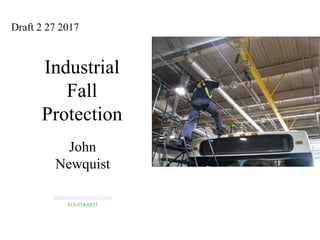
Industrial
Fall
Protection
John
Newquist
johnanewquist@gmail.com
815-354-6853
Draft 2 27 2017
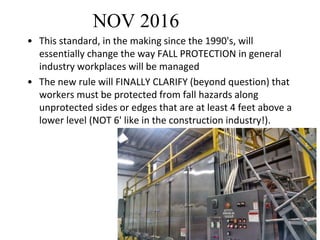
NOV 2016
• This standard, in the making since the 1990's, will
essentially change the way FALL PROTECTION in general
industry workplaces will be managed
• The new rule will FINALLY CLARIFY (beyond question) that
workers must be protected from fall hazards along
unprotected sides or edges that are at least 4 feet above a
lower level (NOT 6' like in the construction industry!).
2
Effective Dates
• Effective January 17,
2017
• Most of the rule will
become effective 60
days after publication in
the Federal Register, but
some provisions have
delayed effective dates,
including:
• Ensuring exposed
workers are trained on
fall hazards (6 months)
• July 17 2017
Effective Dates
• Inspecting and certifying
permanent anchorages for rope
descent systems (1 year),
• Installing personal fall arrest or
ladder safety systems on new
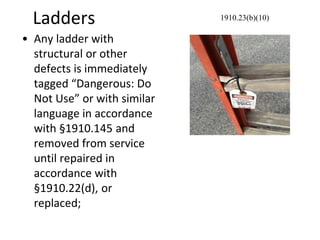
fixed ladders over 24 feet and on
replacement ladders/ladder
sections, including fixed ladders
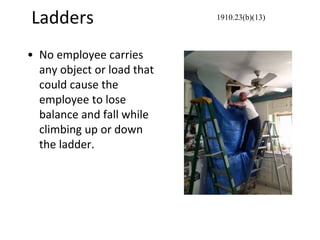
on outdoor advertising structures
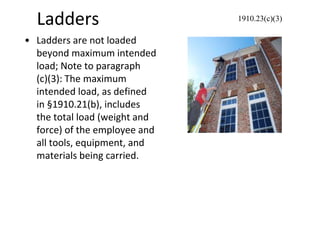
(2 years),
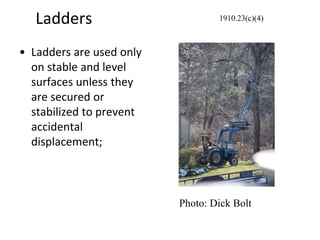
Effective Dates
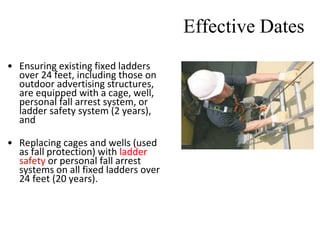
• Ensuring existing fixed ladders
over 24 feet, including those on
outdoor advertising structures,
are equipped with a cage, well,
personal fall arrest system, or
ladder safety system (2 years),
and
• Replacing cages and wells (used
as fall protection) with ladder
safety or personal fall arrest
systems on all fixed ladders over
24 feet (20 years).
Definitions
(Most in back of presentation)
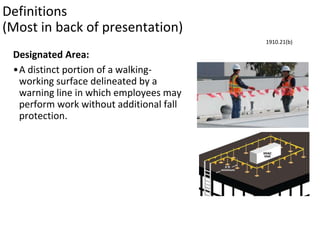
Designated Area:
•A distinct portion of a walking-
working surface delineated by a
warning line in which employees may
perform work without additional fall
protection.
1910.21(b)
Definitions
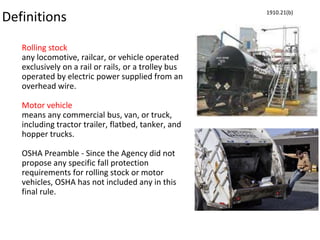
Rolling stock
any locomotive, railcar, or vehicle operated
exclusively on a rail or rails, or a trolley bus
operated by electric power supplied from an
overhead wire.
Motor vehicle
means any commercial bus, van, or truck,
including tractor trailer, flatbed, tanker, and
hopper trucks.
OSHA Preamble - Since the Agency did not
propose any specific fall protection
requirements for rolling stock or motor
vehicles, OSHA has not included any in this
final rule.
1910.21(b)
Definitions
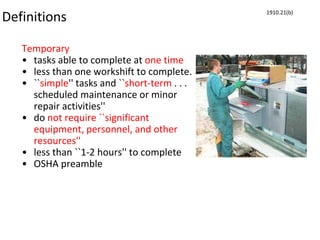
Temporary
• tasks able to complete at one time
• less than one workshift to complete.
• ``simple'' tasks and ``short-term . . .
scheduled maintenance or minor
repair activities''
• do not require ``significant
equipment, personnel, and other
resources''
• less than ``1-2 hours'' to complete
• OSHA preamble
1910.21(b)
Definitions
Infrequent
• task or job is performed only on occasion, when
needed (e.g., equipment breakdown),
• on an occasional basis, or
• at sporadic or irregular intervals.
• Infrequent tasks include work activities such as
annual maintenance or servicing of equipment,
monthly or quarterly replacement of batteries or
HVAC filters, and responding to equipment
outage or breakdown.
• the frequency of exposure to fall hazards is very
limited.
• tasks performed or repeated on a daily, routine
or regular basis are not infrequent activities
within the meaning of the final rule.
• A task may be considered infrequent when it is
performed once a month, once a year, or when
needed.
• OSHA preamble
1910.21(b)
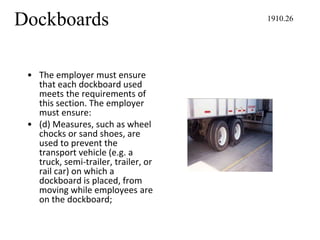
Dockboards
• The employer must ensure
that each dockboard used
meets the requirements of
this section. The employer
must ensure:
• (d) Measures, such as wheel
chocks or sand shoes, are
used to prevent the
transport vehicle (e.g. a
truck, semi-trailer, trailer, or
rail car) on which a
dockboard is placed, from
moving while employees are
on the dockboard;
1910.26
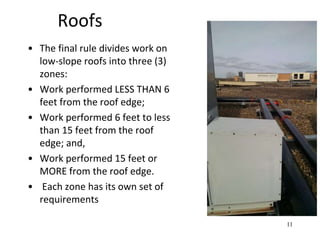
Roofs
• The final rule divides work on
low-slope roofs into three (3)
zones:
• Work performed LESS THAN 6
feet from the roof edge;
• Work performed 6 feet to less
than 15 feet from the roof
edge; and,
• Work performed 15 feet or
MORE from the roof edge.
• Each zone has its own set of
requirements
11
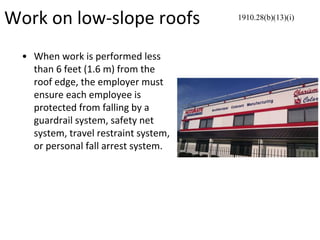
Work on low-slope roofs
• When work is performed less
than 6 feet (1.6 m) from the
roof edge, the employer must
ensure each employee is
protected from falling by a
guardrail system, safety net
system, travel restraint system,
or personal fall arrest system.
1910.28(b)(13)(i)
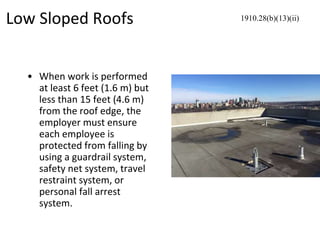
Low Sloped Roofs
• When work is performed
at least 6 feet (1.6 m) but
less than 15 feet (4.6 m)
from the roof edge, the
employer must ensure
each employee is
protected from falling by
using a guardrail system,
safety net system, travel
restraint system, or
personal fall arrest
system.
1910.28(b)(13)(ii)
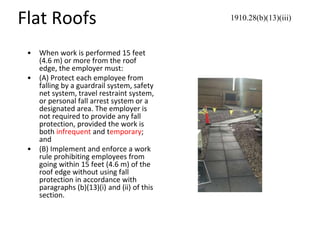
Flat Roofs
• When work is performed 15 feet
(4.6 m) or more from the roof
edge, the employer must:
• (A) Protect each employee from
falling by a guardrail system, safety
net system, travel restraint system,
or personal fall arrest system or a
designated area. The employer is
not required to provide any fall
protection, provided the work is
both infrequent and temporary;
and
• (B) Implement and enforce a work
rule prohibiting employees from
going within 15 feet (4.6 m) of the
roof edge without using fall
protection in accordance with
paragraphs (b)(13)(i) and (ii) of this
section.
1910.28(b)(13)(iii)
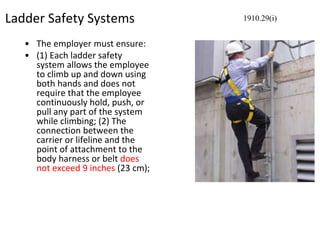
Ladder Safety Systems
• The employer must ensure:
• (1) Each ladder safety
system allows the employee
to climb up and down using
both hands and does not
require that the employee
continuously hold, push, or
pull any part of the system
while climbing; (2) The
connection between the
carrier or lifeline and the
point of attachment to the
body harness or belt does
not exceed 9 inches (23 cm);
1910.29(i)
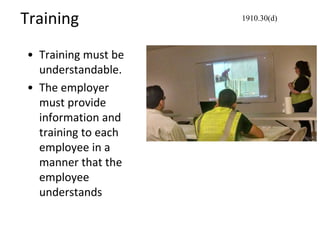
Training
• Training must be
understandable.
• The employer
must provide
information and
training to each
employee in a
manner that the
employee
understands
1910.30(d)
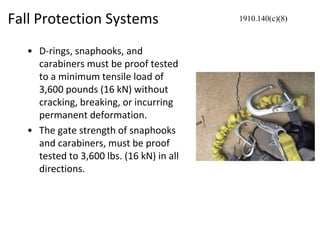
Fall Protection Systems
• D-rings, snaphooks, and
carabiners must be proof tested
to a minimum tensile load of
3,600 pounds (16 kN) without
cracking, breaking, or incurring
permanent deformation.
• The gate strength of snaphooks
and carabiners, must be proof
tested to 3,600 lbs. (16 kN) in all
directions.
1910.140(c)(8)
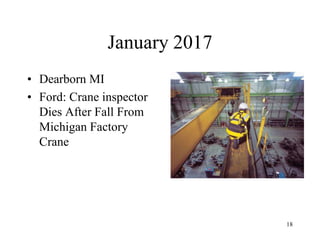
January 2017
• Dearborn MI
• Ford: Crane inspector
Dies After Fall From
Michigan Factory
Crane
18
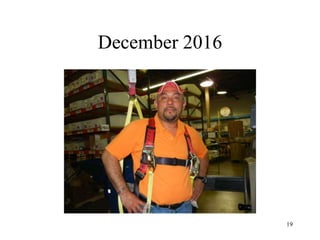
December 2016
19
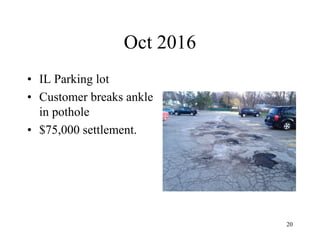
Oct 2016
• IL Parking lot
• Customer breaks ankle
in pothole
• $75,000 settlement.
20
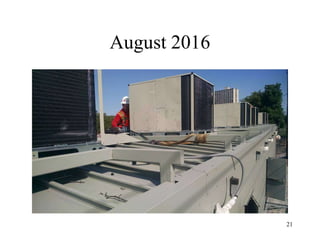
August 2016
21
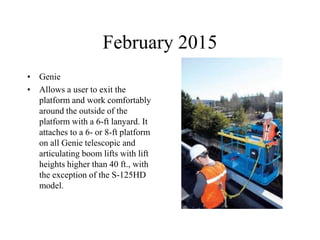
February 2015
• Genie
• Allows a user to exit the
platform and work comfortably
around the outside of the
platform with a 6-ft lanyard. It
attaches to a 6- or 8-ft platform
on all Genie telescopic and
articulating boom lifts with lift
heights higher than 40 ft., with
the exception of the S-125HD
model.
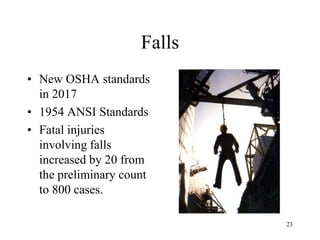
Falls
• New OSHA standards
in 2017
• 1954 ANSI Standards
• Fatal injuries
involving falls
increased by 20 from
the preliminary count
to 800 cases.
23
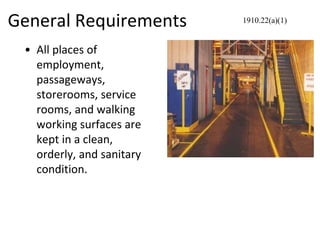
General Requirements
• All places of
employment,
passageways,
storerooms, service
rooms, and walking
working surfaces are
kept in a clean,
orderly, and sanitary
condition.
1910.22(a)(1)
General Requirements
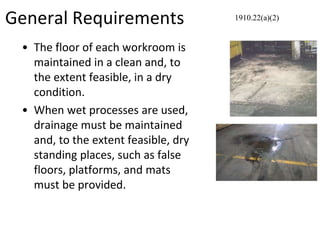
• The floor of each workroom is
maintained in a clean and, to
the extent feasible, in a dry
condition.
• When wet processes are used,
drainage must be maintained
and, to the extent feasible, dry
standing places, such as false
floors, platforms, and mats
must be provided.
1910.22(a)(2)
General Requirements
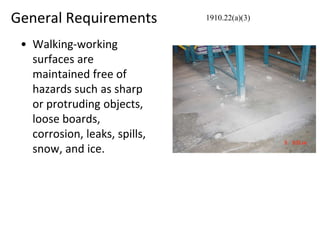
• Walking-working
surfaces are
maintained free of
hazards such as sharp
or protruding objects,
loose boards,
corrosion, leaks, spills,
snow, and ice.
1910.22(a)(3)
Loads
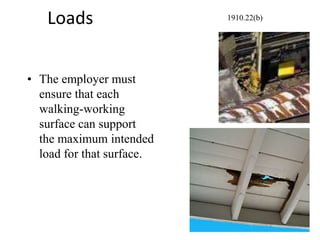
• The employer must
ensure that each
walking-working
surface can support
the maximum intended
load for that surface.
1910.22(b)
Access and Egress
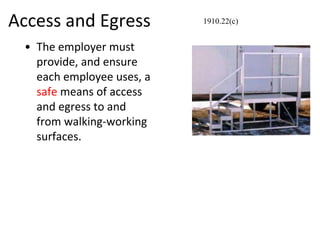
• The employer must
provide, and ensure
each employee uses, a
safe means of access
and egress to and
from walking-working
surfaces.
1910.22(c)
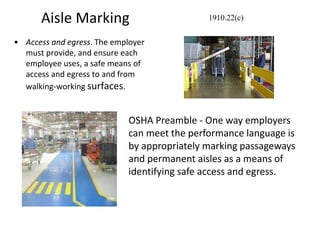
Aisle Marking
• Access and egress. The employer
must provide, and ensure each
employee uses, a safe means of
access and egress to and from
walking-working surfaces.
1910.22(c)
OSHA Preamble - One way employers
can meet the performance language is
by appropriately marking passageways
and permanent aisles as a means of
identifying safe access and egress.
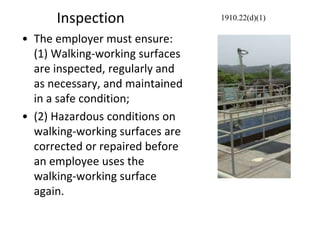
Inspection
• The employer must ensure:
(1) Walking-working surfaces
are inspected, regularly and
as necessary, and maintained
in a safe condition;
• (2) Hazardous conditions on
walking-working surfaces are
corrected or repaired before
an employee uses the
walking-working surface
again.
1910.22(d)(1)
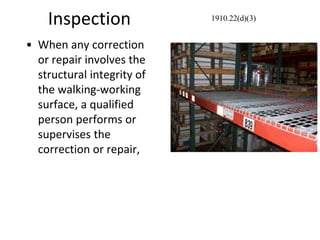
Inspection
• When any correction
or repair involves the
structural integrity of
the walking-working
surface, a qualified
person performs or
supervises the
correction or repair,
1910.22(d)(3)
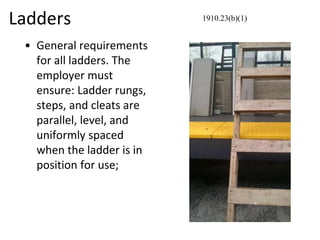
Ladders
• General requirements
for all ladders. The
employer must
ensure: Ladder rungs,
steps, and cleats are
parallel, level, and
uniformly spaced
when the ladder is in
position for use;
1910.23(b)(1)
Ladders
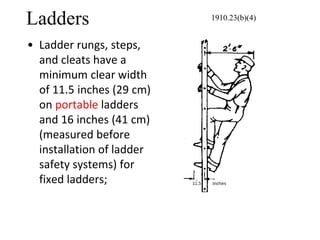
• Ladder rungs, steps,
and cleats have a
minimum clear width
of 11.5 inches (29 cm)
on portable ladders
and 16 inches (41 cm)
(measured before
installation of ladder
safety systems) for
fixed ladders;
1910.23(b)(4)
Ladders
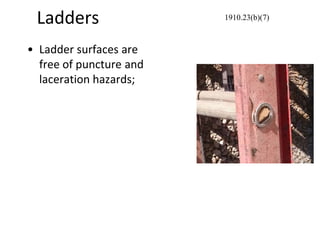
• Ladder surfaces are
free of puncture and
laceration hazards;
1910.23(b)(7)
Ladders
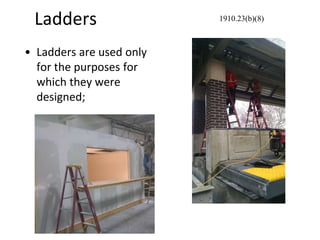
• Ladders are used only
for the purposes for
which they were
designed;
1910.23(b)(8)
Ladders
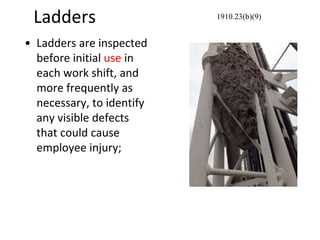
• Ladders are inspected
before initial use in
each work shift, and
more frequently as
necessary, to identify
any visible defects
that could cause
employee injury;
1910.23(b)(9)
Ladders
• Any ladder with
structural or other
defects is immediately
tagged “Dangerous: Do
Not Use” or with similar
language in accordance
with §1910.145 and
removed from service
until repaired in
accordance with
§1910.22(d), or
replaced;
1910.23(b)(10)
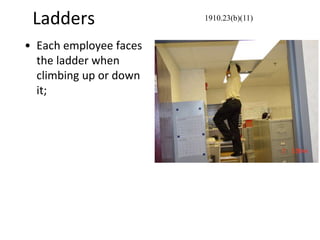
Ladders
• Each employee faces
the ladder when
climbing up or down
it;
1910.23(b)(11)
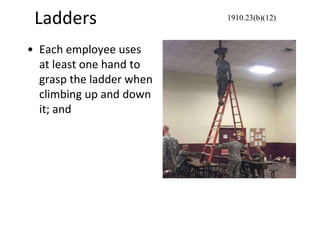
Ladders
• Each employee uses
at least one hand to
grasp the ladder when
climbing up and down
it; and
1910.23(b)(12)
Ladders
• No employee carries
any object or load that
could cause the
employee to lose
balance and fall while
climbing up or down
the ladder.
1910.23(b)(13)
Ladders
• Ladders are not loaded
beyond maximum intended
load; Note to paragraph
(c)(3): The maximum
intended load, as defined
in §1910.21(b), includes
the total load (weight and
force) of the employee and
all tools, equipment, and
materials being carried.
1910.23(c)(3)
Ladders
• Ladders are used only
on stable and level
surfaces unless they
are secured or
stabilized to prevent
accidental
displacement;
1910.23(c)(4)
Photo: Dick Bolt
Ladders
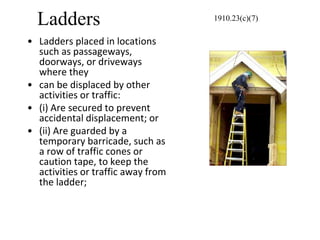
• Ladders placed in locations
such as passageways,
doorways, or driveways
where they
• can be displaced by other
activities or traffic:
• (i) Are secured to prevent
accidental displacement; or
• (ii) Are guarded by a
temporary barricade, such as
a row of traffic cones or
caution tape, to keep the
activities or traffic away from
the ladder;
1910.23(c)(7)
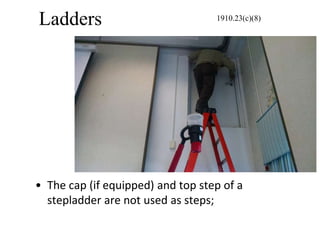
Ladders
• The cap (if equipped) and top step of a
stepladder are not used as steps;
1910.23(c)(8)
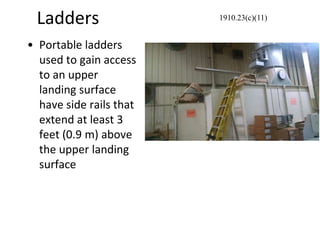
Ladders
• Portable ladders
used to gain access
to an upper
landing surface
have side rails that
extend at least 3
feet (0.9 m) above
the upper landing
surface
1910.23(c)(11)
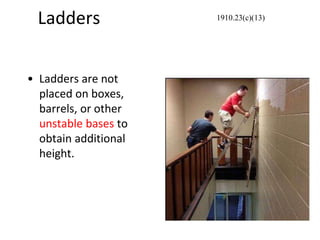
Ladders
• Ladders are not
placed on boxes,
barrels, or other
unstable bases to
obtain additional
height.
1910.23(c)(13)
Fixed Ladders
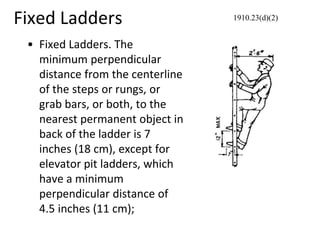
• Fixed Ladders. The
minimum perpendicular
distance from the centerline
of the steps or rungs, or
grab bars, or both, to the
nearest permanent object in
back of the ladder is 7
inches (18 cm), except for
elevator pit ladders, which
have a minimum
perpendicular distance of
4.5 inches (11 cm);
1910.23(d)(2)
Fixed Ladders
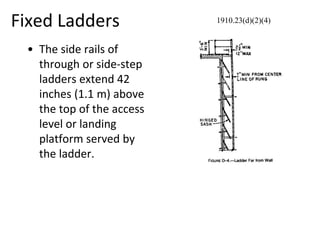
• The side rails of
through or side-step
ladders extend 42
inches (1.1 m) above
the top of the access
level or landing
platform served by
the ladder.
1910.23(d)(2)(4)
Fixed Ladders
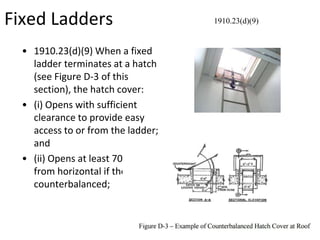
• 1910.23(d)(9) When a fixed
ladder terminates at a hatch
(see Figure D-3 of this
section), the hatch cover:
• (i) Opens with sufficient
clearance to provide easy
access to or from the ladder;
and
• (ii) Opens at least 70 degrees
from horizontal if the hatch is
counterbalanced;
1910.23(d)(9)
Fixed Ladders
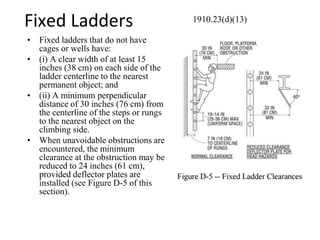
• Fixed ladders that do not have
cages or wells have:
• (i) A clear width of at least 15
inches (38 cm) on each side of the
ladder centerline to the nearest
permanent object; and
• (ii) A minimum perpendicular
distance of 30 inches (76 cm) from
the centerline of the steps or rungs
to the nearest object on the
climbing side.
• When unavoidable obstructions are
encountered, the minimum
clearance at the obstruction may be
reduced to 24 inches (61 cm),
provided deflector plates are
installed (see Figure D-5 of this
section).
1910.23(d)(13)
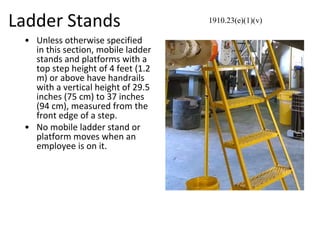
Ladder Stands
• Unless otherwise specified
in this section, mobile ladder
stands and platforms with a
top step height of 4 feet (1.2
m) or above have handrails
with a vertical height of 29.5
inches (75 cm) to 37 inches
(94 cm), measured from the
front edge of a step.
• No mobile ladder stand or
platform moves when an
employee is on it.
1910.23(e)(1)(v)
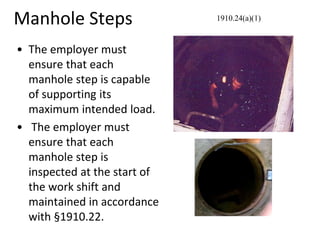
Manhole Steps
• The employer must
ensure that each
manhole step is capable
of supporting its
maximum intended load.
• The employer must
ensure that each
manhole step is
inspected at the start of
the work shift and
maintained in accordance
with §1910.22.
1910.24(a)(1)
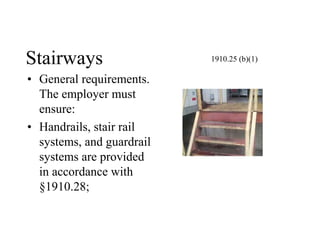
Stairways
• General requirements.
The employer must
ensure:
• Handrails, stair rail
systems, and guardrail
systems are provided
in accordance with
§1910.28;
1910.25 (b)(1)
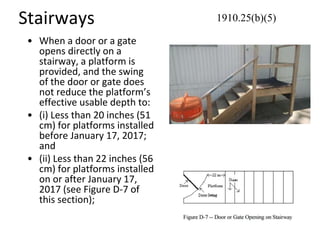
Stairways
• When a door or a gate
opens directly on a
stairway, a platform is
provided, and the swing
of the door or gate does
not reduce the platform’s
effective usable depth to:
• (i) Less than 20 inches (51
cm) for platforms installed
before January 17, 2017;
and
• (ii) Less than 22 inches (56
cm) for platforms installed
on or after January 17,
2017 (see Figure D-7 of
this section);
1910.25(b)(5)
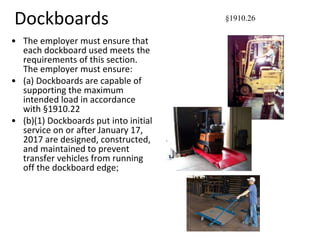
Dockboards
• The employer must ensure that
each dockboard used meets the
requirements of this section.
The employer must ensure:
• (a) Dockboards are capable of
supporting the maximum
intended load in accordance
with §1910.22
• (b)(1) Dockboards put into initial
service on or after January 17,
2017 are designed, constructed,
and maintained to prevent
transfer vehicles from running
off the dockboard edge;
§1910.26
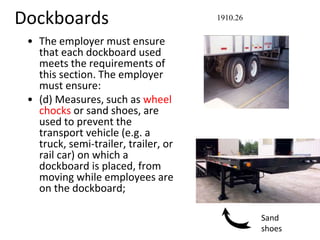
Dockboards
• The employer must ensure
that each dockboard used
meets the requirements of
this section. The employer
must ensure:
• (d) Measures, such as wheel
chocks or sand shoes, are
used to prevent the
transport vehicle (e.g. a
truck, semi-trailer, trailer, or
rail car) on which a
dockboard is placed, from
moving while employees are
on the dockboard;
1910.26
Sand
shoes
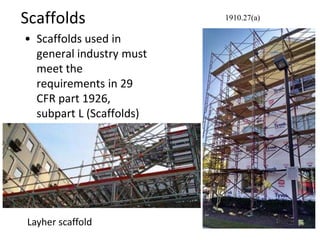
Scaffolds
• Scaffolds used in
general industry must
meet the
requirements in 29
CFR part 1926,
subpart L (Scaffolds)
1910.27(a)
Layher scaffold
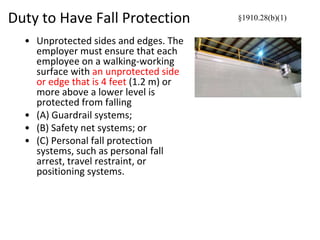
Duty to Have Fall Protection
• Unprotected sides and edges. The
employer must ensure that each
employee on a walking-working
surface with an unprotected side
or edge that is 4 feet (1.2 m) or
more above a lower level is
protected from falling
• (A) Guardrail systems;
• (B) Safety net systems; or
• (C) Personal fall protection
systems, such as personal fall
arrest, travel restraint, or
positioning systems.
§1910.28(b)(1)
Duty to Have Fall Protection
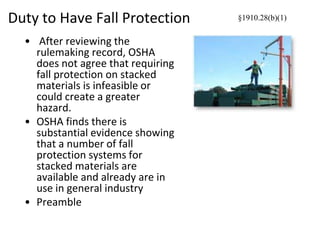
• After reviewing the
rulemaking record, OSHA
does not agree that requiring
fall protection on stacked
materials is infeasible or
could create a greater
hazard.
• OSHA finds there is
substantial evidence showing
that a number of fall
protection systems for
stacked materials are
available and already are in
use in general industry
• Preamble
§1910.28(b)(1)
Holes
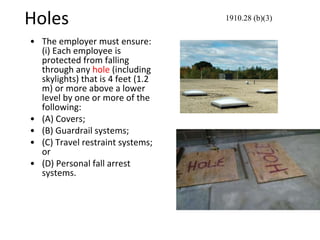
• The employer must ensure:
(i) Each employee is
protected from falling
through any hole (including
skylights) that is 4 feet (1.2
m) or more above a lower
level by one or more of the
following:
• (A) Covers;
• (B) Guardrail systems;
• (C) Travel restraint systems;
or
• (D) Personal fall arrest
systems.
1910.28 (b)(3)
Holes
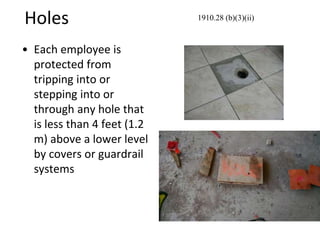
• Each employee is
protected from
tripping into or
stepping into or
through any hole that
is less than 4 feet (1.2
m) above a lower level
by covers or guardrail
systems
1910.28 (b)(3)(ii)
Designated Areas
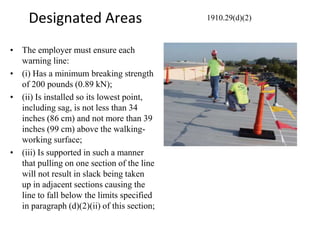
• The employer must ensure each
warning line:
• (i) Has a minimum breaking strength
of 200 pounds (0.89 kN);
• (ii) Is installed so its lowest point,
including sag, is not less than 34
inches (86 cm) and not more than 39
inches (99 cm) above the walking-
working surface;
• (iii) Is supported in such a manner
that pulling on one section of the line
will not result in slack being taken
up in adjacent sections causing the
line to fall below the limits specified
in paragraph (d)(2)(ii) of this section;
1910.29(d)(2)
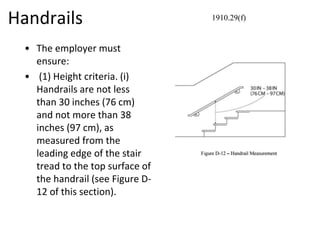
Handrails
• The employer must
ensure:
• (1) Height criteria. (i)
Handrails are not less
than 30 inches (76 cm)
and not more than 38
inches (97 cm), as
measured from the
leading edge of the stair
tread to the top surface of
the handrail (see Figure D-
12 of this section).
1910.29(f)
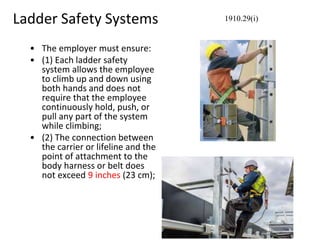
Ladder Safety Systems
• The employer must ensure:
• (1) Each ladder safety
system allows the employee
to climb up and down using
both hands and does not
require that the employee
continuously hold, push, or
pull any part of the system
while climbing;
• (2) The connection between
the carrier or lifeline and the
point of attachment to the
body harness or belt does
not exceed 9 inches (23 cm);
1910.29(i)
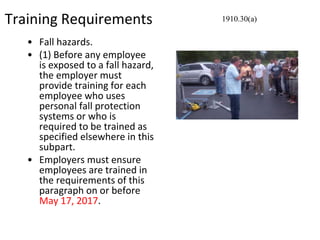
Training Requirements
• Fall hazards.
• (1) Before any employee
is exposed to a fall hazard,
the employer must
provide training for each
employee who uses
personal fall protection
systems or who is
required to be trained as
specified elsewhere in this
subpart.
• Employers must ensure
employees are trained in
the requirements of this
paragraph on or before
May 17, 2017.
1910.30(a)
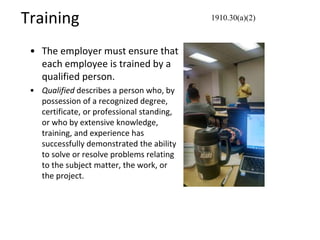
Training
• The employer must ensure that
each employee is trained by a
qualified person.
• Qualified describes a person who, by
possession of a recognized degree,
certificate, or professional standing,
or who by extensive knowledge,
training, and experience has
successfully demonstrated the ability
to solve or resolve problems relating
to the subject matter, the work, or
the project.
1910.30(a)(2)
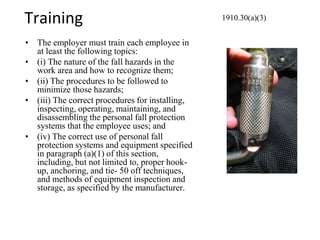
Training
• The employer must train each employee in
at least the following topics:
• (i) The nature of the fall hazards in the
work area and how to recognize them;
• (ii) The procedures to be followed to
minimize those hazards;
• (iii) The correct procedures for installing,
inspecting, operating, maintaining, and
disassembling the personal fall protection
systems that the employee uses; and
• (iv) The correct use of personal fall
protection systems and equipment specified
in paragraph (a)(1) of this section,
including, but not limited to, proper hook-
up, anchoring, and tie- 50 off techniques,
and methods of equipment inspection and
storage, as specified by the manufacturer.
1910.30(a)(3)
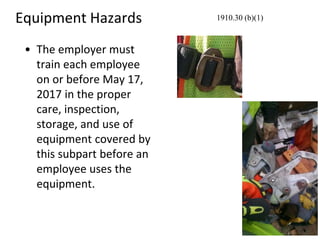
Equipment Hazards
• The employer must
train each employee
on or before May 17,
2017 in the proper
care, inspection,
storage, and use of
equipment covered by
this subpart before an
employee uses the
equipment.
1910.30 (b)(1)
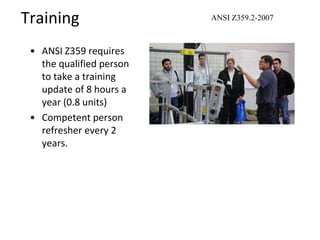
Training
• ANSI Z359 requires
the qualified person
to take a training
update of 8 hours a
year (0.8 units)
• Competent person
refresher every 2
years.
ANSI Z359.2-2007
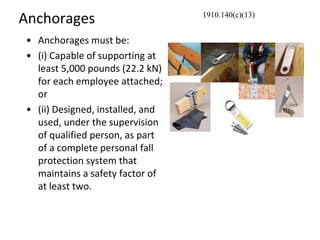
Anchorages
• Anchorages must be:
• (i) Capable of supporting at
least 5,000 pounds (22.2 kN)
for each employee attached;
or
• (ii) Designed, installed, and
used, under the supervision
of qualified person, as part
of a complete personal fall
protection system that
maintains a safety factor of
at least two.
1910.140(c)(13)
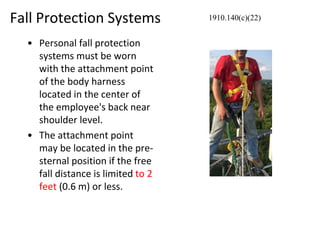
Fall Protection Systems
• Personal fall protection
systems must be worn
with the attachment point
of the body harness
located in the center of
the employee's back near
shoulder level.
• The attachment point
may be located in the pre-
sternal position if the free
fall distance is limited to 2
feet (0.6 m) or less.
1910.140(c)(22)
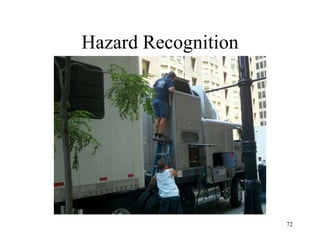
Hazard Recognition
72
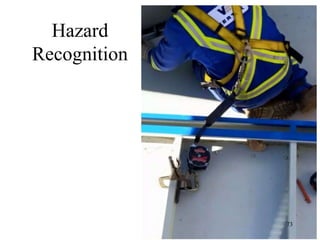
Hazard
Recognition
73
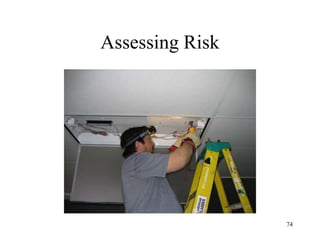
Assessing Risk
74
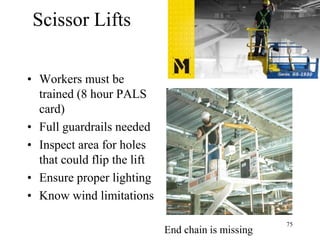
Scissor Lifts
• Workers must be
trained (8 hour PALS
card)
• Full guardrails needed
• Inspect area for holes
that could flip the lift
• Ensure proper lighting
• Know wind limitations
End chain is missing
75
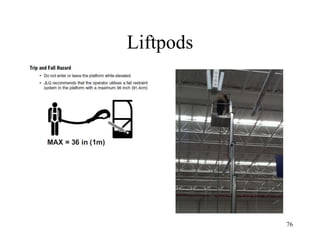
Liftpods
76
Liftpods
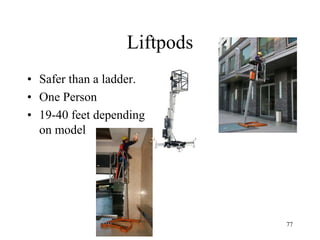
• Safer than a ladder.
• One Person
• 19-40 feet depending
on model
77
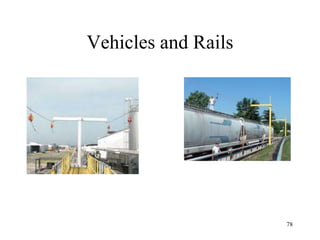
Vehicles and Rails
78
Vehicles
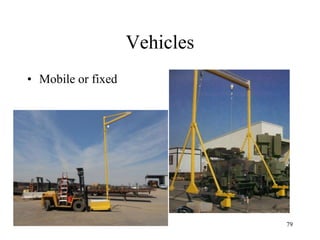
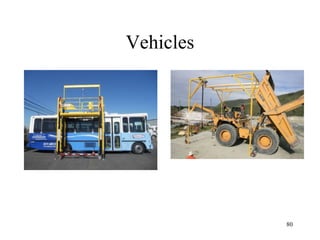
• Mobile or fixed
79
Vehicles
80
Equipment
81
Equipment
82
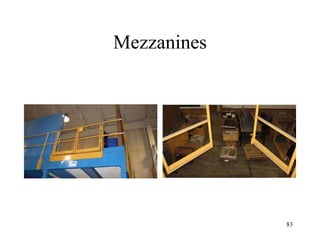
Mezzanines
83
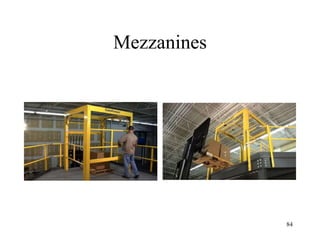
Mezzanines
84
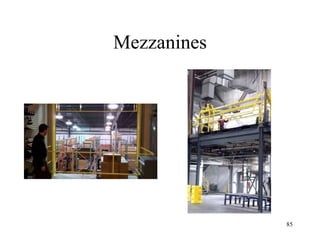
Mezzanines
85
Questions?
86
Definitions
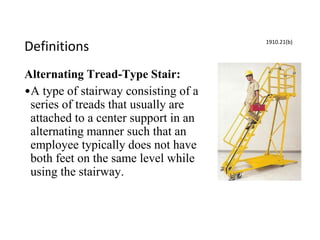
Alternating Tread-Type Stair:
•A type of stairway consisting of a
series of treads that usually are
attached to a center support in an
alternating manner such that an
employee typically does not have
both feet on the same level while
using the stairway.
1910.21(b)
Definitions
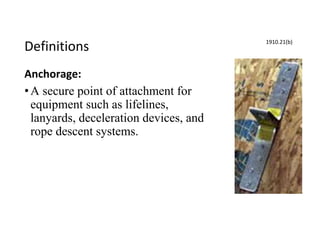
Anchorage:
•A secure point of attachment for
equipment such as lifelines,
lanyards, deceleration devices, and
rope descent systems.
1910.21(b)
Definitions
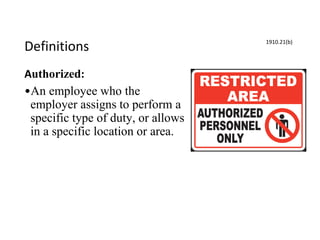
Authorized:
•An employee who the
employer assigns to perform a
specific type of duty, or allows
in a specific location or area.
1910.21(b)
Definitions
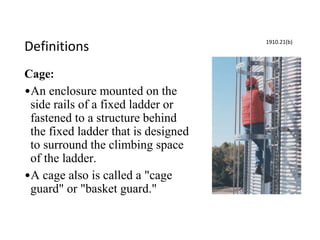
Cage:
•An enclosure mounted on the
side rails of a fixed ladder or
fastened to a structure behind
the fixed ladder that is designed
to surround the climbing space
of the ladder.
•A cage also is called a "cage
guard" or "basket guard."
1910.21(b)
Definitions
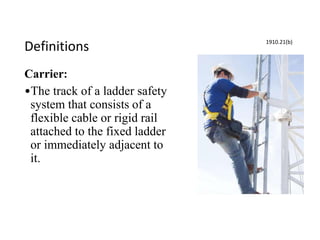
Carrier:
•The track of a ladder safety
system that consists of a
flexible cable or rigid rail
attached to the fixed ladder
or immediately adjacent to
it.
1910.21(b)
Definitions
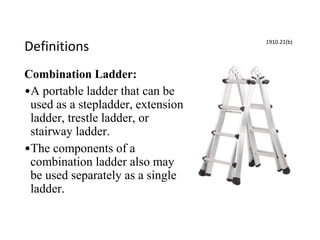
Combination Ladder:
•A portable ladder that can be
used as a stepladder, extension
ladder, trestle ladder, or
stairway ladder.
•The components of a
combination ladder also may
be used separately as a single
ladder.
1910.21(b)
Definitions
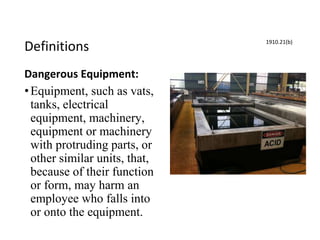
Dangerous Equipment:
•Equipment, such as vats,
tanks, electrical
equipment, machinery,
equipment or machinery
with protruding parts, or
other similar units, that,
because of their function
or form, may harm an
employee who falls into
or onto the equipment.
1910.21(b)
Definitions
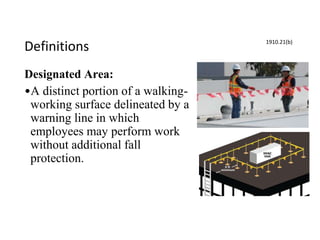
Designated Area:
•A distinct portion of a walking-
working surface delineated by a
warning line in which
employees may perform work
without additional fall
protection.
1910.21(b)
Definitions
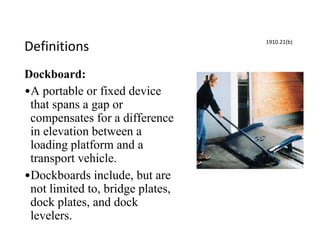
Dockboard:
•A portable or fixed device
that spans a gap or
compensates for a difference
in elevation between a
loading platform and a
transport vehicle.
•Dockboards include, but are
not limited to, bridge plates,
dock plates, and dock
levelers.
1910.21(b)
Definitions
Equivalent:
•Alternative designs, equipment,
materials, or methods, that the
employer can demonstrate will
provide an equal or greater
degree of safety for employees
compared to the designs,
equipment, materials, or methods
specified in this subpart.
1910.21(b)
Definitions
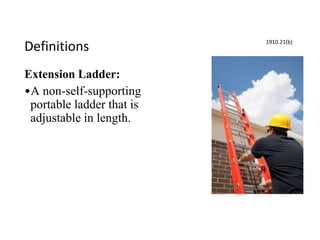
Extension Ladder:
•A non-self-supporting
portable ladder that is
adjustable in length.
1910.21(b)
Definitions
Failure:
•A load refusal, breakage, or
separation of component
parts.
•A load refusal is the point at
which the ultimate strength of
a component or object is
exceeded.
1910.21(b)
Definitions
Fall Hazard:
•Any condition on a walking-
working surface that
exposes an employee to a
risk of harm from a fall on
the same level or to a lower
level.
1910.21(b)
Definitions
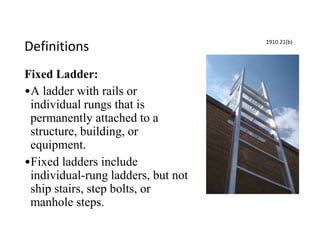
Fixed Ladder:
•A ladder with rails or
individual rungs that is
permanently attached to a
structure, building, or
equipment.
•Fixed ladders include
individual-rung ladders, but not
ship stairs, step bolts, or
manhole steps.
1910.21(b)
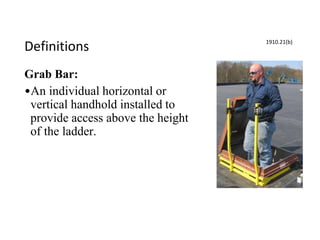
Definitions
Grab Bar:
•An individual horizontal or
vertical handhold installed to
provide access above the height
of the ladder.
1910.21(b)
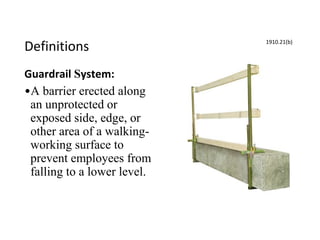
Definitions
Guardrail System:
•A barrier erected along
an unprotected or
exposed side, edge, or
other area of a walking-
working surface to
prevent employees from
falling to a lower level.
1910.21(b)
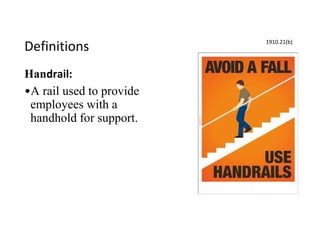
Definitions
Handrail:
•A rail used to provide
employees with a
handhold for support.
1910.21(b)
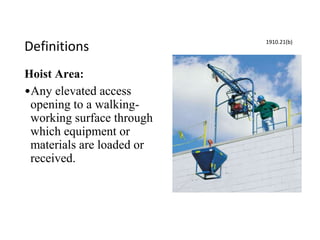
Definitions
Hoist Area:
•Any elevated access
opening to a walking-
working surface through
which equipment or
materials are loaded or
received.
1910.21(b)
Definitions
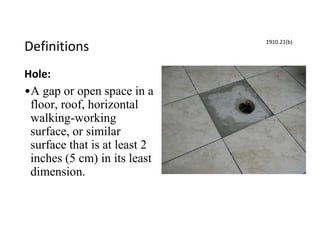
Hole:
•A gap or open space in a
floor, roof, horizontal
walking-working
surface, or similar
surface that is at least 2
inches (5 cm) in its least
dimension.
1910.21(b)
Definitions
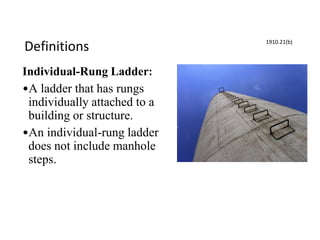
Individual-Rung Ladder:
•A ladder that has rungs
individually attached to a
building or structure.
•An individual-rung ladder
does not include manhole
steps.
1910.21(b)
Definitions
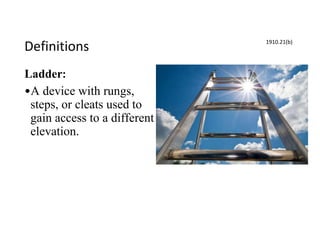
Ladder:
•A device with rungs,
steps, or cleats used to
gain access to a different
elevation.
1910.21(b)
Definitions
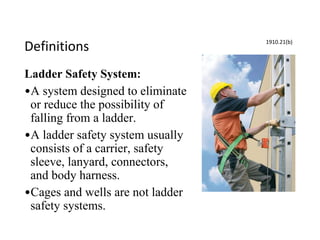
Ladder Safety System:
•A system designed to eliminate
or reduce the possibility of
falling from a ladder.
•A ladder safety system usually
consists of a carrier, safety
sleeve, lanyard, connectors,
and body harness.
•Cages and wells are not ladder
safety systems.
1910.21(b)
Definitions
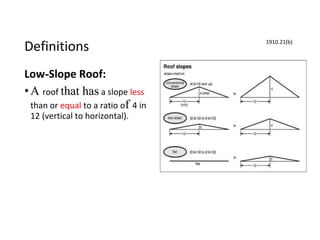
Low-Slope Roof:
•A roof that has a slope less
than or equal to a ratio of 4 in
12 (vertical to horizontal).
1910.21(b)
Definitions
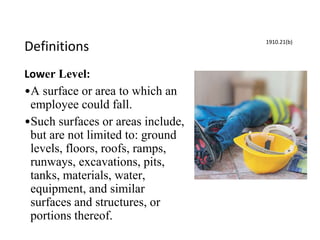
Lower Level:
•A surface or area to which an
employee could fall.
•Such surfaces or areas include,
but are not limited to: ground
levels, floors, roofs, ramps,
runways, excavations, pits,
tanks, materials, water,
equipment, and similar
surfaces and structures, or
portions thereof.
1910.21(b)
Definitions
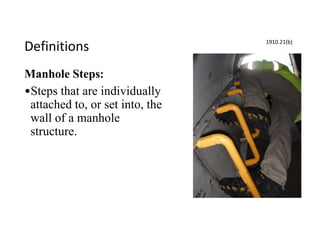
Manhole Steps:
•Steps that are individually
attached to, or set into, the
wall of a manhole
structure.
1910.21(b)
Definitions
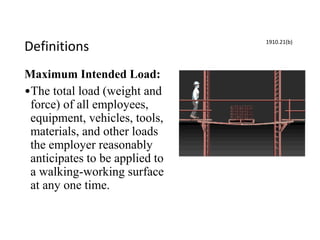
Maximum Intended Load:
•The total load (weight and
force) of all employees,
equipment, vehicles, tools,
materials, and other loads
the employer reasonably
anticipates to be applied to
a walking-working surface
at any one time.
1910.21(b)
Definitions
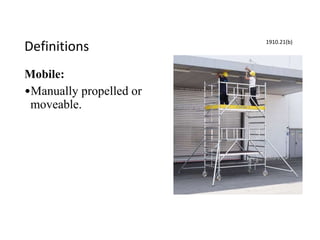
Mobile:
•Manually propelled or
moveable.
1910.21(b)
Definitions
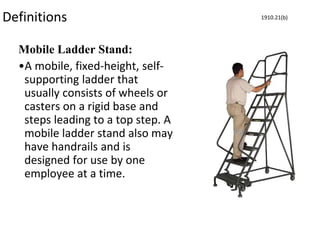
Mobile Ladder Stand:
•A mobile, fixed-height, self-
supporting ladder that
usually consists of wheels or
casters on a rigid base and
steps leading to a top step. A
mobile ladder stand also may
have handrails and is
designed for use by one
employee at a time.
1910.21(b)
Definitions
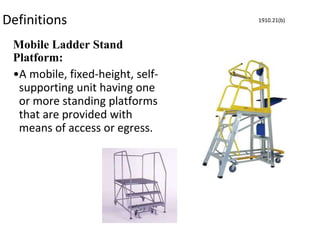
Mobile Ladder Stand
Platform:
•A mobile, fixed-height, self-
supporting unit having one
or more standing platforms
that are provided with
means of access or egress.
1910.21(b)
Definitions
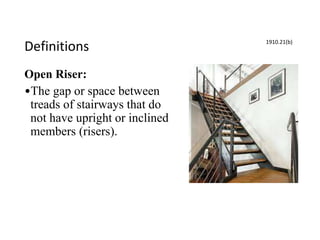
Open Riser:
•The gap or space between
treads of stairways that do
not have upright or inclined
members (risers).
1910.21(b)
Definitions
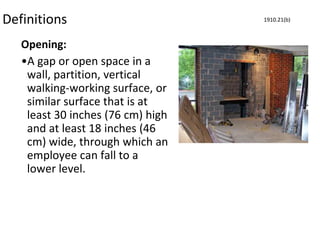
Opening:
•A gap or open space in a
wall, partition, vertical
walking-working surface, or
similar surface that is at
least 30 inches (76 cm) high
and at least 18 inches (46
cm) wide, through which an
employee can fall to a
lower level.
1910.21(b)
Definitions
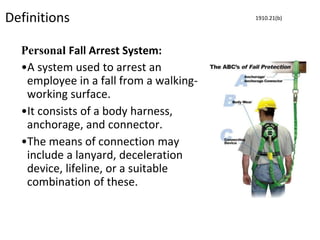
Personal Fall Arrest System:
•A system used to arrest an
employee in a fall from a walking-
working surface.
•It consists of a body harness,
anchorage, and connector.
•The means of connection may
include a lanyard, deceleration
device, lifeline, or a suitable
combination of these.
1910.21(b)
Definitions
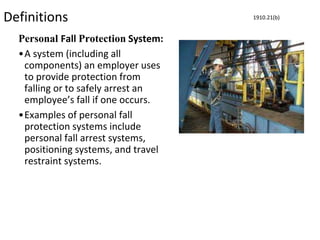
Personal Fall Protection System:
•A system (including all
components) an employer uses
to provide protection from
falling or to safely arrest an
employee’s fall if one occurs.
•Examples of personal fall
protection systems include
personal fall arrest systems,
positioning systems, and travel
restraint systems.
1910.21(b)
Definitions
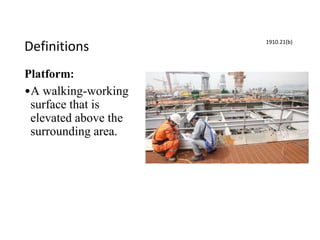
Platform:
•A walking-working
surface that is
elevated above the
surrounding area.
1910.21(b)
Definitions
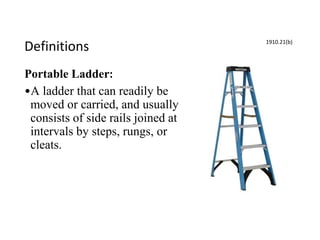
Portable Ladder:
•A ladder that can readily be
moved or carried, and usually
consists of side rails joined at
intervals by steps, rungs, or
cleats.
1910.21(b)
Definitions
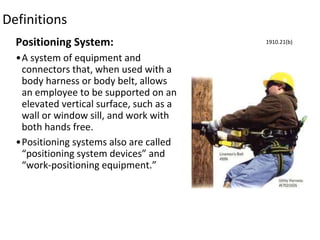
Positioning System:
•A system of equipment and
connectors that, when used with a
body harness or body belt, allows
an employee to be supported on an
elevated vertical surface, such as a
wall or window sill, and work with
both hands free.
•Positioning systems also are called
“positioning system devices” and
“work-positioning equipment.”
1910.21(b)
Definitions
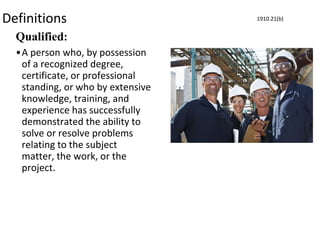
Qualified:
•A person who, by possession
of a recognized degree,
certificate, or professional
standing, or who by extensive
knowledge, training, and
experience has successfully
demonstrated the ability to
solve or resolve problems
relating to the subject
matter, the work, or the
project.
1910.21(b)
Definitions
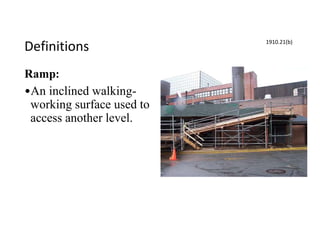
Ramp:
•An inclined walking-
working surface used to
access another level.
1910.21(b)
Definitions
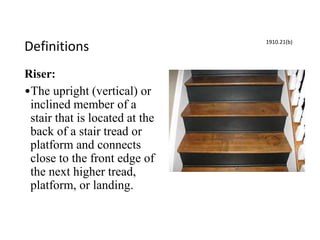
Riser:
•The upright (vertical) or
inclined member of a
stair that is located at the
back of a stair tread or
platform and connects
close to the front edge of
the next higher tread,
platform, or landing.
1910.21(b)
Definitions
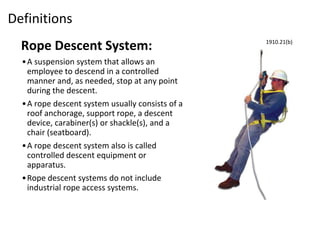
Rope Descent System:
•A suspension system that allows an
employee to descend in a controlled
manner and, as needed, stop at any point
during the descent.
•A rope descent system usually consists of a
roof anchorage, support rope, a descent
device, carabiner(s) or shackle(s), and a
chair (seatboard).
•A rope descent system also is called
controlled descent equipment or
apparatus.
•Rope descent systems do not include
industrial rope access systems.
1910.21(b)
Definitions
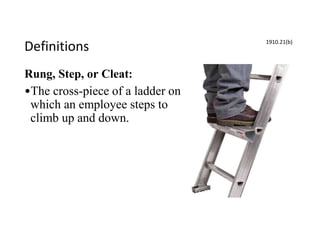
Rung, Step, or Cleat:
•The cross-piece of a ladder on
which an employee steps to
climb up and down.
1910.21(b)
Definitions
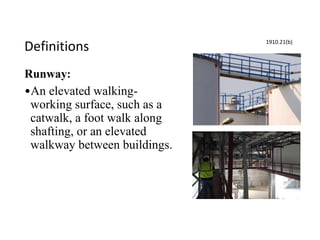
Runway:
•An elevated walking-
working surface, such as a
catwalk, a foot walk along
shafting, or an elevated
walkway between buildings.
1910.21(b)
Definitions
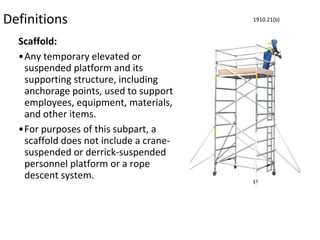
Scaffold:
•Any temporary elevated or
suspended platform and its
supporting structure, including
anchorage points, used to support
employees, equipment, materials,
and other items.
•For purposes of this subpart, a
scaffold does not include a crane-
suspended or derrick-suspended
personnel platform or a rope
descent system.
1910.21(b)
Definitions
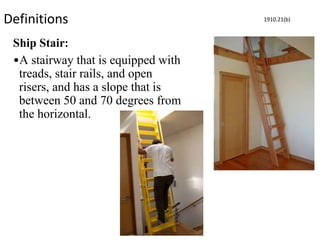
Ship Stair:
•A stairway that is equipped with
treads, stair rails, and open
risers, and has a slope that is
between 50 and 70 degrees from
the horizontal.
1910.21(b)
Definitions
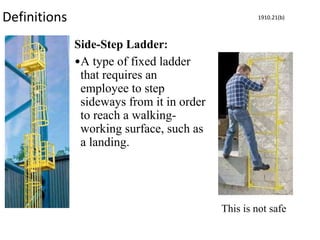
Side-Step Ladder:
•A type of fixed ladder
that requires an
employee to step
sideways from it in order
to reach a walking-
working surface, such as
a landing.
1910.21(b)
This is not safe
Definitions
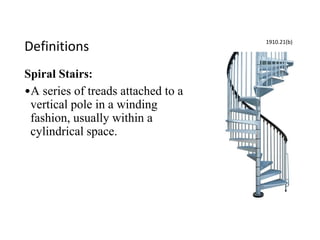
Spiral Stairs:
•A series of treads attached to a
vertical pole in a winding
fashion, usually within a
cylindrical space.
1910.21(b)
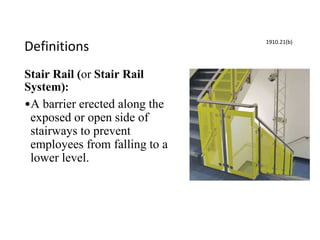
Definitions
Stair Rail (or Stair Rail
System):
•A barrier erected along the
exposed or open side of
stairways to prevent
employees from falling to a
lower level.
1910.21(b)
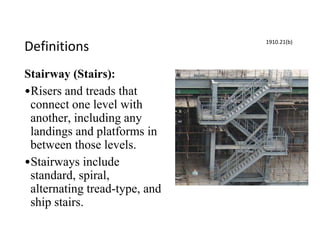
Definitions
Stairway (Stairs):
•Risers and treads that
connect one level with
another, including any
landings and platforms in
between those levels.
•Stairways include
standard, spiral,
alternating tread-type, and
ship stairs.
1910.21(b)
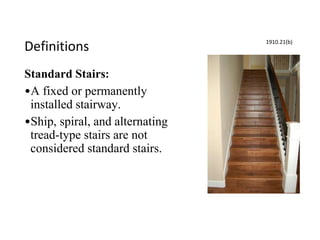
Definitions
Standard Stairs:
•A fixed or permanently
installed stairway.
•Ship, spiral, and alternating
tread-type stairs are not
considered standard stairs.
1910.21(b)
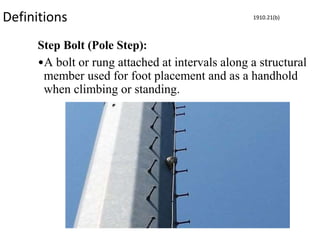
Definitions
Step Bolt (Pole Step):
•A bolt or rung attached at intervals along a structural
member used for foot placement and as a handhold
when climbing or standing.
1910.21(b)
Definitions
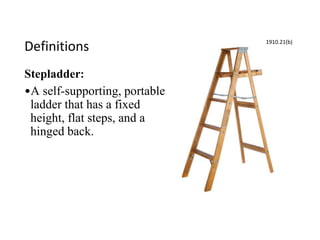
Stepladder:
•A self-supporting, portable
ladder that has a fixed
height, flat steps, and a
hinged back.
1910.21(b)
Definitions
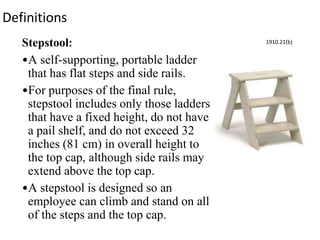
Stepstool:
•A self-supporting, portable ladder
that has flat steps and side rails.
•For purposes of the final rule,
stepstool includes only those ladders
that have a fixed height, do not have
a pail shelf, and do not exceed 32
inches (81 cm) in overall height to
the top cap, although side rails may
extend above the top cap.
•A stepstool is designed so an
employee can climb and stand on all
of the steps and the top cap.
1910.21(b)
Definitions
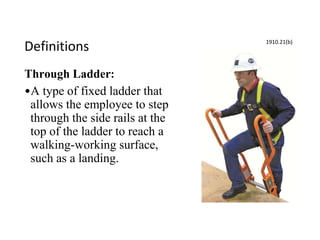
Through Ladder:
•A type of fixed ladder that
allows the employee to step
through the side rails at the
top of the ladder to reach a
walking-working surface,
such as a landing.
1910.21(b)
Definitions
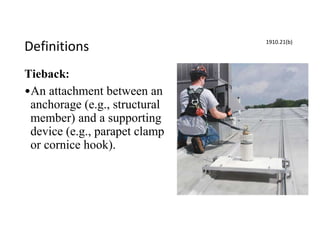
Tieback:
•An attachment between an
anchorage (e.g., structural
member) and a supporting
device (e.g., parapet clamp
or cornice hook).
1910.21(b)
Definitions
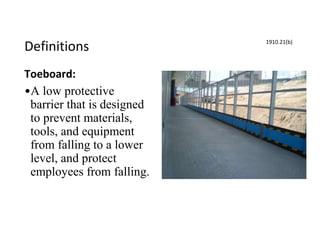
Toeboard:
•A low protective
barrier that is designed
to prevent materials,
tools, and equipment
from falling to a lower
level, and protect
employees from falling.
1910.21(b)
Definitions
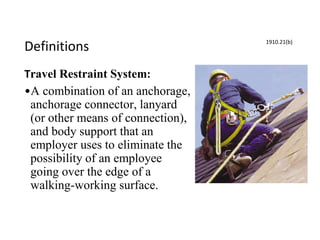
Travel Restraint System:
•A combination of an anchorage,
anchorage connector, lanyard
(or other means of connection),
and body support that an
employer uses to eliminate the
possibility of an employee
going over the edge of a
walking-working surface.
1910.21(b)
Definitions
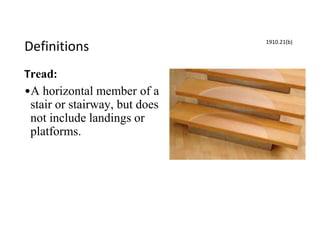
Tread:
•A horizontal member of a
stair or stairway, but does
not include landings or
platforms.
1910.21(b)
Definitions
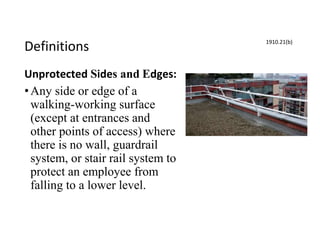
Unprotected Sides and Edges:
•Any side or edge of a
walking-working surface
(except at entrances and
other points of access) where
there is no wall, guardrail
system, or stair rail system to
protect an employee from
falling to a lower level.
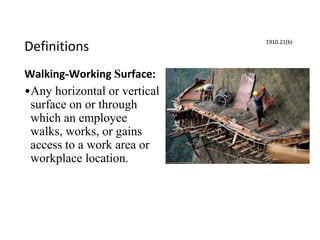
1910.21(b)
Definitions
Walking-Working Surface:
•Any horizontal or vertical
surface on or through
which an employee
walks, works, or gains
access to a work area or
workplace location.
1910.21(b)
Definitions
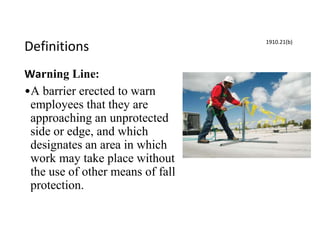
Warning Line:
•A barrier erected to warn
employees that they are
approaching an unprotected
side or edge, and which
designates an area in which
work may take place without
the use of other means of fall
protection.
1910.21(b)
Definitions
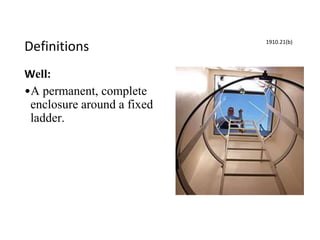
Well:
•A permanent, complete
enclosure around a fixed
ladder.
1910.21(b)

Industrial fall protection 2017

  • 1.
  • 2.
    NOV 2016 • Thisstandard, in the making since the 1990's, will essentially change the way FALL PROTECTION in general industry workplaces will be managed • The new rule will FINALLY CLARIFY (beyond question) that workers must be protected from fall hazards along unprotected sides or edges that are at least 4 feet above a lower level (NOT 6' like in the construction industry!). 2
  • 3.
    Effective Dates • EffectiveJanuary 17, 2017 • Most of the rule will become effective 60 days after publication in the Federal Register, but some provisions have delayed effective dates, including: • Ensuring exposed workers are trained on fall hazards (6 months) • July 17 2017
  • 4.
    Effective Dates • Inspectingand certifying permanent anchorages for rope descent systems (1 year), • Installing personal fall arrest or ladder safety systems on new fixed ladders over 24 feet and on replacement ladders/ladder sections, including fixed ladders on outdoor advertising structures (2 years),
  • 5.
    Effective Dates • Ensuringexisting fixed ladders over 24 feet, including those on outdoor advertising structures, are equipped with a cage, well, personal fall arrest system, or ladder safety system (2 years), and • Replacing cages and wells (used as fall protection) with ladder safety or personal fall arrest systems on all fixed ladders over 24 feet (20 years).
  • 6.
    Definitions (Most in backof presentation) Designated Area: •A distinct portion of a walking- working surface delineated by a warning line in which employees may perform work without additional fall protection. 1910.21(b)
  • 7.
    Definitions Rolling stock any locomotive,railcar, or vehicle operated exclusively on a rail or rails, or a trolley bus operated by electric power supplied from an overhead wire. Motor vehicle means any commercial bus, van, or truck, including tractor trailer, flatbed, tanker, and hopper trucks. OSHA Preamble - Since the Agency did not propose any specific fall protection requirements for rolling stock or motor vehicles, OSHA has not included any in this final rule. 1910.21(b)
  • 8.
    Definitions Temporary • tasks ableto complete at one time • less than one workshift to complete. • ``simple'' tasks and ``short-term . . . scheduled maintenance or minor repair activities'' • do not require ``significant equipment, personnel, and other resources'' • less than ``1-2 hours'' to complete • OSHA preamble 1910.21(b)
  • 9.
    Definitions Infrequent • task orjob is performed only on occasion, when needed (e.g., equipment breakdown), • on an occasional basis, or • at sporadic or irregular intervals. • Infrequent tasks include work activities such as annual maintenance or servicing of equipment, monthly or quarterly replacement of batteries or HVAC filters, and responding to equipment outage or breakdown. • the frequency of exposure to fall hazards is very limited. • tasks performed or repeated on a daily, routine or regular basis are not infrequent activities within the meaning of the final rule. • A task may be considered infrequent when it is performed once a month, once a year, or when needed. • OSHA preamble 1910.21(b)
  • 10.
    Dockboards • The employermust ensure that each dockboard used meets the requirements of this section. The employer must ensure: • (d) Measures, such as wheel chocks or sand shoes, are used to prevent the transport vehicle (e.g. a truck, semi-trailer, trailer, or rail car) on which a dockboard is placed, from moving while employees are on the dockboard; 1910.26
  • 11.
    Roofs • The finalrule divides work on low-slope roofs into three (3) zones: • Work performed LESS THAN 6 feet from the roof edge; • Work performed 6 feet to less than 15 feet from the roof edge; and, • Work performed 15 feet or MORE from the roof edge. • Each zone has its own set of requirements 11
  • 12.
    Work on low-sloperoofs • When work is performed less than 6 feet (1.6 m) from the roof edge, the employer must ensure each employee is protected from falling by a guardrail system, safety net system, travel restraint system, or personal fall arrest system. 1910.28(b)(13)(i)
  • 13.
    Low Sloped Roofs •When work is performed at least 6 feet (1.6 m) but less than 15 feet (4.6 m) from the roof edge, the employer must ensure each employee is protected from falling by using a guardrail system, safety net system, travel restraint system, or personal fall arrest system. 1910.28(b)(13)(ii)
  • 14.
    Flat Roofs • Whenwork is performed 15 feet (4.6 m) or more from the roof edge, the employer must: • (A) Protect each employee from falling by a guardrail system, safety net system, travel restraint system, or personal fall arrest system or a designated area. The employer is not required to provide any fall protection, provided the work is both infrequent and temporary; and • (B) Implement and enforce a work rule prohibiting employees from going within 15 feet (4.6 m) of the roof edge without using fall protection in accordance with paragraphs (b)(13)(i) and (ii) of this section. 1910.28(b)(13)(iii)
  • 15.
    Ladder Safety Systems •The employer must ensure: • (1) Each ladder safety system allows the employee to climb up and down using both hands and does not require that the employee continuously hold, push, or pull any part of the system while climbing; (2) The connection between the carrier or lifeline and the point of attachment to the body harness or belt does not exceed 9 inches (23 cm); 1910.29(i)
  • 16.
    Training • Training mustbe understandable. • The employer must provide information and training to each employee in a manner that the employee understands 1910.30(d)
  • 17.
    Fall Protection Systems •D-rings, snaphooks, and carabiners must be proof tested to a minimum tensile load of 3,600 pounds (16 kN) without cracking, breaking, or incurring permanent deformation. • The gate strength of snaphooks and carabiners, must be proof tested to 3,600 lbs. (16 kN) in all directions. 1910.140(c)(8)
  • 18.
    January 2017 • DearbornMI • Ford: Crane inspector Dies After Fall From Michigan Factory Crane 18
  • 19.
  • 20.
    Oct 2016 • ILParking lot • Customer breaks ankle in pothole • $75,000 settlement. 20
  • 21.
  • 22.
    February 2015 • Genie •Allows a user to exit the platform and work comfortably around the outside of the platform with a 6-ft lanyard. It attaches to a 6- or 8-ft platform on all Genie telescopic and articulating boom lifts with lift heights higher than 40 ft., with the exception of the S-125HD model.
  • 23.
    Falls • New OSHAstandards in 2017 • 1954 ANSI Standards • Fatal injuries involving falls increased by 20 from the preliminary count to 800 cases. 23
  • 24.
    General Requirements • Allplaces of employment, passageways, storerooms, service rooms, and walking working surfaces are kept in a clean, orderly, and sanitary condition. 1910.22(a)(1)
  • 25.
    General Requirements • Thefloor of each workroom is maintained in a clean and, to the extent feasible, in a dry condition. • When wet processes are used, drainage must be maintained and, to the extent feasible, dry standing places, such as false floors, platforms, and mats must be provided. 1910.22(a)(2)
  • 26.
    General Requirements • Walking-working surfacesare maintained free of hazards such as sharp or protruding objects, loose boards, corrosion, leaks, spills, snow, and ice. 1910.22(a)(3)
  • 27.
    Loads • The employermust ensure that each walking-working surface can support the maximum intended load for that surface. 1910.22(b)
  • 28.
    Access and Egress •The employer must provide, and ensure each employee uses, a safe means of access and egress to and from walking-working surfaces. 1910.22(c)
  • 29.
    Aisle Marking • Accessand egress. The employer must provide, and ensure each employee uses, a safe means of access and egress to and from walking-working surfaces. 1910.22(c) OSHA Preamble - One way employers can meet the performance language is by appropriately marking passageways and permanent aisles as a means of identifying safe access and egress.
  • 30.
    Inspection • The employermust ensure: (1) Walking-working surfaces are inspected, regularly and as necessary, and maintained in a safe condition; • (2) Hazardous conditions on walking-working surfaces are corrected or repaired before an employee uses the walking-working surface again. 1910.22(d)(1)
  • 31.
    Inspection • When anycorrection or repair involves the structural integrity of the walking-working surface, a qualified person performs or supervises the correction or repair, 1910.22(d)(3)
  • 32.
    Ladders • General requirements forall ladders. The employer must ensure: Ladder rungs, steps, and cleats are parallel, level, and uniformly spaced when the ladder is in position for use; 1910.23(b)(1)
  • 33.
    Ladders • Ladder rungs,steps, and cleats have a minimum clear width of 11.5 inches (29 cm) on portable ladders and 16 inches (41 cm) (measured before installation of ladder safety systems) for fixed ladders; 1910.23(b)(4)
  • 34.
    Ladders • Ladder surfacesare free of puncture and laceration hazards; 1910.23(b)(7)
  • 35.
    Ladders • Ladders areused only for the purposes for which they were designed; 1910.23(b)(8)
  • 36.
    Ladders • Ladders areinspected before initial use in each work shift, and more frequently as necessary, to identify any visible defects that could cause employee injury; 1910.23(b)(9)
  • 37.
    Ladders • Any ladderwith structural or other defects is immediately tagged “Dangerous: Do Not Use” or with similar language in accordance with §1910.145 and removed from service until repaired in accordance with §1910.22(d), or replaced; 1910.23(b)(10)
  • 38.
    Ladders • Each employeefaces the ladder when climbing up or down it; 1910.23(b)(11)
  • 39.
    Ladders • Each employeeuses at least one hand to grasp the ladder when climbing up and down it; and 1910.23(b)(12)
  • 40.
    Ladders • No employeecarries any object or load that could cause the employee to lose balance and fall while climbing up or down the ladder. 1910.23(b)(13)
  • 41.
    Ladders • Ladders arenot loaded beyond maximum intended load; Note to paragraph (c)(3): The maximum intended load, as defined in §1910.21(b), includes the total load (weight and force) of the employee and all tools, equipment, and materials being carried. 1910.23(c)(3)
  • 42.
    Ladders • Ladders areused only on stable and level surfaces unless they are secured or stabilized to prevent accidental displacement; 1910.23(c)(4) Photo: Dick Bolt
  • 43.
    Ladders • Ladders placedin locations such as passageways, doorways, or driveways where they • can be displaced by other activities or traffic: • (i) Are secured to prevent accidental displacement; or • (ii) Are guarded by a temporary barricade, such as a row of traffic cones or caution tape, to keep the activities or traffic away from the ladder; 1910.23(c)(7)
  • 44.
    Ladders • The cap(if equipped) and top step of a stepladder are not used as steps; 1910.23(c)(8)
  • 45.
    Ladders • Portable ladders usedto gain access to an upper landing surface have side rails that extend at least 3 feet (0.9 m) above the upper landing surface 1910.23(c)(11)
  • 46.
    Ladders • Ladders arenot placed on boxes, barrels, or other unstable bases to obtain additional height. 1910.23(c)(13)
  • 47.
    Fixed Ladders • FixedLadders. The minimum perpendicular distance from the centerline of the steps or rungs, or grab bars, or both, to the nearest permanent object in back of the ladder is 7 inches (18 cm), except for elevator pit ladders, which have a minimum perpendicular distance of 4.5 inches (11 cm); 1910.23(d)(2)
  • 48.
    Fixed Ladders • Theside rails of through or side-step ladders extend 42 inches (1.1 m) above the top of the access level or landing platform served by the ladder. 1910.23(d)(2)(4)
  • 49.
    Fixed Ladders • 1910.23(d)(9)When a fixed ladder terminates at a hatch (see Figure D-3 of this section), the hatch cover: • (i) Opens with sufficient clearance to provide easy access to or from the ladder; and • (ii) Opens at least 70 degrees from horizontal if the hatch is counterbalanced; 1910.23(d)(9)
  • 50.
    Fixed Ladders • Fixedladders that do not have cages or wells have: • (i) A clear width of at least 15 inches (38 cm) on each side of the ladder centerline to the nearest permanent object; and • (ii) A minimum perpendicular distance of 30 inches (76 cm) from the centerline of the steps or rungs to the nearest object on the climbing side. • When unavoidable obstructions are encountered, the minimum clearance at the obstruction may be reduced to 24 inches (61 cm), provided deflector plates are installed (see Figure D-5 of this section). 1910.23(d)(13)
  • 51.
    Ladder Stands • Unlessotherwise specified in this section, mobile ladder stands and platforms with a top step height of 4 feet (1.2 m) or above have handrails with a vertical height of 29.5 inches (75 cm) to 37 inches (94 cm), measured from the front edge of a step. • No mobile ladder stand or platform moves when an employee is on it. 1910.23(e)(1)(v)
  • 52.
    Manhole Steps • Theemployer must ensure that each manhole step is capable of supporting its maximum intended load. • The employer must ensure that each manhole step is inspected at the start of the work shift and maintained in accordance with §1910.22. 1910.24(a)(1)
  • 53.
    Stairways • General requirements. Theemployer must ensure: • Handrails, stair rail systems, and guardrail systems are provided in accordance with §1910.28; 1910.25 (b)(1)
  • 54.
    Stairways • When adoor or a gate opens directly on a stairway, a platform is provided, and the swing of the door or gate does not reduce the platform’s effective usable depth to: • (i) Less than 20 inches (51 cm) for platforms installed before January 17, 2017; and • (ii) Less than 22 inches (56 cm) for platforms installed on or after January 17, 2017 (see Figure D-7 of this section); 1910.25(b)(5)
  • 55.
    Dockboards • The employermust ensure that each dockboard used meets the requirements of this section. The employer must ensure: • (a) Dockboards are capable of supporting the maximum intended load in accordance with §1910.22 • (b)(1) Dockboards put into initial service on or after January 17, 2017 are designed, constructed, and maintained to prevent transfer vehicles from running off the dockboard edge; §1910.26
  • 56.
    Dockboards • The employermust ensure that each dockboard used meets the requirements of this section. The employer must ensure: • (d) Measures, such as wheel chocks or sand shoes, are used to prevent the transport vehicle (e.g. a truck, semi-trailer, trailer, or rail car) on which a dockboard is placed, from moving while employees are on the dockboard; 1910.26 Sand shoes
  • 57.
    Scaffolds • Scaffolds usedin general industry must meet the requirements in 29 CFR part 1926, subpart L (Scaffolds) 1910.27(a) Layher scaffold
  • 58.
    Duty to HaveFall Protection • Unprotected sides and edges. The employer must ensure that each employee on a walking-working surface with an unprotected side or edge that is 4 feet (1.2 m) or more above a lower level is protected from falling • (A) Guardrail systems; • (B) Safety net systems; or • (C) Personal fall protection systems, such as personal fall arrest, travel restraint, or positioning systems. §1910.28(b)(1)
  • 59.
    Duty to HaveFall Protection • After reviewing the rulemaking record, OSHA does not agree that requiring fall protection on stacked materials is infeasible or could create a greater hazard. • OSHA finds there is substantial evidence showing that a number of fall protection systems for stacked materials are available and already are in use in general industry • Preamble §1910.28(b)(1)
  • 60.
    Holes • The employermust ensure: (i) Each employee is protected from falling through any hole (including skylights) that is 4 feet (1.2 m) or more above a lower level by one or more of the following: • (A) Covers; • (B) Guardrail systems; • (C) Travel restraint systems; or • (D) Personal fall arrest systems. 1910.28 (b)(3)
  • 61.
    Holes • Each employeeis protected from tripping into or stepping into or through any hole that is less than 4 feet (1.2 m) above a lower level by covers or guardrail systems 1910.28 (b)(3)(ii)
  • 62.
    Designated Areas • Theemployer must ensure each warning line: • (i) Has a minimum breaking strength of 200 pounds (0.89 kN); • (ii) Is installed so its lowest point, including sag, is not less than 34 inches (86 cm) and not more than 39 inches (99 cm) above the walking- working surface; • (iii) Is supported in such a manner that pulling on one section of the line will not result in slack being taken up in adjacent sections causing the line to fall below the limits specified in paragraph (d)(2)(ii) of this section; 1910.29(d)(2)
  • 63.
    Handrails • The employermust ensure: • (1) Height criteria. (i) Handrails are not less than 30 inches (76 cm) and not more than 38 inches (97 cm), as measured from the leading edge of the stair tread to the top surface of the handrail (see Figure D- 12 of this section). 1910.29(f)
  • 64.
    Ladder Safety Systems •The employer must ensure: • (1) Each ladder safety system allows the employee to climb up and down using both hands and does not require that the employee continuously hold, push, or pull any part of the system while climbing; • (2) The connection between the carrier or lifeline and the point of attachment to the body harness or belt does not exceed 9 inches (23 cm); 1910.29(i)
  • 65.
    Training Requirements • Fallhazards. • (1) Before any employee is exposed to a fall hazard, the employer must provide training for each employee who uses personal fall protection systems or who is required to be trained as specified elsewhere in this subpart. • Employers must ensure employees are trained in the requirements of this paragraph on or before May 17, 2017. 1910.30(a)
  • 66.
    Training • The employermust ensure that each employee is trained by a qualified person. • Qualified describes a person who, by possession of a recognized degree, certificate, or professional standing, or who by extensive knowledge, training, and experience has successfully demonstrated the ability to solve or resolve problems relating to the subject matter, the work, or the project. 1910.30(a)(2)
  • 67.
    Training • The employermust train each employee in at least the following topics: • (i) The nature of the fall hazards in the work area and how to recognize them; • (ii) The procedures to be followed to minimize those hazards; • (iii) The correct procedures for installing, inspecting, operating, maintaining, and disassembling the personal fall protection systems that the employee uses; and • (iv) The correct use of personal fall protection systems and equipment specified in paragraph (a)(1) of this section, including, but not limited to, proper hook- up, anchoring, and tie- 50 off techniques, and methods of equipment inspection and storage, as specified by the manufacturer. 1910.30(a)(3)
  • 68.
    Equipment Hazards • Theemployer must train each employee on or before May 17, 2017 in the proper care, inspection, storage, and use of equipment covered by this subpart before an employee uses the equipment. 1910.30 (b)(1)
  • 69.
    Training • ANSI Z359requires the qualified person to take a training update of 8 hours a year (0.8 units) • Competent person refresher every 2 years. ANSI Z359.2-2007
  • 70.
    Anchorages • Anchorages mustbe: • (i) Capable of supporting at least 5,000 pounds (22.2 kN) for each employee attached; or • (ii) Designed, installed, and used, under the supervision of qualified person, as part of a complete personal fall protection system that maintains a safety factor of at least two. 1910.140(c)(13)
  • 71.
    Fall Protection Systems •Personal fall protection systems must be worn with the attachment point of the body harness located in the center of the employee's back near shoulder level. • The attachment point may be located in the pre- sternal position if the free fall distance is limited to 2 feet (0.6 m) or less. 1910.140(c)(22)
  • 72.
  • 73.
  • 74.
  • 75.
    Scissor Lifts • Workersmust be trained (8 hour PALS card) • Full guardrails needed • Inspect area for holes that could flip the lift • Ensure proper lighting • Know wind limitations End chain is missing 75
  • 76.
  • 77.
    Liftpods • Safer thana ladder. • One Person • 19-40 feet depending on model 77
  • 78.
  • 79.
  • 80.
  • 81.
  • 82.
  • 83.
  • 84.
  • 85.
  • 86.
  • 87.
    Definitions Alternating Tread-Type Stair: •Atype of stairway consisting of a series of treads that usually are attached to a center support in an alternating manner such that an employee typically does not have both feet on the same level while using the stairway. 1910.21(b)
  • 88.
    Definitions Anchorage: •A secure pointof attachment for equipment such as lifelines, lanyards, deceleration devices, and rope descent systems. 1910.21(b)
  • 89.
    Definitions Authorized: •An employee whothe employer assigns to perform a specific type of duty, or allows in a specific location or area. 1910.21(b)
  • 90.
    Definitions Cage: •An enclosure mountedon the side rails of a fixed ladder or fastened to a structure behind the fixed ladder that is designed to surround the climbing space of the ladder. •A cage also is called a "cage guard" or "basket guard." 1910.21(b)
  • 91.
    Definitions Carrier: •The track ofa ladder safety system that consists of a flexible cable or rigid rail attached to the fixed ladder or immediately adjacent to it. 1910.21(b)
  • 92.
    Definitions Combination Ladder: •A portableladder that can be used as a stepladder, extension ladder, trestle ladder, or stairway ladder. •The components of a combination ladder also may be used separately as a single ladder. 1910.21(b)
  • 93.
    Definitions Dangerous Equipment: •Equipment, suchas vats, tanks, electrical equipment, machinery, equipment or machinery with protruding parts, or other similar units, that, because of their function or form, may harm an employee who falls into or onto the equipment. 1910.21(b)
  • 94.
    Definitions Designated Area: •A distinctportion of a walking- working surface delineated by a warning line in which employees may perform work without additional fall protection. 1910.21(b)
  • 95.
    Definitions Dockboard: •A portable orfixed device that spans a gap or compensates for a difference in elevation between a loading platform and a transport vehicle. •Dockboards include, but are not limited to, bridge plates, dock plates, and dock levelers. 1910.21(b)
  • 96.
    Definitions Equivalent: •Alternative designs, equipment, materials,or methods, that the employer can demonstrate will provide an equal or greater degree of safety for employees compared to the designs, equipment, materials, or methods specified in this subpart. 1910.21(b)
  • 97.
    Definitions Extension Ladder: •A non-self-supporting portableladder that is adjustable in length. 1910.21(b)
  • 98.
    Definitions Failure: •A load refusal,breakage, or separation of component parts. •A load refusal is the point at which the ultimate strength of a component or object is exceeded. 1910.21(b)
  • 99.
    Definitions Fall Hazard: •Any conditionon a walking- working surface that exposes an employee to a risk of harm from a fall on the same level or to a lower level. 1910.21(b)
  • 100.
    Definitions Fixed Ladder: •A ladderwith rails or individual rungs that is permanently attached to a structure, building, or equipment. •Fixed ladders include individual-rung ladders, but not ship stairs, step bolts, or manhole steps. 1910.21(b)
  • 101.
    Definitions Grab Bar: •An individualhorizontal or vertical handhold installed to provide access above the height of the ladder. 1910.21(b)
  • 102.
    Definitions Guardrail System: •A barriererected along an unprotected or exposed side, edge, or other area of a walking- working surface to prevent employees from falling to a lower level. 1910.21(b)
  • 103.
    Definitions Handrail: •A rail usedto provide employees with a handhold for support. 1910.21(b)
  • 104.
    Definitions Hoist Area: •Any elevatedaccess opening to a walking- working surface through which equipment or materials are loaded or received. 1910.21(b)
  • 105.
    Definitions Hole: •A gap oropen space in a floor, roof, horizontal walking-working surface, or similar surface that is at least 2 inches (5 cm) in its least dimension. 1910.21(b)
  • 106.
    Definitions Individual-Rung Ladder: •A ladderthat has rungs individually attached to a building or structure. •An individual-rung ladder does not include manhole steps. 1910.21(b)
  • 107.
    Definitions Ladder: •A device withrungs, steps, or cleats used to gain access to a different elevation. 1910.21(b)
  • 108.
    Definitions Ladder Safety System: •Asystem designed to eliminate or reduce the possibility of falling from a ladder. •A ladder safety system usually consists of a carrier, safety sleeve, lanyard, connectors, and body harness. •Cages and wells are not ladder safety systems. 1910.21(b)
  • 109.
    Definitions Low-Slope Roof: •A roofthat has a slope less than or equal to a ratio of 4 in 12 (vertical to horizontal). 1910.21(b)
  • 110.
    Definitions Lower Level: •A surfaceor area to which an employee could fall. •Such surfaces or areas include, but are not limited to: ground levels, floors, roofs, ramps, runways, excavations, pits, tanks, materials, water, equipment, and similar surfaces and structures, or portions thereof. 1910.21(b)
  • 111.
    Definitions Manhole Steps: •Steps thatare individually attached to, or set into, the wall of a manhole structure. 1910.21(b)
  • 112.
    Definitions Maximum Intended Load: •Thetotal load (weight and force) of all employees, equipment, vehicles, tools, materials, and other loads the employer reasonably anticipates to be applied to a walking-working surface at any one time. 1910.21(b)
  • 113.
  • 114.
    Definitions Mobile Ladder Stand: •Amobile, fixed-height, self- supporting ladder that usually consists of wheels or casters on a rigid base and steps leading to a top step. A mobile ladder stand also may have handrails and is designed for use by one employee at a time. 1910.21(b)
  • 115.
    Definitions Mobile Ladder Stand Platform: •Amobile, fixed-height, self- supporting unit having one or more standing platforms that are provided with means of access or egress. 1910.21(b)
  • 116.
    Definitions Open Riser: •The gapor space between treads of stairways that do not have upright or inclined members (risers). 1910.21(b)
  • 117.
    Definitions Opening: •A gap oropen space in a wall, partition, vertical walking-working surface, or similar surface that is at least 30 inches (76 cm) high and at least 18 inches (46 cm) wide, through which an employee can fall to a lower level. 1910.21(b)
  • 118.
    Definitions Personal Fall ArrestSystem: •A system used to arrest an employee in a fall from a walking- working surface. •It consists of a body harness, anchorage, and connector. •The means of connection may include a lanyard, deceleration device, lifeline, or a suitable combination of these. 1910.21(b)
  • 119.
    Definitions Personal Fall ProtectionSystem: •A system (including all components) an employer uses to provide protection from falling or to safely arrest an employee’s fall if one occurs. •Examples of personal fall protection systems include personal fall arrest systems, positioning systems, and travel restraint systems. 1910.21(b)
  • 120.
    Definitions Platform: •A walking-working surface thatis elevated above the surrounding area. 1910.21(b)
  • 121.
    Definitions Portable Ladder: •A ladderthat can readily be moved or carried, and usually consists of side rails joined at intervals by steps, rungs, or cleats. 1910.21(b)
  • 122.
    Definitions Positioning System: •A systemof equipment and connectors that, when used with a body harness or body belt, allows an employee to be supported on an elevated vertical surface, such as a wall or window sill, and work with both hands free. •Positioning systems also are called “positioning system devices” and “work-positioning equipment.” 1910.21(b)
  • 123.
    Definitions Qualified: •A person who,by possession of a recognized degree, certificate, or professional standing, or who by extensive knowledge, training, and experience has successfully demonstrated the ability to solve or resolve problems relating to the subject matter, the work, or the project. 1910.21(b)
  • 124.
    Definitions Ramp: •An inclined walking- workingsurface used to access another level. 1910.21(b)
  • 125.
    Definitions Riser: •The upright (vertical)or inclined member of a stair that is located at the back of a stair tread or platform and connects close to the front edge of the next higher tread, platform, or landing. 1910.21(b)
  • 126.
    Definitions Rope Descent System: •Asuspension system that allows an employee to descend in a controlled manner and, as needed, stop at any point during the descent. •A rope descent system usually consists of a roof anchorage, support rope, a descent device, carabiner(s) or shackle(s), and a chair (seatboard). •A rope descent system also is called controlled descent equipment or apparatus. •Rope descent systems do not include industrial rope access systems. 1910.21(b)
  • 127.
    Definitions Rung, Step, orCleat: •The cross-piece of a ladder on which an employee steps to climb up and down. 1910.21(b)
  • 128.
    Definitions Runway: •An elevated walking- workingsurface, such as a catwalk, a foot walk along shafting, or an elevated walkway between buildings. 1910.21(b)
  • 129.
    Definitions Scaffold: •Any temporary elevatedor suspended platform and its supporting structure, including anchorage points, used to support employees, equipment, materials, and other items. •For purposes of this subpart, a scaffold does not include a crane- suspended or derrick-suspended personnel platform or a rope descent system. 1910.21(b)
  • 130.
    Definitions Ship Stair: •A stairwaythat is equipped with treads, stair rails, and open risers, and has a slope that is between 50 and 70 degrees from the horizontal. 1910.21(b)
  • 131.
    Definitions Side-Step Ladder: •A typeof fixed ladder that requires an employee to step sideways from it in order to reach a walking- working surface, such as a landing. 1910.21(b) This is not safe
  • 132.
    Definitions Spiral Stairs: •A seriesof treads attached to a vertical pole in a winding fashion, usually within a cylindrical space. 1910.21(b)
  • 133.
    Definitions Stair Rail (orStair Rail System): •A barrier erected along the exposed or open side of stairways to prevent employees from falling to a lower level. 1910.21(b)
  • 134.
    Definitions Stairway (Stairs): •Risers andtreads that connect one level with another, including any landings and platforms in between those levels. •Stairways include standard, spiral, alternating tread-type, and ship stairs. 1910.21(b)
  • 135.
    Definitions Standard Stairs: •A fixedor permanently installed stairway. •Ship, spiral, and alternating tread-type stairs are not considered standard stairs. 1910.21(b)
  • 136.
    Definitions Step Bolt (PoleStep): •A bolt or rung attached at intervals along a structural member used for foot placement and as a handhold when climbing or standing. 1910.21(b)
  • 137.
    Definitions Stepladder: •A self-supporting, portable ladderthat has a fixed height, flat steps, and a hinged back. 1910.21(b)
  • 138.
    Definitions Stepstool: •A self-supporting, portableladder that has flat steps and side rails. •For purposes of the final rule, stepstool includes only those ladders that have a fixed height, do not have a pail shelf, and do not exceed 32 inches (81 cm) in overall height to the top cap, although side rails may extend above the top cap. •A stepstool is designed so an employee can climb and stand on all of the steps and the top cap. 1910.21(b)
  • 139.
    Definitions Through Ladder: •A typeof fixed ladder that allows the employee to step through the side rails at the top of the ladder to reach a walking-working surface, such as a landing. 1910.21(b)
  • 140.
    Definitions Tieback: •An attachment betweenan anchorage (e.g., structural member) and a supporting device (e.g., parapet clamp or cornice hook). 1910.21(b)
  • 141.
    Definitions Toeboard: •A low protective barrierthat is designed to prevent materials, tools, and equipment from falling to a lower level, and protect employees from falling. 1910.21(b)
  • 142.
    Definitions Travel Restraint System: •Acombination of an anchorage, anchorage connector, lanyard (or other means of connection), and body support that an employer uses to eliminate the possibility of an employee going over the edge of a walking-working surface. 1910.21(b)
  • 143.
    Definitions Tread: •A horizontal memberof a stair or stairway, but does not include landings or platforms. 1910.21(b)
  • 144.
    Definitions Unprotected Sides andEdges: •Any side or edge of a walking-working surface (except at entrances and other points of access) where there is no wall, guardrail system, or stair rail system to protect an employee from falling to a lower level. 1910.21(b)
  • 145.
    Definitions Walking-Working Surface: •Any horizontalor vertical surface on or through which an employee walks, works, or gains access to a work area or workplace location. 1910.21(b)
  • 146.
    Definitions Warning Line: •A barriererected to warn employees that they are approaching an unprotected side or edge, and which designates an area in which work may take place without the use of other means of fall protection. 1910.21(b)
  • 147.