Definition
“Induction or orientation is a process designed to
provide new employee with the information he or she
needs to function comfortably and effectively in the
organization
What is that Information!
1) General Information about the Daily Work Routine
2) Review of the Firm’s history, objectives, products,etc.
3) The organisation’s policies, work rules, et al
Purpose of Orientation
 to relax new hire
 to introduce them to colleagues and function
 to create favorable impression of job and company
 to make him/her adjust to new work environment
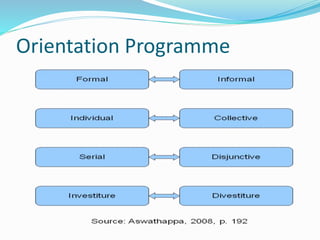
Orientation Programme
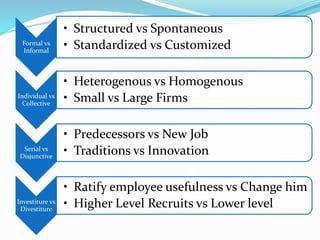
Formal vs
Informal
• Structured vs Spontaneous
• Standardized vs Customized
Individual vs
Collective
• Heterogenous vs Homogenous
• Small vs Large Firms
Serial vs
Disjunctive
• Predecessors vs New Job
• Traditions vs Innovation
Investiture vs
Divestiture
• Ratify employee usefulness vs Change him
• Higher Level Recruits vs Lower level
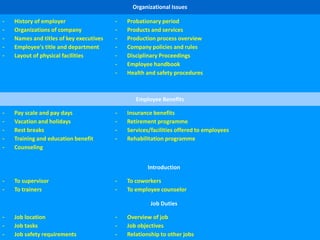
Organizational Issues
- History of employer
- Organizations of company
- Names and titles of key executives
- Employee's title and department
- Layout of physical facilities
- Probationary period
- Products and services
- Production process overview
- Company policies and rules
- Disciplinary Proceedings
- Employee handbook
- Health and safety procedures
Employee Benefits
- Pay scale and pay days
- Vacation and holidays
- Rest breaks
- Training and education benefit
- Counseling
- Insurance benefits
- Retirement programme
- Services/facilities offered to employees
- Rehabilitation programme
Introduction
- To supervisor
- To trainers
- To coworkers
- To employee counselor
Job Duties
- Job location
- Job tasks
- Job safety requirements
- Overview of job
- Job objectives
- Relationship to other jobs
Placement Process
 After hiring and completion of orientation programme
he or she is placed in job
 Allocation of assignments matching individual
personality with job demands
 The number of the jobs and number of selected
candidates determine placement decisions
 Employee work independent of others or dependent is
based on type and context of job
Three kinds of Job
 Independent Job: A job with no interdependencies
with other jobs. Eg.Field sale office
 Sequential Job: Activity or tasks of one worker
dependent on work activities of others: Example:
Assembly line
 Pooled Job: The work of all workers is highly
interdependent (team work, project teams)
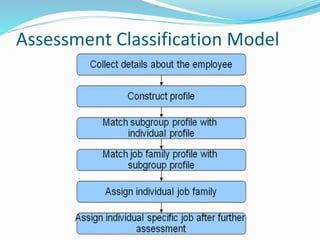
Assessment Classification Model

Induction and Placement

  • 2.
    Definition “Induction or orientationis a process designed to provide new employee with the information he or she needs to function comfortably and effectively in the organization
  • 3.
    What is thatInformation! 1) General Information about the Daily Work Routine 2) Review of the Firm’s history, objectives, products,etc. 3) The organisation’s policies, work rules, et al
  • 4.
    Purpose of Orientation to relax new hire  to introduce them to colleagues and function  to create favorable impression of job and company  to make him/her adjust to new work environment
  • 5.
  • 6.
    Formal vs Informal • Structuredvs Spontaneous • Standardized vs Customized Individual vs Collective • Heterogenous vs Homogenous • Small vs Large Firms Serial vs Disjunctive • Predecessors vs New Job • Traditions vs Innovation Investiture vs Divestiture • Ratify employee usefulness vs Change him • Higher Level Recruits vs Lower level
  • 7.
    Organizational Issues - Historyof employer - Organizations of company - Names and titles of key executives - Employee's title and department - Layout of physical facilities - Probationary period - Products and services - Production process overview - Company policies and rules - Disciplinary Proceedings - Employee handbook - Health and safety procedures Employee Benefits - Pay scale and pay days - Vacation and holidays - Rest breaks - Training and education benefit - Counseling - Insurance benefits - Retirement programme - Services/facilities offered to employees - Rehabilitation programme Introduction - To supervisor - To trainers - To coworkers - To employee counselor Job Duties - Job location - Job tasks - Job safety requirements - Overview of job - Job objectives - Relationship to other jobs
  • 8.
    Placement Process  Afterhiring and completion of orientation programme he or she is placed in job  Allocation of assignments matching individual personality with job demands  The number of the jobs and number of selected candidates determine placement decisions  Employee work independent of others or dependent is based on type and context of job
  • 9.
    Three kinds ofJob  Independent Job: A job with no interdependencies with other jobs. Eg.Field sale office  Sequential Job: Activity or tasks of one worker dependent on work activities of others: Example: Assembly line  Pooled Job: The work of all workers is highly interdependent (team work, project teams)
  • 10.