StaffingManagement of Personnel
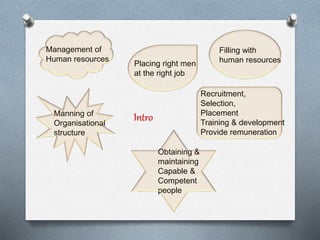
Management of
Human resources
Manning of
Organisational
structure
Placing right men
at the right job
Recruitment,
Selection,
Placement
Training & development
Provide remuneration
Filling with
human resources
Intro
Obtaining &
maintaining
Capable &
Competent
people
In Planning– Set goal/target/objective
Goal/Target/
Objective
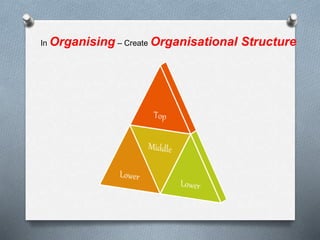
In Organising – Create Organisational Structure
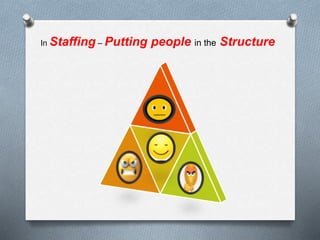
In Staffing – Putting people in the Structure
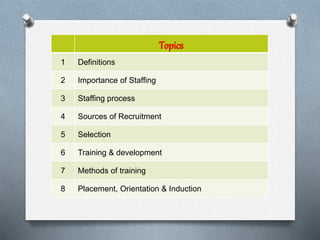
Topics
1 Definitions
2 Importance of Staffing
3 Staffing process
4 Sources of Recruitment
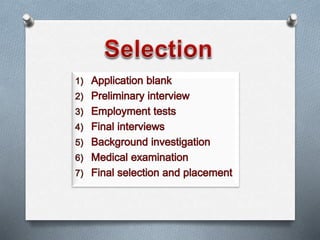
5 Selection
6 Training & development
7 Methods of training
8 Placement, Orientation & Induction
1.
Definitions
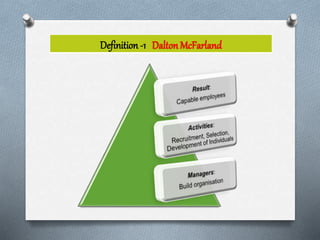
Definition -1 DaltonMcFarland
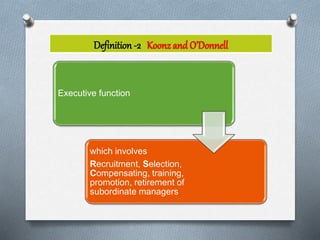
Definition -2 Koonzand O’Donnell
Executive function
which involves
Recruitment, Selection,
Compensating, training,
promotion, retirement of
subordinate managers
Definition -3 Weirich
Filling and keeping
filled, positions in the
organization structure
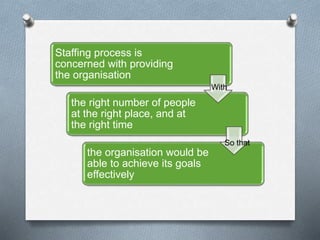
Staffing process is
concerned with providing
the organisation
the right number of people
at the right place, and at
the right time
the organisation would be
able to achieve its goals
effectively
With
So that
A wrong placement in the
organisation would adversely affect
the productivity of the organisation
as a whole
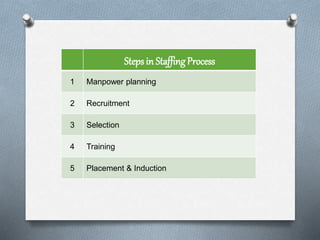
Steps in Staffing Process
1 Manpower planning
2 Recruitment
3 Selection
4 Training
5 Placement & Induction
Anticipated human resources
Skill & expertise required
To achieve
Organisational objectives
Action plans
To meet
Note: Current assessment, future assessment of the
human resource needs and the development of future
programme as well as career development
 Seeking and attracting a pool of people from which qualified
candidates for job vacancies
 Development and maintenance of adequate manpower
resources is the main task of recruitment
 Critical step
 Choosing candidates who best meet the qualifications and
requirements of the job
 It is the process of increasing the knowledge and skills of an
employee for doing a particular job.
 The objective of training is to achieve a change in the
behaviour of those trained
 Placement refers to assigning rank and responsibility to an
individual,
 Identifying him with a particular job
 If the person adjusts to the job and continues to perform per
expectations, it means that the candidate is properly placed.
 However, if the candidate is seen to have problems in
adjusting himself to the job, the supervisor must find out
whether the person is properly placed as per the latter’s
aptitude and potential
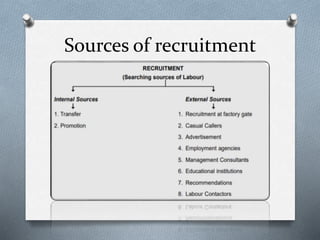
Sources of recruitment
Internal Sources
 Present employees: Employees on the payroll.
 Basic internal sources: Transfers, promotions
of present employees
 Review: Personnel records and skills
 Employee’s friends and relatives
Internal sources - Merits
1 Encourage employees – Reachtoppositions
2 Track record – Rightpeople
3 Little training – Knowmajoroperations
4 Expenditure – Relativelyless
5 Improves the morale – Preferredoveroutsiders
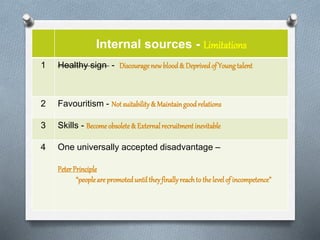
Internal sources - Limitations
1 Healthy sign - Discouragenewblood& Deprivedof Youngtalent
2 Favouritism - Not suitability& Maintaingoodrelations
3 Skills - Becomeobsolete& Externalrecruitmentinevitable
4 One universally accepted disadvantage –
PeterPrinciple
“peoplearepromoteduntiltheyfinallyreachto thelevelof incompetence”
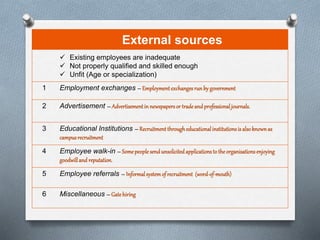
External sources
 Existing employees are inadequate
 Not properly qualified and skilled enough
 Unfit (Age or specialization)
1 Employment exchanges – Employmentexchangesrunby government
2 Advertisement – Advertisementin newspapersor tradeand professionaljournals.
3 Educational Institutions – Recruitmentthrougheducationalinstitutionsis alsoknownas
campusrecruitment
4 Employee walk-in – Somepeople sendunsolicitedapplicationsto theorganisationsenjoying
goodwilland reputation.
5 Employee referrals – Informalsystemof recruitment (word-of-mouth)
6 Miscellaneous – Gatehiring
External sources - Advantages
1
Wider spectrum - The number of applicantswould
be verylarge (Carefullyafter weighing the pros and cons)
2
Avoid bias to some personnel - Following
the external sourcesof recruitment objectively
External sources - Limitations
1 Dissatisfaction - Personnelchosenfromexternalsources
2 Demoralize - Come to knowthat organizationsare considering the
outsiders
3 Costly - spendheavilyonadvertisements
4 Poor response - Potential candidatesresponsesmaybe dismaland
disappointing
5 Wastage of resources - It is customaryto pay (toand fro)the
expenses of thecandidatesfor attending interviews
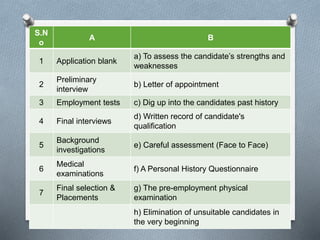
S.N
o
A B
1 Application blank
a) To assess the candidate’s strengths and
weaknesses
2
Preliminary
interview
b) Letter of appointment
3 Employment tests c) Dig up into the candidates past history
4 Final interviews
d) Written record of candidate's
qualification
5
Background
investigations
e) Careful assessment (Face to Face)
6
Medical
examinations
f) A Personal History Questionnaire
7
Final selection &
Placements
g) The pre-employment physical
examination
h) Elimination of unsuitable candidates in
the very beginning
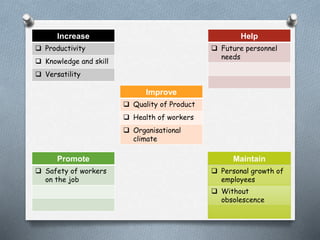
Increase
 Productivity
 Knowledge and skill
 Versatility
Maintain
 Personal growth of
employees
 Without
obsolescence
Help
 Future personnel
needs
Promote
 Safety of workers
on the job
Improve
 Quality of Product
 Health of workers
 Organisational
climate
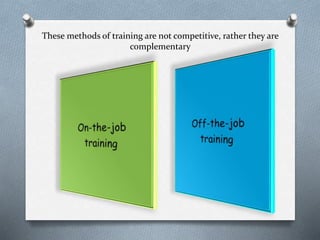
These methods of training are not competitive, rather they are
complementary
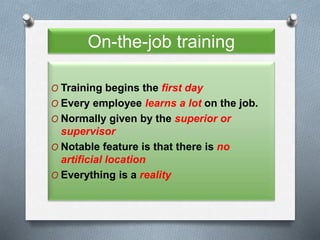
On-the-job training
O Training begins the first day
O Every employee learns a lot on the job.
O Normally given by the superior or
supervisor
O Notable feature is that there is no
artificial location
O Everything is a reality
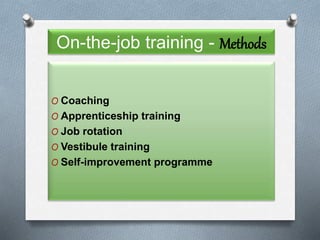
On-the-job training - Methods
O Coaching
O Apprenticeship training
O Job rotation
O Vestibule training
O Self-improvement programme
On-the-job training
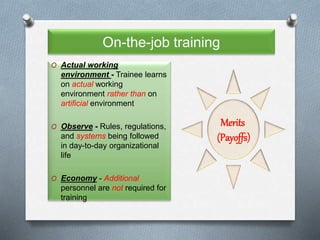
O Actual working
environment - Trainee learns
on actual working
environment rather than on
artificial environment
O Observe - Rules, regulations,
and systems being followed
in day-to-day organizational
life
O Economy - Additional
personnel are not required for
training
Merits
(Payoffs)
On-the-job training
O Haphazard manner - No
direction & disorganized
learning on the part of the trainee
O Costly - Inexperienced handling
of machines and tools by the
trainees may result in colossal
losses
O Productivity - Dismal and
disappointing & Affects the flow
of work
O Difficult to work as well as
learn
Demerits
Off-the-job training
O Off-the-job training refers to training conducted away
from the actual work setting
O Some of the popular methods of off-the-job training
are:
• Lectures and classroom instruction
• The conference method
• Group discussions
• Role playing
• Case studies
• T-group training (or sensitivity training)
Off-the-job training
O High Productivity - The trained
employees are placed in the actual
work station; hence, high productivity is
maintained
O No Production Error - In off-the-job
training, the employees are trained
outside the work environment.
Therefore, they are not involved in
production process as in OJT. As a
result, error in production can be
minimized
O Economy - Off-the-job training will be
economical in the sense that a large
groups of trainees are trained
simultaneously at a time
Off-the-job training
O Free On Production - When the trainees
are not involved in production process,
the production activities can be carried out
without any interruption. Hence, it runs
freely,. Moreover, costly errors and injuries
can be avoided
O Large People - In off-the-job training, a
large number of people can be trained at
a time
O Less Time Of Training - Under off-the-job
training, a large amount of information can
be recovered within a short span of time.
During training phase, no production will
take place; hence, training requires less
time
Off-the-job training
O Outside The Work Station - OTJ training
program takes place outside the work station,
so that it may not yield the desired result to
employees as they are unknown with actual
machines and equipments
O Not Effective - Off-the-job training will not be
effective as the employees are trained in an
artificial classroom. They are unfamiliar with
actual work environment. As a result of
which, it requires long time for them to learn
O No Production - During training period, no
production takes place because employees
are kept away fro the actual work place. The
organization bears only training cost without
any physical output
Off-the-job training
O Expensive - Off-the-job training is
expensive in the sense that the
organization has to prepare extra
place for training outside the actual
work environment
O Lack Of Feedback - The employees
are trained away from the
organizational work environment;
hence, it lacks feedback to
employees.
Placement, Orientation & Induction
O Placement – Right job to the right person
O Orientation – Act of introducing the person
with the job
O Induction - Admit (someone) formally to a
post or organization
Induction
O Act of introducing the person with the
job
O Details of the job – Roles,
Responsibilities & Job requirements
O Also called as “Socialisation”
Orientation
O Wider term than Induction
O Not only job but also Environment (Co-
workers & Organization
O Varies with the organizational size (Small
– Informal & Large – Formal)

Staffing function of Management

  • 1.
  • 2.
    Management of Human resources Manningof Organisational structure Placing right men at the right job Recruitment, Selection, Placement Training & development Provide remuneration Filling with human resources Intro Obtaining & maintaining Capable & Competent people
  • 3.
    In Planning– Setgoal/target/objective Goal/Target/ Objective
  • 4.
    In Organising –Create Organisational Structure
  • 5.
    In Staffing –Putting people in the Structure
  • 6.
    Topics 1 Definitions 2 Importanceof Staffing 3 Staffing process 4 Sources of Recruitment 5 Selection 6 Training & development 7 Methods of training 8 Placement, Orientation & Induction
  • 7.
  • 8.
  • 9.
    Definition -2 KoonzandO’Donnell Executive function which involves Recruitment, Selection, Compensating, training, promotion, retirement of subordinate managers
  • 10.
    Definition -3 Weirich Fillingand keeping filled, positions in the organization structure
  • 22.
    Staffing process is concernedwith providing the organisation the right number of people at the right place, and at the right time the organisation would be able to achieve its goals effectively With So that
  • 23.
    A wrong placementin the organisation would adversely affect the productivity of the organisation as a whole
  • 24.
    Steps in StaffingProcess 1 Manpower planning 2 Recruitment 3 Selection 4 Training 5 Placement & Induction
  • 25.
    Anticipated human resources Skill& expertise required To achieve Organisational objectives Action plans To meet Note: Current assessment, future assessment of the human resource needs and the development of future programme as well as career development
  • 26.
     Seeking andattracting a pool of people from which qualified candidates for job vacancies  Development and maintenance of adequate manpower resources is the main task of recruitment
  • 27.
     Critical step Choosing candidates who best meet the qualifications and requirements of the job
  • 28.
     It isthe process of increasing the knowledge and skills of an employee for doing a particular job.  The objective of training is to achieve a change in the behaviour of those trained
  • 29.
     Placement refersto assigning rank and responsibility to an individual,  Identifying him with a particular job  If the person adjusts to the job and continues to perform per expectations, it means that the candidate is properly placed.  However, if the candidate is seen to have problems in adjusting himself to the job, the supervisor must find out whether the person is properly placed as per the latter’s aptitude and potential
  • 31.
  • 32.
    Internal Sources  Presentemployees: Employees on the payroll.  Basic internal sources: Transfers, promotions of present employees  Review: Personnel records and skills  Employee’s friends and relatives
  • 33.
    Internal sources -Merits 1 Encourage employees – Reachtoppositions 2 Track record – Rightpeople 3 Little training – Knowmajoroperations 4 Expenditure – Relativelyless 5 Improves the morale – Preferredoveroutsiders
  • 34.
    Internal sources -Limitations 1 Healthy sign - Discouragenewblood& Deprivedof Youngtalent 2 Favouritism - Not suitability& Maintaingoodrelations 3 Skills - Becomeobsolete& Externalrecruitmentinevitable 4 One universally accepted disadvantage – PeterPrinciple “peoplearepromoteduntiltheyfinallyreachto thelevelof incompetence”
  • 35.
    External sources  Existingemployees are inadequate  Not properly qualified and skilled enough  Unfit (Age or specialization) 1 Employment exchanges – Employmentexchangesrunby government 2 Advertisement – Advertisementin newspapersor tradeand professionaljournals. 3 Educational Institutions – Recruitmentthrougheducationalinstitutionsis alsoknownas campusrecruitment 4 Employee walk-in – Somepeople sendunsolicitedapplicationsto theorganisationsenjoying goodwilland reputation. 5 Employee referrals – Informalsystemof recruitment (word-of-mouth) 6 Miscellaneous – Gatehiring

  • 36.
    External sources -Advantages 1 Wider spectrum - The number of applicantswould be verylarge (Carefullyafter weighing the pros and cons) 2 Avoid bias to some personnel - Following the external sourcesof recruitment objectively
  • 37.
    External sources -Limitations 1 Dissatisfaction - Personnelchosenfromexternalsources 2 Demoralize - Come to knowthat organizationsare considering the outsiders 3 Costly - spendheavilyonadvertisements 4 Poor response - Potential candidatesresponsesmaybe dismaland disappointing 5 Wastage of resources - It is customaryto pay (toand fro)the expenses of thecandidatesfor attending interviews
  • 40.
    S.N o A B 1 Applicationblank a) To assess the candidate’s strengths and weaknesses 2 Preliminary interview b) Letter of appointment 3 Employment tests c) Dig up into the candidates past history 4 Final interviews d) Written record of candidate's qualification 5 Background investigations e) Careful assessment (Face to Face) 6 Medical examinations f) A Personal History Questionnaire 7 Final selection & Placements g) The pre-employment physical examination h) Elimination of unsuitable candidates in the very beginning
  • 49.
    Increase  Productivity  Knowledgeand skill  Versatility Maintain  Personal growth of employees  Without obsolescence Help  Future personnel needs Promote  Safety of workers on the job Improve  Quality of Product  Health of workers  Organisational climate
  • 51.
    These methods oftraining are not competitive, rather they are complementary
  • 52.
    On-the-job training O Trainingbegins the first day O Every employee learns a lot on the job. O Normally given by the superior or supervisor O Notable feature is that there is no artificial location O Everything is a reality
  • 53.
    On-the-job training -Methods O Coaching O Apprenticeship training O Job rotation O Vestibule training O Self-improvement programme
  • 54.
    On-the-job training O Actualworking environment - Trainee learns on actual working environment rather than on artificial environment O Observe - Rules, regulations, and systems being followed in day-to-day organizational life O Economy - Additional personnel are not required for training Merits (Payoffs)
  • 55.
    On-the-job training O Haphazardmanner - No direction & disorganized learning on the part of the trainee O Costly - Inexperienced handling of machines and tools by the trainees may result in colossal losses O Productivity - Dismal and disappointing & Affects the flow of work O Difficult to work as well as learn Demerits
  • 56.
    Off-the-job training O Off-the-jobtraining refers to training conducted away from the actual work setting O Some of the popular methods of off-the-job training are: • Lectures and classroom instruction • The conference method • Group discussions • Role playing • Case studies • T-group training (or sensitivity training)
  • 57.
    Off-the-job training O HighProductivity - The trained employees are placed in the actual work station; hence, high productivity is maintained O No Production Error - In off-the-job training, the employees are trained outside the work environment. Therefore, they are not involved in production process as in OJT. As a result, error in production can be minimized O Economy - Off-the-job training will be economical in the sense that a large groups of trainees are trained simultaneously at a time
  • 58.
    Off-the-job training O FreeOn Production - When the trainees are not involved in production process, the production activities can be carried out without any interruption. Hence, it runs freely,. Moreover, costly errors and injuries can be avoided O Large People - In off-the-job training, a large number of people can be trained at a time O Less Time Of Training - Under off-the-job training, a large amount of information can be recovered within a short span of time. During training phase, no production will take place; hence, training requires less time
  • 59.
    Off-the-job training O OutsideThe Work Station - OTJ training program takes place outside the work station, so that it may not yield the desired result to employees as they are unknown with actual machines and equipments O Not Effective - Off-the-job training will not be effective as the employees are trained in an artificial classroom. They are unfamiliar with actual work environment. As a result of which, it requires long time for them to learn O No Production - During training period, no production takes place because employees are kept away fro the actual work place. The organization bears only training cost without any physical output
  • 60.
    Off-the-job training O Expensive- Off-the-job training is expensive in the sense that the organization has to prepare extra place for training outside the actual work environment O Lack Of Feedback - The employees are trained away from the organizational work environment; hence, it lacks feedback to employees.
  • 61.
    Placement, Orientation &Induction O Placement – Right job to the right person O Orientation – Act of introducing the person with the job O Induction - Admit (someone) formally to a post or organization
  • 62.
    Induction O Act ofintroducing the person with the job O Details of the job – Roles, Responsibilities & Job requirements O Also called as “Socialisation”
  • 63.
    Orientation O Wider termthan Induction O Not only job but also Environment (Co- workers & Organization O Varies with the organizational size (Small – Informal & Large – Formal)