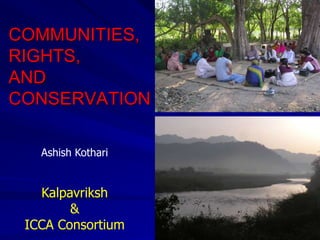
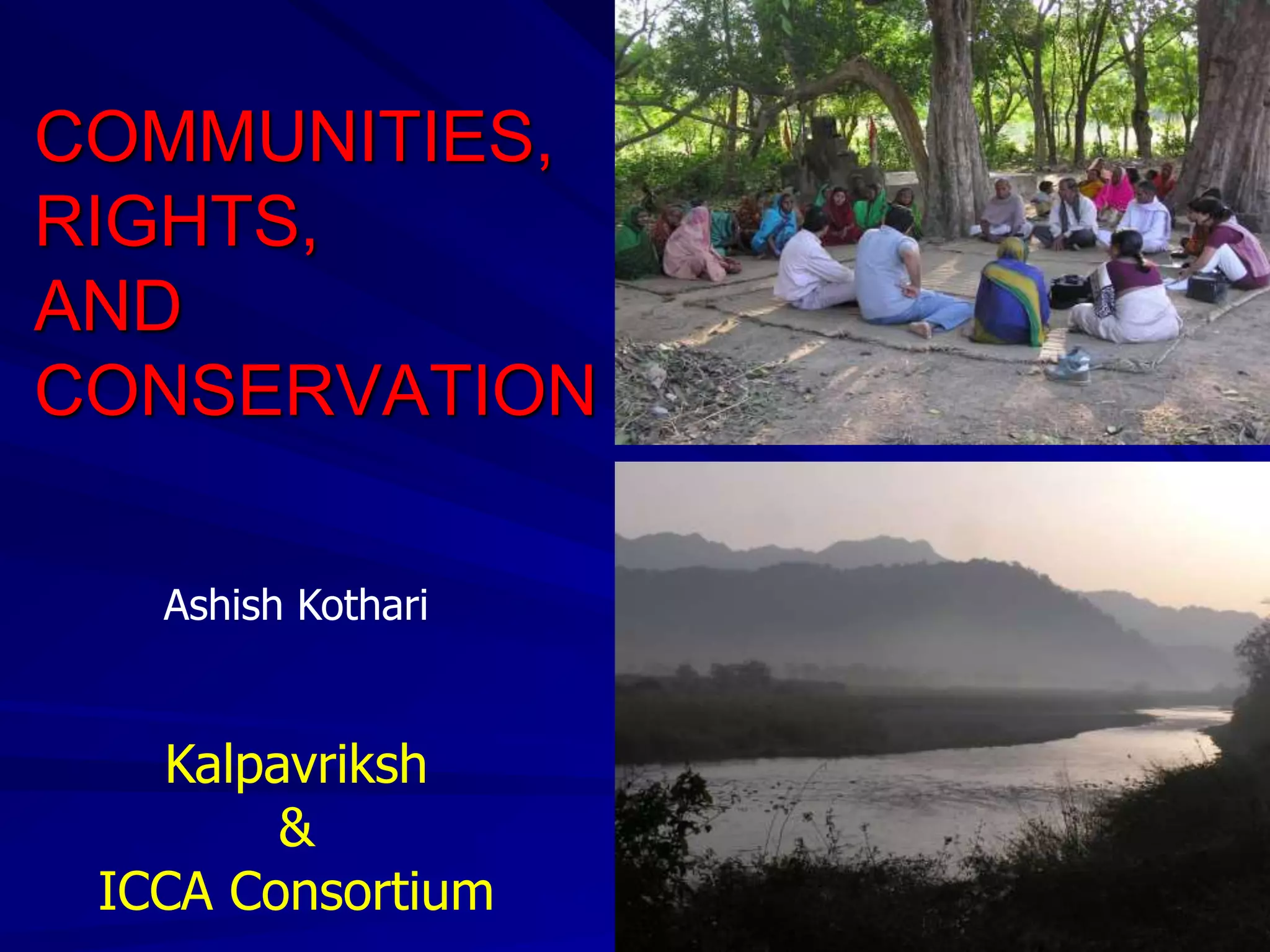
COMMUNITIES,
RIGHTS,
AND
CONSERVATION
Ashish Kothari
Kalpavriksh
&
ICCA Consortium
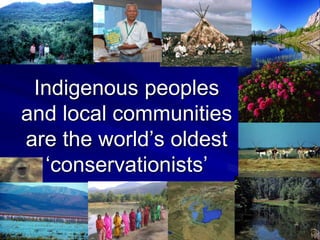
Indigenous peoples
and local communities
are the world’s oldest
ā€˜conservationists’
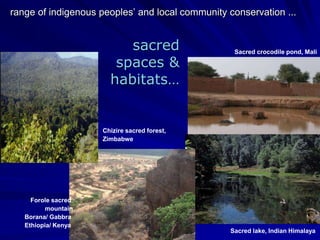
range of indigenous peoples’ and local community conservation ...
sacred
spaces &
habitats…
Sacred lake, Indian Himalaya
Chizire sacred forest,
Zimbabwe
Sacred crocodile pond, Mali
Forole sacred
mountain
Borana/ Gabbra
Ethiopia/ Kenya
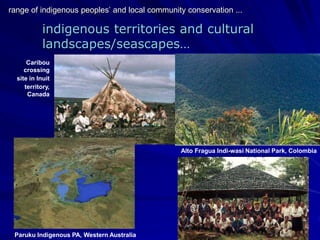
indigenous territories and cultural
landscapes/seascapes…
Paruku Indigenous PA, Western Australia
Caribou
crossing
site in Inuit
territory,
Canada
Alto Fragua Indi-wasi National Park, Colombia
range of indigenous peoples’ and local community conservation ...
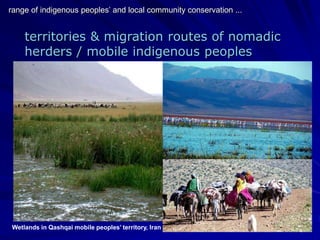
territories & migration routes of nomadic
herders / mobile indigenous peoples
Wetlands in Qashqai mobile peoples’ territory, Iran
range of indigenous peoples’ and local community conservation ...
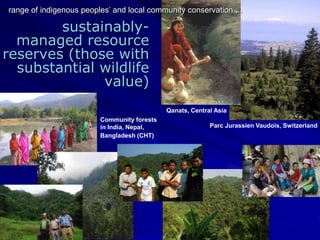
sustainably-
managed resource
reserves (those with
substantial wildlife
value)
Parc Jurassien Vaudois, Switzerland
Qanats, Central Asia
Community forests
in India, Nepal,
Bangladesh (CHT)
range of indigenous peoples’ and local community conservation ...
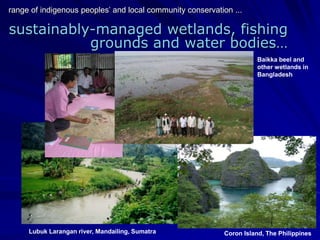
sustainably-managed wetlands, fishing
grounds and water bodies…
Lubuk Larangan river, Mandailing, Sumatra Coron Island, The Philippines
Baikka beel and
other wetlands in
Bangladesh
range of indigenous peoples’ and local community conservation ...
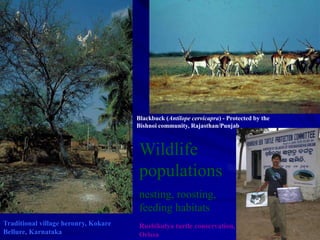
Traditional village heronry, Kokare
Bellure, Karnataka
Blackbuck (Antilope cervicapra) - Protected by the
Bishnoi community, Rajasthan/Punjab
Wildlife
populations
nesting, roosting,
feeding habitats
Rushikulya turtle conservation,
Orissa
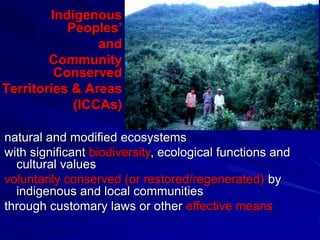
Indigenous
Peoples’
and
Community
Conserved
Territories & Areas
(ICCAs)
natural and modified ecosystems
with significant biodiversity, ecological functions and
cultural values
voluntarily conserved (or restored/regenerated) by
indigenous and local communities
through customary laws or other effective means
Three defining features of ICCAs
(not all indigenous/community lands are ICCAs!)
Predominant decisions by community (regardless of
land or resource ownership)
Community has rules or institutions for governance and
management
Community management is achieving conservation
(regardless of objectives)
Extent of ICCAs?
No comprehensive estimate available
Some examples:
– Worldwide: 500 million ha of forests (15% of the world’s total)
under community ownership or management (2011); of this,
about 90% under some level of conservation management (based
on Molnar et al. 2004).
– Brazil: 1/5th of Amazon under indigenous reserves (5X govt PAs,
and achieving equal or better conservation; Nepstad et al 2006)
– Philippines - over 60% of forests in indigenous territories; 4.5
m.ha. recognised as Ancestral Domain (Pedgragosa 2012)
– Australia: 25% of protected area estate are Indigenous PAs
(Govan/Grant 2012)
– Namibia: 14 m.ha. community forests & conservancies (Jones
2012)
– Fiji: 1.7 m.ha. under Locally Managed Marine Areas (100% of
marine PAs; Govan 2012)
– Mexico (Oaxaca): 82% forests community owned/managed
(Martin et al 2010)
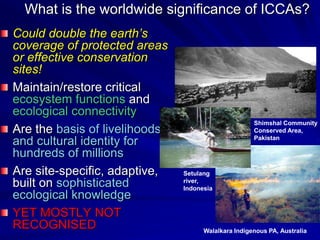
What is the worldwide significance of ICCAs?
Could double the earth’s
coverage of protected areas
or effective conservation
sites!
Maintain/restore critical
ecosystem functions and
ecological connectivity
Are the basis of livelihoods
and cultural identity for
hundreds of millions
Are site-specific, adaptive,
built on sophisticated
ecological knowledge
YET MOSTLY NOT
RECOGNISED Walalkara Indigenous PA, Australia
Shimshal Community
Conserved Area,
Pakistan
Setulang
river,
Indonesia
expand the total coverage of
conservation sites
address gaps in the system
improve connectivity in the
landscape
help restore ecosystems and
wildlife populations
enhance public support for
conservation
increase the flexibility and
resilience of the system
help mitigate and adapt to
climate change
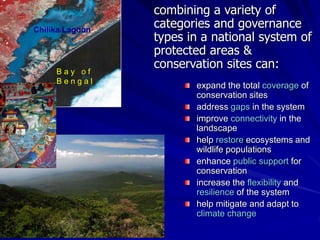
combining a variety of
categories and governance
types in a national system of
protected areas &
conservation sites can:
Chilika Lagoon
B a y o f
B e n g a l
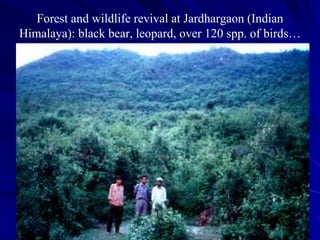
Forest and wildlife revival at Jardhargaon (Indian
Himalaya): black bear, leopard, over 120 spp. of birds…
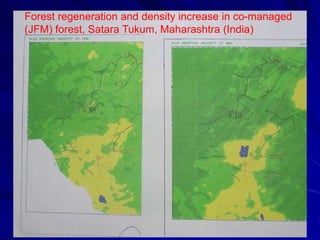
Regeneration and increase in density of forests at Satara TukumForest regeneration and density increase in co-managed
(JFM) forest, Satara Tukum, Maharashtra (India)
Customs / strategies …
Social fencing
Sanctions/fines/penalties
Fire / grazing /logging control (not
necessarily complete suppression)
Community patrolling
Assisted restoration (limited)
Control of invasives
Diverse governance/management institutions
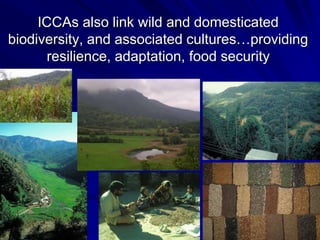
ICCAs also link wild and domesticated
biodiversity, and associated cultures…providing
resilience, adaptation, food security
Challenges & threats ICCAs face
Unclear or weak legal status and tenure
Lack of social and legal recognition as ICCAs
Lack of information on ecological and social values
Inappropriate ā€˜development’ processes (mining,
agricultural expansion, dams…)
Imposition of non-participatory govt protected areas
Inadequate livelihood options
Internal inequalities, political vested interests
Cultural and aspirational changes
Global Study on ICCA
Recognition and Support
(ICCA Consortium, IUCN TILCEPA, Kalpavriksh, Natural Justice)
19 country case studies, global
overview:
Analysis of legal recognition
(rights, access, etc)
Analysis of non-legal recognition &
support (social, economic, etc)
Crucial ingredients of a
secure ICCA
Clear tenurial rights (territory, resources)
Recognition of collective decision-making
authority
Prior informed consent provisions
Customary &/or statutory law
Clear cultural, economic, ecological, &/or
political linkage with site/resource
Continued traditional knowledge
(complemented by modern knowledge)
Three ways to legally recognise
ICCAs (distinct or overlapping)
As part of protected area system (e.g. in PA law)
As part of more general conservation measures (e.g. in
biodiversity law)
Embedded in recognition of indigenous peoples,
decentralised governance, etc (e.g. in Constitution, or land
law, or village council law)
Progress of legal recognition
Forests under community ownership/management, up
from 10 to 15% in last decade (RRI 2012)
Brazil, Bolivia, Columbia, Australia: indigenous territories
designated in ~200 hundred m.ha.
Philippines: Ancestral Domain titles to many indigenous
territories, could go up to 6-7 m.ha.
India: Community Forest Rights (incl. use/management)
under Forest Rights Act to ~ 0.5 m.ha. (potential >30 m.ha.)
Kenya, Namibia, Tanzania: community forests &/or
conservancies, with full management and use control,
several m.ha.
Iran: much of country under mobile peoples’ territories,
with increasing recognition
Major new international tools
for ICCAs…
1. U.N. Convention on Biodiversity
2. UN Declaration of the Rights of
Indigenous Peoples
3. IUCN protected area categories
4. UNEP protected area database
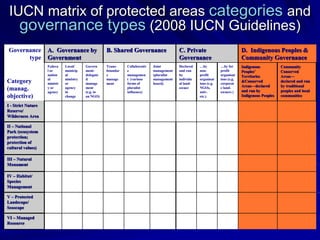
IUCN matrix of protected areas categories and
governance types (2008 IUCN Guidelines)
Governance
type
Category
(manag.
objective)
A. Governance by
Government
B. Shared Governance C. Private
Governance
D. Indigenous Peoples &
Community Governance
Federa
l or
nation
al
ministr
y or
agency
Local/
municip
al
ministry
or
agency
in
change
Govern
ment-
delegate
d
manage
ment
(e.g. to
an NGO)
Trans-
boundar
y
manage
ment
Collaborativ
e
managemen
t (various
forms of
pluralist
influence)
Joint
management
(pluralist
management
board)
Declared
and run
by
individu
al land-
owner
…by
non-
profit
organisat
ions (e.g.
NGOs,
univ.
etc.)
…by for
profit
organisat
ions (e.g.
corporat
e land-
owners )
Indigenous
Peoples’
Territories
&Conserved
Areas—declared
and run by
Indigenous Peoples
Community
Conserved
Areas—
declared and run
by traditional
peoples and local
communities
I - Strict Nature
Reserve/
Wilderness Area
II – National
Park (ecosystem
protection;
protection of
cultural values)
III – Natural
Monument
IV – Habitat/
Species
Management
V – Protected
Landscape/
Seascape
VI – Managed
Resource
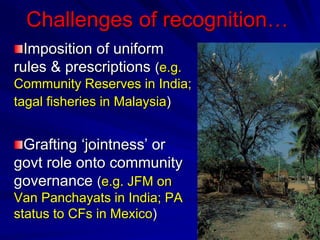
Challenges of recognition…
Imposition of uniform
rules & prescriptions (e.g.
Community Reserves in India;
tagal fisheries in Malaysia)
Grafting ā€˜jointness’ or
govt role onto community
governance (e.g. JFM on
Van Panchayats in India; PA
status to CFs in Mexico)
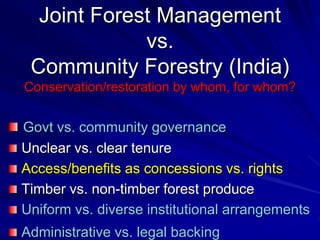
Joint Forest Management
vs.
Community Forestry (India)
Conservation/restoration by whom, for whom?
Govt vs. community governance
Unclear vs. clear tenure
Access/benefits as concessions vs. rights
Timber vs. non-timber forest produce
Uniform vs. diverse institutional arrangements
Administrative vs. legal backing
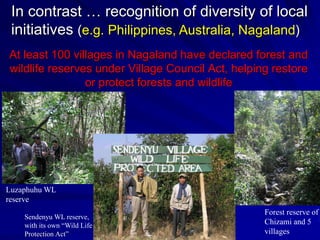
At least 100 villages in Nagaland have declared forest and
wildlife reserves under Village Council Act, helping restore
or protect forests and wildlife
Luzaphuhu WL
reserve
Forest reserve of
Chizami and 5
villages
Sendenyu WL reserve,
with its own ā€œWild Life
Protection Actā€
In contrast … recognition of diversity of local
initiatives (e.g. Philippines, Australia, Nagaland)
What is needed for ICCAs?
Identification and documentation, mapping
Study of ecological & socio-economic values
Legal and policy measures for recognition and
support (esp. tenurial/territorial rights)
Building capacity for more effective conservation /
restoration, management planning, livelihood
enhancement
Generating livelihoods (appropriate development)
Resolving human-wildlife conflicts
Regional level and national networks
Alert system for ICCAs under threat
for more information:
www.iccaforum.org
www.kalpavriksh.org

Indigenous & community conservation

  • 1.
  • 2.
    Indigenous peoples and localcommunities are the world’s oldest ā€˜conservationists’
  • 3.
    range of indigenouspeoples’ and local community conservation ... sacred spaces & habitats… Sacred lake, Indian Himalaya Chizire sacred forest, Zimbabwe Sacred crocodile pond, Mali Forole sacred mountain Borana/ Gabbra Ethiopia/ Kenya
  • 4.
    indigenous territories andcultural landscapes/seascapes… Paruku Indigenous PA, Western Australia Caribou crossing site in Inuit territory, Canada Alto Fragua Indi-wasi National Park, Colombia range of indigenous peoples’ and local community conservation ...
  • 5.
    territories & migrationroutes of nomadic herders / mobile indigenous peoples Wetlands in Qashqai mobile peoples’ territory, Iran range of indigenous peoples’ and local community conservation ...
  • 6.
    sustainably- managed resource reserves (thosewith substantial wildlife value) Parc Jurassien Vaudois, Switzerland Qanats, Central Asia Community forests in India, Nepal, Bangladesh (CHT) range of indigenous peoples’ and local community conservation ...
  • 7.
    sustainably-managed wetlands, fishing groundsand water bodies… Lubuk Larangan river, Mandailing, Sumatra Coron Island, The Philippines Baikka beel and other wetlands in Bangladesh range of indigenous peoples’ and local community conservation ...
  • 8.
    Traditional village heronry,Kokare Bellure, Karnataka Blackbuck (Antilope cervicapra) - Protected by the Bishnoi community, Rajasthan/Punjab Wildlife populations nesting, roosting, feeding habitats Rushikulya turtle conservation, Orissa
  • 9.
    Indigenous Peoples’ and Community Conserved Territories & Areas (ICCAs) naturaland modified ecosystems with significant biodiversity, ecological functions and cultural values voluntarily conserved (or restored/regenerated) by indigenous and local communities through customary laws or other effective means
  • 10.
    Three defining featuresof ICCAs (not all indigenous/community lands are ICCAs!) Predominant decisions by community (regardless of land or resource ownership) Community has rules or institutions for governance and management Community management is achieving conservation (regardless of objectives)
  • 11.
    Extent of ICCAs? Nocomprehensive estimate available Some examples: – Worldwide: 500 million ha of forests (15% of the world’s total) under community ownership or management (2011); of this, about 90% under some level of conservation management (based on Molnar et al. 2004). – Brazil: 1/5th of Amazon under indigenous reserves (5X govt PAs, and achieving equal or better conservation; Nepstad et al 2006) – Philippines - over 60% of forests in indigenous territories; 4.5 m.ha. recognised as Ancestral Domain (Pedgragosa 2012) – Australia: 25% of protected area estate are Indigenous PAs (Govan/Grant 2012) – Namibia: 14 m.ha. community forests & conservancies (Jones 2012) – Fiji: 1.7 m.ha. under Locally Managed Marine Areas (100% of marine PAs; Govan 2012) – Mexico (Oaxaca): 82% forests community owned/managed (Martin et al 2010)
  • 12.
    What is theworldwide significance of ICCAs? Could double the earth’s coverage of protected areas or effective conservation sites! Maintain/restore critical ecosystem functions and ecological connectivity Are the basis of livelihoods and cultural identity for hundreds of millions Are site-specific, adaptive, built on sophisticated ecological knowledge YET MOSTLY NOT RECOGNISED Walalkara Indigenous PA, Australia Shimshal Community Conserved Area, Pakistan Setulang river, Indonesia
  • 13.
    expand the totalcoverage of conservation sites address gaps in the system improve connectivity in the landscape help restore ecosystems and wildlife populations enhance public support for conservation increase the flexibility and resilience of the system help mitigate and adapt to climate change combining a variety of categories and governance types in a national system of protected areas & conservation sites can: Chilika Lagoon B a y o f B e n g a l
  • 14.
    Forest and wildliferevival at Jardhargaon (Indian Himalaya): black bear, leopard, over 120 spp. of birds…
  • 15.
    Regeneration and increasein density of forests at Satara TukumForest regeneration and density increase in co-managed (JFM) forest, Satara Tukum, Maharashtra (India)
  • 16.
    Customs / strategies… Social fencing Sanctions/fines/penalties Fire / grazing /logging control (not necessarily complete suppression) Community patrolling Assisted restoration (limited) Control of invasives Diverse governance/management institutions
  • 17.
    ICCAs also linkwild and domesticated biodiversity, and associated cultures…providing resilience, adaptation, food security
  • 18.
    Challenges & threatsICCAs face Unclear or weak legal status and tenure Lack of social and legal recognition as ICCAs Lack of information on ecological and social values Inappropriate ā€˜development’ processes (mining, agricultural expansion, dams…) Imposition of non-participatory govt protected areas Inadequate livelihood options Internal inequalities, political vested interests Cultural and aspirational changes
  • 19.
    Global Study onICCA Recognition and Support (ICCA Consortium, IUCN TILCEPA, Kalpavriksh, Natural Justice) 19 country case studies, global overview: Analysis of legal recognition (rights, access, etc) Analysis of non-legal recognition & support (social, economic, etc)
  • 20.
    Crucial ingredients ofa secure ICCA Clear tenurial rights (territory, resources) Recognition of collective decision-making authority Prior informed consent provisions Customary &/or statutory law Clear cultural, economic, ecological, &/or political linkage with site/resource Continued traditional knowledge (complemented by modern knowledge)
  • 21.
    Three ways tolegally recognise ICCAs (distinct or overlapping) As part of protected area system (e.g. in PA law) As part of more general conservation measures (e.g. in biodiversity law) Embedded in recognition of indigenous peoples, decentralised governance, etc (e.g. in Constitution, or land law, or village council law)
  • 22.
    Progress of legalrecognition Forests under community ownership/management, up from 10 to 15% in last decade (RRI 2012) Brazil, Bolivia, Columbia, Australia: indigenous territories designated in ~200 hundred m.ha. Philippines: Ancestral Domain titles to many indigenous territories, could go up to 6-7 m.ha. India: Community Forest Rights (incl. use/management) under Forest Rights Act to ~ 0.5 m.ha. (potential >30 m.ha.) Kenya, Namibia, Tanzania: community forests &/or conservancies, with full management and use control, several m.ha. Iran: much of country under mobile peoples’ territories, with increasing recognition
  • 23.
    Major new internationaltools for ICCAs… 1. U.N. Convention on Biodiversity 2. UN Declaration of the Rights of Indigenous Peoples 3. IUCN protected area categories 4. UNEP protected area database
  • 24.
    IUCN matrix ofprotected areas categories and governance types (2008 IUCN Guidelines) Governance type Category (manag. objective) A. Governance by Government B. Shared Governance C. Private Governance D. Indigenous Peoples & Community Governance Federa l or nation al ministr y or agency Local/ municip al ministry or agency in change Govern ment- delegate d manage ment (e.g. to an NGO) Trans- boundar y manage ment Collaborativ e managemen t (various forms of pluralist influence) Joint management (pluralist management board) Declared and run by individu al land- owner …by non- profit organisat ions (e.g. NGOs, univ. etc.) …by for profit organisat ions (e.g. corporat e land- owners ) Indigenous Peoples’ Territories &Conserved Areas—declared and run by Indigenous Peoples Community Conserved Areas— declared and run by traditional peoples and local communities I - Strict Nature Reserve/ Wilderness Area II – National Park (ecosystem protection; protection of cultural values) III – Natural Monument IV – Habitat/ Species Management V – Protected Landscape/ Seascape VI – Managed Resource
  • 25.
    Challenges of recognition… Impositionof uniform rules & prescriptions (e.g. Community Reserves in India; tagal fisheries in Malaysia) Grafting ā€˜jointness’ or govt role onto community governance (e.g. JFM on Van Panchayats in India; PA status to CFs in Mexico)
  • 26.
    Joint Forest Management vs. CommunityForestry (India) Conservation/restoration by whom, for whom? Govt vs. community governance Unclear vs. clear tenure Access/benefits as concessions vs. rights Timber vs. non-timber forest produce Uniform vs. diverse institutional arrangements Administrative vs. legal backing
  • 27.
    At least 100villages in Nagaland have declared forest and wildlife reserves under Village Council Act, helping restore or protect forests and wildlife Luzaphuhu WL reserve Forest reserve of Chizami and 5 villages Sendenyu WL reserve, with its own ā€œWild Life Protection Actā€ In contrast … recognition of diversity of local initiatives (e.g. Philippines, Australia, Nagaland)
  • 28.
    What is neededfor ICCAs? Identification and documentation, mapping Study of ecological & socio-economic values Legal and policy measures for recognition and support (esp. tenurial/territorial rights) Building capacity for more effective conservation / restoration, management planning, livelihood enhancement Generating livelihoods (appropriate development) Resolving human-wildlife conflicts Regional level and national networks Alert system for ICCAs under threat
  • 29.