Trends in Forest Ownership, Forest Resource Tenure and Institutional Arrangements: Are They Contributing to Better Forest Management and Poverty
Reduction? Case studies from Indonesia.
Vince Deschamps MCIP, RPP
Paul Hartman
CIP Conference, Quebec City
June 4, 2007
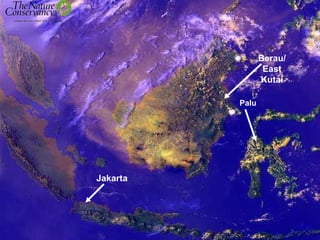
Berau/
East
Kutai
Palu
Jakarta
Main FindingsMain Findings
1. In theabsenceof securetenurerights, creation of
collaborativemanagement structuresthat aresupported
by customary law can contributeto better forest
management and poverty reduction and should be
promoted nationally
2. Thesocio-economic and ecological ‘health’ of forest
based communitiesutilizing customary law can exceed
thoseof communitieswith economiesbased primarily
on agricultural production
3. Land tenureand forestry lawsneed to berevised to
recognizethelegitimacy and rightsof local
communities
Land Tenure ContextLand Tenure Context
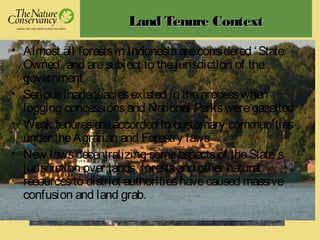
• Almost all forestsin Indonesiaareconsidered ‘State
Owned’ and aresubject to thejurisdiction of the
government
• Seriousinadequaciesexisted in theprocesswhen
logging concessionsand National Parksweregazetted
• Weak tenuresareaccorded to customary communities
under theAgrarian and Forestry laws
• New lawsdecentralizing someaspectsof theState’s
jurisdiction over lands, forestsand other natural
resourcesto district authoritieshavecaused massive
confusion and land grab.
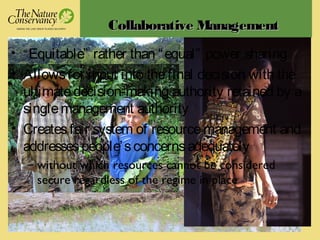
CollaborativeCollaborative ManagementManagement
• “Equitable” rather than “equal” power sharing
• Allowsfor input into thefinal decision with the
ultimatedecision-making authority retained by a
singlemanagement authority
• Createsfair system of resourcemanagement and
addressespeople’sconcernsadequately
– without which resources cannot be considered
secure regardless of the regime in place
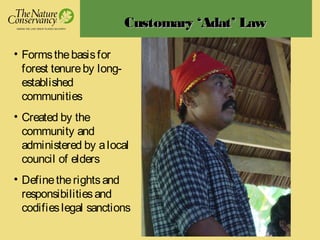
Customary ‘Adat’ LawCustomary ‘Adat’ Law
• Formsthebasisfor
forest tenureby long-
established
communities
• Created by the
community and
administered by alocal
council of elders
• Definetherightsand
responsibilitiesand
codifieslegal sanctions
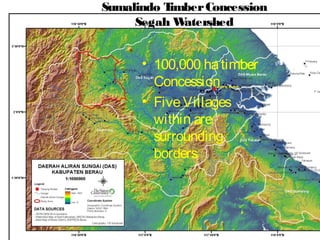
Berau district
• 100,000 hatimber
Concession
• FiveVillages
within are
surrounding
borders
Sumalindo TimberConcession
Segah Watershed
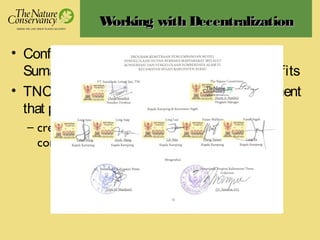
Working with DecentralizationWorking with Decentralization
• Conflict between thecommunitiesand
Sumalindo timber concession = nobody benefits
• TNC as‘honest broker’ in facilitating agreement
that providesbenefit to all parties
– creation of a Management Body involving the
communities, the concessionaire, and local govt
Roles and ResponsibilitiesRoles and Responsibilities
• Timber company provides increased revenue stream
to Communities through the management body
• Communities monitor the logging practices of the
timber company in the forest
• Work together to keep out illegal logging
• TNC builds capacity of the management body
RecognitionRecognition ofof
Traditional RightsTraditional Rights
• Ultimatedecision-making and legal authority
retained by theconcession holder (company)
• Acknowledgesthetraditional land tenurerights
of communitiesthrough:
1. requiring agreement on where and when logging
takes place
2. ensuring equitable distribution of logging benefits
through compensation for logging in traditional
lands
3. increasing the voice of communities in the
management of forest resources
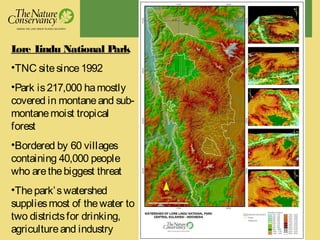
Lore Lindu National Park
•TNC sitesince1992
•Park is217,000 hamostly
covered in montaneand sub-
montanemoist tropical
forest
•Bordered by 60 villages
containing 40,000 people
who arethebiggest threat
•Thepark’swatershed
suppliesmost of thewater to
two districtsfor drinking,
agricultureand industry
Dongi-DongiDongi-Dongi
EncroachmentEncroachment
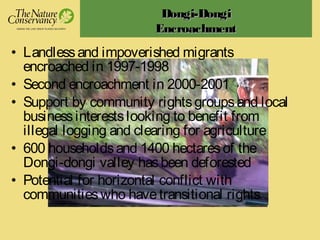
• Landlessand impoverished migrants
encroached in 1997-1998
• Second encroachment in 2000-2001
• Support by community rightsgroupsand local
businessinterestslooking to benefit from
illegal logging and clearing for agriculture
• 600 householdsand 1400 hectaresof the
Dongi-dongi valley hasbeen deforested
• Potential for horizontal conflict with
communitieswho havetransitional rights
• TNC working to change
perceptionsand attitudesabout
LoreLindu NP
– Park is conceived as protector of traditional
land and not a threat to livelihoods
Collaborative ManagementCollaborative Management
LLNPLLNP
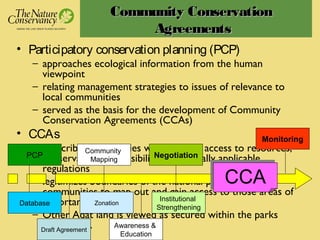
• Participatory conservation planning (PCP)
– approaches ecological information from the human
viewpoint
– relating management strategies to issues of relevance to
local communities
– served as the basis for the development of Community
Conservation Agreements (CCAs)
• CCAs
– prescribe communities with rights of access to resources,
conservation responsibilities, and locally applicable
regulations
– legitimizes boundaries of the national park by allowing
communities to map out and gain access to those areas of
importance to them.
– Other Adat land is viewed as secured within the parks
boundaries.
Database
Draft Agreement
Community
Mapping
PCP
Awareness &
Education
Institutional
Strengthening
Zonation
Negotiation
Monitoring
CCACCA
Community ConservationCommunity Conservation
AgreementsAgreements
Control Illegal loggingControl Illegal logging
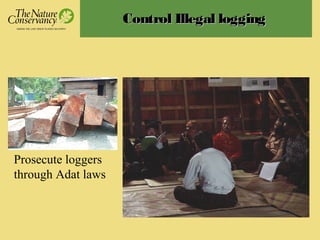
Prosecute loggers
through Adat laws
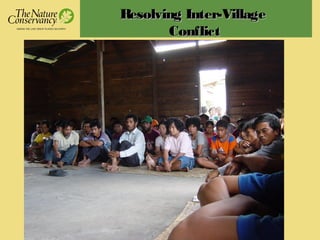
Resolving Inter-VillageResolving Inter-Village
ConflictConflict
Collaborative Management &Collaborative Management &
Economic SustainabilityEconomic Sustainability
• TNC conducted resourcevaluationsin the
Berau and Palu river watershedsin 2001 and
2002
• Studiesprovideeconomic justification for
promotion of Adat and sustainableforest-
based systemsin thecollaborative
management process
Collaborative Management &Collaborative Management &
Economic SustainabilityEconomic Sustainability
• Communitiesin Berau include:
– indigenous communities managing forest-based
economies through the implementation of Adat
– relatively new arrivals who derived livelihoods
from agro-based economies.
• Communitiesin Palu include:
– households from a variety of indigenous and
immigrant backgrounds with mixed agro/forest-
based economies
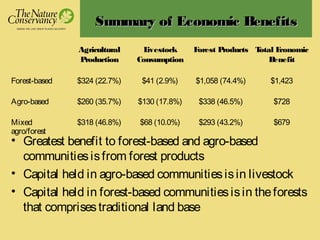
Summary of Economic BenefitsSummary of Economic Benefits
• Greatest benefit to forest-based and agro-based
communitiesisfrom forest products
• Capital held in agro-based communitiesisin livestock
• Capital held in forest-based communitiesisin theforests
that comprisestraditional land base
Agricultural
Production
Livestock
Consumption
Forest Products Total Economic
Benefit
Forest-based $324 (22.7%) $41 (2.9%) $1,058 (74.4%) $1,423
Agro-based $260 (35.7%) $130 (17.8%) $338 (46.5%) $728
Mixed
agro/forest
$318 (46.8%) $68 (10.0%) $293 (43.2%) $679
Natural Environment andNatural Environment and
Community Well-BeingCommunity Well-Being
• Higher ratesof ‘environmental events’ reported
in householdsof forest-based communities
– proximity to the ‘front lines’ of environmental
degradation
– Identifying their sources important in maintaining
balance between community/ecosystem health and
economic prosperity
• Littleawarenessof relationship between resource
extraction and impactson ecosystem servicesand
general well-being
SummarySummary
• Almost all havean incomeassociated with local natural
resourceconsumption, with forest-based activities:
– contributing up to 75% of local cash economy
– providing high levels of basic foodstuffs and building materials.
• Mixed agro/forest-based communitiesaresimilar to
agro-based communitiesin their dependenceon
agricultural productsand livestock inventories
• Forest-based economiesareexposed to vulnerabilities
– Remoteness and lack of access to major centres
– manipulation by middlemen
Guiding Principles forCommunityGuiding Principles forCommunity
InvolvementInvolvement
• Focuson thelink between healthy ecosystems
and sustainablelivelihoods
• Let thecommunity guidetheprocess, but provide
them with sufficient information and expertiseto
makeinformed decisions
• Develop and executetheproject with along-term
vision
RecommendationsRecommendations
A Way ForwardA Way Forward
• Mapping of traditional land usefor indigenous
communities
• Document and securelegal recognition of resource-
based Adat for indigenouscommunities
• Formulate, document and obtain legal recognition of
resource-based Adat for non-indigenouscommunities
• PromoteCollaborativeManagement structureswith the
assistanceof non-government organizations
• Promotereforestation of degraded forestsnear agro and
mixed forest/agro-based communitiesto provide
potential resourcebasefor forest products
Terima Kasih

Trends in Forest Ownership and Tenure_Indonesia Studies

  • 1.
    Trends in ForestOwnership, Forest Resource Tenure and Institutional Arrangements: Are They Contributing to Better Forest Management and Poverty Reduction? Case studies from Indonesia. Vince Deschamps MCIP, RPP Paul Hartman CIP Conference, Quebec City June 4, 2007
  • 2.
  • 3.
    Main FindingsMain Findings 1.In theabsenceof securetenurerights, creation of collaborativemanagement structuresthat aresupported by customary law can contributeto better forest management and poverty reduction and should be promoted nationally 2. Thesocio-economic and ecological ‘health’ of forest based communitiesutilizing customary law can exceed thoseof communitieswith economiesbased primarily on agricultural production 3. Land tenureand forestry lawsneed to berevised to recognizethelegitimacy and rightsof local communities
  • 4.
    Land Tenure ContextLandTenure Context • Almost all forestsin Indonesiaareconsidered ‘State Owned’ and aresubject to thejurisdiction of the government • Seriousinadequaciesexisted in theprocesswhen logging concessionsand National Parksweregazetted • Weak tenuresareaccorded to customary communities under theAgrarian and Forestry laws • New lawsdecentralizing someaspectsof theState’s jurisdiction over lands, forestsand other natural resourcesto district authoritieshavecaused massive confusion and land grab.
  • 5.
    CollaborativeCollaborative ManagementManagement • “Equitable”rather than “equal” power sharing • Allowsfor input into thefinal decision with the ultimatedecision-making authority retained by a singlemanagement authority • Createsfair system of resourcemanagement and addressespeople’sconcernsadequately – without which resources cannot be considered secure regardless of the regime in place
  • 6.
    Customary ‘Adat’ LawCustomary‘Adat’ Law • Formsthebasisfor forest tenureby long- established communities • Created by the community and administered by alocal council of elders • Definetherightsand responsibilitiesand codifieslegal sanctions
  • 7.
    Berau district • 100,000hatimber Concession • FiveVillages within are surrounding borders Sumalindo TimberConcession Segah Watershed
  • 8.
    Working with DecentralizationWorkingwith Decentralization • Conflict between thecommunitiesand Sumalindo timber concession = nobody benefits • TNC as‘honest broker’ in facilitating agreement that providesbenefit to all parties – creation of a Management Body involving the communities, the concessionaire, and local govt
  • 9.
    Roles and ResponsibilitiesRolesand Responsibilities • Timber company provides increased revenue stream to Communities through the management body • Communities monitor the logging practices of the timber company in the forest • Work together to keep out illegal logging • TNC builds capacity of the management body
  • 10.
    RecognitionRecognition ofof Traditional RightsTraditionalRights • Ultimatedecision-making and legal authority retained by theconcession holder (company) • Acknowledgesthetraditional land tenurerights of communitiesthrough: 1. requiring agreement on where and when logging takes place 2. ensuring equitable distribution of logging benefits through compensation for logging in traditional lands 3. increasing the voice of communities in the management of forest resources
  • 11.
    Lore Lindu NationalPark •TNC sitesince1992 •Park is217,000 hamostly covered in montaneand sub- montanemoist tropical forest •Bordered by 60 villages containing 40,000 people who arethebiggest threat •Thepark’swatershed suppliesmost of thewater to two districtsfor drinking, agricultureand industry
  • 12.
    Dongi-DongiDongi-Dongi EncroachmentEncroachment • Landlessand impoverishedmigrants encroached in 1997-1998 • Second encroachment in 2000-2001 • Support by community rightsgroupsand local businessinterestslooking to benefit from illegal logging and clearing for agriculture • 600 householdsand 1400 hectaresof the Dongi-dongi valley hasbeen deforested • Potential for horizontal conflict with communitieswho havetransitional rights
  • 13.
    • TNC workingto change perceptionsand attitudesabout LoreLindu NP – Park is conceived as protector of traditional land and not a threat to livelihoods Collaborative ManagementCollaborative Management LLNPLLNP
  • 14.
    • Participatory conservationplanning (PCP) – approaches ecological information from the human viewpoint – relating management strategies to issues of relevance to local communities – served as the basis for the development of Community Conservation Agreements (CCAs) • CCAs – prescribe communities with rights of access to resources, conservation responsibilities, and locally applicable regulations – legitimizes boundaries of the national park by allowing communities to map out and gain access to those areas of importance to them. – Other Adat land is viewed as secured within the parks boundaries. Database Draft Agreement Community Mapping PCP Awareness & Education Institutional Strengthening Zonation Negotiation Monitoring CCACCA Community ConservationCommunity Conservation AgreementsAgreements
  • 15.
    Control Illegal loggingControlIllegal logging Prosecute loggers through Adat laws
  • 16.
  • 17.
    Collaborative Management &CollaborativeManagement & Economic SustainabilityEconomic Sustainability • TNC conducted resourcevaluationsin the Berau and Palu river watershedsin 2001 and 2002 • Studiesprovideeconomic justification for promotion of Adat and sustainableforest- based systemsin thecollaborative management process
  • 18.
    Collaborative Management &CollaborativeManagement & Economic SustainabilityEconomic Sustainability • Communitiesin Berau include: – indigenous communities managing forest-based economies through the implementation of Adat – relatively new arrivals who derived livelihoods from agro-based economies. • Communitiesin Palu include: – households from a variety of indigenous and immigrant backgrounds with mixed agro/forest- based economies
  • 19.
    Summary of EconomicBenefitsSummary of Economic Benefits • Greatest benefit to forest-based and agro-based communitiesisfrom forest products • Capital held in agro-based communitiesisin livestock • Capital held in forest-based communitiesisin theforests that comprisestraditional land base Agricultural Production Livestock Consumption Forest Products Total Economic Benefit Forest-based $324 (22.7%) $41 (2.9%) $1,058 (74.4%) $1,423 Agro-based $260 (35.7%) $130 (17.8%) $338 (46.5%) $728 Mixed agro/forest $318 (46.8%) $68 (10.0%) $293 (43.2%) $679
  • 20.
    Natural Environment andNaturalEnvironment and Community Well-BeingCommunity Well-Being • Higher ratesof ‘environmental events’ reported in householdsof forest-based communities – proximity to the ‘front lines’ of environmental degradation – Identifying their sources important in maintaining balance between community/ecosystem health and economic prosperity • Littleawarenessof relationship between resource extraction and impactson ecosystem servicesand general well-being
  • 21.
    SummarySummary • Almost allhavean incomeassociated with local natural resourceconsumption, with forest-based activities: – contributing up to 75% of local cash economy – providing high levels of basic foodstuffs and building materials. • Mixed agro/forest-based communitiesaresimilar to agro-based communitiesin their dependenceon agricultural productsand livestock inventories • Forest-based economiesareexposed to vulnerabilities – Remoteness and lack of access to major centres – manipulation by middlemen
  • 22.
    Guiding Principles forCommunityGuidingPrinciples forCommunity InvolvementInvolvement • Focuson thelink between healthy ecosystems and sustainablelivelihoods • Let thecommunity guidetheprocess, but provide them with sufficient information and expertiseto makeinformed decisions • Develop and executetheproject with along-term vision
  • 23.
    RecommendationsRecommendations A Way ForwardAWay Forward • Mapping of traditional land usefor indigenous communities • Document and securelegal recognition of resource- based Adat for indigenouscommunities • Formulate, document and obtain legal recognition of resource-based Adat for non-indigenouscommunities • PromoteCollaborativeManagement structureswith the assistanceof non-government organizations • Promotereforestation of degraded forestsnear agro and mixed forest/agro-based communitiesto provide potential resourcebasefor forest products
  • 24.

Editor's Notes

  • #3 What’s different Wallace line, Dry vs Wet, National park vs HPH
  • #6 84.0% of rural households along the Kelay and Segah river systems Berau are impacted by floods at least once a year Erosion and the loss of productive land for agriculture has been reported by communities along both the Kelay and Segah rivers. Erosion of productive land impacts 19.6% of rural households annually
  • #8 These forests extend over two watersheds in the district: the Segah and Kelay river basins. These rivers join up before entering the ocean
  • #9 3 years ago, Now these partners work together to manage and protect the forest. Just last month, together they stopped illegal logging in the concession.
  • #12 Larian and Gumbasa river supply water to palu