Topic 3: Human population, carrying
capacity and resource use
3.2 : Resources Natural Capital


      3.2.7: Sustainable Yield
Topic 3: Human population, carrying
capacity and resource use
3.2 : Resources Natural Capital

   The extent to which a given interaction with the
   environment exploits and utilizes the natural
   income without causing long term deterioration
   to the natural capital. For example, a system of
   harvesting renewable resources at a rate that
   will be replaced by natural growth might be
   considered to demonstrate sustainability.

                 A Long Definition
Topic 3: Human population, carrying
capacity and resource use
3.2 : Resources Natural Capital

     'development which meets the needs
     of the present without compromising
       the ability of future generations to
             meet their own needs'


                A Better Definition
Topic 3: Human population, carrying
capacity and resource use
3.2 : Resources Natural Capital

   Sustainable Yield
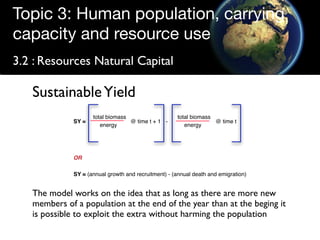
   Sustainable yield (SY) may be calculated as the rate of
   increase in natural capital

   Or

   The idea that a “crop” can be taken from an ecosystem
   in a way that leaves the ecosystem viable for the future
Topic 3: Human population, carrying
capacity and resource use
3.2 : Resources Natural Capital

   Sustainable Yield
                     total biomass                    total biomass
              SY =                 @ time t + 1 -                   @ time t
                        energy                           energy


              OR

              SY = (annual growth and recruitment) - (annual death and emigration)


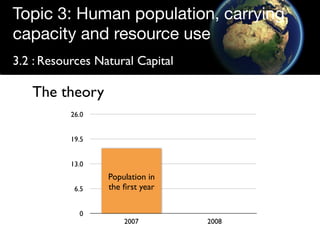
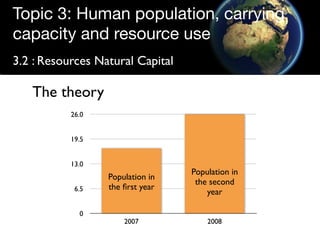
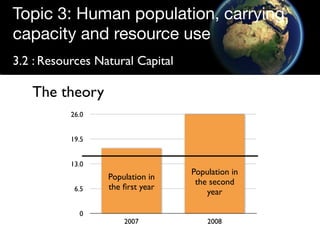
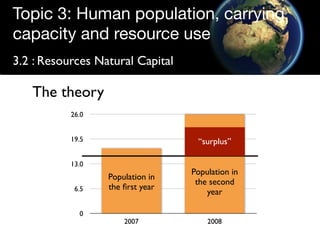
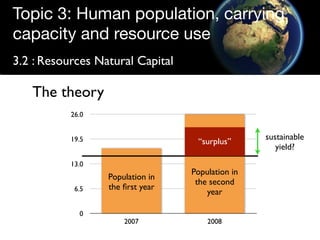
   The model works on the idea that as long as there are more new
   members of a population at the end of the year than at the beging it
   is possible to exploit the extra without harming the population
Topic 3: Human population, carrying
capacity and resource use
3.2 : Resources Natural Capital

   The theory
Topic 3: Human population, carrying
capacity and resource use
3.2 : Resources Natural Capital

   The theory
           26.0


           19.5


           13.0


            6.5


             0
                     2007         2008
Topic 3: Human population, carrying
capacity and resource use
3.2 : Resources Natural Capital

   The theory
           26.0


           19.5


           13.0
                  Population in
            6.5   the first year


             0
                      2007        2008
Topic 3: Human population, carrying
capacity and resource use
3.2 : Resources Natural Capital

   The theory
           26.0


           19.5


           13.0
                                  Population in
                  Population in
                                   the second
            6.5   the first year
                                      year

             0
                      2007            2008
Topic 3: Human population, carrying
capacity and resource use
3.2 : Resources Natural Capital

   The theory
           26.0


           19.5


           13.0
                                  Population in
                  Population in
                                   the second
            6.5   the first year
                                      year

             0
                      2007            2008
Topic 3: Human population, carrying
capacity and resource use
3.2 : Resources Natural Capital

   The theory
           26.0


           19.5                    “surplus”

           13.0
                                  Population in
                  Population in
                                   the second
            6.5   the first year
                                      year

             0
                      2007            2008
Topic 3: Human population, carrying
capacity and resource use
3.2 : Resources Natural Capital

   The theory
           26.0


           19.5                                   sustainable
                                   “surplus”
                                                     yield?
           13.0
                                  Population in
                  Population in
                                   the second
            6.5   the first year
                                      year

             0
                      2007            2008
Topic 3: Human population, carrying
capacity and resource use
3.2 : Resources Natural Capital

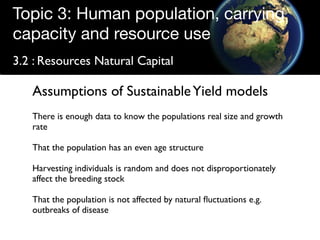
   Assumptions of Sustainable Yield models
   There is enough data to know the populations real size and growth
   rate

   That the population has an even age structure

   Harvesting individuals is random and does not disproportionately
   affect the breeding stock

   That the population is not affected by natural fluctuations e.g.
   outbreaks of disease
Topic 3: Human population, carrying
capacity and resource use
3.2 : Resources Natural Capital

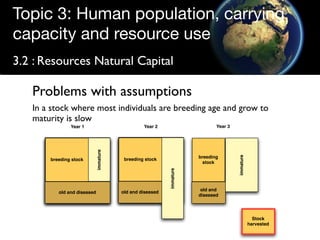
   Problems with assumptions
   In a stock where most individuals are breeding age and grow to
   maturity is slow
               Year 1                            Year 2                      Year 3
                             immature


                                                                                      immature
                                         breeding stock               breeding
       breeding stock
                                                                       stock

                                                           immature


                                        old and diseased               old and
          old and diseased
                                                                      diseased


                                                                                                   Stock
                                                                                                 harvested
Topic 3: Human population, carrying
capacity and resource use
3.2 : Resources Natural Capital

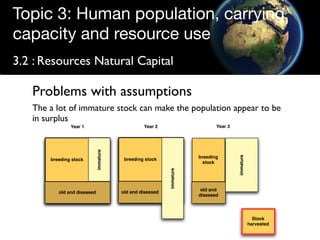
   Problems with assumptions
   The a lot of immature stock can make the population appear to be
   in surplus
               Year 1                            Year 2                      Year 3
                             immature


                                                                                      immature
                                         breeding stock               breeding
       breeding stock
                                                                       stock

                                                           immature


                                        old and diseased               old and
          old and diseased
                                                                      diseased


                                                                                                   Stock
                                                                                                 harvested
Topic 3: Human population, carrying
capacity and resource use
3.2 : Resources Natural Capital

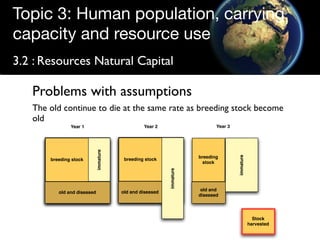
   Problems with assumptions
   The old continue to die at the same rate as breeding stock become
   old
               Year 1                            Year 2                      Year 3
                             immature


                                                                                      immature
                                         breeding stock               breeding
       breeding stock
                                                                       stock

                                                           immature


                                        old and diseased               old and
          old and diseased
                                                                      diseased


                                                                                                   Stock
                                                                                                 harvested
Topic 3: Human population, carrying
capacity and resource use
3.2 : Resources Natural Capital

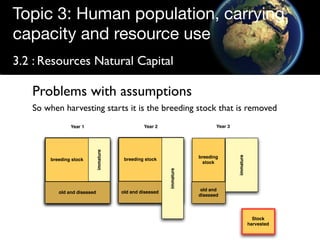
   Problems with assumptions
   So when harvesting starts it is the breeding stock that is removed
               Year 1                            Year 2                      Year 3
                             immature


                                                                                      immature
                                         breeding stock               breeding
       breeding stock
                                                                       stock

                                                           immature


                                        old and diseased               old and
          old and diseased
                                                                      diseased


                                                                                                   Stock
                                                                                                 harvested
Topic 3: Human population, carrying
capacity and resource use
3.2 : Resources Natural Capital

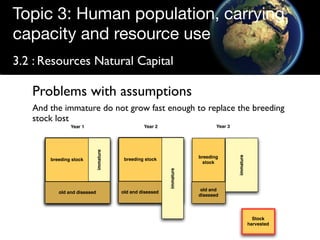
   Problems with assumptions
   And the immature do not grow fast enough to replace the breeding
   stock lost
               Year 1                            Year 2                      Year 3
                             immature


                                                                                      immature
                                         breeding stock               breeding
       breeding stock
                                                                       stock

                                                           immature


                                        old and diseased               old and
          old and diseased
                                                                      diseased


                                                                                                   Stock
                                                                                                 harvested
Topic 3: Human population, carrying
capacity and resource use
3.2 : Resources Natural Capital


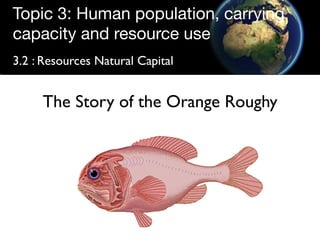
     The Story of the Orange Roughy
Topic 3: Human population, carrying
capacity and resource use
3.2 : Resources Natural Capital

   Orange Roughy: The ecology
   Habitat: cool deep waters

   Slow-growing, very long-lived fish, up to 150 years

   Feeds on prawns, fish and squid

   Do not breed until about 25 - 30 years old

   Lay about 10% less eggs than most fish species
Topic 3: Human population, carrying
capacity and resource use
3.2 : Resources Natural Capital

   Orange Roughy: Australia
   Found in deep water of Southern Australia

   Large scale fishing started in the 1990’s

   Within a decade shoals reduced to 10% of original
   size

   Australian Government introduced quotas
Topic 3: Human population, carrying
capacity and resource use
3.2 : Resources Natural Capital

   Orange Roughy: Australia
   30 years ago found large numbers in deep water of
   Southern Australia

   Large scale fishing started in the 1990’s

   Within a decade shoals reduced to 10% of original
   size

   Australian Government introduced quotas
Topic 3: Human population, carrying
capacity and resource use
3.2 : Resources Natural Capital

         Orange Roughy: Australia
                                      30 years ago found large numbers in deep
                                      water of Southern Australia

                                      Large scale fishing started in the 1990’s

                                      Within a decade shoals reduced to 10% of
                                      original size

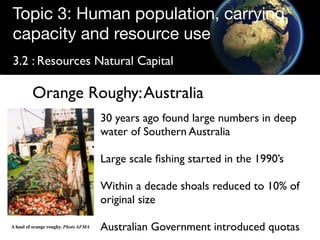
A haul of orange roughy. Photo AFMA   Australian Government introduced quotas
Topic 3: Human population, carrying
capacity and resource use
3.2 : Resources Natural Capital
 Catch (tonnes)


                           Year
Topic 3: Human population, carrying
capacity and resource use
3.2 : Resources Natural Capital

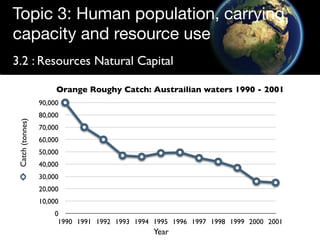
                       Orange Roughy Catch: Austrailian waters 1990 - 2001
                  90,000
                  80,000
 Catch (tonnes)


                  70,000
                  60,000
                  50,000
                  40,000
                  30,000
                  20,000
                  10,000
                      0
                       1990 1991 1992 1993 1994 1995 1996 1997 1998 1999 2000 2001
                                                Year
Topic 3: Human population, carrying
capacity and resource use
3.2 : Resources Natural Capital

   Orange Roughy: Declining catches
   Early population counts were based on fishing records

   No account taken of low reproductive rate and long
   time to maturity

   Management plans have not stopped the decline

   Since discovered that Orange Roughy reproduction is
   also spasmodic and irregular

Sustainable Yield

  • 1.
    Topic 3: Humanpopulation, carrying capacity and resource use 3.2 : Resources Natural Capital 3.2.7: Sustainable Yield
  • 2.
    Topic 3: Humanpopulation, carrying capacity and resource use 3.2 : Resources Natural Capital The extent to which a given interaction with the environment exploits and utilizes the natural income without causing long term deterioration to the natural capital. For example, a system of harvesting renewable resources at a rate that will be replaced by natural growth might be considered to demonstrate sustainability. A Long Definition
  • 3.
    Topic 3: Humanpopulation, carrying capacity and resource use 3.2 : Resources Natural Capital 'development which meets the needs of the present without compromising the ability of future generations to meet their own needs' A Better Definition
  • 4.
    Topic 3: Humanpopulation, carrying capacity and resource use 3.2 : Resources Natural Capital Sustainable Yield Sustainable yield (SY) may be calculated as the rate of increase in natural capital Or The idea that a “crop” can be taken from an ecosystem in a way that leaves the ecosystem viable for the future
  • 5.
    Topic 3: Humanpopulation, carrying capacity and resource use 3.2 : Resources Natural Capital Sustainable Yield total biomass total biomass SY = @ time t + 1 - @ time t energy energy OR SY = (annual growth and recruitment) - (annual death and emigration) The model works on the idea that as long as there are more new members of a population at the end of the year than at the beging it is possible to exploit the extra without harming the population
  • 6.
    Topic 3: Humanpopulation, carrying capacity and resource use 3.2 : Resources Natural Capital The theory
  • 7.
    Topic 3: Humanpopulation, carrying capacity and resource use 3.2 : Resources Natural Capital The theory 26.0 19.5 13.0 6.5 0 2007 2008
  • 8.
    Topic 3: Humanpopulation, carrying capacity and resource use 3.2 : Resources Natural Capital The theory 26.0 19.5 13.0 Population in 6.5 the first year 0 2007 2008
  • 9.
    Topic 3: Humanpopulation, carrying capacity and resource use 3.2 : Resources Natural Capital The theory 26.0 19.5 13.0 Population in Population in the second 6.5 the first year year 0 2007 2008
  • 10.
    Topic 3: Humanpopulation, carrying capacity and resource use 3.2 : Resources Natural Capital The theory 26.0 19.5 13.0 Population in Population in the second 6.5 the first year year 0 2007 2008
  • 11.
    Topic 3: Humanpopulation, carrying capacity and resource use 3.2 : Resources Natural Capital The theory 26.0 19.5 “surplus” 13.0 Population in Population in the second 6.5 the first year year 0 2007 2008
  • 12.
    Topic 3: Humanpopulation, carrying capacity and resource use 3.2 : Resources Natural Capital The theory 26.0 19.5 sustainable “surplus” yield? 13.0 Population in Population in the second 6.5 the first year year 0 2007 2008
  • 13.
    Topic 3: Humanpopulation, carrying capacity and resource use 3.2 : Resources Natural Capital Assumptions of Sustainable Yield models There is enough data to know the populations real size and growth rate That the population has an even age structure Harvesting individuals is random and does not disproportionately affect the breeding stock That the population is not affected by natural fluctuations e.g. outbreaks of disease
  • 14.
    Topic 3: Humanpopulation, carrying capacity and resource use 3.2 : Resources Natural Capital Problems with assumptions In a stock where most individuals are breeding age and grow to maturity is slow Year 1 Year 2 Year 3 immature immature breeding stock breeding breeding stock stock immature old and diseased old and old and diseased diseased Stock harvested
  • 15.
    Topic 3: Humanpopulation, carrying capacity and resource use 3.2 : Resources Natural Capital Problems with assumptions The a lot of immature stock can make the population appear to be in surplus Year 1 Year 2 Year 3 immature immature breeding stock breeding breeding stock stock immature old and diseased old and old and diseased diseased Stock harvested
  • 16.
    Topic 3: Humanpopulation, carrying capacity and resource use 3.2 : Resources Natural Capital Problems with assumptions The old continue to die at the same rate as breeding stock become old Year 1 Year 2 Year 3 immature immature breeding stock breeding breeding stock stock immature old and diseased old and old and diseased diseased Stock harvested
  • 17.
    Topic 3: Humanpopulation, carrying capacity and resource use 3.2 : Resources Natural Capital Problems with assumptions So when harvesting starts it is the breeding stock that is removed Year 1 Year 2 Year 3 immature immature breeding stock breeding breeding stock stock immature old and diseased old and old and diseased diseased Stock harvested
  • 18.
    Topic 3: Humanpopulation, carrying capacity and resource use 3.2 : Resources Natural Capital Problems with assumptions And the immature do not grow fast enough to replace the breeding stock lost Year 1 Year 2 Year 3 immature immature breeding stock breeding breeding stock stock immature old and diseased old and old and diseased diseased Stock harvested
  • 19.
    Topic 3: Humanpopulation, carrying capacity and resource use 3.2 : Resources Natural Capital The Story of the Orange Roughy
  • 20.
    Topic 3: Humanpopulation, carrying capacity and resource use 3.2 : Resources Natural Capital Orange Roughy: The ecology Habitat: cool deep waters Slow-growing, very long-lived fish, up to 150 years Feeds on prawns, fish and squid Do not breed until about 25 - 30 years old Lay about 10% less eggs than most fish species
  • 21.
    Topic 3: Humanpopulation, carrying capacity and resource use 3.2 : Resources Natural Capital Orange Roughy: Australia Found in deep water of Southern Australia Large scale fishing started in the 1990’s Within a decade shoals reduced to 10% of original size Australian Government introduced quotas
  • 22.
    Topic 3: Humanpopulation, carrying capacity and resource use 3.2 : Resources Natural Capital Orange Roughy: Australia 30 years ago found large numbers in deep water of Southern Australia Large scale fishing started in the 1990’s Within a decade shoals reduced to 10% of original size Australian Government introduced quotas
  • 23.
    Topic 3: Humanpopulation, carrying capacity and resource use 3.2 : Resources Natural Capital Orange Roughy: Australia 30 years ago found large numbers in deep water of Southern Australia Large scale fishing started in the 1990’s Within a decade shoals reduced to 10% of original size A haul of orange roughy. Photo AFMA Australian Government introduced quotas
  • 24.
    Topic 3: Humanpopulation, carrying capacity and resource use 3.2 : Resources Natural Capital Catch (tonnes) Year
  • 25.
    Topic 3: Humanpopulation, carrying capacity and resource use 3.2 : Resources Natural Capital Orange Roughy Catch: Austrailian waters 1990 - 2001 90,000 80,000 Catch (tonnes) 70,000 60,000 50,000 40,000 30,000 20,000 10,000 0 1990 1991 1992 1993 1994 1995 1996 1997 1998 1999 2000 2001 Year
  • 26.
    Topic 3: Humanpopulation, carrying capacity and resource use 3.2 : Resources Natural Capital Orange Roughy: Declining catches Early population counts were based on fishing records No account taken of low reproductive rate and long time to maturity Management plans have not stopped the decline Since discovered that Orange Roughy reproduction is also spasmodic and irregular