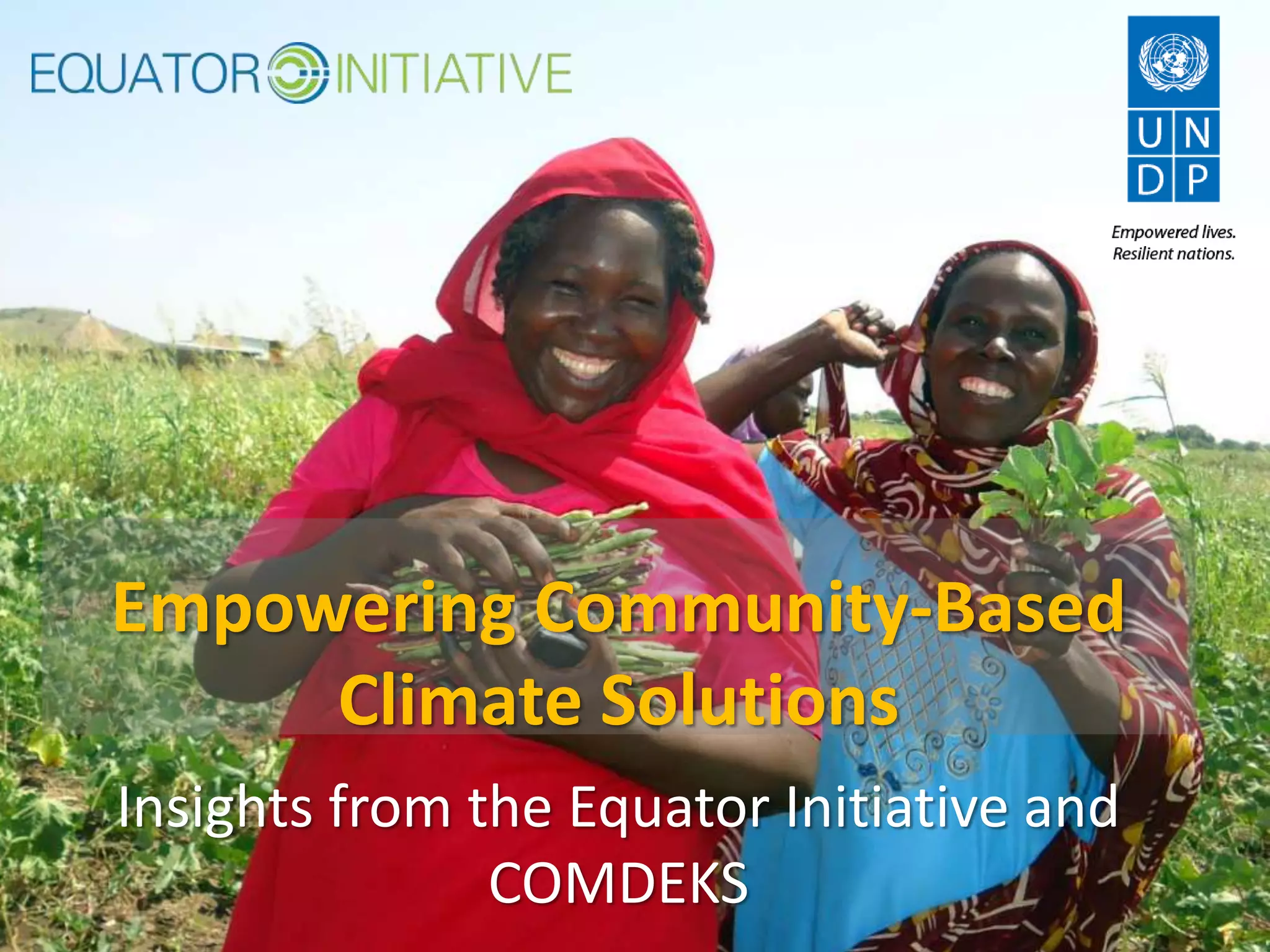
Empowering Community-Based
Climate Solutions
Insights from the Equator Initiative and
COMDEKS
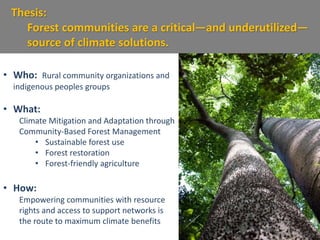
Thesis:
Forest communities are a critical—and underutilized—
source of climate solutions.
• Who: Rural community organizations and
indigenous peoples groups
• What:
Climate Mitigation and Adaptation through
Community-Based Forest Management
• Sustainable forest use
• Forest restoration
• Forest-friendly agriculture
• How:
Empowering communities with resource
rights and access to support networks is
the route to maximum climate benefits
Evidence: Equator Prize Case Study Database
The UNDP Equator Prize is awarded every two
years to local sustainable development solutions
for people, nature, and resilient communities.
o Equator Prize database contains 187 case
studies from rural communities around the
world.
o Over 60% involve forest communities and
sustainable forest management
o Each case study contains information on:
o Key Activities and Innovations
o Biodiversity Impacts
o Socioeconomic Impacts
o Policy Impacts
o Replication
o Sustainability
o Partnerships
Evidence: COMDEKS
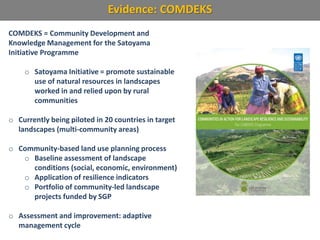
COMDEKS = Community Development and
Knowledge Management for the Satoyama
Initiative Programme
o Satoyama Initiative = promote sustainable
use of natural resources in landscapes
worked in and relied upon by rural
communities
o Currently being piloted in 20 countries in target
landscapes (multi-community areas)
o Community-based land use planning process
o Baseline assessment of landscape
conditions (social, economic, environment)
o Application of resilience indicators
o Portfolio of community-led landscape
projects funded by SGP
o Assessment and improvement: adaptive
management cycle
The Need for Community-Based Solutions:
Intensifying Climate and Forest Threats
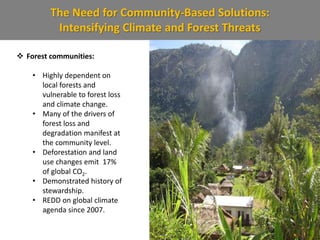
 Forest communities:
• Highly dependent on
local forests and
vulnerable to forest loss
and climate change.
• Many of the drivers of
forest loss and
degradation manifest at
the community level.
• Deforestation and land
use changes emit 17%
of global CO2.
• Demonstrated history of
stewardship.
• REDD on global climate
agenda since 2007.
New York Declaration on Forests:
Ambitious Goals, But How Do We Achieve Them?
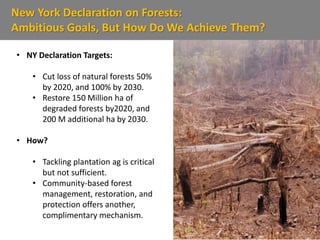
• NY Declaration Targets:
• Cut loss of natural forests 50%
by 2020, and 100% by 2030.
• Restore 150 Million ha of
degraded forests by2020, and
200 M additional ha by 2030.
• How?
• Tackling plantation ag is critical
but not sufficient.
• Community-based forest
management, restoration, and
protection offers another,
complimentary mechanism.
Potential for Community-Based Climate Solutions is
Substantial and Already Being Implemented
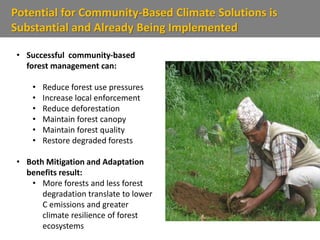
• Successful community-based
forest management can:
• Reduce forest use pressures
• Increase local enforcement
• Reduce deforestation
• Maintain forest canopy
• Maintain forest quality
• Restore degraded forests
• Both Mitigation and Adaptation
benefits result:
• More forests and less forest
degradation translate to lower
C emissions and greater
climate resilience of forest
ecosystems
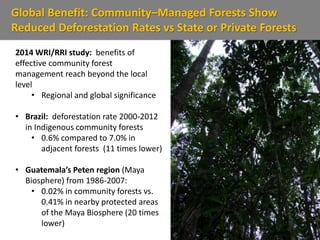
Global Benefit: Community–Managed Forests Show
Reduced Deforestation Rates vs State or Private Forests
2014 WRI/RRI study: benefits of
effective community forest
management reach beyond the local
level
• Regional and global significance
• Brazil: deforestation rate 2000-2012
in Indigenous community forests
• 0.6% compared to 7.0% in
adjacent forests (11 times lower)
• Guatemala’s Peten region (Maya
Biosphere) from 1986-2007:
• 0.02% in community forests vs.
0.41% in nearby protected areas
of the Maya Biosphere (20 times
lower)
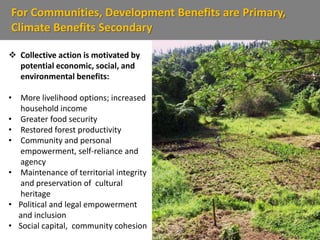
For Communities, Development Benefits are Primary,
Climate Benefits Secondary
 Collective action is motivated by
potential economic, social, and
environmental benefits:
• More livelihood options; increased
household income
• Greater food security
• Restored forest productivity
• Community and personal
empowerment, self-reliance and
agency
• Maintenance of territorial integrity
and preservation of cultural
heritage
• Political and legal empowerment
and inclusion
• Social capital, community cohesion
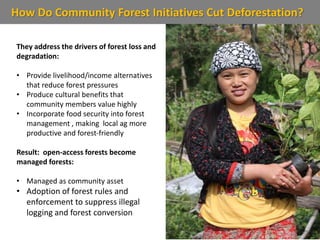
How Do Community Forest Initiatives Cut Deforestation?
They address the drivers of forest loss and
degradation:
• Provide livelihood/income alternatives
that reduce forest pressures
• Produce cultural benefits that
community members value highly
• Incorporate food security into forest
management , making local ag more
productive and forest-friendly
Result: open-access forests become
managed forests:
• Managed as community asset
• Adoption of forest rules and
enforcement to suppress illegal
logging and forest conversion
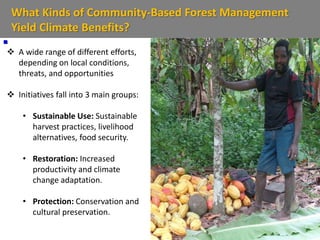
What Kinds of Community-Based Forest Management
Yield Climate Benefits?

 A wide range of different efforts,
depending on local conditions,
threats, and opportunities
 Initiatives fall into 3 main groups:
• Sustainable Use: Sustainable
harvest practices, livelihood
alternatives, food security.
• Restoration: Increased
productivity and climate
change adaptation.
• Protection: Conservation and
cultural preservation.
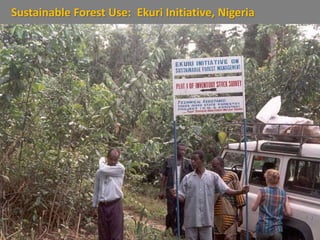
Sustainable Forest Use: Ekuri Initiative, Nigeria
Ekuri Initiative, Cross River State, Eastern Nigeria
 Situation: 34k ha legally recognized community forest near Cross River National
Park. Local economy dependent on subsistence farming and sale of forest fruits
and other NTFPs.
 Threats: Proposed logging, resisted by local tribal authorities. Illegal logging also a
problem in nearby park areas.
 Initiative Activities:
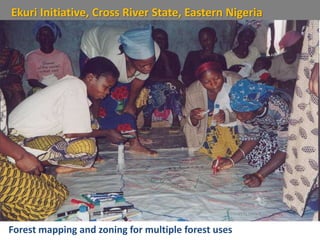
• Adopted forest management plan that established 8 distinct use zones:
• Stream buffer zone, protected area, animal corridor zones
• NTFP and commercial timber zones
• Farming and cash crop zones
• Ecotourism zone
 Result: Healthy standing forest that brings in substantial community income while
contributing to household subsistence needs.
• Contrasts with surrounding forests that are subject to commercial logging and
encroachment.
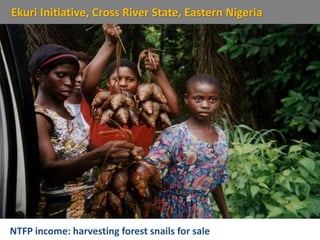
Ekuri Initiative, Cross River State, Eastern Nigeria
NTFP income: harvesting forest snails for sale
Ekuri Initiative, Cross River State, Eastern Nigeria
Forest mapping and zoning for multiple forest uses
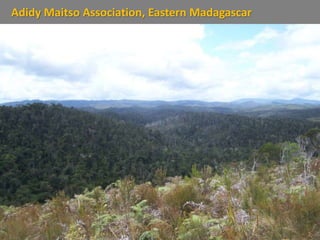
Adidy Maitso Association, Eastern Madagascar
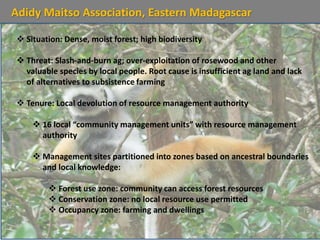
 Situation: Dense, moist forest; high biodiversity
 Threat: Slash-and-burn ag; over-exploitation of rosewood and other
valuable species by local people. Root cause is insufficient ag land and lack
of alternatives to subsistence farming
 Tenure: Local devolution of resource management authority
 16 local “community management units” with resource management
authority
 Management sites partitioned into zones based on ancestral boundaries
and local knowledge:
 Forest use zone: community can access forest resources
 Conservation zone: no local resource use permitted
 Occupancy zone: farming and dwellings
Adidy Maitso Association, Eastern Madagascar
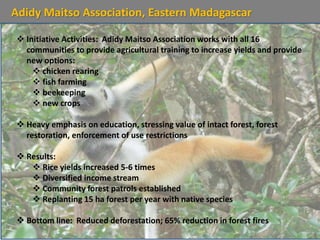
 Initiative Activities: Adidy Maitso Association works with all 16
communities to provide agricultural training to increase yields and provide
new options:
 chicken rearing
 fish farming
 beekeeping
 new crops
 Heavy emphasis on education, stressing value of intact forest, forest
restoration, enforcement of use restrictions
 Results:
 Rice yields increased 5-6 times
 Diversified income stream
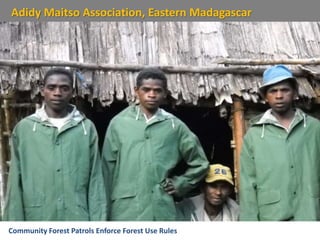
 Community forest patrols established
 Replanting 15 ha forest per year with native species
 Bottom line: Reduced deforestation; 65% reduction in forest fires
Adidy Maitso Association, Eastern Madagascar
Community Forest Patrols Enforce Forest Use Rules
Adidy Maitso Association, Eastern Madagascar
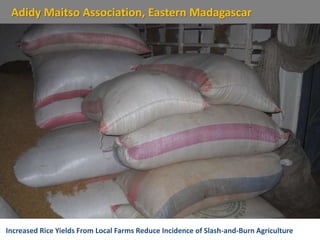
Increased Rice Yields From Local Farms Reduce Incidence of Slash-and-Burn Agriculture
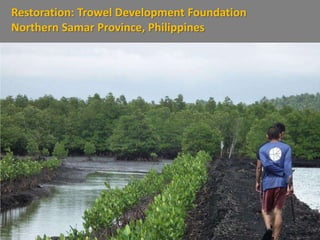
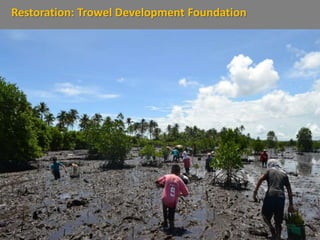
Restoration: Trowel Development Foundation
Northern Samar Province, Philippines
Restoration: Trowel Development Foundation
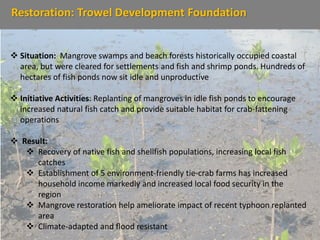
 Situation: Mangrove swamps and beach forests historically occupied coastal
area, but were cleared for settlements and fish and shrimp ponds. Hundreds of
hectares of fish ponds now sit idle and unproductive
 Initiative Activities: Replanting of mangroves in idle fish ponds to encourage
increased natural fish catch and provide suitable habitat for crab-fattening
operations
 Result:
 Recovery of native fish and shellfish populations, increasing local fish
catches
 Establishment of 5 environment-friendly tie-crab farms has increased
household income markedly and increased local food security in the
region
 Mangrove restoration help ameliorate impact of recent typhoon replanted
area
 Climate-adapted and flood resistant
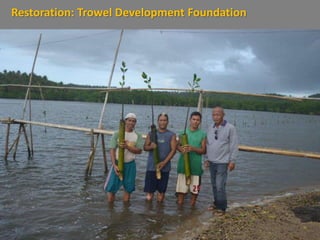
Restoration: Trowel Development Foundation
Protection: Wechiau Community Hippo Sanctuary,
Northwestern Ghana
Wechiau Community Hippo Sanctuary, Ghana
 Situation: Sanctuary occupies a 34-km stretch of river forest, floodplain, and
savannah woodlands along the Black Volta River and encompasses 17
communities.
 Threat: Poaching endangered hippo population, which is considered sacred.
Local agriculture degraded woodland areas.
 Initiative Activities:
 Local bylaws adopted regulating land use and entry
 Dwellings and agriculture restricted from core sanctuary zone
 Established ecotourism program
 Instituted value-added activities such as shea nut processing to replace
income lost from displaced farming in sanctuary
 Results:
 Ecotourism has generated jobs and funded community investments in
education and water and energy infrastructure
 Stable hippo population
 Benefits sharing among the sanctuary’s 4 ethnic groups
 Model for Ghana’s Community Resource Management Area legislation
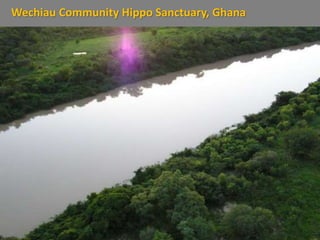
Wechiau Community Hippo Sanctuary, Ghana
Insights: Four Factors Associated with Climate Benefits
from Community-Based Forest Initiatives
 New economic incentives: Alternative or additional income sources or enhanced
productivity of local forests and farms.
• Acts as a counterweight to the need to over-exploit local forests for subsistence or cash.
 Community-based land use or forest management planning: Consensus on forest
use that the community can stand behind.
• Provides the basis for community rule-making and enforcement, which keeps local
forests from being open-access resources.
 Community education/communication/knowledge management: Public
communication and dialogue on the value of local forests, the potential for community
management; the technical aspects of management and enterprise; as well as
documentation and sharing of local successes.
• Establishes the value of forests and the alternatives to overuse.
 Land tenure—both forest and farm: Legally recognized right to use, manage, exclude
others from , and dispose of local forests and farm lands.
• Provides the practical basis for community-driven development and the rationale for
investments in sustainable forest management.
Insights: Land Rights/ Forest Tenure Are Central, But Many
Different Tenure Situations Can Be Functional
 Tenure security is one of the strongest correlates of success in community-
based forest initiatives. Stronger land rights give communities more land
management options and self-determination, which can make collective action
easier and increase community benefits.
 Many different tenure situations can work, even though not ideal. While
holding outright communal title may be optimal, various forms of co-
management with the state can also work.
 Hybrid systems of state ownership and local customary tenure regimes.
 Modification of state protected areas regulations to allow sustainable
community management of park areas.
 Good stewardship by communities sometimes brings tenure gains. By showing
that community-based management can produce healthier ecosystems and
greater local benefits, many Equator Prize winners have received formal
recognition of their success by government authorities and expanded
management rights.
Insight: Participatory Planning, Education, and
Communication Are the Engines of Attitude and Behavior
Change
 Participatory planning and education processes establish group consensus and a
foundation of trust--the basis for community action. Communities are not
monolithic and not all members begin with a clear idea of why action is necessary
or what action is best.
• Participatory needs assessments and baseline assessment of local
environmental, economic, and social conditions provide a starting point for
management and a baseline for measurement of progress.
 Good communication also necessary to actually carry out community action
(technical training), measure it, learn from it, and teach others.
• Peer-to-peer exchange and knowledge networks
• Extension services, “train the trainers” approaches
• Community monitoring and assessment
• Innovative uses of media and technology
• Community organizing and political advocacy
Insight: Forest Initiatives Must Account for Local
Agriculture and Food Security Needs;
An Integrated, Landscape Approach Needed
 Local forest health is linked to the conduct of local agriculture. Unsustainable
agriculture is one of the drivers of forest loss and degradation. Successful
community-based forest initiatives understand this and explicitly incorporate
activities to raise the productivity and profitability of local agriculture and
change to forest-friendly practices.
 Organic and specialty crops
 Agroforestry and slope-adapted cropping
 Cooperatives and marketing organizations
 Adopting a landscape approach, where both forestry and agriculture are seen
as part of the mosaic of local land uses, is helpful.
 COMDEKS experience with community-led land use planning confirms that
food security is at or near the top of local priorities when projects are
prioritized, and forest interventions always have an agricultural aspect.
Insight: Partnerships and well-timed support can be
catalytic, but the relationship must be clear
 Partnerships matter. Equator Prize winning communities are self-reliant. But
nearly every successful community initiative boasts several crucial partnerships.
• Specialized skills, training, and technology
• Product commercialization and market access (esp. private sector)
• Research and monitoring
• Financial support
 Partnerships do not necessarily diminish autonomy. Community must remain
the center of gravity and authority. Multiple and diverse partnerships are better.
Gradual transition from external to local NGO partners is healthy. Governments
are essential partners, but relationship with the community must be clear.
 Donor lessons: Small, well-targeted, well-timed investments can bring big
results:
• SGP model is highly effective and efficient
• Early funding most catalytic; Longer funding timeframes fit community
projects better.
Insight: Scaling of success is possible and can bring
landscape-level change
 Equator Prize initiatives have shown a remarkable ability to spread their
successful models of local action (quantitative scaling):
• Direct contact with other similar communities.
• Training centers
• Media
• On-line communities and other networking tools
 Quantitative scaling also demonstrated: communities become proficient at
new, related lines of work that increase the effectiveness of their forest
restoration enterprises or restoration. Local community organizations may
morph into second-level groups that can link together efforts over a larger area.
 COMDEKS experience shows the power of having scale built into the initiative
from the start. COMDEKS landscape programs are multi-community endeavors
and act over a larger geographical area, coordinating many different projects to
achieve a set of strategic landscape goals—a clear route to landscape level
impact.
Implications for a New Global Climate Regime:
Expand Land Rights
 Greatly Expand Indigenous and Community Land Rights. No other factor has
greater potential for expanding the area under sustainable community-based
forest management.
• General consensus has developed on the importance of forest and land
tenure to sustainable rural development (including REDD+)
• Since 1992, 25 countries have passed laws expanding the forest tenure of
Indigenous Peoples and communities.
• Result: Greatly expanded area under community forestry—500 million ha in
low and middle-income countries—roughly 30% of forest area in these
countries.
• But pace of recognition has greatly slowed since 2008—even as interest in
REDD+ surged.
• Meanwhile, pace of land grabs and tenure disputes has increased.
• Therefore, a large unmet demand for land rights remains, eroding the
potential for climate gains from community forest management.
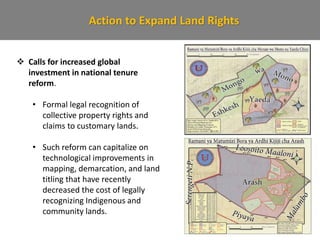
Action to Expand Land Rights
 Calls for increased global
investment in national tenure
reform.
• Formal legal recognition of
collective property rights and
claims to customary lands.
• Such reform can capitalize on
technological improvements in
mapping, demarcation, and land
titling that have recently
decreased the cost of legally
recognizing Indigenous and
community lands.
Implications for a New Global Climate Regime:
Acknowledge Community Role
 Acknowledge the legitimacy of local ecosystem management and its local,
national, and global benefits
• Acknowledge the potential climate benefits of community-based forest
management and account for it in national carbon commitments that
countries submit to the UNFCCC (the Intended Nationally Determined
Contributions—INDCs)
• Acknowledge the importance of “non-carbon” benefits that community-
based forest management yields.
 Avoid resource conflicts that pit national against local interests
• Largescale extractive logging, mining, and industrial agriculture encouraged
by national policies pose one of the greatest threats to community control of
local forests
• Avoiding such conflicts calls for meaningful inclusion of IPs and local interests
in national natural resource policies and planning: Proactive FPIC
Implications for a New Global Climate Regime:
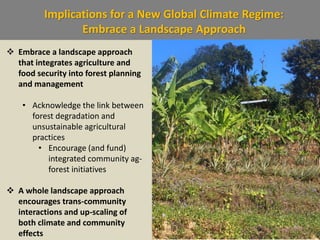
Embrace a Landscape Approach
 Embrace a landscape approach
that integrates agriculture and
food security into forest planning
and management
• Acknowledge the link between
forest degradation and
unsustainable agricultural
practices
• Encourage (and fund)
integrated community ag-
forest initiatives
 A whole landscape approach
encourages trans-community
interactions and up-scaling of
both climate and community
effects
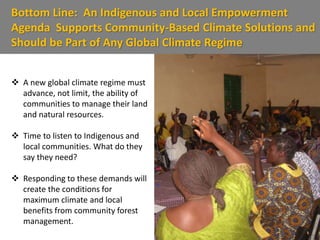
Bottom Line: An Indigenous and Local Empowerment
Agenda Supports Community-Based Climate Solutions and
Should be Part of Any Global Climate Regime
 A new global climate regime must
advance, not limit, the ability of
communities to manage their land
and natural resources.
 Time to listen to Indigenous and
local communities. What do they
say they need?
 Responding to these demands will
create the conditions for
maximum climate and local
benefits from community forest
management.
Thank you!
Gregory.mock@gmail.com
www.equatorinitiative.org
http://comdeksproject.com/

Empowering Community-Based Climate Solutions

  • 1.
    Empowering Community-Based Climate Solutions Insightsfrom the Equator Initiative and COMDEKS
  • 2.
    Thesis: Forest communities area critical—and underutilized— source of climate solutions. • Who: Rural community organizations and indigenous peoples groups • What: Climate Mitigation and Adaptation through Community-Based Forest Management • Sustainable forest use • Forest restoration • Forest-friendly agriculture • How: Empowering communities with resource rights and access to support networks is the route to maximum climate benefits
  • 3.
    Evidence: Equator PrizeCase Study Database The UNDP Equator Prize is awarded every two years to local sustainable development solutions for people, nature, and resilient communities. o Equator Prize database contains 187 case studies from rural communities around the world. o Over 60% involve forest communities and sustainable forest management o Each case study contains information on: o Key Activities and Innovations o Biodiversity Impacts o Socioeconomic Impacts o Policy Impacts o Replication o Sustainability o Partnerships
  • 4.
    Evidence: COMDEKS COMDEKS =Community Development and Knowledge Management for the Satoyama Initiative Programme o Satoyama Initiative = promote sustainable use of natural resources in landscapes worked in and relied upon by rural communities o Currently being piloted in 20 countries in target landscapes (multi-community areas) o Community-based land use planning process o Baseline assessment of landscape conditions (social, economic, environment) o Application of resilience indicators o Portfolio of community-led landscape projects funded by SGP o Assessment and improvement: adaptive management cycle
  • 5.
    The Need forCommunity-Based Solutions: Intensifying Climate and Forest Threats  Forest communities: • Highly dependent on local forests and vulnerable to forest loss and climate change. • Many of the drivers of forest loss and degradation manifest at the community level. • Deforestation and land use changes emit 17% of global CO2. • Demonstrated history of stewardship. • REDD on global climate agenda since 2007.
  • 6.
    New York Declarationon Forests: Ambitious Goals, But How Do We Achieve Them? • NY Declaration Targets: • Cut loss of natural forests 50% by 2020, and 100% by 2030. • Restore 150 Million ha of degraded forests by2020, and 200 M additional ha by 2030. • How? • Tackling plantation ag is critical but not sufficient. • Community-based forest management, restoration, and protection offers another, complimentary mechanism.
  • 7.
    Potential for Community-BasedClimate Solutions is Substantial and Already Being Implemented • Successful community-based forest management can: • Reduce forest use pressures • Increase local enforcement • Reduce deforestation • Maintain forest canopy • Maintain forest quality • Restore degraded forests • Both Mitigation and Adaptation benefits result: • More forests and less forest degradation translate to lower C emissions and greater climate resilience of forest ecosystems
  • 8.
    Global Benefit: Community–ManagedForests Show Reduced Deforestation Rates vs State or Private Forests 2014 WRI/RRI study: benefits of effective community forest management reach beyond the local level • Regional and global significance • Brazil: deforestation rate 2000-2012 in Indigenous community forests • 0.6% compared to 7.0% in adjacent forests (11 times lower) • Guatemala’s Peten region (Maya Biosphere) from 1986-2007: • 0.02% in community forests vs. 0.41% in nearby protected areas of the Maya Biosphere (20 times lower)
  • 9.
    For Communities, DevelopmentBenefits are Primary, Climate Benefits Secondary  Collective action is motivated by potential economic, social, and environmental benefits: • More livelihood options; increased household income • Greater food security • Restored forest productivity • Community and personal empowerment, self-reliance and agency • Maintenance of territorial integrity and preservation of cultural heritage • Political and legal empowerment and inclusion • Social capital, community cohesion
  • 10.
    How Do CommunityForest Initiatives Cut Deforestation? They address the drivers of forest loss and degradation: • Provide livelihood/income alternatives that reduce forest pressures • Produce cultural benefits that community members value highly • Incorporate food security into forest management , making local ag more productive and forest-friendly Result: open-access forests become managed forests: • Managed as community asset • Adoption of forest rules and enforcement to suppress illegal logging and forest conversion
  • 11.
    What Kinds ofCommunity-Based Forest Management Yield Climate Benefits?   A wide range of different efforts, depending on local conditions, threats, and opportunities  Initiatives fall into 3 main groups: • Sustainable Use: Sustainable harvest practices, livelihood alternatives, food security. • Restoration: Increased productivity and climate change adaptation. • Protection: Conservation and cultural preservation.
  • 12.
    Sustainable Forest Use:Ekuri Initiative, Nigeria
  • 13.
    Ekuri Initiative, CrossRiver State, Eastern Nigeria  Situation: 34k ha legally recognized community forest near Cross River National Park. Local economy dependent on subsistence farming and sale of forest fruits and other NTFPs.  Threats: Proposed logging, resisted by local tribal authorities. Illegal logging also a problem in nearby park areas.  Initiative Activities: • Adopted forest management plan that established 8 distinct use zones: • Stream buffer zone, protected area, animal corridor zones • NTFP and commercial timber zones • Farming and cash crop zones • Ecotourism zone  Result: Healthy standing forest that brings in substantial community income while contributing to household subsistence needs. • Contrasts with surrounding forests that are subject to commercial logging and encroachment.
  • 14.
    Ekuri Initiative, CrossRiver State, Eastern Nigeria NTFP income: harvesting forest snails for sale
  • 15.
    Ekuri Initiative, CrossRiver State, Eastern Nigeria Forest mapping and zoning for multiple forest uses
  • 16.
    Adidy Maitso Association,Eastern Madagascar
  • 17.
    Adidy Maitso Association,Eastern Madagascar  Situation: Dense, moist forest; high biodiversity  Threat: Slash-and-burn ag; over-exploitation of rosewood and other valuable species by local people. Root cause is insufficient ag land and lack of alternatives to subsistence farming  Tenure: Local devolution of resource management authority  16 local “community management units” with resource management authority  Management sites partitioned into zones based on ancestral boundaries and local knowledge:  Forest use zone: community can access forest resources  Conservation zone: no local resource use permitted  Occupancy zone: farming and dwellings
  • 18.
    Adidy Maitso Association,Eastern Madagascar  Initiative Activities: Adidy Maitso Association works with all 16 communities to provide agricultural training to increase yields and provide new options:  chicken rearing  fish farming  beekeeping  new crops  Heavy emphasis on education, stressing value of intact forest, forest restoration, enforcement of use restrictions  Results:  Rice yields increased 5-6 times  Diversified income stream  Community forest patrols established  Replanting 15 ha forest per year with native species  Bottom line: Reduced deforestation; 65% reduction in forest fires
  • 19.
    Adidy Maitso Association,Eastern Madagascar Community Forest Patrols Enforce Forest Use Rules
  • 20.
    Adidy Maitso Association,Eastern Madagascar Increased Rice Yields From Local Farms Reduce Incidence of Slash-and-Burn Agriculture
  • 21.
    Restoration: Trowel DevelopmentFoundation Northern Samar Province, Philippines
  • 22.
    Restoration: Trowel DevelopmentFoundation  Situation: Mangrove swamps and beach forests historically occupied coastal area, but were cleared for settlements and fish and shrimp ponds. Hundreds of hectares of fish ponds now sit idle and unproductive  Initiative Activities: Replanting of mangroves in idle fish ponds to encourage increased natural fish catch and provide suitable habitat for crab-fattening operations  Result:  Recovery of native fish and shellfish populations, increasing local fish catches  Establishment of 5 environment-friendly tie-crab farms has increased household income markedly and increased local food security in the region  Mangrove restoration help ameliorate impact of recent typhoon replanted area  Climate-adapted and flood resistant
  • 23.
  • 24.
  • 25.
    Protection: Wechiau CommunityHippo Sanctuary, Northwestern Ghana
  • 26.
    Wechiau Community HippoSanctuary, Ghana  Situation: Sanctuary occupies a 34-km stretch of river forest, floodplain, and savannah woodlands along the Black Volta River and encompasses 17 communities.  Threat: Poaching endangered hippo population, which is considered sacred. Local agriculture degraded woodland areas.  Initiative Activities:  Local bylaws adopted regulating land use and entry  Dwellings and agriculture restricted from core sanctuary zone  Established ecotourism program  Instituted value-added activities such as shea nut processing to replace income lost from displaced farming in sanctuary  Results:  Ecotourism has generated jobs and funded community investments in education and water and energy infrastructure  Stable hippo population  Benefits sharing among the sanctuary’s 4 ethnic groups  Model for Ghana’s Community Resource Management Area legislation
  • 27.
    Wechiau Community HippoSanctuary, Ghana
  • 28.
    Insights: Four FactorsAssociated with Climate Benefits from Community-Based Forest Initiatives  New economic incentives: Alternative or additional income sources or enhanced productivity of local forests and farms. • Acts as a counterweight to the need to over-exploit local forests for subsistence or cash.  Community-based land use or forest management planning: Consensus on forest use that the community can stand behind. • Provides the basis for community rule-making and enforcement, which keeps local forests from being open-access resources.  Community education/communication/knowledge management: Public communication and dialogue on the value of local forests, the potential for community management; the technical aspects of management and enterprise; as well as documentation and sharing of local successes. • Establishes the value of forests and the alternatives to overuse.  Land tenure—both forest and farm: Legally recognized right to use, manage, exclude others from , and dispose of local forests and farm lands. • Provides the practical basis for community-driven development and the rationale for investments in sustainable forest management.
  • 29.
    Insights: Land Rights/Forest Tenure Are Central, But Many Different Tenure Situations Can Be Functional  Tenure security is one of the strongest correlates of success in community- based forest initiatives. Stronger land rights give communities more land management options and self-determination, which can make collective action easier and increase community benefits.  Many different tenure situations can work, even though not ideal. While holding outright communal title may be optimal, various forms of co- management with the state can also work.  Hybrid systems of state ownership and local customary tenure regimes.  Modification of state protected areas regulations to allow sustainable community management of park areas.  Good stewardship by communities sometimes brings tenure gains. By showing that community-based management can produce healthier ecosystems and greater local benefits, many Equator Prize winners have received formal recognition of their success by government authorities and expanded management rights.
  • 30.
    Insight: Participatory Planning,Education, and Communication Are the Engines of Attitude and Behavior Change  Participatory planning and education processes establish group consensus and a foundation of trust--the basis for community action. Communities are not monolithic and not all members begin with a clear idea of why action is necessary or what action is best. • Participatory needs assessments and baseline assessment of local environmental, economic, and social conditions provide a starting point for management and a baseline for measurement of progress.  Good communication also necessary to actually carry out community action (technical training), measure it, learn from it, and teach others. • Peer-to-peer exchange and knowledge networks • Extension services, “train the trainers” approaches • Community monitoring and assessment • Innovative uses of media and technology • Community organizing and political advocacy
  • 31.
    Insight: Forest InitiativesMust Account for Local Agriculture and Food Security Needs; An Integrated, Landscape Approach Needed  Local forest health is linked to the conduct of local agriculture. Unsustainable agriculture is one of the drivers of forest loss and degradation. Successful community-based forest initiatives understand this and explicitly incorporate activities to raise the productivity and profitability of local agriculture and change to forest-friendly practices.  Organic and specialty crops  Agroforestry and slope-adapted cropping  Cooperatives and marketing organizations  Adopting a landscape approach, where both forestry and agriculture are seen as part of the mosaic of local land uses, is helpful.  COMDEKS experience with community-led land use planning confirms that food security is at or near the top of local priorities when projects are prioritized, and forest interventions always have an agricultural aspect.
  • 32.
    Insight: Partnerships andwell-timed support can be catalytic, but the relationship must be clear  Partnerships matter. Equator Prize winning communities are self-reliant. But nearly every successful community initiative boasts several crucial partnerships. • Specialized skills, training, and technology • Product commercialization and market access (esp. private sector) • Research and monitoring • Financial support  Partnerships do not necessarily diminish autonomy. Community must remain the center of gravity and authority. Multiple and diverse partnerships are better. Gradual transition from external to local NGO partners is healthy. Governments are essential partners, but relationship with the community must be clear.  Donor lessons: Small, well-targeted, well-timed investments can bring big results: • SGP model is highly effective and efficient • Early funding most catalytic; Longer funding timeframes fit community projects better.
  • 33.
    Insight: Scaling ofsuccess is possible and can bring landscape-level change  Equator Prize initiatives have shown a remarkable ability to spread their successful models of local action (quantitative scaling): • Direct contact with other similar communities. • Training centers • Media • On-line communities and other networking tools  Quantitative scaling also demonstrated: communities become proficient at new, related lines of work that increase the effectiveness of their forest restoration enterprises or restoration. Local community organizations may morph into second-level groups that can link together efforts over a larger area.  COMDEKS experience shows the power of having scale built into the initiative from the start. COMDEKS landscape programs are multi-community endeavors and act over a larger geographical area, coordinating many different projects to achieve a set of strategic landscape goals—a clear route to landscape level impact.
  • 34.
    Implications for aNew Global Climate Regime: Expand Land Rights  Greatly Expand Indigenous and Community Land Rights. No other factor has greater potential for expanding the area under sustainable community-based forest management. • General consensus has developed on the importance of forest and land tenure to sustainable rural development (including REDD+) • Since 1992, 25 countries have passed laws expanding the forest tenure of Indigenous Peoples and communities. • Result: Greatly expanded area under community forestry—500 million ha in low and middle-income countries—roughly 30% of forest area in these countries. • But pace of recognition has greatly slowed since 2008—even as interest in REDD+ surged. • Meanwhile, pace of land grabs and tenure disputes has increased. • Therefore, a large unmet demand for land rights remains, eroding the potential for climate gains from community forest management.
  • 35.
    Action to ExpandLand Rights  Calls for increased global investment in national tenure reform. • Formal legal recognition of collective property rights and claims to customary lands. • Such reform can capitalize on technological improvements in mapping, demarcation, and land titling that have recently decreased the cost of legally recognizing Indigenous and community lands.
  • 36.
    Implications for aNew Global Climate Regime: Acknowledge Community Role  Acknowledge the legitimacy of local ecosystem management and its local, national, and global benefits • Acknowledge the potential climate benefits of community-based forest management and account for it in national carbon commitments that countries submit to the UNFCCC (the Intended Nationally Determined Contributions—INDCs) • Acknowledge the importance of “non-carbon” benefits that community- based forest management yields.  Avoid resource conflicts that pit national against local interests • Largescale extractive logging, mining, and industrial agriculture encouraged by national policies pose one of the greatest threats to community control of local forests • Avoiding such conflicts calls for meaningful inclusion of IPs and local interests in national natural resource policies and planning: Proactive FPIC
  • 37.
    Implications for aNew Global Climate Regime: Embrace a Landscape Approach  Embrace a landscape approach that integrates agriculture and food security into forest planning and management • Acknowledge the link between forest degradation and unsustainable agricultural practices • Encourage (and fund) integrated community ag- forest initiatives  A whole landscape approach encourages trans-community interactions and up-scaling of both climate and community effects
  • 38.
    Bottom Line: AnIndigenous and Local Empowerment Agenda Supports Community-Based Climate Solutions and Should be Part of Any Global Climate Regime  A new global climate regime must advance, not limit, the ability of communities to manage their land and natural resources.  Time to listen to Indigenous and local communities. What do they say they need?  Responding to these demands will create the conditions for maximum climate and local benefits from community forest management.
  • 39.

Editor's Notes

  • #2 So here we are in mid-June. Time grows short before December, the deadline for negotiations on a global climate agreement. Everyone’s eyes are beginning to turn toward Paris. The heavy hitters are beginning to speak up, like the Pope. Already there’s speculation about who will play Pope Francis when they make: Climate, The Movie. And countries are coming forward with their commitments to reduce emissions. The question is: how will they actually achieve these reductions?
  • #3 I believe that rural Indigenous and local communities have a real role to play here through community forestry Rural community organizations and indigenous peoples groups have demonstrated that they can be front-line actors in the global effort to combat and adapt to the effects of climate change through their efforts to sustainably manage and restore local forests and to practice forest-friendly agriculture. Their potential contribution, as documented in the Equator Prize database, is both substantial and underutilized.
  • #4 There is a substantial evidence base to back up this assertion. One major source is the Equator Initiative database of case studies, which we’ve been assembling over the last 13 years.
  • #5 A second line of evidence comes from the COMDEKS Programme Working landscapes = Socio-ecological Production Landscapes and Seascapes (SEPLS) Adopts a Landscape Approach involving several or many communities within a geographic area.
  • #6 Why community-based solutions? Why now? The Need for Forest and Agricultural sectors to contribute to global climate change solutions is well-accepted. Deforestation and landuse changes estimated to account for 17% of global CO2 emissions. As a consequence, forest management has long been part of global climate negotiations. REDD has been on the global climate agenda since 2007 (UN-REDD established 2008). Importance of these sectors emphasized more recently as climate negotiations have intensified. Forest threats are in sharp profile today. The threats to global forests (and biodiversity) from deforestation and forest degradation—and from climate change as well—have come into sharper relief as our measurement tools have improved and the economic and cultural costs to rural communities have become more widespread and well-documented. These threats increase the need for forest communities to be actively engaged in the emerging global climate regime, with its emphasis on sustainable forestry.
  • #7 Last year’s New York Declaration on Forests succinctly captures the threats to forests and sets very ambitious targets for stopping forest loss and restoring degraded forests. It also explicitly links rural development, local and indigenous rights, with forest restoration and climate mitigation. But how can we reach such ambitious targets? It rightfully points a finger at forest loss from conversion to oil plantations and other largescale exploitation. But tackling these alone is not enough. CB forest management directly addresses the need to promote rural development and local and indigenous land rights as a means to stop forest loss and restore forest ecosystems. Our contention here is that without community-based action, we simply can’t meet the NYD targets. We can probably go farther and also say that without communities contributing their piece, we won’t be able to cut emissions enough to reach the goal of holding global temperature change to 2 degrees.
  • #9 There is also evidence that the benefits of community-base forest management reach far beyond the local level.
  • #10 Let’s pause here and acknowledge that rural communities are and must be concerned with their own welfare. They probably don’t spend a lot of time pondering how best to contribute to meeting global climate goals. But they are very motivated by the demonstrated benefits of community action Economic, social, and environmental benefits all come together and are highly linked—that is part of the magic of these community interventions.
  • #13 Let’s turn to a few examples to illustrate the kind of local solutions that are being created in rural communities today.
  • #14 This community program arose from a proposal to log the 34k-ha community forest of the Ekuri people. A logging company had proposed to build a road into the then inaccessible village of Ekuri in exchange for logging rights to the community forest. The local people, led by their chief, decided instead to create their own multi-use forest management plan. The plan created distinct use zones within the forest, including a zone for harvesting non-timber forest products, for cutting commercial timber, for farming, a stream buffer zone where only agroforestry is permitted, and a protected area and ecotourism zone. The community evolved regulations for each of these zones, and the revenues from the sale of commercial timber and other joint activities are paid into the community treasury. This is all facilitated by the fact that the entire community forest is legally recognized under communal tenure, where families have restricted rights to harvest forest products for family use but not for commercial sale. The result of this initiative has been a healthy standing forest that brings in substantial community income while still contributing to household subsistence needs. The stability this provides is in contrast to much of the surrounding forests that have been subject to commercial logging and illegal encroachment.
  • #15 NTFP income: harvesting forest snails for sale
  • #18 The Didy forest in eastern Madagascar = dense, moist forest, high biodiversity, but over-exploited by local people who practiced slash-and-burn ag and harvesting of rosewood and other valuable species. At the root of this overuse of local forests was a lack of sufficient ag land and a lack of alternatives to subsistence farming. Adidy Maitso is a for-profit association who took as its mission to promote livelihood alternatives in the Didy forest area with the goal of reducing pressure on the forest. The Association works with 16 local “community management units” which each have been granted resource management authority by the government in discrete “management units” within the forest corridor. Each management unit has been divided into land use zones, including a forest access zone, a conservation zone, a farming zone, and a zone where dwellings are allowed to be built.
  • #19 But the key to the successful functioning of these land use zones has been the work of Adidy Maitso, which has provided agricultural training to local farmers to greatly increase their productivity and provide new opportunities, including chicken rearing, fish farming, beekeeping, and the promotion of crops such as onions, corn, white beans, and soybeans that can be sold for greater profit during the off-season. As a result, many farmers have abandoned slash and burn practices in preference for these alternatives. An indication of the economic incentive these incentives can provide: new intensive rice growing methods in the designated agricultural zone yield 5-6 times the rice harvest of previous methods. The association has also undertaken intensive educational campaigns stressing the value of the intact forest, and has encouraged replanting of native species and the establishment of forest patrols to control illegal forest use. The result has been a 65% decrease in forest fires and a significant reduction in the deforestation rate in the forest corridor. This example shows the close connection between local ag and forest health and the great potential to decrease pressure on local forests by making local ag more productive and forest-friendly. Attending to food security needs is a necessary ingredient in most community-based sustainable forestry initiatives.
  • #20 Didy Forest Patrol
  • #23 Profits from the tie-crab farms are 50% greater than normal growing scheme Farms are largely storm resistant because of use of floats to which crabs are tied. Ride out stroms or can be collected and replanted after storm. An example of combined local innovation and government research An example of climate adapted livelihoods: adaptation in the best sense
  • #24 Mangrove seedlings in special planting containers
  • #25 Group mangrove planting
  • #27 Wechiau is a good example of a Community Conserved Area—an area that is protected not by government fiat, but through the will and efforts of local people, acting for their own reasons. Substantial sacrifice involved for some: 14 families relocated from the core sanctuary zone. Trained tour guides and research teams carry out regular wildlife surveys. Motion-sensitive cameras document poachers, helping the 10 sanctuary rangers in their work. Through these efforts, the Wechiau communities have been able to maintain a population of around 20 hippos—one of only 2 hippo populations in Ghana. Economic benefits very distinct: 150 jobs generated and viable value-added businesses such as shea nut processing. All 14 communities in sanctuary now have access to clean water from wells. Policy impact is notable: this initiative was used as the model for Ghana’s Community Resource Management Area legislation. This is tremendously important, because it transfers management authority to local people for Community Conserved Areas. So it actually improves the legal tenure situation for local people.
  • #29 When we look across these cases, this large evidence base, what can we say? What makes these community efforts work? Can we influence these factors to help communities maximize their climate effect? Here are 4 factors that I see when I look across cases.
  • #30 Let’s look a little deeper at some of these and other factors and see if we can enlarge on these insights. In spite of the fact that communities can often make the best of tenure situations that are not ideal: Still, the single biggest action to expand climate benefits from good forestry practice would be expanded effort to legally recognize the communal land rights of indigenous and local communities.
  • #31 Community-based initiatives are transformative: they change community behavior. And because they change attitudes and behavior, they can in turn transform the forest dynamic into one of stewardship rather than uncontrolled use. But communication and education are the first step. To have any hope of success, community forest initiatives have to involve communication and dialogue in various forms. A process of participatory planning is often the first venue for basic education on conditions, the need and opportunity for action, and ultimately what course of action to take. The community education benefit is one of the most important to the ultimate sustainability of community based efforts. The change in attitude of the local public about forest value and forest use is crucial to long-term health and recovery of local forests. But communication is also essential to the conduct of the community initiative. Technical communication about the “how to.” Also, measuring and communicating results, as well as spreading these local successes to others. Finally, advocating for support or policy changes requires deft communication.
  • #34 This kind of scaling is not top-down, but organic, community-to-community Communities themselves are their own best advocates
  • #35 In the drive to maximize climate benefits from community forest initiatives, there is no single factor that has greater potential for expanding the area under sustainable community-based forest management. The movement to expand Indigenous and community land rights is not only justified on the basis of equity alone, but it is also good climate policy. And when we don’t act on this problem of tenure insecurity, we are eroding the potential for climate gains from community action.
  • #39 To sum up: perhaps it’s time to listen to Indigenous Peoples and local communities when they tell us what they need out of the current climate negotiations. What do Indigenous Peoples say they want: According to a statement recently released in Bonn: Titling of communal land Respect for the non-carbon benefits that their land management creates Actions to control plantation agriculture and other “mega-drivers” of deforestation A functional FPIC so that they are truly brought into national land use planning, and not marginalized as in the past. These are the things they themselves have identified as most helpful for them to contribute to global climate solutions without themselves becoming victims in the process. So, responding to these demands will create the conditions for maximum climate benefits and maximum local benefits from community-based initiatives. Isn’t that what we all want? Thank you.