

HEALTH INDICATORS
Prepared by
Dr.Mohammed Ali Aljradey
(MBBS,MPH ,TA –IUA)
Contents
• Objectives
• Introduction
• Indicators of Health
• Characteristics
• Uses
• Classification of Indicators of Health
• Health indictors in Sudan
• Summary
• References
20/07/1441HEALTH INDICATORS2
SESSObjectives
N 1 : Learning Objectives
•At the end of the session, participants should
be able to
 Define and identify relevant health indicators
 Mention characteristics of good indicators
 Give examples of good indicators
20/07/1441HEALTH INDICATORS3
Introduction
• Health is defined as “a state of complete
physical, mental & social wellbeing, and not
merely an absence of disease or infirmity”
(WHO)
• This statement has been amplified to include
the ability to lead a “socially and economically
productive life”
20/07/1441HEALTH INDICATORS4
Indicators of Health
• Health Indicator is a variable, susceptible to
direct measurement, that reflects the state of
health of persons in a community.
 a variable (its value changes)
 that measures (objective calculation of value)…
20/07/1441HEALTH INDICATORS5
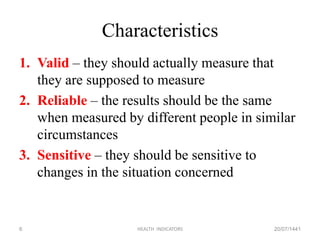
Characteristics
1. Valid – they should actually measure that
they are supposed to measure
2. Reliable – the results should be the same
when measured by different people in similar
circumstances
3. Sensitive – they should be sensitive to
changes in the situation concerned
20/07/1441HEALTH INDICATORS6
4. Specific – they should reflect changes only in
the situation concerned
5. Feasible – they should have the ability to
obtain data when needed
6. Relevant – they should contribute to the
understanding of the phenomenon of interest
20/07/1441HEALTH INDICATORS7
Uses of Indicators of Health
• Measurement the health of the community.
• Description the health of the community.
• Comparison the health of different
communities.
• Identification health needs and prioritizing
them.
20/07/1441HEALTH INDICATORS8
Cont. Uses of Indicators of Health
• Concurrent evaluation and terminal evaluation
of health services
• Planning and allocation of health resources.
• Measurement of health successes.
20/07/1441HEALTH INDICATORS9
Classification of Indicators of Health
• Mortality Indicators
• Morbidity Indicators
• Disability Rates
• Nutritional Status or Nutritional Indicators
• Health Care Delivery Indicators
• Utilization Rates
20/07/1441HEALTH INDICATORS10
Cont. Classification of Indicators of Health.
• Indicators of Social And Mental Health
• Environmental Indicators
• Socio-economic Indicators
• Health Policy Indicators
• Indicators of Quality of Life
• Other Indicators
20/07/1441HEALTH INDICATORS11
Mortality Indicators
1.Crude Death Rate
• It is defined as the number of deaths per
1000 population per year in a given
community, usually the mid-year population
• fair indicator of the comparative health of the
people.
• Useful in detecting the etiologic factor
20/07/1441HEALTH INDICATORS12
Cont. Mortality Indicators
2.Expectation of life
• refers to the number of years a person can
expect to live.
• Estimated for both sexes separately.
• Good indicator of socioeconomic development
• In Sudan :Male: 64 years
• female: 66 years
20/07/1441HEALTH INDICATORS13
Cont. Mortality Indicators
Infant mortality rate:
• The ratio of deaths under 1yr of age in a
given year to the total number of live births
in the same year, usually expressed as a rate
per 1000 live births.
• Sensitive indicator of availability, utilization
&effectiveness of health care, particularly
perinatal care.
20/07/1441HEALTH INDICATORS14
Cont. Mortality Indicators
Child Mortality Rate
• The number of deaths at ages 1-4yrs in a
given year, per 1000 children in that age
group at the mid-point of the year.
• Correlates with inadequate MCH services,
malnutrition, low immunization coverage and
environmental factors
20/07/1441HEALTH INDICATORS15
Cont. Mortality Indicators
• Other indicators are
• Perinatal mortality rate,
• Neonatal mortality rate,
• Stillbirth rate, etc.
 Correlates with inadequate antenatal care and
perinatal care
Disease Specific Death Rate :
20/07/1441HEALTH INDICATORS16
Morbidity Indicators
• Morbidity Indicators: The frequency with
which a disease appears in a population.
• Reveal the burden of ill health in a community,
but do not measure the subclinical states.
• Incidence :The number of new events or new
cases of a disease in a defined population,
within a specified period of time.
20/07/1441HEALTH INDICATORS17
Cont. Morbidity Indicators
• Prevalence : The number of new + old cases.
• Notification rates : is calculated from the
reporting to public authorities of certain
diseases.
• Admission, Readmission and discharge rates.
• Duration of stay in hospital – reflects the
virulence and resistance developed by the
etiological factor
20/07/1441HEALTH INDICATORS18
Disability Rates
• Disability Rates are of two categories
• Event type Indicators –
 number of days of restricted activity
 bed disability days
 work-loss days within a specified period
• Person type Indicators –
limitation of mobility e.g. confined to bed,
confined to house, special aid in getting around.
 limitation of activity e.g. limitation to perform
the basic activities of daily living (ADL) e.g.
eating, washing, dressing, etc.
20/07/1441HEALTH INDICATORS19
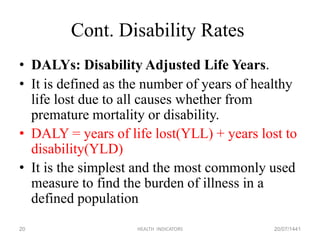
Cont. Disability Rates
• DALYs: Disability Adjusted Life Years.
• It is defined as the number of years of healthy
life lost due to all causes whether from
premature mortality or disability.
• DALY = years of life lost(YLL) + years lost to
disability(YLD)
• It is the simplest and the most commonly used
measure to find the burden of illness in a
defined population
20/07/1441HEALTH INDICATORS20
Nutritional Status Indicators
Newborns :
• are measured for their : i. Birth–weight ii. Length
Head circumference .
• They reflect the maternal nutrition status.
 Anthropometric measurements of pre-school
children.
i. Weight – measures acute malnutrition.
ii. Height – measures chronic malnutrition.
• Growth Monitoring of children is done by measuring
weight for-age, height-for-age, weight-for- height,etc
 In adults :MBI ( Underweight, Obesity) and Anemia
20/07/1441HEALTH INDICATORS21
Health Care Delivery Indicators
• These indicators reflect the equity of distribution of
health resources in different parts of the country and
of the provision of health care.
• Doctor-population Ratio
• Nurse-population ratio
• Population-bed Ratio
20/07/1441HEALTH INDICATORS22
CONT. Health Care Delivery
Indicators
• The WHO Joint Learning Initiative has
established a threshold of 25 health workers
(doctors, nurses and midwives) per 10,000
population, with a WHO endorsed lower
threshold of 23 workers per 10,000.
20/07/1441HEALTH INDICATORS23
Utilization Rates
• the proportion of people in need of a service
who actually receive it in a given period.
• It depends on availability & accessibility of health
services and the attitude of an individual towards
health care system.
E.g.
1. Proportion of infants who are fully immunized
2. Proportion of pregnant women who receive ANC
3. Percentage of population who adopt family
planning
20/07/1441HEALTH INDICATORS24
Indicators of Social and Mental Health
• These Include rates of suicide, homicide, other
crime, road traffic accident, alcohol and
substance abuse, domestic violence.
20/07/1441HEALTH INDICATORS25
Environmental Indicators
• These reflect the quality of physical and
biological environment in which diseases
occur and people live.
• The most important are those measuring the
proportion of population having access to safe
drinking water and sanitation facilities.
• These indicators explains the prevalence of
communicable diseases in a community
20/07/1441HEALTH INDICATORS26
Indicators of Quality of Life
• Life expectancy is no longer important
• The Quality Of Life has gained its importance
• Physical Quality of Life Index :s an attempt to measure
the quality of life or well-being of a country.
 basic literacy rate,
 infant mortality,
 and life expectancy
20/07/1441HEALTH INDICATORS27
CONT. Indicators of Quality of Life
• Human Development Index
– Longevity (life expectancy at birth)
– Education (mean and expected years of schooling)
– Gross national income (GNI) per capita
• The result is placed on the 0 to 1 scale
20/07/1441HEALTH INDICATORS28
SOCIOECONOMIC INDICATORS
• These do not directly measure health but are
important in interpreting health indicators.
These are:
– Rate of growth of population
– Per capita GNI (gross national income)
– Dependency ratio
– Literacy rates
– Housing – the number of persons per room
– Per capita “calorie” availability
20/07/1441HEALTH INDICATORS29
HEALTH POLICY INDICATORS
• The single most important indicator of political
commitment is allocation of adequate
resources.
• The relevant indicators are
• Proportion of GNP(gross national product)
spent on health services.
• Proportion of GNP spent on health related
activities like water supply and sanitation &
housing and nutrition.
20/07/1441HEALTH INDICATORS30
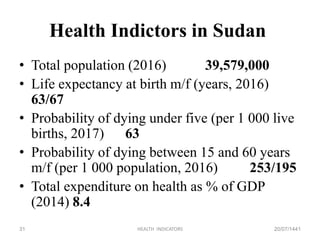
Health Indictors in Sudan
• Total population (2016) 39,579,000
• Life expectancy at birth m/f (years, 2016)
63/67
• Probability of dying under five (per 1 000 live
births, 2017) 63
• Probability of dying between 15 and 60 years
m/f (per 1 000 population, 2016) 253/195
• Total expenditure on health as % of GDP
(2014) 8.4
20/07/1441HEALTH INDICATORS31
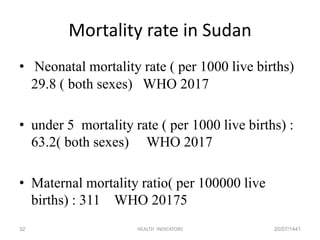
Mortality rate in Sudan
• Neonatal mortality rate ( per 1000 live births)
29.8 ( both sexes) WHO 2017
• under 5 mortality rate ( per 1000 live births) :
63.2( both sexes) WHO 2017
• Maternal mortality ratio( per 100000 live
births) : 311 WHO 20175
20/07/1441HEALTH INDICATORS32
SUMMARY
• Health not measured directly but using
indicators
• Indicator should be valid, sensitive, specific,
reliable, relevant and feasible
• Used in measuring, describing, comparing,
identifying health needs and planning and
evaluation of health services
20/07/1441HEALTH INDICATORS33
References
• Park K. Textbook of preventive and social
medicine. 21st ed. Jabalpur, India
• health indicators IN SUDAN – WHO
https://apps.who.int/gho/data/node.cco.ki-
SDN?lang=en
• Lecture notes
20/07/1441HEALTH INDICATORS34

Health indicators

  • 1.
    HEALTH INDICATORS Prepared by Dr.MohammedAli Aljradey (MBBS,MPH ,TA –IUA)
  • 2.
    Contents • Objectives • Introduction •Indicators of Health • Characteristics • Uses • Classification of Indicators of Health • Health indictors in Sudan • Summary • References 20/07/1441HEALTH INDICATORS2
  • 3.
    SESSObjectives N 1 :Learning Objectives •At the end of the session, participants should be able to  Define and identify relevant health indicators  Mention characteristics of good indicators  Give examples of good indicators 20/07/1441HEALTH INDICATORS3
  • 4.
    Introduction • Health isdefined as “a state of complete physical, mental & social wellbeing, and not merely an absence of disease or infirmity” (WHO) • This statement has been amplified to include the ability to lead a “socially and economically productive life” 20/07/1441HEALTH INDICATORS4
  • 5.
    Indicators of Health •Health Indicator is a variable, susceptible to direct measurement, that reflects the state of health of persons in a community.  a variable (its value changes)  that measures (objective calculation of value)… 20/07/1441HEALTH INDICATORS5
  • 6.
    Characteristics 1. Valid –they should actually measure that they are supposed to measure 2. Reliable – the results should be the same when measured by different people in similar circumstances 3. Sensitive – they should be sensitive to changes in the situation concerned 20/07/1441HEALTH INDICATORS6
  • 7.
    4. Specific –they should reflect changes only in the situation concerned 5. Feasible – they should have the ability to obtain data when needed 6. Relevant – they should contribute to the understanding of the phenomenon of interest 20/07/1441HEALTH INDICATORS7
  • 8.
    Uses of Indicatorsof Health • Measurement the health of the community. • Description the health of the community. • Comparison the health of different communities. • Identification health needs and prioritizing them. 20/07/1441HEALTH INDICATORS8
  • 9.
    Cont. Uses ofIndicators of Health • Concurrent evaluation and terminal evaluation of health services • Planning and allocation of health resources. • Measurement of health successes. 20/07/1441HEALTH INDICATORS9
  • 10.
    Classification of Indicatorsof Health • Mortality Indicators • Morbidity Indicators • Disability Rates • Nutritional Status or Nutritional Indicators • Health Care Delivery Indicators • Utilization Rates 20/07/1441HEALTH INDICATORS10
  • 11.
    Cont. Classification ofIndicators of Health. • Indicators of Social And Mental Health • Environmental Indicators • Socio-economic Indicators • Health Policy Indicators • Indicators of Quality of Life • Other Indicators 20/07/1441HEALTH INDICATORS11
  • 12.
    Mortality Indicators 1.Crude DeathRate • It is defined as the number of deaths per 1000 population per year in a given community, usually the mid-year population • fair indicator of the comparative health of the people. • Useful in detecting the etiologic factor 20/07/1441HEALTH INDICATORS12
  • 13.
    Cont. Mortality Indicators 2.Expectationof life • refers to the number of years a person can expect to live. • Estimated for both sexes separately. • Good indicator of socioeconomic development • In Sudan :Male: 64 years • female: 66 years 20/07/1441HEALTH INDICATORS13
  • 14.
    Cont. Mortality Indicators Infantmortality rate: • The ratio of deaths under 1yr of age in a given year to the total number of live births in the same year, usually expressed as a rate per 1000 live births. • Sensitive indicator of availability, utilization &effectiveness of health care, particularly perinatal care. 20/07/1441HEALTH INDICATORS14
  • 15.
    Cont. Mortality Indicators ChildMortality Rate • The number of deaths at ages 1-4yrs in a given year, per 1000 children in that age group at the mid-point of the year. • Correlates with inadequate MCH services, malnutrition, low immunization coverage and environmental factors 20/07/1441HEALTH INDICATORS15
  • 16.
    Cont. Mortality Indicators •Other indicators are • Perinatal mortality rate, • Neonatal mortality rate, • Stillbirth rate, etc.  Correlates with inadequate antenatal care and perinatal care Disease Specific Death Rate : 20/07/1441HEALTH INDICATORS16
  • 17.
    Morbidity Indicators • MorbidityIndicators: The frequency with which a disease appears in a population. • Reveal the burden of ill health in a community, but do not measure the subclinical states. • Incidence :The number of new events or new cases of a disease in a defined population, within a specified period of time. 20/07/1441HEALTH INDICATORS17
  • 18.
    Cont. Morbidity Indicators •Prevalence : The number of new + old cases. • Notification rates : is calculated from the reporting to public authorities of certain diseases. • Admission, Readmission and discharge rates. • Duration of stay in hospital – reflects the virulence and resistance developed by the etiological factor 20/07/1441HEALTH INDICATORS18
  • 19.
    Disability Rates • DisabilityRates are of two categories • Event type Indicators –  number of days of restricted activity  bed disability days  work-loss days within a specified period • Person type Indicators – limitation of mobility e.g. confined to bed, confined to house, special aid in getting around.  limitation of activity e.g. limitation to perform the basic activities of daily living (ADL) e.g. eating, washing, dressing, etc. 20/07/1441HEALTH INDICATORS19
  • 20.
    Cont. Disability Rates •DALYs: Disability Adjusted Life Years. • It is defined as the number of years of healthy life lost due to all causes whether from premature mortality or disability. • DALY = years of life lost(YLL) + years lost to disability(YLD) • It is the simplest and the most commonly used measure to find the burden of illness in a defined population 20/07/1441HEALTH INDICATORS20
  • 21.
    Nutritional Status Indicators Newborns: • are measured for their : i. Birth–weight ii. Length Head circumference . • They reflect the maternal nutrition status.  Anthropometric measurements of pre-school children. i. Weight – measures acute malnutrition. ii. Height – measures chronic malnutrition. • Growth Monitoring of children is done by measuring weight for-age, height-for-age, weight-for- height,etc  In adults :MBI ( Underweight, Obesity) and Anemia 20/07/1441HEALTH INDICATORS21
  • 22.
    Health Care DeliveryIndicators • These indicators reflect the equity of distribution of health resources in different parts of the country and of the provision of health care. • Doctor-population Ratio • Nurse-population ratio • Population-bed Ratio 20/07/1441HEALTH INDICATORS22
  • 23.
    CONT. Health CareDelivery Indicators • The WHO Joint Learning Initiative has established a threshold of 25 health workers (doctors, nurses and midwives) per 10,000 population, with a WHO endorsed lower threshold of 23 workers per 10,000. 20/07/1441HEALTH INDICATORS23
  • 24.
    Utilization Rates • theproportion of people in need of a service who actually receive it in a given period. • It depends on availability & accessibility of health services and the attitude of an individual towards health care system. E.g. 1. Proportion of infants who are fully immunized 2. Proportion of pregnant women who receive ANC 3. Percentage of population who adopt family planning 20/07/1441HEALTH INDICATORS24
  • 25.
    Indicators of Socialand Mental Health • These Include rates of suicide, homicide, other crime, road traffic accident, alcohol and substance abuse, domestic violence. 20/07/1441HEALTH INDICATORS25
  • 26.
    Environmental Indicators • Thesereflect the quality of physical and biological environment in which diseases occur and people live. • The most important are those measuring the proportion of population having access to safe drinking water and sanitation facilities. • These indicators explains the prevalence of communicable diseases in a community 20/07/1441HEALTH INDICATORS26
  • 27.
    Indicators of Qualityof Life • Life expectancy is no longer important • The Quality Of Life has gained its importance • Physical Quality of Life Index :s an attempt to measure the quality of life or well-being of a country.  basic literacy rate,  infant mortality,  and life expectancy 20/07/1441HEALTH INDICATORS27
  • 28.
    CONT. Indicators ofQuality of Life • Human Development Index – Longevity (life expectancy at birth) – Education (mean and expected years of schooling) – Gross national income (GNI) per capita • The result is placed on the 0 to 1 scale 20/07/1441HEALTH INDICATORS28
  • 29.
    SOCIOECONOMIC INDICATORS • Thesedo not directly measure health but are important in interpreting health indicators. These are: – Rate of growth of population – Per capita GNI (gross national income) – Dependency ratio – Literacy rates – Housing – the number of persons per room – Per capita “calorie” availability 20/07/1441HEALTH INDICATORS29
  • 30.
    HEALTH POLICY INDICATORS •The single most important indicator of political commitment is allocation of adequate resources. • The relevant indicators are • Proportion of GNP(gross national product) spent on health services. • Proportion of GNP spent on health related activities like water supply and sanitation & housing and nutrition. 20/07/1441HEALTH INDICATORS30
  • 31.
    Health Indictors inSudan • Total population (2016) 39,579,000 • Life expectancy at birth m/f (years, 2016) 63/67 • Probability of dying under five (per 1 000 live births, 2017) 63 • Probability of dying between 15 and 60 years m/f (per 1 000 population, 2016) 253/195 • Total expenditure on health as % of GDP (2014) 8.4 20/07/1441HEALTH INDICATORS31
  • 32.
    Mortality rate inSudan • Neonatal mortality rate ( per 1000 live births) 29.8 ( both sexes) WHO 2017 • under 5 mortality rate ( per 1000 live births) : 63.2( both sexes) WHO 2017 • Maternal mortality ratio( per 100000 live births) : 311 WHO 20175 20/07/1441HEALTH INDICATORS32
  • 33.
    SUMMARY • Health notmeasured directly but using indicators • Indicator should be valid, sensitive, specific, reliable, relevant and feasible • Used in measuring, describing, comparing, identifying health needs and planning and evaluation of health services 20/07/1441HEALTH INDICATORS33
  • 34.
    References • Park K.Textbook of preventive and social medicine. 21st ed. Jabalpur, India • health indicators IN SUDAN – WHO https://apps.who.int/gho/data/node.cco.ki- SDN?lang=en • Lecture notes 20/07/1441HEALTH INDICATORS34