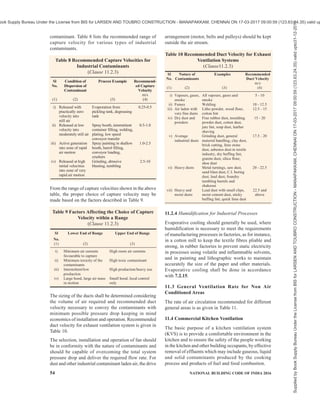
HNXGL)NL]Q
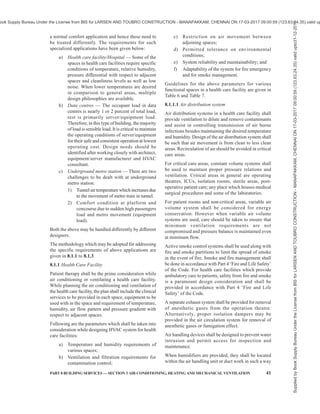
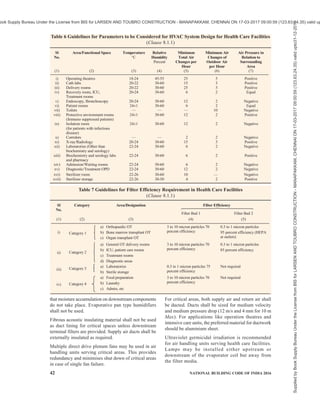
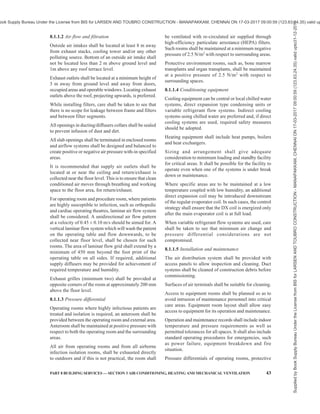
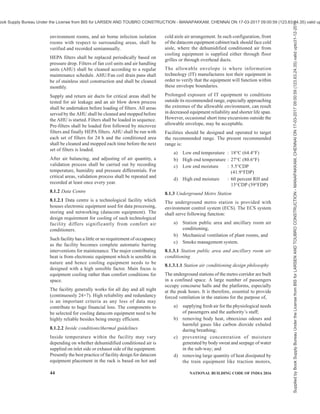
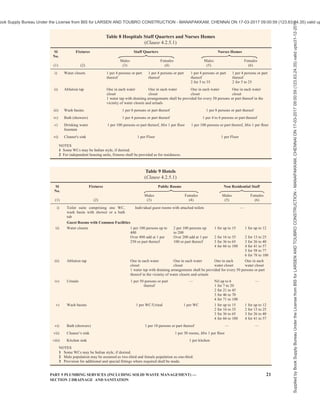
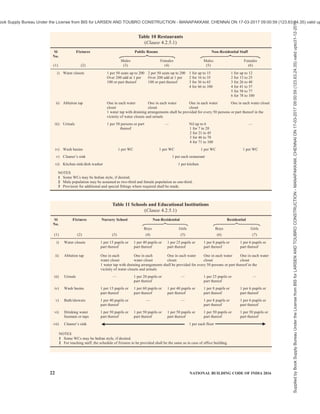
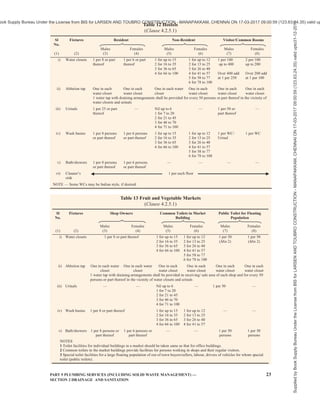
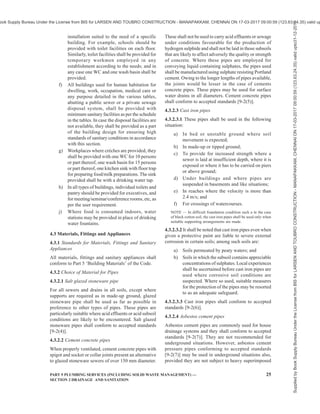
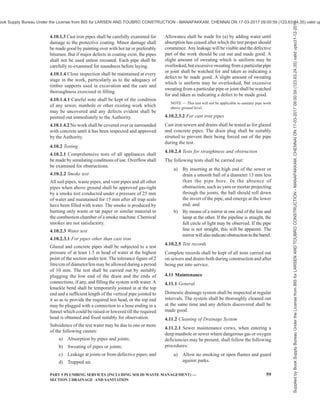
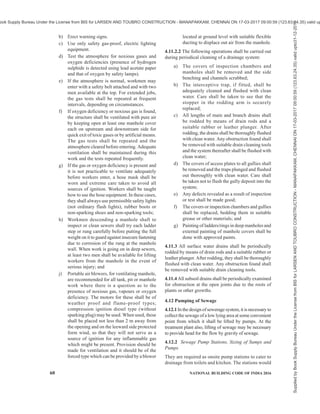
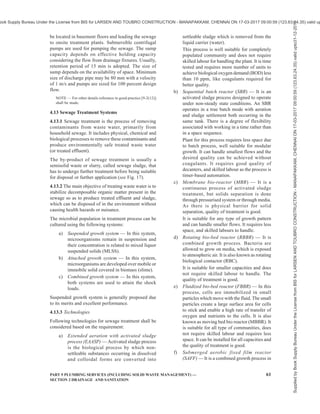
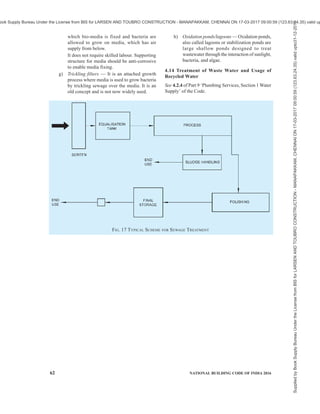
N=G
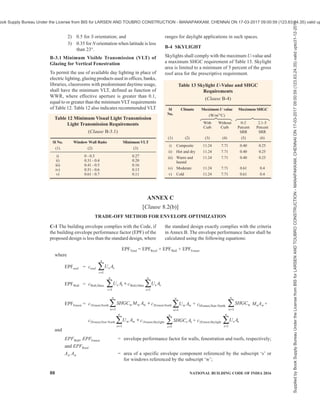
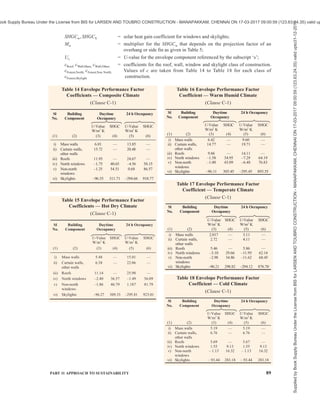
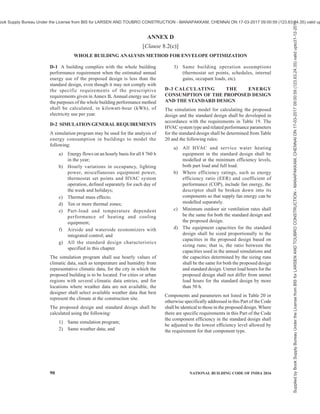
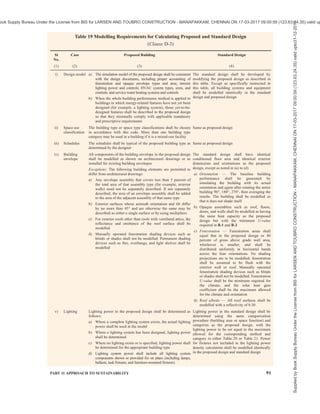
+NNMUKHNXGZMNV
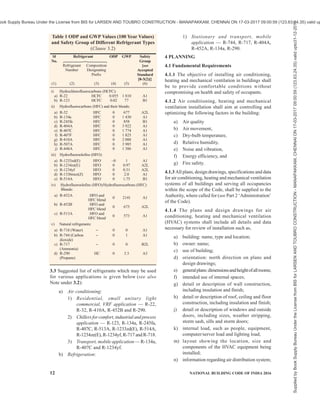
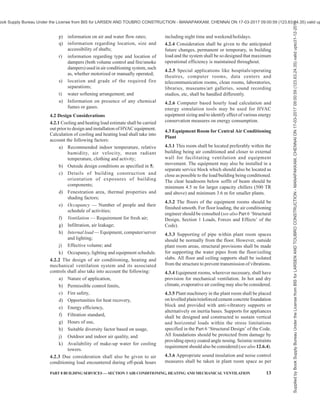
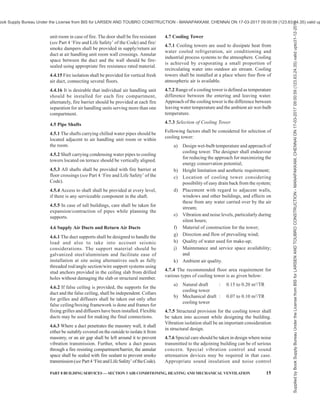
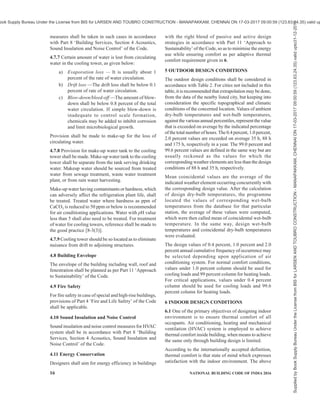
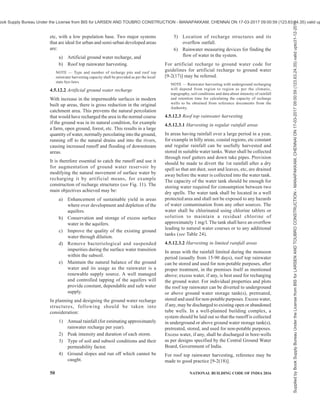
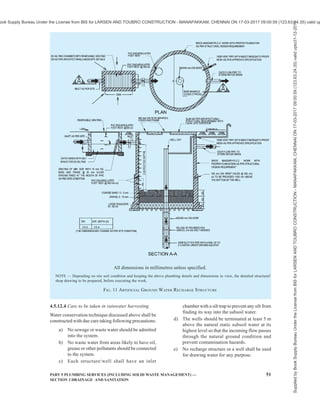
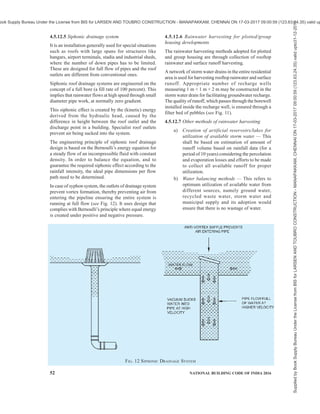
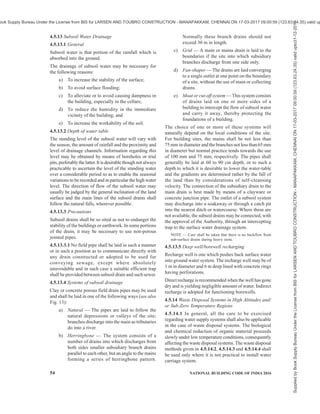
	1,
1ÊÊ
Ê-/
,
-
1$7,21$/%8,/',1*2'(
2),1',$
+NNMUGKMN9K
+NRXIXHN=NODIJUN

92/80(
N0
Supplied
by
Book
Supply
Bureau
Under
the
License
from
BIS
for
LARSEN
AND
TOUBRO
CONSTRUCTION
-
MANAPAKKAM,
CHENNAI
ON
17-03-2017
09:00:59
(123.63.24.35)
valid
upto31-12-2017
ook Supply Bureau Under the License from BIS for LARSEN AND TOUBRO CONSTRUCTION - MANAPAKKAM, CHENNAI ON 17-03-2017 09:00:59 (123.63.24.35) valid up
Hkkjr dh jkVªh;
Hkou fuekZ.k lafgrk 2016
[k.M 2
NATIONALBUILDING CODE
OF INDIA 2016
VOLUME 2
BUREAU OF INDIAN STANDARDS
Hkkjrh; ekud C;wjks
Supplied
by
Book
Supply
Bureau
Under
the
License
from
BIS
for
LARSEN
AND
TOUBRO
CONSTRUCTION
-
MANAPAKKAM,
CHENNAI
ON
17-03-2017
09:00:59
(123.63.24.35)
valid
upto31-12-2017
ook Supply Bureau Under the License from BIS for LARSEN AND TOUBRO CONSTRUCTION - MANAPAKKAM, CHENNAI ON 17-03-2017 09:00:59 (123.63.24.35) valid up
SP 7 : 2016
FIRST PUBLISHED 1970
FIRST REVISION 1983
SECONDREVISION2005
THIRDREVISION2016
© BUREAU OF INDIAN STANDARDS
ICS 01.120; 91.040.01
PRICE `
PUBLISHED BY BUREAU OF INDIAN STANDARDS, MANAK BHAVAN, 9 BAHADUR SHAH ZAFAR
MARG, NEW DELHI 110002; TYPESETAT SUNSHINE GRAPHICS, 263, TELIWARA, SHAHDARA, DELHI
110032; PRINTEDATJ. J. OFFSET PRINTERS,A-24, SECTOR 68, NOIDA, GAUTAM BUDH NAGAR, UTTAR
PRADESH (INDIA).
Supplied
by
Book
Supply
Bureau
Under
the
License
from
BIS
for
LARSEN
AND
TOUBRO
CONSTRUCTION
-
MANAPAKKAM,
CHENNAI
ON
17-03-2017
09:00:59
(123.63.24.35)
valid
upto31-12-2017
ook Supply Bureau Under the License from BIS for LARSEN AND TOUBRO CONSTRUCTION - MANAPAKKAM, CHENNAI ON 17-03-2017 09:00:59 (123.63.24.35) valid up
(iii)
C O N T E N T S
Volume 1
FOREWORD ... (v)
COMMITTEE COMPOSITION ... (ix)
IMPORTANT EXPLANATORY NOTE FOR USERS OF THE CODE ... (xxx)
INFORMATION FOR THE USERS ABOUT AVAILABILITY OF THE CODE IN GROUPS ... (xxxi)
Total Pages
PART 0 INTEGRATED APPROACH — PREREQUISITE FOR APPLYING PROVISIONS OF THE CODE ... 12
PART 1 DEFINITIONS ... 28
PART 2 ADMINISTRATION ... 32
PART 3 DEVELOPMENT CONTROL RULES AND GENERAL BUILDING REQUIREMENTS ... 150
PART 4 FIRE AND LIFE SAFETY ... 116
PART 5 BUILDING MATERIALS ... 46
PART 6 STRUCTURAL DESIGN
Section 1 Loads, Forces and Effects ... 134
Section 2 Soils and Foundations ... 60
Section 3 Timber and Bamboo
3A Timber ... 56
3B Bamboo ... 30
Section 4 Masonry ... 86
Section 5 Concrete
5A Plain and Reinforced Concrete ... 118
5B Prestressed Concrete ... 52
Section 6 Steel ... 138
Section 7 Prefabrication, Systems Building and Mixed/Composite Construction
7A Prefabricated Concrete ... 42
7B Systems Building and Mixed/Composite Construction ... 12
Section 8 Glass and Glazing ... 80
Volume 2
IMPORTANT EXPLANATORY NOTE FOR USERS OF THE CODE ... (iv)
INFORMATION FOR THE USERS ABOUT AVAILABILITY OF THE CODE IN GROUPS ... (v)
Total Pages
PART 7 CONSTRUCTION MANAGEMENT, PRACTICES AND SAFETY ... 76
PART 8 BUILDING SERVICES
Section 1 Lighting and Natural Ventilation ... 56
Section 2 Electrical and Allied Installations ... 172
Section 3 Air Conditioning, Heating and Mechanical Ventilation ... 86
Section 4 Acoustics, Sound Insulation and Noise Control ... 46
Section 5 Installation of Lifts, Escalators and Moving Walks
5A Lifts ... 96
5B Escalators and Moving Walks ... 44
Section 6 Information and Communication Enabled Installations ... 28
PART 9 PLUMBING SERVICES (INCLUDING SOLID WASTE MANAGEMENT)
Section 1 Water Supply ... 44
Section 2 Drainage and Sanitation ... 82
Section 3 Solid Waste Management ... 16
Section 4 Gas Supply ... 18
PART 10 LANDSCAPE DEVELOPMENT, SIGNS AND OUTDOOR DISPLAY STRUCTURES
Section 1 Landscape Planning, Design and Development ... 34
Section 2 Signs and Outdoor Display Structures ... 24
PART 11 APPROACH TO SUSTAINABILITY ... 98
PART 12 ASSET AND FACILITY MANAGEMENT ... 98
Supplied
by
Book
Supply
Bureau
Under
the
License
from
BIS
for
LARSEN
AND
TOUBRO
CONSTRUCTION
-
MANAPAKKAM,
CHENNAI
ON
17-03-2017
09:00:59
(123.63.24.35)
valid
upto31-12-2017
ook Supply Bureau Under the License from BIS for LARSEN AND TOUBRO CONSTRUCTION - MANAPAKKAM, CHENNAI ON 17-03-2017 09:00:59 (123.63.24.35) valid up
(iv)
Important Explanatory Note for Users of the Code
In any Part/Section of this Code, where reference is made to ‘good practice’ in
relation to design, constructional procedures or other related information, and where
reference is made to ‘accepted standard’ in relation to material specification,
testing, or other related information, the Indian Standards listed at the end of the
Part/Section shall be used as a guide to the interpretation.
At the time of publication, the editions indicated in the standards were valid. All
standards are subject to revision and parties to agreements based on any Part/
Section are encouraged to investigate the possibility of applying the most recent
editions of the standards.
In the list of standards given at the end of a Part/Section, the number appearing
within parentheses in the first column indicates the number of the reference of the
standard in the Part/Section. For example:
a) Good practice [7(2)] refers to the Indian Standard given at serial number (2)
of the list of standards given at the end of Part 7, that is, IS 16416 : 2016
‘Construction project management: Project formulation and appraisal —
Guidelines’.
b) Good practice [8-1(6)] refers to the Indian Standard given at serial number
(6) of the list of standards given at the end of Section 1 of Part 8, that is,
IS 3362 : 1977 ‘Code of practice for natural ventilation of residential buildings
(first revision)’.
c) Good practice [8-3(16)] refers to the Indian Standard given at serial number
(16) of the list of standards given at the end of Section 3 of Part 8, that is,
IS 4831 : 1968 ‘Recommendation on units and symbols for refrigeration’.
d) Accepted standard [8-5A(6)] refers to the Indian Standard given at serial
number (6) of the list of standards given at the end of Subsection 5A of
Part 8, that is, IS 14665 (Part 3/Sec 1 and 2) : 2000 ‘Electric traction lifts:
Part 3 Safety rules, Section 1 Passenger and goods lifts, Section 2 Service
lifts’.
e) Accepted standards [8-6(2)] refers to the Indian Standards given at serial
number (2) of the list of standards given at the end of Section 6 of Part 8,
that is, IS 9537 (Part 3) : 1983 ‘Specification for conduits for electrical
installations: Part 3 Rigid plain conduits for insulating materials’ and
IS 3419 : 1989 ‘Specification for fittings for rigid non-metallic conduits
(second revision)’.
f) Accepted standard [9-1(1)] refers to the Indian Standard given at serial
number (1) of the list of standards given at the end of Section 1 of Part 9,
that is, IS 10446 : 1983 ‘Glossary of terms relating to water supply and
sanitation’.
Supplied
by
Book
Supply
Bureau
Under
the
License
from
BIS
for
LARSEN
AND
TOUBRO
CONSTRUCTION
-
MANAPAKKAM,
CHENNAI
ON
17-03-2017
09:00:59
(123.63.24.35)
valid
upto31-12-2017
ook Supply Bureau Under the License from BIS for LARSEN AND TOUBRO CONSTRUCTION - MANAPAKKAM, CHENNAI ON 17-03-2017 09:00:59 (123.63.24.35) valid up
(v)
INFORMATION FOR THE USERS ABOUT AVAILABILITY OF
THE CODE IN GROUPS
For the convenience of the users, the National Building Code of India 2016 is available as a comprehensive
volume as well as in the following five groups, each incorporating the related Parts/Sections dealing with particular
area of building activity:
Group 1 For Development/
Building Planning
and Related
Aspects
Part 0 Integrated Approach — Prerequisite for Applying Provisions of the Code
Part 1 Definitions
Part 2 Administration
Part 3 Development Control Rules and General Building Requirements
Part 4 Fire and Life Safety
Part 5 Building Materials
Part 10 Landscape Development, Signs And Outdoor Display Structures
Section 1 Landscape Planning, Design and Development
Section 2 Signs and Outdoor Display Structures
Part 11 Approach to Sustainability
Group 2 For Structural
Design and Related
Aspects
Part 0 Integrated Approach — Prerequisite for Applying Provisions of the Code
Part 6 Structural Design
Section 1 Loads, Forces and Effects
Section 2 Soils and Foundations
Section 3 Timber and Bamboo
3A Timber
3B Bamboo
Section 4 Masonry
Section 5 Concrete
5A Plain and Reinforced Concrete
5B Prestressed Concrete
Section 6 Steel
Section 7 Prefabrication, Systems Building and Mixed/ Composite
Construction
7A Prefabricated Concrete
7B Systems Building and Mixed/ Composite Construction
Section 8 Glass and Glazing
Part 11 Approach to Sustainability
Group 3 For Aspects
Relating to
Construction, and
Asset/ Facility
Management
Part 0 Integrated Approach — Prerequisite for Applying Provisions of the Code
Part 7 Construction Management, Practices and Safety
Part 11 Approach to Sustainability
Part 12 Asset and Facility Management
Group 4 For Aspects
Relating to Building
Services
Part 0 Integrated Approach — Prerequisite for Applying Provisions of the Code
Part 8 Building Services
Section 1 Lighting and Natural Ventilation
Section 2 Electrical and Allied Installations
Section 3 Air Conditioning, Heating and Mechanical Ventilation
Section 4 Acoustics, Sound Insulation and Noise Control
Section 5 Installation of Lifts, Escalators and Moving Walks
5A Lifts
5B Escalators and Moving Walks
Section 6 Information and Communication Enabled Installations
Part 11 Approach to Sustainability
Group 5 For Aspects
Relating to
Plumbing Services
and Solid Waste
Management
Part 0 Integrated Approach — Prerequisite for Applying Provisions of the Code
Part 9 Plumbing Services (including Solid Waste Management)
Section 1 Water Supply
Section 2 Drainage and Sanitation
Section 3 Solid Waste Management
Section 4 Gas Supply
Part 11 Approach to Sustainability
The information contained in different groups will serve the concerned professionals dealing with the respective
areas. However, it is advisable that professionals essentially dealing with any of the above groups should also
refer the other groups.
Supplied
by
Book
Supply
Bureau
Under
the
License
from
BIS
for
LARSEN
AND
TOUBRO
CONSTRUCTION
-
MANAPAKKAM,
CHENNAI
ON
17-03-2017
09:00:59
(123.63.24.35)
valid
upto31-12-2017
ook Supply Bureau Under the License from BIS for LARSEN AND TOUBRO CONSTRUCTION - MANAPAKKAM, CHENNAI ON 17-03-2017 09:00:59 (123.63.24.35) valid up
Supplied
by
Book
Supply
Bureau
Under
the
License
from
BIS
for
LARSEN
AND
TOUBRO
CONSTRUCTION
-
MANAPAKKAM,
CHENNAI
ON
17-03-2017
09:00:59
(123.63.24.35)
valid
upto31-12-2017
Book Supply Bureau Under the License from BIS for LARSEN AND TOUBRO CONSTRUCTION - MANAPAKKAM, CHENNAI ON 17-03-2017 09:00:59 (123.63.24.35) valid up
NATIONAL BUILDING CODE OF INDIA
PART 7 CONSTRUCTION MANAGEMENT, PRACTICES AND SAFETY
BUREAU OF INDIAN STANDARDS
Supplied
by
Book
Supply
Bureau
Under
the
License
from
BIS
for
LARSEN
AND
TOUBRO
CONSTRUCTION
-
MANAPAKKAM,
CHENNAI
ON
17-03-2017
09:00:59
(123.63.24.35)
valid
upto31-12-2017
ook Supply Bureau Under the License from BIS for LARSEN AND TOUBRO CONSTRUCTION - MANAPAKKAM, CHENNAI ON 17-03-2017 09:00:59 (123.63.24.35) valid up
2 NATIONAL BUILDING CODE OF INDIA 2016
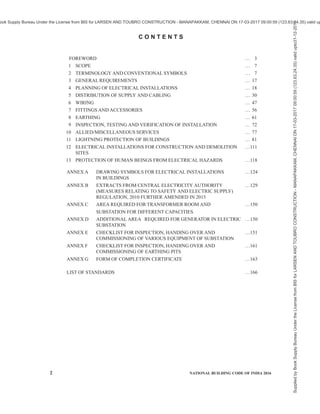
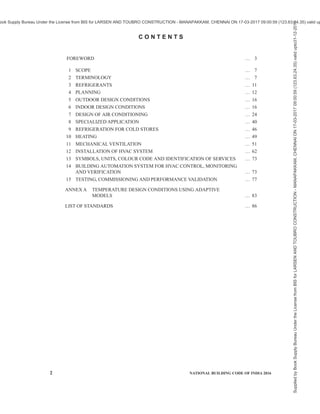
C O N T E N T S
FOREWORD … 3
1 SCOPE … 7
2 TERMINOLOGY … 7
3 GENERAL … 7
SECTION 1 CONSTRUCTION MANAGEMENT
4 CONSTRUCTION PROJECT MANAGEMENT … 8
SECTION 2 CONSTRUCTION PLANNING AND SITE MANAGEMENT
5 PLANNING ASPECTS … 17
SECTION 3 CONSTRUCTION PRACTICES
6 CONSTRUCTION CONTROL AND PRACTICES … 19
7 TEMPORARY WORKS … 21
8 STORAGE, STACKING AND HANDLING PRACTICES … 23
SECTION 4 SAFETY IN CONSTRUCTION
9 SAFETY IN CONSTRUCTION OF ELEMENTS OF A BUILDING … 34
10 SAFETY IN DEMOLITION OF BUILDINGS … 52
SECTION 5 REPAIRS, RETROFITTING AND STRENGTHENING OF BUILDINGS
11 MAINTENANCE MANAGEMENT … 57
12 PREVENTION OF CRACKS … 57
13 REPAIRS AND SEISMIC STRENGTHENING OF BUILDINGS … 58
SECTION 6 HABITAT AND WELFARE REQUIREMENTS FOR WORKERS
14 HABITAT AND OTHER WELFARE REQUIREMENTS FOR CONSTRUCTION … 59
WORKERS
ANNEX A CHECK LIST FOR STACKING AND STORAGE OF MATERIALS … 63
LIST OF STANDARDS … 64 Supplied
by
Book
Supply
Bureau
Under
the
License
from
BIS
for
LARSEN
AND
TOUBRO
CONSTRUCTION
-
MANAPAKKAM,
CHENNAI
ON
17-03-2017
09:00:59
(123.63.24.35)
valid
upto31-12-2017
ook Supply Bureau Under the License from BIS for LARSEN AND TOUBRO CONSTRUCTION - MANAPAKKAM, CHENNAI ON 17-03-2017 09:00:59 (123.63.24.35) valid up
PART 7 CONSTURCTION MANAGEMENT, PRACTICES AND SAFETY 3
National Building Code Sectional Committee, CED 46
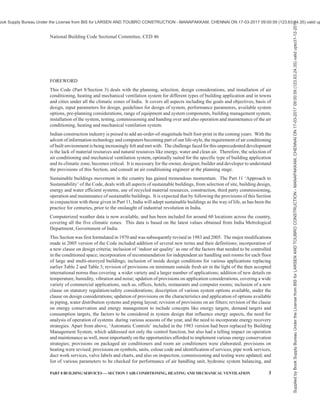
FOREWORD
This Code (Part 7) covers construction project management; construction planning, site management and building
construction practices; storage, stacking and handling of materials; and safety of personnel during construction
operations for all elements of a building and demolition of buildings; and habitat and welfare requirements for
workers. It also covers guidelines relating to repairs, retrofitting and strengthening of buildings.
The principles enunciated in the various sections of this Part are to be ultimately utilized and implemented in the
physical construction of the buildings with the required infrastructure. This would require sound construction
practices and efficient management thereof in order to ensure that the implementation of the project is carried out
within the estimated cost and planned period to the required quality standards and in a safe and sustainable
manner. Workers in large number, both skilled and unskilled, are engaged in the innumerable construction works.
Due to increased tempo of such a building activity and large scale mechanization, hazards of accidents could
increase considerably. It is, therefore, imperative that adequate safety rules are laid down for every phase of
construction work. It is also important to give due cognizance to habitat and welfare requirements of workers at
construction site. This Part also deals with these aspects.
Planning the various construction operations before hand and making adequate arrangements for procurement
and storage of materials, and the machinery to get work done is as important as carrying out these construction
operations in accordance with good practice. Lack of planning or defective planning may result in avoidable
delay in the completion of work and consequently increased hazards from the point of view of fire, health and
structural soundness. This Part covers provisions in this regard.
A construction project is an endeavour undertaken by a project team on behalf of owner/client to create a built
facility suited to the defined functional objectives. From inception to commissioning, the project goes through
various distinct stages leading to progressive achievement of project objectives. Each stage involves specific
inputs, processes (both technical and managerial) and deliverables. Typically, the life cycle of a project from
commencement to completion involves the following stages:
a) Project formulation and appraisal — Inception, feasibility and strategic planning;
b) Project development — Project brief development, planning and design, finalization of proposals,
procurement strategy, construction documentation including tender drawings, working drawings,
specifications, cost estimates, bills of quantities, procurement documents;
c) Planning for construction — Sequencing of project components, planning tools, resource planning and
time cost trade off;
d) Tender action — Open competitive bidding/pre-qualification of agencies, issue of tender documents,
evaluation of bids, negotiation if required and award of work;
e) Construction — Execution, monitoring, control, work acceptance; and
f) Commissioning and handing over — Contractual closeout, financial closeout, defect liability
commencement, facility handing over.
The distinct features of a construction project include the temporary nature of the organizations involved, the
evolutionary process of project deliverables during project development stages and the unique output of the built
facility. As a result of these features, unless there is efficient and effective project management, a construction
project is faced with challenges of uncertainties leading to time over-runs, cost over-runs, changes in project
parameters, loss of quality and inability to meet the functional objectives. While technical soundness of a proposal
is an important aspect of a construction project, the management aspects, which involve techno-legal, financial
and other issues, have also a significant role in the success of a project. Therefore, management functions and
technical processes in a construction project need to be integrated towards achieving project objectives. Top
management commitment plays an important role in harmoniously achieving these project objectives. In some of
the public sector projects, it may be necessary to share relevant information with public at large through appropriate
Supplied
by
Book
Supply
Bureau
Under
the
License
from
BIS
for
LARSEN
AND
TOUBRO
CONSTRUCTION
-
MANAPAKKAM,
CHENNAI
ON
17-03-2017
09:00:59
(123.63.24.35)
valid
upto31-12-2017
ook Supply Bureau Under the License from BIS for LARSEN AND TOUBRO CONSTRUCTION - MANAPAKKAM, CHENNAI ON 17-03-2017 09:00:59 (123.63.24.35) valid up
4 NATIONAL BUILDING CODE OF INDIA 2016
means. The overall management of a building construction project is very important to ensure that the objectives
of such a project are achieved through scope management, procurement management, time management, cost
management, quality management, risk management, communication management, human resources management,
safety, health and environment management and integration management. This Part, therefore, gives guidelines
on these areas.
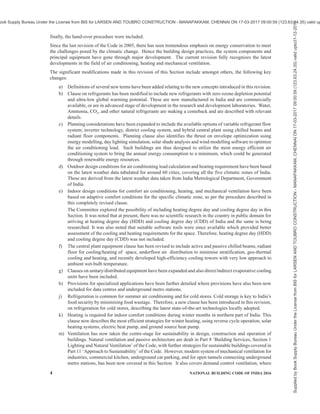
The first version of this Part was formulated in 1970, which was subsequently revised in 1983 and 2005. In the
first revision, information regarding handling operations that is unloading, stacking, lifting, loading and conveying
of building materials, was also given along with the storage practices. Additional information regarding the use of
ladders; safety requirements for floor and wall openings, railings and toe boards; piling and other deep foundations;
constructions involving use of hot bituminous materials; and erection of structural steel work and concrete framed
structures, etc, were included.
In the second revision, the Section 1 ‘Construction Practices’ of this Part, had been revamped to include the
planning and management aspects. Further, provisions on construction using bamboo were also incorporated. The
other important modifications incorporated in the second revision included comprehensive updating of the
provisions with regard to stacking and storage of building materials and components, which were comprehensively
covered in line with the revised IS 4082 : 1996 ‘Recommendations on stacking and storage of construction
materials and components at site (second revision)’; addition of provisions of safety requirements of hoists/lifts
for worker during construction; incorporation of aspects like preventive measures such as falling material hazards
prevention, fall prevention, disposal of debris, fire protection, etc, with regard to safety at work site; addition of
provisions regarding safety management at work sites; addition of a new section on ‘Maintenance management,
repairs, retrofitting and strengthening of buildings’, covering aspects like maintenance management, prevention
of cracks, and repairs and seismic strengthening of buildings; and updating of safety provisions with respect to
demolition of buildings.
As a result of experience gained in implementation of 2005 version of this Part and feedback received as well as
in view of formulation of new standards in the field of construction project management and construction practices
and revision of some existing standards, including those on safety, a need to revise this Part was felt. This revision
has, therefore, been prepared to take care of these aspects. This Part has been divided into six sections as follows,
under which all technical provisions relating to their subject areas, have been given:
Section 1 Construction Management
Section 2 Construction Planning and Site Management
Section 3 Construction Practices
Section 4 Safety in Construction
Section 5 Repairs, Retrofitting and Strengthening of Buildings
Section 6 Habitat and Welfare Requirements for Workers
The significant changes incorporated in this revision include:
a) This Part has been divided into six Sections under which the provisions have been rearranged in a logical
sequence;
b) Provisions on construction project management have been detailed which also now includes project
formulation and appraisal.
c) Safety provisions with respect to scaffolding, piling and other deep foundations, blasting and related
drilling operations, and construction involving use of hot bituminous materials have been updated;
d) A new clause on habitat and other welfare requirements for construction workers has been introduced;
e) A new clause on urban/city roads planning and construction, has been added;
f) A new clause on temporary works has been included;
g) Provisions on construction using bamboo has been shifted to Part 6 ‘Structural Design, Section 3B
Bamboo, and a reference to the same has been given in this Part;
h) Provisions on maintenance management has been shifted to Part 12 ‘Asset and Facility Management’ of
the Code and a reference to the same has been given in this Part; and
j) References to all the concerned Indian Standards have been updated.
Users are encouraged to employ suitable construction management software as an aid to implement provisions of
Supplied
by
Book
Supply
Bureau
Under
the
License
from
BIS
for
LARSEN
AND
TOUBRO
CONSTRUCTION
-
MANAPAKKAM,
CHENNAI
ON
17-03-2017
09:00:59
(123.63.24.35)
valid
upto31-12-2017
ook Supply Bureau Under the License from BIS for LARSEN AND TOUBRO CONSTRUCTION - MANAPAKKAM, CHENNAI ON 17-03-2017 09:00:59 (123.63.24.35) valid up
PART 7 CONSTURCTION MANAGEMENT, PRACTICES AND SAFETY 5
this Code. The guidelines may be applicable in general to all construction projects. However, for smaller projects,
the applicability of various provisions may be decided appropriately by the parties concerned.
Provisions on sustainable building construction practices are covered in Part 11 ‘Approach to Sustainability’ of
the Code.
The information contained in this Part is largely based on the following Indian Standards and Special Publications:
IS 3696 Safety code for scaffolds and ladders:
(Part 1) : 1987 Scaffolds
(Part 2) : 1991 Ladders
IS 3764 : 1992 Code of practice for excavation work (first revision)
IS 4082 : 1996 Recommendations on stacking and storage of construction materials and components at
site (second revision)
IS 4130 : 1991 Safety code for demolition of buildings (second revision)
IS 4912 : 1978 Safety requirements for floor and wall openings, railing and toe boards (first revision)
IS 5121 : 2013 Code of safety for piling and other deep foundations (first revision)
IS 5916 : 2013 Safety code for construction involving use of hot bituminous materials (first revision)
IS 7205 : 1974 Safety code for erection of structural steel work
IS 7969 : 1975 Safety code for handling and storage of building materials
IS 8989 : 1978 Safety code for erection of concrete framed structures
IS 13415 : 1992 Safety code for protective barrier in and around buildings
IS 13416 Recommendations for preventive measures against hazards at work places:
(Part 1) : 1992 Falling material hazards prevention
(Part 2) : 1992 Fall prevention
(Part 3) : 1994 Disposal of debris
(Part 4) : 1994 Timber structures
(Part 5) : 1994 Fire protection
IS 13430 : 1992 Code of practice for safety during additional construction and alteration to existing
buildings
IS 15883 (Part 1) : Guidelines for construction project management: Part 1 General
2009
IS 16601 : 2016 Guidelines for habitat and welfare requirements for construction workers
A reference to SP 62 : 1992 ‘Handbook on building construction practices (excluding electrical works)’ and
SP 70 : 2001 ‘Handbook on construction safety practices’, may also be made.
All standards, whether given herein above or cross-referred to in the main text of this Part, are subject to revision.
The parties to agreement based on this Part are encouraged to investigate the possibility of applying the most
recent editions of the standards.
For the purpose of deciding whether a particular requirement of this Code is complied with, the final value,
observed or calculated, expressing the result of a test or analysis, shall be rounded off in accordance with IS 2 : 1960
‘Rules for rounding off numerical values (revised)’. The number of significant places retained in the rounded off
value should be the same as that of the specified value in this Part. Supplied
by
Book
Supply
Bureau
Under
the
License
from
BIS
for
LARSEN
AND
TOUBRO
CONSTRUCTION
-
MANAPAKKAM,
CHENNAI
ON
17-03-2017
09:00:59
(123.63.24.35)
valid
upto31-12-2017
ook Supply Bureau Under the License from BIS for LARSEN AND TOUBRO CONSTRUCTION - MANAPAKKAM, CHENNAI ON 17-03-2017 09:00:59 (123.63.24.35) valid up
Supplied
by
Book
Supply
Bureau
Under
the
License
from
BIS
for
LARSEN
AND
TOUBRO
CONSTRUCTION
-
MANAPAKKAM,
CHENNAI
ON
17-03-2017
09:00:59
(123.63.24.35)
valid
upto31-12-2017
Book Supply Bureau Under the License from BIS for LARSEN AND TOUBRO CONSTRUCTION - MANAPAKKAM, CHENNAI ON 17-03-2017 09:00:59 (123.63.24.35) valid up
PART 7 CONSTURCTION MANAGEMENT, PRACTICES AND SAFETY 7
NATIONAL BUILDING CODE OF INDIA
PART 7 CONSTRUCTION MANAGEMENT, PRACTICES AND SAFETY
1 SCOPE
1.1 This Code (Part 7) covers construction project
management; construction planning, site management
and building construction practices; storage, stacking
and handling of materials; and safety of personnel
during construction operations for all elements of a
building and demolition of buildings; and habitat and
welfare requirements for workers. It also covers
guidelines relating to repairs, retrofitting and
strengthening of buildings.
1.2 The provisions in respect of sustainable building
construction practices are covered in Part 11 ‘Approach
to Sustainability’ of the Code which shall be used in
conjunction with this Part.
1.3 Provisions relating to maintenance management are
covered in Part 12 ‘Asset and Facility Management’ of
the Code which has been referred to in this Part.
2 TERMINOLOGY
For the purpose of this Part, the following definitions
shall apply, and for other terms those given in the
accepted standards [7(1)] shall apply.
2.1 Authority Having Jurisdiction
The authority which has been created by a statute and
which for the purpose of administering the Code/Part,
may authorize a committee or an official to act on its
behalf; hereinafter called the ‘Authority’.
2.2 Definitions Relating to Safety in Construction
2.2.1 Construction Equipment — All equipment,
machinery, tools and temporary retaining structures and
working platforms, that is, tools, derricks, staging,
scaffolds, runways, ladders and all material, handling
equipment including safety devices.
2.2.2 Floor Hole — An opening measuring less than
300 mm but more than 25 mm in its least dimension, in
any floor, platform, pavement, or yard, through which
materials but not persons may fall; such as, a belt hole,
pipe opening or slot opening.
2.2.3 Floor Opening — An opening measuring 300 mm
or more in its least dimension, in any floor, platform,
pavement or yard through which person may fall; such
as hatch way, stair or ladder opening, pit or large
manhole.
2.2.4 Guard Railing — A barrier erected along exposed
edges of an open side floor opening, wall opening,
ramp, platform, or catwalk or balcony, etc, to prevent
fall of persons.
2.2.5 Materials Handling Hoists — A platform, bucket
or similar enclosure exclusively meant for the lifting
or lowering of construction material, the hoists being
operated from a point outside the conveyance.
2.2.6 Pile Rig — The complete pile driving equipment
comprising piling frame, leader, hammer, extractor
winch and power unit. Complete pile driving rig may
be mounted on rafts or pontoon or rails. Pile rig may
also be a mobile unit mounted on trailers or trucks, or
a special full revolving rig for raking piles.
2.2.7 Platform — A working space for persons, elevated
above the surrounding floor or ground, such as balcony
or platform for the operation of machinery and
equipment.
2.2.8 Scaffold — A temporary structure consisting of
standards, putlogs, ledgers, generally of bamboo,
Ballies, timber or metal to provide a working platform
for workers and materials in the course of construction,
maintenance, repairs and demolition, and also to
support or allow hoisting and lowering of workers, their
tools and materials.
2.2.9 Toe Board — A vertical barrier erected along
exposed edge of a floor opening, wall opening,
platform, catwalk or ramp to prevent fall of materials
or persons.
2.2.10 Wall Hole — An opening in any wall or partition
having height of less than 750 mm but more than 25 mm
and width unrestricted.
2.2.11 Wall Opening — An opening in any wall or
partition having both height of at least 750 mm and
width of at least 450 mm.
3 GENERAL
3.1 A general overview of construction project
management and information regarding the applicable
tools and techniques are covered in Section 1
‘Construction Management’ of this Part, which also
demarcates various stages of a construction project and
activities thereunder. Section 1 gives brief guidelines
on project formulation and appraisal, and various
construction project management functions; and for
detailed guidelines on each of these, gives reference to
the available good practices.
Construction planning and site management, plays an
Supplied
by
Book
Supply
Bureau
Under
the
License
from
BIS
for
LARSEN
AND
TOUBRO
CONSTRUCTION
-
MANAPAKKAM,
CHENNAI
ON
17-03-2017
09:00:59
(123.63.24.35)
valid
upto31-12-2017
ook Supply Bureau Under the License from BIS for LARSEN AND TOUBRO CONSTRUCTION - MANAPAKKAM, CHENNAI ON 17-03-2017 09:00:59 (123.63.24.35) valid up
8 NATIONAL BUILDING CODE OF INDIA 2016
important role in smooth progress of a building
construction activity and are covered in Section 2
‘Construction Planning and Site Management’. The
knowledge of actual technical provisions in regard to
practices relating to various building components
starting from sub-structure to super-structure, play a
key role in achieving the quality of building
construction. Also, temporary enabling works; proper
stacking and storage of materials; and well planned
handling operations, have important role in proper, safe
and smooth progress in construction work at site. The
provisions in respect of these are covered in Section 3
‘Construction Practices’.
The objectives of sound construction of buildings
having requisite quality, durability and finish has to be
duly dovetailed with the goals of safety whether during
construction of a new building or addition/alteration
to an existing building part thereof or during demolition
of an existing building. Section 4 ‘Safety in
Construction’ covers provisions to these effects.
Section 5 ‘Repairs, Retrofitting and Strengthening of
Buildings’ covers repair, retrofitting and strengthening
of existing buildings and Section 6 ‘Habitat and Welfare
Requirements for Workers’ deals with habitat and other
welfare requirements for construction workers at site.
3.2 The objective of universal design and accessibility
is to ensure that all users, including those with
disabilities and elderly people are able to access all the
facilities within the built environment including in the
public buildings, on an equal basis. Requirements for
accessibility in built environment for the elderly and
for persons with disabilities as given in 13 of Part 3
‘Development Control Rules and General Building
Requirements’ of the Code shall be complied with at
all stages of the construction project.
SECTION 1 CONSTRUCTION
MANAGEMENT
4 CONSTRUCTION PROJECT MANAGEMENT
4.1 General
4.1.1 A project is generally a non-recurring task having
a definable beginning and end, with a definite mission
and has a set of objectives and achievements. Project
management is application of knowledge, skills, tools
and techniques to achieve the objectives of a defined
project with the aim to ensure that a project is completed
within the scheduled time, authorized cost and to the
requirement of quality standards. Construction project
management refers to such project management when
applied to construction of built facility. Project
objectives depend on the requirements of the built
facility. From the point of view of construction project
management, project objectives may be defined in
terms of scope, time, cost and quality. This may usually
take place in project appraisal stage and shall be done
in accordance with the good practice [7(2)].
Information and guidelines given under 4.1.2 to 4.1.6
shall be appropriately utilized under different stages
of construction project.
4.1.2 Stakeholder
Stakeholder is a person, group of persons or
organizations who are actively involved in the project
or those who have an interest in the success of a project
and its environment. Generally in a construction project,
besides the owner/client, the project manager,
consultants, construction agencies and the users are the
stakeholders. In addition, depending on the nature of
the project, there may be other stakeholders such as
financer, government and public at large.
4.1.3 Construction Project Life Cycle
Construction project life cycle consists of project
formulation and appraisal, project development,
planning for construction, tender action, construction,
and commissioning and handing over, as main stages.
These stages involve defined decisions, deliverables
and completion of mile-stones for control of project,
ensuring that the adverse impact of uncertainties is
overcome at each stage in the progress. Accordingly,
the responsibilities of project team should be defined
and measured for acceptance, and liabilities determined
objectively.
Project objectives, drawn out of feasibility established
in the appraisal stage, are achieved progressively
through each of the project life cycle stages. The stage-
wise break-up of project objectives, tasks, compliance
and authorization to proceed further in the next stage
should be structured comprehensively through various
stages of life cycle. Each stage of construction project
life cycle may be considered as a subproject, thus
making overall complexities of a project more
manageable.
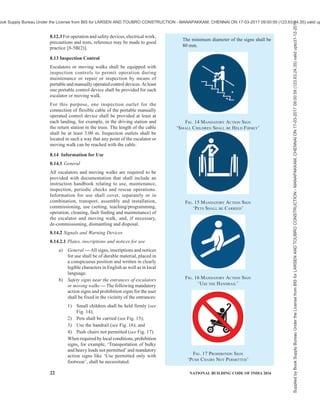
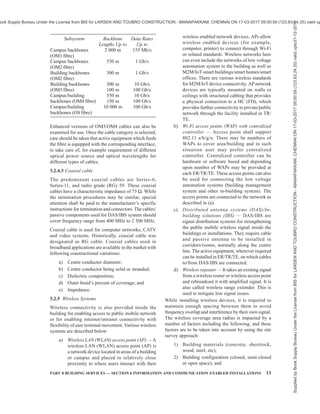
A typical construction project life cycle is given in
Fig. 1.
4.1.4 Construction Project Delivery Models
Project delivery model determines the manner in which
the project is planned, designed, executed and contract
administration carried out. It also determines the
contractual relationships between the owner/client,
design consultants and construction agency. The
delivery model shall define the span of control and role
and responsibilities of each of the above parties. The
main types of project delivery models that are in vogue
in construction projects are: (a) Traditional design-bid-
build, (b) Design-build with variants, (c) Turn-key and
(d) Build, operate and transfer and its variants. Each
Supplied
by
Book
Supply
Bureau
Under
the
License
from
BIS
for
LARSEN
AND
TOUBRO
CONSTRUCTION
-
MANAPAKKAM,
CHENNAI
ON
17-03-2017
09:00:59
(123.63.24.35)
valid
upto31-12-2017
ook Supply Bureau Under the License from BIS for LARSEN AND TOUBRO CONSTRUCTION - MANAPAKKAM, CHENNAI ON 17-03-2017 09:00:59 (123.63.24.35) valid up
PART 7 CONSTURCTION MANAGEMENT, PRACTICES AND SAFETY 9
of the delivery models can adopt different types of
contracts depending upon the suitability of the contract
type in relation to the nature and type of projects,
project objectives and other project specific
considerations.
4.1.5 Construction Methodologies and Techniques
Suitable construction methodologies and techniques,
such as, conventional, prefabrication, systems building
approach, mixed/composite construction, mechanization
in construction and other innovative technologies, shall
be defined considering design principles adopted and
also considering the project objectives in terms offactors,
like, scope, time, cost and quality requirements. Method
statement may be made for all critical items of work.
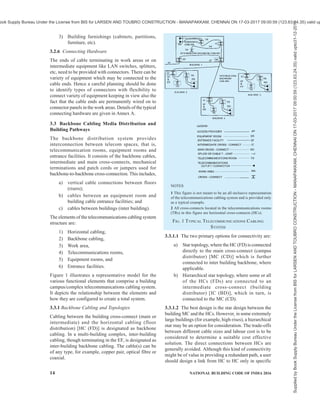
4.1.6 Organizational Structures
Organizational structure depends on the project delivery
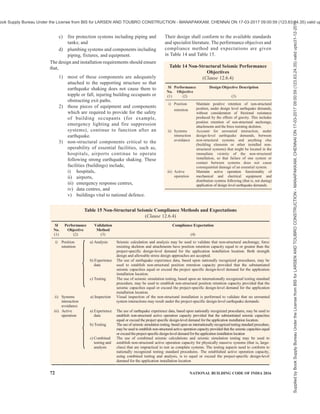
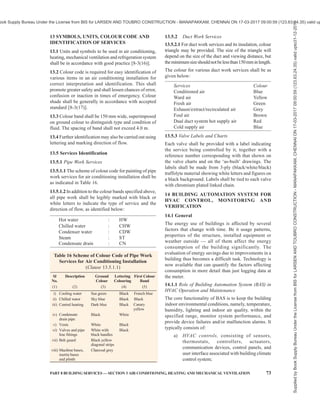
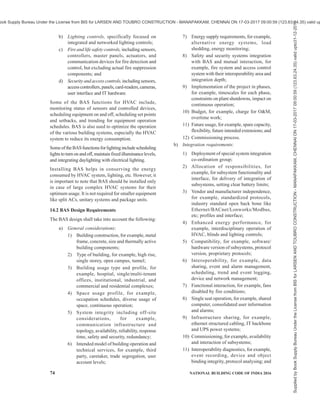
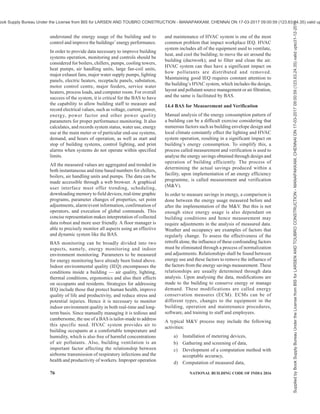
model. As an example, a typical organization chart for
Design-Bid-Build model is given in Fig. 2.
4.1.6.1 Construction project management
organizational teams
For any given project delivery model, an appropriate
organizationalstructureshallbeselectedsoastofacilitate
constitution of teams across various agencies involved.
Such teams are fundamental functional units generally
specific to each of the life cycle stages of a project.
Health, Safety and Environment (HSE) and quality set
up shall directly report to the Project Manager.
4.2 Stages of a Construction Project
4.2.1 Typically a construction project (whether small
or large) may be considered to involve the following
distinct broad stages:
a) Project formulation and appraisal stage:
1) Inception,
2) Feasibility, and
3) Strategic planning.
b) Pre-construction stage:
1) Project development,
2) Planning for construction, and
3) Tender action.
c) Construction stage, and
d) Commissioning and handing over stage.
4.2.2 Project Formulation and Appraisal Stage
For successful management of construction projects,
the earlier stages when the construction project is
conceived, formulated and its feasibility assessed,
leading to decision to implement the project, are equally
important. The guidelines given in the good practice
[7(2)] should be employed during project formulation
and appraisal stage of a construction project.
NOTE — This stage of a construction project is basically the
preliminary stage covering activities up to the stage of
preparation of proposals for obtaining approval for
implementing the project including financial approval and
includes inception, pre-feasibility, feasibility, related project
strategic planning and viability assessment and review prior to
approval of project.
For all other above stages, the relevant construction
management function guidelines given in 4.3 should
be employed for achieving the intended objectives.
4.2.3 Pre-Construction
4.2.3.1 Project development
This shall involve the following:
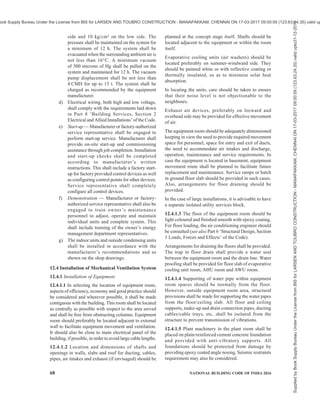
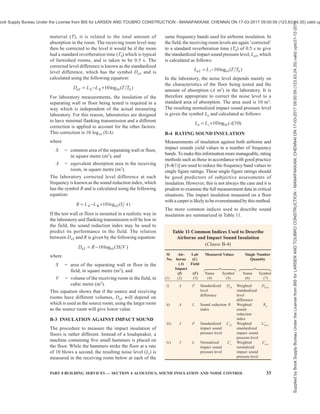
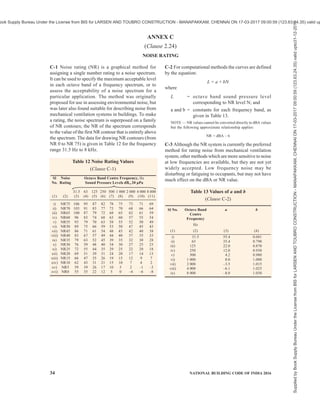
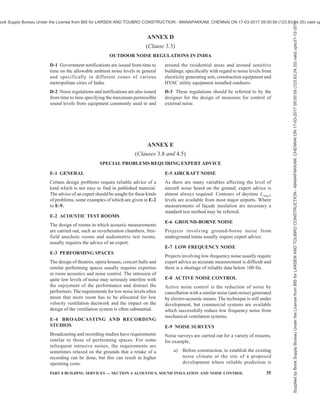
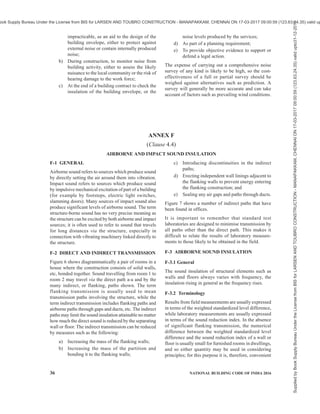
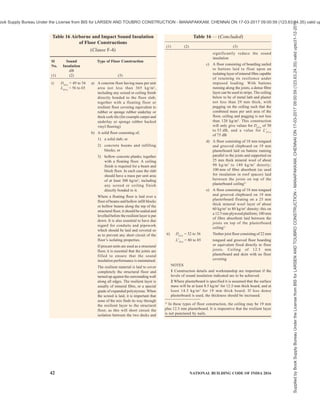
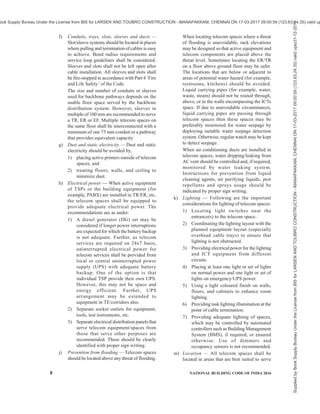
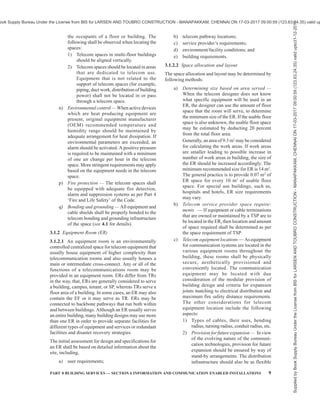
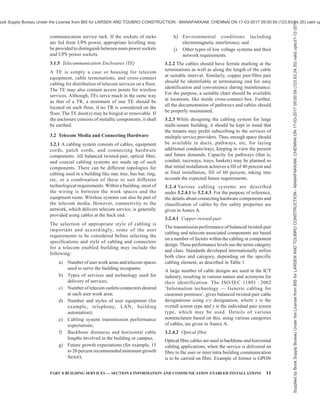
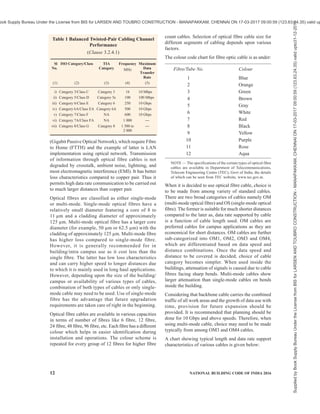
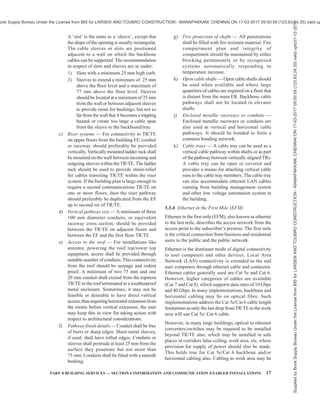
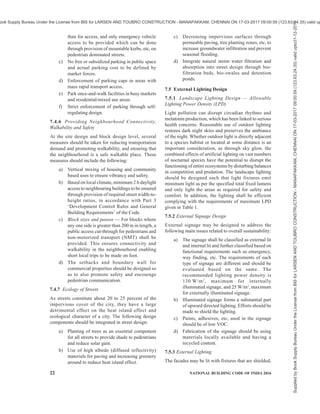
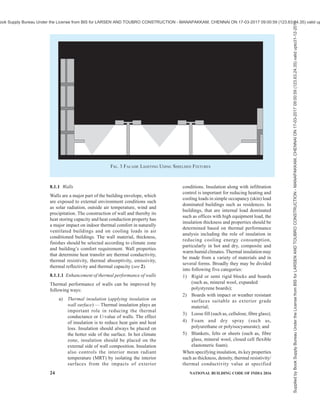
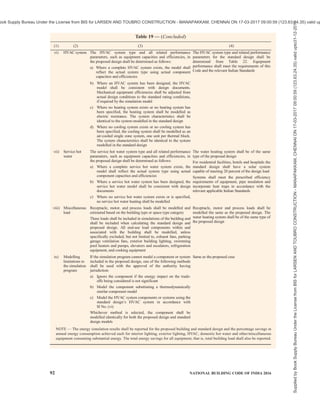
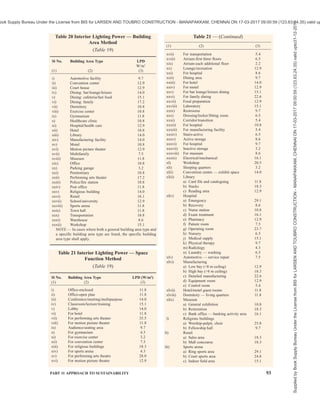
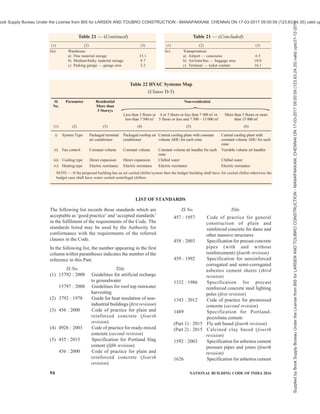
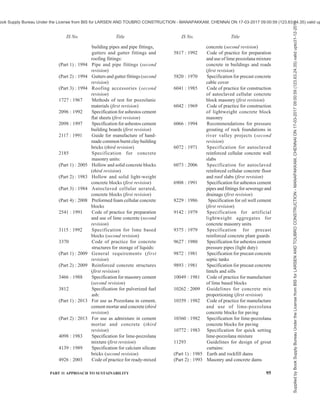
FIG. 1 TYPICAL CONSTRUCTION PROJECT LIFE CYCLE
Supplied
by
Book
Supply
Bureau
Under
the
License
from
BIS
for
LARSEN
AND
TOUBRO
CONSTRUCTION
-
MANAPAKKAM,
CHENNAI
ON
17-03-2017
09:00:59
(123.63.24.35)
valid
upto31-12-2017
ook Supply Bureau Under the License from BIS for LARSEN AND TOUBRO CONSTRUCTION - MANAPAKKAM, CHENNAI ON 17-03-2017 09:00:59 (123.63.24.35) valid up
10 NATIONAL BUILDING CODE OF INDIA 2016
a) Formalization of design brief;
b) Site survey and soil investigation;
c) Hazard risk vulnerability analysis;
d) Alternative concept designs with costing and
finalization;
e) Preliminary designs and drawings;
f) Development of design of each discipline and
their integration;
g) Obtaining statutory approvals;
h) Selection of construction methodology;
j) Preliminary cost estimates;
k) Detailed planning and design of each
discipline;
m) Construction working drawings and related
specifications with integration of engineering
inputs of all concerned disciplines;
n) Detailed cost estimates;
p) Detailed specifications and bills of quantities;
and
q) Tender documents.
Peer review/proof checking of the drawings/designs/
estimates shall be done in case of important projects,
depending upon their complexity and sensitivity.
Environment impact analysis and social impact analysis
shall be done in applicable cases.
4.2.3.2 Planning for construction
The following aspects shall be considered:
a) Sequencing of project components,
b) Planning tools:
1) Work breakdown structures (WBS),
2) Bar charts, and
3) Network techniques and scheduling.
c) Resource planning, and
d) Time cost trade off.
4.2.3.2.1 Sequencing of project components
Methodology of construction shall be detailed before
the start of the project. Sequencing of project
components shall be done on the basis of methodology
adopted and availability of resources. This shall be
reviewed during the progress of the project and revised,
if necessary.
4.2.3.2.2 Planning tools
The planning tools described below may be employed
for effective management of a construction project:
a) Work breakdown structure (WBS) — The
WBS shall identify the total scope of works
involved in the project and shall form the basis
for the development of detailed project
schedule. Through WBS, the project shall be
subdivided into major subdivisions (work
packages) and each major subdivision shall
be further subdivided into additional levels as
required up to the level of activities that could
form the basis for monitoring and control of
project performance in terms of time, cost and
quality parameters. WBS shall provide activity
listing with associated cost account codes for
the preparation of project schedule either by
bar charts or by network diagramming
methods.
b) Bar chart — Bar chart is the simplest form of
NOTE — ‘Consultants’ may cover in-house teams or outside consultants.
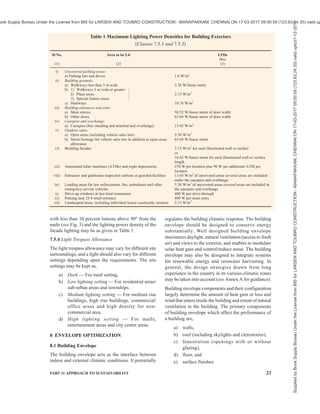
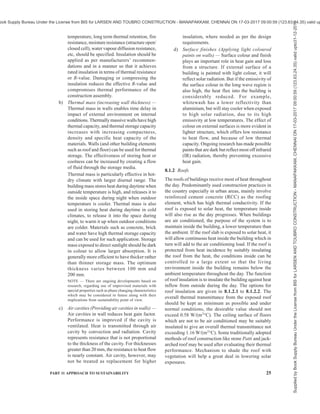
FIG. 2 TYPICAL ORGANIZATION STRUCTURE FOR DESIGN-BID-BUILD MODEL
Supplied
by
Book
Supply
Bureau
Under
the
License
from
BIS
for
LARSEN
AND
TOUBRO
CONSTRUCTION
-
MANAPAKKAM,
CHENNAI
ON
17-03-2017
09:00:59
(123.63.24.35)
valid
upto31-12-2017
ook Supply Bureau Under the License from BIS for LARSEN AND TOUBRO CONSTRUCTION - MANAPAKKAM, CHENNAI ON 17-03-2017 09:00:59 (123.63.24.35) valid up
PART 7 CONSTURCTION MANAGEMENT, PRACTICES AND SAFETY 11
project scheduling and used for small and
complex projects and in preliminary planning
and tender-stages of major projects. A typical
bar chart form of project schedule depicts the
various activities on a calendar time scale in
the form of bars in their relative positions with
start and finish dates and length of bar
indicating probable activity duration. Linked
bars represent the interdependencies between
the activities. Bar chart type of schedule shall
be used to comprehend, summarize and
display the results of complex project network
analysis and further monitoring and
controlling process.
c) Network techniques and scheduling
1) Network diagramming methods —
Network based project schedule shall be
used for major and complex projects. In
this method, the network of project
activities identified through WBS is
developed incorporating their logical
relationships and interdependencies. The
two available approaches for network
diagramming techniques are arrow
diagramming method (ADM) and
precedence diagramming method (PDM).
2) Network analysis and scheduling — The
project network incorporating the activity
durations and logical relationships shall
be analyzed with forward and backward
pass schedule calculations to establish
early and late start and finish time of
activities with their available floats,
critical activities, critical path and overall
project duration. The project schedule is
prepared in terms of calendar dates of
start and finish of activities with available
floats. The network schedule shall also
be presented in the form of linked bar
chart or in tabular format.
For details on network preparation and
analysis, reference shall be made to good
practices [7(3)]. Network schedule shall be
prepared for all disciplines and they shall be
integrated into a master control schedule.
4.2.3.2.3 Resource planning
This shall involve the following:
a) Resource allocation — The feasibility of the
network shall be checked with respect to
manpower, equipment, materials, other
resources required at the site.
b) Resource levelling — It shall be done by re-
allocating the slack resources from non-
critical path to critical path activity in order
to obtain a reduction of time or by shifting
the activities within the floats available with
them, to obtain optimum uniform resource
requirements.
c) Resource schedule — Schedule of following
resource requirements with respect to time
shall be prepared on the basis of network
developed and kept in the database for project
control purposes:
1) Technology,
2) Manpower:
i) Technical staff,
ii) Skilled labour,
iii) Unskilled labour,
3) Machinery,
4) Materials, and
5) Cash flow.
Resource schedule shall be prepared separately for
client, consultant and construction agency.
4.2.3.2.4 Time cost trade off
Time cost trade off analysis shall be done to obtain a
minimum total cost of the project within the specified
time. This shall be done taking into consideration direct
cost and indirect cost of the project.
4.2.3.3 Tender action
4.2.3.3.1 Preparation of tender documents
The bill of quantities, specifications, drawings and
conditions of contract should be prepared on the basis
of design and details finalized in project proposal
development stage (see 4.2.3.1) keeping in view the
construction project delivery model selected. The
format, terminologies and terms and conditions should
be as per the standard engineering practices. In case of
any special item or condition, the same shall be
described clearly to avoid any ambiguity.
4.2.3.3.2 Selection of construction agency
Selection of construction agency shall be done by either:
a) Open competitive bidding — In this case,
tender notice should be publicized adequately
to obtain competitive tenders from competent
agencies for the project; or
NOTE — Electronic tendering could also be considered.
b) Limited competitive bidding — In large,
specialized and important works,
prequalification of contractors shall be done
considering their financial capability, bid
capacity, experience of similar type of works,
past performance, technical staff, and plants
and machinery available.
Supplied
by
Book
Supply
Bureau
Under
the
License
from
BIS
for
LARSEN
AND
TOUBRO
CONSTRUCTION
-
MANAPAKKAM,
CHENNAI
ON
17-03-2017
09:00:59
(123.63.24.35)
valid
upto31-12-2017
ook Supply Bureau Under the License from BIS for LARSEN AND TOUBRO CONSTRUCTION - MANAPAKKAM, CHENNAI ON 17-03-2017 09:00:59 (123.63.24.35) valid up
12 NATIONAL BUILDING CODE OF INDIA 2016
4.2.3.3.3 Bid evaluation, negotiation and award of
work
After due evaluation and negotiation with the bidders,
if required, the work shall be awarded to the
construction agency based on competitive technical and
financial bids.
4.2.4 Construction
This is one of the most important stages of construction
management where pre-construction stage outputs are
realized into physical tangible form within the
constraints of time and cost. The intent or need for
functional and physical characteristics, defined in the
pre-construction stage outputs through specifications,
drawings and consolidated project brief is realized
through various construction project management
functions described in 4.3 and particularly through
procurement management, time management, cost
management, quality management and health, safety
and environment management.
4.2.5 Commissioning and Handing Over
After all construction activities of the project are
complete as per specifications and designs, project
commissioning and handing over stage follows. It shall
need the compliance of the following:
a) Clearing of site,
b) Removal of all defects at the time of
completion and during defect liability period,
c) Preparation of list of inventories,
d) Certification and settlement of construction
agency’s final bills for payment,
e) Obtaining completion certificate from local
government bodies/departments,
f) Preparation of maintenance manual,
g) Performance compliance verification of built
facility,
h) Handing over all other required documents,
including guarantees, to the client/owner,
j) Restoration of surroundings, and
k) Preparation and handing over all as-built
drawings.
4.3 Construction Project Management Functions
Construction project management consists of number
of processes and these can be grouped under the
following management functions:
a) Scope management,
b) Procurement management,
c) Time management,
d) Cost management,
e) Quality management,
f) Risk management,
g) Communication management,
h) Human resources management,
j) Health and safety management,
k) Sustainability management,
m) Integration management, and
n) Other management processes.
The project management functions briefly described
below may be employed for effective management of
construction project during its different stages as
applicable. Some of the processes may, however,
overlap more than one function.
4.3.1 Scope Management
It should be ensured that project concept, details and
functions which are established and recorded during
the finalization stage, remain same except minor
changes and/or authorized variations. Scope
management includes the processes of scope planning,
scope definition, scope verification, scope monitoring,
and change control.
Scope planning, scope definition and scope verification
are associated with the preconstruction phase of the
project. Scope monitoring and change control are
critical to the construction/installation stage in order
to control time and cost over-runs. The work break
down structure of the project shall be the basic tool for
defining the scope baseline. Scope control should aim
to identify factors influencing scope change, determine
the impact of scope changes and establish the system
for scope change approval and revision of scope
baseline. Accordingly, a detailed scope management
plan should be drawn to lay down all the necessary
practices including technical and organizational
interfaces.
For detailed guidelines, reference shall be made to good
practice [7(4)].
4.3.2 Procurement Management
Procurement management includes processes for
purchase of materials, equipment, products, soliciting
services of consultants and engaging agencies for
execution of works under a contract. Project
procurement processes, which depend on type of
project delivery model include identification of
procurement needs, preparation for procurement,
soliciting proposals, selection of suppliers/consultants/
works contractors, administering of contract, contract
management and closure of contract. Project manager
is charged with the responsibility to help structure and
develop contract to suit the specific needs of the project.
As contract, which is an output of project procurement
management processes, is a legal document, the
procurement processes should follow detailed
Supplied
by
Book
Supply
Bureau
Under
the
License
from
BIS
for
LARSEN
AND
TOUBRO
CONSTRUCTION
-
MANAPAKKAM,
CHENNAI
ON
17-03-2017
09:00:59
(123.63.24.35)
valid
upto31-12-2017
ook Supply Bureau Under the License from BIS for LARSEN AND TOUBRO CONSTRUCTION - MANAPAKKAM, CHENNAI ON 17-03-2017 09:00:59 (123.63.24.35) valid up
PART 7 CONSTURCTION MANAGEMENT, PRACTICES AND SAFETY 13
procedures with adequate review and stakeholder
appraisal opportunities.
One of the fundamental issues in construction projects,
managed through project managers, is to determine
what needs may be met by procuring products, services
and works from external agencies and what should be
accomplished by the project team. This decision is best
arrived at the earlier stages of the project (so that the
opportunities of procurement initiation at earlier stages
is not lost) and reviewed at each of the subsequent life
cycle stages of the project. Such decisions should draw
inputs from the time, cost, quality and scope
management processes. Various procurement routes
should be analysed on their suitability to both time and
cost criteria of project. As a strategy for procurement,
a project procurement management plan should be
developed to document: contract types to be used;
procurement documents; coordination of procurement
with schedules; constraints and assumptions; risk
mitigation activities (performance bonds, insurances,
etc); and pre-qualification of suppliers. In addition,
specifications, quality standards, performance data at
work locations, etc, which are part of project scope
statement, should be described. Inventory management
plays an important role in the procurement management
process.
Provision of establishment of suitable dispute redressal
system should be inbuilt to take care of any disputes
that may arise.
For detailed guidelines, reference shall be made to good
practice [7(5)].
4.3.3 Time Management
Time management aims to complete the project within
the stipulated time period. Time management essentially
involves the following processes:
a) Defining project scope in the form of work
breakdown structure to generate activity
identification and listing,
b) Activity duration estimating,
c) Activity sequencing with interactivity
dependencies,
d) Project schedule development, and
e) Project schedule control.
Work breakdown structure should be used as a tool to
prepare the project schedule by defining the project
scope and identifying and listing of the activities in the
work packages. For the quantum of work involved in
the activities, the activity durations are estimated based
on the standard productivity norms for different trades
of work. Past-documented experience and expertise
should also be used for determination of the activity
durations with the construction technology adopted and
manpower and equipment resources used. Based on the
construction methodology proposed with the
consideration of project specific constraints, the
sequencing and interdependencies of the activities are
determined and the graphical representation of activities
in the form of network should be prepared. The network
thus prepared should be analysed to develop the project
schedule with information on early and late start and
finishing of activities with their available floats and
the critical path/critical activities on the network.
Incorporating the calendar dates, the baseline schedule
may be finalized with the incorporation of milestones
for subsequent schedule monitoring and control
processes.
During the construction stage, schedule monitoring
involves methods of tracking and comparing the actual
schedule with the baseline schedule and schedule
control activities should ensure to remove deficiencies
and slippages corrected to acceptable levels.
Project scheduling and monitoring is a dynamic process
and periodic schedule updating should be done for
effective monitoring and control process. In the process,
the status of each activity should be examined. For
completed activities, actual durations utilized, are
incorporated; and for activities in progress, balance to
complete revised durations and estimated finish dates
are determined and incorporated. If the actual schedule
lags behind the baseline schedule, various options
should be considered to control and bring back the
schedule to acceptable levels. The possible control
actions, which may be considered, are: possible
reduction in activity duration of future activities with
alternate technology options, increasing the resources,
alteration in the construction logic and activity
sequencing, etc.
For detailed guidelines, reference shall be made to good
practice [7(6)].
4.3.4 Cost Management
The objective of the project cost management is to
ensure that the project is completed within the
authorized budget. The major processes involved in
the cost management are: resource planning, cost
estimation, cost budgeting/cost planning and cost
monitoring and control. The resource planning involves
determination of various types of resources, such as
appropriate technology, workforce, materials,
equipment and infrastructure facilities, their quantum
and their requirements during different stages of the
project. Preliminary cost estimate with defined scope
of work is required for obtaining the project sanction.
Detailed item wise cost estimates with bill of quantities
and specifications should be made for tendering and
subsequent project execution. The type of contract
Supplied
by
Book
Supply
Bureau
Under
the
License
from
BIS
for
LARSEN
AND
TOUBRO
CONSTRUCTION
-
MANAPAKKAM,
CHENNAI
ON
17-03-2017
09:00:59
(123.63.24.35)
valid
upto31-12-2017
ook Supply Bureau Under the License from BIS for LARSEN AND TOUBRO CONSTRUCTION - MANAPAKKAM, CHENNAI ON 17-03-2017 09:00:59 (123.63.24.35) valid up
14 NATIONAL BUILDING CODE OF INDIA 2016
adopted such as item rate, percentage rate, lump sum
and cost plus, influences the cost management strategy.
Most of the cost optimization techniques through value
engineering studies are achieved during the
preconstruction stage of the project. Value engineering
is a useful technique for application in cost
management. It is a systematic multi-disciplinary effort
directed towards analyzing the functions of project or
item for the purpose of achieving the best value at the
lowest overall life cycle project cost. It is an established
technique for determining value based decisions rather
than cost reduction based on change in specifications.
Suitability of construction techniques, selection of
equipment for specific purposes, considering
alternative materials and other design changes are some
of the areas of application of value engineering.
During construction stage, the efforts are more on
control mode for adherence to the budgeted cost. For
the purpose of cost control during execution, the time
based cost baseline of the project which forms the basis
for the measurement and monitoring of cost
performance, should be generated. The cost baseline
is generated by allocating the overall cost estimate to
individual project activities based on the project
schedule. Using the cost baseline, the cost control,
which comprises the following, should be exercised:
a) Periodical cost reporting,
b) Comparison of the actual cost against the
planned cost,
c) Obtaining early warning for corrective actions,
d) Control and monitoring cost changes,
e) Forecasting of final cost at completion based
on cost trend and cost changes, and
f) Modification of the cost baseline for
authorized cost changes and preparation of
revised estimates.
For detailed guidelines, reference shall be made to good
practice [7(7)].
4.3.5 Quality Management
Quality management in construction aims to achieve
required functional and physical characteristics of a
constructed facility through management actions
including planning, direction and control. Quality is
the key determinant of requirements which is expressed
through drawings and specifications. Main function of
quality management is to achieve quality objective of
satisfying requirements through performance evaluation
of construction processes and ensure that they are
directed towards overall quality. Quality management
during construction stage assumes that the design and
specifications comprehensively incorporate
requirements of users and other stakeholders. Prior to
setting out for the construction, the client should
completely understand the implications of changes to
the design and specifications during the construction
stage, which may affect quality.
Although quality is an all-encompassing concept which
also has bearing on time and cost aspects, the specific
scope of quality management may be limited to its key
functions of quality planning, quality assurance and
quality control. Quality planning refers to the
identification of relevant quality standards and
determining how to satisfy them. Quality assurance
activities include consistent evaluation of project
performance to provide confidence that the project
satisfies the relevant quality standards. Quality control
monitors project results related to the compliance to
quality standards and identifying means to eliminate
non-conformity.
On-site operations constitute most of the construction
processes. Scope of quality management for on-site
operations may be categorized broadly in three distinct
stages. In the receiving stage, materials and supplies
are inspected and tested for conformance to the
specified standards. During ‘in-process stage’, materials
and supplies are processed to form project product
components wherein process control ensures
conformance to the specified standards. In the ‘final
stage’, inspections and tests monitor the functional and
physical performance of the product/service to ensure
that they satisfy the requirements.
Planning being an integral part of the quality
management, may also consider efficient site layout
and its management for on-site operations. In addition
to time and cost implications of the site management,
the quality performance improves by efficient
organization of activities by way of providing adequate
and appropriate conditions for the work processes. Site
management needs to consider construction technology
constraints with reference to aspects related to space
availability such as permanent services, access to site,
temporary services, location of material stores, stacking
and storage areas and plants, fencing and other
temporary structures.
The various organizations connected with the project
should have their own quality management systems.
For detailed guidelines, reference shall be made to good
practice [7(8)].
4.3.6 Risk Management
Project risks have an impact on the project objectives
and need a planned response. Project risk management
processes ensure proper planning, identification,
analysis, monitoring and control to the best interest of
the project.
Supplied
by
Book
Supply
Bureau
Under
the
License
from
BIS
for
LARSEN
AND
TOUBRO
CONSTRUCTION
-
MANAPAKKAM,
CHENNAI
ON
17-03-2017
09:00:59
(123.63.24.35)
valid
upto31-12-2017
ook Supply Bureau Under the License from BIS for LARSEN AND TOUBRO CONSTRUCTION - MANAPAKKAM, CHENNAI ON 17-03-2017 09:00:59 (123.63.24.35) valid up
PART 7 CONSTURCTION MANAGEMENT, PRACTICES AND SAFETY 15
Risk management planning processes develop an
approach to risk management activities which include
planning, execution and monitoring. A risk management
plan should define lead and support role responsibilities
of project team in relation to management, budgeting,
risk responsive scheduling, classification of risk
activities based on risk break-down structure and
explanation of probability and impact for risk context.
Risk response planning determines actions required for
reducing impact of risks. Risk responses are established
and assigned to appropriate project participants.
Suitable risk mitigation measures should be evolved
for identified risks.
For detailed guidelines, reference shall be made to good
practice [7(9)].
4.3.7 Communication Management
For communication management, Management
Information System (MIS) is used as an important tool
for systemized approach to furnish information. It
comprises a system that collects, stores, sorts and
analyses data to generate and communicate information.
It may be a combination of manual and computerized
systems.
At the construction stage of a project, there are many
agencies involved like client, architect, engineer,
project manager, various consultants, material
suppliers, construction agencies and sub-contractors.
Each agency is divided into top level management
taking policy decisions, middle level management
monitoring the project and lower level management
involved in day to day operations of the project.
Each level of management requires information of
varying details, at different periodicities and in different
formats. Project progress information flows from lower
level to the top level management and policy decisions
flow from top level to the lower level management.
MIS integrates the work and information flow within
each agency and flow of information between different
agencies.
In construction stage of the projects, the information
may be in the form of data reflecting status of project
in terms of actual execution time for each activity, cost
incurred, resources used, quality control, material
management, bills, organization management and other
administrative aspects like disputes that may come up.
This data should be analysed to understand the overall
progress achieved and to update schedules of the
project.
Basic objectives of MIS of a construction project may
be summarized as:
a) Providing benchmark against which to
measure or compare progress and costs, like
time network schedules, cost estimates,
material and labour schedules, specifications,
working drawings.
b) Providing an organized and efficient means
of measuring, collecting, verifying and
reflecting the progress and status of operations
on the project with respect to progress, cost,
resources and quality.
c) Providing an organized, accurate and efficient
means of converting the data from operations
into information.
d) Reporting the correct and necessary
information in the required format and at the
required level of detail to managers at all
levels and to the supervisors.
e) Identifying and isolating the most important
and critical information at various stages to
be communicated to the managers and
supervisors for taking decisions.
f) Communicating the information to the
managers and supervisors in time so that
decisions may be taken at the right time.
Total MIS configuration of the construction project may
be divided into the following modules:
1) Planning and scheduling module,
2) Cost control and accounting module,
3) Trend and forecast module,
4) Project administrative and financial module,
and
5) Historical and documentation module.
All modules should be interlinked in flow of
information and generation of reports.
For large public projects, suitable mechanism may be
established for communication of relevant information
to public at large.
For detailed guidelines, reference shall be made to good
practice [7(10)].
4.3.8 Human Resource Management
All construction projects involve large number of
skilled/unskilled persons. Human resources in a project
should be adequately qualified, trained and competent.
Quality of construction work depends on the quality of
labour resource. For skilled and un-skilled labour, the
requirement for technical knowledge, skill and general
awareness are varied for different construction
processes. Labourers are required to understand their
respective responsibilities especially towards the work.
Therefore, construction management practices should
emphasize on development of competence of this
critical human resource through training programmes.
Supplied
by
Book
Supply
Bureau
Under
the
License
from
BIS
for
LARSEN
AND
TOUBRO
CONSTRUCTION
-
MANAPAKKAM,
CHENNAI
ON
17-03-2017
09:00:59
(123.63.24.35)
valid
upto31-12-2017
ook Supply Bureau Under the License from BIS for LARSEN AND TOUBRO CONSTRUCTION - MANAPAKKAM, CHENNAI ON 17-03-2017 09:00:59 (123.63.24.35) valid up
16 NATIONAL BUILDING CODE OF INDIA 2016
The critical activities should be identified from the point
of view of technological innovations, workmanship and
environmental conditions which determine labour
behaviour and performance. In each construction
project, there are certain work related peculiarities
which call for job specific orientation. There should
be a clearly defined competence requirement for the
workers. Progressively, a formal training or a certified
course undertaken should be a preferred selection
criterion for the workers. All efforts should also be made
to impart on site skilling/training of construction
workers for specific tasks. A periodic review of the
performance may be made to establish the nature of
training required and methods for imparting training.
There is a need to address the motivational aspects, for
better performance.
For detailed guidelines, reference shall be made to good
practice [7(11)].
4.3.9 Health and Safety Management
4.3.9.1 Health management issues include looking into
the risk factors to health of construction personnel and
providing hygienic conditions at construction sites and
methods of their management. It includes managing,
a) occupational/physical health hazards.
b) short term as well as long-term ill effects of
the activities and the working environment of
the construction sites.
c) provision of personal protective equipment
required for specific health hazards.
d) laying down of construction hygiene control
methods.
4.3.9.2 Safety management issues include managing
work processes, equipment and material handling at
site for striving to achieve zero accident status at site.
For prevention and management of accidents, a proper
organizational and administrative mechanism is
required. Following steps should be taken for achieving
the same:
a) Laying down of safety regulations or
mandatory prescriptions concerning different
work processes.
b) Standardization of work processes and
management actions.
c) Regular and stipulated inspection of works and
machinery/equipment for enforcement of
mandatory regulations.
d) Providing education and training to workers
on safety issues.
e) Publicity and appeal to develop safety
consciousness.
f) Insurance of built facilities, construction
personnel and third party.
g) Regular safety audit of construction sites and
post audit actions.
h) Effective post-accident action including
accident analysis and reporting.
j) Effective post-accident management including
corrective measures to avoid repetition of such
accidents.
Safety Officer shall be appointed in accordance with
the concerned provisions of the Building and Other
Construction Workers (Regulation of Employment and
Conditions of Service) Act, 1996. Safety officer who is
posted at a medium to major construction site shall:
1) Look after the safety of the personnel, safe
handling of materials and machinery, safe
work practices and standard operating
procedures.
2) Be responsible for compliance of all statutory
obligations of the employer in regard to safety
of personnel and structures.
3) Guide and assist the site managers/engineers
to make their sites safe and accident free.
4) Train personnel in construction safety, conduct
safety surveys and design suitable documents
for recording and promoting safety on sites
and in the construction industry.
5) Arrange for safety briefing for all the persons
entering the construction area.
For detailed guidelines, reference shall be made to good
practice [7(12)].
4.3.10 Sustainability Management
4.3.10.1 Sustainability management issues include the
following:
a) Minimizing adverse environmental impact of
activities, products and services.
b) Limiting any adverse impact within the laws/
prescribed norms and their monitoring.
c) Safety of environment while working with
hazardous materials and maintaining material
safety data sheets.
d) Management of disposal of waste from the
construction sites.
e) Considering positive environmental
contribution particularly after completion of
construction.
f) Mechanism to review concerns of interested
parties.
For detailed guidelines, reference shall be made to good
practice [7(13)].
4.3.11 Integration Management
Integration management aims to provide processes
Supplied
by
Book
Supply
Bureau
Under
the
License
from
BIS
for
LARSEN
AND
TOUBRO
CONSTRUCTION
-
MANAPAKKAM,
CHENNAI
ON
17-03-2017
09:00:59
(123.63.24.35)
valid
upto31-12-2017
ook Supply Bureau Under the License from BIS for LARSEN AND TOUBRO CONSTRUCTION - MANAPAKKAM, CHENNAI ON 17-03-2017 09:00:59 (123.63.24.35) valid up
PART 7 CONSTURCTION MANAGEMENT, PRACTICES AND SAFETY 17
necessary for coordination amongst various
organizations and their teams involved. It ensures that
various organizational teams perform in an integrated
manner, with their actions coordinated to the mutual
interests towards the project. Integrated management
processes provide opportunities for resolving conflicts
and competing interests through appropriate tradeoffs.
Integration is necessary where processes interact,
especially when process responsibilities belong to
different organizational groups. Such process
interactions need organizational interfaces to be defined
and resolved at an overall level.
Integration management may also be required for
specific situations when impact of one management
function is a cause for concern for other management
functions. For example, if there is a time delay in
performing a particular construction process, it may
often have impact on the cost aspects of not only that
process but other processes involving other
organizational groups; the rescheduling may affect
coordination amongst performing groups in the down-
stream processes and activities.
For detailed guidelines, reference shall be made to good
practice [7(14)].
SECTION 2 CONSTRUCTION PLANNING
AND SITE MANAGEMENT
5 PLANNING ASPECTS
Construction planning aspects aim to identify and
develop various stages of project execution on site
which should be consistent with the management
considerations. Planning aspects evolve out of the
objectives of project and requirements of the final
completed constructed facility. These objectives could
relate to the time constraints, cost considerations,
quality standards, safety standards, environmental
considerations and health considerations. Construction
practices would, then have to satisfy these objectives
during construction phase of the project.
Having established objectives of the construction phase,
planning determines processes, resources (including
materials, equipment, human and environmental) and
monitoring system to ensure that the practices are
appropriately aligned. Adequate knowledge about
preconstruction phase evolution of project, especially
related to customer’s requirements, is an essential
prerequisite for construction planning.
5.1 Preconstruction Phase
5.1.1 Besides the design aspects, preconstruction phase
should also address all the issues related to the
implementation of the design at the site through suitable
construction strategy. During the design stage, the site
conditions should be fully understood with anticipated
difficulties and avoid the risk of subsequent delays and
changes after the construction has started.
5.1.2 The selection of construction methods, building
systems and materials, components, manpower and
equipment and techniques are best done in the
preconstruction phase. Such selection is influenced by
the local conditions like terrain, climate, vulnerability
for disasters, etc.
5.1.3 Construction in busy localities of cities needs
special considerations and meticulous planning due to
restricted space, adjoining structures, underground
utilities, traffic restrictions, noise and environmental
pollution and other specific site constraints.
5.1.4 The constructability aspects of the proposed
construction methods needs to be carefully evaluated
at the planning stage to ensure ease of construction
besides optimizing the construction schedule and
achieving quality, reliability and maintainability of the
constructed facilities.
5.1.5 Construction practices in hilly regions needs to
take into considerations the problem of landslides, slope
stability, drainage, etc, besides ensuring no adverse
impact on the fragile environmental conditions.
5.1.6 Durability of constructions in corrosive
atmospheric conditions like coastal regions and
aggressive ground situations with high chlorides and
sulphates should also be taken care of with appropriate
construction practices.
5.1.7 Construction practices in disaster prone areas need
specific planning. The type of construction, use of
materials, construction techniques require special
considerations in such areas.
5.1.8 Adverse weather conditions have strong bearing
on construction phase. Situations wherein constructions
are to be carried out in adverse weather conditions,
such as heavy and continuous rain fall, extreme hot or
cold weather, dust storms, etc, the practices have to
address the relevant aspects. Accordingly, suiting the
site conditions, the design and field operations should
be adapted or redefined based on considerations, such
as the following:
a) Site layout which enables accessibility in
adverse weather.
b) Adequate protected storage for weather
sensitive materials/equipment.
c) Protection to personnel from extreme hot/cold
conditions.
d) Scheduling to allow maximization of outdoor
activities during fair weather conditions.
e) Special design and construction provisions for
Supplied
by
Book
Supply
Bureau
Under
the
License
from
BIS
for
LARSEN
AND
TOUBRO
CONSTRUCTION
-
MANAPAKKAM,
CHENNAI
ON
17-03-2017
09:00:59
(123.63.24.35)
valid
upto31-12-2017
ook Supply Bureau Under the License from BIS for LARSEN AND TOUBRO CONSTRUCTION - MANAPAKKAM, CHENNAI ON 17-03-2017 09:00:59 (123.63.24.35) valid up
18 NATIONAL BUILDING CODE OF INDIA 2016
activities in extreme temperature conditions
like hot or cold weather concreting, stability
of false work in extreme wind conditions
(gusts).
f) Adequate lighting for shorter days in winter/
night work.
g) Design for early enclosure.
5.2 Resource Planning
Resource planning aims to identify requirement,
availability and regulatory/control processes related to
resources. Resource planning is a generic expression
but the actual process of planning is specific to the
resources considered (see also 4.2.3.2.3).
In construction phases, the resources could be
categorized as materials, manufactured products,
equipment for construction, installation and fabrication,
human resources as a part of overall organization,
information resources such as reference standards and
other practice documents, environmental conditions for
work on site, infrastructure facilities and cash flow.
Therefore, the resource planning encompasses
identification, estimation, scheduling and allocation of
resources. Resource planning needs to establish a
control system for controlling consumption monitoring,
corrective action and resource reappropriation in the
event of favourable deviation. Organizational
capability, commitment to the project requirements and
other constraints such as time and cost, need to be
considered as inputs while planning resources.
Techniques of management and planning such as
Programme Evaluation and Review Technique (PERT)
and Critical Path Method (CPM) may be used.
Non-availability of basic building materials (brick,
stone, aggregate, etc) within reasonable lead would
influence the construction practice by alternative
materials. The construction practices also get decided
by the local skills of the manpower for construction
activities. The equipment selection would also be
governed by the site constraints. Source of funding of
the project and its timeliness with reference to
requirement of cash flow should also merit
consideration. Therefore, as, the resource planning is
critical to the project viability itself, the inputs to the
resource planning need to be validated appropriately
and established for such management. Resource
planning should establish a proper system of data
collection so as to facilitate effective resources control
mechanism. Resource planning responsibility has to be
specifically defined in the overall organizational setup.
5.3 Construction Phase
5.3.1 Organizational Structure
The site management should be carried out through
suitable site organization structure with roles and
responsibilities assigned to the construction personnel
for various construction related functions.
5.3.2 Site Management
5.3.2.1 Site layout
The layout of the construction site should be carefully
planned keeping in view the various requirements of
construction activities and the specific constraints in
terms of its size, shape, topography, traffic, and other
restrictions, in public interest. A well planned site layout
would enable safe smooth and efficient construction
operations. The site layout should take into
considerations the following factors:
a) Easy access and exit, with proper parking of
vehicle and equipment during construction
b) Properly located material stores for easy
handling and storage.
c) Adequate stack areas for bulk construction
materials.
d) Optimum location of plants and equipment
(batching plants, etc).
e) Layout of temporary services (water, power,
power suppression unit, hoists, cranes,
elevators, etc).
f) Adequate yard lighting and lighting for night
shifts.
g) Temporary buildings; site office and shelter
for workers (see 14) with use of non-
combustible materials as far as possible
including emergency medical aids.
h) Roads for vehicular movement with effective
drainage plan.
j) Construction safety with emergency access
and evacuations and security measures.
k) Fabrication yards for reinforcement assembly,
concrete precasting and shuttering materials.
m) Fencing, barricades and signages.
5.3.2.2 Access for firefighting equipment vehicles
Access for firefighting equipment shall be provided to
the construction site at the start of construction and
maintained until all construction work is completed.
Free access from the street to fire hydrants/static water
tanks, where available, shall be provided and
maintained at all times. No materials for construction
shall be placed within 3 m of hydrants/static water tanks.
During building operations, free access to permanent,
temporary or portable first-aid firefighting equipment
shall be maintained at all times.
5.3.2.3 Access to the upper floors during construction
In all buildings over two storeys high, at least one
Supplied
by
Book
Supply
Bureau
Under
the
License
from
BIS
for
LARSEN
AND
TOUBRO
CONSTRUCTION
-
MANAPAKKAM,
CHENNAI
ON
17-03-2017
09:00:59
(123.63.24.35)
valid
upto31-12-2017
ook Supply Bureau Under the License from BIS for LARSEN AND TOUBRO CONSTRUCTION - MANAPAKKAM, CHENNAI ON 17-03-2017 09:00:59 (123.63.24.35) valid up
PART 7 CONSTURCTION MANAGEMENT, PRACTICES AND SAFETY 19
stairway shall be provided in usable condition at all
times. This stairway shall be extended upward as each
floor is completed. There shall be a handrail on the
staircase.
5.3.2.4 Electrical installations
Electrical installations, both permanent and temporary,
for construction and demolition sites, including
electrical installations for transportable construction
buildings (site sheds) shall be in accordance with 12 of
Part 8 ‘Building Services, Section 2 Electrical and
Allied Installations’ of the Code.
5.3.3 Construction Strategy and Construction
Sequence
Construction strategy and construction methods are to
be evolved at the planning and design stage specific to
the conditions and constraints of the project site and
implemented by the site management personnel to
ensure ease of construction and smooth flow of
construction activities. Sites of high water table
conditions with aggressive chemical contents of subsoil
needs special design considerations. Buildings with
basement in sites of high water table should be planned
with dewatering scheme with appropriate construction
sequence. Duration of dewatering should continue till
sufficient dead loads are achieved to stabilize the
buoyancy loads with adequate factor of safety. The
construction sequence should be planned taking into
consideration the following aspects:
a) Availability of resources (men, material and
equipment);
b) Construction methods employed including
prefabrication;
c) Planned construction time;
d) Design requirements and load transfer
mechanism;
e) Stability of ground like in hilly terrain;
f) Ensuring slope stability with retaining
structure before the main construction;
g) Installation and movement of heavy
equipment like cranes and piling equipment;
h) Effect of weather; and
j) Minimum time to be spent on working below
ground level.
SECTION 3 CONSTRUCTION PRACTICES
6 CONSTRUCTION CONTROL AND
PRACTICES
6.1 Professional Services and Responsibilities
The responsibility of professionals with regard to
planning, designing and supervision of building
construction work, etc and that of the owner shall be in
accordance with Part 2 ‘Administration’ of the Code.
All applications for permits and issuance of certificates,
etc shall be as given in Part 2 ‘Administration’ of the
Code. Employment of trained workers shall be
encouraged for building construction activity.
6.2 Site Preparation
6.2.1 While preparing the site for construction, bush
and other wood, debris, etc, shall be removed and
promptly disposed of so as to minimise the attendant
hazards.
6.2.2 Temporary buildings for construction offices and
storage shall be so located as to cause the minimum
fire hazards and shall be constructed from non-
combustible materials as far as possible.
6.3 Habitat for Construction Workers at Site
The habitat and other welfare measures for construction
workers shall meet the requirements specified in 14.
6.4 Construction of All Elements
6.4.1 Construction of all elements of a building shall
be in accordance with good practice [7(15)]. It shall
also be ensured that the elements of structure satisfy
the appropriate fire resistance requirements as specified
in Part 4 ‘Fire and Life Safety’ of the Code, and quality
of building materials/components used shall be in
accordance with Part 5 ‘Building Materials’ of the
Code.
6.4.2 Construction of all accessibility features/elements
in a building and its built environment shall be as per
the requirements given in 13 of Part 3 ‘Development
Control Rules and General Building Requirements’ of
the Code.
6.4.3 All mechanical, electrical and plumbing (MEP)
and other services in a building shall be installed in
accordance with approved designs as per Part 8
‘Building Services’ of the Code and Part 9 ‘Plumbing
Services including Solid Waste Management’ of the
Code. Proper sequencing of installation of various
services shall be done for ensuring smooth construction
activities.
6.4.4 Necessary temporary works required to enable
permanent works, shall be executed in accordance
with 7.
6.5 Low Income Housing
For low income housing, appropriate planning and
selection of building materials and techniques of
construction have to be judiciously done and applied
in practice. Requirements of low income housing
specified in Part 3 ‘Development Control Rules and
Supplied
by
Book
Supply
Bureau
Under
the
License
from
BIS
for
LARSEN
AND
TOUBRO
CONSTRUCTION
-
MANAPAKKAM,
CHENNAI
ON
17-03-2017
09:00:59
(123.63.24.35)
valid
upto31-12-2017
ook Supply Bureau Under the License from BIS for LARSEN AND TOUBRO CONSTRUCTION - MANAPAKKAM, CHENNAI ON 17-03-2017 09:00:59 (123.63.24.35) valid up
20 NATIONAL BUILDING CODE OF INDIA 2016
General Building Requirements’ of the Code shall be
followed. However, all requirements regarding
structural safety, health safety and fire safety shall be
in accordance with this Part.
6.6 Use of New/Alternative Construction Techniques
The provisions of this Part are not intended to prevent
use of any construction techniques including any
alternative materials, not specifically prescribed by the
Code, provided any such alternative has been approved.
The Authority may approve any such alternative, such
as, ferrocement construction; stretcher bond in filler
slab; glass fibre reinforced gypsum (GFRG) panel
system using composite of GFRG panel and reinforced
concrete; pre-engineered steel structures with
reinforced concrete expanded polystyrene core based
panel/other in-fill walls; light gauge steel framed
structures with suitable water resistant wall panels like
cement bonded particle board, provided it is found that
the proposed alternative is satisfactory and conforms
to the provisions of relevant parts regarding material,
design and construction and that material, method, or
work offered is, for the purpose intended, at least
equivalent to that prescribed in the Code in quality,
strength, compatibility, effectiveness, fire and water
resistance, durability and safety.
6.7 Urban Roads/City Roads Planning and
Construction
6.7.1 The urban roads, which are commonly known as
city roads/streets have been under constant
development. The emphasis has been primarily on
providing essentially required width of metalled surface
for the movement of vehicles (both motorized and non-
motorized). Footpaths of various widths and heights
are required to be provided.
The space between the buildings and the city roads
should be treated as valuable and important space
allowing for a comfortable and safe use by the
pedestrians, hawkers, cyclists including non-motorized
vehicle (NMV) drivers, and adequate space for
drainage, utilities, street lighting poles, transformers
and trees. Thus, the objective should be to create urban
streets/roads that are efficiently planned, safe for
vehicles as well as pedestrians, universally user friendly,
and sustainable.
The elements required in an efficiently planned street,
such as, kerb stones; kerb channels; kerb ramps; tactile
ground surface indicators; silt chambers with manhole
cover; drain cover slabs; drain manhole covers; service
pipes; manhole covers for electrical services; manhole
covers for telecom services; cycle tracks (NMV);
bollards across pedestrian paths; tree gratings; lighting
poles on main roads and service roads; table tops on
free left turns; pedestrian paths at intersections/
T-junctions; pedestrian paths on traffic islands;
pedestrian paths across central verge; pedestrian paths
near rotaries (un-signaled); pedestrian paths below
flyovers; signages; traffic signals; cable ducting by
discoms; central verge irrigation system; central verge,
footpath and traffic islands plantation; street furniture;
bus queue shelters; public art, public toilets, etc. should
be identified. These elements should be integrated at
the planning stage, indicating the methodology of
execution, taking care of the following while complying
with the relevant rules/regulations:
a) Road cross-section planning based on land-
use with emphasis on smooth vehicular
movements.
NOTE — This may be achieved by rationalizing lane widths
based on norms laid down by Indian Roads Congress.
b) Design of road intersections, fixing of
geometrics of roads, providing provision of
entry and exits from the service roads.
c) Coordination between the traffic police,
transport authorities and the executing
agencies to be ensured for efficient location
of traffic signals, zebra crossings and the bus
queue shelters and the pickup stands for the
para-transport.
d) Standardization of kerb stones, kerb ramps and
kerb channels.
e) Appropriate selection of materials, like, paver
blocks, tiles, stone slabs or plain cement
concrete for footpaths, plazas, etc, so that they
add to aesthetics of buildings and roads.
f) Standardization of access manhole covers for
various utilities.
g) Providing footpath at one level by adjusting
the drain cover slab levels.
h) Integration of bus queue shelters with the
footpath.
j) Pedestrian friendly access across the roads to
the foot-over bridges, subways and public
toilets.
k) Access to gates of residential/commercial
properties integrated with the road through the
footpath in front.
m) Sharing of NMV with footpath necessary at
many locations.
n) Adequate provision of public conveniences
and dust bins.
p) Street lighting for proper illumination of roads
and service roads including modifications of
street lighting along with central verge and the
service roads blocked by existing trees.
q) Low height plantation on central verges,
avoiding plantation of trees.
Supplied
by
Book
Supply
Bureau
Under
the
License
from
BIS
for
LARSEN
AND
TOUBRO
CONSTRUCTION
-
MANAPAKKAM,
CHENNAI
ON
17-03-2017
09:00:59
(123.63.24.35)
valid
upto31-12-2017
ook Supply Bureau Under the License from BIS for LARSEN AND TOUBRO CONSTRUCTION - MANAPAKKAM, CHENNAI ON 17-03-2017 09:00:59 (123.63.24.35) valid up
PART 7 CONSTURCTION MANAGEMENT, PRACTICES AND SAFETY 21
r) Removal of crooked trees on footpaths for
proper and safe utilization of footpath.
s) Removal of trees obstructing the carriage ways
and their replantation, wherever feasible.
t) Freeing of trees embedded in the compound
wall/dwarf walls on footpaths to save both the
trees and the walls.
u) Providing planters in the central verge in the
deck portion of flyover to ensure proper glare
cutting during night hours and improving
aesthetics during the day.
w) Proper location of signage boards so as to be
safe from moving traffic near the footpath
edges and give clear visibility.
y) Selection, procurement and installation of
street furniture.
z) Selection, procurement and installation in
respect of accessibility features as per the
requirements given in 13 of Part 3
‘Development Control Rules and General
Building Requirements’ of the Code.
NOTE — The relevant standards/publications of Indian Roads
Congress may be referred to.
6.7.2 The road work zones are areas of conflict between
normal operating traffic, construction workers, road
building machineries and construction traffic. If it is a
construction of new road, normal operating traffic will
not be there but the care has to be taken to avoid and or
remove conflicts between workers and construction
machineries and construction traffic. Problem becomes
more serious if it is an urban road with significant
proportion of vulnerable road users. The road work
zones and the traffic around them should be so planned
and managed so as to ensure traffic safety, facilitate
smooth and efficient flow of traffic and also provide
safe working environment for the workers.
NOTE — For guidance on management of pedestrians/cyclists/
vehicles near road construction sites, reference may be made
to IRC SP 55 : 2014 ‘Guidelines on traffic management in work
zones’.
6.8 Measures against pollution and hazard due to dust,
smoke and debris, such as screens and barricading shall
be installed at the site during construction. Plastic/
tarpaulin sheet covers shall be used for trucks
transporting fine materials liable to cause environmental
pollution.
7 TEMPORARY WORKS
7.1 The construction of most types of permanent works
requires the use of some form of temporary works.
Temporary works are the parts of a construction project
that are needed to enable the permanent works to be
built.  Usually the temporary works are removed after
use, for example, access, scaffolds, props, shoring,
excavation support, false work and formwork,
etc. Sometimes the temporary works are incorporated
into the permanent works, for example, haul road
foundations and crane or piling platforms which may
be used for hard standing or road foundations. The same
degree of care and attention should be given to the
design and construction of temporary works as to the
design and construction of the permanent works. 
Considering that as temporary works may be in place
for only a short while, there is a tendency to assume
they are less important, which is incorrect. Lack of care
in design, selection, assembly, etc, leaves temporary
works liable to fail or collapse. While organizing the
temporary works, aspects as given below should be
followed:
a) The person organizing the temporary works
should be aware of the problems that can occur
at each stage of the process and how to prevent
these.  They need to coordinate design,
selection of equipment, appointment of
contractors, supervision of work, checking
completion, authorization to load and
removal. 
b) If so required, a temporary works co-ordinator
(TWC) may be employed in case of medium
and large projects, whose requisite
qualification and experience should be
specified. The role of TWC and supervisor
should be decided. The coordinator shall have
adequate field training for temporary works.
The contractor shall ensure that work is
allocated and carried out in a manner that does
not create unacceptable risk of harm to
workers or members of the public.  On
projects with relatively simple temporary
works needs, a TWC may be avoided,
however, it shall be ensured that temporary
works are properly managed.
c) The cost of any temporary works is generally
included in the build-up of the tender.
d) Temporary works are often taken from site to
site and re-used and it is important to consider
the robustness of components in their design.
However, temporary works that are designed
only to be used during construction shall not
be removed until the satisfactory safety criteria
for their use has been met.
e) Proper planning and co-ordination should be
done in respect of sequence and timely
execution of temporary works, as also for
ensuring that they are correctly installed, used,
checked and maintained. 
f) In each of the cases of temporary works, the
person organizing the temporary works should
assess the soil conditions to be sure that it is
Supplied
by
Book
Supply
Bureau
Under
the
License
from
BIS
for
LARSEN
AND
TOUBRO
CONSTRUCTION
-
MANAPAKKAM,
CHENNAI
ON
17-03-2017
09:00:59
(123.63.24.35)
valid
upto31-12-2017
ook Supply Bureau Under the License from BIS for LARSEN AND TOUBRO CONSTRUCTION - MANAPAKKAM, CHENNAI ON 17-03-2017 09:00:59 (123.63.24.35) valid up
22 NATIONAL BUILDING CODE OF INDIA 2016
suitable for the equipment involved, and check
that any assumptions made in the calculations
for the standard solution are valid for this
particular situation and the conditions on site. 
On a simple job, the supplier’s data will allow
an experienced person to consider the
necessary issues without further calculation. 
g) Propping using standard equipment such as
screw props (acrows) needs careful
consideration.  To select the type, size, number
and decide spacing, information is needed
about the loads that will act on the props.  This
will include the wall above and the additional
load from any other floor or roof beams, etc,
that enter the wall above or close to the
opening.  Even with proprietary equipment,
the support system shall be worked out.
h) A local failure within the temporary
works should not initiate a global collapse of
the structure. Therefore, additional care should
be taken while removing temporary works.
The different types of temporary works can be
scaffolding, crane supports, falsework, formwork, and
trench support. Detailed knowledge about each type of
temporary work is necessary for safe construction. The
requirements as given in 7.2 to 7.6 shall be satisfied in
case of temporary works.
Proprietary equipment supplier should be identified and
approved. It should be ascertained, whether following
has been performed:
1) They have designed the foundations,
2) Any assumption made that have to be
confirmed/investigated,
3) Independent checking done and by whom,
4) Status of drawings, and
5) Procedures checked at site.
In management of temporary works, the owner/client
has to ensure,
i) checks on competence on designers;
ii) steps taken to ensure co-operation between the
permanent and temporary works designers;
iii) coordination at site meetings; and
iv) advise clients on the suitability of the initial
construction phase plan, that is, the
arrangements for controlling significant site
risks.
7.2 Scaffolding
Scaffolding includes providing a temporary safe
working platform for erection, maintenance,
construction, repair, access, and inspection. Scaffolding
and their erection shall be in accordance with the good
practice [7(16)].
7.3 Tower Cranes
Tower cranes are usually supplied on a hire basis, with
the client being responsible for the design and
construction of the base upon which the crane is erected.
Details of loading are provided by the crane supplier
and the base is most commonly designed as a temporary
structure, though sometimes a crane base is
incorporated into the permanent structure to save on
cost and time.
Loads are given in two forms, ‘in service’ loads, where
the crane is functioning and wind speeds are restricted
(that is, cranes will not operate at high wind speeds),
and ‘out of service’ loads, where the crane is not being
used but maximum wind speeds may occur.
The location for a crane should be carefully selected
to provide a maximum working radius, and when two
cranes are being used on the same site, mast heights
and jib lengths shall be considered.
Cranes should typically be structured around two rails
at their base between 4.5 m and 10 m apart with wheels
in each corner. Cranes should not normally be tied
down, so sufficient kentledge should be provided so as
to ensure that vertical loading from the crane passes
through the rails and into the foundation.
The foundation shall be so designed that the unfactored
loading from the crane and the unfactored pressure is
less than the allowable bearing pressure of the soil.
Various foundation types can be selected depending on
the ground conditions. Where possible a structural fill
can be compacted and used to support a crane with the
load spreading through layers of track support at 45°
in to the soil strata below. When loads from the crane
increase, reinforced concrete foundations may be
required. This can involve a series of reinforced
concrete beams used to support line loads as a result of
the crane loading.
When ground conditions are particularly poor,
pile foundations may be necessary. The design shall
ensure that reinforcement at the top of the pile top
should not cause problems for positioning the mast base
section of the crane.
Tower cranes shall embody all fundamental principles
of design in accordance with the good practice [7(17)]
so as to secure reliability and safety in operation. The
particular requirements for controls for tower cranes
and the arrangement of basic control used for
positioning loads shall be in accordance with the good
practice [7(18)].
7.4 Falsework
Falsework involves a temporary structure used to
Supplied
by
Book
Supply
Bureau
Under
the
License
from
BIS
for
LARSEN
AND
TOUBRO
CONSTRUCTION
-
MANAPAKKAM,
CHENNAI
ON
17-03-2017
09:00:59
(123.63.24.35)
valid
upto31-12-2017
ook Supply Bureau Under the License from BIS for LARSEN AND TOUBRO CONSTRUCTION - MANAPAKKAM, CHENNAI ON 17-03-2017 09:00:59 (123.63.24.35) valid up
PART 7 CONSTURCTION MANAGEMENT, PRACTICES AND SAFETY 23
support other permanent structures until they can
support themselves. Falsework shall be designed and
erected in accordance with the good practice [7(19)].
7.5 Formwork
Formwork is the term used for a temporary mould into
which concrete is poured and formed. Traditional
formwork is fabricated using timber, but it can also be
constructed from steel, glass fiber reinforced plastics
and other materials.
Timber formwork is normally constructed on site
using timber and plywood. It is easy to produce,
although it can be time consuming for larger structures.
Re-usable plastic formwork is generally used for quick
pours of concrete. The formwork is assembled either
from interlocking panels or from a modular system and
is used for relatively simple concrete structures. It is
not as versatile as timber formwork due to the
prefabrication requirements and is best suited for low-
cost, repetitive structures such as mass housing
schemes.
Stay-in-place structural formwork is generally
assembled on site using prefabricated fibre-reinforced
plastic. It is used for concrete columns and piers and
stays in place, acting as permanent axial and shear
reinforcement for the structural member. It also
provides resistance to environmental damage to both
the concrete and reinforcing bars. Proprietary systems
are used to support vertical formwork while concrete
cures, consisting of series of tubes and ties.
When selecting formwork the type of concrete and
temperature of the pour are important considerations
as they both effect the pressure exerted on the
formwork. Striking of formwork shall be governed by
Part 6 ‘Structural Design, Section 5 Concrete:
Subsection 5A Plain and Reinforced Concrete’ of the
Code.
High quality workmanship and inspection are
necessary to ensure a high standard of work including
finish.
7.6 Trench Support
A trench is defined as an excavation when its length
greatly exceeds its depth. Shallow trenches are usually
considered to be less than 6 m deep and deep trenches
have depth greater than 6 m. Depending on the
dimensions of a trench, excavation can either be carried
out by hand or by using a mechanical digger. Trenches
are commonly required to allow services, pipelines
or foundations to be laid.
Water ingress into the trench is often a major issue and
ground water table locations and soil strata should be
investigated before any extensive excavation takes
place. Over short periods of time, for relatively shallow
depths most soil types will stand almost vertically
without any problems. However, trenches other than
those which are relatively shallow may require a trench
support scheme. Traditionally, trenching involved
using timber to support horizontal and vertical soil
loads and this technique is still used today. Timber
trenching is generally used for low risk, narrow
trenches, shafts or headings. The timber solutions
require good workmanship and are reasonably labour-
intensive; however, they are versatile and the
equipment required is easy to handle and transport.
Trench boxes are suitable for low-risk situations in
stable, dry ground and can be placed in pre-excavated
trenches or installed using the ‘dig and push’ technique.
The system requires at least two struts at each panel
for stability which should be considered when access
is required for construction work or piping.
Trench sheets are the most adaptable of the systems
available, and are most commonly used to retain poorer
soil. They can support deeper trenches with larger
surcharges and provide a continuous support. They
require multiple levels of strut support and the
slenderness of the sheets can often limit the depth of
the trench as they are installed by light machinery and
could buckle under large vertical loads.
While making deep excavation near an existing
structure, it is necessary that the lateral force caused
by the existing structure should be taken care of.
Trench supports shall be provided in accordance with
the good practice [7(20)].
8 STORAGE, STACKING AND HANDLING
PRACTICES
8.1 General
8.1.1 Planning and Storage Layout
8.1.1.1 For any site, there should be proper planning
of the layout for stacking and storage of different
materials, components and equipment with proper
access and proper manoeuvrability of the vehicles
carrying the material. While planning the layout, the
requirements of various materials, components and
equipment at different stages of construction shall be
considered.
8.1.1.2 Materials shall be segregated as to kind, size
and length and placed in neat, orderly piles that are
safe against falling. If piles are high they shall be
stepped back at suitable intervals in height. Piles of
materials shall be arranged so as to allow a passageway
of not less than 1 m width in between the piles or stacks
for inspection or removal. All passageways shall be
kept clear of dry vegetation.
Supplied
by
Book
Supply
Bureau
Under
the
License
from
BIS
for
LARSEN
AND
TOUBRO
CONSTRUCTION
-
MANAPAKKAM,
CHENNAI
ON
17-03-2017
09:00:59
(123.63.24.35)
valid
upto31-12-2017
ook Supply Bureau Under the License from BIS for LARSEN AND TOUBRO CONSTRUCTION - MANAPAKKAM, CHENNAI ON 17-03-2017 09:00:59 (123.63.24.35) valid up
24 NATIONAL BUILDING CODE OF INDIA 2016
8.1.1.3 Materials shall be stored, stacked and handled
in such a manner as to prevent deterioration or intrusion
of foreign matter and to ensure the preservation of their
quality and fitness for the work.
8.1.1.4 Materials shall be stacked on well drained, firm
and unyielding surface. Materials shall not be stacked
so as to impose any undue stresses on walls or other
structures.
8.1.1.5 Materials shall be stacked in such a manner as
not to constitute a hazard to passerby. At such places
the stacks shall have suitable warning signs in day time
and red lights on and around them at night.
8.1.1.6 Stairways, passageways and gangways shall not
become obstructed by storage of building materials,
tools or accumulated rubbish.
8.1.2 Protection Against Atmospheric Agencies
Materials stored at site, depending upon the individual
characteristics, shall be protected from atmospheric
actions, such as rain, sun, winds and moisture, to avoid
deterioration.
8.1.3 Protection Against Fire and Other Hazards
8.1.3.1 Materials, like timber, bamboo, coal, paints,
etc, shall be stored in such a way that there may not be
any possibility of fire hazards. Inflammable materials
like kerosene and petrol, shall be stored in accordance
with the relevant rules and regulations so as to ensure
the desired safety during storage. Stacks shall not be
piled so high as to make them unstable under fire
fighting conditions and in general they shall not be more
than 4.5 m in height. The provisions given in good
practice [7(21)] shall be followed. Explosives like
detonators shall be stored in accordance with the
existing regulations of The Explosives Act, 1884.
8.1.3.2 Materials which are likely to be affected by
subsidence of soil like precast beams, slabs and timber
of sizes shall be stored by adopting suitable measures
to ensure unyielding supports.
8.1.3.3 Materials liable to be affected by floods, tides,
etc, shall be suitably stored to prevent their being
washed away or damaged due to floods, tides, etc.
8.1.4 Manual Handling
When heavy materials have to be handled manually
each workman shall be instructed by his foreman or
supervisor for the proper method of handling such
materials. Each workman shall be provided with
suitable equipment for his personal safety as necessary.
All workers shall wear adequate clothing to protect
themselves from direct sun-rays and other irritants.
Supervisors shall also take care to assign enough men
to each such job depending on the weight and the
distance involved.
8.2 Storage, Stacking and Handling of Materials
8.2.1 The storage, stacking and handling of materials
generally used in construction shall be as given in 8.2.2
to 8.2.31, which have been summarized in the form of
a check list in Annex A. Exposure to asbestos fibres/
dust is known to be harmful to health of human beings.
Prescribed guidelines in accordance with good practice
[7(22)] shall be followed for handling and usage of
asbestos cement products.
8.2.2 Cement
a) Storage and stacking — Cement shall be stored at
the work site in a building or a shed which is dry, leak-
proof and as moisture-proof as possible. The building
or shed for storage should have minimum number of
windows and close fitting doors and these should be
kept closed as far as possible.
Cement received in bags shall be kept in such a way
that the bags are kept free from the possibility of any
dampness or moisture coming in contact with them.
Cement bags shall be stacked off the floor on wooden
planks in such a way as to keep them about 150 mm to
200 mm clear above the floor. The floor may comprise
lean cement concrete or two layers of dry bricks laid
on a well consolidated earth. A space of 600 mm
minimum shall be left around between the exterior walls
and the stacks (see Fig. 3). In the stacks the cement
bags shall be kept close together to reduce circulation
of air as much as possible. Owing to pressure on bottom
layer of bags sometimes ‘warehouse pack’ is developed
in these bags. This can be removed easily by rolling
the bags when cement is taken out for use. Lumped
bags, if any should be removed and disposed of.
The height of stack shall not be more than 10 bags to
prevent the possibility of lumping up under pressure.
The width of the stack shall be not more than four bags
length or 3 m. In stacks more than 8 bags high, the
cement bags shall be arranged alternately length-wise
and cross-wise so as to tie the stacks together and
minimise the danger of toppling over. Cement bags shall
be stacked in a manner to facilitate their removal and
use in the order in which they are received; a table
showing date of receipt of cement shall be put on each
stack to know the age of cement.
For extra safety during monsoon, or when it is expected
to store for an unusually long period, the stack shall be
completely enclosed by a water proofing membrane
such as polyethylene, which shall close on the top of
the stack. Care shall be taken to see that the
waterproofing membrane is not damaged any time
during the use.
Cement in gunny bags, paper bags and polyethylene
bags shall be stored separately.
Supplied
by
Book
Supply
Bureau
Under
the
License
from
BIS
for
LARSEN
AND
TOUBRO
CONSTRUCTION
-
MANAPAKKAM,
CHENNAI
ON
17-03-2017
09:00:59
(123.63.24.35)
valid
upto31-12-2017
ook Supply Bureau Under the License from BIS for LARSEN AND TOUBRO CONSTRUCTION - MANAPAKKAM, CHENNAI ON 17-03-2017 09:00:59 (123.63.24.35) valid up
PART 7 CONSTURCTION MANAGEMENT, PRACTICES AND SAFETY 25
In case cement is received in drums, these shall be
stored on plane level ground, as far as possible near
the concrete mixing place. After taking out the required
quantity of cement, the lid of the drum shall be securely
tied to prevent ingress of moisture.
In case cement is received in silos, the silos shall be
placed near the concrete batching plant. Proper access
shall be provided for the replacement of silos.
Different types of cements shall be stacked and stored
separately.
b) Handling — Hooks shall not be used for handling
cement bags unless specifically permitted by the
engineer-in-charge. Bags shall be removed uniformly
from the top of the piles to avoid tipping of the stack.
For information regarding bulk handling of cement
(see 8.2.4).
8.2.3 Lime
8.2.3.1 Quicklime before slaking
a) Storage and stacking — Quicklime should be
slaked as soon as possible. If unavoidable it
may be stored in compact heaps having only
the minimum of exposed area. The heaps shall
FIG. 3 TYPICAL ARRANGEMENT IN CEMENT GODOWN
Supplied
by
Book
Supply
Bureau
Under
the
License
from
BIS
for
LARSEN
AND
TOUBRO
CONSTRUCTION
-
MANAPAKKAM,
CHENNAI
ON
17-03-2017
09:00:59
(123.63.24.35)
valid
upto31-12-2017
ook Supply Bureau Under the License from BIS for LARSEN AND TOUBRO CONSTRUCTION - MANAPAKKAM, CHENNAI ON 17-03-2017 09:00:59 (123.63.24.35) valid up
26 NATIONAL BUILDING CODE OF INDIA 2016
be stored on a suitable platform and covered
to avoid direct contact with rain or being
blown away by wind. In case quick lime is
stored in a covered shed, a minimum space of
300 mm should be provided all-round the
heaps to avoid bulging of walls.
Unslaked lime shall be stored in a place
inaccessible to water and because of fire
hazards, shall be segregated from the
combustible materials.
b) Handling — See 8.2.4.
8.2.3.2 Hydrated lime
a) Storage and stacking — Hydrated lime is
generally supplied in containers, such as jute
bags lined with polyethylene or craft paper
bags. It should be stored in a building to
protect the lime from dampness and to
minimise warehouse deterioration.
The building should be with a concrete floor
and having least ventilation to eliminate
draughts through the walls and roof. In
general, the recommendations given in 8.2.2
for storing of cement shall be applicable for
hydrated lime. When air movement is reduced
to a practical minimum, hydrated lime can be
stored for up to three months without
appreciable change.
b) Handling — See 8.2.4.
8.2.3.3 Dry slaked lime
a) Storage and stacking — The lime shall be
stored in a dry and closed godown.
b) Handling — See 8.2.4.
8.2.4 Handling of Cement and Lime
Workers, handling bulk cement or lime shall wear
protective clothing, respirators, and goggles; shall be
instructed in the need of cleanliness to prevent
dermatitis, and shall be provided with hand cream,
petroleum jelly, or similar preparation for protection
of exposed skin. Workers handling cement, who are
continually exposed to it, shall, in addition to the above
be equipped with hand gloves and dust mask.
Bulk cement stored in silos or bins may fail to feed to
the ejection system. When necessary to enter a silo or
bin for any purpose, the ejection system employed shall
be shut down and locked out electrically as well as
mechanically. When necessary for a workman to enter
such storage area, he shall wear a life-line, with another
workman outside the silo or hopper attending the rope.
8.2.5 Masonry Units
a) Stones — Stones of different sizes, types and
classification shall be stored separately. Stones
shall be stacked on dry firm ground in a regular
heap not more than 1 m in height. Veneering
stones shall be stacked against vertical support
on a firm dry ground in tiers, upto a height of
1.2 m. A distance of about 0.8 m shall be kept
between two adjacent stacks.
b) Bricks — Bricks shall be stacked in regular
tiers as and when they are unloaded to
minimise breakage and defacement. These
shall not be dumped at site. In the case of
bricks made from clays containing lime
Kankar, the bricks in stack should be
thoroughly soaked in water (docked) to
prevent lime bursting.
Bricks shall be stacked on dry firm ground.
For proper inspection of quality and ease in
counting, the stacks shall be 50 bricks long,
10 bricks high and not more than 4 bricks in
width, the bricks being placed on edge, two at
a time along the width of the stack. Clear
distance between adjacent stacks shall not be
less than 0.8 m. Bricks of each truck load shall
be put in one stack. Bricks of different types,
such as, clay bricks, clay fly ash bricks, fly
ash lime bricks, sand lime (calcium silicate)
bricks shall be stacked separately. Bricks of
different classifications from strength
consideration and size consideration (such as,
conventional and modular) shall be stacked
separately. Also bricks of different types, such
as, solid, hollow and perforated shall be
stacked separately.
c) Blocks — Blocks are available as hollow and
solid concrete blocks, hollow and solid light
weight concrete blocks, autoclaved aerated
concrete blocks, concrete stone masonry
blocks and soil based blocks. Blocks shall be
unloaded one at a time and stacked in regular
tiers to minimise breakage and defacement.
These shall not be dumped at site. The height
of the stack shall not be more than 1.2 m, the
length of the stack shall not be more than
3.0 m, as far as possible and the width shall
be of two or three blocks. Normally blocks
cured for 28 days only should be received at
site. In case blocks cured for less than 28 days
are received, these shall be stacked separately.
All blocks should be water cured for 10 to 14
days and air cured for another 15 days; thus
no blocks with less than 28 days curing shall
be used in building construction. Blocks shall
be placed close to the site of work so that least
effort is required for their transportation. The
date of manufacture of the blocks shall be
suitably marked on the stacks of blocks
Supplied
by
Book
Supply
Bureau
Under
the
License
from
BIS
for
LARSEN
AND
TOUBRO
CONSTRUCTION
-
MANAPAKKAM,
CHENNAI
ON
17-03-2017
09:00:59
(123.63.24.35)
valid
upto31-12-2017
ook Supply Bureau Under the License from BIS for LARSEN AND TOUBRO CONSTRUCTION - MANAPAKKAM, CHENNAI ON 17-03-2017 09:00:59 (123.63.24.35) valid up
PART 7 CONSTURCTION MANAGEMENT, PRACTICES AND SAFETY 27
manufactured at factory or site.
d) Handling — Brick stacks shall be placed close
to the site of work so that least effort is
required to unload and transport the bricks
again by loading on pallets or in barrows.
Unloading of building bricks or handling in
any other way likely to damage the corners or
edges or other parts of bricks shall not be
permitted.
8.2.6 Floors, Wall and Roof Tiles
a) Storage and stacking — Floor, wall and clay
roof tiles of different types, such as, cement
concrete tiles (plain, coloured and terrazzo)
and ceramic tiles (glazed and unglazed) shall
be stacked on regular platform as far as
possible under cover in proper layers and in
tiers and they shall not be dumped in heaps.
In the stack, the tiles shall be so placed that
the mould surface of one faces that of another.
Height of the stack shall not be more than one
metre.
Tiles of different quality, size and thickness
shall be stacked separately to facilitate easy
removal for use in work. Tiles when supplied
by manufacturers packed in wooden crates
shall be stored in crates. The crates shall be
opened one at a time as and when required
for use.
b) Handling — Ceramic tiles and roof tiles are
generally supplied in cartons which shall be
handled with care to avoid breakage. It is
preferable to transport these at the site on
platform trolleys.
8.2.7 Aggregate
a) Storage and stacking — Aggregates shall be
stored at site on a hard dry and level patch of
ground. If such a surface is not available, a
platform of planks or old corrugated iron
sheets, or a floor of bricks, or a thin layer of
lean concrete shall be made so as to prevent
the mixing with clay, dust, vegetable and other
foreign matter.
Stacks of fine and coarse aggregate shall be
kept in separate stock piles sufficiently
removed from each other to prevent the
material at the edges of the piles from getting
intermixed. On a large job it is desirable to
construct dividing walls to give each type of
aggregates its own compartment. Fine
aggregates shall be stacked in a place where
loss due to the effect of wind is minimum.
b) Handling — When withdrawals are made
from stock piles, no overhang shall be
permitted.
Employees required to enter hoppers shall be
equipped with safety belts and life-lines,
attended by another person. Machine driven
hoppers, feeders, and loaders shall be locked
in the off position prior to entry, electrically
as well as mechanically.
8.2.8 Pulverized Fuel Ash/Fly Ash/Silica
a) Storage and stacking — Fly ash/Silica fume
shall be stored in such a manner as to permit
easy access for proper inspection and
identification of each consignment. Fly ash in
bulk quantities shall be stored in stack similar
to fine aggregates, avoiding any intrusion of
foreign matter. Fly ash in bags shall be stored
in stacks not more than 10 bags high. Silica
fume, in general, shall be stored similar to
cement/fly ash storage depending upon the
storage requirements in bags/bulk form.
b) Handling — See 8.2.4.
8.2.9 Cinder
Cinder shall be stored in bulk quantities in stacks similar
to coarse aggregates avoiding any extrusion of foreign
matter.
8.2.10 Timber
a) Storage and stacking — Timber shall be
stored in stacks upon well treated and even
surfaced beams, sleepers or brick pillars so
as to be above the ground level by at least
150 mm to ensure that the timber will not be
affected by accumulation of water under it.
Various members shall preferably be stored
separately in different lengths, and material
of equal lengths shall be piled together in
layers with wooden battens, called crossers,
separating one layer from another. The
crossers shall be of sound wood, straight and
uniform in thickness. In case, where separate
crossers are not available smaller sections of
the available structural timber may be
employed in their place. In any layer an air
space of about 25 mm shall be provided
between adjacent members. The longer pieces
shall be placed in the bottom layers and shorter
pieces in the top layers but one end of the stack
shall be in true vertical alignment. The crossers
in different layers shall be in vertical
alignment. The most suitable width and height
of a stack are recommended to be about 1.5 m
and 2.0 m. Distance between adjacent stacks
is recommended to be at least 450 mm. In case
the stacking with the help of battens is not
possible, the timber may be close piled in
heaps on raised foundations with the
Supplied
by
Book
Supply
Bureau
Under
the
License
from
BIS
for
LARSEN
AND
TOUBRO
CONSTRUCTION
-
MANAPAKKAM,
CHENNAI
ON
17-03-2017
09:00:59
(123.63.24.35)
valid
upto31-12-2017
ook Supply Bureau Under the License from BIS for LARSEN AND TOUBRO CONSTRUCTION - MANAPAKKAM, CHENNAI ON 17-03-2017 09:00:59 (123.63.24.35) valid up
28 NATIONAL BUILDING CODE OF INDIA 2016
precautions specified above.
The stacks shall be protected from hot dry
winds or direct sun and rain. Heavy weights,
such as metal rails or large sections of wood,
are recommended to be placed on the top of
the stack to prevent distortion or warping of
the timber in the stack. In case timber is to be
stored for about a year or more, to prevent end-
crackinginthematerial,theendsofallmembers
shall be coated with coal tar, aluminium leaf
paints (hardened gloss oil), microcrystalline
wax or any other suitable material.
b) Care must be taken that handler or workers
are not injured by rails, straps, etc, attached
to the used timber. This applies particularly
to planks and formwork for shuttering.
8.2.11 Bamboo
8.2.11.1 The site shall be properly inspected and termite
colonies or mounds, if detected, shall be destroyed.
All refuse and useless cellulosic materials shall be
removed from the site. The ground may then be
disinfected by suitable insecticides. The area should
have good drainage.
8.2.11.2 Bamboo may preferably be stacked on high
skids or raised platform at least 300 mm above ground.
Storage under cover reduces the liability to fungal
attack. Good ventilation and frequent inspection are
important.
8.2.11.3 Bamboo dries by air-seasoning under cover
in the storage yards from 6 to 12 weeks’ time.
8.2.11.4 Prophylactic treatment of bamboo during
storage prevents losses due to fungi and insects even
under open storage. Following chemicals have been
found suitable at a coverage rate of 24 litre per tonne:
a) Sodium pentachlorophenate : 1 percent
solution.
b) Boric acid + borax (1:1) : 2 percent solution.
c) Sodium pentachlorophenate : 2.5 percent
solution + boric acid + borax (5:1:1).
A mixture of these compounds yields the best results.
NOTE — For better protection of structural bamboo (if stored
outside), repetition of the treatment after four to six months is
desirable.
8.2.12 Partially Prefabricated Wall and Roof
Components
a) Storage and stacking — The wall components
comprise blocks, sills, lintels, etc. The blocks
shall be stacked in accordance with 8.2.5 (c).
These shall be stacked on plane level ground
having a floor of bricks or a thin layer of lean
concrete.
The roof components such as precast RC
joists, prefabricated brick panels, RC planks,
channel units, cored units, waffle units,
L-panel, single tee and double tee sections,
ferrocement panels, etc shall be unloaded as
individual components. These shall be stacked
on plane level ground having a floor of bricks
or a thin layer of lean concrete. RC planks,
prefabricated brick panels and ferrocement
panels shall be stacked against a brick masonry
wall in slightly inclined position on both sides
of the wall. Channel units, cored units and
L-panels shall be stacked one over the other
up to five tiers. The waffle units shall be
stacked upside down as individual units. The
RC joists, single tee and double tee sections
shall be stacked as individual units one
adjacent to the other. The distance between
any two adjacent stacks shall not be less than
450 mm.
b) Handling — The components shall be handled
by holding the individual components at
specified points so that the stresses due to
handling are minimised.
8.2.13 Steel
a) Storage and stacking — For each
classification of steel, separate areas shall be
earmarked. It is desirable that ends of bars and
sections of each class be painted in distinct
separate colours. Steel reinforcement shall be
stored in a way as to prevent distortion and
corrosion. It is desirable to coat reinforcement
with cement wash before stacking to prevent
scaling and rusting.
Bars of different classification, sizes and
lengths shall be stored separately to facilitate
issues in such sizes and lengths as to minimise
wastage in cut from standard lengths.
In case of long storage or in coastal areas,
reinforcement bars shall be stacked above
ground level by at least 150 mm and a coat of
cement wash shall be given to prevent scaling
and rusting.
Structural steel of different sections, sizes and
lengths shall be stored separately. It shall be
stored above ground level by at least 150 mm
upon platforms, skids or any other suitable
supports to avoid distortion of sections. In case
of coastal areas or in case of long storage,
suitable protective coating of cement wash
shall be given to prevent scaling and rusting.
b) Handling — Tag lines shall be used to control
the load in handling reinforcements or
structural steel when a crane is employed.
Supplied
by
Book
Supply
Bureau
Under
the
License
from
BIS
for
LARSEN
AND
TOUBRO
CONSTRUCTION
-
MANAPAKKAM,
CHENNAI
ON
17-03-2017
09:00:59
(123.63.24.35)
valid
upto31-12-2017
ook Supply Bureau Under the License from BIS for LARSEN AND TOUBRO CONSTRUCTION - MANAPAKKAM, CHENNAI ON 17-03-2017 09:00:59 (123.63.24.35) valid up
PART 7 CONSTURCTION MANAGEMENT, PRACTICES AND SAFETY 29
Heavy steel sections and bundles shall be
lifted and carried with the help of slings and
tackles and shall not be carried on the
shoulders of the workers.
8.2.14 Aluminium Sections
a) Storage and stacking — Aluminium sections
of different classification, sizes and lengths
shall be stored separately, on a level platform
under cover.
b) Handling — The aluminium sections shall not
be pulled or pushed from the stack nor shall
be slid over each other, to protect the
anodizing layer.
8.2.15 Doors, Windows and Ventilators
a) Storage and stacking — Metal and plastic
doors, windows and ventilators shall be
stacked upright (on their sills) on level ground
preferably on wooden battens and shall not
come in contact with dirt or ashes. If received
in crates they shall be stacked according to
manufacturer’s instructions and removed from
the crates as and when required for the work.
Metal and plastic frames of doors, windows
and ventilators shall be stacked upside down
with the kick plates at the top. These shall not
be allowed to stand for long in this manner
before being fixed so as to avoid the door
frames getting out of shape and hinges being
strained and shutters drooping.
During the period of storage of aluminium
doors, windows and ventilators, these shall be
protected from loose cement and mortar by
suitable covering, such as tarpaulin. The
tarpaulin shall be hung loosely on temporary
framing to permit circulation of air to prevent
moisture condensation.
All timber and other lignocellulosic material
based frames and shutters shall be stored in a
dry and clean covered space away from any
infestation and dampness. The storage shall
preferably be in well-ventilated dry rooms.
The storage shall preferably be in well-
ventilated dry rooms. The frames shall be
stacked one over the other in vertical stacks
with cross battens at regular distances to keep
the stack vertical and straight. These cross
battens should be of uniform thickness and
placed vertically one above the other. The door
shutters shall be stacked in the form of clean
vertical stacks one over the other and at least
80 mm above ground on pallets or suitable
beams or rafters. The top of the stack shall be
covered by a protecting cover and weighted
down by means of scantlings or other suitable
weights. The shutter stack shall rest on hard
and level surface.
If any timber or other lignocellulosic material
based frame or shutter becomes wet during
transit, it shall be kept separate from the
undamaged material. The wet material may
be dried by stacking in shade with battens in
between adjacent boards with free access of
dry air. Separate stacks shall be built up for
each size, each grade and each type of
material. When materials of different sizes,
grades and types are to be stacked in one stack
due to shortage of space, the bigger size shall
be stacked in the lower portion of the stacks.
Suitable pallets or separating battens shall be
kept in between the two types of material.
Precast concrete door and window frames
shall be stored in upright position adopting
suitable measures against risk of subsidence
of soil/support.
b) Handling — While unloading, shifting,
handling and stacking timber or other
lignocellulosic material based, metal and
plastic door and window frames and shutters,
care shall be taken that the pieces are not
dragged one over the other as it may cause
damage to their surface particularly in case of
the decorative shutters. The pieces should be
lifted and carried preferably flat avoiding
damage to corners or sides.
8.2.16 Roofing Materials
8.2.16.1 Roofing sheets shall be stored and stacked in
such a manner as not to damage them in any way.
8.2.16.2 Asbestos cement sheet
a) Storage and stacking — Asbestos cement
sheets shall be stacked horizontally to a height
of not more than 1 m on a firm and level
ground, with timber or other packing beneath
them. If stacked in exposed position, they shall
be protected from damage by wind. Asbestos
cement sheets of same variety and size shall
be stacked together. Damaged sheets shall not
be stacked with sound materials. All damaged
sheets shall be salvaged as early as possible.
b) Handling — Not more than two sheets shall
be first pushed forward along the valley line
say about one fourth of the sheet length and
preferably carried by two workers. Asbestos
cement sheets shall be lowered or raised gently
and not thrown.
Supplied
by
Book
Supply
Bureau
Under
the
License
from
BIS
for
LARSEN
AND
TOUBRO
CONSTRUCTION
-
MANAPAKKAM,
CHENNAI
ON
17-03-2017
09:00:59
(123.63.24.35)
valid
upto31-12-2017
ook Supply Bureau Under the License from BIS for LARSEN AND TOUBRO CONSTRUCTION - MANAPAKKAM, CHENNAI ON 17-03-2017 09:00:59 (123.63.24.35) valid up
30 NATIONAL BUILDING CODE OF INDIA 2016
8.2.16.3 Corrugated galvanized iron sheets and
aluminium sheets
a) Storage and stacking — Corrugated
galvanized iron sheets and aluminium sheets
shall be stacked horizontally to a height of not
more than 0.5 m on a firm and level ground,
with timber or other packing beneath them.
To protect them from dust and rain water, these
shall be covered with tarpaulin or polyethylene
sheets.
b) Handling — In bulk handling of CGI sheets,
workers shall be provided with suitable hand
protection.
8.2.16.4 Plastic sheets and glass reinforced plastic
(GRP) sheets
a) Storage and stacking — Plastic sheets and
glass reinforced plastic (GRP) sheets shall be
stacked under a shed to a height of not more
than 0.5 m on a firm and level ground with
timber or other packing beneath them.
b) Handling — Handling shall be done to avoid
any damage to the sheets.
8.2.17 Boards
8.2.17.1 Gypsum boards
a) Storage and stacking — Gypsum boards shall
be stored flat in a covered clean and dry place.
b) Handling — See 8.2.17.2 (b).
8.2.17.2 Plywood, fibre board, particle board, block
board, etc
a) Storage and stacking — Plywood, fibre board,
particle board, block board, etc, shall not be
stored in the open and exposed to direct sun
and rain. The boards shall be stacked on a flat
dunnage, on the top of which a wooden frame
shall be constructed with battens of
50 mm × 25 mm (Min) in such a way that it
supports all four edges and corners of the
boards with intermediate battens placed at
suitable intervals to avoid warping. If required,
the stack shall be adequately raised above
ground level to ensure that it will not be
affected by accumulation of water under it.
The board shall be stacked in a solid block in
a clear vertical alignment. The top sheet of
each stack shall be suitably weighed down to
prevent warping, wherever necessary.
b) Handling — The board shall be unloaded and
stacked with utmost care avoiding damage to
the corners and surface. In case of decorative
plywood and decorative boards, the surfaces
of which are likely to get damaged by dragging
one sheet over another, it is advisable that
these are lifted as far as possible in pairs facing
each other.
8.2.18 Plastic and Rubber Flooring Sheets and Tiles
a) Storage and stacking — Plastic and rubber
sheets have tendency to break-down during
storage. Plastic and rubber sheets shall be
stored according to manufacturer’s
instructions.
The coolest store room available shall be
utilized for the storage of the sheets. The store
rooms where the sheets are stored shall be well
ventilated and direct light should not be
allowed to fall on them.
The sheets shall be stored away from electric
generators, electric motors, switchgears and
other such electrical equipment as they
produce harmful odour/gases.
Contamination of the sheets with vegetable
and mineral oils; greases; organic solvents;
acids and their fumes; alkalies; dust and grit
shall be prevented. Where greasy
contamination occurs, this shall be removed
immediately with petrol and the sheets and
tiles thoroughly wiped dry and dusted with
chalk.
Undue stretch and strain, kinks, sharp bends
or folds of the sheets and tiles shall be avoided.
In case of long storage, the sheets shall be
turned over periodically and treated with chalk
powder, if necessary.
b) Handling — While handling plastic and
rubber sheets, workers shall lift the sheets and
carry them flat to avoid sharp bends or folds
of the sheets.
8.2.19 Glass Sheets
a) Storage and stacking — The special glasses
shall be stored and handled as per
manufacturer’s instructions. It is important
that all glass sheets whether stored in crates
or not shall be kept dry. Suitable covered
storage space shall be provided for the safe
storage of the glass sheets. The glass sheets
shall be lifted and stored on their long edges
and shall be put into stacks of not more than
25 panes, supported at two points by fillets of
wood at about 300 mm from each end. The
first pane laid in each stack shall be so placed
that its bottom edge is about 25 mm from the
base of the wall or other support against which
the stack rests. The whole stack shall be as
close and as upright as possible. To prevent
Supplied
by
Book
Supply
Bureau
Under
the
License
from
BIS
for
LARSEN
AND
TOUBRO
CONSTRUCTION
-
MANAPAKKAM,
CHENNAI
ON
17-03-2017
09:00:59
(123.63.24.35)
valid
upto31-12-2017
ook Supply Bureau Under the License from BIS for LARSEN AND TOUBRO CONSTRUCTION - MANAPAKKAM, CHENNAI ON 17-03-2017 09:00:59 (123.63.24.35) valid up
PART 7 CONSTURCTION MANAGEMENT, PRACTICES AND SAFETY 31
slipping on smooth floor, the floor shall be
covered with gunny bags. The glass sheets of
different sizes, thickness and type shall be
stacked separately. The distance between any
two stacks shall be of the order of 400 mm.
b) Handling — Workers handling glass panes,
waste glass pieces and fibre glass shall be
provided with suitable hand protection. In
removing glass sheets from crates, due care
shall be taken to avoid damages. Glass edges
shall be covered or otherwise protected to
prevent injuries to workers. Special glasses
shall be stored and handled as per
manufacturer’s instructions.
8.2.20 Cast Iron, Galvanized Iron and Asbestos Cement
Pipes and Fittings
a) Storage and stacking – The pipes shall be
unloaded where they are required, when the
trenches are ready to receive them.
Storage shall be provided at the bottom layer
to keep the stack stable. The stack shall be in
pyramid shape or the pipes placed lengthwise
and crosswise in alternate layers. The pyramid
stack is advisable in smaller diameter pipes
for conserving space in storing them. The
height of the stack shall not exceed 1.5 m.
Each stack shall contain only pipes of same
class and size, with consignment or batch
number marked on it with particulars or
suppliers wherever possible.
Cast iron detachable joints and fittings shall
be stacked under cover and separated from
the asbestos cement pipes and fittings.
Rubber rings shall be kept clean, away from
grease, oil, heat and light.
b) Handling — Pipes in the top layer shall be
handled first. At a time only one pipe shall be
handled by two labourers while carrying to
the actual site and shall be carried on
shoulders. Fittings shall be handled
individually.
8.2.21 Polyethylene Pipes
a) Storage and stacking — Black polyethylene
pipes may be stored either under cover or in
the open. Natural polyethylene pipes,
however, should be stored under cover and
protected from direct sunlight.
Coils may be stored either on edge or stacked
flat one on top of the other, but in either case
they should not be allowed to come into
contact with hot water or steam pipes and
should be kept away from hot surface.
Straight lengths should be stored on horizontal
racks giving continuous support to prevent the
pipe taking on a permanent set. Storage of
pipes in heated areas exceeding 27°C should
be avoided.
b) Handling — Removal of pipe from a pile shall
be accomplished by working from the ends of
the pipe.
8.2.22 Unplasticized PVC Pipes
a) Storage and stacking — Pipes should be
stored on a reasonably flat surface free from
stones and sharp projections so that the pipe
is supported throughout its length. The pipe
should be given adequate support at all times.
In storage, pipe racks should be avoided. Pipe
should not be stacked in large piles especially
under warm temperature conditions as the
bottom pipes may distort thus giving rise to
difficulty in jointing. Socket and spigot pipes
should be stacked in layers with sockets placed
at alternate ends of the stacks to avoid lopsided
stacks.
It is recommended not to store a pipe inside
another pipe. On no account should pipes be
stored in a stressed or bend condition or near
a source of heat. Pipes should not be stacked
more than 1.5 m high. Pipes of different sizes
and classes should be stacked separately.
In tropical conditions, pipes should be stored
in shade. In very cold weather, the impact
strength of PVC is reduced making it brittle.
The ends of pipe should be protected from
abrasion particularly those specially prepared
for jointing either spigot or socket solvent
welded joints or soldered for use with
couplings.
If due to unsatisfactory storage or handling, a
pipe becomes kinked, the damaged portion
should be cut out completely. Kinking is likely
to occur only on very thin walled pipes.
b) Handling — Great care shall be exercised in
handling these pipes in wintry conditions as
these become brittle in very cold weather.
8.2.23 Pipes of Conducting Materials
a) Storage and stacking — Pipes shall be stacked
on solid level sills and contained in a manner
to prevent spreading or rolling of the pipe.
Where quantity storage is necessary, suitable
packing shall be placed between succeeding
layers to reduce the pressure and resulting
spreading of the pile.
In stacking and handling of pipes and other
conducting materials, the following minimum
safety distances shall be ensured from the
Supplied
by
Book
Supply
Bureau
Under
the
License
from
BIS
for
LARSEN
AND
TOUBRO
CONSTRUCTION
-
MANAPAKKAM,
CHENNAI
ON
17-03-2017
09:00:59
(123.63.24.35)
valid
upto31-12-2017
ook Supply Bureau Under the License from BIS for LARSEN AND TOUBRO CONSTRUCTION - MANAPAKKAM, CHENNAI ON 17-03-2017 09:00:59 (123.63.24.35) valid up
32 NATIONAL BUILDING CODE OF INDIA 2016
overhead power lines:
1) 11 kV and below : 1.40 m
2) Above 11 and below 33 kV : 3.60 m
3) Above 33 and below 132 kV : 4.70 m
4) Above 132 and below 275 kV : 5.70 m
5) Above 275 and below 400 kV : 6.50 m
b) Handling — Removal of pipes from a pile
shall be accomplished by working from the
ends of the pipe. During transportation, the
pipes shall be so secured as to ensure against
displacement.
8.2.24 Piles and Poles
a) Storage and stacking — Piles and poles shall
be carefully stacked on solid, level sills so as
to prevent rolling or spreading of the pile.
The storage area shall be maintained free of
vegetation and flammable materials.
b) Handling — When placing piles or poles on
the stack, workers shall work from the ends
of the piles/poles. Similar precautions shall
be observed in removal of piles/poles from
the stack. Tag lines shall be used to control
piles and poles when handling for any purpose.
In stacking and handling of piles and poles, precautions
as laid down in 8.2.18 (a) shall be followed.
8.2.25 Paints, Varnishes and Thinners
a) Storage and stacking — Paints, varnishes,
lacquers, thinners and other flammable
materials shall be kept in properly sealed or
closed containers. The containers shall be kept
in a well ventilated location, free from
excessive heat, smoke, sparks or flame. The
floor of the paint stores shall be made up of
100 mm thick loose sand.
Paint materials in quantities other than
required for daily use shall be kept stocked
under regular storage place.
Where the paint is likely to deteriorate with
age, the manner of storage shall facilitate
removal and use of lots in the same order in
which they are received.
Temporary electrical wirings/fittings shall not
be installed in the paint store. When electric
lights, switches or electrical equipment are
necessary, they shall be of explosion proof
design.
b) Handling — Adequate ventilation to prevent
the accumulation of flammable vapours to
hazardous levels of concentration shall be
provided in all areas where painting is done.
When painting is done in confined spaces where
flammable or explosive vapours may develop, any
necessary heat shall be provided through duct work
remote from the source of flame.
Sources of ignition, such as open flame and exposed
heating elements, shall not be permitted in area or rooms
where spray painting is done nor shall smoking be
allowed there.
Care should be taken not to use any naked flame inside
the paint store. Buckets containing sand shall be kept
ready for use in case of fire. Fire extinguishers when
required shall be of foam type conforming to accepted
standards [7(23)] {see also good practice [7(24)]}.
Each workman handling lead based paints shall be
issued ½ litre milk per day for his personal
consumption.
8.2.26 Bitumen, Road Tar, Asphalt, etc
a) Storage and stacking – Drums or containers
containing all types of bitumen, road tar,
asphalt, etc, shall be stacked vertically on their
bottoms in up to 3 tiers. Leaky drums shall be
segregated. Empty drums shall be stored in
pyramidal stacks neatly in rows.
b) Handling — See 9.13.3.1.2 and 9.13.3.4.
8.2.27 Bituminous Roofing Felts
a) Storage and stacking — Bituminous roofing
felts shall be stored away from other
combustible materials and shall be kept under
shade.
b) Handling — Bituminous roofing felts should
be handled in a manner to prevent cracking
and other damages.
8.2.28 Flammable Materials
a) Storage and stacking — In addition to the
requirements as laid down in 8.1.3, the
following provisions shall also apply:
1) Outdoor storage of drums requires some
care to avoid contamination because
moisture and dirt in hydraulic brake and
transmission fluid, gasoline, or lubricants
may cause malfunction or failure of
equipment, with possible danger to
personnel. The storage area should be free
of accumulations of spilled products,
debris and other hazards.
2) Compressed gases and petroleum
products shall not be stored in the same
building or close to each other. Storage
of petroleum products should be as per
Petroleum Rules, 2002, as amended from
time-to-time.
Supplied
by
Book
Supply
Bureau
Under
the
License
from
BIS
for
LARSEN
AND
TOUBRO
CONSTRUCTION
-
MANAPAKKAM,
CHENNAI
ON
17-03-2017
09:00:59
(123.63.24.35)
valid
upto31-12-2017
ook Supply Bureau Under the License from BIS for LARSEN AND TOUBRO CONSTRUCTION - MANAPAKKAM, CHENNAI ON 17-03-2017 09:00:59 (123.63.24.35) valid up
PART 7 CONSTURCTION MANAGEMENT, PRACTICES AND SAFETY 33
b) Handling — Petroleum products delivered to
the job site and stored there in drums shall be
protected during handling to prevent loss of
identification through damage to drum
markings, tags, etc. Unidentifiable petroleum
products may result in improper use, with
possible fire hazard, damage to equipment or
operating failure.
Workers shall be required to guard carefully against
any part of their clothing becoming contaminated with
flammable fluids. They shall not be allowed to continue
work when their clothing becomes so contaminated.
8.2.29 Water
Water to be stored for construction purposes shall be
stored in proper tanks to prevent any ingress of organic
impurities. The aggregate capacity of storage tanks shall
be determined after taking into account the
requirements of firefighting.
8.2.30 Sanitary Appliances
a) Storage and stacking — All sanitary
appliances shall be carefully stored under
cover to prevent damage. When accepting and
storing appliances, consideration shall be
given to the sequence of removal from the
store to the assembly positions. Vitreous
fittings shall be stacked separately from the
metal ones.
b) Handling — Bigger sanitary appliances shall
be handled one at a time. Traps, water seals
and gullies shall be handled separately. While
handling sanitary fittings they shall be free
from any oil spilling, etc. The hands of the
workers shall also be free from any oily
substance. Before lowering the appliances in
their position the supporting brackets,
pedestals, etc, shall be checked for their
soundness and then only the fixtures be
attached.
8.2.31 Other Materials
Polymeric materials such as coatings, sheeting,
reflective surfacing/sheeting, etc, shall be stored as per
the manufacturers’ instructions. Special precautions
shall be taken in case of storage, handling and usage of
toxic materials.
Small articles like screws, bolts, nuts, door and window
fittings, polishing stones, protective clothing, spare
parts of machinery, linings, packings, water supply and
sanitary fittings, and electrical fittings, insulation board,
etc, shall be kept in suitable and properly protected
containers or store rooms. Valuable small materials shall
be kept under lock and key.
8.2.32 Special Considerations
8.2.32.1 Materials constantly in use shall be relatively
nearer to the place of use.
8.2.32.2 Heavy units like precast concrete members
shall be stacked near the hoist or the ramp.
8.2.32.3 Materials which normally deteriorate during
storage shall be kept constantly moving, by replacing
old materials with fresh stocks. Freshly arrived
materials shall never be placed over materials which
had arrived earlier.
8.2.32.4 Appropriate types of fire extinguishers shall
be provided at open sites where combustible materials
are stored and for each storage shed/room where
flammable/combustible materials are stored. For
guidance regarding selection of the appropriate types
of fire extinguishers reference may be made to good
practice [7(24)]. It is desirable that a minimum of two
extinguishers are provided at each such location.
8.2.32.5 Workers handling excavated earth from
foundation, particularly if the site happens to be
reclaimed area or marshy area or any other infected
area, shall be protected against infection affecting their
exposed body portions.
8.2.32.6 House keeping
Stairways, walkways, scaffolds, and access ways shall
be kept free of materials, debris and obstructions. The
engineer-in-charge/the foreman shall initiate and carry
out a programme requiring routine removal of scrap
and debris from scaffolds and walkways.
8.2.32.7 Where stacking of the materials is to be done
on road side berms in the street and other public place,
the owner shall seek permission from the Authority for
such stacking and also for removing the remnants of
the same after the construction is over, so as to avoid
any hazard to the public.
8.3 Unloading Rail/Road Wagons and Motor
Vehicles
8.3.1 Loading and unloading from rail/road wagons
8.3.1.1 Appropriate warning signals shall be displayed
to indicate that the wagons shall not be coupled or
moved.
8.3.1.2 The wheels of wagons shall always be sprigged
or chained while the wagons are being unloaded. The
brakes alone shall not be depended upon.
8.3.1.3 Special level bars shall preferably be used for
moving rail wagons rather than ordinary crow bars.
8.3.1.4 Where gangplanks are used between wagons
and platforms of piles (heaps), cleats at lower end of
Supplied
by
Book
Supply
Bureau
Under
the
License
from
BIS
for
LARSEN
AND
TOUBRO
CONSTRUCTION
-
MANAPAKKAM,
CHENNAI
ON
17-03-2017
09:00:59
(123.63.24.35)
valid
upto31-12-2017
ook Supply Bureau Under the License from BIS for LARSEN AND TOUBRO CONSTRUCTION - MANAPAKKAM, CHENNAI ON 17-03-2017 09:00:59 (123.63.24.35) valid up
34 NATIONAL BUILDING CODE OF INDIA 2016
gangplank, or pin through end of gangplanks, shall be
used to prevent sliding. If gangplank is on a gradient,
cleats or abrasive surface shall be provided for the entire
length.
8.3.1.5 When rail/road wagons are being loaded or
unloaded near passageways or walkways, adequate
warning signals shall be placed on each end of the
wagon to warn pedestrians.
8.3.2 Loading and Unloading from Motor Vehicles
8.3.2.1 The motor vehicles shall be properly blocked
while being loaded or unloaded; brakes alone shall not
be depended upon to hold them.
8.3.2.2 When motor vehicles are being loaded or
unloaded near passageways or walkways, adequate
warning signs shall be placed on each end of the vehicle
to warn the pedestrians.
8.3.2.3 Adequate lighting shall be provided while
loading/unloading.
8.3.3 Handling Heavy/Long Items
8.3.3.1 Loading and unloading of heavy items, shall,
as far as possible, be done with cranes or gantries. The
workman shall stand clear of the material being moved
by mechanical equipment. The slings and the ropes used
shall be of adequate load carrying capacity, so as not
to give way and result in accidents.
8.3.3.2 While heavy and long components are being
manually loaded into motor vehicle, wagons, trailer,
etc, either wooden sleepers or steel rails of sufficient
length and properly secured in position shall be put in
a gentle slope against the body of the wagon/vehicle at
3 or 4 places for loading. These long items shall be
dragged, one by one, gently and uniformly along these
supports by means of ropes, being pulled by men with
feet properly anchored against firm surface. As soon
as the items come on the floor of the vehicle, the same
may be shifted by crowbars and other suitable leverage
mechanism, but not by hands to avoid causing accident
to the workers.
8.3.3.3 Similar procedure as outlined under8.3.3.2 shall
be followed for manual unloading of long or heavy
items.
SECTION 4 SAFETY IN CONSTRUCTION
9 SAFETY IN CONSTRUCTION OF ELEMENTS
OF A BUILDING
9.1 General
9.1.1 The provisions of this section shall apply to the
erection/alteration of the various parts of a building or
similar structure. The construction of the different
elements shall conform to 6.4.
9.1.2 Other Laws
Nothing herein stated shall be construed to nullify any
rules, regulations, safety standards or statutes of the
local state governments or those contained in the
various Acts of the Government of India. The specific
rules, regulations and acts pertaining to the protection
of the public or workers from health and other hazards,
wherever specified by the Local/State Authority or in
the Acts of the Government take precedence over
whatever is herein specified in case of a doubt or
dispute.
9.1.3 Safety Management
9.1.3.1 The safety of personnel engaged in building
construction should be ensured through a well planned
and well organized mechanism by employing the
guidelines given in good practice [7(12)].
9.1.3.2 Notwithstanding the guidelines given in 9.1.3.1,
all provisions given in relevant Act/Rules/Regulations
as amended from time to time shall be followed; in this
regard, reference shall also be made to the Building
and other Construction Workers (Regulation of
Employment and Conditions of Service) Act, 1996 and
the rules/regulations framed thereunder.
9.2 Temporary Construction, Use of Side Walls and
Temporary Encroachments
9.2.1 Temporary Construction
The plans and specifications of temporary
constructions, which are likely to interfere with facilities
or right of way provided by the Authority, shall be
submitted to the Authority for approval showing clearly
the layout, design and construction.
9.2.1.1 Temporary structure referred to in 9.2.1 shall
apply to the following types of structures :
a) Structures with roof or walls made of straw,
hay, ulugrass, golpatta, hogle, darma, mat,
canvas cloth or other like materials not
adopted for permanent or continuous
occupancy.
b) Site-work sheds, truck-runways, trestles, foot-
bridges, etc.
9.2.2 For detailed information regarding fire safety
aspects in respect of construction, location,
maintenance and use of temporary structures
[mentioned in 9.2.1.1(a)] including pandals used by
public for outdoor assembly, reference may be made
to good practice [7(25)].
9.2.3 Special permits shall be obtained for the storage
of the materials on side walks and highways. It shall be
ensured that the material dump or the storage shed does
not create a traffic hazard, nor it shall interfere with
the free flow of the pedestrian traffic. Special permits
Supplied
by
Book
Supply
Bureau
Under
the
License
from
BIS
for
LARSEN
AND
TOUBRO
CONSTRUCTION
-
MANAPAKKAM,
CHENNAI
ON
17-03-2017
09:00:59
(123.63.24.35)
valid
upto31-12-2017
ook Supply Bureau Under the License from BIS for LARSEN AND TOUBRO CONSTRUCTION - MANAPAKKAM, CHENNAI ON 17-03-2017 09:00:59 (123.63.24.35) valid up
PART 7 CONSTURCTION MANAGEMENT, PRACTICES AND SAFETY 35
shall also be obtained for the use of water and electricity
from the public facilities. Whenever such utilities are
made use of, adequate safety precautions regarding
drainage and elimination of contamination and hazards
from electricity shall be taken.
9.2.4 In order to ensure safety for the adjoining
property, adequate temporary protective guards are to
be provided. In case these protective devices project
beyond the property, the consent of the Authority and
that of the owner of the adjoining property shall be
obtained.
9.3 Testing
9.3.1 Tests
No structure, temporary support, scaffolding or any
construction equipment during the construction or
demolition of any building or structure shall be loaded
beyond the allowable loads and working stresses as
provided for in Part 6 ‘Structural Design’ of the Code
{see also good practices [7(26)]}.
9.3.1.1 Whenever any doubt arises about the structural
adequacy of a scaffolding, support or any other
construction equipment, it shall be tested to two and a
half times the superimposed dead and imposed loads
to which the material or the equipment is subjected to
and the member/material shall sustain the test load
without failure if it is to be accepted.
9.3.2 Notwithstanding the test mentioned above, if any
distress in any member is visible, the member shall be
rejected.
9.4 Inspection and Rectification of Hazardous
Defects
9.4.1 Inspection
The Authority shall inspect the construction equipment
and if during the inspection, it is revealed that unsafe/
illegal conditions exist, the Authority shall intimate the
owner and direct him to take immediate remedial
measures to remove the hazard/violation.
9.4.2 Rectification
The owner shall proceed to rectify the defect, hazardous
condition or violation within 24 h of the receipt of the
notice from the Authority. The Authority shall have full
powers to rectify the unsafe condition and all expenses
incurred in this connection is payable by the owner of
the property. Illegal encroachments and non-payment
of money due, in respect of the rectification of unsafe
conditions may vest a lien on the property with the
Authority (see also Part 2 ‘Administration’ of the Code).
9.4.3 When the strength and adequacy of any scaffold
or other construction equipment is in doubt or when
any complaint is made, the Authority shall get the same
inspected before use.
9.5 Foundations
9.5.1 General
The distribution of the supporting foundation shall be
such as to avoid any harmful differential settlement of
the structure. The type and design of the foundation
adopted shall ensure safety to workers during
construction and residents of the neighbouring property.
Sufficient care shall be taken in areas, where withdrawal
of ground water from surrounding areas could result in
damages to such foundations. During the construction
of the foundation, it shall be ensured that the adjoining
properties are not affected by any harmful effects.
9.5.2 Adjoining Properties
The person causing excavation shall, before starting
the work, give adequate notices in writing to the owner
of the adjoining properties, safety of which is likely to
be affected due to excavation. After having given such
notices, wherein details regarding the type of protective
works that are anticipated to be incorporated in the
excavation are shown, written permission shall be
obtained for such excavation from the adjoining
property owners. Where necessary, the person causing
excavation shall make adequate provision to protect
the safety of adjacent property. If on giving such notices
and the precautionary measures having been approved
by the Authority, the adjoining property owner still
refuses to give necessary facilities to the person causing
excavation for protecting/providing both temporary and
permanent supports to such property, the responsibility
for any damage to the adjoining property shall be that
of the adjoining property owner. The person causing
excavation shall be absolved of responsibility for any
loss of property or life in the adjoining property.
9.5.2.1 Protection to neighbouring structures and
adjoining services
In driven piles, vibration is set up which may cause
damage to adjoining structures or service lines
depending on the nature of soil condition and the
construction standard of such structures and service
lines. Possible extent of all such damages shall be
ascertained in advance and operation and mode of
driving shall be planned with appropriate measures to
ensure safety.
Wherever in the vicinity of a site where bored or driven
piling works are to be carried out there are old structures
which are likely to be damaged, tell-tales shall be fixed
on such structures to watch their behaviour and timely
precautions taken against any undesirable effect.
In case of bored piles, measures shall be taken to ensure,
Supplied
by
Book
Supply
Bureau
Under
the
License
from
BIS
for
LARSEN
AND
TOUBRO
CONSTRUCTION
-
MANAPAKKAM,
CHENNAI
ON
17-03-2017
09:00:59
(123.63.24.35)
valid
upto31-12-2017
ook Supply Bureau Under the License from BIS for LARSEN AND TOUBRO CONSTRUCTION - MANAPAKKAM, CHENNAI ON 17-03-2017 09:00:59 (123.63.24.35) valid up
36 NATIONAL BUILDING CODE OF INDIA 2016
that there is no appreciable movement of soil mass into
the borehole which may cause subsidence to any
existing foundation in the close proximity. In wet holes
where such possibilities are likely to be there the same
shall be minimised by approved technique and the
operation should be planned.
9.5.3 During construction, inspection shall be made by
the engineer-in-charge to ensure that all protective
works carried out to safe-guard the adjoining property
are sufficient and in good order to ensure safety
(see Part 2 ‘Administration’ of the Code).
9.5.4 Before carrying out any excavation work/pile
driving, the position, depth and size of underground
structures, such as water pipes, mains, cables or other
services in the vicinity to the proposed work, may be
obtained from the Authority to prevent accidents to
workers engaged in excavation work and calamities for
the general public.
Prior to commencement of excavation detailed data of
the type of soils that are likely to be met with during
excavation shall be obtained and the type of protective
works by way of shoring timbering, etc, shall be decided
upon for the various strata that are likely to be
encountered during excavation. For detailed information
regarding safety requirements during excavation
reference may be made to good practice [7(20)].
9.6 General Requirements and Common Hazards
During Excavation
9.6.1 Location of Machinery and Tools
Excavating machinery consisting of both heavy and
light types shall be kept back from the excavation site
at a distance which would be safe for such type of
equipment. Heavy equipment, such as excavating
machinery and road traffic shall be kept back from the
excavated sites at a distance of not less than the depth
of trench or at least 6 m for trench deeper than 6 m.
Care shall also be taken to keep excavating tools and
materials far away from the edge of trench to prevent
such items being inadvertently knocked into the trench.
9.6.2 Excavated Materials
Excavated materials shall be kept back from the edges
of the trench to provide clear berm of safe width. Where
this is not feasible, the protective works designed for
the trenches shall take into consideration, the additional
load due to overburden of materials.
9.6.2.1 Other surcharges
Proximity of buildings, piles of lumber, crushed rocks,
sand and other construction materials, large trees, etc,
may impose surcharges on the side of the trench to cause
sliding, etc. Under these conditions additional
protective works shall be provided to support the sides
of the trench.
9.6.3 Type of Strata
Adequate precautions, depending upon the type of strata
met with during excavation (like quick sand, loose fills
and loose boulder) shall be taken to protect the workers
during excavation. Effect of climatic variations and
moisture content variations on the materials under
excavation shall be constantly watched and precautions
taken, where necessary, immediately to prevent
accidents at work site.
9.6.4 Overhang and Slopes
During any excavation, sufficient slopes to excavated
sides by way of provision of steps or gradual slopes
shall be provided to ensure the safety of men and
machine working in the area.
9.6.5 Blasting for foundation of building is prohibited
unless special permission is obtained from the
Authority. Where blasting technique has to be resorted
to, prior inspection for the stability of slopes shall be
carried out. After blasting, overhangs or loose boulders
shall be cleared by expert workers carrying out blasting
prior to continuation of the excavation by normal
working parties.
9.6.5.1 Burrowing or mining or what is known as
‘gophering’ shall not be allowed. In any trench where
such methods have been followed, the cavities felt shall
be eliminated by cutting back the bare slope before
removing any further material from the section of the
trench.
9.6.6 Health Hazards
Where gases or fumes are likely to be present in
trenches, sufficient mechanical ventilation, to protect
the health and safety of persons working there, shall be
provided. If necessary, the personnel working there,
shall be provided with respiratory protective equipment
when work in such unhealthy conditions has to be
carried out. The precautionary measures provided shall
be inspected by the local health authorities prior to
commencement of the work.
9.6.7 Safety of Materials
Materials required for excavation, like ropes, planks
for gangways and walkways, ladders, etc, shall be
inspected by the engineer-in-charge who shall ensure
that no accident shall occur due to the failure of such
materials (see Part 5 ‘Building Materials’ of the Code).
9.6.8 Fencing and Warning Signals
Where excavation is going on, for the safety of public
and the workers, fencing shall be erected, if there is
likelihood of the public including cattle frequenting the
area. Sufficient number of notice boards and danger
sign lights shall be provided in the area to avoid any
Supplied
by
Book
Supply
Bureau
Under
the
License
from
BIS
for
LARSEN
AND
TOUBRO
CONSTRUCTION
-
MANAPAKKAM,
CHENNAI
ON
17-03-2017
09:00:59
(123.63.24.35)
valid
upto31-12-2017
ook Supply Bureau Under the License from BIS for LARSEN AND TOUBRO CONSTRUCTION - MANAPAKKAM, CHENNAI ON 17-03-2017 09:00:59 (123.63.24.35) valid up
PART 7 CONSTURCTION MANAGEMENT, PRACTICES AND SAFETY 37
member of public from inadvertently falling into the
excavation. When excavations are being done on roads,
diversion of the roads shall be provided with adequate
notice board and lights indicating the diversion well
ahead. Where necessary, recourse may be had for
additional precautionary measures by way of watchmen
to prevent accident to the general public, especially
during hours of darkness.
9.6.9 Effect of Freezing and Thawing
Due to expansion of water when freezing, rock
fragments, boulders, etc, are frequently loosened.
Therefore, the side walls of the excavation shall be
constantly watched for signs of cracks during a thaw.
When depending in whole or in part on freezing to
support the side walls, great care shall be taken during
thaws to provide suitable bracing or remedy the
condition by scaling of the loose material from the sides.
9.6.10 Vibrations from Nearby Sources
Vibration due to adjacent machinery, vehicles, rail-
roads, blasting, piling and other sources require
additional precautions to be taken.
9.6.11 Precautions While Using Petroleum Powered
Equipment
At the site of excavation, where petroleum powered
equipment is used, petroleum vapours are likely to
accumulate at lower levels and may cause fire explosion
under favourable circumstances. Care should, therefore,
be taken to avoid all sources of ignition in such places.
9.7 Piling and Other Deep Foundations
9.7.1 General
9.7.1.1 Safety programme
All operations shall be carried out under the immediate
charge of a properly qualified and competent foreman
who shall also be responsible for the safety
arrangements of the work.
9.7.1.2 For work during night, lighting of at least
100 lux intensity shall be provided at the work site.
9.7.1.3 Barricading/fencing shall be provided, wherever
necessary, around the working area or the watchmen
provided to prevent onlookers from trespassing into
the construction sites. In case of digging a bore hole,
precautions shall be taken that it is properly barricaded
and is not left open to avoid accidental fall into the
bore well.
9.7.1.4 The working area shall be investigated to
ascertain the presence of any buried obstruction and
actual position of all service lines passing through the
work site shall be known before the work commences.
Particular attention shall be given in case live electrical
cables pass underground, which may interfere within
the depth of the foundation.
9.7.1.5 The safety provisions shall be brought to the
notice of all concerned and matters needing special
attention shall be displayed at a prominent place at the
work spot.
9.7.1.6 All necessary personal protective equipment like
full body harnesses, safety helmets and safety shoes,
as considered suitable, shall be kept available for the
use of persons employed on the site and maintained in
condition suitable for immediate use.
9.7.1.7 A first-aid kit shall be maintained at the site
near the place of work, to comply with the requirements
and provisions for the work.
9.7.1.8 Those engaged in mixing and stacking of cement
bags or any other material injurious to human body
shall be provided with protective wear suitable for the
purpose. Welders engaged in the work of welding shall
use welding goggles/shields, helmets and gloves.
9.7.1.9 Every crane driver or hoisting appliance
operator shall be competent to the satisfaction of the
engineer-in-charge and no person under the age of
21 years should be in-charge of any hoisting machine
including any scaffolding winch, or give signals to
operator. Crane driver and hoisting appliance operator
shall posses the knowledge of inherent risks involved
in the operation of lifting appliances by undergoing a
formal training at any institution of national importance
acceptable to the employer and is medically examined
periodically including in compliance to the requirement
as may be specified in the Building and other
Construction Workers’ (Regulation of Employment and
Conditions of Service Central) Rules, 1998.
9.7.1.10 Working in compressed air, in case of deep
foundations, requires several precautions to be observed
to safeguard the workers against severe hazards to life,
compressed air disease and related ailments. For
detailed information regarding safety requirements,
reference may be made to good practice [7(27)].
9.7.2 Piling Rig
9.7.2.1 There are numerous types of piling rigs in piling
work, depending on the need for the site conditions.
While utilizing specialized rigs the instructions issued
by the suppliers shall be kept in view.
9.7.2.1.1 Pile drivers shall not be erected in dangerous
proximity to electric conductors.
9.7.2.1.2 If two pile drivers are erected at one place
these shall be separated by a distance at least equal to
the longest leg in either rig.
9.7.2.2 The frame of any rig shall be structurally safe
Supplied
by
Book
Supply
Bureau
Under
the
License
from
BIS
for
LARSEN
AND
TOUBRO
CONSTRUCTION
-
MANAPAKKAM,
CHENNAI
ON
17-03-2017
09:00:59
(123.63.24.35)
valid
upto31-12-2017
ook Supply Bureau Under the License from BIS for LARSEN AND TOUBRO CONSTRUCTION - MANAPAKKAM, CHENNAI ON 17-03-2017 09:00:59 (123.63.24.35) valid up
38 NATIONAL BUILDING CODE OF INDIA 2016
for all anticipated dead, live or wind loads. Whenever
there is any doubt about the structural strength, suitable
test shall be carried out by the foreman and the results
of the test recorded. No pile-driving equipment shall
be taken into use until it has been inspected and found
to be safe.
9.7.2.3 Pile drivers shall be firmly supported on heavy
timber sills, concrete beds or other secure foundation.
If necessary, to prevent danger, pile drivers shall be
adequately guyed.
When the rig is not in use, extra precautionary measures
for stability, such as securing them with minimum four
guys, shall be adopted to prevent any accidents due to
wind, storm, gales and earthquake.
9.7.2.4 Access to working platforms and the top pulley
shall be provided by ladders. Working platforms shall
be protected against the weather.
9.7.2.4.1 In tall driven piling rigs or rigs of similar
nature where a ladder is necessary for regular use, the
ladder shall be securely fastened and extended for the
full height of the rig. The ladder shall also be maintained
in good condition at all times.
9.7.2.5 Exposed gears, fly wheels, etc, shall be fully
enclosed. Boilers, hoisting drums and brakes shall be
kept in good condition and sheltered from weather,
wherever possible.
9.7.2.6 Pile driving equipment in use shall be inspected
by a competent engineer at regular intervals not
exceeding three months. Also a register shall be
maintained at the site of work for recording the results
of such inspections. Pile lines and pulley blocks shall
be inspected by the foreman before the beginning of
each shift for any excess wear or any other defect.
9.7.2.6.1 Defective parts of pile drivers, such as
sheaves, mechanism slings and hose shall be repaired
by only competent person and duly inspected by
foreman-in-charge of the rig and the results recorded
in the register. No steam or air equipment shall be
repaired while it is in operation or under pressure.
Hoisting ropes on pile drivers shall be made of
galvanized steel.
9.7.2.7 All bolts and nuts which are likely to be loosened
due to vibration during pile driving shall be checked
regularly and tightened.
9.7.2.8 Steam and air lines shall be controlled by easily
accessible shut-off valves. These lines shall consist of
armoured hose or its equivalent. The hose of steam and
air hammers shall be securely lashed to the hammer so
as to prevent it from whipping if a connection breaks.
Couplings of sections of hose shall be additionally
secured by ropes or chains.
9.7.2.9 When not in use, the hammer shall be in dropped
position and shall be held in place by a cleat, timber or
any other suitable means.
9.7.2.10 For every hoisting machine and for every chain
ring hook, shackle, swivel and pulley block, used in
hoisting or as means of suspension, the safe working
loads shall be ascertained. In case of doubt actual testing
shall be carried out and the working load shall be taken
as half of the tested load. Every hoisting machine and
all gears referred to above shall be plainly marked with
the safe working load. In case of a hoisting machine
having a variable safe working load, each safe working
load together with the conditions under which it is
applicable shall be clearly indicated. No part of any
machine or any gear shall be loaded beyond the safe
working load except for the purpose of testing.
All hoisting appliances should be fitted with automatic
safe load indicator, boom angle indicator, swing alarm,
back horn, over lift boom alarm. A register shall be
maintained containing a system of identification of all
tools and tackles, their date of purchase, safe working
load and date of examination by competent person. All
loads shall have tag-lines attached in order to ensure
that the load can be controlled at all times.
9.7.2.11 Motor gearing, transmission, electrical wiring
and other dangerous parts of hoisting appliances should
be provided with efficient safeguards. Hoisting
appliances shall be provided with such means as will
reduce, to the minimum, the risk of accidental descent
of the load and adequate precautions shall be taken to
reduce to the minimum, the risk of any part of
suspended load becoming accidentally displaced. When
workers are employed on electrical installations which
are already energized, insulating mats and wearing
apparel, such as gloves, etc, as may be necessary, shall
be provided. Sheaves on pile drivers shall be guarded
so that workers may not be drawn into them.
When loads have to be inclined, they shall be
adequately counter-balanced and the tilting device shall
be secured against slipping.
9.7.2.12 Adequate precautions shall be taken to prevent
a pile driver from overturning, if a wheel breaks.
9.7.2.13 Adequate precautions shall be taken by
providing stirrups or by other effective means, to
prevent the rope from coming out of the top pulley or
wheel.
9.7.2.14 Adequate precautions shall be taken to prevent
the hammer from missing the pile.
9.7.2.15 If necessary to prevent danger, long piles and
heavy sheet piling should be secured against falling.
9.7.2.16 Wherever steam boilers are used, the safety
regulations of boiler shall be strictly followed and safety
Supplied
by
Book
Supply
Bureau
Under
the
License
from
BIS
for
LARSEN
AND
TOUBRO
CONSTRUCTION
-
MANAPAKKAM,
CHENNAI
ON
17-03-2017
09:00:59
(123.63.24.35)
valid
upto31-12-2017
ook Supply Bureau Under the License from BIS for LARSEN AND TOUBRO CONSTRUCTION - MANAPAKKAM, CHENNAI ON 17-03-2017 09:00:59 (123.63.24.35) valid up
PART 7 CONSTURCTION MANAGEMENT, PRACTICES AND SAFETY 39
valves shall be adjusted to 0.07 N/mm2
in excess of
working pressure accurately.
9.7.2.17 Where electricity is used as power for piling
rig, only armoured cable conforming to the relevant
Indian Standard shall be used and the cable shall be
thoroughly waterproofed.
9.7.3 Operation of Equipment
9.7.3.1 Workers employed in the vicinity of pile drivers
shall wear helmets conforming to accepted
standard [7(28)].
9.7.3.2 Piles shall be prepared at a distance at least
equal to twice the length of the longest pile from the
pile driver.
9.7.3.3 Piles being hoisted in the rig should be so slung
that they do not have to be swung round, and may not
inadvertently, swing or whip round. A hand rope shall
be fastened to a pile that is being hoisted to control its
movement. While a pile is being guided into position
in the leads, workers shall not put their hands or arms
between the pile and the inside guide or on top of the
pile, but shall use a rope for guiding.
9.7.3.4 While a pile is being hoisted all workers not
actually engaged in the operation shall keep at a distance
which ensures safety. Piles shall not be slewed over
public areas without stopping the pedestrians and road
traffic first.
9.7.3.5 Before a wood pile is hoisted into position it
shall be provided with an iron ring or cap over the
driving end to prevent brooming.
9.7.3.6 When creosoted wood piles are being driven,
adequate precautions shall be taken, such as the
provision of personal protective equipment and barrier
creams to prevent workers receiving eye or skin injuries
from splashes of creosote.
9.7.3.7 When piles are driven at an inclination to the
vertical, if necessary to prevent danger, these should
rest in a guide.
9.7.3.8 No steam or air line shall be blown down until
all workers are at a safe distance.
9.7.4 Sheet Piling
9.7.4.1 If necessary to prevent danger from wind or
other sources, a hand rope shall be used to control the
movement of steel sheet sections that are being
transported.
9.7.4.2 Workers who have to sit on a steel sheet section
to interlock sheets shall be provided with stirrups or
other devices to afford them a safe seat. Workers shall
not stand or sit on sheet piling while it is being released
from the slings, lowered or moved into position.
9.7.4.3 Workers handling sheets should wear gloves.
9.7.4.4 If necessary to prevent danger from
displacement by the current, steel sheet sections shall
be braced until they are firmly in position. If necessary
to prevent danger from undercutting of the cofferdam
by the current a substantial berm shall be installed
upstream.
9.7.4.5 Adequate pumping facilities shall be available
at cofferdams to keep them clear of water. Also adequate
means of escape, such as ladders and boats shall be
provided at cofferdams for the protection of workers
in case of flooding.
9.7.4.6 Adequate supplies of life-saving equipment
shall be provided for workers employed on cofferdams.
9.7.4.7 When sheet sections are being removed, their
movements shall be controlled by cables or other
effective means.
9.8 Walls
9.8.1 General
Depending on the type of wall to be constructed the
height of construction per day shall be restricted to
ensure that the newly constructed wall does not come
down due to lack of strength in the lower layers.
Similarly, in long walls adequate expansion/crumple
joints shall be provided to ensure safety.
9.8.2 Scaffold
Properly designed and constructed scaffolding built by
competent workers shall be provided during the
construction of the walls to ensure the safety of workers.
The scaffolding may be of timber, metal or bamboo
sections and the materials in scaffolding shall be
inspected for soundness, strength, etc, at site by the
engineer-in-charge prior to erection of scaffolds. Steel
scaffolds intended for use in normal building
construction work shall conform to accepted standard
[7(29)]. Bamboo and timber scaffolds shall be properly
tied to the junctions with coir ropes of sufficient strength
or mechanical joints to ensure that joints do not give
way due to the load of workers and material. Joining
the members of scaffolds only with nails shall be
prohibited as they are likely to get loose under normal
weathering conditions. In the erection or maintenance
of tall buildings, scaffoldings shall be of non-
combustible material especially when the work is being
done on any building in occupation. After initial
construction of the scaffolding, frequent inspections of
scaffolding shall be carried out regularly. The platforms,
gangways and runways provided on the scaffoldings
shall be of sufficient strength and width to ensure safe
passage for the workers working on the scaffolding.
The joints provided in these gangways, platforms, etc,
shall be such as to ensure a firm foot-hold to the
workers. Where necessary, cross bars shall be provided
Supplied
by
Book
Supply
Bureau
Under
the
License
from
BIS
for
LARSEN
AND
TOUBRO
CONSTRUCTION
-
MANAPAKKAM,
CHENNAI
ON
17-03-2017
09:00:59
(123.63.24.35)
valid
upto31-12-2017
ook Supply Bureau Under the License from BIS for LARSEN AND TOUBRO CONSTRUCTION - MANAPAKKAM, CHENNAI ON 17-03-2017 09:00:59 (123.63.24.35) valid up
40 NATIONAL BUILDING CODE OF INDIA 2016
to the full width of gangway or runway to facilitate
safe walking. For detailed information regarding safety
requirements for erection, use and dismantling of
scaffolds, reference may be made to good practices
[7(30)].
9.8.2.1 The engineer-in-charge shall ensure by frequent
inspections that gangways of scaffolding have not
become slippery due to spillage of material. Loose
materials shall not be allowed to remain on the
gangways. Where necessary, because of height or
restricted width, hand-rails shall be provided on both
sides. Workers shall not be allowed to work on the
scaffolding during bad weather and high winds.
9.8.2.2 In the operations involved in the erection or
maintenance of outside walls, fittings, etc, of tall
buildings, it is desirable to use one or more net(s) for
the safety of the workers when the workers are required
to work on scaffoldings.
9.8.3 Ladders
All ladders shall be constructed of sound materials and
shall be capable of carrying their intended loads safely.
The ladders shall have not only adequate strength but
rigidity as well. If a ladder shows tendency to spring, a
brace shall be attached to its middle and supported from
some other non-yielding fixed object. No ladder having
a missing or defective rung or one which depends for
its support solely on nails, shall be used. Ladders shall
not be used as guys, braces or skids or for any other
purpose for which they are not intended. They shall
not be used in horizontal position as runways. They
shall not be overcrowded. Wherever possible, ladders
shall not be spliced. Where splicing is unavoidable, it
shall be done only under the supervision of engineer-
in-charge. Ladders leading to landings or walkways
shall extend at least 1 m above the landing and shall be
secured at the upper end. To prevent slipping, a ladder
shall be secured at the bottom end. If this cannot be
done, a person shall be stationed at the base whenever
it is in use. As a further precaution, the pitch at which a
lean-to-ladder is used shall be such that the horizontal
distance of its foot from the vertical plane of its top
shall be not more than one quarter of its length. If the
surface of the floor on which the ladder rests is smooth
or sloping, the ladder shall be provided with non-slip
bases. If the use of a ladder is essential during strong
winds, it shall be securely lashed in position. No ladder
shall be placed or leant against window pane, sashes
or such other unsafe or yielding objects, nor placed in
front of doors opening towards it. If set up in driveways,
passageways or public walkways, it shall be protected
by suitable barricades. When ascending or descending,
the user shall face the ladder, use both his hands and
place his feet near the ends of the rungs rather than
near the middle. It is dangerous to lean more than 30 cm
to side in order to reach a larger area from a single
setting of the ladder. Instead, the user shall get down
and shift the ladder to the required position.
Metal ladders shall not be used around electrical
equipment or circuits of any kind where there is a
possibility of coming in contact with the current. Metal
laddersshallbemarkedwithsignsreading‘CAUTION—
DO NOT USE NEAR ELECTRICAL EQUIPMENT’.
Wooden ladders shall be inspected at least once in a
month for damage and deterioration. Close visual
inspection is recommended in preference to load
testing. This condition is particularly applicable to rope
and bamboo ladders wherein fraying of ropes and
damage to bamboo is likely to occur due to materials
falling on them. When a ladder has been accidentally
dropped it shall be inspected by the engineer-in-charge
prior to re-use. Overhead protection shall be provided
for workers under ladder. For detailed information
regarding safety requirements for use of ladders,
reference may be made to good practice [7(31)].
9.8.4 Opening in Walls
Whenever making of an opening in the existing wall is
contemplated, adequate supports against the collapse
or cracking of the wall portion above or roof or
adjoining walls shall be provided.
9.8.4.1 Guarding of wall openings and holes
Wall opening barriers and screens shall be of such
construction and mounting that they are capable of
withstanding the intended loads safely. For detailed
information reference may be made to good practice
[7(32)]. Every wall opening from which there is a drop
of more than 1 200 mm shall be guarded by one of the
following:
a) Rail, roller, picket fence, half door or
equivalent barrier — The guard may be
removable but should preferably be hinged or
otherwise mounted so as to be conveniently
replaceable. Where there is danger to persons
working or passing below on account of the
falling materials, a removable toe board or the
equivalent shall also be provided. When the
opening is not in use for handling materials,
the guards shall be kept in position regardless
of a door on the opening. In addition, a grab
handle shall be provided on each side of the
opening. The opening should have a sill that
projects above the floor level at least 25 mm.
b) Extension platform, into which materials may
be hoisted for handling, shall be of full length
of the opening and shall have side rails or
equivalent guards.
9.8.4.2 Every chute wall opening from which there is a
Supplied
by
Book
Supply
Bureau
Under
the
License
from
BIS
for
LARSEN
AND
TOUBRO
CONSTRUCTION
-
MANAPAKKAM,
CHENNAI
ON
17-03-2017
09:00:59
(123.63.24.35)
valid
upto31-12-2017
ook Supply Bureau Under the License from BIS for LARSEN AND TOUBRO CONSTRUCTION - MANAPAKKAM, CHENNAI ON 17-03-2017 09:00:59 (123.63.24.35) valid up
PART 7 CONSTURCTION MANAGEMENT, PRACTICES AND SAFETY 41
drop of more than 1 200 mm shall be guarded by one
or more of the barriers specified in9.8.4.1 or as required
by the conditions.
9.8.5 Projection from Walls
Whenever projections cantilever out of the walls,
temporary formwork shall be provided for such
projections and the same shall not be removed till walls
over the projecting slabs providing stability load against
overturning are completely constructed.
9.9 Common Hazards During Walling
9.9.1 Lifting of Materials for Construction
Implements used for carrying materials to the top of
scaffoldings shall be of adequate strength and shall not
be overloaded during the work. Where workers have
to work below scaffoldings or ladder, overhead
protection against the falling materials shall be
provided. Care shall be taken in carrying large bars,
rods, etc, during construction of the walls to prevent
any damage to property or injury to workers.
9.9.2 Haulage of Materials
9.9.2.1 In case of precast columns, steel beams, etc,
proper precautions shall be taken to correctly handle,
use and position them with temporary arrangement of
guys till grouting of the base.
9.9.2.2 Manila or sisal rope shall not be used in rainy
season for hoisting of heavy materials as they lose their
strength with alternate wetting and drying.
9.9.3 Electical Hazards
No scaffolding, ladder, working platform, gangway
runs, etc, shall exist within 3 m from any uninsulated
electric wire.
9.9.4 Fire Hazards
Gangways and the ground below the scaffolding shall
be kept free from readily combustible materials
including waste and dry vegetation at all times.
Where extensive use of blow torch or other flame is
anticipated scaffoldings, gangways, etc, shall be
constructed with fire resistant materials. A portable dry
powder extinguisher of 3 kg capacity shall be kept
handy.
9.9.5 Mechanical Hazards
Care shall be taken to see that no part of scaffolding or
walls is struck by truck or heavy moving equipment
and no materials shall be dumped against them to
prevent any damage. When such scaffoldings are in or
near a public thoroughfare, sufficient warning lights
and boards shall be provided on the scaffoldings to
make them clearly visible to the public.
9.9.6 Fragile Materials
During glazing operations, adequate precautions shall
be taken to ensure that the fragments of fragile materials
do not cause any injury to workers or general public in
that area by way of providing covering to such material,
side protection at work site, etc.
9.10 Roofing
9.10.1 Prevention of accidental falling of workers
during the construction of roofs shall be ensured by
providing platforms, catch ropes, etc. If the materials
are to be hoisted from the ground level to the roof level,
adequate precautions shall be taken by way of correct
technique of handling, hoists of sufficient strength to
cater for the quantity of stores to be hoisted and
prevention of overloading such hoists or buckets,
prevention of overturning of hoists or buckets. Where
in a multi-storeyed building, the floor of one storey is
to be used for storage of materials for the construction
of roofs, it shall be ensured that the quantum of stores
kept on the floor along with the load due to personnel
engaged in the construction work shall not exceed the
rated capacity of the floors.
9.10.2 While roofing work is being done with
corrugated galvanized iron or asbestos cement sheets,
it shall be ensured that joints are kept secured in position
and do not slip, thus causing injury to workers. Workers
should not be allowed to walk on asbestos cement sheets
but should be provided with walking boards. While
working with tiles, it shall be ensured that they are not
kept loose on the roof site resulting in falling of tiles
on workers in lower area. In slopes of more than 30° to
the horizontal, the workers shall use ladders or other
safety devices to work on the roof.
9.10.3 If any glass work is to be carried out in the roof,
it shall be ensured that injury to passerby due to
breaking of glass is prevented. During wet conditions,
the workers shall be allowed to proceed to work on a
sloping roof, only if the engineer-in-charge has satisfied
himself that the workers are not likely to slip due to
wet conditions.
9.10.4 Flat Roof
In any type of flat roof construction, any formwork
provided shall be properly designed and executed to
ensure that it does not collapse during construction.
During actual construction of roof, frequent inspection
of the formwork shall be carried out to ensure that no
damage has occurred to it.
9.10.5 While using reinforcement in roofs, it shall be
ensured that enough walking platforms are provided in
the reinforcement area to ensure safe walking to the
concreting area. Loose wires and unprotected rod ends
shall be avoided.
Supplied
by
Book
Supply
Bureau
Under
the
License
from
BIS
for
LARSEN
AND
TOUBRO
CONSTRUCTION
-
MANAPAKKAM,
CHENNAI
ON
17-03-2017
09:00:59
(123.63.24.35)
valid
upto31-12-2017
ook Supply Bureau Under the License from BIS for LARSEN AND TOUBRO CONSTRUCTION - MANAPAKKAM, CHENNAI ON 17-03-2017 09:00:59 (123.63.24.35) valid up
42 NATIONAL BUILDING CODE OF INDIA 2016
9.10.6 Guarding of Floor Openings and Floor Holes
9.10.6.1 Every temporary floor opening shall have
railings, or shall be constantly attended by someone.
Every floor hole into which persons can accidentally
fall shall be guarded by either,
a) a railing with toe board on all exposed sides;
or
b) a floor hole cover of adequate strength and it
should be hinged in place. When the cover is
not in place, the floor hole shall be constantly
attended by someone or shall be protected by
a removable railing.
9.10.6.2 Every stairway floor opening shall be guarded
by a railing on all exposed sides, except at entrance to
stairway. Every ladder way floor opening or platform
shall be guarded by a guard railing with toe board on
all exposed sides (except at entrance to opening), with
the passage through the railing either provided with a
swinging gate or so offset that a person cannot walk
directly into the opening.
9.10.6.3 Guarding of open-side floors and platform
Every open-sided floor or platform 1 200 mm or more
above adjacent floor or ground level shall be guarded
by a railing (or the equivalent) on all open sides, except
where there is entrance to ramp, stair-way, or fixed
ladder. The railing shall be provided with a toe board
beneath the open sides wherever,
a) persons may pass;
b) there is moving machinery; or
c) there is equipment with which falling materials
could create a hazard.
For detailed information, reference may be made to
good practice [7(32)].
9.11 Additional Safety Requirements for Erection
of Concrete Framed Structures (High-Rise
Buildings)
9.11.1 Handling of Plant
9.11.1.1 Mixers
All gears, chains and rollers of mixers shall be properly
guarded. If the mixer has a charging skip the operator
shall ensure that the workers are out of danger before
the skip is lowered. Railings shall be provided on the
ground to prevent anyone walking under the skip while
it is being lowered.
All cables, clamps, hooks, wire ropes, gears and
clutches, etc, of the mixer, shall be checked and cleaned,
oiled and greased, and serviced once a week. A trial
run of the mixer shall be made and defects shall be
removed before operating a mixer.
When workers are cleaning the inside of the drums,
operating power of the mixer shall be locked in the off
position and all fuses shall be removed and a suitable
notice hung at the place.
9.11.1.2 Cranes
Crane rails where used shall be installed on firm ground
and shall be properly secured. In case of tower cranes,
it shall be ensured that the level difference between the
two rails remains within the limits prescribed by the
manufacturer to safeguard against toppling of the crane.
Requirements for tower cranes as given in 7.3 shall
also be complied with.
Electrical wiring which can possibly touch the crane
or any member being lifted shall be removed, or made
dead by removing the controlling fuses and in their
absence controlling switches.
All practical steps shall be taken to prevent the cranes
being operated in dangerous proximity to a live
overhead power line. In particular, no member of the
crane shall be permitted to approach within the
minimum safety distances as laid down in 8.2.23 (a).
If it becomes necessary to operate the cranes with
clearances less than those specified above, it shall be
ensured that the overhead power lines shall invariably
be shut off during the period of operation of cranes.
Location of any underground power cables in the area
of operation shall also be ascertained and necessary
safety precautions shall be taken.
Cranes shall not be used at a speed which causes the
boom to swing.
A crane shall be thoroughly examined at least once in a
period of 6 months by a competent person who shall
record a certificate of the check.
The operator of the crane shall follow the safe reach of
the crane as shown by the manufacturer.
No person shall be lifted or transported by the crane
on its hook or boom.
Toe boards and limit stops should be provided for wheel
barrows on the loading/unloading platforms. Material
should be loaded securely with no projections.
Concrete buckets handled by crane or overhead
cableway shall be suspended from deep throated hooks,
preferably equipped with swivel and safety latch. In
the concrete buckets, both bottom drop type and side
drop type, closing and locking of the exit door of the
bucket shall always be checked by the man-in-charge
of loading concrete in the bucket to avoid accidental
opening of the exit door and consequent falling of
concrete.
Interlocking or other safety devices should be installed
Supplied
by
Book
Supply
Bureau
Under
the
License
from
BIS
for
LARSEN
AND
TOUBRO
CONSTRUCTION
-
MANAPAKKAM,
CHENNAI
ON
17-03-2017
09:00:59
(123.63.24.35)
valid
upto31-12-2017
ook Supply Bureau Under the License from BIS for LARSEN AND TOUBRO CONSTRUCTION - MANAPAKKAM, CHENNAI ON 17-03-2017 09:00:59 (123.63.24.35) valid up
PART 7 CONSTURCTION MANAGEMENT, PRACTICES AND SAFETY 43
at all stopping points of the hoists. The hoists shaft
way should be fenced properly.
When the bucket or other members being lifted are out
of sight of the crane operator, a signalman shall be
posted in clear view of the receiving area and the crane
operator.
A standard code of hand signals shall be adopted in
controlling the movements of the crane, and both the
driver and the signaller shall be thoroughly familiar
with the signals.
The driver of the crane shall respond to signals only
from the appointed signaler but shall obey stop signal
at any time no matter who gives it.
If a travelling gantry crane is operating over casting
beds, a warning signal which sounds automatically
during travel should be provided to avoid accidents to
workers crossing or standing in the path of the moving
loads.
9.11.1.3 Trucks
When trucks are being used on the site, traffic problems
shall be taken care of. A reasonably smooth traffic
surface shall be provided. If practicable, a loop road
shall be provided to permit continuous operation of
vehicles and to eliminate their backing. If a continuous
loop is not possible, a turnout shall be provided.
Backing operations shall be controlled by a signalman
positioned so as to have a clear view of the area behind
the truck and to be clearly visible to the truck driver.
Movement of workers and plant shall be routed to avoid
crossing, as much as possible, the truck lanes.
9.11.1.4 Concrete pumps (Air compressor operated)
Safety requirements in accordance with good practice
[7(33)] shall be followed.
9.11.2 Formwork
9.11.2.1 Formwork shall be designed after taking into
consideration spans, setting temperature of concrete,
dead load and working load to be supported and safety
factor for the materials used for formwork {see also
with good practice [7(26)]}.
9.11.2.2 All timber formwork shall be carefully
inspected before use and members having cracks and
excessive knots shall be discarded.
9.11.2.3 As timber centering usually takes an initial set
when vertical load is applied, the design of this
centering shall make allowance for this factor.
9.11.2.4 The vertical supports shall be adequately
braced or otherwise secured in position that these do
not fall when the load gets released or the supports are
accidently hit.
9.11.2.5 Tubular steel centering shall be used in
accordance with the manufacturer’s instructions. When
tubular steel and timber centering is to be used in
combination necessary precautions shall be taken to
avoid any unequal settlement under load.
9.11.2.6 A thorough inspection of tubular steel centering
is necessary before its erection and members showing
evidence of excessive resting, kinks, dents or damaged
welds shall be discarded. Buckled or broken members
shall be replaced. Care shall also be taken that locking
devices are in good working order and that coupling
pins are effectively aligned to frames.
9.11.2.7 After assembling the basic unit, adjustment
screws shall be set to their approximate final adjustment
and the unit shall be level and plumb so that when
additional frames are installed the tower shall be in
level and plumb. The centering frames shall be tied
together with sufficient braces to make a rigid and solid
unit. It shall be ensured that struts and diagonals braces
are in proper position and are secured so that frames
develop full load carrying capacity. As erection
progresses, all connecting devices shall be in place and
shall be fastened for full stability of joints and units.
9.11.2.8 In case of timber posts, vertical joints shall be
properly designed. The connections shall normally be
with bolts and nuts. Use of rusted or spoiled threaded
bolts and nuts shall be avoided.
9.11.2.9 Unless the timber centering is supported by a
manufacturer’s certificate about the loads it can stand,
centering shall be designed by a competent engineer.
9.11.2.10 Centering layout shall be made by a qualified
engineer and shall be strictly followed. The bearing
capacity of the soil shall be kept in view for every
centering job. The effect of weather conditions as dry
clay may become very plastic after a rainfall and show
marked decrease in its bearing capacity.
9.11.2.11 Sills under the supports shall be set on firm
soil or other suitable material in a pattern which assures
adequate stability for all props. Care shall be taken not
to disturb the soil under the supports. Adequate drainage
shall be provided to drain away water coming due to
rains, washing of forms or during the curing of the
concrete to avoid softening of the supporting soil strata.
9.11.2.12 All centering shall be finally, inspected to
ensure that,
a) footings or sills under every post of the
centering are sound.
b) all lower adjustment screws or wedges are
sung against the legs of the panels.
c) all upper adjustment screws or heads of jacks
are in full contact with the formwork.
Supplied
by
Book
Supply
Bureau
Under
the
License
from
BIS
for
LARSEN
AND
TOUBRO
CONSTRUCTION
-
MANAPAKKAM,
CHENNAI
ON
17-03-2017
09:00:59
(123.63.24.35)
valid
upto31-12-2017
ook Supply Bureau Under the License from BIS for LARSEN AND TOUBRO CONSTRUCTION - MANAPAKKAM, CHENNAI ON 17-03-2017 09:00:59 (123.63.24.35) valid up
44 NATIONAL BUILDING CODE OF INDIA 2016
d) panels are plumb in both directions.
e) all cross braces are in place and locking
devices are in closed and secure position.
f) In case of Chhajas and balconies, the props
shall be adequate to transfer the load to the
supporting point.
9.11.2.13 During pouring of the concrete, the centering
shall be constantly inspected and strengthened, if
required, wedges below the vertical supports tightened
and adjustment screws properly adjusted as necessary.
Adequate protection of centering shall be secured from
moving vehicles or swinging loads.
While pouring concrete, it should be placed in such a
manner that the load should be transmitted to the
support of formwork uniformly without causing high
eccentric load.
Caution shall be exercised to avoid heap storage of
bricks/sand in roof/floor slab as it may lead to failure
of slab.
9.11.2.14 Forms shall not be removed earlier than as
laid down in the specifications and until it is certain
that the concrete has developed sufficient strength to
support itself and all loads that will be imposed on it.
Only workers actually engaged in removing the
formwork shall be allowed in the area during these
operations. Those engaged in removing the formwork
shall wear helmets, gloves and heavy soled shoes and
approved safety belts if adequate footing is not provided
above 2 m level. While cutting any tying wires in
tension, care shall be taken to prevent backlash which
might hit a workman.
9.11.2.14.1 The particular order in which the supports
are to be dismantled should be followed according to
the instructions of the site engineer.
9.11.3 Ramps and Gangways
9.11.3.1 Ramps and gangways shall be of adequate
strength and evenly supported. They shall either have
a sufficiently flat slope or shall have cleats fixed to the
surface to prevent slipping of workers. Ramps and
gangways shall be kept free from grease, mud, snow or
other slipping hazards or other obstructions leading to
tripping and accidental fall of a workman.
9.11.3.1.1 Ramps and gangways meant for transporting
materials shall have even surface and be of sufficient
width and provided with skirt boards on open sides.
9.11.4 Materials Hoists
9.11.4.1 The hoist should be erected on a firm base,
adequately supported and secured. All materials
supporting the hoist shall be appropriately designed
and strong enough for the work intended and free from
defects.
9.11.4.2 The size of the drum shall match the size of
the rope. Not less than two full turns of rope shall remain
on the drum at all times. Ropes shall be securely
attached to the drum.
9.11.4.3 All ropes, chains and other lifting gear shall
be properly made of sound materials, free from defects
and strong enough for the work intended. They shall
be examined by a competent person who shall clearly
certify the safe working load on each item and the
system.
9.11.4.4 Hoistways shall be protected by a substantial
enclosure at ground level, at all access points and
wherever persons may be struck by any moving part.
9.11.4.5 Gates at access points should be at least 2 m
high, wherever possible. Gates shall be kept closed at
all times except when required open for immediate
movement of materials at that landing place.
9.11.4.6 All gates shall be fitted with electronic or
mechanical interlocks to prevent movement of the hoist
in the event of a gate being opened.
9.11.4.7 Winches used for hoists shall be so constructed
that a brake is applied when the control lever or switch
is not held in the operating position (dead-man’s
handle).
9.11.4.8 The hoist tower shall be tied to a building or
structure at every floor level or at least every 3 m. The
height of the tower shall not exceed 6 m after the last
tie or a lesser height as recommended by the
manufacturer. All ties on a hoist tower shall be secured
using right angled couples.
9.11.4.9 The hoist shall be capable of being operated
only from one position at a time. It shall not be operated
from the cage. The operator shall have a clear view of
all levels or, if he has not, a clear and distinct system of
signaling shall be employed.
9.11.4.10 All hoist platform shall be fitted with guards
and gates to a height of at least 1 m, to prevent materials
rolling/falling from the platform.
9.11.4.11 Where materials extend over the height of
the platform guards, a frame shall be fitted and the
materials secured to it during hoisting/lowering. Care
should be taken to ensure that neither the frame nor
materials interfere or touch any part of the hoisting
mechanism.
9.11.4.12 The platform of a goods hoist shall carry a
notice stating,
a) the safe working load; and
b) that passengers shall not ride on the hoist.
9.11.4.13 All hoist operators shall be adequately trained
Supplied
by
Book
Supply
Bureau
Under
the
License
from
BIS
for
LARSEN
AND
TOUBRO
CONSTRUCTION
-
MANAPAKKAM,
CHENNAI
ON
17-03-2017
09:00:59
(123.63.24.35)
valid
upto31-12-2017
ook Supply Bureau Under the License from BIS for LARSEN AND TOUBRO CONSTRUCTION - MANAPAKKAM, CHENNAI ON 17-03-2017 09:00:59 (123.63.24.35) valid up
PART 7 CONSTURCTION MANAGEMENT, PRACTICES AND SAFETY 45
and competent, and shall be responsible for ensuring
that the hoist is not overloaded or otherwise misused.
9.11.4.14 All hoists shall be tested and thoroughly
examined by a competent person before use on a site,
after substantial alteration, modification or repair of
hoists, and at least every 6 months.
9.11.4.15 Every hoist shall be inspected at least once
each week by a competent person and a record of these
inspections kept.
9.11.5 Prestressed Concrete
9.11.5.1 In pre-stressing operations, operating,
maintenance and replacement instructions of the
supplier of the equipment shall be strictly adhered to.
9.11.5.2 Extreme caution shall be exercised in all
operations involving the use of stressing equipment as
wires/strands under high tensile stresses become a lethal
weapon.
9.11.5.3 During the jacking operation of any tensioning
element(s) the anchor shall be kept turned up close to
anchor plate, wherever possible, to avoid serious
damage, if a hydraulic line fails.
9.11.5.4 Pulling-headers, bolts and hydraulic jacks/
rams shall be inspected for signs of deformation and
failure. Threads on bolts and nuts should be frequently
inspected for diminishing cross section. Choked units
shall be carefully cleaned.
9.11.5.5 Care shall be taken that no one stands in line
with the tensioning elements and jacking equipment
during the tensioning operations and that no one is
directly over the jacking equipment when deflection is
being done. Signs and barriers shall be provided to
prevent workers from working behind the jacks when
the stressing operation is in progress.
9.11.5.6 Necessary shields should be put up
immediately behind the prestressing jacks during
stressing operations.
9.11.5.7 Wedges and other temporary anchoring devices
shall be inspected before use.
9.11.5.8 The prestressing jacks shall be periodically
examined for wear and tear.
9.11.5.9 Prestressing shall be done in accordance with
Part 6 ‘Structural Design, Section 5 Plain, Reinforced
and Prestressed Concrete, Subsection 5B Prestressed
Concrete’ of the Code.
9.11.6 Erection of Prefabricated Members
9.11.6.1 A spreader beam shall be used wherever
possible so that the cable can be as perpendicular to
the members being lifted as practical. The angle
between the cable and the members to be lifted shall
not be less than 60°.
9.11.6.2 The lifting wires shall be tested for double the
load to be handled at least once in six months. The guy
line shall be of adequate strength to perform its function
of controlling the movement of members being lifted.
9.11.6.3 Temporary scaffolding of adequate strength
shall be used to support precast members at
predetermined supporting points while lifting and
placing them in position and connecting them to other
members.
9.11.6.4 After erection of the member, it shall be guyed
and braced to prevent it from being tipped or dislodged
by accidental impact when setting the next member.
9.11.6.5 Precast concrete units shall be handled at
specific picking points and with specific devices.
Girders and beams shall be braced during transportation
and handled in such a way as to keep the members
upright. Lifting, handling and installation of
prefabricated members shall be in accordance with
Part 6 ‘Structural Design, Section 7 Prefabrication and
Systems Building: Subsection 7A Prefabricated
Concrete’ of the Code.
9.11.6.6 Methods of assembly and erection specified
by the designer, shall be strictly adhered to at site.
Immediately on erecting any unit in position, temporary
connections or supports as specified shall be provided
before releasing the lifting equipment. The permanent
structural connections shall be established at the earliest
opportunity.
9.11.7 Heated Concrete
When heaters are being used to heat aggregates and
other materials and to maintain proper curing
temperatures, the heaters shall be frequently checked
for functioning and precautions shall be taken to avoid
hazards in using coal, liquid, gas or any other fuel.
9.11.8 Structural Connections
9.11.8.1 When reliance is placed on bond between
precast and in-situ concrete the contact surface of the
precast units shall be suitably prepared in accordance
with the specifications.
9.11.8.2 The packing of joints shall be carried out in
accordance with the assembly instructions.
9.11.8.3 Levelling devices, such as wedges and nuts
which have no load bearing function in the completed
structure shall be released or removed as necessary prior
to integrating the joints.
9.11.8.4 If it becomes necessary to use electric power
for in-situ work, the same should be stepped down to a
safe level as far as possible.
9.11.9 Workers working in any position where there is
a falling hazard shall wear safety belts or other adequate
Supplied
by
Book
Supply
Bureau
Under
the
License
from
BIS
for
LARSEN
AND
TOUBRO
CONSTRUCTION
-
MANAPAKKAM,
CHENNAI
ON
17-03-2017
09:00:59
(123.63.24.35)
valid
upto31-12-2017
ook Supply Bureau Under the License from BIS for LARSEN AND TOUBRO CONSTRUCTION - MANAPAKKAM, CHENNAI ON 17-03-2017 09:00:59 (123.63.24.35) valid up
46 NATIONAL BUILDING CODE OF INDIA 2016
protection shall be provided.
9.12 Additional Safety Requirements for Erection
of Structural Steel Work
9.12.1 Safety Organization
The agency responsible for erecting the steel work
should analyze the proposed erection scheme for safety;
the erection scheme should cover safety aspects right
from the planning stage up to the actual execution of
the work.
9.12.2 Safety of Workpersons
9.12.2.1 General
While engaging persons for the job the supervisor
should check up and make sure that they are skilled in
the particular job they have to perform.
The helmets shall be worn properly and at all times
during the work and shall conform to the accepted
standard [7(28)].
The safety goggles shall be used while performing
duties which are hazardous to eye like drilling, cutting
and welding. The goggles used shall conform to the
accepted standard [7(34)] and should suit individual
workers.
The welders and gas cutters shall be equipped with
proper protective equipment like gloves, safety boots,
aprons and hand shields [see accepted standard 7(35)].
The filter glass of the hand shield shall conform to the
accepted standard [7(34)] and should be suitable to the
eyes of the particular worker.
When the work is in progress, the area shall be cordoned
off by barricades to prevent persons from hitting against
structural components, or falling into excavated
trenches or getting injured by falling objects.
Warning signs shall be displayed where necessary to
indicate hazards, for example (a) ‘440 V’, (b) ‘DO NOT
SMOKE’, (c) ‘MEN WORKING AHEAD’, etc. Hand
lamps shall be of low voltage preferably 24 V to prevent
electrical hazards.
All electrically operated hand tools shall be provided
with double earthing.
9.12.2.2 Anchors for guys or ties shall be checked for
proper placement. The weight of concrete in which the
anchors are embedded shall be checked for uplift and
sliding. Split-end eye anchors shall only be used in
good, solid rock. The first load lifted by a guy derrick
shall be kept at a small height for about 10 min and the
anchors immediately inspected for any signs or
indications of failure.
9.12.2.3 When a number of trusses or deep girders are
loaded in one car or on one truck, all but one being
lifted shall be tied back unless they have been tied or
braced to prevent their falling over and endangering
men unloading.
9.12.2.4 The erection gang shall have adequate supply
of bolts, washers, rivets, pins, etc, of the correct size.
Enough number of bolts shall be used in connecting
each piece using a minimum of two bolts in a pattern
to ensure that the joint will not fail due to dead load
and erection loads. All splice connections in columns,
crane girders, etc, shall be completely bolted or riveted
or welded as specified in the drawing before erection.
9.12.2.5 Girders and other heavy complicated structural
members may require special erection devices like
cleats and hooks, which can be shop assembled and
bolted or riveted or welded to the piece and may be
left permanently in the place after the work.
9.12.2.6 If a piece is laterally unstable when picked at
its centre, use of a balance beam is advisable, unless a
pair of bridles slings can be placed far enough apart,
for them to act as safe lifting points. The top flange of
a truss, girder or long beam may be temporarily
reinforced with a structural member laid flat on top of
the member and secured temporarily.
9.12.2.7 On deep girders, and even on some trusses, a
safety ‘bar’ running their full length will aid the riggers,
fitters and others employed on the bottom flange or
bottom chord to work with greater safety. This can be
a single 16 mm diameter wire rope through vertical
stiffeners of such members about 1 m above the bottom
flange and clamped at the ends with wire rope clamps.
If the holes cannot be provided, short eye bolts can be
welded to the webs of the girder at intervals to be
removed and the surface chipped or ground to leave it
smooth after all work on the piece has been completed.
9.12.2.8 Safety belts shall always be available at work
spot to be used, whenever necessary. The rope shall be
chemically treated to resist dew and rotting. These shall
not be tied on sharp edges of steel structures. They shall
be tied generally not more than 2 m to 3 m away from
the belt.
9.12.2.9 On a guy derrick or climbing crane job, the
tool boxes used by the erection staff shall be moved to
the new working floor each time the rig is changed. On
a mobile crane job, the boxes shall be moved as soon
as the crane starts operating in a new area not too far
away for the men to reach the boxes conveniently. While
working a tall and heavy guy derrick, it is advisable to
control tension in guys by hand winches to avoid jerks,
which may cause an accident.
9.12.2.10 The proper size, number and spacing of wire
rope clamps shall be used, depending on the diameter
of the wire rope. They shall be properly fixed in
Supplied
by
Book
Supply
Bureau
Under
the
License
from
BIS
for
LARSEN
AND
TOUBRO
CONSTRUCTION
-
MANAPAKKAM,
CHENNAI
ON
17-03-2017
09:00:59
(123.63.24.35)
valid
upto31-12-2017
ook Supply Bureau Under the License from BIS for LARSEN AND TOUBRO CONSTRUCTION - MANAPAKKAM, CHENNAI ON 17-03-2017 09:00:59 (123.63.24.35) valid up
PART 7 CONSTURCTION MANAGEMENT, PRACTICES AND SAFETY 47
accordance with the procedure given in the accepted
standard [7(36)]. They shall be checked as soon as the
rope has been stretched, as the rope, especially if new,
tends to stretch under the applied load, which in turn
may cause it to shrink slightly in diameter. The clamps
shall then be promptly tightened to take care of this
new condition. In addition, the clamps shall be
inspected frequently to be sure that they have not
slipped and are tight enough.
9.12.2.11 When the men can work safely from the steel
structure itself, this is preferable to hanging platforms
or scaffolds, as it eliminates additional operations,
which in turn, reduces the hazard of an accident. To
aid men working on floats or scaffolds, as well as men
in erection gangs, or other gangs using small material,
such as bolts and drift pins, adequate bolt baskets or
similar containers with handles of sufficient strength
and attachment to carry the loaded containers, shall be
provided. The men should be trained to use such
containers, and to keep small tools gathered up and
put away in tool boxes when not in use. Material shall
not be dumped overboard when a scaffold is to be
moved. Rivet heaters shall have safe containers or
buckets for hot rivets left over at the end of the day.
9.12.2.12 During the erection of tall buildings, it is
desirable to use nylon nets of sufficient width at a height
of 3 m to 4 m from ground to provide safety to people.
The safety net should be made from man-made or
machine-made fibre ropes which are UV stabilized and
conforming to the accepted standard [7(37)].
9.12.2.13 Safety against fire
A fire protection procedure is to be set up if there is to
be any flame cutting, burning, heating, riveting or any
operation that could start a fire. For precautions to be
observed during welding and cutting operations,
reference may be made to good practice [7(38)]. The
workers should be instructed not to throw objects like
hot rivets, cigarette stubs, etc, around. Sufficient fire
extinguishers shall be placed at strategic points.
Extinguishers shall always be placed in cranes, hoists,
compressors and similar places. Where electrical
equipmentareinvolved,CO2 ordrypowderextinguishers
shall be provided {see also good practice [7(24)]}.
9.12.2.14 Riding on a load, tackle or runner shall be
prohibited.
9.12.2.15 The load shall never be allowed to rest on
wire ropes. Ropes in operation should not be touched.
Wire rope with broken strand shall not be used for
erection work. Wire ropes/manila ropes conforming to
acceptable standards [7(39)] shall be used for guying.
9.12.2.16 Lifting appliances
Precautions as laid down in 9.11.1.2 shall be followed.
9.12.2.17 Slinging
Chains shall not be joined by bolting or wiring links
together. They shall not be shortened by tying knots. A
chain in which the links are locked, stretched or do not
move freely shall not be used. The chain shall be free
of kinks and twists. Proper eye splices shall be used to
attach the chain hooks.
Pulley blocks of the proper size shall be used to allow
the rope free play in the sheave grooves and to protect
the wire rope from sharp bends under load. Idle sling
should not be carried on the crane hook alongwith a
loaded sling. When idle slings are carried they shall be
hooked.
While using multilegged slings, each sling or leg shall
be loaded evenly and the slings shall be of sufficient
length to avoid a wide angle between the legs.
9.12.2.18 Riveting operations
9.12.2.18.1 Handling rivets
Care shall be taken while handling rivets so that they
do not fall, strike or cause injury to men and material
below. Rivet catchers shall have false wooden bottoms
to prevent rivets from rebounding.
9.12.2.18.2 Riveting dollies
Canvas, leather or rope slings shall be used for riveting
dollies. Chain shall not be used for the purpose.
9.12.2.18.3 Riveting hammers
Snaps and plungers of pneumatic riveting hammers
shall be secured to prevent the snap from dropping out
of place. The nozzle of the hammer shall be inspected
periodically and the wire attachment renewed when
born.
9.12.2.18.4 Fire protection
The rivet heating equipment should be as near as
possible to the place of work. A pail of water shall
always be kept ready for quenching the fire during
riveting operations and to prevent fires when working
near inflammable materials.
9.12.2.19 Welding and gas cutting
9.12.2.19.1 For safety and health requirements in
electric gas welding and cutting operations, reference
may be made to good practice [7(40)]. The
recommendations given in 9.12.2.19.2 to 9.12.2.19.4
are also applicable.
9.12.2.19.2 All gas cylinders shall be used and stored
in the upright position only and shall be conveyed in
trolleys. While handling by cranes they shall be carried
in cages. The cylinders shall be marked ‘full’ or ‘empty’
as the case may be. Gas cylinders shall be stored away
Supplied
by
Book
Supply
Bureau
Under
the
License
from
BIS
for
LARSEN
AND
TOUBRO
CONSTRUCTION
-
MANAPAKKAM,
CHENNAI
ON
17-03-2017
09:00:59
(123.63.24.35)
valid
upto31-12-2017
ook Supply Bureau Under the License from BIS for LARSEN AND TOUBRO CONSTRUCTION - MANAPAKKAM, CHENNAI ON 17-03-2017 09:00:59 (123.63.24.35) valid up
48 NATIONAL BUILDING CODE OF INDIA 2016
from open flames and other sources of heat. Oxygen
cylinders shall not be stored near combustible gas, oil,
grease and similar combustible materials. When the
cylinders are in use, cylinder valve key or wrench shall
be placed in position. Before a cylinder is moved,
cylinder valve shall be closed. All cylinder valves shall
be closed when the torches are being replaced or
welding is stopped for some reason. The cylinder valve
and connections shall not be lubricated.
9.12.2.19.3 Gas cutting and welding torches shall be
lighted by means of special lighters and not with
matches. The cables from welding equipment should
be placed in such a way that they are not run over by
traffic. Double earthing shall be provided. Before
undertaking welding operations near combustible
materials, suitable blanketing shall be provided and fire
extinguishers kept nearby. Welding shall not be
undertaken in areas where inflammable liquids and
gases are stored.
9.12.2.19.4 Gas lines and compressed air lines shall
be identified by suitable colour codes for easy
identification, to avoid confusion and to prevent fire
and explosion hazards.
9.12.3 Safety of Structure
9.12.3.1 General
The structure itself should be safeguarded during its
erection. The first truss of the roof system shall be guyed
on each side before the hoisting rope is detached from
it. After the subsequent trusses and roof purlins are
erected, protective guides shall be firmly established
and the required wind bracings shall be erected to
prevent the whole structure being blown over by a
sudden gale at night. Bracing and guying precautions
shall be taken on every structure until it is complete.
Guying shall be specifically done for trusses and
structural components which after their erection form
an erection device. On structures used for temporary
material storage overloading shall be avoided.
9.12.3.1.1 Erection of columns shall be immediately
followed by vertical bracing between columns before
the roof structure is erected.
9.13 Miscellaneous Items
9.13.1 Staircase Construction
While staircase is under construction, depending on
the type of construction, namely, concrete or brickwork,
etc, suitable precautions shall be taken by way of
support, formworks, etc, to prevent any collapse.
Workers or any other person shall not be allowed to
use such staircases till they are tested and found fit for
usage by the Authority/engineer-in-charge. Till the
permanent handrails are provided, temporary provisions
like ropes, etc, shall be provided on staircases prior to
commencement of use of such staircases.
9.13.2 Lift Wells
Till the installation of the lift is completed, lift wells
shall be protected with check boards or railings together
with notice boards, danger lights, etc, to prevent persons
accidentally falling into the wells. The handrails
provided shall be capable of withstanding pressure
exerted due to normal bumping of an individual against
the same.
9.13.3 Construction Involving the Use of Hot
Bituminous Tar Materials
9.13.3.1 Safety programme
9.13.3.1.1 General
On all major works, an experienced and competent
foreman or supervisor shall be placed in-charge of the
work, and shall be made responsible for the strict
observance of the safety rules. He shall stock the
necessary protective equipment, fire extinguishing
equipment, first-aid kit, etc. He shall also keep a record
of the accidents taking place on any particular job, with
reasons thereof, and shall suggest suitable remedial
measures to the management for prevention thereof.
9.13.3.1.2 Protective covering
Workers engaged on jobs involving handling of hot
bitumen, tar, and bituminous mixtures shall use
protective wears, such as boots and gloves, preferably
of asbestos or otherwise of rubber; goggles and helmet.
No workers shall be permitted to handle such materials
without wearing the needed protective covering.
9.13.3.1.3 Fire fighting arrangements
When heating and handling of hot bituminous materials
is to be done in the open, sufficient stocks of clean dry
sand or loose earth shall be made available at the work
site to cope with any resultant fires. When neither such
materials are available, nor are any suitable type of fire
extinguishers provided at the work site in the open,
and reliance has to be on using water for fighting any
fire, the water supply available should be in abundance
and the water shall be applied to the fire in the form of
spray. When heating of bituminous materials is carried
out in enclosed spaces, sufficient number of properly
maintained dry powder fire extinguisher or foam
extinguisher conforming to accepted standards [7(23)]
shall be kept in readiness on the work site.
9.13.3.2 Sprayer, spreader/paver
9.13.3.2.1 Sprayer
The sprayer shall be provided with a fire resisting
screen. The screen shall have an observation window.
Supplied
by
Book
Supply
Bureau
Under
the
License
from
BIS
for
LARSEN
AND
TOUBRO
CONSTRUCTION
-
MANAPAKKAM,
CHENNAI
ON
17-03-2017
09:00:59
(123.63.24.35)
valid
upto31-12-2017
ook Supply Bureau Under the License from BIS for LARSEN AND TOUBRO CONSTRUCTION - MANAPAKKAM, CHENNAI ON 17-03-2017 09:00:59 (123.63.24.35) valid up
PART 7 CONSTURCTION MANAGEMENT, PRACTICES AND SAFETY 49
Piping for hot tar and bitumen shall be adequately
insulated to protect workers from injury by burns.
Flexible piping work under positive pressure shall be
of metal which shall be adequately insulated. Workers
shall not stand facing the wind directions while spraying
hot binder, lest it may fall on them causing burns.
9.13.3.2.2 Spreader/Paver
Spreaders in operation shall be protected by signals,
signs or other effective means. People should be warned
against walking over hot mixture laid. Gravel spreaders
shall always keep a safe distance from sprayer. Elevated
platforms on spreaders shall be protected by suitable
railing and be provided with an access ladder.
9.13.3.3 Equipment for heating of bitumen and tars
9.13.3.3.1 Tanks, vats, kettles, pots, drums and other
vessels for heating tar, bitumen and other bituminous
materials shall be,
a) adequately resistant to damage by heat,
transportation, etc;
b) capable of holding a full load without danger
of collapse, bursting or distortion;
c) provided with a close fitting cover suitable for
smothering a fire in the vessel or protection
from rain; and
d) leak proof, and provided with suitable outlets
which can be controlled for taking out the hot
material.
9.13.3.3.2 Suitable indicator gauges shall be used to
ascertain level and temperature of the material in the
boiler. On no account shall workers be allowed to peep
into the boiler for this purpose. For ascertaining levels,
in small plants, dipstick may also be used.
9.13.3.3.3 Gas and oil-fired bitumen and tar kettles or
pots shall be equipped with burners, regulators and
safety devices of types approved by the Authority.
Heating appliances for vessels shall distribute the heat
uniformly over the heating surface so as to avoid
overheating. In case of bituminous mixtures using
mineral aggregates filler together with bitumen, it is
preferable to have some means for stirring as well. Only
vessels heated by electricity shall be used inside
buildings. Tar boilers shall never be used on
combustible roof.
9.13.3.3.4 Buckets for hot bitumen, bituminous
materials of tar shall have,
a) the bail or handle firmly secured; and
b) a second handle near the bottom for tipping.
9.13.3.3.5 Bitumen or tar boilers mounted on wheels
for easy transport or towing shall preferably be provided
with hand pumps for spraying purposes.
9.13.3.3.6 Vessels in operation shall be kept at a safe
distance from combustible materials. When vessels are
used in confined spaces, the gases, fumes and smoke
generated shall be removed by exhaust ventilation or
by forced ventilations. Vessels that are being heated
shall not be left unattended. Pieces of bituminous
material shall not be thrown into the hot vessels so as
to cause splashing. Covers shall be kept closed when
vessels are not in use. Containers shall not be filled
with hot bitumen or tar to a level that might cause danger
when they are carried or hoisted. Enough space shall
be left in vessels for expansion of binder, when heated.
9.13.3.3.7 Bitumen/tar shall be kept dry and to avoid
fire due to foaming, boiler shall have a device that
prevents foam from reaching the burners or anti-
foaming agents shall be used to control the same.
Alternatively, to avoid fire due to foaming, the heating
shall be at low temperature till the water entrapped, if
any, is completely evaporated. Any water present in
the boiler shall also be drained before using it for
heating binders. No open light shall be used for
ascertaining the level of binder in boilers. If a burner
goes out, the fuel supply shall be cut off and the heating
tube shall be thoroughly blown out by the fan so as to
prevent a back fire.
9.13.3.3.8 Cutbacks shall not be heated over an open
flame unless a water jacket is used. While they are being
heated the vessel shall be kept open.
9.13.3.3.9 Piping shall not be warmed with burning rags
and instead blow-lamps or similar devices shall be used.
9.13.3.3.10 Spilled bitumen or tar shall be promptly
cleaned up around boilers.
9.13.3.3.11 Inspection openings shall not be opened
while there is any pressure in the boiler.
9.13.3.3.12 When tanks are cleaned by steam, adequate
precautions shall be taken to prevent any build up of
pressure.
9.13.3.4 Handling bitumen/tar
Bitumen/tar shall not be heated beyond the temperature
recommended by the manufacturer of the product.
While discharging heated binder from the boiler,
workers shall not stand opposite to the jet so as to avoid
the possibility of hot binder falling on them. The
container shall be handled only after closing the control
valve. While handling hot bitumen/tar, workers shall
exercise scrupulous care to prevent accidental spillage
thereof. The buckets and cans in which the hot material
is carried from boiler shall be checked before use to
ensure that they are intact and safe. Mops and other
applicators contaminated with bituminous materials
shall not be stored inside buildings.
Supplied
by
Book
Supply
Bureau
Under
the
License
from
BIS
for
LARSEN
AND
TOUBRO
CONSTRUCTION
-
MANAPAKKAM,
CHENNAI
ON
17-03-2017
09:00:59
(123.63.24.35)
valid
upto31-12-2017
ook Supply Bureau Under the License from BIS for LARSEN AND TOUBRO CONSTRUCTION - MANAPAKKAM, CHENNAI ON 17-03-2017 09:00:59 (123.63.24.35) valid up
50 NATIONAL BUILDING CODE OF INDIA 2016
9.13.3.5 Bitumen plants
Safety requirements shall be in accordance with good
practice [7(41)].
9.13.4 Timber Structure
Preventive measures against hazards in work places
involving construction of timber structures shall be
taken in accordance with good practice [7(42)].
9.14 Finishes
9.14.1 Painting, Polishing and Other Finishes
Only the quantity of paint, thinner and polish required
for the day’s work should be kept at the work spot.
9.14.1.1 All containers of paint, thinner and polish
which are not in actual use should be closed with tight
fitting lids and kept at a safe place away from the actual
work site.
9.14.1.2 A 5 kg dry powder fire extinguisher
conforming to the accepted standard [7(43)] shall be
kept handy.
9.14.1.3 Metal receptacles with pedal operated metal
lids shall be kept handy at the work site for depositing
used cotton rags/waste. The contents of such receptacles
shall be disposed off before the end of each day’s work
at a safe place, preferably by burning under proper
supervision.
9.14.1.4 All containers of paint shall be removed from
the work site and deposited in the paint store before
the close of day’s work. Used paint brushes shall be
cleaned and deposited in the store along with the
containers.
9.14.1.5 Some paints/polishing and finishing materials
are injurious to the health of workers. Adequate
protective clothing, respiratory equipment, etc, shall
be provided for the use of workers during such
operations where necessary.
9.15 Fragile Fixtures
It shall be ensured that sufficient number of workers
and equipment are provided to carry the fragile fixtures
like sanitary fittings, glass panes, etc, to prevent injury
to workers due to accidental dropping of such fixtures.
9.16 Safety in Special Operations
Safety in compressed air work, drilling, blasting and
welding operations shall be in accordance with good
practices [7(44)].
9.17 Electrical Installations and Lifts
9.17.1 Temporary Electrical Wiring
9.17.1.1 Frayed and/or bare wires shall not be used for
temporary electrical connections during construction.
All temporary wiring shall be installed and supervised
by a competent electrician. Adequate protection shall
be provided for all electrical wiring laid on floor which
may have to be crossed over by construction machinery
or by the workers. All flexible wiring connecting the
electrical appliances shall have adequate mechanical
strength and shall preferably be enclosed in a flexible
metal sheath. Overhead wires/cables shall be so laid
that they leave adequate head room.
9.17.1.2 All electrical circuits, other than those required
for illumination of the site at night, shall be switched
off at the close of day’s work. The main switch board
from which connections are taken for lighting, power
operated machinery, etc, shall be located in an easily
accessible and prominent place. No articles of clothing
nor stores shall be kept at the back of or over the board
or anywhere near it. One 3 kg/4.5 kg CO2 extinguisher
or one 5 kg dry powder extinguisher conforming to the
accepted standard [7(43)] shall be provided near the
switch board.
9.7.1.3 Requirements as given in 12 of Part 8 ‘Building
Services, Section 2 Electrical and Allied Installations’
of the Code shall also be complied with.
9.17.2 Permanent Electrical Installations
Besides the fire safety measures for electrical
installations covered under 9.17.1, safety in electric
installations in buildings and installations of lifts shall
be in accordance with 12 of Part 8 ‘Building Services,
Section 2 Electrical and Allied Installations’ of the
Code, and Part 8 ‘Building Services, Section 5
Installation of Lifts, Escalators and Moving Walks’ of
the Code, respectively.
9.18 General Safety Requirements for Workplace
9.18.1 Sanitation
a) Adequate toilet facilities shall be provided for
the workers within easy access of their place
of work. The total number to be provided shall
be not less than one per 30 employees in any
one shift.
b) Toilet facilities shall be provided from the start
of building operations, and connection to a
sewer shall be made as soon as practicable.
c) Every toilet shall be so constructed that the
occupant is sheltered from view and protected
from the weather and falling objects.
d) Toilet facilities shall be maintained in a
sanitary condition. A sufficient quantity of
disinfectant shall be provided. Natural or
artificial illumination shall be provided.
Supplied
by
Book
Supply
Bureau
Under
the
License
from
BIS
for
LARSEN
AND
TOUBRO
CONSTRUCTION
-
MANAPAKKAM,
CHENNAI
ON
17-03-2017
09:00:59
(123.63.24.35)
valid
upto31-12-2017
ook Supply Bureau Under the License from BIS for LARSEN AND TOUBRO CONSTRUCTION - MANAPAKKAM, CHENNAI ON 17-03-2017 09:00:59 (123.63.24.35) valid up
PART 7 CONSTURCTION MANAGEMENT, PRACTICES AND SAFETY 51
e) An adequate supply of drinking water shall
be provided, and unless connected to a
municipal water supply, samples of the water
shall be tested at frequent intervals by the
Authority.
9.18.2 Fire Protection
9.18.2.1 In addition to the provision of fire extinguishers,
asspecifiedinthispartoftheCode,otherfireextinguishing
equipmentshallalsobeprovidedandconvenientlylocated
within the building under construction or on the building
site, as required by the Authority.
9.18.2.1.1 All fire extinguishers shall be maintained in
a serviceable condition at all times in accordance with
good practice [7(24)] and all necessary guidelines
regarding fire protection at workplaces followed in
accordance with good practice [7(21)].
9.18.2.1.2 It shall be ensured that all workers and
supervisory staff are fully conversant with the correct
operation and use of fire extinguishers provided at the
construction site.
9.18.2.1.3 Telephone number of local fire brigade
should be prominently displayed near each telephone
provided at construction site.
9.18.2.1.4 Watch and ward services should be provided
at construction sites during holidays and nights.
9.18.2.2 Access shall be provided and maintained at
all times to all fire fighting equipment, including fire
hose, extinguishers, sprinkler valves and hydrants.
9.18.2.2.1 Approach roads for fire fighting should be
planned, properly maintained and kept free from
blockage. Width of approach road should be not less
than 5 m to facilitate fire fighting operations.
9.18.2.2.2 Emergency plan and fire order specifying
the individual responsibility in the event of fire should
be formulated and mock drills should be practised
periodically in case of large and important construction
sites to ensure upkeep and efficiency of fire fighting
appliances.
9.18.2.2.3 Periodical inspection should be carried out
to identify any hazard and proper records maintained
and follow up action taken.
9.18.2.2.4 Evacuation facilities and fire exits should
be provided at all locations susceptible to fire hazards.
9.18.2.3 Where the building plans require the
installation of fixed fire fighting equipment, such as
hydrants, stand pipes, sprinklers and underground water
mains or other suitable arrangements for provision of
water shall be installed, completed and made available
for permanent use as soon as possible, but in any case
not later than the stage at which the hydrants, etc, are
required for use as specified in 9.18.2.3.1 to 9.18.2.3.4.
9.18.2.3.1 A stand pipe system (landing valves),
permanent in nature shall be installed and made
available before the building has reached the height of
15 m above the grade, and carried up with each floor.
9.18.2.3.2 The standpipe (landing valve/internal fire
hydrant) and its installation shall conform to the
accepted standards [7(45)].
9.18.2.3.3 The standpipe shall be carried up with each
floor and securely capped at the top. Top hose outlets,
should at all times, be not more than one floor below
the floor under construction.
9.18.2.3.4 A substantial box, preferably of metal, should
be provided and maintained near each hose outlet. The
box should contain adequate lengths of hose to reach
all parts of the floor as well as a short branch fitted
with 12 mm or 20 mm nozzle.
9.18.2.4 Close liaison shall be maintained with the local
Fire Brigade, during construction of all buildings above
15 m in height and special occupancies, like
educational, assembly, institutional, industrial, storage,
hazardous and mixed occupancies with any of the
aforesaid occupancies having area more than 500 m2
on each floor.
9.18.2.5 It is desirable that telephone system or other
means of inter-communication system be provided
during the construction of all buildings over 15 m in
height or buildings having a plinth area in excess
of 1 000 m2
.
9.18.2.6 All work waste, such as scrap timber, wood
shavings, sawdust, paper, packing materials and oily
waste shall be collected and disposed of safely at the
end of each day’s work. Particular care shall be taken
to remove all waste accumulation in or near vertical
shaft openings like stairways, lift-shaft, etc.
9.18.2.7 An independent water storage facility shall be
provided before the commencement of construction
operations for fire-fighting purposes. It shall be
maintained and be available for use at all times.
9.18.2.8 Fire cut-offs
Fire walls and exit stairways required for a building
should be given construction priority. Where fire doors,
with or without automatic closing devices, are stipulated
in the building plans they should be hung as soon as
practicable and before any significant quantity of
combustible material is introduced in the building.
9.18.2.8.1 As the work progresses, the provision of
permanent stairways, stairway enclosures, fire walls and
other features of the completed structure which will
prevent the horizontal and vertical spread of fire should
be ensured.
Supplied
by
Book
Supply
Bureau
Under
the
License
from
BIS
for
LARSEN
AND
TOUBRO
CONSTRUCTION
-
MANAPAKKAM,
CHENNAI
ON
17-03-2017
09:00:59
(123.63.24.35)
valid
upto31-12-2017
ook Supply Bureau Under the License from BIS for LARSEN AND TOUBRO CONSTRUCTION - MANAPAKKAM, CHENNAI ON 17-03-2017 09:00:59 (123.63.24.35) valid up
52 NATIONAL BUILDING CODE OF INDIA 2016
9.18.3 Clothing
9.18.3.1 It shall be ensured that the clothes worn by
the workers be not of such nature as to increase the
chances of their getting involved in accident to
themselves or to others. As a rule, wearing of Chaddars
or loose garments shall be prohibited.
9.18.3.2 Workers engaged in processes which splash
liquid or other materials which will injure the skin shall
have enough protective clothing to cover the body.
9.18.3.3 Individuals engaged in work involving use of
naked flames (such as welding) shall not wear synthetic
fibre or similar clothing which increases the risk of fire
hazards.
9.18.4 Safety Measures Against Fall Prevention
Persons working at heights may use safety belts and
harnesses. Provision of cat-walks, wire mesh, railings
reduces chances of fall-ladder and scaffoldings,
stagings, etc, should be anchored on firm footing and
should be secured and railing should be provided as
far as possible. All accesses should be barricaded to
prevent accidental fall. For details as fall prevention
reference may be made to good practice [7(46)].
9.18.5 Falling Materials Hazard Prevention
Preventive measures against falling materials hazards
in work places shall be taken in accordance with good
practice [7(47)].
9.18.6 Disposal of Debris
Preventive measures against hazards relating to disposal
of debris shall be taken in accordance with [7(48)].
9.19 Construction Machinery
9.19.1 Specification and requirements of construction
machinery used in construction or demolition work shall
conform to accepted standards [7(49)].
9.19.2 For safety requirements for working with
construction machinery, reference may be made to good
practice [7(50)].
9.19.3 Petroleum powered air compressors, hoists,
derricks, pumps, etc, shall be so located that the
exhausts are well away from combustible materials.
Where the exhausts are pipes to outside the building
under construction, a clearance of at least 150 mm shall
be maintained between such piping and combustible
material.
9.19.4 Earthing/grounding of electrically powered
equipment/tools shall be ensured. Also all electric
powered equipment should be switched off from mains,
after completion of day’s job.
10 SAFETY IN DEMOLITION OF BUILDINGS
10.1 The safety requirements for carrying out
demolition/dismantling work shall be as given in 10.2
to 10.15.
10.2 Planning
Before beginning the actual work of demolition a
careful study shall be made of the structure which is to
be pulled down and also of all its surroundings. This
shall, in particular, include study of the manner in which
the various parts of the building to be demolished are
supported and how far the stage by stage demolition
will affect the safety of the adjoining structure. A
definite plan of procedure for the demolition work,
depending upon the manner in which the loads of the
various structural parts are supported, shall be prepared
and approved by the engineer-in-charge and this shall
be followed as closely as possible, in actual execution
of the demolition work. Before the commencement of
each stage of demolition, the foreman shall brief the
workers in detail regarding the safety aspects to be kept
in view.
It should be ensured that the demolition operations do
not, at any stage, and endanger the safety of the
adjoining buildings. Moreover, the nuisance effect of
the demolishing work on the use of the adjacent
buildings should be kept to the minimum.
No structure or part of the structure or any floor or
temporary support or scaffold, side wall or any device
for equipment shall be loaded in excess of the safe
carrying capacity, in its then existing condition.
Electrical installations for demolition sites shall be in
accordance with 12 of Part 8 ‘Building Services,
Section 2 Electrical and Allied Installations’ of the
Code.
10.3 Precautions Prior to Demolition
10.3.1 On every demolition job, danger signs shall be
conspicuously posted all around the structure and all
doors and openings giving access to the structure shall
be kept barricaded or manned except during the actual
passage of workers or equipment. However, provisions
shall be made for at least two independent exits for
escape of workers during any emergency.
10.3.2 During nights, red lights shall be placed on or
about all the barricades.
10.3.3 Where in any work of demolition it is imperative,
because of danger existing, to ensure that no
unauthorized person shall enter the site of demolition
during the outside hours; a watchman should be
employed. In addition to watching the site he shall also
be responsible for maintaining all notices, lights and
barricades.
Supplied
by
Book
Supply
Bureau
Under
the
License
from
BIS
for
LARSEN
AND
TOUBRO
CONSTRUCTION
-
MANAPAKKAM,
CHENNAI
ON
17-03-2017
09:00:59
(123.63.24.35)
valid
upto31-12-2017
ook Supply Bureau Under the License from BIS for LARSEN AND TOUBRO CONSTRUCTION - MANAPAKKAM, CHENNAI ON 17-03-2017 09:00:59 (123.63.24.35) valid up
PART 7 CONSTURCTION MANAGEMENT, PRACTICES AND SAFETY 53
10.3.4 All the necessary safety appliances shall be
issued to the workers and their use explained. It shall
be ensured that the workers are using all the safety
appliances while at work.
10.3.5 The power on all electrical service lines shall
be shut off and all such lines cut or disconnected at or
outside the property line, before the demolition work
is started. Prior to cutting of such lines, the necessary
approval shall be obtained from the electrical
authorities concerned. The only exception will be any
power lines required for demolition work itself.
10.3.6 All gas, water steam and other service lines shall
be shut off and capped or otherwise controlled at or
outside the building line, before demolition work is
started.
10.3.7 All the mains and meters of the building shall
be removed or protected from damage.
10.3.8 If a structure to be demolished has been partially
wrecked by fire, explosion or other catastrophe, the
walls and damaged roofs shall be shored or braced
suitably.
10.3.9 Protection of the Public
10.3.9.1 Safety distances to ensure safety of the public
shall be clearly marked and prominently sign posted.
Every sidewalk or road adjacent to the work shall be
closed or protected. All main roads, which are open to
the public, shall be kept open to the public clear and
unobstructed at all times. Diversions for pedestrians
shall be constructed, where necessary for safety.
10.3.9.2 If the structure to be demolished is more than
two storeyed or 7.5 m high, measured from the side
walk or street which cannot be closed or safely diverted,
and the horizontal distance from the inside of the
sidewalk to the structure is 4.5 m or less, a substantial
sidewalk shed shall be constructed over the entire length
of the sidewalk adjacent to the structure, of sufficient
width with a view to accommodating the pedestrian
traffic without causing congestion. The side walk shed
shall be lighted sufficiently to ensure safety at all times.
For detailed information reference may be made to good
practice [7(51)].
A toe board of at least 1 m high above the roof of the
shed shall be provided on the outside edge and ends of
the sidewalk shed. Such boards may be vertical or
inclined outward at not more than 45°.
Except where the roof of a sidewalk shed solidly abuts
the structure, the face of the sidewalk shed towards the
building shall be completely closed by providing
sheeting/planking to prevent falling material from
penetrating into the shed.
The roof of sidewalk sheds shall be capable of
sustaining a load of 73 N/mm2
. Only in exceptional
cases, say due to lack of other space, the storing of
material on a sidewalk shed may be permitted in which
case the shed shall be designed for a load of 146 N/mm2
.
Roof of sidewalk shed shall be designed taking into
account the impact of the falling debris. By frequent
removal of loads it shall be ensured that the maximum
load, at any time, on the roof of work shed is not more
than 6 000 N/m2
. The height of sidewalk shed shall be
such as to give a minimum clearance of 2.4 m.
Sidewalk shed opening, for loading purposes, shall be
kept closed at all time except during actual loading
operations.
The deck flooring of the sidewalk shed shall consist of
plank of not less than 50 mm in thickness closely laid
and deck made watertight. All members of the shed
shall be adequately braced and connected to resist
displacement of members or distortion of framework.
10.3.9.3 When the horizontal distance from the inside
of the sidewalk to the structure is more than 4.5 m and
less than 7.5 m, a sidewalk shed or fence or a substantial
railing shall be constructed on the inside of the sidewalk
or roadway along the entire length of the demolition
side of the property with movable bars as may be
necessary for the proper execution of the work.
NOTE — For guidance on management of pedestrians/cyclists/
vehicles near road construction sites, reference may be made
to IRC SP 55 : 2014 ‘Guidelines on traffic management in work
zones’.
10.4 Precautions During Demolition
10.4.1 Prior to commencement of work, all material of
fragile nature like glass shall be removed.
10.4.2 All openings shall be boarded up.
10.4.3 Dust shall be controlled by suitable means to
prevent harm to workers.
10.4.4 Stacking of materials or debris shall be within
safe limits of the structural member. Additional
supports, where necessary, shall be given.
10.4.5 Adequate natural or artificial lighting and
ventilation shall be provided for the workers.
10.5 Sequence of Demolition Operations
10.5.1 The demolition work shall be proceeded with in
such a way that,
a) it causes the least damage and nuisance to the
adjoining building and the members of the
public; and
b) it satisfies all safety requirements to avoid any
accidents.
10.5.2 All existing fixtures required during demolition
Supplied
by
Book
Supply
Bureau
Under
the
License
from
BIS
for
LARSEN
AND
TOUBRO
CONSTRUCTION
-
MANAPAKKAM,
CHENNAI
ON
17-03-2017
09:00:59
(123.63.24.35)
valid
upto31-12-2017
ook Supply Bureau Under the License from BIS for LARSEN AND TOUBRO CONSTRUCTION - MANAPAKKAM, CHENNAI ON 17-03-2017 09:00:59 (123.63.24.35) valid up
54 NATIONAL BUILDING CODE OF INDIA 2016
operations shall be well protected with substantial
covering to the entire satisfaction of the rules and
regulations of the undertakings or they shall be
temporarily relocated.
10.5.3 Before demolition work is started, glazed sash,
glazed doors and windows, etc, shall be removed. All
fragile and loose fixtures shall be removed. The lath
and all loose plaster shall be stripped off throughout
the entire building. This is advantageous because it
reduces glass breakage and also eliminates a large
amount of dust producing material before more
substantial parts of the buildings are removed.
10.5.4 All well openings which extend down to floor
level shall be barricaded to a height of not less than
one metre above the floor level. This provision shall
not apply to the ground level floor.
10.5.5 All floor openings and shafts not used for
material chutes shall be floored over and be enclosed
with guard rails and toe boards.
10.5.6 The demolition shall always proceed
systematically storey by storey in descending order. All
work in the upper floor shall be completed and
approved by the engineer-in-charge prior to disturbance
to any supporting member on the lower floor.
Demolition of the structure in sections may be permitted
in exceptional cases, if proper precautions are ensured
to prevent injuries to persons and damage to property.
10.6 Walls
10.6.1 While walls of sections of masonry are being
demolished, it shall be ensured that they are not allowed
to fall as single mass upon the floors of the building
that are being demolished so as to exceed the safe
carrying capacity of the floors. Overloading of floors
shall be prevented by removing the accumulating debris
through chutes or by other means immediately. The
floor shall be inspected by the engineer-in-charge before
undertaking demolition work and if the same is found
to be incapable to carry the load of the debris, necessary
additional precautions shall be taken so as to prevent
any possible unexpected collapse of the floor.
10.6.2 Walls shall be removed part by part. Stages shall
be provided for the men to work on if the walls are less
than one and a half brick thick and dangerous to work
by standing over them.
10.6.3 Adequate lateral bracing shall be provided for
walls which are unsound. For detailed information
reference may be made to good practice [7(51)].
10.7 Flooring
10.7.1 Prior to removal of masonry or concrete floor
adequate support centering shall be provided.
10.7.2 When floors are being removed, no worker or
person shall be allowed to work in the area, directly
underneath and such area shall be barricaded to prevent
access to it.
10.7.3 Planks of sufficient strength shall be provided
to give workers firm support to guard against any
unexpected floor collapse.
10.8 Demolition of Steel Structures
10.8.1 When a derrick is used, care shall be taken to
see that the floor on which it is supported is amply
strong for the loading so imposed. If necessary heavy
planking shall be used to distribute the load to floor
beam and girders.
10.8.2 Overloading of equipment shall not be allowed.
10.8.3 Tag lines shall be used on all materials being
lowered or hoisted up and a standard signal system shall
be used and the workers instructed on the signals.
10.8.4 No person shall be permitted to ride the load
line.
10.8.5 No beams shall be cut until precautions have
been taken to prevent it from swinging freely and
possibly striking any worker or equipment or to any
part of the structure being demolished.
10.8.6 All structural steel members shall be lowered
from the building and shall not be allowed to drop.
10.9 Catch Platform
10.9.1 In demolition of exterior walls of multistorey
structures, catch platform of sufficient strength to
prevent injuries to workers below and public shall be
provided, when the external walls are more than 20 m
in height.
10.9.2 Such catch platform shall be constructed and
maintained not more than 3 storeys below the storey
from which exterior wall is being demolished. When
demolition has progressed to within 3 storeys of ground
level, catch platform will not be considered necessary.
10.9.3 Catch platform shall be capable of sustaining a
live load of not less than 6 100 N/m2
.
10.9.4 Materials shall not be dumped on the catch
platform nor shall they be used for storage of materials.
10.10 Stairs, Passageways and Ladders
10.10.1 Stairs with railings, passageways and ladders
shall be left in place as long as possible and maintained
in a safe condition.
10.10.2 All ladders shall be secured against, slipping
out at the bottom and against movement in any direction
at the top.
Supplied
by
Book
Supply
Bureau
Under
the
License
from
BIS
for
LARSEN
AND
TOUBRO
CONSTRUCTION
-
MANAPAKKAM,
CHENNAI
ON
17-03-2017
09:00:59
(123.63.24.35)
valid
upto31-12-2017
ook Supply Bureau Under the License from BIS for LARSEN AND TOUBRO CONSTRUCTION - MANAPAKKAM, CHENNAI ON 17-03-2017 09:00:59 (123.63.24.35) valid up
PART 7 CONSTURCTION MANAGEMENT, PRACTICES AND SAFETY 55
10.11 Mechanical Demolition
When demolition is to be performed by mechanical
devices, such as weight ball and power shovels, the
following additional precautions may be observed:
a) The area shall be barricaded for a minimum
distance of 1½ times the height of the wall;
b) While the mechanical device is in operation,
no worker shall be allowed to enter the
building being demolished;
c) The device shall be so located as to avoid
falling debris; and
d) The mechanical device, when being used, shall
not cause any damage to adjacent structure,
power line, etc.
10.12 Demolition of Certain Special Types and
Elements of Structures
10.12.1 Roof Trusses
If a building has a pitched roof, the structure should be
removed to wall plate level by hand methods. Sufficient
purlins and bracing should be retained to ensure stability
of the remaining roof trusses while each individual truss
is removed progressively.
10.12.1.1 Temporary bracing should be added, where
necessary, to maintain stability. The end frame opposite
to the end where dismantling is commenced, or a
convenient intermediate frame should be independently
and securely guyed in both directions before work
starts.
10.12.1.2 On no account should the bottom tie of roof
trusses be cut until the principal rafters are prevented
from making outward movement.
10.12.1.3 Adequate hoisting gears suitable for the loads
shall be provided. If during demolition any thing is to
be put on the floor below the level of the truss, it shall
be ensured that the floor is capable of taking the load.
10.12.2 Heavy Floor Beams
Heavy baulks of timber and steel beams should be
supported before cutting at the extremities and should
then be lowered gently to a safe working place.
10.12.3 Jack Arches
Where tie rods are present between main supporting
beams, these should not be cut until after the arch or
series of arches in the floor have been removed. The
floor should be demolished in strips parallel to the span
of the arch rings (at right angles to the main floor
beams).
10.12.4 Brick Arches
Expert advice should be obtained and, at all stages of
the demolition, the closest supervision should be given
by persons fully experienced and conversant in the type
of work to ensure that the structure is stable at all times.
However, the following points may be kept in view:
a) On no account should the restraining influence
of the abutments be removed before the dead
load of the spandrel fill and the arch rings are
removed.
b) A single span arch can be demolished by hand
by cutting narrow segments progressively
from each springing parallel to the span of the
arch, until the width of the arch has been
reduced to a minimum which can then be
collapsed.
c) Where deliberate collapse is feasible, the
crown may be broken by the demolition ball
method working progressively from edges to
the centre.
d) Collapse of the structure can be affected in
one action by the use of explosives. Charges
should be inserted into bore holes drilled in
both arch and abutments.
e) In multi-span arches, before individual arches
are removed, lateral restraint should be
provided at the springing level. Demolition
may then proceed as for single span; where
explosives are used it is preferable to ensure
the collapse of the whole structure in one
operation to obviate the chance of leaving
unstable portion standing.
10.12.5 Cantilever (Not Part of a Framed Structure)
Canopies, cornices, staircases and balconies should be
demolished or supported before tailing down load is
removed.
10.12.6 In-situ Reinforced Concrete
Before commencing demolition, the nature and
condition of the concrete, the condition and position
of reinforcement, and the possibility of lack of
continuity of reinforcement should be ascertained.
Demolition should be commenced by removing
partitions and external non-load bearing cladding.
10.12.6.1 Reinforced concrete beams
A supporting rope should be attached to the beam. Then
the concrete should be removed from both ends by
pneumatic drill and the reinforcement exposed. The
reinforcement should then be cut in such a way as to
allow the beam to be lowered under control to the floor.
10.12.6.2 Reinforced concrete columns
The reinforcement should be exposed at the base after
restraining wire guy ropes have been placed round the
member at the top. The reinforcement should then be
Supplied
by
Book
Supply
Bureau
Under
the
License
from
BIS
for
LARSEN
AND
TOUBRO
CONSTRUCTION
-
MANAPAKKAM,
CHENNAI
ON
17-03-2017
09:00:59
(123.63.24.35)
valid
upto31-12-2017
ook Supply Bureau Under the License from BIS for LARSEN AND TOUBRO CONSTRUCTION - MANAPAKKAM, CHENNAI ON 17-03-2017 09:00:59 (123.63.24.35) valid up
56 NATIONAL BUILDING CODE OF INDIA 2016
cut in such a way as to allow it to be pulled down to the
floor under control.
10.12.6.3 Reinforced concrete walls
These should be cut into strips and demolished as for
columns.
10.12.6.4 Suspended floors and roofs
The slab should be cut into strips parallel to the main
reinforcement and demolished strip by strip. Where
ribbed construction has been used, the principle of
design and method of construction should be
determined before demolition is commenced. Care
should be taken not to cut the ribs inadvertently.
10.12.7 Precast Reinforced Concrete
Due precautions shall be taken to avoid toppling over
of prefabricated units or any other part of the structure
and whenever necessary temporary supports shall be
provided.
10.12.8 Prestressed Reinforced Concrete
Before commencing of the demolition work, advice of
an engineering expert in such demolition shall be
obtained and followed.
10.13 Lowering, Removal and Disposal of Materials
10.13.1 Dismantled materials may be thrown to the
ground only after taking adequate precautions. The
material shall preferably be dumped inside the building.
Normally such materials shall be lowered to the ground
or to the top of the sidewalk shed where provided by
means of ropes or suitable tackles.
10.13.2 Through Chutes
10.13.2.1 Wooden or metal chutes may be provided
for removal of materials. The chutes shall preferably
be provided at the centre of the building for efficient
disposal of debris.
10.13.2.2 Chutes, if provided at an angle of more than
45° from the horizontal, shall be entirely enclosed on
all the four sides, except for opening at or about the
floor level for receiving the materials.
10.13.2.3 To prevent the descending material attaining
a dangerous speed, chute shall not extend in an
unbroken line for more than two storeys. A gate or stop
shall be provided with suitable means for closing at
the bottom of each chute to stop the flow of materials.
10.13.2.4 Any opening into which workers dump debris
at the top of chute shall be guarded by a substantial
guard rail extending at least one metre above the level
of the floor or other surface on which men stand to
dump the materials into the chute.
10.13.2.5 A toe board or bumper, not less than 50 mm
thick and 150 mm high shall be provided at each chute
openings, if the material is dumped from the wheel
barrows. Any space between the chute and the edge of
the opening in the floor through which it passes shall
be solidly planked over.
10.13.3 Through Holes in the Floors
10.13.3.1 Debris may also be dropped through holes
in the floor without the use of chutes. In such a case the
total area of the hole cut in any intermediate floor, one
which lies between floor that is being demolished and
the storage floor shall not exceed 25 percent of such
floor area. It shall be ensured that the storage floor is
of adequate strength to withstand the impact of the
falling material.
10.13.3.2 All intermediate floor openings for passage
of materials shall be completely enclosed with
barricades or guard rails not less than one metre high
and at a distance of not less than 1 m from the edge of
general opening. No barricades or guard rails shall be
removed until the storey immediately above has been
demolished down to the floor line and all debris cleared
from the floor.
10.13.3.3 When the cutting of a hole in an intermediate
floor between the storage floor and the floor which is
being demolished makes the intermediate floor or any
portion of it unsafe, then such intermediate floor shall
be properly shored. It shall also be ensured that the
supporting walls are not kept without adequate lateral
restraints.
10.13.4 Removal of Materials
10.13.4.1 As demolition work proceeds, the released
serviceable materials of different types shall be
separated from the unserviceable lot (hereinafter called
‘Malba’) at suitable time intervals and properly stocked
clear of the spots where demolition work is being done.
10.13.4.2 The Malba obtained during demolition shall
be collected in well-formed heaps at properly selected
places, keeping in view safe conditions for workers in
the area. The height of each Malba heap shall be limited
to ensure its toppling over or otherwise endangering
the safety of workers or passersby.
10.13.4.3 The Malba shall be removed from the
demolition site to a location as required by the local
civil authority. Depending on the space available at the
demolition site, this operation of conveying Malba to
its final disposal location may have to be carried out a
number of times during the demolition work. In any
case, the demolition work shall not be considered as
completed and the area declared fit for further
occupation till all the Malba has been carried to its
final disposal location and the demolition areas tidied
up.
Supplied
by
Book
Supply
Bureau
Under
the
License
from
BIS
for
LARSEN
AND
TOUBRO
CONSTRUCTION
-
MANAPAKKAM,
CHENNAI
ON
17-03-2017
09:00:59
(123.63.24.35)
valid
upto31-12-2017
ook Supply Bureau Under the License from BIS for LARSEN AND TOUBRO CONSTRUCTION - MANAPAKKAM, CHENNAI ON 17-03-2017 09:00:59 (123.63.24.35) valid up
PART 7 CONSTURCTION MANAGEMENT, PRACTICES AND SAFETY 57
10.13.4.4 Materials which are likely to cause dust
nuisance or undue environmental pollution in any other
way, shall be removed from the site at the earliest and
till then they shall be suitably covered. Such materials
shall be covered during transportation also.
10.13.4.5 Following other requirements should also be
met:
a) Glass and steel should be dumped or buried
separately to prevent injury.
b) Workman should be provided with suitable
protective gears for personal safety during
works, like safety helmets, boots, hand gloves,
goggles, special attire, etc.
c) Work of removal of debris should be carried
out during day. In case of poor visibility
artificial light may be provided.
d) Debris should first be removed from top. Early
removal from bottom or sides of dump may
cause collapse of debris, causing injuries.
10.14 Miscellaneous
10.14.1 No demolition work should be carried out
during night as far as possible, especially when the
structure to be demolished is in an inhabited area. If
such night work has to be done, additional precautions
by way of additional red warning signals, working lights
and watchmen, shall be provided to avoid any injury
to workers and public. Demolition work shall not be
carried out during storm and heavy rain.
10.14.2 Warning devices shall be installed in the area
to warn the workers in case of any danger.
10.14.3 Safety devices like industrial safety helmets
conforming to the accepted standards [7(28)] and
goggles made of celluloid lens, shall be issued to the
workers. Foreman-in-charge of the work areas shall
ensure that all the workers are wearing the safety
devices before commencing any work.
10.14.4 Construction sheds and tool boxes shall be so
located as to protect workers from injuries from the
falling debris.
10.14.5 Where there is a likelihood of injuries to hands
of workers when demolishing RCC, steel structures, etc,
gloves of suitable materials shall be worn by workers.
10.14.6 Sufficient protection by way of both overhead
cover and screens shall be provided to prevent injuries
to the workers and the public.
10.14.7 Safety belts or ropes shall be used by workers
when working at higher levels.
10.14.8 Grading of Plot
When a building has been demolished and no building
operation has been projected or approved, the vacant
plot shall be filled, graded and maintained in conformity
to the established street grades at kerb level. The plot
shall be maintained free from the accumulation of
rubbish and all other unsafe and hazardous conditions
which endangers the life or health of the public; and
provisions shall be made to prevent the accumulation
of water or damage to any foundations on the premises
or the adjoining property.
10.15 First-Aid
10.15.1 A copy of all pertinent regulations and notices
concerning accidents, injury and first-aid shall be
prominently exhibited at the work site.
10.15.2 Depending on the scope and nature of the work,
a person, qualified in first-aid shall be available at work
site to render and direct first-aid to casualties. He shall
maintain a list of individuals qualified to serve in first-
aid work. Enough first-aid kit, including a stretcher and
a cot with accessories shall be provided at site. A
telephone may be provided to first-aid assistant with
telephone numbers of the hospitals prominently
displayed.
Complete reports of all accidents and action taken
thereon shall be forwarded to the competent authorities.
SECTION 5 REPAIRS, RETROFITTING AND
STRENGTHENING OF BUILDINGS
11 MAINTENANCE MANAGEMENT
Maintenance management of building is the art of
preserving over a long period what has been
constructed. Whereas construction stage lasts for a short
period, maintenance continues for comparatively very
large period during the useful life of building.
Inadequate or improper maintenance adversely affects
the environment in which people work, thus affecting
the overall output. In the post construction stage the
day to day maintenance or upkeep of the building shall
certainly delay the decay of the building structure.
Though the building may be designed to be very durable
it needs maintenance to keep it in good condition. The
maintenance management of buildings shall be done
in accordance with Part 12 ‘Asset and Facility
Management’ of the Code.
12 PREVENTION OF CRACKS
12.1 Cracks in buildings are of common occurrence. A
building component develops cracks whenever stress
in the component exceeds its strength. Stress in a
building component could be caused by externally
applied forces, such as dead, imposed, wind or seismic
loads, or foundation settlement or it could be induced
internally due to thermal movements, moisture changes,
chemical action, etc.
Supplied
by
Book
Supply
Bureau
Under
the
License
from
BIS
for
LARSEN
AND
TOUBRO
CONSTRUCTION
-
MANAPAKKAM,
CHENNAI
ON
17-03-2017
09:00:59
(123.63.24.35)
valid
upto31-12-2017
ook Supply Bureau Under the License from BIS for LARSEN AND TOUBRO CONSTRUCTION - MANAPAKKAM, CHENNAI ON 17-03-2017 09:00:59 (123.63.24.35) valid up
58 NATIONAL BUILDING CODE OF INDIA 2016
12.2 Cracks could be broadly classified as structural
or non-structural. Structural cracks are those which are
due to incorrect design, faulty construction or
overloading and these may endanger the safety of a
building. Extensive cracking of an RCC beam is an
instance of structural cracking. Non-structural cracks
are mostly due to internally induced stresses in building
materials and these generally do not directly result in
structural weakening. In course of time, however,
sometime non-structural cracks may, because of
penetration of moisture through cracks or weathering
action, result in corrosion of reinforcement and thus
may render the structure unsafe. Vertical cracks in a
long compound wall due to shrinkage or thermal
movement is an instance of non-structural cracking.
Non-structural cracks, normally do not endanger the
safety of a building, but may look unsightly, or may
create an impression of faulty work or may give a
feeling of instability. In some situations, cracks may,
because of penetration of moisture through them, spoil
the internal finish, thus adding to cost of maintenance.
It is, therefore, necessary to adopt measures of
prevention or minimization of these cracks.
12.3 For complete details on causes and prevention of
non-structural cracks, reference shall be made to good
practice SP 25:1984 ‘Handbook on causes and
prevention of cracks in buildings’.
13 REPAIRS AND SEISMIC STRENGTHENING
OF BUILDINGS
13.1 General Principles and Concepts
13.1.1 Non-structural/Architectural Repairs
13.1.1.1 The buildings affected by earthquake may
suffer both non-structural and structural damages. Non-
structural repairs may cover the damages to civil and
electrical items, including the services in the building.
Repairs to non-structural components need to be taken
up after the structural repairs and retrofitting work are
carried out. Care should be taken about the connection
details of architectural components to the main
structural components to ensure their stability.
13.1.1.2 Non-structural and architectural components
get easily affected/ dislocated during the earthquake.
These repairs involve one or more of the following:
a) Patching up of defects such as cracks and fall
of plaster;
b) Repairing doors, windows, replacement of
glass panes;
c) Checking and repairing electric conduits/
wiring;
d) Checking and repairing gas pipes, water pipes
and plumbing services;
e) Rebuilding non-structural walls, smoke
chimneys, parapet walls, etc;
f) Replastering of walls, as required;
g) Rearranging disturbed roofing tiles;
h) Relaying cracked flooring at ground level; and
j) Redecoration – white washing, painting, etc.
The architectural repairs as stated above do not restore
the original structural strength of structural components
in the building and any attempt to carry out only repairs
to architectural/non-structural elements, neglecting the
required structural repairs, may have serious
implications on the safety of the building. The damage
would be more severe in the event of the building being
shaken by a similar shock because original energy
absorption capacity of the building would have been
reduced.
13.1.2 Structural Repairs/Restoration
13.1.2.1 Prior to taking up of the structural repairs for
restoration of original strength and any strengthening
measures, it is necessary to conduct detailed damage
assessment to determine,
a) the structural condition of the building to
decide whether a structure is amenable for
repair; whether continued occupation is
permitted; to decide the structure as a whole
or a part require demolition, if considered
dangerous;
b) if the structure is considered amenable for
repair then detailed damage assessment of the
individual structural components (mapping of
the crack pattern, distress location; crushed
concrete, reinforcement bending/yielding,
etc). Non-destructive testing techniques could
be employed to determine the residual strength
of the members; and
c) to work out the details of temporary supporting
arrangement of the distressed members so that
they do not undergo further distress due to
gravity loads.
13.1.2.2 After the assessment of the damage of
individual structural elements, appropriate repair
methods are to be carried out component-wise
depending on the extent of damage. The restoration
work may consist of the following:
a) Removal of portions of cracked masonry walls
and piers and rebuilding them in richer mortar.
Use of non-shrinking mortar will be
preferable.
b) Addition of reinforcing mesh on both faces
of the cracked wall, holding it to the wall
through spikes or bolts and then covering it,
suitably, with cement mortar or micro-
concrete (maximum size of aggregate limited
Supplied
by
Book
Supply
Bureau
Under
the
License
from
BIS
for
LARSEN
AND
TOUBRO
CONSTRUCTION
-
MANAPAKKAM,
CHENNAI
ON
17-03-2017
09:00:59
(123.63.24.35)
valid
upto31-12-2017
ook Supply Bureau Under the License from BIS for LARSEN AND TOUBRO CONSTRUCTION - MANAPAKKAM, CHENNAI ON 17-03-2017 09:00:59 (123.63.24.35) valid up
PART 7 CONSTURCTION MANAGEMENT, PRACTICES AND SAFETY 59
to 6 mm or less as suitable), and may be with
use of micro-reinforcement as fibre or ferro-
cement.
c) Injecting cement, polymer-cement mixture or
epoxy materials, which are strong in tension,
into the cracks in walls.
d) The cracked reinforced concrete elements
may be repaired by epoxy grouting and could
be strengthened by epoxy or polymer mortar
application like shotcreting, jacketing, etc.
NOTE — In mortar for masonry or plaster, fibres can be used.
13.1.3 Seismic Strengthening
The main purpose of the seismic strengthening is to
upgrade the seismic resistance of a damaged building
while repairing so that it becomes safer under future
earthquake occurrences. This work may involve some
of the following actions:
a) Increasing the lateral strength in one or both
directions by increasing column and wall
areas or the number of walls and columns.
b) Giving unity to the structure, by providing a
proper connection between its resisting
elements, in such a way that inertia forces
generated by the vibration of the building can
be transmitted to the members that have the
ability to resist them. Typical important
aspects are the connections between roofs or
floors and walls, between intersecting walls
and between walls and foundations.
c) Eliminating features that are sources of
weakness or that produce concentration of
stresses in some members. Asymmetrical
plan distribution of resisting members, abrupt
changes of stiffness from one floor to the
other, concentration of large masses and large
openings in walls without a proper peripheral
reinforcement are examples of defects of this
kind.
d) Avoiding the possibility of brittle modes of
failure by proper reinforcement and
connection of resisting members.
13.1.4 Seismic Retrofitting
Many existing buildings do not meet the seismic
strength requirements of present earthquake codes due
to original structural inadequacies and material
degradation due to time or alterations carried out
during use over the years. Their earthquake resistance
can be upgraded to the level of the present day codes
by appropriate seismic retrofitting techniques, such
as mentioned in 13.1.3.
13.1.5 Strengthening or Retrofititng Versus
Reconstruction
13.1.5.1 Replacement of damaged buildings or
existing unsafe buildings by reconstruction is,
generally, avoided due to a number of reasons, the
main ones among them being,
a) higher cost than that of strengthening or
retrofitting;
b) preservation of historical architecture; and
c) maintaining functional social and cultural
environment.
In most instances, however, the relative cost of
retrofitting to reconstruction cost determines the
decision. As a thumb rule, if the cost of repair and
seismic strengthening is less than about 50 percent of
the reconstruction cost, the retrofitting is adopted. This
may also require less working time and much less
dislocation in the living style of the population. On
the other hand reconstruction may offer the possibility
of modernization of the habitat and may be preferred
by well-to-do communities.
13.1.5.2 Cost wise the building construction including
the seismic code provisions in the first instance, works
out to be the cheaper in terms of its own safety and
that of the occupants. Retrofitting an existing
inadequate building may involve as much as 4 to 5
times the initial extra expenditure required on seismic
resisting features. Repair and seismic strengthening
of a damaged building may even be 5 to 10 times as
expensive. It is, therefore, very much safe as well as
cost-effective to construct earthquake resistant
buildings at the initial stage itself according to the
relevant seismic IS codes.
13.2 For detailed guidelines for repairs and seismic
strengthening of masonry buildings, reference shall
be made to good practice [7(52)].
13.3 For detailed guidelines for improving earthquake
resistance of low strength masonry buildings,
reference shall be made to good practice [7(53)].
13.4 For detailed guidelines for improving earthquake
resistance of earthen buildings, reference shall be
made to good practice [7(54)].
13.5 For detailed guidelines for seismic evaluation
and strengthening of existing reinforced concrete
buildings, reference shall be made to good practice
[7(55)].
SECTION 6 HABITAT AND WELFARE
REQUIREMENTS FOR WORKERS
14 HABITAT AND OTHER WELFARE
REQUIREMENTS FOR CONSTRUCTION
WORKERS
14.1 The following aspects relating to habitat and other
welfare requirements for construction workers at site
Supplied
by
Book
Supply
Bureau
Under
the
License
from
BIS
for
LARSEN
AND
TOUBRO
CONSTRUCTION
-
MANAPAKKAM,
CHENNAI
ON
17-03-2017
09:00:59
(123.63.24.35)
valid
upto31-12-2017
ook Supply Bureau Under the License from BIS for LARSEN AND TOUBRO CONSTRUCTION - MANAPAKKAM, CHENNAI ON 17-03-2017 09:00:59 (123.63.24.35) valid up
60 NATIONAL BUILDING CODE OF INDIA 2016
shall be met with, in accordance with 14.2 to 14.16:
a) Habitat site selection criteria;
b) Area requirements for the various facilities of
the habitat;
c) Design of the habitat including the
construction materials;
d) Specifications of living area, height of the
rooms, windows and doors, ventilation;
e) Specification and requirements for kitchen and
other sanitary facilities, such as toilets,
bathrooms, etc;
f) Fire and safety requirements;
g) First aid and medical requirements;
h) Crèches;
j) Habitat operation and maintenance;
k) Security;
m) Recreational facilities;
n) Waste management;
p) Habitat inspection and monitoring; and
q) Other facilities.
The project authorities should, depending on size of
the project, number of workers employed, location of
the project, etc, provide these facilities for the workers.
They should also decide the nature of facilities that
should be provided at the workplace within working
hours.
14.2 Habitat Site Selection Criteria
14.2.1 The criteria given in 14.2.1.1 to 14.2.1.5 shall
be met while selecting habitat site for construction
workers.
14.2.1.1 Workers habitat shall be located away from
overhead electrical lines. If due to non-availability of
space, the habitat need to be located in the proximity
of electrical line, minimum clearances as given in Part 3
‘Development Control Rules and General Building
Requirements’ of the Code shall be provided.
14.2.1.2 Workers’ habitat shall be located sufficiently
away from areas like sewage channels, effluent
treatment plants, garbage dumping yards, etc.
14.2.1.3 The site selected shall be such that it does not
get flooded during monsoon and drainage system
available around the site for run-off water.
14.2.1.4 The site shall be separated from the
construction site/public area by physical barrier such
as fences.
14.2.1.5 Appropriate provisions shall be made for
access to the site; and depending upon the location
thereof, transportation of workers from their habitat to
work locations.
14.3 Minimum Area Requirements
The area requirements as given in Table 1 shall be
adopted in a construction workers’ habitat.
For female workers and if workers’ accommodation is
provided for families of workers, separate sanitation
facility for women with adequate privacy shall be
provided as per Table 1.
Table 1 Area Requirements in Construction
Workers’ Habitat
(Clause 14.3)
Sl
No.
Description Quantity
(1) (2) (3)
i) Minimum floor area per
person
3.6 m2
ii) Maximum number of
persons per room
10
iii) Minimum height of the
room
2.7 m, if two tier beds
are provided 3 m
iv) Minimum area of kitchen
per person
0.60 m2
v) Number of lavatories, Min 1 per 10 person
vi) Number of bathrooms, Min 1 unit per 15 person
vii) Number of urinals, Min 1 per 25 person
14.4 Minimum Facilities to be Provided in Rooms
Following minimum facilities shall be provided in
rooms of construction workers:
a) Adequate natural light during the day time and
adequate artificial light;
b) Adequate ventilation to ensure sufficient
movement of air in all conditions of weather
and climate;
c) Lockable doors and windows, provided with
mosquito screens where conditions warrant;
d) A separate bed for each worker;
e) Adequate furniture for each worker to secure
his or her personal belongings, such as, a
ventilated clothes locker which can be locked
by the occupant to ensure privacy;
f) Separate storage for work boots and other
personal protection equipment to be provided
depending on conditions;
g) As far as practicable, sleeping rooms be so
arranged that shifts are separated and that no
workers working during the day share a room
with workers on night shifts;
h) Beds not to be arranged in tiers of more than
two.
14.5 Design and Construction of the Habitat
Design and construction of the workers’ habitat meeting
Supplied
by
Book
Supply
Bureau
Under
the
License
from
BIS
for
LARSEN
AND
TOUBRO
CONSTRUCTION
-
MANAPAKKAM,
CHENNAI
ON
17-03-2017
09:00:59
(123.63.24.35)
valid
upto31-12-2017
ook Supply Bureau Under the License from BIS for LARSEN AND TOUBRO CONSTRUCTION - MANAPAKKAM, CHENNAI ON 17-03-2017 09:00:59 (123.63.24.35) valid up
PART 7 CONSTURCTION MANAGEMENT, PRACTICES AND SAFETY 61
the requirements given in 14.2 to 14.4 shall be
structurally sound and may be constructed at site or
erected as prefabricated single/two storied
accommodation.
14.6 Sanitary Facilities
Following sanitary facilities shall be provided at habitat
for construction workers at site:
a) Every lavatory shall be under cover and so
partitioned off as to secure privacy, and shall
have a proper door and fastenings.
b) Where both male and female building workers
are employed, separate sanitary facilities shall
be provided for female workers. There shall
be displayed outside each block of lavatories
or urinals a notice containing therein ‘For Men
Only’ or ‘For Women Only’, as the case may
be, written in the language understood by the
majority of such workers. Such notice shall
also bear the figure of a man or of a woman,
as the case may be.
c) Every lavatory or urinal shall be conveniently
situated and accessible to building workers at
all times.
d) Every lavatory or urinal and washing facilities
shall be adequately lighted and shall be
maintained in a clean and sanitary condition
at all times.
e) Every lavatory or urinal other than those
connected with a flush sewage system shall
comply with the requirements of the public
health authorities.
f) Water seal lavatories may be provided on the
basis of community toilets or shared toilets as
per the recommendation given in good
practice [7(56)].
g) Water shall be provided by means of a tap or
otherwise so as to be conveniently accessible
in or near every lavatory or urinal.
h) The walls, ceilings and partitions of every
lavatory or urinal shall be white-washed or
colour-washed once in every period of six
months.
j) Waste water from wash areas, bathrooms and
toilets shall be drained in septic tanks/soak
pits and suitably disposed in municipal
sewerage systems. For very large habitat,
sewage treatment plant may be installed. No
waste water shall be discharged to ground or
other sources without proper treatment.
k) Septic tanks/soak pits shall be located at a
minimum distance of 18 m from the wells.
Location of septic tank shall meet the
requirements of good practice [7(57)].
14.7 Drinking Water Requirements
14.7.1 Sufficient quantity of potable water shall be
made available for drinking. Drinking water shall meet
the requirements of the accepted standard [7(58)] and
water quality shall be monitored regularly.
14.7.2 Drinking water outlet shall be so located such
that the distance to travel to nearest outlet shall not be
more than 30 m. Drinking water tanks should be legibly
marked ‘Drinking Water’ in a language understood by
a majority of the workers and shall be located at
least 6 m away from washing place, urinal or lavatory.
14.7.3 Sampling and testing of drinking water for
checking its conformity to meet the requirements
of 14.7.1 should be carried out quarterly through
accredited laboratory.
14.7.4 Storage tanks shall be cleaned as part of regular
maintenance procedure to prevent growth of slime and
collection of sediments.
14.8 First Aid and Medical Facilities
14.8.1 First aid centre shall be established in the habitat
with the required medical facilities. Trained first aiders/
male nurse/doctor shall be employed in the First Aid
Centre depending on the number of workers
accommodated. Sufficient number of first-aid boxes
shall be provided and maintained and the box shall be
distinctly marked ‘First-aid’ and shall be equipped with
specified articles.
14.8.2 An emergency vehicle shall be provided or an
arrangement shall be made with an identified nearby
hospital for providing ambulance for transportation of
serious cases of accident or sickness of workers to the
hospital promptly. Such vehicle should be maintained
in good repair and should be equipped with standard
facilities. The contact details, including phone numbers
of such nearby hospitals shall be readily available to
different managers/supervisors/first-aid facility in-
charge. These phone numbers shall also be suitably
displayed at site.
14.8.3 Details of all the first-aid/medical treatments
shall be logged in the first aid register.
14.8.4 Lighting of 300 lux shall be maintained in the
first aid centre.
14.8.5 Health check-up of all the workers shall be done
at least once in six months by a registered medical
practitioner.
14.8.6 The medical facilities shall meet the provisions
of Building and other Construction Workers
(Regulation of Employment and Conditions of Service)
Act, 1996 and rules framed thereunder.
Supplied
by
Book
Supply
Bureau
Under
the
License
from
BIS
for
LARSEN
AND
TOUBRO
CONSTRUCTION
-
MANAPAKKAM,
CHENNAI
ON
17-03-2017
09:00:59
(123.63.24.35)
valid
upto31-12-2017
ook Supply Bureau Under the License from BIS for LARSEN AND TOUBRO CONSTRUCTION - MANAPAKKAM, CHENNAI ON 17-03-2017 09:00:59 (123.63.24.35) valid up
62 NATIONAL BUILDING CODE OF INDIA 2016
14.9 Cooking Area
Cooking shall not be permitted in the living area.
Separate designated kitchen shall be provided meeting
the minimum area requirements given in 14.3. Canteen
and cooking facilities should provide sufficient space
for preparing food and eating, as well as conform to
hygiene and safety requirements. When workers can
individually cook their meals, they should be provided
with a space separate from the sleeping areas. Facilities
must be kept in a clean and sanitary condition.
14.10 Crèches
In every place wherein more than fifty female building
workers are ordinarily employed, there shall be
provided and maintained, a suitable room or rooms for
the use of children under the age of six years of such
female workers. Such rooms shall,
a) provide adequate accommodation;
b) be adequately lighted and ventilated; 
c) be maintained in a clean and sanitary
condition; and
d) be under the charge of women trained in the
care of children and infants.
14.11 Habitat Operation and Maintenance
14.11.1 A detailed plan shall be prepared for the
operation and maintenance of the habitat facilities. The
plan shall cover all aspects of the operation, preventive
and routine maintenance.
14.11.2 Qualified and experienced in-house electrical/
maintenance personnel shall be present and available.
A supervisor shall be appointed to supervise hygiene
in the habitat facilities. Sufficient cleaners shall be
employed to ensure that the buildings and sanitary
facilities are always clean and hygienic.
14.11.3 Regular pest and insect control measures shall
be taken up to avoid mosquito/pest breeding. This may
be done through an approved agency.
14.11.4 Worker’s transportation may be done with
standard passenger vehicle/bus, where required.
14.12 Fire Prevention
14.12.1 Fire extinguishers shall be provided such that
one should not have to travel more than 15 m distance
to access a fire extinguisher.
14.12.2 Diesel generator shed and inflammable liquid
storage areas shall be provided with foam type fire
extinguishers and fire buckets.
14.12.3 Electrical fittings in the inflammable storage
areas shall be flame proof.
14.12.4 ‘No Smoking’ boards shall be displayed in gas
cylinder and flammable liquid storage areas.
14.12.5 All the security and habitat maintenance
personnel, habitat residents and site workers shall be
trained on use of fire extinguishers.
14.13 Recreation
Internal and external recreational facilities may be made
available depending on the number of workers to be
accommodated. Reasonable access to telephone or
other modes of communications, with any charges for
the use of these services being reasonable in amount,
shall be provided.
14.14 Security
14.14.1 Adequate number of security personnel shall
be deployed. Specific security personnel shall be
deployed at the main entry gate for restricting
unauthorized entry and checking vehicle/material exit
and entry.
14.14.2 Security staff shall receive adequate training
on first aid, firefighting and emergency preparedness.
Security staff shall have a good understanding about
the importance of respecting workers’ rights and the
rights of the communities. Security staff shall have the
emergency lights, torches and other accessories
required to facilitate during emergency situations.
14.14.3 A minimum of 50 lux lighting shall be
maintained in the roads, parking area, boundary wall
and other general areas of the habitat.
14.15 Other Facilities
Other facilities like provisional stores with separate
counters for vegetables, etc, may also be provided in a
construction workers habitat.
Facilities like induction/initiation room may be planned
as the part of habitat for awareness, education and other
related work site requirements.
14.16 Habitat Inspection
Periodical inspection of the habitat shall be carried out
by an identified team preferably once in a month. The
team shall record their findings on the Inspection Report
form and team shall also review and follow-up
implementation of the suggested measures. The above
periodic inspection report of the habitat should be
submitted to Project-in-Charge.
14.17 Notwithstanding the requirements given in 14.1
to 14.16, all provisions given in relevant Act/Rules/
Regulations as amended from time to time shall be
followed; in this regard, reference shall also be made
to the Building and other Construction Workers
(Regulation of Employment and Conditions of Service)
Act, 1996 and the rules/regulations framed thereunder.
Supplied
by
Book
Supply
Bureau
Under
the
License
from
BIS
for
LARSEN
AND
TOUBRO
CONSTRUCTION
-
MANAPAKKAM,
CHENNAI
ON
17-03-2017
09:00:59
(123.63.24.35)
valid
upto31-12-2017
ook Supply Bureau Under the License from BIS for LARSEN AND TOUBRO CONSTRUCTION - MANAPAKKAM, CHENNAI ON 17-03-2017 09:00:59 (123.63.24.35) valid up
PART 7 CONSTURCTION MANAGEMENT, PRACTICES AND SAFETY 63
ANNEX A
(Clause 8.2.1)
CHECK LIST FOR STACKING AND STORAGE OF MATERIALS
Base Stack Type of Cover
Sl No. Material/ Component
Firm
Level
Ground
Hard
Floor
Off-
Floor
Heaps Tiers Flat Vertical Open Open but
Covered
Under
Shed
(1) (2) (3) (4) (5) (6) (7) (8) (9) (10) (11) (12)
1. Cement ü ü ü
2. Lime:
a) Quick lime ü ü ü
b) Hydrated lime ü ü ü
3. Stones and aggregates:
a) Stones, aggregates, fly
ash and cinder
ü ü ü
b) Veneering stones ü ü ü ü
4. Bricks and blocks ü ü ü
5. Tiles:
a) Clay and concrete
floor, wall and roof
tiles
ü ü ü ü
b) Ceramic tiles ü ü ü ü
6. Partially pre-fabricated
wall and roof components:
a) RC planks,
prefabricated brick
panels and ferro-
cement panels
ü ü ü
b) Channel units, cored
units and L-Panels
ü ü ü
c) Waffle units, RC
joists, single tee and
double tee
ü ü ü
7. Timber ü ü ü
8. Steel ü ü ü
9. Aluminium sections ü ü ü
10. Doors, windows and
ventilators
ü ü ü
11. Roofing sheets:
a) AC ü ü ü ü
b) GI and aluminium
sheets
ü ü ü ü
c) Plastic sheets ü ü ü ü
12. Boards like plywood,
particle boards, fibre
boards, blockboards and
gypsum board
ü ü ü ü
Supplied
by
Book
Supply
Bureau
Under
the
License
from
BIS
for
LARSEN
AND
TOUBRO
CONSTRUCTION
-
MANAPAKKAM,
CHENNAI
ON
17-03-2017
09:00:59
(123.63.24.35)
valid
upto31-12-2017
ook Supply Bureau Under the License from BIS for LARSEN AND TOUBRO CONSTRUCTION - MANAPAKKAM, CHENNAI ON 17-03-2017 09:00:59 (123.63.24.35) valid up
64 NATIONAL BUILDING CODE OF INDIA 2016
(1) (2) (3) (4) (5) (6) (7) (8) (9) (10) (11) (12)
13. Plastic and rubber flooring:
a) Sheets in rolls ü ü ü
b) Tiles ü ü ü ü
14. Glass sheets ü ü ü
15. Glass bricks/blocks ü ü ü
16. CI, GI and AC pipes and
fittings:
a) Pipes ü ü ü ü
b) CI and GI fittings ü ü ü
c) AC fittings ü ü ü
17. Polyethylene pipes ü ü ü ü
18. Unplasticized PVC pipes ü ü ü ü
19. Bitumen, road tar, asphalt,
etc, in drums
ü ü ü
20. Oil paints ü ü ü
21. Sanitary appliances ü ü ü
ANNEX A — (Concluded)
LIST OF STANDARDS
The following list records those standards which are
acceptable as ‘good practice’ and ‘accepted standards’
in the fulfillment of the requirements of the Code. The
latest version of a standard shall be adopted at the time
of enforcement of the Code. The standards listed may
be used by the Authority for conformance with the
requirements of the referred clauses in the Code.
In the following list, the number appearing in the first
column within parantheses indicates the number of the
reference in this Part.
IS No. Title
(1) 7337 : 2010 Glossary of terms in project
management (second
revision)
10400 : 2013 Glossary of terms in
inventory management
(second revision)
15198 : 2014 Glossary of terms in human
resource development
(2) 16416 : 2016 Construction project
management: Project
formulation and
appraisal — Guidelines
(3) 14580 Use of network analysis for
project management
IS No. Title
(Part 1) : 1998 Management, planning,
review, reporting and
termination procedures
(Part 2) : 2006 Use of graphic techniques
(4) 15883 (Part 6) : Guidelines for construction
2015 project management: Part 6
Scope management
(5) 15883 (Part 7) Guidelines for construction
project management: Part 7
Procurement management
(under preparation)
(6) 15883 (Part 2) : Guidelines for construction
2013 project management: Part 2
Time management
(7) 15883 (Part 3) : Guidelines for construction
2015 project management: Part 3
Cost management
(8) 15883 (Part 4) : Guidelines for construction
2015 project management: Part 4
Quality management
(9) 15883 (Part 8) : Guidelines for construction
2015 project management: Part 8
Risk management
(10) 15883 (Part 9) Guidelines for construction
Supplied
by
Book
Supply
Bureau
Under
the
License
from
BIS
for
LARSEN
AND
TOUBRO
CONSTRUCTION
-
MANAPAKKAM,
CHENNAI
ON
17-03-2017
09:00:59
(123.63.24.35)
valid
upto31-12-2017
ook Supply Bureau Under the License from BIS for LARSEN AND TOUBRO CONSTRUCTION - MANAPAKKAM, CHENNAI ON 17-03-2017 09:00:59 (123.63.24.35) valid up
PART 7 CONSTURCTION MANAGEMENT, PRACTICES AND SAFETY 65
project management: Part 8
Communication manage-
ment (under preparation)
(11) 15883 (Part 10) Guidelines for construction
projectmanagement: Part 10
Human resource manage-
ment (under preparation)
(12) 15883 (Part 5) : Guidelines for construction
2013 project management: Part 5
Health and safety manage-
ment
(13) 15883 (Part 11) Guidelines for construction
projectmanagement: Part 11
Sustainability management
(under preparation)
(14) 15883 (Part 12) : Guidelines for construction
2016 projectmanagement: Part 12
Integration management
(15) a) Foundations
1080 : 1985 Code of practice for design
and construction of shallow
foundations on soils (other
than raft, ring and shell)
(second revision)
1904 : 1986 Code of practice for design
and construction of
foundations in soils:
General requirements (third
revision)
2911 Code of practice for design
and construction of pile
foundations
(Part 1/Sec 1) : Concrete piles, Section 1
2010 Driven cast in-situ concrete
piles (second revision)
(Part 1/Sec 2) : Concrete piles, Section 2
2010 Board cast in-situ concrete
piles (second revision)
(Part 1/Sec 3) : Concrete piles, Section 3
2010 Precast driven concrete
piles (second revision)
(Part 1/Sec 4) : Concrete piles, Section 4
2010 Precast concrete piles in
prebored holes (first
revision)
(Part 2) : 1980 Timber piles (first revision)
(Part 3) : 1980 Under-reamed piles (first
revision)
(Part 4) : 2013 Load test on piles (second
revision)
2974 Code of practice for design
and construction of
machine foundations
(Part 1) : 1982 Foundations for reci-
procating type machines
(second revision)
(Part 2) : 1980 Foundations for impact
type machines (hammer
foundations) (first revision)
(Part 3) : 1992 Foundations for rotary type
machines (medium and
high frequency) (second
revision)
(Part 4) :1979 Foundations for rotary type
machines of low frequency
(first revision)
(Part 5) :1987 Foundations for impact
machines other than
hammers forging and
stamping press pig breakers
(drop crusher and jolter)
(first revision)
9456 : 1980 Code of practice for design
and construction of conical
and hyperbolic paraboidal
types of shell foundations
9556 : 1980 Code of practice for design
and construction of
diaphragm walls
12070 : 1987 Code of practice for design
and construction of shallow
foundations on rock
13094 : 1992 Guidelines for selection of
ground improvement
techniques for foundation
in weak soils
14593 : 1998 Design and construction of
bored cast-in-situ piles
founded on rocks —
Guidelines
15284 Design and construction for
ground improvement:
(Part 1) : 2003 Stone columns
(Part 2) : 2004 Preconsolidation using
vertical drains
b) Masonry
IS No. Title
1597 Code of practice for
construction of stone
masonry
(Part 1) : 1992 Rubble stone masonry (first
revision)
IS No. Title IS No. Title
Supplied
by
Book
Supply
Bureau
Under
the
License
from
BIS
for
LARSEN
AND
TOUBRO
CONSTRUCTION
-
MANAPAKKAM,
CHENNAI
ON
17-03-2017
09:00:59
(123.63.24.35)
valid
upto31-12-2017
ook Supply Bureau Under the License from BIS for LARSEN AND TOUBRO CONSTRUCTION - MANAPAKKAM, CHENNAI ON 17-03-2017 09:00:59 (123.63.24.35) valid up
66 NATIONAL BUILDING CODE OF INDIA 2016
(Part 2) : 1992 Ashlar masonry (first
revision)
2110 : 1980 Code of practice for in-situ
construction of walls in
buildings with soil-cement
(first revision)
2212 : 1991 Code of practice for
brickwork (first revision)
2250 : 1981 Code of practice for
preparation and use of
masonry mortars (first
revision)
2572 : 2005 Code of practice for
construction of hollow and
solid concrete block
masonry (first revision)
3630 : 1992 Code of practice for
construction of non-load
bearing gypsum block
partitions (first revision)
4407 : 1967 Code of practice for reed
walling
4441 : 1980 Code of practice for use of
silicate type chemical
resistant mortars (first
revision)
4442 : 1980 Code of practice for use of
sulphur type chemical
resistant mortars (first
revision)
4443 : 1980 Code of practice for use of
resin type chemical
resistant mortars (first
revision)
6041 : 1985 Code of practice for
construction of autoclaved
cellular concrete block
masonry (first revision)
6042 : 1969 Code of practice for
construction of light weight
concrete block masonry
(first revision)
c) Timber and Bamboo
IS No. Title
1634 : 1992 Code of practice for design
and constructions of wood
stair for houses (second
revision)
2366 : 1983 Code of practice for nail-
jointed timber construction
(first revision)
3670 : 1989 Code of practice for
construction of timber
floors (first revision)
4913 : 1968 Code of practice for
selection, installation and
maintenance of timber
doors and windows
4983 : 1968 Code of practice for design
and construction of nail
laminated timber beams
5390 : 1984 Code of practice for
construction of timber
ceilings (first revision)
11096 : 1984 Code of practice for design
and construction of bolt-
jointed timber construction
12506 : 1988 Code of practice for
improved thatching of roof
with wrought and fire
retardant treatment
d) Concrete
IS No. Title
456 : 2000 Code of practice for plain
and reinforced concrete
(fourth revision)
457 : 1957 Code of practice for general
construction of plain and
reinforced concrete for
dams and other massive
structures
1343 : 2012 Code of practice for pre-
stressed concrete (second
revision)
2502 : 1963 Code of practice for
bending and fixing of bars
for concrete reinforcement
2541 : 1991 Code of practice for
preparation and use of lime
concrete (second revision)
3370 Code of practice for
concrete structures for the
storage of liquids:
(Part 1) : 2009 General requirements (first
revision)
(Part 2) : 2009 Reinforced concrete
structures (first revision)
(Part 3) :1967 Prestressed concrete
structures
3558 : 1983 Code of practice for use of
immersion vibrators for
consolidating concrete
(first revision)
IS No. Title IS No. Title
Supplied
by
Book
Supply
Bureau
Under
the
License
from
BIS
for
LARSEN
AND
TOUBRO
CONSTRUCTION
-
MANAPAKKAM,
CHENNAI
ON
17-03-2017
09:00:59
(123.63.24.35)
valid
upto31-12-2017
ook Supply Bureau Under the License from BIS for LARSEN AND TOUBRO CONSTRUCTION - MANAPAKKAM, CHENNAI ON 17-03-2017 09:00:59 (123.63.24.35) valid up
PART 7 CONSTURCTION MANAGEMENT, PRACTICES AND SAFETY 67
4926 : 2003 Code of practice for ready-
mixed concrete (second
revision)
5817 : 1992 Code of practice for
preparation and use of lime
pozzolana mixture concrete
in buildings and roads (first
revision)
7246 : 1974 Recommendations for use
of table vibrators for
consolidating concrete
7861 Code of practice for extreme
whether concreting:
(Part 1) : 1975 Recommended practice for
hot weather concreting
(Part 2) : 1981 Recommended practice for
cold weather concreting
10262 : 2009 Guidelines for concrete mix
design proportioning (first
revision)
10359 : 1982 Code of practice for
manufacture and use of
lime pozzolana concrete
blocks for paving
14687 : 1999 Guidelines for falsework
for concrete structures
e) Steel
IS No. Title
800 : 2007 Code of practice for general
construction in steel (third
revision)
801 : 1975 Code of practice for use of
cold formed light gauge
steel structural members in
general building construc-
tion (first revision)
805 : 1968 Code of practice for use of
steel in gravity water tanks
806 : 1968 Code of practice for use of
steel tubes in general
building construction (first
revision)
4000 : 1992 Code of practice for high
strength bolts in steel
structures (first revision)
4180 : 1967 Code of practice for
corrosion protection of
light gauge steel sections
used in building
6533 Code of practice for design
and construction of steel
IS No. Title IS No. Title
chimneys:
(Part 1) : 1989 Mechanical aspects (first
revision)
(Part 2) : 1989 Structural aspects (first
revision)
8629 (Parts 1 to 3) : Code of practice for
1977 protection of iron and
steel structures from
atmospheric corrosion
9077 : 1979 Code of practice of
corrosion protection of
steel reinforcement in RB
and RCC construction
9172 : 1979 Recommended design
practice for corrosion
prevention of steel
structures
f) Flooring and Roofing
658 : 1982 Code of practice for
magnesium oxychloride
composition floors (second
revision)
1196 : 1978 Code of practice for laying
bitumen mastic flooring
(second revision)
1197 : 1970 Code of practice for laying
of rubber floors (first
revision)
1198 : 1982 Code of practice for laying,
fixing and maintenance of
linoleum floor (first
revision)
1443 : 1972 Code of practice for laying
and finishing of cement
concrete flooring tiles (first
revision)
2118 : 1980 Code of practice for
construction of jack-arch
type of building floor or
roof (first revision)
2119 : 1980 Code of practice for
construction of brick-cum-
concrete composite
(Madras terrace) floor or
roof (first revision)
2204 : 1962 Code of practice for
construction of reinforced
concrete shell roof
2571 : 1970 Code of practice for laying
in-situ cement concrete
flooring (first revision)
Supplied
by
Book
Supply
Bureau
Under
the
License
from
BIS
for
LARSEN
AND
TOUBRO
CONSTRUCTION
-
MANAPAKKAM,
CHENNAI
ON
17-03-2017
09:00:59
(123.63.24.35)
valid
upto31-12-2017
ook Supply Bureau Under the License from BIS for LARSEN AND TOUBRO CONSTRUCTION - MANAPAKKAM, CHENNAI ON 17-03-2017 09:00:59 (123.63.24.35) valid up
68 NATIONAL BUILDING CODE OF INDIA 2016
2700 : 1987 Code of practice for roofing
with wooden shingles (first
revision)
2792 : 1964 Code of practice for design
and construction of stone
slab over joist floor
2858 : 1984 Code of practice for roofing
with Mangalore tiles (first
revision)
3007 Code of practice for laying
of asbestos cement sheets
(Part 1) : 1999 Corrugated sheets (first
revision)
(Part 2) : 1999 Semi-corrugated sheets
(first revision)
3670 : 1989 Code of practice for
construction of timber
floors (first revision)
5119 Code of practice for laying
and fixing of sloped roof
coverings
(Part 1) : 1968 Slating
5318 : 1969 Code of practice for laying
of flexible PVC sheet and
tile flooring
5389 : 1969 Code of practice for laying
of hard wood parquet and
wood block floors
5390 : 1984 Code of practice for
construction of timber
ceilings (first revision)
5766 : 1970 Code of practice for laying
burnt clay brick flooring
6061 Code of practice for
construction of floor and
roof with joists and filler
blocks
(Part 1) : 1971 With hollow concrete filler
blocks
(Part 2) : 1981 With hollow clay filler
blocks (first revision)
(Part 3) : 1981 Precast hollow clay blocks
joists and hollow clay filler
blocks
(Part 4) : 1981 With precast hollow clay
block slab panels
6332 : 1984 Code of practice for
construction of floors and
roofs using precast doubly-
curved shell units (first
revision)
9472 : 1980 Code of practice for laying
mosaic parquet flooring
10297 : 1982 Code of practice for design
and construction of floors
and roofs using precast
reinforced/prestressed
concrete ribbed or cored
slab units
10440 : 1983 Code of practice for
construction of reinforced
brick and RBC floors and
roofs
10505 : 1983 Code of practice for
construction of floors and
roofs using precast concrete
waffle units
g) Finishes
IS No. Title
1346 : 1991 Code of practice for
waterproofing of roofs with
bitumen felts (third
revision)
1414 : 1989 Code of practice for fixing
wall coverings
1477 Code of practice for
painting of ferrous metals in
buildings
(Part 1) : 1971 Pretreatment (first revision)
(Part 2) : 1971 Painting (first revision)
1609 : 1991 Code of practice for laying
damp-proofing treatment
using bitumen felts (second
revision)
1661 : 1972 Code of practice for
application of cement and
cement lime plaster finishes
(first revision)
2114 : 1984 Code of practice for laying
in-situ terrazzo floor finish
(first revision)
2115 : 1980 Code of practice for flat-
roof finish : Mud Phuska
(second revision)
2338 Code of practice for
finishing of wood and wood
based materials
(Part 1) : 1967 Operations and work-
manship
(Part 2) : 1967 Schedules
IS No. Title IS No. Title
Supplied
by
Book
Supply
Bureau
Under
the
License
from
BIS
for
LARSEN
AND
TOUBRO
CONSTRUCTION
-
MANAPAKKAM,
CHENNAI
ON
17-03-2017
09:00:59
(123.63.24.35)
valid
upto31-12-2017
ook Supply Bureau Under the License from BIS for LARSEN AND TOUBRO CONSTRUCTION - MANAPAKKAM, CHENNAI ON 17-03-2017 09:00:59 (123.63.24.35) valid up
PART 7 CONSTURCTION MANAGEMENT, PRACTICES AND SAFETY 69
2394 : 1984 Code of practice for
application of lime plaster
finish (first revision)
2395 Code of practice for
painting concrete, masonry
and plaster surfaces
(Part 1) : 1994 Operations and work-
manship (first revision)
(Part 2) : 1994 Schedule (first revision)
2402 : 1963 Code of practice for
external rendered finishes
2441 : 1984 Code of practice for fixing
ceiling covering (first
revision)
2524 Code of practice for
painting of non-ferrous
metals in buildings
(Part 1) : 1968 Pre-treatment
(Part 2) : 1968 Painting
3036 : 1992 Code of practice for laying
lime concrete for a water-
proofed roof finish (second
revision)
3067 : 1988 Code of practice for general
design details and
preparatory work for damp-
proofing and waterproofing
of buildings (first revision)
3140 : 1965 Code of practice for
painting asbestos cement
building products
4101 Code of practice for
external facing and veneers
(Part 1) : 1967 Stone facing
(Part 2) : 1967 Cement concrete facing
(Part 3) : 1985 Wall tiling and mosaics
(first revision)
4365 : 1967 Code of practice for
application of bitumen
mastic for waterproofing of
roofs
4597 : 1968 Code of practice for
finishing of wood and wood
based products with
nitrocellulose and cold
catalysed materials
4631 : 1986 Code of practice for laying
of epoxy resin floor
toppings (first revision)
5491 : 1969 Code of practice for laying
in-situ granolithic concrete
floor topping
6278 : 1971 Code of practice for white-
washing and colour
washing
6494 : 1988 Code of practice for
waterproofing of
underground water
reservoirs and swimming
pools (first revision)
7198 : 1974 Code of practice for damp-
proofing using bitumen
mastic
7290 : 1979 Recommendations for use
of polyethylene film for
waterproofing of roofs (first
revision)
9918 : 1981 Code of practice for in-situ
waterproofing and damp-
proofing treatments with
glass fibre tissue reinforced
bitumen
10439 : 1983 Code of practice for patent
glazing
16135 : 2014 Code of practice for dry
lining and partitioning
using gypsum plasterboards
16231 Code of practice of use of
glass in buildings
(Part 1) : 2016 General methodology and
selection
(Part 2) : 2016 Energy and light
(Part 3) : 2016 Fire and loading
(Part 4) : 2014 Safety related to human
impact
h) Piping
IS No. Title
783 : 1985 Code of practice for laying
of concrete pipes (first
revision)
3114 : 1994 Code of practice for laying
of cast iron pipes (second
revision)
4127 : 1983 Code of practice for laying
of glazed stoneware pipes
(first revision)
5329 : 1983 Code of practice for
sanitary pipe work above
ground for buildings (first
revision)
IS No. Title IS No. Title
Supplied
by
Book
Supply
Bureau
Under
the
License
from
BIS
for
LARSEN
AND
TOUBRO
CONSTRUCTION
-
MANAPAKKAM,
CHENNAI
ON
17-03-2017
09:00:59
(123.63.24.35)
valid
upto31-12-2017
ook Supply Bureau Under the License from BIS for LARSEN AND TOUBRO CONSTRUCTION - MANAPAKKAM, CHENNAI ON 17-03-2017 09:00:59 (123.63.24.35) valid up
70 NATIONAL BUILDING CODE OF INDIA 2016
5822 : 1994 Code of practice for laying
of welded steel pipes for
water supply (second
revision)
6530 : 1972 Code of practice for laying
of asbestos cement pressure
pipes
7634 Code of practice for
plastics pipe work for
portable water supplies
(Part 1) : 1975 Choice of materials and
general recommen-dations
(Part 2) : 2012 Laying and jointing
polyethylene (PE) pipes
(first revision)
(Part 3) : 2003 Laying and jointing of
unplasticized PVC pipes
13916 : 1994 Code of practice for
installation of glass fibre
reinforced plastic piping
system
j) Measurements
IS No. Title
1200 Method of measurement of
building and civil
engineering works
(Part 1) : 1992 Earthwork (fourth revision)
(Part 2) : 1974 Concrete work (third
revision)
(Part 3) : 1976 Brickwork (third revision)
(Part 4)1976 Stone masonry (third
revision)
(Part 5) : 2013 Formwork (fourth revision)
(Part 6) : 1974 Refactory work (second
revision)
(Part 7) : 2013 Hardware (third revision)
(Part 8) : 1993 Steel work and iron work
(fourth revision)
(Part 9) : 1973 Roof covering (including
cladding) (second revision)
(Part 10) : 2013 Ceiling and linings (third
revision)
(Part 11) : 2013 Paving, floor finishes dado
and skirting (fourth
revision)
(Part 12) : 1976 Plastering and pointing
(third revision)
(Part 13) : 1994 White washing, colour
washing, distempering and
painting of building
surfaces (fifth revision)
(Part 14) : 1984 Glazing (third revision)
(Part 15) : 1987 Paining, polishing,
varnishing, etc (fourth
revision)
(Part 16) : 1979 Laying of water and sewer
lines including appurtenant
items (third revision)
(Part 17) : 1985 Roadwork including air
field pavements (third
revision)
(Part 18) : 1974 Demolition and dis-
mantling (third revision)
(Part 19) : 1981 Water supply, plumbing and
drains (third revision)
(Part 20) : 1981 Laying of gas and oil pipe
lines (third revision)
(Part 21) : 1973 Woodwork and joinery
(second revision)
(Part 23) : 1988 Piling (fourth revision)
(Part 24) : 1983 Well foundations (third
revision)
(Part 27) : 2013 Earth work done by
mechanical appliances
3861 : 2002 Method of measurement of
plinth, carpet and rentable
areas of buildings (second
revision)
k) Others
IS No. Title
1081 : 1960 Code of practice for fixing
and glazing of metal (steel
and aluminium) doors,
windows and ventilators
1649 : 1962 Code of practice for design
and construction of flues
and chimneys for domestic
heating appliances
1946 : 1961 Code of practice for use of
fixing devices in walls,
ceilings and floors of solid
construction
2470 Code of practice for
installation of septic tanks
(Part 1) : 1985 Design criteria and
construction (second
revision)
(Part 2) : 1985 Secondary treatment and
disposal of septic tank
effluent (second revision)
2527 : 1984 Code of practice for fixing
rain-water gutters and down
IS No. Title
IS No. Title
Supplied
by
Book
Supply
Bureau
Under
the
License
from
BIS
for
LARSEN
AND
TOUBRO
CONSTRUCTION
-
MANAPAKKAM,
CHENNAI
ON
17-03-2017
09:00:59
(123.63.24.35)
valid
upto31-12-2017
ook Supply Bureau Under the License from BIS for LARSEN AND TOUBRO CONSTRUCTION - MANAPAKKAM, CHENNAI ON 17-03-2017 09:00:59 (123.63.24.35) valid up
PART 7 CONSTURCTION MANAGEMENT, PRACTICES AND SAFETY 71
pipes for roof drainage
(first revision)
3414 : 1968 Code of practice for design
and installation of joints in
buildings
3548 : 1988 Code of practice for glazing
in buildings (first revision)
3558 : 1983 Code of practice for use of
immersion vibrators for
consolidating concrete
(first revision)
3935 : 1966 Code of practice for
composite construction
4326 : 2013 Code of practice for
earthquake resistant design
and construction of
buildings (third revision)
4913 : 1968 Code of practice for
selection, installation and
maintenance of timber
doors and windows
6313 Code of practice for anti-
termite measures in
buildings
(Part 1) : 1981 Constructional measures
(first revision)
(Part 2) : 2013 P r e - c o n s t r u c t i o n a l
chemical treatment
measures (third revision)
(Part 3) : 2013 Treatment for existing
buildings (third revision)
6924 : 1973 Code of practice for the
construction of refuse
chutes in multistoreyed
buildings
7246 : 1974 Recommendation for use of
table vibrators for
consolidating concrete
8147 : 1976 Code of practice for use of
aluminium alloys in
structures
15345 : 2003 Code of practice for
installation of frameless
door and window shutters
15916 : 2010 Code of practice for buil-
ding design and erection
using prefabricated
concrete
15917 : 2010 Code of practice for
building design and
erection using mixed/
composite construction
(16) 2750 : 1964 Specification for steel
scaffoldings
14687 : 1999 Guidelines for falsework
for concrete structures
3696 (Part 1) : 1987 Safety code for scaffolds
and ladders: Part 1
Scaffolds
4014 Code of practice for steel
tubular scaffolding
(Part 1) : 1967 Definitions and materials
(Part 2) : 2013 Safety regulations for
scaffolding (first revision)
(17) 6521 (Part 1) : 1972 Code of practice for design
of tower cranes: Part 1
Static and rail mounted
(18) 13558 (Part 3) : Cranes — control — layout
1995 and characteristics: Part 3
Tower cranes
(19) 14687 : 1999 Guidelines for falsework
for concrete structures
(20) 3764 : 1992 Safety code for excavation
work (first revision)
(21) 13416 (Part 5) : Recommendations for
1994 preventive measure against
hazards at workplaces :
Part 5 Fire protection
(22) 11769 (Part 1) : Guidelines for safe use of
1987 products containing
asbestos : Part 1 Asbestos
cement products
(23) 15683 : 2006 Specification for portable
fire extinguishers —
Performance and
construction
16018 : 2012 Specification for wheeled
fire extinguishers —
Performance and
construction
(24) 2190 : 2010 Code of practice for
selection, installation and
maintenance of first-aid fire
extinguishers (fourth
revision)
(25) 8758 : 2013 Code of practice for fire
precautionary measures in
construction of temporary
structures and pandals
(second revision)
(26) 10439 : 1983 Code of practice patent
glazing
14687 : 1999 Guidelines for falsework
for concrete structures
IS No. Title IS No. Title
Supplied
by
Book
Supply
Bureau
Under
the
License
from
BIS
for
LARSEN
AND
TOUBRO
CONSTRUCTION
-
MANAPAKKAM,
CHENNAI
ON
17-03-2017
09:00:59
(123.63.24.35)
valid
upto31-12-2017
ook Supply Bureau Under the License from BIS for LARSEN AND TOUBRO CONSTRUCTION - MANAPAKKAM, CHENNAI ON 17-03-2017 09:00:59 (123.63.24.35) valid up
72 NATIONAL BUILDING CODE OF INDIA 2016
(27) 4138 : 1977 Safety code for working in
compressed air (first
revision)
(28) 2925 : 1984 Specification for industrial
safety helmets (second
revision)
(29) 2750 : 1964 Specification for steel
scaffoldings
(30) 3696 (Part 1) : 1987 Safety code for scaffolds
and ladders: Part 1
Scaffolds
4014 (Part 2) : 2013 Code of practice for steel
tubular scaffolding: Part 2
Safety provisions for
scaffolding (first revision)
(31) 3696 (Part 2) : 1991 Safety code for scaffolds
and ladders: Part 2 Ladders
(32) 4912 : 1978 Safety requirements for
floors and wall openings,
railing and toe boards (first
revision)
(33) 11461 : 1985 Code of practice for
compressor safety
(34) 5983 : 1980 Specification for eye-
protectors (first revision)
(35) 1179 : 1967 Specification for equipment
for eye and face protection
during welding (first
revision)
(36) 2361 : 2002 Specification for bull-dog
grips (third revision)
(37) 11057 : 1984 Specification for industrial
safety nets
(38) 3016 : 1982 Code of practice for fire
precautions in welding and
cutting operations (first
revision)
(39) 1084 : 2005 Specification for manila
ropes (fifth revision)
2266 : 2002 Specification for steel wire
ropes for general
engineering purposes (forth
revision)
(40) 818 : 1968 Code of practice for safety
and health requirements in
electric and gas welding
and cutting operations (first
revision)
(41) 5916 : 2013 Constructions involving
use of hot bituminous
materials — Code of safety
(42) 13416 (Part 4) : Recommendations for
1994 preventive measure against
hazards at workplaces : Part
4 Timber structure
(43) 15683 : 2006 Portable fire extinguishers
— Performance and
construction — Speci-
fication
(44) 819 : 1957 Code of practice for
resistance spot welding for
light assemblies in mild
steel
1261 : 1959 Code of practice for seam
welding in mild steel
3016 : 1982 Code of practice for fire
precautions in welding and
cutting operations (first
revision)
4081 : 2013 Blasting and related drilling
operations — Code of
Safety (second revision)
4138 : 1977 Safety code for working in
compressed gas (first
revision)
9595 : 1996 Recommendations for
metal arc welding of carbon
and carbon manganese
steels (first revision)
10178 : 1995 Recommended procedure
for CO2
gas shielded metal-
arc welding of structural
steels (first revision)
(45) 3844 : 1989 Code of practice for
installation and
maintenance of internal fire
hydrants and hose reels on
premises (first revision)
5290 : 1993 Specification for landing
valves (third revision)
(46) 13416 (Part 2) : Recommendation for
1992 preventive measures
against hazards at work
places: Part 2 Fall
prevention
(47) 13416 (Part 1) : Recommendation for
1992 preventive measures
against hazards at work
places: Part 1 Falling
material hazard prevention
(48) 13416 (Part 3) : Recommendation for
1994 preventive measures
against hazards at work
IS No. Title IS No. Title
Supplied
by
Book
Supply
Bureau
Under
the
License
from
BIS
for
LARSEN
AND
TOUBRO
CONSTRUCTION
-
MANAPAKKAM,
CHENNAI
ON
17-03-2017
09:00:59
(123.63.24.35)
valid
upto31-12-2017
ook Supply Bureau Under the License from BIS for LARSEN AND TOUBRO CONSTRUCTION - MANAPAKKAM, CHENNAI ON 17-03-2017 09:00:59 (123.63.24.35) valid up
PART 7 CONSTURCTION MANAGEMENT, PRACTICES AND SAFETY 73
places: Part 3 Disposal of
debris
(49) 274 Specification for shovels
(Part 1) : 1981 General purpose shovels
(third revision)
(Part 2) : 1981 Heat-treated shovels (third
revision)
663 : 1980 Specification for adzes
(second revision)
704 : 1984 Specification for crow bars
and claw bars (second
revision)
841 : 1983 Specification for steel
hammers (second revision)
844 Specification for screw
drivers
(Part 2) : 1979 Dimensions (second
revision)
(Part 3) : 1979 Dimensions for screw
drivers for recessed head
screws (second revision)
1630 : 1984 Specification for Mason’s
tools for plaster work and
pointing work (first
revision)
1759 : 1986 Specification for Powrahs
(second revision)
1791 : 1985 Specification for batch type
concrete mixers (second
revision)
1930 : 2003 Woodworking tools —
Chisels and gouges (third
revision)
1931 : 2000 Specification for engineer’s
files (third revision)
2028 : 2004 Specification for open jaw
wrenches (spanners)
(fourth revision)
2029 : 1998 Specification for ring
wrenches (spanners)
(fourth revision)
2030 : 1989 Specification for box
spanners (second revision)
2094 Specification for heater for
bitumen (tar) and emulsion
(second revision)
(Part 1) : 1996 Specification (second
revision)
(Part 2) : 1999 Bitumen sprayer (third
revision)
(Part 3) : 1999 Emulsion (third revision)
2431 : 1963 Specification for steel
wheel barrows (single
wheel-type)
2438 : 1963 Specification for roller pan
mixer
2505 : 1992 Specification for concrete
vibrators, immersion type
(General requirements)
(third revision)
2506 : 1985 General requirements for
screed board concrete
vibrators (first revision)
2514 : 1963 Specification for concrete
vibrating tables
2587 : 1975 Specification for pipes
vices (open side type and
fixed sides type) (first
revision)
2588 : 1975 Specification for black-
smith’s vices (first revision)
2722 : 1964 Specification for portable
swing weigh batchers for
concrete (single and double
bucket type)
2852 : 1998 Specification for carpenters
augers (first revision)
3066 : 1965 Specification for hot
asphalt mixing plants
3251 : 1965 Specification for asphalt
paver finisher
3365 : 1965 Specification for floor
polishing machines
3559 : 1966 Specification for pneumatic
concrete breakers
3587 : 1986 Specification for rasps
(second revision)
3650 : 1981 Specification for
combination side cutting
pliers (second revision)
3938 : 1983 Specification for electric
wire rope hoists (second
revision)
4003 Specification for pipe
wrenches
(Part 1) : 1978 General purposes (first
revision)
(Part 2) : 1986 Heavy duty (first revision)
IS No. Title IS No. Title
Supplied
by
Book
Supply
Bureau
Under
the
License
from
BIS
for
LARSEN
AND
TOUBRO
CONSTRUCTION
-
MANAPAKKAM,
CHENNAI
ON
17-03-2017
09:00:59
(123.63.24.35)
valid
upto31-12-2017
ook Supply Bureau Under the License from BIS for LARSEN AND TOUBRO CONSTRUCTION - MANAPAKKAM, CHENNAI ON 17-03-2017 09:00:59 (123.63.24.35) valid up
74 NATIONAL BUILDING CODE OF INDIA 2016
4017 : 1992 Specification for carpenters
squares (first revision)
4095 : 1991 Specification for pincers
(second revision)
4183 : 1967 Specification for metal
hand rammers
4184 : 1967 Specification for steel
wheel barrows (with two
wheels)
4508 : 1992 Specification for open
ended slugging wrenches
(spanners) (first revision)
4915 : 1968 Specification for welders
chipping hammer
5066 : 1969 Specification for glass
pliers
5067 : 1969 Specification for fencing
pliers
5087 : 1969 Specification for wire
stripping pliers
5098 : 1969 Specification for cross cut
and rip saws
5123 : 1969 Specification for tenon and
dovetail saws
5169 : 1986 Specification for hack-saw
frames (first revision)
5200 : 1998 Specification for bolt
clippers (first revision)
5658 : 1990 Specification for snipenose
pliers (first revision)
5663 : 1970 Specification for brick and
mason’s chisels
5684 : 1970 Specification for pipe vices
(chain type)
5697 : 1970 Specification for ripping
chisels
5889 : 1994 Specification for vibratory
plate compactor (first
revision)
5890 : 2004 Mobile hot mix asphalt
plants, light duty —
Requirements (first
revision)
5891 : 1970 Specification for hand-
operated concrete mixer
5995 : 1971 Specification for pipe grip
pliers
6007 : 1971 Specification for pipe vices
(hinged type)
6078 : 1986 Specification for Lineman’s
pliers (second revision)
6087 : 1971 Specification for metal
cutting shears
6118 : 1991 Specification for multiple
slip joint pliers (first
revision)
6149 : 1984 Specification for single
ended open jaw adjustable
wrenches ((first revision)
6375 : 1991 Specification for wood
splitting wedges (first
revision)
6389 : 1998 Specification for
combination wrenches with
equal openings (second
revision)
6428 : 1972 Specification for pile frame
6430 : 1985 Specification for mobile air
compressor for construct-
ion purposes (first revision)
6433 : 1972 Specification for guniting
equipment
6546 : 1989 Specification for claw
hammers (first revision)
6836 : 1973 Specification for hand
snaps and set-ups for solid
rivets
6837 : 1973 Specification for three
wheel type pipe cutter
6841 : 1973 Specification for wrecking
bars
6861 : 1973 Specification for engineers’
scrapers
6881 : 1973 Specification for link type
pipe cutters
6891 : 1973 Specification for
carpenter’s auger bits
6892 : 1973 Specification for black-
smith’s brick-iron
7041 : 1973 Specification for
carpenter’s plain brace
7042 : 1973 Specification for
carpenter’s ratchet brace
7077 : 1973 Specification for bending
bars
7958 : 1976 Specification for hand vices
8202 : 1999 Specification for car-
penter’s wooden bodied
planes (first revision)
IS No. Title IS No. Title
Supplied
by
Book
Supply
Bureau
Under
the
License
from
BIS
for
LARSEN
AND
TOUBRO
CONSTRUCTION
-
MANAPAKKAM,
CHENNAI
ON
17-03-2017
09:00:59
(123.63.24.35)
valid
upto31-12-2017
ook Supply Bureau Under the License from BIS for LARSEN AND TOUBRO CONSTRUCTION - MANAPAKKAM, CHENNAI ON 17-03-2017 09:00:59 (123.63.24.35) valid up
PART 7 CONSTURCTION MANAGEMENT, PRACTICES AND SAFETY 75
8671 : 1977 Specification for nail puller
(50) 7293 : 1974 Safety code for working
with construction
machinery
(51) 4130 : 1991 Safety code for demolition
of buildings (second
revision)
(52) 13935 : 2009 Guidelines for repair and
seismic strengthening of
masonry buildings (first
revision)
(53) 13828 : 1993 Improving earthquake
resistance of low strength
masonry buildings —
Guidelines
IS No. Title IS No. Title
(54) 13827 : 1993 Improving earthquake
resistance of earthen
buildings — Guidelines
(55) 15988 : 2013 Seismic evaluation and
strengthening of existing
reinforced concrete
buildings — Guidelines
(56) 13727 : 1993 Guidelines for
requirements of cluster
planning for housing
(57) 2470 (Part 1) : Code of practice for
1985 installation of septic
tanks: Part 1 design, criteria
and construction (second
revision)
(58) 10500 : 2012 Specification for drinking
water (second revision)
Supplied
by
Book
Supply
Bureau
Under
the
License
from
BIS
for
LARSEN
AND
TOUBRO
CONSTRUCTION
-
MANAPAKKAM,
CHENNAI
ON
17-03-2017
09:00:59
(123.63.24.35)
valid
upto31-12-2017
ook Supply Bureau Under the License from BIS for LARSEN AND TOUBRO CONSTRUCTION - MANAPAKKAM, CHENNAI ON 17-03-2017 09:00:59 (123.63.24.35) valid up
Supplied
by
Book
Supply
Bureau
Under
the
License
from
BIS
for
LARSEN
AND
TOUBRO
CONSTRUCTION
-
MANAPAKKAM,
CHENNAI
ON
17-03-2017
09:00:59
(123.63.24.35)
valid
upto31-12-2017
Book Supply Bureau Under the License from BIS for LARSEN AND TOUBRO CONSTRUCTION - MANAPAKKAM, CHENNAI ON 17-03-2017 09:00:59 (123.63.24.35) valid up
NATIONAL BUILDING CODE OF INDIA
PART 8 BUILDING SERVICES
Section 1 Lighting and Natural Ventilation
BUREAU OF INDIAN STANDARDS
Supplied
by
Book
Supply
Bureau
Under
the
License
from
BIS
for
LARSEN
AND
TOUBRO
CONSTRUCTION
-
MANAPAKKAM,
CHENNAI
ON
17-03-2017
09:00:59
(123.63.24.35)
valid
upto31-12-2017
ook Supply Bureau Under the License from BIS for LARSEN AND TOUBRO CONSTRUCTION - MANAPAKKAM, CHENNAI ON 17-03-2017 09:00:59 (123.63.24.35) valid up
2 NATIONAL BUILDING CODE OF INDIA 2016
C O N T E N T S
FOREWORD … 3
1 SCOPE … 5
2 TERMINOLOGY … 5
3 ORIENTATION OF BUILDING … 8
4 LIGHTING … 11
5 VENTILATION … 35
ANNEX A METHOD OF CALCULATING SOLAR LOAD ON VERTICAL … 46
SURFACES OF DIFFERENT ORIENTATION
ANNEX B SKY COMPONENT TABLES … 49
LIST OF STANDARDS … 55
Supplied
by
Book
Supply
Bureau
Under
the
License
from
BIS
for
LARSEN
AND
TOUBRO
CONSTRUCTION
-
MANAPAKKAM,
CHENNAI
ON
17-03-2017
09:00:59
(123.63.24.35)
valid
upto31-12-2017
ook Supply Bureau Under the License from BIS for LARSEN AND TOUBRO CONSTRUCTION - MANAPAKKAM, CHENNAI ON 17-03-2017 09:00:59 (123.63.24.35) valid up
PART 8 BUILDING SERVICES — SECTION 1 LIGHTING AND NATURAL VENTILATION 3
National Building Code Sectional Committee, CED 46
FOREWORD
This Code (Part 8/Section 1) covers requirements and methods for lighting and natural ventilation of buildings.
Illumination levels for different tasks are recommended to be achieved either by daylighting or artificial lighting
or a combination of both. This Section, read together with Part 8 ‘Building Services, Section 2 Electrical and
Allied Installations’ of the Code, adequately covers the illumination levels required and methods of achieving the
same.
Ventilation requirements to maintain air quality and control body odours in terms of air changes per hour and to
ensure thermal comfort and heat balance of body are laid for different occupancies and the methods of achieving
the same by natural means are covered in this Section. The provisions on mechanical ventilation are covered in
Part 8 ‘Building Services, Section 3 Air conditioning, Heating and Mechanical Ventilation’ of the Code.
Climatic factors which normally help in deciding the orientation of the buildings to get desirable benefits of
lighting and natural ventilation inside the buildings are also covered in this Section.
This Section was first published in 1970. The first revision of the Section was brought out in 1983. In the second
revision, some provisions were updated based on the information given in the SP 41:1987 ‘Handbook on functional
requirements of buildings (other than industrial buildings)’; other major changes in the last revision included
rationalization of definitions and inclusion of definitions for some more terms; inclusion of climatic classification
map of India based on a new criteria; updating of data on total solar radiations incident on various surfaces of
buildings for summer and winter seasons; inclusion of design guidelines for natural ventilation; reference to
Part 8 ‘Building Services, Section 3 Air Conditioning, Heating and Mechanical Ventilation’ of the Code for
guidelines on mechanical ventilation, was made, where these provisions were covered exhaustively; inclusion of
rationalized method for estimation of desired capacity of ceiling fans and their optimum height above the floor for
rooms of different sizes; incorporation of design sky illuminance values for different climatic zones of India, etc.
Energy efficiency was another important aspect which was taken care of in the last revision of the Code. Accordingly,
the relevant requirements for energy efficient system for lighting and natural ventilation were duly included in the
concerned provisions under the Section.
As a result of experience gained on implementation of 2005 version of the Code and feedback data received, a
need was felt to revise this Section. This draft revision has, therefore, been formulated to take care of these. The
significant changes incorporated in this revision are:
a) Calculation for solar load has been elaborated, and a detailed ‘Method of Calculating Solar Load on
Vertical Surfaces in Different Orientation’ has been added in Annex A, supporting the relevant provisions.
b) Detailed provisions on sky component calculation procedure have been included along with examples in
Annex B supporting the relevant clauses.
c) Reference to SP 41 : 1987 for obtaining coefficient utilization for determination of luminous flux has
been included.
d) Provisions relating to efficient artificial light source and luminaires have been updated.
e) Modern lighting techniques such as LED and induction light have been included vis-à-vis their energy
consumption.
f) Provisions relating to photocontrols for artificial lights have been updated.
g) Definitions and enabling provision for lighting shelves and light pipes have been included.
h) Provisions related to thermal comfort clause have been elaborated including therein indices such as
effective temperature, adaptive thermal comfort along with elaborations on tropical summer index.
j) Design guidelines for natural ventilation have been elaborated with illustrations.
k) Provisions related to determination of rate of ventilation, particularly on combined effect of wind and
thermal actions, have been elaborated.
Supplied
by
Book
Supply
Bureau
Under
the
License
from
BIS
for
LARSEN
AND
TOUBRO
CONSTRUCTION
-
MANAPAKKAM,
CHENNAI
ON
17-03-2017
09:00:59
(123.63.24.35)
valid
upto31-12-2017
ook Supply Bureau Under the License from BIS for LARSEN AND TOUBRO CONSTRUCTION - MANAPAKKAM, CHENNAI ON 17-03-2017 09:00:59 (123.63.24.35) valid up
4 NATIONAL BUILDING CODE OF INDIA 2016
m) Provision on colour rendering has been included in line with that in SP 72 : 2010 ‘National Lighting
Code 2010’.
n) Various other existing provisions have been updated based on the latest technical developments in the
field.
The provisions of this Section are without prejudice to the various acts, rules and regulations including the Factories
Act, 1948 and rules and regulations framed thereunder.
The information contained in this Section is largely based on the following Indian Standards/Special Publications:
IS 2440 : 1975 Guide for daylighting of buildings (second revision)
IS 3103 : 1975 Code of practice for industrial ventilation (first revision)
IS 3362 : 1977 Code of practice for natural ventilation of residential buildings (first revision)
IS 3646 (Part 1) : 1992 Code of practice for interior illumination: Part 1 General requirements and
recommendations for working interiors (first revision)
IS 7662 (Part 1) : 1974 Recommendations for orientation of buildings : Part 1 Non-industrial buildings
IS 11907 : 1986 Recommendations for calculation of solar radiation on buildings
SP 32 : 1986 Handbook on functional requirements of industrial buildings (lighting and ventilation)
SP 41 : 1987 Handbook on functional requirements of buildings other than industrial buildings
Provisions given in National Lighting Code, ‘SP 72 : 2010’ may also be referred.
The following publication has also been referred to in the formulation of this Section:
Report on energy conservation in buildings, submitted to Department of Power, Ministry of Energy by CSIR-
Central Building Research Institute, Roorkee.
All standards, whether given herein above or cross-referred to in the main text of this Section, are subject to
revision. The parties to agreement based on this Section are encouraged to investigate the possibility of applying
the most recent editions of the standards.
For the purpose of deciding whether a particular requirement of this Section is complied with, the final value,
observed or calculated, expressing the result of a test or analysis, shall be rounded off in accordance with IS 2 : 1960
‘Rules for rounding off numerical values (revised)’. The number of significant places retained in the rounded off
value should be the same as that of the specified value in this Section.
Supplied
by
Book
Supply
Bureau
Under
the
License
from
BIS
for
LARSEN
AND
TOUBRO
CONSTRUCTION
-
MANAPAKKAM,
CHENNAI
ON
17-03-2017
09:00:59
(123.63.24.35)
valid
upto31-12-2017
ook Supply Bureau Under the License from BIS for LARSEN AND TOUBRO CONSTRUCTION - MANAPAKKAM, CHENNAI ON 17-03-2017 09:00:59 (123.63.24.35) valid up
PART 8 BUILDING SERVICES — SECTION 1 LIGHTING AND NATURAL VENTILATION 5
NATIONAL BUILDING CODE OF INDIA
PART 8 BUILDING SERVICES
Section 1 Lighting and Natural Ventilation
1 SCOPE
1.1 This Code (Part 8/Section 1) covers requirements
and methods for lighting and natural ventilation of
buildings.
1.2 The provisions in respect of lighting and ventilation
in sustainable buildings are covered in Part 11
‘Approach to Sustainability’ of the Code which shall
be used in conjunction with this Section.
1.3 For all buildings and facilities open to and used by
the public, including all forms of public housing by the
government/civic bodies and private developers,
adequate lighting and ventilation for barrier free access
and movement within and around buildings by elderly
and persons with disabilities shall be ensured in
accordance with 13 of Part 3 ‘Development Control
Rules and General Building Requirements’ of the Code.
2 TERMINOLOGY
For the purpose of this Section, the definitions given
below shall apply.
2.1 Lighting
2.1.1 Altitude (θ) — The angular distance of any point
of celestial sphere, measured from the horizon, on the
great circle passing through the body and the zenith
(see Fig. 1).
2.1.2 Azimuth (Φ) — The angle measured between
meridians passing through the north point and the point
in question (point C in Fig. 1).
2.1.3 Brightness Ratio or Contrast — The variations
or contrast in brightness of the details of a visual task,
such as white print on blackboard.
2.1.4 Candela (cd) — The SI unit of luminous intensity.
Candela = 1 lumen per steradian
2.1.5 Central Field — The area of circle around the
point of fixation and its diameter, subtending an angle
of about 2° at the eye. Objects within this area are most
critically seen in both their details and colour.
2.1.6 Clear Design Sky — The distribution of
luminance of such a sky is non-uniform; the horizon is
brighter than the zenith, and when Lz is the brightness
at zenith, the brightness at an altitude (θ) in the region
away from the sun, is given by the expression:
Lθ = Lz cosec θ (for 15°  θ ≤ 90°)
Lθ = Lz cosec 15° (for 0° ≤ θ ≤ 15°) = 3.863 7 Lz
2.1.7 Colour Rendering Index (CRI) — Measure of
the degree to which the psychophysical colour of an
object illuminated by the test illuminant conforms to
that of the same object illuminated by the reference
illuminant, suitable allowance having been made for
the state of chromatic adaptation.
2.1.8 Correlated Colour Temperature (CCT) (K) —
The temperature of the Planckian radiator whose
perceived colour most closely resembles that of a given
stimulus at the same brightness and under specified
viewing conditions.
2.1.9 Daylight Area — The superficial area on the
working plane illuminated to not less than a specified
daylight factor, that is, the area within the relevant
contour.
2.1.10 Daylight Factor — The measure of total
daylight illuminance at a point on a given plane
expressed as the ratio (or percentage) which the
illuminance at the point on the given plane bears to the
simultaneous illuminance on a horizontal plane due to
clear design sky at an exterior point open to the whole
sky vault, direct sunlight being excluded.
2.1.11 Daylight Penetration — The maximum distance
to which a given daylight factor contour penetrates into
a room.
2.1.12 Direct Solar Illuminance — The illuminance
from the sun without taking into account the light from
the sky.
REFERENCES
O – Observer’s station S – Geographical south
C – Celestial body E – Geographical east
Z – Zenith W – Geographical west
NA – Nadir N – Geographical north
FIG. 1 ALTITUDE AND AZIMUTH OF A
CELESTIAL BODY
Supplied
by
Book
Supply
Bureau
Under
the
License
from
BIS
for
LARSEN
AND
TOUBRO
CONSTRUCTION
-
MANAPAKKAM,
CHENNAI
ON
17-03-2017
09:00:59
(123.63.24.35)
valid
upto31-12-2017
ook Supply Bureau Under the License from BIS for LARSEN AND TOUBRO CONSTRUCTION - MANAPAKKAM, CHENNAI ON 17-03-2017 09:00:59 (123.63.24.35) valid up
6 NATIONAL BUILDING CODE OF INDIA 2016
2.1.13 External Reflected Component (ERC) — The
ratio (or percentage) of that part of the daylight
illuminance at a point on a given plane which is received
by direct reflection from external surfaces as compared
to the simultaneous exterior illuminance on a horizontal
plane from the entire hemisphere of an unobstructed
clear design sky.
2.1.14 Glare — A condition of vision in which there
is discomfort or a reduction in the ability to see
significant objects or both due to an unsuitable
distribution or range of luminance or due to extreme
contrasts in space and time.
2.1.15 Illuminance — At a point on a surface, the ratio
of the luminous flux incident on an infinitesimal element
of the surface containing the point under consideration
to the area of the element.
NOTE — The unit of illuminance (the measurement of
illumination) is lux which is 1 lumen per m2
.
2.1.16 Internal Reflected Component (IRC) — The
ratio (or percentage) of that part of the daylight
illuminance at a point in a given plane which is received
by direct reflection or inter-reflection from the internal
surfaces as compared to the simultaneous exterior
illuminance on a horizontal plane due to the entire
hemisphere of an unobstructed clear design sky.
2.1.17 Light Output Ratio (LOR) or Efficiency (η) —
The ratio of the luminous flux emitted from the
luminaire to that emitted from the lamp(s) (nominal
luminous flux). It is expressed in percent.
2.1.18 Light Pipe — A conduit made of a highly
reflective material, which is capable of channeling light
from one end to the other through successive internal
reflections. Such a pipe may be flexible or rigid.
2.1.19 Light Shelf — A daylighting system based on
sun path geometry used to bounce the light off a ceiling,
project it deeper into a space, distribute it from above,
and diffuse it to produce a uniform light level below.
2.1.20 Lumen (lm) — SI unit of luminous flux. The
luminous flux emitted within unit solid angle (one
steradian) by a point source having a uniform intensity
of one candela.
2.1.21 Luminance (At a point of a Surface in a Given
Direction) (Brightness) — The quotient of the luminous
intensity in the given direction of an infinitesimal
element of the surface containing the point under
consideration by the orthogonally projected area of the
element on a plane perpendicular to the given direction.
The unit is candela per square metre (cd/m2
).
2.1.22 Luminous Flux (φ) — The quantity
characteristic of radiant flux which expresses its
capacity to produce visual sensation evaluated
according to the values of relative luminous efficiency
for the light adapted eye:
a) Effective Luminous Flux (φn) — Total luminous
flux which reaches the working plane.
b) Nominal Luminous Flux (φo) — Total luminous
flux of the light sources in the interior.
2.1.23 Maintenance Factor (d) — The ratio of the
average illuminance on the working plane after a certain
period of use of a lighting installation to the average
illuminance obtained under the same conditions for a
new installation.
2.1.24 Meridian — It is the great circle passing through
the zenith and nadir for a given point of observation.
2.1.25 North and South Points — The point in the
respective directions where the meridian cuts the
horizon.
2.1.26 Orientation of Buildings — In the case of non-
square buildings, orientation refers to the direction of
the normal to the long axis. For example, if the length of
the building is east-west, its orientation is north-south.
2.1.27 Peripheral Field — It is the rest of the visual
field which enables the observer to be aware of the
spatial framework surrounding the object seen.
NOTE — A central part of the peripheral field, subtending an
angle of about 30° on either side of the point of fixation, is
chiefly involved in the perception of glare.
2.1.28 Reflected Glare — The variety of ill effects on
visual efficiency and comfort produced by unwanted
reflections in and around the task area.
2.1.29 Reflection Factor (Reflectance) — The ratio
of the luminous flux reflected by a body (with or without
diffusion) to the flux it receives. Some symbols used
for reflection factor are:
rc = reflection factor of ceiling.
rw = reflection factor of parts of the wall between
the working surface and the luminaires.
rf = reflection factor of floor.
2.1.30 Reveal — The side of an opening for a window.
2.1.31 Room Index (kr) — An index relating to the
shape of a rectangular interior, according to the formula:
r
m
.
( )
LW
k
L W H
=
+
where L and W are the length and width respectively of
the interior, and Hm is the mounting height, that is,
height of the fittings above the working plane.
NOTES
1 For rooms where the length exceeds 5 times the width, L
shall be taken as L = 5W.
2 If the reflection factor of the upper stretch of the walls is less
than half the reflection factor of the ceiling, for indirect or for
the greater part of indirect lighting, the value Hm is measured
between the ceiling and the working plane.
Supplied
by
Book
Supply
Bureau
Under
the
License
from
BIS
for
LARSEN
AND
TOUBRO
CONSTRUCTION
-
MANAPAKKAM,
CHENNAI
ON
17-03-2017
09:00:59
(123.63.24.35)
valid
upto31-12-2017
ook Supply Bureau Under the License from BIS for LARSEN AND TOUBRO CONSTRUCTION - MANAPAKKAM, CHENNAI ON 17-03-2017 09:00:59 (123.63.24.35) valid up
PART 8 BUILDING SERVICES — SECTION 1 LIGHTING AND NATURAL VENTILATION 7
2.1.32 Sky Component (SC) — The ratio (or
percentage) of that part of the daylight illuminance at a
point on a given plane which is received directly from
the sky as compared to the simultaneous exterior
illuminance on a horizontal plane from the entire
hemisphere of an unobstructed clear design sky.
2.1.33 Solar Load — The amount of heat received
into a building due to solar radiation which is affected
by orientation, materials of construction and reflection
of external finishes and colour.
2.1.34 Utilization Factor (Coefficient of Utilization)
(µ) — The ratio of the total luminous flux which reaches
the working plane (effective luminous flux, φn) to the
total luminous flux of the light sources in the interior
(nominal luminous flux, φo).
2.1.35 Visual Field — The visual field in the binocular
which includes an area approximately 120° vertically
and 160° horizontally centering on the point to which
the eyes are directed. The line joining the point of
fixation and the centre of the pupil of each eye is called
its primary line of sight.
2.1.36 Working Plane — A horizontal plane at a level
at which work will normally be done (see 4.1.4.3
and 4.1.4.4).
2.2 Ventilation
2.2.1 Air Change per Hour — The amount of air
leakage into or out of a building or room in terms of
the number of times the building volume or room
volume exchanged.
2.2.2 Axial Flow Fan — A fan having a casing in which
the air enters and leaves the impeller in a direction
substantially parallel to its axis.
2.2.3 Centrifugal Fan — A fan in which the air leaves
the impeller in a direction substantially at right angles
to its axis.
2.2.4 Contaminants — Dusts, fumes, gases, mists,
vapours and such other substances present in air that
are likely to be injurious or offensive to the occupants.
2.2.5 Dilution Ventilation — Supply of outside air to
reduce the airborne concentration of contaminants in
the building.
2.2.6 Dry Bulb Temperature — The temperature of
the air, read on a thermometer, taken in such a way so
as to avoid errors due to radiation.
2.2.7 Effective Temperature (ET) — An arbitrary index
which combines into a single value the effect of
temperature, humidity and air movement on the
sensation of warmth or cold felt by the human body
and its numerical value is that of the temperature of
still saturated air which would induce an identical
sensation.
2.2.8 Exhaust of Air — Removal of air from a building
or a room and its disposal outside by means of a
mechanical device, such as a fan.
2.2.9 Fresh Air or Outside Air — Air of that quality,
which meets the criteria of Table 1 and in addition
shall be such that the concentration of any contaminant
in the air is limited to within one-tenth the threshold
limit value (TLV) of that contaminant.
NOTES
1 Where it is reasonably believed that the air of quality is not
expected as indicated above, sampling and analysis shall be
carried out by a competent authority having jurisdiction and if
the outside air of the specified quality is not available, filtration
and other treatment devices shall be used to bring its quality to
or above the levels mentioned in Table 1.
Odour is to be essentially unobjectionable.
2 The above list of contaminants is not exhaustive and available
special literature may be referred for data on other contaminants.
Table 1 Maximum Allowable Contaminant
Concentrations for Ventilation Air
(Clause 2.2.9)
Sl
No.
Contaminants Annual
Average
(Arithmetic
Mean)
ìg/m3
Short
Term Level
(Not to
Exceed
More than
Once a
Year)
ìg/m3
Averaging
Period
h
(1) (2) (3) (4) (2)
i) Suspended
particulates
60 150 24
ii) Sulphur oxides 80 400 24
iii) Carbon monoxide 20 000 30 000 8
iv) Photochemical
oxidant
100 500 1
v) Hydrocarbons (not
including methanes)
1 800 4 000 3
vi) Nitrogen oxide 200 500 24
2.2.10 General Ventilation — Ventilation, either
natural or mechanical or both, so as to improve the
general environment of the building, as opposed to local
exhaust ventilation for contamination control.
2.2.11 Globe Temperature — The temperature
measured by a thermometer whose bulb is enclosed in
a matt black painted thin copper globe of 150 mm
diameter. It combines the influence of air temperature
and thermal radiations received or emitted by the
bounding surfaces.
2.2.12 Humidification — The process whereby the
absolute humidity of the air in a building is maintained
at a higher level than that of outside air or at a level
higher than that which would prevail naturally.
2.2.13 Humidity, Absolute — The mass of water vapour
per unit volume.
Supplied
by
Book
Supply
Bureau
Under
the
License
from
BIS
for
LARSEN
AND
TOUBRO
CONSTRUCTION
-
MANAPAKKAM,
CHENNAI
ON
17-03-2017
09:00:59
(123.63.24.35)
valid
upto31-12-2017
ook Supply Bureau Under the License from BIS for LARSEN AND TOUBRO CONSTRUCTION - MANAPAKKAM, CHENNAI ON 17-03-2017 09:00:59 (123.63.24.35) valid up
8 NATIONAL BUILDING CODE OF INDIA 2016
2.2.14 Humidity, Relative — The ratio of the partial
pressure or density of the water vapour in the air to the
saturated pressure or density, respectively of water
vapour at the same temperature.
2.2.15 Local Exhaust Ventilation — Ventilation effected
by exhaust of air through an exhaust appliance, such as
a hood with or without fan located as closely as possible
to the point at which contaminants are released, so as to
capture effectively the contaminants and convey them
through ducts to a safe point of discharge.
2.2.16 Make-Up Air — Outside air supplied into a
building to replace the indoor air.
2.2.17 Mechanical Ventilation — Supply of outside
air either by positive ventilation or by infiltration by
reduction of pressure inside due to exhaust of air, or by
a combination of positive ventilation and exhaust of
air.
2.2.18 Natural Ventilation — Supply of outside air
into a building through window or other openings due
to wind outside and convection effects arising from
temperature or vapour pressure differences (or both)
between inside and outside of the building.
2.2.19 Positive Ventilation — The supply of outside
air by means of a mechanical device, such as a fan.
2.2.20 Propeller Fan — A fan in which the air leaves
the impeller in a direction substantially parallel to its
axis designed to operate normally under free inlet and
outlet conditions.
2.2.21 Spray-Head System — A system of atomizing
water so as to introduce free moisture directly into a
building.
2.2.22 Stack Effect — Convection effect arising from
temperature or vapour pressure difference (or both)
between outside and inside of the room and the difference
of height between the outlet and inlet openings.
2.2.23 Tropical Summer Index (TSI) — The
temperature of calm air at 50 percent relative humidity
which imparts the same thermal sensation as the given
environment.
2.2.24 Threshold Limit Value (TLV) —Referstoairborne
concentration of contaminants currently accepted by the
American Conference of Governmental Industrial
Hygienists and represents conditions under which it is
believed that nearly all occupants may be repeatedly
exposed, day after day, without adverse effect.
2.2.25 Velocity, Capture — Air velocity at any point
in front of the exhaust hood necessary to overcome
opposing air currents and to capture the contaminants
in air at that point by causing the air to flow into the
exhaust hood.
2.2.26 Ventilation — Supply of outside air into, or the
removal of inside air from an enclosed space.
2.2.27 Wet Bulb Temperature — The steady
temperature finally given by a thermometer having its
bulb covered with gauze or muslin moistened with
distilled water and placed in an air stream of not less
than 4.5 m/s.
3 ORIENTATION OF BUILDING
3.1 The chief aim of orientation of buildings is to
provide physically and psychologically comfortable
living inside the building by creating conditions which
suitably and successfully ward off the undesirable
effects of severe weather to a considerable extent by
judicious use of the recommendations and knowledge
of climatic factors.
3.2 Basic Zones
3.2.1 For the purpose of design of buildings, the
country may be divided into the major climatic zones
as given in Table 2, which also gives the basis of this
classification.
Table 2 Classification of Climate
(Clause 3.2.1)
Sl
No.
Climatic Zone Mean Monthly
Maximum
Temperature
°C
Mean Monthly
Relative
Humidity
Percent
(1) (2) (3) (4)
i) Hot-dry Above 30 Below 55
ii) Warm-humid Above 30
Above 25
Above 55
Above 75
iii) Temperate 25-30 Below 75
iv) Cold Below 25 All values
v) Composite see 3.2.2
The climatic classification map of India is shown in
Fig. 2.
3.2.2 Each climatic zone does not have same climate
for the whole year; it has a particular season for more
than six months and may experience other seasons for
the remaining period. A climatic zone that does not have
any season for more than six months may be called as
composite zone.
3.3 Climatic Factors
From the point of view of lighting and natural
ventilation, the following climatic factors influence the
optimum orientation of the building:
a) Solar radiation and temperature,
b) Relative humidity, and
c) Prevailing winds.
Supplied
by
Book
Supply
Bureau
Under
the
License
from
BIS
for
LARSEN
AND
TOUBRO
CONSTRUCTION
-
MANAPAKKAM,
CHENNAI
ON
17-03-2017
09:00:59
(123.63.24.35)
valid
upto31-12-2017
ook Supply Bureau Under the License from BIS for LARSEN AND TOUBRO CONSTRUCTION - MANAPAKKAM, CHENNAI ON 17-03-2017 09:00:59 (123.63.24.35) valid up
PART 8 BUILDING SERVICES — SECTION 1 LIGHTING AND NATURAL VENTILATION 9
FIG. 2 CLIMATIC ZONES OF INDIA
Supplied
by
Book
Supply
Bureau
Under
the
License
from
BIS
for
LARSEN
AND
TOUBRO
CONSTRUCTION
-
MANAPAKKAM,
CHENNAI
ON
17-03-2017
09:00:59
(123.63.24.35)
valid
upto31-12-2017
ook Supply Bureau Under the License from BIS for LARSEN AND TOUBRO CONSTRUCTION - MANAPAKKAM, CHENNAI ON 17-03-2017 09:00:59 (123.63.24.35) valid up
10 NATIONAL BUILDING CODE OF INDIA 2016
3.4 Solar Radiation
3.4.1 The best orientation from solar point of view
requires that the building as a whole should receive the
maximum solar radiation in winter and the minimum
in summer. For practical evaluation, it is necessary to
know the duration of sunshine, and hourly solar
intensity on the various external surfaces on
representative days of the seasons. The total direct plus
diffused diurnal solar loads per unit area on vertical
surface facing different directions are given in Table 3
for two days in the year, that is, 22 June and 22
December, representative of summer and winter, for
latitudes corresponding to some important cities all over
India. From Table 3, the total heat intake can be
calculated for all possible orientations of the building
for these extreme days of summer and winter. Solar
load on vertical surfaces of different orientation can
be calculated as per the method given in Annex A.
3.4.1.1 Exceptincoldclimaticzone,suitablesun-breakers
have to be provided to cut off the incursion of direct
sunlight to prevent heat radiation and to avoid glare.
3.5 Relative Humidity and Prevailing Winds
3.5.1 The discomfort due to high relative humidity in
air when temperatures are also high can be
counteracted, to a great extent, by circulation of air
with electric fans or by ventilation. In the past,
simultaneously with heavy construction and
surrounding Verandahs to counter the effect of sun’s
radiation, there was also an over emphasis on prevailing
winds to minimise the adverse effects of high humidity
with high temperatures. With the introduction of electric
fan to effectively circulate air and owing to taking into
account the rise in cost of construction of buildings,
emphasis should be placed on protection from solar
radiation where temperatures are very high. When,
however, there is less diurnal variation between
morning and mean maximum temperatures along with
high humidity, as in coastal areas, the emphasis should
be on prevailing winds.
3.5.1.1 For the purpose of orientation, it is necessary
to study the velocity and direction of the wind at each
hour and in each month instead of relying on
generalizations of a month or a period or for the year
as a whole. This helps to spot the right winds for a
particular period of day or night.
3.5.1.2 It is generally found that variation up to 30°
with respect to the prevalent wind direction does not
materially affect indoor ventilation (average indoor air
speed) inside the building.
3.5.2 In hot-dry climate, advantage can be taken of
evaporative cooling in summer to cool the air before
introducing it into the building. But in warm humid
climate, it is desirable either to regulate the rate of air
movement with the aid of electric fans or to take
advantage of prevailing winds.
3.6 Aspects of Daylighting
Since the clear design sky concept for daylighting takes
care of the worst possible situation, orientation is not a
major problem for daylighting in buildings, except that
Table 3 Total Solar Radiation (Direct Plus Diffused) Incident on Various Surfaces of
Buildings, in W/m2
/day, for Summer and for Winter Seasons
(Clause 3.4.1)
Latitude
Orientation
9°N 13°N 17°N 21°N 25°N 29°N
Sl
No.
(1) (2) (3) (4) (5) (6) (7) (8)
North Summer 1 494 1 251 2 102 1 775 2 173 1 927
i)
Winter 873 859 840 825 802 765
North-East Summer 2 836 2 717 3 144 3 092 3 294 3 189
ii)
Winter 1 240 1 158 1 068 1 001 912 835
East Summer 3 344 3 361 3 475 3 598 3 703 3 794
iii)
Winter 2 800 2 673 2 525 2 409 2 211 2 055
South-East Summer 2 492 2 660 2 393 2 629 2 586 2 735
iv)
Winter 3 936 3 980 3 980 3 995 3 892 3 818
South Summer 1 009 1 185 1 035 1 117 1 112 1 350
v)
Winter 4 674 4 847 4 958 5 059 4 942 4 981
South-West Summer 2 492 2 660 2 393 2 629 2 586 2 735
vi)
Winter 3 936 3 980 3 980 3 995 3 892 3 818
West Summer 3 341 3 361 3 475 3 598 3 703 3 794
vii)
Winter 2 800 2 673 2 525 2 409 2 211 2 055
North-West Summer 2 836 2 717 3 144 3 092 3 294 3 189
viii)
Winter 1 240 1 158 1 068 1 001 912 835
Horizontal Summer 8 107 8 139 8 379 8 553 8 817 8 863
ix)
Winter 6 409 6 040 5 615 5 231 4 748 4 281
Supplied
by
Book
Supply
Bureau
Under
the
License
from
BIS
for
LARSEN
AND
TOUBRO
CONSTRUCTION
-
MANAPAKKAM,
CHENNAI
ON
17-03-2017
09:00:59
(123.63.24.35)
valid
upto31-12-2017
ook Supply Bureau Under the License from BIS for LARSEN AND TOUBRO CONSTRUCTION - MANAPAKKAM, CHENNAI ON 17-03-2017 09:00:59 (123.63.24.35) valid up
PART 8 BUILDING SERVICES — SECTION 1 LIGHTING AND NATURAL VENTILATION 11
direct sunshine and glare should be avoided. However,
due allowance should be given to the mutual shading
effects of opposite facades.
3.7 Planting of Trees
Planting of trees in streets and in open spaces should be
done carefully to take advantage of both shades and
sunshine without handicapping the flow of natural winds.
Their advantage in abating glare and in providing cool
and/or warm pockets in developed areas should also be
taken. Some trees shed leaves in winter while retaining
thick foliage in summer. Such trees will be very
advantageous, particularly where southern and western
exposures are concerned, by allowing maximum sun
during winter and effectively blocking it in summer.
3.8 For detailed information regarding orientation of
buildings and recommendations for various climatic
zones of country, reference may be made to good
practice [8-1(1)].
4 LIGHTING
4.1 Principles of Lighting
4.1.1 Aims of Good Lighting
Good lighting is necessary for all buildings and has
three primary aims. The first aim is to promote work
and other activities carried out within the building; the
second aim is to promote the safety of the people using
the building; and the third aim is to create, in
conjunction with the structure and decoration, a
pleasing environment conducive to interest of the
occupants and a sense of their well-being.
4.1.1.1 Realization of these aims involves the following:
a) Careful planning of the brightness and colour
pattern within both the working areas and the
surroundingssothatattentionisdrawnnaturally
to the important areas, detail is seen quickly
and accurately and the room is free from any
sense of gloom or monotony (see 4.1.4);
b) Using directional lighting, where appropriate,
to assist perception of task detail and to give
good modeling;
c) Controlling direct and reflected glare from
light sources to eliminate visual discomfort;
d) In artificial lighting installations, minimizing
flicker from certain types of lamps and paying
attention to the colour rendering properties of
the light;
e) Correlating lighting throughout the building to
prevent excessive differences between adjacent
areas so as to reduce the risk of accidents; and
f) Installing emergency lighting systems, where
necessary.
4.1.2 Planning the Brightness Pattern
The brightness pattern seen within an interior may be
considered as composed of three main parts — the task
itself, immediate background of the task and the general
surroundings of walls, ceiling, floor, equipment and
furnishings.
4.1.2.1 In occupations where the visual demands are
small, the levels of illumination derived from a criterion
of visual performance alone may be too low to satisfy
the other requirements. For such situations, therefore,
illuminance recommendations are based on standards
of welfare, safety and amenity judged appropriate to the
occupations; they are also sufficient to give these tasks
brightness which ensured that the visual performance
exceeds the specified minimum. Unless there are special
circumstances associated with the occupation, it is
recommended that the illuminance of all working areas
within a building should generally be 150 lux.
4.1.2.2 Where work takes place over the whole
utilizable area of room, the illumination over that area
should be reasonably uniform and it is recommended
that the uniformity ratio (minimum illuminance divided
by average illuminance levels) should be not less than
0.7 for the working area.
4.1.2.3 When the task brightness appropriate to an
occupation has been determined, the brightness of the
other parts of the room should be planned to give a
proper emphasis to visual comfort and interest.
A general guide for the brightness relationship within
the normal field of vision should be as follows:
a) For high task brightness Maximum
(above 100 cd/m2
):
1) Between the visual task and 3:1
the adjacent areas like table tops
2) Between the visual task and 10:1
the remote areas of the room
b) For low and medium task brightness (below
100 cd/m2
): The task should be brighter than
both the background and the surroundings; the
lower the task brightness, the less critical is
the relationship.
4.1.2.4 In case of all buildings and facilities open to
and used by the public including all forms of public
housing by the government/civic bodies and private
developers, the requirements for visual contrast as given
in 13 and Annex B of Part 3 ‘Development Control
and Rules and General Building Requirements’ of the
Code shall also be complied with for ensuring visual
comfort for elders and persons with disabilities.
4.1.3 Glare
Excessive contrast or abrupt and large changes in
Supplied
by
Book
Supply
Bureau
Under
the
License
from
BIS
for
LARSEN
AND
TOUBRO
CONSTRUCTION
-
MANAPAKKAM,
CHENNAI
ON
17-03-2017
09:00:59
(123.63.24.35)
valid
upto31-12-2017
ook Supply Bureau Under the License from BIS for LARSEN AND TOUBRO CONSTRUCTION - MANAPAKKAM, CHENNAI ON 17-03-2017 09:00:59 (123.63.24.35) valid up
12 NATIONAL BUILDING CODE OF INDIA 2016
brightness produce the effect of glare. When glare is
present, the efficiency of vision is reduced and small
details or subtle changes in scene cannot be perceived.
It may be,
a) direct glare due to light sources within the field
of vision;
b) reflected glare due to reflections from light
sources or surfaces of excessive brightness;
and
c) veiling glare where the peripheral field is
comparatively very bright.
4.1.3.1 An example of glare sources in daylighting is
the view of the bright sky through a window or skylight,
especially when the surrounding wall or ceiling is
comparatively dark or weakly illuminated. Glare can
be minimised in this case either by shielding the open
sky from direct sight by louvers, external hoods or deep
reveals, curtains or other shading devices or by cross
lighting the surroundings to a comparable level. A
gradual transition of brightness from one portion to the
other within the field of vision always avoids or
minimises the discomfort from glare.
For electric lamps the minimum shielding angles for
lamp luminance shall not be less than the values given
in the table below:
Lamp Luminance
kcd/m2
Minimum Shielding Angle
Degree
1 to 20 10
20 to 50 15
50 to 500 20
³ 500 30
The above mentioned shielding angle should not be
applied to luminaires that do not appear in the field of
view of a worker during usual work and/or do not give
the worker any noticeable disability glare.
Table 4 also gives recommended value of quality class
of direct glare limitation for different tasks. These are
numbers assigned to qualitative limits of direct glare:
high, medium and low quality as 1, 2 and 3, respectively.
For more details reference may be made to good
practice [8–1(2)].
4.1.4 Recommended Values of Illuminance
Table 4 gives recommended values of illuminance
commensurate with the general standards of lighting
described in this Section and related to many
occupations and buildings. These are valid under most
of the conditions whether the illumination is by
daylighting, artificial lighting or a combination of the
two. The great variety of visual tasks makes it
impossible to list them all and those given should be
regarded as representing types of task.
4.1.4.1 The different locations and tasks are grouped
within the following four sections:
a) Industrial buildings and process;
b) Offices, schools and public buildings;
c) Surgeries and hospitals; and
d) Hotels, restaurants, shops and homes.
4.1.4.2 The illumination levels recommended in
Table 4 are those to be maintained at all time on the
task. As circumstances may be significantly different
for different interiors used for the same application or
for different conditions for the same kind of activity, a
range of illuminances is recommended for each type
of interior or activity instead of a single value of
illuminance. Each range consists of three successive
steps of the recommended scale of illuminances. They
represent good practice and should be regarded as
giving order of illumination commonly required rather
than as having some absolute significance. For working
interiors the middle value of each range represents the
recommended service illuminance that would be used
unless one or more of the factors mentioned below
apply.
4.1.4.2.1 The higher value of the range should be used
when,
a) unusually low reflectances or contrasts are
present in the task;
b) errors are costly to rectify;
c) visual work is critical;
d) accuracy or higher productivity is of great
importance; and
e) visual capacity of the worker makes it
necessary.
4.1.4.2.2 The lower value of the range may be used when,
a) reflectances or contrast are unusually high;
b) speed and accuracy is not important; and
c) the task is executed only occasionally.
4.1.4.3 Where a visual task is required to be carried
out throughout an interior, general illumination level
to the recommended value on the working plane is
necessary; where the precise height and location of the
task are not known or cannot be easily specified, the
recommended value is that on horizontal plane 850 mm
above floor level.
NOTE — For an industrial task, working plane for the purpose
of general illumination levels is that on a work place which is
generally 750 mm above the floor level. For certain purposes,
such as viewing the objects of arts, the illumination levels
recommended are for the vertical plane at which the art pieces
are placed.
4.1.4.4 Where the task is localized, the recommended
value is that for the task only; it need not, and sometimes
should not, be the general level of illumination used
Supplied
by
Book
Supply
Bureau
Under
the
License
from
BIS
for
LARSEN
AND
TOUBRO
CONSTRUCTION
-
MANAPAKKAM,
CHENNAI
ON
17-03-2017
09:00:59
(123.63.24.35)
valid
upto31-12-2017
ook Supply Bureau Under the License from BIS for LARSEN AND TOUBRO CONSTRUCTION - MANAPAKKAM, CHENNAI ON 17-03-2017 09:00:59 (123.63.24.35) valid up
PART 8 BUILDING SERVICES — SECTION 1 LIGHTING AND NATURAL VENTILATION 13
throughout the interior. Some processes, such as
industrial inspection process, call for lighting of
specialized design, in which case the level of illumination
is only one of the several factors to be taken into account.
4.1.4.5 In case of all buildings and facilities open to
and used by the public, including all forms of public
housing by the government/civic bodies and private
developers, the minimum luminance level as given in
13 and Annex B of Part 3 'Development Control Rules
and General Building Requirements' of the Code shall
also be complied with for ensuring sufficient lighting
for accessibility by elders and persons with disabilities.
4.1.5 Lighting for Movement About a Building
Most buildings are complexes of working areas and
other areas, such as passages, corridors, stairways,
lobbies and entrances. The lighting of all these areas
shall be properly correlated to give safe movement
within the building at all times.
In case of all buildings and facilities open to and used
by the public, including all forms of public housing by
the government/civic bodies and private developers, the
illuminance in these areas shall comply with
requirements given in 13 and Annex B of Part 3
‘Development Control Rules and General Building
Requirements’ of the Code.
4.1.5.1 Corridors, passages and stairways
Accidents may result if people leave a well-lighted
working area and pass immediately into corridors or
on to stairways where the lighting is inadequate, as the
time needed for adaptation to the lower level may be
too long to permit obstacles or the treads of stairs to be
seen sufficiently quickly. For the same reason, it is
desirable that the illumination level of rooms which
open off a working area should be fairly high even
though the rooms may be used only occasionally.
It is important, when lighting stairways, to prevent
disability from glare caused by direct sight of bright
sources to emphasize the edges of the treads and to
avoid confusing shadows. The same precautions should
be taken in the lighting of catwalks and stairways on
outdoor industrial plants.
4.1.5.2 Entrances
The problems of correctly grading the lighting within
a building to allow adequate time for adaptation when
passing from one area to another area are particularly
acute at building entrances. These are given below:
a) By day, people entering a building will be
adapted to the very high levels of brightness
usually present outdoors and there is risk of
accident if entrance areas, particularly any
steps, are poorly lighted. This problem may
often be overcome by arranging windows to
give adequate natural lighting at the immediate
entrance, grading to lower levels further inside
the entrance area. Where this cannot be done,
supplementary artificial lighting should be
installed to raise the level of illumination to
an appropriate value.
b) At night it is desirable to light entrance hallsand
lobbies so that the illumination level reduces
towards the exit and so that no bright fittings are
inthelineofsightofpeopleleavingthebuilding.
Any entrance steps to the building should be
well-lighted by correctly screened fittings.
4.1.6 Colour Rendering
The colour appearance of light and its colour rendering
capability are different aspects of the light sources. A
faithful reproduction of an object colour depends on
the colour rendering capability of the light source. In
1965 International Commission on Illumination (CIE)
developed a quantitative method of assignment of
colour rendering property, and is denoted as Colour
Rendering Index (CRI).
CRI is arrived at by a test by which a number of specified
samples are tested under a standard or reference light
source and the chromaticity coordinate are plotted on
the IE triangle as given in Fig. 7 of Part 2 ‘Physics of
Light, Section3Colour’ofNationalLightingCode2010.
The same test is repeated under the source under test
and corresponding chromaticity coordinate are plotted
on the same plot. The difference between the position of
each sample for test and standard source is measured to
scale. The general colour rendering index (Ra) is
obtained by the average value for eight samples (see
Fig. 8 of Part 2 ‘Physics of Light, Section 3 Colour’ of
National Lighting Code 2010). For perfect agreement
of colour, the R1 value should be 100. In general:
Ra = 1/ (R1 + R2 + R3 + R4 + ......+ R8)
The specific colour rendering index for an individual
sample is given by:
Ri = 100 – 4.6∆Ei
where
∆Ei = chromaticity shift on the CIE chromaticity
diagram for each sample.
From the obtained value of Ra, as calculated above,
the colour rendering shall be evaluated as mentioned
in the following table:
Colour Rendering
Evaluated
Ra (General Colour
Rendering Index)
True 90 - 100
Good 70 - 90
Moderate 50 - 70
Supplied
by
Book
Supply
Bureau
Under
the
License
from
BIS
for
LARSEN
AND
TOUBRO
CONSTRUCTION
-
MANAPAKKAM,
CHENNAI
ON
17-03-2017
09:00:59
(123.63.24.35)
valid
upto31-12-2017
ook Supply Bureau Under the License from BIS for LARSEN AND TOUBRO CONSTRUCTION - MANAPAKKAM, CHENNAI ON 17-03-2017 09:00:59 (123.63.24.35) valid up
SINo.
(1)
Table 4 Recommended Values of lliuminance
(Clauses 4.1.3.1, 4.1.4, 4.1.4.2, 4.3.2 and 4.3.2.1)
Type of Interior or Activity Range of
Service
IDwninance
(See Note)
lux
Quality Class
orDirect
Glare
Limitation
(See Note)
(2) (3) (4)
Remarks
(5)
1 AGRICULTUREAND
1.1
1.2
1.2.1
1.2.2
1.3
1.4
1.5
2
2.1
2.1.1
2.1.2
2.1.3
2.1.4
2.1.5
2.2
2.2.1
2.2.2
2.3
2.4
3
3.1
3.1.1
3.1.2
3.1.3
3.1.4
3.1.5
3.1.6
3.1.7
3.1.8
3.1.9
3.1.10
3.1.11
3.2
3.2.1
3.2.2
14
HORTICULTURE
Inspection of Farm Produce where
Colour is Important
Other Important Tasks
Farm Workshops
General
Workbench or machine
Milk Premises
Sick Animal Pets, Calf Nurseries
Other Firm and Horticultural Buildings
COAL MINING (SURFACE
BUILDINGS)
Coal Preparation Plant
Walkways, floors under conveyors
Wagon loading, bunkers
Elevators, chute transfer pits, wash box
area
Drum filters, screen, rotating shafts
Picking belts
Lamp Rooms
Repair section
Other areas
Weight Cabins, Fan Houses
Winding Houses
ELECTRICITY GENERATION,
TRANSMISSION AND
DISTRIBUTION
General Plant
Turbine houses (operating floor)
Boiler and turbine house basements
Boiler houses, platforms, areas around
burners
Switch rooms, meter rooms, oil plant
rooms, HV substations (indoor)
Control rooms
Relay and telecommunication rooms
Diesel generator rooms, compressor
rooms
Pump houses, water treatment plant
houses
Battery rooms, chargers, rectifiers
Precipitator chambers, platforms, etc
Cable tunnels and basements,
circulating water culverts and screen
chambers, storage tanks (indoor),
operating areas and fIlling points at
outdoor tanks
Coal Plant
Conveyors, gantries, junction towers,
unloading hoppers, ash handling plants,
settling pits, dust hoppers outlets
Other areas where operators may be in
attendance
300-500-750
200-300-500
50-100-150
200-300-500
50-100-150
30-50-100
20-30-50
30-50-100
30-50-100
50-100-150
100-150-200
150-200-300
200-300-500
100-150-200
100-150-200
100-150-200
150-200-300
50-100-150
50-100-150
100-150-200
200-300-500
200-300-500
100-150-200
100-150-200
50-100-150
50-100-150
30-50-100
50-100-150
100-150-200
2
3
2
3
3
3
3
3
3
3
3
2
3
3
3
2
3
3
2
2
3
3
3
3
3
3
3
Local lighting may be appropriate
Local or portable lighting may be appropriate
Directional and colour properties of lighting
may be important for easy recognition of coal
and rock
Localized lighting of control display and the
control desks may be appropriate
NATIONAL BUILDING CODE OF INDIA 2016
Supplied
by
Book
Supply
Bureau
Under
the
License
from
BIS
for
LARSEN
AND
TOUBRO
CONSTRUCTION
-
MANAPAKKAM,
CHENNAI
ON
17-03-2017
09:00:59
(123.63.24.35)
valid
upto31-12-2017
ook Supply Bureau Under the License from BIS for LARSEN AND TOUBRO CONSTRUCTION - MANAPAKKAM, CHENNAI ON 17-03-2017 09:00:59 (123.63.24.35) valid up
Table 4 — (Continued)
Supplied
by
Book
Supply
Bureau
Under
the
License
from
BIS
for
LARSEN
AND
TOUBRO
CONSTRUCTION
-
MANAPAKKAM,
CHENNAI
ON
17-03-2017
09:00:59
(123.63.24.35)
valid
upto31-12-2017
ook Supply Bureau Under the License from BIS for LARSEN AND TOUBRO CONSTRUCTION - MANAPAKKAM, CHENNAI ON 17-03-2017 09:00:59 (123.63.24.35) valid up
Table 4 — (Continued)
Supplied
by
Book
Supply
Bureau
Under
the
License
from
BIS
for
LARSEN
AND
TOUBRO
CONSTRUCTION
-
MANAPAKKAM,
CHENNAI
ON
17-03-2017
09:00:59
(123.63.24.35)
valid
upto31-12-2017
ook Supply Bureau Under the License from BIS for LARSEN AND TOUBRO CONSTRUCTION - MANAPAKKAM, CHENNAI ON 17-03-2017 09:00:59 (123.63.24.35) valid up
Table 4 — (Continued)
Supplied
by
Book
Supply
Bureau
Under
the
License
from
BIS
for
LARSEN
AND
TOUBRO
CONSTRUCTION
-
MANAPAKKAM,
CHENNAI
ON
17-03-2017
09:00:59
(123.63.24.35)
valid
upto31-12-2017
ook Supply Bureau Under the License from BIS for LARSEN AND TOUBRO CONSTRUCTION - MANAPAKKAM, CHENNAI ON 17-03-2017 09:00:59 (123.63.24.35) valid up
Table 4 — (Continued)
Supplied
by
Book
Supply
Bureau
Under
the
License
from
BIS
for
LARSEN
AND
TOUBRO
CONSTRUCTION
-
MANAPAKKAM,
CHENNAI
ON
17-03-2017
09:00:59
(123.63.24.35)
valid
upto31-12-2017
ook Supply Bureau Under the License from BIS for LARSEN AND TOUBRO CONSTRUCTION - MANAPAKKAM, CHENNAI ON 17-03-2017 09:00:59 (123.63.24.35) valid up
Table 4 — (Continued)
Supplied
by
Book
Supply
Bureau
Under
the
License
from
BIS
for
LARSEN
AND
TOUBRO
CONSTRUCTION
-
MANAPAKKAM,
CHENNAI
ON
17-03-2017
09:00:59
(123.63.24.35)
valid
upto31-12-2017
ook Supply Bureau Under the License from BIS for LARSEN AND TOUBRO CONSTRUCTION - MANAPAKKAM, CHENNAI ON 17-03-2017 09:00:59 (123.63.24.35) valid up
Table 4 — (Continued)
Supplied
by
Book
Supply
Bureau
Under
the
License
from
BIS
for
LARSEN
AND
TOUBRO
CONSTRUCTION
-
MANAPAKKAM,
CHENNAI
ON
17-03-2017
09:00:59
(123.63.24.35)
valid
upto31-12-2017
ook Supply Bureau Under the License from BIS for LARSEN AND TOUBRO CONSTRUCTION - MANAPAKKAM, CHENNAI ON 17-03-2017 09:00:59 (123.63.24.35) valid up
Table 4 — (Continued)
Supplied
by
Book
Supply
Bureau
Under
the
License
from
BIS
for
LARSEN
AND
TOUBRO
CONSTRUCTION
-
MANAPAKKAM,
CHENNAI
ON
17-03-2017
09:00:59
(123.63.24.35)
valid
upto31-12-2017
ook Supply Bureau Under the License from BIS for LARSEN AND TOUBRO CONSTRUCTION - MANAPAKKAM, CHENNAI ON 17-03-2017 09:00:59 (123.63.24.35) valid up
Table 4 — (Continued)
Supplied
by
Book
Supply
Bureau
Under
the
License
from
BIS
for
LARSEN
AND
TOUBRO
CONSTRUCTION
-
MANAPAKKAM,
CHENNAI
ON
17-03-2017
09:00:59
(123.63.24.35)
valid
upto31-12-2017
ook Supply Bureau Under the License from BIS for LARSEN AND TOUBRO CONSTRUCTION - MANAPAKKAM, CHENNAI ON 17-03-2017 09:00:59 (123.63.24.35) valid up
Table 4 — (Continued)
Supplied
by
Book
Supply
Bureau
Under
the
License
from
BIS
for
LARSEN
AND
TOUBRO
CONSTRUCTION
-
MANAPAKKAM,
CHENNAI
ON
17-03-2017
09:00:59
(123.63.24.35)
valid
upto31-12-2017
ook Supply Bureau Under the License from BIS for LARSEN AND TOUBRO CONSTRUCTION - MANAPAKKAM, CHENNAI ON 17-03-2017 09:00:59 (123.63.24.35) valid up
Table 4 — (Continued)
Supplied
by
Book
Supply
Bureau
Under
the
License
from
BIS
for
LARSEN
AND
TOUBRO
CONSTRUCTION
-
MANAPAKKAM,
CHENNAI
ON
17-03-2017
09:00:59
(123.63.24.35)
valid
upto31-12-2017
ook Supply Bureau Under the License from BIS for LARSEN AND TOUBRO CONSTRUCTION - MANAPAKKAM, CHENNAI ON 17-03-2017 09:00:59 (123.63.24.35) valid up
Table 4 - (Concludelf)
(I) (2) (3) (4) (S)
22.2.7 Time table IS0-200-300 2 Localized lighting may be appropriate
22.2.8 Ticket barriers ISO-200-300 2 Localized lighting may be appropriate
22.2.9 Platforms (covered) 30-S0-100 2 Care should be taken to light and mark the
edge of the platform clearly
22.2.10 Platforms (open) 20 Care should be taken to light and mark the
edge of the platform clearly
22.3 Coach Stations
22.3.1 Ticket offices 300-S00-7S0 2 Localized lighting over the counter may be
appropriate
22.3.2 Information offices 300-S00-7S0 2 Localized lighting over the counter may be
appropriate
22.3.3 Left luggage office
22.3.3.1 General SO-I00-IS0 3
22.3.3.2 Counter ISO-200-300 3 Localized lighting is appropriate
22.3.4 Waiting rooms IS0-200-300 2
22.3.5 Concourse IS0-200-300 2
22.3.6 Time tables ISO-200-300 2 Local lighting is appropriate
22.3.7 Loading areas l00-IS0-200 3
23 GENERAL BUILDING AREAS
23.1 Entrance
23.1.1 Entrance halls, lobbies, waiting rooms ISO-200-300 2
23.1.2 Enquiry desks 300-S00-7S0 2 Localized lighting may be appropriate
23.1.3 Gatehouses IS0-200-300 2
23.2 Circulation Areas
23.2.1 Lifts SO-I00-IS0
23.2.2 Corridors, passageways, stairs SO-I00-ISO 2
23.2.3 Escalators, revelators I00-1S0-200
23.3 Medical and First Aid Centres
23.3.1 Consulting rooms, treatment rooms 300-S00-7S0 1
23.3.2 Rest rooms 100-1S0-200 I
23.3.3 Medical stores I00-1SO-200 2
23.4 Staff Rooms
23.4.1 Changing, locker and cleaners rooms, SO-I00-IS0
cloakrooms, lavatories
23.4.2 Rest rooms lOO-ISO-200
23.5 Staff Restaurants
23.5.1 Canteens, cafeterias, dining rooms, IS0-200-300 2
mess rooms
23.5.2 Servery. vegetable preparation, 200-300-S00 2
washing-up area
23.5.3 Food preparation and cooking 300-S00-7S0 2
23.5.4 Food stores, cellars l00-IS0-200 2
23.6 Communications
23.6.1 Switchboard rooms 200-300-S00 2
23.6.2 Telephone apparatus rooms 100-ISO-200 2
23.6.3 Telex room, post room 300-S00-7S0 2
23.6.4 Reprographic room 200-300-S00 2
23.7 Building Services
23.7.1 Boiler houses
23.7.1.1 General SO-I00-IS0 3
23.7.1.2 Boiler front 100-1S0-200 3
23.7.1.3 Boiler control room 200-300-S00 2 Localized lighting of the control display and
the control desk may be appropriate
23.7.1.4 Control rooms 200-300-S00 2 Localized lighting of the control display and
the control desk may be appropriate
23.7.1.5 Mechanical plant room l00-IS0-200 2
23.7.1.6 Electrical power supply and l00-IS0-200 2
distribution rooms
23.7.1.7 Storerooms SO-IOO-ISO 3
23.8 CarParks
23.8.1 Covered car parks
23.8.1.1 Floors S-20
23.8.1.2 Ramps and comers 30
23.8.1.3 Entrances and exits SO-I00-IS0
23.8.1.4 Control booths ISO-200-300
23.8.1.5 Outdoor car parks S-20
NOTE - For details on use of the ranges of illumination given in three steps in this table, reference shall be made to 4.1.4.2.
4.1.4.2.1 and 4.1.4.2.2. For details on quality class of direct glare limitation, reference shall be made to 4.1.3.1.
PART 8 BUILDING SERVICES - SECTION 1 LIGHTING AND NATURAL VENTILATION 25
Supplied
by
Book
Supply
Bureau
Under
the
License
from
BIS
for
LARSEN
AND
TOUBRO
CONSTRUCTION
-
MANAPAKKAM,
CHENNAI
ON
17-03-2017
09:00:59
(123.63.24.35)
valid
upto31-12-2017
ook Supply Bureau Under the License from BIS for LARSEN AND TOUBRO CONSTRUCTION - MANAPAKKAM, CHENNAI ON 17-03-2017 09:00:59 (123.63.24.35) valid up
26 NATIONAL BUILDING CODE OF INDIA 2016
4.1.7 For detailed information regarding principles of
good lighting, reference may be made to good practice
[8-1(2)].
4.2 Daylighting
The primary source of lighting for daylighting is the
sun. The light received by the earth from the sun consists
of two parts, namely, direct solar illuminance and sky
illuminance. For the purposes of daylighting design,
direct solar illuminance shall not be considered and
only sky illuminance shall be taken as contributing to
illumination of the building interiors during the day.
4.2.1 The relative amount of sky illuminance depends
on the position of the sun defined by its altitude, which
in turn, varies with the latitude of the locality, the day
of the year and the time of the day, as indicated in
Table 5.
4.2.2 The external available horizontal sky illuminance
(diffuse illuminance) values which are exceeded for
about 90 percent of the daytime working hours may be
taken as outdoor design illuminance values for ensuring
adequacy of daylighting design. The outdoor design
sky illuminance varies for different climatic regions of
the country. The recommended design sky illuminance
values are 6 800 lux for cold climate, 8 000 lux for
composite climate, 9 000 lux for warm humid climate,
9 000 lux for temperate climate and 10 500 lux for hot-
dry climate. For integration with the artificial lighting
during daytime working hours an increase of 500 lux
in the recommended sky design illuminance for
daylighting is suggested.
4.2.3 The daylight factor is dependent on the sky
luminance distribution, which varies with atmospheric
conditions. A clear design sky with its non-uniform
distribution of luminance is adopted for the purposes
of design in this Section.
4.2.4 Components of Daylight Factor
Daylight factor is the sum of all the daylight reaching
on an indoor reference point from the following sources:
a) Direct sky visible from the point,
b) External surfaces reflecting light directly to
the point (see Note 1), and
c) Internal surfaces reflecting and inter-reflecting
light to the point.
NOTES
1 External surface reflection may be computed approximately
only for points at the centre of the room, and for detailed analysis
procedures are complicated and these may be ignored for actual
calculations.
2 Each of the three components, when expressed as a ratio or
percent of the simultaneous external illuminance on the
horizontal plane, defines respectively the sky component (SC),
the external reflected component (ERC) and the internal
reflected component (IRC) of the daylight factor.
4.2.4.1 The daylight factors on the horizontal plane only
are usually taken, as the working plane in a room is
generally horizontal; however, the factors in vertical
planes should also be considered when specifying
daylighting values for special cases, such as daylighting
on classrooms, blackboards, pictures and paintings hung
on walls.
4.2.5 Sky Component (SC)
Sky component for a window of any size is computed
by the use of the appropriate table of Annex B.
a) The recommended sky component level
should be ensured generally on the working
plane at the following positions:
1) At a distance of 3 m to 3.75 m from the
window along the central line
perpendicular to the window,
2) At the centre of the room if more
appropriate, and
3) At fixed locations, such as school desks,
blackboards and office tables.
b) The daylight area of the prescribed sky
component should not normally be less than
half the total area of the room.
4.2.5.1 The values obtainable from the tables are for
rectangular, open unglazed windows, with no external
obstructions. The values shall be corrected for the
presence of window bars, glazing and external
obstructions, if any. This assumes the maintenance of
a regular cleaning schedule.
4.2.5.2 Corrections for window bars
The corrections for window bars shall be made by
multiplying the values read from tables in Annex B by
a factor equal to the ratio of the clear opening to the
overall opening.
4.2.5.3 Correction for glazing
Where windows are glazed, the sky components
obtained from Annex A shall be reduced by 10 to
20 percent, provided the panes are of clear and clean
glass. Where glass is of the frosted (ground) type, the
sky components read from Annex A may be reduced
by 15 to 30 percent. In case of tinted or reflective glass
the reduction is about 50 percent. Higher indicated
correction corresponds to larger windows and/or near
reference points. In the case of openings and glazings
which are not vertical, suitable correction shall be taken
into account.
Supplied
by
Book
Supply
Bureau
Under
the
License
from
BIS
for
LARSEN
AND
TOUBRO
CONSTRUCTION
-
MANAPAKKAM,
CHENNAI
ON
17-03-2017
09:00:59
(123.63.24.35)
valid
upto31-12-2017
ook Supply Bureau Under the License from BIS for LARSEN AND TOUBRO CONSTRUCTION - MANAPAKKAM, CHENNAI ON 17-03-2017 09:00:59 (123.63.24.35) valid up
PART 8 BUILDING SERVICES — SECTION 1 LIGHTING AND NATURAL VENTILATION 27
Table 5 Solar Altitudes (to the Nearest Degree) for Indian Latitudes
(Clause 4.2.1)
Period of
Year
22 June 21 March and 23 September 22 December
Hours of
Day
(Sun or
Solar)
Latitude
07 00
17 00
08 00
16 00
09 00
15 00
10 00
14 00
11 00
13 00
12 00
—
07 00
17 00
08 00
16 00
09 00
15 00
10 00
14 00
11 00
13 00
12 00
—
07 00
17 00
08 00
16 00
09 00
15 00
10 00
14 00
11 00
13 00
12 00
—
(1) (2) (3) (4) (5) (6) (7) (8) (9) (10) (11) (12) (13) (14) (15) (16) (17) (18) (19)
10°N 18 31 45 58 70 77 15 30 44 59 72 80 9 23 35 46 53 57
13°N 19 32 46 60 72 80 15 29 44 58 70 77 8 21 33 43 51 54
16°N 20 33 47 61 74 83 14 29 43 56 68 74 7 19 31 41 48 51
19°N 21 34 48 62 75 86 14 28 42 55 66 71 5 18 29 48 45 48
22°N 22 35 49 62 75 89 14 28 41 53 64 68 4 16 27 36 42 45
25°N 23 36 49 63 76 88 13 27 40 52 61 65 3 14 25 34 39 42
28°N 23 36 49 63 76 86 13 26 39 50 59 62 1 13 23 31 37 39
31°N 24 37 50 62 75 82 13 25 37 48 56 56 — 11 21 28 34 36
34°N 25 37 49 62 73 79 12 25 36 46 53 56 — 9 18 26 31 33
4.2.5.4 Correction for external obstructions
There is no separate correction, except that the values
from tables in Annex B shall be read only for the
unobstructed portions of the window.
4.2.6 External Reflected Component (ERC)
The value of the sky component corresponding to the
portion of the window obstructed by the external
obstructions may be found by the use of methods
described in Annex C of good practice [8-1(3)].
These values when multiplied by the correction factors,
corresponding to the mean elevation of obstruction
from the point in question as given in Table 6, can be
taken as the external reflected components for that
point.
Table 6 Correction Factor for ERC
(Clause 4.2.6)
Sl No. Mean Angle of Elevation Correction Factor
(1) (2) (3)
i) 5° 0.086
ii) 15° 0.086
iii) 25° 0.142
iv) 35° 0.192
v) 45° 0.226
vi) 55° 0.274
vii) 65° 0.304
viii) 75° 0.324
ix) 85° 0.334
4.2.6.1 For method of calculating ERC, reference may
be made to accepted standard (see Examples 10 and
11 given in Annex B of good practice [8-1(3)].
4.2.7 Internal Reflected Component (IRC)
The component of daylight factor contributed by
reflection from the inside surfaces varies directly as
the window area and inversely as the total area of
internal surfaces, and depends on the reflection factor
of the floor, wall and roof surfaces inside and of the
ground outside. For rooms white-washed on walls and
ceiling and windows of normal sizes, the IRC will have
sizeable value even at points far away from the window.
External obstructions, when present, will
proportionately reduce IRC. Where accurate values of
IRC are desired, the same may be done in accordance
with the good practice [8-1(3)].
4.2.8 General Principles of Openings to Afford Good
Lighting
4.2.8.1 Generally, while taller openings give greater
penetrations, broader openings give better distribution
of light. It is preferable that some area of the sky at an
altitude of 20° to 25° should light up the working plane.
4.2.8.2 Broader openings may also be equally or more
efficient, provided their sills are raised by 300 mm to
600 mm above the working plane.
NOTE — It is to be noted that while placing window with a
high sill level might help natural lighting, this is likely to reduce
ventilation at work levels. While designing the opening for
ventilation also, a compromise may be made by providing the
sill level about 150 mm below the head level of workers.
4.2.8.3 For a given penetration, a number of small
openings properly positioned along the same, adjacent
or opposite walls will give better distribution of
illumination than a single large opening. The sky
component at any point, due to a number of openings
may be easily determined from the corresponding sky
Supplied
by
Book
Supply
Bureau
Under
the
License
from
BIS
for
LARSEN
AND
TOUBRO
CONSTRUCTION
-
MANAPAKKAM,
CHENNAI
ON
17-03-2017
09:00:59
(123.63.24.35)
valid
upto31-12-2017
ook Supply Bureau Under the License from BIS for LARSEN AND TOUBRO CONSTRUCTION - MANAPAKKAM, CHENNAI ON 17-03-2017 09:00:59 (123.63.24.35) valid up
28 NATIONAL BUILDING CODE OF INDIA 2016
component contour charts appropriately superposed.
The sum of the individual sky component for each
opening at the point gives the overall component due
to all the openings. The same charts may also facilitate
easy drawing of sky component contours due to
multiple openings.
4.2.8.4 Unilateral lighting from side openings will, in
general, be unsatisfactory if the effective width of the
room is more than 2 to 2.5 times the distance from the
floor to the top of the opening. In such cases provision
of light shelves is always advantageous.
4.2.8.5 Openings on two opposite sides will give
greater uniformity of internal daylight illumination,
especially when the room is 7 m or more across. They
also minimise glare by illuminating the wall
surrounding each of the opposing openings. Side
openings on one side and clerestory openings on the
opposite side may be provided where the situation so
requires.
4.2.8.6 Cross-lighting with openings on adjacent walls
tends to increase the diffused lighting within a room.
4.2.8.7 Openings in deep reveals tend to minimise glare
effects.
4.2.8.8 Openings shall be provided with Chajjahs,
louvers, baffles or other shading devices to exclude, as
far as possible, direct sunlight entering the room.
Chajjahs, louvers, etc, reduce the effective height of
the opening for which due allowance shall be made.
Broad and low openings are, in general, much easier
to shade against sunlight entry. Direct sunlight, when
it enters, increases the inside illuminance very
considerably. Glare will result if it falls on walls at low
angles, more so than when it falls on floors, especially
when the floors are dark coloured or less reflective.
4.2.8.9 Light control media, such as translucent glass
panes (opal or matt) surfaced by grinding, etching or
sandblasting, configurated or corrugated glass, certain
types of prismatic glass, tinted glass and glass blasts
are often used. They should be provided, either fixed
or movable outside or inside, especially in the upper
portions of the openings. The lower portions are usually
left clear to afford desirable view. The chief purpose
of such fixtures is to reflect part of the light on to the
roof and thereby increase the diffuse lighting within,
light up the farther areas in the room and thereby
produce a more uniform illumination throughout. They
will also prevent the opening causing serious glare
discomfort to the occupants but will provide some glare
when illuminated by direct sunlight.
4.2.9 Availability of Daylight in Multistoreyed Block
Proper planning and layout of building can add
appreciably to daylighting illumination inside. Certain
dispositions of building masses offer much less mutual
obstruction to daylight than others and have a significant
relevance, especially when intensive site planning is
undertaken. As guidance, the relative availability of
daylight in multi-storeyed blocks (up to 4 storeys) of
different relative orientations may be taken as given in
Table 7.
Table 7 Relative Availability of Daylight on the
Window Plane at Ground Level in a
Four-Storeyed Building Blocks (Clear Design-Sky
as Basis, Daylight Availability Taken as Unity on
an Unobstructed Facade, Values are for the
Centre of the Blocks)
(Clause 4.2.9)
Sl
No.
Distance of
Separation
Between
Blocks
Infinitely
Long
Parallel
Blocks
Parallel
Blocks
Facing Each
Other
(Length =
2 × Height)
Parallel Blocks
facing Gaps
Between
Opposite
Blocks
(Length =
2 × Height)
(1) (2) (3) (4) (5)
i) 0.5 Ht 0.15 0.15 0.25
ii) 1.0 Ht 0.30 0.32 0.38
iii) 1.5 Ht 0.40 0.50 0.55
iv) 2.0 Ht 0.50 0.60 0.68
NOTE — Ht = Height of building.
4.2.10 For specified requirements for daylighting of
special occupancies and areas, reference may be made
to good practice [8-1(4)].
4.3 Artificial Lighting
4.3.1 Artificial lighting may have to be provided,
a) where the recommended illumination levels
have to be obtained by artificial lighting only;
b) to supplement daylighting when the level of
illumination falls below the recommended
value; and
c) where visual task may demand a higher level
of illumination.
4.3.2 Artificial Lighting Design for Interiors
For general lighting purposes, the recommended
practice is to design for a level of illumination on the
working plane on the basis of the recommended levels
for visual tasks given in Table 4 by a method called
‘Lumen method’. In order to make the necessary
detailed calculations concerning the type and quantity
of lighting equipment necessary, advance information
on the surface reflectances of walls, ceilings and floors
is required. Similarly, calculations concerning the
brightness ratio in the interior call for details of the
interior decoration and furnishing. Stepwise guidance
regarding designing the interior lighting systems for a
Supplied
by
Book
Supply
Bureau
Under
the
License
from
BIS
for
LARSEN
AND
TOUBRO
CONSTRUCTION
-
MANAPAKKAM,
CHENNAI
ON
17-03-2017
09:00:59
(123.63.24.35)
valid
upto31-12-2017
ook Supply Bureau Under the License from BIS for LARSEN AND TOUBRO CONSTRUCTION - MANAPAKKAM, CHENNAI ON 17-03-2017 09:00:59 (123.63.24.35) valid up
PART 8 BUILDING SERVICES — SECTION 1 LIGHTING AND NATURAL VENTILATION 29
building using the ‘Lumen method’ is given in 4.3.2.1
to 4.3.2.4.
4.3.2.1 Determination of the illumination level
Recommended value of illumination shall be taken from
Table 4, depending upon the type of work to be carried
out in the location in question and the visual tasks
involved.
4.3.2.2 Selection of the light sources and luminaires
The selection of light sources and luminaires depends
on the choice of lighting system, namely, general
lighting, directional lighting and localized or local
lighting.
4.3.2.3 Determination of the luminous flux
a) The luminous flux (F) reaching the working
plane depends upon the following:
1) Lumen output of the lamps,
2) Type of luminaire,
3) Proportion of the room (room index) (kr),
4) Reflectance of internal surfaces of the
room,
5) Depreciation in the lumen output of the
lamps after burning their rated life, and
6) Depreciation due to dirt collection on
luminaires and room surface.
b) Coefficient of utilization or utilization factor
1) The compilation of tables for the
utilization factor requires a considerable
amount of calculations, especially if these
tables have to cover a wide range of
lighting practices. For every luminaire,
the exact light distribution has to be
measured in the laboratory and their
efficiencies have to be calculated and
measured exactly. These measurements
comprise,
i) the luminous flux radiated by the
luminaires directly to the measuring
surface;
ii) the luminous flux reflected and re-
reflected by the ceiling and the walls
to the measuring surface; and
iii) the inter-reflections between the
ceiling and wall which result in the
measuring surface receiving
additional luminous flux.
All these measurements have to be made
for different reflection factors of the
ceiling and the walls for all necessary
room indices. These tables have also to
indicate the maintenance factor to be
taken for the luminous flux depreciation
throughout the life of an installation due
to ageing of the lamp and owing to the
deposition of dirt on the lamps and
luminaires and room surfaces.
2) The values of the reflection factor of the
ceiling and of the wall are as follows:
White and very light colours : 0.7
Light colours : 0.5
Middle tints : 0.3
Dark colours : 0.1
For the walls, taking into account the
influence of the windows without
curtains, shelves, almirahs and doors with
different colours, etc, should be
estimated.
c) Calculation for determining the luminous flux
[see Table 22 of SP : 41 (ST) — 1987
‘Handbook on functional requirements of
buildings other than industrial buildings’]
av
.
E
A
µ φ
=
or, av.
E A
φ =
µ
, for new condition, and
av.
.
E A
d
φ =
µ
, for working condition
where
φ = total luminous flux of the light sources
installed in the room, in lumens;
Eav = average illumination level required on the
working plane, in lux;
A = area of the working plane, in m2
;
µ = utilization factor in new conditions; and
d = maintenance factor.
In practice, it is easier to calculate straightaway the
number of lamps or luminaires from:
av
lamp
lamp
.
. .
E A
N
d
=
µ φ
av
luminaires
luminaires
.
. .
E A
N
d
=
µ φ
where
φlamp = luminous flux of each lamp, in
lumens
φluminaires = luminous flux of each luminaire, in
lumens
Nlamp = total number of lamps
Nluminaires = total number of luminaires.
Supplied
by
Book
Supply
Bureau
Under
the
License
from
BIS
for
LARSEN
AND
TOUBRO
CONSTRUCTION
-
MANAPAKKAM,
CHENNAI
ON
17-03-2017
09:00:59
(123.63.24.35)
valid
upto31-12-2017
ook Supply Bureau Under the License from BIS for LARSEN AND TOUBRO CONSTRUCTION - MANAPAKKAM, CHENNAI ON 17-03-2017 09:00:59 (123.63.24.35) valid up
30 NATIONAL BUILDING CODE OF INDIA 2016
4.3.2.4 Arrangement of the luminaires
This is done to achieve better uniformly distributed
illumination. The location of the luminaires has an
important effect on the utilization factor.
a) In general, luminaires are spaced ‘x’ metre
apart in either direction, while the distance of
the end luminaire from the wall is ‘0.5x’ metre.
The distance ‘x’ is more or less equal to the
mounting height ‘Hm’ between the luminaire
and the working plane. The utilization factor
tables are calculated for this arrangement of
luminaires [see Table 22 of SP : 41 (ST) –
1987 ‘Handbook on functional requirements
of buildings other than industrial buildings’].
b) For small rooms where the room index (kr) is
less than 1, the distance ‘x’ should always be
less than Hm, since otherwise luminaires
cannot be properly located. In most cases of
such rooms, four or two luminaires are placed
for good general lighting. If, however, in such
rooms only one luminaire is installed in the
middle, higher utilization factors are obtained,
but the uniformity of distribution is poor. For
such cases, references should be made to the
additional tables for kr = 0.6 to 1.25 for
luminaires located centrally.
4.3.3 Artificial Lighting to Supplement Daylighting
4.3.3.1 The need for general supplementary artificial
lighting arises due to diminishing of daylighting beyond
design hours, that is, for solar altitude below 15° or
when dark cloudy conditions occur.
4.3.3.2 The need may also arise for providing artificial
lighting during the day in the innermost parts of the
building which cannot be adequately provided with
daylighting, or when the outside windows are not of
adequate size or when there are unavoidable external
obstructions to the incoming daylighting.
4.3.3.3 The need for supplementary lighting during
the day arises, particularly when the daylighting on the
working plane falls below 100 lux and the surrounding
luminance drops below 19 cd/m2
.
4.3.3.4 The requirement of supplementary artificial
lighting increases with the decrease in daylighting
availability. Therefore, conditions near sunset or sunrise
or equivalent conditions due to clouds or obstructions,
etc, represent the worst conditions when the
supplementary lighting is most needed.
4.3.3.5 The requirement of supplementary artificial
lighting when daylighting availability becomes poor
may be determined from Fig. 3 for an assumed ceiling
height of 3.0 m, depending upon floor area, fenestration
percentage and room surface reflectance. Cool daylight
fluorescent tubes are recommended with semi-direct
luminaires. To ensure a good distribution of
illumination, the mounting height should be between
1.5 m and 2.0 m above the work plane for a separation
of 2.0 m to 3.0 m between the luminaires. Also the
number of lamps should preferably be more in the rear
half of the room than in the vicinity of windows. The
FIG. 3 SUPPLEMENTARY ARTIFICIAL LIGHTING FOR 40 W FLUORESCENT TUBES
Supplied
by
Book
Supply
Bureau
Under
the
License
from
BIS
for
LARSEN
AND
TOUBRO
CONSTRUCTION
-
MANAPAKKAM,
CHENNAI
ON
17-03-2017
09:00:59
(123.63.24.35)
valid
upto31-12-2017
ook Supply Bureau Under the License from BIS for LARSEN AND TOUBRO CONSTRUCTION - MANAPAKKAM, CHENNAI ON 17-03-2017 09:00:59 (123.63.24.35) valid up
PART 8 BUILDING SERVICES — SECTION 1 LIGHTING AND NATURAL VENTILATION 31
following steps may be followed for using Fig. 3 for
determining the number of fluorescent tubes required
for supplementary daylighting.
a) Determine fenestration percentage of the floor
area, that is,
Window area
100
Floor area
×
b) In Fig. 3, refer to the curve corresponding to
the percent fenestration determined above and
the set of reflectances of ceiling, walls and
floor actually provided.
c) For the referred curve of Fig. 3 read, along
the ordinate, the number of 40 W fluorescent
tubes required, corresponding to the given
floor area on the abscissa.
4.3.4 For detailed information on the design aspects
and principles of artificial lighting, reference may be
made to good practice [8-1(2)].
4.3.5 For specific requirements for lighting of special
occupancies and areas, reference may be made to good
practice [8-1(5)].
4.3.6 Electrical installation aspect for artificial lighting
shall be in accordance with Part 8 ‘Building Services,
Section 2 Electrical and Allied Installations’ of the
Code.
4.4 Energy Conservation in Lighting
4.4.1 A substantial portion of the energy consumed on
lighting may be saved by utilization of daylight and
rational design of supplementary artificial lights.
4.4.2 Daytime use of artificial lights may be minimised
by proper design of windows for adequate daylight
indoors. Daylighting design should be according to 4.2.
4.4.3 Fenestration expressed as percentage of floor area
required for satisfactory visual performance of a few
tasks for different separation to height (S/H) ratio of
external obstructions such as opposite buildings may
be obtained from the design nomogram (see Fig. 4).
The obstructions at a distance of three times their height
or more (S/H 3) from a window façade are not
significant and a window facing such an obstruction
may be regarded as a case of unobstructed window.
4.4.3.1 The nomogram consists of horizontal lines
indicating fenestration percentage of floor area and
vertical lines indicating the separation to height ratio
of external obstructions such as opposite buildings. Any
vertical line for separation to height ratio other than
already shown in the nomogram (1.0, 2.0 and 3.0) may
be drawn by designer, if required. For cases where there
is no obstruction, the ordinate corresponding to the
value 3.0 may be used. The value of percentage
fenestration and separation to height ratio are marked
on left hand ordinate and abscissa, respectively. The
illumination levels are marked on the right hand
ordinate. The values given within brackets are the
illumination levels on the work plane at center and rear
of the room. The wattage of fluorescent tubes required
per m2
of the floor area for different illumination levels
is shown on each curve.
4.4.3.2 Following assumptions have been made in the
construction of the nomogram:
a) An average interior finish with ceiling white,
walls off white and floor grey has been
assumed.
b) Ceiling height of 3 m, room depths up to 10 m
and floor area between 30 m2
and 50 m2
have
been assumed. For floor area beyond 50 m2
and less than 30 m2
, the values of percent
fenestration as well as wattage per m2
should
be multiplied by a factor of 0.85 and 1.15,
respectively.
c) It is assumed that windows are of metallic
sashes with louvers of width up to 600 mm or
a Chhajja (balcony projection) at ceiling level
of width up to 2.0 m. For wooden sashes, the
window area should be increased by a factor
of about 1.1.
d) Luminaires emanating more light in the
downward direction than upward direction
(such as reflectors with or without diffusing
plastics) and mounted at a height of 1.5 m to
2.0 m above the work plane have been
considered.
4.4.3.3 Method of use
The following steps shall be followed for the use of
nomogram:
a) Step 1 — Decide the desired illumination level
depending upon the task illumination
requirement in the proposed room and read
the value of watts per m2
on the curve
corresponding to the required illumination
level.
b) Step 2 — Fix the vertical line corresponding
to the given separation to height ratio of
opposite buildings on the abscissa. From the
point of intersection of this vertical line and
the above curve move along horizontal, and
read the value of fenestration percent on the
left hand ordinate.
c) Step 3 — If the floor area is greater than 50 m2
or if it is less than 30 m2
, the value of watt per
m2
as well as fenestration percent may be
easily determined for adequate daylighting
and supplemental artificial lighting for design
Supplied
by
Book
Supply
Bureau
Under
the
License
from
BIS
for
LARSEN
AND
TOUBRO
CONSTRUCTION
-
MANAPAKKAM,
CHENNAI
ON
17-03-2017
09:00:59
(123.63.24.35)
valid
upto31-12-2017
ook Supply Bureau Under the License from BIS for LARSEN AND TOUBRO CONSTRUCTION - MANAPAKKAM, CHENNAI ON 17-03-2017 09:00:59 (123.63.24.35) valid up
32 NATIONAL BUILDING CODE OF INDIA 2016
FIG. 4 NOMOGRAPH FOR DAYLIGHTING AND SUPPLEMENTAL LIGHTING DESIGN OF BUILDINGS
Supplied
by
Book
Supply
Bureau
Under
the
License
from
BIS
for
LARSEN
AND
TOUBRO
CONSTRUCTION
-
MANAPAKKAM,
CHENNAI
ON
17-03-2017
09:00:59
(123.63.24.35)
valid
upto31-12-2017
ook Supply Bureau Under the License from BIS for LARSEN AND TOUBRO CONSTRUCTION - MANAPAKKAM, CHENNAI ON 17-03-2017 09:00:59 (123.63.24.35) valid up
PART 8 BUILDING SERVICES — SECTION 1 LIGHTING AND NATURAL VENTILATION 33
purposes. However, if the fenestration
provided is less than the required value, the
wattage of supplementary artificial lights
should be increased proportionately to make
up for the deficiency of natural illumination.
4.4.4 For good distribution of day light on the working
plane in a room, window height, window width and
height of sill should be chosen in accordance with the
following recommendations:
a) In office buildings windows of height 1.2 m
or more in the centre of a bay with sill level at
1.0 to 1.2 m above floor and in residential
buildings windows of height 1.0 m to 1.1 m
with sill height as 0.7 m to 0.9 m above floor
are recommended for good distribution of
daylight indoors. Window width can
accordingly be adjusted depending upon the
required fenestration percentage of the floor
area.
b) If the room depth is more than 10 m, windows
should be provided on opposite sides for
bilateral lighting.
c) It is desirable to have a white finish for ceiling
and off white (light colour) to white for walls.
There is about 7 percent improvement in
lighting levels in changing the finish of walls
from moderate to white.
4.4.5 For good distribution and integration of daylight
with artificial lights the following guidelines are
recommended:
a) Employ cool daylight fluorescent tubes for
supplementary artificial lighting.
b) Distribute luminaries with a separation of 2 m
to 3 m in each bay of 3 m to 4 m width.
c) Provide more supplementary lights such as
twin tube luminaries in work areas where
daylight is expected to be poor, for example
in the rear region of a room having single
window and in the central region of a room
having windows on opposite walls. In the
vicinity of windows only single tube
luminaries should be provided.
4.4.6 Artificial Lighting
Energy conservation in lighting is affected by reducing
wastage and using energy effective lamps and
luminaires without sacrificing lighting quality.
Measures to be followed comprise utilization of
daylight, energy effective artificial lighting design by
providing required illumination where needed, turning
off artificial lights when not needed, maintaining lighter
finishes of ceiling, walls and furnishings, and
implementing periodic schedule for cleaning of
luminaires and group replacement of lamps at suitable
intervals. Choice of light sources with higher luminous
efficacy and luminaires with appropriate light
distribution is the most effective means of energy saving
in lighting. However, choice of light sources also
depends on the other lighting quality parameters like
colour rendering index and colour temperature or
appearance. For example, high pressure sodium vapour
lamps, which have very high luminous efficacy, are not
suitable for commercial interiors because of poor colour
rendering index and colour appearance, but are highly
desirable in heavy industries. Also the choice of light
sources depends on the mounting height in the interiors.
For example, fluorescent lamps are not preferred for
mounting beyond 7 m height, when high pressure gas
discharge lamps are preferred because of better optical
control due to their compact size.
4.4.6.1 Efficient artificial light sources and luminaires
Luminous efficacies of some of the lamps used in
lighting of buildings are given in Table 8 along with
average life in burning hours, colour rendering index
and colour temperature.
Following recommendations may be followed in the
choice of light sources for different locations:
a) For supplementary artificial lighting of work
area in office building care should be taken to
use fluorescent lamps, which match with
colour temperature of the daylight.
b) For residential buildings fluorescent lamps
and/or CFLs of proper CRI and CCT are
recommended to match with the colours and
interior design of the room.
c) For commercial interiors, depending on the
mounting heights and interior design,
fluorescent lamps, CFLs and low wattage
metal halide lamps are recommended. For
highlighting the displays in show windows,
hotels, etc, low wattage tubular or dichroic
reflector type halogen lamps can be used.
d) For industrial lighting, depending on the
mounting height and colour consideration
fluorescent lamps, high pressure mercury
vapour lamps or high pressure sodium vapour
lamps are recommended.
4.4.6.2 For the same lumen output, it is possible to
save 50 to 70 percent energy if CFL lamps are replaced
with induction lighting, and 40 to 60 percent if replaced
with LED lamps. Similar energy effective solutions are
to be chosen for every application area.
Similarly with white fluorescent tubes recommended
for corridors and staircases, the electrical consumption
reduces to 1/4.5 of the energy consumption with
incandescent lamps.
Supplied
by
Book
Supply
Bureau
Under
the
License
from
BIS
for
LARSEN
AND
TOUBRO
CONSTRUCTION
-
MANAPAKKAM,
CHENNAI
ON
17-03-2017
09:00:59
(123.63.24.35)
valid
upto31-12-2017
ook Supply Bureau Under the License from BIS for LARSEN AND TOUBRO CONSTRUCTION - MANAPAKKAM, CHENNAI ON 17-03-2017 09:00:59 (123.63.24.35) valid up
34 NATIONAL BUILDING CODE OF INDIA 2016
4.4.6.3 Efficient luminaire also plays an important role
for energy conservation in lighting. The choice of a
luminaire should be such that it is efficient not only
initially but also throughout its life. Following
luminaries are recommended for different locations:
a) For offices semi-direct type of luminaries are
recommended so that both the work plane
illumination and surround luminance can be
effectively enhanced.
b) For corridors and stair cases direct type of
luminaries with wide spread of light
distributions are recommended.
c) In residential buildings, bare fluorescent tubes
are recommended. Wherever the incandescent
lamps are employed, they should be provided
with white enameled conical reflectors at an
inclination of about 45° from vertical.
4.4.7 Cleaning Schedule for Window Panes and
Luminaires
Adequate schedule for cleaning of window panes and
luminaries will result in significant advantage of
enhanced daylight and lumen output from luminaries.
This will tend to reduce the duration over which
artificial lights will be used and minimise the wastage
of energy. Depending upon the location of the building
a minimum of three to six months interval for periodic
cleaning of luminaries and window panes is
Table 8 Luminous Efficacy, Life, Lumen Maintenance and Colour Rendition of Light Sources
(Clause 4.4.6.1)
Sl
No.
Light Source Wattage
Range
W
Efficacy
lm/W
Average Life
h
Lumen
Maintenance
Colour Rendition
(1) (2) (3) (4) (5) (6) (7)
i) Incandescent lamps 15 to 200 12 to 20 500 to 1 000 Fair to good Very good
ii) Tungsten halogen 300 to 1 500 20 to 27 200 to 2 000 Good to very good Very good
iii) Standard fluorescent lamps 20 to 80 55 to 65 5 000 Fair to good Good
iv) Compact fluorescent lamps (CFL) 5 to 40 60 to 70 7 500 Good Good to very good
v) Slim line fluorescent 18 to 58 57 to 67 5 000 Fair to good Good
v) High pressure mercury vapour lamps 60 to 1 000 50 to 65 5 000 Very low to fair Federate
vi) Blended - light lamps 160 to 250 20 to 30 5 000 Low to fair Federate
vii) High pressure sodium vapour lamps 50 to 1 000 90 to 125 10 000 to 15 000 Fair to good Low to good
viii) Metal halide lamps 35 to 2 000 80 to 95 4 000 to 10 000 Very low Very good
ix) Low pressure sodium 10 to 180 100 to 200 10 000 to 20 000 Good to very good Poor
x) LED 0.5 to 2.0 60 to 100 10 000 Very good Good for white LED
NOTES
1 The table includes lamps and wattages currently in use in buildings in India.
2 Luminous efficacy varies with the wattage of the lamp.
3 Average life values are from available Indian Standards. Where Indian Standard is not available, values given are only indicative.
4 For exact values, it is advisable to contact manufacturers.
recommended for maximum utilization of daylight and
artificial lights.
4.4.8 Photocontrols for Artificial Lights
There is a considerable wastage of electrical energy in
lighting of buildings due to carelessness in switching
off lights even when sufficient daylight is available
indoors. In offices and commercial buildings, occupants
may switch on lights in the morning and keep them on
throughout the day. When sufficient daylight is
available inside, suitable photo controls can be
employed to switch off the artificial lights and thus
prevent the wastage of energy.
The photocontrol should have the following features:
a) An integrated photocontrol system continually
measures the amount of visible light under the
lighting fixture and maintains the lux levels
as referred in Table 4.
b) An integrated photocontrol system should
maintain six daylighting scenarios that can be
adjusted by the user namely; daytime
occupied, daytime unoccupied, sunset
occupied, sunset unoccupied, night time
occupied and night time unoccupied.
c) The photocontrol sensor should have
a 60° cone of reference to measure the amount
of light on the work surface.
Supplied
by
Book
Supply
Bureau
Under
the
License
from
BIS
for
LARSEN
AND
TOUBRO
CONSTRUCTION
-
MANAPAKKAM,
CHENNAI
ON
17-03-2017
09:00:59
(123.63.24.35)
valid
upto31-12-2017
ook Supply Bureau Under the License from BIS for LARSEN AND TOUBRO CONSTRUCTION - MANAPAKKAM, CHENNAI ON 17-03-2017 09:00:59 (123.63.24.35) valid up
PART 8 BUILDING SERVICES — SECTION 1 LIGHTING AND NATURAL VENTILATION 35
4.4.9 Solar Photovoltaic Systems (SPV)
Solar photovoltaic system enables direct conversion of
sunlight into electricity and is a viable option for
lighting purpose in remote nongrid areas. The common
SPV lighting systems are:
a) Solar lantern,
b) Fixed type solar home lighting system, and
c) Street lighting system.
4.4.9.1 SPV lighting system should preferably be
provided with CFL for energy efficiency.
4.4.9.2 Inverters used in buildings for supplying
electricity during the power cut period should be
charged through SPV system.
4.4.9.3 Regular maintenance of SPV system is
necessary for its satisfactory functioning.
4.4.10 Lighting shelves and light pipes may be explored
for utilization and integration in the lighting design.
5 VENTILATION
5.1 General
Ventilation of buildings is required to supply fresh air
for respiration of occupants, to dilute inside air to
prevent vitiation by body odours and to remove any
products of combustion or other contaminants in air
and to provide such thermal environments as will assist
in the maintenance of heat balance of the body in order
to prevent discomfort and injury to health of the
occupants.
5.2 Design Considerations
5.2.1 Respiration
Supply of fresh air to provide oxygen for the human
body for elimination of waste products and to maintain
carbon dioxide concentration in the air within safe limits
rarely calls for special attention as enough outside air
for this purpose normally enters the areas of occupancy
through crevices and other openings.
5.2.1.1 In normal habitable rooms devoid of smoke
generating source, the content of carbon dioxide in air
rarely exceeds 0.5 percent to 1 percent and is, therefore,
incapable of producing any ill effect. The amount of
air required to keep the concentration down to 1 percent
is very small. The change in oxygen content is also too
small under normal conditions to have any ill effects;
the oxygen content may vary quite appreciably without
noticeable effect, if the carbon dioxide concentration
is unchanged.
5.2.2 Vitiation by Body Odours
Where no products of combustion or other
contaminants are to be removed from air, the amount
of fresh air required for dilution of inside air to prevent
vitiation of air by body odours, depends on the air space
available per person and the degree of physical activity;
the amount of air decreases as the air space available
per person increases, and it may vary from 20 m3
to
30 m3
per person per hour. In rooms occupied by only
a small number of persons such an air change will
automatically be attained in cool weather by normal
leakage around windows and other openings and this
may easily be secured in warm weather by keeping the
openings open.
No standards have been laid down under Factories Act,
1948 as regards the amount of fresh air required per
worker or the number of air changes per hour. Section
16 of the Factories Act, 1948 relating to overcrowding
requires that at least 14 m3
to 16 m3
of space shall be
provided for every worker and for the purpose of that
section no account shall be taken of any space in a work
room which is more than 4.25 m above the floor level.
NOTE — Vitiation of the atmosphere can also occur in factories
by odours given off due to contaminants of the product itself,
say for example, from tobacco processing in a ‘Beedi’ factory.
Here the ventilation will have to be augmented to keep odours
within unobjectionable levels.
5.2.2.1 Recommended values for air changes
The standards of general ventilation are recommended/
based on maintenance of required oxygen, carbon
dioxide and other air quality levels and for the control
of body odours when no products of combustion or
other contaminants are present in the air; the values of
air changes should be as follows:
Sl No. Application Air Change per Hour
(1) (2) (3)
1. Assembly rooms 4-8
2. Bakeries 20-30
3. Banks/building societies 4-8
4. Bathrooms 6-10
5. Bedrooms 2-4
6. Billiard rooms 6-8
7. Boiler rooms see Note 2
8. Cafes and coffee bars 10-12
9. Canteens 8-12
10. Cellars 3-10
11. Changing rooms 6-10
12. Churches 1-3
13. Cinemas and theatres 10-15
14. Club rooms 12, Min
15. Compressor rooms 10-12
16. Conference rooms 8-12
17. Corridors 5-10
Supplied
by
Book
Supply
Bureau
Under
the
License
from
BIS
for
LARSEN
AND
TOUBRO
CONSTRUCTION
-
MANAPAKKAM,
CHENNAI
ON
17-03-2017
09:00:59
(123.63.24.35)
valid
upto31-12-2017
ook Supply Bureau Under the License from BIS for LARSEN AND TOUBRO CONSTRUCTION - MANAPAKKAM, CHENNAI ON 17-03-2017 09:00:59 (123.63.24.35) valid up
36 NATIONAL BUILDING CODE OF INDIA 2016
Sl No. Application Air Change per Hour
(1) (2) (3)
18. Dairies 8-12
19. Dance halls 12, Min
20. Dye works 20-30
21. Electroplating shops 10-12
22. Engine rooms/DG see Note 2
Rooms/GG Rooms
23. Entrance halls 3-5
24. Factories and work shops 8-10
25. Foundries 15-30
26. Garages 6-8
27. Glass houses 25-60
28. Gymnasium 6, Min
29. Hair dressing saloon 10-15
30. Hospitals sterilising 15-25
31. Hospital wards 6-8
32. Hospital domestic 15-20
33. Laboratories 6-15
34. Launderettes 10-15
35. Laundries 10-30
36. Lavatories 6-15
37. Lecture theatres 5-8
38. Libraries 3-5
39. Lift cars 20, Min
40. Living rooms 3-6
41. Mushroom houses 6-10
42. Offices 6-10
43. Paint shops (not cellulose) 10-20
44. Photo and X-ray dark room 10-15
45. Public house bars 12, Min
46. Recording control rooms 15-25
47. Recording studios 10-12
48. Restaurants 8-12
49. Schoolrooms 5-7
50. Shops and supermarkets 8-15
51. Shower baths 15-20
52. Stores and warehouses 3-6
53. STP rooms 30, Min
54. Squash courts 4, Min
55. Swimming baths 10-15
56. Toilets 6-10
57. Underground vehicle parking 6, Min
58. Utility rooms 15-30
59. Welding shops 15-30
NOTES
1 The ventilation rates may be increased by 50 percent where
heavy smoking occurs or if the room is below the ground.
2 The ventilation rate shall be as per 11.2.2 of Part 8 ‘Building
Services, Section 3 Air Conditioning, Heating and Mechanical
Ventilation’ of the Code.
5.2.3 Heat Balance of Body
Especially in hot weather, when thermal environment
inside the room is worsened by heat given off by
machinery, occupants and other sources, the prime need
for ventilation is to provide such thermal environment
as will assist in the maintenance of heat balance of the
body in order to prevent discomfort and injury to health.
Excess of heat either from increased metabolism due
to physical activity of persons or gains from a hot
environment has to be offset to maintain normal body
temperature (37°C). Heat exchange of the human body
with respect to the surroundings is determined by the
temperature and humidity gradient between the skin
and the surroundings and other factors, such as age of
persons, clothing, etc, and the latter depends on air
temperature (dry bulb temperature), relative humidity,
radiation from the solid surroundings and rate of air
movement. The volume of outside air to be circulated
through the room is, therefore, governed by the physical
considerations of controlling the temperature, air
distribution or air movement. Air movement and air
distribution may, however, be achieved by recirculation
of the inside air rather than bringing in all outside air.
However, fresh air supply or the circulated air will
reduce heat stress by dissipating heat from body by
evaporation of the sweat, particularly when the relative
humidity is high and the air temperature is near body
temperature.
5.2.3.1 Indices of thermal comfort
Thermal comfort is that condition of thermal
environment under which a person can maintain a body
heat balance at normal body temperature and without
perceptible sweating. Limits of comfort vary
considerably according to studies carried out in India
and abroad.
The thermal indices which find applications for Indian
climate are as follows:
a) Effective temperature (ET),
b) Tropical summer index (TSI), and
c) Adaptive thermal comfort.
5.2.3.1.1 Effective temperature (ET)
Effective temperature is defined as the temperature of
still, saturated air which has the same general effect
upon comfort as the atmosphere under investigation.
Combinations of temperature, humidity and wind
velocity producing the same thermal sensation in an
individual are taken to have the same effective
temperature.
Initially two scales were developed, one of which
referred to men stripped to the waist, and called the
basic scale. The other applies to men fully clad in indoor
clothing and called the normal scale of effective
Supplied
by
Book
Supply
Bureau
Under
the
License
from
BIS
for
LARSEN
AND
TOUBRO
CONSTRUCTION
-
MANAPAKKAM,
CHENNAI
ON
17-03-2017
09:00:59
(123.63.24.35)
valid
upto31-12-2017
ook Supply Bureau Under the License from BIS for LARSEN AND TOUBRO CONSTRUCTION - MANAPAKKAM, CHENNAI ON 17-03-2017 09:00:59 (123.63.24.35) valid up
PART 8 BUILDING SERVICES — SECTION 1 LIGHTINGAND NATURAL VENTILATION 37
temperature. Bedfort (1946) proposed the use of globe
temperature reading instead of the air temperature
reading to make allowance for the radiant heat. This
scale is known as the corrected effective temperature
(CET) scale. No allowance, however, was made for
the different rates of energy expenditure. The scale was
compiled only for men either seated or engaged in light
activity.
Figure 5 represents the corrected effective temperature
nomogram. The CET can be obtained by connecting
the appropriate points representing the dry bulb (or
globe) and wet bulb temperatures and reading the CET
value at the intersection of this line with the relevant
air velocity curve from the family of curves for various
air velocities running diagonally upwards from left to
right.
The effective temperature scale may be considered to
be reasonably accurate in warm climates where the heat
stress is not high but it may be misleading at high levels
of heat stress. There appears to be an inherent error in
this scale if used as an index of physiological strain,
the error increasing with the severity of the
environmental conditions. For low and moderate
degrees of heat stress, the effective temperature scales
FIG. 5 CORRECTED EFFECTIVE TEMPERATURE NOMOGRAM
appear to assess climatic heat stress with an accuracy
which is acceptable for most practical purposes.
5.2.3.1.2 Tropical summer index (TSI)
The TSI is defined as the temperature of calm air,
at 50 percent relative humidity which imparts the same
thermal sensation as the given environment. The
50 percent level of relative humidity is chosen for this
index as it is a reasonable intermediate value for the
prevailing humidity conditions. Mathematically, TSI
(°C) is expressed as:
g w
0.745 0.308 2.06 0.841
TSI t t v
!  # 
where
tw = wet bulb temperature, in °C;
tg = globe temperature, in °C; and
V = air speed, in m/s.
The thermal comfort of a person lies between TSI
values of 25°C and 30°C with optimum condition at
27.5°C. Air movement is necessary in hot and humid
weather for body cooling.Acertain minimum desirable
wind speed is needed for achieving thermal comfort at
different temperatures and relative humidities. Such
,
Supplied
by
Book
Supply
Bureau
Under
the
License
from
BIS
for
LARSEN
AND
TOUBRO
CONSTRUCTION
-
MANAPAKKAM,
CHENNAI
ON
17-03-2017
09:00:59
(123.63.24.35)
valid
upto31-12-2017
ook Supply Bureau Under the License from BIS for LARSEN AND TOUBRO CONSTRUCTION - MANAPAKKAM, CHENNAI ON 17-03-2017 09:00:59 (123.63.24.35) valid up
38 NATIONAL BUILDING CODE OF INDIA 2016
wind speeds are given in Table 9. These are applicable
to sedentary work in offices and other places having
no noticeable sources of heat gain. Where somewhat
warmer conditions are prevalent, such as in godowns
and machine shops and work is of lighter intensity, and
higher temperatures can be tolerated without much
discomfort, minimum wind speeds for just acceptable
warm conditions are given in Table 10. For obtaining
values of indoor wind speed above 2.0 m/s, mechanical
means of ventilation may have to be adopted (see also
Part 8 ‘Building Services, Section 3 Air Conditioning,
Heating and Mechanical Ventilation’ of the Code).
The warmth of the environment was found tolerable
between 30°C and 34°C (TSI), and too hot above this
limit. On the lower side, the coolness of the environment
was found tolerable between 19°C and 25°C (TSI) and
below 19°C (TSI), it was found too cold.
Table 9 Desirable Wind Speeds (m/s) for
Thermal Comfort Conditions
(Clause 5.2.3.1.2)
Relative Humidity
Percent
Sl.
No.
Dry Bulb
Temperature
°C
30 40 50 60 70 80 90
(1) (2) (3) (4) (5) (6) (7) (8) (9)
i) 28 1) 1) 1) 1) 1) 1) 1)
ii) 29 1) 1) 1) 1) 1)
0.06 0.19
iii) 30 1) 1) 1)
0.06 0.24 0.53 0.85
iv) 31 1)
0.06 0.24 0.53 1.04 1.47 2.10
v) 32 0.20 0.46 0.94 1.59 2.26 3.04 2)
vi) 33 0.77 1.36 2.12 3.00 2) 2) 2)
vii) 34 1.85 2.72 2) 2) 2) 2) 2)
viii) 35 3.20 2) 2) 2) 2) 2) 2)
1)
None.
2)
Higher than those acceptable in practice.
Table 10 Minimum Wind Speeds (m/s) for Just
Acceptable Warm Conditions
(Clause 5.2.3.1.2)
Relative Humidity
Percent
Sl
No.
Dry Bulb
Temperature
°C 30 40 50 60 70 80 90
(1) (2) (3) (4) (5) (6) (7) (8) (9)
i) 28 1) 1) 1) 1) 1) 1) 1)
ii) 29 1) 1) 1) 1) 1) 1) 1)
iii) 30 1) 1) 1) 1) 1) 1) 1)
iv) 31 1) 1) 1) 1) 1)
0.06 0.23
v) 32 1) 1) 1)
0.09 0.29 0.60 0.94
vi) 33 1)
0.04 0.24 0.60 1.04 1.85 2.10
vii) 34 0.15 0.46 0.94 1.60 2.26 3.05 2)
viii) 35 0.68 1.36 2.10 3.05 2) 2) 2)
ix) 36 1.72 2.70 2) 2) 2) 2) 2)
1)
None.
2)
Higher than those acceptable in practice.
5.2.3.1.3 Adaptive thermal comfort
For details on adaptive thermal comfort, reference shall
be made to Part 8 ‘Building Services, Section 3 Air
Conditioning, Heating and Mechanical Ventilation’ of
this Code.
5.2.3.2 There will be a limit of heat tolerance when air
temperatures are excessive and the degree of physical
activity is high. This limit is determined when the bodily
heat balance is upset, that is, when the bodily heat gain
due to conduction, convection and the radiation from
the surroundings exceeds the bodily heat loss, which is
mostly by evaporation of sweat from the surface of the
body. The limits of heat tolerance for Indian workers
are based on the study conducted by the Chief Adviser
Factories, Government of India, Ministry of Labour
and are given in his report on Thermal Stress in Textile
Industry (Report No. 17) issued in 1956. According to
this Report, where workers in industrial buildings
wearing light clothing are expected to do work of
moderate severity with the energy expenditure in the
range 273 to 284 W, the maximum wet bulb temperature
shall not exceed 29°C and adequate air movement
subject to a minimum air velocity of 30 m/min shall be
provided, and in relation to the dry bulb temperature,
the wet bulb temperature of air in the work room, as
far as practicable, shall not exceed that given in
Table 11.
Table 11 Maximum Permissible Wet Bulb
Temperatures for Given Dry Bulb Temperatures
(Clause 5.2.3.2)
Sl
No.
Dry Bulb
Temperature
°C
Maximum Wet-Bulb
Temperature
°C
(1) (2) (3)
i) 30 29.0
ii) 35 28.5
iii) 40 28.0
iv) 45 27.5
v) 50 27.0
NOTES
1 These are limits beyond which the industry should not allow
the thermal conditions to go for more than 1h continuously.
The limits are based on a series of studies conducted on Indian
subjects in psychrometric chamber and on other data on heat
casualties in earlier studies conducted in Kolar Gold Fields and
elsewhere.
2 Figures given in this table are not intended to convey that
human efficiency at 50°C will remain the same as at 30°C,
provided appropriate wet bulb temperatures are maintained.
Efficiency decreases with rise in the dry bulb temperature as
well, as much as possible. Long exposures to temperature of
50°C dry bulb/27°C wet bulb may prove dangerous.
3 Refrigeration or some other method of cooling is
recommended in all cases where conditions would be worse
than those shown in this table.
Supplied
by
Book
Supply
Bureau
Under
the
License
from
BIS
for
LARSEN
AND
TOUBRO
CONSTRUCTION
-
MANAPAKKAM,
CHENNAI
ON
17-03-2017
09:00:59
(123.63.24.35)
valid
upto31-12-2017
ook Supply Bureau Under the License from BIS for LARSEN AND TOUBRO CONSTRUCTION - MANAPAKKAM, CHENNAI ON 17-03-2017 09:00:59 (123.63.24.35) valid up
PART 8 BUILDING SERVICES — SECTION 1 LIGHTING AND NATURAL VENTILATION 39
5.3 Methods of Ventilation
General ventilation involves providing a building with
relatively large quantities of outside air in order to
improve general environment of the building. This may
be achieved in one of the following ways:
a) Natural supply and natural exhaust of air;
b) Natural supply and mechanical exhaust of air;
c) Mechanical supply and natural exhaust of air;
and
d) Mechanical supply and mechanical exhaust of
air.
5.3.1 Control of Heat
Although it is recognized that general ventilation is one
of the most effective methods of improving thermal
environmental conditions in factories, in many
situations, the application of ventilation should be
preceded by and considered along with some of the
following other methods of control. This would
facilitate better design of buildings for general
ventilation, either natural or mechanical or both, and
also reduce their cost.
5.3.1.1 Isolation
Sometimes it is possible to locate heat producing
equipment, such as furnaces in such a position as would
expose only a small number of workers to hot
environment. As far as practicable, such sources of heat
in factories should be isolated.
In situations where relatively few people are exposed
to severe heat stress and their activities are confined to
limited areas as in the case of rolling mill operators
and crane operators, it may be possible to enclose the
work areas and provide spot cooling or supply
conditioned air to such enclosures.
5.3.1.2 Insulation
A considerable portion of heat in many factories is due
to the solar radiation falling on the roof surfaces, which,
in turn, radiate heat inside the building. In such
situations, insulations of the roof or providing a false
ceiling or double roofing would be very effective in
controlling heat. Some reduction can also be achieved
by painting the roof in heat reflective shades.
Hot surfaces of equipment, such as pipes, vessels, etc,
in the building should also be insulated to reduce their
surface temperature.
5.3.1.3 Substitution
Sometimes, it is possible to substitute a hot process by
a method that involves application of localized or more
efficiently controlled method of heating. Examples
include induction hardening instead of conventional
heat treatment, cold riveting or spot welding instead of
hot riveting, etc.
5.3.1.4 Radiant shielding
Hot surfaces, such as layers of molten metal emanate
radiant heat, which can best be controlled by placing a
shield having a highly reflecting surface between the
source of heat and the worker, so that a major portion
of the heat falling on the shield is reflected back to the
source. Surfaces such as of tin and aluminium have
been used as materials for shields. The efficiency of
the shield does not depend on its thickness, but on the
reflectivity and emissivity of its surface. Care should
be taken to see that the shield is not heated up by
conduction and for this purpose adequate provision
should be made for the free flow upwards of the heated
air between the hot surface and the shield by leaving
the necessary air space and providing opening at the
top and the bottom of the sides.
5.3.2 Volume of Air Required
The volume of air required shall be calculated by using
both the sensible heat and latent heat gain as the bases.
The larger of the two values obtained should be used
in actual practice.
In places without sufficient wind speeds and/or in
buildings where effective cross ventilation is not
possible due to the design of the interior, the indoor air
may be exhausted by a fan, with outdoor air entering
the building through the open windows.
5.3.2.1 Volume of air required for removing sensible
heat
When the amount of sensible heat given off by different
sources, namely, the sun, the manufacturing processes,
machinery, occupants and other sources, is known and
a suitable value for the allowable temperature rise is
assumed, the volume of outside air to be provided for
removing the sensible heat may be calculated from:
s
1
2.976 8 K
Q
t
=
where
Q1 = quantity of air, in m3
/h;
Ks = sensible heat gained, in W; and
t = allowable temperature rise, in °C.
5.3.2.2 Temperature rise refers mainly to the difference
between the air temperatures at the outlet (roof exit)
and at the inlet openings for outside air. As very little
inlet data exist on allowable temperature rise values
for supply of outside air in summer months, the values
given in Table 12 related to industrial buildings may
be used for general guidance.
Supplied
by
Book
Supply
Bureau
Under
the
License
from
BIS
for
LARSEN
AND
TOUBRO
CONSTRUCTION
-
MANAPAKKAM,
CHENNAI
ON
17-03-2017
09:00:59
(123.63.24.35)
valid
upto31-12-2017
ook Supply Bureau Under the License from BIS for LARSEN AND TOUBRO CONSTRUCTION - MANAPAKKAM, CHENNAI ON 17-03-2017 09:00:59 (123.63.24.35) valid up
40 NATIONAL BUILDING CODE OF INDIA 2016
Table 12 Allowable Temperature Rise Values
(Clause 5.3.2.2)
Sl No. Height of Outlet Opening
m
Temperature Rise
°C
(1) (2) (3)
i) 6 3 to 4.5
ii) 9 4.5 to 6.5
iii) 12 6.5 to 11
NOTES
1 The conditions are limited to light or medium heavy
manufacturing processes, freedom from radiant heat and inlet
openings not more than 3 to 4.5 m above floor level.
2 At the working zone between floor level and 1.5 m above
floor level, the recommended maximum allowable temperature
rise for air is 2°C to 3°C above the air temperature at the inlet
openings.
5.3.2.3 Volume of air required for removing latent heat
If the latent heat gained from the manufacturing
processes and occupants is also known and a suitable
value for the allowable rise in the vapour pressure is
assumed:
1
2
4 127.26 K
Q
h
=
where
Q2 = quantity of air, in m3
/h;
K1 = latent heat gained, in W; and
h = allowable vapour pressure difference of
mercury, in mm.
NOTE — In majority of the cases, the sensible heat gain will
far exceed the latent heat gain, so that the amount of outside
air to be drawn by ventilating equipment can be calculated in
most cases on the basis of the equation given in 5.3.2.1.
5.3.2.4 Ventilation is also expressed as m3
/h/m2
of floor
area. This relationship fails to evaluate the actual heat
relief provided by a ventilation system, but it does give
a relationship which is independent of building height.
This is a more rational approach, because, with the same
internal load, the same amount of ventilation air,
properly applied to the work zone with adequate
velocity, will provide the desired heat relief quite
independently of the ceiling height of the space, with
few exceptions. Ventilation rates of 30 to 60 m3
/h/m2
have been found to give good results in many plants.
5.4 Natural Ventilation
The rate of ventilation by natural means through
windows or other openings depends on,
a) direction and velocity of wind outside and
sizes and disposition of openings (wind
action); and
b) convection effects arising from temperature
of vapour pressure difference (or both)
between inside and outside the room and the
difference of height between the outlet and
inlet openings (stack effect).
5.4.1 Ventilation of Non-Industrial Buildings
Ventilation in non-industrial buildings due to stack
effect, unless there is a significant internal load, could
be neglected, except in cold regions, and wind action
may be assumed to be predominant.
5.4.1.1 In hot dry regions, the main problem in summer
is to provide protection from sun’s heat so as to keep
the indoor temperature lower than those outside under
the sun. For this purpose windows and other openings
are generally kept closed during day time and only
minimum ventilation is provided for the control of
odours or for removal of products of combustion.
5.4.1.2 In warm humid regions, the problem in the
design of non-industrial buildings is to provide free
passage of air to keep the indoor temperature as near
to those outside in the shade as possible, and for this
purpose the buildings are oriented to face the direction
of prevailing winds and windows and other openings
are kept open on both windward and leeward sides.
5.4.1.3 In winter months in cold regions, the windows
and other openings are generally kept shut, particularly
during night; and ventilation necessary for the control
of odours and for the removal of products of combustion
can be achieved either by stack action or by some
infiltration of outside air due to wind action.
5.4.2 Ventilation of Industrial Buildings
In providing natural ventilation of all industrial
buildings having significant internal heat loads due to
manufacturing process, proper consideration should be
given to the size and distribution of windows and other
inlet openings in relation to outlet openings so as to
give, with due regard to orientation, prevailing winds,
size and configuration of the building and
manufacturing processes carried on, maximum possible
control of thermal environment.
5.4.2.1 In the case of industrial buildings wider than
30 m, the ventilation through windows may be
augmented by roof ventilation.
5.4.3 Design Guidelines for Natural Ventilation
5.4.3.1 By wind action
1) A building need not necessarily be oriented
perpendicular to the prevailing outdoor wind;
it may be oriented at any convenient angle
between 0° and 30° without losing any
beneficial aspect of the breeze. If the
prevailing wind is from East or West, building
may be oriented at 45° to the incident wind so
Supplied
by
Book
Supply
Bureau
Under
the
License
from
BIS
for
LARSEN
AND
TOUBRO
CONSTRUCTION
-
MANAPAKKAM,
CHENNAI
ON
17-03-2017
09:00:59
(123.63.24.35)
valid
upto31-12-2017
ook Supply Bureau Under the License from BIS for LARSEN AND TOUBRO CONSTRUCTION - MANAPAKKAM, CHENNAI ON 17-03-2017 09:00:59 (123.63.24.35) valid up
PART 8 BUILDING SERVICES — SECTION 1 LIGHTING AND NATURAL VENTILATION 41
as to diminish the solar heat without much
reduction in air motion indoors.
2) Inlet openings in the buildings should be well
distributed and should be located on the
windward side at a low level, and outlet
openings should be located on the leeward
side. Inlet and outlet openings at high levels
may only clear the top air at that level without
producing air movement at the level of
occupancy.
3) Maximum air movement at a particular plane
is achieved by keeping the sill height of the
opening at 85 percent of the critical height
(such as head level) for the following
recommended levels of occupancy:
a) For sitting on chair 0.75 m,
b) For sitting on bed 0.60 m, and
c) For sitting on floor 0.40 m.
4) Inlet openings should not as far as possible
be obstructed by adjoining buildings, trees,
sign boards or other obstructions or by
partitions inside in the path of air flow.
5) In rooms of normal size having identical
windows on opposite walls the average indoor
air speed increases rapidly by increasing the
width of window up to two-third of the wall
width; beyond that the increase is in much
smaller proportion than the increase of the
window width. The air motion in the working
zone is maximum when window height is
1.1m. Further increase in window height
promotes air motion at higher level of window,
but does not contribute additional benefits as
regards air motion in the occupancy zones in
buildings.
6) Greatest flow per unit area of openings is
obtained by using inlet and outlet openings of
nearby equal areas at the same level.
7) For a total area of openings (inlet and outlet)
of 20 percent to 30 percent of floor area, the
average indoor wind velocity is around
30 percent of outdoor velocity. Further
increase in window size increases the available
velocity but not in the same proportion as
shown in Fig. 6. In fact, even under most
favourable conditions the maximum average
indoor wind speed does not exceed 40 percent
of outdoor velocity.
8) Where the direction of wind is quite constant
and dependable, the size of the inlet should
be kept within 30 to 50 percent of the total
area of openings and the building should be
oriented perpendicular to the incident wind.
Where direction of the wind is quite variable
the openings may be arranged so that as far as
possible there is approximately equal area on
all sides. Thus no matter what the wind
direction be, there would be some openings
directly exposed to wind pressure and others
to air suction and effective air movement
through the building would be assured.
9) Windows of living rooms should open directly
to an open space. In places where building
sites are restricted, open space may have to
be created in the buildings by providing
adequate courtyards.
10) In the case of rooms with only one wall
exposed to outside, provision of two windows
on that wall is preferred to that of a single
window.
11) Windows located diagonally opposite to each
other with the windward window near the
upstream corner give better performance than
other window arrangements for most of the
building orientations.
12) Horizontal louvers, that is, sunshades atop
windows deflect the incident wind upward and
reduce air motion in the zone of occupancy. A
horizontal slot between the wall and horizontal
louver prevents upward deflection of air in the
interior of rooms. Provision of inverted L type
(Γ) louver increases the room air motion
provided that the vertical projection does not
obstruct the incident wind (see Fig. 7).
13) Provision of horizontal sashes inclined at an
angle of 45° in appropriate direction helps to
promote the indoor air motion. Sashes
projecting outward are more effective than
projecting inward.
14) Air motion at working plane 0.4 m above the
floor can be enhanced by 30 percent using a
pelmet type wind deflector (see Fig. 8).
FIG. 6 EFFECT OF AREA OF OPENING ON AVERAGE
INDOOR WIND VELOCITY
Supplied
by
Book
Supply
Bureau
Under
the
License
from
BIS
for
LARSEN
AND
TOUBRO
CONSTRUCTION
-
MANAPAKKAM,
CHENNAI
ON
17-03-2017
09:00:59
(123.63.24.35)
valid
upto31-12-2017
ook Supply Bureau Under the License from BIS for LARSEN AND TOUBRO CONSTRUCTION - MANAPAKKAM, CHENNAI ON 17-03-2017 09:00:59 (123.63.24.35) valid up
42 NATIONAL BUILDING CODE OF INDIA 2016
FIG. 7 L-TYPE LOUVER
15) Roof overhangs help promoting air motion in
the working zone inside buildings.
16) In case of room with windows on one wall,
with single window, the room wind velocity
inside the room on the windward side is
10 percent of outdoor velocity at points up to
a distance of one-sixth of room width from the
window and then decreases rapidly and hardly
any air movement is produced in the leeward
half portion of the room. The average indoor
wind velocity is generally less than 10 percent
of outdoor velocity. When two windows are
provided and wind impinges obliquely on
them, the inside velocity increases up to
15 percent of the outdoor velocity.
17) Cross ventilation can be obtained through one
side of the building to the other, in case of
narrow buildings with the width common in
the multistoreyed type by the provision of
large and suitably placed windows or
combination of windows and wall ventilators
for the inflow and outflow of air.
18) Verandah open on three sides is to be preferred
since it causes an increase in the room air
motion for most of the orientations of the
building with respect to the outdoor wind.
19) A partition placed parallel to the incident wind
has little influence on the pattern of the air
flow, but when located perpendicular to the
main flow, the same partition creates a wind
shadow. Provision of a partition with spacing
of 0.3 m underneath helps augmenting air
motion near floor level in the leeward
compartment of wide span buildings.
20) Air motion in a building unit having windows
tangential to the incident wind is accelerated
when another unit is located at end-on position
on downstream side (see Fig. 9).
21) Air motion in two wings oriented parallel to
theprevailingbreezeispromotedbyconnecting
them with a block on downstream side.
FIG. 8 SKETCH OF A PELMET TYPE WIND DEFLECTOR
Supplied
by
Book
Supply
Bureau
Under
the
License
from
BIS
for
LARSEN
AND
TOUBRO
CONSTRUCTION
-
MANAPAKKAM,
CHENNAI
ON
17-03-2017
09:00:59
(123.63.24.35)
valid
upto31-12-2017
ook Supply Bureau Under the License from BIS for LARSEN AND TOUBRO CONSTRUCTION - MANAPAKKAM, CHENNAI ON 17-03-2017 09:00:59 (123.63.24.35) valid up
PART 8 BUILDING SERVICES — SECTION 1 LIGHTING AND NATURAL VENTILATION 43
22) Air motion in a building is not affected by
constructing another building of equal or
smaller height on the leeward side; but it is
slightly reduced if the leeward building is
taller than the windward block.
23) Air motion in a shielded building is less than
that in an unobstructed building. To minimise
shielding effect, the distances between two
rows should be 8 H for semi-detached houses
and 10 H for long rows houses. However, for
smaller spacing the shielding effect is also
diminished by raising the height of the
shielded building.
24) Hedges and shrubs defect the air away from
the inlet openings and cause a reduction in
indoor air motion. These elements should not
be planted at a distance of about 8 m from the
building because the induced air motion is
reduced to minimum in that case. However,
air motion in the leeward part of the building
can be enhanced by planting a low hedge at a
distance of 2 m from the building.
25) Trees with large foliage mass having trunk
bare of branches up to the top level of window,
deflect the outdoor wind downwards and
promotes air motion in the leeward portion of
buildings,
26) Ventilation conditions indoors can be
ameliorated by constructing buildings on earth
mound having a slant surface with a slope of
10° on upstream side.
27) In case of industrial buildings the window
height should be about 1.6 m and width about
two-third of wall width. These should be
located at a height of 1.1 m above the floor.
In addition to this, openings around 0.9 m high
should be provided over two-third length of
the glazed area in the roof lights.
28) Height of industrial buildings, although
determined by the requirements of industrial
processes involved, generally kept large
enough to protect the workers against hot
stagnant air below the ceiling as also to dilute
the concentration of contaminant inside.
However, if high level openings in roof or
walls are provided, building height can be
reduced to 4 m without in any way impairing
the ventilation performance.
29) The maximum width up to which buildings of
height usually found in factories, being
effectively ventilated by natural means by
wind action, is 30 m, beyond which sufficient
reliance cannot be placed on prevailing winds.
Approximately half the ventilating area of
openings should be between floor level and a
height of 2.25 m from the floor.
NOTE — For data on outdoor wind speeds at a place, reference
may be made to ‘The Climatic Data Handbook’ prepared by
Central Building Research Institute, Roorkee, 1999’.
5.4.3.2 By stack effect
Natural ventilation by stack effect occurs when air
inside a building is at a different temperature than air
outside. Thus in heated buildings or in buildings
wherein hot processes are carried on and in ordinary
buildings during summer nights and during pre-
monsoon periods, the inside temperature is higher than
that of outside, cool outside air will tend to enter through
openings at low level and warm air will tend to leave
through openings at high level. It would, therefore, be
advantageous to provide ventilators as close to ceilings
as possible. Ventilators can also be provided in roofs
as, for example, cowl, vent pipe, covered roof and ridge
vent.
5.5 Mechanical Ventilation
The requirements of mechanical ventilation shall be in
accordance with Part 8 ‘Building Services, Section 3
Air Conditioning, Heating and Mechanical Ventilation’
of the Code.
5.6 Determining Rate of Ventilation
5.6.1 Natural Ventilation
This is difficult to measure as it varies from time to
FIG. 9 TWO UNITS LOCATED AT THE END-ON POSITION
Supplied
by
Book
Supply
Bureau
Under
the
License
from
BIS
for
LARSEN
AND
TOUBRO
CONSTRUCTION
-
MANAPAKKAM,
CHENNAI
ON
17-03-2017
09:00:59
(123.63.24.35)
valid
upto31-12-2017
ook Supply Bureau Under the License from BIS for LARSEN AND TOUBRO CONSTRUCTION - MANAPAKKAM, CHENNAI ON 17-03-2017 09:00:59 (123.63.24.35) valid up
44 NATIONAL BUILDING CODE OF INDIA 2016
time. The amount of outside air through windows and
other openings depends on the direction and velocity
of wind outside (wind action) and/or convection effects
arising from temperature or vapour pressure differences
(or both) between inside and outside of the building
(stack effect).
5.6.1.1 Wind action
For determining the rate of ventilation based on wind
action the wind may be assumed to come from any
direction within 45° of the direction of prevailing wind.
Ventilation due to external wind is given by the
following formula:
Qw = K.A.V
where
Qw = rate of air flow, in m3
/h;
K = coefficient of effectiveness, which may be
taken as 0.6 for wind perpendicular to
openings and 0.3 for wind at an angle less
than 45° to the openings;
A = free area of inlet openings, in m2
; and
V = wind speed, in m/h.
NOTE — For wind data at a place, the local Meteorological
Department may be consulted.
5.6.1.2 Stack effect (thermal action)
Ventilation due to convection effects arising from
temperature difference between inside and outside is
given by:
( )
T r o
7.0 A
Q h t t
= −
where
QT = rate of air flow, in m3
/h;
A = free area of inlet openings, in m2
;
h = vertical distance between inlets and outlets,
in m;
tr = average temperature of indoor air at height
h, in °C; and
to = temperature of outdoor air, in °C.
NOTE — The equation is based on 0.65 times the effectiveness
of openings. This should be reduced to 0.50, if conditions are
not favourable.
5.6.1.3 When areas of inlet and outlet openings are
unequal, the value of A may be calculated using the
equation:
2 2 2
inlet outlet
2 1 1
A A A
= +
5.6.1.4 Combined Effect of Wind and Thermal Action
When both forces (wind and thermal) act together in
the same direction, even without interference, the
resulting air flow is not equal to the two flows estimated
separately.
When acting simultaneously, the rate of air flow through
the building may be computed by the following
equation:
2 2
2
w t
Q Q Q
= +
where
Q = resultant volume of air flow, in m3
/min;
Qw = volume of air flow due to wind force, in m3
/
min; and
Qt = volume of air flow due to thermal force, in
m3
/min.
Wind velocity and direction, outdoor temperature, and
indoor distribution cannot be predicted with certainty,
and refinement in calculation is not justified. A simple
method is to calculate the sum of the flows produced
by each force separately. Then using the ratio of the
flow produced by thermal forces to the aforementioned
sum, the actual flow due to the combined forces can be
approximated from Fig. 10. When the two flows are
equal, the actual flow is about 30 percent greater than
the flow caused by either force acting independently
(see Fig. 10).
FIG. 10 DETERMINATION OF FLOW CAUSED BY
COMBINED FORCES OF WIND AND TEMPERATURE
DIFFERENCE
Judgment is necessary for proper location of openings
in a building specially in the roof, where heat, smoke
and fumes are to be removed. Usually, windward
Supplied
by
Book
Supply
Bureau
Under
the
License
from
BIS
for
LARSEN
AND
TOUBRO
CONSTRUCTION
-
MANAPAKKAM,
CHENNAI
ON
17-03-2017
09:00:59
(123.63.24.35)
valid
upto31-12-2017
ook Supply Bureau Under the License from BIS for LARSEN AND TOUBRO CONSTRUCTION - MANAPAKKAM, CHENNAI ON 17-03-2017 09:00:59 (123.63.24.35) valid up
PART 8 BUILDING SERVICES — SECTION 1 LIGHTING AND NATURAL VENTILATION 45
monitor openings should be closed, but if wind is so
slight that temperature head can overcome it, all
openings may be opened.
5.6.1.5 For method for determining the rate of
ventilation based on probable indoor wind speed with
typical illustrative example for residential building,
reference may be made to A-4 of good practice [9-1(6)].
5.6.2 Mechanical Ventilation
The determination of rate of ventilation in case of
mechanical ventilation shall be done in accordance with
Part 8 ‘Building Services, Section 3 Air Conditioning,
Heating and Mechanical Ventilation’ of the Code.
5.6.3 Combined effect of Different Methods of
Ventilation
When combination of two or more methods of general
ventilation is used, the total rate of ventilation shall be
reckoned as the highest of the following three, and this
rule shall be followed until an exact formula is
established by research:
a) 1.25 times the rate of natural ventilation,
b) Rate of positive ventilation, and
c) Rate of exhaust of air.
5.6.4 Measurement of Air Movement
The rate of air movement of turbulent type at the
working zone shall be measured either with a Kata
thermometer (dry silvered type) or heated thermometer
or properly calibrated thermocouple anemometer.
Whereas anemometer gives the air velocity directly,
the Kata thermometer and heated thermometer give
cooling power of air and the rate of air movement is
found by reference to a suitable nomogram using the
ambient temperature.
5.7 Energy Conservation in Ventilation System
5.7.1 Maximum possible use should be made of wind
induced natural ventilation. This may be accomplished
by following the design guidelines given in 5.7.1.1.
5.7.1.1 Adequate number of circulating fans should be
installedtoserveallinteriorworkingareasduringsummer
months in the hot dry and warm humid regions to provide
necessary air movement at times when ventilation due to
wind action alone does not afford sufficient relief.
5.7.1.1.1 The capacity of a ceiling fan to meet the
requirement of a room with the longer dimension D
metre should be about 55D m3
/min.
5.7.1.1.2 The height of fan blades above the floor
should be (3H + W )/4, where H is the height of the
room, and W is the height of work plane.
5.7.1.1.3 The minimum distance between fan blades
and the ceiling should be about 0.3 m.
5.7.2 Electronic regulators should be used instead of
resistance type regulators for controlling the speed of
fans.
5.7.3 When actual ventilated zone does not cover the
entire room area, then optimum size of ceiling fan
should be chosen based on the actual usable area of
room, rather than the total floor area of the room. Thus
smaller size of fan can be employed and energy saving
could be achieved.
5.7.4 Power consumption by larger fans is obviously
higher, but their power consumption per square metre
of floor area is less and service value higher. Evidently,
improper use of fans irrespective of the rooms’
dimensions is likely to result in higher power
consumption. From the point of view of energy
consumption, the number of fans and the optimum sizes
for rooms of different dimensions are given in Table 13.
Table 13 Optimum Size/Number of Fans for Rooms of Different Sizes
(Clause 5.7.4)
Optimum Size, mm/Number of Fans
for Room Length
Sl
No.
Room
Width
m
4 m 5 m 6 m 7 m 8 m 9 m 10 m 11 m 12 m 14 m 16 m
(1) (2) (3) (4) (5) (6) (7) (8) (9) (10) (11) (12) (13)
i) 3 1 200/1 1 400/1 1 500/1 1 050/2 1 200/2 1 400/2 1 400/2 1 400/2 1 200/3 1 400/3 1 400/3
ii) 4 1 200/1 1 400/1 1 200/2 1 200/2 1 200/2 1 400/2 1 400/2 1 500/2 1 200/3 1 400/3 1 500/3
iii) 5 1 400/1 1 400/1 1 400/2 1 400/2 1 400/2 1 400/2 1 400/2 1 500/2 1 400/3 1 400/3 1 500/3
iv) 6 1 200/2 1 400/2 900/4 1 050/4 1 200/4 1 400/4 1 400/4 1 500/4 1 200/6 1 400/6 1 500/6
v) 7 1 200/2 1 400/2 1 050/4 1 050/4 1 200/4 1 400/4 1 400/4 1 500/4 1 200/6 1 400/6 1 500/6
vi) 8 1 200/2 1 400/2 1 200/4 1 200/4 1 200/4 1 400/4 1 400/4 1 500/4 1 200/6 1 400/6 1 500/6
vii) 9 1 400/2 1 400/2 1 400/4 1 400/4 1 400/4 1 400/4 1 400/4 1 500/4 1 400/6 1 400/6 1 500/6
viii) 10 1 400/2 1 400/2 1 400/4 1 400/4 1 400/4 1 400/4 1 400/4 1 500/4 1 400/6 1 400/6 1 500/6
ix) 11 1 500/2 1 500/2 1 500/4 1 500/4 1 500/4 1 500/4 1 500/4 1 500/4 1 500/6 1 500/6 1 500/6
x) 12 1 200/3 1 400/3 1 200/6 1 200/6 1 200/6 1 400/6 1 400/6 1 500/6 1 200/7 1 400/9 1 400/9
xi) 13 1 400/3 1 400/3 1 200/6 1 200/6 1 200/6 1 400/6 1 400/6 1 500/6 1 400/9 1 400/9 1 500/9
xii) 14 1 400/3 1 400/3 1 400/6 1 400/6 1 400/6 1 400/6 1 400/6 1 500/6 1 400/9 1 400/9 1 500/9
Supplied
by
Book
Supply
Bureau
Under
the
License
from
BIS
for
LARSEN
AND
TOUBRO
CONSTRUCTION
-
MANAPAKKAM,
CHENNAI
ON
17-03-2017
09:00:59
(123.63.24.35)
valid
upto31-12-2017
ook Supply Bureau Under the License from BIS for LARSEN AND TOUBRO CONSTRUCTION - MANAPAKKAM, CHENNAI ON 17-03-2017 09:00:59 (123.63.24.35) valid up
46 NATIONAL BUILDING CODE OF INDIA 2016
ANNEX A
(Clause 3.4.1)
METHOD OF CALCULATING SOLAR LOAD ON VERTICAL
SURFACES OF DIFFERENT ORIENTATION
A-1 DETAILS OF CALCULATION
A-1.1 The solar energy above the earth’s atmosphere
is constant and the amount incident on unit area normal
to sun’s rays is called solar constant (1.360 8 kWm–2
or 2 cal/cm2
/min). This energy, in reaching the earth’s
surface, is depleted in, the atmosphere due to scattering
by air molecules, water vapour, dust particles, and
absorption by water vapour and ozone. The depletion
varies with varying atmospheric conditions. Another
important cause of depletion is the length of path
traversed by sun’s rays through the atmosphere. This
path is the shortest when sun is at the zenith and, as the
altitude of the sun decreases, the length of path in the
atmosphere increases. Figure 11 gives the computed
incident solar energy/hour on unit surface area normal
to the rays under standard atmospheric conditions (see
Note below) for different altitudes of the sun.
NOTE — The standard atmospheric conditions assumed for
this computation are: cloud-free, 300 dust particles per cm3
,
15 mm of precipitable water, 2.5 mm of ozone, at sea level.
A-1.2 In order to calculate the solar energy on any
surface other than normal to the rays, the altitude of
the sun at that time should be known. The corresponding
value of direct solar radiation (IN) should then be found
with the help of Fig. 12. The solar radiation incident
on any surface (IS) is given by:
( )
S N sin sin cos cos cos
I I
= β φ + β α φ
where
β = solar altitude,
φ = angle tilt of the surface from the vertical
(see Fig. 12), and
α = wall solar azimuth angle.
A-2 EXAMPLE TO FIND OUT ORIENTATION
ON THE BASIS OF SOLAR LOAD
A-2.1 Example
A-2.1.1 As an example, a simple building with flat
roof, 10 m × 20 m, and 4 m high is dealt with below.
For the sake of generalization, no shading device or
verandah is taken.
A-2.1.2 As the roof is horizontal, it will receive the
same solar heat in any orientation.
A-2.1.3 The area of the vertical surfaces are 4 m ×
10 m = A (say) and 4 m × 20 m = 2A. Since, the external
wall surface are not in shade except when the sun is
not shining on them, the total solar load in a day on a
surface can be obtained by multiplying the total load
per unit area per day (see Table 3) by the area of the
surface. For four principal orientations of the building,
the total solar load on the building is worked out in
Table 14.
A-2.1.4 From Table 14, it can be seen that for the above
type of building, orientation 3 (longer surface facing
North and South) is appropriate as it affords maximum
solar heat gain in winter and in summer. This is true for
all places of India from the point of solar heat gain. By
further increasing the length to breadth ratio, the
FIG. 11 DIRECT SOLAR INTENSITIES NORMAL TO SUN AT
SEA LEVEL FOR STANDARD CONDITION (COMPUTED)
FIG. 12 DEFINITION OF SOLAR ANGLES
Supplied
by
Book
Supply
Bureau
Under
the
License
from
BIS
for
LARSEN
AND
TOUBRO
CONSTRUCTION
-
MANAPAKKAM,
CHENNAI
ON
17-03-2017
09:00:59
(123.63.24.35)
valid
upto31-12-2017
ook Supply Bureau Under the License from BIS for LARSEN AND TOUBRO CONSTRUCTION - MANAPAKKAM, CHENNAI ON 17-03-2017 09:00:59 (123.63.24.35) valid up
PART 8 BUILDING SERVICES — SECTION 1 LIGHTING AND NATURAL VENTILATION 47
Table 14 Solar Heat Gained Due to Orientation of Buildings
(Clause A-2.1.3)
8° N THIRUVANANTHAPURAM 13° N CHENNAI
May 16 Dec 22 May 16 Dec 22
North 2 177 × A = 2 177A — 1 625 × A = 1 625A —
East 2 618 × 2A = 5 236A 2 177 × 2A = 4 354A 2 697 × 2A = 5 394A 2 019 × 2A = 4 038A
South — 4 164 × A = 4 164A — 4 385 × A = 4 385A
1.
West 2 618 × 2A = 5 236A 2 177 × 2A = 4 354A 2 697 × 2A = 5 394A 2 019 × 2A = 4 038A
Total 12 649A 12 872A 12 413A 12 461A
NE 2 650 × A = 2 650A 410 × A = 410A 2 492 × A = 2 492A 315 × A = 315A
SE 1 167 × 2A = 2 334A 3 391 × 2A = 6 782A 1 341 × 2A = 2 682A 3 423 × 2A = 6 846A
SW 1 167 × 2A = 2 334A 3 391 × A = 3 391A 1 341 × A = 1 341A 3 423 × A = 3 423A
2.
NW 2 650 × 2A = 5 300A 410 × 2A = 820A 2 492 × A = 4 984A 315 × 2A = 630A
Total 12 618A 11 403A 11 499A 11 214A
North 2 177 × 2A = 4 354A — 1 625 × 2A = 3 250A —
East 2 618 × A = 2 618A 2 177 × A = 2 177A 2 697 × A = 2 697A 2 019 × A = 2 019A
South — 4 164 × 2A = 8 328A — 4 385 × 2A = 8 770A
3.
West 2 618 × A = 2 618A 2 177 × A = 2 177A 2 697 × A = 2 697A 2 019 × A = 2 019A
Total 9 590A 12 602A 8 644A 12 808A
NE 2 650 × 2A = 5 300A — 2 492 × A = 4 984A 315 × 2A = 630A
SE 1 167 × A = 1 167A 2 177 × A = 2 177A 1 341 × A = 1 341A 3 423 × A = 3 423A
SW 1 167 × 2A = 2 334A 4 164 × 2A = 8 328A 1 341 × 2A = 2 682A 3 423 × 2A = 6 846A
4.
NW 2 650 × A = 2 650A 2 177 × A = 2 177A 2 492 × A = 2 492A 315 × A = 315A
Total 11 451A 12 682A 11 499A 11 214A
19° N MUMBAI 23° N KOLKATA
May 16 Dec 22 May 16 Dec 22
North 962 × A = 962A — 741 × A = 741A —
East 2 795 × 2A = 5 590A 1 830 × 2A = 3 660A 2 871 × 2A = 5 742A 1 703 × 2A = 3 406A
South — 4 574 × A = 4 574A 205 × A = 205A 4 637 × A = 4 637A
1.
West 2 795 × 2A = 5 590A 1 830 × 2A = 3 660A 2 871 × 2A = 5 742A 1 703 × 2A = 3 406A
Total 12 142A 11 894A 12 430A 11 449A
NE 2 255 × A = 2 255A 237 × A = 237A 2 192 × A = 2 192A 173 × A = 173A
SE 1 640 × 2A = 3 280A 3 438 × 2A = 6 876A 1 845 × 2A = 3 690A 3 454 × 2A = 6 908A
SW 1 640 × A = 1 640A 3 438 × A = 3 438A 1 845 × A = 1 845A 3 454 × A = 3 454A
2.
NW 2 255 × 2A = 4 510A 237 × 2A = 474A 2 192 × 2A = 4 384A 173 × 2A = 346A
Total 11 685A 11 025A 12 111A 10 881A
North 962 × 2A = 1 924A — 741 × 2A = 1 482A —
East 2 795 × A = 2 795A 1 830 × A = 1 830A 2 871 × A = 2 871A 1 703 × A = 1 703A
South — 4 574 × 2A = 9 148A 205 × 2A = 410A 4 637 × 2A = 9 274A
3.
West 2 795 × A = 2 795A 1 830 × A = 1 830A 2 871 × A = 2 871A 1 703 × A = 1 703A
Total 7 514A 12 808A 7 634A 12 680A
NE 2 255 × 2A = 4 510A 237 × 2A = 474A 2 192 × 2A = 4 384A 173 × 2A = 346A
SE 1 640 × A = 1 640A 3 438 × A = 3 438A 1 845 × A = 1 845A 3 454 × A = 3 454A
SW 1 640 × 2A = 3 280A 3 438 × 2A = 6 876A 1 845 × 2A = 3 690A 3 454 × 2A = 6 908A
4.
NW 2 255 × A = 2 255A 237 × A = 237A 2 192 × A = 2 192A 173 × A = 173A
Total 11 685A 11 025A 12 111A 10 881A
Supplied
by
Book
Supply
Bureau
Under
the
License
from
BIS
for
LARSEN
AND
TOUBRO
CONSTRUCTION
-
MANAPAKKAM,
CHENNAI
ON
17-03-2017
09:00:59
(123.63.24.35)
valid
upto31-12-2017
ook Supply Bureau Under the License from BIS for LARSEN AND TOUBRO CONSTRUCTION - MANAPAKKAM, CHENNAI ON 17-03-2017 09:00:59 (123.63.24.35) valid up
48 NATIONAL BUILDING CODE OF INDIA 2016
29° N DELHI
May 16 Dec 22
North 536 × A = 536A —
East 2 950 × 2A = 5 900A 1 467 × 2A = 2 934A
South 741 × A = 741A 4 543 × A = 4 543A
1.
West 2 950 × 2A = 5 900A 1 467 × 2A = 2 934A
Total 13 077A 10 411A
NE 2 098 × A = 2 098A 110 × A = 110A
SE 2 192 × 2A = 4 384A 3 265 × 2A = 6 530A
SW 2 192 × A = 2 192A 3 265 × A = 3 265A
2.
NW 2 098 × 2A = 4 196A 110 × 2A = 220A
Total 12 870A 10 125A
North 536 × 2A = 1 072A —
East 2 950 × A = 2 950A 1 467 × A = 1 467A
South 741 × 2A = 1 482A 4 543 × 2A = 9 086A
3.
West 2 950 × A = 2 950A 1 467 × A = 1 467A
Total 8 454A 12 020A
NE 2 098 × 2A = 4 196A 110 × 2A = 220A
SE 2 192 × A = 2 192A 3 265 × A = 3 265A
SW 2 192 × 2A = 4 384A 3 265 × 2A = 6 530A
4.
NW 2 098 × A = 4 196A 110 × A = 110A
Total 12 870A 10 125A
advantage of this orientation will be more pronounced.
It may also be noted that in higher altitudes, the relative
merit of this orientation is more.
A-2.1.5 It is also seen that the total solar heat on the
building is the same for orientation 2 and 4. But if the
site considerations require a choice between these two,
orientation 2 should be preferred at places north of
latitude 23°N and orientation 4 at southern places. This
is so because the total solar load per unit area in summer
on the north western wall decreases with the increase
in latitude and that on the south western wall increases.
It would, therefore, be advantageous to face only
smaller surface of the building to greater solar load in
the summer afternoons, when the air temperature also
is higher.
A-2.1.6 At hill stations, winter season cause more
discomfort and so sole criterion for optimum orientation
should be based on receiving maximum solar energy
on building in winter.
Table 14 — (Concluded)
Supplied
by
Book
Supply
Bureau
Under
the
License
from
BIS
for
LARSEN
AND
TOUBRO
CONSTRUCTION
-
MANAPAKKAM,
CHENNAI
ON
17-03-2017
09:00:59
(123.63.24.35)
valid
upto31-12-2017
ook Supply Bureau Under the License from BIS for LARSEN AND TOUBRO CONSTRUCTION - MANAPAKKAM, CHENNAI ON 17-03-2017 09:00:59 (123.63.24.35) valid up
PART 8 BUILDING SERVICES — SECTION 1 LIGHTING AND NATURAL VENTILATION 49
B-1 DESCRIPTION OF TABLES
B-1.1 The three sky component tables are as given
below:
a) Table 15 — Percentage sky components on
the horizontal plane due to a
vertical rectangular opening for
the clear design sky.
b) Table 16 — Percentage sky components on
the vertical plane perpendicular
to a vertical rectangular opening
for the clear design sky.
c) Table 17 — Percentage sky components on
the vertical plane parallel to a
vertical rectangular opening for
the clear design sky.
B-1.2 All the tables are for an unglazed opening
illuminated by the clear design sky.
B-1.3 The values tabulated are the components at a
point P distant from the opening on a line perpendicular
to the plane of the opening through one of its lower
corners, and l and h are the width and height
respectively of the rectangular opening (see Fig. 13).
FIG. 13
B-1.4 Sky component for different h/d and l/d values
are tabulated, that is, for windows of different size and
for different distances of the point P from the window.
B-1.5 By suitable combination of the values obtained
from the three tables, for a given point for a given
window, the sky component in any plane passing
through the point may be obtained.
B-1.6 Method of Using the Tables
B-1.6.1 Method of using the Tables to get the sky
ANNEX B
(Clauses 4.2.5, 4.2.5.2, 4.2.5.4 and 4.2.6.1)
SKY COMPONENT TABLES
component at given point is explained with help of the
following example.
B-1.6.2 Example
It is desired to calculate the sky component due to a
vertical window ABCD with width 1.8 m and height
1.5 m at a point P on a horizontal plane 3.0 m from the
window wall located as shown in the Fig. 14. Foot of
the perpendicular N is 0.6 m below the sill and 0.9 m
to the left of AD.
FIG. 14
Consider ABCD extended to NB′CD′
1) For NB'CD'
l/d = (1.8 + 0.9)/3 = 0.9
h/d = (1.5 + 0.6)/3 = 0.7
F1 = 5.708 percent (from Table 15)
2) For NA'DD'
l/d = 0.9/3 = 0.3
h/d = (1.5 + 0.6)/3 = 0.7
F2 = 2.441 percent (from Table 15)
3) For NB'BA'
l/d = (1.8 + 0.9)/3 = 0.9
h/d = 0.6/3 = 0.2
F3 = 0.878 percent (from Table 15)
4) For NA'AA'
l/d = 0.9/3 = 0.3
h/d = 0.6/3 = 0.2
F4= 0.403 percent (from Table 15)
Supplied
by
Book
Supply
Bureau
Under
the
License
from
BIS
for
LARSEN
AND
TOUBRO
CONSTRUCTION
-
MANAPAKKAM,
CHENNAI
ON
17-03-2017
09:00:59
(123.63.24.35)
valid
upto31-12-2017
ook Supply Bureau Under the License from BIS for LARSEN AND TOUBRO CONSTRUCTION - MANAPAKKAM, CHENNAI ON 17-03-2017 09:00:59 (123.63.24.35) valid up
50 NATIONAL BUILDING CODE OF INDIA 2016
Since ABCD = NB'CD'–NA'DD'–NB'BA' + NA'AA'
Sky Component, F = F1 – F2 – F3 + F4
= 5.708 – 2.441 – 0.878 + 0.403
= 2.792
B-2 GENERAL INSTRUCTIONS
B-2.1 For irregular obstructions like row of trees
parallel to the plane of the window, equivalent straight
boundaries horizontal and vertical, may be drawn.
B-2.2 For extremely irregular obstruction or
obstructions not in a plane parallel to the window,
diagrammatic methods, such as Waldrams diagrams
may have to be employed.
B-2.3 For bay windows, dormer windows or corner
windows the effective dimensions of window opening
computed should be taken when using the tables to find
the sky components.
B-3 CALCULATION OF IRC
B-3.1 The internal reflected component is a variable
quantity which varies from point to point in a room
depending upon the interior finish. IRC value is
maximum at the centre of the room and decreases
elsewhere in all directions. For processing calculations
of IRC at any given point of the room, special
techniques have to be made out. The internal reflected
component may be calculated by using the formula:
fw cw
0.85
IRC ( 10 )
(1 )
W
CR R
A R
= +
−
where
W = window area;
C = constant of value 78 when there is no external
obstruction but it has different values as
shown in the following table when there are
obstructions:
Angle of
Obstruction
Degree
Sky + External
Obstruction, C
(1) (2)
5 68.9
15 50.6
25 36.2
35 26.7
45 20.1
55 15.8
65 12.9
75 11.1
85 10.36
Rfw = average reflection factor of the floor and
those parts of the wall below the plane of
the mid-height of the window (excluding the
window wall);
Rcw = average reflection factor of the ceiling and
those parts of the wall above the plane of
the mid-height of the window (excluding the
window wall);
A = area of all the surfaces in the room (ceiling
walls, floor and windows); and
R = average reflection factor of all surfaces in
the room (ceiling, walls, floor and windows)
expressed as a decimal part of unity.
B-3.2 Example
Consider two rooms of dimensions:
Room X = 6 m (l) × 5 m (w) × 3 m (ht)
Room Y = 3.7 m × 3 m × 3 m
Let the window area be 15 percent of the floor area
and be glazed.
Window size in room X = 2.5 m × 1.8 m
Window size in room 3.7 m × 3 m
The window are on the Y = 6 m × 3 m side in room X
and 3.7 m × 3 m side in room Y, and the sill heights are
0.9 m from floor level.
Reflection coefficients of:
walls and ceiling = 70 percent
floor = 20 percent
glazing = 15 percent
Value of IRC in room X:
a) Total interior area, A = 2 (30 + 18 + 15)
= 126 m2
b) Average reflection factor of interior:
61.5 0.7 30 0.7 30 0.2 4.5 0.15
0.56
61.5 30 30 4.5
R
× + × + × + ×
= =
+ + +
c) 1 – R = 0.44
d) Mid-height of window is 1.83 m from floor,
average reflection factor of room below
1.83 m level excluding the wall containing the
window:
fw
29.28 0.7 30 0.2
0.45
29.28 30
R
× + ×
= =
+
Supplied
by
Book
Supply
Bureau
Under
the
License
from
BIS
for
LARSEN
AND
TOUBRO
CONSTRUCTION
-
MANAPAKKAM,
CHENNAI
ON
17-03-2017
09:00:59
(123.63.24.35)
valid
upto31-12-2017
ook Supply Bureau Under the License from BIS for LARSEN AND TOUBRO CONSTRUCTION - MANAPAKKAM, CHENNAI ON 17-03-2017 09:00:59 (123.63.24.35) valid up
PART 8 BUILDING SERVICES — SECTION 1 LIGHTING AND NATURAL VENTILATION 51
e) Average reflection factor of room above
1.83 m level excluding the wall containing the
window:
cw
18.72 0.7 30 0.7
0.7
18.72 30
R
× + ×
= =
+
f) IRC = ( )
0.85 4.5
78 0.45 10 0.7
126 0.44
×
× + ×
×
= 2.904
Value of IRC in room Y:
a) Total interior area:
2
2(3.7 3 3.7 3 3 3) 62.4 m
A = × + × + × =
b) Average reflection factor:
38 55 0.7 3 0.7 3.7 3
0.2 1.5 1.1 0.15
0.596
38.55 11.1 11.1 1.65
R
× × × × + ×
× + × ×
= =
+ + +
c) Mid-height of window from floor = 1.46 m
d) Average reflection factor below 1.46 m level
Rfw =
3.7 3 0.7 1.54 9.7 0.7
0.7
11.1 14.94
× × + × ×
=
+
e) Average reflection factor above 1.46 m level
Rcw =
3.7 3 0.7 1.54 9.7 0.7
0.7
11.1 14.94
× × + × ×
=
+
f) IRC = ( )
0.85 1.65
78 0.48 10 0.7
62.4 0.404
×
× + ×
×
= 2.472
B-4 GENERAL NOTE ON DAYLIGHTING OF
BUILDNG
B-4.1 The main aim of day lighting design is how to
admit enough light for good visibility without setting
up uncomfortable glare. No simple solution may be
given as the sky varies so much in its brightness from
hour to hour, and from season to season.
B-4.2 Different visual tasks need differing amounts of
lights for the same visual efficiency. The correct amount
of light for any task is determined by the following:
a) Characteristics of the tasks — Size of
significant detail, contrast of detail with
background and how close it is to the eyes;
b) Sight of the worker — For example, old
people need more light;
c) Speed and accuracy necessary in the
performance of work. If no errors are
permissible, much more light is needed; and
d) Ease and comfort of working — Long and
sustained tasks shall be done easily whereas
workers can make a special effort for tasks of
very short duration.
These factors have been made the subject of careful
analysis as a result of which tables of necessary levels
of illumination have been draw up.
B-4.3 Levels of lighting determined analytically shall
be translated into levels of daylight and then into size
of window opening or vice versa for checking the size
of window assumed for required levels of daylight.
B-4.4 One of the many important factors involved in
the translation is the lightness of the room surface. The
illumination levels in a given room with a finite window
will be higher when the walls are light coloured than
when these are dark coloured. It is necessary, therefore,
at an early stage to consider the colouring of the rooms
of the building and not to leave this until later. Lighting
is not merely a matter of window openings and quite
half the eventual level of lighting may be dependent on
the decoration in the room. Whatever may be the colour
the occupant wants to use, it is most desirable to
maintain proper values of reflectance factors for ceiling,
wall and floors so that the level of daylight illumination
is maintained.
Supplied
by
Book
Supply
Bureau
Under
the
License
from
BIS
for
LARSEN
AND
TOUBRO
CONSTRUCTION
-
MANAPAKKAM,
CHENNAI
ON
17-03-2017
09:00:59
(123.63.24.35)
valid
upto31-12-2017
ook Supply Bureau Under the License from BIS for LARSEN AND TOUBRO CONSTRUCTION - MANAPAKKAM, CHENNAI ON 17-03-2017 09:00:59 (123.63.24.35) valid up
52
NATIONAL
BUILDING
CODE
OF
INDIA
2016
Table 15 Percentage Sky Components on the Horizontal Plane Due to a Vertical
Rectangular Opening for the Clear Design Sky
(Clauses B-1.1 and B-1.6.2)
l/d
h/d
0.1 0.2 0.3 0.4 0.5 0.6 0.7 0.8 0.9 1.0 1.1 1.2 1.3 1.4 1.5 1.6 1.7 1.8 1.9 2.0 3.0 4.0 5.0 10.0 INF
(1) (2) (3) (4) (5) (6) (7) (8) (9) (10) (11) (12) (13) (14) (15) (16) (17) (18) (19) (20) (21) (22) (23) (24) (25) (26)
0.1 0.036 0.071 0.104 0.133 0.158 0.179 0.198 0.213 0.225 0.235 0.243 0.250 0.256 0.261 0.264 0.268 0.270 0.272 0.274 0.276 0.284 0.286 0.287 0.288 0.288
0.2 0.141 0.277 0.403 0.516 0.614 0.699 0.770 0.829 0.878 0.918 0.950 0.977 0.999 1.018 1.033 1.046 1.056 1.065 1.072 1.079 1.110 1.118 1.122 1.125 1.125
0.3 0.300 0.589 0.859 1.102 1.315 1.499 1.653 1.782 1.888 1.976 2.048 2.108 2.157 2.197 2.231 2.259 2.282 2.302 2.318 2.333 2.401 2.421 2.429 2.436 2.437
0.4 0.460 0.905 1.322 1.702 2.041 2.337 2.590 2.804 2.984 3.134 3.258 3.361 3.446 3.516 3.574 3.623 3.664 3.699 3.728 3.753 3.873 3.909 3.922 3.935 3.937
0.5 0.604 1.189 1.741 2.247 2.700 3.099 3.444 3.740 3.992 4.204 3.383 4.553 4.659 4.765 4.853 4.928 4.990 5.043 5.088 5.126 5.312 5.366 5.387 5.408 5.410
0.6 0.732 1.443 2.114 2.732 3.289 3.781 4.211 4.582 4.900 5.171 5.401 5.596 5.761 5.901 6.020 6.121 6.208 6.281 6.344 6.397 6.661 6.739 6.769 6.798 6.802
0.7 0.844 1.665 2.441 3.159 3.808 4.385 4.891 5.330 5.708 6.034 6.311 6.548 6.751 6.924 7.071 7.198 7.307 7.400 7.481 7.551 7.902 8.006 8.047 8.087 8.092
0.8 0.942 1.858 2.727 3.532 4.262 4.914 5.488 5.989 6.423 6.798 7.119 7.395 7.632 7.836 8.011 8.162 8.292 8.405 8.502 8.587 9.029 9.164 9.217 9.268 9.276
0.9 1.026 2.025 2.974 3.855 4.657 5.375 6.011 6.567 7.051 7.470 7.832 8.144 8.413 8.645 8.846 9.019 9.170 9.301 9.415 9.515 10.045 10.214 10.280 10.345 10.355
1.0 1.099 2.169 3.188 4.135 5.000 5.776 6.465 7.071 7.600 8.060 8.458 8.803 9.102 9.361 9.585 9.780 9.950 10.098 10.228 10.343 10.957 11.162 11.243 11.323 11.335
1.1 1.161 2.294 3.372 4.377 5.296 6.124 6.861 7.510 8.079 8.576 9.008 9.383 9.709 9.992 10.239 10.454 10.642 10.806 10.951 11.078 11.776 12.017 12.114 12.209 12.224
1.2 1.215 2.401 3.531 4.586 5.553 6.425 7.204 7.893 8.498 9.027 9.489 9.892 10.243 10.549 10.816 11.050 11.254 11.434 11.593 11.732 12.509 12.786 12.900 13.013 13.030
1.3 1.262 2.493 3.668 4.767 5.775 6.687 7.503 8.226 8.863 9.422 9.912 10.339 10.713 11.040 11.326 11.577 11.797 11.992 12.163 12.314 13.167 13.478 13.609 13.742 13.762
1.4 1.302 2.573 3.787 4.924 5.968 6.915 7.764 8.517 9.183 9.769 10.283 10.733 11.127 11.473 11.777 12.044 12.279 12.487 12.670 12.833 13.758 14.102 14.251 14.404 14.427
1.5 1.337 2.643 3.891 5.060 6.136 7.114 7.991 8.772 9.664 10.073 10.609 11.080 11.493 11.857 12.176 12.458 12.707 12.927 13.122 13.295 14.289 14.666 14.832 15.006 15.033
1.6 1.367 2.703 3.981 5.179 6.283 7.287 8.190 8.996 9.710 10.341 10.897 11.386 11.817 12.196 12.531 12.826 13.088 13.319 13.525 13.708 14.768 15.176 15.359 15.555 15.585
1.7 1.394 2.756 4.060 5.283 6.412 7.440 8.366 9.192 9.927 10.577 11.151 11.657 12.104 12.498 12.846 13.154 13.427 13.669 13.885 14.078 15.199 15.638 15.838 16.056 16.091
1.8 1.417 2.803 4.129 5.375 6.526 7.574 8.520 9.366 10.119 10.786 11.376 11.898 12.359 12.766 13.127 13.446 13.730 13.983 14.208 14.409 15.590 16.058 16.274 16.516 16.554
1.9 1.438 2.844 4.190 5.456 6.626 7.693 8.656 9.520 10.289 10.972 11.577 12.112 12.587 13.006 13.378 13.708 14.002 14.264 14.498 14.707 15.944 16.441 16.673 16.937 16.980
2.0 1.456 2.880 4.244 5.527 6.714 7.798 8.778 9.656 10.440 11.137 11.755 12.303 12.789 13.220 13.603 13.943 14.246 14.516 14.758 14.975 16.265 16.790 17.037 17.325 17.372
3.0 1.559 3.087 4.553 5.937 7.223 8.403 9.478 10.448 11.321 12.103 12.804 13.431 13.993 14.496 14.947 15.353 15.718 16.048 16.346 16.676 18.301 19.051 19.432 19.943 20.046
4.0 1.600 3.168 4.676 6.100 7.426 8.646 9.759 10.768 11.678 12.498 13.235 13.897 14.493 15.030 15.514 15.951 16.347 16.706 17.033 17.330 19.241 20.142 20.623 21.322 21.495
5.0 1.620 3.208 4.735 6.179 7.525 8.765 9.897 10.925 11.854 12.693 13.448 14.128 14.742 15.296 15.798 16.252 16.664 17.040 17.382 17.695 19.740 20.740 21.293 22.148 22.393
10.0 1.648 3.263 4.818 6.289 7.662 8.930 10.089 11.144 12.100 12.965 13.747 14.454 15.094 15.674 16.201 16.681 17.118 17.518 17.885 18.222 20.491 21.681 22.390 23.676 24.238
INF 1.657 3.282 4.846 6.327 7.710 8.986 10.155 11.220 12.186 13.060 13.851 14.567 15.217 15.806 16.342 16.831 17.278 17.688 18.064 18.410 20.770 22.046 22.838 24.463 26.111
ok
Supply
Bureau
Under
the
License
from
BIS
for
LARSEN
AND
TOUBRO
CONSTRUCTION
-
MANAPAKKAM,
CHENNAI
ON
17-03-2017
09:00:59
(123.63.24.35)
valid
u
Supplied by Book Supply Bureau Under the License from BIS for LARSEN AND TOUBRO CONSTRUCTION - MANAPAKKAM, CHENNAI ON 17-03-2017 09:00:59 (123.63.24.35) valid upto31-12-2017
PART
8
BUILDING
SERVICES
—
SECTION
1
LIGHTING
AND
NATURAL
VENTILATION
53
Table 16 Percentage Sky Components on the Vertical Plane Perpendicular
to a Vertical Rectangular Opening for the Clear Design Sky
(Clause B-1.1)
l/d
h/d
0.1 0.2 0.3 0.4 0.5 0.6 0.7 0.8 0.9 1.0 1.1 1.2 1.3 1.4 1.5 1.6 1.7 1.8 1.9 2.0 3.0 4.0 5.0 10.0 INF
(1) (2) (3) (4) (5) (6) (7) (8) (9) (10) (11) (12) (13) (14) (15) (16) (17) (18) (19) (20) (21) (22) (23) (24) (25) (26)
0.1 0.036 0.141 0.303 0.506 0.734 0.971 1.207 1.432 1.643 2.836 1.011 2.168 2.308 2.433 2.544 2.642 2.730 2.808 2.878 2.940 3.309 3.461 3.536 3.641 3.678
0.2 0.071 0.277 0.594 0.993 1.442 1.910 2.374 2.820 3.236 3.618 3.964 4.276 4.554 4.802 5.022 5.219 5.393 5.549 5.688 5.812 6.547 6.850 7.000 7.211 7.284
0.3 0.103 0.401 0.863 1.445 2.100 2.793 3.475 4.180 4.743 5.306 5.818 6.278 6.690 7.058 7.385 7.677 7.936 8.168 8.375 8.560 9.657 10.110 10.335 10.651 10.760
0.4 0.126 0.491 1.059 1.779 2.597 3.460 4.326 5.166 5.958 6.691 7.359 7.967 8.507 8.900 9.420 9.804 10.146 10.451 10.724 10.968 12.421 13.024 13.323 13.743 13.889
0.5 0.142 0.554 1.197 2.015 2.947 3.937 4.938 5.914 6.842 7.707 8.503 9.228 9.883 10.472 10.999 11.476 11.897 12.273 12.610 12.912 14.712 15.462 15.835 16.360 16.542
0.6 0.154 0.600 1.298 2.187 3.204 4.288 5.389 6.468 7.498 8.464 9.358 10.177 10.922 11.596 12.204 12.752 13.244 13.686 14.084 14.441 16.583 17.478 17.924 18.552 18.771
0.7 0.162 0.634 1.372 2.316 3.397 4.552 5.729 6.887 7.997 9.042 10.013 10.907 11.723 12.465 13.138 13.746 14.296 14.793 15.241 15.646 18.111 19.148 19.665 20.397 20.653
0.8 0.169 0.660 1.429 2.413 3.543 4.754 5.990 7.209 8.382 9.490 10.523 11.476 12.350 13.147 13.873 14.531 15.129 15.670 16.161 16.606 19.361 20.538 21.127 21.961 22.253
0.9 0.174 0.680 1.472 2.487 3.655 4.909 6.192 7.460 8.683 9.841 10.924 11.926 12.847 13.690 14.459 15.159 15.796 16.375 16.902 17.381 20.387 21.701 22.360 23.397 23.625
1.0 0.178 0.695 1.505 2.545 3.743 5.030 6.350 7.657 8.921 10.120 11.243 12.284 13.245 14.126 14.931 15.666 16.337 16.948 17.504 18.012 21.237 22.680 23.408 24.446 24.810
1.1 0.181 0.707 1.532 2.591 3.812 5.126 6.475 7.814 9.110 10.342 11.498 12.573 13.356 14.478 15.314 16.079 16.778 17.416 17.999 18.531 21.946 23.508 24.303 25.441 25.841
1.2 0.183 0.716 1.552 2.626 3.866 5.202 6.575 7.939 9.261 10.521 11.705 12.807 13.827 14.766 15.628 16.418 17.141 17.802 18.407 18.961 22.543 24.208 25.072 26.309 26.745
1.3 0.185 0.723 1.568 2.655 3.910 5.263 6.655 8.040 9.384 10.666 11.873 12.998 14.041 15.003 15.887 16.698 17.442 18.123 18.747 19.320 23.049 24.809 25.735 27.070 27.542
1.4 0.186 0.729 1.582 2.678 3.945 5.312 6.720 8.122 9.484 10.785 12.011 13.155 14.217 15.198 16.101 16.931 17.692 18.391 19.032 19.621 23.480 25.326 26.308 27.441 28.249
1.5 0.188 0.734 1.592 2.697 3.973 5.352 6.773 8.189 9.566 10.883 12.124 13.285 14.364 15.361 16.280 17.125 17.902 18.616 19.272 19.875 23.850 25.772 26.808 28.336 28.880
1.6 0.189 0.738 1.601 2.712 3.996 5.385 6.816 8.244 9.634 10.963 12.219 13.394 14.486 15.497 16.430 17.289 18.079 18.806 19.475 20.090 24.169 26.161 27.245 28.866 29.445
1.7 0.189 0.741 1.608 2.724 4.016 5.412 6.852 8.290 9.690 11.031 12.298 13.484 14.589 15.511 16.556 17.427 18.229 18.968 19.648 20.274 24.444 26.501 27.629 29.340 29.955
1.8 0.190 0.744 1.614 2.735 4.032 5.434 6.882 8.328 9.737 11.087 12.364 13.561 14.675 15.708 16.663 17.545 18.357 19.105 19.795 20.431 24.684 26.799 27.969 29.765 30.416
1.9 0.191 0.746 1.619 2.743 4.045 5.453 6.908 8.360 9.777 11.135 12.420 13.625 14.749 15.791 16.755 17.645 18.466 19.224 19.922 20.567 24.893 27.062 28.270 30.149 30.835
2.0 0.191 0.748 1.623 2.751 4.056 5.469 6.929 8.387 9.811 11.175 12.468 13.680 14.811 15.861 16.833 17.731 18.560 19.325 20.031 20.684 25.077 27.294 28.537 30.496 31.217
3.0 0.193 0.756 1.642 2.785 4.109 5.544 7.030 8.517 9.972 11.371 12.699 13.950 15.120 16.211 17.224 18.164 19.036 19.844 20.594 21.289 26.082 28.619 30.108 32.676 32.742
4.0 0.194 0.759 1.648 2.794 4.124 5.566 7.058 8.540 10.018 11.427 12.767 14.029 15.212 16.316 17.343 18.298 19.185 20.008 20.772 21.483 26.439 29.128 30.745 33.687 35.064
5.0 0.194 0.760 1.650 2.798 4.129 5.574 7.069 8.568 10.036 11.449 12.793 14.060 15.248 16.357 17.390 18.351 19.243 20.073 20.844 21.562 26.592 29.359 31.049 34.232 35.872
10.0 0.194 0.761 1.652 2.801 4.135 5.581 7.080 8.582 10.053 11.470 12.818 14.095 15.283 16.398 17.436 18.403 19.302 20.138 20.917 21.641 26.758 29.624 31.419 35.049 37.513
INF 0.194 0.761 1.652 2.802 4.136 5.582 7.081 8.584 10.056 11.473 12.822 14.095 15.288 16.404 17.443 18.411 19.311 20.148 20.928 21.654 26.785 29.672 31.490 35.274 39.172
ok
Supply
Bureau
Under
the
License
from
BIS
for
LARSEN
AND
TOUBRO
CONSTRUCTION
-
MANAPAKKAM,
CHENNAI
ON
17-03-2017
09:00:59
(123.63.24.35)
valid
u
Supplied by Book Supply Bureau Under the License from BIS for LARSEN AND TOUBRO CONSTRUCTION - MANAPAKKAM, CHENNAI ON 17-03-2017 09:00:59 (123.63.24.35) valid upto31-12-2017
54
NATIONAL
BUILDING
CODE
OF
INDIA
2016
Table 17 Percentage Sky Components on the Vertical Plane Parallel
to a Vertical Rectangular Opening for the Clear Design Sky
(Clause B-1.1)
l/d
h/d
0.1 0.2 0.3 0.4 0.5 0.6 0.7 0.8 0.9 1.0 1.1 1.2 1.3 1.4 1.5 1.6 1.7 1.8 1.9 2.0 3.0 4.0 5.0 10.0 INF
(1) (2) (3) (4) (5) (6) (7) (8) (9) (10) (11) (12) (13) (14) (15) (16) (17) (18) (19) (20) (21) (22) (23) (24) (25) (26)
0.1 0.728 1.429 2.078 2.600 3.167 3.660 3.964 4.265 4.513 4.717 4.883 5.020 5.132 5.225 5.301 5.365 5.418 5.463 5.501 5.533 5.687 5.733 5.749 5.765 5.766
0.2 1.429 2.803 4.007 5.221 6.220 7.073 7.790 8.385 8.876 9.278 9.609 9.880 10.103 10.286 10.439 10.565 10.671 10.760 10.835 10.899 11.207 11.296 11.330 11.362 11.365
0.3 2.068 4.061 5.913 7.580 9.040 10.285 11.337 12.212 12.934 13.528 14.016 14.417 14.747 15.020 15.246 15.434 15.591 15.724 15.836 15.931 16.390 16.523 16.574 16.623 16.627
0.4 2.529 4.970 7.249 9.312 11.133 12.707 14.042 15.164 16.097 16.870 17.507 18.025 18.458 18.816 19.113 19.360 19.568 19.742 19.890 20.015 20.624 20.801 20.868 20.933 20.939
0.5 2.852 5.608 8.186 10.529 12.606 14.401 15.952 17.256 18.350 19.262 20.021 20.652 21.177 21.613 21.978 22.275 22.530 22.746 22.923 23.082 23.836 24.056 24.140 24.222 24.229
0.6 3.086 6.070 8.867 11.415 13.681 15.656 17.353 18.793 20.008 21.027 21.879 22.592 23.189 23.689 24.109 24.462 24.761 25.014 25.229 25.412 26.229 26.561 26.662 26.759 26.768
0.7 3.259 6.413 9.373 12.074 14.482 16.588 18.402 19.949 21.257 22.359 23.285 24.063 24.716 25.267 25.731 26.124 26.458 26.742 26.984 27.192 28.214 28.517 28.634 28.748 28.758
0.8 3.389 6.672 9.755 12.573 15.090 17.296 19.201 20.830 22.212 23.380 24.365 25.195 25.895 26.486 26.987 27.412 27.775 28.084 28.350 28.578 29.720 30.065 30.198 30.327 30.339
0.9 3.489 6.869 10.046 12.955 15.556 17.840 19.817 21.511 22.952 24.173 25.206 26.078 26.816 27.441 27.972 28.424 28.810 29.141 29.426 29.672 30.927 31.303 31.451 31.596 31.610
1.0 3.565 7.024 10.272 13.250 15.917 18.263 20.297 22.043 23.531 24.795 25.866 26.773 27.542 28.196 28.572 29.226 29.633 29.982 30.283 30.544 31.889 32.302 32.467 32.627 32.643
1.1 3.625 7.139 10.447 13.481 16.200 18.594 20.674 22.462 23.989 25.288 26.391 27.326 28.121 28.798 29.375 29.869 30.293 30.658 30.973 31.246 32.670 33.117 33.297 33.473 33.491
1.2 3.672 7.233 10.586 13.663 16.423 18.857 20.973 22.795 24.353 25.681 26.810 27.770 28.587 29.283 29.878 30.388 30.826 31.204 31.532 31.816 33.309 33.796 33.981 34.173 34.193
1.3 3.709 7.307 10.696 13.807 16.602 19.067 21.213 23.062 24.646 25.998 27.148 28.128 28.963 29.676 30.286 30.810 31.261 31.651 31.989 32.283 33.836 34.350 34.550 34.756 34.779
1.4 3.739 7.366 10.784 13.924 16.745 19.236 21.406 23.278 24.884 26.255 27.424 28.420 29.271 29.998 30.621 31.157 31.618 32.018 32.365 32.667 34.374 34.813 35.035 35.247 35.271
1.5 3.763 7.414 10.856 14.018 16.861 19.373 21.563 23.454 25.077 26.465 27.649 28.660 29.523 30.262 30.897 31.443 31.914 32.322 32.677 32.986 34.641 35.202 35.436 35.663 35.689
1.6 3.783 7.453 10.914 14.095 16.956 19.485 21.692 23.599 25.236 26.638 27.835 28.857 29.732 30.482 31.226 31.680 32.160 32.575 32.937 33.253 34.950 35.532 35.776 36.017 36.046
1.7 3.799 7.485 10.962 14.158 17.034 19.578 21.798 23.718 25.368 26.781 27.989 29.022 29.906 30.665 31.317 31.879 32.366 32.888 33.156 33.477 35.211 35.812 36.067 36.321 36.352
1.8 3.812 7.512 11.002 14.211 17.099 19.655 21.886 23.817 25.478 26.900 28.118 29.160 30.052 30.818 31.477 32.046 32.539 32.967 33.340 33.666 35.435 36.052 36.316 36.584 36.617
1.9 3.824 7.534 11.035 14.254 17.153 19.719 21.960 23.900 25.570 27.001 28.226 26.276 30.175 30.948 31.613 32.188 32.686 33.119 33.497 33.828 35.626 35.259 36.532 36.812 36.847
2.0 3.833 7.553 11.062 14.291 17.199 19.773 22.022 23.970 25.647 27.086 28.318 29.374 31.279 31.058 31.728 32.308 32.811 33.249 33.631 33.965 35.791 36.438 36.719 37.011 37.048
3.0 3.876 7.639 11.192 14.463 17.412 20.027 22.316 24.302 26.016 27.491 28.757 29.846 30.783 31.592 32.291 32.898 33.427 33.889 34.294 34.551 36.640 37.380 37.715 38.107 38.157
4.0 3.888 7.663 11.228 14.511 17.471 20.098 22.398 24.398 26.121 27.606 28.884 29.983 30.930 31.748 32.457 33.074 33.611 34.082 34.496 34.860 36.915 37.699 38.063 38.510 38.579
5.0 3.893 7.672 11.241 14.529 17.494 20.125 22.430 24.432 26.161 27.650 28.932 30.035 30.986 31.808 32.521 33.142 33.683 34.157 34.574 34.943 37.028 37.834 38.214 38.696 38.781
10.0 3.897 7681 11.254 14.546 17.515 20.150 22.459 24.466 26.199 27.693 28.978 30.085 31.041 31.867 32.584 33.208 33.753 34.231 34.652 35.024 37.144 37.978. 38.382 38.927 39.057
INF 3.898 7.682 11.256 44.548 17.518 20.154 22.464 24.471 26.205 27.699 28.985 30.093 31.049 31.876 32.593 33.218 33.764 34.243 34.664 35.037 37.162 38.003 38.411 38.978 39.172
ok
Supply
Bureau
Under
the
License
from
BIS
for
LARSEN
AND
TOUBRO
CONSTRUCTION
-
MANAPAKKAM,
CHENNAI
ON
17-03-2017
09:00:59
(123.63.24.35)
valid
u
Supplied by Book Supply Bureau Under the License from BIS for LARSEN AND TOUBRO CONSTRUCTION - MANAPAKKAM, CHENNAI ON 17-03-2017 09:00:59 (123.63.24.35) valid upto31-12-2017
PART 8 BUILDING SERVICES — SECTION 1 LIGHTING AND NATURAL VENTILATION 55
The following list records those standards which are
acceptable as ‘good practice’ and ‘accepted standards’
in the fulfillment of the requirements of the Code. The
latest version of a standard shall be adopted at the time
of enforcement of the Code. The standards listed may
be used by the Authority for conformance with the
requirements of the referred clauses in the Code.
In the following list, the number appearing in first
column within parentheses indicates the number of the
reference in this Section.
IS No. Title
(1) 7662 Recommendations for orientation
(Part 1) : 1974 of buildings: Part 1 Non-industrial
buildings
(2) 3646 Code of practice for interior
(Part 1) : 1992 illumination: Part 1 General
requirements and recommen-
dations for building interiors (first
revision)
(3) 2440 : 1975 Guide for daylighting of buildings
(second revision)
(4) 6060 : 1971 Code of practice for daylighting
of factory buildings
IS No. Title
7942 : 1976 Code of practice for daylighting
of educational buildings
(5) 1944 Code of practice for lighting of
public thoroughfares:
(Parts 1 and 2) : Parts 1 and 2 For main and
1970 secondary roads (Group A and B)
(first revision)
Part 6 : 1981 Lighting for town and city centres
and areas of civic importance
(Group E)
2672 : 1966 Codeofpracticeforlibrarylighting
4347 : 1967 Code of practice for hospital
lighting
6074 : 1971 Functional requirements of hotels,
restaurants and other food service
establishments
6665 : 1972 Code of practice for industrial
lighting
10894 : 1984 Code of practice for lighting of
educational institutions
10947 : 1984 Code of practice for lighting for
ports and harbours
(6) 3362 : 1977 Code of practice for natural
ventilation of residential buildings
(first revision)
LIST OF STANDARDS
Supplied
by
Book
Supply
Bureau
Under
the
License
from
BIS
for
LARSEN
AND
TOUBRO
CONSTRUCTION
-
MANAPAKKAM,
CHENNAI
ON
17-03-2017
09:00:59
(123.63.24.35)
valid
upto31-12-2017
ook Supply Bureau Under the License from BIS for LARSEN AND TOUBRO CONSTRUCTION - MANAPAKKAM, CHENNAI ON 17-03-2017 09:00:59 (123.63.24.35) valid up
Supplied
by
Book
Supply
Bureau
Under
the
License
from
BIS
for
LARSEN
AND
TOUBRO
CONSTRUCTION
-
MANAPAKKAM,
CHENNAI
ON
17-03-2017
09:00:59
(123.63.24.35)
valid
upto31-12-2017
Book Supply Bureau Under the License from BIS for LARSEN AND TOUBRO CONSTRUCTION - MANAPAKKAM, CHENNAI ON 17-03-2017 09:00:59 (123.63.24.35) valid up
NATIONAL BUILDING CODE OF INDIA
PART 8 BUILDING SERVICES
Section 2 Electrical and Allied Installations
BUREAU OF INDIAN STANDARDS
Supplied
by
Book
Supply
Bureau
Under
the
License
from
BIS
for
LARSEN
AND
TOUBRO
CONSTRUCTION
-
MANAPAKKAM,
CHENNAI
ON
17-03-2017
09:00:59
(123.63.24.35)
valid
upto31-12-2017
ook Supply Bureau Under the License from BIS for LARSEN AND TOUBRO CONSTRUCTION - MANAPAKKAM, CHENNAI ON 17-03-2017 09:00:59 (123.63.24.35) valid up
2 NATIONAL BUILDING CODE OF INDIA 2016
C O N T E N T S
FOREWORD … 3
1 SCOPE … 7
2 TERMINOLOGY AND CONVENTIONAL SYMBOLS … 7
3 GENERAL REQUIREMENTS … 17
4 PLANNING OF ELECTRICAL INSTALLATIONS … 18
5 DISTRIBUTION OF SUPPLY AND CABLING … 30
6 WIRING … 47
7 FITTINGS AND ACCESSORIES … 56
8 EARTHING … 61
9 INSPECTION, TESTING AND VERIFICATION OF INSTALLATION … 72
10 ALLIED/MISCELLANEOUS SERVICES … 77
11 LIGHTNING PROTECTION OF BUILDINGS … 81
12 ELECTRICAL INSTALLATIONS FOR CONSTRUCTION AND DEMOLITION …111
SITES
13 PROTECTION OF HUMAN BEINGS FROM ELECTRICAL HAZARDS …118
ANNEX A DRAWING SYMBOLS FOR ELECTRICAL INSTALLATIONS …124
IN BUILDINGS
ANNEX B EXTRACTS FROM CENTRAL ELECTRICITY AUTHORITY …129
(MEASURES RELATING TO SAFETY AND ELECTRIC SUPPLY)
REGULATION, 2010 FURTHER AMENDED IN 2015
ANNEX C AREA REQUIRED FOR TRANSFORMER ROOM AND …150
SUBSTATION FOR DIFFERENT CAPACITIES
ANNEX D ADDITIONAL AREA REQUIRED FOR GENERATOR IN ELECTRIC …150
SUBSTATION
ANNEX E CHECKLIST FOR INSPECTION, HANDING OVER AND …151
COMMISSIONING OF VARIOUS EQUIPMENT OF SUBSTATION
ANNEX F CHECKLIST FOR INSPECTION, HANDING OVER AND …161
COMMISSIONING OF EARTHING PITS
ANNEX G FORM OF COMPLETION CERTIFICATE …163
LIST OF STANDARDS …166
Supplied
by
Book
Supply
Bureau
Under
the
License
from
BIS
for
LARSEN
AND
TOUBRO
CONSTRUCTION
-
MANAPAKKAM,
CHENNAI
ON
17-03-2017
09:00:59
(123.63.24.35)
valid
upto31-12-2017
ook Supply Bureau Under the License from BIS for LARSEN AND TOUBRO CONSTRUCTION - MANAPAKKAM, CHENNAI ON 17-03-2017 09:00:59 (123.63.24.35) valid up
PART 8 BUILDING SERVICES — SECTION 2 ELECTRICAL AND ALLIED INSTALLATIONS 3
National Building Code Sectional Committee, CED 46
FOREWORD
This Code (Part 8/Section 2) covers essential requirements for electrical and allied installations in buildings.
This Section was first published in 1970 and was subsequently revised in 1983 and 2005. In the first revision,
general guidance for electrical wiring installation in industrial location where voltage supply normally exceeds
650 V was included. This Section was also updated based on the existing version of the Indian Standards. The
importance of pre-planning and exchange of information among all concerned agencies from the earlier stages of
building work was emphasized.
In the second revision of 2005, the title of this Section was modified from the erstwhile ‘Electrical Installations’
to ‘Electrical and Allied Installations’ to reflect the provisions included on certain allied installations. The significant
changes incorporated in the last revision included, thorough change in the risk assessment procedure for lightning
including some other changes in the provision of lightning protection of building; alignment of some of the
provisions of wiring with the practices prevalent at that time; modification of definitions in line with terminologies
used at national and international level and addition of some new definitions; incorporation of provisions on
installation of distribution transformer inside the multi-storeyed building; introduction of concept of energy
conservation in lighting and introduction of concept of various types of earthing in building installation.
All electrical installations in India come under the purview of The Indian Electricity Act, 2003 and the rules and
regulations framed thereunder. In the context of the buildings, both buildings (the structure itself) and the building
services (not just the electrical services, but all other services that use electricity or have an interface with the
electrical system) are required to follow these. The erstwhile Indian Electricity Rules, 1956 were superseded by
various Central Electricity Authority Regulations. While revising the provisions of this Section of the Code, care
has been taken to align the same with the provisions of the relevant regulations, particularly, Central Electricity
Authority (Measures Relating to Safety and Electric Supply) Regulations, 2010, amended in 2015. In this revision,
in addition to above, the following major modifications have been incorporated:
a) Various new terms and their definitions have been added and existing terms and definitions have also
been updated based on current developments at national and international level.
b) Provisions relating to location and other requirements relating to layout, environmental and safety aspects
for different substation apparatus/equipment and generating sets have been reviewed and updated.
c) Provisions relating to location of compact substations have been added.
d) Requirements for electrical supply system for life and safety services have been included.
e) Provisions relating to reception and distribution of supply and wiring installations have been updated
with due cognizance to Indian Standards formulated for various wiring systems.
f) Provisions relating to installation of energy meters have been updated.
g) Discrimination, cascading and limitation concepts for the coordination of protective devices in electrical
circuits have been introduced.
h) Socket outlets with suitable circuit breakers, conforming to following Indian Standards have been
recommended for industrial and commercial applications, either indoors or outdoors:
1) lS/lEC 60309-1:2002 ‘Plugs, socket-outlets and couplers for industrial purposes — Part 1:
General requirements’; and
2) lS/lEC 60309-2:2002 ‘Plugs, socket-outlets and couplers for industrial purposes — Part 2:
Dimensional Interchangeability Requirements for Pin and Contact-Tube Accessories’.
j) Provisions relating to earthing/grounding have been substantially revised and updated.
k) Provisions relating to lightning protection of buildings have been revamped based on the current national
and international developments.
m) Provisions relating to renewable energy sources for building, such as solar PV system; aviation obstacle
Supplied
by
Book
Supply
Bureau
Under
the
License
from
BIS
for
LARSEN
AND
TOUBRO
CONSTRUCTION
-
MANAPAKKAM,
CHENNAI
ON
17-03-2017
09:00:59
(123.63.24.35)
valid
upto31-12-2017
ook Supply Bureau Under the License from BIS for LARSEN AND TOUBRO CONSTRUCTION - MANAPAKKAM, CHENNAI ON 17-03-2017 09:00:59 (123.63.24.35) valid up
4 NATIONAL BUILDING CODE OF INDIA 2016
lights; electrical supply for electric vehicle charging and car park management; etc, have been included.
n) New provisions relating to electrical installations for construction sites and demolition sites have been
included.
p) New provisions relating to protection of human beings from electrical hazards and protection against
fire in the building due to leakage current have been included.
q) Typical formats for checklists for handing over and commissioning of substation equipment and earthing
pit have been included.
This Section has to be read together with Part 8 ‘Building Services, Section 1 Lighting and Natural Ventilation’ of
the Code for making provision for the desired levels of illumination as well as ventilation for different locations
in different occupancies; and also with Part 4 ‘Fire and Life Safety’ of the Code for list of emergency fire and life
safety services and other sections of Part 8 ‘Building Services’ and Part 9 ‘Plumbing Services’ for electricity
related requirements and integration thereof. Utmost importance should be given in the installation of electrical
wiring to prevent short circuiting and the hazards associated therewith.
Notwithstanding the provisions given in this Section and the National Electrical Code, 2011 the provisions of the
Indian Electricity Act, 2003 and the rules and regulations framed thereunder have to be necessarily complied
with.
The information contained in this Section is largely based on the following Indian Standards/Special Publication:
IS 732 : 1989 Code of practice for electrical wiring installations (third revision) (under revision)
IS 3043 : 1987 Code of practice for earthing (first revision) (under revision)
IS 4648: 1968 Guide for electrical layout in residential buildings
IS 12032 (Part 11) : 1987 Specification for graphical symbols for diagrams in the field of electro technology:
Part 11 Architectural and topographical installation plan and diagrams
IS/IEC 62305-1 : 2010 Protection against lightning: Part 1 General principles
IS/IEC 62305-2 : 2010 Protection against lightning: Part 2 Risk management
IS/IEC 62305-3 : 2010 Protection against lightning: Part 3 Physical damage to structures and life hazard
IS/IEC 62305-4 : 2010 Protection against lightning: Part 4 Electrical and electronic systems within structures
SP 30 : 2011 National Electrical Code, 2011 (first revision)
It may be noted that some of the above standards are currently under revision. The revised version when available
should also be referred.
Considerable assistance has also been drawn from following International Standards while formulating this Section:
IEC 60364-4-41 : 2005 Low-voltage electrical installations — Part 4-41: Protection for safety — Protection
against electric shock
IEC 60364-4-43 : 2008 Low-voltage electrical installations — Part 4-43: Protection for safety — Protection
against overcurrent
IEC 60364-4-44 : 2007 Low-voltage electrical installations — Part 4-44: Protection for safety — Protection
against voltage disturbances and electromagnetic disturbances
IEC 60364-5-51 : 2005 Electrical installations of buildings — Part 5-51: Selection and erection of electrical
equipment — Common rules
IEC 60364-5-54 : 2011 Low-voltage electrical installations — Part 5-54: Selection and erection of electrical
equipment — Earthing arrangements and protective conductors
IEC 60364-7 series Low-voltage electrical installations — Part 7: Requirements for special installations
or locations 
IEC 61439-1 : 2011 Low-voltage switchgear and controlgear assemblies and bus trunking — Part 1:
General rules
IEC 61439-2 : 2011 Low-voltage switchgear and controlgear assemblies and bus trunking — Part 2: Power
switchgear and controlgear assemblies
IEC 61439-6 : 2012 Low-voltage switchgear and controlgear assemblies and bus trunking — Part 6:
Busbar trunking systems (busways)
Supplied
by
Book
Supply
Bureau
Under
the
License
from
BIS
for
LARSEN
AND
TOUBRO
CONSTRUCTION
-
MANAPAKKAM,
CHENNAI
ON
17-03-2017
09:00:59
(123.63.24.35)
valid
upto31-12-2017
ook Supply Bureau Under the License from BIS for LARSEN AND TOUBRO CONSTRUCTION - MANAPAKKAM, CHENNAI ON 17-03-2017 09:00:59 (123.63.24.35) valid up
PART 8 BUILDING SERVICES — SECTION 2 ELECTRICAL AND ALLIED INSTALLATIONS 5
All standards, whether given herein above or cross-referred to in the main text of this Section, are subject to
revision. The parties to agreement based on this Section are encouraged to investigate the possibility of applying
the most recent editions of the standards.
For the purpose of deciding whether a particular requirement of this Section is complied with, the final value,
observed or calculated, expressing the result of a test or analysis, shall be rounded off in accordance with IS 2 : 1960
‘Rules for rounding off numerical values (revised)’. The number of significant places retained in the rounded off
value should be the same as that of the specified value in this Section of the Code.
Supplied
by
Book
Supply
Bureau
Under
the
License
from
BIS
for
LARSEN
AND
TOUBRO
CONSTRUCTION
-
MANAPAKKAM,
CHENNAI
ON
17-03-2017
09:00:59
(123.63.24.35)
valid
upto31-12-2017
ook Supply Bureau Under the License from BIS for LARSEN AND TOUBRO CONSTRUCTION - MANAPAKKAM, CHENNAI ON 17-03-2017 09:00:59 (123.63.24.35) valid up
Supplied
by
Book
Supply
Bureau
Under
the
License
from
BIS
for
LARSEN
AND
TOUBRO
CONSTRUCTION
-
MANAPAKKAM,
CHENNAI
ON
17-03-2017
09:00:59
(123.63.24.35)
valid
upto31-12-2017
Book Supply Bureau Under the License from BIS for LARSEN AND TOUBRO CONSTRUCTION - MANAPAKKAM, CHENNAI ON 17-03-2017 09:00:59 (123.63.24.35) valid up
PART 8 BUILDING SERVICES — SECTION 2 ELECTRICAL AND ALLIED INSTALLATIONS 7
NATIONAL BUILDING CODE OF INDIA
PART 8 BUILDING SERVICES
Section 2 Electrical and Allied Installations
1 SCOPE
This Code (Part 8/Section 2) covers the essential
requirements for electrical installations in buildings to
ensure efficient use of electricity including safety from
fire and shock. This Section also includes general
requirements relating to lightning protection of
buildings and brief provisions on certain allied
installations.
2 TERMINOLOGY AND CONVENTIONAL
SYMBOLS
2.1 For the purpose of this Section, the following
definitions shall apply. For definition of other terms,
reference may be made to accepted standards [8-2(1)].
2.1.1 Accessory — A device, other than current using
equipment, associated with such equipment or with the
wiring of an installation.
2.1.2 Apparatus — Electrical apparatus including all
machines, appliances and fittings in which conductors
are used or of which they form a part.
2.1.3 Appliance — An item of current using equipment
other than a luminaire or an independent motor.
2.1.4 Back-up Protection — Protection which is
intended to operate when a system fault is not cleared
or abnormal condition not detected in the required time,
because of failure or inability of other protection to
operate or failure of appropriate circuit-breaker to trip.
2.1.5 Barrier — A part providing a defined degree of
protection against contact with live parts, from any
usual direction of access.
2.1.6 Basic Protection — Protection against electric
shock under fault-free condition.
NOTE — For low voltage installations, systems and equipment,
basic protection generally corresponds to protection against
direct contact that is ‘contact of persons or live parts’.
2.1.7 Bonding Conductor — A protective conductor
providing equipotential bonding.
2.1.8 Bonding Ring Conductor (BRC) — A bus earthing
conductor in the form of a closed ring.
NOTE — Normally the bonding ring conductor, as part of the
bonding network, has multiple connections to the common
bonding network (CBN) that improves its performance.
2.1.9 Bunched — Cables are said to be ‘bunched’ when
two or more are contained within a single conduit, duct,
ducting, or trunking, or, if not enclosed, are not
separated from each other.
2.1.10 Buried Direct — A cable laid in the ground in
intimate contact with the soil.
2.1.11 Busbar Trunking System — A type-tested
assembly, in the form of an enclosed conductor system
comprising solid conductors separated by insulating
materials. The assembly may consist of units such as:
a) Busbur trunking units, with or without tap-off
facilities;
b) Tap-off units where applicable; and
c) Phase-transposition, expansion, building-
movement, flexible, end-feeder and adaptor
units.
2.1.12 Bypass Equipotential Bonding Conductor —
Bonding conductor connected in parallel with the
screens of cables.
2.1.13 Cable — A length of single-insulated conductor
(solid or stranded), or two or more such conductors,
each provided with its own insulation, which are laid
up together. The insulated conductor or conductors may
or may not be provided with an overall mechanical
protective covering.
2.1.14 Cable, Circuit Integrity — A cable which
continues to function, that is, maintains the continuity
of the circuit under circumstances of fire (against a
specified temperature and period of the test).
NOTE — For circuit integrity cable requirements reference may
be made to accepted standard [8-2(2)], which prescribes a fire
survival test at 750°C for 3 h.
2.1.15 Cable, Flame Retardant (FR) — A cable which
is flame retardant as per the accepted standard [8-2(3)].
2.1.16 Cable, Flame Retardant Low Smoke and
Halogen (FR-LSH) — A cable which is flame retardant
and emits low smoke and halogen as per the accepted
standard [8-2(3)].
2.1.17 Cable, Flexible — A cable containing one or
more cores, each formed of a group of wires, the
diameters of the cores and of the wires being sufficiently
small to afford flexibility.
2.1.18 Cable, Metal-Sheathed — An insulated cable
with a metal sheath.
2.1.19 Cable, PVC Sheathed-Insulated — A cable in
which the insulation of the conductor is a
polyvinylchloride (PVC) compound; with PVC sheath
also providing mechanical protection to the conductor
core or cores in the cable.
Supplied
by
Book
Supply
Bureau
Under
the
License
from
BIS
for
LARSEN
AND
TOUBRO
CONSTRUCTION
-
MANAPAKKAM,
CHENNAI
ON
17-03-2017
09:00:59
(123.63.24.35)
valid
upto31-12-2017
ook Supply Bureau Under the License from BIS for LARSEN AND TOUBRO CONSTRUCTION - MANAPAKKAM, CHENNAI ON 17-03-2017 09:00:59 (123.63.24.35) valid up
8 NATIONAL BUILDING CODE OF INDIA 2016
2.1.20 Cable, Weatherproof — A cable so constructed
that when installed in uncovered locations, it will
withstand all kinds of weather variations (see 2.1.186
for definition of weatherproof).
2.1.21 Cable, XLPE — A cable in which the insulation
of the conductor is cross-linked polythene and the
mechanical protection is provided for the core or cores
by a sheath of a polyvinyl chloride compound.
2.1.22 Cable Armoured — A cable provided with a
wrapping of metal (usually in the form of tape or wire)
serving as a mechanical protection.
2.1.23 Cable Bracket — A cable support consisting of
single devices fixed to elements of building or plant
construction.
2.1.24 Cable Channel — An enclosure situated above
or in the ground, open or ventilated or closed, and
having dimensions which do not permit the access of
persons but allow access to the conductor and/or cables
throughout their length during and after installation.
NOTE — A cable channel may or may not form part of the
building construction.
2.1.25 Cable Cleat — A component of a support system
which consists of elements spread at intervals along
the length of the cable or conduits and which
mechanically retains the cable or conduit.
2.1.26 Cable Coupler — A means enabling the
connection, at will, of two flexible cables. It consists
of a connector and a plug.
2.1.27 Cable Ducting — A manufactured enclosure of
metal or insulating material, other than conduit or cable
trunking, intended for the protection of cables which
are drawn-in after erection of the ducting, but which is
not specifically intended to form part of a building
structure.
2.1.28 Cable Ladder — A cable support occupying less
than 10 percent of the plan area and consisting of a
series of supporting elements rigidly fixed to each other
or to a main supporting member or members.
2.1.29 Cable Raceways — An enclosed channel of
metal or non-metallic materials designed expressly for
holding wires, cables or busbars, with openable/
maintainable construction having provision of
ventilation. These include electrical non-metallic
tubing, electrical metallic tubing, underfloor raceways,
cellular concrete floor raceways, cellular metal floor
raceways, surface raceways and wireways.
2.1.30 Cable Tray — A cable support consisting of a
continuous base with raised edges and no covering. A
cable tray is considered to be non-perforated, where
less than 30 percent of the material is removed from
the base.
2.1.31 Cable Trunking — A factory made closed
support and protection system into which conductors
and/or cables are laid after removal of the cover.
2.1.32 Cable Tunnel — An enclosure (corridor)
containing supporting structures for conductors and/or
cables and joints and whose dimensions allow free
access to persons throughout the entire length.
2.1.33 Cartridge Fuse Link — A device comprising a
fuse element or several fuse elements connected in
parallel enclosed in a cartridge usually filled with an
arc-extinguishing medium and connected to
terminations. The fuse link is the part of a fuse which
requires replacing after the fuse has operated.
2.1.34 Ceiling Rose — A fitting (usually used to attach
to the ceiling) designed for the connection between the
electrical installation wiring and a flexible cord (which
is in turn connected to a lampholder).
2.1.35 Circuit — An assembly of electrical equipment
supplied from the same origin and protected against
overcurrent by the same protective device(s). Circuits
are categorized as follows:
a) Category 1 circuit — A circuit (other than a
fire alarm annunciation or emergency lighting
circuit and other circuits required to work
during fire in a building) operating at low
voltage and supplied directly from a mains
supply system.
b) Category 2 circuit — With the exception of
Category 3 circuits, any circuit for extra low-
voltage (ELV)/telecommunication [for
example, radio, telephone, sound distribution,
building management system (BMS), public
address system (PAS), intruder alarm, bell and
call and data transmission circuits)] which is
supplied from a safety source.
c) Category 3 circuit — A fire alarm circuit or
an emergency lighting circuit and other
circuits required to work during fire in a
building.
2.1.36 Circuit Breaker — A mechanical switching
device, capable of making, carrying and breaking
currents under normal circuit conditions and also of
making, carrying for a specified time, and breaking
currents under specified abnormal circuit conditions
such as those of short circuit.
NOTE — A circuit breaker is usually intended to operate
infrequently, although some types are suitable for frequent
operation.
2.1.36.1 Miniature circuit breaker (MCB) — A compact
mechanical switching device capable of making,
carrying and breaking currents under normal circuit
conditions and also making and carrying currents for
specified times and automatically breaking currents
Supplied
by
Book
Supply
Bureau
Under
the
License
from
BIS
for
LARSEN
AND
TOUBRO
CONSTRUCTION
-
MANAPAKKAM,
CHENNAI
ON
17-03-2017
09:00:59
(123.63.24.35)
valid
upto31-12-2017
ook Supply Bureau Under the License from BIS for LARSEN AND TOUBRO CONSTRUCTION - MANAPAKKAM, CHENNAI ON 17-03-2017 09:00:59 (123.63.24.35) valid up
PART 8 BUILDING SERVICES — SECTION 2 ELECTRICAL AND ALLIED INSTALLATIONS 9
under specified abnormal circuit conditions, such as
those of overload and short circuits.
2.1.36.2 Circuit breaker, linked — A circuit breaker,
the contacts of which are so arranged as to make or
break all poles simultaneously or in a definite sequence.
2.1.36.3 Moulded case circuit breaker (MCCB) — A
circuit breaker having a supporting housing of moulded
insulating material forming an integral part of the circuit
breaker.
2.1.36.4 Air circuit breaker (ACB) — A circuit breaker
in which the contacts open and close in air at
atmospheric pressure.
2.1.36.5 Residual current operated circuit breaker —
A mechanical switching device designed to make, carry
and break currents under normal service conditions and
to cause the opening of the contacts when the residual
current attains a given value under specified conditions.
2.1.36.5.1 Residual current operated circuit breaker
with integral overcurrent protection (RCBO) — A
residual current operated circuit breaker designed to
perform the functions of protection against overload
and/or short-circuit.
2.1.36.5.2 Residual current operated circuit breaker
without integral overcurrent protection (RCCB) — A
residual current operated circuit breaker not designed
to perform the functions of protection against overload
and/or short-circuits.
NOTE — Similar function is provided by earth leakage circuit
breaker (ELCB).
2.1.37 Circuit, Final Sub — An outgoing circuit
connected to one-way distribution board and intended
to supply electrical energy at one or more points to
current, using appliances without the intervention of a
further distribution board other than a one-way board.
It includes all branches and extensions derived from
that particular way in the board.
2.1.38 Circuit Integrity Cable Support and Fixing
Materials — Supports and fixing materials for
supporting circuit integrity cable (see 2.1.14), which
continues in service after exposure to fire for a specified
duration.
2.1.39 Compact Substation or Prefabricated
Substation — Prefabricated and type-tested assembly
which can to be operated from inside (walk-in type) or
outside (non-walk-in type) comprising components
such as power transformer, high-voltage switchgear and
controlgear, low-voltage switchgear and controlgear,
corresponding interconnections (cable, busbar or other)
and-auxiliary equipment and circuits located next to
each other, maintaining segregation and integrity of
each compartment in which they are located along with
external interconnecting cables, earthing, protections,
etc. The components shall be enclosed, by either a
common enclosure or by an assembly of enclosures.
NOTE — See accepted standard [8-2(4)] for requirements of
prefabricated substation.
2.1.40 Conductor of a Cable or Core — The conducting
portion consisting of a single wire or group of wires,
assembled together and in contact with each other or
connected in parallel.
2.1.41 Conductor, Aerial — Any conductor which is
supported by insulators above the ground and is directly
exposed to the weather.
NOTE — Following four classes of aerial conductors are
recognized:
a) Bare aerial conductors,
b) Covered aerial conductors,
c) Insulated aerial conductors, and
d) Weatherproof neutral-screened cable.
2.1.42 Conductor, Bare — A conductor not covered
with insulating material.
2.1.43 Conductor, Earthed — A conductor with no
provision for its insulation from earth.
2.1.44 Conductor, Insulated — A conductor adequately
covered with insulating material of such quality and
thickness as to prevent danger.
2.1.45 Conduit — A part of a closed wiring system, a
circular or non-circular cross-section for conductors
and/or cables in electrical installations, allowing them
to be drawn in and/or replaced. Conduits should be
sufficiently closed-jointed so that the conductors can
only be drawn in and not inserted laterally.
2.1.46 Connector — The part of a cable coupler or of
an appliance coupler which is provided with female
contact and is intended to be attached to the flexible
cable connected to the supply.
2.1.47 Connector Box or Joint Box — A box forming a
part of wiring installation, provided to contain joints
in the conductors of cables of the installations.
2.1.48 Connector for Portable Appliances — A
combination of a plug and socket arranged for
attachment to a portable electrical appliance or to a
flexible cord.
2.1.49 Consumer’s Terminals — The ends of the
electrical conductors situated upon any consumer’s
premises and belonging to him, at which the supply of
energy is delivered from the service line.
2.1.50 Continuous Operating Voltage (Uc) —
Maximum rms voltage which may be continuously
applied to a surge protection device’s mode of
protection. This is equal to rated voltage.
Supplied
by
Book
Supply
Bureau
Under
the
License
from
BIS
for
LARSEN
AND
TOUBRO
CONSTRUCTION
-
MANAPAKKAM,
CHENNAI
ON
17-03-2017
09:00:59
(123.63.24.35)
valid
upto31-12-2017
ook Supply Bureau Under the License from BIS for LARSEN AND TOUBRO CONSTRUCTION - MANAPAKKAM, CHENNAI ON 17-03-2017 09:00:59 (123.63.24.35) valid up
10 NATIONAL BUILDING CODE OF INDIA 2016
2.1.51 Cord, Flexible — A flexible cable having a large
number of (typically 16 or 23 or 46 or 89, etc) strands
of conductors of small cross-sectional area. Two
flexible cords twisted together are known as twin
‘flexible cord’.
NOTE — Large number of fine strands of wires for each
conductor makes the conductor capable of withstanding
frequent bends thereby improving their flexibility.
2.1.52 Core of a Cable — A single conductor of a cable
with its insulation but not including any mechanical
protective covering.
2.1.53 Current Carrying Capacity of a Conductor —
The maximum current which can be carried by a
conductor under specified conditions without its steady
state temperature exceeding a specified value.
2.1.54 Current Using Equipment — Equipment which
converts electrical energy in to another form of energy,
such as light, heat, or motive power.
2.1.55 Cut-out — Any appliance for automatically
interrupting the transmission of energy through any
conductor when the current rises above a pre-
determined amount.
2.1.56 Damp Situation — A situation in which moisture
is either permanently present or intermittently present
to such an extent as likely to impair the effectiveness
of an installation conforming to the requirements for
ordinary situations.
2.1.57 Danger — Danger to health or danger to life
or limb from shock, burn or injury from mechanical
movement to persons (and livestock where present),
or from fire attendant upon the use of electrical
energy.
2.1.58 Dead — A portion of an electrical circuit
(normally expected to carry a voltage) at or near earth
potential or apparently disconnected from any live
system. A circuit apparently disconnected from all
sources is expected to be at earth potential; but
capacitive storage of charge in cables, capacitors, etc,
can keep the electric circuit at a significant voltage (and
often dangerous voltages from aspects of shock). Such
circuits with storage components will be dead only on
connection to earth.
2.1.59 Design Current (of a Circuit) — The magnitude
of the current intended to be carried by the circuit in
normal service.
2.1.60 Direct Contact — Contact of persons or live
stock with live parts which may result in electric
shock.
2.1.61 Direct Earthing System — A system of earthing
in which the parts of an installation are so earthed as
specified, but are not connected within the installation
to the neutral conductor of the supply system or to earth
through the trip coil of an earth leakage circuit-breaker.
2.1.62 Disconnector — A mechanical switching device
which, in the open position, complies with the
requirements specified for the isolation function.
NOTES
1 A disconnector is otherwise known as isolator.
2 A disconnector is capable of opening and closing a circuit
when either a negligible current is broken or made, or when no
significant change in the voltage across the terminals of each
pole of the disconnector occurs. It is also capable of carrying
currents under normal circuit conditions and carrying for a
specified time, current under abnormal conditions, such as those
of short-circuit.
2.1.63Discrimination (Over-Current Discrimination) —
Coordination of the operating characteristics of two or
more over-current protective devices should be such
that, on the incidence of over-currents within stated
limits, the device intended to operate would be the
device closest to the point of fault or abnormality, and
if proper discrimination is achieved within these limits,
only that device closest should operate, while the other
circuit breakers upstream do not operate, thereby
ensuring that there is minimum area of power supply
which is interrupted.
NOTES
1 Protective devices should have discrimination so that only
the affected part (minimum section) of the circuit is isolated,
even though a number of protective devices may be in the path
of the over current.
2 The electrical network requires the discrimination for all
the fault circuits, including overload, short-circuit, etc. The
downstream device should take care of the fault up to the
level of ultimate short-circuit breaking capacity, Icu of the
downstream breaker which should be equal to the bus which
is connected.
3 Distinction is made between series discrimination involving
different over-current protective devices passing substantially
the same over-current and network discrimination involving
identical protective devices passing different proportions of the
over-current.
4 Different types of protective devices may have to be used to
ensure effective discrimination in circuits where proper and
effective discrimination is necessary. Apart from the built-in
sensors and actuators in circuit breakers, external relays
operating on different parameters, and comparison of
parameters between two or more points will have to be used for
complex installations.
5 See also relevant parts of the accepted standard [8-2(5)].
2.1.64 Distance Area or Resistance Area (for an Earth
Electrode Only) — The surface area of ground (around
an earth electrode) on which a significant voltage
gradient may exist.
2.1.65 Diversity Factor — A measure of the probability
that a particular piece of equipment will turn on
coincidentally to another piece of equipment. For
aggregate systems it is defined as the ratio of the sum
of the individual non-coincident maximum loads of
Supplied
by
Book
Supply
Bureau
Under
the
License
from
BIS
for
LARSEN
AND
TOUBRO
CONSTRUCTION
-
MANAPAKKAM,
CHENNAI
ON
17-03-2017
09:00:59
(123.63.24.35)
valid
upto31-12-2017
ook Supply Bureau Under the License from BIS for LARSEN AND TOUBRO CONSTRUCTION - MANAPAKKAM, CHENNAI ON 17-03-2017 09:00:59 (123.63.24.35) valid up
PART 8 BUILDING SERVICES — SECTION 2 ELECTRICAL AND ALLIED INSTALLATIONS 11
various subdivisions of the system to the maximum
demand of the complete system.
2.1.66 Duct — A closed passage way formed
underground or in a structure and intended to receive
one or more cables which may be drawn in.
2.1.67 Ducting — See 2.1.27.
2.1.68 Earth — The conductive mass of the earth,
whose electric potential at any point is conventionally
taken as zero.
2.1.69 Earth Continuity Conductor — The conductor,
including any clamp, connecting to the earthing lead
or to each other, those parts of an installation which
are required to be earthed. It may be in whole or in
part, the metal conduit or the metal sheath or armour
of the cables, or the special continuity conductor of a
cable or flexible cord incorporating such a conductor.
2.1.70 Earthed Concentric Wiring — A wiring system
in which one or more insulated conductors are
completely surrounded throughout their length by a
conductor, for example a sheath, which acts as a PEN
conductor.
2.1.71 Earth Electrode — A conductor or group of
conductors in intimate contact with the ground to
provide a low resistance path for flow of current to
earth.
2.1.72 Earth Electrode Network — Part of an earthing
arrangement comprising only the earth electrodes and
their interconnections.
2.1.73 Earth Electrode Resistance — The resistance
of an earth electrode to earth.
2.1.74 Earth Fault — An unintended and undesirable
connection of phase/neutral conductor to earth. When
the impedance is negligible, the connection is called a
dead earth fault.
2.1.75 Earth Fault Current — A current resulting from
a fault of negligible impedance between a line
conductor and an exposed conductive part or a
protective conductor.
2.1.76 Earthing — Connection of the exposed
conductive parts of an installation to the main earthing
terminal of that installation.
2.1.77 Earthing Conductor — A protective conductor
connecting the main earth terminal (or equipotential
bonding conductor of an installation when there is no
earth bus) to an earth electrode or to other means of
earthing.
2.1.78 Earthing Lead — The final conductor by which
the connection to the earth electrode is made.
2.1.79 Earth Leakage Current — A current which flows
to earth, or to extraneous conductive parts, in a circuit
which is electrically sound.
NOTE — This current may have a capacitive component
including that resulting from the deliberate use of
capacitors.
2.1.80 Earthing Resistance, Total — The resistance
between the main earthing terminal and the earth.
2.1.81 Electrical Equipment (abb: Equipment) — Any
item for such purposes as generation, conversion,
transmission, distribution or utilization of electrical
energy, such as machines, transformers, apparatus,
measuring instruments, protective devices, wiring
materials, accessories, and appliances.
2.1.82 Electrically Independent Earth Electrodes —
Earth electrodes located at such a distance from one
another that the maximum current likely to flow through
one of them does not significantly affect the potential
of the other(s).
2.1.83 Electrical Supply System for Life and Safety
Services — A supply system intended to maintain the
operation of essential parts of an electrical installation
and equipment,
a) for health and safety of persons and livestock;
and
b) to avoid damage to the environment and to
other equipment.
NOTES
1 The supply system includes the source and the circuit(s) up
to the terminals of the electrical equipment.
2 See also Part 4 ‘Fire and Life Safety’ of the Code regarding
emergency fire and life safety services.
2.1.84 Electric Shock — A dangerous patho-
physiological effect resulting from the passing of an
electric current through a human body or an animal.
2.1.85 Emergency Switching — Rapid cutting off of
electrical energy to remove any hazard to persons,
livestock, or property which may occur unexpectedly.
2.1.86 Enclosed Distribution Board — An enclosure
containing bus bars with one or more control and
protected devices for the purpose of protecting,
controlling or connecting more than one outgoing
circuits fed from one or more incoming circuits.
2.1.87 Enclosure — A part providing protection of
equipment against certain external influences and, in
any direction, protection against direct contact.
2.1.88 Equipotential Bonding — Electrical connection
putting various exposed conductive parts and
extraneous conductive parts at a substantially equal
potential.
Supplied
by
Book
Supply
Bureau
Under
the
License
from
BIS
for
LARSEN
AND
TOUBRO
CONSTRUCTION
-
MANAPAKKAM,
CHENNAI
ON
17-03-2017
09:00:59
(123.63.24.35)
valid
upto31-12-2017
ook Supply Bureau Under the License from BIS for LARSEN AND TOUBRO CONSTRUCTION - MANAPAKKAM, CHENNAI ON 17-03-2017 09:00:59 (123.63.24.35) valid up
12 NATIONAL BUILDING CODE OF INDIA 2016
NOTE — In a building installation equipotential bonding
conductors shall interconnect the following conductive parts:
a) Protective conductor,
b) Earth continuity conductor, and
c) Risers of air conditioning system and heating systems
(if any).
2.1.89 Exposed Conductive Part — A conductive part
of electrical equipment, which can be touched and
which is not normally live, but which may become live
under fault conditions.
2.1.90 Exposed Metal — All metal parts of an
installation which are easily accessible other than,
a) parts separated from live parts by double
insulation;
b) metal name-plates, screw heads, covers, or
plates, which are supported on, or attached,
or connected to substantial non-conducting
material only in such a manner that they do
not become alive in the event of failure of
insulation of live parts and whose means of
fixing do not come in contact with any internal
metal; and
c) parts which are separated from live parts by
other metal parts which are themselves earthed
or have double insulation.
2.1.91 External Influence — Any influence external to
an electrical installation which affects the design and
safe operation of that installation.
2.1.92 Extraneous Conductive Part — A conductive
part not forming part of the electrical installation and
liable to introduce a potential, generally the earth
potential.
2.1.93 Fault — A circuit condition in which current
flows through an abnormal or unintended path. This
may result from an insulation failure or a bridging of
insulation. Conventionally the impedance between live
conductors or between lives conductors and exposed
or extraneous conductive parts at the fault position is
considered negligible.
2.1.94 Fault Current — A current resulting from a fault.
2.1.95 Fault Protection — Protection against electric
shock under single fault conditions.
NOTE — For low voltage installation, system’s and equipment’s
fault protection generally corresponds to protection against
indirect contact, mainly with regards to failure of basic
insulation. Indirect contact is ‘contact of persons or livestock
with exposed-conductive parts which have become live under
fault conditions’.
2.1.96 Final Circuit — A circuit connected directly
to current using equipment, or to socket outlets or
other outlet points for the connection of such
equipment.
2.1.97 Fire Survival Distribution Board — A
distribution board which continues in service after
exposure to fire to the required system rating.
2.1.98 Fitting, Lighting — A device for supporting or
containing a lamp or lamps [for example, fluorescent or
incandescent or halogen or compact fluorescent lamp
(CFL) or light emitting diode (LED)] together with any
holder, shade, or reflector, for example, a bracket, a
pendantwithceilingrose,anelectrolier,oraportableunit.
2.1.99 Fixed Equipment — Equipment fastened to a
support or otherwise secured.
2.1.100 Flameproof Enclosure — An enclosure which
will withstand without injury any explosion of
inflammable gas that may occur within it under practical
conditions of operation within the rating of the
apparatus (and recognized overloads, if any, associated
therewith) and will prevent the transmission of flame
which may ignite any inflammable gas that may be
present in the surrounding atmosphere.
NOTES
1 Hazardous areas are classified into different zones, depending
upon the extent to which an explosive atmosphere may exist at
that place. In such areas, flame proof switchgear, fittings,
accessories, have to be used/installed in flameproof enclosure.
2 An electrical apparatus is not considered as flameproof unless
it complies with the appropriate statutory regulations.
3 Other types of fittings are also in vogue in wiring installations,
for example, ‘increased safety’.
2.1.101 Functional Earthing — Connection to earth
necessary for proper functioning of electrical
equipment.
2.1.102 Fuse — A device which, by melting of one or
more of its specially designed and proportioned
components, opens the circuit in which it is inserted by
breaking the current when this exceeds a given value
for a sufficient time. The fuse comprises all the parts
that form the complete device.
2.1.103 Fuse Carrier — The movable part of a fuse
designed to carry a fuse link.
2.1.104 Fuse Element — A part of a fuse designed to
melt when the fuse operates.
2.1.105 Fuse Link — A part of fuse, including the fuse
element(s), which requires replacement by a new or
renewable fuse link after the fuse has operated and
before the fuse is put back into service.
2.1.106 Hand-Held Equipment — Portable equipment
intended to be held in the hand during normal use, in
which the motor, if any, forms an integral part of the
equipment.
NOTE — A hand held equipment is an item of equipment, the
functioning of which requires constant manual support or
guidance.
Supplied
by
Book
Supply
Bureau
Under
the
License
from
BIS
for
LARSEN
AND
TOUBRO
CONSTRUCTION
-
MANAPAKKAM,
CHENNAI
ON
17-03-2017
09:00:59
(123.63.24.35)
valid
upto31-12-2017
ook Supply Bureau Under the License from BIS for LARSEN AND TOUBRO CONSTRUCTION - MANAPAKKAM, CHENNAI ON 17-03-2017 09:00:59 (123.63.24.35) valid up
PART 8 BUILDING SERVICES — SECTION 2 ELECTRICAL AND ALLIED INSTALLATIONS 13
2.1.107 Harmonics (Current and Voltage) — All
alternating current which is not absolutely sinusoidal
is made up of a fundamental and a certain number of
current and voltage harmonics [multiples of 50 Hz
(basic frequency)] which are the cause of its
deformation (distortion) when compared to the
theoretical sine-wave.
2.1.108 Hazardous Live Part — A live part which can
give, under certain condition of external influence, an
electric shock.
2.1.109 Impulse Current — A parameter used for the
classification test for SPDs; it is defined by three
elements, a current peak value, a charge Q and a specific
energy W/R.
2.1.110 Impulse Withstand Voltage — The highest peak
value of impulse voltage of prescribed form and polarity
which does not cause breakdown of insulation under
specified condition.
2.1.111 Indirect Contact — Contact of persons or
livestock with exposed conductive parts made live by
a fault and which may result in electric shock.
2.1.112 Industrial Plugs and Sockets — Plugs and
socket-outlets, cable couplers and appliance couplers,
primarily intended for industrial use, either indoors or
outdoors.
NOTE — For the purpose of this Code, industrial plugs and
sockets conforming to lS/lEC 60309-1:2002 ‘Plugs, socket-
outlets and couplers for industrial purposes — Part 1: General
requirements’; and lS/lEC 60309-2:2002 ‘Plugs, socket-outlets
and couplers for industrial purposes — Part 2: Dimensional
Interchangeability Requirements for Pin and Contact Tube
Accessories’ shall be used for industrial purpose.
2.1.113 Inflammable Material — A material capable
of being easily ignited.
2.1.114 Installation (Electrical) — An assembly of
associated electrical equipment to fulfill a specific
purpose or purposes and having coordinated
characteristics.
2.1.115 Insulated — Insulated shall mean separated
from adjacent conducting material or protected from
personal contact by a non-conducting substance or an
air space, in either case offering permanently sufficient
resistance to the passage of current or to disruptive
discharges through or over the surface of the substance
or space, to obviate danger or shock or injurious leakage
of current.
2.1.116 Insulation — Suitable non-conducting material,
enclosing, surrounding or supporting a conductor.
2.1.116.1 Insulation, basic — Insulation applied to live
parts to provide basic protection against electric shock
and which does not necessarily include insulation used
exclusively for functional purposes.
2.1.116.2 Insulation, double — Insulation comprising
both basic and supplementary insulation.
NOTE — Double insulation for small hand held equipment
allows them to be used without a safety earth connection,
without shock risk such hand held equipment.
2.1.116.3 Insulation, reinforced — Single insulation
applied to live parts, which provides a degree of
protection against electric shock equivalent to double
insulation under the conditions specified in the relevant
standard.
NOTE — The term ‘single insulation’ does not imply that the
insulation is a homogeneous piece. It may comprise several
layers which cannot be tested singly as supplementary or basic
insulation.
2.1.116.4 Insulation, supplementary — Independent
insulation applied in addition to basic insulation in order
to provide protection against electric shock in the event
of a failure of basic insulation.
2.1.117 Isolation — Cutting off an electrical
installation, a circuit, or an item of equipment from
every source of electrical energy.
2.1.118 Isolator — A mechanical switching device
which, in the open position, complies with the
requirements specified for the isolating function. An
isolator is otherwise known as a disconnector.
2.1.119 Junction Box — A box forming a part of wiring
installation, intended to conceal electrical connections
and joints of conductors/ cables in order to protect the
connection from external influences such as direct
contact, dust, water, moisture, UV radiation, etc,
depending upon the protection requirement of the space
or utility.
2.1.120 LEMP Protection Measures (SPM) —
Measures taken to protect internal systems against the
effects of LEMP.
2.1.121 Lightning Electromagnetic Impulse (LEMP) —
All electromagnetic effects of lightning current via
resistive, inductive and capacitive coupling that create
surges and radiated electromagnetic fields.
2.1.122 Lightning Protection — Complete system for
protection of structures against lightning, including their
internal systems and contents, as well as persons, in
general consisting of an LPS and SPM.
2.1.123 Lightning Protection Level (LPL) — A number
related to a set of lightning current parameters values
relevant to the probability that the associated maximum
and minimum design values will not be exceeded in
naturally occurring lightning.
NOTE — Lightning protection level is used to design protection
measures according to the relevant set of lightning current
parameters.
Supplied
by
Book
Supply
Bureau
Under
the
License
from
BIS
for
LARSEN
AND
TOUBRO
CONSTRUCTION
-
MANAPAKKAM,
CHENNAI
ON
17-03-2017
09:00:59
(123.63.24.35)
valid
upto31-12-2017
ook Supply Bureau Under the License from BIS for LARSEN AND TOUBRO CONSTRUCTION - MANAPAKKAM, CHENNAI ON 17-03-2017 09:00:59 (123.63.24.35) valid up
14 NATIONAL BUILDING CODE OF INDIA 2016
2.1.124 Lightning Protection System (LPS) —
Complete system used to reduce physical damage due
to lightning flashes to a structure.
2.1.124.1 External lightning protection system — Part
of the LPS consisting of an air-termination system, a
down-conductor system and an earth-termination
system.
2.1.124.2 Internal lightning protection system — Part
of the LPS consisting of lightning equipotential bonding
and/or electrical insulation of external LPS.
2.1.125 Lightning Protection Zone — Zone where the
lightning electromagnetic environment is defined.
2.1.126 Live or Alive — Electrically charged so as to
have a potential different from that of earth.
2.1.127 Locations, Industrial — Locations where tools
and machinery requiring electrical wiring are installed
for manufacture or repair.
2.1.128 Locations, Non-Industrial — Locations other
than industrial locations, and shall include residences,
offices, shops, showrooms, stores and similar premises
requiring electrical wiring for lighting, or similar
purposes.
2.1.129 Leakage Current — Electric current in an
unwanted conductive path under normal operating
conditions.
2.1.130 Line Conductor — A conductor of an a.c.
system for the transmission of electrical energy other
than a neutral conductor or a PEN conductor. This also
means the equivalent conductor of a d.c. system unless
otherwise specified in this Code.
2.1.131 Live Part — A conductor or conductive part
intended to be energised in normal use including a
neutral conductor but, by convention, not a PEN
conductor.
2.1.132 Low Voltage Switchgear and Controlgear
Assembly — A combination of one or more low voltage
switching devices together with associated control,
measuring, signalling, protective, regulating equipment,
etc, completely assembled under the responsibility of
the manufacturer with all the internal electrical and
mechanical interconnections and structural parts. The
components of the assembly may be electromechanical
or electronic.
2.1.133 Luminaire — Equipment which distributes,
filters or transforms the light from one or more lamps,
and which includes any parts necessary for supporting,
fixing and protecting the lamps, but not the lamps
themselves, and, where necessary, circuit auxiliaries
together with the means for connecting them to the
supply.
NOTE — For the purposes of this Code a batten lampholder,
or a lampholder suspended by flexible cord, is a luminaire.
2.1.134 Main Earthing Terminal — The terminal or
bar which is the equipotential bonding conductor of
protective conductors, and conductors for functional
earthing, if any, to the means of earthing.
2.1.135 Meshed Bonding Network (MESH-BN) —
Bonding network in which all associated equipment
frames, racks and cabinets and usually the d.c. power
return conductor are bonded together as well as at
multiple points to the CBN and may have the form of a
mesh.
2.1.136 Mobile Equipment — Electrical equipment
which is moved while in operation or which can be
easily moved from one place to another while connected
to the supply.
2.1.137 Monitoring — Observation of the operation of
a system or part of a system to verify correct functioning
or detect incorrect functioning by measuring system
variables and comparing the measured value with the
specified value.
2.1.138 Multiple Earthed Neutral System — A system
of earthing in which the parts of an installation specified
to be earthed are connected to the general mass of earth
and, in addition, are connected within the installation
to the neutral conductor of the supply system.
2.1.139 Neutral Conductor — Includes the conductor
of a three-phase four-wire system; the conductor of a
single-phase or d.c. installation, which is earthed by
the supply undertaking (or otherwise at the source of
the supply), and the middle wire or common return
conductor of a three-wire d.c. or single-phase a.c.
system.
2.1.140 Origin of an Electrical Installation — The
point at which electrical energy is delivered to an
installation.
NOTE — An electrical installation may have more than one
origin.
2.1.141 Overcurrent — A current exceeding the rated
value. For conductors the rated value is the current
carrying capacity.
2.1.142 Overload Current (of a Circuit) — An
overcurrent occurring in a circuit in the absence of an
electrical fault.
2.1.143 PEN Conductor — A conductor combining the
functions of both protective conductor and neutral
conductor.
2.1.144 Phase Conductor — See 2.1.130.
2.1.145 Plug — A device, provided with contact pins,
which is intended to be attached to a flexible cable,
Supplied
by
Book
Supply
Bureau
Under
the
License
from
BIS
for
LARSEN
AND
TOUBRO
CONSTRUCTION
-
MANAPAKKAM,
CHENNAI
ON
17-03-2017
09:00:59
(123.63.24.35)
valid
upto31-12-2017
ook Supply Bureau Under the License from BIS for LARSEN AND TOUBRO CONSTRUCTION - MANAPAKKAM, CHENNAI ON 17-03-2017 09:00:59 (123.63.24.35) valid up
PART 8 BUILDING SERVICES — SECTION 2 ELECTRICAL AND ALLIED INSTALLATIONS 15
and which can be engaged with a socket outlet or with
a connector.
2.1.146 Point (in Wiring) — A termination of the fixed
wiring intended for the connection of current using
equipment.
2.1.147 Portable Equipment — Equipment which is
moved while in operation or which can easily be moved
from one place to another while connected to the supply.
2.1.148 Protection, Ingress — The degree of protection
against intrusions (body parts such as hands and
fingers), dust, accidental contact and water.
NOTE — The classification of degrees of ingress protection
provided by enclosures for electrical equipment shall be as per
the accepted standard [8-2(6)].
2.1.149 Protection, Mechanical Impact — The degrees
of protection provided by enclosures for electrical
equipment against external mechanical impacts.
NOTE — The classification of degrees of protection against
mechanical impact provided by enclosures for electrical
equipment shall be as per IEC 62262:2002 ‘Degrees of
protection provided by enclosures for electrical equipment
against external mechanical impacts (IK code)’.
2.1.150 Prospective Fault Current (Ipf) — The value
of overcurrent at a given point in a circuit resulting
from a fault of negligible impedance between live
conductor having a difference of potential under normal
operating conditions, or between a live conductor and
an exposed-conductive part.
2.1.151 Protective Conductor — A conductor used for
some measures of protection against electric shock and
intended for connecting together any of the following
parts:
a) Exposed conductive parts,
b) Extraneous conductive parts,
c) Main earthing terminal, and
d) Earthed point of the source, or an artificial
neutral.
2.1.152 Protective Conductor Current — Electric
current appearing in a protective conductor, such as
leakage current or electric current resulting from an
insulation fault.
2.1.153 Protective Earthing — Earthing of a point or
points in a system or in equivalent for the purpose of
safety.
2.1.154 Protective Separation — Separation of one
electric circuit from another by means of,
a) double insulation;
b) basic insulation and electrically protective
screening (shielding); or
c) reinforced insulation.
2.1.155 Rated Current — Value of current used for
specification purposes, established for a specified set
of operating conditions of a component, device,
equipment or system.
2.1.156 Rated Impulse Withstand Voltage Level (Uw) —
The level of impulse withstand voltage assigned by the
manufacturer to the equipment, or to part of it,
characterizing the specified withstand capability of its
insulation against overvoltage.
2.1.157 Residual Current — The algebraic sum of the
instantaneous values of current flowing through all live
conductors of a circuit at a point of the electrical
installation.
2.1.158 Residual Current Device (RCD) — A
mechanical switching device or association of devices
intended to cause the opening of the contacts when the
residual current attains a given value under specified
conditions.
2.1.159 Residual Operating Current — Residual
current which causes the residual current device to
operate under specified conditions.
2.1.160 Service — The conductors and equipment
required for delivering energy from the electric supply
system to the wiring system of the premises served.
2.1.161 Shock Current A current passing through the
body of a person or an animal and having characteristics
likely to cause dangerous patho-physiological effects.
2.1.162 Short-Circuit Current — An overcurrent
resulting from a fault of negligible impedance between
live conductors having a difference in potential under
normal operating conditions.
2.1.163 Space Factor — The ratio (expressed as a
percentage) of the sum of the overall cross-sectional
areas of cables (including insulation and sheath) to the
internal cross-sectional area of the conduit or other
cable enclosure in which they are installed. The
effective overall cross-sectional area of a non-circular
cable is taken as that of a circle of diameter equal to
the major axis of the cable.
2.1.164 Standby Supply System — A system intended
to maintain supply to the installation or part thereof, in
case of interruption of the normal supply, for reasons
other than safety of persons.
NOTE — Standby supplies are necessary, for example, to avoid
interruption of continuous industrial processes or data
processing.
2.1.165 Stationary Equipment — Either fixed
equipment or equipment not provided with a carrying
handle and having such a mass that it cannot easily be
moved.
Supplied
by
Book
Supply
Bureau
Under
the
License
from
BIS
for
LARSEN
AND
TOUBRO
CONSTRUCTION
-
MANAPAKKAM,
CHENNAI
ON
17-03-2017
09:00:59
(123.63.24.35)
valid
upto31-12-2017
ook Supply Bureau Under the License from BIS for LARSEN AND TOUBRO CONSTRUCTION - MANAPAKKAM, CHENNAI ON 17-03-2017 09:00:59 (123.63.24.35) valid up
16 NATIONAL BUILDING CODE OF INDIA 2016
2.1.166 Step Voltage — The potential difference
between two points on the earth’s surface, separated
by distance of one pace, that will be assumed to be one
metre in the direction of maximum potential gradient.
2.1.167 Socket-Outlet — A device, provided with
female contacts, which is intended to be installed with
the fixed wiring, and intended to receive a plug.
NOTE — A luminaire track system is not regarded as a socket-
outlet system.
2.1.168 Surge — A transient created by LEMP that
appears as an overvoltage and/or an overcurrent.
2.1.169 Surge Protective Devices (SPD) — A device
intended to limit transient overvoltages and divert surge
currents. It contains at least one non-linear component.
2.1.170 Switch — A mechanical switching device
capable of making, carrying and breaking current under
normal circuit conditions, which may include specified
operating overload conditions; and also of carrying for
a specified time currents under specified abnormal
circuit conditions, such as those of short circuit.
NOTE — A switch may also be capable of making, but not
breaking, short-circuit currents.
2.1.171 Switchboard — An assembly of switchgear
with or without instruments, but the term does not apply
to a group of local switches in a final circuit.
NOTE — The term ‘switchboard’ includes a distribution board.
2.1.172 Switch Disconnector — A switch which, in the
open position, satisfies the isolating requirements
specified for a disconnector.
NOTE — A switch disconnector is otherwise known as an
isolating switch.
2.1.173 Switch Disconnector Fuse — A composite unit,
comprising a switch with the fuse contained in or
mounted on the moving member of the switch.
2.1.174 Switch, Linked — A switch, the contacts of
which are so arranged as to make or break all poles
simultaneously or in a definite sequence.
2.1.175 Switchgear — An assembly of main and
auxiliary switching apparatus for operation, regulation,
protection or other control of electrical installations.
2.1.176 System (Electrial) — An electrical system
consisting of a single source or multiple sources running
in parallel of electrical energy and an installation. Types
of system are identified as follows, depending upon
the relationship of the source, and of exposed-
conductive parts of the installation, to earth:
a) TN system — A system having one or more
points of the source of energy directly earthed,
the exposed conductive-parts of the
installation being connected to that point by
protective conductors.
b) TN-C system — A system in which neutral and
protective conductors are combined in a single
conductor throughout the system.
c) TN-S system — A system having separate
neutral and protective conductor throughout
the system.
d) TN-C-S system — A system in which neutral
and protective conductors are combined in a
single conductor in part of the system.
e) TT system — A system having one point of
the source of energy directly earthed, the
exposed-conductive-parts of the installation
being connected to the earth electrodes
electrically independent of the earth electrodes
of the source.
f) IT system — A system having no direct
connection between live parts and earth, the
exposed-conductive-parts of the electrical
installation being earthed.
2.1.177 Touch Voltage — The potential difference
between the ground potential rise (GPR) of a grounded
metallic structure and the surface potential at the point
where a person could be standing while at the same
time having a hand in contact with the grounded metallic
structure. Touch voltage measurements can be ‘open
circuit’ (without the equivalent body resistance included
in the measurement circuit) or ‘closed circuit’ (with the
equivalent body resistance included in the measurement
circuit) voltage by which an installation or part of an
installation is designated.
2.1.178 Usable Wall Space — All portions of a wall,
except that occupied by a door in its normal open
position, or occupied by a fire place opening, but
excluding wall spaces which are less than 1 m in extent
measured along the wall at the floor line.
2.1.179 Utility Building — A standalone separate single
or two storied service building structure outside the
main building structure meant for only accommodating
services’ spaces, such as electric substation, diesel
generator plant room, a.c. plant room, plumbing plant
room, sewerage treatment plant, medical gases,
electrical and mechanical maintenance rooms. Such
buildings do not have any permanent occupancy other
than by personnel on duty.
2.1.180 Voltage, Nominal (of an Installation) —
Voltage by which an installation or part of an installation
is designated.
2.1.181 Voltage, Extra Low (ELV) — The voltage which
does not normally exceed 50 V.
2.1.182 Voltage, Low (LV) — The voltage which
normally exceeds 50 V but does not normally exceed
250 V.
Supplied
by
Book
Supply
Bureau
Under
the
License
from
BIS
for
LARSEN
AND
TOUBRO
CONSTRUCTION
-
MANAPAKKAM,
CHENNAI
ON
17-03-2017
09:00:59
(123.63.24.35)
valid
upto31-12-2017
ook Supply Bureau Under the License from BIS for LARSEN AND TOUBRO CONSTRUCTION - MANAPAKKAM, CHENNAI ON 17-03-2017 09:00:59 (123.63.24.35) valid up
PART 8 BUILDING SERVICES — SECTION 2 ELECTRICAL AND ALLIED INSTALLATIONS 17
2.1.183 Voltage, Medium (MV) — The voltage which
normally exceeds 250 V but does not exceed 650 V.
2.1.184 Voltage, High (HV) — The voltage which
normally exceeds 650 V but less than or equal to 33 kV.
2.1.185 Voltage, Extra High (EHV) — The voltage,
which normally exceeds 33 kV.
2.1.186 Weatherproof — Accessories, lighting fittings,
current-using appliances and cables are said to be of
the weatherproof type with ingress protection according
to the application, if they are so constructed that when
installed in open situation they will withstand the effects
of rain, snow, dust and temperature variations.
2.2 Conventional Symbols
The architectural symbols that are to be used in all
drawings, wiring plans, etc, for electrical installations
in buildings shall be as given in Annex A.
For other graphical symbols used in electrotechnology,
reference may be made to good practice [8-2(1)].
3 GENERAL REQUIREMENTS
3.1 Conformity with The Electricity Act, 2003 and
Central Electricity Authority (Measures Relating to
Safety and Electric Supply) Regulations, 2010 as
Amended Up-to-Date
The installation shall generally be carried out in
conformity with the requirements of The Electricity Act,
2003 as amended up-to-date and the Central Electricity
Authority (Measures Relating to Safety and Electric
Supply) Regulations, 2010 framed thereunder and as
amended from time-to-time; and also the relevant
regulations of the Electric Supply Authority concerned
as amended from time-to-time. Extracts from the
Central Electricity Authority (Measures Relating to
Safety and Electric Supply) Regulations, 2010 (as
amended in 2015), referred to in this Section, are given
in Annex B.
3.2 Materials
All materials, fittings, appliances, etc, used in electrical
and allied installations, shall conform to Part 5
‘Building Materials’ of the Code and other concerned
Indian Standards.
3.3 Coordination with Local Supply Authority
a) In all cases, that is, whether the proposed
electrical work is a new installation or
extension of an existing one, or a modification
involving major changes, the electricity supply
undertaking shall be consulted about the
feasibility, etc, at an early date. The wattage
per square metre and permissible diversity
consideration shall be defined as per the type
of building (residential, commercial,
mercantile, industrial, retail, convention,
exhibition, hotel, hospital, institution, flatted
factory, group housing, etc). The wattage per
square feet shall be defined considering
probable loads as per city grading such that
future loading into the development is
accounted.
b) Addition to an Installation — An addition,
temporary or permanent, shall not be made to
the authorized load of an existing installation,
until it has been definitely ascertained that the
current carrying capacity and the condition of
existing accessories, conductors, switches, etc,
affected, including those of the supply
authority are adequate for the increased load.
The size of the cable/conductor shall be
suitably selected on the basis of the ratings of
the protective devices. Ratings of protective
devices and their types shall be based on the
installed load, switching characteristics and
power factor.
Load assessment and application of suitable diversity
factor to estimate the full load current shall be made as
a first step. This should be done for every circuit,
submain and feeder. Power factor, harmonics
(see 5.3.6.6) and efficiency of loads shall also be
considered. Diversity factor assumed shall be based
on one’s own experience or as per table under 4.2.2.2.
Allowance should be made for about 15 percent to 20
percent for extension in near future. The wiring system
should be adopted taking into account the
environmental requirements and hazards, if any in the
building. The sizes of wiring cables are decided not
merely to carry the load currents, but also to withstand
thermal effects of likely overcurrents, short circuit and
also to ensure acceptance level of voltage drop.
3.4 Power Factor Improvement in Consumers’
Installation
3.4.1 Conditions of supply of electricity boards or
licensees stipulate the lower limit of power factor which
is generally 0.90 or better.
3.4.2 Principal causes of low power factor are many.
For guidance to the consumers of electric energy who
take supply at low and medium voltages for
improvement of power factor, reference shall be made
to good practice [8-2(7)].
3.5 Execution of Work
Unless otherwise exempted under the appropriate
regulation of the CEA (Measures relating to Safety and
Electricity Supply) Regulations, 2010 as amended from
time-to-time, the work of electrical installations shall
be carried out by a licensed electrical contractor and
Supplied
by
Book
Supply
Bureau
Under
the
License
from
BIS
for
LARSEN
AND
TOUBRO
CONSTRUCTION
-
MANAPAKKAM,
CHENNAI
ON
17-03-2017
09:00:59
(123.63.24.35)
valid
upto31-12-2017
ook Supply Bureau Under the License from BIS for LARSEN AND TOUBRO CONSTRUCTION - MANAPAKKAM, CHENNAI ON 17-03-2017 09:00:59 (123.63.24.35) valid up
18 NATIONAL BUILDING CODE OF INDIA 2016
under the direct supervision of a person holding a
certificate of competency and by persons holding a valid
permit issued and recognized by any State government.
3.6 Safety procedures and practices shall be kept in view
during execution of the work in accordance with good
practice [8-2(8)].
3.7 Safety provisions given in Part 4 ‘Fire and Life
Safety’ of the Code shall be followed.
4 PLANNING OF ELECTRICAL INSTALLA-
TIONS
4.1 General
The design and planning of an electrical wiring
installation involve consideration of all prevailing
conditions, and is usually influenced by the type and
requirements of the consumer. Various utility services
including LV systems namely intercom, data cabling (see
Part 8 ‘Building Services, Section 6 Information and
Communication Enabled Installations’ of the Code),
CCTV, fire alarm shall also be taken into account with
anticipated future requirements. A competent electrical
design engineer should be involved at the planning stage
with a view to providing for an installation that will prove
adequate for its intended purpose and ensure safety,
reliability and energy efficiency in its use. The
information/requirements given in 3 shall also be kept
into consideration while designing and planning an
electrical wiring installation. With the proliferation of
the use of electrical and electronic devices in buildings
as well as the increase in the generation/distribution
capacities of power systems, the hazards of energy feed
to a fault or defect in the electrical installation have
increased. Reliability of power supply and continued
supply even under abnormal conditions are becoming
very important not only for the operation of services and
activities in a building, but also for the life safety of
occupants. Reference is drawn to Part 0 ‘Integrated
Approach — Prerequisite for Applying Provisions of the
Code’ of the Code, which defines the requirements of
interdisciplinary coordination right from the sketch
design of the building. Electricity is linked to all services
and addition of standby and emergency power supply
systems adds to the complexity, thus requiring proper
coordinated design. Generally it is not difficult to provide
proper pathways and equipment installation spaces, if
an integrated approach is taken from the beginning. The
designs should also have to keep the availability of
optimum access to installations to ensure proper
maintenance. Considering various utility services and
to avoid conflict amongst them, it is most important to
estimate space requirement for electrical work including
LV systems, at planning stage and allocate it in
consultation with an architect/civil engineer.
4.1.1 The design and planning of an electrical wiring
installation shall take into consideration the following:
a) Type of supply, building utility, occupancy,
envisaged load and the earthing arrangement
available;
b) Provisioning of air conditioning systems in
present and/or future loading;
c) Climatic condition, such as cooling air
temperature, moisture or such other conditions
which are likely to affect the installation
adversely;
d) Possible presence of inflammable or explosive
dust, vapour or gas;
e) Degree of electrical and mechanical protection
necessary;
f) Importance of continuity of service including
the possible need for standby supply;
g) Probability of need for modification or future
extension;
h) Probable operation and maintenance cost
taking into account the electricity supply tariffs
available;
j) Relative cost of various alternative methods;
k) Need for radio and telecommunication
interference suppression;
m) Ease of maintenance;
n) Safety aspects;
p) Energy conservation;
q) Importance of proper discrimination between
protective devices for continuity of supply and
limited isolation of only the affected portion;
and
r) Reliability of power supply and redundancy (of
sources and distribution paths) to cater to the
needs for emergency power and standby power
for continued operation of systems as well as
integration of alternate sources of energy such
as diesel generation, solar energy, wind power,
etc.
4.1.2 All electrical apparatus shall be suitable for the
services these are intended for.
4.1.3 Coordination
Proper coordination and collaboration between the
architect, civil engineer, electrical engineer and
mechanical engineer shall be effected from the planning
stage of the installation. The electrical engineer shall
be conversant with the needs of the electrical supply
provider for making electrical supply arrangement.
Electrical supplier’s installation, as per Regulations,
needs to be segregated from consumer’s installation.
Wherever required, prior approval of drawings shall
be taken from concerned electrical supplier/electrical
inspector. Further, depending on load and regulation
Supplied
by
Book
Supply
Bureau
Under
the
License
from
BIS
for
LARSEN
AND
TOUBRO
CONSTRUCTION
-
MANAPAKKAM,
CHENNAI
ON
17-03-2017
09:00:59
(123.63.24.35)
valid
upto31-12-2017
ook Supply Bureau Under the License from BIS for LARSEN AND TOUBRO CONSTRUCTION - MANAPAKKAM, CHENNAI ON 17-03-2017 09:00:59 (123.63.24.35) valid up
PART 8 BUILDING SERVICES — SECTION 2 ELECTRICAL AND ALLIED INSTALLATIONS 19
provisions, consumer will need to submit to the
electrical supplier the details regarding the
accommodation of substation including transformers,
switch-rooms, standby power, solar photovoltaic
panels, lightning scheme for the approval. Additional
information may be sought by the Authority regarding
cable ducts, rising mains and distribution cables, sub-
distribution boards, openings and chases in floors and
walls for all required electrical installations, etc.
4.1.4 Before starting wiring and installation of fittings
and accessories, information should be exchanged
between the owner of the building/architect/ consultant/
electrical contractor and the local supply authority in
respect of tariffs applicable, types of apparatus that may
be connected under each tariff, requirement of space
for installing meters, switches, etc, and for total load
requirements of lights, fans and power.
4.1.5 While planning an installation, consideration
should be taken of the anticipated increase in the use of
electricity for lighting, general purpose socket-outlet,
kitchen equipment, air conditioning, utility sockets,
heating, etc.
It is essential that adequate provision should be made
for all the services which may be required immediately
and during the intended useful life of the building, for
the householder, who may otherwise be tempted to carry
out extension of the installation himself or to rely upon
use of multi-plug adaptors and long flexible cords, both
of which are not recommended.
4.2 Substation and Switchrooms
4.2.1 Location and Other Requirements
The location and other requirements of a substation and
switchrooms shall be as given below:
1) Availability of power lines nearby may be kept
in view while deciding the location of the
substation.
2) The substation should preferably be located in
a separate utility building and may be adjacent
to the generator room, if any. Location of
substation in the basement should be avoided,
as far as possible.
3) In case there is only one basement in a
building, the substation/switchroom shall not
be provided in the basement. Also, the floor
level of the substation shall not be lowest point
of the basement.
4) Ideal location for an electrical substation for a
group of buildings will be at the electrical load
centre. Generally the load centre will be
somewhere between the geometrical centre and
the air conditioning plant room, as air
conditioning plant room will normally be the
largest load, if the building(s) are centrally air
conditioned.
5) In order to prevent storm water entering the
transformerandswitchroomsthroughthesoak-
pits, the floor level of the substation/
switchroom shall be at least 300 mm above the
highest flood water level that may be
anticipated in the locality. Also, facility shall
be provided for automatic removal of water.
6) Substation shall not be located immediately
aboveorbelowplumbingwatertanksorsewage
treatment plant (STP) water tanks at the same
location.
7) All door openings from substation, electrical
rooms, etc, should open outwards. Vertical
shutters (like fire rated rolling shutters) may
also be acceptable provided they are combined
with a single leaf door opening outwards for
exit in case of emergency. For large substation
room/electrical room having multiple
equipment, two or more doors shall be
provided which shall be remotely located from
each other.
8) If substation is located at a height 1 000 m
above MSL, then adequate derating of
equipment shall be considered.
9) In case of HV panel and transformers located
at different floors or at a distance more than
20 m, HV isolator shall be provided at
transformer end.
10) In case transformer and main MV/LV panel
room are located at different floors or are at a
distance more than 20 m, MV/LV isolator shall
be provided at transformer end. In case
transformer and main MV/LV panel room are
located at different floors, the designer should
also take care of the safety requirements caused
by lack of direct visibility of the status of the
controlling switch. To cater to the safety
requirements under different conditions of
operation as well as maintenance, it may be
necessary to provide additional isolator or an
emergency push button in the vicinity to trip
the supply. Decision has to be taken based on
the possible risks.
11) No services or ventilation shafts shall open into
substation or switch room unless specific to
substation or switch room.
12) Oil-filled installation — Substations with oil-
filled equipment require great consideration
for the fire detection, protection and
suppression. Oil-filled transformers require a
suitable soak pit with gravity flow to contain
the oil in the event of the possibility of oil
spillage from the transformer on its failure.
Installation of oil-filled equipment shall meet
the following requirements:
Supplied
by
Book
Supply
Bureau
Under
the
License
from
BIS
for
LARSEN
AND
TOUBRO
CONSTRUCTION
-
MANAPAKKAM,
CHENNAI
ON
17-03-2017
09:00:59
(123.63.24.35)
valid
upto31-12-2017
ook Supply Bureau Under the License from BIS for LARSEN AND TOUBRO CONSTRUCTION - MANAPAKKAM, CHENNAI ON 17-03-2017 09:00:59 (123.63.24.35) valid up
20 NATIONAL BUILDING CODE OF INDIA 2016
i) Substations with oil-filled equipment/
apparatus [transformers and high voltage
panels] shall be either located in open or
in a utility building. They shall not be
located in any floor other than the ground
floor or the first basement of a utility
building. They shall not be located below
first basement slab of utility building.
They shall have direct access from
outside the building for operation and
maintenance of the equipment.
ii) Substations/Utility buildings (where the
substation or oil-filled transformer is
located) shall be separated from the
adjoining buildings including the main
building by at least 6 m clear distance to
allow passage of fire tender between the
substation/utility building and adjoining
building/main building.
iii) There shall be no interconnecting
basement with the main building
underneath the oil-filled transformers.
iv) Provisions for oil drainage to a point at a
lower level and separated by adequate fire
barrier shall be provided. If there is a floor
directly below the ground floor level or
first basement where the oil-filled
transformers and oil-filled circuit breakers
are placed, then they shall be separated by
a fire barrier of appropriate fire rating as
per Part 4 ‘Fire and Life Safety’ of the
Code and proper oil drainage system shall
be provided to avoid possible leakage of
oil into the lower floor.
v) Substation equipment having more than
2 000 litre of oil whether located indoors
in the utility building or outdoors shall
have baffle walls of 4 h fire rating
between apparatus (see also Part 4 ‘Fire
and Life Safety’ of the Code for fire safety
related requirements).
vi) Provisions shall be made for suitable oil
soak-pit, and where use of more than 9 000
litre of oil in any one oil tank, receptacle
or chamber is involved, provision shall be
made for the draining away or removal of
any oil which may leak or escape from the
tank, receptacle or chamber containing the
same. Special precautions shall be taken
to prevent the spread of any fire resulting
from the ignition of the oil from any cause
and adequate provision shall be made for
extinguishing any fire which may occur.
vii) In respect of all oil type transformers
located at basement, a kerb (sill) of a
suitable height shall be provided at the
entrance in order to prevent the flow of oil
from a ruptured transformer into other
parts of the basement in the event of the
possibility of oil spillage from the
transformer on its failure.
viii) Adequate fire barriers or deflectors shall
be provided to avoid flames from the
substation reaching or affecting the upper
floors(seealsoPart4‘FireandLifeSafety’
of the Code).
ix) For transformers having large oil content
(more than 2 000 litre), Rule 44(2) of the
Central Electricity Authority (Measures
Relating to Safety and Electric Supply)
Regulations, 2010 as amended from time-
to-time shall apply (see Annex B).
13) Dry-type installation — In case electric
substation has to be located within the main
multi-storeyed building itself for unavoidable
reasons, it shall be a dry-type installation with
very little combustible material, such as, a dry
type transformer with vacuum (or SF6)breakers
as HT switchgear and ACB or MCCB as
medium voltage (MV) switchgear. Such
substations shall be located on the ground level
or on first basement, and shall have direct
access from the outside of the building for
operation and maintenance of the equipment.
Exceptionally, in case of functional buildings,
such as air traffic control towers, data centres
and buildings of height more than 100 m having
high electrical load requirement, dry-type
installations/substations may also be provided
at upper level. This measure will decrease the
current flow and short-circuit rating at various
points, thereby reducing vulnerability to fire.
In such cases, a base substation shall be located
at ground floor/first basement to cater to the
main MV/LV panel which feeds life and safety
services loads as defined in4.2.1 (29). The base
substation shall be located in such a way to
provide direct access to the firemen in case of
any emergency. The power supply control to
any substation or transformer located at upper
floors shall be from the base substation so that
in case of fire, the electrical supply can be easily
disconnected to avoid additional losses.
14) The power supply HV cables voltage shall not
be more than 12 kV and a separate dedicated
and fire compartmented shaft should be
provided for carrying such high voltage cables
to upper floors in a building. These shall not
be mixed with any other shaft and suitable fire
detection and suppression measures shall be
provided throughout the length of the cable on
Supplied
by
Book
Supply
Bureau
Under
the
License
from
BIS
for
LARSEN
AND
TOUBRO
CONSTRUCTION
-
MANAPAKKAM,
CHENNAI
ON
17-03-2017
09:00:59
(123.63.24.35)
valid
upto31-12-2017
ook Supply Bureau Under the License from BIS for LARSEN AND TOUBRO CONSTRUCTION - MANAPAKKAM, CHENNAI ON 17-03-2017 09:00:59 (123.63.24.35) valid up
PART 8 BUILDING SERVICES — SECTION 2 ELECTRICAL AND ALLIED INSTALLATIONS 21
each floor.
15) The provision for installation and removal of
substation equipment should be provided from
insideoroutsidethebuildingwithoutdisturbing
theassociatedmajorequipmentinthesubstation.
16) In case of compact substation {see accepted
standard [8-2(4)]}, design and location of the
substation shall ensure safety of the people
around the compact substation installed along
walkways, playgrounds, etc. Compact
substation with incomer voltage of 12 kV or
less, when located in open areas shall have
fencing or barrier (of any metal based
protection, such as wire mesh or chain link,
which is duly earthed) against unauthorized
contact possibility around it at a minimum
distance of 750 mm around it with access for
maintenance from all four sides. For incomer
voltage more than 12 kV and less than 24 kV
the fencing distance from substation may
be 1 000 mm minimum. In case of more than
24 kV incomer, the distance may be further
increased accordingly. The fencing design
should take care of the servicing and
maintenance requirements of the substation
equipment.
17) In case of two transformers (dry type or
transformers with oil quantity less than 2 000
litre) located next to each other without
intermittent wall, the distance between the two
shall be minimum 1 500 mm for 11 kV,
minimum 2 000 mm for 22 kV and minimum
2 500 mm for 33 kV. Beyond 33 kV, two
transformers shall be separated by baffle wall
of 4 h fire rating.
18) Horizontal routing of HT cable through
functional/occupied areas should be avoided
in view of safety.
19) Ifdrytypetransformerisused,itmaybelocated
adjacent to medium voltage switchgear in the
form of unit type substation. In such a case, no
separate room or fire barrier for the transformer
is required either between transformers or
between transformer and the switchgear,
therebydecreasingtheroomspacerequirement;
however, minimum distances as specified
in 4.2.1 (17) shall be maintained between the
apparatus depending upon voltage ratings.
Layout of equipment should take care of the
need that any one piece of equipment or sub-
assembly can be taken out of service and out
of the installed location, while keeping the
remaining system in service. Working space for
access for maintenance of equipment, while
keeping an adjoining section of the substation
live to maintain power supply to essential loads,
may require additional space between such
sections of equipment.
20) In places where flooding can occur and water
level may go above 1 000 mm, the base
substation may be located on one level above
the ground level of a utility building. In such
cases, one feeder should feed ground level and
levels below with automatic tripping of the
feeder to avoid electrocution in case of live
electricity coming in contact with water.
Designers shall use their discretion in special
cases and depending on the degree of reliability,
redundancy and the category of load and make
suitable provisions.
NOTE — In cases, where the substation is located
one level above ground level of utility building, this
should be after due evaluation of the other risks posed
by such a location combined with the concurrence
for such a decision from State Electricity Authority
comprising the electrical inspectorate and the
distribution licensee and the fire service.
21) For acoustical enclosures/treatment, reference
may be made to Part 8 ‘Building Services’,
Section 4 ‘Acoustics, Sound Insulation and
Noise Control’ of the Code.
22) The minimum recommended spacing between
the walls and the transformer periphery from
the point of proper ventilation shall be in
accordance with good practice [8-2(9)] (see
also Fig. 1A). The actual spacing may be
different than those given in the figure,
depending on the circumstances, such as access
to the accessories. Other requirements relating
to installation of transformers shall also be in
accordance with good practice [8-2(9)].
23) High voltage switch room/space — The design
should take care of HV equipment space and
clearance required around for maintenance and
personnel safety as given in 5.3.6.8. This room
may preferably have direct access from outside.
In case of substation having one transformer
and one source of supply, the owner shall
provide one high voltage switch. In case of
single point supply with two or more
transformers, the number of switch required
will be one for incoming supply and one for
each transformer. Additional space may be
provided keeping in mind future requirement,
if any. In case of duplicate supply, two switches
shall be provided with mechanical/electrical
inter locking arrangement. In case the number
of incoming and outgoing switches exceed five,
bus coupler of suitable capacity should
invariably be provided.
24) Mediumvoltageswitchroom/space—Thefloor
area required in respect of medium voltage
switchgear room may be determined keeping in
Supplied
by
Book
Supply
Bureau
Under
the
License
from
BIS
for
LARSEN
AND
TOUBRO
CONSTRUCTION
-
MANAPAKKAM,
CHENNAI
ON
17-03-2017
09:00:59
(123.63.24.35)
valid
upto31-12-2017
ook Supply Bureau Under the License from BIS for LARSEN AND TOUBRO CONSTRUCTION - MANAPAKKAM, CHENNAI ON 17-03-2017 09:00:59 (123.63.24.35) valid up
22 NATIONAL BUILDING CODE OF INDIA 2016
viewthenumberandtypeofincoming/outgoing
buscouplerswitchesincludinglikelyexpansion
in future and space requirement as given in
5.3.6.8. The additional requirements of MV
switchroom when located separate from the
substation shall be as per 4.2.4.
25) Other requirements relating to installation of
switchgears and controlgears as given in good
practice [8-2(10)] shall also be complied with.
26) The minimum height of substation room/HV
switch room/MV switch room shall be arrived
at considering 1 200 mm clearance
requirement from top of the equipment to the
below of the soffit of the beam (see also
Annex C). In case cable entry/exit is from
above the equipment (transformer, HV
switchgear, MV switchgear), height of
substation room/HV switch room/MV switch
room shall also take into account requirement
of space for turning radius of cable above the
equipment height.
27) All the rooms shall be provided with partitions
up to the ceiling and shall have proper
ventilation. Special care should be taken to
dissipate transformer heat and where
necessary fresh air louvers at lower level and
exhaust fans at higher level shall be provided
at suitable locations.
28) In case of cable trench in substation/HV switch
room/MV switch room, the same shall be
adequately drained to ensure no water is
stagnated at any time with live cables.
29) Power supply to emergency fire and life safety
systems — Emergency power supplying
distribution system for critical requirement for
functioning of fire and life safety system and
equipment, shall be planned for efficient and
reliable power and control supply to the
following systems and equipment where
provided:
i) Fire pumps;
ii) Pressurization and smoke venting;
including its ancillary systems such as
dampers and actuators;
iii) Fireman’s lifts (including all lifts).
iv) Exit signage lighting;
v) Emergency lighting;
vi) Fire alarm system;
vii) Public address (PA) system (relating to
emergency voice evacuation and
annunciation);
viii) Magnetic door hold open devices; and
ix) Lighting in fire command centre and
security room.
Power supply to these systems and equipment
shall be from normal and emergency (standby
generator) power sources with change over
facility.Itshallbeensuredthatincasethepower
supply is from HT source/HT generation,
transformers should be planned in stand-by
capacity to ensure continuity of power to such
systems. Wherever transformers are installed
at higher levels in buildings and backup DG
sets are of higher voltage rating, then dual
redundant cables shall be taken to all
transformers. The generator shall be capable
of taking starting current of all the fire and life
safety systems and equipment as above. Where
parallel HV/LV supply from a separate
substation fed from different grid is provided
withappropriatetransformerforemergency, the
provision of generator may be waived in
consultation with the Authority.
The power supply to the panel/distribution
board of these fire and life safety systems shall
be through fire proof enclosures or circuit
integrity cables or through alternate route in
the adjoining fire compartment to ensure that
supply of power is reliable to these systems and
equipment. It is to be ensured that the cabling
from the adjoining fire compartment is to be
protected within the compartment of
vulnerability. The location of the panel/
distributionboardfeedingthefireandlifesafety
system shall be in fire safe zone ensuring supply
of power to these systems.
Cables for fire alarm and PA system shall be
laid in metal conduits or armoured to provide
physical segregation from the power cables.
30) Other requirements as given in Central
Electricity Authority (Measures relating to
Safety and Electricity Supply) Regulations,
2010 as amended shall also be complied with.
The fire safety requirements for substation and
electrical rooms, including fire rating
requirements of substations enclosure, that is,
walls, floor, ceiling, openings, doors, etc, as
given in Part 4 ‘Fire and Life Safety’ of the
Code shall also be complied with.
4.2.2 Layout of Substation
4.2.2.1 In allocating the area of substation, it is to be
noted that the flow of electric power is from supply
company’s meter room to HV room, then to transformer
and finally to the MV switchgear room. The layout of
the room and trenches of required depth shall be in
accordance with this flow, so as to optimize the cables,
bus-trunking,etc.Visibilityofequipmentcontrolledfrom
the operating point of the controlling switchgear is also
a desirable feature, though it may not be achievable in
case of large substations. Substations shall not be located
Supplied
by
Book
Supply
Bureau
Under
the
License
from
BIS
for
LARSEN
AND
TOUBRO
CONSTRUCTION
-
MANAPAKKAM,
CHENNAI
ON
17-03-2017
09:00:59
(123.63.24.35)
valid
upto31-12-2017
ook Supply Bureau Under the License from BIS for LARSEN AND TOUBRO CONSTRUCTION - MANAPAKKAM, CHENNAI ON 17-03-2017 09:00:59 (123.63.24.35) valid up
PART 8 BUILDING SERVICES — SECTION 2 ELECTRICAL AND ALLIED INSTALLATIONS 23
at or across expansion joints. The rooms/spaces required
in a substation shall be provided as given below:
a) Supply company’s meter room, generally at the
peripheryofthepremisewithdirectaccessfrom
the road/outside;
b) HV isolation room, required in case the
substation is away from the meter room and is
planned adjacent to meter room for
disconnecting supply in case of any repair
required between meter room and substation;
c) HV panel room/space, located adjacent to
transformer;
d) Transformer room/space, separate space incase
of oil-filled transformer and combined space
in case of dry type transformer;
e) MV isolation room/space, required in case MV
panel is away from transformer or on a different
level for isolating supply in case of any repair
required between transformer and MV
switchgear; and
f) Main MV panel room/space, required for
distribution to different facility/utility in a
building.
A typical layout of a substation is shown in Fig. 1B.
4.2.2.2 Capacity and size of substation
The capacity of a substation depends upon the area of
the building and its type. The capacity of substation may
be determined based on the load requirements (see
also 3.3). Ratings of electrical equipment as given in
6.1, may be assumed, unless the values are known or
specified and diversity requirements as given below may
be used for load assessment:
Typical Allowances for Diversity Based on:
Type of Building
Sl
No.
Purpose of Final Circuit Fed
from Conductors or
Switchgear to which
Diversity Applies Individual House Hold
Installations, Including
Individual Dwelling
of a Block
Small Shops,
Stores, Offices and
Business
Premises
Small Hotels,
Boarding Houses,
etc
(1) (2) (3) (4) (5)
i) Lighting 66 percent of total current
demand
90 percent of total
current demand
75 percent of total
current demand
ii) Heating and power [see also
Sl No. (iii) to (iv)]
100 percent of total
current demand up to
10 A
+ 50 percent of any
current demand in excess
of 10 A
100 percent of full
load of largest
appliance
+ 75 percent of
remaining
appliances
100 percent of full
load of largest
appliance
+ 80 percent of
second largest
appliance +
60 percent of
remaining
appliances
iii) Cooking appliances 10 A +
30 percent full load of
connected cooking
appliances in excess of
10 A
+ 6 A if socket-outlet
incorporated in the unit
100 percent of full
load of largest
appliance
+ 80 percent of
full load of second
largest appliance
+ 60 percent of
full load of
remaining
appliances
100 percent of full
load of largest
appliance
+ 80 percent of
full load of second
largest appliance
+ 60 percent of
full load of
remaining
appliances
iv) Motors (other than lift
motors which are subject to
special consideration)
100 percent of full
load of largest
motor
+ 80 percent of
full load of second
largest motor
100 percent of full
load of largest
motor
+ 50 percent of
full load of
remaining motors
Supplied
by
Book
Supply
Bureau
Under
the
License
from
BIS
for
LARSEN
AND
TOUBRO
CONSTRUCTION
-
MANAPAKKAM,
CHENNAI
ON
17-03-2017
09:00:59
(123.63.24.35)
valid
upto31-12-2017
ook Supply Bureau Under the License from BIS for LARSEN AND TOUBRO CONSTRUCTION - MANAPAKKAM, CHENNAI ON 17-03-2017 09:00:59 (123.63.24.35) valid up
24 NATIONAL BUILDING CODE OF INDIA 2016
Typical Allowances for Diversity Based on:
Type of Building
Sl
No.
Purpose of Final Circuit Fed
from Conductors or
Switchgear to which Diversity
Applies Individual House Hold
Installations, Including
Individual Dwelling
of a Block
Small Shops,
Stores, Offices
and Business
Premises
Small Hotels,
Boarding Houses,
etc
(1) (2) (3) (4) (5)
+ 60 percent of
full load of
remaining motors
v) Water heater [instantaneous
type1)
]
100 percent of full
load of largest
appliance
+ 100 percent of full
load of second largest
appliance
+ 25 percent of full
load of remaining
appliances
100 percent of
full load of
largest appliance
+ 100 percent of
full load of
second largest
appliance
+ 25 percent of
full load of
remaining
appliances
100 percent of full
load of largest
appliance
+ 100 percent of full
load of second largest
appliance
+ 25 percent of full
load of remaining
appliances
vi) Water heater (thermostatically
controlled)
No diversity
allowable2)
vii) Floor warming installations No diversity
allowable2)
viii) Water heaters thermal storage
space heating installations
No diversity
allowable2)
ix) Standard arrangements of final
circuits in accordance with
good practice [8-2(11)]
100 percent of the
current demand of the
largest circuit
+ 40 percent of the
current demand of
every other circuit
100 percent of
the current
demand of the
largest circuit
+ 50 percent of
the current
demand of every
other circuit
x) Socket outlets other than those
included in Sl No. (ix) and
stationary equipment other
than those listed above
100 percent of the
current demand of the
largest point
+ 40 percent of the
current demand of
every other point
100 percent of
the current
demand of the
largest point
+ 75 percent of
the current
demand of every
other point
100 percent of the
current demand of the
largest point
+ 75 percent of the
current demand of
every point in main
rooms (dining rooms,
etc)
+ 40 percent of the
current demand of
every other point
NOTE — Diversity may be considered , if multiple units of water he ater are there in an individual house -hold installation, including
individual dwelling of a block
1)
For the purpose of the table, an instantaneous water heater is deemed to be a water heater of any loading which heats water only
while the tap is turned o n and therefore uses electricity intermittently.
2)
It is important to ensure that the distribution boards are of sufficient rating to take the total load connected to them without the
application of any diversity.
Supplied
by
Book
Supply
Bureau
Under
the
License
from
BIS
for
LARSEN
AND
TOUBRO
CONSTRUCTION
-
MANAPAKKAM,
CHENNAI
ON
17-03-2017
09:00:59
(123.63.24.35)
valid
upto31-12-2017
ook Supply Bureau Under the License from BIS for LARSEN AND TOUBRO CONSTRUCTION - MANAPAKKAM, CHENNAI ON 17-03-2017 09:00:59 (123.63.24.35) valid up
PART 8 BUILDING SERVICES — SECTION 2 ELECTRICAL AND ALLIED INSTALLATIONS 25
1A MINIMUM RECOMMNEDED SPACING BETWEEN THE TRANSFORMER PERIPHERY AND WALLS
FIG. 1 — (Continued)
After calculating the electrical load on the above basis,
an overall load factor of 70 to 90 percent is to be applied
to arrive at the minimum capacity of substation. A future
load may also be considered for substation sizing
(see 3.3). The area required for substation and
transformer room for different capacities is given in
Annex C for general guidance. For reliability, it is
recommended to split the load into more than one
transformer and also provide for standby transformer
as well as multiple sources, bus-section, etc.
4.3 Emergency Power Backup System
4.3.1 Location
The emergency power supply (such as generating sets)
should not be allowed to be installed above ground floor
or below the first basement level of the building. In
case of DG set located in basement, the ceiling of the
DG room shall be the ground floor slab. It is preferable
to install the standby generator in utility building. If
installed in the enclosed space, facilities for forced
ventilation shall be provided such that there is minimum
derating of the equipment. The generating set should
preferably be housed adjacent to MV switchgear in the
substation building to enable transfer of electrical load
efficiently and also to avoid transfer of vibration and
noise to the main building.
4.3.2 Room for Emergency Power Backup System
The capacity of standby generating set shall be sized
for emergency fire and life safty systems [see 4.2.1 (29)]
and other utilities as required and identified for
functional requirement of the building. Having chosen
the capacity and number of generating sets, required
space may be provided for their installation (see Annex
D for general guidance). There shall be provision of
separate direct escape and entry from outside so that in
case of fire, electrical supplies can be disconnected to
X TO BE AS PER 4.2.1(17)
Supplied
by
Book
Supply
Bureau
Under
the
License
from
BIS
for
LARSEN
AND
TOUBRO
CONSTRUCTION
-
MANAPAKKAM,
CHENNAI
ON
17-03-2017
09:00:59
(123.63.24.35)
valid
upto31-12-2017
ook Supply Bureau Under the License from BIS for LARSEN AND TOUBRO CONSTRUCTION - MANAPAKKAM, CHENNAI ON 17-03-2017 09:00:59 (123.63.24.35) valid up
26 NATIONAL BUILDING CODE OF INDIA 2016
All dimensions in millimetres.
1B TYPICAL LAYOUT OF SUBSTATION WITH DRY TYPE EQUIPMENT IN A SINGLE ROOM
FIG. 1 TYPICAL LAYOUT OF SUBSTATION INCLUDING MINIMUM RECOMMENDED SPACING OF
TRANSFORMER PERIPHERY FROM WALLS
X TO BE AS PER 4.2.1(17)
Supplied
by
Book
Supply
Bureau
Under
the
License
from
BIS
for
LARSEN
AND
TOUBRO
CONSTRUCTION
-
MANAPAKKAM,
CHENNAI
ON
17-03-2017
09:00:59
(123.63.24.35)
valid
upto31-12-2017
ook Supply Bureau Under the License from BIS for LARSEN AND TOUBRO CONSTRUCTION - MANAPAKKAM, CHENNAI ON 17-03-2017 09:00:59 (123.63.24.35) valid up
PART 8 BUILDING SERVICES — SECTION 2 ELECTRICAL AND ALLIED INSTALLATIONS 27
avoid additional losses which may be caused due to
electrical supply, present at the time of fire. The height
of diesel generating (DG) set rooms shall however be
not more than 3 000 mm above the DG set height, unless
required due to DG room ventilation requirements.
Adequate space shall be provided for storing of fuel.
Facilities including space at appropriate positions,
relative to the location of the installed equipment has
to be kept in the layout design for removal of equipment
or sub-assemblies for repair or maintenance. When it
is located at a place, other than the ground level with
direct equipment access, a hatch or ramp shall be
provided.
4.3.3 Installation and Other Requirements
Following installation and other requirements shall also
be complied with:
a) Day-oil tanks for the DG sets shall be in
compliance with The Petroleum Act, 1934.
b) The emergency installation shall comply with
the norms laid down by the Central Pollution
Control Board (CPCB) and shall also be in
compliance with The Petroleum Act, 1934 and
guidelines of Oil Industry Safety Directorate
(OISD). Compartmentation for fire protection
with detection and first-aid protection
measures is essential.
NOTE — Different type of fire safety requirements
exists for the diesel engine and generator for the oil
storage area and for the switchgear (see also Part 4
‘Fire and Life Safety ‘of the Code).
c) Acoustic enclosure for DG sets/acoustic lining
of the DG room and ventilation system for DG
room shall be in line with the requirements of
CPCB. If DG set is located outdoors, it shall
be housed in acoustics enclosure as per the
requirements of CPCB norms. For acoustical
enclosures/treatment, reference shall also be
made to Part 8 ‘Building Services, Section 4
Acoustics, Sound Insulation and Noise
Control’ of the Code.
d) The generator house should have proper
ventilation for engine combustion
requirements and as well as for the body heat
removal apart from the heat removal from
radiator or cooling tower, fire fighting
equipment, etc. The other requirements given
in Part 4 ‘Fire and Life Safety’ of the Code
for room for emergency power backup system
including DG set room shall also be complied
with.
e) Other environmental requirements under the
provisions of Environment Protection Rules,
1986 and norms laid down by CPCB, as
amended from time-to-time shall be taken into
account particularly from the aspect of engine
emissions including the height of exhaust pipe
and permitted noise levels/controls.
4.4 Location of MV/LV Switch Room Other than in
Substation
In large installations other than where a substation is
provided, a separate switch room shall be provided;
this shall be located as close to the electrical load centre
as possible, on the ground floor or on the first basement
level of the building. Suitable cable trays shall be laid
with minimum number of bends from the points of entry
of the main supply cable to the position of the main
switchgear. The switch room shall also be placed in
such a position that riser shafts may readily be provided
therefrom to the upper floors of the building in one
straight vertical run. In larger buildings, more than one
riser shaft may be required and then horizontal trays
may also be required for running cables from the switch
room to the foot of each rising main. Such cable trays
shall either be reserved for specific voltage grades or
provided with a means of segregation for medium, low
and extra low voltage installations, such as call-bell
systems, telephone installations, fire detection and
alarm system, security systems, data cables and
announcement or public address system. Cables/wires
for emergency fire and life safety services and their
routing shall be in accordance with 4.2.1 (29) and Part
4 ‘Fire and Life Safety’ of the Code so that these
services are maintained even in the event of a fire.
4.5 Location and Requirements of Distribution
Panels
All distribution panels, switchgears shall be installed
in readily accessible position. The electrical control
gear distribution panels and other apparatus, which are
required on each floor may conveniently be mounted
adjacent to the rising mains, and adequate space
considering clearances required as per 5.3.6.8 shall be
provided at each floor for this purpose.
4.6 Substation Safety
The owner and the operator of any substation shall be
collectively and severally be responsible for any lapse
or neglect leading to an accident or an incidence of an
avoidable abnormality and shall take care of the
following safety requirements:
a) Enclose the substation or similar equipment
where necessary to prevent, so far as is
reasonably practicable, danger of electric
shock or unauthorized access;
b) Enclose any part of the substation which is
open to the air, with a fence (earthed efficiently
at both ends) or wall not less than 1 800 mm
(preferably not less than 2 400 mm) in height;
Supplied
by
Book
Supply
Bureau
Under
the
License
from
BIS
for
LARSEN
AND
TOUBRO
CONSTRUCTION
-
MANAPAKKAM,
CHENNAI
ON
17-03-2017
09:00:59
(123.63.24.35)
valid
upto31-12-2017
ook Supply Bureau Under the License from BIS for LARSEN AND TOUBRO CONSTRUCTION - MANAPAKKAM, CHENNAI ON 17-03-2017 09:00:59 (123.63.24.35) valid up
28 NATIONAL BUILDING CODE OF INDIA 2016
to prevent, so far as is reasonably practicable,
danger of electric shock or unauthorized
access;
c) Ensure that there are at all times displayed,
1) sufficient safety signs of such size and
placed in such positions as are necessary
to give due warning of such danger as is
reasonably foreseeable in the
circumstances;
2) a notice which is placed in a conspicuous
position and which gives the location or
identification of the substation, the name
of each generator or distributor who owns
or operates the substation equipment
making up the substation and the
telephone number where a suitably
qualified person appointed for this
purpose by the generator or distributor
will be in constant attendance; and
3) such other signs, which are of such size
and placed in such positions, as are
necessary to give due warning of danger
having regard to the siting of, the nature
of, and the measures taken to ensure the
physical security of, the substation
equipment;
d) Take all reasonable precautions to minimize
the risk of fire associated with the equipment;
and
e) Ensure that, in addition to provisions
mentioned in (c), name and emergency
telephone number of the authorized personnel
shall also be displayed at the substation and
instructions covering schematic diagram;
requirements of switchgear interlocking, if
any; and permission requirements, if any, for
load limitations on (incoming) feeders; be also
prominently displayed.
4.7 Overhead Lines, Wires and Cables
All erections/alterations having relation to overhead
lines, wires and cables shall comply with Central
Electricity Authority regulations and the following.
However, in case of any conflict, the regulations shall
prevail.
4.7.1 Height Requirement
4.7.1.1 While overhead lines may not be relevant within
buildings, regulations related to overhead lines are of
concern from different angles as follows:
a) Overhead lines may be required in building
complexes, though use of underground cables
is the preferred alternative.
b) Overhead lines may be passing through the
site of a building. In such a case the safety
aspects are important for the construction
activity in the vicinity of the overhead line as
well as portions of low height buildings that
may have to be constructed below the
overhead lines. Overhead lines running
adjacent to buildings pose hazard from the
aspect of certain maintenance activity (such
as use of a ladder on external face of a
building) causing temporary compromise of
the minimum safety clearance.
4.7.1.2 If at any time subsequent to the erection of an
overhead line, whether covered with insulating material
or not, or underground cable, any person who proposes
to erect a new building or structure or to raise any road
level or to carry out any other type of work whether
permanent or temporary or to make in or upon any
building, or structure or road, any permanent or
temporary addition or alteration, in proximity to an
overhead line or underground cable, such person and
the contractor whom he employs to carry out the
erection, addition or alteration, shall give intimation in
writing of his intention to do so, to the supplier or owner
and to the Electrical Inspector and shall furnish
therewith a scale drawing showing the proposed
building, structure, road or any addition or alteration
and scaffolding thereof required during the
construction. In this connection, Regulation 63 of
Central Electricity Authority (Measures Relating to
Safety and Electricity Supply) Regulations, 2010, as
amended from time-to-time shall also be complied with
(see Annex B).
4.7.1.3 Any person responsible for erecting an overhead
line will keep informed the authority(s) responsible for
services in that area for telecommunication, gas
distribution, water and sewage network, roads so as to
have proper coordination to ensure safety. He shall also
publish the testing, energizing programme for the line
in the interest of safety.
4.7.1.4 For minimum distance (vertical and horizontal)
of electric lines/wires/cables from buildings, reference
may be made to Part 3 ‘Development Control Rules
and General Building Requirements’ of the Code. In
this connection, Regulations 58, 60, 61, and 65 of
Central Electricity Authority (Measures Relating to
Safety and Electricity Supply) Regulations, 2010, as
amended from time-to-time shall also be complied with
(see Annex B).
4.7.1.5 Regulation 64 of Central Electricity Authority
(Measures Relating to Safety and Electricity Supply)
Regulations, 2010, as amended from time-to-time,
which govern conditions related to the storage of
material including storage of construction material at
a construction site, or other materials in a building in
Supplied
by
Book
Supply
Bureau
Under
the
License
from
BIS
for
LARSEN
AND
TOUBRO
CONSTRUCTION
-
MANAPAKKAM,
CHENNAI
ON
17-03-2017
09:00:59
(123.63.24.35)
valid
upto31-12-2017
ook Supply Bureau Under the License from BIS for LARSEN AND TOUBRO CONSTRUCTION - MANAPAKKAM, CHENNAI ON 17-03-2017 09:00:59 (123.63.24.35) valid up
PART 8 BUILDING SERVICES — SECTION 2 ELECTRICAL AND ALLIED INSTALLATIONS 29
vicinity of overhead lines and underground cables, shall
also be complied with (see Annex B).
4.7.2 Position, Insulation and Protection of Overhead
Lines
4.7.2.1 Any part of an overhead line which is not
connected with earth and which is not ordinarily
accessible shall be supported on insulators or
surrounded by insulation. Any part of an overhead line
which is not connected with earth and which is
ordinarily accessible shall be,
a) made dead; or
b) so insulated that it is protected, so far it is
reasonably practicable, against mechanical
damage or interference; or
c) adequately protected to prevent danger.
4.7.2.2 Any person responsible for erecting a building
or structure which will cause any part of an overhead
line which is not connected with earth to become
ordinarily accessible shall give reasonable notice to the
licensee or distributor who owns or operates the
overhead line of his intention to erect that building or
structure.
The expression ‘ordinarily accessible’ means the
overhead line might be reachable by hand if any
scaffolding, ladder or other construction was erected
or placed on/in, against or near to a building or
structure.
4.7.2.3 Any bare conductor not connected with earth,
which is part of a low voltage overhead line, shall be
situated throughout its length directly above a bare
conductor which is connected with earth.
4.7.3 Precautions against Access and Warnings of
Dangers
4.7.3.1 Every support carrying a high voltage overhead
line shall be fitted with anti-climbing devices to prevent
any unauthorized person from reaching a position at
which any such line will be a source of danger. In this
connection, Regulation 73(3) of Central Electricity
Authority (Measures Relating to Safety and Electricity
Supply) Regulations, 2010, as amended from time-to-
time shall also be complied with (see Annex B).
4.7.3.2 Every support carrying a high voltage overhead
line, and every support carrying a low voltage overhead
line incorporating bare phase conductors, shall have
attached to it sufficient safety signs and placed in such
positions as are necessary to give due warning of such
danger as is reasonably foreseeable in the
circumstances.
4.7.3.3 Poles supporting overhead lines near the road
junctions and turnings shall be protected by a masonry
or earth fill structure or metal barricade, to prevent a
vehicle from directly hitting the pole, so that the vehicle,
if out of control, is restrained from causing total damage
to the live conductor system, likely to lead to a
hazardous condition on the road or footpath or building.
4.7.4 Fitting of Insulators to Stay Wires
Every stay wire which forms part of, or is attached to,
any support carrying an overhead line incorporating
bare phase conductors (except where the support is a
lattice steel structure or other structure entirely of metal
and connected to earth) shall be fitted with an insulator,
no part of which shall be less than 3 m above ground or
above the normal height of any such line attached to
that support.
4.8 Maps of Underground Networks
4.8.1 Any person or organization or authority laying
cables shall contact the local authority in charge of that
area and find out the layout of,
a) water distribution pipe lines in the area;
b) sewage distribution network;
c) telecommunication network,
d) gas pipeline network; and
e) existing power cable network,
and plan the cable network in such a manner that the
system is compatible, safe and non-interfering either
during its installation or during its operation and
maintenance. Plan of the proposed cable installation
shall be brought to the notice of the other authorities
referred above.
4.8.2 Suitable cable markers and danger sign as will
be appropriate for the safety of the workmen of any of
the systems shall be installed along with the cable
installation. Cable route markers shall be provided at
every 20 m and also at turnings and/or crossings.
4.8.3 Notification of testing and energization of the
system shall also be suitably publicized for ensuring
safety.
4.8.4 Any person or organization or authority associated
with the operation and maintenance of services in a
complex is required to have a complete integrated
diagram or drawings of all services with particular
emphasis on the hidden pipes, cables, etc, duly kept
up-to-date by frequent interaction with all agencies
associated with the maintenance work.
Organization or agency responsible for laying cables
shall have and, so far it is reasonably practicable, keep
up-to-date, a map or series of maps indicating the
position and depth below surface level of all networks
or parts thereof which he owns or operates. Where
adequate mapping has not been done and the excavation
Supplied
by
Book
Supply
Bureau
Under
the
License
from
BIS
for
LARSEN
AND
TOUBRO
CONSTRUCTION
-
MANAPAKKAM,
CHENNAI
ON
17-03-2017
09:00:59
(123.63.24.35)
valid
upto31-12-2017
ook Supply Bureau Under the License from BIS for LARSEN AND TOUBRO CONSTRUCTION - MANAPAKKAM, CHENNAI ON 17-03-2017 09:00:59 (123.63.24.35) valid up
30 NATIONAL BUILDING CODE OF INDIA 2016
for cable laying reveals lines pertaining to any of the
other services, record of three dimensional location
should be marked and recorded. Even where mapping
exists, it may be examined if the records have become
obsolete due to change such as, in road level. Any map
prepared or kept shall be available for inspection by
any authority, such as municipality, water supply,
sewage, service providers, general public provided they
have a reasonable cause for requiring reference to any
part of the map.
4.8.5 Any agency working on any one or more service
(occupying the underground space for service pipes,
cables, etc) should keep the other agencies informed
of the work so that an inadvertent action will not cause
a disruption of service. Each agency should be
responsible for keeping the latest information with the
central authority of such records and should be
responsible to ensure that the modifications, if any are
duly updated and notified among the other agencies.
5 DISTRIBUTION OF SUPPLY AND CABLING
5.1 General
5.1.1 In the planning and design of an electrical wiring
installation, due consideration shall be made of all the
prevailing conditions. It is recommended that advice
of a competent electrical engineer be sought at the initial
stage itself with a view to providing an installation that
will prove adequate for its intended purpose, be reliable,
safe and efficient.
5.1.2 A certain redundancy in the electrical system is
necessary and has to be built in from the initial design
stage itself. The extent of redundancy will depend on
the type of load, its criticality, normal hours of use,
quality of power supply in that area, coordination with
the standby power supply, capacity to meet the starting
current requirements of large motors, etc.
5.1.3 In modern building technology, following high
demands are made of the power distribution system
and its individual components:
a) Long life and good service quality;
b) Safe protection in the event of fire;
c) Low fire load;
d) Flexibility in load location and connection, but
critical in design;
e) Low space requirement; and
f) Minimum effort involved in carrying out
retrofits.
5.1.4 The high load density in modern large buildings
and high rise buildings demands compact and safe
solution for the supply of power. The use of busbar
trunking system is ideal for such applications. Busbar
trunking can be installed in vertical risers shafts or
horizontally in passages for transmission and
distribution of power. They allow electrical installations
to be planned in a simple and neat manner. In the
building complexes, additional safety demands with
respect to fire barriers and fire load can also be met
with the use of busbar trunking. Busbar trunking system
also reduces the combustible material near the area with
high energy in comparison with other distribution
systems such as cables and makes the building safe from
the aspect of vulnerability to fire of electrical origin.
In addition, unlike cable systems the reliability of a
busbar trunking system is very high. These systems also
require very little periodic maintenance. Choice of
busbar trunking for distribution in buildings can be
made on the basis of,
a) reduced fire load (drastically reduced in
comparison to the cable system);
NOTE — Insulation materials of cables are required
to be fire resistant and an essential performance
requirement is that the insulation material may burn
or melt and flow when directly exposed to a
temperature (or fire) higher than what it is class
designated for, but should not continue to burn after
the flame or the source of heat or file is withdrawn.
Even if the above fire resistant property is exhibited
by the cable insulation, a large collection of cables
will make the cable insulation fail to exhibit this
retardant property. While specific guidelines for
limiting number of cable and bunching is not
available and in such cases the switch over to a bus
trunking system is the proper alternative.
b) reduced maintenance over its entire lifetime;
c) longer service lifetime in comparison with a
cable distribution; and
d) enhanced reliability due to rigid bolted joints
and terminations and extremely low possibility
of insulation failure.
5.2 System of Supply
5.2.1 All electrical apparatus shall be suitable for the
voltage and frequency of supply.
5.2.2 In case of connected load of 100 kVA and above,
the relative advantage of high voltage three-phase
supply should be considered. Though the use of high
voltage supply entails the provisions of space and the
capital cost of providing suitable transformer substation
at the consumer’s premises, the following advantages
are gained:
a) advantage in tariff;
b) more effective earth fault protection for heavy
current circuits;
c) elimination of interference with supplies to
other consumers permitting the use of large
size motors, welding plant, etc; and
d) better control of voltage regulation and more
constant supply voltage.
Supplied
by
Book
Supply
Bureau
Under
the
License
from
BIS
for
LARSEN
AND
TOUBRO
CONSTRUCTION
-
MANAPAKKAM,
CHENNAI
ON
17-03-2017
09:00:59
(123.63.24.35)
valid
upto31-12-2017
ook Supply Bureau Under the License from BIS for LARSEN AND TOUBRO CONSTRUCTION - MANAPAKKAM, CHENNAI ON 17-03-2017 09:00:59 (123.63.24.35) valid up
PART 8 BUILDING SERVICES — SECTION 2 ELECTRICAL AND ALLIED INSTALLATIONS 31
NOTE — Additional safety precautions required to be observed
in HV installations shall also be kept in view.
In many cases there may be no choice available to the
consumer, as most of the licensees have formulated their
policy of correlating the supply voltage with the
connected load or the contract demand. Generally the
supply is at 240 V single phase up to 5 kVA,
415/240 V 3-phase from 5 kVA to 100 kVA, 11 kV (or
22 kV) for loads up to 5 MVA and 33 kV or 66 kV for
consumers of connected load or contract demand more
than 5 MVA.
5.2.3 In very large industrial buildings where heavy
electric demands occur at scattered locations, the
economics of electrical distribution at high voltage from
the main substation to other subsidiary transformer
substations or to certain items of plant, such as large
motors and furnaces, should be considered. The relative
economy attainable by use of medium or high voltage
distribution and high voltage plant is a matter of expert
judgment and individual assessment in light of
experience by a professionally qualified electrical
engineer.
5.3 Substation Equipment and Accessories
Substations require an approval by the Electrical
Inspectorate. Such approval is mandatory before
energizing the substation. It is desirable to get the
approval for the general layout, schematic layout,
protection plan, etc, before the start of the work from
the Inspectorate. All substation equipment and
accessories and materials, etc, shall conform to relevant
Indian Standards, wherever they exist, otherwise the
consumer (or his consultant) shall specify the standards
to which the equipment to be supplied confirms and
that shall be approved by the authority. Manufacturers
of equipment have to furnish certificate of conformity
as well as type test certificates for record, in addition
to specified test certificates for acceptance tests and
installation related tests for earthing, earth continuity,
load tests and tests for performance of protective gear.
5.3.1 Supply Company’s High Voltage Meter Board
In case of single point high voltage metering, energy
meters shall be installed in building premise as
per 4.2.2.1, at such a place which is readily accessible
to the owner/operator of the building and the Authority.
The supplier or owner of the installation shall provide
at the point of commencement of supply a suitable
isolating device fixed in a conspicuous position at not
more than 1.7 m above the ground so as to completely
isolate the supply to the building in case of emergency.
In this connection, Central Electricity Authority
(Installation and Operation of Meters) Regulations,
2006, as amended from time-to-time shall be complied
with.
5.3.2 High Voltage Switchgear
5.3.2.1 The selection of the type of high voltage
switchgear for any installation inter alia depends upon
the following:
a) Voltage of the supply system;
b) Prospective short-circuit current at the point
of supply;
c) Size and layout of electrical installation;
d) Accommodation available; and
e) Nature of industry.
Making and breaking capacity of switchgear shall be
commensurate with short-circuit potentialities of the
supply system and the supply authority shall be
consulted on this subject. HV switchgear and
controlgear shall conform to the accepted standards
[8-2(14)] and other relevant Indian Standards.
5.3.2.2 Guidelines on various types of switchgear
equipment and their choice for a particular application
shall be in accordance with good practice [8-2(12)].
5.3.2.3 In extensive installations of switchgear (having
more than four incoming supply cables or having more
than 12 circuit breakers), banks of switchgears shall be
segregated from each other in order to prevent spreading
of the risk of damage by fire or explosion arising from
switch failure. Where a busbar section switch is installed,
it shall also be segregated from adjoining banks in the
same way {see good practice [8-2(13)]}.
5.3.2.4 It should be possible to isolate any section from
the rest of the switchboards such that work might be
undertaken on this section without the necessity of
making the switchboard dead. Isolating switches used
for the interconnection of sections or for the purpose
of isolating circuit-breakers of other apparatus, shall
also be segregated within its compartment so that no
live part is accessible when work in a neighbouring
section is in progress.
5.3.2.5 In the case of double or ring main supply,
switchgears with interlocking arrangement shall be
provided to prevent simultaneous switching of two
different supply sources. Electrical and/or mechanical
interlocks may preferably be provided.
5.3.3 HV Cables
5.3.3.1 The sizing of the cable shall depend upon the
method of laying cable, current to be carried,
permissible maximum temperature it shall withstand,
voltage drop over the length of the cable, the
prospective short-circuit current to which the cable may
be subjected, the characteristics of the overload
protection gear installed, load cycle, thermal resistivity
of the soil and the operating voltage {see also good
practice [8-2(15)]}.
Supplied
by
Book
Supply
Bureau
Under
the
License
from
BIS
for
LARSEN
AND
TOUBRO
CONSTRUCTION
-
MANAPAKKAM,
CHENNAI
ON
17-03-2017
09:00:59
(123.63.24.35)
valid
upto31-12-2017
ook Supply Bureau Under the License from BIS for LARSEN AND TOUBRO CONSTRUCTION - MANAPAKKAM, CHENNAI ON 17-03-2017 09:00:59 (123.63.24.35) valid up
32 NATIONAL BUILDING CODE OF INDIA 2016
5.3.3.2 All HV cables shall be installed in accordance
with good practice [8-2(15)]. The HV cables shall either
be laid on the cable rack/built-up concrete trenches/
tunnel/basement or directly buried in the ground
depending upon the specific requirement. When HV
cable is hanging/running below the basement ceiling
slab, the cable shall be laid in a fire rated enclosure/
cable tray. The advice of the cable manufacturer with
regard to installation, jointing and sealing should also
be followed.
5.3.4 High Voltage Bus Bar Trunking/Ducting
HV bus bar system is used for transporting power
between HV generators, transformers and the infeed
main switchgear of the main HV switchgear.
Generally three types of bus ducts, namely non-
segregated, segregated and isolated phase bus duct
are used. The non-segregated bus ducts consist of three
phase bus bars running in a common enclosure made
of steel or aluminium. The enclosure shall provide
safety for the operational personnel and shall reduce
chances of faults. HV interconnecting bus bar trunking
for a.c. voltage above 1 kV up to and including 36 kV
shall conform to accepted standard [8-2(16)]. The
enclosures shall be effectively grounded.
Segregated phase bus ducts are similar to non-
segregated phase ducts except that metal or isolation
barriers are provided between phase conductors to
reduce chances of phase to phase faults. However, it is
preferable to use metal barriers.
In the case of isolated bus ducts, each phase conductor
shall be housed in a separate non-magnetic enclosure.
The bus duct shall be made of sections which are
assembled together at site to make complete assembly.
The enclosure shall be of either round or square shape
and welded construction. The enclosures of all phases
in general should be supported on a common steel
structure.
Seismic supports shall be provided for busbar trunking
having continuous straight lengths of more than 24 m
at a single stretch.
The bus duct system shall be coordinated with
connecting switchgear so as to provide adequate
protection.
When busbar trunking is crossing different fire
compartments, they shall have fire barriers of same
rating as that of the compartment (see also Part 4 ‘Fire
and Life Safety’ of the Code).
5.3.5 Transformers
5.3.5.1 General design objective while selecting the
transformer(s) for a substation should be to provide at
least two or more transformers, so that a certain amount
of redundancy is built in, even if a standby system is
provided. The total installed transformer capacity shall
be at least 15 to 20 percent higher than the anticipated
maximum demand. With growing emphasis on energy
conservation, the system design is made for both
extremes of loading. During the periods of lowest load
in the system, it would be desirable to operate only one
transformer and to subsequently switch on the
additional transformers as the load increases during the
day. Total transformer capacity is generally selected
on the basis of present load, possible future load,
operation and maintenance cost and other system
conditions. The selection of the maximum size
(capacity) of the transformer is guided by the short-
circuit making and breaking capacity of the switchgear
used in the medium voltage distribution system.
Maximum size limitation is important from the aspect
of feed to a downstream fault. The transformers shall
conform to accepted standards [8-2(17)] and other
relevant Indian Standards.
5.3.5.2 For reasons of reliability and redundancy it is
normal practice to provide at least two transformers
for any important installation. Interlinking by tie lines
is an alternative to enhance reliability/redundancy in
areas where there are a number of substations in close
vicinity, such as a campus with three or four multi-
storeyed blocks, each with a substation. Ring main type
of distribution is preferred for complexes having a
number of substations.
5.3.6 Medium or Low Voltage Switchgear and
Controlgear and their Assemblies
5.3.6.1 The selection of the type of medium or low
voltage switchgear for any installation inter alia
depends upon the following:
a) Voltage of the distribution system;
b) Prospective circuit current at the point at
which the switchgear is proposed;
c) Prospective short-circuit current at which the
switchgear is proposed;
d) Accommodation available; and
e) Nature of industry.
The switchgear and controlgear and their assemblies
so selected shall comply with the relevant accepted
standards [8-2(18)], other relevant Indian Standards,
IEC 61439 (Part 1) : 2011 ‘Low-voltage switchgear and
controlgear assemblies — Part 1: General rules’ (under
publication as adopted Indian Standard) and IEC 61439
(Part 2): 2011 ‘Low-voltage switchgear and controlgear
assemblies — Part 2: Power switchgear and controlgear
assemblies’ (under publication as adopted Indian
Standard).
5.3.6.2 Switchgear (and its protective device) shall
Supplied
by
Book
Supply
Bureau
Under
the
License
from
BIS
for
LARSEN
AND
TOUBRO
CONSTRUCTION
-
MANAPAKKAM,
CHENNAI
ON
17-03-2017
09:00:59
(123.63.24.35)
valid
upto31-12-2017
ook Supply Bureau Under the License from BIS for LARSEN AND TOUBRO CONSTRUCTION - MANAPAKKAM, CHENNAI ON 17-03-2017 09:00:59 (123.63.24.35) valid up
PART 8 BUILDING SERVICES — SECTION 2 ELECTRICAL AND ALLIED INSTALLATIONS 33
have breaking capacity not less than the anticipated
fault level in the system at that point. System fault
level at a point in distribution systems is
predominantly dependent on the transformer size and
its reactance. Parallel operation of transformers
increases the fault level.
5.3.6.3 Where two or more transformers are to be
installed in a substation to supply a medium voltage
distribution system, the distribution system shall be
divided into separate sections, each of which shall be
normally fed from one transformer only unless the
medium voltage switchgear has the requisite short-
circuit capacity. Provision may, however, be made to
interconnect separate sections, through a bus coupler
in the event of failure or disconnection of one
transformer. See 4.2 for details of location and
requirements of substation.
5.3.6.4 Isolation and controlling circuit breaker shall
be interlocked so that the isolator cannot be operated
unless the corresponding breaker is in open condition.
The choice between alternative types of equipment
may be influenced by the following considerations:
a) In certain installations supplied with electric
power from remote transformer substations,
it may be necessary to protect main circuits
with circuit-breakers operated by earth fault,
in order to ensure effective earth fault
protection.
b) Where large electric motors, furnaces or
other heavy electrical equipment is installed,
the main circuits shall be protected from
short-circuits by switch disconnector fuse or
circuit breakers. For motor protection, the
combination of contactor overload device
and fuse or circuit breakers shall have total
coordination at least for motor ratings up to
10 kW, and for ratings above 10 kW, it shall
be Type 2 coordination in accordance with
relevant part of accepted standards [8-2(18)].
Wherever necessary, back up protection and
earth fault protection shall be provided to the
main circuit.
c) Where means of isolating main circuits is
separately required, switch disconnector fuse
or switch disconnector may form part of main
switchboards.
5.3.6.5 It shall be mandatory to provide power factor
improvement capacitor at the substation bus. Suitable
capacitor may be selected in consultation with the
capacitor as well as switchgear manufacture
depending upon the nature of electrical load
anticipated on the system. Necessary switchgear/
feeder circuit breaker shall be provided for controlling
of capacitor bank.
Power factor of individual motor may be improved
by connecting individual capacitor banks in parallel.
For higher range of motors, which are running
continuously without much variation in load,
individual power factor correction at load end is
advisable.
NOTE — Care should be taken in deciding the kVAr rating
of the capacitor in relation to the magnetizing kVA of the
motor. Over rating of the capacitor may cause injury to the
motor and capacitor bank. The motor still rotating after
disconnection from the supply, may act as generator by self-
excitation and produce a voltage higher than supply voltage.
If the motor is again switched on before the speed has fallen
to about 80 percent of the normal running speed, the high
voltage will be superimposed on the supply circuits and will
damage both the motor and the capacitor.
As a general rule, the kVAr rating of the capacitor
should not exceed the no-load magnetizing kVA of
the motor.
Generally it will be necessary to provide an automatic
control for switching on the capacitors matching the
load power factor and the bus voltage. Such a scheme
will be necessary as capacitors permanently switched
in the circuit may cause over voltage at times of light
load. Capacitor panel shall be provided with adequate
ventilation facility.
5.3.6.6 Harmonics on the supply systems are
becoming a greater problem due to the increasing use
of electronic equipment, computer, fluorescent lamps,
LEDs and CFLs (both types have control/driver
circuits operating in switch mode), mercury vapour
and sodium vapour lighting, TV, microwave ovens,
latest air conditioners, refrigerators, controlled
rectifier and inverters for variable speed drives, power
electronics and other non-linear loads. Harmonics may
lead to almost as much current in the neutral as in the
phases. This current is almost third, fifth, seventh and
ninth harmonic. In such cases, phase rectification
devices may be considered at the planning stage itself
for the limits of harmonic voltage distortion.
With the wide spread use of thyristor and rectifier
based loads, there is a necessity of providing a full
size neutral; but this requirement is generally limited
to the 3-phase 4-wire distribution generally in
the 415/240 V.
5.3.6.7 MV/LV Bus bar chambers
Bus bar chambers, which feed two or more circuits,
shall be controlled by a main disconnector (TPN)
Supplied
by
Book
Supply
Bureau
Under
the
License
from
BIS
for
LARSEN
AND
TOUBRO
CONSTRUCTION
-
MANAPAKKAM,
CHENNAI
ON
17-03-2017
09:00:59
(123.63.24.35)
valid
upto31-12-2017
ook Supply Bureau Under the License from BIS for LARSEN AND TOUBRO CONSTRUCTION - MANAPAKKAM, CHENNAI ON 17-03-2017 09:00:59 (123.63.24.35) valid up
34 NATIONAL BUILDING CODE OF INDIA 2016
or TPN MCB to enable them to be disconnected from
the supply.
5.3.6.8 Sufficient clearances as below shall be
provided for isolating the switchboard to allow access
for servicing, testing and maintenance (see Fig. 2):
a) A clear space of not less than 1 m in width
shall be provided in front of the switchboard.
NOTE — In case the board has a shutter in the
front for aesthetic reasons, provided the opening
of the shutter shall satisfy the requirement of
working/safety space of 1 m in front of the
switchgear.
b) If there are any attachments or bare
connections at the back of the switchboard,
the space, if any, behind the switchboard shall
be either less than 200 mm or more than
750 mm in width, measured from the farthest
protruding part of any attachment or
conductor.
c) If the space behind the switchboard exceeds
750 mm in width, there shall be a passageway
from either end of the switchboard, clear to
a height of 1.8 m.
d) If two switchboards are facing each other, a
minimum distance of 2.0 m shall be
maintained between them.
The connections between the switchgear mounting and
the outgoing cable up to the wall shall be enclosed in
a protection pipe.
There shall be a clear distance of not less than 250 mm
between the board and the insulation cover, the
distance being increased for larger boards in order
that on closing of the cover, the insulation of the cables
is not subjected to damage and no excessive twisting
or bending in any case. The cable alley in the metal
board should enable within prescribed limit twisting
or bending of cable such that insulation of the cables
is not subjected to damage.
In this connection, for installation of voltages
exceeding 250 V, Regulation 37 of Central Electricity
Authority (Measures Relating to Safety and Electricity
Supply) Regulations, 2010, as amended from time-
to-time shall also be complied with (see Annex B).
5.3.6.9 Sufficient additional space shall be allowed
in substations and switchrooms to allow operation and
maintenance. Sufficient additional space shall be
allowed for temporary location and installation of
standard servicing and testing equipment. Space
should also be provided to allow for anticipated future
extensions.
5.3.6.10 Panels in a room or cubicle or in an area
surrounded by wall/fence, access to which is
controlled by lock and key shall be accessible to
authorized persons only.
Such installations shall be efficiently protected by
fencing not less than 1 800 mm in height or other means
so as to prevent access to the electric supply lines and
apparatus therein by an undesignated person and the
2A ONE SWITCH BOARD/PANEL 2B TWO SWITCH BOARDS/PANELS FACING EACH OTHER
X = Less than 200 mm (if switchboard/panel is
not accessible from behind)
= More than 750 mm (if switchboard/panel is
accessible from behind)
FIG. 2 CLEARANCES AROUND SWITCHBOARDS IN ENCLOSED ROOM
NOTE — X to be measured from the fathest protruding part of any attachment or conductor.
Supplied
by
Book
Supply
Bureau
Under
the
License
from
BIS
for
LARSEN
AND
TOUBRO
CONSTRUCTION
-
MANAPAKKAM,
CHENNAI
ON
17-03-2017
09:00:59
(123.63.24.35)
valid
upto31-12-2017
ook Supply Bureau Under the License from BIS for LARSEN AND TOUBRO CONSTRUCTION - MANAPAKKAM, CHENNAI ON 17-03-2017 09:00:59 (123.63.24.35) valid up
PART 8 BUILDING SERVICES — SECTION 2 ELECTRICAL AND ALLIED INSTALLATIONS 35
fencing of such area shall be earthed efficiently.
Sufficient clearances as per 5.3.6.8 shall be provided
between the switchboard and the wall/fence.
5.3.6.11 Except main LV panel, it will be preferable to
locate the sub-panels/distribution boards/sub-meter
boards near the load centre. Further, it should be
ensured that these panels are easily approachable. The
panels should have clear access from common areas
excluding staircase.
Where the switchboard is erected in a room of a building
isolated from the source of supply or at a distance from
it, adequate means of control and isolation shall be
provided both near the boards and at the origin of
supply. Sufficient clearances as per 5.3.6.8 shall be
provided.
5.3.6.12 All switchboards shall be of metal clad totally
enclosed type or any insulated enclosed pattern.
5.3.7 Medium or Low Voltage Cables
5.3.7.1 The sizing of the cable shall depend upon the
current to be carried, method of laying cable,
permissible maximum temperature it shall withstand,
voltage drop over the length of the cable, the
prospective short-circuit current to which the cable may
be subjected, the characteristics of the overload
protection gear installed, load cycle, thermal resistivity
of the soil and the operating voltage {see also good
practice [8-2(11)]}.
It is desirable to use flame retardant cables and wires
in electrical distribution systems. Availability of flame
retardant low smoke and halogen cable may also be
noted and considered accordingly.
It is recommended to use four core cable in place of
three and half core to minimize heating of neutral core
due to harmonic content in the supply system and also
avoidance of overload failures. All cables shall be
installed in accordance with good practice [8-2(11)].
The advice of the cable manufacturer with regard to
installation, jointing and sealing should also be
followed.
In final circuits where cable size of 16 mm2
and below
are used, these shall be 4 core cables only to avoid the
possibility of neutral overload, (except for equipment
such as motors, heaters which offer balanced 3 phase
load and do not require a neutral connection. As a result
it is not desirable to use half-size neutral conductor as
possibility of neutral conductor overload due to
harmonics is likely. Larger feeders (size greater than
16 mm2
) may revert to use 3½ core cables.
5.3.7.2 Colour identification of cores of non-flexible
cables {see also good practice [8-2(19)]}
The colour of cores of non-flexible cables shall be in
accordance with the following:
Sl
No.
Function Colour Identification of Core of Rubber of
PVC Insulated Non-flexible Cable, or of
Sleeve or Disc to be Applied to Conductor
or Cable Code
(1) (2) (3)
i) Protective or earthing Green and yellow (see Note 1)
ii) Phase of a.c. single-phase circuit Red [or yellow or blue (see Note 2)]
iii) Neutral of a.c. single or three-phase circuit Black
iv) Phase R of 3-phase a.c. circuit Red
v) Phase Y of 3-phase a.c. circuit Yellow
vi) Phase B of 3-phase a.c. circuit Blue
vii) Positive of d.c. 2-wire circuit Red
viii) Negative of d.c. 2-wire circuit Black
ix) Outer (positive or negative) of d.c. 2-wire circuit
derived from 3-wire system
Red
x) Positive of 3-wire system (positive of 3-wire d.c.
circuit)
Red
xi) Middle wire of 3-wire d.c. circuit Black
xii) Negative of 3-wire d.c. circuit Blue
xiii) Functional earth-telecommunication Cream
NOTES
1 Bare conductors are also used for earthing and earth continuity conductors. But it is preferable to use insulated conductors with
green coloured insulation with yellow stripes.
2 As alternative to the use of red, yellow or blue colour may be used, if desired in large installations, up to the final distribution board.
3 For armoured PVC-insulated cables and paper-insulated cables, see relevant Indian Standard.
Supplied
by
Book
Supply
Bureau
Under
the
License
from
BIS
for
LARSEN
AND
TOUBRO
CONSTRUCTION
-
MANAPAKKAM,
CHENNAI
ON
17-03-2017
09:00:59
(123.63.24.35)
valid
upto31-12-2017
ook Supply Bureau Under the License from BIS for LARSEN AND TOUBRO CONSTRUCTION - MANAPAKKAM, CHENNAI ON 17-03-2017 09:00:59 (123.63.24.35) valid up
36 NATIONAL BUILDING CODE OF INDIA 2016
5.3.7.3 Colour, identification of cores of flexible cables
and flexible cords {see also good practice [8-2(19)]}
The colour of cores of flexible cables and flexible cords
shall be in accordance with the following:
Sl
No.
Number
of
Cores
Function of
Core
Colour(s) of
Core
(1) (2) (3) (4)
i) 1 Phase
Neutral
Protective or
earthing
Brown1)
(Light) Blue
Green and
yellow
ii) 2 Phase
Neutral
Brown
(Light) Blue1)
iii) 3 Phase
Neutral
Protective or
earthing
Brown
(Light) Blue1)
Green and
yellow
iv) 4 or 5 Phase
Neutral
Protective or
earthing
Brown or
black1)
(Light) Blue1)
Green and
yellow
1)
Certain alternatives are allowed in wiring regulations.
5.3.8 MV/LV Bus bar Trunking/Rising Mains
5.3.8.1 Where heavy loads and/or multiple distribution
feeders are required to be supplied, busbar/rising main
systems are preferred. The busbars are available for
continuous run from point to point or with tap offs at
standard intervals and have to be chosen as per specific
requirement. Seismic supports shall be provided for bus
trunking having continuous straight lengths of more than
24 m at a single stretch. There are following two types
of MV/LV bus duct systems for power distribution:
a) Conventional type; and
b) Compact and sandwich type.
5.3.8.1.1 Conventional type bus duct
These are used for large power handling between
transformer and switchgear or between switchgear and
large power loads such as compressor drive motor, etc.
This type is generally used in plant rooms, riser shafts,
substations, etc. These are generally air insulated with
intermediate ceramic support insulators enclosed in a
metallic enclosure, which should be earthed. They have
the least amount of combustible material. However,
when these are crossing different fire compartments,
they shall have fire barriers of same rating as that of
the compartment (see also Part 4 ‘Fire and Life Safety’
of the Code).
Conventional type bus ducts with non-metallic
enclosures are also available. However, such bus ducts
shall be used only, if essential and with appropriate
additional care.
5.3.8.1.2 Compact type bus duct
Compact type bus ducts are used within areas of the
building which have space restrictions, etc, for aesthetic
and functional reasons. These are either air insulated
or sandwich type. They may be used in false ceiling
spaces or even in corridors and shafts for distribution
without any false ceiling as they provide an aesthetically
acceptable finish to merge with other building elements
such as beams, ducts or pipes in functional buildings.
The insulation material in such ducts are generally glass
fibre tape or epoxy encapsulation in combination with
ceramic supports/spacers. These bus ducts should be
duly enclosed by a metallic enclosure, which should
be earthed.
In case of compact air insulated type bus ducts crossing
different fire compartments, they shall have fire barriers
of same rating as that of the compartment (see also
Part 4 ‘Fire and Life Safety’ of the Code).
5.3.8.2 The bus duct system shall be coordinated with
connecting switchgear so as to provide adequate
protection.
5.3.8.3 Seismic supports shall be provided for busbar
trunking having continuous straight lengths of more
than 24 m at a single stretch.
5.3.8.4 Where the number of individual units/flats/
shops/offices on a floor in a building are more than 24,
multiple rising mains are recommended for power
distribution.
5.3.8.5 The low voltage bus bar trunking shall conform
to accepted standard [8-2(20)].
5.4 Reception and Distribution of Main Supply
5.4.1 Control at Point of Commencement of Supply
5.4.1.1 The supplier shall provide a suitable metering
switchgear in each conductor of every service line other
than an earthed or earth neutral conductor or the earthed
conductor of a concentric cable within a consumer’s
premises, in an accessible position and such metering
switchgear shall be contained within adequately
enclosed fireproof receptacle. Where more than one
consumer is supplied through a common service line,
such consumer shall be provided with an independent
metering switchgear at the point of rigid junction to
the common service. Every electric supply line other
than the earthed or earthed neutral conductor of any
system or the earthed external conductor of a concentric
cable shall be protected by a suitable switchgear by its
Supplied
by
Book
Supply
Bureau
Under
the
License
from
BIS
for
LARSEN
AND
TOUBRO
CONSTRUCTION
-
MANAPAKKAM,
CHENNAI
ON
17-03-2017
09:00:59
(123.63.24.35)
valid
upto31-12-2017
ook Supply Bureau Under the License from BIS for LARSEN AND TOUBRO CONSTRUCTION - MANAPAKKAM, CHENNAI ON 17-03-2017 09:00:59 (123.63.24.35) valid up
PART 8 BUILDING SERVICES — SECTION 2 ELECTRICAL AND ALLIED INSTALLATIONS 37
owner. In this connection, Regulation 14 and 41 of
Central Electricity Authority (Measures Relating to
Safety and Electricity Supply) Regulations, 2010, as
amended from time-to-time shall also be complied with
(see Annex B).
In case of high rise buildings, the supplier or owner of
the installation shall provide at the point of
commencement of supply a suitable isolating device
with cut-out or breaker to operate on all phases except
neutral in the 3-phase, 4-wire circuit and fixed in a
conspicuous position at not more than 1.7 m above the
ground so as to completely isolate the supply to the
building in case of emergency. In this connection,
Regulation 36 of Central Electricity Authority
(Measures Relating to Safety and Electricity Supply)
Regulations, 2010, as amended from time-to-time shall
also be complied with (see Annex B).
The supplier shall provide and maintain on the
consumer’s premises for the consumer’s use, a suitable
earthed terminal in an accessible position at or near
the point of commencement of supply. In this
connection, Regulation 16 of Central Electricity
Authority (Measures Relating to Safety and Electricity
Supply) Regulations, 2010, as amended from time-to-
time shall also be complied with (see Annex B).
No cut-out, link or switch other than a linked switch
arranged to operate simultaneously on the earthed or
earthed neutral conductor and live conductor shall be
inserted or remain inserted in any earthed or earthed
neutral conductor of a two wire-system or in any earthed
or earthed neutral conductor of a multi-wire system or
in any conductor connected thereto. This requirement
shall however not apply in case of,
a) a link for testing purposes, or
b) a switch for use in controlling a generator or
transformer.
In this connection, Regulation 15 (ii) of Central
Electricity Authority (Measures Relating to Safety and
Electricity Supply) Regulations, 2010, as amended from
time-to-time shall also be complied with (see Annex B).
The neutral shall also be distinctly marked.
5.4.1.2 The main switch shall be easily accessible and
situated as near as practicable to the termination of
service line.
5.4.1.3 Where the conductors include an earthed
conductor of a two-wire system or an earthed neutral
conductor of a multi-wire system or a conductor which
is to be connected thereto, an indication of a permanent
nature shall be provided for identification in accordance
with Regulation 15 (i) of Central Electricity Authority
(Measures Relating to Safety and Electricity Supply)
Regulations, 2010, as amended from time-to-time (see
Annex B).
5.4.1.4 Energy meters
5.4.1.4.1 Energy meters conforming to accepted
standards [8-2(21)] and other relevant Indian Standards
shall be installed in all buildings at such a place which
is readily accessible to the owner/operator/occupant of
the building and the Authority. Meters should not be
located at an elevated area or a depressed area that does
not have access by means of a stairway of normal rise.
The height of meter display shall be between 750 mm
and 1 800 mm. In case the meter is provided with a
secondary display unit, this requirement applies to the
secondary display unit only. A minimum clearance of
50 mm should be maintained around the meter itself
for better inspection. This includes the space between
two meters, or between meter and the mounting box,
or between two mounting boxes as the case may be.
The energy meters should either be provided with a
protecting covering, enclosing it completely except the
glass window through which the readings are noted or
should be mounted inside a completely enclosed panel
provided with hinged arrangement for locking.
Additionally, for outdoor installations, the meters and
associated accessories shall be protected by appropriate
enclosure of level of protection IP 55 and ensuring
compliance with above conditions. The enclosure
should preferably be light coloured.
In large multi-storeyed buildings, installation of a large
number of energy meters at the ground floor (or first
basement) switch-room for the convenience of the
meter-reader poses high fire hazard. More than 24
energy meters on one switchboard is undesirable. In
such cases, where number of energy meters to be
installed for feeding exceeds 24, energy meters shall
be installed at each floor and therefore, the rising main
(bus trunking) with tapping point at individual floor
shall be provided for meters.
The energy meters shall be protected by suitable circuit
breaker. The provisions of 5.3.6.8 shall apply in case
of energy meters installed in boards.
5.4.1.4.2 Main sources of energy, as given below shall
be metered, as required at entry into the premise/control
panel:
1) Utility grid points (high voltage/medium
voltage/low voltage),
2) Captive generator sets, and
3) On-site renewable energy system (if installed/
operational).
5.4.1.4.3 Testing, evaluation, installation and
maintenance of energy meters shall be in accordance
with the good practice [8-2(22)].
5.4.1.4.4 Centralized metering system
Smart metering and energy monitoring in a centralized
Supplied
by
Book
Supply
Bureau
Under
the
License
from
BIS
for
LARSEN
AND
TOUBRO
CONSTRUCTION
-
MANAPAKKAM,
CHENNAI
ON
17-03-2017
09:00:59
(123.63.24.35)
valid
upto31-12-2017
ook Supply Bureau Under the License from BIS for LARSEN AND TOUBRO CONSTRUCTION - MANAPAKKAM, CHENNAI ON 17-03-2017 09:00:59 (123.63.24.35) valid up
38 NATIONAL BUILDING CODE OF INDIA 2016
metering system are used to monitor, measure, and
control the demand of electrical loads in a building. These
systems are designed specifically for the control and
monitoring of those facilities in a building which have
significant electrical consumption, such as heating,
ventilation, air conditioning, lifts, pumps, and lighting
installations at multiple locations in a campus. The scope
may span from a single building to a group of buildings,
such as residential apartments under common ownership,
large multi-storeyed buildings, malls, university
campuses, office buildings, retail store networks,
factories, or any building with multi-tenanted occupancy.
These systems provide metering, submetering and
monitoring functions to allow facility and building
managers to gather data and insight that allow them to
make more informed decisions about demand
management and demand control across their sites.
For such buildings with centralized metering, several
main meters and sub-meters with following
requirements should be provided:
a) Main meters should be digital energy meters
with high accuracy, high sampling rates and
power quality parameters, that is, harmonics,
etc, for meters installed at incomer level.
b) Separate sub-meters should be provided for
all energy end uses and functional areas that
individually account for reasonable energy
consumption in the building. These may
include, but are not limited to, sub-meters for
HVAC system; common area lighting, raw
power, UPS, other common utility; lifts and
escalators, pumps, external and internal
lighting, individual units/flats/shops/ offices;
etc.
c) The sub-meters should be able to
communicate data for monitoring. At a
minimum, the sub-metering infrastructure
should facilitate the aggregation of total
energy use.
d) Adequate smart metering and energy
monitoring infrastructure should be installed
in order to help monitor operational energy
use and costs and to enable continuous energy
performance improvement.
Smart metering and energy monitoring system that can
display the following parameters should be installed
with two-way communicable smart meters:
1) Hourly energy demand and use;
2) Energy breakdown and mix and energy
consumption patterns;
3) Power quality analysis;
4) Energy consumption by process, department,
building, floor, etc;
5) Comparison of actual energy use with targets
or historical trends and benchmark energy key
performance indicators; and
6) Reporting on energy efficiency achieved.
These systems should also have the ability to utilize
near-real-time or time-of-use pricing through
integration of smart meters with the monitoring and
control system. The system should be capable of
supporting predictive demand for better demand
management and proactive demand control.
5.4.1.4.5 The Central Electricity Authority (Installation
and Operation of Meters) Regulations 2006, as
amended from time-to-time shall also be complied with.
5.4.2 Main Switches and Switchboard
5.4.2.1 All main switches shall be either of metal-clad
enclosed pattern or of any insulated enclosed pattern
which shall be fixed at close proximity to the point of
entry of supply. Every switch shall have suitable ingress
protection level rating (IP), so that its operation is
satisfactory and safe in the environment of the
installation.
NOTE — Woodwork shall not be used for the construction or
mounting of switches and switch boards installed in a building.
5.4.2.2 Location
The main switchboard shall comply with the following
requirements relating to its location:
a) The location of the main board should be such
that it is easily accessible to firemen and other
personnel to quickly disconnect the supply in
case of emergencies. If the room is locked for
security reasons, means of emergency access,
by schemes such as break glass cupboard,
shall be incorporated.
b) Main switch board shall be installed in rooms
or fire safe cupboards so as to safeguard
against operation by unauthorized personnel.
Otherwise the main switch board shall have
lock and key facility for small installations in
residences or other occupancies having
sanctioned loads less than 5 kW.
c) Switchboards shall be placed only in dry
situations and in ventilated rooms and they
shall not be placed in the vicinity of storage
batteries or exposed to chemical fumes.
d) In damp situation or where inflammable or
explosive dust, gas or vapour is likely to be
present, the switchboard shall be totally
enclosed and shall have adequate degree of
ingress protection (IP). In some cases
flameproof enclosure may be necessitated by
particular circumstances [see 8-2(23)].
Supplied
by
Book
Supply
Bureau
Under
the
License
from
BIS
for
LARSEN
AND
TOUBRO
CONSTRUCTION
-
MANAPAKKAM,
CHENNAI
ON
17-03-2017
09:00:59
(123.63.24.35)
valid
upto31-12-2017
ook Supply Bureau Under the License from BIS for LARSEN AND TOUBRO CONSTRUCTION - MANAPAKKAM, CHENNAI ON 17-03-2017 09:00:59 (123.63.24.35) valid up
PART 8 BUILDING SERVICES — SECTION 2 ELECTRICAL AND ALLIED INSTALLATIONS 39
e) Switchboards shall not be erected above gas
stoves or sinks, or within 2.5 m of any washing
unit in the washing rooms or laundries, or in
bathrooms, lavatories or toilets, or kitchens.
f) In case of switchboards unavoidably fixed in
places likely to be located outdoors, exposed
to weather, to drip, or to abnormal moist
temperature, the outer casing shall be
weatherproof and shall be provided with
glands or bushings or adopted to receive
screwed conduit, according to the manner in
which the cables are run. The casing as well
as cable entries shall have suitable IP ratings
according to the installation.
g) Adequate illumination shall be provided for
all working spaces around the switchboards.
h) Easy access to the enclosure around
switchgear is essential to enable easy and safe
operation and maintenance. The provisions as
given in 5.3.6.8 including requirements for
sufficient clearances shall be complied with.
5.4.2.3 Metal-clad switchgear shall be mounted on any
of the following types of boards:
a) Hinged-type metal boards — These shall
consist of a box made of sheet metal not less
than 2 mm thick and shall be provided with a
hinged cover to enable the board to swing
open for examination of the wiring at the back.
The board shall be securely fixed to the wall
by means of proper nuts and bolts designed
to take weight of the switch board and shall
be provided with a locking arrangement and
an earthing and neutral stud or bus. All wires
passing through the metal board shall be
protected by cable termination glands at the
entry hole. The earth stud should
commensurate with the size of earth lead/
leads. Alternatively, metal boards may be
made of suitable size iron angle section of
minimum size 35 mm × 35 mm × 6 mm or
iron channel section of minimum size 35 mm
x 25 mm x 6 mm frame work suitably mounted
on front with a 3 mm thick mild steel plate
and on back with 1.5 mm thick mild steel
sheet. No apparatus shall project beyond any
edge of panel. No fuse body shall be mounted
within 25 mm of any edge of the panel.
NOTE — Such type of boards are particularly
suitable for small switchboard for mounting metal-
clad switchgear connected to supply at low voltages.
b) Fixed-type metal boards — These shall
consist of an angle or channel iron frame fixed
on the wall or on floor and supported on the
wall at the top, if necessary.
NOTE — Such type of boards are suitable for both
small and large switchboards. They are particularly
suitable for large switchboards for mounting number
of switchgears or high capacity metal-clad
switchgear or both in an arrangement which do not
require rear access.
c) Protected-type switchboard — A protected
switchboard is one where all of the switchgear
and conductors are protected by metal or
halogen free plastic enclosures. They may
consist of a metal/plastic cubicle panel, or an
iron frame upon which metal-clad switchgears
are mounted. They usually consist of a main
switch, bus bars and circuit breakers or fuses
controlling outgoing circuits.
d) Outdoor-type switchboard — An outdoor-type
switchboard is one which is totally enclosed
and UV ray protected and having high ingress
protection against dust and moisture and
vermin-proof and high impact resistance
(IP 55 or higher and IK 10). Such
switchboards are of cubicle type and also
provide high impact resistance. Cubicle type
boards shall be with hinged doors interlocked
with switch-operating mechanisms. The doors
of these switchboards shall have facility to
ensure that it is always in closed conditions.
All such switches shall bear labels indicating
their functions.
NOTE — Such switchboards shall be located away
from areas likely to be crowded by the public.
Open type switchboards wherever existing in old
buildings shall be phased out and replaced with
protected-type switchboards with suitable circuit
breakers.
5.4.2.4 Recessing of boards
Where so specified, the switchboards shall be recessed
in the wall. Ample room shall be provided at the back
for connection and at the front between the switchgear
mountings (see 5.3.6.8).
5.4.2.5 Marking of apparatus {see also good practices
[8-2(24)]}
Where a board is connected to voltage higher than
250 V, all the apparatus mounted on it shall be marked
with the following colours to indicate the different poles
or phases to which the apparatus or its different
terminals may have been connected:
a) Alternating current (three-phase) system:
Phase 1 – red, Phase 2 – yellow and Phase 3 –
blue; and 1 Neutral – black
b) Direct current (three-wire system):
2 outer wire, Positive – red and Negative –
blue; and 1 Mid wire (Neutral) – black
Supplied
by
Book
Supply
Bureau
Under
the
License
from
BIS
for
LARSEN
AND
TOUBRO
CONSTRUCTION
-
MANAPAKKAM,
CHENNAI
ON
17-03-2017
09:00:59
(123.63.24.35)
valid
upto31-12-2017
ook Supply Bureau Under the License from BIS for LARSEN AND TOUBRO CONSTRUCTION - MANAPAKKAM, CHENNAI ON 17-03-2017 09:00:59 (123.63.24.35) valid up
40 NATIONAL BUILDING CODE OF INDIA 2016
Where four-wire three-phase wiring is done, the neutral
shallbeinonecolourandtheotherthreephaseconductors
in another colour (preferably brown) or shall be suitably
tagged or sleeved to ensure fool proof identification.
NOTE — Generally brown colour identification is adopted for
the phase conductors and black for neutral with additional tags
or sleeves or coloured tapes at terminations.
Earth continuity conductor shall be marked with green
colour or green with yellow line.
Where a board has more than one switchgear, each such
switchgear shall be marked to indicate the section of
the installation it controls. The main switchgear shall
be marked as such. Where there is more than one main
switchboard in the building, each such switchboard
shall be marked to indicate the section of the installation
and/or building it controls.
All markings shall be clear and permanent.
5.4.2.6 Drawings
Before proceeding with the actual construction, a proper
drawing showing the detailed dimensions and design
including the disposition of the mountings of the boards,
which shall be symmetrically and neatly arranged for
arriving at the overall dimensions, shall be prepared
along the building drawing. Such drawings will show
the mandatory clearance spaces if any, and clear height
below the soffit of the beam required to satisfy
regulations and safety considerations, so that other
designers or installers do not get into such areas or
spaces for their equipment.
5.4.3 Distribution Boards
A distribution board comprises one or more protective
devices against over current and ensuring the
distribution of electrical energy to the circuits.
Distribution board shall provide plenty of wiring space,
to allow working as well as to allow keeping the extra
length of connecting cables, likely to be required for
maintenance.
5.4.3.1 Main distribution board shall be provided with
a circuit breaker on each pole of each circuit, or a switch
with a fuse on the phase or live conductor and a link on
the neutral or earthed conductor of each circuit. The
switches shall always be linked.
All incomers should be provided with surge protection
devices depending upon the current carrying capacity
and fault level (see 11). Surge protecting devices should
be provided with backup circuit breaker/fuses,
wherever required.
5.4.4 Branch Distribution Boards
5.4.4.1 Branch MCB distribution boards shall be
provided, along with earth leakage protective device
(RCCB/RCD) in the incoming, with a fuse or a
miniature circuit breaker or both of adequate rating/
setting chosen on the live conductor of each sub-circuit
and the earthed neutral conductor shall be connected
to a common link and be capable of being disconnected
individually for testing purposes. At least one spare
circuit of the same capacity shall be provided on each
branch distribution board. Further, the individual
branching circuits (outgoing) shall be protected against
over-current with miniature circuit breaker of adequate
rating. In residential/industrial lighting installations, the
various circuits shall be separated and each circuit shall
be individually protected so that in the event of fault,
only the particular circuit gets disconnected. In order
to provide protection against electric shock due to
leakage current for human being, a 30 mA RCCB/ RCD
shall be installed at distribution board incomer of
buildings, such as residential, schools and hospitals.
For all other buildings, a 100 mA RCCB/RCD will
suffice for protection against leakage current.
In case of phase segregated distribution boards, earth
leakage protective device shall be provided in the sub-
incomer to provide phase wise earth fault protection.
The provision of sub-incomer in distribution board shall
be as per consumer requirement.
5.4.4.2 Common circuit shall be provided for
installations at higher level (those in the ceiling and at
higher levels, above 1 m, on the walls) and for
installations at lower level but with separate switch
control (sockets for portable or stationery plug in
equipment). For devices consuming high power and
which are to be supplied through supply cord and plug,
separate wiring shall be done. For plug-in equipment
provisions shall be made for providing RCCB/RCD
protection in the distribution board.
5.4.4.3 It is preferable to have additional circuit for
kitchen and bathrooms. Such sub-circuit shall not have
more than a total of ten points of light, fans and 6 A
socket outlets. The load of such circuit shall be
restricted to 800 W and the wiring with 1.5 mm2
copper
conductor cable is recommended. If a dedicated circuit
is planned for light fixtures, the load of such circuit
shall be restricted to 400 W and the wiring with 1.5 mm2
copper conductor cable is recommended. If a dedicated
circuit is planned for 6A sockets the load of such a
circuit shall be restricted to 800 W or a maximum of
8 numbers, whichever is lesser, controlling MCB should
be sized accordingly. The wiring shall be with 1.5 mm2
copper conductor cable. If a separate fan circuit is
provided, the number of fans in the circuit shall not
exceed ten. Power sub-circuit shall be designed
according to the load but in no case shall there be more
than two 16 A outlets on each sub-circuit which can be
wired with 4 mm2
for miscellaneous socket loads and
shall be with 4 mm2
copper conductor cable for
equipment consuming more than 1 kW. Power sockets
Supplied
by
Book
Supply
Bureau
Under
the
License
from
BIS
for
LARSEN
AND
TOUBRO
CONSTRUCTION
-
MANAPAKKAM,
CHENNAI
ON
17-03-2017
09:00:59
(123.63.24.35)
valid
upto31-12-2017
ook Supply Bureau Under the License from BIS for LARSEN AND TOUBRO CONSTRUCTION - MANAPAKKAM, CHENNAI ON 17-03-2017 09:00:59 (123.63.24.35) valid up
PART 8 BUILDING SERVICES — SECTION 2 ELECTRICAL AND ALLIED INSTALLATIONS 41
complying with the accepted standards [8-2(25)] with
current rated according to their starting load, wiring,
MCB, etc, shall be designed for special equipment
space heaters, air conditioners, heat pumps, VRF, etc.
For feeding final single phase domestic type of loads
or general office loads it is advisable to introduce
additional cables if required to allow lowering of short
circuit rating of the switchgear required at user end.
Use of hand held equipment fed through flexible cords
is safe.
5.4.4.4 The circuits for lighting of common area shall
be separate. For large halls 3-wire control with
individual control and master control installed near the
entrance shall be provided for effective conservation
of energy. Occupancy sensors, movement sensors, lux
level sensors, etc, may also be considered as switching
options for lights, fans, TV, etc, for different closed
spaces (see also Part 11 ‘Approach to Sustainability’
of the Code).
5.4.4.5 Where daylight is abundantly available,
particularly in large halls, lighting in the area near the
windows likely to receive daylight shall have separate
controls for lights, so that they can be switched off/
automatically reduce intensity selectively when daylight
is adequate, while keeping the lights in the areas remote
from the windows on (see also Part 11 ‘Approach to
Sustainability’ of the Code).
5.4.4.6 Circuits for socket outlets may be kept separate
from circuits feeding fans and lights. Normally, fans
and lights may be wired on a common circuit. In large
spaces, circuits for fans and lights may also be
segregated. Lights may have group control in large halls
and industrial areas. While providing group control,
consideration may be given for the nature of use of the
area lit by a group. Consideration has to be given for
the daylight utilization, while grouping, so that a group
feeding areas near windows receiving daylight can be
selectively switched off during daylight period.
5.4.4.7 The load on any low voltage sub-circuit shall
not exceed 3 000 W. In case of a new installation, all
circuits and sub-circuits shall be designed with an initial
load of about 2 500 W, so as to allow a provision of
20 percent increase in load due to any future
modification. Power sub-circuits shall be designed
according to the load, where the circuit is meant for a
specific equipment. Good practice is to limit a circuit
to a maximum of three sockets, where it is expected
that there will be diversity due to use of very few sockets
in large spaces (example sockets for use of vacuum
cleaner). General practice is to limit it to two sockets
in a circuit, in both residential and non-residential
buildings and to provide a single socket on a circuit
for a known heavy load appliance such as air
conditioner, cooking range, etc.
5.4.4.8 In wiring installations at special places like
construction sites, stadia, shipyards, open yards in
industrial plants, etc, where a large number of high
wattage lamps may be required, there shall be no
restriction of load on any circuit but conductors used
in such circuits shall be of adequate size for the load
and proper circuit protection shall be provided. The
distribution boards (DBs) used in these areas shall be
of UV resistant, double insulated type with IP 66 or
higher degree of protection. Power tools and other
temporary equipment connected to these DBs shall be
sufficiently protected against electrical faults. Insulated
IP 66 sockets complying with the accepted standards
[8-2(25)] used in these DBs shall have interlocking
facility in addition to protection to ensure safe plugging
and unplugging of these equipment.
5.4.5 Location of Distribution Boards
a) The distribution boards shall be located as
near as possible to the centre of the load they
are intended to control.
b) These shall be fixed on suitable stanchion or
wall and shall be accessible for replacement/
reset of protective devices, and shall not be
more than 1.8 m from floor level.
c) These shall be of either metal-clad type, or
polycarbonate enclosure of minimum IP 42.
But, if exposed to weather or damp situations,
these shall be of the weatherproof type
conforming to IP 55 and, if installed where
exposed to explosive dust, vapour or gas, these
shall be of flameproof type in accordance with
accepted standards [8-2(26)]. In corrosive
atmospheres, these shall be treated with anti-
corrosive preservative or covered with suitable
plastic compound.
d) Where two and/or more distribution boards
feeding low voltage circuits are fed from a
supply of medium voltage, the metal case shall
be marked ‘Danger 415 Volts’ and identified
with proper phase marking and danger marks.
e) Each shall be provided with a circuit list giving
diagram of each circuit which it controls and
the current rating of the circuit and size of fuse
element.
f) In wiring branch distribution board, total load
of consuming devices shall be divided as far
as possible evenly between the number of
ways in the board leaving spare circuits for
future extension.
g) Distribution board shall not be located at
structural expansion joints of the building.
h) Distribution board/other electrical outlets shall
have a minimum calculated separation
distance from lightning protection down-
Supplied
by
Book
Supply
Bureau
Under
the
License
from
BIS
for
LARSEN
AND
TOUBRO
CONSTRUCTION
-
MANAPAKKAM,
CHENNAI
ON
17-03-2017
09:00:59
(123.63.24.35)
valid
upto31-12-2017
ook Supply Bureau Under the License from BIS for LARSEN AND TOUBRO CONSTRUCTION - MANAPAKKAM, CHENNAI ON 17-03-2017 09:00:59 (123.63.24.35) valid up
42 NATIONAL BUILDING CODE OF INDIA 2016
conductors to avoid flash over in case of
lightning.
j) Walls with flushed distribution boards shall
have adequate support behind and surrounding
so that there is no physical weight on the
distribution board of the civil structure around.
Electrical switch sockets, etc, shall also be
avoided to be mounted behind the distribution
board to avoid touching the board from
behind.
5.4.6 Protection of Circuits
a) Appropriate protection shall be provided at
switchboards, distribution boards and at all
levels of panels for all circuits and sub-circuits
against short circuit, over-current and other
parameters as required. The protective device
shall be capable of interrupting maximum
prospective short circuit current that may
occur, without danger. The ratings and settings
of fuses and the protective devices shall be
coordinated so as to afford selectivity in
operation and in accordance with accepted
standards [8-2(27)].
b) Where circuit-breakers are used for protection
of a main circuit and of the sub-circuits
derived therefrom, discrimination in operation
may be achieved by adjusting the protective
devices of the sub-main circuit-breakers to
operate at lower current settings and shorter
time-lag than the main circuit-breaker.
c) Where HRC type fuses are used for back-up
protection of circuit- breakers, or where HRC
fuses are used for protection of main circuits,
and circuit-breakers for the protection of sub-
circuits derived there from, in the event of
short-circuits protection exceeding the short-
circuits protection exceeding the short-circuits
capacity of the circuit-breakers, the HRC fuses
shall operate earlier than the circuit-breakers;
but for smaller overloads within the short-
circuit capacity of the circuit-breakers, the
circuit-breakers shall operate earlier than the
HRC fuse blows.
d) If rewireable type fuses are used to protect
sub-circuits derived from a main circuit
protected by HRC type fuses, the main circuit
fuse shall normally blow in the event of a
short-circuit or earth fault occurring on sub-
circuit, although discrimination may be
achieved in respect of overload currents. The
use of rewireable fuses is restricted to the
circuits with short-circuit level of 4 kA; for
higher level either cartridge or HRC fuses
shall be used. However, use of rewireable fuse
is not desirable, even for lower fault level
areas. MCB’s provide a better and dependable
protection, as their current setting is not
temperable.
e) A fuse carrier shall not be fitted with a fuse
element larger than that for which the carrier
is designed.
f) The current rating of a fuse or circuit breaker
shall not exceed the current rating of the
smallest cable in the circuit protected by the
fuse.
g) Every fuse shall have its own case or cover
for the protection of the circuit and an indelible
indication of its appropriate current rating in
an adjacent conspicuous position.
h) All distribution board or panel incomer may
be protected by a surge protection device, if
found necessary (see 11). Separate HRC fuse/
CB with proper enclosure may be required in
series with the surge protection device with
main incomer. Back-up fuse/CB shall be of
the capacity not lower than that recommended
by the SPD manufacturer. Short circuit
withstand capability of the SPDs should be
coordinated with the HRC fuse/CB and SPD
should be selected to be matching the fault
power expected/calculated at that point.
5.4.7 Cascading, Discrimination and Limitation
Cascading and discrimination in switchgear
downstream and upstream shall be designed and
maintained such that the continuity of power in case of
any abnormal conditions such as overload, short circuit
and earth faults, etc is maintained and only faulty circuit
is isolated and power is made available to other loads.
Cascading technique allows the designer to select
circuit breakers of lower breaking capacities. Utilizing
the current limiting effect of the incoming breaker,
outgoing breaker can sustain the higher faults than its
capacity and even maintain the discrimination.
5.5 Protection Class of Equipment and Accessories
The class of ingress protection (IP) and protection
against mechanical impact (IK) {see also good practice
[8-2(6)] and IEC 62262:2002 ‘Degrees of protection
provided by enclosures for electrical equipment against
external mechanical impacts (IK code)’} shall be
specific depending on the requirement at the place of
installation.
5.6 Voltage and Frequency of Supply
It should be ensured that all equipment connected to
the system including any appliances to be used on it
are suitable for the voltage and frequency of supply of
the system. The nominal values of low and medium
voltage systems in India are 240 V and 415 V a.c.,
respectively, and the frequency is 50 Hz.
Supplied
by
Book
Supply
Bureau
Under
the
License
from
BIS
for
LARSEN
AND
TOUBRO
CONSTRUCTION
-
MANAPAKKAM,
CHENNAI
ON
17-03-2017
09:00:59
(123.63.24.35)
valid
upto31-12-2017
ook Supply Bureau Under the License from BIS for LARSEN AND TOUBRO CONSTRUCTION - MANAPAKKAM, CHENNAI ON 17-03-2017 09:00:59 (123.63.24.35) valid up
PART 8 BUILDING SERVICES — SECTION 2 ELECTRICAL AND ALLIED INSTALLATIONS 43
NOTE — The design of the wiring system and the sizes of the
cables should be decided taking into account following factors:
a) Voltage drop — This should be kept below
6 percent to ensure proper functioning of all
electrical appliances and equipment including
motors;
b) Thermal limit based current carrying capacity
of the cable with appropriate derating factors
applicable to the installation conditions;
c) Capacity to withstand the let through fault
current based on the fault level and the
controlling switchgear disconnection
characteristics.
5.7 Rating of Cables and Equipment
5.7.1 The current-carrying capacity of different types
of cables shall be chosen in accordance with good
practice [8-2(28].
5.7.2 The current ratings of switches for domestic and
similar purposes are 6 A, 16 A, 20 A and 25 A.
5.7.3 The current ratings of isolators and normal duty
switches and composite units of switches and fuses shall
be selected from one of the following values:
16, 25, 32, 63, 100, 160, 200, 320, 400, 500, 630,
800, 1 000 and 1 250 A.
5.7.4 The ratings of rewireable and HRC fuses shall be
in accordance with good practice [8-2(29)].
5.7.5 The current ratings of miniature circuit-breakers
shall be chosen from the values given below:
6, 10, 16, 20, 25, 32, 40, 50, 63, 80, 100 and 125 A.
5.7.6 The current ratings of moulded case circuit
breakers shall be chosen from the values given below:
100, 125, 160, 200, 250, 315, 400, 630, 800, 1 000,
1 250 and 1 600A.
5.7.7 The current ratings of air circuit-breakers shall
be chosen from the values given below:
630, 800, 1 000, 1 250, 1 600, 2 000, 2 500, 3 200,
4 000A and 6 300 A.
5.7.8 The current ratings of the distribution fuse board
shall be selected from one of the following values:
6, 16, 25, 32, 63 and 100 A.
5.8 Installation Circuits
5.8.1 The nominal cross-sectional area of copper phase
conductors in a.c. circuits and of live conductors in
d.c. circuits shall be not less than the values specified
below:
Sl
No.
Type of Circuit Minimum
Copper Wire
Size
Number of Circuits
(1) (2) (3) (4)
i) Lighting 1.5 mm2
2 or more
ii) Socket-outlets, 6 A 2.5 mm2
Any number
Areas such as kitchens and laundries 3 × double
socket-outlets per circuit. Other areas up to 12
double socket-outlets
iii) Signaling and control circuits 0.5 mm2
(see Note 1)
—
iv) Socket-outlets, 16 A 2.5 mm2
1
v) Water heater  3 kW 2.5 mm2
1
vi) Heaters or electric equipment
more than or equal to 3 kW
4.0 mm2
1
vii) Free standing electric range
Separate oven and/or cook top
4.0 mm2
1
viii) Air conditioner  1.5 t 4.0 mm2
1
ix) Permanently connected
appliances including
dishwashers, heaters, etc
2.5 mm2
1 above 10 A. Up to 10 A can be wired as part
of a socket-outlet circuit
x) Appliance rated 3 kW6 kW 6.0 mm2
—
xi) Submains to garage or out-
building
2.5 mm2
1 for each
xii) Mains cable — It should be based on demand load/peaking
loads and future loading.
NOTE — In multi-core flexible cables containing 7 or more cores and in signalling control circuits intended for electronic equipment
a minimum nominal cross -sectional area of 0.1 mm 2
is permitted.
Supplied
by
Book
Supply
Bureau
Under
the
License
from
BIS
for
LARSEN
AND
TOUBRO
CONSTRUCTION
-
MANAPAKKAM,
CHENNAI
ON
17-03-2017
09:00:59
(123.63.24.35)
valid
upto31-12-2017
ook Supply Bureau Under the License from BIS for LARSEN AND TOUBRO CONSTRUCTION - MANAPAKKAM, CHENNAI ON 17-03-2017 09:00:59 (123.63.24.35) valid up
44 NATIONAL BUILDING CODE OF INDIA 2016
5.8.2 Aluminum conductor cables in sizes less than
16 mm2
cause termination problems leading to heating
at the terminals and enhance the possibility of a fire. For
conductor sizes less than or equal to16 mm2
, only copper
conductor cables should be used.
5.8.3 Switch or isolator controlling a water heater or
geyser should not be located within 1 m from the
location of a shower or bath tub, to avoid a person in
wet condition reaching the switch or isolator. It is
preferable to provide the control switch outside the bath
room near the entrance and provide an indication at
the water heater. A socket or a connector block with
suitable protection against water spray should be
provided to connect the water heater. The above
considerations apply to switches for outdoor lights and
other appliances, with the objective of avoidance of
operation of a switch when a person is wet.
5.8.4 Sockets in kitchen, bathroom, toilet, garage, etc,
should not be provided within a height of 1 m from the
ground level. Similar care has to be taken for installations
involving fountains, swimming pools, etc. Light fittings
in such areas should be fed at low voltage, preferably
through an isolating transformer with a proper earth
leakage protection. Where possibility of a person in
contact with a wet surface has to operate or touch an
electrical switch or an appliance the circuit should be
protected by a 100/30 mA RCCB/RCD, as applicable.
5.8.5 Selecting and Installing Cables
5.8.5.1 Cable insulation types
For the purpose of this Code, cables above 1 mm2
shall
have strandedconductors.All cableswhen installed, shall
be adequately protectedagainstmechanical damage. This
can be carried out by either having additional protection,
such as being enclosed in PVC conduit or metal pipes,
or placing the cables in a suitable location that requires
no additional protection. The cables for wiring circuits
in electrical installation shall have the appropriate wire
size matching the requirement of the loads and the
following table gives the recommendations for different
types of loads:
For the mains cable Tough plastic sheathed (TPS) cable
For installation wiring Tough plastic sheathed (TPS) cables
For main earth or main equipotential wire Poly vinyl chloride (PVC) insulated conduit
wire
Underground installation and installation in cable trench,
feeders between buildings, etc
PVC insulated, PVC sheathed armored
cables or XLPE insulated, PVC sheathed
cables armoured cables
Installation in plant rooms, switch rooms etc, on cable tray
or ladder or protected trench, where risk of mechanical
damage to cable does not exist.
PVC insulated, PVC sheathed or XLPE
insulated, PVC sheathed unarmoured cables
5.8.5.2 Circuit wire sizes
Recommended minimum wire sizes for various circuits is given below:
Sl
No.
Circuits Minimum Wire Size Wire Colour
(1) (2) (3) (4)
i) 1-way lighting 2 + E cable wires
1.5 mm2
Red-Black-Green or
Green/Yellow
ii) 2-way lighting control (straps
between the 2 switches)
3 wire cable
1.5 mm2
Red-White-Blue
iii) Storage water heaters up to 3 kW 2 + E cable
2.5 mm2
(stranded conductors)
Red-Black-Green or
Green/Yellow
iv) Storage water heaters between
3 kW and 6 kW
2 + E cable
4 mm2
(stranded conductors)
Red-Black-Green or
Green/Yellow
v) Socket-outlets and permanent
connection units
2 + E cable
2.5 mm2
(stranded conductors)
Red-Black-Green or
Green/Yellow
vi) Submains to garages or out
buildings
2 + E cable
2.5 mm2
(stranded conductors)
Red-Black-Green or
Green/Yellow
Supplied
by
Book
Supply
Bureau
Under
the
License
from
BIS
for
LARSEN
AND
TOUBRO
CONSTRUCTION
-
MANAPAKKAM,
CHENNAI
ON
17-03-2017
09:00:59
(123.63.24.35)
valid
upto31-12-2017
ook Supply Bureau Under the License from BIS for LARSEN AND TOUBRO CONSTRUCTION - MANAPAKKAM, CHENNAI ON 17-03-2017 09:00:59 (123.63.24.35) valid up
PART 8 BUILDING SERVICES — SECTION 2 ELECTRICAL AND ALLIED INSTALLATIONS 45
Sl
No.
Circuits Minimum Wire Size Wire Colour
(1) (2) (3) (4)
vii)
viii)
Cooking hobs
Separate ovens
2 + E cable
1.5 mm2
2 + E cable
4 mm2
(stranded conductors)
Red-Black-Green or
Green/Yellow
ix) Electric range 2 + E cable
6 mm2
(stranded conductors)
Red-Black- Green or
Green/Yellow
x) Mains 2 wire cable
16 mm2
(stranded conductors)
Red-Black
xi) Main equipotential bonding wire Conduit wire
4 mm2
(stranded conductors)
Green or Green/Yellow
xii) Main earth wire Conduit wire
6 mm2
(stranded conductors)
Green or Green/Yellow
NOTES
1 2 + E is also known as twin and earth.
2 Earth wire can be as per the following:
a) Green/Yellow throughout their length with, in addition, light blue markings at the terminations, or
b) Light blue throughout their length with, in addition, green/yellow markings at the terminations.
3 The above sizes are recommendatory and shall be modified as per voltage drop, starting current, distance from DB, etc.
5.8.6 Requirements for Physical Protection of
Underground Cables
Sl
No.
Protective
Element
Specifications
(1) (2) (3)
i) Bricks (a) 100 mm minimum
width
(b) 25 mm thick
(c) sand cushioning 100
mm and sand cover
100 mm
ii) Concrete slabs At least 50 mm thick
iii) Plastic slabs
(polymeric
cover strips)
Fibre reinforced
plastic
At least 10 mm thick,
depending on properties
and has to be matched
with the protective
cushioning and cover
iv) PVC conduit or
PVC pipe or
stoneware pipe
or hume pipe
The pipe diameter
should be such so that
the cable is able to
easily slip down the pipe
v) Galvanized pipe The pipe diameter
should be such so that
the cable is able to
easily slip down the pipe
The trench shall be backfilled to cover the cable initially
by 200 mm of sand fill; and then a plastic marker strip
shall be put over the full length of cable in the trench.
The marker signs shall be provided where any cable
enters or leaves a building. This will identify that there
is a cable located underground near the building. The
trench shall then be completely filled. If the cables rise
above ground to enter a building or other structure, a
mechanical protection such as a GI pipe or PVC pipe
for the cable from the trench depth to a height of 2.0 m
above ground shall be provided.
5.9 Lighting and Levels of Illumination
5.9.1 General
Lighting installation shall take into consideration many
factors on which the quality and quantity of artificial
lighting depends. Recent practice in illumination is to
provide the required illumination with a large number
of light sources (not of higher illumination level) instead
of fewer number of light sources of higher illumination
level, to produce higher uniformity in illumination level.
Now a wide variety of light sources, such as, fluorescent
lamps [tubular (TL) and compact (CFL)], light emitting
diodes (LED) and induction lighting are available in
addition to the incandescent lamps (GLS and halogen),
for application in buildings. Most of them are
competitive when applied in the segment for which a
particular type is well suited.
With the increase in energy costs and awareness of the
need to conserve energy for the protection of the
Supplied
by
Book
Supply
Bureau
Under
the
License
from
BIS
for
LARSEN
AND
TOUBRO
CONSTRUCTION
-
MANAPAKKAM,
CHENNAI
ON
17-03-2017
09:00:59
(123.63.24.35)
valid
upto31-12-2017
ook Supply Bureau Under the License from BIS for LARSEN AND TOUBRO CONSTRUCTION - MANAPAKKAM, CHENNAI ON 17-03-2017 09:00:59 (123.63.24.35) valid up
46 NATIONAL BUILDING CODE OF INDIA 2016
environment, lighting design is becoming complex.
With the developments in the types of light sources
and their control systems now available, lighting design
goes with the concept of better light with less energy
and least impact on environment.
Automatic lighting control schemes may be considered
to have efficient utilization of lights. Automatic controls
can take care of the switching off when the space served
has no activity or is illuminated by daylight.
5.9.2 Electrical Installations for Lighting
The concepts or needs of energy conservation today
require more lights to be provided so that different sets of
lightsareusedtolightuptheareaofactivitytotherequired
higherleveloflightingneededfortheactivityandprovide
a general minimum background level of lighting. Any
space requires two or three different combination of
lighting sets associated with the activity and this may
require the wiring to be provided to accommodate the
lighting groups in different circuits with group controls,
automatic controls and remote controls.
Availability of LED lights with a wide range from 1 W
to 100 W allows designers to provide spot task lighting
of a high illumination level combined with a general
space lighting of low illumination. As light follows the
inverse square law, provision of the light source close
to the task reduces the energy need.
Lighting demand for buildings should be considered
as per type of building. Where nothing is specified, for
lighting demand of any type of building a maximum of
13 W/m2
of all built-up areas including balconies.
Covered parking areas may be considered at 3.23 W/m2
including balconies, service areas, corridors, etc, may
be considered with very basic diversity of 80 percent
to 100 percent. Power requirements shall be considered
at least 55 W/m2
with an overall diversity not exceeding
50 percent. These shall be excluding defined loads such
as lifts, plumbing system, fire fighting systems,
ventilation requirement, etc.
While incandescent lamps (GLS or halogen) does not
require any control gear, other light sources such as
tubular fluorescent lamps, compact fluorescent lamps,
mercury vapour lamps, sodium vapour lamps, metal
halide lamps and light emitting diode (LED) lamps have
non-linear characteristics and require specifically made
control gear for each type of lamp for their proper
operation. In some cases the control gear is integral
with the lamp and in some it is with light fitting and in
some it is external. The electrical installation and wiring
has to take this into account and provide appropriate
space for such control gear. There will be heat emission,
introduction of harmonics etc, and they also consume
some energy. The electrical and lighting system design
has to keep this aspect in the wiring design and
installation. Control gear contributes or influences
energy conservation significantly and due care should
be taken to ensure a proper choice.
5.9.3 Principles of Lighting
When considering the function of artificial lighting,
attention shall be given to the following principle
characteristics before designing an installation:
a) Illumination and its uniformity;
b) Special distribution of light. This includes a
reference to the composition of diffused and
directional light, direction of incidence, the
distribution of luminances and the degree of
glare;
c) Colour of the light and colour rendition;
d) Natural light sources, if possible such as light
tubes; and
e) System wattage of the luminaire proposed.
5.9.4 The variety of purposes which have to be kept in
mind while planning the lighting installation may be
broadly grouped as:
a) Industrial buildings and processes;
b) Offices, schools and public buildings;
c) Surgeries and hospitals; and
d) Hostels, restaurants, shops and residential
buildings.
5.9.4.1 It is important that appropriate levels of
illumination for these and the types and positions of
fittings determined to suit the task and the disposition
of the working planes.
5.9.5 For detailed requirements for lighting and lighting
design and installations, reference shall be made to
National Lighting Code. For specific requirements for
lighting of special occupancies, reference shall be made
to good practice [8-2(30)] and the National Lighting
Code.
5.9.6 Energy Conservation
Energy conservation may be achieved by using the
following:
a) Energy efficient lamps, chokes, ballast, etc,
for lighting equipment.
b) Efficient switching systems such as remote
sensors, infrared switches, master switches,
occupancy sensors, light sensors, light
automation, remote switches, etc for switching
‘ON’ and ‘OFF’ of lighting circuits.
c) Properly made/connected joints/contacts to
avoid loose joints leading to loss of power.
5.10 In locations where the system voltage exceeds
650 V, as in the case of industrial locations, for details
of design and construction of wiring installation,
Supplied
by
Book
Supply
Bureau
Under
the
License
from
BIS
for
LARSEN
AND
TOUBRO
CONSTRUCTION
-
MANAPAKKAM,
CHENNAI
ON
17-03-2017
09:00:59
(123.63.24.35)
valid
upto31-12-2017
ook Supply Bureau Under the License from BIS for LARSEN AND TOUBRO CONSTRUCTION - MANAPAKKAM, CHENNAI ON 17-03-2017 09:00:59 (123.63.24.35) valid up
PART 8 BUILDING SERVICES — SECTION 2 ELECTRICAL AND ALLIED INSTALLATIONS 47
reference may be made to good practice [8-2(11)].
5.11 Guideline for Electrical Layout in Residential
Buildings
For guidelines for electrical installation in residential
buildings, reference may be made to good practice
[8-2(31)].
A typical distribution scheme in a residential building
with separate circuits for lights and fans and for power
appliances is given in Fig. 3.
5.12 For detailed information regarding the installation
of different electrical equipment, reference may be
made to good practice [8-2(32)].
6 WIRING
6.1 Provision for Maximum Load
All conductors, switches and accessories shall be of
such size as to be capable of carrying, without their
respective ratings being exceeded, the maximum
current which will normally flow through them.
6.1.1 Estimation of Load Requirements
In estimating the current to be carried by any conductor
the following ratings shall be taken, unless the actual
values are known or specified for these elements:
Sl
No.
Element Rating
W
(1) (2) (3)
i) Incandescent lamp 60
ii) Ceiling fan 60
iii) Table fan 60
iv) 6 A socket outlet 100, unless the
actual value of
loads are specified
v) 16 A socket outlet 1 000, unless the
actual value of
loads are specified
vi) Fluorescent light:
Length :
a) 600 mm
b) 1 200 mm
c) 1 500 mm
25
50
90
vii) High pressure
mercury vapour
(HPMV) lamps, high
pressure sodium
vapour (HPSV)
lamps
According to their
capacity, control
gear losses shall be
also considered as
applicable
viii) Compact fluorescent
lamp (CFL)
20
ix) Light emitting diode
(LED)
10
Sl
No.
Element Rating
W
(1) (2) (3)
x) Exhaust fan 50
xi) Geyser (storage type) 2 000
xii) Geyser (instant) 3 000
xiii) Computer point 150
xiv) Computer (laptop) 50
xv) Printer, laser 1 500
xvi) Printer, inkjet 70
xvii) Kitchen outlet 1 500
xviii) Air conditioner:
1 TR
1.5 TR
2 TR
2.5 TR
1 250
1 875
2 500
3 200
6.1.2 Electrical installation in a new building shall
normally begin immediately on the commencement of
the main structural building work and before finishing
work such as plastering has begun except in the case of
surface wiring which can be carried out after the plaster
work. Usually, no installation work should start until
the building is reasonably weatherproof, but where
electric wiring is to be concealed within the structures
as may be the case with a reinforced concrete building,
the necessary conduits and ducts shall be positioned
firmly by tying the conduit to the reinforcement before
concreting. Care should be taken to avoid use of
damaged conduit or ducts, the conduits end shall be
given suitable anti-corrosive treatment and holes
blocked off by putties or caps to protect conduits from
getting blocked. All conduit openings and junction box
openings, etc shall be properly protected against entry
of mortar, concrete, etc, during construction.
6.2 Selection of Size of Conductors
The size of conductors of circuits shall be so selected
that the drop in voltage from consumer’s terminals in a
public supply (or from the bus-bars of the main
switchboard controlling the various circuits in a private
generation plant) to any point on the installation does
not exceed three percent of the voltage at the consumer’s
terminals (or at two bus-bars as these may be) when the
conductors are carrying the maximum current under the
normal conditions of service. The overall voltage drop
from the transformer end to consumer’s final distribution
board shall not exceed six percent.
6.2.1 If the cable size is increased to reduce voltage
drop in the circuit, the rating of the cable shall be
sufficient to carry the current which the circuit is
designed for. In each circuit or sub-circuit the fuse/
circuit-breaker shall be selected to match the current
rating of the circuit to ensure the desired protection.
Supplied
by
Book
Supply
Bureau
Under
the
License
from
BIS
for
LARSEN
AND
TOUBRO
CONSTRUCTION
-
MANAPAKKAM,
CHENNAI
ON
17-03-2017
09:00:59
(123.63.24.35)
valid
upto31-12-2017
ook Supply Bureau Under the License from BIS for LARSEN AND TOUBRO CONSTRUCTION - MANAPAKKAM, CHENNAI ON 17-03-2017 09:00:59 (123.63.24.35) valid up
48 NATIONAL BUILDING CODE OF INDIA 2016
FIG. 3 WIRING DIAGRAM FOR A TYPICAL DISTRIBUTION SCHEME IN A RESIDENTIAL BUILDING FLAT
6ASWITCH
6ASWITCH
SOCKET OUTLET
2 - WAY SWITCH OUTLET
EARTH BUS
E
6ASWITCH
SOCKET OUTLET
6ASWITCH
16A SWITCH
SOCKET OUTLET
EARTH LEAKAGE
PROTECTION DEVICE
(RCCB / RCD)
16A SWITCI-
SOCKET OUTL
16A SWITCH
SOCKET OUTLET
L N
NEUTRAL BUS
DISTRIBUTION BOARD
FOR THE FLAT
DP MCB's
Supplied
by
Book
Supply
Bureau
Under
the
License
from
BIS
for
LARSEN
AND
TOUBRO
CONSTRUCTION
-
MANAPAKKAM,
CHENNAI
ON
17-03-2017
09:00:59
(123.63.24.35)
valid
upto31-12-2017
ook Supply Bureau Under the License from BIS for LARSEN AND TOUBRO CONSTRUCTION - MANAPAKKAM, CHENNAI ON 17-03-2017 09:00:59 (123.63.24.35) valid up
PART 8 BUILDING SERVICES — SECTION 2 ELECTRICAL AND ALLIED INSTALLATIONS 49
6.3 Branch Switches
Where the supply is derived from a three-wire or four-
wire source, and distribution is done on the two-wire
system, all branch switches shall be placed in the outer
or live conductor of the circuit and no single phase
switch or protective device shall be inserted in the
middle wire, earth or earthed neutral conductor of the
circuit. Single-pole switches (other than for multiple
control) carrying not more than 16 A may be of tumbler
type or flush type which shall be on when the handle or
knob is down.
6.4 Layout and Installation Drawing
6.4.1 The electrical layout should be drawn indicating
properly the locations of all outlets, such as, lamps,
fans, appliances (both fixed and movable) and motors
and best suit for wiring.
6.4.2 All runs of wiring and the exact positions of all
points of switch-boxes and other outlets shall be first
marked on the plans of the building and approved by
the Engineer-in-Charge or the owner before actual
commencement of the work.
6.4.3 Industrial layout drawings should indicate the
relative civil and mechanical details.
6.4.4 Layout of Wiring
The layout of wiring should be designed keeping in
view disposition of the lighting system to meet the
illumination levels. All wirings shall be done on the
distribution system with main and branch distribution
boards at convenient physical and electrical load
centres. All types of wiring, whether concealed or
unconcealed should be as near the ceiling as possible.
In all types of wirings due consideration shall be given
for neatness and good appearance.
6.4.5 Balancing of circuits in three-wire or poly-phase
installation shall be arranged beforehand. Proper
balancing can be done only under actual load
conditions. Conductors shall be so enclosed in earthed
metal or incombustible insulating material that it is not
possible to have ready access to them. Means of access
shall be marked to indicate the voltage present.
Where terminals or other fixed live parts between which
a voltage exceeding 250 V exists are housed in separate
enclosures or items of apparatus which, although
separated are within reach of each other, a notice shall
be placed in such a position that anyone gaining access
to live parts is warned of the magnitude of the voltage
that exists between them.
Where loads are single phase, balancing should be for
the peak load condition based on equipment usage.
Facility for change should be built into the distribution
design.
NOTE — The above requirements apply equally to three-phase
circuits in which the voltage between lines or to earth exceeds
250 V and to groups of two or more single-phase circuits,
between which medium voltage may be present, derived
therefrom. They apply also to 3-wire d.c. or 3-wire single-phase
a.c. circuits in which the voltage between lines or to earth
exceeds 250 V and to groups of 2-wire circuits, between which
medium voltage may be present, derived there from.
6.4.6 Medium voltage wiring and associated apparatus
shall comply, in all respects, with the requirements of
Regulation 35, 36, 37, 40, 41 and 42 of Central
Electricity Authority (Measures Relating to Safety and
Electricity Supply) Regulations, 2010, as amended from
time-to-time (see Annex B).
6.5 Conductors and Accessories
6.5.1 Conductors
Conductors for all the internal wiring shall be of copper.
Conductors for power and lighting circuits shall be of
adequate size to carry the designed circuit load without
exceeding the permissible thermal limits for the
insulation. For final section wiring to larger loads, the
current carrying capacity will preside. The conductor
size shall also be based on the voltage drop in the line so
as to provide a terminal voltage not below the prescribed
voltage requirement.
Theconductorforfinalsub-circuitforfanandlightwiring
shall have a nominal cross-sectional area not less than
1.50 mm2
copper. The cross-sectional area of conductor
for power wiring shall be not less than 2.5 mm2
copper.
The minimum cross-sectional area of conductor of
flexible cord shall be 1.50 mm2
copper.
In existing buildings where aluminum wiring has been
used for internal electrification, changeover from
aluminum conductor cables to copper conductor cables
is recommended as it has been found that aluminum
conductors below 10 mm2
size pose a number of hazards.
NOTE — It is advisable to replace wiring, which is more than
30 years old as the insulation also would have deteriorated,
and will be in a state to cause failure on the slightest of
mechanical or electrical disturbance.
6.5.2 Flexible Cables and Flexible Cords
Flexible cables and cords shall be of copper and
stranded and protected by flexible conduits or tough
rubber or PVC sheath to prevent mechanical damage.
6.5.3 Cable Ends
When a stranded conductor having a nominal sectional
area less than 6 mm2
is not provided with cable sockets,
all strands at the exposed ends of the cable shall be
soldered together or crimped using suitable sleeve or
ferrules.
6.5.4 Special Risk
Special forms of construction, such as flameproof
Supplied
by
Book
Supply
Bureau
Under
the
License
from
BIS
for
LARSEN
AND
TOUBRO
CONSTRUCTION
-
MANAPAKKAM,
CHENNAI
ON
17-03-2017
09:00:59
(123.63.24.35)
valid
upto31-12-2017
ook Supply Bureau Under the License from BIS for LARSEN AND TOUBRO CONSTRUCTION - MANAPAKKAM, CHENNAI ON 17-03-2017 09:00:59 (123.63.24.35) valid up
50 NATIONAL BUILDING CODE OF INDIA 2016
enclosures, shall be adopted where there is risk of fire
or explosion.
6.5.5 Connection to Ancillary Buildings
Unless otherwise specified, electric connections to
ancillary buildings, such as out-houses, garages, etc,
adjacent to the main building and when no roadway
intervenes shall be taken in an earthed GI pipe or heavy
duty PVC or HDPE pipe of suitable size. This pipe can
be taken either underground or over ground, however,
in latter case, its height from the ground shall not be
less than 5.8 m. This applies to both runs of mains or
sub-mains or final sub-circuit wiring between the
buildings.
6.5.6 Expansion Joints
Distribution boards shall be so located that the conduits
shall not normally be required to cross expansion joints
in a building. Where such crossing is found to be
unavoidable, special care shall be taken to ensure that
the conduit runs and wiring are not in any way put to
strain or damaged due to expansion of building
structure. Anyone of the following standard methods
of connection at a structural expansion joint shall be
followed:
a) Flexible conduit shall be inserted at place of
expansion joint.
b) Oversized conduit overlapping the conduit.
c) Expansion box.
Supports and flexible joints shall be of same
requirement as the rising main/bus duct in so far as
resistance to seismic forces is concerned. This is further
important when rising mains and bus-ducts cross
expansion joints.
6.5.7 Low Voltage (Types of Wires/Cables)
Low voltage services utilizes various categories of
cables/wires, such as fibre optic cable, co-axial,
category cable, etc. These shall be laid at least at a
distance of 300 mm from any power wire or cable. The
distance may be reduced only by using completely
closed earthed metal trunking with metal separations
for various kind of cable. Special care shall be taken to
ensure that the conduit runs and wiring are laid properly
for low voltage signal to flow through it.
The power cable and the signal or data cable may run
together under floor and near the equipment. However,
separation may be required from the insulation aspect,
if the signal cable is running close to an un-insulated
conductor carrying power at high voltage. All types of
signal cables are required to have insulation level for
withstanding 2 kV impulse voltage even if they are
meant for service at low voltage.
6.6 Joints and Looping Back
6.6.1 Where looping back system of wiring is specified,
the wiring shall be done without any junction or
connector boxes on the line. Where joint box system is
specified, all joints in conductors shall be made by
means of suitable mechanical connectors in suitable
joint boxes. Whenever practicable, only one system
shall be adopted for a building, preferably a looping
back system.
6.6.2 In any system of wiring, no bare or twist joints
shall be made at intermediate points in the through run
of cables unless the length of a final sub-circuit, sub-
main or main is more than the length of the standard
coil as given by the manufacturer of the cable. If any
jointing becomes unavoidable such joint shall be made
through proper cutouts or through proper junction boxes
open to easy inspection, but in looping back system no
such junction boxes shall be allowed.
6.6.3 Joints are a source of problems in reliability and
are also vulnerable to fire. They should be avoided or
at least minimized. They should under no circumstance
exceed more than one to two in total length and distance
between two shall not be less than 5 m. Joint should
not be used as tap-off for multiple feeders. Where joints
in cable conductors or bare conductors are necessary,
they shall be mechanically and electrically sound. Joints
in non-flexible cables shall be accessible for inspection;
provided that this requirement shall not apply to joints
in cables buried underground, or joints buried or
enclosed in non-combustible building materials. Joints
in non-flexible cables shall be made by soldering,
brazing, welding or mechanical clamps, or be of the
compression type; provided that mechanical clamps
shall not be used for inaccessible joints buried or
enclosed in the building structure. All mechanical
clamps and compression type sockets shall securely
retain all the wires of the conductors. Any joint in a
flexible cable or flexible cord shall be effected by means
of a cable coupler.
For flexible cables for small loads less than 1 kW, while
it is desirable to avoid joints, if unavoidable, joints may
be made either by splicing by a recognized method or
by using a connector and protecting the joint by suitable
insulating tape or sleeve or straight joint. For
application of flexible cable for loads of 1 kW or more,
if joint is unavoidable, crimped joint is preferred.
Spliced joint should not be used for large loads.
There are different standard joints, such as epoxy resin
based joint, heat shrinkable plastic sleeve joint, etc,
and each one has its advantage and disadvantage.
Selection has to be made on the basis of application,
site conditions and availability of skilled licensed
workmen trained in the application of the particular
type of joint.
Supplied
by
Book
Supply
Bureau
Under
the
License
from
BIS
for
LARSEN
AND
TOUBRO
CONSTRUCTION
-
MANAPAKKAM,
CHENNAI
ON
17-03-2017
09:00:59
(123.63.24.35)
valid
upto31-12-2017
ook Supply Bureau Under the License from BIS for LARSEN AND TOUBRO CONSTRUCTION - MANAPAKKAM, CHENNAI ON 17-03-2017 09:00:59 (123.63.24.35) valid up
PART 8 BUILDING SERVICES — SECTION 2 ELECTRICAL AND ALLIED INSTALLATIONS 51
6.6.4 Every joint in a cable shall be provided with
insulation not less effective than that of the cable cores
and shall be protected against moisture and mechanical
damage. Soldering fluxes which remain acidic or
corrosive at the completion of the soldering operation
shall not be used.
For joints in paper-insulated metal-sheathed cables, a
wiped metal sleeve or joint box, filled with insulating
compound, shall be provided.
Where an aluminum conductor and a copper conductor
are joined together, precautions shall be taken against
corrosion and mechanical damage to the conductors.
6.6.5 Pull at Joints and Terminals
Every connection at a cable termination shall be made
by means of a terminal, soldering socket, or
compression type socket and shall securely contain and
anchor all the wires of the conductor, and shall not
impose any appreciable mechanical strain on the
terminal or socket.
Flexible cords shall be so connected to devices and to
fittings that tension is not transmitted to joints or
terminal screws. This shall be accomplished by a knot
in the cord, by winding with tape, by a special fitting
designed for that purpose, or by other approved means
which can prevent a pull on the cord from being directly
transmitted to joints or terminal screws.
6.7 Passing Through Walls and Floors
6.7.1 Where wires/cables are required to pass through
walls, care shall be taken to see that wires/cables pass
freely through protective pipe or box and that the wires
pass through in a straight line without any twist or cross
in wires.
One of the following methods shall be employed for
laying wires/cables:
a) Conduit wiring system (see 6.10) — The
conductor shall be carried either in a rigid steel
conduit or a rigid non-metallic conduit
conforming to accepted standards [8-2(33)].
The conduits shall be colour coded as per the
purpose of wire carried in the same. The
recommended colour coding may be in form
of bands of colour (100 mm thick, with centre
to centre distance of 300 mm) or coloured
throughout. The colour scheme may be as
follows:
Conduit Type Colour Scheme
Power conduit Black
Security conduit Blue
Fire alarm conduit Red
Low voltage conduit Brown
UPS conduit Green
Conduit wiring system shall comply with
accepted standards [8-2(34)]. The number of
insulated conductors that can be drawn into
rigid conduit is given in Tables 1 (see Table
1A for rigid steel conduits and Table 1B for
rigid non-metallic conduits).
b) Cable trunking/cable ways (see 6.11) — Cable
trunking/cable ways system should be used
when number of wires/small cable sizes to be
laid is more than the conduit capacity. Care
should be taken to have space in the trunking
system to minimize heating of wires and to
provide identification of the different circuits.
Cable trunking or ducting system shall comply
with accepted standards [8-2(35)].
c) Tray and ladder rack — As tray provides
continuous support, unless mounted on edge
or in vertical runs (when adequate strapping
or clipping is essential), the mechanical
strength of supported cable is not as important
as with ladder-racking or structural support
methods. Consequently, tray is eminently
suitable for the smaller unarmoured cabling
while ladder racks call for armoured cables
or larger unarmoured cables as they provide
the necessary strength to avoid sagging
between supports. Both tray and ladder racks
are provided with accessories to facilitate
changes of route, and they provide no
difficulty in this respect on vertical runs.
Cable tray/ladder racks and support systems
shall be installed in such a way that the
deflection between the spans shall be less than
1 percent of the span.
Power cables running in cable ladders both
horizontal and vertical shall be fixed with
proper clamps which can withstand the
mechanical force created on the cable in case
of short circuit current. The complete
installation consisting of cables, ladders,
clamps, ladder supports and fixtures shall also
withstand the mechanical force of short circuit
current. Only one layer of power cable shall
be laid in a ladder. The minimum space
between two cables shall be equal to the
diameter of the biggest cable.
Cable tray and ladder system shall comply
with IEC 61537:2006 ‘Cable management —
Cable tray systems and cable ladder systems’
(under publication as an adopted Indian
Standard).
6.7.2 Insulated conductors while passing through floors
shall be protected from mechanical injury by means of
rigid steel/non-metal conduit or by mechanical
protection up to a height not less than 1.5 m above the
Supplied
by
Book
Supply
Bureau
Under
the
License
from
BIS
for
LARSEN
AND
TOUBRO
CONSTRUCTION
-
MANAPAKKAM,
CHENNAI
ON
17-03-2017
09:00:59
(123.63.24.35)
valid
upto31-12-2017
ook Supply Bureau Under the License from BIS for LARSEN AND TOUBRO CONSTRUCTION - MANAPAKKAM, CHENNAI ON 17-03-2017 09:00:59 (123.63.24.35) valid up
52 NATIONAL BUILDING CODE OF INDIA 2016
floor and flush with the ceiling below. These steel
conduits shall be earthed and securely bushed.
Power outlets and wiring in the floor shall be generally
avoided. If not avoidable, false floor trunking or metal
floor trunking should be used. Power sockets of
adequate IP/IK rating shall be used.
False floor shall be provided where density of
equipment and interconnection between different pieces
of equipment is high. Examples are, mainframe
computer station, telecommunication switch rooms, etc.
Floor trunking shall be used in large halls, convention
centres, open plan offices, laboratory, etc.
In case of floor trunking, drain points/weep holes shall
be provided within the trunking for installation for
conventional centres, exhibition areas or any other place
where water may spill into the trunking, as there might
be possibility of water seepage in the case of wiring
passing through the floors. Proper care should be taken
for providing suitable means of draining of water.
Possibility of water entry exists from floor washing,
condensation in some particular weather and indoor
temperature conditions. At the design stage, these
aspects shall be assessed and an appropriate means of
avoiding, or reducing, and draining method shall be
built in. Floor trunking outlets shall be suitably IP rated
for protection against dust and water.
Floor outlet boxes are generally provided for the use
of appliances, which require a signal, or communication
connection. The floor box and trunking system should
cater to serve both power distribution and the signal
distribution, with appropriate safety and non-
interference.
6.7.3 Where a wall tube passes outside a building so as
to be exposed to weather, the outer end shall be bell-
mouthed and turned downwards and properly bushed
on the open end.
6.8 Wiring of Distribution Boards
6.8.1 All connections between pieces of apparatus or
between apparatus and terminals on a board shall be
neatly arranged in a definite sequence, following the
arrangements of the apparatus mounted thereon,
avoiding unnecessary crossings.
6.8.2 Cables shall be connected to a terminal only by
soldered or welded or crimped lugs using suitable
sleeve, lugs or ferrules unless the terminal is of such a
form that it is possible to securely clamp them without
the cutting away of cables stands. Cables in each circuit
shall be bunched together.
6.8.3 All bare conductors shall be rigidly fixed in such
a manner that a clearance of at least 25 mm is
maintained between conductors or opposite polarity or
phase and between the conductors and any material
other than insulation material.
6.8.4 If required, a pilot lamp shall be fixed and
connected through an independent single pole switch
and fuse to the bus-bars of the board. Leads connecting
bus-bars to any instrument or indicating lamp or an
outgoing connection switch or breaker face the same
fault current that is applicable to the bus-bar and as
such should be provided with a fuse capable of handling
the prospective fault current.
6.8.5 In a hinged type board, the incoming and outgoing
cables shall be fixed at one or more points according
to the number of cables on the back of the board leaving
suitable space in between cables, and shall also, if
possible, be fixed at the corresponding points on the
switchboard panel. The cables between these points
shall be of such length as to allow the switchboard panel
to swing through an angle of not less than 90° and cables
arranged and clamped in such a manner that the cables
do not face bending, but only face a twist, when the
hinged door is opened. The circuit breakers in such
cases shall be accessible without opening the door of
distribution board. Also, circuit breakers or any other
equipment (having cable size more than 1.5 mm2
multi-
strand wire) shall not be mounted on the door.
NOTE — Use of hinged type boards is discouraged, as these
boards lead to deterioration of the cables in the hinged portion,
leading to failures or even fire.
6.8.6 Wires terminating and originating from the
protective devices shall be properly lugged and taped.
6.9 PVC-Sheathed Wiring System
6.9.1 General
Wiring with PVC-sheathed cables may be used for
temporary installations for medium voltage installation
and may be installed directly under exposed conditions
of sun and rain or damp places.
6.9.2 PVC Clamps/PVC Channel
The clamps shall be used for temporary installations
of 1-3 sheathed wires only. The clamps shall be fixed
on wall at intervals of 100 mm in the case of horizontal
runs and 150 mm in the case of vertical runs.
PVC channel shall be used for temporary installations
in case more than 3 wires or wires or unsheathed wires.
The channel shall be clamped on wall at intervals not
exceeding 300 mm. PVC clamps/PVC channel shall
conform to accepted standards.
6.9.3 Protection of PVC-Sheathed Wiring from
Mechanical Damage
a) In cases where there are chances of any
damage to the wirings, such wirings shall be
Supplied
by
Book
Supply
Bureau
Under
the
License
from
BIS
for
LARSEN
AND
TOUBRO
CONSTRUCTION
-
MANAPAKKAM,
CHENNAI
ON
17-03-2017
09:00:59
(123.63.24.35)
valid
upto31-12-2017
ook Supply Bureau Under the License from BIS for LARSEN AND TOUBRO CONSTRUCTION - MANAPAKKAM, CHENNAI ON 17-03-2017 09:00:59 (123.63.24.35) valid up
PART 8 BUILDING SERVICES — SECTION 2 ELECTRICAL AND ALLIED INSTALLATIONS 53
covered with sheet metal protective covering,
the base of which is made flush with the plaster
or brickwork, as the case may be, or the wiring
shall be drawn through a conduit complying
with all requirements of conduit wiring system
(see 6.10).
b) Such protective coverings shall in all cases
be fitted on all down-drops within 1.5 m from
the floor.
6.9.4 Bends in Wiring
The wiring shall not in any circumstances be bent so as
to form a right angle but shall be rounded off at the
corners to a radius not less than six times the overall
diameter of the cable.
6.9.5 Passing Through Floors
All cables taken through floors shall be enclosed in an
insulated heavy gauge steel conduit extending 1.5 m
above the floor and flush with the ceiling below, or by
means of any other approved type of metallic covering.
The ends of all conduits or pipes shall be neatly bushed
with porcelain, wood or other approved material.
6.9.6 Passing Through Walls
The method to be adopted shall be according to good
practice. There shall be one or more conduits of
adequate size to carry the conductors [see 6.10.1(a)].
The conduits shall be neatly arranged so that the cables
enter them straight without bending.
6.9.7 Stripping of Outer Covering
While cutting and stripping of the outer covering of
the cables, care shall be taken that the sharp edge of
the cutting instrument does not touch the rubber or
PVC-sheathed insulation of conductors. The protective
outer covering of the cables shall be stripped off near
connecting terminals, and this protective covering shall
be maintained up to the close proximity of connecting
terminals as far as practicable. Care shall be taken to
avoid hammering on link clips with any metal
instruments, after the cables are laid. Where junction
boxes are provided, they shall be made moisture-proof
with an approved plastic compound.
6.9.8 Painting
If so required, the tough rubber-sheathed wiring shall,
after erection, be painted with one coat of oil-less paint
or distemper of suitable colour over a coat of oil-less
primer, and the PVC-sheathed wiring shall be painted
with a synthetic enamel paint of quick drying type.
6.10 Conduit Wiring System
Conduit wiring system shall comply with accepted
standards [8-2(34)]. Requirements relating to conduit
wiring system with rigid steel and non-metallic conduits
shall be as per 6.10.1 to 6.10.3.
6.10.1 Surface Conduit Wiring System with Rigid Steel
Conduits
a) Type and size of conduit — All conduit pipes
shall conform to accepted standards [8-2(36)],
finished with galvanized or enamelled surface.
All conduit accessories shall be of threaded
type and under no circumstance pin grip type
or clamp type accessories be used. No steel
conduit less than 16 mm in diameter shall be
used. The number of insulated conductors that
can be drawn into rigid steel conduit is given
in Tables 1A.
b) Bunching of cables — Unless otherwise
specified, insulated conductors of a.c. supply
and d.c. supply shall be bunched in separate
conduits. For lighting and small power outlet
circuits phase segregation in separate conduits
is recommended.
c) Conduit joints — Conduit pipes shall be joined
by means of screwed couplers and screwed
accessories only [see 8-2(37)]. In long distance
straight runs of conduit, inspection type
couplers at reasonable intervals shall be
provided or running threads with couplers and
jam-nuts (in the latter case the bare threaded
portion shall be treated with anti-corrosive
preservative) shall be provided. Threaded on
conduit pipes in all cases shall be between 11
mm and 27 mm long sufficient to accommodate
pipes to full threaded portion of couplers or
accessories. Cut ends of conduit pipes shall
have no sharp edges or any burrs left to avoid
damage to the insulation of conductors while
pulling them through such pipes.
d) Protection against dampness — In order to
minimize condensation or sweating inside the
tube, all outlets of conduit system shall be
properly drained and ventilated, but in such a
manner as to prevent the entry of insects as
far as possible.
e) Protection of conduit against rust — The
outer surface of the conduit pipes, including
all bends, unions, tees, conduit system shall
be adequately protected against rust
particularly when such system is exposed to
weather. In all cases, no bare threaded portion
of conduit pipe shall be allowed unless such
bare threaded portion is treated with anti-
corrosive preservative or covered with suitable
plastic compound.
f) Fixing of conduit — Conduit pipes shall be
fixed by heavy gauge saddles, secured to
Supplied
by
Book
Supply
Bureau
Under
the
License
from
BIS
for
LARSEN
AND
TOUBRO
CONSTRUCTION
-
MANAPAKKAM,
CHENNAI
ON
17-03-2017
09:00:59
(123.63.24.35)
valid
upto31-12-2017
ook Supply Bureau Under the License from BIS for LARSEN AND TOUBRO CONSTRUCTION - MANAPAKKAM, CHENNAI ON 17-03-2017 09:00:59 (123.63.24.35) valid up
54 NATIONAL BUILDING CODE OF INDIA 2016
Table 1A Maximum Permissible Number of Single-Core Cables up to and including 1 100 V
that can be Drawn into Rigid Steel Conduits
[Clauses 6.7.1(a) and 6.10.1(a)]
Size of Cable Size of Conduit
mm
16 20 25 32 40 50 63
Number of Cables, Max
Sl
No.
Nominal
Cross-
Sectional
Area
mm2
Number
and
Diameter
(in mm) of
Wires
S B S B S B S B S B S B S B
(1) (2) (3) (4) (5) (6) (7) (8) (9) (10) (11) (12) (13) (14) (15) (16) (17)
i) 1.0 1/1.121)
5 4 7 5 13 10 20 14 — — — — — —
ii) 1.5 1/1.40 4 3 7 5 12 10 20 14 — — — — — —
iii) 2.5 1/1.80
3/1.061)
3 2 6 5 10 8 18 12 — — — — — —
iv) 4 1/2.24
7/0.851)
3 2 4 3 7 5 12 10 — — — — — —
v) 6 1/2.80
7/1.061)
2 — 3 2 6 5 10 8 — — — — — —
1/3.552)
— — 2 — 5 4 8 7 — — — — — —
vi) 10
7/1.401)
— — 2 — 4 3 6 5 8 6 — — — —
vii) 16 7/1.70 — — — — 2 — 4 3 7 6 — — — —
viii) 25 7/2.24 — — — — — — 3 2 5 4 8 6 9 7
ix) 35 7/2.50 — — — — — — 2 — 4 3 7 5 8 6
x) 50 19/1.80
7/3.0072)
— — — — — — — — 2 — 5 4 6 5
NOTES
1 The table shows the maximum capacity of conduits for the simultaneously drawing of cables. The columns headed S apply to runs
of conduit which have distance not exceeding 4.25 m between draw-in boxes, and which do not deflect from the straight by an angle
of more than 15°. The columns headed B apply to runs of conduit which deflect from the straight by an angle of more than 15°.
2 In case an inspection type draw-in box has been provided and if the cable is first drawn through one straight conduit, then through the
draw-in box, and then through the second straight conduit, such systems may be considered as that of a straight conduit even if the
conduit deflects through the straight by more than 15°.
3 Conductor sizes for cables and wires above and including 2.5 mm2
core size shall be multi-stranded.
1)
For copper conductors only.
2)
For aluminium conductors only.
suitable wood plugs or other plugs with screws
in an approved manner at an interval of not
more than 1 m, but on either side of couplers
or bends or similar fittings, saddles shall be
fixed at a distance of 300 mm from the centre
of such fittings. Conduit fittings shall be
avoided as far as possible on conduit system
exposed to weather; where necessary, solid
type fittings shall be used.
g) Bends in conduit — All necessary bends in
the system including diversion shall be done
by bending pipes; or by inserting suitable solid
or inspection type normal bends, elbows or
similar fittings; or fixing cast iron,
thermoplastic or thermosetting plastic material
inspection boxes, whichever is more suitable.
Radius of such bends in conduit pipes shall
be not less than 75 mm. No length of conduit
shall have more than the equivalent of four
quarter bends from outlet to outlet, the bends
at the outlets not being counted.
h) Outlets — All outlets for fittings, switches,
etc, shall be boxes of suitable metal or any
other approved outlet boxes for either surface
mounting or flush mounting system.
j) Conductors — All conductors used in conduit
wiring shall preferably be stranded. No single-
core cable of nominal cross-sectional area
greater than 130 mm2
enclosed along in a
conduit and used for alternating current.
k) Erection and earthing of conduit — The
conduit of each circuit or section shall be
completed before conductors are drawn in.
The entire system of conduit after erection
shall be tested for mechanical and electrical
continuity throughout and permanently
connected to earth conforming to the
requirements as already specified by means
of suitable earthing clamp efficiently fastened
to conduit pipe in a workman like manner for
a perfect continuity between each wire and
conduit. Gas or water pipes shall not be used
Supplied
by
Book
Supply
Bureau
Under
the
License
from
BIS
for
LARSEN
AND
TOUBRO
CONSTRUCTION
-
MANAPAKKAM,
CHENNAI
ON
17-03-2017
09:00:59
(123.63.24.35)
valid
upto31-12-2017
ook Supply Bureau Under the License from BIS for LARSEN AND TOUBRO CONSTRUCTION - MANAPAKKAM, CHENNAI ON 17-03-2017 09:00:59 (123.63.24.35) valid up
PART 8 BUILDING SERVICES — SECTION 2 ELECTRICAL AND ALLIED INSTALLATIONS 55
as earth medium. If conduit pipes are liable to
mechanical damage they shall be adequately
protected.
m) Inspection type conduit fittings, such as
inspection boxes, draw boxes, bends, elbows
and tees shall be so installed that they can
remain accessible for such purposes as to
withdrawal of existing cables or the installing
of traditional cables.
6.10.2 Recessed Conduit Wiring System with Rigid Steel
Conduit
Recessed conduit wiring system shall comply with all
the requirements for surface conduit wiring system
specified in 6.10.1 (a) to 6.10.1 (k) and in addition,
conform to the requirements specified below:
a) Making of chase — The chase in the wall shall
be neatly made and be of ample dimensions
to permit the conduit to be fixed in the manner
desired. In the case of buildings under
construction, chases shall be provided in the
wall, ceiling, etc, at the time of their
construction and shall be filled up neatly after
erection of conduit and brought to the original
finish of the wall. In case of exposed brick/
rubble masonry work, special care shall be
taken to fix the conduit and accessories in
position along with the building work.
b) Fixing of conduit in chase — The conduit pipe
shall be fixed by means of staples or by means
of saddles not more than 600 mm apart. Fixing
of standard bends or elbows shall be avoided
as far as practicable and all curves maintained
by bending the conduit pipe itself with a long
radius which will permit easy drawing-in of
conductors. All threaded joints of rigid steel
conduit shall be treated with preservative
compound to secure protection against rust.
c) Inspection boxes — Suitable inspection boxes
shall be provided to permit periodical
inspection and to facilitate removal of wires,
if necessary. These shall be mounted flush with
the wall. Suitable ventilating holes shall be
provided in the inspection box covers. The
minimum sizes of inspection boxes shall be
75 mm × 75 mm.
d) Types of accessories to be used — All outlet,
such as switches and wall sockets, may be
either of flush mounting type or of surface
mounting type, as given below:
1) Flush mounting type — All flush
mounting outlets shall be of cast-iron or
mild steel boxes with a cover of insulating
material or shall be a box made of a
suitable insulating material. The switches
and other outlets shall be mounted on such
boxes. The metal box shall be efficiently
earthed with conduit by a suitable means
of earth attachment.
2) Surface mounting type — If surface
mounting type outlet box is specified, it
shall be of any suitable insulating material
and outlets mounted in an approved
manner.
The switches/socket outlets shall have
adequate IP rating for various utilizations.
6.10.3 Conduit Wiring System with Rigid Non-Metallic
Conduits
Rigid non-metallic conduits are used for concealed
conduit wiring.
6.10.3.1 Type and size
All non-metallic conduits used shall conform to
accepted standards [8-2(38)] and shall be used with
the corresponding accessories {see accepted standards
[8-2(39)]}. The conduits shall be circular or rectangular
cross-sections.
6.10.3.2 Bunching of cables
Conductors of a.c. supply and d.c. supply shall be
bunched in separate conduits. For lighting and small
power outlet circuits phase segregation in separate
circuits is recommended. The number of insulated
cables that may be drawn into the conduits are given in
Table 1 B. In Table 1B, the space factor does not exceed
40 percent.
6.10.3.3 Conduit Joints
Conduits shall be joined by means of couplers. Where
there are long runs of straight conduit, inspection type
couplers shall be provided at intervals. For conduit
fittings and accessories reference may be made to the
good practice [8-2(39)].
6.10.3.4 Fixing of conduit in chase
The conduit pipe shall be fixed by means of stapples
or by means of non-metallic saddles placed at not more
than 800 mm apart or by any other approved means of
fixing. Fixing of standard bends or elbows shall be
avoided as far as practicable and all curves shall be
maintained by sending the conduit pipe itself with a
long radius which will permit easy drawing in of
conductors. At either side of bends, saddles/stapples
shall be fixed at a distance of 150 mm from the centre
of bends.
6.10.3.5 Inspection boxes
Suitable inspection boxes to the nearest minimum
requirements shall be provided to permit periodical
inspection and to facilitate replacement of wires, if
Supplied
by
Book
Supply
Bureau
Under
the
License
from
BIS
for
LARSEN
AND
TOUBRO
CONSTRUCTION
-
MANAPAKKAM,
CHENNAI
ON
17-03-2017
09:00:59
(123.63.24.35)
valid
upto31-12-2017
ook Supply Bureau Under the License from BIS for LARSEN AND TOUBRO CONSTRUCTION - MANAPAKKAM, CHENNAI ON 17-03-2017 09:00:59 (123.63.24.35) valid up
56 NATIONAL BUILDING CODE OF INDIA 2016
necessary. The inspection/junction boxes shall be
mounted flush with the wall or ceiling concrete. Where
necessary deeper boxes of suitable dimensions shall
be used. Suitable ventilating holes shall be provided in
the inspection box covers, where required.
6.10.3.6 The outlet boxes such as switch boxes,
regulator boxes and their phenolic laminated sheet
covers shall be as per requirements of 6.10.1 (h). They
shall be mounted flush with the wall.
6.10.3.7 Types of accessories to be used
All accessories such as switches, wall sockets, etc, may
be either flush mounting type or of surface mounting
type.
6.10.3.8 Bends in conduits
Wherever necessary, bends or diversions may be
achieved by bending the conduits or by employing
normal bends, inspection bends, inspection boxes,
elbows or similar fittings. Heat may be used to soften
the conduit for bending and forming joints in case of
plain conduits.
6.10.3.9 Outlets
In order to minimize condensation or sweating inside
the conduit, all outlets of conduit system shall be
properly drained and ventilated, but in such a manner
as to prevent the entry of insects.
6.11 Cable Trunking/Cable Ways
Cable trunking and ducting system of insulating
material are used for surface wiring. The number of
insulated conductors that can be drawn into cable
trunking and ducting system are given in Table 2.
7 FITTINGS AND ACCESSORIES
7.1 Ceiling Roses and Similar Attachments
7.1.1 A ceiling rose or any other similar attachment
shall not be used on a circuit the voltage of which
normally exceeds 250 V.
7.1.2 Normally, only one flexible cord shall be attached
to a ceiling rose. Specially designed ceiling roses shall
be used for multiple pendants.
7.1.3 A ceiling rose shall not embody fuse terminal as
an integral part of it.
7.2 Socket-Outlets and Plugs
Each 16 A socket-outlet provided in buildings for the
use of domestic appliances, such as, air conditioner and
water cooler shall be provided with its own individual
fuse, with suitable discrimination with back-up fuse or
miniature circuit-breaker provided in the distribution/
sub-distribution board. The socket-outlet shall not
necessarily embody the fuse as an integral part of it.
7.2.1 Each socket-outlet shall also be controlled by a
switch which shall preferably be located immediately
adjacent thereto or combined therewith.
7.2.2 The switch controlling the socket-outlet shall be
on the live side of the line.
Sizes of Cable Size of Conduit
mm
16 20 25 32 40 50
Sl
No.
Nominal Cross-
Sectional Area
mm2
Number and
Diameter (in mm)
of Wires
Number of Cables, Max
(1) (2) (3) (4) (5) (6) (7) (8) (9)
i) 1.0 1/1.121)
5 7 13 20 — —
ii) 1.5 1/1.40 4 6 10 14 — —
iii) 2.5 (1/1.80)
[3/1.061)
]
3 5 10 14 — —
iv) 4 (1/2.24)
[7/0.851)
]
2 3 6 10 14 —
v) 6 (1/2.80)
[7/1.401)
]
— 2 5 9 11 —
vi) 10 [1/3.552)
]
[7/1.401)
]
— — 4 7 9 —
vii) 16 7/1.70 — — 2 4 5 12
viii) 25 7/2.24 — — — 2 2 6
ix) 35 7/2.50 — — — — 2 5
7/3.002)
— — — — 2 5
x) 50
19/1.80 — — — — 2 3
1)
For copper conductors only.
2)
For aluminium conductors only.
Table 1B Maximum Permissible Number of 250 V Grade Single-Core Cables that may be
Drawn into Rigid Non-Metallic Conduits
[Clauses 6.7.1(a) and 6.10.3.2]
Supplied
by
Book
Supply
Bureau
Under
the
License
from
BIS
for
LARSEN
AND
TOUBRO
CONSTRUCTION
-
MANAPAKKAM,
CHENNAI
ON
17-03-2017
09:00:59
(123.63.24.35)
valid
upto31-12-2017
ook Supply Bureau Under the License from BIS for LARSEN AND TOUBRO CONSTRUCTION - MANAPAKKAM, CHENNAI ON 17-03-2017 09:00:59 (123.63.24.35) valid up
PART 8 BUILDING SERVICES — SECTION 2 ELECTRICAL AND ALLIED INSTALLATIONS 57
7.2.3 Ordinary socket-outlet may be fixed at any
convenient place at a height above 200 mm from the
floor level and shall be away from danger of mechanical
injury.
NOTE — In situations where a socket-outlet is accessible to
children, it is necessary to install an interlocked plug and socket
or alternatively a socket-outlet which automatically gets
screened by the withdrawal of plug. In industrial premises
socket-outlet of rating 20 A and above shall preferably be
provided with interlocked type switch.
In case of public buildings, to facilitate operation of
switches/socket-outlets by persons with disabilities
and the elderly, these shall be installed at an accessible
height for reaching and operating, between 800 mm
and 1 100 mm above floor level and shall be located
at a minimum of 600 mm with a preference of
minimum 700 mm, from any internal corner (see also
B-7 of Part 3 ‘Development Control Rules and
General Building Requirements’ of the Code). They
shall be so fixed so as to be away from danger of
mechanical injury.
NOTE — As an exception, electrical wall socket outlets,
telephone points and TV sockets can be located at a minimum
height of 400 mm above floor level.
7.2.4 In an earthed system of supply, a socket-outlet
with plug shall be of three-pin or five-pin type with the
third or fifth terminal connected to the earth. When
such socket-outlets with plugs are connected to any
current consuming device of metal or any non-
insulating material or both, conductors connecting such
current-consuming devices shall be of flexible cord with
an earthing core and the earthing core shall be secured
by connecting between the earth terminal of plug and
the body of current-consuming devices.
In industrial premises three-phase and neutral socket-
outlets shall be provided with a earth terminal either of
pin type or scrapping type in addition to the main pins
required for the purpose.
7.2.5 In wiring installations for residential buildings,
metal clad switch, socket-outlet and plugs shall be used
for power wiring. For industrial and commercial
application socket outlets conforming to accepted
standards [8-2(25)] with suitable circuit breakers shall
be used.
NOTE — A recommended schedule of socket-outlets in a
residential building is given below:
Sl
No.
Location Number of
6 A Socket-
Outlets
Number of
16 A
Socket-
Outlets
(1) (2) (3) (4)
i) Bed room 2 to 6 2
ii) Living room 2 to 4 2
iii) Kitchen 2 to 8 2
iv) Dining room 2 to 4 2
v) Garage 1 1
vi) For refrigerator — 1
vii) For air conditioner — 1 for each
viii) Verandah 1 per
10 m2
1
ix) Bathroom 1 1
7.3 Lighting Fittings
7.3.1 A switch shall be provided for control of every
lighting fitting or a group of lighting fittings. Where
control at more than one point is necessary as many
two way or intermediate switches may be provided as
there are control points. See also 7.2.3.
7.3.2 In industrial premises, lighting fittings shall be
supported by suitable pipe/conduits, brackets fabricated
from structural steel, steel chains or similar materials
depending upon the type and weight of the fittings.
Table 2 Maximum Permissible Number of PVC Insulated 650/1 100 V Grade Aluminium/Copper Cable
Conforming to Accepted Standard [8-2(3)] that can be Drawn into Cable Trunking/Cable Ways
(Clause 6.11)
Sl
No.
Nominal Cross-
Sectional Area
of Conductor
mm2
10/15 mm ×
10 mm
20/15 mm ×
10 mm
25/15 mm ×
16 mm
32 mm ×
16 mm
40 mm ×
25 mm
40 mm ×
40 mm
(1) (2) (3) (4) (5) (6) (7) (8)
i) 1.5 3 5 6 8 12 18
ii) 2.5 2 4 5 6 9 15
iii) 4 2 3 4 5 8 12
iv) 6 — 2 3 4 6 9
v) 10 — 1 2 3 5 8
vi) 16 — — 1 2 4 6
vii) 25 — — — 1 3 5
viii) 35 — — — — 2 4
ix) 50 — — — — 1 3
x) 70 — — — — 1 2
Supplied
by
Book
Supply
Bureau
Under
the
License
from
BIS
for
LARSEN
AND
TOUBRO
CONSTRUCTION
-
MANAPAKKAM,
CHENNAI
ON
17-03-2017
09:00:59
(123.63.24.35)
valid
upto31-12-2017
ook Supply Bureau Under the License from BIS for LARSEN AND TOUBRO CONSTRUCTION - MANAPAKKAM, CHENNAI ON 17-03-2017 09:00:59 (123.63.24.35) valid up
58 NATIONAL BUILDING CODE OF INDIA 2016
Where a lighting fitting is supported by one or more
flexible cords, the maximum weight to which the twin
flexible cords may be subjected shall be as follows:
Sl
No.
Nominal Cross-
Sectional Area
of Twin Cord
Maximum
Permissible
Weight
mm2
kg
(1) (2) (3)
i) 0.5 2
ii) 0.75 3
iii) 1.0 5
iv) 1.5 5.3
v) 2.5 8.8
vi) 4 14.0
7.3.3 No flammable shade shall form a part of lighting
fittings unless such shade is well protected against all
risks of fire. Celluloid shade or lighting fittings shall
not be used under any circumstances.
7.3.4 General and safety requirements for electrical
lighting fittings shall be in accordance with good
practice [8-2(40)].
7.3.5 The lighting fittings shall conform to accepted
standards [8-2(26)].
7.4 Fitting-Wire
The use of fitting-wire shall be restricted to the internal
wiring of the lighting fittings. Where fitting-wire is used
for wiring fittings, the sub-circuit loads shall terminate
in a ceiling rose or box with connectors from which
they shall be carried into the fittings.
7.5 Lampholders
Lampholders for use on brackets and the like shall be
in accordance with accepted standards [8-2(41)] and
all those for use with flexible pendants shall be provided
with cord grips. All lampholders shall be provided with
shade carriers. Where centre-contact Edison screw
lampholders are used, the outer or screw contacts shall
be connected to the ‘middle wire’, the neutral, the
earthed conductor of the circuit.
7.6 Outdoor Lamps
External and road lamps shall have weatherproof fittings
of approved design so as to effectively prevent the ingress
of moisture and dust. Flexible cord and cord grip
lampholders shall not be used where exposed to weather.
In verandahs and similar exposed situations where
pendants are used, these shall be of fixed rod type.
7.7 Lamps
All lamps unless otherwise required and suitably
protected, shall be hung at a height of not less than
2.5 m above the floor level. All electric lamps and
accessories shall conform to accepted standards
[8-2(42)]. Following shall also be ensured:
a) Portable lamps shall be wired with flexible
cord. Hand lamps shall be equipped with a
handle of moulded composition or other
material approved for the purpose. Hand
lamps shall be equipped with a substantial
guard attached to the lampholder or handle.
Metallic guards shall be earthed suitably.
b) A bushing or the equivalent shall be provided
where flexible cord enters the base or stem of
portable lamp. The bushing shall be of
insulating material unless a jacketted type of
cord is used.
c) All wiring shall be free from short circuits and
shall be tested for these defects prior to being
connected to the circuit.
d) Exposed live parts within porcelain fixtures
shall be suitably recessed and so located as to
make it improbable that wires will come in
contact with them. There shall be a spacing of
at least 125 mm between live parts and the
mounting plane of the fixture.
7.8 Fans, Regulators and Clamps
7.8.1 Ceiling Fans
Ceiling fans including their suspension shall conform
to accepted standards [8-2(43)] and to the following
requirements:
a) Control of a ceiling fan shall be through its
own regulator as well as a switch in series.
See also 7.2.3.
b) All ceiling fans shall be wired with normal
wiring to ceiling roses or to special connector
boxes to which fan rod wires shall be connected
and suspended from hooks or shackles with
insulators between hooks and suspension rods.
There shall be no joint in the suspension rod,
but if joints are unavoidable then such joints
shall be screwed to special couplers of 50 mm
minimumlengthandbothendsofthepipesshall
touch together within the couplers, and shall in
addition be secured by means of split pins;
alternatively, the two pipes may be welded. The
suspension rod shall be of adequate strength to
withstand the dead and impact forces imposed
on it. Suspension rods should preferably be
procured along with the fan.
c) Fan clamps shall be of suitable design
according to the nature of construction of
ceiling on which these clamps are to be fitted.
In all cases fan clamps shall be fabricated from
new metal of suitable sizes and they shall be
Supplied
by
Book
Supply
Bureau
Under
the
License
from
BIS
for
LARSEN
AND
TOUBRO
CONSTRUCTION
-
MANAPAKKAM,
CHENNAI
ON
17-03-2017
09:00:59
(123.63.24.35)
valid
upto31-12-2017
ook Supply Bureau Under the License from BIS for LARSEN AND TOUBRO CONSTRUCTION - MANAPAKKAM, CHENNAI ON 17-03-2017 09:00:59 (123.63.24.35) valid up
PART 8 BUILDING SERVICES — SECTION 2 ELECTRICAL AND ALLIED INSTALLATIONS 59
as close fitting as possible. Fan clamps for
reinforced concrete roofs shall be buried with
the casting and due care shall be taken that
they shall serve the purpose. Fan clamps for
wooden beams, shall be of suitable flat iron
fixed on two sides of the beam and according
to the size and section of the beam one or two
mild steel bolts passing through the beam shall
hold both flat irons together. Fan clamps for
steel joist shall be fabricated from flat iron to
fit rigidly to the bottom flange of the beam.
Care shall be taken during fabrication that the
metal does not crack while hammer to shape.
Other fan clamps shall be made to suit the
position, but in all cases care shall be taken to
see that they are rigid and safe.
d) Canopies on top and bottom of suspension
rods shall effectively conceal suspensions and
connections to fan motors, respectively.
e) The lead-in-wire shall be of nominal cross-
sectional area not less than 1.5 mm2
copper
and shall be protected from abrasion.
f) Unless otherwise specified, the clearance
between the bottom most point of the ceiling
fan and the floor shall be not less than 2.4 m.
The minimum clearance between the ceiling
and the plane of the blades shall be not less
than 300 mm.
A typical arrangement of a fan clamp is given in Fig. 4.
NOTE — All fan clamps shall be so fabricated that fans revolve
steadily.
7.8.2 Exhaust Fans
For fixing of an exhaust fan, a circular hole shall be
provided in the wall to suit the size of the frame which
shall be fixed by means of rag-bolts embedded in the
wall. The hole shall be nearly plastered with cement
and brought to the original finish of the wall. The
exhaust fan shall be connected to exhaust fan point
which shall be wired as near to the hole as possible by
means of a flexible cord, care being taken that the blades
rotate in the proper direction.
7.8.3 Fannage
7.8.3.1 Where ceiling fans are provided, the bay sizes
of a building, which control fan point locations, play
an important part. Fans of 1 200/1 400 mm sweep
normally cover an area of 9 m2
to 10 m2
and therefore
in general purpose office buildings, for every part of a
bay to be served by the ceiling fans, it is necessary that
the bays shall be so designed that full number of fans
can be suitably located for the bay, otherwise it will
result in ill-ventilated pockets. In general, fans in long
halls may be spaced at 3 m in both the directions. If
building modules do not lend themselves for proper
positioning of the required number of ceiling fans, other
fans such as, air circulators or bracket fans will have to
be employed for the areas uncovered by the ceiling fans.
For this, suitable electrical outlets shall be provided
although result will be disproportionate to cost on
account of fans.
7.8.3.2 Proper air circulation may be achieved either
by larger number of smaller fans or smaller number of
larger fans. The economics of the system as a whole
should be a guiding factor in choosing the number and
type of fans and their locations. For design guidelines
in this regard, reference shall be made to Part 8
‘Building Services, Section 1 Lighting and Natural
Ventilation’ of the Code.
7.8.3.3 Exhaust fans are necessary for spaces, such as
community toilets, kitchens and canteens, and godowns
to provide the required number of air changes (see
Part 8 ‘Building Services, Section 3 Air Conditioning,
Heating and Mechanical Ventilation’ of the Code).
Since the exhaust fans are located generally on the outer
walls of a room, appropriate openings in such walls
shall be provided for, in the planning stage.
NOTE — Exhaust fan requirement is based on the
recommended air changes (see Part 8 ‘Building Services,
Section 3 Air Conditioning, Heating and Mechanical
Ventilation’ of the Code). Reference shall also be made to Part
4 ‘Fire and Life Safety’ of the Code for exhaust fan requirements
for smoke extraction.
7.9 Attachment of Fittings and Accessories
7.9.1 In wiring other than conduit wiring, all ceiling
roses, brackets, pendants and accessories attached to
walls or ceilings shall be mounted on substantial teak
wood blocks twice varnished after all fixing holes are
made in them. Blocks shall not be less than 40 mm
deep. Brass screws shall only be used for attaching
fittings and accessories to their base blocks.
7.9.2 Where teak or hardwood boards are used for
mounting switches, regulators, etc, these boards shall
be well varnished with pure shellac on all four sides (both
inside and outside),irrespectiveof being painted to match
the surroundings. The size of such boards shall depend
on the number of accessories that can be conveniently
and neatly be arranged. Where there is danger of attack
by white ants, the boards shall be treated with suitable
anti-termite compound and painted on both sides.
7.10 Interchangeability
Similar parts of all switches, lamp holders, distribution
fuse-boards, ceiling roses, brackets, pendants, fans and
all other fittings shall be so chosen that they are of the
same type and interchangeable in each installation.
7.11 Equipment
Electrical equipment which form integral part of wiring
Supplied
by
Book
Supply
Bureau
Under
the
License
from
BIS
for
LARSEN
AND
TOUBRO
CONSTRUCTION
-
MANAPAKKAM,
CHENNAI
ON
17-03-2017
09:00:59
(123.63.24.35)
valid
upto31-12-2017
ook Supply Bureau Under the License from BIS for LARSEN AND TOUBRO CONSTRUCTION - MANAPAKKAM, CHENNAI ON 17-03-2017 09:00:59 (123.63.24.35) valid up
60 NATIONAL BUILDING CODE OF INDIA 2016
4B SLAB WITH BEAM
All dimensions in millimetres.
NOTES
1 RCC slab steel reinforcement not shown.
2 Fan clamp shall be placed in position such that its projecting arms are in the line of length of beam.
FIG. 4 TYPICAL DESIGN OF FAN CLAMPS
4A SLAB
Supplied
by
Book
Supply
Bureau
Under
the
License
from
BIS
for
LARSEN
AND
TOUBRO
CONSTRUCTION
-
MANAPAKKAM,
CHENNAI
ON
17-03-2017
09:00:59
(123.63.24.35)
valid
upto31-12-2017
ook Supply Bureau Under the License from BIS for LARSEN AND TOUBRO CONSTRUCTION - MANAPAKKAM, CHENNAI ON 17-03-2017 09:00:59 (123.63.24.35) valid up
PART 8 BUILDING SERVICES — SECTION 2 ELECTRICAL AND ALLIED INSTALLATIONS 61
intended for switching or control or protection of wiring
installations shall conform to the relevant Indian
Standards, wherever they exist.
7.12 Positioning of fans and light fittings shall be
chosen to make these effective without causing shadows
and stroboscopic effect on the working planes.
8 EARTHING
8.1 General
8.1.1 Earthing is an essential part of any electrical
installation, essential for the safety from electrical
shock, and fire and for operation of most of the
protective systems of the electrical installation. The
earthing provides the necessary reference of zero
potential and helps in activating the operation of the
circuit breaker provided for the safe disconnection of
power in the event of an abnormality in the flow of
current. Earthing systems, apart from addressing safety
from shock and fire, help in limiting the interference
between one appliance and the other. This is of
particular importance in the case of voice and data
communication devices. With the proliferation in
electrical/electronic gadgets and greater dependence
on voice and data communication systems, proper and
effective earthing or grounding is very important.
Earthing is also necessary for diverting the effects of
lightning strikes from the buildings and its contents,
including from sensitive equipment.
8.1.2 Different types of earth electrodes and different
types of earthing systems available. For low voltage and
medium voltage systems which apply to almost all
electrical systems of buildings, the common earthing
system followed is with the neutral solidly earthed at the
source. This system requires that there is always a
protective earth continuity conductor running all through
the system and all metal parts of electrical appliances
connected to an electrical system are connected to the
earth continuity conductor. The exception to this system
is the double insulated appliances which are connected
to the line and neutral and operate on low voltage (single
phase) and are also of low power consumption. All
appliances (other than double insulated devices) use the
earthing through the earth continuity conductor. Single
phase appliances use a 3-wire connection with line (live
wire), neutral (return path wire) and the earth-wire at
zero potential. Three phase appliances use a connection
with 4-wires for a load which does not require a neutral
connection or use a 5-wire connection if the appliance
requires a neutral connection. Care should be taken to
ensure that the earthing system, the earth continuity
conductor and in case of sockets plugs the earthing pin
are not disconnected.
8.1.3 Different earthing systems have features which
are suitable for different applications. Earthing system
adopted should be so selected so as to match with the
type of load, protection device, application, degree of
reliability, etc. For classification of electrical systems
based on the relationship of the source, and of exposed-
conductive parts of the installation, to earth, see 2.1.75.
8.2 Selection and Design of Earthing System
8.2.1 Earthing shall generally be carried out in
accordance with the requirements of Regulation 16, 41
and 48 of Central Electricity Authority (Measures
relating to Safety and Electricity Supply) Regulations,
2010 as amended from time-to-time (see Annex B) and
good practice [8-2(44)] and the relevant regulations of
the Electricity Supply Authority concerned.
8.2.2 Conductors and earth electrodes in an earthing
system shall be so designed and constructed that in
normal use their performance is reliable and without
danger to persons and surrounding equipment. Earthing
system shall be designed such as to have touch potential
and step potential as specified in good practice
[8-2(44)]. The choice of a material depends on its ability
to match the particular application requirement. The
requirements for earthing arrangements are intended
to provide a connection to earth which,
a) is reliable and suitable for the protective
requirements of the installation;
b) can carry earth fault currents and protective
conductor currents to earth without danger
from thermal, thermo-mechanical and
electromechanical stresses and from electric
shock arising from these currents;
c) if relevant, is also suitable for functional
requirements; and
d) is suitable for the foreseeable external
influences {see good practice [8-2(44)] and
IEC 60364-5-51:2005 ‘Electrical installations
of buildings — Part 5-51: Selection and
erection of electrical equipment — Common
rules’}, for example, mechanical stresses and
corrosion.
8.2.3 The main earthing system of an electrical
installation shall consist of,
a) an earth electrode, (electrode can be one
vertical rod/pipe/buried plate or an earth mat
with several vertical installations or a ring
earthing with vertical installations.
b) a main earthing wire;
c) an earth bar (located on the main switchboard
for small installation and installed in the wall/
room in case of large industrial electronic
installations) for the connection of the main
earthing wire, protective earthing wires and/
or bonding wires within the installation; and
Supplied
by
Book
Supply
Bureau
Under
the
License
from
BIS
for
LARSEN
AND
TOUBRO
CONSTRUCTION
-
MANAPAKKAM,
CHENNAI
ON
17-03-2017
09:00:59
(123.63.24.35)
valid
upto31-12-2017
ook Supply Bureau Under the License from BIS for LARSEN AND TOUBRO CONSTRUCTION - MANAPAKKAM, CHENNAI ON 17-03-2017 09:00:59 (123.63.24.35) valid up
62 NATIONAL BUILDING CODE OF INDIA 2016
d) a removable link, which effectively
disconnects the neutral bar from the earth bar.
NOTE — The requirements of (c) and (d) shall be carried out
by a licensed electrician as part of the switchboard installation.
8.2.4 The main earthing wire connection shall,
a) be mechanically and electrically sound;
b) be protected against damage, corrosion, and
vibration;
c) not place any strain on various parts of the
connection;
d) not damage the wire or fittings; and
e) be secured at the earth electrode.
8.2.4.1 The main earthing wire termination shall be
readily accessible at the earth electrode except
for 8.2.20. As far as possible, all earth connections,
except exothermically welded, shall be visible for
inspection.
8.2.5 Consideration shall be given to the earthing
arrangements where currents with high frequencies are
expected to flow (see 444 of IEC 60364-4-44:2007
‘Low-voltage electrical installations — Part 4-44:
Protection for safety — Protection against voltage
disturbances and electromagnetic disturbances’).
8.2.6 Protection against electric shock (see IEC 60364-
4-41 ‘Low-voltage electrical installations — Part 4-
41: Protection for safety — Protection against electric
shock’), shall not be adversely affected by any
foreseeable change of the earth electrode resistance (for
example, due to corrosion, drying or freezing).
8.2.7 Where the supply to an installation is at high or
extra high voltage, requirements concerning the
earthing arrangements of the high or extra high voltage
supply and of the low-voltage installation shall also
comply with 442 of IEC 60364-4-44:2007 ‘Low-
voltage electrical installations — Part 4-44: Protection
for safety — Protection against voltage disturbances
and electromagnetic disturbances’.
8.2.8 A permanent fitting (like a screwed-down plastic
label or copper label, or one that can be threaded onto
the cable) shall be used at the connection point that is
clearly marked with the words: ‘EARTHING LEAD
— DO NOT DISCONNECT’ or ‘EARTHING
CONDUCTOR — DO NOT DISCONNECT’.
8.2.9 All medium voltage equipment shall be earthed
by two separate and distinct connections with earth.
The contact area of earth conductor/plate shall be
determined in accordance with good practice
[8-2(44)].
8.2.9.1 The 415/240 V, 4-wire, 3-phase systems are
normally operated with the neutral solidly earthed at
source. At medium voltage, Central Electricity
Authority regulations require that the neutral be earthed
by two separate and distinct connections with earth.
Source in the case of a substation (such as 11 kV/415 V)
will be the neutral(s) of the transformer(s). Neutral
conductor shall be of the same size as the phase
conductor.
NOTE — Neutral conductor of half the size of the phase
conductor was permitted in earlier installations. But with the
proliferation of equipment using non-linear devices and
consequent increase in harmonics, the neutral will carry a
current more than the notional out-of-balance current and
therefore neutral conductor shall be of the same size as the
phase conductor.
8.2.10 In the case of high and extra high voltages, the
neutral points shall be earthed by not less than two
separate and distinct connections to earth, each having
its own electrode at the generating station or substation
and may be earthed at any other point provided no
interference is caused by such earthing. The neutral
may be earthed through suitable impedance. Neutral
earthing conductor shall be sized as to have a current
carrying capacity not less than the phase current.
8.2.11 For industrial/commercial installations having
a transformer within the facility, soil resistivity of the
place of installation shall be measured as per good
practice [8-2(44)] and recorded. For the adopted type
of earth electrode configuration, earth resistance of each
electrode configuration shall be calculated and recorded
based on good practice [8-2(44)].
8.2.12 It is recommended that a drawing showing the
main earth connection and earth electrodes be prepared
for each installation.
8.2.13 Conductors, other than live conductors, and any
other parts intended to carry a fault current shall be
capable of carrying that current without attaining an
excessive temperature.
8.2.14 Earth system shall be so devised that the testing
of individual earth electrode is possible {except for
installations according to 5.3.6 of good practice
[8-2(45)]}. It is recommended that the value of any earth
system resistance shall be such as to conform to the
degree of shock protection desired. For measuring
purposes, the joint shall be capable of being opened with
the aid of a tool. In normal use it shall remain closed.
8.2.15 No addition to the current-carrying system, either
temporary or permanent, shall be made which will
increase the maximum available earth fault current or
its duration until it has been ascertained that the existing
arrangement of earth electrodes, earth bus-bar, etc, are
capable of carrying the new value of earth fault current
which may be obtained by this addition.
8.2.16 No cut-out, link or switch other than a linked
switch arranged to operate simultaneously on the
Supplied
by
Book
Supply
Bureau
Under
the
License
from
BIS
for
LARSEN
AND
TOUBRO
CONSTRUCTION
-
MANAPAKKAM,
CHENNAI
ON
17-03-2017
09:00:59
(123.63.24.35)
valid
upto31-12-2017
ook Supply Bureau Under the License from BIS for LARSEN AND TOUBRO CONSTRUCTION - MANAPAKKAM, CHENNAI ON 17-03-2017 09:00:59 (123.63.24.35) valid up
PART 8 BUILDING SERVICES — SECTION 2 ELECTRICAL AND ALLIED INSTALLATIONS 63
earthed or earthed neutral conductor and the live
conductors, shall be inserted on any supply system.
This, however, does not include the case of a switch
for use in controlling a generator or a transformer or a
link for test purposes.
8.2.17 All materials, fittings, etc, used in earthing shall
conform to relevant Indian Standard specification,
wherever these exist.
8.2.18 Earthing associated with current-carrying
conductor is normally essential for the function of the
system and is generally known as system earthing or
functional earthing, while earthing of non-current
carrying metal work and conductor is essential for the
safety of human life, of animals and of property and it
is generally known as equipment earthing or protective
earthing. The earthing arrangements may be used jointly
or separately for protective and functional purposes
according to the requirements of the electrical
installation. The requirements for protective purposes
shall always take precedence.
8.2.19 For selection of electrodes for use in corrosive
environments, reference shall be made to good practice
[8-2(44)].
8.2.20 Test joints are not required in the case of natural
down-conductors combined with foundation earth
electrodes (see Fig. 5).
8.2.21 For computer and other sensitive electronic
equipment system in industrial and commercial
application, special bonding techniques with isolation
transformer should be employed (see Fig. 6).
8.2.22 Isolated earthing is unsafe during a transient
condition. In unavoidable conditions if isolated earthing
is used, to reduce potential difference between isolated
earthing, earth couplers or isolating spark gaps shall
be installed. This will reduce potential difference during
a transient condition such as lightning.
8.3 Earth Electrodes
The efficacy of any earth electrode depends on its
configuration and upon local soil conditions. Number
of earth electrodes suitable for the soil conditions and
the value of resistance to earth required shall be
considered. Examples of earth electrodes which may
be used are,
a) concrete-embedded foundation earth
electrode;
b) soil-embedded foundation earth electrode;
c) metallic electrode embedded directly in soil
vertically or horizontally (for example rods,
wires, tapes, pipes or plates);
d) metal sheath and other metal coverings of
cables according to local conditions or
requirements;
e) other suitable underground metalwork (for
example, pipes) according to local conditions
or requirements; and
f) welded metal reinforcement of concrete
(except pre-stressed concrete) embedded in
the earth.
The type, materials and dimensions of earth electrodes
shall be selected to withstand corrosion and to have
adequate mechanical strength for the intended lifetime.
For materials commonly used for earth electrodes, the
minimum sizes, from the point of view of corrosion
and mechanical strength, when embedded in the soil
or in concrete, may be as specified in Table 3. If a
lightning protection system is required, 11.5.3 applies
{see 5.4 of good practice [8-2(45)]}.
NOTES
1 For corrosion, the parameters to be considered are: the soil
pH at the site, soil resistivity, soil moisture, stray and leakage
a.c. and d.c. current, chemical contamination, and proximity
of dissimilar materials.
2 The minimum thickness of protective coating is greater for
vertical earth electrodes than for horizontal earth electrodes
because of their greater exposure to mechanical stresses while
being embedded.
Earth electrode either in the form of solid rod, pipe,
plate or earth grid should be provided at all premises
for providing an earth system. Details of typical pipe,
rod and plate earth electrodes are given in Fig. 7 and
Fig. 8. Other electrode configurations can be as in Fig. 9
{see also 9.2 of good practice [8-2(44)]}.
Although electrode material does not affect initial earth
resistance, care should be taken to select a material
which is resistant to corrosion in the type of soil in
which it is used. In case where soil condition leads to
excessive corrosion of the electrode, and the
connections, it is recommended to use either copper/
stainless steel or copper coated steel electrode and
copper/stainless steel connections. Exothermic welding
may also be adopted to have enhanced life and strength
to the connection (see Fig. 7B and Fig. 8B). It is
recommended to use similar material for earth
electrodes and earth conductors or otherwise
precautions should be taken to avoid corrosion.
8.4 Earth Enhancing Compound
Multiple rods, even in large numbers, may sometime
fail to produce an adequately low resistance to earth.
This condition arises in installations involving soils of
high resistivity. The alternative is to reduce the
resistivity of the soil immediately surrounding the earth
electrode. To reduce the soil resistivity, artificial soil
treatment shall be adopted.
8.4.1 Earthing enhancing compound is a conductive
Supplied
by
Book
Supply
Bureau
Under
the
License
from
BIS
for
LARSEN
AND
TOUBRO
CONSTRUCTION
-
MANAPAKKAM,
CHENNAI
ON
17-03-2017
09:00:59
(123.63.24.35)
valid
upto31-12-2017
ook Supply Bureau Under the License from BIS for LARSEN AND TOUBRO CONSTRUCTION - MANAPAKKAM, CHENNAI ON 17-03-2017 09:00:59 (123.63.24.35) valid up
64 NATIONAL BUILDING CODE OF INDIA 2016
FIG. 5 EXAMPLE OF AN EARTHING ARRANGEMENT FOR FOUNDATION EARTH ELECTRODE, PROTECTIVE
CONDUCTORS AND PROTECTIVE BONDING CONDUCTORS
Supplied
by
Book
Supply
Bureau
Under
the
License
from
BIS
for
LARSEN
AND
TOUBRO
CONSTRUCTION
-
MANAPAKKAM,
CHENNAI
ON
17-03-2017
09:00:59
(123.63.24.35)
valid
upto31-12-2017
ook Supply Bureau Under the License from BIS for LARSEN AND TOUBRO CONSTRUCTION - MANAPAKKAM, CHENNAI ON 17-03-2017 09:00:59 (123.63.24.35) valid up
PART 8 BUILDING SERVICES — SECTION 2 ELECTRICAL AND ALLIED INSTALLATIONS 65
FIG. 6 RECOMMENDED POWER DISTRIBUTION FOR A COMPUTER AND CONTROL SYSTEM WITH
A DELTA/STAR ISOLATION TRANSFORMER
Supplied
by
Book
Supply
Bureau
Under
the
License
from
BIS
for
LARSEN
AND
TOUBRO
CONSTRUCTION
-
MANAPAKKAM,
CHENNAI
ON
17-03-2017
09:00:59
(123.63.24.35)
valid
upto31-12-2017
ook Supply Bureau Under the License from BIS for LARSEN AND TOUBRO CONSTRUCTION - MANAPAKKAM, CHENNAI ON 17-03-2017 09:00:59 (123.63.24.35) valid up
66 NATIONAL BUILDING CODE OF INDIA 2016
Table 3 Recommended Minimum Size of Commonly Used Earth Electrodes, Embedded in Soil or
Concrete Used to Prevent Corrosion and Provide Mechanical Strength1)
(Clause 8.3)
Sl
No.
Material and
Surface
Shape Diameter Cross-
Sectional
Area
Thickness Weight of
Coating
Thickness of
Coating/
Sheathing
mm mm2
mm g/m2
mm
(1) (2) (3) (4) (5) (6) (7) (8)
Round wire 10 — — — —
i) Steel embedded in
concrete (bare, hot
galvanized or
stainless)
Solid tape or strip — 75 3 — —
Strip3)
or shaped
strip/plate — solid
plate — lattice plate
— 90 3 500 63
Round rod installed
vertically
16 — — 350 45
Round wire installed
horizontally
10 — — 350 45
Pipe 25 — 2 350 45
Stranded
(embedded in
concrete)
— 70 — — —
ii) Steel hot-dip
galvanized2)
Cross profile
installed vertically
— (290) 3 — —
iii) Steel copper sheathed Round rod installed
vertically
(15) — — — 2 000
Round rod installed
vertically
14 — — — 2506)
Round wire installed
horizontally
(8) — — — 70
iv) Steel with electro-
deposited copper
coating
Strip installed
horizontally
— 90 3 — 70
Strip3)
or shaped
strip/plate
— 90 3 — —
Round rod installed
vertically
16 — — — —
Round wire installed
horizontally
10 — — — —
v) Stainless steel 4)
Pipe 25 — 2 — —
Strip 50 2 — —
Round wire installed
horizontally
— (25)5)
50 — — —
Round rod installed
vertically
(12) 15 — — — —
Stranded wire 1.7 for
individual
strands of wire
(25)5)
50 — — —
Pipe6)
20 — 2 — —
Solid plate — — (1.5) 2 — —
vi) Copper
Lattice plate — — 2 — —
1)
See IEC 60364-5-54:2011 ‘Low-voltage electrical installations – Part 5-54: Selection and erection of electrical equipment – Earthing
arrangements and protective conductors’.
2)
The coating shall be smooth, continuous and free from flux stains.
3)
As rolled strip or slit strip with round edges.
4)
Chromium  16 percent, Nickel  5 percent, Molybdenum  2 percent, carbon  0.08 percent.
5)
Where experience shows that the risk of corrosion and mechanical damage is extremely low, 16 mm2
can be used.
6)
This thickness is provided to withstand mechanical damage of copper coating during the installation process. It may be reduced to not
less than 100 µm where special precautions to avoid mechanical damage of copper during the installation process (for example, drilling
holes or special protective tips) are taken according to the manufacturer’s instruction.
NOTES
1 Values in bracket are applicable for protection against electric shock only, while values not in brackets are applicable for lightning
protection and for protection against electric shock.
2 Metals inserted inside pipe will not influence in the final earth resistance value.
3 Unprotected ferrous materials are not recommended due to high corrosion (see IEC 60364-4-43:2008 ‘Low-voltage electrical
installations — Part 4-43: Protection for safety – Protection against overcurrent’).
Supplied
by
Book
Supply
Bureau
Under
the
License
from
BIS
for
LARSEN
AND
TOUBRO
CONSTRUCTION
-
MANAPAKKAM,
CHENNAI
ON
17-03-2017
09:00:59
(123.63.24.35)
valid
upto31-12-2017
ook Supply Bureau Under the License from BIS for LARSEN AND TOUBRO CONSTRUCTION - MANAPAKKAM, CHENNAI ON 17-03-2017 09:00:59 (123.63.24.35) valid up
PART 8 BUILDING SERVICES — SECTION 2 ELECTRICAL AND ALLIED INSTALLATIONS 67
compound producing low resistance of an earth-
termination system. These compounds used for artificial
treatment of soil {see good practice [8-2 (44)]} shall
satisfy the requirements as per IEC 62561-7:2011
‘Lightning protection system components (LPSC) —
Part 7: Requirements for earthing enhancing
compounds’.
8.4.2 The material of the earthing enhancing compound
shall be chemically inert to subsoil. It shall not pollute
the environment. It shall provide a stable environment
in terms of physical and chemical properties and exhibit
low resistivity. The earthing enhancing compound shall
not be corrosive to the earth electrodes being used.
8.4.3 The materials used for artificial treatment should
also fulfil toxicity characteristic leaching
procedure (TCLP) requirements.
8.4.4 Use of salt [sodium chloride (NaCl)] for artificial
treatment of soil should be avoided as it accelerates
corrosion of ferrous materials.
8.5 Earth Electrode Inspection Housings and Earth
Electrode Seals
8.5.1 Earth Electrode Inspection Housing
Earth electrode inspection housing is the metallic or
non-metallic enclosure that houses the down-conductor/
earth-termination connection for inspection and testing
purposes and consists of a housing and a removable
lid. The design of the earth electrode inspection housing
shall be such that it carries out its function of enclosing
the down-conductor/earth rod termination in an
acceptable and safe manner, and has sufficient internal
dimensions to permit the assembly/disassembly of the
earth rod clamp. The housing body shall be deep enough
to permit the lid to sit flush on the body without fouling
on the rod/conductor/clamp assembly. The material of
the earth electrode inspection housing shall be
compatible with its surrounding environment and shall
comply with the tests given in IEC 62561-5: 2011
‘Lightning protection system components (LPSC) —
Part 5: Requirements for earth electrode inspection
housings and earth electrode seals’.
8.5.2 Earth Electrode Seal
Water pressure seal used in conjunction with an earth
rod electrode that passes through the foundation of the
building. The design of the earth electrode seal shall
be such that it carries out its function of preventing
ground water bypassing the earth rod and entering the
basement of a building, in an acceptable and safe
manner. The material of the earth electrode seal shall
be compatible with its surrounding environment and
comply with the tests given in IEC 62561-5: 2011
‘Lightning protection system components (LPSC) —
Part 5: Requirements for earth electrode inspection
housings and earth electrode seals’.
8.6 Bonding and Inter connection
All connections made in an earthing system above or
below ground should meet electrical conductivity,
corrosion resistance, current carrying capacity, and
mechanical strength of the conductor. These
connections should be strong enough to maintain a
temperature rise below that of the conductor and to
withstand the effect of heating and the mechanical
forces caused by fault currents. Consideration shall be
given to electrolytic corrosion when using different
materials in an earthing arrangement. The complete
connections shall be able to resist corrosion for the
intended life of the installation
8.6.1 For external conductors (for example earthing
conductor) connected to a concrete-embedded
foundation earth electrode, the connection made from
hot-dip galvanized steel shall not be embedded in the
soil
8.6.2 Where an earth electrode consists of parts that
must be connected together, the connection shall be by
exothermic welding, pressure connectors, clamps or
other suitable mechanical connectors.
8.6.3 All connection components shall meet the
requirements according to IEC 62561-1:2012
‘Lightning protection system components (LPSC) —
Part 1: Requirements for connection components’.
8.7 Equipment and Portions of Installations which
shall be Earthed
8.7.1 Equipment to be Earthed
Except for equipment provided with double insulation,
all the non-current carrying metal parts of electrical
installations are to be earthed properly. All metal
conduits, trunking, cable sheaths, switchgear,
distribution fuse boards, lighting fittings and all other
parts made of metal shall be bonded together and
connected by means of two separate and distinct
conductors to an efficient earth electrode.
8.7.2 Structural Metal Work
Earthing of metallic parts of the structure shall be done
according to good practices [8-2(44)] and [8-2(45)].
8.8 Neutral Earthing
To comply with relevant Central Electricity Authority
regulations, no fuses or circuit breakers other than a
linked circuit breaker shall inserted in an earthed neutral
conductor, a linked switch or linked circuit breaker shall
be arranged to break or the neutral either with or after
breaking all the related phase conductors and. Shall
positively make (or close) the neutral before making
(or closing) the phases.
Supplied
by
Book
Supply
Bureau
Under
the
License
from
BIS
for
LARSEN
AND
TOUBRO
CONSTRUCTION
-
MANAPAKKAM,
CHENNAI
ON
17-03-2017
09:00:59
(123.63.24.35)
valid
upto31-12-2017
ook Supply Bureau Under the License from BIS for LARSEN AND TOUBRO CONSTRUCTION - MANAPAKKAM, CHENNAI ON 17-03-2017 09:00:59 (123.63.24.35) valid up
68 NATIONAL BUILDING CODE OF INDIA 2016
Key
1 a) CI pipe 100 mm ID (Min), 13 mm thick (Min)
b) GI pipe (class B)/MS Rod, 40 mm ID (Min)
2 Earth enhancement material [confirming to IEC 62561-7:2011 ‘Lightning protection system components (LPSC) —
Part 7: Requirements for earthing enhancing compounds’],
or sand, salt and charcoal
3 Inspection chamber
4 Universal stainless steel clamp,
or 50 × 3 mm GI strip
5 M10 bolts and nuts
6 Funnel (for maintenance/watering)
7 CI lid/cover
8 50 × 6 mm GI strip
All dimensions in millimetres.
NOTE — Inspection housing can also be of FRP materials with CI cover tested according to IEC 62561-5:2011 ‘Lightning protection
system components (LPSC) — Part 5: Requirements for earth electrode inspection housings and earth electrode seals’.
7A TYPICAL ARRANGEMENT OF EARTHING WITH PIPE ELECTRODE
(WITH MAINTENANCE ARRANGEMENT)
FIG. 7 — (Continued)
Supplied
by
Book
Supply
Bureau
Under
the
License
from
BIS
for
LARSEN
AND
TOUBRO
CONSTRUCTION
-
MANAPAKKAM,
CHENNAI
ON
17-03-2017
09:00:59
(123.63.24.35)
valid
upto31-12-2017
ook Supply Bureau Under the License from BIS for LARSEN AND TOUBRO CONSTRUCTION - MANAPAKKAM, CHENNAI ON 17-03-2017 09:00:59 (123.63.24.35) valid up
PART 8 BUILDING SERVICES — SECTION 2 ELECTRICAL AND ALLIED INSTALLATIONS 69
Key
1 Copper/copper bonded steel rod (see Table 3 for sizes)
2 Earth enhancement material [conforming to IEC 62561-7:2011 ‘Lightning protection system components (LPSC) —
Part 7: Requirements for earthing enhancing compounds’]
3 Inspection chamber
4 M10 bolts and nuts
5 Copper strip — 25 x 6 mm or higher
6 Exothermic welding
7 CI lid/cover
All dimensions in millimetres.
NOTE — Inspection housing can also be of FRP materials with CI cover tested according to IEC 62561-5:2011 ‘Lightning protection
system components (LPSC) — Part 5: Requirements for earth electrode inspection housings and earth electrode seals’.
7B TYPICAL ARRANGEMENT OF EARTHING WITH COPPER/COPPER BONDED ELECTRODE WITH
EXOTHERMIC WELDING (MAINTENANCE FREE ARRANGEMENT)
FIG. 7 TYPICAL ARRANGEMENT OF ELECTRODE EARTHING
Supplied
by
Book
Supply
Bureau
Under
the
License
from
BIS
for
LARSEN
AND
TOUBRO
CONSTRUCTION
-
MANAPAKKAM,
CHENNAI
ON
17-03-2017
09:00:59
(123.63.24.35)
valid
upto31-12-2017
ook Supply Bureau Under the License from BIS for LARSEN AND TOUBRO CONSTRUCTION - MANAPAKKAM, CHENNAI ON 17-03-2017 09:00:59 (123.63.24.35) valid up
70 NATIONAL BUILDING CODE OF INDIA 2016
Key
1 50 mm dia GI pipe for watering (maintenance)
2 a) 35 × 6 mm copper strip
b) 50 x 12 mm GI Strip
3 Inspection chamber
4 Funnel (for watering/maintenance)
5 Earth enhancement material [conforming to IEC 62561-7:2011 ‘Lightning protection system components (LPSC) —
Part 7: Requirements for earthing enhancing compounds’],
or sand, salt and charcoal
6 a) 600 × 600 × 3 mm copper plate
b) 600 × 600 × 6 mm GI plate
c) 1 200 × 1 200 × 12 mm CI plate
7 a) M12 × 40 brass bolts and nuts
b) M12 × 60 GI bolts and nuts
8 a) M10 × 30 brass bolts and nuts
b) M12 × 50 GI bolts and nuts
9 a) M12 × 40 brass bolts and nuts
b) M12 × 60 GI bolts and nuts
10 a) 35 × 6 copper strip
b) 50 × 12 mm GI strip
11 CI lid/cover
12 a) 25 × 4 mm copper strip for clamp
b) 50 × 12 mm GI copper strip for clamp
All dimensions in millimetres.
NOTE — Inspection housing can also be of FRP materials with CI cover, tested according to IEC 62561-5: 2011 ‘Lightning
protection system components (LPSC) — Part 5: Requirements for earth electrode inspection housings and earth electrode seals’.
8A TYPICAL ARRANGEMENT OF CI/GI/COPPER PLATE EARTHING (WITH MAINTENANCE ARRANGEMENT)
FIG. 8 — (Continued)
Supplied
by
Book
Supply
Bureau
Under
the
License
from
BIS
for
LARSEN
AND
TOUBRO
CONSTRUCTION
-
MANAPAKKAM,
CHENNAI
ON
17-03-2017
09:00:59
(123.63.24.35)
valid
upto31-12-2017
ook Supply Bureau Under the License from BIS for LARSEN AND TOUBRO CONSTRUCTION - MANAPAKKAM, CHENNAI ON 17-03-2017 09:00:59 (123.63.24.35) valid up
PART 8 BUILDING SERVICES — SECTION 2 ELECTRICAL AND ALLIED INSTALLATIONS 71
Key
1 600 × 600 × 3 mm copper plate
2 30 × 6 mm copper strip
3 Exothermic welding
4 Earth enhancement material [conforming to IEC 62561-7:2011 ‘Lightning protection system components (LPSC) —
Part 7: Requirements for earthing enhancing compounds’]
5 Inspection chamber
6 M12 × 40 stainless steel bolts and nuts
7 50 × 6 mm copper strip
8 CI lid/cover
All dimensions in millimetres.
NOTE — Inspection housing can also be of FRP materials with CI cover tested according to IEC 62561-5:2011 ‘Lightning protection
system components (LPSC) — Part 5: Requirements for earth electrode inspection housings and earth electrode seals’.
8B TYPICAL ARRANGEMENT OF COPPER PLATE EARTHING WITH EXOTHERMIC WELDING
(MAINTENANCE FREE ARRANGEMENT)
FIG. 8 TYPICAL ARRANGEMENT OF PLATE EARTHING
Supplied
by
Book
Supply
Bureau
Under
the
License
from
BIS
for
LARSEN
AND
TOUBRO
CONSTRUCTION
-
MANAPAKKAM,
CHENNAI
ON
17-03-2017
09:00:59
(123.63.24.35)
valid
upto31-12-2017
ook Supply Bureau Under the License from BIS for LARSEN AND TOUBRO CONSTRUCTION - MANAPAKKAM, CHENNAI ON 17-03-2017 09:00:59 (123.63.24.35) valid up
72 NATIONAL BUILDING CODE OF INDIA 2016
If this neutral point of the supply system is connected
permanently to earth, then the above rule applies
throughout the installation including 2-wire final
circuits. This means that no fuses may be inserted in
the neutral or common return wire. And the neutral
should consist of a bolted solid link, or part of a linked
switch, which completely disconnects the whole system
from the supply. This linked switch shall be so arranged
that the neutral makes before, and break after the
phases.
8.9 System of Earthing
Equipment and portions of installations shall be deemed
to be earthed only if earthed in accordance with either
the direct earthing system, the multiple earthed neutral
system or the earth leakage circuit-breaker system. In
all cases, the relevant provisions of Central Electricity
Authority regulation shall be complied with.
8.10 The earthing of electrical installations for non-
industrial and industrial buildings shall be done in
accordance with good practice [8-2(44)].
9 INSPECTION, TESTING AND VERIFICATION
OF INSTALLATION
9.1 General Requirements
9.1.1 Before the completed installation, or an addition
to the existing installation, is put into service, inspection
and testing shall be carried out in accordance with the
Central Electricity Authority (Measures Relating to
Safety and Electric Supply) Regulations, 2010, as
amended from time-to-time. In this connection,
Regulation 4, 5, 5A, 8, 30, 31, 32, 40 and 46 of the
FIG. 9 MISCELLANEOUS ELECTRODE CONFIGURATIONS
Supplied
by
Book
Supply
Bureau
Under
the
License
from
BIS
for
LARSEN
AND
TOUBRO
CONSTRUCTION
-
MANAPAKKAM,
CHENNAI
ON
17-03-2017
09:00:59
(123.63.24.35)
valid
upto31-12-2017
ook Supply Bureau Under the License from BIS for LARSEN AND TOUBRO CONSTRUCTION - MANAPAKKAM, CHENNAI ON 17-03-2017 09:00:59 (123.63.24.35) valid up
PART 8 BUILDING SERVICES — SECTION 2 ELECTRICAL AND ALLIED INSTALLATIONS 73
regulation shall be complied with (see Annex B). In
the event of defects being found, these shall be rectified,
as soon as practicable and the installation retested.
9.1.2 Periodic inspection and testing shall be carried
out in order to maintain the installation in a sound
condition after putting into service.
9.1.3 Where an addition is to be made to the fixed wiring
of an existing installation, the latter shall be examined
for compliance with the recommendations of the Code.
9.1.4 The individual equipment and materials which
form part of the installation shall generally conform to
the relevant Indian Standard specification, wherever
applicable. If there is no relevant Indian Standard
specification for any item, these shall be approved by
the appropriate authority.
9.1.5 Completion Drawings
On completion of the electric work, a wiring diagram
shall be prepared and submitted to the Engineer-in-
Charge or the owner. All wiring diagrams shall indicate
clearly, the main switch board, the runs of various mains
and submains and the position of all points and their
controls. All circuits shall be clearly indicated and
numbered in the wiring diagram and all points shall be
given the same number as the circuit in which they are
electrically connected. Also the location and number
of earth points and the run of each loads should be
clearly shown in the completion drawings.
9.2 Inspection of the Installation
9.2.1 General
On completion of wiring a general inspection shall be
carried out by competent personnel in order to verify
that the provisions of this Code and that of Central
Electricity Authority (Measures Relating to Safety and
Electric Supply) Regulations, 2010, have been
complied with. This, among other things, shall include
checking whether all equipment, fittings, accessories,
wires/cables, used in the installation are of adequate
rating and quality to meet the requirement of the load.
General workmanship of the electrical wiring with
regard to the layout and finish shall be examined for
neatness that would facilitate easy identification of
circuits of the system, adequacy of clearances,
soundness, contact pressure and contact area. A
complete check shall also be made of all the protective
devices, with respect to their ratings, range of settings
and coordination between the various protective
devices.
9.2.2 Item to be Inspected
All equipment in a substation including HV panel,
transformer, LV panel, emergency DG sets, battery
bank, cables, cable terminations, etc, need inspection.
Healthiness of the main distribution boards, metering
panels, distribution cables, rising mains, bus ducts, etc,
need to be verified along with earthing system.
9.2.2.1 Substation installations
In substation installation, it shall be checked whether,
1) the installation has been carried out in
accordance with the approved drawings;
2) phase to phase and phase to earth clearances
are provided as required;
3) all equipment are efficiently earthed and
properly connected to the required number of
earth electrodes;
4) HV and MV/LV switchgears are all vermin
and damp-proof and all unused openings or
holes are blocked properly;
5) the required ground clearance to live-terminals
is provided;
6) suitable fencing is provided with gate with
lockable arrangements;
7) there is no vegetation in outdoor substation;
8) the required number of caution boards, fire-
fighting equipment, operating rods, rubber
mats, etc, are kept in the substation;
9) in case of indoor substation sufficient
ventilation and draining arrangements are
made;
10) all cable trenches are provided with non-
inflammable covers;
11) free accessibility is provided for all equipment
for normal operation;
12) all name plates are fixed and the equipment
are fully painted;
13) all construction materials and temporary
connections are removed;
14) oil-level, bus bar tightness, transformer tap
position, etc, are in order;
15) earth pipe troughs and cover slabs are
provided for earth electrodes/earth pits and
the neutral and lightning arrestor earth pits are
marked for easy identification;
16) earth electrodes are of GI pipes or CI pipes or
copper plates or Cu bonded rods as per
Table 3. For earth connections, brass bolts and
nuts with lead washers are provided in the
pipes/plates;
17) earth pipe troughs and oil sumps/pits are free
from rubbish and dirt and stone jelly and the
earth connections are visible and easily
accessible;
18) earthing system designed are periodically
checked for permissible limits of step and
touch potential.
Supplied
by
Book
Supply
Bureau
Under
the
License
from
BIS
for
LARSEN
AND
TOUBRO
CONSTRUCTION
-
MANAPAKKAM,
CHENNAI
ON
17-03-2017
09:00:59
(123.63.24.35)
valid
upto31-12-2017
ook Supply Bureau Under the License from BIS for LARSEN AND TOUBRO CONSTRUCTION - MANAPAKKAM, CHENNAI ON 17-03-2017 09:00:59 (123.63.24.35) valid up
74 NATIONAL BUILDING CODE OF INDIA 2016
19) the earth bus bars have tight connections and
corrosion-free joint surfaces;
20) operating handle of protective device are
provided at an accessible height from ground,
that is, 300 mm to 1 800 mm;
21) adequate headroom is available in the
transformer room for easy topping-up of oil,
maintenance, etc;
22) safety devices, horizontal and vertical barriers,
bus bar covers/shrouds, automatic safety
shutters/doors interlock, handle interlock are
safe and in reliable operation in all panels and
cubicles;
23) clearances in the front, rear and sides of the
main HV and MV and sub-switch boards are
adequate;
24) the switches operate freely; the 3 blades make
contact at the same time, the arcing horns
contact in advance; and the handles are
provided with locking arrangements;
25) insulators are free from cracks, and are clean;
26) in transformers, there is any oil leak;
27) connections to bushing in transformers for
tightness and good contact;
28) bushings are free from cracks and are clean;
29) accessories of transformers like breathers, vent
pipe, buchholz relay, etc, are in order;
30) connections to gas relay in transformers are
in order;
31) oil and winding temperature are set for specific
requirements in transformers;
32) in case of cable cellars, adequate arrangements
to pump out water that has entered due to
seepage or other reasons;
33) all incoming and outgoing circuits of HV and
MV panels are clearly and indelibly labelled
for identifications;
34) no cable is damaged;
35) there is adequate clearance around the
equipment installed; and
36) cable terminations are proper.
9.2.2.2 Medium/low voltage installation
In medium and low voltage installations, it shall be
checked whether,
a) all blocking materials that are used for safe
transportation in switchgears, contactors,
relays, etc, are removed;
b) all connections to the earthing system are
feasible for periodical inspection;
c) sharp cable bends are avoided and cables are
taken in a smooth manner in the trenches or
alongside the walls and ceilings using suitable
support clamps at regular intervals;
d) suitable circuit breaker or lockable push
button is provided near the motors/apparatus
for controlling supply to the motor/apparatus
in an easily accessible location;
e) two separate and distinct earth connections are
provided for the motor/apparatus;
f) control switch-fuse is provided at an
accessible height from ground for controlling
supply to overhead travelling crane, hoists,
overhead bus bar trunking;
g) the metal rails on which the crane travels are
electrically continuous and earthed and
bonding of rails and earthing at both ends are
done;
h) four core cables are used for overhead
travelling crane and portable equipment, the
fourth core being used for earthing, and
separate supply for lighting circuit is taken;
j) if flexible metallic hose is used for wiring to
motors and other equipment, the wiring is
enclosed to the full lengths, and the hose
secured properly by approved means;
k) the cables are not taken through areas where
they are likely to be damaged or chemically
affected;
m) the screens and armours of the cables are
earthed properly;
n) the belts of the belt driven equipment are
properly guarded;
p) adequate precautions are taken to ensure that
no live parts are so exposed as to cause danger;
q) ammeters and voltmeters are tested;
r) the relays are inspected visually by moving
covers for deposits of dusts or other foreign
matter;
s) wherever bus ducts/rising mains/overhead bus
trucking are used, special care being taken for
earthing the system. All tap off points are
provided with adequately rated protective
device like MCB, MCCB, fuses, RCCB/RCD,
SPD (see 11), etc;
t) all equipment are weather, dust and vermin
proof; and
u) any and all equipment having air insulation
as media maintain proper distances between
phases; phase to neutral; phase to earth and
earth to neutral.
9.2.2.3 Overhead lines
For overhead lines, it shall be checked whether,
a) all conductors and apparatus including live
Supplied
by
Book
Supply
Bureau
Under
the
License
from
BIS
for
LARSEN
AND
TOUBRO
CONSTRUCTION
-
MANAPAKKAM,
CHENNAI
ON
17-03-2017
09:00:59
(123.63.24.35)
valid
upto31-12-2017
ook Supply Bureau Under the License from BIS for LARSEN AND TOUBRO CONSTRUCTION - MANAPAKKAM, CHENNAI ON 17-03-2017 09:00:59 (123.63.24.35) valid up
PART 8 BUILDING SERVICES — SECTION 2 ELECTRICAL AND ALLIED INSTALLATIONS 75
parts thereof are inaccessible;
b) the types and size of supports are suitable for
the overhead lines/conductors used and are in
accordance with approved drawing and
standards;
c) clearances from ground level to the lowest
conductor of overhead lines, sag conditions,
etc, are in accordance with 4.7;
d) where overhead lines cross the roads or cross
each other or are in proximity with one
another, suitable guarding is provided at road
crossings and also to protect against possibility
of the lines coming in contact with one
another;
e) every guard wire is properly earthed;
f) the type, size and suitability of the guarding
arrangement provided is adequate;
g) stays are provided suitably on the overhead
lines as required and are efficiently earthed
or provided with suitably stay insulators of
suitable voltages;
h) anti-climbing devices and danger board/
caution board, notices are provided on all HV
supports;
j) clearances along the route are checked and
all obstructions, such as, trees/branches and
shrubs are cleared on the route to the required
distance on either side;
k) clearance between the live conductor and the
earthed metal parts are adequate;
m) for the service connections tapped-off from
the overhead lines, cut-outs of adequate
capacity are provided;
n) all insulators are properly and securely
mounted; also they are not damaged.
p) all poles are properly grouted/insulated so as
to avoid bending of pole towards tension; and
q) steel poles, if used is properly earthed.
9.2.2.4 Lighting and convenience power circuits
For the lighting and convenience power circuits, it shall
be checked whether,
a) wooden boxes and panels are avoided in
factories for mounting the lighting boards and
switch controls, etc;
b) neutral links are provided in double pole
switch-fuses which are used for lighting
control, and no protective device (such as
MCB, MCCB, fuses, RCCB/RCD, etc) is
provided in the neutral;
c) the plug points (6 A) in the lighting circuit are
all of 3/5-pin type, the third pin being suitably
earthed;
d) the plug points (16 A) in the lighting circuit
are all of 3/6-pin type, the third pin being
suitably earthed;
e) tamper-proof interlocked switch socket and
plug are used for locations easily accessible;
f) lighting wiring in factory area is taken
enclosed in conduit and conduit properly
earthed, or alternatively, armoured cable
wiring is used;
g) a separate earth wire is run in the lighting
installation to provide earthing for plug points,
fixtures and equipment;
h) proper connectors and junction boxes are used
wherever joints are to be made in conductors
or cross-over of conductors takes place;
j) cartridge fuse units are fitted with cartridge
fuses only;
k) clear and permanent identification marks are
painted in all distribution boards,
switchboards, sub-main boards and switches
as necessary;
m) the polarity has been checked and all
protective devices (such as MCB, MCCB,
fuses, RCCB/RCD, etc) and single pole
switches are connected on the phase conductor
only and wiring is correctly connected to
socket-outlets;
n) spare knockouts provided in distribution
boards and switch fuses are blocked;
p) the ends of conduits enclosing the wiring leads
are provided with ebonite or other suitable
bushes;
q) the fittings and fixtures used for outdoor use
are all of weather-proof construction and of
suitable IP and IK rating, and similarly,
fixtures, fittings and switchgears used in the
hazardous area, are of flame-proof
application;
r) proper terminal connectors are used for
termination of wires (conductors and earth
leads) and all strands are inserted in the
terminals;
s) flat ended screws are used for fixing conductor
to the accessories;
t) use of flat washers backed up by spring
washers for making end connections is
desirable; and
u) all metallic parts of installation, such as
conduits, distribution boards, metal boxes, etc,
have been properly earthed.
9.3 Testing of Installation
9.3.1 General
After inspection, the following tests shall be carried
Supplied
by
Book
Supply
Bureau
Under
the
License
from
BIS
for
LARSEN
AND
TOUBRO
CONSTRUCTION
-
MANAPAKKAM,
CHENNAI
ON
17-03-2017
09:00:59
(123.63.24.35)
valid
upto31-12-2017
ook Supply Bureau Under the License from BIS for LARSEN AND TOUBRO CONSTRUCTION - MANAPAKKAM, CHENNAI ON 17-03-2017 09:00:59 (123.63.24.35) valid up
76 NATIONAL BUILDING CODE OF INDIA 2016
out, before an installation or an addition to the existing
installation is put into service. Any testing of the
electrical installation in an already existing installation
shall commence after obtaining permit to work from
the Engineer-in-Charge and after ensuring the safety
provisions.
Testing of the installations will cover the testing of
equipment, connections, cables, switchgear, protective
devices, circuit breakers and the associated relays,
measuring instruments and earthing. Periodicity of
testing should not exceed six months. More frequent
testing may be prescribed for complex installations and
installations feeding sensitive loads. Due date of next
test cycle should be displayed on the equipment.
9.3.2 Testing
9.3.2.1 Switchboards
HV and MV switchboards shall be tested in the manner
indicated below:
a) All high voltage switchboards shall be tested
for dielectric test as per good practice
[8-2(14)].
b) All earth connections shall be checked for
continuity.
c) The operation of the protective devices shall
be tested by means of secondary or primary
injection tests.
d) The operation of the breakers shall be tested
from all control stations.
e) Indication/Signalling lamps shall be checked
for proper working.
f) The operation of the breakers shall be tested
for all interlocks.
g) The closing and opening timings of the
breakers shall be tested, wherever required for
auto-transfer schemes.
h) Contact resistance of main and isolator
contacts shall be measured.
j) The specific gravity and the voltage of the
control battery shall be measured.
9.3.2.2 Transformers
Transformers shall be tested in the manner indicated
below:
a) All commissioning tests shall be in accordance
with good practice [8-2(9)].
b) Insulation resistance on HV and MV windings
shall be measured at the end of 1 min as also
at the end of 10 min of measuring the
polarization index. The absolute value of
insulation resistance should not be the sole
criterion for determining the state of dryness
of the insulation. Polarization index values
should form the basis for determining the state
of dryness of insulation. For any class of
insulation, the polarization index should be
greater than 1.5.
9.3.2.3 Cables
Cable installations shall be checked as given below:
a) It shall be ensured that the cables conform to
the relevant Indian Standards. Tests shall also
be done in accordance with good practice
[8-2(11)]and[8-2(15)].Theinsulationresistance
before and after the tests shall be checked.
b) The insulation resistance between each
conductor and against earth shall be measured.
The insulation resistance varies with the type
of insulation used and with the length of cable.
The following empirical rule gives reasonable
guidance:
Insulation resistance =
10×Voltage, in kV
Length, in km
in megaohms
c) Physical examination of cables shall be carried
out.
d) Cable terminations shall be checked.
e) Continuity test shall be performed before
charging the cable with current.
9.3.2.4 Motors and other equipment
The following tests shall be made on motor and other
equipment.
The insulation resistance of each phase winding against
the frame and between the windings shall be measured.
Megger of 500 V or 1 000 V rating shall be used. Star
points should be disconnected. Minimum acceptable
value of the insulation resistance varies with the rated
power and the rated voltage of the motor.
The following relation may serve as a reasonable guide:
n
I
20
1000 2
E
R
P
×
=
+
where
RI = insulation resistance in mega-ohms at 25°C.
En = rated phase to phase voltage.
P = rated power, in kW.
If the resistance is measured at a temperature different
from 25°C, the value shall be corrected to 25°C.
The insulation resistance as measured at ambient
temperature does not always gives a reliable value, since
moisture may have been absorbed during shipment and
storage. When the temperature of such a motor is raised,
the insulation resistance will initially drop considerably,
even below the acceptable minimum. If any suspicion
Supplied
by
Book
Supply
Bureau
Under
the
License
from
BIS
for
LARSEN
AND
TOUBRO
CONSTRUCTION
-
MANAPAKKAM,
CHENNAI
ON
17-03-2017
09:00:59
(123.63.24.35)
valid
upto31-12-2017
ook Supply Bureau Under the License from BIS for LARSEN AND TOUBRO CONSTRUCTION - MANAPAKKAM, CHENNAI ON 17-03-2017 09:00:59 (123.63.24.35) valid up
PART 8 BUILDING SERVICES — SECTION 2 ELECTRICAL AND ALLIED INSTALLATIONS 77
exists on this score, motor winding shall be dried out.
9.3.2.5 Wiring installation
The following tests shall be done:
a) The insulation resistance shall be measured
by applying between earth and the whole
system of conductor or any section thereof
with all fuses in place and all switches closed,
and except in earthed concentric wiring, all
lamps in position or both poles of installation
otherwise electrically connected together, a
d.c. voltage of not less than twice the working
voltage, provided that it does not exceed
500 V for medium voltage circuits. Where the
supply is derived from three-wire (a.c. or d.c.)
or a poly-phase system, the neutral pole of
which is connected to earth either direct or
through added resistance the working voltage
shall be deemed to be that which is maintained
between the outer or phase conductor and the
neutral.
b) The insulation resistance in mega-ohm of an
installation measured as in (a) shall be not less
than 50 divided by the number of points on
the circuit, provided that the whole installation
need not be required to have an insulation
resistance greater than one mega-ohm.
c) Control rheostats, heating and power
appliances and electric signs, may, if desired,
be disconnected from the circuit during the
test, but in that event the insulation resistance
between the case of framework, and all live
parts of each rheostat, appliance and sign shall
be not less than that specified in the relevant
Indian Standard specification or where there
is no such specification, shall be not less than
half a mega-ohm.
d) The insulation resistance shall also be
measured between all conductors connected
to one pole or phase conductor of the supply
and all the conductors connected to the middle
wire or to the neutral on to the other pole of
phase conductors of the supply. Such a test
shall be made after removing all metallic
connections between the two poles of the
installation and in these circumstances the
insulation resistance between conductors of
the installation shall be not less than that
specified in (b).
9.3.2.6 Completion certificate
On completion of an electrical installation (or an
extension to an installation) a certificate shall be
furnished by the contractor, counter-signed by the
certified supervisor under whose direct supervision the
installation was carried out. This certificate shall be in
a prescribed form as required by the local electric
supply authority. One such recommended form is given
in Annex G. This is a general form giving the minimum
basic requirements and the items in the form have to
be augmented keeping in view the features of the
particular equipment, system or installation and
environmental conditions of its operation.
9.3.2.7 Earthing
For checking the efficiency of earthing, the following
tests shall be done:
a) The earth resistance of each electrode shall
be measured.
b) Earth resistance of earthing grid shall be
measured.
c) All electrodes shall be connected to the grid
and the earth resistance of the entire earthing
system shall be measured.
These tests shall preferably be done during the summer
months.
9.4 Checklists covering basic minimum set of checks
for installation, handing over and commissioning of
typical equipment of a substation are given in Annex E
for general reference and use. Checklist for handing
over of earthing pits is given in Annex F for general
reference and use. For any installation, the proper
checklist should be developed keeping in view the type
of loads, quality of service, environmental conditions
and operating requirements of redundancy and
reliability.
10 ALLIED/MISCELLANEOUS SERVICES
Requirements relating to various allied services shall
be as per 10.1 to 10.9.
10.1 Telecommunication and Information and
Communication Technology Services
10.1.1 Telephone Services
10.1.1.1 House wiring of telephone subscribers in small
buildings may be on the surface of walls or desirably,
in a concealed manner through conduits. In large multi-
storeyed buildings intended for commercial, business
and office use as well as for residential purposes, wiring
for telephone connections should be done in a concealed
manner through conduits. The requirements of
telecommunication facilities like telephone
connections, private branch exchange and
intercommunication facilities, should be planned well
in advance so that suitable provisions are made in the
building plan in such a way that the demand for
telecommunication services in any part of the building
at any floor are met at any time during the life of the
building.
Supplied
by
Book
Supply
Bureau
Under
the
License
from
BIS
for
LARSEN
AND
TOUBRO
CONSTRUCTION
-
MANAPAKKAM,
CHENNAI
ON
17-03-2017
09:00:59
(123.63.24.35)
valid
upto31-12-2017
ook Supply Bureau Under the License from BIS for LARSEN AND TOUBRO CONSTRUCTION - MANAPAKKAM, CHENNAI ON 17-03-2017 09:00:59 (123.63.24.35) valid up
78 NATIONAL BUILDING CODE OF INDIA 2016
10.1.1.2 Layout arrangements, methods for internal
block wiring and other requirements regarding
provisions of space, etc, may be decided depending on
the number of phone outlets and other details in
consultation with engineer/architect and user. See also
Part 8 ‘Building Services, Section 6 Information and
Communication Enabled Installations’ of the Code.
10.1.2 Information and Communication Technology
Services including Computer Networking See Part 8
‘Building Services, Section 6 Information and
Communication Enabled Installations’ of the Code.
10.2 Public Address System — See Part 4 ‘Fire and
Life Safety’ of the Code.
10.3 Common Antenna System for TV Receivers
10.3.1 In multi-storeyed apartments, houses and hotels
where many TV receivers are located, a common master
antenna system may preferably be used to avoid
mushrooming of individual antennas.
10.3.2 Master antenna is generally provided at the top
most convenient point in any building and a suitable
room on the top most floor or terrace for housing the
amplifier unit, etc, may also be provided in consultation
with the architect/engineer.
10.3.3 From the amplifier rooms, conduits should be
laid in recess to facilitate drawing co-axial cable to
individual flats. Suitable ‘Tap Off’ boxes may be
provided in every room/flat, as required.
10.4 Emergency and Standby Power Supply Systems
10.4.1 General
Use of electricity has grown tremendously and for
various activities the dependence on electricity has
increased to such an extent as to cause serious problems
even with loss of electrical power for a few moments.
As a result, a wide variety of alternate sources of
electricity are being in our built environment.
The different alternative sources of power are the
Uninterrupted Power Supply (UPS) System, inverter,
CNG/LPG generator sets, diesel/petrol/kerosene oil
generator sets, bio-gas generator sets.
In addition to the above, there is a proliferation of power
sources, such as solar photo-voltaic cells, wind
generators, bio-mass and waste based power plants etc,
primarily oriented towards reduction of the
environmentally harmful CO2 emissions.
These systems give electricity during the periods of
the failure of the conventional grid based public energy
system and keep our critical systems in continued
operation. However, introduction of more than one
source of electrical power introduces questions of
safety. For safety from electrical shock to human beings
or livestock, the hazard is not just dependent on the
main high powered source such as the grid, but the
hazard is the same from a low powered source also.
Shock from a small 20 W inverter can be as dangerous
as a shock from the grid with megawatts of power at
the back. As such precautions from the angle of safety
apply equally to all sources of power. Electric shock
hazards are dependent on the system voltage and as
such even a low capacity generator or an inverter (of
capacity 100 VA) poses the same level of shock hazard
as a multi-kilovolt ampere capacity generator and all
protection provisions (such as safety earthing, earth
leakage and overload breakers) shall be provided as
done for a large capacity system.
Power devices contain fuel, batteries which are points
of concentrated sources of energy constrained in a small
place. Any unintended improper release of this bottled
up energy can unleash devastating consequences, such
as fire and as such care is required in location which
houses any of these sources of electrical power and its
associated components.
10.4.2 Uninterrupted Power Supply (UPS) System
UPS is an electrical device providing an interface
between the mains power supply and sensitive loads
(computer systems, instrumentation, etc). The UPS
supplies sinusoidal a.c. power free of disturbances and
within strict amplitude and frequency tolerances. It is
generally made up of a rectifier/charger and an inverter
together with a battery for backup power in the event
of a mains failure with virtually no time lag.
In general UPS system shall be provided for sensitive
electronic equipment like computers, printers, fire
alarm panel, public address system equipment, access
control panel, EPABX, etc, with the following
provisions:
a) Isolation transformers may be provided in
many UPS systems to provide higher grade
of power supply quality to the loads fed by
the UPS.
b) UPS shall have dedicated neutral earth pits.
This earth pit shall be interconnected with
other earth pits below soil for equipotential
bonding.
c) Adequate rating of protective devices such as
MCB, MCCB, fuses, RCCB/RCD, etc, shall
be provided at both incoming and outgoing
sides.
d) UPS room shall be provided with adequate
ventilation and/or air conditioning as per
requirement.
e) For all 3 phase UPS, 4 pole CB (circuit
breaker) shall be used and for all 1 phase UPS,
Double Pole CB shall be used.
Supplied
by
Book
Supply
Bureau
Under
the
License
from
BIS
for
LARSEN
AND
TOUBRO
CONSTRUCTION
-
MANAPAKKAM,
CHENNAI
ON
17-03-2017
09:00:59
(123.63.24.35)
valid
upto31-12-2017
ook Supply Bureau Under the License from BIS for LARSEN AND TOUBRO CONSTRUCTION - MANAPAKKAM, CHENNAI ON 17-03-2017 09:00:59 (123.63.24.35) valid up
PART 8 BUILDING SERVICES — SECTION 2 ELECTRICAL AND ALLIED INSTALLATIONS 79
10.4.3 Inverter
In general inverter system shall be provided for house
lighting, shop lighting, etc.
NOTE — While a UPS system is provided to maintain power
supply without any break even in the event of a failure of the
incoming power supply, an inverter system is provided where a
short break is acceptable.
Inverter systems also have a battery bank to supply
power during the failure of the main power supply and
the battery charged through a rectifier. The following
provisions shall apply to inverter systems:
a) Adequate rating of protective devices such as
MCB, MCCB, fuses, RCCB/RCD, etc, shall
be provided at both incoming and outgoing
sides.
b) Earthing shall be done properly.
c) Adequate ventilation space shall be provided
around the battery section of the inverter.
d) Care shall be taken in circuit design to keep
the connected load in such a manner that the
demand at the time of mains failure is within
the capability of the inverter.
NOTE — If the inverter fails to take over the load at
the time of the mains failure, the purpose of
providing the inverter and battery backup is
defeated.
10.4.4 The following provisions shall apply to both
inverter and UPS systems:
a) Circuits which are fed by the UPS or inverter
systems should have suitable marking to
ensure that a workman does not assume that
the power is off, once he has switched off the
mains from the DB for maintenance.
b) Electric shock hazards are dependent on the
system voltage and as such even a low capacity
generator or an inverter (of capacity 100 VA)
poses the same level of shock hazard as a
multi-kilovolt ampere capacity generator and
all protection provisions (such as safety
earthing, earth leakage and overload breakers)
shall therefore be provided as done in case of
a large capacity system.
c) UPS and inverter systems should be provided
with protection to shut the output during
abnormal conditions, such as overload or short
circuit. Such systems may also have the choice
of auto-restoration after a preset time delay
and an ultimate lock-out after a number of
restoration attempts. Warning should be
displayed wherever the possibility of
automatic restoration is possible.
d) Batteries that go with UPS and inverter
systems are required to be placed in well-
ventilated spaces as oxygen and hydrogen
gasses are produced in the batteries, which
unless ventilated, can cause explosive
conditions.
e) The flooring for the battery room should be
with acid (or alkali as the case may be)
resistant tiles or coating.
10.4.5 Standby Generating Set (less than 5 kVA)
In general, small standby generating sets (using either
diesel or petrol or kerosene or LPG or CNG) may be
provided for small installations, such as offices, shops,
small scale industry, hostels, etc, which shall comply
the following requirements:
a) These shall be located outside in open areas.
b) There shall be no risk of fire due to presence
of such equipment in the premise.
c) They shall be in reach of authorized persons
only.
d) Adequate firefighting equipment shall be
provided near such installations.
e) Exhaust from these shall be disposed in such
a way so as not to cause health hazard.
NOTE — Installation of a set in a closed space poses
the hazard of accumulation of the exhaust gasses
which contains harmful gases such as carbon
monoxide, and also reduction of oxygen in the air
in the enclosure.
f) These shall have acoustic enclosure, or shall
be placed at a location so as not to cause noise
pollution.
g) Adequate ventilation shall be provided around
the installation.
h) Protective devices such as MCB, MCCB,
fuses, RCCB/RCD, etc, with adequate rating
shall be provided.
j) Separate and adequate body and neutral
earthing shall be done.
k) Cumulative capacity shall not exceed 10 kVA.
10.5 Building Management System
A building management/automation system may be
considered to be provided for controlling of some and
monitoring of all parameters of heating, ventilation and
air conditioning system (HVAC); electrical; plumbing;
fire fighting; low voltage system, such as telephone,
TV; etc. This not only leads to reduction of energy
consumption, it also generates data leading to better
operation practice and systematic maintenance
scheduling. The total overview provided by a building
automation system, with a capability to oversee a large
number of operating and environmental parameters on
real time basis leads to introduction of measures which
further leads to reduction in energy consumption.
It also helps in reduction in skilled manpower
Supplied
by
Book
Supply
Bureau
Under
the
License
from
BIS
for
LARSEN
AND
TOUBRO
CONSTRUCTION
-
MANAPAKKAM,
CHENNAI
ON
17-03-2017
09:00:59
(123.63.24.35)
valid
upto31-12-2017
ook Supply Bureau Under the License from BIS for LARSEN AND TOUBRO CONSTRUCTION - MANAPAKKAM, CHENNAI ON 17-03-2017 09:00:59 (123.63.24.35) valid up
80 NATIONAL BUILDING CODE OF INDIA 2016
requirement for operation and maintenance of large
complexes. This system can further be linked to other
systems such as fire alarm system, public address
system, etc for more effective running of services. This
system can be used for analysis and controlling of all
services in a particular complex, leading to efficient
and optimum utilization of available services.
NOTE — See Part 8 ‘Building Services, Section 3 Air
Conditioning, Heating and Mechanical Ventilation’ and Part
12 ‘Asset and Facility Management’ of the Code for provisions
relating to building management system.
10.6 Security System
Security system may comprise an integrated closed
circuit television system, access control system,
perimeter protection systems, movement sensors, etc.
These have a central control panel, which has a defined
history storage capacity. This main control panel may
be located near to the fire detection and alarm system.
These may be considered for high security areas or large
crowded areas or complexes. High security areas may
consider uncorded, high-resolution, black and white
cameras in place of coloured cameras. These cameras
may be accompanied or automatically controlled with
movement sensors. Cameras may be linked to access
controls so that proper recording of the movement at
the points of access to high security areas is maintained.
Access control may be provided for entry to high
security areas. The systems may have proximity card
readers, magnetic readers, etc.
NOTE — See Part 12 ‘Asset and Facility Management’ of the
Code for provisions relating to security system.
10.7 Car Parking Area
10.7.1 Electrical Vehicle Charging
Adequate electrical provisioning should be made for
electric vehicle charging in designated spaces for
electric car parks in enclosed/covered car parking.
These electrical outlets should be fed from a separate
distribution board located near such outlets for electric
car parks. Distribution board and outlets should be
protected and metered.
NOTE — Reference may be made to IEC 60364-7-722:2015
‘Low-voltage electrical installations — Part 7-722:
Requirements for special installations or locations — Supplies
for electric vehicles’.
10.7.2 Car Park Management System
Wherever car park management system is provided in
multi-level parking or other parking lots with features
of boom barriers, pay and display machines (manned
or unmanned type) and parking guidance system (for
displaying number of car spaces vacant on various
floors, direction of entry and exit, etc), the electrical
provisions for the same shall be adequately backed with
UPS for protection of vehicle and for efficient car park
management.
10.8 Solar Photovoltaic Power Generating System
10.8.1 General
Solar energy, which is available in two forms, heat and
light, is a renewable and inexhaustible natural resource
and can supplement/augment the depleting fossil fuel
resources. Greenhouse gases and pollutant emissions
which result from fossil fuel generation can also be
offset by solar photovoltaic power generation. Most
parts of the country receive good solar radiation of 4 to
7 kWh/m2
per day and almost 300 sunny days in a year
making solar PV system one of the most preferred
renewable energy source in the country.
10.8.2 Solar PV power generating system consists of
components and subsystems that are used to convert
incident solar radiation directly into electrical energy.
The energy converter (namely, solar photovoltaic cells
which convert solar energy directly into d.c. electric
power) does not have moving parts and has a
comparatively long lifetime. Also, it can be used in
decentralized/distributed mode.
PV cells are made of light-sensitive semiconductor
materials that use photons to dislodge electrons to drive
an electric current. The available cell technology used
in construction of solar PV is single crystal or mono-
crystalline silicon/poly-crystalline or multi-crystalline
silicon/amorphous thin film. Individual PV cells are
interconnected to form a PV module. This takes the
form of a panel for easy installation.
The electrical parameters of the input of a subsystem
should be compatible with the output electrical
parameters of a preceding subsystem(s).
Most solar PV systems can be mounted on a building
or installed on ground. For buildings, they are either
mounted on the roof or integrated into the building
facade (BIPV).
10.8.3 Types of Solar PV Generating System
When photovoltaic modules are exposed to sunlight,
they generate electricity in d.c. waveform. A d.c./a.c
inverter then converts the d.c into a.c. or stabilizes d.c.
for further distribution. The PV power generating
systems can broadly be classified into two categories,
namely, stand-alone (with a.c. output or with d.c. output)
and grid connected system (see Fig. 10).
10.8.3.1 Stand alone solar PV system (see Fig. 11)
Stand alone solar PV generating system is an
independent power production system that is not
connected to the grid and can thus be designed free
from grid code requirements. This system is also known
Supplied
by
Book
Supply
Bureau
Under
the
License
from
BIS
for
LARSEN
AND
TOUBRO
CONSTRUCTION
-
MANAPAKKAM,
CHENNAI
ON
17-03-2017
09:00:59
(123.63.24.35)
valid
upto31-12-2017
ook Supply Bureau Under the License from BIS for LARSEN AND TOUBRO CONSTRUCTION - MANAPAKKAM, CHENNAI ON 17-03-2017 09:00:59 (123.63.24.35) valid up
PART 8 BUILDING SERVICES — SECTION 2 ELECTRICAL AND ALLIED INSTALLATIONS 81
as off-grid system. Off-grid solar PV systems are
applicable for areas where there is no available power
grid, such as remote villages, forests, off-shore islands,
ships. But they may also be installed within the city in
situations where it is inconvenient or too costly to tap
electricity from the power grid.
An off-grid solar PV system needs deep cycle
rechargeable batteries, such as lead-acid, nickel-
cadmium or lithium-ion batteries to store electricity for
use under conditions where there is little or no output
from the solar PV system, such as during the night.
10.8.3.2 Grid connected solar PV system (see Fig. 12)
A grid connected solar PV generating system is
interconnected with an existing electric power grid,
subject to grid requirements. This system is also known
as grid-tied system. A building has two parallel power
supplies, one from the PV solar system and the other
from the power grid. The combined power supply feeds
all the loads connected to the main a.c. distribution
board. The ratio of solar PV supply to power grid supply
varies, depending on the size of the solar PV system.
Whenever the solar PV supply exceeds the building’s
current demand, excess electricity is exported into the
grid. When there is no sunlight to generate PV
electricity at night, the power grid will feed all the
building’s demand. A grid-connected system can be an
effective way to reduce dependence on utility power
during the day, increase renewable energy production,
and improve the environment.
10.8.4 When designing solar PV system, care should
be taken to address design aspects relating to earthing,
short circuit protection, lightning protection and
switching control. This shall be done in accordance with
Part 8 ‘Solar Photovoltaic (PV) Power Supply Systems’
of National Electrical Code, 2011. Earthing and
lightning protection of solar PV systems shall be done
in accordance with the procedure laid down in 8 and
11, respectively.
10.9 Aviation Obstacle Lights
High-rise buildings and structures such as chimneys
and towers are potential hazards to aircraft. The
provision of aviation obstacle lights (AOL) on tall
buildings/structures is intended to reduce hazards to
aircraft by indicating their presence. AOLs, low,
medium or high intensity obstacle lights, or a
combination of such lights, shall be provided on
buildings of different heights as per the requirements
of Annex 14 to the Convention on International Civil
Aviation, Volume I Aerodrome Design and Operations,
International Civil Aviation Organization (ICAO). A
general arrangement of AOLs in case of group of
buildings is given in Fig. 13.
11 LIGHTNING PROTECTION OF BUILDINGS
11.1 Basic Considerations For Protection
11.1.1 There are no devices or methods capable of
modifying the natural weather phenomena to the extent
that they can prevent lightning discharges. Lightning
FIG. 10 PV POWER GENERATING SYSTEM AND MAJOR SUBSYSTEMS
10A STAND ALONE SYSTEM WITH ac LINE
10B STAND ALONE SYSTEM WITH dc LINE
10C GRID CONNECTED SYSTEM
Supplied
by
Book
Supply
Bureau
Under
the
License
from
BIS
for
LARSEN
AND
TOUBRO
CONSTRUCTION
-
MANAPAKKAM,
CHENNAI
ON
17-03-2017
09:00:59
(123.63.24.35)
valid
upto31-12-2017
ook Supply Bureau Under the License from BIS for LARSEN AND TOUBRO CONSTRUCTION - MANAPAKKAM, CHENNAI ON 17-03-2017 09:00:59 (123.63.24.35) valid up
82 NATIONAL BUILDING CODE OF INDIA 2016
FIG. 11 STAND ALONE SOLAR PV SYSTEM
FIG. 12 GRID CONNECTED SOLAR PV SYSTEM
Supplied
by
Book
Supply
Bureau
Under
the
License
from
BIS
for
LARSEN
AND
TOUBRO
CONSTRUCTION
-
MANAPAKKAM,
CHENNAI
ON
17-03-2017
09:00:59
(123.63.24.35)
valid
upto31-12-2017
ook Supply Bureau Under the License from BIS for LARSEN AND TOUBRO CONSTRUCTION - MANAPAKKAM, CHENNAI ON 17-03-2017 09:00:59 (123.63.24.35) valid up
PART 8 BUILDING SERVICES — SECTION 2 ELECTRICAL AND ALLIED INSTALLATIONS 83
flashes to, or nearby, structures (or lines connected to
the structures) are hazardous to people, to the structures
themselves, their contents and installations as well as
to lines (see Fig. 14). Lightning protection measures
therefore become essential. Lightning protection
systems are methods to divert the effects of lightning
discharges away from the buildings, its occupants and
sensitive equipment housed in the building, including
from the necessary connections from public systems
to the building. Lightning discharges are of very high
energy and can have devastating effects depending on
the path of its discharge. Lightning strike is not
predictable and is a random phenomenon both from
the aspect of its occurrence and intensity or the energy
discharge. Protection systems have been developed
purely on laboratory behaviour of simulated lightning
A, B = 45 m - 90 m
C, D, E  45 m
FIG. 13 TYPICAL ARRANGEMENT OF AVIATION OBSTACLE LIGHTS IN CASE OF GROUP OF BUILDINGS
FIG. 14 BASIC EXAMPLE OF DIFFERENT SOURCE OF DAMAGE TO A STRUCTURE AND LIGHTNING CURRENT
DISTRIBUTION WITHIN A SYSTEM
Key
S1 Flash to the structure
S2 Flash near the structure
S3 Flash to the service connected to the structure
S4 Flash near the service connected to the structure
Supplied
by
Book
Supply
Bureau
Under
the
License
from
BIS
for
LARSEN
AND
TOUBRO
CONSTRUCTION
-
MANAPAKKAM,
CHENNAI
ON
17-03-2017
09:00:59
(123.63.24.35)
valid
upto31-12-2017
ook Supply Bureau Under the License from BIS for LARSEN AND TOUBRO CONSTRUCTION - MANAPAKKAM, CHENNAI ON 17-03-2017 09:00:59 (123.63.24.35) valid up
84 NATIONAL BUILDING CODE OF INDIA 2016
strikes and methods of containing them or diverting
them to safe paths with least damage. At the same time
it is necessary to understand that lightning possibly
causes the maximum loss of life to human beings and
animals due to its unpredictability, lack of forewarning
and protection systems only provide a means of
diversion of lightning discharges to safe paths.
Lightning protection systems may be installed to avoid
accidents, severe injuries and (may be even) deaths of
humans and animals due to direct or indirect lightning.
In many cases, the need for protection may be self-
evident, for example:
a) where the area is one in which lightning
strokes are prevalent;
b) where large numbers of people congregate,
such as, sports, cultural, assembly buildings;
c) where there are very tall, complex or isolated
structures;
d) where there are structures of historic or
cultural importance;
e) structures with inherent explosive risks; for
example, explosives factories, stores and
dumps and fuel tanks;
f) where essential public services are concerned
(as lightning may lead to power outages and
unplanned interruptions of production
processes); and
g) where there is wide use of electrical and
electronic equipment/ components that are
sensitive to the effects of lightning (in industry,
ICT enabled buildings, transportation and
communication).
11.2 The maximum values of lightning current
parameters for the different lightning protection levels
(LPL) are given below and are used to design lightning
protection components (for example, cross-section of
conductors, thickness of metal sheets, current capability
of SPDs, separation distance against dangerous
sparking) and to define test parameters simulating the
effects of lightning on such components {see good
practice [8-2(46)] for details}:
First positive impulse LPL
Current parameters Symbol Unit I II III IV
Peak current I kA 200 150 100
Impulse charge QShort C 100 75 50
Specific energy W/R MJ/? 10 5.6 2.5
Time parameters T1/T2 µs/µs 10/350
First negative impulse 1)
LPL
Current parameters Symbol Unit I II III
Peak current I kA 100 75 50
Average steepness dl/dt kA/µs 100 75 50
Time parameters T1/T2 µs/µs 1/200
1)
The use of this current shape concerns only calculations and not testing.
Subsequent impulse LPL
Current parameters Symbol Unit I II III IV
Peak current I kA 50 37.5 25
Average steepness dl/dt kA/µs 200 150 100
Time parameters T1/T2 µs/µs 0.25/100
Long stroke LPL
Current parameters Symbol Unit I II III IV
Long stroke charge QLong C 200 150 100
Time parameter TLong s 0.5
Flash LPL
Current parameters Symbol Unit I II III IV
Flash charge QFlash C 300 225 150
Supplied
by
Book
Supply
Bureau
Under
the
License
from
BIS
for
LARSEN
AND
TOUBRO
CONSTRUCTION
-
MANAPAKKAM,
CHENNAI
ON
17-03-2017
09:00:59
(123.63.24.35)
valid
upto31-12-2017
ook Supply Bureau Under the License from BIS for LARSEN AND TOUBRO CONSTRUCTION - MANAPAKKAM, CHENNAI ON 17-03-2017 09:00:59 (123.63.24.35) valid up
PART 8 BUILDING SERVICES — SECTION 2 ELECTRICAL AND ALLIED INSTALLATIONS 85
Definitions of impulse current parameters are shown in Fig. 15 {see also good practice [8-2(46)]}.
FIG. 15 DEFINITIONS OF IMPULSE CURRENT PARAMETERS
Key
O1 Virtual origin
l Peak current
T1 Front time
T2 Time to half value
11.3 Risk Assessment
The need for protection, the economic benefits of
installing protection measures and the selection of
adequate protection measures should be determined in
terms of risk assessment. The protection measures
should ensure that the calculated risk is less than the
tolerable risk (see 11.3.3). Tolerable risk is the
maximum value of the risk which can be tolerated. Risk
assessment and level of lighting protection required
shall be assessed as per the procedure laid down in
11.3.1 to 11.3.4. The good practice [8-2(47)] shall be
followed for details.
11.3.1 Typical Values of Tolerable Risk (RT)
The typical values of tolerable risk (RT) are given below:
Sl
No.
Type of Loss Tolerable Risk
(1) (2) (3)
i) Loss of human
life or permanent
injuries
10–5
(One injury out
of 100 000 strikes)
ii) Loss of service to
the public
10–3
(One service loss
out of 1 000 strikes)
iii) Loss of cultural
heritage
10–4
(One damage out
of 10 000 strikes)
iv) Economic Loss 10–3
(One failure out
of 1 000 strikes)
11.3.2 Risk Analysis and Lightning Protection Level
(LPL)
Risk analysis is done considering the following factors
and protection is divided in to four protection levels
(LPL I to IV) (see Tables 4 and 5):
a) Source of damage — Such as flashes to a
structure, flashes near a structure, flashes to a
line, flashes near a line;
b) Type of damage — Injury to living beings by
electric shock, physical damage, failure of
electrical and electronic systems; and
c) Type of loss — Loss of human life (including
permanent injury), loss of service to the public,
loss of cultural heritage, loss of economic
value (structure, content, and loss of activity).
11.3.3 Risk
Risk (R) is the value of probable average annual loss
(humans or goods) due to lightning, relative to the total
value (humans or goods) of the structure to be protected.
For each type of loss which may appear in a structure
or in a service, the relevant risk shall be evaluated for
each source and type of damage as given below:
R1 : risk of loss of human life;
R2 : risk of loss of service to the public;
R3 : risk of loss of cultural heritage; and
R4 : risk of loss of economic value.
Supplied
by
Book
Supply
Bureau
Under
the
License
from
BIS
for
LARSEN
AND
TOUBRO
CONSTRUCTION
-
MANAPAKKAM,
CHENNAI
ON
17-03-2017
09:00:59
(123.63.24.35)
valid
upto31-12-2017
ook Supply Bureau Under the License from BIS for LARSEN AND TOUBRO CONSTRUCTION - MANAPAKKAM, CHENNAI ON 17-03-2017 09:00:59 (123.63.24.35) valid up
86 NATIONAL BUILDING CODE OF INDIA 2016
Each risk component, Rx = Nx × Px × Lx
where
Nx = number of dangerous events per annum;
Px = probability of damage to a structure; and
Lx = consequent loss.
NOTE — For annual number of thunderstorm days of various
places, 11.8 shall be referred to.
Total risk, R is the sum of various risk components. If
R  RT, lightning protection is not necessary, where RT
is the tolerable risk.
Besides the need of lightning protection for a structure
or for a service, it may be useful to ascertain the
economic benefits of installing protection measures in
order to reduce the economic loss, L4. The assessment
of components of risk R4 for a structure allows the user
to evaluate the cost of the economic loss with and
without the adopted protection measures.
11.3.4 Lightning Protection Level (LPL)
Based on the risk assessment if protection is necessary,
lightning protection is divided into four levels (LPL I
to IV) which helps in designing and implementing
protection measures for an economical implementation.
LPL I provides the maximum protection and is
expensive, whereas, LPL IV provides the least
protection and is less expensive. Recommended
lightning protection level (LPL) for typical buildings
is given in Table 5 for guidance.
Complete system for protection of structures against
lightning, including their internal systems and contents,
as well as persons, in general consisting of an LPS and
SPM shall be installed to avoid damages to structures,
accidents, severe injuries and (may be even) deaths of
humans due to direct or indirect lightning. Both
protection measures should complement each other.
Before proceeding with the detailed design of a
lightning protection, the following essential steps
should be taken:
a) Decide whether or not the structure needs
protection and, if so, what are the special
requirements by making all calculations
{see good practice [8-2(47)]}.
b) Ensure a close liaison between the architect/
engineer, the builder, the lightning protective
system engineer, and the appropriate
Structure Service
(Metal Lines such as Power,
Telephone, etc)
Sl
No.
Point of
Strike
Source of
Damage
Type of Damage Type of Loss Type of Damage Type of Loss
(1) (2) (3) (4) (5) (6) (7)
D1 L1, L42)
D2 L1, L2, L3, L4 D2 L`2, L`4
1) S1
D3 L11)
, L2, L4 D3 L`2, L`4
2) S2 D3 L11)
, L2 , L4
D1 L1, L42)
D2 L1, L2, L3, L4 D2 L`2, L`4
3) S3
D3 L11)
, L2, L4 D3 L`2, L`4
4) S4 D3 L11)
, L2, L4 D3 L`2, L`4
1)
Only for structures with risk of explosion, and for hospitals or other structures where failures of internal systems immediately
endangers human life.
2)
Only for properties where animals may be lost.
Table 4 Source and Type of Damage and Type of Loss
(Clause 11.3.2)
Supplied
by
Book
Supply
Bureau
Under
the
License
from
BIS
for
LARSEN
AND
TOUBRO
CONSTRUCTION
-
MANAPAKKAM,
CHENNAI
ON
17-03-2017
09:00:59
(123.63.24.35)
valid
upto31-12-2017
ook Supply Bureau Under the License from BIS for LARSEN AND TOUBRO CONSTRUCTION - MANAPAKKAM, CHENNAI ON 17-03-2017 09:00:59 (123.63.24.35) valid up
PART 8 BUILDING SERVICES — SECTION 2 ELECTRICAL AND ALLIED INSTALLATIONS 87
authorities throughout the design stages
(see also Note).
c) Agree the procedures for testing and future
maintenance {see good practice [8-2(47)]}.
NOTE — Modern buildings with electronic
equipment need protection from radiated surges of
lightning. To achieve this, structural steel of the
building is also sometimes used as a part of lightning
protection system {see good practice [8-2(47)]}. In
such cases, lightning protection measures shall be
included in the structural drawing, particularly for
foundation.
Table 5 Recommended LPL for Typical Buildings
(Clause 11.3.4)
Sl
No.
Application LPL
(1) (2) (3)
i) Computer data centres, military
applications, high rise hotels/hospitals,
nuclear power stations, airports,
essential services such as telecom
I
ii) Low rise hospitals/hotels, ex-zones in
the industry and chemical sector, fuel
retail outlets/gas stations/compressor
stations and similar installations
II
iii) Schools, banks, residential buildings,
temples, churches, mosques,
community halls, etc
III/IV
NOTE — Detailed risk assessment should be done before
execution.
11.4 Lightning Protection
11.5 Lightning Protection System (LPS)
The main and most effective measure for protection of
structures against physical damage is considered to be
the lightning protection system (LPS). It usually
consists of both external and internal lightning
protection systems.
An external LPS which consists of air-termination
system,down-conductorsystemandearthingsystem{see
good practice [8-2(45)] for details} is intended to,
a) intercept a lightning flash to the structure (with
an air-termination system),
b) conduct the lightning current safely towards
earth (using a down-conductor system), and
c) disperse the lightning current into the earth
(using an earth-termination system).
An internal LPS comprises equipotential bonding or a
separation distance (and hence electrical insulation)
between the external LPS components and other
electrically conducting elements internal to the
structure.
Both external and internal protection systems should
complement each other. Class of LPS denotes the
classification of an LPS according to the lightning
protection level for which it is designed. Four classes
of LPS (I, II, III and IV) are defined as a set of
construction rules, based on the corresponding LPL.
Each set includes level-dependent (for example, rolling
sphere radius, mesh width etc.) and level-independent
(for example, cross-sections, materials, etc)
construction rules {see good practice [8-2(47)]}.
Main protection measures against injury to living beings
due to touch and step voltages are intended to,
1) reduce the dangerous current flowing through
bodies by insulating exposed conductive parts,
and/or by increasing the surface soil
resistivity; and
2) reduce the occurrence of dangerous touch and
step voltages by physical restrictions and/or
warning notices.
The type and location of an LPS should be carefully
considered in the initial design of a new structure,
thereby enabling maximum advantage to be taken of
the electrically conductive parts of the structure. By
doing so, design and construction of an integrated
installation is made easier, the overall aesthetic aspects
can be improved, and the effectiveness of the LPS can
be increased at minimum cost and effort.
Access to the ground and the proper use of foundation
steelwork for the purpose of forming an effective earth-
termination may well be impossible once construction
work on a site has commenced. Therefore, soil
resistivity and the nature of the earth should be
considered at the earliest possible stage of a project.
This information is fundamental to the design of an
earth-termination system and may influence the
foundation design work for the structure.
Regular consultation between LPS designers and
installers, architects/civil engineer and builders is
essential in order to achieve the best result at minimum
cost. If lightning protection is to be added to an existing
structure, every effort should be made to ensure that it
conforms to the principles of this Code. The design of
the type and location of an LPS should take into account
the features of the existing structure.
11.5.1 Air-Termination System
11.5.1.1 Air-termination system is a part of an external
LPS using metallic elements such as rods, mesh
conductors or catenary wires intended to intercept
lightning flashes. The probability of penetration by a
lightning current on a structure is considerably
decreased by the presence of a properly designed air-
termination system. Air-termination systems can be
composed of any combination of the following
elements:
Supplied
by
Book
Supply
Bureau
Under
the
License
from
BIS
for
LARSEN
AND
TOUBRO
CONSTRUCTION
-
MANAPAKKAM,
CHENNAI
ON
17-03-2017
09:00:59
(123.63.24.35)
valid
upto31-12-2017
ook Supply Bureau Under the License from BIS for LARSEN AND TOUBRO CONSTRUCTION - MANAPAKKAM, CHENNAI ON 17-03-2017 09:00:59 (123.63.24.35) valid up
88 NATIONAL BUILDING CODE OF INDIA 2016
a) Vertical rods (offers certain angle of
protection);
b) Catenary wires; and
c) Meshed/Grid conductors.
All types of air-termination systems shall be positioned
in accordance with 11.5.1.2. The individual air-
terminations rods should be connected together at roof
level to ensure current division. Radioactive air-
terminals shall not be allowed. Any other kind of air-
terminal like dissipation system/ESE air-terminal/CSE
air-terminal shall not be acceptable.
11.5.1.2 Positioning
Air-termination components installed on a structure
shall be located at corners, exposed points and edges
(especially on the upper level of any facades) in
accordance with one or more of the following methods
{see also Figs. 16 to 20 in conjunction with good
practice [8-2(45)]}:
a) Protection angle method;
b) Rolling sphere method; and
c) Mesh method.
The protection angle method is suitable for simple
shaped buildings but it is subject to limits of air-
termination height indicated in Table 6. The mesh
method is a suitable form of protection where plane/
pitch roof surfaces are to be protected. The rolling
sphere method is suitable in all cases. See good practice
[8-2(45)] for details.
11.5.1.3 Roof mounted electrical/electronic equipment
(for example, chillers, antennas, cameras and bill boards)
need vertical air-termination to avoid direct flashover. All
parts of lightning protection should maintain separation
distancefromtheseelectrical/electronicequipment.Power
anddataconnectiontotheseequipmentshouldhaveproper
Class I and Class II SPD’s (see 11.6.5) to avoid failures.
OverheadcablessuchascableTVlinesfromonebuilding
to the other should be avoided.
11.5.1.4 Unearthed metallic roofs should be avoided.
Metallic roofs shall be connected either to steel
reinforcement or to other earthed steel parts of the
building satisfying the requirements of number of down-
conductors (see 11.5.2). Small buildings with metallic
roofs less than 100 m2
shall be earthed at least not less
than 2 places.
11.5.1.5 Structures of height less than 60 m and more
than 60 m
On structures lower than 60 m in height, generally
flashes to the side may not occur, hence air-termination
protection on sides will not be required (see Fig. 21A).
On structures taller than 60 m, flashes to the side may
occur, especially to points, corners and edges of
surfaces. In general, the risk due to these flashes is low,
but electrical and electronic equipment on walls or
outside structures may be destroyed even by lightning
flashes with low current peak values.
An air-termination system shall be installed to protect
the upper part of tall structures (that is, typically the
topmost 20 percent of the height of the structure as far
as this part exceeds 60 m in height) and the equipment
installed on it. The rules for positioning the air-
termination systems on these upper parts of a structure
shall meet at least the requirements for LPL IV with
emphasis on the location of air-termination devices on
corners, edges, and significant protrusions (such as
balconies, viewing platforms, etc (see Fig. 21B).
11.5.1.6 Buildings with roof top solar PV and water
heaters
Vertical air-terminals are required for protecting roof
mounted installations such as solar PV, water heaters,
chillers as well as water tanks. Protection angle should
be considered as per Table 6. Vertical air-terminals need
to be connected to the air-termination mesh/down-
conductors. Metal support structure of these
installations shall be bonded to the air-termination
mesh/down-conductors. Class I/Class II surge
protection devices (SPDs) (see 11.6.5) should be
installed in the electrical lines to protect the installations
inside the building (typically d.c. SPD for solar PV
output at inverter or junction box level and a.c. SPD
Table 6 Maximum Values of Mesh Size and Protection Angle Corresponding to the Class of LPS
(Clause 11.5.1.2)
Protection Angle with respect to Height
Mesh Size Rolling Sphere
Radius
r 10 m 20 m 30 m 45 m 60 m
Sl
No.
Class of LPS
m m
(1) (2) (3) (4) (5) (6) (7) (8) (9)
i) I 5 × 5 20 45 23 Cannot be used
ii) II 10 × 10 30 54 38 23 Cannot be used
iii) III 15 × 15 45 62 48 36 3 Cannot be used
iv) IV 20 × 20 60 65 54 45 34 23
Supplied
by
Book
Supply
Bureau
Under
the
License
from
BIS
for
LARSEN
AND
TOUBRO
CONSTRUCTION
-
MANAPAKKAM,
CHENNAI
ON
17-03-2017
09:00:59
(123.63.24.35)
valid
upto31-12-2017
ook Supply Bureau Under the License from BIS for LARSEN AND TOUBRO CONSTRUCTION - MANAPAKKAM, CHENNAI ON 17-03-2017 09:00:59 (123.63.24.35) valid up
PART 8 BUILDING SERVICES — SECTION 2 ELECTRICAL AND ALLIED INSTALLATIONS 89
Key
H Height of the building over the ground reference plane
h1 Physical height of an air-termination rod
h2 Height of the air-termination rod over the ground (= h1 + H)
α1 The protection angle corresponding to the air-termination height, h = h1, being the height above the roof surface to be
measured (reference plane)
α2 The protection angle corresponding to the height, h2 (= H + h1)
FIG. 16 PROTECTION ANGLE METHOD OF AIR-TERMINATION DESIGN FOR DIFFERENT
HEIGHTS ACCORDING TO TABLE 6
NOTE — The mesh size should comply with table 6.
Wm – Mesh size
FIG. 17 DESIGN OF AIR-TERMINATION SYSTEM ACCORDING TO MESH METHOD
Supplied
by
Book
Supply
Bureau
Under
the
License
from
BIS
for
LARSEN
AND
TOUBRO
CONSTRUCTION
-
MANAPAKKAM,
CHENNAI
ON
17-03-2017
09:00:59
(123.63.24.35)
valid
upto31-12-2017
ook Supply Bureau Under the License from BIS for LARSEN AND TOUBRO CONSTRUCTION - MANAPAKKAM, CHENNAI ON 17-03-2017 09:00:59 (123.63.24.35) valid up
90 NATIONAL BUILDING CODE OF INDIA 2016
NOTE — The rolling sphere, r should comply with the selected class of LPS (see Table 6).
FIG. 18 DESIGN OF AIR-TERMINATION SYSTEM ACCORDING TO THE ROLLING SPHERE METHOD
Key
1 Shaded areas are exposed to lightning interception and need protection according to Table 6
2 Mast on the structure
r Radius of rolling sphere according to Table 6
NOTE — Protection against side flashes is required {see good practice [8-2(45)] for details}.
FIG. 19 DESIGN OF AIR-TERMINATION CONDUCTOR NETWORK FOR A STRUCTURE WITH COMPLICATED SHAPE
Supplied
by
Book
Supply
Bureau
Under
the
License
from
BIS
for
LARSEN
AND
TOUBRO
CONSTRUCTION
-
MANAPAKKAM,
CHENNAI
ON
17-03-2017
09:00:59
(123.63.24.35)
valid
upto31-12-2017
ook Supply Bureau Under the License from BIS for LARSEN AND TOUBRO CONSTRUCTION - MANAPAKKAM, CHENNAI ON 17-03-2017 09:00:59 (123.63.24.35) valid up
PART 8 BUILDING SERVICES — SECTION 2 ELECTRICAL AND ALLIED INSTALLATIONS 91
Key
1 Air-termination conductor (also called as mesh/Faraday cage). See Table 6 for mesh size
2 Air-termination rod
3 Mesh size
4 Down-conductor
5 Earthing system with ring conductor
h = Height of the air-terminal above ground level
α = Protection angle
FIG. 20 DESIGN OF AN LPS AIR-TERMINATION ACCORDING TO THE PROTECTION ANGLE METHOD,
MESH METHOD AND GENERAL ARRANGEMENT OF AIR-TERMINATION ELEMENTS
for inverter output and mains input). The roof top PV
system or 240 V a.c. water heaters or any other
equipment should not pose any safety risk related to
lightning protection and protection of overall building
may be reviewed by the expert after installation of roof
top PV system. Necessary measures may then be
required to complete the lightning protection
arrangement.
11.5.1.7 Large solar PV power plants/farms
Vertical air-terminals for PV modules based on LPL
III/IV connected directly to the frame shall protect
against direct lightning impact in case of large solar
PV power plants/farms. A design according to rolling
sphere method should be done for zone of protection
(for example, 1 m rod at 0.5 m height from panel at
four corners provides protection to approximately
12 m × 9 m area). Maximum height of the air-
termination rod above the panel should be restricted to
less than 0.5 m considering the influence of shadow of
air-terminal in current generation. To reduce step
potential, structures should be interconnected with
underground earth mats/isolating spark gaps, wherever
necessary. The short circuit current/expected fault
current should be taken into consideration while
designing earthing arrangement or while selection of
the suitable SPD so as to withstand the same. The
provisions should be made to avoid possible d.c. arcing
to avoid fire hazards and for the safety of the working
personnel.
11.5.1.8 Buildings with roof top telecom towers
The metallic tower itself will act as air-termination.
Antennas mounted above these towers (if antenna
mounted below to the top of tower by more than 1 m,
then no air-terminal is required on top of tower) need
air-terminals connected to the main structure. The main
structure shall be connected to the air-termination
conductors for the balance of the building if available.
Two separate down-conductors with a size of minimum
150 mm2
should be used in addition to regular down-
conductors to make the bonding between tower and
ring earthing. In order to avoid uncontrolled flash overs
and also to protect equipment, which may be mounted
Supplied
by
Book
Supply
Bureau
Under
the
License
from
BIS
for
LARSEN
AND
TOUBRO
CONSTRUCTION
-
MANAPAKKAM,
CHENNAI
ON
17-03-2017
09:00:59
(123.63.24.35)
valid
upto31-12-2017
ook Supply Bureau Under the License from BIS for LARSEN AND TOUBRO CONSTRUCTION - MANAPAKKAM, CHENNAI ON 17-03-2017 09:00:59 (123.63.24.35) valid up
92 NATIONAL BUILDING CODE OF INDIA 2016
NOTES
1 Mesh size, Wm shall be as per Table 6.
2 Down-conductor spacing, X, shall be as per Table 7.
21A TYPICAL LIGHTNING PROTECTION SYSTEM FOR BUILDINGS OF HEIGHT, H  60 m
FIG 21 — (Continued)
Supplied
by
Book
Supply
Bureau
Under
the
License
from
BIS
for
LARSEN
AND
TOUBRO
CONSTRUCTION
-
MANAPAKKAM,
CHENNAI
ON
17-03-2017
09:00:59
(123.63.24.35)
valid
upto31-12-2017
ook Supply Bureau Under the License from BIS for LARSEN AND TOUBRO CONSTRUCTION - MANAPAKKAM, CHENNAI ON 17-03-2017 09:00:59 (123.63.24.35) valid up
PART 8 BUILDING SERVICES — SECTION 2 ELECTRICAL AND ALLIED INSTALLATIONS 93
NOTES
1 Mesh size, Wm shall be as per Table 6.
2 Down-conductor spacing, X, shall be as per Table 7.
21B TYPICAL LIGHTNING PROTECTION SYSTEM FOR BUILDINGS OF HEIGHT, H  60 m
FIG. 21 TYPICAL LIGHTNING PROTECTION SYSTEM FOR BUILDINGS
Supplied
by
Book
Supply
Bureau
Under
the
License
from
BIS
for
LARSEN
AND
TOUBRO
CONSTRUCTION
-
MANAPAKKAM,
CHENNAI
ON
17-03-2017
09:00:59
(123.63.24.35)
valid
upto31-12-2017
ook Supply Bureau Under the License from BIS for LARSEN AND TOUBRO CONSTRUCTION - MANAPAKKAM, CHENNAI ON 17-03-2017 09:00:59 (123.63.24.35) valid up
94 NATIONAL BUILDING CODE OF INDIA 2016
on the tower itself, special cable with increased
dielectric strength as down-conductor should be used.
Since these down-conductors are shielded, the area of
cross-section will be significantly lower than 50 mm2
but not less than 16 mm2
, which is sufficient enough to
discharge the lightning current.
Every power, coaxial, data and other metallic lines
connected between the telecom installation and the
other parts of the building shall be protected with
Class 1 and Class 2 SPD. It should be ensured that SPDs
during their operation do not impede fire safety.
11.5.1.9 Lightning protection for multi-storeyed car
park roofs/helipads
Air-termination studs (see Fig. 22) may be used for
lightning protection for multi-storeyed car park roofs/
helipads. Air-termination studs used can be connected
to the reinforcement steel of a concrete roof. In the
case of roofs where a connection to the reinforcement
cannot be made, the roof conductors can be laid in the
seams of the carriageway slabs and air-termination studs
can be located at the mesh joints. The mesh width shall
not exceed the value corresponding to the protection
class given in Table 6. The persons and vehicles on
this parking area are not protected against direct
lightning.
11.5.2 Down-conductor System
Down-conductor system is a part of an external LPS
intended to conduct lightning current from the air-
termination system to the earth-termination system. In
order to reduce the probability of damage due to
lightning current flowing in the air-termination system,
the down-conductors shall be arranged in such a way
that from the point of strike to earth,
a) several parallel current paths exist;
b) the length of the current paths is kept to a
minimum; and
c) equipotential bonding to conducting parts of
the structure is performed.
11.5.2.1 Typical values of the distance between down-
conductors are given in Table 7. These values can be
used for horizontal ring conductors installed for a tall
building more than 60 m height. The minimum number
of down-conductors shall be 2 (diagonally opposite to
each other) for building with an area less than 100 m2
.
Table 7 Minimum Distance Between
Down-Conductors
(Clause 11.5.2.1)
Sl
No.
Class of LPS Distance
m
(1) (2) (3)
i) I 10
ii) II 10
iii) III 15
iv) IV 20
11.5.2.2 Down-conductors shall be installed so that, as
far as practicable, they form a direct continuation of
the air-termination conductors. It shall be installed
straight and vertical such that they provide the shortest
and most direct path to earth. The formation of sharp
bends and loops shall be avoided. Every down-
conductor should be connected to a Type B ring/
foundation earthing. Connection of down-conductor to
a Type A earthing is allowed only in case of space
constraints or existing buildings, where installation is
difficult.
11.5.2.3 While routing the down-conductors, separation
distance need to be calculated based on good practice
[8-2(45)] and maintained from live parts/services.
Key
1 Air-termination stud
2 Steel conductor connecting to several bars of the reinforcement steel
3 Steel reinforcement to concrete
FIG. 22 TYPICAL AIR-TERMINATION STUDS USED ON CAR PARK ROOFS
Supplied
by
Book
Supply
Bureau
Under
the
License
from
BIS
for
LARSEN
AND
TOUBRO
CONSTRUCTION
-
MANAPAKKAM,
CHENNAI
ON
17-03-2017
09:00:59
(123.63.24.35)
valid
upto31-12-2017
ook Supply Bureau Under the License from BIS for LARSEN AND TOUBRO CONSTRUCTION - MANAPAKKAM, CHENNAI ON 17-03-2017 09:00:59 (123.63.24.35) valid up
PART 8 BUILDING SERVICES — SECTION 2 ELECTRICAL AND ALLIED INSTALLATIONS 95
11.5.2.4 Lateral connection of down-conductors at
ground level and every 10 m to 20 m of height as a ring
conductor as per below table is considered to be good
practice. The installation of as many down-conductors
as possible, at equal spacing around the perimeter
interconnected by ring conductors, reduces the
probability of dangerous sparking and facilitates the
protection of internal installations {see good practice
[8-2(45)]}. This condition is fulfilled in metal
framework structures and in reinforced concrete
structures in which the interconnected steel is
electrically continuous.
11.5.2.5 Routing of down-conductors (insulated or
uninsulated) through electrical and other service shafts
are not allowed as it can create fire and explosion during
lightning.
11.5.2.6 Separation distance is the distance required
between air-terminals/lightning down-conductor and
any conductive/metallic/electrical/ electronic part of a
building to avoid uncontrolled flashover. Separation
distance (S), in m should be calculated as per the
following formula:
i c
m
K K l
S
K
× ×
=
where
Ki = depends on the selected LPL (see Table 8);
Km = depends on the electrical insulation material
(see Table 9);
Kc = depends on the partial lightning current
flowing on the air-termination and the down-
conductor (see Table 10); and
l = length, in m along the air-termination and
the down-conductor from the point where the
separation distance is to be considered, to
the nearest equipotential bonding point or
the earth-termination.
11.5.2.6.1 Cable with increased dielectric strength and
tested for lightning current discharge may be used to
avoid specific separation distance to live parts of the
building {see good practice [8-2(45)]}.
11.5.2.7 The down-conductor shall be supported on
structure like column at every 1 m using suitable clamps
or connectors or exothermic welding. The clamps or
connectors or exothermic welding shall be tested for
the lightning current as per selected LPL. Reference
may be made to table given below and good practice
[8-2(45)] for supporting details:
Sl
No.
Arrangement Fixing Centres for Tape,
Stranded and Soft Drawn
Round Conductors
mm
Fixing Centres for
Round Solid
Conductors
mm
(1) (2) (3) (4)
i) Horizontal conductors on horizontal surfaces 1 000 1 000
ii) Horizontal conductors on vertical surfaces 500 1 000
iii) Vertical conductors from the ground to 20 m 1 000 1 000
iv) Vertical conductors from 20 m and thereafter 500 1 000
NOTES
1 This table does not apply to built -in type fixings, which may require special considerations.
2 Assessment of environmental conditions (that is, expected wind load) should be undertaken and fixing centres different from those
recommended may be found to be necessary.
11.5.2.8 At the structures, which cannot be punctured
for holding the down-conductors, like tin roofs, glass
structures, etc, the down-conductors should be
supported with adhesive type clamps tested for weather
durability and for withstanding lightning currents as
per selected LPL.
11.5.2.9 The wind speed shall be taken into account
while mounting the air-termination and down-conductor
system {see good practice [8-2(45)]}.
11.5.3 Earth-termination System
Earth-termination system is a part of an external LPS
which is intended to conduct and disperse lightning
current into the earth. When dealing with the dispersion
of the lightning current (high frequency behaviour) into
the ground, whilst minimizing any potentially
dangerous over-voltages, the shape and dimensions of
the earth-termination system are the important criteria.
In general, a low earthing resistance (if possible lower
than 10 ohm when measured at low frequency) is
recommended. From the viewpoint of lightning
protection, a single integrated structure earth-
termination system is preferable and is suitable for all
purposes (that is, lightning protection, power systems
and telecommunication systems).
Type A earth-termination comprising of vertical/
horizontal conductor or Type B earth-termination
comprising of ring earthing/foundation earthing shall
be used satisfying the requirements of this Code as well
as good practice [8-2(45)].
Supplied
by
Book
Supply
Bureau
Under
the
License
from
BIS
for
LARSEN
AND
TOUBRO
CONSTRUCTION
-
MANAPAKKAM,
CHENNAI
ON
17-03-2017
09:00:59
(123.63.24.35)
valid
upto31-12-2017
ook Supply Bureau Under the License from BIS for LARSEN AND TOUBRO CONSTRUCTION - MANAPAKKAM, CHENNAI ON 17-03-2017 09:00:59 (123.63.24.35) valid up
96 NATIONAL BUILDING CODE OF INDIA 2016
electrode (or foundation earth electrode), the area
enclosed by the ring earth electrode (or foundation earth
electrode) shall be not less than the value of Type A
earthing as given in Table 11 {see also [8-2(45)]}.
11.5.3.3 In structures where only electrical systems are
provided, a Type A earthing arrangement may be used,
but a Type B earthing arrangement is preferable. In
structures with electronic systems, a Type B earthing
arrangement is recommended.
11.5.3.4 In industrial and commercial structures, the
ring earth electrode around the structure or the ring
earth electrode in the concrete at the perimeter of the
foundation, should be integrated with a meshed network
under and around the structure, having a mesh width
of typically 5 m. This greatly improves the performance
of the earth-termination system. If the basement’s
reinforced concrete floor forms a well-defined
interconnected mesh and is connected to the earth-
termination system, typically at every 5 m, the same
will also be suitable {see good practice [8-2(45)]}.
11.5.3.5 For buildings without steel reinforced
foundation (brickwork/stones) a Type B earth-
termination (ring earthing) shall be installed.
11.5.3.6 Where large numbers of people frequently
assemble in an area adjacent to the structure to be
protected, further potential control for such areas should
be provided. More ring earth electrodes should be
installed at distances of approximately 3 m from the
first and subsequent ring conductors. Ring electrodes
further from the structure should be installed more
deeply below the surface, that is, those at 4 m from the
structure at a depth of 1 m, those at 7 m from the
structure at a depth of 1.5 m and those at 10 m from the
structure at a depth of 2 m. These ring earth electrodes
should be connected to the first ring conductor by means
of radial conductors.
11.5.3.7 For buildings integrating structural steel as
down-conductor and earth-termination, earth resistivity
Table 8 Isolation of External LPS —
Approximated Values of Coefficient, Kc
(Clause 11.5.2.6)
Sl
No.
Number of Down-
conductors, n
Kc
(1) (2) (3)
i) 1
(only in case of
an isolated LPS)
1
ii) 2 0.66
iii) 3 and more 0.44
NOTE — Values of Table 8 apply for all Type B earthing
arrangements and for Type A earthing arrangements,
provided that the earth resistance of neighbouring earth
electrodes do not differ by more than a factor of 2. If the
earth resistance of single earth electrodes differ by more than
a factor of 2, Kc = 1 is to be assumed.
Table 9 Isolation of External LPS — Values of
Coefficient, Ki
(Clause 11.5.2.6)
Sl
No.
Class of LPS Ki
(1) (2) (3)
i) I 0.08
ii) II 0.06
iii) III and IV 0.04
Table 10 Isolation of External LPS — Values of
coefficient, Km
(Clause 11.5.2.6)
Sl
No.
Material Km
(1) (2) (3)
i) Air 1
ii) Concrete, bricks, wood 0.5
NOTES
1 When there are several insulating materials in series, it is a
good practice to use the lower value for Km.
2 In using other insulating materials, construction guidance
and the value of Km should be provided by the manufacturer.
11.5.3.1 Type A earthing
Length of the earth electrode depends on the soil
resistivity and class of LPS {see [8-2(45)] for details
and Table 11 for vertical earth electrode}. For Type A,
minimum number of earth electrodes should be 2.
11.5.3.2 Type B earthing
This type of arrangement comprises either a ring
conductor external to the structure to be protected, in
contact with the soil for at least 80 percent of its total
length, or a foundation earth electrode. Such earth
electrodes may also be meshed. For the ring earth
Table 11 Minimum Length of Vertical Earth
Electrode
(Clause 11.5.3.1)
Typical Length of Each Vertical Earth
Electrode Based on Soil Resistivity
m
Sl
No.
Class
of
LPS
Up to
500 W-m
1 000 W-m 2 000 W-m 3 000 W-m
(1) (2) (3) (4) (5) (6)
i) I 2.5 10 25 40
ii) II 2.5 5 15 25
iii) III 2.5 2.5 2.5 2.5
iv) IV 2.5 2.5 2.5 2.5
Supplied
by
Book
Supply
Bureau
Under
the
License
from
BIS
for
LARSEN
AND
TOUBRO
CONSTRUCTION
-
MANAPAKKAM,
CHENNAI
ON
17-03-2017
09:00:59
(123.63.24.35)
valid
upto31-12-2017
ook Supply Bureau Under the License from BIS for LARSEN AND TOUBRO CONSTRUCTION - MANAPAKKAM, CHENNAI ON 17-03-2017 09:00:59 (123.63.24.35) valid up
PART 8 BUILDING SERVICES — SECTION 2 ELECTRICAL AND ALLIED INSTALLATIONS 97
measurements are not required. Proper drawings should
be made based on the actual installation and submitted
to authorities if necessary. See also good practice
[8-2(45)].
11.5.4 Use of Natural Components
Natural components are conductive components
installed in a building not specifically for lightning
protection which can be used to provide the function
of one or more parts of the LPS.
Natural components made of conductive materials,
which will always remain in/on the structure (for
example, interconnected steel-reinforcement, metal
framework of the structure, steel roof, metal facade,
handrails, etc) should be used as parts of an LPS such
as air-termination, down-conductor and earthing, if it
satisfies the requirement according to good practices
[8-5(44)] and [8-5(45)]. Bonding of different metallic
installations in the building should be done to avoid
dangerous potential differences which results in
flashover. This integrated method is not only
economical but does not influence or spoil the aesthetics
of the building. It also reduces the failure of electronic
equipment inside the building from radiated lightning
effects.
In case of natural down-conductors combined with
foundation earth electrodes, test joints are not required
and earth resistance measurements are not necessary
(see also 11.5.3.7)
11.5.4.1 Continuity of steelwork in reinforced concrete
structures
Steelwork within reinforced concrete structures is
considered to be electrically continuous provided that
the major part of interconnections of vertical and
horizontal bars are welded or otherwise securely
connected. Connections of vertical bars shall be welded,
clamped or overlapped a minimum of 20 times their
diameters and bound or otherwise securely connected.
For new structures, the connections between
reinforcement elements shall be specified by the
designer or installer, in cooperation with the builder
and the civil engineer. See [8-2(45)] for details.
For structures utilizing steel reinforced concrete
(including pre-cast, pre-stressed reinforced units), the
electrical continuity of the reinforcing bars shall be
determined by electrical testing between the uppermost
part and ground level (see Fig. 23). The overall
electrical resistance should not be greater than 0.2 Ω,
measured using test equipment suitable for this purpose.
If this value is not achieved, or it is not practical to
conduct such testing, the reinforcing steel shall not be
used as a natural down-conductor. In this case it is
recommended that an external down-conductor be
installed. In the case of structures of pre-cast reinforced
concrete, the electrical continuity of the reinforcing
steel shall be established between individual adjacent
pre-cast concrete units. See [8-2(45)] for details.
11.5.4.2 Bonding network
A low impedance bonding network is needed to avoid
dangerous potential differences between all equipment
inside the building. Moreover, such a bonding network
also reduces the magnetic field, thereby reduces the
radiated surges inside the building and provides more
protection for electrical/electronic equipment {see good
practice [8-5(48)]}.
This can be realized by a meshed bonding network
integrating conductive parts of the structure, or parts
of the internal systems, and by bonding metal parts or
conductive services at the boundary of each LPZ
directly or by using suitable SPDs.
The bonding network can be arranged as a three-
dimensional meshed structure with a typical mesh width
of 5 m (see Fig. 24 and Fig. 25). This requires multiple
interconnections of metal components in and on the
structure (such as concrete reinforcement, elevator rails,
cranes, metal roofs, metal facades, metal frames of
windows and doors, metal floor frames, service pipes
and cable trays). Bonding bars (for example, ring
bonding bars, several bonding bars at different levels
of the structure) and magnetic shields of the LPZ shall
be integrated in the same way.
Conductive parts (for example, cabinets, enclosures,
racks) and the protective earth conductor (PE) of the
internal systems shall be connected to the bonding
network {see good practice [8-5(48)]}.
11.5.5 Materials and Dimensions
Copper and aluminium are recommended for exposed
areas on installations required to have a long life.
Galvanized steel may be preferred for temporary
installations such as exhibition centres. Although it is
a common practice to use material in the form of strip
for horizontal air-terminations, down-conductors and
bonds, it is more convenient to use round material,
particularly as it facilitates the making of bends in any
plane. If different materials are used in an installation,
care should be taken to avoid galvanic corrosion by
the use of bi-metallic connectors. See Tables 12 to 14
for details.
11.5.6 Protection measures against injury to living
beings due to touch voltage and step voltage shall be
provided in accordance with good practice [8-2(45)].
11.5.7 Inspection of the LPS shall be done as per the
good practice [8-2(45)].
Supplied
by
Book
Supply
Bureau
Under
the
License
from
BIS
for
LARSEN
AND
TOUBRO
CONSTRUCTION
-
MANAPAKKAM,
CHENNAI
ON
17-03-2017
09:00:59
(123.63.24.35)
valid
upto31-12-2017
ook Supply Bureau Under the License from BIS for LARSEN AND TOUBRO CONSTRUCTION - MANAPAKKAM, CHENNAI ON 17-03-2017 09:00:59 (123.63.24.35) valid up
98 NATIONAL BUILDING CODE OF INDIA 2016
Key
1 Air-termination rod
2 Horizontal air-termination conductor
3 Down-conductor
4 T-type joint
5 Cross type joint
6 Connection to steel reinforcing rods {see E-4.3.3 and E-4.3.6 of good practice [8-2(45)]}
7 Test joint
8 Type B earthing arrangement, ring electrode
9 Flat roof with roof fixtures
10 T-type joint — corrosion resistant
NOTE — The steel reinforcement of the structure should comply with available Indian Standards. All dimensions of the LPS
should comply with the selected protection level.
FIG. 23 CONSTRUCTION OF EXTERNAL LPS ON A STRUCTURE OF STEEL-REINFORCED CONCRETE USING THE
REINFORCEMENT OF THE OUTER WALLS AS NATURAL COMPONENTS
Supplied
by
Book
Supply
Bureau
Under
the
License
from
BIS
for
LARSEN
AND
TOUBRO
CONSTRUCTION
-
MANAPAKKAM,
CHENNAI
ON
17-03-2017
09:00:59
(123.63.24.35)
valid
upto31-12-2017
ook Supply Bureau Under the License from BIS for LARSEN AND TOUBRO CONSTRUCTION - MANAPAKKAM, CHENNAI ON 17-03-2017 09:00:59 (123.63.24.35) valid up
PART 8 BUILDING SERVICES — SECTION 2 ELECTRICAL AND ALLIED INSTALLATIONS 99
FIG. 24 UTILIZATION OF REINFORCING RODS OF A STRUCTURE FOR EQUIPOTENTIAL BONDING
Key
1 Air-termination conductor
2 Metal covering of the roof parapet
3 Steel reinforcing rods
4 Mesh conductors superimposed on the reinforcement
5 Joint of the mesh conductor
6 Joint of the internal bonding bar
7 Connection made by welding or clamping
8 Arbitary connection
9 Steel reinforcement in concrete (with super imposed
mesh conductors)
10 Ring earthing electrode (if any)
11 Foundation earthing electrode
a Typical distance of 5 m for superimposed mesh conductor
b Typical distance of 1 m for connecting this mesh with the
reinforcement
Supplied
by
Book
Supply
Bureau
Under
the
License
from
BIS
for
LARSEN
AND
TOUBRO
CONSTRUCTION
-
MANAPAKKAM,
CHENNAI
ON
17-03-2017
09:00:59
(123.63.24.35)
valid
upto31-12-2017
ook Supply Bureau Under the License from BIS for LARSEN AND TOUBRO CONSTRUCTION - MANAPAKKAM, CHENNAI ON 17-03-2017 09:00:59 (123.63.24.35) valid up
100 NATIONAL BUILDING CODE OF INDIA 2016
Key
1 Electric power equipment
2 Steel girder
3 Metal covering of the facade
4 Bonding joint
5 Electrical or electronic equipment
FIG. 25 EQUIPOTENTIAL BONDING IN A STRUCTURE WITH STEEL REINFORCEMENT
6 Bonding bar
7 Steel reinforcement in concrete (with superimposed
mesh conductors)
8 Foundation earthing electrode
9 Common inlet for different services
Supplied
by
Book
Supply
Bureau
Under
the
License
from
BIS
for
LARSEN
AND
TOUBRO
CONSTRUCTION
-
MANAPAKKAM,
CHENNAI
ON
17-03-2017
09:00:59
(123.63.24.35)
valid
upto31-12-2017
ook Supply Bureau Under the License from BIS for LARSEN AND TOUBRO CONSTRUCTION - MANAPAKKAM, CHENNAI ON 17-03-2017 09:00:59 (123.63.24.35) valid up
PART 8 BUILDING SERVICES — SECTION 2 ELECTRICAL AND ALLIED INSTALLATIONS 101
Table 12 LPS Materials and Conditions of Use1)
(Clause 11.5.5)
Use Corrosion
Sl
No.
Material
In Open
Air
In Earth In
Concrete
Resistance Increased
by
May be
destroyed by
galvanic
coupling with
(1) (2) (3) (4) (5) (6) (7) (8)
Solid Solid Solid
Stranded Stranded Stranded
i) Copper
— As coating As coating
Good in many
environments
Sulphur compounds
Organic materials
—
Solid Solid Solid
ii) Hot galvanized
steel2), 3) and 4)
Stranded5)
Stranded5)
Acceptable in air, in
concrete and in benign
soil
High chlorides
content
Copper
iii) Steel with electro-
deposited copper
Solid Solid Solid Good in many
environments
Sulphur compounds
Solid Solid Solid
iv) Stainless steel
Stranded Stranded Stranded
Good in many
environments
High chlorides
content
—
Solid
v) Aluminium
Stranded
Unsuitable Unsuitable Good in atmospheres
containing low
concentrations of
sulphur and chloride
Alkaline solutions Copper
1)
This table gives general guidance only. In special circumstances more careful corrosion immunity considerations are required.
2)
Galvanized steel may be corroded in clay soil or moist soil.
3)
Galvanized steel in concrete should not extend into the soil due to possible corrosion of the steel just outside the concrete.
4)
Galvanized steel in contact with reinforcement steel in concrete may, under certain circumstances, cause damage to the concrete.
5)
Stranded conductors are more vulnerable to corrosion than solid conductors. Stranded conductors are also vulnerable where they enter
or exit earth/concrete positions. This is the reason why stranded galvanized steel is not recommended in earth.
11.6 Protection of Electrical/Electronic Systems
within Structures
11.6.1 The internal LPS shall avoid the occurrence of
dangerous sparking within the structure to be protected
due to lightning current flowing in the external LPS or
in other conductive parts of the structure. Dangerous
sparking between different parts can be avoided by
means of equipotential bonding or electrical insulation
between the parts.
Permanent failure of electrical and electronic systems
can be caused by the lightning electromagnetic impulse
(LEMP) via:
a) Conducted and induced surges transmitted to
equipment via connecting wiring; and
b) The effects of radiated electromagnetic fields
directly into equipment itself.
Surges to the structure can originate from sources
external to the structure or from within the structure
itself, and
1) surges which originate externally from the
structure are created by lightning flashes
striking incoming lines or the nearby ground,
and are transmitted to electrical and electronic
systems within the structure via these lines.
2) surges which originate internally within the
structure are created by lightning flashes
striking the structure itself or the nearby
ground. Surges can also originate internally
within the structure from switching effects (for
example, switching of inductive loads).
The coupling can arise from different mechanisms such
as,
i) resistive coupling (for example, the earth
impedance of the earth-termination system or
the cable shield resistance); and
ii) magnetic field coupling (for example, caused
by wiring loops in the electrical and electronic
system or by inductance of bonding
conductors).
In general electrical and electronic systems are subject
to damage from a lightning electromagnetic impulse
(LEMP). The wave shapes of lightning impulse and
surges are given in good practices [8-2(46)] and
[8-2(48)]. The lightning current parameters given under
11.2 may also be referred. LEMP protection measures
(SPM) need to be provided to avoid failure of internal
systems. The design of SPM should be carried out by
experts in lightning and surge protection who possesses
a broad knowledge of installation practices of lightning
protection systems.
11.6.2 Lightning Protection Zone Concept
Protection against LEMP is based on the lightning
Supplied
by
Book
Supply
Bureau
Under
the
License
from
BIS
for
LARSEN
AND
TOUBRO
CONSTRUCTION
-
MANAPAKKAM,
CHENNAI
ON
17-03-2017
09:00:59
(123.63.24.35)
valid
upto31-12-2017
ook Supply Bureau Under the License from BIS for LARSEN AND TOUBRO CONSTRUCTION - MANAPAKKAM, CHENNAI ON 17-03-2017 09:00:59 (123.63.24.35) valid up
102 NATIONAL BUILDING CODE OF INDIA 2016
protection zone (LPZ) concept. The zone containing
systems to be protected shall be divided into LPZs.
These zones are theoretically assigned part of space
(or of an internal system) where the LEMP severity is
compatible with the withstand level of the internal
system. Successive zones are characterized by
significant changes in the LEMP severity. The boundary
of an LPZ is defined by the protection measures
employed.
11.6.3 Equipment Protection Principles
11.6.3.1 For protection against the effects of radiated
electromagnetic fields impinging directly onto the
equipment, SPM consisting of spatial shields and/or
shielded lines, combined with shielded equipment
enclosures should be used.
11.6.3.2 For protection against the effects of conducted
and induced surges being transmitted to the equipment
via connection wiring, SPM consisting of a coordinated
SPD system should be used. SPD to be used according
to their installation position are as follows:
a) At the line entrance into the structure (at the
boundary of LPZ 1, for example at the main
distribution panel):
1) SPD tested with Iimp (typical waveform
10/350, for example, SPD tested
according to class I); and
2) SPD tested with In (typical waveform
8/20, for example, SPD tested according
to class II).
b) Close to the apparatus to be protected (at the
boundary of LPZ 2 and higher, for example,
at secondary distribution board, or at a socket
outlet):
1) SPD tested with In (typical waveform 8/20
Table 13 Material, Configuration and Minimum Cross-Sectional Area of Air-Termination Conductors
and Rods, Earth Lead-in Rods and Down-Conductors1)
(Clause 11.5.5)
Sl
No.
Material Configuration Minimum Cross-Sectional
Area
mm2
(1) (2) (3) (4)
Solid tape 50
Solid round2)
50
Stranded2)
50
i) Copper, Tin plated Copper
Solid round3)
176
Solid tape 70
Solid round 50
ii) Aluminium
Stranded 50
Solid tape 50
Solid round 50
Stranded 50
iii) Aluminium alloy
Solid round3)
176
iv) Copper coated aluminium alloy Solid round 50
Solid tape 50
Solid round 50
Stranded 50
v) Hot dipped galvanized steel
Solid round3)
176
Solid round 50
vi) Copper coated steel
Solid tape 50
Solid tape4)
50
Solid round4)
50
Stranded 50
vii) Stainless steel
Solid round3)
176
1)
Mechanical and electrical characteristics as well as corrosion resistance properties shall meet the requirements of the IEC 62561
series.
2)
50 mm2
(8 mm diameter) may be reduced to 25 mm2
in certain application where mechanical strength is not an essential requirement.
Consideration should in this case, given to reducing the space between fasteners.
3)
Applicable for air-termination rods and earth lead-in rods. For air-termination rods where mechanical stress such as wind loading is
not critical, a 9.5 mm diameter, 1 m long rod may be used.
4)
If the thermal and mechanical considerations are important, then these values should be increased to 75 mm2
.
Supplied
by
Book
Supply
Bureau
Under
the
License
from
BIS
for
LARSEN
AND
TOUBRO
CONSTRUCTION
-
MANAPAKKAM,
CHENNAI
ON
17-03-2017
09:00:59
(123.63.24.35)
valid
upto31-12-2017
ook Supply Bureau Under the License from BIS for LARSEN AND TOUBRO CONSTRUCTION - MANAPAKKAM, CHENNAI ON 17-03-2017 09:00:59 (123.63.24.35) valid up
PART 8 BUILDING SERVICES — SECTION 2 ELECTRICAL AND ALLIED INSTALLATIONS 103
for example, SPD tested according to
class II); and
2) SPD tested with a combination wave
(typical waveform 8/20 for example, SPD
tested according to class II).
11.6.3.3 Failures of equipment due to electromagnetic
fields impinging directly onto the equipment can be
considered negligible provided the equipment complies
with the relevant radio frequency emission and
immunity (EMC) product standards. In general,
equipment is required to comply with the relevant EMC
product standards therefore SPM consisting of a
coordinated SPD system is usually considered sufficient
to protect such equipment against the effects of LEMP.
For equipment not complying with the relevant EMC
product standards, SPM consisting of a coordinated
SPD system as well as additional magnetic shielding
measures shall be considered. Coordinated SPD
protection should ensure the voltage impulses due to
conducted surges are less than the voltage impulse
withstanding capacity of the equipment as well as
shielding measures should ensure the radiated surges
are within the withstanding capacity of the equipment.
11.6.3.4 Design of SPM
SPM can be designed for protection of equipment
against surges and electromagnetic fields, as given
below. See good practice [8-2(48)] for some examples
of SPM using protection measures, such as LPS,
magnetic shields and coordinated SPD systems
(see 11.6.5).
Table 14 Material Configuration and Minimum Dimensions of Earth Electrodes1) and 2)
(Clause 11.5.5)
Minimum Dimensions
Sl
No.
Material Configuration
Earth Rod Diameter
mm
Earth Conductor
mm2
Earth Plate
mm
(1) (2) (3) (4) (5) (6)
Stranded 50
Solid round 15 50
Solid Tape 50
Pipe 20
Solid plate 500 × 500
i) Copper,
Tin plated copper
Lattice plate3)
600 × 600
Solid round 14 78
Pipe 25
Solid tape 90
Solid plate 500 × 500
Lattice plate 600 × 600
ii) Hot dipped
galvanized steel
Profile 4)
Stranded 70
Sold round 78
iii) Bare steel5)
Solid tape 75
Solid round 146)
50
iv) Copper coated steel
Solid tape 90
Solid round 15 78
v) Stainless steel7)
Solid tape 100
1)
Mechanical and electrical characteristics as well as corrosion resistance properties shall meet the requirements of IEC 62561
‘Lightning protection system components (LPSC)’ series.
2)
In case of a type B arrangement foundation earthing system, the earth electrode shall be correctly connected at least every 5 m with
the reinforcement steel.
3)
Lattice plate constructed with a minimum total length of conductor of 4.8 m.
4)
Different profiles are permitted with a cross-section of 290 mm2
and a minimum thickness of 3 mm, for example, cross profile.
5)
Shall be embedded in concrete for a minimum depth of 50 mm.
6)
250µm minimum radial copper coating, with 99.9 percent copper content
7)
Chromium  16 percent, nickel  5 percent, molybdenum  2 percent, carbon  0.08 percent.
Supplied
by
Book
Supply
Bureau
Under
the
License
from
BIS
for
LARSEN
AND
TOUBRO
CONSTRUCTION
-
MANAPAKKAM,
CHENNAI
ON
17-03-2017
09:00:59
(123.63.24.35)
valid
upto31-12-2017
ook Supply Bureau Under the License from BIS for LARSEN AND TOUBRO CONSTRUCTION - MANAPAKKAM, CHENNAI ON 17-03-2017 09:00:59 (123.63.24.35) valid up
104 NATIONAL BUILDING CODE OF INDIA 2016
a) SPM employing spatial shields and a
coordinated SPD system will protect against
radiated magnetic fields and against conducted
surges. Cascaded spatial shields and
coordinated SPDs can reduce the magnetic field
and surges to a lower threat level.
b) SPM employing a spatial shield of LPZ 1 and
an SPD at the entry of LPZ 1 can protect
equipment against the radiated magnetic field
and against conducted surges.
NOTE — The protection would not be sufficient if the magnetic
field remains too high (due to low shielding effectiveness of
LPZ 1), or if the surge magnitude remains too high (due to a
high voltage protection level of the SPD and due to the
induction effects onto wiring downstream of the SPD).
c) SPM using shielded lines, combined with
shielded equipment enclosures, will protect
against radiated magnetic fields. The SPD at
the entry of LPZ 1 will provide protection
against conducted surges. To achieve a lower
threat level (in one step from LPZ 0 to LPZ 2),
a special SPD may be required (for example
additional coordinated stages inside) to reach
a sufficient low voltage protection level.
d) SPM using a coordinated SPD system is only
suitable to protect equipment which is
insensitive to radiated magnetic fields, since
the SPDs will only provide protection against
conducted surges. A lower threat surge level
can be achieved using coordinated SPDs.
NOTES
1 Solutions in accordance with (a) to (c) are recommended
especially for equipment which does not comply with relevant
EMC product standards.
2 An LPS in accordance with good practice [8-2(45)] that
employs only equipotential bonding SPDs provides no
effective protection against failure of sensitive electrical and
electronic systems. The LPS can be improved by reducing
the mesh dimensions and selecting suitable SPDs, so as to
make it an effective component of the SPM.
11.6.4 Equipotentialization of Services to LPS
Equipotentialization is achieved by interconnecting the
LPS with structural metal parts, metal installations,
internal systems, external conductive parts and lines
connected to the structure. See Fig. 26.
Interconnection can be done with bonding conductors,
Key
1 Power to user 2 Power meter 3 House connection box 4 Power from utility
5 Gas 6 Water 7 Central heating system 8 Electronic appliances
9 Screen of antenna cable 10 Equipotential bonding bar 11 Surge protection device 12 Isolating spark plug
M Meter
FIG. 26 EXAMPLE OF AN EQUIPOTENTIAL BONDING ARRANGEMENT
Supplied
by
Book
Supply
Bureau
Under
the
License
from
BIS
for
LARSEN
AND
TOUBRO
CONSTRUCTION
-
MANAPAKKAM,
CHENNAI
ON
17-03-2017
09:00:59
(123.63.24.35)
valid
upto31-12-2017
ook Supply Bureau Under the License from BIS for LARSEN AND TOUBRO CONSTRUCTION - MANAPAKKAM, CHENNAI ON 17-03-2017 09:00:59 (123.63.24.35) valid up
PART 8 BUILDING SERVICES — SECTION 2 ELECTRICAL AND ALLIED INSTALLATIONS 105
where the electrical continuity is not provided by natural
bonding or by using surge protective devices (SPD’s),
where direct connections with bonding conductors is
not feasible (for example, installation of SPD’s for
power, data, telecom lines, etc). It contains at least one
non-linear component to ensure perfect equipotential
bonding. All SPD’s at the service entrance to an
installation should be able to divert 10/350 µS impulse
current depending upon selected level of protection. A
three phase four wire system should be designed for
50 percent of the Iimp of selected LPS and single phase
two wire system should be designed for 25 percent of
the Iimp of selected LPS. The lightning current
distribution for three phase four wire system is given
in Fig. 27 {see also good practice [8-2(46)]}.
11.6.5 Protection Measures with Surge Protection
Devices (SPD’s)
11.6.5.1 Lightning surges frequently cause failure of
electrical and electronic systems due to insulation
breakdown or when over voltages exceed the
equipment’s common mode insulation level. Power line
protection is fundamental, however equal importance
should be given to data, communication and
instrumentation lines of the equipment that need
protection. Equipment is protected, if its rated impulse
withstand voltage UW at its terminals is greater than
the surge overvoltage between the live conductors and
earth. If not, an SPD shall be installed.
Implementing coordinated SPD’s will provide
protection against radiated surges for equipment
{see good practice [8-2(48)]}. Shielding and routing
of power and data lines, bonding of services and various
lightning protection zones (LPZ) {see good practice
[8-2(48)]} and earthing also plays major role in
protecting electrical and electronic equipment.
SPD’s are used to protect under specified conditions,
electrical systems and equipment against various over
voltages and impulse currents such as lightning and
switching surges. SPD shall be selected according to
their environmental conditions and the acceptable
failure rates of the equipment and the SPD’s.
11.6.5.2 Failure of SPDs
Possibility of failure of any line to neutral or neutral to
earth connected SPDs should not be ruled out, hence
measures should be taken within the SPD for safe failure
or withstand in worst conditions. SPD can fail in open
or short modes. SPD should not create a fire hazard
during failure. Safe failure mode is expected from the
SPD.
11.6.5.3 Status indicators
Each SPD should have inbuilt health indicator so as to
show if protection is available. SPD should be installed
in a way that visual inspection is easily possible. Failed
SPD shall be replaced.
11.6.5.4 SPD’s for power line need to be installed
according to the type of service such as TN, TT, IT,
etc. In general, the SPDs connected as per connection
diagram given in Fig. 28 (informative) is suitable for
TT connections. Reference may be made to relevant
Indian Standard for such installations.
11.6.5.5 Selection of SPD’s
FIG. 27 BASIC EXAMPLE OF BALANCED CURRENT DISTRIBUTION
Supplied
by
Book
Supply
Bureau
Under
the
License
from
BIS
for
LARSEN
AND
TOUBRO
CONSTRUCTION
-
MANAPAKKAM,
CHENNAI
ON
17-03-2017
09:00:59
(123.63.24.35)
valid
upto31-12-2017
ook Supply Bureau Under the License from BIS for LARSEN AND TOUBRO CONSTRUCTION - MANAPAKKAM, CHENNAI ON 17-03-2017 09:00:59 (123.63.24.35) valid up
106 NATIONAL BUILDING CODE OF INDIA 2016
28B SPDs ON THE SUPPLY SIDE OF RCD
FIG. 28 TYPICAL INSTALLATION OF SPDS IN TT SYSTEM
28A SPDs ON THE LOAD SIDE OF RCD
Key
3 Main earthing terminal or bar
4 Surge protection devices providing protection against
overvoltages of category II (either 5a and/or 5b)
5 Earthing connection of SPDs
6 Equipment to be protected
7 Residual current protective device (RCD)
F1 Protective device at the origin of installation
F2 Protective device required by the manufacturer of the
SPD
RA Earthing electrode (earthing resistance) of the
installation
RB Earthing electrode (earthing resistance) of the supply
system
Key
3 Main earthing terminal or bar
4 Surge protection devices
4a Surge protection devices
(a combination of 4-4a providing protection against
overvoltages of category II (either 5a and/or 5b)
5 Earthing connection of SPDs
6 Equipment to be protected
7 Residual current protective device (RCD), placed
either upstream or down stream of the bus bar
F1 Protective device at the origin of the installation
F2 Protective device required by the manufacturer of the
SPDs
RA Earthing electrode (earthing resistance) of the
installation
RB Earthing electrode (earthing resistance) of the supply
system
F2 is required if F1 is more than specified value of back
up fuse by manufacturer
(optional for N-PE connected SPD)
Supplied
by
Book
Supply
Bureau
Under
the
License
from
BIS
for
LARSEN
AND
TOUBRO
CONSTRUCTION
-
MANAPAKKAM,
CHENNAI
ON
17-03-2017
09:00:59
(123.63.24.35)
valid
upto31-12-2017
ook Supply Bureau Under the License from BIS for LARSEN AND TOUBRO CONSTRUCTION - MANAPAKKAM, CHENNAI ON 17-03-2017 09:00:59 (123.63.24.35) valid up
PART 8 BUILDING SERVICES — SECTION 2 ELECTRICAL AND ALLIED INSTALLATIONS 107
SPD(s) need to be selected based on the place of
installation as well the impulse voltage withstanding
capacity of the equipment. Iimp, and In, are test parameters
used to categorize Class I and Class II SPD(s). They are
related to the maximum values of discharge currents,
which are expected to occur at the LPL probability level
at the location of installation (LPZ) of the SPD in the
system. In is associated with Class II tests and Iimp is
associated with Class I tests.
11.6.5.5.1 If no risk analysis according to good practice
[8-2(47)] has been carried out or if the current value of
SPD cannot be established, Class I SPDs should be
installed with an Iimp not less than 12.5 kA (10/350 µS)
for connection according to Fig. 28A or between L to N
or PE. For connection according to Fig. 28B, Iimp shall
not be less than 50 kA (10/350 µS) between N and PE
for three-phase systems and 25 kA (10/350 µS) between
N and PE for single-phase systems. Otherwise the
currents shall be considered as per level of protection.
11.6.5.5.2 Follow current extinguishing capability of the
SPD
Follow current is the short circuit current (rms value)
which flows through the SPD when it gets switched on
due to lightning strike or surges. The SPD has to restore
to normal condition by breaking this short circuit current
before back fuse/switchgears are stressed, in order to
retain the availability of the services by the load or to
retain the availability of protection in the network. Follow
current extinguishing capability and short circuit
withstand capacity of SPD shall be as per good practice
[8-2(48)].
11.6.5.5.3 Where Class II tested SPD {see good practice
[8-2(48)]} are required at or near the origin of
installation, the value of In shall be not less than 5 kA for
connections according to Fig. 28A or between L to N or
PE. For Class II tested SPDs connected between neutral
and PE for connection in Fig. 28B, In shall not be less
than 20 kA for three-phase systems and 10 kA for single-
phase systems.
11.6.5.5.4 Voltage protection level of SPD
The voltage protection level of SPD is the voltage that
is finally exposed to the equipment. The voltage
protection level (Up) should be less than the withstand
voltage of the equipment. The voltage protection level
of the SPD shall be as less as possible to have better
protection but it should be ensured that it should not get
switched on due to normal voltage variations or during
low spark over voltages {see good practice [8-5(48)]}.
The values of the withstand voltages of the equipment
at various supply voltages is given in Table 15.
Table 15 Rated Impulse Voltage for the Equipment Energized Directly from the Low Voltages Mains
(Clause 11.6.5.5.4)
Nominal Voltage of the Supply
System1)
Based on
IEC 60038 : 2009
‘IEC Standard Voltages’2)
Rated Impulse Voltage3)
Overvoltage Category 4)
Three Phase Single Phase
Voltage Line to
Neutral Derived
from Nominal
Voltages a.c. or d.c.
up to and Including
I II III IV
Sl
No.
V V V V V V V
(1) (2) (3) (4) (5) (6) (7) (8)
i) 50 330 500 800 1 500
ii) 100 500 800 1 500 2 500
iii) 120-240 150 800 1 500 2 500 4 000
iv) 230/400
277/480
300 1 500 2 500 4 000 6 000
v) 400/690 600 2 500 4 000 6 000 8 000
vi) 1 000 1 000 4 000 6 000 8 000 12 000
1)
See Annex B of IEC 60664-1:2007 ‘Insulation coordination for equipment within low-voltage systems — Part 1: Principles,
requirements and tests’ for application to existing different low voltage mains and their nominal voltages.
2)
The ‘/’ mark indicates a four-wire three-phase distribution system. The lower value is the voltage line-to-neutral, while the higher
value is the voltage line-to-line. Where only one value is indicated, it refers to three-wire, while the higher value is the voltage line-to-
line. Where only one value is indicated, it refers to three-wire, three-phase systems and specifies the value line-to-line.
3)
Equipment with these rated impulse voltage can be used in installations in accordance with IEC 60364-4-44 ‘Low-voltage electrical
installations — Part 4-44: Protection for safety — Protection against voltage disturbances and electromagnetic disturbances’.
4)
See 4.3.3.2.2 of IEC 60664-1:2007 ‘Insulation coordination for equipment within low-voltage systems — Part 1: Principles,
requirements and tests’ for an explanation of the overvoltage categories.
Supplied
by
Book
Supply
Bureau
Under
the
License
from
BIS
for
LARSEN
AND
TOUBRO
CONSTRUCTION
-
MANAPAKKAM,
CHENNAI
ON
17-03-2017
09:00:59
(123.63.24.35)
valid
upto31-12-2017
ook Supply Bureau Under the License from BIS for LARSEN AND TOUBRO CONSTRUCTION - MANAPAKKAM, CHENNAI ON 17-03-2017 09:00:59 (123.63.24.35) valid up
108 NATIONAL BUILDING CODE OF INDIA 2016
11.6.5.5.5 The preferred values of voltage protection
level of SPDs, Up is given below (see IEC 61643-
11:2011):
0.08, 0.09, 0.10, 0.12, 0.15, 0.22, 0.33, 0.4, 0.5, 0.6,
0.7, 0.8, 0.9, 1.0, 1.2, 1.5, 1.8, 2.0, 2.5, 3.0, 4.0,
5.0, 6.0, 8.0 and 10 kV
Hence for protecting a 240 V/415 V connected
equipment, selecting a Up  1.5 kV will be a safer
choice. The Up may be tested and certified by a third
party as per the laid down test procedures. See Fig. 29
on connection diagram for SPD.
11.6.5.6 For small residential buildings, power line SPD
at the mains incoming panel will enhance the life of
electronic equipment, such as TV, music system,
refrigerators, LED lights, etc.
11.6.5.7 For large buildings, power line SPD is required
at incoming panel as well as for sub distribution panels
based on the LPZ principle {see good practice
[8-5(48)]}.
11.6.5.8 For industrial and commercial buildings,
critical and sensitive loads such as drives, PLC’s,
automation panels, etc require protection with SPD in
addition to SPD at incoming power panels and sub-
distribution boards. SPDs shall be selected to meet the
requirements of relevant LPZs.
11.6.5.9 Lifts, escalators, moving walks and fire panels
shall be protected with SPD in control panels. All
electrical and control panels related to safety and
security of building shall be protected with appropriate
SPDs.
11.6.5.10 SPDs should be installed for outdoor
equipment such as CCTV cameras, LED street lights,
weighbridges, firefighting systems, roof top solar PV
installations, etc. This will ensure availability of the
vital services provided by these equipment as and when
required.
11.6.5.11 Failure of equipment and chance of fire in
electrical installations are more for buildings near tall
structures (for example, telecom tower). These
buildings should be protected with SPD at power
incoming and ring earthing to avoid fire and equipment
failure.
11.6.5.12 All SPDs should have status indication to
show their healthy state for discharging the lightning
current. The possibility of failure of L-N as well as
N-PE connected SPD cannot be ignored.
11.6.5.13 The SPD shall be installed at the entrance to
ensure perfect bonding to the ground at the time of
lightning {see good practice [8-2(44)] and [8-2(48)]}.
The let through energy of the protection system shall
be less than the energy that equipment can withstand.
As per good practice [8-5(48)], the energy coordination
method is the best method to ensure the protection of
the equipment. The let through energy details of the
SPD shall be provided by manufacturer.
FIG. 29 EXAMPLE OF INSTALLATION OF SPDS AT OR NEAR ORIGIN OF INSTALLATION
Supplied
by
Book
Supply
Bureau
Under
the
License
from
BIS
for
LARSEN
AND
TOUBRO
CONSTRUCTION
-
MANAPAKKAM,
CHENNAI
ON
17-03-2017
09:00:59
(123.63.24.35)
valid
upto31-12-2017
ook Supply Bureau Under the License from BIS for LARSEN AND TOUBRO CONSTRUCTION - MANAPAKKAM, CHENNAI ON 17-03-2017 09:00:59 (123.63.24.35) valid up
PART 8 BUILDING SERVICES — SECTION 2 ELECTRICAL AND ALLIED INSTALLATIONS 109
11.6.5.14 Maximum continuous operating voltage of
the SPD (Uc) should not be less than 1.1 × Unominal =
1.1 × 230 = 253 V; however, neutral disconnect tests
are done at much higher voltages (above 440 V) to
simulate this condition.
The Class I SPD shall be tested to withstand sustained
high voltage of minimum 460 V (L-N) under neutral
disconnect condition.
11.6.5.15 Low-voltage SPDs for connection to low-
voltage power systems shall be conforming to the
accepted standard [8-2(49)].
11.6.5.16 SPDs for data/telecommunication line shall
be selected considering following parameters:
a) Place of installation {see good practice [8-
2(48)] for lightning protection zone concept};
b) Immunity of terminal equipment;
c) Earthing of the system to be protected
(balanced/unbalanced);
d) Requirement on interface (transmission
parameters: voltage, frequency, current); and
e) Mounting interface.
These SPDs shall be tested as per Table 16.
NOTE — Reference may be made to IEC 61643-21:2000 ’Low
voltage surge protective devices — Part 21: Surge protective
devices connected to telecommunications and signalling
networks — Performance requirements and testing methods’
for requirements and test methods for SPDs for data/
telecommunication line.
Table 16 Voltage and Current Waveforms for Impulse-Limiting Voltage
(Clause 11.6.5.16)
Sl
No.
Category Type of
Test
Open-Circuit
Voltage1)
Short-Circuit
Current
Minimum Number
of Applications
Terminals to
be Tested
(1) (2) (3) (4) (5) (6) (7)
A1 Very slow
rate of rise
 1 kV
Rate of rise from
0.1 kV/µs to 100 kV/s
10 A,
0.1 A/µs,
2A/ µs
 1 000 µs (duration)
Not applicable
(NA)
i)
A2 AC Select a test from Table 5 of IEC 61643-21:2000
‘Low voltage surge protective devices — Part 21
surge protective devices connected to
telecommunications and signaling networks —
Performance requirements and testing methods’1)
Single cycle
B1 1 kV
10/1 000
100 A,
10/1 000
300
B2 1 kV to 4 kV
10/700
25 A to 100 A
5/300
300
ii)
B3
Slow rate of
rise
1 kV
100 V/µs
10 A to 100 A
10/1 000
300
C1 0.5 kV to 2 kV
1.2/50
0.25 kA to  1 kA 8/20 300
C2 2 kV to 10 kV
1.2/50
1 kA to 5 kA
8/20
10
iii)
C3
Fast rate of
rise
1 kV
1 kV/µs
10 A to 100 A
10/1 000
300
D1  1 kV 0.5 kA to 2.5 kA
10/350
2
iv)
D2
High energy
1 kV 0.6 kA to 2.0 kA
10/250
5
X1-C
X2-C
X1-X22)
NOTES
1 For the verification of Up, one of the above impulse waveform of Category C is mandatory and A, B and D are optional. Unless
otherwise specified, apply 5 positive and 5 negative pulses.
2 For impulse reset, select test from Category B, C and D. Unless otherwise specified, apply 3 positive and 3 negative pulses.
3 For impulse durability measurement, one impulse waveform of Category C is mandatory and A1, B and D are optional.
4 Values listed in this table are minimum requirements; other surge current ratings are possible and can also be found in other standards,
for example, ITU-T K series — Recommendations.
1)
An open-circuit voltage different from 1 kV may be used. However, it shall be sufficient to operate the SPD under test.
2)
X1-X2 terminals shall be tested only if it is required.
Supplied
by
Book
Supply
Bureau
Under
the
License
from
BIS
for
LARSEN
AND
TOUBRO
CONSTRUCTION
-
MANAPAKKAM,
CHENNAI
ON
17-03-2017
09:00:59
(123.63.24.35)
valid
upto31-12-2017
ook Supply Bureau Under the License from BIS for LARSEN AND TOUBRO CONSTRUCTION - MANAPAKKAM, CHENNAI ON 17-03-2017 09:00:59 (123.63.24.35) valid up
110 NATIONAL BUILDING CODE OF INDIA 2016
11.7 Implementation of Lightning Protection Measures for Typical Buildings
Sl
No.
Type of Building Place Implementation
(1) (2) (3) (4)
Close to tall
structures/trees1)
SPD and ring earthing connected
to the power incoming
switchboard earth terminal
i) Buildings with no steel
reinforced foundation with
electricity connection (one or two
family private dwellings)
Isolated Class IV external LPS, SPD2)
and
ring earthing
Close to tall
structures/trees1)
SPD2)
and bonding of steel
reinforcement to earthing bonding
bar3)
ii) Buildings with steel reinforced
foundation with electricity
connection (one or two family
private dwellings)
Isolated Class IV external LPS connected
to reinforcement and down-
conductor5)
(max every 20 m).
SPD2)
and bonding3)
of steel
reinforcement to earthing bonding
bar
iii) Buildings with steel reinforced
foundation with electricity
connection (less than 20 m
height) [other than those covered
in (ii)]
Urban/suburban/rural
iv) Residential high rise buildings
(more than 20 m height) with
steel reinforced columns/ pillars
Urban/suburban/rural
Class IV External LPS connected
to reinforcement and down-
conductor5)
(max every 20 m).
SPD2)
and bonding3)
of steel
reinforcement to earthing bonding
bar
v) Educational buildings (school/
college/ training) for education or
recreation for not less than 20
students
Urban/suburban/rural
vi) Institutional buildings (Hospitals/
Jails)
Urban/suburban/rural
Assembly buildings (theatres/
passenger stations (rail/bus/air)/
exhibition halls/religious
buildings
Urban/suburban/rural
Recommended 6)
LPS as per 11.3.
SPD2)
and bonding of steel
reinforcement to earthing bonding
bar3)
. Additional step/touch
potential reduction measures in
pathways/play grounds
vii)
Assembly buildings (more than
5 000 people)
Railway stations/airport/hill
stations/mines
Urban/suburban/rural In addition to LPS as per good
practice [8-5(45)], [8-5(46)],
[8-5(47)] and [8-5(48)], lightning
safety areas shall be declared for
the assembly of people during
thunderstorm
viii) Offices, banks, data centers,
telephone exchanges, broad-
casting stations
Urban/suburban/rural
ix) Industrial buildings/Storage
buildings (without the risk of
combustible materials)
Urban/suburban/rural
Recommended6)
LPS as per good
practice 11.3. SPD2)
and bonding
of steel reinforcement to earthing
bonding bar3)
. Ring earthing as per
11.5.1 for the safe assembly area.
Supplied
by
Book
Supply
Bureau
Under
the
License
from
BIS
for
LARSEN
AND
TOUBRO
CONSTRUCTION
-
MANAPAKKAM,
CHENNAI
ON
17-03-2017
09:00:59
(123.63.24.35)
valid
upto31-12-2017
ook Supply Bureau Under the License from BIS for LARSEN AND TOUBRO CONSTRUCTION - MANAPAKKAM, CHENNAI ON 17-03-2017 09:00:59 (123.63.24.35) valid up
PART 8 BUILDING SERVICES — SECTION 2 ELECTRICAL AND ALLIED INSTALLATIONS 111
11.8 Average Number of Thunderstorm Days
For the purpose of risk assessment, annual thunderstorm
days in various places are provided in the informal table
to be read along with Fig. 30.
12 ELECTRICAL INSTALLATIONS FOR
CONSTRUCTION AND DEMOLITION SITES
12.1 General
12.1.1 Electrical hazards are a major cause of serious
injury and even death in construction sites. Accidents
also cause loss of productivity and destroy the morale
of workers. The need to use electricity and electrical/
electronic equipment has been constantly increasing.
Without these gadgets productivity and quality of work
will suffer. Therefore the use of electricity and the use
of gadgets has to increase. Such increase requires a
proper electrical distribution system in the work site.
12.1.2 To ensure continuous supply of power during
the construction activity and maintain productivity, site
security, etc, the city power supply may required to be
supplemented by on-site standby power generation.
Some gadgets require continuity of power supply
without interruption, thereby requiring UPS systems.
In a typical large construction site there may be a large
temporary distribution network combined with more
than one source of electricity, which can make the
system quite complex from the safety point of view.
12.1.3 Problem may also arise in case of lack of
required training to workers in the safe use of the tools
and equipment that they are required to handle in a
system with multiple sources of power supply. In case
of use of imported equipment which may be
manufactured to their own standards, problems may
arise, such as, during connection and inter-connection
of equipment and tools and mismatch of plugs and
sockets.
12.1.4 Practical guidance to employers, designers,
manufacturers, importers, suppliers (including hirers),
electrical contractors and electricians on eliminating
or reducing the risk of electrocution and electric shock
to any person is necessary.
12.1.5 Even though awareness exists about good
practices, the same may be compromised at times in
the name of speed or economy or due to ignorance and
neglect. The materials, equipment, tools, cables,
switchgear used in the temporary installation face far
more severe environmental working conditions. Use
of discarded switchgear, cables, etc, at the construction
sites compounds the risk to workmen from shock and
fire. The laid down standard need to be followed during
construction and demolition meticulously as in the case
of permanent installations during building use.
12.2 Installation and Removal of Construction
Wiring
All construction wiring work shall be installed by an
appropriately registered electrical worker as required
by The Indian Electricity Act, 2003 and only by
Sl
No.
Type of Building Place Implementation
(1) (2) (3) (4)
x) Hazardous Buildings (storage
and handling of highly
flammable or explosive
materials, liquids or gases7)
Urban/suburban/rural
1)
Side flashes from trees/tall structures are expected if the building is within 5 m. To reduce the impact of side flash, metal conductors
(down-conductors) connected to ring earthing need to be installed near the tall structure.
2)
SPD shall be installed in all the incoming services like power, telephone, data , etc.
3)
May not be possible for an existing building. Ring earthing is recommended as an alternate. Provision to bond the steel reinforcement
to the earthing bus bar shall be provided during the construction of the building using a corrosion resistant metal ( such as stainless
steel).
4)
Direction boards towards lightning safe area shall be shown.
5)
Down-conductor can be avoided, if reinforcement steel is interconnected according to good practice [8 -5(44)].
6)
Recommended LPS — Class of LPS as derived in a ri sk assessment calculation as per 11.3.
7)
Lightning protection with insulated materials can avoid safety distance of LPS from these installations.
8)
The quality of the connectors and other components of the LPS shall be ensured by following tests:
a) Salt mist test;
b) Humid sulphurous atmosphere treatment tests;
c) Electrical tests for lightning current and resistance;
d) Mechanical strength tests – tensile strength, minimum elongation test; and
e) Metal compatibility tests.
Supplied
by
Book
Supply
Bureau
Under
the
License
from
BIS
for
LARSEN
AND
TOUBRO
CONSTRUCTION
-
MANAPAKKAM,
CHENNAI
ON
17-03-2017
09:00:59
(123.63.24.35)
valid
upto31-12-2017
ook Supply Bureau Under the License from BIS for LARSEN AND TOUBRO CONSTRUCTION - MANAPAKKAM, CHENNAI ON 17-03-2017 09:00:59 (123.63.24.35) valid up
112 NATIONAL BUILDING CODE OF INDIA 2016
1. Gilgit 7
2. Skardu 5
3. Gulmarg 53
4. Srinagar 54
5. Dras 3
6. Kargil 2
7. Leh 3
8. Jammu 26
9. Dharmsala 13
10. Amritsar 49
11. Pathankot 4
12. Mandi 46
13. Ludhiana 12
14. Simla 40
15. Patiala 26
16. Ambala 9
17. Hissar 27
18. Delhi 30
19. Bikaner 10
20. Phalodi 14
21. Sikar 17
22. Barmer 12
23. Jodhpur 23
24. Ajmer 26
25. Jaipur 39
26. Kankroli 36
27. Mount Abu 5
28. Udaipur 38
29. Neemuch 28
30. Kota 27
31. Jhalawar 40
32. Mussorie 61
33. Roorkee 74
34. Najibabad 36
35. Mukteswar 53
36. Meerut —
37. Bareilly 34
38. Aligarh 30
39. Agra 24
40. Mainpuri 23
41. Bahraich 31
42. Gonda 22
43. Lucknow 18
44. Kanpur 26
45. Fatehpur 24
46. Jhansi 20
47. Allahabad 51
48. Varanasi 51
49. Azamgarh 1
50. Gorakhpur 11
51. Katmandu 74
52. Motihari 38
53. Darbhanga 10
54. Patna 33
55. Gaya 38
56. Daltonganj 73
57. Hazaribagh 73
58. Ranchi 34
59. Chaibasa 70
60. Jamshedpur 66
61. Purnea 52
62. Sabour 76
63. Dumka 63
64. Darjeeling 28
65. Jalpaiguri 68
66. Malda 59
67. Asansol 71
68. Burdwan 39
69. Kharagpur 76
70. Kolkata 70
71. Sagar Island 41
72. Dhubri 8
73. Tezpur 27
74. Dibrugarh 98
75. Sibsagar 103
76. Shillong 75
77. Cherrapunji 49
78. Silchar 33
79. Kohima 34
80. Imphal 49
81. Deesa 7
82. Dwarka 5
83. Jamnagar 8
84. Rajkot 12
85. Ahmedabad 11
86. Dohad 17
87. Porbandar 3
88. Veraval 3
89. Bhavnagar 11
90. Vadodara 8
91. Surat 4
92. Gwalior 53
93. Guna 33
94. Nowgong 59
95. Satna 41
96. Sagar 36
97. Bhopal 44
98. Jabalpur 50
99. Umaria 37
100. Ambikapur 29
101. Indore 34
102. Hoshangabad 37
103. Panchmarhi 30
104. Seoni 51
105. Pendadah 56
106. Raipur 34
107. Chhindwara 27
108. Kanker 37
109. Jagdalpur 35
110. Balasore 81
111. Chandbali 75
112. Angul 81
113. Bhubaneswar 46
114. Puri 33
115. Gopalpur 34
116. Jharsuguda 85
117. Sambalpur 67
118. Titlagarh 24
119. Rajgangpur 1
120. Dahanu 1
121. Nasik 17
122. Malegaon 13
Sl Name of Annual
No. Place Thunder-
storm Days
123. Akola 20
124. Amraoti 32
125. Nagpur 45
126. Gondia 10
127. Aurangabad 34
128. Mumbai 16
129. Alibag 12
130. Ahmadnagar 10
131. Parbhani 32
132. Pune 22
133. Mahabaleshwar 14
134. Ratnagiri 6
135. Sholapur 23
136. Miraj 25
137. Vengurla 39
138. Nizambad 36
139. Hnamkonda 43
140. Hyderabad 28
141. Khammam 26
142. Kalingapatam 20
143. Vishakapatnam 46
144. Rentichintala 42
145. Masulipatam 20
146. Ongole 25
147. Kurnool 29
148. Anantpur 22
149. Nellore 18
150. Bidar 15
151. Gulbarga 34
152. Bijapur 9
153. Belgaum 31
154. Raichur 17
155. Gadag 21
156. Bellary 22
157. Karwar 27
158. Honavar 5
159. Chikalthana 24
160. Mangaluru 36
161. Hassan 26
162. Bengaluru 46
163. Mysuru 44
164. Kozhikode 39
165. Palghat 35
166. Kochi 69
167. Alleppey 51
168. Thiruvananthapuram 68
169. Vellore 25
170. Chennai 47
171. Udhagamandalam 24
172. Salem 69
173. Cuddalore 37
174. Coimbatore 40
175. Trichchirapalli 41
176. Nagappattinam 15
177. Kodaikanal 82
178. Madurai 39
179. Pamban 5
180. Tuticorin 14
181. Cape Comorin 68
182. Port Blair 62
183. Car Nicobar I 18
184. Minicoy I 20
Sl Name of Annual
No. Place Thunder-
storm Days
Sl Name of Annual
No. Place Thunder-
storm Days
Supplied
by
Book
Supply
Bureau
Under
the
License
from
BIS
for
LARSEN
AND
TOUBRO
CONSTRUCTION
-
MANAPAKKAM,
CHENNAI
ON
17-03-2017
09:00:59
(123.63.24.35)
valid
upto31-12-2017
ook Supply Bureau Under the License from BIS for LARSEN AND TOUBRO CONSTRUCTION - MANAPAKKAM, CHENNAI ON 17-03-2017 09:00:59 (123.63.24.35) valid up
PART 8 BUILDING SERVICES — SECTION 2 ELECTRICAL AND ALLIED INSTALLATIONS 113
FIG. 30 PLACES FOR AVERAGE NUMBER OF THUNDERSTORM DAYS IN A YEAR
Supplied
by
Book
Supply
Bureau
Under
the
License
from
BIS
for
LARSEN
AND
TOUBRO
CONSTRUCTION
-
MANAPAKKAM,
CHENNAI
ON
17-03-2017
09:00:59
(123.63.24.35)
valid
upto31-12-2017
ook Supply Bureau Under the License from BIS for LARSEN AND TOUBRO CONSTRUCTION - MANAPAKKAM, CHENNAI ON 17-03-2017 09:00:59 (123.63.24.35) valid up
114 NATIONAL BUILDING CODE OF INDIA 2016
electrical workmen holding licence of the appropriate
level of competence depending on the voltage, local
generation, etc. The installation should be inspected
prior to commissioning and at regular intervals by the
Engineer-in-Charge (if he is qualified to inspect
electrical installations) or by his representative, who
should be competent to inspect an installation.
12.3 Provision of Indicating and Recording
Instruments and Meters
Measurement is a prerequisite to analyze the
performance. Construction site switchboards should
have adequate instrumentation (such as, ammeters, PF
meters, voltmeters, energy meters) on different branches
of the distribution system so that any abnormal
condition or overload is noticed. Considering the nature
of varying activity in a construction site, frequent visual
and instrument based inspections are necessary keeping
record of the same.
12.4 RCCB/RCD
Following shall be ensured in construction and
demolition sites:
a) Every electric supply to which electrical plant
can be connected should incorporate an
RCCB/RCD so as to protect persons who may
come into contact with the electrical plant
against electric shock.
b) The RCCB/RCD(s) should have a rated
tripping current not exceeding 30 mA and
should have the capacity to carry the load
current required by the appliances permitted
to be connected in that branch circuit or feeder.
c) Where construction work supply can only be
obtained from a permanent wiring socket
outlet, RCCB/RCD should be connected at the
socket outlet.
d) Sub-mains supplying site sheds should
incorporate an RCCB/RCD having a rated
tripping current not exceeding 100 mA.
e) Every non-portable RCCB/RCD device on the
worksite shall be trip tested by the built-in
push button test monthly, and performance
tested for operation before being put into
service and thereafter at least once every
12 months. It shall also be subjected to an
imbalance of current not less than the rated
residual current and shall trip in a time not
exceeding 6 s.
f) Every portable RCCB/RCD device on the
worksite shall be trip tested by the built-in
push button test. The test shall be done prior
to use and each day while in use; and it shall
be performance tested for operation before
being put into service and thereafter at least
once every 3 months. It shall also be subjected
to an imbalance of current not less than the
rated residual current and shall trip in a time
not exceeding 6 s.
g) Results of RCCB/RCD tests shall be recorded
and kept on site or made available for audit
and kept for a minimum period of 5 years
[excluding the daily push button test for
portable RCCB/RCD(s)].
h) Portable RCCB/RCD(s) when tested shall be
fitted with a durable, non-reusable, non-
metallic tag. The tag shall include the
following information:
1) The name of the person or company who
performed the tests; and
2) The test or retest date.
The recommended colour coding for tags on
tested RCCB/RCD, which is prescribed below
should be indicated by its colour representing
the period when the test was performed:
January – March : Red
April – June : Green
July – September : Blue
October – December : Yellow
j) Portable generators should be fitted with
RCDs and the RCDs should be fitted with core
balance earth leakage protection having a rated
tripping current not exceeding 30 mA.
k) Personal hoists used on construction sites shall
be supplied from a separate final sub-circuit
originating from the main switchboard; and
be suitably identified by marking this supply,
the RCD/MCB feeding it.
12.5 Temporary Supply Switchboards
All temporary supply switchboards used on building,
construction and demolition sites shall be of robust
construction and either securely attached to a pole, post
wall or other structure which may be of stable
freestanding design and,
a) where installed in outdoor locations, should
be constructed and maintained to IP23 (or
higher) rating so that safe operation is not
affected by the weather;
b) switchboards should incorporate the support
and elevation of cables and flexible extension
cords;
c) switchboard enclosures shall be provided with
an insulated or covered tie-bar or similar
arrangement for the anchorage of the cables
Supplied
by
Book
Supply
Bureau
Under
the
License
from
BIS
for
LARSEN
AND
TOUBRO
CONSTRUCTION
-
MANAPAKKAM,
CHENNAI
ON
17-03-2017
09:00:59
(123.63.24.35)
valid
upto31-12-2017
ook Supply Bureau Under the License from BIS for LARSEN AND TOUBRO CONSTRUCTION - MANAPAKKAM, CHENNAI ON 17-03-2017 09:00:59 (123.63.24.35) valid up
PART 8 BUILDING SERVICES — SECTION 2 ELECTRICAL AND ALLIED INSTALLATIONS 115
or flexible cords in order to prevent strain and
mechanical damage at the termination of the
cables or cords;
d) switchboards should be provided with a door
and locking facility. The doors should be
designed and attached in a manner that will
not damage any flexible cord connected to the
board and should protect the switches from
mechanical damage;
e) the door should be provided with signs (in
English, Hindi and at least one local language)
stating, ‘KEEP CLOSED — LEADS
THROUGH BOTTOM’;
f) switchboards should have an insulated slot
(with edges suitably shaped or covered with
plastic or rubber trims to avoid damaging the
cable insulation/sheath) at the bottom for the
passage of leads;
g) switchboards should be attached to a
permanent wall or suitable portable or
temporary structure in an elevated position
suitable for easy access and least interference
with the activity in the area.
h) if the floor in that area is likely to be wet,
additional precautions are necessary and an
insulated platform should preferably be
provided for access to operation of switches.
Personal protective equipment such as gloves
should be available, placed near the
switchboard, as an alternative.
j) a clearance of at least 1.0 m should be
maintained in front of all switchboards;
k) the contractor or nominated persons should
ensure that all power circuits are isolated or
made inaccessible so as to eliminate the risk
of fire, electric shock or other injury to persons
after completion of the daily work;
m) switchboards shall be legibly and indelibly
marked with a set of numbers or letters or both
which uniquely identify the switchboard from
others on a site;
n) switchboards shall be marked to indicate the
presence of live parts in accordance with
symbols such as the following drawing:
p) chart indicating first aid measures for electric
shock management should be placed near the
switchboard;
q) ‘Lock Out and Tag Out’ procedures as adopted
should be displayed;
r) the switchboard should be lighted properly to
ensure its identification and safe working; and
s) all switchboards should have their
identification names (or/and numbers) so that
and communication/instructions about them
are unambiguous.
12.6 Cables Used in Worksite Installations
12.6.1 Worksite poses a number of hazards to the
cables. The conditions are severe compared to those in
permanent installations. Cables face dust, moisture,
abrasives and even impact unlike those in permanent
installations. Extra care should be taken to frequently
inspect the cables and discard cables which show signs
of damage as a damaged insulation combined with
moisture can be dangerous.
12.6.2 Cables are likely to be run over by vehicles.
Suitable protection by a steel pipe or hume pipe or steel
plate, whichever is appropriate, is required. Dragging
of cables damages their sheath/insulation and may also
cut a few strands of the conductor due to stretching,
effectively reducing the current carrying capacity.
12.6.3 Overhead installation of cables is a common
practice. Such installations should use a GI wire to carry
the weight of the cable without causing the stretching
of the cable. The carrier GI wire should be earthed.
Unarmoured cables shall not be installed on metallic
roofs or similar structures unless suitably protected
against mechanical damage.
Overhead wiring should be positioned to avoid crossing
roadways or accessways where cranes, high loads, or
heavy machinery may travel. Where it is not possible
to avoid accessways an effective means shall be
provided to minimize the risk of the vehicular contact
with the aerial wiring system. This condition may be
satisfied by the placement of flagged catenary wires or
cables of suitable material across the accessway 6 m
on either side of the overhead wiring and 0.6 m below
the lowest point of the overhead electrical cables or
lower.
All aerial conductors installed on construction and
demolition sites shall be insulated. Cables supported
by means of a catenary shall be stranded or shall be
flexible cables affording double insulation or the
equivalent of double insulation. Construction wiring
(including switchboards) shall be visually inspected at
intervals not exceeding 6 weeks.
Supplied
by
Book
Supply
Bureau
Under
the
License
from
BIS
for
LARSEN
AND
TOUBRO
CONSTRUCTION
-
MANAPAKKAM,
CHENNAI
ON
17-03-2017
09:00:59
(123.63.24.35)
valid
upto31-12-2017
ook Supply Bureau Under the License from BIS for LARSEN AND TOUBRO CONSTRUCTION - MANAPAKKAM, CHENNAI ON 17-03-2017 09:00:59 (123.63.24.35) valid up
116 NATIONAL BUILDING CODE OF INDIA 2016
12.7 Extension Cords and Fittings
12.7.1 It shall be ensured that 3-pin plugs and cord
extension sockets used on flexible extension cords and
portable power tools are either of non-rewirable
(moulded) or transparent type. Cables that are normally
used for fixed wiring should not be used as flexible
extension cords.
12.7.2 Flexible extension cords shall not be located
with plug socket connections in wet places or places
where they may be subject to damage by liquids.
Fittings for flexible cables or flexible extension cords
shall be wired identically and the identity of phase,
neutral and earth connections are preserved in a like
manner. Bending radius limits for cables should be
strictly ensured; else internal breakage of strands can
occur leading to reduction of capacity, spot heating,
etc.
Flexible extension cords used in multi-storeyed
building construction works shall be confined to the
same floor as the power source, except in case of
formwork; external staging; lift or service shafts; and
stairwells. Extension cords shall be confined to not
more than one storey above or below the location of
the switchboard and be mechanically protected in the
transition area between storeys and in places where
damage is likely to occur.
The recommended maximum length of a 230 V cord
extension is given below:
Sl
No.
Cord
Extension
Set Rating
Conductor
Area
Maximum
Length of
Flexible Cord
A mm2
m
(1) (2) (3) (4)
1.0 25
1.5 35
i) 10
2.5 60
1.5 25
ii) 15
2.5 40
2.5 30
iii) 20
4.0 50
12.7.3 Joints in temporary wiring shall be avoided.
Unavoidable joints should be made with suitable
crimped ferrule and insulated with PVC tape on
individual core joints and further protected by a sleeve
or a covering of tape. Combination of teflon tape
followed by PVC tape is recommended where exposure
to water is anticipated.
12.7.4 Construction wiring shall be readily
distinguishable from permanent wiring by using cable
of a different colour or by attaching iridescent yellow
tape spaced at intervals not exceeding 5 m and stamped
with the words ‘construction wiring’.
12.8 Electrical Plant in Service Testing
Electrical plant shall be inspected and tested in
accordance with the following:
a) Movable electrical plant that is hand held or
portable during operation or moved between
operations and is subject to damage or harsh
environment shall be examined and tested
every 3 months.
b) All other electrical plant used for construction
purposes shall be inspected and tested at
intervals not exceeding 6 months.
c) When any equipment inspected or tested in
accordance with (a) and (b) is found to be
unsatisfactory, it shall be withdrawn from
service immediately and have a label attached
to it, ‘Warning against Further Use’. Electrical
plant found to be unsatisfactory shall not be
returned to service until it has been repaired
and retested.
d) The inspection and testing specified should
be carried out by an authorized/qualified
person.
e) The results of the inspection of electrical plant
should be recorded and kept on site or made
available for inspection by authorities.
Information recorded shall include,
1) the name of the person or company who
performed the tests;
2) the test or retest date; and
3) identification of faulty equipment and
action taken to repair or remove it from
use.
12.9 Lighting
Following in respect of lighting shall be ensured in
construction and demolition sites:
a) Access lighting — Adequate artificial lighting
should be installed to illuminate the work area,
if there is insufficient natural lighting. Lamps
in luminaires shall be protected against
mechanical damage. Luminaires installed as
part of the permanent electrical installation in
site accommodation, may not require further
mechanical protection.
Sufficient battery powered lighting shall be
installed in stairways and passageways to allow
safe access and exit from the area if there is
insufficient natural lighting. If there is a loss of
supply to the normal lighting in the area, it
should be ensured that battery powered lighting
Supplied
by
Book
Supply
Bureau
Under
the
License
from
BIS
for
LARSEN
AND
TOUBRO
CONSTRUCTION
-
MANAPAKKAM,
CHENNAI
ON
17-03-2017
09:00:59
(123.63.24.35)
valid
upto31-12-2017
ook Supply Bureau Under the License from BIS for LARSEN AND TOUBRO CONSTRUCTION - MANAPAKKAM, CHENNAI ON 17-03-2017 09:00:59 (123.63.24.35) valid up
PART 8 BUILDING SERVICES — SECTION 2 ELECTRICAL AND ALLIED INSTALLATIONS 117
has sufficient capacity to operate for one hour
to allow persons to exit the building safely.
Temporary wiring supplying lighting circuits
should be connected to the designated lighting
circuits of the switchboard.
b) Task lighting — Portable luminaires shall be
provided with the appropriate ingress
protection (IP) rating. Task lighting in many
construction site may have to move
continuously in steps as the work progresses.
The lighting system should also be shifted in
suitable steps instead of simply extending the
cables without any consideration for safety.
Hand held additional lights, if any, should be
taken from a socket protected by a RCCB/RCD
of 30 mA setting just like hand held tools.
c) Lift and service shaft lighting — Lift and
service shaft lighting may have either
construction wiring or permanent wiring.
Fluorescent lighting should be used. The lights
should be located on the floor above or below
the work area. It shall be ensured that the
emergency lighting has sufficient battery
capacity to operate for a minimum of 1 h, if
there is a loss of supply to the normal lighting
in the area.
d) Lighting in means of egress — Sufficient
battery powered lighting shall be installed in
stairways and passageways to allow safe
access and exit from the area if there is
insufficient natural lighting. If there is a loss
of supply to the normal lighting in the area it
shall be ensured that battery powered lighting
has sufficient capacity to operate for sufficient
time to allow persons to exit the building
safely.
e) Illumination of signs and warning boards —
Sufficient lighting should be available to
illuminate the sign boards and warning boards.
These lights may also be a part of the lighting
set for means of egress.
12.10 Transportable Construction Buildings (Site
Sheds)
Electrical installations to transportable construction
buildings shall comply with the following:
a) If supply is by means of a flexible cord, the
same shall not be taken from one transportable
building to another transportable building;
b) The flexible cord supplying a transportable
building should not be more than 15 m in
length;
c) Each amenity in the building shall be
connected/supplied by a flexible cord to a final
sub-circuit protected by an RCCB/RCD
device with a rated tripping current not
exceeding 30 mA; these flexible cords should
be protected from mechanical damage and
power outlets in site sheds should be used to
supply power to the equipment and lighting
within the shed only; and
d) Socket-outlets installed on the outside of
transportable building shall be used only to
supply power to the following:
1) Electrical equipment and lighting
immediately adjacent to those
transportable buildings.
2) Other transportable buildings when the
socket-outlet is part of an interconnecting
system and the flexible cord supplying
those transportable buildings has a
maximum length of 15 m.
12.11 Lock-Out and Tag-Out Practices
Whenever an electrician is to work on a branch feeder
from the switchboard it becomes necessary that the
switch feeding the feeder on which work is done is to
be switched-off and should be kept switched-off till
the same electrician decides to switch on after
completion of work either for testing or for putting the
section back into service. To ensure that during the
period an electrician is working on a feeder or the
equipment it feeds, the practice is to put a ‘Tag’ on the
concerned switch. The tag will carry details about which
authorized worker has put the tag and when and who is
authorized to remove it. This is a very critical operating
practice for maintenance of the electrical system and
following it is of particular importance in the case of
temporary installations, where such requirements arise
more often than in permanent installations.
Lock-out procedure shall be similar to the above but
the difference is that the relevant switch is kept locked
in off position and the key is kept by the person or the
team leader who will be working on the feeder. The
system should also maintain a register where the
activities of this nature and the details of action (repair,
transfer of the end equipment to a new location, addition
of a new appliance on the feeder, etc) are recorded.
12.12 Standard Operating and Maintenance
Practices in Sites with More than One Source of
Electricity
12.12.1 In medium and large construction sites it is
common to use local generation of electricity by a diesel
generating set. The reasons may be lack of dependable
local/city distribution system for continuous power
supply, high cost of temporary connection charges,
restrictions on use of certain equipment like welding
transformers on temporary connection, etc. Apart from
DG sets for power requirement of site construction
Supplied
by
Book
Supply
Bureau
Under
the
License
from
BIS
for
LARSEN
AND
TOUBRO
CONSTRUCTION
-
MANAPAKKAM,
CHENNAI
ON
17-03-2017
09:00:59
(123.63.24.35)
valid
upto31-12-2017
ook Supply Bureau Under the License from BIS for LARSEN AND TOUBRO CONSTRUCTION - MANAPAKKAM, CHENNAI ON 17-03-2017 09:00:59 (123.63.24.35) valid up
118 NATIONAL BUILDING CODE OF INDIA 2016
equipment, there may be office equipment with
computers, site laboratory equipment which require un-
interruptible power supply. Shock hazards depend on
the voltage of the system and the consequent current flow
through the body. As such shock risk associated with all
these sources is the same.
12.12.2 Wherever an alternative power supply is
provided, proper protocols shall be adopted for the
supply from different systems and the associated change-
over switch or contactors. Risk increases due to existence
of more than one source of power supply. System
schematics, operating practice and essential interlock
between the different sources of power should be
displayed and followed systematically. Earthing for each
system should be provided. Changeover switches should
be of 4-pole in order to ensure that earth leakage
protections operate properly with each one of the power
sources.Thesystemshouldalsomaintainaregisterwhere
the activities related to each source of power is recorded
and the actions to be taken are provided.
12.13 Earthing or Grounding
12.13.1 Earthing or grounding is an essential pre-
requisite for any electrical system from the aspect of
safety of personnel, equipment, appliances and for
avoidance of fire due to short-circuit or of feeding energy
to a short circuit originating from any other cause
consequent to damage to insulation by the fire.
12.13.2 The standard earthing practice is applicable to
temporary installations also. The earthing sets installed
at the initial development of the site can be planned to
be retained as earthing sets for use even after the
completion of the building for the permanent installation.
12.13.3 The minimum requirement of earthing for any
temporary electrical installation is given hereunder for
easy adherence to the basic minimum. It is recommended
to follow the earthing requirements given in 8.
12.13.3.1 The neutral of the system of each source or
generator shall be having two distinct connection to two
distinct earthing sets. All metal parts associated with
electrical equipment are required to be connected to
earth. The minimum requirement is the provision of two
pipe earthing sets each with a pipe of 2.5 m length and
separated by at least 2.5 m between them and connected
to the source neutral by a conductor of cross-section more
than half the size used for the phase conductor.
12.13.3.2 Earth continuity shall be maintained all over
the site wherever electricity is made available and the
earth continuity conductor shall have a cross-section at
least more than that used for the phase conductor.
12.13.3.3 Wherever the requirements of earthing and
use of RCD or RCCB cannot be satisfactorily met with
at any site and electrical hand tools are required to be
used, low voltage ( 50 V) appliances or self-contained
battery operated tools shall be used as a safe alternative.
This applies to work under damp or water logged areas
also.
13 PROTECTION OF HUMAN BEINGS FROM
ELECTRICAL HAZARDS
13.1 General
Danger to persons due to contact with live parts is
caused by the flow of the current through the human
body. The effects on the human body are dependent on
the amount of the current flow and the duration of the
flow. The current flow through the human body depends
on the voltage and the resistance in the path. The contact
resistance forms an important or significant contributor
to the total resistance for the current flow. The contact
resistance reduces by a factor of 100 to 1 000 due to
the body part being wet and also the touch pressure at
the point of contact.
13.1.1 Physiological Effects of Electric Shock
The following are the physiological effects of electric
shock:
a) Tetanization — The muscles affected by the
current flow involuntarily contract and letting
go of gripped conductive parts is difficult.
NOTE — Very high currents do not usually induce
muscular tetanization because, when the body
touches such currents, the muscular contraction is
so sustained that the involuntary muscle movements
generally throw the subject away from the
conductive part.
b) Breathing arrest — If the current flows
through the muscles controlling the lungs, the
involuntary contraction of these muscles alters
the normal respiratory process and the subject
may die due to suffocation or suffer the
consequences of traumas caused by asphyxia.
c) Ventricular fibrillation — The most dangerous
effect is due to the superposition of the
external currents with the physiological ones,
which, by generating uncontrolled
contractions, induce alterations of the cardiac
cycle. This anomaly may become an
irreversible phenomenon since it persists even
when the stimulus has ceased.
d) Burns — They are due to the heating deriving,
by Joule effect, from the current passing
through the human body.
13.1.2 On a time-current diagram, four zones to which
the physiological effects of alternating current (15 to
100 Hz) passing through the human body have been
related are given in Fig. 31.
13.1.3 In general, ‘special locations’ involve one or
more of the following environmental conditions or
Supplied
by
Book
Supply
Bureau
Under
the
License
from
BIS
for
LARSEN
AND
TOUBRO
CONSTRUCTION
-
MANAPAKKAM,
CHENNAI
ON
17-03-2017
09:00:59
(123.63.24.35)
valid
upto31-12-2017
ook Supply Bureau Under the License from BIS for LARSEN AND TOUBRO CONSTRUCTION - MANAPAKKAM, CHENNAI ON 17-03-2017 09:00:59 (123.63.24.35) valid up
PART 8 BUILDING SERVICES — SECTION 2 ELECTRICAL AND ALLIED INSTALLATIONS 119
different risks, which in the absence of special
arrangements, will give rise to an increased risk of
electric shock:
1) Wetness or condensation, that is, reduced skin
resistance;
2) Absence of clothing, that is, greater
opportunity to make direct or indirect contact
through increased area of bare skin and bare
feet;
3) Proximity of earthed metalwork, that is,
increased risk of indirect contact; and
4) Arduous or onerous site conditions, that is,
conditions of use that may impair the
effectiveness of the protective measures.
13.1.3.1 The additional requirements for these ‘special
locations’ have been devised by assessing the relevant
risks under each of the above categories and making
adjustments to the protective measures accordingly. The
NOTES
1 As regards ventricular fibrillation, this figure relates to the effects of current which flows in the path ‘left hand to feet’. For other
current paths, see 5 and Table III of the accepted standard [8-2 (50)].
2 The point 500 mA/100 ms corresponds to fibrillation probability in the order of 0.14 percent.
FIG. 31 TIME/CURRENT ZONES OF THE EFFECTS OF a.c. CURRENTS (15 HZ TO 100 HZ)
mA
ms
DURATION
OF
CURRENT-FLOW,
t
Supplied
by
Book
Supply
Bureau
Under
the
License
from
BIS
for
LARSEN
AND
TOUBRO
CONSTRUCTION
-
MANAPAKKAM,
CHENNAI
ON
17-03-2017
09:00:59
(123.63.24.35)
valid
upto31-12-2017
ook Supply Bureau Under the License from BIS for LARSEN AND TOUBRO CONSTRUCTION - MANAPAKKAM, CHENNAI ON 17-03-2017 09:00:59 (123.63.24.35) valid up
120 NATIONAL BUILDING CODE OF INDIA 2016
intention is to remove or minimize the additional risks
to users presented by the electrical installations within
these ‘special locations’. Designers, installers and
operators of such installations should consider the
particular requirements of the installation and design
and install or operate the installation to reduce or protect
against risks from these requirements. It should be
however recognized, that all installations require
adequate regular periodic inspection and testing, and
any necessary maintenance or repair works be properly
carried out.
13.2 Protection Against Electric Shocks
13.2.1 Protective measures against electric shock are
based on following two common dangers:
a) Contact with an active conductor, which is live
with respect to earth in normal circumstances;
and is referred to as a ‘direct contact’ hazard.
b) Contact with a conductive part of an apparatus
which is normally dead, but which has become
live due to insulation failure in the apparatus;
and is referred to as an ‘indirect contact’ hazard.
The third type of shock hazard exists in the
proximity of MV or LV (or mixed) earth
electrodes which are passing earth-fault
currents.
c) This hazard is due to potential gradients on the
surface of the ground and is referred to as a
‘step-voltage’ hazard; shock current enters one
foot and leaves by the other foot, and is
particularly dangerous for four-legged animals.
A variation of this danger, known as a ‘touch
voltage’ hazard can occur, for instance, when
an earthed metallic part is situated in an area in
which potential gradients exist. Touching the
part would cause current to pass through the
hand and both feet. Animals with a relatively
long front-to-hind legs span are particularly
sensitive to step-voltage hazards.
NOTE — Cattle have been killed by the potential
gradients caused by a low voltage (240/415 V) neutral
earth electrode of insufficiently low resistance.
13.2.2 Potential-gradient problems as mentioned
in 13.2.1 are not normally encountered in electrical
installations of buildings, provided that equipotential
conductors properly bond all exposed metal parts of
equipment and all extraneous metal (that is, those which
are not part of an electrical apparatus or the installation,
for example structural steelwork, etc) to the protective-
earthing conductor.
Potential-gradient problems do exist at the switchboards
of electrical installations. Even where components, such
as the metallic cubicle and operating handle are earthed,
there is a possibility that for very short duration when a
fault current is flowing through the metal part, the
potential of the earthed metal part may be increased due
to the current flow. The practice of using an insulating
mat at places where the switches are to be operated, is
for protection against such transient over-voltages in
earthed metal parts (if the metal part is not earthed the
transient overvoltage will be beyond safe limits).
With the increased use of pumped water in bathrooms
for spa-baths, power showers, etc, there is a need, on
occasions, to provide for motive power within the area
of the bath. In order to protect against direct and indirect
contact, supplies for such equipment shall be by extra-
low-voltage-system with the nominal voltage not
exceeding 12 V r.m.s.
It is a requirement to provide supplementary
equipotential bonding by bonding all simultaneously
accessible exposed and extraneous conductive parts. This
should include all in-coming metallic services (including
metal wastes) and any structural metalwork, including a
metallic floor grid, if provided.
Protection measures as given in 13.2.3 to 13.2.5 shall
also be provided for protection against electric shock.
13.2.3 Direct-Contact Protection or Basic Protection
The main form of protection against direct contact
hazards is to contain all live parts in housings of
insulating material or in metallic earthed housings, by
placing out of reach (behind insulated barriers or at the
top of poles) or by means of obstacles. Where insulated
live parts are housed in a metal envelope, for example
transformers, electric motors and many domestic
appliances, the metal envelope is connected to the
installation protective earthing system. Protection
classification and the details of the different levels of
protection are designated by IP XX and IK X {see good
practice [8-2(6)] and IEC 62262:2002 ‘Degrees of
protection provided by enclosures for electrical
equipment against external mechanical impacts (IK
code)’}. The metallic enclosure has to demonstrate an
electrical continuity, then establishing a good segregation
between inside and outside of the enclosure. Proper
grounding of the enclosure further participates to the
electrical protection of the operators under normal
operating conditions. For LV appliances this is achieved
through the third pin of a 3-pin plug and socket. Total or
even partial failure of insulation to the metal, can raise
the voltage of the envelope to a dangerous level
(depending on the ratio of the resistance of the leakage
path through the insulation, to the resistance from the
metal envelope to earth). The minimum standard for any
equipment has to be IP2X to limit the possibility of a
finger touching a live part of an electrical system.
13.2.4 Indirect-Contact Protection or Fault Protection
A person touching the metal envelope of an apparatus
with a faulty insulation is said to be making an indirect
contact. An indirect contact is characterized by the fact
that a current path to earth exists (through the protective
earthing (PE) conductor) in parallel with the shock
current through the person concerned. The hazard in such
cases is dependent on the earth resistance and the
Supplied
by
Book
Supply
Bureau
Under
the
License
from
BIS
for
LARSEN
AND
TOUBRO
CONSTRUCTION
-
MANAPAKKAM,
CHENNAI
ON
17-03-2017
09:00:59
(123.63.24.35)
valid
upto31-12-2017
ook Supply Bureau Under the License from BIS for LARSEN AND TOUBRO CONSTRUCTION - MANAPAKKAM, CHENNAI ON 17-03-2017 09:00:59 (123.63.24.35) valid up
PART 8 BUILDING SERVICES — SECTION 2 ELECTRICAL AND ALLIED INSTALLATIONS 121
resistance of the earth continuity conductor, which would
effectively be in parallel to the path of flow of current
through the human body.
Extensive tests have shown that, providing the potential
of the metal envelope not greater than 50 V with respect
to earth, or to any conductive material within reaching
distance, no danger exists.
If the insulation failure in an apparatus is between a MV
conductor and the metal envelope, it is not generally
possible to limit the rise of voltage of the envelope to
50 V or less, simply by reducing the earthing resistance
to a low value. The solution in this case is to create an
equipotential ‘Earthing systems ‘. Insulation faults
affecting the MV substation’s equipment (internal) or
resulting from atmospheric overvoltages (external) may
generate earth currents capable of causing physical injury
or damage to equipment. Preventive measures essentially
consist of,
a) connecting all substation frames to the earth
bar;
b) minimizing earth resistance; and
c) fast tripping and isolation of the fault by the
operation of the fuse or circuit breaker.
13.2.5 In order to provide protection against electric
shock due to leakage current for human being, a 30 mA
RCCB/ RCD shall be installed at distribution board
incomer of buildings, such as residential, schools and
hospitals. For all other buildings, a 100 mA RCCB will
suffice for protection against leakage current.
13.2.6 Additional Protection Against Electric Shocks
In a.c. systems, additional protection by means of a
residual current protective device (RCD) with sensitivity
not exceeding 30 mA shall be provided for,
a) socket-outlets with a rated current not
exceeding 20 A that are for use by ordinary
person and are intended for general use; and
b) mobile equipment with a current rating not
exceeding 32 A for use outdoors.
The residual current devices shall be independent of the
line voltage, except for installation operated, tested and
inspected by skilled persons.
13.3 Hazards Due to Multiple Electrical Sources
The need for reliability of power supply and continued
supply for different equipment leads to provision of
redundant equipment chains as well as the provision of
more than one source of power.
For critical installations it is normal to have more than
one service connection, preferably from two different
paths, so that at least one of the paths is in service at any
time.
At the next level to cover the failure of the area
distribution network local standby generating systems
such as diesel generating sets are provided. For extremely
critical loads which cannot tolerate even short break in
service UPS systems which store energy in a battery bank
and release it during the power failure become necessary.
As such multiple sources have become a necessary
common feature in most large buildings. Even in small
buildings activities depending on computers, etc, leads
ustoprovideastandbysystemwithanUPSoraninverter.
Where there is more than one source the shock hazards
increase due to various reasons and a proper drill and
display of instructions becomes necessary so that the
users and in particular the operating and maintenance
personnel are warned of the different sources and the
associated protocol.
13.4 Care and Design of Electrical Installations for
Human Safety
Location of switches and location of electrical equipment
has to be done with a view to avoid electrical hazards to
the users from the angle of human safety.
Most common hazard is of direct contact and that too
when associated with wet surfaces. Wet surface reduces
the contact resistance and thereby increases the current
flow.
The second most common hazard comes up from old
or/and damaged or under-sized flexible cords used for
connection of portable equipment or devices.
The recommendations for typical areas requiring special
attention are given in 13.4.1 to 13.4.5.
13.4.1 Bath Room Installations
13.4.1.1 Geyser
The geyser or a storage water heater in not a portable
device as it requires connection to the electricity line as
well as to the water supply lines. The electrical
connection will be from a 16 A socket outlet located at
least 500 mm away from the plumbing connections. The
switch for the geyser should not be accessible from the
bath area or the shower area, to avoid a person standing
on the wet surfacetouching the switch. The switch should
be located away from the wet floor area of a bath room
and preferably outside near the entrance to the bath room.
This switch should have a built in indicator to display
the status.
13.4.1.2 Shaver socket
Shaver sockets are located near the mirror. The socket
will be fed from an isolating transformer (which in
addition to providing electrical isolation between the
output to the shaver and the building electrical system,
may also give a voltage choice selection) to avoid shock
hazard.
Shaver sockets which do not have a built in isolating
transformer should be protected at the back by an RCCB/
RCD of 10 mA sensitivity.
13.4.1.3 Protection against electric shocks in bathrooms
All circuits in bathrooms shall be protected by an RCCB/
Supplied
by
Book
Supply
Bureau
Under
the
License
from
BIS
for
LARSEN
AND
TOUBRO
CONSTRUCTION
-
MANAPAKKAM,
CHENNAI
ON
17-03-2017
09:00:59
(123.63.24.35)
valid
upto31-12-2017
ook Supply Bureau Under the License from BIS for LARSEN AND TOUBRO CONSTRUCTION - MANAPAKKAM, CHENNAI ON 17-03-2017 09:00:59 (123.63.24.35) valid up
122 NATIONAL BUILDING CODE OF INDIA 2016
RCD with a sensitivity of 30 mA. The an RCCB/RCD
shall be in compliance with its relevant Indian Standards.
13.4.1.4 Protection against electric shocks in sauna
heater
All circuits in sauna shall be protected by an RCCB/
RCD with a sensitivity of 30 mA. The RCCB/RCD shall
be in compliance with its relevant Indian standards.
13.4.2 Bed Room Installations
For the convenience of operating the lights, fan, etc, from
the bed, it is quite a common practice to provide a
pendant switch wired with a flexible cord. The flexible
cord used should be with an outer sheath and the sheath
should be securely clamped at the pendent switch. Use
of twisted flexible cables without double insulation is
hazardous and should be avoided.
A bed-head control set for all outlets to be controlled,
mounted either on the wall accessible from the bed or
mounted on the head board of the bed would be a
preferable and safer alternative. This alternative requires
the termination of the permanently installed wiring at a
box near the bed and a flexible multicore sheathed cable
for connection from the wall termination box to the
control switch set mounted on the bed-head.
13.4.3 Kitchen Installations
Today a large number of gadgets are in use in the kitchen
and it would be desirable to provide a large number of
combination of 6 A/16 A sockets. As a general guideline
any part of the kitchen counter should be within 1 m
from a socket outlet as most kitchen appliances come
with a 1.5 m or 2 m flexible cord.
The sockets should be located on the basis of the
equipment layout and the general purpose outlets would
be placed at 150 mm above the kitchen counter level.
For safety, all the socket outlets should be from circuits
with an RCCB/RCD protection of sensitivity 30 mA. If
an instant geyser is provided the same has to be wired
from circuit with a 100 mA RCCB/RCD as 30 mA may
cause nuisance tripping for a geyser.
13.4.4 Protection Against Electric Shocks in Swimming
Pools and the Other Basins.
For swimming pools and other basins such as basins of
swimming pools, paddling pools and their surrounding
zones; areas in natural waters such as lakes in gravel
pits, coastal and similar areas, specially intended to be
occupied by persons for swimming, paddling and similar
purposes and their surrounding zones, basins of fountains
and their surrounding zones; all electrical systems
provided shall be protected by residual current devices
with a sensitivity not exceeding 30 mA. The RCD shall
be in compliance with its product standard. All circuits
for lighting, etc, in contact with water shall be at 24 V or
less.
13.4.5 For protection against electric shock in other
applications, reference shall be made to National Electric
Code.
13.5 Earthing Requirements
Earthing is an essential need for protection against shock.
Almost all devices require a proper earth connection
through the earthing pin (and socket) and in turn through
the earth continuity conductor.
13.6 Heating Appliances and Hot Appliances
Electrical appliance incorporating a heating element pose
additional hazards from the possibility of overheating
and inadvertent ignition of combustible material in the
vicinity. While the installation by itself cannot be made
failsafe, it is necessary to provide conspicuous indicators
withthe switchesforthe socketsusedforsuchappliances,
so that visible indication warns the user that the appliance
is ‘ON’ (many appliances which have their own built in
indication, may be in ‘OFF’ position in their standby
mode or in the cut-off mode. Under such conditions the
indication associated with the switch would be a gentle
reminder.).
Almost all electrical appliances produce heat and require
ventilation. The surface of the equipment is likely to be
hot. Wherever the surface temperature is likely to be
more than 45°C, there should be a protection against the
possibility of touching the surface and getting scalded
or burnt.
13.7 Switches Getting Supply from Multiple Sources
Use of critical electrical equipment requiring continued
power supply even in the absence of the commercial
supply are on the increase both at home and in any
general office, apart from special functional buildings
where multiple or redundant sources is a necessity. Use
of UPS systems has become common.
Where there are such points or switches fed from multiple
sources, it is desirable to mark these switches or adopt a
colour code so that they are identified readily.
Many UPS and Inverters have the feature of tripping on
overload followed by automatic restoration after a brief
time delay. Such characteristics should be made known
to the users, so that accidents do not happen by the
uninformed user taking some action assuming that the
power supply is not there. Shock hazards are dependent
on the system voltage and the hazard level is the same
whether it is from the power system or from a mini UPS
of a few watts.
13.8 Protection Against Environmental Over-
Voltages
Any building today has a number of metallic connections
coming into the building or installed over (or near) the
building such as lines for electricity, telephone, dish
antenna, radio antenna, pipe lines for water supply,
sewage, cable of cable TV, solar hot water system, solar
photovoltaic array, cell phone tower, wind generator, etc.
External disturbances such as lightning, faults in external
Supplied
by
Book
Supply
Bureau
Under
the
License
from
BIS
for
LARSEN
AND
TOUBRO
CONSTRUCTION
-
MANAPAKKAM,
CHENNAI
ON
17-03-2017
09:00:59
(123.63.24.35)
valid
upto31-12-2017
ook Supply Bureau Under the License from BIS for LARSEN AND TOUBRO CONSTRUCTION - MANAPAKKAM, CHENNAI ON 17-03-2017 09:00:59 (123.63.24.35) valid up
PART 8 BUILDING SERVICES — SECTION 2 ELECTRICAL AND ALLIED INSTALLATIONS 123
systems, can induce over-voltage in the installations
within the building.
Buildings are to be provided protection from lightning
strikes by a system of ‘Faraday Cage’ on the basis of
hazard assessment. But at the same time use of dish
antenna for TV, cable TV (the cable for which is run
from building to building on the top, apparently forming
a line to catch a lightning stroke) are on the rise and are
without any regulation. These installations pose hazards
to the installations inside the building.
For sensitive and critical equipment it is necessary to
make a separate detailed study and build in appropriate
protective device such as shield, suppressor or diverter
as may be appropriate for the equipment as well as the
type of hazard assessed.
13.9 Flammable Atmosphere and Risk of Ignition by
Electricity Leading to Fire or Explosion
13.9.1 Flammable atmospheres are part of the electrical
fire and explosion hazards. They are dealt with separately
because of the complexities and problems peculiar to
the subject. They occur when flammable gas, vapour,
mist, aerosol or dust is present in a concentration in air
between the upper (UEL) and lower (LEL) explosive
limits. Such mixtures ignite if there is a source of ignition
also present, such as incentive arcs or sparks from
electrical equipment. The risk areas are divided into
following zones for flammable gases/vapours:
a) Zone 0 —Where the flammable atmosphere is
always present.
b) Zone 1 —Where the flammable material is
present during normal operations
and a flammable atmosphere is
likely to occur.
c) Zone 2 —Where the flammable atmosphere is
unlikely during normal operation
and if it occurs it will exist only for
a short time.
13.9.2 A spark such as from a switch in an explosive
atmosphere can trigger a fire or an explosion. In such
areas special ‘flame-proof’ category switches, light
fittings, cables, etc, will have to be used. The installation
practices are also precise. Zonal boundaries have to be
determined by the occupier’s specialist staff and marked
on the site drawing in plan and elevation. It is a difficult
task and requires knowledge of the characteristics of the
material and how it disperses from the source of
emission.
To illustrate by an example, if LPG leaks from a domestic
gas cylinder it creates a hazardous situation. LPG is
heavier than air and will settle down at the bottom on
the floor with gradually changing ratio of air/LPG
mixture as you go up above the floor level and it would
be an explosive mixture at a height of a few centimeters
above the floor level, which can easily be ignited by a
spark or a flame. LPG stored in a basement (particularly
if it is without exhaust picked up from floor level) can
be serious situation.
Armed with the zonal boundary plans, the next step is to
determine the position of the electrical equipment.
Wherever possible, the risk should be avoided or
minimized by locating the electrical equipment outside
the risk areas or in Zone 2 areas rather than in Zones 0
and 1.
Zone 0 is usually inside reaction vessels or storage tanks.
There is not much electrical equipment available for use
in Zone 0 and as the risk is high it should be avoided by
locating the equipment outside, example, a container can
have glazed port-holes so that the interior can be viewed
through one and lit from a luminaire shining through
another. Zone 1 areas often occur only in the immediate
vicinity of where the flammable material is processed.
They are invariably surrounded by Zone 2 areas where
the electrical apparatus should preferably be situated. It
is sometimes possible to light outside site zones by
luminaires located at high level in safe areas above the
vertical zone boundaries. For flammable interiors,
lighting can often be provided by positioning the
luminaires outside in a safe location and shining the light
through glazed panels in the roof or walls. Again, motors
can be outside and drive an internal machine through a
long shaft extension passing through a gas-tight seal in
the wall. In some plants, it is convenient to locate the
motor starters together on a starter panel in a motor
control room. This room may either be in a safe area or
if within the flammable zone, fed with clean air, from
outside the zone, maintained at a positive pressure to
ensure that gas cannot enter. Conduits for wiring should
be solid drawn or seam welded with screwed joints.
Where flammable gases have to be excluded from
equipment, barrier seals may be necessary. Flexible
metallic conduit should be lined to prevent abrasion of
the cable insulation. Aluminium and aluminium alloy
conduits and accessories should not be used where
frictional contact with oxygen-rich items such as rusty
steel might occur and cause sparking.
13.10 Protection Against Fire Due to Leakage
Current in the Building
Large number of fire in the building occur due to faulty
electrical installation. Mostly, the cause is assigned to
over load or short-circuit fault. But there can be one more
reason for causing the fire in the building. As the quality
of insulation of the cables deteriorate due to ageing over
a period of time, certain amount of leakage current flows
in the system. This leakage current or tracking is difficult
to detect and if it is allowed for a long period of time,
say months or years, sparks occur which on a favourable
condition, may lead to devastating fire in the building.
Ignition of fire due to leakage current or tracking may
be prevented by providing residual current devices of
300/500 mA as part of the main distribution board.
Supplied
by
Book
Supply
Bureau
Under
the
License
from
BIS
for
LARSEN
AND
TOUBRO
CONSTRUCTION
-
MANAPAKKAM,
CHENNAI
ON
17-03-2017
09:00:59
(123.63.24.35)
valid
upto31-12-2017
ook Supply Bureau Under the License from BIS for LARSEN AND TOUBRO CONSTRUCTION - MANAPAKKAM, CHENNAI ON 17-03-2017 09:00:59 (123.63.24.35) valid up
124 NATIONAL BUILDING CODE OF INDIA 2016
ANNEX A
(Clause 2.2)
DRAWING SYMBOLS FOR ELECTRICAL INSTALLATIONS IN BUILDINGS
SINo. Delails Symbol SINo. Delails Symbol
1. 12. Overhead Line
e
Direct current
----
2. Alternating current,
' U
13. Winding , delta
L
general symbol
3. Alternating current,
' U 5OHZ
14. Winding , star
y
single-phase, 50Hz
4. Alternating current,
3'U 5OHZ 15. Terminals
0
three-phase, 415 V 415 V
5. Alternating current,
3N'U 5OHZ
16. Resistance/Resistor
---cJ-
three-phase with neutral, 50 Hz
6. Neutral
N 17. Variable resistor
--¢-
7. Positive polarity
+ 18. Impedance --{TI-
8. Negative polarity -- 19. Inductance/Inductor
-c:o-
9.
Direct current,
2 --110V 20. Winding
2 conductors 110 V .....fY'Y
Direct current
-H-
10. 3 conductors including
2N --220V
21 . Capacitance, capacitor
neutral 220 V
11 . Underground cable --- 22. Earth
~
--
--
Supplied
by
Book
Supply
Bureau
Under
the
License
from
BIS
for
LARSEN
AND
TOUBRO
CONSTRUCTION
-
MANAPAKKAM,
CHENNAI
ON
17-03-2017
09:00:59
(123.63.24.35)
valid
upto31-12-2017
ook Supply Bureau Under the License from BIS for LARSEN AND TOUBRO CONSTRUCTION - MANAPAKKAM, CHENNAI ON 17-03-2017 09:00:59 (123.63.24.35) valid up
PART 8 BUILDING SERVICES — SECTION 2 ELECTRICAL AND ALLIED INSTALLATIONS 125
SINo. Detaifs Symbol SINo. Detaifs Symbol
23. Fault
I 34. Auto-transformer
0
24. 35.
3-Phase transformer with
~
Flexible conductor
JJ'- three separate
windings-Star-star-delta
25. Generator
® 36. Starter
LJ
26. a.c. generator
® 37. Direct-on-line-starter
~
for reversing motor
27. d.c. generator
® 38. Star-delta starter
~
28. Motor
® 39. Auto-transformer starter
~
29. Synchronous motor
C§ 40. Rheostatic starter
~
30. Mechanically coupled machines
0====0 41 . Switch
i
31 . Induction motor, ) 42. Contactor
~
Three-phase, squirrel cage
32. Induction motor with wound rotor
~
43.
One - way switch, single pole /'
33.
Transformers with
(3 44.
/
two separate windings One - way switch, two pole
Supplied
by
Book
Supply
Bureau
Under
the
License
from
BIS
for
LARSEN
AND
TOUBRO
CONSTRUCTION
-
MANAPAKKAM,
CHENNAI
ON
17-03-2017
09:00:59
(123.63.24.35)
valid
upto31-12-2017
ook Supply Bureau Under the License from BIS for LARSEN AND TOUBRO CONSTRUCTION - MANAPAKKAM, CHENNAI ON 17-03-2017 09:00:59 (123.63.24.35) valid up
126 NATIONAL BUILDING CODE OF INDIA 2016
SINo. Details Symbol SINo. Details Symbol
~
/
- ..
56. Relay T
45. One - way switch, three pole
N 2
46. Single pole pull switch
~ 57. Circuit-Breaker
¢
47. Multiposition switch
V 58. Isolator
~
for different degrees of lighting
I
48. Two-way switch
/ 59. Residual current circuit breaker
..f'V1../I-*-
49. Intermediate switch
X 60. Surge protective device
~
50. Period limiting switch
crf 61 . Fuse
$
51 . Time switch
l~o'O I
62. Signal lamp
®
52. Pendant switch
cfP 63. Link
~
co I I
Distribution boards,
53. Push botton 64. cubicle box, main
fuse board with switches
I I
54. Luminous push botton
C® 65. Socket outlet, 6A
YOR A
55. Restricted access push botton
@] 66. Socket outlet, 16 A
A
Supplied
by
Book
Supply
Bureau
Under
the
License
from
BIS
for
LARSEN
AND
TOUBRO
CONSTRUCTION
-
MANAPAKKAM,
CHENNAI
ON
17-03-2017
09:00:59
(123.63.24.35)
valid
upto31-12-2017
ook Supply Bureau Under the License from BIS for LARSEN AND TOUBRO CONSTRUCTION - MANAPAKKAM, CHENNAI ON 17-03-2017 09:00:59 (123.63.24.35) valid up
PART 8 BUILDING SERVICES — SECTION 2 ELECTRICAL AND ALLIED INSTALLATIONS 127
SINo. Details Symbol SINo. Details Symbol
67. Combined Switch and
){ 78. Indicating instrument
0
Socket Outlet, 6A (General symbol)
68. Combined switch and
)[ 79. Recording instrument
D
socket outlet, 16 A (General symbol)
69. Interlocking switch and
X 80. Integrating meter
EJ
socket outlet, 6A
70. Interlocking switch and
X 81 . Watthour meter
§
socket outlet, 16A
71 . Plug
I 82. Clock
C9
72. Voltmeter
0 83. Master clock
~
73. Ammeter
0 84. Current transformer
8
74. Wattmeter
® 85. Voltage transformer LU
rn
75. Varmeter
(9 86. Wiring on the surface
/77 /77
76. Power factor meter
8 87. Wiring under the surface LL/ LL/
@ Q
77. Ohmmeter 88. Conduit on surface
/77 /77
Supplied
by
Book
Supply
Bureau
Under
the
License
from
BIS
for
LARSEN
AND
TOUBRO
CONSTRUCTION
-
MANAPAKKAM,
CHENNAI
ON
17-03-2017
09:00:59
(123.63.24.35)
valid
upto31-12-2017
ook Supply Bureau Under the License from BIS for LARSEN AND TOUBRO CONSTRUCTION - MANAPAKKAM, CHENNAI ON 17-03-2017 09:00:59 (123.63.24.35) valid up
128 NATIONAL BUILDING CODE OF INDIA 2016
SINo. Details Symbol SINo. Details Symbol
89. Concealed conduit LL/OLL/ 101 . Storage type water heater
I1111
90. Wiring in conduit Q 102. Bell
Tr
91 . Lamp
X 103. Buzzer
R
92. Lamp mounted on a ceiling
:x: 104. Siren
®
93. Lamp, mounted on a wall
~ 105. Ceiling fan 0)
94. Emergency lamp
X 106. Exhaust fan
(§
95. Panic lamp
X 107. Fan regulator
CSJ
96. Water-tight lighting fitting
~WT 108. Aerial
r
97. Battem lamp holder
~ BH 109. Radio receiving set
--1 I
98. Spot light
cg= 110. Television receiving set
Ic::) I
99. Flood light
cg~ 111 . Manually operated fire alarm
~
100. Heater
-1111 r- 112. Automatic fire detector switch
m
Supplied
by
Book
Supply
Bureau
Under
the
License
from
BIS
for
LARSEN
AND
TOUBRO
CONSTRUCTION
-
MANAPAKKAM,
CHENNAI
ON
17-03-2017
09:00:59
(123.63.24.35)
valid
upto31-12-2017
ook Supply Bureau Under the License from BIS for LARSEN AND TOUBRO CONSTRUCTION - MANAPAKKAM, CHENNAI ON 17-03-2017 09:00:59 (123.63.24.35) valid up
PART 8 BUILDING SERVICES — SECTION 2 ELECTRICAL AND ALLIED INSTALLATIONS 129
ANNEX B
[Clauses 3.1, 4.2.1 (12) (ix), 4.7.1.2, 4.7.1.4, 4.7.1.5, 4.7.3.1, 5.3.6.8, 5.4.1.1,
5.4.1.3, 6.4.6, 8.2.1 and 9.1.1]
EXTRACTS FROM CENTRAL ELECTRICITY AUTHORITY (MEASURES RELATING TO SAFETY
AND ELECTRIC SUPPLY) REGULATION, 2010 FURTHER AMENDED IN 2015
B-1 The following are the extracts of some of the rules:
Regulation 4, Inspection of designated officers and
other safety measures
(1) The register maintained under sub-regulation
(2) of regulation 3 shall be produced before
the Electrical Inspector when required by him.
(2) If on inspection, the Electrical Inspector finds
that the designated person does not fulfill the
required qualification, he shall recommend the
removal of the name of such persons from the
register.
Regulation 5, Electrical safety officer
(1) All suppliers of electricity including
generating companies, transmission
companies and distribution companies shall
designate an Electrical Safety Officer for
ensuring observance of safety measures
specified under these regulations in their
organization, for construction, operation and
maintenance of power stations, sub-stations,
transmission and distribution lines.
(2) The Electrical Safety Officer shall be an
Electrical Engineering degree holder with at
least five years of experience in operation and
maintenance of electrical installations.
(3) The Electrical Safety Officer designated under
sub-regulation (1), shall carry out periodic
tests as per the relevant standards and
inspection of such installations for ensuring
observance of safety measures specified under
these regulations at intervals not exceeding
one year, and keep a record thereof in Form I
or Form II or Form III, as the case may be, of
Schedule IV and test reports, and also keep a
register of recommended safety requirements
duly acknowledged by the owner with date
and compliances thereafter; and such records
shall be made available to the Electrical
Inspector, as and when required.
(4) For every electrical installation including
factory registered under the Factories Act,
1948 (63 of 1948) and mines and oil field as
defined in the Mines Act, 1952 (35 of 1952),
where more than 250 kW of electrical load is
connected, the owner of the installation or the
management of the factory or mines, as the
case may be, shall designate Electrical Safety
Officer having qualification and experience
specified in sub-regulation (2), for ensuring
the observance of the safety provisions laid
under the Act and the regulations made
thereunder, who shall carry out recommended
periodic tests as per the relevant standards,
and inspect such installation at intervals not
exceeding one year, and keep a record thereof
in Form I or Form II or Form III, as the case
may be, of Schedule IV to these regulations;
test reports and a register of recommendations
in regard with safety duly acknowledged by
owner; compliances made thereafter; and such
records shall be made available to the
Electrical Inspector, as and when required.
Regulation 5A, Chartered Electrical Safety
Engineer
The Appropriate Government may authorize Electrical
Safety Engineers having the qualification and
experience as specified in sub-regulation (2) of
regulation 5 to assist the owner or supplier or consumer
of electrical installations for the purpose of self-
certification under regulation 30 and regulation 43.
Regulation 8, Keeping of records and inspection
thereof
(1) The generating company or licensee shall
maintain records of the maps, plans and
sections relating to supply or transmission of
electricity and submit the same to the
Electrical Inspector for inspection as and when
required by him.
(2) The Electrical Inspector shall supply a copy
of the report of inspection referred to in sub-
regulation (1), to the generating company or
licensee, as the case may be.
Regulation 12, General safety requirements
pertaining to construction, installation, protection,
operation and maintenance of electric supply lines
and apparatus
(1) All electric supply lines and apparatus shall
be of sufficient rating for power, insulation
and estimated fault current and of sufficient
Supplied
by
Book
Supply
Bureau
Under
the
License
from
BIS
for
LARSEN
AND
TOUBRO
CONSTRUCTION
-
MANAPAKKAM,
CHENNAI
ON
17-03-2017
09:00:59
(123.63.24.35)
valid
upto31-12-2017
ook Supply Bureau Under the License from BIS for LARSEN AND TOUBRO CONSTRUCTION - MANAPAKKAM, CHENNAI ON 17-03-2017 09:00:59 (123.63.24.35) valid up
130 NATIONAL BUILDING CODE OF INDIA 2016
mechanical strength, for the duty cycle which
they may be required to perform under the
environmental conditions of installation, and
shall be constructed, installed, protected,
worked and maintained in such a manner as
to ensure safety of human beings, animals and
property.
(2) Save as otherwise provided in these
regulations, the relevant code of practice of
the Bureau of Indian Standards or National
Electrical Code, if any, may be followed to
carry out the purposes of this regulation and
in the event of any inconsistency, the
provisions of these regulations shall prevail.
(3) The material and apparatus used shall conform
to the relevant specifications of the Bureau of
Indian Standards or International Electro-
Technical Commission where such
specifications have already been laid down.
(4) All electrical equipment shall be installed
above the Mean Sea Level (MSL) as declared
by local Municipal Authorities and where such
equipment is to be installed in the basement,
consumer shall ensure that the design of the
basement should be such that there is no
seepage or leakage or logging of water in the
basement.
Regulation 13, Service lines and apparatus on
consumer’s premises
(1) The supplier shall ensure that all electric
supply lines, wires, fittings and apparatus
belonging to him or under his control, which
are on a consumer’s premises, are in a safe-
condition and in all respects fit for supplying
electricity and the supplier shall take
precautions to avoid danger arising on such
premises from such supply lines, wires, fittings
and apparatus.
(2) Service lines placed by the supplier on the
premises of a consumer which are
underground or which are accessible shall be
so insulated and protected by the supplier as
to be secured under all ordinary conditions
against electrical, mechanical, chemical or
other injury to the insulation.
(3) The consumer shall, as far as circumstances
permit, take precautions for the safe custody
of the equipment on his premises belonging
to the supplier.
(4) The consumer shall also ensure that the
installation under his control is maintained in
a safe condition.
Regulation 14, Switchgear on consumer’s premises
(1) The supplier shall provide a suitable
switchgear in each conductor of every service
line other than an earthed or earthed neutral
conductor or the earthed external conductor
of a concentric cable within a consumer’s
premises, in an accessible position and such
switchgear shall be contained within an
adequately enclosed fireproof receptacle:
Provided that where more than one consumer
is supplied through a common service line,
each such consumer shall be provided with
an independent switchgear at the point of rigid
junction to the common service.
(2) Every electric supply line other than the
earthed or earthed neutral conductor of any
system or the earthed external conductor of a
concentric cable shall be protected by a
suitable switchgear by its owner.
Regulation 15, Identification of earthed and earthed
neutral conductors and position of switches and
switchgear therein
Where the conductors include an earthed conductor of
a two-wire system or an earthed neutral conductor of a
multi-wire system or a conductor which is to be
connected thereto, the following conditions shall be
complied with:
(i) an indication of a permanent nature shall be
provided by the owner of the earthed or
earthed neutral conductor which is to be
connected thereto, to enable such conductor
to be distinguished from any live conductor
and such indication shall be provided—
(a) where the earthed or earthed neutral
conductor is the property of the supplier,
at or near the point of commencement of
supply;
(b) where a conductor forming part of a
consumer’s system is to be connected to
the supplier’s earthed or earthed neutral
conductor, at the point where such
connection is to be made;
(c) in all other cases, at a point corresponding
to the point of commencement of supply
or at such other points as may be
approved by an Electrical Inspector.
(ii) no cut-out, link or switch other than a linked
switch arranged to operate simultaneously on
the earthed or earthed neutral conductor and
live conductor shall be inserted or remain
inserted in any earthed or earthed neutral
conductor of a two wire-system or in any
earthed or earthed neutral conductor of a
Supplied
by
Book
Supply
Bureau
Under
the
License
from
BIS
for
LARSEN
AND
TOUBRO
CONSTRUCTION
-
MANAPAKKAM,
CHENNAI
ON
17-03-2017
09:00:59
(123.63.24.35)
valid
upto31-12-2017
ook Supply Bureau Under the License from BIS for LARSEN AND TOUBRO CONSTRUCTION - MANAPAKKAM, CHENNAI ON 17-03-2017 09:00:59 (123.63.24.35) valid up
PART 8 BUILDING SERVICES — SECTION 2 ELECTRICAL AND ALLIED INSTALLATIONS 131
multi-wire system or in any conductor
connected thereto.
Provided that the above requirement shall not
apply in case of —
(a) a link for testing purposes, or
(b) a switch for use in controlling a generator
or transformer.
Regulation 16, Earthed terminal on consumer’s
premises
(1) The supplier shall provide and maintain on
the consumer’s premises for the consumer’s
use, a suitable earthed terminal in an
accessible position at or near the point of
commencement of supply.
Provided that in the case of installation of
voltage exceeding 250 V the consumer shall,
in addition to the aforementioned earthing
arrangement, provide his own earthing system
with an independent electrode.
Provided further that the supplier may not
provide any earthed terminal in the case of
installations already connected to his system
on or before the date to be specified by the
State Government in this behalf if he is
satisfied that the consumer’s earthing
arrangement is efficient.
(2) The consumer shall take all reasonable
precautions to prevent mechanical damage to
the earthed terminal and its lead belonging to
the supplier.
(3) The supplier may recover from the consumer
the cost of installation on the basis of schedule
of charges published by him in advance and
where such schedule of charges is not
published, the procedure laid down, in
regulations 63 shall apply.
Explanation — For the purposes of sub-
regulation (1), the expression “Point of
commencement of supply of electricity” shall
mean the point at the incoming terminal of
the switchgear installed by the consumer.
Regulation 17, Accessibility of bare conductors
Where bare conductors are used in a building, the owner
of such conductors shall —
(a) ensure that they are inaccessible;
(b) provide in readily accessible position switches
for rendering them dead whenever necessary;
and
(c) take such other safety measures as are
specified in the relevant Indian Standards.
Regulation 18, Danger notices
The owner of every installation of voltage exceeding
250 V shall affix permanently in a conspicuous position
a danger notice in Hindi or English and the local
language of the District, with a sign of skull and bones
of a design as per IS-2551 on
(a) every motor, generator, transformer and other
electrical plant and equipment together with
apparatus used for controlling or regulating
the same;
(b) all supports of overhead lines of voltage
exceeding 650 V which can be easily climbed
upon without the aid of ladder or special
appliances;
(c) luminous tube sign requiring supply, X-ray
and similar high frequency installations of
voltage exceeding 650V but not exceeding
33 kV:
Provided that where it is not possible to affix such
notices on any generator, motor, transformer or other
apparatus, they shall be affixed as near as possible
thereto, or the word ‘danger’ and the voltage of the
apparatus concerned shall be permanently painted on
it:
Provided further that where the generator, motor,
transformer or other apparatus is within an enclosure
one notice affixed to the said enclosure shall be
sufficient for the purposes of this regulation.
Explanation — For the purpose of clause (b), rails,
tubular poles, wooden supports, reinforced cement
concrete poles without steps, I-sections and channels,
shall be deemed as supports which cannot be easily
climbed upon.
Regulation 19, Handling of electric supply lines and
apparatus
(1) Before any conductor or apparatus is handled,
adequate precautions shall be taken, by
earthing or other suitable means, to discharge
electrically such conductor or apparatus, and
any adjacent conductor or apparatus if there
is danger therefrom, and to prevent any
conductor or apparatus from being
accidentally or inadvertently electrically
charged when persons are working thereon.
(2) Every person who is working on an electric
supply line or apparatus or both shall be
provided with tools and devices such as
gloves, rubber shoes, safety belts, ladders,
earthing devices, helmets, line testers, hand
lines and the like for protecting him from
mechanical and electrical injury and such tools
Supplied
by
Book
Supply
Bureau
Under
the
License
from
BIS
for
LARSEN
AND
TOUBRO
CONSTRUCTION
-
MANAPAKKAM,
CHENNAI
ON
17-03-2017
09:00:59
(123.63.24.35)
valid
upto31-12-2017
ook Supply Bureau Under the License from BIS for LARSEN AND TOUBRO CONSTRUCTION - MANAPAKKAM, CHENNAI ON 17-03-2017 09:00:59 (123.63.24.35) valid up
132 NATIONAL BUILDING CODE OF INDIA 2016
and devices shall always be maintained in
sound and efficient working condition.
(3) No person shall work on any live electric
supply line or apparatus and no person shall
assist such person on such work, unless he is
designated in that behalf, and takes the safety
precautions given in Schedule-III.
(4) Every telecommunication line on supports
carrying a line of voltage exceeding 650 V
but not exceeding 33 kV shall, for the purpose
of working thereon, be deemed to be a line of
voltage exceeding 650 V.
(5) All non-current carrying metal parts of
switchgear and control panels shall be
properly earthed and insulating floors or mat
conforming to IS-15652:2006, of appropriate
voltage level shall be provided in front of
panels for the safety of operating personnel.
(6) All panels shall be painted with the description
of its identification at front and at the rear.
Regulation 22, Cables protected by bituminous
materials
(1) Where the supplier or the owner has brought
into use an electric supply line, other than an
overhead line, which is not completely
enclosed in a continuous metallic covering
connected with earth and is insulated or
protected in situ by composition or material
of a bituminous character, —
(i) any pipe, conduit, or the like into which
such electric supply line may have been
drawn or placed shall, unless other
arrangements are approved by the
Electrical Inspector in any particular case,
be effectively sealed at its point of entry
into any street box so as to prevent any
flow of gas to or from the street box, and;
(ii) such electric supply line shall be
periodically inspected and tested where
accessible, and the result of each such
inspection and test shall be duly recorded
by the supplier or the owner.
(2) The supplier or the owner after the coming
into force of these regulations, shall not bring
into use any further electric supply line as
aforesaid which is insulated or protected in
situ by a composition or material known to be
liable to produce noxious or explosive gases
on excessive heating.
Regulation 23, Street boxes
(1) Street boxes shall not contain gas pipes, and
precautions shall be taken to prevent, as far
as reasonably possible, any influx of water or
gas.
(2) Where electric supply lines forming part of
different systems pass through the same street
box, they shall be readily distinguishable from
one another and all electric supply lines of
voltage exceeding 650 V at or in street boxes
shall be adequately supported and protected
so as to prevent risk of damage to or danger
from adjacent electric supply lines.
(3) All street boxes shall be regularly inspected
for the purpose of detecting the presence of
gas and if any influx or accumulation is
discovered, the owner shall give immediate
notice to any authority or company who have
gas mains in the neighbourhood of the street
box and in cases where a street box is large
enough to admit the entrance of a person after
the electric supply lines or apparatus therein
have been placed in position, ample provision
shall be made —
(i) to ensure that any gas which may be
accident have obtained access to the box
shall escape before a person is allowed
to enter; and
(ii) for the prevention of danger from
sparking.
(4) The owners of all street boxes or pillars
containing circuits or apparatus shall ensure
that their covers and doors are kept closed and
locked and are so provided that they can be
opened only by means of a key or a special
appliance.
Regulation 24, Distinction of different circuits
The owner of every generating stations, substation,
junction-box or pillar in which there are any circuits or
apparatus, whether intended for operation at different
voltages or at the same voltage, shall ensure by means
of indication of a permanent nature that the respective
circuits are readily distinguishable from one another.
Regulation 25, Distinction of the installations having
more than one feed
The owner of every installation including substation,
double pole structure, four pole structure or any other
structure having more than one feed, shall ensure by
means of indication of a permanent nature, that the
installation is readily distinguishable from other
installations.
Regulation 26, Accidental charging
(1) The owners of all circuits and apparatus shall
so arrange them that there shall be no danger
Supplied
by
Book
Supply
Bureau
Under
the
License
from
BIS
for
LARSEN
AND
TOUBRO
CONSTRUCTION
-
MANAPAKKAM,
CHENNAI
ON
17-03-2017
09:00:59
(123.63.24.35)
valid
upto31-12-2017
ook Supply Bureau Under the License from BIS for LARSEN AND TOUBRO CONSTRUCTION - MANAPAKKAM, CHENNAI ON 17-03-2017 09:00:59 (123.63.24.35) valid up
PART 8 BUILDING SERVICES — SECTION 2 ELECTRICAL AND ALLIED INSTALLATIONS 133
of any part thereof becoming accidently
charged to any voltage beyond the limits of
voltage for which they are intended.
(2) Where alternating current and direct current
circuits are installed on the same box or
support, they shall be so arranged and
protected that they shall not come into contact
with each other when live.
Regulation 27, Provisions applicable to protective
equipment
(1) Fire buckets filled with clean dry sand and
ready for immediate use for extinguishing
fires, in addition to fire extinguishers suitable
for dealing with fires, shall be conspicuously
marked fire extinguishers suitable for dealing
with fires, shall be conspicuously marked and
kept in all generating stations, enclosed
substations and switching-stations in
convenient locations.
(2) The fire extinguishers shall be tested for
satisfactory operation as per relevant Indian
Standard at least once a year and record of
such tests shall be maintained.
(3) First-aid boxes or cupboards conspicuously
marked and equipped with such contents as
the State Government may specify, shall be
provided and maintained in every generating
station, enclosed substation, enclosed
switching station and in vehicles used for
maintenance of lines so as to be readily
accessible during all working hours and all
such boxes and cupboards shall, except in the
case of unattended substations and switching
stations, be kept in charge of responsible
persons who are trained in first-aid treatment
and one of such persons shall be available
during working hours.
(4) Two or more gas masks shall be provided
conspicuously and installed and maintained
at accessible places in every generating station
with capacity of 5 MW and above and
enclosed substation with transformation
capacity of 5 MVA and above for use in the
event of fire or smoke.
Provided that where more than one generator
with capacity of 5 MW and above is installed
in a power station, each generator shall be
provided with at least two separate gas masks
in an accessible and conspicuous place.
Provided further that adequate number of gas
masks shall be provided by the owner at every
generating station and enclosed substation
with capacity less than 5 MW and 5 MVA
respectively.
Regulation 28, Display of instructions for
resuscitation of persons suffering from electric
shock
(1) Instructions, in English or Hindi and the local
language of the District and where Hindi is
the local language, in English and Hindi for
the resuscitation of persons suffering from
electric shock, shall be affixed by the owner
in a conspicuous place in every generating
station, enclosed substation, enclosed
switching station, mines and in every factory,
as defined in clause (m) of section 2 of the
Factory Act, 1948 (63 of 1948) in which
electricity is used and in such other premises
where electricity is used as the Electrical
Inspector may, by notice in writing served on
the owner, direct.
(2) The owner of every generating station,
enclosed substation, enclosed switching
station and every factory or other premises to
which these regulations apply, shall ensure that
all designated persons employed by him are
acquainted with and are competent to apply
the instructions referred to in sub-regulation
(1).
(3) In every manned generating station, substation
or switching station of voltage exceeding 650
V, an artificial respirator shall be provided and
kept in good working condition.
Regulation 29, Precautions to be adopted by
consumers, owners, occupiers, electrical
contractors, electrical workmen and suppliers
(1) No electrical installation work, including
additions, alternations, repairs and
adjustments to existing installations, except
such replacement of lamps, fans, fuses,
switches, domestic appliances of voltage not
exceeding 250 V and fittings as in no way
alters its capacity or character, shall be carried
out upon the premises of or on behalf of any
consumer, supplier, owner or occupier for the
purpose of supply to such consumer, supplier,
owner or occupier except by an electrical
contractor licensed in this behalf by the State
Government and under the direct supervision
of a person holding a certificate of competency
and by a person holding a permit issued or
recognized by the State Government.
Provided that in the case of works executed
for or on behalf of the Central Government
and in the case of installations in mines, oil
fields and railways, the Central Government
and in other cases the State Government, may,
by notification in the Official Gazette, exempt
Supplied
by
Book
Supply
Bureau
Under
the
License
from
BIS
for
LARSEN
AND
TOUBRO
CONSTRUCTION
-
MANAPAKKAM,
CHENNAI
ON
17-03-2017
09:00:59
(123.63.24.35)
valid
upto31-12-2017
ook Supply Bureau Under the License from BIS for LARSEN AND TOUBRO CONSTRUCTION - MANAPAKKAM, CHENNAI ON 17-03-2017 09:00:59 (123.63.24.35) valid up
134 NATIONAL BUILDING CODE OF INDIA 2016
on such conditions as it may impose, any such
work described therein either generally or in
the case of any specified class of consumers,
suppliers, owners or occupiers.
(2) No electrical installation work which has been
carried out in contravention of sub-regulation
(1) shall either be energized or connected to
the works of any supplier.
Regulation 30, Periodical inspection and testing of
installations
(1) Where an installation is already connected to
the supply system of the supplier or trader,
every such installation shall be periodically
inspected and tested at intervals not exceeding
five years either by the Electrical Inspector
or by the supplier as may be directed by the
State Government in this behalf or in the case
of installations belonging to, or under the
control of the Central Government, and in the
case of installation in mines, oilfields and
railways, by the Central Government.
(2) The periodical inspection and testing of
installations of voltage equal to or below the
notified voltage belonging to the supplier or
consumer, shall be carried out by the supplier
or owner or consumer and shall be self-
certified.
(3) The periodical inspection and testing of
installations of voltage above the notified
voltage belonging to the supplier or consumer
shall be carried out by the Electrical Inspector:
Provided that the supplier or owner or
consumer has the option to get his installation
inspected and tested by the Electrical
Inspector of the Appropriate Government.
Provided further that the electrical
installations of mines, oil-fields and railways
shall be periodically inspected and tested by
the Electrical Inspector of the Appropriate
Government.
(4) Where the supplier is directed by the Central
Government or the State Government, as the
case may be, to inspect and test the
installation, such supplier shall report on the
condition of the installation to the consumer
concerned in the Forms I, II and III as
specified in Schedule-IV and shall submit a
copy of such report to the Electrical Inspector.
(5) The Electrical Inspector may, on receipt of
such report, accept the report submitted by the
supplier or record variations as the
circumstances of each case may require and
may recommend that the defects may be
rectified as per report.
(6) In the event of the failure of the owner of any
installation to rectify the defects in his
installation pointed out by the Electrical
Inspector in his report and within the time
indicated therein, such installation shall be
liable to be disconnected under the directions
of the Electrical Inspector after serving the
owner of such installation with a notice for a
period not less than forty eight hours:
Provided that the installation shall not be
disconnected in case an appeal is made under
sub section (2) of section 162 of the Act and
the appellate authority has stayed the orders
of disconnection.
(7) It shall be the responsibility of the owner of
all installations to maintain and operate the
installation in a condition free from danger
and as recommended by the manufacturer or
by the relevant codes of practice of the Bureau
of Indian Standards.
Regulation 31, Testing of consumer’s installation
(1) Upon receipt of an application for a new or
additional supply of electricity and before
connecting the supply or reconnecting the
same after a period of six months, the supplier
shall either test the installation himself or
accept the test results submitted by the
consumer when the same has been duly signed
by the licensed Electrical Contractor.
(2) The supplier shall maintain a record of test
results obtained at each supply point to a
consumer, in a Schedule-V.
(3) If as a result of such inspection and test, the
supplier is satisfied that the installation is
likely to be dangerous, he shall serve on the
applicant a notice in writing requiring him to
make such modifications as are necessary to
render the installation safe and may refuse to
connect or reconnect the supply until the
required modifications have been completed.
Regulation 32, Installation and testing of generating
units
The capacity above which generating units including
generating units producing electricity from renewable
sources of energy will be required to be inspected by
the Electrical Inspector before commissioning, shall
be as per the notification to be issued by the Appropriate
Government, under the sub-section (1) of section 162
of the Act.
Regulation 33, Precautions against leakage before
connection
(1) The supplier shall not connect with his works
Supplied
by
Book
Supply
Bureau
Under
the
License
from
BIS
for
LARSEN
AND
TOUBRO
CONSTRUCTION
-
MANAPAKKAM,
CHENNAI
ON
17-03-2017
09:00:59
(123.63.24.35)
valid
upto31-12-2017
ook Supply Bureau Under the License from BIS for LARSEN AND TOUBRO CONSTRUCTION - MANAPAKKAM, CHENNAI ON 17-03-2017 09:00:59 (123.63.24.35) valid up
PART 8 BUILDING SERVICES — SECTION 2 ELECTRICAL AND ALLIED INSTALLATIONS 135
the installation or apparatus on the premises
of any applicant for supply unless he is
reasonably satisfied that the connection will
not at the time of making the connection cause
a leakage from that installation or apparatus
of a magnitude detrimental to safety which
shall be checked by measuring the installation
resistance as under, -
(i) all equipment shall have the insulation
resistance (IR) value as stipulated in the
relevant Indian Standards;
(ii) on application of 500 V d.c. between each
live conductor and earth for a period of
one minute the insulation resistance of
installation and equipment of voltage not
exceeding 650 V shall be at least 1 MEGA
OHM or as specified in the relevant
Indian Standard;
(iii) on application of 2.5 kV d.c. between
each live conductor and earth for a period
of one minute, the insulation resistance
of installation and equipment of voltage
exceeding 650 V but not exceeding 33
kV shall be at least 5 MEGA OHM or as
specified in the relevant standard;
(2) If the supplier declines to make a connection
under the provision of sub-regulation (1) he
shall convey to the applicant the reasons in
writing for so declining.
Regulation 34, Leakage on consumer’s premises
(1) If the Electrical Inspector or the supplier has
reasons to believe that there is leakage in the
system of a consumer which is likely to affect
injuriously the use of electricity by the supplier
or by other persons, or which is likely to cause
danger, he may give the consumer notice in
writing that he desires to inspect and test the
consumer’s installation.
(2) If on such notice being given the consumer
does not give all reasonable facilities for
inspection and testing of his installation, or
when an insulation resistance of the
consumer’s installation is so low as to prevent
safe use of electricity, the supplier may, and if
directed so to do by the Electrical Inspector
shall discontinue the supply of electricity to
the installation but only after giving to the
consumer forty eight hours notice in writing
of disconnection of supply and shall not
recommence the supply until he or the
Electrical Inspector is satisfied that the cause
of the leakage has been removed.
Regulation 35, Supply and use of electricity
(1) The electricity shall not be supplied,
transformed, converted, inverted or used or
continued to be supplied, transformed,
converted, inverted or used unless the
conditions contained in sub-regulations (2) to
(8) are complied with.
(2) The following controls of requisite capacity
to carry and break the current shall be placed
as near as possible after the point of
commencement of supply so as to be readily
accessible and capable of being easily
operated to completely isolate the supply to
the installation, such equipment being in
addition to any equipment installed for
controlling individual circuits or apparatus,
namely—
(i) a linked switch with fuse or a circuit
breaker by consumers of voltage which
does not exceed 650 V;
(ii) a linked switch with fuse or a circuit
breaker by a consumer of voltage
exceeding 650 V but not exceeding 33
kV having aggregate installed transformer
or apparatus capacity up to 1000 kVA to
be supplied at voltage upto 11 kV and
2500 kVA at higher voltages (above 11
kV and not exceeding 33 kV);
(iii) a circuit breaker by consumers at voltage
exceeding 650 V but not exceeding 33
kV having an aggregate installed
transformer and apparatus capacity above
1000 kVA and supplied at voltage upto
11 kV and above 2500 kVA at higher
voltages (above 11 kV and not exceeding
33 kV);
(iv) a circuit breaker by a consumer of voltage
exceeding 33 kV.
Provided that where the point of
commencement of supply and the consumer
apparatus are near each other, one linked
switch with fuse or circuit breaker near the
point of commencement of supply shall be
considered sufficient.
(3) In case of every transformer the following
shall be provided; namely—
(i) on primary side of transformers a linked
switch with fuse or circuit breaker of
adequate capacity:
Provided that the linked switch on the
primary side of the transformer may be
of such capacity as to carry the full load
current and to break only the magnetising
current of the transformer:
Supplied
by
Book
Supply
Bureau
Under
the
License
from
BIS
for
LARSEN
AND
TOUBRO
CONSTRUCTION
-
MANAPAKKAM,
CHENNAI
ON
17-03-2017
09:00:59
(123.63.24.35)
valid
upto31-12-2017
ook Supply Bureau Under the License from BIS for LARSEN AND TOUBRO CONSTRUCTION - MANAPAKKAM, CHENNAI ON 17-03-2017 09:00:59 (123.63.24.35) valid up
136 NATIONAL BUILDING CODE OF INDIA 2016
Provided further that for all transformers:
(a) having a capacity of 5000 kVA and
above installed before the year 2000;
and
(b) having a capacity 1000 kVA and
above installed in or after the year
2000,
a circuit breaker shall be provided:
Provided also that the linked switch on
the primary side of the transformer shall
not be required for the unit auxiliary
transformer and generator transformer;
(ii) in respect of all transformers installed in
or after the year 2000, on the secondary
side of all transformers a circuit breaker
of adequate rating shall be installed:
Provided that for suppliers’ transformers
of capacity below 1000 kVA, a linked
switch with fuse or circuit breaker of
adequate rating shall be installed on
secondary side.
(4) Except in the case of composite control gear
designed as a unit each distinct circuit is to be
protected against excess energy by means of
suitable cut-out or a circuit breaker of
adequate breaking capacity suitably located
and so constructed as to prevent danger from
overheating, arcing or scattering of hot metal
when it comes into operation and to permit
for ready renewal of the fusible metal of the
cut-out without danger.
(5) The supply of electricity to each motor or a
group of motors or other apparatus meant for
operating one particular machine shall be
controlled by a suitable linked switch or a
circuit breaker or an emergency tripping
device with manual reset of requisite capacity
placed in such a position as to be adjacent to
the motor or a group of motors or other
apparatus readily accessible to and easily
operated by person incharge and so connected
in the circuit that by its means all supply of
electricity can be cut off from the motor or
group of motors or apparatus from any
regulating switch, resistance of other device
associated therewith.
(6) All insulating materials shall be chosen with
special regard to the circumstances of their
proposed use and their mechanical strength
shall be sufficient for their purpose and so far
as is practicable of such a character or so
protected as to maintain adequately their
insulating property under all working
conditions in respect of temperature and
moisture; and
(7) Adequate precautions shall be taken to ensure
that no live parts are so exposed as to cause
danger.
(8) Every consumer shall use all reasonable means
to ensure that where electricity is supplied by
a supplier no person other than the supplier
shall interfere with service lines and apparatus
placed by the supplier on the premises of the
consumer.
Regulation 36, Provisions for supply and use of
electricity in multi-storeyed building more than 15
metres in height
(1) The connected load and voltage of supply
above which inspection is to be carried out
by an Electrical Inspector for a multi-storeyed
building of more than fifteen meters height
shall be notified by the Appropriate
Government.
(2) Before making an application for
commencement of supply or recommencement
of supply after an installation has been
disconnected for a period of six months or
more, the owner or occupier of a multi-storeyed
building shall give not less than thirty days
notice in writing to the Electrical Inspector
specify therein the particularsof installation and
thesupplyofelectricityshallnotbecommenced
or recommenced within this period, without the
approval in writing of the Electrical Inspector.
(3) The supplier or owner of the installation shall
provide at the point of commencement of
supply a suitable isolating device with cut-out
or breaker to operate on all phases except
neutral in the 3-phase, 4-wire circuit and fixed
in a conspicuous position at not more than 1.70
metres above the ground so as to completely
isolate the supply to the building in case of
emergency.
(4) The owner or occupier of a multi-storeyed
building shall ensure that electrical
installations and works inside the building are
carried out and maintained in such a manner
as to prevent danger due to shock and fire
hazards, and the installations is carried out in
accordance with the relevant codes of practice.
(5) No other service pipes and cables shall be
taken along the ducts provided for laying
power cables and all ducts provided for power
cables and other services shall be provided
with fire barrier at each floor crossing.
Regulation 37, Conditions applicable to installations
of voltage exceeding 250 Volts
The following conditions shall be compiled with where
Supplied
by
Book
Supply
Bureau
Under
the
License
from
BIS
for
LARSEN
AND
TOUBRO
CONSTRUCTION
-
MANAPAKKAM,
CHENNAI
ON
17-03-2017
09:00:59
(123.63.24.35)
valid
upto31-12-2017
ook Supply Bureau Under the License from BIS for LARSEN AND TOUBRO CONSTRUCTION - MANAPAKKAM, CHENNAI ON 17-03-2017 09:00:59 (123.63.24.35) valid up
PART 8 BUILDING SERVICES — SECTION 2 ELECTRICAL AND ALLIED INSTALLATIONS 137
electricity of voltage above 250 V is supplied, coverted,
transformed or used, namely—
(i) All conductors, other than those of overhead
lines, shall be completely enclosed in
mechanically strong metal casing or metallic
covering which is electrically and
mechanically continuous and adequately
protected against mechanical damage unless
the said conductors are accessible only to an
designated person or are installed and
protected so as to prevent danger:
Provided that non-metallic conduits
conforming to the relevant Indian Standard
Specifications may be used for installations
of voltage not exceeding 650 V:
(ii) All metal works, enclosing, supporting or
associated with the installation, other than that
designed to serve as a conductor shall be
connected with an earthing system as per
standards laid down in the Indian Standards
in this regard and the provisions of
regulation 41.
(iii) Every switchboard shall comply with the
following—
(a) a clear space of not less than one metre
in width shall be provided in front of the
switchboard;
(b) if there are any attachments or bare
connections at the back of the
switchboard, the space, if any, behind the
switchboard shall be either less than
twenty centimetres or more than seventy
five centimetres in width, measured from
the farthest protruding part of any
attachment or conductor;
(c) if the space behind the switchboard
exceeds seventy five centimetres in width,
there shall be a passage way from either
end of the switchboard, clear to a height
of 1.8 m.
(iv) In case of installations provided in premises
where inflammable materials including gases
and chemicals are produced, handled or
stored, the electrical installations, equipment
and apparatus shall comply with the
requirements of flame proof, dust tight, totally
enclosed or any other suitable type of
electrical fittings depending upon the
hazardous zones as per the relevant Indian
Standard Specifications.
(v) Where an application has been made to a
supplier for supply of electricity to any
installation, he shall not commence the supply
or where the supply has been discontinued for
a period of six months and above,
recommence the supply unless the consumer
has compiled with, in all respects the
conditions of supply set out in these
regulations.
(vi) Where a supplier proposes to supply or use
electricity at or to recommence supply of
voltage exceeding 250 V but not exceeding
650 V after it has been discontinued for a
period of six months, he shall, before
connecting or reconnecting the supply, give
notice in writing of such intention to the
Electrical Inspector.
(vii)If at any time after connecting the supply, the
supplier is satisfied that any provision of these
regulations are not being observed he shall
give notice of the same in writing to the
consumer and the Electrical Inspector,
specifying how the provisions have not been
observed and to rectify such defects in a
reasonable time and if the consumer fails to
rectify such defects pointed out, he may
discontinue the supply after giving the
consumer a reasonable opportunity of being
heard and recording reasons in writing and the
supply shall be discontinued only on written
orders of an officer duly notified by the
supplier in this behalf and shall be restored
with all possible speed after such defects are
rectified by the consumer to the satisfaction
of the supplier.
Regulation 39, Precautions against failure of supply
and notice of failures
(1) The layout of the electric supply lines of the
supplier for the supply of electricity
throughout his area of supply shall under
normal working conditions be sectionalised
and so arranged, and provided with switchgear
or circuit-breakers, so located, as to restrict
within reasonable limits the extent of the
portion of the system affected by any failure
of supply.
(2) The supplier shall take all reasonable
precautions to avoid any accidental
interruptions of supply, and also to avoid
danger to the public or to any employee or
designated person when engaged on any
operation during and in connection with the
installation, extension, replacement, repair and
maintenance of any works.
(3) The supplier shall send to the Electrical
Inspector a notice of failure of supply of such
kind as the Electrical Inspector may from time-
to-time require to be notified to him, and such
Supplied
by
Book
Supply
Bureau
Under
the
License
from
BIS
for
LARSEN
AND
TOUBRO
CONSTRUCTION
-
MANAPAKKAM,
CHENNAI
ON
17-03-2017
09:00:59
(123.63.24.35)
valid
upto31-12-2017
ook Supply Bureau Under the License from BIS for LARSEN AND TOUBRO CONSTRUCTION - MANAPAKKAM, CHENNAI ON 17-03-2017 09:00:59 (123.63.24.35) valid up
138 NATIONAL BUILDING CODE OF INDIA 2016
notice shall be sent by the earliest mode of
communication after the failure occurs or after
the failure becomes known to the supplier and
shall be in the Form given in Schedule-VI.
(4) For the purpose of testing or for any other
purpose connected with the efficient working
of the supplier’s installations, the supply of
electricity may be discontinued by the supplier
for such period as may be necessary, subject
to not less than twenty four hours notice being
given by the supplier to all consumers likely
to be affected by such discontinuance:
Provided that no such notice shall be given in
cases of emergency.
Regulation 40, Test for resistance of insulation
(1) Where any electric supply line for use at
voltage not exceeding 650 V has been
disconnected from a system for the purpose
of addition, alteration or repair, such electric
supply line shall not be reconnected to
the system until the supplier or the owner has
applied the test prescribed under
regulation 33.
(2) The provision under sub-regulation (1) shall
not apply to overhead lines except overhead
insulated cables, unless the Electrical
Inspector otherwise directs in any particular
case.
Regulation 41, Connection with earth
The following condition shall apply to the connection
with earth of systems at voltage normally exceeding
125 V but not exceeding 650 V, namely—
(i) neutral conductor of a 3-phase, 4-wire system
and the middle conductor of a 2-phase, 3-wire
system shall be earthed by not less than two
separate and distinct connections with a
minimum of two different earth electrodes or
such large number as may be necessary to
bring the earth resistance to a satisfactory
value both at the generating station and at the
substation.
(ii) the earth electrodes so provided, shall be inter-
connected to reduce earth resistance.
(iii) neutral conductor shall also be earthed at one
or more points along the distribution system
or service line in addition to any connection
with earth which may be at the consumer’s
premises.
(iv) in the case of a system comprising electric
supply lines having concentric cables, the
external conductor of such cables shall be
earthed by two separate and distinct
connections with earth.
(v) the connection with earth may include a link
by means of which the connection may be
temporarily interrupted for the purpose of
testing or for locating a fault.
(vi) in a direct current three wire system, the
middle conductor shall be earthed at the
generating station only, and the current from
the middle conductor to earth shall be
continuously recorded by means of a
recording ammeter, and if at any time the
current exceeds one-thousandth part of the
maximum supply current, immediate steps
shall be taken to improve the insulation of the
system.
(vii) where the middle conductor is earthed by
means of a circuit breaker with a resistance
connected in parallel, the resistance shall not
exceed ten ohms and on the opening of the
circuit breaker, immediate steps shall be taken
to improve the insulation of the system, and
the circuit breaker shall be reclosed as soon
as possible.
(viii) the resistance shall be used only as a protection
for the ammeter in case of earths on the system
and until such earths are removed and
immediate steps shall be taken to locate and
remove the earth.
(ix) in the case of an alternating current system,
there shall not be inserted in the connection
with earth any impedance, other than that
required solely for the operation of switchgear
or instruments, cut-out or circuit breaker, and
the result of any test made to ascertain whether
the current, if any, passing through the
connection with earth is normal, shall be duly
recorded by the supplier.
(x) no person shall make connection with earth
by the aid of, nor shall he keep it in contact
with, any water mains not belonging to him
except with the consent of the owner thereof
and of the Electrical Inspector.
(xi) alternating current systems which are
connected with earth as aforesaid shall be
electrically interconnected:
Provided that each connection with earth is
bonded to the metal sheathing and metallic
armouring, if any, of the electric supply lines
concerned.
(xii) the frame of every generator, stationary motor,
portable motor, and the metallic parts, not
intended as conductors, of all transformers and
any other apparatus used for regulating or
controlling electricity, and all electricity
consuming apparatus, of voltage exceeding
250 V but not exceeding 650 V shall be
Supplied
by
Book
Supply
Bureau
Under
the
License
from
BIS
for
LARSEN
AND
TOUBRO
CONSTRUCTION
-
MANAPAKKAM,
CHENNAI
ON
17-03-2017
09:00:59
(123.63.24.35)
valid
upto31-12-2017
ook Supply Bureau Under the License from BIS for LARSEN AND TOUBRO CONSTRUCTION - MANAPAKKAM, CHENNAI ON 17-03-2017 09:00:59 (123.63.24.35) valid up
PART 8 BUILDING SERVICES — SECTION 2 ELECTRICAL AND ALLIED INSTALLATIONS 139
earthed by the owner by two separate and
distinct connections with earth.
(xiii) neutral point of every generator and
transformer shall be earthed by connecting it
to the earthing system by not less than two
separate and distinct connections.
(xiv) all metal casing or metallic coverings
containing or protecting any electric supply
line or apparatus shall be connected with earth
and shall be so joined and connected across
all junction boxes and other openings as to
make good mechanical and electrical
connection throughout their whole length:
Provided that conditions mentioned in this
regulation shall not apply, where the supply
voltage does not exceed 250 V and the
apparatus consists of wall tubes or brackets,
electroliers, switches, ceiling fans or other
fittings, other than portable hand lamps and
portable and transportable apparatus, unless
provided with earth terminal and to class-II
apparatus and appliances:
Provided further that where the supply voltage
is not exceeding 250 V and where the
installations are either new or renovated, all
plug sockets shall be of the three pin type, and
the third pin shall be permanently and
efficiently earthed.
(xv) All earthing systems shall —
(a) consist of equipotential bonding
conductors capable of carrying the
prospective earth fault current and a group
of pipes, rods and plate electrodes for
dissipating the current to the general mass
of earth without exceeding the allowable
temperature limits as per relevant Indian
Standards in order to maintain all non-
current carrying metal works reasonably
at earth potential and to avoid dangerous
contact potentials being developed on
such metal works;
(b) limit earth resistance sufficiently low to
permit adequate fault current for the
operation of protective devices in time
and to reduce neutral shifting;
(c) be mechanically strong, withstand
corrosion and retain electrical continuity
during the life of the installation and all
earthing systems shall be tested to ensure
efficient earthing, before the electric
supply lines or apparatus are energised.
(xvi) all earthing systems belonging to the supplier
shall in addition, be tested for resistance on
dry day during the dry season not less than
once every two years.
(xvii) a record of every earth test made and the result
thereof shall be kept by the supplier for a
period of not less than two years after the day
of testing and shall be available to the
Electrical Inspector when required.
Explanation — The expression “Class-II apparatus
and appliance” shall have the same meaning as is
assigned to it in the relevant Indian Standards.
Regulation 42, Earth leakage protective device
The supply of electricity to every electrical installation
other than voltage not exceeding 250 V, below 2 kW
and those installations of voltage not exceeding 250 V,
which do not attract provisions of section 54 of the
Act, shall be controlled by an earth leakage protective
device whose maximum earth leakage threshold for
tripping should not exceed 30 milliamps for domestic
connections and 100 milliamps for all other
installations, so as to disconnect the supply instantly
on the occurrence of earth fault or leakage of current:
Provided that such earth leakage protective device shall
not be required for overhead supply lines having
protective devices which are effectively bonded to the
neutral of supply transformers and conforming to
regulation 73.
Regulation 43, Approval by electrical inspector and
self-certification
(1) Every electrical installation of notified voltage
and below shall be inspected, tested and shall
be self-certified by the owner of the
installation before commencement of supply
or recommencement after shutdown for six
months and above for ensuring observance of
safety measures specified under these
regulations and such owner shall submit the
report of self-certification in the Form-I or
Form-II or Form-III, as the case may be, of
Schedule-IV to the Electrical Inspector.
(2) The voltage above which inspection and
testing of electrical installations including
installations of supplier or consumer shall be
carried out by the Electrical Inspector shall
be notified by the Appropriate Government.
(3) Every electrical installation of voltage above
the notified voltage and all the apparatus of
the generating stations and above the capacity
specified under regulation 32, shall be
required to be inspected and tested by the
Electrical Inspector before commencement of
supply or recommencement after shutdown for
six months and above for ensuring observance
of safety measures specified under these
regulations:
Provided that the owner or supplier or
Supplied
by
Book
Supply
Bureau
Under
the
License
from
BIS
for
LARSEN
AND
TOUBRO
CONSTRUCTION
-
MANAPAKKAM,
CHENNAI
ON
17-03-2017
09:00:59
(123.63.24.35)
valid
upto31-12-2017
ook Supply Bureau Under the License from BIS for LARSEN AND TOUBRO CONSTRUCTION - MANAPAKKAM, CHENNAI ON 17-03-2017 09:00:59 (123.63.24.35) valid up
140 NATIONAL BUILDING CODE OF INDIA 2016
consumer has the option to get his installation
inspected and tested by the Electrical
Inspector of the Appropriate Government.
(4) The Electrical Inspector may, on receipt of
self-certification report referred to in sub-
regulation (1), accept the report submitted by
the supplier or owner and record variations
as the circumstances of each case may require
and may recommend that the defects may be
rectified as recommended:
Provided further that every electrical
installation covered under section 54 of the
Act including every electrical installations of
mines, oil fields and railways shall be
inspected and tested by the Electrical
Inspector of the Appropriate Government as
specified in sub-regulation (3).
(5) Before making an application to the Electrical
Inspector for permission to commence or
recommence supply in installations above the
notified voltage after an installation has been
disconnected for six months, the supplier shall
ensure that electric supply lines or apparatus
of more than notified voltage belonging to him
are placed in position, properly joined and
duly completed and examined, and the supply
of electricity shall not be commenced by the
supplier for installations of voltage needing
inspection under these regulations unless the
provisions of regulations 12 to 29, 33 to 35,
44 to 51 and 55 to 77 have been complied
with and the approval in writing of the
Electrical Inspector has been obtained by him:
Provided that the supplier may energise the
aforesaid electric supply lines or apparatus for
the purpose of tests specified in regulation 46
and after successful testing, the owner may
energise the section of a line to prevent theft
of conductors or towers, subject to compliance
of all the provisions of these regulations.
(6) The owner of any installations of voltage
above the notified voltage, shall, before
making application to the Electrical Inspector
for approval of his installation or additions
thereto, other than an overhead line, and
satisfy himself that they withstand the
application of the testing voltage set out in
sub-regulation (1) of regulation 46 and shall
duly record the results of such tests and
forward them to the Electrical Inspector:
Provided that an Electrical Inspector may
direct such owner to carry out such tests as he
deems necessary or accept the certified tests
of the manufacturer in respect of any particular
apparatus in place of the tests required by this
regulation.
(7) The owner of any installation who makes any
addition or alternation to his installation shall
not connect to the supply his apparatus or
electric supply lines, comprising the said
alternations or additions, unless and until such
alteration or addition has been approved in
writing by the Electrical Inspector or self-
certified by the owner of the installation, as
the case may be.
Regulation 44, Use of electricity at voltage exceeding
notified voltage
(1) The Electrical Inspector shall not authorize
the supplier to commence supply or where the
supply has been discontinued for a period of
six months and above, to recommence the
supply at voltage exceeding notified voltage
to any consumer unless—
(i) all conductors and apparatus situated on
the premises of the consumer are so
placed as to be inaccessible except to a
designated person and all operations in
connection with the said conductors and
apparatus are carried out by a designated
person;
(ii) the consumer has provided and agrees to
maintain a separate building or a locked
weather proof and fire proof enclosure of
agreed design and location, to which the
supplier at all times shall have access for
the purpose of housing his apparatus and
metering equipment, or where the
provision for a separate building or
enclosure is impracticable, the consumer
has segregated the aforesaid apparatus of
the supplier from any other part of his own
apparatus:
Provided that such segregation shall be
by the provision of fire proof walls, if the
Electrical Inspector considers it to be
necessary:
Provided further that in the case of an
outdoor installation the consumer shall
suitably segregate the aforesaid apparatus
belonging to the supplier from his own;
(iii) all pole type substations are constructed
and maintained in accordance with
regulation 50.
(2) The owner shall observe the following
conditions, where electricity at voltage
exceeding 650 V is supplied, converted,
transformed or used,—
(i) he shall maintain safety clearances for
electrical apparatus as per Bureau of
Supplied
by
Book
Supply
Bureau
Under
the
License
from
BIS
for
LARSEN
AND
TOUBRO
CONSTRUCTION
-
MANAPAKKAM,
CHENNAI
ON
17-03-2017
09:00:59
(123.63.24.35)
valid
upto31-12-2017
ook Supply Bureau Under the License from BIS for LARSEN AND TOUBRO CONSTRUCTION - MANAPAKKAM, CHENNAI ON 17-03-2017 09:00:59 (123.63.24.35) valid up
PART 8 BUILDING SERVICES — SECTION 2 ELECTRICAL AND ALLIED INSTALLATIONS 141
Indian Standard specification so that
sufficient space is available for easy
operation and maintenance without any
hazard to the operating and maintenance
personnel working near the equipment
and for ensuring adequate ventilation;
(ii) he shall not allow any encroachment
below such installation:
Provided that where the Electrical
Inspector comes across any such
encroachment, he shall direct the owner
to remove such encroachments;
(iii) the minimum safety working clearances
specified in Schedule-VII shall be
maintained for the bare conductors or live
parts of any apparatus in outdoor
substations excluding overhead lines of
installations of voltage exceeding 650 V;
(iv) he shall ensure that the windings of
motors or other apparatus within reach
from any position in which a person may
require to be, are suitably protected so as
to prevent danger;
(v) he shall ensure that where a transformer
or transformers are used, suitable
provision shall be made, either by
connecting with earth, a point of the
circuit at the lower voltage or otherwise,
to guard against danger by reason of the
said circuit becoming accidentally
charged above its normal voltage by
leakage from or contact with the circuit
at the higher voltage;
(vi) a substation or a switching station with
apparatus having more than 2000 litres
of oil shall not be located in the basement
where proper oil draining arrangement
cannot be provided;
(vii)where a substation or a switching station
with apparatus having more than 2000
litres of oil is installed, whether indoor
or outdoors, he shall take the following
measures, namely—
(a) the baffle walls of four hours fire
rating shall be provided between the
apparatus,—
(i) where there is a single phase
transformer banks in the switch-
yards of generating stations and
substations;
(ii) on the consumer premises;
(iii) where adequate clearance
between the units is not
available.
(b) provisions shall be made for suitable
oil soakpit and where use of more
than 9000 litres of oil in any one oil
tank, receptacle or chamber is
involved, provision shall be made for
the draining away or removal of any
oil which may leak or escape from
the tank, receptacle or chamber
containing the same, and special
precautions shall be taken to prevent
the spread of any fire resulting from
the ignition of the oil from any cause
and adequate provision shall be made
for extinguishing any fire which may
occur;
(c) spare oil shall not be stored in the
vicinity of any oil filled equipment
in any such substation or switching
station;
(d) all the transformers and switchgears
shall be maintained in accordance
with the maintenance schedules
prepared in accordance with the
relevant codes of practice of Bureau
of Indian Standards;
(e) dry type of transformers only shall
be used for installations inside the
residential and commercial
buildings;
(viii) without prejudice to the above measures,
he shall take adequate fire protection
arrangement for quenching the fire in the
apparatus;
(ix) he shall ensure that the transformers of
10 MVA and above rating or in case of
oil filled transformers with oil capacity
of more than 2000 liters are provided with
fire fighting system as per IS-3034:1993
or with Nitrogen Injection Fire Protection
system;
(x) where it is necessary to locate the
substation, or switching station in the
basement, he shall take the following
measures, namely—
(a) the room shall necessarily be in the
first basement at the periphery of the
basement;
(b) the entrances to the room shall be
provided with the fire resisting doors
of 2 hour fire rating and the door shall
always be kept closed and a notice
of this effect shall be affixed on outer
side of the door;
(c) a curb (sill) of a suitable height shall
be provided at the entrance in order
to prevent the flow of oil from a
Supplied
by
Book
Supply
Bureau
Under
the
License
from
BIS
for
LARSEN
AND
TOUBRO
CONSTRUCTION
-
MANAPAKKAM,
CHENNAI
ON
17-03-2017
09:00:59
(123.63.24.35)
valid
upto31-12-2017
ook Supply Bureau Under the License from BIS for LARSEN AND TOUBRO CONSTRUCTION - MANAPAKKAM, CHENNAI ON 17-03-2017 09:00:59 (123.63.24.35) valid up
142 NATIONAL BUILDING CODE OF INDIA 2016
ruptured transformer into other parts
of the basement;
(d) direct access to the transformer room
shall be provided from outside and
the surrounding walls shall be lined
with fire bricks;
(e) the cables to primary side and
secondary side shall have sealing at
all floors and wall opening of atleast
two hours rating;
(f) Fire Retardant Low Smoke (FRLS)
cable of two hours rating shall be
used.
(xi) he shall ensure that oil filled transformers
installed indoors in other than residential
or commercial buildings are placed at the
ground floor or not below the first
basement;
(xii)he shall ensure that cable trenches inside
the substations and switching stations
containing cables are filled with sand,
pebbles or similar non-inflammable
materials or completely covered with
non-inflammable slabs;
(xiii) he shall ensure that unless the conditions
are such that all the conductors and
apparatus may be made dead at the same
time for the purpose of cleaning or for
other work, the said conductors and
apparatus shall be so arranged that these
may be made dead in sections, and that
work on any such section may be carried
on by a designated person without danger;
(xiv) only persons designated under sub-
regulation (1) of regulation 3, shall carry
india-national-building-code-nbc-2016-vol-2.pdf

india-national-building-code-nbc-2016-vol-2.pdf

  • 1.
  • 2.
  • 3.
  • 4.
  • 5.
    Hkkjr dh jkVªh; HkoufuekZ.k lafgrk 2016 [k.M 2 NATIONALBUILDING CODE OF INDIA 2016 VOLUME 2 BUREAU OF INDIAN STANDARDS Hkkjrh; ekud C;wjks Supplied by Book Supply Bureau Under the License from BIS for LARSEN AND TOUBRO CONSTRUCTION - MANAPAKKAM, CHENNAI ON 17-03-2017 09:00:59 (123.63.24.35) valid upto31-12-2017 ook Supply Bureau Under the License from BIS for LARSEN AND TOUBRO CONSTRUCTION - MANAPAKKAM, CHENNAI ON 17-03-2017 09:00:59 (123.63.24.35) valid up
  • 6.
    SP 7 :2016 FIRST PUBLISHED 1970 FIRST REVISION 1983 SECONDREVISION2005 THIRDREVISION2016 © BUREAU OF INDIAN STANDARDS ICS 01.120; 91.040.01 PRICE ` PUBLISHED BY BUREAU OF INDIAN STANDARDS, MANAK BHAVAN, 9 BAHADUR SHAH ZAFAR MARG, NEW DELHI 110002; TYPESETAT SUNSHINE GRAPHICS, 263, TELIWARA, SHAHDARA, DELHI 110032; PRINTEDATJ. J. OFFSET PRINTERS,A-24, SECTOR 68, NOIDA, GAUTAM BUDH NAGAR, UTTAR PRADESH (INDIA). Supplied by Book Supply Bureau Under the License from BIS for LARSEN AND TOUBRO CONSTRUCTION - MANAPAKKAM, CHENNAI ON 17-03-2017 09:00:59 (123.63.24.35) valid upto31-12-2017 ook Supply Bureau Under the License from BIS for LARSEN AND TOUBRO CONSTRUCTION - MANAPAKKAM, CHENNAI ON 17-03-2017 09:00:59 (123.63.24.35) valid up
  • 7.
    (iii) C O NT E N T S Volume 1 FOREWORD ... (v) COMMITTEE COMPOSITION ... (ix) IMPORTANT EXPLANATORY NOTE FOR USERS OF THE CODE ... (xxx) INFORMATION FOR THE USERS ABOUT AVAILABILITY OF THE CODE IN GROUPS ... (xxxi) Total Pages PART 0 INTEGRATED APPROACH — PREREQUISITE FOR APPLYING PROVISIONS OF THE CODE ... 12 PART 1 DEFINITIONS ... 28 PART 2 ADMINISTRATION ... 32 PART 3 DEVELOPMENT CONTROL RULES AND GENERAL BUILDING REQUIREMENTS ... 150 PART 4 FIRE AND LIFE SAFETY ... 116 PART 5 BUILDING MATERIALS ... 46 PART 6 STRUCTURAL DESIGN Section 1 Loads, Forces and Effects ... 134 Section 2 Soils and Foundations ... 60 Section 3 Timber and Bamboo 3A Timber ... 56 3B Bamboo ... 30 Section 4 Masonry ... 86 Section 5 Concrete 5A Plain and Reinforced Concrete ... 118 5B Prestressed Concrete ... 52 Section 6 Steel ... 138 Section 7 Prefabrication, Systems Building and Mixed/Composite Construction 7A Prefabricated Concrete ... 42 7B Systems Building and Mixed/Composite Construction ... 12 Section 8 Glass and Glazing ... 80 Volume 2 IMPORTANT EXPLANATORY NOTE FOR USERS OF THE CODE ... (iv) INFORMATION FOR THE USERS ABOUT AVAILABILITY OF THE CODE IN GROUPS ... (v) Total Pages PART 7 CONSTRUCTION MANAGEMENT, PRACTICES AND SAFETY ... 76 PART 8 BUILDING SERVICES Section 1 Lighting and Natural Ventilation ... 56 Section 2 Electrical and Allied Installations ... 172 Section 3 Air Conditioning, Heating and Mechanical Ventilation ... 86 Section 4 Acoustics, Sound Insulation and Noise Control ... 46 Section 5 Installation of Lifts, Escalators and Moving Walks 5A Lifts ... 96 5B Escalators and Moving Walks ... 44 Section 6 Information and Communication Enabled Installations ... 28 PART 9 PLUMBING SERVICES (INCLUDING SOLID WASTE MANAGEMENT) Section 1 Water Supply ... 44 Section 2 Drainage and Sanitation ... 82 Section 3 Solid Waste Management ... 16 Section 4 Gas Supply ... 18 PART 10 LANDSCAPE DEVELOPMENT, SIGNS AND OUTDOOR DISPLAY STRUCTURES Section 1 Landscape Planning, Design and Development ... 34 Section 2 Signs and Outdoor Display Structures ... 24 PART 11 APPROACH TO SUSTAINABILITY ... 98 PART 12 ASSET AND FACILITY MANAGEMENT ... 98 Supplied by Book Supply Bureau Under the License from BIS for LARSEN AND TOUBRO CONSTRUCTION - MANAPAKKAM, CHENNAI ON 17-03-2017 09:00:59 (123.63.24.35) valid upto31-12-2017 ook Supply Bureau Under the License from BIS for LARSEN AND TOUBRO CONSTRUCTION - MANAPAKKAM, CHENNAI ON 17-03-2017 09:00:59 (123.63.24.35) valid up
  • 8.
    (iv) Important Explanatory Notefor Users of the Code In any Part/Section of this Code, where reference is made to ‘good practice’ in relation to design, constructional procedures or other related information, and where reference is made to ‘accepted standard’ in relation to material specification, testing, or other related information, the Indian Standards listed at the end of the Part/Section shall be used as a guide to the interpretation. At the time of publication, the editions indicated in the standards were valid. All standards are subject to revision and parties to agreements based on any Part/ Section are encouraged to investigate the possibility of applying the most recent editions of the standards. In the list of standards given at the end of a Part/Section, the number appearing within parentheses in the first column indicates the number of the reference of the standard in the Part/Section. For example: a) Good practice [7(2)] refers to the Indian Standard given at serial number (2) of the list of standards given at the end of Part 7, that is, IS 16416 : 2016 ‘Construction project management: Project formulation and appraisal — Guidelines’. b) Good practice [8-1(6)] refers to the Indian Standard given at serial number (6) of the list of standards given at the end of Section 1 of Part 8, that is, IS 3362 : 1977 ‘Code of practice for natural ventilation of residential buildings (first revision)’. c) Good practice [8-3(16)] refers to the Indian Standard given at serial number (16) of the list of standards given at the end of Section 3 of Part 8, that is, IS 4831 : 1968 ‘Recommendation on units and symbols for refrigeration’. d) Accepted standard [8-5A(6)] refers to the Indian Standard given at serial number (6) of the list of standards given at the end of Subsection 5A of Part 8, that is, IS 14665 (Part 3/Sec 1 and 2) : 2000 ‘Electric traction lifts: Part 3 Safety rules, Section 1 Passenger and goods lifts, Section 2 Service lifts’. e) Accepted standards [8-6(2)] refers to the Indian Standards given at serial number (2) of the list of standards given at the end of Section 6 of Part 8, that is, IS 9537 (Part 3) : 1983 ‘Specification for conduits for electrical installations: Part 3 Rigid plain conduits for insulating materials’ and IS 3419 : 1989 ‘Specification for fittings for rigid non-metallic conduits (second revision)’. f) Accepted standard [9-1(1)] refers to the Indian Standard given at serial number (1) of the list of standards given at the end of Section 1 of Part 9, that is, IS 10446 : 1983 ‘Glossary of terms relating to water supply and sanitation’. Supplied by Book Supply Bureau Under the License from BIS for LARSEN AND TOUBRO CONSTRUCTION - MANAPAKKAM, CHENNAI ON 17-03-2017 09:00:59 (123.63.24.35) valid upto31-12-2017 ook Supply Bureau Under the License from BIS for LARSEN AND TOUBRO CONSTRUCTION - MANAPAKKAM, CHENNAI ON 17-03-2017 09:00:59 (123.63.24.35) valid up
  • 9.
    (v) INFORMATION FOR THEUSERS ABOUT AVAILABILITY OF THE CODE IN GROUPS For the convenience of the users, the National Building Code of India 2016 is available as a comprehensive volume as well as in the following five groups, each incorporating the related Parts/Sections dealing with particular area of building activity: Group 1 For Development/ Building Planning and Related Aspects Part 0 Integrated Approach — Prerequisite for Applying Provisions of the Code Part 1 Definitions Part 2 Administration Part 3 Development Control Rules and General Building Requirements Part 4 Fire and Life Safety Part 5 Building Materials Part 10 Landscape Development, Signs And Outdoor Display Structures Section 1 Landscape Planning, Design and Development Section 2 Signs and Outdoor Display Structures Part 11 Approach to Sustainability Group 2 For Structural Design and Related Aspects Part 0 Integrated Approach — Prerequisite for Applying Provisions of the Code Part 6 Structural Design Section 1 Loads, Forces and Effects Section 2 Soils and Foundations Section 3 Timber and Bamboo 3A Timber 3B Bamboo Section 4 Masonry Section 5 Concrete 5A Plain and Reinforced Concrete 5B Prestressed Concrete Section 6 Steel Section 7 Prefabrication, Systems Building and Mixed/ Composite Construction 7A Prefabricated Concrete 7B Systems Building and Mixed/ Composite Construction Section 8 Glass and Glazing Part 11 Approach to Sustainability Group 3 For Aspects Relating to Construction, and Asset/ Facility Management Part 0 Integrated Approach — Prerequisite for Applying Provisions of the Code Part 7 Construction Management, Practices and Safety Part 11 Approach to Sustainability Part 12 Asset and Facility Management Group 4 For Aspects Relating to Building Services Part 0 Integrated Approach — Prerequisite for Applying Provisions of the Code Part 8 Building Services Section 1 Lighting and Natural Ventilation Section 2 Electrical and Allied Installations Section 3 Air Conditioning, Heating and Mechanical Ventilation Section 4 Acoustics, Sound Insulation and Noise Control Section 5 Installation of Lifts, Escalators and Moving Walks 5A Lifts 5B Escalators and Moving Walks Section 6 Information and Communication Enabled Installations Part 11 Approach to Sustainability Group 5 For Aspects Relating to Plumbing Services and Solid Waste Management Part 0 Integrated Approach — Prerequisite for Applying Provisions of the Code Part 9 Plumbing Services (including Solid Waste Management) Section 1 Water Supply Section 2 Drainage and Sanitation Section 3 Solid Waste Management Section 4 Gas Supply Part 11 Approach to Sustainability The information contained in different groups will serve the concerned professionals dealing with the respective areas. However, it is advisable that professionals essentially dealing with any of the above groups should also refer the other groups. Supplied by Book Supply Bureau Under the License from BIS for LARSEN AND TOUBRO CONSTRUCTION - MANAPAKKAM, CHENNAI ON 17-03-2017 09:00:59 (123.63.24.35) valid upto31-12-2017 ook Supply Bureau Under the License from BIS for LARSEN AND TOUBRO CONSTRUCTION - MANAPAKKAM, CHENNAI ON 17-03-2017 09:00:59 (123.63.24.35) valid up
  • 10.
    Supplied by Book Supply Bureau Under the License from BIS for LARSEN AND TOUBRO CONSTRUCTION - MANAPAKKAM, CHENNAI ON 17-03-2017 09:00:59 (123.63.24.35) valid upto31-12-2017 Book Supply BureauUnder the License from BIS for LARSEN AND TOUBRO CONSTRUCTION - MANAPAKKAM, CHENNAI ON 17-03-2017 09:00:59 (123.63.24.35) valid up
  • 11.
    NATIONAL BUILDING CODEOF INDIA PART 7 CONSTRUCTION MANAGEMENT, PRACTICES AND SAFETY BUREAU OF INDIAN STANDARDS Supplied by Book Supply Bureau Under the License from BIS for LARSEN AND TOUBRO CONSTRUCTION - MANAPAKKAM, CHENNAI ON 17-03-2017 09:00:59 (123.63.24.35) valid upto31-12-2017 ook Supply Bureau Under the License from BIS for LARSEN AND TOUBRO CONSTRUCTION - MANAPAKKAM, CHENNAI ON 17-03-2017 09:00:59 (123.63.24.35) valid up
  • 12.
    2 NATIONAL BUILDINGCODE OF INDIA 2016 C O N T E N T S FOREWORD … 3 1 SCOPE … 7 2 TERMINOLOGY … 7 3 GENERAL … 7 SECTION 1 CONSTRUCTION MANAGEMENT 4 CONSTRUCTION PROJECT MANAGEMENT … 8 SECTION 2 CONSTRUCTION PLANNING AND SITE MANAGEMENT 5 PLANNING ASPECTS … 17 SECTION 3 CONSTRUCTION PRACTICES 6 CONSTRUCTION CONTROL AND PRACTICES … 19 7 TEMPORARY WORKS … 21 8 STORAGE, STACKING AND HANDLING PRACTICES … 23 SECTION 4 SAFETY IN CONSTRUCTION 9 SAFETY IN CONSTRUCTION OF ELEMENTS OF A BUILDING … 34 10 SAFETY IN DEMOLITION OF BUILDINGS … 52 SECTION 5 REPAIRS, RETROFITTING AND STRENGTHENING OF BUILDINGS 11 MAINTENANCE MANAGEMENT … 57 12 PREVENTION OF CRACKS … 57 13 REPAIRS AND SEISMIC STRENGTHENING OF BUILDINGS … 58 SECTION 6 HABITAT AND WELFARE REQUIREMENTS FOR WORKERS 14 HABITAT AND OTHER WELFARE REQUIREMENTS FOR CONSTRUCTION … 59 WORKERS ANNEX A CHECK LIST FOR STACKING AND STORAGE OF MATERIALS … 63 LIST OF STANDARDS … 64 Supplied by Book Supply Bureau Under the License from BIS for LARSEN AND TOUBRO CONSTRUCTION - MANAPAKKAM, CHENNAI ON 17-03-2017 09:00:59 (123.63.24.35) valid upto31-12-2017 ook Supply Bureau Under the License from BIS for LARSEN AND TOUBRO CONSTRUCTION - MANAPAKKAM, CHENNAI ON 17-03-2017 09:00:59 (123.63.24.35) valid up
  • 13.
    PART 7 CONSTURCTIONMANAGEMENT, PRACTICES AND SAFETY 3 National Building Code Sectional Committee, CED 46 FOREWORD This Code (Part 7) covers construction project management; construction planning, site management and building construction practices; storage, stacking and handling of materials; and safety of personnel during construction operations for all elements of a building and demolition of buildings; and habitat and welfare requirements for workers. It also covers guidelines relating to repairs, retrofitting and strengthening of buildings. The principles enunciated in the various sections of this Part are to be ultimately utilized and implemented in the physical construction of the buildings with the required infrastructure. This would require sound construction practices and efficient management thereof in order to ensure that the implementation of the project is carried out within the estimated cost and planned period to the required quality standards and in a safe and sustainable manner. Workers in large number, both skilled and unskilled, are engaged in the innumerable construction works. Due to increased tempo of such a building activity and large scale mechanization, hazards of accidents could increase considerably. It is, therefore, imperative that adequate safety rules are laid down for every phase of construction work. It is also important to give due cognizance to habitat and welfare requirements of workers at construction site. This Part also deals with these aspects. Planning the various construction operations before hand and making adequate arrangements for procurement and storage of materials, and the machinery to get work done is as important as carrying out these construction operations in accordance with good practice. Lack of planning or defective planning may result in avoidable delay in the completion of work and consequently increased hazards from the point of view of fire, health and structural soundness. This Part covers provisions in this regard. A construction project is an endeavour undertaken by a project team on behalf of owner/client to create a built facility suited to the defined functional objectives. From inception to commissioning, the project goes through various distinct stages leading to progressive achievement of project objectives. Each stage involves specific inputs, processes (both technical and managerial) and deliverables. Typically, the life cycle of a project from commencement to completion involves the following stages: a) Project formulation and appraisal — Inception, feasibility and strategic planning; b) Project development — Project brief development, planning and design, finalization of proposals, procurement strategy, construction documentation including tender drawings, working drawings, specifications, cost estimates, bills of quantities, procurement documents; c) Planning for construction — Sequencing of project components, planning tools, resource planning and time cost trade off; d) Tender action — Open competitive bidding/pre-qualification of agencies, issue of tender documents, evaluation of bids, negotiation if required and award of work; e) Construction — Execution, monitoring, control, work acceptance; and f) Commissioning and handing over — Contractual closeout, financial closeout, defect liability commencement, facility handing over. The distinct features of a construction project include the temporary nature of the organizations involved, the evolutionary process of project deliverables during project development stages and the unique output of the built facility. As a result of these features, unless there is efficient and effective project management, a construction project is faced with challenges of uncertainties leading to time over-runs, cost over-runs, changes in project parameters, loss of quality and inability to meet the functional objectives. While technical soundness of a proposal is an important aspect of a construction project, the management aspects, which involve techno-legal, financial and other issues, have also a significant role in the success of a project. Therefore, management functions and technical processes in a construction project need to be integrated towards achieving project objectives. Top management commitment plays an important role in harmoniously achieving these project objectives. In some of the public sector projects, it may be necessary to share relevant information with public at large through appropriate Supplied by Book Supply Bureau Under the License from BIS for LARSEN AND TOUBRO CONSTRUCTION - MANAPAKKAM, CHENNAI ON 17-03-2017 09:00:59 (123.63.24.35) valid upto31-12-2017 ook Supply Bureau Under the License from BIS for LARSEN AND TOUBRO CONSTRUCTION - MANAPAKKAM, CHENNAI ON 17-03-2017 09:00:59 (123.63.24.35) valid up
  • 14.
    4 NATIONAL BUILDINGCODE OF INDIA 2016 means. The overall management of a building construction project is very important to ensure that the objectives of such a project are achieved through scope management, procurement management, time management, cost management, quality management, risk management, communication management, human resources management, safety, health and environment management and integration management. This Part, therefore, gives guidelines on these areas. The first version of this Part was formulated in 1970, which was subsequently revised in 1983 and 2005. In the first revision, information regarding handling operations that is unloading, stacking, lifting, loading and conveying of building materials, was also given along with the storage practices. Additional information regarding the use of ladders; safety requirements for floor and wall openings, railings and toe boards; piling and other deep foundations; constructions involving use of hot bituminous materials; and erection of structural steel work and concrete framed structures, etc, were included. In the second revision, the Section 1 ‘Construction Practices’ of this Part, had been revamped to include the planning and management aspects. Further, provisions on construction using bamboo were also incorporated. The other important modifications incorporated in the second revision included comprehensive updating of the provisions with regard to stacking and storage of building materials and components, which were comprehensively covered in line with the revised IS 4082 : 1996 ‘Recommendations on stacking and storage of construction materials and components at site (second revision)’; addition of provisions of safety requirements of hoists/lifts for worker during construction; incorporation of aspects like preventive measures such as falling material hazards prevention, fall prevention, disposal of debris, fire protection, etc, with regard to safety at work site; addition of provisions regarding safety management at work sites; addition of a new section on ‘Maintenance management, repairs, retrofitting and strengthening of buildings’, covering aspects like maintenance management, prevention of cracks, and repairs and seismic strengthening of buildings; and updating of safety provisions with respect to demolition of buildings. As a result of experience gained in implementation of 2005 version of this Part and feedback received as well as in view of formulation of new standards in the field of construction project management and construction practices and revision of some existing standards, including those on safety, a need to revise this Part was felt. This revision has, therefore, been prepared to take care of these aspects. This Part has been divided into six sections as follows, under which all technical provisions relating to their subject areas, have been given: Section 1 Construction Management Section 2 Construction Planning and Site Management Section 3 Construction Practices Section 4 Safety in Construction Section 5 Repairs, Retrofitting and Strengthening of Buildings Section 6 Habitat and Welfare Requirements for Workers The significant changes incorporated in this revision include: a) This Part has been divided into six Sections under which the provisions have been rearranged in a logical sequence; b) Provisions on construction project management have been detailed which also now includes project formulation and appraisal. c) Safety provisions with respect to scaffolding, piling and other deep foundations, blasting and related drilling operations, and construction involving use of hot bituminous materials have been updated; d) A new clause on habitat and other welfare requirements for construction workers has been introduced; e) A new clause on urban/city roads planning and construction, has been added; f) A new clause on temporary works has been included; g) Provisions on construction using bamboo has been shifted to Part 6 ‘Structural Design, Section 3B Bamboo, and a reference to the same has been given in this Part; h) Provisions on maintenance management has been shifted to Part 12 ‘Asset and Facility Management’ of the Code and a reference to the same has been given in this Part; and j) References to all the concerned Indian Standards have been updated. Users are encouraged to employ suitable construction management software as an aid to implement provisions of Supplied by Book Supply Bureau Under the License from BIS for LARSEN AND TOUBRO CONSTRUCTION - MANAPAKKAM, CHENNAI ON 17-03-2017 09:00:59 (123.63.24.35) valid upto31-12-2017 ook Supply Bureau Under the License from BIS for LARSEN AND TOUBRO CONSTRUCTION - MANAPAKKAM, CHENNAI ON 17-03-2017 09:00:59 (123.63.24.35) valid up
  • 15.
    PART 7 CONSTURCTIONMANAGEMENT, PRACTICES AND SAFETY 5 this Code. The guidelines may be applicable in general to all construction projects. However, for smaller projects, the applicability of various provisions may be decided appropriately by the parties concerned. Provisions on sustainable building construction practices are covered in Part 11 ‘Approach to Sustainability’ of the Code. The information contained in this Part is largely based on the following Indian Standards and Special Publications: IS 3696 Safety code for scaffolds and ladders: (Part 1) : 1987 Scaffolds (Part 2) : 1991 Ladders IS 3764 : 1992 Code of practice for excavation work (first revision) IS 4082 : 1996 Recommendations on stacking and storage of construction materials and components at site (second revision) IS 4130 : 1991 Safety code for demolition of buildings (second revision) IS 4912 : 1978 Safety requirements for floor and wall openings, railing and toe boards (first revision) IS 5121 : 2013 Code of safety for piling and other deep foundations (first revision) IS 5916 : 2013 Safety code for construction involving use of hot bituminous materials (first revision) IS 7205 : 1974 Safety code for erection of structural steel work IS 7969 : 1975 Safety code for handling and storage of building materials IS 8989 : 1978 Safety code for erection of concrete framed structures IS 13415 : 1992 Safety code for protective barrier in and around buildings IS 13416 Recommendations for preventive measures against hazards at work places: (Part 1) : 1992 Falling material hazards prevention (Part 2) : 1992 Fall prevention (Part 3) : 1994 Disposal of debris (Part 4) : 1994 Timber structures (Part 5) : 1994 Fire protection IS 13430 : 1992 Code of practice for safety during additional construction and alteration to existing buildings IS 15883 (Part 1) : Guidelines for construction project management: Part 1 General 2009 IS 16601 : 2016 Guidelines for habitat and welfare requirements for construction workers A reference to SP 62 : 1992 ‘Handbook on building construction practices (excluding electrical works)’ and SP 70 : 2001 ‘Handbook on construction safety practices’, may also be made. All standards, whether given herein above or cross-referred to in the main text of this Part, are subject to revision. The parties to agreement based on this Part are encouraged to investigate the possibility of applying the most recent editions of the standards. For the purpose of deciding whether a particular requirement of this Code is complied with, the final value, observed or calculated, expressing the result of a test or analysis, shall be rounded off in accordance with IS 2 : 1960 ‘Rules for rounding off numerical values (revised)’. The number of significant places retained in the rounded off value should be the same as that of the specified value in this Part. Supplied by Book Supply Bureau Under the License from BIS for LARSEN AND TOUBRO CONSTRUCTION - MANAPAKKAM, CHENNAI ON 17-03-2017 09:00:59 (123.63.24.35) valid upto31-12-2017 ook Supply Bureau Under the License from BIS for LARSEN AND TOUBRO CONSTRUCTION - MANAPAKKAM, CHENNAI ON 17-03-2017 09:00:59 (123.63.24.35) valid up
  • 16.
    Supplied by Book Supply Bureau Under the License from BIS for LARSEN AND TOUBRO CONSTRUCTION - MANAPAKKAM, CHENNAI ON 17-03-2017 09:00:59 (123.63.24.35) valid upto31-12-2017 Book Supply BureauUnder the License from BIS for LARSEN AND TOUBRO CONSTRUCTION - MANAPAKKAM, CHENNAI ON 17-03-2017 09:00:59 (123.63.24.35) valid up
  • 17.
    PART 7 CONSTURCTIONMANAGEMENT, PRACTICES AND SAFETY 7 NATIONAL BUILDING CODE OF INDIA PART 7 CONSTRUCTION MANAGEMENT, PRACTICES AND SAFETY 1 SCOPE 1.1 This Code (Part 7) covers construction project management; construction planning, site management and building construction practices; storage, stacking and handling of materials; and safety of personnel during construction operations for all elements of a building and demolition of buildings; and habitat and welfare requirements for workers. It also covers guidelines relating to repairs, retrofitting and strengthening of buildings. 1.2 The provisions in respect of sustainable building construction practices are covered in Part 11 ‘Approach to Sustainability’ of the Code which shall be used in conjunction with this Part. 1.3 Provisions relating to maintenance management are covered in Part 12 ‘Asset and Facility Management’ of the Code which has been referred to in this Part. 2 TERMINOLOGY For the purpose of this Part, the following definitions shall apply, and for other terms those given in the accepted standards [7(1)] shall apply. 2.1 Authority Having Jurisdiction The authority which has been created by a statute and which for the purpose of administering the Code/Part, may authorize a committee or an official to act on its behalf; hereinafter called the ‘Authority’. 2.2 Definitions Relating to Safety in Construction 2.2.1 Construction Equipment — All equipment, machinery, tools and temporary retaining structures and working platforms, that is, tools, derricks, staging, scaffolds, runways, ladders and all material, handling equipment including safety devices. 2.2.2 Floor Hole — An opening measuring less than 300 mm but more than 25 mm in its least dimension, in any floor, platform, pavement, or yard, through which materials but not persons may fall; such as, a belt hole, pipe opening or slot opening. 2.2.3 Floor Opening — An opening measuring 300 mm or more in its least dimension, in any floor, platform, pavement or yard through which person may fall; such as hatch way, stair or ladder opening, pit or large manhole. 2.2.4 Guard Railing — A barrier erected along exposed edges of an open side floor opening, wall opening, ramp, platform, or catwalk or balcony, etc, to prevent fall of persons. 2.2.5 Materials Handling Hoists — A platform, bucket or similar enclosure exclusively meant for the lifting or lowering of construction material, the hoists being operated from a point outside the conveyance. 2.2.6 Pile Rig — The complete pile driving equipment comprising piling frame, leader, hammer, extractor winch and power unit. Complete pile driving rig may be mounted on rafts or pontoon or rails. Pile rig may also be a mobile unit mounted on trailers or trucks, or a special full revolving rig for raking piles. 2.2.7 Platform — A working space for persons, elevated above the surrounding floor or ground, such as balcony or platform for the operation of machinery and equipment. 2.2.8 Scaffold — A temporary structure consisting of standards, putlogs, ledgers, generally of bamboo, Ballies, timber or metal to provide a working platform for workers and materials in the course of construction, maintenance, repairs and demolition, and also to support or allow hoisting and lowering of workers, their tools and materials. 2.2.9 Toe Board — A vertical barrier erected along exposed edge of a floor opening, wall opening, platform, catwalk or ramp to prevent fall of materials or persons. 2.2.10 Wall Hole — An opening in any wall or partition having height of less than 750 mm but more than 25 mm and width unrestricted. 2.2.11 Wall Opening — An opening in any wall or partition having both height of at least 750 mm and width of at least 450 mm. 3 GENERAL 3.1 A general overview of construction project management and information regarding the applicable tools and techniques are covered in Section 1 ‘Construction Management’ of this Part, which also demarcates various stages of a construction project and activities thereunder. Section 1 gives brief guidelines on project formulation and appraisal, and various construction project management functions; and for detailed guidelines on each of these, gives reference to the available good practices. Construction planning and site management, plays an Supplied by Book Supply Bureau Under the License from BIS for LARSEN AND TOUBRO CONSTRUCTION - MANAPAKKAM, CHENNAI ON 17-03-2017 09:00:59 (123.63.24.35) valid upto31-12-2017 ook Supply Bureau Under the License from BIS for LARSEN AND TOUBRO CONSTRUCTION - MANAPAKKAM, CHENNAI ON 17-03-2017 09:00:59 (123.63.24.35) valid up
  • 18.
    8 NATIONAL BUILDINGCODE OF INDIA 2016 important role in smooth progress of a building construction activity and are covered in Section 2 ‘Construction Planning and Site Management’. The knowledge of actual technical provisions in regard to practices relating to various building components starting from sub-structure to super-structure, play a key role in achieving the quality of building construction. Also, temporary enabling works; proper stacking and storage of materials; and well planned handling operations, have important role in proper, safe and smooth progress in construction work at site. The provisions in respect of these are covered in Section 3 ‘Construction Practices’. The objectives of sound construction of buildings having requisite quality, durability and finish has to be duly dovetailed with the goals of safety whether during construction of a new building or addition/alteration to an existing building part thereof or during demolition of an existing building. Section 4 ‘Safety in Construction’ covers provisions to these effects. Section 5 ‘Repairs, Retrofitting and Strengthening of Buildings’ covers repair, retrofitting and strengthening of existing buildings and Section 6 ‘Habitat and Welfare Requirements for Workers’ deals with habitat and other welfare requirements for construction workers at site. 3.2 The objective of universal design and accessibility is to ensure that all users, including those with disabilities and elderly people are able to access all the facilities within the built environment including in the public buildings, on an equal basis. Requirements for accessibility in built environment for the elderly and for persons with disabilities as given in 13 of Part 3 ‘Development Control Rules and General Building Requirements’ of the Code shall be complied with at all stages of the construction project. SECTION 1 CONSTRUCTION MANAGEMENT 4 CONSTRUCTION PROJECT MANAGEMENT 4.1 General 4.1.1 A project is generally a non-recurring task having a definable beginning and end, with a definite mission and has a set of objectives and achievements. Project management is application of knowledge, skills, tools and techniques to achieve the objectives of a defined project with the aim to ensure that a project is completed within the scheduled time, authorized cost and to the requirement of quality standards. Construction project management refers to such project management when applied to construction of built facility. Project objectives depend on the requirements of the built facility. From the point of view of construction project management, project objectives may be defined in terms of scope, time, cost and quality. This may usually take place in project appraisal stage and shall be done in accordance with the good practice [7(2)]. Information and guidelines given under 4.1.2 to 4.1.6 shall be appropriately utilized under different stages of construction project. 4.1.2 Stakeholder Stakeholder is a person, group of persons or organizations who are actively involved in the project or those who have an interest in the success of a project and its environment. Generally in a construction project, besides the owner/client, the project manager, consultants, construction agencies and the users are the stakeholders. In addition, depending on the nature of the project, there may be other stakeholders such as financer, government and public at large. 4.1.3 Construction Project Life Cycle Construction project life cycle consists of project formulation and appraisal, project development, planning for construction, tender action, construction, and commissioning and handing over, as main stages. These stages involve defined decisions, deliverables and completion of mile-stones for control of project, ensuring that the adverse impact of uncertainties is overcome at each stage in the progress. Accordingly, the responsibilities of project team should be defined and measured for acceptance, and liabilities determined objectively. Project objectives, drawn out of feasibility established in the appraisal stage, are achieved progressively through each of the project life cycle stages. The stage- wise break-up of project objectives, tasks, compliance and authorization to proceed further in the next stage should be structured comprehensively through various stages of life cycle. Each stage of construction project life cycle may be considered as a subproject, thus making overall complexities of a project more manageable. A typical construction project life cycle is given in Fig. 1. 4.1.4 Construction Project Delivery Models Project delivery model determines the manner in which the project is planned, designed, executed and contract administration carried out. It also determines the contractual relationships between the owner/client, design consultants and construction agency. The delivery model shall define the span of control and role and responsibilities of each of the above parties. The main types of project delivery models that are in vogue in construction projects are: (a) Traditional design-bid- build, (b) Design-build with variants, (c) Turn-key and (d) Build, operate and transfer and its variants. Each Supplied by Book Supply Bureau Under the License from BIS for LARSEN AND TOUBRO CONSTRUCTION - MANAPAKKAM, CHENNAI ON 17-03-2017 09:00:59 (123.63.24.35) valid upto31-12-2017 ook Supply Bureau Under the License from BIS for LARSEN AND TOUBRO CONSTRUCTION - MANAPAKKAM, CHENNAI ON 17-03-2017 09:00:59 (123.63.24.35) valid up
  • 19.
    PART 7 CONSTURCTIONMANAGEMENT, PRACTICES AND SAFETY 9 of the delivery models can adopt different types of contracts depending upon the suitability of the contract type in relation to the nature and type of projects, project objectives and other project specific considerations. 4.1.5 Construction Methodologies and Techniques Suitable construction methodologies and techniques, such as, conventional, prefabrication, systems building approach, mixed/composite construction, mechanization in construction and other innovative technologies, shall be defined considering design principles adopted and also considering the project objectives in terms offactors, like, scope, time, cost and quality requirements. Method statement may be made for all critical items of work. 4.1.6 Organizational Structures Organizational structure depends on the project delivery model. As an example, a typical organization chart for Design-Bid-Build model is given in Fig. 2. 4.1.6.1 Construction project management organizational teams For any given project delivery model, an appropriate organizationalstructureshallbeselectedsoastofacilitate constitution of teams across various agencies involved. Such teams are fundamental functional units generally specific to each of the life cycle stages of a project. Health, Safety and Environment (HSE) and quality set up shall directly report to the Project Manager. 4.2 Stages of a Construction Project 4.2.1 Typically a construction project (whether small or large) may be considered to involve the following distinct broad stages: a) Project formulation and appraisal stage: 1) Inception, 2) Feasibility, and 3) Strategic planning. b) Pre-construction stage: 1) Project development, 2) Planning for construction, and 3) Tender action. c) Construction stage, and d) Commissioning and handing over stage. 4.2.2 Project Formulation and Appraisal Stage For successful management of construction projects, the earlier stages when the construction project is conceived, formulated and its feasibility assessed, leading to decision to implement the project, are equally important. The guidelines given in the good practice [7(2)] should be employed during project formulation and appraisal stage of a construction project. NOTE — This stage of a construction project is basically the preliminary stage covering activities up to the stage of preparation of proposals for obtaining approval for implementing the project including financial approval and includes inception, pre-feasibility, feasibility, related project strategic planning and viability assessment and review prior to approval of project. For all other above stages, the relevant construction management function guidelines given in 4.3 should be employed for achieving the intended objectives. 4.2.3 Pre-Construction 4.2.3.1 Project development This shall involve the following: FIG. 1 TYPICAL CONSTRUCTION PROJECT LIFE CYCLE Supplied by Book Supply Bureau Under the License from BIS for LARSEN AND TOUBRO CONSTRUCTION - MANAPAKKAM, CHENNAI ON 17-03-2017 09:00:59 (123.63.24.35) valid upto31-12-2017 ook Supply Bureau Under the License from BIS for LARSEN AND TOUBRO CONSTRUCTION - MANAPAKKAM, CHENNAI ON 17-03-2017 09:00:59 (123.63.24.35) valid up
  • 20.
    10 NATIONAL BUILDINGCODE OF INDIA 2016 a) Formalization of design brief; b) Site survey and soil investigation; c) Hazard risk vulnerability analysis; d) Alternative concept designs with costing and finalization; e) Preliminary designs and drawings; f) Development of design of each discipline and their integration; g) Obtaining statutory approvals; h) Selection of construction methodology; j) Preliminary cost estimates; k) Detailed planning and design of each discipline; m) Construction working drawings and related specifications with integration of engineering inputs of all concerned disciplines; n) Detailed cost estimates; p) Detailed specifications and bills of quantities; and q) Tender documents. Peer review/proof checking of the drawings/designs/ estimates shall be done in case of important projects, depending upon their complexity and sensitivity. Environment impact analysis and social impact analysis shall be done in applicable cases. 4.2.3.2 Planning for construction The following aspects shall be considered: a) Sequencing of project components, b) Planning tools: 1) Work breakdown structures (WBS), 2) Bar charts, and 3) Network techniques and scheduling. c) Resource planning, and d) Time cost trade off. 4.2.3.2.1 Sequencing of project components Methodology of construction shall be detailed before the start of the project. Sequencing of project components shall be done on the basis of methodology adopted and availability of resources. This shall be reviewed during the progress of the project and revised, if necessary. 4.2.3.2.2 Planning tools The planning tools described below may be employed for effective management of a construction project: a) Work breakdown structure (WBS) — The WBS shall identify the total scope of works involved in the project and shall form the basis for the development of detailed project schedule. Through WBS, the project shall be subdivided into major subdivisions (work packages) and each major subdivision shall be further subdivided into additional levels as required up to the level of activities that could form the basis for monitoring and control of project performance in terms of time, cost and quality parameters. WBS shall provide activity listing with associated cost account codes for the preparation of project schedule either by bar charts or by network diagramming methods. b) Bar chart — Bar chart is the simplest form of NOTE — ‘Consultants’ may cover in-house teams or outside consultants. FIG. 2 TYPICAL ORGANIZATION STRUCTURE FOR DESIGN-BID-BUILD MODEL Supplied by Book Supply Bureau Under the License from BIS for LARSEN AND TOUBRO CONSTRUCTION - MANAPAKKAM, CHENNAI ON 17-03-2017 09:00:59 (123.63.24.35) valid upto31-12-2017 ook Supply Bureau Under the License from BIS for LARSEN AND TOUBRO CONSTRUCTION - MANAPAKKAM, CHENNAI ON 17-03-2017 09:00:59 (123.63.24.35) valid up
  • 21.
    PART 7 CONSTURCTIONMANAGEMENT, PRACTICES AND SAFETY 11 project scheduling and used for small and complex projects and in preliminary planning and tender-stages of major projects. A typical bar chart form of project schedule depicts the various activities on a calendar time scale in the form of bars in their relative positions with start and finish dates and length of bar indicating probable activity duration. Linked bars represent the interdependencies between the activities. Bar chart type of schedule shall be used to comprehend, summarize and display the results of complex project network analysis and further monitoring and controlling process. c) Network techniques and scheduling 1) Network diagramming methods — Network based project schedule shall be used for major and complex projects. In this method, the network of project activities identified through WBS is developed incorporating their logical relationships and interdependencies. The two available approaches for network diagramming techniques are arrow diagramming method (ADM) and precedence diagramming method (PDM). 2) Network analysis and scheduling — The project network incorporating the activity durations and logical relationships shall be analyzed with forward and backward pass schedule calculations to establish early and late start and finish time of activities with their available floats, critical activities, critical path and overall project duration. The project schedule is prepared in terms of calendar dates of start and finish of activities with available floats. The network schedule shall also be presented in the form of linked bar chart or in tabular format. For details on network preparation and analysis, reference shall be made to good practices [7(3)]. Network schedule shall be prepared for all disciplines and they shall be integrated into a master control schedule. 4.2.3.2.3 Resource planning This shall involve the following: a) Resource allocation — The feasibility of the network shall be checked with respect to manpower, equipment, materials, other resources required at the site. b) Resource levelling — It shall be done by re- allocating the slack resources from non- critical path to critical path activity in order to obtain a reduction of time or by shifting the activities within the floats available with them, to obtain optimum uniform resource requirements. c) Resource schedule — Schedule of following resource requirements with respect to time shall be prepared on the basis of network developed and kept in the database for project control purposes: 1) Technology, 2) Manpower: i) Technical staff, ii) Skilled labour, iii) Unskilled labour, 3) Machinery, 4) Materials, and 5) Cash flow. Resource schedule shall be prepared separately for client, consultant and construction agency. 4.2.3.2.4 Time cost trade off Time cost trade off analysis shall be done to obtain a minimum total cost of the project within the specified time. This shall be done taking into consideration direct cost and indirect cost of the project. 4.2.3.3 Tender action 4.2.3.3.1 Preparation of tender documents The bill of quantities, specifications, drawings and conditions of contract should be prepared on the basis of design and details finalized in project proposal development stage (see 4.2.3.1) keeping in view the construction project delivery model selected. The format, terminologies and terms and conditions should be as per the standard engineering practices. In case of any special item or condition, the same shall be described clearly to avoid any ambiguity. 4.2.3.3.2 Selection of construction agency Selection of construction agency shall be done by either: a) Open competitive bidding — In this case, tender notice should be publicized adequately to obtain competitive tenders from competent agencies for the project; or NOTE — Electronic tendering could also be considered. b) Limited competitive bidding — In large, specialized and important works, prequalification of contractors shall be done considering their financial capability, bid capacity, experience of similar type of works, past performance, technical staff, and plants and machinery available. Supplied by Book Supply Bureau Under the License from BIS for LARSEN AND TOUBRO CONSTRUCTION - MANAPAKKAM, CHENNAI ON 17-03-2017 09:00:59 (123.63.24.35) valid upto31-12-2017 ook Supply Bureau Under the License from BIS for LARSEN AND TOUBRO CONSTRUCTION - MANAPAKKAM, CHENNAI ON 17-03-2017 09:00:59 (123.63.24.35) valid up
  • 22.
    12 NATIONAL BUILDINGCODE OF INDIA 2016 4.2.3.3.3 Bid evaluation, negotiation and award of work After due evaluation and negotiation with the bidders, if required, the work shall be awarded to the construction agency based on competitive technical and financial bids. 4.2.4 Construction This is one of the most important stages of construction management where pre-construction stage outputs are realized into physical tangible form within the constraints of time and cost. The intent or need for functional and physical characteristics, defined in the pre-construction stage outputs through specifications, drawings and consolidated project brief is realized through various construction project management functions described in 4.3 and particularly through procurement management, time management, cost management, quality management and health, safety and environment management. 4.2.5 Commissioning and Handing Over After all construction activities of the project are complete as per specifications and designs, project commissioning and handing over stage follows. It shall need the compliance of the following: a) Clearing of site, b) Removal of all defects at the time of completion and during defect liability period, c) Preparation of list of inventories, d) Certification and settlement of construction agency’s final bills for payment, e) Obtaining completion certificate from local government bodies/departments, f) Preparation of maintenance manual, g) Performance compliance verification of built facility, h) Handing over all other required documents, including guarantees, to the client/owner, j) Restoration of surroundings, and k) Preparation and handing over all as-built drawings. 4.3 Construction Project Management Functions Construction project management consists of number of processes and these can be grouped under the following management functions: a) Scope management, b) Procurement management, c) Time management, d) Cost management, e) Quality management, f) Risk management, g) Communication management, h) Human resources management, j) Health and safety management, k) Sustainability management, m) Integration management, and n) Other management processes. The project management functions briefly described below may be employed for effective management of construction project during its different stages as applicable. Some of the processes may, however, overlap more than one function. 4.3.1 Scope Management It should be ensured that project concept, details and functions which are established and recorded during the finalization stage, remain same except minor changes and/or authorized variations. Scope management includes the processes of scope planning, scope definition, scope verification, scope monitoring, and change control. Scope planning, scope definition and scope verification are associated with the preconstruction phase of the project. Scope monitoring and change control are critical to the construction/installation stage in order to control time and cost over-runs. The work break down structure of the project shall be the basic tool for defining the scope baseline. Scope control should aim to identify factors influencing scope change, determine the impact of scope changes and establish the system for scope change approval and revision of scope baseline. Accordingly, a detailed scope management plan should be drawn to lay down all the necessary practices including technical and organizational interfaces. For detailed guidelines, reference shall be made to good practice [7(4)]. 4.3.2 Procurement Management Procurement management includes processes for purchase of materials, equipment, products, soliciting services of consultants and engaging agencies for execution of works under a contract. Project procurement processes, which depend on type of project delivery model include identification of procurement needs, preparation for procurement, soliciting proposals, selection of suppliers/consultants/ works contractors, administering of contract, contract management and closure of contract. Project manager is charged with the responsibility to help structure and develop contract to suit the specific needs of the project. As contract, which is an output of project procurement management processes, is a legal document, the procurement processes should follow detailed Supplied by Book Supply Bureau Under the License from BIS for LARSEN AND TOUBRO CONSTRUCTION - MANAPAKKAM, CHENNAI ON 17-03-2017 09:00:59 (123.63.24.35) valid upto31-12-2017 ook Supply Bureau Under the License from BIS for LARSEN AND TOUBRO CONSTRUCTION - MANAPAKKAM, CHENNAI ON 17-03-2017 09:00:59 (123.63.24.35) valid up
  • 23.
    PART 7 CONSTURCTIONMANAGEMENT, PRACTICES AND SAFETY 13 procedures with adequate review and stakeholder appraisal opportunities. One of the fundamental issues in construction projects, managed through project managers, is to determine what needs may be met by procuring products, services and works from external agencies and what should be accomplished by the project team. This decision is best arrived at the earlier stages of the project (so that the opportunities of procurement initiation at earlier stages is not lost) and reviewed at each of the subsequent life cycle stages of the project. Such decisions should draw inputs from the time, cost, quality and scope management processes. Various procurement routes should be analysed on their suitability to both time and cost criteria of project. As a strategy for procurement, a project procurement management plan should be developed to document: contract types to be used; procurement documents; coordination of procurement with schedules; constraints and assumptions; risk mitigation activities (performance bonds, insurances, etc); and pre-qualification of suppliers. In addition, specifications, quality standards, performance data at work locations, etc, which are part of project scope statement, should be described. Inventory management plays an important role in the procurement management process. Provision of establishment of suitable dispute redressal system should be inbuilt to take care of any disputes that may arise. For detailed guidelines, reference shall be made to good practice [7(5)]. 4.3.3 Time Management Time management aims to complete the project within the stipulated time period. Time management essentially involves the following processes: a) Defining project scope in the form of work breakdown structure to generate activity identification and listing, b) Activity duration estimating, c) Activity sequencing with interactivity dependencies, d) Project schedule development, and e) Project schedule control. Work breakdown structure should be used as a tool to prepare the project schedule by defining the project scope and identifying and listing of the activities in the work packages. For the quantum of work involved in the activities, the activity durations are estimated based on the standard productivity norms for different trades of work. Past-documented experience and expertise should also be used for determination of the activity durations with the construction technology adopted and manpower and equipment resources used. Based on the construction methodology proposed with the consideration of project specific constraints, the sequencing and interdependencies of the activities are determined and the graphical representation of activities in the form of network should be prepared. The network thus prepared should be analysed to develop the project schedule with information on early and late start and finishing of activities with their available floats and the critical path/critical activities on the network. Incorporating the calendar dates, the baseline schedule may be finalized with the incorporation of milestones for subsequent schedule monitoring and control processes. During the construction stage, schedule monitoring involves methods of tracking and comparing the actual schedule with the baseline schedule and schedule control activities should ensure to remove deficiencies and slippages corrected to acceptable levels. Project scheduling and monitoring is a dynamic process and periodic schedule updating should be done for effective monitoring and control process. In the process, the status of each activity should be examined. For completed activities, actual durations utilized, are incorporated; and for activities in progress, balance to complete revised durations and estimated finish dates are determined and incorporated. If the actual schedule lags behind the baseline schedule, various options should be considered to control and bring back the schedule to acceptable levels. The possible control actions, which may be considered, are: possible reduction in activity duration of future activities with alternate technology options, increasing the resources, alteration in the construction logic and activity sequencing, etc. For detailed guidelines, reference shall be made to good practice [7(6)]. 4.3.4 Cost Management The objective of the project cost management is to ensure that the project is completed within the authorized budget. The major processes involved in the cost management are: resource planning, cost estimation, cost budgeting/cost planning and cost monitoring and control. The resource planning involves determination of various types of resources, such as appropriate technology, workforce, materials, equipment and infrastructure facilities, their quantum and their requirements during different stages of the project. Preliminary cost estimate with defined scope of work is required for obtaining the project sanction. Detailed item wise cost estimates with bill of quantities and specifications should be made for tendering and subsequent project execution. The type of contract Supplied by Book Supply Bureau Under the License from BIS for LARSEN AND TOUBRO CONSTRUCTION - MANAPAKKAM, CHENNAI ON 17-03-2017 09:00:59 (123.63.24.35) valid upto31-12-2017 ook Supply Bureau Under the License from BIS for LARSEN AND TOUBRO CONSTRUCTION - MANAPAKKAM, CHENNAI ON 17-03-2017 09:00:59 (123.63.24.35) valid up
  • 24.
    14 NATIONAL BUILDINGCODE OF INDIA 2016 adopted such as item rate, percentage rate, lump sum and cost plus, influences the cost management strategy. Most of the cost optimization techniques through value engineering studies are achieved during the preconstruction stage of the project. Value engineering is a useful technique for application in cost management. It is a systematic multi-disciplinary effort directed towards analyzing the functions of project or item for the purpose of achieving the best value at the lowest overall life cycle project cost. It is an established technique for determining value based decisions rather than cost reduction based on change in specifications. Suitability of construction techniques, selection of equipment for specific purposes, considering alternative materials and other design changes are some of the areas of application of value engineering. During construction stage, the efforts are more on control mode for adherence to the budgeted cost. For the purpose of cost control during execution, the time based cost baseline of the project which forms the basis for the measurement and monitoring of cost performance, should be generated. The cost baseline is generated by allocating the overall cost estimate to individual project activities based on the project schedule. Using the cost baseline, the cost control, which comprises the following, should be exercised: a) Periodical cost reporting, b) Comparison of the actual cost against the planned cost, c) Obtaining early warning for corrective actions, d) Control and monitoring cost changes, e) Forecasting of final cost at completion based on cost trend and cost changes, and f) Modification of the cost baseline for authorized cost changes and preparation of revised estimates. For detailed guidelines, reference shall be made to good practice [7(7)]. 4.3.5 Quality Management Quality management in construction aims to achieve required functional and physical characteristics of a constructed facility through management actions including planning, direction and control. Quality is the key determinant of requirements which is expressed through drawings and specifications. Main function of quality management is to achieve quality objective of satisfying requirements through performance evaluation of construction processes and ensure that they are directed towards overall quality. Quality management during construction stage assumes that the design and specifications comprehensively incorporate requirements of users and other stakeholders. Prior to setting out for the construction, the client should completely understand the implications of changes to the design and specifications during the construction stage, which may affect quality. Although quality is an all-encompassing concept which also has bearing on time and cost aspects, the specific scope of quality management may be limited to its key functions of quality planning, quality assurance and quality control. Quality planning refers to the identification of relevant quality standards and determining how to satisfy them. Quality assurance activities include consistent evaluation of project performance to provide confidence that the project satisfies the relevant quality standards. Quality control monitors project results related to the compliance to quality standards and identifying means to eliminate non-conformity. On-site operations constitute most of the construction processes. Scope of quality management for on-site operations may be categorized broadly in three distinct stages. In the receiving stage, materials and supplies are inspected and tested for conformance to the specified standards. During ‘in-process stage’, materials and supplies are processed to form project product components wherein process control ensures conformance to the specified standards. In the ‘final stage’, inspections and tests monitor the functional and physical performance of the product/service to ensure that they satisfy the requirements. Planning being an integral part of the quality management, may also consider efficient site layout and its management for on-site operations. In addition to time and cost implications of the site management, the quality performance improves by efficient organization of activities by way of providing adequate and appropriate conditions for the work processes. Site management needs to consider construction technology constraints with reference to aspects related to space availability such as permanent services, access to site, temporary services, location of material stores, stacking and storage areas and plants, fencing and other temporary structures. The various organizations connected with the project should have their own quality management systems. For detailed guidelines, reference shall be made to good practice [7(8)]. 4.3.6 Risk Management Project risks have an impact on the project objectives and need a planned response. Project risk management processes ensure proper planning, identification, analysis, monitoring and control to the best interest of the project. Supplied by Book Supply Bureau Under the License from BIS for LARSEN AND TOUBRO CONSTRUCTION - MANAPAKKAM, CHENNAI ON 17-03-2017 09:00:59 (123.63.24.35) valid upto31-12-2017 ook Supply Bureau Under the License from BIS for LARSEN AND TOUBRO CONSTRUCTION - MANAPAKKAM, CHENNAI ON 17-03-2017 09:00:59 (123.63.24.35) valid up
  • 25.
    PART 7 CONSTURCTIONMANAGEMENT, PRACTICES AND SAFETY 15 Risk management planning processes develop an approach to risk management activities which include planning, execution and monitoring. A risk management plan should define lead and support role responsibilities of project team in relation to management, budgeting, risk responsive scheduling, classification of risk activities based on risk break-down structure and explanation of probability and impact for risk context. Risk response planning determines actions required for reducing impact of risks. Risk responses are established and assigned to appropriate project participants. Suitable risk mitigation measures should be evolved for identified risks. For detailed guidelines, reference shall be made to good practice [7(9)]. 4.3.7 Communication Management For communication management, Management Information System (MIS) is used as an important tool for systemized approach to furnish information. It comprises a system that collects, stores, sorts and analyses data to generate and communicate information. It may be a combination of manual and computerized systems. At the construction stage of a project, there are many agencies involved like client, architect, engineer, project manager, various consultants, material suppliers, construction agencies and sub-contractors. Each agency is divided into top level management taking policy decisions, middle level management monitoring the project and lower level management involved in day to day operations of the project. Each level of management requires information of varying details, at different periodicities and in different formats. Project progress information flows from lower level to the top level management and policy decisions flow from top level to the lower level management. MIS integrates the work and information flow within each agency and flow of information between different agencies. In construction stage of the projects, the information may be in the form of data reflecting status of project in terms of actual execution time for each activity, cost incurred, resources used, quality control, material management, bills, organization management and other administrative aspects like disputes that may come up. This data should be analysed to understand the overall progress achieved and to update schedules of the project. Basic objectives of MIS of a construction project may be summarized as: a) Providing benchmark against which to measure or compare progress and costs, like time network schedules, cost estimates, material and labour schedules, specifications, working drawings. b) Providing an organized and efficient means of measuring, collecting, verifying and reflecting the progress and status of operations on the project with respect to progress, cost, resources and quality. c) Providing an organized, accurate and efficient means of converting the data from operations into information. d) Reporting the correct and necessary information in the required format and at the required level of detail to managers at all levels and to the supervisors. e) Identifying and isolating the most important and critical information at various stages to be communicated to the managers and supervisors for taking decisions. f) Communicating the information to the managers and supervisors in time so that decisions may be taken at the right time. Total MIS configuration of the construction project may be divided into the following modules: 1) Planning and scheduling module, 2) Cost control and accounting module, 3) Trend and forecast module, 4) Project administrative and financial module, and 5) Historical and documentation module. All modules should be interlinked in flow of information and generation of reports. For large public projects, suitable mechanism may be established for communication of relevant information to public at large. For detailed guidelines, reference shall be made to good practice [7(10)]. 4.3.8 Human Resource Management All construction projects involve large number of skilled/unskilled persons. Human resources in a project should be adequately qualified, trained and competent. Quality of construction work depends on the quality of labour resource. For skilled and un-skilled labour, the requirement for technical knowledge, skill and general awareness are varied for different construction processes. Labourers are required to understand their respective responsibilities especially towards the work. Therefore, construction management practices should emphasize on development of competence of this critical human resource through training programmes. Supplied by Book Supply Bureau Under the License from BIS for LARSEN AND TOUBRO CONSTRUCTION - MANAPAKKAM, CHENNAI ON 17-03-2017 09:00:59 (123.63.24.35) valid upto31-12-2017 ook Supply Bureau Under the License from BIS for LARSEN AND TOUBRO CONSTRUCTION - MANAPAKKAM, CHENNAI ON 17-03-2017 09:00:59 (123.63.24.35) valid up
  • 26.
    16 NATIONAL BUILDINGCODE OF INDIA 2016 The critical activities should be identified from the point of view of technological innovations, workmanship and environmental conditions which determine labour behaviour and performance. In each construction project, there are certain work related peculiarities which call for job specific orientation. There should be a clearly defined competence requirement for the workers. Progressively, a formal training or a certified course undertaken should be a preferred selection criterion for the workers. All efforts should also be made to impart on site skilling/training of construction workers for specific tasks. A periodic review of the performance may be made to establish the nature of training required and methods for imparting training. There is a need to address the motivational aspects, for better performance. For detailed guidelines, reference shall be made to good practice [7(11)]. 4.3.9 Health and Safety Management 4.3.9.1 Health management issues include looking into the risk factors to health of construction personnel and providing hygienic conditions at construction sites and methods of their management. It includes managing, a) occupational/physical health hazards. b) short term as well as long-term ill effects of the activities and the working environment of the construction sites. c) provision of personal protective equipment required for specific health hazards. d) laying down of construction hygiene control methods. 4.3.9.2 Safety management issues include managing work processes, equipment and material handling at site for striving to achieve zero accident status at site. For prevention and management of accidents, a proper organizational and administrative mechanism is required. Following steps should be taken for achieving the same: a) Laying down of safety regulations or mandatory prescriptions concerning different work processes. b) Standardization of work processes and management actions. c) Regular and stipulated inspection of works and machinery/equipment for enforcement of mandatory regulations. d) Providing education and training to workers on safety issues. e) Publicity and appeal to develop safety consciousness. f) Insurance of built facilities, construction personnel and third party. g) Regular safety audit of construction sites and post audit actions. h) Effective post-accident action including accident analysis and reporting. j) Effective post-accident management including corrective measures to avoid repetition of such accidents. Safety Officer shall be appointed in accordance with the concerned provisions of the Building and Other Construction Workers (Regulation of Employment and Conditions of Service) Act, 1996. Safety officer who is posted at a medium to major construction site shall: 1) Look after the safety of the personnel, safe handling of materials and machinery, safe work practices and standard operating procedures. 2) Be responsible for compliance of all statutory obligations of the employer in regard to safety of personnel and structures. 3) Guide and assist the site managers/engineers to make their sites safe and accident free. 4) Train personnel in construction safety, conduct safety surveys and design suitable documents for recording and promoting safety on sites and in the construction industry. 5) Arrange for safety briefing for all the persons entering the construction area. For detailed guidelines, reference shall be made to good practice [7(12)]. 4.3.10 Sustainability Management 4.3.10.1 Sustainability management issues include the following: a) Minimizing adverse environmental impact of activities, products and services. b) Limiting any adverse impact within the laws/ prescribed norms and their monitoring. c) Safety of environment while working with hazardous materials and maintaining material safety data sheets. d) Management of disposal of waste from the construction sites. e) Considering positive environmental contribution particularly after completion of construction. f) Mechanism to review concerns of interested parties. For detailed guidelines, reference shall be made to good practice [7(13)]. 4.3.11 Integration Management Integration management aims to provide processes Supplied by Book Supply Bureau Under the License from BIS for LARSEN AND TOUBRO CONSTRUCTION - MANAPAKKAM, CHENNAI ON 17-03-2017 09:00:59 (123.63.24.35) valid upto31-12-2017 ook Supply Bureau Under the License from BIS for LARSEN AND TOUBRO CONSTRUCTION - MANAPAKKAM, CHENNAI ON 17-03-2017 09:00:59 (123.63.24.35) valid up
  • 27.
    PART 7 CONSTURCTIONMANAGEMENT, PRACTICES AND SAFETY 17 necessary for coordination amongst various organizations and their teams involved. It ensures that various organizational teams perform in an integrated manner, with their actions coordinated to the mutual interests towards the project. Integrated management processes provide opportunities for resolving conflicts and competing interests through appropriate tradeoffs. Integration is necessary where processes interact, especially when process responsibilities belong to different organizational groups. Such process interactions need organizational interfaces to be defined and resolved at an overall level. Integration management may also be required for specific situations when impact of one management function is a cause for concern for other management functions. For example, if there is a time delay in performing a particular construction process, it may often have impact on the cost aspects of not only that process but other processes involving other organizational groups; the rescheduling may affect coordination amongst performing groups in the down- stream processes and activities. For detailed guidelines, reference shall be made to good practice [7(14)]. SECTION 2 CONSTRUCTION PLANNING AND SITE MANAGEMENT 5 PLANNING ASPECTS Construction planning aspects aim to identify and develop various stages of project execution on site which should be consistent with the management considerations. Planning aspects evolve out of the objectives of project and requirements of the final completed constructed facility. These objectives could relate to the time constraints, cost considerations, quality standards, safety standards, environmental considerations and health considerations. Construction practices would, then have to satisfy these objectives during construction phase of the project. Having established objectives of the construction phase, planning determines processes, resources (including materials, equipment, human and environmental) and monitoring system to ensure that the practices are appropriately aligned. Adequate knowledge about preconstruction phase evolution of project, especially related to customer’s requirements, is an essential prerequisite for construction planning. 5.1 Preconstruction Phase 5.1.1 Besides the design aspects, preconstruction phase should also address all the issues related to the implementation of the design at the site through suitable construction strategy. During the design stage, the site conditions should be fully understood with anticipated difficulties and avoid the risk of subsequent delays and changes after the construction has started. 5.1.2 The selection of construction methods, building systems and materials, components, manpower and equipment and techniques are best done in the preconstruction phase. Such selection is influenced by the local conditions like terrain, climate, vulnerability for disasters, etc. 5.1.3 Construction in busy localities of cities needs special considerations and meticulous planning due to restricted space, adjoining structures, underground utilities, traffic restrictions, noise and environmental pollution and other specific site constraints. 5.1.4 The constructability aspects of the proposed construction methods needs to be carefully evaluated at the planning stage to ensure ease of construction besides optimizing the construction schedule and achieving quality, reliability and maintainability of the constructed facilities. 5.1.5 Construction practices in hilly regions needs to take into considerations the problem of landslides, slope stability, drainage, etc, besides ensuring no adverse impact on the fragile environmental conditions. 5.1.6 Durability of constructions in corrosive atmospheric conditions like coastal regions and aggressive ground situations with high chlorides and sulphates should also be taken care of with appropriate construction practices. 5.1.7 Construction practices in disaster prone areas need specific planning. The type of construction, use of materials, construction techniques require special considerations in such areas. 5.1.8 Adverse weather conditions have strong bearing on construction phase. Situations wherein constructions are to be carried out in adverse weather conditions, such as heavy and continuous rain fall, extreme hot or cold weather, dust storms, etc, the practices have to address the relevant aspects. Accordingly, suiting the site conditions, the design and field operations should be adapted or redefined based on considerations, such as the following: a) Site layout which enables accessibility in adverse weather. b) Adequate protected storage for weather sensitive materials/equipment. c) Protection to personnel from extreme hot/cold conditions. d) Scheduling to allow maximization of outdoor activities during fair weather conditions. e) Special design and construction provisions for Supplied by Book Supply Bureau Under the License from BIS for LARSEN AND TOUBRO CONSTRUCTION - MANAPAKKAM, CHENNAI ON 17-03-2017 09:00:59 (123.63.24.35) valid upto31-12-2017 ook Supply Bureau Under the License from BIS for LARSEN AND TOUBRO CONSTRUCTION - MANAPAKKAM, CHENNAI ON 17-03-2017 09:00:59 (123.63.24.35) valid up
  • 28.
    18 NATIONAL BUILDINGCODE OF INDIA 2016 activities in extreme temperature conditions like hot or cold weather concreting, stability of false work in extreme wind conditions (gusts). f) Adequate lighting for shorter days in winter/ night work. g) Design for early enclosure. 5.2 Resource Planning Resource planning aims to identify requirement, availability and regulatory/control processes related to resources. Resource planning is a generic expression but the actual process of planning is specific to the resources considered (see also 4.2.3.2.3). In construction phases, the resources could be categorized as materials, manufactured products, equipment for construction, installation and fabrication, human resources as a part of overall organization, information resources such as reference standards and other practice documents, environmental conditions for work on site, infrastructure facilities and cash flow. Therefore, the resource planning encompasses identification, estimation, scheduling and allocation of resources. Resource planning needs to establish a control system for controlling consumption monitoring, corrective action and resource reappropriation in the event of favourable deviation. Organizational capability, commitment to the project requirements and other constraints such as time and cost, need to be considered as inputs while planning resources. Techniques of management and planning such as Programme Evaluation and Review Technique (PERT) and Critical Path Method (CPM) may be used. Non-availability of basic building materials (brick, stone, aggregate, etc) within reasonable lead would influence the construction practice by alternative materials. The construction practices also get decided by the local skills of the manpower for construction activities. The equipment selection would also be governed by the site constraints. Source of funding of the project and its timeliness with reference to requirement of cash flow should also merit consideration. Therefore, as, the resource planning is critical to the project viability itself, the inputs to the resource planning need to be validated appropriately and established for such management. Resource planning should establish a proper system of data collection so as to facilitate effective resources control mechanism. Resource planning responsibility has to be specifically defined in the overall organizational setup. 5.3 Construction Phase 5.3.1 Organizational Structure The site management should be carried out through suitable site organization structure with roles and responsibilities assigned to the construction personnel for various construction related functions. 5.3.2 Site Management 5.3.2.1 Site layout The layout of the construction site should be carefully planned keeping in view the various requirements of construction activities and the specific constraints in terms of its size, shape, topography, traffic, and other restrictions, in public interest. A well planned site layout would enable safe smooth and efficient construction operations. The site layout should take into considerations the following factors: a) Easy access and exit, with proper parking of vehicle and equipment during construction b) Properly located material stores for easy handling and storage. c) Adequate stack areas for bulk construction materials. d) Optimum location of plants and equipment (batching plants, etc). e) Layout of temporary services (water, power, power suppression unit, hoists, cranes, elevators, etc). f) Adequate yard lighting and lighting for night shifts. g) Temporary buildings; site office and shelter for workers (see 14) with use of non- combustible materials as far as possible including emergency medical aids. h) Roads for vehicular movement with effective drainage plan. j) Construction safety with emergency access and evacuations and security measures. k) Fabrication yards for reinforcement assembly, concrete precasting and shuttering materials. m) Fencing, barricades and signages. 5.3.2.2 Access for firefighting equipment vehicles Access for firefighting equipment shall be provided to the construction site at the start of construction and maintained until all construction work is completed. Free access from the street to fire hydrants/static water tanks, where available, shall be provided and maintained at all times. No materials for construction shall be placed within 3 m of hydrants/static water tanks. During building operations, free access to permanent, temporary or portable first-aid firefighting equipment shall be maintained at all times. 5.3.2.3 Access to the upper floors during construction In all buildings over two storeys high, at least one Supplied by Book Supply Bureau Under the License from BIS for LARSEN AND TOUBRO CONSTRUCTION - MANAPAKKAM, CHENNAI ON 17-03-2017 09:00:59 (123.63.24.35) valid upto31-12-2017 ook Supply Bureau Under the License from BIS for LARSEN AND TOUBRO CONSTRUCTION - MANAPAKKAM, CHENNAI ON 17-03-2017 09:00:59 (123.63.24.35) valid up
  • 29.
    PART 7 CONSTURCTIONMANAGEMENT, PRACTICES AND SAFETY 19 stairway shall be provided in usable condition at all times. This stairway shall be extended upward as each floor is completed. There shall be a handrail on the staircase. 5.3.2.4 Electrical installations Electrical installations, both permanent and temporary, for construction and demolition sites, including electrical installations for transportable construction buildings (site sheds) shall be in accordance with 12 of Part 8 ‘Building Services, Section 2 Electrical and Allied Installations’ of the Code. 5.3.3 Construction Strategy and Construction Sequence Construction strategy and construction methods are to be evolved at the planning and design stage specific to the conditions and constraints of the project site and implemented by the site management personnel to ensure ease of construction and smooth flow of construction activities. Sites of high water table conditions with aggressive chemical contents of subsoil needs special design considerations. Buildings with basement in sites of high water table should be planned with dewatering scheme with appropriate construction sequence. Duration of dewatering should continue till sufficient dead loads are achieved to stabilize the buoyancy loads with adequate factor of safety. The construction sequence should be planned taking into consideration the following aspects: a) Availability of resources (men, material and equipment); b) Construction methods employed including prefabrication; c) Planned construction time; d) Design requirements and load transfer mechanism; e) Stability of ground like in hilly terrain; f) Ensuring slope stability with retaining structure before the main construction; g) Installation and movement of heavy equipment like cranes and piling equipment; h) Effect of weather; and j) Minimum time to be spent on working below ground level. SECTION 3 CONSTRUCTION PRACTICES 6 CONSTRUCTION CONTROL AND PRACTICES 6.1 Professional Services and Responsibilities The responsibility of professionals with regard to planning, designing and supervision of building construction work, etc and that of the owner shall be in accordance with Part 2 ‘Administration’ of the Code. All applications for permits and issuance of certificates, etc shall be as given in Part 2 ‘Administration’ of the Code. Employment of trained workers shall be encouraged for building construction activity. 6.2 Site Preparation 6.2.1 While preparing the site for construction, bush and other wood, debris, etc, shall be removed and promptly disposed of so as to minimise the attendant hazards. 6.2.2 Temporary buildings for construction offices and storage shall be so located as to cause the minimum fire hazards and shall be constructed from non- combustible materials as far as possible. 6.3 Habitat for Construction Workers at Site The habitat and other welfare measures for construction workers shall meet the requirements specified in 14. 6.4 Construction of All Elements 6.4.1 Construction of all elements of a building shall be in accordance with good practice [7(15)]. It shall also be ensured that the elements of structure satisfy the appropriate fire resistance requirements as specified in Part 4 ‘Fire and Life Safety’ of the Code, and quality of building materials/components used shall be in accordance with Part 5 ‘Building Materials’ of the Code. 6.4.2 Construction of all accessibility features/elements in a building and its built environment shall be as per the requirements given in 13 of Part 3 ‘Development Control Rules and General Building Requirements’ of the Code. 6.4.3 All mechanical, electrical and plumbing (MEP) and other services in a building shall be installed in accordance with approved designs as per Part 8 ‘Building Services’ of the Code and Part 9 ‘Plumbing Services including Solid Waste Management’ of the Code. Proper sequencing of installation of various services shall be done for ensuring smooth construction activities. 6.4.4 Necessary temporary works required to enable permanent works, shall be executed in accordance with 7. 6.5 Low Income Housing For low income housing, appropriate planning and selection of building materials and techniques of construction have to be judiciously done and applied in practice. Requirements of low income housing specified in Part 3 ‘Development Control Rules and Supplied by Book Supply Bureau Under the License from BIS for LARSEN AND TOUBRO CONSTRUCTION - MANAPAKKAM, CHENNAI ON 17-03-2017 09:00:59 (123.63.24.35) valid upto31-12-2017 ook Supply Bureau Under the License from BIS for LARSEN AND TOUBRO CONSTRUCTION - MANAPAKKAM, CHENNAI ON 17-03-2017 09:00:59 (123.63.24.35) valid up
  • 30.
    20 NATIONAL BUILDINGCODE OF INDIA 2016 General Building Requirements’ of the Code shall be followed. However, all requirements regarding structural safety, health safety and fire safety shall be in accordance with this Part. 6.6 Use of New/Alternative Construction Techniques The provisions of this Part are not intended to prevent use of any construction techniques including any alternative materials, not specifically prescribed by the Code, provided any such alternative has been approved. The Authority may approve any such alternative, such as, ferrocement construction; stretcher bond in filler slab; glass fibre reinforced gypsum (GFRG) panel system using composite of GFRG panel and reinforced concrete; pre-engineered steel structures with reinforced concrete expanded polystyrene core based panel/other in-fill walls; light gauge steel framed structures with suitable water resistant wall panels like cement bonded particle board, provided it is found that the proposed alternative is satisfactory and conforms to the provisions of relevant parts regarding material, design and construction and that material, method, or work offered is, for the purpose intended, at least equivalent to that prescribed in the Code in quality, strength, compatibility, effectiveness, fire and water resistance, durability and safety. 6.7 Urban Roads/City Roads Planning and Construction 6.7.1 The urban roads, which are commonly known as city roads/streets have been under constant development. The emphasis has been primarily on providing essentially required width of metalled surface for the movement of vehicles (both motorized and non- motorized). Footpaths of various widths and heights are required to be provided. The space between the buildings and the city roads should be treated as valuable and important space allowing for a comfortable and safe use by the pedestrians, hawkers, cyclists including non-motorized vehicle (NMV) drivers, and adequate space for drainage, utilities, street lighting poles, transformers and trees. Thus, the objective should be to create urban streets/roads that are efficiently planned, safe for vehicles as well as pedestrians, universally user friendly, and sustainable. The elements required in an efficiently planned street, such as, kerb stones; kerb channels; kerb ramps; tactile ground surface indicators; silt chambers with manhole cover; drain cover slabs; drain manhole covers; service pipes; manhole covers for electrical services; manhole covers for telecom services; cycle tracks (NMV); bollards across pedestrian paths; tree gratings; lighting poles on main roads and service roads; table tops on free left turns; pedestrian paths at intersections/ T-junctions; pedestrian paths on traffic islands; pedestrian paths across central verge; pedestrian paths near rotaries (un-signaled); pedestrian paths below flyovers; signages; traffic signals; cable ducting by discoms; central verge irrigation system; central verge, footpath and traffic islands plantation; street furniture; bus queue shelters; public art, public toilets, etc. should be identified. These elements should be integrated at the planning stage, indicating the methodology of execution, taking care of the following while complying with the relevant rules/regulations: a) Road cross-section planning based on land- use with emphasis on smooth vehicular movements. NOTE — This may be achieved by rationalizing lane widths based on norms laid down by Indian Roads Congress. b) Design of road intersections, fixing of geometrics of roads, providing provision of entry and exits from the service roads. c) Coordination between the traffic police, transport authorities and the executing agencies to be ensured for efficient location of traffic signals, zebra crossings and the bus queue shelters and the pickup stands for the para-transport. d) Standardization of kerb stones, kerb ramps and kerb channels. e) Appropriate selection of materials, like, paver blocks, tiles, stone slabs or plain cement concrete for footpaths, plazas, etc, so that they add to aesthetics of buildings and roads. f) Standardization of access manhole covers for various utilities. g) Providing footpath at one level by adjusting the drain cover slab levels. h) Integration of bus queue shelters with the footpath. j) Pedestrian friendly access across the roads to the foot-over bridges, subways and public toilets. k) Access to gates of residential/commercial properties integrated with the road through the footpath in front. m) Sharing of NMV with footpath necessary at many locations. n) Adequate provision of public conveniences and dust bins. p) Street lighting for proper illumination of roads and service roads including modifications of street lighting along with central verge and the service roads blocked by existing trees. q) Low height plantation on central verges, avoiding plantation of trees. Supplied by Book Supply Bureau Under the License from BIS for LARSEN AND TOUBRO CONSTRUCTION - MANAPAKKAM, CHENNAI ON 17-03-2017 09:00:59 (123.63.24.35) valid upto31-12-2017 ook Supply Bureau Under the License from BIS for LARSEN AND TOUBRO CONSTRUCTION - MANAPAKKAM, CHENNAI ON 17-03-2017 09:00:59 (123.63.24.35) valid up
  • 31.
    PART 7 CONSTURCTIONMANAGEMENT, PRACTICES AND SAFETY 21 r) Removal of crooked trees on footpaths for proper and safe utilization of footpath. s) Removal of trees obstructing the carriage ways and their replantation, wherever feasible. t) Freeing of trees embedded in the compound wall/dwarf walls on footpaths to save both the trees and the walls. u) Providing planters in the central verge in the deck portion of flyover to ensure proper glare cutting during night hours and improving aesthetics during the day. w) Proper location of signage boards so as to be safe from moving traffic near the footpath edges and give clear visibility. y) Selection, procurement and installation of street furniture. z) Selection, procurement and installation in respect of accessibility features as per the requirements given in 13 of Part 3 ‘Development Control Rules and General Building Requirements’ of the Code. NOTE — The relevant standards/publications of Indian Roads Congress may be referred to. 6.7.2 The road work zones are areas of conflict between normal operating traffic, construction workers, road building machineries and construction traffic. If it is a construction of new road, normal operating traffic will not be there but the care has to be taken to avoid and or remove conflicts between workers and construction machineries and construction traffic. Problem becomes more serious if it is an urban road with significant proportion of vulnerable road users. The road work zones and the traffic around them should be so planned and managed so as to ensure traffic safety, facilitate smooth and efficient flow of traffic and also provide safe working environment for the workers. NOTE — For guidance on management of pedestrians/cyclists/ vehicles near road construction sites, reference may be made to IRC SP 55 : 2014 ‘Guidelines on traffic management in work zones’. 6.8 Measures against pollution and hazard due to dust, smoke and debris, such as screens and barricading shall be installed at the site during construction. Plastic/ tarpaulin sheet covers shall be used for trucks transporting fine materials liable to cause environmental pollution. 7 TEMPORARY WORKS 7.1 The construction of most types of permanent works requires the use of some form of temporary works. Temporary works are the parts of a construction project that are needed to enable the permanent works to be built.  Usually the temporary works are removed after use, for example, access, scaffolds, props, shoring, excavation support, false work and formwork, etc. Sometimes the temporary works are incorporated into the permanent works, for example, haul road foundations and crane or piling platforms which may be used for hard standing or road foundations. The same degree of care and attention should be given to the design and construction of temporary works as to the design and construction of the permanent works.  Considering that as temporary works may be in place for only a short while, there is a tendency to assume they are less important, which is incorrect. Lack of care in design, selection, assembly, etc, leaves temporary works liable to fail or collapse. While organizing the temporary works, aspects as given below should be followed: a) The person organizing the temporary works should be aware of the problems that can occur at each stage of the process and how to prevent these.  They need to coordinate design, selection of equipment, appointment of contractors, supervision of work, checking completion, authorization to load and removal.  b) If so required, a temporary works co-ordinator (TWC) may be employed in case of medium and large projects, whose requisite qualification and experience should be specified. The role of TWC and supervisor should be decided. The coordinator shall have adequate field training for temporary works. The contractor shall ensure that work is allocated and carried out in a manner that does not create unacceptable risk of harm to workers or members of the public.  On projects with relatively simple temporary works needs, a TWC may be avoided, however, it shall be ensured that temporary works are properly managed. c) The cost of any temporary works is generally included in the build-up of the tender. d) Temporary works are often taken from site to site and re-used and it is important to consider the robustness of components in their design. However, temporary works that are designed only to be used during construction shall not be removed until the satisfactory safety criteria for their use has been met. e) Proper planning and co-ordination should be done in respect of sequence and timely execution of temporary works, as also for ensuring that they are correctly installed, used, checked and maintained.  f) In each of the cases of temporary works, the person organizing the temporary works should assess the soil conditions to be sure that it is Supplied by Book Supply Bureau Under the License from BIS for LARSEN AND TOUBRO CONSTRUCTION - MANAPAKKAM, CHENNAI ON 17-03-2017 09:00:59 (123.63.24.35) valid upto31-12-2017 ook Supply Bureau Under the License from BIS for LARSEN AND TOUBRO CONSTRUCTION - MANAPAKKAM, CHENNAI ON 17-03-2017 09:00:59 (123.63.24.35) valid up
  • 32.
    22 NATIONAL BUILDINGCODE OF INDIA 2016 suitable for the equipment involved, and check that any assumptions made in the calculations for the standard solution are valid for this particular situation and the conditions on site.  On a simple job, the supplier’s data will allow an experienced person to consider the necessary issues without further calculation.  g) Propping using standard equipment such as screw props (acrows) needs careful consideration.  To select the type, size, number and decide spacing, information is needed about the loads that will act on the props.  This will include the wall above and the additional load from any other floor or roof beams, etc, that enter the wall above or close to the opening.  Even with proprietary equipment, the support system shall be worked out. h) A local failure within the temporary works should not initiate a global collapse of the structure. Therefore, additional care should be taken while removing temporary works. The different types of temporary works can be scaffolding, crane supports, falsework, formwork, and trench support. Detailed knowledge about each type of temporary work is necessary for safe construction. The requirements as given in 7.2 to 7.6 shall be satisfied in case of temporary works. Proprietary equipment supplier should be identified and approved. It should be ascertained, whether following has been performed: 1) They have designed the foundations, 2) Any assumption made that have to be confirmed/investigated, 3) Independent checking done and by whom, 4) Status of drawings, and 5) Procedures checked at site. In management of temporary works, the owner/client has to ensure, i) checks on competence on designers; ii) steps taken to ensure co-operation between the permanent and temporary works designers; iii) coordination at site meetings; and iv) advise clients on the suitability of the initial construction phase plan, that is, the arrangements for controlling significant site risks. 7.2 Scaffolding Scaffolding includes providing a temporary safe working platform for erection, maintenance, construction, repair, access, and inspection. Scaffolding and their erection shall be in accordance with the good practice [7(16)]. 7.3 Tower Cranes Tower cranes are usually supplied on a hire basis, with the client being responsible for the design and construction of the base upon which the crane is erected. Details of loading are provided by the crane supplier and the base is most commonly designed as a temporary structure, though sometimes a crane base is incorporated into the permanent structure to save on cost and time. Loads are given in two forms, ‘in service’ loads, where the crane is functioning and wind speeds are restricted (that is, cranes will not operate at high wind speeds), and ‘out of service’ loads, where the crane is not being used but maximum wind speeds may occur. The location for a crane should be carefully selected to provide a maximum working radius, and when two cranes are being used on the same site, mast heights and jib lengths shall be considered. Cranes should typically be structured around two rails at their base between 4.5 m and 10 m apart with wheels in each corner. Cranes should not normally be tied down, so sufficient kentledge should be provided so as to ensure that vertical loading from the crane passes through the rails and into the foundation. The foundation shall be so designed that the unfactored loading from the crane and the unfactored pressure is less than the allowable bearing pressure of the soil. Various foundation types can be selected depending on the ground conditions. Where possible a structural fill can be compacted and used to support a crane with the load spreading through layers of track support at 45° in to the soil strata below. When loads from the crane increase, reinforced concrete foundations may be required. This can involve a series of reinforced concrete beams used to support line loads as a result of the crane loading. When ground conditions are particularly poor, pile foundations may be necessary. The design shall ensure that reinforcement at the top of the pile top should not cause problems for positioning the mast base section of the crane. Tower cranes shall embody all fundamental principles of design in accordance with the good practice [7(17)] so as to secure reliability and safety in operation. The particular requirements for controls for tower cranes and the arrangement of basic control used for positioning loads shall be in accordance with the good practice [7(18)]. 7.4 Falsework Falsework involves a temporary structure used to Supplied by Book Supply Bureau Under the License from BIS for LARSEN AND TOUBRO CONSTRUCTION - MANAPAKKAM, CHENNAI ON 17-03-2017 09:00:59 (123.63.24.35) valid upto31-12-2017 ook Supply Bureau Under the License from BIS for LARSEN AND TOUBRO CONSTRUCTION - MANAPAKKAM, CHENNAI ON 17-03-2017 09:00:59 (123.63.24.35) valid up
  • 33.
    PART 7 CONSTURCTIONMANAGEMENT, PRACTICES AND SAFETY 23 support other permanent structures until they can support themselves. Falsework shall be designed and erected in accordance with the good practice [7(19)]. 7.5 Formwork Formwork is the term used for a temporary mould into which concrete is poured and formed. Traditional formwork is fabricated using timber, but it can also be constructed from steel, glass fiber reinforced plastics and other materials. Timber formwork is normally constructed on site using timber and plywood. It is easy to produce, although it can be time consuming for larger structures. Re-usable plastic formwork is generally used for quick pours of concrete. The formwork is assembled either from interlocking panels or from a modular system and is used for relatively simple concrete structures. It is not as versatile as timber formwork due to the prefabrication requirements and is best suited for low- cost, repetitive structures such as mass housing schemes. Stay-in-place structural formwork is generally assembled on site using prefabricated fibre-reinforced plastic. It is used for concrete columns and piers and stays in place, acting as permanent axial and shear reinforcement for the structural member. It also provides resistance to environmental damage to both the concrete and reinforcing bars. Proprietary systems are used to support vertical formwork while concrete cures, consisting of series of tubes and ties. When selecting formwork the type of concrete and temperature of the pour are important considerations as they both effect the pressure exerted on the formwork. Striking of formwork shall be governed by Part 6 ‘Structural Design, Section 5 Concrete: Subsection 5A Plain and Reinforced Concrete’ of the Code. High quality workmanship and inspection are necessary to ensure a high standard of work including finish. 7.6 Trench Support A trench is defined as an excavation when its length greatly exceeds its depth. Shallow trenches are usually considered to be less than 6 m deep and deep trenches have depth greater than 6 m. Depending on the dimensions of a trench, excavation can either be carried out by hand or by using a mechanical digger. Trenches are commonly required to allow services, pipelines or foundations to be laid. Water ingress into the trench is often a major issue and ground water table locations and soil strata should be investigated before any extensive excavation takes place. Over short periods of time, for relatively shallow depths most soil types will stand almost vertically without any problems. However, trenches other than those which are relatively shallow may require a trench support scheme. Traditionally, trenching involved using timber to support horizontal and vertical soil loads and this technique is still used today. Timber trenching is generally used for low risk, narrow trenches, shafts or headings. The timber solutions require good workmanship and are reasonably labour- intensive; however, they are versatile and the equipment required is easy to handle and transport. Trench boxes are suitable for low-risk situations in stable, dry ground and can be placed in pre-excavated trenches or installed using the ‘dig and push’ technique. The system requires at least two struts at each panel for stability which should be considered when access is required for construction work or piping. Trench sheets are the most adaptable of the systems available, and are most commonly used to retain poorer soil. They can support deeper trenches with larger surcharges and provide a continuous support. They require multiple levels of strut support and the slenderness of the sheets can often limit the depth of the trench as they are installed by light machinery and could buckle under large vertical loads. While making deep excavation near an existing structure, it is necessary that the lateral force caused by the existing structure should be taken care of. Trench supports shall be provided in accordance with the good practice [7(20)]. 8 STORAGE, STACKING AND HANDLING PRACTICES 8.1 General 8.1.1 Planning and Storage Layout 8.1.1.1 For any site, there should be proper planning of the layout for stacking and storage of different materials, components and equipment with proper access and proper manoeuvrability of the vehicles carrying the material. While planning the layout, the requirements of various materials, components and equipment at different stages of construction shall be considered. 8.1.1.2 Materials shall be segregated as to kind, size and length and placed in neat, orderly piles that are safe against falling. If piles are high they shall be stepped back at suitable intervals in height. Piles of materials shall be arranged so as to allow a passageway of not less than 1 m width in between the piles or stacks for inspection or removal. All passageways shall be kept clear of dry vegetation. Supplied by Book Supply Bureau Under the License from BIS for LARSEN AND TOUBRO CONSTRUCTION - MANAPAKKAM, CHENNAI ON 17-03-2017 09:00:59 (123.63.24.35) valid upto31-12-2017 ook Supply Bureau Under the License from BIS for LARSEN AND TOUBRO CONSTRUCTION - MANAPAKKAM, CHENNAI ON 17-03-2017 09:00:59 (123.63.24.35) valid up
  • 34.
    24 NATIONAL BUILDINGCODE OF INDIA 2016 8.1.1.3 Materials shall be stored, stacked and handled in such a manner as to prevent deterioration or intrusion of foreign matter and to ensure the preservation of their quality and fitness for the work. 8.1.1.4 Materials shall be stacked on well drained, firm and unyielding surface. Materials shall not be stacked so as to impose any undue stresses on walls or other structures. 8.1.1.5 Materials shall be stacked in such a manner as not to constitute a hazard to passerby. At such places the stacks shall have suitable warning signs in day time and red lights on and around them at night. 8.1.1.6 Stairways, passageways and gangways shall not become obstructed by storage of building materials, tools or accumulated rubbish. 8.1.2 Protection Against Atmospheric Agencies Materials stored at site, depending upon the individual characteristics, shall be protected from atmospheric actions, such as rain, sun, winds and moisture, to avoid deterioration. 8.1.3 Protection Against Fire and Other Hazards 8.1.3.1 Materials, like timber, bamboo, coal, paints, etc, shall be stored in such a way that there may not be any possibility of fire hazards. Inflammable materials like kerosene and petrol, shall be stored in accordance with the relevant rules and regulations so as to ensure the desired safety during storage. Stacks shall not be piled so high as to make them unstable under fire fighting conditions and in general they shall not be more than 4.5 m in height. The provisions given in good practice [7(21)] shall be followed. Explosives like detonators shall be stored in accordance with the existing regulations of The Explosives Act, 1884. 8.1.3.2 Materials which are likely to be affected by subsidence of soil like precast beams, slabs and timber of sizes shall be stored by adopting suitable measures to ensure unyielding supports. 8.1.3.3 Materials liable to be affected by floods, tides, etc, shall be suitably stored to prevent their being washed away or damaged due to floods, tides, etc. 8.1.4 Manual Handling When heavy materials have to be handled manually each workman shall be instructed by his foreman or supervisor for the proper method of handling such materials. Each workman shall be provided with suitable equipment for his personal safety as necessary. All workers shall wear adequate clothing to protect themselves from direct sun-rays and other irritants. Supervisors shall also take care to assign enough men to each such job depending on the weight and the distance involved. 8.2 Storage, Stacking and Handling of Materials 8.2.1 The storage, stacking and handling of materials generally used in construction shall be as given in 8.2.2 to 8.2.31, which have been summarized in the form of a check list in Annex A. Exposure to asbestos fibres/ dust is known to be harmful to health of human beings. Prescribed guidelines in accordance with good practice [7(22)] shall be followed for handling and usage of asbestos cement products. 8.2.2 Cement a) Storage and stacking — Cement shall be stored at the work site in a building or a shed which is dry, leak- proof and as moisture-proof as possible. The building or shed for storage should have minimum number of windows and close fitting doors and these should be kept closed as far as possible. Cement received in bags shall be kept in such a way that the bags are kept free from the possibility of any dampness or moisture coming in contact with them. Cement bags shall be stacked off the floor on wooden planks in such a way as to keep them about 150 mm to 200 mm clear above the floor. The floor may comprise lean cement concrete or two layers of dry bricks laid on a well consolidated earth. A space of 600 mm minimum shall be left around between the exterior walls and the stacks (see Fig. 3). In the stacks the cement bags shall be kept close together to reduce circulation of air as much as possible. Owing to pressure on bottom layer of bags sometimes ‘warehouse pack’ is developed in these bags. This can be removed easily by rolling the bags when cement is taken out for use. Lumped bags, if any should be removed and disposed of. The height of stack shall not be more than 10 bags to prevent the possibility of lumping up under pressure. The width of the stack shall be not more than four bags length or 3 m. In stacks more than 8 bags high, the cement bags shall be arranged alternately length-wise and cross-wise so as to tie the stacks together and minimise the danger of toppling over. Cement bags shall be stacked in a manner to facilitate their removal and use in the order in which they are received; a table showing date of receipt of cement shall be put on each stack to know the age of cement. For extra safety during monsoon, or when it is expected to store for an unusually long period, the stack shall be completely enclosed by a water proofing membrane such as polyethylene, which shall close on the top of the stack. Care shall be taken to see that the waterproofing membrane is not damaged any time during the use. Cement in gunny bags, paper bags and polyethylene bags shall be stored separately. Supplied by Book Supply Bureau Under the License from BIS for LARSEN AND TOUBRO CONSTRUCTION - MANAPAKKAM, CHENNAI ON 17-03-2017 09:00:59 (123.63.24.35) valid upto31-12-2017 ook Supply Bureau Under the License from BIS for LARSEN AND TOUBRO CONSTRUCTION - MANAPAKKAM, CHENNAI ON 17-03-2017 09:00:59 (123.63.24.35) valid up
  • 35.
    PART 7 CONSTURCTIONMANAGEMENT, PRACTICES AND SAFETY 25 In case cement is received in drums, these shall be stored on plane level ground, as far as possible near the concrete mixing place. After taking out the required quantity of cement, the lid of the drum shall be securely tied to prevent ingress of moisture. In case cement is received in silos, the silos shall be placed near the concrete batching plant. Proper access shall be provided for the replacement of silos. Different types of cements shall be stacked and stored separately. b) Handling — Hooks shall not be used for handling cement bags unless specifically permitted by the engineer-in-charge. Bags shall be removed uniformly from the top of the piles to avoid tipping of the stack. For information regarding bulk handling of cement (see 8.2.4). 8.2.3 Lime 8.2.3.1 Quicklime before slaking a) Storage and stacking — Quicklime should be slaked as soon as possible. If unavoidable it may be stored in compact heaps having only the minimum of exposed area. The heaps shall FIG. 3 TYPICAL ARRANGEMENT IN CEMENT GODOWN Supplied by Book Supply Bureau Under the License from BIS for LARSEN AND TOUBRO CONSTRUCTION - MANAPAKKAM, CHENNAI ON 17-03-2017 09:00:59 (123.63.24.35) valid upto31-12-2017 ook Supply Bureau Under the License from BIS for LARSEN AND TOUBRO CONSTRUCTION - MANAPAKKAM, CHENNAI ON 17-03-2017 09:00:59 (123.63.24.35) valid up
  • 36.
    26 NATIONAL BUILDINGCODE OF INDIA 2016 be stored on a suitable platform and covered to avoid direct contact with rain or being blown away by wind. In case quick lime is stored in a covered shed, a minimum space of 300 mm should be provided all-round the heaps to avoid bulging of walls. Unslaked lime shall be stored in a place inaccessible to water and because of fire hazards, shall be segregated from the combustible materials. b) Handling — See 8.2.4. 8.2.3.2 Hydrated lime a) Storage and stacking — Hydrated lime is generally supplied in containers, such as jute bags lined with polyethylene or craft paper bags. It should be stored in a building to protect the lime from dampness and to minimise warehouse deterioration. The building should be with a concrete floor and having least ventilation to eliminate draughts through the walls and roof. In general, the recommendations given in 8.2.2 for storing of cement shall be applicable for hydrated lime. When air movement is reduced to a practical minimum, hydrated lime can be stored for up to three months without appreciable change. b) Handling — See 8.2.4. 8.2.3.3 Dry slaked lime a) Storage and stacking — The lime shall be stored in a dry and closed godown. b) Handling — See 8.2.4. 8.2.4 Handling of Cement and Lime Workers, handling bulk cement or lime shall wear protective clothing, respirators, and goggles; shall be instructed in the need of cleanliness to prevent dermatitis, and shall be provided with hand cream, petroleum jelly, or similar preparation for protection of exposed skin. Workers handling cement, who are continually exposed to it, shall, in addition to the above be equipped with hand gloves and dust mask. Bulk cement stored in silos or bins may fail to feed to the ejection system. When necessary to enter a silo or bin for any purpose, the ejection system employed shall be shut down and locked out electrically as well as mechanically. When necessary for a workman to enter such storage area, he shall wear a life-line, with another workman outside the silo or hopper attending the rope. 8.2.5 Masonry Units a) Stones — Stones of different sizes, types and classification shall be stored separately. Stones shall be stacked on dry firm ground in a regular heap not more than 1 m in height. Veneering stones shall be stacked against vertical support on a firm dry ground in tiers, upto a height of 1.2 m. A distance of about 0.8 m shall be kept between two adjacent stacks. b) Bricks — Bricks shall be stacked in regular tiers as and when they are unloaded to minimise breakage and defacement. These shall not be dumped at site. In the case of bricks made from clays containing lime Kankar, the bricks in stack should be thoroughly soaked in water (docked) to prevent lime bursting. Bricks shall be stacked on dry firm ground. For proper inspection of quality and ease in counting, the stacks shall be 50 bricks long, 10 bricks high and not more than 4 bricks in width, the bricks being placed on edge, two at a time along the width of the stack. Clear distance between adjacent stacks shall not be less than 0.8 m. Bricks of each truck load shall be put in one stack. Bricks of different types, such as, clay bricks, clay fly ash bricks, fly ash lime bricks, sand lime (calcium silicate) bricks shall be stacked separately. Bricks of different classifications from strength consideration and size consideration (such as, conventional and modular) shall be stacked separately. Also bricks of different types, such as, solid, hollow and perforated shall be stacked separately. c) Blocks — Blocks are available as hollow and solid concrete blocks, hollow and solid light weight concrete blocks, autoclaved aerated concrete blocks, concrete stone masonry blocks and soil based blocks. Blocks shall be unloaded one at a time and stacked in regular tiers to minimise breakage and defacement. These shall not be dumped at site. The height of the stack shall not be more than 1.2 m, the length of the stack shall not be more than 3.0 m, as far as possible and the width shall be of two or three blocks. Normally blocks cured for 28 days only should be received at site. In case blocks cured for less than 28 days are received, these shall be stacked separately. All blocks should be water cured for 10 to 14 days and air cured for another 15 days; thus no blocks with less than 28 days curing shall be used in building construction. Blocks shall be placed close to the site of work so that least effort is required for their transportation. The date of manufacture of the blocks shall be suitably marked on the stacks of blocks Supplied by Book Supply Bureau Under the License from BIS for LARSEN AND TOUBRO CONSTRUCTION - MANAPAKKAM, CHENNAI ON 17-03-2017 09:00:59 (123.63.24.35) valid upto31-12-2017 ook Supply Bureau Under the License from BIS for LARSEN AND TOUBRO CONSTRUCTION - MANAPAKKAM, CHENNAI ON 17-03-2017 09:00:59 (123.63.24.35) valid up
  • 37.
    PART 7 CONSTURCTIONMANAGEMENT, PRACTICES AND SAFETY 27 manufactured at factory or site. d) Handling — Brick stacks shall be placed close to the site of work so that least effort is required to unload and transport the bricks again by loading on pallets or in barrows. Unloading of building bricks or handling in any other way likely to damage the corners or edges or other parts of bricks shall not be permitted. 8.2.6 Floors, Wall and Roof Tiles a) Storage and stacking — Floor, wall and clay roof tiles of different types, such as, cement concrete tiles (plain, coloured and terrazzo) and ceramic tiles (glazed and unglazed) shall be stacked on regular platform as far as possible under cover in proper layers and in tiers and they shall not be dumped in heaps. In the stack, the tiles shall be so placed that the mould surface of one faces that of another. Height of the stack shall not be more than one metre. Tiles of different quality, size and thickness shall be stacked separately to facilitate easy removal for use in work. Tiles when supplied by manufacturers packed in wooden crates shall be stored in crates. The crates shall be opened one at a time as and when required for use. b) Handling — Ceramic tiles and roof tiles are generally supplied in cartons which shall be handled with care to avoid breakage. It is preferable to transport these at the site on platform trolleys. 8.2.7 Aggregate a) Storage and stacking — Aggregates shall be stored at site on a hard dry and level patch of ground. If such a surface is not available, a platform of planks or old corrugated iron sheets, or a floor of bricks, or a thin layer of lean concrete shall be made so as to prevent the mixing with clay, dust, vegetable and other foreign matter. Stacks of fine and coarse aggregate shall be kept in separate stock piles sufficiently removed from each other to prevent the material at the edges of the piles from getting intermixed. On a large job it is desirable to construct dividing walls to give each type of aggregates its own compartment. Fine aggregates shall be stacked in a place where loss due to the effect of wind is minimum. b) Handling — When withdrawals are made from stock piles, no overhang shall be permitted. Employees required to enter hoppers shall be equipped with safety belts and life-lines, attended by another person. Machine driven hoppers, feeders, and loaders shall be locked in the off position prior to entry, electrically as well as mechanically. 8.2.8 Pulverized Fuel Ash/Fly Ash/Silica a) Storage and stacking — Fly ash/Silica fume shall be stored in such a manner as to permit easy access for proper inspection and identification of each consignment. Fly ash in bulk quantities shall be stored in stack similar to fine aggregates, avoiding any intrusion of foreign matter. Fly ash in bags shall be stored in stacks not more than 10 bags high. Silica fume, in general, shall be stored similar to cement/fly ash storage depending upon the storage requirements in bags/bulk form. b) Handling — See 8.2.4. 8.2.9 Cinder Cinder shall be stored in bulk quantities in stacks similar to coarse aggregates avoiding any extrusion of foreign matter. 8.2.10 Timber a) Storage and stacking — Timber shall be stored in stacks upon well treated and even surfaced beams, sleepers or brick pillars so as to be above the ground level by at least 150 mm to ensure that the timber will not be affected by accumulation of water under it. Various members shall preferably be stored separately in different lengths, and material of equal lengths shall be piled together in layers with wooden battens, called crossers, separating one layer from another. The crossers shall be of sound wood, straight and uniform in thickness. In case, where separate crossers are not available smaller sections of the available structural timber may be employed in their place. In any layer an air space of about 25 mm shall be provided between adjacent members. The longer pieces shall be placed in the bottom layers and shorter pieces in the top layers but one end of the stack shall be in true vertical alignment. The crossers in different layers shall be in vertical alignment. The most suitable width and height of a stack are recommended to be about 1.5 m and 2.0 m. Distance between adjacent stacks is recommended to be at least 450 mm. In case the stacking with the help of battens is not possible, the timber may be close piled in heaps on raised foundations with the Supplied by Book Supply Bureau Under the License from BIS for LARSEN AND TOUBRO CONSTRUCTION - MANAPAKKAM, CHENNAI ON 17-03-2017 09:00:59 (123.63.24.35) valid upto31-12-2017 ook Supply Bureau Under the License from BIS for LARSEN AND TOUBRO CONSTRUCTION - MANAPAKKAM, CHENNAI ON 17-03-2017 09:00:59 (123.63.24.35) valid up
  • 38.
    28 NATIONAL BUILDINGCODE OF INDIA 2016 precautions specified above. The stacks shall be protected from hot dry winds or direct sun and rain. Heavy weights, such as metal rails or large sections of wood, are recommended to be placed on the top of the stack to prevent distortion or warping of the timber in the stack. In case timber is to be stored for about a year or more, to prevent end- crackinginthematerial,theendsofallmembers shall be coated with coal tar, aluminium leaf paints (hardened gloss oil), microcrystalline wax or any other suitable material. b) Care must be taken that handler or workers are not injured by rails, straps, etc, attached to the used timber. This applies particularly to planks and formwork for shuttering. 8.2.11 Bamboo 8.2.11.1 The site shall be properly inspected and termite colonies or mounds, if detected, shall be destroyed. All refuse and useless cellulosic materials shall be removed from the site. The ground may then be disinfected by suitable insecticides. The area should have good drainage. 8.2.11.2 Bamboo may preferably be stacked on high skids or raised platform at least 300 mm above ground. Storage under cover reduces the liability to fungal attack. Good ventilation and frequent inspection are important. 8.2.11.3 Bamboo dries by air-seasoning under cover in the storage yards from 6 to 12 weeks’ time. 8.2.11.4 Prophylactic treatment of bamboo during storage prevents losses due to fungi and insects even under open storage. Following chemicals have been found suitable at a coverage rate of 24 litre per tonne: a) Sodium pentachlorophenate : 1 percent solution. b) Boric acid + borax (1:1) : 2 percent solution. c) Sodium pentachlorophenate : 2.5 percent solution + boric acid + borax (5:1:1). A mixture of these compounds yields the best results. NOTE — For better protection of structural bamboo (if stored outside), repetition of the treatment after four to six months is desirable. 8.2.12 Partially Prefabricated Wall and Roof Components a) Storage and stacking — The wall components comprise blocks, sills, lintels, etc. The blocks shall be stacked in accordance with 8.2.5 (c). These shall be stacked on plane level ground having a floor of bricks or a thin layer of lean concrete. The roof components such as precast RC joists, prefabricated brick panels, RC planks, channel units, cored units, waffle units, L-panel, single tee and double tee sections, ferrocement panels, etc shall be unloaded as individual components. These shall be stacked on plane level ground having a floor of bricks or a thin layer of lean concrete. RC planks, prefabricated brick panels and ferrocement panels shall be stacked against a brick masonry wall in slightly inclined position on both sides of the wall. Channel units, cored units and L-panels shall be stacked one over the other up to five tiers. The waffle units shall be stacked upside down as individual units. The RC joists, single tee and double tee sections shall be stacked as individual units one adjacent to the other. The distance between any two adjacent stacks shall not be less than 450 mm. b) Handling — The components shall be handled by holding the individual components at specified points so that the stresses due to handling are minimised. 8.2.13 Steel a) Storage and stacking — For each classification of steel, separate areas shall be earmarked. It is desirable that ends of bars and sections of each class be painted in distinct separate colours. Steel reinforcement shall be stored in a way as to prevent distortion and corrosion. It is desirable to coat reinforcement with cement wash before stacking to prevent scaling and rusting. Bars of different classification, sizes and lengths shall be stored separately to facilitate issues in such sizes and lengths as to minimise wastage in cut from standard lengths. In case of long storage or in coastal areas, reinforcement bars shall be stacked above ground level by at least 150 mm and a coat of cement wash shall be given to prevent scaling and rusting. Structural steel of different sections, sizes and lengths shall be stored separately. It shall be stored above ground level by at least 150 mm upon platforms, skids or any other suitable supports to avoid distortion of sections. In case of coastal areas or in case of long storage, suitable protective coating of cement wash shall be given to prevent scaling and rusting. b) Handling — Tag lines shall be used to control the load in handling reinforcements or structural steel when a crane is employed. Supplied by Book Supply Bureau Under the License from BIS for LARSEN AND TOUBRO CONSTRUCTION - MANAPAKKAM, CHENNAI ON 17-03-2017 09:00:59 (123.63.24.35) valid upto31-12-2017 ook Supply Bureau Under the License from BIS for LARSEN AND TOUBRO CONSTRUCTION - MANAPAKKAM, CHENNAI ON 17-03-2017 09:00:59 (123.63.24.35) valid up
  • 39.
    PART 7 CONSTURCTIONMANAGEMENT, PRACTICES AND SAFETY 29 Heavy steel sections and bundles shall be lifted and carried with the help of slings and tackles and shall not be carried on the shoulders of the workers. 8.2.14 Aluminium Sections a) Storage and stacking — Aluminium sections of different classification, sizes and lengths shall be stored separately, on a level platform under cover. b) Handling — The aluminium sections shall not be pulled or pushed from the stack nor shall be slid over each other, to protect the anodizing layer. 8.2.15 Doors, Windows and Ventilators a) Storage and stacking — Metal and plastic doors, windows and ventilators shall be stacked upright (on their sills) on level ground preferably on wooden battens and shall not come in contact with dirt or ashes. If received in crates they shall be stacked according to manufacturer’s instructions and removed from the crates as and when required for the work. Metal and plastic frames of doors, windows and ventilators shall be stacked upside down with the kick plates at the top. These shall not be allowed to stand for long in this manner before being fixed so as to avoid the door frames getting out of shape and hinges being strained and shutters drooping. During the period of storage of aluminium doors, windows and ventilators, these shall be protected from loose cement and mortar by suitable covering, such as tarpaulin. The tarpaulin shall be hung loosely on temporary framing to permit circulation of air to prevent moisture condensation. All timber and other lignocellulosic material based frames and shutters shall be stored in a dry and clean covered space away from any infestation and dampness. The storage shall preferably be in well-ventilated dry rooms. The storage shall preferably be in well- ventilated dry rooms. The frames shall be stacked one over the other in vertical stacks with cross battens at regular distances to keep the stack vertical and straight. These cross battens should be of uniform thickness and placed vertically one above the other. The door shutters shall be stacked in the form of clean vertical stacks one over the other and at least 80 mm above ground on pallets or suitable beams or rafters. The top of the stack shall be covered by a protecting cover and weighted down by means of scantlings or other suitable weights. The shutter stack shall rest on hard and level surface. If any timber or other lignocellulosic material based frame or shutter becomes wet during transit, it shall be kept separate from the undamaged material. The wet material may be dried by stacking in shade with battens in between adjacent boards with free access of dry air. Separate stacks shall be built up for each size, each grade and each type of material. When materials of different sizes, grades and types are to be stacked in one stack due to shortage of space, the bigger size shall be stacked in the lower portion of the stacks. Suitable pallets or separating battens shall be kept in between the two types of material. Precast concrete door and window frames shall be stored in upright position adopting suitable measures against risk of subsidence of soil/support. b) Handling — While unloading, shifting, handling and stacking timber or other lignocellulosic material based, metal and plastic door and window frames and shutters, care shall be taken that the pieces are not dragged one over the other as it may cause damage to their surface particularly in case of the decorative shutters. The pieces should be lifted and carried preferably flat avoiding damage to corners or sides. 8.2.16 Roofing Materials 8.2.16.1 Roofing sheets shall be stored and stacked in such a manner as not to damage them in any way. 8.2.16.2 Asbestos cement sheet a) Storage and stacking — Asbestos cement sheets shall be stacked horizontally to a height of not more than 1 m on a firm and level ground, with timber or other packing beneath them. If stacked in exposed position, they shall be protected from damage by wind. Asbestos cement sheets of same variety and size shall be stacked together. Damaged sheets shall not be stacked with sound materials. All damaged sheets shall be salvaged as early as possible. b) Handling — Not more than two sheets shall be first pushed forward along the valley line say about one fourth of the sheet length and preferably carried by two workers. Asbestos cement sheets shall be lowered or raised gently and not thrown. Supplied by Book Supply Bureau Under the License from BIS for LARSEN AND TOUBRO CONSTRUCTION - MANAPAKKAM, CHENNAI ON 17-03-2017 09:00:59 (123.63.24.35) valid upto31-12-2017 ook Supply Bureau Under the License from BIS for LARSEN AND TOUBRO CONSTRUCTION - MANAPAKKAM, CHENNAI ON 17-03-2017 09:00:59 (123.63.24.35) valid up
  • 40.
    30 NATIONAL BUILDINGCODE OF INDIA 2016 8.2.16.3 Corrugated galvanized iron sheets and aluminium sheets a) Storage and stacking — Corrugated galvanized iron sheets and aluminium sheets shall be stacked horizontally to a height of not more than 0.5 m on a firm and level ground, with timber or other packing beneath them. To protect them from dust and rain water, these shall be covered with tarpaulin or polyethylene sheets. b) Handling — In bulk handling of CGI sheets, workers shall be provided with suitable hand protection. 8.2.16.4 Plastic sheets and glass reinforced plastic (GRP) sheets a) Storage and stacking — Plastic sheets and glass reinforced plastic (GRP) sheets shall be stacked under a shed to a height of not more than 0.5 m on a firm and level ground with timber or other packing beneath them. b) Handling — Handling shall be done to avoid any damage to the sheets. 8.2.17 Boards 8.2.17.1 Gypsum boards a) Storage and stacking — Gypsum boards shall be stored flat in a covered clean and dry place. b) Handling — See 8.2.17.2 (b). 8.2.17.2 Plywood, fibre board, particle board, block board, etc a) Storage and stacking — Plywood, fibre board, particle board, block board, etc, shall not be stored in the open and exposed to direct sun and rain. The boards shall be stacked on a flat dunnage, on the top of which a wooden frame shall be constructed with battens of 50 mm × 25 mm (Min) in such a way that it supports all four edges and corners of the boards with intermediate battens placed at suitable intervals to avoid warping. If required, the stack shall be adequately raised above ground level to ensure that it will not be affected by accumulation of water under it. The board shall be stacked in a solid block in a clear vertical alignment. The top sheet of each stack shall be suitably weighed down to prevent warping, wherever necessary. b) Handling — The board shall be unloaded and stacked with utmost care avoiding damage to the corners and surface. In case of decorative plywood and decorative boards, the surfaces of which are likely to get damaged by dragging one sheet over another, it is advisable that these are lifted as far as possible in pairs facing each other. 8.2.18 Plastic and Rubber Flooring Sheets and Tiles a) Storage and stacking — Plastic and rubber sheets have tendency to break-down during storage. Plastic and rubber sheets shall be stored according to manufacturer’s instructions. The coolest store room available shall be utilized for the storage of the sheets. The store rooms where the sheets are stored shall be well ventilated and direct light should not be allowed to fall on them. The sheets shall be stored away from electric generators, electric motors, switchgears and other such electrical equipment as they produce harmful odour/gases. Contamination of the sheets with vegetable and mineral oils; greases; organic solvents; acids and their fumes; alkalies; dust and grit shall be prevented. Where greasy contamination occurs, this shall be removed immediately with petrol and the sheets and tiles thoroughly wiped dry and dusted with chalk. Undue stretch and strain, kinks, sharp bends or folds of the sheets and tiles shall be avoided. In case of long storage, the sheets shall be turned over periodically and treated with chalk powder, if necessary. b) Handling — While handling plastic and rubber sheets, workers shall lift the sheets and carry them flat to avoid sharp bends or folds of the sheets. 8.2.19 Glass Sheets a) Storage and stacking — The special glasses shall be stored and handled as per manufacturer’s instructions. It is important that all glass sheets whether stored in crates or not shall be kept dry. Suitable covered storage space shall be provided for the safe storage of the glass sheets. The glass sheets shall be lifted and stored on their long edges and shall be put into stacks of not more than 25 panes, supported at two points by fillets of wood at about 300 mm from each end. The first pane laid in each stack shall be so placed that its bottom edge is about 25 mm from the base of the wall or other support against which the stack rests. The whole stack shall be as close and as upright as possible. To prevent Supplied by Book Supply Bureau Under the License from BIS for LARSEN AND TOUBRO CONSTRUCTION - MANAPAKKAM, CHENNAI ON 17-03-2017 09:00:59 (123.63.24.35) valid upto31-12-2017 ook Supply Bureau Under the License from BIS for LARSEN AND TOUBRO CONSTRUCTION - MANAPAKKAM, CHENNAI ON 17-03-2017 09:00:59 (123.63.24.35) valid up
  • 41.
    PART 7 CONSTURCTIONMANAGEMENT, PRACTICES AND SAFETY 31 slipping on smooth floor, the floor shall be covered with gunny bags. The glass sheets of different sizes, thickness and type shall be stacked separately. The distance between any two stacks shall be of the order of 400 mm. b) Handling — Workers handling glass panes, waste glass pieces and fibre glass shall be provided with suitable hand protection. In removing glass sheets from crates, due care shall be taken to avoid damages. Glass edges shall be covered or otherwise protected to prevent injuries to workers. Special glasses shall be stored and handled as per manufacturer’s instructions. 8.2.20 Cast Iron, Galvanized Iron and Asbestos Cement Pipes and Fittings a) Storage and stacking – The pipes shall be unloaded where they are required, when the trenches are ready to receive them. Storage shall be provided at the bottom layer to keep the stack stable. The stack shall be in pyramid shape or the pipes placed lengthwise and crosswise in alternate layers. The pyramid stack is advisable in smaller diameter pipes for conserving space in storing them. The height of the stack shall not exceed 1.5 m. Each stack shall contain only pipes of same class and size, with consignment or batch number marked on it with particulars or suppliers wherever possible. Cast iron detachable joints and fittings shall be stacked under cover and separated from the asbestos cement pipes and fittings. Rubber rings shall be kept clean, away from grease, oil, heat and light. b) Handling — Pipes in the top layer shall be handled first. At a time only one pipe shall be handled by two labourers while carrying to the actual site and shall be carried on shoulders. Fittings shall be handled individually. 8.2.21 Polyethylene Pipes a) Storage and stacking — Black polyethylene pipes may be stored either under cover or in the open. Natural polyethylene pipes, however, should be stored under cover and protected from direct sunlight. Coils may be stored either on edge or stacked flat one on top of the other, but in either case they should not be allowed to come into contact with hot water or steam pipes and should be kept away from hot surface. Straight lengths should be stored on horizontal racks giving continuous support to prevent the pipe taking on a permanent set. Storage of pipes in heated areas exceeding 27°C should be avoided. b) Handling — Removal of pipe from a pile shall be accomplished by working from the ends of the pipe. 8.2.22 Unplasticized PVC Pipes a) Storage and stacking — Pipes should be stored on a reasonably flat surface free from stones and sharp projections so that the pipe is supported throughout its length. The pipe should be given adequate support at all times. In storage, pipe racks should be avoided. Pipe should not be stacked in large piles especially under warm temperature conditions as the bottom pipes may distort thus giving rise to difficulty in jointing. Socket and spigot pipes should be stacked in layers with sockets placed at alternate ends of the stacks to avoid lopsided stacks. It is recommended not to store a pipe inside another pipe. On no account should pipes be stored in a stressed or bend condition or near a source of heat. Pipes should not be stacked more than 1.5 m high. Pipes of different sizes and classes should be stacked separately. In tropical conditions, pipes should be stored in shade. In very cold weather, the impact strength of PVC is reduced making it brittle. The ends of pipe should be protected from abrasion particularly those specially prepared for jointing either spigot or socket solvent welded joints or soldered for use with couplings. If due to unsatisfactory storage or handling, a pipe becomes kinked, the damaged portion should be cut out completely. Kinking is likely to occur only on very thin walled pipes. b) Handling — Great care shall be exercised in handling these pipes in wintry conditions as these become brittle in very cold weather. 8.2.23 Pipes of Conducting Materials a) Storage and stacking — Pipes shall be stacked on solid level sills and contained in a manner to prevent spreading or rolling of the pipe. Where quantity storage is necessary, suitable packing shall be placed between succeeding layers to reduce the pressure and resulting spreading of the pile. In stacking and handling of pipes and other conducting materials, the following minimum safety distances shall be ensured from the Supplied by Book Supply Bureau Under the License from BIS for LARSEN AND TOUBRO CONSTRUCTION - MANAPAKKAM, CHENNAI ON 17-03-2017 09:00:59 (123.63.24.35) valid upto31-12-2017 ook Supply Bureau Under the License from BIS for LARSEN AND TOUBRO CONSTRUCTION - MANAPAKKAM, CHENNAI ON 17-03-2017 09:00:59 (123.63.24.35) valid up
  • 42.
    32 NATIONAL BUILDINGCODE OF INDIA 2016 overhead power lines: 1) 11 kV and below : 1.40 m 2) Above 11 and below 33 kV : 3.60 m 3) Above 33 and below 132 kV : 4.70 m 4) Above 132 and below 275 kV : 5.70 m 5) Above 275 and below 400 kV : 6.50 m b) Handling — Removal of pipes from a pile shall be accomplished by working from the ends of the pipe. During transportation, the pipes shall be so secured as to ensure against displacement. 8.2.24 Piles and Poles a) Storage and stacking — Piles and poles shall be carefully stacked on solid, level sills so as to prevent rolling or spreading of the pile. The storage area shall be maintained free of vegetation and flammable materials. b) Handling — When placing piles or poles on the stack, workers shall work from the ends of the piles/poles. Similar precautions shall be observed in removal of piles/poles from the stack. Tag lines shall be used to control piles and poles when handling for any purpose. In stacking and handling of piles and poles, precautions as laid down in 8.2.18 (a) shall be followed. 8.2.25 Paints, Varnishes and Thinners a) Storage and stacking — Paints, varnishes, lacquers, thinners and other flammable materials shall be kept in properly sealed or closed containers. The containers shall be kept in a well ventilated location, free from excessive heat, smoke, sparks or flame. The floor of the paint stores shall be made up of 100 mm thick loose sand. Paint materials in quantities other than required for daily use shall be kept stocked under regular storage place. Where the paint is likely to deteriorate with age, the manner of storage shall facilitate removal and use of lots in the same order in which they are received. Temporary electrical wirings/fittings shall not be installed in the paint store. When electric lights, switches or electrical equipment are necessary, they shall be of explosion proof design. b) Handling — Adequate ventilation to prevent the accumulation of flammable vapours to hazardous levels of concentration shall be provided in all areas where painting is done. When painting is done in confined spaces where flammable or explosive vapours may develop, any necessary heat shall be provided through duct work remote from the source of flame. Sources of ignition, such as open flame and exposed heating elements, shall not be permitted in area or rooms where spray painting is done nor shall smoking be allowed there. Care should be taken not to use any naked flame inside the paint store. Buckets containing sand shall be kept ready for use in case of fire. Fire extinguishers when required shall be of foam type conforming to accepted standards [7(23)] {see also good practice [7(24)]}. Each workman handling lead based paints shall be issued ½ litre milk per day for his personal consumption. 8.2.26 Bitumen, Road Tar, Asphalt, etc a) Storage and stacking – Drums or containers containing all types of bitumen, road tar, asphalt, etc, shall be stacked vertically on their bottoms in up to 3 tiers. Leaky drums shall be segregated. Empty drums shall be stored in pyramidal stacks neatly in rows. b) Handling — See 9.13.3.1.2 and 9.13.3.4. 8.2.27 Bituminous Roofing Felts a) Storage and stacking — Bituminous roofing felts shall be stored away from other combustible materials and shall be kept under shade. b) Handling — Bituminous roofing felts should be handled in a manner to prevent cracking and other damages. 8.2.28 Flammable Materials a) Storage and stacking — In addition to the requirements as laid down in 8.1.3, the following provisions shall also apply: 1) Outdoor storage of drums requires some care to avoid contamination because moisture and dirt in hydraulic brake and transmission fluid, gasoline, or lubricants may cause malfunction or failure of equipment, with possible danger to personnel. The storage area should be free of accumulations of spilled products, debris and other hazards. 2) Compressed gases and petroleum products shall not be stored in the same building or close to each other. Storage of petroleum products should be as per Petroleum Rules, 2002, as amended from time-to-time. Supplied by Book Supply Bureau Under the License from BIS for LARSEN AND TOUBRO CONSTRUCTION - MANAPAKKAM, CHENNAI ON 17-03-2017 09:00:59 (123.63.24.35) valid upto31-12-2017 ook Supply Bureau Under the License from BIS for LARSEN AND TOUBRO CONSTRUCTION - MANAPAKKAM, CHENNAI ON 17-03-2017 09:00:59 (123.63.24.35) valid up
  • 43.
    PART 7 CONSTURCTIONMANAGEMENT, PRACTICES AND SAFETY 33 b) Handling — Petroleum products delivered to the job site and stored there in drums shall be protected during handling to prevent loss of identification through damage to drum markings, tags, etc. Unidentifiable petroleum products may result in improper use, with possible fire hazard, damage to equipment or operating failure. Workers shall be required to guard carefully against any part of their clothing becoming contaminated with flammable fluids. They shall not be allowed to continue work when their clothing becomes so contaminated. 8.2.29 Water Water to be stored for construction purposes shall be stored in proper tanks to prevent any ingress of organic impurities. The aggregate capacity of storage tanks shall be determined after taking into account the requirements of firefighting. 8.2.30 Sanitary Appliances a) Storage and stacking — All sanitary appliances shall be carefully stored under cover to prevent damage. When accepting and storing appliances, consideration shall be given to the sequence of removal from the store to the assembly positions. Vitreous fittings shall be stacked separately from the metal ones. b) Handling — Bigger sanitary appliances shall be handled one at a time. Traps, water seals and gullies shall be handled separately. While handling sanitary fittings they shall be free from any oil spilling, etc. The hands of the workers shall also be free from any oily substance. Before lowering the appliances in their position the supporting brackets, pedestals, etc, shall be checked for their soundness and then only the fixtures be attached. 8.2.31 Other Materials Polymeric materials such as coatings, sheeting, reflective surfacing/sheeting, etc, shall be stored as per the manufacturers’ instructions. Special precautions shall be taken in case of storage, handling and usage of toxic materials. Small articles like screws, bolts, nuts, door and window fittings, polishing stones, protective clothing, spare parts of machinery, linings, packings, water supply and sanitary fittings, and electrical fittings, insulation board, etc, shall be kept in suitable and properly protected containers or store rooms. Valuable small materials shall be kept under lock and key. 8.2.32 Special Considerations 8.2.32.1 Materials constantly in use shall be relatively nearer to the place of use. 8.2.32.2 Heavy units like precast concrete members shall be stacked near the hoist or the ramp. 8.2.32.3 Materials which normally deteriorate during storage shall be kept constantly moving, by replacing old materials with fresh stocks. Freshly arrived materials shall never be placed over materials which had arrived earlier. 8.2.32.4 Appropriate types of fire extinguishers shall be provided at open sites where combustible materials are stored and for each storage shed/room where flammable/combustible materials are stored. For guidance regarding selection of the appropriate types of fire extinguishers reference may be made to good practice [7(24)]. It is desirable that a minimum of two extinguishers are provided at each such location. 8.2.32.5 Workers handling excavated earth from foundation, particularly if the site happens to be reclaimed area or marshy area or any other infected area, shall be protected against infection affecting their exposed body portions. 8.2.32.6 House keeping Stairways, walkways, scaffolds, and access ways shall be kept free of materials, debris and obstructions. The engineer-in-charge/the foreman shall initiate and carry out a programme requiring routine removal of scrap and debris from scaffolds and walkways. 8.2.32.7 Where stacking of the materials is to be done on road side berms in the street and other public place, the owner shall seek permission from the Authority for such stacking and also for removing the remnants of the same after the construction is over, so as to avoid any hazard to the public. 8.3 Unloading Rail/Road Wagons and Motor Vehicles 8.3.1 Loading and unloading from rail/road wagons 8.3.1.1 Appropriate warning signals shall be displayed to indicate that the wagons shall not be coupled or moved. 8.3.1.2 The wheels of wagons shall always be sprigged or chained while the wagons are being unloaded. The brakes alone shall not be depended upon. 8.3.1.3 Special level bars shall preferably be used for moving rail wagons rather than ordinary crow bars. 8.3.1.4 Where gangplanks are used between wagons and platforms of piles (heaps), cleats at lower end of Supplied by Book Supply Bureau Under the License from BIS for LARSEN AND TOUBRO CONSTRUCTION - MANAPAKKAM, CHENNAI ON 17-03-2017 09:00:59 (123.63.24.35) valid upto31-12-2017 ook Supply Bureau Under the License from BIS for LARSEN AND TOUBRO CONSTRUCTION - MANAPAKKAM, CHENNAI ON 17-03-2017 09:00:59 (123.63.24.35) valid up
  • 44.
    34 NATIONAL BUILDINGCODE OF INDIA 2016 gangplank, or pin through end of gangplanks, shall be used to prevent sliding. If gangplank is on a gradient, cleats or abrasive surface shall be provided for the entire length. 8.3.1.5 When rail/road wagons are being loaded or unloaded near passageways or walkways, adequate warning signals shall be placed on each end of the wagon to warn pedestrians. 8.3.2 Loading and Unloading from Motor Vehicles 8.3.2.1 The motor vehicles shall be properly blocked while being loaded or unloaded; brakes alone shall not be depended upon to hold them. 8.3.2.2 When motor vehicles are being loaded or unloaded near passageways or walkways, adequate warning signs shall be placed on each end of the vehicle to warn the pedestrians. 8.3.2.3 Adequate lighting shall be provided while loading/unloading. 8.3.3 Handling Heavy/Long Items 8.3.3.1 Loading and unloading of heavy items, shall, as far as possible, be done with cranes or gantries. The workman shall stand clear of the material being moved by mechanical equipment. The slings and the ropes used shall be of adequate load carrying capacity, so as not to give way and result in accidents. 8.3.3.2 While heavy and long components are being manually loaded into motor vehicle, wagons, trailer, etc, either wooden sleepers or steel rails of sufficient length and properly secured in position shall be put in a gentle slope against the body of the wagon/vehicle at 3 or 4 places for loading. These long items shall be dragged, one by one, gently and uniformly along these supports by means of ropes, being pulled by men with feet properly anchored against firm surface. As soon as the items come on the floor of the vehicle, the same may be shifted by crowbars and other suitable leverage mechanism, but not by hands to avoid causing accident to the workers. 8.3.3.3 Similar procedure as outlined under8.3.3.2 shall be followed for manual unloading of long or heavy items. SECTION 4 SAFETY IN CONSTRUCTION 9 SAFETY IN CONSTRUCTION OF ELEMENTS OF A BUILDING 9.1 General 9.1.1 The provisions of this section shall apply to the erection/alteration of the various parts of a building or similar structure. The construction of the different elements shall conform to 6.4. 9.1.2 Other Laws Nothing herein stated shall be construed to nullify any rules, regulations, safety standards or statutes of the local state governments or those contained in the various Acts of the Government of India. The specific rules, regulations and acts pertaining to the protection of the public or workers from health and other hazards, wherever specified by the Local/State Authority or in the Acts of the Government take precedence over whatever is herein specified in case of a doubt or dispute. 9.1.3 Safety Management 9.1.3.1 The safety of personnel engaged in building construction should be ensured through a well planned and well organized mechanism by employing the guidelines given in good practice [7(12)]. 9.1.3.2 Notwithstanding the guidelines given in 9.1.3.1, all provisions given in relevant Act/Rules/Regulations as amended from time to time shall be followed; in this regard, reference shall also be made to the Building and other Construction Workers (Regulation of Employment and Conditions of Service) Act, 1996 and the rules/regulations framed thereunder. 9.2 Temporary Construction, Use of Side Walls and Temporary Encroachments 9.2.1 Temporary Construction The plans and specifications of temporary constructions, which are likely to interfere with facilities or right of way provided by the Authority, shall be submitted to the Authority for approval showing clearly the layout, design and construction. 9.2.1.1 Temporary structure referred to in 9.2.1 shall apply to the following types of structures : a) Structures with roof or walls made of straw, hay, ulugrass, golpatta, hogle, darma, mat, canvas cloth or other like materials not adopted for permanent or continuous occupancy. b) Site-work sheds, truck-runways, trestles, foot- bridges, etc. 9.2.2 For detailed information regarding fire safety aspects in respect of construction, location, maintenance and use of temporary structures [mentioned in 9.2.1.1(a)] including pandals used by public for outdoor assembly, reference may be made to good practice [7(25)]. 9.2.3 Special permits shall be obtained for the storage of the materials on side walks and highways. It shall be ensured that the material dump or the storage shed does not create a traffic hazard, nor it shall interfere with the free flow of the pedestrian traffic. Special permits Supplied by Book Supply Bureau Under the License from BIS for LARSEN AND TOUBRO CONSTRUCTION - MANAPAKKAM, CHENNAI ON 17-03-2017 09:00:59 (123.63.24.35) valid upto31-12-2017 ook Supply Bureau Under the License from BIS for LARSEN AND TOUBRO CONSTRUCTION - MANAPAKKAM, CHENNAI ON 17-03-2017 09:00:59 (123.63.24.35) valid up
  • 45.
    PART 7 CONSTURCTIONMANAGEMENT, PRACTICES AND SAFETY 35 shall also be obtained for the use of water and electricity from the public facilities. Whenever such utilities are made use of, adequate safety precautions regarding drainage and elimination of contamination and hazards from electricity shall be taken. 9.2.4 In order to ensure safety for the adjoining property, adequate temporary protective guards are to be provided. In case these protective devices project beyond the property, the consent of the Authority and that of the owner of the adjoining property shall be obtained. 9.3 Testing 9.3.1 Tests No structure, temporary support, scaffolding or any construction equipment during the construction or demolition of any building or structure shall be loaded beyond the allowable loads and working stresses as provided for in Part 6 ‘Structural Design’ of the Code {see also good practices [7(26)]}. 9.3.1.1 Whenever any doubt arises about the structural adequacy of a scaffolding, support or any other construction equipment, it shall be tested to two and a half times the superimposed dead and imposed loads to which the material or the equipment is subjected to and the member/material shall sustain the test load without failure if it is to be accepted. 9.3.2 Notwithstanding the test mentioned above, if any distress in any member is visible, the member shall be rejected. 9.4 Inspection and Rectification of Hazardous Defects 9.4.1 Inspection The Authority shall inspect the construction equipment and if during the inspection, it is revealed that unsafe/ illegal conditions exist, the Authority shall intimate the owner and direct him to take immediate remedial measures to remove the hazard/violation. 9.4.2 Rectification The owner shall proceed to rectify the defect, hazardous condition or violation within 24 h of the receipt of the notice from the Authority. The Authority shall have full powers to rectify the unsafe condition and all expenses incurred in this connection is payable by the owner of the property. Illegal encroachments and non-payment of money due, in respect of the rectification of unsafe conditions may vest a lien on the property with the Authority (see also Part 2 ‘Administration’ of the Code). 9.4.3 When the strength and adequacy of any scaffold or other construction equipment is in doubt or when any complaint is made, the Authority shall get the same inspected before use. 9.5 Foundations 9.5.1 General The distribution of the supporting foundation shall be such as to avoid any harmful differential settlement of the structure. The type and design of the foundation adopted shall ensure safety to workers during construction and residents of the neighbouring property. Sufficient care shall be taken in areas, where withdrawal of ground water from surrounding areas could result in damages to such foundations. During the construction of the foundation, it shall be ensured that the adjoining properties are not affected by any harmful effects. 9.5.2 Adjoining Properties The person causing excavation shall, before starting the work, give adequate notices in writing to the owner of the adjoining properties, safety of which is likely to be affected due to excavation. After having given such notices, wherein details regarding the type of protective works that are anticipated to be incorporated in the excavation are shown, written permission shall be obtained for such excavation from the adjoining property owners. Where necessary, the person causing excavation shall make adequate provision to protect the safety of adjacent property. If on giving such notices and the precautionary measures having been approved by the Authority, the adjoining property owner still refuses to give necessary facilities to the person causing excavation for protecting/providing both temporary and permanent supports to such property, the responsibility for any damage to the adjoining property shall be that of the adjoining property owner. The person causing excavation shall be absolved of responsibility for any loss of property or life in the adjoining property. 9.5.2.1 Protection to neighbouring structures and adjoining services In driven piles, vibration is set up which may cause damage to adjoining structures or service lines depending on the nature of soil condition and the construction standard of such structures and service lines. Possible extent of all such damages shall be ascertained in advance and operation and mode of driving shall be planned with appropriate measures to ensure safety. Wherever in the vicinity of a site where bored or driven piling works are to be carried out there are old structures which are likely to be damaged, tell-tales shall be fixed on such structures to watch their behaviour and timely precautions taken against any undesirable effect. In case of bored piles, measures shall be taken to ensure, Supplied by Book Supply Bureau Under the License from BIS for LARSEN AND TOUBRO CONSTRUCTION - MANAPAKKAM, CHENNAI ON 17-03-2017 09:00:59 (123.63.24.35) valid upto31-12-2017 ook Supply Bureau Under the License from BIS for LARSEN AND TOUBRO CONSTRUCTION - MANAPAKKAM, CHENNAI ON 17-03-2017 09:00:59 (123.63.24.35) valid up
  • 46.
    36 NATIONAL BUILDINGCODE OF INDIA 2016 that there is no appreciable movement of soil mass into the borehole which may cause subsidence to any existing foundation in the close proximity. In wet holes where such possibilities are likely to be there the same shall be minimised by approved technique and the operation should be planned. 9.5.3 During construction, inspection shall be made by the engineer-in-charge to ensure that all protective works carried out to safe-guard the adjoining property are sufficient and in good order to ensure safety (see Part 2 ‘Administration’ of the Code). 9.5.4 Before carrying out any excavation work/pile driving, the position, depth and size of underground structures, such as water pipes, mains, cables or other services in the vicinity to the proposed work, may be obtained from the Authority to prevent accidents to workers engaged in excavation work and calamities for the general public. Prior to commencement of excavation detailed data of the type of soils that are likely to be met with during excavation shall be obtained and the type of protective works by way of shoring timbering, etc, shall be decided upon for the various strata that are likely to be encountered during excavation. For detailed information regarding safety requirements during excavation reference may be made to good practice [7(20)]. 9.6 General Requirements and Common Hazards During Excavation 9.6.1 Location of Machinery and Tools Excavating machinery consisting of both heavy and light types shall be kept back from the excavation site at a distance which would be safe for such type of equipment. Heavy equipment, such as excavating machinery and road traffic shall be kept back from the excavated sites at a distance of not less than the depth of trench or at least 6 m for trench deeper than 6 m. Care shall also be taken to keep excavating tools and materials far away from the edge of trench to prevent such items being inadvertently knocked into the trench. 9.6.2 Excavated Materials Excavated materials shall be kept back from the edges of the trench to provide clear berm of safe width. Where this is not feasible, the protective works designed for the trenches shall take into consideration, the additional load due to overburden of materials. 9.6.2.1 Other surcharges Proximity of buildings, piles of lumber, crushed rocks, sand and other construction materials, large trees, etc, may impose surcharges on the side of the trench to cause sliding, etc. Under these conditions additional protective works shall be provided to support the sides of the trench. 9.6.3 Type of Strata Adequate precautions, depending upon the type of strata met with during excavation (like quick sand, loose fills and loose boulder) shall be taken to protect the workers during excavation. Effect of climatic variations and moisture content variations on the materials under excavation shall be constantly watched and precautions taken, where necessary, immediately to prevent accidents at work site. 9.6.4 Overhang and Slopes During any excavation, sufficient slopes to excavated sides by way of provision of steps or gradual slopes shall be provided to ensure the safety of men and machine working in the area. 9.6.5 Blasting for foundation of building is prohibited unless special permission is obtained from the Authority. Where blasting technique has to be resorted to, prior inspection for the stability of slopes shall be carried out. After blasting, overhangs or loose boulders shall be cleared by expert workers carrying out blasting prior to continuation of the excavation by normal working parties. 9.6.5.1 Burrowing or mining or what is known as ‘gophering’ shall not be allowed. In any trench where such methods have been followed, the cavities felt shall be eliminated by cutting back the bare slope before removing any further material from the section of the trench. 9.6.6 Health Hazards Where gases or fumes are likely to be present in trenches, sufficient mechanical ventilation, to protect the health and safety of persons working there, shall be provided. If necessary, the personnel working there, shall be provided with respiratory protective equipment when work in such unhealthy conditions has to be carried out. The precautionary measures provided shall be inspected by the local health authorities prior to commencement of the work. 9.6.7 Safety of Materials Materials required for excavation, like ropes, planks for gangways and walkways, ladders, etc, shall be inspected by the engineer-in-charge who shall ensure that no accident shall occur due to the failure of such materials (see Part 5 ‘Building Materials’ of the Code). 9.6.8 Fencing and Warning Signals Where excavation is going on, for the safety of public and the workers, fencing shall be erected, if there is likelihood of the public including cattle frequenting the area. Sufficient number of notice boards and danger sign lights shall be provided in the area to avoid any Supplied by Book Supply Bureau Under the License from BIS for LARSEN AND TOUBRO CONSTRUCTION - MANAPAKKAM, CHENNAI ON 17-03-2017 09:00:59 (123.63.24.35) valid upto31-12-2017 ook Supply Bureau Under the License from BIS for LARSEN AND TOUBRO CONSTRUCTION - MANAPAKKAM, CHENNAI ON 17-03-2017 09:00:59 (123.63.24.35) valid up
  • 47.
    PART 7 CONSTURCTIONMANAGEMENT, PRACTICES AND SAFETY 37 member of public from inadvertently falling into the excavation. When excavations are being done on roads, diversion of the roads shall be provided with adequate notice board and lights indicating the diversion well ahead. Where necessary, recourse may be had for additional precautionary measures by way of watchmen to prevent accident to the general public, especially during hours of darkness. 9.6.9 Effect of Freezing and Thawing Due to expansion of water when freezing, rock fragments, boulders, etc, are frequently loosened. Therefore, the side walls of the excavation shall be constantly watched for signs of cracks during a thaw. When depending in whole or in part on freezing to support the side walls, great care shall be taken during thaws to provide suitable bracing or remedy the condition by scaling of the loose material from the sides. 9.6.10 Vibrations from Nearby Sources Vibration due to adjacent machinery, vehicles, rail- roads, blasting, piling and other sources require additional precautions to be taken. 9.6.11 Precautions While Using Petroleum Powered Equipment At the site of excavation, where petroleum powered equipment is used, petroleum vapours are likely to accumulate at lower levels and may cause fire explosion under favourable circumstances. Care should, therefore, be taken to avoid all sources of ignition in such places. 9.7 Piling and Other Deep Foundations 9.7.1 General 9.7.1.1 Safety programme All operations shall be carried out under the immediate charge of a properly qualified and competent foreman who shall also be responsible for the safety arrangements of the work. 9.7.1.2 For work during night, lighting of at least 100 lux intensity shall be provided at the work site. 9.7.1.3 Barricading/fencing shall be provided, wherever necessary, around the working area or the watchmen provided to prevent onlookers from trespassing into the construction sites. In case of digging a bore hole, precautions shall be taken that it is properly barricaded and is not left open to avoid accidental fall into the bore well. 9.7.1.4 The working area shall be investigated to ascertain the presence of any buried obstruction and actual position of all service lines passing through the work site shall be known before the work commences. Particular attention shall be given in case live electrical cables pass underground, which may interfere within the depth of the foundation. 9.7.1.5 The safety provisions shall be brought to the notice of all concerned and matters needing special attention shall be displayed at a prominent place at the work spot. 9.7.1.6 All necessary personal protective equipment like full body harnesses, safety helmets and safety shoes, as considered suitable, shall be kept available for the use of persons employed on the site and maintained in condition suitable for immediate use. 9.7.1.7 A first-aid kit shall be maintained at the site near the place of work, to comply with the requirements and provisions for the work. 9.7.1.8 Those engaged in mixing and stacking of cement bags or any other material injurious to human body shall be provided with protective wear suitable for the purpose. Welders engaged in the work of welding shall use welding goggles/shields, helmets and gloves. 9.7.1.9 Every crane driver or hoisting appliance operator shall be competent to the satisfaction of the engineer-in-charge and no person under the age of 21 years should be in-charge of any hoisting machine including any scaffolding winch, or give signals to operator. Crane driver and hoisting appliance operator shall posses the knowledge of inherent risks involved in the operation of lifting appliances by undergoing a formal training at any institution of national importance acceptable to the employer and is medically examined periodically including in compliance to the requirement as may be specified in the Building and other Construction Workers’ (Regulation of Employment and Conditions of Service Central) Rules, 1998. 9.7.1.10 Working in compressed air, in case of deep foundations, requires several precautions to be observed to safeguard the workers against severe hazards to life, compressed air disease and related ailments. For detailed information regarding safety requirements, reference may be made to good practice [7(27)]. 9.7.2 Piling Rig 9.7.2.1 There are numerous types of piling rigs in piling work, depending on the need for the site conditions. While utilizing specialized rigs the instructions issued by the suppliers shall be kept in view. 9.7.2.1.1 Pile drivers shall not be erected in dangerous proximity to electric conductors. 9.7.2.1.2 If two pile drivers are erected at one place these shall be separated by a distance at least equal to the longest leg in either rig. 9.7.2.2 The frame of any rig shall be structurally safe Supplied by Book Supply Bureau Under the License from BIS for LARSEN AND TOUBRO CONSTRUCTION - MANAPAKKAM, CHENNAI ON 17-03-2017 09:00:59 (123.63.24.35) valid upto31-12-2017 ook Supply Bureau Under the License from BIS for LARSEN AND TOUBRO CONSTRUCTION - MANAPAKKAM, CHENNAI ON 17-03-2017 09:00:59 (123.63.24.35) valid up
  • 48.
    38 NATIONAL BUILDINGCODE OF INDIA 2016 for all anticipated dead, live or wind loads. Whenever there is any doubt about the structural strength, suitable test shall be carried out by the foreman and the results of the test recorded. No pile-driving equipment shall be taken into use until it has been inspected and found to be safe. 9.7.2.3 Pile drivers shall be firmly supported on heavy timber sills, concrete beds or other secure foundation. If necessary, to prevent danger, pile drivers shall be adequately guyed. When the rig is not in use, extra precautionary measures for stability, such as securing them with minimum four guys, shall be adopted to prevent any accidents due to wind, storm, gales and earthquake. 9.7.2.4 Access to working platforms and the top pulley shall be provided by ladders. Working platforms shall be protected against the weather. 9.7.2.4.1 In tall driven piling rigs or rigs of similar nature where a ladder is necessary for regular use, the ladder shall be securely fastened and extended for the full height of the rig. The ladder shall also be maintained in good condition at all times. 9.7.2.5 Exposed gears, fly wheels, etc, shall be fully enclosed. Boilers, hoisting drums and brakes shall be kept in good condition and sheltered from weather, wherever possible. 9.7.2.6 Pile driving equipment in use shall be inspected by a competent engineer at regular intervals not exceeding three months. Also a register shall be maintained at the site of work for recording the results of such inspections. Pile lines and pulley blocks shall be inspected by the foreman before the beginning of each shift for any excess wear or any other defect. 9.7.2.6.1 Defective parts of pile drivers, such as sheaves, mechanism slings and hose shall be repaired by only competent person and duly inspected by foreman-in-charge of the rig and the results recorded in the register. No steam or air equipment shall be repaired while it is in operation or under pressure. Hoisting ropes on pile drivers shall be made of galvanized steel. 9.7.2.7 All bolts and nuts which are likely to be loosened due to vibration during pile driving shall be checked regularly and tightened. 9.7.2.8 Steam and air lines shall be controlled by easily accessible shut-off valves. These lines shall consist of armoured hose or its equivalent. The hose of steam and air hammers shall be securely lashed to the hammer so as to prevent it from whipping if a connection breaks. Couplings of sections of hose shall be additionally secured by ropes or chains. 9.7.2.9 When not in use, the hammer shall be in dropped position and shall be held in place by a cleat, timber or any other suitable means. 9.7.2.10 For every hoisting machine and for every chain ring hook, shackle, swivel and pulley block, used in hoisting or as means of suspension, the safe working loads shall be ascertained. In case of doubt actual testing shall be carried out and the working load shall be taken as half of the tested load. Every hoisting machine and all gears referred to above shall be plainly marked with the safe working load. In case of a hoisting machine having a variable safe working load, each safe working load together with the conditions under which it is applicable shall be clearly indicated. No part of any machine or any gear shall be loaded beyond the safe working load except for the purpose of testing. All hoisting appliances should be fitted with automatic safe load indicator, boom angle indicator, swing alarm, back horn, over lift boom alarm. A register shall be maintained containing a system of identification of all tools and tackles, their date of purchase, safe working load and date of examination by competent person. All loads shall have tag-lines attached in order to ensure that the load can be controlled at all times. 9.7.2.11 Motor gearing, transmission, electrical wiring and other dangerous parts of hoisting appliances should be provided with efficient safeguards. Hoisting appliances shall be provided with such means as will reduce, to the minimum, the risk of accidental descent of the load and adequate precautions shall be taken to reduce to the minimum, the risk of any part of suspended load becoming accidentally displaced. When workers are employed on electrical installations which are already energized, insulating mats and wearing apparel, such as gloves, etc, as may be necessary, shall be provided. Sheaves on pile drivers shall be guarded so that workers may not be drawn into them. When loads have to be inclined, they shall be adequately counter-balanced and the tilting device shall be secured against slipping. 9.7.2.12 Adequate precautions shall be taken to prevent a pile driver from overturning, if a wheel breaks. 9.7.2.13 Adequate precautions shall be taken by providing stirrups or by other effective means, to prevent the rope from coming out of the top pulley or wheel. 9.7.2.14 Adequate precautions shall be taken to prevent the hammer from missing the pile. 9.7.2.15 If necessary to prevent danger, long piles and heavy sheet piling should be secured against falling. 9.7.2.16 Wherever steam boilers are used, the safety regulations of boiler shall be strictly followed and safety Supplied by Book Supply Bureau Under the License from BIS for LARSEN AND TOUBRO CONSTRUCTION - MANAPAKKAM, CHENNAI ON 17-03-2017 09:00:59 (123.63.24.35) valid upto31-12-2017 ook Supply Bureau Under the License from BIS for LARSEN AND TOUBRO CONSTRUCTION - MANAPAKKAM, CHENNAI ON 17-03-2017 09:00:59 (123.63.24.35) valid up
  • 49.
    PART 7 CONSTURCTIONMANAGEMENT, PRACTICES AND SAFETY 39 valves shall be adjusted to 0.07 N/mm2 in excess of working pressure accurately. 9.7.2.17 Where electricity is used as power for piling rig, only armoured cable conforming to the relevant Indian Standard shall be used and the cable shall be thoroughly waterproofed. 9.7.3 Operation of Equipment 9.7.3.1 Workers employed in the vicinity of pile drivers shall wear helmets conforming to accepted standard [7(28)]. 9.7.3.2 Piles shall be prepared at a distance at least equal to twice the length of the longest pile from the pile driver. 9.7.3.3 Piles being hoisted in the rig should be so slung that they do not have to be swung round, and may not inadvertently, swing or whip round. A hand rope shall be fastened to a pile that is being hoisted to control its movement. While a pile is being guided into position in the leads, workers shall not put their hands or arms between the pile and the inside guide or on top of the pile, but shall use a rope for guiding. 9.7.3.4 While a pile is being hoisted all workers not actually engaged in the operation shall keep at a distance which ensures safety. Piles shall not be slewed over public areas without stopping the pedestrians and road traffic first. 9.7.3.5 Before a wood pile is hoisted into position it shall be provided with an iron ring or cap over the driving end to prevent brooming. 9.7.3.6 When creosoted wood piles are being driven, adequate precautions shall be taken, such as the provision of personal protective equipment and barrier creams to prevent workers receiving eye or skin injuries from splashes of creosote. 9.7.3.7 When piles are driven at an inclination to the vertical, if necessary to prevent danger, these should rest in a guide. 9.7.3.8 No steam or air line shall be blown down until all workers are at a safe distance. 9.7.4 Sheet Piling 9.7.4.1 If necessary to prevent danger from wind or other sources, a hand rope shall be used to control the movement of steel sheet sections that are being transported. 9.7.4.2 Workers who have to sit on a steel sheet section to interlock sheets shall be provided with stirrups or other devices to afford them a safe seat. Workers shall not stand or sit on sheet piling while it is being released from the slings, lowered or moved into position. 9.7.4.3 Workers handling sheets should wear gloves. 9.7.4.4 If necessary to prevent danger from displacement by the current, steel sheet sections shall be braced until they are firmly in position. If necessary to prevent danger from undercutting of the cofferdam by the current a substantial berm shall be installed upstream. 9.7.4.5 Adequate pumping facilities shall be available at cofferdams to keep them clear of water. Also adequate means of escape, such as ladders and boats shall be provided at cofferdams for the protection of workers in case of flooding. 9.7.4.6 Adequate supplies of life-saving equipment shall be provided for workers employed on cofferdams. 9.7.4.7 When sheet sections are being removed, their movements shall be controlled by cables or other effective means. 9.8 Walls 9.8.1 General Depending on the type of wall to be constructed the height of construction per day shall be restricted to ensure that the newly constructed wall does not come down due to lack of strength in the lower layers. Similarly, in long walls adequate expansion/crumple joints shall be provided to ensure safety. 9.8.2 Scaffold Properly designed and constructed scaffolding built by competent workers shall be provided during the construction of the walls to ensure the safety of workers. The scaffolding may be of timber, metal or bamboo sections and the materials in scaffolding shall be inspected for soundness, strength, etc, at site by the engineer-in-charge prior to erection of scaffolds. Steel scaffolds intended for use in normal building construction work shall conform to accepted standard [7(29)]. Bamboo and timber scaffolds shall be properly tied to the junctions with coir ropes of sufficient strength or mechanical joints to ensure that joints do not give way due to the load of workers and material. Joining the members of scaffolds only with nails shall be prohibited as they are likely to get loose under normal weathering conditions. In the erection or maintenance of tall buildings, scaffoldings shall be of non- combustible material especially when the work is being done on any building in occupation. After initial construction of the scaffolding, frequent inspections of scaffolding shall be carried out regularly. The platforms, gangways and runways provided on the scaffoldings shall be of sufficient strength and width to ensure safe passage for the workers working on the scaffolding. The joints provided in these gangways, platforms, etc, shall be such as to ensure a firm foot-hold to the workers. Where necessary, cross bars shall be provided Supplied by Book Supply Bureau Under the License from BIS for LARSEN AND TOUBRO CONSTRUCTION - MANAPAKKAM, CHENNAI ON 17-03-2017 09:00:59 (123.63.24.35) valid upto31-12-2017 ook Supply Bureau Under the License from BIS for LARSEN AND TOUBRO CONSTRUCTION - MANAPAKKAM, CHENNAI ON 17-03-2017 09:00:59 (123.63.24.35) valid up
  • 50.
    40 NATIONAL BUILDINGCODE OF INDIA 2016 to the full width of gangway or runway to facilitate safe walking. For detailed information regarding safety requirements for erection, use and dismantling of scaffolds, reference may be made to good practices [7(30)]. 9.8.2.1 The engineer-in-charge shall ensure by frequent inspections that gangways of scaffolding have not become slippery due to spillage of material. Loose materials shall not be allowed to remain on the gangways. Where necessary, because of height or restricted width, hand-rails shall be provided on both sides. Workers shall not be allowed to work on the scaffolding during bad weather and high winds. 9.8.2.2 In the operations involved in the erection or maintenance of outside walls, fittings, etc, of tall buildings, it is desirable to use one or more net(s) for the safety of the workers when the workers are required to work on scaffoldings. 9.8.3 Ladders All ladders shall be constructed of sound materials and shall be capable of carrying their intended loads safely. The ladders shall have not only adequate strength but rigidity as well. If a ladder shows tendency to spring, a brace shall be attached to its middle and supported from some other non-yielding fixed object. No ladder having a missing or defective rung or one which depends for its support solely on nails, shall be used. Ladders shall not be used as guys, braces or skids or for any other purpose for which they are not intended. They shall not be used in horizontal position as runways. They shall not be overcrowded. Wherever possible, ladders shall not be spliced. Where splicing is unavoidable, it shall be done only under the supervision of engineer- in-charge. Ladders leading to landings or walkways shall extend at least 1 m above the landing and shall be secured at the upper end. To prevent slipping, a ladder shall be secured at the bottom end. If this cannot be done, a person shall be stationed at the base whenever it is in use. As a further precaution, the pitch at which a lean-to-ladder is used shall be such that the horizontal distance of its foot from the vertical plane of its top shall be not more than one quarter of its length. If the surface of the floor on which the ladder rests is smooth or sloping, the ladder shall be provided with non-slip bases. If the use of a ladder is essential during strong winds, it shall be securely lashed in position. No ladder shall be placed or leant against window pane, sashes or such other unsafe or yielding objects, nor placed in front of doors opening towards it. If set up in driveways, passageways or public walkways, it shall be protected by suitable barricades. When ascending or descending, the user shall face the ladder, use both his hands and place his feet near the ends of the rungs rather than near the middle. It is dangerous to lean more than 30 cm to side in order to reach a larger area from a single setting of the ladder. Instead, the user shall get down and shift the ladder to the required position. Metal ladders shall not be used around electrical equipment or circuits of any kind where there is a possibility of coming in contact with the current. Metal laddersshallbemarkedwithsignsreading‘CAUTION— DO NOT USE NEAR ELECTRICAL EQUIPMENT’. Wooden ladders shall be inspected at least once in a month for damage and deterioration. Close visual inspection is recommended in preference to load testing. This condition is particularly applicable to rope and bamboo ladders wherein fraying of ropes and damage to bamboo is likely to occur due to materials falling on them. When a ladder has been accidentally dropped it shall be inspected by the engineer-in-charge prior to re-use. Overhead protection shall be provided for workers under ladder. For detailed information regarding safety requirements for use of ladders, reference may be made to good practice [7(31)]. 9.8.4 Opening in Walls Whenever making of an opening in the existing wall is contemplated, adequate supports against the collapse or cracking of the wall portion above or roof or adjoining walls shall be provided. 9.8.4.1 Guarding of wall openings and holes Wall opening barriers and screens shall be of such construction and mounting that they are capable of withstanding the intended loads safely. For detailed information reference may be made to good practice [7(32)]. Every wall opening from which there is a drop of more than 1 200 mm shall be guarded by one of the following: a) Rail, roller, picket fence, half door or equivalent barrier — The guard may be removable but should preferably be hinged or otherwise mounted so as to be conveniently replaceable. Where there is danger to persons working or passing below on account of the falling materials, a removable toe board or the equivalent shall also be provided. When the opening is not in use for handling materials, the guards shall be kept in position regardless of a door on the opening. In addition, a grab handle shall be provided on each side of the opening. The opening should have a sill that projects above the floor level at least 25 mm. b) Extension platform, into which materials may be hoisted for handling, shall be of full length of the opening and shall have side rails or equivalent guards. 9.8.4.2 Every chute wall opening from which there is a Supplied by Book Supply Bureau Under the License from BIS for LARSEN AND TOUBRO CONSTRUCTION - MANAPAKKAM, CHENNAI ON 17-03-2017 09:00:59 (123.63.24.35) valid upto31-12-2017 ook Supply Bureau Under the License from BIS for LARSEN AND TOUBRO CONSTRUCTION - MANAPAKKAM, CHENNAI ON 17-03-2017 09:00:59 (123.63.24.35) valid up
  • 51.
    PART 7 CONSTURCTIONMANAGEMENT, PRACTICES AND SAFETY 41 drop of more than 1 200 mm shall be guarded by one or more of the barriers specified in9.8.4.1 or as required by the conditions. 9.8.5 Projection from Walls Whenever projections cantilever out of the walls, temporary formwork shall be provided for such projections and the same shall not be removed till walls over the projecting slabs providing stability load against overturning are completely constructed. 9.9 Common Hazards During Walling 9.9.1 Lifting of Materials for Construction Implements used for carrying materials to the top of scaffoldings shall be of adequate strength and shall not be overloaded during the work. Where workers have to work below scaffoldings or ladder, overhead protection against the falling materials shall be provided. Care shall be taken in carrying large bars, rods, etc, during construction of the walls to prevent any damage to property or injury to workers. 9.9.2 Haulage of Materials 9.9.2.1 In case of precast columns, steel beams, etc, proper precautions shall be taken to correctly handle, use and position them with temporary arrangement of guys till grouting of the base. 9.9.2.2 Manila or sisal rope shall not be used in rainy season for hoisting of heavy materials as they lose their strength with alternate wetting and drying. 9.9.3 Electical Hazards No scaffolding, ladder, working platform, gangway runs, etc, shall exist within 3 m from any uninsulated electric wire. 9.9.4 Fire Hazards Gangways and the ground below the scaffolding shall be kept free from readily combustible materials including waste and dry vegetation at all times. Where extensive use of blow torch or other flame is anticipated scaffoldings, gangways, etc, shall be constructed with fire resistant materials. A portable dry powder extinguisher of 3 kg capacity shall be kept handy. 9.9.5 Mechanical Hazards Care shall be taken to see that no part of scaffolding or walls is struck by truck or heavy moving equipment and no materials shall be dumped against them to prevent any damage. When such scaffoldings are in or near a public thoroughfare, sufficient warning lights and boards shall be provided on the scaffoldings to make them clearly visible to the public. 9.9.6 Fragile Materials During glazing operations, adequate precautions shall be taken to ensure that the fragments of fragile materials do not cause any injury to workers or general public in that area by way of providing covering to such material, side protection at work site, etc. 9.10 Roofing 9.10.1 Prevention of accidental falling of workers during the construction of roofs shall be ensured by providing platforms, catch ropes, etc. If the materials are to be hoisted from the ground level to the roof level, adequate precautions shall be taken by way of correct technique of handling, hoists of sufficient strength to cater for the quantity of stores to be hoisted and prevention of overloading such hoists or buckets, prevention of overturning of hoists or buckets. Where in a multi-storeyed building, the floor of one storey is to be used for storage of materials for the construction of roofs, it shall be ensured that the quantum of stores kept on the floor along with the load due to personnel engaged in the construction work shall not exceed the rated capacity of the floors. 9.10.2 While roofing work is being done with corrugated galvanized iron or asbestos cement sheets, it shall be ensured that joints are kept secured in position and do not slip, thus causing injury to workers. Workers should not be allowed to walk on asbestos cement sheets but should be provided with walking boards. While working with tiles, it shall be ensured that they are not kept loose on the roof site resulting in falling of tiles on workers in lower area. In slopes of more than 30° to the horizontal, the workers shall use ladders or other safety devices to work on the roof. 9.10.3 If any glass work is to be carried out in the roof, it shall be ensured that injury to passerby due to breaking of glass is prevented. During wet conditions, the workers shall be allowed to proceed to work on a sloping roof, only if the engineer-in-charge has satisfied himself that the workers are not likely to slip due to wet conditions. 9.10.4 Flat Roof In any type of flat roof construction, any formwork provided shall be properly designed and executed to ensure that it does not collapse during construction. During actual construction of roof, frequent inspection of the formwork shall be carried out to ensure that no damage has occurred to it. 9.10.5 While using reinforcement in roofs, it shall be ensured that enough walking platforms are provided in the reinforcement area to ensure safe walking to the concreting area. Loose wires and unprotected rod ends shall be avoided. Supplied by Book Supply Bureau Under the License from BIS for LARSEN AND TOUBRO CONSTRUCTION - MANAPAKKAM, CHENNAI ON 17-03-2017 09:00:59 (123.63.24.35) valid upto31-12-2017 ook Supply Bureau Under the License from BIS for LARSEN AND TOUBRO CONSTRUCTION - MANAPAKKAM, CHENNAI ON 17-03-2017 09:00:59 (123.63.24.35) valid up
  • 52.
    42 NATIONAL BUILDINGCODE OF INDIA 2016 9.10.6 Guarding of Floor Openings and Floor Holes 9.10.6.1 Every temporary floor opening shall have railings, or shall be constantly attended by someone. Every floor hole into which persons can accidentally fall shall be guarded by either, a) a railing with toe board on all exposed sides; or b) a floor hole cover of adequate strength and it should be hinged in place. When the cover is not in place, the floor hole shall be constantly attended by someone or shall be protected by a removable railing. 9.10.6.2 Every stairway floor opening shall be guarded by a railing on all exposed sides, except at entrance to stairway. Every ladder way floor opening or platform shall be guarded by a guard railing with toe board on all exposed sides (except at entrance to opening), with the passage through the railing either provided with a swinging gate or so offset that a person cannot walk directly into the opening. 9.10.6.3 Guarding of open-side floors and platform Every open-sided floor or platform 1 200 mm or more above adjacent floor or ground level shall be guarded by a railing (or the equivalent) on all open sides, except where there is entrance to ramp, stair-way, or fixed ladder. The railing shall be provided with a toe board beneath the open sides wherever, a) persons may pass; b) there is moving machinery; or c) there is equipment with which falling materials could create a hazard. For detailed information, reference may be made to good practice [7(32)]. 9.11 Additional Safety Requirements for Erection of Concrete Framed Structures (High-Rise Buildings) 9.11.1 Handling of Plant 9.11.1.1 Mixers All gears, chains and rollers of mixers shall be properly guarded. If the mixer has a charging skip the operator shall ensure that the workers are out of danger before the skip is lowered. Railings shall be provided on the ground to prevent anyone walking under the skip while it is being lowered. All cables, clamps, hooks, wire ropes, gears and clutches, etc, of the mixer, shall be checked and cleaned, oiled and greased, and serviced once a week. A trial run of the mixer shall be made and defects shall be removed before operating a mixer. When workers are cleaning the inside of the drums, operating power of the mixer shall be locked in the off position and all fuses shall be removed and a suitable notice hung at the place. 9.11.1.2 Cranes Crane rails where used shall be installed on firm ground and shall be properly secured. In case of tower cranes, it shall be ensured that the level difference between the two rails remains within the limits prescribed by the manufacturer to safeguard against toppling of the crane. Requirements for tower cranes as given in 7.3 shall also be complied with. Electrical wiring which can possibly touch the crane or any member being lifted shall be removed, or made dead by removing the controlling fuses and in their absence controlling switches. All practical steps shall be taken to prevent the cranes being operated in dangerous proximity to a live overhead power line. In particular, no member of the crane shall be permitted to approach within the minimum safety distances as laid down in 8.2.23 (a). If it becomes necessary to operate the cranes with clearances less than those specified above, it shall be ensured that the overhead power lines shall invariably be shut off during the period of operation of cranes. Location of any underground power cables in the area of operation shall also be ascertained and necessary safety precautions shall be taken. Cranes shall not be used at a speed which causes the boom to swing. A crane shall be thoroughly examined at least once in a period of 6 months by a competent person who shall record a certificate of the check. The operator of the crane shall follow the safe reach of the crane as shown by the manufacturer. No person shall be lifted or transported by the crane on its hook or boom. Toe boards and limit stops should be provided for wheel barrows on the loading/unloading platforms. Material should be loaded securely with no projections. Concrete buckets handled by crane or overhead cableway shall be suspended from deep throated hooks, preferably equipped with swivel and safety latch. In the concrete buckets, both bottom drop type and side drop type, closing and locking of the exit door of the bucket shall always be checked by the man-in-charge of loading concrete in the bucket to avoid accidental opening of the exit door and consequent falling of concrete. Interlocking or other safety devices should be installed Supplied by Book Supply Bureau Under the License from BIS for LARSEN AND TOUBRO CONSTRUCTION - MANAPAKKAM, CHENNAI ON 17-03-2017 09:00:59 (123.63.24.35) valid upto31-12-2017 ook Supply Bureau Under the License from BIS for LARSEN AND TOUBRO CONSTRUCTION - MANAPAKKAM, CHENNAI ON 17-03-2017 09:00:59 (123.63.24.35) valid up
  • 53.
    PART 7 CONSTURCTIONMANAGEMENT, PRACTICES AND SAFETY 43 at all stopping points of the hoists. The hoists shaft way should be fenced properly. When the bucket or other members being lifted are out of sight of the crane operator, a signalman shall be posted in clear view of the receiving area and the crane operator. A standard code of hand signals shall be adopted in controlling the movements of the crane, and both the driver and the signaller shall be thoroughly familiar with the signals. The driver of the crane shall respond to signals only from the appointed signaler but shall obey stop signal at any time no matter who gives it. If a travelling gantry crane is operating over casting beds, a warning signal which sounds automatically during travel should be provided to avoid accidents to workers crossing or standing in the path of the moving loads. 9.11.1.3 Trucks When trucks are being used on the site, traffic problems shall be taken care of. A reasonably smooth traffic surface shall be provided. If practicable, a loop road shall be provided to permit continuous operation of vehicles and to eliminate their backing. If a continuous loop is not possible, a turnout shall be provided. Backing operations shall be controlled by a signalman positioned so as to have a clear view of the area behind the truck and to be clearly visible to the truck driver. Movement of workers and plant shall be routed to avoid crossing, as much as possible, the truck lanes. 9.11.1.4 Concrete pumps (Air compressor operated) Safety requirements in accordance with good practice [7(33)] shall be followed. 9.11.2 Formwork 9.11.2.1 Formwork shall be designed after taking into consideration spans, setting temperature of concrete, dead load and working load to be supported and safety factor for the materials used for formwork {see also with good practice [7(26)]}. 9.11.2.2 All timber formwork shall be carefully inspected before use and members having cracks and excessive knots shall be discarded. 9.11.2.3 As timber centering usually takes an initial set when vertical load is applied, the design of this centering shall make allowance for this factor. 9.11.2.4 The vertical supports shall be adequately braced or otherwise secured in position that these do not fall when the load gets released or the supports are accidently hit. 9.11.2.5 Tubular steel centering shall be used in accordance with the manufacturer’s instructions. When tubular steel and timber centering is to be used in combination necessary precautions shall be taken to avoid any unequal settlement under load. 9.11.2.6 A thorough inspection of tubular steel centering is necessary before its erection and members showing evidence of excessive resting, kinks, dents or damaged welds shall be discarded. Buckled or broken members shall be replaced. Care shall also be taken that locking devices are in good working order and that coupling pins are effectively aligned to frames. 9.11.2.7 After assembling the basic unit, adjustment screws shall be set to their approximate final adjustment and the unit shall be level and plumb so that when additional frames are installed the tower shall be in level and plumb. The centering frames shall be tied together with sufficient braces to make a rigid and solid unit. It shall be ensured that struts and diagonals braces are in proper position and are secured so that frames develop full load carrying capacity. As erection progresses, all connecting devices shall be in place and shall be fastened for full stability of joints and units. 9.11.2.8 In case of timber posts, vertical joints shall be properly designed. The connections shall normally be with bolts and nuts. Use of rusted or spoiled threaded bolts and nuts shall be avoided. 9.11.2.9 Unless the timber centering is supported by a manufacturer’s certificate about the loads it can stand, centering shall be designed by a competent engineer. 9.11.2.10 Centering layout shall be made by a qualified engineer and shall be strictly followed. The bearing capacity of the soil shall be kept in view for every centering job. The effect of weather conditions as dry clay may become very plastic after a rainfall and show marked decrease in its bearing capacity. 9.11.2.11 Sills under the supports shall be set on firm soil or other suitable material in a pattern which assures adequate stability for all props. Care shall be taken not to disturb the soil under the supports. Adequate drainage shall be provided to drain away water coming due to rains, washing of forms or during the curing of the concrete to avoid softening of the supporting soil strata. 9.11.2.12 All centering shall be finally, inspected to ensure that, a) footings or sills under every post of the centering are sound. b) all lower adjustment screws or wedges are sung against the legs of the panels. c) all upper adjustment screws or heads of jacks are in full contact with the formwork. Supplied by Book Supply Bureau Under the License from BIS for LARSEN AND TOUBRO CONSTRUCTION - MANAPAKKAM, CHENNAI ON 17-03-2017 09:00:59 (123.63.24.35) valid upto31-12-2017 ook Supply Bureau Under the License from BIS for LARSEN AND TOUBRO CONSTRUCTION - MANAPAKKAM, CHENNAI ON 17-03-2017 09:00:59 (123.63.24.35) valid up
  • 54.
    44 NATIONAL BUILDINGCODE OF INDIA 2016 d) panels are plumb in both directions. e) all cross braces are in place and locking devices are in closed and secure position. f) In case of Chhajas and balconies, the props shall be adequate to transfer the load to the supporting point. 9.11.2.13 During pouring of the concrete, the centering shall be constantly inspected and strengthened, if required, wedges below the vertical supports tightened and adjustment screws properly adjusted as necessary. Adequate protection of centering shall be secured from moving vehicles or swinging loads. While pouring concrete, it should be placed in such a manner that the load should be transmitted to the support of formwork uniformly without causing high eccentric load. Caution shall be exercised to avoid heap storage of bricks/sand in roof/floor slab as it may lead to failure of slab. 9.11.2.14 Forms shall not be removed earlier than as laid down in the specifications and until it is certain that the concrete has developed sufficient strength to support itself and all loads that will be imposed on it. Only workers actually engaged in removing the formwork shall be allowed in the area during these operations. Those engaged in removing the formwork shall wear helmets, gloves and heavy soled shoes and approved safety belts if adequate footing is not provided above 2 m level. While cutting any tying wires in tension, care shall be taken to prevent backlash which might hit a workman. 9.11.2.14.1 The particular order in which the supports are to be dismantled should be followed according to the instructions of the site engineer. 9.11.3 Ramps and Gangways 9.11.3.1 Ramps and gangways shall be of adequate strength and evenly supported. They shall either have a sufficiently flat slope or shall have cleats fixed to the surface to prevent slipping of workers. Ramps and gangways shall be kept free from grease, mud, snow or other slipping hazards or other obstructions leading to tripping and accidental fall of a workman. 9.11.3.1.1 Ramps and gangways meant for transporting materials shall have even surface and be of sufficient width and provided with skirt boards on open sides. 9.11.4 Materials Hoists 9.11.4.1 The hoist should be erected on a firm base, adequately supported and secured. All materials supporting the hoist shall be appropriately designed and strong enough for the work intended and free from defects. 9.11.4.2 The size of the drum shall match the size of the rope. Not less than two full turns of rope shall remain on the drum at all times. Ropes shall be securely attached to the drum. 9.11.4.3 All ropes, chains and other lifting gear shall be properly made of sound materials, free from defects and strong enough for the work intended. They shall be examined by a competent person who shall clearly certify the safe working load on each item and the system. 9.11.4.4 Hoistways shall be protected by a substantial enclosure at ground level, at all access points and wherever persons may be struck by any moving part. 9.11.4.5 Gates at access points should be at least 2 m high, wherever possible. Gates shall be kept closed at all times except when required open for immediate movement of materials at that landing place. 9.11.4.6 All gates shall be fitted with electronic or mechanical interlocks to prevent movement of the hoist in the event of a gate being opened. 9.11.4.7 Winches used for hoists shall be so constructed that a brake is applied when the control lever or switch is not held in the operating position (dead-man’s handle). 9.11.4.8 The hoist tower shall be tied to a building or structure at every floor level or at least every 3 m. The height of the tower shall not exceed 6 m after the last tie or a lesser height as recommended by the manufacturer. All ties on a hoist tower shall be secured using right angled couples. 9.11.4.9 The hoist shall be capable of being operated only from one position at a time. It shall not be operated from the cage. The operator shall have a clear view of all levels or, if he has not, a clear and distinct system of signaling shall be employed. 9.11.4.10 All hoist platform shall be fitted with guards and gates to a height of at least 1 m, to prevent materials rolling/falling from the platform. 9.11.4.11 Where materials extend over the height of the platform guards, a frame shall be fitted and the materials secured to it during hoisting/lowering. Care should be taken to ensure that neither the frame nor materials interfere or touch any part of the hoisting mechanism. 9.11.4.12 The platform of a goods hoist shall carry a notice stating, a) the safe working load; and b) that passengers shall not ride on the hoist. 9.11.4.13 All hoist operators shall be adequately trained Supplied by Book Supply Bureau Under the License from BIS for LARSEN AND TOUBRO CONSTRUCTION - MANAPAKKAM, CHENNAI ON 17-03-2017 09:00:59 (123.63.24.35) valid upto31-12-2017 ook Supply Bureau Under the License from BIS for LARSEN AND TOUBRO CONSTRUCTION - MANAPAKKAM, CHENNAI ON 17-03-2017 09:00:59 (123.63.24.35) valid up
  • 55.
    PART 7 CONSTURCTIONMANAGEMENT, PRACTICES AND SAFETY 45 and competent, and shall be responsible for ensuring that the hoist is not overloaded or otherwise misused. 9.11.4.14 All hoists shall be tested and thoroughly examined by a competent person before use on a site, after substantial alteration, modification or repair of hoists, and at least every 6 months. 9.11.4.15 Every hoist shall be inspected at least once each week by a competent person and a record of these inspections kept. 9.11.5 Prestressed Concrete 9.11.5.1 In pre-stressing operations, operating, maintenance and replacement instructions of the supplier of the equipment shall be strictly adhered to. 9.11.5.2 Extreme caution shall be exercised in all operations involving the use of stressing equipment as wires/strands under high tensile stresses become a lethal weapon. 9.11.5.3 During the jacking operation of any tensioning element(s) the anchor shall be kept turned up close to anchor plate, wherever possible, to avoid serious damage, if a hydraulic line fails. 9.11.5.4 Pulling-headers, bolts and hydraulic jacks/ rams shall be inspected for signs of deformation and failure. Threads on bolts and nuts should be frequently inspected for diminishing cross section. Choked units shall be carefully cleaned. 9.11.5.5 Care shall be taken that no one stands in line with the tensioning elements and jacking equipment during the tensioning operations and that no one is directly over the jacking equipment when deflection is being done. Signs and barriers shall be provided to prevent workers from working behind the jacks when the stressing operation is in progress. 9.11.5.6 Necessary shields should be put up immediately behind the prestressing jacks during stressing operations. 9.11.5.7 Wedges and other temporary anchoring devices shall be inspected before use. 9.11.5.8 The prestressing jacks shall be periodically examined for wear and tear. 9.11.5.9 Prestressing shall be done in accordance with Part 6 ‘Structural Design, Section 5 Plain, Reinforced and Prestressed Concrete, Subsection 5B Prestressed Concrete’ of the Code. 9.11.6 Erection of Prefabricated Members 9.11.6.1 A spreader beam shall be used wherever possible so that the cable can be as perpendicular to the members being lifted as practical. The angle between the cable and the members to be lifted shall not be less than 60°. 9.11.6.2 The lifting wires shall be tested for double the load to be handled at least once in six months. The guy line shall be of adequate strength to perform its function of controlling the movement of members being lifted. 9.11.6.3 Temporary scaffolding of adequate strength shall be used to support precast members at predetermined supporting points while lifting and placing them in position and connecting them to other members. 9.11.6.4 After erection of the member, it shall be guyed and braced to prevent it from being tipped or dislodged by accidental impact when setting the next member. 9.11.6.5 Precast concrete units shall be handled at specific picking points and with specific devices. Girders and beams shall be braced during transportation and handled in such a way as to keep the members upright. Lifting, handling and installation of prefabricated members shall be in accordance with Part 6 ‘Structural Design, Section 7 Prefabrication and Systems Building: Subsection 7A Prefabricated Concrete’ of the Code. 9.11.6.6 Methods of assembly and erection specified by the designer, shall be strictly adhered to at site. Immediately on erecting any unit in position, temporary connections or supports as specified shall be provided before releasing the lifting equipment. The permanent structural connections shall be established at the earliest opportunity. 9.11.7 Heated Concrete When heaters are being used to heat aggregates and other materials and to maintain proper curing temperatures, the heaters shall be frequently checked for functioning and precautions shall be taken to avoid hazards in using coal, liquid, gas or any other fuel. 9.11.8 Structural Connections 9.11.8.1 When reliance is placed on bond between precast and in-situ concrete the contact surface of the precast units shall be suitably prepared in accordance with the specifications. 9.11.8.2 The packing of joints shall be carried out in accordance with the assembly instructions. 9.11.8.3 Levelling devices, such as wedges and nuts which have no load bearing function in the completed structure shall be released or removed as necessary prior to integrating the joints. 9.11.8.4 If it becomes necessary to use electric power for in-situ work, the same should be stepped down to a safe level as far as possible. 9.11.9 Workers working in any position where there is a falling hazard shall wear safety belts or other adequate Supplied by Book Supply Bureau Under the License from BIS for LARSEN AND TOUBRO CONSTRUCTION - MANAPAKKAM, CHENNAI ON 17-03-2017 09:00:59 (123.63.24.35) valid upto31-12-2017 ook Supply Bureau Under the License from BIS for LARSEN AND TOUBRO CONSTRUCTION - MANAPAKKAM, CHENNAI ON 17-03-2017 09:00:59 (123.63.24.35) valid up
  • 56.
    46 NATIONAL BUILDINGCODE OF INDIA 2016 protection shall be provided. 9.12 Additional Safety Requirements for Erection of Structural Steel Work 9.12.1 Safety Organization The agency responsible for erecting the steel work should analyze the proposed erection scheme for safety; the erection scheme should cover safety aspects right from the planning stage up to the actual execution of the work. 9.12.2 Safety of Workpersons 9.12.2.1 General While engaging persons for the job the supervisor should check up and make sure that they are skilled in the particular job they have to perform. The helmets shall be worn properly and at all times during the work and shall conform to the accepted standard [7(28)]. The safety goggles shall be used while performing duties which are hazardous to eye like drilling, cutting and welding. The goggles used shall conform to the accepted standard [7(34)] and should suit individual workers. The welders and gas cutters shall be equipped with proper protective equipment like gloves, safety boots, aprons and hand shields [see accepted standard 7(35)]. The filter glass of the hand shield shall conform to the accepted standard [7(34)] and should be suitable to the eyes of the particular worker. When the work is in progress, the area shall be cordoned off by barricades to prevent persons from hitting against structural components, or falling into excavated trenches or getting injured by falling objects. Warning signs shall be displayed where necessary to indicate hazards, for example (a) ‘440 V’, (b) ‘DO NOT SMOKE’, (c) ‘MEN WORKING AHEAD’, etc. Hand lamps shall be of low voltage preferably 24 V to prevent electrical hazards. All electrically operated hand tools shall be provided with double earthing. 9.12.2.2 Anchors for guys or ties shall be checked for proper placement. The weight of concrete in which the anchors are embedded shall be checked for uplift and sliding. Split-end eye anchors shall only be used in good, solid rock. The first load lifted by a guy derrick shall be kept at a small height for about 10 min and the anchors immediately inspected for any signs or indications of failure. 9.12.2.3 When a number of trusses or deep girders are loaded in one car or on one truck, all but one being lifted shall be tied back unless they have been tied or braced to prevent their falling over and endangering men unloading. 9.12.2.4 The erection gang shall have adequate supply of bolts, washers, rivets, pins, etc, of the correct size. Enough number of bolts shall be used in connecting each piece using a minimum of two bolts in a pattern to ensure that the joint will not fail due to dead load and erection loads. All splice connections in columns, crane girders, etc, shall be completely bolted or riveted or welded as specified in the drawing before erection. 9.12.2.5 Girders and other heavy complicated structural members may require special erection devices like cleats and hooks, which can be shop assembled and bolted or riveted or welded to the piece and may be left permanently in the place after the work. 9.12.2.6 If a piece is laterally unstable when picked at its centre, use of a balance beam is advisable, unless a pair of bridles slings can be placed far enough apart, for them to act as safe lifting points. The top flange of a truss, girder or long beam may be temporarily reinforced with a structural member laid flat on top of the member and secured temporarily. 9.12.2.7 On deep girders, and even on some trusses, a safety ‘bar’ running their full length will aid the riggers, fitters and others employed on the bottom flange or bottom chord to work with greater safety. This can be a single 16 mm diameter wire rope through vertical stiffeners of such members about 1 m above the bottom flange and clamped at the ends with wire rope clamps. If the holes cannot be provided, short eye bolts can be welded to the webs of the girder at intervals to be removed and the surface chipped or ground to leave it smooth after all work on the piece has been completed. 9.12.2.8 Safety belts shall always be available at work spot to be used, whenever necessary. The rope shall be chemically treated to resist dew and rotting. These shall not be tied on sharp edges of steel structures. They shall be tied generally not more than 2 m to 3 m away from the belt. 9.12.2.9 On a guy derrick or climbing crane job, the tool boxes used by the erection staff shall be moved to the new working floor each time the rig is changed. On a mobile crane job, the boxes shall be moved as soon as the crane starts operating in a new area not too far away for the men to reach the boxes conveniently. While working a tall and heavy guy derrick, it is advisable to control tension in guys by hand winches to avoid jerks, which may cause an accident. 9.12.2.10 The proper size, number and spacing of wire rope clamps shall be used, depending on the diameter of the wire rope. They shall be properly fixed in Supplied by Book Supply Bureau Under the License from BIS for LARSEN AND TOUBRO CONSTRUCTION - MANAPAKKAM, CHENNAI ON 17-03-2017 09:00:59 (123.63.24.35) valid upto31-12-2017 ook Supply Bureau Under the License from BIS for LARSEN AND TOUBRO CONSTRUCTION - MANAPAKKAM, CHENNAI ON 17-03-2017 09:00:59 (123.63.24.35) valid up
  • 57.
    PART 7 CONSTURCTIONMANAGEMENT, PRACTICES AND SAFETY 47 accordance with the procedure given in the accepted standard [7(36)]. They shall be checked as soon as the rope has been stretched, as the rope, especially if new, tends to stretch under the applied load, which in turn may cause it to shrink slightly in diameter. The clamps shall then be promptly tightened to take care of this new condition. In addition, the clamps shall be inspected frequently to be sure that they have not slipped and are tight enough. 9.12.2.11 When the men can work safely from the steel structure itself, this is preferable to hanging platforms or scaffolds, as it eliminates additional operations, which in turn, reduces the hazard of an accident. To aid men working on floats or scaffolds, as well as men in erection gangs, or other gangs using small material, such as bolts and drift pins, adequate bolt baskets or similar containers with handles of sufficient strength and attachment to carry the loaded containers, shall be provided. The men should be trained to use such containers, and to keep small tools gathered up and put away in tool boxes when not in use. Material shall not be dumped overboard when a scaffold is to be moved. Rivet heaters shall have safe containers or buckets for hot rivets left over at the end of the day. 9.12.2.12 During the erection of tall buildings, it is desirable to use nylon nets of sufficient width at a height of 3 m to 4 m from ground to provide safety to people. The safety net should be made from man-made or machine-made fibre ropes which are UV stabilized and conforming to the accepted standard [7(37)]. 9.12.2.13 Safety against fire A fire protection procedure is to be set up if there is to be any flame cutting, burning, heating, riveting or any operation that could start a fire. For precautions to be observed during welding and cutting operations, reference may be made to good practice [7(38)]. The workers should be instructed not to throw objects like hot rivets, cigarette stubs, etc, around. Sufficient fire extinguishers shall be placed at strategic points. Extinguishers shall always be placed in cranes, hoists, compressors and similar places. Where electrical equipmentareinvolved,CO2 ordrypowderextinguishers shall be provided {see also good practice [7(24)]}. 9.12.2.14 Riding on a load, tackle or runner shall be prohibited. 9.12.2.15 The load shall never be allowed to rest on wire ropes. Ropes in operation should not be touched. Wire rope with broken strand shall not be used for erection work. Wire ropes/manila ropes conforming to acceptable standards [7(39)] shall be used for guying. 9.12.2.16 Lifting appliances Precautions as laid down in 9.11.1.2 shall be followed. 9.12.2.17 Slinging Chains shall not be joined by bolting or wiring links together. They shall not be shortened by tying knots. A chain in which the links are locked, stretched or do not move freely shall not be used. The chain shall be free of kinks and twists. Proper eye splices shall be used to attach the chain hooks. Pulley blocks of the proper size shall be used to allow the rope free play in the sheave grooves and to protect the wire rope from sharp bends under load. Idle sling should not be carried on the crane hook alongwith a loaded sling. When idle slings are carried they shall be hooked. While using multilegged slings, each sling or leg shall be loaded evenly and the slings shall be of sufficient length to avoid a wide angle between the legs. 9.12.2.18 Riveting operations 9.12.2.18.1 Handling rivets Care shall be taken while handling rivets so that they do not fall, strike or cause injury to men and material below. Rivet catchers shall have false wooden bottoms to prevent rivets from rebounding. 9.12.2.18.2 Riveting dollies Canvas, leather or rope slings shall be used for riveting dollies. Chain shall not be used for the purpose. 9.12.2.18.3 Riveting hammers Snaps and plungers of pneumatic riveting hammers shall be secured to prevent the snap from dropping out of place. The nozzle of the hammer shall be inspected periodically and the wire attachment renewed when born. 9.12.2.18.4 Fire protection The rivet heating equipment should be as near as possible to the place of work. A pail of water shall always be kept ready for quenching the fire during riveting operations and to prevent fires when working near inflammable materials. 9.12.2.19 Welding and gas cutting 9.12.2.19.1 For safety and health requirements in electric gas welding and cutting operations, reference may be made to good practice [7(40)]. The recommendations given in 9.12.2.19.2 to 9.12.2.19.4 are also applicable. 9.12.2.19.2 All gas cylinders shall be used and stored in the upright position only and shall be conveyed in trolleys. While handling by cranes they shall be carried in cages. The cylinders shall be marked ‘full’ or ‘empty’ as the case may be. Gas cylinders shall be stored away Supplied by Book Supply Bureau Under the License from BIS for LARSEN AND TOUBRO CONSTRUCTION - MANAPAKKAM, CHENNAI ON 17-03-2017 09:00:59 (123.63.24.35) valid upto31-12-2017 ook Supply Bureau Under the License from BIS for LARSEN AND TOUBRO CONSTRUCTION - MANAPAKKAM, CHENNAI ON 17-03-2017 09:00:59 (123.63.24.35) valid up
  • 58.
    48 NATIONAL BUILDINGCODE OF INDIA 2016 from open flames and other sources of heat. Oxygen cylinders shall not be stored near combustible gas, oil, grease and similar combustible materials. When the cylinders are in use, cylinder valve key or wrench shall be placed in position. Before a cylinder is moved, cylinder valve shall be closed. All cylinder valves shall be closed when the torches are being replaced or welding is stopped for some reason. The cylinder valve and connections shall not be lubricated. 9.12.2.19.3 Gas cutting and welding torches shall be lighted by means of special lighters and not with matches. The cables from welding equipment should be placed in such a way that they are not run over by traffic. Double earthing shall be provided. Before undertaking welding operations near combustible materials, suitable blanketing shall be provided and fire extinguishers kept nearby. Welding shall not be undertaken in areas where inflammable liquids and gases are stored. 9.12.2.19.4 Gas lines and compressed air lines shall be identified by suitable colour codes for easy identification, to avoid confusion and to prevent fire and explosion hazards. 9.12.3 Safety of Structure 9.12.3.1 General The structure itself should be safeguarded during its erection. The first truss of the roof system shall be guyed on each side before the hoisting rope is detached from it. After the subsequent trusses and roof purlins are erected, protective guides shall be firmly established and the required wind bracings shall be erected to prevent the whole structure being blown over by a sudden gale at night. Bracing and guying precautions shall be taken on every structure until it is complete. Guying shall be specifically done for trusses and structural components which after their erection form an erection device. On structures used for temporary material storage overloading shall be avoided. 9.12.3.1.1 Erection of columns shall be immediately followed by vertical bracing between columns before the roof structure is erected. 9.13 Miscellaneous Items 9.13.1 Staircase Construction While staircase is under construction, depending on the type of construction, namely, concrete or brickwork, etc, suitable precautions shall be taken by way of support, formworks, etc, to prevent any collapse. Workers or any other person shall not be allowed to use such staircases till they are tested and found fit for usage by the Authority/engineer-in-charge. Till the permanent handrails are provided, temporary provisions like ropes, etc, shall be provided on staircases prior to commencement of use of such staircases. 9.13.2 Lift Wells Till the installation of the lift is completed, lift wells shall be protected with check boards or railings together with notice boards, danger lights, etc, to prevent persons accidentally falling into the wells. The handrails provided shall be capable of withstanding pressure exerted due to normal bumping of an individual against the same. 9.13.3 Construction Involving the Use of Hot Bituminous Tar Materials 9.13.3.1 Safety programme 9.13.3.1.1 General On all major works, an experienced and competent foreman or supervisor shall be placed in-charge of the work, and shall be made responsible for the strict observance of the safety rules. He shall stock the necessary protective equipment, fire extinguishing equipment, first-aid kit, etc. He shall also keep a record of the accidents taking place on any particular job, with reasons thereof, and shall suggest suitable remedial measures to the management for prevention thereof. 9.13.3.1.2 Protective covering Workers engaged on jobs involving handling of hot bitumen, tar, and bituminous mixtures shall use protective wears, such as boots and gloves, preferably of asbestos or otherwise of rubber; goggles and helmet. No workers shall be permitted to handle such materials without wearing the needed protective covering. 9.13.3.1.3 Fire fighting arrangements When heating and handling of hot bituminous materials is to be done in the open, sufficient stocks of clean dry sand or loose earth shall be made available at the work site to cope with any resultant fires. When neither such materials are available, nor are any suitable type of fire extinguishers provided at the work site in the open, and reliance has to be on using water for fighting any fire, the water supply available should be in abundance and the water shall be applied to the fire in the form of spray. When heating of bituminous materials is carried out in enclosed spaces, sufficient number of properly maintained dry powder fire extinguisher or foam extinguisher conforming to accepted standards [7(23)] shall be kept in readiness on the work site. 9.13.3.2 Sprayer, spreader/paver 9.13.3.2.1 Sprayer The sprayer shall be provided with a fire resisting screen. The screen shall have an observation window. Supplied by Book Supply Bureau Under the License from BIS for LARSEN AND TOUBRO CONSTRUCTION - MANAPAKKAM, CHENNAI ON 17-03-2017 09:00:59 (123.63.24.35) valid upto31-12-2017 ook Supply Bureau Under the License from BIS for LARSEN AND TOUBRO CONSTRUCTION - MANAPAKKAM, CHENNAI ON 17-03-2017 09:00:59 (123.63.24.35) valid up
  • 59.
    PART 7 CONSTURCTIONMANAGEMENT, PRACTICES AND SAFETY 49 Piping for hot tar and bitumen shall be adequately insulated to protect workers from injury by burns. Flexible piping work under positive pressure shall be of metal which shall be adequately insulated. Workers shall not stand facing the wind directions while spraying hot binder, lest it may fall on them causing burns. 9.13.3.2.2 Spreader/Paver Spreaders in operation shall be protected by signals, signs or other effective means. People should be warned against walking over hot mixture laid. Gravel spreaders shall always keep a safe distance from sprayer. Elevated platforms on spreaders shall be protected by suitable railing and be provided with an access ladder. 9.13.3.3 Equipment for heating of bitumen and tars 9.13.3.3.1 Tanks, vats, kettles, pots, drums and other vessels for heating tar, bitumen and other bituminous materials shall be, a) adequately resistant to damage by heat, transportation, etc; b) capable of holding a full load without danger of collapse, bursting or distortion; c) provided with a close fitting cover suitable for smothering a fire in the vessel or protection from rain; and d) leak proof, and provided with suitable outlets which can be controlled for taking out the hot material. 9.13.3.3.2 Suitable indicator gauges shall be used to ascertain level and temperature of the material in the boiler. On no account shall workers be allowed to peep into the boiler for this purpose. For ascertaining levels, in small plants, dipstick may also be used. 9.13.3.3.3 Gas and oil-fired bitumen and tar kettles or pots shall be equipped with burners, regulators and safety devices of types approved by the Authority. Heating appliances for vessels shall distribute the heat uniformly over the heating surface so as to avoid overheating. In case of bituminous mixtures using mineral aggregates filler together with bitumen, it is preferable to have some means for stirring as well. Only vessels heated by electricity shall be used inside buildings. Tar boilers shall never be used on combustible roof. 9.13.3.3.4 Buckets for hot bitumen, bituminous materials of tar shall have, a) the bail or handle firmly secured; and b) a second handle near the bottom for tipping. 9.13.3.3.5 Bitumen or tar boilers mounted on wheels for easy transport or towing shall preferably be provided with hand pumps for spraying purposes. 9.13.3.3.6 Vessels in operation shall be kept at a safe distance from combustible materials. When vessels are used in confined spaces, the gases, fumes and smoke generated shall be removed by exhaust ventilation or by forced ventilations. Vessels that are being heated shall not be left unattended. Pieces of bituminous material shall not be thrown into the hot vessels so as to cause splashing. Covers shall be kept closed when vessels are not in use. Containers shall not be filled with hot bitumen or tar to a level that might cause danger when they are carried or hoisted. Enough space shall be left in vessels for expansion of binder, when heated. 9.13.3.3.7 Bitumen/tar shall be kept dry and to avoid fire due to foaming, boiler shall have a device that prevents foam from reaching the burners or anti- foaming agents shall be used to control the same. Alternatively, to avoid fire due to foaming, the heating shall be at low temperature till the water entrapped, if any, is completely evaporated. Any water present in the boiler shall also be drained before using it for heating binders. No open light shall be used for ascertaining the level of binder in boilers. If a burner goes out, the fuel supply shall be cut off and the heating tube shall be thoroughly blown out by the fan so as to prevent a back fire. 9.13.3.3.8 Cutbacks shall not be heated over an open flame unless a water jacket is used. While they are being heated the vessel shall be kept open. 9.13.3.3.9 Piping shall not be warmed with burning rags and instead blow-lamps or similar devices shall be used. 9.13.3.3.10 Spilled bitumen or tar shall be promptly cleaned up around boilers. 9.13.3.3.11 Inspection openings shall not be opened while there is any pressure in the boiler. 9.13.3.3.12 When tanks are cleaned by steam, adequate precautions shall be taken to prevent any build up of pressure. 9.13.3.4 Handling bitumen/tar Bitumen/tar shall not be heated beyond the temperature recommended by the manufacturer of the product. While discharging heated binder from the boiler, workers shall not stand opposite to the jet so as to avoid the possibility of hot binder falling on them. The container shall be handled only after closing the control valve. While handling hot bitumen/tar, workers shall exercise scrupulous care to prevent accidental spillage thereof. The buckets and cans in which the hot material is carried from boiler shall be checked before use to ensure that they are intact and safe. Mops and other applicators contaminated with bituminous materials shall not be stored inside buildings. Supplied by Book Supply Bureau Under the License from BIS for LARSEN AND TOUBRO CONSTRUCTION - MANAPAKKAM, CHENNAI ON 17-03-2017 09:00:59 (123.63.24.35) valid upto31-12-2017 ook Supply Bureau Under the License from BIS for LARSEN AND TOUBRO CONSTRUCTION - MANAPAKKAM, CHENNAI ON 17-03-2017 09:00:59 (123.63.24.35) valid up
  • 60.
    50 NATIONAL BUILDINGCODE OF INDIA 2016 9.13.3.5 Bitumen plants Safety requirements shall be in accordance with good practice [7(41)]. 9.13.4 Timber Structure Preventive measures against hazards in work places involving construction of timber structures shall be taken in accordance with good practice [7(42)]. 9.14 Finishes 9.14.1 Painting, Polishing and Other Finishes Only the quantity of paint, thinner and polish required for the day’s work should be kept at the work spot. 9.14.1.1 All containers of paint, thinner and polish which are not in actual use should be closed with tight fitting lids and kept at a safe place away from the actual work site. 9.14.1.2 A 5 kg dry powder fire extinguisher conforming to the accepted standard [7(43)] shall be kept handy. 9.14.1.3 Metal receptacles with pedal operated metal lids shall be kept handy at the work site for depositing used cotton rags/waste. The contents of such receptacles shall be disposed off before the end of each day’s work at a safe place, preferably by burning under proper supervision. 9.14.1.4 All containers of paint shall be removed from the work site and deposited in the paint store before the close of day’s work. Used paint brushes shall be cleaned and deposited in the store along with the containers. 9.14.1.5 Some paints/polishing and finishing materials are injurious to the health of workers. Adequate protective clothing, respiratory equipment, etc, shall be provided for the use of workers during such operations where necessary. 9.15 Fragile Fixtures It shall be ensured that sufficient number of workers and equipment are provided to carry the fragile fixtures like sanitary fittings, glass panes, etc, to prevent injury to workers due to accidental dropping of such fixtures. 9.16 Safety in Special Operations Safety in compressed air work, drilling, blasting and welding operations shall be in accordance with good practices [7(44)]. 9.17 Electrical Installations and Lifts 9.17.1 Temporary Electrical Wiring 9.17.1.1 Frayed and/or bare wires shall not be used for temporary electrical connections during construction. All temporary wiring shall be installed and supervised by a competent electrician. Adequate protection shall be provided for all electrical wiring laid on floor which may have to be crossed over by construction machinery or by the workers. All flexible wiring connecting the electrical appliances shall have adequate mechanical strength and shall preferably be enclosed in a flexible metal sheath. Overhead wires/cables shall be so laid that they leave adequate head room. 9.17.1.2 All electrical circuits, other than those required for illumination of the site at night, shall be switched off at the close of day’s work. The main switch board from which connections are taken for lighting, power operated machinery, etc, shall be located in an easily accessible and prominent place. No articles of clothing nor stores shall be kept at the back of or over the board or anywhere near it. One 3 kg/4.5 kg CO2 extinguisher or one 5 kg dry powder extinguisher conforming to the accepted standard [7(43)] shall be provided near the switch board. 9.7.1.3 Requirements as given in 12 of Part 8 ‘Building Services, Section 2 Electrical and Allied Installations’ of the Code shall also be complied with. 9.17.2 Permanent Electrical Installations Besides the fire safety measures for electrical installations covered under 9.17.1, safety in electric installations in buildings and installations of lifts shall be in accordance with 12 of Part 8 ‘Building Services, Section 2 Electrical and Allied Installations’ of the Code, and Part 8 ‘Building Services, Section 5 Installation of Lifts, Escalators and Moving Walks’ of the Code, respectively. 9.18 General Safety Requirements for Workplace 9.18.1 Sanitation a) Adequate toilet facilities shall be provided for the workers within easy access of their place of work. The total number to be provided shall be not less than one per 30 employees in any one shift. b) Toilet facilities shall be provided from the start of building operations, and connection to a sewer shall be made as soon as practicable. c) Every toilet shall be so constructed that the occupant is sheltered from view and protected from the weather and falling objects. d) Toilet facilities shall be maintained in a sanitary condition. A sufficient quantity of disinfectant shall be provided. Natural or artificial illumination shall be provided. Supplied by Book Supply Bureau Under the License from BIS for LARSEN AND TOUBRO CONSTRUCTION - MANAPAKKAM, CHENNAI ON 17-03-2017 09:00:59 (123.63.24.35) valid upto31-12-2017 ook Supply Bureau Under the License from BIS for LARSEN AND TOUBRO CONSTRUCTION - MANAPAKKAM, CHENNAI ON 17-03-2017 09:00:59 (123.63.24.35) valid up
  • 61.
    PART 7 CONSTURCTIONMANAGEMENT, PRACTICES AND SAFETY 51 e) An adequate supply of drinking water shall be provided, and unless connected to a municipal water supply, samples of the water shall be tested at frequent intervals by the Authority. 9.18.2 Fire Protection 9.18.2.1 In addition to the provision of fire extinguishers, asspecifiedinthispartoftheCode,otherfireextinguishing equipmentshallalsobeprovidedandconvenientlylocated within the building under construction or on the building site, as required by the Authority. 9.18.2.1.1 All fire extinguishers shall be maintained in a serviceable condition at all times in accordance with good practice [7(24)] and all necessary guidelines regarding fire protection at workplaces followed in accordance with good practice [7(21)]. 9.18.2.1.2 It shall be ensured that all workers and supervisory staff are fully conversant with the correct operation and use of fire extinguishers provided at the construction site. 9.18.2.1.3 Telephone number of local fire brigade should be prominently displayed near each telephone provided at construction site. 9.18.2.1.4 Watch and ward services should be provided at construction sites during holidays and nights. 9.18.2.2 Access shall be provided and maintained at all times to all fire fighting equipment, including fire hose, extinguishers, sprinkler valves and hydrants. 9.18.2.2.1 Approach roads for fire fighting should be planned, properly maintained and kept free from blockage. Width of approach road should be not less than 5 m to facilitate fire fighting operations. 9.18.2.2.2 Emergency plan and fire order specifying the individual responsibility in the event of fire should be formulated and mock drills should be practised periodically in case of large and important construction sites to ensure upkeep and efficiency of fire fighting appliances. 9.18.2.2.3 Periodical inspection should be carried out to identify any hazard and proper records maintained and follow up action taken. 9.18.2.2.4 Evacuation facilities and fire exits should be provided at all locations susceptible to fire hazards. 9.18.2.3 Where the building plans require the installation of fixed fire fighting equipment, such as hydrants, stand pipes, sprinklers and underground water mains or other suitable arrangements for provision of water shall be installed, completed and made available for permanent use as soon as possible, but in any case not later than the stage at which the hydrants, etc, are required for use as specified in 9.18.2.3.1 to 9.18.2.3.4. 9.18.2.3.1 A stand pipe system (landing valves), permanent in nature shall be installed and made available before the building has reached the height of 15 m above the grade, and carried up with each floor. 9.18.2.3.2 The standpipe (landing valve/internal fire hydrant) and its installation shall conform to the accepted standards [7(45)]. 9.18.2.3.3 The standpipe shall be carried up with each floor and securely capped at the top. Top hose outlets, should at all times, be not more than one floor below the floor under construction. 9.18.2.3.4 A substantial box, preferably of metal, should be provided and maintained near each hose outlet. The box should contain adequate lengths of hose to reach all parts of the floor as well as a short branch fitted with 12 mm or 20 mm nozzle. 9.18.2.4 Close liaison shall be maintained with the local Fire Brigade, during construction of all buildings above 15 m in height and special occupancies, like educational, assembly, institutional, industrial, storage, hazardous and mixed occupancies with any of the aforesaid occupancies having area more than 500 m2 on each floor. 9.18.2.5 It is desirable that telephone system or other means of inter-communication system be provided during the construction of all buildings over 15 m in height or buildings having a plinth area in excess of 1 000 m2 . 9.18.2.6 All work waste, such as scrap timber, wood shavings, sawdust, paper, packing materials and oily waste shall be collected and disposed of safely at the end of each day’s work. Particular care shall be taken to remove all waste accumulation in or near vertical shaft openings like stairways, lift-shaft, etc. 9.18.2.7 An independent water storage facility shall be provided before the commencement of construction operations for fire-fighting purposes. It shall be maintained and be available for use at all times. 9.18.2.8 Fire cut-offs Fire walls and exit stairways required for a building should be given construction priority. Where fire doors, with or without automatic closing devices, are stipulated in the building plans they should be hung as soon as practicable and before any significant quantity of combustible material is introduced in the building. 9.18.2.8.1 As the work progresses, the provision of permanent stairways, stairway enclosures, fire walls and other features of the completed structure which will prevent the horizontal and vertical spread of fire should be ensured. Supplied by Book Supply Bureau Under the License from BIS for LARSEN AND TOUBRO CONSTRUCTION - MANAPAKKAM, CHENNAI ON 17-03-2017 09:00:59 (123.63.24.35) valid upto31-12-2017 ook Supply Bureau Under the License from BIS for LARSEN AND TOUBRO CONSTRUCTION - MANAPAKKAM, CHENNAI ON 17-03-2017 09:00:59 (123.63.24.35) valid up
  • 62.
    52 NATIONAL BUILDINGCODE OF INDIA 2016 9.18.3 Clothing 9.18.3.1 It shall be ensured that the clothes worn by the workers be not of such nature as to increase the chances of their getting involved in accident to themselves or to others. As a rule, wearing of Chaddars or loose garments shall be prohibited. 9.18.3.2 Workers engaged in processes which splash liquid or other materials which will injure the skin shall have enough protective clothing to cover the body. 9.18.3.3 Individuals engaged in work involving use of naked flames (such as welding) shall not wear synthetic fibre or similar clothing which increases the risk of fire hazards. 9.18.4 Safety Measures Against Fall Prevention Persons working at heights may use safety belts and harnesses. Provision of cat-walks, wire mesh, railings reduces chances of fall-ladder and scaffoldings, stagings, etc, should be anchored on firm footing and should be secured and railing should be provided as far as possible. All accesses should be barricaded to prevent accidental fall. For details as fall prevention reference may be made to good practice [7(46)]. 9.18.5 Falling Materials Hazard Prevention Preventive measures against falling materials hazards in work places shall be taken in accordance with good practice [7(47)]. 9.18.6 Disposal of Debris Preventive measures against hazards relating to disposal of debris shall be taken in accordance with [7(48)]. 9.19 Construction Machinery 9.19.1 Specification and requirements of construction machinery used in construction or demolition work shall conform to accepted standards [7(49)]. 9.19.2 For safety requirements for working with construction machinery, reference may be made to good practice [7(50)]. 9.19.3 Petroleum powered air compressors, hoists, derricks, pumps, etc, shall be so located that the exhausts are well away from combustible materials. Where the exhausts are pipes to outside the building under construction, a clearance of at least 150 mm shall be maintained between such piping and combustible material. 9.19.4 Earthing/grounding of electrically powered equipment/tools shall be ensured. Also all electric powered equipment should be switched off from mains, after completion of day’s job. 10 SAFETY IN DEMOLITION OF BUILDINGS 10.1 The safety requirements for carrying out demolition/dismantling work shall be as given in 10.2 to 10.15. 10.2 Planning Before beginning the actual work of demolition a careful study shall be made of the structure which is to be pulled down and also of all its surroundings. This shall, in particular, include study of the manner in which the various parts of the building to be demolished are supported and how far the stage by stage demolition will affect the safety of the adjoining structure. A definite plan of procedure for the demolition work, depending upon the manner in which the loads of the various structural parts are supported, shall be prepared and approved by the engineer-in-charge and this shall be followed as closely as possible, in actual execution of the demolition work. Before the commencement of each stage of demolition, the foreman shall brief the workers in detail regarding the safety aspects to be kept in view. It should be ensured that the demolition operations do not, at any stage, and endanger the safety of the adjoining buildings. Moreover, the nuisance effect of the demolishing work on the use of the adjacent buildings should be kept to the minimum. No structure or part of the structure or any floor or temporary support or scaffold, side wall or any device for equipment shall be loaded in excess of the safe carrying capacity, in its then existing condition. Electrical installations for demolition sites shall be in accordance with 12 of Part 8 ‘Building Services, Section 2 Electrical and Allied Installations’ of the Code. 10.3 Precautions Prior to Demolition 10.3.1 On every demolition job, danger signs shall be conspicuously posted all around the structure and all doors and openings giving access to the structure shall be kept barricaded or manned except during the actual passage of workers or equipment. However, provisions shall be made for at least two independent exits for escape of workers during any emergency. 10.3.2 During nights, red lights shall be placed on or about all the barricades. 10.3.3 Where in any work of demolition it is imperative, because of danger existing, to ensure that no unauthorized person shall enter the site of demolition during the outside hours; a watchman should be employed. In addition to watching the site he shall also be responsible for maintaining all notices, lights and barricades. Supplied by Book Supply Bureau Under the License from BIS for LARSEN AND TOUBRO CONSTRUCTION - MANAPAKKAM, CHENNAI ON 17-03-2017 09:00:59 (123.63.24.35) valid upto31-12-2017 ook Supply Bureau Under the License from BIS for LARSEN AND TOUBRO CONSTRUCTION - MANAPAKKAM, CHENNAI ON 17-03-2017 09:00:59 (123.63.24.35) valid up
  • 63.
    PART 7 CONSTURCTIONMANAGEMENT, PRACTICES AND SAFETY 53 10.3.4 All the necessary safety appliances shall be issued to the workers and their use explained. It shall be ensured that the workers are using all the safety appliances while at work. 10.3.5 The power on all electrical service lines shall be shut off and all such lines cut or disconnected at or outside the property line, before the demolition work is started. Prior to cutting of such lines, the necessary approval shall be obtained from the electrical authorities concerned. The only exception will be any power lines required for demolition work itself. 10.3.6 All gas, water steam and other service lines shall be shut off and capped or otherwise controlled at or outside the building line, before demolition work is started. 10.3.7 All the mains and meters of the building shall be removed or protected from damage. 10.3.8 If a structure to be demolished has been partially wrecked by fire, explosion or other catastrophe, the walls and damaged roofs shall be shored or braced suitably. 10.3.9 Protection of the Public 10.3.9.1 Safety distances to ensure safety of the public shall be clearly marked and prominently sign posted. Every sidewalk or road adjacent to the work shall be closed or protected. All main roads, which are open to the public, shall be kept open to the public clear and unobstructed at all times. Diversions for pedestrians shall be constructed, where necessary for safety. 10.3.9.2 If the structure to be demolished is more than two storeyed or 7.5 m high, measured from the side walk or street which cannot be closed or safely diverted, and the horizontal distance from the inside of the sidewalk to the structure is 4.5 m or less, a substantial sidewalk shed shall be constructed over the entire length of the sidewalk adjacent to the structure, of sufficient width with a view to accommodating the pedestrian traffic without causing congestion. The side walk shed shall be lighted sufficiently to ensure safety at all times. For detailed information reference may be made to good practice [7(51)]. A toe board of at least 1 m high above the roof of the shed shall be provided on the outside edge and ends of the sidewalk shed. Such boards may be vertical or inclined outward at not more than 45°. Except where the roof of a sidewalk shed solidly abuts the structure, the face of the sidewalk shed towards the building shall be completely closed by providing sheeting/planking to prevent falling material from penetrating into the shed. The roof of sidewalk sheds shall be capable of sustaining a load of 73 N/mm2 . Only in exceptional cases, say due to lack of other space, the storing of material on a sidewalk shed may be permitted in which case the shed shall be designed for a load of 146 N/mm2 . Roof of sidewalk shed shall be designed taking into account the impact of the falling debris. By frequent removal of loads it shall be ensured that the maximum load, at any time, on the roof of work shed is not more than 6 000 N/m2 . The height of sidewalk shed shall be such as to give a minimum clearance of 2.4 m. Sidewalk shed opening, for loading purposes, shall be kept closed at all time except during actual loading operations. The deck flooring of the sidewalk shed shall consist of plank of not less than 50 mm in thickness closely laid and deck made watertight. All members of the shed shall be adequately braced and connected to resist displacement of members or distortion of framework. 10.3.9.3 When the horizontal distance from the inside of the sidewalk to the structure is more than 4.5 m and less than 7.5 m, a sidewalk shed or fence or a substantial railing shall be constructed on the inside of the sidewalk or roadway along the entire length of the demolition side of the property with movable bars as may be necessary for the proper execution of the work. NOTE — For guidance on management of pedestrians/cyclists/ vehicles near road construction sites, reference may be made to IRC SP 55 : 2014 ‘Guidelines on traffic management in work zones’. 10.4 Precautions During Demolition 10.4.1 Prior to commencement of work, all material of fragile nature like glass shall be removed. 10.4.2 All openings shall be boarded up. 10.4.3 Dust shall be controlled by suitable means to prevent harm to workers. 10.4.4 Stacking of materials or debris shall be within safe limits of the structural member. Additional supports, where necessary, shall be given. 10.4.5 Adequate natural or artificial lighting and ventilation shall be provided for the workers. 10.5 Sequence of Demolition Operations 10.5.1 The demolition work shall be proceeded with in such a way that, a) it causes the least damage and nuisance to the adjoining building and the members of the public; and b) it satisfies all safety requirements to avoid any accidents. 10.5.2 All existing fixtures required during demolition Supplied by Book Supply Bureau Under the License from BIS for LARSEN AND TOUBRO CONSTRUCTION - MANAPAKKAM, CHENNAI ON 17-03-2017 09:00:59 (123.63.24.35) valid upto31-12-2017 ook Supply Bureau Under the License from BIS for LARSEN AND TOUBRO CONSTRUCTION - MANAPAKKAM, CHENNAI ON 17-03-2017 09:00:59 (123.63.24.35) valid up
  • 64.
    54 NATIONAL BUILDINGCODE OF INDIA 2016 operations shall be well protected with substantial covering to the entire satisfaction of the rules and regulations of the undertakings or they shall be temporarily relocated. 10.5.3 Before demolition work is started, glazed sash, glazed doors and windows, etc, shall be removed. All fragile and loose fixtures shall be removed. The lath and all loose plaster shall be stripped off throughout the entire building. This is advantageous because it reduces glass breakage and also eliminates a large amount of dust producing material before more substantial parts of the buildings are removed. 10.5.4 All well openings which extend down to floor level shall be barricaded to a height of not less than one metre above the floor level. This provision shall not apply to the ground level floor. 10.5.5 All floor openings and shafts not used for material chutes shall be floored over and be enclosed with guard rails and toe boards. 10.5.6 The demolition shall always proceed systematically storey by storey in descending order. All work in the upper floor shall be completed and approved by the engineer-in-charge prior to disturbance to any supporting member on the lower floor. Demolition of the structure in sections may be permitted in exceptional cases, if proper precautions are ensured to prevent injuries to persons and damage to property. 10.6 Walls 10.6.1 While walls of sections of masonry are being demolished, it shall be ensured that they are not allowed to fall as single mass upon the floors of the building that are being demolished so as to exceed the safe carrying capacity of the floors. Overloading of floors shall be prevented by removing the accumulating debris through chutes or by other means immediately. The floor shall be inspected by the engineer-in-charge before undertaking demolition work and if the same is found to be incapable to carry the load of the debris, necessary additional precautions shall be taken so as to prevent any possible unexpected collapse of the floor. 10.6.2 Walls shall be removed part by part. Stages shall be provided for the men to work on if the walls are less than one and a half brick thick and dangerous to work by standing over them. 10.6.3 Adequate lateral bracing shall be provided for walls which are unsound. For detailed information reference may be made to good practice [7(51)]. 10.7 Flooring 10.7.1 Prior to removal of masonry or concrete floor adequate support centering shall be provided. 10.7.2 When floors are being removed, no worker or person shall be allowed to work in the area, directly underneath and such area shall be barricaded to prevent access to it. 10.7.3 Planks of sufficient strength shall be provided to give workers firm support to guard against any unexpected floor collapse. 10.8 Demolition of Steel Structures 10.8.1 When a derrick is used, care shall be taken to see that the floor on which it is supported is amply strong for the loading so imposed. If necessary heavy planking shall be used to distribute the load to floor beam and girders. 10.8.2 Overloading of equipment shall not be allowed. 10.8.3 Tag lines shall be used on all materials being lowered or hoisted up and a standard signal system shall be used and the workers instructed on the signals. 10.8.4 No person shall be permitted to ride the load line. 10.8.5 No beams shall be cut until precautions have been taken to prevent it from swinging freely and possibly striking any worker or equipment or to any part of the structure being demolished. 10.8.6 All structural steel members shall be lowered from the building and shall not be allowed to drop. 10.9 Catch Platform 10.9.1 In demolition of exterior walls of multistorey structures, catch platform of sufficient strength to prevent injuries to workers below and public shall be provided, when the external walls are more than 20 m in height. 10.9.2 Such catch platform shall be constructed and maintained not more than 3 storeys below the storey from which exterior wall is being demolished. When demolition has progressed to within 3 storeys of ground level, catch platform will not be considered necessary. 10.9.3 Catch platform shall be capable of sustaining a live load of not less than 6 100 N/m2 . 10.9.4 Materials shall not be dumped on the catch platform nor shall they be used for storage of materials. 10.10 Stairs, Passageways and Ladders 10.10.1 Stairs with railings, passageways and ladders shall be left in place as long as possible and maintained in a safe condition. 10.10.2 All ladders shall be secured against, slipping out at the bottom and against movement in any direction at the top. Supplied by Book Supply Bureau Under the License from BIS for LARSEN AND TOUBRO CONSTRUCTION - MANAPAKKAM, CHENNAI ON 17-03-2017 09:00:59 (123.63.24.35) valid upto31-12-2017 ook Supply Bureau Under the License from BIS for LARSEN AND TOUBRO CONSTRUCTION - MANAPAKKAM, CHENNAI ON 17-03-2017 09:00:59 (123.63.24.35) valid up
  • 65.
    PART 7 CONSTURCTIONMANAGEMENT, PRACTICES AND SAFETY 55 10.11 Mechanical Demolition When demolition is to be performed by mechanical devices, such as weight ball and power shovels, the following additional precautions may be observed: a) The area shall be barricaded for a minimum distance of 1½ times the height of the wall; b) While the mechanical device is in operation, no worker shall be allowed to enter the building being demolished; c) The device shall be so located as to avoid falling debris; and d) The mechanical device, when being used, shall not cause any damage to adjacent structure, power line, etc. 10.12 Demolition of Certain Special Types and Elements of Structures 10.12.1 Roof Trusses If a building has a pitched roof, the structure should be removed to wall plate level by hand methods. Sufficient purlins and bracing should be retained to ensure stability of the remaining roof trusses while each individual truss is removed progressively. 10.12.1.1 Temporary bracing should be added, where necessary, to maintain stability. The end frame opposite to the end where dismantling is commenced, or a convenient intermediate frame should be independently and securely guyed in both directions before work starts. 10.12.1.2 On no account should the bottom tie of roof trusses be cut until the principal rafters are prevented from making outward movement. 10.12.1.3 Adequate hoisting gears suitable for the loads shall be provided. If during demolition any thing is to be put on the floor below the level of the truss, it shall be ensured that the floor is capable of taking the load. 10.12.2 Heavy Floor Beams Heavy baulks of timber and steel beams should be supported before cutting at the extremities and should then be lowered gently to a safe working place. 10.12.3 Jack Arches Where tie rods are present between main supporting beams, these should not be cut until after the arch or series of arches in the floor have been removed. The floor should be demolished in strips parallel to the span of the arch rings (at right angles to the main floor beams). 10.12.4 Brick Arches Expert advice should be obtained and, at all stages of the demolition, the closest supervision should be given by persons fully experienced and conversant in the type of work to ensure that the structure is stable at all times. However, the following points may be kept in view: a) On no account should the restraining influence of the abutments be removed before the dead load of the spandrel fill and the arch rings are removed. b) A single span arch can be demolished by hand by cutting narrow segments progressively from each springing parallel to the span of the arch, until the width of the arch has been reduced to a minimum which can then be collapsed. c) Where deliberate collapse is feasible, the crown may be broken by the demolition ball method working progressively from edges to the centre. d) Collapse of the structure can be affected in one action by the use of explosives. Charges should be inserted into bore holes drilled in both arch and abutments. e) In multi-span arches, before individual arches are removed, lateral restraint should be provided at the springing level. Demolition may then proceed as for single span; where explosives are used it is preferable to ensure the collapse of the whole structure in one operation to obviate the chance of leaving unstable portion standing. 10.12.5 Cantilever (Not Part of a Framed Structure) Canopies, cornices, staircases and balconies should be demolished or supported before tailing down load is removed. 10.12.6 In-situ Reinforced Concrete Before commencing demolition, the nature and condition of the concrete, the condition and position of reinforcement, and the possibility of lack of continuity of reinforcement should be ascertained. Demolition should be commenced by removing partitions and external non-load bearing cladding. 10.12.6.1 Reinforced concrete beams A supporting rope should be attached to the beam. Then the concrete should be removed from both ends by pneumatic drill and the reinforcement exposed. The reinforcement should then be cut in such a way as to allow the beam to be lowered under control to the floor. 10.12.6.2 Reinforced concrete columns The reinforcement should be exposed at the base after restraining wire guy ropes have been placed round the member at the top. The reinforcement should then be Supplied by Book Supply Bureau Under the License from BIS for LARSEN AND TOUBRO CONSTRUCTION - MANAPAKKAM, CHENNAI ON 17-03-2017 09:00:59 (123.63.24.35) valid upto31-12-2017 ook Supply Bureau Under the License from BIS for LARSEN AND TOUBRO CONSTRUCTION - MANAPAKKAM, CHENNAI ON 17-03-2017 09:00:59 (123.63.24.35) valid up
  • 66.
    56 NATIONAL BUILDINGCODE OF INDIA 2016 cut in such a way as to allow it to be pulled down to the floor under control. 10.12.6.3 Reinforced concrete walls These should be cut into strips and demolished as for columns. 10.12.6.4 Suspended floors and roofs The slab should be cut into strips parallel to the main reinforcement and demolished strip by strip. Where ribbed construction has been used, the principle of design and method of construction should be determined before demolition is commenced. Care should be taken not to cut the ribs inadvertently. 10.12.7 Precast Reinforced Concrete Due precautions shall be taken to avoid toppling over of prefabricated units or any other part of the structure and whenever necessary temporary supports shall be provided. 10.12.8 Prestressed Reinforced Concrete Before commencing of the demolition work, advice of an engineering expert in such demolition shall be obtained and followed. 10.13 Lowering, Removal and Disposal of Materials 10.13.1 Dismantled materials may be thrown to the ground only after taking adequate precautions. The material shall preferably be dumped inside the building. Normally such materials shall be lowered to the ground or to the top of the sidewalk shed where provided by means of ropes or suitable tackles. 10.13.2 Through Chutes 10.13.2.1 Wooden or metal chutes may be provided for removal of materials. The chutes shall preferably be provided at the centre of the building for efficient disposal of debris. 10.13.2.2 Chutes, if provided at an angle of more than 45° from the horizontal, shall be entirely enclosed on all the four sides, except for opening at or about the floor level for receiving the materials. 10.13.2.3 To prevent the descending material attaining a dangerous speed, chute shall not extend in an unbroken line for more than two storeys. A gate or stop shall be provided with suitable means for closing at the bottom of each chute to stop the flow of materials. 10.13.2.4 Any opening into which workers dump debris at the top of chute shall be guarded by a substantial guard rail extending at least one metre above the level of the floor or other surface on which men stand to dump the materials into the chute. 10.13.2.5 A toe board or bumper, not less than 50 mm thick and 150 mm high shall be provided at each chute openings, if the material is dumped from the wheel barrows. Any space between the chute and the edge of the opening in the floor through which it passes shall be solidly planked over. 10.13.3 Through Holes in the Floors 10.13.3.1 Debris may also be dropped through holes in the floor without the use of chutes. In such a case the total area of the hole cut in any intermediate floor, one which lies between floor that is being demolished and the storage floor shall not exceed 25 percent of such floor area. It shall be ensured that the storage floor is of adequate strength to withstand the impact of the falling material. 10.13.3.2 All intermediate floor openings for passage of materials shall be completely enclosed with barricades or guard rails not less than one metre high and at a distance of not less than 1 m from the edge of general opening. No barricades or guard rails shall be removed until the storey immediately above has been demolished down to the floor line and all debris cleared from the floor. 10.13.3.3 When the cutting of a hole in an intermediate floor between the storage floor and the floor which is being demolished makes the intermediate floor or any portion of it unsafe, then such intermediate floor shall be properly shored. It shall also be ensured that the supporting walls are not kept without adequate lateral restraints. 10.13.4 Removal of Materials 10.13.4.1 As demolition work proceeds, the released serviceable materials of different types shall be separated from the unserviceable lot (hereinafter called ‘Malba’) at suitable time intervals and properly stocked clear of the spots where demolition work is being done. 10.13.4.2 The Malba obtained during demolition shall be collected in well-formed heaps at properly selected places, keeping in view safe conditions for workers in the area. The height of each Malba heap shall be limited to ensure its toppling over or otherwise endangering the safety of workers or passersby. 10.13.4.3 The Malba shall be removed from the demolition site to a location as required by the local civil authority. Depending on the space available at the demolition site, this operation of conveying Malba to its final disposal location may have to be carried out a number of times during the demolition work. In any case, the demolition work shall not be considered as completed and the area declared fit for further occupation till all the Malba has been carried to its final disposal location and the demolition areas tidied up. Supplied by Book Supply Bureau Under the License from BIS for LARSEN AND TOUBRO CONSTRUCTION - MANAPAKKAM, CHENNAI ON 17-03-2017 09:00:59 (123.63.24.35) valid upto31-12-2017 ook Supply Bureau Under the License from BIS for LARSEN AND TOUBRO CONSTRUCTION - MANAPAKKAM, CHENNAI ON 17-03-2017 09:00:59 (123.63.24.35) valid up
  • 67.
    PART 7 CONSTURCTIONMANAGEMENT, PRACTICES AND SAFETY 57 10.13.4.4 Materials which are likely to cause dust nuisance or undue environmental pollution in any other way, shall be removed from the site at the earliest and till then they shall be suitably covered. Such materials shall be covered during transportation also. 10.13.4.5 Following other requirements should also be met: a) Glass and steel should be dumped or buried separately to prevent injury. b) Workman should be provided with suitable protective gears for personal safety during works, like safety helmets, boots, hand gloves, goggles, special attire, etc. c) Work of removal of debris should be carried out during day. In case of poor visibility artificial light may be provided. d) Debris should first be removed from top. Early removal from bottom or sides of dump may cause collapse of debris, causing injuries. 10.14 Miscellaneous 10.14.1 No demolition work should be carried out during night as far as possible, especially when the structure to be demolished is in an inhabited area. If such night work has to be done, additional precautions by way of additional red warning signals, working lights and watchmen, shall be provided to avoid any injury to workers and public. Demolition work shall not be carried out during storm and heavy rain. 10.14.2 Warning devices shall be installed in the area to warn the workers in case of any danger. 10.14.3 Safety devices like industrial safety helmets conforming to the accepted standards [7(28)] and goggles made of celluloid lens, shall be issued to the workers. Foreman-in-charge of the work areas shall ensure that all the workers are wearing the safety devices before commencing any work. 10.14.4 Construction sheds and tool boxes shall be so located as to protect workers from injuries from the falling debris. 10.14.5 Where there is a likelihood of injuries to hands of workers when demolishing RCC, steel structures, etc, gloves of suitable materials shall be worn by workers. 10.14.6 Sufficient protection by way of both overhead cover and screens shall be provided to prevent injuries to the workers and the public. 10.14.7 Safety belts or ropes shall be used by workers when working at higher levels. 10.14.8 Grading of Plot When a building has been demolished and no building operation has been projected or approved, the vacant plot shall be filled, graded and maintained in conformity to the established street grades at kerb level. The plot shall be maintained free from the accumulation of rubbish and all other unsafe and hazardous conditions which endangers the life or health of the public; and provisions shall be made to prevent the accumulation of water or damage to any foundations on the premises or the adjoining property. 10.15 First-Aid 10.15.1 A copy of all pertinent regulations and notices concerning accidents, injury and first-aid shall be prominently exhibited at the work site. 10.15.2 Depending on the scope and nature of the work, a person, qualified in first-aid shall be available at work site to render and direct first-aid to casualties. He shall maintain a list of individuals qualified to serve in first- aid work. Enough first-aid kit, including a stretcher and a cot with accessories shall be provided at site. A telephone may be provided to first-aid assistant with telephone numbers of the hospitals prominently displayed. Complete reports of all accidents and action taken thereon shall be forwarded to the competent authorities. SECTION 5 REPAIRS, RETROFITTING AND STRENGTHENING OF BUILDINGS 11 MAINTENANCE MANAGEMENT Maintenance management of building is the art of preserving over a long period what has been constructed. Whereas construction stage lasts for a short period, maintenance continues for comparatively very large period during the useful life of building. Inadequate or improper maintenance adversely affects the environment in which people work, thus affecting the overall output. In the post construction stage the day to day maintenance or upkeep of the building shall certainly delay the decay of the building structure. Though the building may be designed to be very durable it needs maintenance to keep it in good condition. The maintenance management of buildings shall be done in accordance with Part 12 ‘Asset and Facility Management’ of the Code. 12 PREVENTION OF CRACKS 12.1 Cracks in buildings are of common occurrence. A building component develops cracks whenever stress in the component exceeds its strength. Stress in a building component could be caused by externally applied forces, such as dead, imposed, wind or seismic loads, or foundation settlement or it could be induced internally due to thermal movements, moisture changes, chemical action, etc. Supplied by Book Supply Bureau Under the License from BIS for LARSEN AND TOUBRO CONSTRUCTION - MANAPAKKAM, CHENNAI ON 17-03-2017 09:00:59 (123.63.24.35) valid upto31-12-2017 ook Supply Bureau Under the License from BIS for LARSEN AND TOUBRO CONSTRUCTION - MANAPAKKAM, CHENNAI ON 17-03-2017 09:00:59 (123.63.24.35) valid up
  • 68.
    58 NATIONAL BUILDINGCODE OF INDIA 2016 12.2 Cracks could be broadly classified as structural or non-structural. Structural cracks are those which are due to incorrect design, faulty construction or overloading and these may endanger the safety of a building. Extensive cracking of an RCC beam is an instance of structural cracking. Non-structural cracks are mostly due to internally induced stresses in building materials and these generally do not directly result in structural weakening. In course of time, however, sometime non-structural cracks may, because of penetration of moisture through cracks or weathering action, result in corrosion of reinforcement and thus may render the structure unsafe. Vertical cracks in a long compound wall due to shrinkage or thermal movement is an instance of non-structural cracking. Non-structural cracks, normally do not endanger the safety of a building, but may look unsightly, or may create an impression of faulty work or may give a feeling of instability. In some situations, cracks may, because of penetration of moisture through them, spoil the internal finish, thus adding to cost of maintenance. It is, therefore, necessary to adopt measures of prevention or minimization of these cracks. 12.3 For complete details on causes and prevention of non-structural cracks, reference shall be made to good practice SP 25:1984 ‘Handbook on causes and prevention of cracks in buildings’. 13 REPAIRS AND SEISMIC STRENGTHENING OF BUILDINGS 13.1 General Principles and Concepts 13.1.1 Non-structural/Architectural Repairs 13.1.1.1 The buildings affected by earthquake may suffer both non-structural and structural damages. Non- structural repairs may cover the damages to civil and electrical items, including the services in the building. Repairs to non-structural components need to be taken up after the structural repairs and retrofitting work are carried out. Care should be taken about the connection details of architectural components to the main structural components to ensure their stability. 13.1.1.2 Non-structural and architectural components get easily affected/ dislocated during the earthquake. These repairs involve one or more of the following: a) Patching up of defects such as cracks and fall of plaster; b) Repairing doors, windows, replacement of glass panes; c) Checking and repairing electric conduits/ wiring; d) Checking and repairing gas pipes, water pipes and plumbing services; e) Rebuilding non-structural walls, smoke chimneys, parapet walls, etc; f) Replastering of walls, as required; g) Rearranging disturbed roofing tiles; h) Relaying cracked flooring at ground level; and j) Redecoration – white washing, painting, etc. The architectural repairs as stated above do not restore the original structural strength of structural components in the building and any attempt to carry out only repairs to architectural/non-structural elements, neglecting the required structural repairs, may have serious implications on the safety of the building. The damage would be more severe in the event of the building being shaken by a similar shock because original energy absorption capacity of the building would have been reduced. 13.1.2 Structural Repairs/Restoration 13.1.2.1 Prior to taking up of the structural repairs for restoration of original strength and any strengthening measures, it is necessary to conduct detailed damage assessment to determine, a) the structural condition of the building to decide whether a structure is amenable for repair; whether continued occupation is permitted; to decide the structure as a whole or a part require demolition, if considered dangerous; b) if the structure is considered amenable for repair then detailed damage assessment of the individual structural components (mapping of the crack pattern, distress location; crushed concrete, reinforcement bending/yielding, etc). Non-destructive testing techniques could be employed to determine the residual strength of the members; and c) to work out the details of temporary supporting arrangement of the distressed members so that they do not undergo further distress due to gravity loads. 13.1.2.2 After the assessment of the damage of individual structural elements, appropriate repair methods are to be carried out component-wise depending on the extent of damage. The restoration work may consist of the following: a) Removal of portions of cracked masonry walls and piers and rebuilding them in richer mortar. Use of non-shrinking mortar will be preferable. b) Addition of reinforcing mesh on both faces of the cracked wall, holding it to the wall through spikes or bolts and then covering it, suitably, with cement mortar or micro- concrete (maximum size of aggregate limited Supplied by Book Supply Bureau Under the License from BIS for LARSEN AND TOUBRO CONSTRUCTION - MANAPAKKAM, CHENNAI ON 17-03-2017 09:00:59 (123.63.24.35) valid upto31-12-2017 ook Supply Bureau Under the License from BIS for LARSEN AND TOUBRO CONSTRUCTION - MANAPAKKAM, CHENNAI ON 17-03-2017 09:00:59 (123.63.24.35) valid up
  • 69.
    PART 7 CONSTURCTIONMANAGEMENT, PRACTICES AND SAFETY 59 to 6 mm or less as suitable), and may be with use of micro-reinforcement as fibre or ferro- cement. c) Injecting cement, polymer-cement mixture or epoxy materials, which are strong in tension, into the cracks in walls. d) The cracked reinforced concrete elements may be repaired by epoxy grouting and could be strengthened by epoxy or polymer mortar application like shotcreting, jacketing, etc. NOTE — In mortar for masonry or plaster, fibres can be used. 13.1.3 Seismic Strengthening The main purpose of the seismic strengthening is to upgrade the seismic resistance of a damaged building while repairing so that it becomes safer under future earthquake occurrences. This work may involve some of the following actions: a) Increasing the lateral strength in one or both directions by increasing column and wall areas or the number of walls and columns. b) Giving unity to the structure, by providing a proper connection between its resisting elements, in such a way that inertia forces generated by the vibration of the building can be transmitted to the members that have the ability to resist them. Typical important aspects are the connections between roofs or floors and walls, between intersecting walls and between walls and foundations. c) Eliminating features that are sources of weakness or that produce concentration of stresses in some members. Asymmetrical plan distribution of resisting members, abrupt changes of stiffness from one floor to the other, concentration of large masses and large openings in walls without a proper peripheral reinforcement are examples of defects of this kind. d) Avoiding the possibility of brittle modes of failure by proper reinforcement and connection of resisting members. 13.1.4 Seismic Retrofitting Many existing buildings do not meet the seismic strength requirements of present earthquake codes due to original structural inadequacies and material degradation due to time or alterations carried out during use over the years. Their earthquake resistance can be upgraded to the level of the present day codes by appropriate seismic retrofitting techniques, such as mentioned in 13.1.3. 13.1.5 Strengthening or Retrofititng Versus Reconstruction 13.1.5.1 Replacement of damaged buildings or existing unsafe buildings by reconstruction is, generally, avoided due to a number of reasons, the main ones among them being, a) higher cost than that of strengthening or retrofitting; b) preservation of historical architecture; and c) maintaining functional social and cultural environment. In most instances, however, the relative cost of retrofitting to reconstruction cost determines the decision. As a thumb rule, if the cost of repair and seismic strengthening is less than about 50 percent of the reconstruction cost, the retrofitting is adopted. This may also require less working time and much less dislocation in the living style of the population. On the other hand reconstruction may offer the possibility of modernization of the habitat and may be preferred by well-to-do communities. 13.1.5.2 Cost wise the building construction including the seismic code provisions in the first instance, works out to be the cheaper in terms of its own safety and that of the occupants. Retrofitting an existing inadequate building may involve as much as 4 to 5 times the initial extra expenditure required on seismic resisting features. Repair and seismic strengthening of a damaged building may even be 5 to 10 times as expensive. It is, therefore, very much safe as well as cost-effective to construct earthquake resistant buildings at the initial stage itself according to the relevant seismic IS codes. 13.2 For detailed guidelines for repairs and seismic strengthening of masonry buildings, reference shall be made to good practice [7(52)]. 13.3 For detailed guidelines for improving earthquake resistance of low strength masonry buildings, reference shall be made to good practice [7(53)]. 13.4 For detailed guidelines for improving earthquake resistance of earthen buildings, reference shall be made to good practice [7(54)]. 13.5 For detailed guidelines for seismic evaluation and strengthening of existing reinforced concrete buildings, reference shall be made to good practice [7(55)]. SECTION 6 HABITAT AND WELFARE REQUIREMENTS FOR WORKERS 14 HABITAT AND OTHER WELFARE REQUIREMENTS FOR CONSTRUCTION WORKERS 14.1 The following aspects relating to habitat and other welfare requirements for construction workers at site Supplied by Book Supply Bureau Under the License from BIS for LARSEN AND TOUBRO CONSTRUCTION - MANAPAKKAM, CHENNAI ON 17-03-2017 09:00:59 (123.63.24.35) valid upto31-12-2017 ook Supply Bureau Under the License from BIS for LARSEN AND TOUBRO CONSTRUCTION - MANAPAKKAM, CHENNAI ON 17-03-2017 09:00:59 (123.63.24.35) valid up
  • 70.
    60 NATIONAL BUILDINGCODE OF INDIA 2016 shall be met with, in accordance with 14.2 to 14.16: a) Habitat site selection criteria; b) Area requirements for the various facilities of the habitat; c) Design of the habitat including the construction materials; d) Specifications of living area, height of the rooms, windows and doors, ventilation; e) Specification and requirements for kitchen and other sanitary facilities, such as toilets, bathrooms, etc; f) Fire and safety requirements; g) First aid and medical requirements; h) Crèches; j) Habitat operation and maintenance; k) Security; m) Recreational facilities; n) Waste management; p) Habitat inspection and monitoring; and q) Other facilities. The project authorities should, depending on size of the project, number of workers employed, location of the project, etc, provide these facilities for the workers. They should also decide the nature of facilities that should be provided at the workplace within working hours. 14.2 Habitat Site Selection Criteria 14.2.1 The criteria given in 14.2.1.1 to 14.2.1.5 shall be met while selecting habitat site for construction workers. 14.2.1.1 Workers habitat shall be located away from overhead electrical lines. If due to non-availability of space, the habitat need to be located in the proximity of electrical line, minimum clearances as given in Part 3 ‘Development Control Rules and General Building Requirements’ of the Code shall be provided. 14.2.1.2 Workers’ habitat shall be located sufficiently away from areas like sewage channels, effluent treatment plants, garbage dumping yards, etc. 14.2.1.3 The site selected shall be such that it does not get flooded during monsoon and drainage system available around the site for run-off water. 14.2.1.4 The site shall be separated from the construction site/public area by physical barrier such as fences. 14.2.1.5 Appropriate provisions shall be made for access to the site; and depending upon the location thereof, transportation of workers from their habitat to work locations. 14.3 Minimum Area Requirements The area requirements as given in Table 1 shall be adopted in a construction workers’ habitat. For female workers and if workers’ accommodation is provided for families of workers, separate sanitation facility for women with adequate privacy shall be provided as per Table 1. Table 1 Area Requirements in Construction Workers’ Habitat (Clause 14.3) Sl No. Description Quantity (1) (2) (3) i) Minimum floor area per person 3.6 m2 ii) Maximum number of persons per room 10 iii) Minimum height of the room 2.7 m, if two tier beds are provided 3 m iv) Minimum area of kitchen per person 0.60 m2 v) Number of lavatories, Min 1 per 10 person vi) Number of bathrooms, Min 1 unit per 15 person vii) Number of urinals, Min 1 per 25 person 14.4 Minimum Facilities to be Provided in Rooms Following minimum facilities shall be provided in rooms of construction workers: a) Adequate natural light during the day time and adequate artificial light; b) Adequate ventilation to ensure sufficient movement of air in all conditions of weather and climate; c) Lockable doors and windows, provided with mosquito screens where conditions warrant; d) A separate bed for each worker; e) Adequate furniture for each worker to secure his or her personal belongings, such as, a ventilated clothes locker which can be locked by the occupant to ensure privacy; f) Separate storage for work boots and other personal protection equipment to be provided depending on conditions; g) As far as practicable, sleeping rooms be so arranged that shifts are separated and that no workers working during the day share a room with workers on night shifts; h) Beds not to be arranged in tiers of more than two. 14.5 Design and Construction of the Habitat Design and construction of the workers’ habitat meeting Supplied by Book Supply Bureau Under the License from BIS for LARSEN AND TOUBRO CONSTRUCTION - MANAPAKKAM, CHENNAI ON 17-03-2017 09:00:59 (123.63.24.35) valid upto31-12-2017 ook Supply Bureau Under the License from BIS for LARSEN AND TOUBRO CONSTRUCTION - MANAPAKKAM, CHENNAI ON 17-03-2017 09:00:59 (123.63.24.35) valid up
  • 71.
    PART 7 CONSTURCTIONMANAGEMENT, PRACTICES AND SAFETY 61 the requirements given in 14.2 to 14.4 shall be structurally sound and may be constructed at site or erected as prefabricated single/two storied accommodation. 14.6 Sanitary Facilities Following sanitary facilities shall be provided at habitat for construction workers at site: a) Every lavatory shall be under cover and so partitioned off as to secure privacy, and shall have a proper door and fastenings. b) Where both male and female building workers are employed, separate sanitary facilities shall be provided for female workers. There shall be displayed outside each block of lavatories or urinals a notice containing therein ‘For Men Only’ or ‘For Women Only’, as the case may be, written in the language understood by the majority of such workers. Such notice shall also bear the figure of a man or of a woman, as the case may be. c) Every lavatory or urinal shall be conveniently situated and accessible to building workers at all times. d) Every lavatory or urinal and washing facilities shall be adequately lighted and shall be maintained in a clean and sanitary condition at all times. e) Every lavatory or urinal other than those connected with a flush sewage system shall comply with the requirements of the public health authorities. f) Water seal lavatories may be provided on the basis of community toilets or shared toilets as per the recommendation given in good practice [7(56)]. g) Water shall be provided by means of a tap or otherwise so as to be conveniently accessible in or near every lavatory or urinal. h) The walls, ceilings and partitions of every lavatory or urinal shall be white-washed or colour-washed once in every period of six months. j) Waste water from wash areas, bathrooms and toilets shall be drained in septic tanks/soak pits and suitably disposed in municipal sewerage systems. For very large habitat, sewage treatment plant may be installed. No waste water shall be discharged to ground or other sources without proper treatment. k) Septic tanks/soak pits shall be located at a minimum distance of 18 m from the wells. Location of septic tank shall meet the requirements of good practice [7(57)]. 14.7 Drinking Water Requirements 14.7.1 Sufficient quantity of potable water shall be made available for drinking. Drinking water shall meet the requirements of the accepted standard [7(58)] and water quality shall be monitored regularly. 14.7.2 Drinking water outlet shall be so located such that the distance to travel to nearest outlet shall not be more than 30 m. Drinking water tanks should be legibly marked ‘Drinking Water’ in a language understood by a majority of the workers and shall be located at least 6 m away from washing place, urinal or lavatory. 14.7.3 Sampling and testing of drinking water for checking its conformity to meet the requirements of 14.7.1 should be carried out quarterly through accredited laboratory. 14.7.4 Storage tanks shall be cleaned as part of regular maintenance procedure to prevent growth of slime and collection of sediments. 14.8 First Aid and Medical Facilities 14.8.1 First aid centre shall be established in the habitat with the required medical facilities. Trained first aiders/ male nurse/doctor shall be employed in the First Aid Centre depending on the number of workers accommodated. Sufficient number of first-aid boxes shall be provided and maintained and the box shall be distinctly marked ‘First-aid’ and shall be equipped with specified articles. 14.8.2 An emergency vehicle shall be provided or an arrangement shall be made with an identified nearby hospital for providing ambulance for transportation of serious cases of accident or sickness of workers to the hospital promptly. Such vehicle should be maintained in good repair and should be equipped with standard facilities. The contact details, including phone numbers of such nearby hospitals shall be readily available to different managers/supervisors/first-aid facility in- charge. These phone numbers shall also be suitably displayed at site. 14.8.3 Details of all the first-aid/medical treatments shall be logged in the first aid register. 14.8.4 Lighting of 300 lux shall be maintained in the first aid centre. 14.8.5 Health check-up of all the workers shall be done at least once in six months by a registered medical practitioner. 14.8.6 The medical facilities shall meet the provisions of Building and other Construction Workers (Regulation of Employment and Conditions of Service) Act, 1996 and rules framed thereunder. Supplied by Book Supply Bureau Under the License from BIS for LARSEN AND TOUBRO CONSTRUCTION - MANAPAKKAM, CHENNAI ON 17-03-2017 09:00:59 (123.63.24.35) valid upto31-12-2017 ook Supply Bureau Under the License from BIS for LARSEN AND TOUBRO CONSTRUCTION - MANAPAKKAM, CHENNAI ON 17-03-2017 09:00:59 (123.63.24.35) valid up
  • 72.
    62 NATIONAL BUILDINGCODE OF INDIA 2016 14.9 Cooking Area Cooking shall not be permitted in the living area. Separate designated kitchen shall be provided meeting the minimum area requirements given in 14.3. Canteen and cooking facilities should provide sufficient space for preparing food and eating, as well as conform to hygiene and safety requirements. When workers can individually cook their meals, they should be provided with a space separate from the sleeping areas. Facilities must be kept in a clean and sanitary condition. 14.10 Crèches In every place wherein more than fifty female building workers are ordinarily employed, there shall be provided and maintained, a suitable room or rooms for the use of children under the age of six years of such female workers. Such rooms shall, a) provide adequate accommodation; b) be adequately lighted and ventilated;  c) be maintained in a clean and sanitary condition; and d) be under the charge of women trained in the care of children and infants. 14.11 Habitat Operation and Maintenance 14.11.1 A detailed plan shall be prepared for the operation and maintenance of the habitat facilities. The plan shall cover all aspects of the operation, preventive and routine maintenance. 14.11.2 Qualified and experienced in-house electrical/ maintenance personnel shall be present and available. A supervisor shall be appointed to supervise hygiene in the habitat facilities. Sufficient cleaners shall be employed to ensure that the buildings and sanitary facilities are always clean and hygienic. 14.11.3 Regular pest and insect control measures shall be taken up to avoid mosquito/pest breeding. This may be done through an approved agency. 14.11.4 Worker’s transportation may be done with standard passenger vehicle/bus, where required. 14.12 Fire Prevention 14.12.1 Fire extinguishers shall be provided such that one should not have to travel more than 15 m distance to access a fire extinguisher. 14.12.2 Diesel generator shed and inflammable liquid storage areas shall be provided with foam type fire extinguishers and fire buckets. 14.12.3 Electrical fittings in the inflammable storage areas shall be flame proof. 14.12.4 ‘No Smoking’ boards shall be displayed in gas cylinder and flammable liquid storage areas. 14.12.5 All the security and habitat maintenance personnel, habitat residents and site workers shall be trained on use of fire extinguishers. 14.13 Recreation Internal and external recreational facilities may be made available depending on the number of workers to be accommodated. Reasonable access to telephone or other modes of communications, with any charges for the use of these services being reasonable in amount, shall be provided. 14.14 Security 14.14.1 Adequate number of security personnel shall be deployed. Specific security personnel shall be deployed at the main entry gate for restricting unauthorized entry and checking vehicle/material exit and entry. 14.14.2 Security staff shall receive adequate training on first aid, firefighting and emergency preparedness. Security staff shall have a good understanding about the importance of respecting workers’ rights and the rights of the communities. Security staff shall have the emergency lights, torches and other accessories required to facilitate during emergency situations. 14.14.3 A minimum of 50 lux lighting shall be maintained in the roads, parking area, boundary wall and other general areas of the habitat. 14.15 Other Facilities Other facilities like provisional stores with separate counters for vegetables, etc, may also be provided in a construction workers habitat. Facilities like induction/initiation room may be planned as the part of habitat for awareness, education and other related work site requirements. 14.16 Habitat Inspection Periodical inspection of the habitat shall be carried out by an identified team preferably once in a month. The team shall record their findings on the Inspection Report form and team shall also review and follow-up implementation of the suggested measures. The above periodic inspection report of the habitat should be submitted to Project-in-Charge. 14.17 Notwithstanding the requirements given in 14.1 to 14.16, all provisions given in relevant Act/Rules/ Regulations as amended from time to time shall be followed; in this regard, reference shall also be made to the Building and other Construction Workers (Regulation of Employment and Conditions of Service) Act, 1996 and the rules/regulations framed thereunder. Supplied by Book Supply Bureau Under the License from BIS for LARSEN AND TOUBRO CONSTRUCTION - MANAPAKKAM, CHENNAI ON 17-03-2017 09:00:59 (123.63.24.35) valid upto31-12-2017 ook Supply Bureau Under the License from BIS for LARSEN AND TOUBRO CONSTRUCTION - MANAPAKKAM, CHENNAI ON 17-03-2017 09:00:59 (123.63.24.35) valid up
  • 73.
    PART 7 CONSTURCTIONMANAGEMENT, PRACTICES AND SAFETY 63 ANNEX A (Clause 8.2.1) CHECK LIST FOR STACKING AND STORAGE OF MATERIALS Base Stack Type of Cover Sl No. Material/ Component Firm Level Ground Hard Floor Off- Floor Heaps Tiers Flat Vertical Open Open but Covered Under Shed (1) (2) (3) (4) (5) (6) (7) (8) (9) (10) (11) (12) 1. Cement ü ü ü 2. Lime: a) Quick lime ü ü ü b) Hydrated lime ü ü ü 3. Stones and aggregates: a) Stones, aggregates, fly ash and cinder ü ü ü b) Veneering stones ü ü ü ü 4. Bricks and blocks ü ü ü 5. Tiles: a) Clay and concrete floor, wall and roof tiles ü ü ü ü b) Ceramic tiles ü ü ü ü 6. Partially pre-fabricated wall and roof components: a) RC planks, prefabricated brick panels and ferro- cement panels ü ü ü b) Channel units, cored units and L-Panels ü ü ü c) Waffle units, RC joists, single tee and double tee ü ü ü 7. Timber ü ü ü 8. Steel ü ü ü 9. Aluminium sections ü ü ü 10. Doors, windows and ventilators ü ü ü 11. Roofing sheets: a) AC ü ü ü ü b) GI and aluminium sheets ü ü ü ü c) Plastic sheets ü ü ü ü 12. Boards like plywood, particle boards, fibre boards, blockboards and gypsum board ü ü ü ü Supplied by Book Supply Bureau Under the License from BIS for LARSEN AND TOUBRO CONSTRUCTION - MANAPAKKAM, CHENNAI ON 17-03-2017 09:00:59 (123.63.24.35) valid upto31-12-2017 ook Supply Bureau Under the License from BIS for LARSEN AND TOUBRO CONSTRUCTION - MANAPAKKAM, CHENNAI ON 17-03-2017 09:00:59 (123.63.24.35) valid up
  • 74.
    64 NATIONAL BUILDINGCODE OF INDIA 2016 (1) (2) (3) (4) (5) (6) (7) (8) (9) (10) (11) (12) 13. Plastic and rubber flooring: a) Sheets in rolls ü ü ü b) Tiles ü ü ü ü 14. Glass sheets ü ü ü 15. Glass bricks/blocks ü ü ü 16. CI, GI and AC pipes and fittings: a) Pipes ü ü ü ü b) CI and GI fittings ü ü ü c) AC fittings ü ü ü 17. Polyethylene pipes ü ü ü ü 18. Unplasticized PVC pipes ü ü ü ü 19. Bitumen, road tar, asphalt, etc, in drums ü ü ü 20. Oil paints ü ü ü 21. Sanitary appliances ü ü ü ANNEX A — (Concluded) LIST OF STANDARDS The following list records those standards which are acceptable as ‘good practice’ and ‘accepted standards’ in the fulfillment of the requirements of the Code. The latest version of a standard shall be adopted at the time of enforcement of the Code. The standards listed may be used by the Authority for conformance with the requirements of the referred clauses in the Code. In the following list, the number appearing in the first column within parantheses indicates the number of the reference in this Part. IS No. Title (1) 7337 : 2010 Glossary of terms in project management (second revision) 10400 : 2013 Glossary of terms in inventory management (second revision) 15198 : 2014 Glossary of terms in human resource development (2) 16416 : 2016 Construction project management: Project formulation and appraisal — Guidelines (3) 14580 Use of network analysis for project management IS No. Title (Part 1) : 1998 Management, planning, review, reporting and termination procedures (Part 2) : 2006 Use of graphic techniques (4) 15883 (Part 6) : Guidelines for construction 2015 project management: Part 6 Scope management (5) 15883 (Part 7) Guidelines for construction project management: Part 7 Procurement management (under preparation) (6) 15883 (Part 2) : Guidelines for construction 2013 project management: Part 2 Time management (7) 15883 (Part 3) : Guidelines for construction 2015 project management: Part 3 Cost management (8) 15883 (Part 4) : Guidelines for construction 2015 project management: Part 4 Quality management (9) 15883 (Part 8) : Guidelines for construction 2015 project management: Part 8 Risk management (10) 15883 (Part 9) Guidelines for construction Supplied by Book Supply Bureau Under the License from BIS for LARSEN AND TOUBRO CONSTRUCTION - MANAPAKKAM, CHENNAI ON 17-03-2017 09:00:59 (123.63.24.35) valid upto31-12-2017 ook Supply Bureau Under the License from BIS for LARSEN AND TOUBRO CONSTRUCTION - MANAPAKKAM, CHENNAI ON 17-03-2017 09:00:59 (123.63.24.35) valid up
  • 75.
    PART 7 CONSTURCTIONMANAGEMENT, PRACTICES AND SAFETY 65 project management: Part 8 Communication manage- ment (under preparation) (11) 15883 (Part 10) Guidelines for construction projectmanagement: Part 10 Human resource manage- ment (under preparation) (12) 15883 (Part 5) : Guidelines for construction 2013 project management: Part 5 Health and safety manage- ment (13) 15883 (Part 11) Guidelines for construction projectmanagement: Part 11 Sustainability management (under preparation) (14) 15883 (Part 12) : Guidelines for construction 2016 projectmanagement: Part 12 Integration management (15) a) Foundations 1080 : 1985 Code of practice for design and construction of shallow foundations on soils (other than raft, ring and shell) (second revision) 1904 : 1986 Code of practice for design and construction of foundations in soils: General requirements (third revision) 2911 Code of practice for design and construction of pile foundations (Part 1/Sec 1) : Concrete piles, Section 1 2010 Driven cast in-situ concrete piles (second revision) (Part 1/Sec 2) : Concrete piles, Section 2 2010 Board cast in-situ concrete piles (second revision) (Part 1/Sec 3) : Concrete piles, Section 3 2010 Precast driven concrete piles (second revision) (Part 1/Sec 4) : Concrete piles, Section 4 2010 Precast concrete piles in prebored holes (first revision) (Part 2) : 1980 Timber piles (first revision) (Part 3) : 1980 Under-reamed piles (first revision) (Part 4) : 2013 Load test on piles (second revision) 2974 Code of practice for design and construction of machine foundations (Part 1) : 1982 Foundations for reci- procating type machines (second revision) (Part 2) : 1980 Foundations for impact type machines (hammer foundations) (first revision) (Part 3) : 1992 Foundations for rotary type machines (medium and high frequency) (second revision) (Part 4) :1979 Foundations for rotary type machines of low frequency (first revision) (Part 5) :1987 Foundations for impact machines other than hammers forging and stamping press pig breakers (drop crusher and jolter) (first revision) 9456 : 1980 Code of practice for design and construction of conical and hyperbolic paraboidal types of shell foundations 9556 : 1980 Code of practice for design and construction of diaphragm walls 12070 : 1987 Code of practice for design and construction of shallow foundations on rock 13094 : 1992 Guidelines for selection of ground improvement techniques for foundation in weak soils 14593 : 1998 Design and construction of bored cast-in-situ piles founded on rocks — Guidelines 15284 Design and construction for ground improvement: (Part 1) : 2003 Stone columns (Part 2) : 2004 Preconsolidation using vertical drains b) Masonry IS No. Title 1597 Code of practice for construction of stone masonry (Part 1) : 1992 Rubble stone masonry (first revision) IS No. Title IS No. Title Supplied by Book Supply Bureau Under the License from BIS for LARSEN AND TOUBRO CONSTRUCTION - MANAPAKKAM, CHENNAI ON 17-03-2017 09:00:59 (123.63.24.35) valid upto31-12-2017 ook Supply Bureau Under the License from BIS for LARSEN AND TOUBRO CONSTRUCTION - MANAPAKKAM, CHENNAI ON 17-03-2017 09:00:59 (123.63.24.35) valid up
  • 76.
    66 NATIONAL BUILDINGCODE OF INDIA 2016 (Part 2) : 1992 Ashlar masonry (first revision) 2110 : 1980 Code of practice for in-situ construction of walls in buildings with soil-cement (first revision) 2212 : 1991 Code of practice for brickwork (first revision) 2250 : 1981 Code of practice for preparation and use of masonry mortars (first revision) 2572 : 2005 Code of practice for construction of hollow and solid concrete block masonry (first revision) 3630 : 1992 Code of practice for construction of non-load bearing gypsum block partitions (first revision) 4407 : 1967 Code of practice for reed walling 4441 : 1980 Code of practice for use of silicate type chemical resistant mortars (first revision) 4442 : 1980 Code of practice for use of sulphur type chemical resistant mortars (first revision) 4443 : 1980 Code of practice for use of resin type chemical resistant mortars (first revision) 6041 : 1985 Code of practice for construction of autoclaved cellular concrete block masonry (first revision) 6042 : 1969 Code of practice for construction of light weight concrete block masonry (first revision) c) Timber and Bamboo IS No. Title 1634 : 1992 Code of practice for design and constructions of wood stair for houses (second revision) 2366 : 1983 Code of practice for nail- jointed timber construction (first revision) 3670 : 1989 Code of practice for construction of timber floors (first revision) 4913 : 1968 Code of practice for selection, installation and maintenance of timber doors and windows 4983 : 1968 Code of practice for design and construction of nail laminated timber beams 5390 : 1984 Code of practice for construction of timber ceilings (first revision) 11096 : 1984 Code of practice for design and construction of bolt- jointed timber construction 12506 : 1988 Code of practice for improved thatching of roof with wrought and fire retardant treatment d) Concrete IS No. Title 456 : 2000 Code of practice for plain and reinforced concrete (fourth revision) 457 : 1957 Code of practice for general construction of plain and reinforced concrete for dams and other massive structures 1343 : 2012 Code of practice for pre- stressed concrete (second revision) 2502 : 1963 Code of practice for bending and fixing of bars for concrete reinforcement 2541 : 1991 Code of practice for preparation and use of lime concrete (second revision) 3370 Code of practice for concrete structures for the storage of liquids: (Part 1) : 2009 General requirements (first revision) (Part 2) : 2009 Reinforced concrete structures (first revision) (Part 3) :1967 Prestressed concrete structures 3558 : 1983 Code of practice for use of immersion vibrators for consolidating concrete (first revision) IS No. Title IS No. Title Supplied by Book Supply Bureau Under the License from BIS for LARSEN AND TOUBRO CONSTRUCTION - MANAPAKKAM, CHENNAI ON 17-03-2017 09:00:59 (123.63.24.35) valid upto31-12-2017 ook Supply Bureau Under the License from BIS for LARSEN AND TOUBRO CONSTRUCTION - MANAPAKKAM, CHENNAI ON 17-03-2017 09:00:59 (123.63.24.35) valid up
  • 77.
    PART 7 CONSTURCTIONMANAGEMENT, PRACTICES AND SAFETY 67 4926 : 2003 Code of practice for ready- mixed concrete (second revision) 5817 : 1992 Code of practice for preparation and use of lime pozzolana mixture concrete in buildings and roads (first revision) 7246 : 1974 Recommendations for use of table vibrators for consolidating concrete 7861 Code of practice for extreme whether concreting: (Part 1) : 1975 Recommended practice for hot weather concreting (Part 2) : 1981 Recommended practice for cold weather concreting 10262 : 2009 Guidelines for concrete mix design proportioning (first revision) 10359 : 1982 Code of practice for manufacture and use of lime pozzolana concrete blocks for paving 14687 : 1999 Guidelines for falsework for concrete structures e) Steel IS No. Title 800 : 2007 Code of practice for general construction in steel (third revision) 801 : 1975 Code of practice for use of cold formed light gauge steel structural members in general building construc- tion (first revision) 805 : 1968 Code of practice for use of steel in gravity water tanks 806 : 1968 Code of practice for use of steel tubes in general building construction (first revision) 4000 : 1992 Code of practice for high strength bolts in steel structures (first revision) 4180 : 1967 Code of practice for corrosion protection of light gauge steel sections used in building 6533 Code of practice for design and construction of steel IS No. Title IS No. Title chimneys: (Part 1) : 1989 Mechanical aspects (first revision) (Part 2) : 1989 Structural aspects (first revision) 8629 (Parts 1 to 3) : Code of practice for 1977 protection of iron and steel structures from atmospheric corrosion 9077 : 1979 Code of practice of corrosion protection of steel reinforcement in RB and RCC construction 9172 : 1979 Recommended design practice for corrosion prevention of steel structures f) Flooring and Roofing 658 : 1982 Code of practice for magnesium oxychloride composition floors (second revision) 1196 : 1978 Code of practice for laying bitumen mastic flooring (second revision) 1197 : 1970 Code of practice for laying of rubber floors (first revision) 1198 : 1982 Code of practice for laying, fixing and maintenance of linoleum floor (first revision) 1443 : 1972 Code of practice for laying and finishing of cement concrete flooring tiles (first revision) 2118 : 1980 Code of practice for construction of jack-arch type of building floor or roof (first revision) 2119 : 1980 Code of practice for construction of brick-cum- concrete composite (Madras terrace) floor or roof (first revision) 2204 : 1962 Code of practice for construction of reinforced concrete shell roof 2571 : 1970 Code of practice for laying in-situ cement concrete flooring (first revision) Supplied by Book Supply Bureau Under the License from BIS for LARSEN AND TOUBRO CONSTRUCTION - MANAPAKKAM, CHENNAI ON 17-03-2017 09:00:59 (123.63.24.35) valid upto31-12-2017 ook Supply Bureau Under the License from BIS for LARSEN AND TOUBRO CONSTRUCTION - MANAPAKKAM, CHENNAI ON 17-03-2017 09:00:59 (123.63.24.35) valid up
  • 78.
    68 NATIONAL BUILDINGCODE OF INDIA 2016 2700 : 1987 Code of practice for roofing with wooden shingles (first revision) 2792 : 1964 Code of practice for design and construction of stone slab over joist floor 2858 : 1984 Code of practice for roofing with Mangalore tiles (first revision) 3007 Code of practice for laying of asbestos cement sheets (Part 1) : 1999 Corrugated sheets (first revision) (Part 2) : 1999 Semi-corrugated sheets (first revision) 3670 : 1989 Code of practice for construction of timber floors (first revision) 5119 Code of practice for laying and fixing of sloped roof coverings (Part 1) : 1968 Slating 5318 : 1969 Code of practice for laying of flexible PVC sheet and tile flooring 5389 : 1969 Code of practice for laying of hard wood parquet and wood block floors 5390 : 1984 Code of practice for construction of timber ceilings (first revision) 5766 : 1970 Code of practice for laying burnt clay brick flooring 6061 Code of practice for construction of floor and roof with joists and filler blocks (Part 1) : 1971 With hollow concrete filler blocks (Part 2) : 1981 With hollow clay filler blocks (first revision) (Part 3) : 1981 Precast hollow clay blocks joists and hollow clay filler blocks (Part 4) : 1981 With precast hollow clay block slab panels 6332 : 1984 Code of practice for construction of floors and roofs using precast doubly- curved shell units (first revision) 9472 : 1980 Code of practice for laying mosaic parquet flooring 10297 : 1982 Code of practice for design and construction of floors and roofs using precast reinforced/prestressed concrete ribbed or cored slab units 10440 : 1983 Code of practice for construction of reinforced brick and RBC floors and roofs 10505 : 1983 Code of practice for construction of floors and roofs using precast concrete waffle units g) Finishes IS No. Title 1346 : 1991 Code of practice for waterproofing of roofs with bitumen felts (third revision) 1414 : 1989 Code of practice for fixing wall coverings 1477 Code of practice for painting of ferrous metals in buildings (Part 1) : 1971 Pretreatment (first revision) (Part 2) : 1971 Painting (first revision) 1609 : 1991 Code of practice for laying damp-proofing treatment using bitumen felts (second revision) 1661 : 1972 Code of practice for application of cement and cement lime plaster finishes (first revision) 2114 : 1984 Code of practice for laying in-situ terrazzo floor finish (first revision) 2115 : 1980 Code of practice for flat- roof finish : Mud Phuska (second revision) 2338 Code of practice for finishing of wood and wood based materials (Part 1) : 1967 Operations and work- manship (Part 2) : 1967 Schedules IS No. Title IS No. Title Supplied by Book Supply Bureau Under the License from BIS for LARSEN AND TOUBRO CONSTRUCTION - MANAPAKKAM, CHENNAI ON 17-03-2017 09:00:59 (123.63.24.35) valid upto31-12-2017 ook Supply Bureau Under the License from BIS for LARSEN AND TOUBRO CONSTRUCTION - MANAPAKKAM, CHENNAI ON 17-03-2017 09:00:59 (123.63.24.35) valid up
  • 79.
    PART 7 CONSTURCTIONMANAGEMENT, PRACTICES AND SAFETY 69 2394 : 1984 Code of practice for application of lime plaster finish (first revision) 2395 Code of practice for painting concrete, masonry and plaster surfaces (Part 1) : 1994 Operations and work- manship (first revision) (Part 2) : 1994 Schedule (first revision) 2402 : 1963 Code of practice for external rendered finishes 2441 : 1984 Code of practice for fixing ceiling covering (first revision) 2524 Code of practice for painting of non-ferrous metals in buildings (Part 1) : 1968 Pre-treatment (Part 2) : 1968 Painting 3036 : 1992 Code of practice for laying lime concrete for a water- proofed roof finish (second revision) 3067 : 1988 Code of practice for general design details and preparatory work for damp- proofing and waterproofing of buildings (first revision) 3140 : 1965 Code of practice for painting asbestos cement building products 4101 Code of practice for external facing and veneers (Part 1) : 1967 Stone facing (Part 2) : 1967 Cement concrete facing (Part 3) : 1985 Wall tiling and mosaics (first revision) 4365 : 1967 Code of practice for application of bitumen mastic for waterproofing of roofs 4597 : 1968 Code of practice for finishing of wood and wood based products with nitrocellulose and cold catalysed materials 4631 : 1986 Code of practice for laying of epoxy resin floor toppings (first revision) 5491 : 1969 Code of practice for laying in-situ granolithic concrete floor topping 6278 : 1971 Code of practice for white- washing and colour washing 6494 : 1988 Code of practice for waterproofing of underground water reservoirs and swimming pools (first revision) 7198 : 1974 Code of practice for damp- proofing using bitumen mastic 7290 : 1979 Recommendations for use of polyethylene film for waterproofing of roofs (first revision) 9918 : 1981 Code of practice for in-situ waterproofing and damp- proofing treatments with glass fibre tissue reinforced bitumen 10439 : 1983 Code of practice for patent glazing 16135 : 2014 Code of practice for dry lining and partitioning using gypsum plasterboards 16231 Code of practice of use of glass in buildings (Part 1) : 2016 General methodology and selection (Part 2) : 2016 Energy and light (Part 3) : 2016 Fire and loading (Part 4) : 2014 Safety related to human impact h) Piping IS No. Title 783 : 1985 Code of practice for laying of concrete pipes (first revision) 3114 : 1994 Code of practice for laying of cast iron pipes (second revision) 4127 : 1983 Code of practice for laying of glazed stoneware pipes (first revision) 5329 : 1983 Code of practice for sanitary pipe work above ground for buildings (first revision) IS No. Title IS No. Title Supplied by Book Supply Bureau Under the License from BIS for LARSEN AND TOUBRO CONSTRUCTION - MANAPAKKAM, CHENNAI ON 17-03-2017 09:00:59 (123.63.24.35) valid upto31-12-2017 ook Supply Bureau Under the License from BIS for LARSEN AND TOUBRO CONSTRUCTION - MANAPAKKAM, CHENNAI ON 17-03-2017 09:00:59 (123.63.24.35) valid up
  • 80.
    70 NATIONAL BUILDINGCODE OF INDIA 2016 5822 : 1994 Code of practice for laying of welded steel pipes for water supply (second revision) 6530 : 1972 Code of practice for laying of asbestos cement pressure pipes 7634 Code of practice for plastics pipe work for portable water supplies (Part 1) : 1975 Choice of materials and general recommen-dations (Part 2) : 2012 Laying and jointing polyethylene (PE) pipes (first revision) (Part 3) : 2003 Laying and jointing of unplasticized PVC pipes 13916 : 1994 Code of practice for installation of glass fibre reinforced plastic piping system j) Measurements IS No. Title 1200 Method of measurement of building and civil engineering works (Part 1) : 1992 Earthwork (fourth revision) (Part 2) : 1974 Concrete work (third revision) (Part 3) : 1976 Brickwork (third revision) (Part 4)1976 Stone masonry (third revision) (Part 5) : 2013 Formwork (fourth revision) (Part 6) : 1974 Refactory work (second revision) (Part 7) : 2013 Hardware (third revision) (Part 8) : 1993 Steel work and iron work (fourth revision) (Part 9) : 1973 Roof covering (including cladding) (second revision) (Part 10) : 2013 Ceiling and linings (third revision) (Part 11) : 2013 Paving, floor finishes dado and skirting (fourth revision) (Part 12) : 1976 Plastering and pointing (third revision) (Part 13) : 1994 White washing, colour washing, distempering and painting of building surfaces (fifth revision) (Part 14) : 1984 Glazing (third revision) (Part 15) : 1987 Paining, polishing, varnishing, etc (fourth revision) (Part 16) : 1979 Laying of water and sewer lines including appurtenant items (third revision) (Part 17) : 1985 Roadwork including air field pavements (third revision) (Part 18) : 1974 Demolition and dis- mantling (third revision) (Part 19) : 1981 Water supply, plumbing and drains (third revision) (Part 20) : 1981 Laying of gas and oil pipe lines (third revision) (Part 21) : 1973 Woodwork and joinery (second revision) (Part 23) : 1988 Piling (fourth revision) (Part 24) : 1983 Well foundations (third revision) (Part 27) : 2013 Earth work done by mechanical appliances 3861 : 2002 Method of measurement of plinth, carpet and rentable areas of buildings (second revision) k) Others IS No. Title 1081 : 1960 Code of practice for fixing and glazing of metal (steel and aluminium) doors, windows and ventilators 1649 : 1962 Code of practice for design and construction of flues and chimneys for domestic heating appliances 1946 : 1961 Code of practice for use of fixing devices in walls, ceilings and floors of solid construction 2470 Code of practice for installation of septic tanks (Part 1) : 1985 Design criteria and construction (second revision) (Part 2) : 1985 Secondary treatment and disposal of septic tank effluent (second revision) 2527 : 1984 Code of practice for fixing rain-water gutters and down IS No. Title IS No. Title Supplied by Book Supply Bureau Under the License from BIS for LARSEN AND TOUBRO CONSTRUCTION - MANAPAKKAM, CHENNAI ON 17-03-2017 09:00:59 (123.63.24.35) valid upto31-12-2017 ook Supply Bureau Under the License from BIS for LARSEN AND TOUBRO CONSTRUCTION - MANAPAKKAM, CHENNAI ON 17-03-2017 09:00:59 (123.63.24.35) valid up
  • 81.
    PART 7 CONSTURCTIONMANAGEMENT, PRACTICES AND SAFETY 71 pipes for roof drainage (first revision) 3414 : 1968 Code of practice for design and installation of joints in buildings 3548 : 1988 Code of practice for glazing in buildings (first revision) 3558 : 1983 Code of practice for use of immersion vibrators for consolidating concrete (first revision) 3935 : 1966 Code of practice for composite construction 4326 : 2013 Code of practice for earthquake resistant design and construction of buildings (third revision) 4913 : 1968 Code of practice for selection, installation and maintenance of timber doors and windows 6313 Code of practice for anti- termite measures in buildings (Part 1) : 1981 Constructional measures (first revision) (Part 2) : 2013 P r e - c o n s t r u c t i o n a l chemical treatment measures (third revision) (Part 3) : 2013 Treatment for existing buildings (third revision) 6924 : 1973 Code of practice for the construction of refuse chutes in multistoreyed buildings 7246 : 1974 Recommendation for use of table vibrators for consolidating concrete 8147 : 1976 Code of practice for use of aluminium alloys in structures 15345 : 2003 Code of practice for installation of frameless door and window shutters 15916 : 2010 Code of practice for buil- ding design and erection using prefabricated concrete 15917 : 2010 Code of practice for building design and erection using mixed/ composite construction (16) 2750 : 1964 Specification for steel scaffoldings 14687 : 1999 Guidelines for falsework for concrete structures 3696 (Part 1) : 1987 Safety code for scaffolds and ladders: Part 1 Scaffolds 4014 Code of practice for steel tubular scaffolding (Part 1) : 1967 Definitions and materials (Part 2) : 2013 Safety regulations for scaffolding (first revision) (17) 6521 (Part 1) : 1972 Code of practice for design of tower cranes: Part 1 Static and rail mounted (18) 13558 (Part 3) : Cranes — control — layout 1995 and characteristics: Part 3 Tower cranes (19) 14687 : 1999 Guidelines for falsework for concrete structures (20) 3764 : 1992 Safety code for excavation work (first revision) (21) 13416 (Part 5) : Recommendations for 1994 preventive measure against hazards at workplaces : Part 5 Fire protection (22) 11769 (Part 1) : Guidelines for safe use of 1987 products containing asbestos : Part 1 Asbestos cement products (23) 15683 : 2006 Specification for portable fire extinguishers — Performance and construction 16018 : 2012 Specification for wheeled fire extinguishers — Performance and construction (24) 2190 : 2010 Code of practice for selection, installation and maintenance of first-aid fire extinguishers (fourth revision) (25) 8758 : 2013 Code of practice for fire precautionary measures in construction of temporary structures and pandals (second revision) (26) 10439 : 1983 Code of practice patent glazing 14687 : 1999 Guidelines for falsework for concrete structures IS No. Title IS No. Title Supplied by Book Supply Bureau Under the License from BIS for LARSEN AND TOUBRO CONSTRUCTION - MANAPAKKAM, CHENNAI ON 17-03-2017 09:00:59 (123.63.24.35) valid upto31-12-2017 ook Supply Bureau Under the License from BIS for LARSEN AND TOUBRO CONSTRUCTION - MANAPAKKAM, CHENNAI ON 17-03-2017 09:00:59 (123.63.24.35) valid up
  • 82.
    72 NATIONAL BUILDINGCODE OF INDIA 2016 (27) 4138 : 1977 Safety code for working in compressed air (first revision) (28) 2925 : 1984 Specification for industrial safety helmets (second revision) (29) 2750 : 1964 Specification for steel scaffoldings (30) 3696 (Part 1) : 1987 Safety code for scaffolds and ladders: Part 1 Scaffolds 4014 (Part 2) : 2013 Code of practice for steel tubular scaffolding: Part 2 Safety provisions for scaffolding (first revision) (31) 3696 (Part 2) : 1991 Safety code for scaffolds and ladders: Part 2 Ladders (32) 4912 : 1978 Safety requirements for floors and wall openings, railing and toe boards (first revision) (33) 11461 : 1985 Code of practice for compressor safety (34) 5983 : 1980 Specification for eye- protectors (first revision) (35) 1179 : 1967 Specification for equipment for eye and face protection during welding (first revision) (36) 2361 : 2002 Specification for bull-dog grips (third revision) (37) 11057 : 1984 Specification for industrial safety nets (38) 3016 : 1982 Code of practice for fire precautions in welding and cutting operations (first revision) (39) 1084 : 2005 Specification for manila ropes (fifth revision) 2266 : 2002 Specification for steel wire ropes for general engineering purposes (forth revision) (40) 818 : 1968 Code of practice for safety and health requirements in electric and gas welding and cutting operations (first revision) (41) 5916 : 2013 Constructions involving use of hot bituminous materials — Code of safety (42) 13416 (Part 4) : Recommendations for 1994 preventive measure against hazards at workplaces : Part 4 Timber structure (43) 15683 : 2006 Portable fire extinguishers — Performance and construction — Speci- fication (44) 819 : 1957 Code of practice for resistance spot welding for light assemblies in mild steel 1261 : 1959 Code of practice for seam welding in mild steel 3016 : 1982 Code of practice for fire precautions in welding and cutting operations (first revision) 4081 : 2013 Blasting and related drilling operations — Code of Safety (second revision) 4138 : 1977 Safety code for working in compressed gas (first revision) 9595 : 1996 Recommendations for metal arc welding of carbon and carbon manganese steels (first revision) 10178 : 1995 Recommended procedure for CO2 gas shielded metal- arc welding of structural steels (first revision) (45) 3844 : 1989 Code of practice for installation and maintenance of internal fire hydrants and hose reels on premises (first revision) 5290 : 1993 Specification for landing valves (third revision) (46) 13416 (Part 2) : Recommendation for 1992 preventive measures against hazards at work places: Part 2 Fall prevention (47) 13416 (Part 1) : Recommendation for 1992 preventive measures against hazards at work places: Part 1 Falling material hazard prevention (48) 13416 (Part 3) : Recommendation for 1994 preventive measures against hazards at work IS No. Title IS No. Title Supplied by Book Supply Bureau Under the License from BIS for LARSEN AND TOUBRO CONSTRUCTION - MANAPAKKAM, CHENNAI ON 17-03-2017 09:00:59 (123.63.24.35) valid upto31-12-2017 ook Supply Bureau Under the License from BIS for LARSEN AND TOUBRO CONSTRUCTION - MANAPAKKAM, CHENNAI ON 17-03-2017 09:00:59 (123.63.24.35) valid up
  • 83.
    PART 7 CONSTURCTIONMANAGEMENT, PRACTICES AND SAFETY 73 places: Part 3 Disposal of debris (49) 274 Specification for shovels (Part 1) : 1981 General purpose shovels (third revision) (Part 2) : 1981 Heat-treated shovels (third revision) 663 : 1980 Specification for adzes (second revision) 704 : 1984 Specification for crow bars and claw bars (second revision) 841 : 1983 Specification for steel hammers (second revision) 844 Specification for screw drivers (Part 2) : 1979 Dimensions (second revision) (Part 3) : 1979 Dimensions for screw drivers for recessed head screws (second revision) 1630 : 1984 Specification for Mason’s tools for plaster work and pointing work (first revision) 1759 : 1986 Specification for Powrahs (second revision) 1791 : 1985 Specification for batch type concrete mixers (second revision) 1930 : 2003 Woodworking tools — Chisels and gouges (third revision) 1931 : 2000 Specification for engineer’s files (third revision) 2028 : 2004 Specification for open jaw wrenches (spanners) (fourth revision) 2029 : 1998 Specification for ring wrenches (spanners) (fourth revision) 2030 : 1989 Specification for box spanners (second revision) 2094 Specification for heater for bitumen (tar) and emulsion (second revision) (Part 1) : 1996 Specification (second revision) (Part 2) : 1999 Bitumen sprayer (third revision) (Part 3) : 1999 Emulsion (third revision) 2431 : 1963 Specification for steel wheel barrows (single wheel-type) 2438 : 1963 Specification for roller pan mixer 2505 : 1992 Specification for concrete vibrators, immersion type (General requirements) (third revision) 2506 : 1985 General requirements for screed board concrete vibrators (first revision) 2514 : 1963 Specification for concrete vibrating tables 2587 : 1975 Specification for pipes vices (open side type and fixed sides type) (first revision) 2588 : 1975 Specification for black- smith’s vices (first revision) 2722 : 1964 Specification for portable swing weigh batchers for concrete (single and double bucket type) 2852 : 1998 Specification for carpenters augers (first revision) 3066 : 1965 Specification for hot asphalt mixing plants 3251 : 1965 Specification for asphalt paver finisher 3365 : 1965 Specification for floor polishing machines 3559 : 1966 Specification for pneumatic concrete breakers 3587 : 1986 Specification for rasps (second revision) 3650 : 1981 Specification for combination side cutting pliers (second revision) 3938 : 1983 Specification for electric wire rope hoists (second revision) 4003 Specification for pipe wrenches (Part 1) : 1978 General purposes (first revision) (Part 2) : 1986 Heavy duty (first revision) IS No. Title IS No. Title Supplied by Book Supply Bureau Under the License from BIS for LARSEN AND TOUBRO CONSTRUCTION - MANAPAKKAM, CHENNAI ON 17-03-2017 09:00:59 (123.63.24.35) valid upto31-12-2017 ook Supply Bureau Under the License from BIS for LARSEN AND TOUBRO CONSTRUCTION - MANAPAKKAM, CHENNAI ON 17-03-2017 09:00:59 (123.63.24.35) valid up
  • 84.
    74 NATIONAL BUILDINGCODE OF INDIA 2016 4017 : 1992 Specification for carpenters squares (first revision) 4095 : 1991 Specification for pincers (second revision) 4183 : 1967 Specification for metal hand rammers 4184 : 1967 Specification for steel wheel barrows (with two wheels) 4508 : 1992 Specification for open ended slugging wrenches (spanners) (first revision) 4915 : 1968 Specification for welders chipping hammer 5066 : 1969 Specification for glass pliers 5067 : 1969 Specification for fencing pliers 5087 : 1969 Specification for wire stripping pliers 5098 : 1969 Specification for cross cut and rip saws 5123 : 1969 Specification for tenon and dovetail saws 5169 : 1986 Specification for hack-saw frames (first revision) 5200 : 1998 Specification for bolt clippers (first revision) 5658 : 1990 Specification for snipenose pliers (first revision) 5663 : 1970 Specification for brick and mason’s chisels 5684 : 1970 Specification for pipe vices (chain type) 5697 : 1970 Specification for ripping chisels 5889 : 1994 Specification for vibratory plate compactor (first revision) 5890 : 2004 Mobile hot mix asphalt plants, light duty — Requirements (first revision) 5891 : 1970 Specification for hand- operated concrete mixer 5995 : 1971 Specification for pipe grip pliers 6007 : 1971 Specification for pipe vices (hinged type) 6078 : 1986 Specification for Lineman’s pliers (second revision) 6087 : 1971 Specification for metal cutting shears 6118 : 1991 Specification for multiple slip joint pliers (first revision) 6149 : 1984 Specification for single ended open jaw adjustable wrenches ((first revision) 6375 : 1991 Specification for wood splitting wedges (first revision) 6389 : 1998 Specification for combination wrenches with equal openings (second revision) 6428 : 1972 Specification for pile frame 6430 : 1985 Specification for mobile air compressor for construct- ion purposes (first revision) 6433 : 1972 Specification for guniting equipment 6546 : 1989 Specification for claw hammers (first revision) 6836 : 1973 Specification for hand snaps and set-ups for solid rivets 6837 : 1973 Specification for three wheel type pipe cutter 6841 : 1973 Specification for wrecking bars 6861 : 1973 Specification for engineers’ scrapers 6881 : 1973 Specification for link type pipe cutters 6891 : 1973 Specification for carpenter’s auger bits 6892 : 1973 Specification for black- smith’s brick-iron 7041 : 1973 Specification for carpenter’s plain brace 7042 : 1973 Specification for carpenter’s ratchet brace 7077 : 1973 Specification for bending bars 7958 : 1976 Specification for hand vices 8202 : 1999 Specification for car- penter’s wooden bodied planes (first revision) IS No. Title IS No. Title Supplied by Book Supply Bureau Under the License from BIS for LARSEN AND TOUBRO CONSTRUCTION - MANAPAKKAM, CHENNAI ON 17-03-2017 09:00:59 (123.63.24.35) valid upto31-12-2017 ook Supply Bureau Under the License from BIS for LARSEN AND TOUBRO CONSTRUCTION - MANAPAKKAM, CHENNAI ON 17-03-2017 09:00:59 (123.63.24.35) valid up
  • 85.
    PART 7 CONSTURCTIONMANAGEMENT, PRACTICES AND SAFETY 75 8671 : 1977 Specification for nail puller (50) 7293 : 1974 Safety code for working with construction machinery (51) 4130 : 1991 Safety code for demolition of buildings (second revision) (52) 13935 : 2009 Guidelines for repair and seismic strengthening of masonry buildings (first revision) (53) 13828 : 1993 Improving earthquake resistance of low strength masonry buildings — Guidelines IS No. Title IS No. Title (54) 13827 : 1993 Improving earthquake resistance of earthen buildings — Guidelines (55) 15988 : 2013 Seismic evaluation and strengthening of existing reinforced concrete buildings — Guidelines (56) 13727 : 1993 Guidelines for requirements of cluster planning for housing (57) 2470 (Part 1) : Code of practice for 1985 installation of septic tanks: Part 1 design, criteria and construction (second revision) (58) 10500 : 2012 Specification for drinking water (second revision) Supplied by Book Supply Bureau Under the License from BIS for LARSEN AND TOUBRO CONSTRUCTION - MANAPAKKAM, CHENNAI ON 17-03-2017 09:00:59 (123.63.24.35) valid upto31-12-2017 ook Supply Bureau Under the License from BIS for LARSEN AND TOUBRO CONSTRUCTION - MANAPAKKAM, CHENNAI ON 17-03-2017 09:00:59 (123.63.24.35) valid up
  • 86.
    Supplied by Book Supply Bureau Under the License from BIS for LARSEN AND TOUBRO CONSTRUCTION - MANAPAKKAM, CHENNAI ON 17-03-2017 09:00:59 (123.63.24.35) valid upto31-12-2017 Book Supply BureauUnder the License from BIS for LARSEN AND TOUBRO CONSTRUCTION - MANAPAKKAM, CHENNAI ON 17-03-2017 09:00:59 (123.63.24.35) valid up
  • 87.
    NATIONAL BUILDING CODEOF INDIA PART 8 BUILDING SERVICES Section 1 Lighting and Natural Ventilation BUREAU OF INDIAN STANDARDS Supplied by Book Supply Bureau Under the License from BIS for LARSEN AND TOUBRO CONSTRUCTION - MANAPAKKAM, CHENNAI ON 17-03-2017 09:00:59 (123.63.24.35) valid upto31-12-2017 ook Supply Bureau Under the License from BIS for LARSEN AND TOUBRO CONSTRUCTION - MANAPAKKAM, CHENNAI ON 17-03-2017 09:00:59 (123.63.24.35) valid up
  • 88.
    2 NATIONAL BUILDINGCODE OF INDIA 2016 C O N T E N T S FOREWORD … 3 1 SCOPE … 5 2 TERMINOLOGY … 5 3 ORIENTATION OF BUILDING … 8 4 LIGHTING … 11 5 VENTILATION … 35 ANNEX A METHOD OF CALCULATING SOLAR LOAD ON VERTICAL … 46 SURFACES OF DIFFERENT ORIENTATION ANNEX B SKY COMPONENT TABLES … 49 LIST OF STANDARDS … 55 Supplied by Book Supply Bureau Under the License from BIS for LARSEN AND TOUBRO CONSTRUCTION - MANAPAKKAM, CHENNAI ON 17-03-2017 09:00:59 (123.63.24.35) valid upto31-12-2017 ook Supply Bureau Under the License from BIS for LARSEN AND TOUBRO CONSTRUCTION - MANAPAKKAM, CHENNAI ON 17-03-2017 09:00:59 (123.63.24.35) valid up
  • 89.
    PART 8 BUILDINGSERVICES — SECTION 1 LIGHTING AND NATURAL VENTILATION 3 National Building Code Sectional Committee, CED 46 FOREWORD This Code (Part 8/Section 1) covers requirements and methods for lighting and natural ventilation of buildings. Illumination levels for different tasks are recommended to be achieved either by daylighting or artificial lighting or a combination of both. This Section, read together with Part 8 ‘Building Services, Section 2 Electrical and Allied Installations’ of the Code, adequately covers the illumination levels required and methods of achieving the same. Ventilation requirements to maintain air quality and control body odours in terms of air changes per hour and to ensure thermal comfort and heat balance of body are laid for different occupancies and the methods of achieving the same by natural means are covered in this Section. The provisions on mechanical ventilation are covered in Part 8 ‘Building Services, Section 3 Air conditioning, Heating and Mechanical Ventilation’ of the Code. Climatic factors which normally help in deciding the orientation of the buildings to get desirable benefits of lighting and natural ventilation inside the buildings are also covered in this Section. This Section was first published in 1970. The first revision of the Section was brought out in 1983. In the second revision, some provisions were updated based on the information given in the SP 41:1987 ‘Handbook on functional requirements of buildings (other than industrial buildings)’; other major changes in the last revision included rationalization of definitions and inclusion of definitions for some more terms; inclusion of climatic classification map of India based on a new criteria; updating of data on total solar radiations incident on various surfaces of buildings for summer and winter seasons; inclusion of design guidelines for natural ventilation; reference to Part 8 ‘Building Services, Section 3 Air Conditioning, Heating and Mechanical Ventilation’ of the Code for guidelines on mechanical ventilation, was made, where these provisions were covered exhaustively; inclusion of rationalized method for estimation of desired capacity of ceiling fans and their optimum height above the floor for rooms of different sizes; incorporation of design sky illuminance values for different climatic zones of India, etc. Energy efficiency was another important aspect which was taken care of in the last revision of the Code. Accordingly, the relevant requirements for energy efficient system for lighting and natural ventilation were duly included in the concerned provisions under the Section. As a result of experience gained on implementation of 2005 version of the Code and feedback data received, a need was felt to revise this Section. This draft revision has, therefore, been formulated to take care of these. The significant changes incorporated in this revision are: a) Calculation for solar load has been elaborated, and a detailed ‘Method of Calculating Solar Load on Vertical Surfaces in Different Orientation’ has been added in Annex A, supporting the relevant provisions. b) Detailed provisions on sky component calculation procedure have been included along with examples in Annex B supporting the relevant clauses. c) Reference to SP 41 : 1987 for obtaining coefficient utilization for determination of luminous flux has been included. d) Provisions relating to efficient artificial light source and luminaires have been updated. e) Modern lighting techniques such as LED and induction light have been included vis-à-vis their energy consumption. f) Provisions relating to photocontrols for artificial lights have been updated. g) Definitions and enabling provision for lighting shelves and light pipes have been included. h) Provisions related to thermal comfort clause have been elaborated including therein indices such as effective temperature, adaptive thermal comfort along with elaborations on tropical summer index. j) Design guidelines for natural ventilation have been elaborated with illustrations. k) Provisions related to determination of rate of ventilation, particularly on combined effect of wind and thermal actions, have been elaborated. Supplied by Book Supply Bureau Under the License from BIS for LARSEN AND TOUBRO CONSTRUCTION - MANAPAKKAM, CHENNAI ON 17-03-2017 09:00:59 (123.63.24.35) valid upto31-12-2017 ook Supply Bureau Under the License from BIS for LARSEN AND TOUBRO CONSTRUCTION - MANAPAKKAM, CHENNAI ON 17-03-2017 09:00:59 (123.63.24.35) valid up
  • 90.
    4 NATIONAL BUILDINGCODE OF INDIA 2016 m) Provision on colour rendering has been included in line with that in SP 72 : 2010 ‘National Lighting Code 2010’. n) Various other existing provisions have been updated based on the latest technical developments in the field. The provisions of this Section are without prejudice to the various acts, rules and regulations including the Factories Act, 1948 and rules and regulations framed thereunder. The information contained in this Section is largely based on the following Indian Standards/Special Publications: IS 2440 : 1975 Guide for daylighting of buildings (second revision) IS 3103 : 1975 Code of practice for industrial ventilation (first revision) IS 3362 : 1977 Code of practice for natural ventilation of residential buildings (first revision) IS 3646 (Part 1) : 1992 Code of practice for interior illumination: Part 1 General requirements and recommendations for working interiors (first revision) IS 7662 (Part 1) : 1974 Recommendations for orientation of buildings : Part 1 Non-industrial buildings IS 11907 : 1986 Recommendations for calculation of solar radiation on buildings SP 32 : 1986 Handbook on functional requirements of industrial buildings (lighting and ventilation) SP 41 : 1987 Handbook on functional requirements of buildings other than industrial buildings Provisions given in National Lighting Code, ‘SP 72 : 2010’ may also be referred. The following publication has also been referred to in the formulation of this Section: Report on energy conservation in buildings, submitted to Department of Power, Ministry of Energy by CSIR- Central Building Research Institute, Roorkee. All standards, whether given herein above or cross-referred to in the main text of this Section, are subject to revision. The parties to agreement based on this Section are encouraged to investigate the possibility of applying the most recent editions of the standards. For the purpose of deciding whether a particular requirement of this Section is complied with, the final value, observed or calculated, expressing the result of a test or analysis, shall be rounded off in accordance with IS 2 : 1960 ‘Rules for rounding off numerical values (revised)’. The number of significant places retained in the rounded off value should be the same as that of the specified value in this Section. Supplied by Book Supply Bureau Under the License from BIS for LARSEN AND TOUBRO CONSTRUCTION - MANAPAKKAM, CHENNAI ON 17-03-2017 09:00:59 (123.63.24.35) valid upto31-12-2017 ook Supply Bureau Under the License from BIS for LARSEN AND TOUBRO CONSTRUCTION - MANAPAKKAM, CHENNAI ON 17-03-2017 09:00:59 (123.63.24.35) valid up
  • 91.
    PART 8 BUILDINGSERVICES — SECTION 1 LIGHTING AND NATURAL VENTILATION 5 NATIONAL BUILDING CODE OF INDIA PART 8 BUILDING SERVICES Section 1 Lighting and Natural Ventilation 1 SCOPE 1.1 This Code (Part 8/Section 1) covers requirements and methods for lighting and natural ventilation of buildings. 1.2 The provisions in respect of lighting and ventilation in sustainable buildings are covered in Part 11 ‘Approach to Sustainability’ of the Code which shall be used in conjunction with this Section. 1.3 For all buildings and facilities open to and used by the public, including all forms of public housing by the government/civic bodies and private developers, adequate lighting and ventilation for barrier free access and movement within and around buildings by elderly and persons with disabilities shall be ensured in accordance with 13 of Part 3 ‘Development Control Rules and General Building Requirements’ of the Code. 2 TERMINOLOGY For the purpose of this Section, the definitions given below shall apply. 2.1 Lighting 2.1.1 Altitude (θ) — The angular distance of any point of celestial sphere, measured from the horizon, on the great circle passing through the body and the zenith (see Fig. 1). 2.1.2 Azimuth (Φ) — The angle measured between meridians passing through the north point and the point in question (point C in Fig. 1). 2.1.3 Brightness Ratio or Contrast — The variations or contrast in brightness of the details of a visual task, such as white print on blackboard. 2.1.4 Candela (cd) — The SI unit of luminous intensity. Candela = 1 lumen per steradian 2.1.5 Central Field — The area of circle around the point of fixation and its diameter, subtending an angle of about 2° at the eye. Objects within this area are most critically seen in both their details and colour. 2.1.6 Clear Design Sky — The distribution of luminance of such a sky is non-uniform; the horizon is brighter than the zenith, and when Lz is the brightness at zenith, the brightness at an altitude (θ) in the region away from the sun, is given by the expression: Lθ = Lz cosec θ (for 15° θ ≤ 90°) Lθ = Lz cosec 15° (for 0° ≤ θ ≤ 15°) = 3.863 7 Lz 2.1.7 Colour Rendering Index (CRI) — Measure of the degree to which the psychophysical colour of an object illuminated by the test illuminant conforms to that of the same object illuminated by the reference illuminant, suitable allowance having been made for the state of chromatic adaptation. 2.1.8 Correlated Colour Temperature (CCT) (K) — The temperature of the Planckian radiator whose perceived colour most closely resembles that of a given stimulus at the same brightness and under specified viewing conditions. 2.1.9 Daylight Area — The superficial area on the working plane illuminated to not less than a specified daylight factor, that is, the area within the relevant contour. 2.1.10 Daylight Factor — The measure of total daylight illuminance at a point on a given plane expressed as the ratio (or percentage) which the illuminance at the point on the given plane bears to the simultaneous illuminance on a horizontal plane due to clear design sky at an exterior point open to the whole sky vault, direct sunlight being excluded. 2.1.11 Daylight Penetration — The maximum distance to which a given daylight factor contour penetrates into a room. 2.1.12 Direct Solar Illuminance — The illuminance from the sun without taking into account the light from the sky. REFERENCES O – Observer’s station S – Geographical south C – Celestial body E – Geographical east Z – Zenith W – Geographical west NA – Nadir N – Geographical north FIG. 1 ALTITUDE AND AZIMUTH OF A CELESTIAL BODY Supplied by Book Supply Bureau Under the License from BIS for LARSEN AND TOUBRO CONSTRUCTION - MANAPAKKAM, CHENNAI ON 17-03-2017 09:00:59 (123.63.24.35) valid upto31-12-2017 ook Supply Bureau Under the License from BIS for LARSEN AND TOUBRO CONSTRUCTION - MANAPAKKAM, CHENNAI ON 17-03-2017 09:00:59 (123.63.24.35) valid up
  • 92.
    6 NATIONAL BUILDINGCODE OF INDIA 2016 2.1.13 External Reflected Component (ERC) — The ratio (or percentage) of that part of the daylight illuminance at a point on a given plane which is received by direct reflection from external surfaces as compared to the simultaneous exterior illuminance on a horizontal plane from the entire hemisphere of an unobstructed clear design sky. 2.1.14 Glare — A condition of vision in which there is discomfort or a reduction in the ability to see significant objects or both due to an unsuitable distribution or range of luminance or due to extreme contrasts in space and time. 2.1.15 Illuminance — At a point on a surface, the ratio of the luminous flux incident on an infinitesimal element of the surface containing the point under consideration to the area of the element. NOTE — The unit of illuminance (the measurement of illumination) is lux which is 1 lumen per m2 . 2.1.16 Internal Reflected Component (IRC) — The ratio (or percentage) of that part of the daylight illuminance at a point in a given plane which is received by direct reflection or inter-reflection from the internal surfaces as compared to the simultaneous exterior illuminance on a horizontal plane due to the entire hemisphere of an unobstructed clear design sky. 2.1.17 Light Output Ratio (LOR) or Efficiency (η) — The ratio of the luminous flux emitted from the luminaire to that emitted from the lamp(s) (nominal luminous flux). It is expressed in percent. 2.1.18 Light Pipe — A conduit made of a highly reflective material, which is capable of channeling light from one end to the other through successive internal reflections. Such a pipe may be flexible or rigid. 2.1.19 Light Shelf — A daylighting system based on sun path geometry used to bounce the light off a ceiling, project it deeper into a space, distribute it from above, and diffuse it to produce a uniform light level below. 2.1.20 Lumen (lm) — SI unit of luminous flux. The luminous flux emitted within unit solid angle (one steradian) by a point source having a uniform intensity of one candela. 2.1.21 Luminance (At a point of a Surface in a Given Direction) (Brightness) — The quotient of the luminous intensity in the given direction of an infinitesimal element of the surface containing the point under consideration by the orthogonally projected area of the element on a plane perpendicular to the given direction. The unit is candela per square metre (cd/m2 ). 2.1.22 Luminous Flux (φ) — The quantity characteristic of radiant flux which expresses its capacity to produce visual sensation evaluated according to the values of relative luminous efficiency for the light adapted eye: a) Effective Luminous Flux (φn) — Total luminous flux which reaches the working plane. b) Nominal Luminous Flux (φo) — Total luminous flux of the light sources in the interior. 2.1.23 Maintenance Factor (d) — The ratio of the average illuminance on the working plane after a certain period of use of a lighting installation to the average illuminance obtained under the same conditions for a new installation. 2.1.24 Meridian — It is the great circle passing through the zenith and nadir for a given point of observation. 2.1.25 North and South Points — The point in the respective directions where the meridian cuts the horizon. 2.1.26 Orientation of Buildings — In the case of non- square buildings, orientation refers to the direction of the normal to the long axis. For example, if the length of the building is east-west, its orientation is north-south. 2.1.27 Peripheral Field — It is the rest of the visual field which enables the observer to be aware of the spatial framework surrounding the object seen. NOTE — A central part of the peripheral field, subtending an angle of about 30° on either side of the point of fixation, is chiefly involved in the perception of glare. 2.1.28 Reflected Glare — The variety of ill effects on visual efficiency and comfort produced by unwanted reflections in and around the task area. 2.1.29 Reflection Factor (Reflectance) — The ratio of the luminous flux reflected by a body (with or without diffusion) to the flux it receives. Some symbols used for reflection factor are: rc = reflection factor of ceiling. rw = reflection factor of parts of the wall between the working surface and the luminaires. rf = reflection factor of floor. 2.1.30 Reveal — The side of an opening for a window. 2.1.31 Room Index (kr) — An index relating to the shape of a rectangular interior, according to the formula: r m . ( ) LW k L W H = + where L and W are the length and width respectively of the interior, and Hm is the mounting height, that is, height of the fittings above the working plane. NOTES 1 For rooms where the length exceeds 5 times the width, L shall be taken as L = 5W. 2 If the reflection factor of the upper stretch of the walls is less than half the reflection factor of the ceiling, for indirect or for the greater part of indirect lighting, the value Hm is measured between the ceiling and the working plane. Supplied by Book Supply Bureau Under the License from BIS for LARSEN AND TOUBRO CONSTRUCTION - MANAPAKKAM, CHENNAI ON 17-03-2017 09:00:59 (123.63.24.35) valid upto31-12-2017 ook Supply Bureau Under the License from BIS for LARSEN AND TOUBRO CONSTRUCTION - MANAPAKKAM, CHENNAI ON 17-03-2017 09:00:59 (123.63.24.35) valid up
  • 93.
    PART 8 BUILDINGSERVICES — SECTION 1 LIGHTING AND NATURAL VENTILATION 7 2.1.32 Sky Component (SC) — The ratio (or percentage) of that part of the daylight illuminance at a point on a given plane which is received directly from the sky as compared to the simultaneous exterior illuminance on a horizontal plane from the entire hemisphere of an unobstructed clear design sky. 2.1.33 Solar Load — The amount of heat received into a building due to solar radiation which is affected by orientation, materials of construction and reflection of external finishes and colour. 2.1.34 Utilization Factor (Coefficient of Utilization) (µ) — The ratio of the total luminous flux which reaches the working plane (effective luminous flux, φn) to the total luminous flux of the light sources in the interior (nominal luminous flux, φo). 2.1.35 Visual Field — The visual field in the binocular which includes an area approximately 120° vertically and 160° horizontally centering on the point to which the eyes are directed. The line joining the point of fixation and the centre of the pupil of each eye is called its primary line of sight. 2.1.36 Working Plane — A horizontal plane at a level at which work will normally be done (see 4.1.4.3 and 4.1.4.4). 2.2 Ventilation 2.2.1 Air Change per Hour — The amount of air leakage into or out of a building or room in terms of the number of times the building volume or room volume exchanged. 2.2.2 Axial Flow Fan — A fan having a casing in which the air enters and leaves the impeller in a direction substantially parallel to its axis. 2.2.3 Centrifugal Fan — A fan in which the air leaves the impeller in a direction substantially at right angles to its axis. 2.2.4 Contaminants — Dusts, fumes, gases, mists, vapours and such other substances present in air that are likely to be injurious or offensive to the occupants. 2.2.5 Dilution Ventilation — Supply of outside air to reduce the airborne concentration of contaminants in the building. 2.2.6 Dry Bulb Temperature — The temperature of the air, read on a thermometer, taken in such a way so as to avoid errors due to radiation. 2.2.7 Effective Temperature (ET) — An arbitrary index which combines into a single value the effect of temperature, humidity and air movement on the sensation of warmth or cold felt by the human body and its numerical value is that of the temperature of still saturated air which would induce an identical sensation. 2.2.8 Exhaust of Air — Removal of air from a building or a room and its disposal outside by means of a mechanical device, such as a fan. 2.2.9 Fresh Air or Outside Air — Air of that quality, which meets the criteria of Table 1 and in addition shall be such that the concentration of any contaminant in the air is limited to within one-tenth the threshold limit value (TLV) of that contaminant. NOTES 1 Where it is reasonably believed that the air of quality is not expected as indicated above, sampling and analysis shall be carried out by a competent authority having jurisdiction and if the outside air of the specified quality is not available, filtration and other treatment devices shall be used to bring its quality to or above the levels mentioned in Table 1. Odour is to be essentially unobjectionable. 2 The above list of contaminants is not exhaustive and available special literature may be referred for data on other contaminants. Table 1 Maximum Allowable Contaminant Concentrations for Ventilation Air (Clause 2.2.9) Sl No. Contaminants Annual Average (Arithmetic Mean) ìg/m3 Short Term Level (Not to Exceed More than Once a Year) ìg/m3 Averaging Period h (1) (2) (3) (4) (2) i) Suspended particulates 60 150 24 ii) Sulphur oxides 80 400 24 iii) Carbon monoxide 20 000 30 000 8 iv) Photochemical oxidant 100 500 1 v) Hydrocarbons (not including methanes) 1 800 4 000 3 vi) Nitrogen oxide 200 500 24 2.2.10 General Ventilation — Ventilation, either natural or mechanical or both, so as to improve the general environment of the building, as opposed to local exhaust ventilation for contamination control. 2.2.11 Globe Temperature — The temperature measured by a thermometer whose bulb is enclosed in a matt black painted thin copper globe of 150 mm diameter. It combines the influence of air temperature and thermal radiations received or emitted by the bounding surfaces. 2.2.12 Humidification — The process whereby the absolute humidity of the air in a building is maintained at a higher level than that of outside air or at a level higher than that which would prevail naturally. 2.2.13 Humidity, Absolute — The mass of water vapour per unit volume. Supplied by Book Supply Bureau Under the License from BIS for LARSEN AND TOUBRO CONSTRUCTION - MANAPAKKAM, CHENNAI ON 17-03-2017 09:00:59 (123.63.24.35) valid upto31-12-2017 ook Supply Bureau Under the License from BIS for LARSEN AND TOUBRO CONSTRUCTION - MANAPAKKAM, CHENNAI ON 17-03-2017 09:00:59 (123.63.24.35) valid up
  • 94.
    8 NATIONAL BUILDINGCODE OF INDIA 2016 2.2.14 Humidity, Relative — The ratio of the partial pressure or density of the water vapour in the air to the saturated pressure or density, respectively of water vapour at the same temperature. 2.2.15 Local Exhaust Ventilation — Ventilation effected by exhaust of air through an exhaust appliance, such as a hood with or without fan located as closely as possible to the point at which contaminants are released, so as to capture effectively the contaminants and convey them through ducts to a safe point of discharge. 2.2.16 Make-Up Air — Outside air supplied into a building to replace the indoor air. 2.2.17 Mechanical Ventilation — Supply of outside air either by positive ventilation or by infiltration by reduction of pressure inside due to exhaust of air, or by a combination of positive ventilation and exhaust of air. 2.2.18 Natural Ventilation — Supply of outside air into a building through window or other openings due to wind outside and convection effects arising from temperature or vapour pressure differences (or both) between inside and outside of the building. 2.2.19 Positive Ventilation — The supply of outside air by means of a mechanical device, such as a fan. 2.2.20 Propeller Fan — A fan in which the air leaves the impeller in a direction substantially parallel to its axis designed to operate normally under free inlet and outlet conditions. 2.2.21 Spray-Head System — A system of atomizing water so as to introduce free moisture directly into a building. 2.2.22 Stack Effect — Convection effect arising from temperature or vapour pressure difference (or both) between outside and inside of the room and the difference of height between the outlet and inlet openings. 2.2.23 Tropical Summer Index (TSI) — The temperature of calm air at 50 percent relative humidity which imparts the same thermal sensation as the given environment. 2.2.24 Threshold Limit Value (TLV) —Referstoairborne concentration of contaminants currently accepted by the American Conference of Governmental Industrial Hygienists and represents conditions under which it is believed that nearly all occupants may be repeatedly exposed, day after day, without adverse effect. 2.2.25 Velocity, Capture — Air velocity at any point in front of the exhaust hood necessary to overcome opposing air currents and to capture the contaminants in air at that point by causing the air to flow into the exhaust hood. 2.2.26 Ventilation — Supply of outside air into, or the removal of inside air from an enclosed space. 2.2.27 Wet Bulb Temperature — The steady temperature finally given by a thermometer having its bulb covered with gauze or muslin moistened with distilled water and placed in an air stream of not less than 4.5 m/s. 3 ORIENTATION OF BUILDING 3.1 The chief aim of orientation of buildings is to provide physically and psychologically comfortable living inside the building by creating conditions which suitably and successfully ward off the undesirable effects of severe weather to a considerable extent by judicious use of the recommendations and knowledge of climatic factors. 3.2 Basic Zones 3.2.1 For the purpose of design of buildings, the country may be divided into the major climatic zones as given in Table 2, which also gives the basis of this classification. Table 2 Classification of Climate (Clause 3.2.1) Sl No. Climatic Zone Mean Monthly Maximum Temperature °C Mean Monthly Relative Humidity Percent (1) (2) (3) (4) i) Hot-dry Above 30 Below 55 ii) Warm-humid Above 30 Above 25 Above 55 Above 75 iii) Temperate 25-30 Below 75 iv) Cold Below 25 All values v) Composite see 3.2.2 The climatic classification map of India is shown in Fig. 2. 3.2.2 Each climatic zone does not have same climate for the whole year; it has a particular season for more than six months and may experience other seasons for the remaining period. A climatic zone that does not have any season for more than six months may be called as composite zone. 3.3 Climatic Factors From the point of view of lighting and natural ventilation, the following climatic factors influence the optimum orientation of the building: a) Solar radiation and temperature, b) Relative humidity, and c) Prevailing winds. Supplied by Book Supply Bureau Under the License from BIS for LARSEN AND TOUBRO CONSTRUCTION - MANAPAKKAM, CHENNAI ON 17-03-2017 09:00:59 (123.63.24.35) valid upto31-12-2017 ook Supply Bureau Under the License from BIS for LARSEN AND TOUBRO CONSTRUCTION - MANAPAKKAM, CHENNAI ON 17-03-2017 09:00:59 (123.63.24.35) valid up
  • 95.
    PART 8 BUILDINGSERVICES — SECTION 1 LIGHTING AND NATURAL VENTILATION 9 FIG. 2 CLIMATIC ZONES OF INDIA Supplied by Book Supply Bureau Under the License from BIS for LARSEN AND TOUBRO CONSTRUCTION - MANAPAKKAM, CHENNAI ON 17-03-2017 09:00:59 (123.63.24.35) valid upto31-12-2017 ook Supply Bureau Under the License from BIS for LARSEN AND TOUBRO CONSTRUCTION - MANAPAKKAM, CHENNAI ON 17-03-2017 09:00:59 (123.63.24.35) valid up
  • 96.
    10 NATIONAL BUILDINGCODE OF INDIA 2016 3.4 Solar Radiation 3.4.1 The best orientation from solar point of view requires that the building as a whole should receive the maximum solar radiation in winter and the minimum in summer. For practical evaluation, it is necessary to know the duration of sunshine, and hourly solar intensity on the various external surfaces on representative days of the seasons. The total direct plus diffused diurnal solar loads per unit area on vertical surface facing different directions are given in Table 3 for two days in the year, that is, 22 June and 22 December, representative of summer and winter, for latitudes corresponding to some important cities all over India. From Table 3, the total heat intake can be calculated for all possible orientations of the building for these extreme days of summer and winter. Solar load on vertical surfaces of different orientation can be calculated as per the method given in Annex A. 3.4.1.1 Exceptincoldclimaticzone,suitablesun-breakers have to be provided to cut off the incursion of direct sunlight to prevent heat radiation and to avoid glare. 3.5 Relative Humidity and Prevailing Winds 3.5.1 The discomfort due to high relative humidity in air when temperatures are also high can be counteracted, to a great extent, by circulation of air with electric fans or by ventilation. In the past, simultaneously with heavy construction and surrounding Verandahs to counter the effect of sun’s radiation, there was also an over emphasis on prevailing winds to minimise the adverse effects of high humidity with high temperatures. With the introduction of electric fan to effectively circulate air and owing to taking into account the rise in cost of construction of buildings, emphasis should be placed on protection from solar radiation where temperatures are very high. When, however, there is less diurnal variation between morning and mean maximum temperatures along with high humidity, as in coastal areas, the emphasis should be on prevailing winds. 3.5.1.1 For the purpose of orientation, it is necessary to study the velocity and direction of the wind at each hour and in each month instead of relying on generalizations of a month or a period or for the year as a whole. This helps to spot the right winds for a particular period of day or night. 3.5.1.2 It is generally found that variation up to 30° with respect to the prevalent wind direction does not materially affect indoor ventilation (average indoor air speed) inside the building. 3.5.2 In hot-dry climate, advantage can be taken of evaporative cooling in summer to cool the air before introducing it into the building. But in warm humid climate, it is desirable either to regulate the rate of air movement with the aid of electric fans or to take advantage of prevailing winds. 3.6 Aspects of Daylighting Since the clear design sky concept for daylighting takes care of the worst possible situation, orientation is not a major problem for daylighting in buildings, except that Table 3 Total Solar Radiation (Direct Plus Diffused) Incident on Various Surfaces of Buildings, in W/m2 /day, for Summer and for Winter Seasons (Clause 3.4.1) Latitude Orientation 9°N 13°N 17°N 21°N 25°N 29°N Sl No. (1) (2) (3) (4) (5) (6) (7) (8) North Summer 1 494 1 251 2 102 1 775 2 173 1 927 i) Winter 873 859 840 825 802 765 North-East Summer 2 836 2 717 3 144 3 092 3 294 3 189 ii) Winter 1 240 1 158 1 068 1 001 912 835 East Summer 3 344 3 361 3 475 3 598 3 703 3 794 iii) Winter 2 800 2 673 2 525 2 409 2 211 2 055 South-East Summer 2 492 2 660 2 393 2 629 2 586 2 735 iv) Winter 3 936 3 980 3 980 3 995 3 892 3 818 South Summer 1 009 1 185 1 035 1 117 1 112 1 350 v) Winter 4 674 4 847 4 958 5 059 4 942 4 981 South-West Summer 2 492 2 660 2 393 2 629 2 586 2 735 vi) Winter 3 936 3 980 3 980 3 995 3 892 3 818 West Summer 3 341 3 361 3 475 3 598 3 703 3 794 vii) Winter 2 800 2 673 2 525 2 409 2 211 2 055 North-West Summer 2 836 2 717 3 144 3 092 3 294 3 189 viii) Winter 1 240 1 158 1 068 1 001 912 835 Horizontal Summer 8 107 8 139 8 379 8 553 8 817 8 863 ix) Winter 6 409 6 040 5 615 5 231 4 748 4 281 Supplied by Book Supply Bureau Under the License from BIS for LARSEN AND TOUBRO CONSTRUCTION - MANAPAKKAM, CHENNAI ON 17-03-2017 09:00:59 (123.63.24.35) valid upto31-12-2017 ook Supply Bureau Under the License from BIS for LARSEN AND TOUBRO CONSTRUCTION - MANAPAKKAM, CHENNAI ON 17-03-2017 09:00:59 (123.63.24.35) valid up
  • 97.
    PART 8 BUILDINGSERVICES — SECTION 1 LIGHTING AND NATURAL VENTILATION 11 direct sunshine and glare should be avoided. However, due allowance should be given to the mutual shading effects of opposite facades. 3.7 Planting of Trees Planting of trees in streets and in open spaces should be done carefully to take advantage of both shades and sunshine without handicapping the flow of natural winds. Their advantage in abating glare and in providing cool and/or warm pockets in developed areas should also be taken. Some trees shed leaves in winter while retaining thick foliage in summer. Such trees will be very advantageous, particularly where southern and western exposures are concerned, by allowing maximum sun during winter and effectively blocking it in summer. 3.8 For detailed information regarding orientation of buildings and recommendations for various climatic zones of country, reference may be made to good practice [8-1(1)]. 4 LIGHTING 4.1 Principles of Lighting 4.1.1 Aims of Good Lighting Good lighting is necessary for all buildings and has three primary aims. The first aim is to promote work and other activities carried out within the building; the second aim is to promote the safety of the people using the building; and the third aim is to create, in conjunction with the structure and decoration, a pleasing environment conducive to interest of the occupants and a sense of their well-being. 4.1.1.1 Realization of these aims involves the following: a) Careful planning of the brightness and colour pattern within both the working areas and the surroundingssothatattentionisdrawnnaturally to the important areas, detail is seen quickly and accurately and the room is free from any sense of gloom or monotony (see 4.1.4); b) Using directional lighting, where appropriate, to assist perception of task detail and to give good modeling; c) Controlling direct and reflected glare from light sources to eliminate visual discomfort; d) In artificial lighting installations, minimizing flicker from certain types of lamps and paying attention to the colour rendering properties of the light; e) Correlating lighting throughout the building to prevent excessive differences between adjacent areas so as to reduce the risk of accidents; and f) Installing emergency lighting systems, where necessary. 4.1.2 Planning the Brightness Pattern The brightness pattern seen within an interior may be considered as composed of three main parts — the task itself, immediate background of the task and the general surroundings of walls, ceiling, floor, equipment and furnishings. 4.1.2.1 In occupations where the visual demands are small, the levels of illumination derived from a criterion of visual performance alone may be too low to satisfy the other requirements. For such situations, therefore, illuminance recommendations are based on standards of welfare, safety and amenity judged appropriate to the occupations; they are also sufficient to give these tasks brightness which ensured that the visual performance exceeds the specified minimum. Unless there are special circumstances associated with the occupation, it is recommended that the illuminance of all working areas within a building should generally be 150 lux. 4.1.2.2 Where work takes place over the whole utilizable area of room, the illumination over that area should be reasonably uniform and it is recommended that the uniformity ratio (minimum illuminance divided by average illuminance levels) should be not less than 0.7 for the working area. 4.1.2.3 When the task brightness appropriate to an occupation has been determined, the brightness of the other parts of the room should be planned to give a proper emphasis to visual comfort and interest. A general guide for the brightness relationship within the normal field of vision should be as follows: a) For high task brightness Maximum (above 100 cd/m2 ): 1) Between the visual task and 3:1 the adjacent areas like table tops 2) Between the visual task and 10:1 the remote areas of the room b) For low and medium task brightness (below 100 cd/m2 ): The task should be brighter than both the background and the surroundings; the lower the task brightness, the less critical is the relationship. 4.1.2.4 In case of all buildings and facilities open to and used by the public including all forms of public housing by the government/civic bodies and private developers, the requirements for visual contrast as given in 13 and Annex B of Part 3 ‘Development Control and Rules and General Building Requirements’ of the Code shall also be complied with for ensuring visual comfort for elders and persons with disabilities. 4.1.3 Glare Excessive contrast or abrupt and large changes in Supplied by Book Supply Bureau Under the License from BIS for LARSEN AND TOUBRO CONSTRUCTION - MANAPAKKAM, CHENNAI ON 17-03-2017 09:00:59 (123.63.24.35) valid upto31-12-2017 ook Supply Bureau Under the License from BIS for LARSEN AND TOUBRO CONSTRUCTION - MANAPAKKAM, CHENNAI ON 17-03-2017 09:00:59 (123.63.24.35) valid up
  • 98.
    12 NATIONAL BUILDINGCODE OF INDIA 2016 brightness produce the effect of glare. When glare is present, the efficiency of vision is reduced and small details or subtle changes in scene cannot be perceived. It may be, a) direct glare due to light sources within the field of vision; b) reflected glare due to reflections from light sources or surfaces of excessive brightness; and c) veiling glare where the peripheral field is comparatively very bright. 4.1.3.1 An example of glare sources in daylighting is the view of the bright sky through a window or skylight, especially when the surrounding wall or ceiling is comparatively dark or weakly illuminated. Glare can be minimised in this case either by shielding the open sky from direct sight by louvers, external hoods or deep reveals, curtains or other shading devices or by cross lighting the surroundings to a comparable level. A gradual transition of brightness from one portion to the other within the field of vision always avoids or minimises the discomfort from glare. For electric lamps the minimum shielding angles for lamp luminance shall not be less than the values given in the table below: Lamp Luminance kcd/m2 Minimum Shielding Angle Degree 1 to 20 10 20 to 50 15 50 to 500 20 ³ 500 30 The above mentioned shielding angle should not be applied to luminaires that do not appear in the field of view of a worker during usual work and/or do not give the worker any noticeable disability glare. Table 4 also gives recommended value of quality class of direct glare limitation for different tasks. These are numbers assigned to qualitative limits of direct glare: high, medium and low quality as 1, 2 and 3, respectively. For more details reference may be made to good practice [8–1(2)]. 4.1.4 Recommended Values of Illuminance Table 4 gives recommended values of illuminance commensurate with the general standards of lighting described in this Section and related to many occupations and buildings. These are valid under most of the conditions whether the illumination is by daylighting, artificial lighting or a combination of the two. The great variety of visual tasks makes it impossible to list them all and those given should be regarded as representing types of task. 4.1.4.1 The different locations and tasks are grouped within the following four sections: a) Industrial buildings and process; b) Offices, schools and public buildings; c) Surgeries and hospitals; and d) Hotels, restaurants, shops and homes. 4.1.4.2 The illumination levels recommended in Table 4 are those to be maintained at all time on the task. As circumstances may be significantly different for different interiors used for the same application or for different conditions for the same kind of activity, a range of illuminances is recommended for each type of interior or activity instead of a single value of illuminance. Each range consists of three successive steps of the recommended scale of illuminances. They represent good practice and should be regarded as giving order of illumination commonly required rather than as having some absolute significance. For working interiors the middle value of each range represents the recommended service illuminance that would be used unless one or more of the factors mentioned below apply. 4.1.4.2.1 The higher value of the range should be used when, a) unusually low reflectances or contrasts are present in the task; b) errors are costly to rectify; c) visual work is critical; d) accuracy or higher productivity is of great importance; and e) visual capacity of the worker makes it necessary. 4.1.4.2.2 The lower value of the range may be used when, a) reflectances or contrast are unusually high; b) speed and accuracy is not important; and c) the task is executed only occasionally. 4.1.4.3 Where a visual task is required to be carried out throughout an interior, general illumination level to the recommended value on the working plane is necessary; where the precise height and location of the task are not known or cannot be easily specified, the recommended value is that on horizontal plane 850 mm above floor level. NOTE — For an industrial task, working plane for the purpose of general illumination levels is that on a work place which is generally 750 mm above the floor level. For certain purposes, such as viewing the objects of arts, the illumination levels recommended are for the vertical plane at which the art pieces are placed. 4.1.4.4 Where the task is localized, the recommended value is that for the task only; it need not, and sometimes should not, be the general level of illumination used Supplied by Book Supply Bureau Under the License from BIS for LARSEN AND TOUBRO CONSTRUCTION - MANAPAKKAM, CHENNAI ON 17-03-2017 09:00:59 (123.63.24.35) valid upto31-12-2017 ook Supply Bureau Under the License from BIS for LARSEN AND TOUBRO CONSTRUCTION - MANAPAKKAM, CHENNAI ON 17-03-2017 09:00:59 (123.63.24.35) valid up
  • 99.
    PART 8 BUILDINGSERVICES — SECTION 1 LIGHTING AND NATURAL VENTILATION 13 throughout the interior. Some processes, such as industrial inspection process, call for lighting of specialized design, in which case the level of illumination is only one of the several factors to be taken into account. 4.1.4.5 In case of all buildings and facilities open to and used by the public, including all forms of public housing by the government/civic bodies and private developers, the minimum luminance level as given in 13 and Annex B of Part 3 'Development Control Rules and General Building Requirements' of the Code shall also be complied with for ensuring sufficient lighting for accessibility by elders and persons with disabilities. 4.1.5 Lighting for Movement About a Building Most buildings are complexes of working areas and other areas, such as passages, corridors, stairways, lobbies and entrances. The lighting of all these areas shall be properly correlated to give safe movement within the building at all times. In case of all buildings and facilities open to and used by the public, including all forms of public housing by the government/civic bodies and private developers, the illuminance in these areas shall comply with requirements given in 13 and Annex B of Part 3 ‘Development Control Rules and General Building Requirements’ of the Code. 4.1.5.1 Corridors, passages and stairways Accidents may result if people leave a well-lighted working area and pass immediately into corridors or on to stairways where the lighting is inadequate, as the time needed for adaptation to the lower level may be too long to permit obstacles or the treads of stairs to be seen sufficiently quickly. For the same reason, it is desirable that the illumination level of rooms which open off a working area should be fairly high even though the rooms may be used only occasionally. It is important, when lighting stairways, to prevent disability from glare caused by direct sight of bright sources to emphasize the edges of the treads and to avoid confusing shadows. The same precautions should be taken in the lighting of catwalks and stairways on outdoor industrial plants. 4.1.5.2 Entrances The problems of correctly grading the lighting within a building to allow adequate time for adaptation when passing from one area to another area are particularly acute at building entrances. These are given below: a) By day, people entering a building will be adapted to the very high levels of brightness usually present outdoors and there is risk of accident if entrance areas, particularly any steps, are poorly lighted. This problem may often be overcome by arranging windows to give adequate natural lighting at the immediate entrance, grading to lower levels further inside the entrance area. Where this cannot be done, supplementary artificial lighting should be installed to raise the level of illumination to an appropriate value. b) At night it is desirable to light entrance hallsand lobbies so that the illumination level reduces towards the exit and so that no bright fittings are inthelineofsightofpeopleleavingthebuilding. Any entrance steps to the building should be well-lighted by correctly screened fittings. 4.1.6 Colour Rendering The colour appearance of light and its colour rendering capability are different aspects of the light sources. A faithful reproduction of an object colour depends on the colour rendering capability of the light source. In 1965 International Commission on Illumination (CIE) developed a quantitative method of assignment of colour rendering property, and is denoted as Colour Rendering Index (CRI). CRI is arrived at by a test by which a number of specified samples are tested under a standard or reference light source and the chromaticity coordinate are plotted on the IE triangle as given in Fig. 7 of Part 2 ‘Physics of Light, Section3Colour’ofNationalLightingCode2010. The same test is repeated under the source under test and corresponding chromaticity coordinate are plotted on the same plot. The difference between the position of each sample for test and standard source is measured to scale. The general colour rendering index (Ra) is obtained by the average value for eight samples (see Fig. 8 of Part 2 ‘Physics of Light, Section 3 Colour’ of National Lighting Code 2010). For perfect agreement of colour, the R1 value should be 100. In general: Ra = 1/ (R1 + R2 + R3 + R4 + ......+ R8) The specific colour rendering index for an individual sample is given by: Ri = 100 – 4.6∆Ei where ∆Ei = chromaticity shift on the CIE chromaticity diagram for each sample. From the obtained value of Ra, as calculated above, the colour rendering shall be evaluated as mentioned in the following table: Colour Rendering Evaluated Ra (General Colour Rendering Index) True 90 - 100 Good 70 - 90 Moderate 50 - 70 Supplied by Book Supply Bureau Under the License from BIS for LARSEN AND TOUBRO CONSTRUCTION - MANAPAKKAM, CHENNAI ON 17-03-2017 09:00:59 (123.63.24.35) valid upto31-12-2017 ook Supply Bureau Under the License from BIS for LARSEN AND TOUBRO CONSTRUCTION - MANAPAKKAM, CHENNAI ON 17-03-2017 09:00:59 (123.63.24.35) valid up
  • 100.
    SINo. (1) Table 4 RecommendedValues of lliuminance (Clauses 4.1.3.1, 4.1.4, 4.1.4.2, 4.3.2 and 4.3.2.1) Type of Interior or Activity Range of Service IDwninance (See Note) lux Quality Class orDirect Glare Limitation (See Note) (2) (3) (4) Remarks (5) 1 AGRICULTUREAND 1.1 1.2 1.2.1 1.2.2 1.3 1.4 1.5 2 2.1 2.1.1 2.1.2 2.1.3 2.1.4 2.1.5 2.2 2.2.1 2.2.2 2.3 2.4 3 3.1 3.1.1 3.1.2 3.1.3 3.1.4 3.1.5 3.1.6 3.1.7 3.1.8 3.1.9 3.1.10 3.1.11 3.2 3.2.1 3.2.2 14 HORTICULTURE Inspection of Farm Produce where Colour is Important Other Important Tasks Farm Workshops General Workbench or machine Milk Premises Sick Animal Pets, Calf Nurseries Other Firm and Horticultural Buildings COAL MINING (SURFACE BUILDINGS) Coal Preparation Plant Walkways, floors under conveyors Wagon loading, bunkers Elevators, chute transfer pits, wash box area Drum filters, screen, rotating shafts Picking belts Lamp Rooms Repair section Other areas Weight Cabins, Fan Houses Winding Houses ELECTRICITY GENERATION, TRANSMISSION AND DISTRIBUTION General Plant Turbine houses (operating floor) Boiler and turbine house basements Boiler houses, platforms, areas around burners Switch rooms, meter rooms, oil plant rooms, HV substations (indoor) Control rooms Relay and telecommunication rooms Diesel generator rooms, compressor rooms Pump houses, water treatment plant houses Battery rooms, chargers, rectifiers Precipitator chambers, platforms, etc Cable tunnels and basements, circulating water culverts and screen chambers, storage tanks (indoor), operating areas and fIlling points at outdoor tanks Coal Plant Conveyors, gantries, junction towers, unloading hoppers, ash handling plants, settling pits, dust hoppers outlets Other areas where operators may be in attendance 300-500-750 200-300-500 50-100-150 200-300-500 50-100-150 30-50-100 20-30-50 30-50-100 30-50-100 50-100-150 100-150-200 150-200-300 200-300-500 100-150-200 100-150-200 100-150-200 150-200-300 50-100-150 50-100-150 100-150-200 200-300-500 200-300-500 100-150-200 100-150-200 50-100-150 50-100-150 30-50-100 50-100-150 100-150-200 2 3 2 3 3 3 3 3 3 3 3 2 3 3 3 2 3 3 2 2 3 3 3 3 3 3 3 Local lighting may be appropriate Local lighting may be appropriate Local or portable lighting may be appropriate Directional and colour properties of lighting may be important for easy recognition of coal and rock Localized lighting of control display and the control desks may be appropriate NATIONAL BUILDING CODE OF INDIA 2016 Supplied by Book Supply Bureau Under the License from BIS for LARSEN AND TOUBRO CONSTRUCTION - MANAPAKKAM, CHENNAI ON 17-03-2017 09:00:59 (123.63.24.35) valid upto31-12-2017 ook Supply Bureau Under the License from BIS for LARSEN AND TOUBRO CONSTRUCTION - MANAPAKKAM, CHENNAI ON 17-03-2017 09:00:59 (123.63.24.35) valid up
  • 101.
    Table 4 —(Continued) Supplied by Book Supply Bureau Under the License from BIS for LARSEN AND TOUBRO CONSTRUCTION - MANAPAKKAM, CHENNAI ON 17-03-2017 09:00:59 (123.63.24.35) valid upto31-12-2017 ook Supply Bureau Under the License from BIS for LARSEN AND TOUBRO CONSTRUCTION - MANAPAKKAM, CHENNAI ON 17-03-2017 09:00:59 (123.63.24.35) valid up
  • 102.
    Table 4 —(Continued) Supplied by Book Supply Bureau Under the License from BIS for LARSEN AND TOUBRO CONSTRUCTION - MANAPAKKAM, CHENNAI ON 17-03-2017 09:00:59 (123.63.24.35) valid upto31-12-2017 ook Supply Bureau Under the License from BIS for LARSEN AND TOUBRO CONSTRUCTION - MANAPAKKAM, CHENNAI ON 17-03-2017 09:00:59 (123.63.24.35) valid up
  • 103.
    Table 4 —(Continued) Supplied by Book Supply Bureau Under the License from BIS for LARSEN AND TOUBRO CONSTRUCTION - MANAPAKKAM, CHENNAI ON 17-03-2017 09:00:59 (123.63.24.35) valid upto31-12-2017 ook Supply Bureau Under the License from BIS for LARSEN AND TOUBRO CONSTRUCTION - MANAPAKKAM, CHENNAI ON 17-03-2017 09:00:59 (123.63.24.35) valid up
  • 104.
    Table 4 —(Continued) Supplied by Book Supply Bureau Under the License from BIS for LARSEN AND TOUBRO CONSTRUCTION - MANAPAKKAM, CHENNAI ON 17-03-2017 09:00:59 (123.63.24.35) valid upto31-12-2017 ook Supply Bureau Under the License from BIS for LARSEN AND TOUBRO CONSTRUCTION - MANAPAKKAM, CHENNAI ON 17-03-2017 09:00:59 (123.63.24.35) valid up
  • 105.
    Table 4 —(Continued) Supplied by Book Supply Bureau Under the License from BIS for LARSEN AND TOUBRO CONSTRUCTION - MANAPAKKAM, CHENNAI ON 17-03-2017 09:00:59 (123.63.24.35) valid upto31-12-2017 ook Supply Bureau Under the License from BIS for LARSEN AND TOUBRO CONSTRUCTION - MANAPAKKAM, CHENNAI ON 17-03-2017 09:00:59 (123.63.24.35) valid up
  • 106.
    Table 4 —(Continued) Supplied by Book Supply Bureau Under the License from BIS for LARSEN AND TOUBRO CONSTRUCTION - MANAPAKKAM, CHENNAI ON 17-03-2017 09:00:59 (123.63.24.35) valid upto31-12-2017 ook Supply Bureau Under the License from BIS for LARSEN AND TOUBRO CONSTRUCTION - MANAPAKKAM, CHENNAI ON 17-03-2017 09:00:59 (123.63.24.35) valid up
  • 107.
    Table 4 —(Continued) Supplied by Book Supply Bureau Under the License from BIS for LARSEN AND TOUBRO CONSTRUCTION - MANAPAKKAM, CHENNAI ON 17-03-2017 09:00:59 (123.63.24.35) valid upto31-12-2017 ook Supply Bureau Under the License from BIS for LARSEN AND TOUBRO CONSTRUCTION - MANAPAKKAM, CHENNAI ON 17-03-2017 09:00:59 (123.63.24.35) valid up
  • 108.
    Table 4 —(Continued) Supplied by Book Supply Bureau Under the License from BIS for LARSEN AND TOUBRO CONSTRUCTION - MANAPAKKAM, CHENNAI ON 17-03-2017 09:00:59 (123.63.24.35) valid upto31-12-2017 ook Supply Bureau Under the License from BIS for LARSEN AND TOUBRO CONSTRUCTION - MANAPAKKAM, CHENNAI ON 17-03-2017 09:00:59 (123.63.24.35) valid up
  • 109.
    Table 4 —(Continued) Supplied by Book Supply Bureau Under the License from BIS for LARSEN AND TOUBRO CONSTRUCTION - MANAPAKKAM, CHENNAI ON 17-03-2017 09:00:59 (123.63.24.35) valid upto31-12-2017 ook Supply Bureau Under the License from BIS for LARSEN AND TOUBRO CONSTRUCTION - MANAPAKKAM, CHENNAI ON 17-03-2017 09:00:59 (123.63.24.35) valid up
  • 110.
    Table 4 —(Continued) Supplied by Book Supply Bureau Under the License from BIS for LARSEN AND TOUBRO CONSTRUCTION - MANAPAKKAM, CHENNAI ON 17-03-2017 09:00:59 (123.63.24.35) valid upto31-12-2017 ook Supply Bureau Under the License from BIS for LARSEN AND TOUBRO CONSTRUCTION - MANAPAKKAM, CHENNAI ON 17-03-2017 09:00:59 (123.63.24.35) valid up
  • 111.
    Table 4 -(Concludelf) (I) (2) (3) (4) (S) 22.2.7 Time table IS0-200-300 2 Localized lighting may be appropriate 22.2.8 Ticket barriers ISO-200-300 2 Localized lighting may be appropriate 22.2.9 Platforms (covered) 30-S0-100 2 Care should be taken to light and mark the edge of the platform clearly 22.2.10 Platforms (open) 20 Care should be taken to light and mark the edge of the platform clearly 22.3 Coach Stations 22.3.1 Ticket offices 300-S00-7S0 2 Localized lighting over the counter may be appropriate 22.3.2 Information offices 300-S00-7S0 2 Localized lighting over the counter may be appropriate 22.3.3 Left luggage office 22.3.3.1 General SO-I00-IS0 3 22.3.3.2 Counter ISO-200-300 3 Localized lighting is appropriate 22.3.4 Waiting rooms IS0-200-300 2 22.3.5 Concourse IS0-200-300 2 22.3.6 Time tables ISO-200-300 2 Local lighting is appropriate 22.3.7 Loading areas l00-IS0-200 3 23 GENERAL BUILDING AREAS 23.1 Entrance 23.1.1 Entrance halls, lobbies, waiting rooms ISO-200-300 2 23.1.2 Enquiry desks 300-S00-7S0 2 Localized lighting may be appropriate 23.1.3 Gatehouses IS0-200-300 2 23.2 Circulation Areas 23.2.1 Lifts SO-I00-IS0 23.2.2 Corridors, passageways, stairs SO-I00-ISO 2 23.2.3 Escalators, revelators I00-1S0-200 23.3 Medical and First Aid Centres 23.3.1 Consulting rooms, treatment rooms 300-S00-7S0 1 23.3.2 Rest rooms 100-1S0-200 I 23.3.3 Medical stores I00-1SO-200 2 23.4 Staff Rooms 23.4.1 Changing, locker and cleaners rooms, SO-I00-IS0 cloakrooms, lavatories 23.4.2 Rest rooms lOO-ISO-200 23.5 Staff Restaurants 23.5.1 Canteens, cafeterias, dining rooms, IS0-200-300 2 mess rooms 23.5.2 Servery. vegetable preparation, 200-300-S00 2 washing-up area 23.5.3 Food preparation and cooking 300-S00-7S0 2 23.5.4 Food stores, cellars l00-IS0-200 2 23.6 Communications 23.6.1 Switchboard rooms 200-300-S00 2 23.6.2 Telephone apparatus rooms 100-ISO-200 2 23.6.3 Telex room, post room 300-S00-7S0 2 23.6.4 Reprographic room 200-300-S00 2 23.7 Building Services 23.7.1 Boiler houses 23.7.1.1 General SO-I00-IS0 3 23.7.1.2 Boiler front 100-1S0-200 3 23.7.1.3 Boiler control room 200-300-S00 2 Localized lighting of the control display and the control desk may be appropriate 23.7.1.4 Control rooms 200-300-S00 2 Localized lighting of the control display and the control desk may be appropriate 23.7.1.5 Mechanical plant room l00-IS0-200 2 23.7.1.6 Electrical power supply and l00-IS0-200 2 distribution rooms 23.7.1.7 Storerooms SO-IOO-ISO 3 23.8 CarParks 23.8.1 Covered car parks 23.8.1.1 Floors S-20 23.8.1.2 Ramps and comers 30 23.8.1.3 Entrances and exits SO-I00-IS0 23.8.1.4 Control booths ISO-200-300 23.8.1.5 Outdoor car parks S-20 NOTE - For details on use of the ranges of illumination given in three steps in this table, reference shall be made to 4.1.4.2. 4.1.4.2.1 and 4.1.4.2.2. For details on quality class of direct glare limitation, reference shall be made to 4.1.3.1. PART 8 BUILDING SERVICES - SECTION 1 LIGHTING AND NATURAL VENTILATION 25 Supplied by Book Supply Bureau Under the License from BIS for LARSEN AND TOUBRO CONSTRUCTION - MANAPAKKAM, CHENNAI ON 17-03-2017 09:00:59 (123.63.24.35) valid upto31-12-2017 ook Supply Bureau Under the License from BIS for LARSEN AND TOUBRO CONSTRUCTION - MANAPAKKAM, CHENNAI ON 17-03-2017 09:00:59 (123.63.24.35) valid up
  • 112.
    26 NATIONAL BUILDINGCODE OF INDIA 2016 4.1.7 For detailed information regarding principles of good lighting, reference may be made to good practice [8-1(2)]. 4.2 Daylighting The primary source of lighting for daylighting is the sun. The light received by the earth from the sun consists of two parts, namely, direct solar illuminance and sky illuminance. For the purposes of daylighting design, direct solar illuminance shall not be considered and only sky illuminance shall be taken as contributing to illumination of the building interiors during the day. 4.2.1 The relative amount of sky illuminance depends on the position of the sun defined by its altitude, which in turn, varies with the latitude of the locality, the day of the year and the time of the day, as indicated in Table 5. 4.2.2 The external available horizontal sky illuminance (diffuse illuminance) values which are exceeded for about 90 percent of the daytime working hours may be taken as outdoor design illuminance values for ensuring adequacy of daylighting design. The outdoor design sky illuminance varies for different climatic regions of the country. The recommended design sky illuminance values are 6 800 lux for cold climate, 8 000 lux for composite climate, 9 000 lux for warm humid climate, 9 000 lux for temperate climate and 10 500 lux for hot- dry climate. For integration with the artificial lighting during daytime working hours an increase of 500 lux in the recommended sky design illuminance for daylighting is suggested. 4.2.3 The daylight factor is dependent on the sky luminance distribution, which varies with atmospheric conditions. A clear design sky with its non-uniform distribution of luminance is adopted for the purposes of design in this Section. 4.2.4 Components of Daylight Factor Daylight factor is the sum of all the daylight reaching on an indoor reference point from the following sources: a) Direct sky visible from the point, b) External surfaces reflecting light directly to the point (see Note 1), and c) Internal surfaces reflecting and inter-reflecting light to the point. NOTES 1 External surface reflection may be computed approximately only for points at the centre of the room, and for detailed analysis procedures are complicated and these may be ignored for actual calculations. 2 Each of the three components, when expressed as a ratio or percent of the simultaneous external illuminance on the horizontal plane, defines respectively the sky component (SC), the external reflected component (ERC) and the internal reflected component (IRC) of the daylight factor. 4.2.4.1 The daylight factors on the horizontal plane only are usually taken, as the working plane in a room is generally horizontal; however, the factors in vertical planes should also be considered when specifying daylighting values for special cases, such as daylighting on classrooms, blackboards, pictures and paintings hung on walls. 4.2.5 Sky Component (SC) Sky component for a window of any size is computed by the use of the appropriate table of Annex B. a) The recommended sky component level should be ensured generally on the working plane at the following positions: 1) At a distance of 3 m to 3.75 m from the window along the central line perpendicular to the window, 2) At the centre of the room if more appropriate, and 3) At fixed locations, such as school desks, blackboards and office tables. b) The daylight area of the prescribed sky component should not normally be less than half the total area of the room. 4.2.5.1 The values obtainable from the tables are for rectangular, open unglazed windows, with no external obstructions. The values shall be corrected for the presence of window bars, glazing and external obstructions, if any. This assumes the maintenance of a regular cleaning schedule. 4.2.5.2 Corrections for window bars The corrections for window bars shall be made by multiplying the values read from tables in Annex B by a factor equal to the ratio of the clear opening to the overall opening. 4.2.5.3 Correction for glazing Where windows are glazed, the sky components obtained from Annex A shall be reduced by 10 to 20 percent, provided the panes are of clear and clean glass. Where glass is of the frosted (ground) type, the sky components read from Annex A may be reduced by 15 to 30 percent. In case of tinted or reflective glass the reduction is about 50 percent. Higher indicated correction corresponds to larger windows and/or near reference points. In the case of openings and glazings which are not vertical, suitable correction shall be taken into account. Supplied by Book Supply Bureau Under the License from BIS for LARSEN AND TOUBRO CONSTRUCTION - MANAPAKKAM, CHENNAI ON 17-03-2017 09:00:59 (123.63.24.35) valid upto31-12-2017 ook Supply Bureau Under the License from BIS for LARSEN AND TOUBRO CONSTRUCTION - MANAPAKKAM, CHENNAI ON 17-03-2017 09:00:59 (123.63.24.35) valid up
  • 113.
    PART 8 BUILDINGSERVICES — SECTION 1 LIGHTING AND NATURAL VENTILATION 27 Table 5 Solar Altitudes (to the Nearest Degree) for Indian Latitudes (Clause 4.2.1) Period of Year 22 June 21 March and 23 September 22 December Hours of Day (Sun or Solar) Latitude 07 00 17 00 08 00 16 00 09 00 15 00 10 00 14 00 11 00 13 00 12 00 — 07 00 17 00 08 00 16 00 09 00 15 00 10 00 14 00 11 00 13 00 12 00 — 07 00 17 00 08 00 16 00 09 00 15 00 10 00 14 00 11 00 13 00 12 00 — (1) (2) (3) (4) (5) (6) (7) (8) (9) (10) (11) (12) (13) (14) (15) (16) (17) (18) (19) 10°N 18 31 45 58 70 77 15 30 44 59 72 80 9 23 35 46 53 57 13°N 19 32 46 60 72 80 15 29 44 58 70 77 8 21 33 43 51 54 16°N 20 33 47 61 74 83 14 29 43 56 68 74 7 19 31 41 48 51 19°N 21 34 48 62 75 86 14 28 42 55 66 71 5 18 29 48 45 48 22°N 22 35 49 62 75 89 14 28 41 53 64 68 4 16 27 36 42 45 25°N 23 36 49 63 76 88 13 27 40 52 61 65 3 14 25 34 39 42 28°N 23 36 49 63 76 86 13 26 39 50 59 62 1 13 23 31 37 39 31°N 24 37 50 62 75 82 13 25 37 48 56 56 — 11 21 28 34 36 34°N 25 37 49 62 73 79 12 25 36 46 53 56 — 9 18 26 31 33 4.2.5.4 Correction for external obstructions There is no separate correction, except that the values from tables in Annex B shall be read only for the unobstructed portions of the window. 4.2.6 External Reflected Component (ERC) The value of the sky component corresponding to the portion of the window obstructed by the external obstructions may be found by the use of methods described in Annex C of good practice [8-1(3)]. These values when multiplied by the correction factors, corresponding to the mean elevation of obstruction from the point in question as given in Table 6, can be taken as the external reflected components for that point. Table 6 Correction Factor for ERC (Clause 4.2.6) Sl No. Mean Angle of Elevation Correction Factor (1) (2) (3) i) 5° 0.086 ii) 15° 0.086 iii) 25° 0.142 iv) 35° 0.192 v) 45° 0.226 vi) 55° 0.274 vii) 65° 0.304 viii) 75° 0.324 ix) 85° 0.334 4.2.6.1 For method of calculating ERC, reference may be made to accepted standard (see Examples 10 and 11 given in Annex B of good practice [8-1(3)]. 4.2.7 Internal Reflected Component (IRC) The component of daylight factor contributed by reflection from the inside surfaces varies directly as the window area and inversely as the total area of internal surfaces, and depends on the reflection factor of the floor, wall and roof surfaces inside and of the ground outside. For rooms white-washed on walls and ceiling and windows of normal sizes, the IRC will have sizeable value even at points far away from the window. External obstructions, when present, will proportionately reduce IRC. Where accurate values of IRC are desired, the same may be done in accordance with the good practice [8-1(3)]. 4.2.8 General Principles of Openings to Afford Good Lighting 4.2.8.1 Generally, while taller openings give greater penetrations, broader openings give better distribution of light. It is preferable that some area of the sky at an altitude of 20° to 25° should light up the working plane. 4.2.8.2 Broader openings may also be equally or more efficient, provided their sills are raised by 300 mm to 600 mm above the working plane. NOTE — It is to be noted that while placing window with a high sill level might help natural lighting, this is likely to reduce ventilation at work levels. While designing the opening for ventilation also, a compromise may be made by providing the sill level about 150 mm below the head level of workers. 4.2.8.3 For a given penetration, a number of small openings properly positioned along the same, adjacent or opposite walls will give better distribution of illumination than a single large opening. The sky component at any point, due to a number of openings may be easily determined from the corresponding sky Supplied by Book Supply Bureau Under the License from BIS for LARSEN AND TOUBRO CONSTRUCTION - MANAPAKKAM, CHENNAI ON 17-03-2017 09:00:59 (123.63.24.35) valid upto31-12-2017 ook Supply Bureau Under the License from BIS for LARSEN AND TOUBRO CONSTRUCTION - MANAPAKKAM, CHENNAI ON 17-03-2017 09:00:59 (123.63.24.35) valid up
  • 114.
    28 NATIONAL BUILDINGCODE OF INDIA 2016 component contour charts appropriately superposed. The sum of the individual sky component for each opening at the point gives the overall component due to all the openings. The same charts may also facilitate easy drawing of sky component contours due to multiple openings. 4.2.8.4 Unilateral lighting from side openings will, in general, be unsatisfactory if the effective width of the room is more than 2 to 2.5 times the distance from the floor to the top of the opening. In such cases provision of light shelves is always advantageous. 4.2.8.5 Openings on two opposite sides will give greater uniformity of internal daylight illumination, especially when the room is 7 m or more across. They also minimise glare by illuminating the wall surrounding each of the opposing openings. Side openings on one side and clerestory openings on the opposite side may be provided where the situation so requires. 4.2.8.6 Cross-lighting with openings on adjacent walls tends to increase the diffused lighting within a room. 4.2.8.7 Openings in deep reveals tend to minimise glare effects. 4.2.8.8 Openings shall be provided with Chajjahs, louvers, baffles or other shading devices to exclude, as far as possible, direct sunlight entering the room. Chajjahs, louvers, etc, reduce the effective height of the opening for which due allowance shall be made. Broad and low openings are, in general, much easier to shade against sunlight entry. Direct sunlight, when it enters, increases the inside illuminance very considerably. Glare will result if it falls on walls at low angles, more so than when it falls on floors, especially when the floors are dark coloured or less reflective. 4.2.8.9 Light control media, such as translucent glass panes (opal or matt) surfaced by grinding, etching or sandblasting, configurated or corrugated glass, certain types of prismatic glass, tinted glass and glass blasts are often used. They should be provided, either fixed or movable outside or inside, especially in the upper portions of the openings. The lower portions are usually left clear to afford desirable view. The chief purpose of such fixtures is to reflect part of the light on to the roof and thereby increase the diffuse lighting within, light up the farther areas in the room and thereby produce a more uniform illumination throughout. They will also prevent the opening causing serious glare discomfort to the occupants but will provide some glare when illuminated by direct sunlight. 4.2.9 Availability of Daylight in Multistoreyed Block Proper planning and layout of building can add appreciably to daylighting illumination inside. Certain dispositions of building masses offer much less mutual obstruction to daylight than others and have a significant relevance, especially when intensive site planning is undertaken. As guidance, the relative availability of daylight in multi-storeyed blocks (up to 4 storeys) of different relative orientations may be taken as given in Table 7. Table 7 Relative Availability of Daylight on the Window Plane at Ground Level in a Four-Storeyed Building Blocks (Clear Design-Sky as Basis, Daylight Availability Taken as Unity on an Unobstructed Facade, Values are for the Centre of the Blocks) (Clause 4.2.9) Sl No. Distance of Separation Between Blocks Infinitely Long Parallel Blocks Parallel Blocks Facing Each Other (Length = 2 × Height) Parallel Blocks facing Gaps Between Opposite Blocks (Length = 2 × Height) (1) (2) (3) (4) (5) i) 0.5 Ht 0.15 0.15 0.25 ii) 1.0 Ht 0.30 0.32 0.38 iii) 1.5 Ht 0.40 0.50 0.55 iv) 2.0 Ht 0.50 0.60 0.68 NOTE — Ht = Height of building. 4.2.10 For specified requirements for daylighting of special occupancies and areas, reference may be made to good practice [8-1(4)]. 4.3 Artificial Lighting 4.3.1 Artificial lighting may have to be provided, a) where the recommended illumination levels have to be obtained by artificial lighting only; b) to supplement daylighting when the level of illumination falls below the recommended value; and c) where visual task may demand a higher level of illumination. 4.3.2 Artificial Lighting Design for Interiors For general lighting purposes, the recommended practice is to design for a level of illumination on the working plane on the basis of the recommended levels for visual tasks given in Table 4 by a method called ‘Lumen method’. In order to make the necessary detailed calculations concerning the type and quantity of lighting equipment necessary, advance information on the surface reflectances of walls, ceilings and floors is required. Similarly, calculations concerning the brightness ratio in the interior call for details of the interior decoration and furnishing. Stepwise guidance regarding designing the interior lighting systems for a Supplied by Book Supply Bureau Under the License from BIS for LARSEN AND TOUBRO CONSTRUCTION - MANAPAKKAM, CHENNAI ON 17-03-2017 09:00:59 (123.63.24.35) valid upto31-12-2017 ook Supply Bureau Under the License from BIS for LARSEN AND TOUBRO CONSTRUCTION - MANAPAKKAM, CHENNAI ON 17-03-2017 09:00:59 (123.63.24.35) valid up
  • 115.
    PART 8 BUILDINGSERVICES — SECTION 1 LIGHTING AND NATURAL VENTILATION 29 building using the ‘Lumen method’ is given in 4.3.2.1 to 4.3.2.4. 4.3.2.1 Determination of the illumination level Recommended value of illumination shall be taken from Table 4, depending upon the type of work to be carried out in the location in question and the visual tasks involved. 4.3.2.2 Selection of the light sources and luminaires The selection of light sources and luminaires depends on the choice of lighting system, namely, general lighting, directional lighting and localized or local lighting. 4.3.2.3 Determination of the luminous flux a) The luminous flux (F) reaching the working plane depends upon the following: 1) Lumen output of the lamps, 2) Type of luminaire, 3) Proportion of the room (room index) (kr), 4) Reflectance of internal surfaces of the room, 5) Depreciation in the lumen output of the lamps after burning their rated life, and 6) Depreciation due to dirt collection on luminaires and room surface. b) Coefficient of utilization or utilization factor 1) The compilation of tables for the utilization factor requires a considerable amount of calculations, especially if these tables have to cover a wide range of lighting practices. For every luminaire, the exact light distribution has to be measured in the laboratory and their efficiencies have to be calculated and measured exactly. These measurements comprise, i) the luminous flux radiated by the luminaires directly to the measuring surface; ii) the luminous flux reflected and re- reflected by the ceiling and the walls to the measuring surface; and iii) the inter-reflections between the ceiling and wall which result in the measuring surface receiving additional luminous flux. All these measurements have to be made for different reflection factors of the ceiling and the walls for all necessary room indices. These tables have also to indicate the maintenance factor to be taken for the luminous flux depreciation throughout the life of an installation due to ageing of the lamp and owing to the deposition of dirt on the lamps and luminaires and room surfaces. 2) The values of the reflection factor of the ceiling and of the wall are as follows: White and very light colours : 0.7 Light colours : 0.5 Middle tints : 0.3 Dark colours : 0.1 For the walls, taking into account the influence of the windows without curtains, shelves, almirahs and doors with different colours, etc, should be estimated. c) Calculation for determining the luminous flux [see Table 22 of SP : 41 (ST) — 1987 ‘Handbook on functional requirements of buildings other than industrial buildings’] av . E A µ φ = or, av. E A φ = µ , for new condition, and av. . E A d φ = µ , for working condition where φ = total luminous flux of the light sources installed in the room, in lumens; Eav = average illumination level required on the working plane, in lux; A = area of the working plane, in m2 ; µ = utilization factor in new conditions; and d = maintenance factor. In practice, it is easier to calculate straightaway the number of lamps or luminaires from: av lamp lamp . . . E A N d = µ φ av luminaires luminaires . . . E A N d = µ φ where φlamp = luminous flux of each lamp, in lumens φluminaires = luminous flux of each luminaire, in lumens Nlamp = total number of lamps Nluminaires = total number of luminaires. Supplied by Book Supply Bureau Under the License from BIS for LARSEN AND TOUBRO CONSTRUCTION - MANAPAKKAM, CHENNAI ON 17-03-2017 09:00:59 (123.63.24.35) valid upto31-12-2017 ook Supply Bureau Under the License from BIS for LARSEN AND TOUBRO CONSTRUCTION - MANAPAKKAM, CHENNAI ON 17-03-2017 09:00:59 (123.63.24.35) valid up
  • 116.
    30 NATIONAL BUILDINGCODE OF INDIA 2016 4.3.2.4 Arrangement of the luminaires This is done to achieve better uniformly distributed illumination. The location of the luminaires has an important effect on the utilization factor. a) In general, luminaires are spaced ‘x’ metre apart in either direction, while the distance of the end luminaire from the wall is ‘0.5x’ metre. The distance ‘x’ is more or less equal to the mounting height ‘Hm’ between the luminaire and the working plane. The utilization factor tables are calculated for this arrangement of luminaires [see Table 22 of SP : 41 (ST) – 1987 ‘Handbook on functional requirements of buildings other than industrial buildings’]. b) For small rooms where the room index (kr) is less than 1, the distance ‘x’ should always be less than Hm, since otherwise luminaires cannot be properly located. In most cases of such rooms, four or two luminaires are placed for good general lighting. If, however, in such rooms only one luminaire is installed in the middle, higher utilization factors are obtained, but the uniformity of distribution is poor. For such cases, references should be made to the additional tables for kr = 0.6 to 1.25 for luminaires located centrally. 4.3.3 Artificial Lighting to Supplement Daylighting 4.3.3.1 The need for general supplementary artificial lighting arises due to diminishing of daylighting beyond design hours, that is, for solar altitude below 15° or when dark cloudy conditions occur. 4.3.3.2 The need may also arise for providing artificial lighting during the day in the innermost parts of the building which cannot be adequately provided with daylighting, or when the outside windows are not of adequate size or when there are unavoidable external obstructions to the incoming daylighting. 4.3.3.3 The need for supplementary lighting during the day arises, particularly when the daylighting on the working plane falls below 100 lux and the surrounding luminance drops below 19 cd/m2 . 4.3.3.4 The requirement of supplementary artificial lighting increases with the decrease in daylighting availability. Therefore, conditions near sunset or sunrise or equivalent conditions due to clouds or obstructions, etc, represent the worst conditions when the supplementary lighting is most needed. 4.3.3.5 The requirement of supplementary artificial lighting when daylighting availability becomes poor may be determined from Fig. 3 for an assumed ceiling height of 3.0 m, depending upon floor area, fenestration percentage and room surface reflectance. Cool daylight fluorescent tubes are recommended with semi-direct luminaires. To ensure a good distribution of illumination, the mounting height should be between 1.5 m and 2.0 m above the work plane for a separation of 2.0 m to 3.0 m between the luminaires. Also the number of lamps should preferably be more in the rear half of the room than in the vicinity of windows. The FIG. 3 SUPPLEMENTARY ARTIFICIAL LIGHTING FOR 40 W FLUORESCENT TUBES Supplied by Book Supply Bureau Under the License from BIS for LARSEN AND TOUBRO CONSTRUCTION - MANAPAKKAM, CHENNAI ON 17-03-2017 09:00:59 (123.63.24.35) valid upto31-12-2017 ook Supply Bureau Under the License from BIS for LARSEN AND TOUBRO CONSTRUCTION - MANAPAKKAM, CHENNAI ON 17-03-2017 09:00:59 (123.63.24.35) valid up
  • 117.
    PART 8 BUILDINGSERVICES — SECTION 1 LIGHTING AND NATURAL VENTILATION 31 following steps may be followed for using Fig. 3 for determining the number of fluorescent tubes required for supplementary daylighting. a) Determine fenestration percentage of the floor area, that is, Window area 100 Floor area × b) In Fig. 3, refer to the curve corresponding to the percent fenestration determined above and the set of reflectances of ceiling, walls and floor actually provided. c) For the referred curve of Fig. 3 read, along the ordinate, the number of 40 W fluorescent tubes required, corresponding to the given floor area on the abscissa. 4.3.4 For detailed information on the design aspects and principles of artificial lighting, reference may be made to good practice [8-1(2)]. 4.3.5 For specific requirements for lighting of special occupancies and areas, reference may be made to good practice [8-1(5)]. 4.3.6 Electrical installation aspect for artificial lighting shall be in accordance with Part 8 ‘Building Services, Section 2 Electrical and Allied Installations’ of the Code. 4.4 Energy Conservation in Lighting 4.4.1 A substantial portion of the energy consumed on lighting may be saved by utilization of daylight and rational design of supplementary artificial lights. 4.4.2 Daytime use of artificial lights may be minimised by proper design of windows for adequate daylight indoors. Daylighting design should be according to 4.2. 4.4.3 Fenestration expressed as percentage of floor area required for satisfactory visual performance of a few tasks for different separation to height (S/H) ratio of external obstructions such as opposite buildings may be obtained from the design nomogram (see Fig. 4). The obstructions at a distance of three times their height or more (S/H 3) from a window façade are not significant and a window facing such an obstruction may be regarded as a case of unobstructed window. 4.4.3.1 The nomogram consists of horizontal lines indicating fenestration percentage of floor area and vertical lines indicating the separation to height ratio of external obstructions such as opposite buildings. Any vertical line for separation to height ratio other than already shown in the nomogram (1.0, 2.0 and 3.0) may be drawn by designer, if required. For cases where there is no obstruction, the ordinate corresponding to the value 3.0 may be used. The value of percentage fenestration and separation to height ratio are marked on left hand ordinate and abscissa, respectively. The illumination levels are marked on the right hand ordinate. The values given within brackets are the illumination levels on the work plane at center and rear of the room. The wattage of fluorescent tubes required per m2 of the floor area for different illumination levels is shown on each curve. 4.4.3.2 Following assumptions have been made in the construction of the nomogram: a) An average interior finish with ceiling white, walls off white and floor grey has been assumed. b) Ceiling height of 3 m, room depths up to 10 m and floor area between 30 m2 and 50 m2 have been assumed. For floor area beyond 50 m2 and less than 30 m2 , the values of percent fenestration as well as wattage per m2 should be multiplied by a factor of 0.85 and 1.15, respectively. c) It is assumed that windows are of metallic sashes with louvers of width up to 600 mm or a Chhajja (balcony projection) at ceiling level of width up to 2.0 m. For wooden sashes, the window area should be increased by a factor of about 1.1. d) Luminaires emanating more light in the downward direction than upward direction (such as reflectors with or without diffusing plastics) and mounted at a height of 1.5 m to 2.0 m above the work plane have been considered. 4.4.3.3 Method of use The following steps shall be followed for the use of nomogram: a) Step 1 — Decide the desired illumination level depending upon the task illumination requirement in the proposed room and read the value of watts per m2 on the curve corresponding to the required illumination level. b) Step 2 — Fix the vertical line corresponding to the given separation to height ratio of opposite buildings on the abscissa. From the point of intersection of this vertical line and the above curve move along horizontal, and read the value of fenestration percent on the left hand ordinate. c) Step 3 — If the floor area is greater than 50 m2 or if it is less than 30 m2 , the value of watt per m2 as well as fenestration percent may be easily determined for adequate daylighting and supplemental artificial lighting for design Supplied by Book Supply Bureau Under the License from BIS for LARSEN AND TOUBRO CONSTRUCTION - MANAPAKKAM, CHENNAI ON 17-03-2017 09:00:59 (123.63.24.35) valid upto31-12-2017 ook Supply Bureau Under the License from BIS for LARSEN AND TOUBRO CONSTRUCTION - MANAPAKKAM, CHENNAI ON 17-03-2017 09:00:59 (123.63.24.35) valid up
  • 118.
    32 NATIONAL BUILDINGCODE OF INDIA 2016 FIG. 4 NOMOGRAPH FOR DAYLIGHTING AND SUPPLEMENTAL LIGHTING DESIGN OF BUILDINGS Supplied by Book Supply Bureau Under the License from BIS for LARSEN AND TOUBRO CONSTRUCTION - MANAPAKKAM, CHENNAI ON 17-03-2017 09:00:59 (123.63.24.35) valid upto31-12-2017 ook Supply Bureau Under the License from BIS for LARSEN AND TOUBRO CONSTRUCTION - MANAPAKKAM, CHENNAI ON 17-03-2017 09:00:59 (123.63.24.35) valid up
  • 119.
    PART 8 BUILDINGSERVICES — SECTION 1 LIGHTING AND NATURAL VENTILATION 33 purposes. However, if the fenestration provided is less than the required value, the wattage of supplementary artificial lights should be increased proportionately to make up for the deficiency of natural illumination. 4.4.4 For good distribution of day light on the working plane in a room, window height, window width and height of sill should be chosen in accordance with the following recommendations: a) In office buildings windows of height 1.2 m or more in the centre of a bay with sill level at 1.0 to 1.2 m above floor and in residential buildings windows of height 1.0 m to 1.1 m with sill height as 0.7 m to 0.9 m above floor are recommended for good distribution of daylight indoors. Window width can accordingly be adjusted depending upon the required fenestration percentage of the floor area. b) If the room depth is more than 10 m, windows should be provided on opposite sides for bilateral lighting. c) It is desirable to have a white finish for ceiling and off white (light colour) to white for walls. There is about 7 percent improvement in lighting levels in changing the finish of walls from moderate to white. 4.4.5 For good distribution and integration of daylight with artificial lights the following guidelines are recommended: a) Employ cool daylight fluorescent tubes for supplementary artificial lighting. b) Distribute luminaries with a separation of 2 m to 3 m in each bay of 3 m to 4 m width. c) Provide more supplementary lights such as twin tube luminaries in work areas where daylight is expected to be poor, for example in the rear region of a room having single window and in the central region of a room having windows on opposite walls. In the vicinity of windows only single tube luminaries should be provided. 4.4.6 Artificial Lighting Energy conservation in lighting is affected by reducing wastage and using energy effective lamps and luminaires without sacrificing lighting quality. Measures to be followed comprise utilization of daylight, energy effective artificial lighting design by providing required illumination where needed, turning off artificial lights when not needed, maintaining lighter finishes of ceiling, walls and furnishings, and implementing periodic schedule for cleaning of luminaires and group replacement of lamps at suitable intervals. Choice of light sources with higher luminous efficacy and luminaires with appropriate light distribution is the most effective means of energy saving in lighting. However, choice of light sources also depends on the other lighting quality parameters like colour rendering index and colour temperature or appearance. For example, high pressure sodium vapour lamps, which have very high luminous efficacy, are not suitable for commercial interiors because of poor colour rendering index and colour appearance, but are highly desirable in heavy industries. Also the choice of light sources depends on the mounting height in the interiors. For example, fluorescent lamps are not preferred for mounting beyond 7 m height, when high pressure gas discharge lamps are preferred because of better optical control due to their compact size. 4.4.6.1 Efficient artificial light sources and luminaires Luminous efficacies of some of the lamps used in lighting of buildings are given in Table 8 along with average life in burning hours, colour rendering index and colour temperature. Following recommendations may be followed in the choice of light sources for different locations: a) For supplementary artificial lighting of work area in office building care should be taken to use fluorescent lamps, which match with colour temperature of the daylight. b) For residential buildings fluorescent lamps and/or CFLs of proper CRI and CCT are recommended to match with the colours and interior design of the room. c) For commercial interiors, depending on the mounting heights and interior design, fluorescent lamps, CFLs and low wattage metal halide lamps are recommended. For highlighting the displays in show windows, hotels, etc, low wattage tubular or dichroic reflector type halogen lamps can be used. d) For industrial lighting, depending on the mounting height and colour consideration fluorescent lamps, high pressure mercury vapour lamps or high pressure sodium vapour lamps are recommended. 4.4.6.2 For the same lumen output, it is possible to save 50 to 70 percent energy if CFL lamps are replaced with induction lighting, and 40 to 60 percent if replaced with LED lamps. Similar energy effective solutions are to be chosen for every application area. Similarly with white fluorescent tubes recommended for corridors and staircases, the electrical consumption reduces to 1/4.5 of the energy consumption with incandescent lamps. Supplied by Book Supply Bureau Under the License from BIS for LARSEN AND TOUBRO CONSTRUCTION - MANAPAKKAM, CHENNAI ON 17-03-2017 09:00:59 (123.63.24.35) valid upto31-12-2017 ook Supply Bureau Under the License from BIS for LARSEN AND TOUBRO CONSTRUCTION - MANAPAKKAM, CHENNAI ON 17-03-2017 09:00:59 (123.63.24.35) valid up
  • 120.
    34 NATIONAL BUILDINGCODE OF INDIA 2016 4.4.6.3 Efficient luminaire also plays an important role for energy conservation in lighting. The choice of a luminaire should be such that it is efficient not only initially but also throughout its life. Following luminaries are recommended for different locations: a) For offices semi-direct type of luminaries are recommended so that both the work plane illumination and surround luminance can be effectively enhanced. b) For corridors and stair cases direct type of luminaries with wide spread of light distributions are recommended. c) In residential buildings, bare fluorescent tubes are recommended. Wherever the incandescent lamps are employed, they should be provided with white enameled conical reflectors at an inclination of about 45° from vertical. 4.4.7 Cleaning Schedule for Window Panes and Luminaires Adequate schedule for cleaning of window panes and luminaries will result in significant advantage of enhanced daylight and lumen output from luminaries. This will tend to reduce the duration over which artificial lights will be used and minimise the wastage of energy. Depending upon the location of the building a minimum of three to six months interval for periodic cleaning of luminaries and window panes is Table 8 Luminous Efficacy, Life, Lumen Maintenance and Colour Rendition of Light Sources (Clause 4.4.6.1) Sl No. Light Source Wattage Range W Efficacy lm/W Average Life h Lumen Maintenance Colour Rendition (1) (2) (3) (4) (5) (6) (7) i) Incandescent lamps 15 to 200 12 to 20 500 to 1 000 Fair to good Very good ii) Tungsten halogen 300 to 1 500 20 to 27 200 to 2 000 Good to very good Very good iii) Standard fluorescent lamps 20 to 80 55 to 65 5 000 Fair to good Good iv) Compact fluorescent lamps (CFL) 5 to 40 60 to 70 7 500 Good Good to very good v) Slim line fluorescent 18 to 58 57 to 67 5 000 Fair to good Good v) High pressure mercury vapour lamps 60 to 1 000 50 to 65 5 000 Very low to fair Federate vi) Blended - light lamps 160 to 250 20 to 30 5 000 Low to fair Federate vii) High pressure sodium vapour lamps 50 to 1 000 90 to 125 10 000 to 15 000 Fair to good Low to good viii) Metal halide lamps 35 to 2 000 80 to 95 4 000 to 10 000 Very low Very good ix) Low pressure sodium 10 to 180 100 to 200 10 000 to 20 000 Good to very good Poor x) LED 0.5 to 2.0 60 to 100 10 000 Very good Good for white LED NOTES 1 The table includes lamps and wattages currently in use in buildings in India. 2 Luminous efficacy varies with the wattage of the lamp. 3 Average life values are from available Indian Standards. Where Indian Standard is not available, values given are only indicative. 4 For exact values, it is advisable to contact manufacturers. recommended for maximum utilization of daylight and artificial lights. 4.4.8 Photocontrols for Artificial Lights There is a considerable wastage of electrical energy in lighting of buildings due to carelessness in switching off lights even when sufficient daylight is available indoors. In offices and commercial buildings, occupants may switch on lights in the morning and keep them on throughout the day. When sufficient daylight is available inside, suitable photo controls can be employed to switch off the artificial lights and thus prevent the wastage of energy. The photocontrol should have the following features: a) An integrated photocontrol system continually measures the amount of visible light under the lighting fixture and maintains the lux levels as referred in Table 4. b) An integrated photocontrol system should maintain six daylighting scenarios that can be adjusted by the user namely; daytime occupied, daytime unoccupied, sunset occupied, sunset unoccupied, night time occupied and night time unoccupied. c) The photocontrol sensor should have a 60° cone of reference to measure the amount of light on the work surface. Supplied by Book Supply Bureau Under the License from BIS for LARSEN AND TOUBRO CONSTRUCTION - MANAPAKKAM, CHENNAI ON 17-03-2017 09:00:59 (123.63.24.35) valid upto31-12-2017 ook Supply Bureau Under the License from BIS for LARSEN AND TOUBRO CONSTRUCTION - MANAPAKKAM, CHENNAI ON 17-03-2017 09:00:59 (123.63.24.35) valid up
  • 121.
    PART 8 BUILDINGSERVICES — SECTION 1 LIGHTING AND NATURAL VENTILATION 35 4.4.9 Solar Photovoltaic Systems (SPV) Solar photovoltaic system enables direct conversion of sunlight into electricity and is a viable option for lighting purpose in remote nongrid areas. The common SPV lighting systems are: a) Solar lantern, b) Fixed type solar home lighting system, and c) Street lighting system. 4.4.9.1 SPV lighting system should preferably be provided with CFL for energy efficiency. 4.4.9.2 Inverters used in buildings for supplying electricity during the power cut period should be charged through SPV system. 4.4.9.3 Regular maintenance of SPV system is necessary for its satisfactory functioning. 4.4.10 Lighting shelves and light pipes may be explored for utilization and integration in the lighting design. 5 VENTILATION 5.1 General Ventilation of buildings is required to supply fresh air for respiration of occupants, to dilute inside air to prevent vitiation by body odours and to remove any products of combustion or other contaminants in air and to provide such thermal environments as will assist in the maintenance of heat balance of the body in order to prevent discomfort and injury to health of the occupants. 5.2 Design Considerations 5.2.1 Respiration Supply of fresh air to provide oxygen for the human body for elimination of waste products and to maintain carbon dioxide concentration in the air within safe limits rarely calls for special attention as enough outside air for this purpose normally enters the areas of occupancy through crevices and other openings. 5.2.1.1 In normal habitable rooms devoid of smoke generating source, the content of carbon dioxide in air rarely exceeds 0.5 percent to 1 percent and is, therefore, incapable of producing any ill effect. The amount of air required to keep the concentration down to 1 percent is very small. The change in oxygen content is also too small under normal conditions to have any ill effects; the oxygen content may vary quite appreciably without noticeable effect, if the carbon dioxide concentration is unchanged. 5.2.2 Vitiation by Body Odours Where no products of combustion or other contaminants are to be removed from air, the amount of fresh air required for dilution of inside air to prevent vitiation of air by body odours, depends on the air space available per person and the degree of physical activity; the amount of air decreases as the air space available per person increases, and it may vary from 20 m3 to 30 m3 per person per hour. In rooms occupied by only a small number of persons such an air change will automatically be attained in cool weather by normal leakage around windows and other openings and this may easily be secured in warm weather by keeping the openings open. No standards have been laid down under Factories Act, 1948 as regards the amount of fresh air required per worker or the number of air changes per hour. Section 16 of the Factories Act, 1948 relating to overcrowding requires that at least 14 m3 to 16 m3 of space shall be provided for every worker and for the purpose of that section no account shall be taken of any space in a work room which is more than 4.25 m above the floor level. NOTE — Vitiation of the atmosphere can also occur in factories by odours given off due to contaminants of the product itself, say for example, from tobacco processing in a ‘Beedi’ factory. Here the ventilation will have to be augmented to keep odours within unobjectionable levels. 5.2.2.1 Recommended values for air changes The standards of general ventilation are recommended/ based on maintenance of required oxygen, carbon dioxide and other air quality levels and for the control of body odours when no products of combustion or other contaminants are present in the air; the values of air changes should be as follows: Sl No. Application Air Change per Hour (1) (2) (3) 1. Assembly rooms 4-8 2. Bakeries 20-30 3. Banks/building societies 4-8 4. Bathrooms 6-10 5. Bedrooms 2-4 6. Billiard rooms 6-8 7. Boiler rooms see Note 2 8. Cafes and coffee bars 10-12 9. Canteens 8-12 10. Cellars 3-10 11. Changing rooms 6-10 12. Churches 1-3 13. Cinemas and theatres 10-15 14. Club rooms 12, Min 15. Compressor rooms 10-12 16. Conference rooms 8-12 17. Corridors 5-10 Supplied by Book Supply Bureau Under the License from BIS for LARSEN AND TOUBRO CONSTRUCTION - MANAPAKKAM, CHENNAI ON 17-03-2017 09:00:59 (123.63.24.35) valid upto31-12-2017 ook Supply Bureau Under the License from BIS for LARSEN AND TOUBRO CONSTRUCTION - MANAPAKKAM, CHENNAI ON 17-03-2017 09:00:59 (123.63.24.35) valid up
  • 122.
    36 NATIONAL BUILDINGCODE OF INDIA 2016 Sl No. Application Air Change per Hour (1) (2) (3) 18. Dairies 8-12 19. Dance halls 12, Min 20. Dye works 20-30 21. Electroplating shops 10-12 22. Engine rooms/DG see Note 2 Rooms/GG Rooms 23. Entrance halls 3-5 24. Factories and work shops 8-10 25. Foundries 15-30 26. Garages 6-8 27. Glass houses 25-60 28. Gymnasium 6, Min 29. Hair dressing saloon 10-15 30. Hospitals sterilising 15-25 31. Hospital wards 6-8 32. Hospital domestic 15-20 33. Laboratories 6-15 34. Launderettes 10-15 35. Laundries 10-30 36. Lavatories 6-15 37. Lecture theatres 5-8 38. Libraries 3-5 39. Lift cars 20, Min 40. Living rooms 3-6 41. Mushroom houses 6-10 42. Offices 6-10 43. Paint shops (not cellulose) 10-20 44. Photo and X-ray dark room 10-15 45. Public house bars 12, Min 46. Recording control rooms 15-25 47. Recording studios 10-12 48. Restaurants 8-12 49. Schoolrooms 5-7 50. Shops and supermarkets 8-15 51. Shower baths 15-20 52. Stores and warehouses 3-6 53. STP rooms 30, Min 54. Squash courts 4, Min 55. Swimming baths 10-15 56. Toilets 6-10 57. Underground vehicle parking 6, Min 58. Utility rooms 15-30 59. Welding shops 15-30 NOTES 1 The ventilation rates may be increased by 50 percent where heavy smoking occurs or if the room is below the ground. 2 The ventilation rate shall be as per 11.2.2 of Part 8 ‘Building Services, Section 3 Air Conditioning, Heating and Mechanical Ventilation’ of the Code. 5.2.3 Heat Balance of Body Especially in hot weather, when thermal environment inside the room is worsened by heat given off by machinery, occupants and other sources, the prime need for ventilation is to provide such thermal environment as will assist in the maintenance of heat balance of the body in order to prevent discomfort and injury to health. Excess of heat either from increased metabolism due to physical activity of persons or gains from a hot environment has to be offset to maintain normal body temperature (37°C). Heat exchange of the human body with respect to the surroundings is determined by the temperature and humidity gradient between the skin and the surroundings and other factors, such as age of persons, clothing, etc, and the latter depends on air temperature (dry bulb temperature), relative humidity, radiation from the solid surroundings and rate of air movement. The volume of outside air to be circulated through the room is, therefore, governed by the physical considerations of controlling the temperature, air distribution or air movement. Air movement and air distribution may, however, be achieved by recirculation of the inside air rather than bringing in all outside air. However, fresh air supply or the circulated air will reduce heat stress by dissipating heat from body by evaporation of the sweat, particularly when the relative humidity is high and the air temperature is near body temperature. 5.2.3.1 Indices of thermal comfort Thermal comfort is that condition of thermal environment under which a person can maintain a body heat balance at normal body temperature and without perceptible sweating. Limits of comfort vary considerably according to studies carried out in India and abroad. The thermal indices which find applications for Indian climate are as follows: a) Effective temperature (ET), b) Tropical summer index (TSI), and c) Adaptive thermal comfort. 5.2.3.1.1 Effective temperature (ET) Effective temperature is defined as the temperature of still, saturated air which has the same general effect upon comfort as the atmosphere under investigation. Combinations of temperature, humidity and wind velocity producing the same thermal sensation in an individual are taken to have the same effective temperature. Initially two scales were developed, one of which referred to men stripped to the waist, and called the basic scale. The other applies to men fully clad in indoor clothing and called the normal scale of effective Supplied by Book Supply Bureau Under the License from BIS for LARSEN AND TOUBRO CONSTRUCTION - MANAPAKKAM, CHENNAI ON 17-03-2017 09:00:59 (123.63.24.35) valid upto31-12-2017 ook Supply Bureau Under the License from BIS for LARSEN AND TOUBRO CONSTRUCTION - MANAPAKKAM, CHENNAI ON 17-03-2017 09:00:59 (123.63.24.35) valid up
  • 123.
    PART 8 BUILDINGSERVICES — SECTION 1 LIGHTINGAND NATURAL VENTILATION 37 temperature. Bedfort (1946) proposed the use of globe temperature reading instead of the air temperature reading to make allowance for the radiant heat. This scale is known as the corrected effective temperature (CET) scale. No allowance, however, was made for the different rates of energy expenditure. The scale was compiled only for men either seated or engaged in light activity. Figure 5 represents the corrected effective temperature nomogram. The CET can be obtained by connecting the appropriate points representing the dry bulb (or globe) and wet bulb temperatures and reading the CET value at the intersection of this line with the relevant air velocity curve from the family of curves for various air velocities running diagonally upwards from left to right. The effective temperature scale may be considered to be reasonably accurate in warm climates where the heat stress is not high but it may be misleading at high levels of heat stress. There appears to be an inherent error in this scale if used as an index of physiological strain, the error increasing with the severity of the environmental conditions. For low and moderate degrees of heat stress, the effective temperature scales FIG. 5 CORRECTED EFFECTIVE TEMPERATURE NOMOGRAM appear to assess climatic heat stress with an accuracy which is acceptable for most practical purposes. 5.2.3.1.2 Tropical summer index (TSI) The TSI is defined as the temperature of calm air, at 50 percent relative humidity which imparts the same thermal sensation as the given environment. The 50 percent level of relative humidity is chosen for this index as it is a reasonable intermediate value for the prevailing humidity conditions. Mathematically, TSI (°C) is expressed as: g w 0.745 0.308 2.06 0.841 TSI t t v ! # where tw = wet bulb temperature, in °C; tg = globe temperature, in °C; and V = air speed, in m/s. The thermal comfort of a person lies between TSI values of 25°C and 30°C with optimum condition at 27.5°C. Air movement is necessary in hot and humid weather for body cooling.Acertain minimum desirable wind speed is needed for achieving thermal comfort at different temperatures and relative humidities. Such , Supplied by Book Supply Bureau Under the License from BIS for LARSEN AND TOUBRO CONSTRUCTION - MANAPAKKAM, CHENNAI ON 17-03-2017 09:00:59 (123.63.24.35) valid upto31-12-2017 ook Supply Bureau Under the License from BIS for LARSEN AND TOUBRO CONSTRUCTION - MANAPAKKAM, CHENNAI ON 17-03-2017 09:00:59 (123.63.24.35) valid up
  • 124.
    38 NATIONAL BUILDINGCODE OF INDIA 2016 wind speeds are given in Table 9. These are applicable to sedentary work in offices and other places having no noticeable sources of heat gain. Where somewhat warmer conditions are prevalent, such as in godowns and machine shops and work is of lighter intensity, and higher temperatures can be tolerated without much discomfort, minimum wind speeds for just acceptable warm conditions are given in Table 10. For obtaining values of indoor wind speed above 2.0 m/s, mechanical means of ventilation may have to be adopted (see also Part 8 ‘Building Services, Section 3 Air Conditioning, Heating and Mechanical Ventilation’ of the Code). The warmth of the environment was found tolerable between 30°C and 34°C (TSI), and too hot above this limit. On the lower side, the coolness of the environment was found tolerable between 19°C and 25°C (TSI) and below 19°C (TSI), it was found too cold. Table 9 Desirable Wind Speeds (m/s) for Thermal Comfort Conditions (Clause 5.2.3.1.2) Relative Humidity Percent Sl. No. Dry Bulb Temperature °C 30 40 50 60 70 80 90 (1) (2) (3) (4) (5) (6) (7) (8) (9) i) 28 1) 1) 1) 1) 1) 1) 1) ii) 29 1) 1) 1) 1) 1) 0.06 0.19 iii) 30 1) 1) 1) 0.06 0.24 0.53 0.85 iv) 31 1) 0.06 0.24 0.53 1.04 1.47 2.10 v) 32 0.20 0.46 0.94 1.59 2.26 3.04 2) vi) 33 0.77 1.36 2.12 3.00 2) 2) 2) vii) 34 1.85 2.72 2) 2) 2) 2) 2) viii) 35 3.20 2) 2) 2) 2) 2) 2) 1) None. 2) Higher than those acceptable in practice. Table 10 Minimum Wind Speeds (m/s) for Just Acceptable Warm Conditions (Clause 5.2.3.1.2) Relative Humidity Percent Sl No. Dry Bulb Temperature °C 30 40 50 60 70 80 90 (1) (2) (3) (4) (5) (6) (7) (8) (9) i) 28 1) 1) 1) 1) 1) 1) 1) ii) 29 1) 1) 1) 1) 1) 1) 1) iii) 30 1) 1) 1) 1) 1) 1) 1) iv) 31 1) 1) 1) 1) 1) 0.06 0.23 v) 32 1) 1) 1) 0.09 0.29 0.60 0.94 vi) 33 1) 0.04 0.24 0.60 1.04 1.85 2.10 vii) 34 0.15 0.46 0.94 1.60 2.26 3.05 2) viii) 35 0.68 1.36 2.10 3.05 2) 2) 2) ix) 36 1.72 2.70 2) 2) 2) 2) 2) 1) None. 2) Higher than those acceptable in practice. 5.2.3.1.3 Adaptive thermal comfort For details on adaptive thermal comfort, reference shall be made to Part 8 ‘Building Services, Section 3 Air Conditioning, Heating and Mechanical Ventilation’ of this Code. 5.2.3.2 There will be a limit of heat tolerance when air temperatures are excessive and the degree of physical activity is high. This limit is determined when the bodily heat balance is upset, that is, when the bodily heat gain due to conduction, convection and the radiation from the surroundings exceeds the bodily heat loss, which is mostly by evaporation of sweat from the surface of the body. The limits of heat tolerance for Indian workers are based on the study conducted by the Chief Adviser Factories, Government of India, Ministry of Labour and are given in his report on Thermal Stress in Textile Industry (Report No. 17) issued in 1956. According to this Report, where workers in industrial buildings wearing light clothing are expected to do work of moderate severity with the energy expenditure in the range 273 to 284 W, the maximum wet bulb temperature shall not exceed 29°C and adequate air movement subject to a minimum air velocity of 30 m/min shall be provided, and in relation to the dry bulb temperature, the wet bulb temperature of air in the work room, as far as practicable, shall not exceed that given in Table 11. Table 11 Maximum Permissible Wet Bulb Temperatures for Given Dry Bulb Temperatures (Clause 5.2.3.2) Sl No. Dry Bulb Temperature °C Maximum Wet-Bulb Temperature °C (1) (2) (3) i) 30 29.0 ii) 35 28.5 iii) 40 28.0 iv) 45 27.5 v) 50 27.0 NOTES 1 These are limits beyond which the industry should not allow the thermal conditions to go for more than 1h continuously. The limits are based on a series of studies conducted on Indian subjects in psychrometric chamber and on other data on heat casualties in earlier studies conducted in Kolar Gold Fields and elsewhere. 2 Figures given in this table are not intended to convey that human efficiency at 50°C will remain the same as at 30°C, provided appropriate wet bulb temperatures are maintained. Efficiency decreases with rise in the dry bulb temperature as well, as much as possible. Long exposures to temperature of 50°C dry bulb/27°C wet bulb may prove dangerous. 3 Refrigeration or some other method of cooling is recommended in all cases where conditions would be worse than those shown in this table. Supplied by Book Supply Bureau Under the License from BIS for LARSEN AND TOUBRO CONSTRUCTION - MANAPAKKAM, CHENNAI ON 17-03-2017 09:00:59 (123.63.24.35) valid upto31-12-2017 ook Supply Bureau Under the License from BIS for LARSEN AND TOUBRO CONSTRUCTION - MANAPAKKAM, CHENNAI ON 17-03-2017 09:00:59 (123.63.24.35) valid up
  • 125.
    PART 8 BUILDINGSERVICES — SECTION 1 LIGHTING AND NATURAL VENTILATION 39 5.3 Methods of Ventilation General ventilation involves providing a building with relatively large quantities of outside air in order to improve general environment of the building. This may be achieved in one of the following ways: a) Natural supply and natural exhaust of air; b) Natural supply and mechanical exhaust of air; c) Mechanical supply and natural exhaust of air; and d) Mechanical supply and mechanical exhaust of air. 5.3.1 Control of Heat Although it is recognized that general ventilation is one of the most effective methods of improving thermal environmental conditions in factories, in many situations, the application of ventilation should be preceded by and considered along with some of the following other methods of control. This would facilitate better design of buildings for general ventilation, either natural or mechanical or both, and also reduce their cost. 5.3.1.1 Isolation Sometimes it is possible to locate heat producing equipment, such as furnaces in such a position as would expose only a small number of workers to hot environment. As far as practicable, such sources of heat in factories should be isolated. In situations where relatively few people are exposed to severe heat stress and their activities are confined to limited areas as in the case of rolling mill operators and crane operators, it may be possible to enclose the work areas and provide spot cooling or supply conditioned air to such enclosures. 5.3.1.2 Insulation A considerable portion of heat in many factories is due to the solar radiation falling on the roof surfaces, which, in turn, radiate heat inside the building. In such situations, insulations of the roof or providing a false ceiling or double roofing would be very effective in controlling heat. Some reduction can also be achieved by painting the roof in heat reflective shades. Hot surfaces of equipment, such as pipes, vessels, etc, in the building should also be insulated to reduce their surface temperature. 5.3.1.3 Substitution Sometimes, it is possible to substitute a hot process by a method that involves application of localized or more efficiently controlled method of heating. Examples include induction hardening instead of conventional heat treatment, cold riveting or spot welding instead of hot riveting, etc. 5.3.1.4 Radiant shielding Hot surfaces, such as layers of molten metal emanate radiant heat, which can best be controlled by placing a shield having a highly reflecting surface between the source of heat and the worker, so that a major portion of the heat falling on the shield is reflected back to the source. Surfaces such as of tin and aluminium have been used as materials for shields. The efficiency of the shield does not depend on its thickness, but on the reflectivity and emissivity of its surface. Care should be taken to see that the shield is not heated up by conduction and for this purpose adequate provision should be made for the free flow upwards of the heated air between the hot surface and the shield by leaving the necessary air space and providing opening at the top and the bottom of the sides. 5.3.2 Volume of Air Required The volume of air required shall be calculated by using both the sensible heat and latent heat gain as the bases. The larger of the two values obtained should be used in actual practice. In places without sufficient wind speeds and/or in buildings where effective cross ventilation is not possible due to the design of the interior, the indoor air may be exhausted by a fan, with outdoor air entering the building through the open windows. 5.3.2.1 Volume of air required for removing sensible heat When the amount of sensible heat given off by different sources, namely, the sun, the manufacturing processes, machinery, occupants and other sources, is known and a suitable value for the allowable temperature rise is assumed, the volume of outside air to be provided for removing the sensible heat may be calculated from: s 1 2.976 8 K Q t = where Q1 = quantity of air, in m3 /h; Ks = sensible heat gained, in W; and t = allowable temperature rise, in °C. 5.3.2.2 Temperature rise refers mainly to the difference between the air temperatures at the outlet (roof exit) and at the inlet openings for outside air. As very little inlet data exist on allowable temperature rise values for supply of outside air in summer months, the values given in Table 12 related to industrial buildings may be used for general guidance. Supplied by Book Supply Bureau Under the License from BIS for LARSEN AND TOUBRO CONSTRUCTION - MANAPAKKAM, CHENNAI ON 17-03-2017 09:00:59 (123.63.24.35) valid upto31-12-2017 ook Supply Bureau Under the License from BIS for LARSEN AND TOUBRO CONSTRUCTION - MANAPAKKAM, CHENNAI ON 17-03-2017 09:00:59 (123.63.24.35) valid up
  • 126.
    40 NATIONAL BUILDINGCODE OF INDIA 2016 Table 12 Allowable Temperature Rise Values (Clause 5.3.2.2) Sl No. Height of Outlet Opening m Temperature Rise °C (1) (2) (3) i) 6 3 to 4.5 ii) 9 4.5 to 6.5 iii) 12 6.5 to 11 NOTES 1 The conditions are limited to light or medium heavy manufacturing processes, freedom from radiant heat and inlet openings not more than 3 to 4.5 m above floor level. 2 At the working zone between floor level and 1.5 m above floor level, the recommended maximum allowable temperature rise for air is 2°C to 3°C above the air temperature at the inlet openings. 5.3.2.3 Volume of air required for removing latent heat If the latent heat gained from the manufacturing processes and occupants is also known and a suitable value for the allowable rise in the vapour pressure is assumed: 1 2 4 127.26 K Q h = where Q2 = quantity of air, in m3 /h; K1 = latent heat gained, in W; and h = allowable vapour pressure difference of mercury, in mm. NOTE — In majority of the cases, the sensible heat gain will far exceed the latent heat gain, so that the amount of outside air to be drawn by ventilating equipment can be calculated in most cases on the basis of the equation given in 5.3.2.1. 5.3.2.4 Ventilation is also expressed as m3 /h/m2 of floor area. This relationship fails to evaluate the actual heat relief provided by a ventilation system, but it does give a relationship which is independent of building height. This is a more rational approach, because, with the same internal load, the same amount of ventilation air, properly applied to the work zone with adequate velocity, will provide the desired heat relief quite independently of the ceiling height of the space, with few exceptions. Ventilation rates of 30 to 60 m3 /h/m2 have been found to give good results in many plants. 5.4 Natural Ventilation The rate of ventilation by natural means through windows or other openings depends on, a) direction and velocity of wind outside and sizes and disposition of openings (wind action); and b) convection effects arising from temperature of vapour pressure difference (or both) between inside and outside the room and the difference of height between the outlet and inlet openings (stack effect). 5.4.1 Ventilation of Non-Industrial Buildings Ventilation in non-industrial buildings due to stack effect, unless there is a significant internal load, could be neglected, except in cold regions, and wind action may be assumed to be predominant. 5.4.1.1 In hot dry regions, the main problem in summer is to provide protection from sun’s heat so as to keep the indoor temperature lower than those outside under the sun. For this purpose windows and other openings are generally kept closed during day time and only minimum ventilation is provided for the control of odours or for removal of products of combustion. 5.4.1.2 In warm humid regions, the problem in the design of non-industrial buildings is to provide free passage of air to keep the indoor temperature as near to those outside in the shade as possible, and for this purpose the buildings are oriented to face the direction of prevailing winds and windows and other openings are kept open on both windward and leeward sides. 5.4.1.3 In winter months in cold regions, the windows and other openings are generally kept shut, particularly during night; and ventilation necessary for the control of odours and for the removal of products of combustion can be achieved either by stack action or by some infiltration of outside air due to wind action. 5.4.2 Ventilation of Industrial Buildings In providing natural ventilation of all industrial buildings having significant internal heat loads due to manufacturing process, proper consideration should be given to the size and distribution of windows and other inlet openings in relation to outlet openings so as to give, with due regard to orientation, prevailing winds, size and configuration of the building and manufacturing processes carried on, maximum possible control of thermal environment. 5.4.2.1 In the case of industrial buildings wider than 30 m, the ventilation through windows may be augmented by roof ventilation. 5.4.3 Design Guidelines for Natural Ventilation 5.4.3.1 By wind action 1) A building need not necessarily be oriented perpendicular to the prevailing outdoor wind; it may be oriented at any convenient angle between 0° and 30° without losing any beneficial aspect of the breeze. If the prevailing wind is from East or West, building may be oriented at 45° to the incident wind so Supplied by Book Supply Bureau Under the License from BIS for LARSEN AND TOUBRO CONSTRUCTION - MANAPAKKAM, CHENNAI ON 17-03-2017 09:00:59 (123.63.24.35) valid upto31-12-2017 ook Supply Bureau Under the License from BIS for LARSEN AND TOUBRO CONSTRUCTION - MANAPAKKAM, CHENNAI ON 17-03-2017 09:00:59 (123.63.24.35) valid up
  • 127.
    PART 8 BUILDINGSERVICES — SECTION 1 LIGHTING AND NATURAL VENTILATION 41 as to diminish the solar heat without much reduction in air motion indoors. 2) Inlet openings in the buildings should be well distributed and should be located on the windward side at a low level, and outlet openings should be located on the leeward side. Inlet and outlet openings at high levels may only clear the top air at that level without producing air movement at the level of occupancy. 3) Maximum air movement at a particular plane is achieved by keeping the sill height of the opening at 85 percent of the critical height (such as head level) for the following recommended levels of occupancy: a) For sitting on chair 0.75 m, b) For sitting on bed 0.60 m, and c) For sitting on floor 0.40 m. 4) Inlet openings should not as far as possible be obstructed by adjoining buildings, trees, sign boards or other obstructions or by partitions inside in the path of air flow. 5) In rooms of normal size having identical windows on opposite walls the average indoor air speed increases rapidly by increasing the width of window up to two-third of the wall width; beyond that the increase is in much smaller proportion than the increase of the window width. The air motion in the working zone is maximum when window height is 1.1m. Further increase in window height promotes air motion at higher level of window, but does not contribute additional benefits as regards air motion in the occupancy zones in buildings. 6) Greatest flow per unit area of openings is obtained by using inlet and outlet openings of nearby equal areas at the same level. 7) For a total area of openings (inlet and outlet) of 20 percent to 30 percent of floor area, the average indoor wind velocity is around 30 percent of outdoor velocity. Further increase in window size increases the available velocity but not in the same proportion as shown in Fig. 6. In fact, even under most favourable conditions the maximum average indoor wind speed does not exceed 40 percent of outdoor velocity. 8) Where the direction of wind is quite constant and dependable, the size of the inlet should be kept within 30 to 50 percent of the total area of openings and the building should be oriented perpendicular to the incident wind. Where direction of the wind is quite variable the openings may be arranged so that as far as possible there is approximately equal area on all sides. Thus no matter what the wind direction be, there would be some openings directly exposed to wind pressure and others to air suction and effective air movement through the building would be assured. 9) Windows of living rooms should open directly to an open space. In places where building sites are restricted, open space may have to be created in the buildings by providing adequate courtyards. 10) In the case of rooms with only one wall exposed to outside, provision of two windows on that wall is preferred to that of a single window. 11) Windows located diagonally opposite to each other with the windward window near the upstream corner give better performance than other window arrangements for most of the building orientations. 12) Horizontal louvers, that is, sunshades atop windows deflect the incident wind upward and reduce air motion in the zone of occupancy. A horizontal slot between the wall and horizontal louver prevents upward deflection of air in the interior of rooms. Provision of inverted L type (Γ) louver increases the room air motion provided that the vertical projection does not obstruct the incident wind (see Fig. 7). 13) Provision of horizontal sashes inclined at an angle of 45° in appropriate direction helps to promote the indoor air motion. Sashes projecting outward are more effective than projecting inward. 14) Air motion at working plane 0.4 m above the floor can be enhanced by 30 percent using a pelmet type wind deflector (see Fig. 8). FIG. 6 EFFECT OF AREA OF OPENING ON AVERAGE INDOOR WIND VELOCITY Supplied by Book Supply Bureau Under the License from BIS for LARSEN AND TOUBRO CONSTRUCTION - MANAPAKKAM, CHENNAI ON 17-03-2017 09:00:59 (123.63.24.35) valid upto31-12-2017 ook Supply Bureau Under the License from BIS for LARSEN AND TOUBRO CONSTRUCTION - MANAPAKKAM, CHENNAI ON 17-03-2017 09:00:59 (123.63.24.35) valid up
  • 128.
    42 NATIONAL BUILDINGCODE OF INDIA 2016 FIG. 7 L-TYPE LOUVER 15) Roof overhangs help promoting air motion in the working zone inside buildings. 16) In case of room with windows on one wall, with single window, the room wind velocity inside the room on the windward side is 10 percent of outdoor velocity at points up to a distance of one-sixth of room width from the window and then decreases rapidly and hardly any air movement is produced in the leeward half portion of the room. The average indoor wind velocity is generally less than 10 percent of outdoor velocity. When two windows are provided and wind impinges obliquely on them, the inside velocity increases up to 15 percent of the outdoor velocity. 17) Cross ventilation can be obtained through one side of the building to the other, in case of narrow buildings with the width common in the multistoreyed type by the provision of large and suitably placed windows or combination of windows and wall ventilators for the inflow and outflow of air. 18) Verandah open on three sides is to be preferred since it causes an increase in the room air motion for most of the orientations of the building with respect to the outdoor wind. 19) A partition placed parallel to the incident wind has little influence on the pattern of the air flow, but when located perpendicular to the main flow, the same partition creates a wind shadow. Provision of a partition with spacing of 0.3 m underneath helps augmenting air motion near floor level in the leeward compartment of wide span buildings. 20) Air motion in a building unit having windows tangential to the incident wind is accelerated when another unit is located at end-on position on downstream side (see Fig. 9). 21) Air motion in two wings oriented parallel to theprevailingbreezeispromotedbyconnecting them with a block on downstream side. FIG. 8 SKETCH OF A PELMET TYPE WIND DEFLECTOR Supplied by Book Supply Bureau Under the License from BIS for LARSEN AND TOUBRO CONSTRUCTION - MANAPAKKAM, CHENNAI ON 17-03-2017 09:00:59 (123.63.24.35) valid upto31-12-2017 ook Supply Bureau Under the License from BIS for LARSEN AND TOUBRO CONSTRUCTION - MANAPAKKAM, CHENNAI ON 17-03-2017 09:00:59 (123.63.24.35) valid up
  • 129.
    PART 8 BUILDINGSERVICES — SECTION 1 LIGHTING AND NATURAL VENTILATION 43 22) Air motion in a building is not affected by constructing another building of equal or smaller height on the leeward side; but it is slightly reduced if the leeward building is taller than the windward block. 23) Air motion in a shielded building is less than that in an unobstructed building. To minimise shielding effect, the distances between two rows should be 8 H for semi-detached houses and 10 H for long rows houses. However, for smaller spacing the shielding effect is also diminished by raising the height of the shielded building. 24) Hedges and shrubs defect the air away from the inlet openings and cause a reduction in indoor air motion. These elements should not be planted at a distance of about 8 m from the building because the induced air motion is reduced to minimum in that case. However, air motion in the leeward part of the building can be enhanced by planting a low hedge at a distance of 2 m from the building. 25) Trees with large foliage mass having trunk bare of branches up to the top level of window, deflect the outdoor wind downwards and promotes air motion in the leeward portion of buildings, 26) Ventilation conditions indoors can be ameliorated by constructing buildings on earth mound having a slant surface with a slope of 10° on upstream side. 27) In case of industrial buildings the window height should be about 1.6 m and width about two-third of wall width. These should be located at a height of 1.1 m above the floor. In addition to this, openings around 0.9 m high should be provided over two-third length of the glazed area in the roof lights. 28) Height of industrial buildings, although determined by the requirements of industrial processes involved, generally kept large enough to protect the workers against hot stagnant air below the ceiling as also to dilute the concentration of contaminant inside. However, if high level openings in roof or walls are provided, building height can be reduced to 4 m without in any way impairing the ventilation performance. 29) The maximum width up to which buildings of height usually found in factories, being effectively ventilated by natural means by wind action, is 30 m, beyond which sufficient reliance cannot be placed on prevailing winds. Approximately half the ventilating area of openings should be between floor level and a height of 2.25 m from the floor. NOTE — For data on outdoor wind speeds at a place, reference may be made to ‘The Climatic Data Handbook’ prepared by Central Building Research Institute, Roorkee, 1999’. 5.4.3.2 By stack effect Natural ventilation by stack effect occurs when air inside a building is at a different temperature than air outside. Thus in heated buildings or in buildings wherein hot processes are carried on and in ordinary buildings during summer nights and during pre- monsoon periods, the inside temperature is higher than that of outside, cool outside air will tend to enter through openings at low level and warm air will tend to leave through openings at high level. It would, therefore, be advantageous to provide ventilators as close to ceilings as possible. Ventilators can also be provided in roofs as, for example, cowl, vent pipe, covered roof and ridge vent. 5.5 Mechanical Ventilation The requirements of mechanical ventilation shall be in accordance with Part 8 ‘Building Services, Section 3 Air Conditioning, Heating and Mechanical Ventilation’ of the Code. 5.6 Determining Rate of Ventilation 5.6.1 Natural Ventilation This is difficult to measure as it varies from time to FIG. 9 TWO UNITS LOCATED AT THE END-ON POSITION Supplied by Book Supply Bureau Under the License from BIS for LARSEN AND TOUBRO CONSTRUCTION - MANAPAKKAM, CHENNAI ON 17-03-2017 09:00:59 (123.63.24.35) valid upto31-12-2017 ook Supply Bureau Under the License from BIS for LARSEN AND TOUBRO CONSTRUCTION - MANAPAKKAM, CHENNAI ON 17-03-2017 09:00:59 (123.63.24.35) valid up
  • 130.
    44 NATIONAL BUILDINGCODE OF INDIA 2016 time. The amount of outside air through windows and other openings depends on the direction and velocity of wind outside (wind action) and/or convection effects arising from temperature or vapour pressure differences (or both) between inside and outside of the building (stack effect). 5.6.1.1 Wind action For determining the rate of ventilation based on wind action the wind may be assumed to come from any direction within 45° of the direction of prevailing wind. Ventilation due to external wind is given by the following formula: Qw = K.A.V where Qw = rate of air flow, in m3 /h; K = coefficient of effectiveness, which may be taken as 0.6 for wind perpendicular to openings and 0.3 for wind at an angle less than 45° to the openings; A = free area of inlet openings, in m2 ; and V = wind speed, in m/h. NOTE — For wind data at a place, the local Meteorological Department may be consulted. 5.6.1.2 Stack effect (thermal action) Ventilation due to convection effects arising from temperature difference between inside and outside is given by: ( ) T r o 7.0 A Q h t t = − where QT = rate of air flow, in m3 /h; A = free area of inlet openings, in m2 ; h = vertical distance between inlets and outlets, in m; tr = average temperature of indoor air at height h, in °C; and to = temperature of outdoor air, in °C. NOTE — The equation is based on 0.65 times the effectiveness of openings. This should be reduced to 0.50, if conditions are not favourable. 5.6.1.3 When areas of inlet and outlet openings are unequal, the value of A may be calculated using the equation: 2 2 2 inlet outlet 2 1 1 A A A = + 5.6.1.4 Combined Effect of Wind and Thermal Action When both forces (wind and thermal) act together in the same direction, even without interference, the resulting air flow is not equal to the two flows estimated separately. When acting simultaneously, the rate of air flow through the building may be computed by the following equation: 2 2 2 w t Q Q Q = + where Q = resultant volume of air flow, in m3 /min; Qw = volume of air flow due to wind force, in m3 / min; and Qt = volume of air flow due to thermal force, in m3 /min. Wind velocity and direction, outdoor temperature, and indoor distribution cannot be predicted with certainty, and refinement in calculation is not justified. A simple method is to calculate the sum of the flows produced by each force separately. Then using the ratio of the flow produced by thermal forces to the aforementioned sum, the actual flow due to the combined forces can be approximated from Fig. 10. When the two flows are equal, the actual flow is about 30 percent greater than the flow caused by either force acting independently (see Fig. 10). FIG. 10 DETERMINATION OF FLOW CAUSED BY COMBINED FORCES OF WIND AND TEMPERATURE DIFFERENCE Judgment is necessary for proper location of openings in a building specially in the roof, where heat, smoke and fumes are to be removed. Usually, windward Supplied by Book Supply Bureau Under the License from BIS for LARSEN AND TOUBRO CONSTRUCTION - MANAPAKKAM, CHENNAI ON 17-03-2017 09:00:59 (123.63.24.35) valid upto31-12-2017 ook Supply Bureau Under the License from BIS for LARSEN AND TOUBRO CONSTRUCTION - MANAPAKKAM, CHENNAI ON 17-03-2017 09:00:59 (123.63.24.35) valid up
  • 131.
    PART 8 BUILDINGSERVICES — SECTION 1 LIGHTING AND NATURAL VENTILATION 45 monitor openings should be closed, but if wind is so slight that temperature head can overcome it, all openings may be opened. 5.6.1.5 For method for determining the rate of ventilation based on probable indoor wind speed with typical illustrative example for residential building, reference may be made to A-4 of good practice [9-1(6)]. 5.6.2 Mechanical Ventilation The determination of rate of ventilation in case of mechanical ventilation shall be done in accordance with Part 8 ‘Building Services, Section 3 Air Conditioning, Heating and Mechanical Ventilation’ of the Code. 5.6.3 Combined effect of Different Methods of Ventilation When combination of two or more methods of general ventilation is used, the total rate of ventilation shall be reckoned as the highest of the following three, and this rule shall be followed until an exact formula is established by research: a) 1.25 times the rate of natural ventilation, b) Rate of positive ventilation, and c) Rate of exhaust of air. 5.6.4 Measurement of Air Movement The rate of air movement of turbulent type at the working zone shall be measured either with a Kata thermometer (dry silvered type) or heated thermometer or properly calibrated thermocouple anemometer. Whereas anemometer gives the air velocity directly, the Kata thermometer and heated thermometer give cooling power of air and the rate of air movement is found by reference to a suitable nomogram using the ambient temperature. 5.7 Energy Conservation in Ventilation System 5.7.1 Maximum possible use should be made of wind induced natural ventilation. This may be accomplished by following the design guidelines given in 5.7.1.1. 5.7.1.1 Adequate number of circulating fans should be installedtoserveallinteriorworkingareasduringsummer months in the hot dry and warm humid regions to provide necessary air movement at times when ventilation due to wind action alone does not afford sufficient relief. 5.7.1.1.1 The capacity of a ceiling fan to meet the requirement of a room with the longer dimension D metre should be about 55D m3 /min. 5.7.1.1.2 The height of fan blades above the floor should be (3H + W )/4, where H is the height of the room, and W is the height of work plane. 5.7.1.1.3 The minimum distance between fan blades and the ceiling should be about 0.3 m. 5.7.2 Electronic regulators should be used instead of resistance type regulators for controlling the speed of fans. 5.7.3 When actual ventilated zone does not cover the entire room area, then optimum size of ceiling fan should be chosen based on the actual usable area of room, rather than the total floor area of the room. Thus smaller size of fan can be employed and energy saving could be achieved. 5.7.4 Power consumption by larger fans is obviously higher, but their power consumption per square metre of floor area is less and service value higher. Evidently, improper use of fans irrespective of the rooms’ dimensions is likely to result in higher power consumption. From the point of view of energy consumption, the number of fans and the optimum sizes for rooms of different dimensions are given in Table 13. Table 13 Optimum Size/Number of Fans for Rooms of Different Sizes (Clause 5.7.4) Optimum Size, mm/Number of Fans for Room Length Sl No. Room Width m 4 m 5 m 6 m 7 m 8 m 9 m 10 m 11 m 12 m 14 m 16 m (1) (2) (3) (4) (5) (6) (7) (8) (9) (10) (11) (12) (13) i) 3 1 200/1 1 400/1 1 500/1 1 050/2 1 200/2 1 400/2 1 400/2 1 400/2 1 200/3 1 400/3 1 400/3 ii) 4 1 200/1 1 400/1 1 200/2 1 200/2 1 200/2 1 400/2 1 400/2 1 500/2 1 200/3 1 400/3 1 500/3 iii) 5 1 400/1 1 400/1 1 400/2 1 400/2 1 400/2 1 400/2 1 400/2 1 500/2 1 400/3 1 400/3 1 500/3 iv) 6 1 200/2 1 400/2 900/4 1 050/4 1 200/4 1 400/4 1 400/4 1 500/4 1 200/6 1 400/6 1 500/6 v) 7 1 200/2 1 400/2 1 050/4 1 050/4 1 200/4 1 400/4 1 400/4 1 500/4 1 200/6 1 400/6 1 500/6 vi) 8 1 200/2 1 400/2 1 200/4 1 200/4 1 200/4 1 400/4 1 400/4 1 500/4 1 200/6 1 400/6 1 500/6 vii) 9 1 400/2 1 400/2 1 400/4 1 400/4 1 400/4 1 400/4 1 400/4 1 500/4 1 400/6 1 400/6 1 500/6 viii) 10 1 400/2 1 400/2 1 400/4 1 400/4 1 400/4 1 400/4 1 400/4 1 500/4 1 400/6 1 400/6 1 500/6 ix) 11 1 500/2 1 500/2 1 500/4 1 500/4 1 500/4 1 500/4 1 500/4 1 500/4 1 500/6 1 500/6 1 500/6 x) 12 1 200/3 1 400/3 1 200/6 1 200/6 1 200/6 1 400/6 1 400/6 1 500/6 1 200/7 1 400/9 1 400/9 xi) 13 1 400/3 1 400/3 1 200/6 1 200/6 1 200/6 1 400/6 1 400/6 1 500/6 1 400/9 1 400/9 1 500/9 xii) 14 1 400/3 1 400/3 1 400/6 1 400/6 1 400/6 1 400/6 1 400/6 1 500/6 1 400/9 1 400/9 1 500/9 Supplied by Book Supply Bureau Under the License from BIS for LARSEN AND TOUBRO CONSTRUCTION - MANAPAKKAM, CHENNAI ON 17-03-2017 09:00:59 (123.63.24.35) valid upto31-12-2017 ook Supply Bureau Under the License from BIS for LARSEN AND TOUBRO CONSTRUCTION - MANAPAKKAM, CHENNAI ON 17-03-2017 09:00:59 (123.63.24.35) valid up
  • 132.
    46 NATIONAL BUILDINGCODE OF INDIA 2016 ANNEX A (Clause 3.4.1) METHOD OF CALCULATING SOLAR LOAD ON VERTICAL SURFACES OF DIFFERENT ORIENTATION A-1 DETAILS OF CALCULATION A-1.1 The solar energy above the earth’s atmosphere is constant and the amount incident on unit area normal to sun’s rays is called solar constant (1.360 8 kWm–2 or 2 cal/cm2 /min). This energy, in reaching the earth’s surface, is depleted in, the atmosphere due to scattering by air molecules, water vapour, dust particles, and absorption by water vapour and ozone. The depletion varies with varying atmospheric conditions. Another important cause of depletion is the length of path traversed by sun’s rays through the atmosphere. This path is the shortest when sun is at the zenith and, as the altitude of the sun decreases, the length of path in the atmosphere increases. Figure 11 gives the computed incident solar energy/hour on unit surface area normal to the rays under standard atmospheric conditions (see Note below) for different altitudes of the sun. NOTE — The standard atmospheric conditions assumed for this computation are: cloud-free, 300 dust particles per cm3 , 15 mm of precipitable water, 2.5 mm of ozone, at sea level. A-1.2 In order to calculate the solar energy on any surface other than normal to the rays, the altitude of the sun at that time should be known. The corresponding value of direct solar radiation (IN) should then be found with the help of Fig. 12. The solar radiation incident on any surface (IS) is given by: ( ) S N sin sin cos cos cos I I = β φ + β α φ where β = solar altitude, φ = angle tilt of the surface from the vertical (see Fig. 12), and α = wall solar azimuth angle. A-2 EXAMPLE TO FIND OUT ORIENTATION ON THE BASIS OF SOLAR LOAD A-2.1 Example A-2.1.1 As an example, a simple building with flat roof, 10 m × 20 m, and 4 m high is dealt with below. For the sake of generalization, no shading device or verandah is taken. A-2.1.2 As the roof is horizontal, it will receive the same solar heat in any orientation. A-2.1.3 The area of the vertical surfaces are 4 m × 10 m = A (say) and 4 m × 20 m = 2A. Since, the external wall surface are not in shade except when the sun is not shining on them, the total solar load in a day on a surface can be obtained by multiplying the total load per unit area per day (see Table 3) by the area of the surface. For four principal orientations of the building, the total solar load on the building is worked out in Table 14. A-2.1.4 From Table 14, it can be seen that for the above type of building, orientation 3 (longer surface facing North and South) is appropriate as it affords maximum solar heat gain in winter and in summer. This is true for all places of India from the point of solar heat gain. By further increasing the length to breadth ratio, the FIG. 11 DIRECT SOLAR INTENSITIES NORMAL TO SUN AT SEA LEVEL FOR STANDARD CONDITION (COMPUTED) FIG. 12 DEFINITION OF SOLAR ANGLES Supplied by Book Supply Bureau Under the License from BIS for LARSEN AND TOUBRO CONSTRUCTION - MANAPAKKAM, CHENNAI ON 17-03-2017 09:00:59 (123.63.24.35) valid upto31-12-2017 ook Supply Bureau Under the License from BIS for LARSEN AND TOUBRO CONSTRUCTION - MANAPAKKAM, CHENNAI ON 17-03-2017 09:00:59 (123.63.24.35) valid up
  • 133.
    PART 8 BUILDINGSERVICES — SECTION 1 LIGHTING AND NATURAL VENTILATION 47 Table 14 Solar Heat Gained Due to Orientation of Buildings (Clause A-2.1.3) 8° N THIRUVANANTHAPURAM 13° N CHENNAI May 16 Dec 22 May 16 Dec 22 North 2 177 × A = 2 177A — 1 625 × A = 1 625A — East 2 618 × 2A = 5 236A 2 177 × 2A = 4 354A 2 697 × 2A = 5 394A 2 019 × 2A = 4 038A South — 4 164 × A = 4 164A — 4 385 × A = 4 385A 1. West 2 618 × 2A = 5 236A 2 177 × 2A = 4 354A 2 697 × 2A = 5 394A 2 019 × 2A = 4 038A Total 12 649A 12 872A 12 413A 12 461A NE 2 650 × A = 2 650A 410 × A = 410A 2 492 × A = 2 492A 315 × A = 315A SE 1 167 × 2A = 2 334A 3 391 × 2A = 6 782A 1 341 × 2A = 2 682A 3 423 × 2A = 6 846A SW 1 167 × 2A = 2 334A 3 391 × A = 3 391A 1 341 × A = 1 341A 3 423 × A = 3 423A 2. NW 2 650 × 2A = 5 300A 410 × 2A = 820A 2 492 × A = 4 984A 315 × 2A = 630A Total 12 618A 11 403A 11 499A 11 214A North 2 177 × 2A = 4 354A — 1 625 × 2A = 3 250A — East 2 618 × A = 2 618A 2 177 × A = 2 177A 2 697 × A = 2 697A 2 019 × A = 2 019A South — 4 164 × 2A = 8 328A — 4 385 × 2A = 8 770A 3. West 2 618 × A = 2 618A 2 177 × A = 2 177A 2 697 × A = 2 697A 2 019 × A = 2 019A Total 9 590A 12 602A 8 644A 12 808A NE 2 650 × 2A = 5 300A — 2 492 × A = 4 984A 315 × 2A = 630A SE 1 167 × A = 1 167A 2 177 × A = 2 177A 1 341 × A = 1 341A 3 423 × A = 3 423A SW 1 167 × 2A = 2 334A 4 164 × 2A = 8 328A 1 341 × 2A = 2 682A 3 423 × 2A = 6 846A 4. NW 2 650 × A = 2 650A 2 177 × A = 2 177A 2 492 × A = 2 492A 315 × A = 315A Total 11 451A 12 682A 11 499A 11 214A 19° N MUMBAI 23° N KOLKATA May 16 Dec 22 May 16 Dec 22 North 962 × A = 962A — 741 × A = 741A — East 2 795 × 2A = 5 590A 1 830 × 2A = 3 660A 2 871 × 2A = 5 742A 1 703 × 2A = 3 406A South — 4 574 × A = 4 574A 205 × A = 205A 4 637 × A = 4 637A 1. West 2 795 × 2A = 5 590A 1 830 × 2A = 3 660A 2 871 × 2A = 5 742A 1 703 × 2A = 3 406A Total 12 142A 11 894A 12 430A 11 449A NE 2 255 × A = 2 255A 237 × A = 237A 2 192 × A = 2 192A 173 × A = 173A SE 1 640 × 2A = 3 280A 3 438 × 2A = 6 876A 1 845 × 2A = 3 690A 3 454 × 2A = 6 908A SW 1 640 × A = 1 640A 3 438 × A = 3 438A 1 845 × A = 1 845A 3 454 × A = 3 454A 2. NW 2 255 × 2A = 4 510A 237 × 2A = 474A 2 192 × 2A = 4 384A 173 × 2A = 346A Total 11 685A 11 025A 12 111A 10 881A North 962 × 2A = 1 924A — 741 × 2A = 1 482A — East 2 795 × A = 2 795A 1 830 × A = 1 830A 2 871 × A = 2 871A 1 703 × A = 1 703A South — 4 574 × 2A = 9 148A 205 × 2A = 410A 4 637 × 2A = 9 274A 3. West 2 795 × A = 2 795A 1 830 × A = 1 830A 2 871 × A = 2 871A 1 703 × A = 1 703A Total 7 514A 12 808A 7 634A 12 680A NE 2 255 × 2A = 4 510A 237 × 2A = 474A 2 192 × 2A = 4 384A 173 × 2A = 346A SE 1 640 × A = 1 640A 3 438 × A = 3 438A 1 845 × A = 1 845A 3 454 × A = 3 454A SW 1 640 × 2A = 3 280A 3 438 × 2A = 6 876A 1 845 × 2A = 3 690A 3 454 × 2A = 6 908A 4. NW 2 255 × A = 2 255A 237 × A = 237A 2 192 × A = 2 192A 173 × A = 173A Total 11 685A 11 025A 12 111A 10 881A Supplied by Book Supply Bureau Under the License from BIS for LARSEN AND TOUBRO CONSTRUCTION - MANAPAKKAM, CHENNAI ON 17-03-2017 09:00:59 (123.63.24.35) valid upto31-12-2017 ook Supply Bureau Under the License from BIS for LARSEN AND TOUBRO CONSTRUCTION - MANAPAKKAM, CHENNAI ON 17-03-2017 09:00:59 (123.63.24.35) valid up
  • 134.
    48 NATIONAL BUILDINGCODE OF INDIA 2016 29° N DELHI May 16 Dec 22 North 536 × A = 536A — East 2 950 × 2A = 5 900A 1 467 × 2A = 2 934A South 741 × A = 741A 4 543 × A = 4 543A 1. West 2 950 × 2A = 5 900A 1 467 × 2A = 2 934A Total 13 077A 10 411A NE 2 098 × A = 2 098A 110 × A = 110A SE 2 192 × 2A = 4 384A 3 265 × 2A = 6 530A SW 2 192 × A = 2 192A 3 265 × A = 3 265A 2. NW 2 098 × 2A = 4 196A 110 × 2A = 220A Total 12 870A 10 125A North 536 × 2A = 1 072A — East 2 950 × A = 2 950A 1 467 × A = 1 467A South 741 × 2A = 1 482A 4 543 × 2A = 9 086A 3. West 2 950 × A = 2 950A 1 467 × A = 1 467A Total 8 454A 12 020A NE 2 098 × 2A = 4 196A 110 × 2A = 220A SE 2 192 × A = 2 192A 3 265 × A = 3 265A SW 2 192 × 2A = 4 384A 3 265 × 2A = 6 530A 4. NW 2 098 × A = 4 196A 110 × A = 110A Total 12 870A 10 125A advantage of this orientation will be more pronounced. It may also be noted that in higher altitudes, the relative merit of this orientation is more. A-2.1.5 It is also seen that the total solar heat on the building is the same for orientation 2 and 4. But if the site considerations require a choice between these two, orientation 2 should be preferred at places north of latitude 23°N and orientation 4 at southern places. This is so because the total solar load per unit area in summer on the north western wall decreases with the increase in latitude and that on the south western wall increases. It would, therefore, be advantageous to face only smaller surface of the building to greater solar load in the summer afternoons, when the air temperature also is higher. A-2.1.6 At hill stations, winter season cause more discomfort and so sole criterion for optimum orientation should be based on receiving maximum solar energy on building in winter. Table 14 — (Concluded) Supplied by Book Supply Bureau Under the License from BIS for LARSEN AND TOUBRO CONSTRUCTION - MANAPAKKAM, CHENNAI ON 17-03-2017 09:00:59 (123.63.24.35) valid upto31-12-2017 ook Supply Bureau Under the License from BIS for LARSEN AND TOUBRO CONSTRUCTION - MANAPAKKAM, CHENNAI ON 17-03-2017 09:00:59 (123.63.24.35) valid up
  • 135.
    PART 8 BUILDINGSERVICES — SECTION 1 LIGHTING AND NATURAL VENTILATION 49 B-1 DESCRIPTION OF TABLES B-1.1 The three sky component tables are as given below: a) Table 15 — Percentage sky components on the horizontal plane due to a vertical rectangular opening for the clear design sky. b) Table 16 — Percentage sky components on the vertical plane perpendicular to a vertical rectangular opening for the clear design sky. c) Table 17 — Percentage sky components on the vertical plane parallel to a vertical rectangular opening for the clear design sky. B-1.2 All the tables are for an unglazed opening illuminated by the clear design sky. B-1.3 The values tabulated are the components at a point P distant from the opening on a line perpendicular to the plane of the opening through one of its lower corners, and l and h are the width and height respectively of the rectangular opening (see Fig. 13). FIG. 13 B-1.4 Sky component for different h/d and l/d values are tabulated, that is, for windows of different size and for different distances of the point P from the window. B-1.5 By suitable combination of the values obtained from the three tables, for a given point for a given window, the sky component in any plane passing through the point may be obtained. B-1.6 Method of Using the Tables B-1.6.1 Method of using the Tables to get the sky ANNEX B (Clauses 4.2.5, 4.2.5.2, 4.2.5.4 and 4.2.6.1) SKY COMPONENT TABLES component at given point is explained with help of the following example. B-1.6.2 Example It is desired to calculate the sky component due to a vertical window ABCD with width 1.8 m and height 1.5 m at a point P on a horizontal plane 3.0 m from the window wall located as shown in the Fig. 14. Foot of the perpendicular N is 0.6 m below the sill and 0.9 m to the left of AD. FIG. 14 Consider ABCD extended to NB′CD′ 1) For NB'CD' l/d = (1.8 + 0.9)/3 = 0.9 h/d = (1.5 + 0.6)/3 = 0.7 F1 = 5.708 percent (from Table 15) 2) For NA'DD' l/d = 0.9/3 = 0.3 h/d = (1.5 + 0.6)/3 = 0.7 F2 = 2.441 percent (from Table 15) 3) For NB'BA' l/d = (1.8 + 0.9)/3 = 0.9 h/d = 0.6/3 = 0.2 F3 = 0.878 percent (from Table 15) 4) For NA'AA' l/d = 0.9/3 = 0.3 h/d = 0.6/3 = 0.2 F4= 0.403 percent (from Table 15) Supplied by Book Supply Bureau Under the License from BIS for LARSEN AND TOUBRO CONSTRUCTION - MANAPAKKAM, CHENNAI ON 17-03-2017 09:00:59 (123.63.24.35) valid upto31-12-2017 ook Supply Bureau Under the License from BIS for LARSEN AND TOUBRO CONSTRUCTION - MANAPAKKAM, CHENNAI ON 17-03-2017 09:00:59 (123.63.24.35) valid up
  • 136.
    50 NATIONAL BUILDINGCODE OF INDIA 2016 Since ABCD = NB'CD'–NA'DD'–NB'BA' + NA'AA' Sky Component, F = F1 – F2 – F3 + F4 = 5.708 – 2.441 – 0.878 + 0.403 = 2.792 B-2 GENERAL INSTRUCTIONS B-2.1 For irregular obstructions like row of trees parallel to the plane of the window, equivalent straight boundaries horizontal and vertical, may be drawn. B-2.2 For extremely irregular obstruction or obstructions not in a plane parallel to the window, diagrammatic methods, such as Waldrams diagrams may have to be employed. B-2.3 For bay windows, dormer windows or corner windows the effective dimensions of window opening computed should be taken when using the tables to find the sky components. B-3 CALCULATION OF IRC B-3.1 The internal reflected component is a variable quantity which varies from point to point in a room depending upon the interior finish. IRC value is maximum at the centre of the room and decreases elsewhere in all directions. For processing calculations of IRC at any given point of the room, special techniques have to be made out. The internal reflected component may be calculated by using the formula: fw cw 0.85 IRC ( 10 ) (1 ) W CR R A R = + − where W = window area; C = constant of value 78 when there is no external obstruction but it has different values as shown in the following table when there are obstructions: Angle of Obstruction Degree Sky + External Obstruction, C (1) (2) 5 68.9 15 50.6 25 36.2 35 26.7 45 20.1 55 15.8 65 12.9 75 11.1 85 10.36 Rfw = average reflection factor of the floor and those parts of the wall below the plane of the mid-height of the window (excluding the window wall); Rcw = average reflection factor of the ceiling and those parts of the wall above the plane of the mid-height of the window (excluding the window wall); A = area of all the surfaces in the room (ceiling walls, floor and windows); and R = average reflection factor of all surfaces in the room (ceiling, walls, floor and windows) expressed as a decimal part of unity. B-3.2 Example Consider two rooms of dimensions: Room X = 6 m (l) × 5 m (w) × 3 m (ht) Room Y = 3.7 m × 3 m × 3 m Let the window area be 15 percent of the floor area and be glazed. Window size in room X = 2.5 m × 1.8 m Window size in room 3.7 m × 3 m The window are on the Y = 6 m × 3 m side in room X and 3.7 m × 3 m side in room Y, and the sill heights are 0.9 m from floor level. Reflection coefficients of: walls and ceiling = 70 percent floor = 20 percent glazing = 15 percent Value of IRC in room X: a) Total interior area, A = 2 (30 + 18 + 15) = 126 m2 b) Average reflection factor of interior: 61.5 0.7 30 0.7 30 0.2 4.5 0.15 0.56 61.5 30 30 4.5 R × + × + × + × = = + + + c) 1 – R = 0.44 d) Mid-height of window is 1.83 m from floor, average reflection factor of room below 1.83 m level excluding the wall containing the window: fw 29.28 0.7 30 0.2 0.45 29.28 30 R × + × = = + Supplied by Book Supply Bureau Under the License from BIS for LARSEN AND TOUBRO CONSTRUCTION - MANAPAKKAM, CHENNAI ON 17-03-2017 09:00:59 (123.63.24.35) valid upto31-12-2017 ook Supply Bureau Under the License from BIS for LARSEN AND TOUBRO CONSTRUCTION - MANAPAKKAM, CHENNAI ON 17-03-2017 09:00:59 (123.63.24.35) valid up
  • 137.
    PART 8 BUILDINGSERVICES — SECTION 1 LIGHTING AND NATURAL VENTILATION 51 e) Average reflection factor of room above 1.83 m level excluding the wall containing the window: cw 18.72 0.7 30 0.7 0.7 18.72 30 R × + × = = + f) IRC = ( ) 0.85 4.5 78 0.45 10 0.7 126 0.44 × × + × × = 2.904 Value of IRC in room Y: a) Total interior area: 2 2(3.7 3 3.7 3 3 3) 62.4 m A = × + × + × = b) Average reflection factor: 38 55 0.7 3 0.7 3.7 3 0.2 1.5 1.1 0.15 0.596 38.55 11.1 11.1 1.65 R × × × × + × × + × × = = + + + c) Mid-height of window from floor = 1.46 m d) Average reflection factor below 1.46 m level Rfw = 3.7 3 0.7 1.54 9.7 0.7 0.7 11.1 14.94 × × + × × = + e) Average reflection factor above 1.46 m level Rcw = 3.7 3 0.7 1.54 9.7 0.7 0.7 11.1 14.94 × × + × × = + f) IRC = ( ) 0.85 1.65 78 0.48 10 0.7 62.4 0.404 × × + × × = 2.472 B-4 GENERAL NOTE ON DAYLIGHTING OF BUILDNG B-4.1 The main aim of day lighting design is how to admit enough light for good visibility without setting up uncomfortable glare. No simple solution may be given as the sky varies so much in its brightness from hour to hour, and from season to season. B-4.2 Different visual tasks need differing amounts of lights for the same visual efficiency. The correct amount of light for any task is determined by the following: a) Characteristics of the tasks — Size of significant detail, contrast of detail with background and how close it is to the eyes; b) Sight of the worker — For example, old people need more light; c) Speed and accuracy necessary in the performance of work. If no errors are permissible, much more light is needed; and d) Ease and comfort of working — Long and sustained tasks shall be done easily whereas workers can make a special effort for tasks of very short duration. These factors have been made the subject of careful analysis as a result of which tables of necessary levels of illumination have been draw up. B-4.3 Levels of lighting determined analytically shall be translated into levels of daylight and then into size of window opening or vice versa for checking the size of window assumed for required levels of daylight. B-4.4 One of the many important factors involved in the translation is the lightness of the room surface. The illumination levels in a given room with a finite window will be higher when the walls are light coloured than when these are dark coloured. It is necessary, therefore, at an early stage to consider the colouring of the rooms of the building and not to leave this until later. Lighting is not merely a matter of window openings and quite half the eventual level of lighting may be dependent on the decoration in the room. Whatever may be the colour the occupant wants to use, it is most desirable to maintain proper values of reflectance factors for ceiling, wall and floors so that the level of daylight illumination is maintained. Supplied by Book Supply Bureau Under the License from BIS for LARSEN AND TOUBRO CONSTRUCTION - MANAPAKKAM, CHENNAI ON 17-03-2017 09:00:59 (123.63.24.35) valid upto31-12-2017 ook Supply Bureau Under the License from BIS for LARSEN AND TOUBRO CONSTRUCTION - MANAPAKKAM, CHENNAI ON 17-03-2017 09:00:59 (123.63.24.35) valid up
  • 138.
    52 NATIONAL BUILDING CODE OF INDIA 2016 Table 15 PercentageSky Components on the Horizontal Plane Due to a Vertical Rectangular Opening for the Clear Design Sky (Clauses B-1.1 and B-1.6.2) l/d h/d 0.1 0.2 0.3 0.4 0.5 0.6 0.7 0.8 0.9 1.0 1.1 1.2 1.3 1.4 1.5 1.6 1.7 1.8 1.9 2.0 3.0 4.0 5.0 10.0 INF (1) (2) (3) (4) (5) (6) (7) (8) (9) (10) (11) (12) (13) (14) (15) (16) (17) (18) (19) (20) (21) (22) (23) (24) (25) (26) 0.1 0.036 0.071 0.104 0.133 0.158 0.179 0.198 0.213 0.225 0.235 0.243 0.250 0.256 0.261 0.264 0.268 0.270 0.272 0.274 0.276 0.284 0.286 0.287 0.288 0.288 0.2 0.141 0.277 0.403 0.516 0.614 0.699 0.770 0.829 0.878 0.918 0.950 0.977 0.999 1.018 1.033 1.046 1.056 1.065 1.072 1.079 1.110 1.118 1.122 1.125 1.125 0.3 0.300 0.589 0.859 1.102 1.315 1.499 1.653 1.782 1.888 1.976 2.048 2.108 2.157 2.197 2.231 2.259 2.282 2.302 2.318 2.333 2.401 2.421 2.429 2.436 2.437 0.4 0.460 0.905 1.322 1.702 2.041 2.337 2.590 2.804 2.984 3.134 3.258 3.361 3.446 3.516 3.574 3.623 3.664 3.699 3.728 3.753 3.873 3.909 3.922 3.935 3.937 0.5 0.604 1.189 1.741 2.247 2.700 3.099 3.444 3.740 3.992 4.204 3.383 4.553 4.659 4.765 4.853 4.928 4.990 5.043 5.088 5.126 5.312 5.366 5.387 5.408 5.410 0.6 0.732 1.443 2.114 2.732 3.289 3.781 4.211 4.582 4.900 5.171 5.401 5.596 5.761 5.901 6.020 6.121 6.208 6.281 6.344 6.397 6.661 6.739 6.769 6.798 6.802 0.7 0.844 1.665 2.441 3.159 3.808 4.385 4.891 5.330 5.708 6.034 6.311 6.548 6.751 6.924 7.071 7.198 7.307 7.400 7.481 7.551 7.902 8.006 8.047 8.087 8.092 0.8 0.942 1.858 2.727 3.532 4.262 4.914 5.488 5.989 6.423 6.798 7.119 7.395 7.632 7.836 8.011 8.162 8.292 8.405 8.502 8.587 9.029 9.164 9.217 9.268 9.276 0.9 1.026 2.025 2.974 3.855 4.657 5.375 6.011 6.567 7.051 7.470 7.832 8.144 8.413 8.645 8.846 9.019 9.170 9.301 9.415 9.515 10.045 10.214 10.280 10.345 10.355 1.0 1.099 2.169 3.188 4.135 5.000 5.776 6.465 7.071 7.600 8.060 8.458 8.803 9.102 9.361 9.585 9.780 9.950 10.098 10.228 10.343 10.957 11.162 11.243 11.323 11.335 1.1 1.161 2.294 3.372 4.377 5.296 6.124 6.861 7.510 8.079 8.576 9.008 9.383 9.709 9.992 10.239 10.454 10.642 10.806 10.951 11.078 11.776 12.017 12.114 12.209 12.224 1.2 1.215 2.401 3.531 4.586 5.553 6.425 7.204 7.893 8.498 9.027 9.489 9.892 10.243 10.549 10.816 11.050 11.254 11.434 11.593 11.732 12.509 12.786 12.900 13.013 13.030 1.3 1.262 2.493 3.668 4.767 5.775 6.687 7.503 8.226 8.863 9.422 9.912 10.339 10.713 11.040 11.326 11.577 11.797 11.992 12.163 12.314 13.167 13.478 13.609 13.742 13.762 1.4 1.302 2.573 3.787 4.924 5.968 6.915 7.764 8.517 9.183 9.769 10.283 10.733 11.127 11.473 11.777 12.044 12.279 12.487 12.670 12.833 13.758 14.102 14.251 14.404 14.427 1.5 1.337 2.643 3.891 5.060 6.136 7.114 7.991 8.772 9.664 10.073 10.609 11.080 11.493 11.857 12.176 12.458 12.707 12.927 13.122 13.295 14.289 14.666 14.832 15.006 15.033 1.6 1.367 2.703 3.981 5.179 6.283 7.287 8.190 8.996 9.710 10.341 10.897 11.386 11.817 12.196 12.531 12.826 13.088 13.319 13.525 13.708 14.768 15.176 15.359 15.555 15.585 1.7 1.394 2.756 4.060 5.283 6.412 7.440 8.366 9.192 9.927 10.577 11.151 11.657 12.104 12.498 12.846 13.154 13.427 13.669 13.885 14.078 15.199 15.638 15.838 16.056 16.091 1.8 1.417 2.803 4.129 5.375 6.526 7.574 8.520 9.366 10.119 10.786 11.376 11.898 12.359 12.766 13.127 13.446 13.730 13.983 14.208 14.409 15.590 16.058 16.274 16.516 16.554 1.9 1.438 2.844 4.190 5.456 6.626 7.693 8.656 9.520 10.289 10.972 11.577 12.112 12.587 13.006 13.378 13.708 14.002 14.264 14.498 14.707 15.944 16.441 16.673 16.937 16.980 2.0 1.456 2.880 4.244 5.527 6.714 7.798 8.778 9.656 10.440 11.137 11.755 12.303 12.789 13.220 13.603 13.943 14.246 14.516 14.758 14.975 16.265 16.790 17.037 17.325 17.372 3.0 1.559 3.087 4.553 5.937 7.223 8.403 9.478 10.448 11.321 12.103 12.804 13.431 13.993 14.496 14.947 15.353 15.718 16.048 16.346 16.676 18.301 19.051 19.432 19.943 20.046 4.0 1.600 3.168 4.676 6.100 7.426 8.646 9.759 10.768 11.678 12.498 13.235 13.897 14.493 15.030 15.514 15.951 16.347 16.706 17.033 17.330 19.241 20.142 20.623 21.322 21.495 5.0 1.620 3.208 4.735 6.179 7.525 8.765 9.897 10.925 11.854 12.693 13.448 14.128 14.742 15.296 15.798 16.252 16.664 17.040 17.382 17.695 19.740 20.740 21.293 22.148 22.393 10.0 1.648 3.263 4.818 6.289 7.662 8.930 10.089 11.144 12.100 12.965 13.747 14.454 15.094 15.674 16.201 16.681 17.118 17.518 17.885 18.222 20.491 21.681 22.390 23.676 24.238 INF 1.657 3.282 4.846 6.327 7.710 8.986 10.155 11.220 12.186 13.060 13.851 14.567 15.217 15.806 16.342 16.831 17.278 17.688 18.064 18.410 20.770 22.046 22.838 24.463 26.111 ok Supply Bureau Under the License from BIS for LARSEN AND TOUBRO CONSTRUCTION - MANAPAKKAM, CHENNAI ON 17-03-2017 09:00:59 (123.63.24.35) valid u Supplied by Book Supply Bureau Under the License from BIS for LARSEN AND TOUBRO CONSTRUCTION - MANAPAKKAM, CHENNAI ON 17-03-2017 09:00:59 (123.63.24.35) valid upto31-12-2017
  • 139.
    PART 8 BUILDING SERVICES — SECTION 1 LIGHTING AND NATURAL VENTILATION 53 Table 16 PercentageSky Components on the Vertical Plane Perpendicular to a Vertical Rectangular Opening for the Clear Design Sky (Clause B-1.1) l/d h/d 0.1 0.2 0.3 0.4 0.5 0.6 0.7 0.8 0.9 1.0 1.1 1.2 1.3 1.4 1.5 1.6 1.7 1.8 1.9 2.0 3.0 4.0 5.0 10.0 INF (1) (2) (3) (4) (5) (6) (7) (8) (9) (10) (11) (12) (13) (14) (15) (16) (17) (18) (19) (20) (21) (22) (23) (24) (25) (26) 0.1 0.036 0.141 0.303 0.506 0.734 0.971 1.207 1.432 1.643 2.836 1.011 2.168 2.308 2.433 2.544 2.642 2.730 2.808 2.878 2.940 3.309 3.461 3.536 3.641 3.678 0.2 0.071 0.277 0.594 0.993 1.442 1.910 2.374 2.820 3.236 3.618 3.964 4.276 4.554 4.802 5.022 5.219 5.393 5.549 5.688 5.812 6.547 6.850 7.000 7.211 7.284 0.3 0.103 0.401 0.863 1.445 2.100 2.793 3.475 4.180 4.743 5.306 5.818 6.278 6.690 7.058 7.385 7.677 7.936 8.168 8.375 8.560 9.657 10.110 10.335 10.651 10.760 0.4 0.126 0.491 1.059 1.779 2.597 3.460 4.326 5.166 5.958 6.691 7.359 7.967 8.507 8.900 9.420 9.804 10.146 10.451 10.724 10.968 12.421 13.024 13.323 13.743 13.889 0.5 0.142 0.554 1.197 2.015 2.947 3.937 4.938 5.914 6.842 7.707 8.503 9.228 9.883 10.472 10.999 11.476 11.897 12.273 12.610 12.912 14.712 15.462 15.835 16.360 16.542 0.6 0.154 0.600 1.298 2.187 3.204 4.288 5.389 6.468 7.498 8.464 9.358 10.177 10.922 11.596 12.204 12.752 13.244 13.686 14.084 14.441 16.583 17.478 17.924 18.552 18.771 0.7 0.162 0.634 1.372 2.316 3.397 4.552 5.729 6.887 7.997 9.042 10.013 10.907 11.723 12.465 13.138 13.746 14.296 14.793 15.241 15.646 18.111 19.148 19.665 20.397 20.653 0.8 0.169 0.660 1.429 2.413 3.543 4.754 5.990 7.209 8.382 9.490 10.523 11.476 12.350 13.147 13.873 14.531 15.129 15.670 16.161 16.606 19.361 20.538 21.127 21.961 22.253 0.9 0.174 0.680 1.472 2.487 3.655 4.909 6.192 7.460 8.683 9.841 10.924 11.926 12.847 13.690 14.459 15.159 15.796 16.375 16.902 17.381 20.387 21.701 22.360 23.397 23.625 1.0 0.178 0.695 1.505 2.545 3.743 5.030 6.350 7.657 8.921 10.120 11.243 12.284 13.245 14.126 14.931 15.666 16.337 16.948 17.504 18.012 21.237 22.680 23.408 24.446 24.810 1.1 0.181 0.707 1.532 2.591 3.812 5.126 6.475 7.814 9.110 10.342 11.498 12.573 13.356 14.478 15.314 16.079 16.778 17.416 17.999 18.531 21.946 23.508 24.303 25.441 25.841 1.2 0.183 0.716 1.552 2.626 3.866 5.202 6.575 7.939 9.261 10.521 11.705 12.807 13.827 14.766 15.628 16.418 17.141 17.802 18.407 18.961 22.543 24.208 25.072 26.309 26.745 1.3 0.185 0.723 1.568 2.655 3.910 5.263 6.655 8.040 9.384 10.666 11.873 12.998 14.041 15.003 15.887 16.698 17.442 18.123 18.747 19.320 23.049 24.809 25.735 27.070 27.542 1.4 0.186 0.729 1.582 2.678 3.945 5.312 6.720 8.122 9.484 10.785 12.011 13.155 14.217 15.198 16.101 16.931 17.692 18.391 19.032 19.621 23.480 25.326 26.308 27.441 28.249 1.5 0.188 0.734 1.592 2.697 3.973 5.352 6.773 8.189 9.566 10.883 12.124 13.285 14.364 15.361 16.280 17.125 17.902 18.616 19.272 19.875 23.850 25.772 26.808 28.336 28.880 1.6 0.189 0.738 1.601 2.712 3.996 5.385 6.816 8.244 9.634 10.963 12.219 13.394 14.486 15.497 16.430 17.289 18.079 18.806 19.475 20.090 24.169 26.161 27.245 28.866 29.445 1.7 0.189 0.741 1.608 2.724 4.016 5.412 6.852 8.290 9.690 11.031 12.298 13.484 14.589 15.511 16.556 17.427 18.229 18.968 19.648 20.274 24.444 26.501 27.629 29.340 29.955 1.8 0.190 0.744 1.614 2.735 4.032 5.434 6.882 8.328 9.737 11.087 12.364 13.561 14.675 15.708 16.663 17.545 18.357 19.105 19.795 20.431 24.684 26.799 27.969 29.765 30.416 1.9 0.191 0.746 1.619 2.743 4.045 5.453 6.908 8.360 9.777 11.135 12.420 13.625 14.749 15.791 16.755 17.645 18.466 19.224 19.922 20.567 24.893 27.062 28.270 30.149 30.835 2.0 0.191 0.748 1.623 2.751 4.056 5.469 6.929 8.387 9.811 11.175 12.468 13.680 14.811 15.861 16.833 17.731 18.560 19.325 20.031 20.684 25.077 27.294 28.537 30.496 31.217 3.0 0.193 0.756 1.642 2.785 4.109 5.544 7.030 8.517 9.972 11.371 12.699 13.950 15.120 16.211 17.224 18.164 19.036 19.844 20.594 21.289 26.082 28.619 30.108 32.676 32.742 4.0 0.194 0.759 1.648 2.794 4.124 5.566 7.058 8.540 10.018 11.427 12.767 14.029 15.212 16.316 17.343 18.298 19.185 20.008 20.772 21.483 26.439 29.128 30.745 33.687 35.064 5.0 0.194 0.760 1.650 2.798 4.129 5.574 7.069 8.568 10.036 11.449 12.793 14.060 15.248 16.357 17.390 18.351 19.243 20.073 20.844 21.562 26.592 29.359 31.049 34.232 35.872 10.0 0.194 0.761 1.652 2.801 4.135 5.581 7.080 8.582 10.053 11.470 12.818 14.095 15.283 16.398 17.436 18.403 19.302 20.138 20.917 21.641 26.758 29.624 31.419 35.049 37.513 INF 0.194 0.761 1.652 2.802 4.136 5.582 7.081 8.584 10.056 11.473 12.822 14.095 15.288 16.404 17.443 18.411 19.311 20.148 20.928 21.654 26.785 29.672 31.490 35.274 39.172 ok Supply Bureau Under the License from BIS for LARSEN AND TOUBRO CONSTRUCTION - MANAPAKKAM, CHENNAI ON 17-03-2017 09:00:59 (123.63.24.35) valid u Supplied by Book Supply Bureau Under the License from BIS for LARSEN AND TOUBRO CONSTRUCTION - MANAPAKKAM, CHENNAI ON 17-03-2017 09:00:59 (123.63.24.35) valid upto31-12-2017
  • 140.
    54 NATIONAL BUILDING CODE OF INDIA 2016 Table 17 PercentageSky Components on the Vertical Plane Parallel to a Vertical Rectangular Opening for the Clear Design Sky (Clause B-1.1) l/d h/d 0.1 0.2 0.3 0.4 0.5 0.6 0.7 0.8 0.9 1.0 1.1 1.2 1.3 1.4 1.5 1.6 1.7 1.8 1.9 2.0 3.0 4.0 5.0 10.0 INF (1) (2) (3) (4) (5) (6) (7) (8) (9) (10) (11) (12) (13) (14) (15) (16) (17) (18) (19) (20) (21) (22) (23) (24) (25) (26) 0.1 0.728 1.429 2.078 2.600 3.167 3.660 3.964 4.265 4.513 4.717 4.883 5.020 5.132 5.225 5.301 5.365 5.418 5.463 5.501 5.533 5.687 5.733 5.749 5.765 5.766 0.2 1.429 2.803 4.007 5.221 6.220 7.073 7.790 8.385 8.876 9.278 9.609 9.880 10.103 10.286 10.439 10.565 10.671 10.760 10.835 10.899 11.207 11.296 11.330 11.362 11.365 0.3 2.068 4.061 5.913 7.580 9.040 10.285 11.337 12.212 12.934 13.528 14.016 14.417 14.747 15.020 15.246 15.434 15.591 15.724 15.836 15.931 16.390 16.523 16.574 16.623 16.627 0.4 2.529 4.970 7.249 9.312 11.133 12.707 14.042 15.164 16.097 16.870 17.507 18.025 18.458 18.816 19.113 19.360 19.568 19.742 19.890 20.015 20.624 20.801 20.868 20.933 20.939 0.5 2.852 5.608 8.186 10.529 12.606 14.401 15.952 17.256 18.350 19.262 20.021 20.652 21.177 21.613 21.978 22.275 22.530 22.746 22.923 23.082 23.836 24.056 24.140 24.222 24.229 0.6 3.086 6.070 8.867 11.415 13.681 15.656 17.353 18.793 20.008 21.027 21.879 22.592 23.189 23.689 24.109 24.462 24.761 25.014 25.229 25.412 26.229 26.561 26.662 26.759 26.768 0.7 3.259 6.413 9.373 12.074 14.482 16.588 18.402 19.949 21.257 22.359 23.285 24.063 24.716 25.267 25.731 26.124 26.458 26.742 26.984 27.192 28.214 28.517 28.634 28.748 28.758 0.8 3.389 6.672 9.755 12.573 15.090 17.296 19.201 20.830 22.212 23.380 24.365 25.195 25.895 26.486 26.987 27.412 27.775 28.084 28.350 28.578 29.720 30.065 30.198 30.327 30.339 0.9 3.489 6.869 10.046 12.955 15.556 17.840 19.817 21.511 22.952 24.173 25.206 26.078 26.816 27.441 27.972 28.424 28.810 29.141 29.426 29.672 30.927 31.303 31.451 31.596 31.610 1.0 3.565 7.024 10.272 13.250 15.917 18.263 20.297 22.043 23.531 24.795 25.866 26.773 27.542 28.196 28.572 29.226 29.633 29.982 30.283 30.544 31.889 32.302 32.467 32.627 32.643 1.1 3.625 7.139 10.447 13.481 16.200 18.594 20.674 22.462 23.989 25.288 26.391 27.326 28.121 28.798 29.375 29.869 30.293 30.658 30.973 31.246 32.670 33.117 33.297 33.473 33.491 1.2 3.672 7.233 10.586 13.663 16.423 18.857 20.973 22.795 24.353 25.681 26.810 27.770 28.587 29.283 29.878 30.388 30.826 31.204 31.532 31.816 33.309 33.796 33.981 34.173 34.193 1.3 3.709 7.307 10.696 13.807 16.602 19.067 21.213 23.062 24.646 25.998 27.148 28.128 28.963 29.676 30.286 30.810 31.261 31.651 31.989 32.283 33.836 34.350 34.550 34.756 34.779 1.4 3.739 7.366 10.784 13.924 16.745 19.236 21.406 23.278 24.884 26.255 27.424 28.420 29.271 29.998 30.621 31.157 31.618 32.018 32.365 32.667 34.374 34.813 35.035 35.247 35.271 1.5 3.763 7.414 10.856 14.018 16.861 19.373 21.563 23.454 25.077 26.465 27.649 28.660 29.523 30.262 30.897 31.443 31.914 32.322 32.677 32.986 34.641 35.202 35.436 35.663 35.689 1.6 3.783 7.453 10.914 14.095 16.956 19.485 21.692 23.599 25.236 26.638 27.835 28.857 29.732 30.482 31.226 31.680 32.160 32.575 32.937 33.253 34.950 35.532 35.776 36.017 36.046 1.7 3.799 7.485 10.962 14.158 17.034 19.578 21.798 23.718 25.368 26.781 27.989 29.022 29.906 30.665 31.317 31.879 32.366 32.888 33.156 33.477 35.211 35.812 36.067 36.321 36.352 1.8 3.812 7.512 11.002 14.211 17.099 19.655 21.886 23.817 25.478 26.900 28.118 29.160 30.052 30.818 31.477 32.046 32.539 32.967 33.340 33.666 35.435 36.052 36.316 36.584 36.617 1.9 3.824 7.534 11.035 14.254 17.153 19.719 21.960 23.900 25.570 27.001 28.226 26.276 30.175 30.948 31.613 32.188 32.686 33.119 33.497 33.828 35.626 35.259 36.532 36.812 36.847 2.0 3.833 7.553 11.062 14.291 17.199 19.773 22.022 23.970 25.647 27.086 28.318 29.374 31.279 31.058 31.728 32.308 32.811 33.249 33.631 33.965 35.791 36.438 36.719 37.011 37.048 3.0 3.876 7.639 11.192 14.463 17.412 20.027 22.316 24.302 26.016 27.491 28.757 29.846 30.783 31.592 32.291 32.898 33.427 33.889 34.294 34.551 36.640 37.380 37.715 38.107 38.157 4.0 3.888 7.663 11.228 14.511 17.471 20.098 22.398 24.398 26.121 27.606 28.884 29.983 30.930 31.748 32.457 33.074 33.611 34.082 34.496 34.860 36.915 37.699 38.063 38.510 38.579 5.0 3.893 7.672 11.241 14.529 17.494 20.125 22.430 24.432 26.161 27.650 28.932 30.035 30.986 31.808 32.521 33.142 33.683 34.157 34.574 34.943 37.028 37.834 38.214 38.696 38.781 10.0 3.897 7681 11.254 14.546 17.515 20.150 22.459 24.466 26.199 27.693 28.978 30.085 31.041 31.867 32.584 33.208 33.753 34.231 34.652 35.024 37.144 37.978. 38.382 38.927 39.057 INF 3.898 7.682 11.256 44.548 17.518 20.154 22.464 24.471 26.205 27.699 28.985 30.093 31.049 31.876 32.593 33.218 33.764 34.243 34.664 35.037 37.162 38.003 38.411 38.978 39.172 ok Supply Bureau Under the License from BIS for LARSEN AND TOUBRO CONSTRUCTION - MANAPAKKAM, CHENNAI ON 17-03-2017 09:00:59 (123.63.24.35) valid u Supplied by Book Supply Bureau Under the License from BIS for LARSEN AND TOUBRO CONSTRUCTION - MANAPAKKAM, CHENNAI ON 17-03-2017 09:00:59 (123.63.24.35) valid upto31-12-2017
  • 141.
    PART 8 BUILDINGSERVICES — SECTION 1 LIGHTING AND NATURAL VENTILATION 55 The following list records those standards which are acceptable as ‘good practice’ and ‘accepted standards’ in the fulfillment of the requirements of the Code. The latest version of a standard shall be adopted at the time of enforcement of the Code. The standards listed may be used by the Authority for conformance with the requirements of the referred clauses in the Code. In the following list, the number appearing in first column within parentheses indicates the number of the reference in this Section. IS No. Title (1) 7662 Recommendations for orientation (Part 1) : 1974 of buildings: Part 1 Non-industrial buildings (2) 3646 Code of practice for interior (Part 1) : 1992 illumination: Part 1 General requirements and recommen- dations for building interiors (first revision) (3) 2440 : 1975 Guide for daylighting of buildings (second revision) (4) 6060 : 1971 Code of practice for daylighting of factory buildings IS No. Title 7942 : 1976 Code of practice for daylighting of educational buildings (5) 1944 Code of practice for lighting of public thoroughfares: (Parts 1 and 2) : Parts 1 and 2 For main and 1970 secondary roads (Group A and B) (first revision) Part 6 : 1981 Lighting for town and city centres and areas of civic importance (Group E) 2672 : 1966 Codeofpracticeforlibrarylighting 4347 : 1967 Code of practice for hospital lighting 6074 : 1971 Functional requirements of hotels, restaurants and other food service establishments 6665 : 1972 Code of practice for industrial lighting 10894 : 1984 Code of practice for lighting of educational institutions 10947 : 1984 Code of practice for lighting for ports and harbours (6) 3362 : 1977 Code of practice for natural ventilation of residential buildings (first revision) LIST OF STANDARDS Supplied by Book Supply Bureau Under the License from BIS for LARSEN AND TOUBRO CONSTRUCTION - MANAPAKKAM, CHENNAI ON 17-03-2017 09:00:59 (123.63.24.35) valid upto31-12-2017 ook Supply Bureau Under the License from BIS for LARSEN AND TOUBRO CONSTRUCTION - MANAPAKKAM, CHENNAI ON 17-03-2017 09:00:59 (123.63.24.35) valid up
  • 142.
    Supplied by Book Supply Bureau Under the License from BIS for LARSEN AND TOUBRO CONSTRUCTION - MANAPAKKAM, CHENNAI ON 17-03-2017 09:00:59 (123.63.24.35) valid upto31-12-2017 Book Supply BureauUnder the License from BIS for LARSEN AND TOUBRO CONSTRUCTION - MANAPAKKAM, CHENNAI ON 17-03-2017 09:00:59 (123.63.24.35) valid up
  • 143.
    NATIONAL BUILDING CODEOF INDIA PART 8 BUILDING SERVICES Section 2 Electrical and Allied Installations BUREAU OF INDIAN STANDARDS Supplied by Book Supply Bureau Under the License from BIS for LARSEN AND TOUBRO CONSTRUCTION - MANAPAKKAM, CHENNAI ON 17-03-2017 09:00:59 (123.63.24.35) valid upto31-12-2017 ook Supply Bureau Under the License from BIS for LARSEN AND TOUBRO CONSTRUCTION - MANAPAKKAM, CHENNAI ON 17-03-2017 09:00:59 (123.63.24.35) valid up
  • 144.
    2 NATIONAL BUILDINGCODE OF INDIA 2016 C O N T E N T S FOREWORD … 3 1 SCOPE … 7 2 TERMINOLOGY AND CONVENTIONAL SYMBOLS … 7 3 GENERAL REQUIREMENTS … 17 4 PLANNING OF ELECTRICAL INSTALLATIONS … 18 5 DISTRIBUTION OF SUPPLY AND CABLING … 30 6 WIRING … 47 7 FITTINGS AND ACCESSORIES … 56 8 EARTHING … 61 9 INSPECTION, TESTING AND VERIFICATION OF INSTALLATION … 72 10 ALLIED/MISCELLANEOUS SERVICES … 77 11 LIGHTNING PROTECTION OF BUILDINGS … 81 12 ELECTRICAL INSTALLATIONS FOR CONSTRUCTION AND DEMOLITION …111 SITES 13 PROTECTION OF HUMAN BEINGS FROM ELECTRICAL HAZARDS …118 ANNEX A DRAWING SYMBOLS FOR ELECTRICAL INSTALLATIONS …124 IN BUILDINGS ANNEX B EXTRACTS FROM CENTRAL ELECTRICITY AUTHORITY …129 (MEASURES RELATING TO SAFETY AND ELECTRIC SUPPLY) REGULATION, 2010 FURTHER AMENDED IN 2015 ANNEX C AREA REQUIRED FOR TRANSFORMER ROOM AND …150 SUBSTATION FOR DIFFERENT CAPACITIES ANNEX D ADDITIONAL AREA REQUIRED FOR GENERATOR IN ELECTRIC …150 SUBSTATION ANNEX E CHECKLIST FOR INSPECTION, HANDING OVER AND …151 COMMISSIONING OF VARIOUS EQUIPMENT OF SUBSTATION ANNEX F CHECKLIST FOR INSPECTION, HANDING OVER AND …161 COMMISSIONING OF EARTHING PITS ANNEX G FORM OF COMPLETION CERTIFICATE …163 LIST OF STANDARDS …166 Supplied by Book Supply Bureau Under the License from BIS for LARSEN AND TOUBRO CONSTRUCTION - MANAPAKKAM, CHENNAI ON 17-03-2017 09:00:59 (123.63.24.35) valid upto31-12-2017 ook Supply Bureau Under the License from BIS for LARSEN AND TOUBRO CONSTRUCTION - MANAPAKKAM, CHENNAI ON 17-03-2017 09:00:59 (123.63.24.35) valid up
  • 145.
    PART 8 BUILDINGSERVICES — SECTION 2 ELECTRICAL AND ALLIED INSTALLATIONS 3 National Building Code Sectional Committee, CED 46 FOREWORD This Code (Part 8/Section 2) covers essential requirements for electrical and allied installations in buildings. This Section was first published in 1970 and was subsequently revised in 1983 and 2005. In the first revision, general guidance for electrical wiring installation in industrial location where voltage supply normally exceeds 650 V was included. This Section was also updated based on the existing version of the Indian Standards. The importance of pre-planning and exchange of information among all concerned agencies from the earlier stages of building work was emphasized. In the second revision of 2005, the title of this Section was modified from the erstwhile ‘Electrical Installations’ to ‘Electrical and Allied Installations’ to reflect the provisions included on certain allied installations. The significant changes incorporated in the last revision included, thorough change in the risk assessment procedure for lightning including some other changes in the provision of lightning protection of building; alignment of some of the provisions of wiring with the practices prevalent at that time; modification of definitions in line with terminologies used at national and international level and addition of some new definitions; incorporation of provisions on installation of distribution transformer inside the multi-storeyed building; introduction of concept of energy conservation in lighting and introduction of concept of various types of earthing in building installation. All electrical installations in India come under the purview of The Indian Electricity Act, 2003 and the rules and regulations framed thereunder. In the context of the buildings, both buildings (the structure itself) and the building services (not just the electrical services, but all other services that use electricity or have an interface with the electrical system) are required to follow these. The erstwhile Indian Electricity Rules, 1956 were superseded by various Central Electricity Authority Regulations. While revising the provisions of this Section of the Code, care has been taken to align the same with the provisions of the relevant regulations, particularly, Central Electricity Authority (Measures Relating to Safety and Electric Supply) Regulations, 2010, amended in 2015. In this revision, in addition to above, the following major modifications have been incorporated: a) Various new terms and their definitions have been added and existing terms and definitions have also been updated based on current developments at national and international level. b) Provisions relating to location and other requirements relating to layout, environmental and safety aspects for different substation apparatus/equipment and generating sets have been reviewed and updated. c) Provisions relating to location of compact substations have been added. d) Requirements for electrical supply system for life and safety services have been included. e) Provisions relating to reception and distribution of supply and wiring installations have been updated with due cognizance to Indian Standards formulated for various wiring systems. f) Provisions relating to installation of energy meters have been updated. g) Discrimination, cascading and limitation concepts for the coordination of protective devices in electrical circuits have been introduced. h) Socket outlets with suitable circuit breakers, conforming to following Indian Standards have been recommended for industrial and commercial applications, either indoors or outdoors: 1) lS/lEC 60309-1:2002 ‘Plugs, socket-outlets and couplers for industrial purposes — Part 1: General requirements’; and 2) lS/lEC 60309-2:2002 ‘Plugs, socket-outlets and couplers for industrial purposes — Part 2: Dimensional Interchangeability Requirements for Pin and Contact-Tube Accessories’. j) Provisions relating to earthing/grounding have been substantially revised and updated. k) Provisions relating to lightning protection of buildings have been revamped based on the current national and international developments. m) Provisions relating to renewable energy sources for building, such as solar PV system; aviation obstacle Supplied by Book Supply Bureau Under the License from BIS for LARSEN AND TOUBRO CONSTRUCTION - MANAPAKKAM, CHENNAI ON 17-03-2017 09:00:59 (123.63.24.35) valid upto31-12-2017 ook Supply Bureau Under the License from BIS for LARSEN AND TOUBRO CONSTRUCTION - MANAPAKKAM, CHENNAI ON 17-03-2017 09:00:59 (123.63.24.35) valid up
  • 146.
    4 NATIONAL BUILDINGCODE OF INDIA 2016 lights; electrical supply for electric vehicle charging and car park management; etc, have been included. n) New provisions relating to electrical installations for construction sites and demolition sites have been included. p) New provisions relating to protection of human beings from electrical hazards and protection against fire in the building due to leakage current have been included. q) Typical formats for checklists for handing over and commissioning of substation equipment and earthing pit have been included. This Section has to be read together with Part 8 ‘Building Services, Section 1 Lighting and Natural Ventilation’ of the Code for making provision for the desired levels of illumination as well as ventilation for different locations in different occupancies; and also with Part 4 ‘Fire and Life Safety’ of the Code for list of emergency fire and life safety services and other sections of Part 8 ‘Building Services’ and Part 9 ‘Plumbing Services’ for electricity related requirements and integration thereof. Utmost importance should be given in the installation of electrical wiring to prevent short circuiting and the hazards associated therewith. Notwithstanding the provisions given in this Section and the National Electrical Code, 2011 the provisions of the Indian Electricity Act, 2003 and the rules and regulations framed thereunder have to be necessarily complied with. The information contained in this Section is largely based on the following Indian Standards/Special Publication: IS 732 : 1989 Code of practice for electrical wiring installations (third revision) (under revision) IS 3043 : 1987 Code of practice for earthing (first revision) (under revision) IS 4648: 1968 Guide for electrical layout in residential buildings IS 12032 (Part 11) : 1987 Specification for graphical symbols for diagrams in the field of electro technology: Part 11 Architectural and topographical installation plan and diagrams IS/IEC 62305-1 : 2010 Protection against lightning: Part 1 General principles IS/IEC 62305-2 : 2010 Protection against lightning: Part 2 Risk management IS/IEC 62305-3 : 2010 Protection against lightning: Part 3 Physical damage to structures and life hazard IS/IEC 62305-4 : 2010 Protection against lightning: Part 4 Electrical and electronic systems within structures SP 30 : 2011 National Electrical Code, 2011 (first revision) It may be noted that some of the above standards are currently under revision. The revised version when available should also be referred. Considerable assistance has also been drawn from following International Standards while formulating this Section: IEC 60364-4-41 : 2005 Low-voltage electrical installations — Part 4-41: Protection for safety — Protection against electric shock IEC 60364-4-43 : 2008 Low-voltage electrical installations — Part 4-43: Protection for safety — Protection against overcurrent IEC 60364-4-44 : 2007 Low-voltage electrical installations — Part 4-44: Protection for safety — Protection against voltage disturbances and electromagnetic disturbances IEC 60364-5-51 : 2005 Electrical installations of buildings — Part 5-51: Selection and erection of electrical equipment — Common rules IEC 60364-5-54 : 2011 Low-voltage electrical installations — Part 5-54: Selection and erection of electrical equipment — Earthing arrangements and protective conductors IEC 60364-7 series Low-voltage electrical installations — Part 7: Requirements for special installations or locations  IEC 61439-1 : 2011 Low-voltage switchgear and controlgear assemblies and bus trunking — Part 1: General rules IEC 61439-2 : 2011 Low-voltage switchgear and controlgear assemblies and bus trunking — Part 2: Power switchgear and controlgear assemblies IEC 61439-6 : 2012 Low-voltage switchgear and controlgear assemblies and bus trunking — Part 6: Busbar trunking systems (busways) Supplied by Book Supply Bureau Under the License from BIS for LARSEN AND TOUBRO CONSTRUCTION - MANAPAKKAM, CHENNAI ON 17-03-2017 09:00:59 (123.63.24.35) valid upto31-12-2017 ook Supply Bureau Under the License from BIS for LARSEN AND TOUBRO CONSTRUCTION - MANAPAKKAM, CHENNAI ON 17-03-2017 09:00:59 (123.63.24.35) valid up
  • 147.
    PART 8 BUILDINGSERVICES — SECTION 2 ELECTRICAL AND ALLIED INSTALLATIONS 5 All standards, whether given herein above or cross-referred to in the main text of this Section, are subject to revision. The parties to agreement based on this Section are encouraged to investigate the possibility of applying the most recent editions of the standards. For the purpose of deciding whether a particular requirement of this Section is complied with, the final value, observed or calculated, expressing the result of a test or analysis, shall be rounded off in accordance with IS 2 : 1960 ‘Rules for rounding off numerical values (revised)’. The number of significant places retained in the rounded off value should be the same as that of the specified value in this Section of the Code. Supplied by Book Supply Bureau Under the License from BIS for LARSEN AND TOUBRO CONSTRUCTION - MANAPAKKAM, CHENNAI ON 17-03-2017 09:00:59 (123.63.24.35) valid upto31-12-2017 ook Supply Bureau Under the License from BIS for LARSEN AND TOUBRO CONSTRUCTION - MANAPAKKAM, CHENNAI ON 17-03-2017 09:00:59 (123.63.24.35) valid up
  • 148.
    Supplied by Book Supply Bureau Under the License from BIS for LARSEN AND TOUBRO CONSTRUCTION - MANAPAKKAM, CHENNAI ON 17-03-2017 09:00:59 (123.63.24.35) valid upto31-12-2017 Book Supply BureauUnder the License from BIS for LARSEN AND TOUBRO CONSTRUCTION - MANAPAKKAM, CHENNAI ON 17-03-2017 09:00:59 (123.63.24.35) valid up
  • 149.
    PART 8 BUILDINGSERVICES — SECTION 2 ELECTRICAL AND ALLIED INSTALLATIONS 7 NATIONAL BUILDING CODE OF INDIA PART 8 BUILDING SERVICES Section 2 Electrical and Allied Installations 1 SCOPE This Code (Part 8/Section 2) covers the essential requirements for electrical installations in buildings to ensure efficient use of electricity including safety from fire and shock. This Section also includes general requirements relating to lightning protection of buildings and brief provisions on certain allied installations. 2 TERMINOLOGY AND CONVENTIONAL SYMBOLS 2.1 For the purpose of this Section, the following definitions shall apply. For definition of other terms, reference may be made to accepted standards [8-2(1)]. 2.1.1 Accessory — A device, other than current using equipment, associated with such equipment or with the wiring of an installation. 2.1.2 Apparatus — Electrical apparatus including all machines, appliances and fittings in which conductors are used or of which they form a part. 2.1.3 Appliance — An item of current using equipment other than a luminaire or an independent motor. 2.1.4 Back-up Protection — Protection which is intended to operate when a system fault is not cleared or abnormal condition not detected in the required time, because of failure or inability of other protection to operate or failure of appropriate circuit-breaker to trip. 2.1.5 Barrier — A part providing a defined degree of protection against contact with live parts, from any usual direction of access. 2.1.6 Basic Protection — Protection against electric shock under fault-free condition. NOTE — For low voltage installations, systems and equipment, basic protection generally corresponds to protection against direct contact that is ‘contact of persons or live parts’. 2.1.7 Bonding Conductor — A protective conductor providing equipotential bonding. 2.1.8 Bonding Ring Conductor (BRC) — A bus earthing conductor in the form of a closed ring. NOTE — Normally the bonding ring conductor, as part of the bonding network, has multiple connections to the common bonding network (CBN) that improves its performance. 2.1.9 Bunched — Cables are said to be ‘bunched’ when two or more are contained within a single conduit, duct, ducting, or trunking, or, if not enclosed, are not separated from each other. 2.1.10 Buried Direct — A cable laid in the ground in intimate contact with the soil. 2.1.11 Busbar Trunking System — A type-tested assembly, in the form of an enclosed conductor system comprising solid conductors separated by insulating materials. The assembly may consist of units such as: a) Busbur trunking units, with or without tap-off facilities; b) Tap-off units where applicable; and c) Phase-transposition, expansion, building- movement, flexible, end-feeder and adaptor units. 2.1.12 Bypass Equipotential Bonding Conductor — Bonding conductor connected in parallel with the screens of cables. 2.1.13 Cable — A length of single-insulated conductor (solid or stranded), or two or more such conductors, each provided with its own insulation, which are laid up together. The insulated conductor or conductors may or may not be provided with an overall mechanical protective covering. 2.1.14 Cable, Circuit Integrity — A cable which continues to function, that is, maintains the continuity of the circuit under circumstances of fire (against a specified temperature and period of the test). NOTE — For circuit integrity cable requirements reference may be made to accepted standard [8-2(2)], which prescribes a fire survival test at 750°C for 3 h. 2.1.15 Cable, Flame Retardant (FR) — A cable which is flame retardant as per the accepted standard [8-2(3)]. 2.1.16 Cable, Flame Retardant Low Smoke and Halogen (FR-LSH) — A cable which is flame retardant and emits low smoke and halogen as per the accepted standard [8-2(3)]. 2.1.17 Cable, Flexible — A cable containing one or more cores, each formed of a group of wires, the diameters of the cores and of the wires being sufficiently small to afford flexibility. 2.1.18 Cable, Metal-Sheathed — An insulated cable with a metal sheath. 2.1.19 Cable, PVC Sheathed-Insulated — A cable in which the insulation of the conductor is a polyvinylchloride (PVC) compound; with PVC sheath also providing mechanical protection to the conductor core or cores in the cable. Supplied by Book Supply Bureau Under the License from BIS for LARSEN AND TOUBRO CONSTRUCTION - MANAPAKKAM, CHENNAI ON 17-03-2017 09:00:59 (123.63.24.35) valid upto31-12-2017 ook Supply Bureau Under the License from BIS for LARSEN AND TOUBRO CONSTRUCTION - MANAPAKKAM, CHENNAI ON 17-03-2017 09:00:59 (123.63.24.35) valid up
  • 150.
    8 NATIONAL BUILDINGCODE OF INDIA 2016 2.1.20 Cable, Weatherproof — A cable so constructed that when installed in uncovered locations, it will withstand all kinds of weather variations (see 2.1.186 for definition of weatherproof). 2.1.21 Cable, XLPE — A cable in which the insulation of the conductor is cross-linked polythene and the mechanical protection is provided for the core or cores by a sheath of a polyvinyl chloride compound. 2.1.22 Cable Armoured — A cable provided with a wrapping of metal (usually in the form of tape or wire) serving as a mechanical protection. 2.1.23 Cable Bracket — A cable support consisting of single devices fixed to elements of building or plant construction. 2.1.24 Cable Channel — An enclosure situated above or in the ground, open or ventilated or closed, and having dimensions which do not permit the access of persons but allow access to the conductor and/or cables throughout their length during and after installation. NOTE — A cable channel may or may not form part of the building construction. 2.1.25 Cable Cleat — A component of a support system which consists of elements spread at intervals along the length of the cable or conduits and which mechanically retains the cable or conduit. 2.1.26 Cable Coupler — A means enabling the connection, at will, of two flexible cables. It consists of a connector and a plug. 2.1.27 Cable Ducting — A manufactured enclosure of metal or insulating material, other than conduit or cable trunking, intended for the protection of cables which are drawn-in after erection of the ducting, but which is not specifically intended to form part of a building structure. 2.1.28 Cable Ladder — A cable support occupying less than 10 percent of the plan area and consisting of a series of supporting elements rigidly fixed to each other or to a main supporting member or members. 2.1.29 Cable Raceways — An enclosed channel of metal or non-metallic materials designed expressly for holding wires, cables or busbars, with openable/ maintainable construction having provision of ventilation. These include electrical non-metallic tubing, electrical metallic tubing, underfloor raceways, cellular concrete floor raceways, cellular metal floor raceways, surface raceways and wireways. 2.1.30 Cable Tray — A cable support consisting of a continuous base with raised edges and no covering. A cable tray is considered to be non-perforated, where less than 30 percent of the material is removed from the base. 2.1.31 Cable Trunking — A factory made closed support and protection system into which conductors and/or cables are laid after removal of the cover. 2.1.32 Cable Tunnel — An enclosure (corridor) containing supporting structures for conductors and/or cables and joints and whose dimensions allow free access to persons throughout the entire length. 2.1.33 Cartridge Fuse Link — A device comprising a fuse element or several fuse elements connected in parallel enclosed in a cartridge usually filled with an arc-extinguishing medium and connected to terminations. The fuse link is the part of a fuse which requires replacing after the fuse has operated. 2.1.34 Ceiling Rose — A fitting (usually used to attach to the ceiling) designed for the connection between the electrical installation wiring and a flexible cord (which is in turn connected to a lampholder). 2.1.35 Circuit — An assembly of electrical equipment supplied from the same origin and protected against overcurrent by the same protective device(s). Circuits are categorized as follows: a) Category 1 circuit — A circuit (other than a fire alarm annunciation or emergency lighting circuit and other circuits required to work during fire in a building) operating at low voltage and supplied directly from a mains supply system. b) Category 2 circuit — With the exception of Category 3 circuits, any circuit for extra low- voltage (ELV)/telecommunication [for example, radio, telephone, sound distribution, building management system (BMS), public address system (PAS), intruder alarm, bell and call and data transmission circuits)] which is supplied from a safety source. c) Category 3 circuit — A fire alarm circuit or an emergency lighting circuit and other circuits required to work during fire in a building. 2.1.36 Circuit Breaker — A mechanical switching device, capable of making, carrying and breaking currents under normal circuit conditions and also of making, carrying for a specified time, and breaking currents under specified abnormal circuit conditions such as those of short circuit. NOTE — A circuit breaker is usually intended to operate infrequently, although some types are suitable for frequent operation. 2.1.36.1 Miniature circuit breaker (MCB) — A compact mechanical switching device capable of making, carrying and breaking currents under normal circuit conditions and also making and carrying currents for specified times and automatically breaking currents Supplied by Book Supply Bureau Under the License from BIS for LARSEN AND TOUBRO CONSTRUCTION - MANAPAKKAM, CHENNAI ON 17-03-2017 09:00:59 (123.63.24.35) valid upto31-12-2017 ook Supply Bureau Under the License from BIS for LARSEN AND TOUBRO CONSTRUCTION - MANAPAKKAM, CHENNAI ON 17-03-2017 09:00:59 (123.63.24.35) valid up
  • 151.
    PART 8 BUILDINGSERVICES — SECTION 2 ELECTRICAL AND ALLIED INSTALLATIONS 9 under specified abnormal circuit conditions, such as those of overload and short circuits. 2.1.36.2 Circuit breaker, linked — A circuit breaker, the contacts of which are so arranged as to make or break all poles simultaneously or in a definite sequence. 2.1.36.3 Moulded case circuit breaker (MCCB) — A circuit breaker having a supporting housing of moulded insulating material forming an integral part of the circuit breaker. 2.1.36.4 Air circuit breaker (ACB) — A circuit breaker in which the contacts open and close in air at atmospheric pressure. 2.1.36.5 Residual current operated circuit breaker — A mechanical switching device designed to make, carry and break currents under normal service conditions and to cause the opening of the contacts when the residual current attains a given value under specified conditions. 2.1.36.5.1 Residual current operated circuit breaker with integral overcurrent protection (RCBO) — A residual current operated circuit breaker designed to perform the functions of protection against overload and/or short-circuit. 2.1.36.5.2 Residual current operated circuit breaker without integral overcurrent protection (RCCB) — A residual current operated circuit breaker not designed to perform the functions of protection against overload and/or short-circuits. NOTE — Similar function is provided by earth leakage circuit breaker (ELCB). 2.1.37 Circuit, Final Sub — An outgoing circuit connected to one-way distribution board and intended to supply electrical energy at one or more points to current, using appliances without the intervention of a further distribution board other than a one-way board. It includes all branches and extensions derived from that particular way in the board. 2.1.38 Circuit Integrity Cable Support and Fixing Materials — Supports and fixing materials for supporting circuit integrity cable (see 2.1.14), which continues in service after exposure to fire for a specified duration. 2.1.39 Compact Substation or Prefabricated Substation — Prefabricated and type-tested assembly which can to be operated from inside (walk-in type) or outside (non-walk-in type) comprising components such as power transformer, high-voltage switchgear and controlgear, low-voltage switchgear and controlgear, corresponding interconnections (cable, busbar or other) and-auxiliary equipment and circuits located next to each other, maintaining segregation and integrity of each compartment in which they are located along with external interconnecting cables, earthing, protections, etc. The components shall be enclosed, by either a common enclosure or by an assembly of enclosures. NOTE — See accepted standard [8-2(4)] for requirements of prefabricated substation. 2.1.40 Conductor of a Cable or Core — The conducting portion consisting of a single wire or group of wires, assembled together and in contact with each other or connected in parallel. 2.1.41 Conductor, Aerial — Any conductor which is supported by insulators above the ground and is directly exposed to the weather. NOTE — Following four classes of aerial conductors are recognized: a) Bare aerial conductors, b) Covered aerial conductors, c) Insulated aerial conductors, and d) Weatherproof neutral-screened cable. 2.1.42 Conductor, Bare — A conductor not covered with insulating material. 2.1.43 Conductor, Earthed — A conductor with no provision for its insulation from earth. 2.1.44 Conductor, Insulated — A conductor adequately covered with insulating material of such quality and thickness as to prevent danger. 2.1.45 Conduit — A part of a closed wiring system, a circular or non-circular cross-section for conductors and/or cables in electrical installations, allowing them to be drawn in and/or replaced. Conduits should be sufficiently closed-jointed so that the conductors can only be drawn in and not inserted laterally. 2.1.46 Connector — The part of a cable coupler or of an appliance coupler which is provided with female contact and is intended to be attached to the flexible cable connected to the supply. 2.1.47 Connector Box or Joint Box — A box forming a part of wiring installation, provided to contain joints in the conductors of cables of the installations. 2.1.48 Connector for Portable Appliances — A combination of a plug and socket arranged for attachment to a portable electrical appliance or to a flexible cord. 2.1.49 Consumer’s Terminals — The ends of the electrical conductors situated upon any consumer’s premises and belonging to him, at which the supply of energy is delivered from the service line. 2.1.50 Continuous Operating Voltage (Uc) — Maximum rms voltage which may be continuously applied to a surge protection device’s mode of protection. This is equal to rated voltage. Supplied by Book Supply Bureau Under the License from BIS for LARSEN AND TOUBRO CONSTRUCTION - MANAPAKKAM, CHENNAI ON 17-03-2017 09:00:59 (123.63.24.35) valid upto31-12-2017 ook Supply Bureau Under the License from BIS for LARSEN AND TOUBRO CONSTRUCTION - MANAPAKKAM, CHENNAI ON 17-03-2017 09:00:59 (123.63.24.35) valid up
  • 152.
    10 NATIONAL BUILDINGCODE OF INDIA 2016 2.1.51 Cord, Flexible — A flexible cable having a large number of (typically 16 or 23 or 46 or 89, etc) strands of conductors of small cross-sectional area. Two flexible cords twisted together are known as twin ‘flexible cord’. NOTE — Large number of fine strands of wires for each conductor makes the conductor capable of withstanding frequent bends thereby improving their flexibility. 2.1.52 Core of a Cable — A single conductor of a cable with its insulation but not including any mechanical protective covering. 2.1.53 Current Carrying Capacity of a Conductor — The maximum current which can be carried by a conductor under specified conditions without its steady state temperature exceeding a specified value. 2.1.54 Current Using Equipment — Equipment which converts electrical energy in to another form of energy, such as light, heat, or motive power. 2.1.55 Cut-out — Any appliance for automatically interrupting the transmission of energy through any conductor when the current rises above a pre- determined amount. 2.1.56 Damp Situation — A situation in which moisture is either permanently present or intermittently present to such an extent as likely to impair the effectiveness of an installation conforming to the requirements for ordinary situations. 2.1.57 Danger — Danger to health or danger to life or limb from shock, burn or injury from mechanical movement to persons (and livestock where present), or from fire attendant upon the use of electrical energy. 2.1.58 Dead — A portion of an electrical circuit (normally expected to carry a voltage) at or near earth potential or apparently disconnected from any live system. A circuit apparently disconnected from all sources is expected to be at earth potential; but capacitive storage of charge in cables, capacitors, etc, can keep the electric circuit at a significant voltage (and often dangerous voltages from aspects of shock). Such circuits with storage components will be dead only on connection to earth. 2.1.59 Design Current (of a Circuit) — The magnitude of the current intended to be carried by the circuit in normal service. 2.1.60 Direct Contact — Contact of persons or live stock with live parts which may result in electric shock. 2.1.61 Direct Earthing System — A system of earthing in which the parts of an installation are so earthed as specified, but are not connected within the installation to the neutral conductor of the supply system or to earth through the trip coil of an earth leakage circuit-breaker. 2.1.62 Disconnector — A mechanical switching device which, in the open position, complies with the requirements specified for the isolation function. NOTES 1 A disconnector is otherwise known as isolator. 2 A disconnector is capable of opening and closing a circuit when either a negligible current is broken or made, or when no significant change in the voltage across the terminals of each pole of the disconnector occurs. It is also capable of carrying currents under normal circuit conditions and carrying for a specified time, current under abnormal conditions, such as those of short-circuit. 2.1.63Discrimination (Over-Current Discrimination) — Coordination of the operating characteristics of two or more over-current protective devices should be such that, on the incidence of over-currents within stated limits, the device intended to operate would be the device closest to the point of fault or abnormality, and if proper discrimination is achieved within these limits, only that device closest should operate, while the other circuit breakers upstream do not operate, thereby ensuring that there is minimum area of power supply which is interrupted. NOTES 1 Protective devices should have discrimination so that only the affected part (minimum section) of the circuit is isolated, even though a number of protective devices may be in the path of the over current. 2 The electrical network requires the discrimination for all the fault circuits, including overload, short-circuit, etc. The downstream device should take care of the fault up to the level of ultimate short-circuit breaking capacity, Icu of the downstream breaker which should be equal to the bus which is connected. 3 Distinction is made between series discrimination involving different over-current protective devices passing substantially the same over-current and network discrimination involving identical protective devices passing different proportions of the over-current. 4 Different types of protective devices may have to be used to ensure effective discrimination in circuits where proper and effective discrimination is necessary. Apart from the built-in sensors and actuators in circuit breakers, external relays operating on different parameters, and comparison of parameters between two or more points will have to be used for complex installations. 5 See also relevant parts of the accepted standard [8-2(5)]. 2.1.64 Distance Area or Resistance Area (for an Earth Electrode Only) — The surface area of ground (around an earth electrode) on which a significant voltage gradient may exist. 2.1.65 Diversity Factor — A measure of the probability that a particular piece of equipment will turn on coincidentally to another piece of equipment. For aggregate systems it is defined as the ratio of the sum of the individual non-coincident maximum loads of Supplied by Book Supply Bureau Under the License from BIS for LARSEN AND TOUBRO CONSTRUCTION - MANAPAKKAM, CHENNAI ON 17-03-2017 09:00:59 (123.63.24.35) valid upto31-12-2017 ook Supply Bureau Under the License from BIS for LARSEN AND TOUBRO CONSTRUCTION - MANAPAKKAM, CHENNAI ON 17-03-2017 09:00:59 (123.63.24.35) valid up
  • 153.
    PART 8 BUILDINGSERVICES — SECTION 2 ELECTRICAL AND ALLIED INSTALLATIONS 11 various subdivisions of the system to the maximum demand of the complete system. 2.1.66 Duct — A closed passage way formed underground or in a structure and intended to receive one or more cables which may be drawn in. 2.1.67 Ducting — See 2.1.27. 2.1.68 Earth — The conductive mass of the earth, whose electric potential at any point is conventionally taken as zero. 2.1.69 Earth Continuity Conductor — The conductor, including any clamp, connecting to the earthing lead or to each other, those parts of an installation which are required to be earthed. It may be in whole or in part, the metal conduit or the metal sheath or armour of the cables, or the special continuity conductor of a cable or flexible cord incorporating such a conductor. 2.1.70 Earthed Concentric Wiring — A wiring system in which one or more insulated conductors are completely surrounded throughout their length by a conductor, for example a sheath, which acts as a PEN conductor. 2.1.71 Earth Electrode — A conductor or group of conductors in intimate contact with the ground to provide a low resistance path for flow of current to earth. 2.1.72 Earth Electrode Network — Part of an earthing arrangement comprising only the earth electrodes and their interconnections. 2.1.73 Earth Electrode Resistance — The resistance of an earth electrode to earth. 2.1.74 Earth Fault — An unintended and undesirable connection of phase/neutral conductor to earth. When the impedance is negligible, the connection is called a dead earth fault. 2.1.75 Earth Fault Current — A current resulting from a fault of negligible impedance between a line conductor and an exposed conductive part or a protective conductor. 2.1.76 Earthing — Connection of the exposed conductive parts of an installation to the main earthing terminal of that installation. 2.1.77 Earthing Conductor — A protective conductor connecting the main earth terminal (or equipotential bonding conductor of an installation when there is no earth bus) to an earth electrode or to other means of earthing. 2.1.78 Earthing Lead — The final conductor by which the connection to the earth electrode is made. 2.1.79 Earth Leakage Current — A current which flows to earth, or to extraneous conductive parts, in a circuit which is electrically sound. NOTE — This current may have a capacitive component including that resulting from the deliberate use of capacitors. 2.1.80 Earthing Resistance, Total — The resistance between the main earthing terminal and the earth. 2.1.81 Electrical Equipment (abb: Equipment) — Any item for such purposes as generation, conversion, transmission, distribution or utilization of electrical energy, such as machines, transformers, apparatus, measuring instruments, protective devices, wiring materials, accessories, and appliances. 2.1.82 Electrically Independent Earth Electrodes — Earth electrodes located at such a distance from one another that the maximum current likely to flow through one of them does not significantly affect the potential of the other(s). 2.1.83 Electrical Supply System for Life and Safety Services — A supply system intended to maintain the operation of essential parts of an electrical installation and equipment, a) for health and safety of persons and livestock; and b) to avoid damage to the environment and to other equipment. NOTES 1 The supply system includes the source and the circuit(s) up to the terminals of the electrical equipment. 2 See also Part 4 ‘Fire and Life Safety’ of the Code regarding emergency fire and life safety services. 2.1.84 Electric Shock — A dangerous patho- physiological effect resulting from the passing of an electric current through a human body or an animal. 2.1.85 Emergency Switching — Rapid cutting off of electrical energy to remove any hazard to persons, livestock, or property which may occur unexpectedly. 2.1.86 Enclosed Distribution Board — An enclosure containing bus bars with one or more control and protected devices for the purpose of protecting, controlling or connecting more than one outgoing circuits fed from one or more incoming circuits. 2.1.87 Enclosure — A part providing protection of equipment against certain external influences and, in any direction, protection against direct contact. 2.1.88 Equipotential Bonding — Electrical connection putting various exposed conductive parts and extraneous conductive parts at a substantially equal potential. Supplied by Book Supply Bureau Under the License from BIS for LARSEN AND TOUBRO CONSTRUCTION - MANAPAKKAM, CHENNAI ON 17-03-2017 09:00:59 (123.63.24.35) valid upto31-12-2017 ook Supply Bureau Under the License from BIS for LARSEN AND TOUBRO CONSTRUCTION - MANAPAKKAM, CHENNAI ON 17-03-2017 09:00:59 (123.63.24.35) valid up
  • 154.
    12 NATIONAL BUILDINGCODE OF INDIA 2016 NOTE — In a building installation equipotential bonding conductors shall interconnect the following conductive parts: a) Protective conductor, b) Earth continuity conductor, and c) Risers of air conditioning system and heating systems (if any). 2.1.89 Exposed Conductive Part — A conductive part of electrical equipment, which can be touched and which is not normally live, but which may become live under fault conditions. 2.1.90 Exposed Metal — All metal parts of an installation which are easily accessible other than, a) parts separated from live parts by double insulation; b) metal name-plates, screw heads, covers, or plates, which are supported on, or attached, or connected to substantial non-conducting material only in such a manner that they do not become alive in the event of failure of insulation of live parts and whose means of fixing do not come in contact with any internal metal; and c) parts which are separated from live parts by other metal parts which are themselves earthed or have double insulation. 2.1.91 External Influence — Any influence external to an electrical installation which affects the design and safe operation of that installation. 2.1.92 Extraneous Conductive Part — A conductive part not forming part of the electrical installation and liable to introduce a potential, generally the earth potential. 2.1.93 Fault — A circuit condition in which current flows through an abnormal or unintended path. This may result from an insulation failure or a bridging of insulation. Conventionally the impedance between live conductors or between lives conductors and exposed or extraneous conductive parts at the fault position is considered negligible. 2.1.94 Fault Current — A current resulting from a fault. 2.1.95 Fault Protection — Protection against electric shock under single fault conditions. NOTE — For low voltage installation, system’s and equipment’s fault protection generally corresponds to protection against indirect contact, mainly with regards to failure of basic insulation. Indirect contact is ‘contact of persons or livestock with exposed-conductive parts which have become live under fault conditions’. 2.1.96 Final Circuit — A circuit connected directly to current using equipment, or to socket outlets or other outlet points for the connection of such equipment. 2.1.97 Fire Survival Distribution Board — A distribution board which continues in service after exposure to fire to the required system rating. 2.1.98 Fitting, Lighting — A device for supporting or containing a lamp or lamps [for example, fluorescent or incandescent or halogen or compact fluorescent lamp (CFL) or light emitting diode (LED)] together with any holder, shade, or reflector, for example, a bracket, a pendantwithceilingrose,anelectrolier,oraportableunit. 2.1.99 Fixed Equipment — Equipment fastened to a support or otherwise secured. 2.1.100 Flameproof Enclosure — An enclosure which will withstand without injury any explosion of inflammable gas that may occur within it under practical conditions of operation within the rating of the apparatus (and recognized overloads, if any, associated therewith) and will prevent the transmission of flame which may ignite any inflammable gas that may be present in the surrounding atmosphere. NOTES 1 Hazardous areas are classified into different zones, depending upon the extent to which an explosive atmosphere may exist at that place. In such areas, flame proof switchgear, fittings, accessories, have to be used/installed in flameproof enclosure. 2 An electrical apparatus is not considered as flameproof unless it complies with the appropriate statutory regulations. 3 Other types of fittings are also in vogue in wiring installations, for example, ‘increased safety’. 2.1.101 Functional Earthing — Connection to earth necessary for proper functioning of electrical equipment. 2.1.102 Fuse — A device which, by melting of one or more of its specially designed and proportioned components, opens the circuit in which it is inserted by breaking the current when this exceeds a given value for a sufficient time. The fuse comprises all the parts that form the complete device. 2.1.103 Fuse Carrier — The movable part of a fuse designed to carry a fuse link. 2.1.104 Fuse Element — A part of a fuse designed to melt when the fuse operates. 2.1.105 Fuse Link — A part of fuse, including the fuse element(s), which requires replacement by a new or renewable fuse link after the fuse has operated and before the fuse is put back into service. 2.1.106 Hand-Held Equipment — Portable equipment intended to be held in the hand during normal use, in which the motor, if any, forms an integral part of the equipment. NOTE — A hand held equipment is an item of equipment, the functioning of which requires constant manual support or guidance. Supplied by Book Supply Bureau Under the License from BIS for LARSEN AND TOUBRO CONSTRUCTION - MANAPAKKAM, CHENNAI ON 17-03-2017 09:00:59 (123.63.24.35) valid upto31-12-2017 ook Supply Bureau Under the License from BIS for LARSEN AND TOUBRO CONSTRUCTION - MANAPAKKAM, CHENNAI ON 17-03-2017 09:00:59 (123.63.24.35) valid up
  • 155.
    PART 8 BUILDINGSERVICES — SECTION 2 ELECTRICAL AND ALLIED INSTALLATIONS 13 2.1.107 Harmonics (Current and Voltage) — All alternating current which is not absolutely sinusoidal is made up of a fundamental and a certain number of current and voltage harmonics [multiples of 50 Hz (basic frequency)] which are the cause of its deformation (distortion) when compared to the theoretical sine-wave. 2.1.108 Hazardous Live Part — A live part which can give, under certain condition of external influence, an electric shock. 2.1.109 Impulse Current — A parameter used for the classification test for SPDs; it is defined by three elements, a current peak value, a charge Q and a specific energy W/R. 2.1.110 Impulse Withstand Voltage — The highest peak value of impulse voltage of prescribed form and polarity which does not cause breakdown of insulation under specified condition. 2.1.111 Indirect Contact — Contact of persons or livestock with exposed conductive parts made live by a fault and which may result in electric shock. 2.1.112 Industrial Plugs and Sockets — Plugs and socket-outlets, cable couplers and appliance couplers, primarily intended for industrial use, either indoors or outdoors. NOTE — For the purpose of this Code, industrial plugs and sockets conforming to lS/lEC 60309-1:2002 ‘Plugs, socket- outlets and couplers for industrial purposes — Part 1: General requirements’; and lS/lEC 60309-2:2002 ‘Plugs, socket-outlets and couplers for industrial purposes — Part 2: Dimensional Interchangeability Requirements for Pin and Contact Tube Accessories’ shall be used for industrial purpose. 2.1.113 Inflammable Material — A material capable of being easily ignited. 2.1.114 Installation (Electrical) — An assembly of associated electrical equipment to fulfill a specific purpose or purposes and having coordinated characteristics. 2.1.115 Insulated — Insulated shall mean separated from adjacent conducting material or protected from personal contact by a non-conducting substance or an air space, in either case offering permanently sufficient resistance to the passage of current or to disruptive discharges through or over the surface of the substance or space, to obviate danger or shock or injurious leakage of current. 2.1.116 Insulation — Suitable non-conducting material, enclosing, surrounding or supporting a conductor. 2.1.116.1 Insulation, basic — Insulation applied to live parts to provide basic protection against electric shock and which does not necessarily include insulation used exclusively for functional purposes. 2.1.116.2 Insulation, double — Insulation comprising both basic and supplementary insulation. NOTE — Double insulation for small hand held equipment allows them to be used without a safety earth connection, without shock risk such hand held equipment. 2.1.116.3 Insulation, reinforced — Single insulation applied to live parts, which provides a degree of protection against electric shock equivalent to double insulation under the conditions specified in the relevant standard. NOTE — The term ‘single insulation’ does not imply that the insulation is a homogeneous piece. It may comprise several layers which cannot be tested singly as supplementary or basic insulation. 2.1.116.4 Insulation, supplementary — Independent insulation applied in addition to basic insulation in order to provide protection against electric shock in the event of a failure of basic insulation. 2.1.117 Isolation — Cutting off an electrical installation, a circuit, or an item of equipment from every source of electrical energy. 2.1.118 Isolator — A mechanical switching device which, in the open position, complies with the requirements specified for the isolating function. An isolator is otherwise known as a disconnector. 2.1.119 Junction Box — A box forming a part of wiring installation, intended to conceal electrical connections and joints of conductors/ cables in order to protect the connection from external influences such as direct contact, dust, water, moisture, UV radiation, etc, depending upon the protection requirement of the space or utility. 2.1.120 LEMP Protection Measures (SPM) — Measures taken to protect internal systems against the effects of LEMP. 2.1.121 Lightning Electromagnetic Impulse (LEMP) — All electromagnetic effects of lightning current via resistive, inductive and capacitive coupling that create surges and radiated electromagnetic fields. 2.1.122 Lightning Protection — Complete system for protection of structures against lightning, including their internal systems and contents, as well as persons, in general consisting of an LPS and SPM. 2.1.123 Lightning Protection Level (LPL) — A number related to a set of lightning current parameters values relevant to the probability that the associated maximum and minimum design values will not be exceeded in naturally occurring lightning. NOTE — Lightning protection level is used to design protection measures according to the relevant set of lightning current parameters. Supplied by Book Supply Bureau Under the License from BIS for LARSEN AND TOUBRO CONSTRUCTION - MANAPAKKAM, CHENNAI ON 17-03-2017 09:00:59 (123.63.24.35) valid upto31-12-2017 ook Supply Bureau Under the License from BIS for LARSEN AND TOUBRO CONSTRUCTION - MANAPAKKAM, CHENNAI ON 17-03-2017 09:00:59 (123.63.24.35) valid up
  • 156.
    14 NATIONAL BUILDINGCODE OF INDIA 2016 2.1.124 Lightning Protection System (LPS) — Complete system used to reduce physical damage due to lightning flashes to a structure. 2.1.124.1 External lightning protection system — Part of the LPS consisting of an air-termination system, a down-conductor system and an earth-termination system. 2.1.124.2 Internal lightning protection system — Part of the LPS consisting of lightning equipotential bonding and/or electrical insulation of external LPS. 2.1.125 Lightning Protection Zone — Zone where the lightning electromagnetic environment is defined. 2.1.126 Live or Alive — Electrically charged so as to have a potential different from that of earth. 2.1.127 Locations, Industrial — Locations where tools and machinery requiring electrical wiring are installed for manufacture or repair. 2.1.128 Locations, Non-Industrial — Locations other than industrial locations, and shall include residences, offices, shops, showrooms, stores and similar premises requiring electrical wiring for lighting, or similar purposes. 2.1.129 Leakage Current — Electric current in an unwanted conductive path under normal operating conditions. 2.1.130 Line Conductor — A conductor of an a.c. system for the transmission of electrical energy other than a neutral conductor or a PEN conductor. This also means the equivalent conductor of a d.c. system unless otherwise specified in this Code. 2.1.131 Live Part — A conductor or conductive part intended to be energised in normal use including a neutral conductor but, by convention, not a PEN conductor. 2.1.132 Low Voltage Switchgear and Controlgear Assembly — A combination of one or more low voltage switching devices together with associated control, measuring, signalling, protective, regulating equipment, etc, completely assembled under the responsibility of the manufacturer with all the internal electrical and mechanical interconnections and structural parts. The components of the assembly may be electromechanical or electronic. 2.1.133 Luminaire — Equipment which distributes, filters or transforms the light from one or more lamps, and which includes any parts necessary for supporting, fixing and protecting the lamps, but not the lamps themselves, and, where necessary, circuit auxiliaries together with the means for connecting them to the supply. NOTE — For the purposes of this Code a batten lampholder, or a lampholder suspended by flexible cord, is a luminaire. 2.1.134 Main Earthing Terminal — The terminal or bar which is the equipotential bonding conductor of protective conductors, and conductors for functional earthing, if any, to the means of earthing. 2.1.135 Meshed Bonding Network (MESH-BN) — Bonding network in which all associated equipment frames, racks and cabinets and usually the d.c. power return conductor are bonded together as well as at multiple points to the CBN and may have the form of a mesh. 2.1.136 Mobile Equipment — Electrical equipment which is moved while in operation or which can be easily moved from one place to another while connected to the supply. 2.1.137 Monitoring — Observation of the operation of a system or part of a system to verify correct functioning or detect incorrect functioning by measuring system variables and comparing the measured value with the specified value. 2.1.138 Multiple Earthed Neutral System — A system of earthing in which the parts of an installation specified to be earthed are connected to the general mass of earth and, in addition, are connected within the installation to the neutral conductor of the supply system. 2.1.139 Neutral Conductor — Includes the conductor of a three-phase four-wire system; the conductor of a single-phase or d.c. installation, which is earthed by the supply undertaking (or otherwise at the source of the supply), and the middle wire or common return conductor of a three-wire d.c. or single-phase a.c. system. 2.1.140 Origin of an Electrical Installation — The point at which electrical energy is delivered to an installation. NOTE — An electrical installation may have more than one origin. 2.1.141 Overcurrent — A current exceeding the rated value. For conductors the rated value is the current carrying capacity. 2.1.142 Overload Current (of a Circuit) — An overcurrent occurring in a circuit in the absence of an electrical fault. 2.1.143 PEN Conductor — A conductor combining the functions of both protective conductor and neutral conductor. 2.1.144 Phase Conductor — See 2.1.130. 2.1.145 Plug — A device, provided with contact pins, which is intended to be attached to a flexible cable, Supplied by Book Supply Bureau Under the License from BIS for LARSEN AND TOUBRO CONSTRUCTION - MANAPAKKAM, CHENNAI ON 17-03-2017 09:00:59 (123.63.24.35) valid upto31-12-2017 ook Supply Bureau Under the License from BIS for LARSEN AND TOUBRO CONSTRUCTION - MANAPAKKAM, CHENNAI ON 17-03-2017 09:00:59 (123.63.24.35) valid up
  • 157.
    PART 8 BUILDINGSERVICES — SECTION 2 ELECTRICAL AND ALLIED INSTALLATIONS 15 and which can be engaged with a socket outlet or with a connector. 2.1.146 Point (in Wiring) — A termination of the fixed wiring intended for the connection of current using equipment. 2.1.147 Portable Equipment — Equipment which is moved while in operation or which can easily be moved from one place to another while connected to the supply. 2.1.148 Protection, Ingress — The degree of protection against intrusions (body parts such as hands and fingers), dust, accidental contact and water. NOTE — The classification of degrees of ingress protection provided by enclosures for electrical equipment shall be as per the accepted standard [8-2(6)]. 2.1.149 Protection, Mechanical Impact — The degrees of protection provided by enclosures for electrical equipment against external mechanical impacts. NOTE — The classification of degrees of protection against mechanical impact provided by enclosures for electrical equipment shall be as per IEC 62262:2002 ‘Degrees of protection provided by enclosures for electrical equipment against external mechanical impacts (IK code)’. 2.1.150 Prospective Fault Current (Ipf) — The value of overcurrent at a given point in a circuit resulting from a fault of negligible impedance between live conductor having a difference of potential under normal operating conditions, or between a live conductor and an exposed-conductive part. 2.1.151 Protective Conductor — A conductor used for some measures of protection against electric shock and intended for connecting together any of the following parts: a) Exposed conductive parts, b) Extraneous conductive parts, c) Main earthing terminal, and d) Earthed point of the source, or an artificial neutral. 2.1.152 Protective Conductor Current — Electric current appearing in a protective conductor, such as leakage current or electric current resulting from an insulation fault. 2.1.153 Protective Earthing — Earthing of a point or points in a system or in equivalent for the purpose of safety. 2.1.154 Protective Separation — Separation of one electric circuit from another by means of, a) double insulation; b) basic insulation and electrically protective screening (shielding); or c) reinforced insulation. 2.1.155 Rated Current — Value of current used for specification purposes, established for a specified set of operating conditions of a component, device, equipment or system. 2.1.156 Rated Impulse Withstand Voltage Level (Uw) — The level of impulse withstand voltage assigned by the manufacturer to the equipment, or to part of it, characterizing the specified withstand capability of its insulation against overvoltage. 2.1.157 Residual Current — The algebraic sum of the instantaneous values of current flowing through all live conductors of a circuit at a point of the electrical installation. 2.1.158 Residual Current Device (RCD) — A mechanical switching device or association of devices intended to cause the opening of the contacts when the residual current attains a given value under specified conditions. 2.1.159 Residual Operating Current — Residual current which causes the residual current device to operate under specified conditions. 2.1.160 Service — The conductors and equipment required for delivering energy from the electric supply system to the wiring system of the premises served. 2.1.161 Shock Current A current passing through the body of a person or an animal and having characteristics likely to cause dangerous patho-physiological effects. 2.1.162 Short-Circuit Current — An overcurrent resulting from a fault of negligible impedance between live conductors having a difference in potential under normal operating conditions. 2.1.163 Space Factor — The ratio (expressed as a percentage) of the sum of the overall cross-sectional areas of cables (including insulation and sheath) to the internal cross-sectional area of the conduit or other cable enclosure in which they are installed. The effective overall cross-sectional area of a non-circular cable is taken as that of a circle of diameter equal to the major axis of the cable. 2.1.164 Standby Supply System — A system intended to maintain supply to the installation or part thereof, in case of interruption of the normal supply, for reasons other than safety of persons. NOTE — Standby supplies are necessary, for example, to avoid interruption of continuous industrial processes or data processing. 2.1.165 Stationary Equipment — Either fixed equipment or equipment not provided with a carrying handle and having such a mass that it cannot easily be moved. Supplied by Book Supply Bureau Under the License from BIS for LARSEN AND TOUBRO CONSTRUCTION - MANAPAKKAM, CHENNAI ON 17-03-2017 09:00:59 (123.63.24.35) valid upto31-12-2017 ook Supply Bureau Under the License from BIS for LARSEN AND TOUBRO CONSTRUCTION - MANAPAKKAM, CHENNAI ON 17-03-2017 09:00:59 (123.63.24.35) valid up
  • 158.
    16 NATIONAL BUILDINGCODE OF INDIA 2016 2.1.166 Step Voltage — The potential difference between two points on the earth’s surface, separated by distance of one pace, that will be assumed to be one metre in the direction of maximum potential gradient. 2.1.167 Socket-Outlet — A device, provided with female contacts, which is intended to be installed with the fixed wiring, and intended to receive a plug. NOTE — A luminaire track system is not regarded as a socket- outlet system. 2.1.168 Surge — A transient created by LEMP that appears as an overvoltage and/or an overcurrent. 2.1.169 Surge Protective Devices (SPD) — A device intended to limit transient overvoltages and divert surge currents. It contains at least one non-linear component. 2.1.170 Switch — A mechanical switching device capable of making, carrying and breaking current under normal circuit conditions, which may include specified operating overload conditions; and also of carrying for a specified time currents under specified abnormal circuit conditions, such as those of short circuit. NOTE — A switch may also be capable of making, but not breaking, short-circuit currents. 2.1.171 Switchboard — An assembly of switchgear with or without instruments, but the term does not apply to a group of local switches in a final circuit. NOTE — The term ‘switchboard’ includes a distribution board. 2.1.172 Switch Disconnector — A switch which, in the open position, satisfies the isolating requirements specified for a disconnector. NOTE — A switch disconnector is otherwise known as an isolating switch. 2.1.173 Switch Disconnector Fuse — A composite unit, comprising a switch with the fuse contained in or mounted on the moving member of the switch. 2.1.174 Switch, Linked — A switch, the contacts of which are so arranged as to make or break all poles simultaneously or in a definite sequence. 2.1.175 Switchgear — An assembly of main and auxiliary switching apparatus for operation, regulation, protection or other control of electrical installations. 2.1.176 System (Electrial) — An electrical system consisting of a single source or multiple sources running in parallel of electrical energy and an installation. Types of system are identified as follows, depending upon the relationship of the source, and of exposed- conductive parts of the installation, to earth: a) TN system — A system having one or more points of the source of energy directly earthed, the exposed conductive-parts of the installation being connected to that point by protective conductors. b) TN-C system — A system in which neutral and protective conductors are combined in a single conductor throughout the system. c) TN-S system — A system having separate neutral and protective conductor throughout the system. d) TN-C-S system — A system in which neutral and protective conductors are combined in a single conductor in part of the system. e) TT system — A system having one point of the source of energy directly earthed, the exposed-conductive-parts of the installation being connected to the earth electrodes electrically independent of the earth electrodes of the source. f) IT system — A system having no direct connection between live parts and earth, the exposed-conductive-parts of the electrical installation being earthed. 2.1.177 Touch Voltage — The potential difference between the ground potential rise (GPR) of a grounded metallic structure and the surface potential at the point where a person could be standing while at the same time having a hand in contact with the grounded metallic structure. Touch voltage measurements can be ‘open circuit’ (without the equivalent body resistance included in the measurement circuit) or ‘closed circuit’ (with the equivalent body resistance included in the measurement circuit) voltage by which an installation or part of an installation is designated. 2.1.178 Usable Wall Space — All portions of a wall, except that occupied by a door in its normal open position, or occupied by a fire place opening, but excluding wall spaces which are less than 1 m in extent measured along the wall at the floor line. 2.1.179 Utility Building — A standalone separate single or two storied service building structure outside the main building structure meant for only accommodating services’ spaces, such as electric substation, diesel generator plant room, a.c. plant room, plumbing plant room, sewerage treatment plant, medical gases, electrical and mechanical maintenance rooms. Such buildings do not have any permanent occupancy other than by personnel on duty. 2.1.180 Voltage, Nominal (of an Installation) — Voltage by which an installation or part of an installation is designated. 2.1.181 Voltage, Extra Low (ELV) — The voltage which does not normally exceed 50 V. 2.1.182 Voltage, Low (LV) — The voltage which normally exceeds 50 V but does not normally exceed 250 V. Supplied by Book Supply Bureau Under the License from BIS for LARSEN AND TOUBRO CONSTRUCTION - MANAPAKKAM, CHENNAI ON 17-03-2017 09:00:59 (123.63.24.35) valid upto31-12-2017 ook Supply Bureau Under the License from BIS for LARSEN AND TOUBRO CONSTRUCTION - MANAPAKKAM, CHENNAI ON 17-03-2017 09:00:59 (123.63.24.35) valid up
  • 159.
    PART 8 BUILDINGSERVICES — SECTION 2 ELECTRICAL AND ALLIED INSTALLATIONS 17 2.1.183 Voltage, Medium (MV) — The voltage which normally exceeds 250 V but does not exceed 650 V. 2.1.184 Voltage, High (HV) — The voltage which normally exceeds 650 V but less than or equal to 33 kV. 2.1.185 Voltage, Extra High (EHV) — The voltage, which normally exceeds 33 kV. 2.1.186 Weatherproof — Accessories, lighting fittings, current-using appliances and cables are said to be of the weatherproof type with ingress protection according to the application, if they are so constructed that when installed in open situation they will withstand the effects of rain, snow, dust and temperature variations. 2.2 Conventional Symbols The architectural symbols that are to be used in all drawings, wiring plans, etc, for electrical installations in buildings shall be as given in Annex A. For other graphical symbols used in electrotechnology, reference may be made to good practice [8-2(1)]. 3 GENERAL REQUIREMENTS 3.1 Conformity with The Electricity Act, 2003 and Central Electricity Authority (Measures Relating to Safety and Electric Supply) Regulations, 2010 as Amended Up-to-Date The installation shall generally be carried out in conformity with the requirements of The Electricity Act, 2003 as amended up-to-date and the Central Electricity Authority (Measures Relating to Safety and Electric Supply) Regulations, 2010 framed thereunder and as amended from time-to-time; and also the relevant regulations of the Electric Supply Authority concerned as amended from time-to-time. Extracts from the Central Electricity Authority (Measures Relating to Safety and Electric Supply) Regulations, 2010 (as amended in 2015), referred to in this Section, are given in Annex B. 3.2 Materials All materials, fittings, appliances, etc, used in electrical and allied installations, shall conform to Part 5 ‘Building Materials’ of the Code and other concerned Indian Standards. 3.3 Coordination with Local Supply Authority a) In all cases, that is, whether the proposed electrical work is a new installation or extension of an existing one, or a modification involving major changes, the electricity supply undertaking shall be consulted about the feasibility, etc, at an early date. The wattage per square metre and permissible diversity consideration shall be defined as per the type of building (residential, commercial, mercantile, industrial, retail, convention, exhibition, hotel, hospital, institution, flatted factory, group housing, etc). The wattage per square feet shall be defined considering probable loads as per city grading such that future loading into the development is accounted. b) Addition to an Installation — An addition, temporary or permanent, shall not be made to the authorized load of an existing installation, until it has been definitely ascertained that the current carrying capacity and the condition of existing accessories, conductors, switches, etc, affected, including those of the supply authority are adequate for the increased load. The size of the cable/conductor shall be suitably selected on the basis of the ratings of the protective devices. Ratings of protective devices and their types shall be based on the installed load, switching characteristics and power factor. Load assessment and application of suitable diversity factor to estimate the full load current shall be made as a first step. This should be done for every circuit, submain and feeder. Power factor, harmonics (see 5.3.6.6) and efficiency of loads shall also be considered. Diversity factor assumed shall be based on one’s own experience or as per table under 4.2.2.2. Allowance should be made for about 15 percent to 20 percent for extension in near future. The wiring system should be adopted taking into account the environmental requirements and hazards, if any in the building. The sizes of wiring cables are decided not merely to carry the load currents, but also to withstand thermal effects of likely overcurrents, short circuit and also to ensure acceptance level of voltage drop. 3.4 Power Factor Improvement in Consumers’ Installation 3.4.1 Conditions of supply of electricity boards or licensees stipulate the lower limit of power factor which is generally 0.90 or better. 3.4.2 Principal causes of low power factor are many. For guidance to the consumers of electric energy who take supply at low and medium voltages for improvement of power factor, reference shall be made to good practice [8-2(7)]. 3.5 Execution of Work Unless otherwise exempted under the appropriate regulation of the CEA (Measures relating to Safety and Electricity Supply) Regulations, 2010 as amended from time-to-time, the work of electrical installations shall be carried out by a licensed electrical contractor and Supplied by Book Supply Bureau Under the License from BIS for LARSEN AND TOUBRO CONSTRUCTION - MANAPAKKAM, CHENNAI ON 17-03-2017 09:00:59 (123.63.24.35) valid upto31-12-2017 ook Supply Bureau Under the License from BIS for LARSEN AND TOUBRO CONSTRUCTION - MANAPAKKAM, CHENNAI ON 17-03-2017 09:00:59 (123.63.24.35) valid up
  • 160.
    18 NATIONAL BUILDINGCODE OF INDIA 2016 under the direct supervision of a person holding a certificate of competency and by persons holding a valid permit issued and recognized by any State government. 3.6 Safety procedures and practices shall be kept in view during execution of the work in accordance with good practice [8-2(8)]. 3.7 Safety provisions given in Part 4 ‘Fire and Life Safety’ of the Code shall be followed. 4 PLANNING OF ELECTRICAL INSTALLA- TIONS 4.1 General The design and planning of an electrical wiring installation involve consideration of all prevailing conditions, and is usually influenced by the type and requirements of the consumer. Various utility services including LV systems namely intercom, data cabling (see Part 8 ‘Building Services, Section 6 Information and Communication Enabled Installations’ of the Code), CCTV, fire alarm shall also be taken into account with anticipated future requirements. A competent electrical design engineer should be involved at the planning stage with a view to providing for an installation that will prove adequate for its intended purpose and ensure safety, reliability and energy efficiency in its use. The information/requirements given in 3 shall also be kept into consideration while designing and planning an electrical wiring installation. With the proliferation of the use of electrical and electronic devices in buildings as well as the increase in the generation/distribution capacities of power systems, the hazards of energy feed to a fault or defect in the electrical installation have increased. Reliability of power supply and continued supply even under abnormal conditions are becoming very important not only for the operation of services and activities in a building, but also for the life safety of occupants. Reference is drawn to Part 0 ‘Integrated Approach — Prerequisite for Applying Provisions of the Code’ of the Code, which defines the requirements of interdisciplinary coordination right from the sketch design of the building. Electricity is linked to all services and addition of standby and emergency power supply systems adds to the complexity, thus requiring proper coordinated design. Generally it is not difficult to provide proper pathways and equipment installation spaces, if an integrated approach is taken from the beginning. The designs should also have to keep the availability of optimum access to installations to ensure proper maintenance. Considering various utility services and to avoid conflict amongst them, it is most important to estimate space requirement for electrical work including LV systems, at planning stage and allocate it in consultation with an architect/civil engineer. 4.1.1 The design and planning of an electrical wiring installation shall take into consideration the following: a) Type of supply, building utility, occupancy, envisaged load and the earthing arrangement available; b) Provisioning of air conditioning systems in present and/or future loading; c) Climatic condition, such as cooling air temperature, moisture or such other conditions which are likely to affect the installation adversely; d) Possible presence of inflammable or explosive dust, vapour or gas; e) Degree of electrical and mechanical protection necessary; f) Importance of continuity of service including the possible need for standby supply; g) Probability of need for modification or future extension; h) Probable operation and maintenance cost taking into account the electricity supply tariffs available; j) Relative cost of various alternative methods; k) Need for radio and telecommunication interference suppression; m) Ease of maintenance; n) Safety aspects; p) Energy conservation; q) Importance of proper discrimination between protective devices for continuity of supply and limited isolation of only the affected portion; and r) Reliability of power supply and redundancy (of sources and distribution paths) to cater to the needs for emergency power and standby power for continued operation of systems as well as integration of alternate sources of energy such as diesel generation, solar energy, wind power, etc. 4.1.2 All electrical apparatus shall be suitable for the services these are intended for. 4.1.3 Coordination Proper coordination and collaboration between the architect, civil engineer, electrical engineer and mechanical engineer shall be effected from the planning stage of the installation. The electrical engineer shall be conversant with the needs of the electrical supply provider for making electrical supply arrangement. Electrical supplier’s installation, as per Regulations, needs to be segregated from consumer’s installation. Wherever required, prior approval of drawings shall be taken from concerned electrical supplier/electrical inspector. Further, depending on load and regulation Supplied by Book Supply Bureau Under the License from BIS for LARSEN AND TOUBRO CONSTRUCTION - MANAPAKKAM, CHENNAI ON 17-03-2017 09:00:59 (123.63.24.35) valid upto31-12-2017 ook Supply Bureau Under the License from BIS for LARSEN AND TOUBRO CONSTRUCTION - MANAPAKKAM, CHENNAI ON 17-03-2017 09:00:59 (123.63.24.35) valid up
  • 161.
    PART 8 BUILDINGSERVICES — SECTION 2 ELECTRICAL AND ALLIED INSTALLATIONS 19 provisions, consumer will need to submit to the electrical supplier the details regarding the accommodation of substation including transformers, switch-rooms, standby power, solar photovoltaic panels, lightning scheme for the approval. Additional information may be sought by the Authority regarding cable ducts, rising mains and distribution cables, sub- distribution boards, openings and chases in floors and walls for all required electrical installations, etc. 4.1.4 Before starting wiring and installation of fittings and accessories, information should be exchanged between the owner of the building/architect/ consultant/ electrical contractor and the local supply authority in respect of tariffs applicable, types of apparatus that may be connected under each tariff, requirement of space for installing meters, switches, etc, and for total load requirements of lights, fans and power. 4.1.5 While planning an installation, consideration should be taken of the anticipated increase in the use of electricity for lighting, general purpose socket-outlet, kitchen equipment, air conditioning, utility sockets, heating, etc. It is essential that adequate provision should be made for all the services which may be required immediately and during the intended useful life of the building, for the householder, who may otherwise be tempted to carry out extension of the installation himself or to rely upon use of multi-plug adaptors and long flexible cords, both of which are not recommended. 4.2 Substation and Switchrooms 4.2.1 Location and Other Requirements The location and other requirements of a substation and switchrooms shall be as given below: 1) Availability of power lines nearby may be kept in view while deciding the location of the substation. 2) The substation should preferably be located in a separate utility building and may be adjacent to the generator room, if any. Location of substation in the basement should be avoided, as far as possible. 3) In case there is only one basement in a building, the substation/switchroom shall not be provided in the basement. Also, the floor level of the substation shall not be lowest point of the basement. 4) Ideal location for an electrical substation for a group of buildings will be at the electrical load centre. Generally the load centre will be somewhere between the geometrical centre and the air conditioning plant room, as air conditioning plant room will normally be the largest load, if the building(s) are centrally air conditioned. 5) In order to prevent storm water entering the transformerandswitchroomsthroughthesoak- pits, the floor level of the substation/ switchroom shall be at least 300 mm above the highest flood water level that may be anticipated in the locality. Also, facility shall be provided for automatic removal of water. 6) Substation shall not be located immediately aboveorbelowplumbingwatertanksorsewage treatment plant (STP) water tanks at the same location. 7) All door openings from substation, electrical rooms, etc, should open outwards. Vertical shutters (like fire rated rolling shutters) may also be acceptable provided they are combined with a single leaf door opening outwards for exit in case of emergency. For large substation room/electrical room having multiple equipment, two or more doors shall be provided which shall be remotely located from each other. 8) If substation is located at a height 1 000 m above MSL, then adequate derating of equipment shall be considered. 9) In case of HV panel and transformers located at different floors or at a distance more than 20 m, HV isolator shall be provided at transformer end. 10) In case transformer and main MV/LV panel room are located at different floors or are at a distance more than 20 m, MV/LV isolator shall be provided at transformer end. In case transformer and main MV/LV panel room are located at different floors, the designer should also take care of the safety requirements caused by lack of direct visibility of the status of the controlling switch. To cater to the safety requirements under different conditions of operation as well as maintenance, it may be necessary to provide additional isolator or an emergency push button in the vicinity to trip the supply. Decision has to be taken based on the possible risks. 11) No services or ventilation shafts shall open into substation or switch room unless specific to substation or switch room. 12) Oil-filled installation — Substations with oil- filled equipment require great consideration for the fire detection, protection and suppression. Oil-filled transformers require a suitable soak pit with gravity flow to contain the oil in the event of the possibility of oil spillage from the transformer on its failure. Installation of oil-filled equipment shall meet the following requirements: Supplied by Book Supply Bureau Under the License from BIS for LARSEN AND TOUBRO CONSTRUCTION - MANAPAKKAM, CHENNAI ON 17-03-2017 09:00:59 (123.63.24.35) valid upto31-12-2017 ook Supply Bureau Under the License from BIS for LARSEN AND TOUBRO CONSTRUCTION - MANAPAKKAM, CHENNAI ON 17-03-2017 09:00:59 (123.63.24.35) valid up
  • 162.
    20 NATIONAL BUILDINGCODE OF INDIA 2016 i) Substations with oil-filled equipment/ apparatus [transformers and high voltage panels] shall be either located in open or in a utility building. They shall not be located in any floor other than the ground floor or the first basement of a utility building. They shall not be located below first basement slab of utility building. They shall have direct access from outside the building for operation and maintenance of the equipment. ii) Substations/Utility buildings (where the substation or oil-filled transformer is located) shall be separated from the adjoining buildings including the main building by at least 6 m clear distance to allow passage of fire tender between the substation/utility building and adjoining building/main building. iii) There shall be no interconnecting basement with the main building underneath the oil-filled transformers. iv) Provisions for oil drainage to a point at a lower level and separated by adequate fire barrier shall be provided. If there is a floor directly below the ground floor level or first basement where the oil-filled transformers and oil-filled circuit breakers are placed, then they shall be separated by a fire barrier of appropriate fire rating as per Part 4 ‘Fire and Life Safety’ of the Code and proper oil drainage system shall be provided to avoid possible leakage of oil into the lower floor. v) Substation equipment having more than 2 000 litre of oil whether located indoors in the utility building or outdoors shall have baffle walls of 4 h fire rating between apparatus (see also Part 4 ‘Fire and Life Safety’ of the Code for fire safety related requirements). vi) Provisions shall be made for suitable oil soak-pit, and where use of more than 9 000 litre of oil in any one oil tank, receptacle or chamber is involved, provision shall be made for the draining away or removal of any oil which may leak or escape from the tank, receptacle or chamber containing the same. Special precautions shall be taken to prevent the spread of any fire resulting from the ignition of the oil from any cause and adequate provision shall be made for extinguishing any fire which may occur. vii) In respect of all oil type transformers located at basement, a kerb (sill) of a suitable height shall be provided at the entrance in order to prevent the flow of oil from a ruptured transformer into other parts of the basement in the event of the possibility of oil spillage from the transformer on its failure. viii) Adequate fire barriers or deflectors shall be provided to avoid flames from the substation reaching or affecting the upper floors(seealsoPart4‘FireandLifeSafety’ of the Code). ix) For transformers having large oil content (more than 2 000 litre), Rule 44(2) of the Central Electricity Authority (Measures Relating to Safety and Electric Supply) Regulations, 2010 as amended from time- to-time shall apply (see Annex B). 13) Dry-type installation — In case electric substation has to be located within the main multi-storeyed building itself for unavoidable reasons, it shall be a dry-type installation with very little combustible material, such as, a dry type transformer with vacuum (or SF6)breakers as HT switchgear and ACB or MCCB as medium voltage (MV) switchgear. Such substations shall be located on the ground level or on first basement, and shall have direct access from the outside of the building for operation and maintenance of the equipment. Exceptionally, in case of functional buildings, such as air traffic control towers, data centres and buildings of height more than 100 m having high electrical load requirement, dry-type installations/substations may also be provided at upper level. This measure will decrease the current flow and short-circuit rating at various points, thereby reducing vulnerability to fire. In such cases, a base substation shall be located at ground floor/first basement to cater to the main MV/LV panel which feeds life and safety services loads as defined in4.2.1 (29). The base substation shall be located in such a way to provide direct access to the firemen in case of any emergency. The power supply control to any substation or transformer located at upper floors shall be from the base substation so that in case of fire, the electrical supply can be easily disconnected to avoid additional losses. 14) The power supply HV cables voltage shall not be more than 12 kV and a separate dedicated and fire compartmented shaft should be provided for carrying such high voltage cables to upper floors in a building. These shall not be mixed with any other shaft and suitable fire detection and suppression measures shall be provided throughout the length of the cable on Supplied by Book Supply Bureau Under the License from BIS for LARSEN AND TOUBRO CONSTRUCTION - MANAPAKKAM, CHENNAI ON 17-03-2017 09:00:59 (123.63.24.35) valid upto31-12-2017 ook Supply Bureau Under the License from BIS for LARSEN AND TOUBRO CONSTRUCTION - MANAPAKKAM, CHENNAI ON 17-03-2017 09:00:59 (123.63.24.35) valid up
  • 163.
    PART 8 BUILDINGSERVICES — SECTION 2 ELECTRICAL AND ALLIED INSTALLATIONS 21 each floor. 15) The provision for installation and removal of substation equipment should be provided from insideoroutsidethebuildingwithoutdisturbing theassociatedmajorequipmentinthesubstation. 16) In case of compact substation {see accepted standard [8-2(4)]}, design and location of the substation shall ensure safety of the people around the compact substation installed along walkways, playgrounds, etc. Compact substation with incomer voltage of 12 kV or less, when located in open areas shall have fencing or barrier (of any metal based protection, such as wire mesh or chain link, which is duly earthed) against unauthorized contact possibility around it at a minimum distance of 750 mm around it with access for maintenance from all four sides. For incomer voltage more than 12 kV and less than 24 kV the fencing distance from substation may be 1 000 mm minimum. In case of more than 24 kV incomer, the distance may be further increased accordingly. The fencing design should take care of the servicing and maintenance requirements of the substation equipment. 17) In case of two transformers (dry type or transformers with oil quantity less than 2 000 litre) located next to each other without intermittent wall, the distance between the two shall be minimum 1 500 mm for 11 kV, minimum 2 000 mm for 22 kV and minimum 2 500 mm for 33 kV. Beyond 33 kV, two transformers shall be separated by baffle wall of 4 h fire rating. 18) Horizontal routing of HT cable through functional/occupied areas should be avoided in view of safety. 19) Ifdrytypetransformerisused,itmaybelocated adjacent to medium voltage switchgear in the form of unit type substation. In such a case, no separate room or fire barrier for the transformer is required either between transformers or between transformer and the switchgear, therebydecreasingtheroomspacerequirement; however, minimum distances as specified in 4.2.1 (17) shall be maintained between the apparatus depending upon voltage ratings. Layout of equipment should take care of the need that any one piece of equipment or sub- assembly can be taken out of service and out of the installed location, while keeping the remaining system in service. Working space for access for maintenance of equipment, while keeping an adjoining section of the substation live to maintain power supply to essential loads, may require additional space between such sections of equipment. 20) In places where flooding can occur and water level may go above 1 000 mm, the base substation may be located on one level above the ground level of a utility building. In such cases, one feeder should feed ground level and levels below with automatic tripping of the feeder to avoid electrocution in case of live electricity coming in contact with water. Designers shall use their discretion in special cases and depending on the degree of reliability, redundancy and the category of load and make suitable provisions. NOTE — In cases, where the substation is located one level above ground level of utility building, this should be after due evaluation of the other risks posed by such a location combined with the concurrence for such a decision from State Electricity Authority comprising the electrical inspectorate and the distribution licensee and the fire service. 21) For acoustical enclosures/treatment, reference may be made to Part 8 ‘Building Services’, Section 4 ‘Acoustics, Sound Insulation and Noise Control’ of the Code. 22) The minimum recommended spacing between the walls and the transformer periphery from the point of proper ventilation shall be in accordance with good practice [8-2(9)] (see also Fig. 1A). The actual spacing may be different than those given in the figure, depending on the circumstances, such as access to the accessories. Other requirements relating to installation of transformers shall also be in accordance with good practice [8-2(9)]. 23) High voltage switch room/space — The design should take care of HV equipment space and clearance required around for maintenance and personnel safety as given in 5.3.6.8. This room may preferably have direct access from outside. In case of substation having one transformer and one source of supply, the owner shall provide one high voltage switch. In case of single point supply with two or more transformers, the number of switch required will be one for incoming supply and one for each transformer. Additional space may be provided keeping in mind future requirement, if any. In case of duplicate supply, two switches shall be provided with mechanical/electrical inter locking arrangement. In case the number of incoming and outgoing switches exceed five, bus coupler of suitable capacity should invariably be provided. 24) Mediumvoltageswitchroom/space—Thefloor area required in respect of medium voltage switchgear room may be determined keeping in Supplied by Book Supply Bureau Under the License from BIS for LARSEN AND TOUBRO CONSTRUCTION - MANAPAKKAM, CHENNAI ON 17-03-2017 09:00:59 (123.63.24.35) valid upto31-12-2017 ook Supply Bureau Under the License from BIS for LARSEN AND TOUBRO CONSTRUCTION - MANAPAKKAM, CHENNAI ON 17-03-2017 09:00:59 (123.63.24.35) valid up
  • 164.
    22 NATIONAL BUILDINGCODE OF INDIA 2016 viewthenumberandtypeofincoming/outgoing buscouplerswitchesincludinglikelyexpansion in future and space requirement as given in 5.3.6.8. The additional requirements of MV switchroom when located separate from the substation shall be as per 4.2.4. 25) Other requirements relating to installation of switchgears and controlgears as given in good practice [8-2(10)] shall also be complied with. 26) The minimum height of substation room/HV switch room/MV switch room shall be arrived at considering 1 200 mm clearance requirement from top of the equipment to the below of the soffit of the beam (see also Annex C). In case cable entry/exit is from above the equipment (transformer, HV switchgear, MV switchgear), height of substation room/HV switch room/MV switch room shall also take into account requirement of space for turning radius of cable above the equipment height. 27) All the rooms shall be provided with partitions up to the ceiling and shall have proper ventilation. Special care should be taken to dissipate transformer heat and where necessary fresh air louvers at lower level and exhaust fans at higher level shall be provided at suitable locations. 28) In case of cable trench in substation/HV switch room/MV switch room, the same shall be adequately drained to ensure no water is stagnated at any time with live cables. 29) Power supply to emergency fire and life safety systems — Emergency power supplying distribution system for critical requirement for functioning of fire and life safety system and equipment, shall be planned for efficient and reliable power and control supply to the following systems and equipment where provided: i) Fire pumps; ii) Pressurization and smoke venting; including its ancillary systems such as dampers and actuators; iii) Fireman’s lifts (including all lifts). iv) Exit signage lighting; v) Emergency lighting; vi) Fire alarm system; vii) Public address (PA) system (relating to emergency voice evacuation and annunciation); viii) Magnetic door hold open devices; and ix) Lighting in fire command centre and security room. Power supply to these systems and equipment shall be from normal and emergency (standby generator) power sources with change over facility.Itshallbeensuredthatincasethepower supply is from HT source/HT generation, transformers should be planned in stand-by capacity to ensure continuity of power to such systems. Wherever transformers are installed at higher levels in buildings and backup DG sets are of higher voltage rating, then dual redundant cables shall be taken to all transformers. The generator shall be capable of taking starting current of all the fire and life safety systems and equipment as above. Where parallel HV/LV supply from a separate substation fed from different grid is provided withappropriatetransformerforemergency, the provision of generator may be waived in consultation with the Authority. The power supply to the panel/distribution board of these fire and life safety systems shall be through fire proof enclosures or circuit integrity cables or through alternate route in the adjoining fire compartment to ensure that supply of power is reliable to these systems and equipment. It is to be ensured that the cabling from the adjoining fire compartment is to be protected within the compartment of vulnerability. The location of the panel/ distributionboardfeedingthefireandlifesafety system shall be in fire safe zone ensuring supply of power to these systems. Cables for fire alarm and PA system shall be laid in metal conduits or armoured to provide physical segregation from the power cables. 30) Other requirements as given in Central Electricity Authority (Measures relating to Safety and Electricity Supply) Regulations, 2010 as amended shall also be complied with. The fire safety requirements for substation and electrical rooms, including fire rating requirements of substations enclosure, that is, walls, floor, ceiling, openings, doors, etc, as given in Part 4 ‘Fire and Life Safety’ of the Code shall also be complied with. 4.2.2 Layout of Substation 4.2.2.1 In allocating the area of substation, it is to be noted that the flow of electric power is from supply company’s meter room to HV room, then to transformer and finally to the MV switchgear room. The layout of the room and trenches of required depth shall be in accordance with this flow, so as to optimize the cables, bus-trunking,etc.Visibilityofequipmentcontrolledfrom the operating point of the controlling switchgear is also a desirable feature, though it may not be achievable in case of large substations. Substations shall not be located Supplied by Book Supply Bureau Under the License from BIS for LARSEN AND TOUBRO CONSTRUCTION - MANAPAKKAM, CHENNAI ON 17-03-2017 09:00:59 (123.63.24.35) valid upto31-12-2017 ook Supply Bureau Under the License from BIS for LARSEN AND TOUBRO CONSTRUCTION - MANAPAKKAM, CHENNAI ON 17-03-2017 09:00:59 (123.63.24.35) valid up
  • 165.
    PART 8 BUILDINGSERVICES — SECTION 2 ELECTRICAL AND ALLIED INSTALLATIONS 23 at or across expansion joints. The rooms/spaces required in a substation shall be provided as given below: a) Supply company’s meter room, generally at the peripheryofthepremisewithdirectaccessfrom the road/outside; b) HV isolation room, required in case the substation is away from the meter room and is planned adjacent to meter room for disconnecting supply in case of any repair required between meter room and substation; c) HV panel room/space, located adjacent to transformer; d) Transformer room/space, separate space incase of oil-filled transformer and combined space in case of dry type transformer; e) MV isolation room/space, required in case MV panel is away from transformer or on a different level for isolating supply in case of any repair required between transformer and MV switchgear; and f) Main MV panel room/space, required for distribution to different facility/utility in a building. A typical layout of a substation is shown in Fig. 1B. 4.2.2.2 Capacity and size of substation The capacity of a substation depends upon the area of the building and its type. The capacity of substation may be determined based on the load requirements (see also 3.3). Ratings of electrical equipment as given in 6.1, may be assumed, unless the values are known or specified and diversity requirements as given below may be used for load assessment: Typical Allowances for Diversity Based on: Type of Building Sl No. Purpose of Final Circuit Fed from Conductors or Switchgear to which Diversity Applies Individual House Hold Installations, Including Individual Dwelling of a Block Small Shops, Stores, Offices and Business Premises Small Hotels, Boarding Houses, etc (1) (2) (3) (4) (5) i) Lighting 66 percent of total current demand 90 percent of total current demand 75 percent of total current demand ii) Heating and power [see also Sl No. (iii) to (iv)] 100 percent of total current demand up to 10 A + 50 percent of any current demand in excess of 10 A 100 percent of full load of largest appliance + 75 percent of remaining appliances 100 percent of full load of largest appliance + 80 percent of second largest appliance + 60 percent of remaining appliances iii) Cooking appliances 10 A + 30 percent full load of connected cooking appliances in excess of 10 A + 6 A if socket-outlet incorporated in the unit 100 percent of full load of largest appliance + 80 percent of full load of second largest appliance + 60 percent of full load of remaining appliances 100 percent of full load of largest appliance + 80 percent of full load of second largest appliance + 60 percent of full load of remaining appliances iv) Motors (other than lift motors which are subject to special consideration) 100 percent of full load of largest motor + 80 percent of full load of second largest motor 100 percent of full load of largest motor + 50 percent of full load of remaining motors Supplied by Book Supply Bureau Under the License from BIS for LARSEN AND TOUBRO CONSTRUCTION - MANAPAKKAM, CHENNAI ON 17-03-2017 09:00:59 (123.63.24.35) valid upto31-12-2017 ook Supply Bureau Under the License from BIS for LARSEN AND TOUBRO CONSTRUCTION - MANAPAKKAM, CHENNAI ON 17-03-2017 09:00:59 (123.63.24.35) valid up
  • 166.
    24 NATIONAL BUILDINGCODE OF INDIA 2016 Typical Allowances for Diversity Based on: Type of Building Sl No. Purpose of Final Circuit Fed from Conductors or Switchgear to which Diversity Applies Individual House Hold Installations, Including Individual Dwelling of a Block Small Shops, Stores, Offices and Business Premises Small Hotels, Boarding Houses, etc (1) (2) (3) (4) (5) + 60 percent of full load of remaining motors v) Water heater [instantaneous type1) ] 100 percent of full load of largest appliance + 100 percent of full load of second largest appliance + 25 percent of full load of remaining appliances 100 percent of full load of largest appliance + 100 percent of full load of second largest appliance + 25 percent of full load of remaining appliances 100 percent of full load of largest appliance + 100 percent of full load of second largest appliance + 25 percent of full load of remaining appliances vi) Water heater (thermostatically controlled) No diversity allowable2) vii) Floor warming installations No diversity allowable2) viii) Water heaters thermal storage space heating installations No diversity allowable2) ix) Standard arrangements of final circuits in accordance with good practice [8-2(11)] 100 percent of the current demand of the largest circuit + 40 percent of the current demand of every other circuit 100 percent of the current demand of the largest circuit + 50 percent of the current demand of every other circuit x) Socket outlets other than those included in Sl No. (ix) and stationary equipment other than those listed above 100 percent of the current demand of the largest point + 40 percent of the current demand of every other point 100 percent of the current demand of the largest point + 75 percent of the current demand of every other point 100 percent of the current demand of the largest point + 75 percent of the current demand of every point in main rooms (dining rooms, etc) + 40 percent of the current demand of every other point NOTE — Diversity may be considered , if multiple units of water he ater are there in an individual house -hold installation, including individual dwelling of a block 1) For the purpose of the table, an instantaneous water heater is deemed to be a water heater of any loading which heats water only while the tap is turned o n and therefore uses electricity intermittently. 2) It is important to ensure that the distribution boards are of sufficient rating to take the total load connected to them without the application of any diversity. Supplied by Book Supply Bureau Under the License from BIS for LARSEN AND TOUBRO CONSTRUCTION - MANAPAKKAM, CHENNAI ON 17-03-2017 09:00:59 (123.63.24.35) valid upto31-12-2017 ook Supply Bureau Under the License from BIS for LARSEN AND TOUBRO CONSTRUCTION - MANAPAKKAM, CHENNAI ON 17-03-2017 09:00:59 (123.63.24.35) valid up
  • 167.
    PART 8 BUILDINGSERVICES — SECTION 2 ELECTRICAL AND ALLIED INSTALLATIONS 25 1A MINIMUM RECOMMNEDED SPACING BETWEEN THE TRANSFORMER PERIPHERY AND WALLS FIG. 1 — (Continued) After calculating the electrical load on the above basis, an overall load factor of 70 to 90 percent is to be applied to arrive at the minimum capacity of substation. A future load may also be considered for substation sizing (see 3.3). The area required for substation and transformer room for different capacities is given in Annex C for general guidance. For reliability, it is recommended to split the load into more than one transformer and also provide for standby transformer as well as multiple sources, bus-section, etc. 4.3 Emergency Power Backup System 4.3.1 Location The emergency power supply (such as generating sets) should not be allowed to be installed above ground floor or below the first basement level of the building. In case of DG set located in basement, the ceiling of the DG room shall be the ground floor slab. It is preferable to install the standby generator in utility building. If installed in the enclosed space, facilities for forced ventilation shall be provided such that there is minimum derating of the equipment. The generating set should preferably be housed adjacent to MV switchgear in the substation building to enable transfer of electrical load efficiently and also to avoid transfer of vibration and noise to the main building. 4.3.2 Room for Emergency Power Backup System The capacity of standby generating set shall be sized for emergency fire and life safty systems [see 4.2.1 (29)] and other utilities as required and identified for functional requirement of the building. Having chosen the capacity and number of generating sets, required space may be provided for their installation (see Annex D for general guidance). There shall be provision of separate direct escape and entry from outside so that in case of fire, electrical supplies can be disconnected to X TO BE AS PER 4.2.1(17) Supplied by Book Supply Bureau Under the License from BIS for LARSEN AND TOUBRO CONSTRUCTION - MANAPAKKAM, CHENNAI ON 17-03-2017 09:00:59 (123.63.24.35) valid upto31-12-2017 ook Supply Bureau Under the License from BIS for LARSEN AND TOUBRO CONSTRUCTION - MANAPAKKAM, CHENNAI ON 17-03-2017 09:00:59 (123.63.24.35) valid up
  • 168.
    26 NATIONAL BUILDINGCODE OF INDIA 2016 All dimensions in millimetres. 1B TYPICAL LAYOUT OF SUBSTATION WITH DRY TYPE EQUIPMENT IN A SINGLE ROOM FIG. 1 TYPICAL LAYOUT OF SUBSTATION INCLUDING MINIMUM RECOMMENDED SPACING OF TRANSFORMER PERIPHERY FROM WALLS X TO BE AS PER 4.2.1(17) Supplied by Book Supply Bureau Under the License from BIS for LARSEN AND TOUBRO CONSTRUCTION - MANAPAKKAM, CHENNAI ON 17-03-2017 09:00:59 (123.63.24.35) valid upto31-12-2017 ook Supply Bureau Under the License from BIS for LARSEN AND TOUBRO CONSTRUCTION - MANAPAKKAM, CHENNAI ON 17-03-2017 09:00:59 (123.63.24.35) valid up
  • 169.
    PART 8 BUILDINGSERVICES — SECTION 2 ELECTRICAL AND ALLIED INSTALLATIONS 27 avoid additional losses which may be caused due to electrical supply, present at the time of fire. The height of diesel generating (DG) set rooms shall however be not more than 3 000 mm above the DG set height, unless required due to DG room ventilation requirements. Adequate space shall be provided for storing of fuel. Facilities including space at appropriate positions, relative to the location of the installed equipment has to be kept in the layout design for removal of equipment or sub-assemblies for repair or maintenance. When it is located at a place, other than the ground level with direct equipment access, a hatch or ramp shall be provided. 4.3.3 Installation and Other Requirements Following installation and other requirements shall also be complied with: a) Day-oil tanks for the DG sets shall be in compliance with The Petroleum Act, 1934. b) The emergency installation shall comply with the norms laid down by the Central Pollution Control Board (CPCB) and shall also be in compliance with The Petroleum Act, 1934 and guidelines of Oil Industry Safety Directorate (OISD). Compartmentation for fire protection with detection and first-aid protection measures is essential. NOTE — Different type of fire safety requirements exists for the diesel engine and generator for the oil storage area and for the switchgear (see also Part 4 ‘Fire and Life Safety ‘of the Code). c) Acoustic enclosure for DG sets/acoustic lining of the DG room and ventilation system for DG room shall be in line with the requirements of CPCB. If DG set is located outdoors, it shall be housed in acoustics enclosure as per the requirements of CPCB norms. For acoustical enclosures/treatment, reference shall also be made to Part 8 ‘Building Services, Section 4 Acoustics, Sound Insulation and Noise Control’ of the Code. d) The generator house should have proper ventilation for engine combustion requirements and as well as for the body heat removal apart from the heat removal from radiator or cooling tower, fire fighting equipment, etc. The other requirements given in Part 4 ‘Fire and Life Safety’ of the Code for room for emergency power backup system including DG set room shall also be complied with. e) Other environmental requirements under the provisions of Environment Protection Rules, 1986 and norms laid down by CPCB, as amended from time-to-time shall be taken into account particularly from the aspect of engine emissions including the height of exhaust pipe and permitted noise levels/controls. 4.4 Location of MV/LV Switch Room Other than in Substation In large installations other than where a substation is provided, a separate switch room shall be provided; this shall be located as close to the electrical load centre as possible, on the ground floor or on the first basement level of the building. Suitable cable trays shall be laid with minimum number of bends from the points of entry of the main supply cable to the position of the main switchgear. The switch room shall also be placed in such a position that riser shafts may readily be provided therefrom to the upper floors of the building in one straight vertical run. In larger buildings, more than one riser shaft may be required and then horizontal trays may also be required for running cables from the switch room to the foot of each rising main. Such cable trays shall either be reserved for specific voltage grades or provided with a means of segregation for medium, low and extra low voltage installations, such as call-bell systems, telephone installations, fire detection and alarm system, security systems, data cables and announcement or public address system. Cables/wires for emergency fire and life safety services and their routing shall be in accordance with 4.2.1 (29) and Part 4 ‘Fire and Life Safety’ of the Code so that these services are maintained even in the event of a fire. 4.5 Location and Requirements of Distribution Panels All distribution panels, switchgears shall be installed in readily accessible position. The electrical control gear distribution panels and other apparatus, which are required on each floor may conveniently be mounted adjacent to the rising mains, and adequate space considering clearances required as per 5.3.6.8 shall be provided at each floor for this purpose. 4.6 Substation Safety The owner and the operator of any substation shall be collectively and severally be responsible for any lapse or neglect leading to an accident or an incidence of an avoidable abnormality and shall take care of the following safety requirements: a) Enclose the substation or similar equipment where necessary to prevent, so far as is reasonably practicable, danger of electric shock or unauthorized access; b) Enclose any part of the substation which is open to the air, with a fence (earthed efficiently at both ends) or wall not less than 1 800 mm (preferably not less than 2 400 mm) in height; Supplied by Book Supply Bureau Under the License from BIS for LARSEN AND TOUBRO CONSTRUCTION - MANAPAKKAM, CHENNAI ON 17-03-2017 09:00:59 (123.63.24.35) valid upto31-12-2017 ook Supply Bureau Under the License from BIS for LARSEN AND TOUBRO CONSTRUCTION - MANAPAKKAM, CHENNAI ON 17-03-2017 09:00:59 (123.63.24.35) valid up
  • 170.
    28 NATIONAL BUILDINGCODE OF INDIA 2016 to prevent, so far as is reasonably practicable, danger of electric shock or unauthorized access; c) Ensure that there are at all times displayed, 1) sufficient safety signs of such size and placed in such positions as are necessary to give due warning of such danger as is reasonably foreseeable in the circumstances; 2) a notice which is placed in a conspicuous position and which gives the location or identification of the substation, the name of each generator or distributor who owns or operates the substation equipment making up the substation and the telephone number where a suitably qualified person appointed for this purpose by the generator or distributor will be in constant attendance; and 3) such other signs, which are of such size and placed in such positions, as are necessary to give due warning of danger having regard to the siting of, the nature of, and the measures taken to ensure the physical security of, the substation equipment; d) Take all reasonable precautions to minimize the risk of fire associated with the equipment; and e) Ensure that, in addition to provisions mentioned in (c), name and emergency telephone number of the authorized personnel shall also be displayed at the substation and instructions covering schematic diagram; requirements of switchgear interlocking, if any; and permission requirements, if any, for load limitations on (incoming) feeders; be also prominently displayed. 4.7 Overhead Lines, Wires and Cables All erections/alterations having relation to overhead lines, wires and cables shall comply with Central Electricity Authority regulations and the following. However, in case of any conflict, the regulations shall prevail. 4.7.1 Height Requirement 4.7.1.1 While overhead lines may not be relevant within buildings, regulations related to overhead lines are of concern from different angles as follows: a) Overhead lines may be required in building complexes, though use of underground cables is the preferred alternative. b) Overhead lines may be passing through the site of a building. In such a case the safety aspects are important for the construction activity in the vicinity of the overhead line as well as portions of low height buildings that may have to be constructed below the overhead lines. Overhead lines running adjacent to buildings pose hazard from the aspect of certain maintenance activity (such as use of a ladder on external face of a building) causing temporary compromise of the minimum safety clearance. 4.7.1.2 If at any time subsequent to the erection of an overhead line, whether covered with insulating material or not, or underground cable, any person who proposes to erect a new building or structure or to raise any road level or to carry out any other type of work whether permanent or temporary or to make in or upon any building, or structure or road, any permanent or temporary addition or alteration, in proximity to an overhead line or underground cable, such person and the contractor whom he employs to carry out the erection, addition or alteration, shall give intimation in writing of his intention to do so, to the supplier or owner and to the Electrical Inspector and shall furnish therewith a scale drawing showing the proposed building, structure, road or any addition or alteration and scaffolding thereof required during the construction. In this connection, Regulation 63 of Central Electricity Authority (Measures Relating to Safety and Electricity Supply) Regulations, 2010, as amended from time-to-time shall also be complied with (see Annex B). 4.7.1.3 Any person responsible for erecting an overhead line will keep informed the authority(s) responsible for services in that area for telecommunication, gas distribution, water and sewage network, roads so as to have proper coordination to ensure safety. He shall also publish the testing, energizing programme for the line in the interest of safety. 4.7.1.4 For minimum distance (vertical and horizontal) of electric lines/wires/cables from buildings, reference may be made to Part 3 ‘Development Control Rules and General Building Requirements’ of the Code. In this connection, Regulations 58, 60, 61, and 65 of Central Electricity Authority (Measures Relating to Safety and Electricity Supply) Regulations, 2010, as amended from time-to-time shall also be complied with (see Annex B). 4.7.1.5 Regulation 64 of Central Electricity Authority (Measures Relating to Safety and Electricity Supply) Regulations, 2010, as amended from time-to-time, which govern conditions related to the storage of material including storage of construction material at a construction site, or other materials in a building in Supplied by Book Supply Bureau Under the License from BIS for LARSEN AND TOUBRO CONSTRUCTION - MANAPAKKAM, CHENNAI ON 17-03-2017 09:00:59 (123.63.24.35) valid upto31-12-2017 ook Supply Bureau Under the License from BIS for LARSEN AND TOUBRO CONSTRUCTION - MANAPAKKAM, CHENNAI ON 17-03-2017 09:00:59 (123.63.24.35) valid up
  • 171.
    PART 8 BUILDINGSERVICES — SECTION 2 ELECTRICAL AND ALLIED INSTALLATIONS 29 vicinity of overhead lines and underground cables, shall also be complied with (see Annex B). 4.7.2 Position, Insulation and Protection of Overhead Lines 4.7.2.1 Any part of an overhead line which is not connected with earth and which is not ordinarily accessible shall be supported on insulators or surrounded by insulation. Any part of an overhead line which is not connected with earth and which is ordinarily accessible shall be, a) made dead; or b) so insulated that it is protected, so far it is reasonably practicable, against mechanical damage or interference; or c) adequately protected to prevent danger. 4.7.2.2 Any person responsible for erecting a building or structure which will cause any part of an overhead line which is not connected with earth to become ordinarily accessible shall give reasonable notice to the licensee or distributor who owns or operates the overhead line of his intention to erect that building or structure. The expression ‘ordinarily accessible’ means the overhead line might be reachable by hand if any scaffolding, ladder or other construction was erected or placed on/in, against or near to a building or structure. 4.7.2.3 Any bare conductor not connected with earth, which is part of a low voltage overhead line, shall be situated throughout its length directly above a bare conductor which is connected with earth. 4.7.3 Precautions against Access and Warnings of Dangers 4.7.3.1 Every support carrying a high voltage overhead line shall be fitted with anti-climbing devices to prevent any unauthorized person from reaching a position at which any such line will be a source of danger. In this connection, Regulation 73(3) of Central Electricity Authority (Measures Relating to Safety and Electricity Supply) Regulations, 2010, as amended from time-to- time shall also be complied with (see Annex B). 4.7.3.2 Every support carrying a high voltage overhead line, and every support carrying a low voltage overhead line incorporating bare phase conductors, shall have attached to it sufficient safety signs and placed in such positions as are necessary to give due warning of such danger as is reasonably foreseeable in the circumstances. 4.7.3.3 Poles supporting overhead lines near the road junctions and turnings shall be protected by a masonry or earth fill structure or metal barricade, to prevent a vehicle from directly hitting the pole, so that the vehicle, if out of control, is restrained from causing total damage to the live conductor system, likely to lead to a hazardous condition on the road or footpath or building. 4.7.4 Fitting of Insulators to Stay Wires Every stay wire which forms part of, or is attached to, any support carrying an overhead line incorporating bare phase conductors (except where the support is a lattice steel structure or other structure entirely of metal and connected to earth) shall be fitted with an insulator, no part of which shall be less than 3 m above ground or above the normal height of any such line attached to that support. 4.8 Maps of Underground Networks 4.8.1 Any person or organization or authority laying cables shall contact the local authority in charge of that area and find out the layout of, a) water distribution pipe lines in the area; b) sewage distribution network; c) telecommunication network, d) gas pipeline network; and e) existing power cable network, and plan the cable network in such a manner that the system is compatible, safe and non-interfering either during its installation or during its operation and maintenance. Plan of the proposed cable installation shall be brought to the notice of the other authorities referred above. 4.8.2 Suitable cable markers and danger sign as will be appropriate for the safety of the workmen of any of the systems shall be installed along with the cable installation. Cable route markers shall be provided at every 20 m and also at turnings and/or crossings. 4.8.3 Notification of testing and energization of the system shall also be suitably publicized for ensuring safety. 4.8.4 Any person or organization or authority associated with the operation and maintenance of services in a complex is required to have a complete integrated diagram or drawings of all services with particular emphasis on the hidden pipes, cables, etc, duly kept up-to-date by frequent interaction with all agencies associated with the maintenance work. Organization or agency responsible for laying cables shall have and, so far it is reasonably practicable, keep up-to-date, a map or series of maps indicating the position and depth below surface level of all networks or parts thereof which he owns or operates. Where adequate mapping has not been done and the excavation Supplied by Book Supply Bureau Under the License from BIS for LARSEN AND TOUBRO CONSTRUCTION - MANAPAKKAM, CHENNAI ON 17-03-2017 09:00:59 (123.63.24.35) valid upto31-12-2017 ook Supply Bureau Under the License from BIS for LARSEN AND TOUBRO CONSTRUCTION - MANAPAKKAM, CHENNAI ON 17-03-2017 09:00:59 (123.63.24.35) valid up
  • 172.
    30 NATIONAL BUILDINGCODE OF INDIA 2016 for cable laying reveals lines pertaining to any of the other services, record of three dimensional location should be marked and recorded. Even where mapping exists, it may be examined if the records have become obsolete due to change such as, in road level. Any map prepared or kept shall be available for inspection by any authority, such as municipality, water supply, sewage, service providers, general public provided they have a reasonable cause for requiring reference to any part of the map. 4.8.5 Any agency working on any one or more service (occupying the underground space for service pipes, cables, etc) should keep the other agencies informed of the work so that an inadvertent action will not cause a disruption of service. Each agency should be responsible for keeping the latest information with the central authority of such records and should be responsible to ensure that the modifications, if any are duly updated and notified among the other agencies. 5 DISTRIBUTION OF SUPPLY AND CABLING 5.1 General 5.1.1 In the planning and design of an electrical wiring installation, due consideration shall be made of all the prevailing conditions. It is recommended that advice of a competent electrical engineer be sought at the initial stage itself with a view to providing an installation that will prove adequate for its intended purpose, be reliable, safe and efficient. 5.1.2 A certain redundancy in the electrical system is necessary and has to be built in from the initial design stage itself. The extent of redundancy will depend on the type of load, its criticality, normal hours of use, quality of power supply in that area, coordination with the standby power supply, capacity to meet the starting current requirements of large motors, etc. 5.1.3 In modern building technology, following high demands are made of the power distribution system and its individual components: a) Long life and good service quality; b) Safe protection in the event of fire; c) Low fire load; d) Flexibility in load location and connection, but critical in design; e) Low space requirement; and f) Minimum effort involved in carrying out retrofits. 5.1.4 The high load density in modern large buildings and high rise buildings demands compact and safe solution for the supply of power. The use of busbar trunking system is ideal for such applications. Busbar trunking can be installed in vertical risers shafts or horizontally in passages for transmission and distribution of power. They allow electrical installations to be planned in a simple and neat manner. In the building complexes, additional safety demands with respect to fire barriers and fire load can also be met with the use of busbar trunking. Busbar trunking system also reduces the combustible material near the area with high energy in comparison with other distribution systems such as cables and makes the building safe from the aspect of vulnerability to fire of electrical origin. In addition, unlike cable systems the reliability of a busbar trunking system is very high. These systems also require very little periodic maintenance. Choice of busbar trunking for distribution in buildings can be made on the basis of, a) reduced fire load (drastically reduced in comparison to the cable system); NOTE — Insulation materials of cables are required to be fire resistant and an essential performance requirement is that the insulation material may burn or melt and flow when directly exposed to a temperature (or fire) higher than what it is class designated for, but should not continue to burn after the flame or the source of heat or file is withdrawn. Even if the above fire resistant property is exhibited by the cable insulation, a large collection of cables will make the cable insulation fail to exhibit this retardant property. While specific guidelines for limiting number of cable and bunching is not available and in such cases the switch over to a bus trunking system is the proper alternative. b) reduced maintenance over its entire lifetime; c) longer service lifetime in comparison with a cable distribution; and d) enhanced reliability due to rigid bolted joints and terminations and extremely low possibility of insulation failure. 5.2 System of Supply 5.2.1 All electrical apparatus shall be suitable for the voltage and frequency of supply. 5.2.2 In case of connected load of 100 kVA and above, the relative advantage of high voltage three-phase supply should be considered. Though the use of high voltage supply entails the provisions of space and the capital cost of providing suitable transformer substation at the consumer’s premises, the following advantages are gained: a) advantage in tariff; b) more effective earth fault protection for heavy current circuits; c) elimination of interference with supplies to other consumers permitting the use of large size motors, welding plant, etc; and d) better control of voltage regulation and more constant supply voltage. Supplied by Book Supply Bureau Under the License from BIS for LARSEN AND TOUBRO CONSTRUCTION - MANAPAKKAM, CHENNAI ON 17-03-2017 09:00:59 (123.63.24.35) valid upto31-12-2017 ook Supply Bureau Under the License from BIS for LARSEN AND TOUBRO CONSTRUCTION - MANAPAKKAM, CHENNAI ON 17-03-2017 09:00:59 (123.63.24.35) valid up
  • 173.
    PART 8 BUILDINGSERVICES — SECTION 2 ELECTRICAL AND ALLIED INSTALLATIONS 31 NOTE — Additional safety precautions required to be observed in HV installations shall also be kept in view. In many cases there may be no choice available to the consumer, as most of the licensees have formulated their policy of correlating the supply voltage with the connected load or the contract demand. Generally the supply is at 240 V single phase up to 5 kVA, 415/240 V 3-phase from 5 kVA to 100 kVA, 11 kV (or 22 kV) for loads up to 5 MVA and 33 kV or 66 kV for consumers of connected load or contract demand more than 5 MVA. 5.2.3 In very large industrial buildings where heavy electric demands occur at scattered locations, the economics of electrical distribution at high voltage from the main substation to other subsidiary transformer substations or to certain items of plant, such as large motors and furnaces, should be considered. The relative economy attainable by use of medium or high voltage distribution and high voltage plant is a matter of expert judgment and individual assessment in light of experience by a professionally qualified electrical engineer. 5.3 Substation Equipment and Accessories Substations require an approval by the Electrical Inspectorate. Such approval is mandatory before energizing the substation. It is desirable to get the approval for the general layout, schematic layout, protection plan, etc, before the start of the work from the Inspectorate. All substation equipment and accessories and materials, etc, shall conform to relevant Indian Standards, wherever they exist, otherwise the consumer (or his consultant) shall specify the standards to which the equipment to be supplied confirms and that shall be approved by the authority. Manufacturers of equipment have to furnish certificate of conformity as well as type test certificates for record, in addition to specified test certificates for acceptance tests and installation related tests for earthing, earth continuity, load tests and tests for performance of protective gear. 5.3.1 Supply Company’s High Voltage Meter Board In case of single point high voltage metering, energy meters shall be installed in building premise as per 4.2.2.1, at such a place which is readily accessible to the owner/operator of the building and the Authority. The supplier or owner of the installation shall provide at the point of commencement of supply a suitable isolating device fixed in a conspicuous position at not more than 1.7 m above the ground so as to completely isolate the supply to the building in case of emergency. In this connection, Central Electricity Authority (Installation and Operation of Meters) Regulations, 2006, as amended from time-to-time shall be complied with. 5.3.2 High Voltage Switchgear 5.3.2.1 The selection of the type of high voltage switchgear for any installation inter alia depends upon the following: a) Voltage of the supply system; b) Prospective short-circuit current at the point of supply; c) Size and layout of electrical installation; d) Accommodation available; and e) Nature of industry. Making and breaking capacity of switchgear shall be commensurate with short-circuit potentialities of the supply system and the supply authority shall be consulted on this subject. HV switchgear and controlgear shall conform to the accepted standards [8-2(14)] and other relevant Indian Standards. 5.3.2.2 Guidelines on various types of switchgear equipment and their choice for a particular application shall be in accordance with good practice [8-2(12)]. 5.3.2.3 In extensive installations of switchgear (having more than four incoming supply cables or having more than 12 circuit breakers), banks of switchgears shall be segregated from each other in order to prevent spreading of the risk of damage by fire or explosion arising from switch failure. Where a busbar section switch is installed, it shall also be segregated from adjoining banks in the same way {see good practice [8-2(13)]}. 5.3.2.4 It should be possible to isolate any section from the rest of the switchboards such that work might be undertaken on this section without the necessity of making the switchboard dead. Isolating switches used for the interconnection of sections or for the purpose of isolating circuit-breakers of other apparatus, shall also be segregated within its compartment so that no live part is accessible when work in a neighbouring section is in progress. 5.3.2.5 In the case of double or ring main supply, switchgears with interlocking arrangement shall be provided to prevent simultaneous switching of two different supply sources. Electrical and/or mechanical interlocks may preferably be provided. 5.3.3 HV Cables 5.3.3.1 The sizing of the cable shall depend upon the method of laying cable, current to be carried, permissible maximum temperature it shall withstand, voltage drop over the length of the cable, the prospective short-circuit current to which the cable may be subjected, the characteristics of the overload protection gear installed, load cycle, thermal resistivity of the soil and the operating voltage {see also good practice [8-2(15)]}. Supplied by Book Supply Bureau Under the License from BIS for LARSEN AND TOUBRO CONSTRUCTION - MANAPAKKAM, CHENNAI ON 17-03-2017 09:00:59 (123.63.24.35) valid upto31-12-2017 ook Supply Bureau Under the License from BIS for LARSEN AND TOUBRO CONSTRUCTION - MANAPAKKAM, CHENNAI ON 17-03-2017 09:00:59 (123.63.24.35) valid up
  • 174.
    32 NATIONAL BUILDINGCODE OF INDIA 2016 5.3.3.2 All HV cables shall be installed in accordance with good practice [8-2(15)]. The HV cables shall either be laid on the cable rack/built-up concrete trenches/ tunnel/basement or directly buried in the ground depending upon the specific requirement. When HV cable is hanging/running below the basement ceiling slab, the cable shall be laid in a fire rated enclosure/ cable tray. The advice of the cable manufacturer with regard to installation, jointing and sealing should also be followed. 5.3.4 High Voltage Bus Bar Trunking/Ducting HV bus bar system is used for transporting power between HV generators, transformers and the infeed main switchgear of the main HV switchgear. Generally three types of bus ducts, namely non- segregated, segregated and isolated phase bus duct are used. The non-segregated bus ducts consist of three phase bus bars running in a common enclosure made of steel or aluminium. The enclosure shall provide safety for the operational personnel and shall reduce chances of faults. HV interconnecting bus bar trunking for a.c. voltage above 1 kV up to and including 36 kV shall conform to accepted standard [8-2(16)]. The enclosures shall be effectively grounded. Segregated phase bus ducts are similar to non- segregated phase ducts except that metal or isolation barriers are provided between phase conductors to reduce chances of phase to phase faults. However, it is preferable to use metal barriers. In the case of isolated bus ducts, each phase conductor shall be housed in a separate non-magnetic enclosure. The bus duct shall be made of sections which are assembled together at site to make complete assembly. The enclosure shall be of either round or square shape and welded construction. The enclosures of all phases in general should be supported on a common steel structure. Seismic supports shall be provided for busbar trunking having continuous straight lengths of more than 24 m at a single stretch. The bus duct system shall be coordinated with connecting switchgear so as to provide adequate protection. When busbar trunking is crossing different fire compartments, they shall have fire barriers of same rating as that of the compartment (see also Part 4 ‘Fire and Life Safety’ of the Code). 5.3.5 Transformers 5.3.5.1 General design objective while selecting the transformer(s) for a substation should be to provide at least two or more transformers, so that a certain amount of redundancy is built in, even if a standby system is provided. The total installed transformer capacity shall be at least 15 to 20 percent higher than the anticipated maximum demand. With growing emphasis on energy conservation, the system design is made for both extremes of loading. During the periods of lowest load in the system, it would be desirable to operate only one transformer and to subsequently switch on the additional transformers as the load increases during the day. Total transformer capacity is generally selected on the basis of present load, possible future load, operation and maintenance cost and other system conditions. The selection of the maximum size (capacity) of the transformer is guided by the short- circuit making and breaking capacity of the switchgear used in the medium voltage distribution system. Maximum size limitation is important from the aspect of feed to a downstream fault. The transformers shall conform to accepted standards [8-2(17)] and other relevant Indian Standards. 5.3.5.2 For reasons of reliability and redundancy it is normal practice to provide at least two transformers for any important installation. Interlinking by tie lines is an alternative to enhance reliability/redundancy in areas where there are a number of substations in close vicinity, such as a campus with three or four multi- storeyed blocks, each with a substation. Ring main type of distribution is preferred for complexes having a number of substations. 5.3.6 Medium or Low Voltage Switchgear and Controlgear and their Assemblies 5.3.6.1 The selection of the type of medium or low voltage switchgear for any installation inter alia depends upon the following: a) Voltage of the distribution system; b) Prospective circuit current at the point at which the switchgear is proposed; c) Prospective short-circuit current at which the switchgear is proposed; d) Accommodation available; and e) Nature of industry. The switchgear and controlgear and their assemblies so selected shall comply with the relevant accepted standards [8-2(18)], other relevant Indian Standards, IEC 61439 (Part 1) : 2011 ‘Low-voltage switchgear and controlgear assemblies — Part 1: General rules’ (under publication as adopted Indian Standard) and IEC 61439 (Part 2): 2011 ‘Low-voltage switchgear and controlgear assemblies — Part 2: Power switchgear and controlgear assemblies’ (under publication as adopted Indian Standard). 5.3.6.2 Switchgear (and its protective device) shall Supplied by Book Supply Bureau Under the License from BIS for LARSEN AND TOUBRO CONSTRUCTION - MANAPAKKAM, CHENNAI ON 17-03-2017 09:00:59 (123.63.24.35) valid upto31-12-2017 ook Supply Bureau Under the License from BIS for LARSEN AND TOUBRO CONSTRUCTION - MANAPAKKAM, CHENNAI ON 17-03-2017 09:00:59 (123.63.24.35) valid up
  • 175.
    PART 8 BUILDINGSERVICES — SECTION 2 ELECTRICAL AND ALLIED INSTALLATIONS 33 have breaking capacity not less than the anticipated fault level in the system at that point. System fault level at a point in distribution systems is predominantly dependent on the transformer size and its reactance. Parallel operation of transformers increases the fault level. 5.3.6.3 Where two or more transformers are to be installed in a substation to supply a medium voltage distribution system, the distribution system shall be divided into separate sections, each of which shall be normally fed from one transformer only unless the medium voltage switchgear has the requisite short- circuit capacity. Provision may, however, be made to interconnect separate sections, through a bus coupler in the event of failure or disconnection of one transformer. See 4.2 for details of location and requirements of substation. 5.3.6.4 Isolation and controlling circuit breaker shall be interlocked so that the isolator cannot be operated unless the corresponding breaker is in open condition. The choice between alternative types of equipment may be influenced by the following considerations: a) In certain installations supplied with electric power from remote transformer substations, it may be necessary to protect main circuits with circuit-breakers operated by earth fault, in order to ensure effective earth fault protection. b) Where large electric motors, furnaces or other heavy electrical equipment is installed, the main circuits shall be protected from short-circuits by switch disconnector fuse or circuit breakers. For motor protection, the combination of contactor overload device and fuse or circuit breakers shall have total coordination at least for motor ratings up to 10 kW, and for ratings above 10 kW, it shall be Type 2 coordination in accordance with relevant part of accepted standards [8-2(18)]. Wherever necessary, back up protection and earth fault protection shall be provided to the main circuit. c) Where means of isolating main circuits is separately required, switch disconnector fuse or switch disconnector may form part of main switchboards. 5.3.6.5 It shall be mandatory to provide power factor improvement capacitor at the substation bus. Suitable capacitor may be selected in consultation with the capacitor as well as switchgear manufacture depending upon the nature of electrical load anticipated on the system. Necessary switchgear/ feeder circuit breaker shall be provided for controlling of capacitor bank. Power factor of individual motor may be improved by connecting individual capacitor banks in parallel. For higher range of motors, which are running continuously without much variation in load, individual power factor correction at load end is advisable. NOTE — Care should be taken in deciding the kVAr rating of the capacitor in relation to the magnetizing kVA of the motor. Over rating of the capacitor may cause injury to the motor and capacitor bank. The motor still rotating after disconnection from the supply, may act as generator by self- excitation and produce a voltage higher than supply voltage. If the motor is again switched on before the speed has fallen to about 80 percent of the normal running speed, the high voltage will be superimposed on the supply circuits and will damage both the motor and the capacitor. As a general rule, the kVAr rating of the capacitor should not exceed the no-load magnetizing kVA of the motor. Generally it will be necessary to provide an automatic control for switching on the capacitors matching the load power factor and the bus voltage. Such a scheme will be necessary as capacitors permanently switched in the circuit may cause over voltage at times of light load. Capacitor panel shall be provided with adequate ventilation facility. 5.3.6.6 Harmonics on the supply systems are becoming a greater problem due to the increasing use of electronic equipment, computer, fluorescent lamps, LEDs and CFLs (both types have control/driver circuits operating in switch mode), mercury vapour and sodium vapour lighting, TV, microwave ovens, latest air conditioners, refrigerators, controlled rectifier and inverters for variable speed drives, power electronics and other non-linear loads. Harmonics may lead to almost as much current in the neutral as in the phases. This current is almost third, fifth, seventh and ninth harmonic. In such cases, phase rectification devices may be considered at the planning stage itself for the limits of harmonic voltage distortion. With the wide spread use of thyristor and rectifier based loads, there is a necessity of providing a full size neutral; but this requirement is generally limited to the 3-phase 4-wire distribution generally in the 415/240 V. 5.3.6.7 MV/LV Bus bar chambers Bus bar chambers, which feed two or more circuits, shall be controlled by a main disconnector (TPN) Supplied by Book Supply Bureau Under the License from BIS for LARSEN AND TOUBRO CONSTRUCTION - MANAPAKKAM, CHENNAI ON 17-03-2017 09:00:59 (123.63.24.35) valid upto31-12-2017 ook Supply Bureau Under the License from BIS for LARSEN AND TOUBRO CONSTRUCTION - MANAPAKKAM, CHENNAI ON 17-03-2017 09:00:59 (123.63.24.35) valid up
  • 176.
    34 NATIONAL BUILDINGCODE OF INDIA 2016 or TPN MCB to enable them to be disconnected from the supply. 5.3.6.8 Sufficient clearances as below shall be provided for isolating the switchboard to allow access for servicing, testing and maintenance (see Fig. 2): a) A clear space of not less than 1 m in width shall be provided in front of the switchboard. NOTE — In case the board has a shutter in the front for aesthetic reasons, provided the opening of the shutter shall satisfy the requirement of working/safety space of 1 m in front of the switchgear. b) If there are any attachments or bare connections at the back of the switchboard, the space, if any, behind the switchboard shall be either less than 200 mm or more than 750 mm in width, measured from the farthest protruding part of any attachment or conductor. c) If the space behind the switchboard exceeds 750 mm in width, there shall be a passageway from either end of the switchboard, clear to a height of 1.8 m. d) If two switchboards are facing each other, a minimum distance of 2.0 m shall be maintained between them. The connections between the switchgear mounting and the outgoing cable up to the wall shall be enclosed in a protection pipe. There shall be a clear distance of not less than 250 mm between the board and the insulation cover, the distance being increased for larger boards in order that on closing of the cover, the insulation of the cables is not subjected to damage and no excessive twisting or bending in any case. The cable alley in the metal board should enable within prescribed limit twisting or bending of cable such that insulation of the cables is not subjected to damage. In this connection, for installation of voltages exceeding 250 V, Regulation 37 of Central Electricity Authority (Measures Relating to Safety and Electricity Supply) Regulations, 2010, as amended from time- to-time shall also be complied with (see Annex B). 5.3.6.9 Sufficient additional space shall be allowed in substations and switchrooms to allow operation and maintenance. Sufficient additional space shall be allowed for temporary location and installation of standard servicing and testing equipment. Space should also be provided to allow for anticipated future extensions. 5.3.6.10 Panels in a room or cubicle or in an area surrounded by wall/fence, access to which is controlled by lock and key shall be accessible to authorized persons only. Such installations shall be efficiently protected by fencing not less than 1 800 mm in height or other means so as to prevent access to the electric supply lines and apparatus therein by an undesignated person and the 2A ONE SWITCH BOARD/PANEL 2B TWO SWITCH BOARDS/PANELS FACING EACH OTHER X = Less than 200 mm (if switchboard/panel is not accessible from behind) = More than 750 mm (if switchboard/panel is accessible from behind) FIG. 2 CLEARANCES AROUND SWITCHBOARDS IN ENCLOSED ROOM NOTE — X to be measured from the fathest protruding part of any attachment or conductor. Supplied by Book Supply Bureau Under the License from BIS for LARSEN AND TOUBRO CONSTRUCTION - MANAPAKKAM, CHENNAI ON 17-03-2017 09:00:59 (123.63.24.35) valid upto31-12-2017 ook Supply Bureau Under the License from BIS for LARSEN AND TOUBRO CONSTRUCTION - MANAPAKKAM, CHENNAI ON 17-03-2017 09:00:59 (123.63.24.35) valid up
  • 177.
    PART 8 BUILDINGSERVICES — SECTION 2 ELECTRICAL AND ALLIED INSTALLATIONS 35 fencing of such area shall be earthed efficiently. Sufficient clearances as per 5.3.6.8 shall be provided between the switchboard and the wall/fence. 5.3.6.11 Except main LV panel, it will be preferable to locate the sub-panels/distribution boards/sub-meter boards near the load centre. Further, it should be ensured that these panels are easily approachable. The panels should have clear access from common areas excluding staircase. Where the switchboard is erected in a room of a building isolated from the source of supply or at a distance from it, adequate means of control and isolation shall be provided both near the boards and at the origin of supply. Sufficient clearances as per 5.3.6.8 shall be provided. 5.3.6.12 All switchboards shall be of metal clad totally enclosed type or any insulated enclosed pattern. 5.3.7 Medium or Low Voltage Cables 5.3.7.1 The sizing of the cable shall depend upon the current to be carried, method of laying cable, permissible maximum temperature it shall withstand, voltage drop over the length of the cable, the prospective short-circuit current to which the cable may be subjected, the characteristics of the overload protection gear installed, load cycle, thermal resistivity of the soil and the operating voltage {see also good practice [8-2(11)]}. It is desirable to use flame retardant cables and wires in electrical distribution systems. Availability of flame retardant low smoke and halogen cable may also be noted and considered accordingly. It is recommended to use four core cable in place of three and half core to minimize heating of neutral core due to harmonic content in the supply system and also avoidance of overload failures. All cables shall be installed in accordance with good practice [8-2(11)]. The advice of the cable manufacturer with regard to installation, jointing and sealing should also be followed. In final circuits where cable size of 16 mm2 and below are used, these shall be 4 core cables only to avoid the possibility of neutral overload, (except for equipment such as motors, heaters which offer balanced 3 phase load and do not require a neutral connection. As a result it is not desirable to use half-size neutral conductor as possibility of neutral conductor overload due to harmonics is likely. Larger feeders (size greater than 16 mm2 ) may revert to use 3½ core cables. 5.3.7.2 Colour identification of cores of non-flexible cables {see also good practice [8-2(19)]} The colour of cores of non-flexible cables shall be in accordance with the following: Sl No. Function Colour Identification of Core of Rubber of PVC Insulated Non-flexible Cable, or of Sleeve or Disc to be Applied to Conductor or Cable Code (1) (2) (3) i) Protective or earthing Green and yellow (see Note 1) ii) Phase of a.c. single-phase circuit Red [or yellow or blue (see Note 2)] iii) Neutral of a.c. single or three-phase circuit Black iv) Phase R of 3-phase a.c. circuit Red v) Phase Y of 3-phase a.c. circuit Yellow vi) Phase B of 3-phase a.c. circuit Blue vii) Positive of d.c. 2-wire circuit Red viii) Negative of d.c. 2-wire circuit Black ix) Outer (positive or negative) of d.c. 2-wire circuit derived from 3-wire system Red x) Positive of 3-wire system (positive of 3-wire d.c. circuit) Red xi) Middle wire of 3-wire d.c. circuit Black xii) Negative of 3-wire d.c. circuit Blue xiii) Functional earth-telecommunication Cream NOTES 1 Bare conductors are also used for earthing and earth continuity conductors. But it is preferable to use insulated conductors with green coloured insulation with yellow stripes. 2 As alternative to the use of red, yellow or blue colour may be used, if desired in large installations, up to the final distribution board. 3 For armoured PVC-insulated cables and paper-insulated cables, see relevant Indian Standard. Supplied by Book Supply Bureau Under the License from BIS for LARSEN AND TOUBRO CONSTRUCTION - MANAPAKKAM, CHENNAI ON 17-03-2017 09:00:59 (123.63.24.35) valid upto31-12-2017 ook Supply Bureau Under the License from BIS for LARSEN AND TOUBRO CONSTRUCTION - MANAPAKKAM, CHENNAI ON 17-03-2017 09:00:59 (123.63.24.35) valid up
  • 178.
    36 NATIONAL BUILDINGCODE OF INDIA 2016 5.3.7.3 Colour, identification of cores of flexible cables and flexible cords {see also good practice [8-2(19)]} The colour of cores of flexible cables and flexible cords shall be in accordance with the following: Sl No. Number of Cores Function of Core Colour(s) of Core (1) (2) (3) (4) i) 1 Phase Neutral Protective or earthing Brown1) (Light) Blue Green and yellow ii) 2 Phase Neutral Brown (Light) Blue1) iii) 3 Phase Neutral Protective or earthing Brown (Light) Blue1) Green and yellow iv) 4 or 5 Phase Neutral Protective or earthing Brown or black1) (Light) Blue1) Green and yellow 1) Certain alternatives are allowed in wiring regulations. 5.3.8 MV/LV Bus bar Trunking/Rising Mains 5.3.8.1 Where heavy loads and/or multiple distribution feeders are required to be supplied, busbar/rising main systems are preferred. The busbars are available for continuous run from point to point or with tap offs at standard intervals and have to be chosen as per specific requirement. Seismic supports shall be provided for bus trunking having continuous straight lengths of more than 24 m at a single stretch. There are following two types of MV/LV bus duct systems for power distribution: a) Conventional type; and b) Compact and sandwich type. 5.3.8.1.1 Conventional type bus duct These are used for large power handling between transformer and switchgear or between switchgear and large power loads such as compressor drive motor, etc. This type is generally used in plant rooms, riser shafts, substations, etc. These are generally air insulated with intermediate ceramic support insulators enclosed in a metallic enclosure, which should be earthed. They have the least amount of combustible material. However, when these are crossing different fire compartments, they shall have fire barriers of same rating as that of the compartment (see also Part 4 ‘Fire and Life Safety’ of the Code). Conventional type bus ducts with non-metallic enclosures are also available. However, such bus ducts shall be used only, if essential and with appropriate additional care. 5.3.8.1.2 Compact type bus duct Compact type bus ducts are used within areas of the building which have space restrictions, etc, for aesthetic and functional reasons. These are either air insulated or sandwich type. They may be used in false ceiling spaces or even in corridors and shafts for distribution without any false ceiling as they provide an aesthetically acceptable finish to merge with other building elements such as beams, ducts or pipes in functional buildings. The insulation material in such ducts are generally glass fibre tape or epoxy encapsulation in combination with ceramic supports/spacers. These bus ducts should be duly enclosed by a metallic enclosure, which should be earthed. In case of compact air insulated type bus ducts crossing different fire compartments, they shall have fire barriers of same rating as that of the compartment (see also Part 4 ‘Fire and Life Safety’ of the Code). 5.3.8.2 The bus duct system shall be coordinated with connecting switchgear so as to provide adequate protection. 5.3.8.3 Seismic supports shall be provided for busbar trunking having continuous straight lengths of more than 24 m at a single stretch. 5.3.8.4 Where the number of individual units/flats/ shops/offices on a floor in a building are more than 24, multiple rising mains are recommended for power distribution. 5.3.8.5 The low voltage bus bar trunking shall conform to accepted standard [8-2(20)]. 5.4 Reception and Distribution of Main Supply 5.4.1 Control at Point of Commencement of Supply 5.4.1.1 The supplier shall provide a suitable metering switchgear in each conductor of every service line other than an earthed or earth neutral conductor or the earthed conductor of a concentric cable within a consumer’s premises, in an accessible position and such metering switchgear shall be contained within adequately enclosed fireproof receptacle. Where more than one consumer is supplied through a common service line, such consumer shall be provided with an independent metering switchgear at the point of rigid junction to the common service. Every electric supply line other than the earthed or earthed neutral conductor of any system or the earthed external conductor of a concentric cable shall be protected by a suitable switchgear by its Supplied by Book Supply Bureau Under the License from BIS for LARSEN AND TOUBRO CONSTRUCTION - MANAPAKKAM, CHENNAI ON 17-03-2017 09:00:59 (123.63.24.35) valid upto31-12-2017 ook Supply Bureau Under the License from BIS for LARSEN AND TOUBRO CONSTRUCTION - MANAPAKKAM, CHENNAI ON 17-03-2017 09:00:59 (123.63.24.35) valid up
  • 179.
    PART 8 BUILDINGSERVICES — SECTION 2 ELECTRICAL AND ALLIED INSTALLATIONS 37 owner. In this connection, Regulation 14 and 41 of Central Electricity Authority (Measures Relating to Safety and Electricity Supply) Regulations, 2010, as amended from time-to-time shall also be complied with (see Annex B). In case of high rise buildings, the supplier or owner of the installation shall provide at the point of commencement of supply a suitable isolating device with cut-out or breaker to operate on all phases except neutral in the 3-phase, 4-wire circuit and fixed in a conspicuous position at not more than 1.7 m above the ground so as to completely isolate the supply to the building in case of emergency. In this connection, Regulation 36 of Central Electricity Authority (Measures Relating to Safety and Electricity Supply) Regulations, 2010, as amended from time-to-time shall also be complied with (see Annex B). The supplier shall provide and maintain on the consumer’s premises for the consumer’s use, a suitable earthed terminal in an accessible position at or near the point of commencement of supply. In this connection, Regulation 16 of Central Electricity Authority (Measures Relating to Safety and Electricity Supply) Regulations, 2010, as amended from time-to- time shall also be complied with (see Annex B). No cut-out, link or switch other than a linked switch arranged to operate simultaneously on the earthed or earthed neutral conductor and live conductor shall be inserted or remain inserted in any earthed or earthed neutral conductor of a two wire-system or in any earthed or earthed neutral conductor of a multi-wire system or in any conductor connected thereto. This requirement shall however not apply in case of, a) a link for testing purposes, or b) a switch for use in controlling a generator or transformer. In this connection, Regulation 15 (ii) of Central Electricity Authority (Measures Relating to Safety and Electricity Supply) Regulations, 2010, as amended from time-to-time shall also be complied with (see Annex B). The neutral shall also be distinctly marked. 5.4.1.2 The main switch shall be easily accessible and situated as near as practicable to the termination of service line. 5.4.1.3 Where the conductors include an earthed conductor of a two-wire system or an earthed neutral conductor of a multi-wire system or a conductor which is to be connected thereto, an indication of a permanent nature shall be provided for identification in accordance with Regulation 15 (i) of Central Electricity Authority (Measures Relating to Safety and Electricity Supply) Regulations, 2010, as amended from time-to-time (see Annex B). 5.4.1.4 Energy meters 5.4.1.4.1 Energy meters conforming to accepted standards [8-2(21)] and other relevant Indian Standards shall be installed in all buildings at such a place which is readily accessible to the owner/operator/occupant of the building and the Authority. Meters should not be located at an elevated area or a depressed area that does not have access by means of a stairway of normal rise. The height of meter display shall be between 750 mm and 1 800 mm. In case the meter is provided with a secondary display unit, this requirement applies to the secondary display unit only. A minimum clearance of 50 mm should be maintained around the meter itself for better inspection. This includes the space between two meters, or between meter and the mounting box, or between two mounting boxes as the case may be. The energy meters should either be provided with a protecting covering, enclosing it completely except the glass window through which the readings are noted or should be mounted inside a completely enclosed panel provided with hinged arrangement for locking. Additionally, for outdoor installations, the meters and associated accessories shall be protected by appropriate enclosure of level of protection IP 55 and ensuring compliance with above conditions. The enclosure should preferably be light coloured. In large multi-storeyed buildings, installation of a large number of energy meters at the ground floor (or first basement) switch-room for the convenience of the meter-reader poses high fire hazard. More than 24 energy meters on one switchboard is undesirable. In such cases, where number of energy meters to be installed for feeding exceeds 24, energy meters shall be installed at each floor and therefore, the rising main (bus trunking) with tapping point at individual floor shall be provided for meters. The energy meters shall be protected by suitable circuit breaker. The provisions of 5.3.6.8 shall apply in case of energy meters installed in boards. 5.4.1.4.2 Main sources of energy, as given below shall be metered, as required at entry into the premise/control panel: 1) Utility grid points (high voltage/medium voltage/low voltage), 2) Captive generator sets, and 3) On-site renewable energy system (if installed/ operational). 5.4.1.4.3 Testing, evaluation, installation and maintenance of energy meters shall be in accordance with the good practice [8-2(22)]. 5.4.1.4.4 Centralized metering system Smart metering and energy monitoring in a centralized Supplied by Book Supply Bureau Under the License from BIS for LARSEN AND TOUBRO CONSTRUCTION - MANAPAKKAM, CHENNAI ON 17-03-2017 09:00:59 (123.63.24.35) valid upto31-12-2017 ook Supply Bureau Under the License from BIS for LARSEN AND TOUBRO CONSTRUCTION - MANAPAKKAM, CHENNAI ON 17-03-2017 09:00:59 (123.63.24.35) valid up
  • 180.
    38 NATIONAL BUILDINGCODE OF INDIA 2016 metering system are used to monitor, measure, and control the demand of electrical loads in a building. These systems are designed specifically for the control and monitoring of those facilities in a building which have significant electrical consumption, such as heating, ventilation, air conditioning, lifts, pumps, and lighting installations at multiple locations in a campus. The scope may span from a single building to a group of buildings, such as residential apartments under common ownership, large multi-storeyed buildings, malls, university campuses, office buildings, retail store networks, factories, or any building with multi-tenanted occupancy. These systems provide metering, submetering and monitoring functions to allow facility and building managers to gather data and insight that allow them to make more informed decisions about demand management and demand control across their sites. For such buildings with centralized metering, several main meters and sub-meters with following requirements should be provided: a) Main meters should be digital energy meters with high accuracy, high sampling rates and power quality parameters, that is, harmonics, etc, for meters installed at incomer level. b) Separate sub-meters should be provided for all energy end uses and functional areas that individually account for reasonable energy consumption in the building. These may include, but are not limited to, sub-meters for HVAC system; common area lighting, raw power, UPS, other common utility; lifts and escalators, pumps, external and internal lighting, individual units/flats/shops/ offices; etc. c) The sub-meters should be able to communicate data for monitoring. At a minimum, the sub-metering infrastructure should facilitate the aggregation of total energy use. d) Adequate smart metering and energy monitoring infrastructure should be installed in order to help monitor operational energy use and costs and to enable continuous energy performance improvement. Smart metering and energy monitoring system that can display the following parameters should be installed with two-way communicable smart meters: 1) Hourly energy demand and use; 2) Energy breakdown and mix and energy consumption patterns; 3) Power quality analysis; 4) Energy consumption by process, department, building, floor, etc; 5) Comparison of actual energy use with targets or historical trends and benchmark energy key performance indicators; and 6) Reporting on energy efficiency achieved. These systems should also have the ability to utilize near-real-time or time-of-use pricing through integration of smart meters with the monitoring and control system. The system should be capable of supporting predictive demand for better demand management and proactive demand control. 5.4.1.4.5 The Central Electricity Authority (Installation and Operation of Meters) Regulations 2006, as amended from time-to-time shall also be complied with. 5.4.2 Main Switches and Switchboard 5.4.2.1 All main switches shall be either of metal-clad enclosed pattern or of any insulated enclosed pattern which shall be fixed at close proximity to the point of entry of supply. Every switch shall have suitable ingress protection level rating (IP), so that its operation is satisfactory and safe in the environment of the installation. NOTE — Woodwork shall not be used for the construction or mounting of switches and switch boards installed in a building. 5.4.2.2 Location The main switchboard shall comply with the following requirements relating to its location: a) The location of the main board should be such that it is easily accessible to firemen and other personnel to quickly disconnect the supply in case of emergencies. If the room is locked for security reasons, means of emergency access, by schemes such as break glass cupboard, shall be incorporated. b) Main switch board shall be installed in rooms or fire safe cupboards so as to safeguard against operation by unauthorized personnel. Otherwise the main switch board shall have lock and key facility for small installations in residences or other occupancies having sanctioned loads less than 5 kW. c) Switchboards shall be placed only in dry situations and in ventilated rooms and they shall not be placed in the vicinity of storage batteries or exposed to chemical fumes. d) In damp situation or where inflammable or explosive dust, gas or vapour is likely to be present, the switchboard shall be totally enclosed and shall have adequate degree of ingress protection (IP). In some cases flameproof enclosure may be necessitated by particular circumstances [see 8-2(23)]. Supplied by Book Supply Bureau Under the License from BIS for LARSEN AND TOUBRO CONSTRUCTION - MANAPAKKAM, CHENNAI ON 17-03-2017 09:00:59 (123.63.24.35) valid upto31-12-2017 ook Supply Bureau Under the License from BIS for LARSEN AND TOUBRO CONSTRUCTION - MANAPAKKAM, CHENNAI ON 17-03-2017 09:00:59 (123.63.24.35) valid up
  • 181.
    PART 8 BUILDINGSERVICES — SECTION 2 ELECTRICAL AND ALLIED INSTALLATIONS 39 e) Switchboards shall not be erected above gas stoves or sinks, or within 2.5 m of any washing unit in the washing rooms or laundries, or in bathrooms, lavatories or toilets, or kitchens. f) In case of switchboards unavoidably fixed in places likely to be located outdoors, exposed to weather, to drip, or to abnormal moist temperature, the outer casing shall be weatherproof and shall be provided with glands or bushings or adopted to receive screwed conduit, according to the manner in which the cables are run. The casing as well as cable entries shall have suitable IP ratings according to the installation. g) Adequate illumination shall be provided for all working spaces around the switchboards. h) Easy access to the enclosure around switchgear is essential to enable easy and safe operation and maintenance. The provisions as given in 5.3.6.8 including requirements for sufficient clearances shall be complied with. 5.4.2.3 Metal-clad switchgear shall be mounted on any of the following types of boards: a) Hinged-type metal boards — These shall consist of a box made of sheet metal not less than 2 mm thick and shall be provided with a hinged cover to enable the board to swing open for examination of the wiring at the back. The board shall be securely fixed to the wall by means of proper nuts and bolts designed to take weight of the switch board and shall be provided with a locking arrangement and an earthing and neutral stud or bus. All wires passing through the metal board shall be protected by cable termination glands at the entry hole. The earth stud should commensurate with the size of earth lead/ leads. Alternatively, metal boards may be made of suitable size iron angle section of minimum size 35 mm × 35 mm × 6 mm or iron channel section of minimum size 35 mm x 25 mm x 6 mm frame work suitably mounted on front with a 3 mm thick mild steel plate and on back with 1.5 mm thick mild steel sheet. No apparatus shall project beyond any edge of panel. No fuse body shall be mounted within 25 mm of any edge of the panel. NOTE — Such type of boards are particularly suitable for small switchboard for mounting metal- clad switchgear connected to supply at low voltages. b) Fixed-type metal boards — These shall consist of an angle or channel iron frame fixed on the wall or on floor and supported on the wall at the top, if necessary. NOTE — Such type of boards are suitable for both small and large switchboards. They are particularly suitable for large switchboards for mounting number of switchgears or high capacity metal-clad switchgear or both in an arrangement which do not require rear access. c) Protected-type switchboard — A protected switchboard is one where all of the switchgear and conductors are protected by metal or halogen free plastic enclosures. They may consist of a metal/plastic cubicle panel, or an iron frame upon which metal-clad switchgears are mounted. They usually consist of a main switch, bus bars and circuit breakers or fuses controlling outgoing circuits. d) Outdoor-type switchboard — An outdoor-type switchboard is one which is totally enclosed and UV ray protected and having high ingress protection against dust and moisture and vermin-proof and high impact resistance (IP 55 or higher and IK 10). Such switchboards are of cubicle type and also provide high impact resistance. Cubicle type boards shall be with hinged doors interlocked with switch-operating mechanisms. The doors of these switchboards shall have facility to ensure that it is always in closed conditions. All such switches shall bear labels indicating their functions. NOTE — Such switchboards shall be located away from areas likely to be crowded by the public. Open type switchboards wherever existing in old buildings shall be phased out and replaced with protected-type switchboards with suitable circuit breakers. 5.4.2.4 Recessing of boards Where so specified, the switchboards shall be recessed in the wall. Ample room shall be provided at the back for connection and at the front between the switchgear mountings (see 5.3.6.8). 5.4.2.5 Marking of apparatus {see also good practices [8-2(24)]} Where a board is connected to voltage higher than 250 V, all the apparatus mounted on it shall be marked with the following colours to indicate the different poles or phases to which the apparatus or its different terminals may have been connected: a) Alternating current (three-phase) system: Phase 1 – red, Phase 2 – yellow and Phase 3 – blue; and 1 Neutral – black b) Direct current (three-wire system): 2 outer wire, Positive – red and Negative – blue; and 1 Mid wire (Neutral) – black Supplied by Book Supply Bureau Under the License from BIS for LARSEN AND TOUBRO CONSTRUCTION - MANAPAKKAM, CHENNAI ON 17-03-2017 09:00:59 (123.63.24.35) valid upto31-12-2017 ook Supply Bureau Under the License from BIS for LARSEN AND TOUBRO CONSTRUCTION - MANAPAKKAM, CHENNAI ON 17-03-2017 09:00:59 (123.63.24.35) valid up
  • 182.
    40 NATIONAL BUILDINGCODE OF INDIA 2016 Where four-wire three-phase wiring is done, the neutral shallbeinonecolourandtheotherthreephaseconductors in another colour (preferably brown) or shall be suitably tagged or sleeved to ensure fool proof identification. NOTE — Generally brown colour identification is adopted for the phase conductors and black for neutral with additional tags or sleeves or coloured tapes at terminations. Earth continuity conductor shall be marked with green colour or green with yellow line. Where a board has more than one switchgear, each such switchgear shall be marked to indicate the section of the installation it controls. The main switchgear shall be marked as such. Where there is more than one main switchboard in the building, each such switchboard shall be marked to indicate the section of the installation and/or building it controls. All markings shall be clear and permanent. 5.4.2.6 Drawings Before proceeding with the actual construction, a proper drawing showing the detailed dimensions and design including the disposition of the mountings of the boards, which shall be symmetrically and neatly arranged for arriving at the overall dimensions, shall be prepared along the building drawing. Such drawings will show the mandatory clearance spaces if any, and clear height below the soffit of the beam required to satisfy regulations and safety considerations, so that other designers or installers do not get into such areas or spaces for their equipment. 5.4.3 Distribution Boards A distribution board comprises one or more protective devices against over current and ensuring the distribution of electrical energy to the circuits. Distribution board shall provide plenty of wiring space, to allow working as well as to allow keeping the extra length of connecting cables, likely to be required for maintenance. 5.4.3.1 Main distribution board shall be provided with a circuit breaker on each pole of each circuit, or a switch with a fuse on the phase or live conductor and a link on the neutral or earthed conductor of each circuit. The switches shall always be linked. All incomers should be provided with surge protection devices depending upon the current carrying capacity and fault level (see 11). Surge protecting devices should be provided with backup circuit breaker/fuses, wherever required. 5.4.4 Branch Distribution Boards 5.4.4.1 Branch MCB distribution boards shall be provided, along with earth leakage protective device (RCCB/RCD) in the incoming, with a fuse or a miniature circuit breaker or both of adequate rating/ setting chosen on the live conductor of each sub-circuit and the earthed neutral conductor shall be connected to a common link and be capable of being disconnected individually for testing purposes. At least one spare circuit of the same capacity shall be provided on each branch distribution board. Further, the individual branching circuits (outgoing) shall be protected against over-current with miniature circuit breaker of adequate rating. In residential/industrial lighting installations, the various circuits shall be separated and each circuit shall be individually protected so that in the event of fault, only the particular circuit gets disconnected. In order to provide protection against electric shock due to leakage current for human being, a 30 mA RCCB/ RCD shall be installed at distribution board incomer of buildings, such as residential, schools and hospitals. For all other buildings, a 100 mA RCCB/RCD will suffice for protection against leakage current. In case of phase segregated distribution boards, earth leakage protective device shall be provided in the sub- incomer to provide phase wise earth fault protection. The provision of sub-incomer in distribution board shall be as per consumer requirement. 5.4.4.2 Common circuit shall be provided for installations at higher level (those in the ceiling and at higher levels, above 1 m, on the walls) and for installations at lower level but with separate switch control (sockets for portable or stationery plug in equipment). For devices consuming high power and which are to be supplied through supply cord and plug, separate wiring shall be done. For plug-in equipment provisions shall be made for providing RCCB/RCD protection in the distribution board. 5.4.4.3 It is preferable to have additional circuit for kitchen and bathrooms. Such sub-circuit shall not have more than a total of ten points of light, fans and 6 A socket outlets. The load of such circuit shall be restricted to 800 W and the wiring with 1.5 mm2 copper conductor cable is recommended. If a dedicated circuit is planned for light fixtures, the load of such circuit shall be restricted to 400 W and the wiring with 1.5 mm2 copper conductor cable is recommended. If a dedicated circuit is planned for 6A sockets the load of such a circuit shall be restricted to 800 W or a maximum of 8 numbers, whichever is lesser, controlling MCB should be sized accordingly. The wiring shall be with 1.5 mm2 copper conductor cable. If a separate fan circuit is provided, the number of fans in the circuit shall not exceed ten. Power sub-circuit shall be designed according to the load but in no case shall there be more than two 16 A outlets on each sub-circuit which can be wired with 4 mm2 for miscellaneous socket loads and shall be with 4 mm2 copper conductor cable for equipment consuming more than 1 kW. Power sockets Supplied by Book Supply Bureau Under the License from BIS for LARSEN AND TOUBRO CONSTRUCTION - MANAPAKKAM, CHENNAI ON 17-03-2017 09:00:59 (123.63.24.35) valid upto31-12-2017 ook Supply Bureau Under the License from BIS for LARSEN AND TOUBRO CONSTRUCTION - MANAPAKKAM, CHENNAI ON 17-03-2017 09:00:59 (123.63.24.35) valid up
  • 183.
    PART 8 BUILDINGSERVICES — SECTION 2 ELECTRICAL AND ALLIED INSTALLATIONS 41 complying with the accepted standards [8-2(25)] with current rated according to their starting load, wiring, MCB, etc, shall be designed for special equipment space heaters, air conditioners, heat pumps, VRF, etc. For feeding final single phase domestic type of loads or general office loads it is advisable to introduce additional cables if required to allow lowering of short circuit rating of the switchgear required at user end. Use of hand held equipment fed through flexible cords is safe. 5.4.4.4 The circuits for lighting of common area shall be separate. For large halls 3-wire control with individual control and master control installed near the entrance shall be provided for effective conservation of energy. Occupancy sensors, movement sensors, lux level sensors, etc, may also be considered as switching options for lights, fans, TV, etc, for different closed spaces (see also Part 11 ‘Approach to Sustainability’ of the Code). 5.4.4.5 Where daylight is abundantly available, particularly in large halls, lighting in the area near the windows likely to receive daylight shall have separate controls for lights, so that they can be switched off/ automatically reduce intensity selectively when daylight is adequate, while keeping the lights in the areas remote from the windows on (see also Part 11 ‘Approach to Sustainability’ of the Code). 5.4.4.6 Circuits for socket outlets may be kept separate from circuits feeding fans and lights. Normally, fans and lights may be wired on a common circuit. In large spaces, circuits for fans and lights may also be segregated. Lights may have group control in large halls and industrial areas. While providing group control, consideration may be given for the nature of use of the area lit by a group. Consideration has to be given for the daylight utilization, while grouping, so that a group feeding areas near windows receiving daylight can be selectively switched off during daylight period. 5.4.4.7 The load on any low voltage sub-circuit shall not exceed 3 000 W. In case of a new installation, all circuits and sub-circuits shall be designed with an initial load of about 2 500 W, so as to allow a provision of 20 percent increase in load due to any future modification. Power sub-circuits shall be designed according to the load, where the circuit is meant for a specific equipment. Good practice is to limit a circuit to a maximum of three sockets, where it is expected that there will be diversity due to use of very few sockets in large spaces (example sockets for use of vacuum cleaner). General practice is to limit it to two sockets in a circuit, in both residential and non-residential buildings and to provide a single socket on a circuit for a known heavy load appliance such as air conditioner, cooking range, etc. 5.4.4.8 In wiring installations at special places like construction sites, stadia, shipyards, open yards in industrial plants, etc, where a large number of high wattage lamps may be required, there shall be no restriction of load on any circuit but conductors used in such circuits shall be of adequate size for the load and proper circuit protection shall be provided. The distribution boards (DBs) used in these areas shall be of UV resistant, double insulated type with IP 66 or higher degree of protection. Power tools and other temporary equipment connected to these DBs shall be sufficiently protected against electrical faults. Insulated IP 66 sockets complying with the accepted standards [8-2(25)] used in these DBs shall have interlocking facility in addition to protection to ensure safe plugging and unplugging of these equipment. 5.4.5 Location of Distribution Boards a) The distribution boards shall be located as near as possible to the centre of the load they are intended to control. b) These shall be fixed on suitable stanchion or wall and shall be accessible for replacement/ reset of protective devices, and shall not be more than 1.8 m from floor level. c) These shall be of either metal-clad type, or polycarbonate enclosure of minimum IP 42. But, if exposed to weather or damp situations, these shall be of the weatherproof type conforming to IP 55 and, if installed where exposed to explosive dust, vapour or gas, these shall be of flameproof type in accordance with accepted standards [8-2(26)]. In corrosive atmospheres, these shall be treated with anti- corrosive preservative or covered with suitable plastic compound. d) Where two and/or more distribution boards feeding low voltage circuits are fed from a supply of medium voltage, the metal case shall be marked ‘Danger 415 Volts’ and identified with proper phase marking and danger marks. e) Each shall be provided with a circuit list giving diagram of each circuit which it controls and the current rating of the circuit and size of fuse element. f) In wiring branch distribution board, total load of consuming devices shall be divided as far as possible evenly between the number of ways in the board leaving spare circuits for future extension. g) Distribution board shall not be located at structural expansion joints of the building. h) Distribution board/other electrical outlets shall have a minimum calculated separation distance from lightning protection down- Supplied by Book Supply Bureau Under the License from BIS for LARSEN AND TOUBRO CONSTRUCTION - MANAPAKKAM, CHENNAI ON 17-03-2017 09:00:59 (123.63.24.35) valid upto31-12-2017 ook Supply Bureau Under the License from BIS for LARSEN AND TOUBRO CONSTRUCTION - MANAPAKKAM, CHENNAI ON 17-03-2017 09:00:59 (123.63.24.35) valid up
  • 184.
    42 NATIONAL BUILDINGCODE OF INDIA 2016 conductors to avoid flash over in case of lightning. j) Walls with flushed distribution boards shall have adequate support behind and surrounding so that there is no physical weight on the distribution board of the civil structure around. Electrical switch sockets, etc, shall also be avoided to be mounted behind the distribution board to avoid touching the board from behind. 5.4.6 Protection of Circuits a) Appropriate protection shall be provided at switchboards, distribution boards and at all levels of panels for all circuits and sub-circuits against short circuit, over-current and other parameters as required. The protective device shall be capable of interrupting maximum prospective short circuit current that may occur, without danger. The ratings and settings of fuses and the protective devices shall be coordinated so as to afford selectivity in operation and in accordance with accepted standards [8-2(27)]. b) Where circuit-breakers are used for protection of a main circuit and of the sub-circuits derived therefrom, discrimination in operation may be achieved by adjusting the protective devices of the sub-main circuit-breakers to operate at lower current settings and shorter time-lag than the main circuit-breaker. c) Where HRC type fuses are used for back-up protection of circuit- breakers, or where HRC fuses are used for protection of main circuits, and circuit-breakers for the protection of sub- circuits derived there from, in the event of short-circuits protection exceeding the short- circuits protection exceeding the short-circuits capacity of the circuit-breakers, the HRC fuses shall operate earlier than the circuit-breakers; but for smaller overloads within the short- circuit capacity of the circuit-breakers, the circuit-breakers shall operate earlier than the HRC fuse blows. d) If rewireable type fuses are used to protect sub-circuits derived from a main circuit protected by HRC type fuses, the main circuit fuse shall normally blow in the event of a short-circuit or earth fault occurring on sub- circuit, although discrimination may be achieved in respect of overload currents. The use of rewireable fuses is restricted to the circuits with short-circuit level of 4 kA; for higher level either cartridge or HRC fuses shall be used. However, use of rewireable fuse is not desirable, even for lower fault level areas. MCB’s provide a better and dependable protection, as their current setting is not temperable. e) A fuse carrier shall not be fitted with a fuse element larger than that for which the carrier is designed. f) The current rating of a fuse or circuit breaker shall not exceed the current rating of the smallest cable in the circuit protected by the fuse. g) Every fuse shall have its own case or cover for the protection of the circuit and an indelible indication of its appropriate current rating in an adjacent conspicuous position. h) All distribution board or panel incomer may be protected by a surge protection device, if found necessary (see 11). Separate HRC fuse/ CB with proper enclosure may be required in series with the surge protection device with main incomer. Back-up fuse/CB shall be of the capacity not lower than that recommended by the SPD manufacturer. Short circuit withstand capability of the SPDs should be coordinated with the HRC fuse/CB and SPD should be selected to be matching the fault power expected/calculated at that point. 5.4.7 Cascading, Discrimination and Limitation Cascading and discrimination in switchgear downstream and upstream shall be designed and maintained such that the continuity of power in case of any abnormal conditions such as overload, short circuit and earth faults, etc is maintained and only faulty circuit is isolated and power is made available to other loads. Cascading technique allows the designer to select circuit breakers of lower breaking capacities. Utilizing the current limiting effect of the incoming breaker, outgoing breaker can sustain the higher faults than its capacity and even maintain the discrimination. 5.5 Protection Class of Equipment and Accessories The class of ingress protection (IP) and protection against mechanical impact (IK) {see also good practice [8-2(6)] and IEC 62262:2002 ‘Degrees of protection provided by enclosures for electrical equipment against external mechanical impacts (IK code)’} shall be specific depending on the requirement at the place of installation. 5.6 Voltage and Frequency of Supply It should be ensured that all equipment connected to the system including any appliances to be used on it are suitable for the voltage and frequency of supply of the system. The nominal values of low and medium voltage systems in India are 240 V and 415 V a.c., respectively, and the frequency is 50 Hz. Supplied by Book Supply Bureau Under the License from BIS for LARSEN AND TOUBRO CONSTRUCTION - MANAPAKKAM, CHENNAI ON 17-03-2017 09:00:59 (123.63.24.35) valid upto31-12-2017 ook Supply Bureau Under the License from BIS for LARSEN AND TOUBRO CONSTRUCTION - MANAPAKKAM, CHENNAI ON 17-03-2017 09:00:59 (123.63.24.35) valid up
  • 185.
    PART 8 BUILDINGSERVICES — SECTION 2 ELECTRICAL AND ALLIED INSTALLATIONS 43 NOTE — The design of the wiring system and the sizes of the cables should be decided taking into account following factors: a) Voltage drop — This should be kept below 6 percent to ensure proper functioning of all electrical appliances and equipment including motors; b) Thermal limit based current carrying capacity of the cable with appropriate derating factors applicable to the installation conditions; c) Capacity to withstand the let through fault current based on the fault level and the controlling switchgear disconnection characteristics. 5.7 Rating of Cables and Equipment 5.7.1 The current-carrying capacity of different types of cables shall be chosen in accordance with good practice [8-2(28]. 5.7.2 The current ratings of switches for domestic and similar purposes are 6 A, 16 A, 20 A and 25 A. 5.7.3 The current ratings of isolators and normal duty switches and composite units of switches and fuses shall be selected from one of the following values: 16, 25, 32, 63, 100, 160, 200, 320, 400, 500, 630, 800, 1 000 and 1 250 A. 5.7.4 The ratings of rewireable and HRC fuses shall be in accordance with good practice [8-2(29)]. 5.7.5 The current ratings of miniature circuit-breakers shall be chosen from the values given below: 6, 10, 16, 20, 25, 32, 40, 50, 63, 80, 100 and 125 A. 5.7.6 The current ratings of moulded case circuit breakers shall be chosen from the values given below: 100, 125, 160, 200, 250, 315, 400, 630, 800, 1 000, 1 250 and 1 600A. 5.7.7 The current ratings of air circuit-breakers shall be chosen from the values given below: 630, 800, 1 000, 1 250, 1 600, 2 000, 2 500, 3 200, 4 000A and 6 300 A. 5.7.8 The current ratings of the distribution fuse board shall be selected from one of the following values: 6, 16, 25, 32, 63 and 100 A. 5.8 Installation Circuits 5.8.1 The nominal cross-sectional area of copper phase conductors in a.c. circuits and of live conductors in d.c. circuits shall be not less than the values specified below: Sl No. Type of Circuit Minimum Copper Wire Size Number of Circuits (1) (2) (3) (4) i) Lighting 1.5 mm2 2 or more ii) Socket-outlets, 6 A 2.5 mm2 Any number Areas such as kitchens and laundries 3 × double socket-outlets per circuit. Other areas up to 12 double socket-outlets iii) Signaling and control circuits 0.5 mm2 (see Note 1) — iv) Socket-outlets, 16 A 2.5 mm2 1 v) Water heater 3 kW 2.5 mm2 1 vi) Heaters or electric equipment more than or equal to 3 kW 4.0 mm2 1 vii) Free standing electric range Separate oven and/or cook top 4.0 mm2 1 viii) Air conditioner 1.5 t 4.0 mm2 1 ix) Permanently connected appliances including dishwashers, heaters, etc 2.5 mm2 1 above 10 A. Up to 10 A can be wired as part of a socket-outlet circuit x) Appliance rated 3 kW6 kW 6.0 mm2 — xi) Submains to garage or out- building 2.5 mm2 1 for each xii) Mains cable — It should be based on demand load/peaking loads and future loading. NOTE — In multi-core flexible cables containing 7 or more cores and in signalling control circuits intended for electronic equipment a minimum nominal cross -sectional area of 0.1 mm 2 is permitted. Supplied by Book Supply Bureau Under the License from BIS for LARSEN AND TOUBRO CONSTRUCTION - MANAPAKKAM, CHENNAI ON 17-03-2017 09:00:59 (123.63.24.35) valid upto31-12-2017 ook Supply Bureau Under the License from BIS for LARSEN AND TOUBRO CONSTRUCTION - MANAPAKKAM, CHENNAI ON 17-03-2017 09:00:59 (123.63.24.35) valid up
  • 186.
    44 NATIONAL BUILDINGCODE OF INDIA 2016 5.8.2 Aluminum conductor cables in sizes less than 16 mm2 cause termination problems leading to heating at the terminals and enhance the possibility of a fire. For conductor sizes less than or equal to16 mm2 , only copper conductor cables should be used. 5.8.3 Switch or isolator controlling a water heater or geyser should not be located within 1 m from the location of a shower or bath tub, to avoid a person in wet condition reaching the switch or isolator. It is preferable to provide the control switch outside the bath room near the entrance and provide an indication at the water heater. A socket or a connector block with suitable protection against water spray should be provided to connect the water heater. The above considerations apply to switches for outdoor lights and other appliances, with the objective of avoidance of operation of a switch when a person is wet. 5.8.4 Sockets in kitchen, bathroom, toilet, garage, etc, should not be provided within a height of 1 m from the ground level. Similar care has to be taken for installations involving fountains, swimming pools, etc. Light fittings in such areas should be fed at low voltage, preferably through an isolating transformer with a proper earth leakage protection. Where possibility of a person in contact with a wet surface has to operate or touch an electrical switch or an appliance the circuit should be protected by a 100/30 mA RCCB/RCD, as applicable. 5.8.5 Selecting and Installing Cables 5.8.5.1 Cable insulation types For the purpose of this Code, cables above 1 mm2 shall have strandedconductors.All cableswhen installed, shall be adequately protectedagainstmechanical damage. This can be carried out by either having additional protection, such as being enclosed in PVC conduit or metal pipes, or placing the cables in a suitable location that requires no additional protection. The cables for wiring circuits in electrical installation shall have the appropriate wire size matching the requirement of the loads and the following table gives the recommendations for different types of loads: For the mains cable Tough plastic sheathed (TPS) cable For installation wiring Tough plastic sheathed (TPS) cables For main earth or main equipotential wire Poly vinyl chloride (PVC) insulated conduit wire Underground installation and installation in cable trench, feeders between buildings, etc PVC insulated, PVC sheathed armored cables or XLPE insulated, PVC sheathed cables armoured cables Installation in plant rooms, switch rooms etc, on cable tray or ladder or protected trench, where risk of mechanical damage to cable does not exist. PVC insulated, PVC sheathed or XLPE insulated, PVC sheathed unarmoured cables 5.8.5.2 Circuit wire sizes Recommended minimum wire sizes for various circuits is given below: Sl No. Circuits Minimum Wire Size Wire Colour (1) (2) (3) (4) i) 1-way lighting 2 + E cable wires 1.5 mm2 Red-Black-Green or Green/Yellow ii) 2-way lighting control (straps between the 2 switches) 3 wire cable 1.5 mm2 Red-White-Blue iii) Storage water heaters up to 3 kW 2 + E cable 2.5 mm2 (stranded conductors) Red-Black-Green or Green/Yellow iv) Storage water heaters between 3 kW and 6 kW 2 + E cable 4 mm2 (stranded conductors) Red-Black-Green or Green/Yellow v) Socket-outlets and permanent connection units 2 + E cable 2.5 mm2 (stranded conductors) Red-Black-Green or Green/Yellow vi) Submains to garages or out buildings 2 + E cable 2.5 mm2 (stranded conductors) Red-Black-Green or Green/Yellow Supplied by Book Supply Bureau Under the License from BIS for LARSEN AND TOUBRO CONSTRUCTION - MANAPAKKAM, CHENNAI ON 17-03-2017 09:00:59 (123.63.24.35) valid upto31-12-2017 ook Supply Bureau Under the License from BIS for LARSEN AND TOUBRO CONSTRUCTION - MANAPAKKAM, CHENNAI ON 17-03-2017 09:00:59 (123.63.24.35) valid up
  • 187.
    PART 8 BUILDINGSERVICES — SECTION 2 ELECTRICAL AND ALLIED INSTALLATIONS 45 Sl No. Circuits Minimum Wire Size Wire Colour (1) (2) (3) (4) vii) viii) Cooking hobs Separate ovens 2 + E cable 1.5 mm2 2 + E cable 4 mm2 (stranded conductors) Red-Black-Green or Green/Yellow ix) Electric range 2 + E cable 6 mm2 (stranded conductors) Red-Black- Green or Green/Yellow x) Mains 2 wire cable 16 mm2 (stranded conductors) Red-Black xi) Main equipotential bonding wire Conduit wire 4 mm2 (stranded conductors) Green or Green/Yellow xii) Main earth wire Conduit wire 6 mm2 (stranded conductors) Green or Green/Yellow NOTES 1 2 + E is also known as twin and earth. 2 Earth wire can be as per the following: a) Green/Yellow throughout their length with, in addition, light blue markings at the terminations, or b) Light blue throughout their length with, in addition, green/yellow markings at the terminations. 3 The above sizes are recommendatory and shall be modified as per voltage drop, starting current, distance from DB, etc. 5.8.6 Requirements for Physical Protection of Underground Cables Sl No. Protective Element Specifications (1) (2) (3) i) Bricks (a) 100 mm minimum width (b) 25 mm thick (c) sand cushioning 100 mm and sand cover 100 mm ii) Concrete slabs At least 50 mm thick iii) Plastic slabs (polymeric cover strips) Fibre reinforced plastic At least 10 mm thick, depending on properties and has to be matched with the protective cushioning and cover iv) PVC conduit or PVC pipe or stoneware pipe or hume pipe The pipe diameter should be such so that the cable is able to easily slip down the pipe v) Galvanized pipe The pipe diameter should be such so that the cable is able to easily slip down the pipe The trench shall be backfilled to cover the cable initially by 200 mm of sand fill; and then a plastic marker strip shall be put over the full length of cable in the trench. The marker signs shall be provided where any cable enters or leaves a building. This will identify that there is a cable located underground near the building. The trench shall then be completely filled. If the cables rise above ground to enter a building or other structure, a mechanical protection such as a GI pipe or PVC pipe for the cable from the trench depth to a height of 2.0 m above ground shall be provided. 5.9 Lighting and Levels of Illumination 5.9.1 General Lighting installation shall take into consideration many factors on which the quality and quantity of artificial lighting depends. Recent practice in illumination is to provide the required illumination with a large number of light sources (not of higher illumination level) instead of fewer number of light sources of higher illumination level, to produce higher uniformity in illumination level. Now a wide variety of light sources, such as, fluorescent lamps [tubular (TL) and compact (CFL)], light emitting diodes (LED) and induction lighting are available in addition to the incandescent lamps (GLS and halogen), for application in buildings. Most of them are competitive when applied in the segment for which a particular type is well suited. With the increase in energy costs and awareness of the need to conserve energy for the protection of the Supplied by Book Supply Bureau Under the License from BIS for LARSEN AND TOUBRO CONSTRUCTION - MANAPAKKAM, CHENNAI ON 17-03-2017 09:00:59 (123.63.24.35) valid upto31-12-2017 ook Supply Bureau Under the License from BIS for LARSEN AND TOUBRO CONSTRUCTION - MANAPAKKAM, CHENNAI ON 17-03-2017 09:00:59 (123.63.24.35) valid up
  • 188.
    46 NATIONAL BUILDINGCODE OF INDIA 2016 environment, lighting design is becoming complex. With the developments in the types of light sources and their control systems now available, lighting design goes with the concept of better light with less energy and least impact on environment. Automatic lighting control schemes may be considered to have efficient utilization of lights. Automatic controls can take care of the switching off when the space served has no activity or is illuminated by daylight. 5.9.2 Electrical Installations for Lighting The concepts or needs of energy conservation today require more lights to be provided so that different sets of lightsareusedtolightuptheareaofactivitytotherequired higherleveloflightingneededfortheactivityandprovide a general minimum background level of lighting. Any space requires two or three different combination of lighting sets associated with the activity and this may require the wiring to be provided to accommodate the lighting groups in different circuits with group controls, automatic controls and remote controls. Availability of LED lights with a wide range from 1 W to 100 W allows designers to provide spot task lighting of a high illumination level combined with a general space lighting of low illumination. As light follows the inverse square law, provision of the light source close to the task reduces the energy need. Lighting demand for buildings should be considered as per type of building. Where nothing is specified, for lighting demand of any type of building a maximum of 13 W/m2 of all built-up areas including balconies. Covered parking areas may be considered at 3.23 W/m2 including balconies, service areas, corridors, etc, may be considered with very basic diversity of 80 percent to 100 percent. Power requirements shall be considered at least 55 W/m2 with an overall diversity not exceeding 50 percent. These shall be excluding defined loads such as lifts, plumbing system, fire fighting systems, ventilation requirement, etc. While incandescent lamps (GLS or halogen) does not require any control gear, other light sources such as tubular fluorescent lamps, compact fluorescent lamps, mercury vapour lamps, sodium vapour lamps, metal halide lamps and light emitting diode (LED) lamps have non-linear characteristics and require specifically made control gear for each type of lamp for their proper operation. In some cases the control gear is integral with the lamp and in some it is with light fitting and in some it is external. The electrical installation and wiring has to take this into account and provide appropriate space for such control gear. There will be heat emission, introduction of harmonics etc, and they also consume some energy. The electrical and lighting system design has to keep this aspect in the wiring design and installation. Control gear contributes or influences energy conservation significantly and due care should be taken to ensure a proper choice. 5.9.3 Principles of Lighting When considering the function of artificial lighting, attention shall be given to the following principle characteristics before designing an installation: a) Illumination and its uniformity; b) Special distribution of light. This includes a reference to the composition of diffused and directional light, direction of incidence, the distribution of luminances and the degree of glare; c) Colour of the light and colour rendition; d) Natural light sources, if possible such as light tubes; and e) System wattage of the luminaire proposed. 5.9.4 The variety of purposes which have to be kept in mind while planning the lighting installation may be broadly grouped as: a) Industrial buildings and processes; b) Offices, schools and public buildings; c) Surgeries and hospitals; and d) Hostels, restaurants, shops and residential buildings. 5.9.4.1 It is important that appropriate levels of illumination for these and the types and positions of fittings determined to suit the task and the disposition of the working planes. 5.9.5 For detailed requirements for lighting and lighting design and installations, reference shall be made to National Lighting Code. For specific requirements for lighting of special occupancies, reference shall be made to good practice [8-2(30)] and the National Lighting Code. 5.9.6 Energy Conservation Energy conservation may be achieved by using the following: a) Energy efficient lamps, chokes, ballast, etc, for lighting equipment. b) Efficient switching systems such as remote sensors, infrared switches, master switches, occupancy sensors, light sensors, light automation, remote switches, etc for switching ‘ON’ and ‘OFF’ of lighting circuits. c) Properly made/connected joints/contacts to avoid loose joints leading to loss of power. 5.10 In locations where the system voltage exceeds 650 V, as in the case of industrial locations, for details of design and construction of wiring installation, Supplied by Book Supply Bureau Under the License from BIS for LARSEN AND TOUBRO CONSTRUCTION - MANAPAKKAM, CHENNAI ON 17-03-2017 09:00:59 (123.63.24.35) valid upto31-12-2017 ook Supply Bureau Under the License from BIS for LARSEN AND TOUBRO CONSTRUCTION - MANAPAKKAM, CHENNAI ON 17-03-2017 09:00:59 (123.63.24.35) valid up
  • 189.
    PART 8 BUILDINGSERVICES — SECTION 2 ELECTRICAL AND ALLIED INSTALLATIONS 47 reference may be made to good practice [8-2(11)]. 5.11 Guideline for Electrical Layout in Residential Buildings For guidelines for electrical installation in residential buildings, reference may be made to good practice [8-2(31)]. A typical distribution scheme in a residential building with separate circuits for lights and fans and for power appliances is given in Fig. 3. 5.12 For detailed information regarding the installation of different electrical equipment, reference may be made to good practice [8-2(32)]. 6 WIRING 6.1 Provision for Maximum Load All conductors, switches and accessories shall be of such size as to be capable of carrying, without their respective ratings being exceeded, the maximum current which will normally flow through them. 6.1.1 Estimation of Load Requirements In estimating the current to be carried by any conductor the following ratings shall be taken, unless the actual values are known or specified for these elements: Sl No. Element Rating W (1) (2) (3) i) Incandescent lamp 60 ii) Ceiling fan 60 iii) Table fan 60 iv) 6 A socket outlet 100, unless the actual value of loads are specified v) 16 A socket outlet 1 000, unless the actual value of loads are specified vi) Fluorescent light: Length : a) 600 mm b) 1 200 mm c) 1 500 mm 25 50 90 vii) High pressure mercury vapour (HPMV) lamps, high pressure sodium vapour (HPSV) lamps According to their capacity, control gear losses shall be also considered as applicable viii) Compact fluorescent lamp (CFL) 20 ix) Light emitting diode (LED) 10 Sl No. Element Rating W (1) (2) (3) x) Exhaust fan 50 xi) Geyser (storage type) 2 000 xii) Geyser (instant) 3 000 xiii) Computer point 150 xiv) Computer (laptop) 50 xv) Printer, laser 1 500 xvi) Printer, inkjet 70 xvii) Kitchen outlet 1 500 xviii) Air conditioner: 1 TR 1.5 TR 2 TR 2.5 TR 1 250 1 875 2 500 3 200 6.1.2 Electrical installation in a new building shall normally begin immediately on the commencement of the main structural building work and before finishing work such as plastering has begun except in the case of surface wiring which can be carried out after the plaster work. Usually, no installation work should start until the building is reasonably weatherproof, but where electric wiring is to be concealed within the structures as may be the case with a reinforced concrete building, the necessary conduits and ducts shall be positioned firmly by tying the conduit to the reinforcement before concreting. Care should be taken to avoid use of damaged conduit or ducts, the conduits end shall be given suitable anti-corrosive treatment and holes blocked off by putties or caps to protect conduits from getting blocked. All conduit openings and junction box openings, etc shall be properly protected against entry of mortar, concrete, etc, during construction. 6.2 Selection of Size of Conductors The size of conductors of circuits shall be so selected that the drop in voltage from consumer’s terminals in a public supply (or from the bus-bars of the main switchboard controlling the various circuits in a private generation plant) to any point on the installation does not exceed three percent of the voltage at the consumer’s terminals (or at two bus-bars as these may be) when the conductors are carrying the maximum current under the normal conditions of service. The overall voltage drop from the transformer end to consumer’s final distribution board shall not exceed six percent. 6.2.1 If the cable size is increased to reduce voltage drop in the circuit, the rating of the cable shall be sufficient to carry the current which the circuit is designed for. In each circuit or sub-circuit the fuse/ circuit-breaker shall be selected to match the current rating of the circuit to ensure the desired protection. Supplied by Book Supply Bureau Under the License from BIS for LARSEN AND TOUBRO CONSTRUCTION - MANAPAKKAM, CHENNAI ON 17-03-2017 09:00:59 (123.63.24.35) valid upto31-12-2017 ook Supply Bureau Under the License from BIS for LARSEN AND TOUBRO CONSTRUCTION - MANAPAKKAM, CHENNAI ON 17-03-2017 09:00:59 (123.63.24.35) valid up
  • 190.
    48 NATIONAL BUILDINGCODE OF INDIA 2016 FIG. 3 WIRING DIAGRAM FOR A TYPICAL DISTRIBUTION SCHEME IN A RESIDENTIAL BUILDING FLAT 6ASWITCH 6ASWITCH SOCKET OUTLET 2 - WAY SWITCH OUTLET EARTH BUS E 6ASWITCH SOCKET OUTLET 6ASWITCH 16A SWITCH SOCKET OUTLET EARTH LEAKAGE PROTECTION DEVICE (RCCB / RCD) 16A SWITCI- SOCKET OUTL 16A SWITCH SOCKET OUTLET L N NEUTRAL BUS DISTRIBUTION BOARD FOR THE FLAT DP MCB's Supplied by Book Supply Bureau Under the License from BIS for LARSEN AND TOUBRO CONSTRUCTION - MANAPAKKAM, CHENNAI ON 17-03-2017 09:00:59 (123.63.24.35) valid upto31-12-2017 ook Supply Bureau Under the License from BIS for LARSEN AND TOUBRO CONSTRUCTION - MANAPAKKAM, CHENNAI ON 17-03-2017 09:00:59 (123.63.24.35) valid up
  • 191.
    PART 8 BUILDINGSERVICES — SECTION 2 ELECTRICAL AND ALLIED INSTALLATIONS 49 6.3 Branch Switches Where the supply is derived from a three-wire or four- wire source, and distribution is done on the two-wire system, all branch switches shall be placed in the outer or live conductor of the circuit and no single phase switch or protective device shall be inserted in the middle wire, earth or earthed neutral conductor of the circuit. Single-pole switches (other than for multiple control) carrying not more than 16 A may be of tumbler type or flush type which shall be on when the handle or knob is down. 6.4 Layout and Installation Drawing 6.4.1 The electrical layout should be drawn indicating properly the locations of all outlets, such as, lamps, fans, appliances (both fixed and movable) and motors and best suit for wiring. 6.4.2 All runs of wiring and the exact positions of all points of switch-boxes and other outlets shall be first marked on the plans of the building and approved by the Engineer-in-Charge or the owner before actual commencement of the work. 6.4.3 Industrial layout drawings should indicate the relative civil and mechanical details. 6.4.4 Layout of Wiring The layout of wiring should be designed keeping in view disposition of the lighting system to meet the illumination levels. All wirings shall be done on the distribution system with main and branch distribution boards at convenient physical and electrical load centres. All types of wiring, whether concealed or unconcealed should be as near the ceiling as possible. In all types of wirings due consideration shall be given for neatness and good appearance. 6.4.5 Balancing of circuits in three-wire or poly-phase installation shall be arranged beforehand. Proper balancing can be done only under actual load conditions. Conductors shall be so enclosed in earthed metal or incombustible insulating material that it is not possible to have ready access to them. Means of access shall be marked to indicate the voltage present. Where terminals or other fixed live parts between which a voltage exceeding 250 V exists are housed in separate enclosures or items of apparatus which, although separated are within reach of each other, a notice shall be placed in such a position that anyone gaining access to live parts is warned of the magnitude of the voltage that exists between them. Where loads are single phase, balancing should be for the peak load condition based on equipment usage. Facility for change should be built into the distribution design. NOTE — The above requirements apply equally to three-phase circuits in which the voltage between lines or to earth exceeds 250 V and to groups of two or more single-phase circuits, between which medium voltage may be present, derived therefrom. They apply also to 3-wire d.c. or 3-wire single-phase a.c. circuits in which the voltage between lines or to earth exceeds 250 V and to groups of 2-wire circuits, between which medium voltage may be present, derived there from. 6.4.6 Medium voltage wiring and associated apparatus shall comply, in all respects, with the requirements of Regulation 35, 36, 37, 40, 41 and 42 of Central Electricity Authority (Measures Relating to Safety and Electricity Supply) Regulations, 2010, as amended from time-to-time (see Annex B). 6.5 Conductors and Accessories 6.5.1 Conductors Conductors for all the internal wiring shall be of copper. Conductors for power and lighting circuits shall be of adequate size to carry the designed circuit load without exceeding the permissible thermal limits for the insulation. For final section wiring to larger loads, the current carrying capacity will preside. The conductor size shall also be based on the voltage drop in the line so as to provide a terminal voltage not below the prescribed voltage requirement. Theconductorforfinalsub-circuitforfanandlightwiring shall have a nominal cross-sectional area not less than 1.50 mm2 copper. The cross-sectional area of conductor for power wiring shall be not less than 2.5 mm2 copper. The minimum cross-sectional area of conductor of flexible cord shall be 1.50 mm2 copper. In existing buildings where aluminum wiring has been used for internal electrification, changeover from aluminum conductor cables to copper conductor cables is recommended as it has been found that aluminum conductors below 10 mm2 size pose a number of hazards. NOTE — It is advisable to replace wiring, which is more than 30 years old as the insulation also would have deteriorated, and will be in a state to cause failure on the slightest of mechanical or electrical disturbance. 6.5.2 Flexible Cables and Flexible Cords Flexible cables and cords shall be of copper and stranded and protected by flexible conduits or tough rubber or PVC sheath to prevent mechanical damage. 6.5.3 Cable Ends When a stranded conductor having a nominal sectional area less than 6 mm2 is not provided with cable sockets, all strands at the exposed ends of the cable shall be soldered together or crimped using suitable sleeve or ferrules. 6.5.4 Special Risk Special forms of construction, such as flameproof Supplied by Book Supply Bureau Under the License from BIS for LARSEN AND TOUBRO CONSTRUCTION - MANAPAKKAM, CHENNAI ON 17-03-2017 09:00:59 (123.63.24.35) valid upto31-12-2017 ook Supply Bureau Under the License from BIS for LARSEN AND TOUBRO CONSTRUCTION - MANAPAKKAM, CHENNAI ON 17-03-2017 09:00:59 (123.63.24.35) valid up
  • 192.
    50 NATIONAL BUILDINGCODE OF INDIA 2016 enclosures, shall be adopted where there is risk of fire or explosion. 6.5.5 Connection to Ancillary Buildings Unless otherwise specified, electric connections to ancillary buildings, such as out-houses, garages, etc, adjacent to the main building and when no roadway intervenes shall be taken in an earthed GI pipe or heavy duty PVC or HDPE pipe of suitable size. This pipe can be taken either underground or over ground, however, in latter case, its height from the ground shall not be less than 5.8 m. This applies to both runs of mains or sub-mains or final sub-circuit wiring between the buildings. 6.5.6 Expansion Joints Distribution boards shall be so located that the conduits shall not normally be required to cross expansion joints in a building. Where such crossing is found to be unavoidable, special care shall be taken to ensure that the conduit runs and wiring are not in any way put to strain or damaged due to expansion of building structure. Anyone of the following standard methods of connection at a structural expansion joint shall be followed: a) Flexible conduit shall be inserted at place of expansion joint. b) Oversized conduit overlapping the conduit. c) Expansion box. Supports and flexible joints shall be of same requirement as the rising main/bus duct in so far as resistance to seismic forces is concerned. This is further important when rising mains and bus-ducts cross expansion joints. 6.5.7 Low Voltage (Types of Wires/Cables) Low voltage services utilizes various categories of cables/wires, such as fibre optic cable, co-axial, category cable, etc. These shall be laid at least at a distance of 300 mm from any power wire or cable. The distance may be reduced only by using completely closed earthed metal trunking with metal separations for various kind of cable. Special care shall be taken to ensure that the conduit runs and wiring are laid properly for low voltage signal to flow through it. The power cable and the signal or data cable may run together under floor and near the equipment. However, separation may be required from the insulation aspect, if the signal cable is running close to an un-insulated conductor carrying power at high voltage. All types of signal cables are required to have insulation level for withstanding 2 kV impulse voltage even if they are meant for service at low voltage. 6.6 Joints and Looping Back 6.6.1 Where looping back system of wiring is specified, the wiring shall be done without any junction or connector boxes on the line. Where joint box system is specified, all joints in conductors shall be made by means of suitable mechanical connectors in suitable joint boxes. Whenever practicable, only one system shall be adopted for a building, preferably a looping back system. 6.6.2 In any system of wiring, no bare or twist joints shall be made at intermediate points in the through run of cables unless the length of a final sub-circuit, sub- main or main is more than the length of the standard coil as given by the manufacturer of the cable. If any jointing becomes unavoidable such joint shall be made through proper cutouts or through proper junction boxes open to easy inspection, but in looping back system no such junction boxes shall be allowed. 6.6.3 Joints are a source of problems in reliability and are also vulnerable to fire. They should be avoided or at least minimized. They should under no circumstance exceed more than one to two in total length and distance between two shall not be less than 5 m. Joint should not be used as tap-off for multiple feeders. Where joints in cable conductors or bare conductors are necessary, they shall be mechanically and electrically sound. Joints in non-flexible cables shall be accessible for inspection; provided that this requirement shall not apply to joints in cables buried underground, or joints buried or enclosed in non-combustible building materials. Joints in non-flexible cables shall be made by soldering, brazing, welding or mechanical clamps, or be of the compression type; provided that mechanical clamps shall not be used for inaccessible joints buried or enclosed in the building structure. All mechanical clamps and compression type sockets shall securely retain all the wires of the conductors. Any joint in a flexible cable or flexible cord shall be effected by means of a cable coupler. For flexible cables for small loads less than 1 kW, while it is desirable to avoid joints, if unavoidable, joints may be made either by splicing by a recognized method or by using a connector and protecting the joint by suitable insulating tape or sleeve or straight joint. For application of flexible cable for loads of 1 kW or more, if joint is unavoidable, crimped joint is preferred. Spliced joint should not be used for large loads. There are different standard joints, such as epoxy resin based joint, heat shrinkable plastic sleeve joint, etc, and each one has its advantage and disadvantage. Selection has to be made on the basis of application, site conditions and availability of skilled licensed workmen trained in the application of the particular type of joint. Supplied by Book Supply Bureau Under the License from BIS for LARSEN AND TOUBRO CONSTRUCTION - MANAPAKKAM, CHENNAI ON 17-03-2017 09:00:59 (123.63.24.35) valid upto31-12-2017 ook Supply Bureau Under the License from BIS for LARSEN AND TOUBRO CONSTRUCTION - MANAPAKKAM, CHENNAI ON 17-03-2017 09:00:59 (123.63.24.35) valid up
  • 193.
    PART 8 BUILDINGSERVICES — SECTION 2 ELECTRICAL AND ALLIED INSTALLATIONS 51 6.6.4 Every joint in a cable shall be provided with insulation not less effective than that of the cable cores and shall be protected against moisture and mechanical damage. Soldering fluxes which remain acidic or corrosive at the completion of the soldering operation shall not be used. For joints in paper-insulated metal-sheathed cables, a wiped metal sleeve or joint box, filled with insulating compound, shall be provided. Where an aluminum conductor and a copper conductor are joined together, precautions shall be taken against corrosion and mechanical damage to the conductors. 6.6.5 Pull at Joints and Terminals Every connection at a cable termination shall be made by means of a terminal, soldering socket, or compression type socket and shall securely contain and anchor all the wires of the conductor, and shall not impose any appreciable mechanical strain on the terminal or socket. Flexible cords shall be so connected to devices and to fittings that tension is not transmitted to joints or terminal screws. This shall be accomplished by a knot in the cord, by winding with tape, by a special fitting designed for that purpose, or by other approved means which can prevent a pull on the cord from being directly transmitted to joints or terminal screws. 6.7 Passing Through Walls and Floors 6.7.1 Where wires/cables are required to pass through walls, care shall be taken to see that wires/cables pass freely through protective pipe or box and that the wires pass through in a straight line without any twist or cross in wires. One of the following methods shall be employed for laying wires/cables: a) Conduit wiring system (see 6.10) — The conductor shall be carried either in a rigid steel conduit or a rigid non-metallic conduit conforming to accepted standards [8-2(33)]. The conduits shall be colour coded as per the purpose of wire carried in the same. The recommended colour coding may be in form of bands of colour (100 mm thick, with centre to centre distance of 300 mm) or coloured throughout. The colour scheme may be as follows: Conduit Type Colour Scheme Power conduit Black Security conduit Blue Fire alarm conduit Red Low voltage conduit Brown UPS conduit Green Conduit wiring system shall comply with accepted standards [8-2(34)]. The number of insulated conductors that can be drawn into rigid conduit is given in Tables 1 (see Table 1A for rigid steel conduits and Table 1B for rigid non-metallic conduits). b) Cable trunking/cable ways (see 6.11) — Cable trunking/cable ways system should be used when number of wires/small cable sizes to be laid is more than the conduit capacity. Care should be taken to have space in the trunking system to minimize heating of wires and to provide identification of the different circuits. Cable trunking or ducting system shall comply with accepted standards [8-2(35)]. c) Tray and ladder rack — As tray provides continuous support, unless mounted on edge or in vertical runs (when adequate strapping or clipping is essential), the mechanical strength of supported cable is not as important as with ladder-racking or structural support methods. Consequently, tray is eminently suitable for the smaller unarmoured cabling while ladder racks call for armoured cables or larger unarmoured cables as they provide the necessary strength to avoid sagging between supports. Both tray and ladder racks are provided with accessories to facilitate changes of route, and they provide no difficulty in this respect on vertical runs. Cable tray/ladder racks and support systems shall be installed in such a way that the deflection between the spans shall be less than 1 percent of the span. Power cables running in cable ladders both horizontal and vertical shall be fixed with proper clamps which can withstand the mechanical force created on the cable in case of short circuit current. The complete installation consisting of cables, ladders, clamps, ladder supports and fixtures shall also withstand the mechanical force of short circuit current. Only one layer of power cable shall be laid in a ladder. The minimum space between two cables shall be equal to the diameter of the biggest cable. Cable tray and ladder system shall comply with IEC 61537:2006 ‘Cable management — Cable tray systems and cable ladder systems’ (under publication as an adopted Indian Standard). 6.7.2 Insulated conductors while passing through floors shall be protected from mechanical injury by means of rigid steel/non-metal conduit or by mechanical protection up to a height not less than 1.5 m above the Supplied by Book Supply Bureau Under the License from BIS for LARSEN AND TOUBRO CONSTRUCTION - MANAPAKKAM, CHENNAI ON 17-03-2017 09:00:59 (123.63.24.35) valid upto31-12-2017 ook Supply Bureau Under the License from BIS for LARSEN AND TOUBRO CONSTRUCTION - MANAPAKKAM, CHENNAI ON 17-03-2017 09:00:59 (123.63.24.35) valid up
  • 194.
    52 NATIONAL BUILDINGCODE OF INDIA 2016 floor and flush with the ceiling below. These steel conduits shall be earthed and securely bushed. Power outlets and wiring in the floor shall be generally avoided. If not avoidable, false floor trunking or metal floor trunking should be used. Power sockets of adequate IP/IK rating shall be used. False floor shall be provided where density of equipment and interconnection between different pieces of equipment is high. Examples are, mainframe computer station, telecommunication switch rooms, etc. Floor trunking shall be used in large halls, convention centres, open plan offices, laboratory, etc. In case of floor trunking, drain points/weep holes shall be provided within the trunking for installation for conventional centres, exhibition areas or any other place where water may spill into the trunking, as there might be possibility of water seepage in the case of wiring passing through the floors. Proper care should be taken for providing suitable means of draining of water. Possibility of water entry exists from floor washing, condensation in some particular weather and indoor temperature conditions. At the design stage, these aspects shall be assessed and an appropriate means of avoiding, or reducing, and draining method shall be built in. Floor trunking outlets shall be suitably IP rated for protection against dust and water. Floor outlet boxes are generally provided for the use of appliances, which require a signal, or communication connection. The floor box and trunking system should cater to serve both power distribution and the signal distribution, with appropriate safety and non- interference. 6.7.3 Where a wall tube passes outside a building so as to be exposed to weather, the outer end shall be bell- mouthed and turned downwards and properly bushed on the open end. 6.8 Wiring of Distribution Boards 6.8.1 All connections between pieces of apparatus or between apparatus and terminals on a board shall be neatly arranged in a definite sequence, following the arrangements of the apparatus mounted thereon, avoiding unnecessary crossings. 6.8.2 Cables shall be connected to a terminal only by soldered or welded or crimped lugs using suitable sleeve, lugs or ferrules unless the terminal is of such a form that it is possible to securely clamp them without the cutting away of cables stands. Cables in each circuit shall be bunched together. 6.8.3 All bare conductors shall be rigidly fixed in such a manner that a clearance of at least 25 mm is maintained between conductors or opposite polarity or phase and between the conductors and any material other than insulation material. 6.8.4 If required, a pilot lamp shall be fixed and connected through an independent single pole switch and fuse to the bus-bars of the board. Leads connecting bus-bars to any instrument or indicating lamp or an outgoing connection switch or breaker face the same fault current that is applicable to the bus-bar and as such should be provided with a fuse capable of handling the prospective fault current. 6.8.5 In a hinged type board, the incoming and outgoing cables shall be fixed at one or more points according to the number of cables on the back of the board leaving suitable space in between cables, and shall also, if possible, be fixed at the corresponding points on the switchboard panel. The cables between these points shall be of such length as to allow the switchboard panel to swing through an angle of not less than 90° and cables arranged and clamped in such a manner that the cables do not face bending, but only face a twist, when the hinged door is opened. The circuit breakers in such cases shall be accessible without opening the door of distribution board. Also, circuit breakers or any other equipment (having cable size more than 1.5 mm2 multi- strand wire) shall not be mounted on the door. NOTE — Use of hinged type boards is discouraged, as these boards lead to deterioration of the cables in the hinged portion, leading to failures or even fire. 6.8.6 Wires terminating and originating from the protective devices shall be properly lugged and taped. 6.9 PVC-Sheathed Wiring System 6.9.1 General Wiring with PVC-sheathed cables may be used for temporary installations for medium voltage installation and may be installed directly under exposed conditions of sun and rain or damp places. 6.9.2 PVC Clamps/PVC Channel The clamps shall be used for temporary installations of 1-3 sheathed wires only. The clamps shall be fixed on wall at intervals of 100 mm in the case of horizontal runs and 150 mm in the case of vertical runs. PVC channel shall be used for temporary installations in case more than 3 wires or wires or unsheathed wires. The channel shall be clamped on wall at intervals not exceeding 300 mm. PVC clamps/PVC channel shall conform to accepted standards. 6.9.3 Protection of PVC-Sheathed Wiring from Mechanical Damage a) In cases where there are chances of any damage to the wirings, such wirings shall be Supplied by Book Supply Bureau Under the License from BIS for LARSEN AND TOUBRO CONSTRUCTION - MANAPAKKAM, CHENNAI ON 17-03-2017 09:00:59 (123.63.24.35) valid upto31-12-2017 ook Supply Bureau Under the License from BIS for LARSEN AND TOUBRO CONSTRUCTION - MANAPAKKAM, CHENNAI ON 17-03-2017 09:00:59 (123.63.24.35) valid up
  • 195.
    PART 8 BUILDINGSERVICES — SECTION 2 ELECTRICAL AND ALLIED INSTALLATIONS 53 covered with sheet metal protective covering, the base of which is made flush with the plaster or brickwork, as the case may be, or the wiring shall be drawn through a conduit complying with all requirements of conduit wiring system (see 6.10). b) Such protective coverings shall in all cases be fitted on all down-drops within 1.5 m from the floor. 6.9.4 Bends in Wiring The wiring shall not in any circumstances be bent so as to form a right angle but shall be rounded off at the corners to a radius not less than six times the overall diameter of the cable. 6.9.5 Passing Through Floors All cables taken through floors shall be enclosed in an insulated heavy gauge steel conduit extending 1.5 m above the floor and flush with the ceiling below, or by means of any other approved type of metallic covering. The ends of all conduits or pipes shall be neatly bushed with porcelain, wood or other approved material. 6.9.6 Passing Through Walls The method to be adopted shall be according to good practice. There shall be one or more conduits of adequate size to carry the conductors [see 6.10.1(a)]. The conduits shall be neatly arranged so that the cables enter them straight without bending. 6.9.7 Stripping of Outer Covering While cutting and stripping of the outer covering of the cables, care shall be taken that the sharp edge of the cutting instrument does not touch the rubber or PVC-sheathed insulation of conductors. The protective outer covering of the cables shall be stripped off near connecting terminals, and this protective covering shall be maintained up to the close proximity of connecting terminals as far as practicable. Care shall be taken to avoid hammering on link clips with any metal instruments, after the cables are laid. Where junction boxes are provided, they shall be made moisture-proof with an approved plastic compound. 6.9.8 Painting If so required, the tough rubber-sheathed wiring shall, after erection, be painted with one coat of oil-less paint or distemper of suitable colour over a coat of oil-less primer, and the PVC-sheathed wiring shall be painted with a synthetic enamel paint of quick drying type. 6.10 Conduit Wiring System Conduit wiring system shall comply with accepted standards [8-2(34)]. Requirements relating to conduit wiring system with rigid steel and non-metallic conduits shall be as per 6.10.1 to 6.10.3. 6.10.1 Surface Conduit Wiring System with Rigid Steel Conduits a) Type and size of conduit — All conduit pipes shall conform to accepted standards [8-2(36)], finished with galvanized or enamelled surface. All conduit accessories shall be of threaded type and under no circumstance pin grip type or clamp type accessories be used. No steel conduit less than 16 mm in diameter shall be used. The number of insulated conductors that can be drawn into rigid steel conduit is given in Tables 1A. b) Bunching of cables — Unless otherwise specified, insulated conductors of a.c. supply and d.c. supply shall be bunched in separate conduits. For lighting and small power outlet circuits phase segregation in separate conduits is recommended. c) Conduit joints — Conduit pipes shall be joined by means of screwed couplers and screwed accessories only [see 8-2(37)]. In long distance straight runs of conduit, inspection type couplers at reasonable intervals shall be provided or running threads with couplers and jam-nuts (in the latter case the bare threaded portion shall be treated with anti-corrosive preservative) shall be provided. Threaded on conduit pipes in all cases shall be between 11 mm and 27 mm long sufficient to accommodate pipes to full threaded portion of couplers or accessories. Cut ends of conduit pipes shall have no sharp edges or any burrs left to avoid damage to the insulation of conductors while pulling them through such pipes. d) Protection against dampness — In order to minimize condensation or sweating inside the tube, all outlets of conduit system shall be properly drained and ventilated, but in such a manner as to prevent the entry of insects as far as possible. e) Protection of conduit against rust — The outer surface of the conduit pipes, including all bends, unions, tees, conduit system shall be adequately protected against rust particularly when such system is exposed to weather. In all cases, no bare threaded portion of conduit pipe shall be allowed unless such bare threaded portion is treated with anti- corrosive preservative or covered with suitable plastic compound. f) Fixing of conduit — Conduit pipes shall be fixed by heavy gauge saddles, secured to Supplied by Book Supply Bureau Under the License from BIS for LARSEN AND TOUBRO CONSTRUCTION - MANAPAKKAM, CHENNAI ON 17-03-2017 09:00:59 (123.63.24.35) valid upto31-12-2017 ook Supply Bureau Under the License from BIS for LARSEN AND TOUBRO CONSTRUCTION - MANAPAKKAM, CHENNAI ON 17-03-2017 09:00:59 (123.63.24.35) valid up
  • 196.
    54 NATIONAL BUILDINGCODE OF INDIA 2016 Table 1A Maximum Permissible Number of Single-Core Cables up to and including 1 100 V that can be Drawn into Rigid Steel Conduits [Clauses 6.7.1(a) and 6.10.1(a)] Size of Cable Size of Conduit mm 16 20 25 32 40 50 63 Number of Cables, Max Sl No. Nominal Cross- Sectional Area mm2 Number and Diameter (in mm) of Wires S B S B S B S B S B S B S B (1) (2) (3) (4) (5) (6) (7) (8) (9) (10) (11) (12) (13) (14) (15) (16) (17) i) 1.0 1/1.121) 5 4 7 5 13 10 20 14 — — — — — — ii) 1.5 1/1.40 4 3 7 5 12 10 20 14 — — — — — — iii) 2.5 1/1.80 3/1.061) 3 2 6 5 10 8 18 12 — — — — — — iv) 4 1/2.24 7/0.851) 3 2 4 3 7 5 12 10 — — — — — — v) 6 1/2.80 7/1.061) 2 — 3 2 6 5 10 8 — — — — — — 1/3.552) — — 2 — 5 4 8 7 — — — — — — vi) 10 7/1.401) — — 2 — 4 3 6 5 8 6 — — — — vii) 16 7/1.70 — — — — 2 — 4 3 7 6 — — — — viii) 25 7/2.24 — — — — — — 3 2 5 4 8 6 9 7 ix) 35 7/2.50 — — — — — — 2 — 4 3 7 5 8 6 x) 50 19/1.80 7/3.0072) — — — — — — — — 2 — 5 4 6 5 NOTES 1 The table shows the maximum capacity of conduits for the simultaneously drawing of cables. The columns headed S apply to runs of conduit which have distance not exceeding 4.25 m between draw-in boxes, and which do not deflect from the straight by an angle of more than 15°. The columns headed B apply to runs of conduit which deflect from the straight by an angle of more than 15°. 2 In case an inspection type draw-in box has been provided and if the cable is first drawn through one straight conduit, then through the draw-in box, and then through the second straight conduit, such systems may be considered as that of a straight conduit even if the conduit deflects through the straight by more than 15°. 3 Conductor sizes for cables and wires above and including 2.5 mm2 core size shall be multi-stranded. 1) For copper conductors only. 2) For aluminium conductors only. suitable wood plugs or other plugs with screws in an approved manner at an interval of not more than 1 m, but on either side of couplers or bends or similar fittings, saddles shall be fixed at a distance of 300 mm from the centre of such fittings. Conduit fittings shall be avoided as far as possible on conduit system exposed to weather; where necessary, solid type fittings shall be used. g) Bends in conduit — All necessary bends in the system including diversion shall be done by bending pipes; or by inserting suitable solid or inspection type normal bends, elbows or similar fittings; or fixing cast iron, thermoplastic or thermosetting plastic material inspection boxes, whichever is more suitable. Radius of such bends in conduit pipes shall be not less than 75 mm. No length of conduit shall have more than the equivalent of four quarter bends from outlet to outlet, the bends at the outlets not being counted. h) Outlets — All outlets for fittings, switches, etc, shall be boxes of suitable metal or any other approved outlet boxes for either surface mounting or flush mounting system. j) Conductors — All conductors used in conduit wiring shall preferably be stranded. No single- core cable of nominal cross-sectional area greater than 130 mm2 enclosed along in a conduit and used for alternating current. k) Erection and earthing of conduit — The conduit of each circuit or section shall be completed before conductors are drawn in. The entire system of conduit after erection shall be tested for mechanical and electrical continuity throughout and permanently connected to earth conforming to the requirements as already specified by means of suitable earthing clamp efficiently fastened to conduit pipe in a workman like manner for a perfect continuity between each wire and conduit. Gas or water pipes shall not be used Supplied by Book Supply Bureau Under the License from BIS for LARSEN AND TOUBRO CONSTRUCTION - MANAPAKKAM, CHENNAI ON 17-03-2017 09:00:59 (123.63.24.35) valid upto31-12-2017 ook Supply Bureau Under the License from BIS for LARSEN AND TOUBRO CONSTRUCTION - MANAPAKKAM, CHENNAI ON 17-03-2017 09:00:59 (123.63.24.35) valid up
  • 197.
    PART 8 BUILDINGSERVICES — SECTION 2 ELECTRICAL AND ALLIED INSTALLATIONS 55 as earth medium. If conduit pipes are liable to mechanical damage they shall be adequately protected. m) Inspection type conduit fittings, such as inspection boxes, draw boxes, bends, elbows and tees shall be so installed that they can remain accessible for such purposes as to withdrawal of existing cables or the installing of traditional cables. 6.10.2 Recessed Conduit Wiring System with Rigid Steel Conduit Recessed conduit wiring system shall comply with all the requirements for surface conduit wiring system specified in 6.10.1 (a) to 6.10.1 (k) and in addition, conform to the requirements specified below: a) Making of chase — The chase in the wall shall be neatly made and be of ample dimensions to permit the conduit to be fixed in the manner desired. In the case of buildings under construction, chases shall be provided in the wall, ceiling, etc, at the time of their construction and shall be filled up neatly after erection of conduit and brought to the original finish of the wall. In case of exposed brick/ rubble masonry work, special care shall be taken to fix the conduit and accessories in position along with the building work. b) Fixing of conduit in chase — The conduit pipe shall be fixed by means of staples or by means of saddles not more than 600 mm apart. Fixing of standard bends or elbows shall be avoided as far as practicable and all curves maintained by bending the conduit pipe itself with a long radius which will permit easy drawing-in of conductors. All threaded joints of rigid steel conduit shall be treated with preservative compound to secure protection against rust. c) Inspection boxes — Suitable inspection boxes shall be provided to permit periodical inspection and to facilitate removal of wires, if necessary. These shall be mounted flush with the wall. Suitable ventilating holes shall be provided in the inspection box covers. The minimum sizes of inspection boxes shall be 75 mm × 75 mm. d) Types of accessories to be used — All outlet, such as switches and wall sockets, may be either of flush mounting type or of surface mounting type, as given below: 1) Flush mounting type — All flush mounting outlets shall be of cast-iron or mild steel boxes with a cover of insulating material or shall be a box made of a suitable insulating material. The switches and other outlets shall be mounted on such boxes. The metal box shall be efficiently earthed with conduit by a suitable means of earth attachment. 2) Surface mounting type — If surface mounting type outlet box is specified, it shall be of any suitable insulating material and outlets mounted in an approved manner. The switches/socket outlets shall have adequate IP rating for various utilizations. 6.10.3 Conduit Wiring System with Rigid Non-Metallic Conduits Rigid non-metallic conduits are used for concealed conduit wiring. 6.10.3.1 Type and size All non-metallic conduits used shall conform to accepted standards [8-2(38)] and shall be used with the corresponding accessories {see accepted standards [8-2(39)]}. The conduits shall be circular or rectangular cross-sections. 6.10.3.2 Bunching of cables Conductors of a.c. supply and d.c. supply shall be bunched in separate conduits. For lighting and small power outlet circuits phase segregation in separate circuits is recommended. The number of insulated cables that may be drawn into the conduits are given in Table 1 B. In Table 1B, the space factor does not exceed 40 percent. 6.10.3.3 Conduit Joints Conduits shall be joined by means of couplers. Where there are long runs of straight conduit, inspection type couplers shall be provided at intervals. For conduit fittings and accessories reference may be made to the good practice [8-2(39)]. 6.10.3.4 Fixing of conduit in chase The conduit pipe shall be fixed by means of stapples or by means of non-metallic saddles placed at not more than 800 mm apart or by any other approved means of fixing. Fixing of standard bends or elbows shall be avoided as far as practicable and all curves shall be maintained by sending the conduit pipe itself with a long radius which will permit easy drawing in of conductors. At either side of bends, saddles/stapples shall be fixed at a distance of 150 mm from the centre of bends. 6.10.3.5 Inspection boxes Suitable inspection boxes to the nearest minimum requirements shall be provided to permit periodical inspection and to facilitate replacement of wires, if Supplied by Book Supply Bureau Under the License from BIS for LARSEN AND TOUBRO CONSTRUCTION - MANAPAKKAM, CHENNAI ON 17-03-2017 09:00:59 (123.63.24.35) valid upto31-12-2017 ook Supply Bureau Under the License from BIS for LARSEN AND TOUBRO CONSTRUCTION - MANAPAKKAM, CHENNAI ON 17-03-2017 09:00:59 (123.63.24.35) valid up
  • 198.
    56 NATIONAL BUILDINGCODE OF INDIA 2016 necessary. The inspection/junction boxes shall be mounted flush with the wall or ceiling concrete. Where necessary deeper boxes of suitable dimensions shall be used. Suitable ventilating holes shall be provided in the inspection box covers, where required. 6.10.3.6 The outlet boxes such as switch boxes, regulator boxes and their phenolic laminated sheet covers shall be as per requirements of 6.10.1 (h). They shall be mounted flush with the wall. 6.10.3.7 Types of accessories to be used All accessories such as switches, wall sockets, etc, may be either flush mounting type or of surface mounting type. 6.10.3.8 Bends in conduits Wherever necessary, bends or diversions may be achieved by bending the conduits or by employing normal bends, inspection bends, inspection boxes, elbows or similar fittings. Heat may be used to soften the conduit for bending and forming joints in case of plain conduits. 6.10.3.9 Outlets In order to minimize condensation or sweating inside the conduit, all outlets of conduit system shall be properly drained and ventilated, but in such a manner as to prevent the entry of insects. 6.11 Cable Trunking/Cable Ways Cable trunking and ducting system of insulating material are used for surface wiring. The number of insulated conductors that can be drawn into cable trunking and ducting system are given in Table 2. 7 FITTINGS AND ACCESSORIES 7.1 Ceiling Roses and Similar Attachments 7.1.1 A ceiling rose or any other similar attachment shall not be used on a circuit the voltage of which normally exceeds 250 V. 7.1.2 Normally, only one flexible cord shall be attached to a ceiling rose. Specially designed ceiling roses shall be used for multiple pendants. 7.1.3 A ceiling rose shall not embody fuse terminal as an integral part of it. 7.2 Socket-Outlets and Plugs Each 16 A socket-outlet provided in buildings for the use of domestic appliances, such as, air conditioner and water cooler shall be provided with its own individual fuse, with suitable discrimination with back-up fuse or miniature circuit-breaker provided in the distribution/ sub-distribution board. The socket-outlet shall not necessarily embody the fuse as an integral part of it. 7.2.1 Each socket-outlet shall also be controlled by a switch which shall preferably be located immediately adjacent thereto or combined therewith. 7.2.2 The switch controlling the socket-outlet shall be on the live side of the line. Sizes of Cable Size of Conduit mm 16 20 25 32 40 50 Sl No. Nominal Cross- Sectional Area mm2 Number and Diameter (in mm) of Wires Number of Cables, Max (1) (2) (3) (4) (5) (6) (7) (8) (9) i) 1.0 1/1.121) 5 7 13 20 — — ii) 1.5 1/1.40 4 6 10 14 — — iii) 2.5 (1/1.80) [3/1.061) ] 3 5 10 14 — — iv) 4 (1/2.24) [7/0.851) ] 2 3 6 10 14 — v) 6 (1/2.80) [7/1.401) ] — 2 5 9 11 — vi) 10 [1/3.552) ] [7/1.401) ] — — 4 7 9 — vii) 16 7/1.70 — — 2 4 5 12 viii) 25 7/2.24 — — — 2 2 6 ix) 35 7/2.50 — — — — 2 5 7/3.002) — — — — 2 5 x) 50 19/1.80 — — — — 2 3 1) For copper conductors only. 2) For aluminium conductors only. Table 1B Maximum Permissible Number of 250 V Grade Single-Core Cables that may be Drawn into Rigid Non-Metallic Conduits [Clauses 6.7.1(a) and 6.10.3.2] Supplied by Book Supply Bureau Under the License from BIS for LARSEN AND TOUBRO CONSTRUCTION - MANAPAKKAM, CHENNAI ON 17-03-2017 09:00:59 (123.63.24.35) valid upto31-12-2017 ook Supply Bureau Under the License from BIS for LARSEN AND TOUBRO CONSTRUCTION - MANAPAKKAM, CHENNAI ON 17-03-2017 09:00:59 (123.63.24.35) valid up
  • 199.
    PART 8 BUILDINGSERVICES — SECTION 2 ELECTRICAL AND ALLIED INSTALLATIONS 57 7.2.3 Ordinary socket-outlet may be fixed at any convenient place at a height above 200 mm from the floor level and shall be away from danger of mechanical injury. NOTE — In situations where a socket-outlet is accessible to children, it is necessary to install an interlocked plug and socket or alternatively a socket-outlet which automatically gets screened by the withdrawal of plug. In industrial premises socket-outlet of rating 20 A and above shall preferably be provided with interlocked type switch. In case of public buildings, to facilitate operation of switches/socket-outlets by persons with disabilities and the elderly, these shall be installed at an accessible height for reaching and operating, between 800 mm and 1 100 mm above floor level and shall be located at a minimum of 600 mm with a preference of minimum 700 mm, from any internal corner (see also B-7 of Part 3 ‘Development Control Rules and General Building Requirements’ of the Code). They shall be so fixed so as to be away from danger of mechanical injury. NOTE — As an exception, electrical wall socket outlets, telephone points and TV sockets can be located at a minimum height of 400 mm above floor level. 7.2.4 In an earthed system of supply, a socket-outlet with plug shall be of three-pin or five-pin type with the third or fifth terminal connected to the earth. When such socket-outlets with plugs are connected to any current consuming device of metal or any non- insulating material or both, conductors connecting such current-consuming devices shall be of flexible cord with an earthing core and the earthing core shall be secured by connecting between the earth terminal of plug and the body of current-consuming devices. In industrial premises three-phase and neutral socket- outlets shall be provided with a earth terminal either of pin type or scrapping type in addition to the main pins required for the purpose. 7.2.5 In wiring installations for residential buildings, metal clad switch, socket-outlet and plugs shall be used for power wiring. For industrial and commercial application socket outlets conforming to accepted standards [8-2(25)] with suitable circuit breakers shall be used. NOTE — A recommended schedule of socket-outlets in a residential building is given below: Sl No. Location Number of 6 A Socket- Outlets Number of 16 A Socket- Outlets (1) (2) (3) (4) i) Bed room 2 to 6 2 ii) Living room 2 to 4 2 iii) Kitchen 2 to 8 2 iv) Dining room 2 to 4 2 v) Garage 1 1 vi) For refrigerator — 1 vii) For air conditioner — 1 for each viii) Verandah 1 per 10 m2 1 ix) Bathroom 1 1 7.3 Lighting Fittings 7.3.1 A switch shall be provided for control of every lighting fitting or a group of lighting fittings. Where control at more than one point is necessary as many two way or intermediate switches may be provided as there are control points. See also 7.2.3. 7.3.2 In industrial premises, lighting fittings shall be supported by suitable pipe/conduits, brackets fabricated from structural steel, steel chains or similar materials depending upon the type and weight of the fittings. Table 2 Maximum Permissible Number of PVC Insulated 650/1 100 V Grade Aluminium/Copper Cable Conforming to Accepted Standard [8-2(3)] that can be Drawn into Cable Trunking/Cable Ways (Clause 6.11) Sl No. Nominal Cross- Sectional Area of Conductor mm2 10/15 mm × 10 mm 20/15 mm × 10 mm 25/15 mm × 16 mm 32 mm × 16 mm 40 mm × 25 mm 40 mm × 40 mm (1) (2) (3) (4) (5) (6) (7) (8) i) 1.5 3 5 6 8 12 18 ii) 2.5 2 4 5 6 9 15 iii) 4 2 3 4 5 8 12 iv) 6 — 2 3 4 6 9 v) 10 — 1 2 3 5 8 vi) 16 — — 1 2 4 6 vii) 25 — — — 1 3 5 viii) 35 — — — — 2 4 ix) 50 — — — — 1 3 x) 70 — — — — 1 2 Supplied by Book Supply Bureau Under the License from BIS for LARSEN AND TOUBRO CONSTRUCTION - MANAPAKKAM, CHENNAI ON 17-03-2017 09:00:59 (123.63.24.35) valid upto31-12-2017 ook Supply Bureau Under the License from BIS for LARSEN AND TOUBRO CONSTRUCTION - MANAPAKKAM, CHENNAI ON 17-03-2017 09:00:59 (123.63.24.35) valid up
  • 200.
    58 NATIONAL BUILDINGCODE OF INDIA 2016 Where a lighting fitting is supported by one or more flexible cords, the maximum weight to which the twin flexible cords may be subjected shall be as follows: Sl No. Nominal Cross- Sectional Area of Twin Cord Maximum Permissible Weight mm2 kg (1) (2) (3) i) 0.5 2 ii) 0.75 3 iii) 1.0 5 iv) 1.5 5.3 v) 2.5 8.8 vi) 4 14.0 7.3.3 No flammable shade shall form a part of lighting fittings unless such shade is well protected against all risks of fire. Celluloid shade or lighting fittings shall not be used under any circumstances. 7.3.4 General and safety requirements for electrical lighting fittings shall be in accordance with good practice [8-2(40)]. 7.3.5 The lighting fittings shall conform to accepted standards [8-2(26)]. 7.4 Fitting-Wire The use of fitting-wire shall be restricted to the internal wiring of the lighting fittings. Where fitting-wire is used for wiring fittings, the sub-circuit loads shall terminate in a ceiling rose or box with connectors from which they shall be carried into the fittings. 7.5 Lampholders Lampholders for use on brackets and the like shall be in accordance with accepted standards [8-2(41)] and all those for use with flexible pendants shall be provided with cord grips. All lampholders shall be provided with shade carriers. Where centre-contact Edison screw lampholders are used, the outer or screw contacts shall be connected to the ‘middle wire’, the neutral, the earthed conductor of the circuit. 7.6 Outdoor Lamps External and road lamps shall have weatherproof fittings of approved design so as to effectively prevent the ingress of moisture and dust. Flexible cord and cord grip lampholders shall not be used where exposed to weather. In verandahs and similar exposed situations where pendants are used, these shall be of fixed rod type. 7.7 Lamps All lamps unless otherwise required and suitably protected, shall be hung at a height of not less than 2.5 m above the floor level. All electric lamps and accessories shall conform to accepted standards [8-2(42)]. Following shall also be ensured: a) Portable lamps shall be wired with flexible cord. Hand lamps shall be equipped with a handle of moulded composition or other material approved for the purpose. Hand lamps shall be equipped with a substantial guard attached to the lampholder or handle. Metallic guards shall be earthed suitably. b) A bushing or the equivalent shall be provided where flexible cord enters the base or stem of portable lamp. The bushing shall be of insulating material unless a jacketted type of cord is used. c) All wiring shall be free from short circuits and shall be tested for these defects prior to being connected to the circuit. d) Exposed live parts within porcelain fixtures shall be suitably recessed and so located as to make it improbable that wires will come in contact with them. There shall be a spacing of at least 125 mm between live parts and the mounting plane of the fixture. 7.8 Fans, Regulators and Clamps 7.8.1 Ceiling Fans Ceiling fans including their suspension shall conform to accepted standards [8-2(43)] and to the following requirements: a) Control of a ceiling fan shall be through its own regulator as well as a switch in series. See also 7.2.3. b) All ceiling fans shall be wired with normal wiring to ceiling roses or to special connector boxes to which fan rod wires shall be connected and suspended from hooks or shackles with insulators between hooks and suspension rods. There shall be no joint in the suspension rod, but if joints are unavoidable then such joints shall be screwed to special couplers of 50 mm minimumlengthandbothendsofthepipesshall touch together within the couplers, and shall in addition be secured by means of split pins; alternatively, the two pipes may be welded. The suspension rod shall be of adequate strength to withstand the dead and impact forces imposed on it. Suspension rods should preferably be procured along with the fan. c) Fan clamps shall be of suitable design according to the nature of construction of ceiling on which these clamps are to be fitted. In all cases fan clamps shall be fabricated from new metal of suitable sizes and they shall be Supplied by Book Supply Bureau Under the License from BIS for LARSEN AND TOUBRO CONSTRUCTION - MANAPAKKAM, CHENNAI ON 17-03-2017 09:00:59 (123.63.24.35) valid upto31-12-2017 ook Supply Bureau Under the License from BIS for LARSEN AND TOUBRO CONSTRUCTION - MANAPAKKAM, CHENNAI ON 17-03-2017 09:00:59 (123.63.24.35) valid up
  • 201.
    PART 8 BUILDINGSERVICES — SECTION 2 ELECTRICAL AND ALLIED INSTALLATIONS 59 as close fitting as possible. Fan clamps for reinforced concrete roofs shall be buried with the casting and due care shall be taken that they shall serve the purpose. Fan clamps for wooden beams, shall be of suitable flat iron fixed on two sides of the beam and according to the size and section of the beam one or two mild steel bolts passing through the beam shall hold both flat irons together. Fan clamps for steel joist shall be fabricated from flat iron to fit rigidly to the bottom flange of the beam. Care shall be taken during fabrication that the metal does not crack while hammer to shape. Other fan clamps shall be made to suit the position, but in all cases care shall be taken to see that they are rigid and safe. d) Canopies on top and bottom of suspension rods shall effectively conceal suspensions and connections to fan motors, respectively. e) The lead-in-wire shall be of nominal cross- sectional area not less than 1.5 mm2 copper and shall be protected from abrasion. f) Unless otherwise specified, the clearance between the bottom most point of the ceiling fan and the floor shall be not less than 2.4 m. The minimum clearance between the ceiling and the plane of the blades shall be not less than 300 mm. A typical arrangement of a fan clamp is given in Fig. 4. NOTE — All fan clamps shall be so fabricated that fans revolve steadily. 7.8.2 Exhaust Fans For fixing of an exhaust fan, a circular hole shall be provided in the wall to suit the size of the frame which shall be fixed by means of rag-bolts embedded in the wall. The hole shall be nearly plastered with cement and brought to the original finish of the wall. The exhaust fan shall be connected to exhaust fan point which shall be wired as near to the hole as possible by means of a flexible cord, care being taken that the blades rotate in the proper direction. 7.8.3 Fannage 7.8.3.1 Where ceiling fans are provided, the bay sizes of a building, which control fan point locations, play an important part. Fans of 1 200/1 400 mm sweep normally cover an area of 9 m2 to 10 m2 and therefore in general purpose office buildings, for every part of a bay to be served by the ceiling fans, it is necessary that the bays shall be so designed that full number of fans can be suitably located for the bay, otherwise it will result in ill-ventilated pockets. In general, fans in long halls may be spaced at 3 m in both the directions. If building modules do not lend themselves for proper positioning of the required number of ceiling fans, other fans such as, air circulators or bracket fans will have to be employed for the areas uncovered by the ceiling fans. For this, suitable electrical outlets shall be provided although result will be disproportionate to cost on account of fans. 7.8.3.2 Proper air circulation may be achieved either by larger number of smaller fans or smaller number of larger fans. The economics of the system as a whole should be a guiding factor in choosing the number and type of fans and their locations. For design guidelines in this regard, reference shall be made to Part 8 ‘Building Services, Section 1 Lighting and Natural Ventilation’ of the Code. 7.8.3.3 Exhaust fans are necessary for spaces, such as community toilets, kitchens and canteens, and godowns to provide the required number of air changes (see Part 8 ‘Building Services, Section 3 Air Conditioning, Heating and Mechanical Ventilation’ of the Code). Since the exhaust fans are located generally on the outer walls of a room, appropriate openings in such walls shall be provided for, in the planning stage. NOTE — Exhaust fan requirement is based on the recommended air changes (see Part 8 ‘Building Services, Section 3 Air Conditioning, Heating and Mechanical Ventilation’ of the Code). Reference shall also be made to Part 4 ‘Fire and Life Safety’ of the Code for exhaust fan requirements for smoke extraction. 7.9 Attachment of Fittings and Accessories 7.9.1 In wiring other than conduit wiring, all ceiling roses, brackets, pendants and accessories attached to walls or ceilings shall be mounted on substantial teak wood blocks twice varnished after all fixing holes are made in them. Blocks shall not be less than 40 mm deep. Brass screws shall only be used for attaching fittings and accessories to their base blocks. 7.9.2 Where teak or hardwood boards are used for mounting switches, regulators, etc, these boards shall be well varnished with pure shellac on all four sides (both inside and outside),irrespectiveof being painted to match the surroundings. The size of such boards shall depend on the number of accessories that can be conveniently and neatly be arranged. Where there is danger of attack by white ants, the boards shall be treated with suitable anti-termite compound and painted on both sides. 7.10 Interchangeability Similar parts of all switches, lamp holders, distribution fuse-boards, ceiling roses, brackets, pendants, fans and all other fittings shall be so chosen that they are of the same type and interchangeable in each installation. 7.11 Equipment Electrical equipment which form integral part of wiring Supplied by Book Supply Bureau Under the License from BIS for LARSEN AND TOUBRO CONSTRUCTION - MANAPAKKAM, CHENNAI ON 17-03-2017 09:00:59 (123.63.24.35) valid upto31-12-2017 ook Supply Bureau Under the License from BIS for LARSEN AND TOUBRO CONSTRUCTION - MANAPAKKAM, CHENNAI ON 17-03-2017 09:00:59 (123.63.24.35) valid up
  • 202.
    60 NATIONAL BUILDINGCODE OF INDIA 2016 4B SLAB WITH BEAM All dimensions in millimetres. NOTES 1 RCC slab steel reinforcement not shown. 2 Fan clamp shall be placed in position such that its projecting arms are in the line of length of beam. FIG. 4 TYPICAL DESIGN OF FAN CLAMPS 4A SLAB Supplied by Book Supply Bureau Under the License from BIS for LARSEN AND TOUBRO CONSTRUCTION - MANAPAKKAM, CHENNAI ON 17-03-2017 09:00:59 (123.63.24.35) valid upto31-12-2017 ook Supply Bureau Under the License from BIS for LARSEN AND TOUBRO CONSTRUCTION - MANAPAKKAM, CHENNAI ON 17-03-2017 09:00:59 (123.63.24.35) valid up
  • 203.
    PART 8 BUILDINGSERVICES — SECTION 2 ELECTRICAL AND ALLIED INSTALLATIONS 61 intended for switching or control or protection of wiring installations shall conform to the relevant Indian Standards, wherever they exist. 7.12 Positioning of fans and light fittings shall be chosen to make these effective without causing shadows and stroboscopic effect on the working planes. 8 EARTHING 8.1 General 8.1.1 Earthing is an essential part of any electrical installation, essential for the safety from electrical shock, and fire and for operation of most of the protective systems of the electrical installation. The earthing provides the necessary reference of zero potential and helps in activating the operation of the circuit breaker provided for the safe disconnection of power in the event of an abnormality in the flow of current. Earthing systems, apart from addressing safety from shock and fire, help in limiting the interference between one appliance and the other. This is of particular importance in the case of voice and data communication devices. With the proliferation in electrical/electronic gadgets and greater dependence on voice and data communication systems, proper and effective earthing or grounding is very important. Earthing is also necessary for diverting the effects of lightning strikes from the buildings and its contents, including from sensitive equipment. 8.1.2 Different types of earth electrodes and different types of earthing systems available. For low voltage and medium voltage systems which apply to almost all electrical systems of buildings, the common earthing system followed is with the neutral solidly earthed at the source. This system requires that there is always a protective earth continuity conductor running all through the system and all metal parts of electrical appliances connected to an electrical system are connected to the earth continuity conductor. The exception to this system is the double insulated appliances which are connected to the line and neutral and operate on low voltage (single phase) and are also of low power consumption. All appliances (other than double insulated devices) use the earthing through the earth continuity conductor. Single phase appliances use a 3-wire connection with line (live wire), neutral (return path wire) and the earth-wire at zero potential. Three phase appliances use a connection with 4-wires for a load which does not require a neutral connection or use a 5-wire connection if the appliance requires a neutral connection. Care should be taken to ensure that the earthing system, the earth continuity conductor and in case of sockets plugs the earthing pin are not disconnected. 8.1.3 Different earthing systems have features which are suitable for different applications. Earthing system adopted should be so selected so as to match with the type of load, protection device, application, degree of reliability, etc. For classification of electrical systems based on the relationship of the source, and of exposed- conductive parts of the installation, to earth, see 2.1.75. 8.2 Selection and Design of Earthing System 8.2.1 Earthing shall generally be carried out in accordance with the requirements of Regulation 16, 41 and 48 of Central Electricity Authority (Measures relating to Safety and Electricity Supply) Regulations, 2010 as amended from time-to-time (see Annex B) and good practice [8-2(44)] and the relevant regulations of the Electricity Supply Authority concerned. 8.2.2 Conductors and earth electrodes in an earthing system shall be so designed and constructed that in normal use their performance is reliable and without danger to persons and surrounding equipment. Earthing system shall be designed such as to have touch potential and step potential as specified in good practice [8-2(44)]. The choice of a material depends on its ability to match the particular application requirement. The requirements for earthing arrangements are intended to provide a connection to earth which, a) is reliable and suitable for the protective requirements of the installation; b) can carry earth fault currents and protective conductor currents to earth without danger from thermal, thermo-mechanical and electromechanical stresses and from electric shock arising from these currents; c) if relevant, is also suitable for functional requirements; and d) is suitable for the foreseeable external influences {see good practice [8-2(44)] and IEC 60364-5-51:2005 ‘Electrical installations of buildings — Part 5-51: Selection and erection of electrical equipment — Common rules’}, for example, mechanical stresses and corrosion. 8.2.3 The main earthing system of an electrical installation shall consist of, a) an earth electrode, (electrode can be one vertical rod/pipe/buried plate or an earth mat with several vertical installations or a ring earthing with vertical installations. b) a main earthing wire; c) an earth bar (located on the main switchboard for small installation and installed in the wall/ room in case of large industrial electronic installations) for the connection of the main earthing wire, protective earthing wires and/ or bonding wires within the installation; and Supplied by Book Supply Bureau Under the License from BIS for LARSEN AND TOUBRO CONSTRUCTION - MANAPAKKAM, CHENNAI ON 17-03-2017 09:00:59 (123.63.24.35) valid upto31-12-2017 ook Supply Bureau Under the License from BIS for LARSEN AND TOUBRO CONSTRUCTION - MANAPAKKAM, CHENNAI ON 17-03-2017 09:00:59 (123.63.24.35) valid up
  • 204.
    62 NATIONAL BUILDINGCODE OF INDIA 2016 d) a removable link, which effectively disconnects the neutral bar from the earth bar. NOTE — The requirements of (c) and (d) shall be carried out by a licensed electrician as part of the switchboard installation. 8.2.4 The main earthing wire connection shall, a) be mechanically and electrically sound; b) be protected against damage, corrosion, and vibration; c) not place any strain on various parts of the connection; d) not damage the wire or fittings; and e) be secured at the earth electrode. 8.2.4.1 The main earthing wire termination shall be readily accessible at the earth electrode except for 8.2.20. As far as possible, all earth connections, except exothermically welded, shall be visible for inspection. 8.2.5 Consideration shall be given to the earthing arrangements where currents with high frequencies are expected to flow (see 444 of IEC 60364-4-44:2007 ‘Low-voltage electrical installations — Part 4-44: Protection for safety — Protection against voltage disturbances and electromagnetic disturbances’). 8.2.6 Protection against electric shock (see IEC 60364- 4-41 ‘Low-voltage electrical installations — Part 4- 41: Protection for safety — Protection against electric shock’), shall not be adversely affected by any foreseeable change of the earth electrode resistance (for example, due to corrosion, drying or freezing). 8.2.7 Where the supply to an installation is at high or extra high voltage, requirements concerning the earthing arrangements of the high or extra high voltage supply and of the low-voltage installation shall also comply with 442 of IEC 60364-4-44:2007 ‘Low- voltage electrical installations — Part 4-44: Protection for safety — Protection against voltage disturbances and electromagnetic disturbances’. 8.2.8 A permanent fitting (like a screwed-down plastic label or copper label, or one that can be threaded onto the cable) shall be used at the connection point that is clearly marked with the words: ‘EARTHING LEAD — DO NOT DISCONNECT’ or ‘EARTHING CONDUCTOR — DO NOT DISCONNECT’. 8.2.9 All medium voltage equipment shall be earthed by two separate and distinct connections with earth. The contact area of earth conductor/plate shall be determined in accordance with good practice [8-2(44)]. 8.2.9.1 The 415/240 V, 4-wire, 3-phase systems are normally operated with the neutral solidly earthed at source. At medium voltage, Central Electricity Authority regulations require that the neutral be earthed by two separate and distinct connections with earth. Source in the case of a substation (such as 11 kV/415 V) will be the neutral(s) of the transformer(s). Neutral conductor shall be of the same size as the phase conductor. NOTE — Neutral conductor of half the size of the phase conductor was permitted in earlier installations. But with the proliferation of equipment using non-linear devices and consequent increase in harmonics, the neutral will carry a current more than the notional out-of-balance current and therefore neutral conductor shall be of the same size as the phase conductor. 8.2.10 In the case of high and extra high voltages, the neutral points shall be earthed by not less than two separate and distinct connections to earth, each having its own electrode at the generating station or substation and may be earthed at any other point provided no interference is caused by such earthing. The neutral may be earthed through suitable impedance. Neutral earthing conductor shall be sized as to have a current carrying capacity not less than the phase current. 8.2.11 For industrial/commercial installations having a transformer within the facility, soil resistivity of the place of installation shall be measured as per good practice [8-2(44)] and recorded. For the adopted type of earth electrode configuration, earth resistance of each electrode configuration shall be calculated and recorded based on good practice [8-2(44)]. 8.2.12 It is recommended that a drawing showing the main earth connection and earth electrodes be prepared for each installation. 8.2.13 Conductors, other than live conductors, and any other parts intended to carry a fault current shall be capable of carrying that current without attaining an excessive temperature. 8.2.14 Earth system shall be so devised that the testing of individual earth electrode is possible {except for installations according to 5.3.6 of good practice [8-2(45)]}. It is recommended that the value of any earth system resistance shall be such as to conform to the degree of shock protection desired. For measuring purposes, the joint shall be capable of being opened with the aid of a tool. In normal use it shall remain closed. 8.2.15 No addition to the current-carrying system, either temporary or permanent, shall be made which will increase the maximum available earth fault current or its duration until it has been ascertained that the existing arrangement of earth electrodes, earth bus-bar, etc, are capable of carrying the new value of earth fault current which may be obtained by this addition. 8.2.16 No cut-out, link or switch other than a linked switch arranged to operate simultaneously on the Supplied by Book Supply Bureau Under the License from BIS for LARSEN AND TOUBRO CONSTRUCTION - MANAPAKKAM, CHENNAI ON 17-03-2017 09:00:59 (123.63.24.35) valid upto31-12-2017 ook Supply Bureau Under the License from BIS for LARSEN AND TOUBRO CONSTRUCTION - MANAPAKKAM, CHENNAI ON 17-03-2017 09:00:59 (123.63.24.35) valid up
  • 205.
    PART 8 BUILDINGSERVICES — SECTION 2 ELECTRICAL AND ALLIED INSTALLATIONS 63 earthed or earthed neutral conductor and the live conductors, shall be inserted on any supply system. This, however, does not include the case of a switch for use in controlling a generator or a transformer or a link for test purposes. 8.2.17 All materials, fittings, etc, used in earthing shall conform to relevant Indian Standard specification, wherever these exist. 8.2.18 Earthing associated with current-carrying conductor is normally essential for the function of the system and is generally known as system earthing or functional earthing, while earthing of non-current carrying metal work and conductor is essential for the safety of human life, of animals and of property and it is generally known as equipment earthing or protective earthing. The earthing arrangements may be used jointly or separately for protective and functional purposes according to the requirements of the electrical installation. The requirements for protective purposes shall always take precedence. 8.2.19 For selection of electrodes for use in corrosive environments, reference shall be made to good practice [8-2(44)]. 8.2.20 Test joints are not required in the case of natural down-conductors combined with foundation earth electrodes (see Fig. 5). 8.2.21 For computer and other sensitive electronic equipment system in industrial and commercial application, special bonding techniques with isolation transformer should be employed (see Fig. 6). 8.2.22 Isolated earthing is unsafe during a transient condition. In unavoidable conditions if isolated earthing is used, to reduce potential difference between isolated earthing, earth couplers or isolating spark gaps shall be installed. This will reduce potential difference during a transient condition such as lightning. 8.3 Earth Electrodes The efficacy of any earth electrode depends on its configuration and upon local soil conditions. Number of earth electrodes suitable for the soil conditions and the value of resistance to earth required shall be considered. Examples of earth electrodes which may be used are, a) concrete-embedded foundation earth electrode; b) soil-embedded foundation earth electrode; c) metallic electrode embedded directly in soil vertically or horizontally (for example rods, wires, tapes, pipes or plates); d) metal sheath and other metal coverings of cables according to local conditions or requirements; e) other suitable underground metalwork (for example, pipes) according to local conditions or requirements; and f) welded metal reinforcement of concrete (except pre-stressed concrete) embedded in the earth. The type, materials and dimensions of earth electrodes shall be selected to withstand corrosion and to have adequate mechanical strength for the intended lifetime. For materials commonly used for earth electrodes, the minimum sizes, from the point of view of corrosion and mechanical strength, when embedded in the soil or in concrete, may be as specified in Table 3. If a lightning protection system is required, 11.5.3 applies {see 5.4 of good practice [8-2(45)]}. NOTES 1 For corrosion, the parameters to be considered are: the soil pH at the site, soil resistivity, soil moisture, stray and leakage a.c. and d.c. current, chemical contamination, and proximity of dissimilar materials. 2 The minimum thickness of protective coating is greater for vertical earth electrodes than for horizontal earth electrodes because of their greater exposure to mechanical stresses while being embedded. Earth electrode either in the form of solid rod, pipe, plate or earth grid should be provided at all premises for providing an earth system. Details of typical pipe, rod and plate earth electrodes are given in Fig. 7 and Fig. 8. Other electrode configurations can be as in Fig. 9 {see also 9.2 of good practice [8-2(44)]}. Although electrode material does not affect initial earth resistance, care should be taken to select a material which is resistant to corrosion in the type of soil in which it is used. In case where soil condition leads to excessive corrosion of the electrode, and the connections, it is recommended to use either copper/ stainless steel or copper coated steel electrode and copper/stainless steel connections. Exothermic welding may also be adopted to have enhanced life and strength to the connection (see Fig. 7B and Fig. 8B). It is recommended to use similar material for earth electrodes and earth conductors or otherwise precautions should be taken to avoid corrosion. 8.4 Earth Enhancing Compound Multiple rods, even in large numbers, may sometime fail to produce an adequately low resistance to earth. This condition arises in installations involving soils of high resistivity. The alternative is to reduce the resistivity of the soil immediately surrounding the earth electrode. To reduce the soil resistivity, artificial soil treatment shall be adopted. 8.4.1 Earthing enhancing compound is a conductive Supplied by Book Supply Bureau Under the License from BIS for LARSEN AND TOUBRO CONSTRUCTION - MANAPAKKAM, CHENNAI ON 17-03-2017 09:00:59 (123.63.24.35) valid upto31-12-2017 ook Supply Bureau Under the License from BIS for LARSEN AND TOUBRO CONSTRUCTION - MANAPAKKAM, CHENNAI ON 17-03-2017 09:00:59 (123.63.24.35) valid up
  • 206.
    64 NATIONAL BUILDINGCODE OF INDIA 2016 FIG. 5 EXAMPLE OF AN EARTHING ARRANGEMENT FOR FOUNDATION EARTH ELECTRODE, PROTECTIVE CONDUCTORS AND PROTECTIVE BONDING CONDUCTORS Supplied by Book Supply Bureau Under the License from BIS for LARSEN AND TOUBRO CONSTRUCTION - MANAPAKKAM, CHENNAI ON 17-03-2017 09:00:59 (123.63.24.35) valid upto31-12-2017 ook Supply Bureau Under the License from BIS for LARSEN AND TOUBRO CONSTRUCTION - MANAPAKKAM, CHENNAI ON 17-03-2017 09:00:59 (123.63.24.35) valid up
  • 207.
    PART 8 BUILDINGSERVICES — SECTION 2 ELECTRICAL AND ALLIED INSTALLATIONS 65 FIG. 6 RECOMMENDED POWER DISTRIBUTION FOR A COMPUTER AND CONTROL SYSTEM WITH A DELTA/STAR ISOLATION TRANSFORMER Supplied by Book Supply Bureau Under the License from BIS for LARSEN AND TOUBRO CONSTRUCTION - MANAPAKKAM, CHENNAI ON 17-03-2017 09:00:59 (123.63.24.35) valid upto31-12-2017 ook Supply Bureau Under the License from BIS for LARSEN AND TOUBRO CONSTRUCTION - MANAPAKKAM, CHENNAI ON 17-03-2017 09:00:59 (123.63.24.35) valid up
  • 208.
    66 NATIONAL BUILDINGCODE OF INDIA 2016 Table 3 Recommended Minimum Size of Commonly Used Earth Electrodes, Embedded in Soil or Concrete Used to Prevent Corrosion and Provide Mechanical Strength1) (Clause 8.3) Sl No. Material and Surface Shape Diameter Cross- Sectional Area Thickness Weight of Coating Thickness of Coating/ Sheathing mm mm2 mm g/m2 mm (1) (2) (3) (4) (5) (6) (7) (8) Round wire 10 — — — — i) Steel embedded in concrete (bare, hot galvanized or stainless) Solid tape or strip — 75 3 — — Strip3) or shaped strip/plate — solid plate — lattice plate — 90 3 500 63 Round rod installed vertically 16 — — 350 45 Round wire installed horizontally 10 — — 350 45 Pipe 25 — 2 350 45 Stranded (embedded in concrete) — 70 — — — ii) Steel hot-dip galvanized2) Cross profile installed vertically — (290) 3 — — iii) Steel copper sheathed Round rod installed vertically (15) — — — 2 000 Round rod installed vertically 14 — — — 2506) Round wire installed horizontally (8) — — — 70 iv) Steel with electro- deposited copper coating Strip installed horizontally — 90 3 — 70 Strip3) or shaped strip/plate — 90 3 — — Round rod installed vertically 16 — — — — Round wire installed horizontally 10 — — — — v) Stainless steel 4) Pipe 25 — 2 — — Strip 50 2 — — Round wire installed horizontally — (25)5) 50 — — — Round rod installed vertically (12) 15 — — — — Stranded wire 1.7 for individual strands of wire (25)5) 50 — — — Pipe6) 20 — 2 — — Solid plate — — (1.5) 2 — — vi) Copper Lattice plate — — 2 — — 1) See IEC 60364-5-54:2011 ‘Low-voltage electrical installations – Part 5-54: Selection and erection of electrical equipment – Earthing arrangements and protective conductors’. 2) The coating shall be smooth, continuous and free from flux stains. 3) As rolled strip or slit strip with round edges. 4) Chromium 16 percent, Nickel 5 percent, Molybdenum 2 percent, carbon 0.08 percent. 5) Where experience shows that the risk of corrosion and mechanical damage is extremely low, 16 mm2 can be used. 6) This thickness is provided to withstand mechanical damage of copper coating during the installation process. It may be reduced to not less than 100 µm where special precautions to avoid mechanical damage of copper during the installation process (for example, drilling holes or special protective tips) are taken according to the manufacturer’s instruction. NOTES 1 Values in bracket are applicable for protection against electric shock only, while values not in brackets are applicable for lightning protection and for protection against electric shock. 2 Metals inserted inside pipe will not influence in the final earth resistance value. 3 Unprotected ferrous materials are not recommended due to high corrosion (see IEC 60364-4-43:2008 ‘Low-voltage electrical installations — Part 4-43: Protection for safety – Protection against overcurrent’). Supplied by Book Supply Bureau Under the License from BIS for LARSEN AND TOUBRO CONSTRUCTION - MANAPAKKAM, CHENNAI ON 17-03-2017 09:00:59 (123.63.24.35) valid upto31-12-2017 ook Supply Bureau Under the License from BIS for LARSEN AND TOUBRO CONSTRUCTION - MANAPAKKAM, CHENNAI ON 17-03-2017 09:00:59 (123.63.24.35) valid up
  • 209.
    PART 8 BUILDINGSERVICES — SECTION 2 ELECTRICAL AND ALLIED INSTALLATIONS 67 compound producing low resistance of an earth- termination system. These compounds used for artificial treatment of soil {see good practice [8-2 (44)]} shall satisfy the requirements as per IEC 62561-7:2011 ‘Lightning protection system components (LPSC) — Part 7: Requirements for earthing enhancing compounds’. 8.4.2 The material of the earthing enhancing compound shall be chemically inert to subsoil. It shall not pollute the environment. It shall provide a stable environment in terms of physical and chemical properties and exhibit low resistivity. The earthing enhancing compound shall not be corrosive to the earth electrodes being used. 8.4.3 The materials used for artificial treatment should also fulfil toxicity characteristic leaching procedure (TCLP) requirements. 8.4.4 Use of salt [sodium chloride (NaCl)] for artificial treatment of soil should be avoided as it accelerates corrosion of ferrous materials. 8.5 Earth Electrode Inspection Housings and Earth Electrode Seals 8.5.1 Earth Electrode Inspection Housing Earth electrode inspection housing is the metallic or non-metallic enclosure that houses the down-conductor/ earth-termination connection for inspection and testing purposes and consists of a housing and a removable lid. The design of the earth electrode inspection housing shall be such that it carries out its function of enclosing the down-conductor/earth rod termination in an acceptable and safe manner, and has sufficient internal dimensions to permit the assembly/disassembly of the earth rod clamp. The housing body shall be deep enough to permit the lid to sit flush on the body without fouling on the rod/conductor/clamp assembly. The material of the earth electrode inspection housing shall be compatible with its surrounding environment and shall comply with the tests given in IEC 62561-5: 2011 ‘Lightning protection system components (LPSC) — Part 5: Requirements for earth electrode inspection housings and earth electrode seals’. 8.5.2 Earth Electrode Seal Water pressure seal used in conjunction with an earth rod electrode that passes through the foundation of the building. The design of the earth electrode seal shall be such that it carries out its function of preventing ground water bypassing the earth rod and entering the basement of a building, in an acceptable and safe manner. The material of the earth electrode seal shall be compatible with its surrounding environment and comply with the tests given in IEC 62561-5: 2011 ‘Lightning protection system components (LPSC) — Part 5: Requirements for earth electrode inspection housings and earth electrode seals’. 8.6 Bonding and Inter connection All connections made in an earthing system above or below ground should meet electrical conductivity, corrosion resistance, current carrying capacity, and mechanical strength of the conductor. These connections should be strong enough to maintain a temperature rise below that of the conductor and to withstand the effect of heating and the mechanical forces caused by fault currents. Consideration shall be given to electrolytic corrosion when using different materials in an earthing arrangement. The complete connections shall be able to resist corrosion for the intended life of the installation 8.6.1 For external conductors (for example earthing conductor) connected to a concrete-embedded foundation earth electrode, the connection made from hot-dip galvanized steel shall not be embedded in the soil 8.6.2 Where an earth electrode consists of parts that must be connected together, the connection shall be by exothermic welding, pressure connectors, clamps or other suitable mechanical connectors. 8.6.3 All connection components shall meet the requirements according to IEC 62561-1:2012 ‘Lightning protection system components (LPSC) — Part 1: Requirements for connection components’. 8.7 Equipment and Portions of Installations which shall be Earthed 8.7.1 Equipment to be Earthed Except for equipment provided with double insulation, all the non-current carrying metal parts of electrical installations are to be earthed properly. All metal conduits, trunking, cable sheaths, switchgear, distribution fuse boards, lighting fittings and all other parts made of metal shall be bonded together and connected by means of two separate and distinct conductors to an efficient earth electrode. 8.7.2 Structural Metal Work Earthing of metallic parts of the structure shall be done according to good practices [8-2(44)] and [8-2(45)]. 8.8 Neutral Earthing To comply with relevant Central Electricity Authority regulations, no fuses or circuit breakers other than a linked circuit breaker shall inserted in an earthed neutral conductor, a linked switch or linked circuit breaker shall be arranged to break or the neutral either with or after breaking all the related phase conductors and. Shall positively make (or close) the neutral before making (or closing) the phases. Supplied by Book Supply Bureau Under the License from BIS for LARSEN AND TOUBRO CONSTRUCTION - MANAPAKKAM, CHENNAI ON 17-03-2017 09:00:59 (123.63.24.35) valid upto31-12-2017 ook Supply Bureau Under the License from BIS for LARSEN AND TOUBRO CONSTRUCTION - MANAPAKKAM, CHENNAI ON 17-03-2017 09:00:59 (123.63.24.35) valid up
  • 210.
    68 NATIONAL BUILDINGCODE OF INDIA 2016 Key 1 a) CI pipe 100 mm ID (Min), 13 mm thick (Min) b) GI pipe (class B)/MS Rod, 40 mm ID (Min) 2 Earth enhancement material [confirming to IEC 62561-7:2011 ‘Lightning protection system components (LPSC) — Part 7: Requirements for earthing enhancing compounds’], or sand, salt and charcoal 3 Inspection chamber 4 Universal stainless steel clamp, or 50 × 3 mm GI strip 5 M10 bolts and nuts 6 Funnel (for maintenance/watering) 7 CI lid/cover 8 50 × 6 mm GI strip All dimensions in millimetres. NOTE — Inspection housing can also be of FRP materials with CI cover tested according to IEC 62561-5:2011 ‘Lightning protection system components (LPSC) — Part 5: Requirements for earth electrode inspection housings and earth electrode seals’. 7A TYPICAL ARRANGEMENT OF EARTHING WITH PIPE ELECTRODE (WITH MAINTENANCE ARRANGEMENT) FIG. 7 — (Continued) Supplied by Book Supply Bureau Under the License from BIS for LARSEN AND TOUBRO CONSTRUCTION - MANAPAKKAM, CHENNAI ON 17-03-2017 09:00:59 (123.63.24.35) valid upto31-12-2017 ook Supply Bureau Under the License from BIS for LARSEN AND TOUBRO CONSTRUCTION - MANAPAKKAM, CHENNAI ON 17-03-2017 09:00:59 (123.63.24.35) valid up
  • 211.
    PART 8 BUILDINGSERVICES — SECTION 2 ELECTRICAL AND ALLIED INSTALLATIONS 69 Key 1 Copper/copper bonded steel rod (see Table 3 for sizes) 2 Earth enhancement material [conforming to IEC 62561-7:2011 ‘Lightning protection system components (LPSC) — Part 7: Requirements for earthing enhancing compounds’] 3 Inspection chamber 4 M10 bolts and nuts 5 Copper strip — 25 x 6 mm or higher 6 Exothermic welding 7 CI lid/cover All dimensions in millimetres. NOTE — Inspection housing can also be of FRP materials with CI cover tested according to IEC 62561-5:2011 ‘Lightning protection system components (LPSC) — Part 5: Requirements for earth electrode inspection housings and earth electrode seals’. 7B TYPICAL ARRANGEMENT OF EARTHING WITH COPPER/COPPER BONDED ELECTRODE WITH EXOTHERMIC WELDING (MAINTENANCE FREE ARRANGEMENT) FIG. 7 TYPICAL ARRANGEMENT OF ELECTRODE EARTHING Supplied by Book Supply Bureau Under the License from BIS for LARSEN AND TOUBRO CONSTRUCTION - MANAPAKKAM, CHENNAI ON 17-03-2017 09:00:59 (123.63.24.35) valid upto31-12-2017 ook Supply Bureau Under the License from BIS for LARSEN AND TOUBRO CONSTRUCTION - MANAPAKKAM, CHENNAI ON 17-03-2017 09:00:59 (123.63.24.35) valid up
  • 212.
    70 NATIONAL BUILDINGCODE OF INDIA 2016 Key 1 50 mm dia GI pipe for watering (maintenance) 2 a) 35 × 6 mm copper strip b) 50 x 12 mm GI Strip 3 Inspection chamber 4 Funnel (for watering/maintenance) 5 Earth enhancement material [conforming to IEC 62561-7:2011 ‘Lightning protection system components (LPSC) — Part 7: Requirements for earthing enhancing compounds’], or sand, salt and charcoal 6 a) 600 × 600 × 3 mm copper plate b) 600 × 600 × 6 mm GI plate c) 1 200 × 1 200 × 12 mm CI plate 7 a) M12 × 40 brass bolts and nuts b) M12 × 60 GI bolts and nuts 8 a) M10 × 30 brass bolts and nuts b) M12 × 50 GI bolts and nuts 9 a) M12 × 40 brass bolts and nuts b) M12 × 60 GI bolts and nuts 10 a) 35 × 6 copper strip b) 50 × 12 mm GI strip 11 CI lid/cover 12 a) 25 × 4 mm copper strip for clamp b) 50 × 12 mm GI copper strip for clamp All dimensions in millimetres. NOTE — Inspection housing can also be of FRP materials with CI cover, tested according to IEC 62561-5: 2011 ‘Lightning protection system components (LPSC) — Part 5: Requirements for earth electrode inspection housings and earth electrode seals’. 8A TYPICAL ARRANGEMENT OF CI/GI/COPPER PLATE EARTHING (WITH MAINTENANCE ARRANGEMENT) FIG. 8 — (Continued) Supplied by Book Supply Bureau Under the License from BIS for LARSEN AND TOUBRO CONSTRUCTION - MANAPAKKAM, CHENNAI ON 17-03-2017 09:00:59 (123.63.24.35) valid upto31-12-2017 ook Supply Bureau Under the License from BIS for LARSEN AND TOUBRO CONSTRUCTION - MANAPAKKAM, CHENNAI ON 17-03-2017 09:00:59 (123.63.24.35) valid up
  • 213.
    PART 8 BUILDINGSERVICES — SECTION 2 ELECTRICAL AND ALLIED INSTALLATIONS 71 Key 1 600 × 600 × 3 mm copper plate 2 30 × 6 mm copper strip 3 Exothermic welding 4 Earth enhancement material [conforming to IEC 62561-7:2011 ‘Lightning protection system components (LPSC) — Part 7: Requirements for earthing enhancing compounds’] 5 Inspection chamber 6 M12 × 40 stainless steel bolts and nuts 7 50 × 6 mm copper strip 8 CI lid/cover All dimensions in millimetres. NOTE — Inspection housing can also be of FRP materials with CI cover tested according to IEC 62561-5:2011 ‘Lightning protection system components (LPSC) — Part 5: Requirements for earth electrode inspection housings and earth electrode seals’. 8B TYPICAL ARRANGEMENT OF COPPER PLATE EARTHING WITH EXOTHERMIC WELDING (MAINTENANCE FREE ARRANGEMENT) FIG. 8 TYPICAL ARRANGEMENT OF PLATE EARTHING Supplied by Book Supply Bureau Under the License from BIS for LARSEN AND TOUBRO CONSTRUCTION - MANAPAKKAM, CHENNAI ON 17-03-2017 09:00:59 (123.63.24.35) valid upto31-12-2017 ook Supply Bureau Under the License from BIS for LARSEN AND TOUBRO CONSTRUCTION - MANAPAKKAM, CHENNAI ON 17-03-2017 09:00:59 (123.63.24.35) valid up
  • 214.
    72 NATIONAL BUILDINGCODE OF INDIA 2016 If this neutral point of the supply system is connected permanently to earth, then the above rule applies throughout the installation including 2-wire final circuits. This means that no fuses may be inserted in the neutral or common return wire. And the neutral should consist of a bolted solid link, or part of a linked switch, which completely disconnects the whole system from the supply. This linked switch shall be so arranged that the neutral makes before, and break after the phases. 8.9 System of Earthing Equipment and portions of installations shall be deemed to be earthed only if earthed in accordance with either the direct earthing system, the multiple earthed neutral system or the earth leakage circuit-breaker system. In all cases, the relevant provisions of Central Electricity Authority regulation shall be complied with. 8.10 The earthing of electrical installations for non- industrial and industrial buildings shall be done in accordance with good practice [8-2(44)]. 9 INSPECTION, TESTING AND VERIFICATION OF INSTALLATION 9.1 General Requirements 9.1.1 Before the completed installation, or an addition to the existing installation, is put into service, inspection and testing shall be carried out in accordance with the Central Electricity Authority (Measures Relating to Safety and Electric Supply) Regulations, 2010, as amended from time-to-time. In this connection, Regulation 4, 5, 5A, 8, 30, 31, 32, 40 and 46 of the FIG. 9 MISCELLANEOUS ELECTRODE CONFIGURATIONS Supplied by Book Supply Bureau Under the License from BIS for LARSEN AND TOUBRO CONSTRUCTION - MANAPAKKAM, CHENNAI ON 17-03-2017 09:00:59 (123.63.24.35) valid upto31-12-2017 ook Supply Bureau Under the License from BIS for LARSEN AND TOUBRO CONSTRUCTION - MANAPAKKAM, CHENNAI ON 17-03-2017 09:00:59 (123.63.24.35) valid up
  • 215.
    PART 8 BUILDINGSERVICES — SECTION 2 ELECTRICAL AND ALLIED INSTALLATIONS 73 regulation shall be complied with (see Annex B). In the event of defects being found, these shall be rectified, as soon as practicable and the installation retested. 9.1.2 Periodic inspection and testing shall be carried out in order to maintain the installation in a sound condition after putting into service. 9.1.3 Where an addition is to be made to the fixed wiring of an existing installation, the latter shall be examined for compliance with the recommendations of the Code. 9.1.4 The individual equipment and materials which form part of the installation shall generally conform to the relevant Indian Standard specification, wherever applicable. If there is no relevant Indian Standard specification for any item, these shall be approved by the appropriate authority. 9.1.5 Completion Drawings On completion of the electric work, a wiring diagram shall be prepared and submitted to the Engineer-in- Charge or the owner. All wiring diagrams shall indicate clearly, the main switch board, the runs of various mains and submains and the position of all points and their controls. All circuits shall be clearly indicated and numbered in the wiring diagram and all points shall be given the same number as the circuit in which they are electrically connected. Also the location and number of earth points and the run of each loads should be clearly shown in the completion drawings. 9.2 Inspection of the Installation 9.2.1 General On completion of wiring a general inspection shall be carried out by competent personnel in order to verify that the provisions of this Code and that of Central Electricity Authority (Measures Relating to Safety and Electric Supply) Regulations, 2010, have been complied with. This, among other things, shall include checking whether all equipment, fittings, accessories, wires/cables, used in the installation are of adequate rating and quality to meet the requirement of the load. General workmanship of the electrical wiring with regard to the layout and finish shall be examined for neatness that would facilitate easy identification of circuits of the system, adequacy of clearances, soundness, contact pressure and contact area. A complete check shall also be made of all the protective devices, with respect to their ratings, range of settings and coordination between the various protective devices. 9.2.2 Item to be Inspected All equipment in a substation including HV panel, transformer, LV panel, emergency DG sets, battery bank, cables, cable terminations, etc, need inspection. Healthiness of the main distribution boards, metering panels, distribution cables, rising mains, bus ducts, etc, need to be verified along with earthing system. 9.2.2.1 Substation installations In substation installation, it shall be checked whether, 1) the installation has been carried out in accordance with the approved drawings; 2) phase to phase and phase to earth clearances are provided as required; 3) all equipment are efficiently earthed and properly connected to the required number of earth electrodes; 4) HV and MV/LV switchgears are all vermin and damp-proof and all unused openings or holes are blocked properly; 5) the required ground clearance to live-terminals is provided; 6) suitable fencing is provided with gate with lockable arrangements; 7) there is no vegetation in outdoor substation; 8) the required number of caution boards, fire- fighting equipment, operating rods, rubber mats, etc, are kept in the substation; 9) in case of indoor substation sufficient ventilation and draining arrangements are made; 10) all cable trenches are provided with non- inflammable covers; 11) free accessibility is provided for all equipment for normal operation; 12) all name plates are fixed and the equipment are fully painted; 13) all construction materials and temporary connections are removed; 14) oil-level, bus bar tightness, transformer tap position, etc, are in order; 15) earth pipe troughs and cover slabs are provided for earth electrodes/earth pits and the neutral and lightning arrestor earth pits are marked for easy identification; 16) earth electrodes are of GI pipes or CI pipes or copper plates or Cu bonded rods as per Table 3. For earth connections, brass bolts and nuts with lead washers are provided in the pipes/plates; 17) earth pipe troughs and oil sumps/pits are free from rubbish and dirt and stone jelly and the earth connections are visible and easily accessible; 18) earthing system designed are periodically checked for permissible limits of step and touch potential. Supplied by Book Supply Bureau Under the License from BIS for LARSEN AND TOUBRO CONSTRUCTION - MANAPAKKAM, CHENNAI ON 17-03-2017 09:00:59 (123.63.24.35) valid upto31-12-2017 ook Supply Bureau Under the License from BIS for LARSEN AND TOUBRO CONSTRUCTION - MANAPAKKAM, CHENNAI ON 17-03-2017 09:00:59 (123.63.24.35) valid up
  • 216.
    74 NATIONAL BUILDINGCODE OF INDIA 2016 19) the earth bus bars have tight connections and corrosion-free joint surfaces; 20) operating handle of protective device are provided at an accessible height from ground, that is, 300 mm to 1 800 mm; 21) adequate headroom is available in the transformer room for easy topping-up of oil, maintenance, etc; 22) safety devices, horizontal and vertical barriers, bus bar covers/shrouds, automatic safety shutters/doors interlock, handle interlock are safe and in reliable operation in all panels and cubicles; 23) clearances in the front, rear and sides of the main HV and MV and sub-switch boards are adequate; 24) the switches operate freely; the 3 blades make contact at the same time, the arcing horns contact in advance; and the handles are provided with locking arrangements; 25) insulators are free from cracks, and are clean; 26) in transformers, there is any oil leak; 27) connections to bushing in transformers for tightness and good contact; 28) bushings are free from cracks and are clean; 29) accessories of transformers like breathers, vent pipe, buchholz relay, etc, are in order; 30) connections to gas relay in transformers are in order; 31) oil and winding temperature are set for specific requirements in transformers; 32) in case of cable cellars, adequate arrangements to pump out water that has entered due to seepage or other reasons; 33) all incoming and outgoing circuits of HV and MV panels are clearly and indelibly labelled for identifications; 34) no cable is damaged; 35) there is adequate clearance around the equipment installed; and 36) cable terminations are proper. 9.2.2.2 Medium/low voltage installation In medium and low voltage installations, it shall be checked whether, a) all blocking materials that are used for safe transportation in switchgears, contactors, relays, etc, are removed; b) all connections to the earthing system are feasible for periodical inspection; c) sharp cable bends are avoided and cables are taken in a smooth manner in the trenches or alongside the walls and ceilings using suitable support clamps at regular intervals; d) suitable circuit breaker or lockable push button is provided near the motors/apparatus for controlling supply to the motor/apparatus in an easily accessible location; e) two separate and distinct earth connections are provided for the motor/apparatus; f) control switch-fuse is provided at an accessible height from ground for controlling supply to overhead travelling crane, hoists, overhead bus bar trunking; g) the metal rails on which the crane travels are electrically continuous and earthed and bonding of rails and earthing at both ends are done; h) four core cables are used for overhead travelling crane and portable equipment, the fourth core being used for earthing, and separate supply for lighting circuit is taken; j) if flexible metallic hose is used for wiring to motors and other equipment, the wiring is enclosed to the full lengths, and the hose secured properly by approved means; k) the cables are not taken through areas where they are likely to be damaged or chemically affected; m) the screens and armours of the cables are earthed properly; n) the belts of the belt driven equipment are properly guarded; p) adequate precautions are taken to ensure that no live parts are so exposed as to cause danger; q) ammeters and voltmeters are tested; r) the relays are inspected visually by moving covers for deposits of dusts or other foreign matter; s) wherever bus ducts/rising mains/overhead bus trucking are used, special care being taken for earthing the system. All tap off points are provided with adequately rated protective device like MCB, MCCB, fuses, RCCB/RCD, SPD (see 11), etc; t) all equipment are weather, dust and vermin proof; and u) any and all equipment having air insulation as media maintain proper distances between phases; phase to neutral; phase to earth and earth to neutral. 9.2.2.3 Overhead lines For overhead lines, it shall be checked whether, a) all conductors and apparatus including live Supplied by Book Supply Bureau Under the License from BIS for LARSEN AND TOUBRO CONSTRUCTION - MANAPAKKAM, CHENNAI ON 17-03-2017 09:00:59 (123.63.24.35) valid upto31-12-2017 ook Supply Bureau Under the License from BIS for LARSEN AND TOUBRO CONSTRUCTION - MANAPAKKAM, CHENNAI ON 17-03-2017 09:00:59 (123.63.24.35) valid up
  • 217.
    PART 8 BUILDINGSERVICES — SECTION 2 ELECTRICAL AND ALLIED INSTALLATIONS 75 parts thereof are inaccessible; b) the types and size of supports are suitable for the overhead lines/conductors used and are in accordance with approved drawing and standards; c) clearances from ground level to the lowest conductor of overhead lines, sag conditions, etc, are in accordance with 4.7; d) where overhead lines cross the roads or cross each other or are in proximity with one another, suitable guarding is provided at road crossings and also to protect against possibility of the lines coming in contact with one another; e) every guard wire is properly earthed; f) the type, size and suitability of the guarding arrangement provided is adequate; g) stays are provided suitably on the overhead lines as required and are efficiently earthed or provided with suitably stay insulators of suitable voltages; h) anti-climbing devices and danger board/ caution board, notices are provided on all HV supports; j) clearances along the route are checked and all obstructions, such as, trees/branches and shrubs are cleared on the route to the required distance on either side; k) clearance between the live conductor and the earthed metal parts are adequate; m) for the service connections tapped-off from the overhead lines, cut-outs of adequate capacity are provided; n) all insulators are properly and securely mounted; also they are not damaged. p) all poles are properly grouted/insulated so as to avoid bending of pole towards tension; and q) steel poles, if used is properly earthed. 9.2.2.4 Lighting and convenience power circuits For the lighting and convenience power circuits, it shall be checked whether, a) wooden boxes and panels are avoided in factories for mounting the lighting boards and switch controls, etc; b) neutral links are provided in double pole switch-fuses which are used for lighting control, and no protective device (such as MCB, MCCB, fuses, RCCB/RCD, etc) is provided in the neutral; c) the plug points (6 A) in the lighting circuit are all of 3/5-pin type, the third pin being suitably earthed; d) the plug points (16 A) in the lighting circuit are all of 3/6-pin type, the third pin being suitably earthed; e) tamper-proof interlocked switch socket and plug are used for locations easily accessible; f) lighting wiring in factory area is taken enclosed in conduit and conduit properly earthed, or alternatively, armoured cable wiring is used; g) a separate earth wire is run in the lighting installation to provide earthing for plug points, fixtures and equipment; h) proper connectors and junction boxes are used wherever joints are to be made in conductors or cross-over of conductors takes place; j) cartridge fuse units are fitted with cartridge fuses only; k) clear and permanent identification marks are painted in all distribution boards, switchboards, sub-main boards and switches as necessary; m) the polarity has been checked and all protective devices (such as MCB, MCCB, fuses, RCCB/RCD, etc) and single pole switches are connected on the phase conductor only and wiring is correctly connected to socket-outlets; n) spare knockouts provided in distribution boards and switch fuses are blocked; p) the ends of conduits enclosing the wiring leads are provided with ebonite or other suitable bushes; q) the fittings and fixtures used for outdoor use are all of weather-proof construction and of suitable IP and IK rating, and similarly, fixtures, fittings and switchgears used in the hazardous area, are of flame-proof application; r) proper terminal connectors are used for termination of wires (conductors and earth leads) and all strands are inserted in the terminals; s) flat ended screws are used for fixing conductor to the accessories; t) use of flat washers backed up by spring washers for making end connections is desirable; and u) all metallic parts of installation, such as conduits, distribution boards, metal boxes, etc, have been properly earthed. 9.3 Testing of Installation 9.3.1 General After inspection, the following tests shall be carried Supplied by Book Supply Bureau Under the License from BIS for LARSEN AND TOUBRO CONSTRUCTION - MANAPAKKAM, CHENNAI ON 17-03-2017 09:00:59 (123.63.24.35) valid upto31-12-2017 ook Supply Bureau Under the License from BIS for LARSEN AND TOUBRO CONSTRUCTION - MANAPAKKAM, CHENNAI ON 17-03-2017 09:00:59 (123.63.24.35) valid up
  • 218.
    76 NATIONAL BUILDINGCODE OF INDIA 2016 out, before an installation or an addition to the existing installation is put into service. Any testing of the electrical installation in an already existing installation shall commence after obtaining permit to work from the Engineer-in-Charge and after ensuring the safety provisions. Testing of the installations will cover the testing of equipment, connections, cables, switchgear, protective devices, circuit breakers and the associated relays, measuring instruments and earthing. Periodicity of testing should not exceed six months. More frequent testing may be prescribed for complex installations and installations feeding sensitive loads. Due date of next test cycle should be displayed on the equipment. 9.3.2 Testing 9.3.2.1 Switchboards HV and MV switchboards shall be tested in the manner indicated below: a) All high voltage switchboards shall be tested for dielectric test as per good practice [8-2(14)]. b) All earth connections shall be checked for continuity. c) The operation of the protective devices shall be tested by means of secondary or primary injection tests. d) The operation of the breakers shall be tested from all control stations. e) Indication/Signalling lamps shall be checked for proper working. f) The operation of the breakers shall be tested for all interlocks. g) The closing and opening timings of the breakers shall be tested, wherever required for auto-transfer schemes. h) Contact resistance of main and isolator contacts shall be measured. j) The specific gravity and the voltage of the control battery shall be measured. 9.3.2.2 Transformers Transformers shall be tested in the manner indicated below: a) All commissioning tests shall be in accordance with good practice [8-2(9)]. b) Insulation resistance on HV and MV windings shall be measured at the end of 1 min as also at the end of 10 min of measuring the polarization index. The absolute value of insulation resistance should not be the sole criterion for determining the state of dryness of the insulation. Polarization index values should form the basis for determining the state of dryness of insulation. For any class of insulation, the polarization index should be greater than 1.5. 9.3.2.3 Cables Cable installations shall be checked as given below: a) It shall be ensured that the cables conform to the relevant Indian Standards. Tests shall also be done in accordance with good practice [8-2(11)]and[8-2(15)].Theinsulationresistance before and after the tests shall be checked. b) The insulation resistance between each conductor and against earth shall be measured. The insulation resistance varies with the type of insulation used and with the length of cable. The following empirical rule gives reasonable guidance: Insulation resistance = 10×Voltage, in kV Length, in km in megaohms c) Physical examination of cables shall be carried out. d) Cable terminations shall be checked. e) Continuity test shall be performed before charging the cable with current. 9.3.2.4 Motors and other equipment The following tests shall be made on motor and other equipment. The insulation resistance of each phase winding against the frame and between the windings shall be measured. Megger of 500 V or 1 000 V rating shall be used. Star points should be disconnected. Minimum acceptable value of the insulation resistance varies with the rated power and the rated voltage of the motor. The following relation may serve as a reasonable guide: n I 20 1000 2 E R P × = + where RI = insulation resistance in mega-ohms at 25°C. En = rated phase to phase voltage. P = rated power, in kW. If the resistance is measured at a temperature different from 25°C, the value shall be corrected to 25°C. The insulation resistance as measured at ambient temperature does not always gives a reliable value, since moisture may have been absorbed during shipment and storage. When the temperature of such a motor is raised, the insulation resistance will initially drop considerably, even below the acceptable minimum. If any suspicion Supplied by Book Supply Bureau Under the License from BIS for LARSEN AND TOUBRO CONSTRUCTION - MANAPAKKAM, CHENNAI ON 17-03-2017 09:00:59 (123.63.24.35) valid upto31-12-2017 ook Supply Bureau Under the License from BIS for LARSEN AND TOUBRO CONSTRUCTION - MANAPAKKAM, CHENNAI ON 17-03-2017 09:00:59 (123.63.24.35) valid up
  • 219.
    PART 8 BUILDINGSERVICES — SECTION 2 ELECTRICAL AND ALLIED INSTALLATIONS 77 exists on this score, motor winding shall be dried out. 9.3.2.5 Wiring installation The following tests shall be done: a) The insulation resistance shall be measured by applying between earth and the whole system of conductor or any section thereof with all fuses in place and all switches closed, and except in earthed concentric wiring, all lamps in position or both poles of installation otherwise electrically connected together, a d.c. voltage of not less than twice the working voltage, provided that it does not exceed 500 V for medium voltage circuits. Where the supply is derived from three-wire (a.c. or d.c.) or a poly-phase system, the neutral pole of which is connected to earth either direct or through added resistance the working voltage shall be deemed to be that which is maintained between the outer or phase conductor and the neutral. b) The insulation resistance in mega-ohm of an installation measured as in (a) shall be not less than 50 divided by the number of points on the circuit, provided that the whole installation need not be required to have an insulation resistance greater than one mega-ohm. c) Control rheostats, heating and power appliances and electric signs, may, if desired, be disconnected from the circuit during the test, but in that event the insulation resistance between the case of framework, and all live parts of each rheostat, appliance and sign shall be not less than that specified in the relevant Indian Standard specification or where there is no such specification, shall be not less than half a mega-ohm. d) The insulation resistance shall also be measured between all conductors connected to one pole or phase conductor of the supply and all the conductors connected to the middle wire or to the neutral on to the other pole of phase conductors of the supply. Such a test shall be made after removing all metallic connections between the two poles of the installation and in these circumstances the insulation resistance between conductors of the installation shall be not less than that specified in (b). 9.3.2.6 Completion certificate On completion of an electrical installation (or an extension to an installation) a certificate shall be furnished by the contractor, counter-signed by the certified supervisor under whose direct supervision the installation was carried out. This certificate shall be in a prescribed form as required by the local electric supply authority. One such recommended form is given in Annex G. This is a general form giving the minimum basic requirements and the items in the form have to be augmented keeping in view the features of the particular equipment, system or installation and environmental conditions of its operation. 9.3.2.7 Earthing For checking the efficiency of earthing, the following tests shall be done: a) The earth resistance of each electrode shall be measured. b) Earth resistance of earthing grid shall be measured. c) All electrodes shall be connected to the grid and the earth resistance of the entire earthing system shall be measured. These tests shall preferably be done during the summer months. 9.4 Checklists covering basic minimum set of checks for installation, handing over and commissioning of typical equipment of a substation are given in Annex E for general reference and use. Checklist for handing over of earthing pits is given in Annex F for general reference and use. For any installation, the proper checklist should be developed keeping in view the type of loads, quality of service, environmental conditions and operating requirements of redundancy and reliability. 10 ALLIED/MISCELLANEOUS SERVICES Requirements relating to various allied services shall be as per 10.1 to 10.9. 10.1 Telecommunication and Information and Communication Technology Services 10.1.1 Telephone Services 10.1.1.1 House wiring of telephone subscribers in small buildings may be on the surface of walls or desirably, in a concealed manner through conduits. In large multi- storeyed buildings intended for commercial, business and office use as well as for residential purposes, wiring for telephone connections should be done in a concealed manner through conduits. The requirements of telecommunication facilities like telephone connections, private branch exchange and intercommunication facilities, should be planned well in advance so that suitable provisions are made in the building plan in such a way that the demand for telecommunication services in any part of the building at any floor are met at any time during the life of the building. Supplied by Book Supply Bureau Under the License from BIS for LARSEN AND TOUBRO CONSTRUCTION - MANAPAKKAM, CHENNAI ON 17-03-2017 09:00:59 (123.63.24.35) valid upto31-12-2017 ook Supply Bureau Under the License from BIS for LARSEN AND TOUBRO CONSTRUCTION - MANAPAKKAM, CHENNAI ON 17-03-2017 09:00:59 (123.63.24.35) valid up
  • 220.
    78 NATIONAL BUILDINGCODE OF INDIA 2016 10.1.1.2 Layout arrangements, methods for internal block wiring and other requirements regarding provisions of space, etc, may be decided depending on the number of phone outlets and other details in consultation with engineer/architect and user. See also Part 8 ‘Building Services, Section 6 Information and Communication Enabled Installations’ of the Code. 10.1.2 Information and Communication Technology Services including Computer Networking See Part 8 ‘Building Services, Section 6 Information and Communication Enabled Installations’ of the Code. 10.2 Public Address System — See Part 4 ‘Fire and Life Safety’ of the Code. 10.3 Common Antenna System for TV Receivers 10.3.1 In multi-storeyed apartments, houses and hotels where many TV receivers are located, a common master antenna system may preferably be used to avoid mushrooming of individual antennas. 10.3.2 Master antenna is generally provided at the top most convenient point in any building and a suitable room on the top most floor or terrace for housing the amplifier unit, etc, may also be provided in consultation with the architect/engineer. 10.3.3 From the amplifier rooms, conduits should be laid in recess to facilitate drawing co-axial cable to individual flats. Suitable ‘Tap Off’ boxes may be provided in every room/flat, as required. 10.4 Emergency and Standby Power Supply Systems 10.4.1 General Use of electricity has grown tremendously and for various activities the dependence on electricity has increased to such an extent as to cause serious problems even with loss of electrical power for a few moments. As a result, a wide variety of alternate sources of electricity are being in our built environment. The different alternative sources of power are the Uninterrupted Power Supply (UPS) System, inverter, CNG/LPG generator sets, diesel/petrol/kerosene oil generator sets, bio-gas generator sets. In addition to the above, there is a proliferation of power sources, such as solar photo-voltaic cells, wind generators, bio-mass and waste based power plants etc, primarily oriented towards reduction of the environmentally harmful CO2 emissions. These systems give electricity during the periods of the failure of the conventional grid based public energy system and keep our critical systems in continued operation. However, introduction of more than one source of electrical power introduces questions of safety. For safety from electrical shock to human beings or livestock, the hazard is not just dependent on the main high powered source such as the grid, but the hazard is the same from a low powered source also. Shock from a small 20 W inverter can be as dangerous as a shock from the grid with megawatts of power at the back. As such precautions from the angle of safety apply equally to all sources of power. Electric shock hazards are dependent on the system voltage and as such even a low capacity generator or an inverter (of capacity 100 VA) poses the same level of shock hazard as a multi-kilovolt ampere capacity generator and all protection provisions (such as safety earthing, earth leakage and overload breakers) shall be provided as done for a large capacity system. Power devices contain fuel, batteries which are points of concentrated sources of energy constrained in a small place. Any unintended improper release of this bottled up energy can unleash devastating consequences, such as fire and as such care is required in location which houses any of these sources of electrical power and its associated components. 10.4.2 Uninterrupted Power Supply (UPS) System UPS is an electrical device providing an interface between the mains power supply and sensitive loads (computer systems, instrumentation, etc). The UPS supplies sinusoidal a.c. power free of disturbances and within strict amplitude and frequency tolerances. It is generally made up of a rectifier/charger and an inverter together with a battery for backup power in the event of a mains failure with virtually no time lag. In general UPS system shall be provided for sensitive electronic equipment like computers, printers, fire alarm panel, public address system equipment, access control panel, EPABX, etc, with the following provisions: a) Isolation transformers may be provided in many UPS systems to provide higher grade of power supply quality to the loads fed by the UPS. b) UPS shall have dedicated neutral earth pits. This earth pit shall be interconnected with other earth pits below soil for equipotential bonding. c) Adequate rating of protective devices such as MCB, MCCB, fuses, RCCB/RCD, etc, shall be provided at both incoming and outgoing sides. d) UPS room shall be provided with adequate ventilation and/or air conditioning as per requirement. e) For all 3 phase UPS, 4 pole CB (circuit breaker) shall be used and for all 1 phase UPS, Double Pole CB shall be used. Supplied by Book Supply Bureau Under the License from BIS for LARSEN AND TOUBRO CONSTRUCTION - MANAPAKKAM, CHENNAI ON 17-03-2017 09:00:59 (123.63.24.35) valid upto31-12-2017 ook Supply Bureau Under the License from BIS for LARSEN AND TOUBRO CONSTRUCTION - MANAPAKKAM, CHENNAI ON 17-03-2017 09:00:59 (123.63.24.35) valid up
  • 221.
    PART 8 BUILDINGSERVICES — SECTION 2 ELECTRICAL AND ALLIED INSTALLATIONS 79 10.4.3 Inverter In general inverter system shall be provided for house lighting, shop lighting, etc. NOTE — While a UPS system is provided to maintain power supply without any break even in the event of a failure of the incoming power supply, an inverter system is provided where a short break is acceptable. Inverter systems also have a battery bank to supply power during the failure of the main power supply and the battery charged through a rectifier. The following provisions shall apply to inverter systems: a) Adequate rating of protective devices such as MCB, MCCB, fuses, RCCB/RCD, etc, shall be provided at both incoming and outgoing sides. b) Earthing shall be done properly. c) Adequate ventilation space shall be provided around the battery section of the inverter. d) Care shall be taken in circuit design to keep the connected load in such a manner that the demand at the time of mains failure is within the capability of the inverter. NOTE — If the inverter fails to take over the load at the time of the mains failure, the purpose of providing the inverter and battery backup is defeated. 10.4.4 The following provisions shall apply to both inverter and UPS systems: a) Circuits which are fed by the UPS or inverter systems should have suitable marking to ensure that a workman does not assume that the power is off, once he has switched off the mains from the DB for maintenance. b) Electric shock hazards are dependent on the system voltage and as such even a low capacity generator or an inverter (of capacity 100 VA) poses the same level of shock hazard as a multi-kilovolt ampere capacity generator and all protection provisions (such as safety earthing, earth leakage and overload breakers) shall therefore be provided as done in case of a large capacity system. c) UPS and inverter systems should be provided with protection to shut the output during abnormal conditions, such as overload or short circuit. Such systems may also have the choice of auto-restoration after a preset time delay and an ultimate lock-out after a number of restoration attempts. Warning should be displayed wherever the possibility of automatic restoration is possible. d) Batteries that go with UPS and inverter systems are required to be placed in well- ventilated spaces as oxygen and hydrogen gasses are produced in the batteries, which unless ventilated, can cause explosive conditions. e) The flooring for the battery room should be with acid (or alkali as the case may be) resistant tiles or coating. 10.4.5 Standby Generating Set (less than 5 kVA) In general, small standby generating sets (using either diesel or petrol or kerosene or LPG or CNG) may be provided for small installations, such as offices, shops, small scale industry, hostels, etc, which shall comply the following requirements: a) These shall be located outside in open areas. b) There shall be no risk of fire due to presence of such equipment in the premise. c) They shall be in reach of authorized persons only. d) Adequate firefighting equipment shall be provided near such installations. e) Exhaust from these shall be disposed in such a way so as not to cause health hazard. NOTE — Installation of a set in a closed space poses the hazard of accumulation of the exhaust gasses which contains harmful gases such as carbon monoxide, and also reduction of oxygen in the air in the enclosure. f) These shall have acoustic enclosure, or shall be placed at a location so as not to cause noise pollution. g) Adequate ventilation shall be provided around the installation. h) Protective devices such as MCB, MCCB, fuses, RCCB/RCD, etc, with adequate rating shall be provided. j) Separate and adequate body and neutral earthing shall be done. k) Cumulative capacity shall not exceed 10 kVA. 10.5 Building Management System A building management/automation system may be considered to be provided for controlling of some and monitoring of all parameters of heating, ventilation and air conditioning system (HVAC); electrical; plumbing; fire fighting; low voltage system, such as telephone, TV; etc. This not only leads to reduction of energy consumption, it also generates data leading to better operation practice and systematic maintenance scheduling. The total overview provided by a building automation system, with a capability to oversee a large number of operating and environmental parameters on real time basis leads to introduction of measures which further leads to reduction in energy consumption. It also helps in reduction in skilled manpower Supplied by Book Supply Bureau Under the License from BIS for LARSEN AND TOUBRO CONSTRUCTION - MANAPAKKAM, CHENNAI ON 17-03-2017 09:00:59 (123.63.24.35) valid upto31-12-2017 ook Supply Bureau Under the License from BIS for LARSEN AND TOUBRO CONSTRUCTION - MANAPAKKAM, CHENNAI ON 17-03-2017 09:00:59 (123.63.24.35) valid up
  • 222.
    80 NATIONAL BUILDINGCODE OF INDIA 2016 requirement for operation and maintenance of large complexes. This system can further be linked to other systems such as fire alarm system, public address system, etc for more effective running of services. This system can be used for analysis and controlling of all services in a particular complex, leading to efficient and optimum utilization of available services. NOTE — See Part 8 ‘Building Services, Section 3 Air Conditioning, Heating and Mechanical Ventilation’ and Part 12 ‘Asset and Facility Management’ of the Code for provisions relating to building management system. 10.6 Security System Security system may comprise an integrated closed circuit television system, access control system, perimeter protection systems, movement sensors, etc. These have a central control panel, which has a defined history storage capacity. This main control panel may be located near to the fire detection and alarm system. These may be considered for high security areas or large crowded areas or complexes. High security areas may consider uncorded, high-resolution, black and white cameras in place of coloured cameras. These cameras may be accompanied or automatically controlled with movement sensors. Cameras may be linked to access controls so that proper recording of the movement at the points of access to high security areas is maintained. Access control may be provided for entry to high security areas. The systems may have proximity card readers, magnetic readers, etc. NOTE — See Part 12 ‘Asset and Facility Management’ of the Code for provisions relating to security system. 10.7 Car Parking Area 10.7.1 Electrical Vehicle Charging Adequate electrical provisioning should be made for electric vehicle charging in designated spaces for electric car parks in enclosed/covered car parking. These electrical outlets should be fed from a separate distribution board located near such outlets for electric car parks. Distribution board and outlets should be protected and metered. NOTE — Reference may be made to IEC 60364-7-722:2015 ‘Low-voltage electrical installations — Part 7-722: Requirements for special installations or locations — Supplies for electric vehicles’. 10.7.2 Car Park Management System Wherever car park management system is provided in multi-level parking or other parking lots with features of boom barriers, pay and display machines (manned or unmanned type) and parking guidance system (for displaying number of car spaces vacant on various floors, direction of entry and exit, etc), the electrical provisions for the same shall be adequately backed with UPS for protection of vehicle and for efficient car park management. 10.8 Solar Photovoltaic Power Generating System 10.8.1 General Solar energy, which is available in two forms, heat and light, is a renewable and inexhaustible natural resource and can supplement/augment the depleting fossil fuel resources. Greenhouse gases and pollutant emissions which result from fossil fuel generation can also be offset by solar photovoltaic power generation. Most parts of the country receive good solar radiation of 4 to 7 kWh/m2 per day and almost 300 sunny days in a year making solar PV system one of the most preferred renewable energy source in the country. 10.8.2 Solar PV power generating system consists of components and subsystems that are used to convert incident solar radiation directly into electrical energy. The energy converter (namely, solar photovoltaic cells which convert solar energy directly into d.c. electric power) does not have moving parts and has a comparatively long lifetime. Also, it can be used in decentralized/distributed mode. PV cells are made of light-sensitive semiconductor materials that use photons to dislodge electrons to drive an electric current. The available cell technology used in construction of solar PV is single crystal or mono- crystalline silicon/poly-crystalline or multi-crystalline silicon/amorphous thin film. Individual PV cells are interconnected to form a PV module. This takes the form of a panel for easy installation. The electrical parameters of the input of a subsystem should be compatible with the output electrical parameters of a preceding subsystem(s). Most solar PV systems can be mounted on a building or installed on ground. For buildings, they are either mounted on the roof or integrated into the building facade (BIPV). 10.8.3 Types of Solar PV Generating System When photovoltaic modules are exposed to sunlight, they generate electricity in d.c. waveform. A d.c./a.c inverter then converts the d.c into a.c. or stabilizes d.c. for further distribution. The PV power generating systems can broadly be classified into two categories, namely, stand-alone (with a.c. output or with d.c. output) and grid connected system (see Fig. 10). 10.8.3.1 Stand alone solar PV system (see Fig. 11) Stand alone solar PV generating system is an independent power production system that is not connected to the grid and can thus be designed free from grid code requirements. This system is also known Supplied by Book Supply Bureau Under the License from BIS for LARSEN AND TOUBRO CONSTRUCTION - MANAPAKKAM, CHENNAI ON 17-03-2017 09:00:59 (123.63.24.35) valid upto31-12-2017 ook Supply Bureau Under the License from BIS for LARSEN AND TOUBRO CONSTRUCTION - MANAPAKKAM, CHENNAI ON 17-03-2017 09:00:59 (123.63.24.35) valid up
  • 223.
    PART 8 BUILDINGSERVICES — SECTION 2 ELECTRICAL AND ALLIED INSTALLATIONS 81 as off-grid system. Off-grid solar PV systems are applicable for areas where there is no available power grid, such as remote villages, forests, off-shore islands, ships. But they may also be installed within the city in situations where it is inconvenient or too costly to tap electricity from the power grid. An off-grid solar PV system needs deep cycle rechargeable batteries, such as lead-acid, nickel- cadmium or lithium-ion batteries to store electricity for use under conditions where there is little or no output from the solar PV system, such as during the night. 10.8.3.2 Grid connected solar PV system (see Fig. 12) A grid connected solar PV generating system is interconnected with an existing electric power grid, subject to grid requirements. This system is also known as grid-tied system. A building has two parallel power supplies, one from the PV solar system and the other from the power grid. The combined power supply feeds all the loads connected to the main a.c. distribution board. The ratio of solar PV supply to power grid supply varies, depending on the size of the solar PV system. Whenever the solar PV supply exceeds the building’s current demand, excess electricity is exported into the grid. When there is no sunlight to generate PV electricity at night, the power grid will feed all the building’s demand. A grid-connected system can be an effective way to reduce dependence on utility power during the day, increase renewable energy production, and improve the environment. 10.8.4 When designing solar PV system, care should be taken to address design aspects relating to earthing, short circuit protection, lightning protection and switching control. This shall be done in accordance with Part 8 ‘Solar Photovoltaic (PV) Power Supply Systems’ of National Electrical Code, 2011. Earthing and lightning protection of solar PV systems shall be done in accordance with the procedure laid down in 8 and 11, respectively. 10.9 Aviation Obstacle Lights High-rise buildings and structures such as chimneys and towers are potential hazards to aircraft. The provision of aviation obstacle lights (AOL) on tall buildings/structures is intended to reduce hazards to aircraft by indicating their presence. AOLs, low, medium or high intensity obstacle lights, or a combination of such lights, shall be provided on buildings of different heights as per the requirements of Annex 14 to the Convention on International Civil Aviation, Volume I Aerodrome Design and Operations, International Civil Aviation Organization (ICAO). A general arrangement of AOLs in case of group of buildings is given in Fig. 13. 11 LIGHTNING PROTECTION OF BUILDINGS 11.1 Basic Considerations For Protection 11.1.1 There are no devices or methods capable of modifying the natural weather phenomena to the extent that they can prevent lightning discharges. Lightning FIG. 10 PV POWER GENERATING SYSTEM AND MAJOR SUBSYSTEMS 10A STAND ALONE SYSTEM WITH ac LINE 10B STAND ALONE SYSTEM WITH dc LINE 10C GRID CONNECTED SYSTEM Supplied by Book Supply Bureau Under the License from BIS for LARSEN AND TOUBRO CONSTRUCTION - MANAPAKKAM, CHENNAI ON 17-03-2017 09:00:59 (123.63.24.35) valid upto31-12-2017 ook Supply Bureau Under the License from BIS for LARSEN AND TOUBRO CONSTRUCTION - MANAPAKKAM, CHENNAI ON 17-03-2017 09:00:59 (123.63.24.35) valid up
  • 224.
    82 NATIONAL BUILDINGCODE OF INDIA 2016 FIG. 11 STAND ALONE SOLAR PV SYSTEM FIG. 12 GRID CONNECTED SOLAR PV SYSTEM Supplied by Book Supply Bureau Under the License from BIS for LARSEN AND TOUBRO CONSTRUCTION - MANAPAKKAM, CHENNAI ON 17-03-2017 09:00:59 (123.63.24.35) valid upto31-12-2017 ook Supply Bureau Under the License from BIS for LARSEN AND TOUBRO CONSTRUCTION - MANAPAKKAM, CHENNAI ON 17-03-2017 09:00:59 (123.63.24.35) valid up
  • 225.
    PART 8 BUILDINGSERVICES — SECTION 2 ELECTRICAL AND ALLIED INSTALLATIONS 83 flashes to, or nearby, structures (or lines connected to the structures) are hazardous to people, to the structures themselves, their contents and installations as well as to lines (see Fig. 14). Lightning protection measures therefore become essential. Lightning protection systems are methods to divert the effects of lightning discharges away from the buildings, its occupants and sensitive equipment housed in the building, including from the necessary connections from public systems to the building. Lightning discharges are of very high energy and can have devastating effects depending on the path of its discharge. Lightning strike is not predictable and is a random phenomenon both from the aspect of its occurrence and intensity or the energy discharge. Protection systems have been developed purely on laboratory behaviour of simulated lightning A, B = 45 m - 90 m C, D, E 45 m FIG. 13 TYPICAL ARRANGEMENT OF AVIATION OBSTACLE LIGHTS IN CASE OF GROUP OF BUILDINGS FIG. 14 BASIC EXAMPLE OF DIFFERENT SOURCE OF DAMAGE TO A STRUCTURE AND LIGHTNING CURRENT DISTRIBUTION WITHIN A SYSTEM Key S1 Flash to the structure S2 Flash near the structure S3 Flash to the service connected to the structure S4 Flash near the service connected to the structure Supplied by Book Supply Bureau Under the License from BIS for LARSEN AND TOUBRO CONSTRUCTION - MANAPAKKAM, CHENNAI ON 17-03-2017 09:00:59 (123.63.24.35) valid upto31-12-2017 ook Supply Bureau Under the License from BIS for LARSEN AND TOUBRO CONSTRUCTION - MANAPAKKAM, CHENNAI ON 17-03-2017 09:00:59 (123.63.24.35) valid up
  • 226.
    84 NATIONAL BUILDINGCODE OF INDIA 2016 strikes and methods of containing them or diverting them to safe paths with least damage. At the same time it is necessary to understand that lightning possibly causes the maximum loss of life to human beings and animals due to its unpredictability, lack of forewarning and protection systems only provide a means of diversion of lightning discharges to safe paths. Lightning protection systems may be installed to avoid accidents, severe injuries and (may be even) deaths of humans and animals due to direct or indirect lightning. In many cases, the need for protection may be self- evident, for example: a) where the area is one in which lightning strokes are prevalent; b) where large numbers of people congregate, such as, sports, cultural, assembly buildings; c) where there are very tall, complex or isolated structures; d) where there are structures of historic or cultural importance; e) structures with inherent explosive risks; for example, explosives factories, stores and dumps and fuel tanks; f) where essential public services are concerned (as lightning may lead to power outages and unplanned interruptions of production processes); and g) where there is wide use of electrical and electronic equipment/ components that are sensitive to the effects of lightning (in industry, ICT enabled buildings, transportation and communication). 11.2 The maximum values of lightning current parameters for the different lightning protection levels (LPL) are given below and are used to design lightning protection components (for example, cross-section of conductors, thickness of metal sheets, current capability of SPDs, separation distance against dangerous sparking) and to define test parameters simulating the effects of lightning on such components {see good practice [8-2(46)] for details}: First positive impulse LPL Current parameters Symbol Unit I II III IV Peak current I kA 200 150 100 Impulse charge QShort C 100 75 50 Specific energy W/R MJ/? 10 5.6 2.5 Time parameters T1/T2 µs/µs 10/350 First negative impulse 1) LPL Current parameters Symbol Unit I II III Peak current I kA 100 75 50 Average steepness dl/dt kA/µs 100 75 50 Time parameters T1/T2 µs/µs 1/200 1) The use of this current shape concerns only calculations and not testing. Subsequent impulse LPL Current parameters Symbol Unit I II III IV Peak current I kA 50 37.5 25 Average steepness dl/dt kA/µs 200 150 100 Time parameters T1/T2 µs/µs 0.25/100 Long stroke LPL Current parameters Symbol Unit I II III IV Long stroke charge QLong C 200 150 100 Time parameter TLong s 0.5 Flash LPL Current parameters Symbol Unit I II III IV Flash charge QFlash C 300 225 150 Supplied by Book Supply Bureau Under the License from BIS for LARSEN AND TOUBRO CONSTRUCTION - MANAPAKKAM, CHENNAI ON 17-03-2017 09:00:59 (123.63.24.35) valid upto31-12-2017 ook Supply Bureau Under the License from BIS for LARSEN AND TOUBRO CONSTRUCTION - MANAPAKKAM, CHENNAI ON 17-03-2017 09:00:59 (123.63.24.35) valid up
  • 227.
    PART 8 BUILDINGSERVICES — SECTION 2 ELECTRICAL AND ALLIED INSTALLATIONS 85 Definitions of impulse current parameters are shown in Fig. 15 {see also good practice [8-2(46)]}. FIG. 15 DEFINITIONS OF IMPULSE CURRENT PARAMETERS Key O1 Virtual origin l Peak current T1 Front time T2 Time to half value 11.3 Risk Assessment The need for protection, the economic benefits of installing protection measures and the selection of adequate protection measures should be determined in terms of risk assessment. The protection measures should ensure that the calculated risk is less than the tolerable risk (see 11.3.3). Tolerable risk is the maximum value of the risk which can be tolerated. Risk assessment and level of lighting protection required shall be assessed as per the procedure laid down in 11.3.1 to 11.3.4. The good practice [8-2(47)] shall be followed for details. 11.3.1 Typical Values of Tolerable Risk (RT) The typical values of tolerable risk (RT) are given below: Sl No. Type of Loss Tolerable Risk (1) (2) (3) i) Loss of human life or permanent injuries 10–5 (One injury out of 100 000 strikes) ii) Loss of service to the public 10–3 (One service loss out of 1 000 strikes) iii) Loss of cultural heritage 10–4 (One damage out of 10 000 strikes) iv) Economic Loss 10–3 (One failure out of 1 000 strikes) 11.3.2 Risk Analysis and Lightning Protection Level (LPL) Risk analysis is done considering the following factors and protection is divided in to four protection levels (LPL I to IV) (see Tables 4 and 5): a) Source of damage — Such as flashes to a structure, flashes near a structure, flashes to a line, flashes near a line; b) Type of damage — Injury to living beings by electric shock, physical damage, failure of electrical and electronic systems; and c) Type of loss — Loss of human life (including permanent injury), loss of service to the public, loss of cultural heritage, loss of economic value (structure, content, and loss of activity). 11.3.3 Risk Risk (R) is the value of probable average annual loss (humans or goods) due to lightning, relative to the total value (humans or goods) of the structure to be protected. For each type of loss which may appear in a structure or in a service, the relevant risk shall be evaluated for each source and type of damage as given below: R1 : risk of loss of human life; R2 : risk of loss of service to the public; R3 : risk of loss of cultural heritage; and R4 : risk of loss of economic value. Supplied by Book Supply Bureau Under the License from BIS for LARSEN AND TOUBRO CONSTRUCTION - MANAPAKKAM, CHENNAI ON 17-03-2017 09:00:59 (123.63.24.35) valid upto31-12-2017 ook Supply Bureau Under the License from BIS for LARSEN AND TOUBRO CONSTRUCTION - MANAPAKKAM, CHENNAI ON 17-03-2017 09:00:59 (123.63.24.35) valid up
  • 228.
    86 NATIONAL BUILDINGCODE OF INDIA 2016 Each risk component, Rx = Nx × Px × Lx where Nx = number of dangerous events per annum; Px = probability of damage to a structure; and Lx = consequent loss. NOTE — For annual number of thunderstorm days of various places, 11.8 shall be referred to. Total risk, R is the sum of various risk components. If R RT, lightning protection is not necessary, where RT is the tolerable risk. Besides the need of lightning protection for a structure or for a service, it may be useful to ascertain the economic benefits of installing protection measures in order to reduce the economic loss, L4. The assessment of components of risk R4 for a structure allows the user to evaluate the cost of the economic loss with and without the adopted protection measures. 11.3.4 Lightning Protection Level (LPL) Based on the risk assessment if protection is necessary, lightning protection is divided into four levels (LPL I to IV) which helps in designing and implementing protection measures for an economical implementation. LPL I provides the maximum protection and is expensive, whereas, LPL IV provides the least protection and is less expensive. Recommended lightning protection level (LPL) for typical buildings is given in Table 5 for guidance. Complete system for protection of structures against lightning, including their internal systems and contents, as well as persons, in general consisting of an LPS and SPM shall be installed to avoid damages to structures, accidents, severe injuries and (may be even) deaths of humans due to direct or indirect lightning. Both protection measures should complement each other. Before proceeding with the detailed design of a lightning protection, the following essential steps should be taken: a) Decide whether or not the structure needs protection and, if so, what are the special requirements by making all calculations {see good practice [8-2(47)]}. b) Ensure a close liaison between the architect/ engineer, the builder, the lightning protective system engineer, and the appropriate Structure Service (Metal Lines such as Power, Telephone, etc) Sl No. Point of Strike Source of Damage Type of Damage Type of Loss Type of Damage Type of Loss (1) (2) (3) (4) (5) (6) (7) D1 L1, L42) D2 L1, L2, L3, L4 D2 L`2, L`4 1) S1 D3 L11) , L2, L4 D3 L`2, L`4 2) S2 D3 L11) , L2 , L4 D1 L1, L42) D2 L1, L2, L3, L4 D2 L`2, L`4 3) S3 D3 L11) , L2, L4 D3 L`2, L`4 4) S4 D3 L11) , L2, L4 D3 L`2, L`4 1) Only for structures with risk of explosion, and for hospitals or other structures where failures of internal systems immediately endangers human life. 2) Only for properties where animals may be lost. Table 4 Source and Type of Damage and Type of Loss (Clause 11.3.2) Supplied by Book Supply Bureau Under the License from BIS for LARSEN AND TOUBRO CONSTRUCTION - MANAPAKKAM, CHENNAI ON 17-03-2017 09:00:59 (123.63.24.35) valid upto31-12-2017 ook Supply Bureau Under the License from BIS for LARSEN AND TOUBRO CONSTRUCTION - MANAPAKKAM, CHENNAI ON 17-03-2017 09:00:59 (123.63.24.35) valid up
  • 229.
    PART 8 BUILDINGSERVICES — SECTION 2 ELECTRICAL AND ALLIED INSTALLATIONS 87 authorities throughout the design stages (see also Note). c) Agree the procedures for testing and future maintenance {see good practice [8-2(47)]}. NOTE — Modern buildings with electronic equipment need protection from radiated surges of lightning. To achieve this, structural steel of the building is also sometimes used as a part of lightning protection system {see good practice [8-2(47)]}. In such cases, lightning protection measures shall be included in the structural drawing, particularly for foundation. Table 5 Recommended LPL for Typical Buildings (Clause 11.3.4) Sl No. Application LPL (1) (2) (3) i) Computer data centres, military applications, high rise hotels/hospitals, nuclear power stations, airports, essential services such as telecom I ii) Low rise hospitals/hotels, ex-zones in the industry and chemical sector, fuel retail outlets/gas stations/compressor stations and similar installations II iii) Schools, banks, residential buildings, temples, churches, mosques, community halls, etc III/IV NOTE — Detailed risk assessment should be done before execution. 11.4 Lightning Protection 11.5 Lightning Protection System (LPS) The main and most effective measure for protection of structures against physical damage is considered to be the lightning protection system (LPS). It usually consists of both external and internal lightning protection systems. An external LPS which consists of air-termination system,down-conductorsystemandearthingsystem{see good practice [8-2(45)] for details} is intended to, a) intercept a lightning flash to the structure (with an air-termination system), b) conduct the lightning current safely towards earth (using a down-conductor system), and c) disperse the lightning current into the earth (using an earth-termination system). An internal LPS comprises equipotential bonding or a separation distance (and hence electrical insulation) between the external LPS components and other electrically conducting elements internal to the structure. Both external and internal protection systems should complement each other. Class of LPS denotes the classification of an LPS according to the lightning protection level for which it is designed. Four classes of LPS (I, II, III and IV) are defined as a set of construction rules, based on the corresponding LPL. Each set includes level-dependent (for example, rolling sphere radius, mesh width etc.) and level-independent (for example, cross-sections, materials, etc) construction rules {see good practice [8-2(47)]}. Main protection measures against injury to living beings due to touch and step voltages are intended to, 1) reduce the dangerous current flowing through bodies by insulating exposed conductive parts, and/or by increasing the surface soil resistivity; and 2) reduce the occurrence of dangerous touch and step voltages by physical restrictions and/or warning notices. The type and location of an LPS should be carefully considered in the initial design of a new structure, thereby enabling maximum advantage to be taken of the electrically conductive parts of the structure. By doing so, design and construction of an integrated installation is made easier, the overall aesthetic aspects can be improved, and the effectiveness of the LPS can be increased at minimum cost and effort. Access to the ground and the proper use of foundation steelwork for the purpose of forming an effective earth- termination may well be impossible once construction work on a site has commenced. Therefore, soil resistivity and the nature of the earth should be considered at the earliest possible stage of a project. This information is fundamental to the design of an earth-termination system and may influence the foundation design work for the structure. Regular consultation between LPS designers and installers, architects/civil engineer and builders is essential in order to achieve the best result at minimum cost. If lightning protection is to be added to an existing structure, every effort should be made to ensure that it conforms to the principles of this Code. The design of the type and location of an LPS should take into account the features of the existing structure. 11.5.1 Air-Termination System 11.5.1.1 Air-termination system is a part of an external LPS using metallic elements such as rods, mesh conductors or catenary wires intended to intercept lightning flashes. The probability of penetration by a lightning current on a structure is considerably decreased by the presence of a properly designed air- termination system. Air-termination systems can be composed of any combination of the following elements: Supplied by Book Supply Bureau Under the License from BIS for LARSEN AND TOUBRO CONSTRUCTION - MANAPAKKAM, CHENNAI ON 17-03-2017 09:00:59 (123.63.24.35) valid upto31-12-2017 ook Supply Bureau Under the License from BIS for LARSEN AND TOUBRO CONSTRUCTION - MANAPAKKAM, CHENNAI ON 17-03-2017 09:00:59 (123.63.24.35) valid up
  • 230.
    88 NATIONAL BUILDINGCODE OF INDIA 2016 a) Vertical rods (offers certain angle of protection); b) Catenary wires; and c) Meshed/Grid conductors. All types of air-termination systems shall be positioned in accordance with 11.5.1.2. The individual air- terminations rods should be connected together at roof level to ensure current division. Radioactive air- terminals shall not be allowed. Any other kind of air- terminal like dissipation system/ESE air-terminal/CSE air-terminal shall not be acceptable. 11.5.1.2 Positioning Air-termination components installed on a structure shall be located at corners, exposed points and edges (especially on the upper level of any facades) in accordance with one or more of the following methods {see also Figs. 16 to 20 in conjunction with good practice [8-2(45)]}: a) Protection angle method; b) Rolling sphere method; and c) Mesh method. The protection angle method is suitable for simple shaped buildings but it is subject to limits of air- termination height indicated in Table 6. The mesh method is a suitable form of protection where plane/ pitch roof surfaces are to be protected. The rolling sphere method is suitable in all cases. See good practice [8-2(45)] for details. 11.5.1.3 Roof mounted electrical/electronic equipment (for example, chillers, antennas, cameras and bill boards) need vertical air-termination to avoid direct flashover. All parts of lightning protection should maintain separation distancefromtheseelectrical/electronicequipment.Power anddataconnectiontotheseequipmentshouldhaveproper Class I and Class II SPD’s (see 11.6.5) to avoid failures. OverheadcablessuchascableTVlinesfromonebuilding to the other should be avoided. 11.5.1.4 Unearthed metallic roofs should be avoided. Metallic roofs shall be connected either to steel reinforcement or to other earthed steel parts of the building satisfying the requirements of number of down- conductors (see 11.5.2). Small buildings with metallic roofs less than 100 m2 shall be earthed at least not less than 2 places. 11.5.1.5 Structures of height less than 60 m and more than 60 m On structures lower than 60 m in height, generally flashes to the side may not occur, hence air-termination protection on sides will not be required (see Fig. 21A). On structures taller than 60 m, flashes to the side may occur, especially to points, corners and edges of surfaces. In general, the risk due to these flashes is low, but electrical and electronic equipment on walls or outside structures may be destroyed even by lightning flashes with low current peak values. An air-termination system shall be installed to protect the upper part of tall structures (that is, typically the topmost 20 percent of the height of the structure as far as this part exceeds 60 m in height) and the equipment installed on it. The rules for positioning the air- termination systems on these upper parts of a structure shall meet at least the requirements for LPL IV with emphasis on the location of air-termination devices on corners, edges, and significant protrusions (such as balconies, viewing platforms, etc (see Fig. 21B). 11.5.1.6 Buildings with roof top solar PV and water heaters Vertical air-terminals are required for protecting roof mounted installations such as solar PV, water heaters, chillers as well as water tanks. Protection angle should be considered as per Table 6. Vertical air-terminals need to be connected to the air-termination mesh/down- conductors. Metal support structure of these installations shall be bonded to the air-termination mesh/down-conductors. Class I/Class II surge protection devices (SPDs) (see 11.6.5) should be installed in the electrical lines to protect the installations inside the building (typically d.c. SPD for solar PV output at inverter or junction box level and a.c. SPD Table 6 Maximum Values of Mesh Size and Protection Angle Corresponding to the Class of LPS (Clause 11.5.1.2) Protection Angle with respect to Height Mesh Size Rolling Sphere Radius r 10 m 20 m 30 m 45 m 60 m Sl No. Class of LPS m m (1) (2) (3) (4) (5) (6) (7) (8) (9) i) I 5 × 5 20 45 23 Cannot be used ii) II 10 × 10 30 54 38 23 Cannot be used iii) III 15 × 15 45 62 48 36 3 Cannot be used iv) IV 20 × 20 60 65 54 45 34 23 Supplied by Book Supply Bureau Under the License from BIS for LARSEN AND TOUBRO CONSTRUCTION - MANAPAKKAM, CHENNAI ON 17-03-2017 09:00:59 (123.63.24.35) valid upto31-12-2017 ook Supply Bureau Under the License from BIS for LARSEN AND TOUBRO CONSTRUCTION - MANAPAKKAM, CHENNAI ON 17-03-2017 09:00:59 (123.63.24.35) valid up
  • 231.
    PART 8 BUILDINGSERVICES — SECTION 2 ELECTRICAL AND ALLIED INSTALLATIONS 89 Key H Height of the building over the ground reference plane h1 Physical height of an air-termination rod h2 Height of the air-termination rod over the ground (= h1 + H) α1 The protection angle corresponding to the air-termination height, h = h1, being the height above the roof surface to be measured (reference plane) α2 The protection angle corresponding to the height, h2 (= H + h1) FIG. 16 PROTECTION ANGLE METHOD OF AIR-TERMINATION DESIGN FOR DIFFERENT HEIGHTS ACCORDING TO TABLE 6 NOTE — The mesh size should comply with table 6. Wm – Mesh size FIG. 17 DESIGN OF AIR-TERMINATION SYSTEM ACCORDING TO MESH METHOD Supplied by Book Supply Bureau Under the License from BIS for LARSEN AND TOUBRO CONSTRUCTION - MANAPAKKAM, CHENNAI ON 17-03-2017 09:00:59 (123.63.24.35) valid upto31-12-2017 ook Supply Bureau Under the License from BIS for LARSEN AND TOUBRO CONSTRUCTION - MANAPAKKAM, CHENNAI ON 17-03-2017 09:00:59 (123.63.24.35) valid up
  • 232.
    90 NATIONAL BUILDINGCODE OF INDIA 2016 NOTE — The rolling sphere, r should comply with the selected class of LPS (see Table 6). FIG. 18 DESIGN OF AIR-TERMINATION SYSTEM ACCORDING TO THE ROLLING SPHERE METHOD Key 1 Shaded areas are exposed to lightning interception and need protection according to Table 6 2 Mast on the structure r Radius of rolling sphere according to Table 6 NOTE — Protection against side flashes is required {see good practice [8-2(45)] for details}. FIG. 19 DESIGN OF AIR-TERMINATION CONDUCTOR NETWORK FOR A STRUCTURE WITH COMPLICATED SHAPE Supplied by Book Supply Bureau Under the License from BIS for LARSEN AND TOUBRO CONSTRUCTION - MANAPAKKAM, CHENNAI ON 17-03-2017 09:00:59 (123.63.24.35) valid upto31-12-2017 ook Supply Bureau Under the License from BIS for LARSEN AND TOUBRO CONSTRUCTION - MANAPAKKAM, CHENNAI ON 17-03-2017 09:00:59 (123.63.24.35) valid up
  • 233.
    PART 8 BUILDINGSERVICES — SECTION 2 ELECTRICAL AND ALLIED INSTALLATIONS 91 Key 1 Air-termination conductor (also called as mesh/Faraday cage). See Table 6 for mesh size 2 Air-termination rod 3 Mesh size 4 Down-conductor 5 Earthing system with ring conductor h = Height of the air-terminal above ground level α = Protection angle FIG. 20 DESIGN OF AN LPS AIR-TERMINATION ACCORDING TO THE PROTECTION ANGLE METHOD, MESH METHOD AND GENERAL ARRANGEMENT OF AIR-TERMINATION ELEMENTS for inverter output and mains input). The roof top PV system or 240 V a.c. water heaters or any other equipment should not pose any safety risk related to lightning protection and protection of overall building may be reviewed by the expert after installation of roof top PV system. Necessary measures may then be required to complete the lightning protection arrangement. 11.5.1.7 Large solar PV power plants/farms Vertical air-terminals for PV modules based on LPL III/IV connected directly to the frame shall protect against direct lightning impact in case of large solar PV power plants/farms. A design according to rolling sphere method should be done for zone of protection (for example, 1 m rod at 0.5 m height from panel at four corners provides protection to approximately 12 m × 9 m area). Maximum height of the air- termination rod above the panel should be restricted to less than 0.5 m considering the influence of shadow of air-terminal in current generation. To reduce step potential, structures should be interconnected with underground earth mats/isolating spark gaps, wherever necessary. The short circuit current/expected fault current should be taken into consideration while designing earthing arrangement or while selection of the suitable SPD so as to withstand the same. The provisions should be made to avoid possible d.c. arcing to avoid fire hazards and for the safety of the working personnel. 11.5.1.8 Buildings with roof top telecom towers The metallic tower itself will act as air-termination. Antennas mounted above these towers (if antenna mounted below to the top of tower by more than 1 m, then no air-terminal is required on top of tower) need air-terminals connected to the main structure. The main structure shall be connected to the air-termination conductors for the balance of the building if available. Two separate down-conductors with a size of minimum 150 mm2 should be used in addition to regular down- conductors to make the bonding between tower and ring earthing. In order to avoid uncontrolled flash overs and also to protect equipment, which may be mounted Supplied by Book Supply Bureau Under the License from BIS for LARSEN AND TOUBRO CONSTRUCTION - MANAPAKKAM, CHENNAI ON 17-03-2017 09:00:59 (123.63.24.35) valid upto31-12-2017 ook Supply Bureau Under the License from BIS for LARSEN AND TOUBRO CONSTRUCTION - MANAPAKKAM, CHENNAI ON 17-03-2017 09:00:59 (123.63.24.35) valid up
  • 234.
    92 NATIONAL BUILDINGCODE OF INDIA 2016 NOTES 1 Mesh size, Wm shall be as per Table 6. 2 Down-conductor spacing, X, shall be as per Table 7. 21A TYPICAL LIGHTNING PROTECTION SYSTEM FOR BUILDINGS OF HEIGHT, H 60 m FIG 21 — (Continued) Supplied by Book Supply Bureau Under the License from BIS for LARSEN AND TOUBRO CONSTRUCTION - MANAPAKKAM, CHENNAI ON 17-03-2017 09:00:59 (123.63.24.35) valid upto31-12-2017 ook Supply Bureau Under the License from BIS for LARSEN AND TOUBRO CONSTRUCTION - MANAPAKKAM, CHENNAI ON 17-03-2017 09:00:59 (123.63.24.35) valid up
  • 235.
    PART 8 BUILDINGSERVICES — SECTION 2 ELECTRICAL AND ALLIED INSTALLATIONS 93 NOTES 1 Mesh size, Wm shall be as per Table 6. 2 Down-conductor spacing, X, shall be as per Table 7. 21B TYPICAL LIGHTNING PROTECTION SYSTEM FOR BUILDINGS OF HEIGHT, H 60 m FIG. 21 TYPICAL LIGHTNING PROTECTION SYSTEM FOR BUILDINGS Supplied by Book Supply Bureau Under the License from BIS for LARSEN AND TOUBRO CONSTRUCTION - MANAPAKKAM, CHENNAI ON 17-03-2017 09:00:59 (123.63.24.35) valid upto31-12-2017 ook Supply Bureau Under the License from BIS for LARSEN AND TOUBRO CONSTRUCTION - MANAPAKKAM, CHENNAI ON 17-03-2017 09:00:59 (123.63.24.35) valid up
  • 236.
    94 NATIONAL BUILDINGCODE OF INDIA 2016 on the tower itself, special cable with increased dielectric strength as down-conductor should be used. Since these down-conductors are shielded, the area of cross-section will be significantly lower than 50 mm2 but not less than 16 mm2 , which is sufficient enough to discharge the lightning current. Every power, coaxial, data and other metallic lines connected between the telecom installation and the other parts of the building shall be protected with Class 1 and Class 2 SPD. It should be ensured that SPDs during their operation do not impede fire safety. 11.5.1.9 Lightning protection for multi-storeyed car park roofs/helipads Air-termination studs (see Fig. 22) may be used for lightning protection for multi-storeyed car park roofs/ helipads. Air-termination studs used can be connected to the reinforcement steel of a concrete roof. In the case of roofs where a connection to the reinforcement cannot be made, the roof conductors can be laid in the seams of the carriageway slabs and air-termination studs can be located at the mesh joints. The mesh width shall not exceed the value corresponding to the protection class given in Table 6. The persons and vehicles on this parking area are not protected against direct lightning. 11.5.2 Down-conductor System Down-conductor system is a part of an external LPS intended to conduct lightning current from the air- termination system to the earth-termination system. In order to reduce the probability of damage due to lightning current flowing in the air-termination system, the down-conductors shall be arranged in such a way that from the point of strike to earth, a) several parallel current paths exist; b) the length of the current paths is kept to a minimum; and c) equipotential bonding to conducting parts of the structure is performed. 11.5.2.1 Typical values of the distance between down- conductors are given in Table 7. These values can be used for horizontal ring conductors installed for a tall building more than 60 m height. The minimum number of down-conductors shall be 2 (diagonally opposite to each other) for building with an area less than 100 m2 . Table 7 Minimum Distance Between Down-Conductors (Clause 11.5.2.1) Sl No. Class of LPS Distance m (1) (2) (3) i) I 10 ii) II 10 iii) III 15 iv) IV 20 11.5.2.2 Down-conductors shall be installed so that, as far as practicable, they form a direct continuation of the air-termination conductors. It shall be installed straight and vertical such that they provide the shortest and most direct path to earth. The formation of sharp bends and loops shall be avoided. Every down- conductor should be connected to a Type B ring/ foundation earthing. Connection of down-conductor to a Type A earthing is allowed only in case of space constraints or existing buildings, where installation is difficult. 11.5.2.3 While routing the down-conductors, separation distance need to be calculated based on good practice [8-2(45)] and maintained from live parts/services. Key 1 Air-termination stud 2 Steel conductor connecting to several bars of the reinforcement steel 3 Steel reinforcement to concrete FIG. 22 TYPICAL AIR-TERMINATION STUDS USED ON CAR PARK ROOFS Supplied by Book Supply Bureau Under the License from BIS for LARSEN AND TOUBRO CONSTRUCTION - MANAPAKKAM, CHENNAI ON 17-03-2017 09:00:59 (123.63.24.35) valid upto31-12-2017 ook Supply Bureau Under the License from BIS for LARSEN AND TOUBRO CONSTRUCTION - MANAPAKKAM, CHENNAI ON 17-03-2017 09:00:59 (123.63.24.35) valid up
  • 237.
    PART 8 BUILDINGSERVICES — SECTION 2 ELECTRICAL AND ALLIED INSTALLATIONS 95 11.5.2.4 Lateral connection of down-conductors at ground level and every 10 m to 20 m of height as a ring conductor as per below table is considered to be good practice. The installation of as many down-conductors as possible, at equal spacing around the perimeter interconnected by ring conductors, reduces the probability of dangerous sparking and facilitates the protection of internal installations {see good practice [8-2(45)]}. This condition is fulfilled in metal framework structures and in reinforced concrete structures in which the interconnected steel is electrically continuous. 11.5.2.5 Routing of down-conductors (insulated or uninsulated) through electrical and other service shafts are not allowed as it can create fire and explosion during lightning. 11.5.2.6 Separation distance is the distance required between air-terminals/lightning down-conductor and any conductive/metallic/electrical/ electronic part of a building to avoid uncontrolled flashover. Separation distance (S), in m should be calculated as per the following formula: i c m K K l S K × × = where Ki = depends on the selected LPL (see Table 8); Km = depends on the electrical insulation material (see Table 9); Kc = depends on the partial lightning current flowing on the air-termination and the down- conductor (see Table 10); and l = length, in m along the air-termination and the down-conductor from the point where the separation distance is to be considered, to the nearest equipotential bonding point or the earth-termination. 11.5.2.6.1 Cable with increased dielectric strength and tested for lightning current discharge may be used to avoid specific separation distance to live parts of the building {see good practice [8-2(45)]}. 11.5.2.7 The down-conductor shall be supported on structure like column at every 1 m using suitable clamps or connectors or exothermic welding. The clamps or connectors or exothermic welding shall be tested for the lightning current as per selected LPL. Reference may be made to table given below and good practice [8-2(45)] for supporting details: Sl No. Arrangement Fixing Centres for Tape, Stranded and Soft Drawn Round Conductors mm Fixing Centres for Round Solid Conductors mm (1) (2) (3) (4) i) Horizontal conductors on horizontal surfaces 1 000 1 000 ii) Horizontal conductors on vertical surfaces 500 1 000 iii) Vertical conductors from the ground to 20 m 1 000 1 000 iv) Vertical conductors from 20 m and thereafter 500 1 000 NOTES 1 This table does not apply to built -in type fixings, which may require special considerations. 2 Assessment of environmental conditions (that is, expected wind load) should be undertaken and fixing centres different from those recommended may be found to be necessary. 11.5.2.8 At the structures, which cannot be punctured for holding the down-conductors, like tin roofs, glass structures, etc, the down-conductors should be supported with adhesive type clamps tested for weather durability and for withstanding lightning currents as per selected LPL. 11.5.2.9 The wind speed shall be taken into account while mounting the air-termination and down-conductor system {see good practice [8-2(45)]}. 11.5.3 Earth-termination System Earth-termination system is a part of an external LPS which is intended to conduct and disperse lightning current into the earth. When dealing with the dispersion of the lightning current (high frequency behaviour) into the ground, whilst minimizing any potentially dangerous over-voltages, the shape and dimensions of the earth-termination system are the important criteria. In general, a low earthing resistance (if possible lower than 10 ohm when measured at low frequency) is recommended. From the viewpoint of lightning protection, a single integrated structure earth- termination system is preferable and is suitable for all purposes (that is, lightning protection, power systems and telecommunication systems). Type A earth-termination comprising of vertical/ horizontal conductor or Type B earth-termination comprising of ring earthing/foundation earthing shall be used satisfying the requirements of this Code as well as good practice [8-2(45)]. Supplied by Book Supply Bureau Under the License from BIS for LARSEN AND TOUBRO CONSTRUCTION - MANAPAKKAM, CHENNAI ON 17-03-2017 09:00:59 (123.63.24.35) valid upto31-12-2017 ook Supply Bureau Under the License from BIS for LARSEN AND TOUBRO CONSTRUCTION - MANAPAKKAM, CHENNAI ON 17-03-2017 09:00:59 (123.63.24.35) valid up
  • 238.
    96 NATIONAL BUILDINGCODE OF INDIA 2016 electrode (or foundation earth electrode), the area enclosed by the ring earth electrode (or foundation earth electrode) shall be not less than the value of Type A earthing as given in Table 11 {see also [8-2(45)]}. 11.5.3.3 In structures where only electrical systems are provided, a Type A earthing arrangement may be used, but a Type B earthing arrangement is preferable. In structures with electronic systems, a Type B earthing arrangement is recommended. 11.5.3.4 In industrial and commercial structures, the ring earth electrode around the structure or the ring earth electrode in the concrete at the perimeter of the foundation, should be integrated with a meshed network under and around the structure, having a mesh width of typically 5 m. This greatly improves the performance of the earth-termination system. If the basement’s reinforced concrete floor forms a well-defined interconnected mesh and is connected to the earth- termination system, typically at every 5 m, the same will also be suitable {see good practice [8-2(45)]}. 11.5.3.5 For buildings without steel reinforced foundation (brickwork/stones) a Type B earth- termination (ring earthing) shall be installed. 11.5.3.6 Where large numbers of people frequently assemble in an area adjacent to the structure to be protected, further potential control for such areas should be provided. More ring earth electrodes should be installed at distances of approximately 3 m from the first and subsequent ring conductors. Ring electrodes further from the structure should be installed more deeply below the surface, that is, those at 4 m from the structure at a depth of 1 m, those at 7 m from the structure at a depth of 1.5 m and those at 10 m from the structure at a depth of 2 m. These ring earth electrodes should be connected to the first ring conductor by means of radial conductors. 11.5.3.7 For buildings integrating structural steel as down-conductor and earth-termination, earth resistivity Table 8 Isolation of External LPS — Approximated Values of Coefficient, Kc (Clause 11.5.2.6) Sl No. Number of Down- conductors, n Kc (1) (2) (3) i) 1 (only in case of an isolated LPS) 1 ii) 2 0.66 iii) 3 and more 0.44 NOTE — Values of Table 8 apply for all Type B earthing arrangements and for Type A earthing arrangements, provided that the earth resistance of neighbouring earth electrodes do not differ by more than a factor of 2. If the earth resistance of single earth electrodes differ by more than a factor of 2, Kc = 1 is to be assumed. Table 9 Isolation of External LPS — Values of Coefficient, Ki (Clause 11.5.2.6) Sl No. Class of LPS Ki (1) (2) (3) i) I 0.08 ii) II 0.06 iii) III and IV 0.04 Table 10 Isolation of External LPS — Values of coefficient, Km (Clause 11.5.2.6) Sl No. Material Km (1) (2) (3) i) Air 1 ii) Concrete, bricks, wood 0.5 NOTES 1 When there are several insulating materials in series, it is a good practice to use the lower value for Km. 2 In using other insulating materials, construction guidance and the value of Km should be provided by the manufacturer. 11.5.3.1 Type A earthing Length of the earth electrode depends on the soil resistivity and class of LPS {see [8-2(45)] for details and Table 11 for vertical earth electrode}. For Type A, minimum number of earth electrodes should be 2. 11.5.3.2 Type B earthing This type of arrangement comprises either a ring conductor external to the structure to be protected, in contact with the soil for at least 80 percent of its total length, or a foundation earth electrode. Such earth electrodes may also be meshed. For the ring earth Table 11 Minimum Length of Vertical Earth Electrode (Clause 11.5.3.1) Typical Length of Each Vertical Earth Electrode Based on Soil Resistivity m Sl No. Class of LPS Up to 500 W-m 1 000 W-m 2 000 W-m 3 000 W-m (1) (2) (3) (4) (5) (6) i) I 2.5 10 25 40 ii) II 2.5 5 15 25 iii) III 2.5 2.5 2.5 2.5 iv) IV 2.5 2.5 2.5 2.5 Supplied by Book Supply Bureau Under the License from BIS for LARSEN AND TOUBRO CONSTRUCTION - MANAPAKKAM, CHENNAI ON 17-03-2017 09:00:59 (123.63.24.35) valid upto31-12-2017 ook Supply Bureau Under the License from BIS for LARSEN AND TOUBRO CONSTRUCTION - MANAPAKKAM, CHENNAI ON 17-03-2017 09:00:59 (123.63.24.35) valid up
  • 239.
    PART 8 BUILDINGSERVICES — SECTION 2 ELECTRICAL AND ALLIED INSTALLATIONS 97 measurements are not required. Proper drawings should be made based on the actual installation and submitted to authorities if necessary. See also good practice [8-2(45)]. 11.5.4 Use of Natural Components Natural components are conductive components installed in a building not specifically for lightning protection which can be used to provide the function of one or more parts of the LPS. Natural components made of conductive materials, which will always remain in/on the structure (for example, interconnected steel-reinforcement, metal framework of the structure, steel roof, metal facade, handrails, etc) should be used as parts of an LPS such as air-termination, down-conductor and earthing, if it satisfies the requirement according to good practices [8-5(44)] and [8-5(45)]. Bonding of different metallic installations in the building should be done to avoid dangerous potential differences which results in flashover. This integrated method is not only economical but does not influence or spoil the aesthetics of the building. It also reduces the failure of electronic equipment inside the building from radiated lightning effects. In case of natural down-conductors combined with foundation earth electrodes, test joints are not required and earth resistance measurements are not necessary (see also 11.5.3.7) 11.5.4.1 Continuity of steelwork in reinforced concrete structures Steelwork within reinforced concrete structures is considered to be electrically continuous provided that the major part of interconnections of vertical and horizontal bars are welded or otherwise securely connected. Connections of vertical bars shall be welded, clamped or overlapped a minimum of 20 times their diameters and bound or otherwise securely connected. For new structures, the connections between reinforcement elements shall be specified by the designer or installer, in cooperation with the builder and the civil engineer. See [8-2(45)] for details. For structures utilizing steel reinforced concrete (including pre-cast, pre-stressed reinforced units), the electrical continuity of the reinforcing bars shall be determined by electrical testing between the uppermost part and ground level (see Fig. 23). The overall electrical resistance should not be greater than 0.2 Ω, measured using test equipment suitable for this purpose. If this value is not achieved, or it is not practical to conduct such testing, the reinforcing steel shall not be used as a natural down-conductor. In this case it is recommended that an external down-conductor be installed. In the case of structures of pre-cast reinforced concrete, the electrical continuity of the reinforcing steel shall be established between individual adjacent pre-cast concrete units. See [8-2(45)] for details. 11.5.4.2 Bonding network A low impedance bonding network is needed to avoid dangerous potential differences between all equipment inside the building. Moreover, such a bonding network also reduces the magnetic field, thereby reduces the radiated surges inside the building and provides more protection for electrical/electronic equipment {see good practice [8-5(48)]}. This can be realized by a meshed bonding network integrating conductive parts of the structure, or parts of the internal systems, and by bonding metal parts or conductive services at the boundary of each LPZ directly or by using suitable SPDs. The bonding network can be arranged as a three- dimensional meshed structure with a typical mesh width of 5 m (see Fig. 24 and Fig. 25). This requires multiple interconnections of metal components in and on the structure (such as concrete reinforcement, elevator rails, cranes, metal roofs, metal facades, metal frames of windows and doors, metal floor frames, service pipes and cable trays). Bonding bars (for example, ring bonding bars, several bonding bars at different levels of the structure) and magnetic shields of the LPZ shall be integrated in the same way. Conductive parts (for example, cabinets, enclosures, racks) and the protective earth conductor (PE) of the internal systems shall be connected to the bonding network {see good practice [8-5(48)]}. 11.5.5 Materials and Dimensions Copper and aluminium are recommended for exposed areas on installations required to have a long life. Galvanized steel may be preferred for temporary installations such as exhibition centres. Although it is a common practice to use material in the form of strip for horizontal air-terminations, down-conductors and bonds, it is more convenient to use round material, particularly as it facilitates the making of bends in any plane. If different materials are used in an installation, care should be taken to avoid galvanic corrosion by the use of bi-metallic connectors. See Tables 12 to 14 for details. 11.5.6 Protection measures against injury to living beings due to touch voltage and step voltage shall be provided in accordance with good practice [8-2(45)]. 11.5.7 Inspection of the LPS shall be done as per the good practice [8-2(45)]. Supplied by Book Supply Bureau Under the License from BIS for LARSEN AND TOUBRO CONSTRUCTION - MANAPAKKAM, CHENNAI ON 17-03-2017 09:00:59 (123.63.24.35) valid upto31-12-2017 ook Supply Bureau Under the License from BIS for LARSEN AND TOUBRO CONSTRUCTION - MANAPAKKAM, CHENNAI ON 17-03-2017 09:00:59 (123.63.24.35) valid up
  • 240.
    98 NATIONAL BUILDINGCODE OF INDIA 2016 Key 1 Air-termination rod 2 Horizontal air-termination conductor 3 Down-conductor 4 T-type joint 5 Cross type joint 6 Connection to steel reinforcing rods {see E-4.3.3 and E-4.3.6 of good practice [8-2(45)]} 7 Test joint 8 Type B earthing arrangement, ring electrode 9 Flat roof with roof fixtures 10 T-type joint — corrosion resistant NOTE — The steel reinforcement of the structure should comply with available Indian Standards. All dimensions of the LPS should comply with the selected protection level. FIG. 23 CONSTRUCTION OF EXTERNAL LPS ON A STRUCTURE OF STEEL-REINFORCED CONCRETE USING THE REINFORCEMENT OF THE OUTER WALLS AS NATURAL COMPONENTS Supplied by Book Supply Bureau Under the License from BIS for LARSEN AND TOUBRO CONSTRUCTION - MANAPAKKAM, CHENNAI ON 17-03-2017 09:00:59 (123.63.24.35) valid upto31-12-2017 ook Supply Bureau Under the License from BIS for LARSEN AND TOUBRO CONSTRUCTION - MANAPAKKAM, CHENNAI ON 17-03-2017 09:00:59 (123.63.24.35) valid up
  • 241.
    PART 8 BUILDINGSERVICES — SECTION 2 ELECTRICAL AND ALLIED INSTALLATIONS 99 FIG. 24 UTILIZATION OF REINFORCING RODS OF A STRUCTURE FOR EQUIPOTENTIAL BONDING Key 1 Air-termination conductor 2 Metal covering of the roof parapet 3 Steel reinforcing rods 4 Mesh conductors superimposed on the reinforcement 5 Joint of the mesh conductor 6 Joint of the internal bonding bar 7 Connection made by welding or clamping 8 Arbitary connection 9 Steel reinforcement in concrete (with super imposed mesh conductors) 10 Ring earthing electrode (if any) 11 Foundation earthing electrode a Typical distance of 5 m for superimposed mesh conductor b Typical distance of 1 m for connecting this mesh with the reinforcement Supplied by Book Supply Bureau Under the License from BIS for LARSEN AND TOUBRO CONSTRUCTION - MANAPAKKAM, CHENNAI ON 17-03-2017 09:00:59 (123.63.24.35) valid upto31-12-2017 ook Supply Bureau Under the License from BIS for LARSEN AND TOUBRO CONSTRUCTION - MANAPAKKAM, CHENNAI ON 17-03-2017 09:00:59 (123.63.24.35) valid up
  • 242.
    100 NATIONAL BUILDINGCODE OF INDIA 2016 Key 1 Electric power equipment 2 Steel girder 3 Metal covering of the facade 4 Bonding joint 5 Electrical or electronic equipment FIG. 25 EQUIPOTENTIAL BONDING IN A STRUCTURE WITH STEEL REINFORCEMENT 6 Bonding bar 7 Steel reinforcement in concrete (with superimposed mesh conductors) 8 Foundation earthing electrode 9 Common inlet for different services Supplied by Book Supply Bureau Under the License from BIS for LARSEN AND TOUBRO CONSTRUCTION - MANAPAKKAM, CHENNAI ON 17-03-2017 09:00:59 (123.63.24.35) valid upto31-12-2017 ook Supply Bureau Under the License from BIS for LARSEN AND TOUBRO CONSTRUCTION - MANAPAKKAM, CHENNAI ON 17-03-2017 09:00:59 (123.63.24.35) valid up
  • 243.
    PART 8 BUILDINGSERVICES — SECTION 2 ELECTRICAL AND ALLIED INSTALLATIONS 101 Table 12 LPS Materials and Conditions of Use1) (Clause 11.5.5) Use Corrosion Sl No. Material In Open Air In Earth In Concrete Resistance Increased by May be destroyed by galvanic coupling with (1) (2) (3) (4) (5) (6) (7) (8) Solid Solid Solid Stranded Stranded Stranded i) Copper — As coating As coating Good in many environments Sulphur compounds Organic materials — Solid Solid Solid ii) Hot galvanized steel2), 3) and 4) Stranded5) Stranded5) Acceptable in air, in concrete and in benign soil High chlorides content Copper iii) Steel with electro- deposited copper Solid Solid Solid Good in many environments Sulphur compounds Solid Solid Solid iv) Stainless steel Stranded Stranded Stranded Good in many environments High chlorides content — Solid v) Aluminium Stranded Unsuitable Unsuitable Good in atmospheres containing low concentrations of sulphur and chloride Alkaline solutions Copper 1) This table gives general guidance only. In special circumstances more careful corrosion immunity considerations are required. 2) Galvanized steel may be corroded in clay soil or moist soil. 3) Galvanized steel in concrete should not extend into the soil due to possible corrosion of the steel just outside the concrete. 4) Galvanized steel in contact with reinforcement steel in concrete may, under certain circumstances, cause damage to the concrete. 5) Stranded conductors are more vulnerable to corrosion than solid conductors. Stranded conductors are also vulnerable where they enter or exit earth/concrete positions. This is the reason why stranded galvanized steel is not recommended in earth. 11.6 Protection of Electrical/Electronic Systems within Structures 11.6.1 The internal LPS shall avoid the occurrence of dangerous sparking within the structure to be protected due to lightning current flowing in the external LPS or in other conductive parts of the structure. Dangerous sparking between different parts can be avoided by means of equipotential bonding or electrical insulation between the parts. Permanent failure of electrical and electronic systems can be caused by the lightning electromagnetic impulse (LEMP) via: a) Conducted and induced surges transmitted to equipment via connecting wiring; and b) The effects of radiated electromagnetic fields directly into equipment itself. Surges to the structure can originate from sources external to the structure or from within the structure itself, and 1) surges which originate externally from the structure are created by lightning flashes striking incoming lines or the nearby ground, and are transmitted to electrical and electronic systems within the structure via these lines. 2) surges which originate internally within the structure are created by lightning flashes striking the structure itself or the nearby ground. Surges can also originate internally within the structure from switching effects (for example, switching of inductive loads). The coupling can arise from different mechanisms such as, i) resistive coupling (for example, the earth impedance of the earth-termination system or the cable shield resistance); and ii) magnetic field coupling (for example, caused by wiring loops in the electrical and electronic system or by inductance of bonding conductors). In general electrical and electronic systems are subject to damage from a lightning electromagnetic impulse (LEMP). The wave shapes of lightning impulse and surges are given in good practices [8-2(46)] and [8-2(48)]. The lightning current parameters given under 11.2 may also be referred. LEMP protection measures (SPM) need to be provided to avoid failure of internal systems. The design of SPM should be carried out by experts in lightning and surge protection who possesses a broad knowledge of installation practices of lightning protection systems. 11.6.2 Lightning Protection Zone Concept Protection against LEMP is based on the lightning Supplied by Book Supply Bureau Under the License from BIS for LARSEN AND TOUBRO CONSTRUCTION - MANAPAKKAM, CHENNAI ON 17-03-2017 09:00:59 (123.63.24.35) valid upto31-12-2017 ook Supply Bureau Under the License from BIS for LARSEN AND TOUBRO CONSTRUCTION - MANAPAKKAM, CHENNAI ON 17-03-2017 09:00:59 (123.63.24.35) valid up
  • 244.
    102 NATIONAL BUILDINGCODE OF INDIA 2016 protection zone (LPZ) concept. The zone containing systems to be protected shall be divided into LPZs. These zones are theoretically assigned part of space (or of an internal system) where the LEMP severity is compatible with the withstand level of the internal system. Successive zones are characterized by significant changes in the LEMP severity. The boundary of an LPZ is defined by the protection measures employed. 11.6.3 Equipment Protection Principles 11.6.3.1 For protection against the effects of radiated electromagnetic fields impinging directly onto the equipment, SPM consisting of spatial shields and/or shielded lines, combined with shielded equipment enclosures should be used. 11.6.3.2 For protection against the effects of conducted and induced surges being transmitted to the equipment via connection wiring, SPM consisting of a coordinated SPD system should be used. SPD to be used according to their installation position are as follows: a) At the line entrance into the structure (at the boundary of LPZ 1, for example at the main distribution panel): 1) SPD tested with Iimp (typical waveform 10/350, for example, SPD tested according to class I); and 2) SPD tested with In (typical waveform 8/20, for example, SPD tested according to class II). b) Close to the apparatus to be protected (at the boundary of LPZ 2 and higher, for example, at secondary distribution board, or at a socket outlet): 1) SPD tested with In (typical waveform 8/20 Table 13 Material, Configuration and Minimum Cross-Sectional Area of Air-Termination Conductors and Rods, Earth Lead-in Rods and Down-Conductors1) (Clause 11.5.5) Sl No. Material Configuration Minimum Cross-Sectional Area mm2 (1) (2) (3) (4) Solid tape 50 Solid round2) 50 Stranded2) 50 i) Copper, Tin plated Copper Solid round3) 176 Solid tape 70 Solid round 50 ii) Aluminium Stranded 50 Solid tape 50 Solid round 50 Stranded 50 iii) Aluminium alloy Solid round3) 176 iv) Copper coated aluminium alloy Solid round 50 Solid tape 50 Solid round 50 Stranded 50 v) Hot dipped galvanized steel Solid round3) 176 Solid round 50 vi) Copper coated steel Solid tape 50 Solid tape4) 50 Solid round4) 50 Stranded 50 vii) Stainless steel Solid round3) 176 1) Mechanical and electrical characteristics as well as corrosion resistance properties shall meet the requirements of the IEC 62561 series. 2) 50 mm2 (8 mm diameter) may be reduced to 25 mm2 in certain application where mechanical strength is not an essential requirement. Consideration should in this case, given to reducing the space between fasteners. 3) Applicable for air-termination rods and earth lead-in rods. For air-termination rods where mechanical stress such as wind loading is not critical, a 9.5 mm diameter, 1 m long rod may be used. 4) If the thermal and mechanical considerations are important, then these values should be increased to 75 mm2 . Supplied by Book Supply Bureau Under the License from BIS for LARSEN AND TOUBRO CONSTRUCTION - MANAPAKKAM, CHENNAI ON 17-03-2017 09:00:59 (123.63.24.35) valid upto31-12-2017 ook Supply Bureau Under the License from BIS for LARSEN AND TOUBRO CONSTRUCTION - MANAPAKKAM, CHENNAI ON 17-03-2017 09:00:59 (123.63.24.35) valid up
  • 245.
    PART 8 BUILDINGSERVICES — SECTION 2 ELECTRICAL AND ALLIED INSTALLATIONS 103 for example, SPD tested according to class II); and 2) SPD tested with a combination wave (typical waveform 8/20 for example, SPD tested according to class II). 11.6.3.3 Failures of equipment due to electromagnetic fields impinging directly onto the equipment can be considered negligible provided the equipment complies with the relevant radio frequency emission and immunity (EMC) product standards. In general, equipment is required to comply with the relevant EMC product standards therefore SPM consisting of a coordinated SPD system is usually considered sufficient to protect such equipment against the effects of LEMP. For equipment not complying with the relevant EMC product standards, SPM consisting of a coordinated SPD system as well as additional magnetic shielding measures shall be considered. Coordinated SPD protection should ensure the voltage impulses due to conducted surges are less than the voltage impulse withstanding capacity of the equipment as well as shielding measures should ensure the radiated surges are within the withstanding capacity of the equipment. 11.6.3.4 Design of SPM SPM can be designed for protection of equipment against surges and electromagnetic fields, as given below. See good practice [8-2(48)] for some examples of SPM using protection measures, such as LPS, magnetic shields and coordinated SPD systems (see 11.6.5). Table 14 Material Configuration and Minimum Dimensions of Earth Electrodes1) and 2) (Clause 11.5.5) Minimum Dimensions Sl No. Material Configuration Earth Rod Diameter mm Earth Conductor mm2 Earth Plate mm (1) (2) (3) (4) (5) (6) Stranded 50 Solid round 15 50 Solid Tape 50 Pipe 20 Solid plate 500 × 500 i) Copper, Tin plated copper Lattice plate3) 600 × 600 Solid round 14 78 Pipe 25 Solid tape 90 Solid plate 500 × 500 Lattice plate 600 × 600 ii) Hot dipped galvanized steel Profile 4) Stranded 70 Sold round 78 iii) Bare steel5) Solid tape 75 Solid round 146) 50 iv) Copper coated steel Solid tape 90 Solid round 15 78 v) Stainless steel7) Solid tape 100 1) Mechanical and electrical characteristics as well as corrosion resistance properties shall meet the requirements of IEC 62561 ‘Lightning protection system components (LPSC)’ series. 2) In case of a type B arrangement foundation earthing system, the earth electrode shall be correctly connected at least every 5 m with the reinforcement steel. 3) Lattice plate constructed with a minimum total length of conductor of 4.8 m. 4) Different profiles are permitted with a cross-section of 290 mm2 and a minimum thickness of 3 mm, for example, cross profile. 5) Shall be embedded in concrete for a minimum depth of 50 mm. 6) 250µm minimum radial copper coating, with 99.9 percent copper content 7) Chromium 16 percent, nickel 5 percent, molybdenum 2 percent, carbon 0.08 percent. Supplied by Book Supply Bureau Under the License from BIS for LARSEN AND TOUBRO CONSTRUCTION - MANAPAKKAM, CHENNAI ON 17-03-2017 09:00:59 (123.63.24.35) valid upto31-12-2017 ook Supply Bureau Under the License from BIS for LARSEN AND TOUBRO CONSTRUCTION - MANAPAKKAM, CHENNAI ON 17-03-2017 09:00:59 (123.63.24.35) valid up
  • 246.
    104 NATIONAL BUILDINGCODE OF INDIA 2016 a) SPM employing spatial shields and a coordinated SPD system will protect against radiated magnetic fields and against conducted surges. Cascaded spatial shields and coordinated SPDs can reduce the magnetic field and surges to a lower threat level. b) SPM employing a spatial shield of LPZ 1 and an SPD at the entry of LPZ 1 can protect equipment against the radiated magnetic field and against conducted surges. NOTE — The protection would not be sufficient if the magnetic field remains too high (due to low shielding effectiveness of LPZ 1), or if the surge magnitude remains too high (due to a high voltage protection level of the SPD and due to the induction effects onto wiring downstream of the SPD). c) SPM using shielded lines, combined with shielded equipment enclosures, will protect against radiated magnetic fields. The SPD at the entry of LPZ 1 will provide protection against conducted surges. To achieve a lower threat level (in one step from LPZ 0 to LPZ 2), a special SPD may be required (for example additional coordinated stages inside) to reach a sufficient low voltage protection level. d) SPM using a coordinated SPD system is only suitable to protect equipment which is insensitive to radiated magnetic fields, since the SPDs will only provide protection against conducted surges. A lower threat surge level can be achieved using coordinated SPDs. NOTES 1 Solutions in accordance with (a) to (c) are recommended especially for equipment which does not comply with relevant EMC product standards. 2 An LPS in accordance with good practice [8-2(45)] that employs only equipotential bonding SPDs provides no effective protection against failure of sensitive electrical and electronic systems. The LPS can be improved by reducing the mesh dimensions and selecting suitable SPDs, so as to make it an effective component of the SPM. 11.6.4 Equipotentialization of Services to LPS Equipotentialization is achieved by interconnecting the LPS with structural metal parts, metal installations, internal systems, external conductive parts and lines connected to the structure. See Fig. 26. Interconnection can be done with bonding conductors, Key 1 Power to user 2 Power meter 3 House connection box 4 Power from utility 5 Gas 6 Water 7 Central heating system 8 Electronic appliances 9 Screen of antenna cable 10 Equipotential bonding bar 11 Surge protection device 12 Isolating spark plug M Meter FIG. 26 EXAMPLE OF AN EQUIPOTENTIAL BONDING ARRANGEMENT Supplied by Book Supply Bureau Under the License from BIS for LARSEN AND TOUBRO CONSTRUCTION - MANAPAKKAM, CHENNAI ON 17-03-2017 09:00:59 (123.63.24.35) valid upto31-12-2017 ook Supply Bureau Under the License from BIS for LARSEN AND TOUBRO CONSTRUCTION - MANAPAKKAM, CHENNAI ON 17-03-2017 09:00:59 (123.63.24.35) valid up
  • 247.
    PART 8 BUILDINGSERVICES — SECTION 2 ELECTRICAL AND ALLIED INSTALLATIONS 105 where the electrical continuity is not provided by natural bonding or by using surge protective devices (SPD’s), where direct connections with bonding conductors is not feasible (for example, installation of SPD’s for power, data, telecom lines, etc). It contains at least one non-linear component to ensure perfect equipotential bonding. All SPD’s at the service entrance to an installation should be able to divert 10/350 µS impulse current depending upon selected level of protection. A three phase four wire system should be designed for 50 percent of the Iimp of selected LPS and single phase two wire system should be designed for 25 percent of the Iimp of selected LPS. The lightning current distribution for three phase four wire system is given in Fig. 27 {see also good practice [8-2(46)]}. 11.6.5 Protection Measures with Surge Protection Devices (SPD’s) 11.6.5.1 Lightning surges frequently cause failure of electrical and electronic systems due to insulation breakdown or when over voltages exceed the equipment’s common mode insulation level. Power line protection is fundamental, however equal importance should be given to data, communication and instrumentation lines of the equipment that need protection. Equipment is protected, if its rated impulse withstand voltage UW at its terminals is greater than the surge overvoltage between the live conductors and earth. If not, an SPD shall be installed. Implementing coordinated SPD’s will provide protection against radiated surges for equipment {see good practice [8-2(48)]}. Shielding and routing of power and data lines, bonding of services and various lightning protection zones (LPZ) {see good practice [8-2(48)]} and earthing also plays major role in protecting electrical and electronic equipment. SPD’s are used to protect under specified conditions, electrical systems and equipment against various over voltages and impulse currents such as lightning and switching surges. SPD shall be selected according to their environmental conditions and the acceptable failure rates of the equipment and the SPD’s. 11.6.5.2 Failure of SPDs Possibility of failure of any line to neutral or neutral to earth connected SPDs should not be ruled out, hence measures should be taken within the SPD for safe failure or withstand in worst conditions. SPD can fail in open or short modes. SPD should not create a fire hazard during failure. Safe failure mode is expected from the SPD. 11.6.5.3 Status indicators Each SPD should have inbuilt health indicator so as to show if protection is available. SPD should be installed in a way that visual inspection is easily possible. Failed SPD shall be replaced. 11.6.5.4 SPD’s for power line need to be installed according to the type of service such as TN, TT, IT, etc. In general, the SPDs connected as per connection diagram given in Fig. 28 (informative) is suitable for TT connections. Reference may be made to relevant Indian Standard for such installations. 11.6.5.5 Selection of SPD’s FIG. 27 BASIC EXAMPLE OF BALANCED CURRENT DISTRIBUTION Supplied by Book Supply Bureau Under the License from BIS for LARSEN AND TOUBRO CONSTRUCTION - MANAPAKKAM, CHENNAI ON 17-03-2017 09:00:59 (123.63.24.35) valid upto31-12-2017 ook Supply Bureau Under the License from BIS for LARSEN AND TOUBRO CONSTRUCTION - MANAPAKKAM, CHENNAI ON 17-03-2017 09:00:59 (123.63.24.35) valid up
  • 248.
    106 NATIONAL BUILDINGCODE OF INDIA 2016 28B SPDs ON THE SUPPLY SIDE OF RCD FIG. 28 TYPICAL INSTALLATION OF SPDS IN TT SYSTEM 28A SPDs ON THE LOAD SIDE OF RCD Key 3 Main earthing terminal or bar 4 Surge protection devices providing protection against overvoltages of category II (either 5a and/or 5b) 5 Earthing connection of SPDs 6 Equipment to be protected 7 Residual current protective device (RCD) F1 Protective device at the origin of installation F2 Protective device required by the manufacturer of the SPD RA Earthing electrode (earthing resistance) of the installation RB Earthing electrode (earthing resistance) of the supply system Key 3 Main earthing terminal or bar 4 Surge protection devices 4a Surge protection devices (a combination of 4-4a providing protection against overvoltages of category II (either 5a and/or 5b) 5 Earthing connection of SPDs 6 Equipment to be protected 7 Residual current protective device (RCD), placed either upstream or down stream of the bus bar F1 Protective device at the origin of the installation F2 Protective device required by the manufacturer of the SPDs RA Earthing electrode (earthing resistance) of the installation RB Earthing electrode (earthing resistance) of the supply system F2 is required if F1 is more than specified value of back up fuse by manufacturer (optional for N-PE connected SPD) Supplied by Book Supply Bureau Under the License from BIS for LARSEN AND TOUBRO CONSTRUCTION - MANAPAKKAM, CHENNAI ON 17-03-2017 09:00:59 (123.63.24.35) valid upto31-12-2017 ook Supply Bureau Under the License from BIS for LARSEN AND TOUBRO CONSTRUCTION - MANAPAKKAM, CHENNAI ON 17-03-2017 09:00:59 (123.63.24.35) valid up
  • 249.
    PART 8 BUILDINGSERVICES — SECTION 2 ELECTRICAL AND ALLIED INSTALLATIONS 107 SPD(s) need to be selected based on the place of installation as well the impulse voltage withstanding capacity of the equipment. Iimp, and In, are test parameters used to categorize Class I and Class II SPD(s). They are related to the maximum values of discharge currents, which are expected to occur at the LPL probability level at the location of installation (LPZ) of the SPD in the system. In is associated with Class II tests and Iimp is associated with Class I tests. 11.6.5.5.1 If no risk analysis according to good practice [8-2(47)] has been carried out or if the current value of SPD cannot be established, Class I SPDs should be installed with an Iimp not less than 12.5 kA (10/350 µS) for connection according to Fig. 28A or between L to N or PE. For connection according to Fig. 28B, Iimp shall not be less than 50 kA (10/350 µS) between N and PE for three-phase systems and 25 kA (10/350 µS) between N and PE for single-phase systems. Otherwise the currents shall be considered as per level of protection. 11.6.5.5.2 Follow current extinguishing capability of the SPD Follow current is the short circuit current (rms value) which flows through the SPD when it gets switched on due to lightning strike or surges. The SPD has to restore to normal condition by breaking this short circuit current before back fuse/switchgears are stressed, in order to retain the availability of the services by the load or to retain the availability of protection in the network. Follow current extinguishing capability and short circuit withstand capacity of SPD shall be as per good practice [8-2(48)]. 11.6.5.5.3 Where Class II tested SPD {see good practice [8-2(48)]} are required at or near the origin of installation, the value of In shall be not less than 5 kA for connections according to Fig. 28A or between L to N or PE. For Class II tested SPDs connected between neutral and PE for connection in Fig. 28B, In shall not be less than 20 kA for three-phase systems and 10 kA for single- phase systems. 11.6.5.5.4 Voltage protection level of SPD The voltage protection level of SPD is the voltage that is finally exposed to the equipment. The voltage protection level (Up) should be less than the withstand voltage of the equipment. The voltage protection level of the SPD shall be as less as possible to have better protection but it should be ensured that it should not get switched on due to normal voltage variations or during low spark over voltages {see good practice [8-5(48)]}. The values of the withstand voltages of the equipment at various supply voltages is given in Table 15. Table 15 Rated Impulse Voltage for the Equipment Energized Directly from the Low Voltages Mains (Clause 11.6.5.5.4) Nominal Voltage of the Supply System1) Based on IEC 60038 : 2009 ‘IEC Standard Voltages’2) Rated Impulse Voltage3) Overvoltage Category 4) Three Phase Single Phase Voltage Line to Neutral Derived from Nominal Voltages a.c. or d.c. up to and Including I II III IV Sl No. V V V V V V V (1) (2) (3) (4) (5) (6) (7) (8) i) 50 330 500 800 1 500 ii) 100 500 800 1 500 2 500 iii) 120-240 150 800 1 500 2 500 4 000 iv) 230/400 277/480 300 1 500 2 500 4 000 6 000 v) 400/690 600 2 500 4 000 6 000 8 000 vi) 1 000 1 000 4 000 6 000 8 000 12 000 1) See Annex B of IEC 60664-1:2007 ‘Insulation coordination for equipment within low-voltage systems — Part 1: Principles, requirements and tests’ for application to existing different low voltage mains and their nominal voltages. 2) The ‘/’ mark indicates a four-wire three-phase distribution system. The lower value is the voltage line-to-neutral, while the higher value is the voltage line-to-line. Where only one value is indicated, it refers to three-wire, while the higher value is the voltage line-to- line. Where only one value is indicated, it refers to three-wire, three-phase systems and specifies the value line-to-line. 3) Equipment with these rated impulse voltage can be used in installations in accordance with IEC 60364-4-44 ‘Low-voltage electrical installations — Part 4-44: Protection for safety — Protection against voltage disturbances and electromagnetic disturbances’. 4) See 4.3.3.2.2 of IEC 60664-1:2007 ‘Insulation coordination for equipment within low-voltage systems — Part 1: Principles, requirements and tests’ for an explanation of the overvoltage categories. Supplied by Book Supply Bureau Under the License from BIS for LARSEN AND TOUBRO CONSTRUCTION - MANAPAKKAM, CHENNAI ON 17-03-2017 09:00:59 (123.63.24.35) valid upto31-12-2017 ook Supply Bureau Under the License from BIS for LARSEN AND TOUBRO CONSTRUCTION - MANAPAKKAM, CHENNAI ON 17-03-2017 09:00:59 (123.63.24.35) valid up
  • 250.
    108 NATIONAL BUILDINGCODE OF INDIA 2016 11.6.5.5.5 The preferred values of voltage protection level of SPDs, Up is given below (see IEC 61643- 11:2011): 0.08, 0.09, 0.10, 0.12, 0.15, 0.22, 0.33, 0.4, 0.5, 0.6, 0.7, 0.8, 0.9, 1.0, 1.2, 1.5, 1.8, 2.0, 2.5, 3.0, 4.0, 5.0, 6.0, 8.0 and 10 kV Hence for protecting a 240 V/415 V connected equipment, selecting a Up 1.5 kV will be a safer choice. The Up may be tested and certified by a third party as per the laid down test procedures. See Fig. 29 on connection diagram for SPD. 11.6.5.6 For small residential buildings, power line SPD at the mains incoming panel will enhance the life of electronic equipment, such as TV, music system, refrigerators, LED lights, etc. 11.6.5.7 For large buildings, power line SPD is required at incoming panel as well as for sub distribution panels based on the LPZ principle {see good practice [8-5(48)]}. 11.6.5.8 For industrial and commercial buildings, critical and sensitive loads such as drives, PLC’s, automation panels, etc require protection with SPD in addition to SPD at incoming power panels and sub- distribution boards. SPDs shall be selected to meet the requirements of relevant LPZs. 11.6.5.9 Lifts, escalators, moving walks and fire panels shall be protected with SPD in control panels. All electrical and control panels related to safety and security of building shall be protected with appropriate SPDs. 11.6.5.10 SPDs should be installed for outdoor equipment such as CCTV cameras, LED street lights, weighbridges, firefighting systems, roof top solar PV installations, etc. This will ensure availability of the vital services provided by these equipment as and when required. 11.6.5.11 Failure of equipment and chance of fire in electrical installations are more for buildings near tall structures (for example, telecom tower). These buildings should be protected with SPD at power incoming and ring earthing to avoid fire and equipment failure. 11.6.5.12 All SPDs should have status indication to show their healthy state for discharging the lightning current. The possibility of failure of L-N as well as N-PE connected SPD cannot be ignored. 11.6.5.13 The SPD shall be installed at the entrance to ensure perfect bonding to the ground at the time of lightning {see good practice [8-2(44)] and [8-2(48)]}. The let through energy of the protection system shall be less than the energy that equipment can withstand. As per good practice [8-5(48)], the energy coordination method is the best method to ensure the protection of the equipment. The let through energy details of the SPD shall be provided by manufacturer. FIG. 29 EXAMPLE OF INSTALLATION OF SPDS AT OR NEAR ORIGIN OF INSTALLATION Supplied by Book Supply Bureau Under the License from BIS for LARSEN AND TOUBRO CONSTRUCTION - MANAPAKKAM, CHENNAI ON 17-03-2017 09:00:59 (123.63.24.35) valid upto31-12-2017 ook Supply Bureau Under the License from BIS for LARSEN AND TOUBRO CONSTRUCTION - MANAPAKKAM, CHENNAI ON 17-03-2017 09:00:59 (123.63.24.35) valid up
  • 251.
    PART 8 BUILDINGSERVICES — SECTION 2 ELECTRICAL AND ALLIED INSTALLATIONS 109 11.6.5.14 Maximum continuous operating voltage of the SPD (Uc) should not be less than 1.1 × Unominal = 1.1 × 230 = 253 V; however, neutral disconnect tests are done at much higher voltages (above 440 V) to simulate this condition. The Class I SPD shall be tested to withstand sustained high voltage of minimum 460 V (L-N) under neutral disconnect condition. 11.6.5.15 Low-voltage SPDs for connection to low- voltage power systems shall be conforming to the accepted standard [8-2(49)]. 11.6.5.16 SPDs for data/telecommunication line shall be selected considering following parameters: a) Place of installation {see good practice [8- 2(48)] for lightning protection zone concept}; b) Immunity of terminal equipment; c) Earthing of the system to be protected (balanced/unbalanced); d) Requirement on interface (transmission parameters: voltage, frequency, current); and e) Mounting interface. These SPDs shall be tested as per Table 16. NOTE — Reference may be made to IEC 61643-21:2000 ’Low voltage surge protective devices — Part 21: Surge protective devices connected to telecommunications and signalling networks — Performance requirements and testing methods’ for requirements and test methods for SPDs for data/ telecommunication line. Table 16 Voltage and Current Waveforms for Impulse-Limiting Voltage (Clause 11.6.5.16) Sl No. Category Type of Test Open-Circuit Voltage1) Short-Circuit Current Minimum Number of Applications Terminals to be Tested (1) (2) (3) (4) (5) (6) (7) A1 Very slow rate of rise 1 kV Rate of rise from 0.1 kV/µs to 100 kV/s 10 A, 0.1 A/µs, 2A/ µs 1 000 µs (duration) Not applicable (NA) i) A2 AC Select a test from Table 5 of IEC 61643-21:2000 ‘Low voltage surge protective devices — Part 21 surge protective devices connected to telecommunications and signaling networks — Performance requirements and testing methods’1) Single cycle B1 1 kV 10/1 000 100 A, 10/1 000 300 B2 1 kV to 4 kV 10/700 25 A to 100 A 5/300 300 ii) B3 Slow rate of rise 1 kV 100 V/µs 10 A to 100 A 10/1 000 300 C1 0.5 kV to 2 kV 1.2/50 0.25 kA to 1 kA 8/20 300 C2 2 kV to 10 kV 1.2/50 1 kA to 5 kA 8/20 10 iii) C3 Fast rate of rise 1 kV 1 kV/µs 10 A to 100 A 10/1 000 300 D1 1 kV 0.5 kA to 2.5 kA 10/350 2 iv) D2 High energy 1 kV 0.6 kA to 2.0 kA 10/250 5 X1-C X2-C X1-X22) NOTES 1 For the verification of Up, one of the above impulse waveform of Category C is mandatory and A, B and D are optional. Unless otherwise specified, apply 5 positive and 5 negative pulses. 2 For impulse reset, select test from Category B, C and D. Unless otherwise specified, apply 3 positive and 3 negative pulses. 3 For impulse durability measurement, one impulse waveform of Category C is mandatory and A1, B and D are optional. 4 Values listed in this table are minimum requirements; other surge current ratings are possible and can also be found in other standards, for example, ITU-T K series — Recommendations. 1) An open-circuit voltage different from 1 kV may be used. However, it shall be sufficient to operate the SPD under test. 2) X1-X2 terminals shall be tested only if it is required. Supplied by Book Supply Bureau Under the License from BIS for LARSEN AND TOUBRO CONSTRUCTION - MANAPAKKAM, CHENNAI ON 17-03-2017 09:00:59 (123.63.24.35) valid upto31-12-2017 ook Supply Bureau Under the License from BIS for LARSEN AND TOUBRO CONSTRUCTION - MANAPAKKAM, CHENNAI ON 17-03-2017 09:00:59 (123.63.24.35) valid up
  • 252.
    110 NATIONAL BUILDINGCODE OF INDIA 2016 11.7 Implementation of Lightning Protection Measures for Typical Buildings Sl No. Type of Building Place Implementation (1) (2) (3) (4) Close to tall structures/trees1) SPD and ring earthing connected to the power incoming switchboard earth terminal i) Buildings with no steel reinforced foundation with electricity connection (one or two family private dwellings) Isolated Class IV external LPS, SPD2) and ring earthing Close to tall structures/trees1) SPD2) and bonding of steel reinforcement to earthing bonding bar3) ii) Buildings with steel reinforced foundation with electricity connection (one or two family private dwellings) Isolated Class IV external LPS connected to reinforcement and down- conductor5) (max every 20 m). SPD2) and bonding3) of steel reinforcement to earthing bonding bar iii) Buildings with steel reinforced foundation with electricity connection (less than 20 m height) [other than those covered in (ii)] Urban/suburban/rural iv) Residential high rise buildings (more than 20 m height) with steel reinforced columns/ pillars Urban/suburban/rural Class IV External LPS connected to reinforcement and down- conductor5) (max every 20 m). SPD2) and bonding3) of steel reinforcement to earthing bonding bar v) Educational buildings (school/ college/ training) for education or recreation for not less than 20 students Urban/suburban/rural vi) Institutional buildings (Hospitals/ Jails) Urban/suburban/rural Assembly buildings (theatres/ passenger stations (rail/bus/air)/ exhibition halls/religious buildings Urban/suburban/rural Recommended 6) LPS as per 11.3. SPD2) and bonding of steel reinforcement to earthing bonding bar3) . Additional step/touch potential reduction measures in pathways/play grounds vii) Assembly buildings (more than 5 000 people) Railway stations/airport/hill stations/mines Urban/suburban/rural In addition to LPS as per good practice [8-5(45)], [8-5(46)], [8-5(47)] and [8-5(48)], lightning safety areas shall be declared for the assembly of people during thunderstorm viii) Offices, banks, data centers, telephone exchanges, broad- casting stations Urban/suburban/rural ix) Industrial buildings/Storage buildings (without the risk of combustible materials) Urban/suburban/rural Recommended6) LPS as per good practice 11.3. SPD2) and bonding of steel reinforcement to earthing bonding bar3) . Ring earthing as per 11.5.1 for the safe assembly area. Supplied by Book Supply Bureau Under the License from BIS for LARSEN AND TOUBRO CONSTRUCTION - MANAPAKKAM, CHENNAI ON 17-03-2017 09:00:59 (123.63.24.35) valid upto31-12-2017 ook Supply Bureau Under the License from BIS for LARSEN AND TOUBRO CONSTRUCTION - MANAPAKKAM, CHENNAI ON 17-03-2017 09:00:59 (123.63.24.35) valid up
  • 253.
    PART 8 BUILDINGSERVICES — SECTION 2 ELECTRICAL AND ALLIED INSTALLATIONS 111 11.8 Average Number of Thunderstorm Days For the purpose of risk assessment, annual thunderstorm days in various places are provided in the informal table to be read along with Fig. 30. 12 ELECTRICAL INSTALLATIONS FOR CONSTRUCTION AND DEMOLITION SITES 12.1 General 12.1.1 Electrical hazards are a major cause of serious injury and even death in construction sites. Accidents also cause loss of productivity and destroy the morale of workers. The need to use electricity and electrical/ electronic equipment has been constantly increasing. Without these gadgets productivity and quality of work will suffer. Therefore the use of electricity and the use of gadgets has to increase. Such increase requires a proper electrical distribution system in the work site. 12.1.2 To ensure continuous supply of power during the construction activity and maintain productivity, site security, etc, the city power supply may required to be supplemented by on-site standby power generation. Some gadgets require continuity of power supply without interruption, thereby requiring UPS systems. In a typical large construction site there may be a large temporary distribution network combined with more than one source of electricity, which can make the system quite complex from the safety point of view. 12.1.3 Problem may also arise in case of lack of required training to workers in the safe use of the tools and equipment that they are required to handle in a system with multiple sources of power supply. In case of use of imported equipment which may be manufactured to their own standards, problems may arise, such as, during connection and inter-connection of equipment and tools and mismatch of plugs and sockets. 12.1.4 Practical guidance to employers, designers, manufacturers, importers, suppliers (including hirers), electrical contractors and electricians on eliminating or reducing the risk of electrocution and electric shock to any person is necessary. 12.1.5 Even though awareness exists about good practices, the same may be compromised at times in the name of speed or economy or due to ignorance and neglect. The materials, equipment, tools, cables, switchgear used in the temporary installation face far more severe environmental working conditions. Use of discarded switchgear, cables, etc, at the construction sites compounds the risk to workmen from shock and fire. The laid down standard need to be followed during construction and demolition meticulously as in the case of permanent installations during building use. 12.2 Installation and Removal of Construction Wiring All construction wiring work shall be installed by an appropriately registered electrical worker as required by The Indian Electricity Act, 2003 and only by Sl No. Type of Building Place Implementation (1) (2) (3) (4) x) Hazardous Buildings (storage and handling of highly flammable or explosive materials, liquids or gases7) Urban/suburban/rural 1) Side flashes from trees/tall structures are expected if the building is within 5 m. To reduce the impact of side flash, metal conductors (down-conductors) connected to ring earthing need to be installed near the tall structure. 2) SPD shall be installed in all the incoming services like power, telephone, data , etc. 3) May not be possible for an existing building. Ring earthing is recommended as an alternate. Provision to bond the steel reinforcement to the earthing bus bar shall be provided during the construction of the building using a corrosion resistant metal ( such as stainless steel). 4) Direction boards towards lightning safe area shall be shown. 5) Down-conductor can be avoided, if reinforcement steel is interconnected according to good practice [8 -5(44)]. 6) Recommended LPS — Class of LPS as derived in a ri sk assessment calculation as per 11.3. 7) Lightning protection with insulated materials can avoid safety distance of LPS from these installations. 8) The quality of the connectors and other components of the LPS shall be ensured by following tests: a) Salt mist test; b) Humid sulphurous atmosphere treatment tests; c) Electrical tests for lightning current and resistance; d) Mechanical strength tests – tensile strength, minimum elongation test; and e) Metal compatibility tests. Supplied by Book Supply Bureau Under the License from BIS for LARSEN AND TOUBRO CONSTRUCTION - MANAPAKKAM, CHENNAI ON 17-03-2017 09:00:59 (123.63.24.35) valid upto31-12-2017 ook Supply Bureau Under the License from BIS for LARSEN AND TOUBRO CONSTRUCTION - MANAPAKKAM, CHENNAI ON 17-03-2017 09:00:59 (123.63.24.35) valid up
  • 254.
    112 NATIONAL BUILDINGCODE OF INDIA 2016 1. Gilgit 7 2. Skardu 5 3. Gulmarg 53 4. Srinagar 54 5. Dras 3 6. Kargil 2 7. Leh 3 8. Jammu 26 9. Dharmsala 13 10. Amritsar 49 11. Pathankot 4 12. Mandi 46 13. Ludhiana 12 14. Simla 40 15. Patiala 26 16. Ambala 9 17. Hissar 27 18. Delhi 30 19. Bikaner 10 20. Phalodi 14 21. Sikar 17 22. Barmer 12 23. Jodhpur 23 24. Ajmer 26 25. Jaipur 39 26. Kankroli 36 27. Mount Abu 5 28. Udaipur 38 29. Neemuch 28 30. Kota 27 31. Jhalawar 40 32. Mussorie 61 33. Roorkee 74 34. Najibabad 36 35. Mukteswar 53 36. Meerut — 37. Bareilly 34 38. Aligarh 30 39. Agra 24 40. Mainpuri 23 41. Bahraich 31 42. Gonda 22 43. Lucknow 18 44. Kanpur 26 45. Fatehpur 24 46. Jhansi 20 47. Allahabad 51 48. Varanasi 51 49. Azamgarh 1 50. Gorakhpur 11 51. Katmandu 74 52. Motihari 38 53. Darbhanga 10 54. Patna 33 55. Gaya 38 56. Daltonganj 73 57. Hazaribagh 73 58. Ranchi 34 59. Chaibasa 70 60. Jamshedpur 66 61. Purnea 52 62. Sabour 76 63. Dumka 63 64. Darjeeling 28 65. Jalpaiguri 68 66. Malda 59 67. Asansol 71 68. Burdwan 39 69. Kharagpur 76 70. Kolkata 70 71. Sagar Island 41 72. Dhubri 8 73. Tezpur 27 74. Dibrugarh 98 75. Sibsagar 103 76. Shillong 75 77. Cherrapunji 49 78. Silchar 33 79. Kohima 34 80. Imphal 49 81. Deesa 7 82. Dwarka 5 83. Jamnagar 8 84. Rajkot 12 85. Ahmedabad 11 86. Dohad 17 87. Porbandar 3 88. Veraval 3 89. Bhavnagar 11 90. Vadodara 8 91. Surat 4 92. Gwalior 53 93. Guna 33 94. Nowgong 59 95. Satna 41 96. Sagar 36 97. Bhopal 44 98. Jabalpur 50 99. Umaria 37 100. Ambikapur 29 101. Indore 34 102. Hoshangabad 37 103. Panchmarhi 30 104. Seoni 51 105. Pendadah 56 106. Raipur 34 107. Chhindwara 27 108. Kanker 37 109. Jagdalpur 35 110. Balasore 81 111. Chandbali 75 112. Angul 81 113. Bhubaneswar 46 114. Puri 33 115. Gopalpur 34 116. Jharsuguda 85 117. Sambalpur 67 118. Titlagarh 24 119. Rajgangpur 1 120. Dahanu 1 121. Nasik 17 122. Malegaon 13 Sl Name of Annual No. Place Thunder- storm Days 123. Akola 20 124. Amraoti 32 125. Nagpur 45 126. Gondia 10 127. Aurangabad 34 128. Mumbai 16 129. Alibag 12 130. Ahmadnagar 10 131. Parbhani 32 132. Pune 22 133. Mahabaleshwar 14 134. Ratnagiri 6 135. Sholapur 23 136. Miraj 25 137. Vengurla 39 138. Nizambad 36 139. Hnamkonda 43 140. Hyderabad 28 141. Khammam 26 142. Kalingapatam 20 143. Vishakapatnam 46 144. Rentichintala 42 145. Masulipatam 20 146. Ongole 25 147. Kurnool 29 148. Anantpur 22 149. Nellore 18 150. Bidar 15 151. Gulbarga 34 152. Bijapur 9 153. Belgaum 31 154. Raichur 17 155. Gadag 21 156. Bellary 22 157. Karwar 27 158. Honavar 5 159. Chikalthana 24 160. Mangaluru 36 161. Hassan 26 162. Bengaluru 46 163. Mysuru 44 164. Kozhikode 39 165. Palghat 35 166. Kochi 69 167. Alleppey 51 168. Thiruvananthapuram 68 169. Vellore 25 170. Chennai 47 171. Udhagamandalam 24 172. Salem 69 173. Cuddalore 37 174. Coimbatore 40 175. Trichchirapalli 41 176. Nagappattinam 15 177. Kodaikanal 82 178. Madurai 39 179. Pamban 5 180. Tuticorin 14 181. Cape Comorin 68 182. Port Blair 62 183. Car Nicobar I 18 184. Minicoy I 20 Sl Name of Annual No. Place Thunder- storm Days Sl Name of Annual No. Place Thunder- storm Days Supplied by Book Supply Bureau Under the License from BIS for LARSEN AND TOUBRO CONSTRUCTION - MANAPAKKAM, CHENNAI ON 17-03-2017 09:00:59 (123.63.24.35) valid upto31-12-2017 ook Supply Bureau Under the License from BIS for LARSEN AND TOUBRO CONSTRUCTION - MANAPAKKAM, CHENNAI ON 17-03-2017 09:00:59 (123.63.24.35) valid up
  • 255.
    PART 8 BUILDINGSERVICES — SECTION 2 ELECTRICAL AND ALLIED INSTALLATIONS 113 FIG. 30 PLACES FOR AVERAGE NUMBER OF THUNDERSTORM DAYS IN A YEAR Supplied by Book Supply Bureau Under the License from BIS for LARSEN AND TOUBRO CONSTRUCTION - MANAPAKKAM, CHENNAI ON 17-03-2017 09:00:59 (123.63.24.35) valid upto31-12-2017 ook Supply Bureau Under the License from BIS for LARSEN AND TOUBRO CONSTRUCTION - MANAPAKKAM, CHENNAI ON 17-03-2017 09:00:59 (123.63.24.35) valid up
  • 256.
    114 NATIONAL BUILDINGCODE OF INDIA 2016 electrical workmen holding licence of the appropriate level of competence depending on the voltage, local generation, etc. The installation should be inspected prior to commissioning and at regular intervals by the Engineer-in-Charge (if he is qualified to inspect electrical installations) or by his representative, who should be competent to inspect an installation. 12.3 Provision of Indicating and Recording Instruments and Meters Measurement is a prerequisite to analyze the performance. Construction site switchboards should have adequate instrumentation (such as, ammeters, PF meters, voltmeters, energy meters) on different branches of the distribution system so that any abnormal condition or overload is noticed. Considering the nature of varying activity in a construction site, frequent visual and instrument based inspections are necessary keeping record of the same. 12.4 RCCB/RCD Following shall be ensured in construction and demolition sites: a) Every electric supply to which electrical plant can be connected should incorporate an RCCB/RCD so as to protect persons who may come into contact with the electrical plant against electric shock. b) The RCCB/RCD(s) should have a rated tripping current not exceeding 30 mA and should have the capacity to carry the load current required by the appliances permitted to be connected in that branch circuit or feeder. c) Where construction work supply can only be obtained from a permanent wiring socket outlet, RCCB/RCD should be connected at the socket outlet. d) Sub-mains supplying site sheds should incorporate an RCCB/RCD having a rated tripping current not exceeding 100 mA. e) Every non-portable RCCB/RCD device on the worksite shall be trip tested by the built-in push button test monthly, and performance tested for operation before being put into service and thereafter at least once every 12 months. It shall also be subjected to an imbalance of current not less than the rated residual current and shall trip in a time not exceeding 6 s. f) Every portable RCCB/RCD device on the worksite shall be trip tested by the built-in push button test. The test shall be done prior to use and each day while in use; and it shall be performance tested for operation before being put into service and thereafter at least once every 3 months. It shall also be subjected to an imbalance of current not less than the rated residual current and shall trip in a time not exceeding 6 s. g) Results of RCCB/RCD tests shall be recorded and kept on site or made available for audit and kept for a minimum period of 5 years [excluding the daily push button test for portable RCCB/RCD(s)]. h) Portable RCCB/RCD(s) when tested shall be fitted with a durable, non-reusable, non- metallic tag. The tag shall include the following information: 1) The name of the person or company who performed the tests; and 2) The test or retest date. The recommended colour coding for tags on tested RCCB/RCD, which is prescribed below should be indicated by its colour representing the period when the test was performed: January – March : Red April – June : Green July – September : Blue October – December : Yellow j) Portable generators should be fitted with RCDs and the RCDs should be fitted with core balance earth leakage protection having a rated tripping current not exceeding 30 mA. k) Personal hoists used on construction sites shall be supplied from a separate final sub-circuit originating from the main switchboard; and be suitably identified by marking this supply, the RCD/MCB feeding it. 12.5 Temporary Supply Switchboards All temporary supply switchboards used on building, construction and demolition sites shall be of robust construction and either securely attached to a pole, post wall or other structure which may be of stable freestanding design and, a) where installed in outdoor locations, should be constructed and maintained to IP23 (or higher) rating so that safe operation is not affected by the weather; b) switchboards should incorporate the support and elevation of cables and flexible extension cords; c) switchboard enclosures shall be provided with an insulated or covered tie-bar or similar arrangement for the anchorage of the cables Supplied by Book Supply Bureau Under the License from BIS for LARSEN AND TOUBRO CONSTRUCTION - MANAPAKKAM, CHENNAI ON 17-03-2017 09:00:59 (123.63.24.35) valid upto31-12-2017 ook Supply Bureau Under the License from BIS for LARSEN AND TOUBRO CONSTRUCTION - MANAPAKKAM, CHENNAI ON 17-03-2017 09:00:59 (123.63.24.35) valid up
  • 257.
    PART 8 BUILDINGSERVICES — SECTION 2 ELECTRICAL AND ALLIED INSTALLATIONS 115 or flexible cords in order to prevent strain and mechanical damage at the termination of the cables or cords; d) switchboards should be provided with a door and locking facility. The doors should be designed and attached in a manner that will not damage any flexible cord connected to the board and should protect the switches from mechanical damage; e) the door should be provided with signs (in English, Hindi and at least one local language) stating, ‘KEEP CLOSED — LEADS THROUGH BOTTOM’; f) switchboards should have an insulated slot (with edges suitably shaped or covered with plastic or rubber trims to avoid damaging the cable insulation/sheath) at the bottom for the passage of leads; g) switchboards should be attached to a permanent wall or suitable portable or temporary structure in an elevated position suitable for easy access and least interference with the activity in the area. h) if the floor in that area is likely to be wet, additional precautions are necessary and an insulated platform should preferably be provided for access to operation of switches. Personal protective equipment such as gloves should be available, placed near the switchboard, as an alternative. j) a clearance of at least 1.0 m should be maintained in front of all switchboards; k) the contractor or nominated persons should ensure that all power circuits are isolated or made inaccessible so as to eliminate the risk of fire, electric shock or other injury to persons after completion of the daily work; m) switchboards shall be legibly and indelibly marked with a set of numbers or letters or both which uniquely identify the switchboard from others on a site; n) switchboards shall be marked to indicate the presence of live parts in accordance with symbols such as the following drawing: p) chart indicating first aid measures for electric shock management should be placed near the switchboard; q) ‘Lock Out and Tag Out’ procedures as adopted should be displayed; r) the switchboard should be lighted properly to ensure its identification and safe working; and s) all switchboards should have their identification names (or/and numbers) so that and communication/instructions about them are unambiguous. 12.6 Cables Used in Worksite Installations 12.6.1 Worksite poses a number of hazards to the cables. The conditions are severe compared to those in permanent installations. Cables face dust, moisture, abrasives and even impact unlike those in permanent installations. Extra care should be taken to frequently inspect the cables and discard cables which show signs of damage as a damaged insulation combined with moisture can be dangerous. 12.6.2 Cables are likely to be run over by vehicles. Suitable protection by a steel pipe or hume pipe or steel plate, whichever is appropriate, is required. Dragging of cables damages their sheath/insulation and may also cut a few strands of the conductor due to stretching, effectively reducing the current carrying capacity. 12.6.3 Overhead installation of cables is a common practice. Such installations should use a GI wire to carry the weight of the cable without causing the stretching of the cable. The carrier GI wire should be earthed. Unarmoured cables shall not be installed on metallic roofs or similar structures unless suitably protected against mechanical damage. Overhead wiring should be positioned to avoid crossing roadways or accessways where cranes, high loads, or heavy machinery may travel. Where it is not possible to avoid accessways an effective means shall be provided to minimize the risk of the vehicular contact with the aerial wiring system. This condition may be satisfied by the placement of flagged catenary wires or cables of suitable material across the accessway 6 m on either side of the overhead wiring and 0.6 m below the lowest point of the overhead electrical cables or lower. All aerial conductors installed on construction and demolition sites shall be insulated. Cables supported by means of a catenary shall be stranded or shall be flexible cables affording double insulation or the equivalent of double insulation. Construction wiring (including switchboards) shall be visually inspected at intervals not exceeding 6 weeks. Supplied by Book Supply Bureau Under the License from BIS for LARSEN AND TOUBRO CONSTRUCTION - MANAPAKKAM, CHENNAI ON 17-03-2017 09:00:59 (123.63.24.35) valid upto31-12-2017 ook Supply Bureau Under the License from BIS for LARSEN AND TOUBRO CONSTRUCTION - MANAPAKKAM, CHENNAI ON 17-03-2017 09:00:59 (123.63.24.35) valid up
  • 258.
    116 NATIONAL BUILDINGCODE OF INDIA 2016 12.7 Extension Cords and Fittings 12.7.1 It shall be ensured that 3-pin plugs and cord extension sockets used on flexible extension cords and portable power tools are either of non-rewirable (moulded) or transparent type. Cables that are normally used for fixed wiring should not be used as flexible extension cords. 12.7.2 Flexible extension cords shall not be located with plug socket connections in wet places or places where they may be subject to damage by liquids. Fittings for flexible cables or flexible extension cords shall be wired identically and the identity of phase, neutral and earth connections are preserved in a like manner. Bending radius limits for cables should be strictly ensured; else internal breakage of strands can occur leading to reduction of capacity, spot heating, etc. Flexible extension cords used in multi-storeyed building construction works shall be confined to the same floor as the power source, except in case of formwork; external staging; lift or service shafts; and stairwells. Extension cords shall be confined to not more than one storey above or below the location of the switchboard and be mechanically protected in the transition area between storeys and in places where damage is likely to occur. The recommended maximum length of a 230 V cord extension is given below: Sl No. Cord Extension Set Rating Conductor Area Maximum Length of Flexible Cord A mm2 m (1) (2) (3) (4) 1.0 25 1.5 35 i) 10 2.5 60 1.5 25 ii) 15 2.5 40 2.5 30 iii) 20 4.0 50 12.7.3 Joints in temporary wiring shall be avoided. Unavoidable joints should be made with suitable crimped ferrule and insulated with PVC tape on individual core joints and further protected by a sleeve or a covering of tape. Combination of teflon tape followed by PVC tape is recommended where exposure to water is anticipated. 12.7.4 Construction wiring shall be readily distinguishable from permanent wiring by using cable of a different colour or by attaching iridescent yellow tape spaced at intervals not exceeding 5 m and stamped with the words ‘construction wiring’. 12.8 Electrical Plant in Service Testing Electrical plant shall be inspected and tested in accordance with the following: a) Movable electrical plant that is hand held or portable during operation or moved between operations and is subject to damage or harsh environment shall be examined and tested every 3 months. b) All other electrical plant used for construction purposes shall be inspected and tested at intervals not exceeding 6 months. c) When any equipment inspected or tested in accordance with (a) and (b) is found to be unsatisfactory, it shall be withdrawn from service immediately and have a label attached to it, ‘Warning against Further Use’. Electrical plant found to be unsatisfactory shall not be returned to service until it has been repaired and retested. d) The inspection and testing specified should be carried out by an authorized/qualified person. e) The results of the inspection of electrical plant should be recorded and kept on site or made available for inspection by authorities. Information recorded shall include, 1) the name of the person or company who performed the tests; 2) the test or retest date; and 3) identification of faulty equipment and action taken to repair or remove it from use. 12.9 Lighting Following in respect of lighting shall be ensured in construction and demolition sites: a) Access lighting — Adequate artificial lighting should be installed to illuminate the work area, if there is insufficient natural lighting. Lamps in luminaires shall be protected against mechanical damage. Luminaires installed as part of the permanent electrical installation in site accommodation, may not require further mechanical protection. Sufficient battery powered lighting shall be installed in stairways and passageways to allow safe access and exit from the area if there is insufficient natural lighting. If there is a loss of supply to the normal lighting in the area, it should be ensured that battery powered lighting Supplied by Book Supply Bureau Under the License from BIS for LARSEN AND TOUBRO CONSTRUCTION - MANAPAKKAM, CHENNAI ON 17-03-2017 09:00:59 (123.63.24.35) valid upto31-12-2017 ook Supply Bureau Under the License from BIS for LARSEN AND TOUBRO CONSTRUCTION - MANAPAKKAM, CHENNAI ON 17-03-2017 09:00:59 (123.63.24.35) valid up
  • 259.
    PART 8 BUILDINGSERVICES — SECTION 2 ELECTRICAL AND ALLIED INSTALLATIONS 117 has sufficient capacity to operate for one hour to allow persons to exit the building safely. Temporary wiring supplying lighting circuits should be connected to the designated lighting circuits of the switchboard. b) Task lighting — Portable luminaires shall be provided with the appropriate ingress protection (IP) rating. Task lighting in many construction site may have to move continuously in steps as the work progresses. The lighting system should also be shifted in suitable steps instead of simply extending the cables without any consideration for safety. Hand held additional lights, if any, should be taken from a socket protected by a RCCB/RCD of 30 mA setting just like hand held tools. c) Lift and service shaft lighting — Lift and service shaft lighting may have either construction wiring or permanent wiring. Fluorescent lighting should be used. The lights should be located on the floor above or below the work area. It shall be ensured that the emergency lighting has sufficient battery capacity to operate for a minimum of 1 h, if there is a loss of supply to the normal lighting in the area. d) Lighting in means of egress — Sufficient battery powered lighting shall be installed in stairways and passageways to allow safe access and exit from the area if there is insufficient natural lighting. If there is a loss of supply to the normal lighting in the area it shall be ensured that battery powered lighting has sufficient capacity to operate for sufficient time to allow persons to exit the building safely. e) Illumination of signs and warning boards — Sufficient lighting should be available to illuminate the sign boards and warning boards. These lights may also be a part of the lighting set for means of egress. 12.10 Transportable Construction Buildings (Site Sheds) Electrical installations to transportable construction buildings shall comply with the following: a) If supply is by means of a flexible cord, the same shall not be taken from one transportable building to another transportable building; b) The flexible cord supplying a transportable building should not be more than 15 m in length; c) Each amenity in the building shall be connected/supplied by a flexible cord to a final sub-circuit protected by an RCCB/RCD device with a rated tripping current not exceeding 30 mA; these flexible cords should be protected from mechanical damage and power outlets in site sheds should be used to supply power to the equipment and lighting within the shed only; and d) Socket-outlets installed on the outside of transportable building shall be used only to supply power to the following: 1) Electrical equipment and lighting immediately adjacent to those transportable buildings. 2) Other transportable buildings when the socket-outlet is part of an interconnecting system and the flexible cord supplying those transportable buildings has a maximum length of 15 m. 12.11 Lock-Out and Tag-Out Practices Whenever an electrician is to work on a branch feeder from the switchboard it becomes necessary that the switch feeding the feeder on which work is done is to be switched-off and should be kept switched-off till the same electrician decides to switch on after completion of work either for testing or for putting the section back into service. To ensure that during the period an electrician is working on a feeder or the equipment it feeds, the practice is to put a ‘Tag’ on the concerned switch. The tag will carry details about which authorized worker has put the tag and when and who is authorized to remove it. This is a very critical operating practice for maintenance of the electrical system and following it is of particular importance in the case of temporary installations, where such requirements arise more often than in permanent installations. Lock-out procedure shall be similar to the above but the difference is that the relevant switch is kept locked in off position and the key is kept by the person or the team leader who will be working on the feeder. The system should also maintain a register where the activities of this nature and the details of action (repair, transfer of the end equipment to a new location, addition of a new appliance on the feeder, etc) are recorded. 12.12 Standard Operating and Maintenance Practices in Sites with More than One Source of Electricity 12.12.1 In medium and large construction sites it is common to use local generation of electricity by a diesel generating set. The reasons may be lack of dependable local/city distribution system for continuous power supply, high cost of temporary connection charges, restrictions on use of certain equipment like welding transformers on temporary connection, etc. Apart from DG sets for power requirement of site construction Supplied by Book Supply Bureau Under the License from BIS for LARSEN AND TOUBRO CONSTRUCTION - MANAPAKKAM, CHENNAI ON 17-03-2017 09:00:59 (123.63.24.35) valid upto31-12-2017 ook Supply Bureau Under the License from BIS for LARSEN AND TOUBRO CONSTRUCTION - MANAPAKKAM, CHENNAI ON 17-03-2017 09:00:59 (123.63.24.35) valid up
  • 260.
    118 NATIONAL BUILDINGCODE OF INDIA 2016 equipment, there may be office equipment with computers, site laboratory equipment which require un- interruptible power supply. Shock hazards depend on the voltage of the system and the consequent current flow through the body. As such shock risk associated with all these sources is the same. 12.12.2 Wherever an alternative power supply is provided, proper protocols shall be adopted for the supply from different systems and the associated change- over switch or contactors. Risk increases due to existence of more than one source of power supply. System schematics, operating practice and essential interlock between the different sources of power should be displayed and followed systematically. Earthing for each system should be provided. Changeover switches should be of 4-pole in order to ensure that earth leakage protections operate properly with each one of the power sources.Thesystemshouldalsomaintainaregisterwhere the activities related to each source of power is recorded and the actions to be taken are provided. 12.13 Earthing or Grounding 12.13.1 Earthing or grounding is an essential pre- requisite for any electrical system from the aspect of safety of personnel, equipment, appliances and for avoidance of fire due to short-circuit or of feeding energy to a short circuit originating from any other cause consequent to damage to insulation by the fire. 12.13.2 The standard earthing practice is applicable to temporary installations also. The earthing sets installed at the initial development of the site can be planned to be retained as earthing sets for use even after the completion of the building for the permanent installation. 12.13.3 The minimum requirement of earthing for any temporary electrical installation is given hereunder for easy adherence to the basic minimum. It is recommended to follow the earthing requirements given in 8. 12.13.3.1 The neutral of the system of each source or generator shall be having two distinct connection to two distinct earthing sets. All metal parts associated with electrical equipment are required to be connected to earth. The minimum requirement is the provision of two pipe earthing sets each with a pipe of 2.5 m length and separated by at least 2.5 m between them and connected to the source neutral by a conductor of cross-section more than half the size used for the phase conductor. 12.13.3.2 Earth continuity shall be maintained all over the site wherever electricity is made available and the earth continuity conductor shall have a cross-section at least more than that used for the phase conductor. 12.13.3.3 Wherever the requirements of earthing and use of RCD or RCCB cannot be satisfactorily met with at any site and electrical hand tools are required to be used, low voltage ( 50 V) appliances or self-contained battery operated tools shall be used as a safe alternative. This applies to work under damp or water logged areas also. 13 PROTECTION OF HUMAN BEINGS FROM ELECTRICAL HAZARDS 13.1 General Danger to persons due to contact with live parts is caused by the flow of the current through the human body. The effects on the human body are dependent on the amount of the current flow and the duration of the flow. The current flow through the human body depends on the voltage and the resistance in the path. The contact resistance forms an important or significant contributor to the total resistance for the current flow. The contact resistance reduces by a factor of 100 to 1 000 due to the body part being wet and also the touch pressure at the point of contact. 13.1.1 Physiological Effects of Electric Shock The following are the physiological effects of electric shock: a) Tetanization — The muscles affected by the current flow involuntarily contract and letting go of gripped conductive parts is difficult. NOTE — Very high currents do not usually induce muscular tetanization because, when the body touches such currents, the muscular contraction is so sustained that the involuntary muscle movements generally throw the subject away from the conductive part. b) Breathing arrest — If the current flows through the muscles controlling the lungs, the involuntary contraction of these muscles alters the normal respiratory process and the subject may die due to suffocation or suffer the consequences of traumas caused by asphyxia. c) Ventricular fibrillation — The most dangerous effect is due to the superposition of the external currents with the physiological ones, which, by generating uncontrolled contractions, induce alterations of the cardiac cycle. This anomaly may become an irreversible phenomenon since it persists even when the stimulus has ceased. d) Burns — They are due to the heating deriving, by Joule effect, from the current passing through the human body. 13.1.2 On a time-current diagram, four zones to which the physiological effects of alternating current (15 to 100 Hz) passing through the human body have been related are given in Fig. 31. 13.1.3 In general, ‘special locations’ involve one or more of the following environmental conditions or Supplied by Book Supply Bureau Under the License from BIS for LARSEN AND TOUBRO CONSTRUCTION - MANAPAKKAM, CHENNAI ON 17-03-2017 09:00:59 (123.63.24.35) valid upto31-12-2017 ook Supply Bureau Under the License from BIS for LARSEN AND TOUBRO CONSTRUCTION - MANAPAKKAM, CHENNAI ON 17-03-2017 09:00:59 (123.63.24.35) valid up
  • 261.
    PART 8 BUILDINGSERVICES — SECTION 2 ELECTRICAL AND ALLIED INSTALLATIONS 119 different risks, which in the absence of special arrangements, will give rise to an increased risk of electric shock: 1) Wetness or condensation, that is, reduced skin resistance; 2) Absence of clothing, that is, greater opportunity to make direct or indirect contact through increased area of bare skin and bare feet; 3) Proximity of earthed metalwork, that is, increased risk of indirect contact; and 4) Arduous or onerous site conditions, that is, conditions of use that may impair the effectiveness of the protective measures. 13.1.3.1 The additional requirements for these ‘special locations’ have been devised by assessing the relevant risks under each of the above categories and making adjustments to the protective measures accordingly. The NOTES 1 As regards ventricular fibrillation, this figure relates to the effects of current which flows in the path ‘left hand to feet’. For other current paths, see 5 and Table III of the accepted standard [8-2 (50)]. 2 The point 500 mA/100 ms corresponds to fibrillation probability in the order of 0.14 percent. FIG. 31 TIME/CURRENT ZONES OF THE EFFECTS OF a.c. CURRENTS (15 HZ TO 100 HZ) mA ms DURATION OF CURRENT-FLOW, t Supplied by Book Supply Bureau Under the License from BIS for LARSEN AND TOUBRO CONSTRUCTION - MANAPAKKAM, CHENNAI ON 17-03-2017 09:00:59 (123.63.24.35) valid upto31-12-2017 ook Supply Bureau Under the License from BIS for LARSEN AND TOUBRO CONSTRUCTION - MANAPAKKAM, CHENNAI ON 17-03-2017 09:00:59 (123.63.24.35) valid up
  • 262.
    120 NATIONAL BUILDINGCODE OF INDIA 2016 intention is to remove or minimize the additional risks to users presented by the electrical installations within these ‘special locations’. Designers, installers and operators of such installations should consider the particular requirements of the installation and design and install or operate the installation to reduce or protect against risks from these requirements. It should be however recognized, that all installations require adequate regular periodic inspection and testing, and any necessary maintenance or repair works be properly carried out. 13.2 Protection Against Electric Shocks 13.2.1 Protective measures against electric shock are based on following two common dangers: a) Contact with an active conductor, which is live with respect to earth in normal circumstances; and is referred to as a ‘direct contact’ hazard. b) Contact with a conductive part of an apparatus which is normally dead, but which has become live due to insulation failure in the apparatus; and is referred to as an ‘indirect contact’ hazard. The third type of shock hazard exists in the proximity of MV or LV (or mixed) earth electrodes which are passing earth-fault currents. c) This hazard is due to potential gradients on the surface of the ground and is referred to as a ‘step-voltage’ hazard; shock current enters one foot and leaves by the other foot, and is particularly dangerous for four-legged animals. A variation of this danger, known as a ‘touch voltage’ hazard can occur, for instance, when an earthed metallic part is situated in an area in which potential gradients exist. Touching the part would cause current to pass through the hand and both feet. Animals with a relatively long front-to-hind legs span are particularly sensitive to step-voltage hazards. NOTE — Cattle have been killed by the potential gradients caused by a low voltage (240/415 V) neutral earth electrode of insufficiently low resistance. 13.2.2 Potential-gradient problems as mentioned in 13.2.1 are not normally encountered in electrical installations of buildings, provided that equipotential conductors properly bond all exposed metal parts of equipment and all extraneous metal (that is, those which are not part of an electrical apparatus or the installation, for example structural steelwork, etc) to the protective- earthing conductor. Potential-gradient problems do exist at the switchboards of electrical installations. Even where components, such as the metallic cubicle and operating handle are earthed, there is a possibility that for very short duration when a fault current is flowing through the metal part, the potential of the earthed metal part may be increased due to the current flow. The practice of using an insulating mat at places where the switches are to be operated, is for protection against such transient over-voltages in earthed metal parts (if the metal part is not earthed the transient overvoltage will be beyond safe limits). With the increased use of pumped water in bathrooms for spa-baths, power showers, etc, there is a need, on occasions, to provide for motive power within the area of the bath. In order to protect against direct and indirect contact, supplies for such equipment shall be by extra- low-voltage-system with the nominal voltage not exceeding 12 V r.m.s. It is a requirement to provide supplementary equipotential bonding by bonding all simultaneously accessible exposed and extraneous conductive parts. This should include all in-coming metallic services (including metal wastes) and any structural metalwork, including a metallic floor grid, if provided. Protection measures as given in 13.2.3 to 13.2.5 shall also be provided for protection against electric shock. 13.2.3 Direct-Contact Protection or Basic Protection The main form of protection against direct contact hazards is to contain all live parts in housings of insulating material or in metallic earthed housings, by placing out of reach (behind insulated barriers or at the top of poles) or by means of obstacles. Where insulated live parts are housed in a metal envelope, for example transformers, electric motors and many domestic appliances, the metal envelope is connected to the installation protective earthing system. Protection classification and the details of the different levels of protection are designated by IP XX and IK X {see good practice [8-2(6)] and IEC 62262:2002 ‘Degrees of protection provided by enclosures for electrical equipment against external mechanical impacts (IK code)’}. The metallic enclosure has to demonstrate an electrical continuity, then establishing a good segregation between inside and outside of the enclosure. Proper grounding of the enclosure further participates to the electrical protection of the operators under normal operating conditions. For LV appliances this is achieved through the third pin of a 3-pin plug and socket. Total or even partial failure of insulation to the metal, can raise the voltage of the envelope to a dangerous level (depending on the ratio of the resistance of the leakage path through the insulation, to the resistance from the metal envelope to earth). The minimum standard for any equipment has to be IP2X to limit the possibility of a finger touching a live part of an electrical system. 13.2.4 Indirect-Contact Protection or Fault Protection A person touching the metal envelope of an apparatus with a faulty insulation is said to be making an indirect contact. An indirect contact is characterized by the fact that a current path to earth exists (through the protective earthing (PE) conductor) in parallel with the shock current through the person concerned. The hazard in such cases is dependent on the earth resistance and the Supplied by Book Supply Bureau Under the License from BIS for LARSEN AND TOUBRO CONSTRUCTION - MANAPAKKAM, CHENNAI ON 17-03-2017 09:00:59 (123.63.24.35) valid upto31-12-2017 ook Supply Bureau Under the License from BIS for LARSEN AND TOUBRO CONSTRUCTION - MANAPAKKAM, CHENNAI ON 17-03-2017 09:00:59 (123.63.24.35) valid up
  • 263.
    PART 8 BUILDINGSERVICES — SECTION 2 ELECTRICAL AND ALLIED INSTALLATIONS 121 resistance of the earth continuity conductor, which would effectively be in parallel to the path of flow of current through the human body. Extensive tests have shown that, providing the potential of the metal envelope not greater than 50 V with respect to earth, or to any conductive material within reaching distance, no danger exists. If the insulation failure in an apparatus is between a MV conductor and the metal envelope, it is not generally possible to limit the rise of voltage of the envelope to 50 V or less, simply by reducing the earthing resistance to a low value. The solution in this case is to create an equipotential ‘Earthing systems ‘. Insulation faults affecting the MV substation’s equipment (internal) or resulting from atmospheric overvoltages (external) may generate earth currents capable of causing physical injury or damage to equipment. Preventive measures essentially consist of, a) connecting all substation frames to the earth bar; b) minimizing earth resistance; and c) fast tripping and isolation of the fault by the operation of the fuse or circuit breaker. 13.2.5 In order to provide protection against electric shock due to leakage current for human being, a 30 mA RCCB/ RCD shall be installed at distribution board incomer of buildings, such as residential, schools and hospitals. For all other buildings, a 100 mA RCCB will suffice for protection against leakage current. 13.2.6 Additional Protection Against Electric Shocks In a.c. systems, additional protection by means of a residual current protective device (RCD) with sensitivity not exceeding 30 mA shall be provided for, a) socket-outlets with a rated current not exceeding 20 A that are for use by ordinary person and are intended for general use; and b) mobile equipment with a current rating not exceeding 32 A for use outdoors. The residual current devices shall be independent of the line voltage, except for installation operated, tested and inspected by skilled persons. 13.3 Hazards Due to Multiple Electrical Sources The need for reliability of power supply and continued supply for different equipment leads to provision of redundant equipment chains as well as the provision of more than one source of power. For critical installations it is normal to have more than one service connection, preferably from two different paths, so that at least one of the paths is in service at any time. At the next level to cover the failure of the area distribution network local standby generating systems such as diesel generating sets are provided. For extremely critical loads which cannot tolerate even short break in service UPS systems which store energy in a battery bank and release it during the power failure become necessary. As such multiple sources have become a necessary common feature in most large buildings. Even in small buildings activities depending on computers, etc, leads ustoprovideastandbysystemwithanUPSoraninverter. Where there is more than one source the shock hazards increase due to various reasons and a proper drill and display of instructions becomes necessary so that the users and in particular the operating and maintenance personnel are warned of the different sources and the associated protocol. 13.4 Care and Design of Electrical Installations for Human Safety Location of switches and location of electrical equipment has to be done with a view to avoid electrical hazards to the users from the angle of human safety. Most common hazard is of direct contact and that too when associated with wet surfaces. Wet surface reduces the contact resistance and thereby increases the current flow. The second most common hazard comes up from old or/and damaged or under-sized flexible cords used for connection of portable equipment or devices. The recommendations for typical areas requiring special attention are given in 13.4.1 to 13.4.5. 13.4.1 Bath Room Installations 13.4.1.1 Geyser The geyser or a storage water heater in not a portable device as it requires connection to the electricity line as well as to the water supply lines. The electrical connection will be from a 16 A socket outlet located at least 500 mm away from the plumbing connections. The switch for the geyser should not be accessible from the bath area or the shower area, to avoid a person standing on the wet surfacetouching the switch. The switch should be located away from the wet floor area of a bath room and preferably outside near the entrance to the bath room. This switch should have a built in indicator to display the status. 13.4.1.2 Shaver socket Shaver sockets are located near the mirror. The socket will be fed from an isolating transformer (which in addition to providing electrical isolation between the output to the shaver and the building electrical system, may also give a voltage choice selection) to avoid shock hazard. Shaver sockets which do not have a built in isolating transformer should be protected at the back by an RCCB/ RCD of 10 mA sensitivity. 13.4.1.3 Protection against electric shocks in bathrooms All circuits in bathrooms shall be protected by an RCCB/ Supplied by Book Supply Bureau Under the License from BIS for LARSEN AND TOUBRO CONSTRUCTION - MANAPAKKAM, CHENNAI ON 17-03-2017 09:00:59 (123.63.24.35) valid upto31-12-2017 ook Supply Bureau Under the License from BIS for LARSEN AND TOUBRO CONSTRUCTION - MANAPAKKAM, CHENNAI ON 17-03-2017 09:00:59 (123.63.24.35) valid up
  • 264.
    122 NATIONAL BUILDINGCODE OF INDIA 2016 RCD with a sensitivity of 30 mA. The an RCCB/RCD shall be in compliance with its relevant Indian Standards. 13.4.1.4 Protection against electric shocks in sauna heater All circuits in sauna shall be protected by an RCCB/ RCD with a sensitivity of 30 mA. The RCCB/RCD shall be in compliance with its relevant Indian standards. 13.4.2 Bed Room Installations For the convenience of operating the lights, fan, etc, from the bed, it is quite a common practice to provide a pendant switch wired with a flexible cord. The flexible cord used should be with an outer sheath and the sheath should be securely clamped at the pendent switch. Use of twisted flexible cables without double insulation is hazardous and should be avoided. A bed-head control set for all outlets to be controlled, mounted either on the wall accessible from the bed or mounted on the head board of the bed would be a preferable and safer alternative. This alternative requires the termination of the permanently installed wiring at a box near the bed and a flexible multicore sheathed cable for connection from the wall termination box to the control switch set mounted on the bed-head. 13.4.3 Kitchen Installations Today a large number of gadgets are in use in the kitchen and it would be desirable to provide a large number of combination of 6 A/16 A sockets. As a general guideline any part of the kitchen counter should be within 1 m from a socket outlet as most kitchen appliances come with a 1.5 m or 2 m flexible cord. The sockets should be located on the basis of the equipment layout and the general purpose outlets would be placed at 150 mm above the kitchen counter level. For safety, all the socket outlets should be from circuits with an RCCB/RCD protection of sensitivity 30 mA. If an instant geyser is provided the same has to be wired from circuit with a 100 mA RCCB/RCD as 30 mA may cause nuisance tripping for a geyser. 13.4.4 Protection Against Electric Shocks in Swimming Pools and the Other Basins. For swimming pools and other basins such as basins of swimming pools, paddling pools and their surrounding zones; areas in natural waters such as lakes in gravel pits, coastal and similar areas, specially intended to be occupied by persons for swimming, paddling and similar purposes and their surrounding zones, basins of fountains and their surrounding zones; all electrical systems provided shall be protected by residual current devices with a sensitivity not exceeding 30 mA. The RCD shall be in compliance with its product standard. All circuits for lighting, etc, in contact with water shall be at 24 V or less. 13.4.5 For protection against electric shock in other applications, reference shall be made to National Electric Code. 13.5 Earthing Requirements Earthing is an essential need for protection against shock. Almost all devices require a proper earth connection through the earthing pin (and socket) and in turn through the earth continuity conductor. 13.6 Heating Appliances and Hot Appliances Electrical appliance incorporating a heating element pose additional hazards from the possibility of overheating and inadvertent ignition of combustible material in the vicinity. While the installation by itself cannot be made failsafe, it is necessary to provide conspicuous indicators withthe switchesforthe socketsusedforsuchappliances, so that visible indication warns the user that the appliance is ‘ON’ (many appliances which have their own built in indication, may be in ‘OFF’ position in their standby mode or in the cut-off mode. Under such conditions the indication associated with the switch would be a gentle reminder.). Almost all electrical appliances produce heat and require ventilation. The surface of the equipment is likely to be hot. Wherever the surface temperature is likely to be more than 45°C, there should be a protection against the possibility of touching the surface and getting scalded or burnt. 13.7 Switches Getting Supply from Multiple Sources Use of critical electrical equipment requiring continued power supply even in the absence of the commercial supply are on the increase both at home and in any general office, apart from special functional buildings where multiple or redundant sources is a necessity. Use of UPS systems has become common. Where there are such points or switches fed from multiple sources, it is desirable to mark these switches or adopt a colour code so that they are identified readily. Many UPS and Inverters have the feature of tripping on overload followed by automatic restoration after a brief time delay. Such characteristics should be made known to the users, so that accidents do not happen by the uninformed user taking some action assuming that the power supply is not there. Shock hazards are dependent on the system voltage and the hazard level is the same whether it is from the power system or from a mini UPS of a few watts. 13.8 Protection Against Environmental Over- Voltages Any building today has a number of metallic connections coming into the building or installed over (or near) the building such as lines for electricity, telephone, dish antenna, radio antenna, pipe lines for water supply, sewage, cable of cable TV, solar hot water system, solar photovoltaic array, cell phone tower, wind generator, etc. External disturbances such as lightning, faults in external Supplied by Book Supply Bureau Under the License from BIS for LARSEN AND TOUBRO CONSTRUCTION - MANAPAKKAM, CHENNAI ON 17-03-2017 09:00:59 (123.63.24.35) valid upto31-12-2017 ook Supply Bureau Under the License from BIS for LARSEN AND TOUBRO CONSTRUCTION - MANAPAKKAM, CHENNAI ON 17-03-2017 09:00:59 (123.63.24.35) valid up
  • 265.
    PART 8 BUILDINGSERVICES — SECTION 2 ELECTRICAL AND ALLIED INSTALLATIONS 123 systems, can induce over-voltage in the installations within the building. Buildings are to be provided protection from lightning strikes by a system of ‘Faraday Cage’ on the basis of hazard assessment. But at the same time use of dish antenna for TV, cable TV (the cable for which is run from building to building on the top, apparently forming a line to catch a lightning stroke) are on the rise and are without any regulation. These installations pose hazards to the installations inside the building. For sensitive and critical equipment it is necessary to make a separate detailed study and build in appropriate protective device such as shield, suppressor or diverter as may be appropriate for the equipment as well as the type of hazard assessed. 13.9 Flammable Atmosphere and Risk of Ignition by Electricity Leading to Fire or Explosion 13.9.1 Flammable atmospheres are part of the electrical fire and explosion hazards. They are dealt with separately because of the complexities and problems peculiar to the subject. They occur when flammable gas, vapour, mist, aerosol or dust is present in a concentration in air between the upper (UEL) and lower (LEL) explosive limits. Such mixtures ignite if there is a source of ignition also present, such as incentive arcs or sparks from electrical equipment. The risk areas are divided into following zones for flammable gases/vapours: a) Zone 0 —Where the flammable atmosphere is always present. b) Zone 1 —Where the flammable material is present during normal operations and a flammable atmosphere is likely to occur. c) Zone 2 —Where the flammable atmosphere is unlikely during normal operation and if it occurs it will exist only for a short time. 13.9.2 A spark such as from a switch in an explosive atmosphere can trigger a fire or an explosion. In such areas special ‘flame-proof’ category switches, light fittings, cables, etc, will have to be used. The installation practices are also precise. Zonal boundaries have to be determined by the occupier’s specialist staff and marked on the site drawing in plan and elevation. It is a difficult task and requires knowledge of the characteristics of the material and how it disperses from the source of emission. To illustrate by an example, if LPG leaks from a domestic gas cylinder it creates a hazardous situation. LPG is heavier than air and will settle down at the bottom on the floor with gradually changing ratio of air/LPG mixture as you go up above the floor level and it would be an explosive mixture at a height of a few centimeters above the floor level, which can easily be ignited by a spark or a flame. LPG stored in a basement (particularly if it is without exhaust picked up from floor level) can be serious situation. Armed with the zonal boundary plans, the next step is to determine the position of the electrical equipment. Wherever possible, the risk should be avoided or minimized by locating the electrical equipment outside the risk areas or in Zone 2 areas rather than in Zones 0 and 1. Zone 0 is usually inside reaction vessels or storage tanks. There is not much electrical equipment available for use in Zone 0 and as the risk is high it should be avoided by locating the equipment outside, example, a container can have glazed port-holes so that the interior can be viewed through one and lit from a luminaire shining through another. Zone 1 areas often occur only in the immediate vicinity of where the flammable material is processed. They are invariably surrounded by Zone 2 areas where the electrical apparatus should preferably be situated. It is sometimes possible to light outside site zones by luminaires located at high level in safe areas above the vertical zone boundaries. For flammable interiors, lighting can often be provided by positioning the luminaires outside in a safe location and shining the light through glazed panels in the roof or walls. Again, motors can be outside and drive an internal machine through a long shaft extension passing through a gas-tight seal in the wall. In some plants, it is convenient to locate the motor starters together on a starter panel in a motor control room. This room may either be in a safe area or if within the flammable zone, fed with clean air, from outside the zone, maintained at a positive pressure to ensure that gas cannot enter. Conduits for wiring should be solid drawn or seam welded with screwed joints. Where flammable gases have to be excluded from equipment, barrier seals may be necessary. Flexible metallic conduit should be lined to prevent abrasion of the cable insulation. Aluminium and aluminium alloy conduits and accessories should not be used where frictional contact with oxygen-rich items such as rusty steel might occur and cause sparking. 13.10 Protection Against Fire Due to Leakage Current in the Building Large number of fire in the building occur due to faulty electrical installation. Mostly, the cause is assigned to over load or short-circuit fault. But there can be one more reason for causing the fire in the building. As the quality of insulation of the cables deteriorate due to ageing over a period of time, certain amount of leakage current flows in the system. This leakage current or tracking is difficult to detect and if it is allowed for a long period of time, say months or years, sparks occur which on a favourable condition, may lead to devastating fire in the building. Ignition of fire due to leakage current or tracking may be prevented by providing residual current devices of 300/500 mA as part of the main distribution board. Supplied by Book Supply Bureau Under the License from BIS for LARSEN AND TOUBRO CONSTRUCTION - MANAPAKKAM, CHENNAI ON 17-03-2017 09:00:59 (123.63.24.35) valid upto31-12-2017 ook Supply Bureau Under the License from BIS for LARSEN AND TOUBRO CONSTRUCTION - MANAPAKKAM, CHENNAI ON 17-03-2017 09:00:59 (123.63.24.35) valid up
  • 266.
    124 NATIONAL BUILDINGCODE OF INDIA 2016 ANNEX A (Clause 2.2) DRAWING SYMBOLS FOR ELECTRICAL INSTALLATIONS IN BUILDINGS SINo. Delails Symbol SINo. Delails Symbol 1. 12. Overhead Line e Direct current ---- 2. Alternating current, ' U 13. Winding , delta L general symbol 3. Alternating current, ' U 5OHZ 14. Winding , star y single-phase, 50Hz 4. Alternating current, 3'U 5OHZ 15. Terminals 0 three-phase, 415 V 415 V 5. Alternating current, 3N'U 5OHZ 16. Resistance/Resistor ---cJ- three-phase with neutral, 50 Hz 6. Neutral N 17. Variable resistor --¢- 7. Positive polarity + 18. Impedance --{TI- 8. Negative polarity -- 19. Inductance/Inductor -c:o- 9. Direct current, 2 --110V 20. Winding 2 conductors 110 V .....fY'Y Direct current -H- 10. 3 conductors including 2N --220V 21 . Capacitance, capacitor neutral 220 V 11 . Underground cable --- 22. Earth ~ -- -- Supplied by Book Supply Bureau Under the License from BIS for LARSEN AND TOUBRO CONSTRUCTION - MANAPAKKAM, CHENNAI ON 17-03-2017 09:00:59 (123.63.24.35) valid upto31-12-2017 ook Supply Bureau Under the License from BIS for LARSEN AND TOUBRO CONSTRUCTION - MANAPAKKAM, CHENNAI ON 17-03-2017 09:00:59 (123.63.24.35) valid up
  • 267.
    PART 8 BUILDINGSERVICES — SECTION 2 ELECTRICAL AND ALLIED INSTALLATIONS 125 SINo. Detaifs Symbol SINo. Detaifs Symbol 23. Fault I 34. Auto-transformer 0 24. 35. 3-Phase transformer with ~ Flexible conductor JJ'- three separate windings-Star-star-delta 25. Generator ® 36. Starter LJ 26. a.c. generator ® 37. Direct-on-line-starter ~ for reversing motor 27. d.c. generator ® 38. Star-delta starter ~ 28. Motor ® 39. Auto-transformer starter ~ 29. Synchronous motor C§ 40. Rheostatic starter ~ 30. Mechanically coupled machines 0====0 41 . Switch i 31 . Induction motor, ) 42. Contactor ~ Three-phase, squirrel cage 32. Induction motor with wound rotor ~ 43. One - way switch, single pole /' 33. Transformers with (3 44. / two separate windings One - way switch, two pole Supplied by Book Supply Bureau Under the License from BIS for LARSEN AND TOUBRO CONSTRUCTION - MANAPAKKAM, CHENNAI ON 17-03-2017 09:00:59 (123.63.24.35) valid upto31-12-2017 ook Supply Bureau Under the License from BIS for LARSEN AND TOUBRO CONSTRUCTION - MANAPAKKAM, CHENNAI ON 17-03-2017 09:00:59 (123.63.24.35) valid up
  • 268.
    126 NATIONAL BUILDINGCODE OF INDIA 2016 SINo. Details Symbol SINo. Details Symbol ~ / - .. 56. Relay T 45. One - way switch, three pole N 2 46. Single pole pull switch ~ 57. Circuit-Breaker ¢ 47. Multiposition switch V 58. Isolator ~ for different degrees of lighting I 48. Two-way switch / 59. Residual current circuit breaker ..f'V1../I-*- 49. Intermediate switch X 60. Surge protective device ~ 50. Period limiting switch crf 61 . Fuse $ 51 . Time switch l~o'O I 62. Signal lamp ® 52. Pendant switch cfP 63. Link ~ co I I Distribution boards, 53. Push botton 64. cubicle box, main fuse board with switches I I 54. Luminous push botton C® 65. Socket outlet, 6A YOR A 55. Restricted access push botton @] 66. Socket outlet, 16 A A Supplied by Book Supply Bureau Under the License from BIS for LARSEN AND TOUBRO CONSTRUCTION - MANAPAKKAM, CHENNAI ON 17-03-2017 09:00:59 (123.63.24.35) valid upto31-12-2017 ook Supply Bureau Under the License from BIS for LARSEN AND TOUBRO CONSTRUCTION - MANAPAKKAM, CHENNAI ON 17-03-2017 09:00:59 (123.63.24.35) valid up
  • 269.
    PART 8 BUILDINGSERVICES — SECTION 2 ELECTRICAL AND ALLIED INSTALLATIONS 127 SINo. Details Symbol SINo. Details Symbol 67. Combined Switch and ){ 78. Indicating instrument 0 Socket Outlet, 6A (General symbol) 68. Combined switch and )[ 79. Recording instrument D socket outlet, 16 A (General symbol) 69. Interlocking switch and X 80. Integrating meter EJ socket outlet, 6A 70. Interlocking switch and X 81 . Watthour meter § socket outlet, 16A 71 . Plug I 82. Clock C9 72. Voltmeter 0 83. Master clock ~ 73. Ammeter 0 84. Current transformer 8 74. Wattmeter ® 85. Voltage transformer LU rn 75. Varmeter (9 86. Wiring on the surface /77 /77 76. Power factor meter 8 87. Wiring under the surface LL/ LL/ @ Q 77. Ohmmeter 88. Conduit on surface /77 /77 Supplied by Book Supply Bureau Under the License from BIS for LARSEN AND TOUBRO CONSTRUCTION - MANAPAKKAM, CHENNAI ON 17-03-2017 09:00:59 (123.63.24.35) valid upto31-12-2017 ook Supply Bureau Under the License from BIS for LARSEN AND TOUBRO CONSTRUCTION - MANAPAKKAM, CHENNAI ON 17-03-2017 09:00:59 (123.63.24.35) valid up
  • 270.
    128 NATIONAL BUILDINGCODE OF INDIA 2016 SINo. Details Symbol SINo. Details Symbol 89. Concealed conduit LL/OLL/ 101 . Storage type water heater I1111 90. Wiring in conduit Q 102. Bell Tr 91 . Lamp X 103. Buzzer R 92. Lamp mounted on a ceiling :x: 104. Siren ® 93. Lamp, mounted on a wall ~ 105. Ceiling fan 0) 94. Emergency lamp X 106. Exhaust fan (§ 95. Panic lamp X 107. Fan regulator CSJ 96. Water-tight lighting fitting ~WT 108. Aerial r 97. Battem lamp holder ~ BH 109. Radio receiving set --1 I 98. Spot light cg= 110. Television receiving set Ic::) I 99. Flood light cg~ 111 . Manually operated fire alarm ~ 100. Heater -1111 r- 112. Automatic fire detector switch m Supplied by Book Supply Bureau Under the License from BIS for LARSEN AND TOUBRO CONSTRUCTION - MANAPAKKAM, CHENNAI ON 17-03-2017 09:00:59 (123.63.24.35) valid upto31-12-2017 ook Supply Bureau Under the License from BIS for LARSEN AND TOUBRO CONSTRUCTION - MANAPAKKAM, CHENNAI ON 17-03-2017 09:00:59 (123.63.24.35) valid up
  • 271.
    PART 8 BUILDINGSERVICES — SECTION 2 ELECTRICAL AND ALLIED INSTALLATIONS 129 ANNEX B [Clauses 3.1, 4.2.1 (12) (ix), 4.7.1.2, 4.7.1.4, 4.7.1.5, 4.7.3.1, 5.3.6.8, 5.4.1.1, 5.4.1.3, 6.4.6, 8.2.1 and 9.1.1] EXTRACTS FROM CENTRAL ELECTRICITY AUTHORITY (MEASURES RELATING TO SAFETY AND ELECTRIC SUPPLY) REGULATION, 2010 FURTHER AMENDED IN 2015 B-1 The following are the extracts of some of the rules: Regulation 4, Inspection of designated officers and other safety measures (1) The register maintained under sub-regulation (2) of regulation 3 shall be produced before the Electrical Inspector when required by him. (2) If on inspection, the Electrical Inspector finds that the designated person does not fulfill the required qualification, he shall recommend the removal of the name of such persons from the register. Regulation 5, Electrical safety officer (1) All suppliers of electricity including generating companies, transmission companies and distribution companies shall designate an Electrical Safety Officer for ensuring observance of safety measures specified under these regulations in their organization, for construction, operation and maintenance of power stations, sub-stations, transmission and distribution lines. (2) The Electrical Safety Officer shall be an Electrical Engineering degree holder with at least five years of experience in operation and maintenance of electrical installations. (3) The Electrical Safety Officer designated under sub-regulation (1), shall carry out periodic tests as per the relevant standards and inspection of such installations for ensuring observance of safety measures specified under these regulations at intervals not exceeding one year, and keep a record thereof in Form I or Form II or Form III, as the case may be, of Schedule IV and test reports, and also keep a register of recommended safety requirements duly acknowledged by the owner with date and compliances thereafter; and such records shall be made available to the Electrical Inspector, as and when required. (4) For every electrical installation including factory registered under the Factories Act, 1948 (63 of 1948) and mines and oil field as defined in the Mines Act, 1952 (35 of 1952), where more than 250 kW of electrical load is connected, the owner of the installation or the management of the factory or mines, as the case may be, shall designate Electrical Safety Officer having qualification and experience specified in sub-regulation (2), for ensuring the observance of the safety provisions laid under the Act and the regulations made thereunder, who shall carry out recommended periodic tests as per the relevant standards, and inspect such installation at intervals not exceeding one year, and keep a record thereof in Form I or Form II or Form III, as the case may be, of Schedule IV to these regulations; test reports and a register of recommendations in regard with safety duly acknowledged by owner; compliances made thereafter; and such records shall be made available to the Electrical Inspector, as and when required. Regulation 5A, Chartered Electrical Safety Engineer The Appropriate Government may authorize Electrical Safety Engineers having the qualification and experience as specified in sub-regulation (2) of regulation 5 to assist the owner or supplier or consumer of electrical installations for the purpose of self- certification under regulation 30 and regulation 43. Regulation 8, Keeping of records and inspection thereof (1) The generating company or licensee shall maintain records of the maps, plans and sections relating to supply or transmission of electricity and submit the same to the Electrical Inspector for inspection as and when required by him. (2) The Electrical Inspector shall supply a copy of the report of inspection referred to in sub- regulation (1), to the generating company or licensee, as the case may be. Regulation 12, General safety requirements pertaining to construction, installation, protection, operation and maintenance of electric supply lines and apparatus (1) All electric supply lines and apparatus shall be of sufficient rating for power, insulation and estimated fault current and of sufficient Supplied by Book Supply Bureau Under the License from BIS for LARSEN AND TOUBRO CONSTRUCTION - MANAPAKKAM, CHENNAI ON 17-03-2017 09:00:59 (123.63.24.35) valid upto31-12-2017 ook Supply Bureau Under the License from BIS for LARSEN AND TOUBRO CONSTRUCTION - MANAPAKKAM, CHENNAI ON 17-03-2017 09:00:59 (123.63.24.35) valid up
  • 272.
    130 NATIONAL BUILDINGCODE OF INDIA 2016 mechanical strength, for the duty cycle which they may be required to perform under the environmental conditions of installation, and shall be constructed, installed, protected, worked and maintained in such a manner as to ensure safety of human beings, animals and property. (2) Save as otherwise provided in these regulations, the relevant code of practice of the Bureau of Indian Standards or National Electrical Code, if any, may be followed to carry out the purposes of this regulation and in the event of any inconsistency, the provisions of these regulations shall prevail. (3) The material and apparatus used shall conform to the relevant specifications of the Bureau of Indian Standards or International Electro- Technical Commission where such specifications have already been laid down. (4) All electrical equipment shall be installed above the Mean Sea Level (MSL) as declared by local Municipal Authorities and where such equipment is to be installed in the basement, consumer shall ensure that the design of the basement should be such that there is no seepage or leakage or logging of water in the basement. Regulation 13, Service lines and apparatus on consumer’s premises (1) The supplier shall ensure that all electric supply lines, wires, fittings and apparatus belonging to him or under his control, which are on a consumer’s premises, are in a safe- condition and in all respects fit for supplying electricity and the supplier shall take precautions to avoid danger arising on such premises from such supply lines, wires, fittings and apparatus. (2) Service lines placed by the supplier on the premises of a consumer which are underground or which are accessible shall be so insulated and protected by the supplier as to be secured under all ordinary conditions against electrical, mechanical, chemical or other injury to the insulation. (3) The consumer shall, as far as circumstances permit, take precautions for the safe custody of the equipment on his premises belonging to the supplier. (4) The consumer shall also ensure that the installation under his control is maintained in a safe condition. Regulation 14, Switchgear on consumer’s premises (1) The supplier shall provide a suitable switchgear in each conductor of every service line other than an earthed or earthed neutral conductor or the earthed external conductor of a concentric cable within a consumer’s premises, in an accessible position and such switchgear shall be contained within an adequately enclosed fireproof receptacle: Provided that where more than one consumer is supplied through a common service line, each such consumer shall be provided with an independent switchgear at the point of rigid junction to the common service. (2) Every electric supply line other than the earthed or earthed neutral conductor of any system or the earthed external conductor of a concentric cable shall be protected by a suitable switchgear by its owner. Regulation 15, Identification of earthed and earthed neutral conductors and position of switches and switchgear therein Where the conductors include an earthed conductor of a two-wire system or an earthed neutral conductor of a multi-wire system or a conductor which is to be connected thereto, the following conditions shall be complied with: (i) an indication of a permanent nature shall be provided by the owner of the earthed or earthed neutral conductor which is to be connected thereto, to enable such conductor to be distinguished from any live conductor and such indication shall be provided— (a) where the earthed or earthed neutral conductor is the property of the supplier, at or near the point of commencement of supply; (b) where a conductor forming part of a consumer’s system is to be connected to the supplier’s earthed or earthed neutral conductor, at the point where such connection is to be made; (c) in all other cases, at a point corresponding to the point of commencement of supply or at such other points as may be approved by an Electrical Inspector. (ii) no cut-out, link or switch other than a linked switch arranged to operate simultaneously on the earthed or earthed neutral conductor and live conductor shall be inserted or remain inserted in any earthed or earthed neutral conductor of a two wire-system or in any earthed or earthed neutral conductor of a Supplied by Book Supply Bureau Under the License from BIS for LARSEN AND TOUBRO CONSTRUCTION - MANAPAKKAM, CHENNAI ON 17-03-2017 09:00:59 (123.63.24.35) valid upto31-12-2017 ook Supply Bureau Under the License from BIS for LARSEN AND TOUBRO CONSTRUCTION - MANAPAKKAM, CHENNAI ON 17-03-2017 09:00:59 (123.63.24.35) valid up
  • 273.
    PART 8 BUILDINGSERVICES — SECTION 2 ELECTRICAL AND ALLIED INSTALLATIONS 131 multi-wire system or in any conductor connected thereto. Provided that the above requirement shall not apply in case of — (a) a link for testing purposes, or (b) a switch for use in controlling a generator or transformer. Regulation 16, Earthed terminal on consumer’s premises (1) The supplier shall provide and maintain on the consumer’s premises for the consumer’s use, a suitable earthed terminal in an accessible position at or near the point of commencement of supply. Provided that in the case of installation of voltage exceeding 250 V the consumer shall, in addition to the aforementioned earthing arrangement, provide his own earthing system with an independent electrode. Provided further that the supplier may not provide any earthed terminal in the case of installations already connected to his system on or before the date to be specified by the State Government in this behalf if he is satisfied that the consumer’s earthing arrangement is efficient. (2) The consumer shall take all reasonable precautions to prevent mechanical damage to the earthed terminal and its lead belonging to the supplier. (3) The supplier may recover from the consumer the cost of installation on the basis of schedule of charges published by him in advance and where such schedule of charges is not published, the procedure laid down, in regulations 63 shall apply. Explanation — For the purposes of sub- regulation (1), the expression “Point of commencement of supply of electricity” shall mean the point at the incoming terminal of the switchgear installed by the consumer. Regulation 17, Accessibility of bare conductors Where bare conductors are used in a building, the owner of such conductors shall — (a) ensure that they are inaccessible; (b) provide in readily accessible position switches for rendering them dead whenever necessary; and (c) take such other safety measures as are specified in the relevant Indian Standards. Regulation 18, Danger notices The owner of every installation of voltage exceeding 250 V shall affix permanently in a conspicuous position a danger notice in Hindi or English and the local language of the District, with a sign of skull and bones of a design as per IS-2551 on (a) every motor, generator, transformer and other electrical plant and equipment together with apparatus used for controlling or regulating the same; (b) all supports of overhead lines of voltage exceeding 650 V which can be easily climbed upon without the aid of ladder or special appliances; (c) luminous tube sign requiring supply, X-ray and similar high frequency installations of voltage exceeding 650V but not exceeding 33 kV: Provided that where it is not possible to affix such notices on any generator, motor, transformer or other apparatus, they shall be affixed as near as possible thereto, or the word ‘danger’ and the voltage of the apparatus concerned shall be permanently painted on it: Provided further that where the generator, motor, transformer or other apparatus is within an enclosure one notice affixed to the said enclosure shall be sufficient for the purposes of this regulation. Explanation — For the purpose of clause (b), rails, tubular poles, wooden supports, reinforced cement concrete poles without steps, I-sections and channels, shall be deemed as supports which cannot be easily climbed upon. Regulation 19, Handling of electric supply lines and apparatus (1) Before any conductor or apparatus is handled, adequate precautions shall be taken, by earthing or other suitable means, to discharge electrically such conductor or apparatus, and any adjacent conductor or apparatus if there is danger therefrom, and to prevent any conductor or apparatus from being accidentally or inadvertently electrically charged when persons are working thereon. (2) Every person who is working on an electric supply line or apparatus or both shall be provided with tools and devices such as gloves, rubber shoes, safety belts, ladders, earthing devices, helmets, line testers, hand lines and the like for protecting him from mechanical and electrical injury and such tools Supplied by Book Supply Bureau Under the License from BIS for LARSEN AND TOUBRO CONSTRUCTION - MANAPAKKAM, CHENNAI ON 17-03-2017 09:00:59 (123.63.24.35) valid upto31-12-2017 ook Supply Bureau Under the License from BIS for LARSEN AND TOUBRO CONSTRUCTION - MANAPAKKAM, CHENNAI ON 17-03-2017 09:00:59 (123.63.24.35) valid up
  • 274.
    132 NATIONAL BUILDINGCODE OF INDIA 2016 and devices shall always be maintained in sound and efficient working condition. (3) No person shall work on any live electric supply line or apparatus and no person shall assist such person on such work, unless he is designated in that behalf, and takes the safety precautions given in Schedule-III. (4) Every telecommunication line on supports carrying a line of voltage exceeding 650 V but not exceeding 33 kV shall, for the purpose of working thereon, be deemed to be a line of voltage exceeding 650 V. (5) All non-current carrying metal parts of switchgear and control panels shall be properly earthed and insulating floors or mat conforming to IS-15652:2006, of appropriate voltage level shall be provided in front of panels for the safety of operating personnel. (6) All panels shall be painted with the description of its identification at front and at the rear. Regulation 22, Cables protected by bituminous materials (1) Where the supplier or the owner has brought into use an electric supply line, other than an overhead line, which is not completely enclosed in a continuous metallic covering connected with earth and is insulated or protected in situ by composition or material of a bituminous character, — (i) any pipe, conduit, or the like into which such electric supply line may have been drawn or placed shall, unless other arrangements are approved by the Electrical Inspector in any particular case, be effectively sealed at its point of entry into any street box so as to prevent any flow of gas to or from the street box, and; (ii) such electric supply line shall be periodically inspected and tested where accessible, and the result of each such inspection and test shall be duly recorded by the supplier or the owner. (2) The supplier or the owner after the coming into force of these regulations, shall not bring into use any further electric supply line as aforesaid which is insulated or protected in situ by a composition or material known to be liable to produce noxious or explosive gases on excessive heating. Regulation 23, Street boxes (1) Street boxes shall not contain gas pipes, and precautions shall be taken to prevent, as far as reasonably possible, any influx of water or gas. (2) Where electric supply lines forming part of different systems pass through the same street box, they shall be readily distinguishable from one another and all electric supply lines of voltage exceeding 650 V at or in street boxes shall be adequately supported and protected so as to prevent risk of damage to or danger from adjacent electric supply lines. (3) All street boxes shall be regularly inspected for the purpose of detecting the presence of gas and if any influx or accumulation is discovered, the owner shall give immediate notice to any authority or company who have gas mains in the neighbourhood of the street box and in cases where a street box is large enough to admit the entrance of a person after the electric supply lines or apparatus therein have been placed in position, ample provision shall be made — (i) to ensure that any gas which may be accident have obtained access to the box shall escape before a person is allowed to enter; and (ii) for the prevention of danger from sparking. (4) The owners of all street boxes or pillars containing circuits or apparatus shall ensure that their covers and doors are kept closed and locked and are so provided that they can be opened only by means of a key or a special appliance. Regulation 24, Distinction of different circuits The owner of every generating stations, substation, junction-box or pillar in which there are any circuits or apparatus, whether intended for operation at different voltages or at the same voltage, shall ensure by means of indication of a permanent nature that the respective circuits are readily distinguishable from one another. Regulation 25, Distinction of the installations having more than one feed The owner of every installation including substation, double pole structure, four pole structure or any other structure having more than one feed, shall ensure by means of indication of a permanent nature, that the installation is readily distinguishable from other installations. Regulation 26, Accidental charging (1) The owners of all circuits and apparatus shall so arrange them that there shall be no danger Supplied by Book Supply Bureau Under the License from BIS for LARSEN AND TOUBRO CONSTRUCTION - MANAPAKKAM, CHENNAI ON 17-03-2017 09:00:59 (123.63.24.35) valid upto31-12-2017 ook Supply Bureau Under the License from BIS for LARSEN AND TOUBRO CONSTRUCTION - MANAPAKKAM, CHENNAI ON 17-03-2017 09:00:59 (123.63.24.35) valid up
  • 275.
    PART 8 BUILDINGSERVICES — SECTION 2 ELECTRICAL AND ALLIED INSTALLATIONS 133 of any part thereof becoming accidently charged to any voltage beyond the limits of voltage for which they are intended. (2) Where alternating current and direct current circuits are installed on the same box or support, they shall be so arranged and protected that they shall not come into contact with each other when live. Regulation 27, Provisions applicable to protective equipment (1) Fire buckets filled with clean dry sand and ready for immediate use for extinguishing fires, in addition to fire extinguishers suitable for dealing with fires, shall be conspicuously marked fire extinguishers suitable for dealing with fires, shall be conspicuously marked and kept in all generating stations, enclosed substations and switching-stations in convenient locations. (2) The fire extinguishers shall be tested for satisfactory operation as per relevant Indian Standard at least once a year and record of such tests shall be maintained. (3) First-aid boxes or cupboards conspicuously marked and equipped with such contents as the State Government may specify, shall be provided and maintained in every generating station, enclosed substation, enclosed switching station and in vehicles used for maintenance of lines so as to be readily accessible during all working hours and all such boxes and cupboards shall, except in the case of unattended substations and switching stations, be kept in charge of responsible persons who are trained in first-aid treatment and one of such persons shall be available during working hours. (4) Two or more gas masks shall be provided conspicuously and installed and maintained at accessible places in every generating station with capacity of 5 MW and above and enclosed substation with transformation capacity of 5 MVA and above for use in the event of fire or smoke. Provided that where more than one generator with capacity of 5 MW and above is installed in a power station, each generator shall be provided with at least two separate gas masks in an accessible and conspicuous place. Provided further that adequate number of gas masks shall be provided by the owner at every generating station and enclosed substation with capacity less than 5 MW and 5 MVA respectively. Regulation 28, Display of instructions for resuscitation of persons suffering from electric shock (1) Instructions, in English or Hindi and the local language of the District and where Hindi is the local language, in English and Hindi for the resuscitation of persons suffering from electric shock, shall be affixed by the owner in a conspicuous place in every generating station, enclosed substation, enclosed switching station, mines and in every factory, as defined in clause (m) of section 2 of the Factory Act, 1948 (63 of 1948) in which electricity is used and in such other premises where electricity is used as the Electrical Inspector may, by notice in writing served on the owner, direct. (2) The owner of every generating station, enclosed substation, enclosed switching station and every factory or other premises to which these regulations apply, shall ensure that all designated persons employed by him are acquainted with and are competent to apply the instructions referred to in sub-regulation (1). (3) In every manned generating station, substation or switching station of voltage exceeding 650 V, an artificial respirator shall be provided and kept in good working condition. Regulation 29, Precautions to be adopted by consumers, owners, occupiers, electrical contractors, electrical workmen and suppliers (1) No electrical installation work, including additions, alternations, repairs and adjustments to existing installations, except such replacement of lamps, fans, fuses, switches, domestic appliances of voltage not exceeding 250 V and fittings as in no way alters its capacity or character, shall be carried out upon the premises of or on behalf of any consumer, supplier, owner or occupier for the purpose of supply to such consumer, supplier, owner or occupier except by an electrical contractor licensed in this behalf by the State Government and under the direct supervision of a person holding a certificate of competency and by a person holding a permit issued or recognized by the State Government. Provided that in the case of works executed for or on behalf of the Central Government and in the case of installations in mines, oil fields and railways, the Central Government and in other cases the State Government, may, by notification in the Official Gazette, exempt Supplied by Book Supply Bureau Under the License from BIS for LARSEN AND TOUBRO CONSTRUCTION - MANAPAKKAM, CHENNAI ON 17-03-2017 09:00:59 (123.63.24.35) valid upto31-12-2017 ook Supply Bureau Under the License from BIS for LARSEN AND TOUBRO CONSTRUCTION - MANAPAKKAM, CHENNAI ON 17-03-2017 09:00:59 (123.63.24.35) valid up
  • 276.
    134 NATIONAL BUILDINGCODE OF INDIA 2016 on such conditions as it may impose, any such work described therein either generally or in the case of any specified class of consumers, suppliers, owners or occupiers. (2) No electrical installation work which has been carried out in contravention of sub-regulation (1) shall either be energized or connected to the works of any supplier. Regulation 30, Periodical inspection and testing of installations (1) Where an installation is already connected to the supply system of the supplier or trader, every such installation shall be periodically inspected and tested at intervals not exceeding five years either by the Electrical Inspector or by the supplier as may be directed by the State Government in this behalf or in the case of installations belonging to, or under the control of the Central Government, and in the case of installation in mines, oilfields and railways, by the Central Government. (2) The periodical inspection and testing of installations of voltage equal to or below the notified voltage belonging to the supplier or consumer, shall be carried out by the supplier or owner or consumer and shall be self- certified. (3) The periodical inspection and testing of installations of voltage above the notified voltage belonging to the supplier or consumer shall be carried out by the Electrical Inspector: Provided that the supplier or owner or consumer has the option to get his installation inspected and tested by the Electrical Inspector of the Appropriate Government. Provided further that the electrical installations of mines, oil-fields and railways shall be periodically inspected and tested by the Electrical Inspector of the Appropriate Government. (4) Where the supplier is directed by the Central Government or the State Government, as the case may be, to inspect and test the installation, such supplier shall report on the condition of the installation to the consumer concerned in the Forms I, II and III as specified in Schedule-IV and shall submit a copy of such report to the Electrical Inspector. (5) The Electrical Inspector may, on receipt of such report, accept the report submitted by the supplier or record variations as the circumstances of each case may require and may recommend that the defects may be rectified as per report. (6) In the event of the failure of the owner of any installation to rectify the defects in his installation pointed out by the Electrical Inspector in his report and within the time indicated therein, such installation shall be liable to be disconnected under the directions of the Electrical Inspector after serving the owner of such installation with a notice for a period not less than forty eight hours: Provided that the installation shall not be disconnected in case an appeal is made under sub section (2) of section 162 of the Act and the appellate authority has stayed the orders of disconnection. (7) It shall be the responsibility of the owner of all installations to maintain and operate the installation in a condition free from danger and as recommended by the manufacturer or by the relevant codes of practice of the Bureau of Indian Standards. Regulation 31, Testing of consumer’s installation (1) Upon receipt of an application for a new or additional supply of electricity and before connecting the supply or reconnecting the same after a period of six months, the supplier shall either test the installation himself or accept the test results submitted by the consumer when the same has been duly signed by the licensed Electrical Contractor. (2) The supplier shall maintain a record of test results obtained at each supply point to a consumer, in a Schedule-V. (3) If as a result of such inspection and test, the supplier is satisfied that the installation is likely to be dangerous, he shall serve on the applicant a notice in writing requiring him to make such modifications as are necessary to render the installation safe and may refuse to connect or reconnect the supply until the required modifications have been completed. Regulation 32, Installation and testing of generating units The capacity above which generating units including generating units producing electricity from renewable sources of energy will be required to be inspected by the Electrical Inspector before commissioning, shall be as per the notification to be issued by the Appropriate Government, under the sub-section (1) of section 162 of the Act. Regulation 33, Precautions against leakage before connection (1) The supplier shall not connect with his works Supplied by Book Supply Bureau Under the License from BIS for LARSEN AND TOUBRO CONSTRUCTION - MANAPAKKAM, CHENNAI ON 17-03-2017 09:00:59 (123.63.24.35) valid upto31-12-2017 ook Supply Bureau Under the License from BIS for LARSEN AND TOUBRO CONSTRUCTION - MANAPAKKAM, CHENNAI ON 17-03-2017 09:00:59 (123.63.24.35) valid up
  • 277.
    PART 8 BUILDINGSERVICES — SECTION 2 ELECTRICAL AND ALLIED INSTALLATIONS 135 the installation or apparatus on the premises of any applicant for supply unless he is reasonably satisfied that the connection will not at the time of making the connection cause a leakage from that installation or apparatus of a magnitude detrimental to safety which shall be checked by measuring the installation resistance as under, - (i) all equipment shall have the insulation resistance (IR) value as stipulated in the relevant Indian Standards; (ii) on application of 500 V d.c. between each live conductor and earth for a period of one minute the insulation resistance of installation and equipment of voltage not exceeding 650 V shall be at least 1 MEGA OHM or as specified in the relevant Indian Standard; (iii) on application of 2.5 kV d.c. between each live conductor and earth for a period of one minute, the insulation resistance of installation and equipment of voltage exceeding 650 V but not exceeding 33 kV shall be at least 5 MEGA OHM or as specified in the relevant standard; (2) If the supplier declines to make a connection under the provision of sub-regulation (1) he shall convey to the applicant the reasons in writing for so declining. Regulation 34, Leakage on consumer’s premises (1) If the Electrical Inspector or the supplier has reasons to believe that there is leakage in the system of a consumer which is likely to affect injuriously the use of electricity by the supplier or by other persons, or which is likely to cause danger, he may give the consumer notice in writing that he desires to inspect and test the consumer’s installation. (2) If on such notice being given the consumer does not give all reasonable facilities for inspection and testing of his installation, or when an insulation resistance of the consumer’s installation is so low as to prevent safe use of electricity, the supplier may, and if directed so to do by the Electrical Inspector shall discontinue the supply of electricity to the installation but only after giving to the consumer forty eight hours notice in writing of disconnection of supply and shall not recommence the supply until he or the Electrical Inspector is satisfied that the cause of the leakage has been removed. Regulation 35, Supply and use of electricity (1) The electricity shall not be supplied, transformed, converted, inverted or used or continued to be supplied, transformed, converted, inverted or used unless the conditions contained in sub-regulations (2) to (8) are complied with. (2) The following controls of requisite capacity to carry and break the current shall be placed as near as possible after the point of commencement of supply so as to be readily accessible and capable of being easily operated to completely isolate the supply to the installation, such equipment being in addition to any equipment installed for controlling individual circuits or apparatus, namely— (i) a linked switch with fuse or a circuit breaker by consumers of voltage which does not exceed 650 V; (ii) a linked switch with fuse or a circuit breaker by a consumer of voltage exceeding 650 V but not exceeding 33 kV having aggregate installed transformer or apparatus capacity up to 1000 kVA to be supplied at voltage upto 11 kV and 2500 kVA at higher voltages (above 11 kV and not exceeding 33 kV); (iii) a circuit breaker by consumers at voltage exceeding 650 V but not exceeding 33 kV having an aggregate installed transformer and apparatus capacity above 1000 kVA and supplied at voltage upto 11 kV and above 2500 kVA at higher voltages (above 11 kV and not exceeding 33 kV); (iv) a circuit breaker by a consumer of voltage exceeding 33 kV. Provided that where the point of commencement of supply and the consumer apparatus are near each other, one linked switch with fuse or circuit breaker near the point of commencement of supply shall be considered sufficient. (3) In case of every transformer the following shall be provided; namely— (i) on primary side of transformers a linked switch with fuse or circuit breaker of adequate capacity: Provided that the linked switch on the primary side of the transformer may be of such capacity as to carry the full load current and to break only the magnetising current of the transformer: Supplied by Book Supply Bureau Under the License from BIS for LARSEN AND TOUBRO CONSTRUCTION - MANAPAKKAM, CHENNAI ON 17-03-2017 09:00:59 (123.63.24.35) valid upto31-12-2017 ook Supply Bureau Under the License from BIS for LARSEN AND TOUBRO CONSTRUCTION - MANAPAKKAM, CHENNAI ON 17-03-2017 09:00:59 (123.63.24.35) valid up
  • 278.
    136 NATIONAL BUILDINGCODE OF INDIA 2016 Provided further that for all transformers: (a) having a capacity of 5000 kVA and above installed before the year 2000; and (b) having a capacity 1000 kVA and above installed in or after the year 2000, a circuit breaker shall be provided: Provided also that the linked switch on the primary side of the transformer shall not be required for the unit auxiliary transformer and generator transformer; (ii) in respect of all transformers installed in or after the year 2000, on the secondary side of all transformers a circuit breaker of adequate rating shall be installed: Provided that for suppliers’ transformers of capacity below 1000 kVA, a linked switch with fuse or circuit breaker of adequate rating shall be installed on secondary side. (4) Except in the case of composite control gear designed as a unit each distinct circuit is to be protected against excess energy by means of suitable cut-out or a circuit breaker of adequate breaking capacity suitably located and so constructed as to prevent danger from overheating, arcing or scattering of hot metal when it comes into operation and to permit for ready renewal of the fusible metal of the cut-out without danger. (5) The supply of electricity to each motor or a group of motors or other apparatus meant for operating one particular machine shall be controlled by a suitable linked switch or a circuit breaker or an emergency tripping device with manual reset of requisite capacity placed in such a position as to be adjacent to the motor or a group of motors or other apparatus readily accessible to and easily operated by person incharge and so connected in the circuit that by its means all supply of electricity can be cut off from the motor or group of motors or apparatus from any regulating switch, resistance of other device associated therewith. (6) All insulating materials shall be chosen with special regard to the circumstances of their proposed use and their mechanical strength shall be sufficient for their purpose and so far as is practicable of such a character or so protected as to maintain adequately their insulating property under all working conditions in respect of temperature and moisture; and (7) Adequate precautions shall be taken to ensure that no live parts are so exposed as to cause danger. (8) Every consumer shall use all reasonable means to ensure that where electricity is supplied by a supplier no person other than the supplier shall interfere with service lines and apparatus placed by the supplier on the premises of the consumer. Regulation 36, Provisions for supply and use of electricity in multi-storeyed building more than 15 metres in height (1) The connected load and voltage of supply above which inspection is to be carried out by an Electrical Inspector for a multi-storeyed building of more than fifteen meters height shall be notified by the Appropriate Government. (2) Before making an application for commencement of supply or recommencement of supply after an installation has been disconnected for a period of six months or more, the owner or occupier of a multi-storeyed building shall give not less than thirty days notice in writing to the Electrical Inspector specify therein the particularsof installation and thesupplyofelectricityshallnotbecommenced or recommenced within this period, without the approval in writing of the Electrical Inspector. (3) The supplier or owner of the installation shall provide at the point of commencement of supply a suitable isolating device with cut-out or breaker to operate on all phases except neutral in the 3-phase, 4-wire circuit and fixed in a conspicuous position at not more than 1.70 metres above the ground so as to completely isolate the supply to the building in case of emergency. (4) The owner or occupier of a multi-storeyed building shall ensure that electrical installations and works inside the building are carried out and maintained in such a manner as to prevent danger due to shock and fire hazards, and the installations is carried out in accordance with the relevant codes of practice. (5) No other service pipes and cables shall be taken along the ducts provided for laying power cables and all ducts provided for power cables and other services shall be provided with fire barrier at each floor crossing. Regulation 37, Conditions applicable to installations of voltage exceeding 250 Volts The following conditions shall be compiled with where Supplied by Book Supply Bureau Under the License from BIS for LARSEN AND TOUBRO CONSTRUCTION - MANAPAKKAM, CHENNAI ON 17-03-2017 09:00:59 (123.63.24.35) valid upto31-12-2017 ook Supply Bureau Under the License from BIS for LARSEN AND TOUBRO CONSTRUCTION - MANAPAKKAM, CHENNAI ON 17-03-2017 09:00:59 (123.63.24.35) valid up
  • 279.
    PART 8 BUILDINGSERVICES — SECTION 2 ELECTRICAL AND ALLIED INSTALLATIONS 137 electricity of voltage above 250 V is supplied, coverted, transformed or used, namely— (i) All conductors, other than those of overhead lines, shall be completely enclosed in mechanically strong metal casing or metallic covering which is electrically and mechanically continuous and adequately protected against mechanical damage unless the said conductors are accessible only to an designated person or are installed and protected so as to prevent danger: Provided that non-metallic conduits conforming to the relevant Indian Standard Specifications may be used for installations of voltage not exceeding 650 V: (ii) All metal works, enclosing, supporting or associated with the installation, other than that designed to serve as a conductor shall be connected with an earthing system as per standards laid down in the Indian Standards in this regard and the provisions of regulation 41. (iii) Every switchboard shall comply with the following— (a) a clear space of not less than one metre in width shall be provided in front of the switchboard; (b) if there are any attachments or bare connections at the back of the switchboard, the space, if any, behind the switchboard shall be either less than twenty centimetres or more than seventy five centimetres in width, measured from the farthest protruding part of any attachment or conductor; (c) if the space behind the switchboard exceeds seventy five centimetres in width, there shall be a passage way from either end of the switchboard, clear to a height of 1.8 m. (iv) In case of installations provided in premises where inflammable materials including gases and chemicals are produced, handled or stored, the electrical installations, equipment and apparatus shall comply with the requirements of flame proof, dust tight, totally enclosed or any other suitable type of electrical fittings depending upon the hazardous zones as per the relevant Indian Standard Specifications. (v) Where an application has been made to a supplier for supply of electricity to any installation, he shall not commence the supply or where the supply has been discontinued for a period of six months and above, recommence the supply unless the consumer has compiled with, in all respects the conditions of supply set out in these regulations. (vi) Where a supplier proposes to supply or use electricity at or to recommence supply of voltage exceeding 250 V but not exceeding 650 V after it has been discontinued for a period of six months, he shall, before connecting or reconnecting the supply, give notice in writing of such intention to the Electrical Inspector. (vii)If at any time after connecting the supply, the supplier is satisfied that any provision of these regulations are not being observed he shall give notice of the same in writing to the consumer and the Electrical Inspector, specifying how the provisions have not been observed and to rectify such defects in a reasonable time and if the consumer fails to rectify such defects pointed out, he may discontinue the supply after giving the consumer a reasonable opportunity of being heard and recording reasons in writing and the supply shall be discontinued only on written orders of an officer duly notified by the supplier in this behalf and shall be restored with all possible speed after such defects are rectified by the consumer to the satisfaction of the supplier. Regulation 39, Precautions against failure of supply and notice of failures (1) The layout of the electric supply lines of the supplier for the supply of electricity throughout his area of supply shall under normal working conditions be sectionalised and so arranged, and provided with switchgear or circuit-breakers, so located, as to restrict within reasonable limits the extent of the portion of the system affected by any failure of supply. (2) The supplier shall take all reasonable precautions to avoid any accidental interruptions of supply, and also to avoid danger to the public or to any employee or designated person when engaged on any operation during and in connection with the installation, extension, replacement, repair and maintenance of any works. (3) The supplier shall send to the Electrical Inspector a notice of failure of supply of such kind as the Electrical Inspector may from time- to-time require to be notified to him, and such Supplied by Book Supply Bureau Under the License from BIS for LARSEN AND TOUBRO CONSTRUCTION - MANAPAKKAM, CHENNAI ON 17-03-2017 09:00:59 (123.63.24.35) valid upto31-12-2017 ook Supply Bureau Under the License from BIS for LARSEN AND TOUBRO CONSTRUCTION - MANAPAKKAM, CHENNAI ON 17-03-2017 09:00:59 (123.63.24.35) valid up
  • 280.
    138 NATIONAL BUILDINGCODE OF INDIA 2016 notice shall be sent by the earliest mode of communication after the failure occurs or after the failure becomes known to the supplier and shall be in the Form given in Schedule-VI. (4) For the purpose of testing or for any other purpose connected with the efficient working of the supplier’s installations, the supply of electricity may be discontinued by the supplier for such period as may be necessary, subject to not less than twenty four hours notice being given by the supplier to all consumers likely to be affected by such discontinuance: Provided that no such notice shall be given in cases of emergency. Regulation 40, Test for resistance of insulation (1) Where any electric supply line for use at voltage not exceeding 650 V has been disconnected from a system for the purpose of addition, alteration or repair, such electric supply line shall not be reconnected to the system until the supplier or the owner has applied the test prescribed under regulation 33. (2) The provision under sub-regulation (1) shall not apply to overhead lines except overhead insulated cables, unless the Electrical Inspector otherwise directs in any particular case. Regulation 41, Connection with earth The following condition shall apply to the connection with earth of systems at voltage normally exceeding 125 V but not exceeding 650 V, namely— (i) neutral conductor of a 3-phase, 4-wire system and the middle conductor of a 2-phase, 3-wire system shall be earthed by not less than two separate and distinct connections with a minimum of two different earth electrodes or such large number as may be necessary to bring the earth resistance to a satisfactory value both at the generating station and at the substation. (ii) the earth electrodes so provided, shall be inter- connected to reduce earth resistance. (iii) neutral conductor shall also be earthed at one or more points along the distribution system or service line in addition to any connection with earth which may be at the consumer’s premises. (iv) in the case of a system comprising electric supply lines having concentric cables, the external conductor of such cables shall be earthed by two separate and distinct connections with earth. (v) the connection with earth may include a link by means of which the connection may be temporarily interrupted for the purpose of testing or for locating a fault. (vi) in a direct current three wire system, the middle conductor shall be earthed at the generating station only, and the current from the middle conductor to earth shall be continuously recorded by means of a recording ammeter, and if at any time the current exceeds one-thousandth part of the maximum supply current, immediate steps shall be taken to improve the insulation of the system. (vii) where the middle conductor is earthed by means of a circuit breaker with a resistance connected in parallel, the resistance shall not exceed ten ohms and on the opening of the circuit breaker, immediate steps shall be taken to improve the insulation of the system, and the circuit breaker shall be reclosed as soon as possible. (viii) the resistance shall be used only as a protection for the ammeter in case of earths on the system and until such earths are removed and immediate steps shall be taken to locate and remove the earth. (ix) in the case of an alternating current system, there shall not be inserted in the connection with earth any impedance, other than that required solely for the operation of switchgear or instruments, cut-out or circuit breaker, and the result of any test made to ascertain whether the current, if any, passing through the connection with earth is normal, shall be duly recorded by the supplier. (x) no person shall make connection with earth by the aid of, nor shall he keep it in contact with, any water mains not belonging to him except with the consent of the owner thereof and of the Electrical Inspector. (xi) alternating current systems which are connected with earth as aforesaid shall be electrically interconnected: Provided that each connection with earth is bonded to the metal sheathing and metallic armouring, if any, of the electric supply lines concerned. (xii) the frame of every generator, stationary motor, portable motor, and the metallic parts, not intended as conductors, of all transformers and any other apparatus used for regulating or controlling electricity, and all electricity consuming apparatus, of voltage exceeding 250 V but not exceeding 650 V shall be Supplied by Book Supply Bureau Under the License from BIS for LARSEN AND TOUBRO CONSTRUCTION - MANAPAKKAM, CHENNAI ON 17-03-2017 09:00:59 (123.63.24.35) valid upto31-12-2017 ook Supply Bureau Under the License from BIS for LARSEN AND TOUBRO CONSTRUCTION - MANAPAKKAM, CHENNAI ON 17-03-2017 09:00:59 (123.63.24.35) valid up
  • 281.
    PART 8 BUILDINGSERVICES — SECTION 2 ELECTRICAL AND ALLIED INSTALLATIONS 139 earthed by the owner by two separate and distinct connections with earth. (xiii) neutral point of every generator and transformer shall be earthed by connecting it to the earthing system by not less than two separate and distinct connections. (xiv) all metal casing or metallic coverings containing or protecting any electric supply line or apparatus shall be connected with earth and shall be so joined and connected across all junction boxes and other openings as to make good mechanical and electrical connection throughout their whole length: Provided that conditions mentioned in this regulation shall not apply, where the supply voltage does not exceed 250 V and the apparatus consists of wall tubes or brackets, electroliers, switches, ceiling fans or other fittings, other than portable hand lamps and portable and transportable apparatus, unless provided with earth terminal and to class-II apparatus and appliances: Provided further that where the supply voltage is not exceeding 250 V and where the installations are either new or renovated, all plug sockets shall be of the three pin type, and the third pin shall be permanently and efficiently earthed. (xv) All earthing systems shall — (a) consist of equipotential bonding conductors capable of carrying the prospective earth fault current and a group of pipes, rods and plate electrodes for dissipating the current to the general mass of earth without exceeding the allowable temperature limits as per relevant Indian Standards in order to maintain all non- current carrying metal works reasonably at earth potential and to avoid dangerous contact potentials being developed on such metal works; (b) limit earth resistance sufficiently low to permit adequate fault current for the operation of protective devices in time and to reduce neutral shifting; (c) be mechanically strong, withstand corrosion and retain electrical continuity during the life of the installation and all earthing systems shall be tested to ensure efficient earthing, before the electric supply lines or apparatus are energised. (xvi) all earthing systems belonging to the supplier shall in addition, be tested for resistance on dry day during the dry season not less than once every two years. (xvii) a record of every earth test made and the result thereof shall be kept by the supplier for a period of not less than two years after the day of testing and shall be available to the Electrical Inspector when required. Explanation — The expression “Class-II apparatus and appliance” shall have the same meaning as is assigned to it in the relevant Indian Standards. Regulation 42, Earth leakage protective device The supply of electricity to every electrical installation other than voltage not exceeding 250 V, below 2 kW and those installations of voltage not exceeding 250 V, which do not attract provisions of section 54 of the Act, shall be controlled by an earth leakage protective device whose maximum earth leakage threshold for tripping should not exceed 30 milliamps for domestic connections and 100 milliamps for all other installations, so as to disconnect the supply instantly on the occurrence of earth fault or leakage of current: Provided that such earth leakage protective device shall not be required for overhead supply lines having protective devices which are effectively bonded to the neutral of supply transformers and conforming to regulation 73. Regulation 43, Approval by electrical inspector and self-certification (1) Every electrical installation of notified voltage and below shall be inspected, tested and shall be self-certified by the owner of the installation before commencement of supply or recommencement after shutdown for six months and above for ensuring observance of safety measures specified under these regulations and such owner shall submit the report of self-certification in the Form-I or Form-II or Form-III, as the case may be, of Schedule-IV to the Electrical Inspector. (2) The voltage above which inspection and testing of electrical installations including installations of supplier or consumer shall be carried out by the Electrical Inspector shall be notified by the Appropriate Government. (3) Every electrical installation of voltage above the notified voltage and all the apparatus of the generating stations and above the capacity specified under regulation 32, shall be required to be inspected and tested by the Electrical Inspector before commencement of supply or recommencement after shutdown for six months and above for ensuring observance of safety measures specified under these regulations: Provided that the owner or supplier or Supplied by Book Supply Bureau Under the License from BIS for LARSEN AND TOUBRO CONSTRUCTION - MANAPAKKAM, CHENNAI ON 17-03-2017 09:00:59 (123.63.24.35) valid upto31-12-2017 ook Supply Bureau Under the License from BIS for LARSEN AND TOUBRO CONSTRUCTION - MANAPAKKAM, CHENNAI ON 17-03-2017 09:00:59 (123.63.24.35) valid up
  • 282.
    140 NATIONAL BUILDINGCODE OF INDIA 2016 consumer has the option to get his installation inspected and tested by the Electrical Inspector of the Appropriate Government. (4) The Electrical Inspector may, on receipt of self-certification report referred to in sub- regulation (1), accept the report submitted by the supplier or owner and record variations as the circumstances of each case may require and may recommend that the defects may be rectified as recommended: Provided further that every electrical installation covered under section 54 of the Act including every electrical installations of mines, oil fields and railways shall be inspected and tested by the Electrical Inspector of the Appropriate Government as specified in sub-regulation (3). (5) Before making an application to the Electrical Inspector for permission to commence or recommence supply in installations above the notified voltage after an installation has been disconnected for six months, the supplier shall ensure that electric supply lines or apparatus of more than notified voltage belonging to him are placed in position, properly joined and duly completed and examined, and the supply of electricity shall not be commenced by the supplier for installations of voltage needing inspection under these regulations unless the provisions of regulations 12 to 29, 33 to 35, 44 to 51 and 55 to 77 have been complied with and the approval in writing of the Electrical Inspector has been obtained by him: Provided that the supplier may energise the aforesaid electric supply lines or apparatus for the purpose of tests specified in regulation 46 and after successful testing, the owner may energise the section of a line to prevent theft of conductors or towers, subject to compliance of all the provisions of these regulations. (6) The owner of any installations of voltage above the notified voltage, shall, before making application to the Electrical Inspector for approval of his installation or additions thereto, other than an overhead line, and satisfy himself that they withstand the application of the testing voltage set out in sub-regulation (1) of regulation 46 and shall duly record the results of such tests and forward them to the Electrical Inspector: Provided that an Electrical Inspector may direct such owner to carry out such tests as he deems necessary or accept the certified tests of the manufacturer in respect of any particular apparatus in place of the tests required by this regulation. (7) The owner of any installation who makes any addition or alternation to his installation shall not connect to the supply his apparatus or electric supply lines, comprising the said alternations or additions, unless and until such alteration or addition has been approved in writing by the Electrical Inspector or self- certified by the owner of the installation, as the case may be. Regulation 44, Use of electricity at voltage exceeding notified voltage (1) The Electrical Inspector shall not authorize the supplier to commence supply or where the supply has been discontinued for a period of six months and above, to recommence the supply at voltage exceeding notified voltage to any consumer unless— (i) all conductors and apparatus situated on the premises of the consumer are so placed as to be inaccessible except to a designated person and all operations in connection with the said conductors and apparatus are carried out by a designated person; (ii) the consumer has provided and agrees to maintain a separate building or a locked weather proof and fire proof enclosure of agreed design and location, to which the supplier at all times shall have access for the purpose of housing his apparatus and metering equipment, or where the provision for a separate building or enclosure is impracticable, the consumer has segregated the aforesaid apparatus of the supplier from any other part of his own apparatus: Provided that such segregation shall be by the provision of fire proof walls, if the Electrical Inspector considers it to be necessary: Provided further that in the case of an outdoor installation the consumer shall suitably segregate the aforesaid apparatus belonging to the supplier from his own; (iii) all pole type substations are constructed and maintained in accordance with regulation 50. (2) The owner shall observe the following conditions, where electricity at voltage exceeding 650 V is supplied, converted, transformed or used,— (i) he shall maintain safety clearances for electrical apparatus as per Bureau of Supplied by Book Supply Bureau Under the License from BIS for LARSEN AND TOUBRO CONSTRUCTION - MANAPAKKAM, CHENNAI ON 17-03-2017 09:00:59 (123.63.24.35) valid upto31-12-2017 ook Supply Bureau Under the License from BIS for LARSEN AND TOUBRO CONSTRUCTION - MANAPAKKAM, CHENNAI ON 17-03-2017 09:00:59 (123.63.24.35) valid up
  • 283.
    PART 8 BUILDINGSERVICES — SECTION 2 ELECTRICAL AND ALLIED INSTALLATIONS 141 Indian Standard specification so that sufficient space is available for easy operation and maintenance without any hazard to the operating and maintenance personnel working near the equipment and for ensuring adequate ventilation; (ii) he shall not allow any encroachment below such installation: Provided that where the Electrical Inspector comes across any such encroachment, he shall direct the owner to remove such encroachments; (iii) the minimum safety working clearances specified in Schedule-VII shall be maintained for the bare conductors or live parts of any apparatus in outdoor substations excluding overhead lines of installations of voltage exceeding 650 V; (iv) he shall ensure that the windings of motors or other apparatus within reach from any position in which a person may require to be, are suitably protected so as to prevent danger; (v) he shall ensure that where a transformer or transformers are used, suitable provision shall be made, either by connecting with earth, a point of the circuit at the lower voltage or otherwise, to guard against danger by reason of the said circuit becoming accidentally charged above its normal voltage by leakage from or contact with the circuit at the higher voltage; (vi) a substation or a switching station with apparatus having more than 2000 litres of oil shall not be located in the basement where proper oil draining arrangement cannot be provided; (vii)where a substation or a switching station with apparatus having more than 2000 litres of oil is installed, whether indoor or outdoors, he shall take the following measures, namely— (a) the baffle walls of four hours fire rating shall be provided between the apparatus,— (i) where there is a single phase transformer banks in the switch- yards of generating stations and substations; (ii) on the consumer premises; (iii) where adequate clearance between the units is not available. (b) provisions shall be made for suitable oil soakpit and where use of more than 9000 litres of oil in any one oil tank, receptacle or chamber is involved, provision shall be made for the draining away or removal of any oil which may leak or escape from the tank, receptacle or chamber containing the same, and special precautions shall be taken to prevent the spread of any fire resulting from the ignition of the oil from any cause and adequate provision shall be made for extinguishing any fire which may occur; (c) spare oil shall not be stored in the vicinity of any oil filled equipment in any such substation or switching station; (d) all the transformers and switchgears shall be maintained in accordance with the maintenance schedules prepared in accordance with the relevant codes of practice of Bureau of Indian Standards; (e) dry type of transformers only shall be used for installations inside the residential and commercial buildings; (viii) without prejudice to the above measures, he shall take adequate fire protection arrangement for quenching the fire in the apparatus; (ix) he shall ensure that the transformers of 10 MVA and above rating or in case of oil filled transformers with oil capacity of more than 2000 liters are provided with fire fighting system as per IS-3034:1993 or with Nitrogen Injection Fire Protection system; (x) where it is necessary to locate the substation, or switching station in the basement, he shall take the following measures, namely— (a) the room shall necessarily be in the first basement at the periphery of the basement; (b) the entrances to the room shall be provided with the fire resisting doors of 2 hour fire rating and the door shall always be kept closed and a notice of this effect shall be affixed on outer side of the door; (c) a curb (sill) of a suitable height shall be provided at the entrance in order to prevent the flow of oil from a Supplied by Book Supply Bureau Under the License from BIS for LARSEN AND TOUBRO CONSTRUCTION - MANAPAKKAM, CHENNAI ON 17-03-2017 09:00:59 (123.63.24.35) valid upto31-12-2017 ook Supply Bureau Under the License from BIS for LARSEN AND TOUBRO CONSTRUCTION - MANAPAKKAM, CHENNAI ON 17-03-2017 09:00:59 (123.63.24.35) valid up
  • 284.
    142 NATIONAL BUILDINGCODE OF INDIA 2016 ruptured transformer into other parts of the basement; (d) direct access to the transformer room shall be provided from outside and the surrounding walls shall be lined with fire bricks; (e) the cables to primary side and secondary side shall have sealing at all floors and wall opening of atleast two hours rating; (f) Fire Retardant Low Smoke (FRLS) cable of two hours rating shall be used. (xi) he shall ensure that oil filled transformers installed indoors in other than residential or commercial buildings are placed at the ground floor or not below the first basement; (xii)he shall ensure that cable trenches inside the substations and switching stations containing cables are filled with sand, pebbles or similar non-inflammable materials or completely covered with non-inflammable slabs; (xiii) he shall ensure that unless the conditions are such that all the conductors and apparatus may be made dead at the same time for the purpose of cleaning or for other work, the said conductors and apparatus shall be so arranged that these may be made dead in sections, and that work on any such section may be carried on by a designated person without danger; (xiv) only persons designated under sub- regulation (1) of regulation 3, shall carry