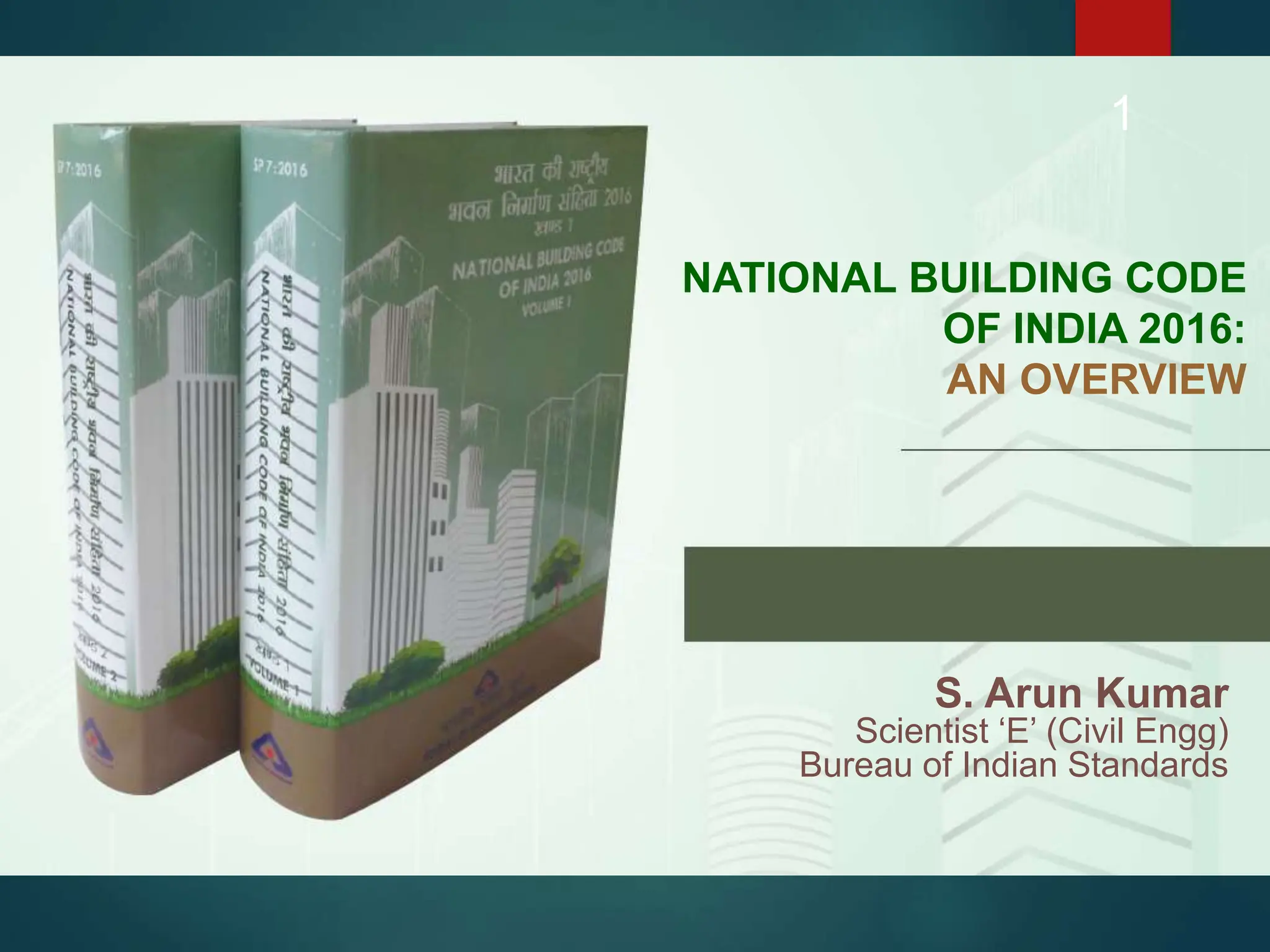
NATIONAL BUILDING CODE
OF INDIA 2016:
AN OVERVIEW
S. Arun Kumar
Scientist ‘E’ (Civil Engg)
Bureau of Indian Standards
1
2
3
4
2030
5
NEED FOR BUILDING REGULATION AND
CONSTITUTIONAL POSITION
Subjects relating to land and buildings fall under the State List
(Seventh Schedule )
35. Works, lands and buildings vested in or in the possession of the
State.
49. Taxes on lands and buildings.
Schedule (referred to under Article 243W) added by the
Constitution (74th Amendment) Act, 1992 (w.e.f 01.06.1993),
1. Urban planning including town planning.
2. Regulation of land-use and construction of buildings.
3. Planning for economic and social development.
4. Roads and bridges.
5. Water supply for domestic, industrial and commercial purposes.
6. Public health, sanitation conservancy and solid waste
management.
7. Fire services.
6
8. Urban forestry, protection of the environment and promotion of
ecological aspects.
9. Safeguarding the interests of weaker sections of society, including
the handicapped and mentally retarded.
10. Slum improvement and upgradation.
11. Urban poverty alleviation.
12. Provision of urban amenities and facilities such as parks,
gardens, playgrounds.
13. Promotion of cultural, educational and aesthetic aspects.
14. Burials and burial grounds; cremations, cremation grounds; and
electric crematoriums.
15. Cattle ponds; prevention of cruelty to animals.
16. Vital statistics including registration of births and deaths.
17. Public amenities including street lighting, parking lots, bus stops
and public conveniences.
18. Regulation of slaughter houses and tanneries.
7
NEED FOR BUILDING REGULATION AND
CONSTITUTIONAL POSITION
AUTHORITIES HAVING JURISDICTION
1) Municipal Corporation
2) Municipality
3) Notified Area Committee
4) Town Area Committee
5) Cantonment Board
6) Township
7) Port Trust
8) Special Purpose Agency like:
 Town improvement trusts.
 Urban development authorities.
 Water supply and sewerage boards.
 Housing boards.
 Pollution control boards.
 Electricity supply boards.
 City transport boards.
8
9
Source: http://lgdirectory.gov.in/
ENTITIES UNDER THE LAND REGIONS/REVENUE,
RURAL AND URBAN LOCAL GOVERNMENTS
INSTRUMENTS FOR BUILDING
REGULATION
 Town and Country Planning Act/
Development Act
 Master Plan, Zonal Plans and Layout Plans
 Municipality/Municipal Corporation Act
 Building Bye-Laws
1
0
11
AUTHORITIES ADDITIONAL CLEARANCES
Fire Authorities High rise and special
(fire vulnerable) buildings
Chief Inspectorate of Factories Industrial buildings
Pollution Control Board As per respective state norms
Chief Controller of Explosives,
Nagpur
Hazardous buildings
Urban Art Commission As per relevant Acts
Archaeological Survey of India Plot falling within 300 m distance
from any protected monument
Railway/Metro-rail Authority Plot is falling within railway corridor
Airports Authority of India Plot is falling in proximity of airport;
etc
AUTHORITIES FOR ADDITIONAL
CLEARANCES THAT MAY BE REQUIRED
12
13
HISTORICAL
Year History
1965 Panel of Experts appointed by Planning Commission to study the whole
gamut of operations involved in construction such as:
Administrative, Organizational, Financial, Technical
1968 ‘Report on Economies in Construction Costs’ recommended:
• One of the important steps towards achieving economy is through
formulation of Unified Building Code at national level.
• For this NBC to be brought out unifying building regulations throughout the
country
• Job entrusted to the then ISI (now BIS)
1970 NBC (first version)
1983 NBC (first revision)
1987 Amendment No. 1 & 2 to NBC 1983
1997 Amendment No. 3 to NBC 1983
2005 NBC (second revision)
2015 Amendment No. 1 & 2 to NBC 2005
2016 NBC (third revision)
Salient Features of NBC 2016 14
• Dealt by National Building Code Sectional Committee,
CED 46 of BIS
• Revision of the Code initiated in 2014
• 22 Expert Panels involved in which around 1000 experts
contributed
• Around 50 Meetings of the Experts Panels were organized
• Involves stakeholder engagement and wide consultation
process
• Revised Code is a culmination of the untiring efforts of
above Experts and BIS
• A voluminous document published in two volumes
Salient Features of NBC 2016
• Substantial improvements incorporated, particularly for
 Ensuring structurally safe and disaster resistant
buildings
 Accessibility of buildings and built environment for
persons with disabilities and the elderly
 Fire safety of modern complex and high-rise buildings
 Use of new/innovative building materials and technologies
 Ensuring speedier construction through prefab
technology
 Installation of modern plumbing and building services
 Ensuring IT enabled buildings
 Sustainability and conducive outdoor built environment
 Management of constructed building assets and facilities
Salient Features of NBC 2016
16
• Expected to be extensively used by,
 the local bodies for framing and revamping the existing
local building byelaws
 the Govt. and private construction agencies in their
construction activities
 the building professionals like architects, engineers,
structural engineers, town planners, building services
engineers and consultants in the design of building and
built environment
 building material suppliers and technology providers
 research institutions for their research purposes
 faculty and students of academic institutions for
imparting technical education to architectural and
engineering students by using the Code as part of their
curriculum
4 Pillars of Safety
 Structural Safety
 Health Safety
 Fire Safety
 Public Safety
17
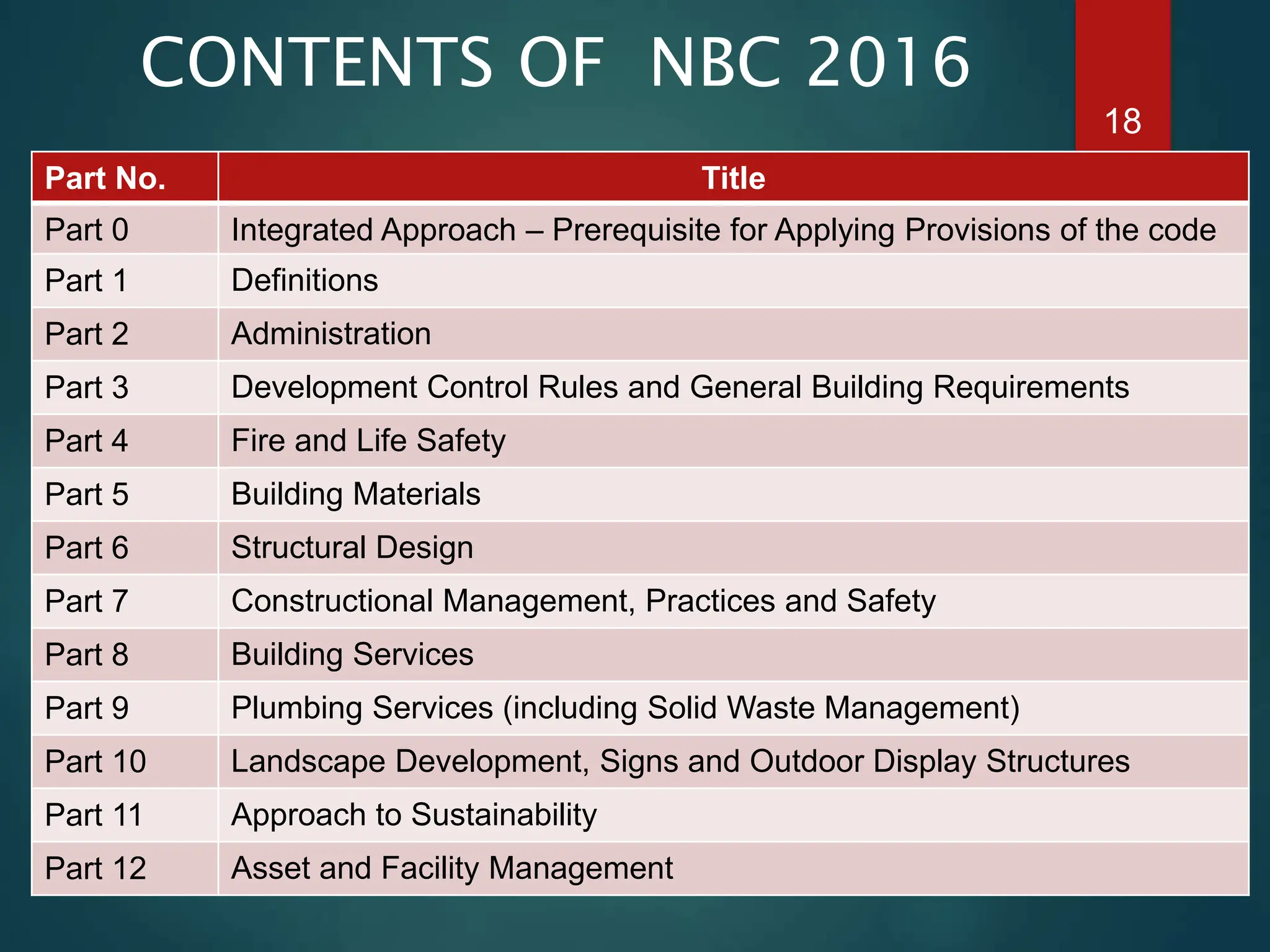
CONTENTS OF NBC 2016
18
Part No. Title
Part 0 Integrated Approach – Prerequisite for Applying Provisions of the code
Part 1 Definitions
Part 2 Administration
Part 3 Development Control Rules and General Building Requirements
Part 4 Fire and Life Safety
Part 5 Building Materials
Part 6 Structural Design
Part 7 Constructional Management, Practices and Safety
Part 8 Building Services
Part 9 Plumbing Services (including Solid Waste Management)
Part 10 Landscape Development, Signs and Outdoor Display Structures
Part 11 Approach to Sustainability
Part 12 Asset and Facility Management
19
20
PART 0
INTEGRATED APPROACH – PREREQUISITE
FOR APPLYING PROVISIONS OF THE
CODE
21
TEAM APPROACH
Sl. No Major Stages Corresponding Team Purpose
1.
Location/siting
Design team
Proper integration of
various design inputs
Conceptualization &
planning
Designing and
detailing
2.
Construction/
execution
Project Management &
Construction
Management Teams
Accomplishment in
accordance with
designs and
specifications in a
stipulated time and cost
framework.
3. Maintenance and
repair
Operation &
Maintenance Team or
Asset Management
Team or
Estate Management
Team
Operation, maintenance
and repairs to be
executed with least
inconvenience and
without any mismatch/
damage to structure,
finishings, fittings, etc.
22
MULTI DISCIPLINARY TEAM OF BUILDING
PROFESSIONALS
23
Each team to be multi-disciplinary team of need based professionals,
depending upon type, size, magnitude, complexity in the project; such as:
Architect
Civil Engineer
Structural Engineer
Geotechnical Engineer
Electrical Engineer
Plumbing Engineer
Fire Protection Engineer
HVAC Engineer
Lift, Escalator & Moving Walk
Specialist
Acoustics Specialist
Information/Communication
Technology Engineer
Health, Safety & Environment
Specialist
Environment/Sustainability
Specialist
Town Planner
Urban Designer
Landscape Architect
Security System Specialist
Interior Designer
Quantity Surveyor
Project/Construction Manager
Accessibility & Universal
Design specialist
Asset/Facility Manager
Other subject specialists
Major Modifications in Part 1 - Definitions
 Various new terms added in various Chapters during
this revision of the Code are reflected in this Part.
 Many of the existing definitions have been modified
based on internationally accepted definitions.
24
PART 1
DEFINITIONS
Lists the terms which are appearing in all the
Parts/Sections of the National Building Code of India,
along with their definitions.
Terms arranged in alphabetical order.
The Part(s)/Section(s) in which these terms are appearing, have
been indicated against the terms.
However, some common definitions are reproduced in
this Part also, the definitions being placed immediately
below the term concerned.
25
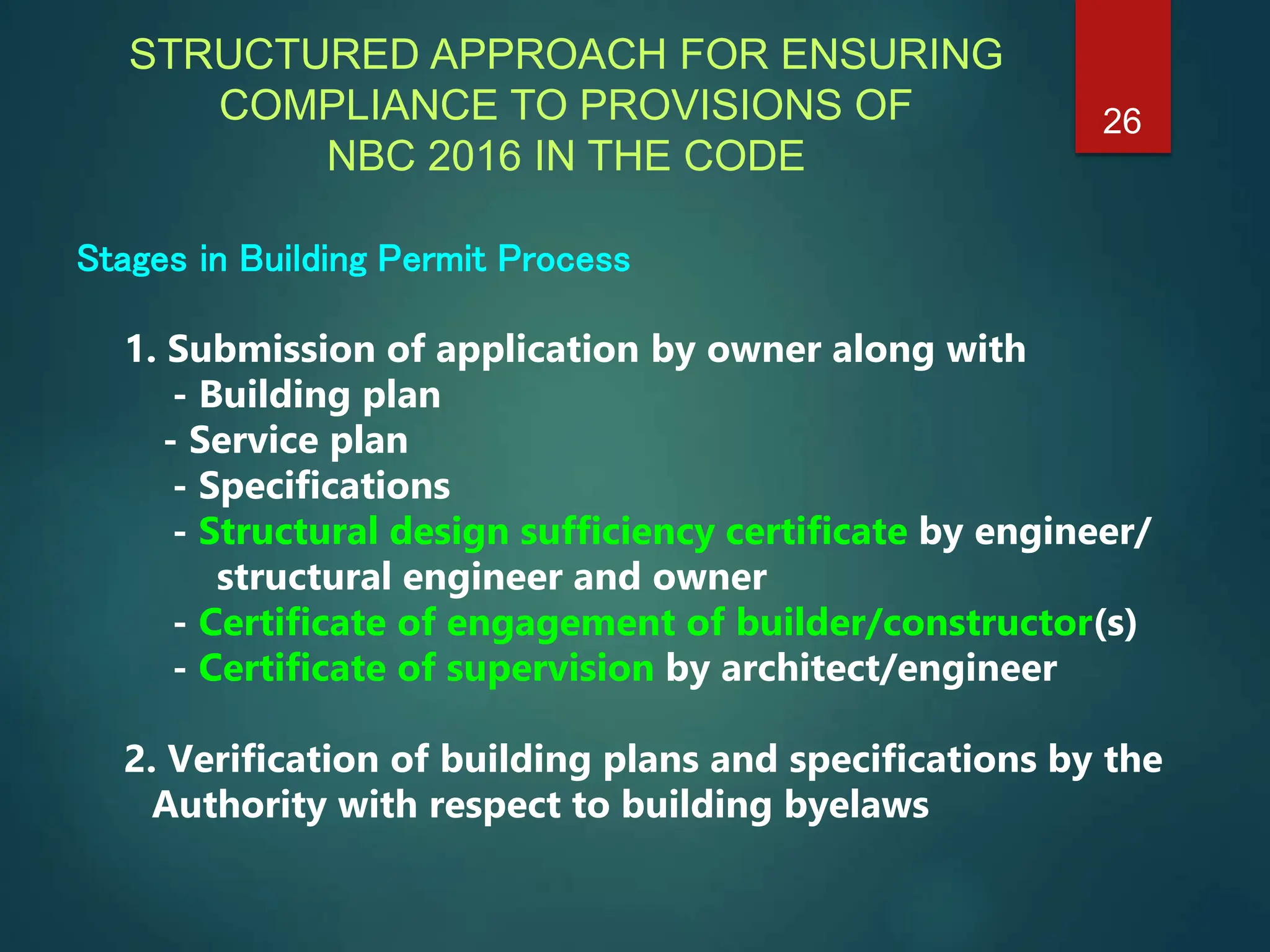
STRUCTURED APPROACH FOR ENSURING
COMPLIANCE TO PROVISIONS OF
NBC 2016 IN THE CODE
Stages in Building Permit Process
1. Submission of application by owner along with
- Building plan
- Service plan
- Specifications
- Structural design sufficiency certificate by engineer/
structural engineer and owner
- Certificate of engagement of builder/constructor(s)
- Certificate of supervision by architect/engineer
2. Verification of building plans and specifications by the
Authority with respect to building byelaws
26
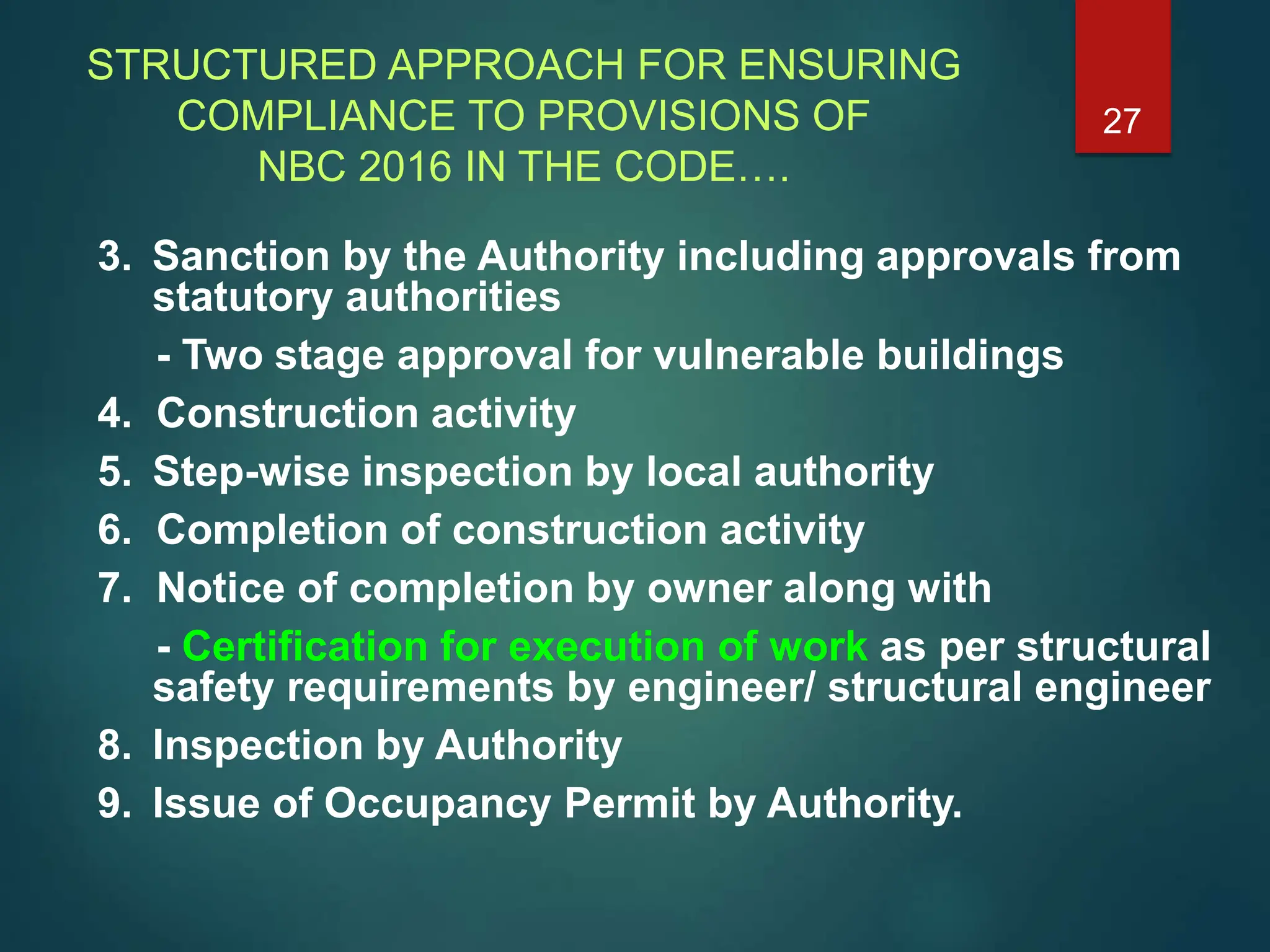
STRUCTURED APPROACH FOR ENSURING
COMPLIANCE TO PROVISIONS OF
NBC 2016 IN THE CODE….
3. Sanction by the Authority including approvals from
statutory authorities
- Two stage approval for vulnerable buildings
4. Construction activity
5. Step-wise inspection by local authority
6. Completion of construction activity
7. Notice of completion by owner along with
- Certification for execution of work as per structural
safety requirements by engineer/ structural engineer
8. Inspection by Authority
9. Issue of Occupancy Permit by Authority.
27
PART 2
ADMINISTRATION
It covers the administrative aspects of the
Code, such as applicability of the Code,
organization of building department for
enforcement of the Code, procedure for
obtaining development and building
permits, and responsibility of the owner
and all professionals involved in the
planning, design and construction of the
building.
28
29
PART 2
ADMINISTRATION Contd…
 Organization of Building Department for enforcement of the
Code
 Qualifications & competence of registered professionals
(Annex A)
 Responsibilities of owner and professionals involved
 Twelve Standard Forms
 Form for first application to develop, erect, re-erect or to make
alteration in any place in a building
 Form for certificate for structural design sufficiency
 Form for engagement of builder/constructor
 Form for supervision
 Form for sanction or refusal of development/building permit
 Form for notice for commencement
 Form for certificate for sub-surface investigation
 Form for certificate for completed structural design work as per
structural safety requirements
 Form for certificate for supervision of execution of work
 Form for certificate for completed work by builder/constructor
30
Major Modifications in Part 2 Administration
 Ease of doing business through detailed and updated
provision for streamlining the approval process in respect of
different agencies in the form of an integrated approval
process through single window approach, thereby
avoiding separate clearances from various authorities.
 Updated provision on computerization of approval
process.
 Reinforcement of the provisions on the mechanism of
ensuring certification of structural safety of buildings by
the competent professional and peer review of design of
buildings.
 Fixation of responsibility for geotechnical engineer and
contractor, where involved in a building construction project.
31
 Existing buildings / development (Cl 3.8)
 Alternative materials/ design/ construction & tests (Cl 5)
 Building notices and orders (Cl 7.2)
 Construction not according to plan (Cl 7.5)
 Modification and occupancy violation (Cl 7.6 & 7.7)
 Integrated approval process (Cl 11.1.4)
 Pre-Code Development / Building Permit (Cl 11.2)
 Building plan for high rise/special buildings (Cl 12.2.5.1)
 Notice for alteration only (Cl 12.4)
 Duration of sanction (Cl 12.6)
 Periodic occupancy renewal (Cl 14.4)
 Unsafe building (Cl 15)
 Demolition of building (Cl 16)
 Architectural control (Cl 18)
32
Part 2 ADMINISTRATION
 Clause 3Applicability
 3.8 Existing Buildings / Development
33
PART 3
DEVELOPMENT CONTROL RULES AND
GENERAL BUILDING REQUIREMENTS
This Part deals with the development
control rules and general building
requirements to ensure health and
safety of the public.
34
35
36
37
- Land use classification and uses permitted
- Cluster planning approach and provisions for housing
- Inclusion of detailed town planning norms for various amenities
such as:
Educational facilities
Health care facilities
Socio-cultural facilities
Distribution services
Police, Civil Defence & Home Guards
Fire services
Telephone, postal and banking facilities
Sports activity
Shopping
Religious
Electrical substation
Transport
Cremation/Burial Ground, etc
PART 3
DEVELOPMENT CONTROL RULES AND
GENERAL BUILDING REQUIREMENTS
PART 3
DEVELOPMENT CONTROL RULES AND
GENERAL BUILDING REQUIREMENTS (contd…)
- Parking norms for metro & mega cities
- Special requirements for low income
housing in urban areas
- Special requirements for rural habitat
planning
- Special requirements for development
planning in hilly areas
- Provision for buildings & facilities for
persons with disabilities and the elderly
38
Major Modifications in
Part 3 Development Control Rules and General
Building Requirements
 Modification of land use classification.
 Modification of planning norms for various amenities provided
in a city/town and also inclusion of provisions for new amenities.
 Barrier free built environment: Comprehensive updated
provisions for accessibility in buildings and built environment
for persons with disabilities and the elderly by adopting
universal design principles.
 Provisions on new planning and development norms, such as,
Transferable Development Rights (TDR) and Accommodation
reservation (AR).
 Foreword of this part also refers to Transit Oriented Development
(TOD).
39
Major Modifications in
Part 3 Development Control Rules and General
Building Requirements
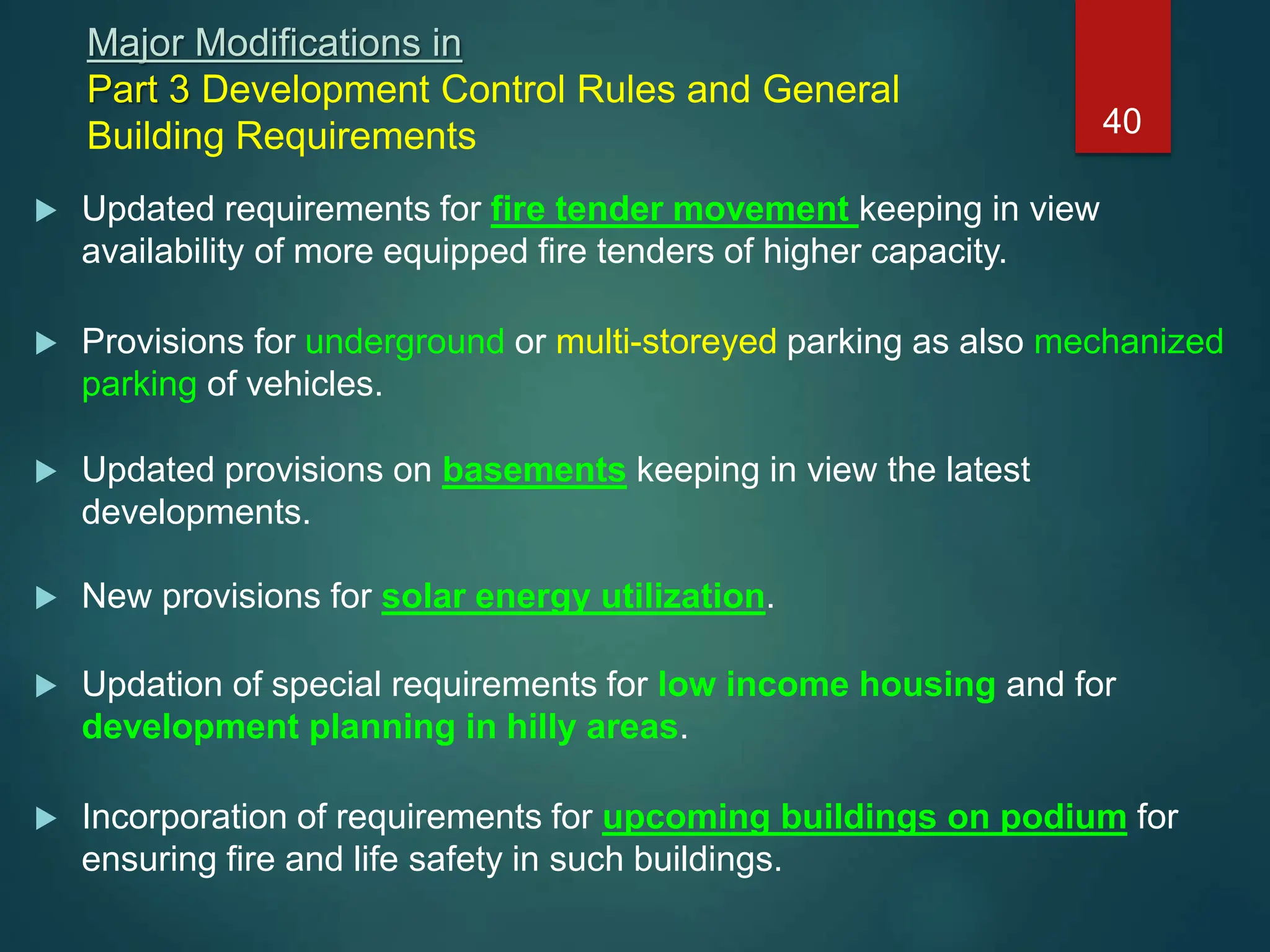
 Updated requirements for fire tender movement keeping in view
availability of more equipped fire tenders of higher capacity.
 Provisions for underground or multi-storeyed parking as also mechanized
parking of vehicles.
 Updated provisions on basements keeping in view the latest
developments.
 New provisions for solar energy utilization.
 Updation of special requirements for low income housing and for
development planning in hilly areas.
 Incorporation of requirements for upcoming buildings on podium for
ensuring fire and life safety in such buildings.
40
ACCESSIBILE BUILT ENVIRONMENT
 Includes ease of independent –
 approach,
 entry,
 evacuation, and/or
 use of a building and its services and
facilities,
 by all of the building’s potential users,
particularly including the elderly and
persons with disabilities, with an assurance
of individual health, safety and welfare during
the course of those activities.
41
REQUIREMENTS APPLY TO
• All buildings and facilities open to and used by the
public
• All forms of public housing by the government/civic
bodies or private developers.
• Private residences.
42
DOES NOT APPLY TO
43
44
Ugly implication of non compliance to building Codes
46
Year Major Fire Incident in the past No. of
Lives lost
No. of
Injured
1981 Bangalore circus fire > 92 > 300
1995 Dabwali fire accident, Haryana > 400 > 160
1997 Uphaar Cinema fire, New Delhi 59 103
1997 Religious congregation, Odisha 206
1997 Brihadeeswarar temple fire,
Thanjavur, T.N.
48  200
2001 Asylum at Erwadi, T.N. > 28
2002 Footwear factory, Agra > 42
2004 Kumbakonam school fire, T.N. 94
2004 Srirangam marriage hall fire, T.N. 57 > 50
2005 Fireworks factory building,
Khusrupur, Bihar
32 > 24
2006 Kolkata leather factory fire > 10
47
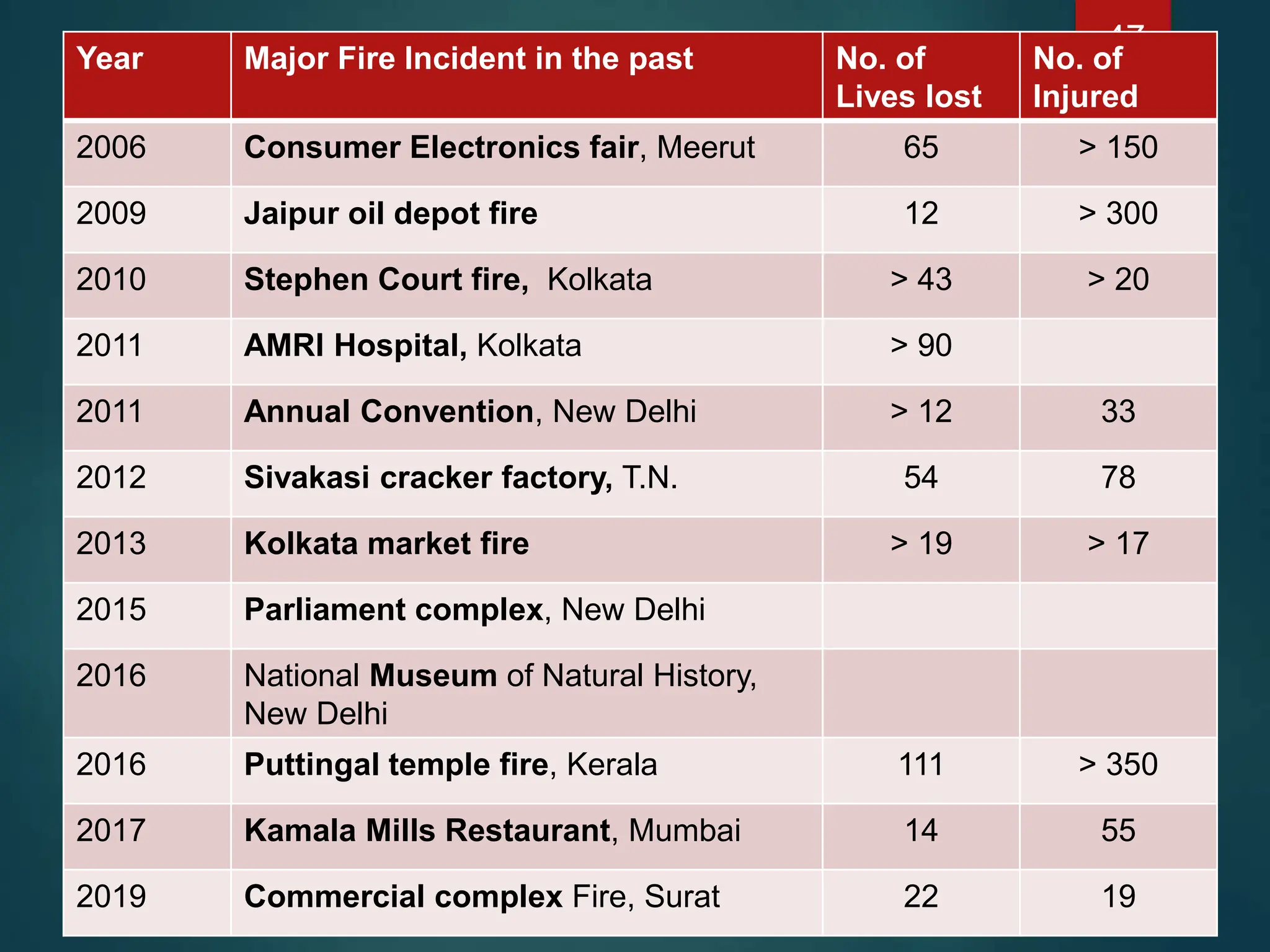
Year Major Fire Incident in the past No. of
Lives lost
No. of
Injured
2006 Consumer Electronics fair, Meerut 65 > 150
2009 Jaipur oil depot fire 12 > 300
2010 Stephen Court fire, Kolkata > 43 > 20
2011 AMRI Hospital, Kolkata > 90
2011 Annual Convention, New Delhi > 12 33
2012 Sivakasi cracker factory, T.N. 54 78
2013 Kolkata market fire > 19 > 17
2015 Parliament complex, New Delhi
2016 National Museum of Natural History,
New Delhi
2016 Puttingal temple fire, Kerala 111 > 350
2017 Kamala Mills Restaurant, Mumbai 14 55
2019 Commercial complex Fire, Surat 22 19
48
FIRE PREVENTION
LIFE SAFETY
FIRE PROTECTION
PART 4
FIRE AND LIFE SAFETY
Approach towards Fire and Life safety
49
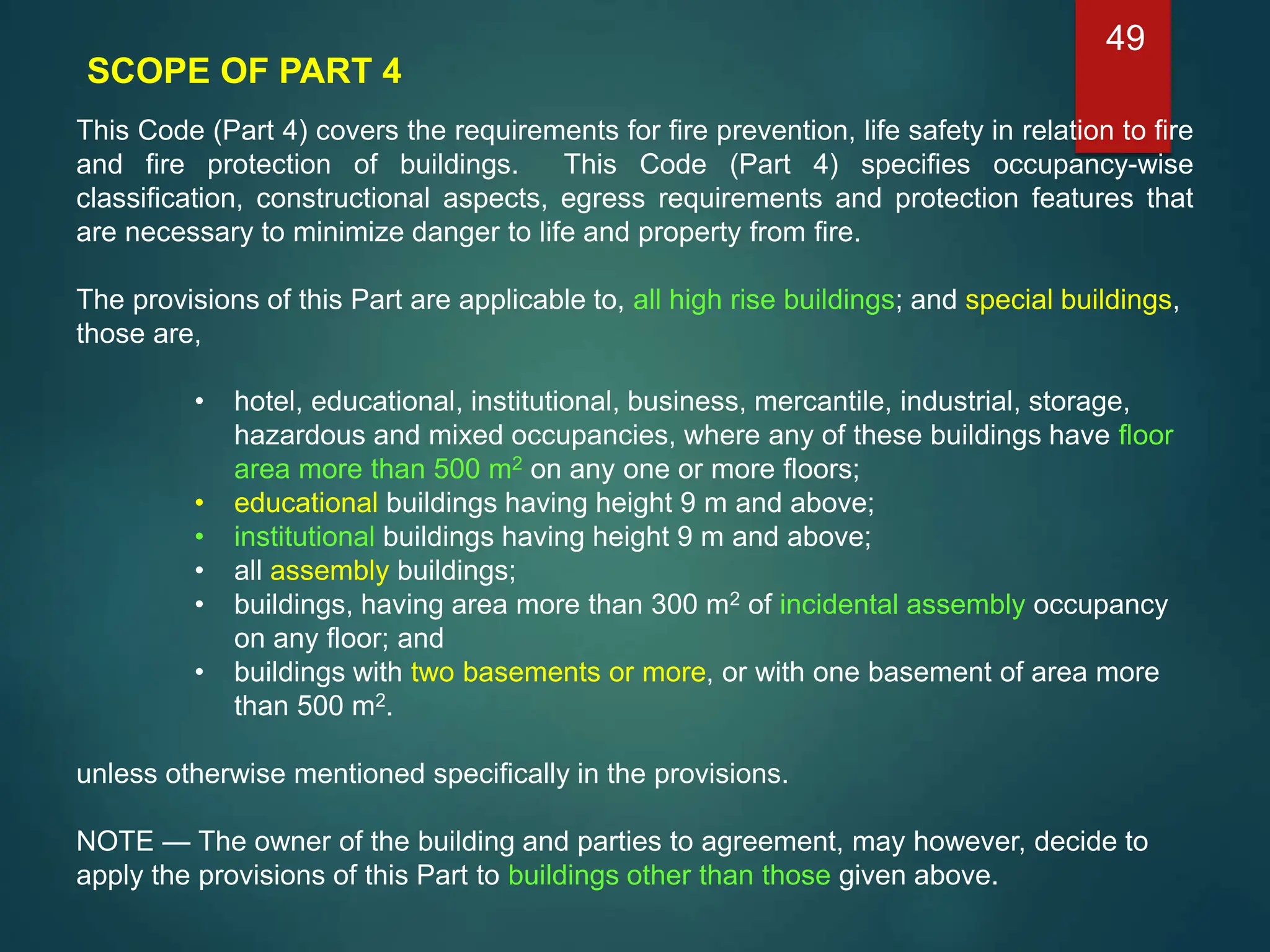
SCOPE OF PART 4
This Code (Part 4) covers the requirements for fire prevention, life safety in relation to fire
and fire protection of buildings. This Code (Part 4) specifies occupancy-wise
classification, constructional aspects, egress requirements and protection features that
are necessary to minimize danger to life and property from fire.
The provisions of this Part are applicable to, all high rise buildings; and special buildings,
those are,
• hotel, educational, institutional, business, mercantile, industrial, storage,
hazardous and mixed occupancies, where any of these buildings have floor
area more than 500 m2 on any one or more floors;
• educational buildings having height 9 m and above;
• institutional buildings having height 9 m and above;
• all assembly buildings;
• buildings, having area more than 300 m2 of incidental assembly occupancy
on any floor; and
• buildings with two basements or more, or with one basement of area more
than 500 m2.
unless otherwise mentioned specifically in the provisions.
NOTE — The owner of the building and parties to agreement, may however, decide to
apply the provisions of this Part to buildings other than those given above.
50
CONTENTS
51
52
53
65 Terminologies 28 Tables 16 Figures 11 Annexes
Part 4 to be read along with the provisions in:
Read with
Part
Title of the Part Reference
made in
Clause
Part 2 Administration 3.1.4, 3.2.7
Part 3 Development Control Rules and General Building
Requirements
3.4.4
Part 6/ Sec 8 Structural Design: Glass and Glazing 3.4.10
Part 8/ Sec 1 Building Services: Lighting and Natural Ventilation 3.4.8
Part 8/ Sec 2 Building Services: Electrical and Allied Installations 3.4.6
Part 8/ Sec 3 Building Services: Air Conditioning, Heating and Mechanical
Ventilation
3.4.8
Part 9/ Sec 4 Plumbing Services: Gas Supply 4.8
Part 12 Asset and Facility Management 4.9, 5.3
BUILDING OCCUPANCY CLASSIFICATION Clause 3.1
Group A Residential
Lodging or rooming houses (A-1)
One or two family dwelling (A-2)
Dormitories (A-3)
Apartment houses (flats) (A-4)
Hotels (A-5) & Starred hotels (A-6)
Group B Educational
Schools up to senior secondary level (B-1)
Others/training institutions (B-2)
Group C Institutional
Hospitals and Sanatoria (C-1)
Custodial institutions (C-2)
Penal & mental institutions (C-3)
Group D Assembly
D-1 to D-6 (Theatrical performances, auditoria, motion picture houses, concert halls,
stadia, amusement park, external swimming pool)
D-7 Underground and elevated MRTS
Group E Business
E-1 to E-5 (offices, banks, labs, computer, telephone exchanges, broadcasting
stations)
Group F Mercantile
F-1 to F-3 (shops, departmental stores, markets & underground shopping
centres)
Group G Industrial
Low hazard (G-1)
Moderate hazard (G-2)
High hazard (G-3)
Group H Storage
Group J Hazardous
MIXED OCCUPANCY
 Fire Protection – most restrictive of the individual occupancies
applies to entire building
 Life Safety – as per respective occupancy
 Exits – Size of egress should not decrease in the direction of travel
 Occupancies to be separated by 240 min fire resistance rating
CHANGE IN OCCUPANCY
 Building to be designed to comply with requirements of the new group/
sub-division
 If new occupancy type is less hazardous – it need not conform to
requirements of the new Group/ sub-division
 Certificate of occupancy before making change as per Part 2 (Annex P)
 Alteration permit
FIRE PREVENTION
56
 Building classification
 Fire zones – Zone no. 1, 2 & 3 (used in Land Use Development
Plan)
 Types of construction – Type 1, 2, 3 & 4
(based on fire resistance rating
of building elements)
 Surface interior finishes - Classes 1, 2, 3 & 4
(Very Low, Low, Medium and
Rapid surface flame spread)
 False ceiling, suspension fixtures - non-combustible
Fire Zones Occupancy Group Type of
Construction
No. 1 A, B, C, D, E-1 (small offices), F
(including temporary buildings & structures)
1, 2, 3, or 4
No. 2 E-2 to E-5, G-1, G-2
(including temporary buildings & structures)
1, 2 or 3
No. 3 G-3, H, J 1 or 2
LIFE SAFETY
Requirements specified for: Reference at
Exit requirements Clause 4.2
Occupant load Table 3
Egress components Clause 4.4
Exit capacities and arrangement Table 4
No. of exits
Max. travel distance Table 5
Doorways, corridors & passageways
Staircases – pressurization Table 6
Ramps
Compartmentation Clause 4.5
Smoke control Clause 4.6
Illumination/escape lighting
Fire detection & alarm system Clause 4.9
Fire fighting shaft Fig. 2
57
General Requirements for All Individual Occupancies
 Buildings under construction
 Maximum height, FAR, open spaces (Part 3)
 Openings in fire resistant walls, floors (Clause 3.4.5)
 Service ducts and shafts
 Refuse chutes
 Vertical opening
 Electrical installation (Clause 3.4.6)
 Escape lighting, exit signage (Clause 3.4.7)
 Air conditioning, ventilation, smoke control (Clause 3.4.8)
 Heating (Clause 3.4.9)
 Glazing (Clause 3.4.5)
 Fire Command Centre (Clause 3.4.12)
58
FIRE PROTECTION
59
 Fire Fighting Installation
 Fire extinguisher
 First aid hose reel
 Wet riser
 Down comers
 Yard hydrant
 Automatic sprinkler system
 Manually operated electric fire alarm system
 Automatic detection and alarm system
 Underground static water storage tank
 Terrace tank over respective tower terrace
 Pump near underground tank
 Pump at terrace tank level
 Dry riser (for hilly areas or industrial areas)
 Fire protection requirements for high rise
buildings
 Fire drill & evacuation procedures
Major Modifications in
Part 4 Fire and Life Safety
 The scope of application of provisions of this Part for different
occupancies has been clarified.
FIRE PREVENTION
 Table 1 on fire resistance ratings of structural and non-structural
elements has been updated.
 Detailed provisions on fire separating walls, fire separating
floors and fire partitions
 Separate comprehensive clause on electrical power supply
distribution for fire and life safety systems
 Detailed provisions on air conditioning systems towards safety
and smoke control integration
 Glass façade requirements have been detailed towards fire
protection and smoke exhaust aspects
 Comprehensive clause on Fire Command Centre (FCC)
60
Major Modifications in
Part 4 Fire and Life Safety
LIFE SAFETY
 Components of means of egress - exit access, exit and exit
discharge
 Table on capacity factors - modified based on the aspect of
width per person approach used globally
 Requirement for displaying the occupancy load for
assembly buildings and call centres.
 Well integrated provisions on firefighting shaft to access the
floor on fire and also allows egress/evacuation of the
occupants with simultaneous use of refuge area.
 Updated provisions on compartmentation with fire barrier
and its passive fire safety requirements for respective
occupancies.
61
Major Modifications in
Part 4 Fire and Life Safety
FIRE PROTECTION
 Erstwhile Table 23 on minimum requirements for fire fighting
installations (now Table 7) comprehensively updated.
 Detailed provisions have been included on fire water storage, fire
pump room, sprinkler system and various alternative fire
suppression systems.
 Detailed provisions on the concept of progressive evacuation in
case of hospital buildings.
 Provisions on refuge area have been updated including for D-6
occupancy and introduced for apartment buildings of height 60
m and above.
 Provisions specific to atrium, commercial kitchen and car
parking facilities.
 Provisions specific to Metro Stations and Metro Trainways
62
63
FOR EXISTING BUILDINGS
Part 4 FIRE AND LIFE
SAFETY
 Cl 3.1.12 – Change in Occupancy (of existing buildings)
64
Part 4 FIRE AND LIFE
SAFETY
 Cl 3.2.7 Restrictions on Existing Building
65
66
CATEGORIES OF MATERIALS
 Aluminium And Other Light
Metals And Their Alloys
 Bitumen And Tar Products
 Builder’s Hardwares
 Building Chemicals
 Building Limes
 Cement And Concrete (Including
Concrete Reinforcement)
 Cememt Matrix Products
 Clay Products For Building
 Conductors And Cables
 Doors And Windows
 Electrical Wiring Fittings And
Accessories
 Fillers, Stoppers And Putties
 Floor Covering, Roofing And
Other Finishes
 Glass
 Gypsum Building Materials
 Lignocellulosic Building Materials
(Including Timber, Bamboo And
Products Thereof)
 Paints And Allied Products
 Polymers, Plastic And Geosynthetics/
Geotextiles
 Sanitary Appliances And Water
Fittings
 Steel
 Stones
 Structural Sections
 Thermal Insulation Materials
 Threaded Fasteners And Rivets
 Unit Weights Of Building Materials
 Waterproofing And Damp-proofing
Materials
 Welding Electrodes And Wires
 Wire Ropes And Wire Products
67
NEW / ALTERNATIVE BUILDING
MATERIALS
 Suitability for End Application
 Strength Properties
 Durability
 Fire Resistivity
 Thermal Properties
 Acoustical Properties
 Ease of Working/Handling
 Energy Conservation/Environment Sustainability
Major Modifications in
Part 5 Building Materials
 Updated provisions for ensuring utilization of
number of new/alternative building materials to
provide for innovation in the field of building
construction.
 Examples of some potential new/alternative
materials.
 New clause giving broad aspects relating to
sustainable materials.
 Categories reclassified for ease of reference.
68
CERTIFICATION
BIS operates a third party certification under
the BIS (Certification) Regulations, 1988
which plays a very important role in quality
assurance. The third party certification not
only encourages the producers/beneficiating
agency but also guides them for in-process
quality control including regarding the
beneficiation, segregation and processing,
etc.
69
RMC CERTIFICATION
70
71
72
• https://www.thehindubusinessline.com/
bline/2001/04/19/stories/141967sk.htm
• https://www.tribuneindia.com/2001/200
10205/nation.htm#5
Buildings which complied with Codes
withstood Bhuj quake. Those which
were non compliant were total write off.
No Central Govt. building suffered any
major loss
PART 6
STRUCTURAL DESIGN 74
Section Title
Section 1 Loads, Forces and Effects
Section 2 Soils and Foundations
Section 3 Timber and Bamboo
Sub section 3A Timber
Sub section 3B Bamboo
Section 4 Masonry
Section 5 Concrete
Sub section 5A Plain and Reinforced Concrete
Sub section 5B Prestressed Concrete
Section 6 Steel
Section 7 Prefabrication, Systems Building and Mixed/ Composite
Construction
Sub section 7A Prefabricated Concrete
Sub section 7B Systems Building and Mixed/Composite Construction
Section 8 Glass and Glazing (New)
75
2016 Wind Map
76
77
78
2016 Seismic
Zoning Map
79
80
81
82
83
84
85
86
Multi-Hazard Risk
in Various
Districts in India
 Earthquake
 Cyclone
 Windstorm
 Floods
 Landslides
 Liquefaction of soils
 Extreme winds
 Cloud bursts
 Failure of slopes
87
 139 Districts
 6 Districts
 29 Districts
 16 Districts
88
Major Modifications in
Part 6/Sec 3A Timber
 Updated design provisions for timber connector joints, lamella
roofing, trussed rafters, etc.
 The permissible lateral strength (in double shear) of mild steel
common wire for different new species of timber have been
added and also strength values for some of the existing species
have been modified based on latest research.
 Data on block shear test results of glued timber joints and on
strength properties of glued finger joints based on the indigenous
work, has been included for guidance in design.
 Illustrations added for possible orientation of planks in glue
laminated beams (Glulam).
 Design outline for horizontally laminated beams has been added.
89
Major Modifications in
Part 6/Sec 3B Bamboo
 Updated design provisions for
• bamboo trusses, and
• bamboo foundations.
 Inclusion of provisions relating to use of
• bamboo as reinforcement in concrete,
• bamboo based materials/panel products as
walling/roofing material, and
• reconstituted wood from destructured bamboo.
90
Major Modifications in
Part 6/Sec 4 Masonry
 Inclusion of provisions relating to
• reinforced masonry,
• confined masonry building construction, and
• masonry wall construction using rat-trap bond.
 New provisions related to durability criteria for selection of
masonry mortars.
 Stabilized soil blocks have been included as masonry unit.
 Number of storeys of masonry construction has been limited
to 4, in line with the seismic design standards.
91
Major Modifications in
Part 6/Sec 5A Concrete
 Elaborated provisions relating to use of mineral admixtures,
their effects on properties of fresh and hardened concrete,
including precautions associated therewith.
 Incorporation of permission to use aggregates from other
than natural sources, including iron slag aggregate, steel
aggregate, copper slag aggregate, bottom ash from thermal
power plant, and aggregate derived from construction and
demolition waste, through cross reference to revised IS 383.
 Inclusion of stripping time required in case of concrete made
using cement other than OPC or using cementitious materials
like fly ash and slag.
92
Major Modifications in
Part 6/Sec 5A Concrete
 Provisions relating to self compacting concrete (SCC) and
high performance concrete (HPC).
 Design provisions relating to steel fibre reinforced concrete
(SFRC) as part of special concretes.
 Inclusion of provisions relating to shear stress for coupled
shear walls.
 Inclusion of comprehensive provisions on ductile detailing
from IS 13920 : 2016 to help extensive implementation of
ductile detailing provisions in all relevant structures.
93
Coverage of
Ductile Detailing
94
95
Major Modifications in
Part 6/Sec 5B Prestressed Concrete
 Updated design provisions for prestressed concrete in line
with revised IS 1343:2012 and latest practices.
 Section on materials, workmanship, inspection and testing
has been completely modified in line with IS 456 as
applicable to prestressing.
 Provisions related to bearing stress in the end zone in post-
tensioned members have been updated.
 Provisions related to ultimate shear resistance of a section
uncracked in flexure and also for that cracked in flexure have
been updated.
 Test on wall thickness of the duct of corrugated HDPE
sheathing duct has been updated.
96
Major Modifications in
Part 6/Sec 6 Steel
 The chapter has been modified in line with IS 800:2007 and latest
developments.
 The table on tensile properties of structural steel products has
been updated by including yield stress values of bolts of sizes 3.6
to 6.8 mm as per IS 1367 (Part 3) and aligning the corresponding
provisions of the table with those given in IS 2062:2011.
 Elaborated provisions for mechanical properties of structural steel.
 Provisions related to effective wind pressure on exposed circular
tube members have been included.
 Provisions related to requirement of temperature stress analysis
have been updated.
97
Major Modifications in
Part 6/Sec 7A Prefabricated Concrete
 Inclusion of emulative system of prefabricated concrete with
detailed provisions in respect of its definition, analysis,
design, detailing, etc.
 Detailed provisions on diaphragm action of floor systems
have been included.
 Design considerations have been updated where accidental
impact due to vehicles has been included.
 Provisions and testing procedures for water tightness of joints
have been included.
 Some of the typical precast joint details have been illustrated.
98
Major Modifications in
Part 6/Sec 7A Prefabricated Concrete
 Provisions relating to fire resistance testing of prototypes
under sustained load has been provided for.
 Connection between adjacent prefabricated members only
through frictional resistance has been removed and
suggestions for resistance using shear has been included.
 Provisions on site prefabrication have been updated.
 Guidelines (restriction on the number of components) on
vertical stacking on ground have been included.
 Provisions for tolerances in erection and associated design
considerations have been included.
99
Major Modifications in
Part 6/Sec 7B Systems Buildings and
Mixed/Composite Construction
 Updated provisions in respect of the following aspects of
systems building and mixed/composite construction:
• definition,
• analysis,
• design,
• detailing, etc.
 Aspects relevant to devising systems and structural schemes
have been updated.
100
New Chapter
Part 6/Sec 8 Glass and Glazing
 This new chapter on structural use of glass covers
• different types of glass, their requirements and associated
glazing materials;
• selection and application of glass in buildings,
• provision for glazing w.r.t. their effect on energy, visual
(light) and solar environments in the building;
• selection of glass in buildings, subject to wind loading,
seismic loading and special considerations for fire rated
glass and related materials;
• provisions for the selection and manifestation of glass in
buildings, subject to safety with respect to human impact of
the occupants; and
• provisions relating to selection, design, fabrication and
installation of glazing systems.
101
SELECTION OF GLASS
102
Application
 Doors and Windows
 Facade
 Semi-Partitions (In-fill panels)
 Mirrors
 Atrium
 Balusters
 Railings
 Greenhouses
 Shop fronts
103
Types of Glass
 Annealed Glass
 ‘A’ quality or ‘Selected Quality’ (SQ)
 ‘B’ quality or ‘Ordinary Quality’(OQ)
 ‘C’ quality or ‘Greenhouse Quality’ (GQ)
 Float Glass
 Tempered Glass (or Toughened Glass)
 Heat strengthened glass
 Laminated Glass
 Reflective Glass
 Wired Glass
 Insulating Glass Unit (or Double Glass Unit)
104
Associated Glazing Materials
 Setting Blocks
 Location Blocks
 Distant Pieces
 Gaskets
 Structural Sealants
 Putty
 Preformed Tapes
 Glazing Beads
105
Factors to be considered in the
Selection of Glass
 Location of glazed area (size, shape)
 Implications of usage
 Influence on performance
 Security
 Maintenance (access for cleaning and Reglazing)
 Initial cost (capital cost)
 Method of glazing (fixing the glass units)
 Access for initial glazing
 Protection during construction
106
Factors to be considered in the
Selection of Glass Contd..
Natural light
 Glare
 Fading
 Privacy
Thermal consideration
 Solar transmission
 Heat absorption
 Thermal insulation
 Frame
107
 Wind loading
 Safety
 Fire
 Durability
 Running cost
 Maintenance cost
 Life expectancy
 Sound absorption
108
ENERGY AND LIGHT
109
110
111
EXTERNAL SHADING DEVICES
112
INTERNAL SHADING DEVICES
FIRE & LOADING
113
Loading Criteria
 Calculation of Appropriate Glass Thickness ( e.g. @ Annex D )
 Net Design Wind Pressure as per IS 873 (Part 3), Pd
 Decide Type and Size of Glass
 General Check (Max. of pane area, span, AR), Table 16
 Find effective wind pressure as per the type of glass, Pnet & Table
15
 Select trial thickness of glass (from Tables 19 to 27)
 Calculate deflection at centre of glass panel, Annex C
 Deflection to be less than allowable deflection, Cl 6.3.6.2
 Check if selected thickness is safe from stress perspective, Table
14 & Empirical relation
 Seismic Load as per IS 1893 (Part 1)
 Design seismic force on the non-structural element, Fp
 Seismic relative displacement
 Structural bite for IGU
 Handling, transportation, storage at site
114
Fire Safety
 Part 4 ‘Fire and Life Safety’ of NBC 2016
 ISO 834 - Fire resistance tests -- Elements of building
construction (Parts 1 to 13)
 ISO 3009 - Fire-resistance tests -- Elements of building
construction -- Glazed elements
115
TYPE OF GLASS FOR FIRE RESISTANCE
 Wired glass
 Annealed fire resistant glass (AFG)
 Tempered fire resistant glass (TFG)
 Gel laminated fire resistant glass (LFG)
 Double glazed fire resistant glass (DFG)
SAFETY RELATED TO HUMAN
IMPACT
116
117
118
PART 3 OF NBC 2016
119
Manifestation
Test Requirements
Requirements Laminated Safety Glass Toughened Safety
Glass
Impact/ Resistance to shock YES YES
Fragmentation test – YES
Warp test – YES
Boil test YES –
Fracture and Adhesion test YES –
Light stability test YES –
UV light test YES (for glass used in the
exterior portions and subject
to natural light)
–
Shot bag impact test YES YES
120
Glazing System (Guidelines)
 Design and selection
 Fabrication
 Installation
 Testing
 Maintenance and durability
 Minimum performance requirement of glazing in the building
exterior
 Test requirements for coated glass
 Shot bag impact test
 Performance test
121
Important Standards utilized in
Part 6/Sec 8
IS No. Title
IS 16231 Code of practice for use of glass in buildings:
(Part 1) : 2016 General methodology and selection
(Part 2) : 2016 Energy and light
(Part 3) : 2016 Fire and loading
(Part 4) : 2014 Safety related to human impact
122
All the above standards have been revised and are published as
IS 16231 (Part xx):2019
123
IS No. Title Current Stage
IS 15883 Construction Project Management- Guidelines:
Part 1:2009 Part 1 General Published
Part 2:2013 Part 2 Time Management Published
Part 3:2015 Part 3 Cost Management Published
Part 4:2015 Part 4 Quality Management Published
Part 5:2013 Part 5 Health & Safety Management Published
Part 6:2015 Part 6 Scope Management Published
Part 7 Part 7 Procurement Management Draft being prepared
Part 8:2015 Part 8 Risk Management Published
Part 9:2018 Part 9 Communication Management Published
Part 10 Part 10 Human Resource Management Draft being prepared
Part 11 Part 11 Sustainability Management Draft being prepared
Part 12:2016 Part 12 Integration Management Published
IS 16416:2016 Guidelines for Construction Project
Formulation and Appraisal
Published
IS 16601:2016 Guidelines for Habitat and Welfare
Requirements for Construction Workers
Published
Construction Project Management
124
- Safety guidelines during different construction operations
such as during:
• excavation
• drilling and blasting
• piling and deep foundations
• tunneling
• road making
• at floor and wall openings
• demolition
• steel erection
• in construction of concrete framed structure
• during material handling
• while working in compressed air
• in use of tools
• in use of construction machinery
• from common hazards
- Concept of safety committees/management
- Maintenance management
SAFETY GUIDELINES
PART 7 CONSTRUCTION
MANAGEMENT, PRACTICES AND
SAFETY
Major Modifications in
Part 7 Construction Management, Practices
and Safety
 Updated provisions for ensuring utilization of number of
new/alternative building technologies to provide for
innovation in the field of building construction.
 Incorporation of construction management guidelines to aid
in timely completion of building projects in a safe manner with
desired quality and within the budgeted cost.
 Inclusion of requirements for habitat and other welfare
requirements for workmen at construction site.
 Updated provisions on safety in construction.
126
PART 8
BUILDING SERVICES
127
Section Title
Section 1 Lighting and Natural Ventilation
Section 2 Electrical and Allied Installations
Section 3 Air Conditioning, Heating and Mechanical Ventilation
Section 4 Acoustics, Sound Insulation and Noise Control
Section 5 Installation of Lifts and Escalators and Moving Walks
Sub section 5A Lifts
Sub section 5B Escalators and Moving Walks (New)
Section 6 Information and Communication Enabled Installations
(New)
Major Modifications in
Part 8/Sec1 Lighting and Natural Ventilation
 Updated provisions relating to efficient artificial light source
and luminaires and photocontrols for artificial lights.
 Inclusion of modern lighting techniques such as LED and
induction light vis-à-vis their energy consumption.
 Reference to SP 41:1987 for obtaining coefficient utilization
for determination of luminous flux has been included.
 Enabling provisions for lighting shelves and light pipes have
been included.
128
 The provisions related to thermal comfort clause have been
elaborated including therein indices such as effective
temperature, adaptive thermal comfort along with
elaborations on tropical summer index.
 Design guidelines for natural ventilation have been
elaborated with illustrations.
 Provisions related to determination of rate of ventilation
particularly on combined effect of wind and thermal actions
have been elaborated.
 Provision on colour rendering has been included in line with
that in SP 72 : 2010 ‘National Lighting Code 2010’.
129
Major Modifications in
Part 8/Sec1 Lighting and Natural Ventilation
Major Modifications in
Part 8/Sec 2 Electrical and Allied Installations
 Updation of the chapter for ensuring alignment with The
Indian Electricity Act, 2003 and various CEA Regulations
framed thereunder particularly Central Electricity Authority
(Measures Relating to Safety and Electric Supply) Regulations,
2010.
 Updated provisions on location and other requirements
relating to layout, environmental and safety aspects for
different substation apparatus/equipment and generating
sets.
 Inclusion of provisions relating to location of compact
substations.
 Updated provisions for reception and distribution of supply
and wiring installations and for installation of energy meters
with due cognizance to the Indian Standards formulated.
130
 Revised provisions for earthing/grounding.
 Comprehensive revision of provisions relating to lightning
protection of buildings.
 Inclusion of provisions relating to renewable energy sources
for building, such as solar PV system; aviation obstacle lights;
electrical supply for electric vehicle charging and car park
management; etc.
 New provisions relating to electrical installations for
construction sites and demolition sites.
 Inclusion of provisions relating to protection of human
beings from electrical hazards and protection against fire in
the building due to leakage current.
131
Major Modifications in
Part 8/Sec 2 Electrical and Allied Installations
Major Modifications in
Part 8/Sec 3 Air conditioning, Heating and
Mechanical Ventilation
 Modified provisions on refrigerants for air conditioning to
include new refrigerants with zero ODP and ultra-low GWP
including natural refrigerants.
 Inclusion of other available options of HVAC such as, VRF
system, inverter technology, district cooling system, and
hybrid central plant using chilled beams, radiant floor
components, geo-thermal cooling and heating, etc.
 Thrust on envelope optimization using energy modelling, day
lighting simulation, solar shade analysis and wind modelling
software to optimize the air conditioning load.
 Indoor design conditions for comfort HVAC now based on
adaptive comfort conditions for the specific climatic zone.
132
 Updated provisions on HVAC requirements for data centres
and healthcare facilities and inclusion of such requirements
for underground metro stations.
 Incorporation of refrigeration for cold stores.
 Inclusion of most efficient strategies for winter heating, using
reverse cycle operation, solar heating systems, electric heat
pump, and ground source heat pump.
 Coverage of modern system of mechanical ventilation for
industries, commercial kitchen, underground car parking, and
for open tunnels connecting underground metro stations.
 Updated provisions on building automation system to
include the latest practices for web-based monitoring and
control of performance parameters.
133
Major Modifications in Part 8/Sec 3
Major Modifications in
Part 8/Sec 4 Acoustics, Sound Insulation and Noise Control
 Updated provisions on sound insulation and noise control
measures in buildings.
 New clause on construction noise.
 The provision relating to noise control in open plan schools
has been deleted, owing to the changed scenario.
 Reverberation times of classrooms and assembly halls in
schools have been modified.
 Requirement of insulation (Rw) for walls or partitions between
rooms in hospitals have been modified.
 Recommended maximum reverberation time for very large
offices and for canteens have been modified.
134
 Requirement of insulation (Rw) for walls or partitions between rooms
in hospitals have been modified.
 Green belts & public garden acts as buffer zone to separate traffic
noise from hospital s
 Honking is prohibited
 Acceptable indoor noise levels – 35-40 dBA
 Clause 7 for HOSPITAL BUILDINGS
 Source: Outdoor noise
Indoor noise
 Recommendation: Site planning,
Detailed planning,
Reduce noise at source
Use resilient material
Sound insulation
Sound absorption
ACOUSTICS, SOUND INSULATION & NOISE CONTROL
Major Modifications in
Part 8/Sec 5A Lifts
 Inclusion of requirements for high speed lifts and lifts for tall
buildings including elaboration of lifts for fire-fighting and
emergency evacuation and inclusion of considerations for
machine room less (MRL) lifts.
 Updation of preliminary design provisions for lifts to cover the
requirements for various building functions.
 Inclusion of provisions for seismic resistance aspects in lifts.
136
New Chapter
Part 8/Sec 5B Escalators and Moving Walks
 This new chapter on escalators and moving walks covers all
aspects relating to their
• Planning;
• Installation;
• Operation, maintenance; and
• Inspection
for ensuring safe movement of people with satisfactory
performance.
137
New Chapter
Part 8/Sec 6 Information and Communication Enabled Installations
 This new chapter on information and communication enabled
installations covers
• essential requirements for ICT installations;
• technology systems and cabling installations in a building;
• general guidelines required for planning and providing ICT
services in the building at the planning and execution
stages;
• basic design and integration requirements for
telecommunication spaces within building/buildings along
with their cabling infrastructure, their pathway components
and passive connectivity hardware; and
• general requirements relating to installation of different
communication equipment, cable terminations and power
connections.
138
PART 9
PLUMBING SERVICES
Section 1 Water Supply
Section 2 Drainage and Sanitation
Section 3 Solid Waste Management (New)
Section 4 Gas Supply
139
Major Modifications in
Part 9/Sec 1 Water Supply
 Water supply requirements for buildings based on estimated
occupancy in the chosen type of building.
 Updation of water requirements for non-residential buildings
with separate domestic and flushing requirements.
 Updation of number of various water supply fixture unit and
probable simultaneous demand, with demand values up to
10,000 fixture units.
 Updated provisions for water supply distribution systems in
multi-storeyed buildings with illustrations therefor.
 Inclusion of provisions relating to swimming pools.
140
14
1
Major Modifications in
Part 9/Sec 2 Drainage and Sanitation
 Various additional requirements relating to layout of drainage
and sanitation system have been added.
 Inclusion of provisions on venting system for high rise
buildings.
 Updation of number of various drainage fixture unit.
 Revised sizes of rainwater pipes for efficient roof drainage.
 Updated provisions on rainwater harvesting and artificial
ground water recharge.
142
New Chapter
Part 9/Sec 3 Solid Waste Management
 This new chapter on solid waste management covers
• various solid waste management systems,
• assessment of per capita solid waste quantities, and
• treatment of solid waste within the building, building complexes
and their built environments.
 References to latest applicable statutory Rules and Regulations
have been included.
 An informative Annex relating to municipal solid waste generation
has been included, covering quantity, type, description and
sources of solid waste generation.
 An Annex relating to treatment of food waste has also been
included.
143
 Infected waste – Pre-treat, sterilise
 Pre-wash soiled linen in dirty utility room & sterilized before
regular wahing
 Neutralize liquid waste to prevent cross contamination
 Radioactive Wastes
14
4
DRAINAGE & SANITATION
SOLID WASTE
 Radioactive Wastes
 Pathological Wastes
 Toxic Wastes
 Bio-medical Wastes
- Anatomical,
- Micro-biological
- Biotechnology
- Waste sharps
- Discarded medicine
- Soiled waste
- Incineration ash
- Chemical waste
Major Modifications in
Part 9/Sec 4 Gas Supply
 Revised provisions on LPG supply in buildings
 Detailed provisions on PNG supply in buildings
 New provisions on medical gas pipeline system
145
PART 10
LANDSCAPE DEVELOPMENT,
SIGNS AND OUTDOOR DISPLAY
STRUCTURES
Section 1 Landscape Planning, Design and
Development
Section 2 Signs and Outdoor Display Structures
146
Major Modifications in
Part 10/Sec 1 and 2
 Updated provisions on landscape planning, design and
development and signs and outdoor display structures.
 New clause on landscape site planning requirements.
 A new clause relating to roof landscape has been added.
 New provisions related to materials and finishes plan have
been included as part of the landscape development
documents required for statutory approvals.
 Part 10/Sec 2 has been linked with Part 3 of the Code for
ensuring appropriate controls of signs as applicable for the
purpose of accessibility for persons with disabilities
147
Major Modifications in
Part 11 Approach to Sustainability
 Updation of the new Part 11 ‘Approach to Sustainability’
which was added to NBC 2005 through its Amendment No. 1
for covering guidelines for making buildings and built
environment energy efficient and environmentally compatible.
 Covers all aspects of energy conservation such as electrical
energy conservation, water conservation, use of low
embodied energy materials, renewable energy utilization, etc.
 The chapter is intended to help in meeting relevant
sustainable development goals (SDG) laid down by the
United Nations.
148
OUTLINE OF
PART 11 APPROACH TO SUSTAINABILITY
1 SCOPE
2 TERMINOLOGY
3 APPROACH TO SUSTAINABILITY
4 APPLICAPABILITY OF THIS PART OF THE CODE
5 SITING, FORM AND DESIGN
6 EXTERNAL DEVELOPMENT AND LANDSCAPE
7 ENVELOPE OPTIMIZATION
8 MATERIALS
9 WATER AND WASTE MANAGEMENT
10 BUILDING SERVICES OPTIMIZATION
11 CONSTRUCTIONAL PRACTICES
12 COMMISSIONING, OPERATION, MAINTENANCE AND
PERFORMANCE TRACKING
149
 Conceptualization
SUSTAINABILITY ISSUES IN BUILDING ACTIVITY
(Contd…)
 Location/Siting
 Environment and ecological concerns of site
 Landslide hazard vulnerability (IS 14496)
 Seismic hazard vulnerability (IS 1893)
 Potential environmental impact of building occupancy
 Recycle and reuse of wastes
 Planning
SUSTAINABILITY ISSUES IN BUILDING
ACTIVITY
(Contd…)
 Orientation
 Natural lighting and ventilation (SP 41)
 Use of shading devices and vegetation cover
 Efficient supplementary lighting and ventilation
 Open spaces in and around building
 Thermal insulation
 External Development
 Selection of Building Materials
SUSTAINABILITY ISSUES IN BUILDING ACTIVITY
(Contd…)
 Impact during production, haulage, construction and
deconstruction
 Industrial and agricultural waste based materials
- Fly Ash (IS 3812) & fly ash based materials, Slag (IS 12089),
GGBS (IS 16714), Ultrafine GGBS (IS 16715),
Sintered Aggregates (IS 9142),
 Lignocellulosic Panel Products
 Plantation timber
 Bamboo (IS 15912)
 Renewable natural materials of low gestation period
 Efficient manufacturing technologies
 Aggregates from other than natural sources (IS 383)
 Structural Design
SUSTAINABILITY ISSUES IN BUILDING
ACTIVITY
(Contd…)
 Structural safety as environmental saviour of embodied
energy
 Limit State Design – exploitation of material potential
 Flyash / Slag concrete
 Durability (IS 456 & IS 800)
 Prefabrication and systems building approach
(IS 15916, 15917)
 Constructional Practices and Management (IS 15883)
SUSTAINABILITY ISSUES IN BUILDING
ACTIVITY
(Contd…)
 Minimizing adverse environmental impact of activities.
 Limiting any adverse impact within the laws/prescribed norms
and their monitoring.
 Safety of environment while working with hazardous materials
and maintaining Material Safety Data Sheets.
 Management of disposal of waste from construction sites.
 Considering positive environmental contribution.
 Mechanism to review concerns of interested parties.
 Best construction management / practices.
 Building Services
SUSTAINABILITY ISSUES IN BUILDING
ACTIVITY
(Contd…)
 Lighting and ventilation
 Electrical Installations
 HVAC
 Sound Insulation and Noise control
 Lifts and Escalators
 Information & Communication Enabled Installations
 Plumbing Services
SUSTAINABILITY ISSUES IN BUILDING
ACTIVITY
(Contd…)
 Water Supply
 Dual Water Supply Systems
 Recycle and Reuse of wastes
 Drainage and Sanitation
 Rain Water Harvesting
 Special Wastes
COMPREHENSIVE APPROACH
Deals with all aspects relating to:
• Siting, Form and design;
• External development and landscape;
• Envelope optimization;
• Selection of appropriate materials;
• Water and waste management;
• Building services optimization;
• Constructional practices including selection of
appropriate technologies;
• Commissioning, operation, maintenance and
building performance tracking.
SITING, FORM AND DESIGN
• Protection of natural resource areas like
floodplains; forests; water bodies; public
parks; and agricultural land.
• Least disturbance to existing soil at site
and hydrology and preserving top soil
• Removal of existing invasive vegetation
on site and ensure none such planted
post completion
EXTERNAL DEVELOPMENT AND
LANDSCAPE
• Ensure proper landscape design including:
a. microclimatic conditions,
b. barrier free external landscape,
c. noise reduction/mitigating practices,
d. pervious paving design,
e. avoiding heat-island effect,
f. preserving top soil,
g. rain water harvesting
• Reduce environmental impacts from parking
facilities
• Promote mass rapid transit systems, provide
for bicycle lanes and pedestrian access
ENVELOPE OPTIMIZATION
• Building envelope to
• conserve energy substantially.
• maximise daylight,
• maximise natural ventilation (access to fresh air)
• modulate solar heat gain and control
• integrate systems for renewable and rainwater
harvesting
• Proper selection of components of
• walls,
• roof,
• fenestration (openings with or without glazing),
• floor,
• surface finishes
• screens (jalli)
MATERIALS
• Environmental Concerns and Human Health and Safety
• depletion of non-renewable natural resources due to
extraction of raw materials,
• disposal of the wastes generated,
• transportation of materials,
• Volatile Organic Compounds (VOCs) released during
manufacture or processing of certain materials,
• Minimizing Green House Gas (GHG) Emission
• Selection of Building Materials
• Life Cycle Assessment (LCA) of Building Materials
involving
• Embodied energy
• Resource reuse and upgradation
• Recycled content
• Materials compliant with clean air and clean water, etc
LIFE CYCLE ASSESSMENT
 Embodied Energy
 Resource Reuse and Upgradation
 Recycled Contents
 Reusablity / Recyclability
 Natural and Plentiful
 Indigenous / Locally Available
 Rapid Renewability
 Non-Polluting / Non-Hazardous
WATER AND WASTE
MANAGEMENT
• Integrated approach to water supply, water
waste and solid waste management in
• Conceptualization, planning and design stage
• Construction stage
• Performance during use and corrective action,
BUILDING SERVICES OPTIMIZATION
• Optimization of electro-mechanical services
• Solar passive techniques suiting different climate zones
• Key target issues to be addressed
• Building orientation
• Building envelope
• Design assumptions and internal load assessment
• Maximize efficiency
• Energy efficient design of electrical installations in
buildings
• Minimizing losses in the power distribution system,
• Reduction of losses and energy wastage in the utilization of electrical
power,
• Reduction of losses due to the associated power quality problems
• Appropriate metering and energy monitoring facilities.
NBC 2016 recommends efforts for utilizing the renewable
energy available in various forms like,
 Solar energy utilization
1) Solar water heating systems
2) Solar steam systems for cooking, laundry, etc.
3) Solar assisted refrigeration/air conditioning systems
4) Solar photovoltaic systems
 Wind energy utilization
 Waste Utilization
1) Waste heat utilization
2) Solid Waste Utilization
 Bio-Fuels
 Hydropower
 Other Renewable Energy Sources
16
5
BUILDING SERVICES OPTIMIZATION
NBC 2016: Part 3 ‘Development Control Rules and General
Building Requirements’ covers detailed administrative
provisions for solar energy utilization.
Prescribes installation of Solar Photovoltaic Power
Generation System for all plots having size 500 m2 and
above.
Also encourages such installations for plots smaller than
500 m2.
16
6
BUILDING SERVICES OPTIMIZATION
Other provisions in this respect in Part 3 of the Code:
a) Installation of either solar panels on roof tops, or integrated
photovoltaic panels on walls/windows, or solar photovoltaic
(PV) banks on open areas.
b) Utilization of power so generated for either in-house or for
transfer to the grid.
c) The Authorities to have required provisions in the building
bye-laws and mechanism for required clearances and
approvals.
d) The Authority to also specify minimum generation
requirement.
e) The Code also provides guidance for minimum
generation requirements.
16
7
BUILDING SERVICES OPTIMIZATION
The Code also prescribes requirement of installation of
Solar Water Heating System for the following building
occupancies for supplying hot water:
a) Residential buildings (except hostels of educational
buildings and plotted houses) having plot area 4 000 m2
and above;
b) Plotted houses having plot area of 250 m2 and above;
c) Hostels for schools, colleges and training centres for
more than 100 students;
d) Institutional buildings; and
e) Assembly buildings.
16
8
BUILDING SERVICES OPTIMIZATION
Other provisions in this respect in Part 3 of the Code:
i) The Authority shall have required provisions in the
building bye-laws and mechanism for required
clearances and approvals.
i) The Authority, considering the availability of solar energy
for harnessing, shall decide the minimum capacity to be
installed subject to a minimum of 25 litre per day hot
water yield for each bathroom and kitchen.
16
9
BUILDING SERVICES OPTIMIZATION
For solar water heating system and their installation,
reference to following Indian Standards should be made:
 IS 12933 Solar flat plate collector — Specification
(Part 1) : 2003 Requirements (second revision)
(Part 2) : 2003 Components (second revision)
(Part 3) : 2003 Measuring instruments (first revision)
(Part 5) : 2003 Test methods (second revision)
 IS 12976 : 1990 Solar water heating systems — Code of
practice
17
0
BUILDING SERVICES OPTIMIZATION
 NBC 2016 in its Part 9/Section 1 covers provisions relating to
installation (including piping) for solar assisted water
heating systems.
 NBC 2016 in its Part 8/Section 2 recommends to plan
buildings electrical services in a manner to integrate with
alternate sources of energy such as solar energy.
The Code in its above chapter also covers provisions relating to
electrical installations of Solar Photovoltaic Power Generation
System. Lightning protection for buildings with roof-top solar
PVs and water heating systems and large solar PV power
plants/farms is also covered in this chapter of the Code.
17
1
BUILDING SERVICES OPTIMIZATION
 NBC 2016 in its Part 8/Section 3 ‘Building Services, Air
Conditioning, Heating and Mechanical Ventilation’ covers
provisions relating to utilization of solar heat energy for
heating buildings.
Also, various passive heating (like solar chimneys, trombe
walls, etc) and passive cooling techniques (nocturnal cooling,
courtyards, etc) have been discussed in Part 11 of the Code.
 NBC 2016 in its Part 11 also prescribes use of Solar
Photovoltaic Systems for lighting purpose in remote non-
grid areas. The use of common SPV lighting systems, a) Solar
lantern, b) Fixed type solar home lighting system, and c) Street
lighting system has been prescribed. Guiding provisions on their
use have been provided.
17
2
BUILDING SERVICES OPTIMIZATION
CONSTRUCTIONAL PRACTICES
The framework for sustainable construction practices includes
the following issues:
• Pre-construction pre-requisites
• Planning for sustainable construction
• Preparation of sustainable construction management plan
• Planning, monitoring and control of environmental descriptors
• Sustainable work execution procedures
• Effective use of water
• Construction waste management
• Post-construction closeout
• Construction methodology for heritage buildings
• Alternative use, de-construction, dismantling, demolition.
COMMISSIONING, OPERATION, MAINTENANCE
AND BUILDING PERFORMANCE TRACKING
• Formation of commissioning team comprising owner, users, occupants, O&M
staff, and design professionals and owners.
• Project design document to include a commissioning plan.
• O&M programmes to focus on improving energy efficiency of building systems.
• Good maintenance practices to be implemented for substantial savings in
consumption of energy and water.
• Regular monitoring of the performance to be carried out which will provide
information on whether the set environmental performance and targets have
been met or not.
• Measurement and verification (M&V) process to cover monitoring of the energy
and water systems to ensure ongoing accountability of energy and water
consumption during the life of building.
17
5
SOME POINTS REGARDING
SUSTAINABILITY
- To get the maximum benefit from the building and its services in
terms of quality, timely completion and cost-effectiveness.
- The aim is to maximize the efficiency of the total system through
appropriate optimization of each of its sub-systems.
- In the team, the inputs from each of the professional disciplines
have to be so optimized that the total system’s efficiency becomes
the maximum.
- It may be re-emphasized that maximizing the efficiencies of each
sub-system may not necessarily assure the maximization of the
efficiency of the total system.
PART 12 ASSET AND FACILITY
MANAGEMENT
17
6
17
7
New Chapter
PART 12 ASSET AND FACILITY MANAGEMENT
 This new chapter on asset and facility management covers
• provisions relating to management of building assets and
associated services;
• provisions to deal with issues relating to maintenance of all
types of facilities and fixed assets such as buildings and
building services (includes both hard and soft services such
as building fabric maintenance, roads and pathways,
security, MEP services including fire safety
installations, housekeeping, etc;
• Provisions for identifying critical activities and critical
assets which need to be focused upon by facility managers;
and
• responsibilities of occupants for maintenance of facilities,
178
ADOPTION OF NBC - WAY FORWARD
Mega Cities (8)
Population of over 50 Lakhs – Delhi,
Mumbai, Kolkata, Chennai, Bangalore,
Hyderabad, Ahmedabad, Pune
Metro Cities (45) 10 to 50 Lakhs
Municipal
Corporations (121)
5 Lakhs and above
City Municipalities
(A class)
1 Lakh and above
Town Municipalities
(B &C class) / Town
Panchayats
5,000 – 1,00,000
Rural Areas
179
53 million plus cities/urban agglomerations – 70 by 2021
18
0
18
1
18
2
https://ndma.gov.in/images/policyplan/dmplan/National%20
Disaster%20Management%20Plan%20May%202016.pdf
18
3
ENFORCEMENT
184
Building Byelaws
Building Rules
Planning Standards
Development Control Rules
Fire Regulations
Town Planning Rules
Hazard Mapping Rules
Water Supply Byelaws
Drainage Byelaws
These regulatory
documents have
to be brought in
line with
NBC 2016
The Building Regulatory Media consist of
THE PUBLICATION
Volume
1 and 2
Comprehensive version (Parts 0 to 12 – all
sections included)
Rs. 13,760/-
Group 1 For Planning,
Building/ Land
Development work
(Parts 0, 1, 2, 3, 4, 5,
10 – Sections 1 & 2
and Part 11)
Rs. 4,650/-
Group 2 For Structural Design (Part 0, 6 – Sections
1 to 8 and Part 11)
Rs. 6,020/-
Group 3 For aspects relating to
Construction
Management, Practices
and Safety and Asset and
Facility Management
(Part 0, 7, 11 and
Part 12)
Rs. 2,380/-
Group 4 For Building Services (Part 0, 8 – Sections
1 to 6 and Part 11)
Rs. 4,300/-
Group 5 For Plumbing Services (Part 0, 9 – Sections
1 to 4 and Part 11)
Rs. 2,710/-
185
18
6
18
7
18
8
BIS Website: www.bis.gov.in
Contact us: ced@bis.gov.in
189
THANKS FOR YOUR KIND
ATTENTION

Summary of NBC 2016

  • 1.
    NATIONAL BUILDING CODE OFINDIA 2016: AN OVERVIEW S. Arun Kumar Scientist ‘E’ (Civil Engg) Bureau of Indian Standards 1
  • 2.
  • 3.
  • 4.
  • 5.
  • 6.
    NEED FOR BUILDINGREGULATION AND CONSTITUTIONAL POSITION Subjects relating to land and buildings fall under the State List (Seventh Schedule ) 35. Works, lands and buildings vested in or in the possession of the State. 49. Taxes on lands and buildings. Schedule (referred to under Article 243W) added by the Constitution (74th Amendment) Act, 1992 (w.e.f 01.06.1993), 1. Urban planning including town planning. 2. Regulation of land-use and construction of buildings. 3. Planning for economic and social development. 4. Roads and bridges. 5. Water supply for domestic, industrial and commercial purposes. 6. Public health, sanitation conservancy and solid waste management. 7. Fire services. 6
  • 7.
    8. Urban forestry,protection of the environment and promotion of ecological aspects. 9. Safeguarding the interests of weaker sections of society, including the handicapped and mentally retarded. 10. Slum improvement and upgradation. 11. Urban poverty alleviation. 12. Provision of urban amenities and facilities such as parks, gardens, playgrounds. 13. Promotion of cultural, educational and aesthetic aspects. 14. Burials and burial grounds; cremations, cremation grounds; and electric crematoriums. 15. Cattle ponds; prevention of cruelty to animals. 16. Vital statistics including registration of births and deaths. 17. Public amenities including street lighting, parking lots, bus stops and public conveniences. 18. Regulation of slaughter houses and tanneries. 7 NEED FOR BUILDING REGULATION AND CONSTITUTIONAL POSITION
  • 8.
    AUTHORITIES HAVING JURISDICTION 1)Municipal Corporation 2) Municipality 3) Notified Area Committee 4) Town Area Committee 5) Cantonment Board 6) Township 7) Port Trust 8) Special Purpose Agency like:  Town improvement trusts.  Urban development authorities.  Water supply and sewerage boards.  Housing boards.  Pollution control boards.  Electricity supply boards.  City transport boards. 8
  • 9.
    9 Source: http://lgdirectory.gov.in/ ENTITIES UNDERTHE LAND REGIONS/REVENUE, RURAL AND URBAN LOCAL GOVERNMENTS
  • 10.
    INSTRUMENTS FOR BUILDING REGULATION Town and Country Planning Act/ Development Act  Master Plan, Zonal Plans and Layout Plans  Municipality/Municipal Corporation Act  Building Bye-Laws 1 0
  • 11.
    11 AUTHORITIES ADDITIONAL CLEARANCES FireAuthorities High rise and special (fire vulnerable) buildings Chief Inspectorate of Factories Industrial buildings Pollution Control Board As per respective state norms Chief Controller of Explosives, Nagpur Hazardous buildings Urban Art Commission As per relevant Acts Archaeological Survey of India Plot falling within 300 m distance from any protected monument Railway/Metro-rail Authority Plot is falling within railway corridor Airports Authority of India Plot is falling in proximity of airport; etc AUTHORITIES FOR ADDITIONAL CLEARANCES THAT MAY BE REQUIRED
  • 12.
  • 13.
    13 HISTORICAL Year History 1965 Panelof Experts appointed by Planning Commission to study the whole gamut of operations involved in construction such as: Administrative, Organizational, Financial, Technical 1968 ‘Report on Economies in Construction Costs’ recommended: • One of the important steps towards achieving economy is through formulation of Unified Building Code at national level. • For this NBC to be brought out unifying building regulations throughout the country • Job entrusted to the then ISI (now BIS) 1970 NBC (first version) 1983 NBC (first revision) 1987 Amendment No. 1 & 2 to NBC 1983 1997 Amendment No. 3 to NBC 1983 2005 NBC (second revision) 2015 Amendment No. 1 & 2 to NBC 2005 2016 NBC (third revision)
  • 14.
    Salient Features ofNBC 2016 14 • Dealt by National Building Code Sectional Committee, CED 46 of BIS • Revision of the Code initiated in 2014 • 22 Expert Panels involved in which around 1000 experts contributed • Around 50 Meetings of the Experts Panels were organized • Involves stakeholder engagement and wide consultation process • Revised Code is a culmination of the untiring efforts of above Experts and BIS • A voluminous document published in two volumes
  • 15.
    Salient Features ofNBC 2016 • Substantial improvements incorporated, particularly for  Ensuring structurally safe and disaster resistant buildings  Accessibility of buildings and built environment for persons with disabilities and the elderly  Fire safety of modern complex and high-rise buildings  Use of new/innovative building materials and technologies  Ensuring speedier construction through prefab technology  Installation of modern plumbing and building services  Ensuring IT enabled buildings  Sustainability and conducive outdoor built environment  Management of constructed building assets and facilities
  • 16.
    Salient Features ofNBC 2016 16 • Expected to be extensively used by,  the local bodies for framing and revamping the existing local building byelaws  the Govt. and private construction agencies in their construction activities  the building professionals like architects, engineers, structural engineers, town planners, building services engineers and consultants in the design of building and built environment  building material suppliers and technology providers  research institutions for their research purposes  faculty and students of academic institutions for imparting technical education to architectural and engineering students by using the Code as part of their curriculum
  • 17.
    4 Pillars ofSafety  Structural Safety  Health Safety  Fire Safety  Public Safety 17
  • 18.
    CONTENTS OF NBC2016 18 Part No. Title Part 0 Integrated Approach – Prerequisite for Applying Provisions of the code Part 1 Definitions Part 2 Administration Part 3 Development Control Rules and General Building Requirements Part 4 Fire and Life Safety Part 5 Building Materials Part 6 Structural Design Part 7 Constructional Management, Practices and Safety Part 8 Building Services Part 9 Plumbing Services (including Solid Waste Management) Part 10 Landscape Development, Signs and Outdoor Display Structures Part 11 Approach to Sustainability Part 12 Asset and Facility Management
  • 19.
  • 20.
  • 21.
    PART 0 INTEGRATED APPROACH– PREREQUISITE FOR APPLYING PROVISIONS OF THE CODE 21
  • 22.
    TEAM APPROACH Sl. NoMajor Stages Corresponding Team Purpose 1. Location/siting Design team Proper integration of various design inputs Conceptualization & planning Designing and detailing 2. Construction/ execution Project Management & Construction Management Teams Accomplishment in accordance with designs and specifications in a stipulated time and cost framework. 3. Maintenance and repair Operation & Maintenance Team or Asset Management Team or Estate Management Team Operation, maintenance and repairs to be executed with least inconvenience and without any mismatch/ damage to structure, finishings, fittings, etc. 22
  • 23.
    MULTI DISCIPLINARY TEAMOF BUILDING PROFESSIONALS 23 Each team to be multi-disciplinary team of need based professionals, depending upon type, size, magnitude, complexity in the project; such as: Architect Civil Engineer Structural Engineer Geotechnical Engineer Electrical Engineer Plumbing Engineer Fire Protection Engineer HVAC Engineer Lift, Escalator & Moving Walk Specialist Acoustics Specialist Information/Communication Technology Engineer Health, Safety & Environment Specialist Environment/Sustainability Specialist Town Planner Urban Designer Landscape Architect Security System Specialist Interior Designer Quantity Surveyor Project/Construction Manager Accessibility & Universal Design specialist Asset/Facility Manager Other subject specialists
  • 24.
    Major Modifications inPart 1 - Definitions  Various new terms added in various Chapters during this revision of the Code are reflected in this Part.  Many of the existing definitions have been modified based on internationally accepted definitions. 24
  • 25.
    PART 1 DEFINITIONS Lists theterms which are appearing in all the Parts/Sections of the National Building Code of India, along with their definitions. Terms arranged in alphabetical order. The Part(s)/Section(s) in which these terms are appearing, have been indicated against the terms. However, some common definitions are reproduced in this Part also, the definitions being placed immediately below the term concerned. 25
  • 26.
    STRUCTURED APPROACH FORENSURING COMPLIANCE TO PROVISIONS OF NBC 2016 IN THE CODE Stages in Building Permit Process 1. Submission of application by owner along with - Building plan - Service plan - Specifications - Structural design sufficiency certificate by engineer/ structural engineer and owner - Certificate of engagement of builder/constructor(s) - Certificate of supervision by architect/engineer 2. Verification of building plans and specifications by the Authority with respect to building byelaws 26
  • 27.
    STRUCTURED APPROACH FORENSURING COMPLIANCE TO PROVISIONS OF NBC 2016 IN THE CODE…. 3. Sanction by the Authority including approvals from statutory authorities - Two stage approval for vulnerable buildings 4. Construction activity 5. Step-wise inspection by local authority 6. Completion of construction activity 7. Notice of completion by owner along with - Certification for execution of work as per structural safety requirements by engineer/ structural engineer 8. Inspection by Authority 9. Issue of Occupancy Permit by Authority. 27
  • 28.
    PART 2 ADMINISTRATION It coversthe administrative aspects of the Code, such as applicability of the Code, organization of building department for enforcement of the Code, procedure for obtaining development and building permits, and responsibility of the owner and all professionals involved in the planning, design and construction of the building. 28
  • 29.
  • 30.
    PART 2 ADMINISTRATION Contd… Organization of Building Department for enforcement of the Code  Qualifications & competence of registered professionals (Annex A)  Responsibilities of owner and professionals involved  Twelve Standard Forms  Form for first application to develop, erect, re-erect or to make alteration in any place in a building  Form for certificate for structural design sufficiency  Form for engagement of builder/constructor  Form for supervision  Form for sanction or refusal of development/building permit  Form for notice for commencement  Form for certificate for sub-surface investigation  Form for certificate for completed structural design work as per structural safety requirements  Form for certificate for supervision of execution of work  Form for certificate for completed work by builder/constructor 30
  • 31.
    Major Modifications inPart 2 Administration  Ease of doing business through detailed and updated provision for streamlining the approval process in respect of different agencies in the form of an integrated approval process through single window approach, thereby avoiding separate clearances from various authorities.  Updated provision on computerization of approval process.  Reinforcement of the provisions on the mechanism of ensuring certification of structural safety of buildings by the competent professional and peer review of design of buildings.  Fixation of responsibility for geotechnical engineer and contractor, where involved in a building construction project. 31
  • 32.
     Existing buildings/ development (Cl 3.8)  Alternative materials/ design/ construction & tests (Cl 5)  Building notices and orders (Cl 7.2)  Construction not according to plan (Cl 7.5)  Modification and occupancy violation (Cl 7.6 & 7.7)  Integrated approval process (Cl 11.1.4)  Pre-Code Development / Building Permit (Cl 11.2)  Building plan for high rise/special buildings (Cl 12.2.5.1)  Notice for alteration only (Cl 12.4)  Duration of sanction (Cl 12.6)  Periodic occupancy renewal (Cl 14.4)  Unsafe building (Cl 15)  Demolition of building (Cl 16)  Architectural control (Cl 18) 32
  • 33.
    Part 2 ADMINISTRATION Clause 3Applicability  3.8 Existing Buildings / Development 33
  • 34.
    PART 3 DEVELOPMENT CONTROLRULES AND GENERAL BUILDING REQUIREMENTS This Part deals with the development control rules and general building requirements to ensure health and safety of the public. 34
  • 35.
  • 36.
  • 37.
    37 - Land useclassification and uses permitted - Cluster planning approach and provisions for housing - Inclusion of detailed town planning norms for various amenities such as: Educational facilities Health care facilities Socio-cultural facilities Distribution services Police, Civil Defence & Home Guards Fire services Telephone, postal and banking facilities Sports activity Shopping Religious Electrical substation Transport Cremation/Burial Ground, etc PART 3 DEVELOPMENT CONTROL RULES AND GENERAL BUILDING REQUIREMENTS
  • 38.
    PART 3 DEVELOPMENT CONTROLRULES AND GENERAL BUILDING REQUIREMENTS (contd…) - Parking norms for metro & mega cities - Special requirements for low income housing in urban areas - Special requirements for rural habitat planning - Special requirements for development planning in hilly areas - Provision for buildings & facilities for persons with disabilities and the elderly 38
  • 39.
    Major Modifications in Part3 Development Control Rules and General Building Requirements  Modification of land use classification.  Modification of planning norms for various amenities provided in a city/town and also inclusion of provisions for new amenities.  Barrier free built environment: Comprehensive updated provisions for accessibility in buildings and built environment for persons with disabilities and the elderly by adopting universal design principles.  Provisions on new planning and development norms, such as, Transferable Development Rights (TDR) and Accommodation reservation (AR).  Foreword of this part also refers to Transit Oriented Development (TOD). 39
  • 40.
    Major Modifications in Part3 Development Control Rules and General Building Requirements  Updated requirements for fire tender movement keeping in view availability of more equipped fire tenders of higher capacity.  Provisions for underground or multi-storeyed parking as also mechanized parking of vehicles.  Updated provisions on basements keeping in view the latest developments.  New provisions for solar energy utilization.  Updation of special requirements for low income housing and for development planning in hilly areas.  Incorporation of requirements for upcoming buildings on podium for ensuring fire and life safety in such buildings. 40
  • 41.
    ACCESSIBILE BUILT ENVIRONMENT Includes ease of independent –  approach,  entry,  evacuation, and/or  use of a building and its services and facilities,  by all of the building’s potential users, particularly including the elderly and persons with disabilities, with an assurance of individual health, safety and welfare during the course of those activities. 41
  • 42.
    REQUIREMENTS APPLY TO •All buildings and facilities open to and used by the public • All forms of public housing by the government/civic bodies or private developers. • Private residences. 42 DOES NOT APPLY TO
  • 43.
  • 44.
  • 45.
    Ugly implication ofnon compliance to building Codes
  • 46.
    46 Year Major FireIncident in the past No. of Lives lost No. of Injured 1981 Bangalore circus fire > 92 > 300 1995 Dabwali fire accident, Haryana > 400 > 160 1997 Uphaar Cinema fire, New Delhi 59 103 1997 Religious congregation, Odisha 206 1997 Brihadeeswarar temple fire, Thanjavur, T.N. 48  200 2001 Asylum at Erwadi, T.N. > 28 2002 Footwear factory, Agra > 42 2004 Kumbakonam school fire, T.N. 94 2004 Srirangam marriage hall fire, T.N. 57 > 50 2005 Fireworks factory building, Khusrupur, Bihar 32 > 24 2006 Kolkata leather factory fire > 10
  • 47.
    47 Year Major FireIncident in the past No. of Lives lost No. of Injured 2006 Consumer Electronics fair, Meerut 65 > 150 2009 Jaipur oil depot fire 12 > 300 2010 Stephen Court fire, Kolkata > 43 > 20 2011 AMRI Hospital, Kolkata > 90 2011 Annual Convention, New Delhi > 12 33 2012 Sivakasi cracker factory, T.N. 54 78 2013 Kolkata market fire > 19 > 17 2015 Parliament complex, New Delhi 2016 National Museum of Natural History, New Delhi 2016 Puttingal temple fire, Kerala 111 > 350 2017 Kamala Mills Restaurant, Mumbai 14 55 2019 Commercial complex Fire, Surat 22 19
  • 48.
    48 FIRE PREVENTION LIFE SAFETY FIREPROTECTION PART 4 FIRE AND LIFE SAFETY Approach towards Fire and Life safety
  • 49.
    49 SCOPE OF PART4 This Code (Part 4) covers the requirements for fire prevention, life safety in relation to fire and fire protection of buildings. This Code (Part 4) specifies occupancy-wise classification, constructional aspects, egress requirements and protection features that are necessary to minimize danger to life and property from fire. The provisions of this Part are applicable to, all high rise buildings; and special buildings, those are, • hotel, educational, institutional, business, mercantile, industrial, storage, hazardous and mixed occupancies, where any of these buildings have floor area more than 500 m2 on any one or more floors; • educational buildings having height 9 m and above; • institutional buildings having height 9 m and above; • all assembly buildings; • buildings, having area more than 300 m2 of incidental assembly occupancy on any floor; and • buildings with two basements or more, or with one basement of area more than 500 m2. unless otherwise mentioned specifically in the provisions. NOTE — The owner of the building and parties to agreement, may however, decide to apply the provisions of this Part to buildings other than those given above.
  • 50.
  • 51.
  • 52.
  • 53.
    53 65 Terminologies 28Tables 16 Figures 11 Annexes Part 4 to be read along with the provisions in: Read with Part Title of the Part Reference made in Clause Part 2 Administration 3.1.4, 3.2.7 Part 3 Development Control Rules and General Building Requirements 3.4.4 Part 6/ Sec 8 Structural Design: Glass and Glazing 3.4.10 Part 8/ Sec 1 Building Services: Lighting and Natural Ventilation 3.4.8 Part 8/ Sec 2 Building Services: Electrical and Allied Installations 3.4.6 Part 8/ Sec 3 Building Services: Air Conditioning, Heating and Mechanical Ventilation 3.4.8 Part 9/ Sec 4 Plumbing Services: Gas Supply 4.8 Part 12 Asset and Facility Management 4.9, 5.3
  • 54.
    BUILDING OCCUPANCY CLASSIFICATIONClause 3.1 Group A Residential Lodging or rooming houses (A-1) One or two family dwelling (A-2) Dormitories (A-3) Apartment houses (flats) (A-4) Hotels (A-5) & Starred hotels (A-6) Group B Educational Schools up to senior secondary level (B-1) Others/training institutions (B-2) Group C Institutional Hospitals and Sanatoria (C-1) Custodial institutions (C-2) Penal & mental institutions (C-3) Group D Assembly D-1 to D-6 (Theatrical performances, auditoria, motion picture houses, concert halls, stadia, amusement park, external swimming pool) D-7 Underground and elevated MRTS Group E Business E-1 to E-5 (offices, banks, labs, computer, telephone exchanges, broadcasting stations) Group F Mercantile F-1 to F-3 (shops, departmental stores, markets & underground shopping centres) Group G Industrial Low hazard (G-1) Moderate hazard (G-2) High hazard (G-3) Group H Storage Group J Hazardous
  • 55.
    MIXED OCCUPANCY  FireProtection – most restrictive of the individual occupancies applies to entire building  Life Safety – as per respective occupancy  Exits – Size of egress should not decrease in the direction of travel  Occupancies to be separated by 240 min fire resistance rating CHANGE IN OCCUPANCY  Building to be designed to comply with requirements of the new group/ sub-division  If new occupancy type is less hazardous – it need not conform to requirements of the new Group/ sub-division  Certificate of occupancy before making change as per Part 2 (Annex P)  Alteration permit
  • 56.
    FIRE PREVENTION 56  Buildingclassification  Fire zones – Zone no. 1, 2 & 3 (used in Land Use Development Plan)  Types of construction – Type 1, 2, 3 & 4 (based on fire resistance rating of building elements)  Surface interior finishes - Classes 1, 2, 3 & 4 (Very Low, Low, Medium and Rapid surface flame spread)  False ceiling, suspension fixtures - non-combustible Fire Zones Occupancy Group Type of Construction No. 1 A, B, C, D, E-1 (small offices), F (including temporary buildings & structures) 1, 2, 3, or 4 No. 2 E-2 to E-5, G-1, G-2 (including temporary buildings & structures) 1, 2 or 3 No. 3 G-3, H, J 1 or 2
  • 57.
    LIFE SAFETY Requirements specifiedfor: Reference at Exit requirements Clause 4.2 Occupant load Table 3 Egress components Clause 4.4 Exit capacities and arrangement Table 4 No. of exits Max. travel distance Table 5 Doorways, corridors & passageways Staircases – pressurization Table 6 Ramps Compartmentation Clause 4.5 Smoke control Clause 4.6 Illumination/escape lighting Fire detection & alarm system Clause 4.9 Fire fighting shaft Fig. 2 57
  • 58.
    General Requirements forAll Individual Occupancies  Buildings under construction  Maximum height, FAR, open spaces (Part 3)  Openings in fire resistant walls, floors (Clause 3.4.5)  Service ducts and shafts  Refuse chutes  Vertical opening  Electrical installation (Clause 3.4.6)  Escape lighting, exit signage (Clause 3.4.7)  Air conditioning, ventilation, smoke control (Clause 3.4.8)  Heating (Clause 3.4.9)  Glazing (Clause 3.4.5)  Fire Command Centre (Clause 3.4.12) 58
  • 59.
    FIRE PROTECTION 59  FireFighting Installation  Fire extinguisher  First aid hose reel  Wet riser  Down comers  Yard hydrant  Automatic sprinkler system  Manually operated electric fire alarm system  Automatic detection and alarm system  Underground static water storage tank  Terrace tank over respective tower terrace  Pump near underground tank  Pump at terrace tank level  Dry riser (for hilly areas or industrial areas)  Fire protection requirements for high rise buildings  Fire drill & evacuation procedures
  • 60.
    Major Modifications in Part4 Fire and Life Safety  The scope of application of provisions of this Part for different occupancies has been clarified. FIRE PREVENTION  Table 1 on fire resistance ratings of structural and non-structural elements has been updated.  Detailed provisions on fire separating walls, fire separating floors and fire partitions  Separate comprehensive clause on electrical power supply distribution for fire and life safety systems  Detailed provisions on air conditioning systems towards safety and smoke control integration  Glass façade requirements have been detailed towards fire protection and smoke exhaust aspects  Comprehensive clause on Fire Command Centre (FCC) 60
  • 61.
    Major Modifications in Part4 Fire and Life Safety LIFE SAFETY  Components of means of egress - exit access, exit and exit discharge  Table on capacity factors - modified based on the aspect of width per person approach used globally  Requirement for displaying the occupancy load for assembly buildings and call centres.  Well integrated provisions on firefighting shaft to access the floor on fire and also allows egress/evacuation of the occupants with simultaneous use of refuge area.  Updated provisions on compartmentation with fire barrier and its passive fire safety requirements for respective occupancies. 61
  • 62.
    Major Modifications in Part4 Fire and Life Safety FIRE PROTECTION  Erstwhile Table 23 on minimum requirements for fire fighting installations (now Table 7) comprehensively updated.  Detailed provisions have been included on fire water storage, fire pump room, sprinkler system and various alternative fire suppression systems.  Detailed provisions on the concept of progressive evacuation in case of hospital buildings.  Provisions on refuge area have been updated including for D-6 occupancy and introduced for apartment buildings of height 60 m and above.  Provisions specific to atrium, commercial kitchen and car parking facilities.  Provisions specific to Metro Stations and Metro Trainways 62
  • 63.
  • 64.
    Part 4 FIREAND LIFE SAFETY  Cl 3.1.12 – Change in Occupancy (of existing buildings) 64
  • 65.
    Part 4 FIREAND LIFE SAFETY  Cl 3.2.7 Restrictions on Existing Building 65
  • 66.
    66 CATEGORIES OF MATERIALS Aluminium And Other Light Metals And Their Alloys  Bitumen And Tar Products  Builder’s Hardwares  Building Chemicals  Building Limes  Cement And Concrete (Including Concrete Reinforcement)  Cememt Matrix Products  Clay Products For Building  Conductors And Cables  Doors And Windows  Electrical Wiring Fittings And Accessories  Fillers, Stoppers And Putties  Floor Covering, Roofing And Other Finishes  Glass  Gypsum Building Materials  Lignocellulosic Building Materials (Including Timber, Bamboo And Products Thereof)  Paints And Allied Products  Polymers, Plastic And Geosynthetics/ Geotextiles  Sanitary Appliances And Water Fittings  Steel  Stones  Structural Sections  Thermal Insulation Materials  Threaded Fasteners And Rivets  Unit Weights Of Building Materials  Waterproofing And Damp-proofing Materials  Welding Electrodes And Wires  Wire Ropes And Wire Products
  • 67.
    67 NEW / ALTERNATIVEBUILDING MATERIALS  Suitability for End Application  Strength Properties  Durability  Fire Resistivity  Thermal Properties  Acoustical Properties  Ease of Working/Handling  Energy Conservation/Environment Sustainability
  • 68.
    Major Modifications in Part5 Building Materials  Updated provisions for ensuring utilization of number of new/alternative building materials to provide for innovation in the field of building construction.  Examples of some potential new/alternative materials.  New clause giving broad aspects relating to sustainable materials.  Categories reclassified for ease of reference. 68
  • 69.
    CERTIFICATION BIS operates athird party certification under the BIS (Certification) Regulations, 1988 which plays a very important role in quality assurance. The third party certification not only encourages the producers/beneficiating agency but also guides them for in-process quality control including regarding the beneficiation, segregation and processing, etc. 69
  • 70.
  • 71.
  • 72.
  • 73.
    • https://www.thehindubusinessline.com/ bline/2001/04/19/stories/141967sk.htm • https://www.tribuneindia.com/2001/200 10205/nation.htm#5 Buildingswhich complied with Codes withstood Bhuj quake. Those which were non compliant were total write off. No Central Govt. building suffered any major loss
  • 74.
    PART 6 STRUCTURAL DESIGN74 Section Title Section 1 Loads, Forces and Effects Section 2 Soils and Foundations Section 3 Timber and Bamboo Sub section 3A Timber Sub section 3B Bamboo Section 4 Masonry Section 5 Concrete Sub section 5A Plain and Reinforced Concrete Sub section 5B Prestressed Concrete Section 6 Steel Section 7 Prefabrication, Systems Building and Mixed/ Composite Construction Sub section 7A Prefabricated Concrete Sub section 7B Systems Building and Mixed/Composite Construction Section 8 Glass and Glazing (New)
  • 75.
  • 76.
  • 77.
  • 78.
  • 79.
  • 80.
  • 81.
  • 82.
  • 83.
  • 84.
  • 85.
  • 86.
  • 87.
    Multi-Hazard Risk in Various Districtsin India  Earthquake  Cyclone  Windstorm  Floods  Landslides  Liquefaction of soils  Extreme winds  Cloud bursts  Failure of slopes 87
  • 88.
     139 Districts 6 Districts  29 Districts  16 Districts 88
  • 89.
    Major Modifications in Part6/Sec 3A Timber  Updated design provisions for timber connector joints, lamella roofing, trussed rafters, etc.  The permissible lateral strength (in double shear) of mild steel common wire for different new species of timber have been added and also strength values for some of the existing species have been modified based on latest research.  Data on block shear test results of glued timber joints and on strength properties of glued finger joints based on the indigenous work, has been included for guidance in design.  Illustrations added for possible orientation of planks in glue laminated beams (Glulam).  Design outline for horizontally laminated beams has been added. 89
  • 90.
    Major Modifications in Part6/Sec 3B Bamboo  Updated design provisions for • bamboo trusses, and • bamboo foundations.  Inclusion of provisions relating to use of • bamboo as reinforcement in concrete, • bamboo based materials/panel products as walling/roofing material, and • reconstituted wood from destructured bamboo. 90
  • 91.
    Major Modifications in Part6/Sec 4 Masonry  Inclusion of provisions relating to • reinforced masonry, • confined masonry building construction, and • masonry wall construction using rat-trap bond.  New provisions related to durability criteria for selection of masonry mortars.  Stabilized soil blocks have been included as masonry unit.  Number of storeys of masonry construction has been limited to 4, in line with the seismic design standards. 91
  • 92.
    Major Modifications in Part6/Sec 5A Concrete  Elaborated provisions relating to use of mineral admixtures, their effects on properties of fresh and hardened concrete, including precautions associated therewith.  Incorporation of permission to use aggregates from other than natural sources, including iron slag aggregate, steel aggregate, copper slag aggregate, bottom ash from thermal power plant, and aggregate derived from construction and demolition waste, through cross reference to revised IS 383.  Inclusion of stripping time required in case of concrete made using cement other than OPC or using cementitious materials like fly ash and slag. 92
  • 93.
    Major Modifications in Part6/Sec 5A Concrete  Provisions relating to self compacting concrete (SCC) and high performance concrete (HPC).  Design provisions relating to steel fibre reinforced concrete (SFRC) as part of special concretes.  Inclusion of provisions relating to shear stress for coupled shear walls.  Inclusion of comprehensive provisions on ductile detailing from IS 13920 : 2016 to help extensive implementation of ductile detailing provisions in all relevant structures. 93
  • 94.
  • 95.
  • 96.
    Major Modifications in Part6/Sec 5B Prestressed Concrete  Updated design provisions for prestressed concrete in line with revised IS 1343:2012 and latest practices.  Section on materials, workmanship, inspection and testing has been completely modified in line with IS 456 as applicable to prestressing.  Provisions related to bearing stress in the end zone in post- tensioned members have been updated.  Provisions related to ultimate shear resistance of a section uncracked in flexure and also for that cracked in flexure have been updated.  Test on wall thickness of the duct of corrugated HDPE sheathing duct has been updated. 96
  • 97.
    Major Modifications in Part6/Sec 6 Steel  The chapter has been modified in line with IS 800:2007 and latest developments.  The table on tensile properties of structural steel products has been updated by including yield stress values of bolts of sizes 3.6 to 6.8 mm as per IS 1367 (Part 3) and aligning the corresponding provisions of the table with those given in IS 2062:2011.  Elaborated provisions for mechanical properties of structural steel.  Provisions related to effective wind pressure on exposed circular tube members have been included.  Provisions related to requirement of temperature stress analysis have been updated. 97
  • 98.
    Major Modifications in Part6/Sec 7A Prefabricated Concrete  Inclusion of emulative system of prefabricated concrete with detailed provisions in respect of its definition, analysis, design, detailing, etc.  Detailed provisions on diaphragm action of floor systems have been included.  Design considerations have been updated where accidental impact due to vehicles has been included.  Provisions and testing procedures for water tightness of joints have been included.  Some of the typical precast joint details have been illustrated. 98
  • 99.
    Major Modifications in Part6/Sec 7A Prefabricated Concrete  Provisions relating to fire resistance testing of prototypes under sustained load has been provided for.  Connection between adjacent prefabricated members only through frictional resistance has been removed and suggestions for resistance using shear has been included.  Provisions on site prefabrication have been updated.  Guidelines (restriction on the number of components) on vertical stacking on ground have been included.  Provisions for tolerances in erection and associated design considerations have been included. 99
  • 100.
    Major Modifications in Part6/Sec 7B Systems Buildings and Mixed/Composite Construction  Updated provisions in respect of the following aspects of systems building and mixed/composite construction: • definition, • analysis, • design, • detailing, etc.  Aspects relevant to devising systems and structural schemes have been updated. 100
  • 101.
    New Chapter Part 6/Sec8 Glass and Glazing  This new chapter on structural use of glass covers • different types of glass, their requirements and associated glazing materials; • selection and application of glass in buildings, • provision for glazing w.r.t. their effect on energy, visual (light) and solar environments in the building; • selection of glass in buildings, subject to wind loading, seismic loading and special considerations for fire rated glass and related materials; • provisions for the selection and manifestation of glass in buildings, subject to safety with respect to human impact of the occupants; and • provisions relating to selection, design, fabrication and installation of glazing systems. 101
  • 102.
  • 103.
    Application  Doors andWindows  Facade  Semi-Partitions (In-fill panels)  Mirrors  Atrium  Balusters  Railings  Greenhouses  Shop fronts 103
  • 104.
    Types of Glass Annealed Glass  ‘A’ quality or ‘Selected Quality’ (SQ)  ‘B’ quality or ‘Ordinary Quality’(OQ)  ‘C’ quality or ‘Greenhouse Quality’ (GQ)  Float Glass  Tempered Glass (or Toughened Glass)  Heat strengthened glass  Laminated Glass  Reflective Glass  Wired Glass  Insulating Glass Unit (or Double Glass Unit) 104
  • 105.
    Associated Glazing Materials Setting Blocks  Location Blocks  Distant Pieces  Gaskets  Structural Sealants  Putty  Preformed Tapes  Glazing Beads 105
  • 106.
    Factors to beconsidered in the Selection of Glass  Location of glazed area (size, shape)  Implications of usage  Influence on performance  Security  Maintenance (access for cleaning and Reglazing)  Initial cost (capital cost)  Method of glazing (fixing the glass units)  Access for initial glazing  Protection during construction 106
  • 107.
    Factors to beconsidered in the Selection of Glass Contd.. Natural light  Glare  Fading  Privacy Thermal consideration  Solar transmission  Heat absorption  Thermal insulation  Frame 107  Wind loading  Safety  Fire  Durability  Running cost  Maintenance cost  Life expectancy  Sound absorption
  • 108.
  • 109.
  • 110.
  • 111.
  • 112.
  • 113.
  • 114.
    Loading Criteria  Calculationof Appropriate Glass Thickness ( e.g. @ Annex D )  Net Design Wind Pressure as per IS 873 (Part 3), Pd  Decide Type and Size of Glass  General Check (Max. of pane area, span, AR), Table 16  Find effective wind pressure as per the type of glass, Pnet & Table 15  Select trial thickness of glass (from Tables 19 to 27)  Calculate deflection at centre of glass panel, Annex C  Deflection to be less than allowable deflection, Cl 6.3.6.2  Check if selected thickness is safe from stress perspective, Table 14 & Empirical relation  Seismic Load as per IS 1893 (Part 1)  Design seismic force on the non-structural element, Fp  Seismic relative displacement  Structural bite for IGU  Handling, transportation, storage at site 114
  • 115.
    Fire Safety  Part4 ‘Fire and Life Safety’ of NBC 2016  ISO 834 - Fire resistance tests -- Elements of building construction (Parts 1 to 13)  ISO 3009 - Fire-resistance tests -- Elements of building construction -- Glazed elements 115 TYPE OF GLASS FOR FIRE RESISTANCE  Wired glass  Annealed fire resistant glass (AFG)  Tempered fire resistant glass (TFG)  Gel laminated fire resistant glass (LFG)  Double glazed fire resistant glass (DFG)
  • 116.
    SAFETY RELATED TOHUMAN IMPACT 116
  • 117.
  • 118.
    118 PART 3 OFNBC 2016
  • 119.
  • 120.
    Test Requirements Requirements LaminatedSafety Glass Toughened Safety Glass Impact/ Resistance to shock YES YES Fragmentation test – YES Warp test – YES Boil test YES – Fracture and Adhesion test YES – Light stability test YES – UV light test YES (for glass used in the exterior portions and subject to natural light) – Shot bag impact test YES YES 120
  • 121.
    Glazing System (Guidelines) Design and selection  Fabrication  Installation  Testing  Maintenance and durability  Minimum performance requirement of glazing in the building exterior  Test requirements for coated glass  Shot bag impact test  Performance test 121
  • 122.
    Important Standards utilizedin Part 6/Sec 8 IS No. Title IS 16231 Code of practice for use of glass in buildings: (Part 1) : 2016 General methodology and selection (Part 2) : 2016 Energy and light (Part 3) : 2016 Fire and loading (Part 4) : 2014 Safety related to human impact 122 All the above standards have been revised and are published as IS 16231 (Part xx):2019
  • 123.
    123 IS No. TitleCurrent Stage IS 15883 Construction Project Management- Guidelines: Part 1:2009 Part 1 General Published Part 2:2013 Part 2 Time Management Published Part 3:2015 Part 3 Cost Management Published Part 4:2015 Part 4 Quality Management Published Part 5:2013 Part 5 Health & Safety Management Published Part 6:2015 Part 6 Scope Management Published Part 7 Part 7 Procurement Management Draft being prepared Part 8:2015 Part 8 Risk Management Published Part 9:2018 Part 9 Communication Management Published Part 10 Part 10 Human Resource Management Draft being prepared Part 11 Part 11 Sustainability Management Draft being prepared Part 12:2016 Part 12 Integration Management Published IS 16416:2016 Guidelines for Construction Project Formulation and Appraisal Published IS 16601:2016 Guidelines for Habitat and Welfare Requirements for Construction Workers Published Construction Project Management
  • 124.
    124 - Safety guidelinesduring different construction operations such as during: • excavation • drilling and blasting • piling and deep foundations • tunneling • road making • at floor and wall openings • demolition • steel erection • in construction of concrete framed structure • during material handling • while working in compressed air • in use of tools • in use of construction machinery • from common hazards - Concept of safety committees/management - Maintenance management SAFETY GUIDELINES
  • 125.
    PART 7 CONSTRUCTION MANAGEMENT,PRACTICES AND SAFETY
  • 126.
    Major Modifications in Part7 Construction Management, Practices and Safety  Updated provisions for ensuring utilization of number of new/alternative building technologies to provide for innovation in the field of building construction.  Incorporation of construction management guidelines to aid in timely completion of building projects in a safe manner with desired quality and within the budgeted cost.  Inclusion of requirements for habitat and other welfare requirements for workmen at construction site.  Updated provisions on safety in construction. 126
  • 127.
    PART 8 BUILDING SERVICES 127 SectionTitle Section 1 Lighting and Natural Ventilation Section 2 Electrical and Allied Installations Section 3 Air Conditioning, Heating and Mechanical Ventilation Section 4 Acoustics, Sound Insulation and Noise Control Section 5 Installation of Lifts and Escalators and Moving Walks Sub section 5A Lifts Sub section 5B Escalators and Moving Walks (New) Section 6 Information and Communication Enabled Installations (New)
  • 128.
    Major Modifications in Part8/Sec1 Lighting and Natural Ventilation  Updated provisions relating to efficient artificial light source and luminaires and photocontrols for artificial lights.  Inclusion of modern lighting techniques such as LED and induction light vis-à-vis their energy consumption.  Reference to SP 41:1987 for obtaining coefficient utilization for determination of luminous flux has been included.  Enabling provisions for lighting shelves and light pipes have been included. 128
  • 129.
     The provisionsrelated to thermal comfort clause have been elaborated including therein indices such as effective temperature, adaptive thermal comfort along with elaborations on tropical summer index.  Design guidelines for natural ventilation have been elaborated with illustrations.  Provisions related to determination of rate of ventilation particularly on combined effect of wind and thermal actions have been elaborated.  Provision on colour rendering has been included in line with that in SP 72 : 2010 ‘National Lighting Code 2010’. 129 Major Modifications in Part 8/Sec1 Lighting and Natural Ventilation
  • 130.
    Major Modifications in Part8/Sec 2 Electrical and Allied Installations  Updation of the chapter for ensuring alignment with The Indian Electricity Act, 2003 and various CEA Regulations framed thereunder particularly Central Electricity Authority (Measures Relating to Safety and Electric Supply) Regulations, 2010.  Updated provisions on location and other requirements relating to layout, environmental and safety aspects for different substation apparatus/equipment and generating sets.  Inclusion of provisions relating to location of compact substations.  Updated provisions for reception and distribution of supply and wiring installations and for installation of energy meters with due cognizance to the Indian Standards formulated. 130
  • 131.
     Revised provisionsfor earthing/grounding.  Comprehensive revision of provisions relating to lightning protection of buildings.  Inclusion of provisions relating to renewable energy sources for building, such as solar PV system; aviation obstacle lights; electrical supply for electric vehicle charging and car park management; etc.  New provisions relating to electrical installations for construction sites and demolition sites.  Inclusion of provisions relating to protection of human beings from electrical hazards and protection against fire in the building due to leakage current. 131 Major Modifications in Part 8/Sec 2 Electrical and Allied Installations
  • 132.
    Major Modifications in Part8/Sec 3 Air conditioning, Heating and Mechanical Ventilation  Modified provisions on refrigerants for air conditioning to include new refrigerants with zero ODP and ultra-low GWP including natural refrigerants.  Inclusion of other available options of HVAC such as, VRF system, inverter technology, district cooling system, and hybrid central plant using chilled beams, radiant floor components, geo-thermal cooling and heating, etc.  Thrust on envelope optimization using energy modelling, day lighting simulation, solar shade analysis and wind modelling software to optimize the air conditioning load.  Indoor design conditions for comfort HVAC now based on adaptive comfort conditions for the specific climatic zone. 132
  • 133.
     Updated provisionson HVAC requirements for data centres and healthcare facilities and inclusion of such requirements for underground metro stations.  Incorporation of refrigeration for cold stores.  Inclusion of most efficient strategies for winter heating, using reverse cycle operation, solar heating systems, electric heat pump, and ground source heat pump.  Coverage of modern system of mechanical ventilation for industries, commercial kitchen, underground car parking, and for open tunnels connecting underground metro stations.  Updated provisions on building automation system to include the latest practices for web-based monitoring and control of performance parameters. 133 Major Modifications in Part 8/Sec 3
  • 134.
    Major Modifications in Part8/Sec 4 Acoustics, Sound Insulation and Noise Control  Updated provisions on sound insulation and noise control measures in buildings.  New clause on construction noise.  The provision relating to noise control in open plan schools has been deleted, owing to the changed scenario.  Reverberation times of classrooms and assembly halls in schools have been modified.  Requirement of insulation (Rw) for walls or partitions between rooms in hospitals have been modified.  Recommended maximum reverberation time for very large offices and for canteens have been modified. 134
  • 135.
     Requirement ofinsulation (Rw) for walls or partitions between rooms in hospitals have been modified.  Green belts & public garden acts as buffer zone to separate traffic noise from hospital s  Honking is prohibited  Acceptable indoor noise levels – 35-40 dBA  Clause 7 for HOSPITAL BUILDINGS  Source: Outdoor noise Indoor noise  Recommendation: Site planning, Detailed planning, Reduce noise at source Use resilient material Sound insulation Sound absorption ACOUSTICS, SOUND INSULATION & NOISE CONTROL
  • 136.
    Major Modifications in Part8/Sec 5A Lifts  Inclusion of requirements for high speed lifts and lifts for tall buildings including elaboration of lifts for fire-fighting and emergency evacuation and inclusion of considerations for machine room less (MRL) lifts.  Updation of preliminary design provisions for lifts to cover the requirements for various building functions.  Inclusion of provisions for seismic resistance aspects in lifts. 136
  • 137.
    New Chapter Part 8/Sec5B Escalators and Moving Walks  This new chapter on escalators and moving walks covers all aspects relating to their • Planning; • Installation; • Operation, maintenance; and • Inspection for ensuring safe movement of people with satisfactory performance. 137
  • 138.
    New Chapter Part 8/Sec6 Information and Communication Enabled Installations  This new chapter on information and communication enabled installations covers • essential requirements for ICT installations; • technology systems and cabling installations in a building; • general guidelines required for planning and providing ICT services in the building at the planning and execution stages; • basic design and integration requirements for telecommunication spaces within building/buildings along with their cabling infrastructure, their pathway components and passive connectivity hardware; and • general requirements relating to installation of different communication equipment, cable terminations and power connections. 138
  • 139.
    PART 9 PLUMBING SERVICES Section1 Water Supply Section 2 Drainage and Sanitation Section 3 Solid Waste Management (New) Section 4 Gas Supply 139
  • 140.
    Major Modifications in Part9/Sec 1 Water Supply  Water supply requirements for buildings based on estimated occupancy in the chosen type of building.  Updation of water requirements for non-residential buildings with separate domestic and flushing requirements.  Updation of number of various water supply fixture unit and probable simultaneous demand, with demand values up to 10,000 fixture units.  Updated provisions for water supply distribution systems in multi-storeyed buildings with illustrations therefor.  Inclusion of provisions relating to swimming pools. 140
  • 141.
  • 142.
    Major Modifications in Part9/Sec 2 Drainage and Sanitation  Various additional requirements relating to layout of drainage and sanitation system have been added.  Inclusion of provisions on venting system for high rise buildings.  Updation of number of various drainage fixture unit.  Revised sizes of rainwater pipes for efficient roof drainage.  Updated provisions on rainwater harvesting and artificial ground water recharge. 142
  • 143.
    New Chapter Part 9/Sec3 Solid Waste Management  This new chapter on solid waste management covers • various solid waste management systems, • assessment of per capita solid waste quantities, and • treatment of solid waste within the building, building complexes and their built environments.  References to latest applicable statutory Rules and Regulations have been included.  An informative Annex relating to municipal solid waste generation has been included, covering quantity, type, description and sources of solid waste generation.  An Annex relating to treatment of food waste has also been included. 143
  • 144.
     Infected waste– Pre-treat, sterilise  Pre-wash soiled linen in dirty utility room & sterilized before regular wahing  Neutralize liquid waste to prevent cross contamination  Radioactive Wastes 14 4 DRAINAGE & SANITATION SOLID WASTE  Radioactive Wastes  Pathological Wastes  Toxic Wastes  Bio-medical Wastes - Anatomical, - Micro-biological - Biotechnology - Waste sharps - Discarded medicine - Soiled waste - Incineration ash - Chemical waste
  • 145.
    Major Modifications in Part9/Sec 4 Gas Supply  Revised provisions on LPG supply in buildings  Detailed provisions on PNG supply in buildings  New provisions on medical gas pipeline system 145
  • 146.
    PART 10 LANDSCAPE DEVELOPMENT, SIGNSAND OUTDOOR DISPLAY STRUCTURES Section 1 Landscape Planning, Design and Development Section 2 Signs and Outdoor Display Structures 146
  • 147.
    Major Modifications in Part10/Sec 1 and 2  Updated provisions on landscape planning, design and development and signs and outdoor display structures.  New clause on landscape site planning requirements.  A new clause relating to roof landscape has been added.  New provisions related to materials and finishes plan have been included as part of the landscape development documents required for statutory approvals.  Part 10/Sec 2 has been linked with Part 3 of the Code for ensuring appropriate controls of signs as applicable for the purpose of accessibility for persons with disabilities 147
  • 148.
    Major Modifications in Part11 Approach to Sustainability  Updation of the new Part 11 ‘Approach to Sustainability’ which was added to NBC 2005 through its Amendment No. 1 for covering guidelines for making buildings and built environment energy efficient and environmentally compatible.  Covers all aspects of energy conservation such as electrical energy conservation, water conservation, use of low embodied energy materials, renewable energy utilization, etc.  The chapter is intended to help in meeting relevant sustainable development goals (SDG) laid down by the United Nations. 148
  • 149.
    OUTLINE OF PART 11APPROACH TO SUSTAINABILITY 1 SCOPE 2 TERMINOLOGY 3 APPROACH TO SUSTAINABILITY 4 APPLICAPABILITY OF THIS PART OF THE CODE 5 SITING, FORM AND DESIGN 6 EXTERNAL DEVELOPMENT AND LANDSCAPE 7 ENVELOPE OPTIMIZATION 8 MATERIALS 9 WATER AND WASTE MANAGEMENT 10 BUILDING SERVICES OPTIMIZATION 11 CONSTRUCTIONAL PRACTICES 12 COMMISSIONING, OPERATION, MAINTENANCE AND PERFORMANCE TRACKING 149
  • 150.
     Conceptualization SUSTAINABILITY ISSUESIN BUILDING ACTIVITY (Contd…)  Location/Siting  Environment and ecological concerns of site  Landslide hazard vulnerability (IS 14496)  Seismic hazard vulnerability (IS 1893)  Potential environmental impact of building occupancy  Recycle and reuse of wastes
  • 151.
     Planning SUSTAINABILITY ISSUESIN BUILDING ACTIVITY (Contd…)  Orientation  Natural lighting and ventilation (SP 41)  Use of shading devices and vegetation cover  Efficient supplementary lighting and ventilation  Open spaces in and around building  Thermal insulation  External Development
  • 152.
     Selection ofBuilding Materials SUSTAINABILITY ISSUES IN BUILDING ACTIVITY (Contd…)  Impact during production, haulage, construction and deconstruction  Industrial and agricultural waste based materials - Fly Ash (IS 3812) & fly ash based materials, Slag (IS 12089), GGBS (IS 16714), Ultrafine GGBS (IS 16715), Sintered Aggregates (IS 9142),  Lignocellulosic Panel Products  Plantation timber  Bamboo (IS 15912)  Renewable natural materials of low gestation period  Efficient manufacturing technologies  Aggregates from other than natural sources (IS 383)
  • 153.
     Structural Design SUSTAINABILITYISSUES IN BUILDING ACTIVITY (Contd…)  Structural safety as environmental saviour of embodied energy  Limit State Design – exploitation of material potential  Flyash / Slag concrete  Durability (IS 456 & IS 800)  Prefabrication and systems building approach (IS 15916, 15917)
  • 154.
     Constructional Practicesand Management (IS 15883) SUSTAINABILITY ISSUES IN BUILDING ACTIVITY (Contd…)  Minimizing adverse environmental impact of activities.  Limiting any adverse impact within the laws/prescribed norms and their monitoring.  Safety of environment while working with hazardous materials and maintaining Material Safety Data Sheets.  Management of disposal of waste from construction sites.  Considering positive environmental contribution.  Mechanism to review concerns of interested parties.  Best construction management / practices.
  • 155.
     Building Services SUSTAINABILITYISSUES IN BUILDING ACTIVITY (Contd…)  Lighting and ventilation  Electrical Installations  HVAC  Sound Insulation and Noise control  Lifts and Escalators  Information & Communication Enabled Installations
  • 156.
     Plumbing Services SUSTAINABILITYISSUES IN BUILDING ACTIVITY (Contd…)  Water Supply  Dual Water Supply Systems  Recycle and Reuse of wastes  Drainage and Sanitation  Rain Water Harvesting  Special Wastes
  • 157.
    COMPREHENSIVE APPROACH Deals withall aspects relating to: • Siting, Form and design; • External development and landscape; • Envelope optimization; • Selection of appropriate materials; • Water and waste management; • Building services optimization; • Constructional practices including selection of appropriate technologies; • Commissioning, operation, maintenance and building performance tracking.
  • 158.
    SITING, FORM ANDDESIGN • Protection of natural resource areas like floodplains; forests; water bodies; public parks; and agricultural land. • Least disturbance to existing soil at site and hydrology and preserving top soil • Removal of existing invasive vegetation on site and ensure none such planted post completion
  • 159.
    EXTERNAL DEVELOPMENT AND LANDSCAPE •Ensure proper landscape design including: a. microclimatic conditions, b. barrier free external landscape, c. noise reduction/mitigating practices, d. pervious paving design, e. avoiding heat-island effect, f. preserving top soil, g. rain water harvesting • Reduce environmental impacts from parking facilities • Promote mass rapid transit systems, provide for bicycle lanes and pedestrian access
  • 160.
    ENVELOPE OPTIMIZATION • Buildingenvelope to • conserve energy substantially. • maximise daylight, • maximise natural ventilation (access to fresh air) • modulate solar heat gain and control • integrate systems for renewable and rainwater harvesting • Proper selection of components of • walls, • roof, • fenestration (openings with or without glazing), • floor, • surface finishes • screens (jalli)
  • 161.
    MATERIALS • Environmental Concernsand Human Health and Safety • depletion of non-renewable natural resources due to extraction of raw materials, • disposal of the wastes generated, • transportation of materials, • Volatile Organic Compounds (VOCs) released during manufacture or processing of certain materials, • Minimizing Green House Gas (GHG) Emission • Selection of Building Materials • Life Cycle Assessment (LCA) of Building Materials involving • Embodied energy • Resource reuse and upgradation • Recycled content • Materials compliant with clean air and clean water, etc
  • 162.
    LIFE CYCLE ASSESSMENT Embodied Energy  Resource Reuse and Upgradation  Recycled Contents  Reusablity / Recyclability  Natural and Plentiful  Indigenous / Locally Available  Rapid Renewability  Non-Polluting / Non-Hazardous
  • 163.
    WATER AND WASTE MANAGEMENT •Integrated approach to water supply, water waste and solid waste management in • Conceptualization, planning and design stage • Construction stage • Performance during use and corrective action,
  • 164.
    BUILDING SERVICES OPTIMIZATION •Optimization of electro-mechanical services • Solar passive techniques suiting different climate zones • Key target issues to be addressed • Building orientation • Building envelope • Design assumptions and internal load assessment • Maximize efficiency • Energy efficient design of electrical installations in buildings • Minimizing losses in the power distribution system, • Reduction of losses and energy wastage in the utilization of electrical power, • Reduction of losses due to the associated power quality problems • Appropriate metering and energy monitoring facilities.
  • 165.
    NBC 2016 recommendsefforts for utilizing the renewable energy available in various forms like,  Solar energy utilization 1) Solar water heating systems 2) Solar steam systems for cooking, laundry, etc. 3) Solar assisted refrigeration/air conditioning systems 4) Solar photovoltaic systems  Wind energy utilization  Waste Utilization 1) Waste heat utilization 2) Solid Waste Utilization  Bio-Fuels  Hydropower  Other Renewable Energy Sources 16 5 BUILDING SERVICES OPTIMIZATION
  • 166.
    NBC 2016: Part3 ‘Development Control Rules and General Building Requirements’ covers detailed administrative provisions for solar energy utilization. Prescribes installation of Solar Photovoltaic Power Generation System for all plots having size 500 m2 and above. Also encourages such installations for plots smaller than 500 m2. 16 6 BUILDING SERVICES OPTIMIZATION
  • 167.
    Other provisions inthis respect in Part 3 of the Code: a) Installation of either solar panels on roof tops, or integrated photovoltaic panels on walls/windows, or solar photovoltaic (PV) banks on open areas. b) Utilization of power so generated for either in-house or for transfer to the grid. c) The Authorities to have required provisions in the building bye-laws and mechanism for required clearances and approvals. d) The Authority to also specify minimum generation requirement. e) The Code also provides guidance for minimum generation requirements. 16 7 BUILDING SERVICES OPTIMIZATION
  • 168.
    The Code alsoprescribes requirement of installation of Solar Water Heating System for the following building occupancies for supplying hot water: a) Residential buildings (except hostels of educational buildings and plotted houses) having plot area 4 000 m2 and above; b) Plotted houses having plot area of 250 m2 and above; c) Hostels for schools, colleges and training centres for more than 100 students; d) Institutional buildings; and e) Assembly buildings. 16 8 BUILDING SERVICES OPTIMIZATION
  • 169.
    Other provisions inthis respect in Part 3 of the Code: i) The Authority shall have required provisions in the building bye-laws and mechanism for required clearances and approvals. i) The Authority, considering the availability of solar energy for harnessing, shall decide the minimum capacity to be installed subject to a minimum of 25 litre per day hot water yield for each bathroom and kitchen. 16 9 BUILDING SERVICES OPTIMIZATION
  • 170.
    For solar waterheating system and their installation, reference to following Indian Standards should be made:  IS 12933 Solar flat plate collector — Specification (Part 1) : 2003 Requirements (second revision) (Part 2) : 2003 Components (second revision) (Part 3) : 2003 Measuring instruments (first revision) (Part 5) : 2003 Test methods (second revision)  IS 12976 : 1990 Solar water heating systems — Code of practice 17 0 BUILDING SERVICES OPTIMIZATION
  • 171.
     NBC 2016in its Part 9/Section 1 covers provisions relating to installation (including piping) for solar assisted water heating systems.  NBC 2016 in its Part 8/Section 2 recommends to plan buildings electrical services in a manner to integrate with alternate sources of energy such as solar energy. The Code in its above chapter also covers provisions relating to electrical installations of Solar Photovoltaic Power Generation System. Lightning protection for buildings with roof-top solar PVs and water heating systems and large solar PV power plants/farms is also covered in this chapter of the Code. 17 1 BUILDING SERVICES OPTIMIZATION
  • 172.
     NBC 2016in its Part 8/Section 3 ‘Building Services, Air Conditioning, Heating and Mechanical Ventilation’ covers provisions relating to utilization of solar heat energy for heating buildings. Also, various passive heating (like solar chimneys, trombe walls, etc) and passive cooling techniques (nocturnal cooling, courtyards, etc) have been discussed in Part 11 of the Code.  NBC 2016 in its Part 11 also prescribes use of Solar Photovoltaic Systems for lighting purpose in remote non- grid areas. The use of common SPV lighting systems, a) Solar lantern, b) Fixed type solar home lighting system, and c) Street lighting system has been prescribed. Guiding provisions on their use have been provided. 17 2 BUILDING SERVICES OPTIMIZATION
  • 173.
    CONSTRUCTIONAL PRACTICES The frameworkfor sustainable construction practices includes the following issues: • Pre-construction pre-requisites • Planning for sustainable construction • Preparation of sustainable construction management plan • Planning, monitoring and control of environmental descriptors • Sustainable work execution procedures • Effective use of water • Construction waste management • Post-construction closeout • Construction methodology for heritage buildings • Alternative use, de-construction, dismantling, demolition.
  • 174.
    COMMISSIONING, OPERATION, MAINTENANCE ANDBUILDING PERFORMANCE TRACKING • Formation of commissioning team comprising owner, users, occupants, O&M staff, and design professionals and owners. • Project design document to include a commissioning plan. • O&M programmes to focus on improving energy efficiency of building systems. • Good maintenance practices to be implemented for substantial savings in consumption of energy and water. • Regular monitoring of the performance to be carried out which will provide information on whether the set environmental performance and targets have been met or not. • Measurement and verification (M&V) process to cover monitoring of the energy and water systems to ensure ongoing accountability of energy and water consumption during the life of building.
  • 175.
    17 5 SOME POINTS REGARDING SUSTAINABILITY -To get the maximum benefit from the building and its services in terms of quality, timely completion and cost-effectiveness. - The aim is to maximize the efficiency of the total system through appropriate optimization of each of its sub-systems. - In the team, the inputs from each of the professional disciplines have to be so optimized that the total system’s efficiency becomes the maximum. - It may be re-emphasized that maximizing the efficiencies of each sub-system may not necessarily assure the maximization of the efficiency of the total system.
  • 176.
    PART 12 ASSETAND FACILITY MANAGEMENT 17 6
  • 177.
  • 178.
    New Chapter PART 12ASSET AND FACILITY MANAGEMENT  This new chapter on asset and facility management covers • provisions relating to management of building assets and associated services; • provisions to deal with issues relating to maintenance of all types of facilities and fixed assets such as buildings and building services (includes both hard and soft services such as building fabric maintenance, roads and pathways, security, MEP services including fire safety installations, housekeeping, etc; • Provisions for identifying critical activities and critical assets which need to be focused upon by facility managers; and • responsibilities of occupants for maintenance of facilities, 178
  • 179.
    ADOPTION OF NBC- WAY FORWARD Mega Cities (8) Population of over 50 Lakhs – Delhi, Mumbai, Kolkata, Chennai, Bangalore, Hyderabad, Ahmedabad, Pune Metro Cities (45) 10 to 50 Lakhs Municipal Corporations (121) 5 Lakhs and above City Municipalities (A class) 1 Lakh and above Town Municipalities (B &C class) / Town Panchayats 5,000 – 1,00,000 Rural Areas 179 53 million plus cities/urban agglomerations – 70 by 2021
  • 180.
  • 181.
  • 182.
  • 183.
  • 184.
    ENFORCEMENT 184 Building Byelaws Building Rules PlanningStandards Development Control Rules Fire Regulations Town Planning Rules Hazard Mapping Rules Water Supply Byelaws Drainage Byelaws These regulatory documents have to be brought in line with NBC 2016 The Building Regulatory Media consist of
  • 185.
    THE PUBLICATION Volume 1 and2 Comprehensive version (Parts 0 to 12 – all sections included) Rs. 13,760/- Group 1 For Planning, Building/ Land Development work (Parts 0, 1, 2, 3, 4, 5, 10 – Sections 1 & 2 and Part 11) Rs. 4,650/- Group 2 For Structural Design (Part 0, 6 – Sections 1 to 8 and Part 11) Rs. 6,020/- Group 3 For aspects relating to Construction Management, Practices and Safety and Asset and Facility Management (Part 0, 7, 11 and Part 12) Rs. 2,380/- Group 4 For Building Services (Part 0, 8 – Sections 1 to 6 and Part 11) Rs. 4,300/- Group 5 For Plumbing Services (Part 0, 9 – Sections 1 to 4 and Part 11) Rs. 2,710/- 185
  • 186.
  • 187.
  • 188.
  • 189.
    BIS Website: www.bis.gov.in Contactus: ced@bis.gov.in 189 THANKS FOR YOUR KIND ATTENTION