BUREAU OF INDIAN STANDARDS
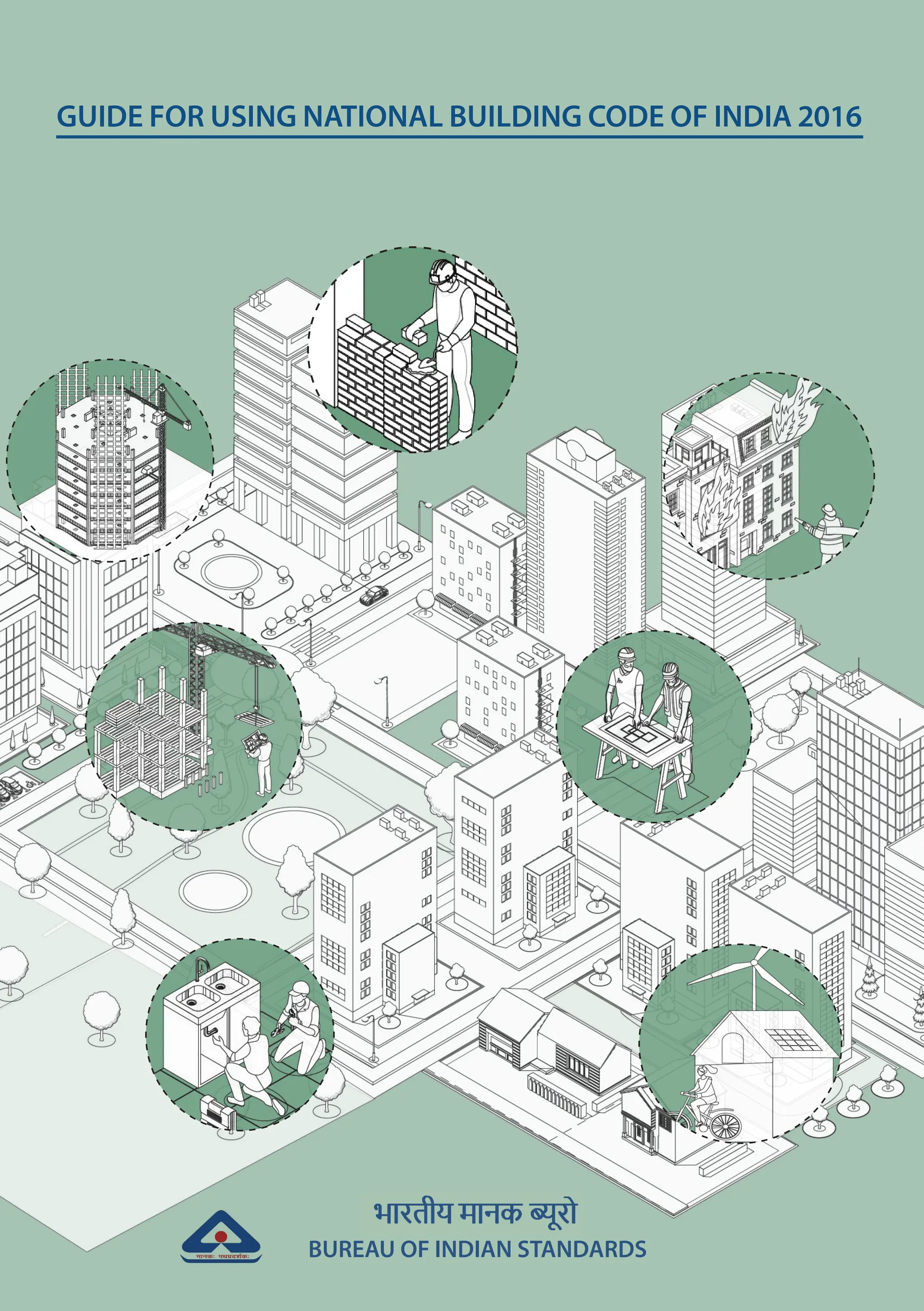
GUIDE FOR USING NATIONAL BUILDING CODE OF INDIA 2016
3
GUIDE FOR USING NATIONAL BUILDING CODE OF INDIA 2016
BUREAU OF INDIAN STANDARDS
Guide for Using
National Building Code of India 2016
NOTE – This guide can only be published after obtaining in writing requisite permission from
Bureau of Indian Standards.
WARNING – Kindly note that extracts from BIS Publications may not be reproduced in any
form without prior permission as this is in violation of the Copyrights Act, 1957.
i
GUIDE FOR USING NATIONAL BUILDING CODE OF INDIA 2016
Bureau of Indian Standards (BIS) is the National Standards Body
of India established under the BIS Act 2016 for development
of standards, marking and quality certification of goods and for
matters connected therewith or incidental thereto. BIS has been
providing traceable and tangible benefits to the national economy
in a number of ways – ensuring provision of safe reliable quality
goods; minimizing health hazards to consumers; promoting
exports and imports substitute; control over proliferation of
varieties, etc through standardization, certification and testing.
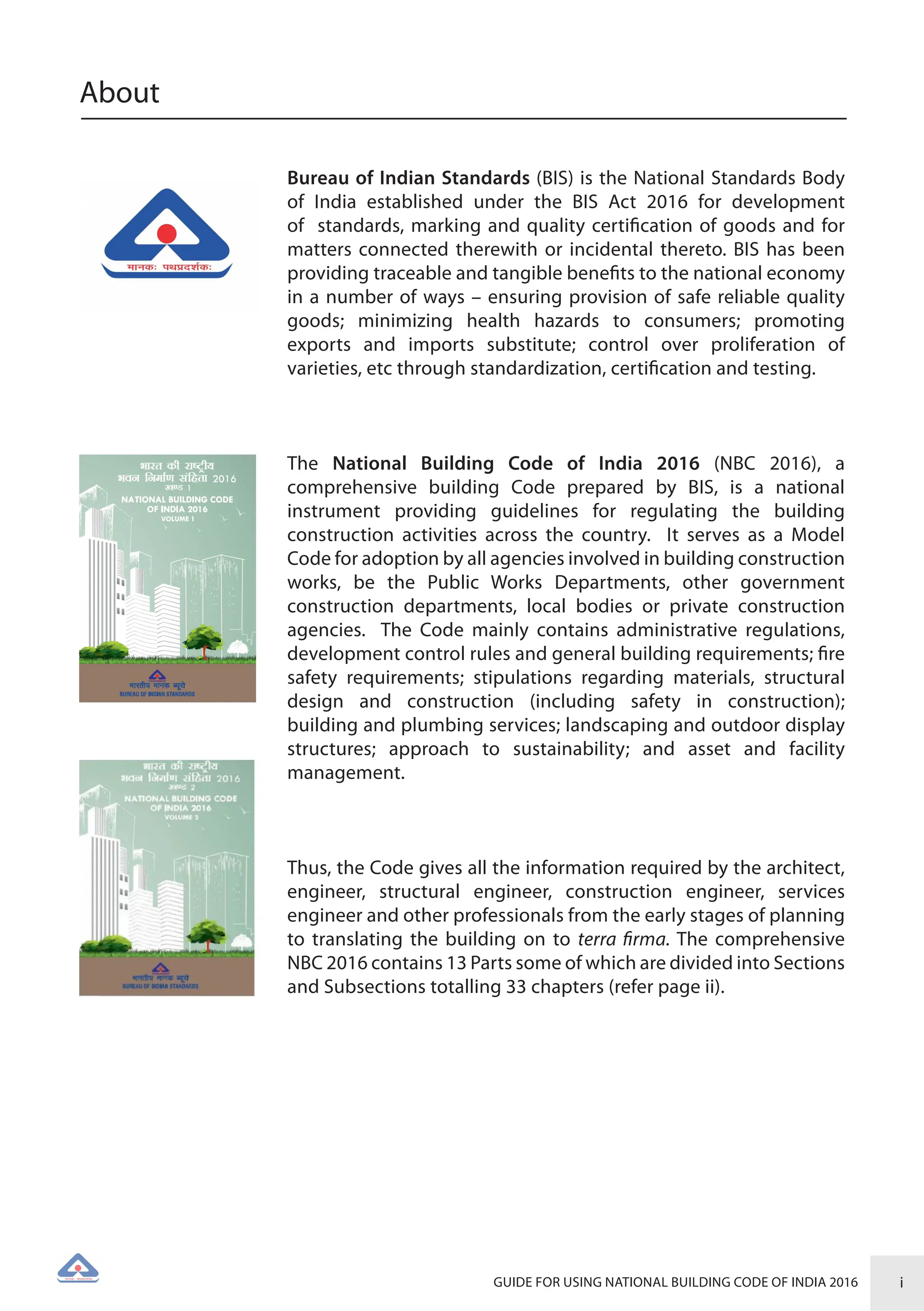
The National Building Code of India 2016 (NBC 2016), a
comprehensive building Code prepared by BIS, is a national
instrument providing guidelines for regulating the building
construction activities across the country. It serves as a Model
Code for adoption by all agencies involved in building construction
works, be the Public Works Departments, other government
construction departments, local bodies or private construction
agencies. The Code mainly contains administrative regulations,
development control rules and general building requirements; fire
safety requirements; stipulations regarding materials, structural
design and construction (including safety in construction);
building and plumbing services; landscaping and outdoor display
structures; approach to sustainability; and asset and facility
management.
Thus, the Code gives all the information required by the architect,
engineer, structural engineer, construction engineer, services
engineer and other professionals from the early stages of planning
to translating the building on to terra firma. The comprehensive
NBC 2016 contains 13 Parts some of which are divided into Sections
and Subsections totalling 33 chapters (refer page ii).
About
ii GUIDE FOR USING NATIONAL BUILDING CODE OF INDIA 2016
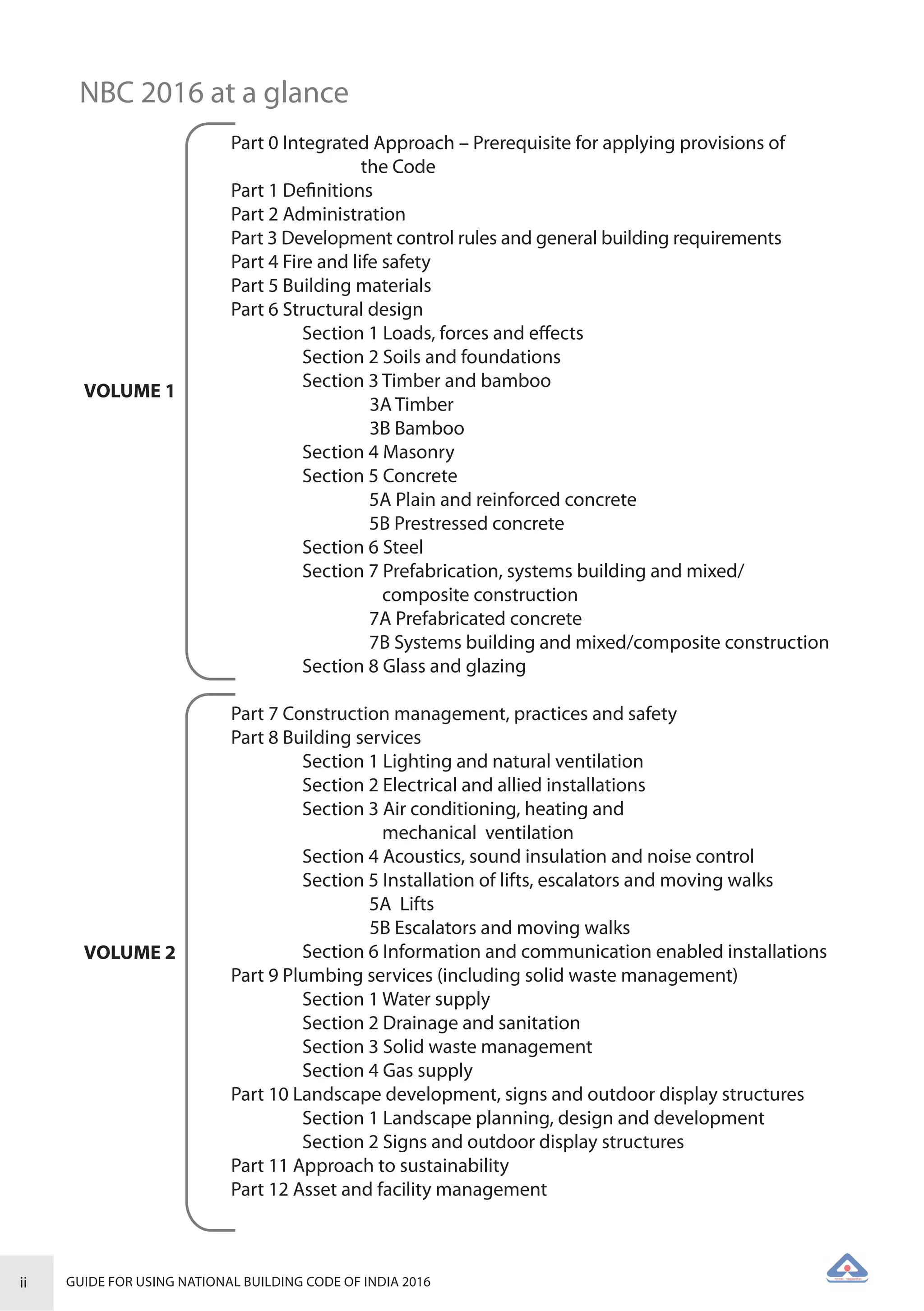
Part 0 Integrated Approach – Prerequisite for applying provisions of
the Code
Part 1 Definitions
Part 2 Administration
Part 3 Development control rules and general building requirements
Part 4 Fire and life safety
Part 5 Building materials
Part 6 Structural design
Section 1 Loads, forces and effects
Section 2 Soils and foundations
Section 3 Timber and bamboo
3A Timber
3B Bamboo
Section 4 Masonry
Section 5 Concrete
5A Plain and reinforced concrete
5B Prestressed concrete
Section 6 Steel
Section 7 Prefabrication, systems building and mixed/
composite construction
7A Prefabricated concrete
7B Systems building and mixed/composite construction
Section 8 Glass and glazing
Part 7 Construction management, practices and safety
Part 8 Building services
Section 1 Lighting and natural ventilation
Section 2 Electrical and allied installations
Section 3 Air conditioning, heating and
mechanical ventilation
Section 4 Acoustics, sound insulation and noise control
Section 5 Installation of lifts, escalators and moving walks
5A Lifts
5B Escalators and moving walks
Section 6 Information and communication enabled installations
Part 9 Plumbing services (including solid waste management)
Section 1 Water supply
Section 2 Drainage and sanitation
Section 3 Solid waste management
Section 4 Gas supply
Part 10 Landscape development, signs and outdoor display structures
Section 1 Landscape planning, design and development
Section 2 Signs and outdoor display structures
Part 11 Approach to sustainability
Part 12 Asset and facility management
VOLUME 1
VOLUME 2
NBC 2016 at a glance
1
GUIDE FOR USING NATIONAL BUILDING CODE OF INDIA 2016
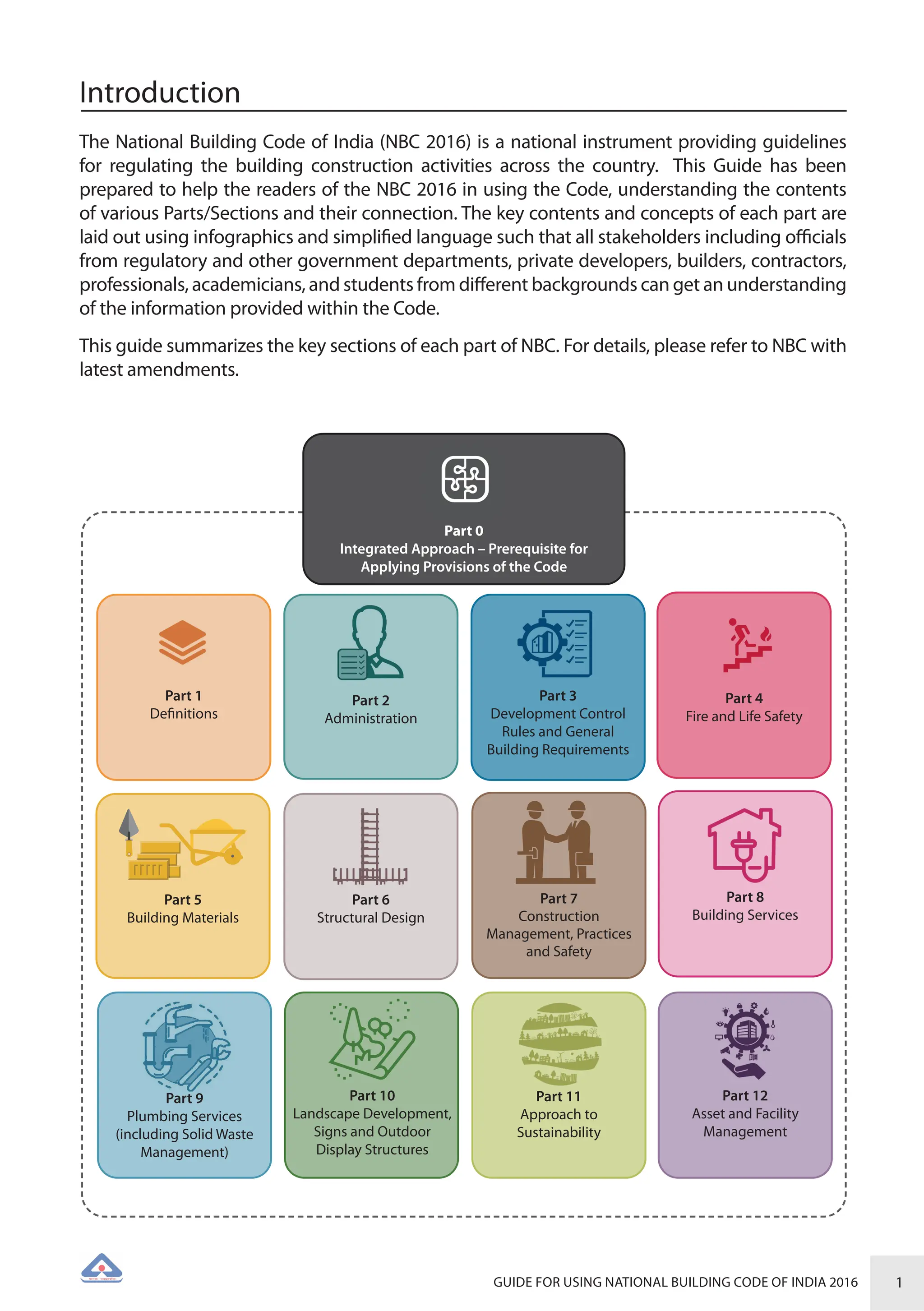
The National Building Code of India (NBC 2016) is a national instrument providing guidelines
for regulating the building construction activities across the country. This Guide has been
prepared to help the readers of the NBC 2016 in using the Code, understanding the contents
of various Parts/Sections and their connection. The key contents and concepts of each part are
laid out using infographics and simplified language such that all stakeholders including officials
from regulatory and other government departments, private developers, builders, contractors,
professionals, academicians, and students from different backgrounds can get an understanding
of the information provided within the Code.
Introduction
Part 0
Integrated Approach – Prerequisite for
Applying Provisions of the Code
Part 1
Definitions
Part 4
Fire and Life Safety
Part 7
Construction
Management, Practices
and Safety
Part 10
Landscape Development,
Signs and Outdoor
Display Structures
Part 2
Administration
Part 5
Building Materials
Part 8
Building Services
Part 11
Approach to
Sustainability
Part 3
Development Control
Rules and General
Building Requirements
Part 6
Structural Design
Part 9
Plumbing Services
(including Solid Waste
Management)
Part 12
Asset and Facility
Management
This guide summarizes the key sections of each part of NBC. For details, please refer to NBC with
latest amendments.
Integrated
Approach–
Prerequisite
for
Applying
Provisions
of
the
Code
2 GUIDE FOR USING NATIONAL BUILDING CODE OF INDIA 2016
Part 0 Integrated Approach– Prerequisite for Applying
Provisions of the Code
Key Content
This Part gives an overall direction for practical applications of different aspects of spatial
planning, designing and construction of buildings, and laying of services. It proposes
an integrated approach for utilizing appropriate knowledge and experience of qualified
professionals during the entire life cycle of a development/building project.
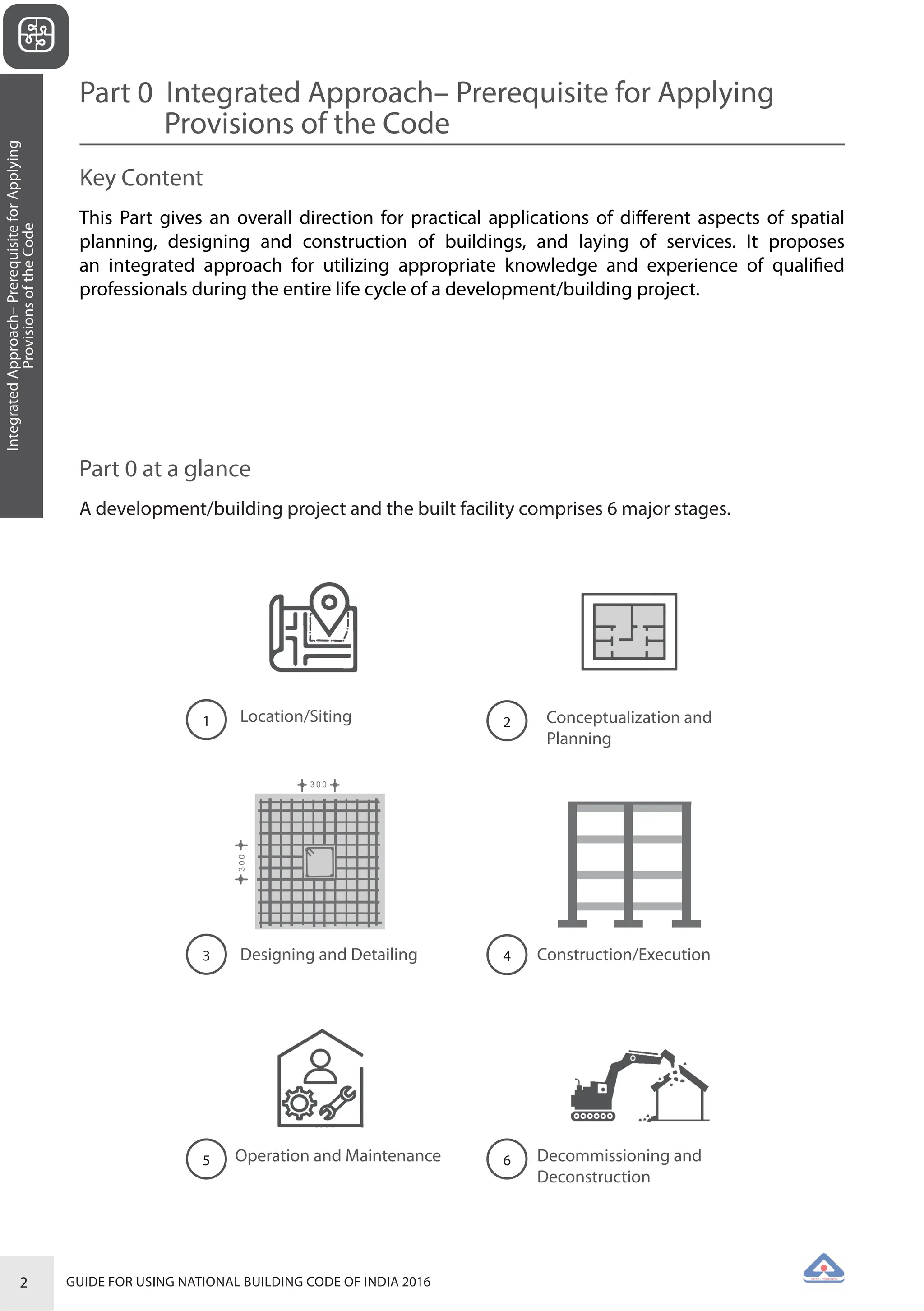
A development/building project and the built facility comprises 6 major stages.
Part 0 at a glance
Conceptualization and
Planning
Operation and Maintenance
Designing and Detailing
Decommissioning and
Deconstruction
Location/Siting
Construction/Execution
1
4
2
5
3
6
3
GUIDE FOR USING NATIONAL BUILDING CODE OF INDIA 2016
Depending on the complexity and magnitude of the project, a multidisciplinary team of
professionals need to be engaged as a well–coordinated team to achieve the desired delivery
in an effective manner.
For more details on Part 0, please refer to NBC 2016
Design Team Project Management
and Construction
Management Team
Operation and
Maintenance Team
Responsible at Planning,
Designing and
Development stage
Architect; Civil engineer; Structural engineer; Geotechnical engineer; Electrical engineer;
Plumbing engineer; Fire protection engineer; HVAC engineer; Lift, escalator and moving walk
specialist; Acoustics specialist; Information/Communication technology engineer; Health,
safety and environment specialist; Environment/Sustainability specialist;Town planner; Urban
designer; Landscape architect; Security system specialist; Interior designer; Quantity surveyor;
Project/Construction manager; Accessibility and universal design specialist; Asset/Facility
manager; and other subject specialists.
Responsible for
monitoring the project
for timely completion
within the cost meeting
stringent quality, health,
safety and environmental
standards
Responsible for
Operation and
Maintenance of building
assets
Key Teams of Multidisciplinary Professionals
Definition
4 GUIDE FOR USING NATIONAL BUILDING CODE OF INDIA 2016
Part 1 Definition
Key Content
There are approximately 1,776 terms defined in NBC 2016. Each Part or Section of the NBC
gives the definitions of the important terms used in it, which may be found in the clause
‘Terminology’for each Part/Section of NBC 2016.
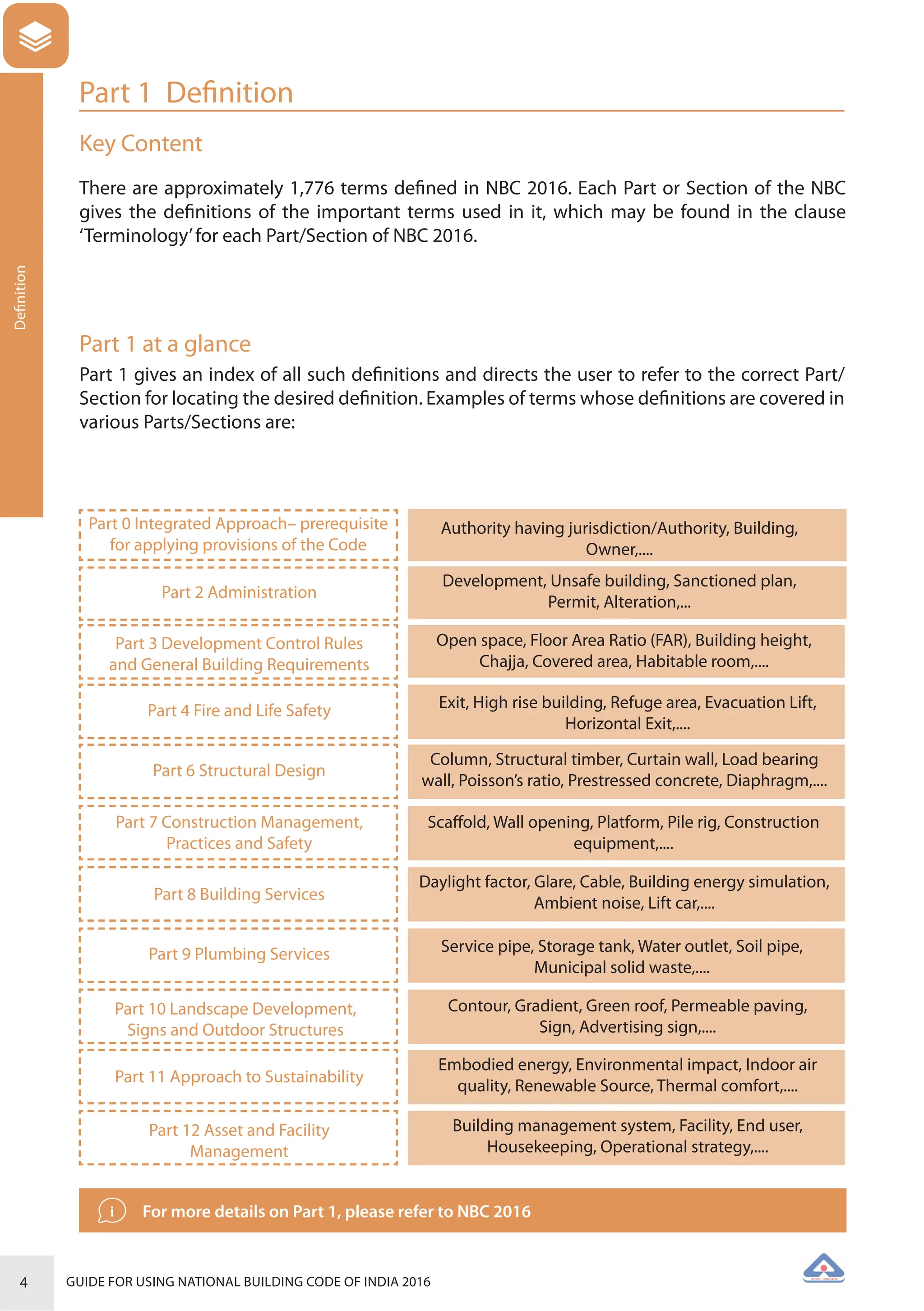
Part 1 gives an index of all such definitions and directs the user to refer to the correct Part/
Section for locating the desired definition. Examples of terms whose definitions are covered in
various Parts/Sections are:
Part 1 at a glance
Part 0 Integrated Approach– prerequisite
for applying provisions of the Code
Part 3 Development Control Rules
and General Building Requirements
Part 2 Administration
Part 4 Fire and Life Safety
Part 6 Structural Design
Part 7 Construction Management,
Practices and Safety
Part 8 Building Services
Part 9 Plumbing Services
Part 10 Landscape Development,
Signs and Outdoor Structures
Part 11 Approach to Sustainability
Part 12 Asset and Facility
Management
Authority having jurisdiction/Authority, Building,
Owner,....
Open space, Floor Area Ratio (FAR), Building height,
Chajja, Covered area, Habitable room,....
Development, Unsafe building, Sanctioned plan,
Permit, Alteration,...
Exit, High rise building, Refuge area, Evacuation Lift,
Horizontal Exit,....
Column, Structural timber, Curtain wall, Load bearing
wall, Poisson’s ratio, Prestressed concrete, Diaphragm,....
Scaffold, Wall opening, Platform, Pile rig, Construction
equipment,....
Daylight factor, Glare, Cable, Building energy simulation,
Ambient noise, Lift car,....
Service pipe, Storage tank, Water outlet, Soil pipe,
Municipal solid waste,....
Contour, Gradient, Green roof, Permeable paving,
Sign, Advertising sign,....
Embodied energy, Environmental impact, Indoor air
quality, Renewable Source, Thermal comfort,....
Building management system, Facility, End user,
Housekeeping, Operational strategy,....
For more details on Part 1, please refer to NBC 2016
Administration
5
GUIDE FOR USING NATIONAL BUILDING CODE OF INDIA 2016
Part 2 Administration
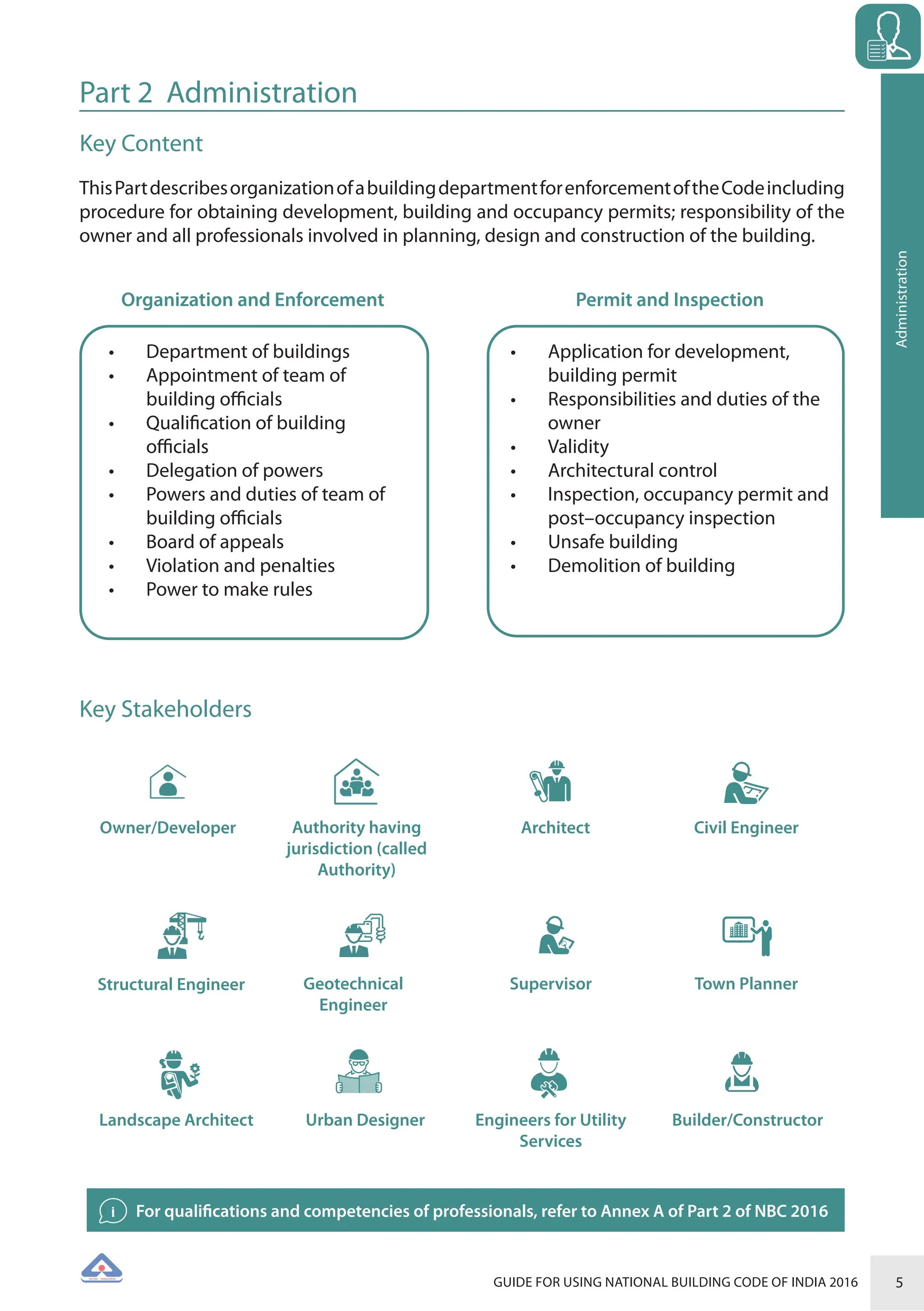
Key Stakeholders
Key Content
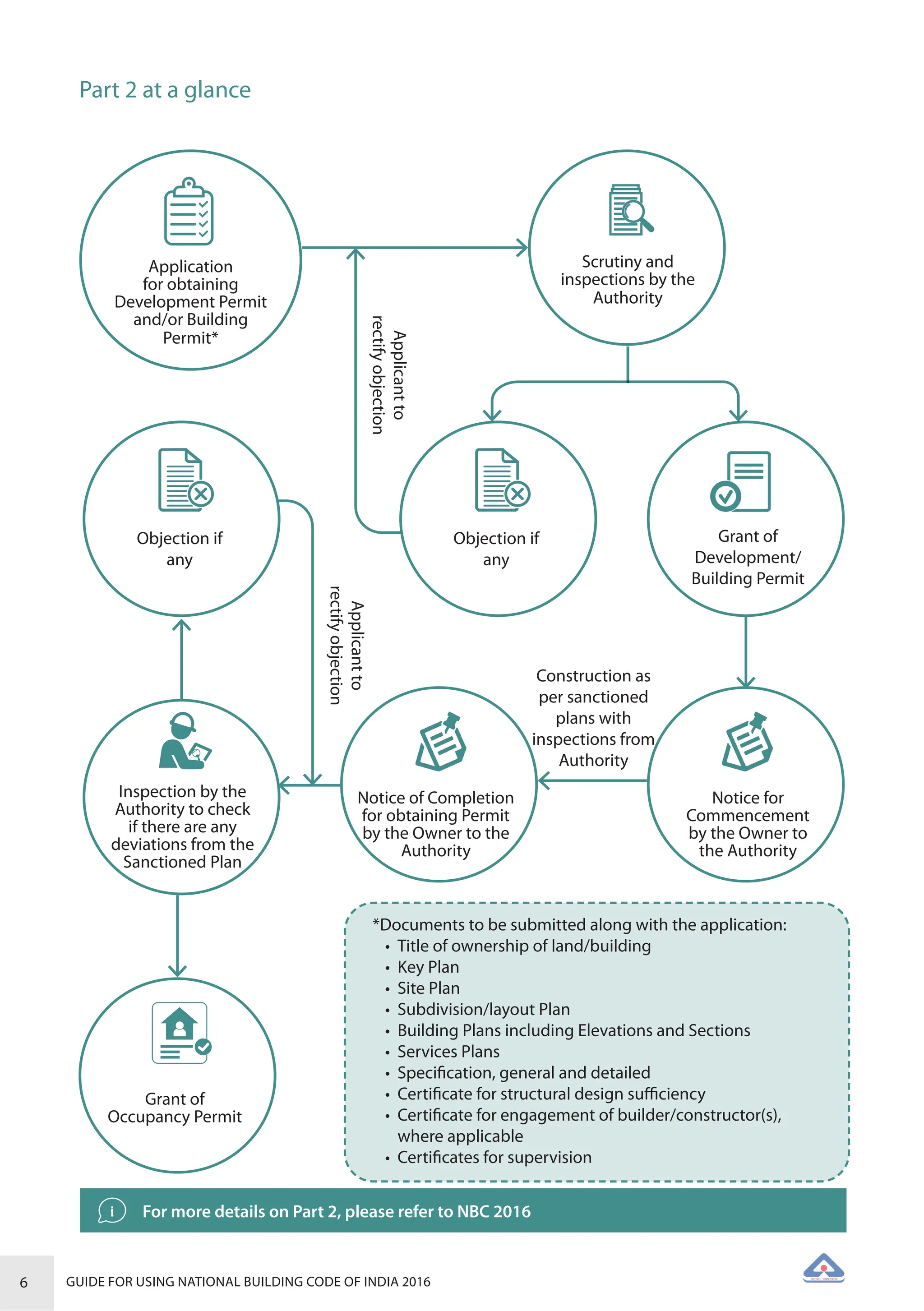
ThisPartdescribesorganizationofabuildingdepartmentforenforcementoftheCodeincluding
procedure for obtaining development, building and occupancy permits; responsibility of the
owner and all professionals involved in planning, design and construction of the building.
Permit and Inspection
Organization and Enforcement
• Application for development,
building permit
• Responsibilities and duties of the
owner
• Validity
• Architectural control
• Inspection, occupancy permit and
post–occupancy inspection
• Unsafe building
• Demolition of building
Architect
Structural Engineer Town Planner
Geotechnical
Engineer
Landscape Architect
Authority having
jurisdiction (called
Authority)
Civil Engineer
Supervisor
Urban Designer Engineers for Utility
Services
Builder/Constructor
Owner/Developer
• Department of buildings
• Appointment of team of
building officials
• Qualification of building
officials
• Delegation of powers
• Powers and duties of team of
building officials
• Board of appeals
• Violation and penalties
• Power to make rules
For qualifications and competencies of professionals, refer to Annex A of Part 2 of NBC 2016
6 GUIDE FOR USING NATIONAL BUILDING CODE OF INDIA 2016
For more details on Part 2, please refer to NBC 2016
Part 2 at a glance
*Documents to be submitted along with the application:
• Title of ownership of land/building
• Key Plan
• Site Plan
• Subdivision/layout Plan
• Building Plans including Elevations and Sections
• Services Plans
• Specification, general and detailed
• Certificate for structural design sufficiency
• Certificate for engagement of builder/constructor(s),
where applicable
• Certificates for supervision
Scrutiny and
inspections by the
Authority
Application
for obtaining
Development Permit
and/or Building
Permit*
Grant of
Development/
Building Permit
Applicant
to
rectify
objection
Applicant
to
rectify
objection
Objection if
any
Objection if
any
Notice for
Commencement
by the Owner to
the Authority
Notice of Completion
for obtaining Permit
by the Owner to the
Authority
Inspection by the
Authority to check
if there are any
deviations from the
Sanctioned Plan
Grant of
Occupancy Permit
Construction as
per sanctioned
plans with
inspections from
Authority
Development
Control
Rules
and
General
Building
Requirements
7
GUIDE FOR USING NATIONAL BUILDING CODE OF INDIA 2016
Part 3 Development Control Rules and General Building
Requirements
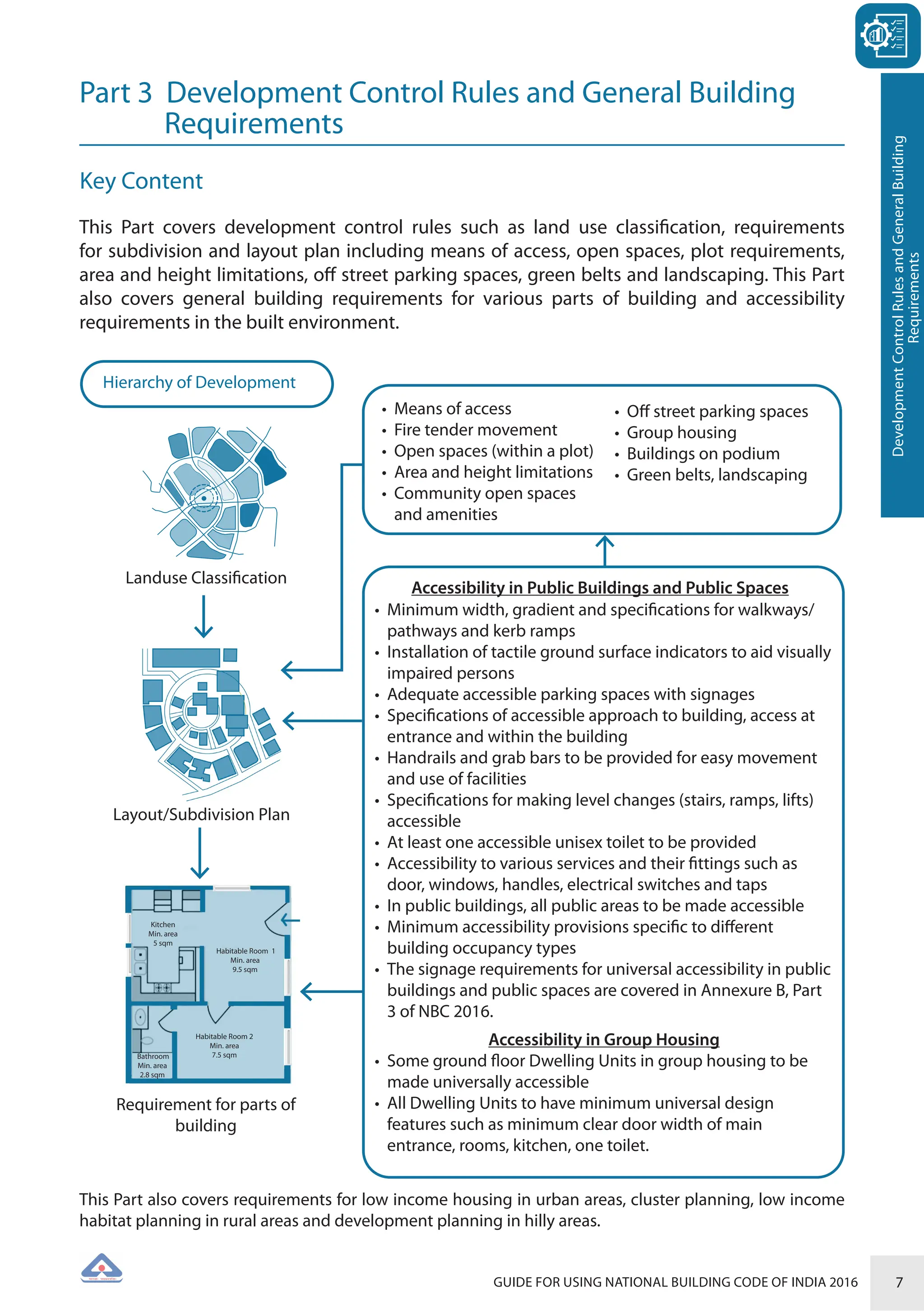
Key Content
This Part covers development control rules such as land use classification, requirements
for subdivision and layout plan including means of access, open spaces, plot requirements,
area and height limitations, off street parking spaces, green belts and landscaping. This Part
also covers general building requirements for various parts of building and accessibility
requirements in the built environment.
Landuse Classification
Layout/Subdivision Plan
Requirement for parts of
building
This Part also covers requirements for low income housing in urban areas, cluster planning, low income
habitat planning in rural areas and development planning in hilly areas.
• Means of access
• Fire tender movement
• Open spaces (within a plot)
• Area and height limitations
• Community open spaces
and amenities
• Off street parking spaces
• Group housing
• Buildings on podium
• Green belts, landscaping
• Minimum width, gradient and specifications for walkways/
pathways and kerb ramps
• Installation of tactile ground surface indicators to aid visually
impaired persons
• Adequate accessible parking spaces with signages
• Specifications of accessible approach to building, access at
entrance and within the building
• Handrails and grab bars to be provided for easy movement
and use of facilities
• Specifications for making level changes (stairs, ramps, lifts)
accessible
• At least one accessible unisex toilet to be provided
• Accessibility to various services and their fittings such as
door, windows, handles, electrical switches and taps
• In public buildings, all public areas to be made accessible
• Minimum accessibility provisions specific to different
building occupancy types
• The signage requirements for universal accessibility in public
buildings and public spaces are covered in Annexure B, Part
3 of NBC 2016.
Accessibility in Group Housing
• Some ground floor Dwelling Units in group housing to be
made universally accessible
• All Dwelling Units to have minimum universal design
features such as minimum clear door width of main
entrance, rooms, kitchen, one toilet.
Hierarchy of Development
Accessibility in Public Buildings and Public Spaces
Habitable Room 1
Min. area
9.5 sqm
Habitable Room 2
Min. area
7.5 sqm
Bathroom
Min. area
2.8 sqm
Kitchen
Min. area
5 sqm
8 GUIDE FOR USING NATIONAL BUILDING CODE OF INDIA 2016
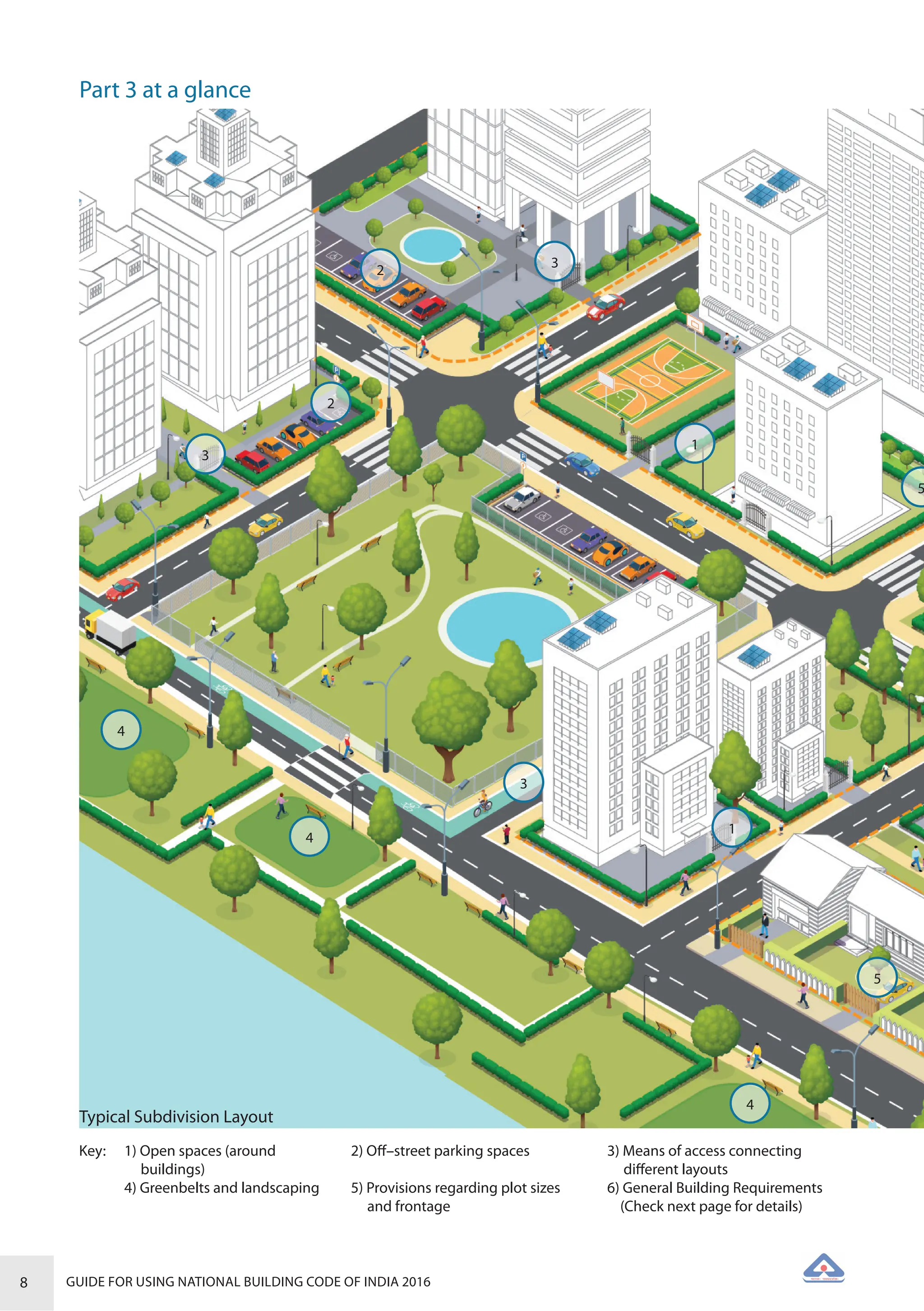
Part 3 at a glance
1) Open spaces (around 		
buildings)
4) Greenbelts and landscaping
2) Off–street parking spaces
5) Provisions regarding plot sizes
and frontage
3) Means of access connecting
different layouts
6) General Building Requirements
(Check next page for details)
Key:
Typical Subdivision Layout
5
5
1
1
2
2
3
3
3
4
4
4
9
GUIDE FOR USING NATIONAL BUILDING CODE OF INDIA 2016
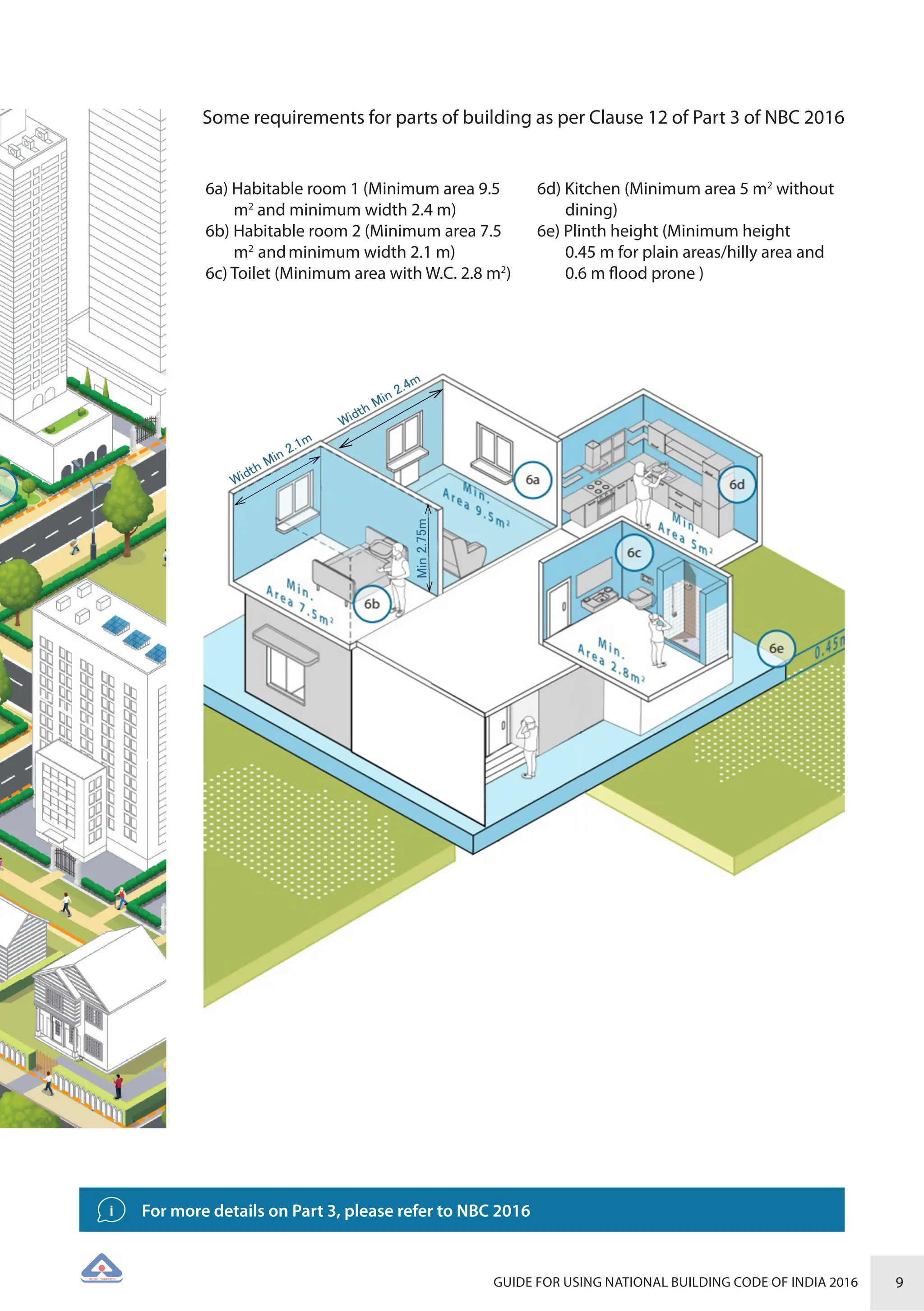
6d) Kitchen (Minimum area 5 m2
without
dining)
6e) Plinth height (Minimum height
0.45 m for plain areas/hilly area and
0.6 m flood prone )
6a) Habitable room 1 (Minimum area 9.5
m2
and minimum width 2.4 m)
6b) Habitable room 2 (Minimum area 7.5
m2
andminimum width 2.1 m)
6c) Toilet (Minimum area with W.C. 2.8 m2
)
For more details on Part 3, please refer to NBC 2016
Some requirements for parts of building as per Clause 12 of Part 3 of NBC 2016
5
10 GUIDE FOR USING NATIONAL BUILDING CODE OF INDIA 2016
Part 4 Fire and Life Safety
Key Content
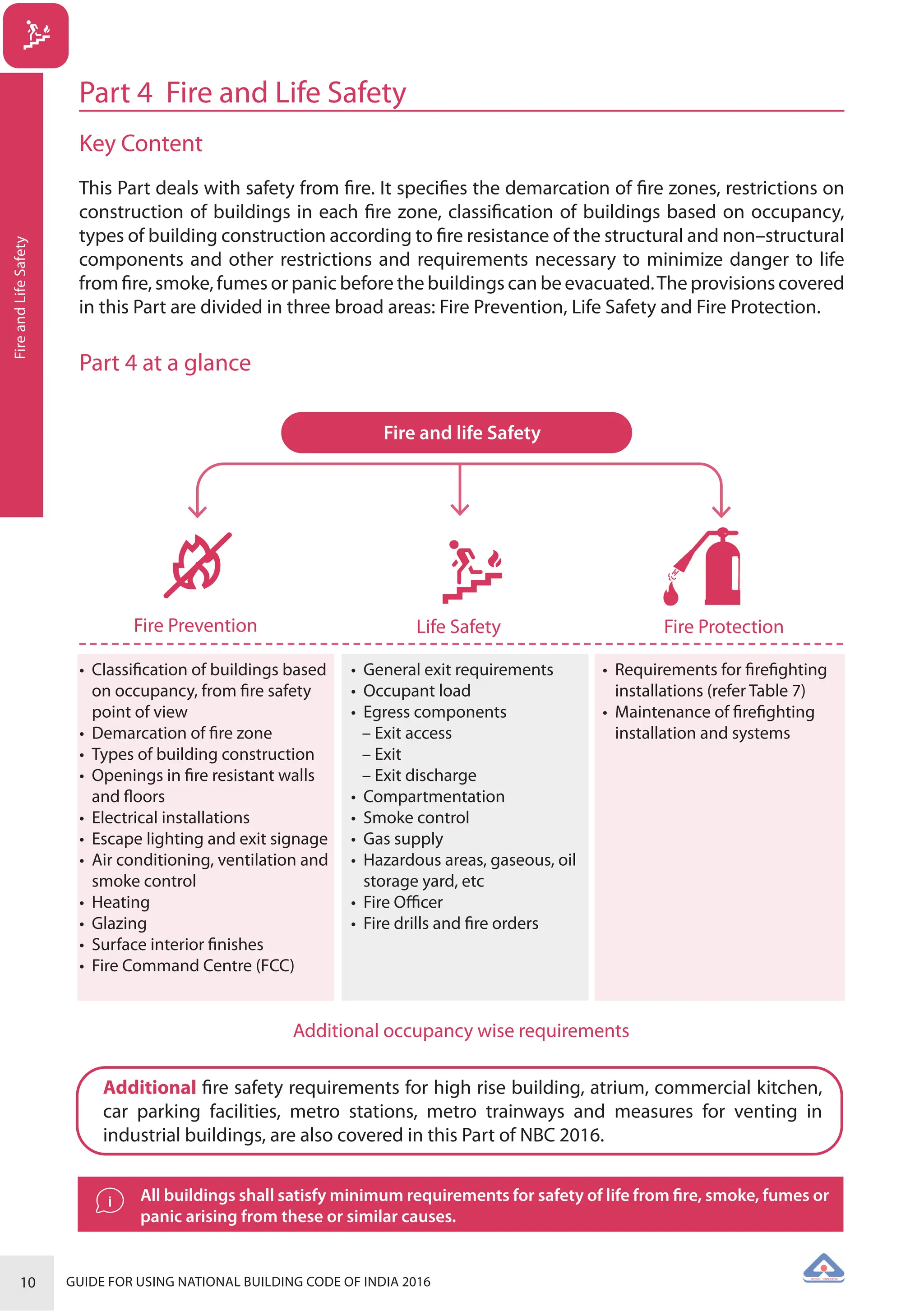
This Part deals with safety from fire. It specifies the demarcation of fire zones, restrictions on
construction of buildings in each fire zone, classification of buildings based on occupancy,
types of building construction according to fire resistance of the structural and non–structural
components and other restrictions and requirements necessary to minimize danger to life
from fire, smoke, fumes or panic before the buildings can be evacuated.The provisions covered
in this Part are divided in three broad areas: Fire Prevention, Life Safety and Fire Protection.
Life Safety Fire Protection
Fire Prevention
Part 4 at a glance
Fire and life Safety
• General exit requirements
• Occupant load
• Egress components
– Exit access
– Exit
– Exit discharge
• Compartmentation
• Smoke control
• Gas supply
• Hazardous areas, gaseous, oil
storage yard, etc
• Fire Officer
• Fire drills and fire orders
• Classification of buildings based
on occupancy, from fire safety
point of view
• Demarcation of fire zone
• Types of building construction
• Openings in fire resistant walls
and floors
• Electrical installations
• Escape lighting and exit signage
• Air conditioning, ventilation and
smoke control
• Heating
• Glazing
• Surface interior finishes
• Fire Command Centre (FCC)
• Requirements for firefighting
installations (refer Table 7)
• Maintenance of firefighting
installation and systems
Additional fire safety requirements for high rise building, atrium, commercial kitchen,
car parking facilities, metro stations, metro trainways and measures for venting in
industrial buildings, are also covered in this Part of NBC 2016.
Additional occupancy wise requirements
All buildings shall satisfy minimum requirements for safety of life from fire, smoke, fumes or
panic arising from these or similar causes.
Fire
and
Life
Safety
• Group G: Industrial Buildings
– Subdivision G–3 Buildings used for high hazard industries
• Group H: Storage Buildings
• Group J: Hazardous Buildings
11
GUIDE FOR USING NATIONAL BUILDING CODE OF INDIA 2016
Fire
Zone
2
Fire
Zone
3
• Group A: Residential Buildings
– Subdivision A–1 Lodging and rooming houses
– Subdivision A–2 One or two family private dwellings
– Subdivision A–3 Dormitories
– Subdivision A–4 Apartment houses
– Subdivision A–5 Hotels
– Subdivision A–6 Starred Hotels
• Group B: Educational Buildings
– Subdivision B–1 Schools up to senior secondary level
– Subdivision B–2 All others/training institutions
• Group C: Institutional Buildings
– Subdivision C–1 Hospitals and sanatoria
– Subdivision C–2 Custodial institutions
– Subdivision C–3 Penal and mental institutions
• Group D: Assembly Buildings
– Subdivision D–1 Buildings with stage and fixed seats over 1,000 persons
– Subdivision D–2 Buildings with stage and fixed seats upto 1,000 persons
– Subdivision D–3 Buildings without permanent stage, accommodation for 300 or more
persons, and no permanent seating arrangements
– Subdivision D–4 Buildings without permanent stage, accommodation less than 300
persons, and no permanent seating arrangements
– Subdivision D–5 Temporary structures designed for assembly
– Subdivision D–6 Shopping malls with multiplexes and food courts
- Subdivision D–7 Underground and elevated mass rapid transit system
• Group E: Business Buildings
– Subdivision E–1 Offices, banks, professional establishments
• Group F: Mercantile Buildings
– Subdivision F–1 Shops, stores departmental stores (area upto 500 m2
)
– Subdivision F–2 Shops, stores departmental stores (area > 500 m2
)
– Subdivision F–3 Underground shopping centres
• Group E: Business Buildings
– Subdivision E–2 Laboratories, outpatient clinics, research establishments, libraries and
test houses
– Subdivision E–3 Electronic data processing centres, computer installations,information
technology parks and call centres
– Subdivision E–4 Telephone exchanges
– Subdivision E–5 Broadcasting stations, T.V. stations and air traffic control towers
• Group G: Industrial Buildings
– Subdivision G–1 Buildings used for low hazard industries
– Subdivision G–2 Buildings used for moderate hazard industries
Classification of buildings based on occupancy.
The city or area under the jurisdiction of the Authority shall be demarcated into distinct fire zones
dependingupontheexistinglayout,typesofbuildingconstruction,classificationofexistingbuildings
based on occupancy and expected future development of the city or area. Intermixing of hazardous
occupancies should not be allowed in other zones.
Fire
Zone
1
FIRE PREVENTION
12 GUIDE FOR USING NATIONAL BUILDING CODE OF INDIA 2016
All buildings shall satisfy minimum requirements, for safety of life from fire, smoke, fumes
or panic arising from these or similar causes.
4
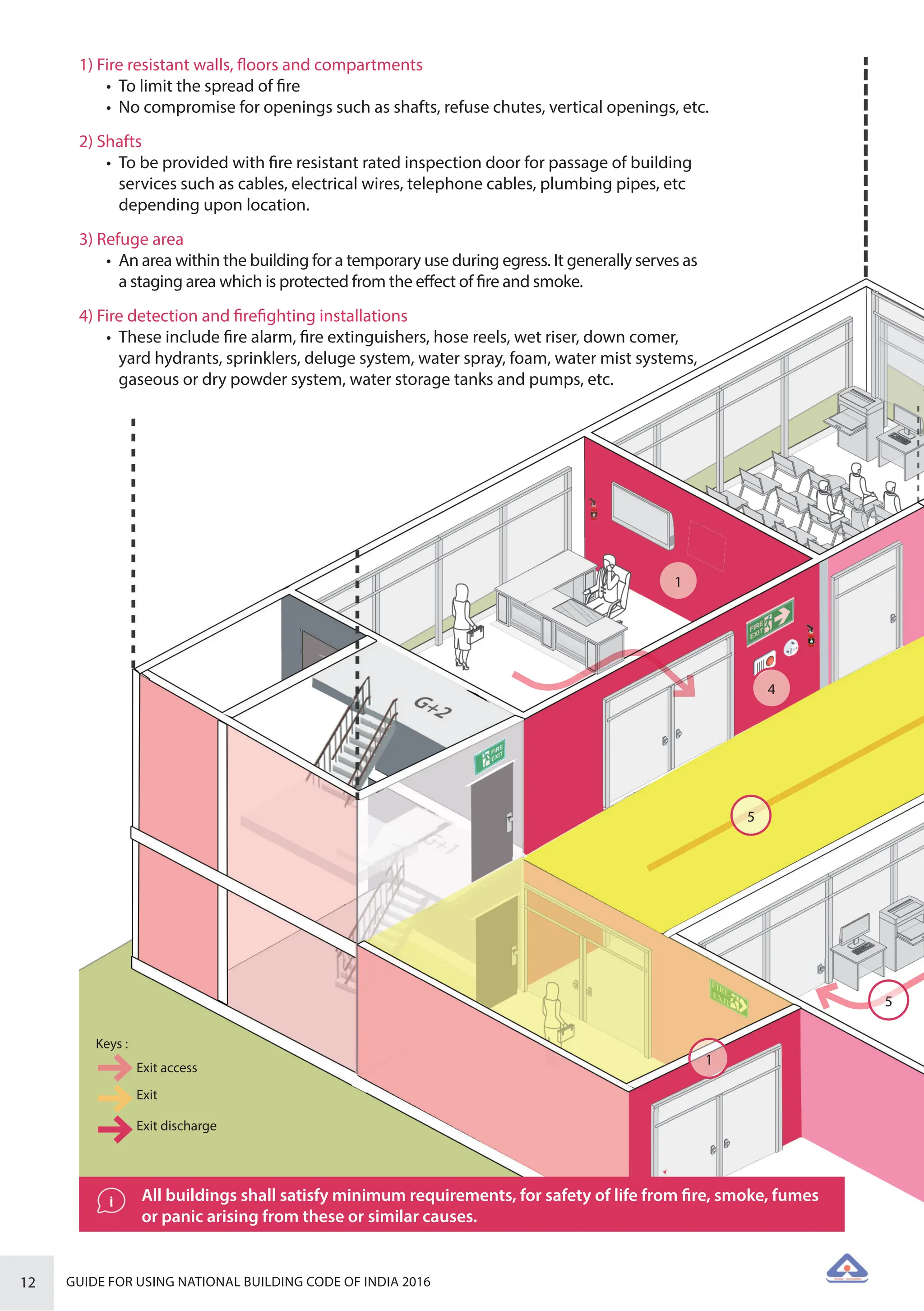
1) Fire resistant walls, floors and compartments
• To limit the spread of fire
• No compromise for openings such as shafts, refuse chutes, vertical openings, etc.
2) Shafts
• To be provided with fire resistant rated inspection door for passage of building
services such as cables, electrical wires, telephone cables, plumbing pipes, etc
depending upon location.
3) Refuge area
• An area within the building for a temporary use during egress. It generally serves as
a staging area which is protected from the effect of fire and smoke.
4) Fire detection and firefighting installations
• These include fire alarm, fire extinguishers, hose reels, wet riser, down comer,
yard hydrants, sprinklers, deluge system, water spray, foam, water mist systems,
gaseous or dry powder system, water storage tanks and pumps, etc.
5
5
1
1
Exit access
Exit discharge
Exit
Keys :
13
GUIDE FOR USING NATIONAL BUILDING CODE OF INDIA 2016
For more details on Part 4, please refer to NBC 2016
2
3
5
Key Plan (First Floor Plan)
Entry
Fire Exit
Fire
Tower
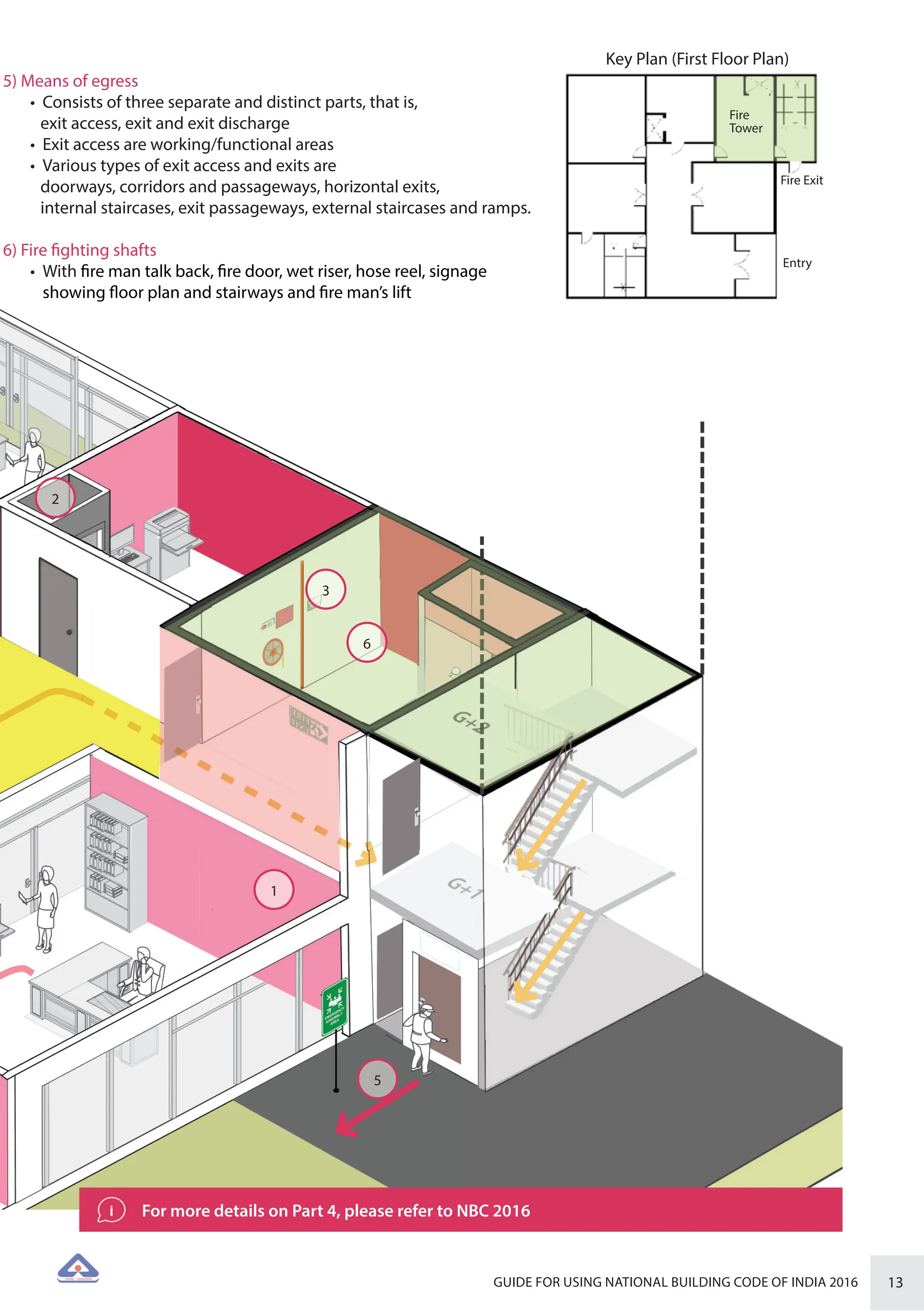
5) Means of egress
• Consists of three separate and distinct parts, that is,
exit access, exit and exit discharge
• Exit access are working/functional areas
• Various types of exit access and exits are
doorways, corridors and passageways, horizontal exits,
internal staircases, exit passageways, external staircases and ramps.
6) Fire fighting shafts
• With fire man talk back, fire door, wet riser, hose reel, signage
showing floor plan and stairways and fire man’s lift
6
1
Building
Materials
14 GUIDE FOR USING NATIONAL BUILDING CODE OF INDIA 2016
Part 5 Building Materials
Key Content
This Part covers the requirements of building materials and components, criteria for accepting
neworalternativebuildingmaterial.Itdetailsthequalityandeffectivenessofbuildingmaterials
used in the construction and of their storage, which are important aspects of building activity.
• Methods of Test
• Third Party Certification
• Materials
• Storage of Materials
• Sustainable Materials
• New or Alternative Materials
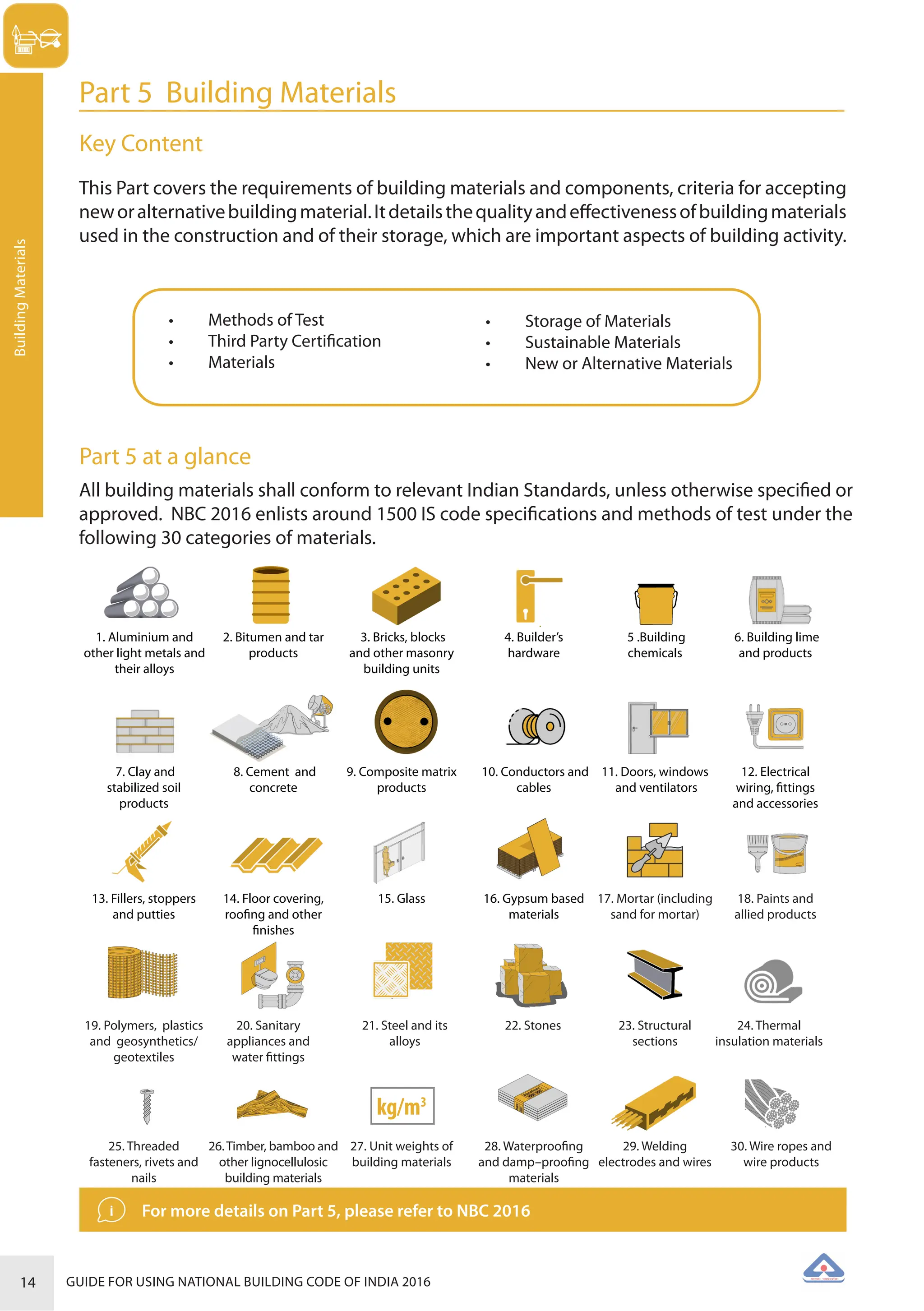
All building materials shall conform to relevant Indian Standards, unless otherwise specified or
approved. NBC 2016 enlists around 1500 IS code specifications and methods of test under the
following 30 categories of materials.
Part 5 at a glance
For more details on Part 5, please refer to NBC 2016
30. Wire ropes and
wire products
18. Paints and
allied products
12. Electrical
wiring, fittings
and accessories
6. Building lime
and products
24. Thermal
insulation materials
23. Structural
sections
29. Welding
electrodes and wires
17. Mortar (including
sand for mortar)
11. Doors, windows
and ventilators
5 .Building
chemicals
22. Stones
28. Waterproofing
and damp–proofing
materials
16. Gypsum based
materials
10. Conductors and
cables
4. Builder’s
hardware
21. Steel and its
alloys
26.Timber, bamboo and
other lignocellulosic
building materials
14. Floor covering,
roofing and other
finishes
8. Cement and
concrete
2. Bitumen and tar
products
27. Unit weights of
building materials
kg/m3
15. Glass
9. Composite matrix
products
3. Bricks, blocks
and other masonry
building units
20. Sanitary
appliances and
water fittings
25. Threaded
fasteners, rivets and
nails
13. Fillers, stoppers
and putties
7. Clay and
stabilized soil
products
1. Aluminium and
other light metals and
their alloys
19. Polymers, plastics
and geosynthetics/
geotextiles
Structural
Design
15
GUIDE FOR USING NATIONAL BUILDING CODE OF INDIA 2016
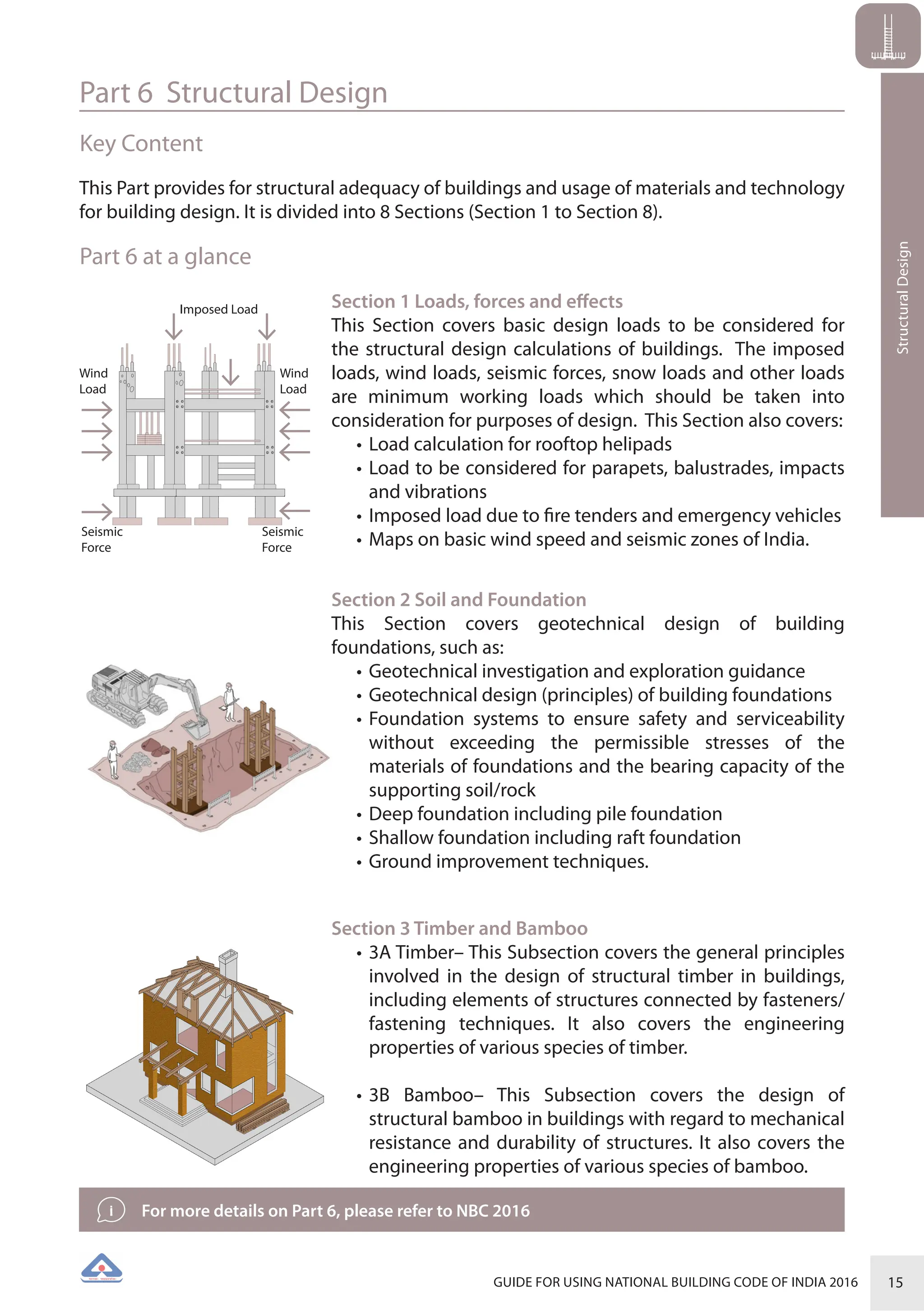
Part 6 at a glance
Imposed Load
For more details on Part 6, please refer to NBC 2016
Part 6 Structural Design
Key Content
This Part provides for structural adequacy of buildings and usage of materials and technology
for building design. It is divided into 8 Sections (Section 1 to Section 8).
Section 1 Loads, forces and effects
This Section covers basic design loads to be considered for
the structural design calculations of buildings. The imposed
loads, wind loads, seismic forces, snow loads and other loads
are minimum working loads which should be taken into
consideration for purposes of design. This Section also covers:
• Load calculation for rooftop helipads
• Load to be considered for parapets, balustrades, impacts
and vibrations
• Imposed load due to fire tenders and emergency vehicles
• Maps on basic wind speed and seismic zones of India.
Section 2 Soil and Foundation
This Section covers geotechnical design of building
foundations, such as:
• Geotechnical investigation and exploration guidance
• Geotechnical design (principles) of building foundations
• Foundation systems to ensure safety and serviceability
without exceeding the permissible stresses of the
materials of foundations and the bearing capacity of the
supporting soil/rock
• Deep foundation including pile foundation
• Shallow foundation including raft foundation
• Ground improvement techniques.
Section 3 Timber and Bamboo
• 3A Timber– This Subsection covers the general principles
involved in the design of structural timber in buildings,
including elements of structures connected by fasteners/
fastening techniques. It also covers the engineering
properties of various species of timber.
• 3B Bamboo– This Subsection covers the design of
structural bamboo in buildings with regard to mechanical
resistance and durability of structures. It also covers the
engineering properties of various species of bamboo.
Wind
Load
Wind
Load
Seismic
Force
Seismic
Force
16 GUIDE FOR USING NATIONAL BUILDING CODE OF INDIA 2016
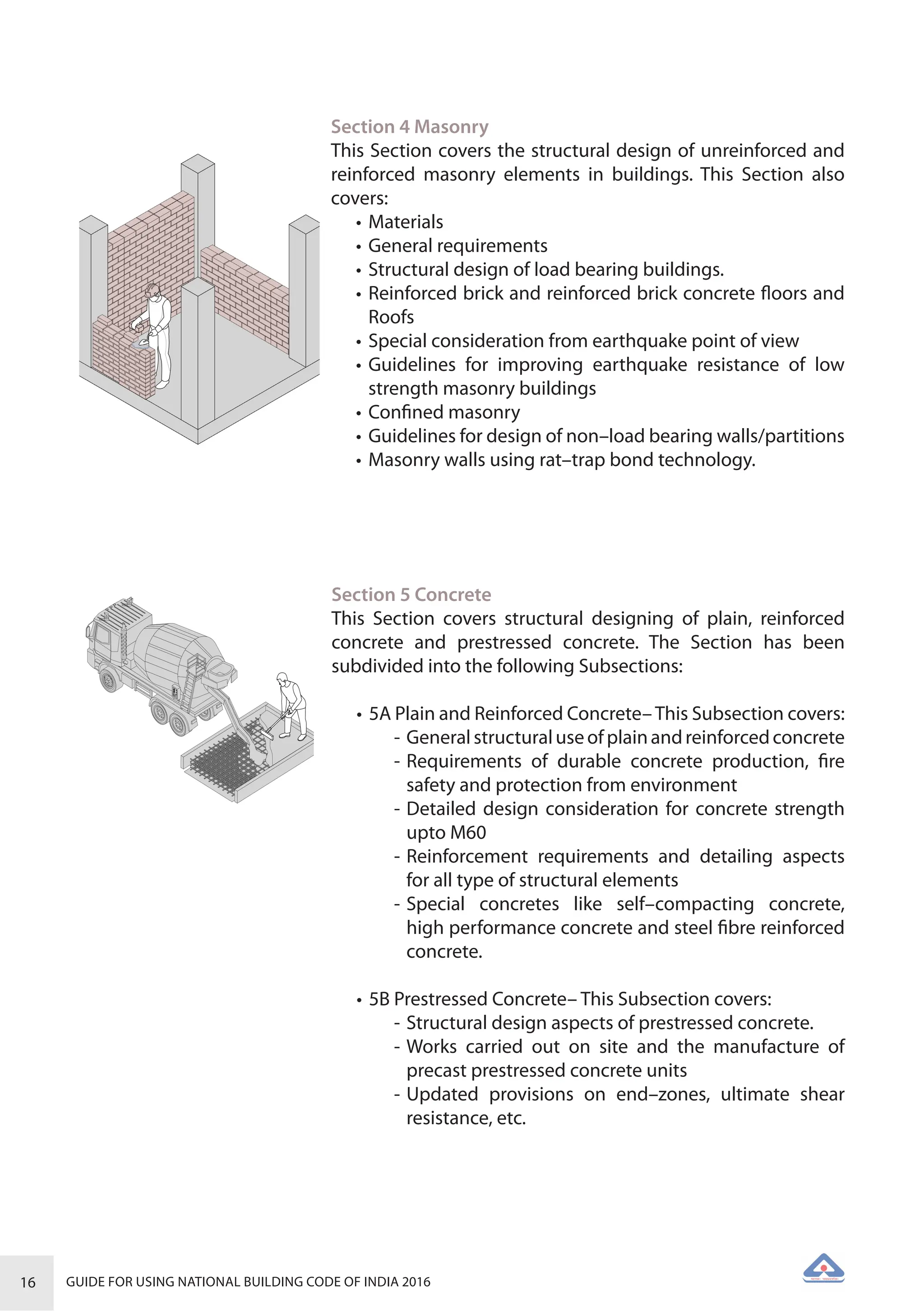
Section 4 Masonry
This Section covers the structural design of unreinforced and
reinforced masonry elements in buildings. This Section also
covers:
• Materials
• General requirements
• Structural design of load bearing buildings.
• Reinforced brick and reinforced brick concrete floors and
Roofs
• Special consideration from earthquake point of view
• Guidelines for improving earthquake resistance of low
strength masonry buildings
• Confined masonry
• Guidelines for design of non–load bearing walls/partitions
• Masonry walls using rat–trap bond technology.
Section 5 Concrete
This Section covers structural designing of plain, reinforced
concrete and prestressed concrete. The Section has been
subdivided into the following Subsections:
• 5A Plain and Reinforced Concrete–This Subsection covers:
- Generalstructuraluseofplainandreinforcedconcrete
- Requirements of durable concrete production, fire
safety and protection from environment
- Detailed design consideration for concrete strength
upto M60
- Reinforcement requirements and detailing aspects
for all type of structural elements
- Special concretes like self–compacting concrete,
high performance concrete and steel fibre reinforced
concrete.
• 5B Prestressed Concrete– This Subsection covers:
- Structural design aspects of prestressed concrete.
- Works carried out on site and the manufacture of
precast prestressed concrete units
- Updated provisions on end–zones, ultimate shear
resistance, etc.
17
GUIDE FOR USING NATIONAL BUILDING CODE OF INDIA 2016
Section 7 Prefabrication, Systems Building and Mixed/
Composite Construction
The Section has been subdivided into the following Subsections:
• 7A Prefabricated Concrete– This Subsection gives:
- Recommendations regarding modular planning,
component sizes, prefabrication systems
- Design considerations, joints & testing
- Manufacture, storage, transportation and erection
- Other related requirements for prefabricated
concrete.
• 7B Systems Buildings and Mixed/Composite Construction–
This Subsection covers:
- Recommendations regarding modular planning,
component sizes
- Joints, manufacture, storage, transport and erection
of prefabricated elements
- Other related requirements for systems building and
mixed/composite construction.
For more details on Part 6, please refer to NBC 2016
Section 8 Glass and Glazing
This Section covers:
• Selection and application of glass in buildings
• Types of glass, its requirements and associated glazing
materials
• Glazing in buildings with respect to its effect on energy,
visual (light) and solar environments
• Design of glass in buildings, subject to wind loading,
seismic loading
• Selection, manifestation of glass in buildings, subject to
safety with respect to human impact of the occupants
• Selection, design, fabrication, installation, testing and
maintenance of glazing systems.
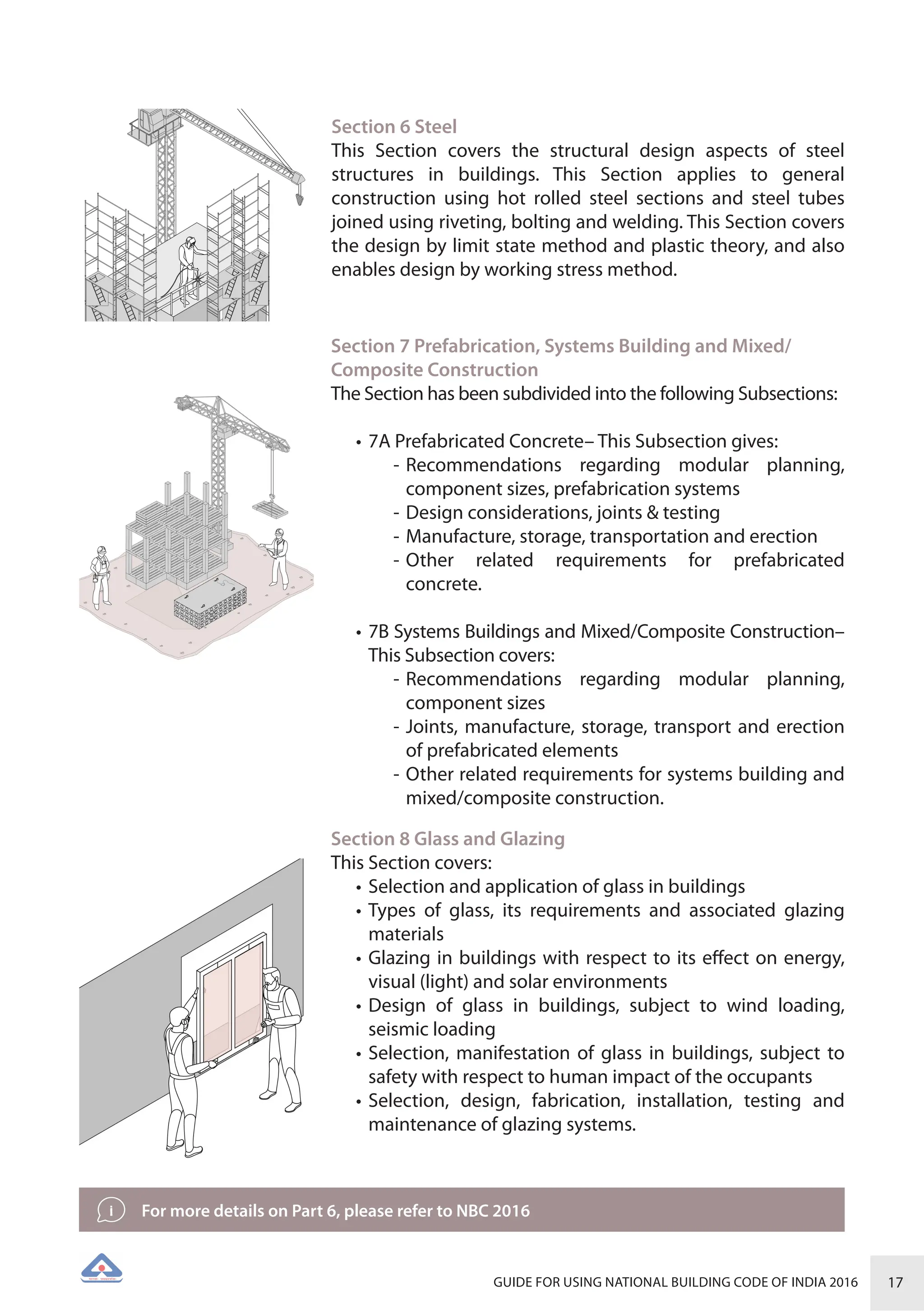
Section 6 Steel
This Section covers the structural design aspects of steel
structures in buildings. This Section applies to general
construction using hot rolled steel sections and steel tubes
joined using riveting, bolting and welding. This Section covers
the design by limit state method and plastic theory, and also
enables design by working stress method.
Construction
Management,
Practices
and
Safety
18 GUIDE FOR USING NATIONAL BUILDING CODE OF INDIA 2016
Part 7 Construction Management, Practices and Safety
Key Content
This Part covers construction project management, construction planning, site management
and building construction practices, storage, stacking and handling of materials. It also deals
with safety of personnel during construction operations, demolition of buildings, habitat
and welfare requirements for workers. The guidelines relating to repairs, retrofitting and
strengthening of buildings are covered under this Part.
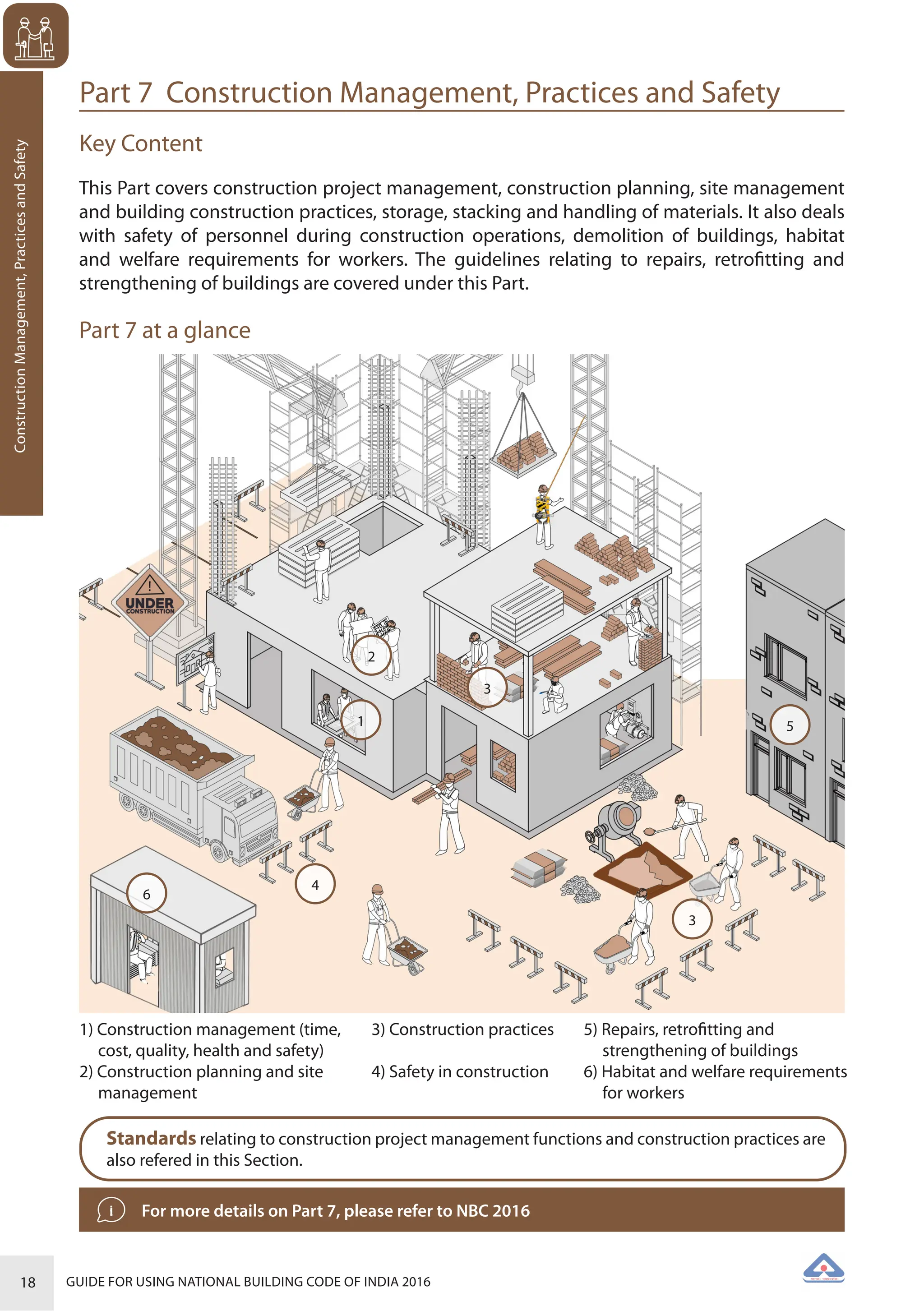
Part 7 at a glance
For more details on Part 7, please refer to NBC 2016
Standards relating to construction project management functions and construction practices are
also refered in this Section.
1
2
3
3
4
5
6
1) Construction management (time,
cost, quality, health and safety)
2) Construction planning and site
management
3) Construction practices
4) Safety in construction
5) Repairs, retrofitting and
strengthening of buildings
6) Habitat and welfare requirements
for workers
Building
Services
19
GUIDE FOR USING NATIONAL BUILDING CODE OF INDIA 2016
Part 8 Building Services
Key Content
All buildings meant for human habitation must be provided with adequate building services.
This Part prescribes requirements for building services, and is divided into 6 Sections.
Part 8 at a glance
Section 1 Lighting and Natural
Ventilation
Section 2 Electrical and Allied
Installations
Section 3 Air–conditioning,
Heating and Mechanical
Ventilation
Section 4 Acoustics, Sound
Insulation and Noise Control
Section 5 Installation of Lifts,
Escalators and Moving Walks
Section 6 Information and
Communication Enabled
Installation
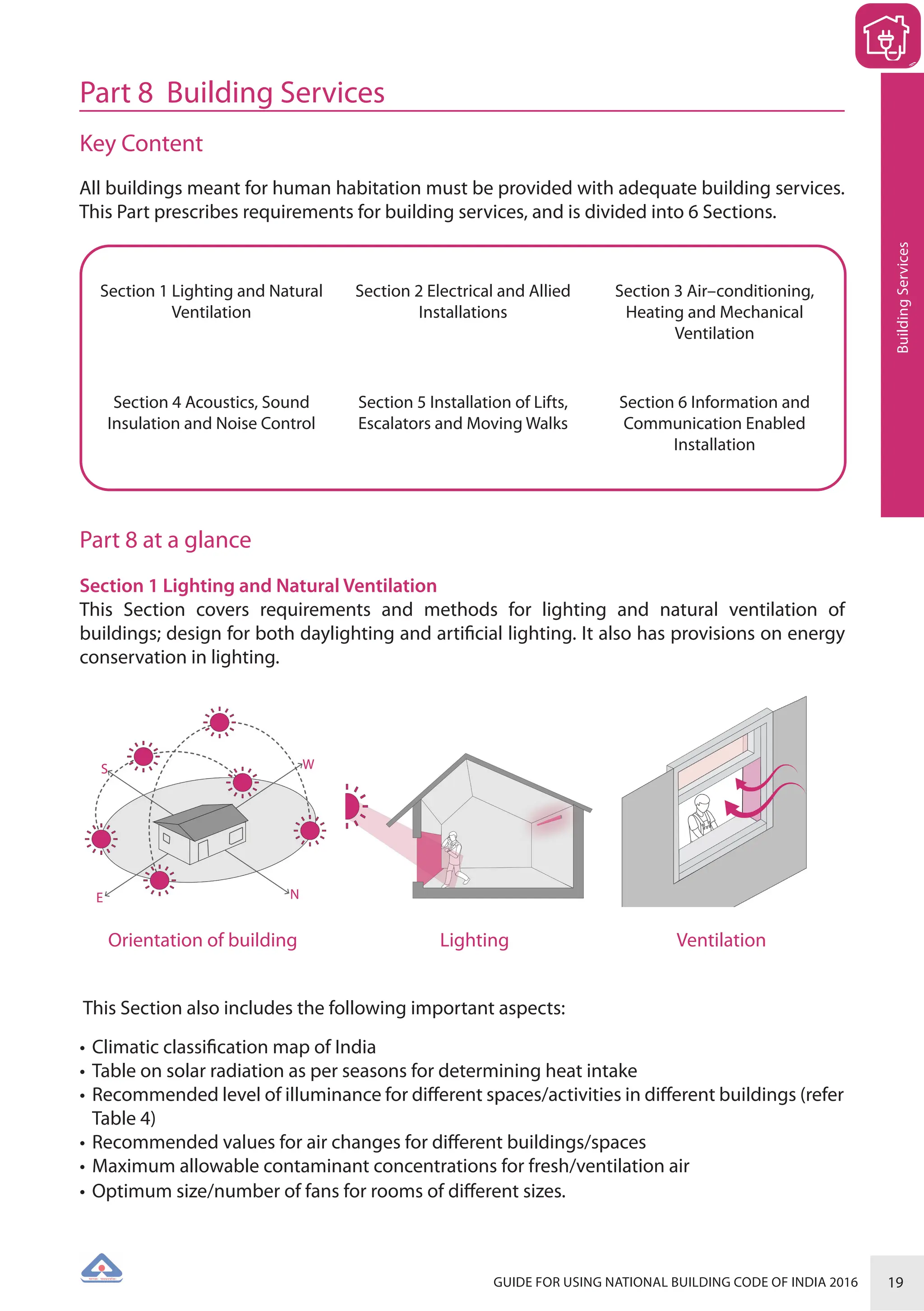
Section 1 Lighting and Natural Ventilation
This Section covers requirements and methods for lighting and natural ventilation of
buildings; design for both daylighting and artificial lighting. It also has provisions on energy
conservation in lighting.
This Section also includes the following important aspects:
• Climatic classification map of India
• Table on solar radiation as per seasons for determining heat intake
• Recommended level of illuminance for different spaces/activities in different buildings (refer
Table 4)
• Recommended values for air changes for different buildings/spaces
• Maximum allowable contaminant concentrations for fresh/ventilation air
• Optimum size/number of fans for rooms of different sizes.
Lighting Ventilation
Orientation of building
20 GUIDE FOR USING NATIONAL BUILDING CODE OF INDIA 2016
Planning of electric
installation
Distribution
of supply and
cabling
Allied/
miscellaneous
services
Inspection,
testing and
verification of
installation
Wiring (including
selection of size
of conductors)
Lightning protection
of buildings
Fittings and
accessories
Electrical
installation for
construction and
demolition sites
Earthing (including
maintenance free
earthing)
Protection of
human beings
from electrical
hazards
Section 3 Air conditioning, Heating and Mechanical Ventilation
This Section covers planning, selection, design considerations, installation, testing and
commissioning of air conditioning, heating and mechanical ventilation systems for buildings.
Planning includes equipment room for central AC plant , air handling units and package units,
pipe shafts, supply/return air ducts and cooling tower.
Key aspects covered under the Section are as follows:
This Section also includes provisions on:
• Location of energy meters, centralized metering system and smart metering
• Requirements for electrical supply system for life and safety services
• Discrimination, cascading and limitation concepts for the coordination of protective
devices in electrical circuits
• Solar photovoltaic system
• Aviation obstacle lights
• Electrical supply for electric vehicle charging and car park management system
• Typical formats for checklists for handing over and commissioning of substation
equipment and earthing pit.
The electric and allied installations are to be carried out in conformity with the requirements
of the Electricity Act, 2003 and the Central Electrical Authority (measures relating to safety and
electric supply) regulations, 2010, as amended from time to time.
Section 2 Electrical and Allied Installations
This Section covers the essential requirements for electrical installations in buildings to
ensure efficient use of electricity including safety from fire and shock. It also includes general
requirements relating to lightning protection of buildings and provisions on certain allied
installations.
Planning of electrical installations include planning spaces for substation, switch rooms,
emergency power back up system, distribution panels, overhead lines, wires and cables.
21
GUIDE FOR USING NATIONAL BUILDING CODE OF INDIA 2016
Refrigeration
for cold stores
Testing,
commissioning
and performance
validation
Specialized
application
Building automation
system for HVAC
control, monitoring
and verification
Symbols, units,
colour code and
identification of
services
Mechanical
ventilation
Installation of
HVAC system
Heating
Design of air
conditioning
Planning Outdoor and
indoor design
conditions
Refrigerants
This Section also includes provisions on:
• Design of indoor conditions as per adaptive thermal comfort model
• Minimum ventilation rates in breathing zone
• Energy efficient air conditioning systems such as variable refrigerant flow system, inverter
technology, district cooling system, hybrid central plant using chilled beams and radiant
floor components
• Envelope utilization using energy modelling, day light simulation, solar shade analysis
and wind modelling software
• Weather data of 60 cities of India
• Direct/indirect evaporative cooling units and geo–thermal cooling and heating
• HVAC systems for healthcare facilities, data centres and underground metro stations
• Energy efficient strategies for winter heating, using reverse cycle operation, solar heating
systems, electric heat pump and ground source heat pump
• Modern system of mechanical ventilation for industries, commercial kitchens,
underground parking and for open tunnel connecting underground metro stations
• Demand control ventilation and axial flow fans with aerofoil profile blades.
Section 4 Acoustics, Sound Insulation and Noise Control
This Section covers requirements and guidelines with regards to planning against outdoor
and indoor noise, acceptable noise levels and sound insulation in buildings with different
occupancies, such as residential, educational, hospital, industrial, office buildings, hotels,
hostels, laboratories, test houses and other miscellaneous buildings.
Key aspects covered in the Section are as follows:
This Section also includes the following aspects:
• Design techniques for noise control of building
services
• Guide for noise calculation, specifications for sound
insulation and noise rating
• Examples of special problems requiring expert
advice.
22 GUIDE FOR USING NATIONAL BUILDING CODE OF INDIA 2016
For more details on Part 8, please refer to NBC 2016
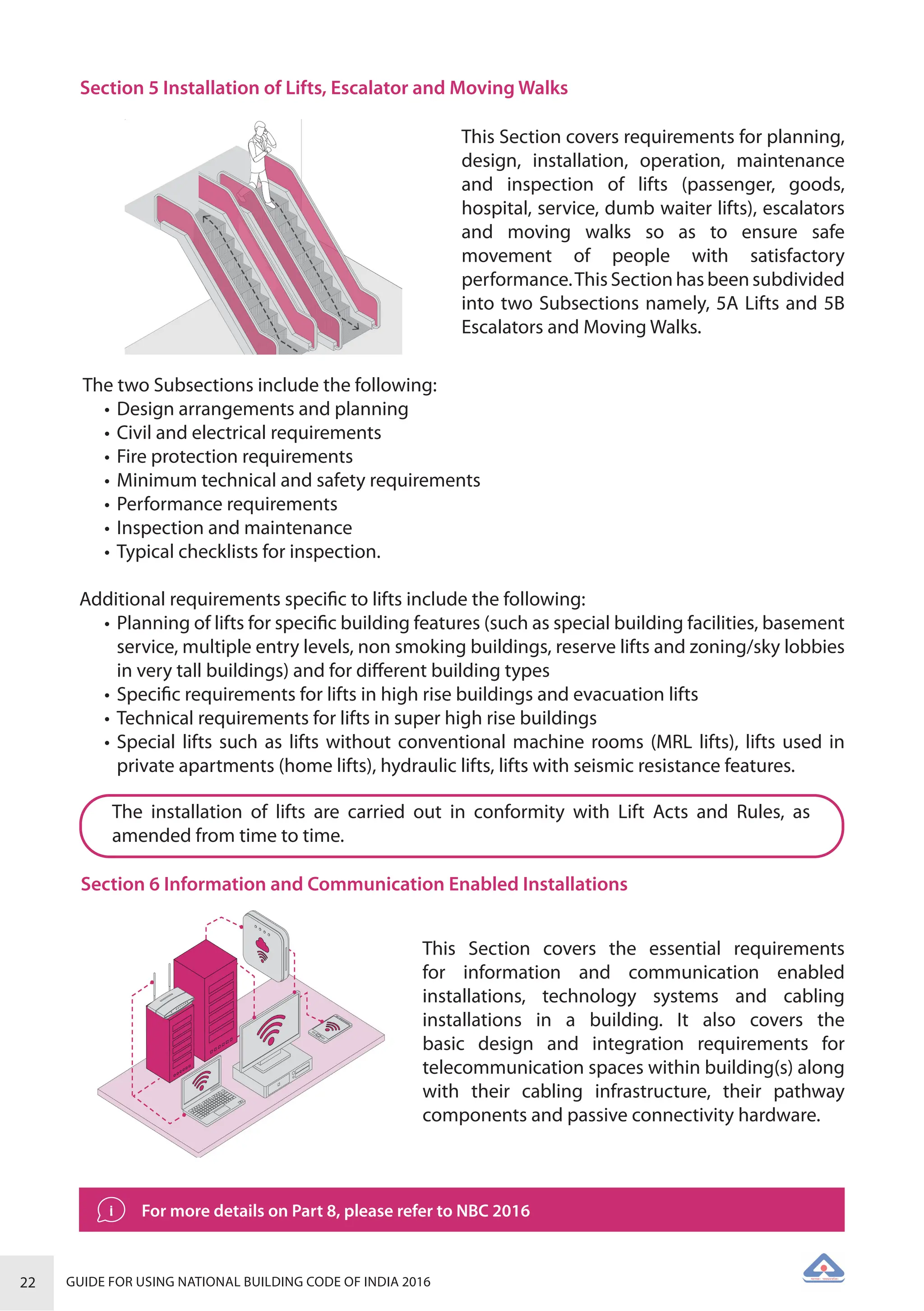
Section 5 Installation of Lifts, Escalator and Moving Walks
This Section covers requirements for planning,
design, installation, operation, maintenance
and inspection of lifts (passenger, goods,
hospital, service, dumb waiter lifts), escalators
and moving walks so as to ensure safe
movement of people with satisfactory
performance.This Section has been subdivided
into two Subsections namely, 5A Lifts and 5B
Escalators and Moving Walks.
The two Subsections include the following:
• Design arrangements and planning
• Civil and electrical requirements
• Fire protection requirements
• Minimum technical and safety requirements
• Performance requirements
• Inspection and maintenance
• Typical checklists for inspection.
Additional requirements specific to lifts include the following:
• Planning of lifts for specific building features (such as special building facilities, basement
service, multiple entry levels, non smoking buildings, reserve lifts and zoning/sky lobbies
in very tall buildings) and for different building types
• Specific requirements for lifts in high rise buildings and evacuation lifts
• Technical requirements for lifts in super high rise buildings
• Special lifts such as lifts without conventional machine rooms (MRL lifts), lifts used in
private apartments (home lifts), hydraulic lifts, lifts with seismic resistance features.
Section 6 Information and Communication Enabled Installations
This Section covers the essential requirements
for information and communication enabled
installations, technology systems and cabling
installations in a building. It also covers the
basic design and integration requirements for
telecommunication spaces within building(s) along
with their cabling infrastructure, their pathway
components and passive connectivity hardware.
The installation of lifts are carried out in conformity with Lift Acts and Rules, as
amended from time to time.
Plumbing
Services
(including
Solid
Waste
Management)
23
GUIDE FOR USING NATIONAL BUILDING CODE OF INDIA 2016
Part 9 Plumbing Services (including Solid Waste
Management)
Key Content
This Part has 4 Sections; for water supply, drainage and sanitation, solid waste management
and gas supply. All buildings meant for human habitation shall be provided with potable
water supply and adequate sanitary facilities.
Part 9 at a glance
Section 1 Water Supply Section 2 Drainage and sanitation
Section 3 Solid Waste Management Section 4 Gas Supply
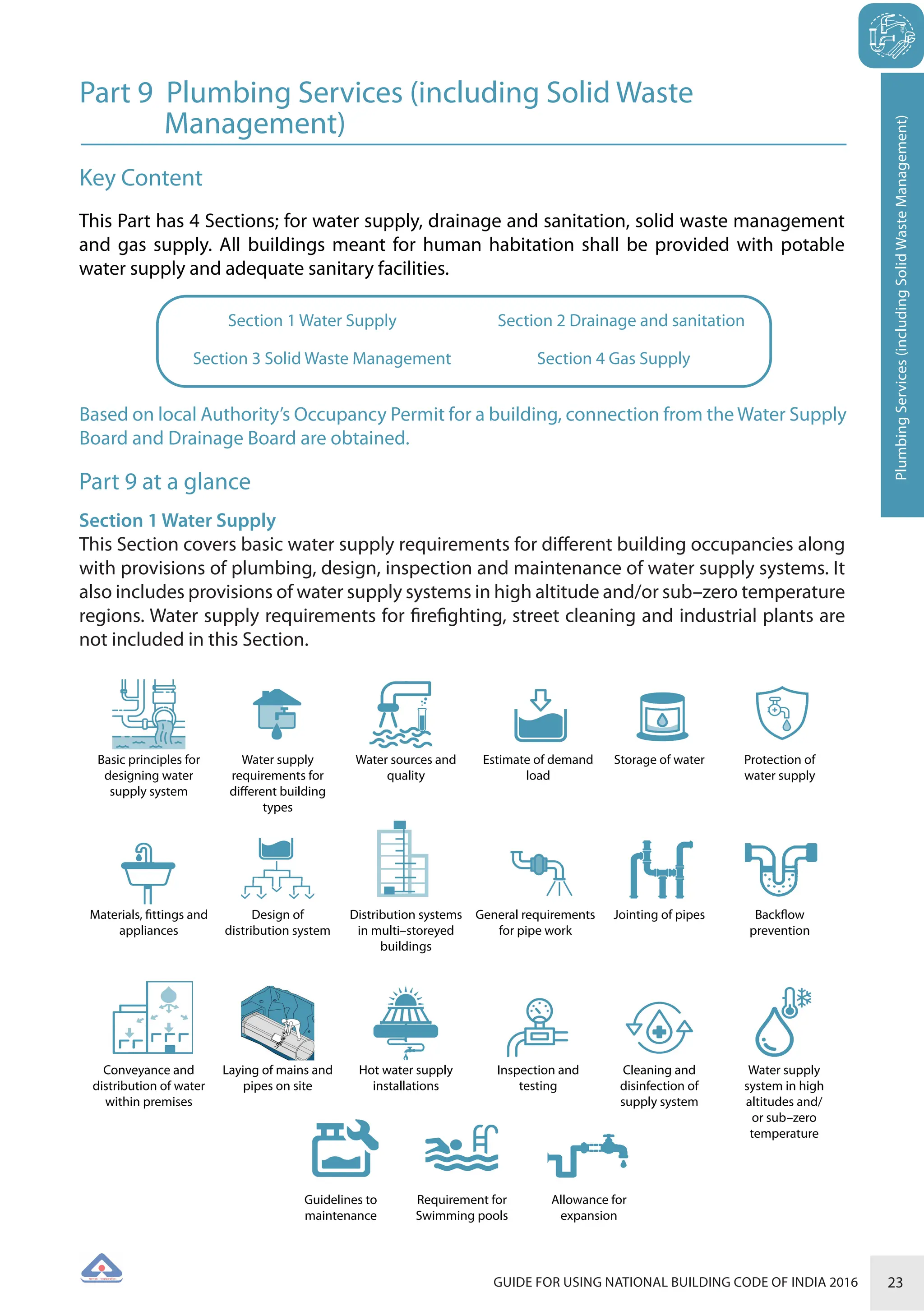
Section 1 Water Supply
This Section covers basic water supply requirements for different building occupancies along
with provisions of plumbing, design, inspection and maintenance of water supply systems. It
also includes provisions of water supply systems in high altitude and/or sub–zero temperature
regions. Water supply requirements for firefighting, street cleaning and industrial plants are
not included in this Section.
Protection of
water supply
Backflow
prevention
Water supply
system in high
altitudes and/
or sub–zero
temperature
Allowance for
expansion
Storage of water
Jointing of pipes
Cleaning and
disinfection of
supply system
Requirement for
Swimming pools
Estimate of demand
load
General requirements
for pipe work
Inspection and
testing
Guidelines to
maintenance
Water supply
requirements for
different building
types
Design of
distribution system
Laying of mains and
pipes on site
Water sources and
quality
Distribution systems
in multi–storeyed
buildings
Hot water supply
installations
Basic principles for
designing water
supply system
Materials, fittings and
appliances
Conveyance and
distribution of water
within premises
Based on local Authority’s Occupancy Permit for a building, connection from the Water Supply
Board and Drainage Board are obtained.
24 GUIDE FOR USING NATIONAL BUILDING CODE OF INDIA 2016
Section 2 Drainage and Sanitation
This Section covers drainage and sanitation requirements for buildings including design,
layout, construction, maintenance and connection up to point of disposal such as public
sewer, private sewer, individual sewerage disposal system, cesspool or any other approved
point of disposal/ treatment. It also includes requirements of drainage system for high altitude
and sub–zero temperature regions.
Tables 1– 15 cover drainage and sanitation requirements for different types of buildings.
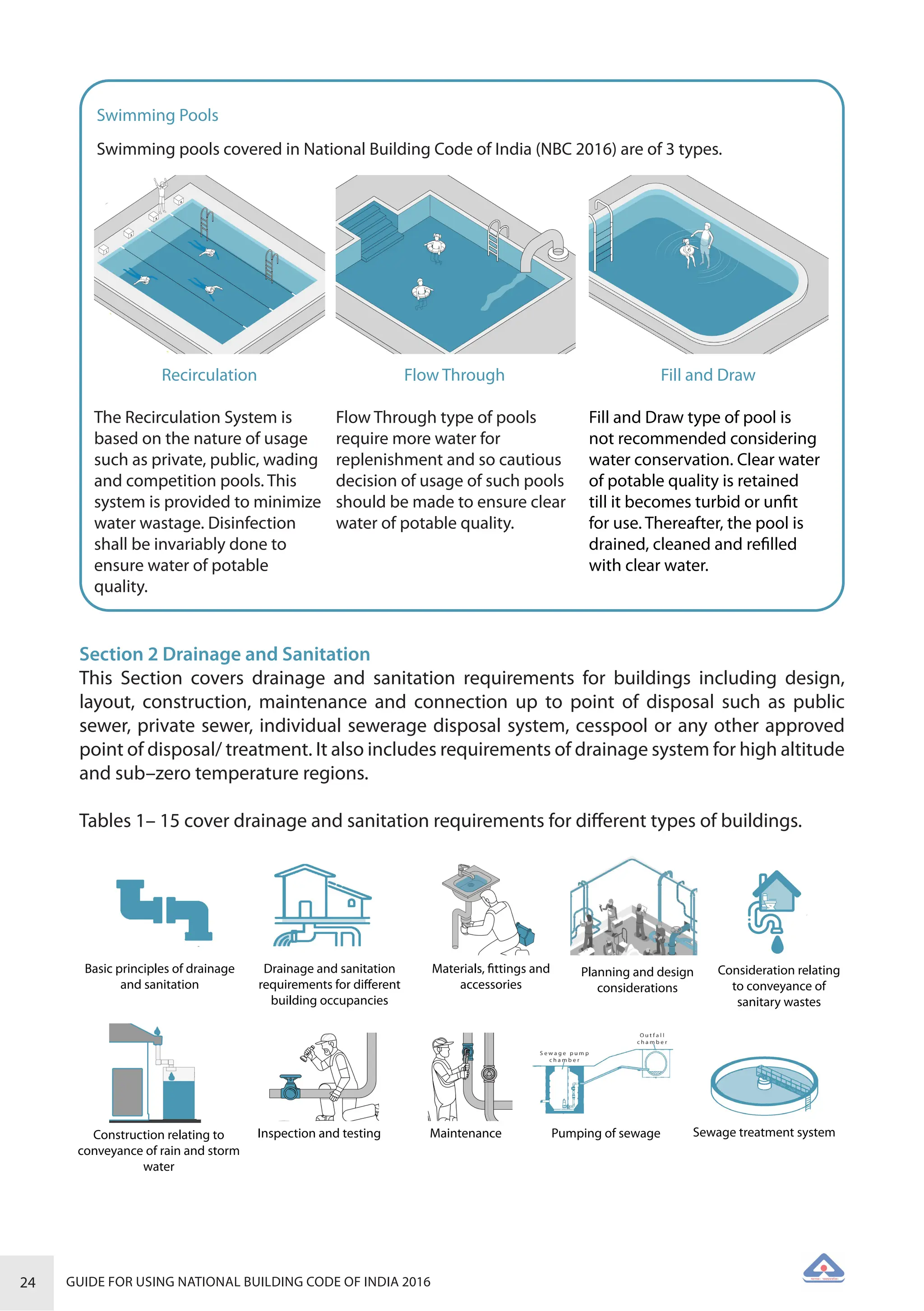
Swimming Pools
Swimming pools covered in National Building Code of India (NBC 2016) are of 3 types.
Fill and Draw
Fill and Draw type of pool is
not recommended considering
water conservation. Clear water
of potable quality is retained
till it becomes turbid or unfit
for use. Thereafter, the pool is
drained, cleaned and refilled
with clear water.
Flow Through
Flow Through type of pools
require more water for
replenishment and so cautious
decision of usage of such pools
should be made to ensure clear
water of potable quality.
Recirculation
The Recirculation System is
based on the nature of usage
such as private, public, wading
and competition pools. This
system is provided to minimize
water wastage. Disinfection
shall be invariably done to
ensure water of potable
quality.
Basic principles of drainage
and sanitation
Consideration relating
to conveyance of
sanitary wastes
Sewage treatment system
Drainage and sanitation
requirements for different
building occupancies
Construction relating to
conveyance of rain and storm
water
Materials, fittings and
accessories
Inspection and testing Maintenance
Planning and design
considerations
Pumping of sewage
25
GUIDE FOR USING NATIONAL BUILDING CODE OF INDIA 2016
Section 3 Solid Waste Management
This Section comprehensively covers solid waste management system for buildings including
assessment of waste generation and its treatment. Additionally, other rules and regulations
in force shall be complied with for treatment and handling of solid waste. These rules and
regulations are also briefly covered in this Section.
Section 4 Gas Supply
This Section prescribes safety requirements of persons and property for all piping uses and for
all types of gases; for usages like fuel, lighting and medical purposes.
For more details on Part 9, please refer to NBC 2016
Bio– toilet (or Eco–toilet)
Bio–toilet involves sludge free disposal of
human waste. It decomposes solid waste
into water and bio–gas. It is eco–friendly,
hazard free, requiring least maintenance
and is capable of functioning efficiently at
sub–zero temperatures.
Bio–toilet is mainly a prefabricated type
structure, above the ground with a bio–
digester tank below the ground.
It is useful in situations where sewerage
system is not available.
Classification
of solid waste
based on sources
of generation,
characteristics, etc.
Considerations
and requirements
for designing a
municipal solid
waste management
system
Refuse chute system
Assessment of
per capita waste
quantities for
different type of
solid wastes
Methods of
treatment and
disposal
Leakage check
Inspection of
services
Installation of gas
pipes
Rules for turning
gas on
Rules for shutting
gas off
Requirements for
pressure
Requirements for safe
installation of LPG, PNG
and medical gas
OFF
ON
Landscape
Development,
Signs
and
Outdoor
Display
Structures
26 GUIDE FOR USING NATIONAL BUILDING CODE OF INDIA 2016
Section1 Landscape Planning, Design and Development
This Section covers requirements of landscape planning, design and development with the
view to promoting quality of outdoor built and natural environments and the protection of
land and its resources.
Key Content
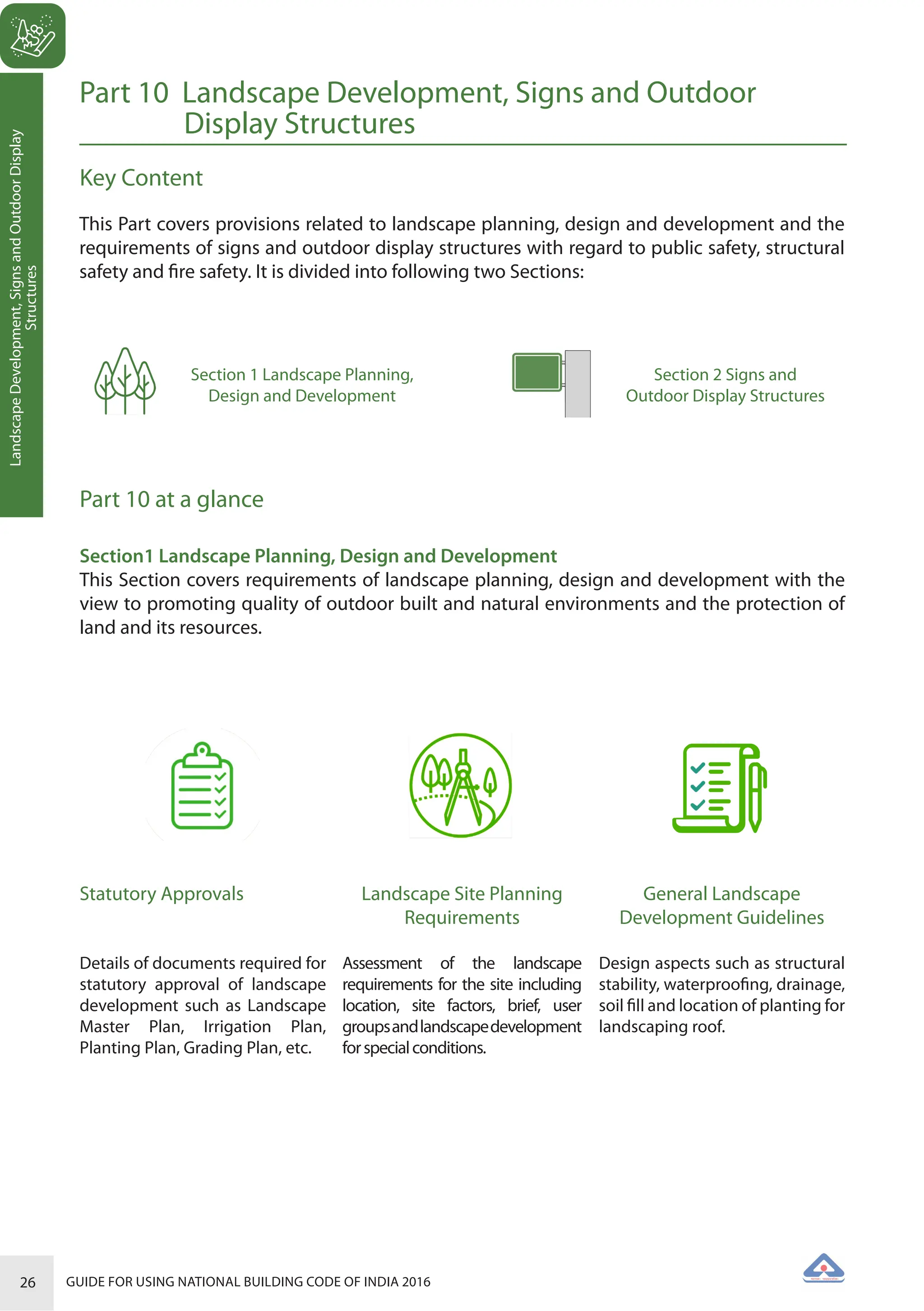
Part 10 at a glance
Section 1 Landscape Planning,
Design and Development
Section 2 Signs and
Outdoor Display Structures
Part 10 Landscape Development, Signs and Outdoor
Display Structures
This Part covers provisions related to landscape planning, design and development and the
requirements of signs and outdoor display structures with regard to public safety, structural
safety and fire safety. It is divided into following two Sections:
Statutory Approvals
Details of documents required for
statutory approval of landscape
development such as Landscape
Master Plan, Irrigation Plan,
Planting Plan, Grading Plan, etc.
Landscape Site Planning
Requirements
Assessment of the landscape
requirements for the site including
location, site factors, brief, user
groupsandlandscapedevelopment
forspecialconditions.
General Landscape
Development Guidelines
Design aspects such as structural
stability, waterproofing, drainage,
soil fill and location of planting for
landscaping roof.
27
GUIDE FOR USING NATIONAL BUILDING CODE OF INDIA 2016
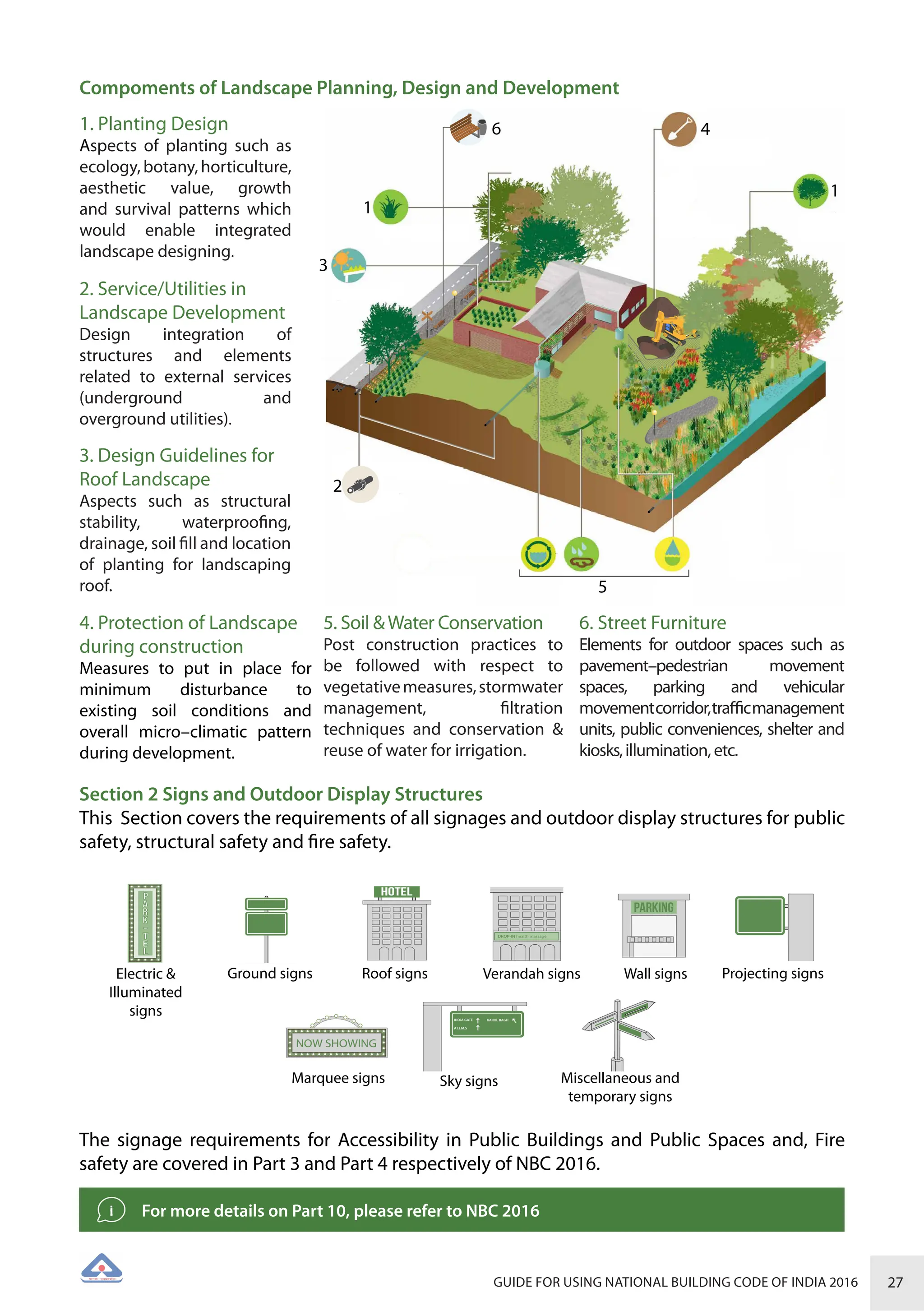
Compoments of Landscape Planning, Design and Development
4. Protection of Landscape
during construction
Measures to put in place for
minimum disturbance to
existing soil conditions and
overall micro–climatic pattern
during development.
5. Soil &Water Conservation
Post construction practices to
be followed with respect to
vegetativemeasures,stormwater
management, filtration
techniques and conservation &
reuse of water for irrigation.
6. Street Furniture
Elements for outdoor spaces such as
pavement–pedestrian movement
spaces, parking and vehicular
movementcorridor,trafficmanagement
units, public conveniences, shelter and
kiosks,illumination, etc.
Electric &
Illuminated
signs
Marquee signs Sky signs Miscellaneous and
temporary signs
Ground signs Roof signs Verandah signs Wall signs Projecting signs
1. Planting Design
Aspects of planting such as
ecology,botany,horticulture,
aesthetic value, growth
and survival patterns which
would enable integrated
landscape designing.
2. Service/Utilities in
Landscape Development
Design integration of
structures and elements
related to external services
(underground and
overground utilities).
3. Design Guidelines for
Roof Landscape
Aspects such as structural
stability, waterproofing,
drainage, soil fill and location
of planting for landscaping
roof.
For more details on Part 10, please refer to NBC 2016
Section 2 Signs and Outdoor Display Structures
This Section covers the requirements of all signages and outdoor display structures for public
safety, structural safety and fire safety.
The signage requirements for Accessibility in Public Buildings and Public Spaces and, Fire
safety are covered in Part 3 and Part 4 respectively of NBC 2016.
Approach
to
Sustainability
28 GUIDE FOR USING NATIONAL BUILDING CODE OF INDIA 2016
Part 11 Approach to Sustainability
Key Content
This Part covers the parameters required for planning, design, construction, operation and
maintenance of buildings and those relating to land development from the point of view of
sustainability.
Part 11 at a glance
Approach to
Sustainability
Waste Water
Management
Siting, Form and
Design
Building Services
Optimization
External Development
and Landscape
Construction Practices
Materials
Commissioning, Operation,
Maintenance and Building
Performance Tracking
Layout level Building level
Planning level
Approach to Sustainability
• Topsoil preservation
• Environmental Management
Plan
• Inclusion of sustainable
construction through
material and construction
management plan
• Landscape development &
drainage
• Water conservation
• Rainwater harvesting
• Wastewater management
• Solar energy utilization
• Wind energy
• Undertaking sustainable
measures to curb onsite
pollution
• Assessment of natural
resources and protected areas
• Water conservation and
irrigation practices
• Integration of masterplan and
transport plan
• Public and private
transportation plan
• Bicycle lanes and pedestrian
access
• Discourage subsidized
parking in public realm
• Neighbourhood connectivity,
walkability and safety
• Ecology of streets
• Planning of water and waste
management system
• Building siting and
orientation
• Envelope optimization
• Building services
optimization
• Lighting and ventilation
• Sustainable materials–
use of alternate and local
construction materials
embodying low energy
consumption
• Maintenance and safe
construction
• Solar energy
Commissioning, Operation, Maintenance and
Building Performance Tracking
1
7
8
9
10
2
3
4
5
6
6
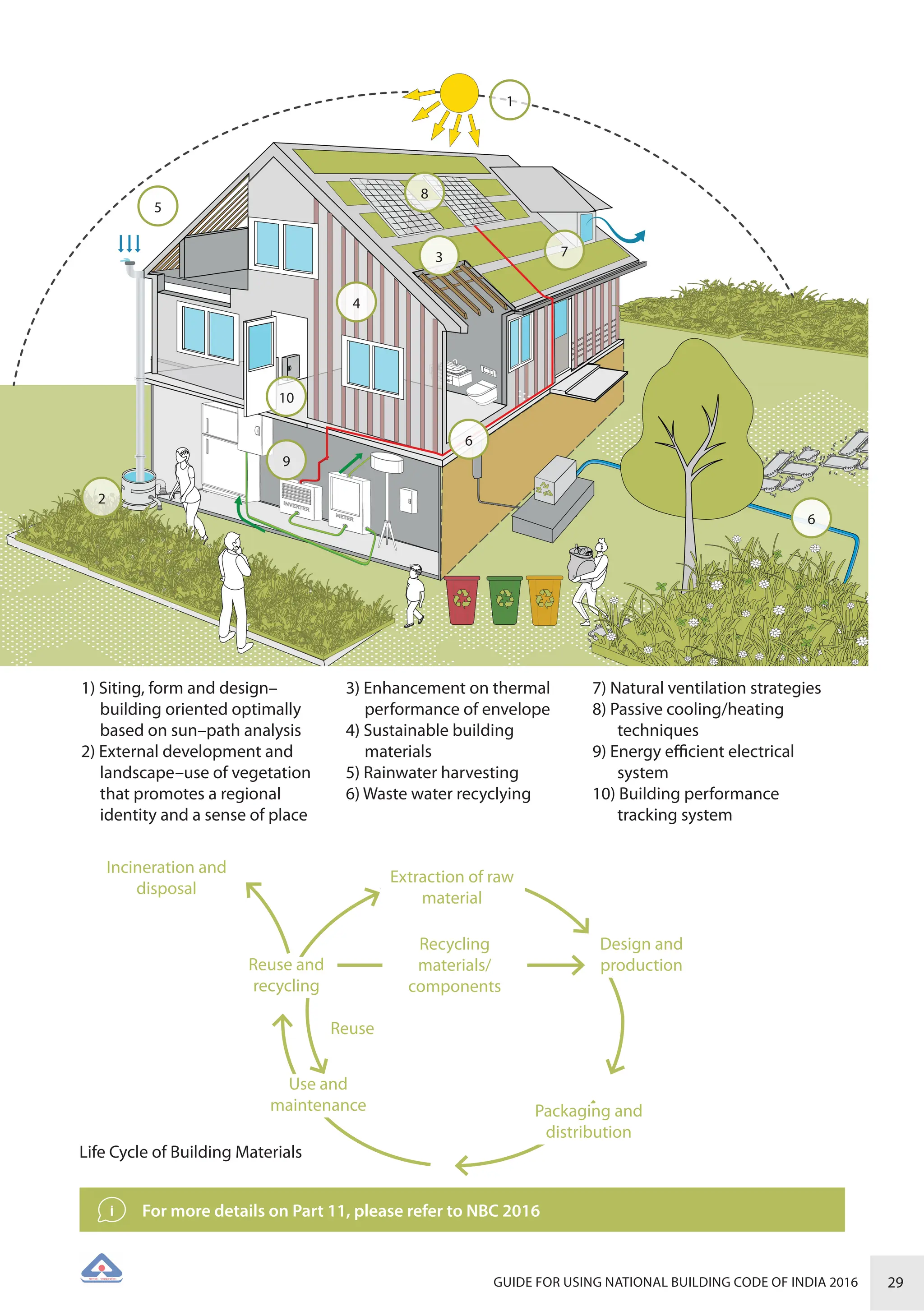
1) Siting, form and design–
building oriented optimally
based on sun–path analysis
2) External development and
landscape–use of vegetation
that promotes a regional
identity and a sense of place
3) Enhancement on thermal
performance of envelope
4) Sustainable building
materials
5) Rainwater harvesting
6) Waste water recyclying
7) Natural ventilation strategies
8) Passive cooling/heating
techniques
9) Energy efficient electrical
system
10) Building performance
tracking system
Extraction of raw
material
Design and
production
Use and
maintenance
Reuse
Incineration and
disposal
Reuse and
recycling
Recycling
materials/
components
Packaging and
distribution
29
GUIDE FOR USING NATIONAL BUILDING CODE OF INDIA 2016
For more details on Part 11, please refer to NBC 2016
Life Cycle of Building Materials
Asset
and
Facility
Management
30 GUIDE FOR USING NATIONAL BUILDING CODE OF INDIA 2016
Part 12 at a glance
Part 12 Asset and Facility Management
Key Content
This Part covers provisions relating to management of building assets and associated facilities,
such as building and building services. It also covers responsibility of facility managers and of
occupants for maintenance of facilities, such as structures, equipment and exterior property.
Asset/Facility Management Building Fabric
Maintenance
Building Maintenance – Methods
and Management
Systems Maintenance Services Maintenance
Asset management is integration of processes within an organization to maintain and develop
the agreed services which support and improve the effectiveness of its primary activities.
Guiding factors for organizational setup
of Asset/Facility Management System
The organizational strategic plan is the starting point for development of the asset/facility
management policy, strategy, objectives and plans.
Competence of Staff at
Various Levels
Outsourcing
Organization Roles at
Various Levels
Scope of Work
Facility Manager
31
GUIDE FOR USING NATIONAL BUILDING CODE OF INDIA 2016
Methods of Building Maintenance
Preventive
Maintenance
Shut down
Maintenance
Corrective
Maintenance
Conditioned Based
Maintenance
Breakdown
Maintenance
Reliability Centred
Maintenance
Emergency
Maintenance
Total Productive
Maintenance
Planned Maintenance Unplanned Maintenance
For more details on Part 12, please refer to NBC 2016
Asset/Facility management can be classified under 2 services
Hard Services
Soft Services
• Building fabric maintenance
• Building services maintenance that includes
– Plumbing and drainage
– Air conditioning
– HVAC services
– Electrical installations
– Lifts and escalator
– Fire fighting–detection and suppression
– Roads and pathways.
• Landscaping and horticulture waste management
• Housekeeping
• Pest control
• Security management
• Solid waste management.
GUIDE FOR USING NATIONAL BUILDING CODE OF INDIA 2016 32
Notes
32 GUIDE FOR USING NATIONAL BUILDING CODE OF INDIA 2016
This guide is available to download for free from www.bis.gov.in
To learn more about NBC 2016 and BIS, please contact/visit us:
Head (Civil Engg)
Bureau of Indian Standards
Manak Bhavan
9 Bahadur Shah Zafar Marg
New Delhi – 110002
www.bis.gov.in, www.manakonline.in
011–2323 5529
011–2360 8301
Email: ced@bis.gov.in
Follow Bureau of Indian Standards
@indianstandards

Booklet-Guide-for-Using-National-building-code-2016-india.pdf

  • 1.
    BUREAU OF INDIANSTANDARDS GUIDE FOR USING NATIONAL BUILDING CODE OF INDIA 2016
  • 3.
    3 GUIDE FOR USINGNATIONAL BUILDING CODE OF INDIA 2016 BUREAU OF INDIAN STANDARDS Guide for Using National Building Code of India 2016
  • 4.
    NOTE – Thisguide can only be published after obtaining in writing requisite permission from Bureau of Indian Standards. WARNING – Kindly note that extracts from BIS Publications may not be reproduced in any form without prior permission as this is in violation of the Copyrights Act, 1957.
  • 5.
    i GUIDE FOR USINGNATIONAL BUILDING CODE OF INDIA 2016 Bureau of Indian Standards (BIS) is the National Standards Body of India established under the BIS Act 2016 for development of standards, marking and quality certification of goods and for matters connected therewith or incidental thereto. BIS has been providing traceable and tangible benefits to the national economy in a number of ways – ensuring provision of safe reliable quality goods; minimizing health hazards to consumers; promoting exports and imports substitute; control over proliferation of varieties, etc through standardization, certification and testing. The National Building Code of India 2016 (NBC 2016), a comprehensive building Code prepared by BIS, is a national instrument providing guidelines for regulating the building construction activities across the country. It serves as a Model Code for adoption by all agencies involved in building construction works, be the Public Works Departments, other government construction departments, local bodies or private construction agencies. The Code mainly contains administrative regulations, development control rules and general building requirements; fire safety requirements; stipulations regarding materials, structural design and construction (including safety in construction); building and plumbing services; landscaping and outdoor display structures; approach to sustainability; and asset and facility management. Thus, the Code gives all the information required by the architect, engineer, structural engineer, construction engineer, services engineer and other professionals from the early stages of planning to translating the building on to terra firma. The comprehensive NBC 2016 contains 13 Parts some of which are divided into Sections and Subsections totalling 33 chapters (refer page ii). About
  • 6.
    ii GUIDE FORUSING NATIONAL BUILDING CODE OF INDIA 2016 Part 0 Integrated Approach – Prerequisite for applying provisions of the Code Part 1 Definitions Part 2 Administration Part 3 Development control rules and general building requirements Part 4 Fire and life safety Part 5 Building materials Part 6 Structural design Section 1 Loads, forces and effects Section 2 Soils and foundations Section 3 Timber and bamboo 3A Timber 3B Bamboo Section 4 Masonry Section 5 Concrete 5A Plain and reinforced concrete 5B Prestressed concrete Section 6 Steel Section 7 Prefabrication, systems building and mixed/ composite construction 7A Prefabricated concrete 7B Systems building and mixed/composite construction Section 8 Glass and glazing Part 7 Construction management, practices and safety Part 8 Building services Section 1 Lighting and natural ventilation Section 2 Electrical and allied installations Section 3 Air conditioning, heating and mechanical ventilation Section 4 Acoustics, sound insulation and noise control Section 5 Installation of lifts, escalators and moving walks 5A Lifts 5B Escalators and moving walks Section 6 Information and communication enabled installations Part 9 Plumbing services (including solid waste management) Section 1 Water supply Section 2 Drainage and sanitation Section 3 Solid waste management Section 4 Gas supply Part 10 Landscape development, signs and outdoor display structures Section 1 Landscape planning, design and development Section 2 Signs and outdoor display structures Part 11 Approach to sustainability Part 12 Asset and facility management VOLUME 1 VOLUME 2 NBC 2016 at a glance
  • 7.
    1 GUIDE FOR USINGNATIONAL BUILDING CODE OF INDIA 2016 The National Building Code of India (NBC 2016) is a national instrument providing guidelines for regulating the building construction activities across the country. This Guide has been prepared to help the readers of the NBC 2016 in using the Code, understanding the contents of various Parts/Sections and their connection. The key contents and concepts of each part are laid out using infographics and simplified language such that all stakeholders including officials from regulatory and other government departments, private developers, builders, contractors, professionals, academicians, and students from different backgrounds can get an understanding of the information provided within the Code. Introduction Part 0 Integrated Approach – Prerequisite for Applying Provisions of the Code Part 1 Definitions Part 4 Fire and Life Safety Part 7 Construction Management, Practices and Safety Part 10 Landscape Development, Signs and Outdoor Display Structures Part 2 Administration Part 5 Building Materials Part 8 Building Services Part 11 Approach to Sustainability Part 3 Development Control Rules and General Building Requirements Part 6 Structural Design Part 9 Plumbing Services (including Solid Waste Management) Part 12 Asset and Facility Management This guide summarizes the key sections of each part of NBC. For details, please refer to NBC with latest amendments.
  • 8.
    Integrated Approach– Prerequisite for Applying Provisions of the Code 2 GUIDE FORUSING NATIONAL BUILDING CODE OF INDIA 2016 Part 0 Integrated Approach– Prerequisite for Applying Provisions of the Code Key Content This Part gives an overall direction for practical applications of different aspects of spatial planning, designing and construction of buildings, and laying of services. It proposes an integrated approach for utilizing appropriate knowledge and experience of qualified professionals during the entire life cycle of a development/building project. A development/building project and the built facility comprises 6 major stages. Part 0 at a glance Conceptualization and Planning Operation and Maintenance Designing and Detailing Decommissioning and Deconstruction Location/Siting Construction/Execution 1 4 2 5 3 6
  • 9.
    3 GUIDE FOR USINGNATIONAL BUILDING CODE OF INDIA 2016 Depending on the complexity and magnitude of the project, a multidisciplinary team of professionals need to be engaged as a well–coordinated team to achieve the desired delivery in an effective manner. For more details on Part 0, please refer to NBC 2016 Design Team Project Management and Construction Management Team Operation and Maintenance Team Responsible at Planning, Designing and Development stage Architect; Civil engineer; Structural engineer; Geotechnical engineer; Electrical engineer; Plumbing engineer; Fire protection engineer; HVAC engineer; Lift, escalator and moving walk specialist; Acoustics specialist; Information/Communication technology engineer; Health, safety and environment specialist; Environment/Sustainability specialist;Town planner; Urban designer; Landscape architect; Security system specialist; Interior designer; Quantity surveyor; Project/Construction manager; Accessibility and universal design specialist; Asset/Facility manager; and other subject specialists. Responsible for monitoring the project for timely completion within the cost meeting stringent quality, health, safety and environmental standards Responsible for Operation and Maintenance of building assets Key Teams of Multidisciplinary Professionals
  • 10.
    Definition 4 GUIDE FORUSING NATIONAL BUILDING CODE OF INDIA 2016 Part 1 Definition Key Content There are approximately 1,776 terms defined in NBC 2016. Each Part or Section of the NBC gives the definitions of the important terms used in it, which may be found in the clause ‘Terminology’for each Part/Section of NBC 2016. Part 1 gives an index of all such definitions and directs the user to refer to the correct Part/ Section for locating the desired definition. Examples of terms whose definitions are covered in various Parts/Sections are: Part 1 at a glance Part 0 Integrated Approach– prerequisite for applying provisions of the Code Part 3 Development Control Rules and General Building Requirements Part 2 Administration Part 4 Fire and Life Safety Part 6 Structural Design Part 7 Construction Management, Practices and Safety Part 8 Building Services Part 9 Plumbing Services Part 10 Landscape Development, Signs and Outdoor Structures Part 11 Approach to Sustainability Part 12 Asset and Facility Management Authority having jurisdiction/Authority, Building, Owner,.... Open space, Floor Area Ratio (FAR), Building height, Chajja, Covered area, Habitable room,.... Development, Unsafe building, Sanctioned plan, Permit, Alteration,... Exit, High rise building, Refuge area, Evacuation Lift, Horizontal Exit,.... Column, Structural timber, Curtain wall, Load bearing wall, Poisson’s ratio, Prestressed concrete, Diaphragm,.... Scaffold, Wall opening, Platform, Pile rig, Construction equipment,.... Daylight factor, Glare, Cable, Building energy simulation, Ambient noise, Lift car,.... Service pipe, Storage tank, Water outlet, Soil pipe, Municipal solid waste,.... Contour, Gradient, Green roof, Permeable paving, Sign, Advertising sign,.... Embodied energy, Environmental impact, Indoor air quality, Renewable Source, Thermal comfort,.... Building management system, Facility, End user, Housekeeping, Operational strategy,.... For more details on Part 1, please refer to NBC 2016
  • 11.
    Administration 5 GUIDE FOR USINGNATIONAL BUILDING CODE OF INDIA 2016 Part 2 Administration Key Stakeholders Key Content ThisPartdescribesorganizationofabuildingdepartmentforenforcementoftheCodeincluding procedure for obtaining development, building and occupancy permits; responsibility of the owner and all professionals involved in planning, design and construction of the building. Permit and Inspection Organization and Enforcement • Application for development, building permit • Responsibilities and duties of the owner • Validity • Architectural control • Inspection, occupancy permit and post–occupancy inspection • Unsafe building • Demolition of building Architect Structural Engineer Town Planner Geotechnical Engineer Landscape Architect Authority having jurisdiction (called Authority) Civil Engineer Supervisor Urban Designer Engineers for Utility Services Builder/Constructor Owner/Developer • Department of buildings • Appointment of team of building officials • Qualification of building officials • Delegation of powers • Powers and duties of team of building officials • Board of appeals • Violation and penalties • Power to make rules For qualifications and competencies of professionals, refer to Annex A of Part 2 of NBC 2016
  • 12.
    6 GUIDE FORUSING NATIONAL BUILDING CODE OF INDIA 2016 For more details on Part 2, please refer to NBC 2016 Part 2 at a glance *Documents to be submitted along with the application: • Title of ownership of land/building • Key Plan • Site Plan • Subdivision/layout Plan • Building Plans including Elevations and Sections • Services Plans • Specification, general and detailed • Certificate for structural design sufficiency • Certificate for engagement of builder/constructor(s), where applicable • Certificates for supervision Scrutiny and inspections by the Authority Application for obtaining Development Permit and/or Building Permit* Grant of Development/ Building Permit Applicant to rectify objection Applicant to rectify objection Objection if any Objection if any Notice for Commencement by the Owner to the Authority Notice of Completion for obtaining Permit by the Owner to the Authority Inspection by the Authority to check if there are any deviations from the Sanctioned Plan Grant of Occupancy Permit Construction as per sanctioned plans with inspections from Authority
  • 13.
    Development Control Rules and General Building Requirements 7 GUIDE FOR USINGNATIONAL BUILDING CODE OF INDIA 2016 Part 3 Development Control Rules and General Building Requirements Key Content This Part covers development control rules such as land use classification, requirements for subdivision and layout plan including means of access, open spaces, plot requirements, area and height limitations, off street parking spaces, green belts and landscaping. This Part also covers general building requirements for various parts of building and accessibility requirements in the built environment. Landuse Classification Layout/Subdivision Plan Requirement for parts of building This Part also covers requirements for low income housing in urban areas, cluster planning, low income habitat planning in rural areas and development planning in hilly areas. • Means of access • Fire tender movement • Open spaces (within a plot) • Area and height limitations • Community open spaces and amenities • Off street parking spaces • Group housing • Buildings on podium • Green belts, landscaping • Minimum width, gradient and specifications for walkways/ pathways and kerb ramps • Installation of tactile ground surface indicators to aid visually impaired persons • Adequate accessible parking spaces with signages • Specifications of accessible approach to building, access at entrance and within the building • Handrails and grab bars to be provided for easy movement and use of facilities • Specifications for making level changes (stairs, ramps, lifts) accessible • At least one accessible unisex toilet to be provided • Accessibility to various services and their fittings such as door, windows, handles, electrical switches and taps • In public buildings, all public areas to be made accessible • Minimum accessibility provisions specific to different building occupancy types • The signage requirements for universal accessibility in public buildings and public spaces are covered in Annexure B, Part 3 of NBC 2016. Accessibility in Group Housing • Some ground floor Dwelling Units in group housing to be made universally accessible • All Dwelling Units to have minimum universal design features such as minimum clear door width of main entrance, rooms, kitchen, one toilet. Hierarchy of Development Accessibility in Public Buildings and Public Spaces Habitable Room 1 Min. area 9.5 sqm Habitable Room 2 Min. area 7.5 sqm Bathroom Min. area 2.8 sqm Kitchen Min. area 5 sqm
  • 14.
    8 GUIDE FORUSING NATIONAL BUILDING CODE OF INDIA 2016 Part 3 at a glance 1) Open spaces (around buildings) 4) Greenbelts and landscaping 2) Off–street parking spaces 5) Provisions regarding plot sizes and frontage 3) Means of access connecting different layouts 6) General Building Requirements (Check next page for details) Key: Typical Subdivision Layout 5 5 1 1 2 2 3 3 3 4 4 4
  • 15.
    9 GUIDE FOR USINGNATIONAL BUILDING CODE OF INDIA 2016 6d) Kitchen (Minimum area 5 m2 without dining) 6e) Plinth height (Minimum height 0.45 m for plain areas/hilly area and 0.6 m flood prone ) 6a) Habitable room 1 (Minimum area 9.5 m2 and minimum width 2.4 m) 6b) Habitable room 2 (Minimum area 7.5 m2 andminimum width 2.1 m) 6c) Toilet (Minimum area with W.C. 2.8 m2 ) For more details on Part 3, please refer to NBC 2016 Some requirements for parts of building as per Clause 12 of Part 3 of NBC 2016 5
  • 16.
    10 GUIDE FORUSING NATIONAL BUILDING CODE OF INDIA 2016 Part 4 Fire and Life Safety Key Content This Part deals with safety from fire. It specifies the demarcation of fire zones, restrictions on construction of buildings in each fire zone, classification of buildings based on occupancy, types of building construction according to fire resistance of the structural and non–structural components and other restrictions and requirements necessary to minimize danger to life from fire, smoke, fumes or panic before the buildings can be evacuated.The provisions covered in this Part are divided in three broad areas: Fire Prevention, Life Safety and Fire Protection. Life Safety Fire Protection Fire Prevention Part 4 at a glance Fire and life Safety • General exit requirements • Occupant load • Egress components – Exit access – Exit – Exit discharge • Compartmentation • Smoke control • Gas supply • Hazardous areas, gaseous, oil storage yard, etc • Fire Officer • Fire drills and fire orders • Classification of buildings based on occupancy, from fire safety point of view • Demarcation of fire zone • Types of building construction • Openings in fire resistant walls and floors • Electrical installations • Escape lighting and exit signage • Air conditioning, ventilation and smoke control • Heating • Glazing • Surface interior finishes • Fire Command Centre (FCC) • Requirements for firefighting installations (refer Table 7) • Maintenance of firefighting installation and systems Additional fire safety requirements for high rise building, atrium, commercial kitchen, car parking facilities, metro stations, metro trainways and measures for venting in industrial buildings, are also covered in this Part of NBC 2016. Additional occupancy wise requirements All buildings shall satisfy minimum requirements for safety of life from fire, smoke, fumes or panic arising from these or similar causes. Fire and Life Safety
  • 17.
    • Group G:Industrial Buildings – Subdivision G–3 Buildings used for high hazard industries • Group H: Storage Buildings • Group J: Hazardous Buildings 11 GUIDE FOR USING NATIONAL BUILDING CODE OF INDIA 2016 Fire Zone 2 Fire Zone 3 • Group A: Residential Buildings – Subdivision A–1 Lodging and rooming houses – Subdivision A–2 One or two family private dwellings – Subdivision A–3 Dormitories – Subdivision A–4 Apartment houses – Subdivision A–5 Hotels – Subdivision A–6 Starred Hotels • Group B: Educational Buildings – Subdivision B–1 Schools up to senior secondary level – Subdivision B–2 All others/training institutions • Group C: Institutional Buildings – Subdivision C–1 Hospitals and sanatoria – Subdivision C–2 Custodial institutions – Subdivision C–3 Penal and mental institutions • Group D: Assembly Buildings – Subdivision D–1 Buildings with stage and fixed seats over 1,000 persons – Subdivision D–2 Buildings with stage and fixed seats upto 1,000 persons – Subdivision D–3 Buildings without permanent stage, accommodation for 300 or more persons, and no permanent seating arrangements – Subdivision D–4 Buildings without permanent stage, accommodation less than 300 persons, and no permanent seating arrangements – Subdivision D–5 Temporary structures designed for assembly – Subdivision D–6 Shopping malls with multiplexes and food courts - Subdivision D–7 Underground and elevated mass rapid transit system • Group E: Business Buildings – Subdivision E–1 Offices, banks, professional establishments • Group F: Mercantile Buildings – Subdivision F–1 Shops, stores departmental stores (area upto 500 m2 ) – Subdivision F–2 Shops, stores departmental stores (area > 500 m2 ) – Subdivision F–3 Underground shopping centres • Group E: Business Buildings – Subdivision E–2 Laboratories, outpatient clinics, research establishments, libraries and test houses – Subdivision E–3 Electronic data processing centres, computer installations,information technology parks and call centres – Subdivision E–4 Telephone exchanges – Subdivision E–5 Broadcasting stations, T.V. stations and air traffic control towers • Group G: Industrial Buildings – Subdivision G–1 Buildings used for low hazard industries – Subdivision G–2 Buildings used for moderate hazard industries Classification of buildings based on occupancy. The city or area under the jurisdiction of the Authority shall be demarcated into distinct fire zones dependingupontheexistinglayout,typesofbuildingconstruction,classificationofexistingbuildings based on occupancy and expected future development of the city or area. Intermixing of hazardous occupancies should not be allowed in other zones. Fire Zone 1 FIRE PREVENTION
  • 18.
    12 GUIDE FORUSING NATIONAL BUILDING CODE OF INDIA 2016 All buildings shall satisfy minimum requirements, for safety of life from fire, smoke, fumes or panic arising from these or similar causes. 4 1) Fire resistant walls, floors and compartments • To limit the spread of fire • No compromise for openings such as shafts, refuse chutes, vertical openings, etc. 2) Shafts • To be provided with fire resistant rated inspection door for passage of building services such as cables, electrical wires, telephone cables, plumbing pipes, etc depending upon location. 3) Refuge area • An area within the building for a temporary use during egress. It generally serves as a staging area which is protected from the effect of fire and smoke. 4) Fire detection and firefighting installations • These include fire alarm, fire extinguishers, hose reels, wet riser, down comer, yard hydrants, sprinklers, deluge system, water spray, foam, water mist systems, gaseous or dry powder system, water storage tanks and pumps, etc. 5 5 1 1 Exit access Exit discharge Exit Keys :
  • 19.
    13 GUIDE FOR USINGNATIONAL BUILDING CODE OF INDIA 2016 For more details on Part 4, please refer to NBC 2016 2 3 5 Key Plan (First Floor Plan) Entry Fire Exit Fire Tower 5) Means of egress • Consists of three separate and distinct parts, that is, exit access, exit and exit discharge • Exit access are working/functional areas • Various types of exit access and exits are doorways, corridors and passageways, horizontal exits, internal staircases, exit passageways, external staircases and ramps. 6) Fire fighting shafts • With fire man talk back, fire door, wet riser, hose reel, signage showing floor plan and stairways and fire man’s lift 6 1
  • 20.
    Building Materials 14 GUIDE FORUSING NATIONAL BUILDING CODE OF INDIA 2016 Part 5 Building Materials Key Content This Part covers the requirements of building materials and components, criteria for accepting neworalternativebuildingmaterial.Itdetailsthequalityandeffectivenessofbuildingmaterials used in the construction and of their storage, which are important aspects of building activity. • Methods of Test • Third Party Certification • Materials • Storage of Materials • Sustainable Materials • New or Alternative Materials All building materials shall conform to relevant Indian Standards, unless otherwise specified or approved. NBC 2016 enlists around 1500 IS code specifications and methods of test under the following 30 categories of materials. Part 5 at a glance For more details on Part 5, please refer to NBC 2016 30. Wire ropes and wire products 18. Paints and allied products 12. Electrical wiring, fittings and accessories 6. Building lime and products 24. Thermal insulation materials 23. Structural sections 29. Welding electrodes and wires 17. Mortar (including sand for mortar) 11. Doors, windows and ventilators 5 .Building chemicals 22. Stones 28. Waterproofing and damp–proofing materials 16. Gypsum based materials 10. Conductors and cables 4. Builder’s hardware 21. Steel and its alloys 26.Timber, bamboo and other lignocellulosic building materials 14. Floor covering, roofing and other finishes 8. Cement and concrete 2. Bitumen and tar products 27. Unit weights of building materials kg/m3 15. Glass 9. Composite matrix products 3. Bricks, blocks and other masonry building units 20. Sanitary appliances and water fittings 25. Threaded fasteners, rivets and nails 13. Fillers, stoppers and putties 7. Clay and stabilized soil products 1. Aluminium and other light metals and their alloys 19. Polymers, plastics and geosynthetics/ geotextiles
  • 21.
    Structural Design 15 GUIDE FOR USINGNATIONAL BUILDING CODE OF INDIA 2016 Part 6 at a glance Imposed Load For more details on Part 6, please refer to NBC 2016 Part 6 Structural Design Key Content This Part provides for structural adequacy of buildings and usage of materials and technology for building design. It is divided into 8 Sections (Section 1 to Section 8). Section 1 Loads, forces and effects This Section covers basic design loads to be considered for the structural design calculations of buildings. The imposed loads, wind loads, seismic forces, snow loads and other loads are minimum working loads which should be taken into consideration for purposes of design. This Section also covers: • Load calculation for rooftop helipads • Load to be considered for parapets, balustrades, impacts and vibrations • Imposed load due to fire tenders and emergency vehicles • Maps on basic wind speed and seismic zones of India. Section 2 Soil and Foundation This Section covers geotechnical design of building foundations, such as: • Geotechnical investigation and exploration guidance • Geotechnical design (principles) of building foundations • Foundation systems to ensure safety and serviceability without exceeding the permissible stresses of the materials of foundations and the bearing capacity of the supporting soil/rock • Deep foundation including pile foundation • Shallow foundation including raft foundation • Ground improvement techniques. Section 3 Timber and Bamboo • 3A Timber– This Subsection covers the general principles involved in the design of structural timber in buildings, including elements of structures connected by fasteners/ fastening techniques. It also covers the engineering properties of various species of timber. • 3B Bamboo– This Subsection covers the design of structural bamboo in buildings with regard to mechanical resistance and durability of structures. It also covers the engineering properties of various species of bamboo. Wind Load Wind Load Seismic Force Seismic Force
  • 22.
    16 GUIDE FORUSING NATIONAL BUILDING CODE OF INDIA 2016 Section 4 Masonry This Section covers the structural design of unreinforced and reinforced masonry elements in buildings. This Section also covers: • Materials • General requirements • Structural design of load bearing buildings. • Reinforced brick and reinforced brick concrete floors and Roofs • Special consideration from earthquake point of view • Guidelines for improving earthquake resistance of low strength masonry buildings • Confined masonry • Guidelines for design of non–load bearing walls/partitions • Masonry walls using rat–trap bond technology. Section 5 Concrete This Section covers structural designing of plain, reinforced concrete and prestressed concrete. The Section has been subdivided into the following Subsections: • 5A Plain and Reinforced Concrete–This Subsection covers: - Generalstructuraluseofplainandreinforcedconcrete - Requirements of durable concrete production, fire safety and protection from environment - Detailed design consideration for concrete strength upto M60 - Reinforcement requirements and detailing aspects for all type of structural elements - Special concretes like self–compacting concrete, high performance concrete and steel fibre reinforced concrete. • 5B Prestressed Concrete– This Subsection covers: - Structural design aspects of prestressed concrete. - Works carried out on site and the manufacture of precast prestressed concrete units - Updated provisions on end–zones, ultimate shear resistance, etc.
  • 23.
    17 GUIDE FOR USINGNATIONAL BUILDING CODE OF INDIA 2016 Section 7 Prefabrication, Systems Building and Mixed/ Composite Construction The Section has been subdivided into the following Subsections: • 7A Prefabricated Concrete– This Subsection gives: - Recommendations regarding modular planning, component sizes, prefabrication systems - Design considerations, joints & testing - Manufacture, storage, transportation and erection - Other related requirements for prefabricated concrete. • 7B Systems Buildings and Mixed/Composite Construction– This Subsection covers: - Recommendations regarding modular planning, component sizes - Joints, manufacture, storage, transport and erection of prefabricated elements - Other related requirements for systems building and mixed/composite construction. For more details on Part 6, please refer to NBC 2016 Section 8 Glass and Glazing This Section covers: • Selection and application of glass in buildings • Types of glass, its requirements and associated glazing materials • Glazing in buildings with respect to its effect on energy, visual (light) and solar environments • Design of glass in buildings, subject to wind loading, seismic loading • Selection, manifestation of glass in buildings, subject to safety with respect to human impact of the occupants • Selection, design, fabrication, installation, testing and maintenance of glazing systems. Section 6 Steel This Section covers the structural design aspects of steel structures in buildings. This Section applies to general construction using hot rolled steel sections and steel tubes joined using riveting, bolting and welding. This Section covers the design by limit state method and plastic theory, and also enables design by working stress method.
  • 24.
    Construction Management, Practices and Safety 18 GUIDE FORUSING NATIONAL BUILDING CODE OF INDIA 2016 Part 7 Construction Management, Practices and Safety Key Content This Part covers construction project management, construction planning, site management and building construction practices, storage, stacking and handling of materials. It also deals with safety of personnel during construction operations, demolition of buildings, habitat and welfare requirements for workers. The guidelines relating to repairs, retrofitting and strengthening of buildings are covered under this Part. Part 7 at a glance For more details on Part 7, please refer to NBC 2016 Standards relating to construction project management functions and construction practices are also refered in this Section. 1 2 3 3 4 5 6 1) Construction management (time, cost, quality, health and safety) 2) Construction planning and site management 3) Construction practices 4) Safety in construction 5) Repairs, retrofitting and strengthening of buildings 6) Habitat and welfare requirements for workers
  • 25.
    Building Services 19 GUIDE FOR USINGNATIONAL BUILDING CODE OF INDIA 2016 Part 8 Building Services Key Content All buildings meant for human habitation must be provided with adequate building services. This Part prescribes requirements for building services, and is divided into 6 Sections. Part 8 at a glance Section 1 Lighting and Natural Ventilation Section 2 Electrical and Allied Installations Section 3 Air–conditioning, Heating and Mechanical Ventilation Section 4 Acoustics, Sound Insulation and Noise Control Section 5 Installation of Lifts, Escalators and Moving Walks Section 6 Information and Communication Enabled Installation Section 1 Lighting and Natural Ventilation This Section covers requirements and methods for lighting and natural ventilation of buildings; design for both daylighting and artificial lighting. It also has provisions on energy conservation in lighting. This Section also includes the following important aspects: • Climatic classification map of India • Table on solar radiation as per seasons for determining heat intake • Recommended level of illuminance for different spaces/activities in different buildings (refer Table 4) • Recommended values for air changes for different buildings/spaces • Maximum allowable contaminant concentrations for fresh/ventilation air • Optimum size/number of fans for rooms of different sizes. Lighting Ventilation Orientation of building
  • 26.
    20 GUIDE FORUSING NATIONAL BUILDING CODE OF INDIA 2016 Planning of electric installation Distribution of supply and cabling Allied/ miscellaneous services Inspection, testing and verification of installation Wiring (including selection of size of conductors) Lightning protection of buildings Fittings and accessories Electrical installation for construction and demolition sites Earthing (including maintenance free earthing) Protection of human beings from electrical hazards Section 3 Air conditioning, Heating and Mechanical Ventilation This Section covers planning, selection, design considerations, installation, testing and commissioning of air conditioning, heating and mechanical ventilation systems for buildings. Planning includes equipment room for central AC plant , air handling units and package units, pipe shafts, supply/return air ducts and cooling tower. Key aspects covered under the Section are as follows: This Section also includes provisions on: • Location of energy meters, centralized metering system and smart metering • Requirements for electrical supply system for life and safety services • Discrimination, cascading and limitation concepts for the coordination of protective devices in electrical circuits • Solar photovoltaic system • Aviation obstacle lights • Electrical supply for electric vehicle charging and car park management system • Typical formats for checklists for handing over and commissioning of substation equipment and earthing pit. The electric and allied installations are to be carried out in conformity with the requirements of the Electricity Act, 2003 and the Central Electrical Authority (measures relating to safety and electric supply) regulations, 2010, as amended from time to time. Section 2 Electrical and Allied Installations This Section covers the essential requirements for electrical installations in buildings to ensure efficient use of electricity including safety from fire and shock. It also includes general requirements relating to lightning protection of buildings and provisions on certain allied installations. Planning of electrical installations include planning spaces for substation, switch rooms, emergency power back up system, distribution panels, overhead lines, wires and cables.
  • 27.
    21 GUIDE FOR USINGNATIONAL BUILDING CODE OF INDIA 2016 Refrigeration for cold stores Testing, commissioning and performance validation Specialized application Building automation system for HVAC control, monitoring and verification Symbols, units, colour code and identification of services Mechanical ventilation Installation of HVAC system Heating Design of air conditioning Planning Outdoor and indoor design conditions Refrigerants This Section also includes provisions on: • Design of indoor conditions as per adaptive thermal comfort model • Minimum ventilation rates in breathing zone • Energy efficient air conditioning systems such as variable refrigerant flow system, inverter technology, district cooling system, hybrid central plant using chilled beams and radiant floor components • Envelope utilization using energy modelling, day light simulation, solar shade analysis and wind modelling software • Weather data of 60 cities of India • Direct/indirect evaporative cooling units and geo–thermal cooling and heating • HVAC systems for healthcare facilities, data centres and underground metro stations • Energy efficient strategies for winter heating, using reverse cycle operation, solar heating systems, electric heat pump and ground source heat pump • Modern system of mechanical ventilation for industries, commercial kitchens, underground parking and for open tunnel connecting underground metro stations • Demand control ventilation and axial flow fans with aerofoil profile blades. Section 4 Acoustics, Sound Insulation and Noise Control This Section covers requirements and guidelines with regards to planning against outdoor and indoor noise, acceptable noise levels and sound insulation in buildings with different occupancies, such as residential, educational, hospital, industrial, office buildings, hotels, hostels, laboratories, test houses and other miscellaneous buildings. Key aspects covered in the Section are as follows: This Section also includes the following aspects: • Design techniques for noise control of building services • Guide for noise calculation, specifications for sound insulation and noise rating • Examples of special problems requiring expert advice.
  • 28.
    22 GUIDE FORUSING NATIONAL BUILDING CODE OF INDIA 2016 For more details on Part 8, please refer to NBC 2016 Section 5 Installation of Lifts, Escalator and Moving Walks This Section covers requirements for planning, design, installation, operation, maintenance and inspection of lifts (passenger, goods, hospital, service, dumb waiter lifts), escalators and moving walks so as to ensure safe movement of people with satisfactory performance.This Section has been subdivided into two Subsections namely, 5A Lifts and 5B Escalators and Moving Walks. The two Subsections include the following: • Design arrangements and planning • Civil and electrical requirements • Fire protection requirements • Minimum technical and safety requirements • Performance requirements • Inspection and maintenance • Typical checklists for inspection. Additional requirements specific to lifts include the following: • Planning of lifts for specific building features (such as special building facilities, basement service, multiple entry levels, non smoking buildings, reserve lifts and zoning/sky lobbies in very tall buildings) and for different building types • Specific requirements for lifts in high rise buildings and evacuation lifts • Technical requirements for lifts in super high rise buildings • Special lifts such as lifts without conventional machine rooms (MRL lifts), lifts used in private apartments (home lifts), hydraulic lifts, lifts with seismic resistance features. Section 6 Information and Communication Enabled Installations This Section covers the essential requirements for information and communication enabled installations, technology systems and cabling installations in a building. It also covers the basic design and integration requirements for telecommunication spaces within building(s) along with their cabling infrastructure, their pathway components and passive connectivity hardware. The installation of lifts are carried out in conformity with Lift Acts and Rules, as amended from time to time.
  • 29.
    Plumbing Services (including Solid Waste Management) 23 GUIDE FOR USINGNATIONAL BUILDING CODE OF INDIA 2016 Part 9 Plumbing Services (including Solid Waste Management) Key Content This Part has 4 Sections; for water supply, drainage and sanitation, solid waste management and gas supply. All buildings meant for human habitation shall be provided with potable water supply and adequate sanitary facilities. Part 9 at a glance Section 1 Water Supply Section 2 Drainage and sanitation Section 3 Solid Waste Management Section 4 Gas Supply Section 1 Water Supply This Section covers basic water supply requirements for different building occupancies along with provisions of plumbing, design, inspection and maintenance of water supply systems. It also includes provisions of water supply systems in high altitude and/or sub–zero temperature regions. Water supply requirements for firefighting, street cleaning and industrial plants are not included in this Section. Protection of water supply Backflow prevention Water supply system in high altitudes and/ or sub–zero temperature Allowance for expansion Storage of water Jointing of pipes Cleaning and disinfection of supply system Requirement for Swimming pools Estimate of demand load General requirements for pipe work Inspection and testing Guidelines to maintenance Water supply requirements for different building types Design of distribution system Laying of mains and pipes on site Water sources and quality Distribution systems in multi–storeyed buildings Hot water supply installations Basic principles for designing water supply system Materials, fittings and appliances Conveyance and distribution of water within premises Based on local Authority’s Occupancy Permit for a building, connection from the Water Supply Board and Drainage Board are obtained.
  • 30.
    24 GUIDE FORUSING NATIONAL BUILDING CODE OF INDIA 2016 Section 2 Drainage and Sanitation This Section covers drainage and sanitation requirements for buildings including design, layout, construction, maintenance and connection up to point of disposal such as public sewer, private sewer, individual sewerage disposal system, cesspool or any other approved point of disposal/ treatment. It also includes requirements of drainage system for high altitude and sub–zero temperature regions. Tables 1– 15 cover drainage and sanitation requirements for different types of buildings. Swimming Pools Swimming pools covered in National Building Code of India (NBC 2016) are of 3 types. Fill and Draw Fill and Draw type of pool is not recommended considering water conservation. Clear water of potable quality is retained till it becomes turbid or unfit for use. Thereafter, the pool is drained, cleaned and refilled with clear water. Flow Through Flow Through type of pools require more water for replenishment and so cautious decision of usage of such pools should be made to ensure clear water of potable quality. Recirculation The Recirculation System is based on the nature of usage such as private, public, wading and competition pools. This system is provided to minimize water wastage. Disinfection shall be invariably done to ensure water of potable quality. Basic principles of drainage and sanitation Consideration relating to conveyance of sanitary wastes Sewage treatment system Drainage and sanitation requirements for different building occupancies Construction relating to conveyance of rain and storm water Materials, fittings and accessories Inspection and testing Maintenance Planning and design considerations Pumping of sewage
  • 31.
    25 GUIDE FOR USINGNATIONAL BUILDING CODE OF INDIA 2016 Section 3 Solid Waste Management This Section comprehensively covers solid waste management system for buildings including assessment of waste generation and its treatment. Additionally, other rules and regulations in force shall be complied with for treatment and handling of solid waste. These rules and regulations are also briefly covered in this Section. Section 4 Gas Supply This Section prescribes safety requirements of persons and property for all piping uses and for all types of gases; for usages like fuel, lighting and medical purposes. For more details on Part 9, please refer to NBC 2016 Bio– toilet (or Eco–toilet) Bio–toilet involves sludge free disposal of human waste. It decomposes solid waste into water and bio–gas. It is eco–friendly, hazard free, requiring least maintenance and is capable of functioning efficiently at sub–zero temperatures. Bio–toilet is mainly a prefabricated type structure, above the ground with a bio– digester tank below the ground. It is useful in situations where sewerage system is not available. Classification of solid waste based on sources of generation, characteristics, etc. Considerations and requirements for designing a municipal solid waste management system Refuse chute system Assessment of per capita waste quantities for different type of solid wastes Methods of treatment and disposal Leakage check Inspection of services Installation of gas pipes Rules for turning gas on Rules for shutting gas off Requirements for pressure Requirements for safe installation of LPG, PNG and medical gas OFF ON
  • 32.
    Landscape Development, Signs and Outdoor Display Structures 26 GUIDE FORUSING NATIONAL BUILDING CODE OF INDIA 2016 Section1 Landscape Planning, Design and Development This Section covers requirements of landscape planning, design and development with the view to promoting quality of outdoor built and natural environments and the protection of land and its resources. Key Content Part 10 at a glance Section 1 Landscape Planning, Design and Development Section 2 Signs and Outdoor Display Structures Part 10 Landscape Development, Signs and Outdoor Display Structures This Part covers provisions related to landscape planning, design and development and the requirements of signs and outdoor display structures with regard to public safety, structural safety and fire safety. It is divided into following two Sections: Statutory Approvals Details of documents required for statutory approval of landscape development such as Landscape Master Plan, Irrigation Plan, Planting Plan, Grading Plan, etc. Landscape Site Planning Requirements Assessment of the landscape requirements for the site including location, site factors, brief, user groupsandlandscapedevelopment forspecialconditions. General Landscape Development Guidelines Design aspects such as structural stability, waterproofing, drainage, soil fill and location of planting for landscaping roof.
  • 33.
    27 GUIDE FOR USINGNATIONAL BUILDING CODE OF INDIA 2016 Compoments of Landscape Planning, Design and Development 4. Protection of Landscape during construction Measures to put in place for minimum disturbance to existing soil conditions and overall micro–climatic pattern during development. 5. Soil &Water Conservation Post construction practices to be followed with respect to vegetativemeasures,stormwater management, filtration techniques and conservation & reuse of water for irrigation. 6. Street Furniture Elements for outdoor spaces such as pavement–pedestrian movement spaces, parking and vehicular movementcorridor,trafficmanagement units, public conveniences, shelter and kiosks,illumination, etc. Electric & Illuminated signs Marquee signs Sky signs Miscellaneous and temporary signs Ground signs Roof signs Verandah signs Wall signs Projecting signs 1. Planting Design Aspects of planting such as ecology,botany,horticulture, aesthetic value, growth and survival patterns which would enable integrated landscape designing. 2. Service/Utilities in Landscape Development Design integration of structures and elements related to external services (underground and overground utilities). 3. Design Guidelines for Roof Landscape Aspects such as structural stability, waterproofing, drainage, soil fill and location of planting for landscaping roof. For more details on Part 10, please refer to NBC 2016 Section 2 Signs and Outdoor Display Structures This Section covers the requirements of all signages and outdoor display structures for public safety, structural safety and fire safety. The signage requirements for Accessibility in Public Buildings and Public Spaces and, Fire safety are covered in Part 3 and Part 4 respectively of NBC 2016.
  • 34.
    Approach to Sustainability 28 GUIDE FORUSING NATIONAL BUILDING CODE OF INDIA 2016 Part 11 Approach to Sustainability Key Content This Part covers the parameters required for planning, design, construction, operation and maintenance of buildings and those relating to land development from the point of view of sustainability. Part 11 at a glance Approach to Sustainability Waste Water Management Siting, Form and Design Building Services Optimization External Development and Landscape Construction Practices Materials Commissioning, Operation, Maintenance and Building Performance Tracking Layout level Building level Planning level Approach to Sustainability • Topsoil preservation • Environmental Management Plan • Inclusion of sustainable construction through material and construction management plan • Landscape development & drainage • Water conservation • Rainwater harvesting • Wastewater management • Solar energy utilization • Wind energy • Undertaking sustainable measures to curb onsite pollution • Assessment of natural resources and protected areas • Water conservation and irrigation practices • Integration of masterplan and transport plan • Public and private transportation plan • Bicycle lanes and pedestrian access • Discourage subsidized parking in public realm • Neighbourhood connectivity, walkability and safety • Ecology of streets • Planning of water and waste management system • Building siting and orientation • Envelope optimization • Building services optimization • Lighting and ventilation • Sustainable materials– use of alternate and local construction materials embodying low energy consumption • Maintenance and safe construction • Solar energy Commissioning, Operation, Maintenance and Building Performance Tracking
  • 35.
    1 7 8 9 10 2 3 4 5 6 6 1) Siting, formand design– building oriented optimally based on sun–path analysis 2) External development and landscape–use of vegetation that promotes a regional identity and a sense of place 3) Enhancement on thermal performance of envelope 4) Sustainable building materials 5) Rainwater harvesting 6) Waste water recyclying 7) Natural ventilation strategies 8) Passive cooling/heating techniques 9) Energy efficient electrical system 10) Building performance tracking system Extraction of raw material Design and production Use and maintenance Reuse Incineration and disposal Reuse and recycling Recycling materials/ components Packaging and distribution 29 GUIDE FOR USING NATIONAL BUILDING CODE OF INDIA 2016 For more details on Part 11, please refer to NBC 2016 Life Cycle of Building Materials
  • 36.
    Asset and Facility Management 30 GUIDE FORUSING NATIONAL BUILDING CODE OF INDIA 2016 Part 12 at a glance Part 12 Asset and Facility Management Key Content This Part covers provisions relating to management of building assets and associated facilities, such as building and building services. It also covers responsibility of facility managers and of occupants for maintenance of facilities, such as structures, equipment and exterior property. Asset/Facility Management Building Fabric Maintenance Building Maintenance – Methods and Management Systems Maintenance Services Maintenance Asset management is integration of processes within an organization to maintain and develop the agreed services which support and improve the effectiveness of its primary activities. Guiding factors for organizational setup of Asset/Facility Management System The organizational strategic plan is the starting point for development of the asset/facility management policy, strategy, objectives and plans. Competence of Staff at Various Levels Outsourcing Organization Roles at Various Levels Scope of Work Facility Manager
  • 37.
    31 GUIDE FOR USINGNATIONAL BUILDING CODE OF INDIA 2016 Methods of Building Maintenance Preventive Maintenance Shut down Maintenance Corrective Maintenance Conditioned Based Maintenance Breakdown Maintenance Reliability Centred Maintenance Emergency Maintenance Total Productive Maintenance Planned Maintenance Unplanned Maintenance For more details on Part 12, please refer to NBC 2016 Asset/Facility management can be classified under 2 services Hard Services Soft Services • Building fabric maintenance • Building services maintenance that includes – Plumbing and drainage – Air conditioning – HVAC services – Electrical installations – Lifts and escalator – Fire fighting–detection and suppression – Roads and pathways. • Landscaping and horticulture waste management • Housekeeping • Pest control • Security management • Solid waste management.
  • 38.
    GUIDE FOR USINGNATIONAL BUILDING CODE OF INDIA 2016 32 Notes
  • 40.
    32 GUIDE FORUSING NATIONAL BUILDING CODE OF INDIA 2016 This guide is available to download for free from www.bis.gov.in To learn more about NBC 2016 and BIS, please contact/visit us: Head (Civil Engg) Bureau of Indian Standards Manak Bhavan 9 Bahadur Shah Zafar Marg New Delhi – 110002 www.bis.gov.in, www.manakonline.in 011–2323 5529 011–2360 8301 Email: ced@bis.gov.in Follow Bureau of Indian Standards @indianstandards