VTU notes for Indian Knowledge System 2022 scheme ppt
1.
Introduction to IndianKnowledge
Systems (IKS):
• Overview
• Vedic Corpus
• Philosophy
• Character scope and importance
• Traditional knowledge vis-à-vis Indigenous
knowledge
• Traditional knowledge vs. Western knowledge
2.
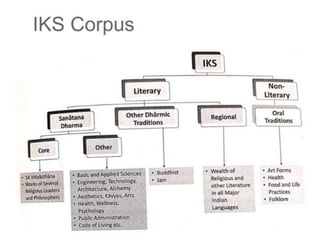
What is IKS.
•Indian Knowledge system refers to the
traditional and ancient knowledge that have
been developed and preserved in India over
thousand of years.
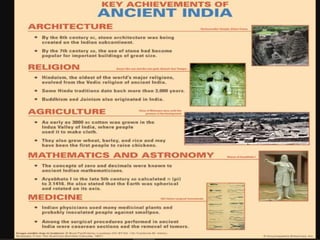
• It includes mathematics, science and
technology, medicine, astronomy,
architecture, philosophy, arts, languages,
literature, cultural and social practices,
traditions, etc.
3.
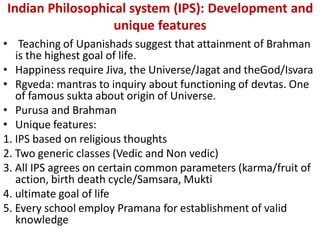
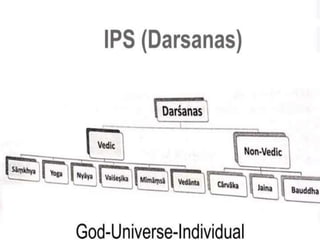
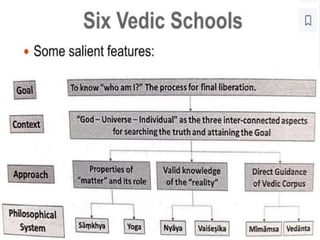
• Philosophy andSpirituality: The IKS includes various philosophical traditions like Vedanta,
Nyaya(Justice), Samkhya(Purusha (the conscious spirit or self) and Prakriti (the material nature or
substance), Buddhist philosophy, and Jainism. It explores existential questions, ethics, and the nature of
reality.
• Science and Mathematics: Ancient Indian scholars made significant contributions to mathematics (e.g.,
the concept of zero, decimal system), astronomy (e.g., Aryabhata’s work), and medicine (e.g., Ayurveda,
Siddha).
• Languages and Literature: The IKS is rich in literature, including ancient texts in Sanskrit, Tamil, and
other regional languages. This encompasses epics like the Mahabharata and Ramayana, as well as
classical poetry and drama.
• Arts and Aesthetics: Indian art forms such as music, dance, painting, and sculpture reflect the profound
cultural heritage and often integrate spiritual themes and philosophies.
• Cultural Practices: Traditions, festivals, customs, and local knowledge systems tied to agriculture,
craftsmanship, and ecology are critical components of IKS.
• Interdisciplinary Nature: The IKS is inherently interdisciplinary, connecting various fields of study and
promoting holistic understanding.
• Sustainability and Ecology: Many aspects of IKS emphasize sustainability, ethical living, and harmony
with nature, rooted in the philosophies that advocate for balance within the ecosystem.
4.
Explain what youunderstand by each word
in this term”IKS”.[CO1,RBTL2,10M]
• Indian:
6.
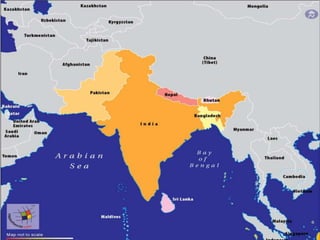
Indian: This wordrefers to the knowledge that
originates from the Indian subcontinent. The term
‘Indian’ points to the undivided Indian
subcontinent(Akhanda Bharata) .
It covers the entire region from modern day
Afghanistan in the west to Burma in the east and
from the Himalayas in the north to the Indian
Ocean in the south.
This region has long history of culture, practices and
ideas. Indian knowledge is not just about country
called India today but includes contributions from
all the people who lived in this region over the
centuries.
7.
"Knowledge" refers tothe information, understanding, and
skills that individuals acquire through experience,
education, or study over a time.
In India much of theses knowledge is passed down through
stories, traditional and written texts.
Some knowledge are written down(explicit knowledge)
while other knowledge is shared orally and is not written
(tacit knowledge).
8.
System:
The word systemrefers to the organized way in
which this knowledge is structured and classified.
Since Indian knowledge is so vast, it needs to be
grouped and arranged logically to make it easier to
access and understand.
A system also helps to show how different pieces of
knowledge are connected to each other, making it
simpler to see the overall picture and understand
how different ideas work together.
9.
• Do youthink ancient knowledge is useful for a
society? Support your answer with suitable
arguments. [CO4,RBT L3,10 Marks]
10.
The use ofancient knowledge in present society can be observed
in various fields, including medicine, architecture, agriculture,
philosophy , environmental practices and Economic Values. Here
are some key areas where ancient wisdom is applied today:
• Medicine and Healing Practices:
– Herbal Medicine: Traditional practices like Ayurveda,
Traditional Chinese Medicine (TCM), and Native
American healing include extensive knowledge of herbs
and natural remedies that are still used today.
– Mind-Body Connection: Ancient practices such as yoga
and meditation, which date back thousands of years, are
now widely recognized for their benefits on mental
health and well-being.
11.
• Architecture andUrban Planning:
– Sustainable Building: Many ancient civilizations used
local materials and environmentally adaptive designs,
which are being revisited in the context of sustainable
architecture today.
– Community Layouts: Ancient urban designs, like those
of Greek agoras or Roman forums, inspire modern public
spaces focused on community interaction.
• Sustainable Agriculture:
– Crop Rotation and Companion Planting: Ancient
civilizations developed techniques to enhance soil
fertility and pest management, many of which are being
revived in modern organic farming.
12.
• Philosophy andEthics:
– Patience: Ancient Greek and Roman Stoic philosophy is
gaining popularity for its practical approaches to stress
management and resilient living.
– Eastern Philosophies: Concepts from Confucianism(China
culture) and Taoism(China Culture) are influencing modern
discussions about ethics, governance, and personal conduct.
• Environmental Control:
– Agroforestry (a land management system that combines
trees with crops or livestock, or both, on the same piece of
land. It focuses on increasing benefits to the landowner as
well as maintaining forest integrity and environmental
health. ) and Forest Management: Practices from indigenous
cultures that maintain the balance of ecosystems are being
integrated into modern environmental conservation
strategies.
13.
• Economic Value:
•Ancient knowledge has the potential to bring
significant economic benefits.
• In a knowledge-driven world, preserving ancient
wisdom can give country a competitive edge.
• The example of pigeon pea extracts show ancient
knowledge can be used for economic gain.
16.
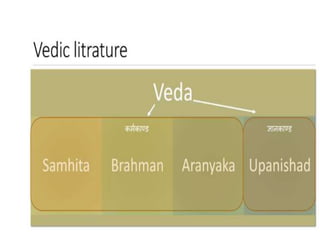
Vedic Corpus
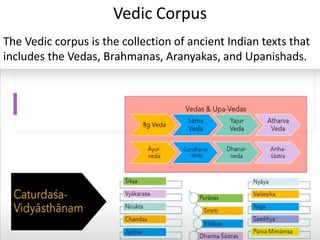
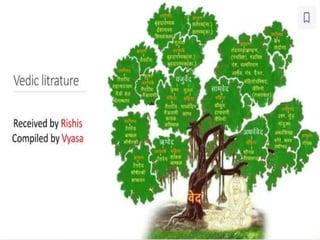
The Vediccorpus is the collection of ancient Indian texts that
includes the Vedas, Brahmanas, Aranyakas, and Upanishads.
19.
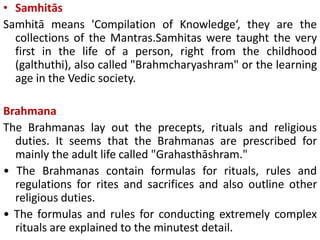
• Samhitās
Samhitā means'Compilation of Knowledge‘, they are the
collections of the Mantras.Samhitas were taught the very
first in the life of a person, right from the childhood
(galthuthi), also called "Brahmcharyashram" or the learning
age in the Vedic society.
Brahmana
The Brahmanas lay out the precepts, rituals and religious
duties. It seems that the Brahmanas are prescribed for
mainly the adult life called "Grahasthāshram."
• The Brahmanas contain formulas for rituals, rules and
regulations for rites and sacrifices and also outline other
religious duties.
• The formulas and rules for conducting extremely complex
rituals are explained to the minutest detail.
20.
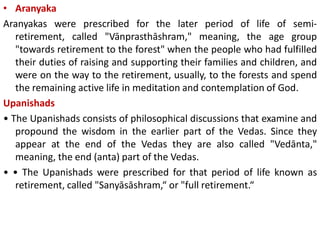
• Aranyaka
Aranyakas wereprescribed for the later period of life of semi-
retirement, called "Vānprasthāshram," meaning, the age group
"towards retirement to the forest" when the people who had fulfilled
their duties of raising and supporting their families and children, and
were on the way to the retirement, usually, to the forests and spend
the remaining active life in meditation and contemplation of God.
Upanishads
• The Upanishads consists of philosophical discussions that examine and
propound the wisdom in the earlier part of the Vedas. Since they
appear at the end of the Vedas they are also called "Vedānta,"
meaning, the end (anta) part of the Vedas.
• • The Upanishads were prescribed for that period of life known as
retirement, called "Sanyāsāshram,“ or "full retirement.“
22.
Philosophy
Philosophical System inquireinto who I am, what is
my source and destination, what are nature of God
and Universe, Are there any universal laws to
remain happy forever?
It provides the vision of life and help us to resolve the
problems which we face in life.
Darsana/Schools of Philosophy: holistic
understanding of the world to attain the final goal
of life.
23.
Indian Philosophical system(IPS): Development and
unique features
• Teaching of Upanishads suggest that attainment of Brahman
is the highest goal of life.
• Happiness require Jiva, the Universe/Jagat and theGod/Isvara
• Rgveda: mantras to inquiry about functioning of devtas. One
of famous sukta about origin of Universe.
• Purusa and Brahman
• Unique features:
1. IPS based on religious thoughts
2. Two generic classes (Vedic and Non vedic)
3. All IPS agrees on certain common parameters (karma/fruit of
action, birth death cycle/Samsara, Mukti
4. ultimate goal of life
5. Every school employ Pramana for establishment of valid
knowledge
26.
Character scope andimportance
In the Indian knowledge system, character (or "sādhanā") plays a critical
role and is intricately woven into its spiritual, philosophical, and
ethical fabric. The concept of character in this context is not just
about personal morality but is seen as essential to achieving a holistic
understanding of the self and the universe.
Let's explore the scope and importance of character in the Indian
knowledge system:
1. Ethical Foundation of Knowledge (Dharma)
In the Indian tradition, the pursuit of knowledge is deeply connected to
Dharma—the moral law and ethical principles that guide individual
and collective conduct. Character is vital because it shapes how a
person interacts with the world, how they acquire knowledge, and
how they use that knowledge. Dharma is understood as the path that
leads to spiritual growth and self-realization, and it involves
cultivating virtues such as truthfulness (satya), compassion (karuṇā),
non-violence (ahimsa), humility (vinaya), and self-discipline (tapas).
27.
• The BhagavadGita (a key text in Indian philosophy) emphasizes
the role of righteousness and personal virtues. Lord Krishna
speaks about the importance of purifying one’s heart and mind,
where knowledge (jnana) is not merely intellectual but requires
a foundation of good character.
2. Integration of Knowledge and Action
In the Indian knowledge system, knowledge is not merely an
intellectual pursuit—it must be applied in life. Character plays a
key role in this integration. Jnana (knowledge) and karma
(action) are both seen as interconnected in the spiritual
journey. One’s actions should align with their knowledge, and
knowledge should manifest in righteous deeds. A person with a
strong character, grounded in dharma, can make wise, ethical
decisions in all aspects of life.
• The concept of karma yoga (the path of selfless action) in the
Gita focuses on performing duties without attachment to the
results, emphasizing the importance of a pure character in one’s
actions.
28.
3. Role ofCharacter in the Pursuit of Moksha
In Indian spiritual traditions, the ultimate goal is moksha, or liberation from
the cycle of birth, death, and rebirth (samsara). Achieving moksha involves
the purification of the mind, heart, and soul.
• Patanjali’s Yoga Sutras emphasize the role of ethics in attaining mastery
over the mind. The practice of virtues like ahimsa (non-violence) and satya
(truthfulness) forms the foundation for spiritual growth.
4. Philosophical Perspectives on Character
Various philosophical schools within the Indian tradition highlight the
importance of character in different ways:
Advaita Vedanta: In the non-dual philosophy of Advaita Vedanta (as
expounded by Shankaracharya), personal character is necessary for realizing
the oneness of the self with Brahman. A pure character, free from desires
and attachments, enables the mind to attain the clarity required to
understand the true nature of reality.
• Bhakti and Devotion: In the Bhakti tradition (devotion to a personal god),
character is essential for cultivating love and devotion. The qualities of
humility, devotion, and selfless service purify the heart, allowing for the
experience of divine grace.
29.
5. Character inIndian Education Systems
• In ancient India, education was seen as a holistic process. It was
not just about acquiring knowledge but also about character
development. The Gurukul system emphasized not only
intellectual development but also moral and ethical education.
The teacher (guru) was expected to impart wisdom that
fostered good character, while the student was encouraged to
develop virtues such as discipline, respect, and a sense of duty.
• Sage Patanjali, in his work on yoga and moral conduct, also
stressed the importance of samyama—a combination of
concentration, meditation, and contemplation—achievable only
when one possesses a virtuous character.
30.
Traditional knowledge vis-à-visIndigenous knowledge
• Traditional Knowledge:
• Definition: Traditional knowledge refers to the body of
knowledge, innovations, and practices that have been
passed down through generations within a particular
community or society. This knowledge is often based on
lived experiences, cultural practices, and wisdom that
evolves over time.
• Examples: This might include farming techniques,
medicinal practices, social structures, or storytelling
traditions.
31.
Traditional knowledge vis-à-visIndigenous knowledge
• Indigenous Knowledge:
• Definition: Indigenous knowledge is a specific form of
traditional knowledge that is closely tied to the cultures,
traditions, and worldviews of Indigenous peoples. It refers
to the deep understanding and wisdom developed over
centuries by Indigenous communities, particularly about
their relationship with the environment and the land they
inhabit.
• Examples: It could involve knowledge of local ecosystems,
plants, animals, natural resources, spiritual beliefs, healing
practices, or governance systems.
32.
Traditional knowledge vs.Western knowledge
• Traditional knowledge, passed down through
generations within communities, focuses on
practical skills, local practices, and cultural
understanding, while Western knowledge, often
rooted in scientific inquiry, emphasizes systematic
observation, experimentation, and theoretical
frameworks.
![Explain what you understand by each word
in this term”IKS”.[CO1,RBTL2,10M]
• Indian:](https://image.slidesharecdn.com/iksppt-250327112523-88a55c10/85/VTU-notes-for-Indian-Knowledge-System-2022-scheme-ppt-4-320.jpg)
![• Do you think ancient knowledge is useful for a
society? Support your answer with suitable
arguments. [CO4,RBT L3,10 Marks]](https://image.slidesharecdn.com/iksppt-250327112523-88a55c10/85/VTU-notes-for-Indian-Knowledge-System-2022-scheme-ppt-9-320.jpg)