Module 1
• Introductionto Indian Knowledge Systems (IKS): Overview, Vedic
Corpus, Philosophy, Character scope and importance, traditional
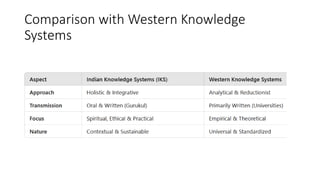
knowledge vis-a-vis indigenous knowledge, traditional knowledge vs.
western knowledge
4.
Arabian Proverb…..
• TheFool: "He who knows not and doesn't know is a fool.".
• The Simple: "He who knows not and knows: He is simple."
• The Asleep: "He who knows and knows not: He is asleep."
• The Wise: "He who knows and knows: He is wise
5.
• He whoknows not, and knows not he knows not, is a fool; shun
him.
He who knows not, and knows he knows not, is simple; teach him.
He who knows, and knows not he knows, is asleep; awaken him.
He who knows, and knows he knows, is wise; follow him
6.
Introduction to IndianKnowledge Systems
(IKS): Overview & Vedic Corpus
• Introduction to Indian Knowledge Systems (IKS)
• Definition: IKS refers to the vast body of knowledge developed in India over
thousands of years.
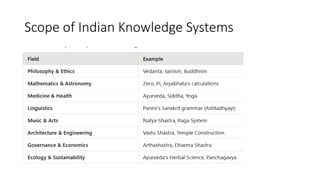
• Scope: Includes philosophy, science, mathematics, medicine (Ayurveda),
linguistics, arts, ethics, and spirituality.
• Objective: To explore the Vedic corpus as the foundational knowledge of IKS.
7.
• The IndianKnowledge Systems comprise of Jnan, Vignan, and Jeevan
Darshan that have evolved out of experience, observation,
experimentation, and rigorous analysis.
• This tradition of validating and putting into practice has impacted
our education, arts, administration, law, justice, health,
manufacturing, and commerce.
8.
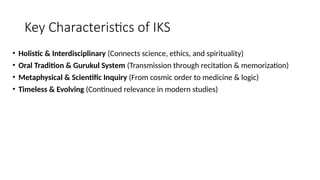
Key Characteristics ofIKS
• Holistic & Interdisciplinary (Connects science, ethics, and spirituality)
• Oral Tradition & Gurukul System (Transmission through recitation & memorization)
• Metaphysical & Scientific Inquiry (From cosmic order to medicine & logic)
• Timeless & Evolving (Continued relevance in modern studies)
9.
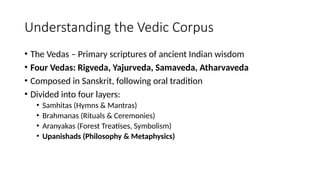
Understanding the VedicCorpus
• The Vedas – Primary scriptures of ancient Indian wisdom
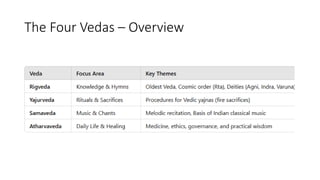
• Four Vedas: Rigveda, Yajurveda, Samaveda, Atharvaveda
• Composed in Sanskrit, following oral tradition
• Divided into four layers:
• Samhitas (Hymns & Mantras)
• Brahmanas (Rituals & Ceremonies)
• Aranyakas (Forest Treatises, Symbolism)
• Upanishads (Philosophy & Metaphysics)
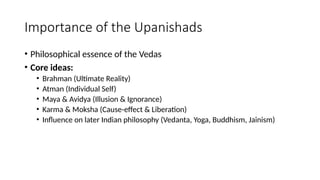
Importance of theUpanishads
• Philosophical essence of the Vedas
• Core ideas:
• Brahman (Ultimate Reality)
• Atman (Individual Self)
• Maya & Avidya (Illusion & Ignorance)
• Karma & Moksha (Cause-effect & Liberation)
• Influence on later Indian philosophy (Vedanta, Yoga, Buddhism, Jainism)
12.
Transmission of VedicKnowledge
• Oral Tradition (Shruti & Smriti)
• Memorization Techniques:
• Pada Patha (Word-by-word recitation)
• Krama Patha (Sequential recitation)
• Ghana Patha (Complex recitation patterns)
• Role of Rishis & Gurukul System
13.
Relevance of theVedic Corpus Today
• Philosophical Thought & Ethics
• Yoga & Meditation Practices
• Influence on Ayurveda & Holistic Health
• Impact on Indian Art, Music & Literature
14.
IKS : Character,scope and importance
• Core Aspects: Includes philosophy, science, medicine, arts,
governance, and ethics.
15.
Character of IndianKnowledge Systems
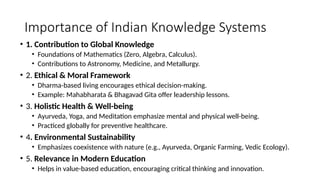
• 1. Holistic Approach
• Integrates science, philosophy, spirituality, and ethics.
• Example: Ayurveda (Medicine), Yoga (Well-being), Vedanta (Philosophy).
• 2. Oral & Written Tradition
• Vedic Knowledge transmitted orally through precise recitation.
• Later written in Sanskrit, Prakrit, and regional languages.
• 3. Practical & Experiential Learning
• Focus on applied knowledge rather than theoretical concepts alone.
• Example: Ayurveda & Siddha based on empirical observations.
• 4. Sustainable & Contextual
• Emphasizes harmony with nature and society.
• Example: Vastu Shastra (Architecture), Panchanga (Calendar Systems).
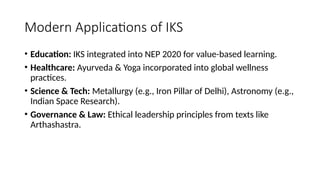
Modern Applications ofIKS
• Education: IKS integrated into NEP 2020 for value-based learning.
• Healthcare: Ayurveda & Yoga incorporated into global wellness
practices.
• Science & Tech: Metallurgy (e.g., Iron Pillar of Delhi), Astronomy (e.g.,
Indian Space Research).
• Governance & Law: Ethical leadership principles from texts like
Arthashastra.
20.
Challenges in PreservingIKS
• Loss of Traditional Knowledge due to modernization.
• Lack of Research & Documentation.
• Need for Interdisciplinary Integration with modern sciences.
• Promoting IKS in Education to retain its relevance.
21.
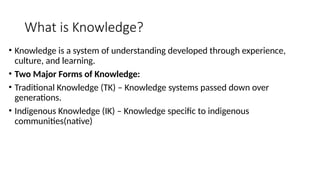
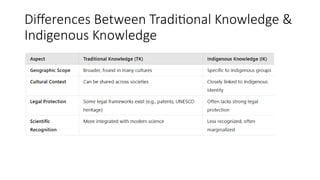
What is Knowledge?
•Knowledge is a system of understanding developed through experience,
culture, and learning.
• Two Major Forms of Knowledge:
• Traditional Knowledge (TK) – Knowledge systems passed down over
generations.
• Indigenous Knowledge (IK) – Knowledge specific to indigenous
communities(native)
22.
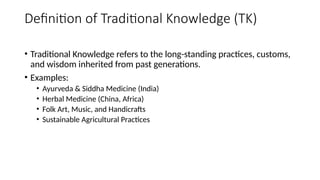
Definition of TraditionalKnowledge (TK)
• Traditional Knowledge refers to the long-standing practices, customs,
and wisdom inherited from past generations.
• Examples:
• Ayurveda & Siddha Medicine (India)
• Herbal Medicine (China, Africa)
• Folk Art, Music, and Handicrafts
• Sustainable Agricultural Practices
23.
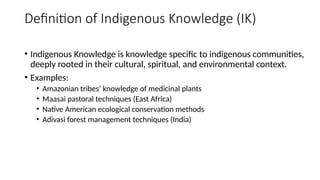
Definition of IndigenousKnowledge (IK)
• Indigenous Knowledge is knowledge specific to indigenous communities,
deeply rooted in their cultural, spiritual, and environmental context.
• Examples:
• Amazonian tribes’ knowledge of medicinal plants
• Maasai pastoral techniques (East Africa)
• Native American ecological conservation methods
• Adivasi forest management techniques (India)
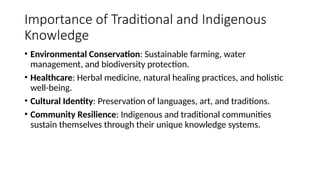
Importance of Traditionaland Indigenous
Knowledge
• Environmental Conservation: Sustainable farming, water
management, and biodiversity protection.
• Healthcare: Herbal medicine, natural healing practices, and holistic
well-being.
• Cultural Identity: Preservation of languages, art, and traditions.
• Community Resilience: Indigenous and traditional communities
sustain themselves through their unique knowledge systems.
27.
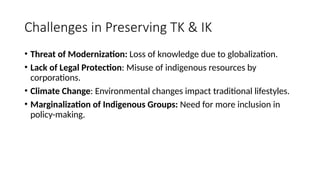
Challenges in PreservingTK & IK
• Threat of Modernization: Loss of knowledge due to globalization.
• Lack of Legal Protection: Misuse of indigenous resources by
corporations.
• Climate Change: Environmental changes impact traditional lifestyles.
• Marginalization of Indigenous Groups: Need for more inclusion in
policy-making.
28.
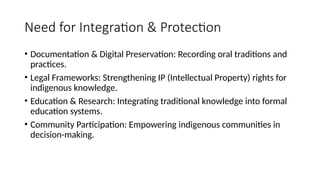
Need for Integration& Protection
• Documentation & Digital Preservation: Recording oral traditions and
practices.
• Legal Frameworks: Strengthening IP (Intellectual Property) rights for
indigenous knowledge.
• Education & Research: Integrating traditional knowledge into formal
education systems.
• Community Participation: Empowering indigenous communities in
decision-making.
29.
Introduction to IndianKnowledge Systems
(IKS): Philosophy
• Understanding the Philosophical Foundations of Indian Knowledge
• Definition: IKS refers to the vast body of knowledge developed in
India over thousands of years.
• Domains: Includes philosophy, science, mathematics, medicine
(Ayurveda), arts, and more.
• Objective: To explore the philosophical traditions within IKS and
their relevance today.
30.
Core Characteristics ofIndian Philosophy
• Spiritual & Metaphysical Inquiry (Focus on self-realization and ultimate truth)
• Interconnectedness of Life & Universe
• Logical & Systematic Approach (Debate and reasoning are essential)
• Ethical & Practical Living
Four Noble Truths
•Truth of suffering:
• Also known as Dukkha, this is the recognition that all life is imperfect,
impermanent, and involves suffering.
• Truth of the cause of suffering:
• Recognizing that actions have consequences, and that karma exists.
• Truth of the end of suffering:
• Nirvana is the ultimate goal of Buddhism, and is often described as a release
from suffering.
• Truth of the path that leads to the end of suffering:
• Also known as the Eightfold Path.
33.
The Eightfold Path
•Study—Cultivating Wisdom
• Right Understanding
• Right Intention
• One cultivates goodwill, harmlessness and non-attachment, avoiding tendencies towards greed, hatred and harm
• Ethical Conduct—Developing Moral Conduct
• Right Speech
• refrain from false speech—not only lying or slandering, but gossip, cursing, swearing or meaningless babble. I will
communicate in kind, gentle and direct speech
• Right Action
• Right Livelihood
• Mental Development—Disciplining the Mind
• Right Effort
• Right Mindfulness
• Right Concentration
34.
• Right Action:
•there are five precepts of non-harming (ahimsa)—these are ideals that one
vows to live by:
• to refrain from harming sentient beings;
• to refrain from taking what is not offered;
• to refrain from sexual misconduct;
• to refrain from false speech;
• to refrain from stupefying drink
35.
Core Concepts inIndian Philosophy
• Dharma – Duty and righteousness
• Karma – Law of cause and effect
• Moksha – Liberation from the cycle of rebirth
• Atman & Brahman – Individual self vs. universal consciousness
• Avidya & Maya – Ignorance and illusion
36.
Philosophical Texts inIKS
• Vedas & Upanishads – Foundational scriptures
• Bhagavad Gita – Philosophical discourse on duty and devotion
• Yoga Sutras of Patanjali – Mind and meditation
• Buddhist & Jain Texts – Dhammapada, Agamas
37.
Influence of IndianPhilosophy on Society
• Education & Gurukul System
• Ethics & Morality in Governance (Arthashastra, Dharmashastra)
• Influence on Global Thought (Scholars like Schopenhauer & Einstein
admired Vedanta)
• Indian philosophyprovides a holistic approach to life, knowledge, and
ethics.
• It harmonizes science, spirituality, and logic.
• Its teachings remain relevant for personal growth and societal well-
being
Module 2
• TraditionalKnowledge in Humanities and Sciences: Lingistics,
Number and measurements- Mathematics, Chemistry, Physics, Art,
Astronomy, Astrology, Crafts and Trade in India and Engineering and
Technology
42.
Module 3
• TraditionalKnowledge in Professional domain: Town planning and
architecture- Construction, Health, wellness and Psychology-
Medicine, Agriculture, Governance and public administration, United
Nations Sustainable development goals
 Most read
 Most read