Dharma:
Concept, Origin, Nature & Types
BA III Semester
UNIT 1
By
Prachi Virag Sontakke
Concept of Dharma
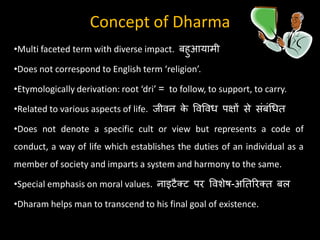
•Multi faceted term with diverse impact. बहुआयामी
•Does not correspond to English term ‘religion’.
•Etymologically derivation: root ‘dri’ = to follow, to support, to carry.
•Related to various aspects of life. जीवन क
े ववववध पक्षों से संबंधधत
•Does not denote a specific cult or view but represents a code of
conduct, a way of life which establishes the duties of an individual as a
member of society and imparts a system and harmony to the same.
•Special emphasis on moral values. नाइटैक्ट पर ववशेष-अततररक्त बल
•Dharam helps man to transcend to his final goal of existence.
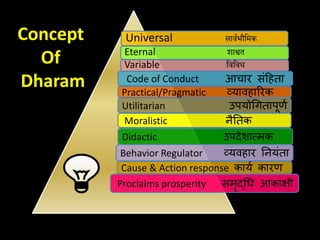
Universal सार्वभौमिक
Eternal शाश्वत
Variable मर्मर्ध
Code of Conduct आचार संहहता
Practical/Pragmatic व्यावहाररक
Utilitarian उपयोधितापूर्ण
Moralistic नैततक
Didactic उपदेशात्मक
Behavior Regulator व्यवहार तनयंता
Cause & Action response कायण कारर्
Proclaims prosperity समृद्धध आकांक्षी
Concept
Of
Dharam
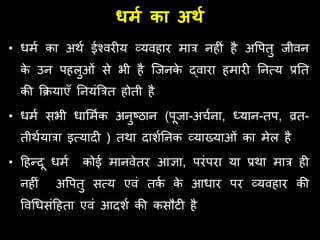
धर्म का अर्म
• धमण का अर्ण ईश्वरीय व्यवहार मात्र नहीं है अवपतु जीवन
क
े उन पहलुओं से भी है जजनक
े द्वारा हमारी तनत्य प्रतत
की क्रियाएँ तनयंत्रत्रत होती है
• धमण सभी धार्मणक अनुष्ठान (पूजा-अचणना, ध्यान-तप, व्रत-
तीर्णयात्रा इत्यादी ) तर्ा दाशणतनक व्याख्याओं का मेल है
• हहन्दू धमण कोई मानवेतर आज्ञा, परंपरा या प्रर्ा मात्र ही
नहीं अवपतु सत्य एवं तक
ण क
े आधार पर व्यवहार की
ववधधसंहहता एवं आदशण की कसौटी है
धमण क
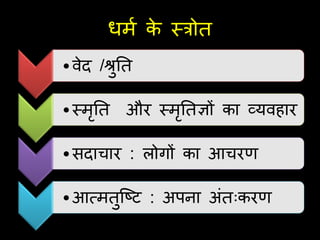
े स्त्त्रोत
•वेद /श्रुतत
•स्त्मृतत और स्त्मृततज्ञों का व्यवहार
•सदाचार : लोिों का आचरर्
•आत्मतुजष्ट : अपना अंतःकरर्
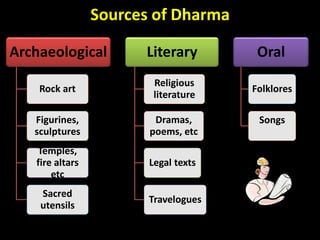
Sources of Dharma
Archaeological
Rock art
Figurines,
sculptures
Temples,
fire altars
etc
Sacred
utensils
Literary
Religious
literature
Dramas,
poems, etc
Legal texts
Travelogues
Oral
Folklores
Songs
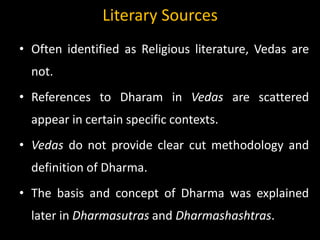
Literary Sources
• Often identified as Religious literature, Vedas are
not.
• References to Dharam in Vedas are scattered
appear in certain specific contexts.
• Vedas do not provide clear cut methodology and
definition of Dharma.
• The basis and concept of Dharma was explained
later in Dharmasutras and Dharmashashtras.
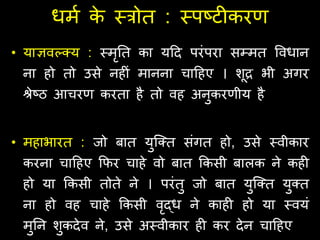
धमण क
े स्त्त्रोत : स्त्पष्टीकरर्
• याज्ञवल्कक्य : स्त्मृतत का यहद परंपरा सम्मत ववधान
ना हो तो उसे नहीं मानना चाहहए । शूद्र भी अिर
श्रेष्ठ आचरर् करता है तो वह अनुकरर्ीय है
• महाभारत : जो बात युजक्त संित हो, उसे स्त्वीकार
करना चाहहए क्रिर चाहे वो बात क्रकसी बालक ने कही
हो या क्रकसी तोते ने । परंतु जो बात युजक्त युक्त
ना हो वह चाहे क्रकसी वृद्ध ने काही हो या स्त्वयं
मुतन शुकदेव ने, उसे अस्त्वीकार ही कर देन चाहहए
Outline of Dharma in Literature
• Rgveda: used 56 times in context of various religious rites,
definite rules and behavior.
• Atharvaveda: used to denote the merit earned by conducting
religious rites.
• Aitereya Brahman: means all religious duties.
• Taitiriya Upanishad: denotes code of conduct like satam vad
• Purvamimaansa sutra: to follow the rules laid down in vedas
is dharam.
• Mahabharata: Behaviour is dharam- ‘ahimsa paramo
dharamah’ , ‘aacharah paramo dharamah’.
• Gautam Dharamsutra: vedas form the crux of dharam.
• ApsatambhDS: opinion of those who know Vedas is dharam.
धर्म का अर्म
• वैशेवषक सूत्र : जजससे आनंद और परमानन्द की
प्राजतत हो वही धमण है
• पूवणमीमांसा : धमण एक वांछनीय वस्त्तु है जजसकी
ववशेषता है प्रेरर्ा देना
• तैविरीय उपतनषद : धमण का पालन का अर्ण जीवन
क
े उस सोपान का पालन है जजसमे हम ववद्यमान
है
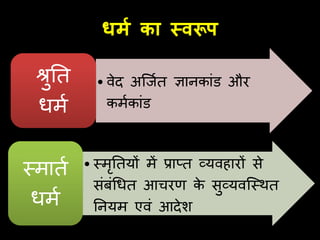
धर्म का स्वरूप
• वेद अजजणत ज्ञानकांड और
कमणकांड
श्रुतत
धमण
• स्त्मृततयों में प्रातत व्यवहारों से
संबंधधत आचरर् क
े सुव्यवजस्त्र्त
तनयम एवं आदेश
स्त्मातण
धमण
Types of Dharma
• छान्दोग्य उपतनषद : धमण की तीन शाखाएं जजनका
संबंध ब्रह्मचारी, िृहस्त्र् ,तपस्त्वी क
े कतणव्यों से है
• Yajnavalkyasmriti: Veda, Smriti, Sadachaar, Swapriy
(loved by self), desire generated by right vow
• Megatithi: Varna, Ashram, Varnashram, Gun,
Naimittik.
• Others : Shraut श्रौत (based on Vedas) & Smritis
स्त्मृतत (based on Smritis).
• Generally: Philosophical/spiritual (आध्याजत्मक /
दाशणतनक) & rites/tradition (कमणकांड / लौक्रकक).
धमण क
े प्रकार
• सामान्य धमण : Applicable/useful to all irrespective of time &
space. Eg.: kindness, truthfullness.
• ववर्शष्ट धमण : restricted for certain groups. Eg. Varna dharam,
Kuldharam (directives for Samskar, Panchmahayajnas, Marriage
etc), Yugdharma (Sat-Tap, Treta-Jnana, Dwapar-Yajna, Kali-Daan),
Rajdharam etc;
• आपद धमण : Shashtras permit to unfollow/change the prescribed
rules of dharam in extreme/dire situations to save life. Eg.
Pandavas performing duties of charioteer, cook etc in exile.
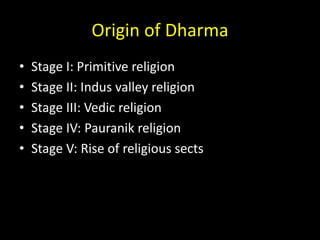
Origin of Dharma
• Stage I: Primitive religion
• Stage II: Indus valley religion
• Stage III: Vedic religion
• Stage IV: Pauranik religion
• Stage V: Rise of religious sects
dharm nature and meaning

  • 1.
    Dharma: Concept, Origin, Nature& Types BA III Semester UNIT 1 By Prachi Virag Sontakke
  • 3.
    Concept of Dharma •Multifaceted term with diverse impact. बहुआयामी •Does not correspond to English term ‘religion’. •Etymologically derivation: root ‘dri’ = to follow, to support, to carry. •Related to various aspects of life. जीवन क े ववववध पक्षों से संबंधधत •Does not denote a specific cult or view but represents a code of conduct, a way of life which establishes the duties of an individual as a member of society and imparts a system and harmony to the same. •Special emphasis on moral values. नाइटैक्ट पर ववशेष-अततररक्त बल •Dharam helps man to transcend to his final goal of existence.
  • 4.
    Universal सार्वभौमिक Eternal शाश्वत Variableमर्मर्ध Code of Conduct आचार संहहता Practical/Pragmatic व्यावहाररक Utilitarian उपयोधितापूर्ण Moralistic नैततक Didactic उपदेशात्मक Behavior Regulator व्यवहार तनयंता Cause & Action response कायण कारर् Proclaims prosperity समृद्धध आकांक्षी Concept Of Dharam
  • 5.
    धर्म का अर्म •धमण का अर्ण ईश्वरीय व्यवहार मात्र नहीं है अवपतु जीवन क े उन पहलुओं से भी है जजनक े द्वारा हमारी तनत्य प्रतत की क्रियाएँ तनयंत्रत्रत होती है • धमण सभी धार्मणक अनुष्ठान (पूजा-अचणना, ध्यान-तप, व्रत- तीर्णयात्रा इत्यादी ) तर्ा दाशणतनक व्याख्याओं का मेल है • हहन्दू धमण कोई मानवेतर आज्ञा, परंपरा या प्रर्ा मात्र ही नहीं अवपतु सत्य एवं तक ण क े आधार पर व्यवहार की ववधधसंहहता एवं आदशण की कसौटी है
  • 6.
    धमण क े स्त्त्रोत •वेद/श्रुतत •स्त्मृतत और स्त्मृततज्ञों का व्यवहार •सदाचार : लोिों का आचरर् •आत्मतुजष्ट : अपना अंतःकरर्
  • 7.
    Sources of Dharma Archaeological Rockart Figurines, sculptures Temples, fire altars etc Sacred utensils Literary Religious literature Dramas, poems, etc Legal texts Travelogues Oral Folklores Songs
  • 8.
    Literary Sources • Oftenidentified as Religious literature, Vedas are not. • References to Dharam in Vedas are scattered appear in certain specific contexts. • Vedas do not provide clear cut methodology and definition of Dharma. • The basis and concept of Dharma was explained later in Dharmasutras and Dharmashashtras.
  • 9.
    धमण क े स्त्त्रोत: स्त्पष्टीकरर् • याज्ञवल्कक्य : स्त्मृतत का यहद परंपरा सम्मत ववधान ना हो तो उसे नहीं मानना चाहहए । शूद्र भी अिर श्रेष्ठ आचरर् करता है तो वह अनुकरर्ीय है • महाभारत : जो बात युजक्त संित हो, उसे स्त्वीकार करना चाहहए क्रिर चाहे वो बात क्रकसी बालक ने कही हो या क्रकसी तोते ने । परंतु जो बात युजक्त युक्त ना हो वह चाहे क्रकसी वृद्ध ने काही हो या स्त्वयं मुतन शुकदेव ने, उसे अस्त्वीकार ही कर देन चाहहए
  • 10.
    Outline of Dharmain Literature • Rgveda: used 56 times in context of various religious rites, definite rules and behavior. • Atharvaveda: used to denote the merit earned by conducting religious rites. • Aitereya Brahman: means all religious duties. • Taitiriya Upanishad: denotes code of conduct like satam vad • Purvamimaansa sutra: to follow the rules laid down in vedas is dharam. • Mahabharata: Behaviour is dharam- ‘ahimsa paramo dharamah’ , ‘aacharah paramo dharamah’. • Gautam Dharamsutra: vedas form the crux of dharam. • ApsatambhDS: opinion of those who know Vedas is dharam.
  • 11.
    धर्म का अर्म •वैशेवषक सूत्र : जजससे आनंद और परमानन्द की प्राजतत हो वही धमण है • पूवणमीमांसा : धमण एक वांछनीय वस्त्तु है जजसकी ववशेषता है प्रेरर्ा देना • तैविरीय उपतनषद : धमण का पालन का अर्ण जीवन क े उस सोपान का पालन है जजसमे हम ववद्यमान है
  • 12.
    धर्म का स्वरूप •वेद अजजणत ज्ञानकांड और कमणकांड श्रुतत धमण • स्त्मृततयों में प्रातत व्यवहारों से संबंधधत आचरर् क े सुव्यवजस्त्र्त तनयम एवं आदेश स्त्मातण धमण
  • 13.
    Types of Dharma •छान्दोग्य उपतनषद : धमण की तीन शाखाएं जजनका संबंध ब्रह्मचारी, िृहस्त्र् ,तपस्त्वी क े कतणव्यों से है • Yajnavalkyasmriti: Veda, Smriti, Sadachaar, Swapriy (loved by self), desire generated by right vow • Megatithi: Varna, Ashram, Varnashram, Gun, Naimittik. • Others : Shraut श्रौत (based on Vedas) & Smritis स्त्मृतत (based on Smritis). • Generally: Philosophical/spiritual (आध्याजत्मक / दाशणतनक) & rites/tradition (कमणकांड / लौक्रकक).
  • 14.
    धमण क े प्रकार •सामान्य धमण : Applicable/useful to all irrespective of time & space. Eg.: kindness, truthfullness. • ववर्शष्ट धमण : restricted for certain groups. Eg. Varna dharam, Kuldharam (directives for Samskar, Panchmahayajnas, Marriage etc), Yugdharma (Sat-Tap, Treta-Jnana, Dwapar-Yajna, Kali-Daan), Rajdharam etc; • आपद धमण : Shashtras permit to unfollow/change the prescribed rules of dharam in extreme/dire situations to save life. Eg. Pandavas performing duties of charioteer, cook etc in exile.
  • 15.
    Origin of Dharma •Stage I: Primitive religion • Stage II: Indus valley religion • Stage III: Vedic religion • Stage IV: Pauranik religion • Stage V: Rise of religious sects