BA III Sem
Panchdevopasana
By
Prachi Virag Sontakke
Introduction
• Combined worship of five deities is termed as Panchdevopasana.
• Integratory nature of Hindu religion.
• Antiquity of tradition of joint worship: Rgvedic times & later period
• Mostly dual worship : Dyaus-Prithvi, Agni-Indra, Agni-Soma, Varuna-Mitra,
Harihar, Ardhanarishwar etc.
• Smarta literature: Worship of five gods is must in daily worship of
householder.
• Five gods include: Shiva, Vishnu, Shakti, Surya, Ganpati.
Sources
• Smarta Literature
• Puranas: specially Agni Purana, Vishnudharmottar Purana, Padma purana &
Garuda Purana
• मत्स्य पुराण : ब्रम्हा, सूयय, विष्णु और शिि अभेद
• ्क
ं द पुराण : विष्णु, शिि, िक्ति, गणेि यह सूययदेि क
े पााँच रूप है।
• Tantra literature
• Temples: Panchayatan temples.
• Inscriptions: Koni inscription of Kalchuri king Prithvi Das II, Brahmeshwar
temple inscription.
Origin of Panchdevopasana
• J.N.Benerji: Tendency for assimilation of Gods reached its peak during Pauranik period. This
is reflected in tradition of Panchdevopasana which was first proclaimed by Shankaracharya
as combined worship of Shiva, Vishnu, Shakti, Surya and Ganapati
• V.S. Pathak: Came into existence to unite the traditional religions. Shankaracharya didn’t
popularize Panchdevopasana. It was a gradual development from the concept of Trideva
worship that occurred with the growth of God pantheon.
• Others: Started by Kumaril Bhatt and not Shankaracharya.
• Others: Panchdevopasana arose as an effort to safeguard and unite Pauranik religion in
wake of foreign invasions and religious differences amongst various Brahminical sects.
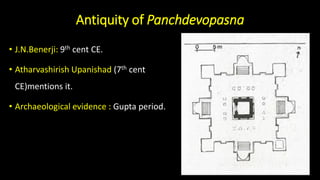
Antiquity of Panchdevopasna
• J.N.Benerji: 9th cent CE.
• Atharvashirish Upanishad (7th cent
CE)mentions it.
• Archaeological evidence : Gupta period.
Concept of Panchdevopasana
Five deities representing five elements.
• Vishnu: Sky
• Shiva: Earth
• Shakti: Agni
• Ganesh: Water
• Surya: Air
Any One deity held main: Others subsidiary
Backdrop
• Scriptures: Numerous devtas, but 5 main devatas are to be worshipped in form
• Philosophically, the Smarta tradition (specialize in the Smriti corpus of texts named the
Grihya Sutras, in contrast to Shrauta Sutras) emphasizes that all murti (idols) are icons of
saguna Brahman, as measn to realizing the abstract Ultimate Reality called nirguna
Brahma.
• The five icons are seen by Smartas as multiple representations of the one Saguna Brahma
• 5 main deeds of Supreme Power– उत्सपवि, क््िति, संहार, तिरोधान या तनग्रह, अनुग्रह
• To carry these five deeds, 5 different manifestations of Supreme God are required
• Creation: Sun, Sustenance: Vishnu, Destruction: Shiva, Restraint: Shakti, Anugrah: Ganpati
References to
Panchdevopasana
• शििे विष्णौ च ितिौ च सूये मतय नराधधप ।
याऽभेदबुद्धधयोगः स सम्यग्योगो मिो मम ॥
(शिि, विष्णु, िक्ति, सूयय और मुझमें अभेदबुद्धध रखने िाला ही योगी है)
• आददत्सयं गणनािं च देिी रुद्रं च क
े ििम।
पंच दैित्सयाशम त्सयुतिं सियकमयसु पूजयेि॥
• रविवियनायकश्चण्डी ईिो विष्णु्ििैि च।
अनुक्रमेण पूज्यन्िे व्युत्सक्रमे िु महद् भयम।।
(अिायि : इसका अिय है उपासक को पंचदेिों में सबसे पहले भगिान सूयय उनक
े बाद श्री गणेि, मां दुगाय,
भगिान िंकर और भगिान विष्णु को पूजना चादहए)
• Upāsanam panchavidham brahmopāsanamev tat
(Panch Dev Upāsanā is the worship ofBrahman. Panch Dev is the visible form of Brahman)
• Evam yo bhajate vishnum rudram durgam ganādhipam! Bhāskaram cha dhiyā nityam sa kadāchinna sīdati
(One who worships Vishnu, Rudra, Durga, Ganesh and Surya with faith will ever be effulgent in mind and
intellect, and will never face sorrow)
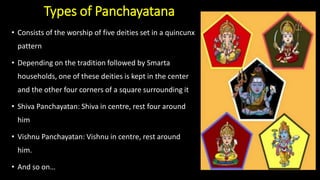
Types of Panchayatana
• Consists of the worship of five deities set in a quincunx
pattern
• Depending on the tradition followed by Smarta
households, one of these deities is kept in the center
and the other four corners of a square surrounding it
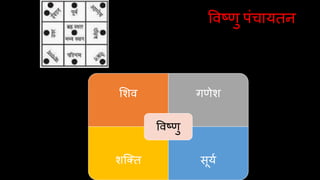
• Shiva Panchayatan: Shiva in centre, rest four around
him
• Vishnu Panchayatan: Vishnu in centre, rest around
him.
• And so on…
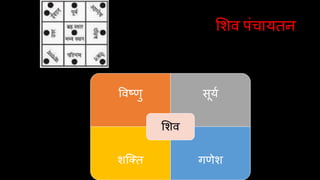
शिि पंचायिन
विष्णु सूयय
िक्ति गणेि
शिि
विष्णु पंचायिन
शिि गणेि
िक्ति सूयय
विष्णु
सूयय पंचायिन
शिि गणेि
िक्ति विष्णु
सूयय
िक्ति पंचायिन
विष्णु शिि
सूयय गणेि
िक्ति
गणेि पंचायिन
विष्णु शिि
िक्ति सूयय
गणेि
A Ganesha-centric Panchayatana:
Ganesha (centre) with Shiva (top left),
Devi or Adi Shakthi (top right), Vishnu
(bottom left), and Surya (bottom right).
Mode of worship
• Some worship all five with same reverence. Others worship one as main
• Three amongst five are Vedic deities.
• Worshipped by Pauranic and Tantric method: Using Meditation and puja
alike.
• Every God has his own mantra reserved specifically for him.
• He is invoked by his own mantra only.
• But worship of other 4 gods is done before invoking the main god.
• Bathing of gods, offering of Patr, Pushp and dhoop
• Fixed mantra for fixed offering
Panchamrit and Panchdevopasana
• Connection can’t be established with certainty.
• Not a specific offering to a specific deity: Panachamrit is offered to all the Devatas.
• But the components of Panchamrit can be associated with the five elements of the human body.
• With this association a connection of Panchamrit can also be established with the Panchadevas.
• 1. Ghee - Agni – Shakti
• 2. Dugdh - Jal – Ganesh
• 3. Madhu - Akash – Vishnu
• 4. Dadhi - Vayu – Surya
• 5. Gud(jaggery) - Prithvi - Shiv
Worship of Five
gods
• Sun represents the element air: Worshipped by
giving arghya and Namaskaar
• Ganesh represents water: Worshipped first
because everything arose from water only.
• Shakti represents fire: Offerings are made for her
in fire altar
• Shiva represents the element earth: Worshipped
as Shivalinga.
• Vishnu represents sky: Worshipped by Stuti
Panchdevopasana in Gupta period
• Prevalent during Gupta period
• Evidence for Panchayatan temple
• Dashavataar temple, Devagarh
Dashavatar temple at Devagarh
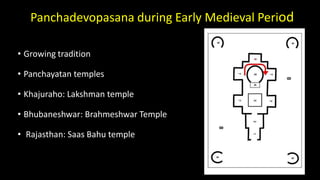
Panchadevopasana during Early Medieval Period
• Growing tradition
• Panchayatan temples
• Khajuraho: Lakshman temple
• Bhubaneshwar: Brahmeshwar Temple
• Rajasthan: Saas Bahu temple
Lakshman temple Khajuraho
Brahmeswara temple
There are also quite a number of tantric-related images, and even
Chamunda holding a trident and a human head, standing on a corpse.
Shiva and other deities are also depicted in their horrific aspects.
Panchdeva tirth in Padha village, Karnal
Conclusion
• Panchdevopasana is marked by the simultaneous worship ohe
worship of all these five Gods, Sun, Ambika, Vishnu, Ganapati and
Shiva.
• Emphasized the idea that these are not five different Gods, but they
are the one God worshipped in five different forms
• Attempt at unification of sectarian divisions of Brahmanism.
• Became popular during Early Medieval period.

Panchdevopasana new.pdf

  • 1.
  • 2.
    Introduction • Combined worshipof five deities is termed as Panchdevopasana. • Integratory nature of Hindu religion. • Antiquity of tradition of joint worship: Rgvedic times & later period • Mostly dual worship : Dyaus-Prithvi, Agni-Indra, Agni-Soma, Varuna-Mitra, Harihar, Ardhanarishwar etc. • Smarta literature: Worship of five gods is must in daily worship of householder. • Five gods include: Shiva, Vishnu, Shakti, Surya, Ganpati.
  • 3.
    Sources • Smarta Literature •Puranas: specially Agni Purana, Vishnudharmottar Purana, Padma purana & Garuda Purana • मत्स्य पुराण : ब्रम्हा, सूयय, विष्णु और शिि अभेद • ्क ं द पुराण : विष्णु, शिि, िक्ति, गणेि यह सूययदेि क े पााँच रूप है। • Tantra literature • Temples: Panchayatan temples. • Inscriptions: Koni inscription of Kalchuri king Prithvi Das II, Brahmeshwar temple inscription.
  • 4.
    Origin of Panchdevopasana •J.N.Benerji: Tendency for assimilation of Gods reached its peak during Pauranik period. This is reflected in tradition of Panchdevopasana which was first proclaimed by Shankaracharya as combined worship of Shiva, Vishnu, Shakti, Surya and Ganapati • V.S. Pathak: Came into existence to unite the traditional religions. Shankaracharya didn’t popularize Panchdevopasana. It was a gradual development from the concept of Trideva worship that occurred with the growth of God pantheon. • Others: Started by Kumaril Bhatt and not Shankaracharya. • Others: Panchdevopasana arose as an effort to safeguard and unite Pauranik religion in wake of foreign invasions and religious differences amongst various Brahminical sects.
  • 5.
    Antiquity of Panchdevopasna •J.N.Benerji: 9th cent CE. • Atharvashirish Upanishad (7th cent CE)mentions it. • Archaeological evidence : Gupta period.
  • 6.
    Concept of Panchdevopasana Fivedeities representing five elements. • Vishnu: Sky • Shiva: Earth • Shakti: Agni • Ganesh: Water • Surya: Air Any One deity held main: Others subsidiary
  • 7.
    Backdrop • Scriptures: Numerousdevtas, but 5 main devatas are to be worshipped in form • Philosophically, the Smarta tradition (specialize in the Smriti corpus of texts named the Grihya Sutras, in contrast to Shrauta Sutras) emphasizes that all murti (idols) are icons of saguna Brahman, as measn to realizing the abstract Ultimate Reality called nirguna Brahma. • The five icons are seen by Smartas as multiple representations of the one Saguna Brahma • 5 main deeds of Supreme Power– उत्सपवि, क््िति, संहार, तिरोधान या तनग्रह, अनुग्रह • To carry these five deeds, 5 different manifestations of Supreme God are required • Creation: Sun, Sustenance: Vishnu, Destruction: Shiva, Restraint: Shakti, Anugrah: Ganpati
  • 8.
    References to Panchdevopasana • शििेविष्णौ च ितिौ च सूये मतय नराधधप । याऽभेदबुद्धधयोगः स सम्यग्योगो मिो मम ॥ (शिि, विष्णु, िक्ति, सूयय और मुझमें अभेदबुद्धध रखने िाला ही योगी है) • आददत्सयं गणनािं च देिी रुद्रं च क े ििम। पंच दैित्सयाशम त्सयुतिं सियकमयसु पूजयेि॥ • रविवियनायकश्चण्डी ईिो विष्णु्ििैि च। अनुक्रमेण पूज्यन्िे व्युत्सक्रमे िु महद् भयम।। (अिायि : इसका अिय है उपासक को पंचदेिों में सबसे पहले भगिान सूयय उनक े बाद श्री गणेि, मां दुगाय, भगिान िंकर और भगिान विष्णु को पूजना चादहए) • Upāsanam panchavidham brahmopāsanamev tat (Panch Dev Upāsanā is the worship ofBrahman. Panch Dev is the visible form of Brahman) • Evam yo bhajate vishnum rudram durgam ganādhipam! Bhāskaram cha dhiyā nityam sa kadāchinna sīdati (One who worships Vishnu, Rudra, Durga, Ganesh and Surya with faith will ever be effulgent in mind and intellect, and will never face sorrow)
  • 9.
    Types of Panchayatana •Consists of the worship of five deities set in a quincunx pattern • Depending on the tradition followed by Smarta households, one of these deities is kept in the center and the other four corners of a square surrounding it • Shiva Panchayatan: Shiva in centre, rest four around him • Vishnu Panchayatan: Vishnu in centre, rest around him. • And so on…
  • 10.
  • 11.
  • 12.
  • 13.
  • 14.
  • 15.
    A Ganesha-centric Panchayatana: Ganesha(centre) with Shiva (top left), Devi or Adi Shakthi (top right), Vishnu (bottom left), and Surya (bottom right).
  • 16.
    Mode of worship •Some worship all five with same reverence. Others worship one as main • Three amongst five are Vedic deities. • Worshipped by Pauranic and Tantric method: Using Meditation and puja alike. • Every God has his own mantra reserved specifically for him. • He is invoked by his own mantra only. • But worship of other 4 gods is done before invoking the main god. • Bathing of gods, offering of Patr, Pushp and dhoop • Fixed mantra for fixed offering
  • 17.
    Panchamrit and Panchdevopasana •Connection can’t be established with certainty. • Not a specific offering to a specific deity: Panachamrit is offered to all the Devatas. • But the components of Panchamrit can be associated with the five elements of the human body. • With this association a connection of Panchamrit can also be established with the Panchadevas. • 1. Ghee - Agni – Shakti • 2. Dugdh - Jal – Ganesh • 3. Madhu - Akash – Vishnu • 4. Dadhi - Vayu – Surya • 5. Gud(jaggery) - Prithvi - Shiv
  • 18.
    Worship of Five gods •Sun represents the element air: Worshipped by giving arghya and Namaskaar • Ganesh represents water: Worshipped first because everything arose from water only. • Shakti represents fire: Offerings are made for her in fire altar • Shiva represents the element earth: Worshipped as Shivalinga. • Vishnu represents sky: Worshipped by Stuti
  • 19.
    Panchdevopasana in Guptaperiod • Prevalent during Gupta period • Evidence for Panchayatan temple • Dashavataar temple, Devagarh
  • 21.
  • 22.
    Panchadevopasana during EarlyMedieval Period • Growing tradition • Panchayatan temples • Khajuraho: Lakshman temple • Bhubaneshwar: Brahmeshwar Temple • Rajasthan: Saas Bahu temple
  • 23.
  • 25.
    Brahmeswara temple There arealso quite a number of tantric-related images, and even Chamunda holding a trident and a human head, standing on a corpse. Shiva and other deities are also depicted in their horrific aspects.
  • 26.
    Panchdeva tirth inPadha village, Karnal
  • 27.
    Conclusion • Panchdevopasana ismarked by the simultaneous worship ohe worship of all these five Gods, Sun, Ambika, Vishnu, Ganapati and Shiva. • Emphasized the idea that these are not five different Gods, but they are the one God worshipped in five different forms • Attempt at unification of sectarian divisions of Brahmanism. • Became popular during Early Medieval period.