Foundation of Indian
Knowledge System
Introduction
• The Indian Knowledge System refers to a vast
body of knowledge that has developed in the
Indian subcontinent over millennia,
encompassing diverse fields such as
philosophy, science, medicine, mathematics,
arts, and social practices
• It is rooted in ancient texts, oral traditions,
and cultural practices that continue to
influence Indian society today
• Here's a breakdown of the key points
The Indian Knowledge System
encompasses indigenous
systems of knowledge that
were developed and passed
down through generations in
India
IKS involves not only
intellectual frameworks but
also practical methodologies
for health, agriculture,
architecture, and social
governance
It represents an integrated
approach to knowledge, often
combining scientific inquiry
with philosophical and
spiritual insights
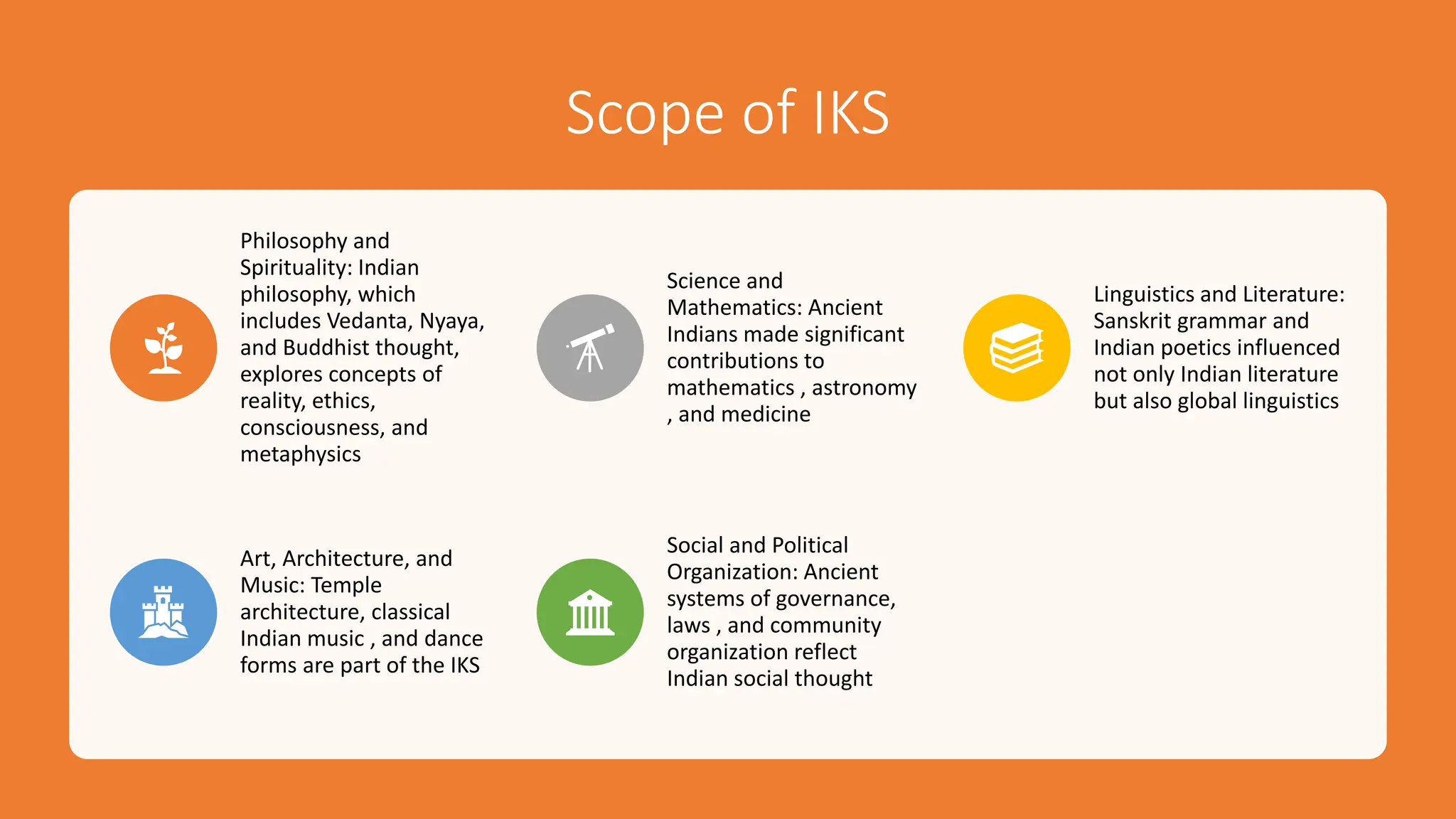
Scope of IKS
Philosophy and
Spirituality: Indian
philosophy, which
includes Vedanta, Nyaya,
and Buddhist thought,
explores concepts of
reality, ethics,
consciousness, and
metaphysics
Science and
Mathematics: Ancient
Indians made significant
contributions to
mathematics , astronomy
, and medicine
Linguistics and Literature:
Sanskrit grammar and
Indian poetics influenced
not only Indian literature
but also global linguistics
Art, Architecture, and
Music: Temple
architecture, classical
Indian music , and dance
forms are part of the IKS
Social and Political
Organization: Ancient
systems of governance,
laws , and community
organization reflect
Indian social thought
Scope of IKS
• Ecology and Environment: IKS also includes
knowledge systems related to sustainable
agriculture, water management , and
ecological conservation
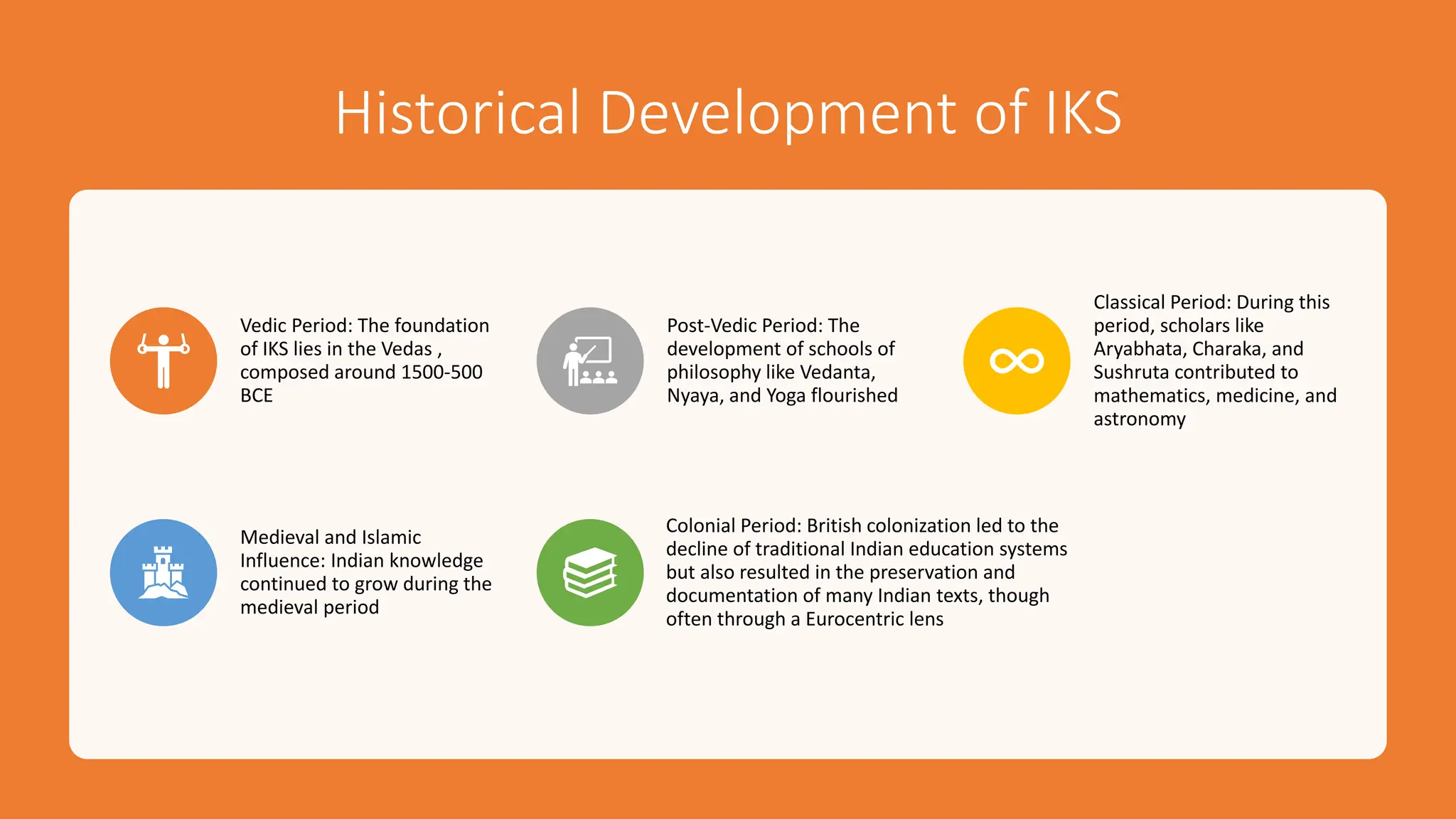
Historical Development of IKS
Vedic Period: The foundation
of IKS lies in the Vedas ,
composed around 1500-500
BCE
Post-Vedic Period: The
development of schools of
philosophy like Vedanta,
Nyaya, and Yoga flourished
Classical Period: During this
period, scholars like
Aryabhata, Charaka, and
Sushruta contributed to
mathematics, medicine, and
astronomy
Medieval and Islamic
Influence: Indian knowledge
continued to grow during the
medieval period
Colonial Period: British colonization led to the
decline of traditional Indian education systems
but also resulted in the preservation and
documentation of many Indian texts, though
often through a Eurocentric lens
Historical
Development
of IKS
• Post-Independence and Modern Revival:
Since India's independence in 1947, there
has been a revival of interest in IKS, with
government and academic efforts to
reintegrate indigenous knowledge with
modern science and education systems
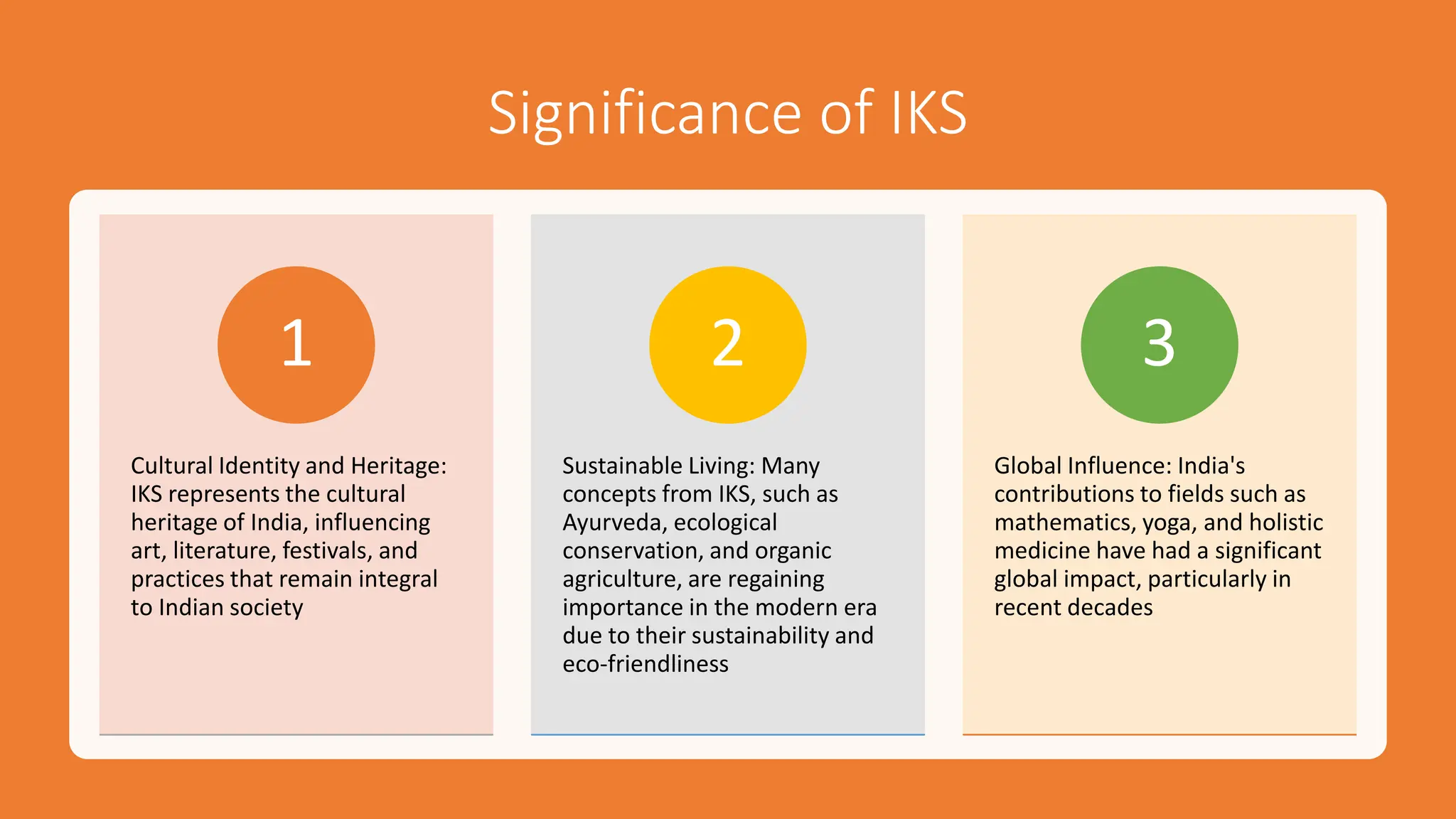
Significance of IKS
Cultural Identity and Heritage:
IKS represents the cultural
heritage of India, influencing
art, literature, festivals, and
practices that remain integral
to Indian society
1
Sustainable Living: Many
concepts from IKS, such as
Ayurveda, ecological
conservation, and organic
agriculture, are regaining
importance in the modern era
due to their sustainability and
eco-friendliness
2
Global Influence: India's
contributions to fields such as
mathematics, yoga, and holistic
medicine have had a significant
global impact, particularly in
recent decades
3
Significance
of IKS
• Holistic Approach: IKS integrates knowledge
across disciplines and emphasizes the
interconnectedness of all forms of life, which
is increasingly seen as important in
addressing modern global challenges like
environmental degradation and mental
health issues

Foundation of Indian Knowledge System.pdf

  • 1.
  • 2.
    Introduction • The IndianKnowledge System refers to a vast body of knowledge that has developed in the Indian subcontinent over millennia, encompassing diverse fields such as philosophy, science, medicine, mathematics, arts, and social practices • It is rooted in ancient texts, oral traditions, and cultural practices that continue to influence Indian society today • Here's a breakdown of the key points
  • 3.
    The Indian KnowledgeSystem encompasses indigenous systems of knowledge that were developed and passed down through generations in India IKS involves not only intellectual frameworks but also practical methodologies for health, agriculture, architecture, and social governance It represents an integrated approach to knowledge, often combining scientific inquiry with philosophical and spiritual insights
  • 4.
    Scope of IKS Philosophyand Spirituality: Indian philosophy, which includes Vedanta, Nyaya, and Buddhist thought, explores concepts of reality, ethics, consciousness, and metaphysics Science and Mathematics: Ancient Indians made significant contributions to mathematics , astronomy , and medicine Linguistics and Literature: Sanskrit grammar and Indian poetics influenced not only Indian literature but also global linguistics Art, Architecture, and Music: Temple architecture, classical Indian music , and dance forms are part of the IKS Social and Political Organization: Ancient systems of governance, laws , and community organization reflect Indian social thought
  • 5.
    Scope of IKS •Ecology and Environment: IKS also includes knowledge systems related to sustainable agriculture, water management , and ecological conservation
  • 6.
    Historical Development ofIKS Vedic Period: The foundation of IKS lies in the Vedas , composed around 1500-500 BCE Post-Vedic Period: The development of schools of philosophy like Vedanta, Nyaya, and Yoga flourished Classical Period: During this period, scholars like Aryabhata, Charaka, and Sushruta contributed to mathematics, medicine, and astronomy Medieval and Islamic Influence: Indian knowledge continued to grow during the medieval period Colonial Period: British colonization led to the decline of traditional Indian education systems but also resulted in the preservation and documentation of many Indian texts, though often through a Eurocentric lens
  • 7.
    Historical Development of IKS • Post-Independenceand Modern Revival: Since India's independence in 1947, there has been a revival of interest in IKS, with government and academic efforts to reintegrate indigenous knowledge with modern science and education systems
  • 8.
    Significance of IKS CulturalIdentity and Heritage: IKS represents the cultural heritage of India, influencing art, literature, festivals, and practices that remain integral to Indian society 1 Sustainable Living: Many concepts from IKS, such as Ayurveda, ecological conservation, and organic agriculture, are regaining importance in the modern era due to their sustainability and eco-friendliness 2 Global Influence: India's contributions to fields such as mathematics, yoga, and holistic medicine have had a significant global impact, particularly in recent decades 3
  • 9.
    Significance of IKS • HolisticApproach: IKS integrates knowledge across disciplines and emphasizes the interconnectedness of all forms of life, which is increasingly seen as important in addressing modern global challenges like environmental degradation and mental health issues