Indian Knowledge Systems(IKS) refer to the rich and diverse array of traditional knowledge, practices,
philosophies, and sciences developed and preserved in India over millennia.
These systems encompass various fields, such as philosophy, mathematics, astronomy, medicine, language,
arts, and architecture, with contributions made by ancient thinkers and scholars.
Introduction to Indian Knowledge Systems (IKS)
3.
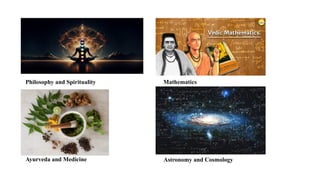
1.Philosophy and Spirituality:
1.Indian philosophy is deeply rooted in spiritual inquiry, focusing on the nature of existence, consciousness, and the cosmos. Key
schools of thought include Vedanta, Nyaya, Sankhya, Yoga, and Buddhist philosophy.
2. Central to IKS is the concept of dharma (righteousness), karma (action), moksha (liberation), and ahimsa (non-violence).
3. Texts like the Vedas, Upanishads, Bhagavad Gita, and the works of various sages and saints form the backbone of these philosophical
traditions.
2.Mathematics:
1. Ancient Indian mathematicians, such as Aryabhata and Brahmagupta, made significant contributions.
2. The concept of zero, decimal system, algebra, and trigonometry were developed and have had a profound impact on modern
mathematics and science.
3.Ayurveda and Medicine:
1. Ayurveda, the traditional system of medicine, is one of the oldest health care systems in the world. It emphasizes balance in the body,
mind, and spirit, with treatments that include herbal medicine, diet, yoga, and meditation.
2. Texts such as the Charaka Samhita and Sushruta Samhita provide detailed knowledge on anatomy, surgery, and therapeutic practices.
Key Elements of IKS:
4.
4. Astronomy andCosmology:
1. Ancient Indian astronomy was highly advanced. The Indian scholars were aware of the Earth's spherical shape,
rotation, and orbital movement centuries before their Western counterparts.
2. Indian astronomers developed sophisticated methods for calculating eclipses, calendar systems, and the position of
celestial bodies. The Surya Siddhanta is a famous ancient text in this domain.
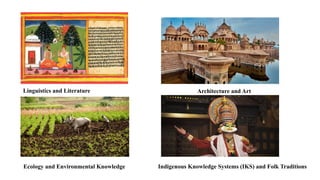
5. Linguistics and Literature:
3. The Sanskrit language is central to IKS. Ancient texts, including the Mahabharata, Ramayana, and Puranas, as
well as works by poets and dramatists like Kalidasa, provide insight into India's literary richness.
4. Linguistics in IKS also involves the study of phonetics and grammar, most notably through works like Panini's
Ashtadhyayi.
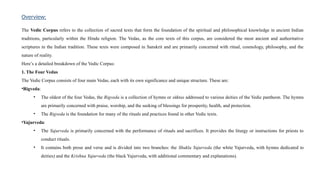
6. Architecture and Art:
5. Traditional Indian architecture, such as Vastu Shastra, outlines principles for constructing buildings and homes in
harmony with nature and the environment.
6. Indian art, including painting, sculpture, dance, and music, has a long history with diverse regional styles, often
reflecting spiritual themes.
5.
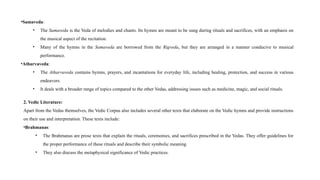
7. Ecology andEnvironmental Knowledge:
1. Indian traditions have long emphasized a deep connection with nature. Practices like sustainable agriculture, water
management (such as rainwater harvesting), and the sacredness of trees and animals reflect this ethos.
2. Indigenous knowledge systems include practices based on local ecosystems, often passed down through generations to
maintain ecological balance.
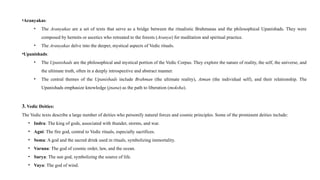
8. Indigenous Knowledge Systems (IKS) and Folk Traditions:
3. India’s diverse ethnic groups have preserved various forms of indigenous knowledge. This includes oral traditions,
folklore, songs, rituals, and craftsmanship specific to particular regions and communities.
4. The folk traditions also include indigenous farming techniques, traditional arts, and healing practices that contribute
significantly to the IKS.
Linguistics and LiteratureArchitecture and Art
Ecology and Environmental Knowledge Indigenous Knowledge Systems (IKS) and Folk Traditions
8.
The Vedic Corpusrefers to the collection of sacred texts that form the foundation of the spiritual and philosophical knowledge in ancient Indian
traditions, particularly within the Hindu religion. The Vedas, as the core texts of this corpus, are considered the most ancient and authoritative
scriptures in the Indian tradition. These texts were composed in Sanskrit and are primarily concerned with ritual, cosmology, philosophy, and the
nature of reality.
Here’s a detailed breakdown of the Vedic Corpus:
1. The Four Vedas
The Vedic Corpus consists of four main Vedas, each with its own significance and unique structure. These are:
•Rigveda:
• The oldest of the four Vedas, the Rigveda is a collection of hymns or sūktas addressed to various deities of the Vedic pantheon. The hymns
are primarily concerned with praise, worship, and the seeking of blessings for prosperity, health, and protection.
• The Rigveda is the foundation for many of the rituals and practices found in other Vedic texts.
•Yajurveda:
• The Yajurveda is primarily concerned with the performance of rituals and sacrifices. It provides the liturgy or instructions for priests to
conduct rituals.
• It contains both prose and verse and is divided into two branches: the Shukla Yajurveda (the white Yajurveda, with hymns dedicated to
deities) and the Krishna Yajurveda (the black Yajurveda, with additional commentary and explanations).
Overview:
9.
•Samaveda:
• The Samavedais the Veda of melodies and chants. Its hymns are meant to be sung during rituals and sacrifices, with an emphasis on
the musical aspect of the recitation.
• Many of the hymns in the Samaveda are borrowed from the Rigveda, but they are arranged in a manner conducive to musical
performance.
•Atharvaveda:
• The Atharvaveda contains hymns, prayers, and incantations for everyday life, including healing, protection, and success in various
endeavors.
• It deals with a broader range of topics compared to the other Vedas, addressing issues such as medicine, magic, and social rituals.
2. Vedic Literature:
Apart from the Vedas themselves, the Vedic Corpus also includes several other texts that elaborate on the Vedic hymns and provide instructions
on their use and interpretation. These texts include:
•Brahmanas:
• The Brahmanas are prose texts that explain the rituals, ceremonies, and sacrifices prescribed in the Vedas. They offer guidelines for
the proper performance of these rituals and describe their symbolic meaning.
• They also discuss the metaphysical significance of Vedic practices.
10.
•Aranyakas:
• The Aranyakasare a set of texts that serve as a bridge between the ritualistic Brahmanas and the philosophical Upanishads. They were
composed by hermits or ascetics who retreated to the forests (Aranya) for meditation and spiritual practice.
• The Aranyakas delve into the deeper, mystical aspects of Vedic rituals.
•Upanishads:
• The Upanishads are the philosophical and mystical portion of the Vedic Corpus. They explore the nature of reality, the self, the universe, and
the ultimate truth, often in a deeply introspective and abstract manner.
• The central themes of the Upanishads include Brahman (the ultimate reality), Atman (the individual self), and their relationship. The
Upanishads emphasize knowledge (jnana) as the path to liberation (moksha).
3. Vedic Deities:
The Vedic texts describe a large number of deities who personify natural forces and cosmic principles. Some of the prominent deities include:
• Indra: The king of gods, associated with thunder, storms, and war.
• Agni: The fire god, central to Vedic rituals, especially sacrifices.
• Soma: A god and the sacred drink used in rituals, symbolizing immortality.
• Varuna: The god of cosmic order, law, and the ocean.
• Surya: The sun god, symbolizing the source of life.
• Vayu: The god of wind.
11.
4. Vedic Ritualsand Practices:
• The Vedic Corpus contains extensive instructions on rituals and sacrifices that were performed to appease the gods and maintain cosmic order.
• These rituals were highly elaborate and involved offerings of ghee, grains, and soma, along with chanting of hymns from the Vedas.
• The fire altar (yajna) was the focal point of many of these rituals, where offerings were made to the deities to ensure prosperity, health, and peace.
5. Vedic Knowledge and Philosophy:
• The Vedic texts emphasize the pursuit of knowledge (jnana) as a means to understand the true nature of the universe and one's relationship
with it.
• They also emphasize karma (action) and dharma (righteousness) as central tenets of life, with the ultimate goal of liberation (moksha) being
the realization of oneness with the divine.
6. The Structure of the Vedic Texts:
The structure of the Vedic texts is complex and multi-layered:
• Samhitas: These are the actual hymns or verses of the Vedas, recited during rituals.
• Brahmanas: Prose texts that explain the meaning and purpose of the hymns.
• Aranyakas: Mystical interpretations and practices associated with the Vedas.
• Upanishads: Philosophical texts that discuss the ultimate nature of reality.
12.
The philosophy ofIntroduction to Indian Knowledge Systems (IKS) is rooted in India's rich intellectual traditions, covering
diverse disciplines such as philosophy, sciences, arts, ethics, and social structures. The approach integrates ancient wisdom
with contemporary knowledge to foster holistic learning and innovation.
Philosophy:
Key Philosophical Foundations of IKS
1.Holistic and Integral Thinking
• IKS does not compartmentalize knowledge; instead, it sees all domains—science, philosophy, art, and ethics—as
interconnected.
• It promotes an interdisciplinary approach where different branches of knowledge support and enrich each other.
2.Synthesis of Material and Spiritual Knowledge
• Indian traditions recognize both empirical (pratyakṣa) and transcendental (śruti, āgama) knowledge.
• It balances artha (material prosperity), dharma (ethical duty), kāma (desires), and mokṣa (liberation) in the pursuit of
knowledge.
13.
3. Pramāṇa: Epistemologyand Ways of Knowing
• Indian epistemology (pramāṇa-śāstra) includes multiple means of knowledge acquisition:
1. Pratyakṣ
a (perception)
2. Anumāna (inference)
3. Śabda (verbal testimony from authoritative sources)
4. Upamāna (comparison)
5. Arthāpatti (postulation)
6. Anupalabdhi (non-apprehension)
• This framework encourages rational inquiry while respecting traditional wisdom.
4.Dharmic and Ethical Foundations
• IKS emphasizes the role of dharma (righteousness) in all pursuits of knowledge.
• Ethical values guide scientific, artistic, and social developments.
5.Sustainability and Harmony with Nature
• Ancient Indian texts emphasize lokasangraha (welfare of all) and ṛ
ta (cosmic order).
• The Pañcamahābhūta (five great elements) doctrine highlights ecological consciousness.
6.Contextual and Dynamic Knowledge
• Unlike rigid doctrines, IKS adapts to time, place, and circumstances (Deśa-kāla-pātra).
• Knowledge is seen as a dynamic process that evolves with experience and reflection.
7.Education as a Path to Liberation
• True knowledge (jñāna) leads to self-realization and liberation (mokṣa).
• The Gurukula tradition emphasized experiential and transformative learning.
14.
Relevance of IKSToday:
•Integrative Learning: Combines ancient knowledge with modern disciplines like AI, medicine, and sustainability.
•Cultural Identity: Strengthens indigenous perspectives while engaging with global knowledge.
•Ethical Science & Technology: Provides a framework for ethical applications of scientific advancements.
•Holistic Well-being: Supports mental, emotional, and spiritual health through disciplines like Yoga and Ayurveda.
Character Scope and Importance of Indian Knowledge Systems (IKS):
1. Character of Indian Knowledge Systems (IKS):
Indian Knowledge Systems (IKS) are characterized by their holistic, interdisciplinary, and wisdom-oriented nature. These
systems integrate philosophy, science, ethics, and practical knowledge in a way that supports both material and spiritual
growth.
Key Characteristics of IKS
1.Holistic Approach
• IKS does not isolate subjects; it interconnects science, philosophy, arts, and ethics.
• It integrates spiritual wisdom with empirical sciences like mathematics, astronomy, and medicine.
2.Diverse and Multi-Disciplinary
• Covers a vast range of subjects: Vedas, Vedā gas, Upaniṣads, Nyāya (logic), Ayurveda (medicine), Yoga,
ṅ
Arthashastra (political science), and Nāṭ
yaśāstra (arts & aesthetics).
• Emphasizes both material progress (artha, kāma) and spiritual enlightenment (dharma, mokṣa).
15.
3.Experiential and PracticalKnowledge
• Learning is not just theoretical but experiential (pratyakṣa) and application-based.
• Encourages self-discovery and personal transformation.
4.Epistemological Rigor (Pramāṇa-based Inquiry)
•Uses multiple valid sources of knowledge:
1. Perception (Pratyakṣa)
2. Inference (Anumāna)
3. Verbal Testimony (Śabda)
4. Comparison, Postulation, and Non-apprehension (Upamāna, Arthāpatti, Anupalabdhi)
5.Ethical and Value-Based
• Knowledge is meant for the welfare of society (Lokasangraha) and should follow Dharma (righteousness).
• Ethical responsibility in governance, science, and education is emphasized.
6.Harmony with Nature
• Concepts like Pancha Mahābhūta (Five Great Elements) and Vastu Shastra reflect ecological consciousness.
• Sustainability and balance with the environment are core principles.
7.Adaptive and Evolving
• Indian knowledge has been dynamic and evolving over millennia, adapting to new contexts while retaining its core principles.
• It integrates scientific advancements with traditional wisdom.
16.
2. Importance ofIndian Knowledge Systems (IKS)
IKS is crucial in both historical and modern contexts, impacting education, science, governance, medicine, and philosophy.
A. Historical Significance
1.Ancient Centers of Learning
• Universities like Takshashila, Nalanda, and Vikramashila were global knowledge hubs.
• Scholars from across the world studied subjects like medicine, astronomy, and linguistics in India.
2.Contributions to Science and Mathematics
• Zero and Decimal System (Āryabhaṭ
a, Brahmagupta).
• Yoga and Ayurveda (Ancient health sciences still relevant today).
• Metallurgy and Architecture (Iron Pillar of Delhi, temple engineering).
3.Philosophy and Ethics
• IKS contributed to logic (Nyāya), metaphysics (Vedānta), ethics (Dharmaśāstra), and political science
(Arthaśāstra).
• These have influenced law, governance, and social structures in India and beyond.
17.
B.Relevance in ModernTimes
1.Education and Research
• IKS can decolonize education, making learning more contextual and holistic.
2.Science and Technology
• Encourages multi-disciplinary learning by integrating ancient knowledge with modern sciences.
• Contributions to astronomy, mathematics, medicine, and environmental science remain useful.
• Sustainable technologies from traditional water management, organic farming, and metallurgy can address modern
ecological challenges.
3.Mental and Physical Well-being
• Yoga and Ayurveda are globally recognized for health and wellness.
• Provides frameworks for mental health, meditation, and stress management.
4.Ethical and Sustainable Development
• Ancient economic and governance models promote sustainability and ethical leadership.
• Dharma-based economics can contribute to corporate ethics and social responsibility.
5.Global Influence and Cultural Identity
• IKS helps in preserving India's rich intellectual heritage and promoting cultural identity.
• Encourages a harmonious blend of tradition and modernity in global knowledge exchange.
18.
Traditional Knowledge (TK)and Indigenous Knowledge (IK) are closely related but have distinct scopes and applications. Both refer
to knowledge systems passed down through generations, often orally, within specific cultural or community contexts. However, their
origins, scope, and application differ in some key aspects.
1. Traditional Knowledge (TK)
Definition:
Traditional Knowledge refers to knowledge, practices, and innovations developed, sustained, and transmitted within a society over
generations. It includes a wide range of subjects like agriculture, medicine, environmental management, and social practices.
Characteristics:
•Broad and Inclusive: TK includes knowledge from various societies and civilizations, not limited to indigenous communities.
•Evolved Over Time: It adapts and integrates influences from different cultures and historical changes.
•Contextual Application: Found in agriculture (organic farming), medicine (Ayurveda, Unani), and environmental conservation
(water harvesting techniques).
•Ethical and Spiritual Elements: Often linked with religious, spiritual, and moral values.
•Codified or Oral: Some TK is documented (e.g., Indian Vedas, Chinese medicine texts), while other forms remain oral.
Traditional Knowledge vs. Indigenous Knowledge:
19.
Examples of TraditionalKnowledge:
•Ayurveda & Siddha Medicine (India)
•Traditional Water Management Systems (Stepwells, Bamboo Drip Irrigation in Meghalaya)
•Ancient Metallurgy (Wootz Steel, Damascus Blades)
•Yoga & Meditation Practices
2. Indigenous Knowledge (IK):
Definition:
Indigenous Knowledge refers to local knowledge held by specific indigenous communities, deeply embedded in their cultural identity,
spiritual beliefs, and interactions with the environment.
Characteristics:
•Localized and Community-Specific: Developed within a specific indigenous group or tribal community.
•Interwoven with Nature: Focuses on sustainable resource use, biodiversity conservation, and coexistence with ecosystems.
•Non-Western Epistemology: Knowledge is acquired through observation, storytelling, rituals, and direct experience rather than formal
education.
•Sacred and Spiritual: Often linked to myths, folklore, and religious rituals unique to the community.
•Non-Codified and Oral: Largely undocumented, passed down through oral traditions and practices.
20.
Examples of IndigenousKnowledge:
•Tribal Healing Practices (Adivasi herbal medicine, Shamanic healing in Native American traditions)
•Ecological Knowledge (Andaman & Nicobar tribes predicting tsunamis based on animal behavior)
•Sacred Forests & Conservation (Sacred groves in Meghalaya, Aboriginal Dreamtime Land
Management in Australia)
•Traditional Boat-Making & Navigation (Polynesian wayfinding without modern tools)
21.
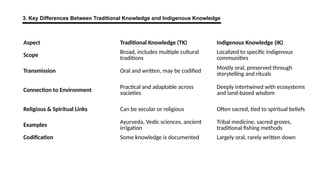
Aspect Traditional Knowledge(TK) Indigenous Knowledge (IK)
Scope
Broad, includes multiple cultural
traditions
Localized to specific indigenous
communities
Transmission Oral and written, may be codified
Mostly oral, preserved through
storytelling and rituals
Connection to Environment
Practical and adaptable across
societies
Deeply intertwined with ecosystems
and land-based wisdom
Religious & Spiritual Links Can be secular or religious Often sacred, tied to spiritual beliefs
Examples
Ayurveda, Vedic sciences, ancient
irrigation
Tribal medicine, sacred groves,
traditional fishing methods
Codification Some knowledge is documented Largely oral, rarely written down
3. Key Differences Between Traditional Knowledge and Indigenous Knowledge
22.
Traditional Knowledge vs.Western Knowledge:
Traditional Knowledge (TK) and Western Knowledge (WK) represent two distinct epistemological frameworks for understanding the
world. While Traditional Knowledge is rooted in long-standing cultural practices, holistic approaches, and local experiences, Western
Knowledge is based on systematic inquiry, empirical observation, and scientific reasoning.
1. Traditional Knowledge (TK)
Definition:
Traditional Knowledge refers to knowledge systems that have been developed, preserved, and transmitted over generations within a
culture or community. It includes agriculture, medicine, environmental management, philosophy, ethics, and social practices.
Characteristics of Traditional Knowledge:
•Holistic Approach: Integrates science, philosophy, ethics, and spirituality.
•Community-Based: Passed down through oral traditions, practices, and lived experiences.
•Interdisciplinary: Blends various disciplines without rigid separation.
•Experiential and Contextual: Based on observation, intuition, and and ethiadaptation to local environments.
•Sustainability-Oriented: Emphasizes balance with nature, conservation, cal living.
•Non-Codified or Semi-Codified: Often oral, but some are documented (e.g., Ayurveda, Vedas, Chinese medicine).
23.
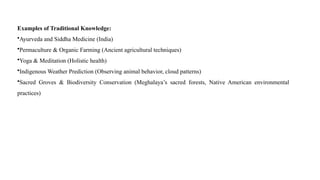
Examples of TraditionalKnowledge:
•Ayurveda and Siddha Medicine (India)
•Permaculture & Organic Farming (Ancient agricultural techniques)
•Yoga & Meditation (Holistic health)
•Indigenous Weather Prediction (Observing animal behavior, cloud patterns)
•Sacred Groves & Biodiversity Conservation (Meghalaya’s sacred forests, Native American environmental
practices)
24.
2. Western Knowledge(WK)
Definition:
Western Knowledge, also known as modern scientific knowledge, is based on systematic research, empirical methods, rational
inquiry, and structured education. It prioritizes objectivity, experimentation, and verifiable evidence.
Characteristics of Western Knowledge:
•Reductionist Approach: Breaks complex phenomena into smaller parts for analysis.
•Empirical and Systematic: Based on data collection, controlled experiments, and scientific validation.
•Universal and Standardized: Seeks general laws applicable across different cultures and regions.
•Objective and Rational: Focuses on measurable outcomes and testable theories.
•Codified and Institutionalized: Documented through research papers, patents, and formal education systems.
Examples of Western Knowledge:
•Newtonian Physics & Modern Engineering
•Allopathic Medicine (Modern Western Medicine)
•Industrial Agriculture & GMOs
•Artificial Intelligence & Data Science
•Space Exploration & Quantum Mechanics
25.
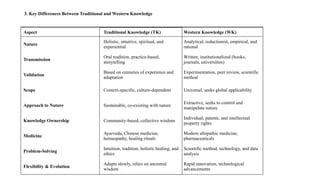
Aspect Traditional Knowledge(TK) Western Knowledge (WK)
Nature
Holistic, intuitive, spiritual, and
experiential
Analytical, reductionist, empirical, and
rational
Transmission
Oral tradition, practice-based,
storytelling
Written, institutionalized (books,
journals, universities)
Validation
Based on centuries of experience and
adaptation
Experimentation, peer review, scientific
method
Scope Context-specific, culture-dependent Universal, seeks global applicability
Approach to Nature Sustainable, co-existing with nature
Extractive, seeks to control and
manipulate nature
Knowledge Ownership Community-based, collective wisdom
Individual, patents, and intellectual
property rights
Medicine
Ayurveda, Chinese medicine,
homeopathy, healing rituals
Modern allopathic medicine,
pharmaceuticals
Problem-Solving
Intuition, tradition, holistic healing, and
ethics
Scientific method, technology, and data
analysis
Flexibility & Evolution
Adapts slowly, relies on ancestral
wisdom
Rapid innovation, technological
advancements
3. Key Differences Between Traditional and Western Knowledge
26.
4. Relationship BetweenTraditional and Western Knowledge
Overlap and Integration:
•Many modern scientific discoveries have roots in traditional knowledge.
• Example: Turmeric (Curcumin) in Ayurveda is now scientifically validated for its anti-inflammatory properties.
• Example: Traditional Indian metallurgical techniques (Wootz steel) influenced modern materials science.
Sustainable Development:
• Traditional agriculture (crop rotation, organic fertilizers) is now being reintroduced in permaculture and sustainable
farming.
•Mind-Body Medicine:
• Yoga and meditation, once considered spiritual, are now scientifically proven for mental and physical well-being.
Challenges in Integration:
•Western knowledge often dismisses TK as "unscientific" due to its lack of formal experimentation.
•TK faces appropriation (e.g., patents on indigenous knowledge like neem, basmati rice).
•Modern scientific methods often ignore ethical and spiritual dimensions of knowledge.
27.
Conclusion
• Both TraditionalKnowledge and Western Knowledge have their strengths and limitations.
Traditional Knowledge is holistic, sustainable, and community-driven, while Western
Knowledge is systematic, evidence-based, and technologically advanced. A balanced
approach that integrates both systems can lead to sustainable development, innovative
solutions, and ethical scientific progress.
• While Traditional Knowledge is a broad, evolving body of wisdom, Indigenous
Knowledge is localized, community-driven, and deeply tied to nature and spirituality.
Recognizing and integrating both forms of knowledge can help in sustainable
development, conservation, and holistic well-being, bridging ancient wisdom with modern
scientific approaches.