Indian Election System
A Comprehensive
Analysis
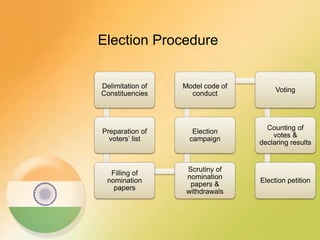
Election Procedure
Delimitation of
Constituencies
Preparation of
voters’ list
Filling of
nomination
papers
Scrutiny of
nomination
papers &
withdrawals
Election
campaign
Model code of
conduct
Voting
Counting of
votes &
declaring results
Election petition
When elections take place
• Term of Parliament & Assembly - 5years (except J & K
Assembly where it is 6 years)
• House can be dissolved before its term ends.
• Dates decided by the Commission. No consultation done
with any Government.
• Bye-elections when a seat falls vacant. Normally held
within 6-months of vacancy.
Right to Vote
• Any citizen over 18 can vote.
• Voting right denied to certain class of
people
• Criminal convicts of certain class.
• Person convicted of electoral offence.
• Person of unsound mind.
• Voting statistics
• 61.97% in 1998
• 59.01% in 1999
• 58.07% in 2004
• 58.17% in 2009
• 66.40 % in 2014
Budget & Expenditure
• Independent Budget finalized in
consultation with Finance Ministry.
• Parliament election - Funded entirely by
Centre.
• Assembly election - Funded by the State.
• Total expenditure for 2014 General
Elections was 30,000 Cr.
• It is triple the amount spent in 2009
General Elections.
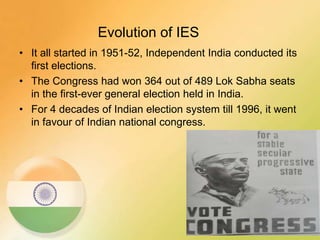
Evolution of IES
• It all started in 1951-52, Independent India conducted its
first elections.
• The Congress had won 364 out of 489 Lok Sabha seats
in the first-ever general election held in India.
• For 4 decades of Indian election system till 1996, it went
in favour of Indian national congress.
Cont.
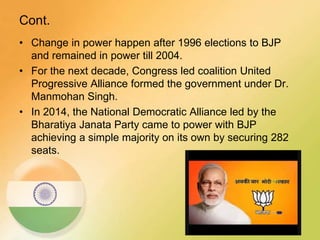
• Change in power happen after 1996 elections to BJP
and remained in power till 2004.
• For the next decade, Congress led coalition United
Progressive Alliance formed the government under Dr.
Manmohan Singh.
• In 2014, the National Democratic Alliance led by the
Bharatiya Janata Party came to power with BJP
achieving a simple majority on its own by securing 282
seats.
Major Parties
• INC - 1885
• BJP - 1980
• CPIM - 1964
• DMK - 1949
• AIADMK - 1972
• BSP - 1984
• BJD - 1997
LOGO
BJP INC CPIM
DMK AIADMK BSP
BJD
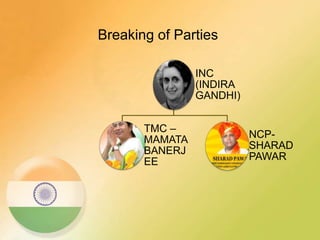
Breaking of Parties
INC
(INDIRA
GANDHI)
TMC –
MAMATA
BANERJ
EE
NCP-
SHARAD
PAWAR
JANTA PARTY
BJP- NARENDRA
MODI
SP- MULAYAM SINGH
YADAV
RJD- LALU PRASAD
YADAV
JDU- NITISH KUMAR
CPI-(CHARU
MAJUMDAR)
CPIM –(
JYOTI BASU)
CPI
The 16th Lok Sabha Elections, 2014
• 814.5 million people were eligible to vote, with an increase of 100
million voters since the last general election, making it the largest-
ever election in the world.
• Running in nine phases from 7 April to 12 May 2014, it was also the
longest election in the country's history
• The National Democratic Alliance won a sweeping victory, taking
336 seats.
Cont.
• The BJP itself won 282 (51.9%) of all
seats. It is the first time since the 1984
elections that a party has won enough
seats to govern without the support of
other parties.
• The United Progressive Alliance, led by
the Indian National Congress, won 58
seats, 44 (8.1%) of which were won by the
Congress, that won 19.3% of all votes.
Building Brand Modi:
“Ab Ki Baar Modi Sarkaar”
• Personal branding and marketing strategy
• Weak and Corrupt Congress
• Excellent Orator
• Youth Appeal
Modi – The Orator:
• Passion - Every speech of Modi’s appeared to come straight from the heart
of his fiery determination.
• Knowing your audience- Modi has spent a lot of time understanding India’s
angst and the frustrations of the Indian youth. Hence, he was focused on
two key thoughts — good governance and development
• Futuristic- Presented long-term commitments, not short-term gimmicks,
unlike AAP.
• Choose the right time -Modi cleverly chose the 9 pm prime-time slot to
deliver his speech, ensuring that all of India would be able to hear him.
Cont.
• Body Language – Modi moves from side to side
seemingly making eye contact with everyone. Every time
he mentioned the word “vikas” two fingers would rise to
point ahead into the future. And every time he uttered
“hum sab”, his fist clenched with all fingers tightly held to
portray strength in unity.
The words “acchhe din” were accompanied by a smile
echoed by “aayenge” from the crowd.
• Voice Modulation- Modi heightened the drama through
his loud proclamations, smoothed by his gentle pauses
and synchronised with his hand gestures to evoke
passion, power and drive.

Indian election system

  • 1.
    Indian Election System AComprehensive Analysis
  • 2.
    Election Procedure Delimitation of Constituencies Preparationof voters’ list Filling of nomination papers Scrutiny of nomination papers & withdrawals Election campaign Model code of conduct Voting Counting of votes & declaring results Election petition
  • 3.
    When elections takeplace • Term of Parliament & Assembly - 5years (except J & K Assembly where it is 6 years) • House can be dissolved before its term ends. • Dates decided by the Commission. No consultation done with any Government. • Bye-elections when a seat falls vacant. Normally held within 6-months of vacancy.
  • 4.
    Right to Vote •Any citizen over 18 can vote. • Voting right denied to certain class of people • Criminal convicts of certain class. • Person convicted of electoral offence. • Person of unsound mind. • Voting statistics • 61.97% in 1998 • 59.01% in 1999 • 58.07% in 2004 • 58.17% in 2009 • 66.40 % in 2014
  • 5.
    Budget & Expenditure •Independent Budget finalized in consultation with Finance Ministry. • Parliament election - Funded entirely by Centre. • Assembly election - Funded by the State. • Total expenditure for 2014 General Elections was 30,000 Cr. • It is triple the amount spent in 2009 General Elections.
  • 6.
    Evolution of IES •It all started in 1951-52, Independent India conducted its first elections. • The Congress had won 364 out of 489 Lok Sabha seats in the first-ever general election held in India. • For 4 decades of Indian election system till 1996, it went in favour of Indian national congress.
  • 7.
    Cont. • Change inpower happen after 1996 elections to BJP and remained in power till 2004. • For the next decade, Congress led coalition United Progressive Alliance formed the government under Dr. Manmohan Singh. • In 2014, the National Democratic Alliance led by the Bharatiya Janata Party came to power with BJP achieving a simple majority on its own by securing 282 seats.
  • 8.
    Major Parties • INC- 1885 • BJP - 1980 • CPIM - 1964 • DMK - 1949 • AIADMK - 1972 • BSP - 1984 • BJD - 1997
  • 9.
    LOGO BJP INC CPIM DMKAIADMK BSP BJD
  • 10.
    Breaking of Parties INC (INDIRA GANDHI) TMC– MAMATA BANERJ EE NCP- SHARAD PAWAR
  • 11.
    JANTA PARTY BJP- NARENDRA MODI SP-MULAYAM SINGH YADAV RJD- LALU PRASAD YADAV JDU- NITISH KUMAR
  • 12.
  • 13.
    The 16th LokSabha Elections, 2014 • 814.5 million people were eligible to vote, with an increase of 100 million voters since the last general election, making it the largest- ever election in the world. • Running in nine phases from 7 April to 12 May 2014, it was also the longest election in the country's history • The National Democratic Alliance won a sweeping victory, taking 336 seats.
  • 14.
    Cont. • The BJPitself won 282 (51.9%) of all seats. It is the first time since the 1984 elections that a party has won enough seats to govern without the support of other parties. • The United Progressive Alliance, led by the Indian National Congress, won 58 seats, 44 (8.1%) of which were won by the Congress, that won 19.3% of all votes.
  • 15.
  • 16.
    “Ab Ki BaarModi Sarkaar” • Personal branding and marketing strategy • Weak and Corrupt Congress • Excellent Orator • Youth Appeal
  • 17.
    Modi – TheOrator: • Passion - Every speech of Modi’s appeared to come straight from the heart of his fiery determination. • Knowing your audience- Modi has spent a lot of time understanding India’s angst and the frustrations of the Indian youth. Hence, he was focused on two key thoughts — good governance and development • Futuristic- Presented long-term commitments, not short-term gimmicks, unlike AAP. • Choose the right time -Modi cleverly chose the 9 pm prime-time slot to deliver his speech, ensuring that all of India would be able to hear him.
  • 18.
    Cont. • Body Language– Modi moves from side to side seemingly making eye contact with everyone. Every time he mentioned the word “vikas” two fingers would rise to point ahead into the future. And every time he uttered “hum sab”, his fist clenched with all fingers tightly held to portray strength in unity. The words “acchhe din” were accompanied by a smile echoed by “aayenge” from the crowd. • Voice Modulation- Modi heightened the drama through his loud proclamations, smoothed by his gentle pauses and synchronised with his hand gestures to evoke passion, power and drive.