Politics of India
Political Institutions & Parties
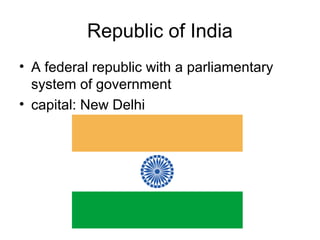
Republic of India
• A federal republic with a parliamentary
system of government
• capital: New Delhi
A federal system
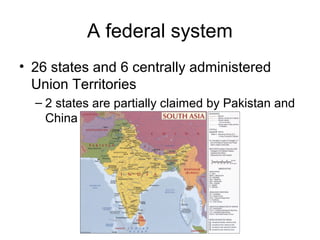
• 26 states and 6 centrally administered
Union Territories
– 2 states are partially claimed by Pakistan and
China
Federal system
• Relatively centralized
• federal government controls the most
essential government functions
– defense
– foreign policy
– taxation
– public expenditures
– economic (industrial) planning
Federal system
• state governments formally control
– agriculture
– education
– law and order within states
– dependent on central government for funds
Federal system
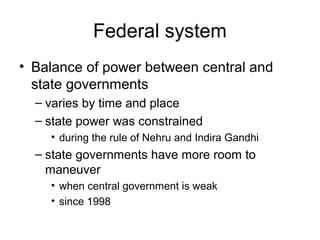
• Balance of power between central and
state governments
– varies by time and place
– state power was constrained
• during the rule of Nehru and Indira Gandhi
– state governments have more room to
maneuver
• when central government is weak
• since 1998
Federal system
• considerable center-state conflict when
ruling political party in a state is different
from national ruling party
Parallel state structure
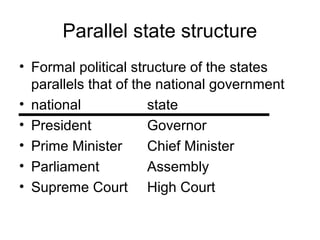
• Formal political structure of the states
parallels that of the national government
• national state
• President Governor
• Prime Minister Chief Minister
• Parliament Assembly
• Supreme Court High Court
The legislature
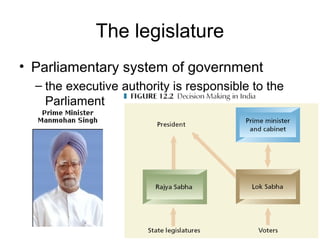
• Parliamentary system of government
– the executive authority is responsible to the
Parliament
The legislature
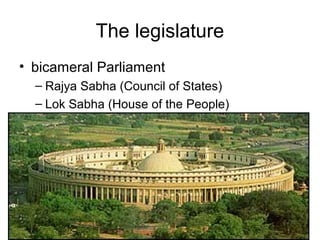
• bicameral Parliament
– Rajya Sabha (Council of States)
– Lok Sabha (House of the People)
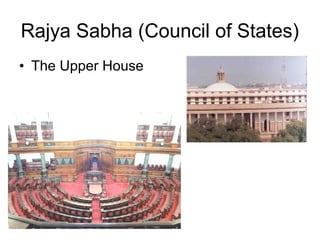
Rajya Sabha (Council of States)
• The Upper House
Upper House
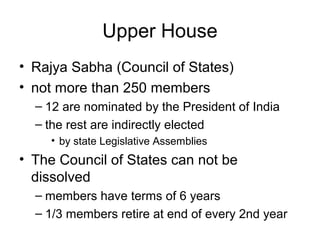
• Rajya Sabha (Council of States)
• not more than 250 members
– 12 are nominated by the President of India
– the rest are indirectly elected
• by state Legislative Assemblies
• The Council of States can not be
dissolved
– members have terms of 6 years
– 1/3 members retire at end of every 2nd year
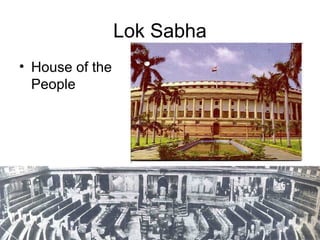
Lok Sabha
• House of the
People
Lower House
• Lok Sabha (House of the People)
• 545 members
– 2 are appointed by the President of India
– the rest are directly elected from single-
member districts
• 5-year terms unless dissolved
• Lok Sabha elects its presiding officer
– the Speaker
Lok Sabha
• Elections held at least every 5 years
• Prime Minister may call elections earlier
• 543 single-member districts of roughly
equal population
• party nomination
• 1st-past-the-post
– winner-take-all
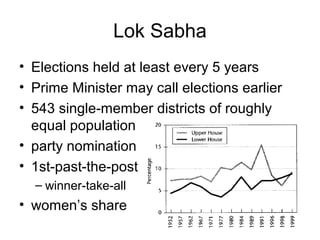
• women’s share
Elections to Lok Sabha
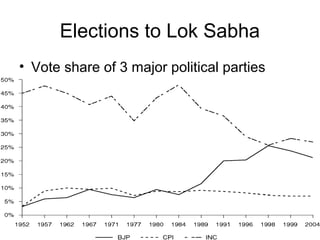
• Vote share of 3 major political parties
Current composition
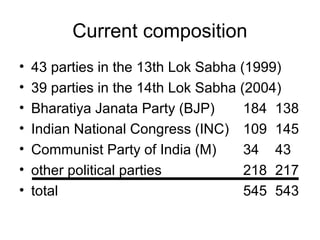
• 43 parties in the 13th Lok Sabha (1999)
• 39 parties in the 14th Lok Sabha (2004)
• Bharatiya Janata Party (BJP) 184 138
• Indian National Congress (INC) 109 145
• Communist Party of India (M) 34 43
• other political parties 218 217
• total 545 543
Indian National Congress
• India’s oldest political party
– since 1885
• India’s premier political party
– until 1990s
• in 1960s many regional parties started
challenging INC’s monopoly on power
Indian National Congress
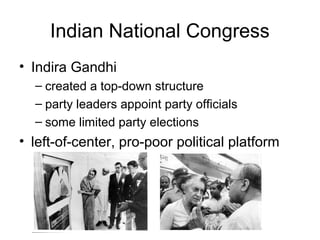
• Indira Gandhi
– created a top-down structure
– party leaders appoint party officials
– some limited party elections
• left-of-center, pro-poor political platform
Indian National Congress
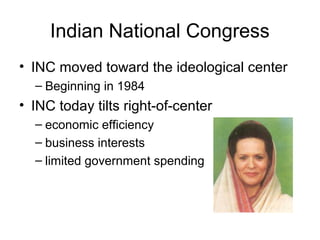
• INC moved toward the ideological center
– Beginning in 1984
• INC today tilts right-of-center
– economic efficiency
– business interests
– limited government spending
Indian National Congress
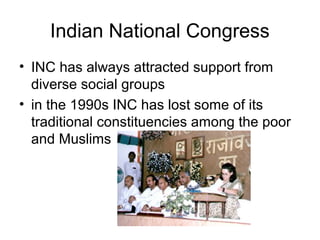
• INC has always attracted support from
diverse social groups
• in the 1990s INC has lost some of its
traditional constituencies among the poor
and Muslims
Bharatiya Janata Party (BJP)
• The major political party in India today
• right-leaning, Hindu-nationalist party
– first major party to mobilize explicitly on the
basis of religious identity
Bharatiya Janata Party (BJP)
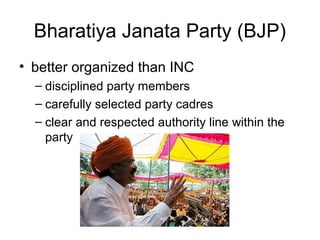
• better organized than INC
– disciplined party members
– carefully selected party cadres
– clear and respected authority line within the
party
Bharatiya Janata Party (BJP)
• Traditional supporters
– urban, lower-middle-class groups
• base of support widened since mid-1980s
– Hindu nationalism
– north-central India
– decline of Indian National Congress
– Muslims as convenient scapegoat for
frustration
BJP’s rapid rise to power
• electoral success from 1989 to 1999
– difficulty in forming alliance with other parties
• break with past traditions
– relatively moderate, centrist position
• BJP formed governing coalition in 1998
– collapsed in 1999
• BJP formed a new coalition in 1999
– more broadly based than previous coalition
Bharatiya Janata Party (BJP)
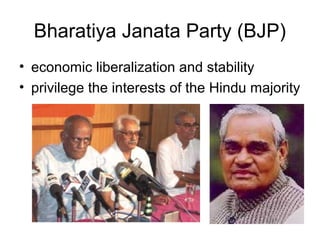
• economic liberalization and stability
• privilege the interests of the Hindu majority
Prime Minister
• Leader of the majority party leader in Lok
Sabha becomes the prime minister
• prime minister nominates a cabinet
– members of Parliament in the ruling coalition
– Council of Ministers
• effective power is concentrated in the
office of the prime minister
– where most of the important policies originate
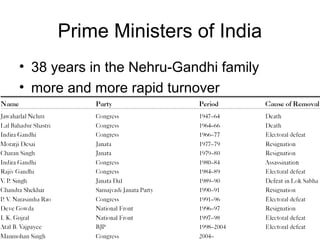
Prime Ministers of India
• 38 years in the Nehru-Gandhi family
• more and more rapid turnover
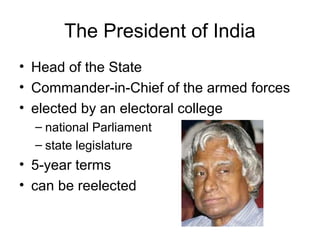
The President of India
• Head of the State
• Commander-in-Chief of the armed forces
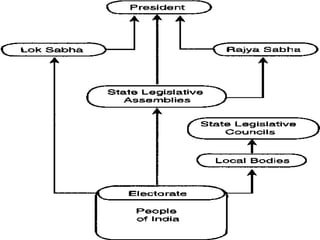
• elected by an electoral college
– national Parliament
– state legislature
• 5-year terms
• can be reelected
The President of India
• Ceremonial office
– symbolize national unity
– supposedly above partisan politics
• mostly acts on the advice of the prime
minister
• President plays a significant role when the
selection of a prime minister is complex
– in 1998 President requested BJP to form govt.
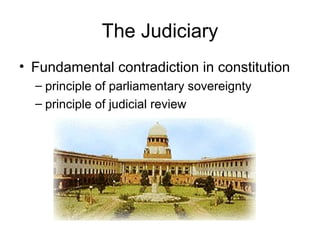
The Judiciary
• Fundamental contradiction in constitution
– principle of parliamentary sovereignty
– principle of judicial review
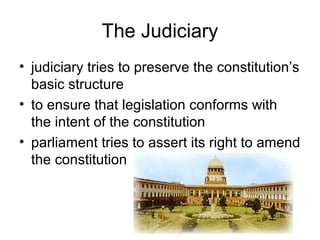
The Judiciary
• judiciary tries to preserve the constitution’s
basic structure
• to ensure that legislation conforms with
the intent of the constitution
• parliament tries to assert its right to amend
the constitution

Indiapol

  • 1.
    Politics of India PoliticalInstitutions & Parties
  • 2.
    Republic of India •A federal republic with a parliamentary system of government • capital: New Delhi
  • 3.
    A federal system •26 states and 6 centrally administered Union Territories – 2 states are partially claimed by Pakistan and China
  • 4.
    Federal system • Relativelycentralized • federal government controls the most essential government functions – defense – foreign policy – taxation – public expenditures – economic (industrial) planning
  • 5.
    Federal system • stategovernments formally control – agriculture – education – law and order within states – dependent on central government for funds
  • 6.
    Federal system • Balanceof power between central and state governments – varies by time and place – state power was constrained • during the rule of Nehru and Indira Gandhi – state governments have more room to maneuver • when central government is weak • since 1998
  • 7.
    Federal system • considerablecenter-state conflict when ruling political party in a state is different from national ruling party
  • 8.
    Parallel state structure •Formal political structure of the states parallels that of the national government • national state • President Governor • Prime Minister Chief Minister • Parliament Assembly • Supreme Court High Court
  • 9.
    The legislature • Parliamentarysystem of government – the executive authority is responsible to the Parliament
  • 10.
    The legislature • bicameralParliament – Rajya Sabha (Council of States) – Lok Sabha (House of the People)
  • 11.
    Rajya Sabha (Councilof States) • The Upper House
  • 12.
    Upper House • RajyaSabha (Council of States) • not more than 250 members – 12 are nominated by the President of India – the rest are indirectly elected • by state Legislative Assemblies • The Council of States can not be dissolved – members have terms of 6 years – 1/3 members retire at end of every 2nd year
  • 13.
    Lok Sabha • Houseof the People
  • 14.
    Lower House • LokSabha (House of the People) • 545 members – 2 are appointed by the President of India – the rest are directly elected from single- member districts • 5-year terms unless dissolved • Lok Sabha elects its presiding officer – the Speaker
  • 15.
    Lok Sabha • Electionsheld at least every 5 years • Prime Minister may call elections earlier • 543 single-member districts of roughly equal population • party nomination • 1st-past-the-post – winner-take-all • women’s share
  • 16.
    Elections to LokSabha • Vote share of 3 major political parties
  • 17.
    Current composition • 43parties in the 13th Lok Sabha (1999) • 39 parties in the 14th Lok Sabha (2004) • Bharatiya Janata Party (BJP) 184 138 • Indian National Congress (INC) 109 145 • Communist Party of India (M) 34 43 • other political parties 218 217 • total 545 543
  • 18.
    Indian National Congress •India’s oldest political party – since 1885 • India’s premier political party – until 1990s • in 1960s many regional parties started challenging INC’s monopoly on power
  • 19.
    Indian National Congress •Indira Gandhi – created a top-down structure – party leaders appoint party officials – some limited party elections • left-of-center, pro-poor political platform
  • 20.
    Indian National Congress •INC moved toward the ideological center – Beginning in 1984 • INC today tilts right-of-center – economic efficiency – business interests – limited government spending
  • 21.
    Indian National Congress •INC has always attracted support from diverse social groups • in the 1990s INC has lost some of its traditional constituencies among the poor and Muslims
  • 22.
    Bharatiya Janata Party(BJP) • The major political party in India today • right-leaning, Hindu-nationalist party – first major party to mobilize explicitly on the basis of religious identity
  • 23.
    Bharatiya Janata Party(BJP) • better organized than INC – disciplined party members – carefully selected party cadres – clear and respected authority line within the party
  • 24.
    Bharatiya Janata Party(BJP) • Traditional supporters – urban, lower-middle-class groups • base of support widened since mid-1980s – Hindu nationalism – north-central India – decline of Indian National Congress – Muslims as convenient scapegoat for frustration
  • 25.
    BJP’s rapid riseto power • electoral success from 1989 to 1999 – difficulty in forming alliance with other parties • break with past traditions – relatively moderate, centrist position • BJP formed governing coalition in 1998 – collapsed in 1999 • BJP formed a new coalition in 1999 – more broadly based than previous coalition
  • 26.
    Bharatiya Janata Party(BJP) • economic liberalization and stability • privilege the interests of the Hindu majority
  • 27.
    Prime Minister • Leaderof the majority party leader in Lok Sabha becomes the prime minister • prime minister nominates a cabinet – members of Parliament in the ruling coalition – Council of Ministers • effective power is concentrated in the office of the prime minister – where most of the important policies originate
  • 28.
    Prime Ministers ofIndia • 38 years in the Nehru-Gandhi family • more and more rapid turnover
  • 29.
    The President ofIndia • Head of the State • Commander-in-Chief of the armed forces • elected by an electoral college – national Parliament – state legislature • 5-year terms • can be reelected
  • 31.
    The President ofIndia • Ceremonial office – symbolize national unity – supposedly above partisan politics • mostly acts on the advice of the prime minister • President plays a significant role when the selection of a prime minister is complex – in 1998 President requested BJP to form govt.
  • 32.
    The Judiciary • Fundamentalcontradiction in constitution – principle of parliamentary sovereignty – principle of judicial review
  • 33.
    The Judiciary • judiciarytries to preserve the constitution’s basic structure • to ensure that legislation conforms with the intent of the constitution • parliament tries to assert its right to amend the constitution