Introduction
◦ India is a constitutional democracy with a parliamentary
system of government, and at the heart of the system is a
commitment to hold regular, free and fair elections.
◦ Elections helps to solve the problem of succession in
leadership and thus contributes to the continuation of
democracy .
The Election Commission Of India
◦ In India elections are conducted by an independent and
powerful autonomous election commission.
◦ It enjoys the same kind of independence that the judiciary
enjoys.
◦ But once appointed the election commission is not
answerable to the president of government.
Steps in an election
Campaigning
Nomination of candidates
Polling
Counting
Nominalisationof candidates
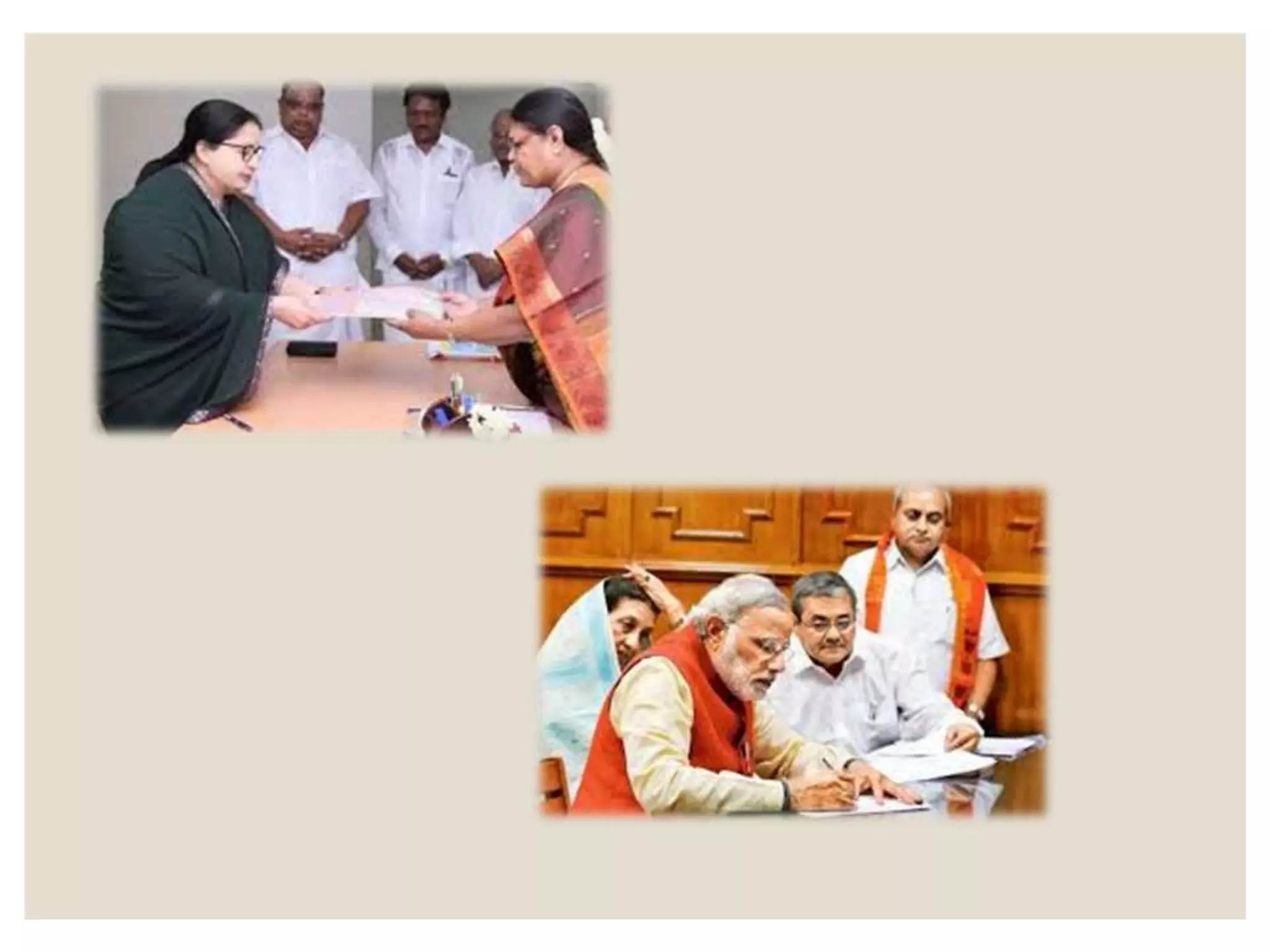
◦ To be a candidate of lok Sabha or Legislative Assembly, the
minimum age limit is 25 years. Political parties nominate
their candidates who get the party symbol and support.
◦ He/She must be a qualified voter and must be eligible to
hold the office . Educational qualification is not needed for
any candidate .
◦ He/She must make an oath that they were not engaged in
any action to overthrow the government by force or
violence and
Reserved constituency
◦ This is to prevent domination of those with better resources
and give a chance to weaker sections of society.
◦ In an SC/ST reserved constituency, only someone from the
SC/ST’s can stand for elections.
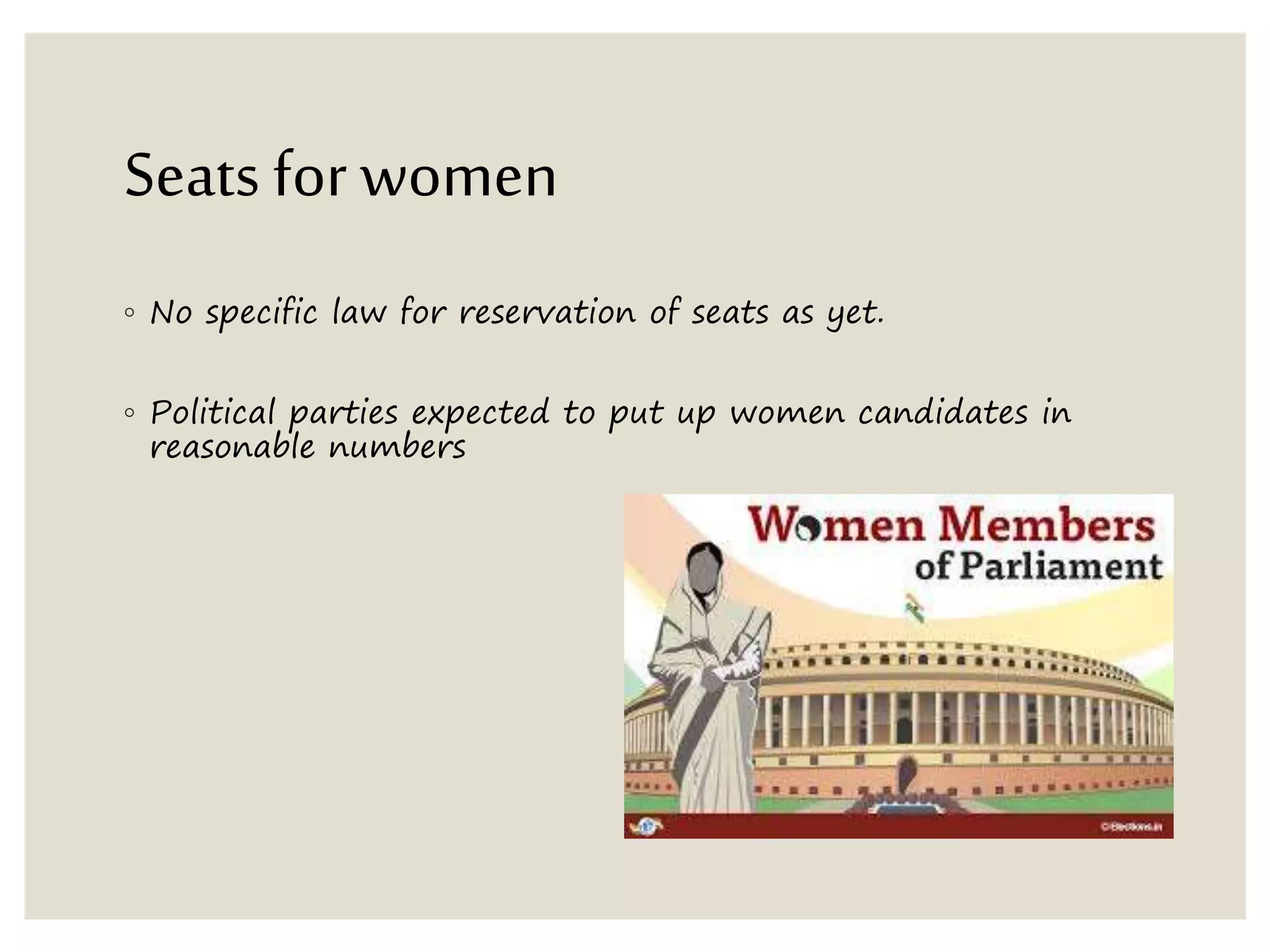
Seats for women
◦ No specific law for reservation of seats as yet.
◦ Political parties expected to put up women candidates in
reasonable numbers
Election campaign
◦ At first before the elections the dates of nomination,
polling and counting are notified by the election
commissioner.
◦ The model code of conduct comes in force from the day the
dates are announced.
◦ The code of conduct stipulates that campaigning be
stopped 48 hours prior to polling day.
Terms $ conditions for a campaign
◦ No place of worship can be used for election campaign by
any party
◦ Political parties should remain within certain limits while
criticizing the opposite party.
◦ During election campaign no government transport,
official aircraft , machinery or personnel could be used by
political party .
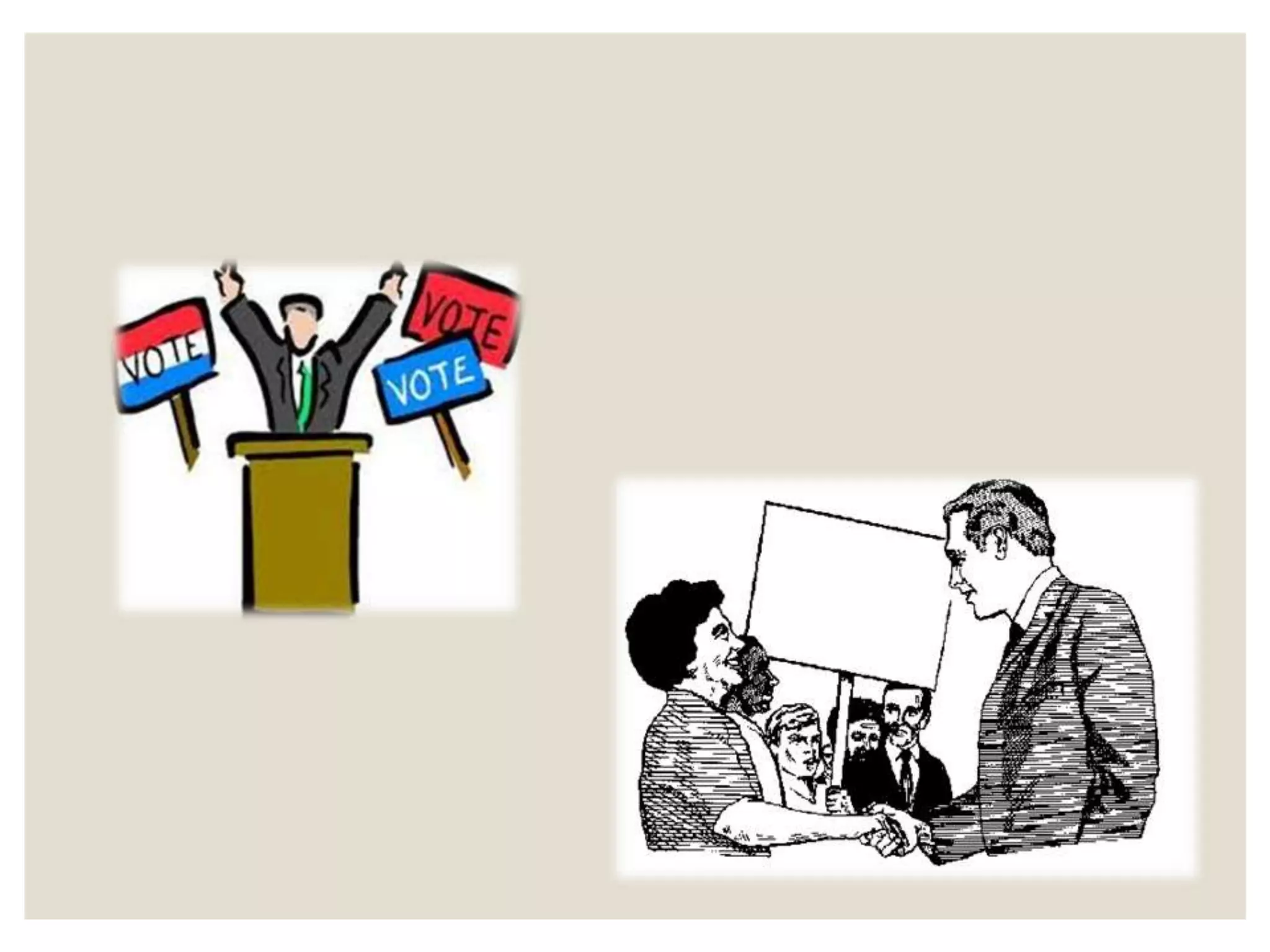
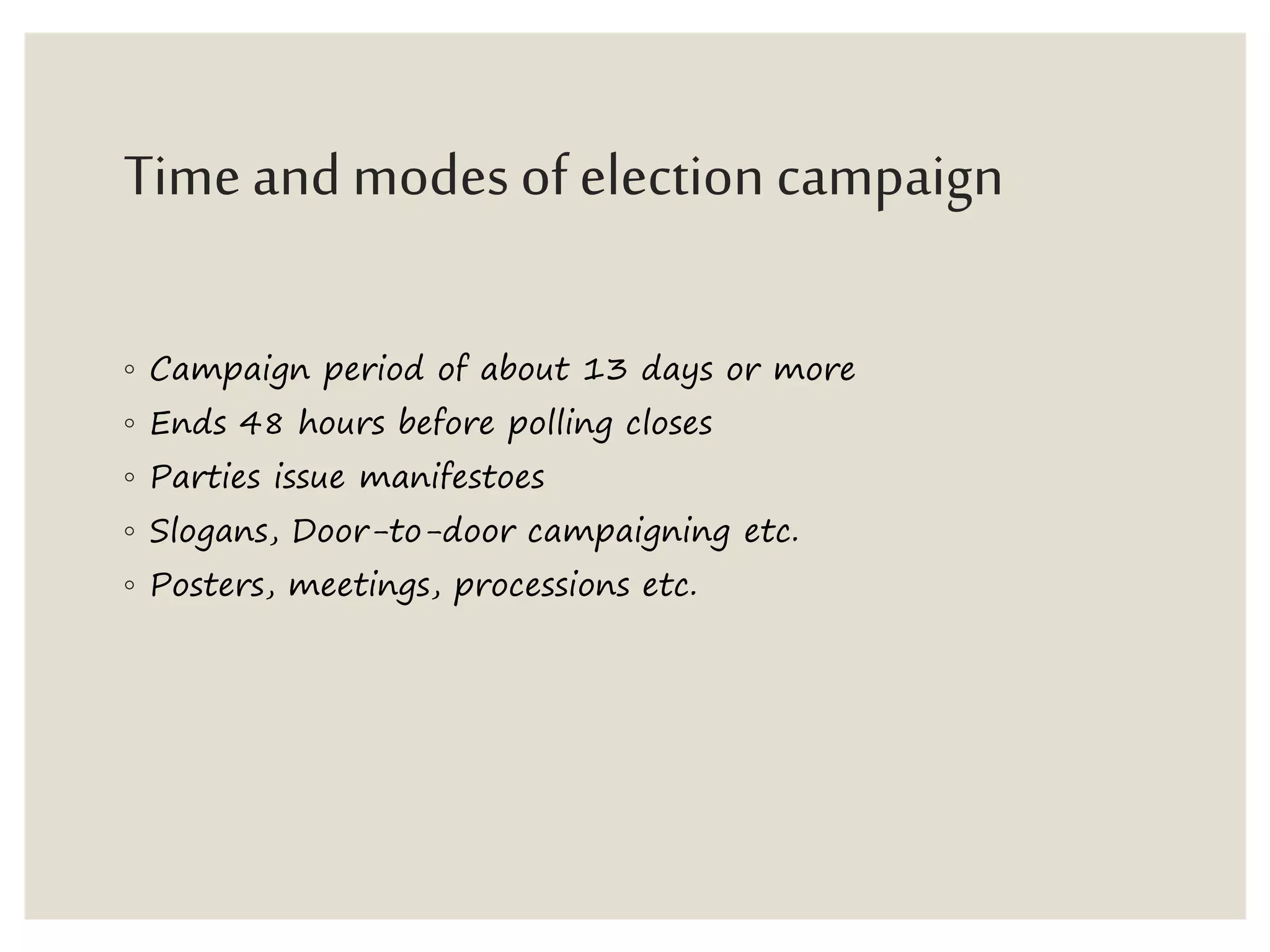
Time and modes of election campaign
◦ Campaign period of about 13 days or more
◦ Ends 48 hours before polling closes
◦ Parties issue manifestoes
◦ Slogans, Door-to-door campaigning etc.
◦ Posters, meetings, processions etc.
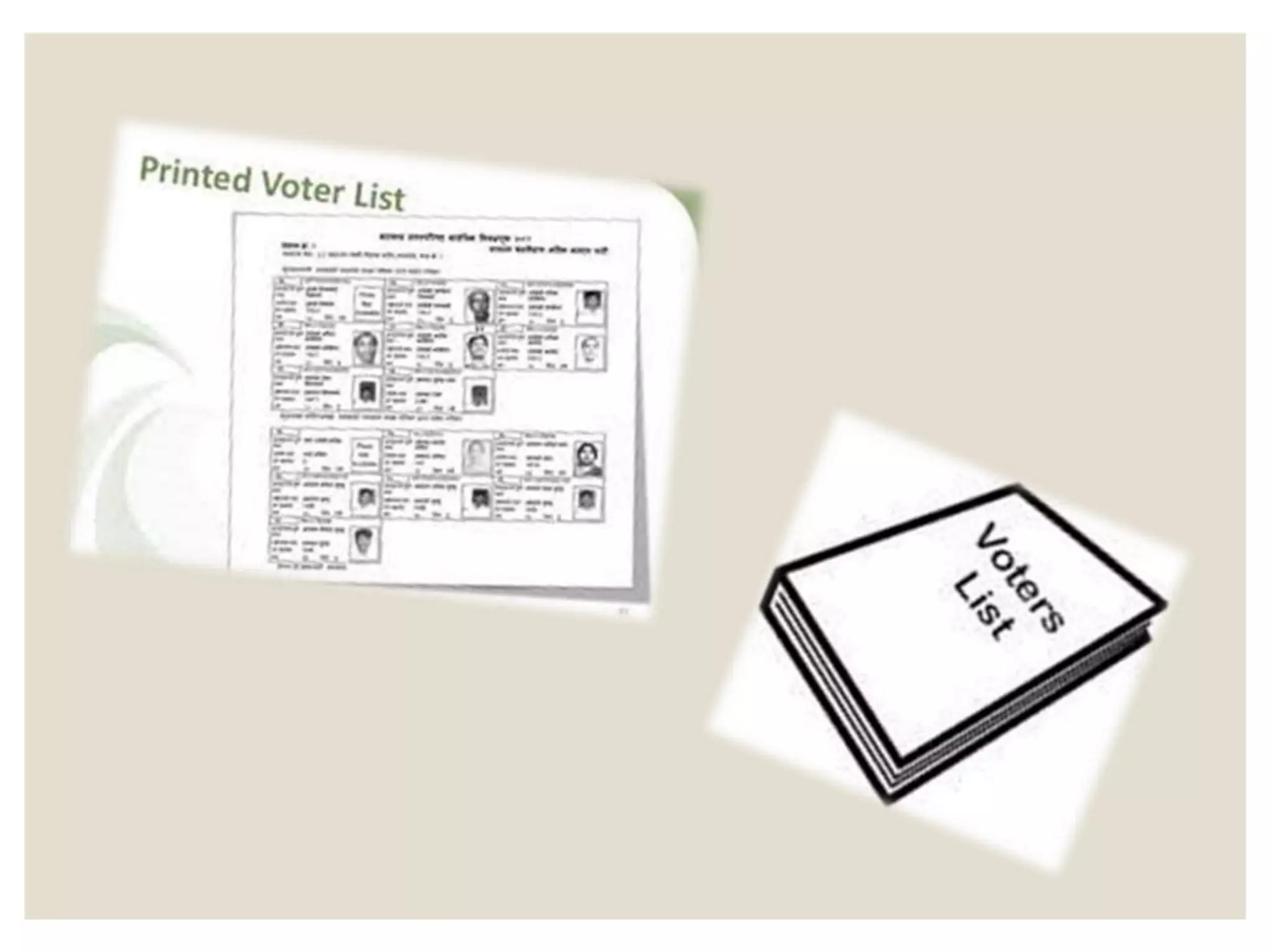
Voters list
◦ In a democratic election,the list of those persons who are
eligible to vote is prepared before elections and displayed
to everyone. This list is officially called Voters List.
◦ For every constituency, there is a voters list Article 326 of
the Constitution, 1950 stipulate that the minimum age
for registration of a voter is 18 years.
◦ A person who is not a citizen of India cannot be registered
as a voter.
Polling of votes
◦ Government schools and colleges are chosen as polling
stations. The Collector of each district is in charge of polling.
Government employees are employed to many of the polling
stations.
◦ Electronic Voting Machines (EVMs) are being increasingly
used instead of ballot boxes to prevent election fraud via
booth capturing, which is heavily prevalent in certain parts
of India.
One vote , one value
◦ Change will only be brought when there is a noticeable
participation and awareness among people.
Your one vote casted can decide our future leader.
Your vote is a valuable one ,don’t underestimate the power
of one vote.
If you demand change, be a part of it.
Counting of votes and declaration of results
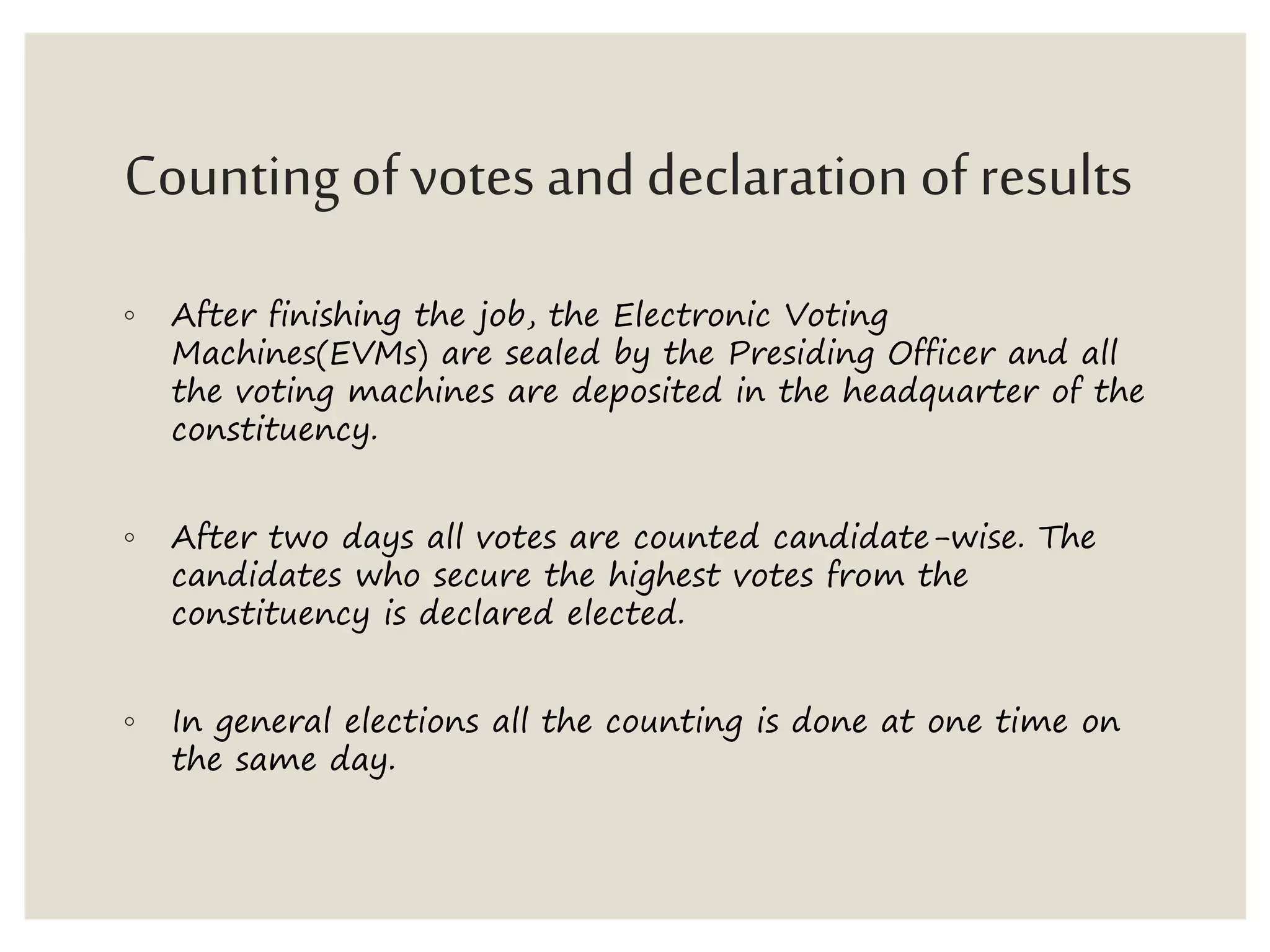
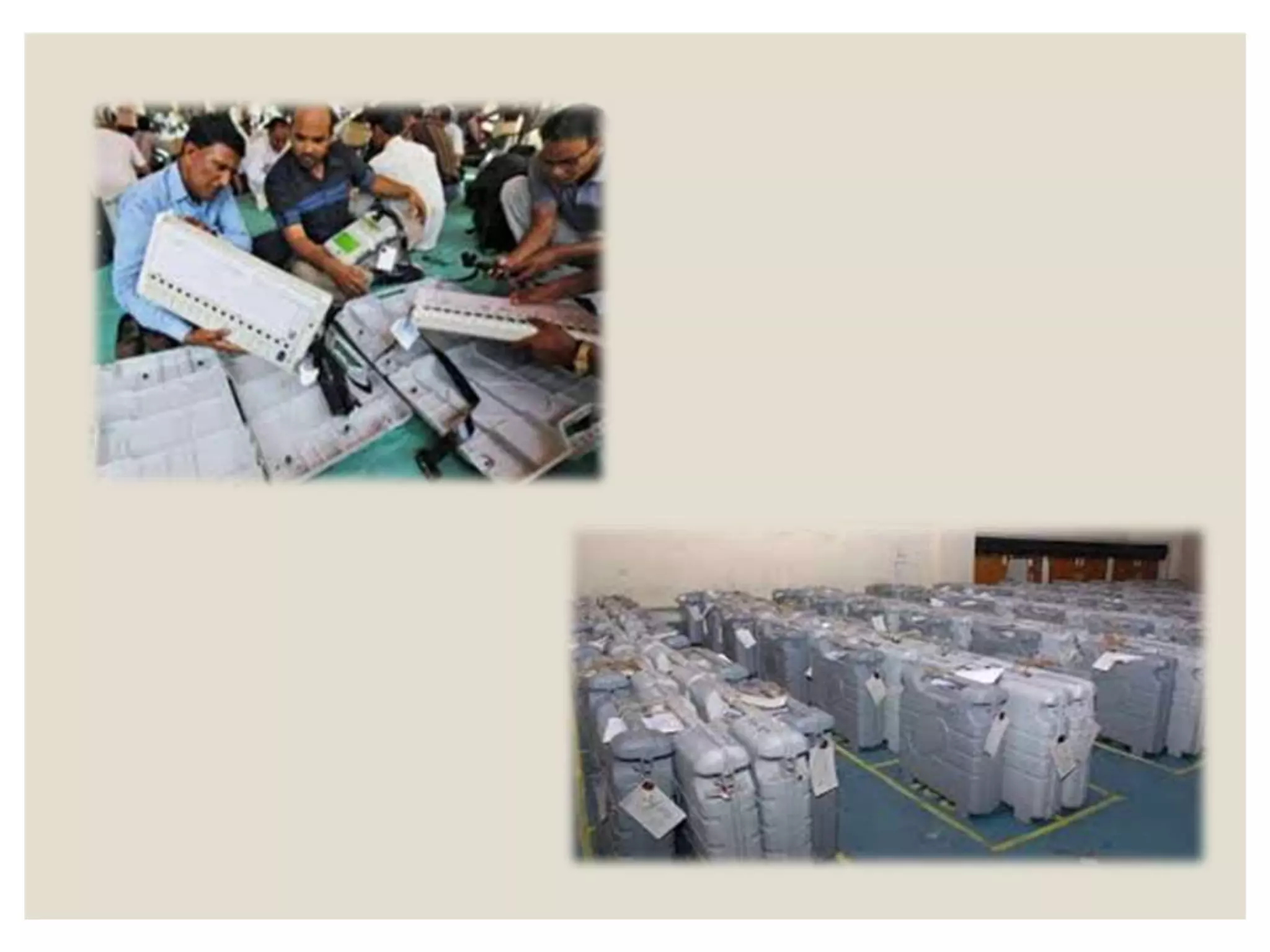
◦ After finishing the job, the Electronic Voting
Machines(EVMs) are sealed by the Presiding Officer and all
the voting machines are deposited in the headquarter of the
constituency.
◦ After two days all votes are counted candidate-wise. The
candidates who secure the highest votes from the
constituency is declared elected.
◦ In general elections all the counting is done at one time on
the same day.
CHALLANGES FOR FREE AND FAIR
ELECTIONS
◦ No doubt that in the elections some of the candidates win
on the basis of money power, muscle power and rigging. But
overall the general election still reflects the people verdict.
◦ In some of the political parties, candidates are contesting
elections with a huge criminal record. They push the other
willing candidates out of electoral race due to their huge
pressure on party.
◦ No political party offers any choice to ordinary citizen.
Often they see the background and manpower of the
candidate.
THANK YOU
name:manthan prabhu

ELECTION SYSTEM OF INDIA

  • 2.
    Introduction ◦ India isa constitutional democracy with a parliamentary system of government, and at the heart of the system is a commitment to hold regular, free and fair elections. ◦ Elections helps to solve the problem of succession in leadership and thus contributes to the continuation of democracy .
  • 4.
    The Election CommissionOf India ◦ In India elections are conducted by an independent and powerful autonomous election commission. ◦ It enjoys the same kind of independence that the judiciary enjoys. ◦ But once appointed the election commission is not answerable to the president of government.
  • 6.
    Steps in anelection Campaigning Nomination of candidates Polling Counting
  • 7.
    Nominalisationof candidates ◦ Tobe a candidate of lok Sabha or Legislative Assembly, the minimum age limit is 25 years. Political parties nominate their candidates who get the party symbol and support. ◦ He/She must be a qualified voter and must be eligible to hold the office . Educational qualification is not needed for any candidate . ◦ He/She must make an oath that they were not engaged in any action to overthrow the government by force or violence and
  • 9.
    Reserved constituency ◦ Thisis to prevent domination of those with better resources and give a chance to weaker sections of society. ◦ In an SC/ST reserved constituency, only someone from the SC/ST’s can stand for elections.
  • 10.
    Seats for women ◦No specific law for reservation of seats as yet. ◦ Political parties expected to put up women candidates in reasonable numbers
  • 11.
    Election campaign ◦ Atfirst before the elections the dates of nomination, polling and counting are notified by the election commissioner. ◦ The model code of conduct comes in force from the day the dates are announced. ◦ The code of conduct stipulates that campaigning be stopped 48 hours prior to polling day.
  • 13.
    Terms $ conditionsfor a campaign ◦ No place of worship can be used for election campaign by any party ◦ Political parties should remain within certain limits while criticizing the opposite party. ◦ During election campaign no government transport, official aircraft , machinery or personnel could be used by political party .
  • 15.
    Time and modesof election campaign ◦ Campaign period of about 13 days or more ◦ Ends 48 hours before polling closes ◦ Parties issue manifestoes ◦ Slogans, Door-to-door campaigning etc. ◦ Posters, meetings, processions etc.
  • 16.
    Voters list ◦ Ina democratic election,the list of those persons who are eligible to vote is prepared before elections and displayed to everyone. This list is officially called Voters List. ◦ For every constituency, there is a voters list Article 326 of the Constitution, 1950 stipulate that the minimum age for registration of a voter is 18 years. ◦ A person who is not a citizen of India cannot be registered as a voter.
  • 18.
    Polling of votes ◦Government schools and colleges are chosen as polling stations. The Collector of each district is in charge of polling. Government employees are employed to many of the polling stations. ◦ Electronic Voting Machines (EVMs) are being increasingly used instead of ballot boxes to prevent election fraud via booth capturing, which is heavily prevalent in certain parts of India.
  • 20.
    One vote ,one value ◦ Change will only be brought when there is a noticeable participation and awareness among people. Your one vote casted can decide our future leader. Your vote is a valuable one ,don’t underestimate the power of one vote. If you demand change, be a part of it.
  • 21.
    Counting of votesand declaration of results ◦ After finishing the job, the Electronic Voting Machines(EVMs) are sealed by the Presiding Officer and all the voting machines are deposited in the headquarter of the constituency. ◦ After two days all votes are counted candidate-wise. The candidates who secure the highest votes from the constituency is declared elected. ◦ In general elections all the counting is done at one time on the same day.
  • 23.
    CHALLANGES FOR FREEAND FAIR ELECTIONS ◦ No doubt that in the elections some of the candidates win on the basis of money power, muscle power and rigging. But overall the general election still reflects the people verdict. ◦ In some of the political parties, candidates are contesting elections with a huge criminal record. They push the other willing candidates out of electoral race due to their huge pressure on party. ◦ No political party offers any choice to ordinary citizen. Often they see the background and manpower of the candidate.
  • 25.