• A political party is a group of like-minded
people who hold similar views on political
issues of the country.
• It is an organised group seeking to gain
power through democratic means.
• In pursuit of this objective, political parties
field their candidates in the election held
for the public offices of the country
• Unity of purpose: A political party can only
function when all its members are united
on basic issues and policy matters.
• Organised system of working: The political
party should follow some rules and
regulations and maintain a certain
discipline.
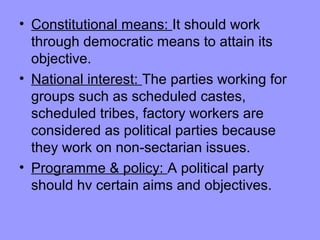
• Constitutional means: It should work
through democratic means to attain its
objective.
• National interest: The parties working for
groups such as scheduled castes,
scheduled tribes, factory workers are
considered as political parties because
they work on non-sectarian issues.
• Programme & policy: A political party
should hv certain aims and objectives.
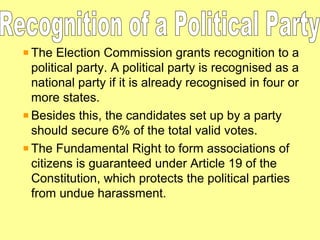
The Election Commission grants recognition to a
political party. A political party is recognised as a
national party if it is already recognised in four or
more states.
Besides this, the candidates set up by a party
should secure 6% of the total valid votes.
The Fundamental Right to form associations of
citizens is guaranteed under Article 19 of the
Constitution, which protects the political parties
from undue harassment.
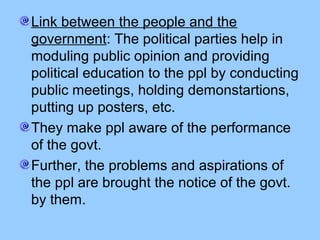
Link between the people and the
government: The political parties help in
moduling public opinion and providing
political education to the ppl by conducting
public meetings, holding demonstartions,
putting up posters, etc.
They make ppl aware of the performance
of the govt.
Further, the problems and aspirations of
the ppl are brought the notice of the govt.
by them.
Participation in elections
Selection of candidates
Campaigns
Good Governance
Role as an opposition
Act as an unifying bond
Social Change
• It traces its origins to Indian National
Congress founded in 1885. Since then it
has undergone several splits. The seventh
general elections in 1980 saw Mrs. Indira
Gandhi returning to power, so the INC
now came to be called as INC (Indira).
• After the 14th general elections in 2004, the
Congress Party formed an alliance with
the other parties called the United
Progressive Alliance (UPA) and formed
the government.
• Policies and Programmes:
Reservation of jobs in private sectors for
tribals.
Selective privatisation of state-owned
companies.
Reservation of one-third of the Lok Sabha
and Assembly seats for women.
Providing employment to every rural
household at a minimum wage for a 100
days every yr.
Increase in allocation on education to 6%
of the GNP.
Revival of Public Distribution System
Revival of the sick Public Sector
Industries.
In 1989 when there was a split in Janata
Party, the erstwhile Jan Singh
rechristened itself into Bharatiya Janta
Party. It was the single largest party in
1996 and in 1999 General Elections it
came close to a majority in the Lok Sabha
winning 182 seats.
Mr. Atal Bihari Vajpayee, who was the
Prime Minister in the earlier govt. was
elected as the Prime Minister again.
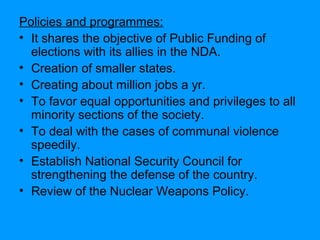
Policies and programmes:
• It shares the objective of Public Funding of
elections with its allies in the NDA.
• Creation of smaller states.
• Creating about million jobs a yr.
• To favor equal opportunities and privileges to all
minority sections of the society.
• To deal with the cases of communal violence
speedily.
• Establish National Security Council for
strengthening the defense of the country.
• Review of the Nuclear Weapons Policy.
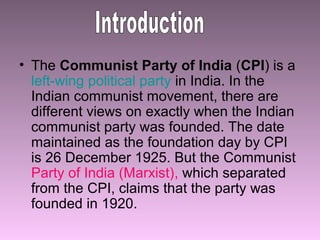
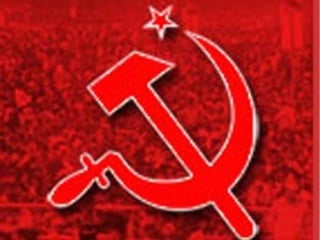
• The Communist Party of India (CPI) is a
left-wing political party in India. In the
Indian communist movement, there are
different views on exactly when the Indian
communist party was founded. The date
maintained as the foundation day by CPI
is 26 December 1925. But the Communist
Party of India (Marxist), which separated
from the CPI, claims that the party was
founded in 1920.
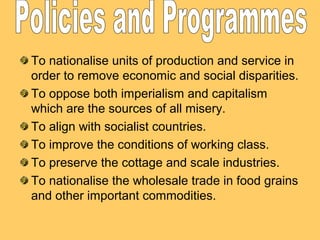
To nationalise units of production and service in
order to remove economic and social disparities.
To oppose both imperialism and capitalism
which are the sources of all misery.
To align with socialist countries.
To improve the conditions of working class.
To preserve the cottage and scale industries.
To nationalise the wholesale trade in food grains
and other important commodities.
• CPI(M) emerged out of a division within the
Communist Party of India (CPI). The undivided
CPI had experienced a period of upsurge during
the years following the Second World War. The
CPI led armed rebellions in Telangana, Tripura
and Kerala. However, it soon abandoned the
strategy of armed revolution in favour of working
within the parliamentary framework. In 1950
B.T. Ranadive, the CPI general secretary and a
prominent representative of the radical sector
inside the party, was demoted on grounds of leftadventurism.
Right to Work to be made a Fundamental
Right and unemployment allowance to be
given to the unemployed.
To establish economic equality with equal
and fair wage structure for agricultural and
industrial workers, uniformity at all levals.
To nationalise all foreign investments and
all monopolies. All foreign trade would be
brought under public undertaking.
Religion- Separation of religion from
politics.
To distribute the land of the big landlords
among the landless workers.
Foreign Relations- Establish close
relationship with the socialist countries
and Russia and pull out of the
Commonwealth to resist imperialism.
 The party was founded in 1984 by Kanshi Ram. Due to
his deteriorating health in the 1990s, former school
teacher Mayawati became the party's de facto leader.
The party's power grew quickly with seats in the Uttar
Pradesh Legislative Assembly and India's Lower House
of Parliament. In 1993, following the assembly elections,
Mayawati formed a coalition with Samajwadi Party
President Mulayam Singh Yadav as Chief Minister. In
mid-1995, she withdrew support to his government,
which led to a major incident where Mulayam Singh
Yadav was accused of keeping her party legislator's
hostage to try to break her party. Since this, they have
regarded each other publicly as chief rivals. Mayawati
then sought the support of the BJP to become Chief
Minister on June 3, 1995. In October 1995 the BJP
withdrew support to her and fresh elections were called
after President's Rule.
• NCP was formed on 25 May 1999, by
Sharad Pawar, P. A. Sangma, and
Tariq Anwar after they were expelled from
the Indian National Congress (INC) on 20
May 1999, for disputing the right of Italianborn Sonia Gandhi to lead the party. At
the time of formation, the party also
absorbed Indian Congress (Socialist),
which traced its origins to anti-coalition
partner in the state ofMaharashtra in
alliance with INC.
 Strengthening the forces of nationalism.
 Maintaining the unity and integrity of India
by strengthening federalism and
decentralisation of power up to the village
level.
 Promoting economic growth through
competition, self-reliance, individual
initiative and enterprise wid emphasis on
equality and social justice.
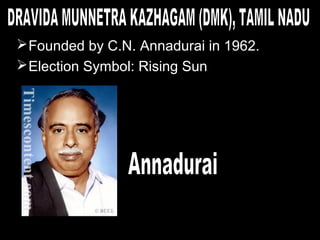
 Founded by C.N. Annadurai in 1962.
 Election Symbol: Rising Sun
 The DMK in 1971 spilt into two units. The
unit led by M.G. Ramachandran came to
be called as All India Anna DMK.
 Election symbol: Two Leaves
• Telugu Desam Party or TDP is a
regional political party in India's
Andhra Pradesh state. It was founded by
former Telugu film star N. T. Rama Rao
("NTR") on March 29, 1982, as an
alternative to the ruling Congress Party in
the state.
• In the 8th Lok Sabha 1984, it was the
second largest party with 39 members.
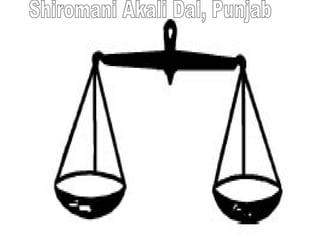
• Akali Dal was formed on December 14, 1920 as a task
force of the Shiromani Gurudwara Prabandhak
Committee, the Sikh religious body.
• The Akali Dal considers itself the principal representative
of Sikhs. Sardar Sarmukh Singh Chubbal was the first
president of a unified proper Akali Dal, but it was
under Master Tara Singh that Akali Dal became a force
to reckon with.
• The party launched the Punjabi Suba movement to
create a Sikh majority state in the undivided East
Punjab under the leadership of Sant Fateh Singh. In
1966, the modern-day East Punjab was formed, but its
division led to bitter conflict.
• Akali Dal came to power in Punjab, but many times the
party's governments were dismissed by the Indian
National Congress ruling at the federal level.
Appointed Election Commission: its
members are appointed by the President
of India. They are free from the control of
the Executive like the judge.
The Election Commission: makes all
arrangement in time . Appoints officials to
supervise the conduct of elections.
Voter Identity Cards: have made it easy to
make away wid fake voters
Appeals where, applicable , can be
forwarded to Election Commission. courts
can be moved for redressal grievances.
Since some ppl are illiterate in India, the
Election Commission gives an election
symbol so that all ppl can recognise these
symbols and vote for the party of their
choice.

india elections

  • 2.
    • A politicalparty is a group of like-minded people who hold similar views on political issues of the country. • It is an organised group seeking to gain power through democratic means. • In pursuit of this objective, political parties field their candidates in the election held for the public offices of the country
  • 3.
    • Unity ofpurpose: A political party can only function when all its members are united on basic issues and policy matters. • Organised system of working: The political party should follow some rules and regulations and maintain a certain discipline.
  • 4.
    • Constitutional means:It should work through democratic means to attain its objective. • National interest: The parties working for groups such as scheduled castes, scheduled tribes, factory workers are considered as political parties because they work on non-sectarian issues. • Programme & policy: A political party should hv certain aims and objectives.
  • 5.
    The Election Commissiongrants recognition to a political party. A political party is recognised as a national party if it is already recognised in four or more states. Besides this, the candidates set up by a party should secure 6% of the total valid votes. The Fundamental Right to form associations of citizens is guaranteed under Article 19 of the Constitution, which protects the political parties from undue harassment.
  • 7.
    Link between thepeople and the government: The political parties help in moduling public opinion and providing political education to the ppl by conducting public meetings, holding demonstartions, putting up posters, etc. They make ppl aware of the performance of the govt. Further, the problems and aspirations of the ppl are brought the notice of the govt. by them.
  • 8.
    Participation in elections Selectionof candidates Campaigns Good Governance Role as an opposition Act as an unifying bond Social Change
  • 11.
    • It tracesits origins to Indian National Congress founded in 1885. Since then it has undergone several splits. The seventh general elections in 1980 saw Mrs. Indira Gandhi returning to power, so the INC now came to be called as INC (Indira). • After the 14th general elections in 2004, the Congress Party formed an alliance with the other parties called the United Progressive Alliance (UPA) and formed the government.
  • 12.
    • Policies andProgrammes: Reservation of jobs in private sectors for tribals. Selective privatisation of state-owned companies. Reservation of one-third of the Lok Sabha and Assembly seats for women. Providing employment to every rural household at a minimum wage for a 100 days every yr.
  • 13.
    Increase in allocationon education to 6% of the GNP. Revival of Public Distribution System Revival of the sick Public Sector Industries.
  • 15.
    In 1989 whenthere was a split in Janata Party, the erstwhile Jan Singh rechristened itself into Bharatiya Janta Party. It was the single largest party in 1996 and in 1999 General Elections it came close to a majority in the Lok Sabha winning 182 seats. Mr. Atal Bihari Vajpayee, who was the Prime Minister in the earlier govt. was elected as the Prime Minister again.
  • 16.
    Policies and programmes: •It shares the objective of Public Funding of elections with its allies in the NDA. • Creation of smaller states. • Creating about million jobs a yr. • To favor equal opportunities and privileges to all minority sections of the society. • To deal with the cases of communal violence speedily. • Establish National Security Council for strengthening the defense of the country. • Review of the Nuclear Weapons Policy.
  • 18.
    • The CommunistParty of India (CPI) is a left-wing political party in India. In the Indian communist movement, there are different views on exactly when the Indian communist party was founded. The date maintained as the foundation day by CPI is 26 December 1925. But the Communist Party of India (Marxist), which separated from the CPI, claims that the party was founded in 1920.
  • 19.
    To nationalise unitsof production and service in order to remove economic and social disparities. To oppose both imperialism and capitalism which are the sources of all misery. To align with socialist countries. To improve the conditions of working class. To preserve the cottage and scale industries. To nationalise the wholesale trade in food grains and other important commodities.
  • 21.
    • CPI(M) emergedout of a division within the Communist Party of India (CPI). The undivided CPI had experienced a period of upsurge during the years following the Second World War. The CPI led armed rebellions in Telangana, Tripura and Kerala. However, it soon abandoned the strategy of armed revolution in favour of working within the parliamentary framework. In 1950 B.T. Ranadive, the CPI general secretary and a prominent representative of the radical sector inside the party, was demoted on grounds of leftadventurism.
  • 22.
    Right to Workto be made a Fundamental Right and unemployment allowance to be given to the unemployed. To establish economic equality with equal and fair wage structure for agricultural and industrial workers, uniformity at all levals. To nationalise all foreign investments and all monopolies. All foreign trade would be brought under public undertaking.
  • 23.
    Religion- Separation ofreligion from politics. To distribute the land of the big landlords among the landless workers. Foreign Relations- Establish close relationship with the socialist countries and Russia and pull out of the Commonwealth to resist imperialism.
  • 25.
     The partywas founded in 1984 by Kanshi Ram. Due to his deteriorating health in the 1990s, former school teacher Mayawati became the party's de facto leader. The party's power grew quickly with seats in the Uttar Pradesh Legislative Assembly and India's Lower House of Parliament. In 1993, following the assembly elections, Mayawati formed a coalition with Samajwadi Party President Mulayam Singh Yadav as Chief Minister. In mid-1995, she withdrew support to his government, which led to a major incident where Mulayam Singh Yadav was accused of keeping her party legislator's hostage to try to break her party. Since this, they have regarded each other publicly as chief rivals. Mayawati then sought the support of the BJP to become Chief Minister on June 3, 1995. In October 1995 the BJP withdrew support to her and fresh elections were called after President's Rule.
  • 27.
    • NCP wasformed on 25 May 1999, by Sharad Pawar, P. A. Sangma, and Tariq Anwar after they were expelled from the Indian National Congress (INC) on 20 May 1999, for disputing the right of Italianborn Sonia Gandhi to lead the party. At the time of formation, the party also absorbed Indian Congress (Socialist), which traced its origins to anti-coalition partner in the state ofMaharashtra in alliance with INC.
  • 28.
     Strengthening theforces of nationalism.  Maintaining the unity and integrity of India by strengthening federalism and decentralisation of power up to the village level.  Promoting economic growth through competition, self-reliance, individual initiative and enterprise wid emphasis on equality and social justice.
  • 31.
     Founded byC.N. Annadurai in 1962.  Election Symbol: Rising Sun
  • 33.
     The DMKin 1971 spilt into two units. The unit led by M.G. Ramachandran came to be called as All India Anna DMK.  Election symbol: Two Leaves
  • 35.
    • Telugu DesamParty or TDP is a regional political party in India's Andhra Pradesh state. It was founded by former Telugu film star N. T. Rama Rao ("NTR") on March 29, 1982, as an alternative to the ruling Congress Party in the state. • In the 8th Lok Sabha 1984, it was the second largest party with 39 members.
  • 37.
    • Akali Dalwas formed on December 14, 1920 as a task force of the Shiromani Gurudwara Prabandhak Committee, the Sikh religious body. • The Akali Dal considers itself the principal representative of Sikhs. Sardar Sarmukh Singh Chubbal was the first president of a unified proper Akali Dal, but it was under Master Tara Singh that Akali Dal became a force to reckon with. • The party launched the Punjabi Suba movement to create a Sikh majority state in the undivided East Punjab under the leadership of Sant Fateh Singh. In 1966, the modern-day East Punjab was formed, but its division led to bitter conflict. • Akali Dal came to power in Punjab, but many times the party's governments were dismissed by the Indian National Congress ruling at the federal level.

  • 39.
    Appointed Election Commission:its members are appointed by the President of India. They are free from the control of the Executive like the judge. The Election Commission: makes all arrangement in time . Appoints officials to supervise the conduct of elections. Voter Identity Cards: have made it easy to make away wid fake voters Appeals where, applicable , can be forwarded to Election Commission. courts can be moved for redressal grievances.
  • 40.
    Since some pplare illiterate in India, the Election Commission gives an election symbol so that all ppl can recognise these symbols and vote for the party of their choice.