PATENTING
SYSTEM
IN

INDIA

1

By,
T.SAIRAM SINGH
Y.SRUJANA
V.BHUVANESHWARI
T.SAKETRAM
K.SACHIN
WHAT IS PATENT?

2

Patent is an exclusive right
granted by the Authority to the
applicant of an invention for a
limited period of time in lieu of full
disclosure of his invention.
WHAT IS AN INVENTION?
“Invention” means any
(i) new product or process,
(ii)involving an inventive step and

3

(iii)capable of industrial application.
TATA'S SEEK PATENT SECURITY FOR NANO
AGAINST COPYCATS
KALA VIJAYRAGHAVAN & LIJEE PHILIP ET BUREAU MAR
,
16, 2009, 09.41AM IST

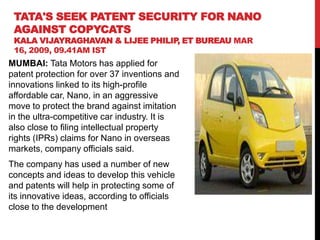
MUMBAI: Tata Motors has applied for
patent protection for over 37 inventions and
innovations linked to its high-profile
affordable car, Nano, in an aggressive
move to protect the brand against imitation
in the ultra-competitive car industry. It is
also close to filing intellectual property
rights (IPRs) claims for Nano in overseas
markets, company officials said.
The company has used a number of new
concepts and ideas to develop this vehicle
and patents will help in protecting some of
its innovative ideas, according to officials
close to the development
CRITERIA FOR PATENTING:

a) Novelty
b) Inventive step

5

c) Capable of industrial application
NOVELTY
The invention should not have been published in India
or elsewhere.
The invention should not have been in prior public
knowledge or public use in India.

6

Exception: display in public exhibition or paper
presented before a learned society but within twelve
months, patent application should be filed.
INVENTIVE STEP
“Inventive step” means a feature of an invention that
involves technical advancement as compared to the
existing knowledge or having economic significance
or both and that makes the invention not obvious to
a person skilled in the art.

7

The question, „is there any inventive step?‟ arises
only if there is novelty.
CAPABLE OF INDUSTRIAL
APPLICATION

8

Capable of industrial application, in
relation to an invention means that the
invention is capable of being made or
used in an industry.
NOT PATENTABLE IN INDIA
The patentability requirement in India, is, the invention should be
novel, inventive and capable of industrial applicable.
However, one can not get patent for all the inventions even though
which meets all the above criteria, and section (3) and (4) under
patent act has long list of area which are not patentable in India.
This section has been obstacle for not less than 50,000 inventions
which are eligible for registering patent
According to Section 3 of the (Indian) Patents Act, 1970 The
following are not patentable in India:An invention, that is frivolous or that claims anything obviously
contrary to well established natural laws;
CONTD..
An invention, the primary or intended use of which would be
contrary to law or morality or injurious to public health;
The mere discovery of a scientific principle or the formulation of
an abstract theory.
The mere discovery of any new property or new use for a known
substance or of the mere use of a known process, machine or
apparatus unless such known process results in a new product or
employs at least one new reactant.
A substance obtained by a mere admixture resulting only in the
aggregation of the properties of the components thereof or a
process for producing such substance.
The mere arrangement or rearrangement or duplication of known
devices, each functioning independently of one another in a known
way.
CONTD…
A method of agriculture or horticulture.
Inventions relating to atomic energy within sub-section (1)
of Section 20 of the Atomic Energy Act, 1962 .
Any
process
for
medicinal, surgical, curative, prophylactic
treatment of human beings or animals.

or

the
other

Plants and animals in whole or any part thereof other than
micro-organisms but including seeds, varieties and species
and essentially biological processes for production or
propagation of plants and animals
Mathematical or business method or a computer program
per se or algorithms.
CONTD..
Literary,
dramatic,
musical
or
artistic
works, cinematographic works, television productions and
any other aesthetic creations.
Mere scheme or rule or method of performing mental act or
playing game.
Presentation of information.
Topography of integrated circuits.
An invention which in effect, is traditional knowledge or is
based on the properties of traditional knowledge.
WHO CAN APPLY FOR A PATENT?
An application for a patent may be submitted by:

1. Any person claiming to be the true and first
inventor of the invention.
2.Any person being the assignee of the person
claiming to be the true and first inventor in respect of
the right to make such an application.
3.By the legal representative of any deceased
person who immediately before his death was
entitled to make such an application.

13
WHERE TO APPLY
For applicants resident in India, appropriate
office is determined according to any of the
following:
place of residence/business/origin of
invention.
For applicants not resident in India or with
no place of business in India, appropriate
office would be according to the address for
service given in the application form.
PATENT OFFICE
Head Office – Kolkata

Branch offices at
Mumbai
Delhi
Chennai
The Patent Office comes under the Ministry of
Commerce & Industry.
Each of the branch offices have their own fixed territory and
accept application forms from areas lying within its geographical
limits.
FEES:
1)The fees payable under section 142 in respect of the grant
of patents and applications therefore, and in respect of
other matters for which fees are required to be payable
under the act shall be as specified in the first schedule.

2)The amount of the fees varies from 1000-4000.
3) The fees, payable under the act may either be paid in cash
or may be sent by bank draft or cheque payable to the
controller of patents.
STAGES FROM
FILING TO GRANT
OF A PATENT
OBTAINING A PATENT
File an application for patent
• With one of the patent offices based on territorial jurisdiction
of the place of office or residence of the applicant /agent
• Pay the required fee

Information concerning application form and details of fee
available at www.ipindia.nic.in
Guidelines for applicants also available on this website
FORMALITY CHECK
An Examiner checks the formal requirements before
accepting the application and the fee – this is done

immediately
Issue of application number and the cash receipt – this is
done the same day
In case of receipt of application by post, cash
receipt, application number is sent by post within 2-3 days
PUBLICATION
Application is kept secret for a period of 18 months from the
date of filing.

In 19th month, the application is published in the official journal
– this journal is made available on the website weekly.
Applicant has an option to get his application published before
18 months also
In that case, application is published within one month of the

request
REQUEST FOR EXAMINATION
Application is examined on request

Request for examination can be made either by the applicant or by a
third party.
A period of 48 months, from the date of filing, is available for
making request for examination
EXAMINATION
Application is sent to an Examiner within 1 month from the

date of request for examination
Examiner undertakes examination w.r.t.
• whether the claimed invention is not prohibited for grant
of patent
• whether the invention meets the criteria of patentability
ISSUE OF FER
A period of 1 to 3 months is available to Examiner to submit the
report to the Controller
1 month’s time available to Controller to assess the Examiner’s
report

First Examination Report (FER) containing list of the
objections is issued within 6 months from the date of filing of
request
RESPONSE FROM THE
APPLICANT
12 months’ time, from the date of issue of FER, is available to
the applicant to meet the objections

If objections are met, grant of patent is approved by the
Controller – within a period of 1 month
PRE-GRANT OPPOSITION

After publication, an opposition can be filed within a
period of 6 months

Opportunity of hearing the opponent is also available
EXAMINATION OF PRE-GRANT
OPPOSITION

Opposition (documents) is sent to the applicant

A period of 3 months is allowed for receipt of response
CONSIDERATION OF
PRE-GRANT OPPOSITION
After examining the opposition and the submissions made during
the hearing, Controller may
• Either reject the opposition and grant the patent
• Or accept the opposition and modify/reject the patent

application
This is to be done within a period of 1 month from the date of
completion of opposition proceedings
GRANT OF A PATENT
A certificate of patent is issued within 7 days

Grant of patent is published in the official journal

For a term of 20 years from the Date of filing the
Patent Application
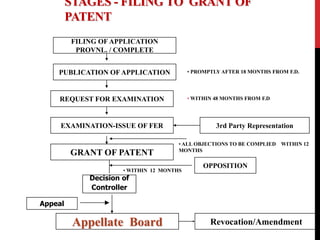
STAGES - FILING TO GRANT OF
PATENT
FILING OF APPLICATION
PROVNL. / COMPLETE
PUBLICATION OF APPLICATION

• PROMPTLY AFTER 18 MONTHS FROM F.D.

REQUEST FOR EXAMINATION

• WITHIN 48 MONTHS FROM F.D.

EXAMINATION-ISSUE OF FER

GRANT OF PATENT

3rd Party Representation
• ALL OBJECTIONS TO BE COMPLIED WITHIN 12
MONTHS

• WITHIN 12 MONTHS

OPPOSITION

Decision of
Controller
Appeal

Appellate Board

Revocation/Amendment
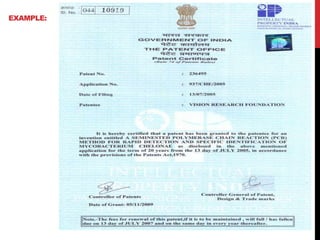
EXAMPLE:
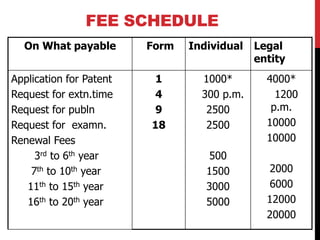
FEE SCHEDULE
On What payable
Application for Patent
Request for extn.time
Request for publn
Request for examn.
Renewal Fees
3rd to 6th year
7th to 10th year
11th to 15th year
16th to 20th year

Form
1
4
9
18

Individual
1000*
300 p.m.
2500
2500
500
1500
3000
5000

Legal
entity
4000*
1200
p.m.
10000
10000
2000
6000
12000
20000
PATENT
INFRINGEMENT
Patent infringement is the commission of a
prohibited act with respect to a patented
invention without permission from the patent
holder.
TYPES OF PATENT
INFRINGEMENT
Direct Infringement : The third party has
willfully or intentionally stole the technology
from the inventor without his prior permission.
Indirect Infringement : It refers to the unfair
practice that does not give a clear indication
that the patent is bought and sold in the
market.
BASIC FEATURES OF
PATENT INFRINGEMENT

1. Objectives of infringement
2. Infringement behavior
3. Violation of legal rules
WHAT CONSEQUENCES CAN WE
EXPECT
FROM PATENT INFRINGEMENT?
HOW TO JUDGE PATENT
INFRINGEMENT?
A determination of patent infringement involves a two-step
process:
1. The claims are analyzed by studying all the relevant
patent documents;
2. The claims must “read on” the accused device or
process.
In a word, the claims are tested to see whether they
describe the accused infringement.
REMEDIES OF PATENT
INFRINGEMENT
Monetary Relief
Equitable Relief
Cost & Attorney‟s Fees
CASES ON PATENTS:
APPLE VS SAMSUNG
PATENT WAR
Apple files first:
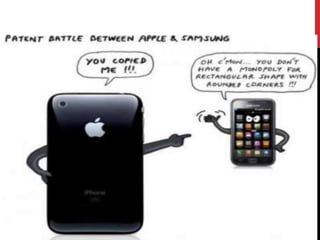
Apple Inc. sued Samsung for copying its

product ideas
38-page suit filed by Apple in the U.S. District
Court of Northern California states
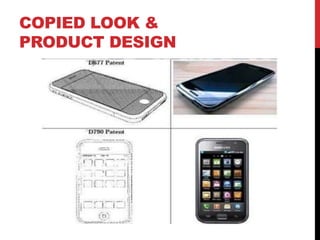
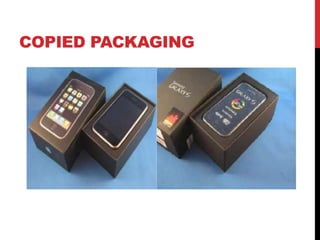
Copied look, product design, Packaging
COPIED LOOK &
PRODUCT DESIGN
COPIED PACKAGING
Samsung’s turn:
Samsung, the world‟s largest maker of
smart phones, countersued Apple saying
that Apple infringes on several of its
patents having to do with wireless
communications technology and camera
phones.
VERDICT
Samsung Electronics flagship Galaxy
Smartphone looks very similar to Apples
iPhone
Jury has found Samsung guilty of infringing on
Apple‟s design patent
Come in favor of Apple in the U.S $1.049
Billion

Rejected all of Samsung‟s claims & Leading
devices may be banned in the U.S
NOVARTIS PATENT
PLEA
Novartis is the world‟s leading pharmaceutical
company filed patent application for its new
version of cancer drug(Glivec).
Indian law bans firms from extending patents
on their products by making slight changes to
a compound, a practice known as
"evergreening".
The court held that the patent application is
rejected on the grounds that :
Novartis has failed to meet stipulations under
sections 3(d) and 3(b) of the Indian Patent
Law.
Section 3(d) restricts patents for already
known drugs unless the new claims are
superior in terms of efficacy
Section 3(b) bars patents for products
that are against public interest and do
not demonstrate enhanced efficacy over
existing products.
FRIENDS RE…

patenting procedure in india

  • 1.
  • 2.
    WHAT IS PATENT? 2 Patentis an exclusive right granted by the Authority to the applicant of an invention for a limited period of time in lieu of full disclosure of his invention.
  • 3.
    WHAT IS ANINVENTION? “Invention” means any (i) new product or process, (ii)involving an inventive step and 3 (iii)capable of industrial application.
  • 4.
    TATA'S SEEK PATENTSECURITY FOR NANO AGAINST COPYCATS KALA VIJAYRAGHAVAN & LIJEE PHILIP ET BUREAU MAR , 16, 2009, 09.41AM IST MUMBAI: Tata Motors has applied for patent protection for over 37 inventions and innovations linked to its high-profile affordable car, Nano, in an aggressive move to protect the brand against imitation in the ultra-competitive car industry. It is also close to filing intellectual property rights (IPRs) claims for Nano in overseas markets, company officials said. The company has used a number of new concepts and ideas to develop this vehicle and patents will help in protecting some of its innovative ideas, according to officials close to the development
  • 5.
    CRITERIA FOR PATENTING: a)Novelty b) Inventive step 5 c) Capable of industrial application
  • 6.
    NOVELTY The invention shouldnot have been published in India or elsewhere. The invention should not have been in prior public knowledge or public use in India. 6 Exception: display in public exhibition or paper presented before a learned society but within twelve months, patent application should be filed.
  • 7.
    INVENTIVE STEP “Inventive step”means a feature of an invention that involves technical advancement as compared to the existing knowledge or having economic significance or both and that makes the invention not obvious to a person skilled in the art. 7 The question, „is there any inventive step?‟ arises only if there is novelty.
  • 8.
    CAPABLE OF INDUSTRIAL APPLICATION 8 Capableof industrial application, in relation to an invention means that the invention is capable of being made or used in an industry.
  • 9.
    NOT PATENTABLE ININDIA The patentability requirement in India, is, the invention should be novel, inventive and capable of industrial applicable. However, one can not get patent for all the inventions even though which meets all the above criteria, and section (3) and (4) under patent act has long list of area which are not patentable in India. This section has been obstacle for not less than 50,000 inventions which are eligible for registering patent According to Section 3 of the (Indian) Patents Act, 1970 The following are not patentable in India:An invention, that is frivolous or that claims anything obviously contrary to well established natural laws;
  • 10.
    CONTD.. An invention, theprimary or intended use of which would be contrary to law or morality or injurious to public health; The mere discovery of a scientific principle or the formulation of an abstract theory. The mere discovery of any new property or new use for a known substance or of the mere use of a known process, machine or apparatus unless such known process results in a new product or employs at least one new reactant. A substance obtained by a mere admixture resulting only in the aggregation of the properties of the components thereof or a process for producing such substance. The mere arrangement or rearrangement or duplication of known devices, each functioning independently of one another in a known way.
  • 11.
    CONTD… A method ofagriculture or horticulture. Inventions relating to atomic energy within sub-section (1) of Section 20 of the Atomic Energy Act, 1962 . Any process for medicinal, surgical, curative, prophylactic treatment of human beings or animals. or the other Plants and animals in whole or any part thereof other than micro-organisms but including seeds, varieties and species and essentially biological processes for production or propagation of plants and animals Mathematical or business method or a computer program per se or algorithms.
  • 12.
    CONTD.. Literary, dramatic, musical or artistic works, cinematographic works,television productions and any other aesthetic creations. Mere scheme or rule or method of performing mental act or playing game. Presentation of information. Topography of integrated circuits. An invention which in effect, is traditional knowledge or is based on the properties of traditional knowledge.
  • 13.
    WHO CAN APPLYFOR A PATENT? An application for a patent may be submitted by: 1. Any person claiming to be the true and first inventor of the invention. 2.Any person being the assignee of the person claiming to be the true and first inventor in respect of the right to make such an application. 3.By the legal representative of any deceased person who immediately before his death was entitled to make such an application. 13
  • 14.
    WHERE TO APPLY Forapplicants resident in India, appropriate office is determined according to any of the following: place of residence/business/origin of invention. For applicants not resident in India or with no place of business in India, appropriate office would be according to the address for service given in the application form.
  • 15.
    PATENT OFFICE Head Office– Kolkata Branch offices at Mumbai Delhi Chennai The Patent Office comes under the Ministry of Commerce & Industry. Each of the branch offices have their own fixed territory and accept application forms from areas lying within its geographical limits.
  • 16.
    FEES: 1)The fees payableunder section 142 in respect of the grant of patents and applications therefore, and in respect of other matters for which fees are required to be payable under the act shall be as specified in the first schedule. 2)The amount of the fees varies from 1000-4000. 3) The fees, payable under the act may either be paid in cash or may be sent by bank draft or cheque payable to the controller of patents.
  • 17.
    STAGES FROM FILING TOGRANT OF A PATENT
  • 18.
    OBTAINING A PATENT Filean application for patent • With one of the patent offices based on territorial jurisdiction of the place of office or residence of the applicant /agent • Pay the required fee Information concerning application form and details of fee available at www.ipindia.nic.in Guidelines for applicants also available on this website
  • 19.
    FORMALITY CHECK An Examinerchecks the formal requirements before accepting the application and the fee – this is done immediately Issue of application number and the cash receipt – this is done the same day In case of receipt of application by post, cash receipt, application number is sent by post within 2-3 days
  • 20.
    PUBLICATION Application is keptsecret for a period of 18 months from the date of filing. In 19th month, the application is published in the official journal – this journal is made available on the website weekly. Applicant has an option to get his application published before 18 months also In that case, application is published within one month of the request
  • 21.
    REQUEST FOR EXAMINATION Applicationis examined on request Request for examination can be made either by the applicant or by a third party. A period of 48 months, from the date of filing, is available for making request for examination
  • 22.
    EXAMINATION Application is sentto an Examiner within 1 month from the date of request for examination Examiner undertakes examination w.r.t. • whether the claimed invention is not prohibited for grant of patent • whether the invention meets the criteria of patentability
  • 23.
    ISSUE OF FER Aperiod of 1 to 3 months is available to Examiner to submit the report to the Controller 1 month’s time available to Controller to assess the Examiner’s report First Examination Report (FER) containing list of the objections is issued within 6 months from the date of filing of request
  • 24.
    RESPONSE FROM THE APPLICANT 12months’ time, from the date of issue of FER, is available to the applicant to meet the objections If objections are met, grant of patent is approved by the Controller – within a period of 1 month
  • 25.
    PRE-GRANT OPPOSITION After publication,an opposition can be filed within a period of 6 months Opportunity of hearing the opponent is also available
  • 26.
    EXAMINATION OF PRE-GRANT OPPOSITION Opposition(documents) is sent to the applicant A period of 3 months is allowed for receipt of response
  • 27.
    CONSIDERATION OF PRE-GRANT OPPOSITION Afterexamining the opposition and the submissions made during the hearing, Controller may • Either reject the opposition and grant the patent • Or accept the opposition and modify/reject the patent application This is to be done within a period of 1 month from the date of completion of opposition proceedings
  • 28.
    GRANT OF APATENT A certificate of patent is issued within 7 days Grant of patent is published in the official journal For a term of 20 years from the Date of filing the Patent Application
  • 29.
    STAGES - FILINGTO GRANT OF PATENT FILING OF APPLICATION PROVNL. / COMPLETE PUBLICATION OF APPLICATION • PROMPTLY AFTER 18 MONTHS FROM F.D. REQUEST FOR EXAMINATION • WITHIN 48 MONTHS FROM F.D. EXAMINATION-ISSUE OF FER GRANT OF PATENT 3rd Party Representation • ALL OBJECTIONS TO BE COMPLIED WITHIN 12 MONTHS • WITHIN 12 MONTHS OPPOSITION Decision of Controller Appeal Appellate Board Revocation/Amendment
  • 30.
  • 31.
    FEE SCHEDULE On Whatpayable Application for Patent Request for extn.time Request for publn Request for examn. Renewal Fees 3rd to 6th year 7th to 10th year 11th to 15th year 16th to 20th year Form 1 4 9 18 Individual 1000* 300 p.m. 2500 2500 500 1500 3000 5000 Legal entity 4000* 1200 p.m. 10000 10000 2000 6000 12000 20000
  • 32.
    PATENT INFRINGEMENT Patent infringement isthe commission of a prohibited act with respect to a patented invention without permission from the patent holder.
  • 33.
    TYPES OF PATENT INFRINGEMENT DirectInfringement : The third party has willfully or intentionally stole the technology from the inventor without his prior permission. Indirect Infringement : It refers to the unfair practice that does not give a clear indication that the patent is bought and sold in the market.
  • 34.
    BASIC FEATURES OF PATENTINFRINGEMENT 1. Objectives of infringement 2. Infringement behavior 3. Violation of legal rules
  • 35.
    WHAT CONSEQUENCES CANWE EXPECT FROM PATENT INFRINGEMENT?
  • 36.
    HOW TO JUDGEPATENT INFRINGEMENT? A determination of patent infringement involves a two-step process: 1. The claims are analyzed by studying all the relevant patent documents; 2. The claims must “read on” the accused device or process. In a word, the claims are tested to see whether they describe the accused infringement.
  • 37.
    REMEDIES OF PATENT INFRINGEMENT MonetaryRelief Equitable Relief Cost & Attorney‟s Fees
  • 38.
    CASES ON PATENTS: APPLEVS SAMSUNG PATENT WAR Apple files first: Apple Inc. sued Samsung for copying its product ideas 38-page suit filed by Apple in the U.S. District Court of Northern California states Copied look, product design, Packaging
  • 40.
  • 41.
  • 42.
    Samsung’s turn: Samsung, theworld‟s largest maker of smart phones, countersued Apple saying that Apple infringes on several of its patents having to do with wireless communications technology and camera phones.
  • 43.
    VERDICT Samsung Electronics flagshipGalaxy Smartphone looks very similar to Apples iPhone Jury has found Samsung guilty of infringing on Apple‟s design patent Come in favor of Apple in the U.S $1.049 Billion Rejected all of Samsung‟s claims & Leading devices may be banned in the U.S
  • 44.
    NOVARTIS PATENT PLEA Novartis isthe world‟s leading pharmaceutical company filed patent application for its new version of cancer drug(Glivec). Indian law bans firms from extending patents on their products by making slight changes to a compound, a practice known as "evergreening".
  • 45.
    The court heldthat the patent application is rejected on the grounds that : Novartis has failed to meet stipulations under sections 3(d) and 3(b) of the Indian Patent Law.
  • 46.
    Section 3(d) restrictspatents for already known drugs unless the new claims are superior in terms of efficacy Section 3(b) bars patents for products that are against public interest and do not demonstrate enhanced efficacy over existing products.
  • 47.