INDIA, CDM AND KYOTO PROTOCOL Presented by:Ratnesh Jaiswal(50803030)Sachin Bhardwaj(50803031)MBA (Energy)L.M Thapar School of ManagementThapar University14 April 20091Kyoto Protocol
Reduction of 6 major GHGs, as defined by IPCCCarbon dioxide (CO2)Methane (CH4)Nitrous oxide (N2O)Hydro fluorocarbon (HFCs)Perfluoro carbon (PFCs) Sulphur hexafluoride (SF6 )By 1997, 186 nations signed Kyoto Protocol (KP)What is Kyoto Protocol14 April 20092Kyoto Protocol
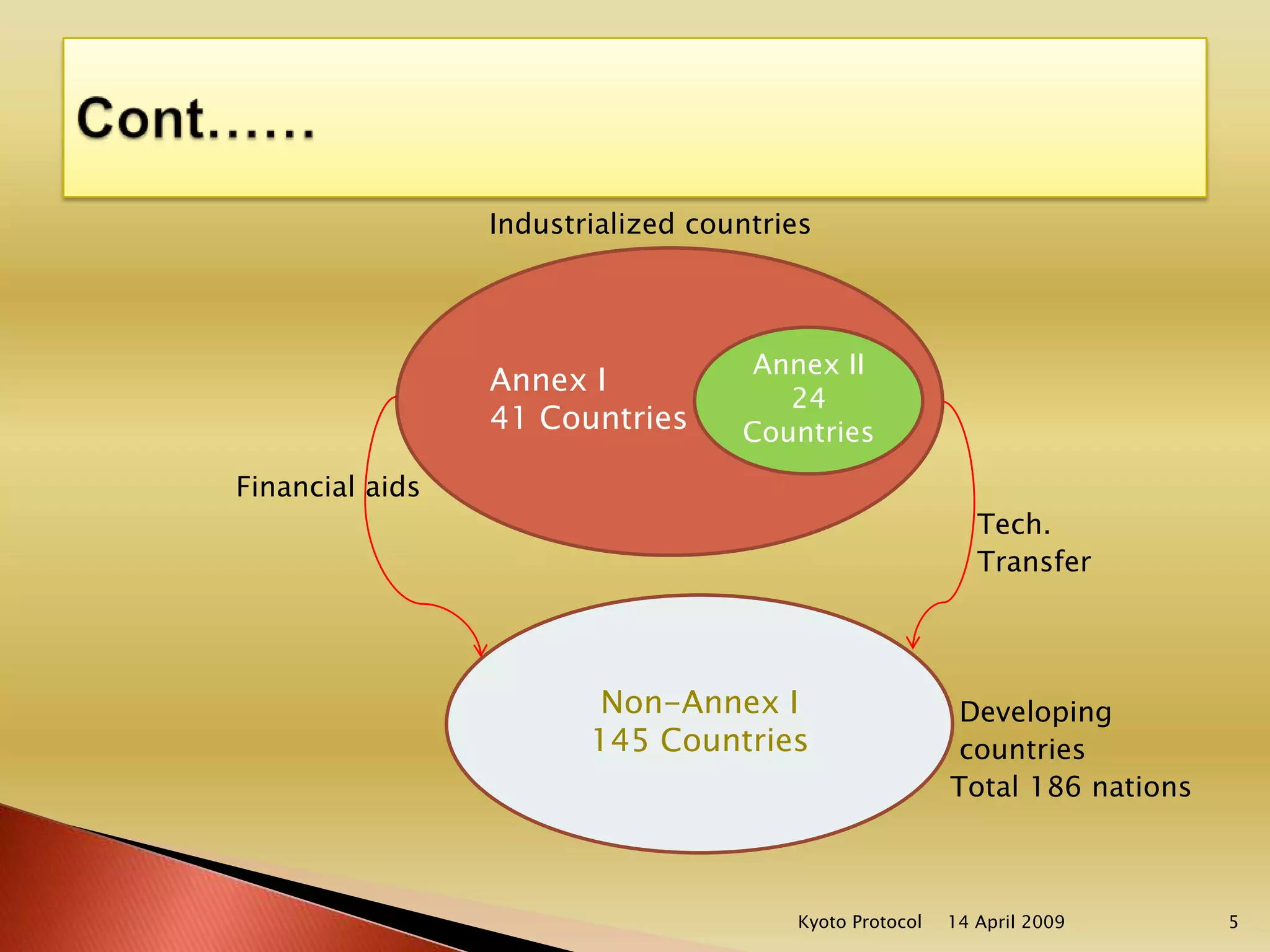
Annex I : Leading industrialized countries (41 nations) Annex II : Wealthy countries in Annex I (24 nations)Non-Annex I : Developing countries (145 nations) Three categories14 April 20093Kyoto Protocol
Annex I:Cut GHG emissions by 5.2% below 1990 level (during                  2008- 2012)Help non-Annex I countries to tackle climate changeAnnex II: Additional financial & tech. supports to Non-Annex I       countries Non-Annex I: No commitmentCommitment 14 April 20094Kyoto Protocol
                                            Industrialized countriesFinancial aidsTech.                                                                                                  TransferDeveloping                                                                                                  countries                                                                                                Total 186 nationsCont……Annex I41 Countries Annex II24 CountriesNon-Annex I145 Countries 14 April 20095Kyoto Protocol
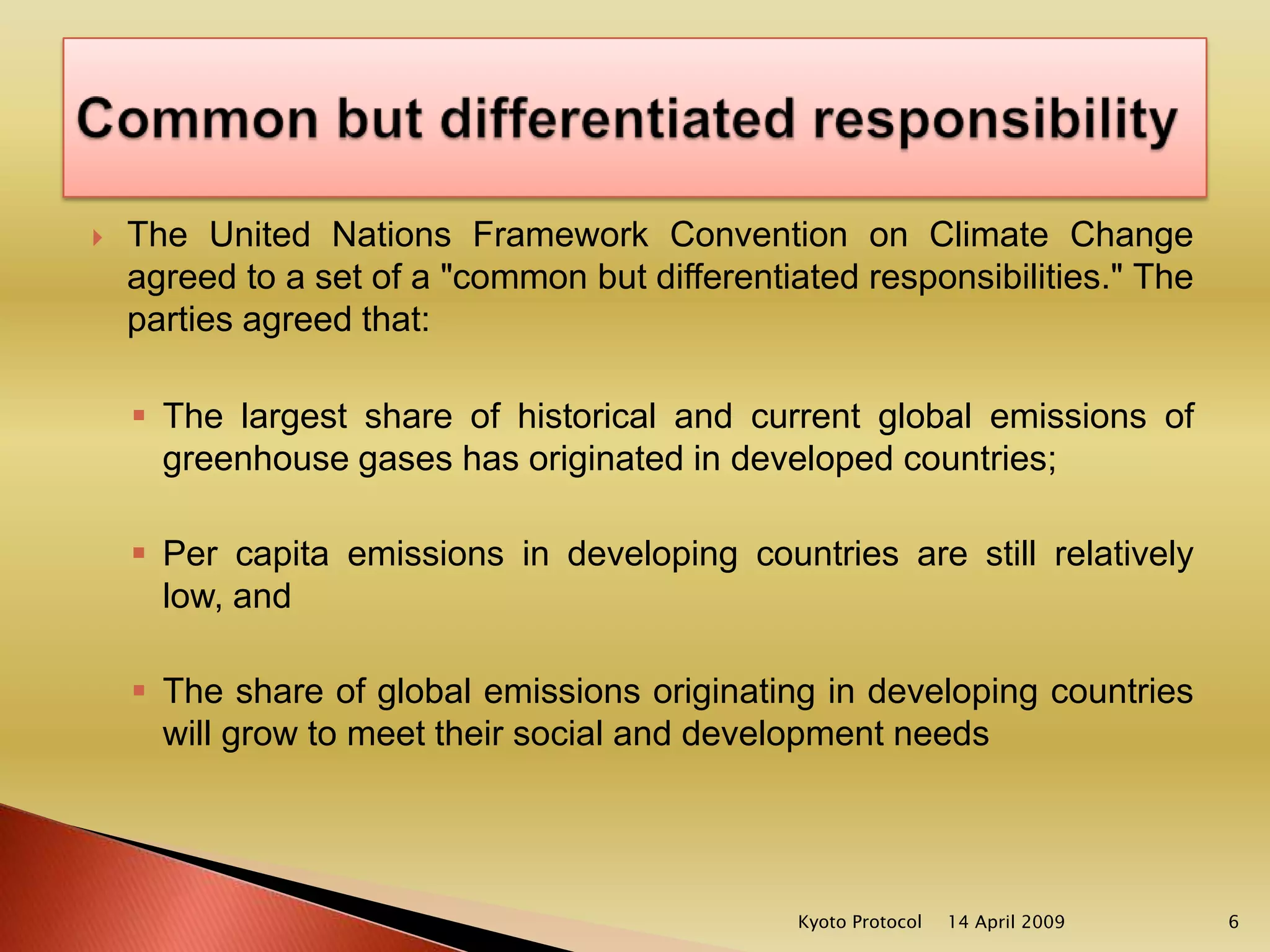
The United Nations Framework Convention on Climate Change agreed to a set of a "common but differentiated responsibilities." The parties agreed that: The largest share of historical and current global emissions of greenhouse gases has originated in developed countries;
Per capita emissions in developing countries are still relatively low, and
The share of global emissions originating in developing countries will grow to meet their social and development needsCommon but differentiated responsibility 14 April 20096Kyoto Protocol
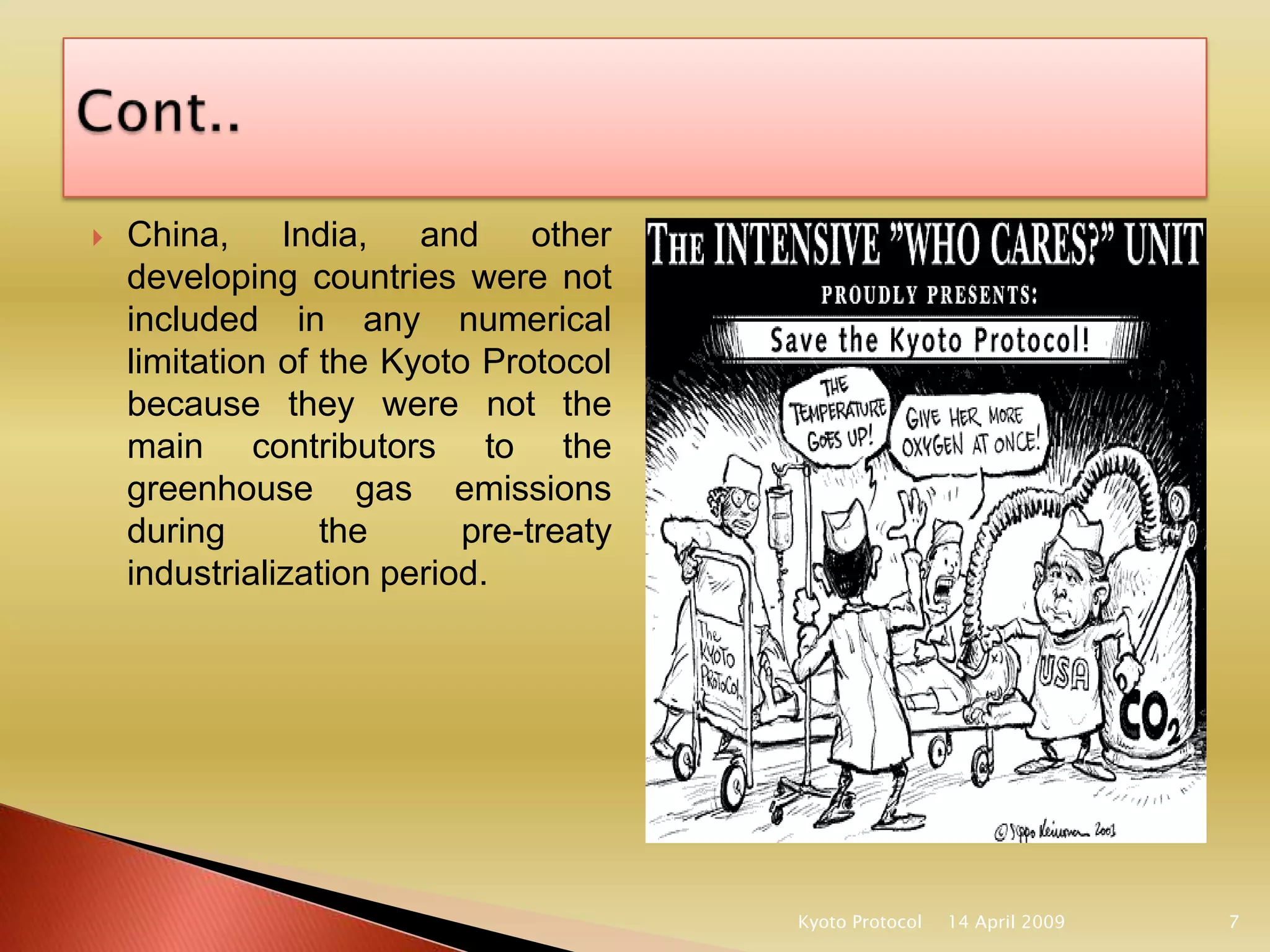
China, India, and other developing countries were not included in any numerical limitation of the Kyoto Protocol because they were not the main contributors to the greenhouse gas emissions during the pre-treaty industrialization period. 14 April 2009Kyoto Protocol7Cont..
14 April 2009Kyoto Protocol8
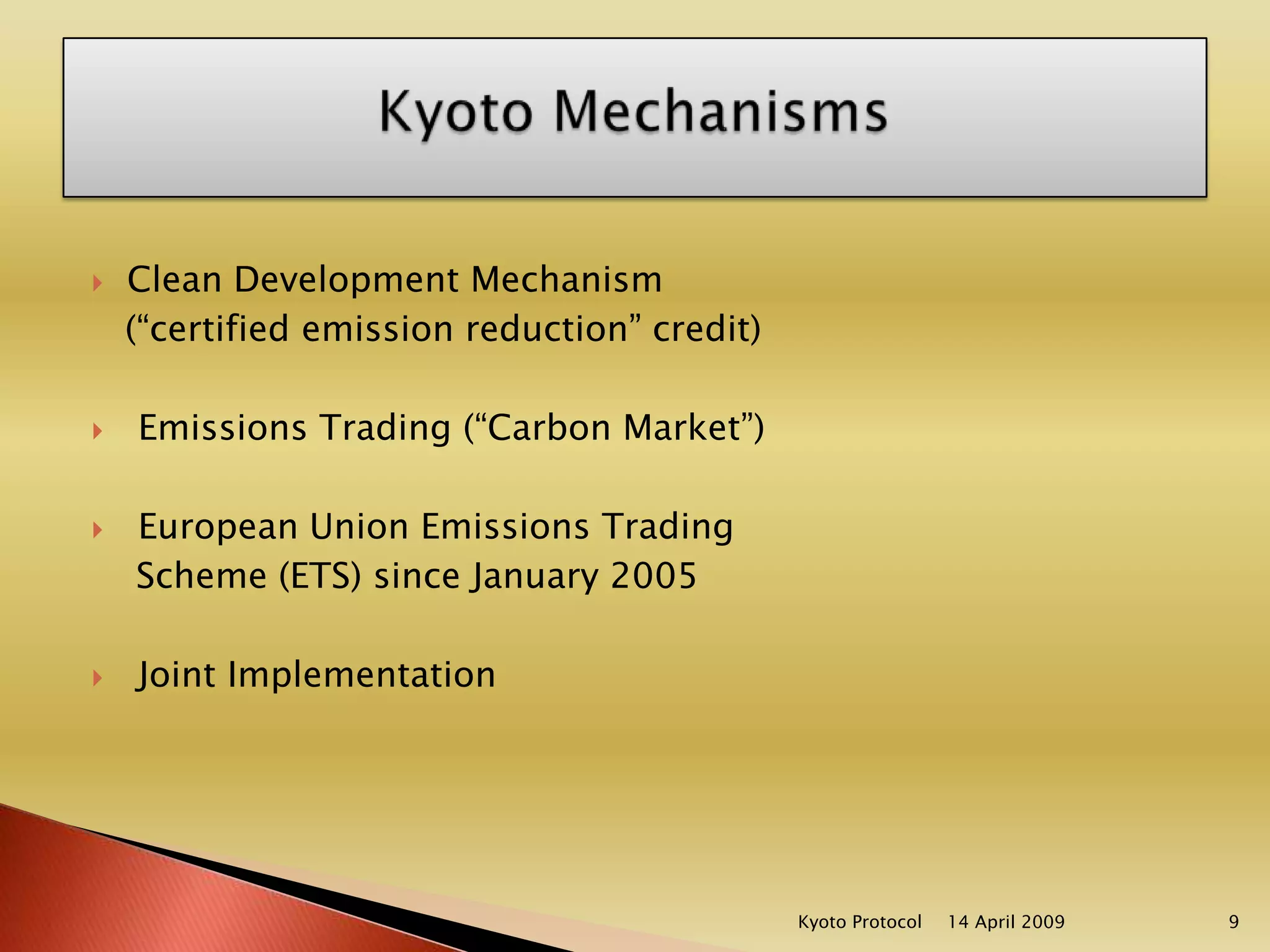
Clean Development Mechanism   (“certified emission reduction” credit) Emissions Trading (“Carbon Market”) European Union Emissions Trading    Scheme (ETS) since January 2005 Joint ImplementationKyoto Mechanisms14 April 20099Kyoto Protocol
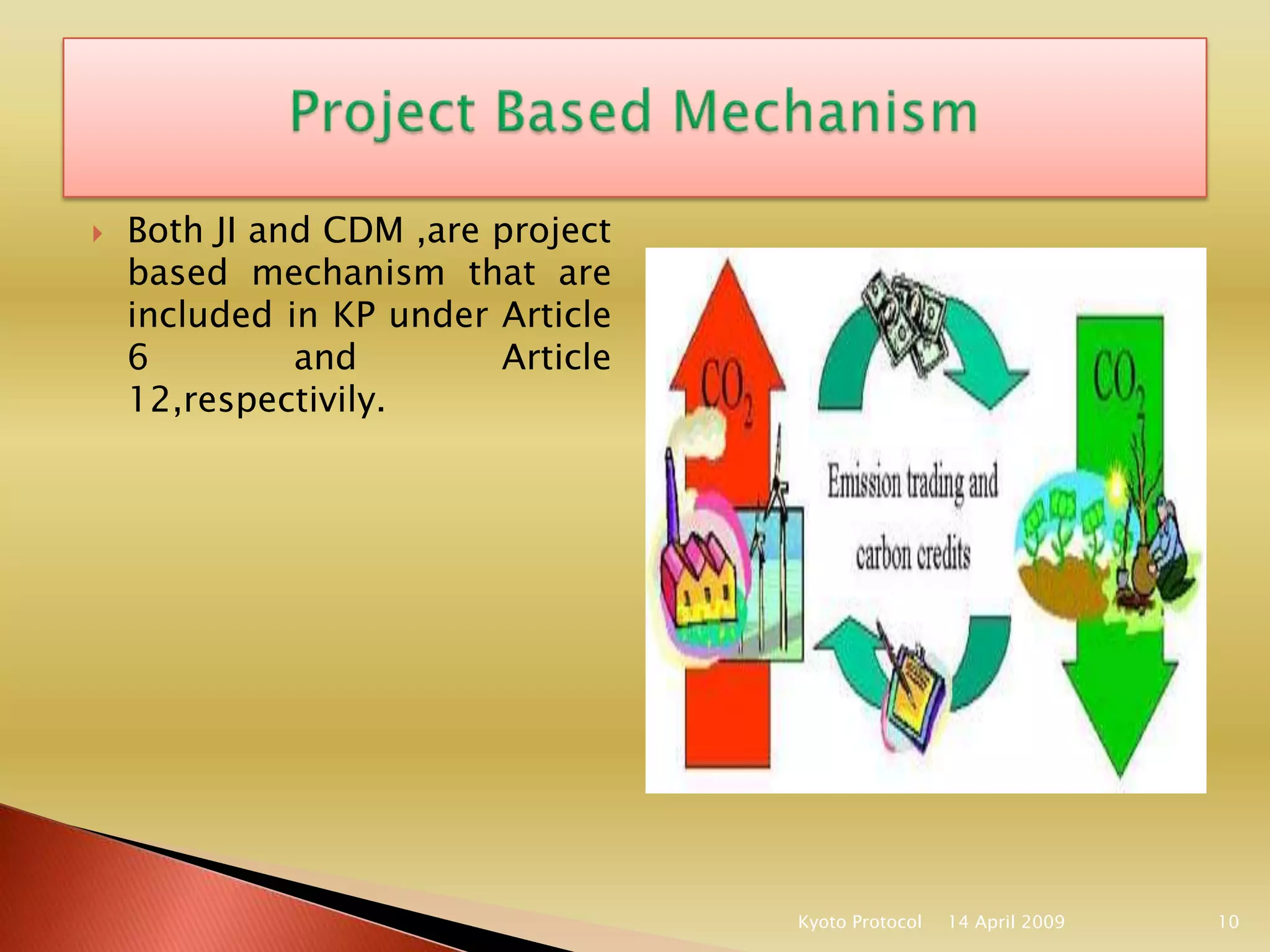
Both JI and CDM ,are project based mechanism that are included in KP under Article 6 and Article 12,respectivily.14 April 2009Kyoto Protocol10Project Based Mechanism
The Clean Development Mechanism (CDM), defined in Article 12 of the Protocol, allows a country with an emission-reduction or emission-limitation commitment under the Kyoto Protocol (Annex B Party) to implement an emission-reduction project in developing countries. Such projects can earn saleable certified emission reduction (CER) credits, each equivalent to one tonne of CO2, which can be counted towards meeting Kyoto targets.
It is the first global, environmental investment and credit scheme of its kind, providing a standardized emissions offset instrument, CERs. Clean Development Mechanism14 April 200911Kyoto Protocol
Out of the total CDM projects for registration under Kyoto Protocol across globe, 32.86% projects are from India, followed by Brazil with 17.12%, China 7.59% and Republic of Korea 1.95%, while other countries collectively account for 19%.Currently, the rate of one carbon credit is 13 euroThe carbon credit market was $25 billion last year and It is growing at tremendous spaceThere is a demand to reduce 1 billion tonne of carbon emissions in the world, so that threats like global warming could be mitigated14 April 2009Kyoto Protocol12Over 200 Indian company apply for CDM in race for carbon credit
If India meets one fifth of carbon emission reduction demand, it works out to be 200 million tonne of carbon emission reduction. With this the Indian entities can earn 2 billion euro by the year 2012.Gujarat has also remained a leader in registering CDM projects as Gujarat Flour chemicals Ltd (GFL) was among the early birds to register CDM project. 14 April 2009Kyoto Protocol13Cont……..
JI enables countries with specific emission reduction targets under the protocol (that is, the industrialized or ‘Annex B’ countries which were also referred to above as Annex 1 countries !) to obtain credit for implementing GHG reduction projects in other Annex 1 countries.
JI is set forth in Article 6 of the KP.
A JI project might involve, for example, replacing a coal-fired power plant with a more efficient combined heat and power plant Joint Implementation14 April 200914Kyoto Protocol
Emission reductions are awarded credits called ERUs.One ERU represents an emission reduction equalling one tonne of CO2 equivalentThe ERUs come from the host country's pool of assigned emissions credits, known as Assigned Amount Units(AAUs)Each Annex I party has a predetermined amount of AAUs, calculated on the basis of its 1990 greenhouse gas emission levels Emission Reduction Units14 April 200915Kyoto Protocol
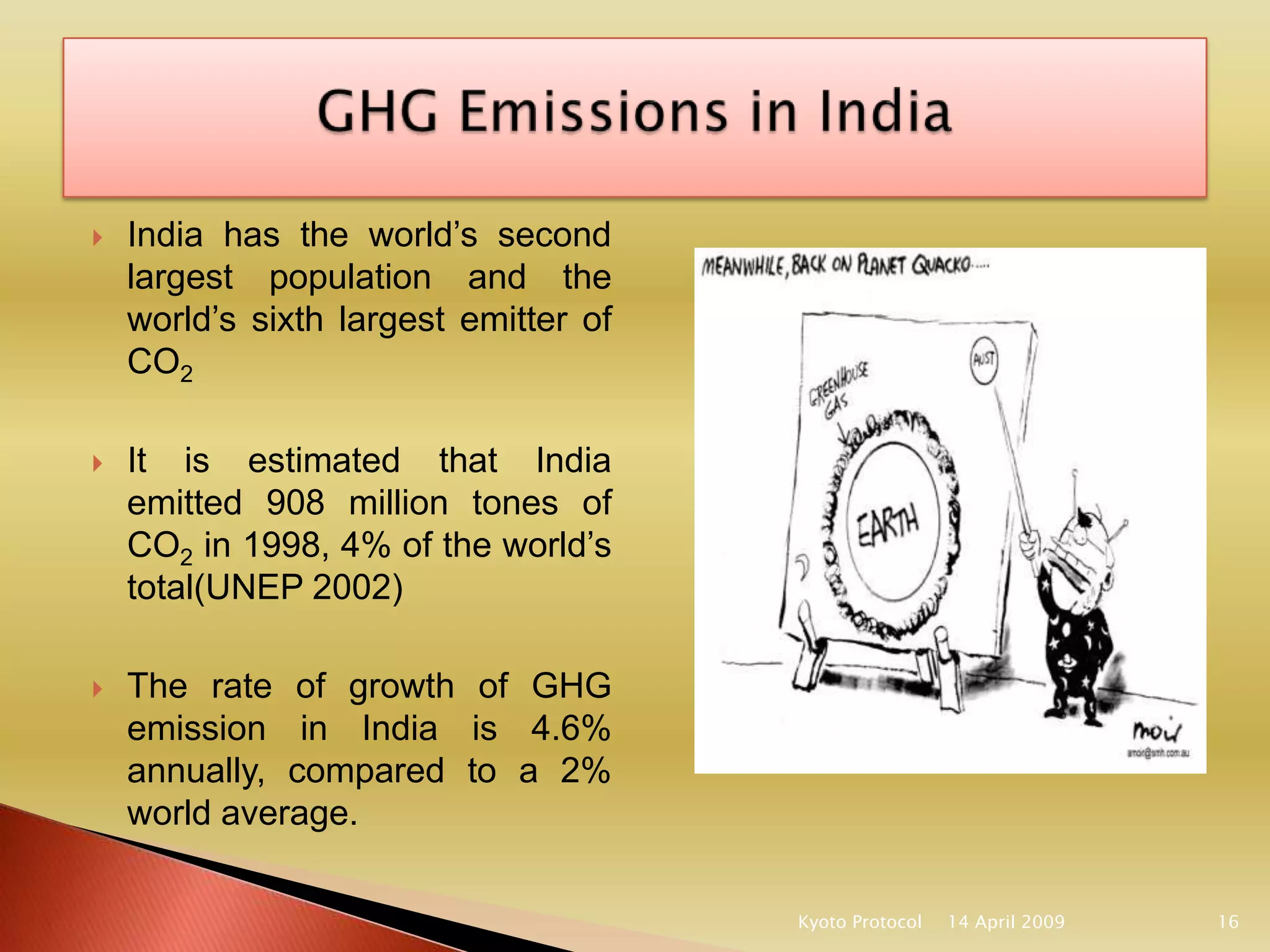
India has the world’s second largest population and the world’s sixth largest emitter of CO2It is estimated that India emitted 908 million tones of CO2 in 1998, 4% of the world’s total(UNEP 2002)The rate of growth of GHG emission in India is 4.6% annually, compared to a 2% world average.14 April 2009Kyoto Protocol16GHG Emissions in India

India, Cdm And Kyoto Protocol

  • 1.
    INDIA, CDM ANDKYOTO PROTOCOL Presented by:Ratnesh Jaiswal(50803030)Sachin Bhardwaj(50803031)MBA (Energy)L.M Thapar School of ManagementThapar University14 April 20091Kyoto Protocol
  • 2.
    Reduction of 6major GHGs, as defined by IPCCCarbon dioxide (CO2)Methane (CH4)Nitrous oxide (N2O)Hydro fluorocarbon (HFCs)Perfluoro carbon (PFCs) Sulphur hexafluoride (SF6 )By 1997, 186 nations signed Kyoto Protocol (KP)What is Kyoto Protocol14 April 20092Kyoto Protocol
  • 3.
    Annex I :Leading industrialized countries (41 nations) Annex II : Wealthy countries in Annex I (24 nations)Non-Annex I : Developing countries (145 nations) Three categories14 April 20093Kyoto Protocol
  • 4.
    Annex I:Cut GHGemissions by 5.2% below 1990 level (during 2008- 2012)Help non-Annex I countries to tackle climate changeAnnex II: Additional financial & tech. supports to Non-Annex I countries Non-Annex I: No commitmentCommitment 14 April 20094Kyoto Protocol
  • 5.
    Industrialized countriesFinancial aidsTech. TransferDeveloping countries Total 186 nationsCont……Annex I41 Countries Annex II24 CountriesNon-Annex I145 Countries 14 April 20095Kyoto Protocol
  • 6.
    The United NationsFramework Convention on Climate Change agreed to a set of a "common but differentiated responsibilities." The parties agreed that: The largest share of historical and current global emissions of greenhouse gases has originated in developed countries;
  • 7.
    Per capita emissionsin developing countries are still relatively low, and
  • 8.
    The share ofglobal emissions originating in developing countries will grow to meet their social and development needsCommon but differentiated responsibility 14 April 20096Kyoto Protocol
  • 9.
    China, India, andother developing countries were not included in any numerical limitation of the Kyoto Protocol because they were not the main contributors to the greenhouse gas emissions during the pre-treaty industrialization period. 14 April 2009Kyoto Protocol7Cont..
  • 10.
  • 11.
    Clean Development Mechanism (“certified emission reduction” credit) Emissions Trading (“Carbon Market”) European Union Emissions Trading Scheme (ETS) since January 2005 Joint ImplementationKyoto Mechanisms14 April 20099Kyoto Protocol
  • 12.
    Both JI andCDM ,are project based mechanism that are included in KP under Article 6 and Article 12,respectivily.14 April 2009Kyoto Protocol10Project Based Mechanism
  • 13.
    The Clean DevelopmentMechanism (CDM), defined in Article 12 of the Protocol, allows a country with an emission-reduction or emission-limitation commitment under the Kyoto Protocol (Annex B Party) to implement an emission-reduction project in developing countries. Such projects can earn saleable certified emission reduction (CER) credits, each equivalent to one tonne of CO2, which can be counted towards meeting Kyoto targets.
  • 14.
    It is thefirst global, environmental investment and credit scheme of its kind, providing a standardized emissions offset instrument, CERs. Clean Development Mechanism14 April 200911Kyoto Protocol
  • 15.
    Out of thetotal CDM projects for registration under Kyoto Protocol across globe, 32.86% projects are from India, followed by Brazil with 17.12%, China 7.59% and Republic of Korea 1.95%, while other countries collectively account for 19%.Currently, the rate of one carbon credit is 13 euroThe carbon credit market was $25 billion last year and It is growing at tremendous spaceThere is a demand to reduce 1 billion tonne of carbon emissions in the world, so that threats like global warming could be mitigated14 April 2009Kyoto Protocol12Over 200 Indian company apply for CDM in race for carbon credit
  • 16.
    If India meetsone fifth of carbon emission reduction demand, it works out to be 200 million tonne of carbon emission reduction. With this the Indian entities can earn 2 billion euro by the year 2012.Gujarat has also remained a leader in registering CDM projects as Gujarat Flour chemicals Ltd (GFL) was among the early birds to register CDM project. 14 April 2009Kyoto Protocol13Cont……..
  • 17.
    JI enables countrieswith specific emission reduction targets under the protocol (that is, the industrialized or ‘Annex B’ countries which were also referred to above as Annex 1 countries !) to obtain credit for implementing GHG reduction projects in other Annex 1 countries.
  • 18.
    JI is setforth in Article 6 of the KP.
  • 19.
    A JI projectmight involve, for example, replacing a coal-fired power plant with a more efficient combined heat and power plant Joint Implementation14 April 200914Kyoto Protocol
  • 20.
    Emission reductions areawarded credits called ERUs.One ERU represents an emission reduction equalling one tonne of CO2 equivalentThe ERUs come from the host country's pool of assigned emissions credits, known as Assigned Amount Units(AAUs)Each Annex I party has a predetermined amount of AAUs, calculated on the basis of its 1990 greenhouse gas emission levels Emission Reduction Units14 April 200915Kyoto Protocol
  • 21.
    India has theworld’s second largest population and the world’s sixth largest emitter of CO2It is estimated that India emitted 908 million tones of CO2 in 1998, 4% of the world’s total(UNEP 2002)The rate of growth of GHG emission in India is 4.6% annually, compared to a 2% world average.14 April 2009Kyoto Protocol16GHG Emissions in India
  • 22.
    Its Main Findingswere:CO2 emissions account for 53% of the total emissions
  • 23.
    CH4 and N2Ocontribute 39% and 8% respectively.
  • 24.
    Energy sector isthe main emitter of CO2 accounting for 87% of total CO2 emissions the remaining coming from the Cement Industry(4%), and land conversation (9%), and biomass burning and agriculture sector are the main source of CH4 and N2O with small portion contributed by the transport sector.14 April 2009Kyoto Protocol17Cont ….
  • 25.
    The main benefitsthat can be expected from the project-based Kyoto mechanisms are, on the one hand, that they potentially reduce industrialized countries’ costs of meeting the Kyoto Protocol targets, whereas, on the other hand, they are to support the host countries objectives regarding sustainable development.
  • 26.
    With the helpof CDM, countries which have set themselves an emission reduction target under the Kyoto Protocol (Annex I countries) can contribute to the financing of projects in developing countries (non-Annex I countries) which do not have a reduction target. Contributing to the sustainable development of the host country, the project should reduce the emission of greenhouse gases. The achieved emission reductions can be used by the Annex I country in order to meet its reduction target.14 April 2009Kyoto Protocol19Cont.
  • 27.
    THERE IS UNCERTAINTYABOUT IHE SIZE OF CDM MARKET AND PRICE OF CERs BUT IN NEAR FUTURE INDIA WILL BE A MAJOR PLAYER. 14 April 2009Kyoto Protocol20Conclusion
  • 28.