CARBON BANKING AND KYOTO 
PROTOCOL 
Mulund College Of Commerce 
FY_BMS ‘A’
GROUP MEMBERS :
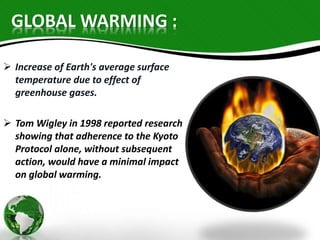
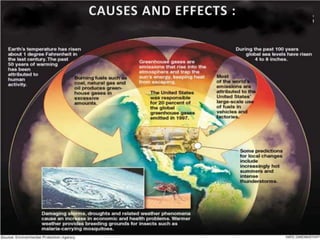
GLOBAL WARMING : 
 Increase of Earth's average surface 
temperature due to effect of 
greenhouse gases. 
 Tom Wigley in 1998 reported research 
showing that adherence to the Kyoto 
Protocol alone, without subsequent 
action, would have a minimal impact 
on global warming.
CARBON BANKING: 
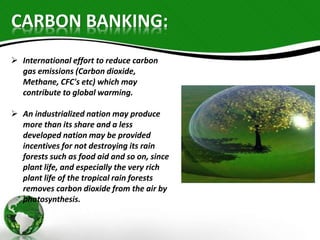
 International effort to reduce carbon 
gas emissions (Carbon dioxide, 
Methane, CFC's etc) which may 
contribute to global warming. 
 An industrialized nation may produce 
more than its share and a less 
developed nation may be provided 
incentives for not destroying its rain 
forests such as food aid and so on, since 
plant life, and especially the very rich 
plant life of the tropical rain forests 
removes carbon dioxide from the air by 
photosynthesis.
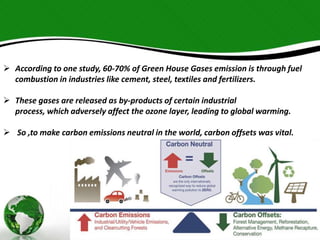
 According to one study, 60-70% of Green House Gases emission is through fuel 
combustion in industries like cement, steel, textiles and fertilizers. 
 These gases are released as by-products of certain industrial 
process, which adversely affect the ozone layer, leading to global warming. 
 So ,to make carbon emissions neutral in the world, carbon offsets was vital.
 Because of ignorance of human beings, different countries across the world formed and 
decided to reduce this emissions and it was known as Kyoto protocol. 
 Kyoto protocol gave rise to Carbon Banking. 
 This is the facility given by an Organization working in common within the world. It 
enables different countries for trading of carbon. 
 A target is decided in the meet between various countries. 
 For example, America scores high in emitting carbon whereas Japan is below the target. So 
Japan can purchase carbon emissions from America. This transaction of selling and 
purchasing carbon emissions in order to reduce increasing global warming, is known as 
Carbon banking.
CARBON TRADING 
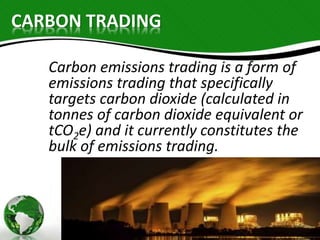
Carbon emissions trading is a form of 
emissions trading that specifically 
targets carbon dioxide (calculated in 
tonnes of carbon dioxide equivalent or 
tCO2e) and it currently constitutes the 
bulk of emissions trading.
INTERNATIONAL CARBON BANK AND 
EXCHANGE : 
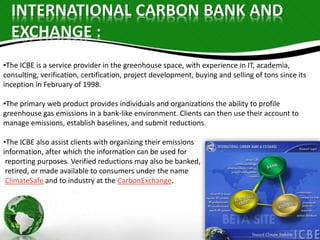
•The ICBE is a service provider in the greenhouse space, with experience in IT, academia, 
consulting, verification, certification, project development, buying and selling of tons since its 
inception in February of 1998. 
•The primary web product provides individuals and organizations the ability to profile 
greenhouse gas emissions in a bank-like environment. Clients can then use their account to 
manage emissions, establish baselines, and submit reductions. 
•The ICBE also assist clients with organizing their emissions 
information, after which the information can be used for 
reporting purposes. Verified reductions may also be banked, 
retired, or made available to consumers under the name 
ClimateSafe and to industry at the CarbonExchange.
KYOTO PROTOCOL : 
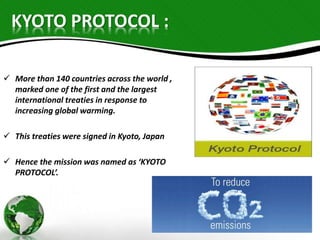
 More than 140 countries across the world , 
marked one of the first and the largest 
international treaties in response to 
increasing global warming. 
 This treaties were signed in Kyoto, Japan 
 Hence the mission was named as ‘KYOTO 
PROTOCOL’.
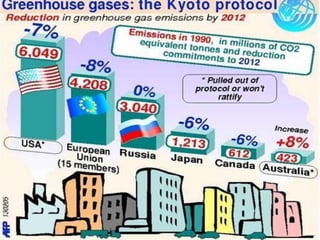
 The main goal, among others, of the Kyoto Protocol was to create a legally binding 
document that would commit industrialized countries to lowering carbon emissions by 5.2% 
below 1990 levels 
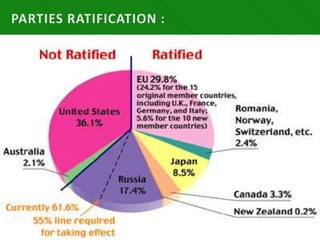
 American leaders have continually stated that the Kyoto Protocol could harm the American 
economy, cost American jobs, and decrease productivity by up to ten percent by 2010, 
hence they refuse to retify the treaty. 
 By not participating in the treaty, the US is denying responsibility for a problem they 
helped to create, weakening their ties to other countries that have ratified the treaty, and 
ultimately causing itself more harm than good. 
 The effects of global warming will eventually cost America millions in damage relief, 
international aid, and more expensive natural resources
 Another criticism of the Kyoto Protocol is that it does not require developing countries to 
lower their carbon emissions. 
 China, now the largest emitter of carbon, is not bound by the Kyoto Protocol to reduce 
production of carbon dioxide. They are, however, able to take advantage of the funding 
provision, which states that the group of developed countries must economically help 
developing countries tackle climate change. 
 India, also a large contributor to global carbon emissions, is under no legal agreement to 
reduce their levels of emissions. 
 In the end, the Kyoto Protocol is ineffective in legally binding the countries that produce 
more than 40% of total carbon dioxide emissions worldwide.
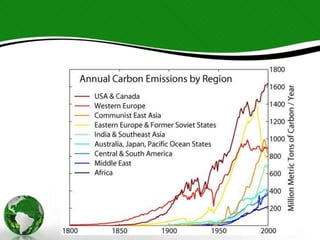
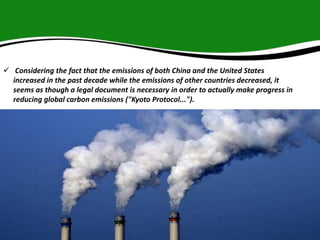
 Considering the fact that the emissions of both China and the United States 
increased in the past decade while the emissions of other countries decreased, it 
seems as though a legal document is necessary in order to actually make progress in 
reducing global carbon emissions ("Kyoto Protocol...").
REFERENCE 
1.Google 
2.Wikipedia 
3.Environmental Management - P.G.Shinde 
4.Environmental Management – H.V.Jadhav
Carbon bank & Kyoto Protocol

Carbon bank & Kyoto Protocol

  • 1.
    CARBON BANKING ANDKYOTO PROTOCOL Mulund College Of Commerce FY_BMS ‘A’
  • 2.
  • 3.
    GLOBAL WARMING :  Increase of Earth's average surface temperature due to effect of greenhouse gases.  Tom Wigley in 1998 reported research showing that adherence to the Kyoto Protocol alone, without subsequent action, would have a minimal impact on global warming.
  • 5.
    CARBON BANKING: International effort to reduce carbon gas emissions (Carbon dioxide, Methane, CFC's etc) which may contribute to global warming.  An industrialized nation may produce more than its share and a less developed nation may be provided incentives for not destroying its rain forests such as food aid and so on, since plant life, and especially the very rich plant life of the tropical rain forests removes carbon dioxide from the air by photosynthesis.
  • 6.
     According toone study, 60-70% of Green House Gases emission is through fuel combustion in industries like cement, steel, textiles and fertilizers.  These gases are released as by-products of certain industrial process, which adversely affect the ozone layer, leading to global warming.  So ,to make carbon emissions neutral in the world, carbon offsets was vital.
  • 7.
     Because ofignorance of human beings, different countries across the world formed and decided to reduce this emissions and it was known as Kyoto protocol.  Kyoto protocol gave rise to Carbon Banking.  This is the facility given by an Organization working in common within the world. It enables different countries for trading of carbon.  A target is decided in the meet between various countries.  For example, America scores high in emitting carbon whereas Japan is below the target. So Japan can purchase carbon emissions from America. This transaction of selling and purchasing carbon emissions in order to reduce increasing global warming, is known as Carbon banking.
  • 8.
    CARBON TRADING Carbonemissions trading is a form of emissions trading that specifically targets carbon dioxide (calculated in tonnes of carbon dioxide equivalent or tCO2e) and it currently constitutes the bulk of emissions trading.
  • 10.
    INTERNATIONAL CARBON BANKAND EXCHANGE : •The ICBE is a service provider in the greenhouse space, with experience in IT, academia, consulting, verification, certification, project development, buying and selling of tons since its inception in February of 1998. •The primary web product provides individuals and organizations the ability to profile greenhouse gas emissions in a bank-like environment. Clients can then use their account to manage emissions, establish baselines, and submit reductions. •The ICBE also assist clients with organizing their emissions information, after which the information can be used for reporting purposes. Verified reductions may also be banked, retired, or made available to consumers under the name ClimateSafe and to industry at the CarbonExchange.
  • 11.
    KYOTO PROTOCOL :  More than 140 countries across the world , marked one of the first and the largest international treaties in response to increasing global warming.  This treaties were signed in Kyoto, Japan  Hence the mission was named as ‘KYOTO PROTOCOL’.
  • 12.
     The maingoal, among others, of the Kyoto Protocol was to create a legally binding document that would commit industrialized countries to lowering carbon emissions by 5.2% below 1990 levels  American leaders have continually stated that the Kyoto Protocol could harm the American economy, cost American jobs, and decrease productivity by up to ten percent by 2010, hence they refuse to retify the treaty.  By not participating in the treaty, the US is denying responsibility for a problem they helped to create, weakening their ties to other countries that have ratified the treaty, and ultimately causing itself more harm than good.  The effects of global warming will eventually cost America millions in damage relief, international aid, and more expensive natural resources
  • 14.
     Another criticismof the Kyoto Protocol is that it does not require developing countries to lower their carbon emissions.  China, now the largest emitter of carbon, is not bound by the Kyoto Protocol to reduce production of carbon dioxide. They are, however, able to take advantage of the funding provision, which states that the group of developed countries must economically help developing countries tackle climate change.  India, also a large contributor to global carbon emissions, is under no legal agreement to reduce their levels of emissions.  In the end, the Kyoto Protocol is ineffective in legally binding the countries that produce more than 40% of total carbon dioxide emissions worldwide.
  • 15.
     Considering thefact that the emissions of both China and the United States increased in the past decade while the emissions of other countries decreased, it seems as though a legal document is necessary in order to actually make progress in reducing global carbon emissions ("Kyoto Protocol...").
  • 17.
    REFERENCE 1.Google 2.Wikipedia 3.Environmental Management - P.G.Shinde 4.Environmental Management – H.V.Jadhav