Indentifying the Development GapA2 Geography
Learning ObjectivesTo discover the different ways of measuring the development gapUnderstand the reasons for using different measures of developmentAppreciate that some countries develop faster than others thus distorting some measures
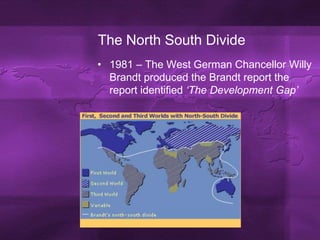
The North South Divide1981 – The West German Chancellor Willy Brandt produced the Brandt report the report identified ‘The Development Gap’
Simply he saidThe North possess 80% of the world’s wealthThe South only 20%Positives of Map:Simplifies data so that it's easy to understand.GDP is used which is an easy to access data source.Negatives of Map:Doesn't include some countries which are more economically developed.Generalised patterns with some countries above the Brandt line less developed less than some below
Measuring the GapMeasurements require dataData is based on the formal economyIgnores much unpaid, subsistence and informal workTwo indicators are commonly used:GDPGross National Income (GNI)
GDPMean value of goods and services produced in a country over a year. Divided by the population to give a per capita value which is converted to US$ to enable comparisons
GNILike GDP but also includes income from overseas investments – As such it is a better measure than GDP Like GDP it is given as a per captia value.It is shown in US$ using a conversion method known as the ATLAS method (Using exchange rates averaged out over 3 years – to smooth fluctuations)
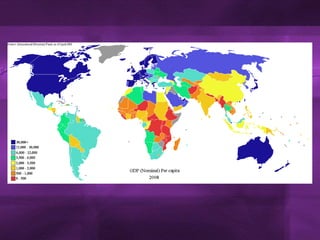
What’s wrong with these two measures?Non of these take into account the Purchasing Power Parity i.e. What this income is actually worth in terms of the cost of living.A $100 in the UK will buy a lot less than a $100 in the USA even more so from a country like ChinaChina’s GDP in 2006 was $2,000 however when converted to PPP$ it was $7,660 this shows it is cheaper to live here than the USA
Are these the only measures of Development?Try to think of different ways that we can measure develop’t
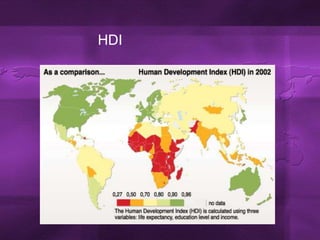
The Human Development Index (HDI)Composite index that measures a country's average achievements in three basic aspects of human development: health, knowledge, and a decent standard of livingHealth is measured by life expectancy at birthKnowledge is measured by a combination of the adult literacy rate and the combined primary, secondary, and tertiary gross enrolment ratioStandard of living by GDP per capita (PPP US$)
The ValueThe values range from 1 (High) to 0 (low)Longest life expectancy is Japan – 82 lowest Zambia – 32Japan = 1, Zambia = 0 (Country with 57 would be 0.5)This is done for each of the three measures
HDI
The World is a Complex PlaceSince 1981 things have become more complex and Brandt’s line is now looking a little datedWhy do you think that is?
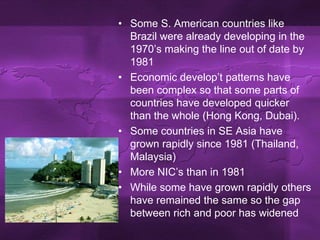
Some S. American countries like Brazil were already developing in the 1970’s making the line out of date by 1981Economic develop’t patterns have been complex so that some parts of countries have developed quicker than the whole (Hong Kong, Dubai). Some countries in SE Asia have grown rapidly since 1981 (Thailand, Malaysia)More NIC’s than in 1981While some have grown rapidly others have remained the same so the gap between rich and poor has widened
UN now uses four levels of incomeHighUpper middleLower middleLowAs a way of classifying the 206 nations of the world.This is still difficult as India one of the fastest growing countries on the earth is still a low level income country whilst Ethiopia one of the slowest growing is also low.
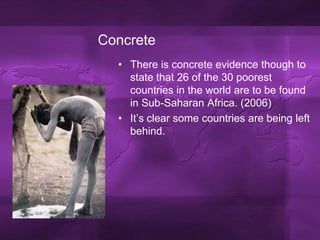
ConcreteThere is concrete evidence though to state that 26 of the 30 poorest countries in the world are to be found in Sub-Saharan Africa. (2006)It’s clear some countries are being left behind.
ActivityCompare the two maps on HDI and the Brandt line make a detailed list of:Which countries have changed since 1981Which have not changed since 1981What are the advantages and disadvantages of using GDP, GNI and HDI as indicators of development
Learning ObjectivesTo discover the different ways of measuring the development gap

Indentifying The Development Gap

  • 1.
  • 2.
    Learning ObjectivesTo discoverthe different ways of measuring the development gapUnderstand the reasons for using different measures of developmentAppreciate that some countries develop faster than others thus distorting some measures
  • 3.
    The North SouthDivide1981 – The West German Chancellor Willy Brandt produced the Brandt report the report identified ‘The Development Gap’
  • 4.
    Simply he saidTheNorth possess 80% of the world’s wealthThe South only 20%Positives of Map:Simplifies data so that it's easy to understand.GDP is used which is an easy to access data source.Negatives of Map:Doesn't include some countries which are more economically developed.Generalised patterns with some countries above the Brandt line less developed less than some below
  • 5.
    Measuring the GapMeasurementsrequire dataData is based on the formal economyIgnores much unpaid, subsistence and informal workTwo indicators are commonly used:GDPGross National Income (GNI)
  • 6.
    GDPMean value ofgoods and services produced in a country over a year. Divided by the population to give a per capita value which is converted to US$ to enable comparisons
  • 7.
    GNILike GDP butalso includes income from overseas investments – As such it is a better measure than GDP Like GDP it is given as a per captia value.It is shown in US$ using a conversion method known as the ATLAS method (Using exchange rates averaged out over 3 years – to smooth fluctuations)
  • 8.
    What’s wrong withthese two measures?Non of these take into account the Purchasing Power Parity i.e. What this income is actually worth in terms of the cost of living.A $100 in the UK will buy a lot less than a $100 in the USA even more so from a country like ChinaChina’s GDP in 2006 was $2,000 however when converted to PPP$ it was $7,660 this shows it is cheaper to live here than the USA
  • 10.
    Are these theonly measures of Development?Try to think of different ways that we can measure develop’t
  • 11.
    The Human DevelopmentIndex (HDI)Composite index that measures a country's average achievements in three basic aspects of human development: health, knowledge, and a decent standard of livingHealth is measured by life expectancy at birthKnowledge is measured by a combination of the adult literacy rate and the combined primary, secondary, and tertiary gross enrolment ratioStandard of living by GDP per capita (PPP US$)
  • 12.
    The ValueThe valuesrange from 1 (High) to 0 (low)Longest life expectancy is Japan – 82 lowest Zambia – 32Japan = 1, Zambia = 0 (Country with 57 would be 0.5)This is done for each of the three measures
  • 13.
  • 14.
    The World isa Complex PlaceSince 1981 things have become more complex and Brandt’s line is now looking a little datedWhy do you think that is?
  • 15.
    Some S. Americancountries like Brazil were already developing in the 1970’s making the line out of date by 1981Economic develop’t patterns have been complex so that some parts of countries have developed quicker than the whole (Hong Kong, Dubai). Some countries in SE Asia have grown rapidly since 1981 (Thailand, Malaysia)More NIC’s than in 1981While some have grown rapidly others have remained the same so the gap between rich and poor has widened
  • 16.
    UN now usesfour levels of incomeHighUpper middleLower middleLowAs a way of classifying the 206 nations of the world.This is still difficult as India one of the fastest growing countries on the earth is still a low level income country whilst Ethiopia one of the slowest growing is also low.
  • 17.
    ConcreteThere is concreteevidence though to state that 26 of the 30 poorest countries in the world are to be found in Sub-Saharan Africa. (2006)It’s clear some countries are being left behind.
  • 18.
    ActivityCompare the twomaps on HDI and the Brandt line make a detailed list of:Which countries have changed since 1981Which have not changed since 1981What are the advantages and disadvantages of using GDP, GNI and HDI as indicators of development
  • 19.
    Learning ObjectivesTo discoverthe different ways of measuring the development gap