Group members:-
1. Anubha
2. Kiran gupta
3. Kanchan mishra
4. Prachi shikha
5. Rekha
6. Meenakshi
7. Kamini singh
8. Shradhha kaur
9. Shashi lata
1. Universalization of Education.
2. Learner centered and flexible for learner.
3. Involvement of Different types of Education
4. Recognized as formal Education.
5. Curriculum and teaching methods according to the pace
and ease of learner.
6. Supplement Education
7. Provide opportunities to grow.
8. Use of Educational technology.
9. Self learning
10.Indirect Education and no formal Education
Need and
importance
of
alternative
education
Explosion
of
knowledge
Population
explosion
Easy
access
Varied
needs
Opportunities
for improving
qualifications
Learning
while
earning
For
different
stages
Education
throughout
life
To educate
the adults
Balance
between
urban and
rural areas
Ease of
admission
Universal
education
Aims of
alternative
education
Education
for all
Expansion
of
education
Development
of national
consciousness
Education
based on
equalityReducing the
cost of
education
Development
of vocational
skills
Continuity in
Educational
Programme
All round
development
Types of
Alternative
Education
Distance
Education
Correspondenc
e Education
Open
Education
(VMOU,
IGNOU)
Informal
Education
Ex. Religious
institutions,
family, nature
etc.
Adult
Education
Schools,
Colleges, Small
institutions
etc.
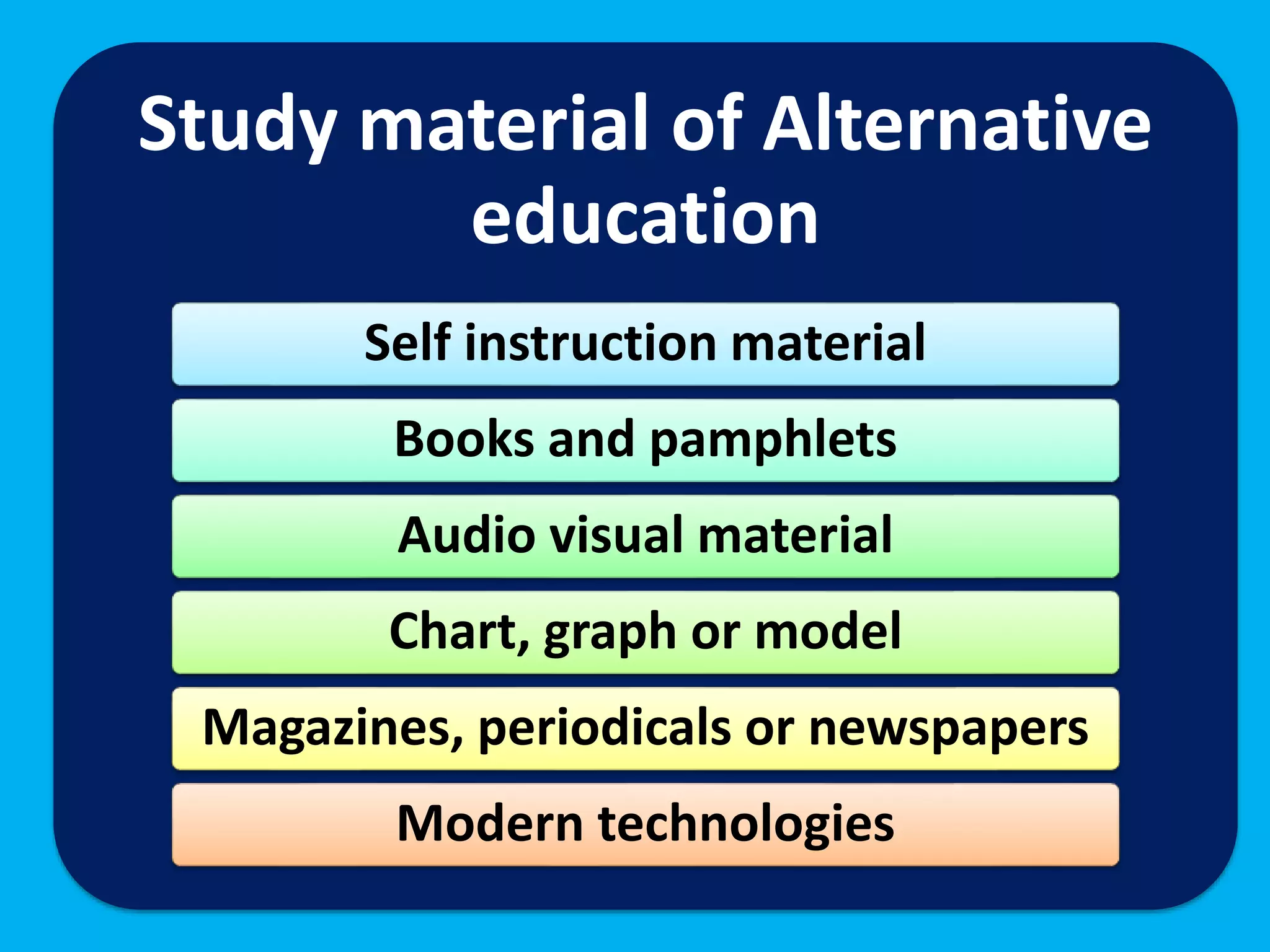
Study material of Alternative
education
Self instruction material
Books and pamphlets
Audio visual material
Chart, graph or model
Magazines, periodicals or newspapers
Modern technologies
Problems of
Alternative
Education
Improper
curriculum
Lack of
suitable
teaching
methods
Lack of
capable
teachers
Lack of
activities and
practical
experiences
Lack of
discussion
Cheap quality
of study
material
Lack of
adequate
facilities
Alternative in education

Alternative in education