Page 1
Introduction
              Incentives are variable reward granted to employees
according to variations in their performance. Financial rewards paid
to workers whose production exceeds a predetermined standard.


 Payment by result
 Achievement of specific result
 Motivational context


                                                             Page 2
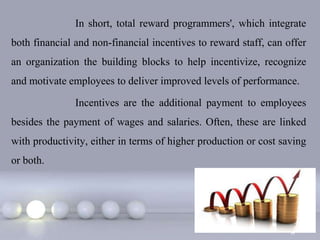
In short, total reward programmers', which integrate
both financial and non-financial incentives to reward staff, can offer
an organization the building blocks to help incentivize, recognize
and motivate employees to deliver improved levels of performance.

               Incentives are the additional payment to employees
besides the payment of wages and salaries. Often, these are linked
with productivity, either in terms of higher production or cost saving
or both.


                                                                Page 3
Q: Is money the only motivator?
            What is your motivator?

Let’s see an example of non-cash incentives…..


                                                 Page 4
Employee Preferences for
  Noncash Incentives


                           Page 5
Importance
•   Higher efficiency
•   Greater output
•   Positive response
•   Improve standard of living
•   Reduction in total as well as unit cost of production


                                                            Page 6
Advantages

•   Reduce supervision
•   Reduce absenteeism and turnover
•   Increased output
•   Improved recruitment of better-quality staff.
•   Improvements in business performance.
•   Reinforcing appropriate behavior.
•   Reinforced commitment through allowing employees choice
    over what they want from their employer


                                                         Page 7
Disadvantages
•   Checking & inspection expenses
•   New machines and models
•   Jealousy and conflict among workers
•   Difficulties in determining standard performance
•   Spoil workers health


                                                       Page 8
Prerequisites for an effective
           incentive system
• Co-operation of workers
• Scheme must be based on scientific work measurement
• Indirect workers must be covered by incentive scheme
• Greater need for planning
• Appropriate to the type of work
• Operate by means of well defined and easily understood
  formula
• Make sure the program is motivational
• Make the incentive plan committed oriented approach


                                                           Page 9
ORGANIZATIONWIDE INCENTIVES
            PLANS
             AND
INCENTIVES FOR MANAGERS AND
         EXECUTIVES


                               Page 10
ORGANIZATIONWIDE INCENTIVE PLANS


Profit-sharing plans.

Employee stock ownership plan(ESOP).

Gain sharing plans.

At risk variable pay plans.


                                       Page 11
PROFIT SHARING PLANS


        A plan that gives employees a share in the profits of the
company. Each employee receives a percentage of those profits based on
the company’s earnings.


  Cash plans.

  Lincoln incentive plans.

 Deferred profit-sharing plans.


                                                                   Page 12
EMPLOYEE STOCK OWNERSHIP
                PLAN(ESOP)

A qualified, defined contribution, employee benefit plan designed to
invest primarily in the stock of the sponsoring employer. ESOPs
are "qualified" in the sense that the ESOP's sponsoring company, the
selling shareholder and participants receive various tax benefits. ESOPs
are often used as a corporate finance strategy and are also used to align
the interests of a company's employees with those of the company's
                              shareholders.


                                                                     Page 13
GAIN SHARING PLAN

Establish general plan objectives.

Choose specific performance measures

Decide on a funding formula.

Choose the form of payment.

Decide how often to pay bonuses.

Develop the involvement system.

Implement the plan.


                                       Page 14
AT-RISK VARIABLE PAY PLAN


          Variable pay is used to recognize and reward employee contributions to
the company's success. Examples include: profit sharing, bonuses and other
benefits.


                                                                            Page 15
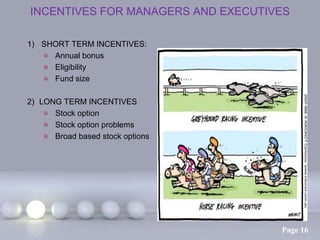
INCENTIVES FOR MANAGERS AND EXECUTIVES

1) SHORT TERM INCENTIVES:
     Annual bonus
     Eligibility
     Fund size

2) LONG TERM INCENTIVES
      Stock option
      Stock option problems
      Broad based stock options


                                    Page 16
Incentives for Salespeople
 Salary Plan
  – Straight salaries
     • This type of plan is Best for: prospecting (finding new
       clients), account servicing, training customer’s sales force,
       or participating in national and local trade shows.


 Commission Plan
  – Pay is a percentage of sales results.
     •   Keeps sales costs proportionate to sales revenues.
     •   May cause a neglect of no selling duties.
     •   Can create wide variation in salesperson’s income.
     •   Can increase turnover of salespeople.
                                                               Page 17
   Combination Plan
     Pay is a combination of salary and commissions,
     usually with a sizable salary component.
     Plan gives salespeople a floor (safety net) to their
     earnings.
     Salary  component      covers   company-specified
     service activities.
     Plans tend to become complicated,               and
     misunderstandings can result.


                                                      Page 18
Specialized Combination Plans
   Commission-plus-Drawing-Account Plan
     Commissions are paid but a draw on future
      earnings helps the salesperson to get through low
      sales periods.
   Commission-plus-Bonus Plan
     Pay is mostly based on commissions.
     Small bonuses are paid for directed activities like
      selling slow-moving items.


                                                       Page 19
Team/Group Incentive Plans

• Team (or Group) Incentive Plans
  – Incentives are based on team’s performance.
• How to Design Team Incentives
  – Set individual work standards.
  – Set work standards for each team member and then
    calculate each member’s output.
  – Members are paid based on one of three formulas:
     • All receive the same pay earned by the highest producer.
     • All receive the same pay earned by the lowest producer.
     • All receive the same pay equal to the average pay earned by
       the group.

                                                              Page 20
Pros and cons of group Incentives
   Pros
     Reinforces team planning and problem solving
     Helps ensure collaboration
     Encourages a sense of cooperation
     Encourages rapid training of new members
   Cons
     Pay is not proportionate to an individual’s effort
     Rewards “free riders”


                                                       Page 21

Hr presentation

  • 1.
  • 2.
    Introduction Incentives are variable reward granted to employees according to variations in their performance. Financial rewards paid to workers whose production exceeds a predetermined standard.  Payment by result  Achievement of specific result  Motivational context Page 2
  • 3.
    In short, totalreward programmers', which integrate both financial and non-financial incentives to reward staff, can offer an organization the building blocks to help incentivize, recognize and motivate employees to deliver improved levels of performance. Incentives are the additional payment to employees besides the payment of wages and salaries. Often, these are linked with productivity, either in terms of higher production or cost saving or both. Page 3
  • 4.
    Q: Is moneythe only motivator? What is your motivator? Let’s see an example of non-cash incentives….. Page 4
  • 5.
    Employee Preferences for Noncash Incentives Page 5
  • 6.
    Importance • Higher efficiency • Greater output • Positive response • Improve standard of living • Reduction in total as well as unit cost of production Page 6
  • 7.
    Advantages • Reduce supervision • Reduce absenteeism and turnover • Increased output • Improved recruitment of better-quality staff. • Improvements in business performance. • Reinforcing appropriate behavior. • Reinforced commitment through allowing employees choice over what they want from their employer Page 7
  • 8.
    Disadvantages • Checking & inspection expenses • New machines and models • Jealousy and conflict among workers • Difficulties in determining standard performance • Spoil workers health Page 8
  • 9.
    Prerequisites for aneffective incentive system • Co-operation of workers • Scheme must be based on scientific work measurement • Indirect workers must be covered by incentive scheme • Greater need for planning • Appropriate to the type of work • Operate by means of well defined and easily understood formula • Make sure the program is motivational • Make the incentive plan committed oriented approach Page 9
  • 10.
    ORGANIZATIONWIDE INCENTIVES PLANS AND INCENTIVES FOR MANAGERS AND EXECUTIVES Page 10
  • 11.
    ORGANIZATIONWIDE INCENTIVE PLANS Profit-sharingplans. Employee stock ownership plan(ESOP). Gain sharing plans. At risk variable pay plans. Page 11
  • 12.
    PROFIT SHARING PLANS A plan that gives employees a share in the profits of the company. Each employee receives a percentage of those profits based on the company’s earnings. Cash plans. Lincoln incentive plans. Deferred profit-sharing plans. Page 12
  • 13.
    EMPLOYEE STOCK OWNERSHIP PLAN(ESOP) A qualified, defined contribution, employee benefit plan designed to invest primarily in the stock of the sponsoring employer. ESOPs are "qualified" in the sense that the ESOP's sponsoring company, the selling shareholder and participants receive various tax benefits. ESOPs are often used as a corporate finance strategy and are also used to align the interests of a company's employees with those of the company's shareholders. Page 13
  • 14.
    GAIN SHARING PLAN Establishgeneral plan objectives. Choose specific performance measures Decide on a funding formula. Choose the form of payment. Decide how often to pay bonuses. Develop the involvement system. Implement the plan. Page 14
  • 15.
    AT-RISK VARIABLE PAYPLAN Variable pay is used to recognize and reward employee contributions to the company's success. Examples include: profit sharing, bonuses and other benefits. Page 15
  • 16.
    INCENTIVES FOR MANAGERSAND EXECUTIVES 1) SHORT TERM INCENTIVES: Annual bonus Eligibility Fund size 2) LONG TERM INCENTIVES Stock option Stock option problems Broad based stock options Page 16
  • 17.
    Incentives for Salespeople Salary Plan – Straight salaries • This type of plan is Best for: prospecting (finding new clients), account servicing, training customer’s sales force, or participating in national and local trade shows.  Commission Plan – Pay is a percentage of sales results. • Keeps sales costs proportionate to sales revenues. • May cause a neglect of no selling duties. • Can create wide variation in salesperson’s income. • Can increase turnover of salespeople. Page 17
  • 18.
    Combination Plan  Pay is a combination of salary and commissions, usually with a sizable salary component.  Plan gives salespeople a floor (safety net) to their earnings.  Salary component covers company-specified service activities.  Plans tend to become complicated, and misunderstandings can result. Page 18
  • 19.
    Specialized Combination Plans  Commission-plus-Drawing-Account Plan  Commissions are paid but a draw on future earnings helps the salesperson to get through low sales periods.  Commission-plus-Bonus Plan  Pay is mostly based on commissions.  Small bonuses are paid for directed activities like selling slow-moving items. Page 19
  • 20.
    Team/Group Incentive Plans •Team (or Group) Incentive Plans – Incentives are based on team’s performance. • How to Design Team Incentives – Set individual work standards. – Set work standards for each team member and then calculate each member’s output. – Members are paid based on one of three formulas: • All receive the same pay earned by the highest producer. • All receive the same pay earned by the lowest producer. • All receive the same pay equal to the average pay earned by the group. Page 20
  • 21.
    Pros and consof group Incentives  Pros  Reinforces team planning and problem solving  Helps ensure collaboration  Encourages a sense of cooperation  Encourages rapid training of new members  Cons  Pay is not proportionate to an individual’s effort  Rewards “free riders” Page 21