Model-Driven
 Software Development

            Lecture1: Introduction & Overview


                                              Course IN4308
     Eelco Visser
                                   Master Computer Science
http://eelcovisser.org         Delft University of Technology
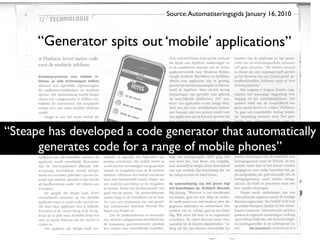
Source: Automatiseringsgids January 16, 2010


      “Generator spits out ‘mobile’ applications”


“Steape has developed a code generator that automatically
      generates code for a range of mobile phones”
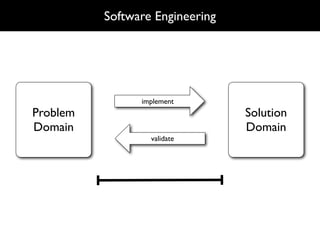
Software Engineering


                implement
Problem                          Solution
Domain                           Domain
                  validate
Programming Languages


"A programming language is low level when its programs
         require attention to the irrelevant."


   Alan J. Perlis. Epigrams on Programming. SIGPLAN Notices, 17(9):7-13, 1982.
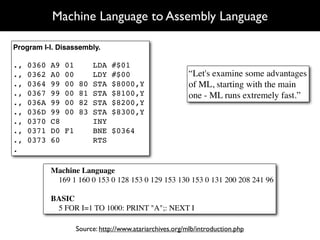
Machine Language to Assembly Language

Program I-I. Disassembly.

.,   0360   A9 01      LDA    #$01
.,   0362   A0 00      LDY    #$00                      “Let's examine some advantages
.,   0364   99 00 80   STA    $8000,Y                   of ML, starting with the main
.,   0367   99 00 81   STA    $8100,Y                   one - ML runs extremely fast.”
.,   036A   99 00 82   STA    $8200,Y
.,   036D   99 00 83   STA    $8300,Y
.,   0370   C8         INY
.,   0371   D0 F1      BNE    $0364
.,   0373   60         RTS
.

            Machine Language
                169 1 160 0 153 0 128 153 0 129 153 130 153 0 131 200 208 241 96

            BASIC
                5 FOR I=1 TO 1000: PRINT "A";: NEXT I

                  Source: http://www.atariarchives.org/mlb/introduction.php
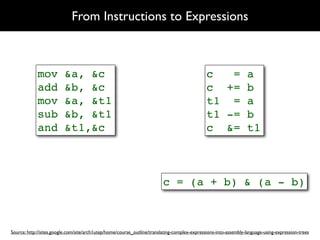
From Instructions to Expressions


            mov          &a, &c                                                               c   = a
            add          &b, &c                                                               c += b
            mov          &a, &t1                                                              t1 = a
            sub          &b, &t1                                                              t1 -= b
            and          &t1,&c                                                               c &= t1


                                                                         c = (a + b) & (a - b)


Source: http://sites.google.com/site/arch1utep/home/course_outline/translating-complex-expressions-into-assembly-language-using-expression-trees
From Calling Conventions to Procedures

calc:
 push eBP                         ; save old frame pointer
 mov eBP,eSP                      ; get new frame pointer
 sub eSP,localsize                ; reserve place for locals
 .
 .                                ; perform calculations, leave result in AX
 .
 mov eSP,eBP                      ; free space for locals
 pop eBP                          ; restore old frame pointer
 ret paramsize                    ; free parameter space and return

push    eAX                      ;   pass some register result
push    byte[eBP+20]             ;   pass some memory variable (FASM/TASM syntax)
push    3                        ;   pass some constant
call    calc                     ;   the returned result is now in eAX
http://en.wikipedia.org/wiki/Calling_convention


       f(x) { ... }                               f(e1,e2,...,en)
From Malloc/Free to Automatic Memory Management

/* Allocate space for an array with ten elements of type int. */
int *ptr = (int*)malloc(10 * sizeof (int));
if (ptr == NULL) {
    /* Memory could not be allocated, the program
       should handle the error here as appropriate. */
} else {
    /* Allocation succeeded. Do something. */
    free(ptr); /* We are done with the int objects,
                   and free the associated pointer. */
    ptr = NULL; /* The pointer must not be used again,
                   unless re-assigned to using malloc again. */
}
http://en.wikipedia.org/wiki/Malloc


               int [] = new int[10];
    /* use it; gc will clean up (hopefully) */
Abstractions in Programming Languages

❖ Structured control-flow
  ★ if-then-else, while

❖ Procedural abstraction
  ★ procedures, first-class functions (closures)

❖ Memory management
  ★ garbage collection

❖ Data abstraction
  ★ abstract data types, objects

❖ Modules
  ★ inheritance, traits, mixins
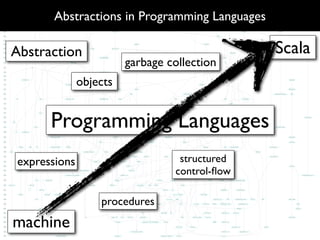
Abstractions in Programming Languages

Abstraction                                    Scala
                        garbage collection
              objects


      Programming Languages
expressions                       structured
                                 control-flow

                  procedures
machine
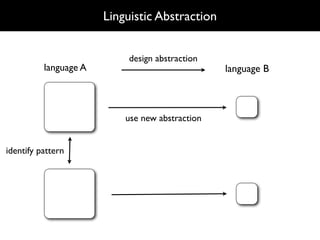
Linguistic Abstraction


                            design abstraction
          language A                             language B


                           use new abstraction


identify pattern
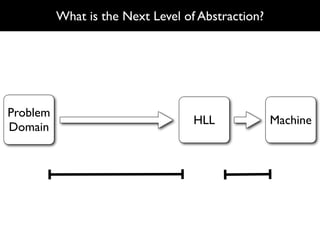
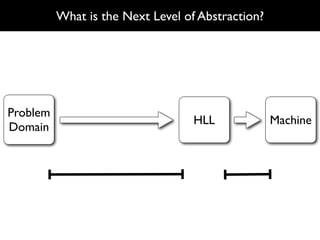
What is the Next Level of Abstraction?
   High-level languages reduce problem/solution gap


Problem
                                 HLL           Machine
Domain
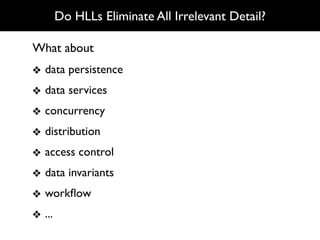
Do HLLs Eliminate All Irrelevant Detail?

What about
❖ data persistence
❖ data services
❖ concurrency
❖ distribution
❖ access control
❖ data invariants
❖ workflow
❖ ...
What is the Next Level of Abstraction?
   High-level languages reduce problem/solution gap


Problem
                                 HLL           Machine
Domain
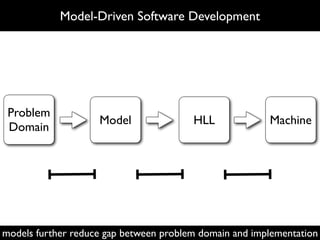
Model-Driven Software Development


 Problem
                    Model               HLL             Machine
 Domain


models further reduce gap between problem domain and implementation
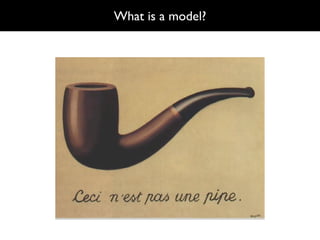
What is a model?
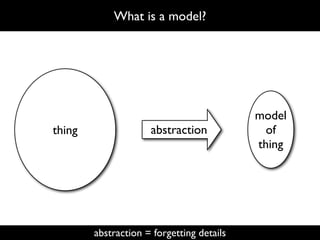
What is a model?


                                           model
thing                abstraction             of
                                           thing


        abstraction = forgetting details
What is a model?


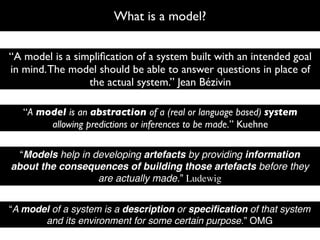
“A model is a simplification of a system built with an intended goal
in mind. The model should be able to answer questions in place of
                 the actual system.” Jean Bézivin

   “A model is an abstraction of a (real or language based) system
        allowing predictions or inferences to be made.” Kuehne

  “Models help in developing artefacts by providing information
about the consequences of building those artefacts before they
                   are actually made.” Ludewig


“A model of a system is a description or specification of that system
       and its environment for some certain purpose.” OMG
What is a model?


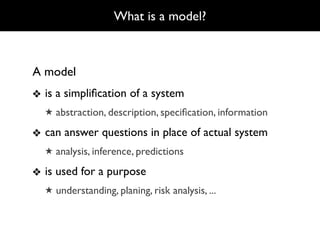
A model
❖ is a simplification of a system
  ★ abstraction, description, specification, information

❖ can answer questions in place of actual system
  ★ analysis, inference, predictions

❖ is used for a purpose
  ★ understanding, planing, risk analysis, ...
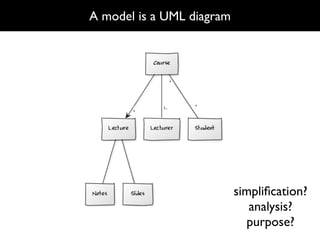
A model is a UML diagram


                           simplification?
                              analysis?
                             purpose?
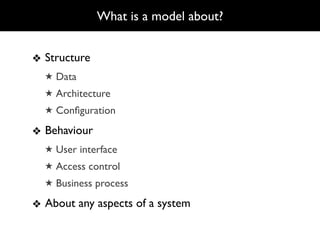
What is a model about?


❖ Structure
  ★ Data
  ★ Architecture
  ★ Configuration

❖ Behaviour
  ★ User interface
  ★ Access control
  ★ Business process

❖ About any aspects of a system
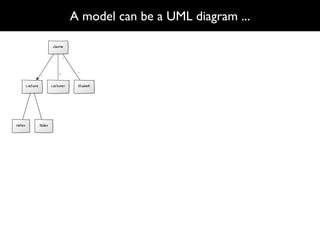
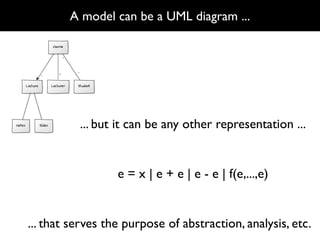
A model can be a UML diagram ...


          ... but it can be any other representation ...


                  e = x | e + e | e - e | f(e,...,e)


... that serves the purpose of abstraction, analysis, etc.
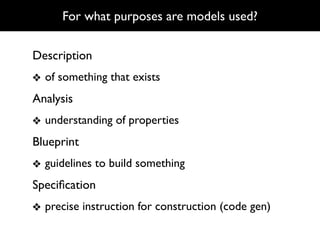
For what purposes are models used?

Description
❖ of something that exists
Analysis
❖ understanding of properties
Blueprint
❖ guidelines to build something
Specification
❖ precise instruction for construction (code gen)
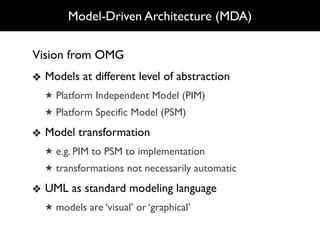
Model-Driven Architecture (MDA)

Vision from OMG
❖ Models at different level of abstraction
  ★ Platform Independent Model (PIM)
  ★ Platform Specific Model (PSM)

❖ Model transformation
  ★ e.g. PIM to PSM to implementation
  ★ transformations not necessarily automatic

❖ UML as standard modeling language
  ★ models are ‘visual’ or ‘graphical’
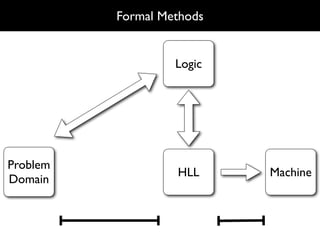
‘Formal Methods’ Formal Methods


                          Logic


Problem
                          HLL     Machine
Domain
A Critique of MDA & Formal Methods


General purpose modeling languages
❖ High coverage
  ★ large class of software systems

❖ Low expressivity
  ★ irrelevant details
  ★ Requirements/implementation gap not reduced
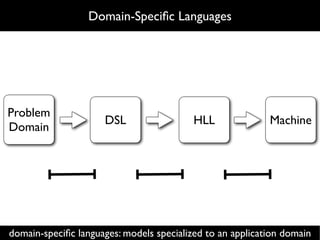
Domain-Specific Languages


Problem
                     DSL                  HLL              Machine
Domain


domain-specific languages: models specialized to an application domain
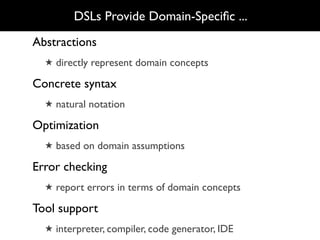
DSLs Provide Domain-Specific ...
Abstractions
  ★ directly represent domain concepts

Concrete syntax
  ★ natural notation

Optimization
  ★ based on domain assumptions

Error checking
  ★ report errors in terms of domain concepts

Tool support
  ★ interpreter, compiler, code generator, IDE
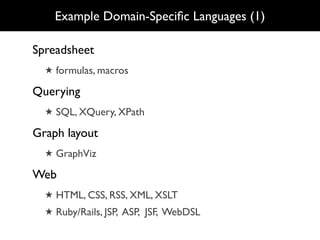
Example Domain-Specific Languages (1)

Spreadsheet
  ★ formulas, macros

Querying
  ★ SQL, XQuery, XPath

Graph layout
  ★ GraphViz

Web
  ★ HTML, CSS, RSS, XML, XSLT
  ★ Ruby/Rails, JSP, ASP, JSF, WebDSL
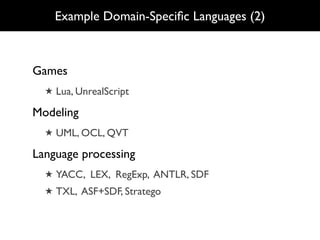
Example Domain-Specific Languages (2)


Games
  ★ Lua, UnrealScript

Modeling
  ★ UML, OCL, QVT

Language processing
  ★ YACC, LEX, RegExp, ANTLR, SDF
  ★ TXL, ASF+SDF, Stratego
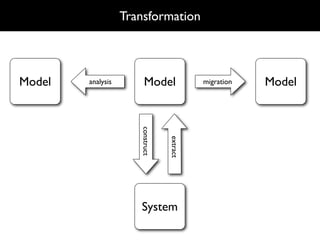
Transformation
                   Transformation


Model   analysis        Model               migration   Model


                      construct


                                  extract


                      System
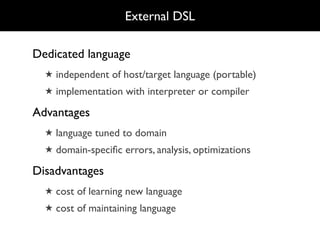
External DSL

Dedicated language
  ★ independent of host/target language (portable)
  ★ implementation with interpreter or compiler

Advantages
  ★ language tuned to domain
  ★ domain-specific errors, analysis, optimizations

Disadvantages
  ★ cost of learning new language
  ★ cost of maintaining language
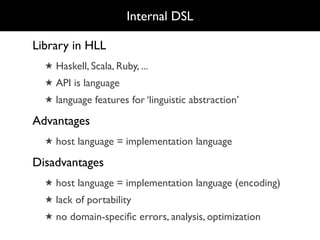
Internal DSL

Library in HLL
  ★ Haskell, Scala, Ruby, ...
  ★ API is language
  ★ language features for ‘linguistic abstraction’

Advantages
  ★ host language = implementation language

Disadvantages
  ★ host language = implementation language (encoding)
  ★ lack of portability
  ★ no domain-specific errors, analysis, optimization
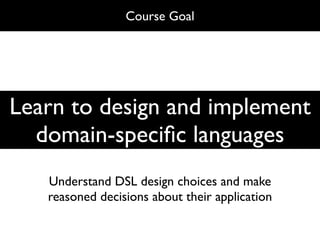
Course Goal
                Course Goal


Learn to design and implement
  domain-specific languages
   Understand DSL design choices and make
   reasoned decisions about their application
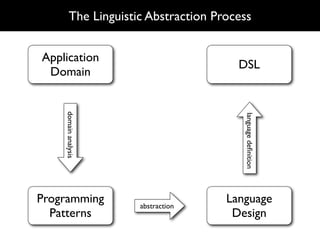
The Linguistic Abstraction Process


Application
                                       DSL
 Domain
    domain analysis


                                        language definition
Programming           abstraction
                                     Language
  Patterns                            Design
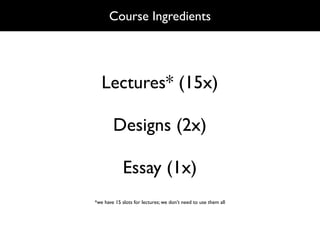
Course Ingredients


   Lectures* (15x)
        Designs (2x)

             Essay (1x)
*we have 15 slots for lectures; we don’t need to use them all
Quarter 3
            (February - March 2011)


Software Development with Domain-Specific Languages
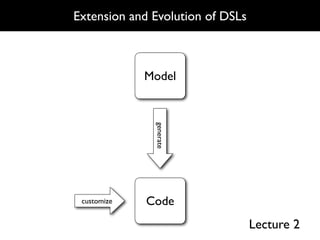
Extension and Evolution of DSLs


             Model


              generate


 customize   Code
                                  Lecture 2
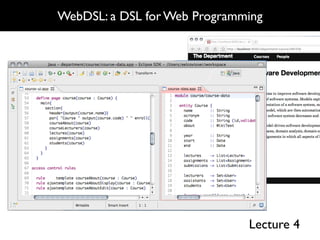
WebDSL: a DSL for Web Programming


                              Lecture 4
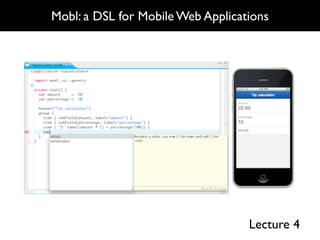
Mobl: a DSL for Mobile Web Applications


                                   Lecture 4
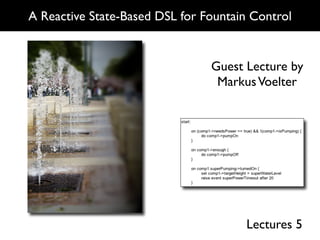
A Reactive State-Based DSL for Fountain Control


                                Guest Lecture by
                                 Markus Voelter


                                      Lectures 5
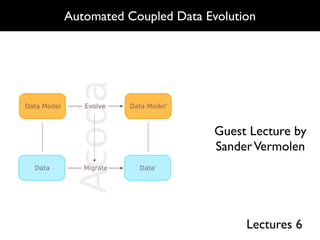
Automated Coupled Data Evolution


                         Guest Lecture by
                         Sander Vermolen


                              Lectures 6
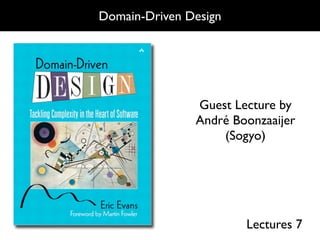
Domain-Driven Design


               Guest Lecture by
               André Boonzaaijer
                   (Sogyo)


                       Lectures 7
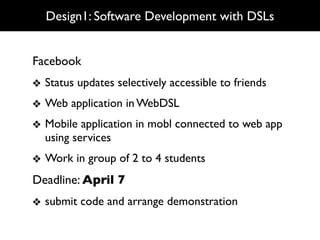
Design1: Software Development with DSLs


Facebook
❖ Status updates selectively accessible to friends
❖ Web application in WebDSL
❖ Mobile application in mobl connected to web app
  using services
❖ Work in group of 2 to 4 students
Deadline: April 7
❖ submit code and arrange demonstration
Quarter 4
                (April - May 2011)


Design and Implementation of Domain-Specific Languages
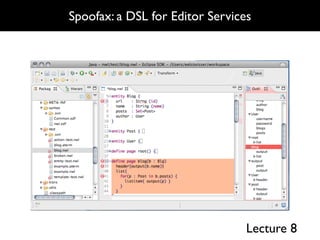
Spoofax: a DSL for Editor Services


                                 Lecture 8
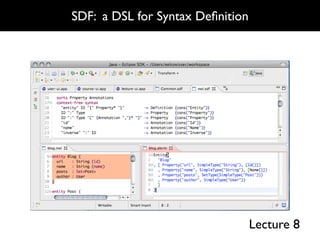
SDF: a DSL for Syntax Definition


                                  Lecture 8
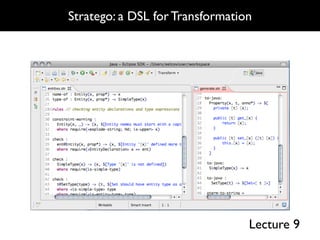
Stratego: a DSL for Transformation


                                 Lecture 9
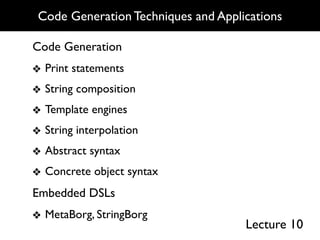
Code Generation Techniques and Applications

Code Generation
❖ Print statements
❖ String composition
❖ Template engines
❖ String interpolation
❖ Abstract syntax
❖ Concrete object syntax
Embedded DSLs
❖ MetaBorg, StringBorg
                                     Lecture 10
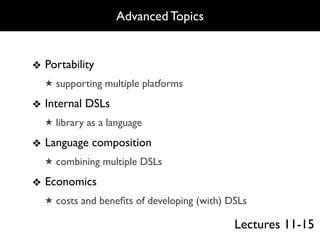
Advanced Topics


❖ Portability
  ★ supporting multiple platforms

❖ Internal DSLs
  ★ library as a language

❖ Language composition
  ★ combining multiple DSLs

❖ Economics
  ★ costs and benefits of developing (with) DSLs

                                            Lectures 11-15
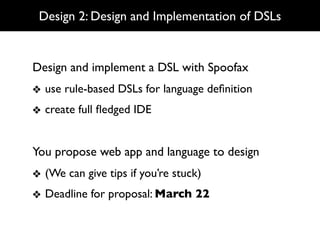
Design 2: Design and Implementation of DSLs


Design and implement a DSL with Spoofax
❖ use rule-based DSLs for language definition
❖ create full fledged IDE


You propose web app and language to design
❖ (We can give tips if you’re stuck)
❖ Deadline for proposal: March 22
Essay: Individual Writing Project


Read
❖ recommended papers
❖ http://researchr.org/bibliography/mdsd
Write
❖ a paper about software development with
  and of domain-specific languages.
  ★ Reflect on your experience in design projects
  ★ Reflect on the literature you’ve read
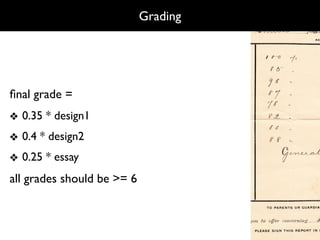
Grading


final grade =
❖ 0.35 * design1
❖ 0.4 * design2
❖ 0.25 * essay
all grades should be >= 6
Feedback


I’d like to get feedback early; not when it is too late to fix
Schedule

Read
❖ Czarnecki: Overview of Generative Development
❖ Muller et al.: Modeling Modeling
Lecture 2 (February 3)
❖ Extension and evolution of DSLs
Lecture 3 (February 8)
❖ WebDSL: a DSL for Web Programming
Lecture 4 (February 10)
❖ Mobl: a DSL for Mobile Web Applications

IN4308 1

  • 1.
    Model-Driven Software Development Lecture1: Introduction & Overview Course IN4308 Eelco Visser Master Computer Science http://eelcovisser.org Delft University of Technology
  • 2.
    Source: Automatiseringsgids January16, 2010 “Generator spits out ‘mobile’ applications” “Steape has developed a code generator that automatically generates code for a range of mobile phones”
  • 3.
    Software Engineering implement Problem Solution Domain Domain validate
  • 4.
  • 5.
    Programming Languages "A programminglanguage is low level when its programs require attention to the irrelevant." Alan J. Perlis. Epigrams on Programming. SIGPLAN Notices, 17(9):7-13, 1982.
  • 6.
    Machine Language toAssembly Language Program I-I. Disassembly. ., 0360 A9 01    LDA #$01 ., 0362 A0 00    LDY #$00 “Let's examine some advantages ., 0364 99 00 80 STA $8000,Y of ML, starting with the main ., 0367 99 00 81 STA $8100,Y one - ML runs extremely fast.” ., 036A 99 00 82 STA $8200,Y ., 036D 99 00 83 STA $8300,Y ., 0370 C8       INY ., 0371 D0 F1    BNE $0364 ., 0373 60       RTS .    Machine Language        169 1 160 0 153 0 128 153 0 129 153 130 153 0 131 200 208 241 96    BASIC        5 FOR I=1 TO 1000: PRINT "A";: NEXT I Source: http://www.atariarchives.org/mlb/introduction.php
  • 7.
    From Instructions toExpressions mov &a, &c c = a add &b, &c c += b mov &a, &t1 t1 = a sub &b, &t1 t1 -= b and &t1,&c c &= t1 c = (a + b) & (a - b) Source: http://sites.google.com/site/arch1utep/home/course_outline/translating-complex-expressions-into-assembly-language-using-expression-trees
  • 8.
    From Calling Conventionsto Procedures calc: push eBP ; save old frame pointer mov eBP,eSP ; get new frame pointer sub eSP,localsize ; reserve place for locals . . ; perform calculations, leave result in AX . mov eSP,eBP ; free space for locals pop eBP ; restore old frame pointer ret paramsize ; free parameter space and return push eAX ; pass some register result push byte[eBP+20] ; pass some memory variable (FASM/TASM syntax) push 3 ; pass some constant call calc ; the returned result is now in eAX http://en.wikipedia.org/wiki/Calling_convention f(x) { ... } f(e1,e2,...,en)
  • 9.
    From Malloc/Free toAutomatic Memory Management /* Allocate space for an array with ten elements of type int. */ int *ptr = (int*)malloc(10 * sizeof (int)); if (ptr == NULL) { /* Memory could not be allocated, the program should handle the error here as appropriate. */ } else { /* Allocation succeeded. Do something. */ free(ptr); /* We are done with the int objects, and free the associated pointer. */ ptr = NULL; /* The pointer must not be used again, unless re-assigned to using malloc again. */ } http://en.wikipedia.org/wiki/Malloc int [] = new int[10]; /* use it; gc will clean up (hopefully) */
  • 10.
    Abstractions in ProgrammingLanguages ❖ Structured control-flow ★ if-then-else, while ❖ Procedural abstraction ★ procedures, first-class functions (closures) ❖ Memory management ★ garbage collection ❖ Data abstraction ★ abstract data types, objects ❖ Modules ★ inheritance, traits, mixins
  • 11.
    Abstractions in ProgrammingLanguages Abstraction Scala garbage collection objects Programming Languages expressions structured control-flow procedures machine
  • 12.
    Linguistic Abstraction design abstraction language A language B use new abstraction identify pattern
  • 13.
    What is theNext Level of Abstraction? High-level languages reduce problem/solution gap Problem HLL Machine Domain
  • 14.
    Do HLLs EliminateAll Irrelevant Detail? What about ❖ data persistence ❖ data services ❖ concurrency ❖ distribution ❖ access control ❖ data invariants ❖ workflow ❖ ...
  • 15.
    What is theNext Level of Abstraction? High-level languages reduce problem/solution gap Problem HLL Machine Domain
  • 16.
    Model-Driven Software Development Problem Model HLL Machine Domain models further reduce gap between problem domain and implementation
  • 17.
    What is amodel?
  • 18.
    What is amodel? model thing abstraction of thing abstraction = forgetting details
  • 19.
    What is amodel? “A model is a simplification of a system built with an intended goal in mind. The model should be able to answer questions in place of the actual system.” Jean Bézivin “A model is an abstraction of a (real or language based) system allowing predictions or inferences to be made.” Kuehne “Models help in developing artefacts by providing information about the consequences of building those artefacts before they are actually made.” Ludewig “A model of a system is a description or specification of that system and its environment for some certain purpose.” OMG
  • 20.
    What is amodel? A model ❖ is a simplification of a system ★ abstraction, description, specification, information ❖ can answer questions in place of actual system ★ analysis, inference, predictions ❖ is used for a purpose ★ understanding, planing, risk analysis, ...
  • 21.
    A model isa UML diagram simplification? analysis? purpose?
  • 22.
    What is amodel about? ❖ Structure ★ Data ★ Architecture ★ Configuration ❖ Behaviour ★ User interface ★ Access control ★ Business process ❖ About any aspects of a system
  • 23.
    A model canbe a UML diagram ...
  • 24.
    A model canbe a UML diagram ... ... but it can be any other representation ... e = x | e + e | e - e | f(e,...,e) ... that serves the purpose of abstraction, analysis, etc.
  • 25.
    For what purposesare models used? Description ❖ of something that exists Analysis ❖ understanding of properties Blueprint ❖ guidelines to build something Specification ❖ precise instruction for construction (code gen)
  • 26.
    Model-Driven Architecture (MDA) Visionfrom OMG ❖ Models at different level of abstraction ★ Platform Independent Model (PIM) ★ Platform Specific Model (PSM) ❖ Model transformation ★ e.g. PIM to PSM to implementation ★ transformations not necessarily automatic ❖ UML as standard modeling language ★ models are ‘visual’ or ‘graphical’
  • 27.
    ‘Formal Methods’ FormalMethods Logic Problem HLL Machine Domain
  • 28.
    A Critique ofMDA & Formal Methods General purpose modeling languages ❖ High coverage ★ large class of software systems ❖ Low expressivity ★ irrelevant details ★ Requirements/implementation gap not reduced
  • 29.
    Domain-Specific Languages Problem DSL HLL Machine Domain domain-specific languages: models specialized to an application domain
  • 30.
    DSLs Provide Domain-Specific... Abstractions ★ directly represent domain concepts Concrete syntax ★ natural notation Optimization ★ based on domain assumptions Error checking ★ report errors in terms of domain concepts Tool support ★ interpreter, compiler, code generator, IDE
  • 31.
    Example Domain-Specific Languages(1) Spreadsheet ★ formulas, macros Querying ★ SQL, XQuery, XPath Graph layout ★ GraphViz Web ★ HTML, CSS, RSS, XML, XSLT ★ Ruby/Rails, JSP, ASP, JSF, WebDSL
  • 32.
    Example Domain-Specific Languages(2) Games ★ Lua, UnrealScript Modeling ★ UML, OCL, QVT Language processing ★ YACC, LEX, RegExp, ANTLR, SDF ★ TXL, ASF+SDF, Stratego
  • 33.
    Transformation Transformation Model analysis Model migration Model construct extract System
  • 34.
    External DSL Dedicated language ★ independent of host/target language (portable) ★ implementation with interpreter or compiler Advantages ★ language tuned to domain ★ domain-specific errors, analysis, optimizations Disadvantages ★ cost of learning new language ★ cost of maintaining language
  • 35.
    Internal DSL Library inHLL ★ Haskell, Scala, Ruby, ... ★ API is language ★ language features for ‘linguistic abstraction’ Advantages ★ host language = implementation language Disadvantages ★ host language = implementation language (encoding) ★ lack of portability ★ no domain-specific errors, analysis, optimization
  • 36.
    Course Goal Course Goal Learn to design and implement domain-specific languages Understand DSL design choices and make reasoned decisions about their application
  • 37.
    The Linguistic AbstractionProcess Application DSL Domain domain analysis language definition Programming abstraction Language Patterns Design
  • 38.
    Course Ingredients Lectures* (15x) Designs (2x) Essay (1x) *we have 15 slots for lectures; we don’t need to use them all
  • 39.
    Quarter 3 (February - March 2011) Software Development with Domain-Specific Languages
  • 40.
    Extension and Evolutionof DSLs Model generate customize Code Lecture 2
  • 41.
    WebDSL: a DSLfor Web Programming Lecture 4
  • 42.
    Mobl: a DSLfor Mobile Web Applications Lecture 4
  • 43.
    A Reactive State-BasedDSL for Fountain Control Guest Lecture by Markus Voelter Lectures 5
  • 44.
    Automated Coupled DataEvolution Guest Lecture by Sander Vermolen Lectures 6
  • 45.
    Domain-Driven Design Guest Lecture by André Boonzaaijer (Sogyo) Lectures 7
  • 46.
    Design1: Software Developmentwith DSLs Facebook ❖ Status updates selectively accessible to friends ❖ Web application in WebDSL ❖ Mobile application in mobl connected to web app using services ❖ Work in group of 2 to 4 students Deadline: April 7 ❖ submit code and arrange demonstration
  • 47.
    Quarter 4 (April - May 2011) Design and Implementation of Domain-Specific Languages
  • 48.
    Spoofax: a DSLfor Editor Services Lecture 8
  • 49.
    SDF: a DSLfor Syntax Definition Lecture 8
  • 50.
    Stratego: a DSLfor Transformation Lecture 9
  • 51.
    Code Generation Techniquesand Applications Code Generation ❖ Print statements ❖ String composition ❖ Template engines ❖ String interpolation ❖ Abstract syntax ❖ Concrete object syntax Embedded DSLs ❖ MetaBorg, StringBorg Lecture 10
  • 52.
    Advanced Topics ❖ Portability ★ supporting multiple platforms ❖ Internal DSLs ★ library as a language ❖ Language composition ★ combining multiple DSLs ❖ Economics ★ costs and benefits of developing (with) DSLs Lectures 11-15
  • 53.
    Design 2: Designand Implementation of DSLs Design and implement a DSL with Spoofax ❖ use rule-based DSLs for language definition ❖ create full fledged IDE You propose web app and language to design ❖ (We can give tips if you’re stuck) ❖ Deadline for proposal: March 22
  • 54.
    Essay: Individual WritingProject Read ❖ recommended papers ❖ http://researchr.org/bibliography/mdsd Write ❖ a paper about software development with and of domain-specific languages. ★ Reflect on your experience in design projects ★ Reflect on the literature you’ve read
  • 55.
    Grading final grade = ❖0.35 * design1 ❖ 0.4 * design2 ❖ 0.25 * essay all grades should be >= 6
  • 56.
    Feedback I’d like toget feedback early; not when it is too late to fix
  • 57.
    Schedule Read ❖ Czarnecki: Overviewof Generative Development ❖ Muller et al.: Modeling Modeling Lecture 2 (February 3) ❖ Extension and evolution of DSLs Lecture 3 (February 8) ❖ WebDSL: a DSL for Web Programming Lecture 4 (February 10) ❖ Mobl: a DSL for Mobile Web Applications