Lecture 3: Parsing
CS4200 Compiler Construction
Eelco Visser
TU Delft
September 2019
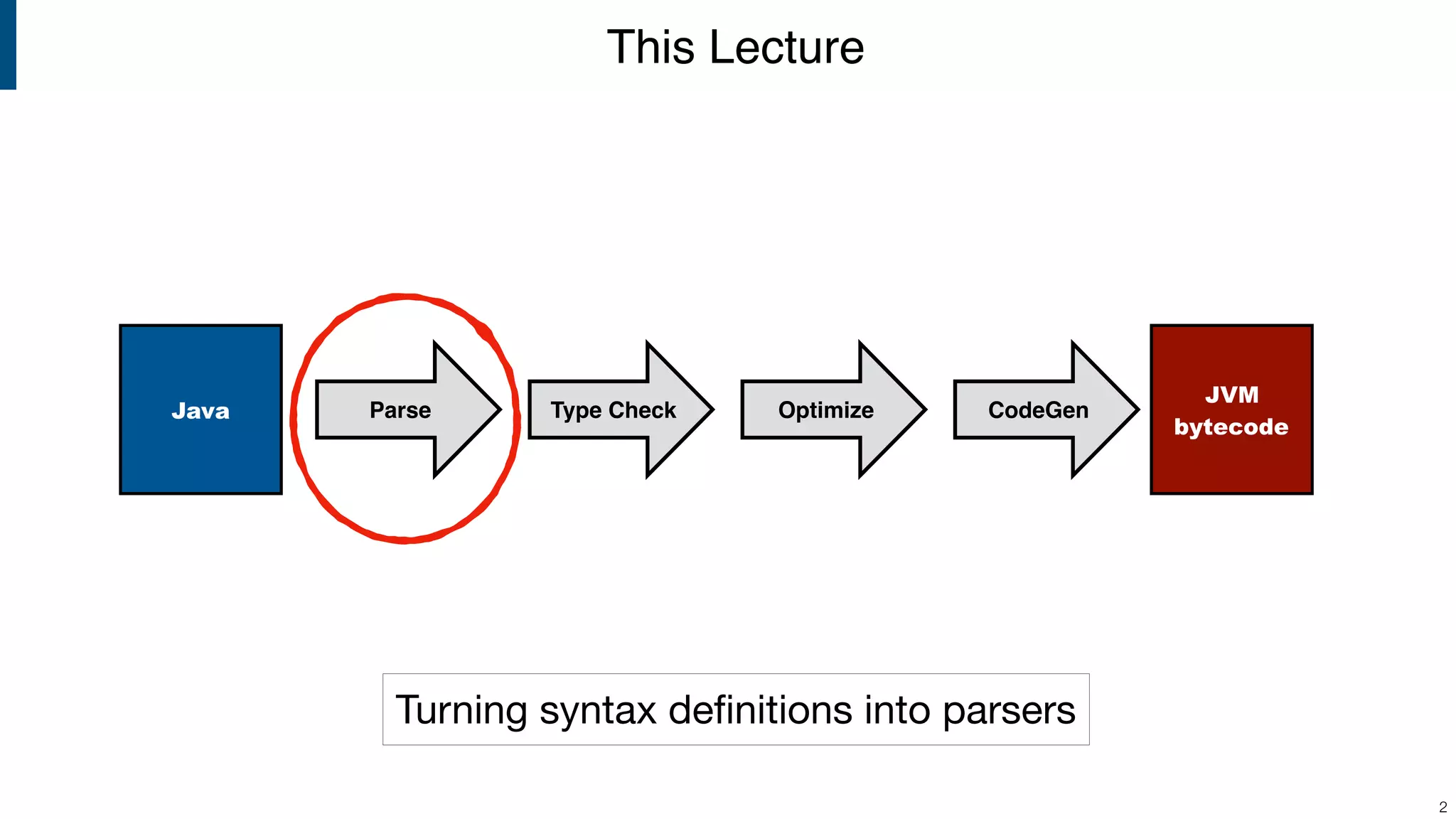
This Lecture
!2
Java Type Check
JVM
bytecode
Parse CodeGenOptimize
Turning syntax definitions into parsers
Derivations
- Generating sentences and trees from context-free grammars

Grammar Transformations
- Eliminating ambiguity by transformation

Reductions
- From sentences to symbols

Parsing
- Shift/reduce parsing

- SLR parsing
!3
This Lecture
Reading Material
4
!5
These slides are the primary material
for study of parsing in this course.

This provides a basic idea of parsing
by studying derivations and one
particular parsing algorithm. 

It is by no means exhaustive.

There is a vast literature on parsing,
and we encourage the interested
student to read on.
!6
Compilers: Principles, Techniques, and Tools, 2nd Edition
Alfred V. Aho, Columbia University

Monica S. Lam, Stanford University

Ravi Sethi, Avaya Labs

Jeffrey D. Ullman, Stanford University

2007 | Pearson
Classical compiler textbook

Chapter 4: Syntax Analysis

The material covered in this lecture corresponds to Sections
4.1, 4.2, 4.3, 4.5, 4.6
Pictures in these slides are copies from the book
!7
Sikkel, N. (1993). Parsing Schemata.

PhD thesis. Enschede: Universiteit Twente
This PhD thesis presents a uniform framework for describing
a wide range of parsing algorithms.
https://research.utwente.nl/en/publications/parsing-schemata
“Parsing schemata provide a general framework for
specication, analysis and comparison of (sequential and/or
parallel) parsing algorithms. A grammar specifies implicitly what
the valid parses of a sentence are; a parsing algorithm specifies
Elicitly how to compute these. Parsing schemata form a well-
defined level of abstraction in between grammars and parsing
algorithms. A parsing schema specifies the types of
intermediate results that can be computed by a parser, and the
rules that allow to Eand a given set of such results with new
results. A parsing schema does not specify the data structures,
control structures, and (in case of parallel processing)
communication structures that are to be used by a parser.”
For the interested
!8
https://ivi.fnwi.uva.nl/tcs/pub/reports/1995/P9507.ps.Z
This paper applies parsing schemata to disambiguation filters
for priority conflicts.
For the interested
!9
This paper defines a declarative semantics for associativity
and priority declarations for disambiguation.

The paper provides a safe semantics and extends it to deep
priority conflicts.

The result of disambiguation is a contextual grammar, which
generalises the disambiguation for the dangling-else
grammar.
The paper is still in production. Ask me for a copy of the draft.
For the interested
Parser Architecture
10
Traditional Parser Architecture
!11
Source: Compilers Principles, Techniques & Tools
Context-Free Grammars
12
Terminals
- Basic symbols from which strings are formed

Nonterminals
- Syntactic variables that denote sets of strings

Start Symbol
- Denotes the nonterminal that generates strings of the languages

Productions
- A = X … X

- Head/left side (A) is a nonterminal

- Body/right side (X … X) zero or more terminals and nonterminals
!13
Context-Free Grammars
Example Context-Free Grammar
!14
grammar
start S
non-terminals E T F
terminals "+" "*" "(" ")" ID
productions
S = E
E = E "+" T
E = T
T = T "*" F
T = F
F = "(" E ")"
F = ID
Abbreviated Grammar
!15
grammar
productions
S = E
E = E "+" T
E = T
T = T "*" F
T = F
F = "(" E ")"
F = ID
Nonterminals, terminals can be derived from productions
First production defines start symbol
grammar
start S
non-terminals E T F
terminals "+" "*" "(" ")" ID
productions
S = E
E = E "+" T
E = T
T = T "*" F
T = F
F = "(" E ")"
F = ID
Notation
!16
A, B, C: non-terminals
l: terminals
a, b, c: strings of non-terminals and terminals
(alpha, beta, gamma in math)
w, v: strings of terminal symbols
Meta: Syntax of Grammars
!17
context-free syntax
Production.Prod = <
<Symbol><Constructor?> = <Symbol*>
>
Symbol.NT = <<ID>>
Symbol.T = <<STRING>>
Symbol.L = <<LCID>>
Constructor.Con = <.<ID>>
context-free syntax // grammars
Grammar.Grammar = <
grammar
<Start?>
<Sorts?>
<Terminals?>
<Productions>
>
context-free syntax
Start.Start = <
start <ID>
>
Sorts.Sorts = <
sorts <ID*>
>
Sorts.NonTerminals = <
non-terminals <ID*>
>
Terminals.Terminals = <
terminals <Symbol*>
>
Productions.Productions = <
productions
<Production*>
>
Derivations: Generating
Sentences from Symbols
18
Derivations
!19
grammar
productions
E = E "+" E
E = E "*" E
E = "-" E
E = "(" E ")"
E = ID
// derivation step: replace symbol by rhs of production
// E = E "+" E
// replace E by E "+" E
//
// derivation:
// repeatedly apply derivations
derivation
E
=> "-" E
=> "-" "(" E ")"
=> "-" "(" ID ")"
derivation // derives in zero or more steps
E =>* "-" "(" ID "+" ID ")"
Meta: Syntax of Derivations
!20
context-free syntax // derivations
Derivation.Derivation = <
derivation
<Symbol> <Step*>
>
Step.Step = [=> [Symbol*]]
Step.Steps = [=>* [Symbol*]]
Step.Steps1 = [=>+ [Symbol*]]
Left-Most Derivation
!21
grammar
productions
E = E "+" E
E = E "*" E
E = "-" E
E = "(" E ")"
E = ID
derivation // left-most derivation
E
=> "-" E
=> "-" "(" E ")"
=> "-" "(" E "+" E ")"
=> "-" "(" ID "+" E ")"
=> "-" "(" ID "+" ID ")"
Left-most derivation: Expand left-most non-terminal at each step
Right-Most Derivation
!22
grammar
productions
E = E "+" E
E = E "*" E
E = "-" E
E = "(" E ")"
E = ID
derivation // left-most derivation
E
=> "-" E
=> "-" "(" E ")"
=> "-" "(" E "+" E ")"
=> "-" "(" ID "+" E ")"
=> "-" "(" ID "+" ID ")"
Right-most derivation: Expand right-most non-terminal at each step
derivation // right-most derivation
E
=> "-" E
=> "-" "(" E ")"
=> "-" "(" E "+" E ")"
=> "-" "(" E "+" ID ")"
=> "-" "(" ID "+" ID ")"
Meta: Tree Derivations
!23
context-free syntax // tree derivations
Derivation.TreeDerivation = <
tree derivation
<Symbol> <PStep*>
>
PStep.Step = [=> [PT*]]
PStep.Steps = [=>* [PT*]]
PStep.Steps1 = [=>+ [PT*]]
PT.App = <<Symbol>[<PT*>]>
PT.Str = <<STRING>>
PT.Sym = <<Symbol>>
Left-Most Tree Derivation
!24
grammar
productions
E.A = E "+" E
E.T = E "*" E
E.N = "-" E
E.P = "(" E ")"
E.V = ID
derivation // left-most derivation
E
=> "-" E
=> "-" "(" E ")"
=> "-" "(" E "+" E ")"
=> "-" "(" ID "+" E ")"
=> "-" "(" ID "+" ID ")"
tree derivation // left-most
E
=> E["-" E]
=> E["-" E["(" E ")"]]
=> E["-" E["(" E[E "+" E] ")"]]
=> E["-" E["(" E[E[ID] "+" E] ")"]]
=> E["-" E["(" E[E[ID] "+" E[ID]] ")"]]
Left-Most Tree Derivation
!25
tree derivation // left-most
E
=> E["-" E]
=> E["-" E["(" E ")"]]
=> E["-" E["(" E[E "+" E] ")"]]
=> E["-" E["(" E[E[ID] "+" E] ")"]]
=> E["-" E["(" E[E[ID] "+" E[ID]] ")"]]
Ambiguity: Deriving Multiple Parse Trees
!26
grammar
productions
E.A = E "+" E
E.T = E "*" E
E.N = "-" E
E.P = "(" E ")"
E.V = ID
derivation
E =>* ID "+" ID "*" ID
Ambiguous grammar: produces >1 parse tree for a sentence
derivation
E
=> E "+" E
=> ID "+" E
=> ID "+" E "*" E
=> ID "+" ID "*" E
=> ID "+" ID "*" ID
tree derivation
E =>* E[E[ID] "+" E[E[ID] "*" E[ID]]]
derivation
E
=> E "*" E
=> E "+" E "*" E
=> ID "+" E "*" E
=> ID "+" ID "*" E
=> ID "+" ID "*" ID
tree derivation
E =>* E[E[E[ID] "+" E[ID]] "*" E[ID]]
Meta: Term Derivations
!27
context-free syntax // term derivations
Derivation.TermDerivation = <
term derivation
<Symbol> <TStep*>
>
TStep.Step = [=> [Term*]]
TStep.Steps = [=>* [Term*]]
TStep.Steps1 = [=>+ [Term*]]
Term.App = <<ID>(<{Term ","}*>)>
Term.Str = <<STRING>>
Term.Sym = <<Symbol>>
Ambiguity: Deriving Abstract Syntax Terms
!28
grammar
productions
E.A = E "+" E
E.T = E "*" E
E.N = "-" E
E.P = "(" E ")"
E.V = ID
derivation
E =>* ID "+" ID "*" ID
derivation
E
=> E "+" E
=> ID "+" E
=> ID "+" E "*" E
=> ID "+" ID "*" E
=> ID "+" ID "*" ID
derivation
E
=> E "*" E
=> E "+" E "*" E
=> ID "+" E "*" E
=> ID "+" ID "*" E
=> ID "+" ID "*" ID
term derivation
E
=> A(E, E)
=> A(V(ID), E)
=> A(V(ID), T(E, E))
=> A(V(ID), T(V(ID), E))
=> A(V(ID), T(V(ID), V(ID)))
term derivation
E
=> T(E, E)
=> T(A(E, E), E)
=> T(A(V(ID), E), E)
=> T(A(V(ID), V(ID)), E)
=> T(A(V(ID), V(ID)), V(ID))
Parse Trees Represent Derivations
!29
List<String> YIELD(T : Tree) {
T match {
[A = Ts] => YIELDs(Ts);
Str => [Str];
};
}
List<String> YIELDs(Ts : List<Tree>) {
Ts match {
[] => "";
[T | Ts] => YIELD(T) + YIELD(Ts);
};
}
S =>* PT
iff
S =>* YIELD(PT)
Language Defined by a Grammar
!30
L(G) = { w | S =>* w }
T(G) = { T | S =>* T }
L(G) = YIELD(T(G))
Grammar Transformations
31
Why?
- Disambiguation

- For use by a particular parsing algorithm

Transformations
- Eliminating ambiguities

- Eliminating left recursion

- Left factoring

Properties
- Does transformation preserve the language (set of strings, trees)?

- Does transformation preserve the structure of trees?
!32
Grammar Transformations
Ambiguous Expression Grammar
!33
derivation
E =>* ID "*" ID "+" ID
term derivation
E
=> A(E, E)
=> A(T(E, E), E)
=> A(T(E, E), E)
=> A(T(V(ID), E), E)
=> A(T(V(ID), V(ID)), E)
=> A(T(V(ID), V(ID)), V(ID))
term derivation
E
=> T(E, E)
=> T(E, E)
=> T(V(ID), E)
=> T(V(ID), A(E, E))
=> T(V(ID), A(V(ID), E))
=> T(V(ID), A(V(ID), V(ID)))
grammar
productions
E.A = E "+" E
E.T = E "*" E
E.M = "-" E
E.B = "(" E ")"
E.V = ID
Associativity and Priority Filter Ambiguities
!34
grammar
productions
E.A = E "+" E
E.T = E "*" E
E.M = "-" E
E.B = "(" E ")"
E.V = ID
derivation
E =>* ID "*" ID "+" ID
term derivation
E
=> A(E, E)
=> A(T(E, E), E)
=> A(T(E, E), E)
=> A(T(V(ID), E), E)
=> A(T(V(ID), V(ID)), E)
=> A(T(V(ID), V(ID)), V(ID))
term derivation
E
=> T(E, E)
=> T(E, E)
=> T(V(ID), E)
=> T(V(ID), A(E, E))
=> T(V(ID), A(V(ID), E))
=> T(V(ID), A(V(ID), V(ID)))
grammar
productions
E.A = E "+" E {left}
E.T = E "*" E {left}
E.M = "-" E
E.B = "(" E ")"
E.V = ID
priorities
E.M > E. T > E.A
Define Associativity and Priority by Transformation
!35
grammar
productions
E.A = E "+" T
E = T
T.T = T "*" F
T = F
F.V = ID
F.B = "(" E ")"
derivation
E =>* ID "*" ID "+" ID
term derivation
E
=> A(E, E)
=> A(T(E, E), E)
=> A(T(E, E), E)
=> A(T(V(ID), E), E)
=> A(T(V(ID), V(ID)), E)
=> A(T(V(ID), V(ID)), V(ID))
term derivation
E
=> T(E, E)
=> T(E, E)
=> T(V(ID), E)
=> T(V(ID), A(E, E))
=> T(V(ID), A(V(ID), E))
=> T(V(ID), A(V(ID), V(ID)))
grammar
productions
E.A = E "+" E {left}
E.T = E "*" E {left}
E.M = "-" E
E.B = "(" E ")"
E.V = ID
priorities
E.M > E. T > E.A
Define Associativity and Priority by Transformation
!36
grammar
productions
E.A = E "+" T
E = T
T.T = T "*" F
T = F
F.V = ID
F.B = "(" E ")"
grammar
productions
E.A = E "+" E {left}
E.T = E "*" E {left}
E.M = "-" E
E.B = "(" E ")"
E.V = ID
priorities
E.M > E. T > E.A
Define new non-terminal for each priority level: 

E, T, F
Add ‘injection’ productions to include priority
level n+1 in n:

E = T

T = F
Transform productions

Left: E = E “+” T

Right: E = T “+” E
Change head of production to reflect priority
level

T = T “*” F
Dangling Else Grammar
!37
grammar
sorts S E
productions
S.If = if E then S
S.IfE = if E then S else S
S = other
derivation
S =>* if E1 then S1 else if E2 then S2 else S3
term derivation
S =>* IfE(E1, S1, IfE(E2, S2, S3))
term derivation
S
=> IfE(E1, S1, S)
=> IfE(E1, S1, IfE(E2, S2, S3))
Dangling Else Grammar is Ambiguous
!38
grammar
sorts S E
productions
S.If = if E then S
S.IfE = if E then S else S
S = other
term derivation
S
=> If(E1, S)
=> If(E1, IfE(E2, S1, S2))
derivation
S
=> if E1 then S
=> if E1 then if E2 then S1 else S2
derivation
S =>* if E1 then if E2 then S1 else S2
term derivation
S
=> IfE(E1, S, S2)
=> IfE(E1, If(E2, S1), S2)
derivation
S
=> if E1 then S else S2
=> if E1 then if E2 then S1 else S2
Eliminating Dangling Else Ambiguity
!39
grammar
sorts S E
productions
S.If = if E then S
S.IfE = if E then S else S
S = other
grammar
productions
S.If = if E then S
S.IfE = if E then SE else S
S = other
SE.IfE = if E then SE else SE
SE = other
Generalization of this transformation: contextual grammars
Eliminating Left Recursion
!40
grammar
productions
E = E "+" T
E = T
T = T "*" F
T = F
F = "(" E ")"
F = ID
grammar
productions
A = A a
A = b
grammar
productions
A = b A'
A' = a A'
A' = // empty
grammar
productions
E = T E'
E' = "+" T E'
E' =
T = F T'
T' = "*" F T'
T' =
F = "(" E ")"
F = ID
// b followed by a list of as
Eliminating Left Recursion using Regular Expressions
!41
grammar
productions
E = E "+" T
E = T
T = T "*" F
T = F
F = "(" E ")"
F = ID
grammar
productions
A = A a
A = b
grammar
productions
A = b a*
grammar
productions
E = T ("+" T)*
T = F ("*" F)*
F = "(" E ")"
F = ID
// b followed by a list of as
Left Factoring
!42
grammar
productions
S.If = if E then S
S.IfE = if E then S else S
S = other
grammar
productions
A = a b1
A = a b2
A = c
grammar
productions
A = a A'
A' = b1
A' = b2
A = c
grammar
sorts S E
productions
S.If = if E then S S'
S'.Else = else S
S'.NoElse = // empty
S = other
Preservation
- Preserves set of sentences

- Preserves set of trees

- Preserves tree structure

Systematic
- Algorithmic

- Heuristic
!43
Properties of Grammar Transformations
Reducing Sentences
to Symbols
44
Meta: Reductions
!45
context-free syntax
Reduction.Reduction = <
reduction
<Symbol*> <RStep*>
>
RStep.Step = [<= [Symbol*]]
RStep.Steps = [<=* [Symbol*]]
RStep.Steps1 = [<=+ [Symbol*]]
context-free syntax
Reduction.TreeReduction = <
tree reduction
<PT*> <PRStep*>
>
PRStep.Step = [<= [PT*]]
PRStep.Steps = [<=* [PT*]]
PRStep.Steps1 = [<=+ [PT*]]
context-free syntax
Reduction.TermReduction = <
term reduction
<Term*> <TRStep*>
>
TRStep.Step = [<= [Term*]]
TRStep.Steps = [<=* [Term*]]
TRStep.Steps1 = [<=+ [Term*]]
A Reduction is an Inverse Derivation
!46
grammar
sorts A
productions
A = b
reduction
a b c <= a A c
Reducing to Symbols
!47
grammar
sorts E T F ID
productions
E.P = E "+" T
E.E = T
T.M = T "*" F
T.T = F
F.B = "(" E ")"
F.V = ID
reduction
ID "*" ID
<= F "*" ID
<= T "*" ID
<= T "*" F
<= T
<= E
Reducing to Parse Trees
!48
grammar
sorts E T F ID
productions
E.P = E "+" T
E.E = T
T.M = T "*" F
T.T = F
F.B = "(" E ")"
F.V = ID
reduction
ID "*" ID
<= F "*" ID
<= T "*" ID
<= T "*" F
<= T
<= E
tree reduction
ID "*" ID
<= F[ID] "*" ID
<= T[F[ID]] "*" ID
<= T[F[ID]] "*" F[ID]
<= T[T[F[ID]] "*" F[ID]]
<= E[T[T[F[ID]] "*" F[ID]]]
Reducing to Abstract Syntax Terms
!49
grammar
sorts E T F ID
productions
E.P = E "+" T
E.E = T
T.M = T "*" F
T.T = F
F.B = "(" E ")"
F.V = ID
reduction
ID "*" ID
<= F "*" ID
<= T "*" ID
<= T "*" F
<= T
<= E
tree reduction
ID "*" ID
<= F[ID] "*" ID
<= T[F[ID]] "*" ID
<= T[F[ID]] "*" F[ID]
<= T[T[F[ID]] "*" F[ID]]
<= E[T[T[F[ID]] "*" F[ID]]]
term reduction
ID "*" ID
<= V(ID) "*" ID
<= T(V(ID)) "*" ID
<= T(V(ID)) "*" V(ID)
<= M(T(V(ID)), V(ID))
<= E(M(T(V(ID)), V(ID)))
Handles
!50
grammar
productions
A = b
derivation // right-most derivation
S =>* a A w => a b w
// Handle
// sentential form: string of non-terminal and terminal symbols
// that can be derived from start symbol
// S =>* a
// right sentential form: a sentential form derived by a right-most derivation
// handle: the part of a right sentential form that if reduced
// would produce the previous right-sential form in a right-most derivation
reduction
a b w <= a A w <=* S
Shift-Reduce Parsing
51
Shift-Reduce Parsing Machine
!52
$ S | $ accept
// reduced to start symbol; accept
$ a | w $ error
// no action possible in this state
shift-reduce parse
$ stack | input $ action
$ a | l w $ shift
=> $ a l | w $
// shift input symbol on the stack
$ a b | w $ reduce by A = b
=> $ a A | w $
// reduce n symbols of the stack to symbol A
Shift-Reduce Parsing
!53
grammar
productions
E.P = E "+" T
E.E = T
T.M = T "*" F
T.T = F
F.B = "(" E ")"
F.V = ID
shift-reduce parse
$ | ID "*" ID $ shift
=> $ ID | "*" ID $ reduce by F = ID
=> $ F | "*" ID $ reduce by T = F
=> $ T | "*" ID $ shift
=> $ T "*" | ID $ shift
=> $ T "*" ID | $ reduce by F = ID
=> $ T "*" F | $ reduce by T = T "*" F
=> $ T | $ reduce by E = T
=> $ E | $ accept
Shift-reduce parsing constructs a right-most derivation
Shift-Reduce Conflicts
!54
grammar
sorts S E
productions
S.If = if E then S
S.IfE = if E then S else S
S = other
shift-reduce parse
$ | if E then S else S $ shift
=> $ if | E then S else S $ shift
=>* $ if E then S | else S $ shift
=> $ if E then S else | S $ shift
=> $ if E then S else S | $ reduce by S = if E then S else S
=> $ S | $ accept
shift-reduce parse
$ | if E then S else S $ shift
=> $ if | E then S else S $ shift
=>* $ if E then S | else S $ reduce by S = if E then S
=> $ S | else S $ error
Shift-Reduce Conflicts
!55
grammar
sorts S E
productions
S.If = if E then S
S.IfE = if E then S else S
S = other
shift-reduce parse
$ | if E then if E then S else S $ ...
=>* $ if E then if E then S | else S $ shift
=> $ if E then if E then S else | S $ shift
=> $ if E then if E then S else S | $ reduce by S = if E then S else S
=> $ if E then S | $ reduce by S = if E then S
=> $ S | $ accept
shift-reduce parse
$ | if E then if E then S else S $ ...
=>* $ if E then if E then S | else S $ reduce by S = if E then S
=> $ if E then S | else S $ shift
=> $ if E then S else | S $ shift
=> $ if E then S else S | $ reduce by S = if E then S else S
=> $ S
Shift-Reduce Conflicts (with Trees)
!56
grammar
sorts S E
productions
S.If = if E then S
S.IfE = if E then S else S
S = other
shift-reduce tree parse
$ | if E then if E then S else S $ ...
=>* $ if E then if E then S | else S $ shift
=> $ if E then if E then S else | S $ shift
=> $ if E then if E then S else S | $ reduce by S = if E then S else S
=> $ if E then S[if E then S else S] | $ reduce by S = if E then S
=> $ S[if E then S[if E then S else S]] | $ accept
shift-reduce tree parse
$ | if E then if E then S else S $ ...
=>* $ if E then if E then S | else S $ reduce by S = if E then S
=> $ if E then S[if E then S] | else S $ shift
=> $ if E then S[if E then S] else | S $ shift
=> $ if E then S[if E then S] else S | $ reduce by S = if E then S else S
=> $ S[if E then S[if E then S] else S] | $ accept
Simple LR Parsing
57
How can we make shift-reduce parsing deterministic?
!58
grammar
productions
E.P = E "+" T
E.E = T
T.M = T "*" F
T.T = F
F.B = "(" E ")"
F.V = ID
shift-reduce parse
$ | ID "*" ID $ shift
=> $ ID | "*" ID $ reduce by F = ID
=> $ F | "*" ID $ reduce by T = F
=> $ T | "*" ID $ shift
=> $ T "*" | ID $ shift
=> $ T "*" ID | $ reduce by F = ID
=> $ T "*" F | $ reduce by T = T "*" F
=> $ T | $ reduce by E = T
=> $ E | $ accept
Is there a production in the grammar that matches the top of the stack?
How to choose between possible shift and reduce actions?
LR(k) Parsing
- L: left-to-right scanning

- R: constructing a right-most derivation

- k: the number of lookahead symbols

Motivation for LR
- LR grammars for many programming languages

- Most general non-backtracking shift-reduce parsing method 

- Early detection of parse errors

- Class of grammars superset of predictive/LL methods

SLR: Simple LR
!59
LR Parsing
Items
!60
[E = . E "+" T]
[E = E . "+" T]
[E = E "+" . T]
[E = E "+" T .]
E = E "+" T
Production Items
Item indicates how far we have progressed in parsing a production
We expect to see an expression
We have seen an expression 

and may see a “+”
Item Set
!61
{
[F = "(" . E ")"]
[E = . E "+" T]
[E = . T]
[T = . T "*" F]
[T = . F]
[F = . "(" E ")"]
[F = . ID]
}
Item set used to keep track where we are in a parse
grammar
productions
S = E
E = E "+" T
E = T
T = T "*" F
T = F
F = "(" E ")"
F = ID
Closure of an Item Set
!62
Set<Item> Closure(I) {
J := I;
for(each [A = a . B b] in J)
for(each [B = c] in G)
if(not [B = . c] in J)
J := J + [B = .c];
return J;
}
{
[F = "(" . E ")"]
}
{
[F = "(" . E ")"]
[E = . E "+" T]
[E = . T]
[T = . T "*" F]
[T = . F]
[F = . "(" E ")"]
[F = . ID]
}
grammar
productions
S = E
E = E "+" T
E = T
T = T "*" F
T = F
F = "(" E ")"
F = ID
Goto
!63
Set<Item> Goto(I, X) {
J := {};
for(each [A = a . X b] in I)
J := J + [A = a X . b];
return Closure(J);
}
{
[F = "(" . E ")"]
}
{
[S = . E]
[E = . E "+" T]
[E = . T]
[T = . T "*" F]
[T = . F]
[F = . "(" E ")"]
[F = . ID]
}
grammar
productions
S = E
E = E "+" T
E = T
T = T "*" F
T = F
F = "(" E ")"
F = ID
{
[F = "(" . E ")"]
[E = . E "+" T]
[E = . T]
[T = . T "*" F]
[T = . F]
[F = . "(" E ")"]
[F = . ID]
}
Computing LR(0) Automaton
!64
Set<Set<Item>> Items(G) {
C := {Closure({[Sp = . S]})};
W := C;
while(W = {I | W'}) {
W := W';
for(each X in G) {
J := Goto(I, X);
if(not J = {} and not J in C)
C := C + J;
W := W + J;
}
}
return C;
}
Computing LR(0) Automaton
!65
grammar
productions
S = E
E = E "+" T
E = T
T = T "*" F
T = F
F = "(" E ")"
F = ID
state 0 {
[S = . E]
}
state 0 {
[S = . E]
[E = . E "+" T]
[E = . T]
[T = . T "*" F]
[T = . F]
[F = . "(" E ")"]
[F = . ID]
}
!66
state 0 {
[S = . E]
[E = . E "+" T]
[E = . T]
[T = . T "*" F]
[T = . F]
[F = . "(" E ")"]
[F = . ID]
}
!67
state 1 {
[S = E . ]
[E = E . "+" T]
}
accept
state 0 {
[S = . E]
[E = . E "+" T]
[E = . T]
[T = . T "*" F]
[T = . F]
[F = . "(" E ")"]
[F = . ID]
}
shift E to 1
!68
state 1 {
[S = E . ]
[E = E . "+" T]
}
accept
state 0 {
[S = . E]
[E = . E "+" T]
[E = . T]
[T = . T "*" F]
[T = . F]
[F = . "(" E ")"]
[F = . ID]
}
shift E to 1
shift T to 2
state 2 {
[E = T . ]
[T = T . "*" F]
}
reduce E = T
!69
state 1 {
[S = E . ]
[E = E . "+" T]
}
accept
state 0 {
[S = . E]
[E = . E "+" T]
[E = . T]
[T = . T "*" F]
[T = . F]
[F = . "(" E ")"]
[F = . ID]
}
shift E to 1
shift T to 2
shift F to 3
state 3 {
[T = F . ]
}
reduce T = F
state 2 {
[E = T . ]
[T = T . "*" F]
}
reduce E = T
!70
state 1 {
[S = E . ]
[E = E . "+" T]
}
accept
state 0 {
[S = . E]
[E = . E "+" T]
[E = . T]
[T = . T "*" F]
[T = . F]
[F = . "(" E ")"]
[F = . ID]
}
shift E to 1
shift T to 2
shift F to 3
shift "(" to 4
state 4 {
[F = "(" . E ")"]
[E = . E "+" T]
[E = . T]
[T = . T "*" F]
[T = . F]
[F = . "(" E ")"]
[F = . ID]
}
state 3 {
[T = F . ]
}
reduce T = F
state 2 {
[E = T . ]
[T = T . "*" F]
}
reduce E = T
!71
state 1 {
[S = E . ]
[E = E . "+" T]
}
accept
state 0 {
[S = . E]
[E = . E "+" T]
[E = . T]
[T = . T "*" F]
[T = . F]
[F = . "(" E ")"]
[F = . ID]
}
shift E to 1
shift T to 2
shift F to 3
shift "(" to 4
state 4 {
[F = "(" . E ")"]
[E = . E "+" T]
[E = . T]
[T = . T "*" F]
[T = . F]
[F = . "(" E ")"]
[F = . ID]
}
shift T to 2
shift F to 3
shift "(" to 4
state 3 {
[T = F . ]
}
reduce T = F
state 2 {
[E = T . ]
[T = T . "*" F]
}
reduce E = T
!72
state 1 {
[S = E . ]
[E = E . "+" T]
}
accept
shift "+" to 6
state 0 {
[S = . E]
[E = . E "+" T]
[E = . T]
[T = . T "*" F]
[T = . F]
[F = . "(" E ")"]
[F = . ID]
}
shift E to 1
shift T to 2
shift F to 3
shift "(" to 4
shift ID to 5
state 4 {
[F = "(" . E ")"]
[E = . E "+" T]
[E = . T]
[T = . T "*" F]
[T = . F]
[F = . "(" E ")"]
[F = . ID]
}
shift T to 2
shift F to 3
shift "(" to 4
shift ID to 5
state 5 {
[F = ID .]
}
reduce F = ID
state 3 {
[T = F . ]
}
reduce T = F
state 2 {
[E = T . ]
[T = T . "*" F]
}
reduce E = T
shift "*" to 7
!73
state 1 {
[S = E . ]
[E = E . "+" T]
}
accept
shift "+" to 6
state 0 {
[S = . E]
[E = . E "+" T]
[E = . T]
[T = . T "*" F]
[T = . F]
[F = . "(" E ")"]
[F = . ID]
}
shift E to 1
shift T to 2
shift F to 3
shift "(" to 4
shift ID to 5
state 4 {
[F = "(" . E ")"]
[E = . E "+" T]
[E = . T]
[T = . T "*" F]
[T = . F]
[F = . "(" E ")"]
[F = . ID]
}
shift T to 2
shift F to 3
shift "(" to 4
shift ID to 5
state 5 {
[F = ID .]
}
reduce F = ID
state 6 {
[E = E "+" . T]
[T = . T "*" F]
[T = . F]
[F = . "(" E ")"]
[F = . ID]
}
state 3 {
[T = F . ]
}
reduce T = F
state 2 {
[E = T . ]
[T = T . "*" F]
}
reduce E = T
shift "*" to 7
!74
state 1 {
[S = E . ]
[E = E . "+" T]
}
accept
shift "+" to 6
state 0 {
[S = . E]
[E = . E "+" T]
[E = . T]
[T = . T "*" F]
[T = . F]
[F = . "(" E ")"]
[F = . ID]
}
shift E to 1
shift T to 2
shift F to 3
shift "(" to 4
shift ID to 5
state 4 {
[F = "(" . E ")"]
[E = . E "+" T]
[E = . T]
[T = . T "*" F]
[T = . F]
[F = . "(" E ")"]
[F = . ID]
}
shift T to 2
shift F to 3
shift "(" to 4
shift ID to 5
state 5 {
[F = ID .]
}
reduce F = ID
state 6 {
[E = E "+" . T]
[T = . T "*" F]
[T = . F]
[F = . "(" E ")"]
[F = . ID]
}
shift F to 3
shift "(" to 4
shift ID to 5
state 3 {
[T = F . ]
}
reduce T = F
state 2 {
[E = T . ]
[T = T . "*" F]
}
reduce E = T
shift "*" to 7
!75
state 1 {
[S = E . ]
[E = E . "+" T]
}
accept
shift "+" to 6
state 0 {
[S = . E]
[E = . E "+" T]
[E = . T]
[T = . T "*" F]
[T = . F]
[F = . "(" E ")"]
[F = . ID]
}
shift E to 1
shift T to 2
shift F to 3
shift "(" to 4
shift ID to 5
state 4 {
[F = "(" . E ")"]
[E = . E "+" T]
[E = . T]
[T = . T "*" F]
[T = . F]
[F = . "(" E ")"]
[F = . ID]
}
shift T to 2
shift F to 3
shift "(" to 4
shift ID to 5
state 5 {
[F = ID .]
}
reduce F = ID
state 6 {
[E = E "+" . T]
[T = . T "*" F]
[T = . F]
[F = . "(" E ")"]
[F = . ID]
}
shift F to 3
shift "(" to 4
shift ID to 5
state 7 {
[T = T "*" . F]
[F = . ID]
}
shift ID to 5state 3 {
[T = F . ]
}
reduce T = F
state 2 {
[E = T . ]
[T = T . "*" F]
}
reduce E = T
shift "*" to 7
!76
state 1 {
[S = E . ]
[E = E . "+" T]
}
accept
shift "+" to 6
state 0 {
[S = . E]
[E = . E "+" T]
[E = . T]
[T = . T "*" F]
[T = . F]
[F = . "(" E ")"]
[F = . ID]
}
shift E to 1
shift T to 2
shift F to 3
shift "(" to 4
shift ID to 5
state 4 {
[F = "(" . E ")"]
[E = . E "+" T]
[E = . T]
[T = . T "*" F]
[T = . F]
[F = . "(" E ")"]
[F = . ID]
}
shift E to 8
shift T to 2
shift F to 3
shift "(" to 4
shift ID to 5
state 5 {
[F = ID .]
}
reduce F = ID
state 6 {
[E = E "+" . T]
[T = . T "*" F]
[T = . F]
[F = . "(" E ")"]
[F = . ID]
}
shift F to 3
shift "(" to 4
shift ID to 5
state 7 {
[T = T "*" . F]
[F = . ID]
}
shift ID to 5
state 8 {
[F = "(" E . ")"]
}
state 3 {
[T = F . ]
}
reduce T = F
state 2 {
[E = T . ]
[T = T . "*" F]
}
reduce E = T
shift "*" to 7
!77
state 1 {
[S = E . ]
[E = E . "+" T]
}
accept
shift "+" to 6
state 0 {
[S = . E]
[E = . E "+" T]
[E = . T]
[T = . T "*" F]
[T = . F]
[F = . "(" E ")"]
[F = . ID]
}
shift E to 1
shift T to 2
shift F to 3
shift "(" to 4
shift ID to 5
state 4 {
[F = "(" . E ")"]
[E = . E "+" T]
[E = . T]
[T = . T "*" F]
[T = . F]
[F = . "(" E ")"]
[F = . ID]
}
shift E to 8
shift T to 2
shift F to 3
shift "(" to 4
shift ID to 5
state 5 {
[F = ID .]
}
reduce F = ID
state 6 {
[E = E "+" . T]
[T = . T "*" F]
[T = . F]
[F = . "(" E ")"]
[F = . ID]
}
shift T to 9
shift F to 3
shift "(" to 4
shift ID to 5
state 7 {
[T = T "*" . F]
[F = . ID]
}
shift ID to 5
state 8 {
[F = "(" E . ")"]
}
state 9 {
[E = E "+" T .]
[T = T . "*" F]
}
reduce E = E "+" T
shift "*" to 7
state 3 {
[T = F . ]
}
reduce T = F
state 2 {
[E = T . ]
[T = T . "*" F]
}
reduce E = T
shift "*" to 7
!78
state 1 {
[S = E . ]
[E = E . "+" T]
}
accept
shift "+" to 6
state 0 {
[S = . E]
[E = . E "+" T]
[E = . T]
[T = . T "*" F]
[T = . F]
[F = . "(" E ")"]
[F = . ID]
}
shift E to 1
shift T to 2
shift F to 3
shift "(" to 4
shift ID to 5
state 4 {
[F = "(" . E ")"]
[E = . E "+" T]
[E = . T]
[T = . T "*" F]
[T = . F]
[F = . "(" E ")"]
[F = . ID]
}
shift E to 8
shift T to 2
shift F to 3
shift "(" to 4
shift ID to 5
state 5 {
[F = ID .]
}
reduce F = ID
state 6 {
[E = E "+" . T]
[T = . T "*" F]
[T = . F]
[F = . "(" E ")"]
[F = . ID]
}
shift T to 9
shift F to 3
shift "(" to 4
shift ID to 5
state 7 {
[T = T "*" . F]
[F = . ID]
}
shift F to 10
shift ID to 5
state 8 {
[F = "(" E . ")"]
}
shift ")" to 11
state 9 {
[E = E "+" T .]
[T = T . "*" F]
}
reduce E = E "+" T
shift "*" to 7
state 10 {
[T = T "*" F .]
}
reduce T = T "*" F
state 3 {
[T = F . ]
}
reduce T = F
state 2 {
[E = T . ]
[T = T . "*" F]
}
reduce E = T
shift "*" to 7
!79
state 1 {
[S = E . ]
[E = E . "+" T]
}
accept
shift "+" to 6
state 0 {
[S = . E]
[E = . E "+" T]
[E = . T]
[T = . T "*" F]
[T = . F]
[F = . "(" E ")"]
[F = . ID]
}
shift E to 1
shift T to 2
shift F to 3
shift "(" to 4
shift ID to 5
state 4 {
[F = "(" . E ")"]
[E = . E "+" T]
[E = . T]
[T = . T "*" F]
[T = . F]
[F = . "(" E ")"]
[F = . ID]
}
shift E to 8
shift T to 2
shift F to 3
shift "(" to 4
shift ID to 5
state 5 {
[F = ID .]
}
reduce F = ID
state 6 {
[E = E "+" . T]
[T = . T "*" F]
[T = . F]
[F = . "(" E ")"]
[F = . ID]
}
shift T to 9
shift F to 3
shift "(" to 4
shift ID to 5
state 7 {
[T = T "*" . F]
[F = . ID]
}
shift F to 10
shift ID to 5
state 8 {
[F = "(" E . ")"]
}
shift ")" to 11
state 9 {
[E = E "+" T .]
[T = T . "*" F]
}
reduce E = E "+" T
shift "*" to 7
state 10 {
[T = T "*" F .]
}
reduce T = T "*" F
state 11 {
[F = "(" E ")" .]
}
reduce F = "(" E ")"
state 3 {
[T = F . ]
}
reduce T = F
state 2 {
[E = T . ]
[T = T . "*" F]
}
reduce E = T
shift "*" to 7
SLR Parse
!80
$ | 0 | ID "*" ID $ shift ID to 5
=> $ ID | 0 5 | "*" ID $ reduce F = ID
=> $ | 0 | F "*" ID $ shift F to 3
=> $ F | 0 3 | "*" ID $ reduce T = F
=> $ | 0 | T "*" ID $ shift T to 2
=> $ T | 0 2 | "*" ID $ shift "*" to 7
=> $ T "*" | 0 2 7 | ID $ shift ID to 5
=> $ T "*" ID | 0 2 7 5 | $ reduce F = ID
=> $ T "*" | 0 2 7 | F $ shift F to 10
=> $ T "*" F | 0 2 7 10 | $ reduce T = T "*" F
=> $ | 0 | T $ shift T to 2
=> $ T | 0 2 | $ reduce E = T
=> $ | 0 | E $ shift E to 1
=> $ E | 0 1 | $ accept
grammar
productions
S = E
E = E "+" T
E = T
T = T "*" F
T = F
F = "(" E ")"
F = ID
!81
state 0 {
[S = . E]
[E = . E "+" T]
[E = . T]
[T = . T "*" F]
[T = . F]
[F = . "(" E ")"]
[F = . ID]
}
shift E to 1
shift T to 2
shift F to 3
shift "(" to 4
shift ID to 5
state 3 {
[T = F . ]
}
reduce T = F
state 5 {
[F = ID .]
}
reduce F = ID
state 2 {
[E = T . ]
[T = T . "*" F]
}
reduce E = T
shift "*" to 7
state 7 {
[T = T "*" . F]
[F = . ID]
}
shift F to 10
shift ID to 5
state 10 {
[T = T "*" F .]
}
reduce T = T "*" F
state 2 {
[E = T . ]
[T = T . "*" F]
}
reduce E = T
shift "*" to 7
state 1 {
[S = E . ]
[E = E . "+" T]
}
accept
shift "+" to 6
state 5 {
[F = ID .]
}
reduce F = ID
$ | 0 | ID "*" ID $ shift ID to 5
=> $ ID | 0 5 | "*" ID $ reduce F = ID
=> $ | 0 | F "*" ID $ shift F to 3
=> $ F | 0 3 | "*" ID $ reduce T = F
=> $ | 0 | T "*" ID $ shift T to 2
=> $ T | 0 2 | "*" ID $ shift "*" to 7
=> $ T "*" | 0 2 7 | ID $ shift ID to 5
=> $ T "*" ID | 0 2 7 5 | $ reduce F = ID
=> $ T "*" | 0 2 7 | F $ shift F to 10
=> $ T "*" F | 0 2 7 10 | $ reduce T = T "*" F
=> $ | 0 | T $ shift T to 2
=> $ T | 0 2 | $ reduce E = T
=> $ | 0 | E $ shift E to 1
=> $ E | 0 1 | $ accept
10
2
3
4
5
6
7
8
!82
state 0 {
[S = . E]
[E = . E "+" T]
[E = . T]
[T = . T "*" F]
[T = . F]
[F = . "(" E ")"]
[F = . ID]
}
shift E to 1
shift T to 2
shift F to 3
shift "(" to 4
shift ID to 5
state 3 {
[T = F . ]
}
reduce T = F
state 5 {
[F = ID .]
}
reduce F = ID
state 7 {
[T = T "*" . F]
[F = . ID]
}
shift F to 10
shift ID to 5
state 10 {
[T = T "*" F .]
}
reduce T = T "*" F
state 1 {
[S = E . ]
[E = E . "+" T]
}
accept
shift "+" to 6
state 5 {
[F = ID .]
}
reduce F = ID
Parsing: ID "+" ID "*" ID .
state 1 {
[S = E . ]
[E = E . "+" T]
}
accept
shift "+" to 6
state 6 {
[E = E "+" . T]
[T = . T "*" F]
[T = . F]
[F = . "(" E ")"]
[F = . ID]
}
shift T to 9
shift F to 3
shift "(" to 4
shift ID to 5
state 9 {
[E = E "+" T .]
[T = T . "*" F]
}
reduce E = E "+" T
shift "*" to 7
E "+"
ID
F
T
ID"*"
F
E
state 9 {
[E = E "+" T .]
[T = T . "*" F]
}
reduce E = E "+" T
shift "*" to 7
T
1
2 3
4
5
6
7
8
9
10
Solving Shift/Reduce
Conflicts
83
SLR Parse
!84
$ | 0 | ID "*" ID $ shift ID to 5
=> $ ID | 0 5 | "*" ID $ reduce F = ID
=> $ | 0 | F "*" ID $ shift F to 3
=> $ F | 0 3 | "*" ID $ reduce T = F
=> $ | 0 | T "*" ID $ shift T to 2
=> $ T | 0 2 | "*" ID $ shift "*" to 7
=> $ T "*" | 0 2 7 | ID $ shift ID to 5
=> $ T "*" ID | 0 2 7 5 | $ reduce F = ID
=> $ T "*" | 0 2 7 | F $ shift F to 10
=> $ T "*" F | 0 2 7 10 | $ reduce T = T "*" F
=> $ | 0 | T $ shift T to 2
=> $ T | 0 2 | $ reduce E = T
=> $ | 0 | E $ shift E to 1
=> $ E | 0 1 | $ accept
grammar
productions
S = E
E = E "+" T
E = T
T = T "*" F
T = F
F = "(" E ")"
F = ID
Why did we choose shift?
SLR Parse
!85
$ | 0 | ID "*" ID $ shift ID to 5
=> $ ID | 0 5 | "*" ID $ reduce F = ID
=> $ | 0 | F "*" ID $ shift F to 3
=> $ F | 0 3 | "*" ID $ reduce T = F
=> $ | 0 | T "*" ID $ shift T to 2
=> $ T | 0 2 | "*" ID $ reduce E = T
=> $ E | 0 2 | "*" ID $ shift E to 1
=> $ E | 0 1 | "*" ID $ error
grammar
productions
S = E
E = E "+" T
E = T
T = T "*" F
T = F
F = "(" E ")"
F = ID
Reduce action is also possible, but leads to error
How can we avoid that?
SLR Parse
!86
$ | 0 | ID "*" ID $ shift ID to 5
=> $ ID | 0 5 | "*" ID $ reduce F = ID
=> $ | 0 | F "*" ID $ shift F to 3
=> $ F | 0 3 | "*" ID $ reduce T = F
=> $ | 0 | T "*" ID $ shift T to 2
=> $ T | 0 2 | "*" ID $ reduce E = T
=> $ E | 0 2 | "*" ID $ shift E to 1
=> $ E | 0 1 | "*" ID $ error
grammar
productions
S = E
E = E "+" T
E = T
T = T "*" F
T = F
F = "(" E ")"
F = ID
E can not be followed by a "*"!
Rule: only reduce with [A = Bs] if next token can follow A
First and Follow
!87
grammar
productions
S = E
E = E "+" T
E = T
T = T "*" F
T = F
F = "(" E ")"
F = ID
first sets
S: {"(", ID}
E: {"(", ID}
T: {"(", ID}
F: {"(", ID}
ID: { ID }
"+": {"+"}
"*": {"*"}
"(": {"("}
")": {")"}
follow sets
S: {$}
E: {$,"+",")"}
T: {$,"+",")","*"}
F: {$,"+",")","*"}
ID: {$,"+",")","*"}
First: the tokens that a phrase for a non-terminal can start with
Follow: the tokens that can follow a non-terminal
First
!88
A terminal starts with itself
If A = Bs is a production, 

then First[A] includes First[Bs]
First: the tokens that a phrase for 

a symbol can start with
grammar
productions
S = E
E = E "+" T
E = T
T = T "*" F
T = F
F = "(" E ")"
F = ID
first sets
S: {"(", ID}
E: {"(", ID}
T: {"(", ID}
F: {"(", ID}
ID: { ID }
"+": {"+"}
"*": {"*"}
"(": {"("}
")": {")"}
First (Attempt 1)
!89
grammar
productions
S = E
E = E "+" T
E = T
T = T "*" F
T = F
F = "(" E ")"
F = ID
first sets
S: {"(", ID}
E: {"(", ID}
T: {"(", ID}
F: {"(", ID}
ID: { ID }
"+": {"+"}
"*": {"*"}
"(": {"("}
")": {")"}
var First : Map<Symbol, Set<Symbol>>
FIRST(G) {
First := {};
repeat {
First' := First;
for(each [A = As] in G) {
First[A] := First[A] + Firsts(As);
}
} until First = First';
}
Set<Symbol> Firsts(As) {
As match {
[] => {};
[A Bs] =>
if(Terminal(A))
{A}
else
First[A];
};
}
First (Attempt 1)
!90
grammar A
start S
non-terminals Decl Mod Args
terminals ID "(" ")" "static" ""
productions
S = Decl
Decl = Mod ID "(" Args ")"
Mod = "static"
Mod =
Args = Args ID
Args =
first sets of A
S: {"static"}
Decl: {"static"}
Mod: {"static"}
Args: {}
ID: { ID }
"(": {"("}
")": {")"}
"static": {"static"}
var First : Map<Symbol, Set<Symbol>>
FIRST(G) {
First := {};
repeat {
First' := First;
for(each [A = As] in G) {
First[A] := First[A] + Firsts(As);
}
} until First = First';
}
Set<Symbol> Firsts(As) {
As match {
[] => {};
[A Bs] =>
if(Terminal(A))
{A}
else
First[A];
};
}
Is Non-Terminal Nullable?
!91
var Nullable : Map<Symbol, Bool>
NULLABLE(G) {
for(each A in G) {
Nullable[A] := False;
}
repeat {
Nullable' := Nullable;
for(each [A = As] in G) {
Nullable[A] := Nullables(As);
}
} until Nullable = Nullable';
}
Bool Nullables(As) {
As match {
[] => True;
[B Bs] => not Terminal(B)
or (Nullable[B] and Nullables(Bs));
};
}
grammar A
start S
non-terminals Decl Mod Args
terminals ID "(" ")" "static" ""
productions
S = Decl
Decl = Mod ID "(" Args ")"
Mod = "static"
Mod =
Args = Args ID
Args =
What are the First Terminals of a Non-Terminal?
!92
var First : Map<Symbol, Set<Symbol>>
FIRST(G) {
First := {};
repeat {
First' := First;
for(each [A = As] in G) {
First[A] := First[A] + Firsts(As);
}
} until First = First';
}
Set<Symbol> Firsts(As) {
As match {
[] => {};
[A Bs] =>
if(Terminal(A))
{A}
else
First[A] + if(Nullable[A]) Firsts(Bs) else {};
};
}
grammar A
start S
non-terminals Decl Mod Args
terminals ID "(" ")" "static" ""
productions
S = Decl
Decl = Mod ID "(" Args ")"
Mod = "static"
Mod =
Args = Args ID
Args =
first sets of A
S: {"static",ID}
Decl: {"static",ID}
Mod: {"static"}
Args: {ID}
ID: { ID }
"(": {"("}
")": {")"}
"static": {"static"}
What Terminal can Follow a Non-Terminal Start with?
!93
var Follow : Map<Symbol, Set<Symbol>>
FOLLOW(G) {
Follow := {};
repeat {
Follow' := Follow;
for(each [A = As B Cs] in G) {
Follow[B] := Follow[B]
+ Firsts(Cs)
+ if(Nullables(Cs)) Follow[A]
else {};
}
} until Follow = Follow';
}
grammar
productions
S = E
E = E "+" T
E = T
T = T "*" F
T = F
F = "(" E ")"
F = ID
follow sets of A
S: {$}
E: {$,"+",")"}
T: {$,"+",")","*"}
F: {$,"+",")","*"}
ID: {$,"+",")","*"}
What Terminal can Follow a Non-Terminal Start with?
!94
var Follow : Map<Symbol, Set<Symbol>>
FOLLOW(G) {
Follow := {};
repeat {
Follow' := Follow;
for(each [A = As B Cs] in G) {
Follow[B] := Follow[B]
+ Firsts(Cs)
+ if(Nullables(Cs)) Follow[A]
else {};
}
} until Follow = Follow';
}
follow sets of A
S: {$}
Decl: {$}
Mod: {ID}
Args: {")" ID}
ID: {"(",")"}
grammar A
start S
non-terminals Decl Mod Args
terminals ID "(" ")" "static" ""
productions
S = Decl
Decl = Mod ID "(" Args ")"
Mod = "static"
Mod =
Args = Args ID
Args =
Parsing: Summary
95
Context-free grammars
- Productions define how to generate sentences of language

- Derivation: generate sentence from (start) symbol

- Reduction: reduce sentence to (start) symbol

Parse tree
- Represents structure of derivation

- Abstracts from derivation order

Parser
- Algorithm to reconstruct derivation

First/Follow
- Selecting between actions in LR parse table
!96
Parsing
Other algorithms
- Top-down: LL(k) table

- Generalized parsing: Earley, Generalized-LR

- Scannerless parsing: characters as tokens

Disambiguation
- Semantics of declarative disambiguation

- Deep priority conflicts
!97
More Topics in Syntax and Parsing
Use LL(1) grammar
- Not left recursive

- Left factored

Top-down back-track parsing
- Predict symbol

- If terminal: corresponds to next input symbol?

- Try productions for non-terminal in turn

Predictive parsing
- Predict symbol to parse

- Use lookahead to deterministically chose production for non-terminal

Variants
- Parser combinators, PEG, packrat, …
!98
LL Parsing
Next: Editor Services
99
Except where otherwise noted, this work is licensed under

CS4200 2019 | Lecture 3 | Parsing

  • 1.
    Lecture 3: Parsing CS4200Compiler Construction Eelco Visser TU Delft September 2019
  • 2.
    This Lecture !2 Java TypeCheck JVM bytecode Parse CodeGenOptimize Turning syntax definitions into parsers
  • 3.
    Derivations - Generating sentencesand trees from context-free grammars Grammar Transformations - Eliminating ambiguity by transformation Reductions - From sentences to symbols Parsing - Shift/reduce parsing - SLR parsing !3 This Lecture
  • 4.
  • 5.
    !5 These slides arethe primary material for study of parsing in this course. This provides a basic idea of parsing by studying derivations and one particular parsing algorithm. It is by no means exhaustive. There is a vast literature on parsing, and we encourage the interested student to read on.
  • 6.
    !6 Compilers: Principles, Techniques,and Tools, 2nd Edition Alfred V. Aho, Columbia University Monica S. Lam, Stanford University Ravi Sethi, Avaya Labs Jeffrey D. Ullman, Stanford University 2007 | Pearson Classical compiler textbook Chapter 4: Syntax Analysis The material covered in this lecture corresponds to Sections 4.1, 4.2, 4.3, 4.5, 4.6 Pictures in these slides are copies from the book
  • 7.
    !7 Sikkel, N. (1993).Parsing Schemata. PhD thesis. Enschede: Universiteit Twente This PhD thesis presents a uniform framework for describing a wide range of parsing algorithms. https://research.utwente.nl/en/publications/parsing-schemata “Parsing schemata provide a general framework for specication, analysis and comparison of (sequential and/or parallel) parsing algorithms. A grammar specifies implicitly what the valid parses of a sentence are; a parsing algorithm specifies Elicitly how to compute these. Parsing schemata form a well- defined level of abstraction in between grammars and parsing algorithms. A parsing schema specifies the types of intermediate results that can be computed by a parser, and the rules that allow to Eand a given set of such results with new results. A parsing schema does not specify the data structures, control structures, and (in case of parallel processing) communication structures that are to be used by a parser.” For the interested
  • 8.
    !8 https://ivi.fnwi.uva.nl/tcs/pub/reports/1995/P9507.ps.Z This paper appliesparsing schemata to disambiguation filters for priority conflicts. For the interested
  • 9.
    !9 This paper definesa declarative semantics for associativity and priority declarations for disambiguation. The paper provides a safe semantics and extends it to deep priority conflicts. The result of disambiguation is a contextual grammar, which generalises the disambiguation for the dangling-else grammar. The paper is still in production. Ask me for a copy of the draft. For the interested
  • 10.
  • 11.
    Traditional Parser Architecture !11 Source:Compilers Principles, Techniques & Tools
  • 12.
  • 13.
    Terminals - Basic symbolsfrom which strings are formed Nonterminals - Syntactic variables that denote sets of strings Start Symbol - Denotes the nonterminal that generates strings of the languages Productions - A = X … X - Head/left side (A) is a nonterminal - Body/right side (X … X) zero or more terminals and nonterminals !13 Context-Free Grammars
  • 14.
    Example Context-Free Grammar !14 grammar startS non-terminals E T F terminals "+" "*" "(" ")" ID productions S = E E = E "+" T E = T T = T "*" F T = F F = "(" E ")" F = ID
  • 15.
    Abbreviated Grammar !15 grammar productions S =E E = E "+" T E = T T = T "*" F T = F F = "(" E ")" F = ID Nonterminals, terminals can be derived from productions First production defines start symbol grammar start S non-terminals E T F terminals "+" "*" "(" ")" ID productions S = E E = E "+" T E = T T = T "*" F T = F F = "(" E ")" F = ID
  • 16.
    Notation !16 A, B, C:non-terminals l: terminals a, b, c: strings of non-terminals and terminals (alpha, beta, gamma in math) w, v: strings of terminal symbols
  • 17.
    Meta: Syntax ofGrammars !17 context-free syntax Production.Prod = < <Symbol><Constructor?> = <Symbol*> > Symbol.NT = <<ID>> Symbol.T = <<STRING>> Symbol.L = <<LCID>> Constructor.Con = <.<ID>> context-free syntax // grammars Grammar.Grammar = < grammar <Start?> <Sorts?> <Terminals?> <Productions> > context-free syntax Start.Start = < start <ID> > Sorts.Sorts = < sorts <ID*> > Sorts.NonTerminals = < non-terminals <ID*> > Terminals.Terminals = < terminals <Symbol*> > Productions.Productions = < productions <Production*> >
  • 18.
  • 19.
    Derivations !19 grammar productions E = E"+" E E = E "*" E E = "-" E E = "(" E ")" E = ID // derivation step: replace symbol by rhs of production // E = E "+" E // replace E by E "+" E // // derivation: // repeatedly apply derivations derivation E => "-" E => "-" "(" E ")" => "-" "(" ID ")" derivation // derives in zero or more steps E =>* "-" "(" ID "+" ID ")"
  • 20.
    Meta: Syntax ofDerivations !20 context-free syntax // derivations Derivation.Derivation = < derivation <Symbol> <Step*> > Step.Step = [=> [Symbol*]] Step.Steps = [=>* [Symbol*]] Step.Steps1 = [=>+ [Symbol*]]
  • 21.
    Left-Most Derivation !21 grammar productions E =E "+" E E = E "*" E E = "-" E E = "(" E ")" E = ID derivation // left-most derivation E => "-" E => "-" "(" E ")" => "-" "(" E "+" E ")" => "-" "(" ID "+" E ")" => "-" "(" ID "+" ID ")" Left-most derivation: Expand left-most non-terminal at each step
  • 22.
    Right-Most Derivation !22 grammar productions E =E "+" E E = E "*" E E = "-" E E = "(" E ")" E = ID derivation // left-most derivation E => "-" E => "-" "(" E ")" => "-" "(" E "+" E ")" => "-" "(" ID "+" E ")" => "-" "(" ID "+" ID ")" Right-most derivation: Expand right-most non-terminal at each step derivation // right-most derivation E => "-" E => "-" "(" E ")" => "-" "(" E "+" E ")" => "-" "(" E "+" ID ")" => "-" "(" ID "+" ID ")"
  • 23.
    Meta: Tree Derivations !23 context-freesyntax // tree derivations Derivation.TreeDerivation = < tree derivation <Symbol> <PStep*> > PStep.Step = [=> [PT*]] PStep.Steps = [=>* [PT*]] PStep.Steps1 = [=>+ [PT*]] PT.App = <<Symbol>[<PT*>]> PT.Str = <<STRING>> PT.Sym = <<Symbol>>
  • 24.
    Left-Most Tree Derivation !24 grammar productions E.A= E "+" E E.T = E "*" E E.N = "-" E E.P = "(" E ")" E.V = ID derivation // left-most derivation E => "-" E => "-" "(" E ")" => "-" "(" E "+" E ")" => "-" "(" ID "+" E ")" => "-" "(" ID "+" ID ")" tree derivation // left-most E => E["-" E] => E["-" E["(" E ")"]] => E["-" E["(" E[E "+" E] ")"]] => E["-" E["(" E[E[ID] "+" E] ")"]] => E["-" E["(" E[E[ID] "+" E[ID]] ")"]]
  • 25.
    Left-Most Tree Derivation !25 treederivation // left-most E => E["-" E] => E["-" E["(" E ")"]] => E["-" E["(" E[E "+" E] ")"]] => E["-" E["(" E[E[ID] "+" E] ")"]] => E["-" E["(" E[E[ID] "+" E[ID]] ")"]]
  • 26.
    Ambiguity: Deriving MultipleParse Trees !26 grammar productions E.A = E "+" E E.T = E "*" E E.N = "-" E E.P = "(" E ")" E.V = ID derivation E =>* ID "+" ID "*" ID Ambiguous grammar: produces >1 parse tree for a sentence derivation E => E "+" E => ID "+" E => ID "+" E "*" E => ID "+" ID "*" E => ID "+" ID "*" ID tree derivation E =>* E[E[ID] "+" E[E[ID] "*" E[ID]]] derivation E => E "*" E => E "+" E "*" E => ID "+" E "*" E => ID "+" ID "*" E => ID "+" ID "*" ID tree derivation E =>* E[E[E[ID] "+" E[ID]] "*" E[ID]]
  • 27.
    Meta: Term Derivations !27 context-freesyntax // term derivations Derivation.TermDerivation = < term derivation <Symbol> <TStep*> > TStep.Step = [=> [Term*]] TStep.Steps = [=>* [Term*]] TStep.Steps1 = [=>+ [Term*]] Term.App = <<ID>(<{Term ","}*>)> Term.Str = <<STRING>> Term.Sym = <<Symbol>>
  • 28.
    Ambiguity: Deriving AbstractSyntax Terms !28 grammar productions E.A = E "+" E E.T = E "*" E E.N = "-" E E.P = "(" E ")" E.V = ID derivation E =>* ID "+" ID "*" ID derivation E => E "+" E => ID "+" E => ID "+" E "*" E => ID "+" ID "*" E => ID "+" ID "*" ID derivation E => E "*" E => E "+" E "*" E => ID "+" E "*" E => ID "+" ID "*" E => ID "+" ID "*" ID term derivation E => A(E, E) => A(V(ID), E) => A(V(ID), T(E, E)) => A(V(ID), T(V(ID), E)) => A(V(ID), T(V(ID), V(ID))) term derivation E => T(E, E) => T(A(E, E), E) => T(A(V(ID), E), E) => T(A(V(ID), V(ID)), E) => T(A(V(ID), V(ID)), V(ID))
  • 29.
    Parse Trees RepresentDerivations !29 List<String> YIELD(T : Tree) { T match { [A = Ts] => YIELDs(Ts); Str => [Str]; }; } List<String> YIELDs(Ts : List<Tree>) { Ts match { [] => ""; [T | Ts] => YIELD(T) + YIELD(Ts); }; } S =>* PT iff S =>* YIELD(PT)
  • 30.
    Language Defined bya Grammar !30 L(G) = { w | S =>* w } T(G) = { T | S =>* T } L(G) = YIELD(T(G))
  • 31.
  • 32.
    Why? - Disambiguation - Foruse by a particular parsing algorithm Transformations - Eliminating ambiguities - Eliminating left recursion - Left factoring Properties - Does transformation preserve the language (set of strings, trees)? - Does transformation preserve the structure of trees? !32 Grammar Transformations
  • 33.
    Ambiguous Expression Grammar !33 derivation E=>* ID "*" ID "+" ID term derivation E => A(E, E) => A(T(E, E), E) => A(T(E, E), E) => A(T(V(ID), E), E) => A(T(V(ID), V(ID)), E) => A(T(V(ID), V(ID)), V(ID)) term derivation E => T(E, E) => T(E, E) => T(V(ID), E) => T(V(ID), A(E, E)) => T(V(ID), A(V(ID), E)) => T(V(ID), A(V(ID), V(ID))) grammar productions E.A = E "+" E E.T = E "*" E E.M = "-" E E.B = "(" E ")" E.V = ID
  • 34.
    Associativity and PriorityFilter Ambiguities !34 grammar productions E.A = E "+" E E.T = E "*" E E.M = "-" E E.B = "(" E ")" E.V = ID derivation E =>* ID "*" ID "+" ID term derivation E => A(E, E) => A(T(E, E), E) => A(T(E, E), E) => A(T(V(ID), E), E) => A(T(V(ID), V(ID)), E) => A(T(V(ID), V(ID)), V(ID)) term derivation E => T(E, E) => T(E, E) => T(V(ID), E) => T(V(ID), A(E, E)) => T(V(ID), A(V(ID), E)) => T(V(ID), A(V(ID), V(ID))) grammar productions E.A = E "+" E {left} E.T = E "*" E {left} E.M = "-" E E.B = "(" E ")" E.V = ID priorities E.M > E. T > E.A
  • 35.
    Define Associativity andPriority by Transformation !35 grammar productions E.A = E "+" T E = T T.T = T "*" F T = F F.V = ID F.B = "(" E ")" derivation E =>* ID "*" ID "+" ID term derivation E => A(E, E) => A(T(E, E), E) => A(T(E, E), E) => A(T(V(ID), E), E) => A(T(V(ID), V(ID)), E) => A(T(V(ID), V(ID)), V(ID)) term derivation E => T(E, E) => T(E, E) => T(V(ID), E) => T(V(ID), A(E, E)) => T(V(ID), A(V(ID), E)) => T(V(ID), A(V(ID), V(ID))) grammar productions E.A = E "+" E {left} E.T = E "*" E {left} E.M = "-" E E.B = "(" E ")" E.V = ID priorities E.M > E. T > E.A
  • 36.
    Define Associativity andPriority by Transformation !36 grammar productions E.A = E "+" T E = T T.T = T "*" F T = F F.V = ID F.B = "(" E ")" grammar productions E.A = E "+" E {left} E.T = E "*" E {left} E.M = "-" E E.B = "(" E ")" E.V = ID priorities E.M > E. T > E.A Define new non-terminal for each priority level: E, T, F Add ‘injection’ productions to include priority level n+1 in n: E = T T = F Transform productions Left: E = E “+” T Right: E = T “+” E Change head of production to reflect priority level T = T “*” F
  • 37.
    Dangling Else Grammar !37 grammar sortsS E productions S.If = if E then S S.IfE = if E then S else S S = other derivation S =>* if E1 then S1 else if E2 then S2 else S3 term derivation S =>* IfE(E1, S1, IfE(E2, S2, S3)) term derivation S => IfE(E1, S1, S) => IfE(E1, S1, IfE(E2, S2, S3))
  • 38.
    Dangling Else Grammaris Ambiguous !38 grammar sorts S E productions S.If = if E then S S.IfE = if E then S else S S = other term derivation S => If(E1, S) => If(E1, IfE(E2, S1, S2)) derivation S => if E1 then S => if E1 then if E2 then S1 else S2 derivation S =>* if E1 then if E2 then S1 else S2 term derivation S => IfE(E1, S, S2) => IfE(E1, If(E2, S1), S2) derivation S => if E1 then S else S2 => if E1 then if E2 then S1 else S2
  • 39.
    Eliminating Dangling ElseAmbiguity !39 grammar sorts S E productions S.If = if E then S S.IfE = if E then S else S S = other grammar productions S.If = if E then S S.IfE = if E then SE else S S = other SE.IfE = if E then SE else SE SE = other Generalization of this transformation: contextual grammars
  • 40.
    Eliminating Left Recursion !40 grammar productions E= E "+" T E = T T = T "*" F T = F F = "(" E ")" F = ID grammar productions A = A a A = b grammar productions A = b A' A' = a A' A' = // empty grammar productions E = T E' E' = "+" T E' E' = T = F T' T' = "*" F T' T' = F = "(" E ")" F = ID // b followed by a list of as
  • 41.
    Eliminating Left Recursionusing Regular Expressions !41 grammar productions E = E "+" T E = T T = T "*" F T = F F = "(" E ")" F = ID grammar productions A = A a A = b grammar productions A = b a* grammar productions E = T ("+" T)* T = F ("*" F)* F = "(" E ")" F = ID // b followed by a list of as
  • 42.
    Left Factoring !42 grammar productions S.If =if E then S S.IfE = if E then S else S S = other grammar productions A = a b1 A = a b2 A = c grammar productions A = a A' A' = b1 A' = b2 A = c grammar sorts S E productions S.If = if E then S S' S'.Else = else S S'.NoElse = // empty S = other
  • 43.
    Preservation - Preserves setof sentences - Preserves set of trees - Preserves tree structure Systematic - Algorithmic - Heuristic !43 Properties of Grammar Transformations
  • 44.
  • 45.
    Meta: Reductions !45 context-free syntax Reduction.Reduction= < reduction <Symbol*> <RStep*> > RStep.Step = [<= [Symbol*]] RStep.Steps = [<=* [Symbol*]] RStep.Steps1 = [<=+ [Symbol*]] context-free syntax Reduction.TreeReduction = < tree reduction <PT*> <PRStep*> > PRStep.Step = [<= [PT*]] PRStep.Steps = [<=* [PT*]] PRStep.Steps1 = [<=+ [PT*]] context-free syntax Reduction.TermReduction = < term reduction <Term*> <TRStep*> > TRStep.Step = [<= [Term*]] TRStep.Steps = [<=* [Term*]] TRStep.Steps1 = [<=+ [Term*]]
  • 46.
    A Reduction isan Inverse Derivation !46 grammar sorts A productions A = b reduction a b c <= a A c
  • 47.
    Reducing to Symbols !47 grammar sortsE T F ID productions E.P = E "+" T E.E = T T.M = T "*" F T.T = F F.B = "(" E ")" F.V = ID reduction ID "*" ID <= F "*" ID <= T "*" ID <= T "*" F <= T <= E
  • 48.
    Reducing to ParseTrees !48 grammar sorts E T F ID productions E.P = E "+" T E.E = T T.M = T "*" F T.T = F F.B = "(" E ")" F.V = ID reduction ID "*" ID <= F "*" ID <= T "*" ID <= T "*" F <= T <= E tree reduction ID "*" ID <= F[ID] "*" ID <= T[F[ID]] "*" ID <= T[F[ID]] "*" F[ID] <= T[T[F[ID]] "*" F[ID]] <= E[T[T[F[ID]] "*" F[ID]]]
  • 49.
    Reducing to AbstractSyntax Terms !49 grammar sorts E T F ID productions E.P = E "+" T E.E = T T.M = T "*" F T.T = F F.B = "(" E ")" F.V = ID reduction ID "*" ID <= F "*" ID <= T "*" ID <= T "*" F <= T <= E tree reduction ID "*" ID <= F[ID] "*" ID <= T[F[ID]] "*" ID <= T[F[ID]] "*" F[ID] <= T[T[F[ID]] "*" F[ID]] <= E[T[T[F[ID]] "*" F[ID]]] term reduction ID "*" ID <= V(ID) "*" ID <= T(V(ID)) "*" ID <= T(V(ID)) "*" V(ID) <= M(T(V(ID)), V(ID)) <= E(M(T(V(ID)), V(ID)))
  • 50.
    Handles !50 grammar productions A = b derivation// right-most derivation S =>* a A w => a b w // Handle // sentential form: string of non-terminal and terminal symbols // that can be derived from start symbol // S =>* a // right sentential form: a sentential form derived by a right-most derivation // handle: the part of a right sentential form that if reduced // would produce the previous right-sential form in a right-most derivation reduction a b w <= a A w <=* S
  • 51.
  • 52.
    Shift-Reduce Parsing Machine !52 $S | $ accept // reduced to start symbol; accept $ a | w $ error // no action possible in this state shift-reduce parse $ stack | input $ action $ a | l w $ shift => $ a l | w $ // shift input symbol on the stack $ a b | w $ reduce by A = b => $ a A | w $ // reduce n symbols of the stack to symbol A
  • 53.
    Shift-Reduce Parsing !53 grammar productions E.P =E "+" T E.E = T T.M = T "*" F T.T = F F.B = "(" E ")" F.V = ID shift-reduce parse $ | ID "*" ID $ shift => $ ID | "*" ID $ reduce by F = ID => $ F | "*" ID $ reduce by T = F => $ T | "*" ID $ shift => $ T "*" | ID $ shift => $ T "*" ID | $ reduce by F = ID => $ T "*" F | $ reduce by T = T "*" F => $ T | $ reduce by E = T => $ E | $ accept Shift-reduce parsing constructs a right-most derivation
  • 54.
    Shift-Reduce Conflicts !54 grammar sorts SE productions S.If = if E then S S.IfE = if E then S else S S = other shift-reduce parse $ | if E then S else S $ shift => $ if | E then S else S $ shift =>* $ if E then S | else S $ shift => $ if E then S else | S $ shift => $ if E then S else S | $ reduce by S = if E then S else S => $ S | $ accept shift-reduce parse $ | if E then S else S $ shift => $ if | E then S else S $ shift =>* $ if E then S | else S $ reduce by S = if E then S => $ S | else S $ error
  • 55.
    Shift-Reduce Conflicts !55 grammar sorts SE productions S.If = if E then S S.IfE = if E then S else S S = other shift-reduce parse $ | if E then if E then S else S $ ... =>* $ if E then if E then S | else S $ shift => $ if E then if E then S else | S $ shift => $ if E then if E then S else S | $ reduce by S = if E then S else S => $ if E then S | $ reduce by S = if E then S => $ S | $ accept shift-reduce parse $ | if E then if E then S else S $ ... =>* $ if E then if E then S | else S $ reduce by S = if E then S => $ if E then S | else S $ shift => $ if E then S else | S $ shift => $ if E then S else S | $ reduce by S = if E then S else S => $ S
  • 56.
    Shift-Reduce Conflicts (withTrees) !56 grammar sorts S E productions S.If = if E then S S.IfE = if E then S else S S = other shift-reduce tree parse $ | if E then if E then S else S $ ... =>* $ if E then if E then S | else S $ shift => $ if E then if E then S else | S $ shift => $ if E then if E then S else S | $ reduce by S = if E then S else S => $ if E then S[if E then S else S] | $ reduce by S = if E then S => $ S[if E then S[if E then S else S]] | $ accept shift-reduce tree parse $ | if E then if E then S else S $ ... =>* $ if E then if E then S | else S $ reduce by S = if E then S => $ if E then S[if E then S] | else S $ shift => $ if E then S[if E then S] else | S $ shift => $ if E then S[if E then S] else S | $ reduce by S = if E then S else S => $ S[if E then S[if E then S] else S] | $ accept
  • 57.
  • 58.
    How can wemake shift-reduce parsing deterministic? !58 grammar productions E.P = E "+" T E.E = T T.M = T "*" F T.T = F F.B = "(" E ")" F.V = ID shift-reduce parse $ | ID "*" ID $ shift => $ ID | "*" ID $ reduce by F = ID => $ F | "*" ID $ reduce by T = F => $ T | "*" ID $ shift => $ T "*" | ID $ shift => $ T "*" ID | $ reduce by F = ID => $ T "*" F | $ reduce by T = T "*" F => $ T | $ reduce by E = T => $ E | $ accept Is there a production in the grammar that matches the top of the stack? How to choose between possible shift and reduce actions?
  • 59.
    LR(k) Parsing - L:left-to-right scanning - R: constructing a right-most derivation - k: the number of lookahead symbols Motivation for LR - LR grammars for many programming languages - Most general non-backtracking shift-reduce parsing method - Early detection of parse errors - Class of grammars superset of predictive/LL methods SLR: Simple LR !59 LR Parsing
  • 60.
    Items !60 [E = .E "+" T] [E = E . "+" T] [E = E "+" . T] [E = E "+" T .] E = E "+" T Production Items Item indicates how far we have progressed in parsing a production We expect to see an expression We have seen an expression and may see a “+”
  • 61.
    Item Set !61 { [F ="(" . E ")"] [E = . E "+" T] [E = . T] [T = . T "*" F] [T = . F] [F = . "(" E ")"] [F = . ID] } Item set used to keep track where we are in a parse grammar productions S = E E = E "+" T E = T T = T "*" F T = F F = "(" E ")" F = ID
  • 62.
    Closure of anItem Set !62 Set<Item> Closure(I) { J := I; for(each [A = a . B b] in J) for(each [B = c] in G) if(not [B = . c] in J) J := J + [B = .c]; return J; } { [F = "(" . E ")"] } { [F = "(" . E ")"] [E = . E "+" T] [E = . T] [T = . T "*" F] [T = . F] [F = . "(" E ")"] [F = . ID] } grammar productions S = E E = E "+" T E = T T = T "*" F T = F F = "(" E ")" F = ID
  • 63.
    Goto !63 Set<Item> Goto(I, X){ J := {}; for(each [A = a . X b] in I) J := J + [A = a X . b]; return Closure(J); } { [F = "(" . E ")"] } { [S = . E] [E = . E "+" T] [E = . T] [T = . T "*" F] [T = . F] [F = . "(" E ")"] [F = . ID] } grammar productions S = E E = E "+" T E = T T = T "*" F T = F F = "(" E ")" F = ID { [F = "(" . E ")"] [E = . E "+" T] [E = . T] [T = . T "*" F] [T = . F] [F = . "(" E ")"] [F = . ID] }
  • 64.
    Computing LR(0) Automaton !64 Set<Set<Item>>Items(G) { C := {Closure({[Sp = . S]})}; W := C; while(W = {I | W'}) { W := W'; for(each X in G) { J := Goto(I, X); if(not J = {} and not J in C) C := C + J; W := W + J; } } return C; }
  • 65.
    Computing LR(0) Automaton !65 grammar productions S= E E = E "+" T E = T T = T "*" F T = F F = "(" E ")" F = ID state 0 { [S = . E] } state 0 { [S = . E] [E = . E "+" T] [E = . T] [T = . T "*" F] [T = . F] [F = . "(" E ")"] [F = . ID] }
  • 66.
    !66 state 0 { [S= . E] [E = . E "+" T] [E = . T] [T = . T "*" F] [T = . F] [F = . "(" E ")"] [F = . ID] }
  • 67.
    !67 state 1 { [S= E . ] [E = E . "+" T] } accept state 0 { [S = . E] [E = . E "+" T] [E = . T] [T = . T "*" F] [T = . F] [F = . "(" E ")"] [F = . ID] } shift E to 1
  • 68.
    !68 state 1 { [S= E . ] [E = E . "+" T] } accept state 0 { [S = . E] [E = . E "+" T] [E = . T] [T = . T "*" F] [T = . F] [F = . "(" E ")"] [F = . ID] } shift E to 1 shift T to 2 state 2 { [E = T . ] [T = T . "*" F] } reduce E = T
  • 69.
    !69 state 1 { [S= E . ] [E = E . "+" T] } accept state 0 { [S = . E] [E = . E "+" T] [E = . T] [T = . T "*" F] [T = . F] [F = . "(" E ")"] [F = . ID] } shift E to 1 shift T to 2 shift F to 3 state 3 { [T = F . ] } reduce T = F state 2 { [E = T . ] [T = T . "*" F] } reduce E = T
  • 70.
    !70 state 1 { [S= E . ] [E = E . "+" T] } accept state 0 { [S = . E] [E = . E "+" T] [E = . T] [T = . T "*" F] [T = . F] [F = . "(" E ")"] [F = . ID] } shift E to 1 shift T to 2 shift F to 3 shift "(" to 4 state 4 { [F = "(" . E ")"] [E = . E "+" T] [E = . T] [T = . T "*" F] [T = . F] [F = . "(" E ")"] [F = . ID] } state 3 { [T = F . ] } reduce T = F state 2 { [E = T . ] [T = T . "*" F] } reduce E = T
  • 71.
    !71 state 1 { [S= E . ] [E = E . "+" T] } accept state 0 { [S = . E] [E = . E "+" T] [E = . T] [T = . T "*" F] [T = . F] [F = . "(" E ")"] [F = . ID] } shift E to 1 shift T to 2 shift F to 3 shift "(" to 4 state 4 { [F = "(" . E ")"] [E = . E "+" T] [E = . T] [T = . T "*" F] [T = . F] [F = . "(" E ")"] [F = . ID] } shift T to 2 shift F to 3 shift "(" to 4 state 3 { [T = F . ] } reduce T = F state 2 { [E = T . ] [T = T . "*" F] } reduce E = T
  • 72.
    !72 state 1 { [S= E . ] [E = E . "+" T] } accept shift "+" to 6 state 0 { [S = . E] [E = . E "+" T] [E = . T] [T = . T "*" F] [T = . F] [F = . "(" E ")"] [F = . ID] } shift E to 1 shift T to 2 shift F to 3 shift "(" to 4 shift ID to 5 state 4 { [F = "(" . E ")"] [E = . E "+" T] [E = . T] [T = . T "*" F] [T = . F] [F = . "(" E ")"] [F = . ID] } shift T to 2 shift F to 3 shift "(" to 4 shift ID to 5 state 5 { [F = ID .] } reduce F = ID state 3 { [T = F . ] } reduce T = F state 2 { [E = T . ] [T = T . "*" F] } reduce E = T shift "*" to 7
  • 73.
    !73 state 1 { [S= E . ] [E = E . "+" T] } accept shift "+" to 6 state 0 { [S = . E] [E = . E "+" T] [E = . T] [T = . T "*" F] [T = . F] [F = . "(" E ")"] [F = . ID] } shift E to 1 shift T to 2 shift F to 3 shift "(" to 4 shift ID to 5 state 4 { [F = "(" . E ")"] [E = . E "+" T] [E = . T] [T = . T "*" F] [T = . F] [F = . "(" E ")"] [F = . ID] } shift T to 2 shift F to 3 shift "(" to 4 shift ID to 5 state 5 { [F = ID .] } reduce F = ID state 6 { [E = E "+" . T] [T = . T "*" F] [T = . F] [F = . "(" E ")"] [F = . ID] } state 3 { [T = F . ] } reduce T = F state 2 { [E = T . ] [T = T . "*" F] } reduce E = T shift "*" to 7
  • 74.
    !74 state 1 { [S= E . ] [E = E . "+" T] } accept shift "+" to 6 state 0 { [S = . E] [E = . E "+" T] [E = . T] [T = . T "*" F] [T = . F] [F = . "(" E ")"] [F = . ID] } shift E to 1 shift T to 2 shift F to 3 shift "(" to 4 shift ID to 5 state 4 { [F = "(" . E ")"] [E = . E "+" T] [E = . T] [T = . T "*" F] [T = . F] [F = . "(" E ")"] [F = . ID] } shift T to 2 shift F to 3 shift "(" to 4 shift ID to 5 state 5 { [F = ID .] } reduce F = ID state 6 { [E = E "+" . T] [T = . T "*" F] [T = . F] [F = . "(" E ")"] [F = . ID] } shift F to 3 shift "(" to 4 shift ID to 5 state 3 { [T = F . ] } reduce T = F state 2 { [E = T . ] [T = T . "*" F] } reduce E = T shift "*" to 7
  • 75.
    !75 state 1 { [S= E . ] [E = E . "+" T] } accept shift "+" to 6 state 0 { [S = . E] [E = . E "+" T] [E = . T] [T = . T "*" F] [T = . F] [F = . "(" E ")"] [F = . ID] } shift E to 1 shift T to 2 shift F to 3 shift "(" to 4 shift ID to 5 state 4 { [F = "(" . E ")"] [E = . E "+" T] [E = . T] [T = . T "*" F] [T = . F] [F = . "(" E ")"] [F = . ID] } shift T to 2 shift F to 3 shift "(" to 4 shift ID to 5 state 5 { [F = ID .] } reduce F = ID state 6 { [E = E "+" . T] [T = . T "*" F] [T = . F] [F = . "(" E ")"] [F = . ID] } shift F to 3 shift "(" to 4 shift ID to 5 state 7 { [T = T "*" . F] [F = . ID] } shift ID to 5state 3 { [T = F . ] } reduce T = F state 2 { [E = T . ] [T = T . "*" F] } reduce E = T shift "*" to 7
  • 76.
    !76 state 1 { [S= E . ] [E = E . "+" T] } accept shift "+" to 6 state 0 { [S = . E] [E = . E "+" T] [E = . T] [T = . T "*" F] [T = . F] [F = . "(" E ")"] [F = . ID] } shift E to 1 shift T to 2 shift F to 3 shift "(" to 4 shift ID to 5 state 4 { [F = "(" . E ")"] [E = . E "+" T] [E = . T] [T = . T "*" F] [T = . F] [F = . "(" E ")"] [F = . ID] } shift E to 8 shift T to 2 shift F to 3 shift "(" to 4 shift ID to 5 state 5 { [F = ID .] } reduce F = ID state 6 { [E = E "+" . T] [T = . T "*" F] [T = . F] [F = . "(" E ")"] [F = . ID] } shift F to 3 shift "(" to 4 shift ID to 5 state 7 { [T = T "*" . F] [F = . ID] } shift ID to 5 state 8 { [F = "(" E . ")"] } state 3 { [T = F . ] } reduce T = F state 2 { [E = T . ] [T = T . "*" F] } reduce E = T shift "*" to 7
  • 77.
    !77 state 1 { [S= E . ] [E = E . "+" T] } accept shift "+" to 6 state 0 { [S = . E] [E = . E "+" T] [E = . T] [T = . T "*" F] [T = . F] [F = . "(" E ")"] [F = . ID] } shift E to 1 shift T to 2 shift F to 3 shift "(" to 4 shift ID to 5 state 4 { [F = "(" . E ")"] [E = . E "+" T] [E = . T] [T = . T "*" F] [T = . F] [F = . "(" E ")"] [F = . ID] } shift E to 8 shift T to 2 shift F to 3 shift "(" to 4 shift ID to 5 state 5 { [F = ID .] } reduce F = ID state 6 { [E = E "+" . T] [T = . T "*" F] [T = . F] [F = . "(" E ")"] [F = . ID] } shift T to 9 shift F to 3 shift "(" to 4 shift ID to 5 state 7 { [T = T "*" . F] [F = . ID] } shift ID to 5 state 8 { [F = "(" E . ")"] } state 9 { [E = E "+" T .] [T = T . "*" F] } reduce E = E "+" T shift "*" to 7 state 3 { [T = F . ] } reduce T = F state 2 { [E = T . ] [T = T . "*" F] } reduce E = T shift "*" to 7
  • 78.
    !78 state 1 { [S= E . ] [E = E . "+" T] } accept shift "+" to 6 state 0 { [S = . E] [E = . E "+" T] [E = . T] [T = . T "*" F] [T = . F] [F = . "(" E ")"] [F = . ID] } shift E to 1 shift T to 2 shift F to 3 shift "(" to 4 shift ID to 5 state 4 { [F = "(" . E ")"] [E = . E "+" T] [E = . T] [T = . T "*" F] [T = . F] [F = . "(" E ")"] [F = . ID] } shift E to 8 shift T to 2 shift F to 3 shift "(" to 4 shift ID to 5 state 5 { [F = ID .] } reduce F = ID state 6 { [E = E "+" . T] [T = . T "*" F] [T = . F] [F = . "(" E ")"] [F = . ID] } shift T to 9 shift F to 3 shift "(" to 4 shift ID to 5 state 7 { [T = T "*" . F] [F = . ID] } shift F to 10 shift ID to 5 state 8 { [F = "(" E . ")"] } shift ")" to 11 state 9 { [E = E "+" T .] [T = T . "*" F] } reduce E = E "+" T shift "*" to 7 state 10 { [T = T "*" F .] } reduce T = T "*" F state 3 { [T = F . ] } reduce T = F state 2 { [E = T . ] [T = T . "*" F] } reduce E = T shift "*" to 7
  • 79.
    !79 state 1 { [S= E . ] [E = E . "+" T] } accept shift "+" to 6 state 0 { [S = . E] [E = . E "+" T] [E = . T] [T = . T "*" F] [T = . F] [F = . "(" E ")"] [F = . ID] } shift E to 1 shift T to 2 shift F to 3 shift "(" to 4 shift ID to 5 state 4 { [F = "(" . E ")"] [E = . E "+" T] [E = . T] [T = . T "*" F] [T = . F] [F = . "(" E ")"] [F = . ID] } shift E to 8 shift T to 2 shift F to 3 shift "(" to 4 shift ID to 5 state 5 { [F = ID .] } reduce F = ID state 6 { [E = E "+" . T] [T = . T "*" F] [T = . F] [F = . "(" E ")"] [F = . ID] } shift T to 9 shift F to 3 shift "(" to 4 shift ID to 5 state 7 { [T = T "*" . F] [F = . ID] } shift F to 10 shift ID to 5 state 8 { [F = "(" E . ")"] } shift ")" to 11 state 9 { [E = E "+" T .] [T = T . "*" F] } reduce E = E "+" T shift "*" to 7 state 10 { [T = T "*" F .] } reduce T = T "*" F state 11 { [F = "(" E ")" .] } reduce F = "(" E ")" state 3 { [T = F . ] } reduce T = F state 2 { [E = T . ] [T = T . "*" F] } reduce E = T shift "*" to 7
  • 80.
    SLR Parse !80 $ |0 | ID "*" ID $ shift ID to 5 => $ ID | 0 5 | "*" ID $ reduce F = ID => $ | 0 | F "*" ID $ shift F to 3 => $ F | 0 3 | "*" ID $ reduce T = F => $ | 0 | T "*" ID $ shift T to 2 => $ T | 0 2 | "*" ID $ shift "*" to 7 => $ T "*" | 0 2 7 | ID $ shift ID to 5 => $ T "*" ID | 0 2 7 5 | $ reduce F = ID => $ T "*" | 0 2 7 | F $ shift F to 10 => $ T "*" F | 0 2 7 10 | $ reduce T = T "*" F => $ | 0 | T $ shift T to 2 => $ T | 0 2 | $ reduce E = T => $ | 0 | E $ shift E to 1 => $ E | 0 1 | $ accept grammar productions S = E E = E "+" T E = T T = T "*" F T = F F = "(" E ")" F = ID
  • 81.
    !81 state 0 { [S= . E] [E = . E "+" T] [E = . T] [T = . T "*" F] [T = . F] [F = . "(" E ")"] [F = . ID] } shift E to 1 shift T to 2 shift F to 3 shift "(" to 4 shift ID to 5 state 3 { [T = F . ] } reduce T = F state 5 { [F = ID .] } reduce F = ID state 2 { [E = T . ] [T = T . "*" F] } reduce E = T shift "*" to 7 state 7 { [T = T "*" . F] [F = . ID] } shift F to 10 shift ID to 5 state 10 { [T = T "*" F .] } reduce T = T "*" F state 2 { [E = T . ] [T = T . "*" F] } reduce E = T shift "*" to 7 state 1 { [S = E . ] [E = E . "+" T] } accept shift "+" to 6 state 5 { [F = ID .] } reduce F = ID $ | 0 | ID "*" ID $ shift ID to 5 => $ ID | 0 5 | "*" ID $ reduce F = ID => $ | 0 | F "*" ID $ shift F to 3 => $ F | 0 3 | "*" ID $ reduce T = F => $ | 0 | T "*" ID $ shift T to 2 => $ T | 0 2 | "*" ID $ shift "*" to 7 => $ T "*" | 0 2 7 | ID $ shift ID to 5 => $ T "*" ID | 0 2 7 5 | $ reduce F = ID => $ T "*" | 0 2 7 | F $ shift F to 10 => $ T "*" F | 0 2 7 10 | $ reduce T = T "*" F => $ | 0 | T $ shift T to 2 => $ T | 0 2 | $ reduce E = T => $ | 0 | E $ shift E to 1 => $ E | 0 1 | $ accept 10 2 3 4 5 6 7 8
  • 82.
    !82 state 0 { [S= . E] [E = . E "+" T] [E = . T] [T = . T "*" F] [T = . F] [F = . "(" E ")"] [F = . ID] } shift E to 1 shift T to 2 shift F to 3 shift "(" to 4 shift ID to 5 state 3 { [T = F . ] } reduce T = F state 5 { [F = ID .] } reduce F = ID state 7 { [T = T "*" . F] [F = . ID] } shift F to 10 shift ID to 5 state 10 { [T = T "*" F .] } reduce T = T "*" F state 1 { [S = E . ] [E = E . "+" T] } accept shift "+" to 6 state 5 { [F = ID .] } reduce F = ID Parsing: ID "+" ID "*" ID . state 1 { [S = E . ] [E = E . "+" T] } accept shift "+" to 6 state 6 { [E = E "+" . T] [T = . T "*" F] [T = . F] [F = . "(" E ")"] [F = . ID] } shift T to 9 shift F to 3 shift "(" to 4 shift ID to 5 state 9 { [E = E "+" T .] [T = T . "*" F] } reduce E = E "+" T shift "*" to 7 E "+" ID F T ID"*" F E state 9 { [E = E "+" T .] [T = T . "*" F] } reduce E = E "+" T shift "*" to 7 T 1 2 3 4 5 6 7 8 9 10
  • 83.
  • 84.
    SLR Parse !84 $ |0 | ID "*" ID $ shift ID to 5 => $ ID | 0 5 | "*" ID $ reduce F = ID => $ | 0 | F "*" ID $ shift F to 3 => $ F | 0 3 | "*" ID $ reduce T = F => $ | 0 | T "*" ID $ shift T to 2 => $ T | 0 2 | "*" ID $ shift "*" to 7 => $ T "*" | 0 2 7 | ID $ shift ID to 5 => $ T "*" ID | 0 2 7 5 | $ reduce F = ID => $ T "*" | 0 2 7 | F $ shift F to 10 => $ T "*" F | 0 2 7 10 | $ reduce T = T "*" F => $ | 0 | T $ shift T to 2 => $ T | 0 2 | $ reduce E = T => $ | 0 | E $ shift E to 1 => $ E | 0 1 | $ accept grammar productions S = E E = E "+" T E = T T = T "*" F T = F F = "(" E ")" F = ID Why did we choose shift?
  • 85.
    SLR Parse !85 $ |0 | ID "*" ID $ shift ID to 5 => $ ID | 0 5 | "*" ID $ reduce F = ID => $ | 0 | F "*" ID $ shift F to 3 => $ F | 0 3 | "*" ID $ reduce T = F => $ | 0 | T "*" ID $ shift T to 2 => $ T | 0 2 | "*" ID $ reduce E = T => $ E | 0 2 | "*" ID $ shift E to 1 => $ E | 0 1 | "*" ID $ error grammar productions S = E E = E "+" T E = T T = T "*" F T = F F = "(" E ")" F = ID Reduce action is also possible, but leads to error How can we avoid that?
  • 86.
    SLR Parse !86 $ |0 | ID "*" ID $ shift ID to 5 => $ ID | 0 5 | "*" ID $ reduce F = ID => $ | 0 | F "*" ID $ shift F to 3 => $ F | 0 3 | "*" ID $ reduce T = F => $ | 0 | T "*" ID $ shift T to 2 => $ T | 0 2 | "*" ID $ reduce E = T => $ E | 0 2 | "*" ID $ shift E to 1 => $ E | 0 1 | "*" ID $ error grammar productions S = E E = E "+" T E = T T = T "*" F T = F F = "(" E ")" F = ID E can not be followed by a "*"! Rule: only reduce with [A = Bs] if next token can follow A
  • 87.
    First and Follow !87 grammar productions S= E E = E "+" T E = T T = T "*" F T = F F = "(" E ")" F = ID first sets S: {"(", ID} E: {"(", ID} T: {"(", ID} F: {"(", ID} ID: { ID } "+": {"+"} "*": {"*"} "(": {"("} ")": {")"} follow sets S: {$} E: {$,"+",")"} T: {$,"+",")","*"} F: {$,"+",")","*"} ID: {$,"+",")","*"} First: the tokens that a phrase for a non-terminal can start with Follow: the tokens that can follow a non-terminal
  • 88.
    First !88 A terminal startswith itself If A = Bs is a production, then First[A] includes First[Bs] First: the tokens that a phrase for a symbol can start with grammar productions S = E E = E "+" T E = T T = T "*" F T = F F = "(" E ")" F = ID first sets S: {"(", ID} E: {"(", ID} T: {"(", ID} F: {"(", ID} ID: { ID } "+": {"+"} "*": {"*"} "(": {"("} ")": {")"}
  • 89.
    First (Attempt 1) !89 grammar productions S= E E = E "+" T E = T T = T "*" F T = F F = "(" E ")" F = ID first sets S: {"(", ID} E: {"(", ID} T: {"(", ID} F: {"(", ID} ID: { ID } "+": {"+"} "*": {"*"} "(": {"("} ")": {")"} var First : Map<Symbol, Set<Symbol>> FIRST(G) { First := {}; repeat { First' := First; for(each [A = As] in G) { First[A] := First[A] + Firsts(As); } } until First = First'; } Set<Symbol> Firsts(As) { As match { [] => {}; [A Bs] => if(Terminal(A)) {A} else First[A]; }; }
  • 90.
    First (Attempt 1) !90 grammarA start S non-terminals Decl Mod Args terminals ID "(" ")" "static" "" productions S = Decl Decl = Mod ID "(" Args ")" Mod = "static" Mod = Args = Args ID Args = first sets of A S: {"static"} Decl: {"static"} Mod: {"static"} Args: {} ID: { ID } "(": {"("} ")": {")"} "static": {"static"} var First : Map<Symbol, Set<Symbol>> FIRST(G) { First := {}; repeat { First' := First; for(each [A = As] in G) { First[A] := First[A] + Firsts(As); } } until First = First'; } Set<Symbol> Firsts(As) { As match { [] => {}; [A Bs] => if(Terminal(A)) {A} else First[A]; }; }
  • 91.
    Is Non-Terminal Nullable? !91 varNullable : Map<Symbol, Bool> NULLABLE(G) { for(each A in G) { Nullable[A] := False; } repeat { Nullable' := Nullable; for(each [A = As] in G) { Nullable[A] := Nullables(As); } } until Nullable = Nullable'; } Bool Nullables(As) { As match { [] => True; [B Bs] => not Terminal(B) or (Nullable[B] and Nullables(Bs)); }; } grammar A start S non-terminals Decl Mod Args terminals ID "(" ")" "static" "" productions S = Decl Decl = Mod ID "(" Args ")" Mod = "static" Mod = Args = Args ID Args =
  • 92.
    What are theFirst Terminals of a Non-Terminal? !92 var First : Map<Symbol, Set<Symbol>> FIRST(G) { First := {}; repeat { First' := First; for(each [A = As] in G) { First[A] := First[A] + Firsts(As); } } until First = First'; } Set<Symbol> Firsts(As) { As match { [] => {}; [A Bs] => if(Terminal(A)) {A} else First[A] + if(Nullable[A]) Firsts(Bs) else {}; }; } grammar A start S non-terminals Decl Mod Args terminals ID "(" ")" "static" "" productions S = Decl Decl = Mod ID "(" Args ")" Mod = "static" Mod = Args = Args ID Args = first sets of A S: {"static",ID} Decl: {"static",ID} Mod: {"static"} Args: {ID} ID: { ID } "(": {"("} ")": {")"} "static": {"static"}
  • 93.
    What Terminal canFollow a Non-Terminal Start with? !93 var Follow : Map<Symbol, Set<Symbol>> FOLLOW(G) { Follow := {}; repeat { Follow' := Follow; for(each [A = As B Cs] in G) { Follow[B] := Follow[B] + Firsts(Cs) + if(Nullables(Cs)) Follow[A] else {}; } } until Follow = Follow'; } grammar productions S = E E = E "+" T E = T T = T "*" F T = F F = "(" E ")" F = ID follow sets of A S: {$} E: {$,"+",")"} T: {$,"+",")","*"} F: {$,"+",")","*"} ID: {$,"+",")","*"}
  • 94.
    What Terminal canFollow a Non-Terminal Start with? !94 var Follow : Map<Symbol, Set<Symbol>> FOLLOW(G) { Follow := {}; repeat { Follow' := Follow; for(each [A = As B Cs] in G) { Follow[B] := Follow[B] + Firsts(Cs) + if(Nullables(Cs)) Follow[A] else {}; } } until Follow = Follow'; } follow sets of A S: {$} Decl: {$} Mod: {ID} Args: {")" ID} ID: {"(",")"} grammar A start S non-terminals Decl Mod Args terminals ID "(" ")" "static" "" productions S = Decl Decl = Mod ID "(" Args ")" Mod = "static" Mod = Args = Args ID Args =
  • 95.
  • 96.
    Context-free grammars - Productionsdefine how to generate sentences of language - Derivation: generate sentence from (start) symbol - Reduction: reduce sentence to (start) symbol Parse tree - Represents structure of derivation - Abstracts from derivation order Parser - Algorithm to reconstruct derivation First/Follow - Selecting between actions in LR parse table !96 Parsing
  • 97.
    Other algorithms - Top-down:LL(k) table - Generalized parsing: Earley, Generalized-LR - Scannerless parsing: characters as tokens Disambiguation - Semantics of declarative disambiguation - Deep priority conflicts !97 More Topics in Syntax and Parsing
  • 98.
    Use LL(1) grammar -Not left recursive - Left factored Top-down back-track parsing - Predict symbol - If terminal: corresponds to next input symbol? - Try productions for non-terminal in turn Predictive parsing - Predict symbol to parse - Use lookahead to deterministically chose production for non-terminal Variants - Parser combinators, PEG, packrat, … !98 LL Parsing
  • 99.
  • 100.
    Except where otherwisenoted, this work is licensed under