Introducing
  Model-Driven
  Software
Development
                   Pedro J. Molina, PhD.
                               Software Engineer
                 Capgemini Spain | Valencia
                              pjmolina@gmail.com
                    http://pjmolina.com/metalevel
Contents

             Objective
             What’s MDSD?
             Why are we doing it?
             How we can apply it?
             CG2010 Program review
             Advices


© MMX Pedro J. Molina, PhD.      2
Objective
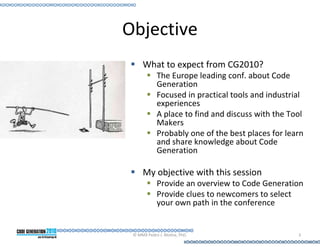
     What to expect from CG2010?
            The Europe leading conf. about Code
            Generation
            Focused in practical tools and industrial
            experiences
            A place to find and discuss with the Tool
            Makers
            Probably one of the best places for learn
            and share knowledge about Code
            Generation

     My objective with this session
            Provide an overview to Code Generation
            Provide clues to newcomers to select
            your own path in the conference


 © MMX Pedro J. Molina, PhD.                       3
Professional programmers needed!
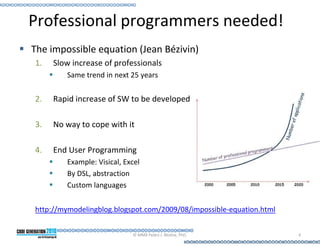
The impossible equation (Jean Bézivin)
1.   Slow increase of professionals
        Same trend in next 25 years


2.   Rapid increase of SW to be developed

3.   No way to cope with it

4.   End User Programming
        Example: Visical, Excel
        By DSL, abstraction
        Custom languages


http://mymodelingblog.blogspot.com/2009/08/impossible-equation.html


                            © MMX Pedro J. Molina, PhD.               4
Abstraction Levels
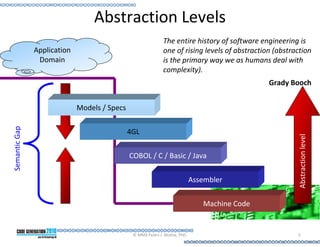
                                                              The entire history of software engineering is
               Application                                    one of rising levels of abstraction (abstraction
                Domain                                        is the primary way we as humans deal with
                                                              complexity).
                                                                                                Grady Booch


                             Models / Specs
Semantic Gap


                                              4GL


                                                                                                          Abstraction level
                                              COBOL / C / Basic / Java


                                                                             Assembler


                                                                                Machine Code


                                               © MMX Pedro J. Molina, PhD.                               5
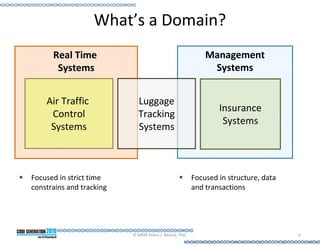
What’s a Domain?
      Real Time                                             Management
       Systems                                               Systems


    Air Traffic             Luggage
                                                                Insurance
     Control                Tracking
                                                                 Systems
     Systems                Systems


Focused in strict time                                  Focused in structure, data
constrains and tracking                                 and transactions


                          © MMX Pedro J. Molina, PhD.                                6
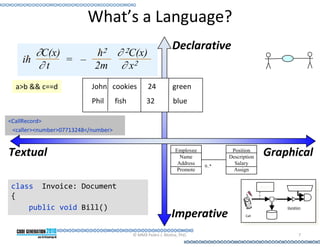
What’s a Language?
                                                               Declarative
       ∂C(x)        ∂        h2         2C(x)
    ih       = –
        ∂t       2m ∂ x2
  a>b && c==d              John cookies            24          green
                           Phil      fish         32           blue

<CallRecord>
 <caller><number>07713248</number>


Textual                                                          Employee
                                                                   Name
                                                                                    Position
                                                                                   Description    Graphical
                                                                  Address   0..*
                                                                                     Salary
                                                                  Promote            Assign


class Invoice: Document                                                                          Record       Cost min.

{                                                                                                                     ×
    public void Bill()                                                                                     Duration

                                                               Imperative                 Call        DB


                                            © MMX Pedro J. Molina, PhD.                                          7
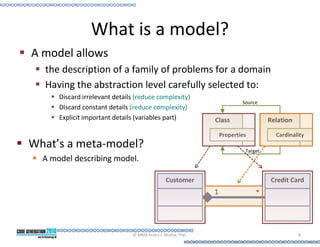
What is a model?
A model allows
  the description of a family of problems for a domain
  Having the abstraction level carefully selected to:
      Discard irrelevant details (reduce complexity)
                                                                         Source
      Discard constant details (reduce complexity)
      Explicit important details (variables part)            Class                 Relation

                                                                 Properties          Cardinality
What’s a meta-model?                                                      Target
  A model describing model.

                                               Customer                             Credit Card
                                                             1                *


                               © MMX Pedro J. Molina, PhD.                                    8
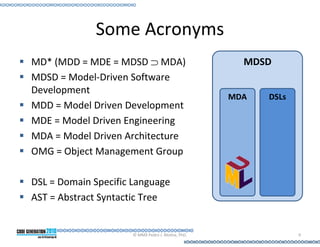
Some Acronyms
MD* (MDD = MDE = MDSD ⊃ MDA)                         MDSD
MDSD = Model-Driven Software
Development
                                                   MDA   DSLs
MDD = Model Driven Development
MDE = Model Driven Engineering
MDA = Model Driven Architecture
OMG = Object Management Group

DSL = Domain Specific Language
AST = Abstract Syntactic Tree


                     © MMX Pedro J. Molina, PhD.                9
MDD
   Model Driven Development

Definition:
   The usage of Models as the main artefacts
   to Drive the software Development.


                © MMX Pedro J. Molina, PhD.    10
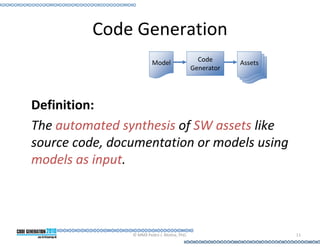
Code Generation
                         Model                  Code      Assets
                                              Generator


Definition:
The automated synthesis of SW assets like
source code, documentation or models using
models as input.


                © MMX Pedro J. Molina, PhD.                        11
Novak’s rule
“Automatic Programming is defined as the
  synthesis of a program from an specification.

  If automatic programming is to be useful, the
  specification must be smaller and easier to
  write than the program would be if written in
  a conventional programming language.”

                                                 G.S. Novak

                   © MMX Pedro J. Molina, PhD.            12
Commonality / Variability
Family of programs
(D. Parnas)

  Common part
    Standard, Fixed.
    Implementable in common & shared base libraries

  Variable part
    Specify in the model
    Can be generated


                    © MMX Pedro J. Molina, PhD.       13
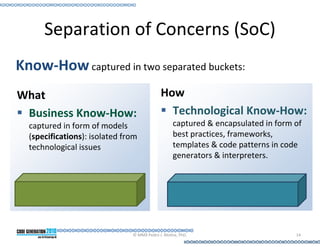
Separation of Concerns (SoC)
Know-How captured in two separated buckets:
What                                        How
 Business Know-How:                           Technological Know-How:
  captured in form of models                      captured & encapsulated in form of
  (specifications): isolated from                 best practices, frameworks,
  technological issues                            templates & code patterns in code
                                                  generators & interpreters.


                               © MMX Pedro J. Molina, PhD.                        14
ROI

Economies of Scale
Economies of Scope
Economics of MDSD

Development Life Cycle Impact
Quality


© MMX Pedro J. Molina, PhD.   15
Economies of Scale
Economies of Scale
   The condition where few inputs, as effort and time, are needed to
   produce big quantities of a unique output. [Wit96]


                                                              But: Can’t be applied to SW!
                                                              Once the SW is produced
                                                              Copy cost is = 0 £!


              Japanese Cookie Factory. Production Line.


                                © MMX Pedro J. Molina, PhD.                              16
© MMX Pedro J. Molina, PhD.   17
Economies of Scope
Economies of Scope
  The condition where few inputs, as effort and time, are
  needed to produce a great variety of outputs. It is
  produced more added value producing in the same line
  different outputs. To produce each output independently
  creates an overcost in the common parts.

  Economy of Scope occurs when the cost of combining two
  or more products in a unique product line is lower than
  producing them independently. [Wit96]


                    © MMX Pedro J. Molina, PhD.             18
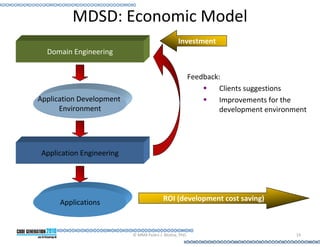
MDSD: Economic Model
                                                 Investment
  Domain Engineering


                                                         Feedback:
                                                                 Clients suggestions
Application Development                                          Improvements for the
      Environment                                                development environment


 Application Engineering


      Applications                        ROI (development cost saving)


                           © MMX Pedro J. Molina, PhD.                               19
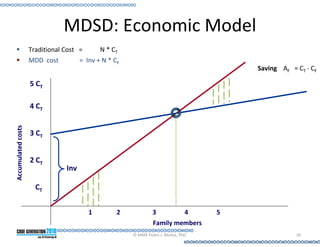
MDSD: Economic Model
                    Traditional Cost =      N * CT
                    MDD cost         = Inv + N * CF
                                                                                        Saving AF = CT - CF

                    5 CT

                    4 CT
Accumulated costs


                    3 CT


                    2 CT
                                 Inv

                      CT


                                        1         2            3        4           5
                                                               Family members
                                                      © MMX Pedro J. Molina, PhD.                   20
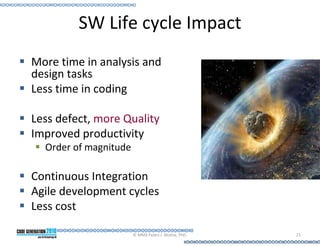
SW Life cycle Impact
More time in analysis and
design tasks
Less time in coding

Less defect, more Quality
Improved productivity
  Order of magnitude

Continuous Integration
Agile development cycles
Less cost

                       © MMX Pedro J. Molina, PhD.   21
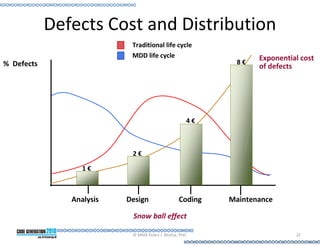
Defects Cost and Distribution
                           Traditional life cycle
                           MDD life cycle                        Exponential cost
% Defects                                                   8€
                                                                 of defects


                                                     4€


                           2€

                  1€


               Analysis   Design                 Coding   Maintenance

                           Snow ball effect

                           © MMX Pedro J. Molina, PhD.                     22
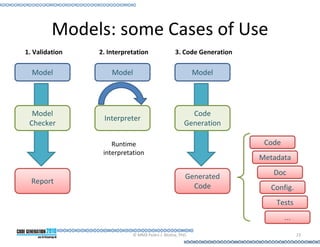
Models: some Cases of Use
1. Validation   2. Interpretation               3. Code Generation

  Model             Model                                Model


  Model                                               Code
                 Interpreter
 Checker                                            Generation

                    Runtime                                           Code
                 interpretation
                                                                     Metadata

                                                     Generated          Doc
  Report
                                                       Code             Config.
                                                                         Tests
                                                                             ...

                           © MMX Pedro J. Molina, PhD.                             23
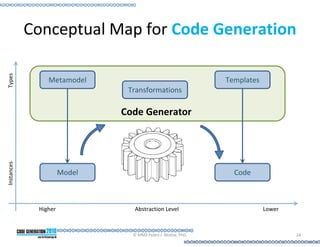
Conceptual Map for Code Generation
Types


                Metamodel                                     Templates
                               Transformations

                              Code Generator
Instances


                      Model                                     Code


             Higher              Abstraction Level                        Lower


                                © MMX Pedro J. Molina, PhD.                       24
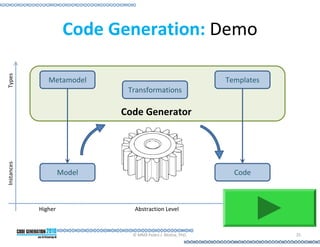
Code Generation: Demo
Types


               Metamodel                                     Templates
                              Transformations

                             Code Generator
Instances


                     Model                                     Code


            Higher              Abstraction Level                        Lower


                               © MMX Pedro J. Molina, PhD.                       25
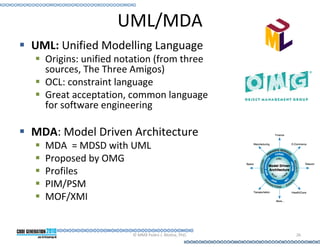
UML/MDA
UML: Unified Modelling Language
  Origins: unified notation (from three
  sources, The Three Amigos)
  OCL: constraint language
  Great acceptation, common language
  for software engineering

MDA: Model Driven Architecture
  MDA = MDSD with UML
  Proposed by OMG
  Profiles
  PIM/PSM
  MOF/XMI


                     © MMX Pedro J. Molina, PhD.   26
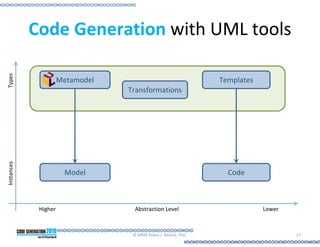
Code Generation with UML tools
Types


                      Metamodel                                  Templates
                                  Transformations
Instances


                        Model                                      Code


             Higher                 Abstraction Level                        Lower


                                   © MMX Pedro J. Molina, PhD.                       27
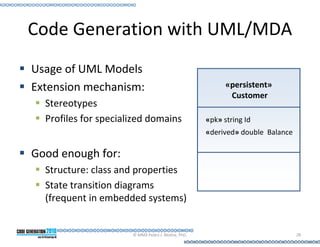
Code Generation with UML/MDA
Usage of UML Models
Extension mechanism:                                      «persistent»
                                                           Customer
  Stereotypes
  Profiles for specialized domains                  «pk» string Id
                                                    «derived» double Balance

Good enough for:
  Structure: class and properties
  State transition diagrams
  (frequent in embedded systems)


                      © MMX Pedro J. Molina, PhD.                              28
Code Generation with UML/MDA
As rich/poor enough as you can express and maintain in UML
“Only a 20% of UML is generally needed for SW development.” Ivar Jacobson
   But: What percent of my problem can such 20% of UML solve?

Metamodel is highly closed
   Only extensible at certain points

Shortcomings
   Symbol and concept overloading
   Not clear Semantics
   Action Language
   Domains not cover by UML: e.g. User Interfaces
   Abuse of profiles Forces models and semantics (One size doesn’t fit
   all)
   Tools: many dialects of XMI Babel’s Tower


                                  © MMX Pedro J. Molina, PhD.         29
DSL
A DSL approach to MDSD give you
full control on the development of
your metamodel
  Powerful
  Better well suited to your needs
  Do it yourself approach


Tools to be built
  Metamodels, editors, model checkers,
  compilers, code generators

   © MMX Pedro J. Molina, PhD.       30
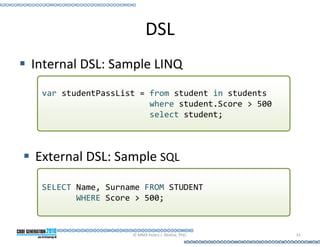
DSL
Internal DSL: Sample LINQ
 var studentPassList = from student in students
                       where student.Score > 500
                       select student;


External DSL: Sample SQL

 SELECT Name, Surname FROM STUDENT
        WHERE Score > 500;


                   © MMX Pedro J. Molina, PhD.     31
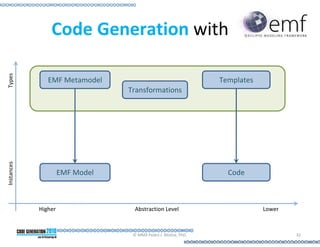
Code Generation with EMF
Types


               EMF Metamodel                                    Templates
                                 Transformations
Instances


                     EMF Model                                    Code


            Higher                 Abstraction Level                        Lower


                                  © MMX Pedro J. Molina, PhD.                       32
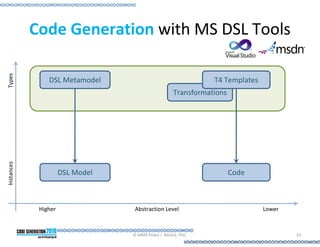
Code Generation with MS DSL Tools
Types


                DSL Metamodel                                    T4 Templates
                                                      Transformations
Instances


                      DSL Model                                         Code


             Higher                Abstraction Level                            Lower


                                  © MMX Pedro J. Molina, PhD.                           33
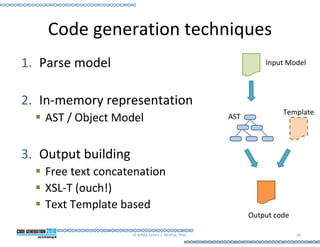
Code generation techniques
1. Parse model                                               Input Model


2. In-memory representation
                                                                  Template
   AST / Object Model                              AST


3. Output building
   Free text concatenation
   XSL-T (ouch!)
   Text Template based
                                                         Output code

                     © MMX Pedro J. Molina, PhD.                       34
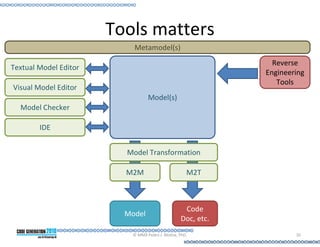
Tools matters
                           Metamodel(s)
                                                                Reverse
Textual Model Editor
                                                              Engineering
                                                                 Tools
Visual Model Editor
                                  Model(s)
  Model Checker

        IDE


                         Model Transformation

                         M2M                         M2T


                                                   Code
                         Model
                                                  Doc, etc.
                           © MMX Pedro J. Molina, PhD.                35
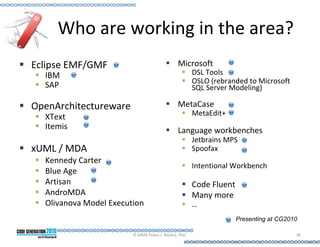
Who are working in the area?
Eclipse EMF/GMF                               Microsoft
  IBM                                                 DSL Tools
                                                      OSLO (rebranded to Microsoft
  SAP                                                 SQL Server Modeling)

OpenArchitectureware                          MetaCase
  XText                                               MetaEdit+
  Itemis                                      Language workbenches
                                                      Jetbrains MPS
xUML / MDA                                            Spoofax
  Kennedy Carter
                                                      Intentional Workbench
  Blue Age
  Artisan                                             Code Fluent
  AndroMDA                                            Many more
  Olivanova Model Execution                           …
                                                                    Presenting at CG2010

                        © MMX Pedro J. Molina, PhD.                                    36
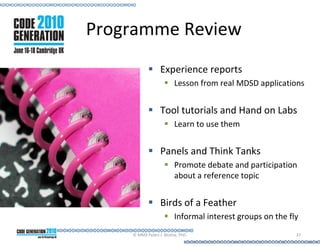
Programme Review
                 Experience reports
                        Lesson from real MDSD applications


                 Tool tutorials and Hand on Labs
                        Learn to use them


                 Panels and Think Tanks
                        Promote debate and participation
                        about a reference topic


                 Birds of a Feather
                        Informal interest groups on the fly
    © MMX Pedro J. Molina, PhD.                           37
CG2010 Advices
Choose your path
   Parallel tracks
   Split your team
   Check for slides of missing session on the
   conference web

Interact!
   Ask whenever something is not clear to you
   Ask for each dark acronym you found
   Introduce yourself and involve in the
   community
   Do not miss the punting trip!
   Continue the discussion on the community
   site: http://modeldrivensoftware.net/

                         © MMX Pedro J. Molina, PhD.   38
Conclusions
A change in SW development it is needed

MDSD can:
  Provide leverage points to reach new levels of productivity

  Offer a clear path for making real engineering in Computer
  Science


                      © MMX Pedro J. Molina, PhD.          39
Thank you!


Questions?
   © MMX Pedro J. Molina, PhD.   40

CG2010 Introducing MDSD

  • 1.
    Introducing Model-Driven Software Development Pedro J. Molina, PhD. Software Engineer Capgemini Spain | Valencia pjmolina@gmail.com http://pjmolina.com/metalevel
  • 2.
    Contents Objective What’s MDSD? Why are we doing it? How we can apply it? CG2010 Program review Advices © MMX Pedro J. Molina, PhD. 2
  • 3.
    Objective What to expect from CG2010? The Europe leading conf. about Code Generation Focused in practical tools and industrial experiences A place to find and discuss with the Tool Makers Probably one of the best places for learn and share knowledge about Code Generation My objective with this session Provide an overview to Code Generation Provide clues to newcomers to select your own path in the conference © MMX Pedro J. Molina, PhD. 3
  • 4.
    Professional programmers needed! Theimpossible equation (Jean Bézivin) 1. Slow increase of professionals Same trend in next 25 years 2. Rapid increase of SW to be developed 3. No way to cope with it 4. End User Programming Example: Visical, Excel By DSL, abstraction Custom languages http://mymodelingblog.blogspot.com/2009/08/impossible-equation.html © MMX Pedro J. Molina, PhD. 4
  • 5.
    Abstraction Levels The entire history of software engineering is Application one of rising levels of abstraction (abstraction Domain is the primary way we as humans deal with complexity). Grady Booch Models / Specs Semantic Gap 4GL Abstraction level COBOL / C / Basic / Java Assembler Machine Code © MMX Pedro J. Molina, PhD. 5
  • 6.
    What’s a Domain? Real Time Management Systems Systems Air Traffic Luggage Insurance Control Tracking Systems Systems Systems Focused in strict time Focused in structure, data constrains and tracking and transactions © MMX Pedro J. Molina, PhD. 6
  • 7.
    What’s a Language? Declarative ∂C(x) ∂ h2 2C(x) ih = – ∂t 2m ∂ x2 a>b && c==d John cookies 24 green Phil fish 32 blue <CallRecord> <caller><number>07713248</number> Textual Employee Name Position Description Graphical Address 0..* Salary Promote Assign class Invoice: Document Record Cost min. { × public void Bill() Duration Imperative Call DB © MMX Pedro J. Molina, PhD. 7
  • 8.
    What is amodel? A model allows the description of a family of problems for a domain Having the abstraction level carefully selected to: Discard irrelevant details (reduce complexity) Source Discard constant details (reduce complexity) Explicit important details (variables part) Class Relation Properties Cardinality What’s a meta-model? Target A model describing model. Customer Credit Card 1 * © MMX Pedro J. Molina, PhD. 8
  • 9.
    Some Acronyms MD* (MDD= MDE = MDSD ⊃ MDA) MDSD MDSD = Model-Driven Software Development MDA DSLs MDD = Model Driven Development MDE = Model Driven Engineering MDA = Model Driven Architecture OMG = Object Management Group DSL = Domain Specific Language AST = Abstract Syntactic Tree © MMX Pedro J. Molina, PhD. 9
  • 10.
    MDD Model Driven Development Definition: The usage of Models as the main artefacts to Drive the software Development. © MMX Pedro J. Molina, PhD. 10
  • 11.
    Code Generation Model Code Assets Generator Definition: The automated synthesis of SW assets like source code, documentation or models using models as input. © MMX Pedro J. Molina, PhD. 11
  • 12.
    Novak’s rule “Automatic Programmingis defined as the synthesis of a program from an specification. If automatic programming is to be useful, the specification must be smaller and easier to write than the program would be if written in a conventional programming language.” G.S. Novak © MMX Pedro J. Molina, PhD. 12
  • 13.
    Commonality / Variability Familyof programs (D. Parnas) Common part Standard, Fixed. Implementable in common & shared base libraries Variable part Specify in the model Can be generated © MMX Pedro J. Molina, PhD. 13
  • 14.
    Separation of Concerns(SoC) Know-How captured in two separated buckets: What How Business Know-How: Technological Know-How: captured in form of models captured & encapsulated in form of (specifications): isolated from best practices, frameworks, technological issues templates & code patterns in code generators & interpreters. © MMX Pedro J. Molina, PhD. 14
  • 15.
    ROI Economies of Scale Economiesof Scope Economics of MDSD Development Life Cycle Impact Quality © MMX Pedro J. Molina, PhD. 15
  • 16.
    Economies of Scale Economiesof Scale The condition where few inputs, as effort and time, are needed to produce big quantities of a unique output. [Wit96] But: Can’t be applied to SW! Once the SW is produced Copy cost is = 0 £! Japanese Cookie Factory. Production Line. © MMX Pedro J. Molina, PhD. 16
  • 17.
    © MMX PedroJ. Molina, PhD. 17
  • 18.
    Economies of Scope Economiesof Scope The condition where few inputs, as effort and time, are needed to produce a great variety of outputs. It is produced more added value producing in the same line different outputs. To produce each output independently creates an overcost in the common parts. Economy of Scope occurs when the cost of combining two or more products in a unique product line is lower than producing them independently. [Wit96] © MMX Pedro J. Molina, PhD. 18
  • 19.
    MDSD: Economic Model Investment Domain Engineering Feedback: Clients suggestions Application Development Improvements for the Environment development environment Application Engineering Applications ROI (development cost saving) © MMX Pedro J. Molina, PhD. 19
  • 20.
    MDSD: Economic Model Traditional Cost = N * CT MDD cost = Inv + N * CF Saving AF = CT - CF 5 CT 4 CT Accumulated costs 3 CT 2 CT Inv CT 1 2 3 4 5 Family members © MMX Pedro J. Molina, PhD. 20
  • 21.
    SW Life cycleImpact More time in analysis and design tasks Less time in coding Less defect, more Quality Improved productivity Order of magnitude Continuous Integration Agile development cycles Less cost © MMX Pedro J. Molina, PhD. 21
  • 22.
    Defects Cost andDistribution Traditional life cycle MDD life cycle Exponential cost % Defects 8€ of defects 4€ 2€ 1€ Analysis Design Coding Maintenance Snow ball effect © MMX Pedro J. Molina, PhD. 22
  • 23.
    Models: some Casesof Use 1. Validation 2. Interpretation 3. Code Generation Model Model Model Model Code Interpreter Checker Generation Runtime Code interpretation Metadata Generated Doc Report Code Config. Tests ... © MMX Pedro J. Molina, PhD. 23
  • 24.
    Conceptual Map forCode Generation Types Metamodel Templates Transformations Code Generator Instances Model Code Higher Abstraction Level Lower © MMX Pedro J. Molina, PhD. 24
  • 25.
    Code Generation: Demo Types Metamodel Templates Transformations Code Generator Instances Model Code Higher Abstraction Level Lower © MMX Pedro J. Molina, PhD. 25
  • 26.
    UML/MDA UML: Unified ModellingLanguage Origins: unified notation (from three sources, The Three Amigos) OCL: constraint language Great acceptation, common language for software engineering MDA: Model Driven Architecture MDA = MDSD with UML Proposed by OMG Profiles PIM/PSM MOF/XMI © MMX Pedro J. Molina, PhD. 26
  • 27.
    Code Generation withUML tools Types Metamodel Templates Transformations Instances Model Code Higher Abstraction Level Lower © MMX Pedro J. Molina, PhD. 27
  • 28.
    Code Generation withUML/MDA Usage of UML Models Extension mechanism: «persistent» Customer Stereotypes Profiles for specialized domains «pk» string Id «derived» double Balance Good enough for: Structure: class and properties State transition diagrams (frequent in embedded systems) © MMX Pedro J. Molina, PhD. 28
  • 29.
    Code Generation withUML/MDA As rich/poor enough as you can express and maintain in UML “Only a 20% of UML is generally needed for SW development.” Ivar Jacobson But: What percent of my problem can such 20% of UML solve? Metamodel is highly closed Only extensible at certain points Shortcomings Symbol and concept overloading Not clear Semantics Action Language Domains not cover by UML: e.g. User Interfaces Abuse of profiles Forces models and semantics (One size doesn’t fit all) Tools: many dialects of XMI Babel’s Tower © MMX Pedro J. Molina, PhD. 29
  • 30.
    DSL A DSL approachto MDSD give you full control on the development of your metamodel Powerful Better well suited to your needs Do it yourself approach Tools to be built Metamodels, editors, model checkers, compilers, code generators © MMX Pedro J. Molina, PhD. 30
  • 31.
    DSL Internal DSL: SampleLINQ var studentPassList = from student in students where student.Score > 500 select student; External DSL: Sample SQL SELECT Name, Surname FROM STUDENT WHERE Score > 500; © MMX Pedro J. Molina, PhD. 31
  • 32.
    Code Generation withEMF Types EMF Metamodel Templates Transformations Instances EMF Model Code Higher Abstraction Level Lower © MMX Pedro J. Molina, PhD. 32
  • 33.
    Code Generation withMS DSL Tools Types DSL Metamodel T4 Templates Transformations Instances DSL Model Code Higher Abstraction Level Lower © MMX Pedro J. Molina, PhD. 33
  • 34.
    Code generation techniques 1.Parse model Input Model 2. In-memory representation Template AST / Object Model AST 3. Output building Free text concatenation XSL-T (ouch!) Text Template based Output code © MMX Pedro J. Molina, PhD. 34
  • 35.
    Tools matters Metamodel(s) Reverse Textual Model Editor Engineering Tools Visual Model Editor Model(s) Model Checker IDE Model Transformation M2M M2T Code Model Doc, etc. © MMX Pedro J. Molina, PhD. 35
  • 36.
    Who are workingin the area? Eclipse EMF/GMF Microsoft IBM DSL Tools OSLO (rebranded to Microsoft SAP SQL Server Modeling) OpenArchitectureware MetaCase XText MetaEdit+ Itemis Language workbenches Jetbrains MPS xUML / MDA Spoofax Kennedy Carter Intentional Workbench Blue Age Artisan Code Fluent AndroMDA Many more Olivanova Model Execution … Presenting at CG2010 © MMX Pedro J. Molina, PhD. 36
  • 37.
    Programme Review Experience reports Lesson from real MDSD applications Tool tutorials and Hand on Labs Learn to use them Panels and Think Tanks Promote debate and participation about a reference topic Birds of a Feather Informal interest groups on the fly © MMX Pedro J. Molina, PhD. 37
  • 38.
    CG2010 Advices Choose yourpath Parallel tracks Split your team Check for slides of missing session on the conference web Interact! Ask whenever something is not clear to you Ask for each dark acronym you found Introduce yourself and involve in the community Do not miss the punting trip! Continue the discussion on the community site: http://modeldrivensoftware.net/ © MMX Pedro J. Molina, PhD. 38
  • 39.
    Conclusions A change inSW development it is needed MDSD can: Provide leverage points to reach new levels of productivity Offer a clear path for making real engineering in Computer Science © MMX Pedro J. Molina, PhD. 39
  • 40.
    Thank you! Questions? © MMX Pedro J. Molina, PhD. 40