SOLID OOPS
ConvertingReal world entities into programming Objects ;
  understanding its applications ; API designing, MVC framework
   We apologize for wrong session title 
   Lets know each other
   Your expectations
   Our aim
   Why should you join this session
   Goodies for active participants 


Introduction
 What is “Real”?
 Everything outside of your program is
  Real.
 Even your own program is a Real World
  Entity for some other program or even for
  your own program!
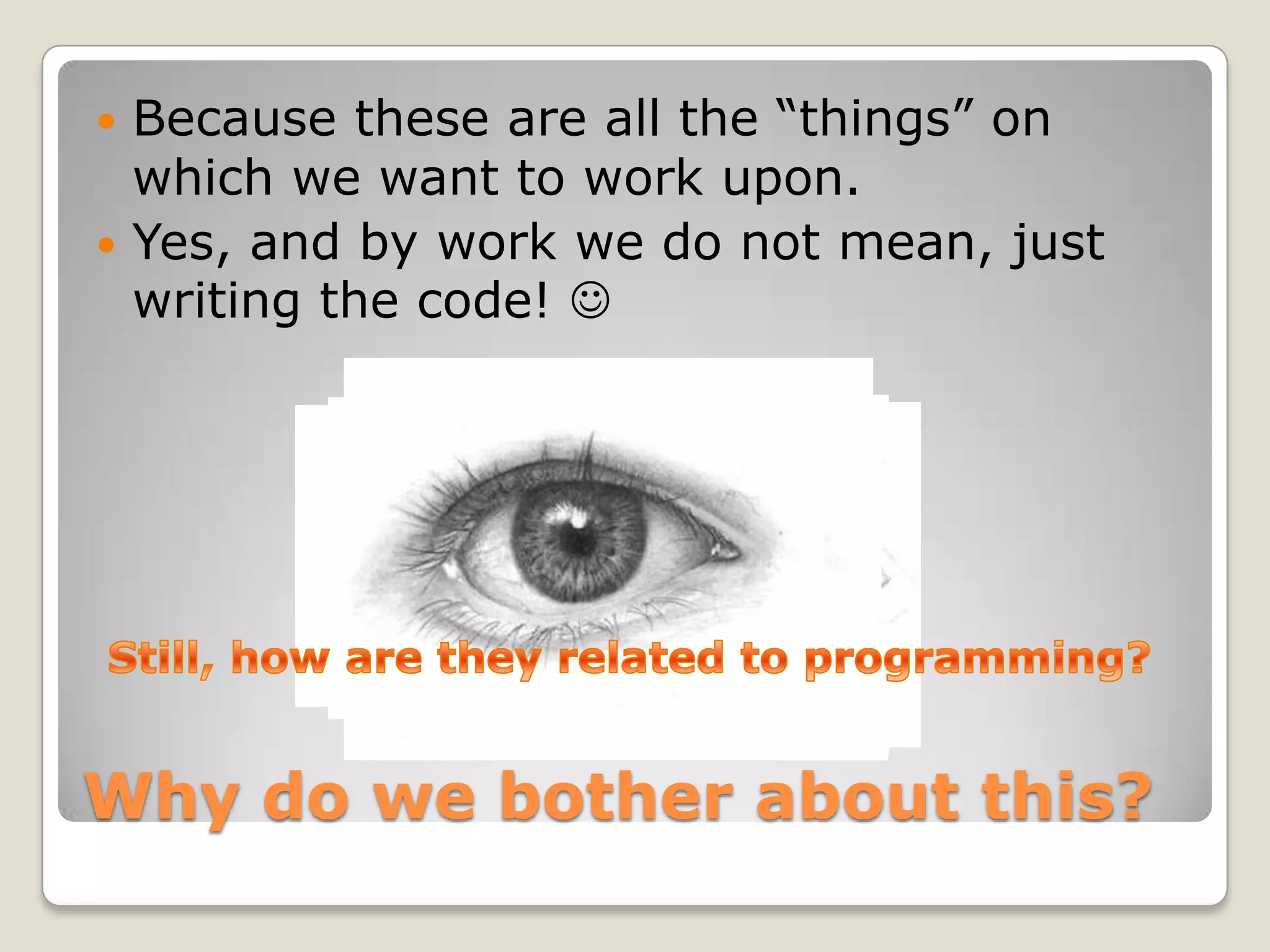
 In short


Real World Entity…
 Because these are all the “things” on
  which we want to work upon.
 Yes, and by work we do not mean, just
  writing the code! 


Why do we bother about this?
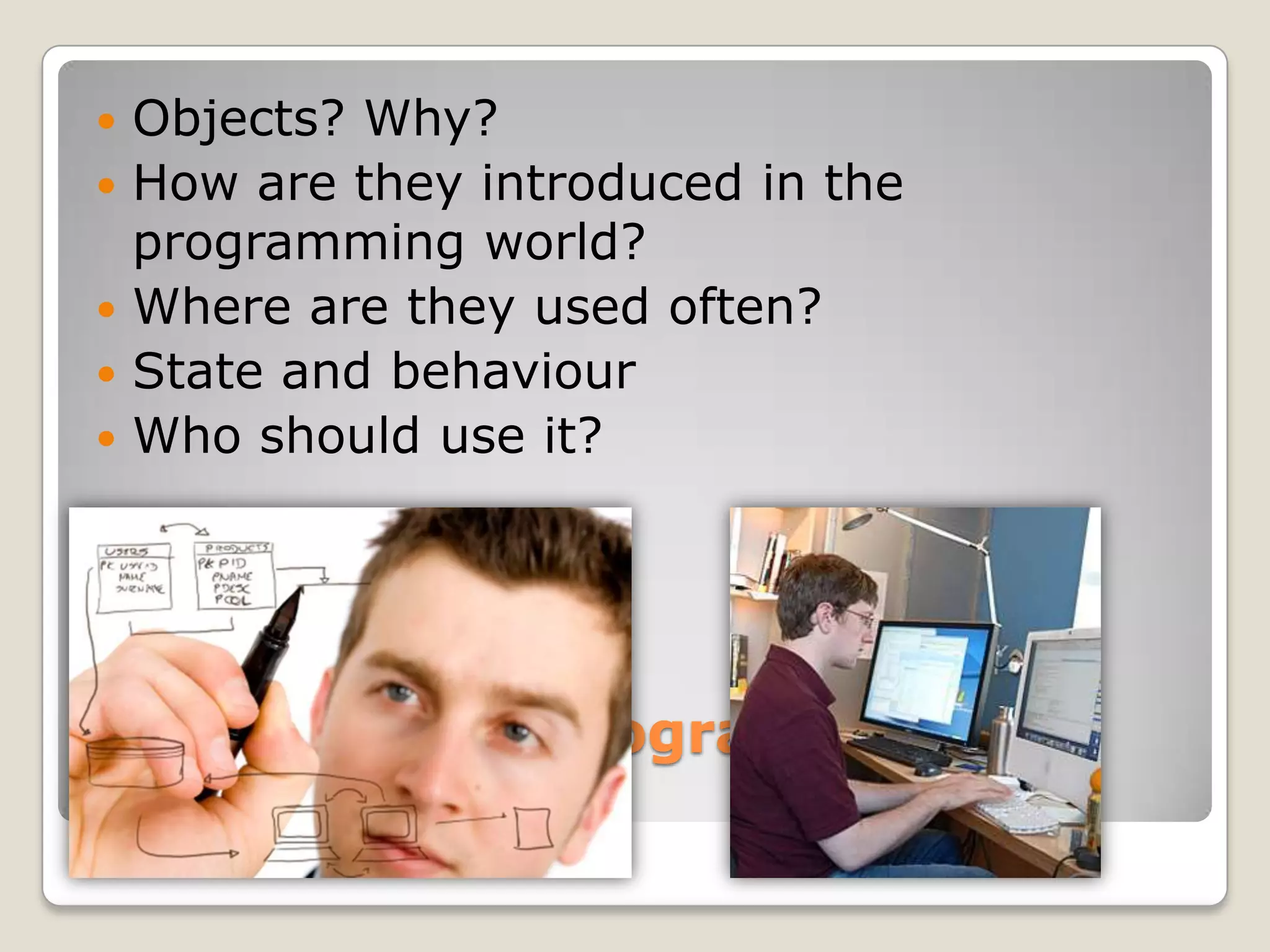
   Objects? Why?
   How are they introduced in the
    programming world?
   Where are they used often?
   State and behaviour
   Who should use it?


Correlating to programming
objects
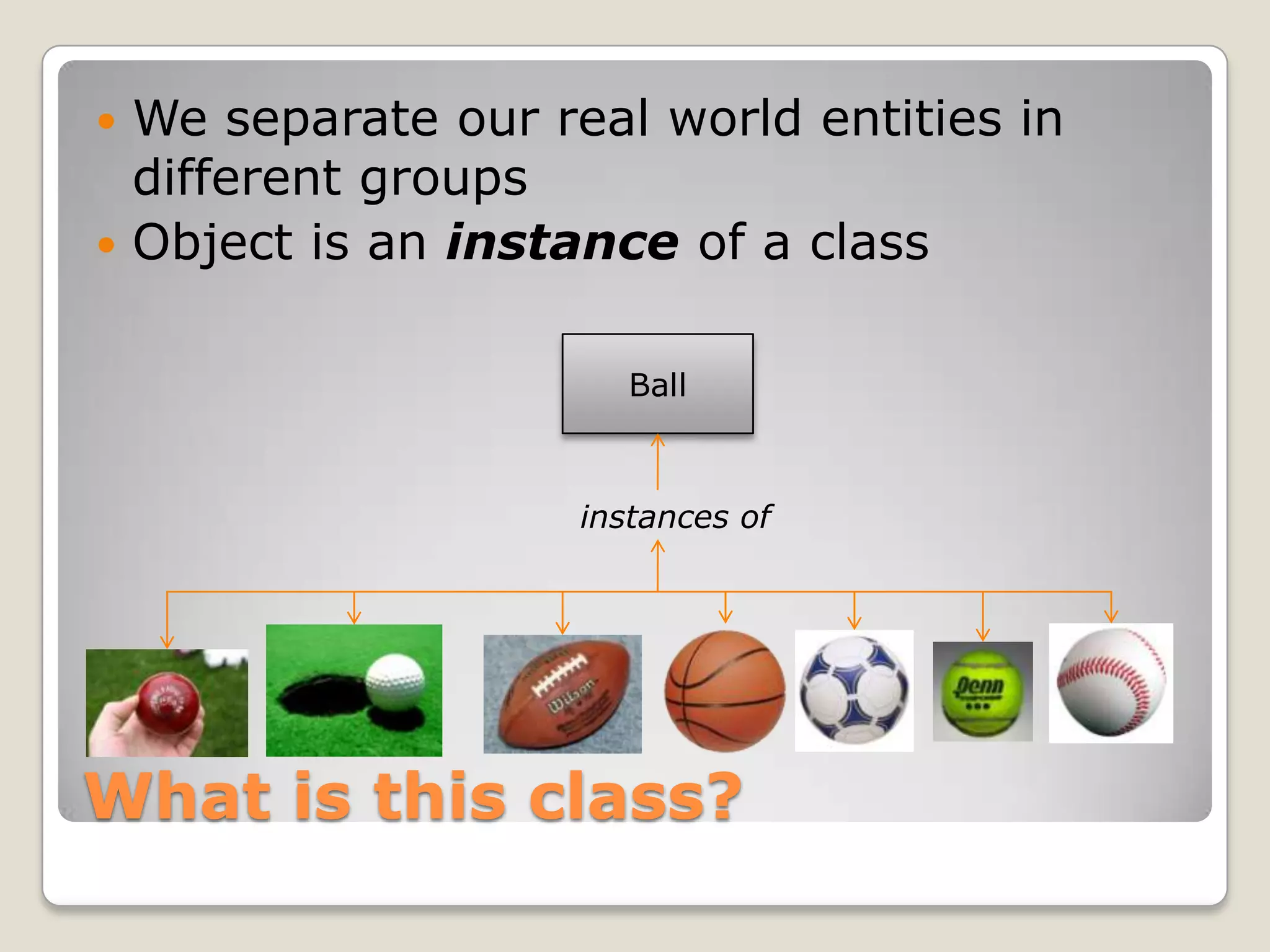
 We separate our real world entities in
  different groups
 Object is an instance of a class


                       Ball


                    instances of


What is this class?
 How classes are organized?
 Why classes need to be organized?
 Is there any standard way to do it?
 If yes, whats it?


Organization
   How these different attributes of a class
    are defined?
   fields/properties - state
   methods/functions - behavior
   constructors/initializers
   destructors


What class contains?
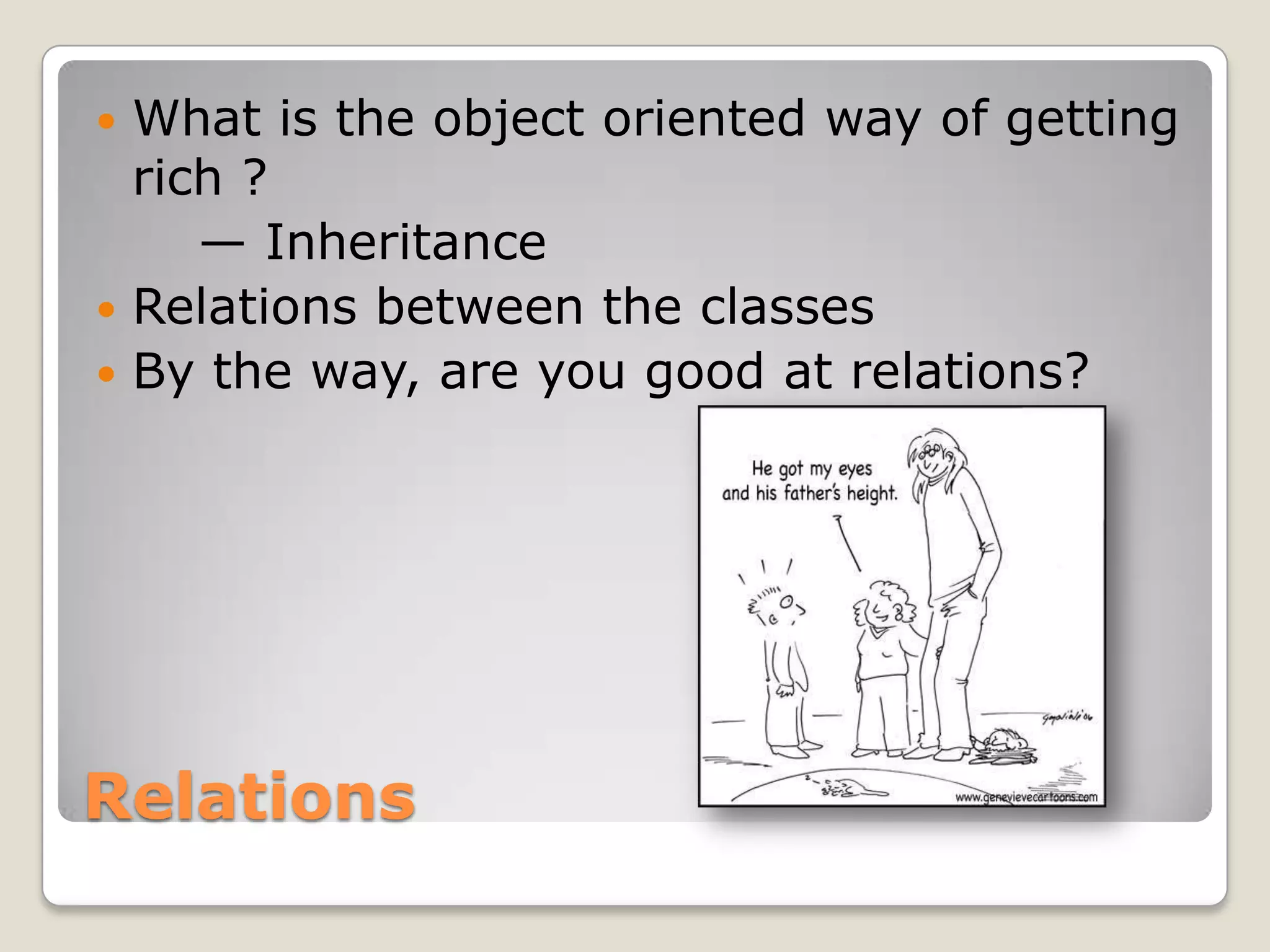
 What is the object oriented way of getting
  rich ?
     — Inheritance
 Relations between the classes
 By the way, are you good at relations?


Relations
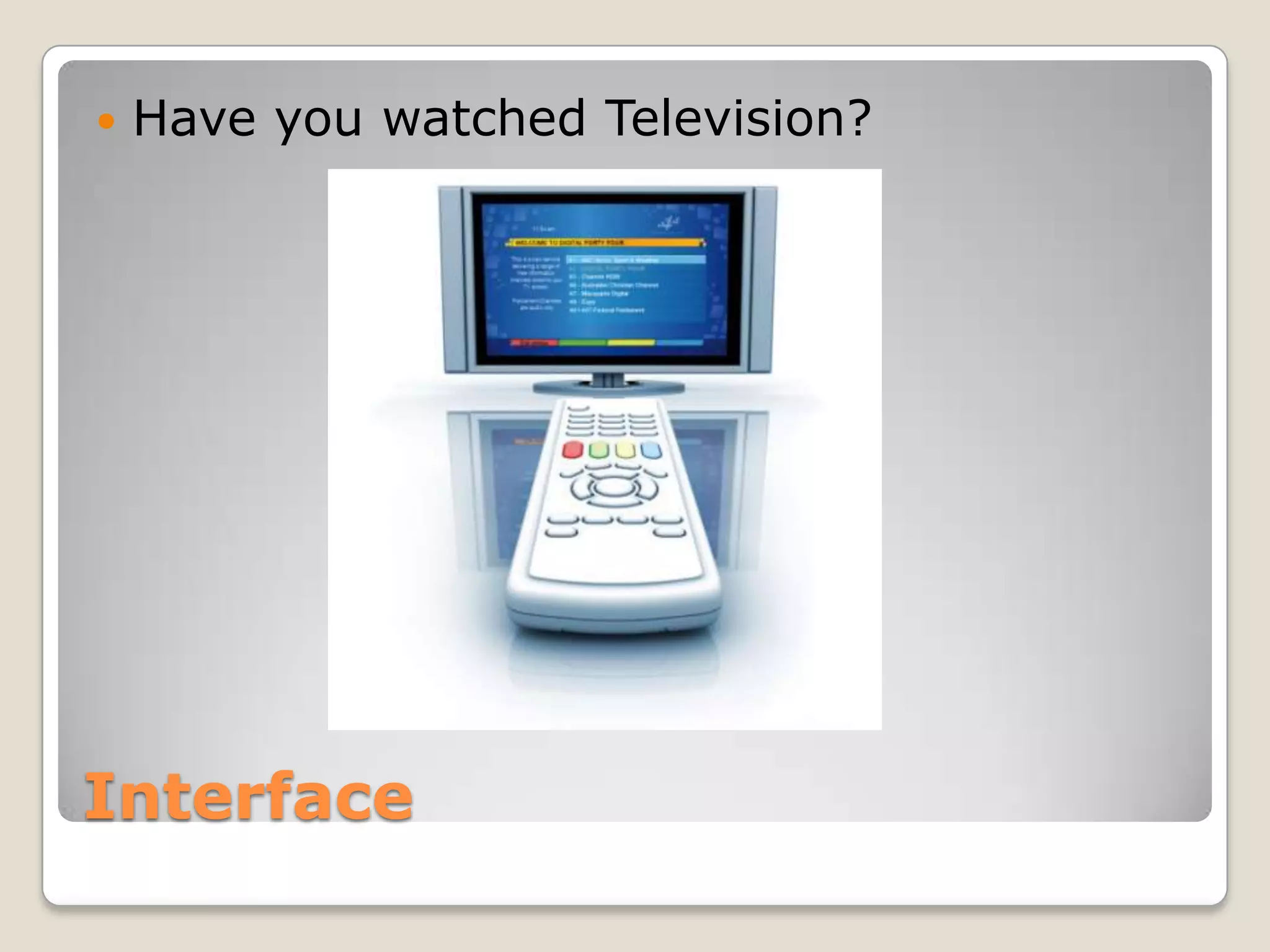
   Have you watched Television?


Interface
   Something you use to keep your stuff from
    mixing together
   Folders
   Drives
   A customized, more sophisticated package
   Examples familiar to you are,
    ◦ ZIP file
    ◦ EXE file
    ◦ DLL file etc.

Point is, keep your stuff organized.


Package
What is Abstraction?
•   Abstraction - a concept or idea not associated with
    any specific instance

•   It is all about perspective
Where does abstraction exist?
•   Control abstraction
    o   Abstraction of actions


•   Data abstraction
    o   Abstraction of information
How does this relate to
programming?
•   Writing functions/subroutines is control
    abstraction.
•   Datatypes is data abstraction.
Data Abstraction
•   Generalization
•   Specialization
Example
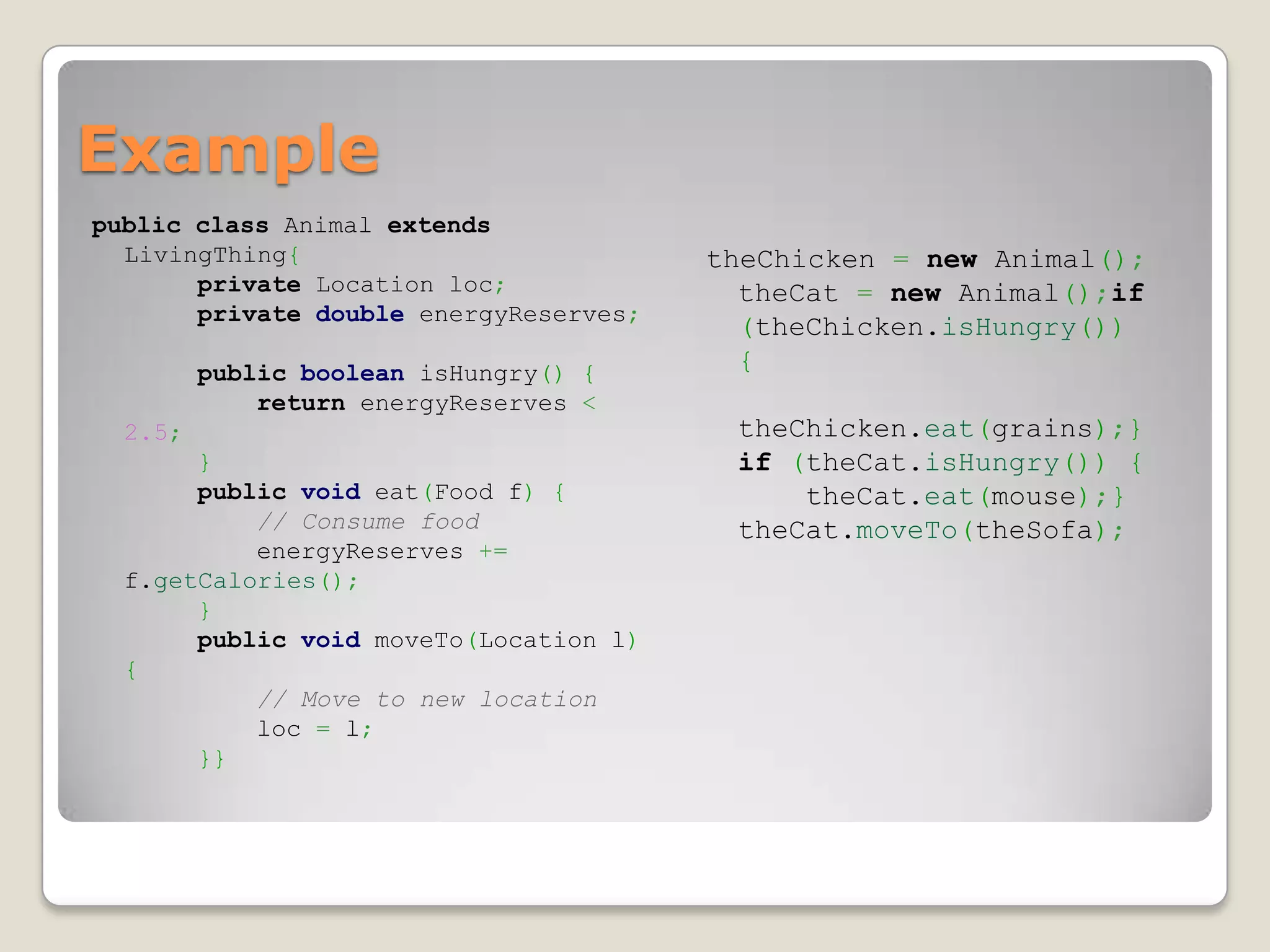
public class Animal extends
  LivingThing{                          theChicken = new Animal();
       private Location loc;              theCat = new Animal();if
       private double energyReserves;
                                          (theChicken.isHungry())
         public boolean isHungry() {      {
             return energyReserves <
  2.5;                                   theChicken.eat(grains);}
       }                                 if (theCat.isHungry()) {
       public void eat(Food f) {             theCat.eat(mouse);}
           // Consume food               theCat.moveTo(theSofa);
           energyReserves +=
  f.getCalories();
       }
       public void moveTo(Location l)
  {
           // Move to new location
           loc = l;
       }}
It's relevance with OOP
•   Object is an attempt to combine data and control
    abstraction
•   Polymorphism
•   Inheritence
Why do this?
•   Separate the business logic from the underlying
    complexity
•   Make it easier to parallelize tasks
•   Meaningful amount of details are exposed
•   Representation in a similar form in semantics
    (meaning) while hiding implementation details.
Why do we write programs?
We have the right objects in
place, now what?
•   Let's get them talking to each other
•   Let's actually tell them what to talk about
What sort of messages?
•   Creation
•   Invocation
•   Destruction
Who generates these
messages?
•   Aliens?           •   Platform
•   The Government?   •   User Interaction
                      •   Events
API Designing
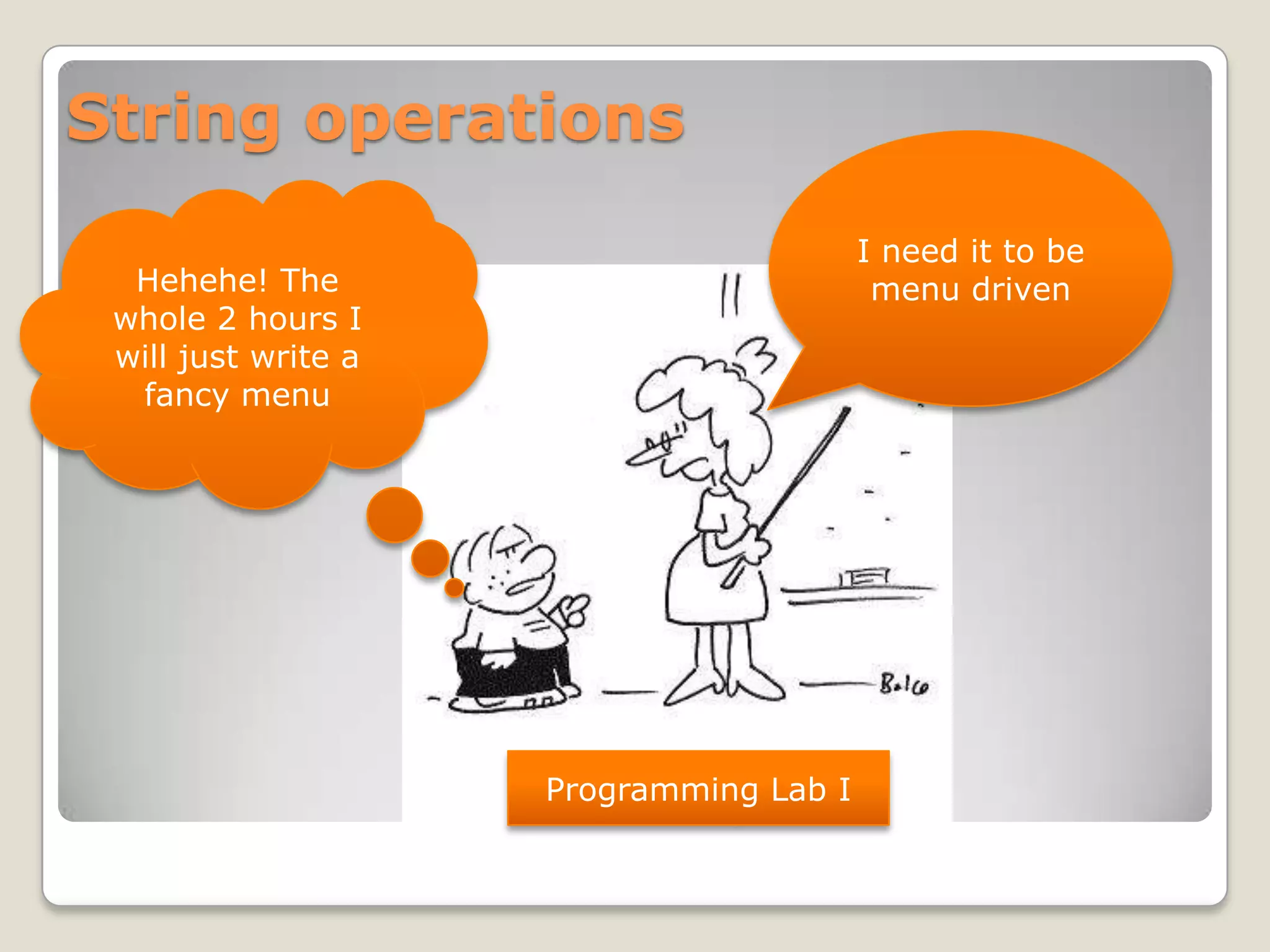
String operations
                                         I need it to be
  Hehehe! The                             menu driven
 whole 2 hours I
 will just write a
  fancy menu


                     Programming Lab I
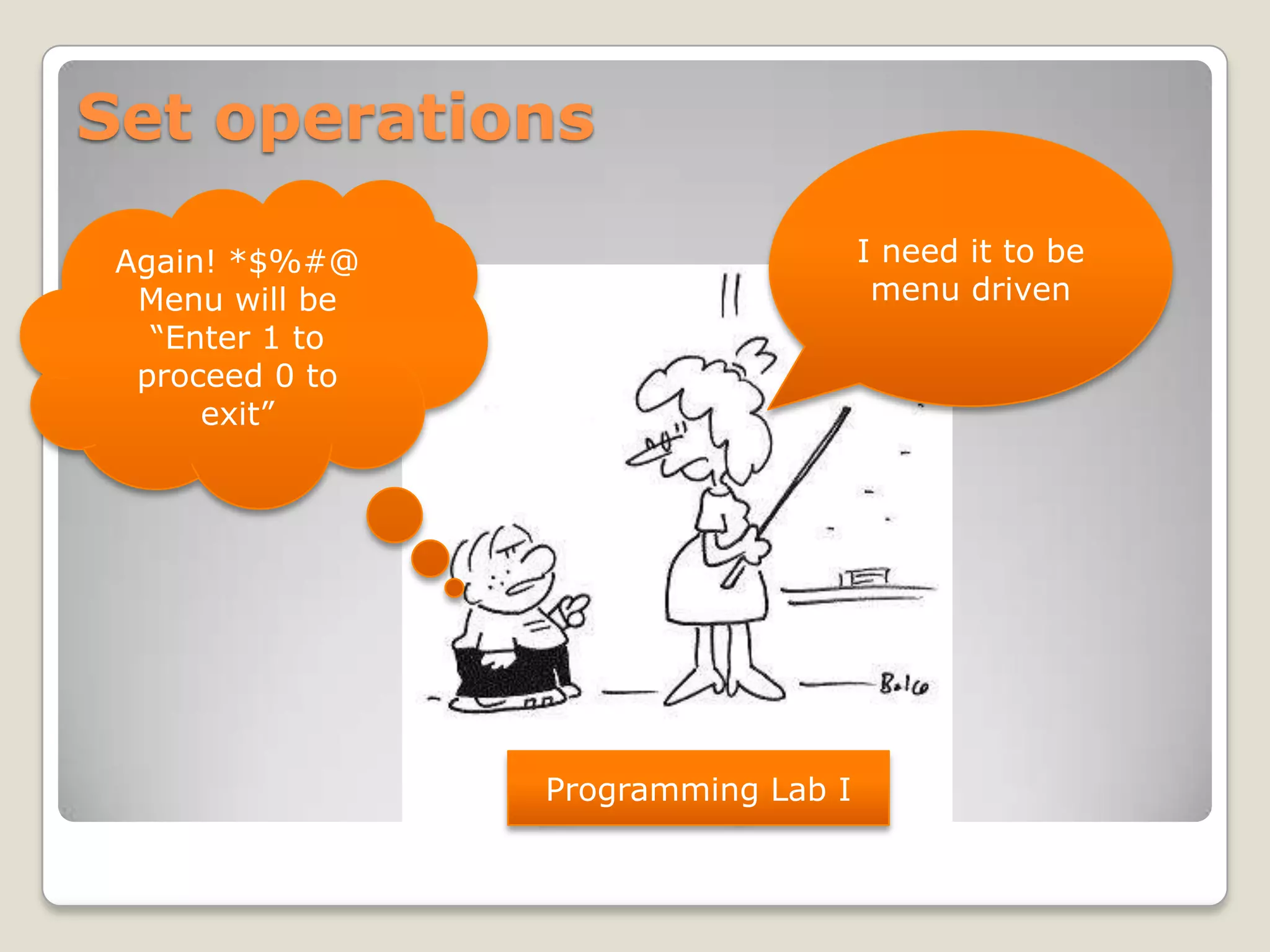
Set operations

 Again! *$%#@                        I need it to be
  Menu will be                        menu driven
   “Enter 1 to
  proceed 0 to
      exit”


                 Programming Lab I
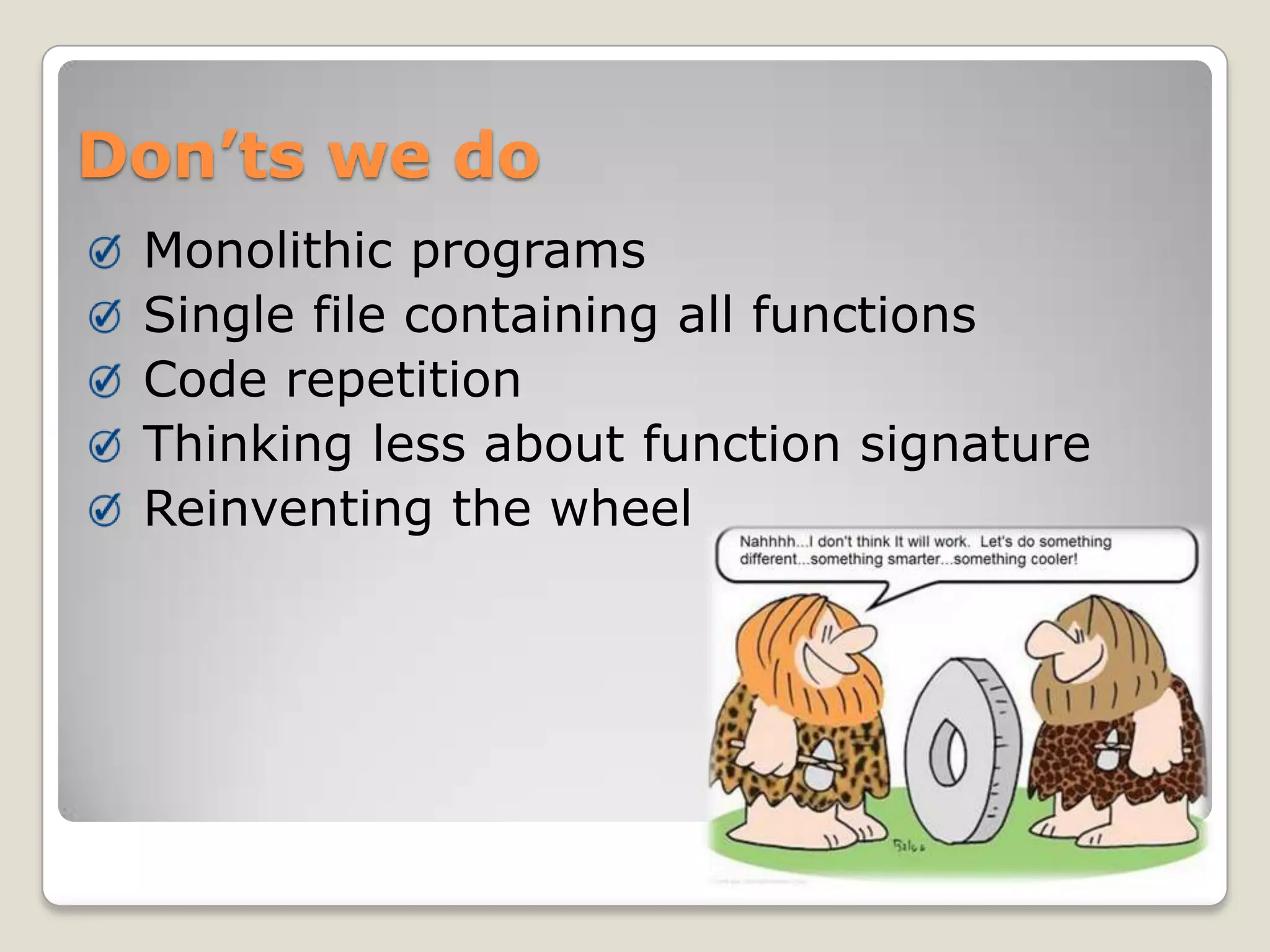
Don’ts we do
 Monolithic programs
 Single file containing all functions
 Code repetition
 Thinking less about function signature
 Reinventing the wheel
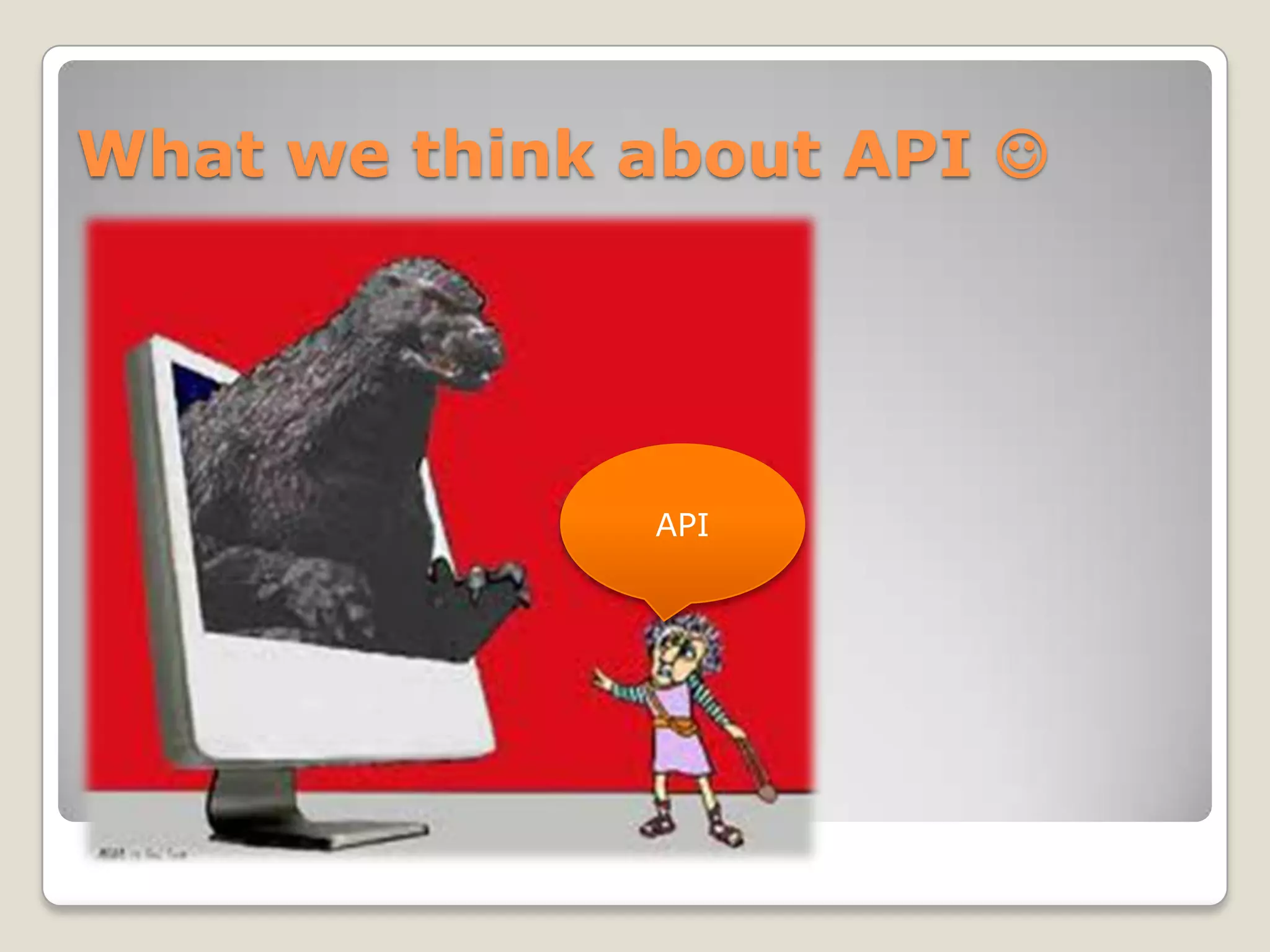
What we think about API 


              API
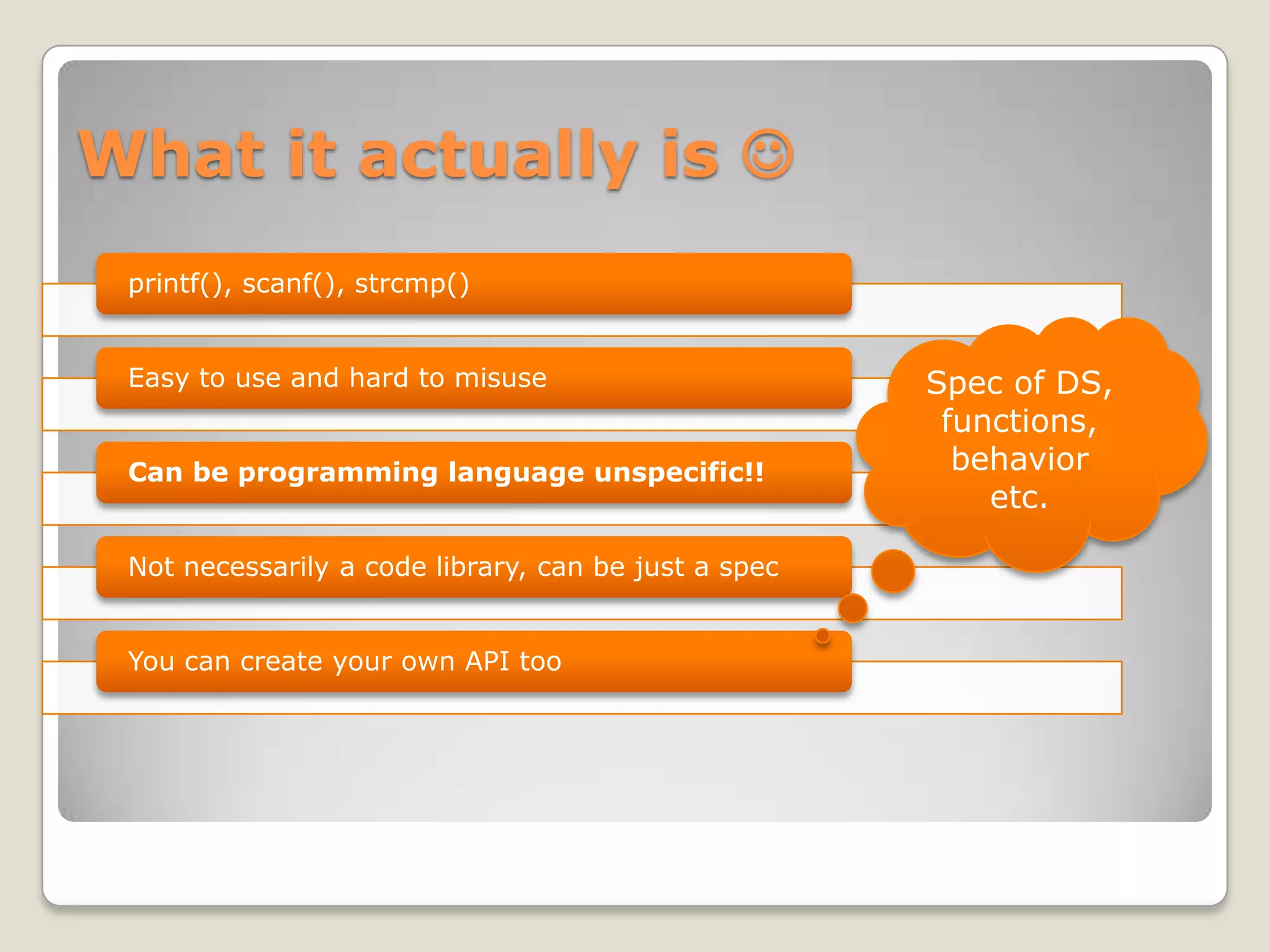
What it actually is 
 printf(), scanf(), strcmp()


 Easy to use and hard to misuse                       Spec of DS,
                                                       functions,
 Can be programming language unspecific!!               behavior
                                                          etc.

 Not necessarily a code library, can be just a spec


 You can create your own API too
Lets design an API
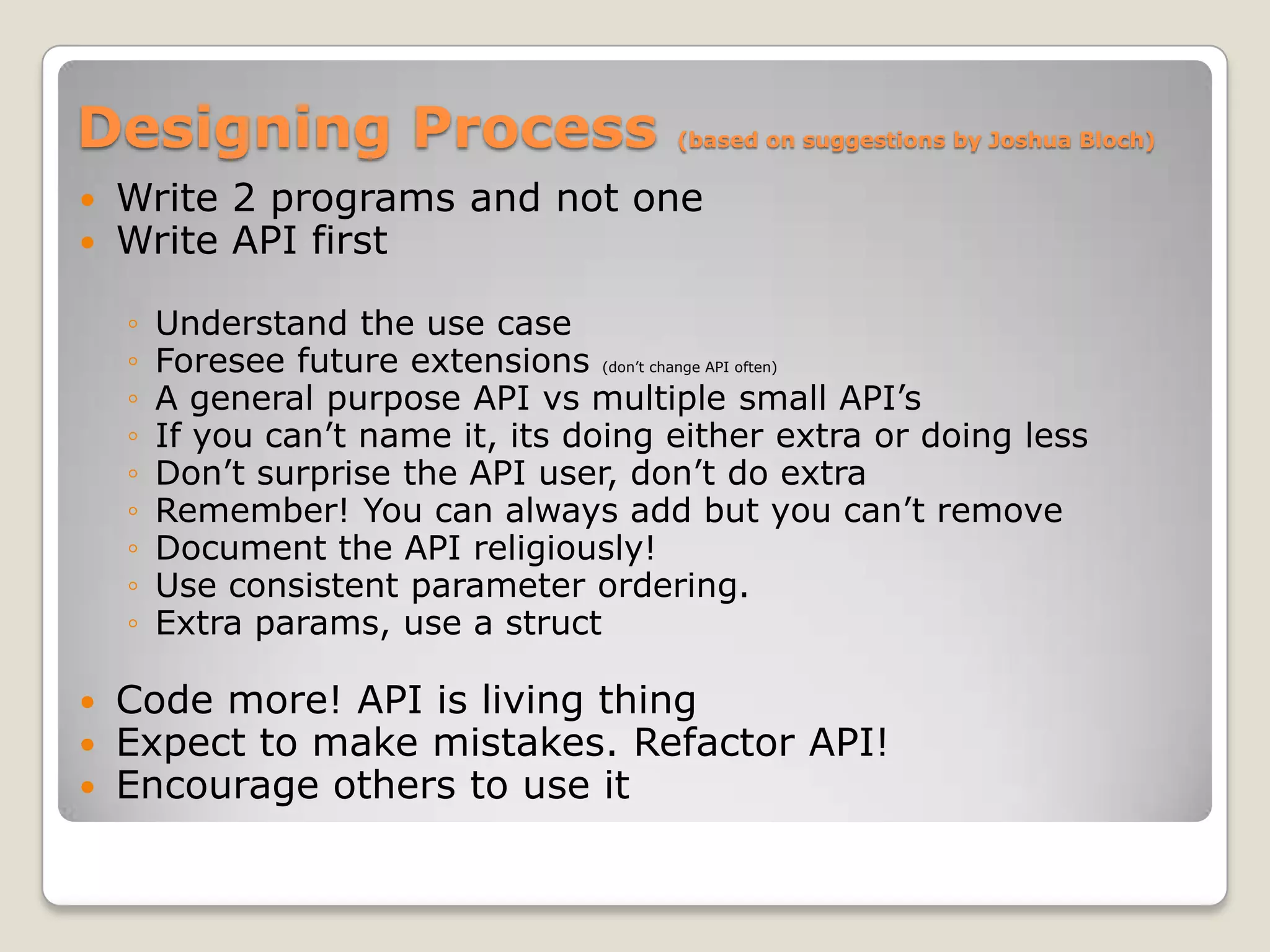
Designing Process                       (based on suggestions by Joshua Bloch)


   Write 2 programs and not one
   Write API first
    ◦   Understand the use case
    ◦   Foresee future extensions (don’t change API often)
    ◦   A general purpose API vs multiple small API’s
    ◦   If you can’t name it, its doing either extra or doing less
    ◦   Don’t surprise the API user, don’t do extra
    ◦   Remember! You can always add but you can’t remove
    ◦   Document the API religiously!
    ◦   Use consistent parameter ordering.
    ◦   Extra params, use a struct

   Code more! API is living thing
   Expect to make mistakes. Refactor API!
   Encourage others to use it
MVC Architecture
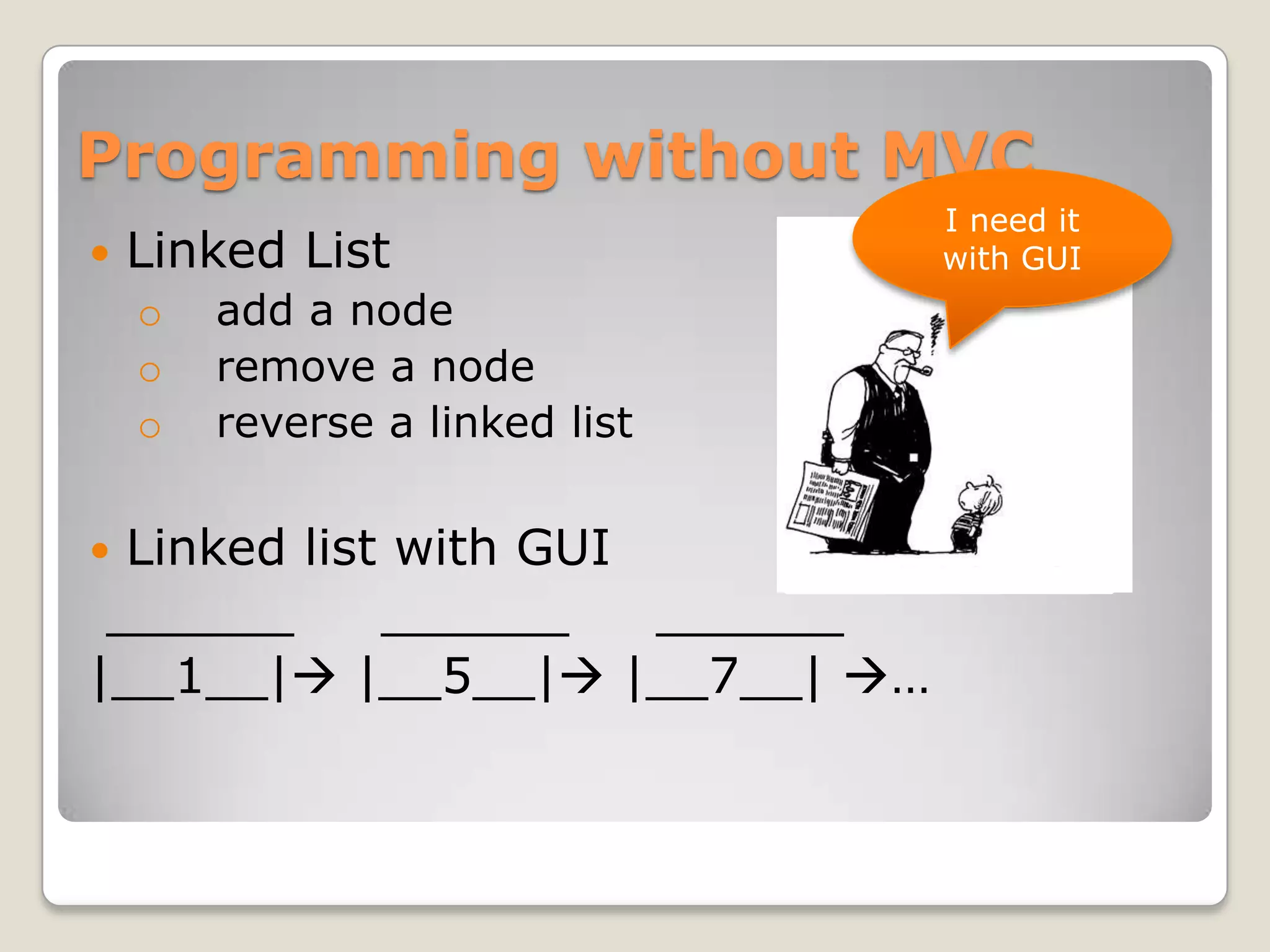
Programming without MVC
                                I need it
   Linked List                 with GUI
    o   add a node
    o   remove a node
    o   reverse a linked list


 Linked list with GUI
 ______      ______    ______
|__1__| |__5__| |__7__| …
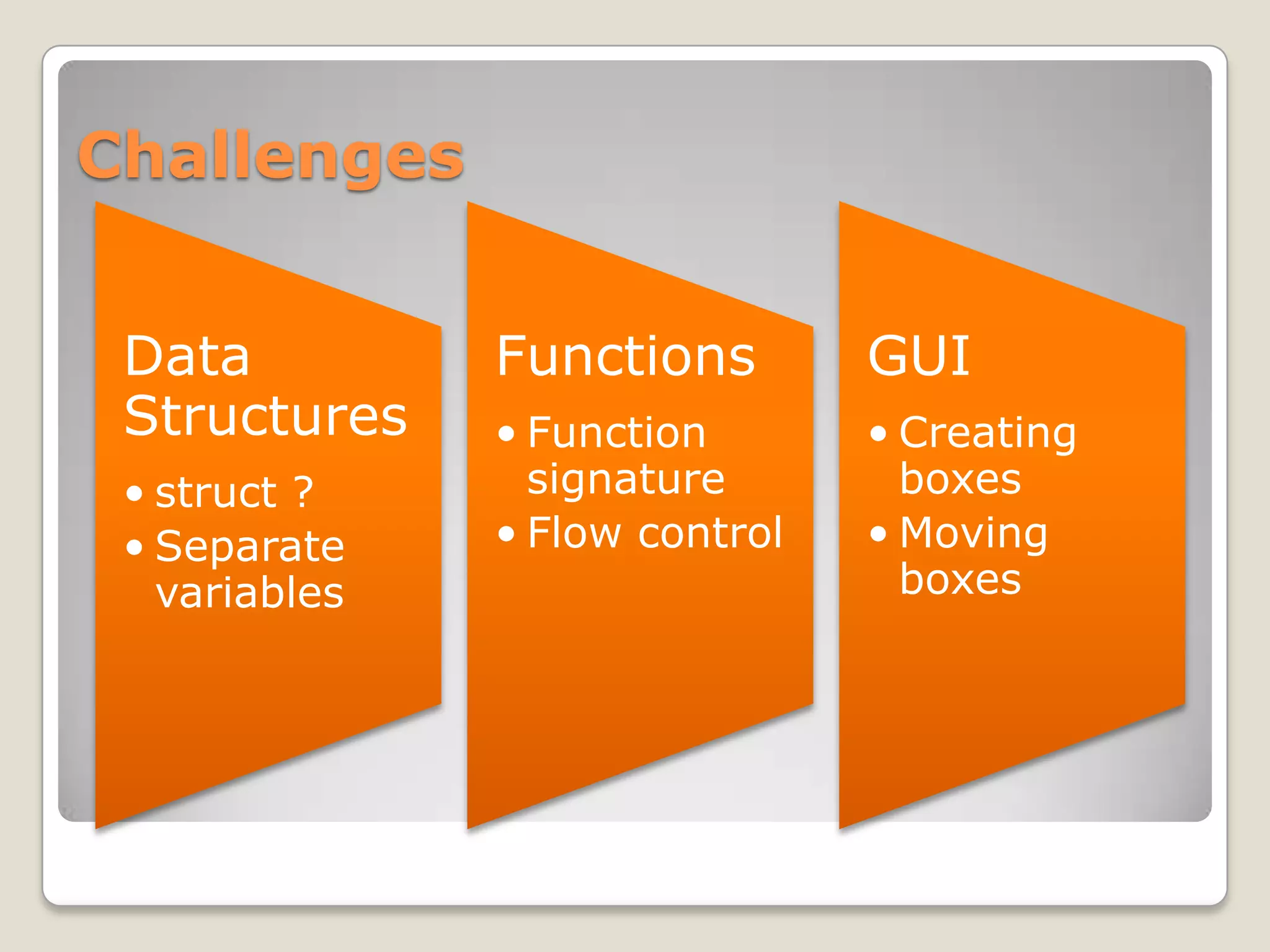
Challenges


 Data          Functions        GUI
 Structures    • Function       • Creating
 • struct ?      signature        boxes
 • Separate    • Flow control   • Moving
   variables                      boxes
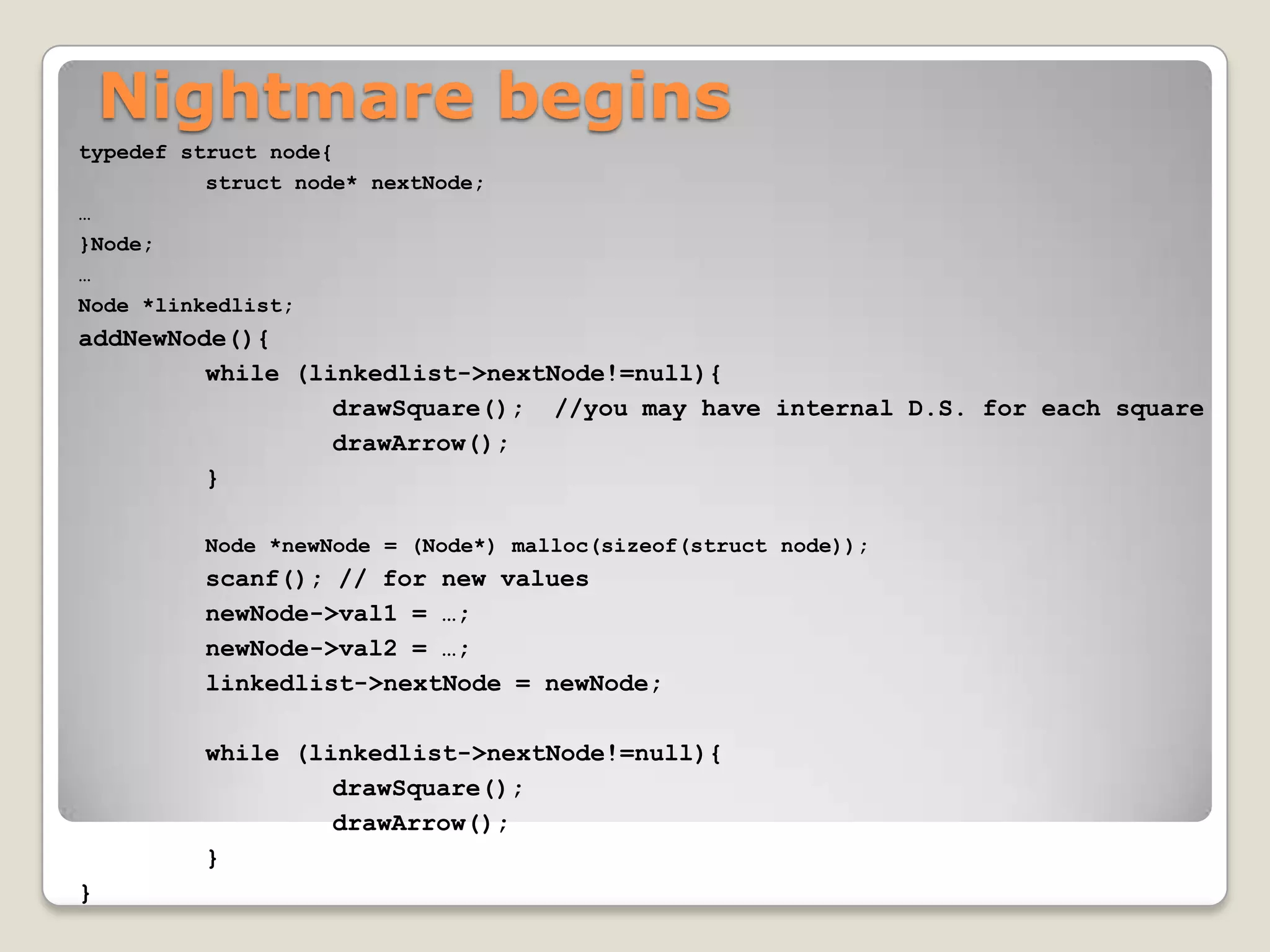
Nightmare begins
typedef struct node{
          struct node* nextNode;
…
}Node;
…
Node *linkedlist;
addNewNode(){
         while (linkedlist->nextNode!=null){
                  drawSquare(); //you may have internal D.S. for each square
                  drawArrow();
         }

         Node *newNode = (Node*) malloc(sizeof(struct node));
         scanf(); // for new values
         newNode->val1 = …;
         newNode->val2 = …;
         linkedlist->nextNode = newNode;

         while (linkedlist->nextNode!=null){
                  drawSquare();
                  drawArrow();
         }
}
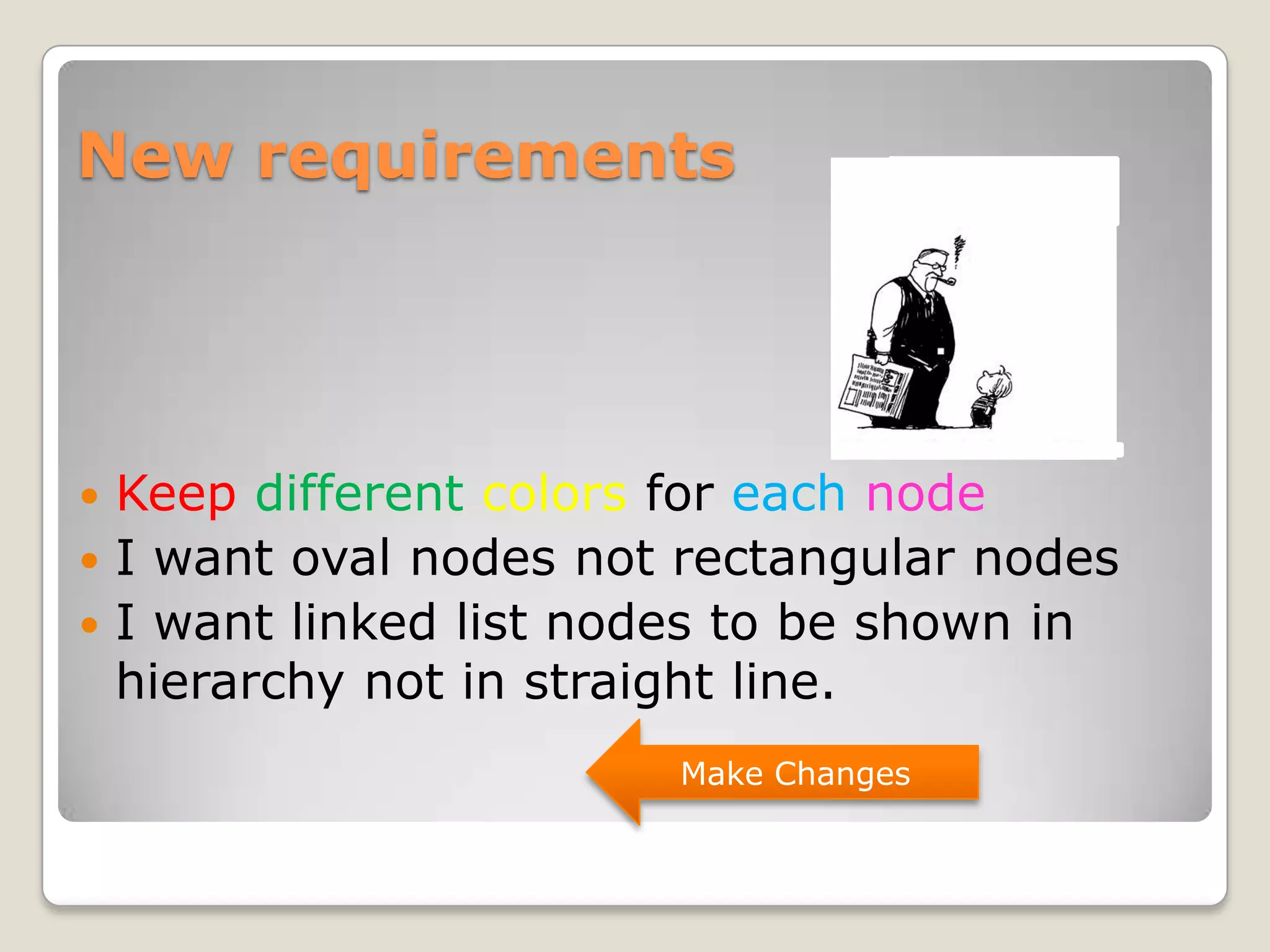
New requirements


 Keep different colors for each node
 I want oval nodes not rectangular nodes
 I want linked list nodes to be shown in
  hierarchy not in straight line.
                       Make Changes
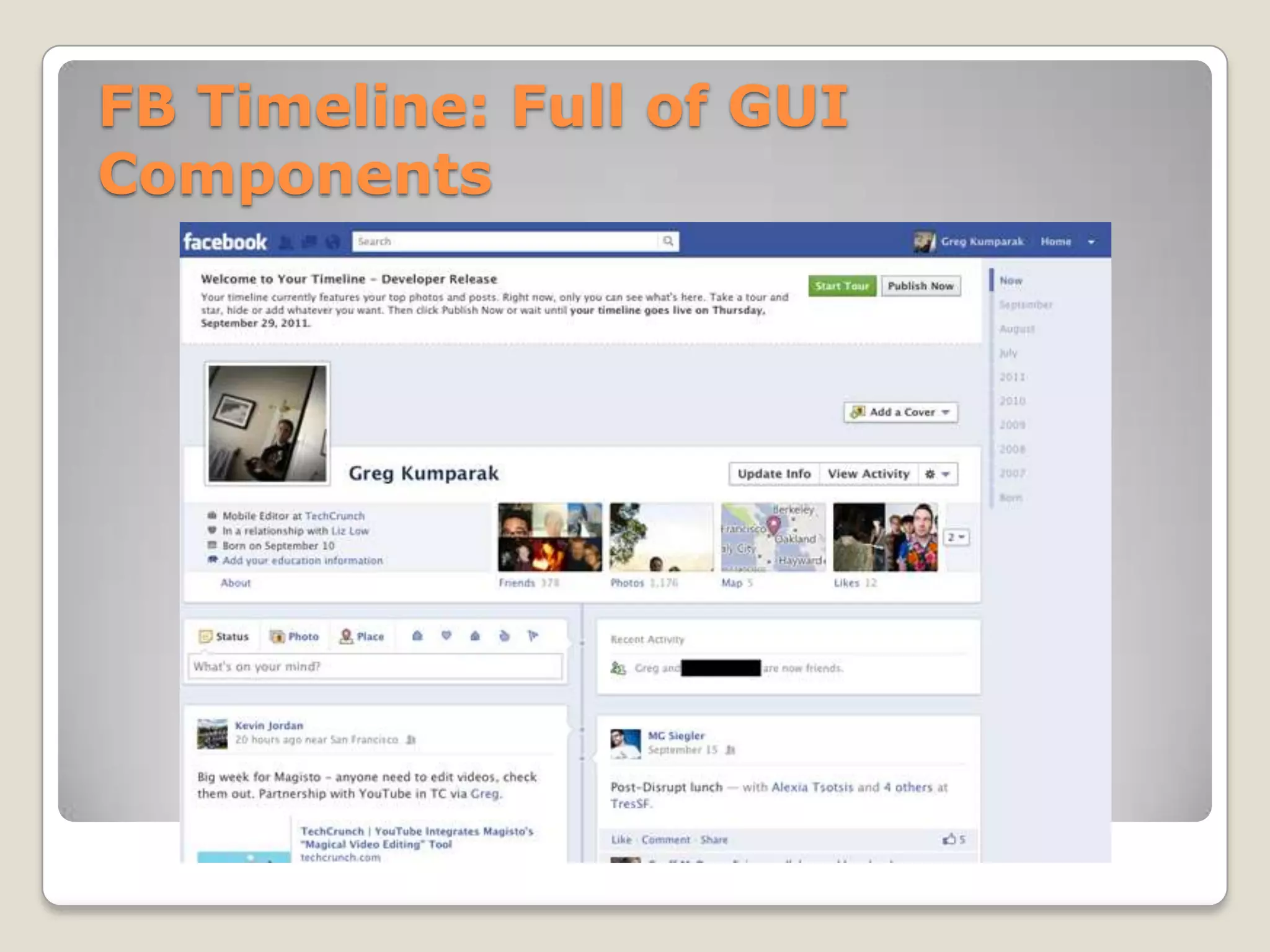
FB Timeline: Full of GUI
Components
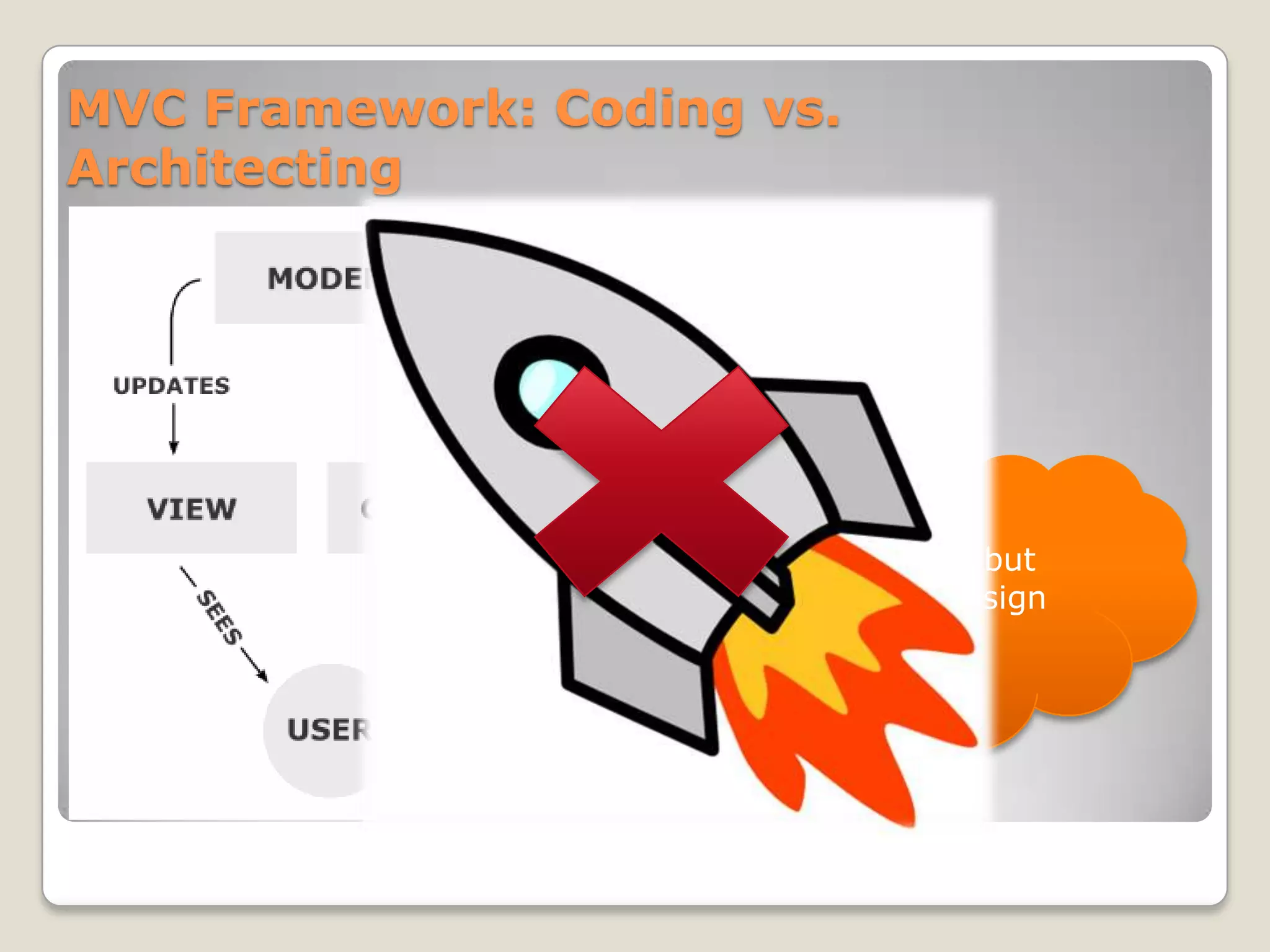
MVC Framework: Coding vs.
Architecting


                       Its nothing but
                       how you design
                       your code.
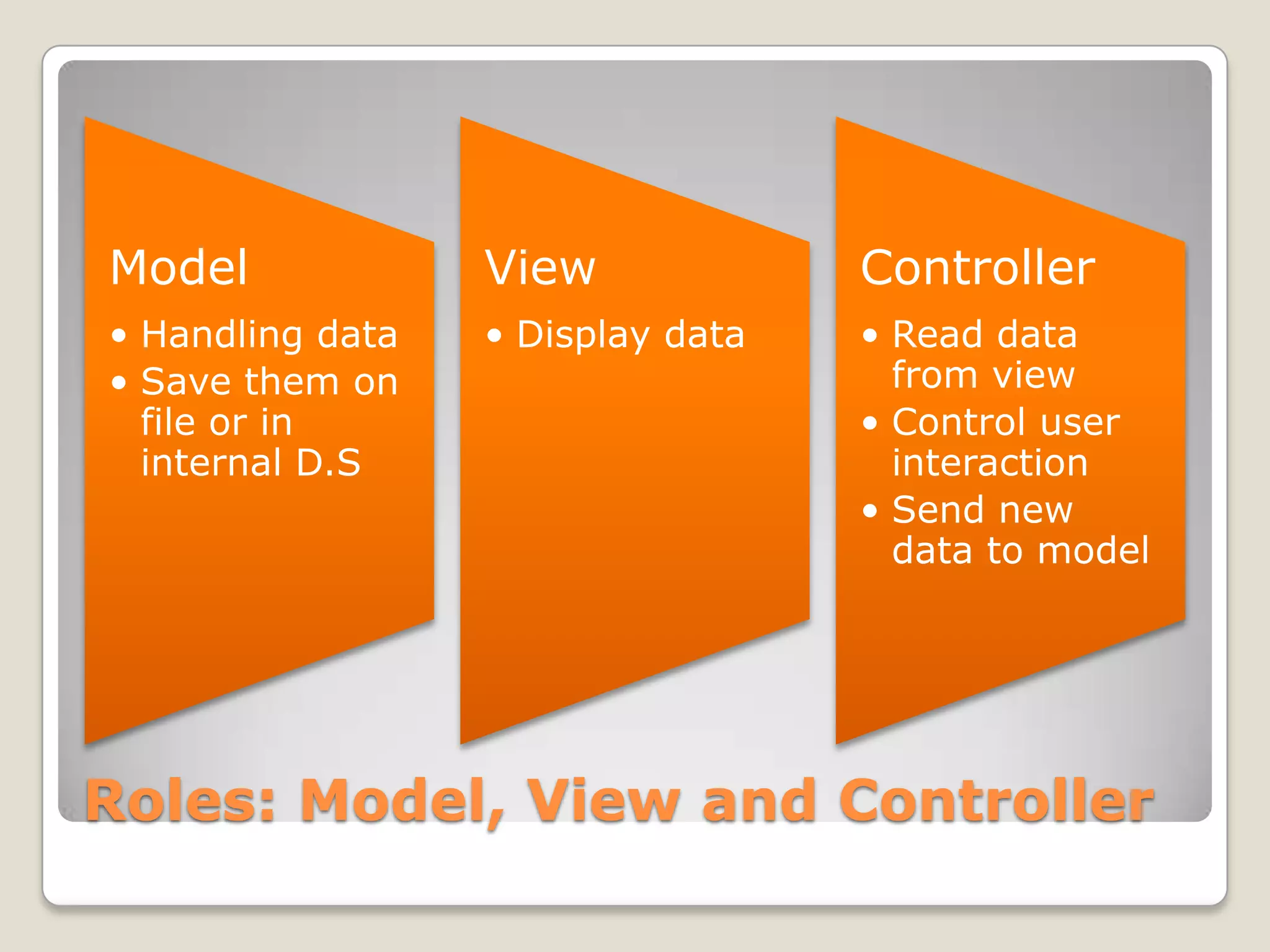
Model             View             Controller
• Handling data   • Display data   • Read data
• Save them on                       from view
  file or in                       • Control user
  internal D.S                       interaction
                                   • Send new
                                     data to model


Roles: Model, View and Controller
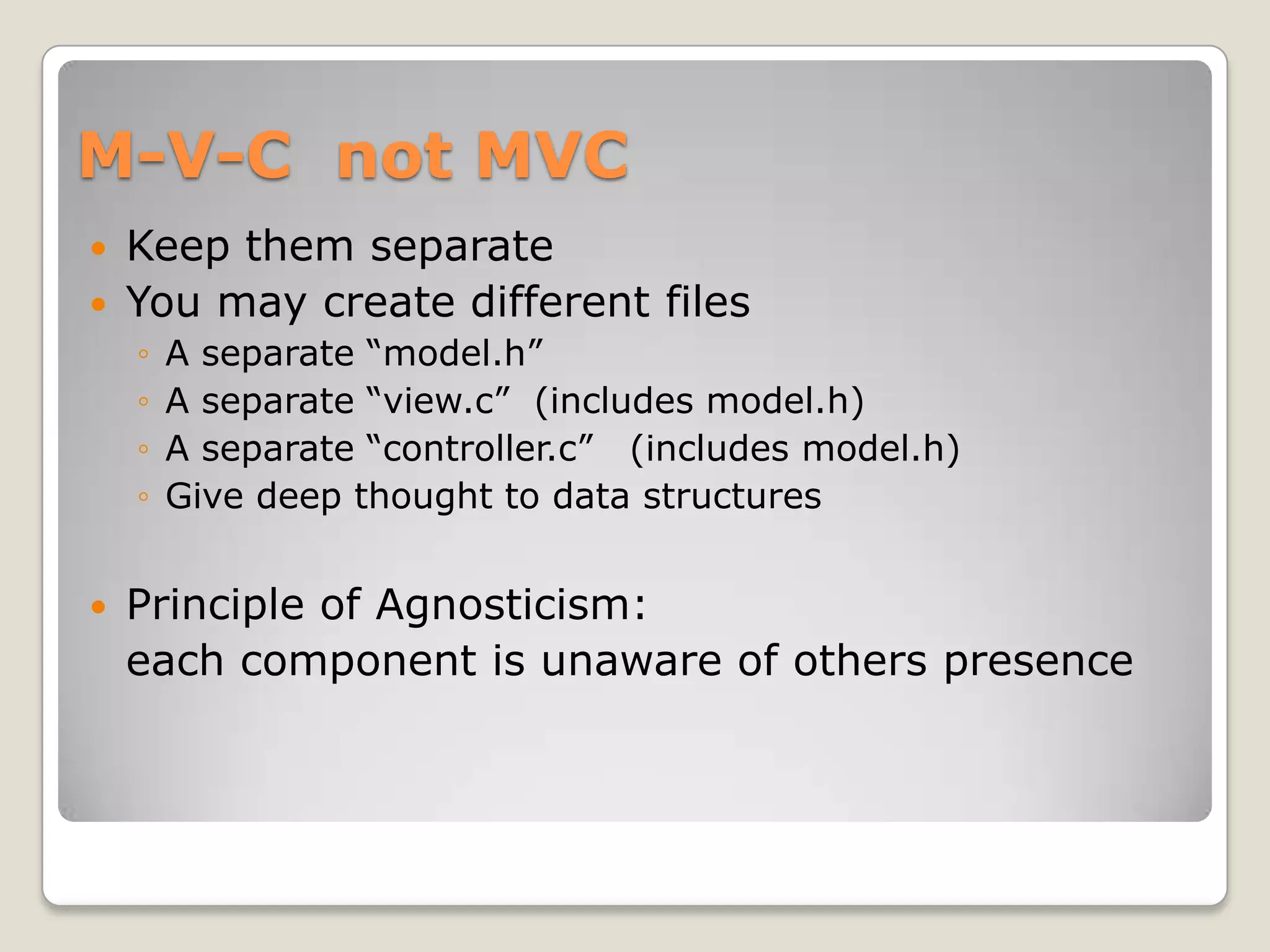
M-V-C not MVC
   Keep them separate
   You may create different files
    ◦   A separate “model.h”
    ◦   A separate “view.c” (includes model.h)
    ◦   A separate “controller.c” (includes model.h)
    ◦   Give deep thought to data structures


   Principle of Agnosticism:
    each component is unaware of others presence
Model
typedef struct node{                               C++ or other
   struct node* nextNode;
   int id;                                        OOP languages
   …                                              make finding the
}Node;
int globalId = 0;
                                                   context easy

typedef struct linkedList{
   Node * headNode;
   int id;
   int listLength;
}LinkedList;
LinkedList *linkedListPool[];

void addNode(int linkedListId, int index, Node *newNode){
   …
}
void removeNode(int linkedListId, Node *node){
   …
}

LinkedList* createNewLinkedList(){
   LinkedList* newll = (LinkedList*) malloc(sizeof(struct linkedList));
   newll->id = globalId++;
   newll->headNode = (Node*) malloc(sizeof(struct node));
   newll->length = 0;
   linkedListPool[globalId] = newll;
   return newll;
}
View
typedef struct viewNode{
       struct viewNode* nextViewNode;
       int xLocation, int yLocation;
       String color; //#FF3e2A (in hex)
…
}ViewNode;

//Similar to Model create another struct
typedef struct display{
  ViewNode* head;
  int id;
  int length;
}Display;
Display *displayNodeList[];
void addDisplayNode(int viewNodeId, int index, Node *newNode){
       //create new ViewNode
       //Render UI
  …
}

//create new display node like Model
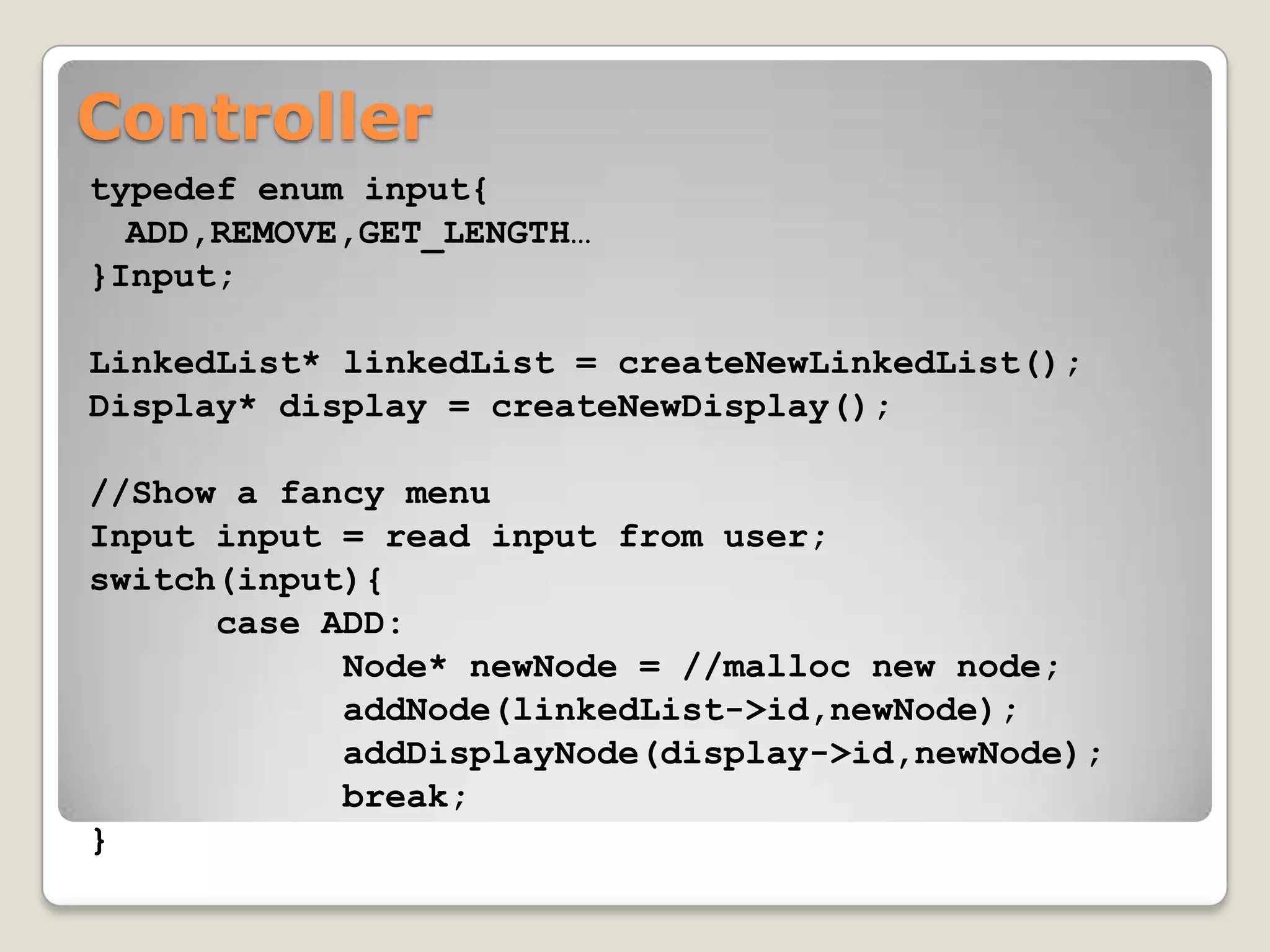
Controller
typedef enum input{
  ADD,REMOVE,GET_LENGTH…
}Input;

LinkedList* linkedList = createNewLinkedList();
Display* display = createNewDisplay();

//Show a fancy menu
Input input = read input from user;
switch(input){
      case ADD:
            Node* newNode = //malloc new node;
            addNode(linkedList->id,newNode);
            addDisplayNode(display->id,newNode);
            break;
}
Questions ?

OOP, API Design and MVP

  • 1.
    SOLID OOPS ConvertingReal worldentities into programming Objects ; understanding its applications ; API designing, MVC framework
  • 2.
    We apologize for wrong session title   Lets know each other  Your expectations  Our aim  Why should you join this session  Goodies for active participants  Introduction
  • 3.
     What is“Real”?  Everything outside of your program is Real.  Even your own program is a Real World Entity for some other program or even for your own program!  In short Real World Entity…
  • 4.
     Because theseare all the “things” on which we want to work upon.  Yes, and by work we do not mean, just writing the code!  Why do we bother about this?
  • 5.
    Objects? Why?  How are they introduced in the programming world?  Where are they used often?  State and behaviour  Who should use it? Correlating to programming objects
  • 6.
     We separateour real world entities in different groups  Object is an instance of a class Ball instances of What is this class?
  • 7.
     How classesare organized?  Why classes need to be organized?  Is there any standard way to do it?  If yes, whats it? Organization
  • 8.
    How these different attributes of a class are defined?  fields/properties - state  methods/functions - behavior  constructors/initializers  destructors What class contains?
  • 9.
     What isthe object oriented way of getting rich ? — Inheritance  Relations between the classes  By the way, are you good at relations? Relations
  • 10.
    Have you watched Television? Interface
  • 11.
    Something you use to keep your stuff from mixing together  Folders  Drives  A customized, more sophisticated package  Examples familiar to you are, ◦ ZIP file ◦ EXE file ◦ DLL file etc. Point is, keep your stuff organized. Package
  • 12.
    What is Abstraction? • Abstraction - a concept or idea not associated with any specific instance • It is all about perspective
  • 13.
    Where does abstractionexist? • Control abstraction o Abstraction of actions • Data abstraction o Abstraction of information
  • 14.
    How does thisrelate to programming? • Writing functions/subroutines is control abstraction. • Datatypes is data abstraction.
  • 15.
    Data Abstraction • Generalization • Specialization
  • 16.
    Example public class Animalextends LivingThing{ theChicken = new Animal(); private Location loc; theCat = new Animal();if private double energyReserves; (theChicken.isHungry()) public boolean isHungry() { { return energyReserves < 2.5; theChicken.eat(grains);} } if (theCat.isHungry()) { public void eat(Food f) { theCat.eat(mouse);} // Consume food theCat.moveTo(theSofa); energyReserves += f.getCalories(); } public void moveTo(Location l) { // Move to new location loc = l; }}
  • 17.
    It's relevance withOOP • Object is an attempt to combine data and control abstraction • Polymorphism • Inheritence
  • 18.
    Why do this? • Separate the business logic from the underlying complexity • Make it easier to parallelize tasks • Meaningful amount of details are exposed • Representation in a similar form in semantics (meaning) while hiding implementation details.
  • 19.
    Why do wewrite programs?
  • 20.
    We have theright objects in place, now what? • Let's get them talking to each other • Let's actually tell them what to talk about
  • 21.
    What sort ofmessages? • Creation • Invocation • Destruction
  • 22.
    Who generates these messages? • Aliens? • Platform • The Government? • User Interaction • Events
  • 23.
  • 24.
    String operations I need it to be Hehehe! The menu driven whole 2 hours I will just write a fancy menu Programming Lab I
  • 25.
    Set operations Again!*$%#@ I need it to be Menu will be menu driven “Enter 1 to proceed 0 to exit” Programming Lab I
  • 26.
    Don’ts we do Monolithic programs Single file containing all functions Code repetition Thinking less about function signature Reinventing the wheel
  • 27.
    What we thinkabout API  API
  • 28.
    What it actuallyis  printf(), scanf(), strcmp() Easy to use and hard to misuse Spec of DS, functions, Can be programming language unspecific!! behavior etc. Not necessarily a code library, can be just a spec You can create your own API too
  • 29.
  • 30.
    Designing Process (based on suggestions by Joshua Bloch)  Write 2 programs and not one  Write API first ◦ Understand the use case ◦ Foresee future extensions (don’t change API often) ◦ A general purpose API vs multiple small API’s ◦ If you can’t name it, its doing either extra or doing less ◦ Don’t surprise the API user, don’t do extra ◦ Remember! You can always add but you can’t remove ◦ Document the API religiously! ◦ Use consistent parameter ordering. ◦ Extra params, use a struct  Code more! API is living thing  Expect to make mistakes. Refactor API!  Encourage others to use it
  • 31.
  • 32.
    Programming without MVC I need it  Linked List with GUI o add a node o remove a node o reverse a linked list  Linked list with GUI ______ ______ ______ |__1__| |__5__| |__7__| …
  • 33.
    Challenges Data Functions GUI Structures • Function • Creating • struct ? signature boxes • Separate • Flow control • Moving variables boxes
  • 34.
    Nightmare begins typedef structnode{ struct node* nextNode; … }Node; … Node *linkedlist; addNewNode(){ while (linkedlist->nextNode!=null){ drawSquare(); //you may have internal D.S. for each square drawArrow(); } Node *newNode = (Node*) malloc(sizeof(struct node)); scanf(); // for new values newNode->val1 = …; newNode->val2 = …; linkedlist->nextNode = newNode; while (linkedlist->nextNode!=null){ drawSquare(); drawArrow(); } }
  • 35.
    New requirements  Keepdifferent colors for each node  I want oval nodes not rectangular nodes  I want linked list nodes to be shown in hierarchy not in straight line. Make Changes
  • 36.
    FB Timeline: Fullof GUI Components
  • 37.
    MVC Framework: Codingvs. Architecting Its nothing but how you design your code.
  • 38.
    Model View Controller • Handling data • Display data • Read data • Save them on from view file or in • Control user internal D.S interaction • Send new data to model Roles: Model, View and Controller
  • 39.
    M-V-C not MVC  Keep them separate  You may create different files ◦ A separate “model.h” ◦ A separate “view.c” (includes model.h) ◦ A separate “controller.c” (includes model.h) ◦ Give deep thought to data structures  Principle of Agnosticism: each component is unaware of others presence
  • 40.
    Model typedef struct node{ C++ or other struct node* nextNode; int id; OOP languages … make finding the }Node; int globalId = 0; context easy typedef struct linkedList{ Node * headNode; int id; int listLength; }LinkedList; LinkedList *linkedListPool[]; void addNode(int linkedListId, int index, Node *newNode){ … } void removeNode(int linkedListId, Node *node){ … } LinkedList* createNewLinkedList(){ LinkedList* newll = (LinkedList*) malloc(sizeof(struct linkedList)); newll->id = globalId++; newll->headNode = (Node*) malloc(sizeof(struct node)); newll->length = 0; linkedListPool[globalId] = newll; return newll; }
  • 41.
    View typedef struct viewNode{ struct viewNode* nextViewNode; int xLocation, int yLocation; String color; //#FF3e2A (in hex) … }ViewNode; //Similar to Model create another struct typedef struct display{ ViewNode* head; int id; int length; }Display; Display *displayNodeList[]; void addDisplayNode(int viewNodeId, int index, Node *newNode){ //create new ViewNode //Render UI … } //create new display node like Model
  • 42.
    Controller typedef enum input{ ADD,REMOVE,GET_LENGTH… }Input; LinkedList* linkedList = createNewLinkedList(); Display* display = createNewDisplay(); //Show a fancy menu Input input = read input from user; switch(input){ case ADD: Node* newNode = //malloc new node; addNode(linkedList->id,newNode); addDisplayNode(display->id,newNode); break; }
  • 43.