In the Middle Ages Presentation by Mindy McAdams Week 6.2 / MMC 2265
“ Axemakers”? Huh? The “axemakers” are the  scientists  and  engineers   The  toolmakers The  inventors Those who apply knowledge Those who discover new knowledge From the 1995 book  The Axemaker’s Gift,  by James Burke and Robert Ornstein
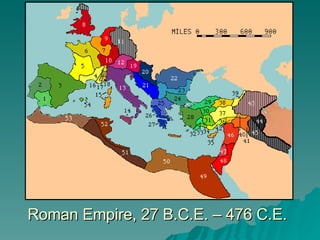
Roman Empire, 27 B.C.E. – 476 C.E.
Religion and the Roman Empire Diverse religious practices and beliefs Differed from region to region The Roman state religion mandated worship of: Traditional Roman gods such as Jupiter, Mars and Apollo The Emperor (after he had died) Some members of the Imperial family
Religion and the Roman Empire The Romans’ religion co-existed with local cults, local superstitions and  magic in the places they conquered Tolerance of other religions --  so long as  they did not threaten: Public order  Roman control and authority
Christianity and the Romans Roman Emperor Nero ordered the  first  mass persecution of Christians in  64 C.E.  (They were tortured and killed.) One of the Christians’ biggest “offenses”: They refused to sacrifice to the Roman gods Roman Emperor  Constantine  converted to Christianity c.  312 C.E.
Constantine, 272 - 337 C.E. Converted to Christianity (312 C.E.) Immediately declared that  both  Christians and pagans should be allowed to worship freely Restored property that had been confiscated during persecutions Founded a new city and named it after himself:  Constantinople
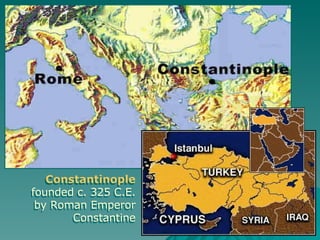
Constantinople  founded c. 325 C.E. by Roman Emperor Constantine Constantinople  founded c. 325 C.E. by Roman Emperor Constantine
After Constantine In  395 C.E.,  the Roman Empire was  divided  into two parts: Constantinople  remained the center and capital of the  Eastern  Empire The  Western  Empire fell to “the onslaughts of the barbarians” “Barbarians” sacked Rome in 410; Roman Empire is  finished  in 476 The number of Christians  increased   gradually  from years 312 to 500 C.E.
 
The Middle Ages of Europe “Dark Ages”:  300  to  1500  C.E. (or c. 395 – 1517) Same as  medieval  times Roman rule ended, and with it, order Lack of learning, lack of cultural growth and achievement “Dark” in the sense of  an absence of light
The Power of the Church During the Middle Ages, in both Eastern and Western Europe, the clergy held great power Kings and princes were  illiterate Monks and other clergy were trained to read and write (monasteries) A wide geographical  network  of messages and intrigue
The Crusades Crusades: Several wars waged by Christians from 1095 to 1291 Goal: To take back Jerusalem from the Muslims Ordered by the Pope in Rome Movie (2005): “Kingdom of Heaven,” starring Orlando Bloom
Meanwhile, among the Muslims The written knowledge and learning of the  Greeks  (Alexander’s empire) was  preserved  and  expanded  by Muslims during Europe’s Dark Ages Nestorians : Exiled Christians (heretics) living near Baghdad Caliph al-Mansur  (712 – 775) of Baghdad ordered the translation of texts in the Nestorian library
Arab and Persian Knowledge The  Abbasid Caliphate  (750 – 1258) moved the capital of the Arab Empire from Damascus to  Baghdad Scholarship flourished Many foreign texts  were  translated  into Persian and Arabic – texts about  astrology, mathematics, agriculture, medicine  and  philosophy Large libraries were built Exiled scholars from the Byzantine Empire were welcomed
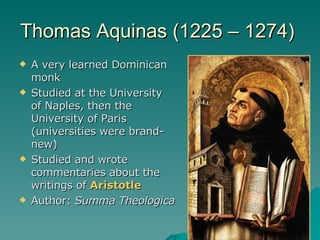
Thomas Aquinas (1225 – 1274)  A very learned Dominican monk Studied at the University of Naples, then the University of Paris (universities were brand-new) Studied and wrote commentaries about the writings of  Aristotle Author:  Summa Theologica
Thomas Aquinas (1225 – 1274)  His writings showed that faith (religion) and science  did not cancel each other out You could study the sciences, the natural world, and not be a heretic
In the Middle Ages Presentation by Mindy McAdams University of Florida

In the Middle Ages

  • 1.
    In the MiddleAges Presentation by Mindy McAdams Week 6.2 / MMC 2265
  • 2.
    “ Axemakers”? Huh?The “axemakers” are the scientists and engineers The toolmakers The inventors Those who apply knowledge Those who discover new knowledge From the 1995 book The Axemaker’s Gift, by James Burke and Robert Ornstein
  • 3.
    Roman Empire, 27B.C.E. – 476 C.E.
  • 4.
    Religion and theRoman Empire Diverse religious practices and beliefs Differed from region to region The Roman state religion mandated worship of: Traditional Roman gods such as Jupiter, Mars and Apollo The Emperor (after he had died) Some members of the Imperial family
  • 5.
    Religion and theRoman Empire The Romans’ religion co-existed with local cults, local superstitions and magic in the places they conquered Tolerance of other religions -- so long as they did not threaten: Public order Roman control and authority
  • 6.
    Christianity and theRomans Roman Emperor Nero ordered the first mass persecution of Christians in 64 C.E. (They were tortured and killed.) One of the Christians’ biggest “offenses”: They refused to sacrifice to the Roman gods Roman Emperor Constantine converted to Christianity c. 312 C.E.
  • 7.
    Constantine, 272 -337 C.E. Converted to Christianity (312 C.E.) Immediately declared that both Christians and pagans should be allowed to worship freely Restored property that had been confiscated during persecutions Founded a new city and named it after himself: Constantinople
  • 8.
    Constantinople foundedc. 325 C.E. by Roman Emperor Constantine Constantinople founded c. 325 C.E. by Roman Emperor Constantine
  • 9.
    After Constantine In 395 C.E., the Roman Empire was divided into two parts: Constantinople remained the center and capital of the Eastern Empire The Western Empire fell to “the onslaughts of the barbarians” “Barbarians” sacked Rome in 410; Roman Empire is finished in 476 The number of Christians increased gradually from years 312 to 500 C.E.
  • 10.
  • 11.
    The Middle Agesof Europe “Dark Ages”: 300 to 1500 C.E. (or c. 395 – 1517) Same as medieval times Roman rule ended, and with it, order Lack of learning, lack of cultural growth and achievement “Dark” in the sense of an absence of light
  • 12.
    The Power ofthe Church During the Middle Ages, in both Eastern and Western Europe, the clergy held great power Kings and princes were illiterate Monks and other clergy were trained to read and write (monasteries) A wide geographical network of messages and intrigue
  • 13.
    The Crusades Crusades:Several wars waged by Christians from 1095 to 1291 Goal: To take back Jerusalem from the Muslims Ordered by the Pope in Rome Movie (2005): “Kingdom of Heaven,” starring Orlando Bloom
  • 14.
    Meanwhile, among theMuslims The written knowledge and learning of the Greeks (Alexander’s empire) was preserved and expanded by Muslims during Europe’s Dark Ages Nestorians : Exiled Christians (heretics) living near Baghdad Caliph al-Mansur (712 – 775) of Baghdad ordered the translation of texts in the Nestorian library
  • 15.
    Arab and PersianKnowledge The Abbasid Caliphate (750 – 1258) moved the capital of the Arab Empire from Damascus to Baghdad Scholarship flourished Many foreign texts were translated into Persian and Arabic – texts about astrology, mathematics, agriculture, medicine and philosophy Large libraries were built Exiled scholars from the Byzantine Empire were welcomed
  • 16.
    Thomas Aquinas (1225– 1274) A very learned Dominican monk Studied at the University of Naples, then the University of Paris (universities were brand-new) Studied and wrote commentaries about the writings of Aristotle Author: Summa Theologica
  • 17.
    Thomas Aquinas (1225– 1274) His writings showed that faith (religion) and science did not cancel each other out You could study the sciences, the natural world, and not be a heretic
  • 18.
    In the MiddleAges Presentation by Mindy McAdams University of Florida